EP2353955A1 - Ground effect load transportation - Google Patents
Ground effect load transportation Download PDFInfo
- Publication number
- EP2353955A1 EP2353955A1 EP11250146A EP11250146A EP2353955A1 EP 2353955 A1 EP2353955 A1 EP 2353955A1 EP 11250146 A EP11250146 A EP 11250146A EP 11250146 A EP11250146 A EP 11250146A EP 2353955 A1 EP2353955 A1 EP 2353955A1
- Authority
- EP
- European Patent Office
- Prior art keywords
- skirt
- bristles
- platform
- ground
- plenum chamber
- Prior art date
- Legal status (The legal status is an assumption and is not a legal conclusion. Google has not performed a legal analysis and makes no representation as to the accuracy of the status listed.)
- Granted
Links
- 230000000694 effects Effects 0.000 title claims abstract description 9
- 238000007789 sealing Methods 0.000 claims abstract description 22
- 239000004677 Nylon Substances 0.000 claims description 4
- 229920001778 nylon Polymers 0.000 claims description 4
- 229920000728 polyester Polymers 0.000 claims description 4
- 229920000915 polyvinyl chloride Polymers 0.000 claims description 4
- 238000004873 anchoring Methods 0.000 description 14
- 238000005728 strengthening Methods 0.000 description 10
- 238000010276 construction Methods 0.000 description 7
- 229910000831 Steel Inorganic materials 0.000 description 5
- 239000010959 steel Substances 0.000 description 5
- 239000004698 Polyethylene Substances 0.000 description 2
- 239000000463 material Substances 0.000 description 2
- 230000004048 modification Effects 0.000 description 2
- 238000012986 modification Methods 0.000 description 2
- -1 polyethylene Polymers 0.000 description 2
- 229920000573 polyethylene Polymers 0.000 description 2
- 235000008733 Citrus aurantifolia Nutrition 0.000 description 1
- 235000011941 Tilia x europaea Nutrition 0.000 description 1
- 230000002745 absorbent Effects 0.000 description 1
- 239000002250 absorbent Substances 0.000 description 1
- 238000007792 addition Methods 0.000 description 1
- 239000000853 adhesive Substances 0.000 description 1
- 230000001070 adhesive effect Effects 0.000 description 1
- 238000001125 extrusion Methods 0.000 description 1
- 239000004571 lime Substances 0.000 description 1
- 239000004033 plastic Substances 0.000 description 1
- 229920003023 plastic Polymers 0.000 description 1
- 229920002635 polyurethane Polymers 0.000 description 1
- 239000004814 polyurethane Substances 0.000 description 1
- 230000000717 retained effect Effects 0.000 description 1
- 230000035939 shock Effects 0.000 description 1
- 239000000725 suspension Substances 0.000 description 1
Images



Classifications
-
- B—PERFORMING OPERATIONS; TRANSPORTING
- B60—VEHICLES IN GENERAL
- B60V—AIR-CUSHION VEHICLES
- B60V1/00—Air-cushion
- B60V1/16—Flexible skirts
-
- B—PERFORMING OPERATIONS; TRANSPORTING
- B60—VEHICLES IN GENERAL
- B60V—AIR-CUSHION VEHICLES
- B60V3/00—Land vehicles, waterborne vessels, or aircraft, adapted or modified to travel on air cushions
- B60V3/02—Land vehicles, e.g. road vehicles
Definitions
- This invention relates to load transportation by means of vehicles using ground effect to support part of the load.
- the present invention seeks to obviate or reduce these above disadvantages.
- a ground effect transport system comprising a plenum roof platform for location beneath a load carrying means, a skirt depending from the platform to form a plenum chamber with the platform, fan means on or in the platform for supplying air to the plenum chamber, wherein the skirt extends downwardly towards the ground surface and has a ground engaging support member for supporting the bottom of the skirt above the ground surface and a separate detachable sealing member for providing a seal between the bottom of the skirt and the ground surface.
- the detachable sealing member may be located at an inner side of the support member and may comprise a sealing part in contact with the ground surface and an attachment part detachably attached to the skirt and attached to the sealing part by a hinge whose axis extends in the longitudinal direction of the skirt.
- the ground engaging support member may comprise a brush surface.
- the brush surface may be formed on a base element which is fastened to the base of the skirt.
- the base element may be detachable from the skirt to enable replacement of the brush surface when worn.
- the brush surface may comprise a large number of downwardly extending flexible bristles which may be PBT. Polyester, PVC or nylon.
- the bristles may be of a length ranging from 20 to 30 mm and may be angled backwards from the intended direction of travel of the load. The angle of inclination of the bristles may be equal to or less than 30 degrees to the vertical.
- FIG 1 there is shown schematically a vehicle 1 to which the invention is applied.
- the vehicle shown is a semi-trailer which is a vehicle having a cab unit 3 which is self contained and is supported on the ground by two steerable front wheels 5 and four trailing wheels 7 at the rear.
- the trailer portion 9 in this case is, for transit purposes, supported at its rear by wheels 10 and by a plenum chamber 11 defined in part by a skirt 13 and at its front end by the rear wheels 7 of the cab unit 3 over which the front end of the trailer extends.
- FIG. 2 there is shown a rear view of the trailer 9 of the semi-trailer 1.
- the skirt arrangement is sectioned so as to indicate how the skirt is located.
- the trailer 9 comprises a load carrying platform 21 which is basically supported towards its rear end by the six wheels 10 and at its forward end, when not connected to a cab unit 3 ( figure 1 ) by means of loading legs (not shown).
- the trailer 9 is connected as usual to the cab unit 3 by means of a king pin. In this situation, the landing legs are folded up towards the load supporting platform 21.
- a framework comprising two longitudinally extending "I" beams 23 from which the plenum chamber 11 is suspended by a pair of suspension connectors 25 ( fig 7 ).
- the plenum chamber 11 is located inboard of the rear wheels 10 of the trailer 9 so that the wheels 10 are fully accessible.
- the "I" beams 23 sit above the wheel axles using a system of air bags 26 between the axles and the "I" beams 23.
- the plenum chamber will extend for a suitable distance above the ground generally in a range from 25.4 cm (10 inches) to 45.72 cm (18 inches) but with a preferable distance of 35.56 cm (14 inches).
- the plenum chamber 11 comprises a plenum roof platform 27 extending over the whole area of the plenum chamber 11 and is the same shape as the plenum chamber 11.
- the skirt 13 is continuous and unbroken around the entire periphery of the plenum chamber 11.
- One or more fans for providing the air supply to the plenum chamber 11 are mounted on the plenum roof platform, one of these being shown in Figure 2 at 31. Usually there will be two fans, these being located spaced along the length of the plenum chamber. However, if desired, a single fan could be used situated at either end of the plenum chamber.
- Figures 3 shows the construction of the skirt 13 and its attachment to the plenum roof platform 27.
- the skirt 13 has a cross section shape of a "J" or a mirror image thereof depending on which direction it is being looked at.
- the upper part 33 of the straight leg 35 is attached to the edge of the plenum roof platform by a connecting arrangement 37 in the form of a fixing plate fastened to the chamber structure by nuts and bolts by means of which the skirt 13 makes an airtight seal with the plenum roof 27.
- the skirt 13 is preferably made from extruded polyurethane. Preferable values for this material are
- the "U” part 41 of the “J” is the part of the skirt 13 which engages the ground surface 43 and is provided with ground engaging member in the form of a brush surface 44 and a sealing member 52 located inwards of the brush surface 44.
- This brush surface is designed to raise the bottom of the skirt from the ground surface.
- the brush surface 44 is formed on a base element 46 which is fastened to the base of the skirt by means, such as bolts, (not shown) and is detachable from the skirt to enable replacement of the brush surface 44 when worn.
- the base is slotted into an inset space on the underside of the skirt.
- the brush surface 44 comprises a large number of downwardly extending flexible bristles 48 formed suitably from PBT. Polyester, PVC or nylon with a thickness of between 0.7 and 1 mm..
- the bristles 48 are of a length ranging from 20 to 30 mm (preferably 20 to 25 mm) and are angled backwards from the intended direction of travel of the load at an angle of inclination of the bristles 48 equal to or less than 30 degrees to the vertical, preferably between 15 and 25 degrees.
- a shock absorbent layer (also not shown) will normally be provided between the base element and the skirt surface to reduce wear.
- the sealing member 52 comprises a sealing part 54 which is in engagement with the ground surface 43 and an attachment part 56 which is removably attached to the "U" part of the skirt, for example, by bolts 58 and to the sealing part 54 by a hinge 62 whose axis extends in the longitudinal direction of the skirt.
- the sealing part 54 is maintained in contact with the ground surface by the action of the hinge 62 and its weight to maintain a seal between the skirt and the ground surface with minimum force and friction to the ground.
- the sealing part may be made of a modified polyethylene such as that sold under the registered trade mark TIVAR.
- the skirt 13 basically comprises a top substantially rigid portion 33 which terminates in an inwardly extending strengthening rib 45 which extends longitudinally of the skirt 13. Inside of the strengthening rib 45 is provided a aperture, and a wire, rod or tube 47, suitably of steel, is provided therein. Sections of the rod 47 are suitably connected at their ends to provide a continuous rod which rod extends around the periphery of the plenum chamber 11. Below the strengthening rib 45 is a section 49 which is flexible and ends in a second strengthening rib 51 which also contains a strengthening wire rod or tube 53 also suitably of steel.
- anchoring lines 55 and 57 which, while permitting the skirt to move inwardly of the plenum chamber 11, prevents their movement outwards.
- These anchoring lines may comprise steel wire, steel chain or steel rods.
- the anchoring lines 55 are anchored to plates 54 depending from the plenum roof 27 while the anchoring lines 57 are anchored at their other ends at 59 and 61 (see figure 2 ) to the plenum roof 27.
- the angle between the anchoring lines 55 and 57 and the straight leg 35 of the skirt 13 must lie at 90 degrees for the upper anchoring lime 55, and in the range of 10 to 50 degrees for the lower anchoring line 57, more preferably in the range of 10 to 40 degrees.
- the best angle range for the lower anchoring line 57 is 20 to 30 degrees.
- the anchoring lines should be located at a spacing of no more than 1,000 mm but for maximum effect, this spacing should be reduced, for example, to 350 mm.
- a suitable positioning of the anchoring attachments and thus of the strengthening ribs is 18% down of the free depth of the skirt for the upper anchoring line 55 and 93% for the lower anchoring line 57.
- the skirt As the vehicle travels along the road it will move up and down following the undulating terrain of the road surface. With the skirt constantly touching the road surface through the bristles 48, it will have to compensate for this movement so as to retain pressure in the plenum chamber. For this reason, the skirt has been designed as a "J" section so that the bottom of the "J” will roll round and the straight section above this will flex and keep the seal between the bristles 48 with the road surface constant. This also has the effect of reducing drag which would be created if the skirt was not able to flex.
- Figure 4 shows a similar arrangement to that shown in figure 3 but provides for a different sealing arrangement 52.
- two strips 63 of the modified polyethylene such as that sold under the registered trade mark TIVAR are removably attached to the "U" part of the skirt inboard of the bristles 48 by means of bolts 64.
- the strips 63 have a downwardly convex cross section 66 which is intended to engage the road surface 43.
- the curvature of the strips reduces the friction between the sealing strips 63 and the road surface 43.
- the same shape can be achieved with a single extrusion moulding.
- FIG. 5 is a fragmentary view of the lower part of the "U" shaped part 41 of the skirt 13 showing yet a further sealing arrangement.
- a wear strip 72 of generally rectangular cross section with rounded corners is provided.
- the wear strip 72 engages the road surface 43 with one of its longer rectangular sides 74.
- the wear strip 72 is connected to the skirt by means of a spring bracket 76 which is attached at the end adjacent to the bristles 48 to the wear strip 72 by a bolt 78 and at its other end to the "U" shaped part 41 pf the skirt 13 by a bolt 80.
- FIG. 6 is a fragmentary perspective view showing the construction of the brush surface 44.
- a holder 46 for the bristles 48 comprises a PVC strip 82, suitably of 5 to 7 cm in width, having a number of apertures 84 for receiving the bristles 48. Suitably there may be five apertures 84 across the strip with the apertures being spaced apart by 0.5 cm.
- the apertures are intended to receive 6 to 10 bristles 48 in each aperture 84.
- the apertures 84 are inclined backwardly to the direction of travel of the skirt so that the bristles extend at an angle of less than or equal to thirty degrees, preferably between fifteen and twenty five degrees, to the vertical and are arranged so that they effectively trail in the direction of travel of the skirt.
- the bristles are suitably made of PBT. Polyester, PVC or nylon with a thickness of between 0.7 and 1 mm.
- the length of the bristles is suitably between 20 and 30 mm, preferably between 20 and 25 mm.
- support for the skirt may also be provided by wheels, rollers or the like.
- wheels, rollers or the like for supporting the skirt will enable there to be less friction between the skirt and the ground surface while still maintaining a seal by the use of the wear strip.
- wheels may be attached to a suitable part of the skirt either inside or outside the skirt.
- the wheels would be provided at spaced distances around the skirt and may, if required, be castored to follow the direction of movement of the skirt.
- rollers are used, these may be located directly under the "U" shaped part of the skirt
- Figures 7 to 9 show how the skirt 13 is made up of a number of sections 71 which are connected together and sealed along the lines 73.
- the ends of the moulded sections have a moulded shape such that a shaped rib 74 at one end of a moulded section fits into a shaped groove 76 in the end of the adjacent section, the seal being completed by an adhesive ( fig 7 ).
- the rods 47 and 53 are also provided in sections 75 and these are all connected together as at 77 so as to form a completely continuous rod around the entire periphery of the plenum chamber 11.
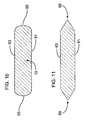
- Figure 10 is a plan view of one embodiment of the skirt 13 from which it can be seen that the skirt has two parallel sides 61 and 63 on opposite sides of the vehicle, these two sides being connected together by "U" shaped ends 65.
- figure 11 is shown a second embodiment with pointed or aerodynamic ends 69 having an apex angle of between 60 and 160 degrees, preferably 67 degrees. All of the elements 61 to 65 or 67 are connected together to form a continuous skirt. It will be appreciated that the pointed ends provide for an increased area for the action of the air cushion and also provide an aerodynamic construction reducing the drag caused by the skirt 13 touching the road surface through bristles 48.
- the amount of pressure needed inside the plenum chamber can be of the order of 1 to 2 pounds per square inch. This will supply, with a suitable area of plenum roof 27, a lifting power of 20 tons. Thus a relatively low power of fans will be required to provide an appropriate lift. Such fans could be for example a single fan of 30 kilowatts. Suitably, the fans would driven by generators driven by the road wheels.
- figure 12 shows an arrangement with a trailer 81 having two plenum chambers 83 and 85, one in front and one behind the six wheels 10
- additional air can be provided using a ram air intake facing forwards above the cab unit
- the plenum chamber could be constructed to be readily removable so that it could be transferred from one vehicle to another.
Landscapes
- Engineering & Computer Science (AREA)
- Aviation & Aerospace Engineering (AREA)
- Transportation (AREA)
- Mechanical Engineering (AREA)
- Body Structure For Vehicles (AREA)
- Road Repair (AREA)
Abstract
Description
- This invention relates to load transportation by means of vehicles using ground effect to support part of the load.
- There have been a number of proposals for easing the load on goods vehicles by taking up a large part of the load using ground effect with a skirt. However, these have had problems due to excessive escape of air from underneath the lower edges of the skirt which has necessitated the use of excessive air supplies in order to maintain the air cushion and provide sufficient support for the load. Other problems include significant wear of the base region of the skirt and some wear effects on the road.
- The present invention seeks to obviate or reduce these above disadvantages.
- According to the invention, a ground effect transport system comprising a plenum roof platform for location beneath a load carrying means, a skirt depending from the platform to form a plenum chamber with the platform, fan means on or in the platform for supplying air to the plenum chamber, wherein the skirt extends downwardly towards the ground surface and has a ground engaging support member for supporting the bottom of the skirt above the ground surface and a separate detachable sealing member for providing a seal between the bottom of the skirt and the ground surface.
- The detachable sealing member may be located at an inner side of the support member and may comprise a sealing part in contact with the ground surface and an attachment part detachably attached to the skirt and attached to the sealing part by a hinge whose axis extends in the longitudinal direction of the skirt.
- The ground engaging support member may comprise a brush surface. The brush surface may be formed on a base element which is fastened to the base of the skirt. The base element may be detachable from the skirt to enable replacement of the brush surface when worn.
- The brush surface may comprise a large number of downwardly extending flexible bristles which may be PBT. Polyester, PVC or nylon. The bristles may be of a length ranging from 20 to 30 mm and may be angled backwards from the intended direction of travel of the load. The angle of inclination of the bristles may be equal to or less than 30 degrees to the vertical.
- The invention will now be described in greater detail by way of example; with reference to the drawings, in which:-
-
Figure 1 is a general schematic side view of a vehicle in accordance with one embodiment of the invention; -
Figure 2 is a rear view of the trailer of a semi-trailer for the vehicle shown inFigure 1 with the support framework for the skirt shown and the details of the wheel arrangements removed. -
Figure 3 is an enlarged sectional side view of the skirt showing details of its construction; -
Figure 4 is a view similar toFigure 3 but showing a different sealing arrangement; -
Figure 5 is a fragmentary view of the bottom of the skirt but showing a still further form of sealing arrangement. -
Figure 6 is a fragmentary perspective view showing the construction of the bristle holder -
Figure 7 is a perspective view showing joints in the connection between adjacent sections of skirt and the attachment of the plenum chamber to the vehicle; -
Figure 8 is an enlarged view of showing a section joint shown infigure 7 ; -
Figure 9 is a sectional view through a section joint as shown infigures 7 and 8 ; -
Figure 10 is a plan view of the footprint of a first embodiment of the skirt; -
Figure 11 is a plan view of the footprint of a second embodiment of the skirt; -
Figure 12 is a general schematic side view of a vehicle in accordance with a second embodiment of the invention. - Referring firstly to
figure 1 , there is shown schematically a vehicle 1 to which the invention is applied. The vehicle shown is a semi-trailer which is a vehicle having acab unit 3 which is self contained and is supported on the ground by two steerablefront wheels 5 and fourtrailing wheels 7 at the rear. Thetrailer portion 9 in this case is, for transit purposes, supported at its rear bywheels 10 and by aplenum chamber 11 defined in part by askirt 13 and at its front end by therear wheels 7 of thecab unit 3 over which the front end of the trailer extends. - The arrangements so far described are known. However, as has been mentioned above, the previous proposals have never been very satisfactory because of excessive escape of air from the plenum chamber due, to a large extent, to the construction of the plenum chamber and particularly of the skirt.
- The application of the invention to the above described semi-trailer vehicle will now be discussed in connection with
figures 2 to 4 . Looking first atfigure 2 , there is shown a rear view of thetrailer 9 of the semi-trailer 1. In this figure, the skirt arrangement is sectioned so as to indicate how the skirt is located. - Thus, the
trailer 9 comprises a load carryingplatform 21 which is basically supported towards its rear end by the sixwheels 10 and at its forward end, when not connected to a cab unit 3 (figure 1 ) by means of loading legs (not shown). When attachment is made to thecab unit 3, thetrailer 9 is connected as usual to thecab unit 3 by means of a king pin. In this situation, the landing legs are folded up towards theload supporting platform 21. - Attached to the
loading platform 21 and depending therebeneath is a framework comprising two longitudinally extending "I"beams 23 from which theplenum chamber 11 is suspended by a pair of suspension connectors 25 (fig 7 ). As can clearly be seen fromfigure 2 , theplenum chamber 11 is located inboard of therear wheels 10 of thetrailer 9 so that thewheels 10 are fully accessible. The "I"beams 23 sit above the wheel axles using a system ofair bags 26 between the axles and the "I"beams 23. Thus the plenum chamber will extend for a suitable distance above the ground generally in a range from 25.4 cm (10 inches) to 45.72 cm (18 inches) but with a preferable distance of 35.56 cm (14 inches). - The
plenum chamber 11 comprises aplenum roof platform 27 extending over the whole area of theplenum chamber 11 and is the same shape as theplenum chamber 11. Theskirt 13 is continuous and unbroken around the entire periphery of theplenum chamber 11. One or more fans for providing the air supply to theplenum chamber 11 are mounted on the plenum roof platform, one of these being shown inFigure 2 at 31. Usually there will be two fans, these being located spaced along the length of the plenum chamber. However, if desired, a single fan could be used situated at either end of the plenum chamber. -
Figures 3 shows the construction of theskirt 13 and its attachment to theplenum roof platform 27. As can be seen, theskirt 13 has a cross section shape of a "J" or a mirror image thereof depending on which direction it is being looked at. Theupper part 33 of thestraight leg 35 is attached to the edge of the plenum roof platform by a connectingarrangement 37 in the form of a fixing plate fastened to the chamber structure by nuts and bolts by means of which theskirt 13 makes an airtight seal with theplenum roof 27. Theskirt 13 is preferably made from extruded polyurethane. Preferable values for this material are - Hardness
- 90 Shore
- Density
- 1,250 kg/m3
- The "U"
part 41 of the "J" is the part of theskirt 13 which engages theground surface 43 and is provided with ground engaging member in the form of abrush surface 44 and a sealingmember 52 located inwards of thebrush surface 44. This brush surface is designed to raise the bottom of the skirt from the ground surface. Thebrush surface 44 is formed on abase element 46 which is fastened to the base of the skirt by means, such as bolts, (not shown) and is detachable from the skirt to enable replacement of thebrush surface 44 when worn. Suitably the base is slotted into an inset space on the underside of the skirt. Thebrush surface 44 comprises a large number of downwardly extendingflexible bristles 48 formed suitably from PBT. Polyester, PVC or nylon with a thickness of between 0.7 and 1 mm.. - The
bristles 48 are of a length ranging from 20 to 30 mm (preferably 20 to 25 mm) and are angled backwards from the intended direction of travel of the load at an angle of inclination of thebristles 48 equal to or less than 30 degrees to the vertical, preferably between 15 and 25 degrees. A shock absorbent layer (also not shown) will normally be provided between the base element and the skirt surface to reduce wear. - The sealing
member 52 comprises asealing part 54 which is in engagement with theground surface 43 and anattachment part 56 which is removably attached to the "U" part of the skirt, for example, bybolts 58 and to thesealing part 54 by ahinge 62 whose axis extends in the longitudinal direction of the skirt. The sealingpart 54 is maintained in contact with the ground surface by the action of thehinge 62 and its weight to maintain a seal between the skirt and the ground surface with minimum force and friction to the ground. To this end, the sealing part may be made of a modified polyethylene such as that sold under the registered trade mark TIVAR. - The
skirt 13 basically comprises a top substantiallyrigid portion 33 which terminates in an inwardly extending strengtheningrib 45 which extends longitudinally of theskirt 13. Inside of the strengtheningrib 45 is provided a aperture, and a wire, rod ortube 47, suitably of steel, is provided therein. Sections of therod 47 are suitably connected at their ends to provide a continuous rod which rod extends around the periphery of theplenum chamber 11. Below the strengtheningrib 45 is asection 49 which is flexible and ends in asecond strengthening rib 51 which also contains a strengthening wire rod ortube 53 also suitably of steel. The positions of the two strengtheningribs lines plenum chamber 11, prevents their movement outwards. These anchoring lines may comprise steel wire, steel chain or steel rods. The anchoring lines 55 are anchored toplates 54 depending from theplenum roof 27 while the anchoring lines 57 are anchored at their other ends at 59 and 61 (seefigure 2 ) to theplenum roof 27. The angle between the anchoringlines straight leg 35 of theskirt 13 must lie at 90 degrees for the upper anchoringlime 55, and in the range of 10 to 50 degrees for thelower anchoring line 57, more preferably in the range of 10 to 40 degrees. For optimum results it has been determined that the best angle range for thelower anchoring line 57 is 20 to 30 degrees. The anchoring lines should be located at a spacing of no more than 1,000 mm but for maximum effect, this spacing should be reduced, for example, to 350 mm. With these anchor angles, a suitable positioning of the anchoring attachments and thus of the strengthening ribs is 18% down of the free depth of the skirt for theupper anchoring line 55 and 93% for thelower anchoring line 57. - As the vehicle travels along the road it will move up and down following the undulating terrain of the road surface. With the skirt constantly touching the road surface through the
bristles 48, it will have to compensate for this movement so as to retain pressure in the plenum chamber. For this reason, the skirt has been designed as a "J" section so that the bottom of the "J" will roll round and the straight section above this will flex and keep the seal between thebristles 48 with the road surface constant. This also has the effect of reducing drag which would be created if the skirt was not able to flex. - It is important for a full satisfactory operation of the skirt and thus of the invention that the angles of the ties remain in these ranges. This will insure that air leakage is kept to a minimum so as to provide the desired lift to the vehicle with a minimum use of power to generate the necessary pressure in the plenum chamber.
-
Figure 4 shows a similar arrangement to that shown infigure 3 but provides for adifferent sealing arrangement 52. In this case twostrips 63 of the modified polyethylene such as that sold under the registered trade mark TIVAR are removably attached to the "U" part of the skirt inboard of thebristles 48 by means ofbolts 64. Thestrips 63 have a downwardly convex cross section 66 which is intended to engage theroad surface 43. The curvature of the strips reduces the friction between the sealing strips 63 and theroad surface 43. Instead of being two sealing strips, the same shape can be achieved with a single extrusion moulding. -
Figure 5 is a fragmentary view of the lower part of the "U" shapedpart 41 of theskirt 13 showing yet a further sealing arrangement. In this case awear strip 72 of generally rectangular cross section with rounded corners is provided. Thewear strip 72 engages theroad surface 43 with one of its longer rectangular sides 74. Thewear strip 72 is connected to the skirt by means of aspring bracket 76 which is attached at the end adjacent to thebristles 48 to thewear strip 72 by a bolt 78 and at its other end to the "U" shapedpart 41 pf theskirt 13 by abolt 80. -
Figure 6 is a fragmentary perspective view showing the construction of thebrush surface 44. As shown, aholder 46 for thebristles 48 comprises aPVC strip 82, suitably of 5 to 7 cm in width, having a number ofapertures 84 for receiving thebristles 48. Suitably there may be fiveapertures 84 across the strip with the apertures being spaced apart by 0.5 cm. The apertures are intended to receive 6 to 10bristles 48 in eachaperture 84. Theapertures 84 are inclined backwardly to the direction of travel of the skirt so that the bristles extend at an angle of less than or equal to thirty degrees, preferably between fifteen and twenty five degrees, to the vertical and are arranged so that they effectively trail in the direction of travel of the skirt. The bristles are suitably made of PBT. Polyester, PVC or nylon with a thickness of between 0.7 and 1 mm. The length of the bristles is suitably between 20 and 30 mm, preferably between 20 and 25 mm. - In addition to or instead of providing the bristle arrangement for supporting the skirt, support for the skirt may also be provided by wheels, rollers or the like. The use of wheels, rollers or the like for supporting the skirt will enable there to be less friction between the skirt and the ground surface while still maintaining a seal by the use of the wear strip. Where wheels are used, these may be attached to a suitable part of the skirt either inside or outside the skirt. The wheels would be provided at spaced distances around the skirt and may, if required, be castored to follow the direction of movement of the skirt. Where rollers are used, these may be located directly under the "U" shaped part of the skirt
-
Figures 7 to 9 show how theskirt 13 is made up of a number ofsections 71 which are connected together and sealed along thelines 73. The ends of the moulded sections have a moulded shape such that a shapedrib 74 at one end of a moulded section fits into a shapedgroove 76 in the end of the adjacent section, the seal being completed by an adhesive (fig 7 ). Therods sections 75 and these are all connected together as at 77 so as to form a completely continuous rod around the entire periphery of theplenum chamber 11. -
Figure 10 is a plan view of one embodiment of theskirt 13 from which it can be seen that the skirt has twoparallel sides figure 11 is shown a second embodiment with pointed oraerodynamic ends 69 having an apex angle of between 60 and 160 degrees, preferably 67 degrees. All of theelements 61 to 65 or 67 are connected together to form a continuous skirt. It will be appreciated that the pointed ends provide for an increased area for the action of the air cushion and also provide an aerodynamic construction reducing the drag caused by theskirt 13 touching the road surface through bristles 48. - With the construction as described above. the amount of pressure needed inside the plenum chamber can be of the order of 1 to 2 pounds per square inch. This will supply, with a suitable area of
plenum roof 27, a lifting power of 20 tons. Thus a relatively low power of fans will be required to provide an appropriate lift. Such fans could be for example a single fan of 30 kilowatts. Suitably, the fans would driven by generators driven by the road wheels. - While the above described arrangements call for a single plenum chamber which extends substantially the length of the trailer, different arrangements can be used. For example,
figure 12 shows an arrangement with atrailer 81 having twoplenum chambers wheels 10 - It will be appreciated that various modifications of or additions to the above described embodiments may be made without departing from the scope of the invention. For example, while it is considered that two anchoring lines provide optimum support for the skirt, if desired, three or more anchoring lines could be used. The materials for the ties and the strengthening elements in skirt ribs may be varied, for example, in suitable situations, plastics of suitable strength and characteristics could be used. While two strengthening ribs have been shown, more strengthening ribs could be used as seems suitable to a particular application.
- In certain circumstances, it may be desirable that, instead of locating the skirt inside of the wheels, it could be located outside the wheels, leaving the wheels located in the plenum chamber.
- In addition to the air supply provided by the fan, additional air can be provided using a ram air intake facing forwards above the cab unit
- In another possible modification, the plenum chamber could be constructed to be readily removable so that it could be transferred from one vehicle to another.
- It will further be noted that while the invention has been described in connection with a semi-trailer, it could also be applied to both full trailers and articulated or other types of lorries. It could also be used on other land vehicles such as trains, coaches or buses.
Claims (11)
- A ground effect transport system comprising a plenum roof platform (27) for location beneath a load carrying means (21), a skirt (13) depending from the platform (27) to form a plenum chamber (11) with the platform (27), fan means (31) on or in the platform (27) for supplying air to the plenum chamber (11), wherein the skirt (13) extends downwardly towards the ground surface (43) and has a ground engaging support member (44) for supporting the bottom of the skirt (13) above the ground surface and a separate detachable sealing member (52, 63, 72) for providing a seal between the bottom of the skirt (13) and the ground surface (43).
- A system as claimed in claim 1 wherein the detachable sealing member (52, 63, 72) is located at an inner side of the support member (44).
- A system as claimed in claim 1 or 2 wherein the detachable sealing member (52) comprises a sealing part (54) in contact with the ground surface and an attachment part (56) detachably attached to the skirt (13) and attached to the sealing part (54) by a hinge (62) whose axis extends in the longitudinal direction of the skirt (13).
- A system as claimed in any preceding claim, wherein the ground engaging support member (44) comprises a brush surface.
- A system as claimed in claim 4, wherein the brush surface (44) is formed on a base element (46) which is fastened to the base of the skirt (13).
- A system as claimed in claim 5 wherein the base element (46) is detachable from the skirt (13) to enable replacement of the brush surface (44) when worn.
- A system as claimed in any one of claims 4 to 6 wherein the brush surface (44) comprises a large number of downwardly extending flexible bristles (48).
- A system as claimed in claim 7, wherein the bristles (48) comprise PBT. Polyester, PVC or nylon.
- A system as claimed in any one of claims 7 or 8 wherein the bristles (48) are of a length ranging from 20 to 30 mm.
- A system as claimed in any one of claims 7 to 9, wherein the bristles (48) are angled backwards from the intended direction of travel of the load.
- A system as claimed in claim 11, wherein the angle of inclination of the bristles (48) is equal to or less than 30 degrees to the vertical.
Priority Applications (1)
| Application Number | Priority Date | Filing Date | Title |
|---|---|---|---|
| PL11250146T PL2353955T3 (en) | 2010-02-10 | 2011-02-09 | Ground effect load transportation |
Applications Claiming Priority (2)
| Application Number | Priority Date | Filing Date | Title |
|---|---|---|---|
| GB201002269A GB201002269D0 (en) | 2009-04-17 | 2010-02-10 | Ground effect load transportation |
| GBGB1005613.3A GB201005613D0 (en) | 2010-02-10 | 2010-04-01 | Ground effect load transportation |
Publications (2)
| Publication Number | Publication Date |
|---|---|
| EP2353955A1 true EP2353955A1 (en) | 2011-08-10 |
| EP2353955B1 EP2353955B1 (en) | 2013-05-08 |
Family
ID=43983968
Family Applications (1)
| Application Number | Title | Priority Date | Filing Date |
|---|---|---|---|
| EP11250146.5A Not-in-force EP2353955B1 (en) | 2010-02-10 | 2011-02-09 | Ground effect load transportation |
Country Status (5)
| Country | Link |
|---|---|
| EP (1) | EP2353955B1 (en) |
| CA (1) | CA2789260A1 (en) |
| ES (1) | ES2424742T3 (en) |
| PL (1) | PL2353955T3 (en) |
| WO (1) | WO2011098756A1 (en) |
Cited By (2)
| Publication number | Priority date | Publication date | Assignee | Title |
|---|---|---|---|---|
| GB2500602A (en) * | 2012-03-23 | 2013-10-02 | Kallista Properties Ltd | Ground effect transport system |
| WO2016030015A1 (en) * | 2014-08-28 | 2016-03-03 | Global Beam Technologies Ag | Particle beam processing device |
Citations (5)
| Publication number | Priority date | Publication date | Assignee | Title |
|---|---|---|---|---|
| GB1300978A (en) * | 1970-11-10 | 1972-12-29 | British Hovercraft Corp Ltd | Improvements in fluid cushion supported vehicles |
| GB1342326A (en) * | 1972-10-25 | 1974-01-03 | British Hovercraft Corp Ltd | Flexible skirts for a structure supported on a cushion of pressurised fluid |
| GB1423656A (en) * | 1972-05-22 | 1976-02-04 | British Hovercraft Corp Ltd | Skirts for air cushion vehilces |
| WO2004094210A1 (en) * | 2003-04-15 | 2004-11-04 | Jeremy Wilfred Fox | Load transportation |
| GB2447852A (en) * | 2006-12-19 | 2008-10-01 | Kallista Properties Ltd | Ground effect transport system |
-
2011
- 2011-02-08 WO PCT/GB2011/000168 patent/WO2011098756A1/en not_active Ceased
- 2011-02-08 CA CA2789260A patent/CA2789260A1/en not_active Abandoned
- 2011-02-09 EP EP11250146.5A patent/EP2353955B1/en not_active Not-in-force
- 2011-02-09 ES ES11250146T patent/ES2424742T3/en active Active
- 2011-02-09 PL PL11250146T patent/PL2353955T3/en unknown
Patent Citations (5)
| Publication number | Priority date | Publication date | Assignee | Title |
|---|---|---|---|---|
| GB1300978A (en) * | 1970-11-10 | 1972-12-29 | British Hovercraft Corp Ltd | Improvements in fluid cushion supported vehicles |
| GB1423656A (en) * | 1972-05-22 | 1976-02-04 | British Hovercraft Corp Ltd | Skirts for air cushion vehilces |
| GB1342326A (en) * | 1972-10-25 | 1974-01-03 | British Hovercraft Corp Ltd | Flexible skirts for a structure supported on a cushion of pressurised fluid |
| WO2004094210A1 (en) * | 2003-04-15 | 2004-11-04 | Jeremy Wilfred Fox | Load transportation |
| GB2447852A (en) * | 2006-12-19 | 2008-10-01 | Kallista Properties Ltd | Ground effect transport system |
Cited By (3)
| Publication number | Priority date | Publication date | Assignee | Title |
|---|---|---|---|---|
| GB2500602A (en) * | 2012-03-23 | 2013-10-02 | Kallista Properties Ltd | Ground effect transport system |
| GB2500602B (en) * | 2012-03-23 | 2017-09-27 | Kallista Properties Ltd | Ground effect load transportation |
| WO2016030015A1 (en) * | 2014-08-28 | 2016-03-03 | Global Beam Technologies Ag | Particle beam processing device |
Also Published As
| Publication number | Publication date |
|---|---|
| ES2424742T3 (en) | 2013-10-08 |
| EP2353955B1 (en) | 2013-05-08 |
| WO2011098756A1 (en) | 2011-08-18 |
| PL2353955T3 (en) | 2013-10-31 |
| CA2789260A1 (en) | 2011-08-18 |
Similar Documents
| Publication | Publication Date | Title |
|---|---|---|
| US8979172B2 (en) | Vehicle side fairing system | |
| US8919475B2 (en) | Ground effect load transportation | |
| US8777324B2 (en) | Composite bodied trailer | |
| US8087715B2 (en) | Inflatable trailer skirt | |
| US6837536B1 (en) | Aerodynamic underbody device for trailer (and box-truck) | |
| US7789453B2 (en) | Trailer keel | |
| ES2780180T3 (en) | Convertible trailer | |
| US20150015029A1 (en) | Vehicle fuel economy system | |
| ES2404144T3 (en) | Agricultural vehicle | |
| US8857893B2 (en) | Intermodal chassis side fairing system | |
| US9630544B2 (en) | Dump truck and load transmission structure for same | |
| GB2541844A (en) | Improvements in the fuel efficiency of road vehicles | |
| EP2353955B1 (en) | Ground effect load transportation | |
| EP3366542A1 (en) | Structure suitable to form part of a floor, a sidewall or a ceiling of a gangway | |
| US4731942A (en) | Dozer blade | |
| EP1577159A1 (en) | Trailer having pivoted axles and a central recess | |
| GB2477852A (en) | Air cushion vehicle having skirt with ground engaging seal | |
| GB2348400A (en) | An aerodynamic road vehicle | |
| WO2013140114A1 (en) | Ground effect load transportation | |
| US3783965A (en) | Air cushion vehicle seal system | |
| US20240083520A1 (en) | Aerodynamic trailer apparatus with skirt, top fairing, and aerodynamic mud flap | |
| US9758144B1 (en) | Air supply system and method for a hovercraft | |
| CN211032741U (en) | Tank type transport semi-trailer and supporting device thereof | |
| GB2447852A (en) | Ground effect transport system | |
| US20240083519A1 (en) | Aerodynamic trailer apparatus with optimized small skirt |
Legal Events
| Date | Code | Title | Description |
|---|---|---|---|
| PUAI | Public reference made under article 153(3) epc to a published international application that has entered the european phase |
Free format text: ORIGINAL CODE: 0009012 |
|
| AK | Designated contracting states |
Kind code of ref document: A1 Designated state(s): AL AT BE BG CH CY CZ DE DK EE ES FI FR GB GR HR HU IE IS IT LI LT LU LV MC MK MT NL NO PL PT RO RS SE SI SK SM TR |
|
| AX | Request for extension of the european patent |
Extension state: BA ME |
|
| 17P | Request for examination filed |
Effective date: 20120210 |
|
| 17Q | First examination report despatched |
Effective date: 20120321 |
|
| GRAP | Despatch of communication of intention to grant a patent |
Free format text: ORIGINAL CODE: EPIDOSNIGR1 |
|
| GRAS | Grant fee paid |
Free format text: ORIGINAL CODE: EPIDOSNIGR3 |
|
| GRAL | Information related to payment of fee for publishing/printing deleted |
Free format text: ORIGINAL CODE: EPIDOSDIGR3 |
|
| GRAS | Grant fee paid |
Free format text: ORIGINAL CODE: EPIDOSNIGR3 |
|
| GRAA | (expected) grant |
Free format text: ORIGINAL CODE: 0009210 |
|
| AK | Designated contracting states |
Kind code of ref document: B1 Designated state(s): AL AT BE BG CH CY CZ DE DK EE ES FI FR GB GR HR HU IE IS IT LI LT LU LV MC MK MT NL NO PL PT RO RS SE SI SK SM TR |
|
| REG | Reference to a national code |
Ref country code: GB Ref legal event code: FG4D |
|
| REG | Reference to a national code |
Ref country code: AT Ref legal event code: REF Ref document number: 610921 Country of ref document: AT Kind code of ref document: T Effective date: 20130515 Ref country code: CH Ref legal event code: EP |
|
| REG | Reference to a national code |
Ref country code: IE Ref legal event code: FG4D |
|
| REG | Reference to a national code |
Ref country code: DE Ref legal event code: R096 Ref document number: 602011001650 Country of ref document: DE Effective date: 20130704 |
|
| REG | Reference to a national code |
Ref country code: ES Ref legal event code: FG2A Ref document number: 2424742 Country of ref document: ES Kind code of ref document: T3 Effective date: 20131008 |
|
| REG | Reference to a national code |
Ref country code: AT Ref legal event code: MK05 Ref document number: 610921 Country of ref document: AT Kind code of ref document: T Effective date: 20130508 |
|
| REG | Reference to a national code |
Ref country code: LT Ref legal event code: MG4D |
|
| REG | Reference to a national code |
Ref country code: NL Ref legal event code: VDEP Effective date: 20130508 |
|
| PG25 | Lapsed in a contracting state [announced via postgrant information from national office to epo] |
Ref country code: SE Free format text: LAPSE BECAUSE OF FAILURE TO SUBMIT A TRANSLATION OF THE DESCRIPTION OR TO PAY THE FEE WITHIN THE PRESCRIBED TIME-LIMIT Effective date: 20130508 Ref country code: IS Free format text: LAPSE BECAUSE OF FAILURE TO SUBMIT A TRANSLATION OF THE DESCRIPTION OR TO PAY THE FEE WITHIN THE PRESCRIBED TIME-LIMIT Effective date: 20130908 Ref country code: FI Free format text: LAPSE BECAUSE OF FAILURE TO SUBMIT A TRANSLATION OF THE DESCRIPTION OR TO PAY THE FEE WITHIN THE PRESCRIBED TIME-LIMIT Effective date: 20130508 Ref country code: GR Free format text: LAPSE BECAUSE OF FAILURE TO SUBMIT A TRANSLATION OF THE DESCRIPTION OR TO PAY THE FEE WITHIN THE PRESCRIBED TIME-LIMIT Effective date: 20130809 Ref country code: AT Free format text: LAPSE BECAUSE OF FAILURE TO SUBMIT A TRANSLATION OF THE DESCRIPTION OR TO PAY THE FEE WITHIN THE PRESCRIBED TIME-LIMIT Effective date: 20130508 Ref country code: NO Free format text: LAPSE BECAUSE OF FAILURE TO SUBMIT A TRANSLATION OF THE DESCRIPTION OR TO PAY THE FEE WITHIN THE PRESCRIBED TIME-LIMIT Effective date: 20130808 Ref country code: LT Free format text: LAPSE BECAUSE OF FAILURE TO SUBMIT A TRANSLATION OF THE DESCRIPTION OR TO PAY THE FEE WITHIN THE PRESCRIBED TIME-LIMIT Effective date: 20130508 Ref country code: PT Free format text: LAPSE BECAUSE OF FAILURE TO SUBMIT A TRANSLATION OF THE DESCRIPTION OR TO PAY THE FEE WITHIN THE PRESCRIBED TIME-LIMIT Effective date: 20130909 Ref country code: SI Free format text: LAPSE BECAUSE OF FAILURE TO SUBMIT A TRANSLATION OF THE DESCRIPTION OR TO PAY THE FEE WITHIN THE PRESCRIBED TIME-LIMIT Effective date: 20130508 |
|
| REG | Reference to a national code |
Ref country code: PL Ref legal event code: T3 |
|
| PG25 | Lapsed in a contracting state [announced via postgrant information from national office to epo] |
Ref country code: HR Free format text: LAPSE BECAUSE OF FAILURE TO SUBMIT A TRANSLATION OF THE DESCRIPTION OR TO PAY THE FEE WITHIN THE PRESCRIBED TIME-LIMIT Effective date: 20130508 Ref country code: CY Free format text: LAPSE BECAUSE OF FAILURE TO SUBMIT A TRANSLATION OF THE DESCRIPTION OR TO PAY THE FEE WITHIN THE PRESCRIBED TIME-LIMIT Effective date: 20130508 Ref country code: BG Free format text: LAPSE BECAUSE OF FAILURE TO SUBMIT A TRANSLATION OF THE DESCRIPTION OR TO PAY THE FEE WITHIN THE PRESCRIBED TIME-LIMIT Effective date: 20130808 Ref country code: RS Free format text: LAPSE BECAUSE OF FAILURE TO SUBMIT A TRANSLATION OF THE DESCRIPTION OR TO PAY THE FEE WITHIN THE PRESCRIBED TIME-LIMIT Effective date: 20130508 |
|
| PG25 | Lapsed in a contracting state [announced via postgrant information from national office to epo] |
Ref country code: LV Free format text: LAPSE BECAUSE OF FAILURE TO SUBMIT A TRANSLATION OF THE DESCRIPTION OR TO PAY THE FEE WITHIN THE PRESCRIBED TIME-LIMIT Effective date: 20130508 |
|
| PG25 | Lapsed in a contracting state [announced via postgrant information from national office to epo] |
Ref country code: BE Free format text: LAPSE BECAUSE OF FAILURE TO SUBMIT A TRANSLATION OF THE DESCRIPTION OR TO PAY THE FEE WITHIN THE PRESCRIBED TIME-LIMIT Effective date: 20130508 Ref country code: EE Free format text: LAPSE BECAUSE OF FAILURE TO SUBMIT A TRANSLATION OF THE DESCRIPTION OR TO PAY THE FEE WITHIN THE PRESCRIBED TIME-LIMIT Effective date: 20130508 Ref country code: CZ Free format text: LAPSE BECAUSE OF FAILURE TO SUBMIT A TRANSLATION OF THE DESCRIPTION OR TO PAY THE FEE WITHIN THE PRESCRIBED TIME-LIMIT Effective date: 20130508 Ref country code: DK Free format text: LAPSE BECAUSE OF FAILURE TO SUBMIT A TRANSLATION OF THE DESCRIPTION OR TO PAY THE FEE WITHIN THE PRESCRIBED TIME-LIMIT Effective date: 20130508 Ref country code: SK Free format text: LAPSE BECAUSE OF FAILURE TO SUBMIT A TRANSLATION OF THE DESCRIPTION OR TO PAY THE FEE WITHIN THE PRESCRIBED TIME-LIMIT Effective date: 20130508 |
|
| PG25 | Lapsed in a contracting state [announced via postgrant information from national office to epo] |
Ref country code: NL Free format text: LAPSE BECAUSE OF FAILURE TO SUBMIT A TRANSLATION OF THE DESCRIPTION OR TO PAY THE FEE WITHIN THE PRESCRIBED TIME-LIMIT Effective date: 20130508 Ref country code: RO Free format text: LAPSE BECAUSE OF FAILURE TO SUBMIT A TRANSLATION OF THE DESCRIPTION OR TO PAY THE FEE WITHIN THE PRESCRIBED TIME-LIMIT Effective date: 20130508 |
|
| PLBE | No opposition filed within time limit |
Free format text: ORIGINAL CODE: 0009261 |
|
| STAA | Information on the status of an ep patent application or granted ep patent |
Free format text: STATUS: NO OPPOSITION FILED WITHIN TIME LIMIT |
|
| 26N | No opposition filed |
Effective date: 20140211 |
|
| REG | Reference to a national code |
Ref country code: DE Ref legal event code: R097 Ref document number: 602011001650 Country of ref document: DE Effective date: 20140211 |
|
| PGFP | Annual fee paid to national office [announced via postgrant information from national office to epo] |
Ref country code: PL Payment date: 20140109 Year of fee payment: 4 |
|
| PG25 | Lapsed in a contracting state [announced via postgrant information from national office to epo] |
Ref country code: LU Free format text: LAPSE BECAUSE OF FAILURE TO SUBMIT A TRANSLATION OF THE DESCRIPTION OR TO PAY THE FEE WITHIN THE PRESCRIBED TIME-LIMIT Effective date: 20140209 Ref country code: MC Free format text: LAPSE BECAUSE OF FAILURE TO SUBMIT A TRANSLATION OF THE DESCRIPTION OR TO PAY THE FEE WITHIN THE PRESCRIBED TIME-LIMIT Effective date: 20130508 |
|
| REG | Reference to a national code |
Ref country code: CH Ref legal event code: PL |
|
| PG25 | Lapsed in a contracting state [announced via postgrant information from national office to epo] |
Ref country code: LI Free format text: LAPSE BECAUSE OF NON-PAYMENT OF DUE FEES Effective date: 20140228 Ref country code: CH Free format text: LAPSE BECAUSE OF NON-PAYMENT OF DUE FEES Effective date: 20140228 |
|
| REG | Reference to a national code |
Ref country code: IE Ref legal event code: MM4A |
|
| PG25 | Lapsed in a contracting state [announced via postgrant information from national office to epo] |
Ref country code: IE Free format text: LAPSE BECAUSE OF NON-PAYMENT OF DUE FEES Effective date: 20140209 |
|
| REG | Reference to a national code |
Ref country code: FR Ref legal event code: PLFP Year of fee payment: 5 |
|
| PGFP | Annual fee paid to national office [announced via postgrant information from national office to epo] |
Ref country code: IT Payment date: 20150216 Year of fee payment: 5 Ref country code: ES Payment date: 20150324 Year of fee payment: 5 |
|
| PGFP | Annual fee paid to national office [announced via postgrant information from national office to epo] |
Ref country code: FR Payment date: 20150302 Year of fee payment: 5 |
|
| PG25 | Lapsed in a contracting state [announced via postgrant information from national office to epo] |
Ref country code: MT Free format text: LAPSE BECAUSE OF FAILURE TO SUBMIT A TRANSLATION OF THE DESCRIPTION OR TO PAY THE FEE WITHIN THE PRESCRIBED TIME-LIMIT Effective date: 20130508 |
|
| PG25 | Lapsed in a contracting state [announced via postgrant information from national office to epo] |
Ref country code: SM Free format text: LAPSE BECAUSE OF FAILURE TO SUBMIT A TRANSLATION OF THE DESCRIPTION OR TO PAY THE FEE WITHIN THE PRESCRIBED TIME-LIMIT Effective date: 20130508 |
|
| PG25 | Lapsed in a contracting state [announced via postgrant information from national office to epo] |
Ref country code: PL Free format text: LAPSE BECAUSE OF NON-PAYMENT OF DUE FEES Effective date: 20150209 |
|
| PG25 | Lapsed in a contracting state [announced via postgrant information from national office to epo] |
Ref country code: TR Free format text: LAPSE BECAUSE OF FAILURE TO SUBMIT A TRANSLATION OF THE DESCRIPTION OR TO PAY THE FEE WITHIN THE PRESCRIBED TIME-LIMIT Effective date: 20130508 Ref country code: HU Free format text: LAPSE BECAUSE OF FAILURE TO SUBMIT A TRANSLATION OF THE DESCRIPTION OR TO PAY THE FEE WITHIN THE PRESCRIBED TIME-LIMIT; INVALID AB INITIO Effective date: 20110209 |
|
| REG | Reference to a national code |
Ref country code: FR Ref legal event code: ST Effective date: 20161028 |
|
| PG25 | Lapsed in a contracting state [announced via postgrant information from national office to epo] |
Ref country code: IT Free format text: LAPSE BECAUSE OF NON-PAYMENT OF DUE FEES Effective date: 20160209 |
|
| PG25 | Lapsed in a contracting state [announced via postgrant information from national office to epo] |
Ref country code: FR Free format text: LAPSE BECAUSE OF NON-PAYMENT OF DUE FEES Effective date: 20160229 |
|
| PGFP | Annual fee paid to national office [announced via postgrant information from national office to epo] |
Ref country code: DE Payment date: 20170224 Year of fee payment: 7 |
|
| PG25 | Lapsed in a contracting state [announced via postgrant information from national office to epo] |
Ref country code: ES Free format text: LAPSE BECAUSE OF NON-PAYMENT OF DUE FEES Effective date: 20160210 |
|
| PGFP | Annual fee paid to national office [announced via postgrant information from national office to epo] |
Ref country code: GB Payment date: 20170202 Year of fee payment: 7 |
|
| PG25 | Lapsed in a contracting state [announced via postgrant information from national office to epo] |
Ref country code: MK Free format text: LAPSE BECAUSE OF FAILURE TO SUBMIT A TRANSLATION OF THE DESCRIPTION OR TO PAY THE FEE WITHIN THE PRESCRIBED TIME-LIMIT Effective date: 20130508 |
|
| REG | Reference to a national code |
Ref country code: DE Ref legal event code: R119 Ref document number: 602011001650 Country of ref document: DE |
|
| GBPC | Gb: european patent ceased through non-payment of renewal fee |
Effective date: 20180209 |
|
| PG25 | Lapsed in a contracting state [announced via postgrant information from national office to epo] |
Ref country code: AL Free format text: LAPSE BECAUSE OF FAILURE TO SUBMIT A TRANSLATION OF THE DESCRIPTION OR TO PAY THE FEE WITHIN THE PRESCRIBED TIME-LIMIT Effective date: 20130508 |
|
| PG25 | Lapsed in a contracting state [announced via postgrant information from national office to epo] |
Ref country code: DE Free format text: LAPSE BECAUSE OF NON-PAYMENT OF DUE FEES Effective date: 20180901 |
|
| PG25 | Lapsed in a contracting state [announced via postgrant information from national office to epo] |
Ref country code: GB Free format text: LAPSE BECAUSE OF NON-PAYMENT OF DUE FEES Effective date: 20180209 |