EP2351027B1 - Verfahren und einrichtung zur hochdichten datenspeicherung - Google Patents
Verfahren und einrichtung zur hochdichten datenspeicherung Download PDFInfo
- Publication number
- EP2351027B1 EP2351027B1 EP20090744461 EP09744461A EP2351027B1 EP 2351027 B1 EP2351027 B1 EP 2351027B1 EP 20090744461 EP20090744461 EP 20090744461 EP 09744461 A EP09744461 A EP 09744461A EP 2351027 B1 EP2351027 B1 EP 2351027B1
- Authority
- EP
- European Patent Office
- Prior art keywords
- data storage
- storage medium
- layer
- producing
- substrate
- Prior art date
- Legal status (The legal status is an assumption and is not a legal conclusion. Google has not performed a legal analysis and makes no representation as to the accuracy of the status listed.)
- Active
Links
Images



Classifications
-
- C—CHEMISTRY; METALLURGY
- C08—ORGANIC MACROMOLECULAR COMPOUNDS; THEIR PREPARATION OR CHEMICAL WORKING-UP; COMPOSITIONS BASED THEREON
- C08G—MACROMOLECULAR COMPOUNDS OBTAINED OTHERWISE THAN BY REACTIONS ONLY INVOLVING UNSATURATED CARBON-TO-CARBON BONDS
- C08G8/00—Condensation polymers of aldehydes or ketones with phenols only
- C08G8/28—Chemically modified polycondensates
-
- B—PERFORMING OPERATIONS; TRANSPORTING
- B82—NANOTECHNOLOGY
- B82Y—SPECIFIC USES OR APPLICATIONS OF NANOSTRUCTURES; MEASUREMENT OR ANALYSIS OF NANOSTRUCTURES; MANUFACTURE OR TREATMENT OF NANOSTRUCTURES
- B82Y10/00—Nanotechnology for information processing, storage or transmission, e.g. quantum computing or single electron logic
-
- G—PHYSICS
- G11—INFORMATION STORAGE
- G11B—INFORMATION STORAGE BASED ON RELATIVE MOVEMENT BETWEEN RECORD CARRIER AND TRANSDUCER
- G11B9/00—Recording or reproducing using a method not covered by one of the main groups G11B3/00 - G11B7/00; Record carriers therefor
-
- C—CHEMISTRY; METALLURGY
- C08—ORGANIC MACROMOLECULAR COMPOUNDS; THEIR PREPARATION OR CHEMICAL WORKING-UP; COMPOSITIONS BASED THEREON
- C08G—MACROMOLECULAR COMPOUNDS OBTAINED OTHERWISE THAN BY REACTIONS ONLY INVOLVING UNSATURATED CARBON-TO-CARBON BONDS
- C08G73/00—Macromolecular compounds obtained by reactions forming a linkage containing nitrogen with or without oxygen or carbon in the main chain of the macromolecule, not provided for in groups C08G12/00 - C08G71/00
- C08G73/06—Polycondensates having nitrogen-containing heterocyclic rings in the main chain of the macromolecule
- C08G73/10—Polyimides; Polyester-imides; Polyamide-imides; Polyamide acids or similar polyimide precursors
-
- G—PHYSICS
- G11—INFORMATION STORAGE
- G11B—INFORMATION STORAGE BASED ON RELATIVE MOVEMENT BETWEEN RECORD CARRIER AND TRANSDUCER
- G11B11/00—Recording on or reproducing from the same record carrier wherein for these two operations the methods are covered by different main groups of groups G11B3/00 - G11B7/00 or by different subgroups of group G11B9/00; Record carriers therefor
- G11B11/002—Recording on or reproducing from the same record carrier wherein for these two operations the methods are covered by different main groups of groups G11B3/00 - G11B7/00 or by different subgroups of group G11B9/00; Record carriers therefor using recording by perturbation of the physical or electrical structure
- G11B11/007—Recording on or reproducing from the same record carrier wherein for these two operations the methods are covered by different main groups of groups G11B3/00 - G11B7/00 or by different subgroups of group G11B9/00; Record carriers therefor using recording by perturbation of the physical or electrical structure with reproducing by means directly associated with the tip of a microscopic electrical probe as defined in G11B9/14
-
- G—PHYSICS
- G11—INFORMATION STORAGE
- G11B—INFORMATION STORAGE BASED ON RELATIVE MOVEMENT BETWEEN RECORD CARRIER AND TRANSDUCER
- G11B9/00—Recording or reproducing using a method not covered by one of the main groups G11B3/00 - G11B7/00; Record carriers therefor
- G11B9/12—Recording or reproducing using a method not covered by one of the main groups G11B3/00 - G11B7/00; Record carriers therefor using near-field interactions; Record carriers therefor
- G11B9/14—Recording or reproducing using a method not covered by one of the main groups G11B3/00 - G11B7/00; Record carriers therefor using near-field interactions; Record carriers therefor using microscopic probe means, i.e. recording or reproducing by means directly associated with the tip of a microscopic electrical probe as used in Scanning Tunneling Microscopy [STM] or Atomic Force Microscopy [AFM] for inducing physical or electrical perturbations in a recording medium; Record carriers or media specially adapted for such transducing of information
-
- G—PHYSICS
- G11—INFORMATION STORAGE
- G11B—INFORMATION STORAGE BASED ON RELATIVE MOVEMENT BETWEEN RECORD CARRIER AND TRANSDUCER
- G11B9/00—Recording or reproducing using a method not covered by one of the main groups G11B3/00 - G11B7/00; Record carriers therefor
- G11B9/12—Recording or reproducing using a method not covered by one of the main groups G11B3/00 - G11B7/00; Record carriers therefor using near-field interactions; Record carriers therefor
- G11B9/14—Recording or reproducing using a method not covered by one of the main groups G11B3/00 - G11B7/00; Record carriers therefor using near-field interactions; Record carriers therefor using microscopic probe means, i.e. recording or reproducing by means directly associated with the tip of a microscopic electrical probe as used in Scanning Tunneling Microscopy [STM] or Atomic Force Microscopy [AFM] for inducing physical or electrical perturbations in a recording medium; Record carriers or media specially adapted for such transducing of information
- G11B9/1463—Record carriers for recording or reproduction involving the use of microscopic probe means
- G11B9/1472—Record carriers for recording or reproduction involving the use of microscopic probe means characterised by the form
-
- G—PHYSICS
- G11—INFORMATION STORAGE
- G11B—INFORMATION STORAGE BASED ON RELATIVE MOVEMENT BETWEEN RECORD CARRIER AND TRANSDUCER
- G11B9/00—Recording or reproducing using a method not covered by one of the main groups G11B3/00 - G11B7/00; Record carriers therefor
- G11B9/12—Recording or reproducing using a method not covered by one of the main groups G11B3/00 - G11B7/00; Record carriers therefor using near-field interactions; Record carriers therefor
- G11B9/14—Recording or reproducing using a method not covered by one of the main groups G11B3/00 - G11B7/00; Record carriers therefor using near-field interactions; Record carriers therefor using microscopic probe means, i.e. recording or reproducing by means directly associated with the tip of a microscopic electrical probe as used in Scanning Tunneling Microscopy [STM] or Atomic Force Microscopy [AFM] for inducing physical or electrical perturbations in a recording medium; Record carriers or media specially adapted for such transducing of information
- G11B9/1463—Record carriers for recording or reproduction involving the use of microscopic probe means
- G11B9/149—Record carriers for recording or reproduction involving the use of microscopic probe means characterised by the memorising material or structure
-
- Y—GENERAL TAGGING OF NEW TECHNOLOGICAL DEVELOPMENTS; GENERAL TAGGING OF CROSS-SECTIONAL TECHNOLOGIES SPANNING OVER SEVERAL SECTIONS OF THE IPC; TECHNICAL SUBJECTS COVERED BY FORMER USPC CROSS-REFERENCE ART COLLECTIONS [XRACs] AND DIGESTS
- Y10—TECHNICAL SUBJECTS COVERED BY FORMER USPC
- Y10T—TECHNICAL SUBJECTS COVERED BY FORMER US CLASSIFICATION
- Y10T428/00—Stock material or miscellaneous articles
- Y10T428/21—Circular sheet or circular blank
-
- Y—GENERAL TAGGING OF NEW TECHNOLOGICAL DEVELOPMENTS; GENERAL TAGGING OF CROSS-SECTIONAL TECHNOLOGIES SPANNING OVER SEVERAL SECTIONS OF THE IPC; TECHNICAL SUBJECTS COVERED BY FORMER USPC CROSS-REFERENCE ART COLLECTIONS [XRACs] AND DIGESTS
- Y10—TECHNICAL SUBJECTS COVERED BY FORMER USPC
- Y10T—TECHNICAL SUBJECTS COVERED BY FORMER US CLASSIFICATION
- Y10T428/00—Stock material or miscellaneous articles
- Y10T428/24—Structurally defined web or sheet [e.g., overall dimension, etc.]
- Y10T428/24355—Continuous and nonuniform or irregular surface on layer or component [e.g., roofing, etc.]
-
- Y—GENERAL TAGGING OF NEW TECHNOLOGICAL DEVELOPMENTS; GENERAL TAGGING OF CROSS-SECTIONAL TECHNOLOGIES SPANNING OVER SEVERAL SECTIONS OF THE IPC; TECHNICAL SUBJECTS COVERED BY FORMER USPC CROSS-REFERENCE ART COLLECTIONS [XRACs] AND DIGESTS
- Y10—TECHNICAL SUBJECTS COVERED BY FORMER USPC
- Y10T—TECHNICAL SUBJECTS COVERED BY FORMER US CLASSIFICATION
- Y10T428/00—Stock material or miscellaneous articles
- Y10T428/24—Structurally defined web or sheet [e.g., overall dimension, etc.]
- Y10T428/24479—Structurally defined web or sheet [e.g., overall dimension, etc.] including variation in thickness
- Y10T428/24612—Composite web or sheet
-
- Y—GENERAL TAGGING OF NEW TECHNOLOGICAL DEVELOPMENTS; GENERAL TAGGING OF CROSS-SECTIONAL TECHNOLOGIES SPANNING OVER SEVERAL SECTIONS OF THE IPC; TECHNICAL SUBJECTS COVERED BY FORMER USPC CROSS-REFERENCE ART COLLECTIONS [XRACs] AND DIGESTS
- Y10—TECHNICAL SUBJECTS COVERED BY FORMER USPC
- Y10T—TECHNICAL SUBJECTS COVERED BY FORMER US CLASSIFICATION
- Y10T428/00—Stock material or miscellaneous articles
- Y10T428/26—Web or sheet containing structurally defined element or component, the element or component having a specified physical dimension
- Y10T428/263—Coating layer not in excess of 5 mils thick or equivalent
- Y10T428/264—Up to 3 mils
- Y10T428/265—1 mil or less
-
- Y—GENERAL TAGGING OF NEW TECHNOLOGICAL DEVELOPMENTS; GENERAL TAGGING OF CROSS-SECTIONAL TECHNOLOGIES SPANNING OVER SEVERAL SECTIONS OF THE IPC; TECHNICAL SUBJECTS COVERED BY FORMER USPC CROSS-REFERENCE ART COLLECTIONS [XRACs] AND DIGESTS
- Y10—TECHNICAL SUBJECTS COVERED BY FORMER USPC
- Y10T—TECHNICAL SUBJECTS COVERED BY FORMER US CLASSIFICATION
- Y10T428/00—Stock material or miscellaneous articles
- Y10T428/31504—Composite [nonstructural laminate]
- Y10T428/31551—Of polyamidoester [polyurethane, polyisocyanate, polycarbamate, etc.]
- Y10T428/31623—Next to polyamide or polyimide
-
- Y—GENERAL TAGGING OF NEW TECHNOLOGICAL DEVELOPMENTS; GENERAL TAGGING OF CROSS-SECTIONAL TECHNOLOGIES SPANNING OVER SEVERAL SECTIONS OF THE IPC; TECHNICAL SUBJECTS COVERED BY FORMER USPC CROSS-REFERENCE ART COLLECTIONS [XRACs] AND DIGESTS
- Y10—TECHNICAL SUBJECTS COVERED BY FORMER USPC
- Y10T—TECHNICAL SUBJECTS COVERED BY FORMER US CLASSIFICATION
- Y10T428/00—Stock material or miscellaneous articles
- Y10T428/31504—Composite [nonstructural laminate]
- Y10T428/31721—Of polyimide
Definitions
- the present invention relates to the field of high-density data storage and more specifically to a data storage medium, a data storage system, and a data storage method.
- the contact mode is achieved by applying small forces to the probes so that the tips of the probes can touch the surface of the storage medium.
- the probes comprise cantilevers, which carry the tips on their end sections. Bits are represented by indentation marks or non-indentation marks in the polymer layer. The cantilevers respond to these topographic changes while they are moved across the surface of the polymer layer during operation of the device in read/write mode.
- Indentation marks are formed on the polymer surface by thermomechanical recording. This is achieved by heating a respective probe operated in contact mode with respect to the polymer layer. Heating of the tip is achieved via a heater dedicated to the writing/formation of the indentation marks. The polymer layer softens locally where it is contacted by the heated tip. The result is an indentation, for example, having a nanoscale diameter of the tip that is used in its formation, being produced on the layer.
- the media requirements are defined by the indentation mechanics of polymers and the need to limit media and tip layer.
- the glass transition temperature should be minimized but the polymer should also be thermally stable.
- Thermal stability of polymers is achieved by crosslinking and using polymers with exceptional thermal stability. Crosslinking typically produces hard materials that require high forces to form indents and therefore lead to increased tip wear. With moderate write speeds, one may use higher temperatures to minimize forces and tip wear. Since the write temperature increases with the write speed, this trade-off between heat and force is not possible for fast writing which requires operation of the cantilever heater element at its maximum design temperature.
- the deposition of the crosslinking agent on the surface of the substrate is conducted by evaporation of the crosslinking agent from a source and a at least partial deposition on the surface of the substrate used as a target.
- the crosslinking agent is selected from compounds of the structure ZR 3 and/or ZR' 4 .
- Z and Z' stands for a linking moiety, particularly an aromatic linker, linking the substituents containing the alkyne groups (Z has 3 substituents R and Z' has at least 4 substituents R, each of the substituents R containing at least one alkyne group; the substituents R are covalently bound to Z and Z', respectively).
- Z may be a 1,3,5-substituted six membered aromatic ring or a 1,2,4-substituted six membered aromatic rings.
- the linking moiety may contain more than one aromatic ring.
- crosslinking agent ZR 3 and/or ZR' 4 ' represents most preferably:
- the surface of the template used in this embodiment has a hydrophilic character.
- the template surface comprises a surface of one of: a mica substrate, a flame- annealed glass substrate, a silicon-oxide layer on a silicon substrate and a (100) surface perovskite substrate. It is also preferable that heating of the modified surface produced in step (b) is conducted prior to step (c). It is desirable that the liquid introduced in step (d) comprises a polar liquid.
- polyimide oligomers described in WO 2007/096359 A2 may be used: E-R'-(A 1 -A 2 -A 3 -...-A N -)R"-R'-E wherein E is wherein each of A 1 , A 2 , A 3 ...A N is independently selected from the group consisting of: and wherein R' and R" are as defined above; wherein R"' is and wherein N is an integer greater than or equal to 2.
- the curing of the crosslinking agent is conducted at a temperature between 330° C and 450° C, preferably between 350 and 450° C and most preferably between 380° C and 430° C.
- steps (a) and (b) of the method of the present invention take place simultaneously.
- the evaporation of the crosslinking agent is carried out at a lower temperature than the temperature for the curing of the crosslinking agent also a re-evaporation of the already deposited crosslinking agent occurs at the surface of the substrate. However, altogether a growth of the layer of the cured crosslinking agent can be observed.
- the present invention extends to a data storage device incorporating a data storage medium according to the second aspect and further comprising at least one probe for writing and/or reading the data stored in the data storage medium.
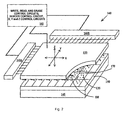
- flexing members 105A and 105B and indenter tip 120 are formed of highly-doped silicon and have a low electrical resistance
- heater 125 is formed of lightly doped silicon having a high electrical resistance sufficient to heat indenter tip 120, in one example, to between about 100 °C and about 500 °C when current is passed through heater 125.
- the electrical resistance of heater 125 is a function of temperature.
- a storage medium (or a recording medium) 130 comprising a substrate 130A, and a support layer 130C.
- support layer 130C is a polyaryletherketone resin layer.
- support layer 130C has a thickness between about 10 nm and about 500 nm.
- On top of the support layer 130C a layer of the cured crosslinking agent 130B is shown.
- Indentation 135 represents a data bit value of "1", a data bit value of "0" being represented by an absence of an indentation.
- Indentations 135 are nano-scale indentations (several to several hundred nanometers in width).
- probe assembly 155 is brought into proximity to polymeric layer 150, and probe tip assemblies 100 are scanned relative to the polymeric layer 150. Local indentations 135 are erased as described supra. Each of the probe tip assemblies 100 reads only in a corresponding region 170 of cured polymeric layer 150. This reduces the amount of travel and thus time required for erasing data.
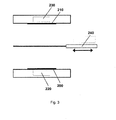
- a shutter 240 is placed between the two plates which can effectively initiate or stop the deposition of the source material onto the target.
- the set-up is placed in a high vacuum chamber (not shown).
- the temperature calibration of the evaporation process was performed by keeping the target at room temperature. Before opening the shutter 240, the source temperature was raised to 120 °C in order to evaporate any absorbed molecules of water or other contaminants. It was found that efficient evaporation of the crosslinking agent, particularly of 1,3,5-Tris(4-(phenylethynyl)phenyl)benzene (structure II), is obtained at temperatures between 150° C and 200° C. The average thickness of the film deposited on the target wafer after 10 minutes of evaporation was 23 nm as measured by ellipsometry.
- a spin-cast film with a thickness of 134 nm (measured by ellipsometry) of a low crosslinked high temperature polymer served as a target e.g. the polyaryletherketone polymer obtained from 4,4'-difluorobenzophenone, resorcinol and 3,5-bis(4-(phenylethynyl)-phenyl)phenol can be used - this polymer is described in US 2007/0296101 A1 ).
- the overall thickness of the target was again 134 nm as measured by ellipsometry.
- a millipede set-up was used for writing the grid of bits.
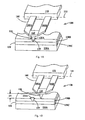
- Each one of the four blocks in both figures was written at a different temperature, respectively from bottom to top, 100° C, 230° C, 367° C and 500° C.
- the force is increased after three lines. Respectively, 85 nN, 105 nN, 125 nN and 145 nN.
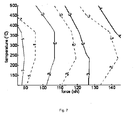
- Figure 7 shows the temperature-force relation for bits with a given depth of 1 nm ("1"), 2nm ("2"), 3nm ("3") and 4 nm ("4") which have been written onto the surface of a low crosslinked polymer (continous lines) and a layered structure obtained from a low crosslinked polymer with a layer of crosslinking agent deposited on top of it (dashed lines), respectively.
- the polymer/layered structure used for this experiment is identical to the polymer/layered structure described in the preceding paragraph.
- the displacement of the curves towards higher forces for the samples having a top layer of cured crosslinking agent clearly indicates the increase of the hardness as expected. In fact, the increasing of crosslink sides locally reduced mobility of the polymer chains.
Landscapes
- Chemical & Material Sciences (AREA)
- Engineering & Computer Science (AREA)
- Nanotechnology (AREA)
- Health & Medical Sciences (AREA)
- Chemical Kinetics & Catalysis (AREA)
- Medicinal Chemistry (AREA)
- Polymers & Plastics (AREA)
- Organic Chemistry (AREA)
- Theoretical Computer Science (AREA)
- Crystallography & Structural Chemistry (AREA)
- Mathematical Physics (AREA)
- Physics & Mathematics (AREA)
- General Chemical & Material Sciences (AREA)
- Semiconductor Memories (AREA)
- Optical Record Carriers And Manufacture Thereof (AREA)
- Micromachines (AREA)
Claims (15)
- Verfahren zum Herstellen eines Datenspeicherungsmediums (130) auf einer Fläche eines Substrats (130A, 145) zum Speichern von Daten in der Form von topographischen Merkmalen (135), aufweisend die Schritte:(a) Abscheiden eines Vernetzungsmittels auf der Fläche des Substrats, wobei das Vernetzungsmittel mindestens drei Alkingruppen enthält,(b) Härten des abgeschiedenen Vernetzungsmittels, wodurch eine modifizierte Fläche des Substrats hergestellt wird, um das Datenspeicherungsmedium in der Form einer vernetzten Polymerschicht (130B, 152) auf der Fläche des Substrats zu erhalten.
- Verfahren zum Herstellen eines Datenspeicherungsmediums nach dem vorhergehenden Anspruch, wobei der Schritt (a) durch Verdampfen des Vernetzungsmittels und Abscheiden des Dampfs des Vernetzungsmittels auf der Fläche des Substrats durchgeführt wird.
- Verfahren zum Herstellen eines Datenspeicherungsmediums nach einem der vorhergehenden Ansprüche,
wobei das Vernetzungsmittel die Struktur ZR3 und/oder Z'R4 aufweist,
wobei
Z und Z' die Bedeutung einer aromatischen und/oder aliphatischen Verbindungseinheit aufweisen und
R beliebig und unabhängig voneinander für eine Einheit steht, die eine Alkingruppe und eine substituierte oder unsubstituierte aromatische Einheit und/oder ein Wasserstoffatom am endständigen Kohlenstoffatom des Alkins aufweist. - Verfahren zum Herstellen eines Datenspeicherungsmediums nach dem vorhergehenden Anspruch, wobei die Verbindungseinheit Z oder Z' für

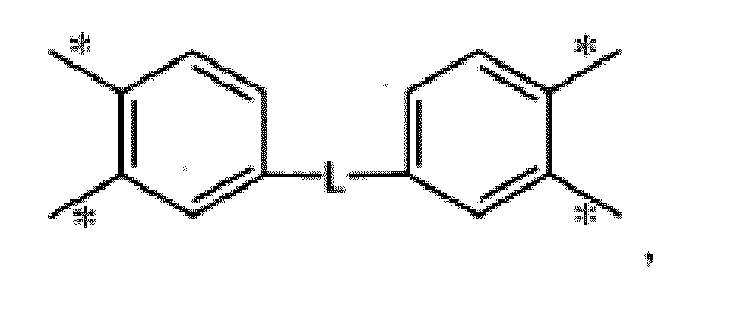

wobei * eine Bindung zwischen R und Z oder Z' bezeichnet und
wobei L für O, CH2, C(CH3)2, eine Aryleneinheit oder eine Einzelbindung zwischen den zwei aromatischen Ringen steht. - Verfahren zum Herstellen eines Datenspeicherungsmediums nach einem der zwei vorhergehenden Ansprüche,
wobei R beliebig und unabhängig voneinander für eine Einheit steht, die eine substituierte Alkingruppe, eine meta- oder parasubstituierte Phenyleneinheit und/oder eine Phenylgruppe aufweist,
und wobei R vorzugsweise beliebig und unabhängig voneinander für


- Verfahren zum Herstellen eines Datenspeicherungsmediums nach einem der vorhergehenden Ansprüche,
wobei das Vernetzungsmittel bei Temperaturen < 300 °C, vorzugsweise < 250 °C, und insbesondere bei Temperaturen von 150 °C bis 200 °C verdampfbar ist,
und wobei das Vernetzungsmittel vorzugsweise eine Molekularmasse unterhalb von etwa 900 Dalton, vorzugsweise von 270 bis 800 Dalton, aufweist. - Verfahren zum Herstellen eines Datenspeicherungsmediums nach einem der vorhergehenden Ansprüche,
wobei das Substrat eine Schablone ist und nach dem Schritt (b) die folgenden Schritte durchgeführt werden:(c) In-Kontakt-Bringen der modifizierten Fläche, die im Schritt (b) hergestellt wird, mit einer Fläche einer Zielschicht, wodurch ein Aufbau erhalten wird, die das Substrat mit der vernetzten Polymerschicht und der Zielschicht in Nachbarschaft zu der modifizierten Fläche aufweist; und(d) Übertragen der Zielschicht mit dem Datenspeicherungsmedium darauf auf mindestens eine benachbarte Zone auf der Zielfläche durch Einbringen einer Flüssigkeit in eine Umgebung des Aufbaus, der im Schritt (c) erhalten wird,wobei die Zielschicht der Schritte (c) und (d) eine Trägerschicht für die vernetzte Polymerschicht ist und das Datenspeicherungsmedium auf einer Fläche der Trägerschicht erhalten wird,
und wobei die Fläche der Schablone vorzugsweise eine hydrophile Fläche ist und die Flüssigkeit, die im Schritt (d) eingebracht wird, eine polare Flüssigkeit aufweist. - Verfahren zum Herstellen eines Datenspeicherungsmediums nach einem der zwei vorhergehenden Ansprüche,
wobei die Fläche der Schablone eine Fläche eines der Folgenden aufweist: eines Glimmersubstrats, eines flammgetemperten Glassubstrats, einer Siliciumoxidschicht auf einem Siliciumsubstrat und einer Perowskitsubstrat-Salzschicht mit (100)-Fläche. - Verfahren zum Herstellen eines Datenspeicherungsmediums nach einem der drei vorhergehenden Ansprüche,
wobei im Schritt (a) eine Mischung des Vernetzungsmittels und eines Comonomers auf der Fläche des Substrats abgeschieden wird, wobei das Comonomer mindestens zwei Alkingruppen enthält, und im Schritt (b) die Mischung des abgeschiedenen Vernetzungsmittels und des abgeschiedenen Comonomers gehärtet wird, wodurch die vernetzte Polymerschicht hergestellt wird und eine modifizierte Fläche erhalten wird. - Verfahren zum Herstellen eines Datenspeicherungsmediums nach einem der Ansprüche 1 bis 6, wobei das Substrat eine Trägerschicht ist, die ein oder mehrere vernetzbare Polymere aufweist, die Alkingruppen enthalten, wobei im Schritt (b) das abgeschiedene Vernetzungsmittel und das vernetzbare Polymer gehärtet werden, wodurch eine vernetzte Polymerschicht hergestellt wird, um das Datenspeicherungsmedium auf einer Fläche der Trägerschicht zu erhalten,
und wobei die Trägerschicht vorzugsweise ein oder mehrere Polyaryletherketon-Polymere und/oder Polyimid-Oligomere aufweist, wobei jedes der ein oder mehreren Polyaryletherketon-Polymere und/oder Polyimid-Oligomere mindestens zwei abschließende Enden aufweist, wobei jedes abschließende Ende zwei oder mehr Phenylethinyl-Einheiten aufweist. - Verfahren zum Herstellen eines Datenspeicherungsmediums nach einem der vorhergehenden Ansprüche,
wobei der Schritt (b) bei einer Temperatur von 330 °C bis 450 °C, vorzugsweise von 350 °C bis 450 °C und insbesondere von 400 °C bis 450 °C, durchgeführt wird. - Verfahren zum Herstellen eines Datenspeicherungsmediums nach einem der vorhergehenden Ansprüche,
wobei die Dicke der vernetzten Polymerschicht des Datenspeicherungsmediums mindestens 5 nm und weniger als 10 nm beträgt. - Verfahren zum Herstellen eines Datenspeicherungsmediums nach einem der vorhergehenden Ansprüche,
wobei der Schritt (a) durch Plasmaabscheidung durchgeführt wird. - Datenspeicherungsmedium zum Speichern von Daten in der Form von topographischen Merkmalen (135), welches gemäß dem Verfahren nach Anspruch 12 zu erhalten ist.
- Datenspeicherungseinheit (140), aufweisend:ein Datenspeicherungsmedium zum Speichern von Daten in der Form von topographischen Merkmalen (135) nach dem vorhergehenden Anspruch und mindestens eine Sonde (100) zum Schreiben und/oder Lesen der Daten, die in dem Datenspeicherungsmedium gespeichert sind.
Priority Applications (1)
| Application Number | Priority Date | Filing Date | Title |
|---|---|---|---|
| EP20090744461 EP2351027B1 (de) | 2008-10-23 | 2009-10-15 | Verfahren und einrichtung zur hochdichten datenspeicherung |
Applications Claiming Priority (3)
| Application Number | Priority Date | Filing Date | Title |
|---|---|---|---|
| EP08105633 | 2008-10-23 | ||
| PCT/IB2009/054536 WO2010046814A1 (en) | 2008-10-23 | 2009-10-15 | Method and device for high density data storage |
| EP20090744461 EP2351027B1 (de) | 2008-10-23 | 2009-10-15 | Verfahren und einrichtung zur hochdichten datenspeicherung |
Publications (2)
| Publication Number | Publication Date |
|---|---|
| EP2351027A1 EP2351027A1 (de) | 2011-08-03 |
| EP2351027B1 true EP2351027B1 (de) | 2014-12-10 |
Family
ID=41531499
Family Applications (1)
| Application Number | Title | Priority Date | Filing Date |
|---|---|---|---|
| EP20090744461 Active EP2351027B1 (de) | 2008-10-23 | 2009-10-15 | Verfahren und einrichtung zur hochdichten datenspeicherung |
Country Status (6)
| Country | Link |
|---|---|
| US (3) | US8715804B2 (de) |
| EP (1) | EP2351027B1 (de) |
| JP (1) | JP4988965B2 (de) |
| KR (1) | KR20110071069A (de) |
| CN (1) | CN102197429B (de) |
| WO (1) | WO2010046814A1 (de) |
Families Citing this family (2)
| Publication number | Priority date | Publication date | Assignee | Title |
|---|---|---|---|---|
| US10907092B2 (en) * | 2016-07-07 | 2021-02-02 | University Of Central Florida Research Foundation, Inc. | Methods of making highly stable perovskite-polymer composites and structures using same |
| US11530303B2 (en) | 2016-07-07 | 2022-12-20 | University Of Central Florida Research Foundation, Inc. | Perovskite-polymer composites and methods |
Family Cites Families (18)
| Publication number | Priority date | Publication date | Assignee | Title |
|---|---|---|---|---|
| US5125138A (en) | 1983-12-19 | 1992-06-30 | Spectrum Control, Inc. | Miniaturized monolithic multi-layer capacitor and apparatus and method for making same |
| US5546557A (en) | 1993-06-14 | 1996-08-13 | International Business Machines Corporation | System for storing and managing plural logical volumes in each of several physical volumes including automatically creating logical volumes in peripheral data storage subsystem |
| DE4416330A1 (de) | 1994-05-09 | 1995-11-16 | Hoechst Ag | Verbundmembran und Verfahren zu ihrer Herstellung |
| TW470861B (en) | 1996-08-26 | 2002-01-01 | Matsushita Electric Industrial Co Ltd | Chemical adsorption film, method of manufacturing the same, and chemical absorption solution used for the same |
| US6045864A (en) | 1997-12-01 | 2000-04-04 | 3M Innovative Properties Company | Vapor coating method |
| US6391379B1 (en) | 1998-09-04 | 2002-05-21 | Kemet Electronics Corporation | Process of preparing a solid electrolytic capacitor containing a conductive polymer counter electrode |
| US6228434B1 (en) | 1998-12-16 | 2001-05-08 | Battelle Memorial Institute | Method of making a conformal coating of a microtextured surface |
| US6217947B1 (en) | 1998-12-16 | 2001-04-17 | Battelle Memorial Institute | Plasma enhanced polymer deposition onto fixtures |
| JP4775527B2 (ja) | 2000-07-24 | 2011-09-21 | Jsr株式会社 | 膜形成用組成物および絶縁膜形成用材料 |
| WO2002040944A1 (en) * | 2000-11-16 | 2002-05-23 | International Business Machines Corporation | Method and apparatus for reading an array of thermal resistance sensors |
| EP1642391A1 (de) | 2003-07-09 | 2006-04-05 | THOMSON Licensing | Fehlerkorrekturverfahren für einen reed-solomon-produktcode |
| US7471614B2 (en) * | 2003-08-29 | 2008-12-30 | International Business Machines Corporation | High density data storage medium |
| US7147891B2 (en) | 2004-02-11 | 2006-12-12 | Dionex Corporation | Polymer substrate coated with weak cationic-exchange functional layer |
| TW200809798A (en) | 2006-03-31 | 2008-02-16 | Ibm | Method of producing a data storage medium |
| US7558186B2 (en) * | 2007-01-02 | 2009-07-07 | International Business Machines Corporation | High density data storage medium, method and device |
| US20080159114A1 (en) | 2007-01-02 | 2008-07-03 | Dipietro Richard Anthony | High density data storage medium, method and device |
| US8012541B2 (en) | 2007-01-24 | 2011-09-06 | International Business Machines Corporation | Thermally reversible cross-linked poly (aryl ether ketone) media and method for high density data storage |
| US20080220612A1 (en) * | 2007-03-06 | 2008-09-11 | Ute Drechsler | Protection of polymer surfaces during micro-fabrication |
-
2009
- 2009-10-15 JP JP2011532744A patent/JP4988965B2/ja not_active Expired - Fee Related
- 2009-10-15 KR KR1020117006805A patent/KR20110071069A/ko not_active Withdrawn
- 2009-10-15 EP EP20090744461 patent/EP2351027B1/de active Active
- 2009-10-15 WO PCT/IB2009/054536 patent/WO2010046814A1/en not_active Ceased
- 2009-10-15 US US13/124,310 patent/US8715804B2/en not_active Expired - Fee Related
- 2009-10-15 CN CN200980142065.7A patent/CN102197429B/zh not_active Expired - Fee Related
-
2014
- 2014-04-03 US US14/244,099 patent/US9196289B2/en not_active Expired - Fee Related
-
2015
- 2015-10-21 US US14/918,693 patent/US9676890B2/en not_active Expired - Fee Related
Also Published As
| Publication number | Publication date |
|---|---|
| US20160039965A1 (en) | 2016-02-11 |
| KR20110071069A (ko) | 2011-06-28 |
| JP2012506598A (ja) | 2012-03-15 |
| US20140301178A1 (en) | 2014-10-09 |
| JP4988965B2 (ja) | 2012-08-01 |
| US9676890B2 (en) | 2017-06-13 |
| US9196289B2 (en) | 2015-11-24 |
| CN102197429B (zh) | 2014-05-07 |
| US20110199887A1 (en) | 2011-08-18 |
| WO2010046814A1 (en) | 2010-04-29 |
| US8715804B2 (en) | 2014-05-06 |
| CN102197429A (zh) | 2011-09-21 |
| EP2351027A1 (de) | 2011-08-03 |
Similar Documents
| Publication | Publication Date | Title |
|---|---|---|
| US7723458B2 (en) | Method for high density data storage and read-back | |
| US8792318B2 (en) | Method for high density data storage and imaging | |
| US8289833B2 (en) | Method for high density data storage and imaging | |
| US9754609B2 (en) | Method of producing a data storage medium | |
| US8604135B2 (en) | Thermally reversible cross-linked poly(aryl ether ketone) media and method for high density data storage | |
| US8488436B2 (en) | High density data storage medium, method and device | |
| US8599673B2 (en) | High density data storage medium, method and device | |
| US9676890B2 (en) | Method and device for high density data storage | |
| US8053067B2 (en) | Data storage device and method of production therefor |
Legal Events
| Date | Code | Title | Description |
|---|---|---|---|
| PUAI | Public reference made under article 153(3) epc to a published international application that has entered the european phase |
Free format text: ORIGINAL CODE: 0009012 |
|
| 17P | Request for examination filed |
Effective date: 20110511 |
|
| AK | Designated contracting states |
Kind code of ref document: A1 Designated state(s): AT BE BG CH CY CZ DE DK EE ES FI FR GB GR HR HU IE IS IT LI LT LU LV MC MK MT NL NO PL PT RO SE SI SK SM TR |
|
| DAX | Request for extension of the european patent (deleted) | ||
| GRAP | Despatch of communication of intention to grant a patent |
Free format text: ORIGINAL CODE: EPIDOSNIGR1 |
|
| INTG | Intention to grant announced |
Effective date: 20140624 |
|
| GRAS | Grant fee paid |
Free format text: ORIGINAL CODE: EPIDOSNIGR3 |
|
| GRAA | (expected) grant |
Free format text: ORIGINAL CODE: 0009210 |
|
| AK | Designated contracting states |
Kind code of ref document: B1 Designated state(s): AT BE BG CH CY CZ DE DK EE ES FI FR GB GR HR HU IE IS IT LI LT LU LV MC MK MT NL NO PL PT RO SE SI SK SM TR |
|
| REG | Reference to a national code |
Ref country code: GB Ref legal event code: FG4D |
|
| REG | Reference to a national code |
Ref country code: CH Ref legal event code: EP |
|
| REG | Reference to a national code |
Ref country code: IE Ref legal event code: FG4D |
|
| REG | Reference to a national code |
Ref country code: GB Ref legal event code: 746 Effective date: 20141223 |
|
| REG | Reference to a national code |
Ref country code: AT Ref legal event code: REF Ref document number: 701002 Country of ref document: AT Kind code of ref document: T Effective date: 20150115 Ref country code: DE Ref legal event code: R084 Ref document number: 602009028257 Country of ref document: DE Ref country code: CH Ref legal event code: NV Representative=s name: IBM RESEARCH GMBH ZURICH RESEARCH LABORATORY I, CH |
|
| REG | Reference to a national code |
Ref country code: DE Ref legal event code: R096 Ref document number: 602009028257 Country of ref document: DE Effective date: 20150122 |
|
| REG | Reference to a national code |
Ref country code: DE Ref legal event code: R084 Ref document number: 602009028257 Country of ref document: DE Effective date: 20150115 |
|
| REG | Reference to a national code |
Ref country code: NL Ref legal event code: VDEP Effective date: 20141210 Ref country code: AT Ref legal event code: MK05 Ref document number: 701002 Country of ref document: AT Kind code of ref document: T Effective date: 20141210 |
|
| REG | Reference to a national code |
Ref country code: NL Ref legal event code: VDEP Effective date: 20141210 |
|
| PG25 | Lapsed in a contracting state [announced via postgrant information from national office to epo] |
Ref country code: ES Free format text: LAPSE BECAUSE OF FAILURE TO SUBMIT A TRANSLATION OF THE DESCRIPTION OR TO PAY THE FEE WITHIN THE PRESCRIBED TIME-LIMIT Effective date: 20141210 Ref country code: NO Free format text: LAPSE BECAUSE OF FAILURE TO SUBMIT A TRANSLATION OF THE DESCRIPTION OR TO PAY THE FEE WITHIN THE PRESCRIBED TIME-LIMIT Effective date: 20150310 Ref country code: FI Free format text: LAPSE BECAUSE OF FAILURE TO SUBMIT A TRANSLATION OF THE DESCRIPTION OR TO PAY THE FEE WITHIN THE PRESCRIBED TIME-LIMIT Effective date: 20141210 Ref country code: LT Free format text: LAPSE BECAUSE OF FAILURE TO SUBMIT A TRANSLATION OF THE DESCRIPTION OR TO PAY THE FEE WITHIN THE PRESCRIBED TIME-LIMIT Effective date: 20141210 |
|
| REG | Reference to a national code |
Ref country code: LT Ref legal event code: MG4D |
|
| PG25 | Lapsed in a contracting state [announced via postgrant information from national office to epo] |
Ref country code: SE Free format text: LAPSE BECAUSE OF FAILURE TO SUBMIT A TRANSLATION OF THE DESCRIPTION OR TO PAY THE FEE WITHIN THE PRESCRIBED TIME-LIMIT Effective date: 20141210 Ref country code: GR Free format text: LAPSE BECAUSE OF FAILURE TO SUBMIT A TRANSLATION OF THE DESCRIPTION OR TO PAY THE FEE WITHIN THE PRESCRIBED TIME-LIMIT Effective date: 20150311 Ref country code: AT Free format text: LAPSE BECAUSE OF FAILURE TO SUBMIT A TRANSLATION OF THE DESCRIPTION OR TO PAY THE FEE WITHIN THE PRESCRIBED TIME-LIMIT Effective date: 20141210 Ref country code: LV Free format text: LAPSE BECAUSE OF FAILURE TO SUBMIT A TRANSLATION OF THE DESCRIPTION OR TO PAY THE FEE WITHIN THE PRESCRIBED TIME-LIMIT Effective date: 20141210 Ref country code: HR Free format text: LAPSE BECAUSE OF FAILURE TO SUBMIT A TRANSLATION OF THE DESCRIPTION OR TO PAY THE FEE WITHIN THE PRESCRIBED TIME-LIMIT Effective date: 20141210 |
|
| PG25 | Lapsed in a contracting state [announced via postgrant information from national office to epo] |
Ref country code: NL Free format text: LAPSE BECAUSE OF FAILURE TO SUBMIT A TRANSLATION OF THE DESCRIPTION OR TO PAY THE FEE WITHIN THE PRESCRIBED TIME-LIMIT Effective date: 20141210 |
|
| PG25 | Lapsed in a contracting state [announced via postgrant information from national office to epo] |
Ref country code: EE Free format text: LAPSE BECAUSE OF FAILURE TO SUBMIT A TRANSLATION OF THE DESCRIPTION OR TO PAY THE FEE WITHIN THE PRESCRIBED TIME-LIMIT Effective date: 20141210 Ref country code: RO Free format text: LAPSE BECAUSE OF FAILURE TO SUBMIT A TRANSLATION OF THE DESCRIPTION OR TO PAY THE FEE WITHIN THE PRESCRIBED TIME-LIMIT Effective date: 20141210 Ref country code: CZ Free format text: LAPSE BECAUSE OF FAILURE TO SUBMIT A TRANSLATION OF THE DESCRIPTION OR TO PAY THE FEE WITHIN THE PRESCRIBED TIME-LIMIT Effective date: 20141210 Ref country code: SK Free format text: LAPSE BECAUSE OF FAILURE TO SUBMIT A TRANSLATION OF THE DESCRIPTION OR TO PAY THE FEE WITHIN THE PRESCRIBED TIME-LIMIT Effective date: 20141210 Ref country code: PT Free format text: LAPSE BECAUSE OF FAILURE TO SUBMIT A TRANSLATION OF THE DESCRIPTION OR TO PAY THE FEE WITHIN THE PRESCRIBED TIME-LIMIT Effective date: 20150410 |
|
| PG25 | Lapsed in a contracting state [announced via postgrant information from national office to epo] |
Ref country code: PL Free format text: LAPSE BECAUSE OF FAILURE TO SUBMIT A TRANSLATION OF THE DESCRIPTION OR TO PAY THE FEE WITHIN THE PRESCRIBED TIME-LIMIT Effective date: 20141210 Ref country code: IS Free format text: LAPSE BECAUSE OF FAILURE TO SUBMIT A TRANSLATION OF THE DESCRIPTION OR TO PAY THE FEE WITHIN THE PRESCRIBED TIME-LIMIT Effective date: 20150410 |
|
| REG | Reference to a national code |
Ref country code: DE Ref legal event code: R097 Ref document number: 602009028257 Country of ref document: DE |
|
| PLBE | No opposition filed within time limit |
Free format text: ORIGINAL CODE: 0009261 |
|
| STAA | Information on the status of an ep patent application or granted ep patent |
Free format text: STATUS: NO OPPOSITION FILED WITHIN TIME LIMIT |
|
| PG25 | Lapsed in a contracting state [announced via postgrant information from national office to epo] |
Ref country code: DK Free format text: LAPSE BECAUSE OF FAILURE TO SUBMIT A TRANSLATION OF THE DESCRIPTION OR TO PAY THE FEE WITHIN THE PRESCRIBED TIME-LIMIT Effective date: 20141210 |
|
| 26N | No opposition filed |
Effective date: 20150911 |
|
| PG25 | Lapsed in a contracting state [announced via postgrant information from national office to epo] |
Ref country code: IT Free format text: LAPSE BECAUSE OF FAILURE TO SUBMIT A TRANSLATION OF THE DESCRIPTION OR TO PAY THE FEE WITHIN THE PRESCRIBED TIME-LIMIT Effective date: 20141210 |
|
| PG25 | Lapsed in a contracting state [announced via postgrant information from national office to epo] |
Ref country code: SI Free format text: LAPSE BECAUSE OF FAILURE TO SUBMIT A TRANSLATION OF THE DESCRIPTION OR TO PAY THE FEE WITHIN THE PRESCRIBED TIME-LIMIT Effective date: 20141210 |
|
| PG25 | Lapsed in a contracting state [announced via postgrant information from national office to epo] |
Ref country code: BE Free format text: LAPSE BECAUSE OF FAILURE TO SUBMIT A TRANSLATION OF THE DESCRIPTION OR TO PAY THE FEE WITHIN THE PRESCRIBED TIME-LIMIT Effective date: 20141210 Ref country code: LU Free format text: LAPSE BECAUSE OF FAILURE TO SUBMIT A TRANSLATION OF THE DESCRIPTION OR TO PAY THE FEE WITHIN THE PRESCRIBED TIME-LIMIT Effective date: 20151015 |
|
| REG | Reference to a national code |
Ref country code: CH Ref legal event code: PL |
|
| PG25 | Lapsed in a contracting state [announced via postgrant information from national office to epo] |
Ref country code: MC Free format text: LAPSE BECAUSE OF FAILURE TO SUBMIT A TRANSLATION OF THE DESCRIPTION OR TO PAY THE FEE WITHIN THE PRESCRIBED TIME-LIMIT Effective date: 20141210 |
|
| REG | Reference to a national code |
Ref country code: IE Ref legal event code: MM4A |
|
| PG25 | Lapsed in a contracting state [announced via postgrant information from national office to epo] |
Ref country code: LI Free format text: LAPSE BECAUSE OF NON-PAYMENT OF DUE FEES Effective date: 20151031 Ref country code: CH Free format text: LAPSE BECAUSE OF NON-PAYMENT OF DUE FEES Effective date: 20151031 |
|
| REG | Reference to a national code |
Ref country code: FR Ref legal event code: ST Effective date: 20160630 |
|
| PG25 | Lapsed in a contracting state [announced via postgrant information from national office to epo] |
Ref country code: FR Free format text: LAPSE BECAUSE OF NON-PAYMENT OF DUE FEES Effective date: 20151102 |
|
| PG25 | Lapsed in a contracting state [announced via postgrant information from national office to epo] |
Ref country code: IE Free format text: LAPSE BECAUSE OF NON-PAYMENT OF DUE FEES Effective date: 20151015 |
|
| PG25 | Lapsed in a contracting state [announced via postgrant information from national office to epo] |
Ref country code: SM Free format text: LAPSE BECAUSE OF FAILURE TO SUBMIT A TRANSLATION OF THE DESCRIPTION OR TO PAY THE FEE WITHIN THE PRESCRIBED TIME-LIMIT Effective date: 20141210 Ref country code: HU Free format text: LAPSE BECAUSE OF FAILURE TO SUBMIT A TRANSLATION OF THE DESCRIPTION OR TO PAY THE FEE WITHIN THE PRESCRIBED TIME-LIMIT; INVALID AB INITIO Effective date: 20091015 Ref country code: BG Free format text: LAPSE BECAUSE OF FAILURE TO SUBMIT A TRANSLATION OF THE DESCRIPTION OR TO PAY THE FEE WITHIN THE PRESCRIBED TIME-LIMIT Effective date: 20141210 |
|
| PG25 | Lapsed in a contracting state [announced via postgrant information from national office to epo] |
Ref country code: CY Free format text: LAPSE BECAUSE OF FAILURE TO SUBMIT A TRANSLATION OF THE DESCRIPTION OR TO PAY THE FEE WITHIN THE PRESCRIBED TIME-LIMIT Effective date: 20141210 |
|
| PG25 | Lapsed in a contracting state [announced via postgrant information from national office to epo] |
Ref country code: MT Free format text: LAPSE BECAUSE OF FAILURE TO SUBMIT A TRANSLATION OF THE DESCRIPTION OR TO PAY THE FEE WITHIN THE PRESCRIBED TIME-LIMIT Effective date: 20141210 Ref country code: TR Free format text: LAPSE BECAUSE OF FAILURE TO SUBMIT A TRANSLATION OF THE DESCRIPTION OR TO PAY THE FEE WITHIN THE PRESCRIBED TIME-LIMIT Effective date: 20141210 |
|
| PG25 | Lapsed in a contracting state [announced via postgrant information from national office to epo] |
Ref country code: MK Free format text: LAPSE BECAUSE OF FAILURE TO SUBMIT A TRANSLATION OF THE DESCRIPTION OR TO PAY THE FEE WITHIN THE PRESCRIBED TIME-LIMIT Effective date: 20141210 |
|
| REG | Reference to a national code |
Ref country code: DE Ref legal event code: R082 Ref document number: 602009028257 Country of ref document: DE Representative=s name: KUISMA, SIRPA, FI |
|
| P01 | Opt-out of the competence of the unified patent court (upc) registered |
Effective date: 20230423 |
|
| PGFP | Annual fee paid to national office [announced via postgrant information from national office to epo] |
Ref country code: DE Payment date: 20231013 Year of fee payment: 15 |
|
| REG | Reference to a national code |
Ref country code: DE Ref legal event code: R119 Ref document number: 602009028257 Country of ref document: DE |
|
| PG25 | Lapsed in a contracting state [announced via postgrant information from national office to epo] |
Ref country code: DE Free format text: LAPSE BECAUSE OF NON-PAYMENT OF DUE FEES Effective date: 20250501 |
|
| PGFP | Annual fee paid to national office [announced via postgrant information from national office to epo] |
Ref country code: GB Payment date: 20251013 Year of fee payment: 17 |