EP2350179B1 - Verbundwerkstoffe mit biologisch synthetisierten nanomaterialien - Google Patents
Verbundwerkstoffe mit biologisch synthetisierten nanomaterialien Download PDFInfo
- Publication number
- EP2350179B1 EP2350179B1 EP09748198.0A EP09748198A EP2350179B1 EP 2350179 B1 EP2350179 B1 EP 2350179B1 EP 09748198 A EP09748198 A EP 09748198A EP 2350179 B1 EP2350179 B1 EP 2350179B1
- Authority
- EP
- European Patent Office
- Prior art keywords
- nanorods
- biologically
- linear
- pmpv
- optical limiting
- Prior art date
- Legal status (The legal status is an assumption and is not a legal conclusion. Google has not performed a legal analysis and makes no representation as to the accuracy of the status listed.)
- Active
Links
Images



Classifications
-
- C—CHEMISTRY; METALLURGY
- C08—ORGANIC MACROMOLECULAR COMPOUNDS; THEIR PREPARATION OR CHEMICAL WORKING-UP; COMPOSITIONS BASED THEREON
- C08K—Use of inorganic or non-macromolecular organic substances as compounding ingredients
- C08K3/00—Use of inorganic substances as compounding ingredients
- C08K3/02—Elements
-
- C—CHEMISTRY; METALLURGY
- C08—ORGANIC MACROMOLECULAR COMPOUNDS; THEIR PREPARATION OR CHEMICAL WORKING-UP; COMPOSITIONS BASED THEREON
- C08K—Use of inorganic or non-macromolecular organic substances as compounding ingredients
- C08K3/00—Use of inorganic substances as compounding ingredients
- C08K3/02—Elements
- C08K3/08—Metals
-
- C—CHEMISTRY; METALLURGY
- C08—ORGANIC MACROMOLECULAR COMPOUNDS; THEIR PREPARATION OR CHEMICAL WORKING-UP; COMPOSITIONS BASED THEREON
- C08K—Use of inorganic or non-macromolecular organic substances as compounding ingredients
- C08K7/00—Use of ingredients characterised by shape
Definitions
- Carbon-based nanocomposites have beneficial electrical, optical and mechanical properties due to the inclusion of the carbon-based nanomaterials.
- Carbon-based nanocomposites have been studied for potential uses as photovoltaics, field emission devices, conductive wires and structural members. Although there has been intense interest in carbon-based nanocomposites, development of these systems has been hampered by synthetic obstacles including, for example, yield and chirality control of the carbon-based nanomaterial filler.
- polymer composites containing inorganic materials such as, for example glass fibers
- inorganic materials such as, for example glass fibers
- polymer composites containing inorganic nanomaterials such as, for example, inorganic quantum dots and nanorods
- Such materials are referred to herein as inorganic-based nanocomposites.
- Chemical syntheses of certain inorganic nanomaterials are hampered by the same synthetic obstacles that encumber organic nanomaterial synthesis.
- biological syntheses are known to be highly efficient, environmentally-friendly, and capable of producing structures that cannot be replicated by standard chemical methods.
- biologically-synthesized inorganic nanomaterials may have properties that meet or exceed those of organic nanomaterials in certain applications.
- inorganic-based nanocomposites having biologically-synthesized inorganic nanomaterials dispersed in a polymer matrix may be of considerable benefit in a variety of applications.
- These inorganic-based nanocomposites may take advantage of property enhancements that are unique to biologically-synthesized inorganic nanomaterials.
- the present invention relates to composite materials including a polymer material and biologically-synthesized tellurium nanorods dispersed in the polymer material, wherein the biologically-synthesized tellurium nanorods have a non-linear optical limiting response, wherein the non-linear optical limiting response is non-linear scattering.
- the present invention further relates to optical limiting devices comprising said composite material.
- the tellurium nanorods are biologically synthesized by Bacillus selenitireducens.
- a plethora of biologically-synthesized minerals are known to be produced by a diverse array of bacteria and other animals. Oftentimes, such biologically-synthesized minerals acquire a particle size or crystalline state that is unattainable using standard chemical syntheses. Such biologically-synthesized minerals may embody vastly different properties than either bulk minerals or minerals produced through non-biological routes. Biological syntheses of minerals, particularly nanoscale materials, hold considerable promise for mass production of these species through an inexpensive and environmentally-benign route.
- the present disclosure describes composite materials including a polymer material and a biologically-synthesized nanoscale material dispersed in the polymer material.
- the biologically-synthesized nanoscale material includes tellurium nanorods.
- the nanoscale materials have optical limiting properties. The optical limiting properties are non-linear in response to incident light having variable intensity.
- optical limiting involves limiting and attenuating the effects of intense laser pulses and other focused beams of electromagnetic radiation.
- Optical limiting devices are often used to lower damaging light levels passing through a material, thereby protecting the vision of an operator of a laser or other bright light source such as, for example, an arc welder.
- One approach to optical limiting makes use of materials whose transmittance decreases at high light levels (high intensities). For protective applications, such as those described above, the response of the optical limiter in decreasing transmittance is ideally rapid with a low saturation threshold.
- an optical limiter ideally exhibits broadband optical limiting properties ranging from the visible to the infrared or near infrared region of the electromagnetic spectrum in some embodiments, and extending into the ultraviolet and X-ray region of the electromagnetic spectrum in other embodiments.
- Non-linear absorption can be further divided into mechanisms involving multi-photon absorption (e.g., organic molecules or crystals), reverse saturable absorption (e.g., fullerenes, phthalocyanines, porphyrins or chromaphores with heavy metals such as Ag) and free-carrier absorption (e.g, semiconductor nanoparticles or metal nanocomposites).
- multi-photon absorption e.g., organic molecules or crystals
- reverse saturable absorption e.g., fullerenes, phthalocyanines, porphyrins or chromaphores with heavy metals such as Ag
- free-carrier absorption e.g, semiconductor nanoparticles or metal nanocomposites.
- Non-linear scattering may arise from a number of physical phenomena, such as, for example, formation of solvent bubbles as scattering centers upon exposure to intense light, ionization of nanoparticles in the composite material, and/or thermal alterations in the refractive index of the polymer matrix or organic solvents.
- the composite materials of the present disclosure have optical limiting properties, and the optical limiting properties are non-linear. In various embodiments, the composite materials of the present disclosure exceed the optical limiting properties of other well studied optical limiting materials such as, for example, carbon nanotubes, phthalocyanines and porphyrins. In various embodiments, the optical limiting absorption properties occur with response times on the order of picoseconds.
- FIGURE 1 shows an illustrative schematic demonstrating how polymer bubble formation may occur in composite materials of the present disclosure.
- photons 1 interact with nanoparticle 2 dispersed in a polymer matrix.
- photons 1 are absorbed by nanoparticle 2 , which results in transfer of thermal energy to the surrounding medium (e.g., the polymer matrix).
- the transfer of thermal energy results in formation of gas bubbles 3 with nanoparticle 2 as the nucleus.
- the initially formed gas bubbles 3 rapidly expand due to the large pressure difference at the vapor-matrix interface to produce expanded gas bubbles 4 .
- the expanded gas bubbles 4 effectively scatter the photons, as shown, and consequently reduce the optical transmission.
- only one of six incident photons 1 reaches the eye 5 of an observer.
- photons 1 may interact with nanoparticle 2 to result in an ionized nanoparticle (not shown).
- the ionized nanoparticle subsequently forms a microplasm 6 in the polymer matrix.
- the energy generated by non-linear photonic vibrations and subsequent breakdown of the ionized nanoparticle results in energy transfer to the polymer matrix and formation of the microplasm 6 .
- Rapid expansion of microplasm 6 to form expanded microplasm 7 results in the formation of scattering centers.
- microplasm 7 effectively scatters photons 1 , as shown, such that only a fraction of the incident light reaches the eye 5 of an observer.
- Certain biologically-synthesized nanoscale materials have optical limiting behavior that may be superior to that of currently studied optical limiting materials.
- Certain anaerobic bacteria such as, for example, Bacillus selenitireducens and Sulfurospirillum barnesii are known to have the ability to respire oxyanions of selenium and tellurium (e.g., TeO 3 2- and SeO 3 2- ) and produce elemental selenium and tellurium having nanoscale dimensions as a respiration product.
- the tellurium nanorods may have a length of about 1 ⁇ m to about 2 ⁇ m.
- the tellurium nanorods may also have a diameter of about 15 nm to about 25 nm in some embodiments, and a diameter of about 20 nm in certain other embodiments.
- polymer materials may be used in any of the composite materials of the present disclosure, depending on the intended end use of the composite material.
- Such polymer materials may be thermosetting or thermoplastic in various embodiments.
- the identity of the polymer material is not particularly critical, other than that it disperses the tellurium nanorods or other nanoscale material. However, in other embodiments, the identity of the polymer material may be more important.
- the polymer material may be semiconducting.
- the polymer material is poly[(m-phenylene vinylene)-co-(2,5-dioctyloxy-p-phenylene vinylene)] (PmPV).
- the polymer may be, for example, poly(3-hexylthiophene) (P 3 HT), poly(3-octylthiophene) (P 3 OT), poly[2-methoxy-5-(2'-ethylhexyloxy-p-phenylene vinylene)] (MEH-PPV), poly[2-methoxy-5-(3,7-dimethyloctyloxy)-p-phenylene vinylene], sodium poly[2-(3-thienyl)-ethoxy-4-butylsulfonate] (PTEBS) and combinations thereof.
- PmPV may also be combined with any of the aforementioned polymers to make a polymer mixture.
- the present disclosure describes composite materials including a polymer material and biologically-synthesized tellurium nanorods dispersed in the polymer material.
- the biologically-synthesized tellurium nanorods have a non-linear optical limiting response.
- the tellurium nanorods are synthesized by Bacillus selenitireducens.
- composite materials are described that include a polymer material and tellurium nanorods dispersed in the polymer material.
- the tellurium nanorods are biologically synthesized such as, for example, by the microorganism Bacillus selenitireducens.
- optical limiting devices incorporating such composites are considered by the present disclosure.
- a transmission response of the devices is non-linear upon exposure to electromagnetic radiation of variable intensity.
- Example 1 Biological Synthesis of Tellurium Nanorods with Bacillus selenitireducens. Biological synthesis of tellurium nanorods and characterization of such nanostructured materials have been described in S.M. Baesman, et al., "Formation of Tellurium Nanocrystals during Anaerobic Growth of Bacteria That Use Te Oxyanions as Repiratory Electron Acceptors", Appl. Env. Microbiol., 73:2007, pp. 2135 - 2143 .
- Te(0) elemental tellurium
- the Te(0) first accumulates on the cell surfaces as Te-nanorods, which then aggregate and slough off into the surrounding aqueous medium as a black precipitate.
- the Te(0) nanorods were cleansed of cellular material and debris by ultrasonication, treatments with lysozyme, and repeated washings and centrifugations.
- the cleansed Te(0) nanorods were re-suspended in deionized water in a stoppered serum bottle and stored under an N 2 atmosphere [to preclude oxidation of Te(0) to Te(IV)] until use.
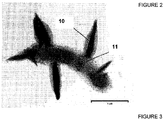
- FIGURE 2 shows an illustrative electron micrograph of Te nanorods on the surface of Bacillus selenitireducens as individuals and as shards after coalescence.
- the respired Te(0) initially forms as thin (-19 nm x 100 - 300 nm) individual nanorods 11 of Te(0) on the cell surface, which subsequently coalesce to form shards 10 containing intertwined nanorods.
- the shards 10 then slough off the cell surface, forming aggregates of star-shaped "rosettes", which contain multiple Te(0) shards.
- FIGURE 3 shows an illustrative electron micrograph of Te nanorods in the form of "rosettes" before being sloughed from the cell surface.
- FIGURES 4A and 4B show illustrative electron micrographs of Te nanorods in the form of "rosettes” after cleansing to remove bacteria and cellular debris.
- the Te nanorods in the "rosettes” have dimensions of 20 nm in width and are 1 - 2 ⁇ m in length.
- Example 2 Optical Characterization of Te Nanorods and Te Nanocomposite Materials.
- Raman spectra were obtained using a Renishaw In Via Raman spectrometer equipped with a Raman Leica RE02 microscope.
- the excitation wavelength was 488 nm, produced from an air-cooled Laser-Physics Ar + laser.
- the Te(0) samples were first suspended in deionized water, drop-cast onto clean silicon substrates and allowed to dry before acquiring the Raman spectra.
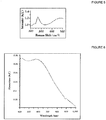
- FIGURE 5 shows an illustrative Raman spectrum of solid Te nanorods.
- Te(0) possess four zone center phonon modes, two of which are doubly degenerate (E' and E"), one non-degenerate (A1) and a second non-degenerate (A2) which is Raman silent.
- the second-order Raman spectrum of Te(0) has a peak at 270 cm -1 , as shown in FIGURE 5 , which corresponds to the second order vibrational mode of the E modes (found typically at 140 cm -1 ).
- Te(0) adopts a trigonal geometry that corresponds to 3 tellurium atoms per unit cell, with each unit cell forming a helical chain that orientates specifically to the x-axis. There is a tendency for these chains of Te(0) unit cells to wrap themselves around each other and result in interactions between chains
- FIGURE 6 shows an illustrative UV-VIS absorption spectrum of Te nanorods.
- UV-Vis absorption data were acquired using a Perkin-Elmer Lambda 20 UV/Vis spectrometer operating over a range of 350 nm - 1000 nm.
- the Te(0) samples were suspended in deionized water, drop-cast on to clean glass microscope slides and allowed to dry before acquiring the absorption spectra.
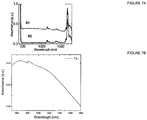
- FIGURE 7A shows illustrative UV/VIS absorption spectra of PmPV (curve 60 ) and a Te nanorod/PmPV nanocomposite (curve 61 ) dispersed in toluene.
- FIGURE 7A shows an illustrative UV/VIS absorption spectrum of Te nanorods in a Te nanorod/PmPV composite after subtracting absorption contributions from the PmPV.
- the subtraction spectrum of FIGURE 7B was qualitatively similar to the UV/VIS spectrum of Te nanorods shown in FIGURE 7A .
- FIGURE 7B shows that the Te nanorods are broadband absorbers, which makes them suitable for use in optical limiting materials.
- the absorption behavior of Te nanorod/PmPV composites followed the Beer-Lambert law. The average absorption coefficient was calculated by fitting the absorbances of all solutions, which yielded a calculated value of 8.41 + 0.42 mL cm -1 .
- Example 3 Non-linear optical measurement of Te nanorod/PmPV composites.
- z-scan experiments were performed using 6 ns pulses from a Q-switched Nd:YAG laser.
- FIGURE 8 shows a schematic of an illustrative z-scan measurement system. As shown in FIGURE 8 , the total transmittance through the sample as a function of incident laser intensity was measured, while the sample was gradually moved through the focus of a lens 80 (along the z-axis). Scattered and non-scattered radiation was measured with detector 81 and open detector 82 , respectively.
- Effective non-linear extinction coefficients including non-linear absorption and scattering were calculated by fitting the normalized transmittance as a function of position z [T norm (z)], as given by Formula (1).
- T Norm z Log e 1 + q 0 z / 1 q 0 z
- q 0 (z) is defined by Formula (2).
- q 0 z q 00 / 1 + z / z 0 2
- q 00 is defined by Formula (3).
- q 00 ⁇ eff I 0 L eff
- ⁇ eff is the effective intensity-dependent non-linear extinction coefficient
- I 0 is the intensity of the light at focus.
- L eff is the effective length of the sample defined in terms of the linear absorbance ⁇ 0 and the true optical path length L, as given in Formula (4).
- L eff 1 ⁇ e ⁇ ⁇ oL / ⁇ 0
- the effective imaginary third-order optical susceptibility Im ⁇ (3) eff ⁇ is directly related to ⁇ eff and is expressed as in Formula (5).
- Im ⁇ 3 eff n 0 2 ⁇ 0 c ⁇ ⁇ eff / 2 ⁇
- n 0 is the linear refractive index
- ⁇ 0 is the permeability of free space
- c is the speed of light
- ⁇ is the wavelength of the incident light.
- Combining Formulas (1) through (5) allows the non-linear extinction coefficients to be calculated.
- the laser beam was spatially filtered to remove higher-order modes and tightly focused with a 9 cm focal length lens.
- the laser was operated at fundamental frequency of 1064 nm and a second harmonic frequency of 532 nm, with a pulse repetition rate of 10 Hz.
- a focusing lens setup was arranged at ⁇ 30° to the direct incident beam to monitor scattered light. All samples were tested in 0.1 cm quartz cuvettes.
- FIGURE 9A shows an illustrative plot demonstrating the non-linear optical limiting response of a Te nanorod/PmPV nanocomposite at 532 nm (curve 72) and 1064 nm (curve 73) as a function of input energy density.
- a plot of output energy density versus input energy density will be a straight line.
- FIGURE 9A non-linear behavior was observed.
- the concentration of PmPV was 0.5 mg/mL
- the Te concentration was estimated to be -0.28 mg/mL using the linear absorption coefficient calculated above.
- FIGURE 9A also shows that the Te nanorod/PmPV nanocomposite had high linear transmittances of 78.8% at 532 nm (curve 70 ) and 67.0% at 1064 nm (curve 71 ). It can be clearly seen from FIGURE 9A that the Te nanorod/PmPV nanocomposite solutions exhibited exceptional optical limiting performances at both 532 nm and 1064 nm, which is characteristic of a broadband optical limiting response from the visible to the near infrared (NIR).
- NIR near infrared
- FIGURE 9B shows an illustrative plot of normalized transmission versus input energy density (J cm -2 ) in which the optical limiting threshold at which when transmittance falls to 50% of the normalized linear transmittance is indicated.
- the optical limiting threshold at 532 nm was 2.2 J cm -2 (curve 74 ) and at 1064 nm was 15.4 J cm -2 (curve 75 ), as indicated by the solid lines.
- the scattered signals [curve 76 (532 nm) and curve 77 (1064 nm)] increased significantly along with the decrease of transmission, indicating that non-linear scattering was responsible for the optical limiting.
- Increased scattering is typically synchronous with the decrease in transmission for lower concentration Te nanorod/PmPV solutions (90%).
- the delay in non-linear scattering seen in FIGURE 9B was observed for higher concentration composite samples. Such a delay is believed to be due to a residual non-linear absorption mechanism (e.g., multi-photon absorption or free-carrier absorption) which becomes evident in more concentrated Te nanorod composite solutions. Nonetheless, non-linear scattering appeared to be the primary mechanism operating in the Te nanorod/PmPV composites.
- Example 4 Comparison of Te Nanorod/PmPV Composites to Other Optical Limiting Materials.
- Te nanorod/PmPV composites To evaluate the optical limiting performance of Te nanorod/PmPV composites, several representative materials having known optical limiting properties were selected for experimental comparison.
- Well-known reverse saturable absorbers C 60 and indium phthalocyanine (tBu 4 PcInCl) that respond favorably at an excitation wavelength of 532 nm were examined.
- Te nanorod/PmPv composites had a larger non-linear extinction coefficient than either of these known optical limiting materials, even though the concentration of Te nanorods in the polymer composites was quite low.
Landscapes
- Chemical & Material Sciences (AREA)
- Health & Medical Sciences (AREA)
- Chemical Kinetics & Catalysis (AREA)
- Medicinal Chemistry (AREA)
- Polymers & Plastics (AREA)
- Organic Chemistry (AREA)
- Compositions Of Macromolecular Compounds (AREA)
- Investigating, Analyzing Materials By Fluorescence Or Luminescence (AREA)
- Polymers With Sulfur, Phosphorus Or Metals In The Main Chain (AREA)
Claims (9)
- Verbundmaterial, umfassend:ein Polymermaterial; undbiologisch synthetisierte Tellur-Nanostäbchen, die in dem Polymermaterial dispergiert sind;wobei die biologisch synthetisierten Tellur-Nanostäbchen eine nichtlineare Reaktion der optischen Begrenzung aufweisen, wobei die nichtlineare Reaktion der optischen Begrenzung nichtlineare Streuung ist.
- Verbundmaterial nach Anspruch 1, wobei die biologisch synthetisierten Tellur-Nanostäbchen durch Bacillus selenitireducens biologisch synthetisiert sind.
- Verbundmaterial nach Anspruch 1 oder Anspruch 2, wobei die biologisch synthetisierten Tellur-Nanostäbchen einen Durchmesser von 15 nm bis 25 nm gemäß Ermittlung durch Elektronenmikroskopbild aufweisen.
- Verbundmaterial nach Anspruch 3, wobei die biologisch synthetisierten Tellur-Nanostäbchen einen Durchmesser von 20 nm gemäß Ermittlung durch Elektronenmikroskopbild aufweisen.
- Verbundmaterial nach einem der vorstehenden Ansprüche, wobei die biologisch synthetisierten Tellur-Nanostäbchen eine Länge von 1 µm bis 2 µm gemäß Ermittlung durch Elektronenmikroskopbild aufweisen.
- Verbundmaterial nach einem der vorstehenden Ansprüche, wobei das Polymermaterial ein halbleitendes Polymer umfasst.
- Verbundmaterial nach Anspruch 6, wobei das halbleitende Polymer aus der Gruppe ausgewählt ist, die aus Poly(3-hexylthiophen) (P3HT), Poly(3-octylthiophen) (P3OT), Poly[2-methoxy-5-(2'-ethylhexyloxy-p-phenylen-vinylen)] (MEH-PPV), Poly[2-methoxy-5-(3,7-dimethyloctyloxy)-p-phenylen-vinylen], Natrium-poly[2-(3-thienyl)-ethoxy-4-butylsulfonat] (PTEBS) und Kombinationen davon besteht.
- Verbundmaterial nach einem der Ansprüche 1 bis 5, wobei das Polymermaterial Poly[(m-phenylen-vinylen)-co-(2,5-dioctyloxy-p-phenylen-vinylen)] (PmPV) umfasst.
- Vorrichtung zur optischen Begrenzung, umfassend das Verbundmaterial nach einem der Ansprüche 1 bis 8.
Applications Claiming Priority (3)
| Application Number | Priority Date | Filing Date | Title |
|---|---|---|---|
| US11085608P | 2008-11-03 | 2008-11-03 | |
| US11122908P | 2008-11-04 | 2008-11-04 | |
| PCT/US2009/062975 WO2010062717A1 (en) | 2008-11-03 | 2009-11-02 | Composites comprising biologically-synthesized nanomaterials |
Publications (2)
| Publication Number | Publication Date |
|---|---|
| EP2350179A1 EP2350179A1 (de) | 2011-08-03 |
| EP2350179B1 true EP2350179B1 (de) | 2018-09-19 |
Family
ID=41566256
Family Applications (1)
| Application Number | Title | Priority Date | Filing Date |
|---|---|---|---|
| EP09748198.0A Active EP2350179B1 (de) | 2008-11-03 | 2009-11-02 | Verbundwerkstoffe mit biologisch synthetisierten nanomaterialien |
Country Status (6)
| Country | Link |
|---|---|
| US (1) | US8431640B2 (de) |
| EP (1) | EP2350179B1 (de) |
| CN (1) | CN102239208A (de) |
| AU (1) | AU2009320026B2 (de) |
| NZ (2) | NZ592755A (de) |
| WO (1) | WO2010062717A1 (de) |
Families Citing this family (4)
| Publication number | Priority date | Publication date | Assignee | Title |
|---|---|---|---|---|
| US8759053B2 (en) * | 2009-02-03 | 2014-06-24 | Ut-Battelle, Llc | Microbially-mediated method for synthesis of non-oxide semiconductor nanoparticles |
| US20110051231A1 (en) * | 2009-08-26 | 2011-03-03 | Kilolambda Technologies Ltd. | Light excited limiting window |
| CN102976628B (zh) * | 2012-12-13 | 2015-09-16 | 重庆大学 | Te/TeO2-SiO2复合薄膜作为光限幅材料的应用 |
| CN108676817B (zh) * | 2018-07-16 | 2022-03-29 | 王昊 | 利用地衣芽孢杆菌生物合成纳米碲的方法及其应用 |
Family Cites Families (2)
| Publication number | Priority date | Publication date | Assignee | Title |
|---|---|---|---|---|
| JP5061414B2 (ja) * | 2001-09-27 | 2012-10-31 | 東レ株式会社 | 薄膜トランジスタ素子 |
| CN1300259C (zh) * | 2005-04-20 | 2007-02-14 | 天津大学 | 聚噻吩甲烯键合碳纳米管非线性光学材料的制备方法 |
-
2009
- 2009-11-02 US US12/610,612 patent/US8431640B2/en active Active
- 2009-11-02 EP EP09748198.0A patent/EP2350179B1/de active Active
- 2009-11-02 NZ NZ592755A patent/NZ592755A/xx not_active IP Right Cessation
- 2009-11-02 WO PCT/US2009/062975 patent/WO2010062717A1/en not_active Ceased
- 2009-11-02 NZ NZ606508A patent/NZ606508A/en unknown
- 2009-11-02 CN CN2009801490024A patent/CN102239208A/zh active Pending
- 2009-11-02 AU AU2009320026A patent/AU2009320026B2/en not_active Ceased
Non-Patent Citations (1)
| Title |
|---|
| None * |
Also Published As
| Publication number | Publication date |
|---|---|
| AU2009320026A1 (en) | 2010-06-03 |
| EP2350179A1 (de) | 2011-08-03 |
| AU2009320026B2 (en) | 2015-08-20 |
| WO2010062717A1 (en) | 2010-06-03 |
| US8431640B2 (en) | 2013-04-30 |
| NZ592755A (en) | 2013-02-22 |
| CN102239208A (zh) | 2011-11-09 |
| NZ606508A (en) | 2014-10-31 |
| US20100160521A1 (en) | 2010-06-24 |
Similar Documents
| Publication | Publication Date | Title |
|---|---|---|
| Wang et al. | Inorganic and hybrid nanostructures for optical limiting | |
| Gao et al. | Saturable absorption and reverse saturable absorption in platinum nanoparticles | |
| Zhang et al. | Nonlinear optical and optical limiting properties of graphene oxide–Fe3O4 hybrid material | |
| Chin et al. | Modified carbon nanotubes as broadband optical limiting nanomaterials | |
| Qu et al. | Optical nonlinearities and optical limiting properties in gold nanoparticles protected by ligands | |
| He et al. | Preparation and optical limiting properties of multiwalled carbon nanotubes with π-conjugated metal-free phthalocyanine moieties | |
| Zhao et al. | Broadband optical limiting response of a graphene–PbS nanohybrid | |
| Wang et al. | Solvent effect on optical limiting properties of single-walled carbon nanotube dispersions | |
| Zhao et al. | Nonlinear optical transmission of nanographene and its composites | |
| Xu et al. | Nonlinear optical transmission in VO x nanotubes and VO x nanotube composites | |
| Alkallas et al. | Nonlinearity enhancement of Multi-walled carbon nanotube decorated with ZnO nanoparticles prepared by laser assisted method | |
| Wang et al. | Nonlinear optical and optical limiting properties of individual single-walled carbon nanotubes | |
| US20110170208A1 (en) | Broadband optical limiter based on nano-graphene and method of fabricating same | |
| Wang et al. | Carbon-based optical limiting materials | |
| Durairaj et al. | 3PA-induced optical limiting in pure and barium borate decorated MoS2 nanocomposites | |
| Mikheev et al. | Saturable absorption in suspensions of single-digit detonation nanodiamonds | |
| US8431640B2 (en) | Composites comprising biologically-synthesized nanomaterials | |
| Gao et al. | Nonlinear optical response of noble metal nanoparticles | |
| Zheng et al. | Nonlinear optical responses of carbon quantum dots anchored on graphene oxide hybrid in solid-state transparent monolithic silica gel glasses | |
| Feng et al. | Facile preparation of transparent and dense CdS–silica gel glass nanocomposites for optical limiting applications | |
| Ramya et al. | Nonlinear optical properties of Ag-enriched ZnO nanostructures | |
| Li et al. | Broadband optical limiting properties of Tungsten Trioxide-Poly (Vinyl Alcohol) solid-state nanocomposite films | |
| Ameta | Nanomaterials: An Introduction | |
| sadat Hosseini et al. | Enhanced third-order nonlinear optical properties of ZnO@ CN composite microspheres | |
| Liaros et al. | Nonlinear optical response of some Graphene oxide and Graphene fluoride derivatives |
Legal Events
| Date | Code | Title | Description |
|---|---|---|---|
| PUAI | Public reference made under article 153(3) epc to a published international application that has entered the european phase |
Free format text: ORIGINAL CODE: 0009012 |
|
| 17P | Request for examination filed |
Effective date: 20110527 |
|
| AK | Designated contracting states |
Kind code of ref document: A1 Designated state(s): AT BE BG CH CY CZ DE DK EE ES FI FR GB GR HR HU IE IS IT LI LT LU LV MC MK MT NL NO PL PT RO SE SI SK SM TR |
|
| DAX | Request for extension of the european patent (deleted) | ||
| 17Q | First examination report despatched |
Effective date: 20170619 |
|
| GRAP | Despatch of communication of intention to grant a patent |
Free format text: ORIGINAL CODE: EPIDOSNIGR1 |
|
| INTG | Intention to grant announced |
Effective date: 20180425 |
|
| GRAS | Grant fee paid |
Free format text: ORIGINAL CODE: EPIDOSNIGR3 |
|
| GRAA | (expected) grant |
Free format text: ORIGINAL CODE: 0009210 |
|
| AK | Designated contracting states |
Kind code of ref document: B1 Designated state(s): AT BE BG CH CY CZ DE DK EE ES FI FR GB GR HR HU IE IS IT LI LT LU LV MC MK MT NL NO PL PT RO SE SI SK SM TR |
|
| REG | Reference to a national code |
Ref country code: GB Ref legal event code: FG4D |
|
| REG | Reference to a national code |
Ref country code: CH Ref legal event code: EP |
|
| REG | Reference to a national code |
Ref country code: AT Ref legal event code: REF Ref document number: 1043188 Country of ref document: AT Kind code of ref document: T Effective date: 20181015 |
|
| REG | Reference to a national code |
Ref country code: IE Ref legal event code: FG4D |
|
| REG | Reference to a national code |
Ref country code: DE Ref legal event code: R096 Ref document number: 602009054603 Country of ref document: DE |
|
| REG | Reference to a national code |
Ref country code: NL Ref legal event code: MP Effective date: 20180919 |
|
| PG25 | Lapsed in a contracting state [announced via postgrant information from national office to epo] |
Ref country code: LT Free format text: LAPSE BECAUSE OF FAILURE TO SUBMIT A TRANSLATION OF THE DESCRIPTION OR TO PAY THE FEE WITHIN THE PRESCRIBED TIME-LIMIT Effective date: 20180919 Ref country code: GR Free format text: LAPSE BECAUSE OF FAILURE TO SUBMIT A TRANSLATION OF THE DESCRIPTION OR TO PAY THE FEE WITHIN THE PRESCRIBED TIME-LIMIT Effective date: 20181220 Ref country code: NO Free format text: LAPSE BECAUSE OF FAILURE TO SUBMIT A TRANSLATION OF THE DESCRIPTION OR TO PAY THE FEE WITHIN THE PRESCRIBED TIME-LIMIT Effective date: 20181219 Ref country code: BG Free format text: LAPSE BECAUSE OF FAILURE TO SUBMIT A TRANSLATION OF THE DESCRIPTION OR TO PAY THE FEE WITHIN THE PRESCRIBED TIME-LIMIT Effective date: 20181219 Ref country code: SE Free format text: LAPSE BECAUSE OF FAILURE TO SUBMIT A TRANSLATION OF THE DESCRIPTION OR TO PAY THE FEE WITHIN THE PRESCRIBED TIME-LIMIT Effective date: 20180919 Ref country code: FI Free format text: LAPSE BECAUSE OF FAILURE TO SUBMIT A TRANSLATION OF THE DESCRIPTION OR TO PAY THE FEE WITHIN THE PRESCRIBED TIME-LIMIT Effective date: 20180919 |
|
| REG | Reference to a national code |
Ref country code: LT Ref legal event code: MG4D |
|
| PG25 | Lapsed in a contracting state [announced via postgrant information from national office to epo] |
Ref country code: HR Free format text: LAPSE BECAUSE OF FAILURE TO SUBMIT A TRANSLATION OF THE DESCRIPTION OR TO PAY THE FEE WITHIN THE PRESCRIBED TIME-LIMIT Effective date: 20180919 Ref country code: LV Free format text: LAPSE BECAUSE OF FAILURE TO SUBMIT A TRANSLATION OF THE DESCRIPTION OR TO PAY THE FEE WITHIN THE PRESCRIBED TIME-LIMIT Effective date: 20180919 |
|
| REG | Reference to a national code |
Ref country code: AT Ref legal event code: MK05 Ref document number: 1043188 Country of ref document: AT Kind code of ref document: T Effective date: 20180919 |
|
| PG25 | Lapsed in a contracting state [announced via postgrant information from national office to epo] |
Ref country code: IT Free format text: LAPSE BECAUSE OF FAILURE TO SUBMIT A TRANSLATION OF THE DESCRIPTION OR TO PAY THE FEE WITHIN THE PRESCRIBED TIME-LIMIT Effective date: 20180919 Ref country code: AT Free format text: LAPSE BECAUSE OF FAILURE TO SUBMIT A TRANSLATION OF THE DESCRIPTION OR TO PAY THE FEE WITHIN THE PRESCRIBED TIME-LIMIT Effective date: 20180919 Ref country code: EE Free format text: LAPSE BECAUSE OF FAILURE TO SUBMIT A TRANSLATION OF THE DESCRIPTION OR TO PAY THE FEE WITHIN THE PRESCRIBED TIME-LIMIT Effective date: 20180919 Ref country code: RO Free format text: LAPSE BECAUSE OF FAILURE TO SUBMIT A TRANSLATION OF THE DESCRIPTION OR TO PAY THE FEE WITHIN THE PRESCRIBED TIME-LIMIT Effective date: 20180919 Ref country code: PL Free format text: LAPSE BECAUSE OF FAILURE TO SUBMIT A TRANSLATION OF THE DESCRIPTION OR TO PAY THE FEE WITHIN THE PRESCRIBED TIME-LIMIT Effective date: 20180919 Ref country code: IS Free format text: LAPSE BECAUSE OF FAILURE TO SUBMIT A TRANSLATION OF THE DESCRIPTION OR TO PAY THE FEE WITHIN THE PRESCRIBED TIME-LIMIT Effective date: 20190119 Ref country code: CZ Free format text: LAPSE BECAUSE OF FAILURE TO SUBMIT A TRANSLATION OF THE DESCRIPTION OR TO PAY THE FEE WITHIN THE PRESCRIBED TIME-LIMIT Effective date: 20180919 Ref country code: NL Free format text: LAPSE BECAUSE OF FAILURE TO SUBMIT A TRANSLATION OF THE DESCRIPTION OR TO PAY THE FEE WITHIN THE PRESCRIBED TIME-LIMIT Effective date: 20180919 Ref country code: ES Free format text: LAPSE BECAUSE OF FAILURE TO SUBMIT A TRANSLATION OF THE DESCRIPTION OR TO PAY THE FEE WITHIN THE PRESCRIBED TIME-LIMIT Effective date: 20180919 |
|
| PG25 | Lapsed in a contracting state [announced via postgrant information from national office to epo] |
Ref country code: PT Free format text: LAPSE BECAUSE OF FAILURE TO SUBMIT A TRANSLATION OF THE DESCRIPTION OR TO PAY THE FEE WITHIN THE PRESCRIBED TIME-LIMIT Effective date: 20190119 Ref country code: SK Free format text: LAPSE BECAUSE OF FAILURE TO SUBMIT A TRANSLATION OF THE DESCRIPTION OR TO PAY THE FEE WITHIN THE PRESCRIBED TIME-LIMIT Effective date: 20180919 Ref country code: SM Free format text: LAPSE BECAUSE OF FAILURE TO SUBMIT A TRANSLATION OF THE DESCRIPTION OR TO PAY THE FEE WITHIN THE PRESCRIBED TIME-LIMIT Effective date: 20180919 |
|
| REG | Reference to a national code |
Ref country code: DE Ref legal event code: R119 Ref document number: 602009054603 Country of ref document: DE |
|
| REG | Reference to a national code |
Ref country code: CH Ref legal event code: PL |
|
| PLBE | No opposition filed within time limit |
Free format text: ORIGINAL CODE: 0009261 |
|
| STAA | Information on the status of an ep patent application or granted ep patent |
Free format text: STATUS: NO OPPOSITION FILED WITHIN TIME LIMIT |
|
| PG25 | Lapsed in a contracting state [announced via postgrant information from national office to epo] |
Ref country code: MC Free format text: LAPSE BECAUSE OF FAILURE TO SUBMIT A TRANSLATION OF THE DESCRIPTION OR TO PAY THE FEE WITHIN THE PRESCRIBED TIME-LIMIT Effective date: 20180919 Ref country code: LU Free format text: LAPSE BECAUSE OF NON-PAYMENT OF DUE FEES Effective date: 20181102 Ref country code: DK Free format text: LAPSE BECAUSE OF FAILURE TO SUBMIT A TRANSLATION OF THE DESCRIPTION OR TO PAY THE FEE WITHIN THE PRESCRIBED TIME-LIMIT Effective date: 20180919 |
|
| REG | Reference to a national code |
Ref country code: BE Ref legal event code: MM Effective date: 20181130 |
|
| REG | Reference to a national code |
Ref country code: IE Ref legal event code: MM4A |
|
| 26N | No opposition filed |
Effective date: 20190620 |
|
| PG25 | Lapsed in a contracting state [announced via postgrant information from national office to epo] |
Ref country code: LI Free format text: LAPSE BECAUSE OF NON-PAYMENT OF DUE FEES Effective date: 20181130 Ref country code: CH Free format text: LAPSE BECAUSE OF NON-PAYMENT OF DUE FEES Effective date: 20181130 |
|
| PG25 | Lapsed in a contracting state [announced via postgrant information from national office to epo] |
Ref country code: IE Free format text: LAPSE BECAUSE OF NON-PAYMENT OF DUE FEES Effective date: 20181102 Ref country code: DE Free format text: LAPSE BECAUSE OF NON-PAYMENT OF DUE FEES Effective date: 20190601 Ref country code: FR Free format text: LAPSE BECAUSE OF NON-PAYMENT OF DUE FEES Effective date: 20181119 Ref country code: SI Free format text: LAPSE BECAUSE OF FAILURE TO SUBMIT A TRANSLATION OF THE DESCRIPTION OR TO PAY THE FEE WITHIN THE PRESCRIBED TIME-LIMIT Effective date: 20180919 |
|
| PG25 | Lapsed in a contracting state [announced via postgrant information from national office to epo] |
Ref country code: BE Free format text: LAPSE BECAUSE OF NON-PAYMENT OF DUE FEES Effective date: 20181130 |
|
| PG25 | Lapsed in a contracting state [announced via postgrant information from national office to epo] |
Ref country code: MT Free format text: LAPSE BECAUSE OF NON-PAYMENT OF DUE FEES Effective date: 20181102 |
|
| PG25 | Lapsed in a contracting state [announced via postgrant information from national office to epo] |
Ref country code: TR Free format text: LAPSE BECAUSE OF FAILURE TO SUBMIT A TRANSLATION OF THE DESCRIPTION OR TO PAY THE FEE WITHIN THE PRESCRIBED TIME-LIMIT Effective date: 20180919 |
|
| PG25 | Lapsed in a contracting state [announced via postgrant information from national office to epo] |
Ref country code: MK Free format text: LAPSE BECAUSE OF NON-PAYMENT OF DUE FEES Effective date: 20180919 Ref country code: CY Free format text: LAPSE BECAUSE OF FAILURE TO SUBMIT A TRANSLATION OF THE DESCRIPTION OR TO PAY THE FEE WITHIN THE PRESCRIBED TIME-LIMIT Effective date: 20180919 Ref country code: HU Free format text: LAPSE BECAUSE OF FAILURE TO SUBMIT A TRANSLATION OF THE DESCRIPTION OR TO PAY THE FEE WITHIN THE PRESCRIBED TIME-LIMIT; INVALID AB INITIO Effective date: 20091102 |
|
| PGFP | Annual fee paid to national office [announced via postgrant information from national office to epo] |
Ref country code: GB Payment date: 20251127 Year of fee payment: 17 |