EP2348303A1 - Liquid inspecting method and liquid inspecting device - Google Patents
Liquid inspecting method and liquid inspecting device Download PDFInfo
- Publication number
- EP2348303A1 EP2348303A1 EP09819143A EP09819143A EP2348303A1 EP 2348303 A1 EP2348303 A1 EP 2348303A1 EP 09819143 A EP09819143 A EP 09819143A EP 09819143 A EP09819143 A EP 09819143A EP 2348303 A1 EP2348303 A1 EP 2348303A1
- Authority
- EP
- European Patent Office
- Prior art keywords
- liquid
- explosive
- infrared light
- raw material
- absorption spectrum
- Prior art date
- Legal status (The legal status is an assumption and is not a legal conclusion. Google has not performed a legal analysis and makes no representation as to the accuracy of the status listed.)
- Granted
Links
Images
Classifications
-
- G—PHYSICS
- G01—MEASURING; TESTING
- G01N—INVESTIGATING OR ANALYSING MATERIALS BY DETERMINING THEIR CHEMICAL OR PHYSICAL PROPERTIES
- G01N21/00—Investigating or analysing materials by the use of optical means, i.e. using sub-millimetre waves, infrared, visible or ultraviolet light
- G01N21/17—Systems in which incident light is modified in accordance with the properties of the material investigated
- G01N21/25—Colour; Spectral properties, i.e. comparison of effect of material on the light at two or more different wavelengths or wavelength bands
- G01N21/31—Investigating relative effect of material at wavelengths characteristic of specific elements or molecules, e.g. atomic absorption spectrometry
- G01N21/35—Investigating relative effect of material at wavelengths characteristic of specific elements or molecules, e.g. atomic absorption spectrometry using infrared light
- G01N21/359—Investigating relative effect of material at wavelengths characteristic of specific elements or molecules, e.g. atomic absorption spectrometry using infrared light using near infrared light
-
- G—PHYSICS
- G01—MEASURING; TESTING
- G01N—INVESTIGATING OR ANALYSING MATERIALS BY DETERMINING THEIR CHEMICAL OR PHYSICAL PROPERTIES
- G01N21/00—Investigating or analysing materials by the use of optical means, i.e. using sub-millimetre waves, infrared, visible or ultraviolet light
- G01N21/17—Systems in which incident light is modified in accordance with the properties of the material investigated
- G01N21/25—Colour; Spectral properties, i.e. comparison of effect of material on the light at two or more different wavelengths or wavelength bands
- G01N21/31—Investigating relative effect of material at wavelengths characteristic of specific elements or molecules, e.g. atomic absorption spectrometry
- G01N21/35—Investigating relative effect of material at wavelengths characteristic of specific elements or molecules, e.g. atomic absorption spectrometry using infrared light
- G01N21/3577—Investigating relative effect of material at wavelengths characteristic of specific elements or molecules, e.g. atomic absorption spectrometry using infrared light for analysing liquids, e.g. polluted water
-
- G—PHYSICS
- G01—MEASURING; TESTING
- G01N—INVESTIGATING OR ANALYSING MATERIALS BY DETERMINING THEIR CHEMICAL OR PHYSICAL PROPERTIES
- G01N21/00—Investigating or analysing materials by the use of optical means, i.e. using sub-millimetre waves, infrared, visible or ultraviolet light
- G01N21/84—Systems specially adapted for particular applications
- G01N21/88—Investigating the presence of flaws or contamination
- G01N21/90—Investigating the presence of flaws or contamination in a container or its contents
- G01N21/9018—Dirt detection in containers
- G01N21/9027—Dirt detection in containers in containers after filling
-
- G—PHYSICS
- G01—MEASURING; TESTING
- G01N—INVESTIGATING OR ANALYSING MATERIALS BY DETERMINING THEIR CHEMICAL OR PHYSICAL PROPERTIES
- G01N33/00—Investigating or analysing materials by specific methods not covered by groups G01N1/00 - G01N31/00
- G01N33/22—Fuels; Explosives
Definitions
- the present invention relates to a method for inspecting a liquid with which an optically transparent container is filled and to a liquid inspection device. More particularly, the present invention relates to an inspection method and an inspection device for checking whether an explosive, a raw material for explosive, or an illicit drug of some kind is contained in a liquid with which an optically transparent container is filled.
- Non-Patent Document 1 As a method for inspecting a liquid from outside a container without opening the container under such circumstances, a detection method has already been proposed which is used to swiftly determine whether a liquid is a combustible liquid, such as gasoline, or not (see Non-Patent Document 1).
- the determination whether a liquid is a dangerous substance or not is made based on a fact that water, the main ingredient in a regular drink is different in permittivity from combustibles such as gasoline, specifically based on a fact that water is higher in permittivity than gasoline.
- Non-Patent Document 1 is not an effective detection method.
- Non-Patent Document 1 the official website of Tokyo Gas Co., Ltd. and Tokyo Gas Engineering Co., Ltd., online information entitled “Launch of Intra-Bottle Liquid Inspection Device SLC-211D", Nov. 1, 2004 (retrieved on Sep. 22, 2008 URL:http://www.tokyo-gas.co.jp/Press/20041101/html)
- an object of the present invention to provide an inspection method and an inspection device in which whether an explosive, a raw material for explosive, or an illicit drug of some kind is contained in a liquid with which an optically transparent container, such as a PET bottle or a glass bottle, is filled can be checked swiftly and reliably from outside the container.
- the invention of Claim 1 is a liquid inspection method for checking whether an explosive, a raw material for explosive, or an illicit drug is contained in a liquid with which an optically transparent container is filled, comprising:
- the present inventors carefully studied not only properties of the dangerous substances but also properties of liquids, such as drinks, and containers. As a result, it was found that whether a dangerous substance of some kind is contained can be checked swiftly and reliably by analyzing an absorption spectrum obtained by irradiating a container with near-infrared light from outside the container without opening the container.
- the dangerous substance can be detected correctly by devising a method for analyzing an obtained near-infrared light absorption spectrum.
- the analysis can be conducted suitably.
- the selection of the specific wavelengths is carried out suitably in consideration of kinds of container, kinds of liquids to be put in the containers, and dangerous substances likely to be used.
- Absorption spectra can be obtained by using either transmitted light or scattered light; it is preferable that scattered light be used because an irradiation unit and a light reception unit can be integrated into a single unit and the detection device can be, therefore, made compact.
- a white lamp As a light source for emitting near-infrared light, a white lamp can be preferably used. Further, as the irradiation direction when near-infrared irradiation is conducted from outside the container, any surface of the container may be irradiated provided that the surface is optically transparent. Undersurfaces of PET bottles and so on often have shapes suitable for light scattering, and thus it is preferable that the irradiation be conducted from the direction of the undersurfaces.
- the invention of Claim 2 is the liquid inspection method according to Claim 1, wherein identification of the kinds of the explosive, raw material for explosive, and/or illicit drug is conducted by analyzing the absorption spectrum.
- the invention of Claim 3 is the liquid inspection method according to Claim 1 or Claim 2, wherein absorbance at the predetermined wavelengths of an absorption spectrum analyzed at the absorption spectrum analysis step is substituted into a concentration estimation equation formulated based on absorption spectra analyzed by using a plurality of liquids that contain the explosive, the raw material for explosive, and/or the illicit drug with preset concentrations to measure a concentration of the explosive, the raw material for explosive, and/or the illicit drug.
- the concentration of the dangerous substance is measured and the level of danger can be clearly determined. And further, since the absorbance at the predetermined wavelengths of the analyzed absorption spectra is merely substituted into the concentration estimation equation formulated based on the absorption spectra analyzed by using the solutions containing the dangerous substances with the preset concentrations, the concentration can be measured swiftly and readily.
- the invention of Claim 4 is the liquid inspection method according to Claim 3, wherein the concentration estimation equation is formulated by conducting multiple regression analyses by using the absorbances at the wavelengths of the absorption spectra analyzed by using the liquids containing the explosive, the raw material for explosive, and/or the illicit drug with the preset concentrations.
- a more exact concentration estimation equation can be formulated by conducting the multiple regression analyses by using the absorbances at the wavelengths of the absorption spectra obtained by analysis of the liquids containing the dangerous substances with the preset concentrations.
- the use of the more exact concentration estimation equation makes it possible to accommodate subtle changes in the spectra, whereby the concentrations can be measured with higher accuracy.
- the invention of Claim 5 is the liquid inspection method according to Claim 3 or 4, wherein an absorbance quadratic differential value at the predetermined wavelengths which is obtained by a quadratic differentiation for the absorption spectra is used as the absorbance.
- the use of the absorbance quadratic differential value determined by subjecting the absorption spectra quadratic differentiation makes it possible to clearly grasp subtle changes in the absorption spectra caused by the mixing of the dangerous substances. As a result, even more exact concentration estimation equation can be obtained.
- the invention of Claim 6 is the liquid inspection method according to any one of Claims 1-5, wherein the raw material for explosive is hydrogen peroxide.
- hydrogen peroxide solutions are similar to water in physical, chemical, and optical properties, it is difficult to identify hydrogen peroxide solutions in a short time by conventional liquid inspection methods; therefore, hydrogen peroxide solution is easy to be carried in with filling in a drinking container. According to the present invention, hydrogen peroxide solutions can also be detected accurately, and thus it is possible to clearly show effects of the present invention.
- the invention of Claim 7 is the liquid inspection method according to any one of Claims 3-6, wherein regular products are used as the liquids containing the explosive, the raw material for explosive, and/or the illicit drug with the preset concentrations, a concentration estimation equation is previously formulated for each of the regular products, a regular product corresponding to the inspection object is identified by reading the product labeling mark put on the inspection object, and the concentration of liquid explosive, raw material for explosive, and/or illicit drug in the inspection objects is measured by using the concentration estimation equation corresponding to the identified regular product.
- concentrations of liquid explosive, raw material for explosive, illicit drug, and so on with which containers are filled can be measured with higher accuracy.
- Containers and liquids to be inspected vary in kind.
- Containers are different in not only material (examples of containers include PET bottles, glass bottles, and colored glass bottles) but size and shape.
- liquids vary in kind; examples of liquids include water, green tea, black tea, coffee, cola, and juice.
- the absorption spectra differ depending on the materials for containers, the sizes and shapes of containers, and the kinds of liquids put in containers. Therefore, in measurement of concentrations using a typical concentration estimation equation so that the equation can be applied to various containers and liquids, there is a limit to accuracy of the measurement.
- the "product labeling mark" mentioned in Claim 7 refers to a bar code, or a QR code, for example.
- the invention of Claim 8 is a liquid inspection device for inspecting whether an explosive, a raw material for explosive, or an illicit drug is contained in a liquid with which an optically transparent container is filled, comprising:
- the invention of Claim 8 is a device used for conducting the method of Claim 1.
- a dangerous substance is contained in a liquid with which an optically transparent container, such as a PET bottle or a glass bottle, is filled can be inspected swiftly and reliably from outside the container without opening the container.
- the invention of Claim 9 is the liquid inspection device according to Claim 8 wherein the near-infrared light irradiation means and the near-infrared light reception means are integrated.
- the near-infrared light irradiation means and the near-infrared light reception means are provided with both means integrated, a spacing between the near-infrared light irradiation unit and the near-infrared light reception unit is constant and absorption spectrum analysis can be, therefore, conducted accurately.
- a compact liquid inspection device can be provided.
- the invention of Claim 10 is the liquid inspection device according to Claim 8 or Claim 9, which further comprising a product labeling mark reading means for reading a product labeling mark put on a regular product.
- a liquid inspection device is provided which is capable of inspecting whether an explosive, a raw material for explosive, and/or an illicit drug are contained in the inspection object with higher accuracy.
- an inspection method in which whether an explosive, a raw material for explosive, or an illicit drug is contained in a liquid with which an optically transparent container, such as a PET bottle or a glass bottle, is filled can be inspected swiftly and reliably from outside the container; and an inspection device for the inspection method is provided.
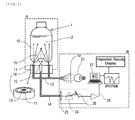
- FIG. 1 is an illustration schematically showing the main part of the liquid inspection device according to the embodiment.
- the main part is mainly constituted by a sample placement section A and an instrumentation section B. Both the section A and B are connected with each other by using optical fibers 13 and 14.
- a sensor head 10 At the sample placement section A, a sensor head 10 is provided.
- the sensor head 10 comprises an irradiation unit 11 for near-infrared light irradiation and a light reception unit 12 to receive the near-infrared light.
- a container placement stage (not shown) is provided; on the placement stage, an optically transparent container 1 in which a liquid 2 is put is placed as a sample to be inspected.
- Top surface of a sensor head 10 may be used as a container placement stage.
- a light source 21 to emit near-infrared light
- lenses 22 and 23 a prism 24, and a personal computer (PC) 27 to analyze an absorption spectrum of the near-infrared light.
- PC personal computer
- a Liquid put in a container is inspected for a dangerous substance by using the liquid inspection device having such a configuration as mentioned above according to the following procedure.
- the optically transparent container 1 filled with the liquid 2 is placed on the placement stage as a sample to be inspected.
- the container 1 is shielded from extraneous light by using a black cover or the like so that results of the inspection are not affected by the extraneous light.
- Light emitted by turning on the light source 21 is concentrated by the lens 22, and then introduced into the irradiation unit 11 provided at the sensor head 10 through the optical fiber 13. Then the irradiation unit 11 irradiates the container 1 and the liquid 2 with near-infrared light 15. The applied near-infrared light 15 is scattered by the liquid 2, whereby scattered near-infrared light 16 is obtained.
- the scattered near-infrared light 16 is received by the light reception unit 12 provided at the sensor head 10, and then introduced into the prism 24 through the optical fiber 14 and the lens 23.
- the near-infrared light is separated into its spectral components, and an absorption spectrum 25 can be obtained.
- an optical grating having a superior spectral analysis function be used instead of the prism 24.
- Some of the near-infrared light 15 pass through the liquid 2 without being scattered.
- the light passed through the liquid 2 can also be subjected to analysis; in this case, a same process as the process described above can be executed by providing a light reception unit in a manner that opposes the light reception unit to an irradiation unit.
- Such a concentration estimation equation is formulated for each regular product; at the time of inspection of an inspection object in a container, a regular product corresponding to the inspection object is identified by reading a product labeling mark put on the container. Then the concentration estimation equation corresponding to the regular product is used to inspect the inspection object with higher accuracy.
- Absorption Spectra of near-infrared light differ depending on the kinds and concentrations of dangerous substances, the kinds of containers, and the kinds of liquids. Further, obtained absorption spectra also differ depending on not only combinations of those factors but quantities and temperatures of the liquids. Therefore, regarding dangerous substances likely to be used, a plurality of samples of each dangerous substance different in concentration are prepared in combination with various containers and liquids to obtain absorption spectra. Moreover, further absorption spectra are obtained by changing the quantity and temperature of each liquid.
- a concentration estimation equation which shows relations between concentrations of a dangerous substance and absorbances at predetermined wavelengths of an absorption spectrum, is formulated by means of multiple regression analysis.
- a following general equation (1) i.e., a multiple regression equation is set up which represents the relation between an estimated value of the concentration of a dangerous substance and the absorbance at the wavelengths
- plurality of equations are formulated by substituting concentrations of liquids and absorbances at selected wavelengths ( ⁇ i ) of absorption spectra in Equation (1), and then a regression constant ⁇ 0 and biased regression coefficient ⁇ i in Equation (1) are determined by using a least squares method.
- y ⁇ 0 + ⁇ 1 ⁇ x 1 + ⁇ 2 ⁇ x 2 + ⁇ 3 x 3 + ⁇ + ⁇ P ⁇ x P
- y is the concentration
- ⁇ 0 is a regression constant (that depends upon quantity of a liquid, container, solution, etc.)
- ⁇ i 's are biased regression coefficients (that depends upon quantity of a liquid, container, solution, etc.).
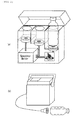
- FIGS. 2 (a) and 2 (b) show concrete examples of the liquid inspection device according to the embodiment.
- FIG. 2 (a) is an illustration of an installation-type inspection device suitable for use in hand luggage inspection, in which plural sensor heads (in the figure, three sensor heads) are provided at heights different from each other. Therefore the inspection device is singly capable of inspecting containers different in size. Further, by closing a top lid, influence of extraneous light can be averted.
- FIG. 2(b) is an illustration of a portable inspection device; by providing a sensor head outside the device, the inspection device is made compact. Further, since the sensor head is provided and separated from the body of the inspection device, near-infrared light irradiation can be performed in any direction. For example, discarded PET bottles and so on can be inspected from a place some distance from those inspection objects.
- concentrations of the hydrogen peroxide in the sample solutions were determined by using the concentration estimation equation, the concentrations were actually measured by using an established analytical method on the sample solutions, and then whether the measured concentrations are accurate or not was determined by comparing both concentrations.
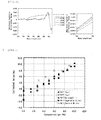
- FIG. 3 shows results of the quadratic differentiation of the absorption spectra obtained by using the samples with the concentrations of 0%, 3%, 6% and 9% and an enlarged view of a part of the result. Then, absorbance quadratic differential values at three wavelengths of 748 nm, 958 nm, 850 nm were determined.
- PET containers different in shape and size such as PET containers for tea
- Hydrogen peroxide solutions with concentrations of 0% to 10% by mass were prepared by using three methods described below.
- the concentration of the hydrogen peroxide in each sample was actually measured by using an established analytical method. Then, the actual measured values obtained by the analysis were compared with the estimated values calculated by using the concentration estimation equation.
- FIG. 4 is a graph showing relation between the estimated values and the actually measured values of the concentrations of the dangerous substances; the figure also shows the containers and the measurement conditions used in the inspection.
- the vertical axis indicates the estimated values (the concentrations calculated by using the concentration estimation equation), and the horizontal axis indicates the concentrations actually measured by using the established analytical method.
- the estimated values of the concentrations were in good agreement with the concentrations actually measured. From this example, it can be seen that even when containers are different in shape and size and liquids are different in quantity, a concentration of hydrogen peroxide can be measured correctly and accurately by using one concentration estimation equation.
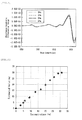
- FIG. 5 shows results of having subjected the absorption spectra of samples with the acetone concentrations of 0%, 3%, 6% and 9% to quadratic differentiation.
- a concentration estimation equation shown as a following equation (4) was formulated by using a same method as the method described in Example 1.
- c 11.2 + 805000 ⁇ E 1 - 150000 ⁇ E 2 - 223000 ⁇ E 3 wherein c is an estimated value of the concentration, E 1 , E 2 and E 3 are absorbance quadratic differential values at the wavelength of 724 nm, 892 nm and850 nm, respectively.
- FIG. 6 shows results of comparisons of the estimated values calculated by using the concentration estimation equation mentioned above and the actually measured concentrations regarding the twelve samples.
- the vertical axis indicates the estimated values of the concentrations
- the horizontal axis indicates the concentrations actually measured through the analysis.
- relation between the estimated values for each sample and the concentrations actually measured through the analysis can be represented in the form of substantially one straight line with gradient of 1. Therefore, in this example as well, it can be seen that the concentration estimation equation with high accuracy is formulated.
Landscapes
- Physics & Mathematics (AREA)
- Spectroscopy & Molecular Physics (AREA)
- Health & Medical Sciences (AREA)
- Life Sciences & Earth Sciences (AREA)
- Chemical & Material Sciences (AREA)
- Analytical Chemistry (AREA)
- Biochemistry (AREA)
- General Health & Medical Sciences (AREA)
- General Physics & Mathematics (AREA)
- Immunology (AREA)
- Pathology (AREA)
- Investigating Or Analysing Materials By Optical Means (AREA)
Abstract
Description
- The present invention relates to a method for inspecting a liquid with which an optically transparent container is filled and to a liquid inspection device. More particularly, the present invention relates to an inspection method and an inspection device for checking whether an explosive, a raw material for explosive, or an illicit drug of some kind is contained in a liquid with which an optically transparent container is filled.
- Including the simultaneous terrorist bomb explosion incidents that occurred in Great Britain in 2005, terrorist bomb explosion incidents have occurred frequently at public facilities and public transportation in recent years. In recent times, there have been growing cases where a dangerous character, such as a terrorist, pretending to be a passenger carries onto an airplane or the like an optically transparent container for a drink, such as a PET bottle, or a glass bottle, for example, filled with a liquid in which an explosive, a raw material for explosive, or the like has been mixed or dissolved. Further, there have also been growing cases where a liquid, in which an illicit drug such as a narcotic or a stimulant has been dissolved, is smuggled in a manner that an optically transparent container is filled with the illicit drug.
- As measures against the carrying of explosives, a raw material for explosive, and illicit drugs on airplanes, hand luggage inspections are conducted on passengers at airports for preventing occurrence of incidents such as terrorist incidents, and smuggling. In order to conduct inspections on many passengers, there is a need to swiftly conduct the inspections, but it is not easy to determine whether or not a liquid with which a container has been filled contains an explosive, a raw material for explosive, or an illicit drug during short-time inspection.
- As a method for inspecting a liquid from outside a container without opening the container under such circumstances, a detection method has already been proposed which is used to swiftly determine whether a liquid is a combustible liquid, such as gasoline, or not (see Non-Patent Document 1). In such a detection method, the determination whether a liquid is a dangerous substance or not is made based on a fact that water, the main ingredient in a regular drink is different in permittivity from combustibles such as gasoline, specifically based on a fact that water is higher in permittivity than gasoline.
- However, there have been growing cases where a dangerous substance close to water in permittivity is used in recent times; for example, in the foregoing incident that occurred in Great Britain, a mixed solution of hydrogen peroxide and acetone was used as an explosive. Therefore, as to detection of dangerous liquid substance close to water in permittivity, the detection method described in Non-Patent
Document 1 is not an effective detection method. - On the other hand, in the USA, a device is commercially available which is capable of detecting a hydrogen peroxide solution from outside an optically transparent container by means of Raman spectroscopy. However, in the case where Raman spectroscopy is used, since optically transparent containers and liquids in the containers show strong fluorescence, necessary detection sensitivity can be hardly obtained; therefore the fact is that the device is scarcely in practical use.
- Non-Patent Document 1: the official website of Tokyo Gas Co., Ltd. and Tokyo Gas Engineering Co., Ltd., online information entitled "Launch of Intra-Bottle Liquid Inspection Device SLC-211D", Nov. 1, 2004 (retrieved on Sep. 22, 2008 URL:http://www.tokyo-gas.co.jp/Press/20041101/html)
- In airplanes etc. that are particularly important as public carriers among public facilities and public transportation where there is a need to take antiterrorism measures, the fact is that carrying-in of drinking water and so forth is prohibited at present because there is no suitable method for detecting various explosives, raw materials for explosives, illicit drugs, and so on in a short time as described above.
- Therefore, it is an object of the present invention to provide an inspection method and an inspection device in which whether an explosive, a raw material for explosive, or an illicit drug of some kind is contained in a liquid with which an optically transparent container, such as a PET bottle or a glass bottle, is filled can be checked swiftly and reliably from outside the container.
- The present inventors conducted extensive studies in order to solve the above problems. As a result, it was found that the above problems can be solved by inventions of the Claims shown below, and thus the present invention has been completed.
- The invention of
Claim 1 is a liquid inspection method for checking whether an explosive, a raw material for explosive, or an illicit drug is contained in a liquid with which an optically transparent container is filled, comprising: - a near-infrared irradiation step in which the liquid is irradiated with near-infrared light from outside the container; a near-infrared light reception step in which the near-infrared light passed through the liquid or the near-infrared light scattered by the liquid is received; and
- an absorption spectrum analysis step in which an absorption spectrum of the received near-infrared light is analyzed, wherein whether an explosive, a raw material for explosive, or an illicit material is contained in a liquid with which the container is filled is checked by analyzing the absorption spectrum.
- According to the invention of
Claim 1, whether an explosive, a raw material for explosive, or an illicit drug (hereinafter collectively referred to as "dangerous substance") is contained in a liquid with which an optically transparent container, such as a PET bottle or a glass bottle, is filled can be checked swiftly and reliably without opening the container. In the following, the above checking method will be described in detail. - The present inventors carefully studied not only properties of the dangerous substances but also properties of liquids, such as drinks, and containers. As a result, it was found that whether a dangerous substance of some kind is contained can be checked swiftly and reliably by analyzing an absorption spectrum obtained by irradiating a container with near-infrared light from outside the container without opening the container.
- Although water absorbs light well, it does not absorb near-infrared light much. Because of this, by irradiating a liquid containing a dangerous substance with near-infrared light and then analyzing the absorption spectrum thus obtained, whether a dangerous substance of some kind is contained or not can be checked. Further, unlike Raman spectroscopy, the use of near-infrared light does not present the problem of containers and liquids showing strong fluorescence which prevents sufficient detection sensitivity, and therefore makes it possible to obtain absorption spectra that can be analyzed sufficiently.
- Moreover, even when a dangerous substance similar to water in properties, such as a hydrogen peroxide solution, is used, the dangerous substance can be detected correctly by devising a method for analyzing an obtained near-infrared light absorption spectrum.
- Even when a liquid put in containers is water, tea, juice, cola, coffee, or the like, whether a dangerous substance of some kind is contained in the liquid can be checked readily by previously obtaining an absorption spectrum specific to the liquid. Further, the same goes for containers; that is, by previously obtaining absorption spectra specific to the containers, whether dangerous substances are contained in liquids can be checked readily irrespective of colors of the containers.
- In the analysis of absorption spectra according to the invention, by suitably selecting several wavelengths from wavelengths of 650 to 1000 nm, the analysis can be conducted suitably. The selection of the specific wavelengths is carried out suitably in consideration of kinds of container, kinds of liquids to be put in the containers, and dangerous substances likely to be used.
- Absorption spectra can be obtained by using either transmitted light or scattered light; it is preferable that scattered light be used because an irradiation unit and a light reception unit can be integrated into a single unit and the detection device can be, therefore, made compact.
- As a light source for emitting near-infrared light, a white lamp can be preferably used. Further, as the irradiation direction when near-infrared irradiation is conducted from outside the container, any surface of the container may be irradiated provided that the surface is optically transparent. Undersurfaces of PET bottles and so on often have shapes suitable for light scattering, and thus it is preferable that the irradiation be conducted from the direction of the undersurfaces.
- At the time of the near-infrared light irradiation, in order to avert an adverse effect of extraneous light, it is preferable to shield the whole container from extraneous light.
- The invention of
Claim 2 is the liquid inspection method according toClaim 1, wherein identification of the kinds of the explosive, raw material for explosive, and/or illicit drug is conducted by analyzing the absorption spectrum. - According to the invention of
Claim 2, kinds of the dangerous substances are identified, whereby dangers posed by the dangerous substances can be detected swiftly, and appropriate measures can be taken against the dangers. - The invention of
Claim 3 is the liquid inspection method according toClaim 1 orClaim 2, wherein
absorbance at the predetermined wavelengths of an absorption spectrum analyzed at the absorption spectrum analysis step is substituted into a concentration estimation equation formulated based on absorption spectra analyzed by using a plurality of liquids that contain the explosive, the raw material for explosive, and/or the illicit drug with preset concentrations
to measure a concentration of the explosive, the raw material for explosive, and/or the illicit drug. - According to the invention of
Claim 3, the concentration of the dangerous substance is measured and the level of danger can be clearly determined. And further, since the absorbance at the predetermined wavelengths of the analyzed absorption spectra is merely substituted into the concentration estimation equation formulated based on the absorption spectra analyzed by using the solutions containing the dangerous substances with the preset concentrations, the concentration can be measured swiftly and readily. - The invention of Claim 4 is the liquid inspection method according to
Claim 3, wherein the concentration estimation equation is formulated by conducting multiple regression analyses by using the absorbances at the wavelengths of the absorption spectra analyzed by using the liquids containing the explosive, the raw material for explosive, and/or the illicit drug with the preset concentrations. - In the invention of Claim 4, a more exact concentration estimation equation can be formulated by conducting the multiple regression analyses by using the absorbances at the wavelengths of the absorption spectra obtained by analysis of the liquids containing the dangerous substances with the preset concentrations. The use of the more exact concentration estimation equation makes it possible to accommodate subtle changes in the spectra, whereby the concentrations can be measured with higher accuracy.
- In particular, it was found that when a dangerous substance close to water in properties is contained, it is very important to conduct multiple regression analysis in order to conduct accurate inspection.
- The invention of
Claim 5 is the liquid inspection method according toClaim 3 or 4, wherein an absorbance quadratic differential value at the predetermined wavelengths which is obtained by a quadratic differentiation for the absorption spectra is used as the absorbance. - In the invention of
Claim 5, the use of the absorbance quadratic differential value determined by subjecting the absorption spectra quadratic differentiation makes it possible to clearly grasp subtle changes in the absorption spectra caused by the mixing of the dangerous substances. As a result, even more exact concentration estimation equation can be obtained. - The invention of
Claim 6 is the liquid inspection method according to any one of Claims 1-5, wherein the raw material for explosive is hydrogen peroxide. - Since hydrogen peroxide solutions are similar to water in physical, chemical, and optical properties, it is difficult to identify hydrogen peroxide solutions in a short time by conventional liquid inspection methods; therefore, hydrogen peroxide solution is easy to be carried in with filling in a drinking container. According to the present invention, hydrogen peroxide solutions can also be detected accurately, and thus it is possible to clearly show effects of the present invention.
- The invention of Claim 7 is the liquid inspection method according to any one of Claims 3-6, wherein regular products are used as the liquids containing the explosive, the raw material for explosive, and/or the illicit drug with the preset concentrations,
a concentration estimation equation is previously formulated for each of the regular products,
a regular product corresponding to the inspection object is identified by reading the product labeling mark put on the inspection object, and
the concentration of liquid explosive, raw material for explosive, and/or illicit drug in the inspection objects is measured by using the concentration estimation equation corresponding to the identified regular product. - According to the invention of this claim, concentrations of liquid explosive, raw material for explosive, illicit drug, and so on with which containers are filled can be measured with higher accuracy.
- Containers and liquids to be inspected vary in kind. Containers are different in not only material (examples of containers include PET bottles, glass bottles, and colored glass bottles) but size and shape. As well, liquids vary in kind; examples of liquids include water, green tea, black tea, coffee, cola, and juice. Further, the absorption spectra differ depending on the materials for containers, the sizes and shapes of containers, and the kinds of liquids put in containers. Therefore, in measurement of concentrations using a typical concentration estimation equation so that the equation can be applied to various containers and liquids, there is a limit to accuracy of the measurement. In contrast, according to the invention of
Claim 6, since a regular product corresponding to the inspection object is identified by reading a product labeling mark and then a concentration estimation equation specific to the identified regular product is used, a concentration of a dangerous substance in the inspection object can be measured with higher accuracy. Moreover, since a container and a liquid can be identified by using a simple method, i.e., by reading a product labeling mark, the effect of the present invention, i.e., the effect of being capable of swiftly conducting liquid inspection is not ruined. - The "product labeling mark" mentioned in Claim 7 refers to a bar code, or a QR code, for example.
- The invention of
Claim 8 is a liquid inspection device for inspecting whether an explosive, a raw material for explosive, or an illicit drug is contained in a liquid with which an optically transparent container is filled, comprising: - a near-infrared light irradiation means for irradiating the liquid with near-infrared light from outside the container; a near-infrared light reception means for receiving the near-infrared light passed through the liquid or the near-infrared light scattered by the liquid; and an absorption spectrum analysis means for analyzing an absorption spectrum of the received near-infrared light,
- wherein whether an explosive, a raw material for explosive, or an illicit drug is contained in the liquid with which the container is filled is inspected by analyzing the absorption spectrum.
- The invention of
Claim 8 is a device used for conducting the method ofClaim 1. By an inspection conducted by using the liquid inspection device ofClaim 8, whether a dangerous substance is contained in a liquid with which an optically transparent container, such as a PET bottle or a glass bottle, is filled can be inspected swiftly and reliably from outside the container without opening the container. - The invention of
Claim 9 is the liquid inspection device according toClaim 8 wherein the near-infrared light irradiation means and the near-infrared light reception means are integrated. - According to the invention of
Claim 9, since the near-infrared light irradiation means and the near-infrared light reception means are provided with both means integrated, a spacing between the near-infrared light irradiation unit and the near-infrared light reception unit is constant and absorption spectrum analysis can be, therefore, conducted accurately. In addition, by integrating both means, a compact liquid inspection device can be provided. - The invention of
Claim 10 is the liquid inspection device according toClaim 8 orClaim 9, which further comprising a product labeling mark reading means for reading a product labeling mark put on a regular product. - By using the device of the invention of
Claim 10, the inspection method of invention of Claim 7 can be conducted. According to the invention ofClaim 10, a liquid inspection device is provided which is capable of inspecting whether an explosive, a raw material for explosive, and/or an illicit drug are contained in the inspection object with higher accuracy. - According to the present invention, an inspection method is provided in which whether an explosive, a raw material for explosive, or an illicit drug is contained in a liquid with which an optically transparent container, such as a PET bottle or a glass bottle, is filled can be inspected swiftly and reliably from outside the container; and
an inspection device for the inspection method is provided. -
-
FIG. 1 is a schematic illustration of the main part of a liquid inspection device according to an embodiment of the invention. -
FIG. 2 is an illustration showing a concrete example of the liquid inspection device according to an embodiment of the invention. -
FIG. 3 is a graph showing results of quadratic differentiation of absorption spectra obtained in Example 1 of the invention. -
FIG. 4 is a graph showing a relation between estimated values and actually measured values of dangerous substance concentrations obtained in Example 1 of the invention. -
FIG. 5 is a graph showing results of quadratic differentiation of absorption spectra obtained in Example 2 of the invention. -
FIG. 6 is a graph showing a relation between estimated values and actually measured values of dangerous substance concentrations obtained in Example 2 of the invention. - An embodiment of the present invention will be described below. The invention is not limited to the embodiment described below. Note that various modifications can be made to the embodiment below within a scope that is the same as and equivalent to the scope of the invention.
- At first, a configuration of a liquid inspection device according to the embodiment will now be described with reference to
FIG. 1. FIG. 1 is an illustration schematically showing the main part of the liquid inspection device according to the embodiment. The main part is mainly constituted by a sample placement section A and an instrumentation section B. Both the section A and B are connected with each other by usingoptical fibers - At the sample placement section A, a
sensor head 10 is provided. Thesensor head 10 comprises anirradiation unit 11 for near-infrared light irradiation and alight reception unit 12 to receive the near-infrared light. And further, on thesensor head 10, a container placement stage (not shown) is provided; on the placement stage, an opticallytransparent container 1 in which aliquid 2 is put is placed as a sample to be inspected. Top surface of asensor head 10 may be used as a container placement stage. - At the instrumentation section B are provided a
light source 21 to emit near-infrared light,lenses prism 24, and a personal computer (PC) 27 to analyze an absorption spectrum of the near-infrared light. - A Liquid put in a container is inspected for a dangerous substance by using the liquid inspection device having such a configuration as mentioned above according to the following procedure.
- Initially, the optically
transparent container 1 filled with theliquid 2 is placed on the placement stage as a sample to be inspected. At that time, thecontainer 1 is shielded from extraneous light by using a black cover or the like so that results of the inspection are not affected by the extraneous light. - Light emitted by turning on the
light source 21 is concentrated by thelens 22, and then introduced into theirradiation unit 11 provided at thesensor head 10 through theoptical fiber 13. Then theirradiation unit 11 irradiates thecontainer 1 and the liquid 2 with near-infrared light 15. The applied near-infrared light 15 is scattered by theliquid 2, whereby scattered near-infrared light 16 is obtained. - The scattered near-
infrared light 16 is received by thelight reception unit 12 provided at thesensor head 10, and then introduced into theprism 24 through theoptical fiber 14 and thelens 23. At the prism, the near-infrared light is separated into its spectral components, and anabsorption spectrum 25 can be obtained. Incidentally, it is preferable that an optical grating having a superior spectral analysis function be used instead of theprism 24. - Some of the near-
infrared light 15 pass through theliquid 2 without being scattered. The light passed through theliquid 2 can also be subjected to analysis; in this case, a same process as the process described above can be executed by providing a light reception unit in a manner that opposes the light reception unit to an irradiation unit. - By substituting
absorbance 26 at predetermined wavelength of the obtainedabsorption spectrum 25 into a concentration estimation equation preregistered in thePC 27, data on a dangerous substance in theliquid 2, such as the kind, concentration, etc. of the dangerous substance, is identified. Results of the inspection are communicated byPC 27, another display means or a voice communication means. - The above processes are registered in the PC as a program. Therefore, in an installation-type liquid inspection device, for example, containers can be inspected by merely placing the containers on a sensor head and irradiating the containers with near-infrared light.
- Such a concentration estimation equation is formulated for each regular product; at the time of inspection of an inspection object in a container, a regular product corresponding to the inspection object is identified by reading a product labeling mark put on the container. Then the concentration estimation equation corresponding to the regular product is used to inspect the inspection object with higher accuracy.
- A basic procedure of the formulation of the concentration estimation equations will be described below.
- Absorption Spectra of near-infrared light differ depending on the kinds and concentrations of dangerous substances, the kinds of containers, and the kinds of liquids. Further, obtained absorption spectra also differ depending on not only combinations of those factors but quantities and temperatures of the liquids. Therefore, regarding dangerous substances likely to be used, a plurality of samples of each dangerous substance different in concentration are prepared in combination with various containers and liquids to obtain absorption spectra. Moreover, further absorption spectra are obtained by changing the quantity and temperature of each liquid.
- Next, a concentration estimation equation, which shows relations between concentrations of a dangerous substance and absorbances at predetermined wavelengths of an absorption spectrum, is formulated by means of multiple regression analysis.
- In particular, in the case where a dangerous substance close to water in properties, such as a hydrogen peroxide solution, is contained, it is difficult to interpret an absorption peak at the dangerous substance separately from an absorption peak at water. However, in the case where multiple regression analysis is performed, it becomes possible to grasp a subtle change in the absorption spectrum, whereby the inspection can be conducted with high accuracy.
- Specifically, in multiple regression analysis, a following general equation (1), i.e., a multiple regression equation is set up which represents the relation between an estimated value of the concentration of a dangerous substance and the absorbance at the wavelengths, plurality of equations are formulated by substituting concentrations of liquids and absorbances at selected wavelengths (λi) of absorption spectra in Equation (1), and then a regression constant β0 and biased regression coefficient βi in Equation (1) are determined by using a least squares method.

where x's are absorbances at the selected wavelengths λi (i=1 to p),
y is the concentration,
β0 is a regression constant (that depends upon quantity of a liquid, container, solution, etc.), and
βi's are biased regression coefficients (that depends upon quantity of a liquid, container, solution, etc.). - Then, absorbances measured about liquid prepared separately which contains a preset concentration of dangerous substance are substituted in the multiple regression equation (1) in which the β0 and the βi are determined to evaluate the multiple regression equation (1), and then a following equation (2), a concentration estimation equation, is finally formulated by making correction as necessary.

wherein c is a concentration (an estimated value),
Ens are absorbances at individual predetermined wavelengths, and
K0, Kis are constants (from 1 to p). - By using absorbance quadratic differential values as the Es in the above concentration estimation equation instead of the absorbances, the subtle change in the spectrum can be grasped more accurately.
-
FIGS. 2 (a) and 2 (b) show concrete examples of the liquid inspection device according to the embodiment. -
FIG. 2 (a) is an illustration of an installation-type inspection device suitable for use in hand luggage inspection, in which plural sensor heads (in the figure, three sensor heads) are provided at heights different from each other. Therefore the inspection device is singly capable of inspecting containers different in size. Further, by closing a top lid, influence of extraneous light can be averted. -
FIG. 2(b) is an illustration of a portable inspection device; by providing a sensor head outside the device, the inspection device is made compact. Further, since the sensor head is provided and separated from the body of the inspection device, near-infrared light irradiation can be performed in any direction. For example, discarded PET bottles and so on can be inspected from a place some distance from those inspection objects. - The present invention will be described in more detail below in accordance with following examples. In the following examples, an installation-type liquid inspection device using FTIR was used.
- This is an example of measurement of concentration of hydrogen peroxide contained in aqueous hydrogen peroxide (H2O2) solutions with which various PET bottles different in shape and size are filled. In this example, concentrations of the hydrogen peroxide in the sample solutions were determined by using the concentration estimation equation, the concentrations were actually measured by using an established analytical method on the sample solutions, and then whether the measured concentrations are accurate or not was determined by comparing both concentrations.
- Initially, a plurality of aqueous hydrogen peroxide solutions were prepared as samples, and then a near-infrared absorption spectrum of each sample was obtained. Next, the absorption spectra thus obtained were subjected to quadratic differentiation.
FIG. 3 shows results of the quadratic differentiation of the absorption spectra obtained by using the samples with the concentrations of 0%, 3%, 6% and 9% and an enlarged view of a part of the result. Then, absorbance quadratic differential values at three wavelengths of 748 nm, 958 nm, 850 nm were determined. Thereafter, a following equation (3), another concentration estimation equation, was formulated by using the concentrations of the hydrogen peroxide in the aqueous hydrogen peroxide solutions and the determined absorbance quadratic differential values according to the foregoing procedure of the formulation of the concentration estimation equation.
wherein c is a concentration (an estimated value),
E1, E2 and E3 are absorbance quadratic differential values at the wavelength of 748 nm, 958 nm, and 850 nm, respectively. - To ascertain that the solution inspections can be conducted without being influenced by the shapes and sizes of the containers and the quantities of the liquids, PET containers different in shape and size, such as PET containers for tea, were prepared. Hydrogen peroxide solutions with concentrations of 0% to 10% by mass were prepared by using three methods described below.
- (1) the concentration of each H2O2 was changed by adding different quantities of water to a fixed quantity of H2O2.
- (2) the concentration of each H2O2 was changed by adding different quantities of H2O2 to a fixed quantity of water, and
- (3) the concentration of each H2O2 was changed by changing a mixture ratio between the H2O2 and the H2O without changing their total quantity.
- Then, absorption spectra of the samples were measured under same conditions as the conditions used in formulation of the concentration estimation equation. Thereafter, by subjecting the measured absorption spectra to quadratic differentiation, absorbance quadratic differential values at wavelengths of 748 nm, 958 nm and 850 nm were determined. Then, estimated values of the concentrations were calculated by substituting the determined absorbance quadratic differential values into Equation (3).
- The concentration of the hydrogen peroxide in each sample was actually measured by using an established analytical method. Then, the actual measured values obtained by the analysis were compared with the estimated values calculated by using the concentration estimation equation.
-
FIG. 4 is a graph showing relation between the estimated values and the actually measured values of the concentrations of the dangerous substances; the figure also shows the containers and the measurement conditions used in the inspection. InFIG. 4 , the vertical axis indicates the estimated values (the concentrations calculated by using the concentration estimation equation), and the horizontal axis indicates the concentrations actually measured by using the established analytical method. As shown inFIG. 4 , the estimated values of the concentrations were in good agreement with the concentrations actually measured. From this example, it can be seen that even when containers are different in shape and size and liquids are different in quantity, a concentration of hydrogen peroxide can be measured correctly and accurately by using one concentration estimation equation. - This is an example of formulation of a concentration estimation equation about acetone solutions with which PET bottles are filled.
- By filling PET bottles with acetone solutions different in concentration, twelve samples were prepared. A near-infrared absorption spectrum was measured for each sample by using a same method as the method used in Example 1, following which the obtained absorption spectra were subjected to quadratic differentiation. Separately, concentration of the acetone in each sample was actually measured by using an established analytical method.
FIG. 5 shows results of having subjected the absorption spectra of samples with the acetone concentrations of 0%, 3%, 6% and 9% to quadratic differentiation. - Next, wavelengths of 724 nm, 892 nm, and 850 nm were selected, and absorbance quadratic differential values at those wavelengths were determined from
FIG. 5 . Thereafter, a concentration estimation equation shown as a following equation (4) was formulated by using a same method as the method described in Example 1.
wherein c is an estimated value of the concentration,
E1, E2 and E3 are absorbance quadratic differential values at the wavelength of 724 nm, 892 nm and850 nm, respectively. -
FIG. 6 shows results of comparisons of the estimated values calculated by using the concentration estimation equation mentioned above and the actually measured concentrations regarding the twelve samples. InFIG. 6 , the vertical axis indicates the estimated values of the concentrations, and the horizontal axis indicates the concentrations actually measured through the analysis. As shown inFIG. 6 , relation between the estimated values for each sample and the concentrations actually measured through the analysis can be represented in the form of substantially one straight line with gradient of 1. Therefore, in this example as well, it can be seen that the concentration estimation equation with high accuracy is formulated. -
- 1
- container
- 2
- liquid
- 10
- sensor head
- 11
- irradiation unit
- 12
- light reception unit
- 13, 14
- optical fiber
- 15
- near-infrared light
- 16
- scattered near-infrared light
- 21
- light source
- 22, 23
- lens
- 24
- prism
- 25
- absorption spectrum
- 26
- absorbance
- 27
- PC
Claims (10)
- A liquid inspection method for checking whether an explosive, a raw material for explosive, or an illicit drug is contained in a liquid with which an optically transparent container is filled, comprising:a near-infrared irradiation step in which the liquid is irradiated with near-infrared light from outside the container;a near-infrared light reception step in which the near-infrared light passed through the liquid or the near-infrared light scattered by the liquid is received; andan absorption spectrum analysis step in which an absorption spectrum of the received near-infrared light is analyzed,wherein whether an explosive, a raw material for explosive, or an illicit material is contained in a liquid with which the container is filled is checked by analyzing the absorption spectrum.
- The liquid inspection method according to Claim 1, wherein identification of the kinds of the explosive, raw material for explosive, and/or illicit drug is conducted by analyzing the absorption spectrum.
- The liquid inspection method according to Claim 1 or Claim 2, wherein absorbance at the predetermined wavelengths of an absorption spectrum analyzed at the absorption spectrum analysis step is substituted into a concentration estimation equation formulated based on absorption spectra analyzed by using a plurality of liquids that contain the explosive, the raw material for explosive, and/or the illicit drug with preset concentrations
to measure a concentration of the explosive, the raw material for explosive, and/or the illicit drug. - The liquid inspection method according to Claim 3, wherein the concentration estimation equation is formulated by conducting multiple regression analyses by using the absorbances at the wavelengths of the absorption spectra analyzed by using the liquids containing the explosive, the raw material for explosive, and/or the illicit drug with the preset concentrations.
- The liquid inspection method according to Claim 3 or 4, wherein an absorbance quadratic differential value at the predetermined wavelengths which is obtained by a quadratic differentiation for the absorption spectra is used as the absorbance.
- The liquid inspection method according to any one of Claims 1-5, wherein the raw material for explosive is hydrogen peroxide.
- The liquid inspection method according to any one of Claims 3-6, wherein regular products are used as the liquids containing the explosive, the raw material for explosive, and/or the illicit drug with the preset concentrations,
a concentration estimation equation is previously formulated for each of the regular products,
a regular product corresponding to the inspection object is identified by reading the product labeling mark put on the inspection object, and
the concentration of liquid explosive, raw material for explosive, and/or illicit drug in the inspection objects is measured by using the concentration estimation equation corresponding to the identified regular product. - A liquid inspection device for inspecting whether an explosive, a raw material for explosive, or an illicit drug is contained in a liquid with which an optically transparent container is filled, comprising:a near-infrared light irradiation means for irradiating the liquid with near-infrared light from outside the container;a near-infrared light reception means for receiving the near-infrared light passed through the liquid or the near-infrared light scattered by the liquid; andan absorption spectrum analysis means for analyzing an absorption spectrum of the received near-infrared light,wherein whether an explosive, a raw material for explosive, or an illicit drug is contained in the liquid with which the container is filled is inspected by analyzing the absorption spectrum.
- The liquid inspection device according to Claim 8 wherein the near-infrared light irradiation means and the near-infrared light reception means are integrated.
- The liquid inspection device according to Claim 8 or Claim 9, which further comprising a product labeling mark reading means for reading a product labeling mark put on a regular product.
Applications Claiming Priority (2)
| Application Number | Priority Date | Filing Date | Title |
|---|---|---|---|
| JP2008259789A JP5207462B2 (en) | 2008-10-06 | 2008-10-06 | Liquid inspection method and liquid inspection apparatus |
| PCT/JP2009/067263 WO2010041608A1 (en) | 2008-10-06 | 2009-10-02 | Liquid inspecting method and liquid inspecting device |
Publications (3)
| Publication Number | Publication Date |
|---|---|
| EP2348303A1 true EP2348303A1 (en) | 2011-07-27 |
| EP2348303A4 EP2348303A4 (en) | 2014-04-16 |
| EP2348303B1 EP2348303B1 (en) | 2020-05-27 |
Family
ID=42100559
Family Applications (1)
| Application Number | Title | Priority Date | Filing Date |
|---|---|---|---|
| EP09819143.0A Active EP2348303B1 (en) | 2008-10-06 | 2009-10-02 | Liquid inspecting method and liquid inspecting device |
Country Status (5)
| Country | Link |
|---|---|
| US (1) | US9377398B2 (en) |
| EP (1) | EP2348303B1 (en) |
| JP (1) | JP5207462B2 (en) |
| CN (1) | CN102171550A (en) |
| WO (1) | WO2010041608A1 (en) |
Cited By (5)
| Publication number | Priority date | Publication date | Assignee | Title |
|---|---|---|---|---|
| WO2015070873A1 (en) * | 2013-11-13 | 2015-05-21 | Drugster Aps | Detection of substances in liquids, in particular psychoactive substances |
| EP2889608A3 (en) * | 2013-12-27 | 2015-08-12 | Nuctech Company Limited | Inspection methods and apparatuses for inspection of liquids |
| US11268942B2 (en) | 2017-08-24 | 2022-03-08 | Steinfurth Mess-Systeme GmbH | Method of inspecting packages |
| EP4042147A1 (en) * | 2019-10-11 | 2022-08-17 | Gunther Krieg | Device and method for identifying substances in the fluid composition |
| US12522447B2 (en) | 2022-12-23 | 2026-01-13 | Krones Ag | Method and apparatus for inspecting containers filled with liquid |
Families Citing this family (17)
| Publication number | Priority date | Publication date | Assignee | Title |
|---|---|---|---|---|
| JP5614620B2 (en) * | 2010-04-05 | 2014-10-29 | 国立大学法人大阪大学 | Liquid inspection method and liquid inspection apparatus |
| JP5930825B2 (en) | 2011-05-06 | 2016-06-08 | アークレイ株式会社 | Reagent kit for EGFR exon 19 polymorphism detection test and use thereof |
| US9354178B2 (en) | 2013-03-05 | 2016-05-31 | Smiths Detection Inc. | Transmission raman sample analysis |
| WO2014138238A1 (en) * | 2013-03-05 | 2014-09-12 | Smiths Detection Inc. | Transmission raman sample analysis |
| JP2016080403A (en) * | 2014-10-10 | 2016-05-16 | 国立大学法人大阪大学 | Liquid inspection device and liquid inspection method |
| HK1211782A2 (en) * | 2015-04-02 | 2016-05-27 | Groking Lab Limited | Beverage container |
| CN205786307U (en) * | 2016-05-10 | 2016-12-07 | 广东星创众谱仪器有限公司 | A kind of liquid-detecting for near-infrared spectrometers |
| WO2018044972A1 (en) * | 2016-08-30 | 2018-03-08 | Sensii, Inc. | A personal liquid analysis system |
| CN106855503B (en) * | 2016-12-30 | 2019-11-15 | 广东美的厨房电器制造有限公司 | Liquid component detection container, server and method for server |
| CN108713137B (en) * | 2018-04-26 | 2020-04-03 | 深圳达闼科技控股有限公司 | Substance detection method, detection terminal and computer readable storage medium |
| CN109030409A (en) * | 2018-08-30 | 2018-12-18 | 无锡迅杰光远科技有限公司 | A kind of Intellectual feeding bottle and milk power solution detection method |
| CN109752365A (en) * | 2019-03-22 | 2019-05-14 | 公安部第一研究所 | A Dangerous Explosives Detector Based on Multi-Technology Integration |
| AU2020407188B2 (en) * | 2019-12-17 | 2026-01-22 | Amgen Inc. | Container visual inspection assembly and method |
| JP7423343B2 (en) * | 2020-02-21 | 2024-01-29 | 株式会社熊平製作所 | Liquid testing device and liquid testing method |
| JP7491126B2 (en) * | 2020-07-29 | 2024-05-28 | 東京エレクトロン株式会社 | Substrate processing apparatus and substrate processing method. |
| CN111983179A (en) * | 2020-08-24 | 2020-11-24 | 大连理工大学 | An experimental device for underwater explosion of shaped charge |
| WO2025215463A1 (en) * | 2024-04-09 | 2025-10-16 | Spin & Turn - Consultadoria De Software, Lda | Device and method for identifying a substance inside a container |
Family Cites Families (19)
| Publication number | Priority date | Publication date | Assignee | Title |
|---|---|---|---|---|
| DE3023211A1 (en) * | 1979-06-28 | 1981-01-22 | Ti Fords Ltd | METHOD AND DEVICE FOR DETERMINING AN AQUEOUS LIQUID IN BOTTLES AND CONTAINERS |
| US5349188A (en) * | 1990-04-09 | 1994-09-20 | Ashland Oil, Inc. | Near infrared analysis of piano constituents and octane number of hydrocarbons |
| JPH08145881A (en) * | 1994-11-25 | 1996-06-07 | Kdk Corp | Determination method for hydrogen peroxide by photo-absorption |
| DE69525226T2 (en) * | 1994-11-25 | 2002-06-27 | Kyoto Daiichi Kagaku Co. Ltd., Kyoto | Device and method for determining hydrogen peroxide |
| GB2297377B (en) * | 1995-01-25 | 1999-03-10 | Secr Defence | Screening device |
| US5708273A (en) * | 1996-05-09 | 1998-01-13 | Foss Nirsystems, Inc. | Transflectance probe having adjustable window gap adapted to measure viscous substances for spectrometric analysis and method of use |
| JPH1048129A (en) | 1996-08-06 | 1998-02-20 | Kubota Corp | Quality evaluation device |
| JPH1151928A (en) | 1997-08-06 | 1999-02-26 | Kubota Corp | Fruit and vegetable quality measuring device |
| JP4167765B2 (en) * | 1998-10-23 | 2008-10-22 | 倉敷紡績株式会社 | Spectroscopic measurement method using ultraviolet rays and near infrared rays |
| US6339222B1 (en) * | 1998-11-12 | 2002-01-15 | Kvaerner Canada Inc. | Determination of ionic species concentration by near infrared spectroscopy |
| US6507401B1 (en) * | 1999-12-02 | 2003-01-14 | Aps Technology, Inc. | Apparatus and method for analyzing fluids |
| WO2001053803A1 (en) * | 2000-01-17 | 2001-07-26 | Norihiro Kiuchi | Liquid concentration sensing method and device |
| JP3824904B2 (en) | 2001-10-19 | 2006-09-20 | 株式会社堀場製作所 | Method for measuring the concentration of a solution containing an alkali component and hydrogen peroxide |
| US6771369B2 (en) * | 2002-03-12 | 2004-08-03 | Analytical Spectral Devices, Inc. | System and method for pharmacy validation and inspection |
| SE0201970L (en) * | 2002-06-26 | 2003-12-27 | Foss Tecator Ab | Method and apparatus for spectrophotometric analysis |
| JP3989360B2 (en) * | 2002-11-15 | 2007-10-10 | 株式会社クボタ | Quality evaluation device calibration method |
| JP2006266948A (en) * | 2005-03-24 | 2006-10-05 | Hiroshi Maeda | Method and device for inspecting inflammable liquid in container |
| CA2666838C (en) | 2006-09-18 | 2010-12-07 | Optosecurity Inc. | Method and apparatus for assessing characteristics of liquids |
| FR2924807B1 (en) * | 2007-12-05 | 2010-09-17 | Alessandro Manneschi | DEVICE FOR ANALYZING THE COMPOSITION OF THE CONTENT OF AN IMPROVED CONTAINER. |
-
2008
- 2008-10-06 JP JP2008259789A patent/JP5207462B2/en active Active
-
2009
- 2009-10-02 WO PCT/JP2009/067263 patent/WO2010041608A1/en not_active Ceased
- 2009-10-02 EP EP09819143.0A patent/EP2348303B1/en active Active
- 2009-10-02 US US13/122,458 patent/US9377398B2/en not_active Expired - Fee Related
- 2009-10-02 CN CN2009801389226A patent/CN102171550A/en active Pending
Cited By (6)
| Publication number | Priority date | Publication date | Assignee | Title |
|---|---|---|---|---|
| WO2015070873A1 (en) * | 2013-11-13 | 2015-05-21 | Drugster Aps | Detection of substances in liquids, in particular psychoactive substances |
| EP2889608A3 (en) * | 2013-12-27 | 2015-08-12 | Nuctech Company Limited | Inspection methods and apparatuses for inspection of liquids |
| US9746404B2 (en) | 2013-12-27 | 2017-08-29 | Nuctech Company Limited | Inspection methods and apparatuses for liquids |
| US11268942B2 (en) | 2017-08-24 | 2022-03-08 | Steinfurth Mess-Systeme GmbH | Method of inspecting packages |
| EP4042147A1 (en) * | 2019-10-11 | 2022-08-17 | Gunther Krieg | Device and method for identifying substances in the fluid composition |
| US12522447B2 (en) | 2022-12-23 | 2026-01-13 | Krones Ag | Method and apparatus for inspecting containers filled with liquid |
Also Published As
| Publication number | Publication date |
|---|---|
| EP2348303A4 (en) | 2014-04-16 |
| US20110186738A1 (en) | 2011-08-04 |
| EP2348303B1 (en) | 2020-05-27 |
| WO2010041608A1 (en) | 2010-04-15 |
| CN102171550A (en) | 2011-08-31 |
| JP5207462B2 (en) | 2013-06-12 |
| JP2010091328A (en) | 2010-04-22 |
| US9377398B2 (en) | 2016-06-28 |
Similar Documents
| Publication | Publication Date | Title |
|---|---|---|
| US9377398B2 (en) | Liquid inspecting method and liquid inspecting device | |
| Casale et al. | Near infrared spectroscopy for analysing olive oils | |
| Edelman et al. | Identification and age estimation of blood stains on colored backgrounds by near infrared spectroscopy | |
| Basri et al. | Classification and quantification of palm oil adulteration via portable NIR spectroscopy | |
| Nordon et al. | Comparison of non-invasive NIR and Raman spectrometries for determination of alcohol content of spirits | |
| Kiefer et al. | Analysis of single malt Scotch whisky using Raman spectroscopy | |
| EP2889608B1 (en) | Inspection methods and apparatuses for inspection of liquids | |
| KR101498096B1 (en) | Apparatus and method for discriminating of geographical origin of agricutural products using hyperspectral imaging | |
| Kranenburg et al. | A calibration friendly approach to identify drugs of abuse mixtures with a portable near‐infrared analyzer | |
| Eliaerts et al. | Challenges for cocaine detection in smuggling samples | |
| JP5614620B2 (en) | Liquid inspection method and liquid inspection apparatus | |
| AU2005100565A4 (en) | Non-destructive analysis by VIS-NIR spectroscopy of fluid(s) in its original container | |
| Risoluti et al. | MicroNIR/Chemometrics: A new analytical platform for fast and accurate detection of Δ9-Tetrahydrocannabinol (THC) in oral fluids | |
| KR101166784B1 (en) | The adulteration evaluation apparatus for sesame oil | |
| Craig et al. | Vibrational spectroscopy for food quality and safety screening | |
| CN105424660A (en) | Method for quantitatively detecting vegetable oil adulteration | |
| McIntyre et al. | Detection of counterfeit Scotch whisky samples using mid-infrared spectrometry with an attenuated total reflectance probe incorporating polycrystalline silver halide fibres | |
| Rohman et al. | The employment of spectroscopic techniques coupled with chemometrics for authentication analysis of halal pharmaceuticals | |
| Ortiz-Romero et al. | Comparing the potential of IR-spectroscopic techniques to gas chromatography coupled to ion mobility spectrometry for classifying virgin olive oil categories | |
| Fernando et al. | Vibrational spectroscopy in combination with chemometrics as an emerging technique in the authentication of coffee: A review | |
| US20150022802A1 (en) | Spectroscopy detection system and method for material identification | |
| US7324188B1 (en) | Characterization of color and clarity enhancement agents in gems | |
| Sleiman et al. | Qualitative and quantitative analysis of explosives by terahertz time-domain spectroscopy: application to imaging | |
| Stuart et al. | Spectroscopic measurement of used lubricating oil quality | |
| Hargreaves et al. | Threat detection of liquid explosive precursor mixtures by Spatially Offset Raman Spectroscopy (SORS) |
Legal Events
| Date | Code | Title | Description |
|---|---|---|---|
| PUAI | Public reference made under article 153(3) epc to a published international application that has entered the european phase |
Free format text: ORIGINAL CODE: 0009012 |
|
| 17P | Request for examination filed |
Effective date: 20110420 |
|
| AK | Designated contracting states |
Kind code of ref document: A1 Designated state(s): AT BE BG CH CY CZ DE DK EE ES FI FR GB GR HR HU IE IS IT LI LT LU LV MC MK MT NL NO PL PT RO SE SI SK SM TR |
|
| AX | Request for extension of the european patent |
Extension state: AL BA RS |
|
| DAX | Request for extension of the european patent (deleted) | ||
| A4 | Supplementary search report drawn up and despatched |
Effective date: 20140318 |
|
| RIC1 | Information provided on ipc code assigned before grant |
Ipc: G01V 5/00 20060101ALI20140312BHEP Ipc: G01N 21/35 20140101AFI20140312BHEP |
|
| STAA | Information on the status of an ep patent application or granted ep patent |
Free format text: STATUS: EXAMINATION IS IN PROGRESS |
|
| 17Q | First examination report despatched |
Effective date: 20180831 |
|
| REG | Reference to a national code |
Ref country code: DE Ref legal event code: R079 Ref document number: 602009062143 Country of ref document: DE Free format text: PREVIOUS MAIN CLASS: G01N0021350000 Ipc: G01N0021357700 |
|
| GRAP | Despatch of communication of intention to grant a patent |
Free format text: ORIGINAL CODE: EPIDOSNIGR1 |
|
| STAA | Information on the status of an ep patent application or granted ep patent |
Free format text: STATUS: GRANT OF PATENT IS INTENDED |
|
| RIC1 | Information provided on ipc code assigned before grant |
Ipc: G01N 21/359 20140101ALI20191126BHEP Ipc: G01N 33/22 20060101ALN20191126BHEP Ipc: G01N 21/3577 20140101AFI20191126BHEP |
|
| INTG | Intention to grant announced |
Effective date: 20191220 |
|
| GRAS | Grant fee paid |
Free format text: ORIGINAL CODE: EPIDOSNIGR3 |
|
| GRAA | (expected) grant |
Free format text: ORIGINAL CODE: 0009210 |
|
| STAA | Information on the status of an ep patent application or granted ep patent |
Free format text: STATUS: THE PATENT HAS BEEN GRANTED |
|
| AK | Designated contracting states |
Kind code of ref document: B1 Designated state(s): AT BE BG CH CY CZ DE DK EE ES FI FR GB GR HR HU IE IS IT LI LT LU LV MC MK MT NL NO PL PT RO SE SI SK SM TR |
|
| REG | Reference to a national code |
Ref country code: GB Ref legal event code: FG4D |
|
| REG | Reference to a national code |
Ref country code: CH Ref legal event code: EP |
|
| REG | Reference to a national code |
Ref country code: DE Ref legal event code: R096 Ref document number: 602009062143 Country of ref document: DE |
|
| REG | Reference to a national code |
Ref country code: AT Ref legal event code: REF Ref document number: 1275052 Country of ref document: AT Kind code of ref document: T Effective date: 20200615 |
|
| REG | Reference to a national code |
Ref country code: LT Ref legal event code: MG4D |
|
| PG25 | Lapsed in a contracting state [announced via postgrant information from national office to epo] |
Ref country code: SE Free format text: LAPSE BECAUSE OF FAILURE TO SUBMIT A TRANSLATION OF THE DESCRIPTION OR TO PAY THE FEE WITHIN THE PRESCRIBED TIME-LIMIT Effective date: 20200527 Ref country code: NO Free format text: LAPSE BECAUSE OF FAILURE TO SUBMIT A TRANSLATION OF THE DESCRIPTION OR TO PAY THE FEE WITHIN THE PRESCRIBED TIME-LIMIT Effective date: 20200827 Ref country code: FI Free format text: LAPSE BECAUSE OF FAILURE TO SUBMIT A TRANSLATION OF THE DESCRIPTION OR TO PAY THE FEE WITHIN THE PRESCRIBED TIME-LIMIT Effective date: 20200527 Ref country code: IS Free format text: LAPSE BECAUSE OF FAILURE TO SUBMIT A TRANSLATION OF THE DESCRIPTION OR TO PAY THE FEE WITHIN THE PRESCRIBED TIME-LIMIT Effective date: 20200927 Ref country code: PT Free format text: LAPSE BECAUSE OF FAILURE TO SUBMIT A TRANSLATION OF THE DESCRIPTION OR TO PAY THE FEE WITHIN THE PRESCRIBED TIME-LIMIT Effective date: 20200928 Ref country code: GR Free format text: LAPSE BECAUSE OF FAILURE TO SUBMIT A TRANSLATION OF THE DESCRIPTION OR TO PAY THE FEE WITHIN THE PRESCRIBED TIME-LIMIT Effective date: 20200828 Ref country code: LT Free format text: LAPSE BECAUSE OF FAILURE TO SUBMIT A TRANSLATION OF THE DESCRIPTION OR TO PAY THE FEE WITHIN THE PRESCRIBED TIME-LIMIT Effective date: 20200527 |
|
| REG | Reference to a national code |
Ref country code: NL Ref legal event code: MP Effective date: 20200527 |
|
| PG25 | Lapsed in a contracting state [announced via postgrant information from national office to epo] |
Ref country code: LV Free format text: LAPSE BECAUSE OF FAILURE TO SUBMIT A TRANSLATION OF THE DESCRIPTION OR TO PAY THE FEE WITHIN THE PRESCRIBED TIME-LIMIT Effective date: 20200527 Ref country code: HR Free format text: LAPSE BECAUSE OF FAILURE TO SUBMIT A TRANSLATION OF THE DESCRIPTION OR TO PAY THE FEE WITHIN THE PRESCRIBED TIME-LIMIT Effective date: 20200527 Ref country code: BG Free format text: LAPSE BECAUSE OF FAILURE TO SUBMIT A TRANSLATION OF THE DESCRIPTION OR TO PAY THE FEE WITHIN THE PRESCRIBED TIME-LIMIT Effective date: 20200827 |
|
| REG | Reference to a national code |
Ref country code: AT Ref legal event code: MK05 Ref document number: 1275052 Country of ref document: AT Kind code of ref document: T Effective date: 20200527 |
|
| PG25 | Lapsed in a contracting state [announced via postgrant information from national office to epo] |
Ref country code: NL Free format text: LAPSE BECAUSE OF FAILURE TO SUBMIT A TRANSLATION OF THE DESCRIPTION OR TO PAY THE FEE WITHIN THE PRESCRIBED TIME-LIMIT Effective date: 20200527 |
|
| PG25 | Lapsed in a contracting state [announced via postgrant information from national office to epo] |
Ref country code: CZ Free format text: LAPSE BECAUSE OF FAILURE TO SUBMIT A TRANSLATION OF THE DESCRIPTION OR TO PAY THE FEE WITHIN THE PRESCRIBED TIME-LIMIT Effective date: 20200527 Ref country code: RO Free format text: LAPSE BECAUSE OF FAILURE TO SUBMIT A TRANSLATION OF THE DESCRIPTION OR TO PAY THE FEE WITHIN THE PRESCRIBED TIME-LIMIT Effective date: 20200527 Ref country code: EE Free format text: LAPSE BECAUSE OF FAILURE TO SUBMIT A TRANSLATION OF THE DESCRIPTION OR TO PAY THE FEE WITHIN THE PRESCRIBED TIME-LIMIT Effective date: 20200527 Ref country code: SM Free format text: LAPSE BECAUSE OF FAILURE TO SUBMIT A TRANSLATION OF THE DESCRIPTION OR TO PAY THE FEE WITHIN THE PRESCRIBED TIME-LIMIT Effective date: 20200527 Ref country code: IT Free format text: LAPSE BECAUSE OF FAILURE TO SUBMIT A TRANSLATION OF THE DESCRIPTION OR TO PAY THE FEE WITHIN THE PRESCRIBED TIME-LIMIT Effective date: 20200527 Ref country code: DK Free format text: LAPSE BECAUSE OF FAILURE TO SUBMIT A TRANSLATION OF THE DESCRIPTION OR TO PAY THE FEE WITHIN THE PRESCRIBED TIME-LIMIT Effective date: 20200527 Ref country code: AT Free format text: LAPSE BECAUSE OF FAILURE TO SUBMIT A TRANSLATION OF THE DESCRIPTION OR TO PAY THE FEE WITHIN THE PRESCRIBED TIME-LIMIT Effective date: 20200527 Ref country code: ES Free format text: LAPSE BECAUSE OF FAILURE TO SUBMIT A TRANSLATION OF THE DESCRIPTION OR TO PAY THE FEE WITHIN THE PRESCRIBED TIME-LIMIT Effective date: 20200527 |
|
| PG25 | Lapsed in a contracting state [announced via postgrant information from national office to epo] |
Ref country code: SK Free format text: LAPSE BECAUSE OF FAILURE TO SUBMIT A TRANSLATION OF THE DESCRIPTION OR TO PAY THE FEE WITHIN THE PRESCRIBED TIME-LIMIT Effective date: 20200527 Ref country code: PL Free format text: LAPSE BECAUSE OF FAILURE TO SUBMIT A TRANSLATION OF THE DESCRIPTION OR TO PAY THE FEE WITHIN THE PRESCRIBED TIME-LIMIT Effective date: 20200527 |
|
| REG | Reference to a national code |
Ref country code: DE Ref legal event code: R097 Ref document number: 602009062143 Country of ref document: DE |
|
| PLBE | No opposition filed within time limit |
Free format text: ORIGINAL CODE: 0009261 |
|
| STAA | Information on the status of an ep patent application or granted ep patent |
Free format text: STATUS: NO OPPOSITION FILED WITHIN TIME LIMIT |
|
| 26N | No opposition filed |
Effective date: 20210302 |
|
| PG25 | Lapsed in a contracting state [announced via postgrant information from national office to epo] |
Ref country code: SI Free format text: LAPSE BECAUSE OF FAILURE TO SUBMIT A TRANSLATION OF THE DESCRIPTION OR TO PAY THE FEE WITHIN THE PRESCRIBED TIME-LIMIT Effective date: 20200527 |
|
| REG | Reference to a national code |
Ref country code: CH Ref legal event code: PL |
|
| PG25 | Lapsed in a contracting state [announced via postgrant information from national office to epo] |
Ref country code: LU Free format text: LAPSE BECAUSE OF NON-PAYMENT OF DUE FEES Effective date: 20201002 Ref country code: MC Free format text: LAPSE BECAUSE OF FAILURE TO SUBMIT A TRANSLATION OF THE DESCRIPTION OR TO PAY THE FEE WITHIN THE PRESCRIBED TIME-LIMIT Effective date: 20200527 |
|
| REG | Reference to a national code |
Ref country code: BE Ref legal event code: MM Effective date: 20201031 |
|
| PG25 | Lapsed in a contracting state [announced via postgrant information from national office to epo] |
Ref country code: BE Free format text: LAPSE BECAUSE OF NON-PAYMENT OF DUE FEES Effective date: 20201031 Ref country code: CH Free format text: LAPSE BECAUSE OF NON-PAYMENT OF DUE FEES Effective date: 20201031 Ref country code: LI Free format text: LAPSE BECAUSE OF NON-PAYMENT OF DUE FEES Effective date: 20201031 |
|
| PG25 | Lapsed in a contracting state [announced via postgrant information from national office to epo] |
Ref country code: IE Free format text: LAPSE BECAUSE OF NON-PAYMENT OF DUE FEES Effective date: 20201002 |
|
| PG25 | Lapsed in a contracting state [announced via postgrant information from national office to epo] |
Ref country code: TR Free format text: LAPSE BECAUSE OF FAILURE TO SUBMIT A TRANSLATION OF THE DESCRIPTION OR TO PAY THE FEE WITHIN THE PRESCRIBED TIME-LIMIT Effective date: 20200527 Ref country code: MT Free format text: LAPSE BECAUSE OF FAILURE TO SUBMIT A TRANSLATION OF THE DESCRIPTION OR TO PAY THE FEE WITHIN THE PRESCRIBED TIME-LIMIT Effective date: 20200527 Ref country code: CY Free format text: LAPSE BECAUSE OF FAILURE TO SUBMIT A TRANSLATION OF THE DESCRIPTION OR TO PAY THE FEE WITHIN THE PRESCRIBED TIME-LIMIT Effective date: 20200527 |
|
| PG25 | Lapsed in a contracting state [announced via postgrant information from national office to epo] |
Ref country code: MK Free format text: LAPSE BECAUSE OF FAILURE TO SUBMIT A TRANSLATION OF THE DESCRIPTION OR TO PAY THE FEE WITHIN THE PRESCRIBED TIME-LIMIT Effective date: 20200527 |
|
| PGFP | Annual fee paid to national office [announced via postgrant information from national office to epo] |
Ref country code: FR Payment date: 20221026 Year of fee payment: 14 |
|
| PGFP | Annual fee paid to national office [announced via postgrant information from national office to epo] |
Ref country code: GB Payment date: 20221019 Year of fee payment: 14 Ref country code: DE Payment date: 20221017 Year of fee payment: 14 |
|
| REG | Reference to a national code |
Ref country code: DE Ref legal event code: R119 Ref document number: 602009062143 Country of ref document: DE |
|
| GBPC | Gb: european patent ceased through non-payment of renewal fee |
Effective date: 20231002 |
|
| PG25 | Lapsed in a contracting state [announced via postgrant information from national office to epo] |
Ref country code: GB Free format text: LAPSE BECAUSE OF NON-PAYMENT OF DUE FEES Effective date: 20231002 |
|
| PG25 | Lapsed in a contracting state [announced via postgrant information from national office to epo] |
Ref country code: GB Free format text: LAPSE BECAUSE OF NON-PAYMENT OF DUE FEES Effective date: 20231002 Ref country code: FR Free format text: LAPSE BECAUSE OF NON-PAYMENT OF DUE FEES Effective date: 20231031 Ref country code: DE Free format text: LAPSE BECAUSE OF NON-PAYMENT OF DUE FEES Effective date: 20240501 |