EP2341663B1 - Procédé et système de réseau - Google Patents
Procédé et système de réseau Download PDFInfo
- Publication number
- EP2341663B1 EP2341663B1 EP10015816.1A EP10015816A EP2341663B1 EP 2341663 B1 EP2341663 B1 EP 2341663B1 EP 10015816 A EP10015816 A EP 10015816A EP 2341663 B1 EP2341663 B1 EP 2341663B1
- Authority
- EP
- European Patent Office
- Prior art keywords
- communication node
- communication
- nodes
- node
- time
- Prior art date
- Legal status (The legal status is an assumption and is not a legal conclusion. Google has not performed a legal analysis and makes no representation as to the accuracy of the status listed.)
- Not-in-force
Links
- 238000000034 method Methods 0.000 title claims description 37
- 230000006855 networking Effects 0.000 title claims description 35
- 238000004891 communication Methods 0.000 claims description 150
- 238000005259 measurement Methods 0.000 claims description 9
- 230000001960 triggered effect Effects 0.000 claims description 8
- 230000004044 response Effects 0.000 claims description 6
- 230000008569 process Effects 0.000 claims description 5
- 230000006870 function Effects 0.000 claims description 2
- 230000000977 initiatory effect Effects 0.000 claims description 2
- 238000010586 diagram Methods 0.000 description 6
- 230000005540 biological transmission Effects 0.000 description 5
- 230000007246 mechanism Effects 0.000 description 4
- 239000013078 crystal Substances 0.000 description 3
- 238000013459 approach Methods 0.000 description 2
- 230000001934 delay Effects 0.000 description 2
- 238000012423 maintenance Methods 0.000 description 2
- 238000004519 manufacturing process Methods 0.000 description 2
- 230000006399 behavior Effects 0.000 description 1
- 235000019504 cigarettes Nutrition 0.000 description 1
- 230000001010 compromised effect Effects 0.000 description 1
- 230000001419 dependent effect Effects 0.000 description 1
- 238000013461 design Methods 0.000 description 1
- 230000000694 effects Effects 0.000 description 1
- 238000011156 evaluation Methods 0.000 description 1
- 230000002045 lasting effect Effects 0.000 description 1
- 238000011084 recovery Methods 0.000 description 1
- 230000000717 retained effect Effects 0.000 description 1
- 230000001360 synchronised effect Effects 0.000 description 1
Images


Classifications
-
- H—ELECTRICITY
- H04—ELECTRIC COMMUNICATION TECHNIQUE
- H04L—TRANSMISSION OF DIGITAL INFORMATION, e.g. TELEGRAPHIC COMMUNICATION
- H04L41/00—Arrangements for maintenance, administration or management of data switching networks, e.g. of packet switching networks
- H04L41/08—Configuration management of networks or network elements
- H04L41/0803—Configuration setting
-
- H—ELECTRICITY
- H04—ELECTRIC COMMUNICATION TECHNIQUE
- H04L—TRANSMISSION OF DIGITAL INFORMATION, e.g. TELEGRAPHIC COMMUNICATION
- H04L12/00—Data switching networks
- H04L12/28—Data switching networks characterised by path configuration, e.g. LAN [Local Area Networks] or WAN [Wide Area Networks]
- H04L12/40—Bus networks
- H04L12/403—Bus networks with centralised control, e.g. polling
-
- H—ELECTRICITY
- H04—ELECTRIC COMMUNICATION TECHNIQUE
- H04W—WIRELESS COMMUNICATION NETWORKS
- H04W76/00—Connection management
- H04W76/10—Connection setup
-
- H—ELECTRICITY
- H04—ELECTRIC COMMUNICATION TECHNIQUE
- H04W—WIRELESS COMMUNICATION NETWORKS
- H04W8/00—Network data management
- H04W8/26—Network addressing or numbering for mobility support
Definitions
- the present invention relates to a method of networking at least first and second communication nodes.
- networking different wireless elements has been either burdensome because of all security measures in connection with the networking or alternatively security issues have been compromised.
- US-A-2003/0114898 discloses a telemetry system in which radio frequency circuitry is maintained in a powered down state until, at synchronised intervals, a device designated as a master device powers up to request a communications session and slave devices power up to listen to that request.
- the invention is based on resolving the above problem for instances where radio (wireless) nodes share a common power supply, e.g. the nodes on a boat which are wired to the same fuse/breaker.
- a networking event is triggered when a radio node powers up from an external supply at exactly the moment as another radio node. From this, as the result of power up radio communications, the nodes conclude they are wired to the same breaker, and they become part of the same network, e.g. by sharing a network address.
- the radio protocol includes a mechanism wherein one radio node acts as the network Master node and starts other nodes with a start signal.
- the other nodes which see the start signal immediately on booting up from the arrival of external power can interpret this "start signal arrival just at the moment of boot up" to be a networking event, and join the network of the Master node.
- only a certain time window is allowed for the slave nodes to network with the master node.
- a method of wirelessly networking at least first and second communication nodes comprising:
- a method of wirelessly networking a system of at least first and second communication nodes comprising:
- a wireless communication system comprising:
- the wireless communication system can further include a third communication node that is operably coupled to a second power supply.
- the second power supply is different from the first power supply.
- the second power supply has an on position wherein power is supplied to the third communication node and an off position wherein power is terminated to the third communication node.
- the third communication node is configured to track elapsed time from the receipt of power from the second power supply.
- the third communication node is configured to send a third signal at a third time period from the receipt of power to the third communication node from the second power supply.
- the third signal includes the third time period.
- the first and second communication nodes are configured to receive the third signal and to compare the third time period of the third signal to fourth and fifth time periods, respectively.
- the fourth and fifth time periods represent the elapsed time from the receipt of power to the first and second communication node from the first power supply, respectively, until the receipt of the third signal.
- the first and second communication nodes are configured to accept the third signal if the third time period matches the fourth and fifth time periods within the predetermined tolerance range, and not to accept the third signal if the third time period does not match the fourth of the first time periods within the predetermined tolerance range.
- One of the nodes acts as a master node and the start signal can be triggered by the switching on of the power source.
- One of the nodes which produces a first signal to the network sends the start signal and other nodes take its network address if the power up timing is essentially the same.
- One of the nodes which produces a first measurement to the network sends the start signal and other nodes take its network address if the power up timing is essentially the same.
- One of the nodes which produces a first signal during manual network start sends the start signal and other nodes take its network address if the power up timing is essentially the same.
- One of the nodes produces a first random start signal and other nodes take its network address if the power up timing is essentially the same.
- the networking nodes take the master node's network address as their own network address.
- Means are provided for a further step, where a non master node networked with a battery operated node becomes a master node at the next switching on of the power source.
- the time window can be about 1 - 6000 ms, and preferably is around 300 ms after the start pulse. An ending of the start pulse is considered as any subsequent event proportional to the time when the actual start signal is complete.
- the time window is formed at the end of the start signal such that the allowed time window for networking starts from the power up added by power up time, signal sending time and end of the start signal time and ends after the predetermined time window after the end of the end of the start signal.
- the invention allows easy assembly of several network nodes with sufficient safety.
- the invention is especially advantageous in boat and car solutions, where the network consists of only few nodes powered from the same battery and the network works based on short range transmission.
- networking event can be triggered without user intervention, if two or more radio enabled nodes see a power up event at the same moment in time.
- the networking in accordance with the invention it is possible to automatically accept the network address of another node who shares the same power supply.
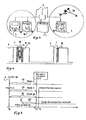
- Figure 1 illustrates a network system configuration according to a preferred embodiment of the present invention.
- Figures 2a illustrates graphically a timing diagram of the system of FIG. 1 .
- FIG. 2b illustrates the timing diagram of FIG. 2a in more detail.
- FIG. 3 illustrates a network system configuration in accordance with an alternative preferred embodiment of the present invention.
- Figure 4 graphically illustrates a timing diagram of the system of FIG. 3 .
- Figure 5 graphically illustrates a timing diagram of a network system configuration in accordance with another alternative preferred embodiment of the present invention.
- Figure 6 graphically illustrates a timing diagram of a network system according to another preferred embodiment of the present invention.
- a system in one preferred embodiment of the present invention, includes three nodes 4, 10 and 5, a common power supply 1 and a circuit breaker 2.
- the three nodes 4, 10 and 5 are wired through a set of wires 3 to the common power supply 1 and the circuit breaker 2.
- Each node 4, 10 and 5 preferably has a wireless transceiver, a memory and a timer (or the capability to track the elapsed time between or from particular signals or events), allowing communication between each of the nodes 4, 10 and 5, and, when produced, each node 4, 10 and 5 preferably includes a unique network address.
- two or nodes could be specifically initially configured to share a network address. When the nodes 4, 10 and 5 do not share the same network address initially, they do not communicate data with each other and do not appear to be part of the same network.
- one or more of the nodes can include a separate receiver and transmitter in lieu of a transceiver.
- One of the nodes can be designated as the Master node. Such designation can be made by the initial system installers. Alternatively, one of the nodes can be designated as the Master node in other manners, such as, for example, original design, by the user, by a technician or other means. In one particularly preferred embodiment, node 5 can set by an installer as the system Master, which means node 5 will attempt to bring other nodes 4 and 10 into a network automatically as part of its boot up process. The remaining nodes, nodes 4 and 10, are designated as slave nodes.
- the system includes several events including a power up 6, a start signal 7, a flashnetworking event 8, and a cut off time window 30.
- the power up 6 occurs when the circuit breaker 2 is made (or closed). In one embodiment, the release of a reset of an onboard micro controller can also be required as part of the power up 6.
- the Master node (node 5) issues the start signal 7.
- the start signal 7 is a special flag indicating first communication by the Master 5 node following boot up of the system including Master node 5.
- the start signal 7 from the Master node 5 preferably occurs at a fixed known delay x from the power-up 6.
- the delay x can be any preselected duration.
- the delay x can be approximately 8 milli-seconds (ms). In another preferred embodiment, x can be approximately 8 seconds. In other alternative preferred embodiments, other values for x can also be used.
- the flashnetworking event 8 occurs, wherein upon seeing the start signal 7, the slave nodes 4 and 10 join the network of the Master node 5 by taking the network address of the Master node 5 as their own network address. This process of taking on the Master's network address may be called FlashNetworking.
- Time y indicates the time from the power up 6 to the point where the slave nodes 4 and 10 receive the start signal and flashnetworking occurs.
- the response time for slave nodes 4 and 10 to flashnetwork with the Master node 5 typically occurs within the range of 5 to 20 ms. However, normal system tolerances and error ranges can result in durations for slave node response that are greater than 20 ms.
- a predetermined cut off time window 30 is initiated after the start signal 7 to establish a timeframe for the flashnetworking of the slave nodes (nodes 4 and 10) to occur in the system.
- the time window 30 is selected from a range of approximately 1 ms to 6000 ms. In one particularly preferred embodiment, the time window 30 can be approximately 300 ms. In other particularly preferred embodiments, other time frames can also be used.
- flashnetworking is terminated. Signals received after the cut off time window 30 are assumed to be signals from another network, i.e. the nodes are not wired to the same breaker and the Flashnetworking event 8 does not arise. Accordingly, establishing an appropriate duration for the cut off time window 30 is important to the system.
- Selecting a cut off time window 30 that is too short can prevent the flashnetworking of the desired slave nodes from occurring.
- selecting a cut off time window 30 that is too long can increase the chances of inadvertently networking undesired nodes as slave nodes.
- the 300 ms precision for the cut-off time window 30 is a compromise, suited to one particular preferred application. A shorter duration would reduce the risk that another network in range is, by chance, started at almost the same instant in time, causing two separately wired networks to accidentally become merged. A longer duration would make the system easier to implement, as timing x is measured by clocks, which have limited accuracy.
- the system has a value of 8 ms for x is 8 ms after the breaker is made, and y is 5 to 20 ms later than x, depending on the network loading. In another alternative preferred embodiment, the value for x is 8 seconds. It is desirable to select a cut off time window 30 that allows for flashnetworking of the desired slave nodes without significantly increasing the chances of flashnetworking other non-targeted and/or undesired nodes.
- any other nodes is within the predetermined time window 30, in other words in a window in which the time from the power up 6 is at least x but less than x + 300ms, the networking happens.
- the flashnetworking event 8 occurs within the cut off time window 30, all three nodes 4, 10 and 5 now share the same network address and so full networking behaviour arises for the remainder of the operating session.
- the network address can be retained permanently by the slave nodes 4 and 10. In this case, future power up events will not generate further Flashnetworking events, the slave nodes 4 and 10 will automatically recognize the network address of the master node 5 and immediately communicate as part of a single network.
- the network address could be reset on power down of the system, in which case a Flashnetworking event would be triggered on each subsequent power cycle so that the slave nodes 4 and 10 would share the network address of the master node 5.
- Line x represents the time taken to complete the issuance of the start signal 7, and the start signal 7 itself typically requires a duration of approximately 3 ms. Alternatively, other durations can also be used. Under the time x following the power up 6, boot-up time 12 and signal sending time 13 occur before the start signal 7 (the start pulse) is initiated.
- the boot-up time 12 immediately follows the power up 6 and represents the warm up time for the crystals of the nodes 4, 10, and 5.
- This area 12 represents a changeover from the low precision internal chip resonator to the high precision external watch crystal, and this changeover time 12 typically takes about 2s ( ⁇ 150ms). In alternative preferred embodiments, other time frames can also be used for the boot-up time.
- the signal sending time 13 represents the start signal from the master node 5 which is a series of 10101010 lasting typically 6s. In alternative embodiments, other durations can be used.
- Signal sending time 13 is a network sending signal intended for communication with wireless nodes, typically battery operated nodes such as, for example, a node 20 of FIG. 3 . Battery operated nodes will typically search for signals periodically to conserve battery life. The signal time 13 extends over a longer time period so that the signal is present when the battery operated node enters a search mode. Once received the signal from time 13 initiates boot-up or start up of the battery operated node.
- the time duration of the areas 13 and 7 is known and precise to microseconds.
- the changeover or boot-up time 12 is dependent on the watch crystal characteristics, the temperature and the system battery voltage in the case of a battery powered unit. This is why in the embodiment in accordance with the invention is left a 300 ms tolerance on comparisons of elapsed times.
- the system includes the following nodes.
- the node 5 can be a wind display 5, the node 20 can be a wind sensor 20, the node 4 can be a hull transmitter 4 and node 10 can be a speed display 10.
- the nodes are configured for use on a boat. Although a boat is referenced, it is done so as an example. The present invention is applicable to other applications and configurations.
- nodes a wind display 5 and a wind sensor 20 already share the same network address i.e. are networked already.
- the enlarged circle of FIG. 3 represents that the wind display 5 and the wind sensor 20 already share the same network address.
- the other two nodes, the hull transmitter 4 and the speed sensor 10 are wired to the same circuit as the wind display 5 and therefore share the breaker and the same power supply 1.
- the wind sensor 20 is a battery operated device and therefore does not share the same power source as the wind display 5 or as the hull transmitter 4 and the speed sensor 10.
- Each of the nodes 4, 5 and 20 contains a wireless transceiver, allowing communication with the other nodes.
- the hull transmitter 4 and the speed display 10 may have a unique network address, or may already be networked, i.e. share their own network address, different to the wind nodes.
- the wind display 5 can be configured as the network Master node.
- the hull transmitter 4 and the speed display 10 will Flashnetwork independently and Flashnetworking is complete.
- the hull transmitter 4 and the speed display 10 are slave nodes that share a common power supply with the master node, wind display 5.
- the hull transmitter 4 and the speed display 10 will each flashnetwork with the wind display 5 as illustrated by power up 6, the start signal 7 and the flashnetwork event 8 of FIG. 4 . After the flashnetwork event 8, all the nodes 5, 20, 4 and 10 share the wind network address and are all now part of the same network.
- one of the new nodes such as the hull transmitter 4 or the speed display 10 can be configured as the network Master node.
- the wind display 5 may serve as one of the slave nodes and Flashnetwork.
- the wind display 5 cannot be flashnetworked alone (unilaterally), or it will leave the wind transmitter 20 left alone on its existing network address.
- the wind transmitter 20 operates on a separate power supply from the power supply 1, and therefore the wind transmitter cannot Flashnetwork as it has no visibility of the 12V breaker 2.
- signal 13 is provided prior to the start signal 7 to allow for communication between the master node, either hull transmitter 4 or the speed display 10, with the battery operated slave node, the wind transmitter 20.
- the wind transmitter 20 After the signal 13 is received by the wind transmitter 20, the wind transmitter 20 is receptive to the start signal 20 and to the flashnetworking event 8.
- the master node, the hull transmitter 4 or the speed display 10 requests by signal 15 that the other nodes "join its network at the next power up", knowing that it had a battery powered devices (the wind transmitter 20) already networked in its previous power cycle.
- all units 4, 10 and 5 then cleanly power up, having adopted the address of the existing wind network 20 and 5.
- none of the nodes 4, 10 or 5 may be configured to be the network master node.
- Flashnetworking cannot happen and the user will be left with the existing network, wherein nodes 5 and 20 share the same network address, but new nodes 4 and 10 operate separately.
- the user will need to configure one of the nodes 4, 10 or 5 to be Master node. This is encouraged because setting one of the nodes 4, 10 or 5 as the Master node gives an automatic network start up feature when the breaker 2 is made.
- the present invention enables two or more nodes of a system to be powered by a common power source and one or more additional nodes of a system to be powered by independent battery power.
- the following steps can be used to address such a configuration.
- the nodes 4, 5 and 10 can check to see whether a separate battery powered units (or node) is already logged into its own network.
- a node for example, the hull transmitter 4
- the hull transmitter 4 is free to take the address of the Master (e.g. wind display 5) and Flashnetworking is complete.
- Other nodes e.g. the speed display 10
- the speed display 10 which have previously been linked to, will independently come to the same conclusion and will themselves Flashnetwork to the Master, the wind display 5.
- a node for example, wind display 5 has previously been networked to a battery powered unit (e.g. the wind sensor 20), then this unit will not be able to perform Flashnetworking as it does not know about the timing of the 12V breaker being made. Therefore the node 5 can take the address of the Master for this session only, i.e. it must put into Flash memory its original network address for recovery at the next power up 6. It must then issue a Flash-enlist instruction 15 containing its original network address, so that the Master and other nodes on the Master's network can store the address in non-volatile memory.
- a battery powered unit e.g. the wind sensor 20
- the system can employ a system master to produce a timing "Master strobe" which other nodes can recognize and Flashnetwork to.
- FIG. 5 illustrates one system configuration incorporating a Master strobe. Many other mechanisms are envisaged and contemplated in accordance with the present invention.
- nodes 4, 5 and 10 can be utilized in a system.
- the nodes 4, 5 and 10 each share a common power supply.
- No node is initially identified as a Master node.
- Each node performs a particular function (e.g., measure a heartbeat, measure a cadence interval, measure a wind speed, etc.).
- a node, for example the node 4 can unilaterally communicate, through the start signal 7, when it completes its first measurement of a parameter such as a heartbeat interval, a cadence interval, a wind speed etc.
- Embedded in the start signal communication 7 can be an "elapsed time" 50 since the start up or power up 6 of the system, which could for example be measured in microseconds (ms).
- any other node 5 or 10 seeing this first communication 7 would compare the time elapsed 50 with its own 50. On finding the two elapsed times to be matching (or to within a predetermined acceptable band, such as the measurement precision of the clocks in the embodiment within 1 to 30 ms), the Nodes 5 and/or 10 can then unilaterally flashnetwork with the first communicating node 4, by absorbing its network address. Multiple nodes would unilaterally Flashnetwork simultaneously because they all see this first communication, the start signal 7 that includes the elapsed time 50, and all compare elapsed times in the same way.
- a node that is outside of the network e.g. a node 40
- the node 4 will have a different elapsed time 50' and therefore will not network.
- the time between receipt of signal 41 and sending of the start signal 7 (t 2 -t 1 ) can be easily taken into account, because this time is accurately enough fixed.
- the time t 2 -t 1 may be subtracted from the elapsed time 50 of the receiving nodes 5 and 10 or alternatively the sending node 4 may add time t 2 -t 1 to its elapsed time 50 to make the times 50 comparable with sending 4 and receiving nodes 5 and 10.
- elapsed time 50 can be considered using a time window for acceptance of a start signal 7 in accordance with the invention. In other words, only such nodes 5 and 10 receiving a start signal powered within the same time window (elapsed time 50) will be accepted to the network.
- the first communication, the first start signal 7, can arise from a user activity such as manually turning the network on or manually actuating one of the nodes. This would avoid the user having to set Master On, or the network having to have a formally defined Master node.
- an ending of the start pulse 7 is considered as any subsequent event proportional to the time when the actual start signal 12, 13, 7 is complete.
- the time window may be deleted by a constant time or a known variable for the other nodes 4, 10 or 5.
- Flashnetworking can occur under several different scenarios or configurations.
- Flashnetworking can arise when the Node 4, 10, 5 sees the start signal 7 with the expected elapsed time since power up 6. This requires one node 4, 10 or 5 to issue a start signal 7, and other nodes to compare elapsed time with expected elapsed time for nodes wired to the same breaker 2.
- networking can arise at any time after power up 6, if transmissions contain elapsed time information, so that receiving nodes can compare the sender's view of elapsed time with their own, and a match to within 300ms (or other FIG.) can instigate flashnetworking.
- one or more battery powered nodes can live in harmony with flashnetworking even if the battery powered nodes can't measure elapsed time. This is achieved with a mechanism where the battery powered node in a system sends out a "network to me" message 15, so that at the next power up, all nodes log onto the battery node network.
- FIG. 6 displays a timeline illustrating communication and networking between nodes having wireless communication capability installed on two different systems.
- FIG. 6 illustrates two wireless nodes present on first and second vehicles 60 and 80.
- the first and second vehicles 60 and 80 each include two wireless nodes, nodes 62 and 64 and nodes 82 and 84, respectively.
- the first and second vehicles 60 and 80 could each include 3, 4, 5 or more nodes.
- the nodes 62 and 64 can communicate wirelessly and share a power supply 66, and the nodes 82 and 84 can also communicate wirelessly and share a power supply 86.
- the nodes can be any electronic device having wireless communication capability, such as, for example, a portable gps device, a phone, a rear view camera, etc.
- the first vehicle 60 starts at point 68 (or to) and power is supplied simultaneously to the nodes 62 and 64 from the power source 66 of the first vehicle 60.
- node 62 transmits a message or signal 70.
- the message or signal 70 can be a measurement of elapsed time, the time t 1 , since the start point 68.
- the message 70 can also include one or more (or none) of the following additional types of information or content, a start signal, a data signal, a message, a network address, a measurement and a code.
- the node 64 receives the signal 70.
- the node 64 also keeps count of the elapsed time since the start point 68.
- the node 64 compares it's elapsed time at receipt of the signal 70 form the node 62 with the elapsed time measurement included in the signal 70. If the elapsed time kept by the node 64 matches the elapsed time included with the signal 70 from the node 62 within a predetermined tolerance range, then the node 64 will consider its elapsed time and the elapsed time included within the signal 70 from the node 62 to be a match.
- the node 64 accepts the signal 70 as a message from an onboard network (onboard the same vehicle).
- the signal 70 accepted by the node 64 can include only the elapsed timing information and therefore communication can occur in the future between the nodes 62 and 64. In alternative preferred embodiments, the signal 70 can also include timing information and measurement data, key press data or any other data.
- the predetermined tolerance range is 300 ⁇ s.
- other time frames for the predetermined tolerance range can also be used, such as, for example, a time frame between 300 ⁇ s to 300 ms or between 5 to 20 ms.
- the objective is to select a predetermined tolerance range that is sufficiently long enough to allow for onboard nodes to communicate effectively taking into account tolerances, normal delays in starting up or transferring of signals without becoming too long and opening the onboard nodes to communication with other nodes from other vehicles or other systems.
- the vehicle 60 can start at the start point 68.
- the vehicle 80 moves within range of the vehicle 60.
- the vehicle 80 has a start point 88 occurring at time To in which the power supply 86 of the vehicle 80 energized the nodes 82 and 84. Time To occurs later than, or after, the start point 68 at to, and the time difference between To and to is greater than the predetermined tolerance range.
- the node 62 sees the signal 72 and compares its elapsed time (the time from the start point 68 (to) up to the time of receipt of the signal 72 at time t 2 with the elapsed time value included in the signal 72. If these times are within the predetermined tolerance range (e.g. within 300 ⁇ s), the node 62 will see a match and consider the message to be from the onboard network of the vehicle 60. However, the nodes 82 and 84, which are now within the communication range of 64, also can receive the signal 72.
- the nodes 82 and 84 compare the elapsed time within the signal 72 with their own particular elapsed time since their start up point 88 occurring at point To. Because the elapsed times from the start points 68 and 88 are not within the predetermined tolerance range, the elapsed times do not match and so the nodes 82 and 84 can conclude that they do not share the same onboard network as the node 64, and vice-versa.
- the node 82 can transmit a message or a signal 90 at time t3.
- the nodes 62 and 64 can receive the signal 90 and compare their own elapsed time from their start point, the start point 68, with the elapsed time included with the signal 90.
- the nodes 62 and 64 see that the elapsed times do not match within the predetermined tolerance range, so the nodes 62 and 64 recognize that the message is from another vehicle and not the vehicle 60.
- the node 84 sees a match between its elapsed time from the start point 88 and the elapsed time included in the signal 90. Therefore, upon seeing the match, the node 84 recognizes that the signal 90 comes from the same vehicle, the vehicle 80.
- the node 84 transmits a message or signal 92 at time t 4 from the start point 88.
- the nodes 62 and 64 can receive the signal 92 and compare their own elapsed time from their start point, the start point 68, with the elapsed time included with the signal 92.
- the nodes 62 and 64 see that their elapsed times do not match the elapsed time included in the signal 92 within the predetermined tolerance range, so the nodes 62 and 64 recognize that the message 92 is from another vehicle and not their vehicle 60.
- the node 82 sees a match between its elapsed time from the start point 88 and the elapsed time included in the signal 92. Therefore, upon seeing the match, the node 82 recognizes that the signal 92 comes from the same vehicle, the vehicle 80.
- flashnetworking between two or more wireless communication nodes can occur based simply upon elapsed time from start up. In this manner, the networking occurs without sharing a network address or other system specific codes etc. Rather, if two or more communication nodes have the same elapsed time from start up at the transmission and receipt of a signal from one node to another (within a predetermined tolerance range), then flashnetworking between the nodes will occur. An actual transmission and receipt of a specific network address or code is unnecessary to allow for networking of these communication nodes. If the nodes do not have the same elapsed time within the predetermined tolerance range, then the nodes will not operate as if on the same network.
- the wireless communication nodes can be configured to not network together if they do not share the same elapsed time within the predetermined tolerance range, but still receive, accept, record or process other information a signal from an out of network node.
- two wireless communication nodes using different power supplies and having different startup times and therefore different elapsed times from transmission and receipt of signal from one node to another will not flashnetwork but may still be configured to store, record, accept or process data or information that is present in the signal from the out of network node.
- the present invention allows wireless nodes (such as the nodes 62, 64, 82 and 84) to be plugged into, or otherwise installed or removably installed, into any vehicle (or other structure or system) or swapped between vehicles without requiring the user or other service provider to re-network the vehicle, the system or the individual node or nodes.
- wireless nodes such as the nodes 62, 64, 82 and 84
- a hand held navigator device when plugged into the cigarette lighter of a vehicle (thereby sharing the power supply of the vehicle) can be recognized and networked automatically with the other electronic components of the vehicle or other nodes on the network of the vehicle.
- installed wireless electronics would not have to be configured to match a particular vehicle.
- the wireless electronics of such a production line vehicle would automatically form a network (or network). Such a system would save manhours and reduce costs. After sales service would also be simplified because a replacement wireless component (or node) would not require reworking or reconfiguration in order to join, or operate within, the network of the vehicle.
- mismatched communication signals or messages would not be ignored.
- a mismatch in elapsed or received times between nodes doesn't necessarily mean the message of the mismatched signal is ignored. It only means that the signal comes from a different network, such as, for example, a different vehicle.
- the information in the mismatched signals may still be used by the separate network or networks.
- the present invention contemplates use of such mismatched communications for various purposes.
- the mismatched signals can be used to share historical data, present operating conditions, maintenance history, maintenance status, share information, etc.
Landscapes
- Engineering & Computer Science (AREA)
- Computer Networks & Wireless Communication (AREA)
- Signal Processing (AREA)
- Mobile Radio Communication Systems (AREA)
- Small-Scale Networks (AREA)
Claims (26)
- Procédé de mise en réseau sans fil au moins des premier et deuxième noeuds de communication (5, 4, 10), le procédé comprenant :mettre en service une source de puissance commune pour les premier et deuxième noeuds de communication (5, 4, 10) à un temps de fonctionnement (6) ;caractérisé en ce que :le procédé comprend en outre :envoyer un signal de départ (7) du premier noeud de communication (5) au deuxième noeud de communication (4, 10), le signal de départ (7) étant déclenché en réponse à la mise en service de la source de puissance commune (1) ;initier une première fenêtre de temps de coupure prédéterminée commençant directement après l'envoi du signal de départ (7) et se terminant à une première période de temps après l'envoi du signal de départ (7) ; etmettre en réseau le premier noeud de communication (5) avec le au moins un deuxième noeud de communication (4, 10) à condition que le deuxième noeud de communication (4, 10) reçoive le signal de départ (7) durant la première période de temps.
- Procédé selon la revendication 1, dans lequel le premier noeud de communication (5) agit comme un noeud maître.
- Procédé selon la revendication 1, dans lequel les premier et deuxième noeuds de communication (5, 4, 10) ont initialement chacun une adresse réseau séparée, et où durant la mise en réseau, le deuxième noeud de communication (4, 10) prend l'adresse réseau du premier noeud de communication (15).
- Procédé selon la revendication 1, comprenant en outre un noeud de communication à batterie, où le noeud de communication à batterie n'utilise pas la source de puissance commune.
- Procédé selon la revendication 4, dans lequel le deuxième noeud de communication (4, 10) est mise en réseau avec le noeud de communication à batterie, et où à la mise en service suivante de la source de puissance commune (1), le deuxième noeud de communication (4, 10) devient un noeud maître.
- Procédé selon la revendication 1, dans lequel la première période de temps prédéterminée est dans une plage de 1 ms à 6000 ms.
- Procédé selon la revendication 6, dans lequel la première période de temps prédéterminée est approximativement de 300 ms.
- Procédé selon la revendication 1, comprenant en outre le démarrage des premier et deuxième noeuds de communication (5, 4, 10) avant l'envoi du signal de départ (7) du premier noeud de communication (5).
- Procédé selon la revendication 8, comprenant en outre l'envoi d'un signal d'envoi de réseau du premier noeud de communication (5) à au moins le deuxième noeud de communication (4, 10) à la suite du démarrage et avant l'envoi du signal de départ (7).
- Procédé selon la revendication 1, dans lequel les premier et deuxième noeuds de communication (5, 4, 10) comprennent au moins des premier, deuxième et troisième noeuds de communication (5, 4, 10).
- Procédé pour la mise en réseau sans fil d'un système d'au moins un premier et deuxième noeud de communication (5, 4, 10), le procédé comprenant :mettre en service une source de puissance commune (1) pour les premier et deuxième noeuds de communication (5, 4, 10) à un temps de fonctionnement (6) ;caractérisé en ce que :chacun des premier et deuxième noeuds de communication (5, 4, 10) étant apte à suivre le temps écoulé depuis le temps de fonctionnement (6) ; etle procédé comprend en outre :envoyer un signal de départ (7) du premier noeud de communication (5) au deuxième noeud de communication (4, 10), le signal de départ (7) étant déclenché en réponse à la mise en service de la source de puissance commune (1) et incluant au moins l'information indiquant le temps qui s'est écoulé suivi par le premier noeud de communication (5) ; etmettre en réseau le deuxième noeud de communication (4, 10) avec le premier noeud de communication (5) si le temps qui s'est écoulé suivi par le deuxième noeud de communication (4, 10) correspond approximativement au temps qui s'est écoulé fourni dans le signal de départ (7).
- Procédé selon la revendication 11, dans lequel les premier et deuxième noeuds de communication (5, 4, 10) ont initialement chacun une adresse réseau séparée, et où durant la mise en réseau, le deuxième noeud de communication (4, 10) prend l'adresse réseau du premier noeud de communication (5).
- Procédé selon la revendication 11, le temps qui s'est écoulé suivi par le deuxième noeud de communication (4, 10) correspond approximativement au temps qui s'est écoulé suivi par le premier noeud de communication (5) si les temps qui se sont écoulés sont dans les 1 à 30 ms l'un de l'autre.
- Procédé selon la revendication 11, dans lequel les premier et deuxième noeuds de communication (5, 4, 10) exécutent chacun une fonction particulière et sont aptes à produire une mesure d'un paramètre, et où le premier noeud de communication (5) produit en premier la mesure du paramètre.
- Procédé selon la revendication 11, dans lequel le premier noeud de communication (5) est manuellement actionné par un utilisateur.
- Procédé selon la revendication 11, dans lequel le premier noeud de communication (5) produit le signal de départ à la suite d'un démarrage manuel du système.
- Procédé selon la revendication 11, comprenant en outre un noeud extérieur ayant une source de puissance qui est différente de la source de puissance commune (1), et où le noeud extérieur a un temps de fonctionnement qui ne correspond pas approximativement au temps de fonctionnement des premier et deuxième noeuds de communication (5, 4, 10), et où le noeud extérieur ne peut pas être en réseau avec les premier et deuxième noeuds de communication (5, 4, 10).
- Procédé selon la revendication 11, dans lequel les premier et deuxième noeuds de communication (5, 4, 10) ont des premier, deuxième et troisième noeuds de communication (5, 4, 10).
- Système de communication sans fil, comprenant :des premier et deuxième noeuds de communication (5, 4, 10), chaque noeud de communication incluant un émetteur-récepteur ou un transmetteur et récepteur, et une mémoire ; etune première alimentation (1) fonctionnellement couplée aux premier et deuxième noeuds de communication (5, 4, 10), la première alimentation (1) ayant une position en service, où la puissance est fournie aux premier et deuxième noeuds de communication (5, 4, 10), et une position hors service,caractérisé en ce que :la puissance est terminée aux premier et deuxième noeuds de communication (5, 4, 10), chacun des premier et deuxième noeuds de communication (5, 4, 10) étant configuré pour suivre le temps qui s'est écoulé depuis la réception de la puissance de la première alimentation (1), le premier noeud de communication (5) étant configuré pour envoyer un premier signal après l'écoulement d'une première période de temps à la suite de la réception de puissance par le premier noeud de communication (5) de la première alimentation (1), le premier signal incluant l'information indiquant la première période de temps, le deuxième noeud de communication (4, 10) étant configuré pour recevoir le premier signal et pour comparer la première période de temps indiquée dans le premier signal avec une deuxième période de temps, la deuxième période de temps étant le temps qui s'est écoulé depuis la réception de puissance par le deuxième noeud de communication (4, 10) de la première alimentation (1) jusqu'à la réception par le deuxième noeud de communication (4, 10) du premier signal, le deuxième noeud de communication (4, 10) étant configuré pour être mis en réseau avec le premier noeud de communication (5) si la première période de temps correspond à la deuxième période de temps dans une plage de tolérance prédéterminée.
- Système de communication sans fil selon la revendication 19, dans lequel la plage de tolérance prédéterminée est sélectionnée dans une période de temps de 300 µs à 300 ms.
- Système de communication sans fil selon la revendication 19, dans lequel la plage de tolérance prédéterminée est dans les 300 µs.
- Système de communication sans fil selon la revendication 19, dans lequel le deuxième noeud de communication (4, 10) est configuré pour ne pas être mis en réseau avec le premier noeud de communication (5) si la première période de temps ne correspond pas à la deuxième période de temps dans la plage de tolérance prédéterminée.
- Système de communication sans fil selon la revendication 22, dans lequel le deuxième noeud de communication (4, 10) est configuré pour stocker, recevoir ou traiter des données ou des informations présentes dans le premier signal.
- Système de communication sans fil selon la revendication 19, comprenant en outre un troisième noeud de communication, où le troisième noeud de communication est fonctionnellement couplé à la deuxième alimentation, et où la deuxième alimentation est différente de la première alimentation (1).
- Système de communication sans fil selon la revendication 24, dans lequel la deuxième alimentation a une position en service dans laquelle la puissance est fournie au troisième noeud de communication, et une position hors service dans laquelle la puissance est terminée au troisième noeud de communication, où le troisième noeud de communication est configuré pour suivre le temps qui s'est écoulé depuis la réception de puissance de la deuxième alimentation, où le troisième noeud de communication est configuré pour envoyer un troisième signal après l'écoulement d'une troisième période de temps à la suite de la réception de puissance par le troisième noeud de communication de la deuxième alimentation, où le troisième signal comprend une information indiquant la troisième période de temps, où les premier et deuxième noeuds de communication (5, 4, 10) sont configurés pour recevoir le troisième signal et pour comparer la troisième période de temps indiquée dans le troisième signal avec des quatrième et cinquième périodes de temps, respectivement, où les quatrième et cinquième périodes de temps sont les temps qui se sont écoulés depuis la réception de puissance par les premier et deuxième noeuds de communication (5, 4, 10) de la première alimentation (1), respectivement, jusqu'à la réception du troisième signal, où les premier et deuxième noeuds de communication (5, 4, 10) sont configurés pour être mis en réseau avec le troisième noeud de communication si la troisième période de temps correspond aux quatrième et cinquième périodes de temps dans la plage de tolérance prédéterminée.
- Système de communication sans fil selon la revendication 25, dans lequel les premier et deuxième noeuds de communication (5, 4, 10) sont configurés pour ne pas être en réseau avec le troisième noeud de communication si la troisième période de temps ne correspond pas aux quatrième et cinquième périodes de temps, respectivement, dans la plage de tolérance prédéterminée.
Priority Applications (1)
| Application Number | Priority Date | Filing Date | Title |
|---|---|---|---|
| EP10015816.1A EP2341663B1 (fr) | 2009-12-30 | 2010-12-20 | Procédé et système de réseau |
Applications Claiming Priority (2)
| Application Number | Priority Date | Filing Date | Title |
|---|---|---|---|
| EP09016109.2A EP2341664B1 (fr) | 2009-12-30 | 2009-12-30 | Procédé et système de réseau |
| EP10015816.1A EP2341663B1 (fr) | 2009-12-30 | 2010-12-20 | Procédé et système de réseau |
Publications (2)
| Publication Number | Publication Date |
|---|---|
| EP2341663A1 EP2341663A1 (fr) | 2011-07-06 |
| EP2341663B1 true EP2341663B1 (fr) | 2013-08-14 |
Family
ID=41718436
Family Applications (2)
| Application Number | Title | Priority Date | Filing Date |
|---|---|---|---|
| EP09016109.2A Not-in-force EP2341664B1 (fr) | 2009-12-30 | 2009-12-30 | Procédé et système de réseau |
| EP10015816.1A Not-in-force EP2341663B1 (fr) | 2009-12-30 | 2010-12-20 | Procédé et système de réseau |
Family Applications Before (1)
| Application Number | Title | Priority Date | Filing Date |
|---|---|---|---|
| EP09016109.2A Not-in-force EP2341664B1 (fr) | 2009-12-30 | 2009-12-30 | Procédé et système de réseau |
Country Status (2)
| Country | Link |
|---|---|
| US (1) | US8301714B2 (fr) |
| EP (2) | EP2341664B1 (fr) |
Families Citing this family (11)
| Publication number | Priority date | Publication date | Assignee | Title |
|---|---|---|---|---|
| US9642415B2 (en) | 2011-02-07 | 2017-05-09 | New Balance Athletics, Inc. | Systems and methods for monitoring athletic performance |
| US10363453B2 (en) | 2011-02-07 | 2019-07-30 | New Balance Athletics, Inc. | Systems and methods for monitoring athletic and physiological performance |
| KR20120138546A (ko) * | 2011-06-15 | 2012-12-26 | 한국전자통신연구원 | 분산 네트워크에서 우선순위에 기반한 디스커버리를 수행하는 장치 및 방법과, 디스커버리 백오프 타임 결정 방법 |
| US10012731B2 (en) | 2014-04-03 | 2018-07-03 | Johnson Outdoors Inc. | Sonar mapping system |
| US10874901B2 (en) | 2014-11-20 | 2020-12-29 | Suunto Oy | Automatic information system |
| US10356189B2 (en) | 2014-11-20 | 2019-07-16 | Suunto Oy | System and method for creating ad-hoc events from sensed sport-specific data |
| US9980434B1 (en) | 2015-02-28 | 2018-05-29 | Hydro-Gear Limited Partnership | Network for placing a plurality of lawnmower components in operative communication |
| US10058031B1 (en) | 2015-02-28 | 2018-08-28 | Hydro-Gear Limited Partnership | Lawn tractor with electronic drive and control system |
| US9907105B2 (en) | 2015-11-13 | 2018-02-27 | FLIR Belgium BVBA | Pairing techniques for network communications |
| US10545235B2 (en) | 2016-11-01 | 2020-01-28 | Johnson Outdoors Inc. | Sonar mapping system |
| US10459508B2 (en) * | 2017-05-31 | 2019-10-29 | Konica Minolta Laboratory U.S.A., Inc. | Low frequency power management bus |
Family Cites Families (6)
| Publication number | Priority date | Publication date | Assignee | Title |
|---|---|---|---|---|
| US20110050390A1 (en) * | 1994-11-15 | 2011-03-03 | Denison William D | Electronic Access Control Device and Management System |
| US20110050391A1 (en) * | 1994-11-15 | 2011-03-03 | Denison William D | Electronic Access Control Device and Management System |
| US20110025459A1 (en) * | 1994-11-15 | 2011-02-03 | Denison William D | Electronic Access Control Device and Management System |
| US6993393B2 (en) | 2001-12-19 | 2006-01-31 | Cardiac Pacemakers, Inc. | Telemetry duty cycle management system for an implantable medical device |
| CN100556225C (zh) | 2002-12-16 | 2009-10-28 | 皇家飞利浦电子股份有限公司 | 用于从主设备故障进行照明控制网络恢复的系统和方法 |
| US20090315668A1 (en) * | 2008-06-19 | 2009-12-24 | Light Corporation | Wiring topology for a building with a wireless network |
-
2009
- 2009-12-30 EP EP09016109.2A patent/EP2341664B1/fr not_active Not-in-force
-
2010
- 2010-03-16 US US12/724,670 patent/US8301714B2/en active Active
- 2010-12-20 EP EP10015816.1A patent/EP2341663B1/fr not_active Not-in-force
Also Published As
| Publication number | Publication date |
|---|---|
| EP2341663A1 (fr) | 2011-07-06 |
| US20110161455A1 (en) | 2011-06-30 |
| EP2341664A1 (fr) | 2011-07-06 |
| US8301714B2 (en) | 2012-10-30 |
| EP2341664B1 (fr) | 2013-09-18 |
Similar Documents
| Publication | Publication Date | Title |
|---|---|---|
| US8301714B2 (en) | Method and system for networking | |
| US10423165B2 (en) | Method for remotely controlling a system for controlling maneuver(s) of a vehicle using a control unit | |
| US8861415B2 (en) | Data transmission device and a method for activating a data transmission | |
| US8660149B2 (en) | Data communication network system | |
| EP3160199B1 (fr) | Procédé de commande de synchronisation dans un réseau sans fil, réseau sans fil et dispositif de maison intelligente | |
| CN115242825A (zh) | 一种远程控制方法及装置 | |
| EP2677696A2 (fr) | Procédé de réglage de la puissance optique émise par une lampe de poche appartenant à un système d'automatisation domestique | |
| EP1363260B1 (fr) | Procédé de communication radiofréquence entre plusieurs dispositifs et système de surveillance mettant en oeuvre un tel procédé | |
| CA2762483A1 (fr) | Systeme de protection incendie sans fil configurable a optimiser sur place | |
| CN103797735A (zh) | 用于使车辆的车载电网中的网络参与者同步的方法和装置 | |
| US12477253B2 (en) | Automated collection of metering index of smart fluid meters | |
| CN102649419A (zh) | 电子钥匙系统 | |
| JP2009206749A (ja) | マルチホップ無線ネットワークシステム | |
| CN109951407A (zh) | 使用计时器与多个从设备进行基于边沿的通信 | |
| GB2358503A (en) | Alarm or detection system | |
| US20210399906A1 (en) | Method for operating a sensor arrangement in a motor vehicle on the basis of a dsi protocol | |
| US6754513B1 (en) | Method and configuration for identification of a mobile station associated with a base station | |
| US20220021471A1 (en) | Communication device, communication method, computer program product, and communication system | |
| CA2874286C (fr) | Procede et systeme pour surveillance de vehicule | |
| US8655512B2 (en) | Method for operating a number of control units | |
| EP2099005B1 (fr) | Procédé de communication entre un premier noeud et un deuxième noeud d'une installation domotique. | |
| JP2013005419A (ja) | 通信システム、パケット送信装置及びプログラム | |
| CN104977842B (zh) | 用于以时控方式激活或解除车辆功能的装置 | |
| JP4803832B2 (ja) | パトロールランプ点滅同期装置 | |
| US6934775B2 (en) | Operating method for a data bus for several users with flexible timed access |
Legal Events
| Date | Code | Title | Description |
|---|---|---|---|
| PUAI | Public reference made under article 153(3) epc to a published international application that has entered the european phase |
Free format text: ORIGINAL CODE: 0009012 |
|
| AK | Designated contracting states |
Kind code of ref document: A1 Designated state(s): AL AT BE BG CH CY CZ DE DK EE ES FI FR GB GR HR HU IE IS IT LI LT LU LV MC MK MT NL NO PL PT RO RS SE SI SK SM TR |
|
| AX | Request for extension of the european patent |
Extension state: BA ME |
|
| 17P | Request for examination filed |
Effective date: 20120106 |
|
| RAP1 | Party data changed (applicant data changed or rights of an application transferred) |
Owner name: RAYMARINE UK LIMITED |
|
| GRAP | Despatch of communication of intention to grant a patent |
Free format text: ORIGINAL CODE: EPIDOSNIGR1 |
|
| RIN1 | Information on inventor provided before grant (corrected) |
Inventor name: EKOUE, BERTRAND Inventor name: JOHNSON, MARK Inventor name: HODGSON, CHRIS |
|
| GRAS | Grant fee paid |
Free format text: ORIGINAL CODE: EPIDOSNIGR3 |
|
| GRAA | (expected) grant |
Free format text: ORIGINAL CODE: 0009210 |
|
| AK | Designated contracting states |
Kind code of ref document: B1 Designated state(s): AL AT BE BG CH CY CZ DE DK EE ES FI FR GB GR HR HU IE IS IT LI LT LU LV MC MK MT NL NO PL PT RO RS SE SI SK SM TR |
|
| REG | Reference to a national code |
Ref country code: GB Ref legal event code: FG4D |
|
| REG | Reference to a national code |
Ref country code: AT Ref legal event code: REF Ref document number: 627366 Country of ref document: AT Kind code of ref document: T Effective date: 20130815 Ref country code: CH Ref legal event code: EP |
|
| REG | Reference to a national code |
Ref country code: IE Ref legal event code: FG4D |
|
| REG | Reference to a national code |
Ref country code: DE Ref legal event code: R096 Ref document number: 602010009309 Country of ref document: DE Effective date: 20131017 |
|
| REG | Reference to a national code |
Ref country code: SE Ref legal event code: TRGR |
|
| REG | Reference to a national code |
Ref country code: NL Ref legal event code: VDEP Effective date: 20130814 Ref country code: AT Ref legal event code: MK05 Ref document number: 627366 Country of ref document: AT Kind code of ref document: T Effective date: 20130814 |
|
| REG | Reference to a national code |
Ref country code: LT Ref legal event code: MG4D |
|
| PG25 | Lapsed in a contracting state [announced via postgrant information from national office to epo] |
Ref country code: PT Free format text: LAPSE BECAUSE OF FAILURE TO SUBMIT A TRANSLATION OF THE DESCRIPTION OR TO PAY THE FEE WITHIN THE PRESCRIBED TIME-LIMIT Effective date: 20131216 Ref country code: HR Free format text: LAPSE BECAUSE OF FAILURE TO SUBMIT A TRANSLATION OF THE DESCRIPTION OR TO PAY THE FEE WITHIN THE PRESCRIBED TIME-LIMIT Effective date: 20130814 Ref country code: CY Free format text: LAPSE BECAUSE OF FAILURE TO SUBMIT A TRANSLATION OF THE DESCRIPTION OR TO PAY THE FEE WITHIN THE PRESCRIBED TIME-LIMIT Effective date: 20130724 Ref country code: NO Free format text: LAPSE BECAUSE OF FAILURE TO SUBMIT A TRANSLATION OF THE DESCRIPTION OR TO PAY THE FEE WITHIN THE PRESCRIBED TIME-LIMIT Effective date: 20131114 Ref country code: IS Free format text: LAPSE BECAUSE OF FAILURE TO SUBMIT A TRANSLATION OF THE DESCRIPTION OR TO PAY THE FEE WITHIN THE PRESCRIBED TIME-LIMIT Effective date: 20131214 Ref country code: LT Free format text: LAPSE BECAUSE OF FAILURE TO SUBMIT A TRANSLATION OF THE DESCRIPTION OR TO PAY THE FEE WITHIN THE PRESCRIBED TIME-LIMIT Effective date: 20130814 Ref country code: AT Free format text: LAPSE BECAUSE OF FAILURE TO SUBMIT A TRANSLATION OF THE DESCRIPTION OR TO PAY THE FEE WITHIN THE PRESCRIBED TIME-LIMIT Effective date: 20130814 |
|
| PG25 | Lapsed in a contracting state [announced via postgrant information from national office to epo] |
Ref country code: BE Free format text: LAPSE BECAUSE OF FAILURE TO SUBMIT A TRANSLATION OF THE DESCRIPTION OR TO PAY THE FEE WITHIN THE PRESCRIBED TIME-LIMIT Effective date: 20130814 Ref country code: LV Free format text: LAPSE BECAUSE OF FAILURE TO SUBMIT A TRANSLATION OF THE DESCRIPTION OR TO PAY THE FEE WITHIN THE PRESCRIBED TIME-LIMIT Effective date: 20130814 Ref country code: SI Free format text: LAPSE BECAUSE OF FAILURE TO SUBMIT A TRANSLATION OF THE DESCRIPTION OR TO PAY THE FEE WITHIN THE PRESCRIBED TIME-LIMIT Effective date: 20130814 Ref country code: PL Free format text: LAPSE BECAUSE OF FAILURE TO SUBMIT A TRANSLATION OF THE DESCRIPTION OR TO PAY THE FEE WITHIN THE PRESCRIBED TIME-LIMIT Effective date: 20130814 Ref country code: FI Free format text: LAPSE BECAUSE OF FAILURE TO SUBMIT A TRANSLATION OF THE DESCRIPTION OR TO PAY THE FEE WITHIN THE PRESCRIBED TIME-LIMIT Effective date: 20130814 Ref country code: GR Free format text: LAPSE BECAUSE OF FAILURE TO SUBMIT A TRANSLATION OF THE DESCRIPTION OR TO PAY THE FEE WITHIN THE PRESCRIBED TIME-LIMIT Effective date: 20131115 |
|
| PG25 | Lapsed in a contracting state [announced via postgrant information from national office to epo] |
Ref country code: CY Free format text: LAPSE BECAUSE OF FAILURE TO SUBMIT A TRANSLATION OF THE DESCRIPTION OR TO PAY THE FEE WITHIN THE PRESCRIBED TIME-LIMIT Effective date: 20130814 |
|
| PG25 | Lapsed in a contracting state [announced via postgrant information from national office to epo] |
Ref country code: NL Free format text: LAPSE BECAUSE OF FAILURE TO SUBMIT A TRANSLATION OF THE DESCRIPTION OR TO PAY THE FEE WITHIN THE PRESCRIBED TIME-LIMIT Effective date: 20130814 Ref country code: SK Free format text: LAPSE BECAUSE OF FAILURE TO SUBMIT A TRANSLATION OF THE DESCRIPTION OR TO PAY THE FEE WITHIN THE PRESCRIBED TIME-LIMIT Effective date: 20130814 Ref country code: DK Free format text: LAPSE BECAUSE OF FAILURE TO SUBMIT A TRANSLATION OF THE DESCRIPTION OR TO PAY THE FEE WITHIN THE PRESCRIBED TIME-LIMIT Effective date: 20130814 Ref country code: CZ Free format text: LAPSE BECAUSE OF FAILURE TO SUBMIT A TRANSLATION OF THE DESCRIPTION OR TO PAY THE FEE WITHIN THE PRESCRIBED TIME-LIMIT Effective date: 20130814 Ref country code: RO Free format text: LAPSE BECAUSE OF FAILURE TO SUBMIT A TRANSLATION OF THE DESCRIPTION OR TO PAY THE FEE WITHIN THE PRESCRIBED TIME-LIMIT Effective date: 20130814 Ref country code: EE Free format text: LAPSE BECAUSE OF FAILURE TO SUBMIT A TRANSLATION OF THE DESCRIPTION OR TO PAY THE FEE WITHIN THE PRESCRIBED TIME-LIMIT Effective date: 20130814 |
|
| PG25 | Lapsed in a contracting state [announced via postgrant information from national office to epo] |
Ref country code: ES Free format text: LAPSE BECAUSE OF FAILURE TO SUBMIT A TRANSLATION OF THE DESCRIPTION OR TO PAY THE FEE WITHIN THE PRESCRIBED TIME-LIMIT Effective date: 20130814 Ref country code: IT Free format text: LAPSE BECAUSE OF FAILURE TO SUBMIT A TRANSLATION OF THE DESCRIPTION OR TO PAY THE FEE WITHIN THE PRESCRIBED TIME-LIMIT Effective date: 20130814 |
|
| PLBE | No opposition filed within time limit |
Free format text: ORIGINAL CODE: 0009261 |
|
| STAA | Information on the status of an ep patent application or granted ep patent |
Free format text: STATUS: NO OPPOSITION FILED WITHIN TIME LIMIT |
|
| REG | Reference to a national code |
Ref country code: DE Ref legal event code: R119 Ref document number: 602010009309 Country of ref document: DE |
|
| 26N | No opposition filed |
Effective date: 20140515 |
|
| REG | Reference to a national code |
Ref country code: DE Ref legal event code: R097 Ref document number: 602010009309 Country of ref document: DE Effective date: 20140515 |
|
| PG25 | Lapsed in a contracting state [announced via postgrant information from national office to epo] |
Ref country code: LU Free format text: LAPSE BECAUSE OF FAILURE TO SUBMIT A TRANSLATION OF THE DESCRIPTION OR TO PAY THE FEE WITHIN THE PRESCRIBED TIME-LIMIT Effective date: 20131220 Ref country code: MC Free format text: LAPSE BECAUSE OF FAILURE TO SUBMIT A TRANSLATION OF THE DESCRIPTION OR TO PAY THE FEE WITHIN THE PRESCRIBED TIME-LIMIT Effective date: 20130814 |
|
| REG | Reference to a national code |
Ref country code: DE Ref legal event code: R119 Ref document number: 602010009309 Country of ref document: DE Effective date: 20140701 |
|
| REG | Reference to a national code |
Ref country code: IE Ref legal event code: MM4A |
|
| PG25 | Lapsed in a contracting state [announced via postgrant information from national office to epo] |
Ref country code: DE Free format text: LAPSE BECAUSE OF NON-PAYMENT OF DUE FEES Effective date: 20140701 Ref country code: IE Free format text: LAPSE BECAUSE OF NON-PAYMENT OF DUE FEES Effective date: 20131220 |
|
| PG25 | Lapsed in a contracting state [announced via postgrant information from national office to epo] |
Ref country code: SM Free format text: LAPSE BECAUSE OF FAILURE TO SUBMIT A TRANSLATION OF THE DESCRIPTION OR TO PAY THE FEE WITHIN THE PRESCRIBED TIME-LIMIT Effective date: 20130814 |
|
| PG25 | Lapsed in a contracting state [announced via postgrant information from national office to epo] |
Ref country code: TR Free format text: LAPSE BECAUSE OF FAILURE TO SUBMIT A TRANSLATION OF THE DESCRIPTION OR TO PAY THE FEE WITHIN THE PRESCRIBED TIME-LIMIT Effective date: 20130814 |
|
| PG25 | Lapsed in a contracting state [announced via postgrant information from national office to epo] |
Ref country code: BG Free format text: LAPSE BECAUSE OF FAILURE TO SUBMIT A TRANSLATION OF THE DESCRIPTION OR TO PAY THE FEE WITHIN THE PRESCRIBED TIME-LIMIT Effective date: 20130814 Ref country code: RS Free format text: LAPSE BECAUSE OF FAILURE TO SUBMIT A TRANSLATION OF THE DESCRIPTION OR TO PAY THE FEE WITHIN THE PRESCRIBED TIME-LIMIT Effective date: 20131114 Ref country code: HU Free format text: LAPSE BECAUSE OF FAILURE TO SUBMIT A TRANSLATION OF THE DESCRIPTION OR TO PAY THE FEE WITHIN THE PRESCRIBED TIME-LIMIT; INVALID AB INITIO Effective date: 20101220 Ref country code: MK Free format text: LAPSE BECAUSE OF FAILURE TO SUBMIT A TRANSLATION OF THE DESCRIPTION OR TO PAY THE FEE WITHIN THE PRESCRIBED TIME-LIMIT Effective date: 20130814 |
|
| REG | Reference to a national code |
Ref country code: CH Ref legal event code: PL |
|
| PG25 | Lapsed in a contracting state [announced via postgrant information from national office to epo] |
Ref country code: MT Free format text: LAPSE BECAUSE OF FAILURE TO SUBMIT A TRANSLATION OF THE DESCRIPTION OR TO PAY THE FEE WITHIN THE PRESCRIBED TIME-LIMIT Effective date: 20130814 |
|
| PG25 | Lapsed in a contracting state [announced via postgrant information from national office to epo] |
Ref country code: CH Free format text: LAPSE BECAUSE OF NON-PAYMENT OF DUE FEES Effective date: 20141231 Ref country code: LI Free format text: LAPSE BECAUSE OF NON-PAYMENT OF DUE FEES Effective date: 20141231 |
|
| REG | Reference to a national code |
Ref country code: FR Ref legal event code: PLFP Year of fee payment: 6 |
|
| REG | Reference to a national code |
Ref country code: FR Ref legal event code: PLFP Year of fee payment: 7 |
|
| PGFP | Annual fee paid to national office [announced via postgrant information from national office to epo] |
Ref country code: SE Payment date: 20161219 Year of fee payment: 7 |
|
| REG | Reference to a national code |
Ref country code: FR Ref legal event code: PLFP Year of fee payment: 8 |
|
| REG | Reference to a national code |
Ref country code: GB Ref legal event code: 732E Free format text: REGISTERED BETWEEN 20180125 AND 20180131 |
|
| REG | Reference to a national code |
Ref country code: FR Ref legal event code: CA Effective date: 20180202 Ref country code: FR Ref legal event code: TP Owner name: FLIR BELGIUM BVBA, BE Effective date: 20180202 |
|
| PG25 | Lapsed in a contracting state [announced via postgrant information from national office to epo] |
Ref country code: SE Free format text: LAPSE BECAUSE OF NON-PAYMENT OF DUE FEES Effective date: 20171221 |
|
| PG25 | Lapsed in a contracting state [announced via postgrant information from national office to epo] |
Ref country code: AL Free format text: LAPSE BECAUSE OF FAILURE TO SUBMIT A TRANSLATION OF THE DESCRIPTION OR TO PAY THE FEE WITHIN THE PRESCRIBED TIME-LIMIT Effective date: 20130814 |
|
| PGFP | Annual fee paid to national office [announced via postgrant information from national office to epo] |
Ref country code: FR Payment date: 20191230 Year of fee payment: 10 |
|
| PG25 | Lapsed in a contracting state [announced via postgrant information from national office to epo] |
Ref country code: FR Free format text: LAPSE BECAUSE OF NON-PAYMENT OF DUE FEES Effective date: 20201231 |
|
| PGFP | Annual fee paid to national office [announced via postgrant information from national office to epo] |
Ref country code: GB Payment date: 20221219 Year of fee payment: 13 |
|
| GBPC | Gb: european patent ceased through non-payment of renewal fee |
Effective date: 20231220 |
|
| PG25 | Lapsed in a contracting state [announced via postgrant information from national office to epo] |
Ref country code: GB Free format text: LAPSE BECAUSE OF NON-PAYMENT OF DUE FEES Effective date: 20231220 |
|
| PG25 | Lapsed in a contracting state [announced via postgrant information from national office to epo] |
Ref country code: GB Free format text: LAPSE BECAUSE OF NON-PAYMENT OF DUE FEES Effective date: 20231220 |