EP2340942A1 - Image formation apparatus and charging destination setting method in image formation apparatus - Google Patents
Image formation apparatus and charging destination setting method in image formation apparatus Download PDFInfo
- Publication number
- EP2340942A1 EP2340942A1 EP09814214A EP09814214A EP2340942A1 EP 2340942 A1 EP2340942 A1 EP 2340942A1 EP 09814214 A EP09814214 A EP 09814214A EP 09814214 A EP09814214 A EP 09814214A EP 2340942 A1 EP2340942 A1 EP 2340942A1
- Authority
- EP
- European Patent Office
- Prior art keywords
- billing destination
- billing
- user
- destination
- new
- Prior art date
- Legal status (The legal status is an assumption and is not a legal conclusion. Google has not performed a legal analysis and makes no representation as to the accuracy of the status listed.)
- Withdrawn
Links
Images






Classifications
-
- G—PHYSICS
- G03—PHOTOGRAPHY; CINEMATOGRAPHY; ANALOGOUS TECHNIQUES USING WAVES OTHER THAN OPTICAL WAVES; ELECTROGRAPHY; HOLOGRAPHY
- G03G—ELECTROGRAPHY; ELECTROPHOTOGRAPHY; MAGNETOGRAPHY
- G03G21/00—Arrangements not provided for by groups G03G13/00 - G03G19/00, e.g. cleaning, elimination of residual charge
- G03G21/02—Counting the number of copies; Billing
-
- G—PHYSICS
- G03—PHOTOGRAPHY; CINEMATOGRAPHY; ANALOGOUS TECHNIQUES USING WAVES OTHER THAN OPTICAL WAVES; ELECTROGRAPHY; HOLOGRAPHY
- G03G—ELECTROGRAPHY; ELECTROPHOTOGRAPHY; MAGNETOGRAPHY
- G03G15/00—Apparatus for electrographic processes using a charge pattern
- G03G15/50—Machine control of apparatus for electrographic processes using a charge pattern, e.g. regulating differents parts of the machine, multimode copiers, microprocessor control
- G03G15/5016—User-machine interface; Display panels; Control console
-
- G—PHYSICS
- G03—PHOTOGRAPHY; CINEMATOGRAPHY; ANALOGOUS TECHNIQUES USING WAVES OTHER THAN OPTICAL WAVES; ELECTROGRAPHY; HOLOGRAPHY
- G03G—ELECTROGRAPHY; ELECTROPHOTOGRAPHY; MAGNETOGRAPHY
- G03G15/00—Apparatus for electrographic processes using a charge pattern
- G03G15/50—Machine control of apparatus for electrographic processes using a charge pattern, e.g. regulating differents parts of the machine, multimode copiers, microprocessor control
- G03G15/5075—Remote control machines, e.g. by a host
- G03G15/5091—Remote control machines, e.g. by a host for user-identification or authorisation
-
- G—PHYSICS
- G06—COMPUTING OR CALCULATING; COUNTING
- G06F—ELECTRIC DIGITAL DATA PROCESSING
- G06F3/00—Input arrangements for transferring data to be processed into a form capable of being handled by the computer; Output arrangements for transferring data from processing unit to output unit, e.g. interface arrangements
- G06F3/12—Digital output to print unit, e.g. line printer, chain printer
- G06F3/1201—Dedicated interfaces to print systems
- G06F3/1202—Dedicated interfaces to print systems specifically adapted to achieve a particular effect
- G06F3/1203—Improving or facilitating administration, e.g. print management
-
- G—PHYSICS
- G06—COMPUTING OR CALCULATING; COUNTING
- G06F—ELECTRIC DIGITAL DATA PROCESSING
- G06F3/00—Input arrangements for transferring data to be processed into a form capable of being handled by the computer; Output arrangements for transferring data from processing unit to output unit, e.g. interface arrangements
- G06F3/12—Digital output to print unit, e.g. line printer, chain printer
- G06F3/1201—Dedicated interfaces to print systems
- G06F3/1202—Dedicated interfaces to print systems specifically adapted to achieve a particular effect
- G06F3/1203—Improving or facilitating administration, e.g. print management
- G06F3/1204—Improving or facilitating administration, e.g. print management resulting in reduced user or operator actions, e.g. presetting, automatic actions, using hardware token storing data
-
- G—PHYSICS
- G06—COMPUTING OR CALCULATING; COUNTING
- G06F—ELECTRIC DIGITAL DATA PROCESSING
- G06F3/00—Input arrangements for transferring data to be processed into a form capable of being handled by the computer; Output arrangements for transferring data from processing unit to output unit, e.g. interface arrangements
- G06F3/12—Digital output to print unit, e.g. line printer, chain printer
- G06F3/1201—Dedicated interfaces to print systems
- G06F3/1223—Dedicated interfaces to print systems specifically adapted to use a particular technique
- G06F3/1237—Print job management
- G06F3/1273—Print job history, e.g. logging, accounting, tracking
-
- G—PHYSICS
- G06—COMPUTING OR CALCULATING; COUNTING
- G06F—ELECTRIC DIGITAL DATA PROCESSING
- G06F3/00—Input arrangements for transferring data to be processed into a form capable of being handled by the computer; Output arrangements for transferring data from processing unit to output unit, e.g. interface arrangements
- G06F3/12—Digital output to print unit, e.g. line printer, chain printer
- G06F3/1201—Dedicated interfaces to print systems
- G06F3/1278—Dedicated interfaces to print systems specifically adapted to adopt a particular infrastructure
- G06F3/1285—Remote printer device, e.g. being remote from client or server
-
- G—PHYSICS
- G06—COMPUTING OR CALCULATING; COUNTING
- G06Q—INFORMATION AND COMMUNICATION TECHNOLOGY [ICT] SPECIALLY ADAPTED FOR ADMINISTRATIVE, COMMERCIAL, FINANCIAL, MANAGERIAL OR SUPERVISORY PURPOSES; SYSTEMS OR METHODS SPECIALLY ADAPTED FOR ADMINISTRATIVE, COMMERCIAL, FINANCIAL, MANAGERIAL OR SUPERVISORY PURPOSES, NOT OTHERWISE PROVIDED FOR
- G06Q20/00—Payment architectures, schemes or protocols
- G06Q20/08—Payment architectures
- G06Q20/14—Payment architectures specially adapted for billing systems
-
- H—ELECTRICITY
- H04—ELECTRIC COMMUNICATION TECHNIQUE
- H04N—PICTORIAL COMMUNICATION, e.g. TELEVISION
- H04N1/00—Scanning, transmission or reproduction of documents or the like, e.g. facsimile transmission; Details thereof
- H04N1/00127—Connection or combination of a still picture apparatus with another apparatus, e.g. for storage, processing or transmission of still picture signals or of information associated with a still picture
- H04N1/00204—Connection or combination of a still picture apparatus with another apparatus, e.g. for storage, processing or transmission of still picture signals or of information associated with a still picture with a digital computer or a digital computer system, e.g. an internet server
- H04N1/00209—Transmitting or receiving image data, e.g. facsimile data, via a computer, e.g. using e-mail, a computer network, the internet, I-fax
- H04N1/00222—Transmitting or receiving image data, e.g. facsimile data, via a computer, e.g. using e-mail, a computer network, the internet, I-fax details of image data generation or reproduction, e.g. scan-to-email or network printing
-
- H—ELECTRICITY
- H04—ELECTRIC COMMUNICATION TECHNIQUE
- H04N—PICTORIAL COMMUNICATION, e.g. TELEVISION
- H04N1/00—Scanning, transmission or reproduction of documents or the like, e.g. facsimile transmission; Details thereof
- H04N1/0035—User-machine interface; Control console
- H04N1/00405—Output means
- H04N1/00408—Display of information to the user, e.g. menus
- H04N1/00411—Display of information to the user, e.g. menus the display also being used for user input, e.g. touch screen
-
- G—PHYSICS
- G03—PHOTOGRAPHY; CINEMATOGRAPHY; ANALOGOUS TECHNIQUES USING WAVES OTHER THAN OPTICAL WAVES; ELECTROGRAPHY; HOLOGRAPHY
- G03G—ELECTROGRAPHY; ELECTROPHOTOGRAPHY; MAGNETOGRAPHY
- G03G2215/00—Apparatus for electrophotographic processes
- G03G2215/00025—Machine control, e.g. regulating different parts of the machine
- G03G2215/00109—Remote control of apparatus, e.g. by a host
-
- H—ELECTRICITY
- H04—ELECTRIC COMMUNICATION TECHNIQUE
- H04N—PICTORIAL COMMUNICATION, e.g. TELEVISION
- H04N2201/00—Indexing scheme relating to scanning, transmission or reproduction of documents or the like, and to details thereof
- H04N2201/32—Circuits or arrangements for control or supervision between transmitter and receiver or between image input and image output device, e.g. between a still-image camera and its memory or between a still-image camera and a printer device
- H04N2201/3201—Display, printing, storage or transmission of additional information, e.g. ID code, date and time or title
- H04N2201/3204—Display, printing, storage or transmission of additional information, e.g. ID code, date and time or title of data relating to a user, sender, addressee, machine or electronic recording medium
- H04N2201/3205—Display, printing, storage or transmission of additional information, e.g. ID code, date and time or title of data relating to a user, sender, addressee, machine or electronic recording medium of identification information, e.g. name or ID code
-
- H—ELECTRICITY
- H04—ELECTRIC COMMUNICATION TECHNIQUE
- H04N—PICTORIAL COMMUNICATION, e.g. TELEVISION
- H04N2201/00—Indexing scheme relating to scanning, transmission or reproduction of documents or the like, and to details thereof
- H04N2201/32—Circuits or arrangements for control or supervision between transmitter and receiver or between image input and image output device, e.g. between a still-image camera and its memory or between a still-image camera and a printer device
- H04N2201/3201—Display, printing, storage or transmission of additional information, e.g. ID code, date and time or title
- H04N2201/3204—Display, printing, storage or transmission of additional information, e.g. ID code, date and time or title of data relating to a user, sender, addressee, machine or electronic recording medium
- H04N2201/3207—Display, printing, storage or transmission of additional information, e.g. ID code, date and time or title of data relating to a user, sender, addressee, machine or electronic recording medium of an address
Definitions
- the present invention relates to a technique for managing a billing destination in an image forming apparatus that charges for execution of printing, and in particular to a technique for managing a change in the setting of the billing destination.
- Such a technique enables a user to select and set a billing destination to which a fee for a printing job is charged.
- an image forming apparatus as described above has the following problem. That is, in order for a user to select a billing destination, a selection screen for selecting the billing destination needs to be displayed on an operation panel of the image forming apparatus. Therefore, in the case of selecting and setting a different billing destination for each printing job, a screen displayed on the operation panel needs to be switched to the selection screen, every time the user performs operations for selecting a billing destination. This switching operation is time consuming.
- the present invention has been achieved in view of the above problem, and an aim thereof is to provide an image forming apparatus in which a billing destination is easily changed, and a billing destination setting method used in the image forming apparatus.
- one aspect of the present invention is an image forming apparatus comprising: a storage storing therein a billing destination to which a fee for printing processing is charged; an operation panel operable to receive, from a user, an instruction for executing the printing processing while the user is logged in; a billing part operable to charge, to the billing destination, the fee for the execution of the printing processing; a receiver operable to receive a new billing destination while the user is logged in; and an update part operable to update the billing destination to the new billing destination by storing the new billing destination into the storage, when the receiver receives the new billing destination.
- Another aspect of the present invention is a billing destination setting method in an image forming apparatus comprising: a billing step of receiving an instruction for executing printing processing via an operation panel while the user is logged in, and of charging, to a billing destination stored in a storage, a fee for the execution of the printing processing; a receiving step of receiving a new billing destination via a receiver, without intervention of the operation panel, while the user is logged in; and an updating step of updating the billing destination to the new billing destination by storing the new billing destination in the storage, when the receiving step receives the new billing destination.
- a new billing destination is input via the receiver without use of the operation panel. This makes it easy for a user to change a billing destination via the receiver without operating the operation panel.
- Fig. 1 shows an example of a structure of the printing system 1 according to the present embodiment.
- the printing system 1 includes an image forming apparatus 100, a billing server 101, and an authentication server 102.
- a reference sign 13 denotes an operation panel
- a reference sign 16 denotes a card reader. The operation panel and the card reader are described below.
- the image forming apparatus 100, the billing server 101, and the authentication server 102 are connected to each other via a LAN (Local Area Network) 103.
- LAN Local Area Network
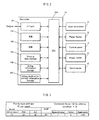
- Fig. 2 is a block diagram showing a structure of the image forming apparatus 100.
- the image forming apparatus 100 includes an image processor 11, a paper feeder 12, an operation panel 13, a controller 14, an image reader 15, and a card reader 16.
- the image processor 11 performs printing processing. Specifically, the image processing 11 forms an image on a recording sheet fed by the paper feeder 12, based on image data input from the controller 14.
- the operation panel 13 includes a plurality of input keys and a liquid crystal display.
- a touch panel is arranged on a surface of the liquid crystal display. Upon receiving an instruction from a user via the touch panel or the input keys, the operation panel 13 notifies the controller 14 of the instruction.
- the image reader 15 includes an image input device such as a scanner.
- the image reader 15 generates image data by reading information on a recording sheet, such as characters and figures.
- the card reader 16 reads identification information (here, it is assumed that the identification information is either the ID number of a user or the ID number of a billing destination), and outputs the identification information to the controller 14.
- the ID number of a user is recorded on a user identification card that is used to identify the user
- the ID number of a billing destination is recorded on a billing destination identification card that is used to identify the billing destination for a printing job.
- the controller 14 determines whether the identification information is the user identification information or the billing destination identification information based on, for example, the first digit of a number indicated by the identification information (here, if the first digit is "1", the controller 14 determines that the identification information is the user identification information. If the first digit is "2", the controller 14 determines that the identification information is the billing destination identification information).
- the card reader 16 may be, for example, an RFID (Radio Frequency Identification) reader or a magnetic card reader.
- RFID Radio Frequency Identification
- the user identification information does not need to be read by the card reader 16 to be input to the controller 14. Instead, the user identification information may be input via the operation panel 13, and only the billing destination identification information may be read by the card reader 16.
- the user identification card and the billing destination identification card may be IC chips or magnetic cards that are compatible with the card reader 16.
- the controller 14 includes, as main components thereof, a CPU 141, a communication interface (I/F) part 142, a ROM 143, a RAM 144, a printing data storage 145, a billing information storage 146, and a billing destination setting information storage 147.
- the I/F part 142 is an interface for connecting to a LAN, such as a LAN card or a LAN board.
- the ROM 143 stores programs necessary for printing processing, programs for an operation control in billing destination switch control processing described below, and the like.
- the RAM 144 is used as a work area when the CPU 141 is executing a program.
- the printing data storage 145 stores image data for printing.
- the image data is input via the I/F part 142 and the image reader 15, converted into bitmap data by the CPU 141, and thereafter stored in the printing data storage 145.
- the billing information storage 146 stores billing information acquired from the billing server 101.
- the billing information indicates the correspondence between printing conditions and fees. Based on a printing condition input via the operation panel 13 and the billing information, the CPU 141 calculates a fee for printing processing.
- Fig. 3 shows a specific example of the billing information.
- the billing information indicates the correspondence between (i) the type and size of a recording sheet and (ii) a fee (P yen) per recording sheet having the type and the size.
- the billing information defines a correction factor (Q) depending on whether a printing condition is monochrome printing, color printing, or aggregate printing.
- a fee per recording sheet is calculated by multiplying P and Q.
- printing conditions that are input are as follows: the type of a recording sheet is a paper sheet; the size thereof is A4; the printing method thereof is monochrome printing; and the number of pages to be printed is 10.
- P and Q corresponding to the printing conditions are 10 and 1, respectively, according to the billing information shown in Fig. 3 . Therefore, a fee per recording sheet is 10 yen, which is calculated by multiplying P (i.e., 10) by Q (i.e., 1).
- a fee for the printing job is 100 yen, which is calculated by multiplying 10 yen (fee per recording sheet) by 10 pages (number of pages to be printed).
- the billing destination setting information storage 147 stores the ID number of a billing destination for printing processing.
- the ID number is set in billing destination switch control processing described below.
- the CPU 141 reads necessary control programs from the ROM 143, controls the image processor 11, the paper feeder 12, and the image reader 15, so that the printing processing is smoothly performed. Also, the CPU 141 controls operations in billing destination switch control processing described below.
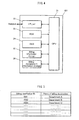
- Fig. 4 is a block diagram showing a structure of the billing server 101.
- the billing server 101 includes, as main components thereof, a CPU 21, a communication interface (I/F) part 22, a ROM 23, a RAM 24, a billing information storage 25, and a billing management information storage 26.
- I/F communication interface
- the I/F part 22 is an interface for connecting to a LAN, such as a LAN card or a LAN board.
- the ROM 23 stores programs necessary for billing destination validation processing and billing destination management processing that are described below.
- the RAM 24 is used as a work area when the CPU 21 is executing a program.
- the billing information storage 25 stores billing information.
- the billing management information storage 26 stores billing destination identification information, default billing destination management information, and billing destination usage management information.
- the billing destination identification information indicates the correspondence between the ID numbers of billing destinations and the names of the billing destinations.
- the ID numbers and the billing destinations are registered in advance in one-to-one correspondence by an administrator.
- Billing destination validation processing is performed by determining whether the ID number of a billing destination read by the card reader 16 is registered in the billing destination identification information.
- Fig. 5 shows a specific example of the billing destination identification information.
- the default billing destination management information indicates the correspondence between the ID numbers of users, the ID numbers of billing destinations predetermined for the users, and the names of the billing destinations.
- the default billing destination management information is used for the initial setting of a billing destination.
- the initial setting is performed when a user is authenticated in billing destination switch control processing described below.
- the ID number of a billing destination corresponding to the authenticated user is initially set in the default billing destination management information.
- the ID number of a billing destination initially set in the aforementioned manner is referred to as "default billing destination".
- Fig. 6 shows a specific example of the default billing destination management information.
- the billing destination usage management information indicates, for each billing destination, the correspondence between (i) the ID number of a user who has used the image forming apparatus 100 for a printing job whose fee is charged to the billing destination, (ii) usage time indicated by login time, and (iii) the fee for the printing job.
- Fig. 7 shows a specific example of the billing destination usage management information.
- Fig. 7 shows the billing destination usage management information regarding a billing destination whose ID number is 2001 (the name of the billing destination is a department A).
- the CPU 21 reads, from the ROM 23, programs necessary for billing destination validation processing and billing destination management processing that are described below, and controls operations in the billing destination validation processing and the billing destination management processing.
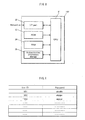
- Fig. 8 is a block diagram showing a structure of the authentication server 102.
- the authentication server 102 includes, as main components thereof, a CPU 31, a communication interface (I/F) part 32, a ROM 33, a RAM 34, an authentication information storage 35.
- I/F communication interface
- the I/F part 32 is an interface for connecting to a LAN, such as a LAN card or a LAN board.
- the ROM 33 stores programs necessary for processing for authenticating a user of the image forming apparatus 100.
- the processing is hereinafter referred to as "user authentication processing”.
- the RAM 34 is used as a work area when the CPU 31 is executing a program.
- the authentication information storage 35 stores user authentication management information.
- the user authentication management information indicates the correspondence between the ID numbers of users and passwords.
- the ID numbers of the users of the image forming apparatus 100 are registered in advance in the user authentication management information, where each ID number is unique to a different one of the users.
- User authentication is performed by judging whether the ID number of a user and a password are registered in the user authentication management information.
- the ID number of the user is read by the card reader 16 from the user identification card of the user, and the password is input via the operation panel 13.
- Fig. 9 shows a specific example of the user authentication management information.
- the CPU 31 reads, from the ROM 33, programs necessary for user authentication processing described below.
- the user authentication processing is performed as follows.
- the image forming apparatus 100 requests the authentication server 102 to authenticate a user.
- the authentication server 102 obtains user authentication information from the image forming apparatus 100.
- the user authentication information indicates the ID number of the user and a password.
- the authentication server 102 judges whether the user authentication information is registered in the user authentication management information. When judging that the user authentication information is registered therein, the authentication server 102 notifies the image forming apparatus 100 that the user has been authenticated. When judging that the user authentication information is not registered therein, the authentication server 102 notifies the image forming apparatus 100 that the user has not been authenticated.
- the controller 14 receives the ID number of a user and a password.
- the ID number is input from the card reader 16 reading the ID number from a user identification card.
- the password is input by the user via a password input screen displayed on the operation panel 13 at the time of login.
- the inputs of the ID number and the password are collectively referred to as "login input”.
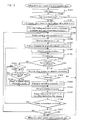
- the controller 14 Upon receipt of the login input (step S1001), the controller 14 acquires login input time, notifies the authentication server 102, via the I/F part 142, of user authentication information indicating the ID number of the user and the password, and requests the authentication server 102 to authenticate the user.
- the controller 14 When the authentication server 102 has authenticated the user by validating that the notified user authentication information is registered in the user authentication management information (step S1002: YES), the controller 14 notifies the billing server 101 of the ID number of the user via the I/F part 142, and requests the billing server 101 to notify the default billing destination of the user (step S1003). Subsequently, the controller 14 stores, into the billing destination setting information storage 147, the default billing destination information that has been notified by the billing server 101 upon request, and sets the default billing destination information as the billing destination of the printing processing by default (step S1004). Subsequently, the controller 14 causes the liquid crystal display on the operation panel 13 to display a printing menu selection screen (step S1005).
- the printing menu selection screen shows buttons for selecting an item from among printing menu items, such as normal printing processing, aggregate printing processing, pull-printing processing, and the like.
- step S1002 when notified by the authentication server 102 that the user has not been authenticated (step S1002: NO), or when notified, by the billing server 101 in response to the request in step S1003, that the default destination has not been validated in billing destination validation processing described below, the controller 14 ends billing destination switch control processing.
- the controller 14 Upon receiving a printing menu item selected by a user via the printing menu selection screen (step S1006), the controller 14 activates programs for executing the selected printing menu item (step S1007). Subsequently, the controller 14 causes the liquid crystal display of the operation panel 13 to display a condition setting screen for setting a printing condition for the selected printing menu item, and receives a printing condition from a user via the condition setting screen (step S 1008). The controller 14 then calculates a fee based on the billing information stored in the billing information storage 146 and the printing condition that has been input (step S1009).
- the controller 14 monitors, until an instruction for executing printing processing corresponding to the selected printing menu item is input via the operation panel 13, whether the ID number of a billing destination is input as the billing destination identification information via the card reader 16, thereby judging whether an instruction for changing a billing destination has been given (step S1010).
- step S1010: YES When the instruction for changing the billing destination has been given by the ID number of a billing destination being input as the billing destination identification information (step S1010: YES), the controller 14 notifies the billing server 101 via the I/F part 142 of the ID number of the billing destination that has been input, and requests the billing server 101 to perform the validation processing for the billing destination (step S1011).
- step S1012: YES the controller 14 stores, into the billing destination setting information storage 147, the ID number of the billing destination input from the card reader 16 instead of the ID number of the default billing destination, and changes the billing destination setting from the ID number of the default billing destination to the ID number of the billing destination (step S1013).
- the controller 14 Upon receiving the instruction for executing the printing processing, the controller 14 causes the printing processing to be performed (step S1014), notifies the billing server 101 of (i) the calculated fee, (ii) the ID number of the billing destination stored in the billing destination setting information storage 147, (iii) the ID number of the user, and (iv) the login time, and charges the fee to the ID number of the notified billing destination (step S1015).
- the controller 14 causes the liquid crystal display of the operation panel 13 to display a message inquiring whether to continue the printing processing corresponding to the selected printing menu item.
- the controller 14 further causes the liquid crystal display of the operation panel 13 to display a message inquiring whether the user desires to log out.
- the controller 14 ends the billing destination switch control processing.
- step S1016 Upon receiving an instruction for continuing the printing processing from the user via the operation panel 13 (step S1016: YES), the controller 14 performs the processing of step S1008. Upon receiving an instruction for not logging out from the user via the operation panel 13 (step S1017: NO), the controller 14 performs the processing of step S 1005.
- the following describes billing destination validation processing performed by the billing server 101.
- Fig. 11 is a flowchart of the billing destination validation processing.
- the billing server 101 Upon receiving a request for notifying the default billing destination from the controller 14 in step S1003 shown in Fig. 10 (step S1101), the billing server 101 refers to the default billing destination management information stored in the billing management information storage 26, and judges whether the ID number of the user notified at the time of the request is registered in the default billing destination management information (step S1102). If the ID number is registered therein (step S1102: YES), the billing server 101 notifies the controller 14 of the ID number of a billing destination corresponding to the ID number of the user, as a default billing destination (step S1103).
- step S1102 If the ID number is not registered therein (step S1102: NO), the billing server 101 notifies the controller 14 that a corresponding default billing destination has not been validated (step S1104).
- the billing server 101 upon receiving a request for the billing destination validation processing from the controller 14 in step S1011 shown in Fig. 10 (step S1105: YES), the billing server 101 refers to the billing destination identification information stored in the billing management information storage 26, and judges whether the ID number of a billing destination notified at the time of the request is registered in the billing destination identification information (step S1106). If the ID number is registered therein (step S1106: YES), the billing server 101 notifies the controller 14 that the billing destination specified by the ID number has been validated (step S 1107).
- step S1106 NO
- the billing server 101 notifies the controller 14 that the billing destination has not been validated (step S1108).
- Fig. 12 is a flowchart of the billing destination management processing.
- the billing server 101 Upon receiving the notification from the controller 14 in step S1015 shown in Fig. 10 (step S1201), the billing server 101 records, in the field of the notified billing destination in the billing destination usage management information stored in the billing management information storage 26, the following information pieces in association with each other: the ID number of the user; the login time; the ID number of the billing destination; and the fee that have been notified (step S 1202).
- judgment of whether an authenticated user has change authority for changing a default billing destination may be performed after the processing step of judging and validating a new billing destination in step S1012. Then, the default billing destination may be changed to the new billing destination when the new billing destination is validated (step S1012: YES) and the authenticated user has the change authority.
- Judgment of whether an authenticated user has the change authority may be performed, for example, by reference to change authority management information as shown in Fig. 13 .
- the change authority management information is stored in one of the image forming apparatus 100, the billing server 101, and the authentication server 102, and indicates the correspondence between (i) the ID number of a user, (ii) information indicating whether the user has the change authority, (iii) the ID number of a new billing destination to which the user can change, and (iv) the name of the new billing destination.
- Fig. 14 is a flowchart showing a modification of the billing destination switch control processing, where a step of judging whether an authenticated user has the change authority (step S1401) is additionally performed after the processing step of judging and validating a new billing destination in step S1012 shown in Fig. 10 .
- step S1401 a step of judging whether an authenticated user has the change authority
- step S1012 a new billing destination in step S1012 shown in Fig. 10 .
- the same step numbers are provided for the same processing steps shown in the flowchart of Fig. 10 .
- the change authority management information may be stored in the image forming apparatus 100 itself.
- the change authority management information may be stored in either the billing server 101 or the authentication server 102, and the image forming apparatus 100 may acquire the change authority management information from either of the servers 101 and 102 that has the change authority management information so as to perform the judgment of step S1401.
- the image forming apparatus 100 may request either of the authentication server 102 and the billing server 101 to perform the judgment of step S1401, and receive a result of the judgment from either of the servers 101 and 102 that has performed the judgment.
- the image forming apparatus 100 may store in advance an ID number (e.g., a number whose digits are all nine) corresponding to an instruction for changing a billing destination back to a default billing destination.
- ID number e.g., a number whose digits are all nine
- the instruction is hereinafter referred to as "default setting instruction ID number”
- the image forming apparatus 100 may reset the billing destination to the default billing destination, when the card reader 16 reads, from a identification card, the ID number whose digits are all nine, and inputs the read ID number to the image forming apparatus 100.
- Fig. 15 is a flowchart showing a modification of the billing destination switch control processing, where a billing destination is resettable to a default billing destination.
- the same step numbers are provided for the same processing steps shown in the flowchart of Fig. 10 .
- the controller 14 sets a flag value n to an initial value "0" and performs the same processing step as step S1003 in Fig. 10 .
- the flag value n indicates whether a billing destination is set to a default billing destination. When the flag value n is "0", it indicates that the billing destination is set to the default billing destination. When the flag value n is not "0", it indicates that the billing destination is not set to the default billing destination.
- the controller 14 stores the default billing destination notified by the billing server 101 into the billing destination setting information storage 147, and initially sets the default billing destination as a billing destination for printing processing in the same manner as the processing of step S1004 in Fig. 10 , and holds the default billing destination.
- step S1010 Upon receiving an instruction for changing a billing destination in step S1010 (step S1010: YES), the controller 14 performs the processing of steps S1011 and S1012. In step S1503, the controller 14 changes the billing destination in the same manner as step S1013, and sets the flag value n to "1" indicating that the billing destination has been changed.
- step S1016: YES When the printing processing is continued (step S1016: YES) and an instruction for changing a billing destination is not given (step S1010: NO), the controller 14 judges whether the billing destination has been changed from the default, based on whether the flag value n indicates "1" (step S1504). When judging that the billing destination has been changed (step S1504: YES), the controller 14 judges whether a default setting instruction is given by monitoring whether a default setting instruction ID number has been input from the card reader 16 (step S1505).
- step S1505 When judging that the default setting instruction is given and the default setting instruction ID number has been input (step S1505: YES), the controller 14 (i) updates the ID number of the billing destination after the change, which is stored in the billing destination setting information storage 147, to the default billing destination held in step S1502, (ii) resets the billing destination to the default billing destination, and (iii) sets the flag value n to "0" (step S1506).
- Fig. 16 is a flowchart showing a modification of the billing destination switch control processing in the case of a pull-printing method.
- Fig. 16 shows processing after the processing of steps S1001 to S1005 in Fig. 10 is performed and a "pull-printing menu" is selected in step S1006.
- the controller 14 activates a program for executing the selected pull-printing menu (step S1601). Then, the controller 14 acquires a list of printing target files from an external server that stores the printing target files, causes the liquid crystal display of the operation panel 13 to display the list, and receives the designation of files for which printing processing is to be performed (step S1602). Upon receiving a printing condition for each of the designated files (step S1603), the controller 14 causes the liquid crystal display of the operation panel 13 to display a message encouraging an input of billing destinations.
- the controller 14 Upon receiving, from the card reader 16, the ID numbers of the billing destinations as the billing destination identification information (step S1604), the controller 14 notifies the billing server 101 of the ID numbers via the I/F part 142 and requests the billing server 101 to perform processing for validating the billing destinations (step S1605).
- the controller 14 holds the correspondence between the printing target files and the ID numbers of the billing destinations as a billing destination setting table (step S1607), and judges whether printing conditions have been input for all the designated printing target files (step S1608).
- step S1608 When the input of the printing conditions has been completed (step S1608: YES), the controller 14 acquires all the designated printing target files from an external server (step S1609). Then, the controller 14 calculates, for each of the acquired printing target files, a fee based on the billing information stored in the billing information storage 146 and the printing condition of the printing target file (step S1610), and causes printing processing to be performed (step S1611). Subsequently, the controller 14 specifies the ID number of a billing destination for each of the designated printing target files, by referring to the billing destination setting table that has been held, and updates the ID numbers of billing destinations stored in the billing destination setting information storage 147 to the ID numbers of the specified billing destinations (step S1612). Finally, the controller 14 notifies the billing server 101 of the updated ID numbers of the billing destinations and the fees for the updated ID numbers, and causes the billing server 101 to charge the fees to the notified ID numbers of the billing destinations (step S1613).
- instructions for changing billing destinations may be input before printing conditions are input. Then, printing conditions permitted to be input may be restricted for each of new billing destinations after the change.
- the billing server 101 may store in advance restriction information as shown in Fig. 17 .
- the restriction information indicates the correspondence between (i) the ID number of a billing destination, (ii) the name of the billing destination, (iii) a restricted printing condition, and (iv) details of the restriction.
- the printing conditions permitted to be input for a new billing destination after change may be restricted in accordance with a restriction corresponding to the new billing destination.
- the user authentication management information and the billing destination identification information may be stored in the image forming apparatus 100.
- the new billing destination may be recorded on a recording medium
- the receiver may be a reader for reading the new billing destination from the recording medium.
- a new billing destination is input by the reader reading the new billing destination recorded on the recording medium. This reduces a risk of input errors unlike the case of manual input, thus promptly and reliably changing a billing destination.
- the image forming apparatus may further comprise: a management information storage storing therein management information indicating one or more registered billing destinations; and a judgment part operable to judge whether the new billing destination is indicated in the management information when the receiver receives the new billing destination, wherein the update part may update the billing destination if the new billing destination is indicated in the management information.
- the billing destination is changed to the new billing destination after it has been validated that the new billing destination is registered. This effectively prevents a user from fraudulently changing the billing destination to a randomly selected billing destination.
- the management information storage may further store therein authority information indicating a user who has authority for changing the billing destination, the judgment part may further judge whether the user who is logged in has the authority based on the authority information, and the update part may update the billing destination only when the user has the authority.
- the billing destination is changed only when the logged-in user has the change authority. This effectively prevents a user not having the change authority to intentionally change the billing destination for a fraudulent purpose, thus improving security in changing the billing destination.
- the image forming apparatus may further comprise: a default setting part operable to store a predetermined billing destination into the storage when the user logs in; a holding part holding the predetermined billing destination; a recovery instruction storage storing therein a recovery instruction for updating the billing destination to the predetermined billing destination, wherein the receiver may receive the recovery instruction from the user while the user is logged in, and when the receiver receives the recovery instruction after the billing destination is updated, the update part may update the new billing destination in the storage to the predetermined billing destination.
- the new billing destination after change may be easily changed back to the predetermined billing destination without newly logging in by inputting the recovery instruction.
- the image forming apparatus may further comprise: a designation receiver operable to receive designation of a plurality of printing target files that are to be acquired from an external device, wherein the receiver may receive a new billing destination for each of the printing target files, and the update part may update, for each printing target file, the billing destination to one of the new billing destinations corresponding to the printing target file.
- a designation receiver operable to receive designation of a plurality of printing target files that are to be acquired from an external device, wherein the receiver may receive a new billing destination for each of the printing target files, and the update part may update, for each printing target file, the billing destination to one of the new billing destinations corresponding to the printing target file.
- the present invention relates to a billing management technique in an image forming apparatus for charging for execution of printing, and in particular is available as a technique for managing a change in the setting of a billing destination.
Landscapes
- Engineering & Computer Science (AREA)
- Theoretical Computer Science (AREA)
- Physics & Mathematics (AREA)
- General Physics & Mathematics (AREA)
- General Engineering & Computer Science (AREA)
- Human Computer Interaction (AREA)
- Business, Economics & Management (AREA)
- Accounting & Taxation (AREA)
- Finance (AREA)
- Signal Processing (AREA)
- Multimedia (AREA)
- Microelectronics & Electronic Packaging (AREA)
- Strategic Management (AREA)
- Economics (AREA)
- Development Economics (AREA)
- General Business, Economics & Management (AREA)
- Computing Systems (AREA)
- Computer Security & Cryptography (AREA)
- Control Or Security For Electrophotography (AREA)
- Accessory Devices And Overall Control Thereof (AREA)
- Facsimiles In General (AREA)
- Facsimile Transmission Control (AREA)
Abstract
Description
- The present invention relates to a technique for managing a billing destination in an image forming apparatus that charges for execution of printing, and in particular to a technique for managing a change in the setting of the billing destination.
- In recent years, image forming apparatuses such as copiers that charge for execution of a printing job have been prevalent. One example of a technique for selecting and setting a billing destination in such an image forming apparatus is disclosed in
Patent literature 1. In this technique, a setting of a billing destination is performed after a user logs in and selects the billing destination via a GUI (Graphic User Interface) displayed on an operation panel. - Such a technique enables a user to select and set a billing destination to which a fee for a printing job is charged.
-
- Japanese Patent Application Publication No.
2008-40809 - However, an image forming apparatus as described above has the following problem. That is, in order for a user to select a billing destination, a selection screen for selecting the billing destination needs to be displayed on an operation panel of the image forming apparatus. Therefore, in the case of selecting and setting a different billing destination for each printing job, a screen displayed on the operation panel needs to be switched to the selection screen, every time the user performs operations for selecting a billing destination. This switching operation is time consuming.
- The present invention has been achieved in view of the above problem, and an aim thereof is to provide an image forming apparatus in which a billing destination is easily changed, and a billing destination setting method used in the image forming apparatus.
- In order to solve the above problem, one aspect of the present invention is an image forming apparatus comprising: a storage storing therein a billing destination to which a fee for printing processing is charged; an operation panel operable to receive, from a user, an instruction for executing the printing processing while the user is logged in; a billing part operable to charge, to the billing destination, the fee for the execution of the printing processing; a receiver operable to receive a new billing destination while the user is logged in; and an update part operable to update the billing destination to the new billing destination by storing the new billing destination into the storage, when the receiver receives the new billing destination.
- Another aspect of the present invention is a billing destination setting method in an image forming apparatus comprising: a billing step of receiving an instruction for executing printing processing via an operation panel while the user is logged in, and of charging, to a billing destination stored in a storage, a fee for the execution of the printing processing; a receiving step of receiving a new billing destination via a receiver, without intervention of the operation panel, while the user is logged in; and an updating step of updating the billing destination to the new billing destination by storing the new billing destination in the storage, when the receiving step receives the new billing destination.
- According to the stated structure of the present invention, a new billing destination is input via the receiver without use of the operation panel. This makes it easy for a user to change a billing destination via the receiver without operating the operation panel.
-
-
Fig.1 shows an example of a structure of aprinting system 1 according to the present embodiment. -
Fig. 2 is a block diagram showing a structure of animage forming apparatus 100. -
Fig. 3 shows a specific example of billing information. -
Fig. 4 is a block diagram showing a structure of abilling server 101. -
Fig. 5 shows a specific example of billing destination identification information. -
Fig. 6 shows a specific example of default billing destination management information. -
Fig. 7 shows a specific example of billing destination usage management information. -
Fig. 8 is a block diagram showing a structure of anauthentication server 102. -
Fig. 9 shows a specific example of user authentication management information. -
Fig. 10 is a flowchart showing billing destination switch control processing performed by acontroller 14. -
Fig. 11 is a flowchart showing billing destination validation processing performed by thebilling server 101. -
Fig. 12 is a flowchart showing billing destination management processing performed by thebilling server 101. -
Fig. 13 shows a specific example of change authority management information. -
Fig. 14 is a flowchart showing a modification of the billing destination switch control processing. -
Fig. 15 is a flowchart showing a modification of the billing destination switch control processing. -
Fig. 16 is a flowchart showing a modification of the billing destination switch control processing in the case of pull-printing. -
Fig. 17 shows a specific example of restriction information indicating functions restricted for each billing destination. - The following describes an embodiment of a
printing system 1 according to the present invention. -
Fig. 1 shows an example of a structure of theprinting system 1 according to the present embodiment. As shown inFig. 1 , theprinting system 1 includes animage forming apparatus 100, abilling server 101, and anauthentication server 102. InFig. 1 , areference sign 13 denotes an operation panel, and areference sign 16 denotes a card reader. The operation panel and the card reader are described below. - The
image forming apparatus 100, thebilling server 101, and theauthentication server 102 are connected to each other via a LAN (Local Area Network) 103. -
Fig. 2 is a block diagram showing a structure of theimage forming apparatus 100. As shown inFig. 2 , theimage forming apparatus 100 includes animage processor 11, apaper feeder 12, anoperation panel 13, acontroller 14, animage reader 15, and acard reader 16. - The
image processor 11 performs printing processing. Specifically, theimage processing 11 forms an image on a recording sheet fed by thepaper feeder 12, based on image data input from thecontroller 14. - The
operation panel 13 includes a plurality of input keys and a liquid crystal display. A touch panel is arranged on a surface of the liquid crystal display. Upon receiving an instruction from a user via the touch panel or the input keys, theoperation panel 13 notifies thecontroller 14 of the instruction. - The
image reader 15 includes an image input device such as a scanner. Theimage reader 15 generates image data by reading information on a recording sheet, such as characters and figures. - The
card reader 16 reads identification information (here, it is assumed that the identification information is either the ID number of a user or the ID number of a billing destination), and outputs the identification information to thecontroller 14. The ID number of a user is recorded on a user identification card that is used to identify the user, and the ID number of a billing destination is recorded on a billing destination identification card that is used to identify the billing destination for a printing job. - Upon receiving identification information, the
controller 14 determines whether the identification information is the user identification information or the billing destination identification information based on, for example, the first digit of a number indicated by the identification information (here, if the first digit is "1", thecontroller 14 determines that the identification information is the user identification information. If the first digit is "2", thecontroller 14 determines that the identification information is the billing destination identification information). - The
card reader 16 may be, for example, an RFID (Radio Frequency Identification) reader or a magnetic card reader. - Here, the user identification information does not need to be read by the
card reader 16 to be input to thecontroller 14. Instead, the user identification information may be input via theoperation panel 13, and only the billing destination identification information may be read by thecard reader 16. - The user identification card and the billing destination identification card may be IC chips or magnetic cards that are compatible with the
card reader 16. - The
controller 14 includes, as main components thereof, aCPU 141, a communication interface (I/F)part 142, aROM 143, aRAM 144, aprinting data storage 145, abilling information storage 146, and a billing destinationsetting information storage 147. - The I/
F part 142 is an interface for connecting to a LAN, such as a LAN card or a LAN board. - The
ROM 143 stores programs necessary for printing processing, programs for an operation control in billing destination switch control processing described below, and the like. - The
RAM 144 is used as a work area when theCPU 141 is executing a program. - The
printing data storage 145 stores image data for printing. The image data is input via the I/F part 142 and theimage reader 15, converted into bitmap data by theCPU 141, and thereafter stored in theprinting data storage 145. - The
billing information storage 146 stores billing information acquired from thebilling server 101. - Here, the billing information indicates the correspondence between printing conditions and fees. Based on a printing condition input via the
operation panel 13 and the billing information, theCPU 141 calculates a fee for printing processing. -
Fig. 3 shows a specific example of the billing information. As shown inFig. 3 , the billing information indicates the correspondence between (i) the type and size of a recording sheet and (ii) a fee (P yen) per recording sheet having the type and the size. Furthermore, the billing information defines a correction factor (Q) depending on whether a printing condition is monochrome printing, color printing, or aggregate printing. A fee per recording sheet is calculated by multiplying P and Q. - Suppose that printing conditions that are input are as follows: the type of a recording sheet is a paper sheet; the size thereof is A4; the printing method thereof is monochrome printing; and the number of pages to be printed is 10. In this case, P and Q corresponding to the printing conditions are 10 and 1, respectively, according to the billing information shown in
Fig. 3 . Therefore, a fee per recording sheet is 10 yen, which is calculated by multiplying P (i.e., 10) by Q (i.e., 1). - Since the number of pages to be printed is 10 pages, a fee for the printing job is 100 yen, which is calculated by multiplying 10 yen (fee per recording sheet) by 10 pages (number of pages to be printed).
- The billing destination setting
information storage 147 stores the ID number of a billing destination for printing processing. The ID number is set in billing destination switch control processing described below. - The
CPU 141 reads necessary control programs from theROM 143, controls theimage processor 11, thepaper feeder 12, and theimage reader 15, so that the printing processing is smoothly performed. Also, theCPU 141 controls operations in billing destination switch control processing described below. -
Fig. 4 is a block diagram showing a structure of thebilling server 101. As shown inFig. 4 , thebilling server 101 includes, as main components thereof, aCPU 21, a communication interface (I/F)part 22, aROM 23, aRAM 24, abilling information storage 25, and a billingmanagement information storage 26. - The I/
F part 22 is an interface for connecting to a LAN, such as a LAN card or a LAN board. - The
ROM 23 stores programs necessary for billing destination validation processing and billing destination management processing that are described below. - The
RAM 24 is used as a work area when theCPU 21 is executing a program. - The
billing information storage 25 stores billing information. - The billing
management information storage 26 stores billing destination identification information, default billing destination management information, and billing destination usage management information. - Here, the billing destination identification information indicates the correspondence between the ID numbers of billing destinations and the names of the billing destinations. In the billing destination identification information, the ID numbers and the billing destinations are registered in advance in one-to-one correspondence by an administrator. Billing destination validation processing is performed by determining whether the ID number of a billing destination read by the
card reader 16 is registered in the billing destination identification information. -
Fig. 5 shows a specific example of the billing destination identification information. - The default billing destination management information indicates the correspondence between the ID numbers of users, the ID numbers of billing destinations predetermined for the users, and the names of the billing destinations. The default billing destination management information is used for the initial setting of a billing destination. The initial setting is performed when a user is authenticated in billing destination switch control processing described below. In this case, the ID number of a billing destination corresponding to the authenticated user is initially set in the default billing destination management information. Hereinafter, the ID number of a billing destination initially set in the aforementioned manner is referred to as "default billing destination".
-
Fig. 6 shows a specific example of the default billing destination management information. - The billing destination usage management information indicates, for each billing destination, the correspondence between (i) the ID number of a user who has used the
image forming apparatus 100 for a printing job whose fee is charged to the billing destination, (ii) usage time indicated by login time, and (iii) the fee for the printing job. -
Fig. 7 shows a specific example of the billing destination usage management information.Fig. 7 shows the billing destination usage management information regarding a billing destination whose ID number is 2001 (the name of the billing destination is a department A). - The
CPU 21 reads, from theROM 23, programs necessary for billing destination validation processing and billing destination management processing that are described below, and controls operations in the billing destination validation processing and the billing destination management processing. -
Fig. 8 is a block diagram showing a structure of theauthentication server 102. Theauthentication server 102 includes, as main components thereof, aCPU 31, a communication interface (I/F)part 32, aROM 33, aRAM 34, anauthentication information storage 35. - The I/
F part 32 is an interface for connecting to a LAN, such as a LAN card or a LAN board. - The
ROM 33 stores programs necessary for processing for authenticating a user of theimage forming apparatus 100. The processing is hereinafter referred to as "user authentication processing". - The
RAM 34 is used as a work area when theCPU 31 is executing a program. - The
authentication information storage 35 stores user authentication management information. - The user authentication management information indicates the correspondence between the ID numbers of users and passwords. The ID numbers of the users of the
image forming apparatus 100 are registered in advance in the user authentication management information, where each ID number is unique to a different one of the users. User authentication is performed by judging whether the ID number of a user and a password are registered in the user authentication management information. The ID number of the user is read by thecard reader 16 from the user identification card of the user, and the password is input via theoperation panel 13. -
Fig. 9 shows a specific example of the user authentication management information. - The
CPU 31 reads, from theROM 33, programs necessary for user authentication processing described below. - Specifically, the user authentication processing is performed as follows.
- In billing destination switch control processing described below, the
image forming apparatus 100 requests theauthentication server 102 to authenticate a user. Upon receiving the request, theauthentication server 102 obtains user authentication information from theimage forming apparatus 100. The user authentication information indicates the ID number of the user and a password. Theauthentication server 102 then judges whether the user authentication information is registered in the user authentication management information. When judging that the user authentication information is registered therein, theauthentication server 102 notifies theimage forming apparatus 100 that the user has been authenticated. When judging that the user authentication information is not registered therein, theauthentication server 102 notifies theimage forming apparatus 100 that the user has not been authenticated. - The following describes billing destination switch control processing performed by the
controller 14, with reference toFig. 10 . - The
controller 14 receives the ID number of a user and a password. The ID number is input from thecard reader 16 reading the ID number from a user identification card. The password is input by the user via a password input screen displayed on theoperation panel 13 at the time of login. Hereinafter, the inputs of the ID number and the password are collectively referred to as "login input". Upon receipt of the login input (step S1001), thecontroller 14 acquires login input time, notifies theauthentication server 102, via the I/F part 142, of user authentication information indicating the ID number of the user and the password, and requests theauthentication server 102 to authenticate the user. - When the
authentication server 102 has authenticated the user by validating that the notified user authentication information is registered in the user authentication management information (step S1002: YES), thecontroller 14 notifies thebilling server 101 of the ID number of the user via the I/F part 142, and requests thebilling server 101 to notify the default billing destination of the user (step S1003). Subsequently, thecontroller 14 stores, into the billing destination settinginformation storage 147, the default billing destination information that has been notified by thebilling server 101 upon request, and sets the default billing destination information as the billing destination of the printing processing by default (step S1004). Subsequently, thecontroller 14 causes the liquid crystal display on theoperation panel 13 to display a printing menu selection screen (step S1005). - The printing menu selection screen shows buttons for selecting an item from among printing menu items, such as normal printing processing, aggregate printing processing, pull-printing processing, and the like.
- Meanwhile, when notified by the
authentication server 102 that the user has not been authenticated (step S1002: NO), or when notified, by thebilling server 101 in response to the request in step S1003, that the default destination has not been validated in billing destination validation processing described below, thecontroller 14 ends billing destination switch control processing. - Upon receiving a printing menu item selected by a user via the printing menu selection screen (step S1006), the
controller 14 activates programs for executing the selected printing menu item (step S1007). Subsequently, thecontroller 14 causes the liquid crystal display of theoperation panel 13 to display a condition setting screen for setting a printing condition for the selected printing menu item, and receives a printing condition from a user via the condition setting screen (step S 1008). Thecontroller 14 then calculates a fee based on the billing information stored in thebilling information storage 146 and the printing condition that has been input (step S1009). Thecontroller 14 monitors, until an instruction for executing printing processing corresponding to the selected printing menu item is input via theoperation panel 13, whether the ID number of a billing destination is input as the billing destination identification information via thecard reader 16, thereby judging whether an instruction for changing a billing destination has been given (step S1010). - When the instruction for changing the billing destination has been given by the ID number of a billing destination being input as the billing destination identification information (step S1010: YES), the
controller 14 notifies thebilling server 101 via the I/F part 142 of the ID number of the billing destination that has been input, and requests thebilling server 101 to perform the validation processing for the billing destination (step S1011). When the billing destination has been validated by the billing server 101 (step S1012: YES), thecontroller 14 stores, into the billing destination settinginformation storage 147, the ID number of the billing destination input from thecard reader 16 instead of the ID number of the default billing destination, and changes the billing destination setting from the ID number of the default billing destination to the ID number of the billing destination (step S1013). - Upon receiving the instruction for executing the printing processing, the
controller 14 causes the printing processing to be performed (step S1014), notifies thebilling server 101 of (i) the calculated fee, (ii) the ID number of the billing destination stored in the billing destination settinginformation storage 147, (iii) the ID number of the user, and (iv) the login time, and charges the fee to the ID number of the notified billing destination (step S1015). - Then, the
controller 14 causes the liquid crystal display of theoperation panel 13 to display a message inquiring whether to continue the printing processing corresponding to the selected printing menu item. Upon receiving an instruction for ending the printing processing from the user via the operation panel 13 (step S1016: NO), thecontroller 14 further causes the liquid crystal display of theoperation panel 13 to display a message inquiring whether the user desires to log out. Upon receiving an instruction for logging out from the user via the operation panel 13 (step S1017: YES), thecontroller 14 ends the billing destination switch control processing. - Upon receiving an instruction for continuing the printing processing from the user via the operation panel 13 (step S1016: YES), the
controller 14 performs the processing of step S1008. Upon receiving an instruction for not logging out from the user via the operation panel 13 (step S1017: NO), thecontroller 14 performs the processing ofstep S 1005. - The following describes billing destination validation processing performed by the
billing server 101. -
Fig. 11 is a flowchart of the billing destination validation processing. - Upon receiving a request for notifying the default billing destination from the
controller 14 in step S1003 shown inFig. 10 (step S1101), thebilling server 101 refers to the default billing destination management information stored in the billingmanagement information storage 26, and judges whether the ID number of the user notified at the time of the request is registered in the default billing destination management information (step S1102). If the ID number is registered therein (step S1102: YES), thebilling server 101 notifies thecontroller 14 of the ID number of a billing destination corresponding to the ID number of the user, as a default billing destination (step S1103). - If the ID number is not registered therein (step S1102: NO), the
billing server 101 notifies thecontroller 14 that a corresponding default billing destination has not been validated (step S1104). - Furthermore, upon receiving a request for the billing destination validation processing from the
controller 14 in step S1011 shown inFig. 10 (step S1105: YES), thebilling server 101 refers to the billing destination identification information stored in the billingmanagement information storage 26, and judges whether the ID number of a billing destination notified at the time of the request is registered in the billing destination identification information (step S1106). If the ID number is registered therein (step S1106: YES), thebilling server 101 notifies thecontroller 14 that the billing destination specified by the ID number has been validated (step S 1107). - If the ID number is not registered therein (step S1106: NO), the
billing server 101 notifies thecontroller 14 that the billing destination has not been validated (step S1108). - The following describes billing destination management processing performed by the
billing server 101.Fig. 12 is a flowchart of the billing destination management processing. - Upon receiving the notification from the
controller 14 in step S1015 shown inFig. 10 (step S1201), thebilling server 101 records, in the field of the notified billing destination in the billing destination usage management information stored in the billingmanagement information storage 26, the following information pieces in association with each other: the ID number of the user; the login time; the ID number of the billing destination; and the fee that have been notified (step S 1202). - Although an image forming apparatus according to the present invention has been described based on the aforementioned embodiment, the present invention is of course not limited to the embodiment.
- (1) In the present embodiment, an instruction for changing a billing destination is input by the
card reader 16 reading the billing destination identification card. However, it is not limited to such. For example, it is possible to provide a sub-operation panel different from theoperation panel 13. Then, a billing destination input screen may be displayed on the sub-operation panel continuously while a user is logged in, and the user may change a billing destination via the billing destination input screen displayed on the sub-operation panel. In this case, it is preferable to provide the sub-operation panel close to theoperation panel 13 so as to facilitate an input operation. - (2) In the billing destination switch control processing in the present embodiment, the billing destination validation processing is performed to judge whether a default billing destination is permitted to be changed. However, it is possible to further judge whether a user attempting to change the default billing destination has change authority, thereby judging whether the default billing destination is permitted to be changed.
- Specifically, in the flowchart of
Fig. 10 showing the billing destination switch control processing, judgment of whether an authenticated user has change authority for changing a default billing destination may be performed after the processing step of judging and validating a new billing destination in step S1012. Then, the default billing destination may be changed to the new billing destination when the new billing destination is validated (step S1012: YES) and the authenticated user has the change authority. - Judgment of whether an authenticated user has the change authority may be performed, for example, by reference to change authority management information as shown in
Fig. 13 . The change authority management information is stored in one of theimage forming apparatus 100, thebilling server 101, and theauthentication server 102, and indicates the correspondence between (i) the ID number of a user, (ii) information indicating whether the user has the change authority, (iii) the ID number of a new billing destination to which the user can change, and (iv) the name of the new billing destination. -
Fig. 14 is a flowchart showing a modification of the billing destination switch control processing, where a step of judging whether an authenticated user has the change authority (step S1401) is additionally performed after the processing step of judging and validating a new billing destination in step S1012 shown inFig. 10 . InFig. 14 , the same step numbers are provided for the same processing steps shown in the flowchart ofFig. 10 . - In the judgment of step S1401, the change authority management information may be stored in the
image forming apparatus 100 itself. Alternatively, the change authority management information may be stored in either thebilling server 101 or theauthentication server 102, and theimage forming apparatus 100 may acquire the change authority management information from either of theservers image forming apparatus 100 may request either of theauthentication server 102 and thebilling server 101 to perform the judgment of step S1401, and receive a result of the judgment from either of theservers - (3) When a default billing destination is changed to a new billing destination in the billing destination switch control processing of the present embodiment, the new billing destination cannot be changed back to the default billing destination without the user logging out, unless the billing destination identification information indicating the default billing destination is obtained by the
card reader 16 reading the billing destination identification card. However, it is not limited to such. For example, after a default billing destination is changed to a new billing destination, the image forming apparatus may receive an instruction for changing the new billing destination back to the default billing destination via thecard reader 16. Upon receiving the instruction, the image forming apparatus may reset the billing destination to the default billing destination. - Specifically, the
image forming apparatus 100 may store in advance an ID number (e.g., a number whose digits are all nine) corresponding to an instruction for changing a billing destination back to a default billing destination. Here, the ID number is hereinafter referred to as "default setting instruction ID number", and the instruction as "default setting instruction". Theimage forming apparatus 100 may reset the billing destination to the default billing destination, when thecard reader 16 reads, from a identification card, the ID number whose digits are all nine, and inputs the read ID number to theimage forming apparatus 100. -
Fig. 15 is a flowchart showing a modification of the billing destination switch control processing, where a billing destination is resettable to a default billing destination. InFig. 15 , the same step numbers are provided for the same processing steps shown in the flowchart ofFig. 10 . - The following describes differences from the flowchart of
Fig. 10 . - After steps S1001 and S1002, the
controller 14 sets a flag value n to an initial value "0" and performs the same processing step as step S1003 inFig. 10 . Here, the flag value n indicates whether a billing destination is set to a default billing destination. When the flag value n is "0", it indicates that the billing destination is set to the default billing destination. When the flag value n is not "0", it indicates that the billing destination is not set to the default billing destination. In step S1502, thecontroller 14 stores the default billing destination notified by thebilling server 101 into the billing destination settinginformation storage 147, and initially sets the default billing destination as a billing destination for printing processing in the same manner as the processing of step S1004 inFig. 10 , and holds the default billing destination. - Upon receiving an instruction for changing a billing destination in step S1010 (step S1010: YES), the
controller 14 performs the processing of steps S1011 and S1012. In step S1503, thecontroller 14 changes the billing destination in the same manner as step S1013, and sets the flag value n to "1" indicating that the billing destination has been changed. - When the printing processing is continued (step S1016: YES) and an instruction for changing a billing destination is not given (step S1010: NO), the
controller 14 judges whether the billing destination has been changed from the default, based on whether the flag value n indicates "1" (step S1504). When judging that the billing destination has been changed (step S1504: YES), thecontroller 14 judges whether a default setting instruction is given by monitoring whether a default setting instruction ID number has been input from the card reader 16 (step S1505). When judging that the default setting instruction is given and the default setting instruction ID number has been input (step S1505: YES), the controller 14 (i) updates the ID number of the billing destination after the change, which is stored in the billing destination settinginformation storage 147, to the default billing destination held in step S1502, (ii) resets the billing destination to the default billing destination, and (iii) sets the flag value n to "0" (step S1506). - (4) In the billing destination switch control processing in the present embodiment, when a user has been authenticated, a billing destination is initially set to a default billing destination corresponding to the ID number of the user. However, a billing destination may be initially set by receiving an ID number of the billing destination from the
card reader 16, in the same manner as the case of changing a billing destination. - (5) In the present embodiment, the processing for changing a billing destination is performed when necessary. However, it is not limited to such. The following structure is applicable in a printing method, such as pull-printing, where an image forming apparatus performs printing processing by downloading a plurality of printing target files from an external server. In this structure, a billing destination for printing processing may be set for each downloaded printing target file, so that when printing processing is performed with respect to a printing target file, a fee for the printing processing is charged to a billing destination corresponding to the printing target file.
-
Fig. 16 is a flowchart showing a modification of the billing destination switch control processing in the case of a pull-printing method. -
Fig. 16 shows processing after the processing of steps S1001 to S1005 inFig. 10 is performed and a "pull-printing menu" is selected in step S1006. - The
controller 14 activates a program for executing the selected pull-printing menu (step S1601). Then, thecontroller 14 acquires a list of printing target files from an external server that stores the printing target files, causes the liquid crystal display of theoperation panel 13 to display the list, and receives the designation of files for which printing processing is to be performed (step S1602). Upon receiving a printing condition for each of the designated files (step S1603), thecontroller 14 causes the liquid crystal display of theoperation panel 13 to display a message encouraging an input of billing destinations. Upon receiving, from thecard reader 16, the ID numbers of the billing destinations as the billing destination identification information (step S1604), thecontroller 14 notifies thebilling server 101 of the ID numbers via the I/F part 142 and requests thebilling server 101 to perform processing for validating the billing destinations (step S1605). When thebilling server 101 has validated the billing destinations (step S1606: YES), thecontroller 14 holds the correspondence between the printing target files and the ID numbers of the billing destinations as a billing destination setting table (step S1607), and judges whether printing conditions have been input for all the designated printing target files (step S1608). - When the input of the printing conditions has been completed (step S1608: YES), the
controller 14 acquires all the designated printing target files from an external server (step S1609). Then, thecontroller 14 calculates, for each of the acquired printing target files, a fee based on the billing information stored in thebilling information storage 146 and the printing condition of the printing target file (step S1610), and causes printing processing to be performed (step S1611). Subsequently, thecontroller 14 specifies the ID number of a billing destination for each of the designated printing target files, by referring to the billing destination setting table that has been held, and updates the ID numbers of billing destinations stored in the billing destination settinginformation storage 147 to the ID numbers of the specified billing destinations (step S1612). Finally, thecontroller 14 notifies thebilling server 101 of the updated ID numbers of the billing destinations and the fees for the updated ID numbers, and causes thebilling server 101 to charge the fees to the notified ID numbers of the billing destinations (step S1613). - (6) In the billing destination switch control processing in the present embodiment, an instruction for changing a billing destination is received after a fee is calculated. However, the instruction may be received any time as desired after the billing destination switch control processing is started.
- The same applies to the modifications (1) to (3).
- Also, instructions for changing billing destinations may be input before printing conditions are input. Then, printing conditions permitted to be input may be restricted for each of new billing destinations after the change.
- Specifically, the
billing server 101 may store in advance restriction information as shown inFig. 17 . The restriction information indicates the correspondence between (i) the ID number of a billing destination, (ii) the name of the billing destination, (iii) a restricted printing condition, and (iv) details of the restriction. The printing conditions permitted to be input for a new billing destination after change may be restricted in accordance with a restriction corresponding to the new billing destination. - (7) In the present embodiment, the user authentication processing is performed by the
authentication server 102, and the billing destination validation processing is performed by thebilling server 103. However, the user authentication processing and the billing destination validation processing may both be performed by theimage forming apparatus 100. Specifically, theimage forming apparatus 100 may acquire the user authentication management information from theauthentication server 102, and the billing destination identification information from thebilling server 101, and perform processing similar to the processing performed by both of theservers - Also, the user authentication management information and the billing destination identification information may be stored in the
image forming apparatus 100. - (8) According to the present embodiment, in the billing destination validation processing, the billing destination identification information is input to the
image forming apparatus 100 via the billing destination identification card that is a recording medium storing therein the billing destination identification information. However, the billing destination identification information may be encoded in another input medium, such as a barcode or a QR (Quick Response) code. Then, the billing destination identification information in the form of the barcode or the QR code may be read by a barcode reader/a QR code reader. - (9) In the present embodiment, processing for validating a new billing destination is performed before a billing destination is changed. However, it is not limited to such. For example, when a user inputs an instruction for changing a billing destination, the
controller 14 may require the user to further input, via theoperation panel 13, the password of a new billing destination to which the user desires to change. Then, as with the user authentication processing, authentication processing of the new billing destination may be performed by judging whether the ID number of the new billing destination and the password correspond to those pre-registered in thebilling server 101. When the new billing destination is authenticated in the authentication processing, the billing destination may be changed to the new billing destination. - The aforementioned embodiments and modifications solve the problem of prior art described above. With the structures described above, a new billing destination is input without use of the operation panel. This makes it easy for a user to change a billing destination without operating the operation panel.
- Here, the new billing destination may be recorded on a recording medium, and the receiver may be a reader for reading the new billing destination from the recording medium.
- With the stated structure, a new billing destination is input by the reader reading the new billing destination recorded on the recording medium. This reduces a risk of input errors unlike the case of manual input, thus promptly and reliably changing a billing destination.
- The image forming apparatus may further comprise: a management information storage storing therein management information indicating one or more registered billing destinations; and a judgment part operable to judge whether the new billing destination is indicated in the management information when the receiver receives the new billing destination, wherein the update part may update the billing destination if the new billing destination is indicated in the management information.
- With the stated structure, the billing destination is changed to the new billing destination after it has been validated that the new billing destination is registered. This effectively prevents a user from fraudulently changing the billing destination to a randomly selected billing destination.
- Here, the management information storage may further store therein authority information indicating a user who has authority for changing the billing destination, the judgment part may further judge whether the user who is logged in has the authority based on the authority information, and the update part may update the billing destination only when the user has the authority.
- With the stated structure, the billing destination is changed only when the logged-in user has the change authority. This effectively prevents a user not having the change authority to intentionally change the billing destination for a fraudulent purpose, thus improving security in changing the billing destination.
- Here, the image forming apparatus may further comprise: a default setting part operable to store a predetermined billing destination into the storage when the user logs in; a holding part holding the predetermined billing destination; a recovery instruction storage storing therein a recovery instruction for updating the billing destination to the predetermined billing destination, wherein the receiver may receive the recovery instruction from the user while the user is logged in, and when the receiver receives the recovery instruction after the billing destination is updated, the update part may update the new billing destination in the storage to the predetermined billing destination.
- With the stated structure, even in a case where the billing information is changed in the image forming apparatus in which the predetermine billing destination is set when the user logs in, the new billing destination after change may be easily changed back to the predetermined billing destination without newly logging in by inputting the recovery instruction.
- Here, the image forming apparatus may further comprise: a designation receiver operable to receive designation of a plurality of printing target files that are to be acquired from an external device, wherein the receiver may receive a new billing destination for each of the printing target files, and the update part may update, for each printing target file, the billing destination to one of the new billing destinations corresponding to the printing target file.
- This makes it easy to perform switching between billing destinations for each of the designated printing target files.
- The present invention relates to a billing management technique in an image forming apparatus for charging for execution of printing, and in particular is available as a technique for managing a change in the setting of a billing destination.
-
- 1
- printing system
- 11
- image processor
- 12
- paper feeder
- 13
- operation panel
- 14
- controller
- 15
- image reader
- 16
- card reader
- 21, 31, 141
- CPU
- 22, 32, 142
- I/F part
- 23, 33, 143
- ROM
- 24,34,144
- RAM
- 145
- printing data storage
- 25, 146
- billing information storage
- 26
- billing management information storage
- 35
- authentication information storage
- 147
- billing destination setting information storage
Claims (12)
- An image forming apparatus comprising:a storage storing therein a billing destination to which a fee for printing processing is charged;an operation panel operable to receive, from a user, an instruction for executing the printing processing while the user is logged in;a billing part operable to charge, to the billing destination, the fee for the execution of the printing processing;a receiver operable to receive a new billing destination while the user is logged in; andan update part operable to update the billing destination to the new billing destination by storing the new billing destination into the storage, when the receiver receives the new billing destination.
- The image forming apparatus of Claim 1 wherein
the new billing destination is recorded on a recording medium, and
the receiver is a reader for reading the new billing destination from the recording medium. - The image forming apparatus of Claim 1 further comprising:a management information storage storing therein management information indicating one or more registered billing destinations; anda judgment part operable to judge whether the new billing destination is indicated in the management information when the receiver receives the new billing destination, whereinthe update part updates the billing destination if the new billing destination is indicated in the management information.
- The image forming apparatus of Claim 3, wherein
the management information storage further stores therein authority information indicating a user who has authority for changing the billing destination,
the judgment part further judges whether the user who is logged in has the authority based on the authority information, and
the update part updates the billing destination only when the user has the authority. - The image forming apparatus of Claim 1 further comprising:a default setting part operable to store a predetermined billing destination into the storage when the user logs in;a holding part holding the predetermined billing destination;a recovery instruction storage storing therein a recovery instruction for updating the billing destination to the predetermined billing destination, whereinthe receiver receives the recovery instruction from the user while the user is logged in, andwhen the receiver receives the recovery instruction after the billing destination is updated, the update part updates the new billing destination in the storage to the predetermined billing destination.
- The image forming apparatus of Claim 1 further comprising:a designation receiver operable to receive designation of a plurality of printing target files that are to be acquired from an external device, whereinthe receiver receives a new billing destination for each of the printing target files, andthe update part updates, for each printing target file, the billing destination to one of the new billing destinations corresponding to the printing target file.
- A billing destination setting method in an image forming apparatus comprising:a billing step of receiving an instruction for executing printing processing via an operation panel while the user is logged in, and of charging, to a billing destination stored in a storage, a fee for the execution of the printing processing;a receiving step of receiving a new billing destination via a receiver, without intervention of the operation panel, while the user is logged in; andan updating step of updating the billing destination to the new billing destination by storing the new billing destination in the storage, when the receiving step receives the new billing destination.
- The billing destination setting method of Claim 7 wherein
the new billing destination is recorded on a recording medium, and
the receiver is a reader for reading the new billing destination from the recording medium. - The billing destination setting method of Claim 7 further comprising:a management information storing step of storing management information indicating one or more registered billing destinations; anda judging step of judging whether the new billing destination is indicated in the management information when the receiving step receives the new billing destination, whereinthe updating step updates the billing destination if the new billing destination is indicated in the management information.
- The billing destination setting method of Claim 9, wherein
the management information storing step further stores authority information indicating a user who has authority for changing the billing destination,
the judging step further judges whether the user who is logged in has the authority based on the authority information, and
the updating step updates the billing destination only when the user has the authority. - The billing destination setting method of Claim 7 further comprising:a default setting step of storing a predetermined billing destination into the storage when the user logs in;a holding step of holding the predetermined billing destination;a recovery instruction storing step of storing a recovery instruction for updating the billing destination to the predetermined billing destination, whereinthe receiving step receives the recovery instruction via the receiver from the user while the user is logged in, andwhen the receiving step receives the recovery instruction after the billing destination is updated, the updating step updates the new billing destination in the storage to the predetermined billing destination.
- The billing destination setting method of Claim 7 further comprising:a designation receiving step of receiving designation of a plurality of printing target files that are to be acquired from an external device, whereinthe receiving step receives, via the receiver, a new billing destination for each of the printing target files, andthe updating step updates, for each printing target file, the billing destination to one of the new billing destinations corresponding to the printing target file.
Applications Claiming Priority (2)
| Application Number | Priority Date | Filing Date | Title |
|---|---|---|---|
| JP2008240939A JP4475347B2 (en) | 2008-09-19 | 2008-09-19 | Image forming apparatus and billing destination setting method in the image forming apparatus |
| PCT/JP2009/003852 WO2010032368A1 (en) | 2008-09-19 | 2009-08-11 | Image formation apparatus and charging destination setting method in image formation apparatus |
Publications (2)
| Publication Number | Publication Date |
|---|---|
| EP2340942A1 true EP2340942A1 (en) | 2011-07-06 |
| EP2340942A4 EP2340942A4 (en) | 2013-11-06 |
Family
ID=42039220
Family Applications (1)
| Application Number | Title | Priority Date | Filing Date |
|---|---|---|---|
| EP09814214.4A Withdrawn EP2340942A4 (en) | 2008-09-19 | 2009-08-11 | Image formation apparatus and charging destination setting method in image formation apparatus |
Country Status (4)
| Country | Link |
|---|---|
| US (1) | US9128453B2 (en) |
| EP (1) | EP2340942A4 (en) |
| JP (1) | JP4475347B2 (en) |
| WO (1) | WO2010032368A1 (en) |
Families Citing this family (11)
| Publication number | Priority date | Publication date | Assignee | Title |
|---|---|---|---|---|
| KR20110129132A (en) * | 2010-05-25 | 2011-12-01 | 삼성전자주식회사 | Charging method of management device and management device |
| JP5246807B2 (en) * | 2010-08-27 | 2013-07-24 | キヤノンマーケティングジャパン株式会社 | Print management system, print management apparatus, print management method, control method, and program |
| JP5671952B2 (en) * | 2010-11-05 | 2015-02-18 | 富士ゼロックス株式会社 | Information processing apparatus, information processing system, and program |
| JP5639447B2 (en) * | 2010-11-11 | 2014-12-10 | キヤノン株式会社 | Information processing apparatus, information processing apparatus job processing method, and program |
| JP6191130B2 (en) * | 2012-03-02 | 2017-09-06 | 株式会社リコー | Information processing program, information processing method, information processing apparatus, and information processing system |
| JP5635144B2 (en) * | 2013-03-18 | 2014-12-03 | キヤノンマーケティングジャパン株式会社 | Print management system, print management apparatus, image forming apparatus, billing processing method, and program |
| JP2016005227A (en) * | 2014-06-19 | 2016-01-12 | 株式会社リコー | Device, billing system, billing method, and program |
| US9641704B2 (en) * | 2014-12-25 | 2017-05-02 | Ricoh Company, Ltd. | Information processing system, information processing apparatus, and control method |
| JP6816639B2 (en) * | 2017-05-17 | 2021-01-20 | 株式会社リコー | Image processing device, image processing system, image processing method, image processing program |
| JP7151305B2 (en) * | 2018-09-14 | 2022-10-12 | 富士フイルムビジネスイノベーション株式会社 | Information transfer device and information transfer program |
| JP7263847B2 (en) * | 2019-03-01 | 2023-04-25 | 富士フイルムビジネスイノベーション株式会社 | Information processing system, image processing device and image processing program |
Family Cites Families (10)
| Publication number | Priority date | Publication date | Assignee | Title |
|---|---|---|---|---|
| JP4822602B2 (en) * | 2000-05-10 | 2011-11-24 | キヤノン株式会社 | Data processing apparatus and data processing apparatus control method |
| US7636757B2 (en) * | 2000-12-15 | 2009-12-22 | Canon Kabushiki Kaisha | Printing over the internet |
| JP3807249B2 (en) * | 2001-05-07 | 2006-08-09 | 富士ゼロックス株式会社 | Information processing apparatus and information processing method, charging processing apparatus and charging processing method |
| JP2006085477A (en) * | 2004-09-16 | 2006-03-30 | Ricoh Co Ltd | Billing management program and image forming apparatus |
| JP2006227703A (en) * | 2005-02-15 | 2006-08-31 | Canon Inc | Billing management method |
| JP2007098940A (en) * | 2005-09-08 | 2007-04-19 | Canon Inc | Image forming system and control method thereof |
| JP2007080209A (en) * | 2005-09-16 | 2007-03-29 | Ricoh Co Ltd | Billing management apparatus, billing management method, and billing management program |
| JP4227635B2 (en) * | 2006-08-07 | 2009-02-18 | キヤノン株式会社 | Image forming apparatus, print processing method, and billing control system |
| JP5004785B2 (en) * | 2007-06-12 | 2012-08-22 | キヤノン株式会社 | Job log management system, job log management method, and computer program |
| JP2009060442A (en) * | 2007-08-31 | 2009-03-19 | Canon Inc | Image processing system and control method thereof |
-
2008
- 2008-09-19 JP JP2008240939A patent/JP4475347B2/en active Active
-
2009
- 2009-08-11 EP EP09814214.4A patent/EP2340942A4/en not_active Withdrawn
- 2009-08-11 WO PCT/JP2009/003852 patent/WO2010032368A1/en not_active Ceased
- 2009-08-11 US US13/119,922 patent/US9128453B2/en active Active
Also Published As
| Publication number | Publication date |
|---|---|
| US9128453B2 (en) | 2015-09-08 |
| JP4475347B2 (en) | 2010-06-09 |
| US20110176161A1 (en) | 2011-07-21 |
| WO2010032368A1 (en) | 2010-03-25 |
| EP2340942A4 (en) | 2013-11-06 |
| JP2010074622A (en) | 2010-04-02 |
Similar Documents
| Publication | Publication Date | Title |
|---|---|---|
| EP2340942A1 (en) | Image formation apparatus and charging destination setting method in image formation apparatus | |
| EP1903767A1 (en) | Personalisation of menu screens of a user interface based on user authority | |
| CN101594351B (en) | Information processing apparatus, authentication system and information processing method | |
| US8780380B2 (en) | Information processing apparatus, output system, and computer-readable storage medium to output stored data in a manner associated with second user information that specifies data based on first user information | |
| US8810834B2 (en) | Image processing apparatus, charging management system, charging management method, and recording medium | |
| JPH11146118A (en) | Data processing system, data processing method of data processing system, and storage medium storing computer readable program | |
| JP6845630B2 (en) | Server device and image formation control method | |
| JP6649632B2 (en) | Document printing system, image forming apparatus, and document printing program | |
| US9311024B2 (en) | Output system, output method, and program | |
| JP5280488B2 (en) | Account management apparatus, image processing system, image processing method, program, and recording medium | |
| US20150007279A1 (en) | Communication method, device, information processing apparatus, and storage medium | |
| JP6390182B2 (en) | Information processing apparatus and program | |
| JP6793370B2 (en) | Equipment use system, equipment, program, information processing equipment | |
| JP5744796B2 (en) | Network device search system, network device, and network search program | |
| JP6476827B2 (en) | System and program | |
| CN100370446C (en) | Data output device, system, method, printer driver and recording medium | |
| JP2012118788A (en) | Content output system and output management server | |
| EP3681139B1 (en) | Image forming system | |
| JP2009187498A (en) | Image processor, image processing system, and charge payment method | |
| JP2009289114A (en) | Widget server, program, and widget management method | |
| CN113965653B (en) | Image processing device and image processing method | |
| CN101990047A (en) | Authentication apparatus, authentication system and authentication method | |
| JP2016174228A (en) | Apparatus, information processing system, information processing method, and program | |
| JP6683224B2 (en) | Smartphones and programs | |
| US20250306819A1 (en) | Method of processing print job, information processing apparatus, image forming system, and medium |
Legal Events
| Date | Code | Title | Description |
|---|---|---|---|
| PUAI | Public reference made under article 153(3) epc to a published international application that has entered the european phase |
Free format text: ORIGINAL CODE: 0009012 |
|
| 17P | Request for examination filed |
Effective date: 20110412 |
|
| AK | Designated contracting states |
Kind code of ref document: A1 Designated state(s): AT BE BG CH CY CZ DE DK EE ES FI FR GB GR HR HU IE IS IT LI LT LU LV MC MK MT NL NO PL PT RO SE SI SK SM TR |
|
| AX | Request for extension of the european patent |
Extension state: AL BA RS |
|
| DAX | Request for extension of the european patent (deleted) | ||
| A4 | Supplementary search report drawn up and despatched |
Effective date: 20131009 |
|
| RIC1 | Information provided on ipc code assigned before grant |
Ipc: G03G 21/02 20060101ALI20131002BHEP Ipc: G06F 3/12 20060101ALI20131002BHEP Ipc: B41J 29/38 20060101AFI20131002BHEP Ipc: H04N 1/34 20060101ALI20131002BHEP Ipc: H04N 1/00 20060101ALI20131002BHEP |
|
| 17Q | First examination report despatched |
Effective date: 20171207 |
|
| STAA | Information on the status of an ep patent application or granted ep patent |
Free format text: STATUS: THE APPLICATION HAS BEEN WITHDRAWN |
|
| 18W | Application withdrawn |
Effective date: 20190710 |