EP2340888A1 - Catalyst for production of acrolein and acrylic acid by means of dehydration reaction of glycerin, and process for producing same - Google Patents
Catalyst for production of acrolein and acrylic acid by means of dehydration reaction of glycerin, and process for producing same Download PDFInfo
- Publication number
- EP2340888A1 EP2340888A1 EP09822101A EP09822101A EP2340888A1 EP 2340888 A1 EP2340888 A1 EP 2340888A1 EP 09822101 A EP09822101 A EP 09822101A EP 09822101 A EP09822101 A EP 09822101A EP 2340888 A1 EP2340888 A1 EP 2340888A1
- Authority
- EP
- European Patent Office
- Prior art keywords
- catalyst
- phosphorus
- glycerin
- vanadium
- acrolein
- Prior art date
- Legal status (The legal status is an assumption and is not a legal conclusion. Google has not performed a legal analysis and makes no representation as to the accuracy of the status listed.)
- Withdrawn
Links
- PEDCQBHIVMGVHV-UHFFFAOYSA-N Glycerine Chemical compound OCC(O)CO PEDCQBHIVMGVHV-UHFFFAOYSA-N 0.000 title claims abstract description 134
- 239000003054 catalyst Substances 0.000 title claims abstract description 81
- HGINCPLSRVDWNT-UHFFFAOYSA-N Acrolein Chemical compound C=CC=O HGINCPLSRVDWNT-UHFFFAOYSA-N 0.000 title claims abstract description 76
- 235000011187 glycerol Nutrition 0.000 title claims abstract description 64
- 238000006297 dehydration reaction Methods 0.000 title claims abstract description 30
- SMZOUWXMTYCWNB-UHFFFAOYSA-N 2-(2-methoxy-5-methylphenyl)ethanamine Chemical compound COC1=CC=C(C)C=C1CCN SMZOUWXMTYCWNB-UHFFFAOYSA-N 0.000 title claims abstract description 28
- NIXOWILDQLNWCW-UHFFFAOYSA-N 2-Propenoic acid Natural products OC(=O)C=C NIXOWILDQLNWCW-UHFFFAOYSA-N 0.000 title claims abstract description 28
- 238000000034 method Methods 0.000 title claims abstract description 28
- 230000008569 process Effects 0.000 title claims abstract description 17
- 238000004519 manufacturing process Methods 0.000 title claims abstract description 12
- JKJKPRIBNYTIFH-UHFFFAOYSA-N phosphanylidynevanadium Chemical compound [V]#P JKJKPRIBNYTIFH-UHFFFAOYSA-N 0.000 claims abstract description 37
- 229910052720 vanadium Inorganic materials 0.000 claims abstract description 17
- 229910052698 phosphorus Inorganic materials 0.000 claims abstract description 16
- 239000011574 phosphorus Substances 0.000 claims abstract description 16
- 230000018044 dehydration Effects 0.000 claims abstract description 11
- OAICVXFJPJFONN-UHFFFAOYSA-N Phosphorus Chemical compound [P] OAICVXFJPJFONN-UHFFFAOYSA-N 0.000 claims abstract description 8
- 239000000470 constituent Substances 0.000 claims abstract description 5
- 239000007789 gas Substances 0.000 claims description 25
- 239000002243 precursor Substances 0.000 claims description 19
- 238000010304 firing Methods 0.000 claims description 17
- 239000000203 mixture Substances 0.000 claims description 15
- -1 phosphorus compound Chemical class 0.000 claims description 15
- 230000003197 catalytic effect Effects 0.000 claims description 10
- 239000003960 organic solvent Substances 0.000 claims description 9
- 238000007254 oxidation reaction Methods 0.000 claims description 8
- 150000003682 vanadium compounds Chemical class 0.000 claims description 8
- 238000002360 preparation method Methods 0.000 claims description 7
- 239000011261 inert gas Substances 0.000 claims description 5
- 230000003647 oxidation Effects 0.000 claims description 5
- 230000000737 periodic effect Effects 0.000 claims description 5
- 239000012298 atmosphere Substances 0.000 claims description 4
- 239000000126 substance Substances 0.000 claims description 4
- 239000003125 aqueous solvent Substances 0.000 claims description 3
- 238000001035 drying Methods 0.000 claims description 3
- 125000004435 hydrogen atom Chemical group [H]* 0.000 claims description 3
- GPPXJZIENCGNKB-UHFFFAOYSA-N vanadium Chemical compound [V]#[V] GPPXJZIENCGNKB-UHFFFAOYSA-N 0.000 claims 1
- LEONUFNNVUYDNQ-UHFFFAOYSA-N vanadium atom Chemical compound [V] LEONUFNNVUYDNQ-UHFFFAOYSA-N 0.000 abstract description 16
- 239000013064 chemical raw material Substances 0.000 abstract 1
- NBIIXXVUZAFLBC-UHFFFAOYSA-N Phosphoric acid Chemical compound OP(O)(O)=O NBIIXXVUZAFLBC-UHFFFAOYSA-N 0.000 description 46
- 238000006243 chemical reaction Methods 0.000 description 38
- GNTDGMZSJNCJKK-UHFFFAOYSA-N divanadium pentaoxide Chemical compound O=[V](=O)O[V](=O)=O GNTDGMZSJNCJKK-UHFFFAOYSA-N 0.000 description 24
- ZXEKIIBDNHEJCQ-UHFFFAOYSA-N isobutanol Chemical compound CC(C)CO ZXEKIIBDNHEJCQ-UHFFFAOYSA-N 0.000 description 22
- 235000011007 phosphoric acid Nutrition 0.000 description 21
- NBBJYMSMWIIQGU-UHFFFAOYSA-N Propionic aldehyde Chemical compound CCC=O NBBJYMSMWIIQGU-UHFFFAOYSA-N 0.000 description 20
- 239000000047 product Substances 0.000 description 19
- XBDQKXXYIPTUBI-UHFFFAOYSA-N dimethylselenoniopropionate Natural products CCC(O)=O XBDQKXXYIPTUBI-UHFFFAOYSA-N 0.000 description 18
- VYPSYNLAJGMNEJ-UHFFFAOYSA-N Silicium dioxide Chemical compound O=[Si]=O VYPSYNLAJGMNEJ-UHFFFAOYSA-N 0.000 description 15
- 229910000147 aluminium phosphate Inorganic materials 0.000 description 15
- WVDDGKGOMKODPV-UHFFFAOYSA-N Benzyl alcohol Chemical compound OCC1=CC=CC=C1 WVDDGKGOMKODPV-UHFFFAOYSA-N 0.000 description 14
- KFZMGEQAYNKOFK-UHFFFAOYSA-N Isopropanol Chemical compound CC(C)O KFZMGEQAYNKOFK-UHFFFAOYSA-N 0.000 description 12
- 239000000843 powder Substances 0.000 description 12
- 150000001875 compounds Chemical class 0.000 description 11
- XLYOFNOQVPJJNP-ZSJDYOACSA-N heavy water Substances [2H]O[2H] XLYOFNOQVPJJNP-ZSJDYOACSA-N 0.000 description 11
- 229910052751 metal Inorganic materials 0.000 description 11
- MCMNRKCIXSYSNV-UHFFFAOYSA-N Zirconium dioxide Chemical compound O=[Zr]=O MCMNRKCIXSYSNV-UHFFFAOYSA-N 0.000 description 10
- ZTQSAGDEMFDKMZ-UHFFFAOYSA-N butyric aldehyde Natural products CCCC=O ZTQSAGDEMFDKMZ-UHFFFAOYSA-N 0.000 description 10
- 239000012071 phase Substances 0.000 description 10
- 235000019260 propionic acid Nutrition 0.000 description 10
- 239000007864 aqueous solution Substances 0.000 description 9
- 230000000694 effects Effects 0.000 description 9
- IUVKMZGDUIUOCP-BTNSXGMBSA-N quinbolone Chemical compound O([C@H]1CC[C@H]2[C@H]3[C@@H]([C@]4(C=CC(=O)C=C4CC3)C)CC[C@@]21C)C1=CCCC1 IUVKMZGDUIUOCP-BTNSXGMBSA-N 0.000 description 9
- CSCPPACGZOOCGX-UHFFFAOYSA-N Acetone Chemical compound CC(C)=O CSCPPACGZOOCGX-UHFFFAOYSA-N 0.000 description 8
- IJGRMHOSHXDMSA-UHFFFAOYSA-N Atomic nitrogen Chemical compound N#N IJGRMHOSHXDMSA-UHFFFAOYSA-N 0.000 description 8
- OKTJSMMVPCPJKN-UHFFFAOYSA-N Carbon Chemical group [C] OKTJSMMVPCPJKN-UHFFFAOYSA-N 0.000 description 8
- 230000004913 activation Effects 0.000 description 8
- PNEYBMLMFCGWSK-UHFFFAOYSA-N aluminium oxide Inorganic materials [O-2].[O-2].[O-2].[Al+3].[Al+3] PNEYBMLMFCGWSK-UHFFFAOYSA-N 0.000 description 8
- 229910052799 carbon Inorganic materials 0.000 description 8
- 239000007791 liquid phase Substances 0.000 description 8
- 239000002184 metal Substances 0.000 description 8
- 150000003839 salts Chemical class 0.000 description 8
- 239000000463 material Substances 0.000 description 7
- 239000002002 slurry Substances 0.000 description 7
- 239000002904 solvent Substances 0.000 description 7
- OAKJQQAXSVQMHS-UHFFFAOYSA-N Hydrazine Chemical compound NN OAKJQQAXSVQMHS-UHFFFAOYSA-N 0.000 description 6
- MUBZPKHOEPUJKR-UHFFFAOYSA-N Oxalic acid Chemical compound OC(=O)C(O)=O MUBZPKHOEPUJKR-UHFFFAOYSA-N 0.000 description 6
- QVGXLLKOCUKJST-UHFFFAOYSA-N atomic oxygen Chemical compound [O] QVGXLLKOCUKJST-UHFFFAOYSA-N 0.000 description 6
- BTANRVKWQNVYAZ-UHFFFAOYSA-N butan-2-ol Chemical compound CCC(C)O BTANRVKWQNVYAZ-UHFFFAOYSA-N 0.000 description 6
- 238000006555 catalytic reaction Methods 0.000 description 6
- 239000001301 oxygen Substances 0.000 description 6
- 229910052760 oxygen Inorganic materials 0.000 description 6
- 239000002245 particle Substances 0.000 description 6
- 238000010992 reflux Methods 0.000 description 6
- 239000000377 silicon dioxide Substances 0.000 description 6
- 239000011973 solid acid Substances 0.000 description 6
- 229910000540 VOPO4 Inorganic materials 0.000 description 5
- 238000009835 boiling Methods 0.000 description 5
- VXNZUUAINFGPBY-UHFFFAOYSA-N 1-Butene Chemical compound CCC=C VXNZUUAINFGPBY-UHFFFAOYSA-N 0.000 description 4
- KAKZBPTYRLMSJV-UHFFFAOYSA-N Butadiene Chemical compound C=CC=C KAKZBPTYRLMSJV-UHFFFAOYSA-N 0.000 description 4
- 239000004215 Carbon black (E152) Substances 0.000 description 4
- VEXZGXHMUGYJMC-UHFFFAOYSA-N Hydrochloric acid Chemical compound Cl VEXZGXHMUGYJMC-UHFFFAOYSA-N 0.000 description 4
- CPLXHLVBOLITMK-UHFFFAOYSA-N Magnesium oxide Chemical compound [Mg]=O CPLXHLVBOLITMK-UHFFFAOYSA-N 0.000 description 4
- 239000002253 acid Substances 0.000 description 4
- 235000019445 benzyl alcohol Nutrition 0.000 description 4
- IAQRGUVFOMOMEM-UHFFFAOYSA-N but-2-ene Chemical compound CC=CC IAQRGUVFOMOMEM-UHFFFAOYSA-N 0.000 description 4
- 229930195733 hydrocarbon Natural products 0.000 description 4
- 150000002430 hydrocarbons Chemical class 0.000 description 4
- 239000011777 magnesium Substances 0.000 description 4
- 229910052757 nitrogen Inorganic materials 0.000 description 4
- XLYOFNOQVPJJNP-UHFFFAOYSA-N water Substances O XLYOFNOQVPJJNP-UHFFFAOYSA-N 0.000 description 4
- DNIAPMSPPWPWGF-GSVOUGTGSA-N (R)-(-)-Propylene glycol Chemical compound C[C@@H](O)CO DNIAPMSPPWPWGF-GSVOUGTGSA-N 0.000 description 3
- OYPRJOBELJOOCE-UHFFFAOYSA-N Calcium Chemical compound [Ca] OYPRJOBELJOOCE-UHFFFAOYSA-N 0.000 description 3
- LFQSCWFLJHTTHZ-UHFFFAOYSA-N EtOH Substances CCO LFQSCWFLJHTTHZ-UHFFFAOYSA-N 0.000 description 3
- FYYHWMGAXLPEAU-UHFFFAOYSA-N Magnesium Chemical compound [Mg] FYYHWMGAXLPEAU-UHFFFAOYSA-N 0.000 description 3
- 150000001299 aldehydes Chemical class 0.000 description 3
- 239000006227 byproduct Substances 0.000 description 3
- 229910052791 calcium Inorganic materials 0.000 description 3
- 239000011575 calcium Substances 0.000 description 3
- 239000000969 carrier Substances 0.000 description 3
- 239000012018 catalyst precursor Substances 0.000 description 3
- 229910052593 corundum Inorganic materials 0.000 description 3
- 238000000151 deposition Methods 0.000 description 3
- 238000010574 gas phase reaction Methods 0.000 description 3
- 229910052747 lanthanoid Inorganic materials 0.000 description 3
- 150000002602 lanthanoids Chemical class 0.000 description 3
- 229910052749 magnesium Inorganic materials 0.000 description 3
- IJDNQMDRQITEOD-UHFFFAOYSA-N n-butane Chemical compound CCCC IJDNQMDRQITEOD-UHFFFAOYSA-N 0.000 description 3
- 230000009467 reduction Effects 0.000 description 3
- 238000000926 separation method Methods 0.000 description 3
- 239000000243 solution Substances 0.000 description 3
- 239000003021 water soluble solvent Substances 0.000 description 3
- 229910001845 yogo sapphire Inorganic materials 0.000 description 3
- XKRFYHLGVUSROY-UHFFFAOYSA-N Argon Chemical compound [Ar] XKRFYHLGVUSROY-UHFFFAOYSA-N 0.000 description 2
- CURLTUGMZLYLDI-UHFFFAOYSA-N Carbon dioxide Chemical compound O=C=O CURLTUGMZLYLDI-UHFFFAOYSA-N 0.000 description 2
- XEEYBQQBJWHFJM-UHFFFAOYSA-N Iron Chemical compound [Fe] XEEYBQQBJWHFJM-UHFFFAOYSA-N 0.000 description 2
- 239000005909 Kieselgur Substances 0.000 description 2
- PXHVJJICTQNCMI-UHFFFAOYSA-N Nickel Chemical compound [Ni] PXHVJJICTQNCMI-UHFFFAOYSA-N 0.000 description 2
- 229910019142 PO4 Inorganic materials 0.000 description 2
- KDLHZDBZIXYQEI-UHFFFAOYSA-N Palladium Chemical compound [Pd] KDLHZDBZIXYQEI-UHFFFAOYSA-N 0.000 description 2
- QAOWNCQODCNURD-UHFFFAOYSA-N Sulfuric acid Chemical compound OS(O)(=O)=O QAOWNCQODCNURD-UHFFFAOYSA-N 0.000 description 2
- GWEVSGVZZGPLCZ-UHFFFAOYSA-N Titan oxide Chemical compound O=[Ti]=O GWEVSGVZZGPLCZ-UHFFFAOYSA-N 0.000 description 2
- HCHKCACWOHOZIP-UHFFFAOYSA-N Zinc Chemical compound [Zn] HCHKCACWOHOZIP-UHFFFAOYSA-N 0.000 description 2
- 125000005595 acetylacetonate group Chemical group 0.000 description 2
- 238000013019 agitation Methods 0.000 description 2
- 229910052783 alkali metal Inorganic materials 0.000 description 2
- 150000001340 alkali metals Chemical class 0.000 description 2
- 229910052784 alkaline earth metal Inorganic materials 0.000 description 2
- 150000001342 alkaline earth metals Chemical class 0.000 description 2
- 229910052788 barium Inorganic materials 0.000 description 2
- DSAJWYNOEDNPEQ-UHFFFAOYSA-N barium atom Chemical compound [Ba] DSAJWYNOEDNPEQ-UHFFFAOYSA-N 0.000 description 2
- 239000003225 biodiesel Substances 0.000 description 2
- 150000001732 carboxylic acid derivatives Chemical class 0.000 description 2
- 230000000052 comparative effect Effects 0.000 description 2
- 239000013078 crystal Substances 0.000 description 2
- 230000008021 deposition Effects 0.000 description 2
- XNMQEEKYCVKGBD-UHFFFAOYSA-N dimethylacetylene Natural products CC#CC XNMQEEKYCVKGBD-UHFFFAOYSA-N 0.000 description 2
- 239000000446 fuel Substances 0.000 description 2
- 238000010438 heat treatment Methods 0.000 description 2
- 239000011964 heteropoly acid Substances 0.000 description 2
- XLSMFKSTNGKWQX-UHFFFAOYSA-N hydroxyacetone Chemical compound CC(=O)CO XLSMFKSTNGKWQX-UHFFFAOYSA-N 0.000 description 2
- 230000002687 intercalation Effects 0.000 description 2
- 238000009830 intercalation Methods 0.000 description 2
- 239000000395 magnesium oxide Substances 0.000 description 2
- 150000001247 metal acetylides Chemical class 0.000 description 2
- 238000002156 mixing Methods 0.000 description 2
- 238000000465 moulding Methods 0.000 description 2
- 235000006408 oxalic acid Nutrition 0.000 description 2
- 239000003208 petroleum Substances 0.000 description 2
- BASFCYQUMIYNBI-UHFFFAOYSA-N platinum Chemical compound [Pt] BASFCYQUMIYNBI-UHFFFAOYSA-N 0.000 description 2
- 239000011541 reaction mixture Substances 0.000 description 2
- 230000009257 reactivity Effects 0.000 description 2
- 230000008929 regeneration Effects 0.000 description 2
- 238000011069 regeneration method Methods 0.000 description 2
- 239000011949 solid catalyst Substances 0.000 description 2
- 229910052712 strontium Inorganic materials 0.000 description 2
- CIOAGBVUUVVLOB-UHFFFAOYSA-N strontium atom Chemical compound [Sr] CIOAGBVUUVVLOB-UHFFFAOYSA-N 0.000 description 2
- WFKWXMTUELFFGS-UHFFFAOYSA-N tungsten Chemical compound [W] WFKWXMTUELFFGS-UHFFFAOYSA-N 0.000 description 2
- 229910052721 tungsten Inorganic materials 0.000 description 2
- 239000010937 tungsten Substances 0.000 description 2
- 229910052725 zinc Inorganic materials 0.000 description 2
- 239000011701 zinc Substances 0.000 description 2
- BVKZGUZCCUSVTD-UHFFFAOYSA-L Carbonate Chemical compound [O-]C([O-])=O BVKZGUZCCUSVTD-UHFFFAOYSA-L 0.000 description 1
- VYZAMTAEIAYCRO-UHFFFAOYSA-N Chromium Chemical compound [Cr] VYZAMTAEIAYCRO-UHFFFAOYSA-N 0.000 description 1
- RYGMFSIKBFXOCR-UHFFFAOYSA-N Copper Chemical compound [Cu] RYGMFSIKBFXOCR-UHFFFAOYSA-N 0.000 description 1
- RWSOTUBLDIXVET-UHFFFAOYSA-N Dihydrogen sulfide Chemical class S RWSOTUBLDIXVET-UHFFFAOYSA-N 0.000 description 1
- GYHNNYVSQQEPJS-UHFFFAOYSA-N Gallium Chemical compound [Ga] GYHNNYVSQQEPJS-UHFFFAOYSA-N 0.000 description 1
- HSRJKNPTNIJEKV-UHFFFAOYSA-N Guaifenesin Chemical compound COC1=CC=CC=C1OCC(O)CO HSRJKNPTNIJEKV-UHFFFAOYSA-N 0.000 description 1
- DGAQECJNVWCQMB-PUAWFVPOSA-M Ilexoside XXIX Chemical compound C[C@@H]1CC[C@@]2(CC[C@@]3(C(=CC[C@H]4[C@]3(CC[C@@H]5[C@@]4(CC[C@@H](C5(C)C)OS(=O)(=O)[O-])C)C)[C@@H]2[C@]1(C)O)C)C(=O)O[C@H]6[C@@H]([C@H]([C@@H]([C@H](O6)CO)O)O)O.[Na+] DGAQECJNVWCQMB-PUAWFVPOSA-M 0.000 description 1
- 229910002651 NO3 Inorganic materials 0.000 description 1
- 229920000557 Nafion® Polymers 0.000 description 1
- NHNBFGGVMKEFGY-UHFFFAOYSA-N Nitrate Chemical compound [O-][N+]([O-])=O NHNBFGGVMKEFGY-UHFFFAOYSA-N 0.000 description 1
- GRYLNZFGIOXLOG-UHFFFAOYSA-N Nitric acid Chemical compound O[N+]([O-])=O GRYLNZFGIOXLOG-UHFFFAOYSA-N 0.000 description 1
- ZLMJMSJWJFRBEC-UHFFFAOYSA-N Potassium Chemical compound [K] ZLMJMSJWJFRBEC-UHFFFAOYSA-N 0.000 description 1
- KJTLSVCANCCWHF-UHFFFAOYSA-N Ruthenium Chemical compound [Ru] KJTLSVCANCCWHF-UHFFFAOYSA-N 0.000 description 1
- BQCADISMDOOEFD-UHFFFAOYSA-N Silver Chemical compound [Ag] BQCADISMDOOEFD-UHFFFAOYSA-N 0.000 description 1
- ATJFFYVFTNAWJD-UHFFFAOYSA-N Tin Chemical compound [Sn] ATJFFYVFTNAWJD-UHFFFAOYSA-N 0.000 description 1
- RTAQQCXQSZGOHL-UHFFFAOYSA-N Titanium Chemical compound [Ti] RTAQQCXQSZGOHL-UHFFFAOYSA-N 0.000 description 1
- 238000002441 X-ray diffraction Methods 0.000 description 1
- 229910021536 Zeolite Inorganic materials 0.000 description 1
- QCWXUUIWCKQGHC-UHFFFAOYSA-N Zirconium Chemical compound [Zr] QCWXUUIWCKQGHC-UHFFFAOYSA-N 0.000 description 1
- XHCLAFWTIXFWPH-UHFFFAOYSA-N [O-2].[O-2].[O-2].[O-2].[O-2].[V+5].[V+5] Chemical compound [O-2].[O-2].[O-2].[O-2].[O-2].[V+5].[V+5] XHCLAFWTIXFWPH-UHFFFAOYSA-N 0.000 description 1
- 150000001242 acetic acid derivatives Chemical class 0.000 description 1
- 230000003213 activating effect Effects 0.000 description 1
- 239000011149 active material Substances 0.000 description 1
- 239000000654 additive Substances 0.000 description 1
- 230000001476 alcoholic effect Effects 0.000 description 1
- 150000003863 ammonium salts Chemical class 0.000 description 1
- 238000004458 analytical method Methods 0.000 description 1
- 150000008064 anhydrides Chemical class 0.000 description 1
- 229910052786 argon Inorganic materials 0.000 description 1
- 229910052797 bismuth Inorganic materials 0.000 description 1
- JCXGWMGPZLAOME-UHFFFAOYSA-N bismuth atom Chemical compound [Bi] JCXGWMGPZLAOME-UHFFFAOYSA-N 0.000 description 1
- 239000001273 butane Substances 0.000 description 1
- 229910052792 caesium Inorganic materials 0.000 description 1
- TVFDJXOCXUVLDH-UHFFFAOYSA-N caesium atom Chemical compound [Cs] TVFDJXOCXUVLDH-UHFFFAOYSA-N 0.000 description 1
- 238000001354 calcination Methods 0.000 description 1
- 239000001569 carbon dioxide Substances 0.000 description 1
- 229910002092 carbon dioxide Inorganic materials 0.000 description 1
- 238000003763 carbonization Methods 0.000 description 1
- 150000001735 carboxylic acids Chemical class 0.000 description 1
- 239000012159 carrier gas Substances 0.000 description 1
- 230000015556 catabolic process Effects 0.000 description 1
- 150000001768 cations Chemical class 0.000 description 1
- 239000007795 chemical reaction product Substances 0.000 description 1
- 239000003638 chemical reducing agent Substances 0.000 description 1
- 229910052804 chromium Inorganic materials 0.000 description 1
- 239000011651 chromium Substances 0.000 description 1
- 229910017052 cobalt Inorganic materials 0.000 description 1
- 239000010941 cobalt Substances 0.000 description 1
- GUTLYIVDDKVIGB-UHFFFAOYSA-N cobalt atom Chemical compound [Co] GUTLYIVDDKVIGB-UHFFFAOYSA-N 0.000 description 1
- 239000002131 composite material Substances 0.000 description 1
- 238000001816 cooling Methods 0.000 description 1
- 229910052802 copper Inorganic materials 0.000 description 1
- 239000010949 copper Substances 0.000 description 1
- GSJVCJPEZMDJIW-UHFFFAOYSA-N copper;silver Chemical compound [Cu+2].[Ag+] GSJVCJPEZMDJIW-UHFFFAOYSA-N 0.000 description 1
- 239000002537 cosmetic Substances 0.000 description 1
- 238000006731 degradation reaction Methods 0.000 description 1
- 230000006866 deterioration Effects 0.000 description 1
- HNPSIPDUKPIQMN-UHFFFAOYSA-N dioxosilane;oxo(oxoalumanyloxy)alumane Chemical compound O=[Si]=O.O=[Al]O[Al]=O HNPSIPDUKPIQMN-UHFFFAOYSA-N 0.000 description 1
- YWEUIGNSBFLMFL-UHFFFAOYSA-N diphosphonate Chemical compound O=P(=O)OP(=O)=O YWEUIGNSBFLMFL-UHFFFAOYSA-N 0.000 description 1
- XPPKVPWEQAFLFU-UHFFFAOYSA-N diphosphoric acid Chemical compound OP(O)(=O)OP(O)(O)=O XPPKVPWEQAFLFU-UHFFFAOYSA-N 0.000 description 1
- 229940079593 drug Drugs 0.000 description 1
- 239000003814 drug Substances 0.000 description 1
- 238000001704 evaporation Methods 0.000 description 1
- 230000008020 evaporation Effects 0.000 description 1
- 239000003925 fat Substances 0.000 description 1
- 238000001914 filtration Methods 0.000 description 1
- 239000002803 fossil fuel Substances 0.000 description 1
- 229910052733 gallium Inorganic materials 0.000 description 1
- 238000002290 gas chromatography-mass spectrometry Methods 0.000 description 1
- 229910052732 germanium Inorganic materials 0.000 description 1
- GNPVGFCGXDBREM-UHFFFAOYSA-N germanium atom Chemical compound [Ge] GNPVGFCGXDBREM-UHFFFAOYSA-N 0.000 description 1
- PCHJSUWPFVWCPO-UHFFFAOYSA-N gold Chemical compound [Au] PCHJSUWPFVWCPO-UHFFFAOYSA-N 0.000 description 1
- 229910052737 gold Inorganic materials 0.000 description 1
- 239000010931 gold Substances 0.000 description 1
- 239000008187 granular material Substances 0.000 description 1
- 229910021476 group 6 element Inorganic materials 0.000 description 1
- 229910052735 hafnium Inorganic materials 0.000 description 1
- VBJZVLUMGGDVMO-UHFFFAOYSA-N hafnium atom Chemical compound [Hf] VBJZVLUMGGDVMO-UHFFFAOYSA-N 0.000 description 1
- 150000004820 halides Chemical class 0.000 description 1
- 150000004679 hydroxides Chemical class 0.000 description 1
- 125000002887 hydroxy group Chemical group [H]O* 0.000 description 1
- 230000006872 improvement Effects 0.000 description 1
- 238000009776 industrial production Methods 0.000 description 1
- 239000002440 industrial waste Substances 0.000 description 1
- 229910052742 iron Inorganic materials 0.000 description 1
- NPLZZSLZTJVZSX-UHFFFAOYSA-L iron(2+);oxalate;dihydrate Chemical compound O.O.[Fe+2].[O-]C(=O)C([O-])=O NPLZZSLZTJVZSX-UHFFFAOYSA-L 0.000 description 1
- 239000007788 liquid Substances 0.000 description 1
- FPYJFEHAWHCUMM-UHFFFAOYSA-N maleic anhydride Chemical compound O=C1OC(=O)C=C1 FPYJFEHAWHCUMM-UHFFFAOYSA-N 0.000 description 1
- WPBNNNQJVZRUHP-UHFFFAOYSA-L manganese(2+);methyl n-[[2-(methoxycarbonylcarbamothioylamino)phenyl]carbamothioyl]carbamate;n-[2-(sulfidocarbothioylamino)ethyl]carbamodithioate Chemical compound [Mn+2].[S-]C(=S)NCCNC([S-])=S.COC(=O)NC(=S)NC1=CC=CC=C1NC(=S)NC(=O)OC WPBNNNQJVZRUHP-UHFFFAOYSA-L 0.000 description 1
- 229910021645 metal ion Inorganic materials 0.000 description 1
- 229910044991 metal oxide Inorganic materials 0.000 description 1
- 150000004706 metal oxides Chemical class 0.000 description 1
- 150000002739 metals Chemical class 0.000 description 1
- OFBQJSOFQDEBGM-UHFFFAOYSA-N n-pentane Natural products CCCCC OFBQJSOFQDEBGM-UHFFFAOYSA-N 0.000 description 1
- 229910052759 nickel Inorganic materials 0.000 description 1
- 229910017604 nitric acid Inorganic materials 0.000 description 1
- 239000012299 nitrogen atmosphere Substances 0.000 description 1
- 239000003921 oil Substances 0.000 description 1
- 235000019198 oils Nutrition 0.000 description 1
- 150000004010 onium ions Chemical class 0.000 description 1
- 229910052762 osmium Inorganic materials 0.000 description 1
- SYQBFIAQOQZEGI-UHFFFAOYSA-N osmium atom Chemical compound [Os] SYQBFIAQOQZEGI-UHFFFAOYSA-N 0.000 description 1
- 229910052763 palladium Inorganic materials 0.000 description 1
- 239000008188 pellet Substances 0.000 description 1
- 150000004714 phosphonium salts Chemical class 0.000 description 1
- DHRLEVQXOMLTIM-UHFFFAOYSA-N phosphoric acid;trioxomolybdenum Chemical compound O=[Mo](=O)=O.O=[Mo](=O)=O.O=[Mo](=O)=O.O=[Mo](=O)=O.O=[Mo](=O)=O.O=[Mo](=O)=O.O=[Mo](=O)=O.O=[Mo](=O)=O.O=[Mo](=O)=O.O=[Mo](=O)=O.O=[Mo](=O)=O.O=[Mo](=O)=O.OP(O)(O)=O DHRLEVQXOMLTIM-UHFFFAOYSA-N 0.000 description 1
- AVFBYUADVDVJQL-UHFFFAOYSA-N phosphoric acid;trioxotungsten;hydrate Chemical compound O.O=[W](=O)=O.O=[W](=O)=O.O=[W](=O)=O.O=[W](=O)=O.O=[W](=O)=O.O=[W](=O)=O.O=[W](=O)=O.O=[W](=O)=O.O=[W](=O)=O.O=[W](=O)=O.O=[W](=O)=O.O=[W](=O)=O.OP(O)(O)=O AVFBYUADVDVJQL-UHFFFAOYSA-N 0.000 description 1
- 150000003018 phosphorus compounds Chemical class 0.000 description 1
- DLYUQMMRRRQYAE-UHFFFAOYSA-N phosphorus pentoxide Inorganic materials O1P(O2)(=O)OP3(=O)OP1(=O)OP2(=O)O3 DLYUQMMRRRQYAE-UHFFFAOYSA-N 0.000 description 1
- 229910052697 platinum Inorganic materials 0.000 description 1
- 238000006116 polymerization reaction Methods 0.000 description 1
- 229920000137 polyphosphoric acid Polymers 0.000 description 1
- 239000011148 porous material Substances 0.000 description 1
- 229910052700 potassium Inorganic materials 0.000 description 1
- 239000011591 potassium Substances 0.000 description 1
- CHKVPAROMQMJNQ-UHFFFAOYSA-M potassium bisulfate Chemical compound [K+].OS([O-])(=O)=O CHKVPAROMQMJNQ-UHFFFAOYSA-M 0.000 description 1
- 229910000343 potassium bisulfate Inorganic materials 0.000 description 1
- OTYBMLCTZGSZBG-UHFFFAOYSA-L potassium sulfate Chemical compound [K+].[K+].[O-]S([O-])(=O)=O OTYBMLCTZGSZBG-UHFFFAOYSA-L 0.000 description 1
- 229910052939 potassium sulfate Inorganic materials 0.000 description 1
- ORSLXQZSKCIHDH-UHFFFAOYSA-N prop-2-enal;prop-2-enoic acid Chemical compound C=CC=O.OC(=O)C=C ORSLXQZSKCIHDH-UHFFFAOYSA-N 0.000 description 1
- 150000004672 propanoic acids Chemical class 0.000 description 1
- QQONPFPTGQHPMA-UHFFFAOYSA-N propylene Natural products CC=C QQONPFPTGQHPMA-UHFFFAOYSA-N 0.000 description 1
- 125000004805 propylene group Chemical group [H]C([H])([H])C([H])([*:1])C([H])([H])[*:2] 0.000 description 1
- 238000011403 purification operation Methods 0.000 description 1
- 229940005657 pyrophosphoric acid Drugs 0.000 description 1
- 239000002994 raw material Substances 0.000 description 1
- 239000012429 reaction media Substances 0.000 description 1
- 230000035484 reaction time Effects 0.000 description 1
- 229910052702 rhenium Inorganic materials 0.000 description 1
- WUAPFZMCVAUBPE-UHFFFAOYSA-N rhenium atom Chemical compound [Re] WUAPFZMCVAUBPE-UHFFFAOYSA-N 0.000 description 1
- 229910052701 rubidium Inorganic materials 0.000 description 1
- IGLNJRXAVVLDKE-UHFFFAOYSA-N rubidium atom Chemical compound [Rb] IGLNJRXAVVLDKE-UHFFFAOYSA-N 0.000 description 1
- 229910052707 ruthenium Inorganic materials 0.000 description 1
- 229910052706 scandium Inorganic materials 0.000 description 1
- SIXSYDAISGFNSX-UHFFFAOYSA-N scandium atom Chemical compound [Sc] SIXSYDAISGFNSX-UHFFFAOYSA-N 0.000 description 1
- 239000013049 sediment Substances 0.000 description 1
- HBMJWWWQQXIZIP-UHFFFAOYSA-N silicon carbide Chemical compound [Si+]#[C-] HBMJWWWQQXIZIP-UHFFFAOYSA-N 0.000 description 1
- 229910010271 silicon carbide Inorganic materials 0.000 description 1
- 150000003377 silicon compounds Chemical class 0.000 description 1
- 229910052709 silver Inorganic materials 0.000 description 1
- 239000004332 silver Substances 0.000 description 1
- 238000005245 sintering Methods 0.000 description 1
- 229910052708 sodium Inorganic materials 0.000 description 1
- 239000011734 sodium Substances 0.000 description 1
- 238000001228 spectrum Methods 0.000 description 1
- 238000001694 spray drying Methods 0.000 description 1
- 238000003756 stirring Methods 0.000 description 1
- 150000003467 sulfuric acid derivatives Chemical class 0.000 description 1
- 238000003786 synthesis reaction Methods 0.000 description 1
- 229910052714 tellurium Inorganic materials 0.000 description 1
- PORWMNRCUJJQNO-UHFFFAOYSA-N tellurium atom Chemical compound [Te] PORWMNRCUJJQNO-UHFFFAOYSA-N 0.000 description 1
- ISIJQEHRDSCQIU-UHFFFAOYSA-N tert-butyl 2,7-diazaspiro[4.5]decane-7-carboxylate Chemical compound C1N(C(=O)OC(C)(C)C)CCCC11CNCC1 ISIJQEHRDSCQIU-UHFFFAOYSA-N 0.000 description 1
- 229910052716 thallium Inorganic materials 0.000 description 1
- BKVIYDNLLOSFOA-UHFFFAOYSA-N thallium Chemical compound [Tl] BKVIYDNLLOSFOA-UHFFFAOYSA-N 0.000 description 1
- 229910052718 tin Inorganic materials 0.000 description 1
- 229910052719 titanium Inorganic materials 0.000 description 1
- 239000010936 titanium Substances 0.000 description 1
- 150000003681 vanadium Chemical class 0.000 description 1
- 235000015112 vegetable and seed oil Nutrition 0.000 description 1
- 239000008158 vegetable oil Substances 0.000 description 1
- 238000010792 warming Methods 0.000 description 1
- 229910052727 yttrium Inorganic materials 0.000 description 1
- VWQVUPCCIRVNHF-UHFFFAOYSA-N yttrium atom Chemical compound [Y] VWQVUPCCIRVNHF-UHFFFAOYSA-N 0.000 description 1
- 239000010457 zeolite Substances 0.000 description 1
- 229910052726 zirconium Inorganic materials 0.000 description 1
Classifications
-
- B—PERFORMING OPERATIONS; TRANSPORTING
- B01—PHYSICAL OR CHEMICAL PROCESSES OR APPARATUS IN GENERAL
- B01J—CHEMICAL OR PHYSICAL PROCESSES, e.g. CATALYSIS OR COLLOID CHEMISTRY; THEIR RELEVANT APPARATUS
- B01J37/00—Processes, in general, for preparing catalysts; Processes, in general, for activation of catalysts
- B01J37/08—Heat treatment
-
- B—PERFORMING OPERATIONS; TRANSPORTING
- B01—PHYSICAL OR CHEMICAL PROCESSES OR APPARATUS IN GENERAL
- B01J—CHEMICAL OR PHYSICAL PROCESSES, e.g. CATALYSIS OR COLLOID CHEMISTRY; THEIR RELEVANT APPARATUS
- B01J27/00—Catalysts comprising the elements or compounds of halogens, sulfur, selenium, tellurium, phosphorus or nitrogen; Catalysts comprising carbon compounds
- B01J27/14—Phosphorus; Compounds thereof
- B01J27/186—Phosphorus; Compounds thereof with arsenic, antimony, bismuth, vanadium, niobium, tantalum, polonium, chromium, molybdenum, tungsten, manganese, technetium or rhenium
- B01J27/195—Phosphorus; Compounds thereof with arsenic, antimony, bismuth, vanadium, niobium, tantalum, polonium, chromium, molybdenum, tungsten, manganese, technetium or rhenium with vanadium, niobium or tantalum
- B01J27/198—Vanadium
-
- C—CHEMISTRY; METALLURGY
- C07—ORGANIC CHEMISTRY
- C07C—ACYCLIC OR CARBOCYCLIC COMPOUNDS
- C07C45/00—Preparation of compounds having >C = O groups bound only to carbon or hydrogen atoms; Preparation of chelates of such compounds
- C07C45/51—Preparation of compounds having >C = O groups bound only to carbon or hydrogen atoms; Preparation of chelates of such compounds by pyrolysis, rearrangement or decomposition
- C07C45/52—Preparation of compounds having >C = O groups bound only to carbon or hydrogen atoms; Preparation of chelates of such compounds by pyrolysis, rearrangement or decomposition by dehydration and rearrangement involving two hydroxy groups in the same molecule
-
- C—CHEMISTRY; METALLURGY
- C07—ORGANIC CHEMISTRY
- C07C—ACYCLIC OR CARBOCYCLIC COMPOUNDS
- C07C51/00—Preparation of carboxylic acids or their salts, halides or anhydrides
- C07C51/16—Preparation of carboxylic acids or their salts, halides or anhydrides by oxidation
- C07C51/21—Preparation of carboxylic acids or their salts, halides or anhydrides by oxidation with molecular oxygen
- C07C51/25—Preparation of carboxylic acids or their salts, halides or anhydrides by oxidation with molecular oxygen of unsaturated compounds containing no six-membered aromatic ring
- C07C51/252—Preparation of carboxylic acids or their salts, halides or anhydrides by oxidation with molecular oxygen of unsaturated compounds containing no six-membered aromatic ring of propene, butenes, acrolein or methacrolein
Definitions
- This invention relates to a novel dehydration catalyst.
- this invention relates to a novel catalyst for producing acrolein and acrylic acid by catalytic dehydration of glycerin in gas phase or liquid phase, and its preparation method.
- Today's industrial production process for preparing unsaturated aldehyde and unsaturated carboxylic acids such as acrolein and acrylic acid is a gas phase catalytic oxidation process starting from propylene effected in the presence of a catalyst.
- Glycerin is produced as a byproduct in a process for preparing the bio-diesel and the quantity of glycerin is such large as about 1/10 of the total output, resulting in that a large amount of glycerin is disposed in a form of industrial waste due to in balance between demand and supply and only a part of glycerin produced is utilized as materials for medicines, cosmetic and foodstuff additives. Therefore, new synthesis reactions are researched very actively to develop novel uses of glycerin and/or to expand its demand.
- the conversion process of glycerin to chemical materials with keeping its skeleton of three carbons can be classified roughly into two reactions of dehydration reaction and oxidation reaction.
- the dehydration reaction will be explained with reference to acrolein production but the oxidation reaction is not explained here.
- acrolein is obtained with a yield of 72% by using a catalyst of phosphoric acid supported on a carrier such as diatomaceous earth.
- the catalyst is dispersed in an organic solvent having a high boiling point in to which glycerin is added drop-wise to effect liquid-phase dehydration reaction.
- This process may not be used in industrial scale, because a large amount of carbides is produced and a separation stage for a liquid mixture comprising the carbide, catalyst and products is necessary.
- JP-A1-2006-290815 discloses a process for producing acrolein in which glycerin is dispersed in a solvent and is subjected to a liquid-phase dehydration reaction in the presence of an acid solid catalyst possessing H 0 of -5.6 to +3.3 such as KHSO 4 and K 2 SO 4 , In this process also, more than 10% of carbides is produced, so that the process can hardly say as an industrial sufficient process and improvement is necessary.
- solid acid catalysts possessing H 0 of less than +2 are effective.
- An example of such solid acid catalysts is phosphoric acid catalyst supported on ⁇ -Al 2 O 3 as is shown in JP-A1-6-211724 .
- acrolein is obtained at a yield of 75% in gas-phases at 300°C but the life of catalyst is short. Still more, amounts of by-products such as hydroxy acetone increase in time and the selectivity also is not so high.
- WO2007/058221 discloses a process for producing acrolein by a dehydration reaction of glycerin in gas-phase in the presence of heteropolyacid used as a solid acid catalyst.
- the heteropolyacid is those of Group 6 element such as tungstosilicic acid, tungstophosphoric acid and phosphomolybdic acid. These heteropolyacids are supported on dual-pores silica carrier and produce acrolein at a yield of 86%.
- This dehydration reaction of the glycerin is effected with free of oxidation gas but using nitrogen stream as carrier gas, so that deposition of carbon increase seriously and hence there is a problem of deterioration in time of stability, activity and selectivity of the catalysis.
- WO20061087 fl83 and WO2006/087084 oxygen is introduced to prevent degradation of the catalyst in the gas-phase reaction of glycerin.
- the catalyst possessing the acid strength of H 0 of -9 to -18 is used.
- a variety of solid acid catalysts such as phosphoric acid/zirconia, Nafion/silica, sulfuric acid/zirconia, tungsten/zirconia are used in Examples and the highest yield of acrolein of 74% was obtained when tungsten/zirconia catalyst was used.
- Complex oxide catalysts of phosphorus-vanadium system which is used in this invention are widely known as an effective catalyst to prepare maleic anhydride by gas-phase catalytic oxidation reaction of hydrocarbon having a carbon number of 4 such as n- butane, 1-butene, 2-butene and 1,3-butadiene.
- hydrocarbon having a carbon number of 4 such as n- butane, 1-butene, 2-butene and 1,3-butadiene.
- a crystalline compound represented by the general formula: (VO) 2 P 2 O 7 (divanadyl pyrophosphorate) which is a structure having higher activity is used as a catalyst component ( E. Bordes, P. Courtine, J. Catal., 57236-252, 1979 ).
- An active component: (VO) 2 P 2 O 7 of the catalyst can be obtained, for example, by reacting V 2 O 5 (vanadium pentoxide) with H 3 PO 4 (phosphoric acid) in an organic solvent or alcohol such as 2-methyl-1-propanol to precipitate VOHPO 4 ⁇ 1/2H 2 O which is a precursor the divanadyl pyrophosphorate, followed by firing and dehydration under suitable conditions.
- V 2 O 5 vanadium pentoxide
- H 3 PO 4 phosphoric acid
- organic solvent or alcohol such as 2-methyl-1-propanol
- JP-A1-54-30114 discloses a process for depositing metal elements such as magnesium and calcium as an accelerator on a surface of phosphorus-vanadium system compound oxide.
- JP-A1-57-24643 discloses a ring-shaped catalyst consisting of vanadium-phosphorus system compound and metal elements such as copper; silver and zinc are mentioned as addition metal to improve the activity.
- JP-A1-58-114735 discloses a process for activating the vanadium-phosphorus system catalyst with oxygen and reducing gas and alkali metal, alkaline earth metal, lanthanide are mentioned as promoter component.
- JP-A1-59-12759 discloses a technique to add water to an organic slurry including catalyst precursor to separates it into two phases and then to recover the precursor and alkali metal, alkaline earth metal, lanthanide are mentioned as promoter component.
- JP-A 1-59-145046 discloses a process for preparing a catalyst by mixing a crystalline vanadium-phosphorus compound having a specific X-ray diffraction spectrum, an aqueous solution of vanadyl phosphorate, a compound of at least one element selected from magnesium, calcium, strontium and barium and silica, followed by drying.
- JP-A1-4-271841 discloses a process for preparing a precursor by reacting vanadium penta oxide with phosphoric acid in the presence of Mg acetyl acetonato or Zr acetyl acetonato.
- JP-A1-7-171398 discloses a process for preparing a precursor by reacting a phosphorus compound of penta valence with a vanadium compound of penta valence in a mixture of aliphatic alcohol having a carbon number of 3 to 6 and benzyl alcohol added with iron oxalate dihydrate as promoter.
- JP-A1-9-52049 discloses a process for preparing a catalyst by reacting vanadium pentoxide with phosphoric acid, added with alkyl silanol that is an organic silicon compound.
- JP-A1-10-87308 discloses a process for preparing metal ion exchanged VOM 0.5 PO 4 which is a phosphorus-vanadium system compound in which H + positioned at an intercalation of catalyst precursor VOHPO 4 ⁇ 1/2H 2 O is exchanged by divalent metal cation such as Co.
- the phosphorus-vanadium system compound oxides were reported in many literatures as catalysts to produce dicarboxylic anhydride from hydrocarbon having a carbon number of 4 at high yield and are actually industrialized. However, there is no report to use as a catalyst for producing acrolein and acrylic acid in dehydration reaction of glycerin.
- an object of this invention is to provide a novel dehydration catalyst, in particular to a catalyst that can produce acrolein and acrylic acid at high yield from glycerin which is a material that does not derive from petroleum.
- Another object of this invention is to provide a catalyst for glycerin dehydration reaction in which glycerin is dehydrated to produce acrolein and acrylic acid at high yield.
- Still another object of this invention is to provide a method for preparing the catalyst.
- the present invention is characterized by following features of (1) to (8) separately or in combination:
- the catalyst for producing acrolein and acrylic acid for catalytic dehydration reaction of glycerin has a high activity and high selectivity.
- By-products such as propion aldehyde and propionic acid are formed in reduced or lower amounts than the conventional solid acid catalysts used usually in this reaction.
- the dehydration catalyst of this invention is a catalyst used to produce acrolein and acrylic acid by dehydration of glycerin and consisting mainly of phosphorus-vanadium complex oxide.
- the phosphorus-vanadium complex oxide may be prepared from a precursor of VOHPO 4 ⁇ 1/2H 2 O crystal which is obtained generally by the above-mentioned reaction between V 2 O 5 and H 3 PO 4 , as a deposit.
- the precursor can be prepared by any method reported and it is preferable to use one of following three methods (a) to (c).
- phosphorus-vanadium complex oxides consisting of phosphorus and vanadium.
- the phosphorus-vanadium complex oxide however may contain other element(s) belonging to the groups 1 to 16, provided that the complex oxide contains phosphorus and vanadium as metal elements.
- a vanadium source used to prepare the precursor can be any vanadium compound that is usually used for the preparation of phosphorus-vanadium complex oxide and may be penta, tetra or tri valence vanadium compound such as vanadium pentoxide, metavanadinic acid salts and oxyhalogenated vanadium. Among them, vanadium pentoxide is preferably used.
- phosphorus source like vanadium source, it is possible to use phosphorus compounds used usually in preparation of phosphorus-vanadium complex oxides and may be orthophosphoric acid, pyrophosphoric acid, phosphorous acid, polyphosphoric acid and phosphorus pentoxide. Among them, orthophosphoric acid is preferably used. Commercially available 85 wt% phosphoric acid can be used but it is desirable to use substantially anhydrous phosphoric acid in order to produce a catalyst that can produce acrolein and acrylic acid at high yield. The substantially anhydrous is understood that the content of phosphoric acid in term of orthophosphoric acid H 3 PO 4 is more than 95 wt%, preferably more than 98 wt%.
- a mixing ratio of phosphorus compound to vanadium compound is usual 0.5 to 1.5 and preferably 1.0 to 1.3.
- the catalyst for producing acrolein and acrylic acid by catalytic dehydration reacting of glycerin is phosphorus-vanadium complex oxide containing phosphorus and vanadium as indispensable constituent elements and represented by the general formula (I): VPaMbOc nH 2 O (I) in which, when V is considered as 1, a and b satisfy respective ranges of 0.5 ⁇ a ⁇ 1.5 and 0 ⁇ b ⁇ 1, c has a number which depends on the oxidation state of each element, M is an element selected from hydrogen atom or elements belonging to Group 1 to Group 16 of the Periodic Table, n is a arbitrary positive number.
- the elements belonging to Group 1 to Group 16 of the Periodic Table may be sodium, potassium, rubidium, cesium, magnesium, calcium, strontium, barium, scandium, yttrium, lanthanide, titanium, zirconium, hafnium, chromium, manganese, rhenium, iron, ruthenium, osmium, cobalt, nickel, palladium, platinum, copper, silver, gold, zinc, gallium, thallium, germanium, tin, leads, bismuth and tellurium.
- Compounds of the elements belonging to Group 1 to Group 16 of the Periodic Table used may be metal salts and onium salts.
- the onium salts may be amine salt, ammonium salt, phosphonium salt and sulfonium salt.
- Materials for the metal salts and onium salts can be nitrate, carbonate, sulfates, acetates, oxides, halide and hydroxides of the metal or onium but they are not limited to them.
- a proportion is 0.001 % by weight to 60 % by weight, preferably 0.01 % by weight to 30 % by weight in term of the % by weight of metal in metal salts and of onium ion onium salts with respect to the phosphorus-vanadium complex oxide.
- Solvent used is not limited especially and can be organic solvents and water-soluble solvent.
- the solvent is those that can reduce vanadium when heated.
- Organic solvent is preferably those having alcoholic hydroxyl group such as aliphatic alcohol having a carbon number of 3 to 5 like 2-propanol and 2-methyl-1-propanol and aromatic alcohol such as benzyl alcohol.
- the water-soluble solvent is aqueous solution of a compound that can reduce vanadium when heated, such as aqueous solutions of hydrochloric acid, nitric acid, hydrazine and oxalic acid.
- the solvent can be a mixture.
- An amount of solvent is not limited specially, provided that it is a quantity that can be used as reaction medium.
- a mole ratio of 2-methyl-1-propanol to vanadium compound is usual 10:0.1 to 1:1, preferably 5:0.1 to 1:0.1.
- vanadium compound is added to the solvent and the mixture is heated to reduce vanadium.
- Addition of the phosphorus compound and the compound of element belonging to Group 1 to Group 16 can be done after the reduction of vanadium is advanced to some extent, or from the start of reaction so that the phosphorus compound is reacted while vanadium is reduced.
- the reduction of vanadium can be effected for example by heating it in an aliphatic alcohol having a carbon number of 3 to 5 and aromatic alcohol such as benzyl alcohol.
- Temperature of the reaction depends on a type of solvent used and is usually 80 to 200°C.
- the reaction time after the addition of phosphorus compound is usually 1 to 20 hours.
- a slurry containing, as active structure, mainly a crystal structure of VOHPO 4 ⁇ 1/2H 2 O, or a slurry containing further other metals, or a slurry deposited on a carrier is obtained.
- the slurry is then subjected to evaporation to dryness, spray drying, centrifugal separation, filtration or the like to isolate a precursor.
- the precursor isolated is washed with a volatile organic solvent such as acetone and can be dried by suitable means.
- the precursor obtained can be used as it is or is subjected to activation so as to exhibit an activity in an objective reaction, so that it can be used as catalyst in this invention.
- the precursor can be fired to effect further activation treatment, resulting in that a proportion of the phosphorus-vanadium composite metal oxide consisting mainly of (VO) 2 P 2 O 7 is advantageously increased.
- the firing or calcination is carried out in an atmosphere of inert gas such as nitrogen and argon, or in air, or in a mixture of air containing reducing gas such as hydrocarbon, or in a mixed gas thereof containing further steam.
- a firing furnace is not limited specially and can be Muffle furnace, rotary kiln and fluidized bed firing furnace.
- the firing can be carried out in a reaction tube used as a reactor.
- the firing temperature is usually 150 to 700°C, preferably 300 to 600°C, more preferably 350 to 550°C.
- the firing time duration is preferably 0.5 to 500 hours.
- the activation of precursor or activation of fired precursor is effected by passing air containing 1 to 70 vol%, preferably 5 to 40 vol% of hydrocarbon having a carbon number of more than 3 such as glycerin, butane, 1-butene, 2-butene and 1,3-butadiene or passing a mixed gas there of containing further steam under heating.
- the activation temperature is 150 to 700°C, preferably 300 to 600°C, more preferably 350 to 550°C. Elevation to the activation temperature or elevation speed to and cooling speed from the reaction temperature is not limited specially.
- the activation can be effected at ambient pressure or is between 0.05 and 10 kg/cm 2 G.
- the space velocity (GHSV) is 100 to 10000 hr -1 , preferably 300 to 5000 hr -1 in term of the volume of phosphorus-vanadium complex oxide catalyst.
- the activation time is preferably between 5 and 500 hours.
- Glycerin dehydration catalyst according to this invention is used to dehydrate glycerin to obtain acrolein and acrylic acid and can be supported on a carrier (supported catalyst of this invention).
- the carrier may be silica, diatomaceous earth, alumina, silica alumina, silica magnesia, zirconia, titania, magnesia, zeolite, silicon carbide and carbide.
- the catalyst can be supported on one of these carriers or on a complex of more than two carriers or on a mixture of these carriers.
- An amount of the phosphorus-vanadium complex oxide catalyst on the carrier is 5 to 200 % by weight, preferably 10 to 150 % by weight.
- Shape of the catalyst is not limited specially and can be granule and powder.
- the catalyst is shaped into spheres, pellets, cylindrical body, hollow cylinder bodies and bars with optional adding a molding aid.
- the catalyst is mixed with carrier and other auxiliary components and is shaped into the above configurations with optional adding a molding aid.
- the molded catalyst has preferably, for example in case of a sphere, a particle size of 1 to 10mm for fixed bed catalyst, and a particle size of less than 1 mm for fluidized bed catalyst-
- the glycerin dehydration reaction according to this invention can be effected both of in gas phase and in liquid phase but gas phase is desirable.
- the gas phase reaction can be carried out in a variety of reactors such as fixed bed, fluidized bed, circulating fluidized bed and movable bed. Among them, the fixed bed is preferable.
- Regeneration of the catalyst can be done inside or outside the reactor. When the regeneration is effected outside the reactor, the catalyst is taken out of the reactor and is burn in air or in an oxygen-containing gas.
- the liquid phase reaction can be carried out in a reactor that is used generally in liquid phase reaction for solid catalyst. The operation is effected at relatively lower temperature so that acrolein produced can be distilled out continuously, since difference in boiling points between unsaturated aldehyde and unsaturated carboxylic acid and glycerin (290°C) is very big.
- a reaction temperature for the dehydration reaction of glycerin in gas phase according to this invention is preferably at 200 to 450°C.
- the life of catalyst will be shortened due to polymerization and carbonization of glycerin and reaction products if the reaction temperature becomes lower than 200°C.
- the reaction temperature exceeds 450°C, the selectivity of acrolein and acrylic acid will be lowered due to parallel reactions and successive reactions.
- a preferred reaction temperature is 250°C to 350°C.
- the reaction pressure is not specially limited but is preferably lower than 2 atm, preferably lower than 1 atm.
- gasified glycerin will be re-liquefied under a higher pressure.
- depositions of carbon increase and hence the life of catalyst is shortened at higher pressure.
- a feed rate of the material gas is 100 to 1000h -1 in term of the space velocity GHSV to the catalyst. If the GHSV is not higher than 100h -1 , the selectivity will be lowered due to successive reactions and if the GHSV exceeds 1000h -1 , the conversion of glycerin will be lowered.
- the liquid phase reaction is carried out desirably at 150°C to 350°C.
- the conversion will be lowered at lower temperatures but the selectivity is improved.
- the pressure is not limited specially.
- the reaction may be carried out under a pressurized condition under 3 atm to 70 atm.
- the raw material of glycerin is available easily in a form of an aqueous solution of glycerol.
- a concentration of the aqueous solution of glycerol is preferably in a range of 5 to 90 % by weight, more preferably 10 to 50 % by weight.
- Higher concentration of glycerol is not desirable because, if the concentration of glycerol becomes higher, glycerin ether is formed and/or unsaturated aldehyde and unsaturated carboxylic acid produced react with glycerin. Still more, enormous energy is necessary to gasify glycerin.
- Catalyst used was phosphorus-vanadium complex oxide: VOHPO 4 ⁇ 1/2H 2 O prepared by the exfoliation-reduction method which is described in Chem. Mater. 2002, 14, 3882-3888 , Applied catalysis A: General 297(2006) 73-80 (Hokkaido Univ. Toshio OKUHARA et al).
- a mixture of vanadium pentoxide and 85% of phosphoric acid was stirred under reflux at 388K for 16 hours. The resulting sediment was filtered, washed with acetone and dried at ambient temperature.
- XRD and IR it was conformed that the product has a structure of VOPO 4 ⁇ 2H 2 O.
- This compound of VOPO 4 ⁇ 2H 2 O was heated under stirring in 2-butanol to effect intercalation of 2-butanol into layers of VOPO 4 ⁇ 2H 2 O, so that the VOPO 4 ⁇ 2H 2 O layer is exfoliated.
- 2-propanol was added and stirred under reflux for 24 hours.
- the product was filtered, washed with acetone and dried at ambient temperature to obtain a blue white powder. This powder was fired at 550°C for 4 hours in nitrogen atmosphere.
- the resulting catalyst was evaluated in a fixed bed type reactor at ambient pressure.
- the catalyst powder was compressed, crushed and then passed through a sieve to obtain particles of 50 to 80 mesh.
- a SUS reaction tube of 10 mm diameter was filled with 2 cc of the catalyst particles.
- An aqueous solution containing 40 % by weight of glycerol was passed to an evaporator heated at 300°C by a pump.
- the resulting gasified glycerin gas was directly passed through the catalyst together with oxygen and steam.
- the reactor containing the catalyst was heated at 280°C.
- the product was collected in a condenser and the resulting condensate was analyzed quantitatively by GC-MS (GC-17A + GC/MS-QP5050A, a product of Shimadzu, TC-WAX column, a product of GL Science). Each product was corrected in factor by this gas chromatograph. From amounts of glycerin fed, of residual glycerin and absolute content of each product, the conversion of material ratio (glycerin conversion), the selectivity of product (the selectivity of acrolein, acrylic acid, propionic acid and propionaldehyde), and the yield of product
- Y ⁇ i ⁇ e ⁇ l ⁇ d % m ⁇ o ⁇ l ⁇ e n ⁇ u ⁇ m ⁇ b ⁇ e ⁇ r o ⁇ f o ⁇ b ⁇ j ⁇ e ⁇ c ⁇ t ⁇ i ⁇ v ⁇ e p ⁇ r ⁇ o ⁇ d ⁇ u ⁇ c ⁇ t / m ⁇ o ⁇ l ⁇ e n ⁇ ⁇ ⁇ m ⁇ b ⁇ e ⁇ r o f ⁇ m ⁇ a ⁇ t ⁇ e ⁇ r ⁇ i ⁇ a ⁇ l f ⁇ e ⁇ d ⁇ 100.
- VOHPO 4 ⁇ 1/2H 2 O A precursor of VOHPO 4 ⁇ 1/2H 2 O was prepared by a method described in JP-B1-57-8761 . Namely, 100.0 g of vanadium pentoxide (V 2 O 5 ) was suspended in 1000ml of 2-methyl-1-propanol and refluxed at 105°C under agitation for 3 hours to reduce V 2 O 5 . In 132.0 g of 98% orthophosphoric acid powder, 250 ml of 2-methyl-1-propanol was added and dissolved under agitation at 100 °C.
- the resulting orthophosphoric acid solution (132.0 g of 98% orthophosphoric acid powder / 250ml of 2-methyl-1-propanol) was added at 100° C gradually into a yellow solution of vanadium prepared by the heat-reflux in 2-methyl-1-propanol and heat-reflux was continued at 105°C. After 3 hours, the reflux was stopped and cooled down to ambient temperature. The resulting catalyst precursor was filtered, washed with acetone and dried in a drier at 140°C during one night to obtain a blue white phosphorus-vanadium complex oxide powder.
- the resulting catalyst was evaluated in a fixed bed type reactor at ambient pressure.
- the catalyst powder was compressed, crushed and then passed through a sieve to obtain particles of 9 to 12 mesh.
- a SUS reaction tube of 10 mm diameter was filled with 10 cc of the catalyst particles.
- An aqueous solution containing 20 % by weight of glycerol was passed to an evaporator heated at 300°C at a rate of 21 g/hr by a pump.
- the resulting gasified glycerin gas was directly passed through the catalyst together with air.
- the reactor containing the catalyst was heated at 300 to 340°C.
- Y ⁇ i ⁇ e ⁇ l ⁇ d % m ⁇ o ⁇ l ⁇ e n ⁇ u ⁇ m ⁇ b ⁇ e ⁇ r o ⁇ f o ⁇ b ⁇ j ⁇ e ⁇ c ⁇ t ⁇ i ⁇ v ⁇ e p ⁇ r ⁇ o ⁇ d ⁇ u ⁇ c ⁇ t / m ⁇ o ⁇ l ⁇ e n ⁇ ⁇ ⁇ m ⁇ b ⁇ e ⁇ r o f ⁇ m ⁇ a ⁇ t ⁇ e ⁇ r ⁇ i ⁇ a ⁇ l f ⁇ e ⁇ d ⁇ 100.
- Blue white dry powder obtained in Example 2 was fired in Muffle furnace in air atmosphere at 500°C for 3 hours to obtain a light green phosphorus-vanadium complex oxide powder.
- Example 2 Catalytic Reaction temp. (°C) Glycerin conversion ratio (%) yield (%) Acrolein Acrylic acid yield (%) Propion aldehyde yield (%) Propionic acid yield (%)
- Example 2 VPO (precursor) 300 100 49.5 0.2 0.4 0.2 340 100 42.5 0.3 0.8 0.0
- Example 3 VPO (after firing in air) 300 100 54.2 0.2 0.5 0.1 340 100 38.1 0.0 1.0 0.0
- the phosphoric acid alumina was prepared by a method described in JP-A1-2005-213225 . Namely, 4 g of phosphoric acid was added to 2 g of Snowtex O (product of Nissan Chemical Industries) and mixed. Into the mixture, 194 g of ⁇ -alumina and 200 ml of water were added and stirred at 80°C. The resulting white slurry was evaporated in a rotary evaporator at 80°C, and finally dried at 100°C for 6 hours.
Landscapes
- Chemical & Material Sciences (AREA)
- Organic Chemistry (AREA)
- Engineering & Computer Science (AREA)
- Materials Engineering (AREA)
- Chemical Kinetics & Catalysis (AREA)
- Physics & Mathematics (AREA)
- Thermal Sciences (AREA)
- Oil, Petroleum & Natural Gas (AREA)
- Catalysts (AREA)
- Organic Low-Molecular-Weight Compounds And Preparation Thereof (AREA)
- Low-Molecular Organic Synthesis Reactions Using Catalysts (AREA)
Abstract
A process for converting glycerin into valuable chemical raw material. A catalyst for use in the production of acrolein and acrylic acid by a dehydration reaction of glycerin, which enables the production of acrolein and acrylic acid in high yield. Glycerin dehydration catalyst which mainly comprises a phosphorus-vanadium complex oxide that contains phosphorus and vanadium as the essential constituent elements.
Description
- This invention relates to a novel dehydration catalyst. In particular, this invention relates to a novel catalyst for producing acrolein and acrylic acid by catalytic dehydration of glycerin in gas phase or liquid phase, and its preparation method.
- Today's industrial production process for preparing unsaturated aldehyde and unsaturated carboxylic acids such as acrolein and acrylic acid is a gas phase catalytic oxidation process starting from propylene effected in the presence of a catalyst.
- However, from the viewpoint of global warming and petroleum depletion, it is requested recently to develop another technique to produce fuels and organic products from bio resources that do not depend on fossil resources. Examples of such products are bio-ethanol and bio-diesel obtained by a conversion of fats and oils, the output of which may exceed 20 million ton/year. Since they are produced from vegetable oil, they can be an alternative fuel of fossil fuel and decrease discharge of carbon dioxide, so that their increase in demand is expected.
- Glycerin is produced as a byproduct in a process for preparing the bio-diesel and the quantity of glycerin is such large as about 1/10 of the total output, resulting in that a large amount of glycerin is disposed in a form of industrial waste due to in balance between demand and supply and only a part of glycerin produced is utilized as materials for medicines, cosmetic and foodstuff additives. Therefore, new synthesis reactions are researched very actively to develop novel uses of glycerin and/or to expand its demand.
- The conversion process of glycerin to chemical materials with keeping its skeleton of three carbons can be classified roughly into two reactions of dehydration reaction and oxidation reaction. In this invention, the dehydration reaction will be explained with reference to acrolein production but the oxidation reaction is not explained here.
- Several processes for producing acrolein were already proposed. For example, in
U.S. Patent No.2,558,520 , acrolein is obtained with a yield of 72% by using a catalyst of phosphoric acid supported on a carrier such as diatomaceous earth. The catalyst is dispersed in an organic solvent having a high boiling point in to which glycerin is added drop-wise to effect liquid-phase dehydration reaction. This process, however, may not be used in industrial scale, because a large amount of carbides is produced and a separation stage for a liquid mixture comprising the carbide, catalyst and products is necessary. -
JP-A1-2006-290815 - When acrolein is produced by a liquid-phase or gas-phase contact reaction of glycerin, solid acid catalysts possessing H0 of less than +2 are effective. An example of such solid acid catalysts is phosphoric acid catalyst supported on α -Al2O3 as is shown in
JP-A1-6-211724 -
WO2007/058221 discloses a process for producing acrolein by a dehydration reaction of glycerin in gas-phase in the presence of heteropolyacid used as a solid acid catalyst. The heteropolyacid is those of Group 6 element such as tungstosilicic acid, tungstophosphoric acid and phosphomolybdic acid. These heteropolyacids are supported on dual-pores silica carrier and produce acrolein at a yield of 86%. This dehydration reaction of the glycerin, however, is effected with free of oxidation gas but using nitrogen stream as carrier gas, so that deposition of carbon increase seriously and hence there is a problem of deterioration in time of stability, activity and selectivity of the catalysis. - In
WO20061087 WO2006/087084 , oxygen is introduced to prevent degradation of the catalyst in the gas-phase reaction of glycerin. In this patent, the catalyst possessing the acid strength of H0 of -9 to -18 is used. A variety of solid acid catalysts such as phosphoric acid/zirconia, Nafion/silica, sulfuric acid/zirconia, tungsten/zirconia are used in Examples and the highest yield of acrolein of 74% was obtained when tungsten/zirconia catalyst was used. - Complex oxide catalysts of phosphorus-vanadium system which is used in this invention are widely known as an effective catalyst to prepare maleic anhydride by gas-phase catalytic oxidation reaction of hydrocarbon having a carbon number of 4 such as n- butane, 1-butene, 2-butene and 1,3-butadiene. In particular, for n-butane that is less reactive, a crystalline compound represented by the general formula: (VO)2P2O7 (divanadyl pyrophosphorate) which is a structure having higher activity is used as a catalyst component (E. Bordes, P. Courtine, J. Catal., 57236-252, 1979). An active component: (VO)2P2O7 of the catalyst can be obtained, for example, by reacting V2O5 (vanadium pentoxide) with H3PO4 (phosphoric acid) in an organic solvent or alcohol such as 2-methyl-1-propanol to precipitate VOHPO4 ·1/2H2O which is a precursor the divanadyl pyrophosphorate, followed by firing and dehydration under suitable conditions. A variety of studies were made to improve the catalytic activity and selectivity of this catalyst. For example, a variety of promoters are added to the phosphorus-vanadium complex oxide. Such promoters are summarized in Burnett et al. Catal. Today, 1537 (1987).
-
JP-A1-54-30114 -
JP-A1-57-24643 -
JP-A1-58-114735 -
JP-A1-59-12759 -
JP-A 1-59-145046 -
JP-A1-4-271841 -
JP-A1-7-171398 -
JP-A1-9-52049 -
JP-A1-10-87308 - As shown as above, the phosphorus-vanadium system compound oxides were reported in many literatures as catalysts to produce dicarboxylic anhydride from hydrocarbon having a carbon number of 4 at high yield and are actually industrialized. However, there is no report to use as a catalyst for producing acrolein and acrylic acid in dehydration reaction of glycerin.
- Therefore, an object of this invention is to provide a novel dehydration catalyst, in particular to a catalyst that can produce acrolein and acrylic acid at high yield from glycerin which is a material that does not derive from petroleum.
- Another object of this invention is to provide a catalyst for glycerin dehydration reaction in which glycerin is dehydrated to produce acrolein and acrylic acid at high yield.
- Still another object of this invention is to provide a method for preparing the catalyst.
- Inventors made deep study to solve the above problem and found that acrolein and acrylic acid can be obtained by the dehydration reaction of glycerin at high yield by using phosphorus-vanadium complex oxide containing phosphorus and vanadium as indispensable constituent elements, and completed this invention.
- The present invention is characterized by following features of (1) to (8) separately or in combination:
- (1) A catalyst for glycerin dehydration used in preparation of acrolein and acrylic acid by catalytic dehydration reaction of glycerin, comprising, as a main constituent, phosphorus-vanadium complex oxides or their precursors, containing as an indispensable element, phosphorus and vanadium.
- (2) The catalyst of (1), wherein the phosphorus-vanadium complex oxides have the composition represented by the general formula (I):
VPaMbOc nH2O (I)
in which, when V is considered as 1, a and b satisfy respective ranges of 0.5 ≦ a ≦ 1.5 and 0 < b ≦ 1, c has a number which depends on the oxidation state of each element, M is an element selected from hydrogen atom or elements belonging to Group 1 to Group 16 of the Periodic Table, n is a arbitrary positive number. - (3) The catalyst of (1) or (2), wherein a precursor of the phosphorus-vanadium complex oxide is a substance whose at least a part becomes (VO)2P2O7 by firing.
- (4) A supported catalyst in which the phosphorus-vanadium complex oxide of any one of (1) to (3) is supported on a carrier.
- (5) A process for preparing the phosphorus-vanadium complex oxide catalyst according to any one of (1) to (3), characterized by the steps of reacting vanadium compound and phosphorus compound in an aqueous solvent or in an organic solvent to prepare phosphorus-vanadium complex oxide, and subjecting the oxide to drying and firing.
- (6) The process of (5), the firing is effected in an atmosphere that contains any one of gases of air or inert gas or a mixed gas of air and inert gas or a mixed gas of reducing gas and air or steam.
- (7) The process of (5) or (6), the firing is carried out at 150 to 700°C for 0.5 to 500 hours.
- (8) Use of the catalyst of any one of claims (1) to (3) and/or the supported catalyst of (4) in preparation of acrolein and acrylic acid by the catalytic dehydration reaction of glycerin.
- The catalyst for producing acrolein and acrylic acid for catalytic dehydration reaction of glycerin according to this invention has a high activity and high selectivity. By-products such as propion aldehyde and propionic acid are formed in reduced or lower amounts than the conventional solid acid catalysts used usually in this reaction. This makes the present invention advantageous in industrial uses, because propion aldehyde and propionic acid have their boiling points of respectively 49°C and 141°C which are very close to boiling points of 53°C and 141°C respectively of the objective compounds of acrolein and acrylic acid and hence which make purification operation much difficult.
- The dehydration catalyst of this invention is a catalyst used to produce acrolein and acrylic acid by dehydration of glycerin and consisting mainly of phosphorus-vanadium complex oxide. The phosphorus-vanadium complex oxide may be prepared from a precursor of VOHPO4 · 1/2H2O crystal which is obtained generally by the above-mentioned reaction between V2O5 and H3PO4, as a deposit.
- The precursor can be prepared by any method reported and it is preferable to use one of following three methods (a) to (c). Here, we explain phosphorus-vanadium complex oxides consisting of phosphorus and vanadium. The phosphorus-vanadium complex oxide however may contain other element(s) belonging to the groups 1 to 16, provided that the complex oxide contains phosphorus and vanadium as metal elements.
- (a) Phosphoric acid is added before or after vanadium pentoxide is reduced in a heated reducible organic solvent such as 2-methyl-1-propanol, and the reaction mixture is refluxed under heat to obtain vanadyl hydrogen phosphate semi-hydride VOHPO4 · 1/2H2O (see
JP-B1-57-8761 - (b) Phosphoric acid is added before or after vanadium pentoxide is reduced in an inorganic reducing agent such as hydrochloric acid or hydrazine and the reaction mixture is subjected to refluxing under heat or to treatment under hydrothermal condition (see
JP-A1-57-32110 - (c) VOPO4 · 0.5H2O is heat-refluxed in a reducing organic solvent such as 2-methyl-1-propanol and 2-propanol ("Catalysis Today", 33 (1997), 161-171, Chem. Mater. 2002, 14, 3882-3888)
- Now, the methods (a), (b) and (c) which are desirable in this invention will be explained in details.
- A vanadium source used to prepare the precursor can be any vanadium compound that is usually used for the preparation of phosphorus-vanadium complex oxide and may be penta, tetra or tri valence vanadium compound such as vanadium pentoxide, metavanadinic acid salts and oxyhalogenated vanadium. Among them, vanadium pentoxide is preferably used.
- As phosphorus source, like vanadium source, it is possible to use phosphorus compounds used usually in preparation of phosphorus-vanadium complex oxides and may be orthophosphoric acid, pyrophosphoric acid, phosphorous acid, polyphosphoric acid and phosphorus pentoxide. Among them, orthophosphoric acid is preferably used. Commercially available 85 wt% phosphoric acid can be used but it is desirable to use substantially anhydrous phosphoric acid in order to produce a catalyst that can produce acrolein and acrylic acid at high yield. The substantially anhydrous is understood that the content of phosphoric acid in term of orthophosphoric acid H3PO4 is more than 95 wt%, preferably more than 98 wt%.
- A mixing ratio of phosphorus compound to vanadium compound (P/V mole ratio) is usual 0.5 to 1.5 and preferably 1.0 to 1.3.
- The catalyst for producing acrolein and acrylic acid by catalytic dehydration reacting of glycerin is phosphorus-vanadium complex oxide containing phosphorus and vanadium as indispensable constituent elements and represented by the general formula (I):
VPaMbOc nH2O (I)
in which, when V is considered as 1, a and b satisfy respective ranges of 0.5 ≦ a ≦ 1.5 and 0 < b ≦ 1, c has a number which depends on the oxidation state of each element, M is an element selected from hydrogen atom or elements belonging to Group 1 to Group 16 of the Periodic Table, n is a arbitrary positive number. - The elements belonging to Group 1 to Group 16 of the Periodic Table may be sodium, potassium, rubidium, cesium, magnesium, calcium, strontium, barium, scandium, yttrium, lanthanide, titanium, zirconium, hafnium, chromium, manganese, rhenium, iron, ruthenium, osmium, cobalt, nickel, palladium, platinum, copper, silver, gold, zinc, gallium, thallium, germanium, tin, leads, bismuth and tellurium. Compounds of the elements belonging to Group 1 to Group 16 of the Periodic Table used may be metal salts and onium salts. The onium salts may be amine salt, ammonium salt, phosphonium salt and sulfonium salt. Materials for the metal salts and onium salts can be nitrate, carbonate, sulfates, acetates, oxides, halide and hydroxides of the metal or onium but they are not limited to them. A proportion is 0.001 % by weight to 60 % by weight, preferably 0.01 % by weight to 30 % by weight in term of the % by weight of metal in metal salts and of onium ion onium salts with respect to the phosphorus-vanadium complex oxide.
- Solvent used is not limited especially and can be organic solvents and water-soluble solvent. Preferably, the solvent is those that can reduce vanadium when heated. Organic solvent is preferably those having alcoholic hydroxyl group such as aliphatic alcohol having a carbon number of 3 to 5 like 2-propanol and 2-methyl-1-propanol and aromatic alcohol such as benzyl alcohol. The water-soluble solvent is aqueous solution of a compound that can reduce vanadium when heated, such as aqueous solutions of hydrochloric acid, nitric acid, hydrazine and oxalic acid. The solvent can be a mixture. For example, it is possible to use a mixture of 2-propanol or 2-methyl-1-propanol added with benzyl alcohol having relatively higher reducing power or a mixture of an aqueous solution of oxalic acid and an aqueous solution of hydrazine. It is also possible to use a mixture of non-aqueous solvent and water-soluble solvent. An amount of solvent is not limited specially, provided that it is a quantity that can be used as reaction medium. For example, when 2-methyl-1-propanol is used, a mole ratio of 2-methyl-1-propanol to vanadium compound is usual 10:0.1 to 1:1, preferably 5:0.1 to 1:0.1.
- In the reaction, vanadium compound is added to the solvent and the mixture is heated to reduce vanadium. Addition of the phosphorus compound and the compound of element belonging to Group 1 to Group 16 can be done after the reduction of vanadium is advanced to some extent, or from the start of reaction so that the phosphorus compound is reacted while vanadium is reduced. The reduction of vanadium can be effected for example by heating it in an aliphatic alcohol having a carbon number of 3 to 5 and aromatic alcohol such as benzyl alcohol. Temperature of the reaction (reduction step of vanadium and a reaction step with phosphorus compound) depends on a type of solvent used and is usually 80 to 200°C. The reaction time after the addition of phosphorus compound is usually 1 to 20 hours.
- After the reaction completes, a slurry containing, as active structure, mainly a crystal structure of VOHPO4 ·1/2H2O, or a slurry containing further other metals, or a slurry deposited on a carrier is obtained. The slurry is then subjected to evaporation to dryness, spray drying, centrifugal separation, filtration or the like to isolate a precursor. The precursor isolated is washed with a volatile organic solvent such as acetone and can be dried by suitable means.
- The precursor obtained can be used as it is or is subjected to activation so as to exhibit an activity in an objective reaction, so that it can be used as catalyst in this invention. The precursor can be fired to effect further activation treatment, resulting in that a proportion of the phosphorus-vanadium composite metal oxide consisting mainly of (VO)2P2O7 is advantageously increased.
- The firing or calcination is carried out in an atmosphere of inert gas such as nitrogen and argon, or in air, or in a mixture of air containing reducing gas such as hydrocarbon, or in a mixed gas thereof containing further steam. A firing furnace is not limited specially and can be Muffle furnace, rotary kiln and fluidized bed firing furnace. The firing can be carried out in a reaction tube used as a reactor. The firing temperature is usually 150 to 700°C, preferably 300 to 600°C, more preferably 350 to 550°C. The firing time duration is preferably 0.5 to 500 hours.
- The activation of precursor or activation of fired precursor is effected by passing air containing 1 to 70 vol%, preferably 5 to 40 vol% of hydrocarbon having a carbon number of more than 3 such as glycerin, butane, 1-butene, 2-butene and 1,3-butadiene or passing a mixed gas there of containing further steam under heating. The activation temperature is 150 to 700°C, preferably 300 to 600°C, more preferably 350 to 550°C. Elevation to the activation temperature or elevation speed to and cooling speed from the reaction temperature is not limited specially. The activation can be effected at ambient pressure or is between 0.05 and 10 kg/cm2G. The space velocity (GHSV) is 100 to 10000 hr-1, preferably 300 to 5000 hr-1 in term of the volume of phosphorus-vanadium complex oxide catalyst. The activation time is preferably between 5 and 500 hours.
- Glycerin dehydration catalyst according to this invention is used to dehydrate glycerin to obtain acrolein and acrylic acid and can be supported on a carrier (supported catalyst of this invention). The carrier may be silica, diatomaceous earth, alumina, silica alumina, silica magnesia, zirconia, titania, magnesia, zeolite, silicon carbide and carbide. The catalyst can be supported on one of these carriers or on a complex of more than two carriers or on a mixture of these carriers. By supporting on a carrier, By preserving carrier, the active material can be used effectively and sintering of the active components can be avoided advantageously so that the life of catalyst is improved. An amount of the phosphorus-vanadium complex oxide catalyst on the carrier is 5 to 200 % by weight, preferably 10 to 150 % by weight.
- Shape of the catalyst is not limited specially and can be granule and powder. In the gas phase reaction, the catalyst is shaped into spheres, pellets, cylindrical body, hollow cylinder bodies and bars with optional adding a molding aid. Or, the catalyst is mixed with carrier and other auxiliary components and is shaped into the above configurations with optional adding a molding aid. The molded catalyst has preferably, for example in case of a sphere, a particle size of 1 to 10mm for fixed bed catalyst, and a particle size of less than 1 mm for fluidized bed catalyst-
- The glycerin dehydration reaction according to this invention can be effected both of in gas phase and in liquid phase but gas phase is desirable. The gas phase reaction can be carried out in a variety of reactors such as fixed bed, fluidized bed, circulating fluidized bed and movable bed. Among them, the fixed bed is preferable. Regeneration of the catalyst can be done inside or outside the reactor. When the regeneration is effected outside the reactor, the catalyst is taken out of the reactor and is burn in air or in an oxygen-containing gas. The liquid phase reaction can be carried out in a reactor that is used generally in liquid phase reaction for solid catalyst. The operation is effected at relatively lower temperature so that acrolein produced can be distilled out continuously, since difference in boiling points between unsaturated aldehyde and unsaturated carboxylic acid and glycerin (290°C) is very big.
- A reaction temperature for the dehydration reaction of glycerin in gas phase according to this invention is preferably at 200 to 450°C. In fact, since glycerin has a high boiling point, the life of catalyst will be shortened due to polymerization and carbonization of glycerin and reaction products if the reaction temperature becomes lower than 200°C. On the other hand, if the reaction temperature exceeds 450°C, the selectivity of acrolein and acrylic acid will be lowered due to parallel reactions and successive reactions. A preferred reaction temperature is 250°C to 350°C. The reaction pressure is not specially limited but is preferably lower than 2 atm, preferably lower than 1 atm. In fact, gasified glycerin will be re-liquefied under a higher pressure. In addition, depositions of carbon increase and hence the life of catalyst is shortened at higher pressure.
- A feed rate of the material gas is 100 to 1000h-1 in term of the space velocity GHSV to the catalyst. If the GHSV is not higher than 100h-1, the selectivity will be lowered due to successive reactions and if the GHSV exceeds 1000h-1, the conversion of glycerin will be lowered.
- The liquid phase reaction is carried out desirably at 150°C to 350°C. The conversion will be lowered at lower temperatures but the selectivity is improved. The pressure is not limited specially. The reaction may be carried out under a pressurized condition under 3 atm to 70 atm.
- The raw material of glycerin is available easily in a form of an aqueous solution of glycerol. A concentration of the aqueous solution of glycerol is preferably in a range of 5 to 90 % by weight, more preferably 10 to 50 % by weight. Higher concentration of glycerol is not desirable because, if the concentration of glycerol becomes higher, glycerin ether is formed and/or unsaturated aldehyde and unsaturated carboxylic acid produced react with glycerin. Still more, enormous energy is necessary to gasify glycerin.
- The present invention will be explained more in detail by Examples. However, the invention should not be limited to the Examples. In the Examples, % means % by weight.
- Catalyst used was phosphorus-vanadium complex oxide: VOHPO4 · 1/2H2O prepared by the exfoliation-reduction method which is described in Chem. Mater. 2002, 14, 3882-3888, Applied catalysis A: General 297(2006) 73-80 (Hokkaido Univ. Toshio OKUHARA et al). In practice, a mixture of vanadium pentoxide and 85% of phosphoric acid was stirred under reflux at 388K for 16 hours. The resulting sediment was filtered, washed with acetone and dried at ambient temperature. By the analysis of XRD and IR, it was conformed that the product has a structure of VOPO4 ·2H2O. This compound of VOPO4 · 2H2O was heated under stirring in 2-butanol to effect intercalation of 2-butanol into layers of VOPO4 · 2H2O, so that the VOPO4 · 2H2O layer is exfoliated. In to the resulting slurry, 2-propanol was added and stirred under reflux for 24 hours. The product was filtered, washed with acetone and dried at ambient temperature to obtain a blue white powder. This powder was fired at 550°C for 4 hours in nitrogen atmosphere.
- The resulting catalyst was evaluated in a fixed bed type reactor at ambient pressure. The catalyst powder was compressed, crushed and then passed through a sieve to obtain particles of 50 to 80 mesh. A SUS reaction tube of 10 mm diameter was filled with 2 cc of the catalyst particles. An aqueous solution containing 40 % by weight of glycerol was passed to an evaporator heated at 300°C by a pump. The resulting gasified glycerin gas was directly passed through the catalyst together with oxygen and steam. The reactor containing the catalyst was heated at 280°C. The feed stream has a composition of glycerin: oxygen: water = 10 mol %: 10 mol %: 79 mol % and GHSV was 330h-1.
- The product was collected in a condenser and the resulting condensate was analyzed quantitatively by GC-MS (GC-17A + GC/MS-QP5050A, a product of Shimadzu, TC-WAX column, a product of GL Science). Each product was corrected in factor by this gas chromatograph. From amounts of glycerin fed, of residual glycerin and absolute content of each product, the conversion of material ratio (glycerin conversion), the selectivity of product (the selectivity of acrolein, acrylic acid, propionic acid and propionaldehyde), and the yield of product
- (yields of acrolein, acrylic acid, propionic acid and propionaldehyde) were calculated by following equations:
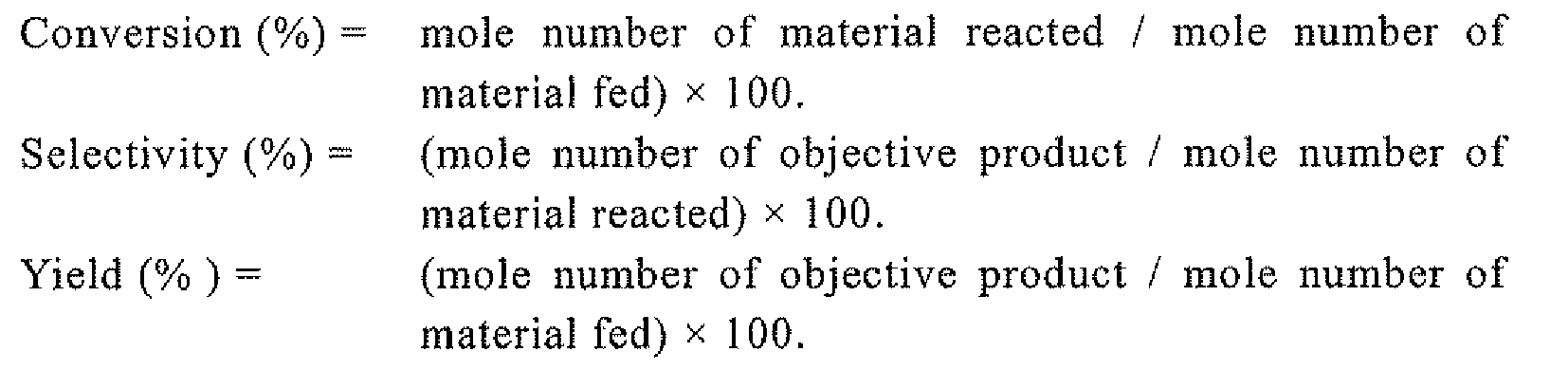
- Results are summarized in Table 1.
Table 1 Catalytic Reaction temp.
(°C)Glycerin conversion ratio (%) Acrolein yield
(%)Acrylic
acid yield
(%)Propion aldehyde Yield (%) Propionic
acid yield
(%)Examples 1 VPO (after firing in nitrogen) 280 100 79.8 0.5 0.0 0.0 - A precursor of VOHPO4 · 1/2H2O was prepared by a method described in
JP-B1-57-8761 - The resulting orthophosphoric acid solution (132.0 g of 98% orthophosphoric acid powder / 250ml of 2-methyl-1-propanol) was added at 100° C gradually into a yellow solution of vanadium prepared by the heat-reflux in 2-methyl-1-propanol and heat-reflux was continued at 105°C. After 3 hours, the reflux was stopped and cooled down to ambient temperature. The resulting catalyst precursor was filtered, washed with acetone and dried in a drier at 140°C during one night to obtain a blue white phosphorus-vanadium complex oxide powder.
- The resulting catalyst was evaluated in a fixed bed type reactor at ambient pressure. The catalyst powder was compressed, crushed and then passed through a sieve to obtain particles of 9 to 12 mesh. A SUS reaction tube of 10 mm diameter was filled with 10 cc of the catalyst particles. An aqueous solution containing 20 % by weight of glycerol was passed to an evaporator heated at 300°C at a rate of 21 g/hr by a pump. The resulting gasified glycerin gas was directly passed through the catalyst together with air. The reactor containing the catalyst was heated at 300 to 340°C. The feed stream has a composition of glycerin: oxygen: nitrogen: water = 4.2 mol %: 2.2 mol %: 8.1 mol %: 85.5 mol % and GHSV was 2445 h-1.
- The product was collected in a condenser and the resulting condensate was analyzed quantitatively by gas chromatograph (GC-7890, DB-WAX column, product of Agilent). Each product was corrected in factor by this gas chromatograph. From amounts of glycerin fed, of residual glycerin and absolute content of each product, the conversion of material ratio (glycerin conversion), the selectivity of product (the selectivity of acrolein, acrylic acid, propionic acid and propionaldehyde), and the yield of product (yields of acrolein, acrylic acid, propionic acid and propionaldehyde) were calculated by following equations:

- Results are summarized in Table 1.
- Blue white dry powder obtained in Example 2 was fired in Muffle furnace in air atmosphere at 500°C for 3 hours to obtain a light green phosphorus-vanadium complex oxide powder.
- Reactivity of this powder was evaluated by the same method as Example 2. Results are shown in Table 2.
Table 2 Catalytic Reaction temp. (°C) Glycerin conversion ratio (%) yield (%) Acrolein Acrylic acid yield (%) Propion aldehyde yield (%) Propionic acid yield (%) Example 2 VPO (precursor) 300 100 49.5 0.2 0.4 0.2 340 100 42.5 0.3 0.8 0.0 Example 3 VPO
(after firing in air)300 100 54.2 0.2 0.5 0.1 340 100 38.1 0.0 1.0 0.0 - For a comparison with the phosphorus-vanadium complex oxide, phosphoric acid alumina (1 wt%PO4 /99wt% Al2O3) as a solid acid was evaluated.
- The phosphoric acid alumina was prepared by a method described in
JP-A1-2005-213225 - Reactivity of the powder was evaluated by the same method as Example 2. Result is shown in following Table 3.
Table 3 Catalytic Reaction temp. (°C) Glycerin conversion ratio (%) Acrolein yield (%) yield (%) Acrylic acid yield (%) yield (%) Propion aldehyde yield (%) Propionic acid yield (%) Comparative Example H3PO4/ Al2O3 350 92.7 37.8 0.2 0.6 0.1 - From the results of Examples and Comparison Example, following points are clear:
- (1) Total yield of acrolein and of acrylic acid when acrolein and acrylic acid are prepared by dehydration reaction of glycerin can be elevated to about 80.3% at maximum by using the phosphorus-vanadium complex oxide of this invention.
- (2) Yield of propionaldehyde or propionic acids, which make a separation operation very difficult, can be lowered and can be reduced to 0 % by selecting alcohol or by adjusting reaction conditions.
Claims (8)
- A catalyst for glycerin dehydration used in preparation of acrolein and acrylic acid by catalytic dehydration reaction of glycerin, comprising, as a main constituent, phosphorus-vanadium complex oxides or their precursors, containing, as an indispensable element, phosphorus and vanadium.
- The catalyst according to claim 1, wherein said phosphorus-vanadium complex oxides have the composition represented by the general formula (I):
VPaMbOc nH2O (I)
in which, when V is considered as 1, a and b satisfy respective ranges of 0.5 ≦ a ≦ 1.5 and 0 < b ≦ 1, c has a number which depends on the oxidation state of each element, M is an element selected from hydrogen atom or elements belonging to Group 1 to Group 16 of the Periodic Table, n is a arbitrary positive number. - The catalyst of claim 1 or 2, wherein a precursor of said phosphorus-vanadium complex oxide is a substance whose at least a part becomes (VO)2P2O7 by firing.
- A supported catalyst in which said phosphorus-vanadium complex oxide of any one of claims 1 to 3 is supported on a carrier.
- A process for preparing the phosphorus-vanadium complex oxide catalyst according to any one of claims 1 to 3, characterized by the steps of reacting vanadium compound and phosphorus compound in an aqueous solvent or in an organic solvent to prepare phosphorus-vanadium complex oxide, and subjecting the oxide to drying and firing.
- The process of claim 5, said firing is effected in an atmosphere that contains any one of gases of air or inert gas or a mixed gas of air and inert gas or a mixed gas of reducing gas and air or steam.
- The process of claim 5 or 6, said firing is carried out at 150 to 700°C for 0.5 to 500 hours.
- Use of the catalyst of any one of claims 1 to 3 and/or of the supported catalyst of claim 4, in preparation of acrolein and acrylic acid by the catalytic dehydration reaction of glycerin.
Applications Claiming Priority (2)
| Application Number | Priority Date | Filing Date | Title |
|---|---|---|---|
| JP2008273889A JP2010099596A (en) | 2008-10-24 | 2008-10-24 | Catalyst for manufacturing acrolein and acrylic acid by dehydration reaction of glycerin and method of manufacturing this catalyst |
| PCT/JP2009/068302 WO2010047405A1 (en) | 2008-10-24 | 2009-10-20 | Catalyst for production of acrolein and acrylic acid by means of dehydration reaction of glycerin, and process for producing same |
Publications (1)
| Publication Number | Publication Date |
|---|---|
| EP2340888A1 true EP2340888A1 (en) | 2011-07-06 |
Family
ID=42119438
Family Applications (1)
| Application Number | Title | Priority Date | Filing Date |
|---|---|---|---|
| EP09822101A Withdrawn EP2340888A1 (en) | 2008-10-24 | 2009-10-20 | Catalyst for production of acrolein and acrylic acid by means of dehydration reaction of glycerin, and process for producing same |
Country Status (5)
| Country | Link |
|---|---|
| US (1) | US20120022291A1 (en) |
| EP (1) | EP2340888A1 (en) |
| JP (1) | JP2010099596A (en) |
| CN (1) | CN102264469A (en) |
| WO (1) | WO2010047405A1 (en) |
Cited By (4)
| Publication number | Priority date | Publication date | Assignee | Title |
|---|---|---|---|---|
| WO2013039705A1 (en) * | 2011-09-16 | 2013-03-21 | Eastman Chemical Company | Catalytic dehydration of alcohols and ethers over a ternary mixed oxide |
| US8883672B2 (en) | 2011-09-16 | 2014-11-11 | Eastman Chemical Company | Process for preparing modified V-Ti-P catalysts for synthesis of 2,3-unsaturated carboxylic acids |
| US8993801B2 (en) | 2011-09-16 | 2015-03-31 | Eastman Chemical Company | Process for preparing V-Ti-P catalysts for synthesis of 2,3-unsaturated carboxylic acids |
| US9573119B2 (en) | 2011-09-16 | 2017-02-21 | Eastman Chemical Company | Process for preparing V—Ti—P catalysts for synthesis of 2,3-unsaturated carboxylic acids |
Families Citing this family (2)
| Publication number | Priority date | Publication date | Assignee | Title |
|---|---|---|---|---|
| JP5846388B2 (en) | 2010-07-09 | 2016-01-20 | 国立大学法人北海道大学 | Novel glycerin dehydration catalyst and process for producing the same |
| KR101616528B1 (en) | 2013-07-16 | 2016-04-28 | 주식회사 엘지화학 | Catalyst for dehydration of glycerin, method of preparing the same, and preparing method of acrolein |
Family Cites Families (24)
| Publication number | Priority date | Publication date | Assignee | Title |
|---|---|---|---|---|
| US2558520A (en) | 1948-01-29 | 1951-06-26 | Us Ind Chemicals Inc | Production of acrolein from glycerol |
| JPS5391100A (en) | 1977-01-24 | 1978-08-10 | Chevron Res | Method of making crystalline vanadium*4* phosphate |
| US4151116A (en) | 1977-08-05 | 1979-04-24 | Halcon Research And Development Corporation | Preparation of maleic anhydride |
| JPS5658969A (en) | 1979-10-20 | 1981-05-22 | Ngk Insulators Ltd | Manufacture of heating cooking appliance of self-purge type |
| US4283307A (en) | 1980-06-02 | 1981-08-11 | Denka Chemical Corporation | Catalyst structure for the partial oxidation of n-butane to produce maleic anhydride |
| CA1202950A (en) | 1981-12-28 | 1986-04-08 | The Standard Oil Company | In situ activation process for fluid bed oxidation catalysts |
| CA1197230A (en) | 1982-06-30 | 1985-11-26 | Dennis E. Dria | Preparation of improved mixed vanadium phosphorus oxide catalysts and their use in oxidation processes |
| JPS59145046A (en) | 1983-02-08 | 1984-08-20 | Mitsubishi Chem Ind Ltd | Preparation of catalyst composition |
| JPH04271841A (en) | 1990-07-12 | 1992-09-28 | Mitsui Toatsu Chem Inc | Catalyst for manufacturing maleic anhydride from butane and its manufacture |
| DE4238493C1 (en) | 1992-11-14 | 1994-04-21 | Degussa | Process for the production of acrolein and its use |
| JP3500676B2 (en) | 1993-12-17 | 2004-02-23 | 三菱化学株式会社 | Method for producing phosphorus-vanadium oxide catalyst precursor |
| JPH0952049A (en) | 1995-08-17 | 1997-02-25 | Mitsubishi Chem Corp | Method for producing phosphorus-vanadium complex oxide catalyst precursor |
| JP3320616B2 (en) * | 1996-09-09 | 2002-09-03 | 株式会社日本触媒 | Novel metal ion-exchanged phosphorus-vanadium compound and solid acid catalyst using the compound |
| JP3767309B2 (en) * | 2000-03-07 | 2006-04-19 | 住友化学株式会社 | Method for producing heteropolyacid catalyst and method for producing methacrylic acid |
| JP5006507B2 (en) * | 2004-01-30 | 2012-08-22 | 株式会社日本触媒 | Acrylic acid production method |
| FR2882052B1 (en) | 2005-02-15 | 2007-03-23 | Arkema Sa | PROCESS FOR THE DEHYDRATION OF GLYCEROL IN ACROLEIN |
| FR2882053B1 (en) | 2005-02-15 | 2007-03-23 | Arkema Sa | METHOD FOR DEHYDRATING GLYCEROL IN ACROLENE |
| FR2884818B1 (en) * | 2005-04-25 | 2007-07-13 | Arkema Sa | PROCESS FOR THE PREPARATION OF ACRYLIC ACID FROM GLYCEROL |
| WO2007058221A1 (en) | 2005-11-15 | 2007-05-24 | Nippon Shokubai Co., Ltd. | Process for dehydration of polyhydric alcohols |
| JP2008088149A (en) * | 2006-01-04 | 2008-04-17 | Nippon Shokubai Co Ltd | Catalyst for production of acrolein and method for producing acrolein by using the same |
| EP2103591A4 (en) * | 2006-12-01 | 2013-10-16 | Nippon Catalytic Chem Ind | Method for producing acrylic acid |
| FR2925490B1 (en) * | 2007-12-20 | 2009-12-25 | Arkema France | PROCESS FOR THE SYNTHESIS OF ACROLEIN FROM GLYCEROL |
| EP2179981A1 (en) * | 2008-10-24 | 2010-04-28 | Arkema France | Process for manufacturing acrolein from glycerol |
| US20130053599A1 (en) * | 2011-08-22 | 2013-02-28 | Celanese International Corporation | Catalysts for producing acrylic acids and acrylates |
-
2008
- 2008-10-24 JP JP2008273889A patent/JP2010099596A/en not_active Ceased
-
2009
- 2009-10-20 WO PCT/JP2009/068302 patent/WO2010047405A1/en not_active Ceased
- 2009-10-20 US US13/125,887 patent/US20120022291A1/en not_active Abandoned
- 2009-10-20 CN CN2009801523051A patent/CN102264469A/en active Pending
- 2009-10-20 EP EP09822101A patent/EP2340888A1/en not_active Withdrawn
Non-Patent Citations (1)
| Title |
|---|
| See references of WO2010047405A1 * |
Cited By (9)
| Publication number | Priority date | Publication date | Assignee | Title |
|---|---|---|---|---|
| WO2013039705A1 (en) * | 2011-09-16 | 2013-03-21 | Eastman Chemical Company | Catalytic dehydration of alcohols and ethers over a ternary mixed oxide |
| CN103813855A (en) * | 2011-09-16 | 2014-05-21 | 伊士曼化工公司 | Catalytic dehydration of alcohols and ethers over a ternary mixed oxide |
| US8883672B2 (en) | 2011-09-16 | 2014-11-11 | Eastman Chemical Company | Process for preparing modified V-Ti-P catalysts for synthesis of 2,3-unsaturated carboxylic acids |
| US8981172B2 (en) | 2011-09-16 | 2015-03-17 | Eastman Chemical Company | Catalytic dehydration of alcohols and ethers over a ternary mixed oxide |
| US8993801B2 (en) | 2011-09-16 | 2015-03-31 | Eastman Chemical Company | Process for preparing V-Ti-P catalysts for synthesis of 2,3-unsaturated carboxylic acids |
| US9493390B2 (en) | 2011-09-16 | 2016-11-15 | Eastman Chemical Company | Process for preparing V-Ti-P catalysts for synthesis of 2,3-unsaturated carboxylic acids |
| US9573119B2 (en) | 2011-09-16 | 2017-02-21 | Eastman Chemical Company | Process for preparing V—Ti—P catalysts for synthesis of 2,3-unsaturated carboxylic acids |
| US9861965B2 (en) | 2011-09-16 | 2018-01-09 | Eastman Chemical Company | Process for preparing modified V—Ti—P catalysts for synthesis of 2,3-unsaturated carboxylic acids |
| US10065180B2 (en) | 2011-09-16 | 2018-09-04 | Eastman Chemical Company | Process for preparing modified V—Ti—P catalysts for synthesis of 2,3-unsaturated carboxylic acids |
Also Published As
| Publication number | Publication date |
|---|---|
| CN102264469A (en) | 2011-11-30 |
| US20120022291A1 (en) | 2012-01-26 |
| WO2010047405A1 (en) | 2010-04-29 |
| JP2010099596A (en) | 2010-05-06 |
Similar Documents
| Publication | Publication Date | Title |
|---|---|---|
| JP5512543B2 (en) | Method for producing acrolein from glycerin | |
| JP5297450B2 (en) | Catalyst for production of acrolein and acrylic acid by dehydration reaction of glycerin and production method thereof | |
| US8507721B2 (en) | Process for preparing acrylic acid from ethanol and formaldehyde | |
| EP2695672B1 (en) | Process for preparing acrolein by dehydration of glycerin in the presence of a catalyst | |
| JP5684818B2 (en) | Method for producing catalyst used for producing unsaturated aldehyde and / or unsaturated carboxylic acid by dehydration reaction of glycerin, and catalyst obtained by this method | |
| JP5846388B2 (en) | Novel glycerin dehydration catalyst and process for producing the same | |
| EP2736871B1 (en) | Improved process of dehydration reactions | |
| EP2117706A1 (en) | Catalyst for oxidation of saturated and unsaturated aldehydes to unasturated carboxylic acid, method of marking and method of using thereof | |
| US20120022291A1 (en) | Catalyst for production of acrolein and acrylic acid by means of dehydration reaction of glycerin, and process for producing same | |
| US20150005529A1 (en) | Integrated Process for the Production of Acrylic Acids and Acrylates | |
| WO2014024782A2 (en) | Catalyst for production of acrylic acid from glycerin, and method for producing same | |
| WO2012010923A1 (en) | Process for manufacturing acrolein from glycerol | |
| JP2016079143A (en) | Producing method of isobutyraldehyde |
Legal Events
| Date | Code | Title | Description |
|---|---|---|---|
| PUAI | Public reference made under article 153(3) epc to a published international application that has entered the european phase |
Free format text: ORIGINAL CODE: 0009012 |
|
| 17P | Request for examination filed |
Effective date: 20110421 |
|
| AK | Designated contracting states |
Kind code of ref document: A1 Designated state(s): AT BE BG CH CY CZ DE DK EE ES FI FR GB GR HR HU IE IS IT LI LT LU LV MC MK MT NL NO PL PT RO SE SI SK SM TR |
|
| AX | Request for extension of the european patent |
Extension state: AL BA RS |
|
| DAX | Request for extension of the european patent (deleted) | ||
| STAA | Information on the status of an ep patent application or granted ep patent |
Free format text: STATUS: THE APPLICATION HAS BEEN WITHDRAWN |
|
| 18W | Application withdrawn |
Effective date: 20140711 |