EP2333928A2 - Solar-powerded battery charging station - Google Patents
Solar-powerded battery charging station Download PDFInfo
- Publication number
- EP2333928A2 EP2333928A2 EP10015392A EP10015392A EP2333928A2 EP 2333928 A2 EP2333928 A2 EP 2333928A2 EP 10015392 A EP10015392 A EP 10015392A EP 10015392 A EP10015392 A EP 10015392A EP 2333928 A2 EP2333928 A2 EP 2333928A2
- Authority
- EP
- European Patent Office
- Prior art keywords
- solar
- electricity
- led lighting
- unit
- charging station
- Prior art date
- Legal status (The legal status is an assumption and is not a legal conclusion. Google has not performed a legal analysis and makes no representation as to the accuracy of the status listed.)
- Withdrawn
Links
Images



Classifications
-
- H—ELECTRICITY
- H02—GENERATION; CONVERSION OR DISTRIBUTION OF ELECTRIC POWER
- H02J—ELECTRIC POWER NETWORKS; CIRCUIT ARRANGEMENTS OR SYSTEMS FOR SUPPLYING OR DISTRIBUTING ELECTRIC POWER; SYSTEMS FOR STORING ELECTRIC ENERGY
- H02J7/00—Circuit arrangements for charging or discharging batteries or for supplying loads from batteries
-
- B—PERFORMING OPERATIONS; TRANSPORTING
- B60—VEHICLES IN GENERAL
- B60L—PROPULSION OF ELECTRICALLY-PROPELLED VEHICLES; SUPPLYING ELECTRIC POWER FOR AUXILIARY EQUIPMENT OF ELECTRICALLY-PROPELLED VEHICLES; ELECTRODYNAMIC BRAKE SYSTEMS FOR VEHICLES IN GENERAL; MAGNETIC SUSPENSION OR LEVITATION FOR VEHICLES; MONITORING OPERATING VARIABLES OF ELECTRICALLY-PROPELLED VEHICLES; ELECTRIC SAFETY DEVICES FOR ELECTRICALLY-PROPELLED VEHICLES
- B60L53/00—Methods of charging batteries, specially adapted for electric vehicles; Charging stations or on-board charging equipment therefor; Exchange of energy storage elements in electric vehicles
- B60L53/10—Methods of charging batteries, specially adapted for electric vehicles; Charging stations or on-board charging equipment therefor; Exchange of energy storage elements in electric vehicles characterised by the energy transfer between the charging station and the vehicle
- B60L53/11—DC charging controlled by the charging station, e.g. mode 4
-
- B—PERFORMING OPERATIONS; TRANSPORTING
- B60—VEHICLES IN GENERAL
- B60L—PROPULSION OF ELECTRICALLY-PROPELLED VEHICLES; SUPPLYING ELECTRIC POWER FOR AUXILIARY EQUIPMENT OF ELECTRICALLY-PROPELLED VEHICLES; ELECTRODYNAMIC BRAKE SYSTEMS FOR VEHICLES IN GENERAL; MAGNETIC SUSPENSION OR LEVITATION FOR VEHICLES; MONITORING OPERATING VARIABLES OF ELECTRICALLY-PROPELLED VEHICLES; ELECTRIC SAFETY DEVICES FOR ELECTRICALLY-PROPELLED VEHICLES
- B60L53/00—Methods of charging batteries, specially adapted for electric vehicles; Charging stations or on-board charging equipment therefor; Exchange of energy storage elements in electric vehicles
- B60L53/10—Methods of charging batteries, specially adapted for electric vehicles; Charging stations or on-board charging equipment therefor; Exchange of energy storage elements in electric vehicles characterised by the energy transfer between the charging station and the vehicle
- B60L53/14—Conductive energy transfer
-
- B—PERFORMING OPERATIONS; TRANSPORTING
- B60—VEHICLES IN GENERAL
- B60L—PROPULSION OF ELECTRICALLY-PROPELLED VEHICLES; SUPPLYING ELECTRIC POWER FOR AUXILIARY EQUIPMENT OF ELECTRICALLY-PROPELLED VEHICLES; ELECTRODYNAMIC BRAKE SYSTEMS FOR VEHICLES IN GENERAL; MAGNETIC SUSPENSION OR LEVITATION FOR VEHICLES; MONITORING OPERATING VARIABLES OF ELECTRICALLY-PROPELLED VEHICLES; ELECTRIC SAFETY DEVICES FOR ELECTRICALLY-PROPELLED VEHICLES
- B60L53/00—Methods of charging batteries, specially adapted for electric vehicles; Charging stations or on-board charging equipment therefor; Exchange of energy storage elements in electric vehicles
- B60L53/30—Constructional details of charging stations
-
- B—PERFORMING OPERATIONS; TRANSPORTING
- B60—VEHICLES IN GENERAL
- B60L—PROPULSION OF ELECTRICALLY-PROPELLED VEHICLES; SUPPLYING ELECTRIC POWER FOR AUXILIARY EQUIPMENT OF ELECTRICALLY-PROPELLED VEHICLES; ELECTRODYNAMIC BRAKE SYSTEMS FOR VEHICLES IN GENERAL; MAGNETIC SUSPENSION OR LEVITATION FOR VEHICLES; MONITORING OPERATING VARIABLES OF ELECTRICALLY-PROPELLED VEHICLES; ELECTRIC SAFETY DEVICES FOR ELECTRICALLY-PROPELLED VEHICLES
- B60L53/00—Methods of charging batteries, specially adapted for electric vehicles; Charging stations or on-board charging equipment therefor; Exchange of energy storage elements in electric vehicles
- B60L53/50—Charging stations characterised by energy-storage or power-generation means
- B60L53/51—Photovoltaic means
-
- F—MECHANICAL ENGINEERING; LIGHTING; HEATING; WEAPONS; BLASTING
- F24—HEATING; RANGES; VENTILATING
- F24S—SOLAR HEAT COLLECTORS; SOLAR HEAT SYSTEMS
- F24S25/00—Arrangement of stationary mountings or supports for solar heat collector modules
- F24S25/10—Arrangement of stationary mountings or supports for solar heat collector modules extending in directions away from a supporting surface
-
- H—ELECTRICITY
- H02—GENERATION; CONVERSION OR DISTRIBUTION OF ELECTRIC POWER
- H02J—ELECTRIC POWER NETWORKS; CIRCUIT ARRANGEMENTS OR SYSTEMS FOR SUPPLYING OR DISTRIBUTING ELECTRIC POWER; SYSTEMS FOR STORING ELECTRIC ENERGY
- H02J7/00—Circuit arrangements for charging or discharging batteries or for supplying loads from batteries
- H02J7/34—Parallel operation in networks using both storage and other DC sources, e.g. providing buffering
-
- H—ELECTRICITY
- H02—GENERATION; CONVERSION OR DISTRIBUTION OF ELECTRIC POWER
- H02J—ELECTRIC POWER NETWORKS; CIRCUIT ARRANGEMENTS OR SYSTEMS FOR SUPPLYING OR DISTRIBUTING ELECTRIC POWER; SYSTEMS FOR STORING ELECTRIC ENERGY
- H02J7/00—Circuit arrangements for charging or discharging batteries or for supplying loads from batteries
- H02J7/34—Parallel operation in networks using both storage and other DC sources, e.g. providing buffering
- H02J7/342—The other DC source being a battery actively interacting with the first one, i.e. battery to battery charging
-
- H—ELECTRICITY
- H02—GENERATION; CONVERSION OR DISTRIBUTION OF ELECTRIC POWER
- H02S—GENERATION OF ELECTRIC POWER BY CONVERSION OF INFRARED RADIATION, VISIBLE LIGHT OR ULTRAVIOLET LIGHT, e.g. USING PHOTOVOLTAIC [PV] MODULES
- H02S20/00—Supporting structures for PV modules
- H02S20/10—Supporting structures directly fixed to the ground
-
- H—ELECTRICITY
- H02—GENERATION; CONVERSION OR DISTRIBUTION OF ELECTRIC POWER
- H02S—GENERATION OF ELECTRIC POWER BY CONVERSION OF INFRARED RADIATION, VISIBLE LIGHT OR ULTRAVIOLET LIGHT, e.g. USING PHOTOVOLTAIC [PV] MODULES
- H02S40/00—Components or accessories in combination with PV modules, not provided for in groups H02S10/00 - H02S30/00
- H02S40/30—Electrical components
- H02S40/38—Energy storage means, e.g. batteries, structurally associated with PV modules
-
- B—PERFORMING OPERATIONS; TRANSPORTING
- B60—VEHICLES IN GENERAL
- B60L—PROPULSION OF ELECTRICALLY-PROPELLED VEHICLES; SUPPLYING ELECTRIC POWER FOR AUXILIARY EQUIPMENT OF ELECTRICALLY-PROPELLED VEHICLES; ELECTRODYNAMIC BRAKE SYSTEMS FOR VEHICLES IN GENERAL; MAGNETIC SUSPENSION OR LEVITATION FOR VEHICLES; MONITORING OPERATING VARIABLES OF ELECTRICALLY-PROPELLED VEHICLES; ELECTRIC SAFETY DEVICES FOR ELECTRICALLY-PROPELLED VEHICLES
- B60L2240/00—Control parameters of input or output; Target parameters
- B60L2240/60—Navigation input
- B60L2240/66—Ambient conditions
- B60L2240/665—Light intensity
-
- E—FIXED CONSTRUCTIONS
- E04—BUILDING
- E04H—BUILDINGS OR LIKE STRUCTURES FOR PARTICULAR PURPOSES; SWIMMING OR SPLASH BATHS OR POOLS; MASTS; FENCING; TENTS OR CANOPIES, IN GENERAL
- E04H6/00—Buildings for parking cars, rolling-stock, aircraft, vessels or like vehicles, e.g. garages
- E04H6/02—Small garages, e.g. for one or two cars
- E04H6/025—Small garages, e.g. for one or two cars in the form of an overhead canopy, e.g. carports
-
- F—MECHANICAL ENGINEERING; LIGHTING; HEATING; WEAPONS; BLASTING
- F24—HEATING; RANGES; VENTILATING
- F24S—SOLAR HEAT COLLECTORS; SOLAR HEAT SYSTEMS
- F24S20/00—Solar heat collectors specially adapted for particular uses or environments
- F24S20/60—Solar heat collectors integrated in fixed constructions, e.g. in buildings
- F24S20/67—Solar heat collectors integrated in fixed constructions, e.g. in buildings in the form of roof constructions
-
- Y—GENERAL TAGGING OF NEW TECHNOLOGICAL DEVELOPMENTS; GENERAL TAGGING OF CROSS-SECTIONAL TECHNOLOGIES SPANNING OVER SEVERAL SECTIONS OF THE IPC; TECHNICAL SUBJECTS COVERED BY FORMER USPC CROSS-REFERENCE ART COLLECTIONS [XRACs] AND DIGESTS
- Y02—TECHNOLOGIES OR APPLICATIONS FOR MITIGATION OR ADAPTATION AGAINST CLIMATE CHANGE
- Y02B—CLIMATE CHANGE MITIGATION TECHNOLOGIES RELATED TO BUILDINGS, e.g. HOUSING, HOUSE APPLIANCES OR RELATED END-USER APPLICATIONS
- Y02B10/00—Integration of renewable energy sources in buildings
- Y02B10/20—Solar thermal
-
- Y—GENERAL TAGGING OF NEW TECHNOLOGICAL DEVELOPMENTS; GENERAL TAGGING OF CROSS-SECTIONAL TECHNOLOGIES SPANNING OVER SEVERAL SECTIONS OF THE IPC; TECHNICAL SUBJECTS COVERED BY FORMER USPC CROSS-REFERENCE ART COLLECTIONS [XRACs] AND DIGESTS
- Y02—TECHNOLOGIES OR APPLICATIONS FOR MITIGATION OR ADAPTATION AGAINST CLIMATE CHANGE
- Y02E—REDUCTION OF GREENHOUSE GAS [GHG] EMISSIONS, RELATED TO ENERGY GENERATION, TRANSMISSION OR DISTRIBUTION
- Y02E10/00—Energy generation through renewable energy sources
- Y02E10/40—Solar thermal energy, e.g. solar towers
- Y02E10/47—Mountings or tracking
-
- Y—GENERAL TAGGING OF NEW TECHNOLOGICAL DEVELOPMENTS; GENERAL TAGGING OF CROSS-SECTIONAL TECHNOLOGIES SPANNING OVER SEVERAL SECTIONS OF THE IPC; TECHNICAL SUBJECTS COVERED BY FORMER USPC CROSS-REFERENCE ART COLLECTIONS [XRACs] AND DIGESTS
- Y02—TECHNOLOGIES OR APPLICATIONS FOR MITIGATION OR ADAPTATION AGAINST CLIMATE CHANGE
- Y02E—REDUCTION OF GREENHOUSE GAS [GHG] EMISSIONS, RELATED TO ENERGY GENERATION, TRANSMISSION OR DISTRIBUTION
- Y02E10/00—Energy generation through renewable energy sources
- Y02E10/50—Photovoltaic [PV] energy
-
- Y—GENERAL TAGGING OF NEW TECHNOLOGICAL DEVELOPMENTS; GENERAL TAGGING OF CROSS-SECTIONAL TECHNOLOGIES SPANNING OVER SEVERAL SECTIONS OF THE IPC; TECHNICAL SUBJECTS COVERED BY FORMER USPC CROSS-REFERENCE ART COLLECTIONS [XRACs] AND DIGESTS
- Y02—TECHNOLOGIES OR APPLICATIONS FOR MITIGATION OR ADAPTATION AGAINST CLIMATE CHANGE
- Y02E—REDUCTION OF GREENHOUSE GAS [GHG] EMISSIONS, RELATED TO ENERGY GENERATION, TRANSMISSION OR DISTRIBUTION
- Y02E70/00—Other energy conversion or management systems reducing GHG emissions
- Y02E70/30—Systems combining energy storage with energy generation of non-fossil origin
-
- Y—GENERAL TAGGING OF NEW TECHNOLOGICAL DEVELOPMENTS; GENERAL TAGGING OF CROSS-SECTIONAL TECHNOLOGIES SPANNING OVER SEVERAL SECTIONS OF THE IPC; TECHNICAL SUBJECTS COVERED BY FORMER USPC CROSS-REFERENCE ART COLLECTIONS [XRACs] AND DIGESTS
- Y02—TECHNOLOGIES OR APPLICATIONS FOR MITIGATION OR ADAPTATION AGAINST CLIMATE CHANGE
- Y02T—CLIMATE CHANGE MITIGATION TECHNOLOGIES RELATED TO TRANSPORTATION
- Y02T10/00—Road transport of goods or passengers
- Y02T10/60—Other road transportation technologies with climate change mitigation effect
- Y02T10/70—Energy storage systems for electromobility, e.g. batteries
-
- Y—GENERAL TAGGING OF NEW TECHNOLOGICAL DEVELOPMENTS; GENERAL TAGGING OF CROSS-SECTIONAL TECHNOLOGIES SPANNING OVER SEVERAL SECTIONS OF THE IPC; TECHNICAL SUBJECTS COVERED BY FORMER USPC CROSS-REFERENCE ART COLLECTIONS [XRACs] AND DIGESTS
- Y02—TECHNOLOGIES OR APPLICATIONS FOR MITIGATION OR ADAPTATION AGAINST CLIMATE CHANGE
- Y02T—CLIMATE CHANGE MITIGATION TECHNOLOGIES RELATED TO TRANSPORTATION
- Y02T10/00—Road transport of goods or passengers
- Y02T10/60—Other road transportation technologies with climate change mitigation effect
- Y02T10/7072—Electromobility specific charging systems or methods for batteries, ultracapacitors, supercapacitors or double-layer capacitors
-
- Y—GENERAL TAGGING OF NEW TECHNOLOGICAL DEVELOPMENTS; GENERAL TAGGING OF CROSS-SECTIONAL TECHNOLOGIES SPANNING OVER SEVERAL SECTIONS OF THE IPC; TECHNICAL SUBJECTS COVERED BY FORMER USPC CROSS-REFERENCE ART COLLECTIONS [XRACs] AND DIGESTS
- Y02—TECHNOLOGIES OR APPLICATIONS FOR MITIGATION OR ADAPTATION AGAINST CLIMATE CHANGE
- Y02T—CLIMATE CHANGE MITIGATION TECHNOLOGIES RELATED TO TRANSPORTATION
- Y02T10/00—Road transport of goods or passengers
- Y02T10/60—Other road transportation technologies with climate change mitigation effect
- Y02T10/72—Electric energy management in electromobility
-
- Y—GENERAL TAGGING OF NEW TECHNOLOGICAL DEVELOPMENTS; GENERAL TAGGING OF CROSS-SECTIONAL TECHNOLOGIES SPANNING OVER SEVERAL SECTIONS OF THE IPC; TECHNICAL SUBJECTS COVERED BY FORMER USPC CROSS-REFERENCE ART COLLECTIONS [XRACs] AND DIGESTS
- Y02—TECHNOLOGIES OR APPLICATIONS FOR MITIGATION OR ADAPTATION AGAINST CLIMATE CHANGE
- Y02T—CLIMATE CHANGE MITIGATION TECHNOLOGIES RELATED TO TRANSPORTATION
- Y02T90/00—Enabling technologies or technologies with a potential or indirect contribution to GHG emissions mitigation
- Y02T90/10—Technologies relating to charging of electric vehicles
- Y02T90/12—Electric charging stations
-
- Y—GENERAL TAGGING OF NEW TECHNOLOGICAL DEVELOPMENTS; GENERAL TAGGING OF CROSS-SECTIONAL TECHNOLOGIES SPANNING OVER SEVERAL SECTIONS OF THE IPC; TECHNICAL SUBJECTS COVERED BY FORMER USPC CROSS-REFERENCE ART COLLECTIONS [XRACs] AND DIGESTS
- Y02—TECHNOLOGIES OR APPLICATIONS FOR MITIGATION OR ADAPTATION AGAINST CLIMATE CHANGE
- Y02T—CLIMATE CHANGE MITIGATION TECHNOLOGIES RELATED TO TRANSPORTATION
- Y02T90/00—Enabling technologies or technologies with a potential or indirect contribution to GHG emissions mitigation
- Y02T90/10—Technologies relating to charging of electric vehicles
- Y02T90/14—Plug-in electric vehicles
-
- Y—GENERAL TAGGING OF NEW TECHNOLOGICAL DEVELOPMENTS; GENERAL TAGGING OF CROSS-SECTIONAL TECHNOLOGIES SPANNING OVER SEVERAL SECTIONS OF THE IPC; TECHNICAL SUBJECTS COVERED BY FORMER USPC CROSS-REFERENCE ART COLLECTIONS [XRACs] AND DIGESTS
- Y02—TECHNOLOGIES OR APPLICATIONS FOR MITIGATION OR ADAPTATION AGAINST CLIMATE CHANGE
- Y02T—CLIMATE CHANGE MITIGATION TECHNOLOGIES RELATED TO TRANSPORTATION
- Y02T90/00—Enabling technologies or technologies with a potential or indirect contribution to GHG emissions mitigation
- Y02T90/10—Technologies relating to charging of electric vehicles
- Y02T90/16—Information or communication technologies improving the operation of electric vehicles
Definitions
- the present invention relates to solar-powered battery charging stations.
- the solar-powered battery charging stations generate electric power from sunlight, and provide such a service as supplying the generated power to electric vehicles, plug-in hybrid vehicles and so on.
- Electric vehicles and hybrid vehicles are known as environmentally friendly.
- a hybrid vehicle incorporates a power storage device, an inverter and an electric motor, as a power source for moving the vehicle in addition to a conventional internal combustion engine.
- a power storage device is chargeable by using outside power sources (such as a household power outlet) for increased mileage to be achieved solely by the electric motor.
- An electric vehicle which does not incorporate an internal combustion engine, is driven solely by an electric motor.
- These plug-in hybrid vehicles and electric vehicles can be more environmentally friendly if their power storage devices which are designed to store externally supplied electricity are charged with electricity generated by solar cells.
- These systems typically include photovoltaic modules; a rechargeable battery unit for storage of electric power generated by the photovoltaic modules; and chargers for supplying the electric power to electric vehicles and/or other client equipment.
- the above-described systems are capable of charging electric vehicles, etc. with electric power generated from sunlight.
- charging and other operations are performed by using electricity which was stored during the daytime in the rechargeable battery unit. Since the rechargeable battery unit has a limited storage capacity, it is desirable that the stored electricity should be utilized as efficiently as possible.
- An object of the present invention is to provide an apparatus which is capable of efficiently utilizing the electricity which is stored during the daytime and supplied from the rechargeable battery unit during the nighttime for example, thereby charging an increased number of electric vehicles, etc.
- the present invention provides a solar-powered battery charging station which includes: a roof member supported by a support member; photovoltaic modules provided on the roof member; a rechargeable battery unit for storage of electricity generated by the photovoltaic modules; a charging unit for supply of charging electricity to a vehicle; lighting equipment having lighting appliances lit with electricity from the rechargeable battery unit; and a control unit for control of turning ON and OFF of the lighting appliances based on the detection.
- the lighting appliances may include a low-luminosity LED lighting element and a high-luminosity LED lighting element.
- the control unit turns ON the low-luminosity LED lighting element on standby while turning ON the high-luminosity LED lighting element to illuminate a parking space upon detection of a vehicle which is entering the parking space.
- the solar-powered battery charging station may include a sensor for detecting vehicles.
- the lighting appliances may include a plurality of lighting elements, and the control unit may elect the lighting elements to be turned ON based on an output of the sensor
- the lighting appliances may include a lighting appliance for illuminating an operation section of the charging unit.
- the control unit turns ON the lighting appliance for illuminating the operation section upon detection of a vehicle stopping in the parking space.
- solar-powered battery charging station is connected to a commercial power system, and the rechargeable battery unit may be charged with electricity generated by the photovoltaic modules in combination with electricity supplied from the commercial power system.
- the charging unit includes an AC charging unit and a DC charging unit.
- the support member may include a column section and an arch section which provides an upward opening structure. With this arrangement, the lighting equipment is installed on the arch section.
- the roof member may include a circular outer frame, and support frames which are connected to the outer frame to form a grid-like structure.
- the present invention provides ON/OFF control of the lighting equipment, thereby providing efficient control on power consumption from the rechargeable battery unit, and hence maximizes the amount of electricity for charging vehicles.
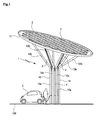
- Fig. 1 is a perspective view of a solar-powered battery charging station according to an embodiment of the present invention.
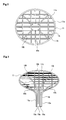
- Fig. 2 is a bottom view of the solar-powered battery charging station according to the embodiment of the present invention as viewed from the ground.
- Fig. 3 is a front view of the solar-powered battery charging station according to the embodiment of the present invention.
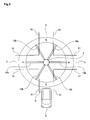
- Fig. 4 is a plan view of the solar-powered battery charging station according to the embodiment of the present invention, showing parking spaces.
- Fig. 5 is a plan view of the solar-powered battery charging station according to the embodiment of the present invention, showing a vehicle entering one of the parking spaces.
- Fig. 6 is a side view of the solar-powered battery charging station according to the embodiment of the present invention, showing a vehicle stopping at one of the parking spaces.
- Fig. 7 is an illustrative drawing of an LED lighting element in the solar-powered battery charging station according to the embodiment of the present invention.
- Fig. 8 is a block diagram showing a configuration of the solar-powered battery charging station according to the embodiment of the present invention.
- Fig.9 is a block diagram showing a configuration of the solar-powered battery charging station according to the second embodiment of the present invention.
- Fig.10 is a block diagram showing a configuration of the solar-powered battery charging station according to the third embodiment of the present invention.
- Fig.11 is an illustrative drawing of an LED lighting element in the solar-powered battery charging station according to the third embodiment of the present invention.
- Fig.12 is an illustrative drawing of an LED lighting element in the solar-powered battery charging station according to the third embodiment of the present invention.
- Fig. 1 is a perspective view of a solar-powered battery charging station according to an embodiment of the present invention.
- a plurality of supporting poles 10 are erected on the ground (a floor) 100 to support a roof member 11, to which photovoltaic modules 2 are attached.
- six supporting poles 10 support a circular roof member 11.
- Each of the supporting poles 10 has a post section 10a which rises vertically from the ground (floor) 100, and an arch section 10b which makes an upward opening structure extending from the post section 10a.
- the post sections 10a surround a center trunk section 4 which houses a rechargeable battery unit.
- the trunk section 4 houses chargers (charging units); a control unit which includes electric components for controlling the station; and other components.
- LED lighting elements 3 are installed in the arch sections 10b to provide illumination to parking spaces, charging plugs and other operation sections, etc. in the charging units.
- the roof member 11 has a circular outer frame 11a and support frames 11b connected to the outer frame 11a to make a grid-like structure.
- the roof member 11 is supported by the supporting poles 10 at a predetermined tilt angle so that sunlight will hit light receiving surfaces of the photovoltaic modules 2 from a perpendicular direction.
- the tilt angle is between 20 degrees and 40 degrees, with the orientation in the south.
- the photovoltaic modules 2 are attached to the roof member 11.
- Each photovoltaic module 2 has a plurality of solar cells and these solar cells are electrically connected for making a predetermined output of electricity.
- the solar cells can be selected from many kinds, including crystalline silicon solar cells made of monocrystalline silicon or polycrystalline silicon; thin-film solar cells made of amorphous silicon or microcrystalline silicon; and solar cells made of other chemical compounds.
- each photovoltaic module 2 a plurality of electrically connected solar cells are sealed between a translucent front surface member made of glass or translucent plastic for example, and a translucent rear surface member made of weather-resistant film, glass or translucent plastic for example with a sealing material having a translucent resin sealant material such as EVA (ethylene vinylacetate).
- the rear surface member is also provided by a translucent material, and the photovoltaic modules 2 are of a dual-surface light-reception type in which the solar cells receive light from both the front and the rear surfaces.
- the photovoltaic modules 2 are interconnected in series or parallel depending on their power generating capability, and the interconnecting wiring is routed to the control unit which is housed in the trunk section 4. As the sunlight hits the photovoltaic modules 2 mounted on the roof member 11, each of the photovoltaic modules 2 generates electricity, which is then stored in the rechargeable battery unit. In addition, some of the sunlight which passes through narrow gaps between the solar cells in each photovoltaic module 2 makes a pleasant and comfortable shower of sun beams on the ground under the roof member 11 as if they were scattering through tree leaves.
- Electricity generated by the photovoltaic modules 2 is stored by the rechargeable battery unit in the trunk section 4, and then supplied by the control unit to four vehicles C in the case of the present embodiment, including electric vehicles and plug-in hybrid vehicles so as to charge secondary batteries in these vehicles C.
- parking spaces 5 for four vehicles are provided in the present embodiment.
- Each of the parking spaces 5 is identified with area lines 51 which define the parking space 5, as well as with a parking area number for example, which is drawn on the ground (floor) 100.
- the charging unit is installed in the trunk section 4 within an access from the parking space 5.
- the charging unit is capable of supplying 400-volt direct current (DC) power and 200-volt alternating current (AC) power for example.
- DC direct current
- AC alternating current
- the charging unit is not limited to this, and may be built to supply 100 VAC and 200 VAC for example.
- the LED lighting elements 3 provide lighting for the parking spaces, power outlets and operation sections in the charging units, as well as lighting when the charging units are on standby. These LED lighting elements 3 work on electricity supplied from the rechargeable battery unit. In the present embodiment, each LED lighting element 3 is controlled so that it will be turned ON only on demand, for efficient use of power from the rechargeable battery unit.
- the LED lighting elements 3 have high-output high-luminosity LED lighting elements 3a and low-output low-luminosity LED lighting elements 3b for different lighting purposes.
- the solar-powered battery charging station 1 has sensors for detecting vehicles C which are coming into individual parking spaces 5. The LED lighting elements 3 are turned ON/OFF depending on the output from each sensor.
- the low-output, low-luminosity LED lighting elements 3b are turned ON to save electricity.
- sensor outputs indicate that there is an incoming vehicle C
- a corresponding one of the parking spaces 5 are highlighted by the corresponding high-output high-luminosity LED lighting elements 3a which are turned ON to illuminate the area lines 51, the parking area number, etc. to guide the vehicle C.
- the LED lighting elements 3a as a guide to the parking space 5 are turned OFF while the operation section is illuminated by other LED lighting elements to facilitate the charging operation.
- ON/OFF control of the LED lighting elements 3 is performed in accordance with the position of the vehicles C, whereby power consumption from the rechargeable battery unit is controlled efficiently to maximize the amount of electricity which can be used for charging the vehicles C.
- the control unit 6 includes a controller 60 which provides overall control of the system; a DC/DC controller 61; a rechargeable battery unit 62; an inverter 63; a DC/DC converter 64; AC charging units 65; and DC charging units 66.
- Electricity from the photovoltaic modules 2 is supplied to the DC/DC controller 61.
- the DC/DC controller 61 performs over-current prevention, back-flow prevention, over-charge prevention, and other control operations to the DC power which comes from the photovoltaic modules 2, and then creates an appropriate voltage for the rechargeable battery unit 62 which is provided by e.g. Nickel-Hydrogen batteries and lithium ion secondary batteries, and thus supplies an electric current to the rechargeable battery unit 62.
- the rechargeable battery unit 62 includes one rechargeable battery or more than one rechargeable batteries.
- the rechargeable battery unit 62 is charged with the electric current supplied from the DC/DC controller 61. In other words, the rechargeable battery unit 62 is charged with electricity which is generated in the photovoltaic modules 2.
- the rechargeable battery unit 62 also outputs electric power to the inverter 63 and the DC/DC converter 64.
- the inverter 63 creates an AC voltage, 100 VAC or 200 VAC for example, from the supplied DC power.
- the AC power from the inverter 63 is supplied to the AC charging units 65 in the form of 3-wire 200-volt AC power.
- the charging units 65 perform a conventional charging-unit process for providing power-charging service to the vehicle C including electric vehicles and plug-in hybrid vehicles, via unillustrated connectors.
- electricity generated in the photovoltaic modules 2 may be directly supplied to the inverter 63 and the DC/DC converter 64, and then supplied to the AC charging unit 65 and the DC charging unit 66.
- the electricity is controlled by the DC/DC controller 61 and the DC/DC controller 61 may create a predetermined voltage.
- the charging can be performed in discretionary methods.
- "200 volt inductive charging method” for non-contact electromagnetic induction charging and "200/100 volt conductive charging method” for conventional plug-in charging may be adopted so that the unit can serve various types of electric vehicles and other client equipment.
- the DC/DC converter 64 converts the voltage from the rechargeable battery unit 62 into a DC current which has a maximum voltage of 400 V and a maximum current of 75A, and then supplies the converted power to the DC charging units 66.
- the charging units 65 perform a conventional charging-unit process for providing power-charging service to the vehicles C via unillustrated connectors.
- Information of the charging unit to be used is supplied to the controller 60, and the controller 60 activates the inverter 63 or the DC/DC converter 64 depending on the charging unit to be used.
- the LED lighting elements 3 have high-output high-luminosity LED lights 3a, low-output low-luminosity LED lights 3b and operation-booth lights 3c for different areas to be lit.
- the solar-powered battery charging station 1 has sensors 7 for detecting vehicles C which are coming into individual parking spaces 5. Outputs from these sensors 7 are supplied to the controller 60. In response to the outputs from the sensors 7, the controller 60 controls turning ON/OFF of the high-output high-luminosity LED lighting elements 3a, the low-output low-luminosity LED lighting elements 3b and the operation-booth lighting elements 3c.
- the controller 60 turns ON the low-luminosity LED lighting elements 3b in standby mode, thereby saving electricity.
- the outputs from the sensors 7 indicate that there is an approaching vehicle C as shown in Fig. 5 and Fig. 6 , a corresponding one of the parking spaces 5 is highlighted by turning ON the corresponding high-luminosity LED lighting elements 3a to illuminate the area lines 51, the parking area number, etc. to guide the vehicle C.
- Fig. 5 shows a case where the sensors 7 detect a vehicle C entering the parking space 5 identified with a parking space number one, and so the area lines 51 and the parking number "1" indicating the space are illuminated by the high-luminosity LED lighting elements 3a.
- the LEDs 3a as a guide to the parking space 5 are turned OFF while the operation-booth lighting LEDs 3c are turned ON so that the operation sections in the units 65, 66 can be seen easily, to facilitate smooth operation for charging.
- ON/OFF control of the LED lighting elements 3 is performed in accordance with the position of the vehicles C, whereby power consumption from the rechargeable battery unit 62 is controlled efficiently to maximize the amount of electricity which can be used for charging vehicles.
- color of the light from the LED lighting elements 3 is not limited to white. Different colors may be used for different purposes such as guiding the vehicles, illuminating the operation sections, and indicating a standby status.
- vehicles used in the present invention includes not only automobile-type vehicles such as electric vehicles and plug-in hybrid vehicles but also other vehicles such as electrically assisted bicycles.
- the rechargeable battery unit is charged with electricity generated by the photovoltaic modules 2.
- the rechargeable battery unit may be charged with electricity from a commercial power source.
- the second embodiment of the present invention will be detailed with reference to Fig.9 .
- the rechargeable battery unit is charged with electricity generated by the photovoltaic modules in combination with electricity supplied from the commercial power system. It is noted that identical or equivalent elements in the drawings will be referred to by like reference numerals and will be explained only once to avoid repetition.
- Electricity from a commercial power system 9 is supplied to the control unit 6.
- AC power from the commercial power system 9 is converted into DC power by a AC/DC converter 68.
- this DC power is supplied to a DC/DC controller 61 via a switch circuit 67.
- Electricity generated by the photovoltaic modules 2 is also supplied to the switch circuit 67.
- the switch circuit changes the electricity to be supplied to the DC/DC controller 61 to the photovoltaic modules 2 or the commercial power system 9 under the control of the controller 60.
- the controller 60 detects a remaining amount of the rechargeable battery unit 62 based on the voltage of the rechargeable battery unit 62, for example.
- the controller 60 controls the switch circuit 67 so as to change the electricity to be supplied to the DC/DC controller 61 to the electricity supplied from the commercial power system 9.
- the AC power supplied from the commercial power system 9 is converted into DC power by the AC/DC converter 68. Then, this DC power is supplied to the DC/DC controller 61 via the switch circuit 67.
- the DC/DC controller 61 performs over-current prevention, back-flow prevention, over-charge prevention, and other control operations to the DC power which is converted by the AC/DC converter 68, and then creates an appropriate voltage for the rechargeable battery unit 62 which is provided by e.g. Nickel-Hydrogen batteries and lithium ion secondary batteries, and thus supplies an electric current to the rechargeable battery unit 62.
- the rechargeable battery unit 62 is charged with the electric current supplied from the DC/DC controller 61. As mentioned above, the rechargeable battery unit 62 is charged with electricity which is supplied from the commercial power system 9.
- the DC power which is converted by the AC/DC converter 68 from the commercial power system 9 may be supplied to the inverter 63and the DC/DC converter 64 via the DC/DC controller 61, and then supplied to the AC charging unit 65 and the DC charging unit 66.
- the above-mentioned embodiment includes a high-luminosity LED lighting element 3a and a low-luminosity LED lighting element 3b, and the control unit performs an ON/OFF control of the high-luminosity LED lighting element 3a and the low-luminosity LED lighting element 3b.
- the number of LED lighting elements to be turned ON is controlled in accordance with an output from a sensor 7. Therefore, in the third embodiment, ON/OFF control of LED lighting elements group is performed.
- the lighting elements group is represented as the first LED lighting elements group 30a and the second LED lighting elements group 30b.
- the LED including the first LED lighting elements group 30a and the second LED lighting elements group 30b are installed in the arch sections 10b to provide illumination to parking spaces, charging plugs and other operation sections, etc. in the charging units.
- the first LED lighting elements group 30a and the second LED lighting elements group 30b are arranged alternately in the LED.
- the controller 60 controls to turn ON only the first LED lighting elements group 30a to save electricity.
- both the first LED lighting elements group 30a and the second LED lighting elements group 30b are turned ON as a guide to the parking space 5 by the control of the controller 60 to illuminate the area lines 51, the parking area number, etc. to guide the vehicle C, as shown in Fig.12 .
- the second LED lighting elements group 30b is turned OFF while the LED lighting elements of the operation section is turned ON to make the charging operation easy.
- ON/OFF control of the first LED lighting elements group 30a and the second LED lighting elements group 30b is performed in accordance with the position of the vehicles C, whereby power consumption from the rechargeable battery unit is controlled efficiently to maximize the amount of electricity which can be used for charging the vehicles C.
- the number of the LED lighting elements to be turned ON is not limited to the above-mentioned example.
- the number and the arrangement may be changed appropriately as necessary, for example, two first LED lighting elements group 30a and one second LED lighting elements group 30b.
- the embodiment described above can charge four electric vehicles including plug-in hybrid vehicles or other vehicles.
- the present invention is not limited to this.
- the number of the charging units and the number of vehicles which can be charged thereby may be changed appropriately as necessary.
Landscapes
- Engineering & Computer Science (AREA)
- Power Engineering (AREA)
- Mechanical Engineering (AREA)
- Transportation (AREA)
- Thermal Sciences (AREA)
- Life Sciences & Earth Sciences (AREA)
- Sustainable Development (AREA)
- Sustainable Energy (AREA)
- Physics & Mathematics (AREA)
- Chemical & Material Sciences (AREA)
- Combustion & Propulsion (AREA)
- General Engineering & Computer Science (AREA)
- Charge And Discharge Circuits For Batteries Or The Like (AREA)
- Secondary Cells (AREA)
- Electric Propulsion And Braking For Vehicles (AREA)
- Photovoltaic Devices (AREA)
Abstract
Description
- The priority application Number
JP2009-278856 - The present invention relates to solar-powered battery charging stations. The solar-powered battery charging stations generate electric power from sunlight, and provide such a service as supplying the generated power to electric vehicles, plug-in hybrid vehicles and so on.
- Electric vehicles and hybrid vehicles are known as environmentally friendly.
- A hybrid vehicle incorporates a power storage device, an inverter and an electric motor, as a power source for moving the vehicle in addition to a conventional internal combustion engine. Among these hybrid vehicles, attentions are being paid to so-called plug-in hybrid vehicles in which the power storage device is chargeable by using outside power sources (such as a household power outlet) for increased mileage to be achieved solely by the electric motor.
- An electric vehicle, which does not incorporate an internal combustion engine, is driven solely by an electric motor. These plug-in hybrid vehicles and electric vehicles can be more environmentally friendly if their power storage devices which are designed to store externally supplied electricity are charged with electricity generated by solar cells.
- Proposals are already made for electric-vehicle charging systems for supplying electric power generated from sunlight, without using conventional commercial source of electricity. Such a system is disclosed in
JP-A 2003-102104 - These systems typically include photovoltaic modules; a rechargeable battery unit for storage of electric power generated by the photovoltaic modules; and chargers for supplying the electric power to electric vehicles and/or other client equipment.
- The above-described systems are capable of charging electric vehicles, etc. with electric power generated from sunlight. During night times, for example, charging and other operations are performed by using electricity which was stored during the daytime in the rechargeable battery unit. Since the rechargeable battery unit has a limited storage capacity, it is desirable that the stored electricity should be utilized as efficiently as possible.
- An object of the present invention is to provide an apparatus which is capable of efficiently utilizing the electricity which is stored during the daytime and supplied from the rechargeable battery unit during the nighttime for example, thereby charging an increased number of electric vehicles, etc.
- The present invention provides a solar-powered battery charging station which includes: a roof member supported by a support member; photovoltaic modules provided on the roof member; a rechargeable battery unit for storage of electricity generated by the photovoltaic modules; a charging unit for supply of charging electricity to a vehicle; lighting equipment having lighting appliances lit with electricity from the rechargeable battery unit; and a control unit for control of turning ON and OFF of the lighting appliances based on the detection.
- The lighting appliances may include a low-luminosity LED lighting element and a high-luminosity LED lighting element. With this arrangement, the control unit turns ON the low-luminosity LED lighting element on standby while turning ON the high-luminosity LED lighting element to illuminate a parking space upon detection of a vehicle which is entering the parking space.
- The solar-powered battery charging station may include a sensor for detecting vehicles. The lighting appliances may include a plurality of lighting elements, and the control unit may elect the lighting elements to be turned ON based on an output of the sensor
- Further, the lighting appliances may include a lighting appliance for illuminating an operation section of the charging unit. With this arrangement, the control unit turns ON the lighting appliance for illuminating the operation section upon detection of a vehicle stopping in the parking space.
- Further, solar-powered battery charging station is connected to a commercial power system, and the rechargeable battery unit may be charged with electricity generated by the photovoltaic modules in combination with electricity supplied from the commercial power system.
- Also, the charging unit includes an AC charging unit and a DC charging unit.
- Also, the support member may include a column section and an arch section which provides an upward opening structure. With this arrangement, the lighting equipment is installed on the arch section.
- Also, the roof member may include a circular outer frame, and support frames which are connected to the outer frame to form a grid-like structure.
- As understood, the present invention provides ON/OFF control of the lighting equipment, thereby providing efficient control on power consumption from the rechargeable battery unit, and hence maximizes the amount of electricity for charging vehicles.
-
Fig. 1 is a perspective view of a solar-powered battery charging station according to an embodiment of the present invention. -
Fig. 2 is a bottom view of the solar-powered battery charging station according to the embodiment of the present invention as viewed from the ground. -
Fig. 3 is a front view of the solar-powered battery charging station according to the embodiment of the present invention. -
Fig. 4 is a plan view of the solar-powered battery charging station according to the embodiment of the present invention, showing parking spaces. -
Fig. 5 is a plan view of the solar-powered battery charging station according to the embodiment of the present invention, showing a vehicle entering one of the parking spaces. -
Fig. 6 is a side view of the solar-powered battery charging station according to the embodiment of the present invention, showing a vehicle stopping at one of the parking spaces. -
Fig. 7 is an illustrative drawing of an LED lighting element in the solar-powered battery charging station according to the embodiment of the present invention. -
Fig. 8 is a block diagram showing a configuration of the solar-powered battery charging station according to the embodiment of the present invention. -
Fig.9 is a block diagram showing a configuration of the solar-powered battery charging station according to the second embodiment of the present invention. -
Fig.10 is a block diagram showing a configuration of the solar-powered battery charging station according to the third embodiment of the present invention. -
Fig.11 is an illustrative drawing of an LED lighting element in the solar-powered battery charging station according to the third embodiment of the present invention. -
Fig.12 is an illustrative drawing of an LED lighting element in the solar-powered battery charging station according to the third embodiment of the present invention. - An embodiment of the present invention will be detailed with reference to the drawings. It should be noted here that for the sake of avoiding redundancy, elements and components which are identical with or equivalent to each other will be indicated with the same reference symbols, and their description will not be repeated.
-
Fig. 1 is a perspective view of a solar-powered battery charging station according to an embodiment of the present invention. As shown inFig. 1 , in the solar-poweredbattery charging station 1 according to the present invention, a plurality of supportingpoles 10 are erected on the ground (a floor) 100 to support aroof member 11, to whichphotovoltaic modules 2 are attached. In the present embodiment, six supportingpoles 10 support acircular roof member 11. - Each of the supporting
poles 10 has apost section 10a which rises vertically from the ground (floor) 100, and anarch section 10b which makes an upward opening structure extending from thepost section 10a. Thepost sections 10a surround acenter trunk section 4 which houses a rechargeable battery unit. In addition to the rechargeable battery unit, thetrunk section 4 houses chargers (charging units); a control unit which includes electric components for controlling the station; and other components. -
LED lighting elements 3 are installed in thearch sections 10b to provide illumination to parking spaces, charging plugs and other operation sections, etc. in the charging units. - As shown in
Fig. 2 and Fig. 3 , theroof member 11 has a circularouter frame 11a andsupport frames 11b connected to theouter frame 11a to make a grid-like structure. Theroof member 11 is supported by the supportingpoles 10 at a predetermined tilt angle so that sunlight will hit light receiving surfaces of thephotovoltaic modules 2 from a perpendicular direction. In the present embodiment, the tilt angle is between 20 degrees and 40 degrees, with the orientation in the south. - The
photovoltaic modules 2 are attached to theroof member 11. Eachphotovoltaic module 2 has a plurality of solar cells and these solar cells are electrically connected for making a predetermined output of electricity. - The solar cells can be selected from many kinds, including crystalline silicon solar cells made of monocrystalline silicon or polycrystalline silicon; thin-film solar cells made of amorphous silicon or microcrystalline silicon; and solar cells made of other chemical compounds.
- In each
photovoltaic module 2, a plurality of electrically connected solar cells are sealed between a translucent front surface member made of glass or translucent plastic for example, and a translucent rear surface member made of weather-resistant film, glass or translucent plastic for example with a sealing material having a translucent resin sealant material such as EVA (ethylene vinylacetate). In the present embodiment, the rear surface member is also provided by a translucent material, and thephotovoltaic modules 2 are of a dual-surface light-reception type in which the solar cells receive light from both the front and the rear surfaces. - The
photovoltaic modules 2 are interconnected in series or parallel depending on their power generating capability, and the interconnecting wiring is routed to the control unit which is housed in thetrunk section 4. As the sunlight hits thephotovoltaic modules 2 mounted on theroof member 11, each of thephotovoltaic modules 2 generates electricity, which is then stored in the rechargeable battery unit. In addition, some of the sunlight which passes through narrow gaps between the solar cells in eachphotovoltaic module 2 makes a pleasant and comfortable shower of sun beams on the ground under theroof member 11 as if they were scattering through tree leaves. - Electricity generated by the
photovoltaic modules 2 is stored by the rechargeable battery unit in thetrunk section 4, and then supplied by the control unit to four vehicles C in the case of the present embodiment, including electric vehicles and plug-in hybrid vehicles so as to charge secondary batteries in these vehicles C. - As shown in
Fig. 4 andFig. 5 ,parking spaces 5 for four vehicles are provided in the present embodiment. Each of theparking spaces 5 is identified witharea lines 51 which define theparking space 5, as well as with a parking area number for example, which is drawn on the ground (floor) 100. The charging unit is installed in thetrunk section 4 within an access from theparking space 5. - In the present embodiment, the charging unit is capable of supplying 400-volt direct current (DC) power and 200-volt alternating current (AC) power for example. However, the charging unit is not limited to this, and may be built to supply 100 VAC and 200 VAC for example.
- The
LED lighting elements 3 provide lighting for the parking spaces, power outlets and operation sections in the charging units, as well as lighting when the charging units are on standby. TheseLED lighting elements 3 work on electricity supplied from the rechargeable battery unit. In the present embodiment, eachLED lighting element 3 is controlled so that it will be turned ON only on demand, for efficient use of power from the rechargeable battery unit. - As shown in
Fig. 7 , theLED lighting elements 3 have high-output high-luminosityLED lighting elements 3a and low-output low-luminosityLED lighting elements 3b for different lighting purposes. In order to provide ON/OFF control on theseLED lighting elements battery charging station 1 has sensors for detecting vehicles C which are coming intoindividual parking spaces 5. TheLED lighting elements 3 are turned ON/OFF depending on the output from each sensor. - When sensor outputs indicate that there is no vehicle, the low-output, low-luminosity
LED lighting elements 3b are turned ON to save electricity. When sensor outputs indicate that there is an incoming vehicle C, a corresponding one of theparking spaces 5 are highlighted by the corresponding high-output high-luminosityLED lighting elements 3a which are turned ON to illuminate the area lines 51, the parking area number, etc. to guide the vehicle C. - When sensor outputs indicate that the vehicle C has stopped, the
LED lighting elements 3a as a guide to theparking space 5 are turned OFF while the operation section is illuminated by other LED lighting elements to facilitate the charging operation. - As described, ON/OFF control of the
LED lighting elements 3 is performed in accordance with the position of the vehicles C, whereby power consumption from the rechargeable battery unit is controlled efficiently to maximize the amount of electricity which can be used for charging the vehicles C. - Hereinafter, the embodiment of the present invention will be described further with reference to a block diagram in
Fig. 8 .
Electricity generated in thephotovoltaic modules 2 on theroof member 11 is supplied to thecontrol unit 6 in thetrunk section 4. Thecontrol unit 6 includes acontroller 60 which provides overall control of the system; a DC/DC controller 61; arechargeable battery unit 62; aninverter 63; a DC/DC converter 64;AC charging units 65; andDC charging units 66. - Electricity from the
photovoltaic modules 2 is supplied to the DC/DC controller 61. The DC/DC controller 61 performs over-current prevention, back-flow prevention, over-charge prevention, and other control operations to the DC power which comes from thephotovoltaic modules 2, and then creates an appropriate voltage for therechargeable battery unit 62 which is provided by e.g. Nickel-Hydrogen batteries and lithium ion secondary batteries, and thus supplies an electric current to therechargeable battery unit 62. Therechargeable battery unit 62 includes one rechargeable battery or more than one rechargeable batteries. Therechargeable battery unit 62 is charged with the electric current supplied from the DC/DC controller 61. In other words, therechargeable battery unit 62 is charged with electricity which is generated in thephotovoltaic modules 2. - From the
rechargeable battery unit 62, electric power is outputted to the high-luminosity LEDs 3a, low-luminosity LEDs 3b and operation-booth lighting LEDs 3c, based on the control provided by thecontroller 60. - The
rechargeable battery unit 62 also outputs electric power to theinverter 63 and the DC/DC converter 64. Theinverter 63 creates an AC voltage, 100 VAC or 200 VAC for example, from the supplied DC power. The AC power from theinverter 63 is supplied to theAC charging units 65 in the form of 3-wire 200-volt AC power. The chargingunits 65 perform a conventional charging-unit process for providing power-charging service to the vehicle C including electric vehicles and plug-in hybrid vehicles, via unillustrated connectors. During the daytime, electricity generated in thephotovoltaic modules 2 may be directly supplied to theinverter 63 and the DC/DC converter 64, and then supplied to theAC charging unit 65 and theDC charging unit 66. The electricity is controlled by the DC/DC controller 61 and the DC/DC controller 61 may create a predetermined voltage. - The charging can be performed in discretionary methods. However, "200 volt inductive charging method" for non-contact electromagnetic induction charging and "200/100 volt conductive charging method" for conventional plug-in charging may be adopted so that the unit can serve various types of electric vehicles and other client equipment.
- With the installation of the
rechargeable battery unit 62 as described above, electricity from thephotovoltaic modules 2 can be stored without being wasted, and it is now possible to charge the vehicles C even during the night time when power generation is impossible, by using the power stored in therechargeable battery unit 62. Also, even when the amount of power stored in therechargeable battery unit 62 is small, it is possible to charge the vehicle C by using electricity directly from thephotovoltaic modules 2 as long as thephotovoltaic modules 2 can generate a sufficient amount of power. - The DC/
DC converter 64 converts the voltage from therechargeable battery unit 62 into a DC current which has a maximum voltage of 400 V and a maximum current of 75A, and then supplies the converted power to theDC charging units 66. The chargingunits 65 perform a conventional charging-unit process for providing power-charging service to the vehicles C via unillustrated connectors. - Information of the charging unit to be used is supplied to the
controller 60, and thecontroller 60 activates theinverter 63 or the DC/DC converter 64 depending on the charging unit to be used. - The
LED lighting elements 3 have high-output high-luminosity LED lights 3a, low-output low-luminosity LED lights 3b and operation-booth lights 3c for different areas to be lit. In order to provide ON/OFF control on theseLED lighting elements 3, the solar-poweredbattery charging station 1 hassensors 7 for detecting vehicles C which are coming intoindividual parking spaces 5. Outputs from thesesensors 7 are supplied to thecontroller 60. In response to the outputs from thesensors 7, thecontroller 60 controls turning ON/OFF of the high-output high-luminosityLED lighting elements 3a, the low-output low-luminosityLED lighting elements 3b and the operation-booth lighting elements 3c. - When the outputs from the
sensors 7 indicate that there is no vehicle C coming in or no vehicle C parking in theparking space 5, thecontroller 60 turns ON the low-luminosityLED lighting elements 3b in standby mode, thereby saving electricity. When the outputs from thesensors 7 indicate that there is an approaching vehicle C as shown inFig. 5 andFig. 6 , a corresponding one of theparking spaces 5 is highlighted by turning ON the corresponding high-luminosityLED lighting elements 3a to illuminate the area lines 51, the parking area number, etc. to guide the vehicle C.Fig. 5 shows a case where thesensors 7 detect a vehicle C entering theparking space 5 identified with a parking space number one, and so the area lines 51 and the parking number "1" indicating the space are illuminated by the high-luminosityLED lighting elements 3a. - When the output from the
sensors 7 indicates that the vehicle C has stopped, theLEDs 3a as a guide to theparking space 5 are turned OFF while the operation-booth lighting LEDs 3c are turned ON so that the operation sections in theunits - As described, ON/OFF control of the
LED lighting elements 3 is performed in accordance with the position of the vehicles C, whereby power consumption from therechargeable battery unit 62 is controlled efficiently to maximize the amount of electricity which can be used for charging vehicles. - It should be noted here that color of the light from the
LED lighting elements 3 is not limited to white. Different colors may be used for different purposes such as guiding the vehicles, illuminating the operation sections, and indicating a standby status. - Obviously, the term vehicles used in the present invention includes not only automobile-type vehicles such as electric vehicles and plug-in hybrid vehicles but also other vehicles such as electrically assisted bicycles.
- In the embodiment described above, the rechargeable battery unit is charged with electricity generated by the
photovoltaic modules 2. However, the present invention is not limited to this. For example, the rechargeable battery unit may be charged with electricity from a commercial power source. The second embodiment of the present invention will be detailed with reference toFig.9 . In the second embodiment, the rechargeable battery unit is charged with electricity generated by the photovoltaic modules in combination with electricity supplied from the commercial power system. It is noted that identical or equivalent elements in the drawings will be referred to by like reference numerals and will be explained only once to avoid repetition. - Electricity from a
commercial power system 9 is supplied to thecontrol unit 6. AC power from thecommercial power system 9 is converted into DC power by a AC/DC converter 68. Then, this DC power is supplied to a DC/DC controller 61 via aswitch circuit 67. Electricity generated by thephotovoltaic modules 2 is also supplied to theswitch circuit 67. The switch circuit changes the electricity to be supplied to the DC/DC controller 61 to thephotovoltaic modules 2 or thecommercial power system 9 under the control of thecontroller 60. - The
controller 60 detects a remaining amount of therechargeable battery unit 62 based on the voltage of therechargeable battery unit 62, for example. When the remaining amount of therechargeable battery unit 62 is equal to or less than the predetermined amount and thephotovoltaic modules 2 do not generate electricity, thecontroller 60 controls theswitch circuit 67 so as to change the electricity to be supplied to the DC/DC controller 61 to the electricity supplied from thecommercial power system 9. The AC power supplied from thecommercial power system 9 is converted into DC power by the AC/DC converter 68. Then, this DC power is supplied to the DC/DC controller 61 via theswitch circuit 67. - The DC/
DC controller 61 performs over-current prevention, back-flow prevention, over-charge prevention, and other control operations to the DC power which is converted by the AC/DC converter 68, and then creates an appropriate voltage for therechargeable battery unit 62 which is provided by e.g. Nickel-Hydrogen batteries and lithium ion secondary batteries, and thus supplies an electric current to therechargeable battery unit 62. Therechargeable battery unit 62 is charged with the electric current supplied from the DC/DC controller 61. As mentioned above, therechargeable battery unit 62 is charged with electricity which is supplied from thecommercial power system 9. - The DC power which is converted by the AC/
DC converter 68 from thecommercial power system 9 may be supplied to the inverter 63and the DC/DC converter 64 via the DC/DC controller 61, and then supplied to theAC charging unit 65 and theDC charging unit 66. - Next, the third embodiment of the present invention will be detailed with reference to
Fig.11 to Fig.12 . The above-mentioned embodiment includes a high-luminosityLED lighting element 3a and a low-luminosityLED lighting element 3b, and the control unit performs an ON/OFF control of the high-luminosityLED lighting element 3a and the low-luminosityLED lighting element 3b. On the other hand, in the third embodiment, the number of LED lighting elements to be turned ON is controlled in accordance with an output from asensor 7. Therefore, in the third embodiment, ON/OFF control of LED lighting elements group is performed. The lighting elements group is represented as the first LEDlighting elements group 30a and the second LEDlighting elements group 30b. - As shown in
Fig.11 and Fig.12 , the LED including the first LEDlighting elements group 30a and the second LEDlighting elements group 30b are installed in thearch sections 10b to provide illumination to parking spaces, charging plugs and other operation sections, etc. in the charging units. The first LEDlighting elements group 30a and the second LEDlighting elements group 30b are arranged alternately in the LED. - As shown in
Fig.11 , when thesensor 7 indicates that there is no vehicle, thecontroller 60 controls to turn ON only the first LEDlighting elements group 30a to save electricity. Whensensor 7 indicates that there is an incoming vehicle C, both the first LEDlighting elements group 30a and the second LEDlighting elements group 30b are turned ON as a guide to theparking space 5 by the control of thecontroller 60 to illuminate the area lines 51, the parking area number, etc. to guide the vehicle C, as shown inFig.12 . - When
sensor 7 indicates that the vehicle C has stopped, the second LEDlighting elements group 30b is turned OFF while the LED lighting elements of the operation section is turned ON to make the charging operation easy. - As described, ON/OFF control of the first LED
lighting elements group 30a and the second LEDlighting elements group 30b is performed in accordance with the position of the vehicles C, whereby power consumption from the rechargeable battery unit is controlled efficiently to maximize the amount of electricity which can be used for charging the vehicles C. - The number of the LED lighting elements to be turned ON is not limited to the above-mentioned example. The number and the arrangement may be changed appropriately as necessary, for example, two first LED
lighting elements group 30a and one second LEDlighting elements group 30b. - Also, the embodiment described above can charge four electric vehicles including plug-in hybrid vehicles or other vehicles. However, the present invention is not limited to this. The number of the charging units and the number of vehicles which can be charged thereby may be changed appropriately as necessary.
- It should be understood that the embodiments disclosed herein are to be taken as examples in every point and are not limited. The scope of the present invention is defined not by the above described embodiments but by the appended claims. All changes that fall within means and bounds of the claims, or equivalence of such means and bounds are intended to be embraced by the claims.
Claims (8)
- A solar-powered battery charging station comprising:a roof member supported by a support member ;photovoltaic modules provided on the roof member;a rechargeable battery unit for storage of electricity generated by the photovoltaic modules;a charging unit for supply of charging electricity to a vehicle;lighting equipment including lighting appliances lit with electricity from the rechargeable battery unit ; anda control unit for control of turning ON and OFF of the lighting appliances .
- The solar-powered battery charging station according to Claim 1, comprising a sensor for detecting vehicles, wherein the lighting appliances include a plurality of lighting elements and the control unit elects the lighting elements to be turned ON based on an output of the sensor.
- The solar-powered battery charging station according to Claim 1 or 2, wherein the lighting appliances include a low-luminosity LED lighting element and a high-luminosity LED lighting element, the control unit turning ON the low-luminosity LED lighting element on standby while turning ON the high-luminosity LED lighting element to illuminate a parking space upon detection of a vehicle entering the parking space.
- The solar-powered battery charging station according to Claim 1, 2 or 3, wherein the lighting appliances include a lighting appliance for illuminating a operation section of the charging unit, the control unit turning ON the lighting appliance for illuminating the operation section upon detection of a vehicle stopping in the parking space.
- The solar-powered battery charging station according to one of Claims 1 to 4, connected to a commercial power system, wherein the rechargeable battery unit is charged with electricity generated by the photovoltaic modules in combination with electricity supplied from the commercial power system.
- The solar-powered battery charging station according to one of Claims 1 to 5, wherein the charging unit includes an AC charging unit and a DC charging unit.
- The solar-powered battery charging station according to one of Claims 1 to 6, wherein the support member includes a column section and an arch section providing an upward opening structure, the lighting equipment being installed on the arch section.
- The solar-powered battery charging station according to one of Claims 1 to 7, wherein the roof member includes a circular outer frame and support frames connected to the outer frame to form a grid-like structure.
Applications Claiming Priority (1)
| Application Number | Priority Date | Filing Date | Title |
|---|---|---|---|
| JP2009278856A JP2011125091A (en) | 2009-12-08 | 2009-12-08 | Solar-powered battery charging station |
Publications (2)
| Publication Number | Publication Date |
|---|---|
| EP2333928A2 true EP2333928A2 (en) | 2011-06-15 |
| EP2333928A3 EP2333928A3 (en) | 2013-08-14 |
Family
ID=43765641
Family Applications (1)
| Application Number | Title | Priority Date | Filing Date |
|---|---|---|---|
| EP10015392.3A Withdrawn EP2333928A3 (en) | 2009-12-08 | 2010-12-07 | Solar-powerded battery charging station |
Country Status (4)
| Country | Link |
|---|---|
| US (1) | US20110133689A1 (en) |
| EP (1) | EP2333928A3 (en) |
| JP (1) | JP2011125091A (en) |
| CN (1) | CN102088199A (en) |
Cited By (7)
| Publication number | Priority date | Publication date | Assignee | Title |
|---|---|---|---|---|
| WO2014070032A1 (en) * | 2012-11-02 | 2014-05-08 | Teixeira E Silva Cardoso Paulo Alexandre | Treelike system and distributed multipurpose infrastructure comprising treelike systems |
| ES2480790A1 (en) * | 2013-01-28 | 2014-07-28 | Enrique MARTINEZ SIERRA | Removable and transportable structure for recharging point, compatible with hybrid and electric vehicles on a rotating platform (Machine-translation by Google Translate, not legally binding) |
| EP2760698A4 (en) * | 2011-09-28 | 2015-06-17 | All Vision Llc | CHARGING SYSTEM FOR ELECTRIC VEHICLES AND METHOD FOR PROVIDING CHARGE TO A CHARGING STATION FOR ELECTRIC VEHICLES |
| EP2974903A1 (en) * | 2014-07-15 | 2016-01-20 | EnBW Energie Baden-Württemberg AG | Local area charging network with at least one charging system for charging electric vehicles, charging system with at least one charging station and method for operating a charging network with at least one charging system for charging electric vehicles |
| EP2559829A3 (en) * | 2011-08-19 | 2016-06-22 | Leopold Kostal GmbH & Co. KG | Carport |
| ES2674493A1 (en) * | 2016-12-30 | 2018-07-02 | Albufera Integration, S.L. | ELECTRIC VEHICLE RECHARGE STATION ISOLATED FROM THE NETWORK (Machine-translation by Google Translate, not legally binding) |
| WO2022178009A1 (en) | 2021-02-17 | 2022-08-25 | Nomad Transportable Power Systems, Inc. | Energy storage unit docking stations |
Families Citing this family (45)
| Publication number | Priority date | Publication date | Assignee | Title |
|---|---|---|---|---|
| KR101238955B1 (en) * | 2010-12-03 | 2013-03-11 | 김한식 | Trees in the form of solar modules |
| US10700633B2 (en) * | 2010-07-16 | 2020-06-30 | Strategic Solar Energy, Llc | Protection of electrical components in solar energy shade structure |
| US11223319B2 (en) | 2010-07-16 | 2022-01-11 | Strategic Solar Energy, Llc | Protection of electrical components in solar energy shade structure |
| US8825500B2 (en) | 2010-07-16 | 2014-09-02 | Strategic Solar Energy, Llc | Solar energy collecting systems and methods |
| US9871392B2 (en) * | 2010-09-17 | 2018-01-16 | Schumacher Electric Corporation | Portable battery booster |
| US8952656B2 (en) | 2011-02-04 | 2015-02-10 | Atieva, Inc. | Battery charging station |
| US20120313568A1 (en) * | 2011-06-08 | 2012-12-13 | Princeton Satellite Systems | Solar powered charging station for electric and plug-in hybrid vehicles |
| DE102011079242A1 (en) * | 2011-07-15 | 2013-01-17 | Bayerische Motoren Werke Aktiengesellschaft | Charging station for charging of high-voltage battery such as lithium-ion battery used in electric vehicle, controls energy charging function of buffer memory by control device, until target charge is reached |
| JP5895182B2 (en) * | 2011-09-06 | 2016-03-30 | パナソニックIpマネジメント株式会社 | Electric vehicle charging device |
| JP5919525B2 (en) * | 2011-11-22 | 2016-05-18 | パナソニックIpマネジメント株式会社 | Vehicle management system |
| CN102568106A (en) * | 2011-12-31 | 2012-07-11 | 宁波道和工业设计有限公司 | Urban integral self-service system for charging electric appliances by solar energy and electric energy |
| JP2013167460A (en) * | 2012-02-14 | 2013-08-29 | Mitsubishi Motors Corp | Guide route search system |
| KR20130094925A (en) * | 2012-02-17 | 2013-08-27 | 한국전자통신연구원 | Energy control method for energy managemetnt system |
| JP5982160B2 (en) * | 2012-04-09 | 2016-08-31 | 積水化学工業株式会社 | Exterior |
| JP5661074B2 (en) * | 2012-07-30 | 2015-01-28 | 三菱電機株式会社 | Charge / discharge device |
| CN102818955A (en) * | 2012-08-09 | 2012-12-12 | 嘉兴优太太阳能有限公司 | Testing device of solar-energy charging station system |
| JP6088764B2 (en) * | 2012-08-16 | 2017-03-01 | 河村電器産業株式会社 | Electric vehicle charging device |
| CN104659849A (en) * | 2013-11-21 | 2015-05-27 | 国家电网公司 | Device, system and charging method of charging pile |
| ITBO20130668A1 (en) * | 2013-11-29 | 2015-05-30 | T C S R L | SYSTEM AND METHOD OF RENTING ELECTRIC CARS |
| CN110015000A (en) * | 2014-06-27 | 2019-07-16 | 易米充电有限责任公司 | Parking structure |
| USD783522S1 (en) * | 2015-05-14 | 2017-04-11 | James Francis Cameron | Solar panel arrangement |
| USD817863S1 (en) * | 2015-05-14 | 2018-05-15 | James Francis Cameron | Solar panel arrangement |
| US10233903B2 (en) | 2015-10-16 | 2019-03-19 | Primo Wind, Inc. | Mobile renewable energy structures providing wireless networking and associated systems and methods |
| USD797657S1 (en) * | 2016-02-24 | 2017-09-19 | Totem Power, Inc. | Configurable solar-powered utility tower |
| USD806012S1 (en) * | 2016-05-16 | 2017-12-26 | Totem Power, Inc. | Configurable solar-powered utility tower |
| CN106143201A (en) * | 2016-08-16 | 2016-11-23 | 苏州市职业大学 | Outdoor parking lot photovoltaic energy storage integral electric vehicle charging station |
| CN106427644A (en) * | 2016-11-14 | 2017-02-22 | 刘锋 | Multifunctional charging pile based on solar energy |
| US10699305B2 (en) * | 2016-11-21 | 2020-06-30 | Nio Usa, Inc. | Smart refill assistant for electric vehicles |
| CN107939103A (en) * | 2017-12-22 | 2018-04-20 | 南京邮电大学 | A kind of electronic bicycle shed and its charging management system |
| US10933753B2 (en) * | 2018-01-15 | 2021-03-02 | Zhejiang Yotrio Group Co., Ltd. | Solar vehicle carport with LED sensor light |
| DE102018100991A1 (en) | 2018-01-17 | 2019-07-18 | Dr. Ing. H.C. F. Porsche Aktiengesellschaft | Network independent mobile charging station |
| CN108039769A (en) * | 2018-01-22 | 2018-05-15 | 无锡十产业投资有限公司 | Management system and photovoltaic tree |
| WO2019191331A1 (en) | 2018-03-27 | 2019-10-03 | Strategic Solar Energy, Llc | Rooftop solar shade structure |
| US11674490B2 (en) | 2018-08-30 | 2023-06-13 | Schumacher Electric Corporation | Multifunctional battery booster |
| CN109801185A (en) * | 2019-01-03 | 2019-05-24 | 宁波绿光能源集团有限公司 | A kind of business model of Portable power generation device |
| WO2020167810A1 (en) * | 2019-02-12 | 2020-08-20 | Oxicool Inc. | Coolant-enabled charging system |
| CN111731132A (en) * | 2019-10-15 | 2020-10-02 | 陕西理工大学 | A solar car charging pile based on new energy |
| US11912144B2 (en) * | 2019-12-18 | 2024-02-27 | Beam Global | Self-contained renewable inductive battery charger |
| US20210387538A1 (en) * | 2020-06-10 | 2021-12-16 | Beam Global | Flood avoidance electric vehicle (ev) charging station |
| USD1011272S1 (en) * | 2020-07-28 | 2024-01-16 | Palm Energy Systems Llc | Solar collector pillar |
| US11973366B2 (en) | 2020-10-20 | 2024-04-30 | Schumacher Electric Corporation | Battery booster |
| CN113613372A (en) * | 2021-07-09 | 2021-11-05 | 山东朗进通信有限公司 | Bus stop intelligent lighting system |
| KR102357365B1 (en) * | 2021-07-28 | 2022-02-08 | 주식회사 베리워즈 | Mobile Solar Charging Station for e-mobility |
| WO2025050153A1 (en) * | 2023-09-04 | 2025-03-13 | World4Solar Inc. | Battery box for pv systems |
| US12502992B2 (en) * | 2024-01-21 | 2025-12-23 | hatchTank LLC | Solar+storage electric vehicle charging carport |
Citations (2)
| Publication number | Priority date | Publication date | Assignee | Title |
|---|---|---|---|---|
| JP2003102104A (en) | 2001-09-26 | 2003-04-04 | San'eisha Mfg Co Ltd | Portable charging system unit for electric vehicles |
| JP2009278856A (en) | 2008-05-15 | 2009-11-26 | Taida Electronic Ind Co Ltd | Motor control apparatus and control method thereof |
Family Cites Families (9)
| Publication number | Priority date | Publication date | Assignee | Title |
|---|---|---|---|---|
| JPS639048Y2 (en) * | 1980-07-16 | 1988-03-17 | ||
| US5315227A (en) * | 1993-01-29 | 1994-05-24 | Pierson Mark V | Solar recharge station for electric vehicles |
| US5847537A (en) * | 1996-10-19 | 1998-12-08 | Parmley, Sr.; Daniel W. | Electric vehicle charging station system |
| US8011140B2 (en) * | 2001-07-10 | 2011-09-06 | Steven Durham | Information display shelter |
| US7248018B2 (en) * | 2004-04-20 | 2007-07-24 | Ufoz, Llc | Personal renewable-energy fueling and storage station for electric-powered vehicles |
| GB0611332D0 (en) * | 2006-06-08 | 2006-07-19 | Elektromotive Ltd | Charging station |
| US8368348B2 (en) * | 2007-09-20 | 2013-02-05 | Semaconnect, Inc. | Automated recharging system |
| DE102008043205A1 (en) * | 2008-10-27 | 2010-04-29 | Robert Bosch Gmbh | Power generating device for powering a vehicle with electrical energy |
| US20100245127A1 (en) * | 2009-03-30 | 2010-09-30 | Vuong Binh Hong | Garage parking assistant |
-
2009
- 2009-12-08 JP JP2009278856A patent/JP2011125091A/en active Pending
-
2010
- 2010-12-06 US US12/960,776 patent/US20110133689A1/en not_active Abandoned
- 2010-12-07 EP EP10015392.3A patent/EP2333928A3/en not_active Withdrawn
- 2010-12-08 CN CN2010106250657A patent/CN102088199A/en not_active Withdrawn
Patent Citations (2)
| Publication number | Priority date | Publication date | Assignee | Title |
|---|---|---|---|---|
| JP2003102104A (en) | 2001-09-26 | 2003-04-04 | San'eisha Mfg Co Ltd | Portable charging system unit for electric vehicles |
| JP2009278856A (en) | 2008-05-15 | 2009-11-26 | Taida Electronic Ind Co Ltd | Motor control apparatus and control method thereof |
Cited By (9)
| Publication number | Priority date | Publication date | Assignee | Title |
|---|---|---|---|---|
| EP2559829A3 (en) * | 2011-08-19 | 2016-06-22 | Leopold Kostal GmbH & Co. KG | Carport |
| EP2760698A4 (en) * | 2011-09-28 | 2015-06-17 | All Vision Llc | CHARGING SYSTEM FOR ELECTRIC VEHICLES AND METHOD FOR PROVIDING CHARGE TO A CHARGING STATION FOR ELECTRIC VEHICLES |
| WO2014070032A1 (en) * | 2012-11-02 | 2014-05-08 | Teixeira E Silva Cardoso Paulo Alexandre | Treelike system and distributed multipurpose infrastructure comprising treelike systems |
| ES2480790A1 (en) * | 2013-01-28 | 2014-07-28 | Enrique MARTINEZ SIERRA | Removable and transportable structure for recharging point, compatible with hybrid and electric vehicles on a rotating platform (Machine-translation by Google Translate, not legally binding) |
| EP2974903A1 (en) * | 2014-07-15 | 2016-01-20 | EnBW Energie Baden-Württemberg AG | Local area charging network with at least one charging system for charging electric vehicles, charging system with at least one charging station and method for operating a charging network with at least one charging system for charging electric vehicles |
| EP3597474A1 (en) * | 2014-07-15 | 2020-01-22 | EnBW Energie Baden-Württemberg AG | Charging system comprising at least one charging station and method for operating a charging system for charging electric vehicles |
| ES2674493A1 (en) * | 2016-12-30 | 2018-07-02 | Albufera Integration, S.L. | ELECTRIC VEHICLE RECHARGE STATION ISOLATED FROM THE NETWORK (Machine-translation by Google Translate, not legally binding) |
| WO2022178009A1 (en) | 2021-02-17 | 2022-08-25 | Nomad Transportable Power Systems, Inc. | Energy storage unit docking stations |
| EP4295462A4 (en) * | 2021-02-17 | 2025-02-12 | Nomad Transportable Power Systems, Inc. | DOCKING STATIONS FOR ENERGY STORAGE UNITS |
Also Published As
| Publication number | Publication date |
|---|---|
| CN102088199A (en) | 2011-06-08 |
| EP2333928A3 (en) | 2013-08-14 |
| US20110133689A1 (en) | 2011-06-09 |
| JP2011125091A (en) | 2011-06-23 |
Similar Documents
| Publication | Publication Date | Title |
|---|---|---|
| EP2333928A2 (en) | Solar-powerded battery charging station | |
| US8138624B2 (en) | Conversion device for automobile | |
| US9810387B2 (en) | Solar and fuel powered portable light tower | |
| US20100026238A1 (en) | Vehicle | |
| CN112292561A (en) | Lamp stand with Electric Vehicle (EV) charger | |
| EP3046214A1 (en) | Solar power supply device and solar illumination device | |
| JP5990786B2 (en) | Charge / discharge system | |
| Martinez-Navarro et al. | Photovoltaic electric scooter charger dock for the development of sustainable mobility in urban environments | |
| KR20160065403A (en) | Bus station system using dye-sensitized solar cell | |
| JP2012090382A (en) | Charging system | |
| CN205012723U (en) | Light stores up integrated parking shed that charges | |
| WO2018097449A1 (en) | Electrical vehicle charging system | |
| US9525305B2 (en) | Electric system and vehicle | |
| KR20130055394A (en) | Electric vehicle capable of supplying electric energy, and method of supplying electric energy using the same | |
| CN204956133U (en) | Intelligence environmental protection electric motor car | |
| KR20120058794A (en) | Optimal Landscape Light System and Method | |
| JP2012039724A (en) | Power supply system for collective housing | |
| JP2010074997A (en) | Building and method for selecting power supply route | |
| Becherif et al. | Design and sizing of a stand-alone recharging point for battery electrical vehicles using photovoltaic energy | |
| CN209072142U (en) | A kind of charging system for electric automobile | |
| JP2012191698A (en) | Storage battery system for charging battery-mounted equipment | |
| NL2027384B1 (en) | Electric power supply system, vehicle, electric power conversion system and method | |
| CN208209611U (en) | The solar energy auxiliary power supply system of motor vehicle | |
| CN202689614U (en) | Solar car shed | |
| CN205558391U (en) | Solar charging type stereo garage |
Legal Events
| Date | Code | Title | Description |
|---|---|---|---|
| PUAI | Public reference made under article 153(3) epc to a published international application that has entered the european phase |
Free format text: ORIGINAL CODE: 0009012 |
|
| AK | Designated contracting states |
Kind code of ref document: A2 Designated state(s): AL AT BE BG CH CY CZ DE DK EE ES FI FR GB GR HR HU IE IS IT LI LT LU LV MC MK MT NL NO PL PT RO RS SE SI SK SM TR |
|
| AX | Request for extension of the european patent |
Extension state: BA ME |
|
| PUAL | Search report despatched |
Free format text: ORIGINAL CODE: 0009013 |
|
| AK | Designated contracting states |
Kind code of ref document: A3 Designated state(s): AL AT BE BG CH CY CZ DE DK EE ES FI FR GB GR HR HU IE IS IT LI LT LU LV MC MK MT NL NO PL PT RO RS SE SI SK SM TR |
|
| AX | Request for extension of the european patent |
Extension state: BA ME |
|
| RIC1 | Information provided on ipc code assigned before grant |
Ipc: H02J 7/00 20060101AFI20130709BHEP Ipc: H01L 31/042 20060101ALI20130709BHEP Ipc: H02J 7/34 20060101ALI20130709BHEP Ipc: H01L 31/00 20060101ALI20130709BHEP |
|
| STAA | Information on the status of an ep patent application or granted ep patent |
Free format text: STATUS: THE APPLICATION HAS BEEN WITHDRAWN |
|
| 18W | Application withdrawn |
Effective date: 20130913 |