EP2333135A1 - Rust inhibitor and surface-treated metal material - Google Patents
Rust inhibitor and surface-treated metal material Download PDFInfo
- Publication number
- EP2333135A1 EP2333135A1 EP09806612A EP09806612A EP2333135A1 EP 2333135 A1 EP2333135 A1 EP 2333135A1 EP 09806612 A EP09806612 A EP 09806612A EP 09806612 A EP09806612 A EP 09806612A EP 2333135 A1 EP2333135 A1 EP 2333135A1
- Authority
- EP
- European Patent Office
- Prior art keywords
- compound
- group
- acid
- rust inhibitor
- chelate
- Prior art date
- Legal status (The legal status is an assumption and is not a legal conclusion. Google has not performed a legal analysis and makes no representation as to the accuracy of the status listed.)
- Granted
Links
- 0 *CN(CC(CN(CC(O)=O)CC(O)=O)OC(*)=O)CC(O)=O Chemical compound *CN(CC(CN(CC(O)=O)CC(O)=O)OC(*)=O)CC(O)=O 0.000 description 1
- HCNTYDCOUYFPAT-UHFFFAOYSA-N C=[O]C1(CC(C2)C3)CC3CC2C1 Chemical compound C=[O]C1(CC(C2)C3)CC3CC2C1 HCNTYDCOUYFPAT-UHFFFAOYSA-N 0.000 description 1
Classifications
-
- C—CHEMISTRY; METALLURGY
- C23—COATING METALLIC MATERIAL; COATING MATERIAL WITH METALLIC MATERIAL; CHEMICAL SURFACE TREATMENT; DIFFUSION TREATMENT OF METALLIC MATERIAL; COATING BY VACUUM EVAPORATION, BY SPUTTERING, BY ION IMPLANTATION OR BY CHEMICAL VAPOUR DEPOSITION, IN GENERAL; INHIBITING CORROSION OF METALLIC MATERIAL OR INCRUSTATION IN GENERAL
- C23F—NON-MECHANICAL REMOVAL OF METALLIC MATERIAL FROM SURFACE; INHIBITING CORROSION OF METALLIC MATERIAL OR INCRUSTATION IN GENERAL; MULTI-STEP PROCESSES FOR SURFACE TREATMENT OF METALLIC MATERIAL INVOLVING AT LEAST ONE PROCESS PROVIDED FOR IN CLASS C23 AND AT LEAST ONE PROCESS COVERED BY SUBCLASS C21D OR C22F OR CLASS C25
- C23F11/00—Inhibiting corrosion of metallic material by applying inhibitors to the surface in danger of corrosion or adding them to the corrosive agent
- C23F11/08—Inhibiting corrosion of metallic material by applying inhibitors to the surface in danger of corrosion or adding them to the corrosive agent in other liquids
- C23F11/10—Inhibiting corrosion of metallic material by applying inhibitors to the surface in danger of corrosion or adding them to the corrosive agent in other liquids using organic inhibitors
- C23F11/14—Nitrogen-containing compounds
- C23F11/144—Aminocarboxylic acids
-
- C—CHEMISTRY; METALLURGY
- C23—COATING METALLIC MATERIAL; COATING MATERIAL WITH METALLIC MATERIAL; CHEMICAL SURFACE TREATMENT; DIFFUSION TREATMENT OF METALLIC MATERIAL; COATING BY VACUUM EVAPORATION, BY SPUTTERING, BY ION IMPLANTATION OR BY CHEMICAL VAPOUR DEPOSITION, IN GENERAL; INHIBITING CORROSION OF METALLIC MATERIAL OR INCRUSTATION IN GENERAL
- C23C—COATING METALLIC MATERIAL; COATING MATERIAL WITH METALLIC MATERIAL; SURFACE TREATMENT OF METALLIC MATERIAL BY DIFFUSION INTO THE SURFACE, BY CHEMICAL CONVERSION OR SUBSTITUTION; COATING BY VACUUM EVAPORATION, BY SPUTTERING, BY ION IMPLANTATION OR BY CHEMICAL VAPOUR DEPOSITION, IN GENERAL
- C23C22/00—Chemical surface treatment of metallic material by reaction of the surface with a reactive liquid, leaving reaction products of surface material in the coating, e.g. conversion coatings, passivation of metals
- C23C22/02—Chemical surface treatment of metallic material by reaction of the surface with a reactive liquid, leaving reaction products of surface material in the coating, e.g. conversion coatings, passivation of metals using non-aqueous solutions
-
- C—CHEMISTRY; METALLURGY
- C23—COATING METALLIC MATERIAL; COATING MATERIAL WITH METALLIC MATERIAL; CHEMICAL SURFACE TREATMENT; DIFFUSION TREATMENT OF METALLIC MATERIAL; COATING BY VACUUM EVAPORATION, BY SPUTTERING, BY ION IMPLANTATION OR BY CHEMICAL VAPOUR DEPOSITION, IN GENERAL; INHIBITING CORROSION OF METALLIC MATERIAL OR INCRUSTATION IN GENERAL
- C23F—NON-MECHANICAL REMOVAL OF METALLIC MATERIAL FROM SURFACE; INHIBITING CORROSION OF METALLIC MATERIAL OR INCRUSTATION IN GENERAL; MULTI-STEP PROCESSES FOR SURFACE TREATMENT OF METALLIC MATERIAL INVOLVING AT LEAST ONE PROCESS PROVIDED FOR IN CLASS C23 AND AT LEAST ONE PROCESS COVERED BY SUBCLASS C21D OR C22F OR CLASS C25
- C23F11/00—Inhibiting corrosion of metallic material by applying inhibitors to the surface in danger of corrosion or adding them to the corrosive agent
- C23F11/08—Inhibiting corrosion of metallic material by applying inhibitors to the surface in danger of corrosion or adding them to the corrosive agent in other liquids
- C23F11/10—Inhibiting corrosion of metallic material by applying inhibitors to the surface in danger of corrosion or adding them to the corrosive agent in other liquids using organic inhibitors
- C23F11/12—Oxygen-containing compounds
- C23F11/122—Alcohols; Aldehydes; Ketones
-
- C—CHEMISTRY; METALLURGY
- C23—COATING METALLIC MATERIAL; COATING MATERIAL WITH METALLIC MATERIAL; CHEMICAL SURFACE TREATMENT; DIFFUSION TREATMENT OF METALLIC MATERIAL; COATING BY VACUUM EVAPORATION, BY SPUTTERING, BY ION IMPLANTATION OR BY CHEMICAL VAPOUR DEPOSITION, IN GENERAL; INHIBITING CORROSION OF METALLIC MATERIAL OR INCRUSTATION IN GENERAL
- C23F—NON-MECHANICAL REMOVAL OF METALLIC MATERIAL FROM SURFACE; INHIBITING CORROSION OF METALLIC MATERIAL OR INCRUSTATION IN GENERAL; MULTI-STEP PROCESSES FOR SURFACE TREATMENT OF METALLIC MATERIAL INVOLVING AT LEAST ONE PROCESS PROVIDED FOR IN CLASS C23 AND AT LEAST ONE PROCESS COVERED BY SUBCLASS C21D OR C22F OR CLASS C25
- C23F11/00—Inhibiting corrosion of metallic material by applying inhibitors to the surface in danger of corrosion or adding them to the corrosive agent
- C23F11/08—Inhibiting corrosion of metallic material by applying inhibitors to the surface in danger of corrosion or adding them to the corrosive agent in other liquids
- C23F11/10—Inhibiting corrosion of metallic material by applying inhibitors to the surface in danger of corrosion or adding them to the corrosive agent in other liquids using organic inhibitors
- C23F11/167—Phosphorus-containing compounds
- C23F11/1676—Phosphonic acids
-
- H—ELECTRICITY
- H01—ELECTRIC ELEMENTS
- H01B—CABLES; CONDUCTORS; INSULATORS; SELECTION OF MATERIALS FOR THEIR CONDUCTIVE, INSULATING OR DIELECTRIC PROPERTIES
- H01B7/00—Insulated conductors or cables characterised by their form
- H01B7/17—Protection against damage caused by external factors, e.g. sheaths or armouring
- H01B7/28—Protection against damage caused by moisture, corrosion, chemical attack or weather
- H01B7/2806—Protection against damage caused by corrosion
-
- Y—GENERAL TAGGING OF NEW TECHNOLOGICAL DEVELOPMENTS; GENERAL TAGGING OF CROSS-SECTIONAL TECHNOLOGIES SPANNING OVER SEVERAL SECTIONS OF THE IPC; TECHNICAL SUBJECTS COVERED BY FORMER USPC CROSS-REFERENCE ART COLLECTIONS [XRACs] AND DIGESTS
- Y10—TECHNICAL SUBJECTS COVERED BY FORMER USPC
- Y10T—TECHNICAL SUBJECTS COVERED BY FORMER US CLASSIFICATION
- Y10T428/00—Stock material or miscellaneous articles
- Y10T428/31504—Composite [nonstructural laminate]
- Y10T428/31678—Of metal
Definitions
- the present invention relates to a rust inhibitor and a surface treatment metal material, and more particularly, to a rust inhibitor that is suitable to be coated on metal surfaces of various metal materials in order to prevent generation of rust, and a surface treatment metal material using the same.
- metal materials are used in various fields, and metal materials take on an important role in industry fields.
- metal materials easily rust, it is required that metal materials be subjected to rust inhibition treatment in order to stably perform its role over a long period of time. Accordingly, with respect to various metal materials, various rust inhibiting methods according to the metal species have been proposed.
- rust inhibiting methods for metal materials for example, a method of performing plating on a metal surface and a method for painting a metal surface have been well known.
- the above methods are used to prevent affection of factors of rust, such as water or oxygen, and show a rust inhibiting effect by forming a coat on a metal surface and physically covering the metal surface.
- the plating or painting may be a large-scale process.
- Patent Literature 1 discloses a method for coating a rust inhibitor on the surface of zinc-based plated steel or aluminum-based plated steel, and a method for forming a coat by a polymer chelating agent using a specific polyamino compound as an organic polymer resin matrix on the metal surface.
- PLT1 Japanese Laid-Open Patent Publication No. Hei 11-166151
- Patent Literature 1 discloses that a rust inhibiting effect is obtained by coating the rust inhibitor on the metal surface to form a continuous coat on the metal surface and physically covering the metal surface. Hence, the methods are significantly different from the present invention in terms of constitution and function.
- the present inventors have conducted extensive studies, the results in the finding are that if a compound that has a portion having a bonding property with respect to a metal surface and a portion having a property for preventing water or oxygen from permeating the metal surface simultaneously is used as an effective component, a rust inhibiting effect may be stably shown over a long period of time while an adhering property to the metal surface is excellent.
- a rust inhibitor according to a preferred embodiment of the present invention includes a compound that has a hydrophobic group and a chelate group in a molecular structure.
- the hydrophobic group is one or a plurality of groups selected from the group consisting of a long chain alkyl group and a cyclic alkyl group.
- the chelate group is derived from one or a plurality of chelate ligands selected from the group consisting of polyphosphate, aminocarbonic acid, 1,3-diketone, acetoacetic acid, acetoacetic ester, hydroxycarbonic acid, polyamine, aminoalcohol, aromatic heterocyclic bases, phenols, oximes, Schiff's base, tetrapyrroles, sulfur compound, synthesized macrocyclic compound, phosphonic acid, and hydroxyethylidenephosphonic acid.
- chelate ligands selected from the group consisting of polyphosphate, aminocarbonic acid, 1,3-diketone, acetoacetic acid, acetoacetic ester, hydroxycarbonic acid, polyamine, aminoalcohol, aromatic heterocyclic bases, phenols, oximes, Schiff's base, tetrapyrroles, sulfur compound, synthesized macrocyclic compound, phosphonic acid, and hydroxyethylidenephosphonic acid.
- the hydrophobic group and the chelate group are bonded by one or a plurality of bonds selected from the group consisting of an ester bond, an ether bond, a thioester bond, a thioether bond, and an amide bond.
- the compound is a neutral compound.
- the rust inhibitor is used for metal surface coating.
- a surface treatment metal material according to another preferred embodiment is formed by coating the rust inhibitor described above on a surface of a metal material.
- the metal material is made of one or a plurality of metals selected from the group consisting of aluminum, iron, copper, an aluminum alloy, an iron alloy, and a copper alloy.
- the rust inhibitor according to the present invention includes the compound that has the hydrophobic group and the chelate group in the molecular structure. Therefore, the adhering property to a metal surface is improved by bonding the chelate group to the metal surface.
- the hydrophobic group that is connected to the chelate group faces toward the outside of the metal surface, the hydrophobic group may provide a water repellent property to the metal surface. Therefore, permeation of water is prevented. Accordingly, a rust inhibiting effect may be stably shown over a long period of time while an adhering property to a metal surface is excellent.
- the hydrophobic group may provide a water repellent property to the metal surface.
- the chelate group may be bonded to the metal surface. At this time, the bonding of the hydrophobic group and the chelate group by the various kinds of bonds may make the synthesis easy and may be widely used.
- the compound is a neutral compound, corrosion or an effect on the human body may be prevented, so that even if the rust inhibitor is attached to a portion that is not included in an intended coated side, the compound is excellent in safety.
- the compound is a neutral compound, the compound is not easily affected by the environment and excellent in safety
- the rust inhibitor is coated on the surface of the metal material, a rust inhibiting effect may be stably shown over a long period of time.
- the rust inhibitor according to a preferred embodiment of the present invention includes a compound that has a hydrophobic group and a chelate group in a molecular structure as an effective component.
- the rust inhibitor according to the present invention may be appropriately used so as to be coated on a metal surface of a metal material.
- the metal material include wires, cables, connectors, and bodies in vehicles such as automobiles, high voltage power cables, electric and electronic device parts.
- the metal species include aluminum, iron, copper, an aluminum alloy, an iron alloy, and a copper alloy.
- the chelate group is a portion that is formed to bond to the rust inhibiting metal surface. Since the chelate group bonds to the metal surface, the rust inhibitor is not easily volatilized or eluted by heat or a solvent. Accordingly, the rust inhibiting effect may be stably shown over a long period of time.
- the change of the chelate group to chelate bond through bonding to the metal surface may be confirmed by, for example, attenuated total reflectance IR absorption method (ATR-IR) or microscopic IR and the like.
- the hydrophobic group is disposed so as to protrude from the chelate group that is formed by bonding it to the metal surface to the outside.
- the hydrophobic group has the water repellent property on the chelate group that is formed by bonding to the metal surface in order to prevent water from permeating the metal surface. That is, the rust inhibiting effect is obtained by physically covering the metal surface, and also by preventing water from permeating the metal surface due to a water repellent effect of the hydrophobic group.
- the hydrophobic group and the chelate group are bonded by bonds such as an ester bond, an ether bond, a thioester bond, a thioether bond, and an amide bond. Through these bonds, the bonding structure of the hydrophobic group and the chelate group may be easily synthesized by a condensation reaction.
- the compound that has the hydrophobic group and the chelate group may be any one of acidic, alkali, and neutral compounds. Preferably, it is neutral.
- it is neutral.
- the compound is a neutral compound, even if the rust inhibitor is attached to a portion that is not included in an intended coated side, corrosion is not easily caused in the portion to which the rust inhibitor is attached.
- an effect to the human body such as roughness of the skin is insignificant. That is, it is excellent in safety.
- the compound is neutral, the compound is not easily affected by the environment as compared to an acidic compound or alkali compound. Therefore, it is excellent in preservation stability.
- the neutral compound includes a compound that does not have an acidic structure or a base structure in a molecular structure (in this case, the chelate group does not have an acidic structure or a base structure), and a compound that has an acidic structure and a base structure in a molecular structure but is neutral.
- the neutral compound may have a pH in the range of 6 to 8.
- the pH of the compound may be measured by using a general pH measuring device, or may be measured by using a pH test paper. The pH measurement may be performed according to general measurement conditions.
- hydrophobic group examples include a long chain alkyl group, and a cyclic alkyl group. They may be used singly or in combination. At this time, if a fluorine atom is introduced to the long chain alkyl group or the cyclic alkyl group, a water repellent effect is made better.
- the long chain alkyl group may be a straight chain type or a branched chain type.
- the number of carbon atoms of the long chain alkyl group is not particularly limited, but preferably 5 to 100 and more preferably 8 to 50.
- the cyclic alkyl group may be formed of a single cycle or plural cycles.
- the number of carbon atoms of the cyclic alkyl group is not particularly limited, but preferably 5 to 100 and more preferably 8 to 50.
- a carbon-carbon unsaturated bond, an amide bond, an ether bond, an ester bond or the like may be included.
- the chelate group may be introduced by using various chelate ligands.
- the chelate ligands include ⁇ -dicarbonyl compound such as 1,3-diketone ( ⁇ -diketone) and 3-keto carbonic acid ester (acetoacetic ester and the like), polyphosphate, aminocarbonic acid, hydroxycarbonic acid, polyamine, amino alcohol, aromatic heterocyclic bases, phenols, oximes, Schiff's base, tetrapyrroles, sulfur compound, synthesized macrocyclic compound, phosphonic acid, and hydroxyethylidenephosphonic acid.
- the compounds have plural unshared electron pairs capable of performing coordinate covalent bonding. They may be used singly or in combination. Among them, since 1,3-diketone and 3-keto carbonic acid ester do not have the acidic structure or base structure in the molecular structure and are neutral compounds, they are more preferable in terms of safety and preservation stability.
- various chelate ligands include polyphosphates such as sodium tripolyphosphate and hexamethaphosphoric acid.
- the aminocarbonic acid include ethylenediamine diacetic acid, ethylenediamine dipropionic acid, ethylenediamine tetraacetic acid, N-hydroxymethylethylenediamine triacetic acid, N-hydroxyethylethylenediamine triacetic acid, diaminocyclohexyl tetraacetic acid, diethylenetriamine pentaacetic acid, glycoletherdiamine tetraacetic acid, N,N-bis(2-hydroxybenzyl)ethylenediamine diacetic acid, hexamethylenediamine N,N,N,N- tetraacetic acid, hydroxyethylimino diacetic acid, imino diacetic acid, diaminopropan tetraacetic acid, nitrilo triacetic acid, nitrilo tripropionic acid, triethylenediamine
- 1,3-diketone examples include acetylacetone, trifluoroacetylacetone, and thenoyltrifluoroacetone.
- examples of acetoacetic ester include acetoacetic acid propyl, acetoacetic acid tert-butyl, acetoacetic acid isobutyl, and acetoacetic acid hydroxypropyl.
- examples of hydroxycarbonic acid include N-dihydroxyethylglycine, ethylene bis(hydroxyphenylglycine), diaminopropanol tetraacetic acid, tartaric acid, citric acid, and gluconic acid.
- polyamine examples include ethylenediamine, triethylenetetramine, triaminotriethylamine, and polyethyleneimine.
- aminoalcohol examples include triethanolamine, N-hydroxyethylethylenediamine, and polymetharyloylacetone.
- aromatic heterocyclic base examples include dipyridyl, o-phenanthroline, oxine, and 8-hydroxyquinoline.
- phenols examples include 5-sulfosalicylic acid, salicylaldehyde, disulfopyrocatecol, chromotropic acid, oxysulfonic acid, and disalicylaldehyde.
- oxime examples include dimethylglyoxime and salicylaldoxime.
- Schiff's base examples include dimethylglyoxime, salicylaldoxime, disalicylaldehyde, and 1,2-propylenediamine.
- Examples of tetrapyrroles include phthalocyanine and tetraphenylporpyrine.
- sulfur compounds include toluenedithiol, dimercaptopropanol, thioglycol acid, potassium ethylxanthinate, sodium diethyldithiocarbamate, dithizone, and diethylthiophosphoric acid.
- Examples of the synthesized macrocyclic compounds include tetraphenylporpyrine and crown ethers.
- Examples of the phosphonic acids include ethylenediamine N,N-bismethylenephosphonic acid, ethylenediaminetetrakismethylenephosphonic acid, nitrilotrismethylenephosphonic acid, and hydroxyethylidenediphosphonic acid.
- a hydroxyl group or an amino group may be appropriately introduced to the chelate ligand.
- Some of the chelate ligands are present in the form of salt. In this case, they may be used in the form of salt.
- a hydrate or solvated material of the chelate ligand or the chelate ligand in the form of the salt may be used.
- the chelate ligand, which includes an optical active structure may include a steric isomer, a mixture of steric isomers, or a racemic mixture.
- the long chain alkyl group may be introduced by using the long chain alkyl compound.
- the long chain alkyl compound is not particularly limited, and examples thereof include long chain alkyl carbonic acid derivatives such as long chain alkyl carbonic acid, long chain alkyl carbonic acid ester, and long chain alkyl carbonic acid amide, long chain alkyl alcohol, long chain alkyl thiol, long chain alkyl aldehyde, long chain alkyl ether, long chain alkyl amine, long chain alkyl amine derivative, and long chain alkyl halogen.
- long chain alkyl carbonic acid, long chain alkyl carbonic acid derivative, long chain alkyl alcohol, and long chain alkyl amine are preferable.
- Examples of the long chain alkyl compounds include octanic acid, nonaic acid, decanoic acid, hexadecanoic acid, octadecanoic acid, Icosanoic acid, docosanoic acid, tetradocosanoic acid, hexadocosanoic acid, octadocosanoic acid, octanol, nonanol, decanol, dodecanol, hexadecanol, octadecanol, eicosanol, docosanol, tetradocosanol, hexadocosanol, octadocosanol, octylamine, nonylamine, decylamine, dodecylamine, hexadecylamine, octadecylamine, dodecyl carbonic acid chloride,
- octanic acid, nonaic acid, decanoic acid, dodecanoic acid, ocutadecanoic acid, docosanoic acid, octanol, nonanol, decanol, dodecanol, octadecanol, docosanol, octylamine, nonylamine, decylamine, dodecylamine, octadecylamine, dodecyl carbonic acid chloride, and octadecylcarbonic acid chloride are preferable.
- the cyclic alkyl group may be introduced by using the cyclic alkyl compound.
- the cyclic alkyl compound is not particularly limited, and examples thereof include a cyclo alkyl compound having 3 to 8 carbon atoms, a compound having a steroidal skeleton, and a compound having an adamantyl skeleton.
- the carbonic acid group, the hydroxyl group, the acid amide group, the amino group, or the thiol group is introduced to the compounds described above.
- cyclic alkyl compound examples include cholic acid, deoxycholic acid, adamantane carbonic acid, adamantane acetic acid, cyclohexyl cyclohexanol, cyclopentadecanol, isoborneol, adamantanol, methyladamantanol, ethyladamantanol, cholesterol, cholestanol, cyclooctylamine, cyclododecylamine, adamantanemethylamine, and adamantaneethylamine.
- adamantanol and cholesterol are preferable.
- the rust inhibitor may be obtained by contacting a compound having the hydrophobic group with the chelate ligand having the chelate group.
- a compound having the hydrophobic group may be obtained by performing condensation reaction between the compound having the hydrophobic group and the chelate ligand having the chelate group.
- a solvent may be used, and stirring may be performed.
- it may be heated or a catalyst may be added thereto.
- a target material may be obtained at high yield by removing a byproduct to make an equilibrium reaction biased toward a production system.
- the compound having the hydrophobic group include the long chain alkyl compound and the cyclic alkyl compound.
- the hydrophobic group and the chelate group may be bonded to each other by the ester bond.
- the hydrophobic group and the chelate group may be bonded to each other by the amide bond.
- the molecular weight of the compound that is an effective component of the rust inhibitor according to the present invention is not particularly limited, but preferably 100 to 1500 and more preferably 200 to 800.
- R is the long chain alkyl group or the cyclic alkyl group
- X is an ester bond portion, an ether bond portion, a thioester bond portion, or an amide bond portion
- Y is a chelate group. That is, the long chain alkyl group or cyclic alkyl group and the chelate group are bonded to each other by the ester bond, ether bond, thioester bond, or amide bond.
- the rust inhibitor according to the present invention may contain other components in addition to the compound that is the effective component.
- the additional components include an organic solvent, wax, and oil.
- the additional components may have the rust inhibiting effect, or may not have the rust inhibiting effect.
- the additional components have a function of a diluting agent. That is, according to the property and shape (liquid phase, solid, or powder) of the compound that is the effective component of the rust inhibitor according to the present invention, the additional components control the property and shape of the rust inhibitor in order to easily perform coating.
- the content of the effective component in the composition constituting the rust inhibitor is 0.01 mass% or more. More preferably, it is in the range of 0.05 to 99.5 mass%. If the content of the effective component is less than 0.01 mass%, the rust inhibiting effect is easily reduced.
- Examples of the organic solvent of the additional component include oxygen-containing solvents such as alcohols having 1 to 8 carbon atoms, tetrahydrofurane, and acetone, and alkanes having 6 to 18 carbon atoms.
- examples of the wax include polyethylene wax, synthetic paraffins, natural paraffins, microwax, and chlorinated hydrocarbons.
- examples of the oil include lubricant, operation oil, thermal medium oil, and silicon oil.
- the compound that is the effective component or a mixture of the compound and the additional components is directly coated on the metal surface.
- methods such as a coating method, a precipitation method, and a spray method may be used as the coating method.
- the coating amount may be controlled and an appearance and film thickness may be made uniform by an air knife method or a roll squeeze method.
- treatments such as heating or compression may be performed as needed.
- the surface treatment metal material according to the preferred embodiment of the present invention is obtained by coating the rust inhibitor according to the present invention on a surface of a metal material.
- the metal material is made of metal such as aluminum, iron, copper, an aluminum alloy, an iron alloy, and a copper alloy.
- the surface of the metal material may be plated with metal such as zinc or aluminum.
- the above-mentioned coating methods may be used as the coating method of the rust inhibitor.
- the surface treatment metal material according to the preferred embodiment of the present invention may preferably be used for metal parts such as wires, cables, connectors, and bodies in vehicles such as automobiles, and metal parts such as high voltage power cables, electric and electronic device.
- R 2 is an octadecyl group.
- R 3 is a dococyl group.
- R 4 is an octadecyl group.
- R 5 is a dococyl group.
- R 6 is a heptadecyl group.
- R 7 is a heptadecyl group.
- R 8 is a heptadecyl group.
- R 9 is a heptadecyl group.
- R 10 is a cholesteryl group.
- R 11 is an adamantyl group.
- the compound was synthesized by using the same method as compound C, except that 12.1 g of cholesterol (31.3 mmol) that had the structure represented by following Formula 14 was used instead of octadecylalcohol (yield 48%).
- IR (cm -1 ) 2925 (C-H stretching), 1745, 1720 ( ⁇ -diketone, enol form), 1642 ( ⁇ -diketone, enol form), 1440 (carbonic acid C-O stretching).
- R 12 is a cholesteryl group.
- R 13 is an adamantyl group.
- One milligram of compounds A to L that were synthesized by using the above-mentioned method was uniformly coated by providing the compounds on aluminum plates (10 x 10 x 0.5 mm) that were cleaned with ethanol, heating them at 100°C for 5 minutes, and melting them to increase the fluidity. Thereafter, heating was stopped, and natural cooling was performed to room temperature to obtain each sample.
- rust inhibitor compositions including respective compounds A to L were prepared by using the diluting agent that will be described in Table 2, and the rust inhibiting test was performed by using the compositions. The test was performed in the same manner as the coating method on the metal surface and the rust inhibiting test method described above. The contents of compounds A to L are expressed in mass% in Table 2. Meanwhile, in coating the rust inhibitor composition, considering the specific gravity of the composition in the solution state, the rust inhibitor composition was provided on the aluminum plate so that the amount thereof was 1 mg in a liquid state, and uniformly coated at 100°C for 5 minutes.
- the rust inhibiting effect was evaluated by vaporizing only the diluting agent at 100°C for 5 minutes after it was verified that diluting agent was sufficiently uniformly spread before volatilization. The results are shown in Table 2.
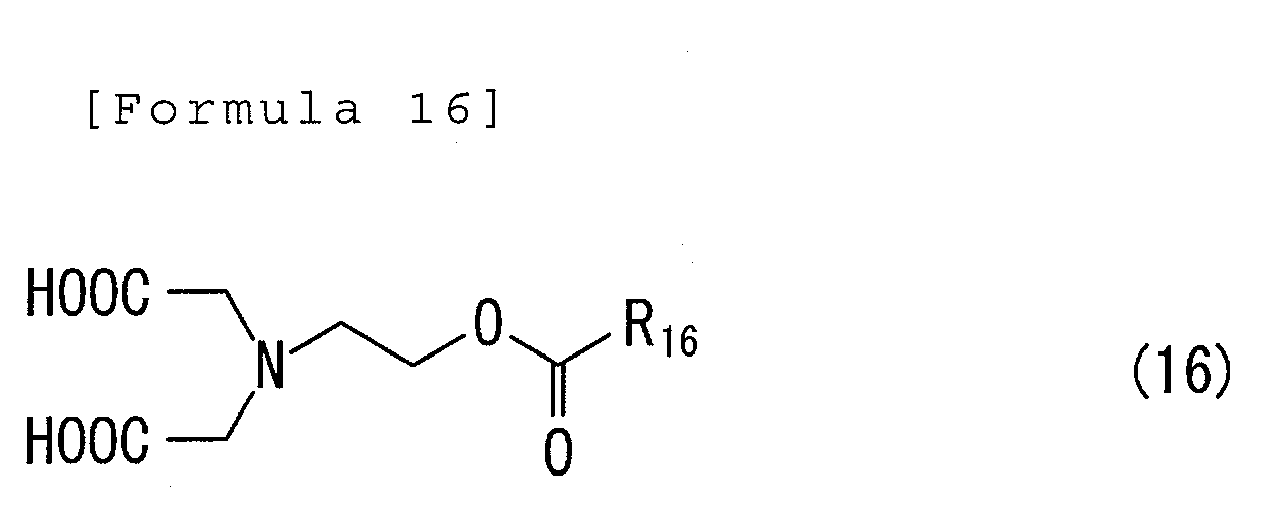
- R 16 is an octadecyl group.
- R 17 is a heptadecyl group.
- a case where the rust inhibitor is attached to an organic material or skin is a case where the rust inhibitor is attached to an organic material or skin.
- the surface state thereof may be fat soluble or water soluble.
- compounds M, G, H, N, and O to R have the acid structure or base structure in the molecular structure thereof. Accordingly, as the pH measurement result, it showed an acidic or alkali property.
- compounds C, D, K, and L are the neutral compounds that do not have the acid structure or base structure in the molecular structure thereof. Accordingly, the pH was neutral. Therefore, even when a rust inhibitor containing these compounds is used and the rust inhibitor is attached to a portion that is not included in an intended coated side, it is deemed that corrosion or effects to a human body are prevented. In addition, it is deemed that the preservation stability is excellent.
Landscapes
- Chemical & Material Sciences (AREA)
- Engineering & Computer Science (AREA)
- Materials Engineering (AREA)
- Mechanical Engineering (AREA)
- Metallurgy (AREA)
- Organic Chemistry (AREA)
- General Chemical & Material Sciences (AREA)
- Chemical Kinetics & Catalysis (AREA)
- Preventing Corrosion Or Incrustation Of Metals (AREA)
Abstract
Description
- The present invention relates to a rust inhibitor and a surface treatment metal material, and more particularly, to a rust inhibitor that is suitable to be coated on metal surfaces of various metal materials in order to prevent generation of rust, and a surface treatment metal material using the same.
- In the related art, metal materials are used in various fields, and metal materials take on an important role in industry fields. However, because metal materials easily rust, it is required that metal materials be subjected to rust inhibition treatment in order to stably perform its role over a long period of time. Accordingly, with respect to various metal materials, various rust inhibiting methods according to the metal species have been proposed.
- As the rust inhibiting methods for metal materials, for example, a method of performing plating on a metal surface and a method for painting a metal surface have been well known. The above methods are used to prevent affection of factors of rust, such as water or oxygen, and show a rust inhibiting effect by forming a coat on a metal surface and physically covering the metal surface. However, the plating or painting may be a large-scale process.
- On the other hand, as a relatively simple method, a method for coating a rust inhibitor on a metal surface is known. For example, a method for coating VASELINE or grease on a metal surface is known. In addition, Patent Literature 1 discloses a method for coating a rust inhibitor on the surface of zinc-based plated steel or aluminum-based plated steel, and a method for forming a coat by a polymer chelating agent using a specific polyamino compound as an organic polymer resin matrix on the metal surface.
- PLT1: Japanese Laid-Open Patent Publication No.
Hei 11-166151 - However, in the known method for coating various kinds of Vaseline or grease on the metal surface, they may be easily volatilized or eluted by heat or a solvent. Consequently, a rust inhibiting effect may be reduced considerably.
- In addition, the method for using various kinds of Vaseline or grease and the method for using the polymer chelating agent disclosed in Patent Literature 1 disclose that a rust inhibiting effect is obtained by coating the rust inhibitor on the metal surface to form a continuous coat on the metal surface and physically covering the metal surface. Hence, the methods are significantly different from the present invention in terms of constitution and function.
- It is an object of the present invention to provide a rust inhibitor that has an excellent adhering property to a metal surface and may show a stable rust inhibiting effect over a long period of time, and a surface treatment metal material using the same.
- The present inventors have conducted extensive studies, the results in the finding are that if a compound that has a portion having a bonding property with respect to a metal surface and a portion having a property for preventing water or oxygen from permeating the metal surface simultaneously is used as an effective component, a rust inhibiting effect may be stably shown over a long period of time while an adhering property to the metal surface is excellent.
- To achieve the objects and in accordance with the purpose of the present invention, a rust inhibitor according to a preferred embodiment of the present invention includes a compound that has a hydrophobic group and a chelate group in a molecular structure.
- It is preferable that the hydrophobic group is one or a plurality of groups selected from the group consisting of a long chain alkyl group and a cyclic alkyl group.
- It is preferable that the chelate group is derived from one or a plurality of chelate ligands selected from the group consisting of polyphosphate, aminocarbonic acid, 1,3-diketone, acetoacetic acid, acetoacetic ester, hydroxycarbonic acid, polyamine, aminoalcohol, aromatic heterocyclic bases, phenols, oximes, Schiff's base, tetrapyrroles, sulfur compound, synthesized macrocyclic compound, phosphonic acid, and hydroxyethylidenephosphonic acid.
- It is preferable that the hydrophobic group and the chelate group are bonded by one or a plurality of bonds selected from the group consisting of an ester bond, an ether bond, a thioester bond, a thioether bond, and an amide bond.
- It is preferable that the compound is a neutral compound.
- It is preferable that the rust inhibitor is used for metal surface coating.
- A surface treatment metal material according to another preferred embodiment is formed by coating the rust inhibitor described above on a surface of a metal material.
- It is preferable that the metal material is made of one or a plurality of metals selected from the group consisting of aluminum, iron, copper, an aluminum alloy, an iron alloy, and a copper alloy.
- The rust inhibitor according to the present invention includes the compound that has the hydrophobic group and the chelate group in the molecular structure. Therefore, the adhering property to a metal surface is improved by bonding the chelate group to the metal surface. In addition, since the hydrophobic group that is connected to the chelate group faces toward the outside of the metal surface, the hydrophobic group may provide a water repellent property to the metal surface. Therefore, permeation of water is prevented. Accordingly, a rust inhibiting effect may be stably shown over a long period of time while an adhering property to a metal surface is excellent.
- At this time, if the hydrophobic group includes various kinds of groups, the hydrophobic group may provide a water repellent property to the metal surface. At this time, if the chelate group includes various kinds of groups, the chelate group may be bonded to the metal surface. At this time, the bonding of the hydrophobic group and the chelate group by the various kinds of bonds may make the synthesis easy and may be widely used.
- Herein, if the compound is a neutral compound, corrosion or an effect on the human body may be prevented, so that even if the rust inhibitor is attached to a portion that is not included in an intended coated side, the compound is excellent in safety. In addition, if the compound is a neutral compound, the compound is not easily affected by the environment and excellent in safety
- Meanwhile, in the surface treatment metal material according to the present invention, since the rust inhibitor is coated on the surface of the metal material, a rust inhibiting effect may be stably shown over a long period of time.
- Hereinafter, preferred embodiments of the present invention will be described in detail. The rust inhibitor according to a preferred embodiment of the present invention includes a compound that has a hydrophobic group and a chelate group in a molecular structure as an effective component. The rust inhibitor according to the present invention, for example, may be appropriately used so as to be coated on a metal surface of a metal material. Examples of the metal material include wires, cables, connectors, and bodies in vehicles such as automobiles, high voltage power cables, electric and electronic device parts. In addition, examples of the metal species include aluminum, iron, copper, an aluminum alloy, an iron alloy, and a copper alloy.
- In the rust inhibitor according to the present invention, the chelate group is a portion that is formed to bond to the rust inhibiting metal surface. Since the chelate group bonds to the metal surface, the rust inhibitor is not easily volatilized or eluted by heat or a solvent. Accordingly, the rust inhibiting effect may be stably shown over a long period of time. The change of the chelate group to chelate bond through bonding to the metal surface may be confirmed by, for example, attenuated total reflectance IR absorption method (ATR-IR) or microscopic IR and the like.
- In the rust inhibitor according to the present invention, the hydrophobic group is disposed so as to protrude from the chelate group that is formed by bonding it to the metal surface to the outside. The hydrophobic group has the water repellent property on the chelate group that is formed by bonding to the metal surface in order to prevent water from permeating the metal surface. That is, the rust inhibiting effect is obtained by physically covering the metal surface, and also by preventing water from permeating the metal surface due to a water repellent effect of the hydrophobic group.
- It is preferable that the hydrophobic group and the chelate group are bonded by bonds such as an ester bond, an ether bond, a thioester bond, a thioether bond, and an amide bond. Through these bonds, the bonding structure of the hydrophobic group and the chelate group may be easily synthesized by a condensation reaction.
- The compound that has the hydrophobic group and the chelate group may be any one of acidic, alkali, and neutral compounds. Preferably, it is neutral. In the case of when the compound is a neutral compound, even if the rust inhibitor is attached to a portion that is not included in an intended coated side, corrosion is not easily caused in the portion to which the rust inhibitor is attached. In addition, in the case of when the rust inhibitor is attached to a skin of a human body, an effect to the human body such as roughness of the skin is insignificant. That is, it is excellent in safety. In addition, in the case of when the compound is neutral, the compound is not easily affected by the environment as compared to an acidic compound or alkali compound. Therefore, it is excellent in preservation stability.
- Examples of the neutral compound includes a compound that does not have an acidic structure or a base structure in a molecular structure (in this case, the chelate group does not have an acidic structure or a base structure), and a compound that has an acidic structure and a base structure in a molecular structure but is neutral.
- The neutral compound may have a pH in the range of 6 to 8. The pH of the compound may be measured by using a general pH measuring device, or may be measured by using a pH test paper. The pH measurement may be performed according to general measurement conditions.
- Examples of the hydrophobic group include a long chain alkyl group, and a cyclic alkyl group. They may be used singly or in combination. At this time, if a fluorine atom is introduced to the long chain alkyl group or the cyclic alkyl group, a water repellent effect is made better.
- The long chain alkyl group may be a straight chain type or a branched chain type. The number of carbon atoms of the long chain alkyl group is not particularly limited, but preferably 5 to 100 and more preferably 8 to 50. The cyclic alkyl group may be formed of a single cycle or plural cycles. The number of carbon atoms of the cyclic alkyl group is not particularly limited, but preferably 5 to 100 and more preferably 8 to 50. In the long chain alkyl group or the cyclic alkyl group, a carbon-carbon unsaturated bond, an amide bond, an ether bond, an ester bond or the like may be included.
- The chelate group may be introduced by using various chelate ligands. Examples of the chelate ligands include β-dicarbonyl compound such as 1,3-diketone (β-diketone) and 3-keto carbonic acid ester (acetoacetic ester and the like), polyphosphate, aminocarbonic acid, hydroxycarbonic acid, polyamine, amino alcohol, aromatic heterocyclic bases, phenols, oximes, Schiff's base, tetrapyrroles, sulfur compound, synthesized macrocyclic compound, phosphonic acid, and hydroxyethylidenephosphonic acid. The compounds have plural unshared electron pairs capable of performing coordinate covalent bonding. They may be used singly or in combination. Among them, since 1,3-diketone and 3-keto carbonic acid ester do not have the acidic structure or base structure in the molecular structure and are neutral compounds, they are more preferable in terms of safety and preservation stability.
- The specific examples of various chelate ligands include polyphosphates such as sodium tripolyphosphate and hexamethaphosphoric acid. Examples of the aminocarbonic acid include ethylenediamine diacetic acid, ethylenediamine dipropionic acid, ethylenediamine tetraacetic acid, N-hydroxymethylethylenediamine triacetic acid, N-hydroxyethylethylenediamine triacetic acid, diaminocyclohexyl tetraacetic acid, diethylenetriamine pentaacetic acid, glycoletherdiamine tetraacetic acid, N,N-bis(2-hydroxybenzyl)ethylenediamine diacetic acid, hexamethylenediamine N,N,N,N- tetraacetic acid, hydroxyethylimino diacetic acid, imino diacetic acid, diaminopropan tetraacetic acid, nitrilo triacetic acid, nitrilo tripropionic acid, triethylenetetramine hexaacetic acid, and poly(p-vinylbenzylimino diacetic acid).
- Examples of 1,3-diketone include acetylacetone, trifluoroacetylacetone, and thenoyltrifluoroacetone. In addition, examples of acetoacetic ester include acetoacetic acid propyl, acetoacetic acid tert-butyl, acetoacetic acid isobutyl, and acetoacetic acid hydroxypropyl. Examples of hydroxycarbonic acid include N-dihydroxyethylglycine, ethylene bis(hydroxyphenylglycine), diaminopropanol tetraacetic acid, tartaric acid, citric acid, and gluconic acid. Examples of polyamine include ethylenediamine, triethylenetetramine, triaminotriethylamine, and polyethyleneimine. Examples of aminoalcohol include triethanolamine, N-hydroxyethylethylenediamine, and polymetharyloylacetone.
- Examples of aromatic heterocyclic base include dipyridyl, o-phenanthroline, oxine, and 8-hydroxyquinoline. Examples of phenols, 5-sulfosalicylic acid, salicylaldehyde, disulfopyrocatecol, chromotropic acid, oxysulfonic acid, and disalicylaldehyde. Examples of oxime include dimethylglyoxime and salicylaldoxime. Examples of the Schiff's base include dimethylglyoxime, salicylaldoxime, disalicylaldehyde, and 1,2-propylenediamine.
- Examples of tetrapyrroles include phthalocyanine and tetraphenylporpyrine. Examples of the sulfur compounds include toluenedithiol, dimercaptopropanol, thioglycol acid, potassium ethylxanthinate, sodium diethyldithiocarbamate, dithizone, and diethylthiophosphoric acid. Examples of the synthesized macrocyclic compounds include tetraphenylporpyrine and crown ethers.
Examples of the phosphonic acids include ethylenediamine N,N-bismethylenephosphonic acid, ethylenediaminetetrakismethylenephosphonic acid, nitrilotrismethylenephosphonic acid, and hydroxyethylidenediphosphonic acid. - A hydroxyl group or an amino group may be appropriately introduced to the chelate ligand. Some of the chelate ligands are present in the form of salt. In this case, they may be used in the form of salt. In addition, a hydrate or solvated material of the chelate ligand or the chelate ligand in the form of the salt may be used. In addition, the chelate ligand, which includes an optical active structure may include a steric isomer, a mixture of steric isomers, or a racemic mixture.
- The long chain alkyl group may be introduced by using the long chain alkyl compound. The long chain alkyl compound is not particularly limited, and examples thereof include long chain alkyl carbonic acid derivatives such as long chain alkyl carbonic acid, long chain alkyl carbonic acid ester, and long chain alkyl carbonic acid amide, long chain alkyl alcohol, long chain alkyl thiol, long chain alkyl aldehyde, long chain alkyl ether, long chain alkyl amine, long chain alkyl amine derivative, and long chain alkyl halogen. Among them, in terms of easy introduction of the chelate group, long chain alkyl carbonic acid, long chain alkyl carbonic acid derivative, long chain alkyl alcohol, and long chain alkyl amine are preferable.
- Examples of the long chain alkyl compounds include octanic acid, nonaic acid, decanoic acid, hexadecanoic acid, octadecanoic acid, Icosanoic acid, docosanoic acid, tetradocosanoic acid, hexadocosanoic acid, octadocosanoic acid, octanol, nonanol, decanol, dodecanol, hexadecanol, octadecanol, eicosanol, docosanol, tetradocosanol, hexadocosanol, octadocosanol, octylamine, nonylamine, decylamine, dodecylamine, hexadecylamine, octadecylamine, dodecyl carbonic acid chloride, hexadecylcarbonic acid chloride, and octadecylcarbonic acid chloride. Among them, in terms of easy purchase, octanic acid, nonaic acid, decanoic acid, dodecanoic acid, ocutadecanoic acid, docosanoic acid, octanol, nonanol, decanol, dodecanol, octadecanol, docosanol, octylamine, nonylamine, decylamine, dodecylamine, octadecylamine, dodecyl carbonic acid chloride, and octadecylcarbonic acid chloride are preferable.
- The cyclic alkyl group may be introduced by using the cyclic alkyl compound. The cyclic alkyl compound is not particularly limited, and examples thereof include a cyclo alkyl compound having 3 to 8 carbon atoms, a compound having a steroidal skeleton, and a compound having an adamantyl skeleton. At this time, in terms of easy formation of the bond to the chelate ligand, it is preferable that the carbonic acid group, the hydroxyl group, the acid amide group, the amino group, or the thiol group is introduced to the compounds described above.
- Examples of the cyclic alkyl compound include cholic acid, deoxycholic acid, adamantane carbonic acid, adamantane acetic acid, cyclohexyl cyclohexanol, cyclopentadecanol, isoborneol, adamantanol, methyladamantanol, ethyladamantanol, cholesterol, cholestanol, cyclooctylamine, cyclododecylamine, adamantanemethylamine, and adamantaneethylamine. Among them, in terms of easy purchase, adamantanol and cholesterol are preferable.
- Since the rust inhibitor according to the present invention has the hydrophobic group and the chelate group, the rust inhibitor may be obtained by contacting a compound having the hydrophobic group with the chelate ligand having the chelate group. To be specific, it may be obtained by performing condensation reaction between the compound having the hydrophobic group and the chelate ligand having the chelate group. At this time, a solvent may be used, and stirring may be performed. In addition, in order to increase a reaction rate, it may be heated or a catalyst may be added thereto. In addition, a target material may be obtained at high yield by removing a byproduct to make an equilibrium reaction biased toward a production system. Examples of the compound having the hydrophobic group include the long chain alkyl compound and the cyclic alkyl compound.
- For example, when the compound having the hydrophobic group has a carboxyl group or hydroxyl group, and the chelate ligand has a hydroxyl group or carboxyl group, the hydrophobic group and the chelate group may be bonded to each other by the ester bond. In addition, for example, when the compound having the hydrophobic group has a carboxyl group or amino group, and the chelate ligand has an amino group or carboxyl group, the hydrophobic group and the chelate group may be bonded to each other by the amide bond.
- The molecular weight of the compound that is an effective component of the rust inhibitor according to the present invention is not particularly limited, but preferably 100 to 1500 and more preferably 200 to 800.
- An example of the compound that is an effective component of the rust inhibitor according to the preferred embodiment of the present invention is shown in the following Structural Formula.
-
[Formula 1] R- X -Y (1)
- where R is the long chain alkyl group or the cyclic alkyl group, X is an ester bond portion, an ether bond portion, a thioester bond portion, or an amide bond portion, and Y is a chelate group. That is, the long chain alkyl group or cyclic alkyl group and the chelate group are bonded to each other by the ester bond, ether bond, thioester bond, or amide bond.
- The rust inhibitor according to the present invention may contain other components in addition to the compound that is the effective component. Examples of the additional components include an organic solvent, wax, and oil. The additional components may have the rust inhibiting effect, or may not have the rust inhibiting effect.
The additional components have a function of a diluting agent. That is, according to the property and shape (liquid phase, solid, or powder) of the compound that is the effective component of the rust inhibitor according to the present invention, the additional components control the property and shape of the rust inhibitor in order to easily perform coating. - When the additional components are contained, it is preferable that the content of the effective component in the composition constituting the rust inhibitor is 0.01 mass% or more. More preferably, it is in the range of 0.05 to 99.5 mass%. If the content of the effective component is less than 0.01 mass%, the rust inhibiting effect is easily reduced.
- Examples of the organic solvent of the additional component include oxygen-containing solvents such as alcohols having 1 to 8 carbon atoms, tetrahydrofurane, and acetone, and alkanes having 6 to 18 carbon atoms. In addition, examples of the wax include polyethylene wax, synthetic paraffins, natural paraffins, microwax, and chlorinated hydrocarbons. In addition, examples of the oil include lubricant, operation oil, thermal medium oil, and silicon oil.
- When the rust inhibitor according to the present invention is coated on the metal surface, the compound that is the effective component or a mixture of the compound and the additional components is directly coated on the metal surface. At this time, methods such as a coating method, a precipitation method, and a spray method may be used as the coating method. In addition, after coating treatment by a squeeze coater, precipitation treatment, or spray treatment, the coating amount may be controlled and an appearance and film thickness may be made uniform by an air knife method or a roll squeeze method. When the coating is performed, in order to improve an adhering property and a corrosion resistance, treatments such as heating or compression may be performed as needed.
- Next, a surface treatment metal material according to another preferred embodiment of the present invention will be described. The surface treatment metal material according to the preferred embodiment of the present invention is obtained by coating the rust inhibitor according to the present invention on a surface of a metal material. It is preferable that the metal material is made of metal such as aluminum, iron, copper, an aluminum alloy, an iron alloy, and a copper alloy. At this time, the surface of the metal material may be plated with metal such as zinc or aluminum. The above-mentioned coating methods may be used as the coating method of the rust inhibitor.
- The surface treatment metal material according to the preferred embodiment of the present invention may preferably be used for metal parts such as wires, cables, connectors, and bodies in vehicles such as automobiles, and metal parts such as high voltage power cables, electric and electronic device.
- Hereinafter, the present invention is described in detail by Examples, but the present invention is not limited to them.
- The experimental materials used in the present Examples and Comparative Examples are described in conjunction with manufacturers and trade names. In addition, some of them were materials synthesized in the laboratory. With respect to the synthetic products, synthesis methods, structural formulae, and identification data are described below. In addition, the materials without the manufacturers and the trade names mean chemical reagents.
- Five grams of ethylenediamine tetraacetic acid dianhydride (19.5 mmol) was dissolved in 50 ml of toluene, and 5.3 g of octadecyl alcohol (19.6 mmol) was dissolved. After the mixture solution was stirred at room temperature for 5 hours, the temperature was increased to 80°C and additional stirring was performed for 1 hour. After the reaction was finished, while the reaction solution was cooled and stirred in an ice bath, 200 ml of pure water was added little by little. Thereafter, the temperature was cooled to room temperature and the stirring was performed for 1 hour, and the toluene phase was separated and concentrated in vacuo. Methanol and water were continuously added to the concentrated material, and the precipitate was obtained by filtration to obtain a light yellow powder. The powder was recrystallized in methanol, and filtered to obtain a light yellow target material (yield 65%). 1H-NMR (DMSO) σppm(TMS): 0.85 (t, 3H), 1.25 (m, 32H), 1.55 (t, 2H), 2.79 (m, 4H), 3.47 (m, 11H), 4.03 (t, 2H). IR (cm-1) : 2925 (C-H stretching), 1734 (ester C=O stretching), 1460 (carbonic acid C-O stretching), 1225 (ester C-O stretching), 1060 (C-N stretching).
-


- Five grams of diethylenediamine pentaacetic acid 2 anhydride (14.0 mmol) was dissolved in 50 ml of toluene, and 4.6 g of docosanol (14.0 mmol) was dissolved. After the mixture solution was stirred at room temperature for 5 hours, the temperature was increased to 80°C and additional stirring was performed for 1 hour. After the reaction was finished, while the reaction solution was cooled and stirred in an ice bath, 200 ml of pure water was added little by little. Thereafter, the temperature was cooled to room temperature and the stirring was performed for 1 hour, and the toluene phase was separated and concentrated in vacuo. Methanol and water were continuously added to the concentrated material, and the precipitate was obtained by filtration to obtain a light yellow powder. The powder was recrystallized in methanol, and filtered to obtain a light yellow target material (yield 56%). 1H-NMR(DMSO) σppm(TMS): 0.86 (t, 3H), 1.25 (m, 40H), 1.57 (t, 2H), 2.79 (m, 8H), 3.37 (s, 2H), 3.41 (m, 6H), 3.49 (s, 2H), 4.04 (t, 2H). IR(cm-1): 2910 (C-H stretching), 1734 (ester C=O stretching), 1455 (carbonic acid C-O stretching), 1225 (ester C-O stretching), 1070 (C-N stretching).
-

- Five grams of tert-butylacetoacetate (31.6 mmol) and 8.5 g of octadecylalcohol (31.4 mmol) were dissolved in 50 ml of toluene, and heated to 110°C while they were stirred, and reacted for 2 hours while tert-butanol that was the byproduct was removed using a Dean-Stark trap. After the reaction was finished, it was concentrated in vacuo to obtain a white composition in a wax state. Twenty milliliters of cold water was added thereto to solidify it, and a target material was obtained by filtration (yield 75%). 1H-NMR (CDCl3) σppm (TMS): 0.89 (t, 3H), 1.26 (m, 32H), 1.64 (m, 2H), 2.27 (s, 3H), 3.44 (s, 2H), 4.13 (t, 2H). IR (cm-1) : 2924 (C-H stretching), 1745, 1720 (β-diketone, enol form, 1642 (βdiketone, enol form), 1420 (carbonic acid C-O stretching).
-

- The compound was synthesized by using the same method as compound C, except that 10.3 g of docosanol (31.5 mmol) was used instead of octadecyl alcohol (yield 78%). 1H-NMR (CDCl3) σppm (TMS): 0.89 (t, 3H), 1.27 (m, 40H), 1.64 (m, 2H), 2.25 (s, 3H), 3.44 (s, 2H), 4.10 (t, 2H). IR (cm-1) : 2922 (C-H stretching), 1745, 1721 (β-diketone, enol form), 1650 (β-diketone, enol form), 1425 (carbonic acid C-O stretching).
-

- While 5 g of hydroxyethylimino diacetic acid (28.2 mmol) was dissolved in 200 ml of DMF, cooled and stirred in a water bath, 8.6 g of stearoyl chloride (28.4 mmol) was added little by little. After that, the stirring was continued at room temperature for 12 hours. After the reaction was finished, while the reaction solution was cooled and stirred in an ice bath, 200 ml of pure water was added little by little. After the temperature was cooled to room temperature and the stirring was performed for 1 hour, the pH was controlled to 2.0 using a 1N sodium hydroxide solution, and the mixture solution thereof was concentrated. Two hundred milliliters of pure water was added to the obtained brown oil, which was cleaned twice by decantation thereafter. The cleaned material was dissolved in methanol by heat, cooled, recrystallized, and filtered to obtain a light yellow powder. The recrystallization of methanol was repeated once more to obtain a light yellow target material (yield 67%). 1H-NMR (DMSO) σppm (TMS): 0.86 (t, 3H), 1.24 (m, 30H), 1.57 (t, 2H), 2.34 (t, 2H), 2.44 (t, 2H), 3.48 (m, 6H), 4.03 (t, 2H). IR (cm-1): 2923 (C-H stretching), 1730 (ester C=O stretching), 1455 (carbonic acid C-O stretching), 1220 (ester C-O stretching), 1058 (C-N stretching).
-

- The compound was synthesized by using the same method as compound E, except that 7.9 g of N- (2-hydroxyethyl)ethylenediamine triacetic acid (28.4 mmol) was used instead of hydroxyethylimino diacetic acid (yield 51%). 1H-NMR (DMSO) σppm (TMS): 0.87 (t, 3H), 1.24 (m, 30H), 1.57 (t, 2H), 2.37 (t, 2H), 2.48 (t, 2H), 3.45 (m, 9H), 4.02 (t, 2H). IR (cm-1): 2925 (C-H stretching), 1733 (ester C=O stretching), 1453 (carbonic acid C-O stretching), 1220 (ester C-O stretching), 1060 (C-N stretching).
-


- The compound was synthesized by using the same method as compound E, except that 9.2 g of diaminopropanol tetraacetic acid (28.5 mmol) was used instead of hydroxyethylimino diacetic acid (yield 47%). 1H-NMR (DMSO) σppm (TMS): 0.85 (t, 3H), 1.24 (m, 30H), 1.56 (t, 2H), 2.56 (m, 2H), 2.75 (m, 2H), 3.45 (m, 8H), 3.87 (m), 1H), 4.02 (t, 2H). IR (cm-1): 2922 (C-H stretching), 1735 (ester C=O stretching), 1453 (carbonic acid C-O stretching), 1220 (ester C-O stretching), 1060 (C-N stretching).
-

- The compound was synthesized by using the same method as compound E, except that 5.9 g of 1-hydroxyethane-1,1-bisphosphonic acid (28.6 mmol) was used instead of hydroxyethylimino diacetic acid (yield 54%). 1H-NMR (DMSO) σppm (TMS): 0.87 (t, 3H), 1.24 (m, 30H), 1.49 (s, 3H), 1.61 (t, 2H), 4.00 (t, 2H). IR (cm-1): 2925 (C-H stretching), 1730 (ester C=O stretching), 1450 (C-O stretching), 1151 (P-O stretching), 925(P-OH).
-

- The compound was synthesized by using the same method as compound A, except that 7.5 g of cholesterol (19.4 mmol) that had the structure represented by following Formula 14 was used instead of octadecylalcohol (yield 59%). 1H-NMR (DMSO) σppm (TMS): 0.5 to 2.0 (m, 41H), 2.28 (m, 2H), 3.47 (m, 11H), 3.52 (m, 12H), 5.35 (m, 1H). IR (cm-1) : 2925 (C-H stretching), 1734 (esterC=O stretching), 1460 (carbonic acid C-O stretching), 1225 (ester C-O stretching), 1060 (C-N stretching).
-

- The compound was synthesized by using the same method as compound B, except that 2.1 g of 1-adamantanol (13.8 mmol) that had the structure represented by following Formula 15 was used instead of docosanol (yield 48%). 1H-NMR (DMSO) σppm (TMS): 1.71 (m, 12H), 2.14 (m, 3H), 2.79 (m, 8H), 3.36 (s, 2H), 3.50 (m, 6H). IR (cm-1): 2954, 2922 (C-H stretching), 1735 (ester C=O stretching), 1455 (carbonic acid C-O stretching), 1225 (ester C-O stretching), 1070 (C-N stretching).
-

- The compound was synthesized by using the same method as compound C, except that 12.1 g of cholesterol (31.3 mmol) that had the structure represented by following Formula 14 was used instead of octadecylalcohol (yield 48%). 1H-NMR (CDCl3) σppm (TMS): 0.5 to 2.0 (m, 41H), 2.28 (m, 2H), 2.26 (s, 3H), 3.41 (s, 2H), 3.52 (m, 1H), 5.35 (m, 1H). IR (cm-1) : 2925 (C-H stretching), 1745, 1720 (β-diketone, enol form), 1642 (β-diketone, enol form), 1440 (carbonic acid C-O stretching).
-

- The compound was synthesized by using the same method as compound C, except that 4.8 g of 1-adamantanol (31.5 mmol) that had the structure represented by following Formula 15 was used instead of octadecylalcohol (yield 48%). 1H-NMR (CDCl3) σppm (TMS): 1.71 (m, 12H), 2.14 (m, 3H), 2.25 (s, 3H), 3.44 (s, 2H). IR (cm-1): 2930 (C-H stretching), 1745, 1722 (β-diketone, enol form), 1645 (β-diketone, enol form), 1444 (carbonic acid C-O stretching).
-

-

-

-
- · Wax <1> [trade name "LUVAX 1151", manufactured by NIPPON SEIRO, CO., LTD.]
- · Wax <2> [trade name "CERIDUST 3620", manufactured by HOECHST AG]
- · Oil [trade name "DAPHNE MECHANIC OIL 10", manufactured by IDEMITSU KOSAN, CO., LTD.]
- · isopropyl alcohol (IPA) (reagent)
- One milligram of compounds A to L that were synthesized by using the above-mentioned method was uniformly coated by providing the compounds on aluminum plates (10 x 10 x 0.5 mm) that were cleaned with ethanol, heating them at 100°C for 5 minutes, and melting them to increase the fluidity. Thereafter, heating was stopped, and natural cooling was performed to room temperature to obtain each sample.
- Ten microliters of 5% neutral saline solution was dropped on the side of each sample where the rust inhibitor was coated, the sample on which the 5% saline solution was spotted was subjected to a high temperature and high humidity test under the condition of 80°C, 95% RH, and 50 to 200 hours, the surface thereof was washed with pure water after a predetermined time, and the surface state of the portion of the sample that was spotted with the saline solution was observed and checked for generation of the white rust. At this time, the spotted surface was photographed, and the area ratio of white rust generation to the entire coated side of the rust inhibitor was obtained. The case where there was no white rust was classified as "Excellent", the case where even though there was the white rust, the area ratio of the white rust generation was less than 5% was classified as "Good+", the case where the area ratio of the white rust generation was 5% or more and less than 10% was classified as "Good", the case where the area ratio of the white rust generation was 10% or more and less than 25% was classified as "Good-", the case where the area ratio of the white rust generation was 25% or more and less than 50% was classified as "Below average", and the case where the area ratio of the white rust generation was 50% or more was classified as "Not good". The rust inhibiting test results are described in Table 1.
-
[Table 1] Rust inhibitor After 50 h After 100 h After 200 h Example 1 Compound A Excellent Excellent Good+ Example 2 Compound B Excellent Excellent Excellent Example 3 Compound C Excellent Excellent Excellent Example 4 Compound D Excellent Excellent Excellent Example 5 Compound E Excellent Excellent Good+ Example 6 Compound F Excellent Excellent Excellent Example 7 Compound G Excellent Excellent Excellent Example 8 Compound H Excellent Excellent Excellent Example 9 Compound I Excellent Excellent Good+ Example 10 Compound J Excellent Excellent Excellent Example 11 Compound K Excellent Excellent Excellent Example 12 Compound L Excellent Excellent Excellent Comparative Example 1 Wax <1> Good+ Good Not good Comparative Example 2 Wax <2> Good- Good- Below average Comparative Example 3 None Below average Not good Not good - According to Table 1, with the commercial wax coat, under the high temperature and high humidity condition, the rust inhibiting effect was reduced by a contact to the saline solution over a long period of time to generate the rust. However, when the rust inhibitor according to the preferred embodiment of the present invention was used, it was confirmed that because of the strong bond to the aluminum surface of the chelate portion, the rust inhibiting effect was continuously obtained over a long period of time.
- Subsequently, rust inhibitor compositions including respective compounds A to L were prepared by using the diluting agent that will be described in Table 2, and the rust inhibiting test was performed by using the compositions. The test was performed in the same manner as the coating method on the metal surface and the rust inhibiting test method described above. The contents of compounds A to L are expressed in mass% in Table 2. Meanwhile, in coating the rust inhibitor composition, considering the specific gravity of the composition in the solution state, the rust inhibitor composition was provided on the aluminum plate so that the amount thereof was 1 mg in a liquid state, and uniformly coated at 100°C for 5 minutes. In addition, with respect to a case where the diluting agent was a volatile solvent, the rust inhibiting effect was evaluated by vaporizing only the diluting agent at 100°C for 5 minutes after it was verified that diluting agent was sufficiently uniformly spread before volatilization. The results are shown in Table 2.
-
[Table 2] Rust inhibitor After 50 h After 100 h After 200 h Compund Content Diluting agent Example 13 A 50 Wax <1> Excellent Excellent Good+ Example 14 B 50 Wax <1> Excellent Excellent Good+ Example 15 C 50 Wax <1> Excellent Excellent Excellent Example 16 D 50 Wax <1> Excellent Excellent Excellent Example 17 E 50 Wax <1> Excellent Good+ Good+ Example 18 F 50 Wax <1> Excellent Excellent Excellent Example 19 G 50 Wax <1> Excellent Excellent Excellent Example 20 H 50 Wax <1> Excellent Excellent Excellent Example 21 I 50 Wax <1> Excellent Good+ Good+ Example 22 J 50 Wax <1> Excellent Excellent Excellent Example 23 K 50 Wax <1> Excellent Excellent Excellent Example 24 L 50 Wax <1> Excellent Excellent Excellent Example 25 C 50 Oil Excellent Excellent Excellent Example 26 C 50 IPA Excellent Excellent Excellent Example 27 D 50 Oil Excellent Good+ Good+ Example 28 D 50 IPA Excellent Excellent Good+ Example 29 K 50 Oil Excellent Excellent Excellent Example 30 K 50 IPA Excellent Excellent Excellent Example 31 C 10 IPA Excellent Excellent Excellent Example 32 C 5 IPA Excellent Excellent Excellent Example 33 C 1 IPA Excellent Excellent Excellent Example 34 C 0.5 IPA Excellent Excellent Excellent Example 35 C 0.1 IPA Excellent Excellent Good+ Example 36 C 0.05 IPA Excellent Good+ Good+ Example 37 K 1 IPA Excellent Excellent Excellent Example 38 K 0.5 IPA Excellent Excellent Excellent Example 39 K 0.1 IPA Excellent Excellent Excellent Example 40 K 0.05 IPA Excellent Good+ Good+ Example 41 C 1 Wax <1> Excellent Excellent Excellent Example 42 C 0.1 Wax <1> Excellent Excellent Good+ - According to Table 2, it was confirmed that even if the rust inhibitor according to the present invention was diluted by the commercial wax or oil or the organic solvent, the rust inhibiting effect was shown over a long period of time, and the rust inhibiting effect was maintained even at the low concentration where the content was 0.05%.
- Next, pH measurement was performed with respect to the rust inhibitors and the chelating agents described in Table 3. Among the compounds described in Table 3, compounds C, D, K, L, G, and H were the same compounds as those described in Tables 1 and 2, and compounds M and N were synthesized by using the following method. In addition, compounds O to R were the commercial reagents. Compounds C, D, K, L, M, G, H, and N were the compounds having the hydrophobic group and the chelate group. Compound O was a representative polyamine chelating agent, compound P was a representative carbonic acid chelating agent, compound Q was a representative phosphoric acid chelating agent, and compound R was a representative amine chelating agent.
- The compound was synthesized by using the same method as compound E, except that 9.0 g of nonadecanoic acid chloride (28.4 mmol) was used instead of stearoyl chloride (yield 70%). 1H-NMR (DMSO) σppm (TMS): 0.86 (t, 3H), 1.25 (m, 32H), 1.58 (t, 2H), 2.34 (t, 2H), 2.44 (t, 2H), 3.48 (m, 6H), 4.03 (t, 2H). IR(cm-1): 2923 (C-H stretching), 1733 (ester C=O stretching), 1455 (carbonic acid C-O stretching), 1220 (ester C-O stretching), 1056 (C-N stretching).
-
- While 4.1 g of triethylenetetramine (28.0 mmol) was dissolved in 200 ml of DMF, cooled and stirred in a water bath, 8.6 g of stearoyl chloride (28.4 mmol) was added little by little. After that, the stirring was continued at room temperature for 12 hours. After the reaction was finished, while the reaction solution was cooled and stirred in an ice bath, 500 ml of pure water was added little by little. After the temperature was cooled to room temperature and the stirring was performed for 1 hour, while the 1N sodium hydroxide solution was added little by little, brown oil was formed at the pH of 11.0. The supernatant was removed, pure water was added to the obtained oil, which was cleaned twice by decantation thereafter. The cleaned material was dissolved in methanol by heat, cooled, recrystallized, and filtered to obtain a yellow powder. The recrystallization of methanol was repeated once more to obtain a light yellow target material (yield 58%). 1H-NMR (DMSO) σppm (TMS): 0.85 (t, 3H), 1.30 (m, 30H), 1.39 (t, 2H), 2.28 ~ 2.81 (m, 12H), 3.60 (m, 5H). IR(cm-1): 3405 (N-H stretching), 2920 (C-H stretching), 1662 (amide C=O stretching), 1590 (N-H variable angle), 1050 (C-N stretching).
-

- · compound O: polyethyleneimine
- · compound P: ethylenediamine tetraacetic acid
- · compound Q: polyphosphoric acid
- · compound R: diethylenetriamine
- One possible case where effects of corrosion, etc. are considered when the rust inhibitor is attached to a portion that is not included in an intended coated side is a case where the rust inhibitor is attached to an organic material or skin. The surface state thereof may be fat soluble or water soluble. In addition, a case where the organic material or skin becomes wet by water or oil components may be considered. Therefore, with the assumption of the surface state including both the states, a filtering paper that was wetted by the mixture solution where isopropyl alcohol: pure water = 1 : 1 was prepared, 0.5 mg of each of the compounds described in Table 3 was provided on the surface thereof and left at room temperature for 1 minute, and the pH at the contact surface between the compound and the filtering paper was measured. At this time, an universal pH test paper (length 5 cm, width 7 mm, manufactured by ADVANTEC) was used as the filtering paper, and the pH value was obtained based on a change in color at the contact surface. That is, the pH value was obtained by comparing to the standard color. The results are described in Table 3.
-
[Table 3] Rust inhibitor or chelating agent pH Compound C 7 Compound D 7 Compound K 6 to 7 Compound L 6 to 7 Compound M 2 to 3 Compound G 2 to 3 Compound H 1 to 2 Compound N 11 Compound O 11 Compound P 3 Compound Q 2 Compound R 10 to 11 - According to Table 3, compounds M, G, H, N, and O to R have the acid structure or base structure in the molecular structure thereof. Accordingly, as the pH measurement result, it showed an acidic or alkali property. On the other hand, compounds C, D, K, and L are the neutral compounds that do not have the acid structure or base structure in the molecular structure thereof. Accordingly, the pH was neutral. Therefore, even when a rust inhibitor containing these compounds is used and the rust inhibitor is attached to a portion that is not included in an intended coated side, it is deemed that corrosion or effects to a human body are prevented. In addition, it is deemed that the preservation stability is excellent.
- The foregoing description of the preferred embodiments of the present invention has been presented for purposes of illustration and description. However, it is not intended to limit the present invention to the preferred embodiments described herein, and modifications and variations are possible as long as they do not deviate from the principles of the invention.
Claims (8)
- A rust inhibitor comprising a compound that has a hydrophobic group and a chelate group in a molecular structure.
- The rust inhibitor according to claim 1, wherein the hydrophobic group is one or a plurality of groups selected from the group consisting of a long chain alkyl group and a cyclic alkyl group.
- The rust inhibitor according to claim 1 or 2, wherein the chelate group is derived from one or a plurality of chelate ligands selected from the group consisting of polyphosphate, aminocarbonic acid, 1,3-diketone, acetoacetic acid, acetoacetic ester, hydroxycarbonic acid, polyamine, amino alcohol, aromatic heterocyclic bases, phenols, oximes, Schiff's base, tetrapyrroles, sulfur compound, synthesized macrocyclic compound, phosphonic acid, and hydroxyethylidenephosphonic acid.
- The rust inhibitor according to any one of claims 1 to 3, wherein the hydrophobic group and the chelate group are bonded by one or a plurality of bonds selected from the group consisting of an ester bond, an ether bond, a thioester bond, a thioether bond, and an amide bond.
- The rust inhibitor according to any one of claims 1 to 4, wherein the compound comprises a neutral compound.
- The rust inhibitor according to any one of claims 1 to 5, wherein the rust inhibitor is used for metal surface coating.
- A surface treatment metal material that is formed by coating the rust inhibitor according to any one of claims 1 to 6, on a surface of a metal material.
- The surface treatment metal material according to claim 7, wherein the metal material is made of one or a plurality of metals selected from the group consisting of aluminum, iron, copper, an aluminum alloy, an iron alloy, and a copper alloy.
Applications Claiming Priority (3)
| Application Number | Priority Date | Filing Date | Title |
|---|---|---|---|
| JP2008206523 | 2008-08-11 | ||
| JP2008303887A JP5914907B2 (en) | 2008-08-11 | 2008-11-28 | Rust preventive and surface-treated metal |
| PCT/JP2009/062084 WO2010018716A1 (en) | 2008-08-11 | 2009-07-02 | Rust inhibitor and surface-treated metal material |
Publications (3)
| Publication Number | Publication Date |
|---|---|
| EP2333135A1 true EP2333135A1 (en) | 2011-06-15 |
| EP2333135A4 EP2333135A4 (en) | 2014-06-04 |
| EP2333135B1 EP2333135B1 (en) | 2018-01-03 |
Family
ID=41668863
Family Applications (1)
| Application Number | Title | Priority Date | Filing Date |
|---|---|---|---|
| EP09806612.9A Not-in-force EP2333135B1 (en) | 2008-08-11 | 2009-07-02 | Rust inhibitor and surface-treated metal material |
Country Status (8)
| Country | Link |
|---|---|
| US (1) | US20110008634A1 (en) |
| EP (1) | EP2333135B1 (en) |
| JP (1) | JP5914907B2 (en) |
| KR (1) | KR101232986B1 (en) |
| CN (1) | CN102027159A (en) |
| BR (1) | BRPI0906551A2 (en) |
| RU (1) | RU2470094C2 (en) |
| WO (1) | WO2010018716A1 (en) |
Cited By (5)
| Publication number | Priority date | Publication date | Assignee | Title |
|---|---|---|---|---|
| US11926543B2 (en) | 2018-08-29 | 2024-03-12 | Ecolab Usa Inc. | Use of multiple charged ionic compounds derived from polyamines for waste water clarification |
| US12082580B2 (en) | 2018-08-29 | 2024-09-10 | Ecolab Usa Inc. | Use of multiple charged cationic compounds derived from primary amines or polyamines for microbial fouling control in a water system |
| US12103881B2 (en) | 2017-08-30 | 2024-10-01 | Ecolab Usa Inc. | Molecules having one hydrophobic group and two identical hydrophilic ionic groups and compositions thereof and methods of preparation thereof |
| US12202784B2 (en) | 2018-08-29 | 2025-01-21 | Ecolab Usa Inc. | Multiple charged ionic compounds derived from polyamines and compositions thereof and methods of preparation thereof |
| US12365608B2 (en) | 2019-01-29 | 2025-07-22 | Ecolab Usa Inc. | Use of cationic sugar-based compounds for microbial fouling control in a water system |
Families Citing this family (24)
| Publication number | Priority date | Publication date | Assignee | Title |
|---|---|---|---|---|
| US11624115B2 (en) | 2010-05-12 | 2023-04-11 | Sio2 Medical Products, Inc. | Syringe with PECVD lubrication |
| US9878101B2 (en) | 2010-11-12 | 2018-01-30 | Sio2 Medical Products, Inc. | Cyclic olefin polymer vessels and vessel coating methods |
| CN102747372B (en) * | 2011-04-22 | 2014-09-17 | 比亚迪股份有限公司 | Copper protective agent and its preparation method and copper protection method |
| EP2583986A1 (en) | 2011-10-17 | 2013-04-24 | Cytec Surface Specialties, S.A. | Fluorinated water-oil repellency agents |
| EP2631254A1 (en) | 2012-02-27 | 2013-08-28 | Cytec Surface Specialties, S.A. | Fluorinated water-oil repellency agents |
| CN103930595A (en) | 2011-11-11 | 2014-07-16 | Sio2医药产品公司 | Passivation, ph protective or lubricity coating for pharmaceutical package, coating process and apparatus |
| US11116695B2 (en) | 2011-11-11 | 2021-09-14 | Sio2 Medical Products, Inc. | Blood sample collection tube |
| CN103422085A (en) * | 2012-05-22 | 2013-12-04 | 广州市泓硕环保科技有限公司 | Treating method capable of improving adhesive force of iron- or aluminum- based material to coating, and treating composition |
| US20150297800A1 (en) | 2012-07-03 | 2015-10-22 | Sio2 Medical Products, Inc. | SiOx BARRIER FOR PHARMACEUTICAL PACKAGE AND COATING PROCESS |
| US9764093B2 (en) | 2012-11-30 | 2017-09-19 | Sio2 Medical Products, Inc. | Controlling the uniformity of PECVD deposition |
| CN105075023B (en) * | 2013-02-18 | 2017-08-29 | 株式会社自动网络技术研究所 | Electric connection structure and terminal |
| JP6090782B2 (en) * | 2013-02-18 | 2017-03-08 | 株式会社オートネットワーク技術研究所 | Electrical connection structure and terminals |
| CN105392916B (en) | 2013-03-11 | 2019-03-08 | Sio2医药产品公司 | Coated Packaging Materials |
| US11066745B2 (en) | 2014-03-28 | 2021-07-20 | Sio2 Medical Products, Inc. | Antistatic coatings for plastic vessels |
| US10994331B2 (en) | 2015-03-26 | 2021-05-04 | Mitsui Mining & Smelting Co., Ltd. | Copper powder and conductive composition containing same |
| WO2016172851A1 (en) * | 2015-04-28 | 2016-11-03 | Rohm And Haas Electronic Materials Llc | Reaction products of bisanhydrids and diamines as additives for electroplating baths |
| US11077233B2 (en) | 2015-08-18 | 2021-08-03 | Sio2 Medical Products, Inc. | Pharmaceutical and other packaging with low oxygen transmission rate |
| JP6267404B1 (en) * | 2017-01-30 | 2018-01-24 | Jx金属株式会社 | Surface treatment plating material, connector terminal, connector, FFC terminal, FFC, FPC and electronic parts |
| KR101922000B1 (en) * | 2017-08-14 | 2019-02-20 | 주식회사 이엔에스코리아 | Composition for Pipe Washing Neutral Gel Agent |
| US11084974B2 (en) | 2018-08-29 | 2021-08-10 | Championx Usa Inc. | Use of multiple charged cationic compounds derived from polyamines for clay stabilization in oil and gas operations |
| CA3136427C (en) | 2019-04-16 | 2023-10-24 | Ecolab Usa Inc. | Use of multiple charged cationic compounds derived from polyamines and compositions thereof for corrosion inhibition in a water system |
| CN110592595A (en) * | 2019-09-19 | 2019-12-20 | 桂林理工大学 | Preparation method and application of 2, 5-thiophene dimethyl acetal 2-aminofluorene Schiff base corrosion inhibitor |
| CN112391072B (en) * | 2020-11-12 | 2021-10-26 | 陕西科技大学 | Hydrophobic long-chain modified L-histidine corrosion inhibitor and preparation method and application thereof |
| CN116180088B (en) * | 2023-02-24 | 2025-07-15 | 盐城工学院 | Corrosion inhibitor for aluminum product surface treatment and preparation method thereof |
Family Cites Families (25)
| Publication number | Priority date | Publication date | Assignee | Title |
|---|---|---|---|---|
| US2325376A (en) * | 1940-08-27 | 1943-07-27 | Gen Electric | Condensation product of amidogen compounds, aldehydes, and ketoesters |
| US2359407A (en) * | 1941-03-31 | 1944-10-03 | Ici Ltd | Protection of metal surfaces from corrosion |
| CA718041A (en) * | 1961-04-28 | 1965-09-14 | Geigy Chemical Corporation | Surface active chelating agents |
| US3463835A (en) * | 1965-10-05 | 1969-08-26 | Plains Chem Dev Co | Aromatic polyphosphonic acids,salts and esters |
| US3714066A (en) * | 1970-04-13 | 1973-01-30 | Monsanto Co | Methods of inhibiting corrosion with ethane diphosphonate compositions |
| DE2530139C3 (en) * | 1975-04-30 | 1979-06-21 | Joh. A. Benckiser Gmbh, 6700 Ludwigshafen | N-acyl-1-aminoalkane-1,1-diphosphonic acids, their preparation and use |
| JPH04314895A (en) * | 1991-04-15 | 1992-11-06 | Nikko Kyodo Co Ltd | Liquid and method for surface treatment |
| US5284972A (en) * | 1993-06-14 | 1994-02-08 | Hampshire Chemical Corp. | N-acyl-N,N',N'-ethylenediaminetriacetic acid derivatives and process of preparing same |
| JP3148591B2 (en) * | 1994-09-13 | 2001-03-19 | トヨタ自動車株式会社 | Method and apparatus for separating / removing metal contained in solution |
| DE19636077A1 (en) * | 1996-09-05 | 1998-03-12 | Basf Ag | Use of aqueous polymer dispersions for the corrosion protection of metallic surfaces |
| US5922790A (en) * | 1997-01-09 | 1999-07-13 | Eastman Chemical Company | Non-polymeric acetoacetates as adhesion promoting coalescing agents |
| US5833741A (en) * | 1997-01-16 | 1998-11-10 | Lonza Inc. | Waterproofing and preservative compositons for wood |
| FR2762016B1 (en) * | 1997-04-11 | 1999-06-04 | Atochem Elf Sa | USE OF THIOLS CONTAINING AMINO GROUPS AS CORROSION INHIBITORS IN THE PETROLEUM INDUSTRY |
| JPH1116615A (en) * | 1997-06-23 | 1999-01-22 | Tokyo Gas Co Ltd | Fitting |
| JPH11166151A (en) * | 1997-12-01 | 1999-06-22 | Nkk Corp | Surface treated steel sheet with excellent corrosion resistance |
| DE19757302A1 (en) * | 1997-12-22 | 1999-07-01 | Siemens Ag | Coating of metal surfaces, especially for microelectronics |
| JP2000160371A (en) * | 1998-11-30 | 2000-06-13 | Chubu Kiresuto Kk | Corrosion inhibitor and method of inhibiting Al or Al alloy powder, and paint containing Al or Al alloy |
| US6596393B1 (en) * | 2000-04-20 | 2003-07-22 | Commscope Properties, Llc | Corrosion-protected coaxial cable, method of making same and corrosion-inhibiting composition |
| US6572789B1 (en) * | 2001-04-02 | 2003-06-03 | Ondeo Nalco Company | Corrosion inhibitors for aqueous systems |
| WO2002083986A1 (en) * | 2001-04-06 | 2002-10-24 | Nippon Oil Corporation | Rust-preventive oil composition |
| TWI297102B (en) * | 2001-08-03 | 2008-05-21 | Nec Electronics Corp | Removing composition |
| US7855130B2 (en) * | 2003-04-21 | 2010-12-21 | International Business Machines Corporation | Corrosion inhibitor additives to prevent semiconductor device bond-pad corrosion during wafer dicing operations |
| US7524535B2 (en) * | 2004-02-25 | 2009-04-28 | Posco | Method of protecting metals from corrosion using thiol compounds |
| JP5255764B2 (en) * | 2006-12-28 | 2013-08-07 | 株式会社オートネットワーク技術研究所 | Covered wire and wire harness |
| US7972655B2 (en) * | 2007-11-21 | 2011-07-05 | Enthone Inc. | Anti-tarnish coatings |
-
2008
- 2008-11-28 JP JP2008303887A patent/JP5914907B2/en not_active Expired - Fee Related
-
2009
- 2009-07-02 KR KR1020107023207A patent/KR101232986B1/en not_active Expired - Fee Related
- 2009-07-02 WO PCT/JP2009/062084 patent/WO2010018716A1/en not_active Ceased
- 2009-07-02 US US12/922,464 patent/US20110008634A1/en not_active Abandoned
- 2009-07-02 EP EP09806612.9A patent/EP2333135B1/en not_active Not-in-force
- 2009-07-02 RU RU2011108982/02A patent/RU2470094C2/en active
- 2009-07-02 BR BRPI0906551-2A patent/BRPI0906551A2/en not_active IP Right Cessation
- 2009-07-02 CN CN200980117196XA patent/CN102027159A/en active Pending
Cited By (5)
| Publication number | Priority date | Publication date | Assignee | Title |
|---|---|---|---|---|
| US12103881B2 (en) | 2017-08-30 | 2024-10-01 | Ecolab Usa Inc. | Molecules having one hydrophobic group and two identical hydrophilic ionic groups and compositions thereof and methods of preparation thereof |
| US11926543B2 (en) | 2018-08-29 | 2024-03-12 | Ecolab Usa Inc. | Use of multiple charged ionic compounds derived from polyamines for waste water clarification |
| US12082580B2 (en) | 2018-08-29 | 2024-09-10 | Ecolab Usa Inc. | Use of multiple charged cationic compounds derived from primary amines or polyamines for microbial fouling control in a water system |
| US12202784B2 (en) | 2018-08-29 | 2025-01-21 | Ecolab Usa Inc. | Multiple charged ionic compounds derived from polyamines and compositions thereof and methods of preparation thereof |
| US12365608B2 (en) | 2019-01-29 | 2025-07-22 | Ecolab Usa Inc. | Use of cationic sugar-based compounds for microbial fouling control in a water system |
Also Published As
| Publication number | Publication date |
|---|---|
| JP5914907B2 (en) | 2016-05-11 |
| CN102027159A (en) | 2011-04-20 |
| WO2010018716A1 (en) | 2010-02-18 |
| JP2010065315A (en) | 2010-03-25 |
| US20110008634A1 (en) | 2011-01-13 |
| RU2011108982A (en) | 2012-09-20 |
| KR101232986B1 (en) | 2013-02-13 |
| EP2333135B1 (en) | 2018-01-03 |
| EP2333135A4 (en) | 2014-06-04 |
| KR20100130997A (en) | 2010-12-14 |
| RU2470094C2 (en) | 2012-12-20 |
| BRPI0906551A2 (en) | 2015-07-07 |
Similar Documents
| Publication | Publication Date | Title |
|---|---|---|
| EP2333135B1 (en) | Rust inhibitor and surface-treated metal material | |
| US7507480B2 (en) | Corrosion-resistant metal surfaces | |
| KR20110073519A (en) | Process for producing deformable corrosion protection layer on metal surface | |
| CN102031508B (en) | Composition for metal surface treatment, metal surface treatment method and coating method of metal material | |
| US20160028177A1 (en) | Electric connection structure and terminal | |
| EP2660197B1 (en) | Method for preparing nanoplatelet-type zirconium phosphate | |
| JP2002501057A (en) | Fluorochemical benzotriazole | |
| JP2011099152A (en) | Rust preventive agent, rust preventive coating film, and surface-treated metal material | |
| KR20100015938A (en) | Method of applying an anti-corrosion and/or adhesion promoting coating to a metal and resulting coated metal | |
| JP5633665B2 (en) | Rust preventive and surface-treated metal | |
| JP6063931B2 (en) | Zirconium-based coating composition and method | |
| BR102017019549B1 (en) | METHOD OF DISPOSING A CORROSION RESISTANT SYSTEM TO A SUBSTRATE, CORROSION INHIBITORY SYSTEM DISPOSED ON A SUBSTRATE, AND, CHEMICAL CONVERSION COATING SOLUTION | |
| KR101350720B1 (en) | Quaternary ammonium salts as a conversion coating or as anticorrosive additive in paints | |
| Al Zoubi et al. | Freestanding anticorrosion hybrid materials based on coordination interaction between metal-quinoline compounds and TiO2-MgO film | |
| EP3978467A1 (en) | Rust inhibitor, rust inhibitor composition, coating formation material, coating, and metal composition | |
| BRPI0922732B1 (en) | titanium phosphate based aqueous colloidal activating agent, processes for preparing an aqueous colloidal activating agent and for phosphating metal surfaces, and use of an activating agent | |
| EP2152720B1 (en) | Hydroxyl-functional carbamoyl organosilicon compounds of low voc and hap generating potential, anti-corrosion and/or adhesion promoting coating compositions containing same, environmentally benign method of coating metal therewith and resulting coated metal | |
| JPS62502467A (en) | silane composition | |
| JP2010174340A (en) | Rust-proofing agent and surface treated metallic material | |
| JP2010144205A (en) | Rust-preventive agent and surface-treated metal material | |
| TW200829718A (en) | Non-chrome thin organic-inorganic hybrid coating on zinciferous metals | |
| Bergeron et al. | Ligand dissociation and core fission from diphosphine-protected gold clusters | |
| WO2010087253A1 (en) | Rust inhibitor and surface-treated metal material | |
| JP4190686B2 (en) | Rust prevention coating agent and rust prevention treatment method | |
| JPH10508902A (en) | Metal cleaning and deicing compositions |
Legal Events
| Date | Code | Title | Description |
|---|---|---|---|
| PUAI | Public reference made under article 153(3) epc to a published international application that has entered the european phase |
Free format text: ORIGINAL CODE: 0009012 |
|
| 17P | Request for examination filed |
Effective date: 20110309 |
|
| AK | Designated contracting states |
Kind code of ref document: A1 Designated state(s): AT BE BG CH CY CZ DE DK EE ES FI FR GB GR HR HU IE IS IT LI LT LU LV MC MK MT NL NO PL PT RO SE SI SK SM TR |
|
| AX | Request for extension of the european patent |
Extension state: AL BA RS |
|
| DAX | Request for extension of the european patent (deleted) | ||
| A4 | Supplementary search report drawn up and despatched |
Effective date: 20140508 |
|
| RIC1 | Information provided on ipc code assigned before grant |
Ipc: C23F 11/14 20060101ALI20140430BHEP Ipc: C23F 11/00 20060101AFI20140430BHEP Ipc: C23F 11/167 20060101ALI20140430BHEP Ipc: H01B 7/28 20060101ALI20140430BHEP Ipc: C23F 11/12 20060101ALI20140430BHEP Ipc: C23C 22/02 20060101ALI20140430BHEP |
|
| STAA | Information on the status of an ep patent application or granted ep patent |
Free format text: STATUS: EXAMINATION IS IN PROGRESS |
|
| 17Q | First examination report despatched |
Effective date: 20161021 |
|
| GRAP | Despatch of communication of intention to grant a patent |
Free format text: ORIGINAL CODE: EPIDOSNIGR1 |
|
| STAA | Information on the status of an ep patent application or granted ep patent |
Free format text: STATUS: GRANT OF PATENT IS INTENDED |
|
| INTG | Intention to grant announced |
Effective date: 20170718 |
|
| GRAS | Grant fee paid |
Free format text: ORIGINAL CODE: EPIDOSNIGR3 |
|
| GRAA | (expected) grant |
Free format text: ORIGINAL CODE: 0009210 |
|
| STAA | Information on the status of an ep patent application or granted ep patent |
Free format text: STATUS: THE PATENT HAS BEEN GRANTED |
|
| AK | Designated contracting states |
Kind code of ref document: B1 Designated state(s): AT BE BG CH CY CZ DE DK EE ES FI FR GB GR HR HU IE IS IT LI LT LU LV MC MK MT NL NO PL PT RO SE SI SK SM TR |
|
| REG | Reference to a national code |
Ref country code: GB Ref legal event code: FG4D |
|
| REG | Reference to a national code |
Ref country code: CH Ref legal event code: EP Ref country code: AT Ref legal event code: REF Ref document number: 960351 Country of ref document: AT Kind code of ref document: T Effective date: 20180115 |
|
| REG | Reference to a national code |
Ref country code: IE Ref legal event code: FG4D |
|
| REG | Reference to a national code |
Ref country code: DE Ref legal event code: R096 Ref document number: 602009050249 Country of ref document: DE |
|
| REG | Reference to a national code |
Ref country code: NL Ref legal event code: MP Effective date: 20180103 |
|
| REG | Reference to a national code |
Ref country code: LT Ref legal event code: MG4D |
|
| REG | Reference to a national code |
Ref country code: AT Ref legal event code: MK05 Ref document number: 960351 Country of ref document: AT Kind code of ref document: T Effective date: 20180103 |
|
| PG25 | Lapsed in a contracting state [announced via postgrant information from national office to epo] |
Ref country code: NL Free format text: LAPSE BECAUSE OF FAILURE TO SUBMIT A TRANSLATION OF THE DESCRIPTION OR TO PAY THE FEE WITHIN THE PRESCRIBED TIME-LIMIT Effective date: 20180103 |
|
| PG25 | Lapsed in a contracting state [announced via postgrant information from national office to epo] |
Ref country code: CY Free format text: LAPSE BECAUSE OF FAILURE TO SUBMIT A TRANSLATION OF THE DESCRIPTION OR TO PAY THE FEE WITHIN THE PRESCRIBED TIME-LIMIT Effective date: 20180103 Ref country code: LT Free format text: LAPSE BECAUSE OF FAILURE TO SUBMIT A TRANSLATION OF THE DESCRIPTION OR TO PAY THE FEE WITHIN THE PRESCRIBED TIME-LIMIT Effective date: 20180103 Ref country code: HR Free format text: LAPSE BECAUSE OF FAILURE TO SUBMIT A TRANSLATION OF THE DESCRIPTION OR TO PAY THE FEE WITHIN THE PRESCRIBED TIME-LIMIT Effective date: 20180103 Ref country code: FI Free format text: LAPSE BECAUSE OF FAILURE TO SUBMIT A TRANSLATION OF THE DESCRIPTION OR TO PAY THE FEE WITHIN THE PRESCRIBED TIME-LIMIT Effective date: 20180103 Ref country code: NO Free format text: LAPSE BECAUSE OF FAILURE TO SUBMIT A TRANSLATION OF THE DESCRIPTION OR TO PAY THE FEE WITHIN THE PRESCRIBED TIME-LIMIT Effective date: 20180403 Ref country code: ES Free format text: LAPSE BECAUSE OF FAILURE TO SUBMIT A TRANSLATION OF THE DESCRIPTION OR TO PAY THE FEE WITHIN THE PRESCRIBED TIME-LIMIT Effective date: 20180103 |
|
| PG25 | Lapsed in a contracting state [announced via postgrant information from national office to epo] |
Ref country code: AT Free format text: LAPSE BECAUSE OF FAILURE TO SUBMIT A TRANSLATION OF THE DESCRIPTION OR TO PAY THE FEE WITHIN THE PRESCRIBED TIME-LIMIT Effective date: 20180103 Ref country code: PL Free format text: LAPSE BECAUSE OF FAILURE TO SUBMIT A TRANSLATION OF THE DESCRIPTION OR TO PAY THE FEE WITHIN THE PRESCRIBED TIME-LIMIT Effective date: 20180103 Ref country code: GR Free format text: LAPSE BECAUSE OF FAILURE TO SUBMIT A TRANSLATION OF THE DESCRIPTION OR TO PAY THE FEE WITHIN THE PRESCRIBED TIME-LIMIT Effective date: 20180404 Ref country code: BG Free format text: LAPSE BECAUSE OF FAILURE TO SUBMIT A TRANSLATION OF THE DESCRIPTION OR TO PAY THE FEE WITHIN THE PRESCRIBED TIME-LIMIT Effective date: 20180403 Ref country code: LV Free format text: LAPSE BECAUSE OF FAILURE TO SUBMIT A TRANSLATION OF THE DESCRIPTION OR TO PAY THE FEE WITHIN THE PRESCRIBED TIME-LIMIT Effective date: 20180103 Ref country code: SE Free format text: LAPSE BECAUSE OF FAILURE TO SUBMIT A TRANSLATION OF THE DESCRIPTION OR TO PAY THE FEE WITHIN THE PRESCRIBED TIME-LIMIT Effective date: 20180103 Ref country code: IS Free format text: LAPSE BECAUSE OF FAILURE TO SUBMIT A TRANSLATION OF THE DESCRIPTION OR TO PAY THE FEE WITHIN THE PRESCRIBED TIME-LIMIT Effective date: 20180503 |
|
| REG | Reference to a national code |
Ref country code: DE Ref legal event code: R097 Ref document number: 602009050249 Country of ref document: DE |
|
| PG25 | Lapsed in a contracting state [announced via postgrant information from national office to epo] |
Ref country code: IT Free format text: LAPSE BECAUSE OF FAILURE TO SUBMIT A TRANSLATION OF THE DESCRIPTION OR TO PAY THE FEE WITHIN THE PRESCRIBED TIME-LIMIT Effective date: 20180103 Ref country code: EE Free format text: LAPSE BECAUSE OF FAILURE TO SUBMIT A TRANSLATION OF THE DESCRIPTION OR TO PAY THE FEE WITHIN THE PRESCRIBED TIME-LIMIT Effective date: 20180103 Ref country code: RO Free format text: LAPSE BECAUSE OF FAILURE TO SUBMIT A TRANSLATION OF THE DESCRIPTION OR TO PAY THE FEE WITHIN THE PRESCRIBED TIME-LIMIT Effective date: 20180103 |
|
| PLBE | No opposition filed within time limit |
Free format text: ORIGINAL CODE: 0009261 |
|
| STAA | Information on the status of an ep patent application or granted ep patent |
Free format text: STATUS: NO OPPOSITION FILED WITHIN TIME LIMIT |
|
| PG25 | Lapsed in a contracting state [announced via postgrant information from national office to epo] |
Ref country code: SK Free format text: LAPSE BECAUSE OF FAILURE TO SUBMIT A TRANSLATION OF THE DESCRIPTION OR TO PAY THE FEE WITHIN THE PRESCRIBED TIME-LIMIT Effective date: 20180103 Ref country code: CZ Free format text: LAPSE BECAUSE OF FAILURE TO SUBMIT A TRANSLATION OF THE DESCRIPTION OR TO PAY THE FEE WITHIN THE PRESCRIBED TIME-LIMIT Effective date: 20180103 Ref country code: DK Free format text: LAPSE BECAUSE OF FAILURE TO SUBMIT A TRANSLATION OF THE DESCRIPTION OR TO PAY THE FEE WITHIN THE PRESCRIBED TIME-LIMIT Effective date: 20180103 Ref country code: SM Free format text: LAPSE BECAUSE OF FAILURE TO SUBMIT A TRANSLATION OF THE DESCRIPTION OR TO PAY THE FEE WITHIN THE PRESCRIBED TIME-LIMIT Effective date: 20180103 |
|
| 26N | No opposition filed |
Effective date: 20181005 |
|
| PG25 | Lapsed in a contracting state [announced via postgrant information from national office to epo] |
Ref country code: SI Free format text: LAPSE BECAUSE OF FAILURE TO SUBMIT A TRANSLATION OF THE DESCRIPTION OR TO PAY THE FEE WITHIN THE PRESCRIBED TIME-LIMIT Effective date: 20180103 |
|
| REG | Reference to a national code |
Ref country code: CH Ref legal event code: PL |
|
| GBPC | Gb: european patent ceased through non-payment of renewal fee |
Effective date: 20180702 |
|
| PG25 | Lapsed in a contracting state [announced via postgrant information from national office to epo] |
Ref country code: MC Free format text: LAPSE BECAUSE OF FAILURE TO SUBMIT A TRANSLATION OF THE DESCRIPTION OR TO PAY THE FEE WITHIN THE PRESCRIBED TIME-LIMIT Effective date: 20180103 Ref country code: LU Free format text: LAPSE BECAUSE OF NON-PAYMENT OF DUE FEES Effective date: 20180702 |
|
| REG | Reference to a national code |
Ref country code: BE Ref legal event code: MM Effective date: 20180731 |
|
| REG | Reference to a national code |
Ref country code: IE Ref legal event code: MM4A |
|
| PG25 | Lapsed in a contracting state [announced via postgrant information from national office to epo] |
Ref country code: IE Free format text: LAPSE BECAUSE OF NON-PAYMENT OF DUE FEES Effective date: 20180702 Ref country code: GB Free format text: LAPSE BECAUSE OF NON-PAYMENT OF DUE FEES Effective date: 20180702 Ref country code: CH Free format text: LAPSE BECAUSE OF NON-PAYMENT OF DUE FEES Effective date: 20180731 Ref country code: LI Free format text: LAPSE BECAUSE OF NON-PAYMENT OF DUE FEES Effective date: 20180731 Ref country code: FR Free format text: LAPSE BECAUSE OF NON-PAYMENT OF DUE FEES Effective date: 20180731 |
|
| PG25 | Lapsed in a contracting state [announced via postgrant information from national office to epo] |
Ref country code: BE Free format text: LAPSE BECAUSE OF NON-PAYMENT OF DUE FEES Effective date: 20180731 |
|
| PG25 | Lapsed in a contracting state [announced via postgrant information from national office to epo] |
Ref country code: MT Free format text: LAPSE BECAUSE OF NON-PAYMENT OF DUE FEES Effective date: 20180702 |
|
| PG25 | Lapsed in a contracting state [announced via postgrant information from national office to epo] |
Ref country code: TR Free format text: LAPSE BECAUSE OF FAILURE TO SUBMIT A TRANSLATION OF THE DESCRIPTION OR TO PAY THE FEE WITHIN THE PRESCRIBED TIME-LIMIT Effective date: 20180103 |
|
| PG25 | Lapsed in a contracting state [announced via postgrant information from national office to epo] |
Ref country code: HU Free format text: LAPSE BECAUSE OF FAILURE TO SUBMIT A TRANSLATION OF THE DESCRIPTION OR TO PAY THE FEE WITHIN THE PRESCRIBED TIME-LIMIT; INVALID AB INITIO Effective date: 20090702 Ref country code: PT Free format text: LAPSE BECAUSE OF FAILURE TO SUBMIT A TRANSLATION OF THE DESCRIPTION OR TO PAY THE FEE WITHIN THE PRESCRIBED TIME-LIMIT Effective date: 20180103 |
|
| PG25 | Lapsed in a contracting state [announced via postgrant information from national office to epo] |
Ref country code: MK Free format text: LAPSE BECAUSE OF NON-PAYMENT OF DUE FEES Effective date: 20180103 |
|
| P01 | Opt-out of the competence of the unified patent court (upc) registered |
Effective date: 20230517 |
|
| PGFP | Annual fee paid to national office [announced via postgrant information from national office to epo] |
Ref country code: DE Payment date: 20230531 Year of fee payment: 15 |
|
| REG | Reference to a national code |
Ref country code: DE Ref legal event code: R119 Ref document number: 602009050249 Country of ref document: DE |
|
| PG25 | Lapsed in a contracting state [announced via postgrant information from national office to epo] |
Ref country code: DE Free format text: LAPSE BECAUSE OF NON-PAYMENT OF DUE FEES Effective date: 20250201 |