EP2327578A2 - Verdeckelement für ein Verdeck eines Cabriolet-Fahrzeugs - Google Patents
Verdeckelement für ein Verdeck eines Cabriolet-Fahrzeugs Download PDFInfo
- Publication number
- EP2327578A2 EP2327578A2 EP10191776A EP10191776A EP2327578A2 EP 2327578 A2 EP2327578 A2 EP 2327578A2 EP 10191776 A EP10191776 A EP 10191776A EP 10191776 A EP10191776 A EP 10191776A EP 2327578 A2 EP2327578 A2 EP 2327578A2
- Authority
- EP
- European Patent Office
- Prior art keywords
- wood
- element according
- component
- hood element
- wood component
- Prior art date
- Legal status (The legal status is an assumption and is not a legal conclusion. Google has not performed a legal analysis and makes no representation as to the accuracy of the status listed.)
- Granted
Links
- 239000002023 wood Substances 0.000 claims abstract description 80
- 239000000463 material Substances 0.000 claims abstract description 8
- 229920003023 plastic Polymers 0.000 claims abstract description 6
- 239000004033 plastic Substances 0.000 claims abstract description 6
- 239000004566 building material Substances 0.000 claims description 13
- 239000000835 fiber Substances 0.000 claims description 10
- 229910052751 metal Inorganic materials 0.000 claims description 6
- 239000002184 metal Substances 0.000 claims description 6
- 238000001746 injection moulding Methods 0.000 claims description 5
- 239000002131 composite material Substances 0.000 claims description 4
- 229920003002 synthetic resin Polymers 0.000 claims description 4
- 239000000057 synthetic resin Substances 0.000 claims description 4
- 229920000862 Arboform Polymers 0.000 claims description 3
- 229920000049 Carbon (fiber) Polymers 0.000 claims description 2
- 239000004917 carbon fiber Substances 0.000 claims description 2
- 238000001125 extrusion Methods 0.000 claims description 2
- 239000003365 glass fiber Substances 0.000 claims description 2
- 239000011159 matrix material Substances 0.000 claims description 2
- VNWKTOKETHGBQD-UHFFFAOYSA-N methane Chemical compound C VNWKTOKETHGBQD-UHFFFAOYSA-N 0.000 claims description 2
- 229920005989 resin Polymers 0.000 claims description 2
- 239000011347 resin Substances 0.000 claims description 2
- 239000000470 constituent Substances 0.000 claims 1
- 239000011120 plywood Substances 0.000 abstract description 2
- 238000004519 manufacturing process Methods 0.000 description 8
- 239000004035 construction material Substances 0.000 description 4
- 238000011161 development Methods 0.000 description 4
- 230000018109 developmental process Effects 0.000 description 4
- 239000004744 fabric Substances 0.000 description 4
- 229920002522 Wood fibre Polymers 0.000 description 2
- 238000010521 absorption reaction Methods 0.000 description 2
- 238000010276 construction Methods 0.000 description 2
- 238000000034 method Methods 0.000 description 2
- XLYOFNOQVPJJNP-UHFFFAOYSA-N water Substances O XLYOFNOQVPJJNP-UHFFFAOYSA-N 0.000 description 2
- 239000002025 wood fiber Substances 0.000 description 2
- FYYHWMGAXLPEAU-UHFFFAOYSA-N Magnesium Chemical compound [Mg] FYYHWMGAXLPEAU-UHFFFAOYSA-N 0.000 description 1
- 229920001587 Wood-plastic composite Polymers 0.000 description 1
- 239000000654 additive Substances 0.000 description 1
- 229910052782 aluminium Inorganic materials 0.000 description 1
- XAGFODPZIPBFFR-UHFFFAOYSA-N aluminium Chemical compound [Al] XAGFODPZIPBFFR-UHFFFAOYSA-N 0.000 description 1
- 239000011230 binding agent Substances 0.000 description 1
- 238000005260 corrosion Methods 0.000 description 1
- 230000007797 corrosion Effects 0.000 description 1
- 230000001419 dependent effect Effects 0.000 description 1
- 230000007613 environmental effect Effects 0.000 description 1
- 229910052749 magnesium Inorganic materials 0.000 description 1
- 239000011777 magnesium Substances 0.000 description 1
- 150000002739 metals Chemical class 0.000 description 1
- 239000000203 mixture Substances 0.000 description 1
- 239000002245 particle Substances 0.000 description 1
- 239000002994 raw material Substances 0.000 description 1
- 230000001172 regenerating effect Effects 0.000 description 1
- 239000005871 repellent Substances 0.000 description 1
- 230000000717 retained effect Effects 0.000 description 1
- 239000007787 solid Substances 0.000 description 1
- 239000011343 solid material Substances 0.000 description 1
- 239000007858 starting material Substances 0.000 description 1
- 239000011155 wood-plastic composite Substances 0.000 description 1
- 239000002759 woven fabric Substances 0.000 description 1
Images
Classifications
-
- B—PERFORMING OPERATIONS; TRANSPORTING
- B60—VEHICLES IN GENERAL
- B60J—WINDOWS, WINDSCREENS, NON-FIXED ROOFS, DOORS, OR SIMILAR DEVICES FOR VEHICLES; REMOVABLE EXTERNAL PROTECTIVE COVERINGS SPECIALLY ADAPTED FOR VEHICLES
- B60J7/00—Non-fixed roofs; Roofs with movable panels, e.g. rotary sunroofs
- B60J7/08—Non-fixed roofs; Roofs with movable panels, e.g. rotary sunroofs of non-sliding type, i.e. movable or removable roofs or panels, e.g. let-down tops or roofs capable of being easily detached or of assuming a collapsed or inoperative position
- B60J7/12—Non-fixed roofs; Roofs with movable panels, e.g. rotary sunroofs of non-sliding type, i.e. movable or removable roofs or panels, e.g. let-down tops or roofs capable of being easily detached or of assuming a collapsed or inoperative position foldable; Tensioning mechanisms therefor, e.g. struts
- B60J7/14—Non-fixed roofs; Roofs with movable panels, e.g. rotary sunroofs of non-sliding type, i.e. movable or removable roofs or panels, e.g. let-down tops or roofs capable of being easily detached or of assuming a collapsed or inoperative position foldable; Tensioning mechanisms therefor, e.g. struts with a plurality of rigid plate-like elements or rigid non plate-like elements, e.g. with non-slidable, but pivotable or foldable movement
- B60J7/143—Non-fixed roofs; Roofs with movable panels, e.g. rotary sunroofs of non-sliding type, i.e. movable or removable roofs or panels, e.g. let-down tops or roofs capable of being easily detached or of assuming a collapsed or inoperative position foldable; Tensioning mechanisms therefor, e.g. struts with a plurality of rigid plate-like elements or rigid non plate-like elements, e.g. with non-slidable, but pivotable or foldable movement for covering the passenger compartment
-
- B—PERFORMING OPERATIONS; TRANSPORTING
- B60—VEHICLES IN GENERAL
- B60J—WINDOWS, WINDSCREENS, NON-FIXED ROOFS, DOORS, OR SIMILAR DEVICES FOR VEHICLES; REMOVABLE EXTERNAL PROTECTIVE COVERINGS SPECIALLY ADAPTED FOR VEHICLES
- B60J7/00—Non-fixed roofs; Roofs with movable panels, e.g. rotary sunroofs
- B60J7/08—Non-fixed roofs; Roofs with movable panels, e.g. rotary sunroofs of non-sliding type, i.e. movable or removable roofs or panels, e.g. let-down tops or roofs capable of being easily detached or of assuming a collapsed or inoperative position
- B60J7/12—Non-fixed roofs; Roofs with movable panels, e.g. rotary sunroofs of non-sliding type, i.e. movable or removable roofs or panels, e.g. let-down tops or roofs capable of being easily detached or of assuming a collapsed or inoperative position foldable; Tensioning mechanisms therefor, e.g. struts
- B60J7/1226—Soft tops for convertible vehicles
-
- B—PERFORMING OPERATIONS; TRANSPORTING
- B60—VEHICLES IN GENERAL
- B60J—WINDOWS, WINDSCREENS, NON-FIXED ROOFS, DOORS, OR SIMILAR DEVICES FOR VEHICLES; REMOVABLE EXTERNAL PROTECTIVE COVERINGS SPECIALLY ADAPTED FOR VEHICLES
- B60J7/00—Non-fixed roofs; Roofs with movable panels, e.g. rotary sunroofs
- B60J7/08—Non-fixed roofs; Roofs with movable panels, e.g. rotary sunroofs of non-sliding type, i.e. movable or removable roofs or panels, e.g. let-down tops or roofs capable of being easily detached or of assuming a collapsed or inoperative position
- B60J7/12—Non-fixed roofs; Roofs with movable panels, e.g. rotary sunroofs of non-sliding type, i.e. movable or removable roofs or panels, e.g. let-down tops or roofs capable of being easily detached or of assuming a collapsed or inoperative position foldable; Tensioning mechanisms therefor, e.g. struts
- B60J7/1226—Soft tops for convertible vehicles
- B60J7/1234—Soft tops for convertible vehicles characterised by arches, e.g. shape or material
-
- B—PERFORMING OPERATIONS; TRANSPORTING
- B60—VEHICLES IN GENERAL
- B60J—WINDOWS, WINDSCREENS, NON-FIXED ROOFS, DOORS, OR SIMILAR DEVICES FOR VEHICLES; REMOVABLE EXTERNAL PROTECTIVE COVERINGS SPECIALLY ADAPTED FOR VEHICLES
- B60J7/00—Non-fixed roofs; Roofs with movable panels, e.g. rotary sunroofs
- B60J7/08—Non-fixed roofs; Roofs with movable panels, e.g. rotary sunroofs of non-sliding type, i.e. movable or removable roofs or panels, e.g. let-down tops or roofs capable of being easily detached or of assuming a collapsed or inoperative position
- B60J7/12—Non-fixed roofs; Roofs with movable panels, e.g. rotary sunroofs of non-sliding type, i.e. movable or removable roofs or panels, e.g. let-down tops or roofs capable of being easily detached or of assuming a collapsed or inoperative position foldable; Tensioning mechanisms therefor, e.g. struts
- B60J7/1226—Soft tops for convertible vehicles
- B60J7/1265—Soft tops for convertible vehicles characterised by kinematic movements, e.g. using parallelogram linkages
-
- B—PERFORMING OPERATIONS; TRANSPORTING
- B60—VEHICLES IN GENERAL
- B60J—WINDOWS, WINDSCREENS, NON-FIXED ROOFS, DOORS, OR SIMILAR DEVICES FOR VEHICLES; REMOVABLE EXTERNAL PROTECTIVE COVERINGS SPECIALLY ADAPTED FOR VEHICLES
- B60J7/00—Non-fixed roofs; Roofs with movable panels, e.g. rotary sunroofs
- B60J7/185—Locking arrangements
Definitions
- the invention relates to a hood element for a hood of a convertible vehicle from the component group handlebar, roof bow, roof top and roof frame after the closer defined in the preamble of claim 1.
- top elements in covering cabriolet vehicles are known.
- Such hollow profiles are in particular formed as extruded profile components and are produced with appropriate forming processes.
- formed with sheets roof elements are known, the sheets are welded together to form the top elements, riveted or comparable interconnected.
- roof elements of such design usually have a high weight and / or are relatively expensive to manufacture.
- the invention thus provides a top element for a convertible top of a convertible vehicle from the group of components handlebar, roof bow, roof top and roof frame, wherein the top element according to the invention comprises at least one wood component, which is at least partially formed with a wood building material.
- a top element according to the invention which can be used both in soft-top coverings and in hard-top coverings, has an advantageously low weight compared to conventionally produced top elements and can also be produced inexpensively in series production.
- An advantage of wood is its easy machinability, so that the wood component, in particular in prototype construction, can be produced in a simple manner in automated processes, for example by means of CNC machines, from an unshaped raw material.
- the wood components are insensitive to corrosion and thus have an optimized life. Also in terms of a package, the wood components over conventional components are advantageous.
- roof elements according to the invention are distinguished from conventionally produced roof elements in that they are regenerative and consist of recyclable material.
- the hood element according to the invention can represent all linkage elements of the hood, including also connecting link a rear window. Also closures and Bearings, ie sleeves and bushes of the component group of handlebar, roof bow, rooftop and roof frame are suitable for training or with a wood construction material.
- the wood building material can in principle be wood per se or a wood material which is produced by comminuting wood and then joining the structural elements, optionally with mixture of different types of wood particle, with natural and synthetic binders and possibly adding further additives.
- the wood component may, in an advantageous embodiment, constitute a supporting component of the top element and absorb the forces acting on the top element substantially alone.
- the wood component is at least partially formed with molded wood, plywood or liquid wood or a composite thereof.
- the wood component has at least one further element.
- This further element is preferably formed as a metal element and in particular meandering or serrated in or on the wood component.
- the wood component can be reinforced, in particular in areas to which high forces act in the use situation, wherein the metal part is arranged for this purpose, for example, in the manner of a spring in wood fiber direction in the timber component.
- the wood component is formed with a composite material comprising the wood building material and at least one other material. In this case, in particular materials can be used, which advantageously influence the wood component in terms of its structure, its strength or its design and further educate.
- At least one fiber in particular a glass fiber, a carbon fiber, a metal fiber or a prepreg fiber, is embedded in the wood building material of the wood component, wherein these are both ordered and unordered, as a single filament, as a woven fabric, as a knitted fabric and / or or knitted fabrics can interact with the wood building material.
- An increased strength of the wood component can be achieved in a simple embodiment of the invention, when the wood construction material of the wood component forms a wood-plastic composite material and z. B. is stored in a plastic matrix.
- a top element according to the invention can also be achieved in that the wood building material of the wood component is at least partially impregnated with a resin, in particular a synthetic resin.
- a handlebar of the top could be made of solid wood and then soaked in synthetic resin.
- the wood component in an advantageous development of the invention may be at least partially, in particular completely encased.
- Such a sheath is particularly easy to produce if the wood component is coated with a plastic, since such a sheathing is water-repellent in a particularly effective manner.
- connection points which may be formed, for example, as a thread or holes can be produced in a simple manner.
- bearing points for the top element are provided on the wood component, by means of which the top element, for example, articulated or fixed to the other components can be arranged.
- tethers bearings are very simple and thus inexpensive to produce by the simple machinability of the wood component.
- a further increased stability of the top element can be achieved in an advantageous embodiment of the invention by a fiber structure of the wood component is aligned substantially along a main loading direction of the top element in its use position.
- a top element according to the invention can be produced if the wood component is produced by means of extrusion or injection molding.
- Such manufactured cover elements are particularly suitable for use in a series production. Since in a production of roof elements made of wood building materials by injection molding already a lower temperature than in a production of top elements made of metals, especially aluminum or magnesium, by injection molding is sufficient, the production process of a roof element according to the invention also advantageously advantageous.
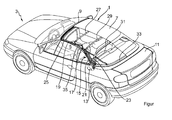
- FIGURE of the drawing shows a simplified perspective view of a convertible top of a convertible vehicle having a plurality of roof elements having a wood component.
- the illustrated in the figure of the drawing designed as a soft-top top 1 convertible top of a convertible vehicle 3 is shown in a closed position, which is formed with a flexible top cloth 7 top 3 between a passenger compartment 5 covering the closed position and a Passenger compartment 5 releasing open position can be transferred.
- the top 3 In the illustrated closed position, the top 3 extends from its vehicle front side arrangement on a windshield frame 9 up to its vehicle rear-side arrangement on a trunk lid 11.
- the top 3 is arranged by means of a top linkage 15 to a main bearing 13, wherein the top linkage 15 is formed with symmetrically arranged to a vehicle longitudinal side frame members 17, 19 of the top linkage 15.
- a rear side frame member 17 is supported at one end about a main column 21 and a main link 23 pivotally mounted on the main bearing 13 and the other end hingedly connected to the front side frame members 19.
- the front side frame elements 19 are connected in a vehicle front side region via a rooftop 25 which can be fixed to the windshield frame 9 in the illustrated closed position.
- the side frame elements 17, 19 are connected to one another via roof skirts 27, 29, 31 extending in the vehicle transverse direction.
- a clamping bracket 33 which is provided in the illustrated closed position of the top 1 to hold the flexible top cloth 7 in a cocked position.
- both the side frame members 17, 19, the main link 23, the roof top 25, and handlebars 35 of the top linkage 15 each have a wood component, which is formed with a wood construction material and manufactured in an injection molding process.
- the clamping bracket 33 and the roof bow 27, 29, 31 are in this case made of a metallic base material.
- the roof elements 17, 19, 23, 25, 35 formed with a wood building material are in the present case formed from liquid wood, which is impregnated with a synthetic resin.
- Wood fibers of the Wood component are each such in the respective top member 17, 19, 23, 25, 35 arranged that a fiber direction in the direction of a main load direction of the respective top member 17, 19, 23, 25, 35 shows, so that the top member 17, 19, 23 , 25, 35 withstands the respective loads.
- the wood component In order to prevent water absorption by the respective wood component, the wood component is present in each case completely surrounded by a plastic. As a result, an odor propagation is prevented by the wood construction material.
- the top elements 17, 19, 23, 25, 35 have according to conventionally designed top elements respectively attachment points for connecting other components to the respective top member 17, 19, 23, 25, 35 and bearing points, by means of which the top elements 17, 19, 23, 25 , 35 are connected to other components.
Landscapes
- Engineering & Computer Science (AREA)
- Mechanical Engineering (AREA)
- Body Structure For Vehicles (AREA)
- Injection Moulding Of Plastics Or The Like (AREA)
- Seal Device For Vehicle (AREA)
Abstract
Description
- Die Erfindung betrifft ein Verdeckelement für ein Verdeck eines Cabriolet-Fahrzeugs aus der Bauteilgruppe Lenker, Dachspriegel, Dachspitze und Dachrahmen nach der im Oberbegriff des Patentanspruches 1 näher definierten Art.
- Aus der Praxis sind beispielsweise mit Vollmaterial oder als Hohlprofile ausgebildete Verdeckelemente bei Verdecken von Cabriolet-Fahrzeugen bekannt. Derartige Hohlprofile sind insbesondere als Strangpressprofilbauteile ausgebildet und werden mit entsprechenden Umformvorgängen hergestellt. Weiterhin sind mit Blechen ausgebildete Verdeckelemente bekannt, wobei die Bleche zur Bildung der Verdeckelemente miteinander verschweißt, vernietet oder vergleichbar miteinander verbunden sind.
- Nachteilhafterweise weisen derartig ausgebildete Verdeckelemente meist ein hohes Gewicht auf und/oder sind in der Herstellung relativ teuer.
- Es ist Aufgabe der vorliegenden Erfindung, ein Verdeckelement für ein Verdeck eines Cabriolet-Fahrzeugs zu schaffen, welches auf einfache Weise herstellbar ist und insbesondere ein geringes Gewicht aufweist.
- Diese Aufgabe wird mit einem Verdeckelement für ein Verdeck eines Cabriolet-Fahrzeugs nach den Merkmalen des Patentanspruches 1 gelöst.
- Vorteilhafte Weiterbildungen eines Verdeckelements für ein Verdeck eines Cabriolet-Fahrzeugs nach der Erfindung ergeben sich aus den Unteransprüchen.
- Die Erfindung sieht somit ein Verdeckelement für ein Verdeck eines Cabriolet-Fahrzeugs aus der Bauteilgruppe Lenker, Dachspriegel, Dachspitze und Dachrahmen vor, wobei das Verdeckelement erfindungsgemäß wenigstens einen Holzbestandteil aufweist, der wenigstens teilweise mit einem Holzbaustoff ausgebildet ist.
- Ein erfindungsgemäßes Verdeckelement, welches sowohl bei Soft-Top-Verdecken als auch bei Hard-Top-Verdecken eingesetzt werden kann, weist gegenüber herkömmlich hergestellten Verdeckelementen ein vorteilhafterweise geringes Gewicht auf und ist kostengünstig auch in einer Serienproduktion herstellbar.
- Ein Vorteil von Holz liegt in seiner leichten Zerspanbarkeit, so dass der Holzbestandteil insbesondere im Prototypenbau auf einfache Weise in automatisierten Prozessen, beispielsweise mittels CNC-Maschinen, aus einem ungeformten Rohmaterial herstellbar ist.
- Neben der Leichtbauweise sind in die Holzbauteile besonders einfach Funktionen integrierbar, wobei die Holzbauteile hinsichtlich einer Korrosion unempfindlich sind und somit eine optimierte Lebensdauer aufweisen. Auch hinsichtlich eines Packages sind die Holzbauteile gegenüber herkömmlichen Bauteilen vorteilhaft.
- Unter Umweltgesichtspunkten zeichnen sich erfindungsgemäße Verdeckelemente gegenüber herkömmlich hergestellten Verdeckelementen dadurch aus, dass sie regenerativ sind und aus recyclebarem Material bestehen.
- Das erfindungsgemäße Verdeckelement kann dabei sämtliche Gestängeelemente des Verdecks darstellen, unter anderem auch Anbindungslenker einer Heckscheibe. Auch Verschlüsse und Lagerstellen, d. h. Hülsen und Buchsen der Bauteilgruppe aus Lenker, Dachspriegel, Dachspitze und Dachrahmen eignen sich zur Ausbildung aus oder mit einem Holzbaustoff.
- Der Holzbaustoff kann grundsätzlich Holz an sich oder ein Holzwerkstoff sein, welcher durch Zerkleinern von Holz und anschließendem Zusammenfügen der Strukturelemente, gegebenenfalls bei Mischung verschiedenartiger Holzpartikelformen, mit natürlichen und synthetischen Bindemitteln und evtl. Zugabe weiterer Additive hergestellt wird.
- Der Holzbestandteil kann bei einer vorteilhaften Ausbildung einen tragenden Bestandteil des Verdeckelements darstellen und die auf das Verdeckelement wirkenden Kräfte im Wesentlichen alleine aufnehmen.
- Als bevorzugte Ausgangsmaterialien zur Herstellung des Holzbestandteils hat es sich erwiesen, wenn der Holzbestandteil wenigstens teilweise mit Formholz, Schichtholz oder Flüssigholz oder einem Verbund daraus ausgebildet ist.
- Um das jeweilige Verdeckelement optimal auf die in seiner Gebrauchssituation auf das Verdeckelement wirkenden Belastungen einzustellen, kann bei einer vorteilhaften Ausbildung der Erfindung vorgesehen sein, dass der Holzbestandteil wenigstens ein weiteres Element aufweist. Dieses weitere Element ist dabei vorzugsweise als Metallelement ausgebildet und insbesondere mäanderförmig oder zackenförmig in oder an dem Holzbestandteil angeordnet. Mittels des weiteren Elements kann der Holzbestandteil insbesondere in Bereichen, auf die in Gebrauchssituation hohe Kräfte wirken, verstärkt werden, wobei das Metallteil hierzu beispielsweise in der Art einer Feder in Holzfaserrichtung in dem Holzbauteil angeordnet ist. Zur Optimierung der mechanischen Eigenschaften des Holzbestandteils kann es bei einer vorteilhaften Weiterbildung der Erfindung vorgesehen sein, dass der Holzbestandteil mit einem Verbundmaterial ausgebildet ist, welches den Holzbaustoff und wenigstens einen weiteren Werkstoff aufweist. Hierbei können insbesondere Werkstoffe zum Einsatz kommen, welche den Holzbestandteil hinsichtlich seiner Struktur, seiner Festigkeit oder seines Designs vorteilhaft beeinflussen und weiterbilden.
- Insbesondere vorteilhaft ist es dabei, wenn in den Holzbaustoff des Holzbestandteils wenigstens eine Faser, insbesondere eine Glasfaser, eine Kohlefaser, eine Metallfaser oder eine Prepregfaser, eingelagert ist, wobei diese sowohl geordnet als auch ungeordnet, als Einzelfilament, als Gewebe, als Gestricke und/oder Gewirke mit dem Holzbaustoff zusammenwirken können.
- Eine erhöhte Festigkeit des Holzbestandteils kann bei einer einfachen Ausbildung der Erfindung erreicht werden, wenn der Holzbaustoff des Holzbestandteils einen Holz-Kunststoff-Verbundwerkstoff bildet und z. B. in eine Kunststoffmatrix eingelagert ist.
- Verbesserte mechanische Eigenschaften eines erfindungsgemäßen Verdeckelements können auch dadurch erreicht werden, dass der Holzbaustoff des Holzbestandteils wenigstens bereichsweise mit einem Harz, insbesondere einem Kunstharz, getränkt ist. Hierbei könnte beispielsweise ein Lenker des Verdecks aus einem Vollholz gefertigt und anschließend in Kunstharz getränkt werden. Eine Faserstruktur des Holzes, welche für die Stabilität des Holzbestandteils wichtig ist, bleibt dabei vorteilhafterweise erhalten.
- Insbesondere um eine Wasseraufnahme durch den Holzbestandteil zu vermeiden und eine Geruchsabgabe des Holzbestandteils zu dämmen, kann der Holzbestandteil bei einer vorteilhaften Weiterbildung der Erfindung wenigstens teilweise, insbesondere vollständig ummantelt sein.
- Besonders einfach ist eine derartige Ummantelung herstellbar, wenn der Holzbestandteil mit einem Kunststoff ummantelt ist, da eine derartige Ummantelung auf besonders effektive Weise wasserabweisend ist.
- Um eine Anbindung von anderen Bauteilen an das erfindungsgemäße Verdeckelement zu erleichtern, kann es bei einer Weiterbildung der Erfindung vorgesehen sein, dass an dem Holzbestandteil Anbindungsstellen für andere Bauteile vorgesehen sind. Diese Anbindungsstellen, welche beispielsweise als Gewinde oder Bohrungen ausgebildet sein können, sind auf einfache Weise herstellbar.
- Zur Anbindung des Holzbestandteils an weitere Bauteile kann es vorgesehen sein, dass an dem Holzbestandteil Lagerstellen für das Verdeckelement vorgesehen sind, mittels denen das Verdeckelement beispielsweise gelenkig oder fest an den weiteren Bauteilen anordenbar ist. Ebenso wie Anbindungsstellen sind auch Lagerstellen durch die einfache Zerspanbarkeit des Holzbestandteils sehr einfach und damit auch kostengünstig herstellbar.
- Eine weiter erhöhte Stabilität des Verdeckelements kann bei einer vorteilhaften Ausbildung der Erfindung erreicht werden, indem eine Faserstruktur des Holzbestandteils im Wesentlichen entlang einer Hauptbelastungsrichtung des Verdeckelements in seiner Gebrauchsposition ausgerichtet ist.
- Besonders kostengünstig kann ein erfindungsgemäßes Verdeckelement hergestellt werden, wenn der Holzbestandteil mittels eines Strangpressens oder eines Spritzgießens hergestellt ist. Derartig hergestellte Verdeckelemente eignen sich insbesondere zum Einsatz für eine Serienherstellung. Da bei einer Herstellung von Verdeckelementen aus Holzbaustoffen mittels Spritzgießens bereits eine niedrigere Temperatur als bei einer Herstellung von Verdeckelementen aus Metallen, insbesondere Aluminium oder Magnesium, mittels Spritzgießens ausreichend ist, ist der Produktionsprozess eines erfindungsgemäß hergestellten Verdeckelements zudem vorteilhafterweise günstig.
- Weitere Vorteile und vorteilhafte Ausführungen eines Verdeckelements nach der Erfindung ergeben sich aus der Zeichnung und der Beschreibung.
- Nachfolgend ist ein vorteilhaftes Ausführungsbeispiel eines erfindungsgemäßen Verdeckelements anhand der Zeichnung prinzipmäßig beschrieben.
- Die einzige Figur der Zeichnung zeigt eine vereinfachte perspektivische Ansicht eines Verdecks eines Cabriolet-Fahrzeugs mit mehreren einen Holzbestandteil aufweisenden Verdeckelementen.
- Das in der Figur der Zeichnung dargestellte, als Soft-Top-Verdeck 1 ausgebildete Verdeck eines Cabriolet-Fahrzeugs 3 ist in einer geschlossenen Position gezeigt, wobei das mit einem flexiblen Verdeckbezug 7 ausgebildete Verdeck 3 zwischen der einen Fahrgastraum 5 überdeckenden geschlossenen Position und einer den Fahrgastraum 5 freigebenden offenen Position überführt werden kann. In der dargestellten geschlossenen Position erstreckt sich das Verdeck 3 von seiner fahrzeugfrontseitigen Anordnung an einem Windschutzscheibenrahmen 9 bis zu seiner fahrzeugheckseitigen Anordnung an einem Heckdeckel 11.
- Das Verdeck 3 ist mittels eines Verdeckgestänges 15 an einem Hauptlager 13 angeordnet, wobei das Verdeckgestänge 15 mit symmetrisch zu einer Fahrzeuglängsachse angeordneten Seitenrahmenelementen 17, 19 des Verdeckgestänges 15 ausgebildet ist. Ein hinteres Seitenrahmenelement 17 ist dabei einenends über eine Hauptsäule 21 und einen Hauptlenker 23 schwenkbeweglich an dem Hauptlager 13 abgestützt und andernends gelenkig mit den vorderen Seitenrahmenelementen 19 verbunden.
- Die vorderen Seitenrahmenelemente 19 sind in einem fahrzeugfrontseitigen Bereich über eine in der dargestellten Schließstellung an dem Windschutzscheibenrahmen 9 festlegbare Dachspitze 25 verbunden. Heckwärts davon sind die Seitenrahmenelemente 17, 19 über jeweils in Fahrzeugquerrichtung verlaufende Dachspriegel 27, 29, 31 miteinander verbunden.
- Ebenfalls an dem Hauptlager 13 angelenkt ist ein Spannbügel 33, welcher in der dargestellten geschlossenen Position des Verdecks 1 dazu vorgesehen ist, den flexiblen Verdeckbezug 7 in einer gespannten Position zu halten.
- Bei dem vorliegenden Ausführungsbeispiel weisen sowohl die Seitenrahmenelemente 17, 19, der Hauptlenker 23, die Dachspitze 25, sowie Lenker 35 des Verdeckgestänges 15 jeweils einen Holzbestandteil auf, welcher mit einem Holzbaustoff ausgebildet und in einem Spritzgießverfahren hergestellt ist. Der Spannbügel 33 sowie die Dachspriegel 27, 29, 31 sind vorliegend aus einem metallischen Grundstoff gefertigt.
- Die mit einem Holzbaustoff ausgebildeten Verdeckelemente 17, 19, 23, 25, 35 sind vorliegend aus Flüssigholz gebildet, welches mit einem Kunstharz getränkt ist. Holzfasern des Holzbestandteils sind dabei jeweils derart in dem jeweiligen Verdeckelement 17, 19, 23, 25, 35 angeordnet, dass eine Faserrichtung in Richtung einer Hauptbelastungsrichtung des jeweiligen Verdeckelements 17, 19, 23, 25, 35 zeigt, so dass das Verdeckelement 17, 19, 23, 25, 35 den jeweiligen Belastungen standhält.
- Um eine Wasseraufnahme durch den jeweiligen Holzbestandteil zu verhindern, ist der Holzbestandteil vorliegend jeweils von einem Kunststoff vollständig ummantelt. Hierdurch wird auch eine Geruchsausbreitung durch den Holzbaustoff verhindert.
- Die Verdeckelemente 17, 19, 23, 25, 35 weisen entsprechend herkömmlich ausgebildeten Verdeckelementen jeweils Anbindungsstellen zur Anbindung weiterer Bauteile an das jeweilige Verdeckelement 17, 19, 23, 25, 35 und Lagerstellen auf, mittels denen die Verdeckelemente 17, 19, 23, 25, 35 mit weiteren Bauteilen verbunden sind.
Claims (14)
- Verdeckelement für ein Verdeck (1) eines Cabriolet-Fahrzeugs (3) aus der Bauteilgruppe Lenker (23, 35), Dachspriegel (27, 29, 31), Dachspitze (25) und Dachrahmen (17, 19),
dadurch gekennzeichnet,
dass das Verdeckelement (17, 19, 23, 25, 27, 29, 31, 35) wenigstens einen Holzbestandteil aufweist, der wenigstens teilweise mit einem Holzbaustoff ausgebildet ist. - Verdeckelement nach Anspruch 1,
dadurch gekennzeichnet,
dass der Holzbestandteil wenigstens teilweise mit Formholz, Flüssigholz oder Schichtholz oder einem Verbund daraus ausgebildet ist. - Verdeckelement nach einem der Ansprüche 1 oder 2,
dadurch gekennzeichnet,
dass der Holzbestandteil wenigstens ein weiteres Element aufweist. - Verdeckelement nach Anspruch 3,
dadurch gekennzeichnet,
dass das weitere Element als Metallelement ausgebildet ist und insbesondere mäanderförmig oder zackenförmig in oder an dem Holzbestandteil angeordnet ist. - Verdeckelement nach einem der Ansprüche 1 bis 4,
dadurch gekennzeichnet,
dass der Holzbestandteil mit einem Verbundmaterial ausgebildet ist, welches den Holzbaustoff und wenigstens einen weiteren Werkstoff aufweist. - Verdeckelement nach einem der Ansprüche 1 bis 5,
dadurch gekennzeichnet,
dass in den Holzbaustoff des Holzbestandteils wenigstens eine Faser, insbesondere eine Glasfaser, eine Kohlefaser, eine Metallfaser oder eine Prepregfaser, eingelagert ist. - Verdeckelement nach einem der Ansprüche 1 bis 6,
dadurch gekennzeichnet,
dass der Holzbaustoff des Holzbestandteils in einer Kunststoffmatrix eingelagert ist. - Verdeckelement nach einem der Ansprüche 1 bis 7,
dadurch gekennzeichnet,
dass der Holzbaustoff des Holzbestandteils wenigstens bereichsweise mit einem Harz, insbesondere einem Kunstharz, getränkt ist. - Verdeckelement nach einem der Ansprüche 1 bis 8,
dadurch gekennzeichnet,
dass der Holzbestandteil wenigstens teilweise, insbesondere vollständig ummantelt ist. - Verdeckelement nach Anspruch 9,
dadurch gekennzeichnet,
dass der Holzbestandteil mit einem Kunststoff vollständig ummantelt ist. - Verdeckelement nach einem der Ansprüche 1 bis 10,
dadurch gekennzeichnet,
dass an dem Holzbestandteil Anbindungsstellen für andere Bauteile vorgesehen sind. - Verdeckelement nach einem der Ansprüche 1 bis 11,
dadurch gekennzeichnet,
dass an dem Holzbestandteil Lagerstellen für das Verdeckelement vorgesehen sind. - Verdeckelement nach einem der Ansprüche 1 bis 12, dadurch gekennzeichnet,
dass eine Faserstruktur des Holzbestandteils im Wesentlichen entlang einer Hauptbelastungsrichtung des Verdeckelements (17, 19, 23, 25, 27, 29, 31, 35) in seiner Gebrauchsposition ausgerichtet ist. - Verdeckelement nach einem der Ansprüche 1 bis 13, dadurch gekennzeichnet,
dass der Holzbestandteil mittels eines Strangpressens oder eines Spritzgießens hergestellt ist.
Applications Claiming Priority (1)
| Application Number | Priority Date | Filing Date | Title |
|---|---|---|---|
| DE200910053730 DE102009053730A1 (de) | 2009-11-18 | 2009-11-18 | Verdeckelement für ein Verdeck eines Cabriolet-Fahrzeugs |
Publications (3)
| Publication Number | Publication Date |
|---|---|
| EP2327578A2 true EP2327578A2 (de) | 2011-06-01 |
| EP2327578A3 EP2327578A3 (de) | 2012-09-12 |
| EP2327578B1 EP2327578B1 (de) | 2014-01-08 |
Family
ID=43543794
Family Applications (1)
| Application Number | Title | Priority Date | Filing Date |
|---|---|---|---|
| EP20100191776 Not-in-force EP2327578B1 (de) | 2009-11-18 | 2010-11-18 | Verdeckelement für ein Verdeck eines Cabriolet-Fahrzeugs |
Country Status (2)
| Country | Link |
|---|---|
| EP (1) | EP2327578B1 (de) |
| DE (1) | DE102009053730A1 (de) |
Family Cites Families (9)
| Publication number | Priority date | Publication date | Assignee | Title |
|---|---|---|---|---|
| GB236334A (en) * | 1924-05-12 | 1925-07-09 | Autohoods Ltd | Improvements in tubular or channel elements of framed structures, and particularly vehicle hoods |
| FR600474A (fr) * | 1924-10-02 | 1926-02-08 | Armature métallique tubulaire, pour cerceaux de capotes de voitures et autres applications, avec âme en bois ou matière analogue, susceptible de recevoir des clous ou vis de fixation | |
| GB308889A (en) * | 1928-03-17 | 1929-04-04 | Standard Motor Co Ltd | Roofs for vehicle bodies |
| US1816924A (en) * | 1928-05-12 | 1931-08-04 | Carl E E Wolfermann | Collapsible roof body for automobiles |
| GB413467A (en) * | 1933-05-09 | 1934-07-19 | Ernest Metcalfe | Improvements in and connected with folding hoods for motor vehicles |
| GB631047A (en) * | 1947-08-12 | 1949-10-26 | E D Abbott Ltd | Improvements in motor-vehicle bodies of the folding-head type |
| DE8909984U1 (de) * | 1989-08-21 | 1989-10-05 | Ostermann, Wilfried, 4530 Ibbenbüren | Cabrio-Klappverdeck |
| DE20318074U1 (de) * | 2003-11-21 | 2004-02-26 | Czichowski, Norbert | Hardtop für ein Cabriolet |
| DE102006055189A1 (de) * | 2006-11-23 | 2008-05-29 | Dr.Ing.H.C. F. Porsche Ag | Verdeck für ein Cabriolet |
-
2009
- 2009-11-18 DE DE200910053730 patent/DE102009053730A1/de not_active Withdrawn
-
2010
- 2010-11-18 EP EP20100191776 patent/EP2327578B1/de not_active Not-in-force
Non-Patent Citations (1)
| Title |
|---|
| None |
Also Published As
| Publication number | Publication date |
|---|---|
| DE102009053730A1 (de) | 2011-05-19 |
| EP2327578A3 (de) | 2012-09-12 |
| EP2327578B1 (de) | 2014-01-08 |
Similar Documents
| Publication | Publication Date | Title |
|---|---|---|
| DE102011083617B4 (de) | Kunststoff-Verbund-Stoßstangenträger für ein Fahrzeug | |
| DE102007053120B4 (de) | Fahrzeug-Radträger, insbesondere Achsschenkel oder Schwenklager, aus einem Faserverbundwerkstoff, sowie Herstellverfahren hierfür | |
| EP2782811B1 (de) | Leichtbauelement für eine karosserie | |
| DE102010013784B4 (de) | Außenhaut-Element zur Kraftfahrzeug-Karosserieverkleidung | |
| DE102007053353B4 (de) | Karosseriesäule für Fahrzeuge und Fahrzeugkarosserie | |
| DE102008006006A1 (de) | Hilfsrahmen | |
| DE102009057734A1 (de) | Verfahren zum Herstellen eines Rohbaus eines Kraftwagens sowie Rohbau für einen Kraftwagen | |
| DE102009053979A1 (de) | Karosserie für einen Kraftwagen | |
| WO2014166733A1 (de) | Dachrahmenbauteil eines dachöffnungssystems eines fahrzeugs | |
| DE102007053569A1 (de) | Vorrichtung zum Schutz des Motorraumes eines Kraftfahrzeugs | |
| DE102007039482B4 (de) | Kopplungseinrichtung | |
| DE10162758B4 (de) | Windschott für ein Cabriolet | |
| DE102006048291A1 (de) | Tragwanne für einen Lastkraftwagen | |
| EP2327578B1 (de) | Verdeckelement für ein Verdeck eines Cabriolet-Fahrzeugs | |
| EP1083071B1 (de) | Verdeckelement eines Cabrioverdecks und Cabrioverdeck | |
| EP1997716B1 (de) | Faserverbundwerkstoffprofil und Kraftfahrzeugscheibenrahmen | |
| DE102015115162B4 (de) | Scharnier für einen Deckel eines Kraftfahrzeugs | |
| EP1997721B1 (de) | Faserverbundwerkstoffprofil und Kraftfahrzeugscheibenrahmen | |
| DE102013000937A1 (de) | Dachrahmen und Verfahren zur Herstellung eines Dachrahmens | |
| DE102009047970A1 (de) | Faltverdeck für einen Personenkraftwagen | |
| DE102013204953A1 (de) | Baugruppe einer Kraftfahrzeugkarosserie | |
| DE102012024281B3 (de) | Zug-Druck-Strebe in einer Unterbodenstruktur eines Straßenfahrzeugs | |
| DE102009002777A1 (de) | Versteifungsstrebe | |
| DE102009005035B4 (de) | Faltverdeck für einen Personenkraftwagen | |
| DE102006053505A1 (de) | Panoramahubdach für ein Kraftfahrzeug, sowie Verfahren zur Herstellung eines Kraftfahrzeuges mit einem Panoramahubdach |
Legal Events
| Date | Code | Title | Description |
|---|---|---|---|
| PUAI | Public reference made under article 153(3) epc to a published international application that has entered the european phase |
Free format text: ORIGINAL CODE: 0009012 |
|
| AK | Designated contracting states |
Kind code of ref document: A2 Designated state(s): AL AT BE BG CH CY CZ DE DK EE ES FI FR GB GR HR HU IE IS IT LI LT LU LV MC MK MT NL NO PL PT RO RS SE SI SK SM TR |
|
| AX | Request for extension of the european patent |
Extension state: BA ME |
|
| PUAL | Search report despatched |
Free format text: ORIGINAL CODE: 0009013 |
|
| AK | Designated contracting states |
Kind code of ref document: A3 Designated state(s): AL AT BE BG CH CY CZ DE DK EE ES FI FR GB GR HR HU IE IS IT LI LT LU LV MC MK MT NL NO PL PT RO RS SE SI SK SM TR |
|
| AX | Request for extension of the european patent |
Extension state: BA ME |
|
| RIC1 | Information provided on ipc code assigned before grant |
Ipc: B60J 7/185 20060101ALI20120809BHEP Ipc: B60J 7/16 20060101ALI20120809BHEP Ipc: B60J 7/14 20060101ALI20120809BHEP Ipc: B60J 7/12 20060101AFI20120809BHEP |
|
| 17P | Request for examination filed |
Effective date: 20121113 |
|
| RAP1 | Party data changed (applicant data changed or rights of an application transferred) |
Owner name: VALMET AUTOMOTIVE OY |
|
| GRAP | Despatch of communication of intention to grant a patent |
Free format text: ORIGINAL CODE: EPIDOSNIGR1 |
|
| RIC1 | Information provided on ipc code assigned before grant |
Ipc: B60J 7/14 20060101ALI20130527BHEP Ipc: B60J 7/12 20060101AFI20130527BHEP Ipc: B60J 7/16 20060101ALI20130527BHEP Ipc: B60J 7/185 20060101ALI20130527BHEP |
|
| INTG | Intention to grant announced |
Effective date: 20130625 |
|
| GRAS | Grant fee paid |
Free format text: ORIGINAL CODE: EPIDOSNIGR3 |
|
| GRAA | (expected) grant |
Free format text: ORIGINAL CODE: 0009210 |
|
| AK | Designated contracting states |
Kind code of ref document: B1 Designated state(s): AL AT BE BG CH CY CZ DE DK EE ES FI FR GB GR HR HU IE IS IT LI LT LU LV MC MK MT NL NO PL PT RO RS SE SI SK SM TR |
|
| REG | Reference to a national code |
Ref country code: GB Ref legal event code: FG4D Free format text: NOT ENGLISH |
|
| REG | Reference to a national code |
Ref country code: CH Ref legal event code: EP |
|
| REG | Reference to a national code |
Ref country code: IE Ref legal event code: FG4D Free format text: LANGUAGE OF EP DOCUMENT: GERMAN |
|
| REG | Reference to a national code |
Ref country code: AT Ref legal event code: REF Ref document number: 648491 Country of ref document: AT Kind code of ref document: T Effective date: 20140215 |
|
| REG | Reference to a national code |
Ref country code: DE Ref legal event code: R096 Ref document number: 502010005875 Country of ref document: DE Effective date: 20140220 |
|
| REG | Reference to a national code |
Ref country code: NL Ref legal event code: VDEP Effective date: 20140108 |
|
| REG | Reference to a national code |
Ref country code: LT Ref legal event code: MG4D |
|
| PG25 | Lapsed in a contracting state [announced via postgrant information from national office to epo] |
Ref country code: IS Free format text: LAPSE BECAUSE OF FAILURE TO SUBMIT A TRANSLATION OF THE DESCRIPTION OR TO PAY THE FEE WITHIN THE PRESCRIBED TIME-LIMIT Effective date: 20140508 Ref country code: LT Free format text: LAPSE BECAUSE OF FAILURE TO SUBMIT A TRANSLATION OF THE DESCRIPTION OR TO PAY THE FEE WITHIN THE PRESCRIBED TIME-LIMIT Effective date: 20140108 Ref country code: NO Free format text: LAPSE BECAUSE OF FAILURE TO SUBMIT A TRANSLATION OF THE DESCRIPTION OR TO PAY THE FEE WITHIN THE PRESCRIBED TIME-LIMIT Effective date: 20140408 |
|
| PG25 | Lapsed in a contracting state [announced via postgrant information from national office to epo] |
Ref country code: PT Free format text: LAPSE BECAUSE OF FAILURE TO SUBMIT A TRANSLATION OF THE DESCRIPTION OR TO PAY THE FEE WITHIN THE PRESCRIBED TIME-LIMIT Effective date: 20140508 Ref country code: NL Free format text: LAPSE BECAUSE OF FAILURE TO SUBMIT A TRANSLATION OF THE DESCRIPTION OR TO PAY THE FEE WITHIN THE PRESCRIBED TIME-LIMIT Effective date: 20140108 Ref country code: SE Free format text: LAPSE BECAUSE OF FAILURE TO SUBMIT A TRANSLATION OF THE DESCRIPTION OR TO PAY THE FEE WITHIN THE PRESCRIBED TIME-LIMIT Effective date: 20140108 Ref country code: CY Free format text: LAPSE BECAUSE OF FAILURE TO SUBMIT A TRANSLATION OF THE DESCRIPTION OR TO PAY THE FEE WITHIN THE PRESCRIBED TIME-LIMIT Effective date: 20140108 Ref country code: ES Free format text: LAPSE BECAUSE OF FAILURE TO SUBMIT A TRANSLATION OF THE DESCRIPTION OR TO PAY THE FEE WITHIN THE PRESCRIBED TIME-LIMIT Effective date: 20140108 Ref country code: FI Free format text: LAPSE BECAUSE OF FAILURE TO SUBMIT A TRANSLATION OF THE DESCRIPTION OR TO PAY THE FEE WITHIN THE PRESCRIBED TIME-LIMIT Effective date: 20140108 |
|
| PG25 | Lapsed in a contracting state [announced via postgrant information from national office to epo] |
Ref country code: RS Free format text: LAPSE BECAUSE OF FAILURE TO SUBMIT A TRANSLATION OF THE DESCRIPTION OR TO PAY THE FEE WITHIN THE PRESCRIBED TIME-LIMIT Effective date: 20140108 Ref country code: HR Free format text: LAPSE BECAUSE OF FAILURE TO SUBMIT A TRANSLATION OF THE DESCRIPTION OR TO PAY THE FEE WITHIN THE PRESCRIBED TIME-LIMIT Effective date: 20140108 Ref country code: LV Free format text: LAPSE BECAUSE OF FAILURE TO SUBMIT A TRANSLATION OF THE DESCRIPTION OR TO PAY THE FEE WITHIN THE PRESCRIBED TIME-LIMIT Effective date: 20140108 |
|
| REG | Reference to a national code |
Ref country code: DE Ref legal event code: R097 Ref document number: 502010005875 Country of ref document: DE |
|
| PG25 | Lapsed in a contracting state [announced via postgrant information from national office to epo] |
Ref country code: CZ Free format text: LAPSE BECAUSE OF FAILURE TO SUBMIT A TRANSLATION OF THE DESCRIPTION OR TO PAY THE FEE WITHIN THE PRESCRIBED TIME-LIMIT Effective date: 20140108 Ref country code: EE Free format text: LAPSE BECAUSE OF FAILURE TO SUBMIT A TRANSLATION OF THE DESCRIPTION OR TO PAY THE FEE WITHIN THE PRESCRIBED TIME-LIMIT Effective date: 20140108 Ref country code: RO Free format text: LAPSE BECAUSE OF FAILURE TO SUBMIT A TRANSLATION OF THE DESCRIPTION OR TO PAY THE FEE WITHIN THE PRESCRIBED TIME-LIMIT Effective date: 20140108 Ref country code: DK Free format text: LAPSE BECAUSE OF FAILURE TO SUBMIT A TRANSLATION OF THE DESCRIPTION OR TO PAY THE FEE WITHIN THE PRESCRIBED TIME-LIMIT Effective date: 20140108 |
|
| PLBE | No opposition filed within time limit |
Free format text: ORIGINAL CODE: 0009261 |
|
| STAA | Information on the status of an ep patent application or granted ep patent |
Free format text: STATUS: NO OPPOSITION FILED WITHIN TIME LIMIT |
|
| PG25 | Lapsed in a contracting state [announced via postgrant information from national office to epo] |
Ref country code: SK Free format text: LAPSE BECAUSE OF FAILURE TO SUBMIT A TRANSLATION OF THE DESCRIPTION OR TO PAY THE FEE WITHIN THE PRESCRIBED TIME-LIMIT Effective date: 20140108 Ref country code: PL Free format text: LAPSE BECAUSE OF FAILURE TO SUBMIT A TRANSLATION OF THE DESCRIPTION OR TO PAY THE FEE WITHIN THE PRESCRIBED TIME-LIMIT Effective date: 20140108 |
|
| 26N | No opposition filed |
Effective date: 20141009 |
|
| REG | Reference to a national code |
Ref country code: DE Ref legal event code: R097 Ref document number: 502010005875 Country of ref document: DE Effective date: 20141009 |
|
| PG25 | Lapsed in a contracting state [announced via postgrant information from national office to epo] |
Ref country code: SI Free format text: LAPSE BECAUSE OF FAILURE TO SUBMIT A TRANSLATION OF THE DESCRIPTION OR TO PAY THE FEE WITHIN THE PRESCRIBED TIME-LIMIT Effective date: 20140108 |
|
| PG25 | Lapsed in a contracting state [announced via postgrant information from national office to epo] |
Ref country code: LU Free format text: LAPSE BECAUSE OF FAILURE TO SUBMIT A TRANSLATION OF THE DESCRIPTION OR TO PAY THE FEE WITHIN THE PRESCRIBED TIME-LIMIT Effective date: 20141118 Ref country code: BE Free format text: LAPSE BECAUSE OF NON-PAYMENT OF DUE FEES Effective date: 20141130 Ref country code: MC Free format text: LAPSE BECAUSE OF FAILURE TO SUBMIT A TRANSLATION OF THE DESCRIPTION OR TO PAY THE FEE WITHIN THE PRESCRIBED TIME-LIMIT Effective date: 20140108 |
|
| REG | Reference to a national code |
Ref country code: CH Ref legal event code: PL |
|
| GBPC | Gb: european patent ceased through non-payment of renewal fee |
Effective date: 20141118 |
|
| PG25 | Lapsed in a contracting state [announced via postgrant information from national office to epo] |
Ref country code: LI Free format text: LAPSE BECAUSE OF NON-PAYMENT OF DUE FEES Effective date: 20141130 Ref country code: CH Free format text: LAPSE BECAUSE OF NON-PAYMENT OF DUE FEES Effective date: 20141130 |
|
| REG | Reference to a national code |
Ref country code: IE Ref legal event code: MM4A |
|
| PG25 | Lapsed in a contracting state [announced via postgrant information from national office to epo] |
Ref country code: GB Free format text: LAPSE BECAUSE OF NON-PAYMENT OF DUE FEES Effective date: 20141118 Ref country code: IE Free format text: LAPSE BECAUSE OF NON-PAYMENT OF DUE FEES Effective date: 20141118 |
|
| REG | Reference to a national code |
Ref country code: FR Ref legal event code: PLFP Year of fee payment: 6 |
|
| PG25 | Lapsed in a contracting state [announced via postgrant information from national office to epo] |
Ref country code: SM Free format text: LAPSE BECAUSE OF FAILURE TO SUBMIT A TRANSLATION OF THE DESCRIPTION OR TO PAY THE FEE WITHIN THE PRESCRIBED TIME-LIMIT Effective date: 20140108 |
|
| PG25 | Lapsed in a contracting state [announced via postgrant information from national office to epo] |
Ref country code: BG Free format text: LAPSE BECAUSE OF FAILURE TO SUBMIT A TRANSLATION OF THE DESCRIPTION OR TO PAY THE FEE WITHIN THE PRESCRIBED TIME-LIMIT Effective date: 20140108 Ref country code: IT Free format text: LAPSE BECAUSE OF FAILURE TO SUBMIT A TRANSLATION OF THE DESCRIPTION OR TO PAY THE FEE WITHIN THE PRESCRIBED TIME-LIMIT Effective date: 20140108 Ref country code: GR Free format text: LAPSE BECAUSE OF FAILURE TO SUBMIT A TRANSLATION OF THE DESCRIPTION OR TO PAY THE FEE WITHIN THE PRESCRIBED TIME-LIMIT Effective date: 20140409 |
|
| PG25 | Lapsed in a contracting state [announced via postgrant information from national office to epo] |
Ref country code: HU Free format text: LAPSE BECAUSE OF FAILURE TO SUBMIT A TRANSLATION OF THE DESCRIPTION OR TO PAY THE FEE WITHIN THE PRESCRIBED TIME-LIMIT; INVALID AB INITIO Effective date: 20101118 Ref country code: MT Free format text: LAPSE BECAUSE OF FAILURE TO SUBMIT A TRANSLATION OF THE DESCRIPTION OR TO PAY THE FEE WITHIN THE PRESCRIBED TIME-LIMIT Effective date: 20140108 Ref country code: TR Free format text: LAPSE BECAUSE OF FAILURE TO SUBMIT A TRANSLATION OF THE DESCRIPTION OR TO PAY THE FEE WITHIN THE PRESCRIBED TIME-LIMIT Effective date: 20140108 |
|
| REG | Reference to a national code |
Ref country code: AT Ref legal event code: MM01 Ref document number: 648491 Country of ref document: AT Kind code of ref document: T Effective date: 20151118 |
|
| REG | Reference to a national code |
Ref country code: FR Ref legal event code: PLFP Year of fee payment: 7 |
|
| PG25 | Lapsed in a contracting state [announced via postgrant information from national office to epo] |
Ref country code: AT Free format text: LAPSE BECAUSE OF NON-PAYMENT OF DUE FEES Effective date: 20151118 |
|
| PGFP | Annual fee paid to national office [announced via postgrant information from national office to epo] |
Ref country code: DE Payment date: 20170125 Year of fee payment: 7 Ref country code: FR Payment date: 20170130 Year of fee payment: 7 |
|
| REG | Reference to a national code |
Ref country code: DE Ref legal event code: R119 Ref document number: 502010005875 Country of ref document: DE |
|
| PG25 | Lapsed in a contracting state [announced via postgrant information from national office to epo] |
Ref country code: MK Free format text: LAPSE BECAUSE OF FAILURE TO SUBMIT A TRANSLATION OF THE DESCRIPTION OR TO PAY THE FEE WITHIN THE PRESCRIBED TIME-LIMIT Effective date: 20140108 |
|
| REG | Reference to a national code |
Ref country code: FR Ref legal event code: ST Effective date: 20180731 |
|
| PG25 | Lapsed in a contracting state [announced via postgrant information from national office to epo] |
Ref country code: AL Free format text: LAPSE BECAUSE OF FAILURE TO SUBMIT A TRANSLATION OF THE DESCRIPTION OR TO PAY THE FEE WITHIN THE PRESCRIBED TIME-LIMIT Effective date: 20140108 Ref country code: FR Free format text: LAPSE BECAUSE OF NON-PAYMENT OF DUE FEES Effective date: 20171130 Ref country code: DE Free format text: LAPSE BECAUSE OF NON-PAYMENT OF DUE FEES Effective date: 20180602 |