EP2325973A2 - Control system for electric vehicle, and electric vehicle equipped therewith - Google Patents
Control system for electric vehicle, and electric vehicle equipped therewith Download PDFInfo
- Publication number
- EP2325973A2 EP2325973A2 EP10191759A EP10191759A EP2325973A2 EP 2325973 A2 EP2325973 A2 EP 2325973A2 EP 10191759 A EP10191759 A EP 10191759A EP 10191759 A EP10191759 A EP 10191759A EP 2325973 A2 EP2325973 A2 EP 2325973A2
- Authority
- EP
- European Patent Office
- Prior art keywords
- electrical power
- storage device
- electricity storage
- load devices
- supplied
- Prior art date
- Legal status (The legal status is an assumption and is not a legal conclusion. Google has not performed a legal analysis and makes no representation as to the accuracy of the status listed.)
- Granted
Links
Images






Classifications
-
- B—PERFORMING OPERATIONS; TRANSPORTING
- B60—VEHICLES IN GENERAL
- B60L—PROPULSION OF ELECTRICALLY-PROPELLED VEHICLES; SUPPLYING ELECTRIC POWER FOR AUXILIARY EQUIPMENT OF ELECTRICALLY-PROPELLED VEHICLES; ELECTRODYNAMIC BRAKE SYSTEMS FOR VEHICLES IN GENERAL; MAGNETIC SUSPENSION OR LEVITATION FOR VEHICLES; MONITORING OPERATING VARIABLES OF ELECTRICALLY-PROPELLED VEHICLES; ELECTRIC SAFETY DEVICES FOR ELECTRICALLY-PROPELLED VEHICLES
- B60L1/00—Supplying electric power to auxiliary equipment of vehicles
- B60L1/003—Supplying electric power to auxiliary equipment of vehicles to auxiliary motors, e.g. for pumps, compressors
-
- B—PERFORMING OPERATIONS; TRANSPORTING
- B60—VEHICLES IN GENERAL
- B60L—PROPULSION OF ELECTRICALLY-PROPELLED VEHICLES; SUPPLYING ELECTRIC POWER FOR AUXILIARY EQUIPMENT OF ELECTRICALLY-PROPELLED VEHICLES; ELECTRODYNAMIC BRAKE SYSTEMS FOR VEHICLES IN GENERAL; MAGNETIC SUSPENSION OR LEVITATION FOR VEHICLES; MONITORING OPERATING VARIABLES OF ELECTRICALLY-PROPELLED VEHICLES; ELECTRIC SAFETY DEVICES FOR ELECTRICALLY-PROPELLED VEHICLES
- B60L1/00—Supplying electric power to auxiliary equipment of vehicles
- B60L1/02—Supplying electric power to auxiliary equipment of vehicles to electric heating circuits
-
- B—PERFORMING OPERATIONS; TRANSPORTING
- B60—VEHICLES IN GENERAL
- B60L—PROPULSION OF ELECTRICALLY-PROPELLED VEHICLES; SUPPLYING ELECTRIC POWER FOR AUXILIARY EQUIPMENT OF ELECTRICALLY-PROPELLED VEHICLES; ELECTRODYNAMIC BRAKE SYSTEMS FOR VEHICLES IN GENERAL; MAGNETIC SUSPENSION OR LEVITATION FOR VEHICLES; MONITORING OPERATING VARIABLES OF ELECTRICALLY-PROPELLED VEHICLES; ELECTRIC SAFETY DEVICES FOR ELECTRICALLY-PROPELLED VEHICLES
- B60L15/00—Methods, circuits, or devices for controlling the traction-motor speed of electrically-propelled vehicles
- B60L15/20—Methods, circuits, or devices for controlling the traction-motor speed of electrically-propelled vehicles for control of the vehicle or its driving motor to achieve a desired performance, e.g. speed, torque, programmed variation of speed
- B60L15/2045—Methods, circuits, or devices for controlling the traction-motor speed of electrically-propelled vehicles for control of the vehicle or its driving motor to achieve a desired performance, e.g. speed, torque, programmed variation of speed for optimising the use of energy
-
- B—PERFORMING OPERATIONS; TRANSPORTING
- B60—VEHICLES IN GENERAL
- B60L—PROPULSION OF ELECTRICALLY-PROPELLED VEHICLES; SUPPLYING ELECTRIC POWER FOR AUXILIARY EQUIPMENT OF ELECTRICALLY-PROPELLED VEHICLES; ELECTRODYNAMIC BRAKE SYSTEMS FOR VEHICLES IN GENERAL; MAGNETIC SUSPENSION OR LEVITATION FOR VEHICLES; MONITORING OPERATING VARIABLES OF ELECTRICALLY-PROPELLED VEHICLES; ELECTRIC SAFETY DEVICES FOR ELECTRICALLY-PROPELLED VEHICLES
- B60L58/00—Methods or circuit arrangements for monitoring or controlling batteries or fuel cells, specially adapted for electric vehicles
- B60L58/10—Methods or circuit arrangements for monitoring or controlling batteries or fuel cells, specially adapted for electric vehicles for monitoring or controlling batteries
- B60L58/12—Methods or circuit arrangements for monitoring or controlling batteries or fuel cells, specially adapted for electric vehicles for monitoring or controlling batteries responding to state of charge [SoC]
-
- H—ELECTRICITY
- H02—GENERATION; CONVERSION OR DISTRIBUTION OF ELECTRIC POWER
- H02J—ELECTRIC POWER NETWORKS; CIRCUIT ARRANGEMENTS OR SYSTEMS FOR SUPPLYING OR DISTRIBUTING ELECTRIC POWER; SYSTEMS FOR STORING ELECTRIC ENERGY
- H02J7/00—Circuit arrangements for charging or discharging batteries or for supplying loads from batteries
- H02J7/855—Circuit arrangements for charging or discharging batteries or for supplying loads from batteries with circuits adapted for supplying loads from the battery
-
- H—ELECTRICITY
- H02—GENERATION; CONVERSION OR DISTRIBUTION OF ELECTRIC POWER
- H02J—ELECTRIC POWER NETWORKS; CIRCUIT ARRANGEMENTS OR SYSTEMS FOR SUPPLYING OR DISTRIBUTING ELECTRIC POWER; SYSTEMS FOR STORING ELECTRIC ENERGY
- H02J7/00—Circuit arrangements for charging or discharging batteries or for supplying loads from batteries
- H02J7/865—Battery or charger load switching, e.g. concurrent charging and load supply
-
- H—ELECTRICITY
- H02—GENERATION; CONVERSION OR DISTRIBUTION OF ELECTRIC POWER
- H02J—ELECTRIC POWER NETWORKS; CIRCUIT ARRANGEMENTS OR SYSTEMS FOR SUPPLYING OR DISTRIBUTING ELECTRIC POWER; SYSTEMS FOR STORING ELECTRIC ENERGY
- H02J7/00—Circuit arrangements for charging or discharging batteries or for supplying loads from batteries
- H02J7/90—Regulation of charging or discharging current or voltage
- H02J7/96—Regulation of charging or discharging current or voltage in response to battery voltage
-
- B—PERFORMING OPERATIONS; TRANSPORTING
- B60—VEHICLES IN GENERAL
- B60L—PROPULSION OF ELECTRICALLY-PROPELLED VEHICLES; SUPPLYING ELECTRIC POWER FOR AUXILIARY EQUIPMENT OF ELECTRICALLY-PROPELLED VEHICLES; ELECTRODYNAMIC BRAKE SYSTEMS FOR VEHICLES IN GENERAL; MAGNETIC SUSPENSION OR LEVITATION FOR VEHICLES; MONITORING OPERATING VARIABLES OF ELECTRICALLY-PROPELLED VEHICLES; ELECTRIC SAFETY DEVICES FOR ELECTRICALLY-PROPELLED VEHICLES
- B60L2200/00—Type of vehicles
- B60L2200/26—Rail vehicles
-
- B—PERFORMING OPERATIONS; TRANSPORTING
- B60—VEHICLES IN GENERAL
- B60L—PROPULSION OF ELECTRICALLY-PROPELLED VEHICLES; SUPPLYING ELECTRIC POWER FOR AUXILIARY EQUIPMENT OF ELECTRICALLY-PROPELLED VEHICLES; ELECTRODYNAMIC BRAKE SYSTEMS FOR VEHICLES IN GENERAL; MAGNETIC SUSPENSION OR LEVITATION FOR VEHICLES; MONITORING OPERATING VARIABLES OF ELECTRICALLY-PROPELLED VEHICLES; ELECTRIC SAFETY DEVICES FOR ELECTRICALLY-PROPELLED VEHICLES
- B60L2240/00—Control parameters of input or output; Target parameters
- B60L2240/10—Vehicle control parameters
- B60L2240/34—Cabin temperature
-
- B—PERFORMING OPERATIONS; TRANSPORTING
- B60—VEHICLES IN GENERAL
- B60L—PROPULSION OF ELECTRICALLY-PROPELLED VEHICLES; SUPPLYING ELECTRIC POWER FOR AUXILIARY EQUIPMENT OF ELECTRICALLY-PROPELLED VEHICLES; ELECTRODYNAMIC BRAKE SYSTEMS FOR VEHICLES IN GENERAL; MAGNETIC SUSPENSION OR LEVITATION FOR VEHICLES; MONITORING OPERATING VARIABLES OF ELECTRICALLY-PROPELLED VEHICLES; ELECTRIC SAFETY DEVICES FOR ELECTRICALLY-PROPELLED VEHICLES
- B60L2240/00—Control parameters of input or output; Target parameters
- B60L2240/40—Drive Train control parameters
- B60L2240/42—Drive Train control parameters related to electric machines
- B60L2240/425—Temperature
-
- B—PERFORMING OPERATIONS; TRANSPORTING
- B60—VEHICLES IN GENERAL
- B60L—PROPULSION OF ELECTRICALLY-PROPELLED VEHICLES; SUPPLYING ELECTRIC POWER FOR AUXILIARY EQUIPMENT OF ELECTRICALLY-PROPELLED VEHICLES; ELECTRODYNAMIC BRAKE SYSTEMS FOR VEHICLES IN GENERAL; MAGNETIC SUSPENSION OR LEVITATION FOR VEHICLES; MONITORING OPERATING VARIABLES OF ELECTRICALLY-PROPELLED VEHICLES; ELECTRIC SAFETY DEVICES FOR ELECTRICALLY-PROPELLED VEHICLES
- B60L2260/00—Operating Modes
- B60L2260/40—Control modes
- B60L2260/50—Control modes by future state prediction
- B60L2260/56—Temperature prediction, e.g. for pre-cooling
-
- Y—GENERAL TAGGING OF NEW TECHNOLOGICAL DEVELOPMENTS; GENERAL TAGGING OF CROSS-SECTIONAL TECHNOLOGIES SPANNING OVER SEVERAL SECTIONS OF THE IPC; TECHNICAL SUBJECTS COVERED BY FORMER USPC CROSS-REFERENCE ART COLLECTIONS [XRACs] AND DIGESTS
- Y02—TECHNOLOGIES OR APPLICATIONS FOR MITIGATION OR ADAPTATION AGAINST CLIMATE CHANGE
- Y02T—CLIMATE CHANGE MITIGATION TECHNOLOGIES RELATED TO TRANSPORTATION
- Y02T10/00—Road transport of goods or passengers
- Y02T10/60—Other road transportation technologies with climate change mitigation effect
- Y02T10/64—Electric machine technologies in electromobility
-
- Y—GENERAL TAGGING OF NEW TECHNOLOGICAL DEVELOPMENTS; GENERAL TAGGING OF CROSS-SECTIONAL TECHNOLOGIES SPANNING OVER SEVERAL SECTIONS OF THE IPC; TECHNICAL SUBJECTS COVERED BY FORMER USPC CROSS-REFERENCE ART COLLECTIONS [XRACs] AND DIGESTS
- Y02—TECHNOLOGIES OR APPLICATIONS FOR MITIGATION OR ADAPTATION AGAINST CLIMATE CHANGE
- Y02T—CLIMATE CHANGE MITIGATION TECHNOLOGIES RELATED TO TRANSPORTATION
- Y02T10/00—Road transport of goods or passengers
- Y02T10/60—Other road transportation technologies with climate change mitigation effect
- Y02T10/70—Energy storage systems for electromobility, e.g. batteries
-
- Y—GENERAL TAGGING OF NEW TECHNOLOGICAL DEVELOPMENTS; GENERAL TAGGING OF CROSS-SECTIONAL TECHNOLOGIES SPANNING OVER SEVERAL SECTIONS OF THE IPC; TECHNICAL SUBJECTS COVERED BY FORMER USPC CROSS-REFERENCE ART COLLECTIONS [XRACs] AND DIGESTS
- Y02—TECHNOLOGIES OR APPLICATIONS FOR MITIGATION OR ADAPTATION AGAINST CLIMATE CHANGE
- Y02T—CLIMATE CHANGE MITIGATION TECHNOLOGIES RELATED TO TRANSPORTATION
- Y02T10/00—Road transport of goods or passengers
- Y02T10/60—Other road transportation technologies with climate change mitigation effect
- Y02T10/72—Electric energy management in electromobility
Definitions
- the present invention relates to a control system for an electric vehicle, and to an electric vehicle equipped with this control system.
- a plurality of load devices such as one or more electricity storage devices, an electric motor and a temperature regulation device, an electrical power conversion device and so on are mounted to an electric vehicle, and control of these load devices is performed on the basis of command values such as the amount with which an accelerator pedal or a brake pedal is depressed by the driver, a temperature setting, and so on.
- command values such as the amount with which an accelerator pedal or a brake pedal is depressed by the driver, a temperature setting, and so on.
- the greatest problem is to increase the range, and methods for increasing the range are, for example, to increase the amount of energy available by increasing the number of electricity storage devices mounted to the vehicle, to save energy by enhancing the efficiency of the load devices themselves, to save energy by enhancing the efficiency of control, and the like.
- Japanese Laid-Open Patent Publication 2008-070326 refer to Japanese Laid-Open Patent Publication 2008-070326 .
- control of the drive power with good energy efficiency is performed on the basis of the presumed path of travel.
- This presumption as to the path of travel is performed on the basis of a map in a navigation device or the like and sensor information, so that drive power control is performed on the basis of the presumed distance of travel and the average vehicle speed, and on the basis of road characteristic information such as gradients and so on.
- a control system for an electric vehicle comprises: an electricity storage device that performs charging and discharging of electrical power; a plurality of load devices that receive supply of electrical power from the electricity storage device and perform operations; and/or a control device that controls the electricity storage device and the plurality of load devices. And when electrical power is supplied from the electricity storage device to the plurality of load devices, the control device calculates a charge/discharge efficiency of the electricity storage device and/or a working efficiency of each of the load devices, and/or regulates an amount of electrical power supplied from the electricity storage device to each of the load devices, so as to enhance an overall efficiency of the electricity storage device and/or the plurality of load devices.
- a electric machine for propelling the electric vehicle is included in the plurality of load devices; and when the electrical power for driving the electric machine varies, the control device regulates the electrical power supplied from the electricity storage device to the load devices other than the electric machine, so as to enhance the overall efficiency with the electrical power for the electric machine having varied.
- a temperature regulation device that performs air conditioning of an interior of a passenger compartment or cooling of an onboard device is included in the load devices other than the electric machine; and the control device reduces the electrical power for driving the temperature regulation device when the electrical power for driving the electric machine has been increased, so that the overall efficiency after increase of the electrical power supplied to the electric machine is enhanced, and increases the electrical power for driving the temperature regulation device when the electrical power for driving the electric machine has been decreased, so that the overall efficiency after decrease of the electrical power supplied to the electric machine is enhanced.
- an electrical power conversion device that converts the electrical power of the electricity storage device and supplies electrical power to another electricity storage device is included in the load devices other than the electric machine; and the control device reduces the electrical power supplied to the power conversion device when the electrical power for driving the electric machine has been increased, so that the overall efficiency after increase of the electrical power supplied to the electric machine is enhanced, and increases the electrical power supplied to the power conversion device when the electrical power for driving the electric machine has been decreased, so that the overall efficiency after decrease of the electrical power supplied to the electric machine is enhanced.
- the control device when electrical power is supplied from the electricity storage device to the plurality of load devices, the control device regulates the electrical power supplied from the electricity storage device to each of the plurality of load devices, so as to reduce fluctuations of the electrical power discharged from the electricity storage device.
- the control device calculates electrical power requested to each of the load devices based upon an amount of actuation by a driver and a running state of the electric vehicle that are detected by a plurality of detectors.
- each of the load devices measures electric power used for actually being operated by using a plurality of detectors, and also calculates a working efficiency based upon the measured electrical power and the electrical powers that are supplied to each of the load devices.
- control device determines the electrical power to be supplied to each of the load devices by correcting the requested electrical power for each of the load device by the working efficiency of each of the load device.
- the control device forecasts a future running state of the electric vehicle based upon a current running state of the electric vehicle detected by a plurality of detectors and based upon road map information and position measurement information, also, based upon the future running state resulting from forecasting, forecasts electric power that will be supplied from the electricity storage device to each of the load devices and the charge/discharge efficiency of the electricity storage device and the working efficiency of each of the load devices that will accompany the forecasted electrical power, and regulates the electrical power supplied from the electricity storage device to each of the load devices in advance so as to enhance the overall efficiency in that future running state.
- the control device forecasts variation of the electric power that will be supplied for driving the electric machine based upon the future running state resulting from forecasting, and, for a load device other than the electric machine for which the electrical power to be supplied is regulated along with the variation of the electrical power supplied to the electric machine, temporarily increases in advance the electrical power supplied to the load device before the electrical power supplied to the electric machine increases, and temporarily reduces in advance the electrical power supplied to the load device before the electrical power supplied to the electric machine decreases.
- a temperature regulation device that performs air conditioning of the interior of a passenger compartment or cooling of an onboard device is included in the plurality of load devices; there is further provided a thermal storage device that accumulates heat or cold generated by the electricity storage device and the plurality of load devices; and the temperature regulation device performs heating or air conditioning of the interior of the passenger compartment and cooling of an onboard device using heat or cold accumulated in the thermal storage device, thus reducing the electrical power supplied from the electricity storage device to the temperature regulation device.
- a control system for an electric vehicle comprises: an electricity storage device that performs charging and discharging of electrical power; a plurality of load devices that receive supply of electrical power from the electricity storage device and perform various operations; and a control device that controls the electricity storage device and the plurality of load devices. And when electrical power is supplied from the electricity storage device to the plurality of load devices, the control device regulates an amount of electrical power supplied from the electricity storage device to each of the load devices, so as to reduce fluctuations of the electrical power discharged from the electricity storage device.
- a electric machine for propelling the electric vehicle is included in the plurality of load devices; and the control device regulates the electrical power supplied from the electricity storage device to a load device other than the electric machine, so as to reduce fluctuations of the electrical power discharged from the electricity storage device when the electrical power for driving the electric machine varies.
- the control device forecasts a future running state of the electric vehicle based upon a current running state of the electric vehicle detected by a plurality of detectors and based upon road map information and position measurement information, also, based upon the future running state resulting from forecasting, forecasts variation of the electric power that will be supplied for driving the electric machine, and, for a load device other than the electric machine for which the supply of electrical power is regulated along with the variation of the electrical power supplied to the electric machine, temporarily increases in advance the electrical power supplied to the load device before the electrical power supplied to the electric machine increases, and temporarily reduces in advance the electrical power supplied to the load device before the electrical power supplied to the electric machine decreases.
- an electric vehicle comprises a control system according to any one of the 1 st through 14th aspects.
- the first embodiment of the control system for an electric vehicle according to the present invention will now be explained with reference to Figs. 1 through 10 . While in this first embodiment the present invention is shown as applied to an electric vehicle of the front wheel drive type, the present invention could also be applied to an electric vehicle of the rear wheel drive type or of the four wheel drive type, to a hybrid electric vehicle that is also provided with an internal combustion engine, or to an electric vehicle for construction, an electric vehicle for a railroad, or indeed an electric vehicle of any kind.
- Fig. 1 shows the structure of an electric vehicle 10 to which a control system according to the first embodiment is mounted.
- This electric vehicle 10 includes a motor-generator (an electric machine) 11, a temperature regulation device 12, an electrical power conversion device 13, a hydraulic pressure generation device 14, a electricity storage device 15, a second electricity storage device 16, a controller 17, drive shafts 20, vehicle wheels 21a through 21d, disk rotors 22a through 22d, brake calipers 23a through 23d, signal lines 131, electrical power lines 132, hydraulic conduits 133, sensors 41 through 46, and so on.
- the electric motor-generator 11 is a rotating DC or AC electrical machine that converts electrical energy supplied from the electricity storage device 15 into mechanical energy, and constitutes one of the load devices of this electric vehicle.
- An electrical power conversion device such as a converter or an inverter or the like is included in this motor-generator 11, and this electrical power conversion device performs voltage conversion and/or conversion to AC voltage of DC electrical power from the electricity storage device 15, thus producing electrical power for supply to the motor-generator 11 to drive it.
- the mechanical energy produced by the motor-generator 11 is converted into rotational motion of its shaft, with this rotational power being transmitted to the front wheels 21a and 21b via a speed reduction device, a differential gear assembly, and the drive shafts 20.
- the motor-generator 11 operates as a generator that generates electricity due to the rotation of the drive shafts 20. Not only is the regenerated energy generated by the motor-generator 11 supplied to the electricity storage device 15, but also the regenerative braking force created by the motor-generator 11 during this electricity generation operates upon the front wheels 21 a and 21b as a braking force.
- One or more sensors 41 are provided to the motor-generator 11 and measure its current, voltage, torque, or the like.
- a torque sensor may be a non-contact powered strain sensor; in any case, in the present invention the numbers and the types of the sensors provided to the motor-generator 11 are not particularly limited.
- the electric motor-generator (the electric machine) 11 may be referred to as a motor 11 when it works as a motor, and the electric motor-generator 11 may be referred to as a generator 11 when it works as a generator.
- the temperature regulation device 12 is a heat exchanger that includes a condenser, an expansion valve, an evaporator, a compressor and so on, and constitutes one of the load devices of this electric vehicle.
- a refrigerant is compressed by the operation of the compressor, and this refrigerant is expanded via the evaporator by the expansion valve, so that it reaches a low temperature and performs exchange of heat with the air in the vehicle passenger compartment, thus cooling this interior air.
- the compressor is operated in the opposite way to its operation during air conditioning, so that the evaporator functions as a condenser while the condenser functions as an evaporator, and thereby, after having been heated to a high temperature by the compressor via the condenser, the refrigerant performs exchange of heat with the air in the vehicle passenger compartment, thus heating this interior air.
- a temperature sensor may be a thermocouple; in any case, in the present invention the numbers and the types of the sensors provided to the temperature regulation device 12 are not particularly limited.
- the temperature regulation device 12 of this first embodiment is taken as being an air conditioning device that cools or heats a refrigerant, it could also be a device that cools or heats cooling water or antifreeze that is used for temperature regulation of onboard devices such as the motor-generator 11 or the like; in other words, in the present invention, the thermal medium that is cooled or heated by the temperature regulation device 12 is not to be considered as being particularly limited.
- the electrical power conversion device 13 is a voltage conversion device that raises or lowers the voltage of the electrical energy supplied from the electricity storage device 15 and that supplies the resulting electrical energy to the hydraulic pressure generation device 14 and to the second electricity storage device 16, and constitutes one of the load devices of this electric vehicle.
- One or more sensors 43 are provided to this electrical power conversion device 13 for measuring its current, voltage, or the like.
- a current sensor may be a non contact type clamp type sensor; in any case, in the present invention, the numbers and the types of the sensors provided to the electrical power conversion device 13 are not particularly limited.
- the hydraulic pressure generation device 14 generates hydraulic pressures according to commands from either one or both of a brake pedal that is operated by the driver, and the controller 17.
- the hydraulic pressures generated by this hydraulic pressure generation device 14 are transmitted via hydraulic conduits 133 to brake calipers 23a through 23d, and operate these brake calipers 23a through 23d.
- One or more sensors 44 are provided to this hydraulic pressure generation device 14 for measuring its current, voltage, hydraulic pressure, or the like.
- a hydraulic pressure sensor may be a strain gauge type pressure sensor; in any case, in the present invention, the numbers and the types of the sensors provided to the hydraulic pressure generation device 14 are not particularly limited.
- a friction braking system includes the disk rotors 22a through 22d and the brake calipers 23a through 23d.
- Each of the disk rotors 22a through 22d is fixed to one of the vehicle wheels 21a through 21d, and rotates integrally with that vehicle wheel 21a through 21d.
- each of the brake calipers 23a through 23d includes a cylinder, a piston, pads and so on not shown in the figures. The pistons are shifted within the cylinders by the hydraulic pressure generated by the hydraulic pressure generation device 14, and thereby the pads are impelled by these pistons and press against the disk rotors 22a through 22d.
- Frictional forces against the disk rotors 22a through 22d are thus created due to this pressing of the pads against the disk rotors 22a through 22d, and these frictional forces act as forces to brake the vehicle wheels 21a through 21 d, so that braking forces are generated between the vehicle wheels 21 a through 21 d and the surface of the road.
- the electricity storage device 15 is an electricity storage device that supplies electrical energy, in other words electrical power, to a plurality of load devices such as, principally, the motor-generator 11, the temperature regulation device 12, the electrical power conversion device 13, and so on.
- the drive loads of these load devices, and the magnitudes of the electrical energies supplied to them by the electricity storage device 15, are controlled by the controller 17.
- One or more sensors 45 are provided to this electricity storage device 15 for measuring its current, voltage, internal resistance, or the like.
- a current sensor may be a non contact type clamp type sensor; in any case, in the present invention, the numbers and the types of the sensors provided to the electricity storage device 15 are not particularly limited.
- the second electricity storage device 16 is an electricity storage device that operates at a lower voltage than the electricity storage device 15, and that accumulates electrical energy supplied via the electrical power conversion device 13, or supplies this accumulated electrical energy to an auxiliary machinery load device, such as the hydraulic pressure generation device 14 or the like.
- One or more sensors 46 are provided to this second electricity storage device 16 for measuring its current, voltage, internal resistance, or the like.
- a current sensor my be a non contact type clamp type sensor; in any case, in the present invention, the numbers and the types of the sensors provided to the second electricity storage device 16 are not particularly limited.
- the electricity storage device 15 and the load devices 11, 12, and 13 described above are connected together via the signal lines 131 along which information relating to power and efficiency, to be described hereinafter, is transmitted and received in the CAN (Controller Area Network) format, and the electrical power lines 132 that supply electrical energy from the electricity storage device 15 to the load devices 11, 12, and 13.
- CAN Controller Area Network
- the electrical power lines 132 that supply electrical energy from the electricity storage device 15 to the load devices 11, 12, and 13.
- the controller 17 of this first embodiment inputs actuation signals 30 from actuation devices of various types not shown in the figures, navigation and sensor signals 31 from a navigation device and sensors of various types not shown in the figures, and the actual efficiencies in real time of the electricity storage device 15 and the load devices 11, 12, and 13 from the electricity storage device 15 and the plurality of load devices that are the motor-generator 11, the temperature regulation device 12, the electrical power conversion device 13, and so on. And the controller 17 calculates optimum powers (i.e. target powers) P in according to the traveling conditions and so on, and outputs these to the electricity storage device 15 and to the various load devices 11, 12, and 13.
- optimum powers i.e. target powers
- the powers are physical quantities that represent the amounts of energy consumed per unit time, and are generally expressed in units of watts (W).
- W watts
- the actuation signals 30 are signals that specify the amounts of actuation by the driver of the accelerator pedal and the brake pedal, and the set temperature upon the temperature regulation device 12 and/or its set amount of air flow and so on.
- the navigation and sensor signals 31 are signals from a navigation device that specify map information and/or position measurement information and so on, and signals transmitted from sensors of various types that specify vehicle speed and/or acceleration and so on.
- the actual efficiencies are the ratios of the powers P out (i.e. the actual powers) at which actuators 33 within the electricity storage device 15 and the various load devices 11, 12, and 13 actually work, to the target powers P in that are inputted to the electricity storage device 15 and the load devices 11, 12, and 13 respectively.
- These efficiencies are the ratios of the amounts of energy that are actually employed for useful work, to the amounts of energy that are consumed, respectively, and, provided that the physical meaning is the same, any name or units may be employed; the present invention is not to be considered as being limited to any particular name or units for the efficiencies.
- the efficiency of the electricity storage device 15 is termed its charge/discharge efficiency, while the efficiencies of the various load devices 11, 12, and 13 are termed their working efficiencies (driving efficiencies).
- the actual output powers P out are measured by sensors 34 of the electricity storage device 15 and the various load devices 11, 12, and 13, and are sent to actual efficiency calculations 35.
- the actual efficiencies ⁇ cr are calculated by dividing the actual powers P out by the target powers P in that are transmitted to the electricity storage device 15 and the various load devices 11, 12, and 13. It should be understood that while, in Fig. 2 , an example is shown in which the actual powers P out are measured by the sensors 34 and the actual efficiencies ⁇ cr are calculated in the electricity storage device 15 and the various load devices 11, 12, and 13, it would also be acceptable, as shown in Fig.
- the method of measuring and/or calculating the actual powers P in and the actual efficiencies ⁇ cr are not to be considered as being particularly limited. Measurement and/or calculation of the actual powers P in and the actual efficiencies ⁇ cr of the electricity storage device 15 and the various load devices 11, 12, and 13 may be performed by the methods described above.
- power corrections by which these requested powers P o should be increased or decreased are calculated according to the states of the electricity storage device 15 and the various load devices 11, 12, and 13, such as the temperatures of the electricity storage device 15 and the various load devices 11, 12, and 13 and the SOC (State Of Charge) of the electricity storage device 15 and so on, and according to travel conditions such as the distance to the destination and the road gradient and so on; and then (3) the target powers P in are calculated by subtracting the power corrections ⁇ P from the requested powers P o .
- the requested powers P o are calculated by the requested powers calculation 32: for example, the power requested for the motor-generator 11 is calculated using a predetermined map or calculation equations, on the basis of amount of actuation signals such as the amount of accelerator opening and the amount of brake pedal depression by the driver and so on, and on the basis of sensor signals such as the current vehicle speed and so on.
- the power corrections ⁇ P are calculated by a power corrections calculation 39 on the basis of the actuation signals 30 and the navigation and sensor signals 31, and on the basis of the requested powers P o , estimated efficiencies ⁇ c , and an overall efficiency ⁇ .
- This overall efficiency ⁇ that is used by the power corrections calculation 39 is calculated in an overall efficiency calculation 38, by dividing the energy that is actually employed by the load devices 11, 12, and 13 for useful work, by the energy that is supplied from the electricity storage device 15.
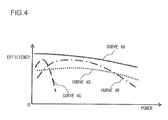
- Fig. 4 shows the efficiencies of the electricity storage device 15 and the load devices 11, 12, and 13 with respect to power under conditions of a certain rotational speed, a certain torque, a certain temperature and so on: the curve 4A shows the efficiency of the electricity storage device 15, the curve 4B shows the efficiency of the motor-generator 11, the curve 4C shows the efficiency of the temperature regulation device 12, and the curve 4D shows the efficiency of the electrical power conversion device 13.
- the loss in the electricity storage device 15 increases in proportion to the square of the current, while the losses in the motor-generator 11, in the temperature regulation device 12, and in the electrical power conversion device 13 exhibit different variation tendencies, according to the specifications of those devices.
- the estimated efficiencies ⁇ c that are used in the overall efficiency calculation 38 are values extracted from a load device efficiency map 37 stored in the controller 17, in which efficiencies corresponding to states of the load devices, such as rotational speed, torque, temperature, and so on are stored, as shown in Fig. 4 .
- This load device efficiency map 37 is overwritten by corrected efficiencies ⁇ x that are calculated by an efficiency map correction 36 on the basis of the estimated efficiencies ⁇ c and the actual efficiencies ⁇ cr .
- By feeding back these actual efficiencies ⁇ cr and thereby correcting the efficiency map 37 it is possible to reduce the errors in the efficiencies along with the passage of time.
- the variations in the efficiency map 37 due to deterioration are comparatively large, accordingly the advantageous effect of loss suppression due to this correction procedure is great.
- ⁇ is the overall efficiency
- P m is the power supplied to the motor-generator 11
- ⁇ m is the efficiency of the motor-generator 11
- P a is the power supplied to the temperature regulation device 12
- ⁇ a is the efficiency of the temperature regulation device 12
- P e is the power supplied to the electrical power conversion device 13
- ⁇ e is the efficiency of the electrical power conversion device 13
- V b is the voltage of the electricity storage device 15
- R is the internal resistance of the electricity storage device 15.
- the numerator in Equation (1) is the sum of the powers that the load devices 11, 12, and 13 actually use for performing useful work, while the denominator is the power that the electricity storage device 15 supplies to the load devices 11, 12, and 13; and, according to the number of load devices that are the objects for control, in the terms of Equation (1), either the products of the powers supplied to the load devices and their efficiencies, or the powers supplied to the load devices, are added together.
- Fig. 5 shows the results of calculation of the overall efficiency ⁇ when the powers supplied to the motor-generator 11 and to the electrical power conversion device 13 are fixed, and the power supplied to the temperature regulation device 12 is varied.
- the efficiency ⁇ a of the temperature regulation device 12 changes according to the supplied power P a
- the overall efficiency ⁇ exhibits a tendency to vary with respect to the power supplied to the temperature regulation device 12 as shown by the curve 5A.
- Fig. 5 is one example of the results of calculation of the overall efficiency ⁇ ; a plurality of maps are generated corresponding to the power supplied to the various load devices and to their efficiencies.
- a map of the overall efficiency ⁇ based upon the requested power P o may also be selected at the time point of the overall efficiency calculation 38; in the present invention, the number of maps of the overall efficiency ⁇ sent from the overall efficiency calculation 38 to the power corrections calculation 39 is not to be considered as being particularly limited.
- power corrections ⁇ P are calculated for charging and discharging the electricity storage device 15, and for increasing or decreasing the drive loads upon the motor-generator 11, upon the temperature regulation device 12, and upon the electrical power conversion device 13, so as to enhance the overall efficiency.
- the way in which this calculation is performed will now be explained with reference to the flow chart shown in Fig. 6 . It should be understood that this calculation of the corrected power ⁇ P shown in Fig. 6 is executed repeatedly on a predetermined cycle.
- step S 1 of this power corrections calculation 39 at the predetermined cycle, signals from the actuation signals 30 such as the amount of actuation by the driver of the accelerator pedal and/or the brake pedal, the set temperature and the set amount of air supply by the air conditioner and so on, and signals among the sensor signals 31 acquired by the various sensors relating to map information and position measurement information, vehicle speed, voltage and so on are acquired. Then in a step S2, on the basis of the signals that have been acquired, the estimated efficiencies of the various load devices are calculated from the efficiency map 37, and in the next step S3 the requested powers P o from the various load devices are calculated by the requested powers calculation 32.
- the actuation signals 30 such as the amount of actuation by the driver of the accelerator pedal and/or the brake pedal, the set temperature and the set amount of air supply by the air conditioner and so on
- signals among the sensor signals 31 acquired by the various sensors relating to map information and position measurement information, vehicle speed, voltage and so on are acquired.
- step S2 on the basis of the signals that have been acquired
- a step S4 along with a map of the overall efficiency ⁇ being generated by the overall efficiency calculation 38 on the basis of the signals acquired or calculated in the steps S 1 through S3, also the powers P 1 supplied to the load devices in the previous calculation cycle, the overall efficiency ⁇ 1 when these powers P 1 were supplied to the load devices in the previous calculation cycle, the maximum efficiency ⁇ 2 , and the powers P 2 to be supplied to the load devices in order to bring the overall efficiency ⁇ 1 to the maximum efficiency ⁇ 2 are calculated.
- the maximum efficiency ⁇ 2 is the overall efficiency as maximized by varying the powers supplied to the various load devices.
- step S5 a decision is made as to whether or not the overall efficiency ⁇ 1 that was calculated in the previous step S4 is less than the maximum efficiency ⁇ 2 . If it is decided in this step S5 that the overall efficiency ⁇ 1 and the maximum efficiency ⁇ 2 are equal or substantially equal, then this control procedure terminates, since it is not necessary to make any corrections to the requested powers P o .
- step S6 power corrections ⁇ P are calculated by subtracting the powers P 1 supplied to the load devices one calculation cycle previously from the powers P 2 calculated in the step S4 to be supplied to the load devices in order to bring the overall efficiency ⁇ 1 to the maximum efficiency ⁇ 2 .
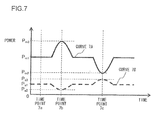
- Figs. 7 and 8 show the results of varying the power P a supplied to the temperature regulation device 12 according to the method of calculation shown in Fig. 6 .
- Fig. 7 shows the results of varying the power P a supplied to the temperature regulation device 12 so as to enhance the overall efficiency ⁇ with respect to fluctuations of the power Pm supplied to the motor-generator 11, and the curve 7A shows the power P m supplied to the motor-generator 11, while the curve 7B shows the power P a supplied to the temperature regulation device 12.
- Fig. 8 is the overall efficiency ⁇ with respect to fluctuations of the power shown in Fig. 7
- the curve 8A is an overall efficiency map when the power P m supplied to the motor-generator 11 is P m1 in Fig.
- the curve 8B is an overall efficiency map when the power P m supplied to the motor-generator 11 is P m3 in Fig. 7
- the curve 8C is an overall efficiency map when the power P m supplied to the motor-generator 11 is P m2 in Fig. 7 .
- the power corrections ⁇ P are calculated if the overall efficiency ⁇ is less than the maximum efficiency ⁇ 2 , it would also be acceptable only to calculate the power corrections ⁇ P if the difference between the overall efficiency ⁇ and the maximum efficiency ⁇ 2 has become greater than a predetermined value, or only if the power supplied to the load devices has become greater than a predetermined value; with the present invention, the standard for calculating the power corrections ⁇ P is not to be considered as being particularly limited.
- the overall efficiency ⁇ is enhanced by varying the power P a that is supplied to the temperature regulation device 12, it would also be acceptable to enhance the overall efficiency ⁇ by varying the power supplied to the electrical power conversion device 13, or to some other load device; with the present invention, the number and the types of the load devices for which the drive load or loads are varied in order to enhance the overall efficiency ⁇ are not to be considered as being particularly limited.
- Fig. 9 shows the results when control is not performed for reducing fluctuations of the power supplied by the electricity storage device 15 to the various load devices, and is a figure for explanation the difference obtained as a result of the first embodiment.
- the curve 9A in Fig. 9 shows the power P b supplied by the electricity storage device 15 to the various load devices; the curve 9B shows the power P m supplied to the motor-generator 11; and the curve 9C shows the power P a supplied to the temperature regulation device 12.
- Fig. 10 shows the results when, according to the first embodiment, control is performed for reducing fluctuations of the power P b supplied by the electricity storage device 15 to the various load devices: the curve 10A shows the power P b supplied by the electricity storage device 15 to the various load devices; the curve 10B shows the power P m supplied to the motor-generator 11; and the curve 10C shows the power P a supplied to the temperature regulation device 12.
- FIG. 11 A second embodiment of the present invention will now be explained with reference to Figs. 11 and 12 .
- the control system of this second embodiment has a travel prediction unit 40 added to the control system of the first embodiment shown in Fig. 2 ; apart from this feature, this second embodiment is the same as the first embodiment shown in Fig. 2 .
- a travel prediction unit 40 it would also be acceptable to add a travel prediction unit 40 to the control system of the variant of the first embodiment shown in Fig. 3 ; with the present invention, the control system to which a travel prediction unit may be provided is not to be considered as being particularly limited.
- the travel prediction unit 40 inputs signals from the actuation signals 30 specifying the amounts of actuation by the driver of the accelerator pedal and the brake pedal, and the set temperature upon the temperature regulation device 12 and/or its set amount of air flow and so on, and also inputs signals from the sensor signals 31 acquired by sensors of various types and specifying map information and position measurement information, vehicle speed, voltage and so on, and, on the basis of these signals, forecasts parameters related to the running state, such as future running speed and running distance, the resistance to vehicle motion, the traveling environment, and so on.
- the traveling environment information related to operation of the temperature regulation device 12, such as the difference between the temperature inside the vehicle passenger compartment and the temperature set upon the temperature regulation device 12, the temperature exterior to the vehicle, and so on: by forecasting this traveling environment, temperature regulation at high accuracy becomes possible, and it is possible to prevent increase of energy losses due to excessive heating or cooling being applied.
- the traveling environment that is forecast is taken as being defined by the difference between the temperature inside the vehicle passenger compartment and the temperature set upon the temperature regulation device 12 and by the temperature exterior to the vehicle, it would also be acceptable for it to include the insolation or the atmospheric pressure, the wind speed, the wind direction, and so on; with the present invention, the details of the traveling environment that are forecast are not to be considered as being particularly limited.
- the power corrections calculation 39 On the basis of the forecast future state as transmitted from the travel prediction unit 40, the power corrections calculation 39 performs forecasting calculation of the power supplied from the electricity storage device 15 to each of the load devices such as the motor-generator 11 and the temperature regulation device 12 and so on until the end of the unit time period ⁇ T, and of the power that is converted into actual useful work by each of these load devices, and calculates power corrections ⁇ P so as to bring the overall efficiency ⁇ to its maximum.
- Equation (2) n ⁇ T is the overall efficiency until the end of the unit time period ⁇ T, and the other parameters are the same as the parameters of Equation (1). It should be understood that, according to the number of load devices that are the objects for control, in the terms
- Fig. 12 shows the results of varying the power P a supplied to the temperature regulation device 12 so as to bring the overall efficiency ⁇ to its maximum until the end of the unit time period ⁇ T, on the basis of the forecast future state as forecast by the travel prediction unit 40.
- the curve 12A in Fig. 12 shows the power P m supplied to the motor-generator 11, the curve 12B shows the power P a supplied to the temperature regulation device 12, and the curve 12C shows the gradient of the road surface.
- the power P a supplied to the temperature regulation device 12 is temporarily increased in advance, while the power P a supplied to the temperature regulation device 12 is decreased in the section 12b.
- the power P a supplied to the temperature regulation device 12 is temporarily decreased in advance, while the power P a supplied to the temperature regulation device 12 is increased in the section 12d.
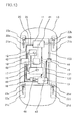
- FIG. 13 A third embodiment of the present invention will now be explained with reference to Fig. 13 . While in this third embodiment an example will be presented in which, as in the case of the first and second embodiments, the present invention is applied to an electric vehicle of the front wheel drive type, the present invention could also be applied to an electric vehicle of the rear wheel drive type or of the four wheel drive type, to a hybrid electric vehicle that is also provided with an internal combustion engine, or to an electric vehicle for construction, an electric vehicle for a railroad, or indeed an electric vehicle of any kind.
- This electric vehicle 10 of the third embodiment is one in which a thermal storage device 18 has been added to the electric vehicle 10 of the first embodiment shown in Fig. 1 ; the other details thereof are the same as those of the electric vehicle 10 shown in Fig. 1 .
- This thermal storage device 18 is a device that is connected to the motor-generator 11, the temperature regulation device 12, the electrical power conversion device 13, the electricity storage device 15, and the second electricity storage device 16, and that accumulates heat in a refrigerant or cooling water or the like that has been cooled or heated up by one or more of these various load devices.
- this thermal storage device 18 may accumulate heat or cold in a thermal medium such as a refrigerant or cooling water or the like that remains in the same physical state as it is cooled or heated, or may be adapted to accumulate heat or cold by causing a phase change of the thermal medium, such as freezing of cooling water into ice; it would also be acceptable to arrange to supply from the exterior of the vehicle a thermal medium that has been heated or cooled, such as a refrigerant or cooling water or the like. With the present invention, the thermal storage method should not be considered as being particularly limited.
- This thermal storage device 18 is connected to the controller 17 and is controlled by the controller 17, in a similar manner to the motor-generator 11 and so on.
- control is performed so as to keep down the drive load of the temperature regulation device 12, as in the section 12b shown in Fig. 12 , the temperature in the vehicle passenger compartment is regulated by performing transfer of thermal energy from the thermal storage device 18.
- the following beneficial operational effects may be obtained.
- a control system for an electric vehicle that includes an electricity storage device 15 that performs charging and discharging of electrical power, a plurality of load devices 11 through 13 that receive supply of electrical power from the electricity storage device 15 and perform various operations, and a controller 17 that controls the electricity storage device 15 and the plurality of load devices 11 through 13, it is arranged for the controller 17, when electrical power is supplied from the electricity storage device 15 to the plurality of load devices 11 through 13, to calculate the charge/discharge efficiency of the electricity storage device 15 and the working efficiency of each of the load devices 11 through 13, and to regulate the amount of electrical power supplied from the electricity storage device 15 to each of the load devices 11 through 13, so as to enhance the overall system efficiency of the electricity storage device 15 and the plurality of load devices 11 through 13 taken as a group, accordingly it is possible to enhance the overall efficiency of the system of the electric vehicle as a whole, in other words to enhance the energy efficiency.
- a motor-generator 11 for propelling the electric vehicle is included in the plurality of load devices 11 through 13, and since it is arranged, when the electrical power for driving the motor-generator 11 varies, for the controller 17 to regulate the electrical power supplied from the electricity storage device 15 to the load devices 12 and 13 other than the motor-generator 11, so as to enhance the overall efficiency in view of this variation of the electrical power for the motor-generator 11, accordingly, even if the fluctuations in the electrical power supplied to the motor-generator 11, which is a large load device of the electricity storage device 15, are large, still it is possible to maintain the overall energy efficiency of the system of the electric vehicle as a whole at a high level.
- a temperature regulation device 12 that performs air conditioning of the interior of a passenger compartment or cooling of an onboard device is included in the plurality of load devices 11 through 13 other than the motor-generator 11, and since it is arranged for the controller 17 to reduce the electrical power for driving the temperature regulation device 12 when the electrical power for driving the motor-generator 11 has been increased, so that the overall efficiency after increase of the electrical power supplied to the motor-generator 11 is enhanced, and to increase the electrical power for driving the temperature regulation device 12 when the electrical power for driving the motor-generator 11 has been decreased, so that the overall efficiency after decrease of the electrical power supplied to the motor-generator 11 is enhanced, accordingly, even if the fluctuations of the electrical power supplied to the motor-generator 11, which is a large load device of the electricity storage device 15, are large, it is still possible to regulate the electrical power supplied to the temperature regulation device 12 so as to maintain a high overall level of energy efficiency for the system of the electric vehicle as a whole.
- an electrical power conversion device 13 that converts the electrical power of the electricity storage device 15 and supplies electrical power to another electricity storage device is included in the load devices other than the motor-generator 11, and since it is arranged for the controller 17 to reduce the electrical power supplied to the power conversion device 13 when the electrical power for driving the motor-generator 11 has been increased, so that the overall efficiency after increase of the electrical power supplied to the motor-generator 11 is enhanced, and to increase the electrical power supplied to the power conversion device 13 when the electrical power for driving the motor-generator 11 has been decreased, so that the overall efficiency after reduction of the electrical power supplied to the motor-generator 11 is enhanced, accordingly, even if the fluctuations of the electrical power supplied to the motor-generator 11, which is a large load device of the electricity storage device 15, are large, still it is possible to regulate the electrical power supplied to the electrical power conversion device 13 so as to maintain the overall energy efficiency of the system of the electric vehicle as a whole at a high level.
- the controller 17 when electrical power is supplied from the electricity storage device 15 to the plurality of load devices 11 through 13, it is arranged for the controller 17 to regulate the electrical power supplied from the electricity storage device 15 to each of the plurality of load devices 11 through 13, so as to reduce fluctuations of the electrical power discharged from the electricity storage device 15, accordingly it is possible to suppress energy losses originating in fluctuations of the electrical power discharged from the energy storage device 15, so that, while still enhancing the overall energy efficiency of the system of the electric vehicle as a whole, it is also possible to prevent deterioration of the energy storage device 15.
- the controller 17 along with forecasting a future running state of the electric vehicle on the basis of the current running state of the electric vehicle as detected by a plurality of detectors 41 through 48 and on the basis of road map information and position measurement information 30 and 31, also, on the basis of the future running state that is the result of that forecast, to forecast the power that will be supplied from the electricity storage device 15 to each of the load devices 11 through 13 and the charge/discharge efficiency of the electricity storage device 15 and the working efficiency of each of the load devices 11 through 13 that will accompany that supply of electrical power, and regulates the electrical power supplied from the electricity storage device 15 to each of the load devices 11 through 13 in advance, so as to enhance the overall efficiency in that future running state, accordingly it is possible further to enhance the overall energy efficiency of the system of the electric vehicle as a whole, by taking into consideration its probable future running state.
- the controller 17 is arranged for the controller 17 to forecast variation of the electric power that will be supplied for driving the motor-generator 11 on the basis of the future running state that is the result of that forecast, and, for a load device 12 or 13 other than the motor-generator 11 for which the supply of electrical power is regulated along with variation of the electrical power supplied to the motor-generator 11, temporarily to increase in advance the electrical power supplied to the load device 12 or 13 before the electrical power supplied to the motor-generator 11 increases, and temporarily to reduce in advance the electrical power supplied to the load device 12 or 13 before the electrical power supplied to the motor-generator 11 decreases, accordingly, even if the fluctuations of the electrical power supplied to the motor-generator 11, which is a large load device of the electricity storage device 15, are large, while still being able to enhance the overall energy efficiency of the system of the electric vehicle as a whole, for the load devices 12 and 13 other than the motor-generator 11 to which the supply of electrical power is regulated as
- thermo storage device 18 that accumulates heat or cold generated by the electricity storage device 15 and the plurality of load devices 11 through 13, and since it is arranged for the temperature regulation device 12 to perform heating or air conditioning of the interior of the passenger compartment and cooling of an onboard device using heat or cold accumulated in the thermal storage device 18, thus reducing the supply of electrical power from the electricity storage device 15 to the temperature regulation device 12, accordingly it is possible to perform heating or air conditioning of the interior of the passenger compartment and cooling of the onboard device by taking advantage of waste heat or waste cold, and, to that extent, it is possible yet further to enhance the overall energy efficiency of the system of the electric vehicle as a whole.
- a control system for an electric vehicle that includes an electricity storage device 15 that performs charging and discharging of electrical power, a plurality of load devices 11 through 13 that receive supply of electrical power from the electricity storage device 15 and perform various operations, and a controller 17 that controls the electricity storage device 15 and the plurality of load devices 11 through 13, it is arranged for the controller 17, when electrical power is supplied from the electricity storage device 15 to the plurality of load devices 11 through 13, to regulate the amount of electrical power supplied from the electricity storage device 15 to each of the load devices 11 through 13, so as to reduce fluctuations of the electrical power discharged from the electricity storage device 15, accordingly it is possible to suppress energy losses originating in fluctuations of the electrical power discharged from the electricity storage device 15, while still being able to enhance the overall energy efficiency of the system of the electric vehicle as a whole, and while being able to prevent deterioration of the electricity storage device 15.
- a motor-generator 11 for propelling the electric vehicle is included in the plurality of load devices 11 through 13, and since it is arranged for the controller 17 to regulate the electrical power supplied from the electricity storage device 15 to a load device 12 or 13 other than the motor-generator 11, so as to reduce fluctuations of the electrical power discharged from the electricity storage device 15 when the electrical power for driving the motor-generator 11 varies, accordingly, even if the fluctuations in the electrical power supplied to the motor-generator 11, which is a large load device of the electricity storage device 15, are large, still it is possible to suppress energy losses originating in fluctuations of the electrical power discharged from the electricity storage device 15, and thereby to prevent deterioration of the electricity storage device 15, while still being able to enhance the overall energy efficiency of the system of the electric vehicle as a whole.
- the controller 17 along with forecasting a future running state of the electric vehicle on the basis of the current running state of the electric vehicle as detected by a plurality of detectors 41 through 48 and on the basis of road map information and position measurement information 30 and 31, also, on the basis of the future running state that is the result of that forecast, to forecast variation of the electric power that will be supplied for driving the motor-generator 11, and, for a load device 12 or 13 other than the motor-generator 11 for which the supply of electrical power is regulated along with this variation of the electrical power supplied to the motor-generator 11, temporarily to increase in advance the electrical power supplied to the load device 12 or 13 before the electrical power supplied to the motor-generator 11 increases, and temporarily to reduce in advance the electrical power supplied to the load device 12 or 13 before the electrical power supplied to the motor-generator 11 decreases, accordingly, even if the fluctuations in the electrical power supplied to the motor-generator 11, which is a large load device of the electricity storage
Landscapes
- Engineering & Computer Science (AREA)
- Power Engineering (AREA)
- Transportation (AREA)
- Mechanical Engineering (AREA)
- Life Sciences & Earth Sciences (AREA)
- Sustainable Development (AREA)
- Sustainable Energy (AREA)
- Electric Propulsion And Braking For Vehicles (AREA)
- Charge And Discharge Circuits For Batteries Or The Like (AREA)
- Secondary Cells (AREA)
- Air-Conditioning For Vehicles (AREA)
Abstract
Description
- The disclosure of the following priority application is herein incorporated by reference: Japanese Patent Application No.
2009-262527 filed November 18, 2009 - The present invention relates to a control system for an electric vehicle, and to an electric vehicle equipped with this control system.
- A plurality of load devices such as one or more electricity storage devices, an electric motor and a temperature regulation device, an electrical power conversion device and so on are mounted to an electric vehicle, and control of these load devices is performed on the basis of command values such as the amount with which an accelerator pedal or a brake pedal is depressed by the driver, a temperature setting, and so on. With an electric vehicle, the greatest problem is to increase the range, and methods for increasing the range are, for example, to increase the amount of energy available by increasing the number of electricity storage devices mounted to the vehicle, to save energy by enhancing the efficiency of the load devices themselves, to save energy by enhancing the efficiency of control, and the like. For example, refer to Japanese Laid-Open Patent Publication
2008-070326 - With the prior art devices described above, control of the drive power with good energy efficiency is performed on the basis of the presumed path of travel. This presumption as to the path of travel is performed on the basis of a map in a navigation device or the like and sensor information, so that drive power control is performed on the basis of the presumed distance of travel and the average vehicle speed, and on the basis of road characteristic information such as gradients and so on.
- However, with prior art devices such as described above, sufficient attention has not been paid to the overall energy efficiency of the electric vehicle when considered as a unitary system that consists of a plurality of load devices, and there is room for improvement of the energy efficiency of the system as a whole.
- According to the 1 st aspect of the present invention, a control system for an electric vehicle, comprises: an electricity storage device that performs charging and discharging of electrical power; a plurality of load devices that receive supply of electrical power from the electricity storage device and perform operations; and/or a control device that controls the electricity storage device and the plurality of load devices. And when electrical power is supplied from the electricity storage device to the plurality of load devices, the control device calculates a charge/discharge efficiency of the electricity storage device and/or a working efficiency of each of the load devices, and/or regulates an amount of electrical power supplied from the electricity storage device to each of the load devices, so as to enhance an overall efficiency of the electricity storage device and/or the plurality of load devices.
- According to the 2nd aspect of the present invention, in the control system for an electric vehicle according to the 1 st aspect, it is preferred that: a electric machine for propelling the electric vehicle is included in the plurality of load devices; and when the electrical power for driving the electric machine varies, the control device regulates the electrical power supplied from the electricity storage device to the load devices other than the electric machine, so as to enhance the overall efficiency with the electrical power for the electric machine having varied.
- According to the 3rd aspect of the present invention, in the control system for an electric vehicle according to the 2nd aspect, it is preferred that: a temperature regulation device that performs air conditioning of an interior of a passenger compartment or cooling of an onboard device is included in the load devices other than the electric machine; and the control device reduces the electrical power for driving the temperature regulation device when the electrical power for driving the electric machine has been increased, so that the overall efficiency after increase of the electrical power supplied to the electric machine is enhanced, and increases the electrical power for driving the temperature regulation device when the electrical power for driving the electric machine has been decreased, so that the overall efficiency after decrease of the electrical power supplied to the electric machine is enhanced.
- According to the 4th aspect of the present invention, in the control system for an electric vehicle according to the 2nd aspect, it is preferred that: an electrical power conversion device that converts the electrical power of the electricity storage device and supplies electrical power to another electricity storage device is included in the load devices other than the electric machine; and the control device reduces the electrical power supplied to the power conversion device when the electrical power for driving the electric machine has been increased, so that the overall efficiency after increase of the electrical power supplied to the electric machine is enhanced, and increases the electrical power supplied to the power conversion device when the electrical power for driving the electric machine has been decreased, so that the overall efficiency after decrease of the electrical power supplied to the electric machine is enhanced.
- According to the 5th aspect of the present invention, in the control system for an electric vehicle according to any one of the 1 st through 4th aspects, it is preferred that when electrical power is supplied from the electricity storage device to the plurality of load devices, the control device regulates the electrical power supplied from the electricity storage device to each of the plurality of load devices, so as to reduce fluctuations of the electrical power discharged from the electricity storage device.
- According to the 6th aspect of the present invention, in the control system for an electric vehicle according to any one of the 1 st through 5th aspects, it is preferred that the control device calculates electrical power requested to each of the load devices based upon an amount of actuation by a driver and a running state of the electric vehicle that are detected by a plurality of detectors.
- According to the 7th aspect of the present invention, in the control system for an electric vehicle according to the 6th aspect, it is preferred that each of the load devices measures electric power used for actually being operated by using a plurality of detectors, and also calculates a working efficiency based upon the measured electrical power and the electrical powers that are supplied to each of the load devices.
- According to the 8th aspect of the present invention, in the control system for an electric vehicle according to the 7th aspect, it is preferred that the control device determines the electrical power to be supplied to each of the load devices by correcting the requested electrical power for each of the load device by the working efficiency of each of the load device.
- According to the 9th aspect of the present invention, in the control system for an electric vehicle according to any one of the 2nd through 8th aspects, it is preferred that the control device forecasts a future running state of the electric vehicle based upon a current running state of the electric vehicle detected by a plurality of detectors and based upon road map information and position measurement information, also, based upon the future running state resulting from forecasting, forecasts electric power that will be supplied from the electricity storage device to each of the load devices and the charge/discharge efficiency of the electricity storage device and the working efficiency of each of the load devices that will accompany the forecasted electrical power, and regulates the electrical power supplied from the electricity storage device to each of the load devices in advance so as to enhance the overall efficiency in that future running state.
- According to the 10th aspect of the present invention, in the control system for an electric vehicle according to the 9th aspect, it is preferred that the control device forecasts variation of the electric power that will be supplied for driving the electric machine based upon the future running state resulting from forecasting, and, for a load device other than the electric machine for which the electrical power to be supplied is regulated along with the variation of the electrical power supplied to the electric machine, temporarily increases in advance the electrical power supplied to the load device before the electrical power supplied to the electric machine increases, and temporarily reduces in advance the electrical power supplied to the load device before the electrical power supplied to the electric machine decreases.
- According to the 11th aspect of the present invention, in the control system for an electric vehicle according to any one of the 1st through 10th aspects, it is preferred that: a temperature regulation device that performs air conditioning of the interior of a passenger compartment or cooling of an onboard device is included in the plurality of load devices; there is further provided a thermal storage device that accumulates heat or cold generated by the electricity storage device and the plurality of load devices; and the temperature regulation device performs heating or air conditioning of the interior of the passenger compartment and cooling of an onboard device using heat or cold accumulated in the thermal storage device, thus reducing the electrical power supplied from the electricity storage device to the temperature regulation device.
- According to the 12th aspect of the present invention, a control system for an electric vehicle, comprises: an electricity storage device that performs charging and discharging of electrical power; a plurality of load devices that receive supply of electrical power from the electricity storage device and perform various operations; and a control device that controls the electricity storage device and the plurality of load devices. And when electrical power is supplied from the electricity storage device to the plurality of load devices, the control device regulates an amount of electrical power supplied from the electricity storage device to each of the load devices, so as to reduce fluctuations of the electrical power discharged from the electricity storage device.
- According to the 13th aspect of the present invention, in the control system for an electric vehicle according to the 12th aspect, it is preferred that: a electric machine for propelling the electric vehicle is included in the plurality of load devices; and the control device regulates the electrical power supplied from the electricity storage device to a load device other than the electric machine, so as to reduce fluctuations of the electrical power discharged from the electricity storage device when the electrical power for driving the electric machine varies.
- According to the 14th aspect of the present invention, in the control system for an electric vehicle according to the 13th aspect, it is preferred that the control device forecasts a future running state of the electric vehicle based upon a current running state of the electric vehicle detected by a plurality of detectors and based upon road map information and position measurement information, also, based upon the future running state resulting from forecasting, forecasts variation of the electric power that will be supplied for driving the electric machine, and, for a load device other than the electric machine for which the supply of electrical power is regulated along with the variation of the electrical power supplied to the electric machine, temporarily increases in advance the electrical power supplied to the load device before the electrical power supplied to the electric machine increases, and temporarily reduces in advance the electrical power supplied to the load device before the electrical power supplied to the electric machine decreases.
- According to the 15th aspect of the present invention, an electric vehicle comprises a control system according to any one of the 1 st through 14th aspects.
-
-
Fig. 1 is an explanatory figure showing the structure of an electric vehicle that is equipped with a control system according to a first embodiment of the present invention; -
Fig. 2 is a figure showing the structure of this control system according to the first embodiment of the present invention; -
Fig. 3 is a figure showing the structure of another control system according to a variant of the first embodiment of the present invention; -
Fig. 4 is a figure showing variation of the efficiencies of various load devices controlled by this control system with respect to power, according to the first embodiment of the present invention; -
Fig. 5 is a figure showing variation of the overall system efficiency with this control system according to the first embodiment of the present invention; -
Fig. 6 is a flow chart of a program executed by this control system according to the first embodiment of the present invention; -
Fig. 7 is a figure showing the results of control of the power loading of the various load devices by this control system according to the first embodiment of the present invention; -
Fig. 8 is a figure showing the variation of the overall system efficiency with respect to power, corresponding to the results of control of the power loading of the various load devices by this control system according to the first embodiment of the present invention; -
Fig. 9 is a figure showing results when fluctuations of electrical power produced by an electricity storage device are not controlled by this control system according to the first embodiment of the present invention; -
Fig. 10 is a figure showing the results when fluctuations of electrical power produced by the electricity storage device are controlled by this control system according to the first embodiment of the present invention; -
Fig. 11 is a figure showing a control system according to a second embodiment of the present invention; -
Fig. 12 is a figure showing the results of control of the power loading of various load devices by this control system according to the second embodiment of the present invention; and -
Fig. 13 is a figure showing the structure of a vehicle to which a control system according to a third embodiment of the present invention is mounted. - The first embodiment of the control system for an electric vehicle according to the present invention, and of an electric vehicle equipped therewith, will now be explained with reference to
Figs. 1 through 10 . While in this first embodiment the present invention is shown as applied to an electric vehicle of the front wheel drive type, the present invention could also be applied to an electric vehicle of the rear wheel drive type or of the four wheel drive type, to a hybrid electric vehicle that is also provided with an internal combustion engine, or to an electric vehicle for construction, an electric vehicle for a railroad, or indeed an electric vehicle of any kind. -
Fig. 1 shows the structure of anelectric vehicle 10 to which a control system according to the first embodiment is mounted. Thiselectric vehicle 10 according to the first embodiment includes a motor-generator (an electric machine) 11, atemperature regulation device 12, an electricalpower conversion device 13, a hydraulicpressure generation device 14, aelectricity storage device 15, a secondelectricity storage device 16, acontroller 17,drive shafts 20,vehicle wheels 21a through 21d,disk rotors 22a through 22d,brake calipers 23a through 23d,signal lines 131,electrical power lines 132,hydraulic conduits 133,sensors 41 through 46, and so on. - The electric motor-
generator 11 is a rotating DC or AC electrical machine that converts electrical energy supplied from theelectricity storage device 15 into mechanical energy, and constitutes one of the load devices of this electric vehicle. An electrical power conversion device such as a converter or an inverter or the like is included in this motor-generator 11, and this electrical power conversion device performs voltage conversion and/or conversion to AC voltage of DC electrical power from theelectricity storage device 15, thus producing electrical power for supply to the motor-generator 11 to drive it. And the mechanical energy produced by the motor-generator 11 is converted into rotational motion of its shaft, with this rotational power being transmitted to thefront wheels drive shafts 20. - Furthermore, during the braking process, the motor-
generator 11 operates as a generator that generates electricity due to the rotation of thedrive shafts 20. Not only is the regenerated energy generated by the motor-generator 11 supplied to theelectricity storage device 15, but also the regenerative braking force created by the motor-generator 11 during this electricity generation operates upon thefront wheels more sensors 41 are provided to the motor-generator 11 and measure its current, voltage, torque, or the like. For example, a torque sensor may be a non-contact powered strain sensor; in any case, in the present invention the numbers and the types of the sensors provided to the motor-generator 11 are not particularly limited. The electric motor-generator (the electric machine) 11 may be referred to as amotor 11 when it works as a motor, and the electric motor-generator 11 may be referred to as agenerator 11 when it works as a generator. - The
temperature regulation device 12 is a heat exchanger that includes a condenser, an expansion valve, an evaporator, a compressor and so on, and constitutes one of the load devices of this electric vehicle. During air conditioning of the passenger compartment, due to electrical energy supplied from theelectricity storage device 15, a refrigerant is compressed by the operation of the compressor, and this refrigerant is expanded via the evaporator by the expansion valve, so that it reaches a low temperature and performs exchange of heat with the air in the vehicle passenger compartment, thus cooling this interior air. And, during heating of the passenger compartment, the compressor is operated in the opposite way to its operation during air conditioning, so that the evaporator functions as a condenser while the condenser functions as an evaporator, and thereby, after having been heated to a high temperature by the compressor via the condenser, the refrigerant performs exchange of heat with the air in the vehicle passenger compartment, thus heating this interior air. - One or
more sensors 42 are provided to thistemperature regulation device 12 and measure its current, voltage, torque, or the like. For example, a temperature sensor may be a thermocouple; in any case, in the present invention the numbers and the types of the sensors provided to thetemperature regulation device 12 are not particularly limited. It should be understood that, while thetemperature regulation device 12 of this first embodiment is taken as being an air conditioning device that cools or heats a refrigerant, it could also be a device that cools or heats cooling water or antifreeze that is used for temperature regulation of onboard devices such as the motor-generator 11 or the like; in other words, in the present invention, the thermal medium that is cooled or heated by thetemperature regulation device 12 is not to be considered as being particularly limited. - The electrical
power conversion device 13 is a voltage conversion device that raises or lowers the voltage of the electrical energy supplied from theelectricity storage device 15 and that supplies the resulting electrical energy to the hydraulicpressure generation device 14 and to the secondelectricity storage device 16, and constitutes one of the load devices of this electric vehicle. One ormore sensors 43 are provided to this electricalpower conversion device 13 for measuring its current, voltage, or the like. For example, a current sensor may be a non contact type clamp type sensor; in any case, in the present invention, the numbers and the types of the sensors provided to the electricalpower conversion device 13 are not particularly limited. - The hydraulic
pressure generation device 14 generates hydraulic pressures according to commands from either one or both of a brake pedal that is operated by the driver, and thecontroller 17. The hydraulic pressures generated by this hydraulicpressure generation device 14 are transmitted viahydraulic conduits 133 tobrake calipers 23a through 23d, and operate thesebrake calipers 23a through 23d. One ormore sensors 44 are provided to this hydraulicpressure generation device 14 for measuring its current, voltage, hydraulic pressure, or the like. For example, a hydraulic pressure sensor may be a strain gauge type pressure sensor; in any case, in the present invention, the numbers and the types of the sensors provided to the hydraulicpressure generation device 14 are not particularly limited. - A friction braking system includes the
disk rotors 22a through 22d and thebrake calipers 23a through 23d. Each of thedisk rotors 22a through 22d is fixed to one of thevehicle wheels 21a through 21d, and rotates integrally with thatvehicle wheel 21a through 21d. And each of thebrake calipers 23a through 23d includes a cylinder, a piston, pads and so on not shown in the figures. The pistons are shifted within the cylinders by the hydraulic pressure generated by the hydraulicpressure generation device 14, and thereby the pads are impelled by these pistons and press against thedisk rotors 22a through 22d. Frictional forces against thedisk rotors 22a through 22d are thus created due to this pressing of the pads against thedisk rotors 22a through 22d, and these frictional forces act as forces to brake thevehicle wheels 21a through 21 d, so that braking forces are generated between thevehicle wheels 21 a through 21 d and the surface of the road. - The
electricity storage device 15 is an electricity storage device that supplies electrical energy, in other words electrical power, to a plurality of load devices such as, principally, the motor-generator 11, thetemperature regulation device 12, the electricalpower conversion device 13, and so on. The drive loads of these load devices, and the magnitudes of the electrical energies supplied to them by theelectricity storage device 15, are controlled by thecontroller 17. One or more sensors 45 are provided to thiselectricity storage device 15 for measuring its current, voltage, internal resistance, or the like. For example, a current sensor may be a non contact type clamp type sensor; in any case, in the present invention, the numbers and the types of the sensors provided to theelectricity storage device 15 are not particularly limited. - The second
electricity storage device 16 is an electricity storage device that operates at a lower voltage than theelectricity storage device 15, and that accumulates electrical energy supplied via the electricalpower conversion device 13, or supplies this accumulated electrical energy to an auxiliary machinery load device, such as the hydraulicpressure generation device 14 or the like. One ormore sensors 46 are provided to this secondelectricity storage device 16 for measuring its current, voltage, internal resistance, or the like. For example, a current sensor my be a non contact type clamp type sensor; in any case, in the present invention, the numbers and the types of the sensors provided to the secondelectricity storage device 16 are not particularly limited. - The
electricity storage device 15 and theload devices signal lines 131 along which information relating to power and efficiency, to be described hereinafter, is transmitted and received in the CAN (Controller Area Network) format, and theelectrical power lines 132 that supply electrical energy from theelectricity storage device 15 to theload devices signal lines 131 is the CAN format, this format could also be the LIN (Local Interconnect Network) format or the FlexRay format or the like; in any case, in the present invention the formats of the signals that are transmitted and received are not particularly limited. - The structure and operation of the control system of this embodiment of the present invention that includes the
controller 17, theelectricity storage device 15, theload devices Figs. 2 through 10 . It should be understood that while, in this embodiment, the explanation of objects controlled by thecontroller 17 is limited to the motor-generator 11, thetemperature regulation device 12, the electricalpower conversion device 13, and theelectricity storage device 15, the present invention could also be applied to the hydraulicpressure generation device 14 and to other load devices: in the present invention, the load devices that constitute control objects are not to be considered as being particularly limited. - As shown in
Fig. 2 , thecontroller 17 of this first embodiment inputs actuation signals 30 from actuation devices of various types not shown in the figures, navigation and sensor signals 31 from a navigation device and sensors of various types not shown in the figures, and the actual efficiencies in real time of theelectricity storage device 15 and theload devices electricity storage device 15 and the plurality of load devices that are the motor-generator 11, thetemperature regulation device 12, the electricalpower conversion device 13, and so on. And thecontroller 17 calculates optimum powers (i.e. target powers) Pin according to the traveling conditions and so on, and outputs these to theelectricity storage device 15 and to thevarious load devices - Here, the powers (i.e. the rates of working) are physical quantities that represent the amounts of energy consumed per unit time, and are generally expressed in units of watts (W). Of course, provided that the physical meaning is the same, any name or units may be employed; the present invention is not to be considered as being limited to any particular name or units for the powers.
- The actuation signals 30 are signals that specify the amounts of actuation by the driver of the accelerator pedal and the brake pedal, and the set temperature upon the
temperature regulation device 12 and/or its set amount of air flow and so on. And the navigation and sensor signals 31 are signals from a navigation device that specify map information and/or position measurement information and so on, and signals transmitted from sensors of various types that specify vehicle speed and/or acceleration and so on. - The actual efficiencies are the ratios of the powers Pout (i.e. the actual powers) at which actuators 33 within the
electricity storage device 15 and thevarious load devices electricity storage device 15 and theload devices electricity storage device 15 is termed its charge/discharge efficiency, while the efficiencies of thevarious load devices - The actual output powers Pout are measured by
sensors 34 of theelectricity storage device 15 and thevarious load devices actual efficiency calculations 35. In theseactual efficiency calculations 35, the actual efficiencies ηcr are calculated by dividing the actual powers Pout by the target powers Pin that are transmitted to theelectricity storage device 15 and thevarious load devices Fig. 2 , an example is shown in which the actual powers Pout are measured by thesensors 34 and the actual efficiencies ηcr are calculated in theelectricity storage device 15 and thevarious load devices Fig. 3 , to calculate the actual powers Pout byactual power calculations 40 on the basis of signals representing rotational speed and/or torque or the like detected by thesensors 34 of theelectricity storage device 15 and thevarious load devices controller 17, and to calculate the actual efficiencies ηcr within thecontroller 17 by anactual efficiencies calculation 35; in the present invention, the method of measuring and/or calculating the actual powers Pin and the actual efficiencies ηcr are not to be considered as being particularly limited. Measurement and/or calculation of the actual powers Pin and the actual efficiencies ηcr of theelectricity storage device 15 and thevarious load devices - Next, the structure within the
controller 17, and its operation, will be explained. By this controller 17: (1) the powers Po that the driver is requesting to theelectricity storage device 15 and thevarious load devices electricity storage device 15 and thevarious load devices electricity storage device 15 and thevarious load devices electricity storage device 15 and so on, and according to travel conditions such as the distance to the destination and the road gradient and so on; and then (3) the target powers Pin are calculated by subtracting the power corrections ΔP from the requested powers Po. - The requested powers Po are calculated by the requested powers calculation 32: for example, the power requested for the motor-
generator 11 is calculated using a predetermined map or calculation equations, on the basis of amount of actuation signals such as the amount of accelerator opening and the amount of brake pedal depression by the driver and so on, and on the basis of sensor signals such as the current vehicle speed and so on. And the power corrections ΔP are calculated by apower corrections calculation 39 on the basis of the actuation signals 30 and the navigation and sensor signals 31, and on the basis of the requested powers Po, estimated efficiencies ηc, and an overall efficiency η. This overall efficiency η that is used by thepower corrections calculation 39 is calculated in anoverall efficiency calculation 38, by dividing the energy that is actually employed by theload devices electricity storage device 15. -
Fig. 4 shows the efficiencies of theelectricity storage device 15 and theload devices curve 4A shows the efficiency of theelectricity storage device 15, thecurve 4B shows the efficiency of the motor-generator 11, the curve 4C shows the efficiency of thetemperature regulation device 12, and thecurve 4D shows the efficiency of the electricalpower conversion device 13. The loss in theelectricity storage device 15 increases in proportion to the square of the current, while the losses in the motor-generator 11, in thetemperature regulation device 12, and in the electricalpower conversion device 13 exhibit different variation tendencies, according to the specifications of those devices. The estimated efficiencies ηc that are used in theoverall efficiency calculation 38 are values extracted from a loaddevice efficiency map 37 stored in thecontroller 17, in which efficiencies corresponding to states of the load devices, such as rotational speed, torque, temperature, and so on are stored, as shown inFig. 4 . - This load
device efficiency map 37 is overwritten by corrected efficiencies ηx that are calculated by anefficiency map correction 36 on the basis of the estimated efficiencies ηc and the actual efficiencies ηcr. By feeding back these actual efficiencies ηcr and thereby correcting theefficiency map 37, it is possible to reduce the errors in the efficiencies along with the passage of time. Furthermore, it is possible to correct for influences caused by fluctuations that cannot perfectly be expressed by theefficiency map 37. As a result, it is possible to prevent losses due to errors in the target powers Pin. In particular since, for theelectricity storage device 15, the variations in theefficiency map 37 due to deterioration are comparatively large, accordingly the advantageous effect of loss suppression due to this correction procedure is great. It should be understood that while, in this first embodiment, an example is shown in which the loaddevice efficiency map 37 is overwritten with the corrected efficiencies, it would also be acceptable to store these corrected efficiencies as a different efficiency map without overwriting the original efficiency map; with the present invention, the way in which the loaddevice efficiency map 37 is corrected is not to be considered as being particularly limited. - Next, the details of the calculation in the
overall efficiency calculation 38 will be explained. The overall efficiency η may be calculated according to the following Equation
In Equation (1), η is the overall efficiency, Pm is the power supplied to the motor-generator 11, ηm is the efficiency of the motor-generator 11, Pa is the power supplied to thetemperature regulation device 12, ηa is the efficiency of thetemperature regulation device 12, Pe is the power supplied to the electricalpower conversion device 13, ηe is the efficiency of the electricalpower conversion device 13, Vb is the voltage of theelectricity storage device 15, and R is the internal resistance of theelectricity storage device 15. - The numerator in Equation (1) is the sum of the powers that the
load devices electricity storage device 15 supplies to theload devices -
Fig. 5 shows the results of calculation of the overall efficiency η when the powers supplied to the motor-generator 11 and to the electricalpower conversion device 13 are fixed, and the power supplied to thetemperature regulation device 12 is varied. The efficiency ηa of thetemperature regulation device 12 changes according to the supplied power Pa, and, since the efficiency of theelectricity storage device 15 changes according to the power supplied to the various load devices, accordingly the overall efficiency η exhibits a tendency to vary with respect to the power supplied to thetemperature regulation device 12 as shown by the curve 5A.Fig. 5 is one example of the results of calculation of the overall efficiency η; a plurality of maps are generated corresponding to the power supplied to the various load devices and to their efficiencies. - While the overall efficiency η that has been calculated by the method described above is transmitted to the
power corrections calculation 39, in order to shorten the time required for the calculation by thispower corrections calculation 39, a map of the overall efficiency η based upon the requested power Po may also be selected at the time point of theoverall efficiency calculation 38; in the present invention, the number of maps of the overall efficiency η sent from theoverall efficiency calculation 38 to thepower corrections calculation 39 is not to be considered as being particularly limited. - Next, the details of the calculation in the
power corrections calculation 39 will be explained. The results of thispower corrections calculation 39 are greatly different depending upon the objective of control (i.e. the control mode), such as whether emphasis is being placed upon power, or emphasis is being placed upon efficiency, or the like. In this first embodiment, power corrections ΔP are calculated for charging and discharging theelectricity storage device 15, and for increasing or decreasing the drive loads upon the motor-generator 11, upon thetemperature regulation device 12, and upon the electricalpower conversion device 13, so as to enhance the overall efficiency. The way in which this calculation is performed will now be explained with reference to the flow chart shown inFig. 6 . It should be understood that this calculation of the corrected power ΔP shown inFig. 6 is executed repeatedly on a predetermined cycle. - In a
step S 1 of thispower corrections calculation 39, at the predetermined cycle, signals from the actuation signals 30 such as the amount of actuation by the driver of the accelerator pedal and/or the brake pedal, the set temperature and the set amount of air supply by the air conditioner and so on, and signals among the sensor signals 31 acquired by the various sensors relating to map information and position measurement information, vehicle speed, voltage and so on are acquired. Then in a step S2, on the basis of the signals that have been acquired, the estimated efficiencies of the various load devices are calculated from theefficiency map 37, and in the next step S3 the requested powers Po from the various load devices are calculated by the requestedpowers calculation 32. - Then in a step S4, along with a map of the overall efficiency η being generated by the
overall efficiency calculation 38 on the basis of the signals acquired or calculated in the steps S 1 through S3, also the powers P1 supplied to the load devices in the previous calculation cycle, the overall efficiency η1 when these powers P1 were supplied to the load devices in the previous calculation cycle, the maximum efficiency η2, and the powers P2 to be supplied to the load devices in order to bring the overall efficiency η1 to the maximum efficiency η2 are calculated. Here, the maximum efficiency η2 is the overall efficiency as maximized by varying the powers supplied to the various load devices. - Then in the next step S5 a decision is made as to whether or not the overall efficiency η1 that was calculated in the previous step S4 is less than the maximum efficiency η2. If it is decided in this step S5 that the overall efficiency η1 and the maximum efficiency η2 are equal or substantially equal, then this control procedure terminates, since it is not necessary to make any corrections to the requested powers Po. But if it is decided that the overall efficiency η1 is substantially less than the maximum efficiency η2, then the flow of control proceeds to a step S6 in which power corrections ΔP are calculated by subtracting the powers P1 supplied to the load devices one calculation cycle previously from the powers P2 calculated in the step S4 to be supplied to the load devices in order to bring the overall efficiency η1 to the maximum efficiency η2.
-
Figs. 7 and8 show the results of varying the power Pa supplied to thetemperature regulation device 12 according to the method of calculation shown inFig. 6 .Fig. 7 shows the results of varying the power Pa supplied to thetemperature regulation device 12 so as to enhance the overall efficiency η with respect to fluctuations of the power Pm supplied to the motor-generator 11, and thecurve 7A shows the power Pm supplied to the motor-generator 11, while thecurve 7B shows the power Pa supplied to thetemperature regulation device 12. Moreover,Fig. 8 is the overall efficiency η with respect to fluctuations of the power shown inFig. 7 , and the curve 8A is an overall efficiency map when the power Pm supplied to the motor-generator 11 is Pm1 inFig. 7 , while thecurve 8B is an overall efficiency map when the power Pm supplied to the motor-generator 11 is Pm3 inFig. 7 , and thecurve 8C is an overall efficiency map when the power Pm supplied to the motor-generator 11 is Pm2 inFig. 7 . - If during the
time period 7a ofFig. 7 the power Pa supplied to thetemperature regulation device 12 for the power Pm1 being supplied to the motor-generator 11 is taken as being Pal, then the overall efficiency η becomes η2 upon the curve 8A ofFig. 8 . Since this overall efficiency η2 is the maximum efficiency upon the curve 8A, accordingly no calculation of any power correction ΔP is performed, so that the power Pal is supplied to thetemperature regulation device 12. - But if, during the
time period 7b ofFig. 7 , similarly to the case during thetime period 7a, the power Pa supplied to thetemperature regulation device 12 for the power Pm3 being supplied to the motor-generator 11 is taken as being Pa1, then the overall efficiency η becomes η1 upon thecurve 8B ofFig. 8 . Since this overall efficiency η1 is less than the maximum efficiency η2 upon thecurve 8B, accordingly calculation of a power correction ΔP is performed. For this power correction ΔP, a value is calculated by subtracting Pa1 from the power Pa2 at which the overall efficiency η becomes the maximum efficiency η2 upon thecurve 8B. As a result, the power Pa supplied to thetemperature regulation device 12 during thetime period 7b ofFig. 7 becomes Pa2, as shown by thecurve 7B. - And if during the time period 7c of
Fig. 7 , similarly to the case during thetime period 7a, the power Pa supplied to thetemperature regulation device 12 for the power Pm2 being supplied to the motor-generator 11 is taken as being Pa1, then the overall efficiency η becomes η1 upon thecurve 8C ofFig. 8 . Since this overall efficiency η1 is less than the maximum efficiency η2 upon thiscurve 8C, accordingly calculation of a power correction ΔP is performed. For this power correction ΔP, a value is calculated by subtracting Pa1 from the power Pa3 at which the overall efficiency η becomes the maximum efficiency η2 upon thecurve 8C. As a result, the power Pa supplied to thetemperature regulation device 12 during the time period 7c ofFig. 7 becomes Pa3, as shown by thecurve 7B. - By varying the power Pa supplied to the
temperature regulation device 12 as described above, it is possible to enhance the overall efficiency η. It should be understood that although in this first embodiment the power corrections ΔP are calculated if the overall efficiency ηis less than the maximum efficiency η2, it would also be acceptable only to calculate the power corrections ΔP if the difference between the overall efficiency η and the maximum efficiency η2 has become greater than a predetermined value, or only if the power supplied to the load devices has become greater than a predetermined value; with the present invention, the standard for calculating the power corrections ΔP is not to be considered as being particularly limited. - Furthermore while, in this first embodiment, the overall efficiency η is enhanced by varying the power Pa that is supplied to the
temperature regulation device 12, it would also be acceptable to enhance the overall efficiency η by varying the power supplied to the electricalpower conversion device 13, or to some other load device; with the present invention, the number and the types of the load devices for which the drive load or loads are varied in order to enhance the overall efficiency η are not to be considered as being particularly limited. - Next, the details of a calculation in the
power corrections calculation 39 that aims at reduction of fluctuations of the electrical power produced from theelectricity storage device 15 will be explained. Since the loss of energy due to charging and discharging of theelectricity storage device 15 increases in proportion to the square of the current, when the case when the current is constant and the case when it fluctuates are compared together, the sum total of the energy losses is greater for the case when the current fluctuates, even if the sum total of the electrical power that is discharged is the same. Furthermore, it is desirable to reduce fluctuations of the power as much as possible, since such fluctuations promote deterioration of theelectricity storage device 15. -
Fig. 9 shows the results when control is not performed for reducing fluctuations of the power supplied by theelectricity storage device 15 to the various load devices, and is a figure for explanation the difference obtained as a result of the first embodiment. Thecurve 9A inFig. 9 shows the power Pb supplied by theelectricity storage device 15 to the various load devices; thecurve 9B shows the power Pm supplied to the motor-generator 11; and the curve 9C shows the power Pa supplied to thetemperature regulation device 12. With the results shown inFig. 9 , since the powers Pm and Pa supplied to the motor-generator 11 and to thetemperature regulation device 12 are not varied so as to reduce fluctuations of the power Pb supplied by theelectricity storage device 15 to the various load devices, accordingly the power Pb supplied by theelectricity storage device 15 to the various load devices fluctuates as shown by thecurve 9A, and thereby increase of the losses of energy and deterioration of theelectricity storage device 15 are undesirably promoted, as described above. - And
Fig. 10 shows the results when, according to the first embodiment, control is performed for reducing fluctuations of the power Pb supplied by theelectricity storage device 15 to the various load devices: the curve 10A shows the power Pb supplied by theelectricity storage device 15 to the various load devices; thecurve 10B shows the power Pm supplied to the motor-generator 11; and the curve 10C shows the power Pa supplied to thetemperature regulation device 12. While the shape of thecurve 10B is the same as that of thecurve 9B, by varying the drive load of thetemperature regulation device 12 as shown by the curve 10C, it is possible to reduce the fluctuations of the power Pb supplied by theelectricity storage device 15 to the various load devices as shown by the curve 10A, and thereby it is possible to reduce the losses of energy and to suppress deterioration of theelectricity storage device 15, as compared to the case in which these fluctuations are not reduced. - It should be understood that while, in this embodiment, an example was shown in which the fluctuations of the power Pb supplied by the
electricity storage device 15 to the various load devices were reduced by varying the power Pa supplied to thetemperature regulation device 12, it would also be acceptable to reduce the fluctuations of the power Pb supplied by theelectricity storage device 15 to the various load devices by varying the power supplied to the electricalpower conversion device 13 or to some other load device; with the present invention, the number and the types of the load devices for which the power that is supplied is varied in order to enhance the overall efficiency η are not to be considered as being particularly limited. - A second embodiment of the present invention will now be explained with reference to
Figs. 11 and12 . The control system of this second embodiment has atravel prediction unit 40 added to the control system of the first embodiment shown inFig. 2 ; apart from this feature, this second embodiment is the same as the first embodiment shown inFig. 2 . It should be understood that it would also be acceptable to add atravel prediction unit 40 to the control system of the variant of the first embodiment shown inFig. 3 ; with the present invention, the control system to which a travel prediction unit may be provided is not to be considered as being particularly limited. - At predetermined intervals, the
travel prediction unit 40 inputs signals from the actuation signals 30 specifying the amounts of actuation by the driver of the accelerator pedal and the brake pedal, and the set temperature upon thetemperature regulation device 12 and/or its set amount of air flow and so on, and also inputs signals from the sensor signals 31 acquired by sensors of various types and specifying map information and position measurement information, vehicle speed, voltage and so on, and, on the basis of these signals, forecasts parameters related to the running state, such as future running speed and running distance, the resistance to vehicle motion, the traveling environment, and so on. - By the traveling environment is meant information related to operation of the
temperature regulation device 12, such as the difference between the temperature inside the vehicle passenger compartment and the temperature set upon thetemperature regulation device 12, the temperature exterior to the vehicle, and so on: by forecasting this traveling environment, temperature regulation at high accuracy becomes possible, and it is possible to prevent increase of energy losses due to excessive heating or cooling being applied. It should be understood that while, in this second embodiment, an example is shown in which the traveling environment that is forecast is taken as being defined by the difference between the temperature inside the vehicle passenger compartment and the temperature set upon thetemperature regulation device 12 and by the temperature exterior to the vehicle, it would also be acceptable for it to include the insolation or the atmospheric pressure, the wind speed, the wind direction, and so on; with the present invention, the details of the traveling environment that are forecast are not to be considered as being particularly limited. - On the basis of the forecast future state as transmitted from the
travel prediction unit 40, thepower corrections calculation 39 performs forecasting calculation of the power supplied from theelectricity storage device 15 to each of the load devices such as the motor-generator 11 and thetemperature regulation device 12 and so on until the end of the unit time period ΔT, and of the power that is converted into actual useful work by each of these load devices, and calculates power corrections ΔP so as to bring the overall efficiency η to its maximum. The overall efficiency ηΔT until the end of the unit time period ΔT may be calculated using Equation (2):
In Equation (2), nΔT is the overall efficiency until the end of the unit time period ΔT, and the other parameters are the same as the parameters of Equation (1). It should be understood that, according to the number of load devices that are the objects for control, in the terms of Equation (2), either the products of the powers supplied to the load devices and their efficiencies, or the powers supplied to the load devices, are added together. -
Fig. 12 shows the results of varying the power Pa supplied to thetemperature regulation device 12 so as to bring the overall efficiency ηto its maximum until the end of the unit time period ΔT, on the basis of the forecast future state as forecast by thetravel prediction unit 40. Thecurve 12A inFig. 12 shows the power Pm supplied to the motor-generator 11, thecurve 12B shows the power Pa supplied to thetemperature regulation device 12, and the curve 12C shows the gradient of the road surface. In thepower corrections calculation 39, if it is forecast that in the section 12b the gradient of the road surface will become greater so that the power Pm to be supplied to the motor-generator 11 will increase, then in thesection 12a, as shown by thecurve 12B, the power Pa supplied to thetemperature regulation device 12 is temporarily increased in advance, while the power Pa supplied to thetemperature regulation device 12 is decreased in the section 12b. Furthermore if it is forecast that in thesection 12d the gradient of the road surface will become less so that the power Pm to be supplied to the motor-generator 11 will decrease, then in thesection 12c, as shown by thecurve 12B, the power Pa supplied to thetemperature regulation device 12 is temporarily decreased in advance, while the power Pa supplied to thetemperature regulation device 12 is increased in thesection 12d. - By performing this kind of control, it is possible to reduce the fluctuations of the power supplied by the
electricity storage device 15 to thevarious load devices electricity storage device 15. It should be understood that while, in this second embodiment, an example is shown in which the power Pa supplied to thetemperature regulation device 12 is varied, it would also be acceptable to vary the power that is supplied to the electricalpower conversion device 13 or to some other load device; with the present invention, the number and the types of the load devices for which the power that is supplied is varied so as to bring the overall efficiency η to a maximum, or to bring the energy lost to a minimum, are not to be considered as being particularly limited. - A third embodiment of the present invention will now be explained with reference to
Fig. 13 . While in this third embodiment an example will be presented in which, as in the case of the first and second embodiments, the present invention is applied to an electric vehicle of the front wheel drive type, the present invention could also be applied to an electric vehicle of the rear wheel drive type or of the four wheel drive type, to a hybrid electric vehicle that is also provided with an internal combustion engine, or to an electric vehicle for construction, an electric vehicle for a railroad, or indeed an electric vehicle of any kind. - This
electric vehicle 10 of the third embodiment is one in which athermal storage device 18 has been added to theelectric vehicle 10 of the first embodiment shown inFig. 1 ; the other details thereof are the same as those of theelectric vehicle 10 shown inFig. 1 . - This
thermal storage device 18 is a device that is connected to the motor-generator 11, thetemperature regulation device 12, the electricalpower conversion device 13, theelectricity storage device 15, and the secondelectricity storage device 16, and that accumulates heat in a refrigerant or cooling water or the like that has been cooled or heated up by one or more of these various load devices. It should be understood that thisthermal storage device 18 may accumulate heat or cold in a thermal medium such as a refrigerant or cooling water or the like that remains in the same physical state as it is cooled or heated, or may be adapted to accumulate heat or cold by causing a phase change of the thermal medium, such as freezing of cooling water into ice; it would also be acceptable to arrange to supply from the exterior of the vehicle a thermal medium that has been heated or cooled, such as a refrigerant or cooling water or the like. With the present invention, the thermal storage method should not be considered as being particularly limited. - This
thermal storage device 18 is connected to thecontroller 17 and is controlled by thecontroller 17, in a similar manner to the motor-generator 11 and so on. When control is performed so as to keep down the drive load of thetemperature regulation device 12, as in the section 12b shown inFig. 12 , the temperature in the vehicle passenger compartment is regulated by performing transfer of thermal energy from thethermal storage device 18. By performing this type of control, it is possible to compensate for the shortage of cooling or heating capability that originates due to the fact that the drive load of thetemperature regulation device 12 is kept down. - With the embodiments and variant embodiments described above, examples have been shown in which the electrical power supplied from the
electricity storage device 15 to thevarious load devices generator 11, is regulated so as to enhance the overall efficiency of the plurality ofload devices 11 through 13 that receive this supply of electrical power from theelectricity storage device 15, or so as to reduce the fluctuations of the electrical power discharged from theelectricity storage device 15. While it is not possible, in order to enhance the energy efficiency, to regulate the electrical power supplied to the motor-generator 11 to such an extent that it becomes impossible to implement the requested running state of the vehicle, since the electrical power supplied to the motor-generator 11 is the power that is necessary for implementing the running state requested by the driver or the control system, on the other hand, it would be possible to regulate the electrical power supplied to the motor-generator 11 while making a decision as to whether or not it is possible to perform energy saving operation while, by applying a reaction force to the accelerator pedal, inviting the driver to perform energy saving operation in order to enhance the energy efficiency, or while making certain sacrifices in the running state requested by the control system. - It should be understood that the embodiments and variant embodiments described above may be applied individually or in any practicable combination.
- According to the embodiments and variant embodiments described above, the following beneficial operational effects may be obtained. First, since, in a control system for an electric vehicle that includes an
electricity storage device 15 that performs charging and discharging of electrical power, a plurality ofload devices 11 through 13 that receive supply of electrical power from theelectricity storage device 15 and perform various operations, and acontroller 17 that controls theelectricity storage device 15 and the plurality ofload devices 11 through 13, it is arranged for thecontroller 17, when electrical power is supplied from theelectricity storage device 15 to the plurality ofload devices 11 through 13, to calculate the charge/discharge efficiency of theelectricity storage device 15 and the working efficiency of each of theload devices 11 through 13, and to regulate the amount of electrical power supplied from theelectricity storage device 15 to each of theload devices 11 through 13, so as to enhance the overall system efficiency of theelectricity storage device 15 and the plurality ofload devices 11 through 13 taken as a group, accordingly it is possible to enhance the overall efficiency of the system of the electric vehicle as a whole, in other words to enhance the energy efficiency. - Furthermore since, according to the embodiments and variant embodiments described above, a motor-
generator 11 for propelling the electric vehicle is included in the plurality ofload devices 11 through 13, and since it is arranged, when the electrical power for driving the motor-generator 11 varies, for thecontroller 17 to regulate the electrical power supplied from theelectricity storage device 15 to theload devices generator 11, so as to enhance the overall efficiency in view of this variation of the electrical power for the motor-generator 11, accordingly, even if the fluctuations in the electrical power supplied to the motor-generator 11, which is a large load device of theelectricity storage device 15, are large, still it is possible to maintain the overall energy efficiency of the system of the electric vehicle as a whole at a high level. - And since, according to the embodiments and variant embodiments described above, a
temperature regulation device 12 that performs air conditioning of the interior of a passenger compartment or cooling of an onboard device is included in the plurality ofload devices 11 through 13 other than the motor-generator 11, and since it is arranged for thecontroller 17 to reduce the electrical power for driving thetemperature regulation device 12 when the electrical power for driving the motor-generator 11 has been increased, so that the overall efficiency after increase of the electrical power supplied to the motor-generator 11 is enhanced, and to increase the electrical power for driving thetemperature regulation device 12 when the electrical power for driving the motor-generator 11 has been decreased, so that the overall efficiency after decrease of the electrical power supplied to the motor-generator 11 is enhanced, accordingly, even if the fluctuations of the electrical power supplied to the motor-generator 11, which is a large load device of theelectricity storage device 15, are large, it is still possible to regulate the electrical power supplied to thetemperature regulation device 12 so as to maintain a high overall level of energy efficiency for the system of the electric vehicle as a whole. - Moreover since, according to the embodiments and variant embodiments described above, an electrical
power conversion device 13 that converts the electrical power of theelectricity storage device 15 and supplies electrical power to another electricity storage device is included in the load devices other than the motor-generator 11, and since it is arranged for thecontroller 17 to reduce the electrical power supplied to thepower conversion device 13 when the electrical power for driving the motor-generator 11 has been increased, so that the overall efficiency after increase of the electrical power supplied to the motor-generator 11 is enhanced, and to increase the electrical power supplied to thepower conversion device 13 when the electrical power for driving the motor-generator 11 has been decreased, so that the overall efficiency after reduction of the electrical power supplied to the motor-generator 11 is enhanced, accordingly, even if the fluctuations of the electrical power supplied to the motor-generator 11, which is a large load device of theelectricity storage device 15, are large, still it is possible to regulate the electrical power supplied to the electricalpower conversion device 13 so as to maintain the overall energy efficiency of the system of the electric vehicle as a whole at a high level. - Still further since, according to the embodiments and variant embodiments described above, when electrical power is supplied from the
electricity storage device 15 to the plurality ofload devices 11 through 13, it is arranged for thecontroller 17 to regulate the electrical power supplied from theelectricity storage device 15 to each of the plurality ofload devices 11 through 13, so as to reduce fluctuations of the electrical power discharged from theelectricity storage device 15, accordingly it is possible to suppress energy losses originating in fluctuations of the electrical power discharged from theenergy storage device 15, so that, while still enhancing the overall energy efficiency of the system of the electric vehicle as a whole, it is also possible to prevent deterioration of theenergy storage device 15. - And moreover since, according to the embodiments and variant embodiments described above, it is arranged for the
controller 17, along with forecasting a future running state of the electric vehicle on the basis of the current running state of the electric vehicle as detected by a plurality ofdetectors 41 through 48 and on the basis of road map information and positionmeasurement information electricity storage device 15 to each of theload devices 11 through 13 and the charge/discharge efficiency of theelectricity storage device 15 and the working efficiency of each of theload devices 11 through 13 that will accompany that supply of electrical power, and regulates the electrical power supplied from theelectricity storage device 15 to each of theload devices 11 through 13 in advance, so as to enhance the overall efficiency in that future running state, accordingly it is possible further to enhance the overall energy efficiency of the system of the electric vehicle as a whole, by taking into consideration its probable future running state. - Yet further since, according to the embodiments and variant embodiments described above, it is arranged for the controller 17 to forecast variation of the electric power that will be supplied for driving the motor-generator 11 on the basis of the future running state that is the result of that forecast, and, for a load device 12 or 13 other than the motor-generator 11 for which the supply of electrical power is regulated along with variation of the electrical power supplied to the motor-generator 11, temporarily to increase in advance the electrical power supplied to the load device 12 or 13 before the electrical power supplied to the motor-generator 11 increases, and temporarily to reduce in advance the electrical power supplied to the load device 12 or 13 before the electrical power supplied to the motor-generator 11 decreases, accordingly, even if the fluctuations of the electrical power supplied to the motor-generator 11, which is a large load device of the electricity storage device 15, are large, while still being able to enhance the overall energy efficiency of the system of the electric vehicle as a whole, for the load devices 12 and 13 other than the motor-generator 11 to which the supply of electrical power is regulated as well, it is possible to compensate for shortage of supply of electrical power occurring together with variation of the electrical power supplied to the motor-generator 11, and it is possible to satisfy the functions requested by the load devices 12 and 13 other than the motor-generator 11, while still being able to enhance the overall energy efficiency of the system of the electric vehicle as a whole.
- Even further since, according to the embodiments and variant embodiments described above, along with a
temperature regulation device 12 that performs air conditioning of the interior of a passenger compartment or cooling of an onboard device being included in the plurality ofload devices 11 through 13, there is further included athermal storage device 18 that accumulates heat or cold generated by theelectricity storage device 15 and the plurality ofload devices 11 through 13, and since it is arranged for thetemperature regulation device 12 to perform heating or air conditioning of the interior of the passenger compartment and cooling of an onboard device using heat or cold accumulated in thethermal storage device 18, thus reducing the supply of electrical power from theelectricity storage device 15 to thetemperature regulation device 12, accordingly it is possible to perform heating or air conditioning of the interior of the passenger compartment and cooling of the onboard device by taking advantage of waste heat or waste cold, and, to that extent, it is possible yet further to enhance the overall energy efficiency of the system of the electric vehicle as a whole. - Furthermore since, according to the embodiments and variant embodiments described above, in a control system for an electric vehicle that includes an
electricity storage device 15 that performs charging and discharging of electrical power, a plurality ofload devices 11 through 13 that receive supply of electrical power from theelectricity storage device 15 and perform various operations, and acontroller 17 that controls theelectricity storage device 15 and the plurality ofload devices 11 through 13, it is arranged for thecontroller 17, when electrical power is supplied from theelectricity storage device 15 to the plurality ofload devices 11 through 13, to regulate the amount of electrical power supplied from theelectricity storage device 15 to each of theload devices 11 through 13, so as to reduce fluctuations of the electrical power discharged from theelectricity storage device 15, accordingly it is possible to suppress energy losses originating in fluctuations of the electrical power discharged from theelectricity storage device 15, while still being able to enhance the overall energy efficiency of the system of the electric vehicle as a whole, and while being able to prevent deterioration of theelectricity storage device 15. - Moreover since, according to the embodiments and variant embodiments described above, a motor-
generator 11 for propelling the electric vehicle is included in the plurality ofload devices 11 through 13, and since it is arranged for thecontroller 17 to regulate the electrical power supplied from theelectricity storage device 15 to aload device generator 11, so as to reduce fluctuations of the electrical power discharged from theelectricity storage device 15 when the electrical power for driving the motor-generator 11 varies, accordingly, even if the fluctuations in the electrical power supplied to the motor-generator 11, which is a large load device of theelectricity storage device 15, are large, still it is possible to suppress energy losses originating in fluctuations of the electrical power discharged from theelectricity storage device 15, and thereby to prevent deterioration of theelectricity storage device 15, while still being able to enhance the overall energy efficiency of the system of the electric vehicle as a whole. - Finally since, according to the embodiments and variant embodiments described above, it is arranged for the controller 17, along with forecasting a future running state of the electric vehicle on the basis of the current running state of the electric vehicle as detected by a plurality of detectors 41 through 48 and on the basis of road map information and position measurement information 30 and 31, also, on the basis of the future running state that is the result of that forecast, to forecast variation of the electric power that will be supplied for driving the motor-generator 11, and, for a load device 12 or 13 other than the motor-generator 11 for which the supply of electrical power is regulated along with this variation of the electrical power supplied to the motor-generator 11, temporarily to increase in advance the electrical power supplied to the load device 12 or 13 before the electrical power supplied to the motor-generator 11 increases, and temporarily to reduce in advance the electrical power supplied to the load device 12 or 13 before the electrical power supplied to the motor-generator 11 decreases, accordingly, even if the fluctuations in the electrical power supplied to the motor-generator 11, which is a large load device of the electricity storage device 15, are large, still it is possible to suppress energy losses originating in fluctuations of the electrical power discharged from the electricity storage device 15, and thereby to prevent deterioration of the electricity storage device 15, while still being able to enhance the overall energy efficiency of the system of the electric vehicle as a whole. In addition to the above, for the
load devices generator 11 to which the supply of electrical power is regulated as well, it is possible to compensate for shortage of supply of electrical power occurring together with variation of the electrical power supplied to the motor-generator 11, and it is possible to satisfy the functions requested by theload devices generator 11, while still being able to enhance the overall energy efficiency of the system of the electric vehicle as a whole. - The above described embodiments are examples, and various modifications can be made without departing from the scope of the invention.
Claims (15)
- A control system for an electric vehicle, comprising:an electricity storage device (15) that performs charging and discharging of electrical power;a plurality of load devices (11-13) that receive supply of electrical power from the electricity storage device (15) and perform various operations; anda control device that controls the electricity storage device (15) and the plurality of load devices (11-13), wherein:when electrical power is supplied from the electricity storage device (15) to the plurality of load devices (11-13), the control device regulates an amount of electrical power supplied from the electricity storage device (15) to each of the load devices (11 - 13).
- A control system for an electric vehicle according to Claim 1, wherein: when electrical power is supplied from the electricity storage device (15) to the plurality of load devices (11-13), the control device calculates a charge/discharge efficiency of the electricity storage device (15) and a working efficiency of each of the load devices (11-13), and regulates the amount of electrical power supplied from the electricity storage device (15) to each of the load devices (11-13), so as to enhance an overall efficiency of the electricity storage device (15) and the plurality of load devices (11-13).
- A control system for an electric vehicle according to Claim 2, wherein:an electric machine (11) for propelling the electric vehicle (10) is included in the plurality of load devices (11-13); andwhen the electrical power for driving the electric machine (11) varies, the control device regulates the electrical power supplied from the electricity storage device (15) to the load devices (12, 13) other than the electric machine (11), so as to enhance the overall efficiency with the electrical power for the electric machine (11) having varied.
- A control system for an electric vehicle according to Claim 3, wherein:a temperature regulation device (12) that performs air conditioning of an interior of a passenger compartment or cooling of an onboard device is included in the load devices (12, 13) other than the electric machine (11); andthe control device reduces the electrical power for driving the temperature regulation device (12) when the electrical power for driving the electric machine (11) has been increased, so that the overall efficiency after increase of the electrical power supplied to the electric machine (11) is enhanced, and increases the electrical power for driving the temperature regulation device (12) when the electrical power for driving the electric machine (11) has been decreased, so that the overall efficiency after decrease of the electrical power supplied to the electric machine (11) is enhanced.
- A control system for an electric vehicle according to any one of Claims 1 through 3, wherein:a temperature regulation device (12) that performs air conditioning of the interior of a passenger compartment or cooling of an onboard device is included in the plurality of load devices (11-13);there is further provided a thermal storage device (18) that accumulates heat or cold generated by the electricity storage device (15) and the plurality of load devices (11-13); andthe temperature regulation device (12) performs heating or air conditioning of the interior of the passenger compartment and cooling of an onboard device using heat or cold accumulated in the thermal storage device (18), thus reducing the electrical power supplied from the electricity storage device (15) to the temperature regulation device (12).
- A control system for an electric vehicle according to at least one of Claims 3 to 5, wherein:an electrical power conversion device (13) that converts the electrical power of the electricity storage device (15) and supplies electrical power to another electricity storage device (16) is included in the load devices (12, 13) other than the electric machine (11); andthe control device reduces the electrical power supplied to the power conversion device (13) when the electrical power for driving the electric machine (11) has been increased, so that the overall efficiency after increase of the electrical power supplied to the electric machine (11) is enhanced, and increases the electrical power supplied to the power conversion device (13) when the electrical power for driving the electric machine (11) has been decreased, so that the overall efficiency after decrease of the electrical power supplied to the electric machine (11) is enhanced.
- A control system for an electric vehicle according to any one of Claims 1 through 6, wherein:when electrical power is supplied from the electricity storage device (15) to the plurality of load devices (11-13), the control device regulates the amount of electrical power supplied from the electricity storage device (15) to each of the plurality of load devices (11 -13), so as to reduce fluctuations of the electrical power discharged from the electricity storage device (15).
- A control system for an electric vehicle according to any one of Claims 1 through 7, wherein:the control device calculates electrical power requested to each of the load devices (11-13) based upon an amount of actuation by a driver and a running state of the electric vehicle (10) that are detected by a plurality of detectors.
- A control system for an electric vehicle according to Claim 8, wherein:each of the load devices (11-13) measures electric power used for actually being operated by using a plurality of detectors, and also calculates a working efficiency based upon the measured electrical power and the electrical powers that are supplied to each of the load devices (11-13).
- A control system for an electric vehicle according to Claim 9, wherein:the control device determines the electrical power to be supplied to each of the load devices (11-13) by correcting the requested electrical power for each of the load devices (11-13) by the working efficiency of each of the load devices (11-13).
- A control system for an electric vehicle according to any one of Claims 3 through 10, wherein:the control device forecasts a future running state of the electric vehicle (10) based upon a current running state of the electric vehicle (10) detected by a plurality of detectors (41- 48) and based upon road map information (30) and position measurement information (31), also, based upon the future running state resulting from forecasting, forecasts electric power that will be supplied from the electricity storage device to each of the load devices and the charge/discharge efficiency of the electricity storage device and the working efficiency of each of the load devices that will accompany the forecasted electrical power, and regulates the electrical power supplied from the electricity storage device to each of the load devices in advance so as to enhance the overall efficiency in that future running state.
- A control system for an electric vehicle according to Claim 11, wherein:the control device forecasts variation of the electric power that will be supplied for driving the electric machine (11) based upon the future running state resulting from forecasting, and, for a load device (12, 13) other than the electric machine (11) for which the electrical power to be supplied is regulated along with the variation of the electrical power supplied to the electric machine (11), temporarily increases in advance the electrical power supplied to the load device (12, 13) before the electrical power supplied to the electric machine (11) increases, and temporarily reduces in advance the electrical power supplied to the load device (12, 13) before the electrical power supplied to the electric machine (11) decreases.
- A control system for an electric vehicle according to Claim 1, wherein:when electrical power is supplied from the electricity storage device (15) to the plurality of load devices (11-13), the control device regulates the amount of electrical power supplied from the electricity storage device (15) to each of the load devices (11-13), so as to reduce fluctuations of the electrical power discharged from the electricity storage device (15).
- A control system for an electric vehicle according to Claim 13, wherein:an electric machine (11) for propelling the electric vehicle (10) is included in the plurality of load devices (11 -13); andthe control device regulates the electrical power supplied from the electricity storage device (15) to a load device (12, 13) other than the electric machine (11), so as to reduce fluctuations of the electrical power discharged from the electricity storage device (15) when the electrical power for driving the electric machine (11) varies.
- A control system for an electric vehicle according to Claim 14, wherein:the control device forecasts a future running state of the electric vehicle (10) based upon a current running state of the electric vehicle (10) detected by a plurality of detectors (41- 48) and based upon road map information (30) and position measurement information (31), also, based upon the future running state resulting from forecasting, forecasts variation of the electric power that will be supplied for driving the electric machine (11), and, for a load device (12, 13) other than the electric machine (11) for which the supply of electrical power is regulated along with the variation of the electrical power supplied to the electric machine (11), temporarily increases in advance the electrical power supplied to the load device (12, 13) before the electrical power supplied to the electric machine (11) increases, and temporarily reduces in advance the electrical power supplied to the load device (12, 13) before the electrical power supplied to the electric machine (11) decreases.
Applications Claiming Priority (1)
| Application Number | Priority Date | Filing Date | Title |
|---|---|---|---|
| JP2009262527A JP5380253B2 (en) | 2009-11-18 | 2009-11-18 | Electric vehicle control system and electric vehicle equipped with the control system |
Publications (3)
| Publication Number | Publication Date |
|---|---|
| EP2325973A2 true EP2325973A2 (en) | 2011-05-25 |
| EP2325973A3 EP2325973A3 (en) | 2016-05-25 |
| EP2325973B1 EP2325973B1 (en) | 2017-08-02 |
Family
ID=43755110
Family Applications (1)
| Application Number | Title | Priority Date | Filing Date |
|---|---|---|---|
| EP10191759.9A Not-in-force EP2325973B1 (en) | 2009-11-18 | 2010-11-18 | Control system for electric vehicle, and electric vehicle equipped therewith |
Country Status (4)
| Country | Link |
|---|---|
| US (2) | US20110118924A1 (en) |
| EP (1) | EP2325973B1 (en) |
| JP (1) | JP5380253B2 (en) |
| CN (1) | CN102059957B (en) |
Cited By (3)
| Publication number | Priority date | Publication date | Assignee | Title |
|---|---|---|---|---|
| WO2015036950A1 (en) | 2013-09-12 | 2015-03-19 | Frezite - Equipamentos Energéticos & Ambiente, Lda. | Power distribution hub |
| FR3025755A1 (en) * | 2014-09-11 | 2016-03-18 | Renault Sas | METHOD FOR LIMITING THE MOTOR TORQUE OF AN ELECTRIC MOTOR AND CORRESPONDING DEVICE |
| EP3386804B1 (en) | 2015-12-10 | 2023-07-26 | Cummins, Inc. | Systems and methods of energy management and control of vehicle accessories |
Families Citing this family (25)
| Publication number | Priority date | Publication date | Assignee | Title |
|---|---|---|---|---|
| CA2762395C (en) * | 2010-12-16 | 2018-09-04 | Lennox Industries Inc | Priority-based energy management |
| KR101317138B1 (en) * | 2011-12-09 | 2013-10-18 | 기아자동차주식회사 | System And Method For Eco Driving Of Electric Vehicle |
| JP5214078B1 (en) * | 2012-08-14 | 2013-06-19 | 三菱電機株式会社 | Train information management apparatus and device control method |
| US9231515B2 (en) * | 2013-02-15 | 2016-01-05 | GM Global Technology Operations LLC | Method of monitoring performance of an electric motor |
| JP6032192B2 (en) * | 2013-12-13 | 2016-11-24 | 株式会社デンソー | Control device for hybrid vehicle |
| KR101551028B1 (en) * | 2013-12-26 | 2015-09-07 | 현대자동차주식회사 | Control system for reducing enery consumption of air conditioner |
| JP6391435B2 (en) * | 2014-11-14 | 2018-09-19 | 古河電気工業株式会社 | Power control apparatus and power control method |
| KR101679927B1 (en) * | 2014-12-09 | 2016-12-06 | 현대자동차주식회사 | System for cooling in electric vehicle and method thereof |
| US9662988B2 (en) | 2014-12-09 | 2017-05-30 | Honda Motor Co., Ltd. | System and method for power management of off-board loads being powered and/or charged by an electric vehicle |
| GB2535788B (en) * | 2015-02-27 | 2017-11-15 | Jaguar Land Rover Ltd | Battery load controller |
| US11077768B2 (en) * | 2015-07-30 | 2021-08-03 | Ford Global Technologies, Llc | Personalized range protection strategy for electrified vehicles |
| DE102015011852A1 (en) * | 2015-09-10 | 2017-03-16 | Man Truck & Bus Ag | Method for operating an oil circuit, in particular for a vehicle |
| US10152050B2 (en) * | 2016-03-04 | 2018-12-11 | The Boeing Company | Apparatus and method for simulating a failure response in an electromechanical actuator |
| JP6601365B2 (en) * | 2016-07-27 | 2019-11-06 | 株式会社デンソー | Control system |
| KR102695310B1 (en) * | 2016-08-09 | 2024-08-13 | 삼성전자주식회사 | Electronic device including power management integrated circuit |
| CN108215895B (en) * | 2017-12-29 | 2019-11-19 | 吉林大学 | Pure electric vehicle recovery energy management method and management system |
| JP7279009B2 (en) * | 2018-02-22 | 2023-05-22 | 日置電機株式会社 | Power calculation device and power calculation method |
| JP7373805B2 (en) * | 2018-10-31 | 2023-11-06 | パナソニックIpマネジメント株式会社 | Information processing systems, control devices, and vehicle power systems |
| JP7131402B2 (en) | 2019-01-17 | 2022-09-06 | トヨタ自動車株式会社 | Abnormality detection device for electrically heated catalyst |
| JP7031616B2 (en) | 2019-01-17 | 2022-03-08 | トヨタ自動車株式会社 | Anomaly detection device for electrically heated catalysts |
| JP7031618B2 (en) | 2019-01-17 | 2022-03-08 | トヨタ自動車株式会社 | Anomaly detection device for electrically heated catalysts |
| JP7031617B2 (en) * | 2019-01-17 | 2022-03-08 | トヨタ自動車株式会社 | Anomaly detection device for electrically heated catalysts |
| CN110329076B (en) * | 2019-08-08 | 2024-02-27 | 河南职业技术学院 | Control method of electric energy control system of hybrid power engineering machinery vehicle |
| JP7657082B2 (en) | 2021-03-19 | 2025-04-04 | 本田技研工業株式会社 | Vehicle control device, vehicle control method, and program |
| US11970078B2 (en) * | 2022-09-02 | 2024-04-30 | GM Global Technology Operations LLC | Vehicle accessory load control and power stability |
Citations (2)
| Publication number | Priority date | Publication date | Assignee | Title |
|---|---|---|---|---|
| JP2008070326A (en) | 2006-09-15 | 2008-03-27 | Denso Corp | Control information output device |
| JP2009262527A (en) | 2008-04-02 | 2009-11-12 | Sumitomo Chemical Co Ltd | Multilayer film |
Family Cites Families (19)
| Publication number | Priority date | Publication date | Assignee | Title |
|---|---|---|---|---|
| JPS6348182A (en) * | 1986-08-11 | 1988-02-29 | Toyota Motor Corp | Operation controller for induction motor |
| DE69413481T2 (en) * | 1993-03-22 | 1999-03-11 | Seiko Epson Corp., Tokio/Tokyo | ELECTRIC VEHICLE |
| JPH0739018A (en) * | 1993-07-16 | 1995-02-07 | Nissan Motor Co Ltd | Power control device for electric vehicle |
| JP2979939B2 (en) * | 1993-12-27 | 1999-11-22 | 株式会社日立製作所 | Operation method of secondary battery system |
| JP3003573B2 (en) * | 1996-03-26 | 2000-01-31 | トヨタ自動車株式会社 | Power output device |
| US6048288A (en) * | 1997-11-18 | 2000-04-11 | Toyota Jidosha Kabushiki Kaisha | Power train system for a vehicle and method for operating same |
| JPH11164038A (en) * | 1997-12-01 | 1999-06-18 | Hitachi Hometec Ltd | Automatic notification system |
| JPH11355903A (en) * | 1998-06-08 | 1999-12-24 | Denso Corp | Remaining capacity detection device for main batteries for electric vehicles |
| JP2000059918A (en) * | 1998-08-12 | 2000-02-25 | Hitachi Ltd | Automobile |
| JP3806578B2 (en) * | 2000-05-22 | 2006-08-09 | スズキ株式会社 | Battery remaining capacity estimation device |
| JP3832237B2 (en) * | 2000-09-22 | 2006-10-11 | 日産自動車株式会社 | Control device for hybrid vehicle |
| JP4060142B2 (en) * | 2002-07-30 | 2008-03-12 | 本田技研工業株式会社 | Air conditioner for vehicles |
| US7173347B2 (en) * | 2002-10-15 | 2007-02-06 | Denso Corporation | Method and apparatus for driving and controlling on-vehicle loads |
| JP2004136699A (en) * | 2002-10-15 | 2004-05-13 | Denso Corp | Air conditioner for hybrid vehicle |
| JP4292824B2 (en) * | 2003-02-21 | 2009-07-08 | 株式会社デンソー | Vehicle power supply |
| JP2005176461A (en) * | 2003-12-09 | 2005-06-30 | Matsushita Electric Ind Co Ltd | DC uninterruptible power supply |
| JP2005253166A (en) * | 2004-03-03 | 2005-09-15 | Renesas Technology Corp | Power unit |
| JP4525448B2 (en) * | 2005-04-25 | 2010-08-18 | 株式会社デンソー | Power balance control type vehicle power supply system |
| CN101318489B (en) * | 2008-05-07 | 2011-09-21 | 中国科学院电工研究所 | Vehicle battery management system control method |
-
2009
- 2009-11-18 JP JP2009262527A patent/JP5380253B2/en not_active Expired - Fee Related
-
2010
- 2010-11-17 US US12/948,190 patent/US20110118924A1/en not_active Abandoned
- 2010-11-18 EP EP10191759.9A patent/EP2325973B1/en not_active Not-in-force
- 2010-11-18 CN CN201010553523.0A patent/CN102059957B/en not_active Expired - Fee Related
-
2014
- 2014-04-23 US US14/259,609 patent/US20140236409A1/en not_active Abandoned
Patent Citations (2)
| Publication number | Priority date | Publication date | Assignee | Title |
|---|---|---|---|---|
| JP2008070326A (en) | 2006-09-15 | 2008-03-27 | Denso Corp | Control information output device |
| JP2009262527A (en) | 2008-04-02 | 2009-11-12 | Sumitomo Chemical Co Ltd | Multilayer film |
Cited By (3)
| Publication number | Priority date | Publication date | Assignee | Title |
|---|---|---|---|---|
| WO2015036950A1 (en) | 2013-09-12 | 2015-03-19 | Frezite - Equipamentos Energéticos & Ambiente, Lda. | Power distribution hub |
| FR3025755A1 (en) * | 2014-09-11 | 2016-03-18 | Renault Sas | METHOD FOR LIMITING THE MOTOR TORQUE OF AN ELECTRIC MOTOR AND CORRESPONDING DEVICE |
| EP3386804B1 (en) | 2015-12-10 | 2023-07-26 | Cummins, Inc. | Systems and methods of energy management and control of vehicle accessories |
Also Published As
| Publication number | Publication date |
|---|---|
| EP2325973A3 (en) | 2016-05-25 |
| US20140236409A1 (en) | 2014-08-21 |
| US20110118924A1 (en) | 2011-05-19 |
| CN102059957A (en) | 2011-05-18 |
| CN102059957B (en) | 2015-01-28 |
| EP2325973B1 (en) | 2017-08-02 |
| JP2011109816A (en) | 2011-06-02 |
| JP5380253B2 (en) | 2014-01-08 |
Similar Documents
| Publication | Publication Date | Title |
|---|---|---|
| EP2325973B1 (en) | Control system for electric vehicle, and electric vehicle equipped therewith | |
| Li et al. | Analysis of downshift’s improvement to energy efficiency of an electric vehicle during regenerative braking | |
| CN103813925B (en) | There is the vehicle driving householder method for optimizing the view that power supply uses | |
| JP5626284B2 (en) | Vehicle control system | |
| US9815373B2 (en) | Battery state of charge target based on predicted regenerative energy | |
| EP2847054B1 (en) | Energy management system and fuel saving method for a hybrid electric vehicle | |
| US5898282A (en) | Control system for a hybrid vehicle | |
| US9517698B2 (en) | System and method for power management during regeneration mode in hybrid electric vehicles | |
| KR100957274B1 (en) | Secondary load compensation method of hybrid vehicle | |
| WO2017077808A1 (en) | Vehicle control device | |
| GB2578698A (en) | Method and apparatus for controlling electric machines | |
| GB2528551A (en) | Cooling system for vehicle device | |
| US12214772B2 (en) | Model predictive control of a motor vehicle | |
| CN102060016A (en) | Regenerative braking torque compensation device, method for regenerative braking torque compensation and a hybrid vehicle embodying such device and method | |
| JP5510343B2 (en) | Control device for electric vehicle | |
| US7590477B2 (en) | Method and device for the coordinated control of mechanical, electrical and thermal power flows in a motor vehicle | |
| CN113147412A (en) | Brake energy recovery strategy for rear-drive pure electric commercial vehicle | |
| JP2018098985A (en) | Electric vehicle and motor output control method thereof | |
| RU2557686C1 (en) | Coordinated control over hybrid vehicle electromechanical transmission | |
| CN115122937B (en) | A regenerative braking method and electromechanical system suitable for all working conditions | |
| SE535927C2 (en) | Method and apparatus for determining energy consumption in vehicles | |
| EP3166831B1 (en) | Control of preparatory measures in a vehicle | |
| US12522105B2 (en) | Battery thermal controls for batteries used in electric vehicles and power wall applications | |
| JP4507597B2 (en) | System efficiency calculation device and system efficiency improvement device | |
| CN109177745B (en) | A Torque Distribution Control Method Considering Multi-objective Distributed Drive Electric Vehicles |
Legal Events
| Date | Code | Title | Description |
|---|---|---|---|
| PUAI | Public reference made under article 153(3) epc to a published international application that has entered the european phase |
Free format text: ORIGINAL CODE: 0009012 |
|
| 17P | Request for examination filed |
Effective date: 20110325 |
|
| AK | Designated contracting states |
Kind code of ref document: A2 Designated state(s): AL AT BE BG CH CY CZ DE DK EE ES FI FR GB GR HR HU IE IS IT LI LT LU LV MC MK MT NL NO PL PT RO RS SE SI SK SM TR |
|
| AX | Request for extension of the european patent |
Extension state: BA ME |
|
| PUAL | Search report despatched |
Free format text: ORIGINAL CODE: 0009013 |
|
| AK | Designated contracting states |
Kind code of ref document: A3 Designated state(s): AL AT BE BG CH CY CZ DE DK EE ES FI FR GB GR HR HU IE IS IT LI LT LU LV MC MK MT NL NO PL PT RO RS SE SI SK SM TR |
|
| AX | Request for extension of the european patent |
Extension state: BA ME |
|
| RIC1 | Information provided on ipc code assigned before grant |
Ipc: B60L 11/18 20060101ALI20160418BHEP Ipc: B60L 15/20 20060101ALI20160418BHEP Ipc: B60L 11/02 20060101ALI20160418BHEP Ipc: H02J 7/00 20060101AFI20160418BHEP |
|
| REG | Reference to a national code |
Ref country code: DE Ref legal event code: R079 Ref document number: 602010044022 Country of ref document: DE Free format text: PREVIOUS MAIN CLASS: H02J0007000000 Ipc: B60L0001000000 |
|
| GRAP | Despatch of communication of intention to grant a patent |
Free format text: ORIGINAL CODE: EPIDOSNIGR1 |
|
| STAA | Information on the status of an ep patent application or granted ep patent |
Free format text: STATUS: GRANT OF PATENT IS INTENDED |
|
| RIC1 | Information provided on ipc code assigned before grant |
Ipc: B60L 15/20 20060101ALI20170217BHEP Ipc: B60L 1/00 20060101AFI20170217BHEP Ipc: H02J 7/00 20060101ALI20170217BHEP Ipc: B60L 1/02 20060101ALI20170217BHEP |
|
| INTG | Intention to grant announced |
Effective date: 20170310 |
|
| GRAS | Grant fee paid |
Free format text: ORIGINAL CODE: EPIDOSNIGR3 |
|
| GRAA | (expected) grant |
Free format text: ORIGINAL CODE: 0009210 |
|
| STAA | Information on the status of an ep patent application or granted ep patent |
Free format text: STATUS: THE PATENT HAS BEEN GRANTED |
|
| AK | Designated contracting states |
Kind code of ref document: B1 Designated state(s): AL AT BE BG CH CY CZ DE DK EE ES FI FR GB GR HR HU IE IS IT LI LT LU LV MC MK MT NL NO PL PT RO RS SE SI SK SM TR |
|
| REG | Reference to a national code |
Ref country code: GB Ref legal event code: FG4D |
|
| REG | Reference to a national code |
Ref country code: CH Ref legal event code: EP Ref country code: AT Ref legal event code: REF Ref document number: 914053 Country of ref document: AT Kind code of ref document: T Effective date: 20170815 |
|
| REG | Reference to a national code |
Ref country code: IE Ref legal event code: FG4D |
|
| REG | Reference to a national code |
Ref country code: DE Ref legal event code: R096 Ref document number: 602010044022 Country of ref document: DE |
|
| REG | Reference to a national code |
Ref country code: NL Ref legal event code: MP Effective date: 20170802 |
|
| REG | Reference to a national code |
Ref country code: AT Ref legal event code: MK05 Ref document number: 914053 Country of ref document: AT Kind code of ref document: T Effective date: 20170802 |
|
| REG | Reference to a national code |
Ref country code: LT Ref legal event code: MG4D |
|
| PG25 | Lapsed in a contracting state [announced via postgrant information from national office to epo] |
Ref country code: NO Free format text: LAPSE BECAUSE OF FAILURE TO SUBMIT A TRANSLATION OF THE DESCRIPTION OR TO PAY THE FEE WITHIN THE PRESCRIBED TIME-LIMIT Effective date: 20171102 Ref country code: AT Free format text: LAPSE BECAUSE OF FAILURE TO SUBMIT A TRANSLATION OF THE DESCRIPTION OR TO PAY THE FEE WITHIN THE PRESCRIBED TIME-LIMIT Effective date: 20170802 Ref country code: SE Free format text: LAPSE BECAUSE OF FAILURE TO SUBMIT A TRANSLATION OF THE DESCRIPTION OR TO PAY THE FEE WITHIN THE PRESCRIBED TIME-LIMIT Effective date: 20170802 Ref country code: LT Free format text: LAPSE BECAUSE OF FAILURE TO SUBMIT A TRANSLATION OF THE DESCRIPTION OR TO PAY THE FEE WITHIN THE PRESCRIBED TIME-LIMIT Effective date: 20170802 Ref country code: HR Free format text: LAPSE BECAUSE OF FAILURE TO SUBMIT A TRANSLATION OF THE DESCRIPTION OR TO PAY THE FEE WITHIN THE PRESCRIBED TIME-LIMIT Effective date: 20170802 Ref country code: FI Free format text: LAPSE BECAUSE OF FAILURE TO SUBMIT A TRANSLATION OF THE DESCRIPTION OR TO PAY THE FEE WITHIN THE PRESCRIBED TIME-LIMIT Effective date: 20170802 Ref country code: NL Free format text: LAPSE BECAUSE OF FAILURE TO SUBMIT A TRANSLATION OF THE DESCRIPTION OR TO PAY THE FEE WITHIN THE PRESCRIBED TIME-LIMIT Effective date: 20170802 |
|
| PG25 | Lapsed in a contracting state [announced via postgrant information from national office to epo] |
Ref country code: RS Free format text: LAPSE BECAUSE OF FAILURE TO SUBMIT A TRANSLATION OF THE DESCRIPTION OR TO PAY THE FEE WITHIN THE PRESCRIBED TIME-LIMIT Effective date: 20170802 Ref country code: GR Free format text: LAPSE BECAUSE OF FAILURE TO SUBMIT A TRANSLATION OF THE DESCRIPTION OR TO PAY THE FEE WITHIN THE PRESCRIBED TIME-LIMIT Effective date: 20171103 Ref country code: ES Free format text: LAPSE BECAUSE OF FAILURE TO SUBMIT A TRANSLATION OF THE DESCRIPTION OR TO PAY THE FEE WITHIN THE PRESCRIBED TIME-LIMIT Effective date: 20170802 Ref country code: PL Free format text: LAPSE BECAUSE OF FAILURE TO SUBMIT A TRANSLATION OF THE DESCRIPTION OR TO PAY THE FEE WITHIN THE PRESCRIBED TIME-LIMIT Effective date: 20170802 Ref country code: LV Free format text: LAPSE BECAUSE OF FAILURE TO SUBMIT A TRANSLATION OF THE DESCRIPTION OR TO PAY THE FEE WITHIN THE PRESCRIBED TIME-LIMIT Effective date: 20170802 Ref country code: BG Free format text: LAPSE BECAUSE OF FAILURE TO SUBMIT A TRANSLATION OF THE DESCRIPTION OR TO PAY THE FEE WITHIN THE PRESCRIBED TIME-LIMIT Effective date: 20171102 Ref country code: IS Free format text: LAPSE BECAUSE OF FAILURE TO SUBMIT A TRANSLATION OF THE DESCRIPTION OR TO PAY THE FEE WITHIN THE PRESCRIBED TIME-LIMIT Effective date: 20171202 |
|
| PG25 | Lapsed in a contracting state [announced via postgrant information from national office to epo] |
Ref country code: CZ Free format text: LAPSE BECAUSE OF FAILURE TO SUBMIT A TRANSLATION OF THE DESCRIPTION OR TO PAY THE FEE WITHIN THE PRESCRIBED TIME-LIMIT Effective date: 20170802 Ref country code: DK Free format text: LAPSE BECAUSE OF FAILURE TO SUBMIT A TRANSLATION OF THE DESCRIPTION OR TO PAY THE FEE WITHIN THE PRESCRIBED TIME-LIMIT Effective date: 20170802 Ref country code: RO Free format text: LAPSE BECAUSE OF FAILURE TO SUBMIT A TRANSLATION OF THE DESCRIPTION OR TO PAY THE FEE WITHIN THE PRESCRIBED TIME-LIMIT Effective date: 20170802 |
|
| REG | Reference to a national code |
Ref country code: DE Ref legal event code: R097 Ref document number: 602010044022 Country of ref document: DE |
|
| PG25 | Lapsed in a contracting state [announced via postgrant information from national office to epo] |
Ref country code: SK Free format text: LAPSE BECAUSE OF FAILURE TO SUBMIT A TRANSLATION OF THE DESCRIPTION OR TO PAY THE FEE WITHIN THE PRESCRIBED TIME-LIMIT Effective date: 20170802 Ref country code: SM Free format text: LAPSE BECAUSE OF FAILURE TO SUBMIT A TRANSLATION OF THE DESCRIPTION OR TO PAY THE FEE WITHIN THE PRESCRIBED TIME-LIMIT Effective date: 20170802 Ref country code: IT Free format text: LAPSE BECAUSE OF FAILURE TO SUBMIT A TRANSLATION OF THE DESCRIPTION OR TO PAY THE FEE WITHIN THE PRESCRIBED TIME-LIMIT Effective date: 20170802 Ref country code: EE Free format text: LAPSE BECAUSE OF FAILURE TO SUBMIT A TRANSLATION OF THE DESCRIPTION OR TO PAY THE FEE WITHIN THE PRESCRIBED TIME-LIMIT Effective date: 20170802 |
|
| PLBE | No opposition filed within time limit |
Free format text: ORIGINAL CODE: 0009261 |
|
| STAA | Information on the status of an ep patent application or granted ep patent |
Free format text: STATUS: NO OPPOSITION FILED WITHIN TIME LIMIT |
|
| PG25 | Lapsed in a contracting state [announced via postgrant information from national office to epo] |
Ref country code: MC Free format text: LAPSE BECAUSE OF FAILURE TO SUBMIT A TRANSLATION OF THE DESCRIPTION OR TO PAY THE FEE WITHIN THE PRESCRIBED TIME-LIMIT Effective date: 20170802 |
|
| 26N | No opposition filed |
Effective date: 20180503 |
|
| GBPC | Gb: european patent ceased through non-payment of renewal fee |
Effective date: 20171118 |
|
| PG25 | Lapsed in a contracting state [announced via postgrant information from national office to epo] |
Ref country code: LI Free format text: LAPSE BECAUSE OF NON-PAYMENT OF DUE FEES Effective date: 20171130 Ref country code: CH Free format text: LAPSE BECAUSE OF NON-PAYMENT OF DUE FEES Effective date: 20171130 |
|
| PG25 | Lapsed in a contracting state [announced via postgrant information from national office to epo] |
Ref country code: LU Free format text: LAPSE BECAUSE OF NON-PAYMENT OF DUE FEES Effective date: 20171118 Ref country code: SI Free format text: LAPSE BECAUSE OF FAILURE TO SUBMIT A TRANSLATION OF THE DESCRIPTION OR TO PAY THE FEE WITHIN THE PRESCRIBED TIME-LIMIT Effective date: 20170802 |
|
| REG | Reference to a national code |
Ref country code: FR Ref legal event code: ST Effective date: 20180731 Ref country code: BE Ref legal event code: MM Effective date: 20171130 |
|
| REG | Reference to a national code |
Ref country code: IE Ref legal event code: MM4A |
|
| PG25 | Lapsed in a contracting state [announced via postgrant information from national office to epo] |
Ref country code: MT Free format text: LAPSE BECAUSE OF NON-PAYMENT OF DUE FEES Effective date: 20171118 |
|
| PG25 | Lapsed in a contracting state [announced via postgrant information from national office to epo] |
Ref country code: IE Free format text: LAPSE BECAUSE OF NON-PAYMENT OF DUE FEES Effective date: 20171118 Ref country code: FR Free format text: LAPSE BECAUSE OF NON-PAYMENT OF DUE FEES Effective date: 20171130 |
|
| PG25 | Lapsed in a contracting state [announced via postgrant information from national office to epo] |
Ref country code: BE Free format text: LAPSE BECAUSE OF NON-PAYMENT OF DUE FEES Effective date: 20171130 Ref country code: GB Free format text: LAPSE BECAUSE OF NON-PAYMENT OF DUE FEES Effective date: 20171118 |
|
| PG25 | Lapsed in a contracting state [announced via postgrant information from national office to epo] |
Ref country code: HU Free format text: LAPSE BECAUSE OF FAILURE TO SUBMIT A TRANSLATION OF THE DESCRIPTION OR TO PAY THE FEE WITHIN THE PRESCRIBED TIME-LIMIT; INVALID AB INITIO Effective date: 20101118 |
|
| PG25 | Lapsed in a contracting state [announced via postgrant information from national office to epo] |
Ref country code: CY Free format text: LAPSE BECAUSE OF NON-PAYMENT OF DUE FEES Effective date: 20170802 |
|
| PG25 | Lapsed in a contracting state [announced via postgrant information from national office to epo] |
Ref country code: MK Free format text: LAPSE BECAUSE OF FAILURE TO SUBMIT A TRANSLATION OF THE DESCRIPTION OR TO PAY THE FEE WITHIN THE PRESCRIBED TIME-LIMIT Effective date: 20170802 |
|
| PG25 | Lapsed in a contracting state [announced via postgrant information from national office to epo] |
Ref country code: TR Free format text: LAPSE BECAUSE OF FAILURE TO SUBMIT A TRANSLATION OF THE DESCRIPTION OR TO PAY THE FEE WITHIN THE PRESCRIBED TIME-LIMIT Effective date: 20170802 |
|
| PG25 | Lapsed in a contracting state [announced via postgrant information from national office to epo] |
Ref country code: PT Free format text: LAPSE BECAUSE OF FAILURE TO SUBMIT A TRANSLATION OF THE DESCRIPTION OR TO PAY THE FEE WITHIN THE PRESCRIBED TIME-LIMIT Effective date: 20170802 |
|
| PG25 | Lapsed in a contracting state [announced via postgrant information from national office to epo] |
Ref country code: AL Free format text: LAPSE BECAUSE OF FAILURE TO SUBMIT A TRANSLATION OF THE DESCRIPTION OR TO PAY THE FEE WITHIN THE PRESCRIBED TIME-LIMIT Effective date: 20170802 |
|
| PGFP | Annual fee paid to national office [announced via postgrant information from national office to epo] |
Ref country code: DE Payment date: 20220930 Year of fee payment: 13 |
|
| REG | Reference to a national code |
Ref country code: DE Ref legal event code: R119 Ref document number: 602010044022 Country of ref document: DE |
|
| PG25 | Lapsed in a contracting state [announced via postgrant information from national office to epo] |
Ref country code: DE Free format text: LAPSE BECAUSE OF NON-PAYMENT OF DUE FEES Effective date: 20240601 |
|
| PG25 | Lapsed in a contracting state [announced via postgrant information from national office to epo] |
Ref country code: DE Free format text: LAPSE BECAUSE OF NON-PAYMENT OF DUE FEES Effective date: 20240601 |