EP2323082A1 - Seat allocation to passengers on an aircraft - Google Patents
Seat allocation to passengers on an aircraft Download PDFInfo
- Publication number
- EP2323082A1 EP2323082A1 EP09305962A EP09305962A EP2323082A1 EP 2323082 A1 EP2323082 A1 EP 2323082A1 EP 09305962 A EP09305962 A EP 09305962A EP 09305962 A EP09305962 A EP 09305962A EP 2323082 A1 EP2323082 A1 EP 2323082A1
- Authority
- EP
- European Patent Office
- Prior art keywords
- group
- customer
- seats
- customers
- satisfaction value
- Prior art date
- Legal status (The legal status is an assumption and is not a legal conclusion. Google has not performed a legal analysis and makes no representation as to the accuracy of the status listed.)
- Withdrawn
Links
Images

Classifications
-
- G—PHYSICS
- G06—COMPUTING OR CALCULATING; COUNTING
- G06Q—INFORMATION AND COMMUNICATION TECHNOLOGY [ICT] SPECIALLY ADAPTED FOR ADMINISTRATIVE, COMMERCIAL, FINANCIAL, MANAGERIAL OR SUPERVISORY PURPOSES; SYSTEMS OR METHODS SPECIALLY ADAPTED FOR ADMINISTRATIVE, COMMERCIAL, FINANCIAL, MANAGERIAL OR SUPERVISORY PURPOSES, NOT OTHERWISE PROVIDED FOR
- G06Q10/00—Administration; Management
- G06Q10/04—Forecasting or optimisation specially adapted for administrative or management purposes, e.g. linear programming or "cutting stock problem"
- G06Q10/043—Optimisation of two dimensional placement, e.g. cutting of clothes or wood
-
- G—PHYSICS
- G06—COMPUTING OR CALCULATING; COUNTING
- G06Q—INFORMATION AND COMMUNICATION TECHNOLOGY [ICT] SPECIALLY ADAPTED FOR ADMINISTRATIVE, COMMERCIAL, FINANCIAL, MANAGERIAL OR SUPERVISORY PURPOSES; SYSTEMS OR METHODS SPECIALLY ADAPTED FOR ADMINISTRATIVE, COMMERCIAL, FINANCIAL, MANAGERIAL OR SUPERVISORY PURPOSES, NOT OTHERWISE PROVIDED FOR
- G06Q10/00—Administration; Management
- G06Q10/02—Reservations, e.g. for tickets, services or events
-
- G—PHYSICS
- G06—COMPUTING OR CALCULATING; COUNTING
- G06Q—INFORMATION AND COMMUNICATION TECHNOLOGY [ICT] SPECIALLY ADAPTED FOR ADMINISTRATIVE, COMMERCIAL, FINANCIAL, MANAGERIAL OR SUPERVISORY PURPOSES; SYSTEMS OR METHODS SPECIALLY ADAPTED FOR ADMINISTRATIVE, COMMERCIAL, FINANCIAL, MANAGERIAL OR SUPERVISORY PURPOSES, NOT OTHERWISE PROVIDED FOR
- G06Q10/00—Administration; Management
- G06Q10/02—Reservations, e.g. for tickets, services or events
- G06Q10/028—Reservations, e.g. for tickets, services or events for seating or spaces in a venue
- G06Q10/0283—Reservations, e.g. for tickets, services or events for seating or spaces in a venue for travel seating
Definitions
- the present invention relates to a customer seating system for allocating seats to a group of customers using a computer system. More specifically, the invention relates to a customer seating system for allocating seats to a group of passengers into a cabin of an airplane or similar using a computer system, while maximizing the requirement to the airplane and the preferences of the customers.
- the appointment of seats to passengers onboard an aircraft took once place by a manual assignment by an employee.
- the criteria essentially used by the employee to carry out this appointment of seats are the distribution of weight within the aircraft and taking into account on a case by case basis, the preferences and value of the passengers.
- An automated system was needed to optimize the efficiency of the seating allocation.
- a system like the above-described system works well for individual passengers. However, when several passengers are travelling together as a group, specific seating is needed. It is for example preferred to place the group together when possible. Also different passengers being part of that group might have different preferences.
- the present invention relates to a customer seating system for allocating seats to a group of customers, adapted to
- One of the main features of the present invention is how to seat a group of customers. According to the invention, passengers in a group will not be considered as individuals, but as a whole unit. This is possible by introducing geometrical seating patterns or "shapes", which may be predefined in the seating allocation system.
- the geometrical shapes corresponding to the number of customer seats required for a group are selected from a set of predetermined geometrical shapes.
- the predetermined geometrical shapes may have a ranking order, defining which shape is preferred. This preference can be configurable and even be aircraft or cabin dependent.
- the highest ranked geometrical shape amongst the available geometrical shapes corresponding to the number of customer seats required for a group is not suitable, then the next shape in the ranking order is selected and so forth.
- a suitable shape we mean the highest ranked geometrical shape that can physically fit with regards to free seats, and which fulfills the above listed criteria.
- a lower ranked shape may actually be a sum of two smaller shapes separated from each other. This way, every customer from a group will still be seated next to another customer from the same group, even though the group is split into two or more smaller groups.
- the maximum number of customers in a group is preferably limited to a predetermined number, for example 9.
- a group having more than 9 customers may be split up in two or more smaller groups.
- the present invention further comprises a method for allocating seats to a group of customer comprising the steps of:
- a terminal comprising:
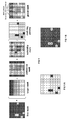
- Figure 1 shows the criteria taken into account by the seat allocation system when seating a single passenger onboard an airplane.
- Each matrix in figure 1 represents the cabin in the airplane and each box represents a seat.
- the matrix "free mask” shows available seats. This group of available seats is defined by subtracting the seats considered as unavailable, including those for which the reservation is confirmed, from the total number of seats. Seats can also be considered as unavailable for other reasons, in particular if they cannot be used in the course of a flight. The seats marked with a "0" in the figure are not available. In practice, if a passenger has confirmed his reservation, the seat allocated to him is thus considered as unavailable. This is particularly the case when he has already checked in and has a boarding pass with a published seat number.
- next matrices or "marks" define different preferences and criteria accommodating the passenger's wishes as well as the rules of the airplane.
- a value is determined as a function of the correspondence to the placement criteria for a given passenger in each seat.
- Each seat will then have a passenger satisfaction value for each rule. These values are added together for each seat and a global mark representing available seats with all rules taken into account is provided. The highest value is translated to the best seat to assign to that given passenger.
- the user interface allows these criteria to define different levels of importance and the calculation will thus be more difficult as a result.
- the user gives thus a particular weight to each criterion, it can be for example: Customer preferences Target areas Suitability Multiple legs Group linking Courtesy 9 5 8 1 9 2
- the multiple-leg penalty applies when a passenger travel on several sections (for example: Nice -> Paris - Paris -> Berlin) and the aircraft is the same for those sections.
- the goal is to avoid that a customer has to move from a seat to another between the sections of his trip. See Fig. 1 .
- a seat available in section can be already occupied in the other sections. To ensure that such a seat won't get a good mark, we penalize it in dividing its score by two. For example, a multiple-legs penalty looking like shown in Fig. 1 and Fig. 1a .
- This seat allocation system only works on one single passenger at a time. This is different for a group of passengers, where passengers willing to travel in group should be seated next to the other group members as much as can be.
- the global mark for each passenger from the group is calculated according to figure 1 . Thereafter, all the global marks (one for each passenger in the group) are added together to define a global group mark as shown in figure 2 .
- the group can be seated according to their criteria, availability and the rules of the airplane.
- the line shape may be preferred to the square shape. This remains configurable and may even be aircraft or cabin dependent.
- the shapes have a ranking order, where the highest ranked shape always will be chosen if suitable in terms of seat availability.
- the group can be split up into smaller groups such as until a suitable shape is found.
- figure 3 the global mark group in shown on the right.
- an average mark is calculated by summing the marks contained inside the shape in every position in the cabin matrix. The resulting matrix is shown in figure 3 , left matrix.
- the final step of the system is to assign individually each passenger of the group inside the best shape, on the seat having the maximum satisfaction value.
- computer means may be used. These means comprise data storage means for storing databases such as a database of predefined geometrical shapes, and particularly a computer database as well as processing means in the form of a processor.
- a communication network may or may not be available. All the data accessed may be stored on the terminal itself or on a remote server.
Landscapes
- Business, Economics & Management (AREA)
- Engineering & Computer Science (AREA)
- Human Resources & Organizations (AREA)
- Strategic Management (AREA)
- Tourism & Hospitality (AREA)
- Economics (AREA)
- Marketing (AREA)
- Entrepreneurship & Innovation (AREA)
- Operations Research (AREA)
- Quality & Reliability (AREA)
- Development Economics (AREA)
- Physics & Mathematics (AREA)
- General Business, Economics & Management (AREA)
- General Physics & Mathematics (AREA)
- Theoretical Computer Science (AREA)
- Game Theory and Decision Science (AREA)
- Management, Administration, Business Operations System, And Electronic Commerce (AREA)
Abstract
A customer seating system for allocating seats to a group of customers, adapted to
- Calculate a satisfaction value for each available seat, for each customer
Characterized in, that said system is further adapted to
- Compute a global satisfaction value for each seat, said global satisfaction value is the sum of the previously calculated satisfaction values for the customers of the group,
- Provide seating arrangements according to one of the predetermined geometrical shapes corresponding to the group,
- Determine the group of seats matching said predetermined shape that gives the maximum average global satisfaction value,
- Assign the corresponding seats to the group of customers.
- Calculate a satisfaction value for each available seat, for each customer
Characterized in, that said system is further adapted to
- Compute a global satisfaction value for each seat, said global satisfaction value is the sum of the previously calculated satisfaction values for the customers of the group,
- Provide seating arrangements according to one of the predetermined geometrical shapes corresponding to the group,
- Determine the group of seats matching said predetermined shape that gives the maximum average global satisfaction value,
- Assign the corresponding seats to the group of customers.
Description
- The present invention relates to a customer seating system for allocating seats to a group of customers using a computer system. More specifically, the invention relates to a customer seating system for allocating seats to a group of passengers into a cabin of an airplane or similar using a computer system, while maximizing the requirement to the airplane and the preferences of the customers.
- In the field of aerial transportation, the appointment of seats to passengers onboard an aircraft took once place by a manual assignment by an employee. The criteria essentially used by the employee to carry out this appointment of seats are the distribution of weight within the aircraft and taking into account on a case by case basis, the preferences and value of the passengers. An automated system was needed to optimize the efficiency of the seating allocation.
- Today, automated reservation systems for seat allocation are well-known from for example publication number
W02004010349 . This document teaches how a computerized system can allocate seats to passengers, while taking their preferences and the requirements of the airplane as weight distribution into account. That way, each passenger reserving a seat onboard an aircraft will automatically be assigned a seat according to the preferences he inputted and the aircrafts capacity and other requirements, such as security requirements. - A system like the above-described system, works well for individual passengers. However, when several passengers are travelling together as a group, specific seating is needed. It is for example preferred to place the group together when possible. Also different passengers being part of that group might have different preferences.
- So far, aerial transportation companies still rely on seat allocation by manual assignment by an employee when it comes to seat allocation for a whole group of passengers with individual needs as well as preferences as a group.
- There is therefore a need to provide an automated computerized system that is configured to allocate seats for groups of costumers, while taking their preferences as individuals and as a group into account, and further while respecting the requirements such as weight distribution of the specific aircraft.
- It is the purpose of the present invention to provide such a system.
- In a more specific manner, the present invention relates to a customer seating system for allocating seats to a group of customers, adapted to
- order the customers by value, and process them sequentially
- calculate a satisfaction value for each available seat, for each customer,
- compute a global satisfaction value for each seat, said global satisfaction value is the sum of the previously calculated satisfaction values for the customers of the group,
- provide seating arrangements according to one of the predetermined geometrical shapes corresponding to the group,
- determine the group of seats matching said predetermined shape that gives the maximum average global satisfaction value, and
- assign the corresponding seats to each customer of the group.
- It further relates to a customer seating system as defined above, where said satisfaction value is calculated using several criteria. These criteria may be one or more but not limited to the following:
- Customer preferences, giving the customer the option to choose between window seat or aisle seat for example.
- Target areas, defining an area where the customer should be seated. This allows grouping customers of same characteristics (value, booking class ...) in same areas.
- Suitability, telling if a seat is suitable for a customer depending on his characteristics. There are two types of suitability criteria: the passenger to seat suitability, and the passenger to passenger suitability. A criterion can be defined optional or mandatory. The interface of the system allows the definition of about thirty different types of passengers (wheelchair, unaccompanied minor, child ...) and forty types of seats (exit row, close to lavatory, bulkhead ...).
- Multiple legs, based on that a same seat should be assigned in case of a trip involving multiple sections with no change of aircraft between the sections.
- Group linking, placing passengers travelling in a group as close to each other as possible.
- Courtesy, keeping a seat free next to high valued customers when possible.
- One of the main features of the present invention is how to seat a group of customers. According to the invention, passengers in a group will not be considered as individuals, but as a whole unit. This is possible by introducing geometrical seating patterns or "shapes", which may be predefined in the seating allocation system.
- Hence, the geometrical shapes corresponding to the number of customer seats required for a group are selected from a set of predetermined geometrical shapes.
- There is for each number of customers in a group, a certain number of possible geometric shapes.
- The predetermined geometrical shapes may have a ranking order, defining which shape is preferred. This preference can be configurable and even be aircraft or cabin dependent.
- Thereby the highest ranked geometrical shape amongst the available geometrical shapes corresponding to the number of customer seats required for a group is selected first.
- If the highest ranked geometrical shape amongst the available geometrical shapes corresponding to the number of customer seats required for a group is not suitable, then the next shape in the ranking order is selected and so forth. By a suitable shape, we mean the highest ranked geometrical shape that can physically fit with regards to free seats, and which fulfills the above listed criteria.
- With none of the highest ranked geometrical shapes being suitable due to for example lack of available adjacent seats, a lower ranked shape may actually be a sum of two smaller shapes separated from each other. This way, every customer from a group will still be seated next to another customer from the same group, even though the group is split into two or more smaller groups.
- Also, the maximum number of customers in a group is preferably limited to a predetermined number, for example 9. A group having more than 9 customers may be split up in two or more smaller groups.
- The present invention further comprises a method for allocating seats to a group of customer comprising the steps of:
- order the customers by value, and process them sequentially,
- Calculating a satisfaction value for each available seat, for each customer,
- Computing a global satisfaction value for each seat, said global satisfaction value is the sum of the previously calculated satisfaction values for the customers of the group,
- Providing seating arrangements according to one of the predetermined geometrical shapes corresponding to the group,
- Determining the group of seats matching said predetermined shape that gives the maximum average global satisfaction value,
- Assigning the corresponding seats to the group of customers.
- Also the invention describes a terminal comprising:
- a user interface for inputting and outputting data,
- a database and memory for storing data,
- a processor for processing data,
- further comprising the customer seating system described above. The terminal may furthermore communicate with a local or remote server.
- The present invention will now be described in details with reference to the drawings for the purpose of illustrating the preferred embodiment.
-
Fig 1 is a schematic view showing how customer satisfaction value is determined for each seat. -
FIG 1 a and 1 b is a schematic view showing the criterion of multi-leg. -
Fig 2 is a schematic view showing how a group of customers is seated according to the invention. -
Fig 3 is a schematic view showing how a best seating "shape" is placed. - The following description is applicable to a reservation of seats for aircraft travel, onboard an airplane. However, this application is not limiting and the invention could be used for any other technical sector in which a reservation of places is necessary.
-
Figure 1 shows the criteria taken into account by the seat allocation system when seating a single passenger onboard an airplane. Each matrix infigure 1 represents the cabin in the airplane and each box represents a seat. - The matrix "free mask" shows available seats. This group of available seats is defined by subtracting the seats considered as unavailable, including those for which the reservation is confirmed, from the total number of seats. Seats can also be considered as unavailable for other reasons, in particular if they cannot be used in the course of a flight. The seats marked with a "0" in the figure are not available. In practice, if a passenger has confirmed his reservation, the seat allocated to him is thus considered as unavailable. This is particularly the case when he has already checked in and has a boarding pass with a published seat number.
- The next matrices or "marks" define different preferences and criteria accommodating the passenger's wishes as well as the rules of the airplane.
- For each rule to be respected, a value is determined as a function of the correspondence to the placement criteria for a given passenger in each seat. Each seat will then have a passenger satisfaction value for each rule. These values are added together for each seat and a global mark representing available seats with all rules taken into account is provided. The highest value is translated to the best seat to assign to that given passenger.
- The user interface allows these criteria to define different levels of importance and the calculation will thus be more difficult as a result. The user gives thus a particular weight to each criterion, it can be for example:
Customer preferences Target areas Suitability Multiple legs Group linking Courtesy 9 5 8 1 9 2 - The multiple-leg penalty applies when a passenger travel on several sections (for example: Nice -> Paris - Paris -> Berlin) and the aircraft is the same for those sections. The goal is to avoid that a customer has to move from a seat to another between the sections of his trip. See
Fig. 1 . - A seat available in section can be already occupied in the other sections. To ensure that such a seat won't get a good mark, we penalize it in dividing its score by two. For example, a multiple-legs penalty looking like shown in
Fig. 1 and Fig. 1a . - for the section Nice -> Paris, would mean that the free mask for the section Paris -> Berlin would be as shown in
Fig. 1 b. - This seat allocation system only works on one single passenger at a time. This is different for a group of passengers, where passengers willing to travel in group should be seated next to the other group members as much as can be.
- To allocate seats for a group of passengers according to the invention, the global mark for each passenger from the group is calculated according to
figure 1 . Thereafter, all the global marks (one for each passenger in the group) are added together to define a global group mark as shown infigure 2 . - With the global group mark computed, the group can be seated according to their criteria, availability and the rules of the airplane.
- To assign seats to a group, different predesigned seating shapes have been defined and stored in the system.
- For example for a group of 4 passengers, the following good shapes are tried by the systemOr


- The line shape may be preferred to the square shape. This remains configurable and may even be aircraft or cabin dependent.
- Obviously, there is a certain number of predefined shapes for each number of passengers forming a group. The shapes have a ranking order, where the highest ranked shape always will be chosen if suitable in terms of seat availability.
- If none of the highest ranked shapes are suitable, alternative shapes are tried. In our previous example with a group of 4 members, if the line and square shapes are not suitable due to lack of available seats in that configuration, the next shape in the ranking order to be tried may be

- As a last resort, if none of the shapes are suitable due to for example lack of available adjacent seats, the group can be split up into smaller groups such asuntil a suitable shape is found.

- Let's assume the square shape in the above example is suitable.
- In
figure 3 the global mark group in shown on the right. To compute the best position for the square shape, an average mark is calculated by summing the marks contained inside the shape in every position in the cabin matrix. The resulting matrix is shown infigure 3 , left matrix. - By positioning the shape in the left corner to perform the first calculation, it is clear to see that the sum is 14+14+14+18=60.
- The second calculation comes from moving the shape one position to the right having a total mark of 14+11+14+11=50, as indicated in the left matrix at the second position (from the top left corner). And so forth, until computing sums for the whole global group mark matrix.
- The highest value is in this example 67, which will therefore be the position of the square shape.
- After the best shape has been found and placed, the final step of the system is to assign individually each passenger of the group inside the best shape, on the seat having the maximum satisfaction value.
- To proceed according to the invention, computer means may be used. These means comprise data storage means for storing databases such as a database of predefined geometrical shapes, and particularly a computer database as well as processing means in the form of a processor. A communication network may or may not be available. All the data accessed may be stored on the terminal itself or on a remote server.
Claims (12)
- A customer seating system for allocating seats to a group of customers, adapted to- Calculate a satisfaction value for each available seat, for each customer
Characterized in, that said system is further adapted to- Compute a global satisfaction value for each seat, said global satisfaction value is the sum of the previously calculated satisfaction values for the customers of the group,- Provide seating arrangements according to one of the predetermined geometrical shapes corresponding to the group,- Determine the group of seats matching said predetermined shape that gives the maximum average global satisfaction value,- Assign the corresponding seats to the group of customers. - A customer seating system according to claim 1, where said satisfaction value is calculated using several criteria such as customer preferences, target, suitability, multi legs, courtesy.
- A customer seating system according to any of the preceding claims, where a plurality of geometrical shapes corresponding to the number of customers seats required for a group, are processed sequentially to find the most suitable one.
- A customer seating system according to any of the preceding claims, where the geometrical shape corresponding to the number of customer seats required for a group, is selected from a set of predetermined geometrical shapes.
- A customer seating system according to any of the preceding claims, where a geometrical shape is selected amongst available geometrical shapes corresponding to the number of customer seats required for a group according to a predetermined ranking order.
- A customer seating system according to claim 5, where the highest ranked geometrical shape amongst the available geometrical shapes corresponding to the number of customer seats required for a group is selected first.
- A customer seating system according to claim 6, where the next geometrical shape according to the ranking order is selected if the highest ranked geometrical shape amongst the available geometrical shapes corresponding to the number of customer seats required for a group is not suitable.
- A customer seating system according to claim 1 to 7, where said system repeatedly will split the group into two smaller groups, until the whole group is assigned, If no shape is found suitable.
- A method for allocating seats to a group of customer comprising the steps of:- Calculating a satisfaction value for each available seat, for each customer,- Computing a global satisfaction value for each seat, said global satisfaction value is the sum of the previously calculated satisfaction values for the customers of the group,- Providing seating arrangements according to one of the predetermined geometrical shapes corresponding to the group,- Determining the group of seats matching said predetermined shape that gives the maximum average global satisfaction value,- Assigning the corresponding seats to the group of customers.
- A terminal comprising
a user interface for inputting and outputting data,
a memory and database for storing data,
a processor for processing data,
further comprising the customer seating system of any of claims 1 to 8. - A terminal according to claim 10, where said terminal communicates with a remote server.
- A computer program configured to perform the steps of claim 9.
Priority Applications (7)
| Application Number | Priority Date | Filing Date | Title |
|---|---|---|---|
| EP09305962A EP2323082A1 (en) | 2009-10-09 | 2009-10-09 | Seat allocation to passengers on an aircraft |
| US12/661,527 US20110087506A1 (en) | 2009-10-09 | 2010-03-18 | Seat allocation to passengers on an aircraft |
| CA2782076A CA2782076A1 (en) | 2009-10-09 | 2010-10-11 | Seat allocation to passengers on an aircraft |
| AU2010304977A AU2010304977A1 (en) | 2009-10-09 | 2010-10-11 | Seat allocation to passengers on an aircraft |
| PCT/EP2010/065174 WO2011042563A1 (en) | 2009-10-09 | 2010-10-11 | Seat allocation to passengers on an aircraft |
| IN3007DEN2012 IN2012DN03007A (en) | 2009-10-09 | 2010-10-11 | |
| CN2010800534649A CN102725768A (en) | 2009-10-09 | 2010-10-11 | Seat allocation to passengers on an aircraft |
Applications Claiming Priority (1)
| Application Number | Priority Date | Filing Date | Title |
|---|---|---|---|
| EP09305962A EP2323082A1 (en) | 2009-10-09 | 2009-10-09 | Seat allocation to passengers on an aircraft |
Publications (1)
| Publication Number | Publication Date |
|---|---|
| EP2323082A1 true EP2323082A1 (en) | 2011-05-18 |
Family
ID=41467129
Family Applications (1)
| Application Number | Title | Priority Date | Filing Date |
|---|---|---|---|
| EP09305962A Withdrawn EP2323082A1 (en) | 2009-10-09 | 2009-10-09 | Seat allocation to passengers on an aircraft |
Country Status (7)
| Country | Link |
|---|---|
| US (1) | US20110087506A1 (en) |
| EP (1) | EP2323082A1 (en) |
| CN (1) | CN102725768A (en) |
| AU (1) | AU2010304977A1 (en) |
| CA (1) | CA2782076A1 (en) |
| IN (1) | IN2012DN03007A (en) |
| WO (1) | WO2011042563A1 (en) |
Cited By (1)
| Publication number | Priority date | Publication date | Assignee | Title |
|---|---|---|---|---|
| CN105573266A (en) * | 2014-10-15 | 2016-05-11 | 株式会社理光 | Method and system for controlling energy-consuming equipment according to user's seating environment requirements |
Families Citing this family (18)
| Publication number | Priority date | Publication date | Assignee | Title |
|---|---|---|---|---|
| US9781170B2 (en) | 2010-06-15 | 2017-10-03 | Live Nation Entertainment, Inc. | Establishing communication links using routing protocols |
| GB201117278D0 (en) | 2011-10-06 | 2011-11-16 | Fuel Matrix Ltd | Method and system |
| US20140032250A1 (en) * | 2012-07-27 | 2014-01-30 | Ebay, Inc. | Interactive Venue Seat Map |
| US20140052482A1 (en) * | 2012-08-14 | 2014-02-20 | Mathieu Le Marier | Passenger oriented seating system and method |
| US9009229B2 (en) * | 2012-11-08 | 2015-04-14 | Seatid Ltd. | Device, system, and method of sharing social network information |
| CN103390204A (en) * | 2013-07-30 | 2013-11-13 | 武汉大学 | Ticket allocation method and system |
| US20150347928A1 (en) * | 2014-05-30 | 2015-12-03 | Amadeus S.A.S. | Seat assignment |
| US11037074B2 (en) * | 2015-03-09 | 2021-06-15 | The Boeing Company | Digital seat ordering and management |
| CN105654181A (en) * | 2015-12-28 | 2016-06-08 | 中国民航信息网络股份有限公司 | Prepaid seat protecting method, prepaid seat protecting device and prepaid seat protecting system |
| CN106529766A (en) * | 2016-10-09 | 2017-03-22 | 深圳市轱辘车联数据技术有限公司 | Vehicle seat allocation method and vehicle seat allocation device |
| CN108074001A (en) * | 2016-11-10 | 2018-05-25 | 松下知识产权经营株式会社 | Seat prompt system and seat reminding method |
| US20190122143A1 (en) | 2017-10-24 | 2019-04-25 | International Business Machines Corporation | Cognitive-based passenger selection |
| CN110009157A (en) * | 2019-04-10 | 2019-07-12 | 哈尔滨理工大学 | An online check-in and seat selection method that meets the individual needs of users |
| CN110334827B (en) * | 2019-07-10 | 2023-05-26 | 中国民航信息网络股份有限公司 | Airplane seat reservation method and system |
| CN110334959B (en) * | 2019-07-10 | 2024-01-23 | 中国民航信息网络股份有限公司 | A method and device for allocating flight space resources |
| CN110322160A (en) * | 2019-07-10 | 2019-10-11 | 中国民航信息网络股份有限公司 | A kind of seating allocation method and system |
| CN110751590A (en) * | 2019-10-21 | 2020-02-04 | 中国民航信息网络股份有限公司 | Method and system for pre-value machine |
| KR102441730B1 (en) * | 2021-03-19 | 2022-09-08 | 이정갑 | Seat recommendation method and device |
Citations (2)
| Publication number | Priority date | Publication date | Assignee | Title |
|---|---|---|---|---|
| FR2842003A1 (en) * | 2002-07-02 | 2004-01-09 | Amadeus | METHOD FOR ALLOCATING SEATS TO CLIENTS IN A COMPUTER RESERVATION SYSTEM |
| WO2004010349A2 (en) | 2002-07-02 | 2004-01-29 | Amadeus S.A.S. | Method of allocating seats to customers in a computer reservation system |
Family Cites Families (1)
| Publication number | Priority date | Publication date | Assignee | Title |
|---|---|---|---|---|
| US8121872B2 (en) * | 2004-11-29 | 2012-02-21 | Mlb Advanced Media, L.P. | System and method for allocating seats for a ticketed event |
-
2009
- 2009-10-09 EP EP09305962A patent/EP2323082A1/en not_active Withdrawn
-
2010
- 2010-03-18 US US12/661,527 patent/US20110087506A1/en not_active Abandoned
- 2010-10-11 CA CA2782076A patent/CA2782076A1/en not_active Abandoned
- 2010-10-11 CN CN2010800534649A patent/CN102725768A/en active Pending
- 2010-10-11 WO PCT/EP2010/065174 patent/WO2011042563A1/en not_active Ceased
- 2010-10-11 IN IN3007DEN2012 patent/IN2012DN03007A/en unknown
- 2010-10-11 AU AU2010304977A patent/AU2010304977A1/en not_active Abandoned
Patent Citations (2)
| Publication number | Priority date | Publication date | Assignee | Title |
|---|---|---|---|---|
| FR2842003A1 (en) * | 2002-07-02 | 2004-01-09 | Amadeus | METHOD FOR ALLOCATING SEATS TO CLIENTS IN A COMPUTER RESERVATION SYSTEM |
| WO2004010349A2 (en) | 2002-07-02 | 2004-01-29 | Amadeus S.A.S. | Method of allocating seats to customers in a computer reservation system |
Non-Patent Citations (2)
| Title |
|---|
| DIMOPOULOS N J ET AL: "A New Heuristic for Solving the Multichoice Multidimensional Knapsack Problem", IEEE TRANSACTIONS ON SYSTEMS, MAN AND CYBERNETICS. PART A:SYSTEMS AND HUMANS, IEEE SERVICE CENTER, PISCATAWAY, NJ, US, vol. 35, no. 5, 1 September 2005 (2005-09-01), pages 708 - 717, XP011137918, ISSN: 1083-4427 * |
| MARIA CHANTZARA ET AL: "MVRC Heuristic for Solving the Multi-Choice Multi-Constraint Knapsack Problem", 1 January 2006, COMPUTATIONAL SCIENCE - ICCS 2006 LECTURE NOTES IN COMPUTER SCIENCE;;LNCS, SPRINGER, BERLIN, DE, PAGE(S) 579 - 587, ISBN: 9783540343790, XP019032833 * |
Cited By (2)
| Publication number | Priority date | Publication date | Assignee | Title |
|---|---|---|---|---|
| CN105573266A (en) * | 2014-10-15 | 2016-05-11 | 株式会社理光 | Method and system for controlling energy-consuming equipment according to user's seating environment requirements |
| CN105573266B (en) * | 2014-10-15 | 2018-09-11 | 株式会社理光 | Method and system for controlling energy consuming devices based on user's seat environment requirements |
Also Published As
| Publication number | Publication date |
|---|---|
| AU2010304977A1 (en) | 2012-05-24 |
| CA2782076A1 (en) | 2011-04-14 |
| WO2011042563A1 (en) | 2011-04-14 |
| IN2012DN03007A (en) | 2015-07-31 |
| US20110087506A1 (en) | 2011-04-14 |
| CN102725768A (en) | 2012-10-10 |
Similar Documents
| Publication | Publication Date | Title |
|---|---|---|
| US20110087506A1 (en) | Seat allocation to passengers on an aircraft | |
| AU2003255702B2 (en) | Method of allocating seats to customers in a computer reservation system | |
| CN110334959B (en) | A method and device for allocating flight space resources | |
| CN110334827B (en) | Airplane seat reservation method and system | |
| US8315892B2 (en) | Assignments of places | |
| EP2574549B1 (en) | Aircraft seating systems | |
| RU2594043C2 (en) | Method of configuring and/or equipment of vehicle passenger compartment, in particular of aircraft | |
| US8543433B1 (en) | System and method for real-time revenue management | |
| US8117051B2 (en) | Method for determining the number of available transport seats in a computerized reservation system | |
| US20210027209A1 (en) | Aircraft seat configuration management system and method | |
| CN106471528A (en) | For analyzing the method and computer program product that flight passenger's air ticket high-volume database is deposited | |
| AU2018408417A1 (en) | Method and system for configuring an interior of a reconfigurable vehicle | |
| US20030216948A1 (en) | Method and program for processing seat reservation cancellations | |
| EP2998746A1 (en) | Corporate recognition for travel related services | |
| KR20050016653A (en) | Method of allocating seats to customers in a computer reservation system | |
| CN114417234B (en) | Aviation overstock optimization method and device, storage medium and electronic equipment | |
| US8489435B2 (en) | Method and device for storing and accessing data in a computer travel reservation system | |
| CA3090165C (en) | Method and system for configuring an interior of a reconfigurable vehicle | |
| EP2950243A1 (en) | Seat assignment | |
| WO2011129834A1 (en) | Automated tour logistics management method and system |
Legal Events
| Date | Code | Title | Description |
|---|---|---|---|
| PUAI | Public reference made under article 153(3) epc to a published international application that has entered the european phase |
Free format text: ORIGINAL CODE: 0009012 |
|
| AK | Designated contracting states |
Kind code of ref document: A1 Designated state(s): AT BE BG CH CY CZ DE DK EE ES FI FR GB GR HR HU IE IS IT LI LT LU LV MC MK MT NL NO PL PT RO SE SI SK SM TR |
|
| AX | Request for extension of the european patent |
Extension state: AL BA RS |
|
| STAA | Information on the status of an ep patent application or granted ep patent |
Free format text: STATUS: THE APPLICATION IS DEEMED TO BE WITHDRAWN |
|
| 18D | Application deemed to be withdrawn |
Effective date: 20111119 |