EP2321746B1 - Effiziente massenverarbeitung von datenkodierten strukten auf säulenbasis - Google Patents
Effiziente massenverarbeitung von datenkodierten strukten auf säulenbasis Download PDFInfo
- Publication number
- EP2321746B1 EP2321746B1 EP09803686.6A EP09803686A EP2321746B1 EP 2321746 B1 EP2321746 B1 EP 2321746B1 EP 09803686 A EP09803686 A EP 09803686A EP 2321746 B1 EP2321746 B1 EP 2321746B1
- Authority
- EP
- European Patent Office
- Prior art keywords
- data
- sequences
- values
- query
- column
- Prior art date
- Legal status (The legal status is an assumption and is not a legal conclusion. Google has not performed a legal analysis and makes no representation as to the accuracy of the status listed.)
- Not-in-force
Links
Images











Classifications
-
- G—PHYSICS
- G06—COMPUTING OR CALCULATING; COUNTING
- G06F—ELECTRIC DIGITAL DATA PROCESSING
- G06F16/00—Information retrieval; Database structures therefor; File system structures therefor
- G06F16/20—Information retrieval; Database structures therefor; File system structures therefor of structured data, e.g. relational data
- G06F16/24—Querying
- G06F16/245—Query processing
- G06F16/2455—Query execution
- G06F16/24553—Query execution of query operations
- G06F16/24554—Unary operations; Data partitioning operations
- G06F16/24557—Efficient disk access during query execution
Definitions
- the subject disclosure generally relates to efficient column based encoding of data for reducing the size of large-scale amounts of data and increasing the speed of processing or querying the data.
- relational databases have been organized according to rows, which correspond to records, having fields. For instance, a first row might include a variety of information for its fields corresponding to columns (name1, age1, address 1, sex1, etc.), which define the record of the first row and a second row might include a variety of different information for fields of the second row (name2, age2, address2, sex2, etc.).
- querying over enormous amounts of data, or retrieving enormous amounts of data for local querying or local business intelligence by a client have been limited in that they have not been able to meet real-time or near real-time requirements.
- the client wishes to have a local copy of up-to-date data from the server, the transfer of such large scale amounts of data from the server given limited network bandwidth and limited client cache storage has been impractical to date for many applications.
- Run-length encoding is a conventional form of data compression in which runs of data, that is, sequences in which the same data value occurs in many consecutive data elements, are stored as a single data value and count, rather than as the original run.
- RLE is useful on data that contains many such runs, for example, relatively simple graphic images such as icons, line drawings, and animations.
- RLE is known to be less efficient.
- RLE by itself, does not lend itself to efficient data reduction, wasting valuable processing time for little to no gain.
- dictionary encoding operates by tokenizing field data values to a reduced bit set, such as sequential integers, in a compacted representation via a dictionary used alongside of the resulting data to obtain the original field data values from the compacted representation.
- Another type of compression that has been applied to data includes value encoding, which converts real numbers into integers by performing some transformation over the data enabling a more compact representation, e.g., applying an invertible mathematical function over the data, which reduces the number of bits needed to represent the data.
- value encoding which converts real numbers into integers by performing some transformation over the data enabling a more compact representation, e.g., applying an invertible mathematical function over the data, which reduces the number of bits needed to represent the data.
- real numbers such as float values
- take up more space in memory than integer values and thus invertibly converting float values to integer values reduces storage size and then a processor that uses the data can derive the float values when needed.
- Still another type of compression that has been applied to data includes bit packing, which counts the number of distinct values of data or determines the range over which the different values span, and then represents that set of numbers or values with the minimum number of bits as determined by an optimization function. For instance, perhaps the each field of a given column spans only a limited range, and thus instead of representing each value with, e.g., 10 bits as originally defined for the field, it may turn out that only 6 bits are needed to represent the values. Bit packing re-stores the values according to the more efficient 6 bit representation of the data.
- each of these conventional compression techniques has been independently applied to the row-organized information of relational databases, e.g., via rowset operators, yet, each of these techniques suffers disadvantages in that none adequately address the problem of satisfying the delivery of huge amounts of data from a database quickly to a consuming client, which may have real-time requirements, for up-to-date data.
- the conventional methodologies have focused on reducing the size of data stored to maximize the amount of data that can be stored for a given disk size or storage limit.
- C-Store stores each column from a table in a separate file. Each column is divided into blocks with each block containing 64 k of data. If data is compressed or variable width, it is possible for different blocks to contain different numbers of values for that column. Each block can be compressed using an algorithm best suited for that block, though in practice the same compression algorithm is used for all blocks in a column.
- Each block contains a small header at the beginning of the block, indicating the compression algorithm used, the number of values stored in the block and the ordinal position of the first value in the block.
- C-Store by default reads 4 MB from a column at a time on any access. This data is held in memory as 4 MB from other columns are read into memory. Once all columns are in memory, random access across columns is significantly faster.
- C-Store was extended to handle a variety of column compression techniques by adding two classes to the source code for each new compression technique. The first class encapsulates an intermediate representation for compressed data called a compression block.
- a compression block contains a buffer of the column data in compressed format and provides an API that allows the buffer to be accessed in several ways.
- a data source operator serves as the interface between the query plan and the storage manager and has compression-specific knowledge about how pages for that compression technique are stored on disk and what indexes are available on that column. It is thus able to serve as a scan operator reading in compressed pages from disk and converting them into compressed blocks. While many optimizations are possible if operators are allowed to work directly on compressed data, the code becomes complex quickly since an if statement and an appropriate block of code is needed for each possible combination of compression types. This complexity is alleviated by abstracting away the properties of compressed data that allow the operators to perform optimizations when processing. The operator was able to optimize processing because the compression schemes encoded multiple positions for the same value. This knowledge allowed the operator to directly output the join result for multiple tuples without actually having to perform the execution more than once.
- Embodiments of processing of column based data encoded structures are described.
- Various non-limiting embodiments enable efficient query processing over large scale data storage.
- a subset of columns implicated by a query are received as integer encoded and compressed sequences of values corresponding to different columns of data.
- Query processing buckets are defined that span over the subset of columns based on transitions of compression type occurring in the integer encoded and compressed sequences of values of the subset of data.
- the query is then processed in memory on a bucket by bucket basis and based on type of current bucket, e.g., pure bucket, single impurity bucket, double impurity bucket, etc., as defined in greater detail below.
- the column based organization of the data and the application of a hybrid run length encoding and bit packing technique, enable a highly efficient and speedy query response in real-time.
- Synergy of the hybrid data reduction techniques in concert with the column-based organization coupled with gains in scanning and querying efficiency owing to the column based compact representation, results in substantially improved data compression at a fraction of the cost of conventional systems, e.g., a factor of 400 times faster at less than 1/10 the cost of the fastest known conventional system.
- a column oriented encoding technique is applied to large amounts of data to compact the data and simultaneously organize the data to make later scan/search/query operations over the data substantially more efficient.
- a roadmap for what follows an overview of various embodiments is first described and then exemplary, non-limiting optional implementations are discussed in more detail for supplemental context and understanding.
- the column based encoding techniques for packing large amounts of data are described including an exemplary embodiment that adaptively trades off the performance benefits of run length encoding and bit packing via a hybrid compression technique.
- the data is "integerized" to form integer sequences for each column that are uniformly represented according to dictionary encoding, value encoding, or both dictionary and value encoding, in either order.
- This integerization stage results in uniformly represented column vectors, and can achieve significant savings by itself, particularly where long fields are recorded in the data, such as text strings.
- a compression stage iteratively applies run length encoding to the run of any of the columns that will lead to the highest amount of overall size savings on the overall set of column vectors.
- the packing technique is column based, not only providing superior compression, but also the compression technique itself aids in processing the data quickly once the compacted integer column vectors are delivered to the client side.
- a column based encoder/compressor 110 is provided for compacting large scale data storage 100 and for making resulting scan/search/query operations over the data substantially more efficient as well.
- compressor 110 transmits the compressed columns that are pertinent to the query over transmission network(s) 115 of data transmission zone B.
- the data is delivered to in memory storage 130, and thus decompression of the pertinent columns can be performed very fast by decoder and query processor 140 in data processing zone C.
- a bucket walking is applied to the rows represented by the decompressed columns pertinent to the query for additional layers of efficient processing.
- column oriented encoding and compression can be applied to large amounts of data in various embodiments to compact and simultaneously organize the data to make later scan/search/query operations over the data substantially more efficient.
- the raw data is initially re-organized as columnized streams of data.
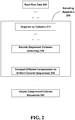
- an encoder is generally shown in Fig. 2 in which raw data is received, or read from storage at 200 at which point encoding apparatus and/or encoding software 250 organizes the data as columns at 210.
- the column streams are transformed to a uniform vector representation.
- integer encoding can be applied to map individual entries like names or places to integers.
- Such integer encoding technique can be a dictionary encoding technique, which can reduce the data by a factor of 2x-10x.
- a value encoding can further provide a 1x-2x reduction in size. This leaves a vector of integers for each column at 220.
- Such performance increases are sensitive to the data being compacted, and thus such size reduction ranges are given merely as non-limiting estimates to give a general idea of relative performance of the different steps.
- the encoded uniform column vectors can be compacted further.
- a run length encoding technique is applied that determines the most frequent value or occurrence of a value across all the columns, in which case a run length is defined for that value, and the process is iterative up to a point where benefits of run length encoding are marginal, e.g., for recurring integer values having at least 64 occurrences in the column.
- bit savings from applying run length encoding are examined, and at each step of the iterative process, the column of the columns is selected that achieves the maximum bit savings through application of re-ordering and definition of a run length.
- the bit savings are maximized at the column providing the greatest savings.
- run length encoding can provide significant compression improvement, e.g., 100x more, by itself.
- a hybrid compression technique is applied at 230 that employs a combination of bit packing and run length encoding.
- a compression analysis is applied that examines potential savings of the two techniques, and where, for instance, run length encoding is deemed to result in insufficient net bit savings, bit packing is applied to the remaining values of a column vector.
- the algorithm switches to bit packing for the remaining relatively unique values of the column. For instance, where the values represented in a column become relatively unique (where the non-unique or repetitive values are already run length encoded), instead of run length encoding, bit packing can be applied for those values.
- the output is a set of compressed column sequences corresponding to the column values as encoded and compressed according to the above-described technique.
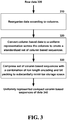
- Fig. 3 generally describes the above methodology according to a flow diagram beginning with the input of raw data 300.
- the data is reorganized according to the columns of the raw data 300, as opposed to keeping each field of a record together like conventional systems.
- each column forms an independent sequence, such as sequences C401, C402, C403, C404, C405, C406.
- column C401 might be a string of product prices
- column C402 might represent a string of purchase dates
- column C403 might represent a store location, and so on.
- the column based organization maintains inherent similarity within a data type considering that most real world data collected by computer systems is not very diverse in terms of the values represented.
- the column based data undergoes one or more conversions to form uniformly represented column based data sequences.
- step 320 reduces each column to integer sequences of data via dictionary encoding and/or value encoding.
- the column based sequences are compressed with a run length encoding process, and optionally bit packing.
- the run-length encoding process re-orders the column data value sequences of the column of all of the columns which achieves the highest compression savings.
- the column where run length encoding achieves the highest savings is re-ordered to group the common values being replaced by run length encoding, and then a run length is defined for the re-ordered group.
- the run length encoding algorithm is applied iteratively across the columns, examining each of the columns at each step to determine the column that will achieve the highest compression savings.
- the algorithm can stop, or for the remaining values not encoded by run length encoding in each column, bit packing can be applied to further reduce the storage requirements for those values.
- the hybrid run length encoding and bit packing technique can be powerful to reduce a column sequence, particularly those with a finite or limited number of values represented in the sequence.
- the field “sex” has only two field values: male and female.
- run length encoding such field could be represented quite simply, as long as the data is encoded according to the column based representation of raw data as described above. This is because the row focused conventional techniques described in the background, in effect, by keeping the fields of each record together, break up the commonality of the column data.
- "Male” next to an age value such as "21” does not compress as well as a "male” value next to only "male” or “female” values.
- the column based organization of data enables efficient compression and the result of the process is a set of distinct, uniformly represented and compacted column based sequences of data 340.
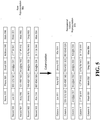
- Fig. 5 gives an example of the columnization process based on actual data.
- the example of Fig. 5 is for 4 data records 500, 501, 502 and 503, however, this is for simplicity of illustration since the invention can apply to terabytes of data.
- transaction data is recorded by computer systems, it is recorded record-by-record and generally in time order of receiving the records. Thus, the data in effect has rows, which correspond to each record.
- record 500 has name field 510 with value "Jon” 511, phone field 520 with value “555-1212” 521, email field 530 with value “jon@go” 531, address field 540 with value "21 st St” 541 and state field 550 with value "Wash” 551.
- Record 501 has name field 510 with value "Amy” 512, phone field 520 with value “123-4567” 522, email field 530 with value "Amy@wo” 532, address field 540 with value "1 2 nd P1" 542 and state field 550 with value "Mont” 552.
- Record 502 has name field 510 with value "Jimmy” 513, phone field 520 with value “765-4321” 523, email field 530 with value "Jim@so” 533, address field 540 with value "9 Fly Rd” 543 and state field 550 with value "Oreg” 553.
- Record 503 has name field 510 with value "Kim” 514, phone field 520 with value “987-6543” 524, email field 530 with value "Kim@to” 534, address field 540 with value "91 Y St” 544 and state field 550 with value "Miss” 554.
- row representation 560 is columnized to reorganized column representation 570, instead of having four records each having five fields, five columns are formed corresponding to the fields.
- column 1 corresponds to the name field 510 with value “Jon” 511, followed by value “Amy” 512, followed by value “Jimmy” 513, followed by value “Kim” 514.
- column 2 corresponds to the phone field 520 with value “555-1212” 521, followed by value “123-4567” 522, followed by value “765-4321” 523, followed by value “987-6543” 524.
- Column 3 corresponds to the email field 530 with value "jon@go” 531, followed by value “Amy@wo” 532, followed by value “Jim@so” 533, followed by value "Kim@to” 534.
- column 4 corresponds to the address field 540 with value "21 st St” 541, followed by value “1 2 nd P1” 542, followed by value “9 Fly Rd” 543, followed by value “91 Y St” 544.
- column 5 corresponds to the state field 550 with value "Wash” 551, followed by value “Mont” 552, followed by value “Oreg” 553, followed by value “Miss” 554.
- the data is segmented across each of the columns C1, C2, C3, C4, C5, C6 to form segments 600, 602, 604, 606, etc.
- each segment can include 100s of millions of rows or more, parallelization improves the speed of processing or scanning the data, e.g., according to a query.
- the results of each segment are aggregated to form a complete set of results while each segment is processed separately.
- Fig. 7 is a block diagram illustrative of a non-limiting example of dictionary encoding, as employed by embodiments described herein.
- a typical column 700 of cities may include values “Seattle,” “Los Angeles,” “Redmond” and so on, and such values may repeat themselves over and over.
- dictionary encoding an encoded column 710 includes a symbol for each distinct value, such as a unique integer per value.
- the integer "1" is stored, which is much more compact.
- the values that repeat themselves more often can be enumerated with mappings to the most compact representations (fewest bits, fewest changes in bits, etc.).
- Fig. 8 is a block diagram illustrative of a non-limiting example of value encoding, as employed by embodiments described herein.
- a column 800 represents sales amounts and includes a typical dollars and cents representation including a decimal, which implicates float storage.
- a column 810 encoded with value encoding may have applied to it a factor of 10, e.g., 10 2 , in order to represent the values with integers instead of float values, with integers requiring fewer bits to store.
- the transformation can similarly be applied in reduce the number of integers representing a value. For instance, values consistently ending in the millions for a column, such as 2,000,000, 185,000,000, etc., can all be divided by 10 6 to reduce the values to more compact representations 2, 185, etc.
- Fig. 9 is a block diagram illustrative of a non-limiting example of bit packing, as employed by embodiments described herein.
- a column 900 represents order quantities as integerized by dictionary and/or value encoding, however, 32 bits per row are reserved to represent the values.
- Bit packing endeavors to use the minimum number of bits for the values in the segment. In this example, 10 bits/row can be used to represent the values 590, 110, 680 and 320, representing a substantial savings for the first layer of bit packing applied to form column 910.
- Bit packing can also remove common powers of 10 (or other number) to form a second packed column 920.
- the values end in 0 as in the example that means that the 3 bits/row used to represent the order quantities are not needed reducing the storage structure to 7 bits/row.
- any increased storage due to the metadata needed to restore the data to column 900, such as what power of 10 was used, is vastly outweighed by the bit savings.
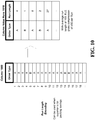
- Fig. 10 is a block diagram illustrative of a non-limiting example of run length encoding, as employed by embodiments described herein.
- a column such as column 1000 representing order types can be encoded effectively with run length encoding due to the repetition of values.
- a column value runs table 1010 maps order type to a run length for the order type. While slight variations on the representation of the metadata of table 1010 are permitted, the basic idea is that run length encoding can give compression of x50 for a run length of 100, which is superior to the gains bit packing can generally provide for the same data set.
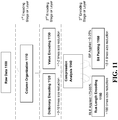
- Fig. 11 is a general block diagram of an embodiment provided herein in which the techniques of Figs. 7-10 are synthesized into various embodiments of a unified encoding and compression scheme.
- Raw data 1100 is organized as column streams according to column organization 1110.
- Dictionary encoding 1120 and/or value encoding 1130 provide respective size reductions as described above.
- a compression analysis 1140 examines potential bit savings across the columns when determining whether to apply run length encoding 1150 or bit packing 1160.
- Fig. 11 is expanded upon in the flow diagram of Fig. 12 .
- raw data is received according to an inherent row representation.
- the data is re-organized as columns.
- dictionary and/or value encoding are applied to reduce the data a first time.
- a hybrid RLE and bit packing technique as described above, can be applied.
- the compressed and encoded column based sequence of data are stored. Then, when a client queries for all or a subset of the compressed encoded column based sequences of data, the affected columns are transmitted to the requesting client at 1250.
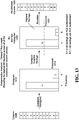
- Fig. 13 is a block diagram of an exemplary way to perform the compression analysis of the hybrid compression technique.
- a histogram 1310 is computed from column 1300, which represents the frequency of occurrences of values, or the frequency of occurrences of individual run lengths.
- a threshold 1312 can be set so that run length encoding does not apply for reoccurrences of a value that are small in number where run length gains may be minimal.
- a bit savings histogram 1320 represents not only frequency of occurrences of values, but also the total bit savings that would be achieved by applying one or the other of the compression techniques of the hybrid compression model.
- a threshold 1322 can again be optionally applied to draw the line where run length encoding benefits are not significant enough to apply the technique. Instead, bit packing can be applied for those values of the column.
- the column 1300 can be re-ordered to group all of the most similar values as re-ordered column 1330.
- this means grouping the As together for a run length encoding and leaving the Bs for bit packing since neither the frequency nor the total bit savings justify run length encoding for the 2 B values.
- the re-ordering can be applied to the other columns to keep the record data in lock step, or it can be remembered via column specific metadata how to undo the re-ordering of the run length encoding.
- Fig. 14 illustrates a similar example where the compression analysis is applied to a similar column 1400, but where the bit savings per replacement of a run length have been altered so that now, it is justified according to the hybrid compression analysis to perform the run length encoding for the 2 B values, even before the 10 A values, since the 2 B values result in higher net bit savings.
- application of run length encoding is "greedy" in that it iteratively seeks the highest gains in size reduction across all of the columns at each step. Similar to Fig.
- a histogram of frequencies 1410 and/or a bit savings histogram 1420 data structure can be built to make determinations about whether to apply run length encoding, as described, or bit packing.
- optional thresholds 1412 and 1422 can be used when deciding whether to pursue RLE or bit packing.
- Re-ordered column 1430 can help the run length encoding to define longer run lengths and thus achieve greater run length savings.
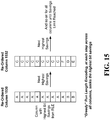
- Fig. 15 illustrates the "greedy" aspect of the run length encoding that examines, across all of the columns, where the highest bit savings are achieved at each step, and can optionally include re-ordering the columns as columns 1530, 1532, etc., to maximize run length savings. At a certain point, it may be that run length savings are relatively insignificant because the values are relatively unique at which point run length encoding is stopped.
- bit packing is applied to the range of remaining values, which is illustrated in Fig. 16 .
- re-ordered column 1600 includes an RLE portion 1610 and a bit packing portion 1620 generally corresponding to recurring values and relatively unique values, respectively.
- re-ordered column 1602 includes RLE portion 1612 and BP portion 1622.
- the hybrid algorithm computes the bit savings from bit packing and bit savings from run length encoding 1700, and then the bit savings from bit packing and bit savings from run length are compared at 1710 or examined to determine which compression technique maximizes bit savings at 1720.
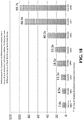
- Exemplary performance of the above-described encoding and compression techniques illustrates the significant gains that can be achieved on real world data samples 1801, 1802, 1803, 1804, 1805, 1806, 1806, 1807 and 1808, ranging in performance improvement from about 9x to 99.7x, which depends on, among other things, the relative amounts of repetition of values in the particular large scale data sample.
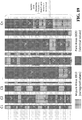
- Fig. 19 is a block diagram showing the final result of the columnization, encoding and compression processes described herein in various embodiments.
- each column C1, C2, C3, ..., CN includes areas having homogeneous repeated values to which run length encoding has been applied, and other areas labeled "Others" or "Oth” in the diagram, which represent groups of heterogeneous values in the column.
- the areas with identical repeated values defined by run length are the pure areas 1920 and the areas having the variegated values are the impure areas 1910, as indicated in the legend.
- the areas having the variegated values are the impure areas 1910, as indicated in the legend.
- a bucket is defined as the rows from the first row to the row at the transition point.
- buckets 1900 are defined down the columns at every transition point as shown by the dotted lines. Buckets 1900 are defined by the rows between the transitions.
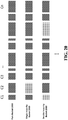
- Fig. 20 shows a nomenclature that is defined for the buckets based on the number of pure and impure areas across a particular row.
- a pure bucket 2000 is one with no impure areas.
- a single impurity bucket 2010 is one with 1 impure area across the rows of the bucket.
- a double impurity bucket 2010 is one with 2 impure area across the rows of the bucket.
- a triple impurity bucket has 3, and so on.
- RLE provides the following advantages for both compression and querying: (A) RLE typically requires significantly less storage than bit packing and (B) RLE includes the ability to effectively "fast forward" through ranges of data while performing such query building block operations as Group By, Filtering and/or Aggregations; such operations can be mathematically reduced to efficient operations over the data organized as columns.
- the compression algorithm clusters rows of data based on their distribution, and as such increases the use of RLE within a segment.
- bucket is used to describe clusters of rows, which, for the avoidance of doubt, should be considered distinct from the term "partition,” a well defined online analytical processing (OLAP) and RDBMS concept.
- Arithmetic Coding leverages this: by representing frequently used characters using fewer bits and infrequently used characters using more bits, with the goal of using fewer bits in total.
- the above-described embodiments of data packing includes two distinct phases: (1) Data analysis to determine bucketization, and (2) Reorganization of segment data to conform to the bucketized layout. Each of these are described in exemplary further detail below.
- the bucketization process begins by finding the single value the takes the most space in the segment data. As mentioned above in connection with Figs. 13 and 14 , this can be done using simple histogram statistics for each column, e.g., as follows. Column Most Common Value # occurrences Space Saved Coll 100 5 45 bits Col2 1231 3 33 bits
- all values belonging to the same row exist at the same index in each of the column segment, e.g., col1[3] and col2[3] both belong to the third row. Ensuring this provides efficient random access to values in the same row, instead of incurring the cost of an indirection through a mapping table for each access. Therefore, in the presently described embodiment of the application of the greedy RLE algorithm, or the hybrid RLE and bit packing algorithm, when reordering a value in one column, this implies values in other column segments are reordered as well.
- the RLE applied herein is a greedy algorithm, which means that the algorithm follows the problem solving metaheuristic of making the locally optimum choice at each stage with the hope of finding the global optimum. After the first phase of finding the largest bucket, the next phase is to select the next largest bucket and repeat the process within that bucket.
- the determination of the buckets can be based purely on statistics, from the act of reordering data within each column segment.
- the act of reordering data within each column segment can be parallelized based on available cores using a job scheduler.
- one segment is processed at a time, multiple cores can be used, overlapping the time taken to read data from the data source into a segment with the time taken to compress the previous segment.
- a segment of 8M rows will take ⁇ 80 seconds, which is a significant amount of time available for such work.
- packing of the previous segment may also be stopped once data for the next segment is available.
- the way that the data is organized according to the various embodiments for column based encoding lends itself to an efficient scan at the consuming side of the data, where the processing can be performed very fast on a select number of the columns in memory.
- the above-described data packing and compression techniques update the compression phase during row encoding, while scanning includes a query optimizer and processor to leverage the intelligent encoding.
- the scan or query mechanism can be used to efficiently return results to business intelligence (BI) queries and is designed for the clustered layout produced by the above-described data packing and compression techniques, and optimizes for increased RLE usage, e.g., it is expected that during query processing, a significant number of columns used for querying would have been compressed using RLE.
- the fast scanning process introduces a column-oriented query engine, instead of a row-wise query processor over column stores. As such, even in buckets that contain bit pack data (as opposed to RLE data), the performance gains due to data locality can be significant.
- the scanning mechanism assumes segments contain buckets that span across a segment, and contains columns values in "pure” RLE runs or "impure” others bit pack storage, such as shown in Fig. 19 .
- the scanning is invoked on a segment, the key being to work one bucket at a time.
- the scanning process performs column-oriented processing in phases, depending on the query specification.
- the first phase is to gather statistics about what column areas are Pure, and what areas are Impure.
- filters can be processed followed by processing of Group By operations, followed by processing of proxy columns.
- aggregations can be processed as another phase.
- the embodiments presented herein for the scanning implement column-oriented query processing, instead of row-oriented like conventional systems.
- the actual code executed can be specific to: (1) whether the column being operated on is run length encoded or not, (2) the compression type used for bit packing, (3) whether results will be sparse or dense, etc.
- additional considerations are taken into account: (1) encoding type (hash or value), (2) aggregation function (sum/min/max/count), etc.
- the scanning process thus follows the form of Fig. 21 in which a query result from various standard query/scan operators 2100 is a function of all of the bucket rows.
- the query/scan operators 2100 can be broken up mathematically in effect such that the filters, Group Bys, proxy columns, and aggregations are processed separate from one another in phases.
- the operators are processed according to different purities of the buckets at 2110 according to a bucket walking process. Consequently, instead of a generalized and expensive scan of all the bucket rows, with the specialization of different buckets introduced by the work of the encoding and compression algorithms described herein, the result is thus an aggregated result of the processing of pure buckets, single impurity buckets, double impurity buckets, etc.
- Fig. 24 shows a sample distribution of buckets and the power of the compression architecture, since processing performed over pure buckets is the fastest due to the reduction of processing mathematics to simple operations, followed by the second fastest being the single impurity buckets, and so on for additional impurity buckets. Moreover, it has been found that a surprisingly large number of buckets are pure. For instance, as shown in Fig. 25 , for six columns implicated by a query, if each column has about 90% purity (meaning about 90% of the values are represented with run length encoding due to similar data), then about 60% of the buckets will be pure, about 1/3 will be single impurity, about 8% will be double purity, and the rest will be accounted for at a mere 1%. Since processing of pure buckets is the fastest, and processing of single impurity and double impurity buckets is still quite fast, the "more complex" processing of buckets with 3 or more impure areas is kept to a minimum.
- Fig. 23 indicates a sample query 2300 with some sample standard query building blocks, such as sample “filter by column” query building block 2302, sample “Group by Column” query building block 2304 and sample “Aggregate by Column” query building block 2306.
- Fig. 24 is a block diagram illustrating an additional aspect of bandwidth reduction through column selectivity. Reviewing sample query 2400, one can see that no more than 6 columns 2410 of all columns 2420 are implicated, and thus only six columns need be loaded into local RAM for a highly efficient query.
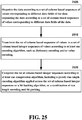
- Fig. 25 illustrates an embodiment for encoding data, including organizing the data according to a set of column based sequences of values corresponding to different data fields of the data at 2500. Then, at 2510, the set of column based sequences of values are transformed to a set of column based integer sequences of values according to at least one encoding algorithm, such as dictionary encoding and/or value encoding. Then, at 2520, the set of column based integer sequences are compressed according to at least one compression algorithm, including a greedy run length encoding algorithm applied across the set of column based integer sequences or a bit backing algorithm, or a combination of run length encoding and bit packing.
- a greedy run length encoding algorithm applied across the set of column based integer sequences or a bit backing algorithm, or a combination of run length encoding and bit packing.
- the integer sequences are analyzed to determine whether to apply run length encoding (RLE) compression or bit packing compression including analyzing bit savings of RLE compression relative to bit packing compression to determine where the maximum bit savings is achieved.
- the process can include generating a histogram to assist in determining where the maximum bit savings are achieved.
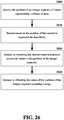
- a bit packing technique includes receiving, at 2600, the portions of an integer sequence of values representing a column of data, and three stages of potential reduction by bit packing.
- the data can be reduced based on the number of bits needed to represent the data fields.
- the data can be reduced by removing any shared numerical powers across the values of the portions of the integer sequence.
- the data can also be reduced by offsetting the values of the portions of the integer sequence spanning a range.
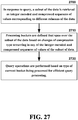
- a subset of the data is retrieved as integer encoded and compressed sequences of values corresponding to different columns of the data.
- processing buckets are defined that span over the subset of the data based on changes of compression type occurring in any of the integer encoded and compressed sequences of values of the subset of data.
- query operations are performed based on type of current bucket being processed for efficient query processing. The operations can be performed in memory, and parallelized in a multi-core architecture.
- Different buckets include where (1) the different portions of values in the bucket across the sequences are all compressed according to run length encoding compression, defining a pure bucket, (2) all but one portion compressed according to run length encoding, defining a single impurity bucket, or (3) all but two portions compressed according to run length encoding, defining a double impurity bucket.
- the improved scanning enables performing a variety of standard query and scan operators much more efficiently, particularly for the purest buckets. For instance, logical OR query slice operations, query join operations between multiple tables where relationships have been specified, filter operations, Group By operations, proxy column operations or aggregation operations can all be performed more efficiently when the bucket walking technique is applied and processing is performed based on bucket type.
- the various embodiments of column based encoding and query processing described herein can be implemented in connection with any computer or other client or server device, which can be deployed as part of a computer network or in a distributed computing environment, and can be connected to any kind of data store.
- the various embodiments described herein can be implemented in any computer system or environment having any number of memory or storage units, and any number of applications and processes occurring across any number of storage units. This includes, but is not limited to, an environment with server computers and client computers deployed in a network environment or a distributed computing environment, having remote or local storage.
- Distributed computing provides sharing of computer resources and services by communicative exchange among computing devices and systems. These resources and services include the exchange of information, cache storage and disk storage for objects, such as files. These resources and services also include the sharing of processing power across multiple processing units for load balancing, expansion of resources, specialization of processing, and the like. Distributed computing takes advantage of network connectivity, allowing clients to leverage their collective power to benefit the entire enterprise. In this regard, a variety of devices may have applications, objects or resources that may cooperate to perform one or more aspects of any of the various embodiments of the subject disclosure.
- Fig. 28 provides a schematic diagram of an exemplary networked or distributed computing environment.
- the distributed computing environment comprises computing objects 2810, 2812, etc., and computing objects or devices 2820, 2822, 2824, 2826, 2828, etc., which may include programs, methods, data stores, programmable logic, etc., as represented by applications 2830, 2832, 2834, 2836, 2838.
- objects 2810, 2812, etc., and computing objects or devices 2820, 2822, 2824, 2826, 2828, etc. may comprise different devices, such as PDAs, audio/video devices, mobile phones, MP3 players, personal computers, laptops, etc.
- Each object 2810, 2812, etc., and computing objects or devices 2820, 2822, 2824, 2826, 2828, etc. can communicate with one or more other objects 2810, 2812, etc., and computing objects or devices 2820, 2822, 2824, 2826, 2828, etc., by way of the communications network 2840, either directly or indirectly.
- network 2840 may comprise other computing objects and computing devices that provide services to the system of Fig. 28 , and/or may represent multiple interconnected networks, which are not shown.
- Each object 2810, 2812, etc., or 2820, 2822, 2824, 2826, 2828, etc. can also contain an application, such as applications 2830, 2832, 2834, 2836, 2838, that might make use of an API, or other object, software, firmware and/or hardware, suitable for communication with, processing for, or implementation of the column based encoding and query processing provided in accordance with various embodiments of the subject disclosure.
- computing systems can be connected together by wired or wireless systems, by local networks or widely distributed networks.
- networks are coupled to the Internet, which provides an infrastructure for widely distributed computing and encompasses many different networks, though any network infrastructure can be used for exemplary communications made incident to the column based encoding and query processing as described in various embodiments.
- client/server peer-to-peer
- hybrid architectures a host of network topologies and network infrastructures, such as client/server, peer-to-peer, or hybrid architectures.
- the "client” is a member of a class or group that uses the services of another class or group to which it is not related.
- a client can be a process, i.e., roughly a set of instructions or tasks, that requests a service provided by another program or process.
- the client process utilizes the requested service without having to "know” any working details about the other program or the service itself.
- a client is usually a computer that accesses shared network resources provided by another computer, e.g., a server.
- computers 2820, 2822, 2824, 2826, 2828, etc. can be thought of as clients and computers 2810, 2812, etc., can be thought of as servers where servers 2810, 2812, etc., provide data services, such as receiving data from client computers 2820, 2822, 2824, 2826, 2828, etc., storing of data, processing of data, transmitting data to client computers 2820, 2822, 2824, 2826, 2828, etc., although any computer can be considered a client, a server, or both, depending on the circumstances. Any of these computing devices may be processing data, encoding data, querying data or requesting services or tasks that may implicate the column based encoding and query processing as described herein for one or more embodiments.
- a server is typically a remote computer system accessible over a remote or local network, such as the Internet or wireless network infrastructures.
- the client process may be active in a first computer system, and the server process may be active in a second computer system, communicating with one another over a communications medium, thus providing distributed functionality and allowing multiple clients to take advantage of the information-gathering capabilities of the server.
- Any software objects utilized pursuant to the column based encoding and query processing can be provided standalone, or distributed across multiple computing devices or objects.
- the servers 2810, 2812, etc. can be Web servers with which the clients 2820, 2822, 2824, 2826, 2828, etc., communicate via any of a number of known protocols, such as the hypertext transfer protocol (HTTP).
- Servers 2810, 2812, etc. may also serve as clients 2820, 2822, 2824, 2826, 2828, etc., as may be characteristic of a distributed computing environment.
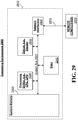
- the techniques described herein can be applied to any device where it is desirable to query large amounts of data quickly. It should be understood, therefore, that handheld, portable and other computing devices and computing objects of all kinds are contemplated for use in connection with the various embodiments, i.e., anywhere that a device may wish to scan or process huge amounts of data for fast and efficient results. Accordingly, the below general purpose remote computer described below in Fig. 29 is but one example of a computing device.
- embodiments can partly be implemented via an operating system, for use by a developer of services for a device or object, and/or included within application software that operates to perform one or more functional aspects of the various embodiments described herein.
- Software may be described in the general context of computer-executable instructions, such as program modules, being executed by one or more computers, such as client workstations, servers or other devices.
- computers such as client workstations, servers or other devices.
- client workstations such as client workstations, servers or other devices.
- Fig. 29 thus illustrates an example of a suitable computing system environment 2900 in which one or aspects of the embodiments described herein can be implemented, although as made clear above, the computing system environment 2900 is only one example of a suitable computing environment and is not intended to suggest any limitation as to scope of use or functionality. Neither should the computing environment 2900 be interpreted as having any dependency or requirement relating to any one or combination of components illustrated in the exemplary operating environment 2900.
- an exemplary remote device for implementing one or more embodiments includes a general purpose computing device in the form of a computer 2910.
- Components of computer 2910 may include, but are not limited to, a processing unit 2920, a system memory 2930, and a system bus 2922 that couples various system components including the system memory to the processing unit 2920.
- Computer 2910 typically includes a variety of computer readable media and can be any available media that can be accessed by computer 2910.
- the system memory 2930 may include computer storage media in the form of volatile and/or nonvolatile memory such as read only memory (ROM) and/or random access memory (RAM).
- ROM read only memory
- RAM random access memory
- memory 2930 may also include an operating system, application programs, other program modules, and program data.
- a user can enter commands and information into the computer 2910 through input devices 2940.
- a monitor or other type of display device is also connected to the system bus 2922 via an interface, such as output interface 2950.
- computers can also include other peripheral output devices such as speakers and a printer, which may be connected through output interface 2950.
- the computer 2910 may operate in a networked or distributed environment using logical connections to one or more other remote computers, such as remote computer 2970.
- the remote computer 2970 may be a personal computer, a server, a router, a network PC, a peer device or other common network node, or any other remote media consumption or transmission device, and may include any or all of the elements described above relative to the computer 2910.
- the logical connections depicted in Fig. 29 include a network 2972, such local area network (LAN) or a wide area network (WAN), but may also include other networks/buses.
- LAN local area network
- WAN wide area network
- Such networking environments are commonplace in homes, offices, enterprise-wide computer networks, intranets and the Internet.
- an appropriate API e.g., an appropriate API, tool kit, driver code, operating system, control, standalone or downloadable software object, etc.
- an appropriate API e.g., an appropriate API, tool kit, driver code, operating system, control, standalone or downloadable software object, etc.
- embodiments herein are contemplated from the standpoint of an API (or other software object), as well as from a software or hardware object that provides column based encoding and/or query processing.
- various embodiments described herein can have aspects that are wholly in hardware, partly in hardware and partly in software, as well as in software.
- a component may be, but is not limited to being, a process running on a processor, a processor, an object, an executable, a thread of execution, a program, and/or a computer.
- an application running on computer and the computer can be a component.
- One or more components may reside within a process and/or thread of execution and a component may be localized on one computer and/or distributed between two or more computers.
Landscapes
- Engineering & Computer Science (AREA)
- Theoretical Computer Science (AREA)
- Computational Linguistics (AREA)
- Data Mining & Analysis (AREA)
- Databases & Information Systems (AREA)
- Physics & Mathematics (AREA)
- General Engineering & Computer Science (AREA)
- General Physics & Mathematics (AREA)
- Information Retrieval, Db Structures And Fs Structures Therefor (AREA)
- Compression, Expansion, Code Conversion, And Decoders (AREA)
Claims (11)
- Verfahren zum Verarbeiten von Daten, umfassend:spaltenartiges Anordnen (210, 310) von Rohdaten in einen Satz von Wertefolgen, eine für jede Spalte;Integerisieren (220, 320) des Satzes von Wertefolgen, wodurch für jede Spalte ganzzahlcodierte Folgen ausgebildet werden;Komprimieren (230, 330) der ganzzahlcodierten Wertefolgen, wodurch ganzzahlcodierte und komprimierte Wertefolgen gebildet werden, einschließlich iterativem Anwenden von Neuordnung und Lauflängencodierung, um in jedem Schritt des iterativen Prozesses die Spalte mit den höchsten Komprimiereinsparungen zu bestimmen;als Antwort auf eine Abfrage für eine Teilmenge der Daten, Empfangen (2700) der Teilmenge der Daten als ganzzahlcodierte und komprimierte Wertefolgen, die verschiedenen Spalten der Daten entsprechen, die für die Abfrage relevant sind;Definieren (2710) von Verarbeitungs-Buckets (1900, 2000, 2010), die sich über die verschiedenen Spalten der Teilmenge der empfangenen Daten erstrecken, als ganzzahlcodierte und komprimierte Wertefolgen basierend auf Übergängen des Kompressionstyps, die in einer der ganzzahlcodierten und komprimierten Wertefolgen der Teilmenge der Daten auftreten, wobei die Buckets durch die Zeilen zwischen den Übergängen definiert werden, undAusführen (2720) von durch die Abfrage definierten Operationen auf Bucket-für-Bucket-Basis, wenn die ganzzahlcodierten und komprimierten Wertefolgen verarbeitet werden, um Abfrageergebnisse zurückzugeben, basierend darauf, ob verschiedene Abschnitte von Werten in einem Bucket über die Folgen gemäß einem ersten Kompressionstyp oder einem zweiten Kompressionstyp komprimiert werden.
- Verfahren nach Anspruch 1, bei dem das Empfangen (2700) das Empfangen der Teilmenge in dem Speicher für schnelle Speicheroperationen und die Verarbeitung der Teilmenge der Daten beinhaltet.
- Verfahren nach Anspruch 1, bei dem das Empfangen (2700) das Empfangen der Teilmenge von Daten aus einer Bezugsdatenbank umfasst und die unterschiedlichen Spalten der Daten Spalten der Bezugsdatenbank entsprechen.
- Verfahren nach Anspruch 1, bei dem der zweite Kompressionstyp eine Bit-Packing-Kompression ist und das Ausführen (2720) das Ausführen von Operationen umfasst, die durch die Abfrage definiert werden, basierend darauf, wie viele verschiedene Abschnitte von Werten in dem Bucket über die Folgen gemäß der Bit-Packing-Kompression komprimiert werden.
- Verfahren nach Anspruch 1, bei dem das Ausführen (2720) eines der folgenden umfasst:Ausführen von durch die Abfrage definierten Operationen basierend auf dem Typ des aktuell verarbeiteten Buckets und Verarbeiten der Buckets in der Reihenfolge;Parallelisieren der durch die Abfrage definierten Operationen durch Verwendung mehrerer Prozessoren und einer entsprechenden Anzahl von Segmenten, die von den Folgen getrennt sind, wobei jedes Segment von einem anderen Prozessor bearbeitet wird; undAusführen logischer ODER-Abfragen von Slice-Operationen oder Abfrage-Join-Operationen zwischen mehreren Tabellen, in denen von der Abfrage definierte Beziehungen basierend auf dem Typ des aktuellen Buckets definiert wurden, der verarbeitet wird, wenn die ganzzahlcodierten und komprimierten Wertefolgen verarbeitet werden, um Abfrageergebnisse zurückzugeben.
- Verfahren nach Anspruch 1, bei dem das Ausführen (2720) das Ausführen von Filteroperationen und/oder Group-By-Operationen und/oder Proxy-Spaltenoperationen und/oder Aggregationsoperationen umfasst, die durch die Abfrage basierend auf dem Typ des aktuellen verarbeiteten Buckets definiert werden, wenn die ganzzahlkodierten und komprimierte Wertefolgen verarbeitet werden, um Abfrageergebnisse zurückzugeben.
- Verfahren nach Anspruch 6, bei dem die Filteroperationen und/oder Group-By-Operationen und/oder Proxy-Spaltenoperationen und/oder Aggregationsoperationen in Phasen für den aktuellen Bucket getrennt voneinander verarbeitet werden (2720) und die Verarbeitung Bucket für Bucket erfolgt.
- Computersystem zum Verarbeiten von Daten, umfassend Einrichtungen für das:spaltenartige Anordnen von Rohdaten in einen Satz von Wertefolgen, eine für jede Spalte;Integerisieren des Satzes von Wertefolgen, wodurch für jede Spalte ganzzahlcodierte Folgen ausgebildet werden;Komprimieren der ganzzahlcodierten Wertefolgen, wodurch ganzzahlcodierte und komprimierte Wertefolgen gebildet werden, einschließlich iterativem Anwenden von Neuordnung und Lauflängencodierung, um in jedem Schritt des iterativen Prozesses die Spalte mit den höchsten Komprimiereinsparungen zu bestimmen;als Antwort auf eine Abfrage für eine Teilmenge der Daten, Empfangen der Teilmenge der Daten als ganzzahlcodierte und komprimierte Wertefolgen, die verschiedenen Spalten der Daten entsprechen, die für die Abfrage relevant sind;Definieren von Verarbeitungs-Buckets, die sich über die verschiedenen Spalten der Teilmenge der empfangenen Daten erstrecken, als ganzzahlcodierte und komprimierte Wertefolgen basierend auf Übergängen des Kompressionstyps, die in einer der ganzzahlcodierten und komprimierten Wertefolgen der Teilmenge der Daten auftreten, wobei die Buckets durch die Zeilen zwischen den Übergängen definiert werden, undAusführen von durch die Abfrage definierten Operationen auf Bucket-für-Bucket-Basis, wenn die ganzzahlcodierten und komprimierten Wertefolgen verarbeitet werden, um Abfrageergebnisse zurückzugeben, basierend darauf, ob verschiedene Abschnitte von Werten in einem Bucket über die Folgen gemäß einem ersten Kompressionstyp oder einem zweiten Kompressionstyp komprimiert werden.
- System nach Anspruch 8, das zum Ausführen des Verfahrens nach einem der Ansprüche 2 bis 7 eingerichtet ist.
- Computerlesbares Medium, das über von einem Computer ausführbare Anweisungen verfügt, die, wenn sie von einem Computer ausgeführt werden, den Computer dazu veranlassen, ein Verfahren auszuführen, das umfasst:spaltenartiges Anordnen von Rohdaten in einen Satz von Wertefolgen, eine für jede Spalte;Integerisieren des Satzes von Wertefolgen, wodurch für jede Spalte ganzzahlcodierte Folgen ausgebildet werden;Komprimieren der ganzzahlcodierten Wertefolgen, wodurch ganzzahlcodierte und komprimierte Wertefolgen gebildet werden, einschließlich iterativem Anwenden von Neuordnung und Lauflängencodierung, um in jedem Schritt des iterativen Prozesses die Spalte mit den höchsten Komprimiereinsparungen zu bestimmen;Abrufen einer durch eine Abfrage implizierten Teilmenge von Spalten als ganzzahlcodierte und komprimierte Wertefolgen, die verschiedenen Datenspalten entsprechen;Definieren von Verarbeitungs-Buckets, die sich über die Teilmenge von Spalten erstrecken, basierend auf Übergängen des Kompressionstyps, die in einer der ganzzahlcodierten und komprimierten Wertefolgen der Teilmenge der Daten auftreten, wobei die Buckets durch die Zeilen zwischen den Übergängen definiert werden; undVerarbeiten der Abfrage im Speicher auf Bucket-für-Bucket-Basis, wenn die ganzzahlcodierten und komprimierten Wertefolgen verarbeitet werden, basierend darauf, ob verschiedene Abschnitte von Werten in einem Bucket über die Folgen gemäß einem ersten Kompressionstyp oder einem zweiten Kompressionstyp komprimiert werden.
- Computerlesbares Medium nach Anspruch 10, das weiterhin Anweisungen zur Ausführung des Verfahrens nach einem der Ansprüche 2 bis 7 aufweist.
Applications Claiming Priority (3)
| Application Number | Priority Date | Filing Date | Title |
|---|---|---|---|
| US8502208P | 2008-07-31 | 2008-07-31 | |
| US12/270,872 US8626725B2 (en) | 2008-07-31 | 2008-11-14 | Efficient large-scale processing of column based data encoded structures |
| PCT/US2009/052490 WO2010014955A2 (en) | 2008-07-31 | 2009-07-31 | Efficient large-scale processing of column based data encoded structures |
Publications (3)
| Publication Number | Publication Date |
|---|---|
| EP2321746A2 EP2321746A2 (de) | 2011-05-18 |
| EP2321746A4 EP2321746A4 (de) | 2011-09-14 |
| EP2321746B1 true EP2321746B1 (de) | 2019-03-20 |
Family
ID=41609355
Family Applications (1)
| Application Number | Title | Priority Date | Filing Date |
|---|---|---|---|
| EP09803686.6A Not-in-force EP2321746B1 (de) | 2008-07-31 | 2009-07-31 | Effiziente massenverarbeitung von datenkodierten strukten auf säulenbasis |
Country Status (5)
| Country | Link |
|---|---|
| US (1) | US8626725B2 (de) |
| EP (1) | EP2321746B1 (de) |
| JP (1) | JP2011530119A (de) |
| CN (1) | CN102112986B (de) |
| WO (1) | WO2010014955A2 (de) |
Families Citing this family (49)
| Publication number | Priority date | Publication date | Assignee | Title |
|---|---|---|---|---|
| US10152504B2 (en) | 2009-03-11 | 2018-12-11 | Actian Netherlands B.V. | Column-store database architecture utilizing positional delta tree update system and methods |
| US9058223B2 (en) | 2011-04-22 | 2015-06-16 | Microsoft Technology Licensing Llc | Parallel entropy encoding on GPU |
| JP5742427B2 (ja) * | 2011-04-25 | 2015-07-01 | 富士ゼロックス株式会社 | 画像処理装置 |
| CA2843886C (en) * | 2011-08-02 | 2020-09-22 | Ajay JADHAV | Cloud-based distributed persistence and cache data model |
| US20130132352A1 (en) * | 2011-11-23 | 2013-05-23 | Microsoft Corporation | Efficient fine-grained auditing for complex database queries |
| WO2013137070A1 (ja) * | 2012-03-13 | 2013-09-19 | 日本電気株式会社 | ログ圧縮システム、ログ圧縮方法、及びプログラム |
| US20150015586A1 (en) * | 2012-03-22 | 2015-01-15 | Google Inc. | Systems and methods for rendering and downsampling an image |
| US9922090B1 (en) | 2012-03-27 | 2018-03-20 | Actian Netherlands, B.V. | System and method for automatic vertical decomposition of a table for improving input/output and memory utilization in a database |
| US8862571B2 (en) * | 2012-06-29 | 2014-10-14 | International Business Machines Corporation | Predicate pushdown with late materialization in database query processing |
| US8756208B2 (en) | 2012-07-10 | 2014-06-17 | International Business Machines Corporation | Encoded data processing |
| US9449046B1 (en) * | 2012-07-31 | 2016-09-20 | Actian Netherlands B.V. | Constant-vector computation system and method that exploits constant-value sequences during data processing |
| US9665572B2 (en) * | 2012-09-12 | 2017-05-30 | Oracle International Corporation | Optimal data representation and auxiliary structures for in-memory database query processing |
| US9317554B2 (en) * | 2012-09-26 | 2016-04-19 | Microsoft Technology Licensing, Llc | SQL generation for assert, update and delete relational trees |
| US9292569B2 (en) * | 2012-10-02 | 2016-03-22 | Oracle International Corporation | Semi-join acceleration |
| US10019457B1 (en) | 2013-01-22 | 2018-07-10 | Amazon Technologies, Inc. | Multi-level compression for storing data in a data store |
| US11507574B1 (en) | 2013-03-13 | 2022-11-22 | Actian Netherlands B.V. | Adaptive selection of a processing method based on observed performance for improved and robust system efficiency |
| CN103258030B (zh) * | 2013-05-09 | 2016-04-13 | 西安电子科技大学 | 基于字典与游长编码的移动设备内存压缩方法 |
| US9384204B2 (en) | 2013-05-22 | 2016-07-05 | Amazon Technologies, Inc. | Efficient data compression and analysis as a service |
| US9244935B2 (en) * | 2013-06-14 | 2016-01-26 | International Business Machines Corporation | Data encoding and processing columnar data |
| US9286350B2 (en) * | 2013-06-28 | 2016-03-15 | International Business Machines Corporation | Estimating most frequent values for a data set |
| US9489409B2 (en) * | 2013-10-17 | 2016-11-08 | Sybase, Inc. | Rollover strategies in a N-bit dictionary compressed column store |
| US20150169607A1 (en) * | 2013-12-17 | 2015-06-18 | Ebay Inc. | Systems and methods to present images representative of searched items |
| US9547553B1 (en) | 2014-03-10 | 2017-01-17 | Parallel Machines Ltd. | Data resiliency in a shared memory pool |
| US9781027B1 (en) | 2014-04-06 | 2017-10-03 | Parallel Machines Ltd. | Systems and methods to communicate with external destinations via a memory network |
| US9477412B1 (en) | 2014-12-09 | 2016-10-25 | Parallel Machines Ltd. | Systems and methods for automatically aggregating write requests |
| US9690713B1 (en) | 2014-04-22 | 2017-06-27 | Parallel Machines Ltd. | Systems and methods for effectively interacting with a flash memory |
| US9632936B1 (en) | 2014-12-09 | 2017-04-25 | Parallel Machines Ltd. | Two-tier distributed memory |
| US9781225B1 (en) | 2014-12-09 | 2017-10-03 | Parallel Machines Ltd. | Systems and methods for cache streams |
| US9753873B1 (en) | 2014-12-09 | 2017-09-05 | Parallel Machines Ltd. | Systems and methods for key-value transactions |
| US9639473B1 (en) | 2014-12-09 | 2017-05-02 | Parallel Machines Ltd. | Utilizing a cache mechanism by copying a data set from a cache-disabled memory location to a cache-enabled memory location |
| US9639407B1 (en) | 2014-12-09 | 2017-05-02 | Parallel Machines Ltd. | Systems and methods for efficiently implementing functional commands in a data processing system |
| WO2016170594A1 (ja) * | 2015-04-21 | 2016-10-27 | 株式会社日立製作所 | 計算機、データベース処理方法、及び集積回路 |
| US9971808B2 (en) | 2015-06-24 | 2018-05-15 | International Business Machines Corporation | Fast query processing in columnar databases with GPUs |
| US10303786B2 (en) | 2015-08-05 | 2019-05-28 | International Business Machines Corporation | Retrieving and displaying data from a columnar database |
| US10346403B2 (en) | 2016-05-06 | 2019-07-09 | International Business Machines Corporation | Value range synopsis in column-organized analytical databases |
| US10248695B2 (en) | 2016-05-23 | 2019-04-02 | International Business Machines Corporation | Extreme value computation |
| US10417237B2 (en) | 2016-05-24 | 2019-09-17 | International Business Machines Corporation | Sorting tables in analytical databases |
| US10515092B2 (en) * | 2017-07-21 | 2019-12-24 | Google Llc | Structured record compression and retrieval |
| US10838963B2 (en) | 2017-09-11 | 2020-11-17 | International Business Machines Corporation | Optimized access for hierarchical low cardinality value synopsis in analytical databases |
| US11169995B2 (en) * | 2017-11-21 | 2021-11-09 | Oracle International Corporation | Relational dictionaries |
| US11023430B2 (en) | 2017-11-21 | 2021-06-01 | Oracle International Corporation | Sparse dictionary tree |
| US11275731B2 (en) * | 2017-12-01 | 2022-03-15 | Singlestore, Inc. | Accelerated filtering, grouping and aggregation in a database system |
| US11126611B2 (en) * | 2018-02-15 | 2021-09-21 | Oracle International Corporation | Code dictionary generation based on non-blocking operations |
| US11379450B2 (en) | 2018-10-09 | 2022-07-05 | Oracle International Corporation | Relational method for transforming unsorted sparse dictionary encodings into unsorted-dense or sorted-dense dictionary encodings |
| US11184021B2 (en) | 2019-03-15 | 2021-11-23 | Samsung Electronics Co., Ltd. | Using predicates in conditional transcoder for column store |
| CN110516117A (zh) * | 2019-07-22 | 2019-11-29 | 平安科技(深圳)有限公司 | 图计算的类别型变量存储方法、装置、设备及存储介质 |
| US11314736B2 (en) | 2020-01-16 | 2022-04-26 | Oracle International Corporation | Group-by efficiency though functional dependencies and non-blocking aggregation functions |
| CN112533164B (zh) * | 2020-10-26 | 2023-10-10 | 中国人民解放军92942部队 | 一种提高可靠性测试中振动数据传输带宽的方法 |
| US12277122B1 (en) * | 2023-10-30 | 2025-04-15 | Microsoft Technology Licensing, Llc | System and method for accelerating query execution |
Family Cites Families (17)
| Publication number | Priority date | Publication date | Assignee | Title |
|---|---|---|---|---|
| US5918225A (en) | 1993-04-16 | 1999-06-29 | Sybase, Inc. | SQL-based database system with improved indexing methodology |
| US5794229A (en) | 1993-04-16 | 1998-08-11 | Sybase, Inc. | Database system with methodology for storing a database table by vertically partitioning all columns of the table |
| US5870752A (en) * | 1997-08-21 | 1999-02-09 | Lucent Technologies Inc. | Incremental maintenance of an approximate histogram in a database system |
| US6457009B1 (en) * | 1998-11-09 | 2002-09-24 | Denison W. Bollay | Method of searching multiples internet resident databases using search fields in a generic form |
| US6597812B1 (en) * | 1999-05-28 | 2003-07-22 | Realtime Data, Llc | System and method for lossless data compression and decompression |
| US7024414B2 (en) * | 2001-08-06 | 2006-04-04 | Sensage, Inc. | Storage of row-column data |
| US20040135903A1 (en) * | 2002-10-11 | 2004-07-15 | Brooks Lane C. | In-stream lossless compression of digital image sensor data |
| US6965897B1 (en) | 2002-10-25 | 2005-11-15 | At&T Corp. | Data compression method and apparatus |
| US7818728B1 (en) * | 2005-04-04 | 2010-10-19 | Qd Technology Llc | Maximizing system resources used to decompress read-only compressed analytic data in a relational database table |
| US20070143248A1 (en) * | 2005-12-19 | 2007-06-21 | Yahoo! Inc. | Method using query processing servers for query processing of column chunks in a distributed column chunk data store |
| US20090187586A1 (en) * | 2006-03-31 | 2009-07-23 | Qd Technology Llc | Selecting various algorithms to compress columns of analytic data in a read-only relational database in a manner that allows decompression of the compressed data using minimal system resources |
| US7647350B2 (en) | 2006-09-06 | 2010-01-12 | Red Hat, Inc. | Database access server with compression translator |
| US8700579B2 (en) * | 2006-09-18 | 2014-04-15 | Infobright Inc. | Method and system for data compression in a relational database |
| US20080133562A1 (en) | 2006-12-05 | 2008-06-05 | Chi Ping Bess Cheong | Coding compressible variable length database fields |
| HUE042697T2 (hu) | 2007-09-24 | 2019-07-29 | Hasso Plattner Inst Fuer Digital Engineering Ggmbh | ETL kisebb nulla redundancia rendszer és eljárás OLTP adatok jelentésére |
| US8082234B2 (en) * | 2007-11-19 | 2011-12-20 | Teradata Us, Inc. | Closed-loop system management method and process capable of managing workloads in a multi-system database environment |
| US8392461B2 (en) * | 2007-11-19 | 2013-03-05 | Teradota Us, Inc. | Virtual data maintenance |
-
2008
- 2008-11-14 US US12/270,872 patent/US8626725B2/en not_active Expired - Fee Related
-
2009
- 2009-07-31 WO PCT/US2009/052490 patent/WO2010014955A2/en not_active Ceased
- 2009-07-31 JP JP2011521367A patent/JP2011530119A/ja not_active Withdrawn
- 2009-07-31 CN CN200980130978.7A patent/CN102112986B/zh not_active Expired - Fee Related
- 2009-07-31 EP EP09803686.6A patent/EP2321746B1/de not_active Not-in-force
Non-Patent Citations (4)
| Title |
|---|
| ANONYMOUS: "ACM SIGMOD/PODS Conference: Vancouver, 2008 SIGMOD: Guidelines for Research Papers", 14 February 2008 (2008-02-14), XP055507561, Retrieved from the Internet <URL:https://web.archive.org/web/20080214115111/http://www.sigmod08.org:80/sigmod_research.shtml> [retrieved on 20180917] * |
| ANONYMOUS: "ACM SIGMOD/PODS Conference: Vancouver, 2008 SIGMOD: Important Dates", 8 March 2008 (2008-03-08), XP055507341, Retrieved from the Internet <URL:https://web.archive.org/web/20080308080851/http://www.sigmod08.org:80/sigmod_important_dates.shtml> [retrieved on 20180914] * |
| ANONYMOUS: "Daniel Abadi's Publications", 26 February 2008 (2008-02-26), XP055507556, Retrieved from the Internet <URL:https://web.archive.org/web/20080226160534/http://cs-www.cs.yale.edu:80/homes/dna/pubs/displaypubs.cgi> [retrieved on 20180917] * |
| DANIEL J ABADI ET AL: "Column-stores vs. row-stores", SIGMOD'08, ACM, ACM, VANCOUVER, BC, CANADA, 9 June 2008 (2008-06-09), pages 967 - 980, XP058184172, ISBN: 978-1-60558-102-6, DOI: 10.1145/1376616.1376712 * |
Also Published As
| Publication number | Publication date |
|---|---|
| WO2010014955A2 (en) | 2010-02-04 |
| EP2321746A4 (de) | 2011-09-14 |
| CN102112986A (zh) | 2011-06-29 |
| US8626725B2 (en) | 2014-01-07 |
| US20100030748A1 (en) | 2010-02-04 |
| JP2011530119A (ja) | 2011-12-15 |
| EP2321746A2 (de) | 2011-05-18 |
| WO2010014955A3 (en) | 2010-04-22 |
| CN102112986B (zh) | 2014-04-23 |
Similar Documents
| Publication | Publication Date | Title |
|---|---|---|
| EP2321746B1 (de) | Effiziente massenverarbeitung von datenkodierten strukten auf säulenbasis | |
| US8108361B2 (en) | Efficient column based data encoding for large-scale data storage | |
| EP2350868B1 (de) | Effiziente massenfilterung und/oder sortierung zur abfrage von datenkodierten strukturen auf basis von spalten | |
| US20100088309A1 (en) | Efficient large-scale joining for querying of column based data encoded structures | |
| US11256696B2 (en) | Data set compression within a database system | |
| US12105712B2 (en) | Distinct value estimation for query planning | |
| CN103177062B (zh) | 用于高速内存在线分析处理查询和操作的加速查询操作器 | |
| US8832142B2 (en) | Query and exadata support for hybrid columnar compressed data | |
| US11880368B2 (en) | Compressing data sets for storage in a database system | |
| US20240370439A1 (en) | Optimizing an operator flow for performing aggregation via a database system | |
| CN117609588A (zh) | 数据处理方法、数据处理装置及电子设备 | |
| CN118363999A (zh) | 数据查询方法、设备、存储介质和程序 | |
| CN119537421A (zh) | 一种针对数据库的分析查询方法及装置 | |
| CN121681587A (zh) | 数据展示方法、计算机设备、存储介质和程序产品 | |
| Wang et al. | Group-scope query and its access method | |
| Dhanekula | Improved storage technique for metadata management at the application level | |
| Vitter | Online Electronic Catalog of Jeff Vitter |
Legal Events
| Date | Code | Title | Description |
|---|---|---|---|
| PUAI | Public reference made under article 153(3) epc to a published international application that has entered the european phase |
Free format text: ORIGINAL CODE: 0009012 |
|
| 17P | Request for examination filed |
Effective date: 20110222 |
|
| AK | Designated contracting states |
Kind code of ref document: A2 Designated state(s): AT BE BG CH CY CZ DE DK EE ES FI FR GB GR HR HU IE IS IT LI LT LU LV MC MK MT NL NO PL PT RO SE SI SK SM TR |
|
| AX | Request for extension of the european patent |
Extension state: AL BA RS |
|
| A4 | Supplementary search report drawn up and despatched |
Effective date: 20110811 |
|
| RIC1 | Information provided on ipc code assigned before grant |
Ipc: G06F 17/30 20060101AFI20110805BHEP Ipc: G06F 17/00 20060101ALI20110805BHEP |
|
| DAX | Request for extension of the european patent (deleted) | ||
| RAP1 | Party data changed (applicant data changed or rights of an application transferred) |
Owner name: MICROSOFT TECHNOLOGY LICENSING, LLC |
|
| STAA | Information on the status of an ep patent application or granted ep patent |
Free format text: STATUS: EXAMINATION IS IN PROGRESS |
|
| 17Q | First examination report despatched |
Effective date: 20170213 |
|
| GRAP | Despatch of communication of intention to grant a patent |
Free format text: ORIGINAL CODE: EPIDOSNIGR1 |
|
| STAA | Information on the status of an ep patent application or granted ep patent |
Free format text: STATUS: GRANT OF PATENT IS INTENDED |
|
| INTG | Intention to grant announced |
Effective date: 20181206 |
|
| RIN1 | Information on inventor provided before grant (corrected) |
Inventor name: PETCULESCU, CRISTIAN Inventor name: NETZ, AMIR |
|
| GRAS | Grant fee paid |
Free format text: ORIGINAL CODE: EPIDOSNIGR3 |
|
| GRAA | (expected) grant |
Free format text: ORIGINAL CODE: 0009210 |
|
| STAA | Information on the status of an ep patent application or granted ep patent |
Free format text: STATUS: THE PATENT HAS BEEN GRANTED |
|
| AK | Designated contracting states |
Kind code of ref document: B1 Designated state(s): AT BE BG CH CY CZ DE DK EE ES FI FR GB GR HR HU IE IS IT LI LT LU LV MC MK MT NL NO PL PT RO SE SI SK SM TR |
|
| REG | Reference to a national code |
Ref country code: GB Ref legal event code: FG4D |
|
| REG | Reference to a national code |
Ref country code: CH Ref legal event code: EP |
|
| REG | Reference to a national code |
Ref country code: DE Ref legal event code: R096 Ref document number: 602009057553 Country of ref document: DE |
|
| REG | Reference to a national code |
Ref country code: AT Ref legal event code: REF Ref document number: 1111244 Country of ref document: AT Kind code of ref document: T Effective date: 20190415 |
|
| REG | Reference to a national code |
Ref country code: IE Ref legal event code: FG4D |
|
| REG | Reference to a national code |
Ref country code: NL Ref legal event code: FP |
|
| PG25 | Lapsed in a contracting state [announced via postgrant information from national office to epo] |
Ref country code: SE Free format text: LAPSE BECAUSE OF FAILURE TO SUBMIT A TRANSLATION OF THE DESCRIPTION OR TO PAY THE FEE WITHIN THE PRESCRIBED TIME-LIMIT Effective date: 20190320 Ref country code: FI Free format text: LAPSE BECAUSE OF FAILURE TO SUBMIT A TRANSLATION OF THE DESCRIPTION OR TO PAY THE FEE WITHIN THE PRESCRIBED TIME-LIMIT Effective date: 20190320 Ref country code: NO Free format text: LAPSE BECAUSE OF FAILURE TO SUBMIT A TRANSLATION OF THE DESCRIPTION OR TO PAY THE FEE WITHIN THE PRESCRIBED TIME-LIMIT Effective date: 20190620 Ref country code: LT Free format text: LAPSE BECAUSE OF FAILURE TO SUBMIT A TRANSLATION OF THE DESCRIPTION OR TO PAY THE FEE WITHIN THE PRESCRIBED TIME-LIMIT Effective date: 20190320 |
|
| REG | Reference to a national code |
Ref country code: LT Ref legal event code: MG4D |
|
| PG25 | Lapsed in a contracting state [announced via postgrant information from national office to epo] |
Ref country code: GR Free format text: LAPSE BECAUSE OF FAILURE TO SUBMIT A TRANSLATION OF THE DESCRIPTION OR TO PAY THE FEE WITHIN THE PRESCRIBED TIME-LIMIT Effective date: 20190621 Ref country code: HR Free format text: LAPSE BECAUSE OF FAILURE TO SUBMIT A TRANSLATION OF THE DESCRIPTION OR TO PAY THE FEE WITHIN THE PRESCRIBED TIME-LIMIT Effective date: 20190320 Ref country code: LV Free format text: LAPSE BECAUSE OF FAILURE TO SUBMIT A TRANSLATION OF THE DESCRIPTION OR TO PAY THE FEE WITHIN THE PRESCRIBED TIME-LIMIT Effective date: 20190320 Ref country code: BG Free format text: LAPSE BECAUSE OF FAILURE TO SUBMIT A TRANSLATION OF THE DESCRIPTION OR TO PAY THE FEE WITHIN THE PRESCRIBED TIME-LIMIT Effective date: 20190620 |
|
| REG | Reference to a national code |
Ref country code: AT Ref legal event code: MK05 Ref document number: 1111244 Country of ref document: AT Kind code of ref document: T Effective date: 20190320 |
|
| PG25 | Lapsed in a contracting state [announced via postgrant information from national office to epo] |
Ref country code: IT Free format text: LAPSE BECAUSE OF FAILURE TO SUBMIT A TRANSLATION OF THE DESCRIPTION OR TO PAY THE FEE WITHIN THE PRESCRIBED TIME-LIMIT Effective date: 20190320 Ref country code: ES Free format text: LAPSE BECAUSE OF FAILURE TO SUBMIT A TRANSLATION OF THE DESCRIPTION OR TO PAY THE FEE WITHIN THE PRESCRIBED TIME-LIMIT Effective date: 20190320 Ref country code: CZ Free format text: LAPSE BECAUSE OF FAILURE TO SUBMIT A TRANSLATION OF THE DESCRIPTION OR TO PAY THE FEE WITHIN THE PRESCRIBED TIME-LIMIT Effective date: 20190320 Ref country code: RO Free format text: LAPSE BECAUSE OF FAILURE TO SUBMIT A TRANSLATION OF THE DESCRIPTION OR TO PAY THE FEE WITHIN THE PRESCRIBED TIME-LIMIT Effective date: 20190320 Ref country code: EE Free format text: LAPSE BECAUSE OF FAILURE TO SUBMIT A TRANSLATION OF THE DESCRIPTION OR TO PAY THE FEE WITHIN THE PRESCRIBED TIME-LIMIT Effective date: 20190320 Ref country code: SK Free format text: LAPSE BECAUSE OF FAILURE TO SUBMIT A TRANSLATION OF THE DESCRIPTION OR TO PAY THE FEE WITHIN THE PRESCRIBED TIME-LIMIT Effective date: 20190320 Ref country code: PT Free format text: LAPSE BECAUSE OF FAILURE TO SUBMIT A TRANSLATION OF THE DESCRIPTION OR TO PAY THE FEE WITHIN THE PRESCRIBED TIME-LIMIT Effective date: 20190720 |
|
| PG25 | Lapsed in a contracting state [announced via postgrant information from national office to epo] |
Ref country code: PL Free format text: LAPSE BECAUSE OF FAILURE TO SUBMIT A TRANSLATION OF THE DESCRIPTION OR TO PAY THE FEE WITHIN THE PRESCRIBED TIME-LIMIT Effective date: 20190320 Ref country code: SM Free format text: LAPSE BECAUSE OF FAILURE TO SUBMIT A TRANSLATION OF THE DESCRIPTION OR TO PAY THE FEE WITHIN THE PRESCRIBED TIME-LIMIT Effective date: 20190320 |
|
| PG25 | Lapsed in a contracting state [announced via postgrant information from national office to epo] |
Ref country code: AT Free format text: LAPSE BECAUSE OF FAILURE TO SUBMIT A TRANSLATION OF THE DESCRIPTION OR TO PAY THE FEE WITHIN THE PRESCRIBED TIME-LIMIT Effective date: 20190320 Ref country code: IS Free format text: LAPSE BECAUSE OF FAILURE TO SUBMIT A TRANSLATION OF THE DESCRIPTION OR TO PAY THE FEE WITHIN THE PRESCRIBED TIME-LIMIT Effective date: 20190720 |
|
| REG | Reference to a national code |
Ref country code: DE Ref legal event code: R097 Ref document number: 602009057553 Country of ref document: DE |
|
| PLBE | No opposition filed within time limit |
Free format text: ORIGINAL CODE: 0009261 |
|
| STAA | Information on the status of an ep patent application or granted ep patent |
Free format text: STATUS: NO OPPOSITION FILED WITHIN TIME LIMIT |
|
| PG25 | Lapsed in a contracting state [announced via postgrant information from national office to epo] |
Ref country code: DK Free format text: LAPSE BECAUSE OF FAILURE TO SUBMIT A TRANSLATION OF THE DESCRIPTION OR TO PAY THE FEE WITHIN THE PRESCRIBED TIME-LIMIT Effective date: 20190320 |
|
| 26N | No opposition filed |
Effective date: 20200102 |
|
| PG25 | Lapsed in a contracting state [announced via postgrant information from national office to epo] |
Ref country code: SI Free format text: LAPSE BECAUSE OF FAILURE TO SUBMIT A TRANSLATION OF THE DESCRIPTION OR TO PAY THE FEE WITHIN THE PRESCRIBED TIME-LIMIT Effective date: 20190320 Ref country code: MC Free format text: LAPSE BECAUSE OF FAILURE TO SUBMIT A TRANSLATION OF THE DESCRIPTION OR TO PAY THE FEE WITHIN THE PRESCRIBED TIME-LIMIT Effective date: 20190320 |
|
| REG | Reference to a national code |
Ref country code: CH Ref legal event code: PL |
|
| PG25 | Lapsed in a contracting state [announced via postgrant information from national office to epo] |
Ref country code: TR Free format text: LAPSE BECAUSE OF FAILURE TO SUBMIT A TRANSLATION OF THE DESCRIPTION OR TO PAY THE FEE WITHIN THE PRESCRIBED TIME-LIMIT Effective date: 20190320 |
|
| REG | Reference to a national code |
Ref country code: BE Ref legal event code: MM Effective date: 20190731 |
|
| PG25 | Lapsed in a contracting state [announced via postgrant information from national office to epo] |
Ref country code: LU Free format text: LAPSE BECAUSE OF NON-PAYMENT OF DUE FEES Effective date: 20190731 Ref country code: BE Free format text: LAPSE BECAUSE OF NON-PAYMENT OF DUE FEES Effective date: 20190731 Ref country code: CH Free format text: LAPSE BECAUSE OF NON-PAYMENT OF DUE FEES Effective date: 20190731 Ref country code: LI Free format text: LAPSE BECAUSE OF NON-PAYMENT OF DUE FEES Effective date: 20190731 |
|
| PG25 | Lapsed in a contracting state [announced via postgrant information from national office to epo] |
Ref country code: IE Free format text: LAPSE BECAUSE OF NON-PAYMENT OF DUE FEES Effective date: 20190731 |
|
| PG25 | Lapsed in a contracting state [announced via postgrant information from national office to epo] |
Ref country code: CY Free format text: LAPSE BECAUSE OF FAILURE TO SUBMIT A TRANSLATION OF THE DESCRIPTION OR TO PAY THE FEE WITHIN THE PRESCRIBED TIME-LIMIT Effective date: 20190320 |
|
| PG25 | Lapsed in a contracting state [announced via postgrant information from national office to epo] |
Ref country code: HU Free format text: LAPSE BECAUSE OF FAILURE TO SUBMIT A TRANSLATION OF THE DESCRIPTION OR TO PAY THE FEE WITHIN THE PRESCRIBED TIME-LIMIT; INVALID AB INITIO Effective date: 20090731 Ref country code: MT Free format text: LAPSE BECAUSE OF FAILURE TO SUBMIT A TRANSLATION OF THE DESCRIPTION OR TO PAY THE FEE WITHIN THE PRESCRIBED TIME-LIMIT Effective date: 20190320 |
|
| PG25 | Lapsed in a contracting state [announced via postgrant information from national office to epo] |
Ref country code: MK Free format text: LAPSE BECAUSE OF FAILURE TO SUBMIT A TRANSLATION OF THE DESCRIPTION OR TO PAY THE FEE WITHIN THE PRESCRIBED TIME-LIMIT Effective date: 20190320 |
|
| P01 | Opt-out of the competence of the unified patent court (upc) registered |
Effective date: 20230505 |
|
| PGFP | Annual fee paid to national office [announced via postgrant information from national office to epo] |
Ref country code: NL Payment date: 20230623 Year of fee payment: 15 Ref country code: FR Payment date: 20230621 Year of fee payment: 15 |
|
| PGFP | Annual fee paid to national office [announced via postgrant information from national office to epo] |
Ref country code: GB Payment date: 20230620 Year of fee payment: 15 |
|
| PGFP | Annual fee paid to national office [announced via postgrant information from national office to epo] |
Ref country code: DE Payment date: 20230620 Year of fee payment: 15 |
|
| REG | Reference to a national code |
Ref country code: DE Ref legal event code: R119 Ref document number: 602009057553 Country of ref document: DE |
|
| REG | Reference to a national code |
Ref country code: NL Ref legal event code: MM Effective date: 20240801 |
|
| GBPC | Gb: european patent ceased through non-payment of renewal fee |
Effective date: 20240731 |
|
| PG25 | Lapsed in a contracting state [announced via postgrant information from national office to epo] |
Ref country code: DE Free format text: LAPSE BECAUSE OF NON-PAYMENT OF DUE FEES Effective date: 20250201 |
|
| PG25 | Lapsed in a contracting state [announced via postgrant information from national office to epo] |
Ref country code: NL Free format text: LAPSE BECAUSE OF NON-PAYMENT OF DUE FEES Effective date: 20240801 |
|
| PG25 | Lapsed in a contracting state [announced via postgrant information from national office to epo] |
Ref country code: FR Free format text: LAPSE BECAUSE OF NON-PAYMENT OF DUE FEES Effective date: 20240731 |
|
| PG25 | Lapsed in a contracting state [announced via postgrant information from national office to epo] |
Ref country code: GB Free format text: LAPSE BECAUSE OF NON-PAYMENT OF DUE FEES Effective date: 20240731 |