EP2318924B1 - Synchronisation de multiples noyaux de processeur - Google Patents
Synchronisation de multiples noyaux de processeur Download PDFInfo
- Publication number
- EP2318924B1 EP2318924B1 EP08774034.6A EP08774034A EP2318924B1 EP 2318924 B1 EP2318924 B1 EP 2318924B1 EP 08774034 A EP08774034 A EP 08774034A EP 2318924 B1 EP2318924 B1 EP 2318924B1
- Authority
- EP
- European Patent Office
- Prior art keywords
- core
- lock
- spinning
- cores
- time window
- Prior art date
- Legal status (The legal status is an assumption and is not a legal conclusion. Google has not performed a legal analysis and makes no representation as to the accuracy of the status listed.)
- Not-in-force
Links
Images


Classifications
-
- G—PHYSICS
- G06—COMPUTING OR CALCULATING; COUNTING
- G06F—ELECTRIC DIGITAL DATA PROCESSING
- G06F9/00—Arrangements for program control, e.g. control units
- G06F9/06—Arrangements for program control, e.g. control units using stored programs, i.e. using an internal store of processing equipment to receive or retain programs
- G06F9/46—Multiprogramming arrangements
- G06F9/52—Program synchronisation; Mutual exclusion, e.g. by means of semaphores
- G06F9/526—Mutual exclusion algorithms
-
- G—PHYSICS
- G06—COMPUTING OR CALCULATING; COUNTING
- G06F—ELECTRIC DIGITAL DATA PROCESSING
- G06F9/00—Arrangements for program control, e.g. control units
- G06F9/06—Arrangements for program control, e.g. control units using stored programs, i.e. using an internal store of processing equipment to receive or retain programs
- G06F9/46—Multiprogramming arrangements
- G06F9/52—Program synchronisation; Mutual exclusion, e.g. by means of semaphores
- G06F9/524—Deadlock detection or avoidance
Definitions
- the invention relates to a technique for synchronizing an operation of multiple processor cores. More particularly, the invention relates to a spinlock-based multi-core synchronization technique in a real-time environment.
- a multi-core computing system comprises multiple processing units or 'cores'; for example, a dual-core CPU comprises two processor cores, a quad-core CPU comprises four cores, etc., wherein the cores may typically be provided on a single chip (a single integrated circuit).
- a multi-core system allows true parallel processing of multiple processes or tasks such that, e.g., each process or task is executed on a dedicated core.
- the cores may share common resources, for example a cache or other storage, and/or the interconnections to other portions of the system. The usage of the shared resources has to be properly controlled, i.e. some synchronization of the multiple cores is required in particular to ensure a sequential access to the resources.
- a low-level synchronization mechanism is provided by a microcontroller of the multi-core system in the form of a set of instructions; for example, atomic test_and_set instruction(s) may be used to implement a spinlock mechanism.
- This low-level mechanism may then serve as the basis for service functions (e.g., a semaphore functionality) provided by an operating system.
- a spinlock mechanism realizes a mutually exclusive operation of multiple cores with regard to a shared resource.
- a simple spinlock mechanism may work as follows:
- an essential aspect of the spinlock mechanism is that the lock, if available, is allocated to the first core requesting it.
- This spinlock mechanism provides for a simple and generally efficient synchronization below the level of operating system re-scheduling and is therefore widely employed, for example in personal computers or general purpose computers.
- the simple spinlock mechanism does not allow to observe timing constraints. Specifically, it is not possible to calculate the maximum time or a time boundary it may take to fulfil a task.
- the simple spinlock mechanism allows a "starvation" of cores; i.e. it may happen that a core never receives the lock, because other cores are always faster. Thus, the spinlock mechanism is not deterministic.
- a fair scheduling should also take into account the priorities of the tasks to be executed on the cores.
- the simple spinlock mechanism allows "priority inversion", i.e. a low priority task executed on one core may block a high priority task on another core which has to wait for the lock.
- a typical real-time environment is an automotive environment in which, e.g., safety-critical applications have to be performed.
- the behaviour of a real-time system must be deterministic and fair. In order to make a spinlock-based scheduling applicable for real-time environments, the simple spinlock thus has to be modified.
- this mechanism requires additional control overhead, for example an additional mechanism to release the lock, and is still neither deterministic nor fair.
- the scheduler may assign a ticket to each spinning core.
- Each ticket comprises a unique number which may be seen as a 'waiting number' such that the spinning cores are ordered by means of their ticket numbers into a strictly sequential sequence.
- the lock is then allocated to one core after another as indicated by the tickets. While at first glance this mechanism seems to guarantee that each of the spinning cores will receive the lock, there are still problems.
- a waiting core is no longer interested in getting the lock, for example because a time limit for the task to be performed has been exceeded, i.e. the waiting time has been too long and another processing path will be followed instead.
- the proceeding controlled by the ticket sequence will hang-up, as the core will never return the lock.
- this ticket-based mechanism is not deterministic.
- queue-based techniques may be used, in which the spinning cores are sorted into a queue by defining preceding and succeeding relations between the cores.
- additional mechanisms may be defined, for example, a time-out mechanism which allows that a core may leave the queue due to an exceeded time limit or a re-scheduling from the operating system, as exemplarily known from the article Craig T.S., "Queuing Spin Lock Algorithms to Support Timing Predictability", Institute of Electrical and Electronics Engineers (Proceedings of the Real Time System Symposium, 1993-12-01, pages 148-157, XP000457643 ).
- queue-based spinlocks are quite complicated. In particular for multicore systems comprising only few cores the overhead introduced by queue-based spinlocks may be large compared to a simple spinlock. And the overhead will get even larger when additional mechanisms have to be introduced in order to consider the priorities of the tasks running on the cores.
- the method comprises the steps of allocating the lock to the first core requesting it; establishing for each core an indication of a waiting time for receiving the lock; selecting at least one of the spinning cores based on the waiting time indications; and, upon return of the lock, conditionally allocating the lock to the selected core, if the selected core performs a spinning attempt within a predefined time window starting with the return of the lock.
- the steps of allocating the lock to the first requesting core and of establishing the waiting time indications may be performed in any sequential order or may be performed in parallel to each other.
- the waiting time indications established for the spinning cores may comprise at least one of time stamps and a monotonous sequence of numbers.
- a ticket may be assigned to each core for which a spinning attempt is detected.
- a ticket number may be represented by an integer value counted up from one detected spinning attempt to the next.
- the waiting time indications are established while the lock is allocated to the first core; for example, a counter for determining the ticket numbers may be reset when the lock is allocated to the first core and may then be counting up with the detected spinning attempts.
- the step of selecting one of the cores comprises selecting the core with the longest waiting time. This may, for example, be the core with the oldest time stamp or the lowest ticket number. In one mode of this realization, the core with the longest waiting time will get the lock.
- a variant of the method comprises the step of assigning a priority to each spinning core.
- the step of selecting a core based on the waiting time indications comprises selecting a core based on its priority. For example, a core may only be selected if its priority is at least the priority of the core to which the lock is currently allocated.
- the steps of selecting a core and allocating the lock to the selected core may be repeatedly performed until the time window expires. Additionally or alternatively, the lock may be allocated to the selected core for a predefined time period. In one implementation, the predefined time period is equal to the duration of the time window. The length of one or both of the time window and the time period may allow few instructions only to be performed.
- One variant of the method comprises the step of sending a control signal to the core to which the lock has been allocated, if on expiry of the predefined time period the core still holds the lock.
- the control signal may indicate a request to return the lock. If within the predefined time window no spinning attempt of the core with the longest waiting time is detected, the lock may be allocated instead to the core with the second longest waiting time (if a spinning attempt corresponding to this core is detected).
- a computer program product which comprises program code portions for performing the steps of one or more of the methods and method aspects described herein when the computer program product is executed on one or more computing devices, for example a multi-core system.
- the computer program product may be stored on a computer readable recording medium, such as a permanent or re-writeable memory within or associated with a computing device or a removable CD-ROM, DVD or USB-stick. Additionally or alternatively, the computer program product may be provided for download to a computing device, for example via a data network such as the Internet or a communication line such as a telephone line or wireless link.
- the spinlock module comprises a component adapted to allocate the lock to the first core requesting it; a component adapted to establish for each core an indication of a waiting time for receiving the lock; a component adapted to select at least one of the spinning cores based on the waiting time indications; and a component adapted to conditionally allocate, upon return of the lock, the lock to the selected core, if the selected core performs a spinning attempt within a predefined time window starting with the return of the lock.
- the spinlock module may further comprise a component adapted to assign a priority to each spinning core.
- a lock is realized as a lock status register which is accessed only by the scheduler.
- the cores or processes may directly access a register holding the lock by using, e.g., atomic instructions provided for that purpose.
- the embodiments below include selecting cores based on their priority, in other embodiments no priority handling may be implemented at all.
- the techniques described herein may generally be used for synchronizing multiple cores, but may also be used for synchronizing multiple processes on a system with a single processor core.
- Fig. 1 schematically illustrates an embodiment of a multi-core system 100 comprising multiple cores C1, C2, C3 and a spinlock module (or scheduler) 102.
- the spinlock module 102 comprises a history register 104 and a lock state register 106.
- the history register (or field) 104 may for example be a 1-byte or 2-byte register, while the lock state register may be a 1-bit register.
- the spinlock module 102 further comprises a signal input component 108, a ticket assignment component 110, a spinning detection component 112, a lock allocation component 114 and a lock state change component 116.
- the spinlock module 102 operates to synchronize the multiple processor cores C1, ..., C3 with regard to a usage of a commonly shared resource (not shown in Fig. 1 ).
- the spinlock module 102 has to ensure a strict sequential ordering of the access operations of the multiple cores to the shared resource.
- the spinlock module or scheduler 102 allocates a lock represented by the lock state register 106 at any given time to at most one of the multiple cores C1, ..., C3 for a mutually exclusive operation thereof.
- the information stored in both the history register 104 and the lock state register 106 forms the basis for synchronizing the multiple cores.
- the spinlock module 102 operates to establish an indication of a waiting time for receiving the lock for each of the multiple cores. More specifically, the cores C1, ..., C3 may generally be adapted to request a ticket before attempting to receive the lock. For exemplary purposes, in Fig. 1 it is assumed that core C1 sends a signal 118 to the spinlock module 102.
- the signal 118 comprises an indication that an assignment of a ticket and a priority is requested by the core C1.
- any signal from the cores is received in the signal input component 108, which is configured to forward the signal or generate an internal trigger to an appropriate one of the further components of the spinlock module 102.
- the component 108 On reception of the signal 118, the component 108 accordingly triggers the ticket assignment component 110, which operates to assign a ticket and a priority to the requesting core C1.
- a sub-component 119 for generating a ticket number is driven by the ticket assignment component 110.
- the sub-component 119 may be a simple counter which upon being triggered by the component 110 generates an integer number by adding +1 to the previously generated number, and provides the generated number to the component 110.
- the sub-component 119 may generate a timestamp from a system time, for example by accessing a system clock. Any other mechanism for generating a ticket number may be employed, as long as the generated ticket numbers allow a sequential ordering of the multiple cores reflecting the sequence in time of their ticket requests. For example, besides monotonously increasing sequence of numbers, also a monotonously decreasing sequence of numbers may be used.
- the term 'numbers' may not only refer to integer numbers, but also to binary numbers, hexadecimal numbers, or similar numerical representations.
- the ticket assignment component 110 also triggers a priority sub-component 120 which determines a priority to be assigned to the requesting core C1.
- the sub-component 120 may determine the priority within the context of the requesting core, i.e. may access additional data related to the requesting core, such as data indicating a priority or importance of the one or more tasks to be executed on the requesting core.
- the ticket assignment component 110 may trigger provision of a ticket comprising the generated ticket number and priority to the requesting core C1, or the ticket may otherwise be assigned to this core, for example by storing the ticket in association with an ID-number of the requesting core in a buffer (not shown in Fig. 1 ).
- any assignment mechanism may be employed which allows the scheduler 102 to associate generated tickets to the spinning cores later on.
- the spinlock module 102 operates to allocate the lock to the first core requesting it. More specifically, and with regard to the configuration illustrated in Fig. 1 , it is exemplarily assumed that the core C2 sends a signal 121 to the spinlock module 102 indicating a request for the lock; i.e. the signal 121 is a spinning attempt performed by core C2.
- the signal 121 may be identified as a spinning attempt by the signal input component 108, e.g., because a ticket comprising a ticket number and priority is indicated in the signal 121.
- the ticket may have been assigned to the core C2 in a similar way as described above for the example of core C1.
- the ticket may be included in the signal 121 or may be stored in association with the spinlock module 102 and may be identified based on an ID-number for the core C2 included in the signal 121, for example.
- the signal input component 108 triggers the spinning detection component 112 by indicating the core C2 and/or the ticket assigned to this core.
- the component 112 normally operates to write the ticket number and priority of the ticket assigned to core C2 into the history register 104. It is assumed that before the writing access the history register is in an initial state, which may be defined by a particular number such as '0000' or any other predefined state, which is generally referred to as the 'INIT state hereinafter.
- the lock allocation component 114 generally operates to allocate the lock to a spinning core in case the lock state represented in the lock state register 106 indicates that the lock is in status 'FREE' (as opposed to the status 'LOCKED').
- the lock allocation component 114 may regularly poll the register 106 in order to determine whether an allocation operation has to be performed. Additionally or alternatively, an operation of the lock allocation component 114 may be triggered by control signals from other components. For example, in the course of processing the spinning attempt 121 of core C2 described above, the spinning detection component 112 may trigger the lock allocation component 114.
- Fig. 1 illustrates a general signal line 122 between the components 112 and 114, which may be used for this purpose. Any other mechanism which lets the lock allocation component 114 detect a change in the lock state register 106 may also be used.
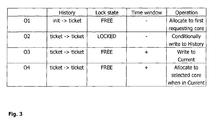
- Operations 01 - 04 performed by the spinlock module 102, in particular the components 112 and 114, in response to a status or status change of the history register 104 and lock state register 106, are exemplarily illustrated in Fig. 3 .
- a control table representing the content of Fig. 3 is provided for access by the components 112 and 114 in a buffer 124, such that the control table 300 may define an operation of these components.
- the control table 300 in Fig. 3 prescribes the operation O1 to be performed by the lock allocation component 114 in case the status of the history register 104 changes from 'INIT' to holding a ticket and the lock state is 'FREE'.
- the operation O1 comprises to allocate the lock to the core corresponding to the ticket currently stored in the history 104. Taking the above discussed example further, this is the ticket of core C2 stored by the component 112 in the history 104 in response to the spinning attempt 121.
- the lock allocation component 114 Based on the instruction O1, the lock allocation component 114 extracts the ticket number stored in the history 104 and allocates the lock to the corresponding core C2 (arrow 126 in Fig. 1 ).
- the operation O1 specifies that the lock is to be allocated to the first core requesting it.
- the lock allocation component 114 may signal the lock state change component 116 to change the lock state in register 106 from 'FREE' to 'LOCKED'.
- the spinlock module 102 operates to select at least one of the spinning cores based on their respective waiting time indications, i.e. tickets. More specifically, the cores which do not have received the lock, i.e. cores C1 and C3 in Fig. 1 , will continue spinning for the lock (this is indicated by short arrows 128 in Fig. 1 for sake of illustration). For each spinning attempt forwarded by the signal input component 108, the spinning detection component 112 analyses the assigned ticket (operation 02 in control table 300 in Fig. 3 ). The ticket (ticket number and priority) is written to the history register 104 in case two conditions are fulfilled:
- the history 104 is not changed. In this way, the ticket for a particular core will be selected, i.e. in the history the ticket assigned to a core ready to execute a high priority task and waiting already for a long time to get the lock will be stored. For later reference, we may assume that core C3 is selected, i.e. the ticket assigned to core C3 is stored in the history 104.
- step 208 upon return of the lock from the first core, the lock is conditionally allocated to the core selected in step 206, if the selected core performs a spinning attempt within a predefined time window, which starts with the return of the lock. More specifically and with reference to the exemplary embodiment illustrated in Fig. 1 , the core C2 which has been allocated the core by signal 126 may, upon completion of its task, provide a signal 129 indicating a lock return to the spinlock module 102. The signal input component 108 forwards the return signal to the lock state change component 116, which operates in response to the forwarded signal to change the lock state held in register 106 from 'LOCKED' to 'FREE'.
- the spinning detection component 112 and lock allocation component 116 change its mode of operation during a predefined time window ⁇ t 1 , wherein the value of ⁇ t 1 , i.e. the duration of the time window, is stored in a storage component 130 for access by the spinning detection component 112 and lock allocation component 114.
- the spinning detection component 112 stops the operation 02 of evaluating and conditionally writing tickets to the history register 104. Instead, the component 112 performs operation 03 (see Fig. 3 ) which includes writing the ticket number of any spinning core to a current register 132, which may, e.g., be a 1-byte register (the priority of the spinning core need not to be stored in the current register 132).
- the lock allocation component 114 operates to compare the ticket number buffered in the current register 132 to the ticket number stored in the history register 104 (depicted as operation 04 in the control table 300 illustrated in Fig. 3 ).
- the lock allocation component 114 may, for example, regularly poll the current register 132, or may be triggered via signal line 122 by the spinning detection component 112. In case it turns out that a ticket number stored in the current register 132 equals the ticket number stored in the history 104, this means that a spinning attempt of the core which has been selected as harbouring a high-priority task and waiting for a long time has been detected. In this case, the lock allocation component 114 allocates the lock to this core, i.e.
- the core corresponding to the ticket number stored in the history register 104 and current register 132 In the example discussed here with reference to the configuration depicted in Fig. 1 , the selected core C3 has performed a further spinning attempt during the time window ⁇ t 1 and therefore the lock is allocated to the selected core C3. Further, the component 114 triggers the lock state change component 116 to set the lock state to 'LOCKED'.
- any other configuration might also be employed which allows to compare the ticket number stored in the history 104 with the ticket number assigned to a currently spinning core.
- a value of a predetermined time period ⁇ t 2 is stored in the configuration parameter storage 130.
- the time period ⁇ t 2 prescribes a maximum operation time for the selected core before to return the lock.
- the lock allocation component 114 or any other component of the spinlock module 102 sends a control signal to the selected core in order to force a return of the lock.
- this control signal is illustrated as a signal 134 sent to the selected core C3.
- Provision of the time period ⁇ t 2 is optional: In other embodiments, no such additional parameter may be provided, e.g. in an environment in which it is clear that selected cores will return the lock after few operation cycles.
- the step 208 may be repeated until the time window ⁇ t 1 , expires.
- the step 206 may comprise selecting two (or more) tickets of spinning cores with a high priority and early ticket numbers.
- the history register 104 may be adapted to store the selected two (or more) tickets.
- the selecting step 206 is repeated during the time the lock is allocated to the selected core within the time window ⁇ t 1 . Upon return of the lock within the time window ⁇ t 1 , the lock may then again be allocated to the core whose ticket is stored in the history register 104.
- step 210 whether or not the lock has been allocated to the selected core(s), the history 104 is reset into the state 'INIT' in any case after the time window ⁇ t 1 has been elapsed.
- the operation of the spinlock module 102 may then continue with steps 202 and 204, as described above.
- the steps 202 and 204 in Fig. 2 may be performed in any order.
- the step 202 of establishing tickets for spinning cores will be performed once for each core, i.e. may generally be performed repeatedly and continuously when the lock is allocated to a core.
- the proposed multi-core synchronization technique is applied to a multi-core system with three cores in the embodiment described above, it is to be understood that the technique may be applied to multi-core systems with any number of cores, for example to systems with only two cores and systems with more than three cores, e.g., four or five cores, and also to systems with a large number of cores, e.g., 32, 64 or 128 core systems.
- Provision of a history register allows buffering the ticket number or a similar waiting time indication for a core to which one wants the lock to be allocated in order to guarantee a deterministic and fair behaviour of the spinlock mechanism.
- the core selected in this way has the chance to gain the lock during a small time window, during which the spinlock module waits for a spinning attempt of the selected core, i.e. the core whose ticket is buffered in the history 104.
- This mechanism allows considering long waiting and/or high priority cores to gain the lock, and thus leads to a deterministic and fair behaviour. No priority inversion does occur.
- the provision of the time window for allocating the lock to the selected core will not lead to a decrease in processing efficiency, as in many typical cases the oldest / high-priority core will still be spinning and thus the lock will be allocated to this core rapidly after the start of the time window.
- a multi-core system implementing the techniques illustrated herein may be employed in a real-time environment, for example in an automotive environment which uses multi-core microcontrollers.
Landscapes
- Engineering & Computer Science (AREA)
- Software Systems (AREA)
- Theoretical Computer Science (AREA)
- Physics & Mathematics (AREA)
- General Engineering & Computer Science (AREA)
- General Physics & Mathematics (AREA)
- Debugging And Monitoring (AREA)
- Small-Scale Networks (AREA)
- Mobile Radio Communication Systems (AREA)
Claims (15)
- Procédé de synchronisation de multiples noyaux de processeur qui exécutent des tentatives de tournage pour demander un verrou, dans lequel le verrou est attribué à, au maximum, un des multiples noyaux (C1-C3) pour une opération exclusive mutuellement de ceux-ci, le procédé comprenant les étapes consistant à :attribuer (204) le verrou (106) au premier noyau (C2) qui le demande ;établir (202), pour chaque noyau (C1-C3), une indication d'un temps d'attente pour recevoir le verrou (106) ;après l'attribution du verrou au premier noyau (C2) demandeur, sélectionner (206) au moins un des noyaux (C1, C3) tournants sur la base des indications de temps d'attente ;lors du retour du verrou (106), attribuer (208) de manière conditionnelle le verrou au noyau (C3) sélectionné pendant une fenêtre (Δt1) de temps prédéfinie, la fenêtre (Δt1) de temps prédéfinie commençant à partir du retour du verrou ;si le noyau (C3) sélectionné exécute une tentative de tournage au sein de la fenêtre (Δt1) de temps prédéfinie, attribuer (208) le verrou au noyau (C3) sélectionné ; etrépéter les étapes précédentes après l'expiration de la fenêtre (Δt1) de temps prédéfinie.
- Procédé selon la revendication 1,
dans lequel l'étape consistant à sélectionner (206) l'un des noyaux consiste à sélectionner le noyau (C3) présentant le temps d'attente le plus long. - Procédé selon la revendication 1 ou 2,
dans lequel les indications de temps d'attente établies pour les noyaux (C1-C3) tournants comprennent au moins un élément parmi des estampilles temporelles et une séquence monotone de nombres. - Procédé selon l'une quelconque des revendications précédentes,
comprenant l'étape consistant à attribuer une priorité à chaque noyau tournant, dans lequel l'étape consistant à sélectionner (206) un noyau sur la base des indications de temps d'attente consiste à sélectionner un noyau sur la base de sa priorité. - Procédé selon la revendication 4,
dans lequel un noyau est sélectionné (206) si sa priorité est au moins la priorité du noyau auquel le verrou est attribué actuellement. - Procédé selon l'une quelconque des revendications précédentes,
dans lequel les étapes consistant à sélectionner (206) un noyau et à attribuer (208) le verrou au noyau sélectionné sont exécutées de manière répétée jusqu'à ce que la fenêtre (Δt1) de temps expire, dans lequel l'étape consistant à attribuer (208) le verrou est exécutée lors du retour du verrou au sein de la fenêtre (Δt1) de temps. - Procédé selon l'une quelconque des revendications précédentes,
dans lequel le verrou est attribué au noyau sélectionné pendant une période (Δt2) de temps prédéfinie. - Procédé selon la revendication 7,
comprenant l'étape consistant à envoyer un signal (134) de commande au noyau auquel le verrou a été attribué, si lors de l'expiration de la période (Δt2) de temps prédéfinie, le noyau tient encore le verrou. - Procédé selon la revendication 7 ou 8,
dans lequel la période (Δt2) de temps prédéfinie est égale à la durée de la fenêtre (Δt1) de temps. - Procédé selon l'une quelconque des revendications 2 à 9,
comprenant l'étape consistant à attribuer le verrou au noyau présentant le second temps d'attente le plus long, si aucune tentative de tournage du noyau, au sein de la fenêtre de temps prédéfinie, n'est détectée présentant le temps d'attente le plus long. - Produit de programme informatique comprenant des parties de code de programme permettant d'exécuter le procédé selon l'une quelconque des revendications précédentes lorsque le produit de programme informatique est exécuté sur un ou plusieurs des dispositifs informatiques.
- Produit de programme informatique selon la revendication 11, stocké sur un support d'enregistrement lisible par ordinateur.
- Module (102) de verrou tournant permettant de synchroniser de multiples noyaux (C1-C3), comprenant :un composant (114, 124) adapté pour exécuter une étape consistant à attribuer le verrou (106) au premier noyau (C2) qui le demande ;un composant (110, 119) adapté pour exécuter une étape consistant à établir pour chaque noyau (C1-C3) une indication de temps d'attente pour recevoir le verrou ;un composant (112, 104, 124, 132) adapté pour exécuter une étape consistant à sélectionner au moins l'un des noyaux (C1-C3) tournants, sur la base des indications de temps d'attente après l'attribution du verrou au premier noyau (C2) demandeur ;un composant (114, 124, 104, 132) adapté pour exécuter les étapes consistant à attribuer de manière conditionnelle le verrou au noyau sélectionné pendant une fenêtre (Δt1) de temps prédéfinie, la fenêtre (Δt1) de temps prédéfinie commençant par le retour du verrou, et si le noyau sélectionné effectue une tentative de tournage au sein de la fenêtre (Δt1) de temps prédéfinie, attribuer le verrou au noyau (C3) sélectionné ; etdans lequel les composants du module (102) de verrou tournant sont adaptés en outre pour répéter les étapes exécutées respectivement après l'expiration de la fenêtre (Δt1) de temps prédéfinie.
- Module de verrou tournant selon la revendication 13,
comprenant en outre un composant (110, 120) adapté pour attribuer une priorité à chaque noyau tournant. - Système (100) à noyaux multiples comprenant un module (102) de verrou tournant selon la revendication 13 ou 14.
Applications Claiming Priority (1)
| Application Number | Priority Date | Filing Date | Title |
|---|---|---|---|
| PCT/EP2008/006001 WO2010009743A1 (fr) | 2008-07-22 | 2008-07-22 | Synchronisation de multiples noyaux de processeur |
Publications (2)
| Publication Number | Publication Date |
|---|---|
| EP2318924A1 EP2318924A1 (fr) | 2011-05-11 |
| EP2318924B1 true EP2318924B1 (fr) | 2016-09-14 |
Family
ID=40282472
Family Applications (1)
| Application Number | Title | Priority Date | Filing Date |
|---|---|---|---|
| EP08774034.6A Not-in-force EP2318924B1 (fr) | 2008-07-22 | 2008-07-22 | Synchronisation de multiples noyaux de processeur |
Country Status (3)
| Country | Link |
|---|---|
| US (1) | US8504749B2 (fr) |
| EP (1) | EP2318924B1 (fr) |
| WO (1) | WO2010009743A1 (fr) |
Families Citing this family (4)
| Publication number | Priority date | Publication date | Assignee | Title |
|---|---|---|---|---|
| US9141434B2 (en) * | 2012-05-30 | 2015-09-22 | Red Hat Israel, Ltd. | Robust non-shareable resource access under live virtual machine cloning |
| US9842010B1 (en) | 2016-10-24 | 2017-12-12 | International Business Machines Corporation | Adjustment of a sleep duration for a process based on an expected time for securing a spinlock |
| US11119831B2 (en) * | 2020-01-10 | 2021-09-14 | Wind River Systems, Inc. | Systems and methods for interrupting latency optimized two-phase spinlock |
| CN116010040A (zh) * | 2021-10-21 | 2023-04-25 | 华为技术有限公司 | 一种获取锁资源的方法、装置及设备 |
Family Cites Families (3)
| Publication number | Priority date | Publication date | Assignee | Title |
|---|---|---|---|---|
| US6779090B2 (en) * | 2002-05-21 | 2004-08-17 | International Business Machines Corporation | Spinlock for shared memory |
| TW200708963A (en) * | 2005-08-26 | 2007-03-01 | Ind Tech Res Inst | Method and apparatus for synchronization in a multi-processor system |
| GB0518516D0 (en) * | 2005-09-10 | 2005-10-19 | Ibm | Managing a resource lock |
-
2008
- 2008-07-22 EP EP08774034.6A patent/EP2318924B1/fr not_active Not-in-force
- 2008-07-22 WO PCT/EP2008/006001 patent/WO2010009743A1/fr not_active Ceased
- 2008-07-22 US US13/055,347 patent/US8504749B2/en not_active Expired - Fee Related
Also Published As
| Publication number | Publication date |
|---|---|
| US8504749B2 (en) | 2013-08-06 |
| US20110185154A1 (en) | 2011-07-28 |
| WO2010009743A1 (fr) | 2010-01-28 |
| EP2318924A1 (fr) | 2011-05-11 |
Similar Documents
| Publication | Publication Date | Title |
|---|---|---|
| US11893416B2 (en) | Determining a job group status based on a relationship between a generation counter value and a ticket value for scheduling the job group for execution | |
| Tindell et al. | Analysis of hard real-time communications | |
| US7735087B2 (en) | Task switching apparatus, method and program | |
| US8918791B1 (en) | Method and system for queuing a request by a processor to access a shared resource and granting access in accordance with an embedded lock ID | |
| US10331500B2 (en) | Managing fairness for lock and unlock operations using operation prioritization | |
| US20100250809A1 (en) | Synchronization mechanisms based on counters | |
| TWI460659B (zh) | 用於降低競爭之鎖定窗 | |
| US10445096B2 (en) | Managing lock and unlock operations using traffic prioritization | |
| CN107797848A (zh) | 进程调度方法、装置和主机设备 | |
| US20220066831A1 (en) | Lock-free work-stealing thread scheduler | |
| EP2318924B1 (fr) | Synchronisation de multiples noyaux de processeur | |
| CN112306827B (zh) | 日志采集装置、方法和计算机可读存储介质 | |
| CN115408117A (zh) | 协程运行方法、装置、计算机设备和存储介质 | |
| CN108958903B (zh) | 嵌入式多核中央处理器任务调度方法与装置 | |
| CN108958905B (zh) | 嵌入式多核中央处理器的轻量级操作系统 | |
| CN109426562B (zh) | 优先级加权轮转调度器 | |
| JP7346649B2 (ja) | 同期制御システムおよび同期制御方法 | |
| CN101647002A (zh) | 多处理系统及方法 | |
| CN108958904B (zh) | 嵌入式多核中央处理器的轻量级操作系统的驱动程序框架 | |
| US6654861B2 (en) | Method to manage multiple communication queues in an 8-bit microcontroller | |
| CN112306698B (zh) | 一种numa系统中的临界区执行方法及装置 | |
| HK1202952A1 (en) | A computing system and a method for operating a lock in the computing system | |
| CN118916150B (zh) | 一种多主机任务同步器和多主机任务同步方法 | |
| RU2816292C1 (ru) | Способ управления чтением из разделяемого ресурса памяти и записью в него (варианты), система и считываемый компьютером носитель, реализующие упомянутый способ | |
| CN114880075B (zh) | 一种用户态虚拟机虚拟核间任务的调度方法及装置 |
Legal Events
| Date | Code | Title | Description |
|---|---|---|---|
| PUAI | Public reference made under article 153(3) epc to a published international application that has entered the european phase |
Free format text: ORIGINAL CODE: 0009012 |
|
| 17P | Request for examination filed |
Effective date: 20110118 |
|
| AK | Designated contracting states |
Kind code of ref document: A1 Designated state(s): AT BE BG CH CY CZ DE DK EE ES FI FR GB GR HR HU IE IS IT LI LT LU LV MC MT NL NO PL PT RO SE SI SK TR |
|
| AX | Request for extension of the european patent |
Extension state: AL BA MK RS |
|
| DAX | Request for extension of the european patent (deleted) | ||
| RAP1 | Party data changed (applicant data changed or rights of an application transferred) |
Owner name: ELEKTROBIT AUTOMOTIVE GMBH |
|
| 17Q | First examination report despatched |
Effective date: 20140721 |
|
| REG | Reference to a national code |
Ref country code: DE Ref legal event code: R079 Ref document number: 602008046302 Country of ref document: DE Free format text: PREVIOUS MAIN CLASS: G06F0009460000 Ipc: G06F0009520000 |
|
| GRAP | Despatch of communication of intention to grant a patent |
Free format text: ORIGINAL CODE: EPIDOSNIGR1 |
|
| RIC1 | Information provided on ipc code assigned before grant |
Ipc: G06F 9/52 20060101AFI20160301BHEP |
|
| INTG | Intention to grant announced |
Effective date: 20160330 |
|
| GRAS | Grant fee paid |
Free format text: ORIGINAL CODE: EPIDOSNIGR3 |
|
| GRAA | (expected) grant |
Free format text: ORIGINAL CODE: 0009210 |
|
| AK | Designated contracting states |
Kind code of ref document: B1 Designated state(s): AT BE BG CH CY CZ DE DK EE ES FI FR GB GR HR HU IE IS IT LI LT LU LV MC MT NL NO PL PT RO SE SI SK TR |
|
| REG | Reference to a national code |
Ref country code: GB Ref legal event code: FG4D |
|
| REG | Reference to a national code |
Ref country code: CH Ref legal event code: EP |
|
| REG | Reference to a national code |
Ref country code: IE Ref legal event code: FG4D |
|
| REG | Reference to a national code |
Ref country code: AT Ref legal event code: REF Ref document number: 829688 Country of ref document: AT Kind code of ref document: T Effective date: 20161015 |
|
| REG | Reference to a national code |
Ref country code: DE Ref legal event code: R096 Ref document number: 602008046302 Country of ref document: DE |
|
| REG | Reference to a national code |
Ref country code: LT Ref legal event code: MG4D |
|
| REG | Reference to a national code |
Ref country code: NL Ref legal event code: MP Effective date: 20160914 |
|
| PG25 | Lapsed in a contracting state [announced via postgrant information from national office to epo] |
Ref country code: HR Free format text: LAPSE BECAUSE OF FAILURE TO SUBMIT A TRANSLATION OF THE DESCRIPTION OR TO PAY THE FEE WITHIN THE PRESCRIBED TIME-LIMIT Effective date: 20160914 Ref country code: NO Free format text: LAPSE BECAUSE OF FAILURE TO SUBMIT A TRANSLATION OF THE DESCRIPTION OR TO PAY THE FEE WITHIN THE PRESCRIBED TIME-LIMIT Effective date: 20161214 Ref country code: LT Free format text: LAPSE BECAUSE OF FAILURE TO SUBMIT A TRANSLATION OF THE DESCRIPTION OR TO PAY THE FEE WITHIN THE PRESCRIBED TIME-LIMIT Effective date: 20160914 Ref country code: FI Free format text: LAPSE BECAUSE OF FAILURE TO SUBMIT A TRANSLATION OF THE DESCRIPTION OR TO PAY THE FEE WITHIN THE PRESCRIBED TIME-LIMIT Effective date: 20160914 |
|
| REG | Reference to a national code |
Ref country code: AT Ref legal event code: MK05 Ref document number: 829688 Country of ref document: AT Kind code of ref document: T Effective date: 20160914 Ref country code: DE Ref legal event code: R082 Ref document number: 602008046302 Country of ref document: DE |
|
| PG25 | Lapsed in a contracting state [announced via postgrant information from national office to epo] |
Ref country code: LV Free format text: LAPSE BECAUSE OF FAILURE TO SUBMIT A TRANSLATION OF THE DESCRIPTION OR TO PAY THE FEE WITHIN THE PRESCRIBED TIME-LIMIT Effective date: 20160914 Ref country code: GR Free format text: LAPSE BECAUSE OF FAILURE TO SUBMIT A TRANSLATION OF THE DESCRIPTION OR TO PAY THE FEE WITHIN THE PRESCRIBED TIME-LIMIT Effective date: 20161215 Ref country code: ES Free format text: LAPSE BECAUSE OF FAILURE TO SUBMIT A TRANSLATION OF THE DESCRIPTION OR TO PAY THE FEE WITHIN THE PRESCRIBED TIME-LIMIT Effective date: 20160914 Ref country code: NL Free format text: LAPSE BECAUSE OF FAILURE TO SUBMIT A TRANSLATION OF THE DESCRIPTION OR TO PAY THE FEE WITHIN THE PRESCRIBED TIME-LIMIT Effective date: 20160914 Ref country code: SE Free format text: LAPSE BECAUSE OF FAILURE TO SUBMIT A TRANSLATION OF THE DESCRIPTION OR TO PAY THE FEE WITHIN THE PRESCRIBED TIME-LIMIT Effective date: 20160914 |
|
| PG25 | Lapsed in a contracting state [announced via postgrant information from national office to epo] |
Ref country code: EE Free format text: LAPSE BECAUSE OF FAILURE TO SUBMIT A TRANSLATION OF THE DESCRIPTION OR TO PAY THE FEE WITHIN THE PRESCRIBED TIME-LIMIT Effective date: 20160914 Ref country code: RO Free format text: LAPSE BECAUSE OF FAILURE TO SUBMIT A TRANSLATION OF THE DESCRIPTION OR TO PAY THE FEE WITHIN THE PRESCRIBED TIME-LIMIT Effective date: 20160914 |
|
| PG25 | Lapsed in a contracting state [announced via postgrant information from national office to epo] |
Ref country code: PT Free format text: LAPSE BECAUSE OF FAILURE TO SUBMIT A TRANSLATION OF THE DESCRIPTION OR TO PAY THE FEE WITHIN THE PRESCRIBED TIME-LIMIT Effective date: 20170116 Ref country code: BG Free format text: LAPSE BECAUSE OF FAILURE TO SUBMIT A TRANSLATION OF THE DESCRIPTION OR TO PAY THE FEE WITHIN THE PRESCRIBED TIME-LIMIT Effective date: 20161214 Ref country code: AT Free format text: LAPSE BECAUSE OF FAILURE TO SUBMIT A TRANSLATION OF THE DESCRIPTION OR TO PAY THE FEE WITHIN THE PRESCRIBED TIME-LIMIT Effective date: 20160914 Ref country code: CZ Free format text: LAPSE BECAUSE OF FAILURE TO SUBMIT A TRANSLATION OF THE DESCRIPTION OR TO PAY THE FEE WITHIN THE PRESCRIBED TIME-LIMIT Effective date: 20160914 Ref country code: PL Free format text: LAPSE BECAUSE OF FAILURE TO SUBMIT A TRANSLATION OF THE DESCRIPTION OR TO PAY THE FEE WITHIN THE PRESCRIBED TIME-LIMIT Effective date: 20160914 Ref country code: IS Free format text: LAPSE BECAUSE OF FAILURE TO SUBMIT A TRANSLATION OF THE DESCRIPTION OR TO PAY THE FEE WITHIN THE PRESCRIBED TIME-LIMIT Effective date: 20170114 Ref country code: SK Free format text: LAPSE BECAUSE OF FAILURE TO SUBMIT A TRANSLATION OF THE DESCRIPTION OR TO PAY THE FEE WITHIN THE PRESCRIBED TIME-LIMIT Effective date: 20160914 Ref country code: BE Free format text: LAPSE BECAUSE OF FAILURE TO SUBMIT A TRANSLATION OF THE DESCRIPTION OR TO PAY THE FEE WITHIN THE PRESCRIBED TIME-LIMIT Effective date: 20160914 |
|
| REG | Reference to a national code |
Ref country code: DE Ref legal event code: R097 Ref document number: 602008046302 Country of ref document: DE |
|
| PG25 | Lapsed in a contracting state [announced via postgrant information from national office to epo] |
Ref country code: IT Free format text: LAPSE BECAUSE OF FAILURE TO SUBMIT A TRANSLATION OF THE DESCRIPTION OR TO PAY THE FEE WITHIN THE PRESCRIBED TIME-LIMIT Effective date: 20160914 |
|
| PLBE | No opposition filed within time limit |
Free format text: ORIGINAL CODE: 0009261 |
|
| STAA | Information on the status of an ep patent application or granted ep patent |
Free format text: STATUS: NO OPPOSITION FILED WITHIN TIME LIMIT |
|
| REG | Reference to a national code |
Ref country code: FR Ref legal event code: PLFP Year of fee payment: 10 |
|
| PG25 | Lapsed in a contracting state [announced via postgrant information from national office to epo] |
Ref country code: DK Free format text: LAPSE BECAUSE OF FAILURE TO SUBMIT A TRANSLATION OF THE DESCRIPTION OR TO PAY THE FEE WITHIN THE PRESCRIBED TIME-LIMIT Effective date: 20160914 |
|
| 26N | No opposition filed |
Effective date: 20170615 |
|
| PG25 | Lapsed in a contracting state [announced via postgrant information from national office to epo] |
Ref country code: SI Free format text: LAPSE BECAUSE OF FAILURE TO SUBMIT A TRANSLATION OF THE DESCRIPTION OR TO PAY THE FEE WITHIN THE PRESCRIBED TIME-LIMIT Effective date: 20160914 |
|
| REG | Reference to a national code |
Ref country code: CH Ref legal event code: PL |
|
| GBPC | Gb: european patent ceased through non-payment of renewal fee |
Effective date: 20170722 |
|
| REG | Reference to a national code |
Ref country code: IE Ref legal event code: MM4A |
|
| PG25 | Lapsed in a contracting state [announced via postgrant information from national office to epo] |
Ref country code: CH Free format text: LAPSE BECAUSE OF NON-PAYMENT OF DUE FEES Effective date: 20170731 Ref country code: IE Free format text: LAPSE BECAUSE OF NON-PAYMENT OF DUE FEES Effective date: 20170722 Ref country code: LI Free format text: LAPSE BECAUSE OF NON-PAYMENT OF DUE FEES Effective date: 20170731 Ref country code: GB Free format text: LAPSE BECAUSE OF NON-PAYMENT OF DUE FEES Effective date: 20170722 |
|
| PG25 | Lapsed in a contracting state [announced via postgrant information from national office to epo] |
Ref country code: LU Free format text: LAPSE BECAUSE OF NON-PAYMENT OF DUE FEES Effective date: 20170722 |
|
| REG | Reference to a national code |
Ref country code: FR Ref legal event code: PLFP Year of fee payment: 11 |
|
| PG25 | Lapsed in a contracting state [announced via postgrant information from national office to epo] |
Ref country code: MT Free format text: LAPSE BECAUSE OF NON-PAYMENT OF DUE FEES Effective date: 20170722 |
|
| PG25 | Lapsed in a contracting state [announced via postgrant information from national office to epo] |
Ref country code: HU Free format text: LAPSE BECAUSE OF FAILURE TO SUBMIT A TRANSLATION OF THE DESCRIPTION OR TO PAY THE FEE WITHIN THE PRESCRIBED TIME-LIMIT; INVALID AB INITIO Effective date: 20080722 Ref country code: MC Free format text: LAPSE BECAUSE OF FAILURE TO SUBMIT A TRANSLATION OF THE DESCRIPTION OR TO PAY THE FEE WITHIN THE PRESCRIBED TIME-LIMIT Effective date: 20160914 |
|
| PG25 | Lapsed in a contracting state [announced via postgrant information from national office to epo] |
Ref country code: CY Free format text: LAPSE BECAUSE OF NON-PAYMENT OF DUE FEES Effective date: 20160914 |
|
| PG25 | Lapsed in a contracting state [announced via postgrant information from national office to epo] |
Ref country code: TR Free format text: LAPSE BECAUSE OF FAILURE TO SUBMIT A TRANSLATION OF THE DESCRIPTION OR TO PAY THE FEE WITHIN THE PRESCRIBED TIME-LIMIT Effective date: 20160914 |
|
| REG | Reference to a national code |
Ref country code: DE Ref legal event code: R084 Ref document number: 602008046302 Country of ref document: DE |
|
| P01 | Opt-out of the competence of the unified patent court (upc) registered |
Effective date: 20230522 |
|
| PGFP | Annual fee paid to national office [announced via postgrant information from national office to epo] |
Ref country code: FR Payment date: 20230725 Year of fee payment: 16 Ref country code: DE Payment date: 20230731 Year of fee payment: 16 |
|
| REG | Reference to a national code |
Ref country code: DE Ref legal event code: R119 Ref document number: 602008046302 Country of ref document: DE |
|
| PG25 | Lapsed in a contracting state [announced via postgrant information from national office to epo] |
Ref country code: DE Free format text: LAPSE BECAUSE OF NON-PAYMENT OF DUE FEES Effective date: 20250201 |
|
| PG25 | Lapsed in a contracting state [announced via postgrant information from national office to epo] |
Ref country code: FR Free format text: LAPSE BECAUSE OF NON-PAYMENT OF DUE FEES Effective date: 20240731 |