EP2316417A2 - Nicht-therapeutische Verwendung gegen Hautalterung - Google Patents
Nicht-therapeutische Verwendung gegen Hautalterung Download PDFInfo
- Publication number
- EP2316417A2 EP2316417A2 EP10164913A EP10164913A EP2316417A2 EP 2316417 A2 EP2316417 A2 EP 2316417A2 EP 10164913 A EP10164913 A EP 10164913A EP 10164913 A EP10164913 A EP 10164913A EP 2316417 A2 EP2316417 A2 EP 2316417A2
- Authority
- EP
- European Patent Office
- Prior art keywords
- copolymer
- sodium
- acrylates
- carbomer
- partially neutralized
- Prior art date
- Legal status (The legal status is an assumption and is not a legal conclusion. Google has not performed a legal analysis and makes no representation as to the accuracy of the status listed.)
- Granted
Links
- 230000009759 skin aging Effects 0.000 title description 6
- NIXOWILDQLNWCW-UHFFFAOYSA-N 2-Propenoic acid Natural products OC(=O)C=C NIXOWILDQLNWCW-UHFFFAOYSA-N 0.000 claims abstract description 39
- 229920001577 copolymer Polymers 0.000 claims abstract description 36
- SMZOUWXMTYCWNB-UHFFFAOYSA-N 2-(2-methoxy-5-methylphenyl)ethanamine Chemical compound COC1=CC=C(C)C=C1CCN SMZOUWXMTYCWNB-UHFFFAOYSA-N 0.000 claims abstract description 17
- 239000002537 cosmetic Substances 0.000 claims abstract description 13
- 229920002674 hyaluronan Polymers 0.000 claims abstract description 13
- KIUKXJAPPMFGSW-DNGZLQJQSA-N (2S,3S,4S,5R,6R)-6-[(2S,3R,4R,5S,6R)-3-Acetamido-2-[(2S,3S,4R,5R,6R)-6-[(2R,3R,4R,5S,6R)-3-acetamido-2,5-dihydroxy-6-(hydroxymethyl)oxan-4-yl]oxy-2-carboxy-4,5-dihydroxyoxan-3-yl]oxy-5-hydroxy-6-(hydroxymethyl)oxan-4-yl]oxy-3,4,5-trihydroxyoxane-2-carboxylic acid Chemical compound CC(=O)N[C@H]1[C@H](O)O[C@H](CO)[C@@H](O)[C@@H]1O[C@H]1[C@H](O)[C@@H](O)[C@H](O[C@H]2[C@@H]([C@@H](O[C@H]3[C@@H]([C@@H](O)[C@H](O)[C@H](O3)C(O)=O)O)[C@H](O)[C@@H](CO)O2)NC(C)=O)[C@@H](C(O)=O)O1 KIUKXJAPPMFGSW-DNGZLQJQSA-N 0.000 claims abstract description 12
- 229960003160 hyaluronic acid Drugs 0.000 claims abstract description 12
- 238000003786 synthesis reaction Methods 0.000 claims abstract description 10
- 230000015572 biosynthetic process Effects 0.000 claims abstract description 9
- 230000001413 cellular effect Effects 0.000 claims abstract description 6
- 229920002125 Sokalan® Polymers 0.000 claims description 27
- 229960001631 carbomer Drugs 0.000 claims description 22
- 229940047670 sodium acrylate Drugs 0.000 claims description 18
- 229920006037 cross link polymer Polymers 0.000 claims description 15
- PQUXFUBNSYCQAL-UHFFFAOYSA-N 1-(2,3-difluorophenyl)ethanone Chemical compound CC(=O)C1=CC=CC(F)=C1F PQUXFUBNSYCQAL-UHFFFAOYSA-N 0.000 claims description 12
- 150000001252 acrylic acid derivatives Chemical class 0.000 claims description 12
- 239000000203 mixture Substances 0.000 claims description 12
- 229920001519 homopolymer Polymers 0.000 claims description 7
- HRPVXLWXLXDGHG-UHFFFAOYSA-N Acrylamide Chemical compound NC(=O)C=C HRPVXLWXLXDGHG-UHFFFAOYSA-N 0.000 claims description 6
- GADGVXXJJXQRSA-UHFFFAOYSA-N ethenyl 8-methylnonanoate Chemical compound CC(C)CCCCCCC(=O)OC=C GADGVXXJJXQRSA-UHFFFAOYSA-N 0.000 claims description 6
- 239000011591 potassium Substances 0.000 claims description 6
- 229910052700 potassium Inorganic materials 0.000 claims description 6
- 239000011734 sodium Substances 0.000 claims description 6
- 229910052708 sodium Inorganic materials 0.000 claims description 6
- FWFUWXVFYKCSQA-UHFFFAOYSA-M sodium;2-methyl-2-(prop-2-enoylamino)propane-1-sulfonate Chemical compound [Na+].[O-]S(=O)(=O)CC(C)(C)NC(=O)C=C FWFUWXVFYKCSQA-UHFFFAOYSA-M 0.000 claims description 6
- QGZKDVFQNNGYKY-UHFFFAOYSA-O Ammonium Chemical compound [NH4+] QGZKDVFQNNGYKY-UHFFFAOYSA-O 0.000 claims description 5
- DGAQECJNVWCQMB-PUAWFVPOSA-M Ilexoside XXIX Chemical compound C[C@@H]1CC[C@@]2(CC[C@@]3(C(=CC[C@H]4[C@]3(CC[C@@H]5[C@@]4(CC[C@@H](C5(C)C)OS(=O)(=O)[O-])C)C)[C@@H]2[C@]1(C)O)C)C(=O)O[C@H]6[C@@H]([C@H]([C@@H]([C@H](O6)CO)O)O)O.[Na+] DGAQECJNVWCQMB-PUAWFVPOSA-M 0.000 claims description 5
- ZLMJMSJWJFRBEC-UHFFFAOYSA-N Potassium Chemical compound [K] ZLMJMSJWJFRBEC-UHFFFAOYSA-N 0.000 claims description 5
- NYRAVIYBIHCEGB-UHFFFAOYSA-N [K].[Ca] Chemical compound [K].[Ca] NYRAVIYBIHCEGB-UHFFFAOYSA-N 0.000 claims description 5
- 229920001495 poly(sodium acrylate) polymer Polymers 0.000 claims description 5
- 229920000058 polyacrylate Polymers 0.000 claims description 5
- 229920005614 potassium polyacrylate Polymers 0.000 claims description 5
- OSCJHTSDLYVCQC-UHFFFAOYSA-N 2-ethylhexyl 4-[[4-[4-(tert-butylcarbamoyl)anilino]-6-[4-(2-ethylhexoxycarbonyl)anilino]-1,3,5-triazin-2-yl]amino]benzoate Chemical compound C1=CC(C(=O)OCC(CC)CCCC)=CC=C1NC1=NC(NC=2C=CC(=CC=2)C(=O)NC(C)(C)C)=NC(NC=2C=CC(=CC=2)C(=O)OCC(CC)CCCC)=N1 OSCJHTSDLYVCQC-UHFFFAOYSA-N 0.000 claims description 4
- 229920000642 polymer Polymers 0.000 claims description 4
- WHNPOQXWAMXPTA-UHFFFAOYSA-N 3-methylbut-2-enamide Chemical compound CC(C)=CC(N)=O WHNPOQXWAMXPTA-UHFFFAOYSA-N 0.000 claims description 3
- 229920002261 Corn starch Polymers 0.000 claims description 3
- 229920002472 Starch Polymers 0.000 claims description 3
- 229920006322 acrylamide copolymer Polymers 0.000 claims description 3
- 125000005250 alkyl acrylate group Chemical group 0.000 claims description 3
- 125000000217 alkyl group Chemical group 0.000 claims description 3
- 239000008120 corn starch Substances 0.000 claims description 3
- 238000006386 neutralization reaction Methods 0.000 claims description 3
- 229920000193 polymethacrylate Polymers 0.000 claims description 3
- 235000019698 starch Nutrition 0.000 claims description 3
- 239000008107 starch Substances 0.000 claims description 3
- QDHUQRBYCVAWEN-UHFFFAOYSA-N amino prop-2-enoate Chemical class NOC(=O)C=C QDHUQRBYCVAWEN-UHFFFAOYSA-N 0.000 claims description 2
- 239000004584 polyacrylic acid Substances 0.000 claims description 2
- FBCQUCJYYPMKRO-UHFFFAOYSA-N prop-2-enyl 2-methylprop-2-enoate Chemical compound CC(=C)C(=O)OCC=C FBCQUCJYYPMKRO-UHFFFAOYSA-N 0.000 claims description 2
- 210000003491 skin Anatomy 0.000 description 6
- 210000002950 fibroblast Anatomy 0.000 description 5
- 238000009472 formulation Methods 0.000 description 5
- NNMHYFLPFNGQFZ-UHFFFAOYSA-M sodium polyacrylate Chemical class [Na+].[O-]C(=O)C=C NNMHYFLPFNGQFZ-UHFFFAOYSA-M 0.000 description 4
- 239000000243 solution Substances 0.000 description 4
- 102000004887 Transforming Growth Factor beta Human genes 0.000 description 3
- 108090001012 Transforming Growth Factor beta Proteins 0.000 description 3
- 239000004480 active ingredient Substances 0.000 description 3
- 230000032683 aging Effects 0.000 description 3
- 210000004027 cell Anatomy 0.000 description 3
- 102000010834 Extracellular Matrix Proteins Human genes 0.000 description 2
- 108010037362 Extracellular Matrix Proteins Proteins 0.000 description 2
- 230000008033 biological extinction Effects 0.000 description 2
- 239000003795 chemical substances by application Substances 0.000 description 2
- 239000012895 dilution Substances 0.000 description 2
- 238000010790 dilution Methods 0.000 description 2
- 229940079593 drug Drugs 0.000 description 2
- 239000003814 drug Substances 0.000 description 2
- 210000002744 extracellular matrix Anatomy 0.000 description 2
- 239000002609 medium Substances 0.000 description 2
- 229910021645 metal ion Inorganic materials 0.000 description 2
- 239000000178 monomer Substances 0.000 description 2
- 239000013642 negative control Substances 0.000 description 2
- 230000002062 proliferating effect Effects 0.000 description 2
- 210000001519 tissue Anatomy 0.000 description 2
- 0 *C(C(C(*)=O)N)N Chemical compound *C(C(C(*)=O)N)N 0.000 description 1
- OYPRJOBELJOOCE-UHFFFAOYSA-N Calcium Chemical compound [Ca] OYPRJOBELJOOCE-UHFFFAOYSA-N 0.000 description 1
- 102000008186 Collagen Human genes 0.000 description 1
- 108010035532 Collagen Proteins 0.000 description 1
- 239000006144 Dulbecco’s modified Eagle's medium Substances 0.000 description 1
- 102000016942 Elastin Human genes 0.000 description 1
- 108010014258 Elastin Proteins 0.000 description 1
- 206010051246 Photodermatosis Diseases 0.000 description 1
- 239000002253 acid Substances 0.000 description 1
- 230000009471 action Effects 0.000 description 1
- 239000013543 active substance Substances 0.000 description 1
- 230000003679 aging effect Effects 0.000 description 1
- 125000005399 allylmethacrylate group Chemical group 0.000 description 1
- 230000001153 anti-wrinkle effect Effects 0.000 description 1
- 239000011575 calcium Substances 0.000 description 1
- 229910052791 calcium Inorganic materials 0.000 description 1
- 125000003178 carboxy group Chemical group [H]OC(*)=O 0.000 description 1
- 150000007942 carboxylates Chemical group 0.000 description 1
- 150000001768 cations Chemical class 0.000 description 1
- 238000004113 cell culture Methods 0.000 description 1
- 239000006143 cell culture medium Substances 0.000 description 1
- 229920001436 collagen Polymers 0.000 description 1
- 230000007423 decrease Effects 0.000 description 1
- 230000007547 defect Effects 0.000 description 1
- 239000000890 drug combination Substances 0.000 description 1
- 230000000694 effects Effects 0.000 description 1
- 229920002549 elastin Polymers 0.000 description 1
- 210000003953 foreskin Anatomy 0.000 description 1
- 239000001963 growth medium Substances 0.000 description 1
- KIUKXJAPPMFGSW-MNSSHETKSA-N hyaluronan Chemical compound CC(=O)N[C@H]1[C@H](O)O[C@H](CO)[C@@H](O)C1O[C@H]1[C@H](O)[C@@H](O)[C@H](O[C@H]2[C@@H](C(O[C@H]3[C@@H]([C@@H](O)[C@H](O)[C@H](O3)C(O)=O)O)[C@H](O)[C@@H](CO)O2)NC(C)=O)[C@@H](C(O)=O)O1 KIUKXJAPPMFGSW-MNSSHETKSA-N 0.000 description 1
- 229940099552 hyaluronan Drugs 0.000 description 1
- 238000010348 incorporation Methods 0.000 description 1
- 239000004615 ingredient Substances 0.000 description 1
- 238000011835 investigation Methods 0.000 description 1
- 238000000034 method Methods 0.000 description 1
- 239000013641 positive control Substances 0.000 description 1
- 238000002360 preparation method Methods 0.000 description 1
- 239000000047 product Substances 0.000 description 1
- 230000000750 progressive effect Effects 0.000 description 1
- 238000012113 quantitative test Methods 0.000 description 1
- 230000009467 reduction Effects 0.000 description 1
- 230000008439 repair process Effects 0.000 description 1
- 230000000284 resting effect Effects 0.000 description 1
- 229920006395 saturated elastomer Polymers 0.000 description 1
- 238000000926 separation method Methods 0.000 description 1
- 210000004927 skin cell Anatomy 0.000 description 1
- 238000001228 spectrum Methods 0.000 description 1
- 239000000126 substance Substances 0.000 description 1
- 239000006228 supernatant Substances 0.000 description 1
- 230000001225 therapeutic effect Effects 0.000 description 1
- 239000002562 thickening agent Substances 0.000 description 1
- 230000000699 topical effect Effects 0.000 description 1
- 238000012546 transfer Methods 0.000 description 1
- 230000007704 transition Effects 0.000 description 1
Classifications
-
- A—HUMAN NECESSITIES
- A61—MEDICAL OR VETERINARY SCIENCE; HYGIENE
- A61Q—SPECIFIC USE OF COSMETICS OR SIMILAR TOILETRY PREPARATIONS
- A61Q19/00—Preparations for care of the skin
- A61Q19/08—Anti-ageing preparations
-
- A—HUMAN NECESSITIES
- A61—MEDICAL OR VETERINARY SCIENCE; HYGIENE
- A61K—PREPARATIONS FOR MEDICAL, DENTAL OR TOILETRY PURPOSES
- A61K8/00—Cosmetics or similar toiletry preparations
- A61K8/18—Cosmetics or similar toiletry preparations characterised by the composition
- A61K8/72—Cosmetics or similar toiletry preparations characterised by the composition containing organic macromolecular compounds
- A61K8/81—Cosmetics or similar toiletry preparations characterised by the composition containing organic macromolecular compounds obtained by reactions involving only carbon-to-carbon unsaturated bonds
- A61K8/8141—Compositions of homopolymers or copolymers of compounds having one or more unsaturated aliphatic radicals, each having only one carbon-to-carbon double bond, and at least one being terminated by only one carboxyl radical, or of salts, anhydrides, esters, amides, imides or nitriles thereof; Compositions of derivatives of such polymers
- A61K8/8147—Homopolymers or copolymers of acids; Metal or ammonium salts thereof, e.g. crotonic acid, (meth)acrylic acid; Compositions of derivatives of such polymers
Definitions
- the invention relates to the use of certain substances in topical cosmetic or dermatological skin treatment compositions which counteract skin aging and their signs.
- Means and treatment methods for treating mature or intrinsically or extrinsically aged or photodamaged skin, especially for anti-wrinkle treatment, are a significant cosmetic challenge.
- the aging process is characterized by a progressive transfer of skin cells from a proliferative status to a resting, senescent status. This transition corresponds to aging at the cellular level, to which much of the macroscopic aging effects can be attributed.
- the number of cells in the tissue decreases and can no longer be filled due to lack of proliferating cells.
- repairs of the surrounding tissue can not be performed, defects accumulate, causing the skin to become atrophied and slack.
- this effect is intensified by UV light, which also pollutes the skin and accelerates its aging and relaxation.
- Cosmetic skin aging agents today typically consist of a base formulation providing the desired skin feel and skin care and an active agent (or drug mixture) intended to alleviate the progression of skin aging.
- active agent or drug mixture
- These drugs or drug combinations induce e.g. the re-synthesis of molecules of the extracellular matrix, such as collagen, elastin or hyaluronic acid, since especially these molecules are no longer sufficiently present in the aged skin.
- the separation of the base formulation and the active ingredient has the disadvantage that, on the one hand, the additional use of an effective amount of the active ingredient increases the cost of the formulation, and, on the other hand, proof of efficacy must be provided again for each formulation when adding a new active ingredient.
- thickeners which already have a positive influence on the synthesis of molecules of the extracellular matrix and can thus be classified as an active component, the desired action against skin aging can already be achieved with the basic formulation.
- a first subject of the present invention is the non-therapeutic use of wholly or partially neutralized homo- and / or copolymers of acrylic acid in cosmetic agents for increasing the cellular hyaluronic acid synthesis.
- completely or partially neutralized homo- and / or copolymers of acrylic acid are used non-therapeutically in cosmetic agents for increasing the cellular hyaluronic acid synthesis.
- this use is carried out in certain ranges, based on the cosmetic agent, so that preferred uses are characterized in that the completely or partially neutralized homo- and / or copolymers of acrylic acid in amounts of 0.001 to 30 wt .-%, preferably 0.005 to 10 wt .-%, more preferably from 0.01 to 5 wt .-%, still more preferably from 0.05 to 2.5 wt .-% and in particular from 0.1 to 1 wt .-%, each based on the ready-to-use cosmetic agent.
- Very preferred uses are in cosmetic products, which - based on their weight - 0.1 wt .-% or 0.15 wt .-% or 0.2 wt .-% or 0.25 wt .-% or 0.3 Wt .-% or 0.35 wt .-% or 0.4 wt .-% or 0.45 wt .-% or 0.5 wt .-% or 0.55 wt .-% or 0.6 wt.
- At least one completely or partially neutralized homo- or copolymer of acrylic acid ie a homo- or copolymer which contains at least one structural unit of the formula (I), is used according to the invention where R1 is -H and R2 is -H or a singly positively charged metal ion or moiety or the nth part of an n-fold positively charged metal ion or moiety.
- radical R 2 and optionally further monomer units present in the copolymers uses according to the invention in which fully or partially neutralized homopolymers and / or copolymers of acrylic acid having molecular weights of from 200 to 10,000 kDa, preferably from 250 to 7,500 kDa and in particular from 500 to 5000 kDa can be used.
- the acid function of the acrylic acid can be completely or only partially neutralized, the degree of neutralization depending on the pH of the agents.
- Completely unneutralized polyacrylic acids are generally stable only below pH values between 2.5 and 3, ie at physiologically tolerable pH values, some of the carboxyl groups are always present as the carboxylate group.
- Preferred uses according to the invention are characterized in that the degree of neutralization of the completely or partially neutralized homo- and / or copolymers of acrylic acid is 40 to 100%, preferably 50 to 100%, particularly preferably 60 to 99.5% and in particular 70 to 99%.
- the cosmetic compositions have pH values from 4 to 8, preferably from 4.5 to 7.5, particularly preferably from 5 to 7 and in particular from 5.5 to 6.5.
- a group of polymers which are preferably used according to the invention are homopolymers of acrylic acid which are wholly or partially neutralized, e.g. with ammonium, sodium, potassium, calcium or mixtures of these cations. These homopolymers are preferably used alone, i. not used in mixture with other copolymers of acrylic acid. Other polymers that do not contain acrylic acid monomers can of course be present.
- ком ⁇ онент characterized in that exclusively homopolymers completely or partially neutralized polyacrylic acids, preferably from the group of homopolymers with the INCI names ammonium polyacrylates and / or calcium potassium carbomer and / or carbomer and / or polyacrylic acid and / or potassium Carbomer and / or potassium polyacrylates and / or sodium carbomer and / or sodium polyacrylates can be used.
- Human foreskin fibroblasts were seeded at a density of 60,000 cells / well in a 6-well cell culture plate and cultured with DMEM supplemented with 2% FCS at 37 ° C and 5% CO 2 in a water-saturated atmosphere.
- Tego Carbomer ® 140 dilutions were prepared with the cell culture medium so that the portion of the solution on the medium in each case was 0.1% and 0.5%. With these dilutions, the fibroblasts were cultured for 24 h and 48 h. To control inducibility, fibroblasts were incubated with 5 ng / ml TGF ⁇ over the same time period, using the normal culture medium as a negative control.
- the concentration of hyaluronic acid released into the medium was determined from the supernatant using the Hyaluronic Acid Quantitative Test Kit (Corgenix, sold by Genzyme Virotech GmbH) according to the manufacturer's instructions. The extinction was determined with the help of the Spectra Max Plus multiwell plate photometer and converted into the corresponding concentration of hyaluronic acid on the basis of a previously measured hyaluronic acid standard series. extinction HA concentration Average SDev. ng / ml SDev. 24 hours Neg. control 0,180 0,010 184.708 1.9 Pos.
- the table shows that after 24 h neither the Tego Carbomer solution nor the positive control TGF ⁇ lead to a significant increase in hyaluronic acid synthesis in fibroblasts. After 48 h, however, a significant increase in hyaluronic acid synthesis can be seen in both TGF ⁇ and Tego Carbomer solutions compared to the negative control.
Landscapes
- Health & Medical Sciences (AREA)
- Life Sciences & Earth Sciences (AREA)
- Animal Behavior & Ethology (AREA)
- General Health & Medical Sciences (AREA)
- Public Health (AREA)
- Veterinary Medicine (AREA)
- Birds (AREA)
- Epidemiology (AREA)
- Gerontology & Geriatric Medicine (AREA)
- Dermatology (AREA)
- Cosmetics (AREA)
Abstract
Description
- Die Erfindung betrifft die Verwendung bestimmter Substanzen in topischen kosmetischen oder dermatologischen Zusammensetzungen zur Hautbehandlung, die der Hautalterung und deren Anzeichen entgegenwirken.
- Mittel und Behandlungsmethoden zur Behandlung reifer oder intrinsisch oder extrinsisch gealterter oder lichtgeschädigter Haut, insbesondere zur Antifaltenbehandlung, sind eine bedeutende kosmetische Herausforderung. Der Alterungsprozeß ist gekennzeichnet durch einen fortschreitenden Übergang der Hautzellen aus einem proliferativen Status in einen ruhenden, seneszenten Status. Dieser Übergang entspricht der Alterung auf zellulärer Ebene, auf den sich ein Großteil der makroskopischen Alterungseffekte zurückführen lässt. Die Zellzahl im Gewebe verringert sich und kann mangels proliferierender Zellen nicht mehr aufgefüllt werden. Dadurch können keine Reparaturen des umliegenden Gewebes durchgeführt werden, Defekte reichern sich an, wodurch die Haut atrophisch wird und erschlafft. Verstärkt wird dieser Effekt unter anderem auch durch UV-Licht, das die Haut ebenfalls belastet und deren Alterung und Erschlaffung beschleunigt.
- Kosmetische Mittel gegen die Hautalterung bestehen heutzutage in der Regel aus einer Basisformulierung, die das gewünschte ansprechende Hautgefühl und eine Grundpflege für die Haut bietet, und einem Wirkstoff (oder Wirkstoffgemisch), der das Fortschreiten der Hautalterung abmildern soll. Diese Wirkstoffe oder Wirkstoffkombinationen induzieren z.B. die Neusynthese von Molekülen der extrazellulären Matrix, wie beispielsweise Kollagen, Elastin oder Hyaluronsäure, da speziell diese Moleküle in der gealterten Haut nicht mehr im ausreichenden Maße vorliegen.
- Die Trennung von Basisformulierung und Wirkstoff hat den Nachteil, dass einerseits durch den zusätzlichen Einsatz einer wirksamen Menge des Wirkstoffs die Kosten der Formulierung steigen, andererseits für jede Formulierung bei Zusatz eines neuen Wirkstoffs der Wirknachweis erneut erbracht werden muss.
- Der vorliegenden Erfindung lag die Aufgabe zugrunde, die oben genannten Probleme zu lösen und Zubereitungen zur Behandlung und deutlichen Reduzierung der Erscheinungsformen der Hautalterung bereitzustellen, die nicht zwingend auf der Inkorporation neuer Inhaltsstoffe beruhen. Durch den Einsatz von Verdickern, die bereits selbst einen positiven Einfluss auf die Synthese von Molekülen der extrazellulären Matrix haben und damit als aktive Komponente klassifiziert werden können, kann die gewünschte Wirkung gegen die Hautalterung bereits mit der Basisformulierung erreicht werden.
- Ein erster Gegenstand der vorliegenden Erfindung ist die nicht-therapeutische Verwendung von ganz oder teilweise neutralisierten Homo- und/oder Copolymeren der Acrylsäure in kosmetischen Mitteln zur Steigerung der zellulären Hyaluronsäure-Synthese.
- Erfindungsgemäß werden ganz oder teilweise neutralisierte Homo- und/oder Copolymere der Acrylsäure in kosmetischen Mitteln zur Steigerung der zellulären Hyaluronsäure-Synthese nichttherapeutisch verwendet. Vorzugsweise erfolgt diese Verwendung in bestimmten Mengenbereichen, bezogen auf das kosmetische Mittel, so daß bevorzugte Verwendungen dadurch gekennzeichnet sind, daß die ganz oder teilweise neutralisierten Homo- und/oder Copolymeren der Acrylsäure in Mengen von 0,001 bis 30 Gew.-%, vorzugsweise von 0,005 bis 10 Gew.-%, weiter bevorzugt von 0,01 bis 5 Gew.-%, noch weiter bevorzugt von 0,05 bis 2,5 Gew.-% und insbesondere von 0,1 bis 1 Gew.-%, jeweils bezogen auf das anwendungsfertige kosmetische Mittel, verwendet werden.
- Ganz bevorzugte Verwendungen erfolgen in kosmetischen Mitteln, die - bezogen auf ihr Gewicht - 0,1 Gew.-% oder 0,15 Gew.-% oder 0,2 Gew.-% oder 0,25 Gew.-% oder 0,3 Gew.-% oder 0,35 Gew.-% oder 0,4 Gew.-% oder 0,45 Gew.-% oder 0,5 Gew.-% oder 0,55 Gew.-% oder 0,6 Gew.-% oder 0,65 Gew.-% oder 0,7 Gew.-% oder 0,75 Gew.-% oder 0,8 Gew.-% oder 0,85 Gew.-% oder 0,9 Gew.-% oder 0,95 Gew.-% oder 1,0 Gew.-% ganz oder teilweise neutralisierte Homo- und/oder Copolymere der Acrylsäure zur Steigerung der zellulären Hyaluronsäure-Synthese enthalten.
- Erfindungsgemäß verwendet wird mindestens ein ganz oder teilweise neutralisiertes Homo- oder Copolymer der Acrylsäure, also ein Homo- oder Copolymer, das mindestens eine Struktureinheit gemäß Formel (I) enthält
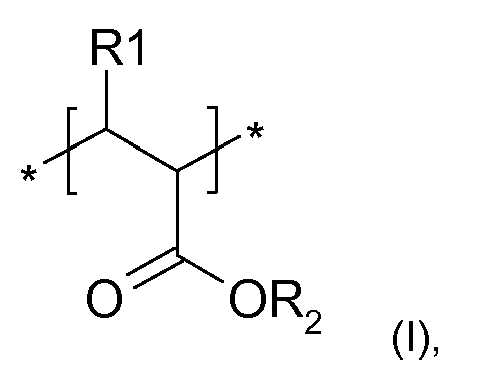
- Unabhängig von der Wahl des Restes R2 und gegebenenfalls weiter vorhandenen Monomerbausteinen in den Copolymeren sind erfindungsgemäße Verwendungen bevorzugt, bei denen ganz oder teilweise neutralisierte Homo- und/oder Copolymere der Acrylsäure mit Molmassen von 200 bis 10.000 kDa, vorzugsweise von 250 bis 7500 kDa und insbesondere von 500 bis 5000 kDa verwendet werden.
- Die Säurefunktion der Acrylsäure kann vollständig oder nur teilweise neutralisiert vorliegen, wobei der Neutralisationsgrad vom pH-Wert der Mittel abhängt. Vollständig nicht neutralisierte Polyacrylsäuren sind in der Regel nur unterhalb von pH-Werten zwischen 2,5 und 3 beständig, d.h. bei physiologisch verträglichen pH-Werten liegt immer ein Teil der Carboxylgruppen als Carboxylatgruppe vor. Erfindungsgemäß bevorzugte Verwendungen sind dadurch gekennzeichnet, daß der Neutralisationsgrad der ganz oder teilweise neutralisierten Homo- und/oder Copolymere der Acrylsäure 40 bis 100%, vorzugsweise 50 bis 100%, besonders bevorzugt 60 bis 99,5% und insbesondere 70 bis 99% beträgt.
- Bezogen auf den pH-Wert der Mittel, in denen die erfindungsgemäße Verwendung erfolgt, sind erfindungsgemäße Verwendungen bevorzugt, bei denen die kosmetischen Mittel pH-Werte von 4 bis 8, bevorzugt von 4,5 bis 7,5, besonders bevorzugt von 5 bis 7 und insbesondere von 5,5 bis 6,5 aufweisen.
- Eine Gruppe von Polymeren, die bevorzugt erfindungsgemäß verwendet werden, sind Hompolymere der Acrylsäure, die ganz oder teilweise neutralisiert sind, z.B. mit Ammonium, Natrium, Kalium, Calcium oder Mischungen aus diesen Kationen. Diese Homopolymeren werden vorzugsweise alleine, d.h. nicht in Mischung mit weiteren Copolymeren der Acrylsäure eingesetzt. Andere Polymere, die keine Acrylsäure-Monomere enthalten, können selbstverständlich zugegen sein.
- Erfindungsgemäß besonders bevorzugte Verwendungen sind demnach dadurch gekennzeichnet, daß ausschließlich Homopolymere ganz oder teilweise neutralisierter Polyacrylsäuren, vorzugsweise aus der Gruppe der Homopolymeren mit den INCI-Bezeichnungen Ammonium Polyacrylate und/oder Calcium Potassium Carbomer und/oder Carbomer und/oder Polyacrylic Acid und/oder Potassium Carbomer und/oder Potassium Polyacrylate und/oder Sodium Carbomer und/oder Sodium Polyacrylate verwendet werden.
- Es ist auch möglich und bevorzugt, Copolymere der Acrylsäure erfindungsgemäß zu verwenden. Hier sind erfindungsgemäße Verwendungen besonders bevorzugt, bei denen ein oder mehrere Copolymer (e) aus der Gruppe der Polymere mit den INCI-Bezeichnungen
- Acrylamide/Sodium Acrylate Copolymer und/oder
- Acrylates/Aminoacrylates/C10-30 Alkyl PEG-20 Itaconate Copolymer und/oder
- Acrylates/C10-30 Alkyl Acrylate Crosspolymer und/oder
- Acrylates/Stearyl Methacrylate Copolymer und/oder
- Acrylates/Vinyl Isodecanoate Crosspolymer und/oder
- Allyl Methacrylates Crosspolymer und/oder
- Ammonium Polyacrylate und/oder
- Calcium Potassium Carbomer und/oder
- Corn Starch/Acrylamide/Sodium Acrylate Copolymer und/oder
- Potassium Carbomer und/oder
- Potassium Polyacrylate und/oder
- Sodium Acrylate/Acryloyldimethyl Taurate Copolymer und/oder
- Sodium Acrylate/Acryloyldimethyltaurate/Dimethylacrylamide Crosspolymer und/oder
- Sodium Acrylate/Acryloyldimethyltaurate/Acrylamide Copolymer und/oder
- Sodium Acrylates/Vinyl Isodecanoate Crosspolymer und/oder
- Sodium Acrylate/Vinyl Alcohol Copolymer und/oder
- Sodium Polyacrylate Starch und/oder
- Sodium Polymethacrylate und/oder
- Die nachfolgenden Beispiele verdeutlichen den Gegenstand der Erfindung näher.
- Humane Vorhautfibroblasten wurden mit einer Dichte von 60.000 Zellen/Vertiefung in eine 6-well-Zellkulturplatte eingesät und mit DMEM, supplementiert mit 2 % FCS, bei 37 °C und 5 % CO2 in einer wassergesättigten Atmosphäre kultiviert.
- Von einer 0,2 %-igen Lösung von Tego® Carbomer 140 wurden Verdünnungen mit dem Zellkulturmedium angesetzt, sodass der Anteil der Lösung am Medium jeweils 0,1 % und 0,5 % betrug. Mit diesen Verdünnungen wurden die Fibroblasten für 24 h und 48 h kultiviert. Zur Kontrolle der Induzierbarkeit wurden Fibroblasten über den gleichen Zeitraum mit 5 ng/ml TGFβ inkubiert, als Negativkontrolle diente das normale Kulturmedium.
- Die Konzentration der in das Medium abgegebenen Menge Hyaluronsäure wurde aus dem Überstand mit Hilfe des Hyaluronic Acid Quantitative Test Kit (Corgenix, vertrieben durch Genzyme Virotech GmbH) nach Herstellerangaben bestimmt. Die Extinktion wurde mit Hilfe des Spectra Max Plus Multiwellplatten Photometers bestimmt und auf Basis einer vorher vermessenen Hyaluronsäure-Standardreihe in die entsprechende Konzentration der Hyaluronsäure umgerechnet.
Extinktion HA-Konzentration Mittelwert Std.abw. ng/ml Std.abw. 24 h Neg. Kontrolle 0,180 0,010 184,708 1,9 Pos. Kontrolle 0,293 0,027 328,039 6,0 Tego® Carbomer 140 0.1% 0,199 0,011 208,282 29,0 Tego® Carbomer 140 0.5% 0,196 0,079 204,549 16,1 48 h Neg. Kontrolle 0,295 0,020 330,487 4,5 Pos. Kontrolle 0,946 0,04 1562,344 16,9 Tego® Carbomer 140 0.1% 0,509 0,35 660,332 106,5 Tego® Carbomer 140 0.5% 0,581 0,19 786,954 59,8 - Aus der Tabelle geht hervor, dass nach 24 h weder die Tego Carbomer-Lösung noch die Positivkontrolle TGFβ zu einer nennenswerten Steigerung der Hyaluronsäure-Synthese in Fibroblasten führen. Nach 48 h lässt sich allerdings eine im Vergleich zur Negativkontrolle eine deutliche Steigerung der Hyaluronsäure-Synthese sowohl bei TGFβ als auch bei der Tego Carbomer-Lösung erkennen.
Claims (7)
- Nicht-therapeutische Verwendung von ganz oder teilweise neutralisierten Homo- und/oder Copolymeren der Acrylsäure in kosmetischen Mitteln zur Steigerung der zellulären Hyaluronsäure-Synthese.
- Verwendung nach Anspruch 1, dadurch gekennzeichnet, daß die ganz oder teilweise neutralisierten Homo- und/oder Copolymeren der Acrylsäure in Mengen von 0,001 bis 30 Gew.-%, vorzugsweise von 0,005 bis 10 Gew.-%, weiter bevorzugt von 0,01 bis 5 Gew.-%, noch weiter bevorzugt von 0,05 bis 2,5 Gew.-% und insbesondere von 0,1 bis 1 Gew.-%, jeweils bezogen auf das anwendungsfertige kosmetische Mittel, verwendet werden.
- Verwendung nach einem der Ansprüche 1 oder 2, dadurch gekennzeichnet, daß ganz oder teilweise neutralisierte Homo- und/oder Copolymere der Acrylsäure mit Molmassen von 200 bis 10.000 kDa, vorzugsweise von 250 bis 7500 kDa und insbesondere von 500 bis 5000 kDa verwendet werden.
- Verwendung nach einem der Ansprüche 1 bis 3, dadurch gekennzeichnet, daß der Neutralisationsgrad der ganz oder teilweise neutralisierten Homo- und/oder Copolymere der Acrylsäure 40 bis 100%, vorzugsweise 50 bis 100%, besonders bevorzugt 60 bis 99,5% und insbesondere 70 bis 99% beträgt.
- Verwendung nach einem der Ansprüche 1 bis 4, dadurch gekennzeichnet, daß die kosmetischen Mittel pH-Werte von 4 bis 8, bevorzugt von 4,5 bis 7,5, besonders bevorzugt von 5 bis 7 und insbesondere von 5,5 bis 6,5 aufweisen.
- Verwendung nach einem der Ansprüche 1 bis 5, dadurch gekennzeichnet, daß ausschließlich Homopolymere ganz oder teilweise neutralisierter Polyacrylsäuren, vorzugsweise aus der Gruppe der Homopolymeren mit den INCI-Bezeichnungen Ammonium Polyacrylate und/oder Calcium Potassium Carbomer und/oder Carbomer und/oder Polyacrylic Acid und/oder Potassium Carbomer und/oder Potassium Polyacrylate und/oder Sodium Carbomer und/oder Sodium Polyacrylate verwendet werden.
- Verwendung nach einem der Ansprüche 1 bis 5, dadurch gekennzeichnet, daß ein oder mehrere Copolymer (e) aus der Gruppe der Polymere mit den INCI-Bezeichnungen- Acrylamide/Sodium Acrylate Copolymer und/oder- Acrylates/Aminoacrylates/C10-30 Alkyl PEG-20 Itaconate Copolymer und/oder- Acrylates/C10-30 Alkyl Acrylate Crosspolymer und/oder- Acrylates/Stearyl Methacrylate Copolymer und/oder- Acrylates/Vinyl Isodecanoate Crosspolymer und/oder- Allyl Methacrylates Crosspolymer und/oder- Ammonium Polyacrylate und/oder- Calcium Potassium Carbomer und/oder- Corn Starch/Acrylamide/Sodium Acrylate Copolymer und/oder- Potassium Carbomer und/oder- Potassium Polyacrylate und/oder- Sodium Acrylate/Acryloyldimethyl Taurate Copolymer und/oder- Sodium Acrylate/Acryloyldimethyltaurate/Dimethylacrylamide Crosspolymer und/oder- Sodium Acrylate/Acryloyldimethyltaurate/Acrylamide Copolymer und/oder- Sodium Acrylates/Vinyl Isodecanoate Crosspolymer und/oder- Sodium Acrylate/Vinyl Alcohol Copolymer und/oder- Sodium Polyacrylate Starch und/oder- Sodium Polymethacrylate und/oderverwendet werden.
Applications Claiming Priority (1)
| Application Number | Priority Date | Filing Date | Title |
|---|---|---|---|
| DE102009029178A DE102009029178A1 (de) | 2009-09-03 | 2009-09-03 | Nicht-therapeutische Verwendung gegen Hautalterung |
Publications (3)
| Publication Number | Publication Date |
|---|---|
| EP2316417A2 true EP2316417A2 (de) | 2011-05-04 |
| EP2316417A3 EP2316417A3 (de) | 2014-08-06 |
| EP2316417B1 EP2316417B1 (de) | 2017-10-04 |
Family
ID=43571011
Family Applications (1)
| Application Number | Title | Priority Date | Filing Date |
|---|---|---|---|
| EP10164913.5A Not-in-force EP2316417B1 (de) | 2009-09-03 | 2010-06-04 | Nicht-therapeutische Verwendung gegen Hautalterung |
Country Status (2)
| Country | Link |
|---|---|
| EP (1) | EP2316417B1 (de) |
| DE (1) | DE102009029178A1 (de) |
Family Cites Families (6)
| Publication number | Priority date | Publication date | Assignee | Title |
|---|---|---|---|---|
| WO2005044216A1 (ja) * | 2004-10-26 | 2005-05-19 | Shiseido Co., Ltd. | 皮膚外用剤 |
| JP2007262012A (ja) * | 2006-03-29 | 2007-10-11 | Pias Arise Kk | ヒアルロン酸産生促進剤、並びにそのヒアルロン酸産生促進剤を含む皮膚外用剤、化粧料、医薬部外品、肌荒れ改善剤、及びしわ改善剤 |
| JP2008094792A (ja) * | 2006-10-13 | 2008-04-24 | Oppen Keshohin Kk | オオボウシバナ由来のフラボノイドを含有するヒアルロン酸合成促進剤、抗老化剤および皮膚外用剤 |
| JP2008105985A (ja) * | 2006-10-25 | 2008-05-08 | Nicca Chemical Co Ltd | ヒアルロン酸産生促進剤、皮膚外用剤、浴用剤及び飲食物 |
| JP2008110927A (ja) * | 2006-10-30 | 2008-05-15 | Yamada Bee Farm Corp | ローヤルゼリー蛋白加水分解物を含む化粧料 |
| JP2008201773A (ja) * | 2007-01-22 | 2008-09-04 | Bhn Kk | 皮膚外用剤 |
-
2009
- 2009-09-03 DE DE102009029178A patent/DE102009029178A1/de not_active Withdrawn
-
2010
- 2010-06-04 EP EP10164913.5A patent/EP2316417B1/de not_active Not-in-force
Non-Patent Citations (1)
| Title |
|---|
| None |
Also Published As
| Publication number | Publication date |
|---|---|
| DE102009029178A1 (de) | 2011-03-17 |
| EP2316417B1 (de) | 2017-10-04 |
| EP2316417A3 (de) | 2014-08-06 |
Similar Documents
| Publication | Publication Date | Title |
|---|---|---|
| DE69733687T2 (de) | Kosmetische zusammensetzung fuer hautregenerierung ohne hautreizung | |
| DE69928228T2 (de) | Gelförmiges desinfektionsmittel mit niedrigem alkoholgehalt | |
| EP1732505B1 (de) | Mittel zur oxidativen behandlung, insbesondere in transparenter gelform | |
| DE69919950T2 (de) | Kosmetische zusammensetzung enthaltend einen Polysacchariden von einem hydrothermalen Bakterium | |
| DE102008059523A1 (de) | Kosmetische Mixtur, die Ascorbinsäure-2-Glucosid und Ergothionein enthält | |
| EP2654420B1 (de) | Antimikrobielle zusammensetzung mit hautpflegenden eigenschaften | |
| DE10300762A1 (de) | Zum Abspülen bestimmtes kosmetisches Mittel mit UV-Schutz | |
| EP3494850B1 (de) | Feuchttuch mit hydroxyacetophenon | |
| EP3503870A1 (de) | Hautpflegezusammensetzung | |
| DE102007026156B4 (de) | Kosmetische Zusammensetzung mit einem Limnocitrus Littoralis-Extrakt | |
| EP2316417B1 (de) | Nicht-therapeutische Verwendung gegen Hautalterung | |
| EP3355860A1 (de) | Stabilisierte antiseptische zubereitungen | |
| EP2890736A1 (de) | Konservierungsmittelmischungen und damit stabilisierte polymerlösungen | |
| Anton-Lamprecht et al. | Zur ultrastruktur der haut bei protoporphyrinämie | |
| DE102011089582A1 (de) | Verwendung von einer Kombination von 2-Methyl-1,4,5,6-tetrahydro-4-pyrimidincarbonsäure oder deren Derivat und einem Blaualgenextrakt zur Steigerung der Hautbarrierefunktion | |
| DE10109925B4 (de) | Wund- und Schleimhautantiseptikum | |
| EP1790324A1 (de) | Transparente oder transluzente Gele | |
| DE69002139T2 (de) | Kosmetische Verwendung von 3-Indolbrenztraubensäure. | |
| DE102010056550A1 (de) | Verwendung von 13-Hydroxy-9, 11-octadecadiensäure zur Bräunung menschlicher Haut | |
| EP3383355A1 (de) | Einsatz von additiven zur effektiven konservierung / boostende wirkung bestehender konservierung kosmetischer emulsionen | |
| EP3236920B1 (de) | Antimikrobielle zubereitung umfassend bispyridiniumalkane, 1- oder 2-(c1 bis c24-alkyl)-glycerinether und alkan-1,2-diole | |
| EP2384738B1 (de) | Verwendung von Salicylsäureestern zur Geruchsmaskierung von Abbauprodukten des Harnstoffs | |
| DE102011089558A1 (de) | Neue Verwendungen von Trimethylglycin und Harnstoffderivaten | |
| DE102011112092B4 (de) | Kosmetische Wirkstoffzubereitung zur Steigerung der langfristigen epidermalen Vitalität der Haut | |
| Vanscheidt et al. | Systematisches Management chronischer Wunden nach dem TIME-Prinzip |
Legal Events
| Date | Code | Title | Description |
|---|---|---|---|
| PUAI | Public reference made under article 153(3) epc to a published international application that has entered the european phase |
Free format text: ORIGINAL CODE: 0009012 |
|
| 17P | Request for examination filed |
Effective date: 20100604 |
|
| AK | Designated contracting states |
Kind code of ref document: A2 Designated state(s): AL AT BE BG CH CY CZ DE DK EE ES FI FR GB GR HR HU IE IS IT LI LT LU LV MC MK MT NL NO PL PT RO SE SI SK SM TR |
|
| AX | Request for extension of the european patent |
Extension state: BA ME RS |
|
| PUAL | Search report despatched |
Free format text: ORIGINAL CODE: 0009013 |
|
| AK | Designated contracting states |
Kind code of ref document: A3 Designated state(s): AL AT BE BG CH CY CZ DE DK EE ES FI FR GB GR HR HU IE IS IT LI LT LU LV MC MK MT NL NO PL PT RO SE SI SK SM TR |
|
| AX | Request for extension of the european patent |
Extension state: BA ME RS |
|
| RIC1 | Information provided on ipc code assigned before grant |
Ipc: A61Q 19/08 20060101ALI20140703BHEP Ipc: A61K 8/81 20060101AFI20140703BHEP |
|
| 17Q | First examination report despatched |
Effective date: 20140728 |
|
| TPAC | Observations by third parties |
Free format text: ORIGINAL CODE: EPIDOSNTIPA |
|
| GRAP | Despatch of communication of intention to grant a patent |
Free format text: ORIGINAL CODE: EPIDOSNIGR1 |
|
| INTG | Intention to grant announced |
Effective date: 20170511 |
|
| GRAS | Grant fee paid |
Free format text: ORIGINAL CODE: EPIDOSNIGR3 |
|
| GRAA | (expected) grant |
Free format text: ORIGINAL CODE: 0009210 |
|
| AK | Designated contracting states |
Kind code of ref document: B1 Designated state(s): AL AT BE BG CH CY CZ DE DK EE ES FI FR GB GR HR HU IE IS IT LI LT LU LV MC MK MT NL NO PL PT RO SE SI SK SM TR |
|
| REG | Reference to a national code |
Ref country code: GB Ref legal event code: FG4D Free format text: NOT ENGLISH |
|
| REG | Reference to a national code |
Ref country code: CH Ref legal event code: EP |
|
| REG | Reference to a national code |
Ref country code: AT Ref legal event code: REF Ref document number: 933346 Country of ref document: AT Kind code of ref document: T Effective date: 20171015 |
|
| REG | Reference to a national code |
Ref country code: IE Ref legal event code: FG4D Free format text: LANGUAGE OF EP DOCUMENT: GERMAN |
|
| REG | Reference to a national code |
Ref country code: DE Ref legal event code: R096 Ref document number: 502010014216 Country of ref document: DE |
|
| REG | Reference to a national code |
Ref country code: NL Ref legal event code: MP Effective date: 20171004 |
|
| REG | Reference to a national code |
Ref country code: LT Ref legal event code: MG4D |
|
| PG25 | Lapsed in a contracting state [announced via postgrant information from national office to epo] |
Ref country code: NL Free format text: LAPSE BECAUSE OF FAILURE TO SUBMIT A TRANSLATION OF THE DESCRIPTION OR TO PAY THE FEE WITHIN THE PRESCRIBED TIME-LIMIT Effective date: 20171004 |
|
| PG25 | Lapsed in a contracting state [announced via postgrant information from national office to epo] |
Ref country code: FI Free format text: LAPSE BECAUSE OF FAILURE TO SUBMIT A TRANSLATION OF THE DESCRIPTION OR TO PAY THE FEE WITHIN THE PRESCRIBED TIME-LIMIT Effective date: 20171004 Ref country code: LT Free format text: LAPSE BECAUSE OF FAILURE TO SUBMIT A TRANSLATION OF THE DESCRIPTION OR TO PAY THE FEE WITHIN THE PRESCRIBED TIME-LIMIT Effective date: 20171004 Ref country code: ES Free format text: LAPSE BECAUSE OF FAILURE TO SUBMIT A TRANSLATION OF THE DESCRIPTION OR TO PAY THE FEE WITHIN THE PRESCRIBED TIME-LIMIT Effective date: 20171004 Ref country code: SE Free format text: LAPSE BECAUSE OF FAILURE TO SUBMIT A TRANSLATION OF THE DESCRIPTION OR TO PAY THE FEE WITHIN THE PRESCRIBED TIME-LIMIT Effective date: 20171004 Ref country code: NO Free format text: LAPSE BECAUSE OF FAILURE TO SUBMIT A TRANSLATION OF THE DESCRIPTION OR TO PAY THE FEE WITHIN THE PRESCRIBED TIME-LIMIT Effective date: 20180104 |
|
| PG25 | Lapsed in a contracting state [announced via postgrant information from national office to epo] |
Ref country code: IS Free format text: LAPSE BECAUSE OF FAILURE TO SUBMIT A TRANSLATION OF THE DESCRIPTION OR TO PAY THE FEE WITHIN THE PRESCRIBED TIME-LIMIT Effective date: 20180204 Ref country code: GR Free format text: LAPSE BECAUSE OF FAILURE TO SUBMIT A TRANSLATION OF THE DESCRIPTION OR TO PAY THE FEE WITHIN THE PRESCRIBED TIME-LIMIT Effective date: 20180105 Ref country code: BG Free format text: LAPSE BECAUSE OF FAILURE TO SUBMIT A TRANSLATION OF THE DESCRIPTION OR TO PAY THE FEE WITHIN THE PRESCRIBED TIME-LIMIT Effective date: 20180104 Ref country code: LV Free format text: LAPSE BECAUSE OF FAILURE TO SUBMIT A TRANSLATION OF THE DESCRIPTION OR TO PAY THE FEE WITHIN THE PRESCRIBED TIME-LIMIT Effective date: 20171004 Ref country code: HR Free format text: LAPSE BECAUSE OF FAILURE TO SUBMIT A TRANSLATION OF THE DESCRIPTION OR TO PAY THE FEE WITHIN THE PRESCRIBED TIME-LIMIT Effective date: 20171004 |
|
| REG | Reference to a national code |
Ref country code: FR Ref legal event code: PLFP Year of fee payment: 9 |
|
| REG | Reference to a national code |
Ref country code: DE Ref legal event code: R097 Ref document number: 502010014216 Country of ref document: DE |
|
| PG25 | Lapsed in a contracting state [announced via postgrant information from national office to epo] |
Ref country code: CZ Free format text: LAPSE BECAUSE OF FAILURE TO SUBMIT A TRANSLATION OF THE DESCRIPTION OR TO PAY THE FEE WITHIN THE PRESCRIBED TIME-LIMIT Effective date: 20171004 Ref country code: SK Free format text: LAPSE BECAUSE OF FAILURE TO SUBMIT A TRANSLATION OF THE DESCRIPTION OR TO PAY THE FEE WITHIN THE PRESCRIBED TIME-LIMIT Effective date: 20171004 Ref country code: DK Free format text: LAPSE BECAUSE OF FAILURE TO SUBMIT A TRANSLATION OF THE DESCRIPTION OR TO PAY THE FEE WITHIN THE PRESCRIBED TIME-LIMIT Effective date: 20171004 Ref country code: EE Free format text: LAPSE BECAUSE OF FAILURE TO SUBMIT A TRANSLATION OF THE DESCRIPTION OR TO PAY THE FEE WITHIN THE PRESCRIBED TIME-LIMIT Effective date: 20171004 |
|
| PGFP | Annual fee paid to national office [announced via postgrant information from national office to epo] |
Ref country code: DE Payment date: 20180625 Year of fee payment: 9 |
|
| PLBE | No opposition filed within time limit |
Free format text: ORIGINAL CODE: 0009261 |
|
| STAA | Information on the status of an ep patent application or granted ep patent |
Free format text: STATUS: NO OPPOSITION FILED WITHIN TIME LIMIT |
|
| REG | Reference to a national code |
Ref country code: DE Ref legal event code: R084 Ref document number: 502010014216 Country of ref document: DE |
|
| PG25 | Lapsed in a contracting state [announced via postgrant information from national office to epo] |
Ref country code: IT Free format text: LAPSE BECAUSE OF FAILURE TO SUBMIT A TRANSLATION OF THE DESCRIPTION OR TO PAY THE FEE WITHIN THE PRESCRIBED TIME-LIMIT Effective date: 20171004 Ref country code: RO Free format text: LAPSE BECAUSE OF FAILURE TO SUBMIT A TRANSLATION OF THE DESCRIPTION OR TO PAY THE FEE WITHIN THE PRESCRIBED TIME-LIMIT Effective date: 20171004 Ref country code: PL Free format text: LAPSE BECAUSE OF FAILURE TO SUBMIT A TRANSLATION OF THE DESCRIPTION OR TO PAY THE FEE WITHIN THE PRESCRIBED TIME-LIMIT Effective date: 20171004 Ref country code: SM Free format text: LAPSE BECAUSE OF FAILURE TO SUBMIT A TRANSLATION OF THE DESCRIPTION OR TO PAY THE FEE WITHIN THE PRESCRIBED TIME-LIMIT Effective date: 20171004 |
|
| PGFP | Annual fee paid to national office [announced via postgrant information from national office to epo] |
Ref country code: FR Payment date: 20180620 Year of fee payment: 9 |
|
| 26N | No opposition filed |
Effective date: 20180705 |
|
| PG25 | Lapsed in a contracting state [announced via postgrant information from national office to epo] |
Ref country code: MT Free format text: LAPSE BECAUSE OF FAILURE TO SUBMIT A TRANSLATION OF THE DESCRIPTION OR TO PAY THE FEE WITHIN THE PRESCRIBED TIME-LIMIT Effective date: 20171004 |
|
| PGFP | Annual fee paid to national office [announced via postgrant information from national office to epo] |
Ref country code: GB Payment date: 20180620 Year of fee payment: 9 |
|
| PG25 | Lapsed in a contracting state [announced via postgrant information from national office to epo] |
Ref country code: SI Free format text: LAPSE BECAUSE OF FAILURE TO SUBMIT A TRANSLATION OF THE DESCRIPTION OR TO PAY THE FEE WITHIN THE PRESCRIBED TIME-LIMIT Effective date: 20171004 |
|
| REG | Reference to a national code |
Ref country code: CH Ref legal event code: PL |
|
| REG | Reference to a national code |
Ref country code: BE Ref legal event code: MM Effective date: 20180630 |
|
| REG | Reference to a national code |
Ref country code: IE Ref legal event code: MM4A |
|
| PG25 | Lapsed in a contracting state [announced via postgrant information from national office to epo] |
Ref country code: LU Free format text: LAPSE BECAUSE OF NON-PAYMENT OF DUE FEES Effective date: 20180604 Ref country code: MC Free format text: LAPSE BECAUSE OF FAILURE TO SUBMIT A TRANSLATION OF THE DESCRIPTION OR TO PAY THE FEE WITHIN THE PRESCRIBED TIME-LIMIT Effective date: 20171004 |
|
| PG25 | Lapsed in a contracting state [announced via postgrant information from national office to epo] |
Ref country code: LI Free format text: LAPSE BECAUSE OF NON-PAYMENT OF DUE FEES Effective date: 20180630 Ref country code: IE Free format text: LAPSE BECAUSE OF NON-PAYMENT OF DUE FEES Effective date: 20180604 Ref country code: CH Free format text: LAPSE BECAUSE OF NON-PAYMENT OF DUE FEES Effective date: 20180630 |
|
| PG25 | Lapsed in a contracting state [announced via postgrant information from national office to epo] |
Ref country code: BE Free format text: LAPSE BECAUSE OF NON-PAYMENT OF DUE FEES Effective date: 20180630 |
|
| REG | Reference to a national code |
Ref country code: AT Ref legal event code: MM01 Ref document number: 933346 Country of ref document: AT Kind code of ref document: T Effective date: 20180604 |
|
| PG25 | Lapsed in a contracting state [announced via postgrant information from national office to epo] |
Ref country code: AT Free format text: LAPSE BECAUSE OF NON-PAYMENT OF DUE FEES Effective date: 20180604 |
|
| REG | Reference to a national code |
Ref country code: DE Ref legal event code: R119 Ref document number: 502010014216 Country of ref document: DE |
|
| GBPC | Gb: european patent ceased through non-payment of renewal fee |
Effective date: 20190604 |
|
| PG25 | Lapsed in a contracting state [announced via postgrant information from national office to epo] |
Ref country code: TR Free format text: LAPSE BECAUSE OF FAILURE TO SUBMIT A TRANSLATION OF THE DESCRIPTION OR TO PAY THE FEE WITHIN THE PRESCRIBED TIME-LIMIT Effective date: 20171004 |
|
| PG25 | Lapsed in a contracting state [announced via postgrant information from national office to epo] |
Ref country code: GB Free format text: LAPSE BECAUSE OF NON-PAYMENT OF DUE FEES Effective date: 20190604 Ref country code: DE Free format text: LAPSE BECAUSE OF NON-PAYMENT OF DUE FEES Effective date: 20200101 |
|
| PG25 | Lapsed in a contracting state [announced via postgrant information from national office to epo] |
Ref country code: HU Free format text: LAPSE BECAUSE OF FAILURE TO SUBMIT A TRANSLATION OF THE DESCRIPTION OR TO PAY THE FEE WITHIN THE PRESCRIBED TIME-LIMIT; INVALID AB INITIO Effective date: 20100604 Ref country code: PT Free format text: LAPSE BECAUSE OF FAILURE TO SUBMIT A TRANSLATION OF THE DESCRIPTION OR TO PAY THE FEE WITHIN THE PRESCRIBED TIME-LIMIT Effective date: 20171004 |
|
| PG25 | Lapsed in a contracting state [announced via postgrant information from national office to epo] |
Ref country code: CY Free format text: LAPSE BECAUSE OF FAILURE TO SUBMIT A TRANSLATION OF THE DESCRIPTION OR TO PAY THE FEE WITHIN THE PRESCRIBED TIME-LIMIT Effective date: 20171004 Ref country code: FR Free format text: LAPSE BECAUSE OF NON-PAYMENT OF DUE FEES Effective date: 20190630 Ref country code: MK Free format text: LAPSE BECAUSE OF NON-PAYMENT OF DUE FEES Effective date: 20171004 |
|
| PG25 | Lapsed in a contracting state [announced via postgrant information from national office to epo] |
Ref country code: AL Free format text: LAPSE BECAUSE OF FAILURE TO SUBMIT A TRANSLATION OF THE DESCRIPTION OR TO PAY THE FEE WITHIN THE PRESCRIBED TIME-LIMIT Effective date: 20171004 |