EP2310442B1 - Verwendung eines organopolysiloxan/polyharnstoff-blockcopolymers als beschichtung auf kunststoff-oberflächen - Google Patents
Verwendung eines organopolysiloxan/polyharnstoff-blockcopolymers als beschichtung auf kunststoff-oberflächen Download PDFInfo
- Publication number
- EP2310442B1 EP2310442B1 EP09781077.4A EP09781077A EP2310442B1 EP 2310442 B1 EP2310442 B1 EP 2310442B1 EP 09781077 A EP09781077 A EP 09781077A EP 2310442 B1 EP2310442 B1 EP 2310442B1
- Authority
- EP
- European Patent Office
- Prior art keywords
- use according
- carbon atoms
- moiety
- organopolysiloxane
- block copolymer
- Prior art date
- Legal status (The legal status is an assumption and is not a legal conclusion. Google has not performed a legal analysis and makes no representation as to the accuracy of the status listed.)
- Not-in-force
Links
Classifications
-
- C—CHEMISTRY; METALLURGY
- C09—DYES; PAINTS; POLISHES; NATURAL RESINS; ADHESIVES; COMPOSITIONS NOT OTHERWISE PROVIDED FOR; APPLICATIONS OF MATERIALS NOT OTHERWISE PROVIDED FOR
- C09D—COATING COMPOSITIONS, e.g. PAINTS, VARNISHES OR LACQUERS; FILLING PASTES; CHEMICAL PAINT OR INK REMOVERS; INKS; CORRECTING FLUIDS; WOODSTAINS; PASTES OR SOLIDS FOR COLOURING OR PRINTING; USE OF MATERIALS THEREFOR
- C09D183/00—Coating compositions based on macromolecular compounds obtained by reactions forming in the main chain of the macromolecule a linkage containing silicon, with or without sulfur, nitrogen, oxygen, or carbon only; Coating compositions based on derivatives of such polymers
- C09D183/10—Block or graft copolymers containing polysiloxane sequences
-
- C—CHEMISTRY; METALLURGY
- C08—ORGANIC MACROMOLECULAR COMPOUNDS; THEIR PREPARATION OR CHEMICAL WORKING-UP; COMPOSITIONS BASED THEREON
- C08G—MACROMOLECULAR COMPOUNDS OBTAINED OTHERWISE THAN BY REACTIONS ONLY INVOLVING UNSATURATED CARBON-TO-CARBON BONDS
- C08G77/00—Macromolecular compounds obtained by reactions forming a linkage containing silicon with or without sulfur, nitrogen, oxygen or carbon in the main chain of the macromolecule
- C08G77/42—Block-or graft-polymers containing polysiloxane sequences
- C08G77/452—Block-or graft-polymers containing polysiloxane sequences containing nitrogen-containing sequences
- C08G77/458—Block-or graft-polymers containing polysiloxane sequences containing nitrogen-containing sequences containing polyurethane sequences
Definitions
- the invention relates to the use of an organopolysiloxane / polyurea block copolymer as a coating on plastic surfaces.
- organopolysiloxane / polyurea block copolymers are soluble in various solvents even with the molecular weights necessary for a separating action.
- organopolysiloxane / polyurea block copolymer is free of impurities, therefore, it can not lead to a silicone transfer.
- Copolymers with organopolysiloxane and polyurea blocks are known in I. Yilgör, Polymer, 1984 (25), 1800 and EP 0 250 248 A1 described.
- the preparation of the polydiorganosiloxane-urea block copolymers is carried out in both cases in two stages. in the the first step bisaminoalkylfunktionelle siloxanes are obtained, which are reacted in the second step with isocyanates to block copolymer.
- I. Yilgör only polydiorganosiloxane-urea block copolymers with polysiloxane segments having molecular weights (M w ) of less than 4000 are obtained.
- the catalyst At the end of the equilibration reaction, the catalyst must either be thermally deactivated or neutralized resulting in catalyst residues and thus impurities in the final product which have a negative impact on the thermal stability of the materials so produced. These impurities are also responsible for a strong inherent odor of the materials synthesized therefrom. Furthermore, about 15% of siloxane cycles have yet to be removed, but this is generally technically not completely possible, so that such siloxane cycles remain in the product and exude from secondary products. During a thermal treatment, the silicones thus produced tend to assume a clearly visible yellowish tinge.
- a method for improving the adhesion of non-adhesive surfaces e.g. As cured silicones on ceramics or semiconductors using a plasma treatment of the surfaces is in US 6,793,759 B2 described.
- polydiorganosiloxane-urea block copolymers as antiblocking agents on adhesive tapes is disclosed in U.S. Pat US 5,290,615 A1 described.
- these copolymers are characterized by the in EP 0 250 248 A1 described disadvantageous process, so that a poor aging behavior is expected.
- the copolymers contain up to 95 wt .-% of a siloxane-free diamino or dihydroxy derivative.
- US 5,290,625 A1 do not adhere to untreated polyester or polyolefin surfaces. If these block copolymers are applied to such surfaces, they can be removed again by slight mechanical stress.
- the US 5,290,625 A1 merely describes the coating on urethane-soaked paper.
- the object of the invention is therefore to provide a coating on a pretreated plastic surface whose polar fraction of the surface energy is at least twice as large as that of the untreated but identical in the other properties plastic surface, to improve the release property of the plastic surface, wherein the coating should have a good adhesion to the plastic surface.
- an organopolysiloxane / polyurea block copolymer is used, which, as in EP 1 489 129 A1 is polymerized in a one-stage reaction course without the use of a catalyst.
- R is a monovalent hydrocarbon radical having one to six carbon atoms, in particular unsubstituted. Particularly preferred as the radical R is methyl.
- X is an alkylene radical having from two to ten carbon atoms.
- the alkylene radical X is not interrupted.
- the radical X is propylene.
- A is an NH group.
- Y is a hydrocarbon radical having 3 to 13 carbon atoms, which is preferably unsubstituted.
- Y is an aralkylene, linear or cyclic alkylene radical.
- B is preferably a functional or non-functional organic or organosilicon radical.
- B is an organosilyl group such as an alkylsilyl, alkoxysilyl or oximosilyl group, in particular having 1 to 4 carbon atoms such as a methoxy or ethoxysilyl group, a hydrogen or a Acyl group, which are all connected via covalent bonds with the polymer.
- B can furthermore be a free-radically or ionically polymerizable radical, for example a vinyl, acrylic, methacrylic, acylamide or methacrylamide radical, or else an epoxide radical, for example a propylene oxide radical.
- B may represent an optionally substituted alkyl group having preferably 1 to 20 carbon atoms, an optionally substituted aryl group having preferably 6 to 22 carbon atoms, or an alkylaryl group which may be substituted or unsubstituted.
- B is particularly preferably a methoxysilyl group, ethoxysilyl group, a hydrogen, an aminoalkyl group or an isocyanate-containing group.
- the radicals A and B can form an isocyanate radical.
- B ' is preferably a functional or nonfunctional organic or organosilicon radical.
- B' is an organosilyl group, a hydrogen, an aminoalkyl group, a hydroxy group or an NCO group, all of which are linked via covalent bonds to the polymer.
- B ' may represent an optionally substituted alkyl group having preferably 1 to 20 carbon atoms, an optionally substituted aryl group having preferably 6 to 22 carbon atoms, or an alkylaryl group which may be substituted or unsubstituted.
- B ' is more preferably a methoxysilyl group, ethoxysilyl group, a hydrogen, an aminoalkyl group, a hydroxy group or an isocyanate-containing group.
- n is preferably a number of at least 3, in particular at least 25 and preferably at most 800, in particular at most 400, particularly preferred at most 250.
- a is a number of at most 50.
- Polydiorganosiloxandiamin is preferably those of the general formula. 2 H 2 NX- [SiR 2 O] n SiR 2 -X-NH 2 , wherein R, X and n have the names given above, used.
- the copolymer of the general formula 1 based on the sum of the urethane and urea groups, at least 50 mol%, particularly preferably at least 75 mol% of urea groups.
- a diisocyanate of the general formula 3 is preferred OCN-Y-NCO, where Y has the meaning given above, used.
- diisocyanates of the general formula 3 to be used are aliphatic compounds such as isophorone diisocyanate, hexamethylene-1,6-diisocyanate, 2,2,4- and 2,4,4-trimethylhexamethylene diisocyanate, cyclohexylene diisocyanate, tetramethylene-1,4-diisocyanate and methylenedicyclohexyl 4,4'-diisocyanate or aromatic compounds such as methylene diphenyl-4,4'-diisocyanate, 2,4-toluene diisocyanate, 2,5-toluene diisocyanate, 2,6-toluene diisocyanate, m-phenylene diisocyanate, p-phenylene diisocyanate, m-xylene diisocyanate, Tetramethyl-m-xylene diisocyanate, mixtures of these isocyanates or blocked types.
- aliphatic compounds
- the organopolysiloxane / polyurea block copolymer used according to the invention is, for example, soluble in anhydrous isopropanol, methyl ethyl ketone and tetrahydrofuran.
- the plastic surface is a surface pretreated physically, for example, by flame treatment, corona or plasma treatment.
- Another pretreatment of polyethylene terephthalate surfaces according to the invention is etching with trichloroacetic acid.
- plastic surfaces are the surfaces of biaxially stretched polyethylene terephthalate, polybutene, polypropylene, monoaxially stretched polypropylene, biaxially stretched polypropylene, or polyethylene.
- the polar component of the surface energy of the plastic surface must be at least twice as large as that of the untreated but identical in the other properties plastic surface .
- the polar component of surface energy is the fraction based on the different electronegativities of different atoms in the same molecule.
- the surface energy of a substance is composed of the sum of the polar and the disperse fraction.
- the disperse fraction describes the proportion of surface energy that results from the attractive forces between uncharged, unpolarized atoms and molecules.
- the coating acts as a release agent.
- the plastic surface is preferably a plastic film onto which the coating preferably acts as a closed layer.
- a pressure-sensitive adhesive is present on the free side of the plastic film facing the coating with organopolysiloxane / polyurea block copolymer, so that a single-sided adhesive tape results in which the coating acts as a release agent.
- the adhesive layer on the carrier film is preferably a layer of acrylate, polyurethane and rubber adhesive.
- the carrier film is coated on one side with the preferred pressure-sensitive adhesive as a solution or dispersion or 100% (for example melt) or by coextrusion with the film.
- the preferred pressure-sensitive adhesive as a solution or dispersion or 100% (for example melt) or by coextrusion with the film.
- the adhesive layer (s) can be crosslinked by heat or high-energy radiation and, if necessary, covered with release film or release paper.
- the self-adhesive composition used may preferably be blended with one or more additives such as tackifiers (resins), plasticizers, fillers, pigments, UV absorbers, light stabilizers, aging inhibitors, crosslinking agents, crosslinking promoters or elastomers.
- additives such as tackifiers (resins), plasticizers, fillers, pigments, UV absorbers, light stabilizers, aging inhibitors, crosslinking agents, crosslinking promoters or elastomers.
- the amount of the adhesive layer is preferably 10 to 120 g / m 2 , preferably 25 to 100 g / m 2 (meaning the amount after any necessary removal of water or solvent, the numerical values also correspond approximately to the thickness in ⁇ m).
- a primer layer in particular solvent-free, such as by coextrusion, are applied, so that there is a primer layer between the carrier film layer and a pressure-sensitive adhesive layer.
- adhesive tapes which have at least one functional layer in direct or indirect proximity to the carrier layer.
- a primer layer between carrier layer and adhesive layer or a layer of a color between carrier layer and organopolysiloxane / polyurea block copolymer or as externa ßere layer on the organopolysiloxane / polyurea block copolymers is possible.
- the use of a primer layer between carrier layer and adhesive is advantageous for improving the adhesion of the adhesive to the carrier layer and thus avoiding the transfer of adhesive to the film back during unwinding of the rollers.
- the known dispersion and solvent systems can be used, for example based on isoprene- or butadiene-containing rubbers and / or cyclo rubbers.
- Isocyanates or epoxy resins as additives improve the adhesion and in part also increase the shear strength of the pressure-sensitive adhesive.
- Physical surface treatments such as flame treatment, corona or plasma or coextrusion layers are also suitable for improving adhesion.
- Particularly preferred is the use of the aforementioned method when using solvent-free adhesive layers, in particular those based on acrylate.
- organopolysiloxane / polyurea block copolymers are used as adhesion promoters (primers), in particular for the bonding of silicone adhesives to the plastic support materials.
- adheresive tape encompasses all planar structures, such as films or film sections expanded in two dimensions, tapes with extended length and limited width, tape sections, labels, diecuts and the like.
- the density of the polymers is determined according to ISO 1183 and expressed in g / cm 3 .
- the crystallite melting point (T cr ) is determined by DSC according to MTM 15902 (Basell method) or ISO 3146.
- the release force is determined on a bond of two 20 mm wide test strips.
- the first of the test strips is a film coated with an organopolysiloxane / polyurea block copolymer or an adhesive tape with a corresponding backside coating.
- the other test strip is a test tape with the product numbers tesa® 7475, tesa® 7476 or tesa® 4579.
- Tesa® 7475 is an adhesive tape with a PVC film backing on which an acrylate compound is applied (adhesion to steel 31.25 N / 25 mm).
- Tesa® 7476 is an adhesive tape with a cotton fabric backing on which a rubber compound is applied (adhesion to steel 25 N / 25 mm).
- tesa® 4579 is a longitudinally and transversely reinforced filament adhesive tape based on a PP film with a bond strength to steel of 8 N / cm.
- the bonding of the second test adhesive tape always takes place on the side coated with organopolysiloxane / polyurea block copolymers side of the first Test strip.
- the sample is stored for 24 hours at 40 ° C (for tesa® 7476 and tesa® 4579) or 70 ° C (tesa® 7475) for 24 hours under a weight load of 2 N / cm 2 . After storage, the test strips are cut to a length of 220 mm and stored for two hours under test conditions.
- the upper test strip of the bond is clamped in the upper jaw of a tensile testing machine, as used in AFERA 4001.
- the lower test strip is clamped in the lower jaw.
- the jaw distance is 50 mm.
- the measurement is made at a speed of 300 mm / min, with which the jaws are moved apart.
- the mean value of the force required for the separation of the bond over a distance of 100 mm corresponds to the separating force.
- Adhesive forces are determined at a deduction angle of 180 ° according to AFERA 4001 on (if possible) 20 mm wide test strips.
- steel plates according to the AFERA standard are used as the test substrate.
- the thickness is determined according to DIN 53370, whereby the probe is flat (not curved). For structured films, however, the thickness before embossing is used. This is also possible subsequently via the basis weight (determined in accordance with DIN 53352) and conversion with the density.
- the embossing depth is the difference between the thicknesses with and without embossing.
- a very similar organopolysiloxane / polyurea block copolymer is marketed by Wacker Chemie AG, Burghausen, Germany under the trade name Geniomer 140.
- a very similar organopolysiloxane / polyurea block copolymer is marketed by Wacker Chemie AG, Burghausen, Germany under the trade name Geniomer 80.
- OPB1 is dissolved in anhydrous isopropanol to give a 2% by weight solution.
- the solution is applied to corona-pretreated film (corona dose for PET: 75 Wmin / m 2 , for polyolefins: 45 Wmin / m 2 ) with a wire bar, so that a theoretical mass application of 0.24 g / m 2 is obtained.
- the painted sample is dried for 2 minutes at 120 ° C.
- test tape is glued and stored the composite according to the test specification for release forces and tested.
- OPB2 is dissolved in anhydrous isopropanol to give a 2% by weight solution.
- the solution is applied to corona-pretreated film (corona dose for PET: 75 Wmin / m 2 , for polyolefins: 45 Wmin / m 2 ) with a wire bar, so that a theoretical mass application of 0.24 g / m 2 is obtained.
- the painted sample is dried for 2 minutes at 120 ° C.
- OPB2 is dissolved in anhydrous isopropanol to give a 2% by weight solution.
- the solution is applied to etched PET film with a wire bar to give a theoretical coverage of 0.24 g / m 2 .
- the painted sample is dried for 2 minutes at 120 ° C.
- a conventional 2 L glass reactor for free-radical polymerizations was charged with 40 g of acrylic acid, 360 g of 2-ethylhexyl acrylate and 133 g of acetone / isopropanol (96: 4). After passing nitrogen gas through with stirring for 45 minutes, the reactor was heated to 58 ° C. and 0.2 g of azoisobutyronitrile (AIBN, Vazo 64®, DuPont) was added. Subsequently, the outer heating bath was heated to 75 ° C and the reaction was carried out constantly at this external temperature. After 1 h of reaction time were again 0.2 g AIBN added.
- AIBN azoisobutyronitrile
- OPB1 is dissolved in anhydrous isopropanol to give a 1% by weight solution.
- the solution is applied to corona-pretreated MOPP film (40 ⁇ m, corona dose: 33 Wmin / m 2 ) with a wire bar to give a theoretical coverage of 0.24 g / m 2 .
- the painted sample is dried for 2 minutes at 120 ° C.
- the second, still uncoated side also treated corona (dose: 33 Wmin / m 2 ) and then coated with the polyacrylate solution. After drying for 20 minutes at 90 ° C, the application rate was 50 g / m 2 .
- the resulting adhesive tape is wound into rods.
- a test adhesive tape is adhered after unwinding.
- the adhesive-coated side is covered with a PVC film and the composite is stored and tested in accordance with the test specification for release forces.
- OPB2 is dissolved in anhydrous isopropanol to give a 2% by weight solution.
- the solution is applied to untreated plastic film with a wire bar, so that a theoretical mass application of 0.24 g / m 2 is obtained.
- the painted sample is dried for 2 minutes at 120 ° C.
- OPB1 is dissolved in anhydrous isopropanol to give a 2% by weight solution.
- the solution is applied to untreated PET film and MOPP film with a wire bar to give a theoretical coverage of 0.24 g / m 2 .
- the painted sample is dried for 2 minutes at 120 ° C.
- Table 1 List of used films. trade name Manufacturer PE Raw material: ExxonMobil LD251 ExxonMobil Chemical, Machelen, Belgium PE ionomer Raw materials: ExxonMobil LD251 (25%), ExxonMobil Chemical, Machelen, Belgium Ineos Novex M21E760 (75%) Ineos, Lyndhurst, UK PP Raw material: Borealis HD905CF Borealis, Vienna, Austria MOP PPK, natural Nowofol, Siegsdorf, Germany BOPP GND 50 Treofan, Raunheim, Germany PET Hostaphan RN75 Mitsubishi Polyester Film, Wiesbaden, Germany PET, etched Polibond D23H Polifibra, Limburg, Germany
- the PE, the PE ionomer and the PP film were produced in-house.
- the adhesive force depression was at most 11% for all measurements.
- a comparison of the surface energies of the untreated films listed in Table 2 shows a clear dependence on the raw material.
- polyethylene terephthalate films even in the untreated state have a fairly high surface energy of about 46 mN / m.
- anchoring of the organopolysiloxane / polyurea block copolymer on the untreated PET film is poor.
- Only the physical pretreatment, which increases the surface energy to 53 mV / m, can be remedied, with the polar component of the surface energy in particular being raised from 8 to 20 mV / m.
- the situation is similar with the other films.
- the physical treatment particularly increases the polar fraction of surface energy, which then allows effective anchoring of the organopolysiloxane / polyurea block copolymer.
- the coating of the organopolysiloxane / polyurea block copolymer can be used as a release agent against polyurethane, polyacrylate (tesa® 7475) and rubber pressure-sensitive adhesives (tesa® 7476, tesa® 4579).
- the release values obtained by types OPB1 and OPB2 are shown in Table 2. With the type OPB1 lower cut-off values can be obtained than with the type OPB2.
- the lowest release forces are achieved for both organopolysiloxane / polyurea block copolymer types in conjunction with polyacrylate PSAs (tesa® 7475). It is also desirable to have low adhesive force depression resulting from a low level of low molecular weight silicones and good surface anchorage.
Landscapes
- Chemical & Material Sciences (AREA)
- Chemical Kinetics & Catalysis (AREA)
- Organic Chemistry (AREA)
- Engineering & Computer Science (AREA)
- Materials Engineering (AREA)
- Wood Science & Technology (AREA)
- Life Sciences & Earth Sciences (AREA)
- Health & Medical Sciences (AREA)
- Medicinal Chemistry (AREA)
- Polymers & Plastics (AREA)
- Adhesive Tapes (AREA)
- Laminated Bodies (AREA)
- Adhesives Or Adhesive Processes (AREA)
Description
- Die Erfindung betrifft die Verwendung eines Organopolysiloxan/Polyharnstoff-Blockcopolymers as Beschichtung auf Kunststoff-Oberflächen.
- Der Einsatz von silikonisierten Trennpapieren und -folien in Verbindung mit Acrylat- und Kautschukklebemassen ist seit langem bekannt und findet eine breite Anwendung. Ein Nachteil ist allerdings die Gefahr des Silikon-Übertrags auf Oberflächen, die in der Folge einen schlechten Haftuntergrund für Haftklebemittel und Farben aufweisen. Ein Übertrag kann auch direkt auf das Haftklebemittel erfolgen und dadurch eine Depression der Klebkraft bewirken. Ursache dieses Übertrags ist, dass die Härtung herkömmlicher Polysiloxane erst nach der Beschichtung auf das Trennpapier oder die Trennfolie erfolgt, da das vernetzte Produkt unlöslich ist. Die Härtung ist in der Regel unvollständig, so dass kurzkettige Polysiloxane zurückbleiben, die auf andere Oberflächen übertragen werden können.
- Eine nachträgliche Vernetzung ist im Fall von Organopolysiloxan/Polyharnstoff-Blockcopolymeren nicht nötig, da diese auch mit den für eine Trennwirkung nötigen Molekulargewichten in verschiedenen Lösungsmitteln löslich sind. Soweit das Organopolysiloxan/Polyharnstoff-Blockcopolymer von Verunreinigungen frei ist, kann es daher nicht zu einem Silikon-Übertrag kommen.
- Copolymere mit Organopolysiloxan- und Polyharnstoff-Blöcken werden in I. Yilgör, Polymer, 1984 (25), 1800 und
EP 0 250 248 A1 beschrieben. Die Herstellung der Polydiorganosiloxan-Harnstoffblockcopolymere erfolgt in beiden Fällen in zwei Stufen. Im ersten Schritt werden bisaminoalkylfunktionelle Siloxane erhalten, die im zweiten Schritt mit Isocyanaten zum Blockcopolymer umgesetzt werden. Im von I. Yilgör durchgeführten Verfahren werden allerdings nur Polydiorganosiloxan-Harnstoffblockcopolymere mit Polysiloxan-Segmenten mit Molekulargewichten (Mw) von weniger als 4000 erhalten. Weiterhin führt ein unvollständiger Reaktionsverlauf zu Verunreinigungen mit mono- und nicht-funktionellen Siloxanen. InEP 0 250 248 A1 wird dagegen beschrieben, dass über eine mit speziellen Äquilibrierungskatalysatoren besonders sorgfältig durchgeführte Äquilibrierungsreaktion bisaminoalkylterminierte Polydimethylsiloxan-Ketten erhalten werden, die auch in höheren Molekulargewichtsbereichen eine ausreichende Reinheit besitzen, um bei der Reaktion mit Diisocyanaten die für gute mechanische Eigenschaften der Endpolymere erforderlichen hohen Molekulargewichte sicherzustellen.
Über Äquilibrierungsreaktionen hergestellte difunktionelle Silikone haben jedoch mehrere Nachteile. Am Ende der Äquilibrierungsreaktion muss der Katalysator entweder thermisch deaktiviert oder neutralisiert werden, was zu Katalysatorresten und somit Verunreinigungen im Endprodukt führt, die negative Auswirkungen auf die thermische Beständigkeit der so hergestellten Materialien haben. Diese Verunreinigungen sind ebenfalls für einen starken Eigengeruch der daraus synthetisierten Materialien verantwortlich. Weiterhin müssen noch ca. 15 % Siloxancyclen entfernt werden, was aber in der Regel technisch nicht vollständig möglich ist, so dass solche Siloxancyclen im Produkt verbleiben und aus Folgeprodukten ausschwitzen. Während einer thermischen Behandlung neigen die so hergestellten Silikone dazu, einen deutlich sichtbaren Gelbstich anzunehmen. - Die Herstellung verunreinigungsfreier Organopolysiloxan/Polyharnstoff-Blockcopolymere wird in
EP1 489 129 A1 beschrieben. Da in diesem Verfahren kein Katalysator eingesetzt werden muss, führt es zu Produkten, die thermisch beständiger sind sowie nur einen geringen Eigengeruch und eine geringe Tendenz aufweisen, einen Gelbstich anzunehmen. -
US 5,792,554 beschreibt Diblock (B-A)- und Triblock (B-A-B)-Polydiorganosiloxan-Polyharnstoff-Blockcopolymere, die unfunktionalisierte Polydiorganosiloxan-Endblöcke B und Polyharnstoffblöcke A umfassen. Diese Blockcopolymere verbessern das Trennverhalten entsprechender Releasebeschichtungen. -
US 2003/0165676 A1 beschreibt Primer-Zusammensetzungen, die ein Polydiorganosiloxan-Polyharnstoff-Copolymer mit elektronenreichen Gruppen enthalten. - Eine Methode zur Verbesserung der Adhäsion nichtklebender Oberflächen, z. B. ausgehärteter Silikone, auf Keramiken oder Halbleitern unter Anwendung einer Plasmabehandlung der Oberflächen wird in
US 6,793,759 B2 beschrieben. - Die Verwendung von Polydiorganosiloxan-Harnstoffblockcopolymeren als Antihaftmittel auf Klebebändern wird in
US 5,290,615 A1 beschrieben. Allerdings werden diese Copolymere durch das inEP 0 250 248 A1 beschriebene unvorteilhafte Verfahren hergestellt, so dass ein schlechtes Alterungsverhalten zu erwarten ist. Weiterhin enthalten die Copolymere bis zu 95 Gew.-% eines Siloxan freien Diamino- oder Dihydroxy-Derivats. Polydiorganosiloxan-Harnstoffblockcopolymere nach -
US 5,290,625 A1 haften nicht auf unbehandelten Polyester oder Polyolefin-Oberflächen. Werden diese Blockcopolymere auf solche Oberflächen aufgebracht, so lassen sie sich bereits durch leichte mechanische Beanspruchung wieder entfernen. DieUS 5,290,625 A1 beschreibt lediglich die Beschichtung auf Urethan getränktem Papier. - Die Aufgabe der Erfindung ist es daher, eine Beschichtung auf einer vorbehandelten Kunststoff-Oberfläche, deren polarer Anteil der Oberflächenenergie wenigstens doppelt so groß ist wie der der unbehandelten aber in den übrigen Eigenschaften identischen Kunststoff-Oberfläche, zur Verbesserung der Releaseeigenschaft der Kunststoff-Oberfläche, wobei die Beschichtung eine gute Haftung auf der Kunststoff-Oberfläche aufweisen soll.
- Gelöst wird diese Aufgabe überraschend durch die Verwendung des im Hauptanspruch dargelegten Organopolysiloxan/Polyharnstoff-Blockcopolymers. Gegenstand der Unteransprüche sind vorteilhafte Fortbildungen des Erfindungsgegenstandes. Des Weiteren betrifft die Erfindung Verwendungsvorschläge der erfindungsgemäßen Beschichtung.
- Demgemäß betrifft die Erfindung Verwendung eines Organopolysiloxan/Polyharnstoff-Blockcopolymers nach Formel 1
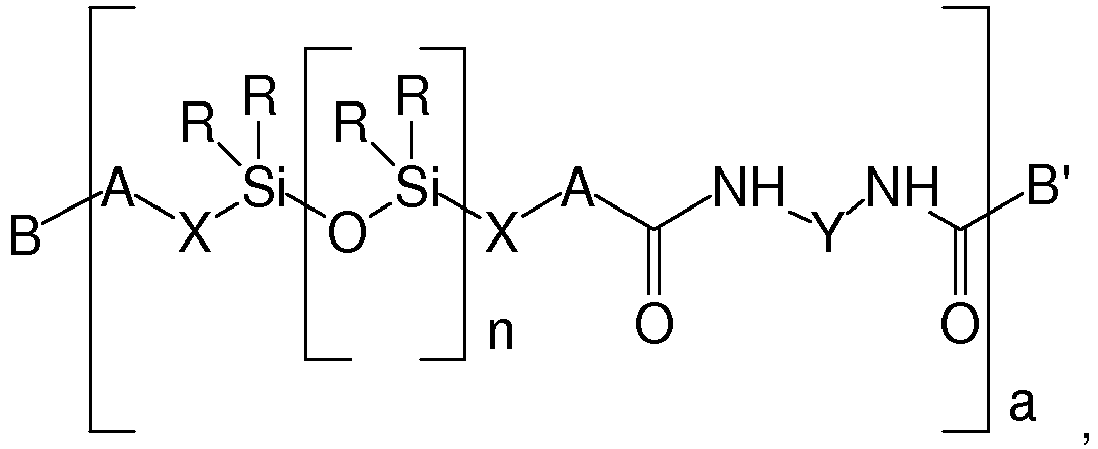
- R einen einwertigen, gegebenenfalls durch Fluor oder Chlor substituierten Kohlenwasserstoffrest mit 1 bis 20 Kohlenstoffatomen,
- X einen Alkylen-Rest mit 1 bis 20 Kohlenstoffatomen, in dem einander nicht benachbarte Methyleneinheiten durch Gruppen -O- ersetzt sein können, oder einen Arylenrest mit 6 bis 22 Kohlenstoffatomen,
- A ein Sauerstoffatom oder eine Aminogruppe -NR'-,
- R' Wasserstoff oder einen Alkylrest mit 1 bis 10 Kohlenstoffatomen,
- Y einen zweiwertigen, gegebenenfalls durch Fluor oder Chlor substituierten Kohlenwasserstoffrest mit 1 bis 20 Kohlenstoffatomen,
- B, B' eine reaktive oder nicht reaktive Endgruppe, welche kovalent an das Polymer gebunden ist.
- n eine Zahl von 1 bis 4000 und
- a eine Zahl von mindestens 10 bedeuten,
- Gemäß einer ersten vorteilhaften Ausführungsform der Erfindung wird ein Organopolysiloxan/Polyharnstoff-Blockcopolymer eingesetzt, das, wie in
EP 1 489 129 A1 beschrieben, in einem einstufigen Reaktionsverlauf ohne Einsatz eines Katalysators polymerisiert wird. - Vorzugsweise bedeutet R einen einwertigen Kohlenwasserstoffrest mit ein bis sechs Kohlenstoffatomen, insbesondere nicht substituiert. Besonders bevorzugt als Rest R ist Methyl.
- Vorzugsweise bedeutet X einen Alkylen-Rest mit zwei bis zehn Kohlenstoffatomen. Vorzugsweise ist der Alkylen-Rest X nicht unterbrochen. Besonders bevorzugt bedeutet der Rest X Propylen.
- Vorzugsweise bedeutet A eine NH-Gruppe.
- Vorzugsweise bedeutet Y einen Kohlenwasserstoffrest mit 3 bis 13 Kohlenstoffatomen, der vorzugsweise nicht substituiert ist. Vorzugsweise bedeutet Y einen Aralkylen-, linearen oder cyclischen Alkylen-Rest.
- B bedeutet vorzugsweise einen funktionellen oder nichtfunktionellen organischen oder siliziumorganischen Rest. Beispielsweise bedeutet B eine Organosilylgruppe wie beispielsweise eine Alkylsilyl-, Alkoxysilyl- oder Oximosilyl-Gruppe, insbesondere mit 1 bis 4 Kohlenstoffatomen wie beispielsweise eine Methoxy- oder Ethoxysilyl-Gruppe, ein Wasserstoff oder eine Acylgruppe, die allesamt über kovalente Bindungen mit dem Polymer verbunden sind. B kann weiterhin einen radikalisch oder ionisch polymerisierbaren Rest wie beispielsweise ein Vinyl-, Acryl-, Methacryl-, Acylamid- oder Methacrylamidrest oder auch einen Epoxidrest wie beispielsweise ein Propylenoxidrest bedeuten. Weiterhin kann B eine gegebenenfalls substituierte Alkylgruppe mit vorzugsweise 1 bis 20 Kohlenstoffatomen, eine gegebenenfalls substituierte Arylgruppe mit vorzugsweise 6 bis 22 Kohlenstoffatomen oder eine Alkylarylgruppe, welche substituiert oder unsubstituiert sein kann, bedeuten. Besonders bevorzugt ist B eine Methoxysilylgruppe, Ethoxysilylgruppe, ein Wasserstoff, eine Aminoalkylgruppe oder eine Isocyanat enthaltende Gruppe. Weiterhin können die Reste A und B einen Isocyanatrest bilden.
- B' bedeutet vorzugsweise einen funktionellen oder nichtfunktionellen organischen oder siliziumorganischen Rest. Beispielsweise bedeutet B' eine Organosilylgruppe, ein Wasserstoff, eine Aminoalkylgruppe, eine Hydroxygruppe oder eine NCO-Gruppe, die allesamt über kovalente Bindungen mit dem Polymer verbunden sind. B' kann weiterhin einen radikalisch oder ionisch polymerisierbaren Rest wie beispielsweise ein Vinyl-, Acryl-, Methacryl-, Acylamid- oder Methacrylamidrest oder auch einen Epoxidrest wie beispielsweise Propylenoxidrest bedeuten. Weiterhin kann B' eine gegebenenfalls substituierte Alkylgruppe mit vorzugsweise 1 bis 20 Kohlenstoffatomen, eine gegebenenfalls substituierte Arylgruppe mit vorzugsweise 6 bis 22 Kohlenstoffatomen oder eine Alkylarylgruppe, welche substituiert oder unsubstituiert sein kann, bedeuten. Besonders bevorzugt ist B' eine Methoxysilylgruppe, Ethoxysilylgruppe, ein Wasserstoff, eine Aminoalkylgruppe, eine Hydroxygruppe oder eine Isocyanat enthaltende Gruppe.
- n bedeutet vorzugsweise eine Zahl von mindestens 3, insbesondere mindestens 25 und vorzugsweise höchstens 800, insbesondere höchstens 400, besonders bevorzugt höchstens 250.
- Vorzugsweise bedeutet a eine Zahl von höchstens 50.
- Als Polydiorganosiloxandiamin wird bevorzugt solches der allgemeinen Formel 2
H2N-X-[SiR2O]nSiR2-X-NH2,
wobei R, X und n die oben dafür angegebenen Bezeichnungen haben, eingesetzt. - Vorzugsweise sind im Copolymer der allgemeinen Formel 1, bezogen auf die Summe der Urethan- und Harnstoffgruppen, mindestens 50 Mol-%, besonders bevorzugt mindestens 75 Mol-% Harnstoffgruppen enthalten.
- Als Polyisocyanat wird bevorzugt ein Diisocyanat der allgemeinen Formel 3
OCN-Y-NCO,
wobei Y die oben dafür angegebene Bedeutung hat, eingesetzt. - Beispiele für die zu verwendenden Diisocyanate der allgemeinen Formel 3 sind aliphatische Verbindungen wie Isophorondiisocyanat, Hexamethylen-1,6-diisocyanat, 2,2,4- und 2,4,4-Trimethylhexamethylendiisocyanat, Cyclohexylendiisocyanat, Tetramethylen-1,4-diisocyanat und Methylendicyclohexyl-4,4'-diisocyanat oder aromatische Verbindungen wie Methylendiphenyl-4,4'-diisocyanat, 2,4-Toluoldiisocyanat, 2,5-Toluoldiisocyanat, 2,6-Toluoldiisocyanat, m-Phenylendiisocyanat, p-Phenylendiisocyanat, m-Xyloldiisocyanat, Tetramethyl-m-xyloldiisocyanat, Mischungen dieser Isocyanate oder geblockte Typen. Ein Beispiel für kommerziell erhältliche derartige Verbindungen sind die Diisocyanate der DESMODUR®-Reihe (H, I, M, T, W) der Bayer AG, Leverkusen, Deutschland oder die Vestanat-Reihe der Evonik Degussa GmbH, Düsseldorf, Deutschland. Bevorzugt sind aliphatische Diisocyanate, bei denen Y ein Alkylenrest ist, da diese Copolymere mit verbesserter UV-Stabilität ergeben, was bei einer Außenanwendung der Polymere von Vorteil ist.
- Das erfindungsgemäß eingesetzte Organopolysiloxan/Polyharnstoff-Blockcopolymer ist beispielsweise löslich in wasserfreiem Isopropanol, Methylethylketon und Tetrahydrofuran.
- Gemäß einer weiteren vorteilhaften Ausführungsform der Erfindung handelt es sich bei der Kunststoff-Oberfläche um eine physikalisch beispielsweise durch Beflammung, Corona- oder Plasma-Behandlung vorbehandelte Oberfläche.
Eine weitere erfindungsgemäße Vorbehandlung von Polyethylenterephthalat-Oberflächen ist das Ätzen mit Trichloressigsäure. - Beispiele von Kunststoff-Oberflächen sind die Oberflächen von biaxial verstrecktem Polyethylenterephthalat, Polybuten, Polypropylen, monoaxial verstrecktem Polypropylen, biaxial verstrecktem Polypropylen, oder Polyethylen.
- Um eine optimale Haftung des Organopolysiloxan/Polyharnstoff-Blockcopolymers auf der Kunststoff-Oberfläche zu gewährleisten, muss nach der physikalischen Vorbehandlung der polare Anteil der Oberflächenenergie der Kunststoff-Oberfläche wenigstens doppelt so groß sein wie der der unbehandelten aber in den übrigen Eigenschaften identischen Kunststoff-Oberfläche. Der polare Anteil der Oberflächenenergie ist definitionsgemäß der Anteil, der auf den unterschiedlichen Elektronegativitäten verschiedener Atome im selben Molekül beruht. Die Oberflächenenergie eines Stoffs setzt sich aus der Summe des polaren und des dispersen Anteils zusammen. Der disperse Anteil beschreibt den Anteil der Oberflächenenergie, der sich aus den Anziehungskräften zwischen ungeladenen, unpolarisierten Atomen und Molekülen ergibt.
- Aufgrund ihrer antiadhäsiven Eigenschaften wirkt die Beschichtung als Trennmittel.
- Vorzugsweise handelt es sich bei der Kunststoff-Oberfläche um eine Kunststofffolie, auf die die Beschichtung bevorzugt als geschlossene Schicht aufgetragen wirkt.
- Weiter vorzugsweise ist auf der freien, der der Beschichtung mit Organopolysiloxan/Polyharnstoff-Blockcopolymer gegenüberliegenden Seite der Kunststofffolie eine Haftklebemasse vorhanden, so dass sich ein einseitig klebendes Klebeband ergibt, in dem die Beschichtung als Trennmittel wirkt.
- Bei der auf der Trägerfolie angeordneten Klebemassenschicht handelt es sich vorzugsweise um eine Schicht aus Acrylat-, Polyurethan- und Kautschukklebemasse.
- Die Trägerfolie wird für die Klebebandanwendung einseitig mit dem bevorzugten Haftkleber als Lösung oder Dispersion oder 100 %ig (zum Beispiel Schmelze) oder durch Coextrusion mit der Folie beschichtet. Alternativ ist eine Beschichtung durch Transfer einer Klebemassen-Schicht durch Kaschieren möglich. Die Klebeschicht(en) können durch Wärme oder energiereiche Strahlen vernetzt und erforderlichenfalls mit Trennfolie oder Trennpapier abgedeckt werden.
- Zur Optimierung der Eigenschaften kann bevorzugt die zum Einsatz kommende Selbstklebemasse mit einem oder mehreren Additiven wie Klebrigmachern (Harzen), Weichmachern, Füllstoffen, Pigmenten, UV-Absorbern, Lichtschutz-, Alterungsschutzmitteln, Vernetzungsmitteln, Vernetzungspromotoren oder Elastomeren abgemischt sein.
- Die Menge der Klebstoffschicht beträgt bevorzugt 10 bis 120 g/m2, vorzugsweise 25 bis 100 g/m2 (gemeint ist die Menge nach einer eventuell notwendigen Entfernung von Wasser oder Lösungsmittel; die Zahlenwerte entsprechen auch in etwa der Dicke in µm).
- Der zur einseitigen Ausrüstung der Trägerfolie einzusetzende Haftkleber ist besonders bevorzugt eine Polyacrylathaftklebemasse, die ein Polymer umfasst, das in Bezug auf das Polymer
- 79 bis 100 Gew.-% Acrylsäureester und/oder Methacrylsäureester und/oder deren freie Säuren Formel CH2=C(R3)(COOR4), wobei R3 H und/oder CH3 darstellt und R4 H und/oder Alkylketten mit 1 bis 30 C-Atomen darstellt, und
- 0 bis 30 Gew.-% olefinisch ungesättigte Monomere mit funktionellen Gruppen umfasst,
- Vorteilhaft ist eine physikalische Vorbehandlung der mit Haftklebemasse zu beschichtenden Trägerfolienseite zur Verbesserung der Haftung, beispielsweise durch Flamm-, Plasma- oder Coronabehandlung.
- Bei Bedarf kann vor dem Aufbringen der Haftkleberschicht auf der Trägerfolie eine Primerschicht, insbesondere lösungsmittelfrei wie zum Beispiel durch Coextrusion, aufgebracht werden, so dass sich zwischen der Trägerfolienschicht und einer Haftkleberschicht eine Primerschicht befindet.
- Von der Erfindung umfasst werden auch erfindungsgemäß beschriebene Klebebänder, die in unmittelbarer oder mittelbarer Nachbarschaft zur Trägerschicht noch mindestens eine Funktionsschicht aufweisen.
Möglich ist hier beispielsweise der Einsatz einer Primer-Schicht zwischen Trägerschicht und Klebemassenschicht oder eine Schicht eines Farblacks zwischen Trägerschicht und Organopolysiloxan/Polyharnstoff-Blockcopolymer oder als äu ßere Schicht auf dem Organopolysiloxan/Polyharnstoff-Blockcopolymeren. Vorteilhaft ist die Verwendung einer Primerschicht zwischen Trägerschicht und Klebmasse zur Verbesserung der Haftung der Klebmasse auf der Trägerschicht und somit der Vermeidung der Übertragung von Klebstoff auf die Folienrückseite während des Abwickelns der Rollen. - Als Primer sind die bekannten Dispersion- und Lösungsmittelsysteme verwendbar, zum Beispiel auf Basis von isopren- oder butadienhaltigen Kautschuken und/oder Cyclokautschuken. Isocyanate oder Epoxyharze als Additive verbessern die Haftung und erhöhen zum Teil auch die Scherfestigkeit des Haftklebstoffes. Physikalische Oberflächenbehandlungen wie Beflammung, Corona oder Plasma oder Coextrusionsschichten sind ebenfalls geeignet, die Haftung zu verbessern. Besonders bevorzugt ist die Nutzung vorgenannter Verfahren bei Verwendung lösungsmittelfreier Klebstoffschichten, insbesondere solche auf Acrylatbasis.
- Beschreibungen der üblichen Primer finden sich zum Beispiel in "Handbook of Pressure Sensitive Adhesive Technology", D. Satas, (3. Auflage).
- Eine weitere mögliche Anwendung der erfindungsgemäßen Beschichtung aus Organopolysiloxan/Polyharnstoff-Blockcopolymeren besteht in der Verwendung als Haftvermittler (Primer), insbesondere für die Anbindung von Silikonklebmassen auf den Kunststoff-Trägermaterialien.
- Der allgemeine Ausdruck "Klebeband" umfasst im Sinne dieser Erfindung alle flächigen Gebilde wie in zwei Dimensionen ausgedehnte Folien oder Folienabschnitte, Bänder mit ausgedehnter Länge und begrenzter Breite, Bandabschnitte, Etiketten, Stanzlinge und dergleichen.
- Die Messungen werden, wenn nicht anders angegeben, bei einem Prüfklima von 23 ± 1 °C und 50 ± 5 % rel. Luftfeuchte durchgeführt.
- Die Dichte der Polymeren wird nach ISO 1183 ermittelt und in g/cm3 ausgedrückt.
- Der Kristallitschmelzpunkt (Tcr) wird mit DSC nach MTM 15902 (Basell-Methode) beziehungsweise ISO 3146 ermittelt.
- Die Verankerung der Beschichtung wird durch Rubbeln mit einem Zeigefinger (jeweils dreimal in Maschinen- und Querrichtung) überprüft. Das Ergebnis wird in folgenden Abstufungen beurteilt:
- sehr gut (sehr gute Verankerung),
- gut (nichts abgelöst, leichte Spuren sichtbar),
- noch gut (nichts abgelöst, deutliche Spuren sichtbar),
- schlecht (etwas, viel beziehungsweise alles abgelöst).
- Zur Bestimmung der Trennkraft wird an einer Verklebung von zwei jeweils 20 mm breiten Teststreifen bestimmt. Der erste der Teststreifen ist dabei eine mit einem Organopolysiloxan/Polyharnstoff-Blockcopolymeren beschichtete Folie oder ein Klebeband mit entsprechender Rückseiten-Beschichtung. Der andere Teststreifen ist ein Testklebeband mit der Produktnummer tesa® 7475, tesa® 7476 oder tesa® 4579.
Bei tesa® 7475 handelt es sich um ein Klebeband mit einer PVC-Folie als Träger, auf den eine Acrylatmasse aufgebracht ist (Klebkraft auf Stahl 31,25 N/25 mm). Bei tesa® 7476 handelt es sich um ein Klebeband mit einem Baumwollgewebe als Träger, auf den eine Kautschukmasse aufgebracht ist (Klebkraft auf Stahl 25 N/25 mm). tesa® 4579 ist ein längs und quer verstärktes Filamentklebeband auf Basis einer PP-Folie mit einer Klebkraft auf Stahl von 8 N/cm.
Die Verklebung des zweiten Testklebebands erfolgt immer auf die mit Organopolysiloxan/Polyharnstoff-Blockcopolymeren beschichtete Seite des ersten Teststreifens. Die Probe wird vor der Messung für 24 Stunden bei 40 °C (für tesa® 7476 und tesa® 4579) beziehungsweise 70 °C (tesa® 7475) unter einer Gewichtsbelastung der Verklebung von 2 N/cm2 gelagert. Nach der Lagerung werden die Teststreifen auf eine Länge von 220 mm zugeschnitten und für zwei Stunden bei Prüfklima gelagert. Für die Messung wird der obere Teststreifen der Verklebung in die obere Klemmbacke einer Zugprüfmaschine, wie sie in AFERA 4001 verwendet wird, eingespannt. Der untere Teststreifen wird in der unteren Klemmbacke eingespannt. Der Klemmbackenabstand beträgt dabei 50 mm. Die Messung erfolgt mit einer Geschwindigkeit von 300 mm/min, mit der die Klemmbacken auseinander gefahren werden. Der über eine Strecke von 100 mm ermittelte Mittelwert der für die Trennung der Verklebung benötigten Kraft entspricht der Trennkraft. - Die Klebkräfte werden bei einem Abzugswinkel von 180° nach AFERA 4001 an (nach Möglichkeit) 20 mm breiten Teststreifen bestimmt. Hierbei werden Stahlplatten nach AFERA-Norm als Prüfuntergrund verwendet.
- Die Klebkraftdepression ergibt sich aus den Klebkräften ohne Lagerung (KKohneLagerung) und den verbleibenden Klebkräften nach Lagerung (KKLagerung) nach folgender Formel:

- Die Dicke wird nach DIN 53370 bestimmt, wobei der Taster plan (nicht gewölbt) ist. Bei strukturierten Folien wird jedoch die Dicke vor dem Prägen zugrunde gelegt. Dies ist auch nachträglich über das Flächengewicht (ermittelt nach DIN 53352) und Umrechnung mit der Dichte möglich. Die Prägetiefe ist die Differenz zwischen den Dicken mit und ohne Prägung.
- Folgende Beispiele sollen die Erfindung erläutern, ohne deren Umfang zu beschränken:
- Verwendete Organopolysiloxan/Polyharnstoff-Blockcopolymere:
- Organopolysiloxan/Polyharnstoff-Blockcopolymer 1 (OPB1): Blockcopolymer, in dessen Struktur nach Formel 1
- R Methyl,
- X Propylen,
- A eine Aminogruppe -NH-,
- B und B' NH2,
- n ca. 42 und
- a ca. 20 darstellen.
- Y ergibt sich durch die Verwendung des Diisocyanats Methylendicyclohexyl-4,4'-diisocyanat (H12MDI, Desmodur W® der Bayer AG, Leverkusen, Deutschland) nach Formel 3.
- Ein sehr ähnliches Organopolysiloxan/Polyharnstoff-Blockcopolymer wird von der Wacker Chemie AG, Burghausen, Deutschland unter dem Handelsnamen Geniomer 140 vertrieben.
- Organopolysiloxan/Polyharnstoff-Blockcopolymer 2 (OPB2): Blockcopolymer, in dessen Struktur nach Formel 1
- R Methyl,
- X Propylen,
- A eine Aminogruppe -NH-,
- B und B' NH2,
- n ca. 42 und
- a ca. 35 darstellen.
- Y ergibt sich durch die Verwendung des Diisocyanats Isophorondiisocyanat (IPDI)
- nach Formel 3.
- Ein sehr ähnliches Organopolysiloxan/Polyharnstoff-Blockcopolymer wird von der Wacker Chemie AG, Burghausen, Deutschland unter dem Handelsnamen Geniomer 80 vertrieben.
- OPB1 wird in wasserfreiem Isopropanol gelöst, so dass eine 2 Gew.-%ige Lösung erhalten wird. Die Lösung wird auf Corona vorbehandelte Folie (Corona-Dosis für PET: 75 Wmin/m2, für Polyolefine: 45 Wmin/m2) mit einem Drahtrakel aufgetragen, so dass ein theoretischer Masseauftrag von 0,24 g/m2 erhalten wird. Das lackierte Muster wird für 2 Minuten bei 120 °C getrocknet.
- Auf die mit OPB1 beschichtete Seite der so erhaltenen Folie wird ein Testklebeband aufgeklebt und der Verbund entsprechend der Prüfvorschrift für Trennkräfte gelagert und geprüft.
- OPB2 wird in wasserfreiem Isopropanol gelöst, so dass eine 2 Gew.-%ige Lösung erhalten wird. Die Lösung wird auf Corona vorbehandelte Folie (Corona-Dosis für PET: 75 Wmin/m2, für Polyolefine: 45 Wmin/m2) mit einem Drahtrakel aufgetragen, so dass ein theoretischer Masseauftrag von 0,24 g/m2 erhalten wird. Das lackierte Muster wird für 2 Minuten bei 120°C getrocknet.
- Die Prüfung erfolgt gemäß Beispiel 1.
- OPB2 wird in wasserfreiem Isopropanol gelöst, so dass eine 2 Gew.-%ige Lösung erhalten wird. Die Lösung wird auf geätzte PET-Folie mit einem Drahtrakel aufgetragen, so dass ein theoretischer Masseauftrag von 0,24 g/m2 erhalten wird. Das lackierte Muster wird für 2 Minuten bei 120°C getrocknet.
- Die Prüfung erfolgt gemäß Beispiel 1.
- Ein für radikalische Polymerisationen konventioneller 2-L-Glasreaktor wurde mit 40 g Acrylsäure, 360 g 2-Ethylhexylacrylat und 133 g Aceton/Isopropanol (96:4) befüllt. Nach 45 Minuten Durchleiten von Stickstoffgas unter Rühren wurde der Reaktor auf 58 °C hochgeheizt und 0,2 g Azoisobutyronitril (AIBN, Vazo 64®, Firma DuPont) hinzugegeben. Anschließend wurde das äußere Heizbad auf 75 °C erwärmt und die Reaktion konstant bei dieser Außentemperatur durchgeführt. Nach 1 h Reaktionszeit wurden wiederum 0,2 g AIBN hinzugegeben. Nach 4 und 8 h wurde mit jeweils 100 g Aceton/Isopropanol (96:4)-Gemisch verdünnt. Zur Reduktion der Restinitiatoren wurden nach 8 und nach 10 h jeweils 0,6 g Bis-(4-tert.-butylcyclohexanyl)-peroxy-dicarbonat (Perkadox 16®, Firma Akzo Nobel) hinzugegeben. Die Reaktion wurde nach 24 h Reaktionszeit abgebrochen und auf Raumtemperatur abgekühlt. Das Polyacrylat wird mit 0,4 Gew.-% Aluminium-(III)-acetylacetonat (3 Gew.-%ige Lösung in Isopropanol) abgemischt, auf einen Feststoffgehalt von 30 % mit Isopropanol verdünnt.
- OPB1 wird in wasserfreiem Isopropanol gelöst, so dass eine 1 Gew.-%ige Lösung erhalten wird. Die Lösung wird auf Corona-vorbehandelte MOPP-Folie (40 µm, Corona-Dosis: 33 Wmin/m2) mit einem Drahtrakel aufgetragen, so dass ein theoretischer Masseauftrag von 0,24 g/m2 erhalten wird. Das lackierte Muster wird für 2 Minuten bei 120 °C getrocknet.
In einem zweiten Beschichtungsgang wird die zweite, noch unbeschichtete Seite, ebenfalls Corona behandelt (Dosis: 33 Wmin/m2) und anschließend mit der Polyacrylat-Lösung beschichtet. Nach Trocknung für 20 Minuten bei 90 °C betrug der Masseauftrag 50 g/m2. Das so erhaltene Klebeband wird zu Stangen gewickelt. - Auf die mit OPB1 beschichtete Seite des so erhaltenen Klebebands wird nach dem Abwickeln ein Testklebeband aufgeklebt. Die mit Klebemasse beschichtete Seite wird mit einer PVC-Folie abgedeckt und der Verbund entsprechend der Prüfvorschrift für Trennkräfte gelagert und geprüft.
- OPB2 wird in wasserfreiem Isopropanol gelöst, so dass eine 2 Gew.-%ige Lösung erhalten wird. Die Lösung wird auf unbehandelte Kunststofffolie mit einem Drahtrakel aufgetragen, so dass ein theoretischer Masseauftrag von 0,24 g/m2 erhalten wird. Das lackierte Muster wird für 2 Minuten bei 120°C getrocknet.
- Die Prüfung erfolgt gemäß Beispiel 1.
- OPB1 wird in wasserfreiem Isopropanol gelöst, so dass eine 2 Gew.-%ige Lösung erhalten wird. Die Lösung wird auf unbehandelte PET-Folie und MOPP-Folie mit einem Drahtrakel aufgetragen, so dass ein theoretischer Masseauftrag von 0,24 g/m2 erhalten wird. Das lackierte Muster wird für 2 Minuten bei 120°C getrocknet.
- Die Prüfung erfolgt gemäß Beispiel 1.
Tabelle 1: Liste der eingesetzten Folien. Handelsname Hersteller PE Rohstoff: ExxonMobil LD251 ExxonMobil Chemical, Machelen, Belgien PE-Ionomer Rohstoffe: ExxonMobil LD251 (25 %), ExxonMobil Chemical, Machelen, Belgien Ineos Novex M21E760 (75 %) Ineos, Lyndhurst, UK PP Rohstoff: Borealis HD905CF Borealis, Wien, Österreich MOPP PPK, natur Nowofol, Siegsdorf, Deutschland BOPP GND 50 Treofan, Raunheim, Deutschland PET Hostaphan RN75 Mitsubishi Polyester Film, Wiesbaden, Deutschland PET, geätzt Polibond D23H Polifibra, Limburg, Deutschland - Die PE-, die PE-Ionomer- und die PP-Folie wurden in Eigenfertigung hergestellt.
-
Tabelle 2: Oberflächenenergien, Verankerung der Beschichtung und Trennkräfte für die eingesetzten Folien. Bsp. -Nr. Polymer Oberflächen -energie σ [mN/m] Polarer Anteil [mN/m] Verankerung Trennkräfte tesa 7475 tesa 7476 tesa 4579 OPB2 V1 PE 25,8 0,3 schlecht 2 PE* 43,8 8,0 Sehr gut 1,3 4,0 V1 PElonomer 32,6 0,9 schlecht 2 PE-Ionomer* 40,4 7,3 Sehr gut 1,5 4,1 V1 PP 31,0 < 0,1 schlecht 2 PP* 40,0 9,1 gut 1,2 3,7 V1 BOPP 26,7 1,3 2 BOPP* 33,3 8,8 Sehr gut 1,2 3,8 V1 PET 46,2 8,1 Schlecht 2 PET* 52,5 20,1 Gut 1,2 3,3 3 PET, geätzt 43,0 25,1 Sehr gut 1,3 3,2 OPB1 V2 PET 46,2 8,1 Schlecht 1 PET* 52,5 20,1 gut 0,5 2,6 V2 MOPP 27,7 1,6 schlecht 4 MOPP* 36,3 4,5 Sehr gut 0,5 3,0 2,8 1 BOPP* 33,3 8,8 Sehr gut 0,2 * nach Corona-Behandlung - Die Klebkraftdepression lag bei allen Messungen bei maximal 11 %.
- Ein Vergleich der Oberflächenenergien der in Tabelle 2 aufgelisteten unbehandelten Folien zeigt eine deutliche Abhängigkeit vom Rohstoff. Besonders Polyethylenterephtalat-Folien besitzen bereits im unbehandelten Zustand eine recht hohe Oberflächenenergie von ca. 46 mN/m. Trotz dieser hohen Oberflächenenergie ist die Verankerung des Organopolysiloxan/Polyharnstoff-Blockcopolymers auf der unbehandelten PET-Folie schlecht. Abhilfe schafft erst die physikalische Vorbehandlung, die die Oberflächenenergie auf 53 mV/m erhöht, wobei besonders der polare Anteil der Oberflächenenergie von 8 auf 20 mV/m angehoben wird. Ähnlich verhält es sich bei den übrigen Folien. Durch die physikalische Behandlung wird besonders der polare Anteil der Oberflächenenergie erhöht, der dann die effektive Verankerung des Organopolysiloxan/Polyharnstoff-Blockcopolymers ermöglicht.
- Erfindungsgemäß lässt sich die Beschichtung des Organopolysiloxan/Polyharnstoff-Blockcopolymers als Trennmittel gegen Polyurethan-, Polyacrylat- (tesa® 7475) und Kautschuk-Haftklebemassen (tesa® 7476, tesa® 4579) verwenden. Die durch die Typen OPB1 und OPB2 erhaltenen Trennwerte sind in Tabelle 2 dargestellt. Mit der Type OPB1 lassen sich niedrigere Trennwerte erhalten als mit der Type OPB2. Die niedrigsten Trennkräfte werden für beide Organopolysiloxan/Polyharnstoff-Blockcopolymer-Typen in Verbindung mit Polyacrylathaftklebemassen (tesa® 7475) erzielt. Wünschenswert ist außerdem eine niedrige Klebkraftdepression, die aus einem geringen Anteil niedermolekularer Silikone und einer guten Verankerung auf der Oberfläche resultieren. Beides ist in der erfindungsgemäßen Beschichtung gegeben, wie die Werte der Klebkraftdepression zeigen, die für die getesteten Verklebungen maximal 11 % beträgt. Bei einer mangelhaften Verankerung des Organopolysiloxan/Polyharnstoff-Blockcopolymers, wie sie bei den unbehandelten Kunststoff-Oberflächen in den Vergleichsbeispielen vorliegt, käme es zu einem Übertrag auf die Klebemasse und damit zu einer Beeinträchtigung der Klebkraft nach dem Ablösen vom Organopolysiloxan/Polyharnstoff-Blockcopolymer.
- Eine Vorbehandlung der Kunststoff-Oberflächen mit dem Ergebnis der Anhebung des polaren Anteils der Oberflächenenergie ist daher zwingend notwendig, um die Verankerung und damit die Anwendung des Organopolysiloxan/Polyharnstoff-Blockcopolymers als Trennmittel zu ermöglichen. Gleiches gilt für die Anwendung des Organopolysiloxan/Polyharnstoff-Blockcopolymers als Haftvermittler.
Claims (18)
- Verwendung eines Organopolysiloxan/Polyharnstoff-Blockcopolymers nach Formel 1
 R einen einwertigen, gegebenenfalls durch Fluor oder Chlor substituierten Kohlenwasserstoffrest mit 1 bis 20 Kohlenstoffatomen,X einen Alkylen-Rest mit 1 bis 20 Kohlenstoffatomen, in dem einander nicht benachbarte Methyleneinheiten durch Gruppen -O- ersetzt sein können, oder einen Arylenrest mit 6 bis 22 Kohlenstoffatomen,A ein Sauerstoffatom oder eine Aminogruppe -NR'-,R' Wasserstoff oder einen Alkylrest mit 1 bis 10 Kohlenstoffatomen,Y einen zweiwertigen, gegebenenfalls durch Fluor oder Chlor substituierten Kohlenwasserstoffrest mit 1 bis 20 Kohlenstoffatomen,B, B' eine reaktive oder nicht reaktive Endgruppe, welche kovalent an das Polymer gebunden ist.n eine Zahl von 1 bis 4000 unda eine Zahl von mindestens 10 bedeuten,als Beschichtung auf einer vorbehandelten Kunststoff-Oberfläche, deren polarer Anteil der Oberflächenenergie wenigstens doppelt so groß ist wie der der unbehandelten Kunststoff-Oberfläche.
 - Verwendung nach Anspruch 1,
dadurch gekennzeichnet, dass
es sich bei der Kunststoff-Oberfläche um eine physikalisch vorbehandelte Kunststoff-Oberfläche handelt. - Verwendung nach Anspruch 2,
dadurch gekennzeichnet, dass
die Kunststoff-Oberfläche durch Corona physikalisch vorbehandelt ist. - Verwendung nach Anspruch 2 oder 3,
dadurch gekennzeichnet, dass
die Kunststoff-Oberfläche durch das Aufbringen einer Primerschicht physikalisch vorbehandelt ist. - Verwendung nach zumindest einem der vorherigen Ansprüche,
dadurch gekennzeichnet, dass
es sich bei der Kunststoff-Oberfläche um biaxial verstrecktes Polyethylenterephthalat, Polybuten, Polypropylen, monoaxial verstrecktes Polypropylen, biaxial verstrecktes Polypropylen oder Polyethylen handelt. - Verwendung nach zumindest einem der vorherigen Ansprüche,
dadurch gekennzeichnet, dass
es sich bei der Kunststoff-Oberfläche um eine Kunststofffolie handelt. - Verwendung nach Anspruch 6,
dadurch gekennzeichnet, dass
auf der freien, der der Beschichtung mit Organopolysiloxan/Polyharnstoff-Blockcopolymer gegenüberliegenden Seite der Kunststofffolie eine Haftklebemasse vorhanden ist. - Verwendung nach Anspruch 7,
dadurch gekennzeichnet, dass
die Haftklebemasse aus der Gruppe bestehend aus Acrylatklebern, Polyurethanklebern und Kautschukklebern gewählt ist. - Verwendung nach Anspruch 8,
dadurch gekennzeichnet, dass
die Haftklebemasse eine Polyacrylathaftklebemasse ist, die ein Polymer umfasst, das im Bezug auf das Polymer(b1) 79 bis 100 % (w/w) Acrylsäureester und/oder Methacrylsäureester und/oder deren freie Säuren mit der Formel CH2=C(R3)(COOR4), wobei R3 H und/oder CH3 darstellt und R4 H und/oder Alkylketten mit 1 bis 30 C-Atomen darstellt; und(b2) 0 bis 30 % (w/w) olefinisch ungesättigte Monomere mit funktionellen Gruppen umfasst. - Verwendung nach zumindest einem der vorherigen Ansprüche,
dadurch gekennzeichnet, dass
sich in Nachbarschaft zur Trägerschicht noch mindestens eine weitere Funktionsschicht befindet. - Verwendung nach zumindest einem der vorherigen Ansprüche,
dadurch gekennzeichnet, dass
das Organopolysiloxan/Polyharnstoff-Blockcopolymer in einem einstufigen Reaktionsverlauf polymerisiert wird. - Verwendung nach zumindest einem der vorherigen Ansprüche,
dadurch gekennzeichnet, dass
R einen einwertigen Kohlenwasserstoffrest mit ein bis sechs Kohlenstoffatomen bedeutet, insbesondere nicht substituiert, besonders bevorzugt Methylrest. - Verwendung nach zumindest einem der vorherigen Ansprüche,
dadurch gekennzeichnet, dass
X einen Alkylen-Rest mit zwei bis zehn Kohlenstoffatomen bedeutet, vorzugsweise einen nicht unterbrochenen Alkylen-Rest, besonders bevorzugt bedeutet Propylen. - Verwendung nach zumindest einem der vorherigen Ansprüche,
dadurch gekennzeichnet, dass
A eine NH-Gruppe bedeutet. - Verwendung nach zumindest einem der vorherigen Ansprüche,
dadurch gekennzeichnet, dass
Y einen Kohlenwasserstoffrest mit 3 bis 13 Kohlenstoffatomen bedeutet, vorzugsweise einen nicht substituierten, besonders bevorzugt einen Aralkylen-, linearen oder cyclischen Alkylen-Rest. - Verwendung nach zumindest einem der vorherigen Ansprüche,
dadurch gekennzeichnet, dass
n eine Zahl von mindestens 3 bedeutet, insbesondere mindestens 25 und weiter vorzugsweise höchstens 800, besonders bevorzugt höchstens 400, ganz besonders bevorzugt höchstens 250. - Verwendung nach zumindest einem der vorherigen Ansprüche,
dadurch gekennzeichnet, dass
a eine Zahl von höchstens 50 bedeutet. - Verwendung nach zumindest einem der vorherigen Ansprüche,
dadurch gekennzeichnet, dass
die Beschichtung als Haftvermittler eingesetzt wird, insbesondere für die Anbindung von Silikonklebmassen auf den Kunststoff-Trägermaterialien.
Applications Claiming Priority (2)
| Application Number | Priority Date | Filing Date | Title |
|---|---|---|---|
| DE102008036518A DE102008036518A1 (de) | 2008-08-06 | 2008-08-06 | Verwendung eines Organopolysiloxan/Polyharnstoff-Blockcopolymers als Beschichtung auf Kunststoff-Oberflächen |
| PCT/EP2009/059610 WO2010015533A1 (de) | 2008-08-06 | 2009-07-24 | Verwendung eines organopolysiloxan/polyharnstoff-blockcopolymers als beschichtung auf kunststoff-oberflächen |
Publications (2)
| Publication Number | Publication Date |
|---|---|
| EP2310442A1 EP2310442A1 (de) | 2011-04-20 |
| EP2310442B1 true EP2310442B1 (de) | 2017-01-04 |
Family
ID=41066121
Family Applications (1)
| Application Number | Title | Priority Date | Filing Date |
|---|---|---|---|
| EP09781077.4A Not-in-force EP2310442B1 (de) | 2008-08-06 | 2009-07-24 | Verwendung eines organopolysiloxan/polyharnstoff-blockcopolymers als beschichtung auf kunststoff-oberflächen |
Country Status (4)
| Country | Link |
|---|---|
| US (1) | US20110117290A1 (de) |
| EP (1) | EP2310442B1 (de) |
| DE (1) | DE102008036518A1 (de) |
| WO (1) | WO2010015533A1 (de) |
Family Cites Families (17)
| Publication number | Priority date | Publication date | Assignee | Title |
|---|---|---|---|---|
| US5214119A (en) | 1986-06-20 | 1993-05-25 | Minnesota Mining And Manufacturing Company | Block copolymer, method of making the same, dimaine precursors of the same, method of making such diamines and end products comprising the block copolymer |
| ES2110391T3 (es) | 1986-06-20 | 1998-02-16 | Minnesota Mining & Mfg | Copolimero de bloques, metodo para preparar el mismo, precursores de diamina del mismo metodo, metodo para preparar tales diaminas y productos finales que comprenden el copolimero de bloques. |
| US4839206A (en) * | 1987-09-15 | 1989-06-13 | Norton Company | Double sided adhesive tape |
| US5001012A (en) * | 1989-01-23 | 1991-03-19 | Minnesota Mining And Manufacturing Company | Thermal transfer donor element |
| US5415935A (en) * | 1992-03-31 | 1995-05-16 | E. I. Du Pont De Nemours And Company | Polymeric release film |
| US5290625A (en) | 1992-05-22 | 1994-03-01 | Davidson Textron Inc. | System for making bright aluminum parts |
| US5670598A (en) * | 1995-03-24 | 1997-09-23 | Minnesota Mining And Manufacturing Company | Diblock and triblock polydiorganosiloxane-polyurea block copolymers |
| US6129964A (en) * | 1997-11-06 | 2000-10-10 | 3M Innovative Properties Company | Nonwoven pressure sensitive adhesive tape |
| DE69803410T2 (de) * | 1997-11-06 | 2002-10-02 | MINNESOTA MINING & MANUFACTURING COMPANY, ST. PAUL | Mit einem haftklebemittel beschichtetes schlingenmaterial ohne trennschicht |
| KR20020079840A (ko) * | 2000-02-08 | 2002-10-19 | 시바 스페셜티 케미칼스 홀딩 인크. | 플라즈마-활성화된 그라프팅에 의한 강한 접착성표면-피복물의 제조방법 |
| DE10137855A1 (de) * | 2001-08-02 | 2003-02-27 | Consortium Elektrochem Ind | Organopolysiloxan/Polyharnstoff/ Polyurethan-Blockcopolymere |
| US6793759B2 (en) * | 2001-10-09 | 2004-09-21 | Dow Corning Corporation | Method for creating adhesion during fabrication of electronic devices |
| US7090922B2 (en) * | 2001-12-18 | 2006-08-15 | 3M Innovative Properties Company | Silicone priming compositions, articles, and methods |
| DE10218570B4 (de) * | 2002-04-26 | 2007-10-18 | Lohmann Gmbh & Co Kg | Acrylatcopolymere und daraus erhältliche Haftklebemassen zum Verkleben von niederenergetischen Oberflächen sowie ihre Verwendung |
| US7524545B2 (en) * | 2002-05-16 | 2009-04-28 | 3M Innovative Properties Company | Release coating containing thermoplastic silicone-containing polymer |
| DE10326575A1 (de) | 2003-06-12 | 2005-01-20 | Wacker-Chemie Gmbh | Organopolysiloxan/Polyharnstoff/Polyurethan-Blockcopolymere |
| US20070100306A1 (en) * | 2005-11-03 | 2007-05-03 | Dizio James P | Release coating containing thermoplastic polymers |
-
2008
- 2008-08-06 DE DE102008036518A patent/DE102008036518A1/de not_active Ceased
-
2009
- 2009-07-24 WO PCT/EP2009/059610 patent/WO2010015533A1/de not_active Ceased
- 2009-07-24 EP EP09781077.4A patent/EP2310442B1/de not_active Not-in-force
- 2009-07-24 US US12/996,877 patent/US20110117290A1/en not_active Abandoned
Non-Patent Citations (1)
| Title |
|---|
| None * |
Also Published As
| Publication number | Publication date |
|---|---|
| US20110117290A1 (en) | 2011-05-19 |
| WO2010015533A1 (de) | 2010-02-11 |
| DE102008036518A1 (de) | 2010-02-11 |
| EP2310442A1 (de) | 2011-04-20 |
Similar Documents
| Publication | Publication Date | Title |
|---|---|---|
| DE69206135T2 (de) | Auf der Basis von Strahlungskärtbarem acrylat/silicon druckempfindliches Klebeband, das auf bemalten Substraten haftend ist. | |
| EP2102302B1 (de) | Mehrlagiges selbstklebeband | |
| DE69730159T2 (de) | Silikon-copolymer modifizierte bändermit trennbeschichtung | |
| EP1979390B1 (de) | Polyurethan-klebstoff mit silan- und carbodiimidgruppen | |
| EP2316900B1 (de) | Verwendung einer Mischung aus einem vernetzbaren Polyolefin und einem Klebharz als Haftklebstoff | |
| EP2166057B1 (de) | Klebstoffzusammensetzung für selbstklebende, wiederablösbare Artikel auf Basis von adhäsiven Polymeren und organischen Nanopartikeln | |
| DE69603357T2 (de) | Diblock und triblock polydiorganosiloxan-polyharnstoff-blockcopolymere | |
| DE69937411T2 (de) | Klebstoffe auf basis von polyharnstoff, gegenstände davon, und verfahren zu ihrer herstellung und verwendung | |
| EP2638118B1 (de) | Klebmasse und verfahren zur kapselung einer elektronischen anordnung | |
| DE102012211075A1 (de) | Haftklebemasse insbesondere zur Verklebung von Druckklischees auf Druckzylindern für den Flexodruck | |
| EP1357140A2 (de) | Acrylatcopolymere und daraus erhältliche Haftklebemassen zum Verkleben von niederenergetischen Oberflächen | |
| EP2274391A1 (de) | Trennfolie aus polyolefin und verwendung derselben | |
| WO2011047958A1 (de) | Verfahren zur herstellung von verklebungen | |
| EP2691465B1 (de) | Latent reaktive polyurethandispersion mit aktivierbarer vernetzung | |
| DE102018220199A1 (de) | Zusammensetzung für eine Trennbeschichtung mit niedrigem Reibungskoeffizienten | |
| DE10317790A1 (de) | Doppelseitiges Klebeband, insbesondere auch für das wiederablösbare Verkleben von flexiblen CDs auf gekrümmten Oberflächen | |
| EP3884006B1 (de) | Zusammensetzung für eine trennbeschichtung mit niedrigem reibungskoeffizienten | |
| EP3278984B1 (de) | Releaseliner mit unterschiedlicher oberflächenbeschichtung | |
| EP3867322A1 (de) | Zusammensetzung für eine trennbeschichtung, welche einen niedrigen reibungskoeffizienten und einen geringen silikonübertrag aufweist | |
| DE102018207182A1 (de) | Klebeband mit Releaseliner auf Basis einer haftklebrigen Silikonbeschichtung | |
| WO2019145194A1 (de) | KLEBEBAND MIT SCHWERFLIEßENDER HAFTKLEBEMASSE SOWIE RELEASELINER AUF BASIS EINER HAFTKLEBRIGEN SILIKONBESCHICHTUNG | |
| EP3543307A1 (de) | Wiederablösbares schaumklebeband | |
| DE102010028184A1 (de) | Doppelseitig selbstklebende Produkte mit hoher optischer Qualtität | |
| EP3790940B1 (de) | Releaseliner mit partieller silikonbeschichtung | |
| EP2310442A1 (de) | Verwendung eines organopolysiloxan/polyharnstoff-blockcopolymers als beschichtung auf kunststoff-oberflächen |
Legal Events
| Date | Code | Title | Description |
|---|---|---|---|
| PUAI | Public reference made under article 153(3) epc to a published international application that has entered the european phase |
Free format text: ORIGINAL CODE: 0009012 |
|
| 17P | Request for examination filed |
Effective date: 20101216 |
|
| AK | Designated contracting states |
Kind code of ref document: A1 Designated state(s): AT BE BG CH CY CZ DE DK EE ES FI FR GB GR HR HU IE IS IT LI LT LU LV MC MK MT NL NO PL PT RO SE SI SK SM TR |
|
| AX | Request for extension of the european patent |
Extension state: AL BA RS |
|
| DAX | Request for extension of the european patent (deleted) | ||
| 17Q | First examination report despatched |
Effective date: 20150423 |
|
| RAP1 | Party data changed (applicant data changed or rights of an application transferred) |
Owner name: TESA SE |
|
| GRAP | Despatch of communication of intention to grant a patent |
Free format text: ORIGINAL CODE: EPIDOSNIGR1 |
|
| INTG | Intention to grant announced |
Effective date: 20160819 |
|
| STAA | Information on the status of an ep patent application or granted ep patent |
Free format text: STATUS: GRANT OF PATENT IS INTENDED |
|
| GRAS | Grant fee paid |
Free format text: ORIGINAL CODE: EPIDOSNIGR3 |
|
| GRAA | (expected) grant |
Free format text: ORIGINAL CODE: 0009210 |
|
| STAA | Information on the status of an ep patent application or granted ep patent |
Free format text: STATUS: THE PATENT HAS BEEN GRANTED |
|
| AK | Designated contracting states |
Kind code of ref document: B1 Designated state(s): AT BE BG CH CY CZ DE DK EE ES FI FR GB GR HR HU IE IS IT LI LT LU LV MC MK MT NL NO PL PT RO SE SI SK SM TR |
|
| REG | Reference to a national code |
Ref country code: GB Ref legal event code: FG4D Free format text: NOT ENGLISH |
|
| REG | Reference to a national code |
Ref country code: CH Ref legal event code: EP |
|
| REG | Reference to a national code |
Ref country code: AT Ref legal event code: REF Ref document number: 859182 Country of ref document: AT Kind code of ref document: T Effective date: 20170115 |
|
| REG | Reference to a national code |
Ref country code: IE Ref legal event code: FG4D Free format text: LANGUAGE OF EP DOCUMENT: GERMAN |
|
| REG | Reference to a national code |
Ref country code: DE Ref legal event code: R096 Ref document number: 502009013551 Country of ref document: DE |
|
| REG | Reference to a national code |
Ref country code: LT Ref legal event code: MG4D Ref country code: NL Ref legal event code: MP Effective date: 20170104 |
|
| PG25 | Lapsed in a contracting state [announced via postgrant information from national office to epo] |
Ref country code: NL Free format text: LAPSE BECAUSE OF FAILURE TO SUBMIT A TRANSLATION OF THE DESCRIPTION OR TO PAY THE FEE WITHIN THE PRESCRIBED TIME-LIMIT Effective date: 20170104 |
|
| PG25 | Lapsed in a contracting state [announced via postgrant information from national office to epo] |
Ref country code: FI Free format text: LAPSE BECAUSE OF FAILURE TO SUBMIT A TRANSLATION OF THE DESCRIPTION OR TO PAY THE FEE WITHIN THE PRESCRIBED TIME-LIMIT Effective date: 20170104 Ref country code: LT Free format text: LAPSE BECAUSE OF FAILURE TO SUBMIT A TRANSLATION OF THE DESCRIPTION OR TO PAY THE FEE WITHIN THE PRESCRIBED TIME-LIMIT Effective date: 20170104 Ref country code: GR Free format text: LAPSE BECAUSE OF FAILURE TO SUBMIT A TRANSLATION OF THE DESCRIPTION OR TO PAY THE FEE WITHIN THE PRESCRIBED TIME-LIMIT Effective date: 20170405 Ref country code: HR Free format text: LAPSE BECAUSE OF FAILURE TO SUBMIT A TRANSLATION OF THE DESCRIPTION OR TO PAY THE FEE WITHIN THE PRESCRIBED TIME-LIMIT Effective date: 20170104 Ref country code: NO Free format text: LAPSE BECAUSE OF FAILURE TO SUBMIT A TRANSLATION OF THE DESCRIPTION OR TO PAY THE FEE WITHIN THE PRESCRIBED TIME-LIMIT Effective date: 20170404 Ref country code: IS Free format text: LAPSE BECAUSE OF FAILURE TO SUBMIT A TRANSLATION OF THE DESCRIPTION OR TO PAY THE FEE WITHIN THE PRESCRIBED TIME-LIMIT Effective date: 20170504 |
|
| PG25 | Lapsed in a contracting state [announced via postgrant information from national office to epo] |
Ref country code: SE Free format text: LAPSE BECAUSE OF FAILURE TO SUBMIT A TRANSLATION OF THE DESCRIPTION OR TO PAY THE FEE WITHIN THE PRESCRIBED TIME-LIMIT Effective date: 20170104 Ref country code: PT Free format text: LAPSE BECAUSE OF FAILURE TO SUBMIT A TRANSLATION OF THE DESCRIPTION OR TO PAY THE FEE WITHIN THE PRESCRIBED TIME-LIMIT Effective date: 20170504 Ref country code: ES Free format text: LAPSE BECAUSE OF FAILURE TO SUBMIT A TRANSLATION OF THE DESCRIPTION OR TO PAY THE FEE WITHIN THE PRESCRIBED TIME-LIMIT Effective date: 20170104 Ref country code: BG Free format text: LAPSE BECAUSE OF FAILURE TO SUBMIT A TRANSLATION OF THE DESCRIPTION OR TO PAY THE FEE WITHIN THE PRESCRIBED TIME-LIMIT Effective date: 20170404 Ref country code: PL Free format text: LAPSE BECAUSE OF FAILURE TO SUBMIT A TRANSLATION OF THE DESCRIPTION OR TO PAY THE FEE WITHIN THE PRESCRIBED TIME-LIMIT Effective date: 20170104 Ref country code: LV Free format text: LAPSE BECAUSE OF FAILURE TO SUBMIT A TRANSLATION OF THE DESCRIPTION OR TO PAY THE FEE WITHIN THE PRESCRIBED TIME-LIMIT Effective date: 20170104 |
|
| REG | Reference to a national code |
Ref country code: DE Ref legal event code: R097 Ref document number: 502009013551 Country of ref document: DE |
|
| PG25 | Lapsed in a contracting state [announced via postgrant information from national office to epo] |
Ref country code: IT Free format text: LAPSE BECAUSE OF FAILURE TO SUBMIT A TRANSLATION OF THE DESCRIPTION OR TO PAY THE FEE WITHIN THE PRESCRIBED TIME-LIMIT Effective date: 20170104 Ref country code: SK Free format text: LAPSE BECAUSE OF FAILURE TO SUBMIT A TRANSLATION OF THE DESCRIPTION OR TO PAY THE FEE WITHIN THE PRESCRIBED TIME-LIMIT Effective date: 20170104 Ref country code: CZ Free format text: LAPSE BECAUSE OF FAILURE TO SUBMIT A TRANSLATION OF THE DESCRIPTION OR TO PAY THE FEE WITHIN THE PRESCRIBED TIME-LIMIT Effective date: 20170104 Ref country code: EE Free format text: LAPSE BECAUSE OF FAILURE TO SUBMIT A TRANSLATION OF THE DESCRIPTION OR TO PAY THE FEE WITHIN THE PRESCRIBED TIME-LIMIT Effective date: 20170104 Ref country code: RO Free format text: LAPSE BECAUSE OF FAILURE TO SUBMIT A TRANSLATION OF THE DESCRIPTION OR TO PAY THE FEE WITHIN THE PRESCRIBED TIME-LIMIT Effective date: 20170104 |
|
| PLBE | No opposition filed within time limit |
Free format text: ORIGINAL CODE: 0009261 |
|
| STAA | Information on the status of an ep patent application or granted ep patent |
Free format text: STATUS: NO OPPOSITION FILED WITHIN TIME LIMIT |
|
| PG25 | Lapsed in a contracting state [announced via postgrant information from national office to epo] |
Ref country code: DK Free format text: LAPSE BECAUSE OF FAILURE TO SUBMIT A TRANSLATION OF THE DESCRIPTION OR TO PAY THE FEE WITHIN THE PRESCRIBED TIME-LIMIT Effective date: 20170104 Ref country code: SM Free format text: LAPSE BECAUSE OF FAILURE TO SUBMIT A TRANSLATION OF THE DESCRIPTION OR TO PAY THE FEE WITHIN THE PRESCRIBED TIME-LIMIT Effective date: 20170104 |
|
| 26N | No opposition filed |
Effective date: 20171005 |
|
| PG25 | Lapsed in a contracting state [announced via postgrant information from national office to epo] |
Ref country code: SI Free format text: LAPSE BECAUSE OF FAILURE TO SUBMIT A TRANSLATION OF THE DESCRIPTION OR TO PAY THE FEE WITHIN THE PRESCRIBED TIME-LIMIT Effective date: 20170104 |
|
| REG | Reference to a national code |
Ref country code: CH Ref legal event code: PL |
|
| GBPC | Gb: european patent ceased through non-payment of renewal fee |
Effective date: 20170724 |
|
| REG | Reference to a national code |
Ref country code: IE Ref legal event code: MM4A |
|
| REG | Reference to a national code |
Ref country code: FR Ref legal event code: ST Effective date: 20180330 |
|
| PG25 | Lapsed in a contracting state [announced via postgrant information from national office to epo] |
Ref country code: IE Free format text: LAPSE BECAUSE OF NON-PAYMENT OF DUE FEES Effective date: 20170724 Ref country code: GB Free format text: LAPSE BECAUSE OF NON-PAYMENT OF DUE FEES Effective date: 20170724 Ref country code: CH Free format text: LAPSE BECAUSE OF NON-PAYMENT OF DUE FEES Effective date: 20170731 Ref country code: LI Free format text: LAPSE BECAUSE OF NON-PAYMENT OF DUE FEES Effective date: 20170731 |
|
| REG | Reference to a national code |
Ref country code: BE Ref legal event code: MM Effective date: 20170731 |
|
| PG25 | Lapsed in a contracting state [announced via postgrant information from national office to epo] |
Ref country code: FR Free format text: LAPSE BECAUSE OF NON-PAYMENT OF DUE FEES Effective date: 20170731 |
|
| PG25 | Lapsed in a contracting state [announced via postgrant information from national office to epo] |
Ref country code: LU Free format text: LAPSE BECAUSE OF NON-PAYMENT OF DUE FEES Effective date: 20170724 |
|
| PG25 | Lapsed in a contracting state [announced via postgrant information from national office to epo] |
Ref country code: BE Free format text: LAPSE BECAUSE OF NON-PAYMENT OF DUE FEES Effective date: 20170731 |
|
| REG | Reference to a national code |
Ref country code: AT Ref legal event code: MM01 Ref document number: 859182 Country of ref document: AT Kind code of ref document: T Effective date: 20170724 |
|
| PG25 | Lapsed in a contracting state [announced via postgrant information from national office to epo] |
Ref country code: MT Free format text: LAPSE BECAUSE OF FAILURE TO SUBMIT A TRANSLATION OF THE DESCRIPTION OR TO PAY THE FEE WITHIN THE PRESCRIBED TIME-LIMIT Effective date: 20170104 |
|
| PG25 | Lapsed in a contracting state [announced via postgrant information from national office to epo] |
Ref country code: AT Free format text: LAPSE BECAUSE OF NON-PAYMENT OF DUE FEES Effective date: 20170724 |
|
| PG25 | Lapsed in a contracting state [announced via postgrant information from national office to epo] |
Ref country code: HU Free format text: LAPSE BECAUSE OF FAILURE TO SUBMIT A TRANSLATION OF THE DESCRIPTION OR TO PAY THE FEE WITHIN THE PRESCRIBED TIME-LIMIT; INVALID AB INITIO Effective date: 20090724 Ref country code: MC Free format text: LAPSE BECAUSE OF FAILURE TO SUBMIT A TRANSLATION OF THE DESCRIPTION OR TO PAY THE FEE WITHIN THE PRESCRIBED TIME-LIMIT Effective date: 20170104 |
|
| PG25 | Lapsed in a contracting state [announced via postgrant information from national office to epo] |
Ref country code: CY Free format text: LAPSE BECAUSE OF NON-PAYMENT OF DUE FEES Effective date: 20170104 |
|
| PG25 | Lapsed in a contracting state [announced via postgrant information from national office to epo] |
Ref country code: MK Free format text: LAPSE BECAUSE OF FAILURE TO SUBMIT A TRANSLATION OF THE DESCRIPTION OR TO PAY THE FEE WITHIN THE PRESCRIBED TIME-LIMIT Effective date: 20170104 |
|
| PG25 | Lapsed in a contracting state [announced via postgrant information from national office to epo] |
Ref country code: TR Free format text: LAPSE BECAUSE OF FAILURE TO SUBMIT A TRANSLATION OF THE DESCRIPTION OR TO PAY THE FEE WITHIN THE PRESCRIBED TIME-LIMIT Effective date: 20170104 |
|
| PGFP | Annual fee paid to national office [announced via postgrant information from national office to epo] |
Ref country code: DE Payment date: 20230719 Year of fee payment: 15 |
|
| REG | Reference to a national code |
Ref country code: DE Ref legal event code: R119 Ref document number: 502009013551 Country of ref document: DE |
|
| PG25 | Lapsed in a contracting state [announced via postgrant information from national office to epo] |
Ref country code: DE Free format text: LAPSE BECAUSE OF NON-PAYMENT OF DUE FEES Effective date: 20250201 |