EP2305765A1 - Addition curable self-adhesive silicone rubber composition - Google Patents
Addition curable self-adhesive silicone rubber composition Download PDFInfo
- Publication number
- EP2305765A1 EP2305765A1 EP10013284A EP10013284A EP2305765A1 EP 2305765 A1 EP2305765 A1 EP 2305765A1 EP 10013284 A EP10013284 A EP 10013284A EP 10013284 A EP10013284 A EP 10013284A EP 2305765 A1 EP2305765 A1 EP 2305765A1
- Authority
- EP
- European Patent Office
- Prior art keywords
- silicone rubber
- silicon
- parts
- rubber composition
- molecule
- Prior art date
- Legal status (The legal status is an assumption and is not a legal conclusion. Google has not performed a legal analysis and makes no representation as to the accuracy of the status listed.)
- Granted
Links
Classifications
-
- C—CHEMISTRY; METALLURGY
- C09—DYES; PAINTS; POLISHES; NATURAL RESINS; ADHESIVES; COMPOSITIONS NOT OTHERWISE PROVIDED FOR; APPLICATIONS OF MATERIALS NOT OTHERWISE PROVIDED FOR
- C09J—ADHESIVES; NON-MECHANICAL ASPECTS OF ADHESIVE PROCESSES IN GENERAL; ADHESIVE PROCESSES NOT PROVIDED FOR ELSEWHERE; USE OF MATERIALS AS ADHESIVES
- C09J183/00—Adhesives based on macromolecular compounds obtained by reactions forming in the main chain of the macromolecule a linkage containing silicon, with or without sulfur, nitrogen, oxygen, or carbon only; Adhesives based on derivatives of such polymers
- C09J183/04—Polysiloxanes
-
- C—CHEMISTRY; METALLURGY
- C08—ORGANIC MACROMOLECULAR COMPOUNDS; THEIR PREPARATION OR CHEMICAL WORKING-UP; COMPOSITIONS BASED THEREON
- C08L—COMPOSITIONS OF MACROMOLECULAR COMPOUNDS
- C08L83/00—Compositions of macromolecular compounds obtained by reactions forming in the main chain of the macromolecule a linkage containing silicon with or without sulfur, nitrogen, oxygen or carbon only; Compositions of derivatives of such polymers
-
- C—CHEMISTRY; METALLURGY
- C08—ORGANIC MACROMOLECULAR COMPOUNDS; THEIR PREPARATION OR CHEMICAL WORKING-UP; COMPOSITIONS BASED THEREON
- C08G—MACROMOLECULAR COMPOUNDS OBTAINED OTHERWISE THAN BY REACTIONS ONLY INVOLVING UNSATURATED CARBON-TO-CARBON BONDS
- C08G77/00—Macromolecular compounds obtained by reactions forming a linkage containing silicon with or without sulfur, nitrogen, oxygen or carbon in the main chain of the macromolecule
- C08G77/04—Polysiloxanes
- C08G77/12—Polysiloxanes containing silicon bound to hydrogen
-
- C—CHEMISTRY; METALLURGY
- C08—ORGANIC MACROMOLECULAR COMPOUNDS; THEIR PREPARATION OR CHEMICAL WORKING-UP; COMPOSITIONS BASED THEREON
- C08G—MACROMOLECULAR COMPOUNDS OBTAINED OTHERWISE THAN BY REACTIONS ONLY INVOLVING UNSATURATED CARBON-TO-CARBON BONDS
- C08G77/00—Macromolecular compounds obtained by reactions forming a linkage containing silicon with or without sulfur, nitrogen, oxygen or carbon in the main chain of the macromolecule
- C08G77/04—Polysiloxanes
- C08G77/20—Polysiloxanes containing silicon bound to unsaturated aliphatic groups
-
- C—CHEMISTRY; METALLURGY
- C08—ORGANIC MACROMOLECULAR COMPOUNDS; THEIR PREPARATION OR CHEMICAL WORKING-UP; COMPOSITIONS BASED THEREON
- C08G—MACROMOLECULAR COMPOUNDS OBTAINED OTHERWISE THAN BY REACTIONS ONLY INVOLVING UNSATURATED CARBON-TO-CARBON BONDS
- C08G77/00—Macromolecular compounds obtained by reactions forming a linkage containing silicon with or without sulfur, nitrogen, oxygen or carbon in the main chain of the macromolecule
- C08G77/70—Siloxanes defined by use of the MDTQ nomenclature
-
- C—CHEMISTRY; METALLURGY
- C08—ORGANIC MACROMOLECULAR COMPOUNDS; THEIR PREPARATION OR CHEMICAL WORKING-UP; COMPOSITIONS BASED THEREON
- C08K—Use of inorganic or non-macromolecular organic substances as compounding ingredients
- C08K3/00—Use of inorganic substances as compounding ingredients
- C08K3/34—Silicon-containing compounds
- C08K3/36—Silica
-
- C—CHEMISTRY; METALLURGY
- C08—ORGANIC MACROMOLECULAR COMPOUNDS; THEIR PREPARATION OR CHEMICAL WORKING-UP; COMPOSITIONS BASED THEREON
- C08K—Use of inorganic or non-macromolecular organic substances as compounding ingredients
- C08K5/00—Use of organic ingredients
- C08K5/56—Organo-metallic compounds, i.e. organic compounds containing a metal-to-carbon bond
-
- C—CHEMISTRY; METALLURGY
- C08—ORGANIC MACROMOLECULAR COMPOUNDS; THEIR PREPARATION OR CHEMICAL WORKING-UP; COMPOSITIONS BASED THEREON
- C08K—Use of inorganic or non-macromolecular organic substances as compounding ingredients
- C08K9/00—Use of pretreated ingredients
- C08K9/04—Ingredients treated with organic substances
- C08K9/06—Ingredients treated with organic substances with silicon-containing compounds
Definitions
- This invention relates to an addition curable silicone rubber composition having a self-adhesion ability and more particularly, an addition curable self-adhesive silicone rubber composition which may cure and bond to organic resins such as polyamide, polybutylene terephthalate (PBT), polycarbonate, polyphenylene oxide and polyphenylene sulfide, metals such as iron and aluminum, and various glass materials.
- organic resins such as polyamide, polybutylene terephthalate (PBT), polycarbonate, polyphenylene oxide and polyphenylene sulfide, metals such as iron and aluminum, and various glass materials.
- silicone rubber Since silicone rubber has excellent characteristics including heat resistance, freeze resistance, safety, electric insulation and weather resistance, it finds widespread use in a variety of fields, for example, as automotive parts such as connector seals and spark plug boots, electric/electronic parts such as copier rolls and microwave oven gaskets, and building parts such as sealants, as well as many consumer parts such as nursing nipples and diving gears. In many of these applications, silicone rubber is used as articles combined with metals and organic resins. Many methods were proposed for manufacturing cured products of addition curable silicone rubber integrated with metals and organic resins.
- Such integrally bonded articles are typically produced by (i) coating the surface of a molded resin with a primer, applying an uncured silicone rubber composition thereto, and curing, (ii) coating an adhesive to an interface, (iii) two-color molding so as to provide mutual engagement, and (iv) curing a self-adhesive silicone rubber composition to a molded resin.
- a primer for a molded resin
- two-color molding so as to provide mutual engagement
- curing a self-adhesive silicone rubber composition to a molded resin.
- the two-color molding method can imposes limitation on the shape of integrated articles and lead to insufficient interfacial adhesion.
- One solution is a self-adhesive type silicone rubber composition obtained by adding an adhesive to a silicone rubber composition.
- the self-adhesive type silicone rubber composition eliminates the priming step, shortens the operating time, reduces the cost, and improves the efficiency of operation. It constitutes an effective means for manufacturing integrally
- JP-A S63-183843 discloses the integral adhesion of silicone rubber to an olefin resin having grafted thereto a compound having an aliphatic unsaturated group and a silicon-bonded hydrolyzable group.
- JP-A H09-165516 and JP-A H09-165517 propose a process in which a thermoplastic resin having added thereto a compound having an aliphatic unsaturated group and a hydrogen atom directly bonded to silicon atom is adhesively joined and integrated with silicone rubber as well as an integrally molded article in which a resin having blended therein a thermoplastic oligomer containing aliphatic unsaturated groups is integrally molded with an oil-bleeding silicone rubber.
- heat-curable silicone rubber compositions of the addition reaction type fail to achieve through a brief molding step a sufficient bond to general thermoplastic resins including ABS, PPO, PPS, PC, PE, PP, PBT, PET, acrylic resins, PA, aromatic PA, and urethane.
- general thermoplastic resins including ABS, PPO, PPS, PC, PE, PP, PBT, PET, acrylic resins, PA, aromatic PA, and urethane.
- the resins must be modified as suggested in the above patents. Modification of resins requires additional steps and an extra cost, and the modified resins sometimes become vulnerable to quality alteration.
- An object of the invention is to provide an addition curable self-adhesive silicone rubber composition which is bondable with a wide variety of metals and resins and moldable within a short time, meeting the goal of producing integrally molded articles for use in automotive parts, communication equipment parts and electric/electronic parts by integrally molding silicone rubber compositions with metals or thermoplastic resins.
- the inventors have found that when a specific crosslinker and a specific adhesion promoter are added to an addition curable silicone rubber composition, the resulting composition becomes bondable with a wide variety of materials including metals such as iron, aluminum, copper and stainless steel, and resins such as polycarbonate, polyamide, aromatic polyamide, polybutylene terephthalate (PBT), polyethylene terephthalate (PET), polyphenylene sulfide (PPS), polyphenylene oxide (PPO), polyimide, and polyurethane, and that the cured silicone rubber has relatively low compression set.
- metals such as iron, aluminum, copper and stainless steel
- resins such as polycarbonate, polyamide, aromatic polyamide, polybutylene terephthalate (PBT), polyethylene terephthalate (PET), polyphenylene sulfide (PPS), polyphenylene oxide (PPO), polyimide, and polyurethane
- the invention provides an addition curable self-adhesive silicone rubber composition comprising
- the organosilicon compound (C) is an organopolysiloxane containing at least three silicon-bonded hydrogen atoms in a molecule wherein at least 2 mol% of the total of silicon-bonded hydrogen atoms and silicon-bonded organic groups are phenyl groups, said organopolysiloxane having a degree of polymerization of 15 to 100.
- the organosilicon compound (C) is an organosilicon compound of 3 to 50 silicon atoms containing at least three SiH groups and at least one di- to tetravalent phenylene skeleton in a molecule.
- the organic compound (E) is an organosilicon compound having an isocyanate group and an alkoxysilyl and/or silanol group in a molecule.
- the silicone rubber composition has a viscosity in the range of 50 to 800 Pa-s at 25°C and a shear rate of 10 s -1 and is used in injection molding.
- the silicone rubber composition has a 10% cure time T10 of 10 seconds to 60 seconds when measured at 130°C for 3 minutes and is used in injection molding.
- the addition curable self-adhesive silicone rubber composition is effectively bondable with a wide variety of metals and organic resins.
- Component (A) which is a base polymer in the composition is an organopolysiloxane containing at least two silicon-bonded alkenyl groups in a molecule.
- the organopolysiloxane typically has the average compositional formula (I).
- R 1 a SiO (4-a)/2 (I)
- R 1 is each independently a substituted or unsubstituted monovalent hydrocarbon group of 1 to 10 carbon atoms, preferably 1 to 8 carbon atoms
- "a" is a positive number in the range of 1.5 to 2.8, preferably 1.8 to 2.5, and more preferably 1.95 to 2.05.
- Examples of the optionally substituted monovalent C 1 -C 10 hydrocarbon groups, represented by R 1 include alkyl groups such as methyl, ethyl, propyl, isopropyl, butyl, isobutyl, tert-butyl, pentyl, neopentyl, hexyl, cyclohexyl, octyl, nonyl and decyl; aryl groups such as phenyl, tolyl, xylyl and naphthyl; aralkyl groups such as benzyl, phenylethyl and phenylpropyl; alkenyl groups such as vinyl, allyl, propenyl, isopropenyl, butenyl, hexenyl, cyclohexenyl and octenyl; and substituted forms of the foregoing groups in which some or all hydrogen atoms are replaced by halogen atoms (e.g.,
- At least two of the R 1 groups must be alkenyl groups, preferably of 2 to 8 carbon atoms, more preferably 2 to 6 carbon atoms, and most preferably vinyl. It is noted that the content of alkenyl groups is preferably 1.0 ⁇ 10 -6 mol/g to 5.0 ⁇ 10 -4 mol/g, and more preferably 1.0 ⁇ 10 -5 mol/g to 2.0 ⁇ 10 -4 mol/g of the organopolysiloxane. If the alkenyl content is less than 1.0 ⁇ 10 -6 mol/g, then the rubber may become gel-like due to a too low hardness.
- the rubber may have a high hardness due to an extremely high crosslinking density.
- the alkenyl groups may be attached to silicon atoms at ends of the molecular chain and/or silicon atoms midway the molecular chain.
- the organopolysiloxane generally has a straight chain structure whose backbone is composed of recurring diorganosiloxane units and which is blocked with a triorganosiloxy group at either end of the molecular chain. However, it may have in part a branched or cyclic structure.
- the organopolysiloxane used herein has an average degree of polymerization of up to 1,500, specifically 100 to 1,500, and preferably 150 to 1,000. With an average degree of polymerization of less than 100, no satisfactory rubber feel may be obtainable. With an average degree of polymerization of more than 1,500, the rubber has too high a viscosity to mold.
- the average degree of polymerization as used herein refers to a weight average degree of polymerization and is generally determined by gel permeation chromatography (GPC) versus polystyrene standards.
- Component (B) is an organohydrogenpolysiloxane containing at least two, preferably at least three silicon-bonded hydrogen atoms (i.e., SiH or hydrosilyl groups) in a molecule, but free of a silicon-bonded aromatic ring such as phenyl group. It serves as a curing or crosslinking agent for curing the composition in a way wherein SiH groups in the molecule form crosslinks with silicon-bonded alkenyl groups in component (A) through addition reaction or hydrosilylation.
- Component (B) is a polysiloxane compound in which each silicon atom in a molecule is linked through oxygen atom to form Si-O-Si bond or siloxane structure.
- an atom or organic group directly bonded to a silicon atom is monovalent.
- any divalent group or polyvalent group such as a divalent or polyvalent aromatic ring is not contained in a molecule of the organohydrogenpolysiloxane of component (B).
- Typical is an organohydrogenpolysiloxane which is represented by the following average compositional formula (II): R 2 c H d SiO (4-c-d)/2 (II) wherein R 2 is a substituted or unsubstituted monovalent hydrocarbon group of 1 to 10 carbon atoms, c is a positive number of 0.7 to 2.1, d is a positive number of 0.001 to 1.0, and c+d is 0.8 to 3.0, and which has at least two (specifically 2 to 200), preferably at least three (specifically 3 to 200), more preferably 5 to 100, and even more preferably 8 to 50 silicon-bonded hydrogen atoms (Si-H groups) in a molecule.
- Si-H groups silicon-bonded hydrogen atoms
- Examples of the optionally substituted monovalent C 1 -C 10 hydrocarbon group of R 2 are as exemplified for R 1 , but exclude aromatic rings such as aryl groups including phenyl group and aralkyl groups. Also preferably the groups of R 2 are free of aliphatic unsaturation such as alkenyl groups. Specifically substituted or unsubstituted alkyl groups such as methyl and trifluoropropyl are preferred.
- the subscript c is a positive number of 0.7 to 2.1, preferably 0.8 to 2.0, d is a positive number of 0.001 to 1.0, preferably 0.01 to 1.0, and c+d is 0.8 to 3.0, preferably 1.0 to 2.5.
- the molecular structure of organohydrogenpolysiloxane may be straight, cyclic, branched or three-dimensional network. Desirable are those which are liquid at room temperature (25°C) and have a number of silicon atoms per molecule or a degree of polymerization in the range of 2 to 300, preferably 3 to 200, more preferably 10 to 200, and even more preferably 15 to 100.
- the hydrogen atoms may be attached to silicon atoms at ends of the molecular chain and/or silicon atoms midway the molecular chain (i.e., non-terminal positions of the molecular chain).
- organohydrogenpolysiloxanes include, but are not limited to, 1,1,3,3-tetramethyldisiloxane, 1,3,5,7-tetramethylcyclotetrasiloxane, methylhydrogencyclopolysiloxane, methylhydrogencyclosiloxane-dimethylsiloxane cyclic copolymers, tris(dimethylhydrogensiloxy)methylsilane, trimethylsiloxy-endcapped methylhydrogenpolysiloxane, trimethylsiloxy-endcapped dimethylsiloxane-methylhydrogensiloxane copolymers, dimethylhydrogensiloxy-endcapped dimethylpolysiloxane, dimethylhydrogensiloxy-endcapped dimethylsiloxane-methylhydrogensiloxane copolymers, copolymers of (CH 3 ) 2 HSiO 1/2 and SiO 4/2 units, copolymers of (CH 3 ) 3 SiO 1/2 , (CH
- the organohydrogenpolysiloxane should preferably have a content of silicon-bonded hydrogen (SiH groups) of 0.003 to 0.015 mol/g, more preferably 0.005 to 0.013 mol/g.
- SiH groups silicon-bonded hydrogen
- a SiH content of less than 0.003 mol/g may lead to insufficient crosslinking.
- the organohydrogenpolysiloxane (B) is blended in an amount of 0.1 to 30 parts, preferably 0.3 to 15 parts by weight per 100 parts by weight of the organopolysiloxane (A). Less than 0.1 pbw of component (B) may lead to insufficient crosslinking so that the rubber may become rather sticky. More than 30 pbw of component (B) may detract from rubber physical properties and be uneconomical.
- Component (C) is an organosilicon compound containing at least one SiH group and at least one mono- to tetravalent aromatic ring (e.g., at an end and/or side chain) in a molecule. This component is essential for the composition to develop adhesion.
- phenyl-containing organohydrogenpolysiloxane containing at least three silicon-bonded hydrogen atoms (SiH groups) in the molecule wherein at least 2 mol% of the total of silicon-bonded hydrogen atoms and all silicon-bonded organic groups are phenyl groups.
- Typical is a phenyl-containing organohydrogenpolysiloxane which has the following average compositional formula (III): R 3 c H d SiO (4-c-d)/2 (III) wherein R 3 is a substituted or unsubstituted monovalent hydrocarbon group of 1 to 10 carbon atoms, c is a positive number of 0.7 to 2.1, d is a positive number of 0.001 to 1.0, and c+d is 0.8 to 3.0, and which has at least three, preferably 4 to 100, and more preferably 6 to 50 silicon-bonded hydrogen atoms (SiH groups) in a molecule.
- SiH groups silicon-bonded hydrogen atoms
- Examples of the optionally substituted monovalent C 1 -C 10 hydrocarbon group of R 3 are as exemplified for R 1 . It is essential that at least 2 mol%, preferably at least 3 mol%, and more preferably at least 5 mol% of the total of silicon-bonded hydrogen atoms and all silicon-bonded organic groups (R 3 ) be phenyl groups. Also preferably the groups of R 3 are free of aliphatic unsaturation.
- the subscript c is a positive number of 0.7 to 2.1, preferably 0.8 to 2.0
- d is a positive number of 0.001 to 1.0, preferably 0.01 to 1.0
- c+d is 0.8 to 3.0, preferably 1.0 to 2.5.
- the molecular structure of organohydrogenpolysiloxane may be straight, cyclic, branched or three-dimensional network. Desirable are those which are liquid at room temperature (25°C) and have a number of silicon atoms per molecule or a degree of polymerization in the range of 3 to 300, preferably 10 to 200, and more preferably 15 to 100.
- the hydrogen atoms may be attached to silicon atoms at ends of the molecular chain and/or silicon atoms midway the molecular chain.
- Exemplary phenyl-containing organohydrogenpolysiloxanes include, but are not limited to, trimethylsiloxy-endcapped methylhydrogensiloxane-diphenylsiloxane copolymers, trimethylsiloxy-endcapped methylhydrogensiloxane-methylphenylsiloxane copolymers, trimethylsiloxy-endcapped dimethylsiloxane-methylhydrogensiloxane-diphenylsiloxane copolymers, trimethylsiloxy-endcapped dimethylsiloxane-methylhydrogensiloxane-methylphenylsiloxane copolymers, dimethylhydrogensiloxy-endcapped dimethylsiloxane-diphenylsiloxane copolymers, dimethylhydrogensiloxy-endcapped dimethylsiloxane-methylphenylsiloxane copolymers, dimethylhydrogensiloxy-endcapped dimethylsiloxane-dipheny
- the phenyl-containing organohydrogenpolysiloxane should preferably have a content of silicon-bonded hydrogen (SiH groups) of 0.006 to 0.015 mol/g, more preferably 0.007 to 0.013 mol/g.
- SiH groups silicon-bonded hydrogen
- a SiH content of less than 0.006 mol/g may lead to insufficient adhesion.
- the organosilicon compound containing at least one SiH group and at least one mono- to tetravalent aromatic ring in a molecule as component (C) is preferably an organosilicon compound containing at least three SiH groups and at least one di- to tetravalent phenylene skeleton in a molecule.
- the SiH and phenylene skeleton-containing organosilicon compounds include organosilicon compounds of 3 to 100, preferably 3 to 50, and more preferably 4 to 30 silicon atoms, typically straight or cyclic organosiloxane oligomers and organoalkoxysilanes, which have at least three, specifically 3 to 20, more specifically 4 to 10 SiH groups (i.e., silicon-bonded hydrogen atoms) per molecule, at least one, specifically 1 to 20, more specifically 2 to 10 di- to tetravalent phenylene skeletons, and optionally, one or more functional groups, for example, epoxy (e.g., glycidoxy), alkoxysilyl (e.g., trimethoxysilyl, triethoxysilyl, and methyldimethoxysilyl), ester, acrylic, methacrylic, carboxylic anhydride, isocyanate, amino, and amide groups.
- organosilicon compounds of 3 to 100, preferably 3 to 50, and
- n is an integer of 1 to 4.
- alkoxysilyl e.g., trimethoxysilyl, triethoxysilyl, and methyldimethoxysilyl
- acrylic, methacrylic, ester, carboxylic anhydride, isocyanate, amino, and amide groups constitute a class of other suitable organic compounds or organosilicon compounds used herein.
- the optionally substituted monovalent hydrocarbon groups of Rw and Rx are preferably of 1 to 12 carbon atoms, more preferably 1 to 8 carbon atoms, and include alkyl, aryl, aralkyl and alkenyl groups as exemplified for R 1 .
- Suitable substituted monovalent hydrocarbon groups include those substituted with alkoxy, acrylic, methacrylic, acryloyl, methacryloyl, amino and alkylamino groups.
- Component (C) is blended in an amount of 0.1 to 30 parts, preferably 0.2 to 20 parts, and more preferably 0.3 to 15 parts by weight per 100 parts by weight of the organopolysiloxane (A). Less than 0.1 pbw of component (C) may fail to provide sufficient adhesion whereas more than 30 pbw of component (C) may detract from physical properties.
- the total amount of silicon-bonded hydrogen atoms (SiH groups) in components (B) and (C) is preferably controlled relative to the amount of alkenyl groups in component (A) such that a ratio of SiH groups to alkenyl groups (mol/mol) may range from 1.0 to 5.0, and more preferably from 1.2 to 3.0.
- the reinforcing silica fine powder (D) may be any of silica species commonly used in the art as a reinforcement for rubber. Although any silica fine powders used in conventional silicone rubber compositions are useful, a reinforcing silica fine powder having a specific surface area of at least 50 m 2 /g is preferred. It is advantageous to use precipitated silica (wet silica), fumed silica (dry silica) and fired silica having a specific surface area of 50 to 400 m 2 /g, with the fumed silica being especially advantageous for improved rubber strength.
- the reinforcing silica fine powder may be surface treated. In this case, silica particles may be directly treated.
- any of well-known techniques may be used for the surface treatment.
- an untreated silica fine powder and a surface treating agent are admitted into a mechanical milling device closed under atmospheric pressure or a fluidized bed where they are mixed to effect surface treatment at room temperature or elevated temperature, optionally in the presence of an inert gas.
- a catalyst is used to promote the surface treatment.
- the powder is dried, yielding a treated silica fine powder.
- the amount of the surface treating agent used is at least the theoretical amount calculated from the surface area to be covered with the agent.
- Suitable treating agents include silazanes such as hexamethyldisilazane; silane coupling agents such as methyltrimethoxysilane, ethyltrimethoxysilane, propyltrimethoxysilane, butyltrimethoxysilane, dimethyldimethoxysilane, diethyldimethoxysilane, vinyltriethoxysilane, vinyltrimethoxysilane, trimethylmethoxysilane, triethylmethoxysilane, vinyltris(methoxyethoxy)silane, trimethylchlorosilane, dimethyldichlorosilane, divinyldimethoxysilane and chloropropyltrimethoxysilane; and organosilicon compounds such as polymethylsiloxane and organohydrogenpolysiloxane. After surface treatment with such treating agents, the resulting hydrophobic silica fine particles are ready for use. Of these treating agents, the silane
- component (D) blended is 0 to 100 parts, preferably 5 to 80 parts, and more preferably 10 to 50 parts by weight per 100 parts by weight of the organopolysiloxane (A). It is acceptable herein to omit component (D), although there may sometimes arise problems such as weak mechanical strength of cured rubber and inconvenience of molding, typically mold release. More than 100 pbw of component (D) is difficult to fill, aggravating working and processing efficiency.
- Component (E) is an organic compound containing at least one isocyanate group in a molecule. Any isocyanate-containing organic compounds may be used. A choice may preferably be made among well-known isocyanate-containing non-silicon organic compounds, typically aromatic and aliphatic hydrocarbon compounds containing 1 to 4, especially 1 or 2 isocyanate groups in a molecule, for example, benzyl isocyanate, tolylene diisocyanate, diphenylmethane diisocyanate, and hexamethylene diisocyanate.
- isocyanate-containing organosilicon compounds typically organosiloxanes containing 1 to 4, especially 1 or 2 isocyanate groups in a molecule, for example, disiloxane compounds and cyclic tetrasiloxane compounds as shown below.
- organosilicon compounds containing an isocyanate group and a hydrolyzable group typically organosilane compounds containing in a molecule an alkoxysilyl group (typically trialkoxysilyl) such as methoxysilyl or ethoxysilyl (typically trimethoxysilyl or triethoxysilyl) and/or a silanol group in addition to an isocyanate group, and partial hydrolytic condensates thereof (i.e., siloxane compounds).
- organosilicon compounds containing an isocyanate group and a hydrolyzable group examples include organosilanes containing an isocyanate group and a trialkoxysilyl group, such as (CH 3 O) 3 -Si-(CH 2 ) 3 NCO nd ( CH 3 CH 2 O) 3 -Si-(CH 2 ) 3 NCO and partial hydrolyzates thereof.
- component (E) blended is 0.1 to 25 parts, preferably 0.2 to 15 parts, and more preferably 0.2 to 5 parts by weight per 100 parts by weight of the organopolysiloxane (A). Less than 0.1 pbw of component (E) may fail to develop adhesion whereas more than 25 pbw may detract from rubber physical properties.
- Component (F) is an addition reaction catalyst.
- platinum base catalysts such as platinum black, platinic chloride, reaction products of chloroplatinic acid with monohydric alcohols, complexes of chloroplatinic acid with olefins, and platinum bisacetoacetate, palladium catalysts and rhodium catalysts.
- the catalyst may be added in a catalytic amount, specifically 0.1 to 1,000 ppm, more specifically 1 to 200 ppm of platinum, palladium or rhodium metal based on the weight of the organopolysiloxane (A).
- additives may be added to the addition curable self-adhesive silicone rubber composition of the invention.
- Such additives are selected for a particular purpose.
- Typical additives are metal oxides and compounds thereof such as titanium oxide, iron oxide, cerium oxide, vanadium oxide, cobalt oxide, chromium oxide, and manganese oxide, and inorganic fillers, for example, quartz powder, diatomaceous earth, calcium carbonate, magnesium carbonate, alumina, and carbon, hollow glass, hollow resins, conductive inorganic powders of gold, silver and copper, and metallized particle powder.
- pigments, heat resistance modifiers, flame retardants, plasticizers, and reaction regulators may be added insofar as the desired properties are not impaired.
- These optional additives may be added in conventional amounts that would not hamper the benefits of the invention.
- the silicone rubber composition of the invention can be obtained simply by uniformly admixing the above-described components (A) to (F) and optional components at room temperature.
- component (D) is mixed with all or a portion of component (A) in a planetary mixer or kneader where they are heat treated at a temperature of 100 to 200°C for 1 to 4 hours. The mixture is cooled to room temperature, whereupon the remaining components are added and mixed.
- Any desired molding technique may be selected depending on the viscosity of the mixture or composition. Any of casting, compression molding, dispenser molding, injection molding, extrusion molding, and transfer molding techniques is useful.
- the composition may be heat molded, typically at a temperature of 60 to 200°C for 10 seconds to 24 hours.
- a method capable of taking advantage of its adhesion is preferably used.
- an insert molding method including mounting a member in a mold, placing an uncured composition in contact with the member, and curing the composition to form an integrally molded article.
- a two-color molding method including alternately injecting a molten or uncured organic resin and the composition into a mold to form an integrally molded article.
- the composition should preferably have a viscosity at 25°C in the range of 50 to 800 Pa-s, more preferably 80 to 600 Pa-s, and even more preferably 100 to 500 Pa-s at a shear rate of 10 s -1 . If the viscosity is less than 50 Pa-s or more than 800 Pa-s, molding may become difficult.
- the cure speed of the composition is not particularly limited as long as the aforementioned molding methods can be implemented.
- the composition should preferably meet 10 seconds ⁇ T10 ⁇ 60 seconds, more preferably 15 seconds ⁇ T10 ⁇ 40 seconds, provided that T10 is a 10% cure time (in sec) when measured at 130°C for 3 minutes on a cure tester (e.g., rotorless disc rheometer or moving die rheometer (MDR)). If T10 is less than 10 seconds, the composition cures too fast to mold. A T10 in excess of 60 seconds indicates a prolonged molding cycle which is uneconomical.
- a cure tester e.g., rotorless disc rheometer or moving die rheometer (MDR)
- the addition curable self-adhesive silicone rubber composition may find use in many fields as integral articles of silicone rubber integrated with metals or organic resins, for example, parts in precision electronic equipment such as mobile phones, mobile communications equipment, mobile computers, entertainment machines, watches, image receivers, DVD equipment, MD equipment and CD equipment, electric appliances such as microwave ovens, refrigerators, rice cookers, cathode-ray tube displays, and flat panel displays (e.g., LC and plasma displays), business machines such as copiers, printers and facsimile machines, and automotive parts such as connector seals, ignition plug caps, and sensor parts.
- precision electronic equipment such as mobile phones, mobile communications equipment, mobile computers, entertainment machines, watches, image receivers, DVD equipment, MD equipment and CD equipment
- electric appliances such as microwave ovens, refrigerators, rice cookers, cathode-ray tube displays, and flat panel displays (e.g., LC and plasma displays)
- business machines such as copiers, printers and facsimile machines
- automotive parts such as connector seals, ignition plug caps, and
- compositions are made of metals such as aluminum, iron, copper, zinc, nickel, stainless steel, brass and the like, or organic resins, typically thermoplastic resins such as olefin polymerization or polycondensation systems.
- resins include acrylonitrile-butadiene-styrene (ABS) resins, polycarbonate (PC) resins, urethane (PU) resins, styrene resins, polyethylene resins, polypropylene resins, acrylic resins, polyethylene terephthalate (PET) resins, polybutylene terephthalate (PBT) resins, polyphenylene oxide (PPO) resins, polyphenylene sulfide (PPS) resins, polysulfone resins, nylon resins, aromatic polyamide resins, polyimide resins, and liquid crystal resins.
- ABS acrylonitrile-butadiene-styrene
- PC polycarbonate
- PU urethane
- the composition may be cured under suitable conditions. In order to acquire strong adhesion between the composition and the metal or thermoplastic resin, the composition must be cured at a temperature for a time such that the resin may not be deformed, melted or altered. Integrally molded articles are obtainable under curing conditions including a temperature of 60 to 220°C and a time of 5 seconds to 30 minutes, especially 100 to 200°C and 10 seconds to 10 minutes although the curing conditions vary with the type of resin.
- This silicone rubber composition had a molar ratio of all SiH functional groups to all alkenyl groups, that is, SiH/alkenyl molar ratio of 2.0.
- the silicone rubber composition was press-cured at 150°C for 5 minutes and post-cured at 150°C for 2 hours into a cured sample, which was measured for hardness, tensile strength and elongation at break according to JIS K6249. The results are shown in Table 1.
- test pieces ( ⁇ 25x50 mm) of aluminum, stainless steel (SUS316L), polyethylene terephthalate (PET), nylon 6 (PA), polyphenylene oxide (PPO), and polyphenylene sulfide (PPS) were mounted in molds.
- the silicone rubber composition was placed thereon and press-cured at 150°C for 3 minutes into a rubber layer of 1 to 3 mm thick. From the integrally molded article, the rubber layer was manually peeled. Adhesion was evaluated in terms of cohesive failure (rubber failure rate). The results are shown in Table 2.
- This silicone rubber composition had a molar ratio of all SiH functional groups to all alkenyl groups, that is, SiH/alkenyl molar ratio of 1.6.
- dimethylpolysiloxane C having a degree of polymerization of 850 (used in Example 2) were added 40 parts of fumed silica having a specific surface area of 300 m 2 /g, 10 parts of hexamethyldisilazane, 0.5 part of divinyltetramethyldisilazane, and 2 parts of water.
- the contents were uniformly admixed in a kneader/mixer and further heat admixed at 150°C for 3 hours, obtaining a silicone rubber base.
- This silicone rubber composition had a molar ratio of all SiH functional groups to all alkenyl groups, that is, SiH/alkenyl molar ratio of 2.5.
- a silicone rubber composition was prepared as in Example 1 except that the isocyanate-containing organosilicon compound was omitted. The results are shown in Tables 1 and 2.
- a silicone rubber composition was prepared as in Example 1 except that 1.77 parts of organohydrogenpolysiloxane A was added instead of 1.28 parts of organohydrogenpolysiloxane B so as to give an equal amount of SiH groups. The results are shown in Tables 1 and 2.
- a silicone rubber composition was prepared as in Example 2 except that the isocyanate-containing organosilicon compound was omitted. The results are shown in Tables 1 and 2.
- Table 2 Example Comparative Example 1 2 3 1 2 3 4 Aluminum O O O ⁇ ⁇ ⁇ O Stainless steel O O O ⁇ / ⁇ ⁇ ⁇ ⁇ PET O O O ⁇ ⁇ O O PA O O O O ⁇ ⁇ ⁇ O PPO O O O ⁇ ⁇ ⁇ ⁇ PPS O O O ⁇ ⁇ ⁇ ⁇ Symbols have the following meaning.
Landscapes
- Chemical & Material Sciences (AREA)
- Chemical Kinetics & Catalysis (AREA)
- Organic Chemistry (AREA)
- Health & Medical Sciences (AREA)
- Medicinal Chemistry (AREA)
- Polymers & Plastics (AREA)
- Compositions Of Macromolecular Compounds (AREA)
- Adhesives Or Adhesive Processes (AREA)
Abstract
Description
- This invention relates to an addition curable silicone rubber composition having a self-adhesion ability and more particularly, an addition curable self-adhesive silicone rubber composition which may cure and bond to organic resins such as polyamide, polybutylene terephthalate (PBT), polycarbonate, polyphenylene oxide and polyphenylene sulfide, metals such as iron and aluminum, and various glass materials.
- Since silicone rubber has excellent characteristics including heat resistance, freeze resistance, safety, electric insulation and weather resistance, it finds widespread use in a variety of fields, for example, as automotive parts such as connector seals and spark plug boots, electric/electronic parts such as copier rolls and microwave oven gaskets, and building parts such as sealants, as well as many consumer parts such as nursing nipples and diving gears. In many of these applications, silicone rubber is used as articles combined with metals and organic resins. Many methods were proposed for manufacturing cured products of addition curable silicone rubber integrated with metals and organic resins. Such integrally bonded articles are typically produced by (i) coating the surface of a molded resin with a primer, applying an uncured silicone rubber composition thereto, and curing, (ii) coating an adhesive to an interface, (iii) two-color molding so as to provide mutual engagement, and (iv) curing a self-adhesive silicone rubber composition to a molded resin. However, the use of adhesives or primers leads to an increased number of steps, and with a certain coating technique, the surface to be bonded may be smeared. The two-color molding method can imposes limitation on the shape of integrated articles and lead to insufficient interfacial adhesion. One solution is a self-adhesive type silicone rubber composition obtained by adding an adhesive to a silicone rubber composition. The self-adhesive type silicone rubber composition eliminates the priming step, shortens the operating time, reduces the cost, and improves the efficiency of operation. It constitutes an effective means for manufacturing integrally molded articles with resins.
- In connection with the primerless molding of addition type heat-curable silicone rubber compositions, a number of reports have been made for bonding silicone rubber to organic resins. In one exemplary attempt, self-adhesive silicone rubber compositions are cured on resins. Many proposals were made relating to specific adhesive components for use in the self-adhesive silicone rubber compositions. Also,
JP-B H02-34311 JP-B S63-4529 JP-A S63-183843 JP-A H09-165516 JP-A H09-165517 - However, heat-curable silicone rubber compositions of the addition reaction type fail to achieve through a brief molding step a sufficient bond to general thermoplastic resins including ABS, PPO, PPS, PC, PE, PP, PBT, PET, acrylic resins, PA, aromatic PA, and urethane. To acquire a bonding ability, the resins must be modified as suggested in the above patents. Modification of resins requires additional steps and an extra cost, and the modified resins sometimes become vulnerable to quality alteration.
-
- Patent Document 1:
JP-B H02-34311 - Patent Document 2:
JP-B S63-4529 - Patent Document 4:
JP-A S63-183843 - Patent Document 5:
JP-A H09-165516 - Patent Document 6:
JP-A H09-165517 - Patent Document 7:
JP-A H08-53661 - An object of the invention is to provide an addition curable self-adhesive silicone rubber composition which is bondable with a wide variety of metals and resins and moldable within a short time, meeting the goal of producing integrally molded articles for use in automotive parts, communication equipment parts and electric/electronic parts by integrally molding silicone rubber compositions with metals or thermoplastic resins.
- The inventors have found that when a specific crosslinker and a specific adhesion promoter are added to an addition curable silicone rubber composition, the resulting composition becomes bondable with a wide variety of materials including metals such as iron, aluminum, copper and stainless steel, and resins such as polycarbonate, polyamide, aromatic polyamide, polybutylene terephthalate (PBT), polyethylene terephthalate (PET), polyphenylene sulfide (PPS), polyphenylene oxide (PPO), polyimide, and polyurethane, and that the cured silicone rubber has relatively low compression set.
- The invention provides an addition curable self-adhesive silicone rubber composition comprising
- (A) 100 parts by weight of an organopolysiloxane containing at least two silicon-bonded alkenyl groups in a molecule,
- (B) 0.1 to 30 parts by weight of an organohydrogenpolysiloxane containing at least two silicon-bonded hydrogen atoms in a molecule, but free of a silicon-bonded aromatic ring,
- (C) 0.1 to 30 parts by weight of an organosilicon compound containing at least one SiH group and at least one mono- to tetravalent aromatic ring in a molecule,
- (D) 0 to 100 parts by weight of a reinforcing silica fine powder,
- (E) 0.1 to 25 parts by weight of an organic compound containing at least one isocyanate group in a molecule, and
- (F) a catalytic amount of an addition reaction catalyst.
- In a preferred embodiment, the organosilicon compound (C) is an organopolysiloxane containing at least three silicon-bonded hydrogen atoms in a molecule wherein at least 2 mol% of the total of silicon-bonded hydrogen atoms and silicon-bonded organic groups are phenyl groups, said organopolysiloxane having a degree of polymerization of 15 to 100. In another preferred embodiment, the organosilicon compound (C) is an organosilicon compound of 3 to 50 silicon atoms containing at least three SiH groups and at least one di- to tetravalent phenylene skeleton in a molecule.
- In a preferred embodiment, the organic compound (E) is an organosilicon compound having an isocyanate group and an alkoxysilyl and/or silanol group in a molecule.
- In a preferred embodiment, the silicone rubber composition has a viscosity in the range of 50 to 800 Pa-s at 25°C and a shear rate of 10 s-1 and is used in injection molding.
- In a preferred embodiment, the silicone rubber composition has a 10% cure time T10 of 10 seconds to 60 seconds when measured at 130°C for 3 minutes and is used in injection molding.
- The addition curable self-adhesive silicone rubber composition is effectively bondable with a wide variety of metals and organic resins.
- Component (A) which is a base polymer in the composition is an organopolysiloxane containing at least two silicon-bonded alkenyl groups in a molecule. The organopolysiloxane typically has the average compositional formula (I).
R1 aSiO(4-a)/2 (I)
Herein R1 is each independently a substituted or unsubstituted monovalent hydrocarbon group of 1 to 10 carbon atoms, preferably 1 to 8 carbon atoms, and "a" is a positive number in the range of 1.5 to 2.8, preferably 1.8 to 2.5, and more preferably 1.95 to 2.05. - Examples of the optionally substituted monovalent C1-C10 hydrocarbon groups, represented by R1, include alkyl groups such as methyl, ethyl, propyl, isopropyl, butyl, isobutyl, tert-butyl, pentyl, neopentyl, hexyl, cyclohexyl, octyl, nonyl and decyl; aryl groups such as phenyl, tolyl, xylyl and naphthyl; aralkyl groups such as benzyl, phenylethyl and phenylpropyl; alkenyl groups such as vinyl, allyl, propenyl, isopropenyl, butenyl, hexenyl, cyclohexenyl and octenyl; and substituted forms of the foregoing groups in which some or all hydrogen atoms are replaced by halogen atoms (e.g., fluoro, bromo and chloro), cyano groups or the like, such as chloromethyl, chloropropyl, bromoethyl, trifluoropropyl and cyanoethyl. It is preferred that at least 90 mol% of entire R1 be methyl, and most preferably, all R1 excluding alkenyl groups be methyl.
- At least two of the R1 groups must be alkenyl groups, preferably of 2 to 8 carbon atoms, more preferably 2 to 6 carbon atoms, and most preferably vinyl. It is noted that the content of alkenyl groups is preferably 1.0×10⁻⁶ mol/g to 5.0×10⁻⁴ mol/g, and more preferably 1.0×10⁻⁵ mol/g to 2.0×10⁻⁴ mol/g of the organopolysiloxane. If the alkenyl content is less than 1.0×10⁻⁶ mol/g, then the rubber may become gel-like due to a too low hardness. If the alkenyl content is more than 5.0×10⁻⁴ mol/g, then the rubber may have a high hardness due to an extremely high crosslinking density. The alkenyl groups may be attached to silicon atoms at ends of the molecular chain and/or silicon atoms midway the molecular chain.
- With respect to the structure, the organopolysiloxane generally has a straight chain structure whose backbone is composed of recurring diorganosiloxane units and which is blocked with a triorganosiloxy group at either end of the molecular chain. However, it may have in part a branched or cyclic structure. With respect to the molecular weight, the organopolysiloxane used herein has an average degree of polymerization of up to 1,500, specifically 100 to 1,500, and preferably 150 to 1,000. With an average degree of polymerization of less than 100, no satisfactory rubber feel may be obtainable. With an average degree of polymerization of more than 1,500, the rubber has too high a viscosity to mold. The average degree of polymerization as used herein refers to a weight average degree of polymerization and is generally determined by gel permeation chromatography (GPC) versus polystyrene standards.
- Component (B) is an organohydrogenpolysiloxane containing at least two, preferably at least three silicon-bonded hydrogen atoms (i.e., SiH or hydrosilyl groups) in a molecule, but free of a silicon-bonded aromatic ring such as phenyl group. It serves as a curing or crosslinking agent for curing the composition in a way wherein SiH groups in the molecule form crosslinks with silicon-bonded alkenyl groups in component (A) through addition reaction or hydrosilylation. Component (B) is a polysiloxane compound in which each silicon atom in a molecule is linked through oxygen atom to form Si-O-Si bond or siloxane structure. Other than oxygen atoms, an atom or organic group directly bonded to a silicon atom is monovalent. Other than oxygen atoms, any divalent group or polyvalent group such as a divalent or polyvalent aromatic ring is not contained in a molecule of the organohydrogenpolysiloxane of component (B).
- Typical is an organohydrogenpolysiloxane which is represented by the following average compositional formula (II):
R2 cHdSiO(4-c-d)/2 (II)
wherein R2 is a substituted or unsubstituted monovalent hydrocarbon group of 1 to 10 carbon atoms, c is a positive number of 0.7 to 2.1, d is a positive number of 0.001 to 1.0, and c+d is 0.8 to 3.0, and which has at least two (specifically 2 to 200), preferably at least three (specifically 3 to 200), more preferably 5 to 100, and even more preferably 8 to 50 silicon-bonded hydrogen atoms (Si-H groups) in a molecule. - Examples of the optionally substituted monovalent C1-C10 hydrocarbon group of R2 are as exemplified for R1, but exclude aromatic rings such as aryl groups including phenyl group and aralkyl groups. Also preferably the groups of R2 are free of aliphatic unsaturation such as alkenyl groups. Specifically substituted or unsubstituted alkyl groups such as methyl and trifluoropropyl are preferred. The subscript c is a positive number of 0.7 to 2.1, preferably 0.8 to 2.0, d is a positive number of 0.001 to 1.0, preferably 0.01 to 1.0, and c+d is 0.8 to 3.0, preferably 1.0 to 2.5. The molecular structure of organohydrogenpolysiloxane may be straight, cyclic, branched or three-dimensional network. Desirable are those which are liquid at room temperature (25°C) and have a number of silicon atoms per molecule or a degree of polymerization in the range of 2 to 300, preferably 3 to 200, more preferably 10 to 200, and even more preferably 15 to 100. The hydrogen atoms may be attached to silicon atoms at ends of the molecular chain and/or silicon atoms midway the molecular chain (i.e., non-terminal positions of the molecular chain).
- Exemplary organohydrogenpolysiloxanes include, but are not limited to, 1,1,3,3-tetramethyldisiloxane, 1,3,5,7-tetramethylcyclotetrasiloxane, methylhydrogencyclopolysiloxane, methylhydrogencyclosiloxane-dimethylsiloxane cyclic copolymers, tris(dimethylhydrogensiloxy)methylsilane, trimethylsiloxy-endcapped methylhydrogenpolysiloxane, trimethylsiloxy-endcapped dimethylsiloxane-methylhydrogensiloxane copolymers, dimethylhydrogensiloxy-endcapped dimethylpolysiloxane, dimethylhydrogensiloxy-endcapped dimethylsiloxane-methylhydrogensiloxane copolymers, copolymers of (CH3) 2HSiO1/2 and SiO4/2 units, copolymers of (CH3) 3SiO1/2, (CH3) 2HSiO1/2, and SiO4/2 units, copolymers of (CH3) 2HSiO1/2, SiO4/2 , and (CH3) SiO3/2 units, and copolymers of (CH3) 2HSiO1/2, SiO4/2, and (CH3) 2SiO2/2 units. As used herein and throughout the disclosure, the term "endcapped" means that a compound is capped at both ends with the indicated group unless otherwise stated.
- The organohydrogenpolysiloxane should preferably have a content of silicon-bonded hydrogen (SiH groups) of 0.003 to 0.015 mol/g, more preferably 0.005 to 0.013 mol/g. A SiH content of less than 0.003 mol/g may lead to insufficient crosslinking.
- The organohydrogenpolysiloxane (B) is blended in an amount of 0.1 to 30 parts, preferably 0.3 to 15 parts by weight per 100 parts by weight of the organopolysiloxane (A). Less than 0.1 pbw of component (B) may lead to insufficient crosslinking so that the rubber may become rather sticky. More than 30 pbw of component (B) may detract from rubber physical properties and be uneconomical.
- Component (C) is an organosilicon compound containing at least one SiH group and at least one mono- to tetravalent aromatic ring (e.g., at an end and/or side chain) in a molecule. This component is essential for the composition to develop adhesion.
- Any compounds satisfying the foregoing conditions may be used. Preferred is a phenyl-containing organohydrogenpolysiloxane containing at least three silicon-bonded hydrogen atoms (SiH groups) in the molecule wherein at least 2 mol% of the total of silicon-bonded hydrogen atoms and all silicon-bonded organic groups are phenyl groups.
- Typical is a phenyl-containing organohydrogenpolysiloxane which has the following average compositional formula (III):
R3 cHdSiO(4-c-d)/2 (III)
wherein R3 is a substituted or unsubstituted monovalent hydrocarbon group of 1 to 10 carbon atoms, c is a positive number of 0.7 to 2.1, d is a positive number of 0.001 to 1.0, and c+d is 0.8 to 3.0, and which has at least three, preferably 4 to 100, and more preferably 6 to 50 silicon-bonded hydrogen atoms (SiH groups) in a molecule. - Examples of the optionally substituted monovalent C1-C10 hydrocarbon group of R3 are as exemplified for R1. It is essential that at least 2 mol%, preferably at least 3 mol%, and more preferably at least 5 mol% of the total of silicon-bonded hydrogen atoms and all silicon-bonded organic groups (R3) be phenyl groups. Also preferably the groups of R3 are free of aliphatic unsaturation.
- The subscript c is a positive number of 0.7 to 2.1, preferably 0.8 to 2.0, d is a positive number of 0.001 to 1.0, preferably 0.01 to 1.0, and c+d is 0.8 to 3.0, preferably 1.0 to 2.5. The molecular structure of organohydrogenpolysiloxane may be straight, cyclic, branched or three-dimensional network. Desirable are those which are liquid at room temperature (25°C) and have a number of silicon atoms per molecule or a degree of polymerization in the range of 3 to 300, preferably 10 to 200, and more preferably 15 to 100. The hydrogen atoms may be attached to silicon atoms at ends of the molecular chain and/or silicon atoms midway the molecular chain.
- Exemplary phenyl-containing organohydrogenpolysiloxanes include, but are not limited to, trimethylsiloxy-endcapped methylhydrogensiloxane-diphenylsiloxane copolymers, trimethylsiloxy-endcapped methylhydrogensiloxane-methylphenylsiloxane copolymers, trimethylsiloxy-endcapped dimethylsiloxane-methylhydrogensiloxane-diphenylsiloxane copolymers, trimethylsiloxy-endcapped dimethylsiloxane-methylhydrogensiloxane-methylphenylsiloxane copolymers, dimethylhydrogensiloxy-endcapped dimethylsiloxane-diphenylsiloxane copolymers, dimethylhydrogensiloxy-endcapped dimethylsiloxane-methylphenylsiloxane copolymers, dimethylhydrogensiloxy-endcapped dimethylsiloxane-methylhydrogensiloxane-diphenylsiloxane copolymers, dimethylhydrogensiloxy-endcapped dimethylsiloxane-methylhydrogensiloxane-methylphenylsiloxane copolymers, copolymers of (CH3) 2HSiO1/2, SiO4/2 and (C6H5) SiO3/2 units, copolymers of (CH3) 2HSiO1/2, SiO4/2 and (C6H5) 2SiO2/2 units, copolymers of (CH3) 2HSiO1/2, SiO4/2 and (C6H5) 3SiO1/2 units, copolymers of (CH3) 3SiO1/2, (CH3) 2HSiO1/2, SiO4/2 and (C6H5) SiO3/2 units, copolymers of (CH3) 3SiO1/2, (CH3) 2HSiO1/2, SiO4/2 and (C6H5) 2SiO2/2 units, and copolymers of (CH3) 3SiO1/2, (CH3) 2HSiO1/2, SiO4/2 and (C6H5) 3SiO1/2 units.
- The phenyl-containing organohydrogenpolysiloxane should preferably have a content of silicon-bonded hydrogen (SiH groups) of 0.006 to 0.015 mol/g, more preferably 0.007 to 0.013 mol/g. A SiH content of less than 0.006 mol/g may lead to insufficient adhesion.
- The organosilicon compound containing at least one SiH group and at least one mono- to tetravalent aromatic ring in a molecule as component (C) is preferably an organosilicon compound containing at least three SiH groups and at least one di- to tetravalent phenylene skeleton in a molecule.
- More particularly, the SiH and phenylene skeleton-containing organosilicon compounds include organosilicon compounds of 3 to 100, preferably 3 to 50, and more preferably 4 to 30 silicon atoms, typically straight or cyclic organosiloxane oligomers and organoalkoxysilanes, which have at least three, specifically 3 to 20, more specifically 4 to 10 SiH groups (i.e., silicon-bonded hydrogen atoms) per molecule, at least one, specifically 1 to 20, more specifically 2 to 10 di- to tetravalent phenylene skeletons, and optionally, one or more functional groups, for example, epoxy (e.g., glycidoxy), alkoxysilyl (e.g., trimethoxysilyl, triethoxysilyl, and methyldimethoxysilyl), ester, acrylic, methacrylic, carboxylic anhydride, isocyanate, amino, and amide groups.
- Examples of the SiH and phenylene skeleton-containing organosilicon compounds are given below.



R' is a group selected from the following: - R' : -O-CH2CH2CH2 -CH2CH2CH2- -OCH2CH2CH2O-

- R" is a group selected from the following:
-O- - CH2

- Y' is

- z is an integer of 1 to 10.
- Modified forms of the foregoing compounds into which are incorporated alkoxysilyl (e.g., trimethoxysilyl, triethoxysilyl, and methyldimethoxysilyl), acrylic, methacrylic, ester, carboxylic anhydride, isocyanate, amino, and amide groups constitute a class of other suitable organic compounds or organosilicon compounds used herein.
- The optionally substituted monovalent hydrocarbon groups of Rw and Rx are preferably of 1 to 12 carbon atoms, more preferably 1 to 8 carbon atoms, and include alkyl, aryl, aralkyl and alkenyl groups as exemplified for R1. Suitable substituted monovalent hydrocarbon groups include those substituted with alkoxy, acrylic, methacrylic, acryloyl, methacryloyl, amino and alkylamino groups.
- Component (C) is blended in an amount of 0.1 to 30 parts, preferably 0.2 to 20 parts, and more preferably 0.3 to 15 parts by weight per 100 parts by weight of the organopolysiloxane (A). Less than 0.1 pbw of component (C) may fail to provide sufficient adhesion whereas more than 30 pbw of component (C) may detract from physical properties.
- Preferably the total amount of silicon-bonded hydrogen atoms (SiH groups) in components (B) and (C) is preferably controlled relative to the amount of alkenyl groups in component (A) such that a ratio of SiH groups to alkenyl groups (mol/mol) may range from 1.0 to 5.0, and more preferably from 1.2 to 3.0.
- The reinforcing silica fine powder (D) may be any of silica species commonly used in the art as a reinforcement for rubber. Although any silica fine powders used in conventional silicone rubber compositions are useful, a reinforcing silica fine powder having a specific surface area of at least 50 m2/g is preferred. It is advantageous to use precipitated silica (wet silica), fumed silica (dry silica) and fired silica having a specific surface area of 50 to 400 m2/g, with the fumed silica being especially advantageous for improved rubber strength. The reinforcing silica fine powder may be surface treated. In this case, silica particles may be directly treated.
- Any of well-known techniques may be used for the surface treatment. For example, an untreated silica fine powder and a surface treating agent are admitted into a mechanical milling device closed under atmospheric pressure or a fluidized bed where they are mixed to effect surface treatment at room temperature or elevated temperature, optionally in the presence of an inert gas. If desired, a catalyst is used to promote the surface treatment. After thorough admixing, the powder is dried, yielding a treated silica fine powder. The amount of the surface treating agent used is at least the theoretical amount calculated from the surface area to be covered with the agent. Suitable treating agents include silazanes such as hexamethyldisilazane; silane coupling agents such as methyltrimethoxysilane, ethyltrimethoxysilane, propyltrimethoxysilane, butyltrimethoxysilane, dimethyldimethoxysilane, diethyldimethoxysilane, vinyltriethoxysilane, vinyltrimethoxysilane, trimethylmethoxysilane, triethylmethoxysilane, vinyltris(methoxyethoxy)silane, trimethylchlorosilane, dimethyldichlorosilane, divinyldimethoxysilane and chloropropyltrimethoxysilane; and organosilicon compounds such as polymethylsiloxane and organohydrogenpolysiloxane. After surface treatment with such treating agents, the resulting hydrophobic silica fine particles are ready for use. Of these treating agents, the silane coupling agents and silazanes are preferred.
- An appropriate amount of component (D) blended is 0 to 100 parts, preferably 5 to 80 parts, and more preferably 10 to 50 parts by weight per 100 parts by weight of the organopolysiloxane (A). It is acceptable herein to omit component (D), although there may sometimes arise problems such as weak mechanical strength of cured rubber and inconvenience of molding, typically mold release. More than 100 pbw of component (D) is difficult to fill, aggravating working and processing efficiency.
- Component (E) is an organic compound containing at least one isocyanate group in a molecule. Any isocyanate-containing organic compounds may be used. A choice may preferably be made among well-known isocyanate-containing non-silicon organic compounds, typically aromatic and aliphatic hydrocarbon compounds containing 1 to 4, especially 1 or 2 isocyanate groups in a molecule, for example, benzyl isocyanate, tolylene diisocyanate, diphenylmethane diisocyanate, and hexamethylene diisocyanate.
- Also useful are isocyanate-containing organosilicon compounds, typically organosiloxanes containing 1 to 4, especially 1 or 2 isocyanate groups in a molecule, for example, disiloxane compounds and cyclic tetrasiloxane compounds as shown below.

- More preferred are organosilicon compounds containing an isocyanate group and a hydrolyzable group, typically organosilane compounds containing in a molecule an alkoxysilyl group (typically trialkoxysilyl) such as methoxysilyl or ethoxysilyl (typically trimethoxysilyl or triethoxysilyl) and/or a silanol group in addition to an isocyanate group, and partial hydrolytic condensates thereof (i.e., siloxane compounds). Examples of the organosilicon compounds containing an isocyanate group and a hydrolyzable group include organosilanes containing an isocyanate group and a trialkoxysilyl group, such as
(CH3O)3-Si-(CH2)3NCO
nd
( CH3CH2O)3-Si-(CH2)3NCO
and partial hydrolyzates thereof. - An appropriate amount of component (E) blended is 0.1 to 25 parts, preferably 0.2 to 15 parts, and more preferably 0.2 to 5 parts by weight per 100 parts by weight of the organopolysiloxane (A). Less than 0.1 pbw of component (E) may fail to develop adhesion whereas more than 25 pbw may detract from rubber physical properties.
- Component (F) is an addition reaction catalyst. Examples include platinum base catalysts such as platinum black, platinic chloride, reaction products of chloroplatinic acid with monohydric alcohols, complexes of chloroplatinic acid with olefins, and platinum bisacetoacetate, palladium catalysts and rhodium catalysts. The catalyst may be added in a catalytic amount, specifically 0.1 to 1,000 ppm, more specifically 1 to 200 ppm of platinum, palladium or rhodium metal based on the weight of the organopolysiloxane (A).
- In addition to the above-described components, various additives may be added to the addition curable self-adhesive silicone rubber composition of the invention. Such additives are selected for a particular purpose. Typical additives are metal oxides and compounds thereof such as titanium oxide, iron oxide, cerium oxide, vanadium oxide, cobalt oxide, chromium oxide, and manganese oxide, and inorganic fillers, for example, quartz powder, diatomaceous earth, calcium carbonate, magnesium carbonate, alumina, and carbon, hollow glass, hollow resins, conductive inorganic powders of gold, silver and copper, and metallized particle powder. Also, pigments, heat resistance modifiers, flame retardants, plasticizers, and reaction regulators may be added insofar as the desired properties are not impaired. These optional additives may be added in conventional amounts that would not hamper the benefits of the invention.
- The silicone rubber composition of the invention can be obtained simply by uniformly admixing the above-described components (A) to (F) and optional components at room temperature. In one preferred procedure, component (D) is mixed with all or a portion of component (A) in a planetary mixer or kneader where they are heat treated at a temperature of 100 to 200°C for 1 to 4 hours. The mixture is cooled to room temperature, whereupon the remaining components are added and mixed.
- Any desired molding technique may be selected depending on the viscosity of the mixture or composition. Any of casting, compression molding, dispenser molding, injection molding, extrusion molding, and transfer molding techniques is useful. The composition may be heat molded, typically at a temperature of 60 to 200°C for 10 seconds to 24 hours.
- In molding the addition curable self-adhesive silicone rubber composition, a method capable of taking advantage of its adhesion is preferably used. Preferred is an insert molding method including mounting a member in a mold, placing an uncured composition in contact with the member, and curing the composition to form an integrally molded article. Also preferred is a two-color molding method including alternately injecting a molten or uncured organic resin and the composition into a mold to form an integrally molded article.
- In order that the composition be effective in these molding methods, the composition should preferably have a viscosity at 25°C in the range of 50 to 800 Pa-s, more preferably 80 to 600 Pa-s, and even more preferably 100 to 500 Pa-s at a shear rate of 10 s-1. If the viscosity is less than 50 Pa-s or more than 800 Pa-s, molding may become difficult. The cure speed of the composition is not particularly limited as long as the aforementioned molding methods can be implemented. With a focus on molding efficiency, the composition should preferably meet 10 seconds ≤ T10 ≤ 60 seconds, more preferably 15 seconds ≤ T10 ≤ 40 seconds, provided that T10 is a 10% cure time (in sec) when measured at 130°C for 3 minutes on a cure tester (e.g., rotorless disc rheometer or moving die rheometer (MDR)). If T10 is less than 10 seconds, the composition cures too fast to mold. A T10 in excess of 60 seconds indicates a prolonged molding cycle which is uneconomical.
- The addition curable self-adhesive silicone rubber composition may find use in many fields as integral articles of silicone rubber integrated with metals or organic resins, for example, parts in precision electronic equipment such as mobile phones, mobile communications equipment, mobile computers, entertainment machines, watches, image receivers, DVD equipment, MD equipment and CD equipment, electric appliances such as microwave ovens, refrigerators, rice cookers, cathode-ray tube displays, and flat panel displays (e.g., LC and plasma displays), business machines such as copiers, printers and facsimile machines, and automotive parts such as connector seals, ignition plug caps, and sensor parts.
- Members with which the composition can be integrated are made of metals such as aluminum, iron, copper, zinc, nickel, stainless steel, brass and the like, or organic resins, typically thermoplastic resins such as olefin polymerization or polycondensation systems. Exemplary resins include acrylonitrile-butadiene-styrene (ABS) resins, polycarbonate (PC) resins, urethane (PU) resins, styrene resins, polyethylene resins, polypropylene resins, acrylic resins, polyethylene terephthalate (PET) resins, polybutylene terephthalate (PBT) resins, polyphenylene oxide (PPO) resins, polyphenylene sulfide (PPS) resins, polysulfone resins, nylon resins, aromatic polyamide resins, polyimide resins, and liquid crystal resins.
- The composition may be cured under suitable conditions. In order to acquire strong adhesion between the composition and the metal or thermoplastic resin, the composition must be cured at a temperature for a time such that the resin may not be deformed, melted or altered. Integrally molded articles are obtainable under curing conditions including a temperature of 60 to 220°C and a time of 5 seconds to 30 minutes, especially 100 to 200°C and 10 seconds to 10 minutes although the curing conditions vary with the type of resin.
- Examples of the invention are given below by way of illustration and not by way of limitation. All parts are by weight.
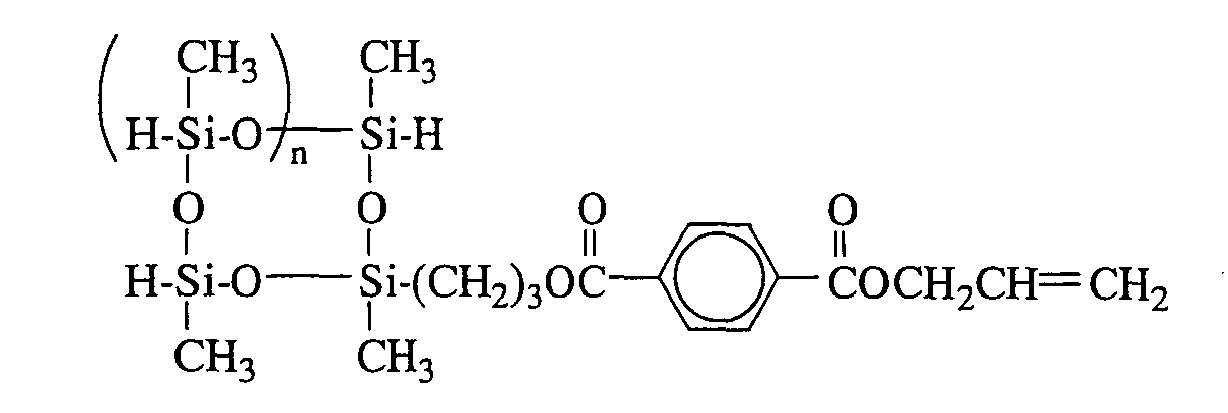
- To 70 parts of a dimethylvinylsiloxy-endcapped dimethylpolysiloxane A having a viscosity of 20,000 mPa-s at 25°C and a degree of polymerization of 620 were added 40 parts of fumed silica having a specific surface area of 200 m2/g and 6 parts of hexamethyldisilazane. The contents were uniformly admixed in a kneader/mixer and further heat admixed at 150°C for 3 hours, obtaining a silicone rubber base. To the silicone rubber base were added 20 parts of dimethylpolysiloxane A, 10 parts of a trimethylsiloxy-endcapped dimethylpolysiloxane B having vinyl groups on side chains (degree of polymerization 180, vinyl value 0.00058 mol/g), 0.44 part of a trimethylsiloxy-endcapped organohydrogenpolysiloxane A in which all silicon-bonded groups other than oxygen and hydrogen atoms are methyl (SiH content 0.0088 mol/g), 1.28 parts of an organohydrogenpolysiloxane B of the following formula (1):

(CH3O)3-Si-(CH2)3NCO (2)
0.1 part of 1% chloroplatinic acid in 2-ethylhexanol, and 0.05 part of 50% ethynyl cyclohexanol in ethanol as a reaction regulator. The contents were uniformly admixed for about 30 minutes, yielding a silicone rubber composition. This silicone rubber composition had a molar ratio of all SiH functional groups to all alkenyl groups, that is, SiH/alkenyl molar ratio of 2.0. - Using a precision rotational viscometer RotoVisco RV1 (Eko Instruments Co., Ltd.), the viscosity of the silicone rubber composition at 25°C and a shear rate of 10 S-1 was measured to be 195 Pa-s. An ability to cure at 130°C was measured by a moving die rheometer MDR2000 (Alpha Technologies), finding T10 = 25 seconds.
- The silicone rubber composition was press-cured at 150°C for 5 minutes and post-cured at 150°C for 2 hours into a cured sample, which was measured for hardness, tensile strength and elongation at break according to JIS K6249. The results are shown in Table 1.
- In another test, test pieces (∼25x50 mm) of aluminum, stainless steel (SUS316L), polyethylene terephthalate (PET), nylon 6 (PA), polyphenylene oxide (PPO), and polyphenylene sulfide (PPS) were mounted in molds. The silicone rubber composition was placed thereon and press-cured at 150°C for 3 minutes into a rubber layer of 1 to 3 mm thick. From the integrally molded article, the rubber layer was manually peeled. Adhesion was evaluated in terms of cohesive failure (rubber failure rate). The results are shown in Table 2.
- To 60 parts of a dimethylvinylsiloxy-endcapped dimethylpolysiloxane C having a viscosity of 50,000 mPa-s at 25°C and a degree of polymerization of 850 were added 20 parts of fumed silica having a specific surface area of 200 m2/g, 20 parts of precipitated silica having a specific surface area of 200 m2/g, 6 parts of hexamethyldisilazane, and 2 parts of water. The contents were uniformly admixed in a kneader/mixer and further heat admixed at 150°C for 3 hours, obtaining a silicone rubber base. To the silicone rubber base were added 30 parts of dimethylpolysiloxane A (used in Example 1), 10 parts of dimethylpolysiloxane B (used in Example 1), 10 parts of a gum-like trimethylsiloxy-endcapped dimethylpolysiloxane D having vinyl groups on side chains (degree of polymerization 6,000, vinyl value 0.00088 mol/g), 1.62 parts of organohydrogenpolysiloxane A (used in Example 1), 1.48 parts of a phenylene skeleton-bearing organohydrogenpolysiloxane C of the following formula (3):

(CH3CH2O)3-Si -(CH2)3NCO (4)
0.1 part of 1% chloroplatinic acid in 2-ethylhexanol, and 0.10 part of 50% ethynyl cyclohexanol in ethanol as a reaction regulator. The contents were uniformly admixed for about 30 minutes, yielding a silicone rubber composition. This silicone rubber composition had a molar ratio of all SiH functional groups to all alkenyl groups, that is, SiH/alkenyl molar ratio of 1.6. - As in Example 1, the silicone rubber composition was determined for viscosity and cure, finding a viscosity of 310 Pa-s and T10 = 36 seconds. It was also measured for hardness, tensile strength, elongation at break, and adhesion as in Example 1. The results are shown in Tables 1 and 2.
- To 60 parts of dimethylpolysiloxane C having a degree of polymerization of 850 (used in Example 2) were added 40 parts of fumed silica having a specific surface area of 300 m2/g, 10 parts of hexamethyldisilazane, 0.5 part of divinyltetramethyldisilazane, and 2 parts of water. The contents were uniformly admixed in a kneader/mixer and further heat admixed at 150°C for 3 hours, obtaining a silicone rubber base. To the silicone rubber base were added 20 parts of dimethylpolysiloxane A (used in Example 1), 5 parts of dimethylpolysiloxane B (used in Example 1), 0.24 part of organohydrogenpolysiloxane A having a SiH content of 0.0072 mol/g (used in Example 1), 1.08 parts of an organohydrogenpolysiloxane D of the following formula (5):


- As in Example 1, the silicone rubber composition was determined for viscosity and cure, finding a viscosity of 190 Pa-s and T10 = 33 seconds. It was also measured for hardness, tensile strength, elongation at break and adhesion as in Example 1. The results are shown in Tables 1 and 2.
- A silicone rubber composition was prepared as in Example 1 except that the isocyanate-containing organosilicon compound was omitted. The results are shown in Tables 1 and 2.
- A silicone rubber composition was prepared as in Example 1 except that 1.77 parts of organohydrogenpolysiloxane A was added instead of 1.28 parts of organohydrogenpolysiloxane B so as to give an equal amount of SiH groups. The results are shown in Tables 1 and 2.
- A silicone rubber composition was prepared as in Example 2 except that the isocyanate-containing organosilicon compound was omitted. The results are shown in Tables 1 and 2.
- A silicone rubber composition was prepared as in Example 3 except that the isocyanate-containing organosilicon compound was omitted. The results are shown in Tables 1 and 2.
Table 1 Example Comparative Example 1 2 3 1 2 3 4 Hardness, Durometer type A 36 51 45 37 40 53 45 Tensile strength (MPa) 8.2 9.2 8.8 8.1 8.9 9.5 8.1 Elongation at break (%) 690 470 610 650 700 460 580 Table 2 Example Comparative Example 1 2 3 1 2 3 4 Aluminum O O O Δ Δ Δ O Stainless steel O O O ×/Δ Δ Δ Δ PET O O O Δ Δ O O PA O O O Δ × × O PPO O O O × Δ Δ Δ PPS O O O × Δ Δ Δ Symbols have the following meaning.
O : cohesive failure ≥ 80%
Δ : 30% ≤ cohesive failure < 80%
×/Δ : 0% < cohesive failure < 30%
× : cohesive failure = 0% (peeled)
Claims (6)
- An addition curable self-adhesive silicone rubber composition comprising(A) 100 parts by weight of an organopolysiloxane containing at least two silicon-bonded alkenyl groups in a molecule,(B) 0.1 to 30 parts by weight of an organohydrogenpolysiloxane containing at least two silicon-bonded hydrogen atoms in a molecule, but free of a silicon-bonded aromatic ring,(C) 0.1 to 30 parts by weight of an organosilicon compound containing at least one SiH group and at least one mono- to tetravalent aromatic ring in a molecule,(D) 0 to 100 parts by weight of a reinforcing silica fine powder,(E) 0.1 to 25 parts by weight of an organic compound containing at least one isocyanate group in a molecule, and(F) a catalytic amount of an addition reaction catalyst.
- The silicone rubber composition of claim 1 wherein the organosilicon compound (C) is an organopolysiloxane containing at least three silicon-bonded hydrogen atoms in a molecule wherein at least 2 mol% of the total of silicon-bonded hydrogen atoms and silicon-bonded organic groups are phenyl groups, said organopolysiloxane having a degree of polymerization of 15 to 100.
- The silicone rubber composition of claim 1 wherein the organosilicon compound (C) is an organosilicon compound of 3 to 50 silicon atoms containing at least three SiH groups and at least one di- to tetravalent phenylene skeleton in a molecule.
- The silicone rubber composition of any one of claims 1 to 3 wherein the organic compound (E) is an organosilicon compound having an isocyanate group and an alkoxysilyl and/or silanol group in a molecule.
- The silicone rubber composition of any one of claims 1 to 4 which has a viscosity in the range of 50 to 800 Pa-s at 25°C and a shear rate of 10 s-1 and is used in injection molding.
- The silicone rubber composition of any one of claims 1 to 5 which has a 10% cure time T10 of 10 seconds to 60 seconds when measured at 130°C for 3 minutes and is used in injection molding.
Applications Claiming Priority (1)
| Application Number | Priority Date | Filing Date | Title |
|---|---|---|---|
| JP2009231365 | 2009-10-05 |
Publications (2)
| Publication Number | Publication Date |
|---|---|
| EP2305765A1 true EP2305765A1 (en) | 2011-04-06 |
| EP2305765B1 EP2305765B1 (en) | 2014-04-30 |
Family
ID=43301808
Family Applications (1)
| Application Number | Title | Priority Date | Filing Date |
|---|---|---|---|
| EP10013284.4A Active EP2305765B1 (en) | 2009-10-05 | 2010-10-04 | Addition curable self-adhesive silicone rubber composition |
Country Status (2)
| Country | Link |
|---|---|
| EP (1) | EP2305765B1 (en) |
| JP (1) | JP5541025B2 (en) |
Cited By (10)
| Publication number | Priority date | Publication date | Assignee | Title |
|---|---|---|---|---|
| EP2452994A1 (en) * | 2010-11-12 | 2012-05-16 | Shin-Etsu Chemical Co., Ltd. | Addition curable silicone adhesive composition |
| WO2013181136A1 (en) * | 2012-05-29 | 2013-12-05 | Momentive Performance Materials Gmbh | Preparation of isocyanato silanes |
| EP2700690A1 (en) * | 2012-08-20 | 2014-02-26 | Shin-Etsu Chemical Co., Ltd. | Addition Curable Self-Adhesive Silicone Rubber Composition |
| EP2746345A1 (en) * | 2012-12-21 | 2014-06-25 | Shin-Etsu Chemical Co., Ltd. | Addition curable self-adhesive silicone rubber composition |
| WO2020153947A1 (en) | 2019-01-23 | 2020-07-30 | Momentive Performance Materials Inc. | Addition curable silicone adhesive compositions |
| WO2021118582A1 (en) | 2019-12-13 | 2021-06-17 | Momentive Performance Materials Inc. | Addition curable silicone adhesive compositions |
| US11124602B2 (en) * | 2010-06-10 | 2021-09-21 | Polyplastics Co., Ltd. | Method for adhering resin molded articles |
| CN114437548A (en) * | 2022-01-21 | 2022-05-06 | 芯体素(杭州)科技发展有限公司 | Moisture-heat dual-curing direct-writing 3D printing medium, preparation method and application |
| CN117965130A (en) * | 2024-03-28 | 2024-05-03 | 临朐县金迪胶业有限公司 | Silicone fireproof sealant for building |
| CN119874761A (en) * | 2025-03-28 | 2025-04-25 | 定西凯美特新材料科技有限公司 | Hydrogen-containing silane, surface-modified magnesium hydroxide, halogen-free flame-retardant silicone rubber composition, and preparation method and application thereof |
Families Citing this family (10)
| Publication number | Priority date | Publication date | Assignee | Title |
|---|---|---|---|---|
| JP4951147B1 (en) * | 2011-09-08 | 2012-06-13 | 積水化学工業株式会社 | Curable composition for optical semiconductor device |
| WO2013035736A1 (en) * | 2011-09-08 | 2013-03-14 | 積水化学工業株式会社 | Curable composition for optical semiconductor device |
| JP5761122B2 (en) * | 2012-05-21 | 2015-08-12 | 信越化学工業株式会社 | Addition-curing self-adhesive liquid silicone rubber composition |
| JP6245119B2 (en) * | 2014-09-05 | 2017-12-13 | 信越化学工業株式会社 | Silicone rubber composition and method for improving tear strength of cured silicone rubber |
| JP6344333B2 (en) * | 2015-08-05 | 2018-06-20 | 信越化学工業株式会社 | Addition-curing silicone rubber composition |
| JP6465219B2 (en) * | 2015-11-30 | 2019-02-06 | 信越化学工業株式会社 | Self-adhesive silicone gel composition and silicone gel |
| JP6974215B2 (en) | 2018-02-28 | 2021-12-01 | 旭化成ワッカーシリコーン株式会社 | A curable silicone composition or a silicone composition kit containing a block polyisocyanate composition, a production method for obtaining an integrally molded product with a substrate, and an integrally molded product obtained. |
| JP7516008B2 (en) * | 2019-01-11 | 2024-07-16 | 信越化学工業株式会社 | Addition-curing self-adhesive silicone rubber composition and cured silicone rubber |
| JP7540975B2 (en) * | 2021-07-01 | 2024-08-27 | 信越化学工業株式会社 | Addition-curing silicone rubber composition and cured silicone rubber |
| JP2026040963A (en) * | 2024-08-26 | 2026-03-10 | 信越化学工業株式会社 | Addition-curable silicone rubber composition and cured product thereof |
Citations (8)
| Publication number | Priority date | Publication date | Assignee | Title |
|---|---|---|---|---|
| JPS63183843A (en) | 1987-01-26 | 1988-07-29 | 東レ・ダウコーニング・シリコーン株式会社 | Monolithic body of polyolefine resin and silicone rubber and manufacture thereof |
| JPH0234311B2 (en) | 1984-02-24 | 1990-08-02 | Sumitomo Beekuraito Kk | |
| JPH0634529B2 (en) | 1987-03-03 | 1994-05-02 | シャープ株式会社 | Stereoscopic image synthesizer |
| JPH0853661A (en) | 1994-06-06 | 1996-02-27 | Shin Etsu Chem Co Ltd | Silicone adhesive composition |
| JPH09165516A (en) | 1995-12-15 | 1997-06-24 | Mitsubishi Eng Plast Kk | Integrated molding of thermoplastic resin and oil bleeding silicone rubber |
| JPH09165517A (en) | 1995-12-15 | 1997-06-24 | Yazaki Corp | Integrally molded automotive waterproof connector of thermoplastic resin and oil bleeding silicone rubber |
| EP1172414A2 (en) * | 2000-07-11 | 2002-01-16 | Shin-Etsu Chemical Co., Ltd. | Silicone rubber adhesive composition and integrally molded article thereof |
| US20070218299A1 (en) * | 2006-03-17 | 2007-09-20 | Shin-Etsu Chemical Co., Ltd. | Thermosetting composition and film having a layer comprising the composition |
Family Cites Families (3)
| Publication number | Priority date | Publication date | Assignee | Title |
|---|---|---|---|---|
| JPH0798902B2 (en) * | 1989-12-05 | 1995-10-25 | 信越化学工業株式会社 | Self-adhesive silicone rubber composition and silicone rubber-coated cloth |
| EP0431881B1 (en) * | 1989-12-05 | 1995-06-28 | Shin-Etsu Chemical Co., Ltd. | Fabric material coated with a self-adhesive silicone rubber |
| JP2004331820A (en) * | 2003-05-08 | 2004-11-25 | Shin Etsu Chem Co Ltd | Silicone rubber adhesive composition for moving objects |
-
2010
- 2010-09-13 JP JP2010204336A patent/JP5541025B2/en active Active
- 2010-10-04 EP EP10013284.4A patent/EP2305765B1/en active Active
Patent Citations (8)
| Publication number | Priority date | Publication date | Assignee | Title |
|---|---|---|---|---|
| JPH0234311B2 (en) | 1984-02-24 | 1990-08-02 | Sumitomo Beekuraito Kk | |
| JPS63183843A (en) | 1987-01-26 | 1988-07-29 | 東レ・ダウコーニング・シリコーン株式会社 | Monolithic body of polyolefine resin and silicone rubber and manufacture thereof |
| JPH0634529B2 (en) | 1987-03-03 | 1994-05-02 | シャープ株式会社 | Stereoscopic image synthesizer |
| JPH0853661A (en) | 1994-06-06 | 1996-02-27 | Shin Etsu Chem Co Ltd | Silicone adhesive composition |
| JPH09165516A (en) | 1995-12-15 | 1997-06-24 | Mitsubishi Eng Plast Kk | Integrated molding of thermoplastic resin and oil bleeding silicone rubber |
| JPH09165517A (en) | 1995-12-15 | 1997-06-24 | Yazaki Corp | Integrally molded automotive waterproof connector of thermoplastic resin and oil bleeding silicone rubber |
| EP1172414A2 (en) * | 2000-07-11 | 2002-01-16 | Shin-Etsu Chemical Co., Ltd. | Silicone rubber adhesive composition and integrally molded article thereof |
| US20070218299A1 (en) * | 2006-03-17 | 2007-09-20 | Shin-Etsu Chemical Co., Ltd. | Thermosetting composition and film having a layer comprising the composition |
Cited By (20)
| Publication number | Priority date | Publication date | Assignee | Title |
|---|---|---|---|---|
| US11124602B2 (en) * | 2010-06-10 | 2021-09-21 | Polyplastics Co., Ltd. | Method for adhering resin molded articles |
| EP2452994A1 (en) * | 2010-11-12 | 2012-05-16 | Shin-Etsu Chemical Co., Ltd. | Addition curable silicone adhesive composition |
| US9309271B2 (en) | 2012-05-29 | 2016-04-12 | Momentive Performance Materials Gmbh | Preparation of isocyanato silanes |
| WO2013181136A1 (en) * | 2012-05-29 | 2013-12-05 | Momentive Performance Materials Gmbh | Preparation of isocyanato silanes |
| CN104334565A (en) * | 2012-05-29 | 2015-02-04 | 莫门蒂夫性能材料有限责任公司 | Preparation of isocyanato silanes |
| EP2700690A1 (en) * | 2012-08-20 | 2014-02-26 | Shin-Etsu Chemical Co., Ltd. | Addition Curable Self-Adhesive Silicone Rubber Composition |
| CN103627176A (en) * | 2012-08-20 | 2014-03-12 | 信越化学工业株式会社 | Addition curable self-adhesive silicone rubber composition |
| US8916646B2 (en) | 2012-08-20 | 2014-12-23 | Shin-Etsu Chemical Co., Ltd. | Addition curable self-adhesive silicone rubber composition |
| CN103627176B (en) * | 2012-08-20 | 2018-01-30 | 信越化学工业株式会社 | Addition curable self-adhesive silicone rubber composition |
| US20140179863A1 (en) * | 2012-12-21 | 2014-06-26 | Shin-Etsu Chemical Co., Ltd. | Addition curable self-adhesive silicone rubber composition |
| US8937123B2 (en) | 2012-12-21 | 2015-01-20 | Shin-Etsu Chemical Co., Ltd. | Addition curable self-adhesive silicone rubber composition |
| EP2746345A1 (en) * | 2012-12-21 | 2014-06-25 | Shin-Etsu Chemical Co., Ltd. | Addition curable self-adhesive silicone rubber composition |
| WO2020153947A1 (en) | 2019-01-23 | 2020-07-30 | Momentive Performance Materials Inc. | Addition curable silicone adhesive compositions |
| WO2021118582A1 (en) | 2019-12-13 | 2021-06-17 | Momentive Performance Materials Inc. | Addition curable silicone adhesive compositions |
| CN114437548A (en) * | 2022-01-21 | 2022-05-06 | 芯体素(杭州)科技发展有限公司 | Moisture-heat dual-curing direct-writing 3D printing medium, preparation method and application |
| CN114437548B (en) * | 2022-01-21 | 2022-12-27 | 芯体素(杭州)科技发展有限公司 | Moisture-heat dual-curing direct-writing type 3D printing medium, preparation method and application |
| CN117965130A (en) * | 2024-03-28 | 2024-05-03 | 临朐县金迪胶业有限公司 | Silicone fireproof sealant for building |
| CN117965130B (en) * | 2024-03-28 | 2024-05-31 | 临朐县金迪胶业有限公司 | Silicone fireproof sealant for building |
| CN119874761A (en) * | 2025-03-28 | 2025-04-25 | 定西凯美特新材料科技有限公司 | Hydrogen-containing silane, surface-modified magnesium hydroxide, halogen-free flame-retardant silicone rubber composition, and preparation method and application thereof |
| CN119874761B (en) * | 2025-03-28 | 2025-08-01 | 定西凯美特新材料科技有限公司 | Hydrogen-containing silane, surface-modified magnesium hydroxide, halogen-free flame-retardant silicone rubber composition, and preparation method and application thereof |
Also Published As
| Publication number | Publication date |
|---|---|
| JP5541025B2 (en) | 2014-07-09 |
| EP2305765B1 (en) | 2014-04-30 |
| JP2011099090A (en) | 2011-05-19 |
Similar Documents
| Publication | Publication Date | Title |
|---|---|---|
| EP2305765B1 (en) | Addition curable self-adhesive silicone rubber composition | |
| EP2700690B1 (en) | Addition Curable Self-Adhesive Silicone Rubber Composition | |
| EP2497802B1 (en) | Addition curable self-adhesive silicone rubber composition | |
| EP2374832B1 (en) | Addition curable self-adhesive silicone rubber composition | |
| EP2746345B1 (en) | Addition curable self-adhesive silicone rubber composition | |
| JP5158371B2 (en) | Addition-curing self-adhesive silicone rubber composition | |
| KR102924767B1 (en) | Addition-curing self-adhesive silicone rubber composition and silicone rubber cured product | |
| EP4172244B1 (en) | Silicone rubber compositions | |
| EP2452994A1 (en) | Addition curable silicone adhesive composition | |
| KR20040095702A (en) | Silicone Rubber Adhesive Composition for Mobile | |
| JP2015017198A (en) | Method for reducing modulus of cured silicone rubber, silicone rubber composition and cured product | |
| JP6108015B2 (en) | Method for reducing modulus of cured silicone rubber, and silicone rubber composition | |
| JP7104332B2 (en) | Additive-curing self-adhesive silicone rubber composition and its cured product | |
| JP2026040963A (en) | Addition-curable silicone rubber composition and cured product thereof |
Legal Events
| Date | Code | Title | Description |
|---|---|---|---|
| PUAI | Public reference made under article 153(3) epc to a published international application that has entered the european phase |
Free format text: ORIGINAL CODE: 0009012 |
|
| AK | Designated contracting states |
Kind code of ref document: A1 Designated state(s): AL AT BE BG CH CY CZ DE DK EE ES FI FR GB GR HR HU IE IS IT LI LT LU LV MC MK MT NL NO PL PT RO RS SE SI SK SM TR |
|
| AX | Request for extension of the european patent |
Extension state: BA ME |
|
| 17P | Request for examination filed |
Effective date: 20110627 |
|
| 17Q | First examination report despatched |
Effective date: 20120522 |
|
| GRAP | Despatch of communication of intention to grant a patent |
Free format text: ORIGINAL CODE: EPIDOSNIGR1 |
|
| INTG | Intention to grant announced |
Effective date: 20131018 |
|
| GRAS | Grant fee paid |
Free format text: ORIGINAL CODE: EPIDOSNIGR3 |
|
| GRAP | Despatch of communication of intention to grant a patent |
Free format text: ORIGINAL CODE: EPIDOSNIGR1 |
|
| INTG | Intention to grant announced |
Effective date: 20140214 |
|
| GRAA | (expected) grant |
Free format text: ORIGINAL CODE: 0009210 |
|
| AK | Designated contracting states |
Kind code of ref document: B1 Designated state(s): AL AT BE BG CH CY CZ DE DK EE ES FI FR GB GR HR HU IE IS IT LI LT LU LV MC MK MT NL NO PL PT RO RS SE SI SK SM TR |
|
| REG | Reference to a national code |
Ref country code: GB Ref legal event code: FG4D Ref country code: CH Ref legal event code: EP |
|
| REG | Reference to a national code |
Ref country code: AT Ref legal event code: REF Ref document number: 665163 Country of ref document: AT Kind code of ref document: T Effective date: 20140515 |
|
| REG | Reference to a national code |
Ref country code: IE Ref legal event code: FG4D |
|
| REG | Reference to a national code |
Ref country code: DE Ref legal event code: R096 Ref document number: 602010015509 Country of ref document: DE Effective date: 20140612 |
|
| REG | Reference to a national code |
Ref country code: AT Ref legal event code: MK05 Ref document number: 665163 Country of ref document: AT Kind code of ref document: T Effective date: 20140430 |
|
| REG | Reference to a national code |
Ref country code: LT Ref legal event code: MG4D |
|
| REG | Reference to a national code |
Ref country code: NL Ref legal event code: VDEP Effective date: 20140430 |
|
| PG25 | Lapsed in a contracting state [announced via postgrant information from national office to epo] |
Ref country code: IS Free format text: LAPSE BECAUSE OF FAILURE TO SUBMIT A TRANSLATION OF THE DESCRIPTION OR TO PAY THE FEE WITHIN THE PRESCRIBED TIME-LIMIT Effective date: 20140830 Ref country code: NL Free format text: LAPSE BECAUSE OF FAILURE TO SUBMIT A TRANSLATION OF THE DESCRIPTION OR TO PAY THE FEE WITHIN THE PRESCRIBED TIME-LIMIT Effective date: 20140430 Ref country code: GR Free format text: LAPSE BECAUSE OF FAILURE TO SUBMIT A TRANSLATION OF THE DESCRIPTION OR TO PAY THE FEE WITHIN THE PRESCRIBED TIME-LIMIT Effective date: 20140731 Ref country code: FI Free format text: LAPSE BECAUSE OF FAILURE TO SUBMIT A TRANSLATION OF THE DESCRIPTION OR TO PAY THE FEE WITHIN THE PRESCRIBED TIME-LIMIT Effective date: 20140430 Ref country code: NO Free format text: LAPSE BECAUSE OF FAILURE TO SUBMIT A TRANSLATION OF THE DESCRIPTION OR TO PAY THE FEE WITHIN THE PRESCRIBED TIME-LIMIT Effective date: 20140730 Ref country code: LT Free format text: LAPSE BECAUSE OF FAILURE TO SUBMIT A TRANSLATION OF THE DESCRIPTION OR TO PAY THE FEE WITHIN THE PRESCRIBED TIME-LIMIT Effective date: 20140430 Ref country code: CY Free format text: LAPSE BECAUSE OF FAILURE TO SUBMIT A TRANSLATION OF THE DESCRIPTION OR TO PAY THE FEE WITHIN THE PRESCRIBED TIME-LIMIT Effective date: 20140430 Ref country code: BG Free format text: LAPSE BECAUSE OF FAILURE TO SUBMIT A TRANSLATION OF THE DESCRIPTION OR TO PAY THE FEE WITHIN THE PRESCRIBED TIME-LIMIT Effective date: 20140730 |
|
| PG25 | Lapsed in a contracting state [announced via postgrant information from national office to epo] |
Ref country code: RS Free format text: LAPSE BECAUSE OF FAILURE TO SUBMIT A TRANSLATION OF THE DESCRIPTION OR TO PAY THE FEE WITHIN THE PRESCRIBED TIME-LIMIT Effective date: 20140430 Ref country code: LV Free format text: LAPSE BECAUSE OF FAILURE TO SUBMIT A TRANSLATION OF THE DESCRIPTION OR TO PAY THE FEE WITHIN THE PRESCRIBED TIME-LIMIT Effective date: 20140430 Ref country code: PL Free format text: LAPSE BECAUSE OF FAILURE TO SUBMIT A TRANSLATION OF THE DESCRIPTION OR TO PAY THE FEE WITHIN THE PRESCRIBED TIME-LIMIT Effective date: 20140430 Ref country code: HR Free format text: LAPSE BECAUSE OF FAILURE TO SUBMIT A TRANSLATION OF THE DESCRIPTION OR TO PAY THE FEE WITHIN THE PRESCRIBED TIME-LIMIT Effective date: 20140430 Ref country code: ES Free format text: LAPSE BECAUSE OF FAILURE TO SUBMIT A TRANSLATION OF THE DESCRIPTION OR TO PAY THE FEE WITHIN THE PRESCRIBED TIME-LIMIT Effective date: 20140430 Ref country code: SE Free format text: LAPSE BECAUSE OF FAILURE TO SUBMIT A TRANSLATION OF THE DESCRIPTION OR TO PAY THE FEE WITHIN THE PRESCRIBED TIME-LIMIT Effective date: 20140430 Ref country code: AT Free format text: LAPSE BECAUSE OF FAILURE TO SUBMIT A TRANSLATION OF THE DESCRIPTION OR TO PAY THE FEE WITHIN THE PRESCRIBED TIME-LIMIT Effective date: 20140430 |
|
| PG25 | Lapsed in a contracting state [announced via postgrant information from national office to epo] |
Ref country code: PT Free format text: LAPSE BECAUSE OF FAILURE TO SUBMIT A TRANSLATION OF THE DESCRIPTION OR TO PAY THE FEE WITHIN THE PRESCRIBED TIME-LIMIT Effective date: 20140901 |
|
| PG25 | Lapsed in a contracting state [announced via postgrant information from national office to epo] |
Ref country code: CZ Free format text: LAPSE BECAUSE OF FAILURE TO SUBMIT A TRANSLATION OF THE DESCRIPTION OR TO PAY THE FEE WITHIN THE PRESCRIBED TIME-LIMIT Effective date: 20140430 Ref country code: SK Free format text: LAPSE BECAUSE OF FAILURE TO SUBMIT A TRANSLATION OF THE DESCRIPTION OR TO PAY THE FEE WITHIN THE PRESCRIBED TIME-LIMIT Effective date: 20140430 Ref country code: DK Free format text: LAPSE BECAUSE OF FAILURE TO SUBMIT A TRANSLATION OF THE DESCRIPTION OR TO PAY THE FEE WITHIN THE PRESCRIBED TIME-LIMIT Effective date: 20140430 Ref country code: BE Free format text: LAPSE BECAUSE OF FAILURE TO SUBMIT A TRANSLATION OF THE DESCRIPTION OR TO PAY THE FEE WITHIN THE PRESCRIBED TIME-LIMIT Effective date: 20140430 Ref country code: EE Free format text: LAPSE BECAUSE OF FAILURE TO SUBMIT A TRANSLATION OF THE DESCRIPTION OR TO PAY THE FEE WITHIN THE PRESCRIBED TIME-LIMIT Effective date: 20140430 Ref country code: RO Free format text: LAPSE BECAUSE OF FAILURE TO SUBMIT A TRANSLATION OF THE DESCRIPTION OR TO PAY THE FEE WITHIN THE PRESCRIBED TIME-LIMIT Effective date: 20140430 |
|
| REG | Reference to a national code |
Ref country code: DE Ref legal event code: R097 Ref document number: 602010015509 Country of ref document: DE |
|
| PLBE | No opposition filed within time limit |
Free format text: ORIGINAL CODE: 0009261 |
|
| STAA | Information on the status of an ep patent application or granted ep patent |
Free format text: STATUS: NO OPPOSITION FILED WITHIN TIME LIMIT |
|
| PG25 | Lapsed in a contracting state [announced via postgrant information from national office to epo] |
Ref country code: IT Free format text: LAPSE BECAUSE OF FAILURE TO SUBMIT A TRANSLATION OF THE DESCRIPTION OR TO PAY THE FEE WITHIN THE PRESCRIBED TIME-LIMIT Effective date: 20140430 |
|
| 26N | No opposition filed |
Effective date: 20150202 |
|
| REG | Reference to a national code |
Ref country code: DE Ref legal event code: R097 Ref document number: 602010015509 Country of ref document: DE Effective date: 20150202 |
|
| PG25 | Lapsed in a contracting state [announced via postgrant information from national office to epo] |
Ref country code: MC Free format text: LAPSE BECAUSE OF FAILURE TO SUBMIT A TRANSLATION OF THE DESCRIPTION OR TO PAY THE FEE WITHIN THE PRESCRIBED TIME-LIMIT Effective date: 20140430 Ref country code: LU Free format text: LAPSE BECAUSE OF FAILURE TO SUBMIT A TRANSLATION OF THE DESCRIPTION OR TO PAY THE FEE WITHIN THE PRESCRIBED TIME-LIMIT Effective date: 20141004 |
|
| REG | Reference to a national code |
Ref country code: CH Ref legal event code: PL |
|
| GBPC | Gb: european patent ceased through non-payment of renewal fee |
Effective date: 20141004 |
|
| REG | Reference to a national code |
Ref country code: IE Ref legal event code: MM4A |
|
| PG25 | Lapsed in a contracting state [announced via postgrant information from national office to epo] |
Ref country code: SI Free format text: LAPSE BECAUSE OF FAILURE TO SUBMIT A TRANSLATION OF THE DESCRIPTION OR TO PAY THE FEE WITHIN THE PRESCRIBED TIME-LIMIT Effective date: 20140430 Ref country code: GB Free format text: LAPSE BECAUSE OF NON-PAYMENT OF DUE FEES Effective date: 20141004 Ref country code: LI Free format text: LAPSE BECAUSE OF NON-PAYMENT OF DUE FEES Effective date: 20141031 Ref country code: CH Free format text: LAPSE BECAUSE OF NON-PAYMENT OF DUE FEES Effective date: 20141031 |
|
| REG | Reference to a national code |
Ref country code: FR Ref legal event code: ST Effective date: 20150630 |
|
| PG25 | Lapsed in a contracting state [announced via postgrant information from national office to epo] |
Ref country code: FR Free format text: LAPSE BECAUSE OF NON-PAYMENT OF DUE FEES Effective date: 20141031 |
|
| PG25 | Lapsed in a contracting state [announced via postgrant information from national office to epo] |
Ref country code: IE Free format text: LAPSE BECAUSE OF NON-PAYMENT OF DUE FEES Effective date: 20141004 |
|
| PG25 | Lapsed in a contracting state [announced via postgrant information from national office to epo] |
Ref country code: SM Free format text: LAPSE BECAUSE OF FAILURE TO SUBMIT A TRANSLATION OF THE DESCRIPTION OR TO PAY THE FEE WITHIN THE PRESCRIBED TIME-LIMIT Effective date: 20140430 |
|
| PG25 | Lapsed in a contracting state [announced via postgrant information from national office to epo] |
Ref country code: HU Free format text: LAPSE BECAUSE OF FAILURE TO SUBMIT A TRANSLATION OF THE DESCRIPTION OR TO PAY THE FEE WITHIN THE PRESCRIBED TIME-LIMIT; INVALID AB INITIO Effective date: 20101004 Ref country code: TR Free format text: LAPSE BECAUSE OF FAILURE TO SUBMIT A TRANSLATION OF THE DESCRIPTION OR TO PAY THE FEE WITHIN THE PRESCRIBED TIME-LIMIT Effective date: 20140430 Ref country code: MT Free format text: LAPSE BECAUSE OF FAILURE TO SUBMIT A TRANSLATION OF THE DESCRIPTION OR TO PAY THE FEE WITHIN THE PRESCRIBED TIME-LIMIT Effective date: 20140430 |
|
| PG25 | Lapsed in a contracting state [announced via postgrant information from national office to epo] |
Ref country code: MK Free format text: LAPSE BECAUSE OF FAILURE TO SUBMIT A TRANSLATION OF THE DESCRIPTION OR TO PAY THE FEE WITHIN THE PRESCRIBED TIME-LIMIT Effective date: 20140430 |
|
| PG25 | Lapsed in a contracting state [announced via postgrant information from national office to epo] |
Ref country code: AL Free format text: LAPSE BECAUSE OF FAILURE TO SUBMIT A TRANSLATION OF THE DESCRIPTION OR TO PAY THE FEE WITHIN THE PRESCRIBED TIME-LIMIT Effective date: 20140430 |
|
| PGFP | Annual fee paid to national office [announced via postgrant information from national office to epo] |
Ref country code: DE Payment date: 20250902 Year of fee payment: 16 |