EP2299603A1 - Process for processing MIMO data streams in a 3GPP HSDPA receiver, and receiver for doing the same - Google Patents
Process for processing MIMO data streams in a 3GPP HSDPA receiver, and receiver for doing the same Download PDFInfo
- Publication number
- EP2299603A1 EP2299603A1 EP09368029A EP09368029A EP2299603A1 EP 2299603 A1 EP2299603 A1 EP 2299603A1 EP 09368029 A EP09368029 A EP 09368029A EP 09368029 A EP09368029 A EP 09368029A EP 2299603 A1 EP2299603 A1 EP 2299603A1
- Authority
- EP
- European Patent Office
- Prior art keywords
- data streams
- linear
- stream
- chip level
- inter
- Prior art date
- Legal status (The legal status is an assumption and is not a legal conclusion. Google has not performed a legal analysis and makes no representation as to the accuracy of the status listed.)
- Withdrawn
Links
- 238000000034 method Methods 0.000 title claims abstract description 40
- 238000001514 detection method Methods 0.000 claims abstract description 24
- 238000003892 spreading Methods 0.000 claims abstract description 15
- 238000004904 shortening Methods 0.000 claims abstract description 11
- 238000004891 communication Methods 0.000 claims abstract description 10
- 238000001228 spectrum Methods 0.000 claims abstract description 6
- 230000005540 biological transmission Effects 0.000 description 4
- 238000010420 art technique Methods 0.000 description 3
- 238000004519 manufacturing process Methods 0.000 description 3
- 238000003860 storage Methods 0.000 description 3
- 230000002123 temporal effect Effects 0.000 description 2
- 241001168730 Simo Species 0.000 description 1
- 230000003044 adaptive effect Effects 0.000 description 1
- 230000009977 dual effect Effects 0.000 description 1
- 238000005516 engineering process Methods 0.000 description 1
- 230000000763 evoking effect Effects 0.000 description 1
- 230000007717 exclusion Effects 0.000 description 1
- 230000005055 memory storage Effects 0.000 description 1
- URWAJWIAIPFPJE-YFMIWBNJSA-N sisomycin Chemical compound O1C[C@@](O)(C)[C@H](NC)[C@@H](O)[C@H]1O[C@@H]1[C@@H](O)[C@H](O[C@@H]2[C@@H](CC=C(CN)O2)N)[C@@H](N)C[C@H]1N URWAJWIAIPFPJE-YFMIWBNJSA-N 0.000 description 1
- 230000001629 suppression Effects 0.000 description 1
Images


Classifications
-
- H—ELECTRICITY
- H04—ELECTRIC COMMUNICATION TECHNIQUE
- H04B—TRANSMISSION
- H04B7/00—Radio transmission systems, i.e. using radiation field
- H04B7/02—Diversity systems; Multi-antenna system, i.e. transmission or reception using multiple antennas
- H04B7/04—Diversity systems; Multi-antenna system, i.e. transmission or reception using multiple antennas using two or more spaced independent antennas
- H04B7/08—Diversity systems; Multi-antenna system, i.e. transmission or reception using multiple antennas using two or more spaced independent antennas at the receiving station
- H04B7/0837—Diversity systems; Multi-antenna system, i.e. transmission or reception using multiple antennas using two or more spaced independent antennas at the receiving station using pre-detection combining
- H04B7/0842—Weighted combining
- H04B7/0848—Joint weighting
- H04B7/0854—Joint weighting using error minimizing algorithms, e.g. minimum mean squared error [MMSE], "cross-correlation" or matrix inversion
-
- H—ELECTRICITY
- H04—ELECTRIC COMMUNICATION TECHNIQUE
- H04B—TRANSMISSION
- H04B1/00—Details of transmission systems, not covered by a single one of groups H04B3/00 - H04B13/00; Details of transmission systems not characterised by the medium used for transmission
- H04B1/69—Spread spectrum techniques
- H04B1/707—Spread spectrum techniques using direct sequence modulation
- H04B1/7097—Interference-related aspects
-
- H—ELECTRICITY
- H04—ELECTRIC COMMUNICATION TECHNIQUE
- H04B—TRANSMISSION
- H04B1/00—Details of transmission systems, not covered by a single one of groups H04B3/00 - H04B13/00; Details of transmission systems not characterised by the medium used for transmission
- H04B1/69—Spread spectrum techniques
- H04B1/707—Spread spectrum techniques using direct sequence modulation
- H04B1/7097—Interference-related aspects
- H04B1/7103—Interference-related aspects the interference being multiple access interference
Definitions
- the invention relates to the field of wireless communication and more particularly to a process for processing multiple MIMO data streams in a 3GPP HSDPA communication system, and a receiver for doing the same.
- High Speed Downlink Packet Access is a packet based data service feature of the in WCDMA standard providing high speed downlink transmission.
- HSDPA is a technology upgrade to current UMTS networks.
- MIMO HSDPA Multiple Input Multiple Output
- the HSDPA receiver Compared to SISO/SIMO case (rel. 6 and previous), the HSDPA receiver must support improve to perform time and spatial equalization.
- MIMO has significant impact on the UE receiver algorithms & complexity
- FIG. 1 shows a MIMO HSDPA receiver which includes a joint time-spatial LMMSE chip level equalizer 10 providing both temporal and spatial equalization of the two received streams. Furthermore, equalization 10 achieves the decoding of the Dual Transmission Adaptive Array (DTx-AA) standard.
- DTx-AA Dual Transmission Adaptive Array
- the two received streams are separately processed in parallel.
- a first processing path includes a dispreading block 11, a Log Likehood Computation Ratio (LLR) Comp. block 12, a Rx HARQ block 13 and a decoding block 14.
- Dispreading block 11 achieves downsampling of the received chip level sequence in order to generate the sequence of symbols.
- Rx HARQ block 13 handles the packet retransmission procedure defined in the above mentioned 3GGP standard while decoding block 14 embodies known channel decoding technique, such as based on turbo-codes.
- the second stream outputted by joint time/spatial equalizer is processed by a dispreading block 15, a Log Likehood Computation Ratio (LLR) block 16, a Rx HARQ block 17 before being decoded by a decoding block 18.
- LLR Log Likehood Computation Ratio
- the first technique shown in figure 1 suffers one main drawback consisting in the high complexity of the joint time-spatial LMMMSE which has to provide effective time and spatial equalization.
- Such block is rather complex to embody, and particularly because it has to operated at the chip level frequency.
- Figure 2 shows one second known technique - also known under the designation V-blast - which is based on such a SIC structure comprising a 2x1 MMSE equalization block 20 which only provides joint time-spatial equalization of one particular stream complying with one criterium such as, for instance, the power.
- Such stream is then processed by one single path comprising, similarly as in the first technique, a dispreading block 21, a Log Likehood Ratio (LLR) block 22, a Rx HARQ block 23 and a decoding block 24.
- LLR Log Likehood Ratio
- Figure 2 also shows that a cancellation loop is arranged between the output of LLR block 22 and the input of 2x1 MMSE equalizer block, comprising a hard decision block 26, a signal reconstruction block 25 comprising estimation of the channel and having the purpose of re-generating the chip level sequence corresponding to the first signal.
- the chip level sequence corresponding to the signal received from the first antenna can be suppressed before being reprocessed by equalizing block 20 for the purpose of decoding the second signal.
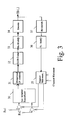
- a second type (type 2) of a SIC is further illustrated in Figure 3 which differs from the second known technique in that the cancellation loop is connected at the output of the decoding block.
- Figure 3 illustrates such a SIC receiver of the second type which includes a 2x1 MMSE equalization block 30 providing temporal and spatial equalization of the higher power received signal, then following by a dispreading block 31, a Log Likehood Ratio (LLR) block 32, a Rx HARQ block 33 and a decoding block 34.
- LLR Log Likehood Ratio
- the cancellation loop regenerates the chip level sequence corresponding to the first signal which can then be suppressed from the signal of the corresponding antenna so as the equalizing block 30 may equalize, process and decode the second signal.
- That first known technique based on the SCI (type 2), shows higher complexity and latency than the SIC of the first type. Conversely, it provides higher performance.
- DS direct-sequence
- a MIMO receiver which comprises:
- the MIMO receiver comprises two data stream.
- the second non linear detector is a NEAR-Maximum Likehood detector, and preferably a Sphere Decoder.
- the invention also provides a user Equipment for a 3GPP HSDPA communication system, such as a mobile phone or a Portable Document Assistant.
- the invention also provides a method for processing a set of N MIMO data stream in a receiver of a direct-sequence (DS) spread-spectrum wireless communication , comprising the following steps :
- the spatial multi-stream detection is performed by means of a non-linear near-Maximum Likehood detection, such as based on a Sphere Decoder.
- Figure 1 illustrates a first known technique for a MIMO receiver for standard 3GPP HSDPA
- the receiver processes the D-TxAA precoded data streams.
- the architecture of the invention is general and can be applied to any other form of decoding. More generally, the skilled man may use the invention in order to embody any MIMO receiver for a direct-sequence (DS) spread-spectrum system and any value of spreading factors.
- DS direct-sequence
- the invention can be implemented in digital electronic circuitry forming a mobile telephone of a Portable Digital Assistant (PDA) including hardware circuits with a combination of firmware and software.
- PDA Portable Digital Assistant
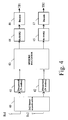
- the MIMO receiver of figure 4 comprises a first linear equalization block 40 receiving a set of N data streams received at N antennas, and carrying information encoded and modulated by a pseudonoise (PN) sequence and transmitted over a communication channel.
- PN pseudonoise
- first linear equalization block 40 only performs a linear chip level Inter-Chip Interference (ICI) and all Inter-Stream Interference (ISI) cancellation (Channel Shortening).
- ICI Inter-Chip Interference
- ISI Inter-Stream Interference
- first linear equalization is performed at the chip level rate (operating at a frequency rate being much higher than the symbol rate, e.g. 16 times higher), it should be noticed that the complexity of the first linear equalizer still remain acceptable since only time equalization is being performed in block 40, at the exclusion of any spatial equalization, particularly complying with the D-TxAA precoding.
- linear equalizer 40 only provides time equalization (also called channel shortening) for two separate streams respectively received by the two antennas.
- time equalization also called channel shortening
- ISI Inter Symbol Interference
- First equalizer outputs N channel shortened data streams which are respectively forwarded to a corresponding number of de-spreading blocks for the purpose of downsampling the equalized chip level sequences.
- Figure 4 shows two dispreading blocks, respectively 41 and 42, which respectively converts the chip level sequences of the first and the second output of linear equalizer 40 into the symbol streams.
- the MIMO receiver further comprises a second spatial multi-stream detection block 43 receiving, at N inputs, the N sequences of symbols respectively outputted by the N de-spreading blocks (e.g. blocks 41-42 of figure 4 ).
- Non linear detection block 43 achieves complex spatial equalization as well as detection of the despreaded streams, but takes a significant advantage on the fact that such operations are being performed at the rate of the Symbol level, thus keeping the complexity relatively acceptable.
- linear equalizer 40 has its complexity still acceptable since, although operating at the chip level rate, it only performs channel shortening thus significantly limiting the digital processing resources being required.
- the invention significantly improves that situation by clearly separating, on one side, the cancellation of ISI which is performed by first linear equalizer 40 operating at the chip level rate and, one the other side, the spatial multi-stream detection which is achieved more easily after the de-spreading of the data streams.
- Non linear detector block 43 may be embodied in different ways.
- ML Maximum Likehood
- the spatial equalization and non linear detection is achieved by means of a 2x2 SPHERE DECODER.
- the MIMO receiver further includes N processing paths, each comprising a Rx HARQ block (resp. 44, 45) for handling the packets retransmission, and a decoding block (resp. 46 and 47) for implementing decoding techniques such as VITERBI decoding or Turbo-decoding.
- N processing paths each comprising a Rx HARQ block (resp. 44, 45) for handling the packets retransmission, and a decoding block (resp. 46 and 47) for implementing decoding techniques such as VITERBI decoding or Turbo-decoding.
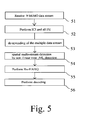
- FIG. 5 illustrates the process according to the invention for processing a number of N Input Multiple Output (MIMO) HSDPA data streams.
- MIMO Input Multiple Output
- a step 54 the process processes with spatial multi-stream detection performed by non-linear or near-ML detection.
- a Sphere Decoder is used for achieving that.
- step 55 the different data stream, at the symbol rate, are parallely processed in accordance with Rx-HARQ standard.
- a step 56 the process proceeds with the final parallel decoding of the multiple stream of symbols.
- the invention achieves a MIMO receiver which can be effectively seen as a spatio-temporal equalizer then achieving decoding of DTxAA MIMO HSDPA transmission.
- ICI Inter-Chip Interference
- ISI Inter-Stream Interference
Landscapes
- Engineering & Computer Science (AREA)
- Computer Networks & Wireless Communication (AREA)
- Signal Processing (AREA)
- Physics & Mathematics (AREA)
- Mathematical Physics (AREA)
- Radio Transmission System (AREA)
- Digital Transmission Methods That Use Modulated Carrier Waves (AREA)
- Noise Elimination (AREA)
Abstract
MIMO receiver for processing N data streams received by N antennas for a direct-sequence (DS) spread-spectrum wireless communication system comprising :
- a first linear equalizer operating at the chip level for performing linear chip level Inter-Chip Interference (ICI) and all Inter-Stream Interference (ISI) cancellation (Channel Shortening) of said N data streams, and generating N output chip level data streams;
- de-spreading blocks for separately de-spreading the N outputs of said first linear equalizer (40) ;
- a second non linear detector (43) for performing spatial equalization and multi-stream detection.
- a first linear equalizer operating at the chip level for performing linear chip level Inter-Chip Interference (ICI) and all Inter-Stream Interference (ISI) cancellation (Channel Shortening) of said N data streams, and generating N output chip level data streams;
- de-spreading blocks for separately de-spreading the N outputs of said first linear equalizer (40) ;
- a second non linear detector (43) for performing spatial equalization and multi-stream detection.
The invention also provides a process for processing the mimo data streams based on the separate performing, on one side, of a linear chip level Inter-Chip Interference (ICI) an and all Inter-Stream Interference (ISI) cancellation and, on the other side, spatial multi-stream detection.
Description
- The invention relates to the field of wireless communication and more particularly to a process for processing multiple MIMO data streams in a 3GPP HSDPA communication system, and a receiver for doing the same.
- High Speed Downlink Packet Access (HSDPA) is a packet based data service feature of the in WCDMA standard providing high speed downlink transmission. HSDPA is a technology upgrade to current UMTS networks.
- In Release 7 3GPP Standard, Multiple Input Multiple Output (MIMO) HSDPA is supported to double the nominal achievable data rate.
- Compared to SISO/SIMO case (rel. 6 and previous), the HSDPA receiver must support improve to perform time and spatial equalization.
- MIMO has significant impact on the UE receiver algorithms & complexity
- baseline receiver is linear Mean Minimum Squared Equalizer (MMSE) w/o interference cancellation
- enhanced receiver would be nonlinear with different options for interference cancellation
- Some techniques are known in the prior art in order to provide such time and spatial equalization.
- A first known technique is illustrated in
figure 1 which shows a MIMO HSDPA receiver which includes a joint time-spatial LMMSEchip level equalizer 10 providing both temporal and spatial equalization of the two received streams. Furthermore,equalization 10 achieves the decoding of the Dual Transmission Adaptive Array (DTx-AA) standard. - Once equalized, the two received streams are separately processed in parallel.
- A first processing path includes a dispreading
block 11, a Log Likehood Computation Ratio (LLR) Comp.block 12, aRx HARQ block 13 and adecoding block 14. Dispreadingblock 11 achieves downsampling of the received chip level sequence in order to generate the sequence of symbols. RxHARQ block 13 handles the packet retransmission procedure defined in the above mentioned 3GGP standard while decodingblock 14 embodies known channel decoding technique, such as based on turbo-codes. - Similarly, the second stream outputted by joint time/spatial equalizer is processed by a dispreading
block 15, a Log Likehood Computation Ratio (LLR)block 16, aRx HARQ block 17 before being decoded by adecoding block 18. - The first technique shown in
figure 1 suffers one main drawback consisting in the high complexity of the joint time-spatial LMMMSE which has to provide effective time and spatial equalization. Such block is rather complex to embody, and particularly because it has to operated at the chip level frequency. - Other techniques are known which are based on a Serial Interference Cancellation (SIC) arrangement.
-
Figure 2 shows one second known technique - also known under the designation V-blast - which is based on such a SIC structure comprising a 2x1MMSE equalization block 20 which only provides joint time-spatial equalization of one particular stream complying with one criterium such as, for instance, the power. Such stream is then processed by one single path comprising, similarly as in the first technique, a dispreadingblock 21, a Log Likehood Ratio (LLR) block 22, aRx HARQ block 23 and adecoding block 24. -
Figure 2 also shows that a cancellation loop is arranged between the output of LLR block 22 and the input of 2x1 MMSE equalizer block, comprising ahard decision block 26, asignal reconstruction block 25 comprising estimation of the channel and having the purpose of re-generating the chip level sequence corresponding to the first signal. - Thanks to that cancellation loop, the chip level sequence corresponding to the signal received from the first antenna can be suppressed before being reprocessed by equalizing
block 20 for the purpose of decoding the second signal. - A second type (type 2) of a SIC is further illustrated in
Figure 3 which differs from the second known technique in that the cancellation loop is connected at the output of the decoding block. -
Figure 3 illustrates such a SIC receiver of the second type which includes a 2x1MMSE equalization block 30 providing temporal and spatial equalization of the higher power received signal, then following by a dispreadingblock 31, a Log Likehood Ratio (LLR)block 32, aRx HARQ block 33 and adecoding block 34. Once the higher level signal has been decoded, the latter is re-encoded byencoder 37, then forwarded to a Tx-HARQ block 36 managing the transmission of packets, and then processed by asignal reconstruction block 35 which regenerate, taking into account the channels characteristics estimation, the chip level sequence corresponding to the first signal. - As shown in the
figure 2 , the cancellation loop regenerates the chip level sequence corresponding to the first signal which can then be suppressed from the signal of the corresponding antenna so as the equalizingblock 30 may equalize, process and decode the second signal. - That first known technique, based on the SCI (type 2), shows higher complexity and latency than the SIC of the first type. Conversely, it provides higher performance.
- However the two SIC structures which are illustrated in
figure 2 and3 , respectively, requires additional storage for successively storing the sequence of data being processed before the whole 2-step- equalization completes. In addition, it should be noticed that2x1 MMSE equalizers figure 1 , have to operated a at frequency being double than the chip level rate. - The need of additional storage and the increase in the frequency of operation of
equalizers - Therefore, there is a desire for a new architecture of a MIMO receiver which, firstly, can be based on an equalization technique of reasonable complexity and, secondly, does not need additional storage for storing two successively processed streams of data.
- It is an object of the present invention to provide the architecture of a MIMO receiver adapted for a direct-sequence (DS) spread-spectrum system.
- It is a further object of the present invention to provide a MIMO receiver suitable for the 3GPP HSDPA standard.
- It is still another object of the present invention to provide a process and a MIMO receiver which reduces the manufacturing costs .
- It is another object of the present invention to provide receiver wherein time equalization is performed jointly on the two received stream (channel shortening operation) and where the spatial equalization is performed by a non linear stage such as a Sphere Decoder.
- These and other objects of the invention are achieved by means of a MIMO receiver which comprises:
- a first linear equalizer operating at the chip level for performing linear chip level Inter-Chip Interference (ICI) and all Inter-Stream Interference (ISI) cancellation (Channel Shortening) of said N data streams, and generating N output chip level data streams;
- de-spreading blocks for separately de-spreading the N outputs of said first linear equalizer (40) ;
- a second non linear detector for performing spatial equalization and multi-stream detection.
- By limiting the operations of the first linear equalizer to the sole time equalization, complexity of the latter can still remain acceptable.
- On the other side, the fact that spatial non linear detector only processes the data stream at the symbol rate reduces its complexity so that the complexity of the whole MIMO receiver remains acceptable.
- In one embodiment, the MIMO receiver comprises two data stream.
- Particularly, the second non linear detector is a NEAR-Maximum Likehood detector, and preferably a Sphere Decoder.
- The invention also provides a user Equipment for a 3GPP HSDPA communication system, such as a mobile phone or a Portable Document Assistant.
- The invention also provides a method for processing a set of N MIMO data stream in a receiver of a direct-sequence (DS) spread-spectrum wireless communication , comprising the following steps :
- receiving via N antennas N data streams of information encoded and modulated by a pseudonoise (PN) sequence;
- performing a linear chip level Inter-Chip Interference (ICI) and all Inter-Stream Interference (ISI) cancellation and outputting N data streams;
- de-spreading said N data streams in order to convert them at the symbol rate;
- performing spatial multi-stream detection.
- In one embodiment, the spatial multi-stream detection is performed by means of a non-linear near-Maximum Likehood detection, such as based on a Sphere Decoder.
- Other features of one or more embodiments of the invention will best be understood by reference to the following detailed description when read in conjunction with the accompanying drawings.
-
Figure 1 illustrates a first known technique for a MIMO receiver for standard 3GPP HSDPA -
Figure 2 illustrates a second known technique for a MIMO receiver for standard 3GPP HSDPA -
Figure 3 illustrates a third known technique for a MIMO receiver for standard 3GPP HSDPA -
Figure 4 illustrates the principle of a MIMO receiver in accordance with the present invention. -
Figure 5 illustrates the process according to the invention for processing the Multiple Input Multiple Output (MIMO) HSDPA data streams. - With respect to
figure 4 , there is now described the architecture of one MIMO receiver which is particularly suitable for embodying a 3GPP HSDPA MIMO receiver. In particular, the receiver processes the D-TxAA precoded data streams. - However it should be clear that the architecture of the invention is general and can be applied to any other form of decoding. More generally, the skilled man may use the invention in order to embody any MIMO receiver for a direct-sequence (DS) spread-spectrum system and any value of spreading factors.
- The invention can be implemented in digital electronic circuitry forming a mobile telephone of a Portable Digital Assistant (PDA) including hardware circuits with a combination of firmware and software.
- The MIMO receiver of
figure 4 comprises a firstlinear equalization block 40 receiving a set of N data streams received at N antennas, and carrying information encoded and modulated by a pseudonoise (PN) sequence and transmitted over a communication channel. - For the sake of clarity, only two data streams have been illustrated in
figure 4 but it is clear that the invention can be used for any number of data streams and antennas. - The key point of the invention is that, contrary to the prior art techniques evoked above, first
linear equalization block 40 only performs a linear chip level Inter-Chip Interference (ICI) and all Inter-Stream Interference (ISI) cancellation (Channel Shortening). - In particular, no spatial detection is being performed by
block 40 so as to keep the complexity of the latter at a relatively acceptable level. - Indeed, while first linear equalization is performed at the chip level rate (operating at a frequency rate being much higher than the symbol rate, e.g. 16 times higher), it should be noticed that the complexity of the first linear equalizer still remain acceptable since only time equalization is being performed in
block 40, at the exclusion of any spatial equalization, particularly complying with the D-TxAA precoding. - In the embodiment illustrated in
figure 4 linear equalizer 40 only provides time equalization (also called channel shortening) for two separate streams respectively received by the two antennas. Such channel shortening is well known to a skilled man and for the sake of clarity there is no need to further develop the details of the procedures and techniques used for achieving suppression of Inter Symbol Interference (ISI). - First equalizer outputs N channel shortened data streams which are respectively forwarded to a corresponding number of de-spreading blocks for the purpose of downsampling the equalized chip level sequences.
-
Figure 4 shows two dispreading blocks, respectively 41 and 42, which respectively converts the chip level sequences of the first and the second output oflinear equalizer 40 into the symbol streams. - The MIMO receiver further comprises a second spatial
multi-stream detection block 43 receiving, at N inputs, the N sequences of symbols respectively outputted by the N de-spreading blocks (e.g. blocks 41-42 offigure 4 ). - Non
linear detection block 43 achieves complex spatial equalization as well as detection of the despreaded streams, but takes a significant advantage on the fact that such operations are being performed at the rate of the Symbol level, thus keeping the complexity relatively acceptable. - It results from that novel and inventive architecture that both
linear equalizer 40 and nonlinear detection block 43 still have a complexity remaining at an acceptable level. - Firstly,
linear equalizer 40 has its complexity still acceptable since, although operating at the chip level rate, it only performs channel shortening thus significantly limiting the digital processing resources being required. - Secondly, non
linear detector block 43 also has its complexity remaining at an acceptable level since, although it performs simultaneous parallel of N streams (N=2 infigure 4 ), the processing is performed at the Symbol level rate, what significantly limits complexity. - Conversely, all the equalizers of the prior art (see
figures 1-3 ) operating at the chip level rate achieved both time and spatial equalization what resulted in significant complexity resulting in higher manufacturing costs... Known techniques offigure 2 and3 tried to reduce somewhat the complexity resulting from the need to perform both time and spatial equalization by perform consecutive processing of the two data streams. - The invention significantly improves that situation by clearly separating, on one side, the cancellation of ISI which is performed by first
linear equalizer 40 operating at the chip level rate and, one the other side, the spatial multi-stream detection which is achieved more easily after the de-spreading of the data streams. - Non
linear detector block 43 may be embodied in different ways. - In one embodiment it can be embodied on the basis of a Maximum Likehood (ML) or, more practically, with a near-ML decoder.
- In particular, as shown in
figure 4 , the spatial equalization and non linear detection is achieved by means of a 2x2 SPHERE DECODER. - Alternatively, the use of lattice reduction can be considered.
- In addition to the non
linear detection block 43, the MIMO receiver further includes N processing paths, each comprising a Rx HARQ block (resp. 44, 45) for handling the packets retransmission, and a decoding block (resp. 46 and 47) for implementing decoding techniques such as VITERBI decoding or Turbo-decoding. - With respect
Figure 5 illustrates the process according to the invention for processing a number of N Input Multiple Output (MIMO) HSDPA data streams. - In a
step 51, the process receives the MIMO streams of data coming from N antennas; - In a
step 52, the process performs a linear chip level Inter-Chip Interference (ICI) and all Inter-Stream Interference (ISI) cancellation (Channel Shortening). - Then, in a
step 53, the process proceeds with the de-spreading of the multiple data stream in order to convert them at the symbol rate; - Then in a
step 54, the process processes with spatial multi-stream detection performed by non-linear or near-ML detection. In one embodiment, a Sphere Decoder is used for achieving that. - The process then proceeds with a
step 55 where the different data stream, at the symbol rate, are parallely processed in accordance with Rx-HARQ standard. - In a
step 56, the process proceeds with the final parallel decoding of the multiple stream of symbols. - By clearly separating, what was not done in the prior art techniques, one one side, the step of linear chip level Inter-Chip Interference (ICI) and all Inter-Stream Interference (ISI) cancellation (Channel Shortening) and, on the other side, the step of spatial multi-stream detection done by non-linear near-ML detection (Sphere Decoder), the invention achieves a MIMO receiver which can be effectively seen as a spatio-temporal equalizer then achieving decoding of DTxAA MIMO HSDPA transmission.
- With the advantage that no latency introduced w.r.t to previous non-linear methods and, further more, there is no need of additional memory storage since there is no two consecutive processing of the parallely received data streams as in the second and third prior art technique.
Claims (11)
- Multiple In Multiple Out (MIMO) receiver for processing N data streams received by N antennas for a direct-sequence (DS) spread-spectrum wireless communication system comprising :- a first linear equalizer (40) operating at the chip level for performing linear chip level Inter-Chip Interference (ICI) and all Inter-Stream Interference (ISI) cancellation (Channel Shortening) of said N data streams, and generating N output chip level data streams;- de-spreading blocks for separately de-spreading the N outputs of said first linear equalizer (40) ;- a second non linear detector (43) for performing spatial equalization and multi-stream detection.
- MIMO receiver according to claim 1 characterized in that said the number of data streams is two .
- MIMO receiver according to claims 1 or 2 characterized in that said second non linear detector is a NEAR-Maximum Likehood detector.
- MIMO receiver according to claim 3 characterized in that said second non linear detector (43) is a SPHERE DECODER.
- MIMO receiver according to any one of the preceding claims characterized in that it further includes a Rx HARQ block (44, 45) for packets retransmission and a decoding block (46, 47), such as a turbo decoder.
- MIMO receiver according to anyone of claims 1 to 5 adapted to a 3GPP HSDPA communication system.
- User Equipment for a 3GPP HSDPA communication system comprising two antennas for receiving two MIMO data streams, characterized in that it further includes:- a first linear equalizer (40) operating at the chip level for performing linear chip level Inter-Chip Interference (ICI) and all Inter-Stream Interference (ISI) cancellation (Channel Shortening) of said N data streams, and generating N output chip level data streams;- de-spreading blocks for separately de-spreading the N outputs of said first linear equalizer (40) ;- a second non linear detector (43) for performing spatial equalization and multi-stream detection.
- Process for processing a set of N MIMO data stream in a receiver of a direct-sequence (DS) spread-spectrum wireless communication , comprising the folloiwing steps :- receiving (51) via N antennas N data streams of information encoded and modulated by a pseudonoise (PN) sequence;- performing (52) a linear chip level Inter-Chip Interference (ICI) and all Inter-Stream Interference (ISI) cancellation and outputting N data streams;- de-spreading (53) said N data streams in order to convert them at the symbol rate;- performing (54) spatial multi-stream detection.
- Process according to claim 8 characterized in that said spatial multi-stream detection is performed by means of a non-linear near-Maximum Likehood detection.
- Process according to claim 9 characterized in that said near-Maximum Likehood detection is based on a sphere decoder.
- Process according to anyone of claims 8 to 10 characterized in that it is applied to HSDPA.
Priority Applications (5)
| Application Number | Priority Date | Filing Date | Title |
|---|---|---|---|
| EP09368029A EP2299603A1 (en) | 2009-09-17 | 2009-09-17 | Process for processing MIMO data streams in a 3GPP HSDPA receiver, and receiver for doing the same |
| JP2012529155A JP5723370B2 (en) | 2009-09-17 | 2010-09-16 | Process for processing a MIMO data stream in a 3GPP HSDPA receiver and receiver therefor |
| EP10767921A EP2478641A1 (en) | 2009-09-17 | 2010-09-16 | Process for processing mimo data streams in a 3gpp hsdpa receiver, and receiver for doing the same |
| PCT/EP2010/005693 WO2011032699A1 (en) | 2009-09-17 | 2010-09-16 | Process for processing mimo data streams in a 3gpp hsdpa receiver, and receiver for doing the same |
| US13/395,978 US8611398B2 (en) | 2009-09-17 | 2010-09-16 | Process for processing MIMO data streams in a 3GPP HSDPA receiver, and receiver for doing the same |
Applications Claiming Priority (1)
| Application Number | Priority Date | Filing Date | Title |
|---|---|---|---|
| EP09368029A EP2299603A1 (en) | 2009-09-17 | 2009-09-17 | Process for processing MIMO data streams in a 3GPP HSDPA receiver, and receiver for doing the same |
Publications (1)
| Publication Number | Publication Date |
|---|---|
| EP2299603A1 true EP2299603A1 (en) | 2011-03-23 |
Family
ID=41666745
Family Applications (2)
| Application Number | Title | Priority Date | Filing Date |
|---|---|---|---|
| EP09368029A Withdrawn EP2299603A1 (en) | 2009-09-17 | 2009-09-17 | Process for processing MIMO data streams in a 3GPP HSDPA receiver, and receiver for doing the same |
| EP10767921A Ceased EP2478641A1 (en) | 2009-09-17 | 2010-09-16 | Process for processing mimo data streams in a 3gpp hsdpa receiver, and receiver for doing the same |
Family Applications After (1)
| Application Number | Title | Priority Date | Filing Date |
|---|---|---|---|
| EP10767921A Ceased EP2478641A1 (en) | 2009-09-17 | 2010-09-16 | Process for processing mimo data streams in a 3gpp hsdpa receiver, and receiver for doing the same |
Country Status (4)
| Country | Link |
|---|---|
| US (1) | US8611398B2 (en) |
| EP (2) | EP2299603A1 (en) |
| JP (1) | JP5723370B2 (en) |
| WO (1) | WO2011032699A1 (en) |
Cited By (2)
| Publication number | Priority date | Publication date | Assignee | Title |
|---|---|---|---|---|
| CN102811120A (en) * | 2012-08-03 | 2012-12-05 | 西安电子科技大学 | System and method for controlling both-way relay HARQ (hybrid automatic repeat request) based on network coding |
| CN117061281A (en) * | 2023-08-25 | 2023-11-14 | 浙江大学 | Iterative sequence estimation method for underwater acoustic communication based on channel shortening and spherical decoding |
Families Citing this family (4)
| Publication number | Priority date | Publication date | Assignee | Title |
|---|---|---|---|---|
| JP5803429B2 (en) * | 2011-08-25 | 2015-11-04 | 富士通株式会社 | Receiver |
| JP2016051973A (en) | 2014-08-29 | 2016-04-11 | 富士通株式会社 | Reception device and reception processing method |
| US9942020B1 (en) * | 2017-04-26 | 2018-04-10 | Cisco Technology, Inc. | Minimum delay spatio-temporal filtering for interference rejection |
| US10516498B1 (en) * | 2017-05-31 | 2019-12-24 | Quantenna Communications, Inc. | Wifi multi-user CPE and ICI mitigation |
Citations (1)
| Publication number | Priority date | Publication date | Assignee | Title |
|---|---|---|---|---|
| US20060072449A1 (en) * | 2004-10-06 | 2006-04-06 | Mark Kent | Method and system for channel equalization |
Family Cites Families (6)
| Publication number | Priority date | Publication date | Assignee | Title |
|---|---|---|---|---|
| US8391322B2 (en) * | 2003-07-09 | 2013-03-05 | Broadcom Corporation | Method and system for single weight (SW) antenna system for spatial multiplexing (SM) MIMO system for WCDMA/HSDPA |
| US7356073B2 (en) * | 2003-09-10 | 2008-04-08 | Nokia Corporation | Method and apparatus providing an advanced MIMO receiver that includes a signal-plus-residual-interference (SPRI) detector |
| US20050100052A1 (en) * | 2003-11-10 | 2005-05-12 | Mailaender Laurence E. | Method and apparatus for receiver processing in a CDMA communications system |
| US7324583B2 (en) * | 2004-02-13 | 2008-01-29 | Nokia Corporation | Chip-level or symbol-level equalizer structure for multiple transmit and receiver antenna configurations |
| US7570689B2 (en) * | 2005-02-14 | 2009-08-04 | Interdigital Technology Corporation | Advanced receiver with sliding window block linear equalizer |
| US8107549B2 (en) * | 2005-11-30 | 2012-01-31 | Qualcomm, Incorporated | Multi-stage receiver for wireless communication |
-
2009
- 2009-09-17 EP EP09368029A patent/EP2299603A1/en not_active Withdrawn
-
2010
- 2010-09-16 JP JP2012529155A patent/JP5723370B2/en not_active Expired - Fee Related
- 2010-09-16 EP EP10767921A patent/EP2478641A1/en not_active Ceased
- 2010-09-16 US US13/395,978 patent/US8611398B2/en not_active Expired - Fee Related
- 2010-09-16 WO PCT/EP2010/005693 patent/WO2011032699A1/en not_active Ceased
Patent Citations (1)
| Publication number | Priority date | Publication date | Assignee | Title |
|---|---|---|---|---|
| US20060072449A1 (en) * | 2004-10-06 | 2006-04-06 | Mark Kent | Method and system for channel equalization |
Non-Patent Citations (1)
| Title |
|---|
| JUNTTI M ET AL: "Space-Time Equalizers for MIMO High Speed WCDMA Downlinks", IEEE TRANSACTIONS ON WIRELESS COMMUNICATIONS, IEEE SERVICE CENTER, PISCATAWAY, NJ, US, vol. 6, no. 7, 1 July 2007 (2007-07-01), pages 2582 - 2592, XP011187609, ISSN: 1536-1276 * |
Cited By (2)
| Publication number | Priority date | Publication date | Assignee | Title |
|---|---|---|---|---|
| CN102811120A (en) * | 2012-08-03 | 2012-12-05 | 西安电子科技大学 | System and method for controlling both-way relay HARQ (hybrid automatic repeat request) based on network coding |
| CN117061281A (en) * | 2023-08-25 | 2023-11-14 | 浙江大学 | Iterative sequence estimation method for underwater acoustic communication based on channel shortening and spherical decoding |
Also Published As
| Publication number | Publication date |
|---|---|
| JP5723370B2 (en) | 2015-05-27 |
| EP2478641A1 (en) | 2012-07-25 |
| US8611398B2 (en) | 2013-12-17 |
| WO2011032699A1 (en) | 2011-03-24 |
| WO2011032699A8 (en) | 2011-07-21 |
| JP2013505610A (en) | 2013-02-14 |
| US20120275491A1 (en) | 2012-11-01 |
Similar Documents
| Publication | Publication Date | Title |
|---|---|---|
| JP4412926B2 (en) | Adaptive equalization apparatus and program thereof | |
| CN100542059C (en) | Method and device for receiving signals | |
| JP4072539B2 (en) | Apparatus and method for receiving a signal in a communication system using a multiple-input multiple-output scheme | |
| EP2276210A2 (en) | Channel estimates in a SIC receiver for a multi-transmitter array transmission scheme | |
| US8611398B2 (en) | Process for processing MIMO data streams in a 3GPP HSDPA receiver, and receiver for doing the same | |
| KR20070086524A (en) | Iterative Multiple Input-Output Equalizer Receiver Architecture Accelerated by Fast Fourier Transform | |
| KR20080081029A (en) | Interference Cancellation in Telecommunication Systems | |
| US7936810B2 (en) | Delayed combining of frequency-domain equalized wireless channels with large delay-spreads | |
| JP2009524285A (en) | Receiver using non-pilot reference channel to equalize received signal | |
| EP2245809B1 (en) | A method and apparatus for efficient multi-symbol detection | |
| CN100367681C (en) | Apparatus and method for generating and receiving services in code division multiple access mobile communication system | |
| CN104025466B (en) | Finger-like branched layout in multistage interference eliminates | |
| US20070054692A1 (en) | Methods and apparatus to perform noise estimation for frequency-domain equalizers | |
| WO2014139953A1 (en) | Iterative successive interference cancellation in mu-mimo using interference whitening and channel reestimation | |
| KR101120768B1 (en) | Fractionally-spaced equalizers for spread spectrum wireless communication | |
| KR100701315B1 (en) | Spatio-temporal multi-user detector and detection method in mobile communication system | |
| CN102396159B (en) | Method and apparatus for cancelling interference | |
| KR20050045836A (en) | Method and apparatus for receiver processing in a cdma communications system | |
| US20070053417A1 (en) | Methods and apparatus to perform fractional-spaced channel estimation for frequency-domain equalizers | |
| KR100703263B1 (en) | Apparatus and method for removing interference signal in mobile communication system using multiple antennas | |
| KR100651432B1 (en) | Apparatus and method for removing interference signal in mobile communication system using multiple antennas | |
| US20070053416A1 (en) | Methods and apparatus to perform closed-loop transmit diversity with frequency-domain equalizers | |
| CN101616376B (en) | Data receiving method and device in code division multiple access communication system | |
| US20170180159A1 (en) | Mobile terminal device and method for processing signals | |
| JP2011139294A (en) | Transmitter and receiver |
Legal Events
| Date | Code | Title | Description |
|---|---|---|---|
| PUAI | Public reference made under article 153(3) epc to a published international application that has entered the european phase |
Free format text: ORIGINAL CODE: 0009012 |
|
| AK | Designated contracting states |
Kind code of ref document: A1 Designated state(s): AT BE BG CH CY CZ DE DK EE ES FI FR GB GR HR HU IE IS IT LI LT LU LV MC MK MT NL NO PL PT RO SE SI SK SM TR |
|
| AX | Request for extension of the european patent |
Extension state: AL BA RS |
|
| STAA | Information on the status of an ep patent application or granted ep patent |
Free format text: STATUS: THE APPLICATION IS DEEMED TO BE WITHDRAWN |
|
| 18D | Application deemed to be withdrawn |
Effective date: 20110924 |