EP2298782A1 - Method for producing pyrazole glycoside derivatives - Google Patents
Method for producing pyrazole glycoside derivatives Download PDFInfo
- Publication number
- EP2298782A1 EP2298782A1 EP09290651A EP09290651A EP2298782A1 EP 2298782 A1 EP2298782 A1 EP 2298782A1 EP 09290651 A EP09290651 A EP 09290651A EP 09290651 A EP09290651 A EP 09290651A EP 2298782 A1 EP2298782 A1 EP 2298782A1
- Authority
- EP
- European Patent Office
- Prior art keywords
- compound
- formula
- defined above
- equivalents
- crystallization
- Prior art date
- Legal status (The legal status is an assumption and is not a legal conclusion. Google has not performed a legal analysis and makes no representation as to the accuracy of the status listed.)
- Withdrawn
Links
- 238000004519 manufacturing process Methods 0.000 title claims abstract description 11
- -1 pyrazole glycoside Chemical class 0.000 title description 22
- 229930182470 glycoside Natural products 0.000 title description 2
- UFHFLCQGNIYNRP-UHFFFAOYSA-N Hydrogen Chemical compound [H][H] UFHFLCQGNIYNRP-UHFFFAOYSA-N 0.000 claims abstract description 17
- 229910052739 hydrogen Inorganic materials 0.000 claims abstract description 17
- 239000001257 hydrogen Substances 0.000 claims abstract description 17
- 125000004209 (C1-C8) alkyl group Chemical group 0.000 claims abstract description 9
- PXGOKWXKJXAPGV-UHFFFAOYSA-N Fluorine Chemical compound FF PXGOKWXKJXAPGV-UHFFFAOYSA-N 0.000 claims abstract description 7
- 229910052731 fluorine Inorganic materials 0.000 claims abstract description 7
- 239000011737 fluorine Substances 0.000 claims abstract description 7
- 150000001875 compounds Chemical class 0.000 claims description 147
- OKKJLVBELUTLKV-UHFFFAOYSA-N Methanol Chemical compound OC OKKJLVBELUTLKV-UHFFFAOYSA-N 0.000 claims description 81
- XLYOFNOQVPJJNP-UHFFFAOYSA-N water Substances O XLYOFNOQVPJJNP-UHFFFAOYSA-N 0.000 claims description 74
- 239000002904 solvent Substances 0.000 claims description 58
- 239000000243 solution Substances 0.000 claims description 49
- LFQSCWFLJHTTHZ-UHFFFAOYSA-N Ethanol Chemical compound CCO LFQSCWFLJHTTHZ-UHFFFAOYSA-N 0.000 claims description 48
- 238000002425 crystallisation Methods 0.000 claims description 43
- 230000008025 crystallization Effects 0.000 claims description 43
- 239000000203 mixture Substances 0.000 claims description 43
- 238000000034 method Methods 0.000 claims description 30
- 239000003054 catalyst Substances 0.000 claims description 23
- 239000011541 reaction mixture Substances 0.000 claims description 21
- 238000004587 chromatography analysis Methods 0.000 claims description 20
- 238000000746 purification Methods 0.000 claims description 20
- 150000001298 alcohols Chemical class 0.000 claims description 18
- 239000003153 chemical reaction reagent Substances 0.000 claims description 16
- 238000006243 chemical reaction Methods 0.000 claims description 15
- 239000007787 solid Substances 0.000 claims description 14
- 150000002148 esters Chemical class 0.000 claims description 13
- LENZDBCJOHFCAS-UHFFFAOYSA-N tris Chemical compound OCC(N)(CO)CO LENZDBCJOHFCAS-UHFFFAOYSA-N 0.000 claims description 13
- 239000000725 suspension Substances 0.000 claims description 12
- 238000002360 preparation method Methods 0.000 claims description 11
- 230000002378 acidificating effect Effects 0.000 claims description 10
- 150000001408 amides Chemical class 0.000 claims description 10
- 125000003236 benzoyl group Chemical group [H]C1=C([H])C([H])=C(C([H])=C1[H])C(*)=O 0.000 claims description 10
- 238000004821 distillation Methods 0.000 claims description 10
- 125000002496 methyl group Chemical group [H]C([H])([H])* 0.000 claims description 10
- 150000003839 salts Chemical class 0.000 claims description 10
- 150000001335 aliphatic alkanes Chemical class 0.000 claims description 9
- 150000001491 aromatic compounds Chemical class 0.000 claims description 9
- 150000002170 ethers Chemical class 0.000 claims description 9
- 150000002576 ketones Chemical class 0.000 claims description 9
- 125000004169 (C1-C6) alkyl group Chemical group 0.000 claims description 8
- 125000002777 acetyl group Chemical group [H]C([H])([H])C(*)=O 0.000 claims description 8
- 125000001495 ethyl group Chemical group [H]C([H])([H])C([H])([H])* 0.000 claims description 8
- 238000007327 hydrogenolysis reaction Methods 0.000 claims description 8
- LPXPTNMVRIOKMN-UHFFFAOYSA-M sodium nitrite Chemical compound [Na+].[O-]N=O LPXPTNMVRIOKMN-UHFFFAOYSA-M 0.000 claims description 8
- 125000006239 protecting group Chemical group 0.000 claims description 7
- 125000001449 isopropyl group Chemical group [H]C([H])([H])C([H])(*)C([H])([H])[H] 0.000 claims description 6
- 239000002253 acid Substances 0.000 claims description 5
- 239000003444 phase transfer catalyst Substances 0.000 claims description 5
- JEXVQSWXXUJEMA-UHFFFAOYSA-N pyrazol-3-one Chemical class O=C1C=CN=N1 JEXVQSWXXUJEMA-UHFFFAOYSA-N 0.000 claims description 5
- 150000007513 acids Chemical class 0.000 claims description 4
- 230000001476 alcoholic effect Effects 0.000 claims description 4
- 239000007864 aqueous solution Substances 0.000 claims description 4
- 239000003125 aqueous solvent Substances 0.000 claims description 4
- BASFCYQUMIYNBI-UHFFFAOYSA-N platinum Chemical compound [Pt] BASFCYQUMIYNBI-UHFFFAOYSA-N 0.000 claims description 4
- 229910052723 transition metal Inorganic materials 0.000 claims description 4
- 150000003624 transition metals Chemical class 0.000 claims description 4
- 238000007796 conventional method Methods 0.000 claims description 3
- 238000002955 isolation Methods 0.000 claims description 3
- 239000011347 resin Substances 0.000 claims description 3
- 229920005989 resin Polymers 0.000 claims description 3
- 125000005270 trialkylamine group Chemical group 0.000 claims description 3
- QZMAEZWZCGBZFK-AOJWCAIYSA-N (2s,3s,4s,5r,6r)-6-[[(3s,4ar,6ar,6bs,8as,12as,14ar,14br)-4,4,6a,6b,11,11,14b-heptamethyl-8a-[(2s,3r,4s,5s,6r)-3,4,5-trihydroxy-6-(hydroxymethyl)oxan-2-yl]oxycarbonyl-1,2,3,4a,5,6,7,8,9,10,12,12a,14,14a-tetradecahydropicen-3-yl]oxy]-3,5-dihydroxy-4-[(2s,3r Chemical compound O([C@H]1[C@H](O)[C@H](O[C@H]([C@@H]1O)O[C@H]1CC[C@]2(C)[C@H]3CC=C4[C@@]([C@@]3(CC[C@H]2C1(C)C)C)(C)CC[C@]1(CCC(C[C@H]14)(C)C)C(=O)O[C@H]1[C@@H]([C@@H](O)[C@H](O)[C@@H](CO)O1)O)C(O)=O)[C@@H]1O[C@H](CO)[C@H](O)[C@H](O)[C@H]1O QZMAEZWZCGBZFK-AOJWCAIYSA-N 0.000 claims description 2
- QZMAEZWZCGBZFK-UHFFFAOYSA-N 28-(beta-D-Glucopyranosyloxy)-28-oxoolean-12-en-3beta-yl 3-O-(beta-D-glucopyranosyl)-beta-D-glucopyranosiduronic acid Natural products C12CC(C)(C)CCC2(C(=O)OC2C(C(O)C(O)C(CO)O2)O)CCC(C2(CCC3C4(C)C)C)(C)C1=CCC2C3(C)CCC4OC(C1O)OC(C(O)=O)C(O)C1OC1OC(CO)C(O)C(O)C1O QZMAEZWZCGBZFK-UHFFFAOYSA-N 0.000 claims description 2
- 229940051880 analgesics and antipyretics pyrazolones Drugs 0.000 claims description 2
- KPJWZUAARPJYSB-UHFFFAOYSA-N glycoside C Natural products CC1(C)OC(=O)C23CCC1C2(O)CCC(C1(CCC24)C)(C)C3CCC1C2(C)CCCC4(C)COC(C(C(O)C1O)OC2C(C(O)C(CO)O2)O)OC1COC1OC(CO)C(O)C(O)C1O KPJWZUAARPJYSB-UHFFFAOYSA-N 0.000 claims description 2
- 239000012442 inert solvent Substances 0.000 claims description 2
- XBYRMPXUBGMOJC-UHFFFAOYSA-N 1,2-dihydropyrazol-3-one Chemical compound OC=1C=CNN=1 XBYRMPXUBGMOJC-UHFFFAOYSA-N 0.000 claims 1
- XEKOWRVHYACXOJ-UHFFFAOYSA-N Ethyl acetate Chemical compound CCOC(C)=O XEKOWRVHYACXOJ-UHFFFAOYSA-N 0.000 description 44
- WEVYAHXRMPXWCK-UHFFFAOYSA-N Acetonitrile Chemical compound CC#N WEVYAHXRMPXWCK-UHFFFAOYSA-N 0.000 description 24
- HEMHJVSKTPXQMS-UHFFFAOYSA-M Sodium hydroxide Chemical compound [OH-].[Na+] HEMHJVSKTPXQMS-UHFFFAOYSA-M 0.000 description 21
- WYURNTSHIVDZCO-UHFFFAOYSA-N Tetrahydrofuran Chemical compound C1CCOC1 WYURNTSHIVDZCO-UHFFFAOYSA-N 0.000 description 19
- 239000002585 base Substances 0.000 description 18
- 239000000047 product Substances 0.000 description 18
- YMWUJEATGCHHMB-UHFFFAOYSA-N Dichloromethane Chemical compound ClCCl YMWUJEATGCHHMB-UHFFFAOYSA-N 0.000 description 17
- IMNFDUFMRHMDMM-UHFFFAOYSA-N N-Heptane Chemical compound CCCCCCC IMNFDUFMRHMDMM-UHFFFAOYSA-N 0.000 description 14
- KDLHZDBZIXYQEI-UHFFFAOYSA-N palladium Substances [Pd] KDLHZDBZIXYQEI-UHFFFAOYSA-N 0.000 description 13
- SECXISVLQFMRJM-UHFFFAOYSA-N N-Methylpyrrolidone Chemical compound CN1CCCC1=O SECXISVLQFMRJM-UHFFFAOYSA-N 0.000 description 12
- FAPWRFPIFSIZLT-UHFFFAOYSA-M Sodium chloride Chemical compound [Na+].[Cl-] FAPWRFPIFSIZLT-UHFFFAOYSA-M 0.000 description 12
- ZMANZCXQSJIPKH-UHFFFAOYSA-N Triethylamine Chemical compound CCN(CC)CC ZMANZCXQSJIPKH-UHFFFAOYSA-N 0.000 description 12
- 239000010410 layer Substances 0.000 description 12
- 0 CCCC[C@@]1*C[C@@](C)C1 Chemical compound CCCC[C@@]1*C[C@@](C)C1 0.000 description 11
- QTBSBXVTEAMEQO-UHFFFAOYSA-N Acetic acid Chemical compound CC(O)=O QTBSBXVTEAMEQO-UHFFFAOYSA-N 0.000 description 10
- JWUJQDFVADABEY-UHFFFAOYSA-N 2-methyltetrahydrofuran Chemical compound CC1CCCO1 JWUJQDFVADABEY-UHFFFAOYSA-N 0.000 description 9
- WTKZEGDFNFYCGP-UHFFFAOYSA-N Pyrazole Chemical compound C=1C=NNC=1 WTKZEGDFNFYCGP-UHFFFAOYSA-N 0.000 description 9
- QAOWNCQODCNURD-UHFFFAOYSA-N Sulfuric acid Chemical compound OS(O)(=O)=O QAOWNCQODCNURD-UHFFFAOYSA-N 0.000 description 9
- 239000003921 oil Substances 0.000 description 9
- 239000012044 organic layer Substances 0.000 description 9
- WQDUMFSSJAZKTM-UHFFFAOYSA-N Sodium methoxide Chemical compound [Na+].[O-]C WQDUMFSSJAZKTM-UHFFFAOYSA-N 0.000 description 8
- DKGAVHZHDRPRBM-UHFFFAOYSA-N Tert-Butanol Chemical compound CC(C)(C)O DKGAVHZHDRPRBM-UHFFFAOYSA-N 0.000 description 8
- ZAFNJMIOTHYJRJ-UHFFFAOYSA-N Diisopropyl ether Chemical compound CC(C)OC(C)C ZAFNJMIOTHYJRJ-UHFFFAOYSA-N 0.000 description 7
- GKQLYSROISKDLL-UHFFFAOYSA-N EEDQ Chemical compound C1=CC=C2N(C(=O)OCC)C(OCC)C=CC2=C1 GKQLYSROISKDLL-UHFFFAOYSA-N 0.000 description 7
- UIIMBOGNXHQVGW-UHFFFAOYSA-M Sodium bicarbonate Chemical compound [Na+].OC([O-])=O UIIMBOGNXHQVGW-UHFFFAOYSA-M 0.000 description 7
- VEXZGXHMUGYJMC-UHFFFAOYSA-N Hydrochloric acid Chemical compound Cl VEXZGXHMUGYJMC-UHFFFAOYSA-N 0.000 description 6
- CSNNHWWHGAXBCP-UHFFFAOYSA-L Magnesium sulfate Chemical compound [Mg+2].[O-][S+2]([O-])([O-])[O-] CSNNHWWHGAXBCP-UHFFFAOYSA-L 0.000 description 6
- JGFZNNIVVJXRND-UHFFFAOYSA-N N,N-Diisopropylethylamine (DIPEA) Chemical compound CCN(C(C)C)C(C)C JGFZNNIVVJXRND-UHFFFAOYSA-N 0.000 description 6
- BDERNNFJNOPAEC-UHFFFAOYSA-N propan-1-ol Chemical compound CCCO BDERNNFJNOPAEC-UHFFFAOYSA-N 0.000 description 6
- 239000011780 sodium chloride Substances 0.000 description 6
- ZMXDDKWLCZADIW-UHFFFAOYSA-N N,N-Dimethylformamide Chemical compound CN(C)C=O ZMXDDKWLCZADIW-UHFFFAOYSA-N 0.000 description 5
- 239000007983 Tris buffer Substances 0.000 description 5
- 239000003513 alkali Substances 0.000 description 5
- 239000003610 charcoal Substances 0.000 description 5
- 238000001816 cooling Methods 0.000 description 5
- 239000012043 crude product Substances 0.000 description 5
- 238000006386 neutralization reaction Methods 0.000 description 5
- 238000010992 reflux Methods 0.000 description 5
- 159000000000 sodium salts Chemical class 0.000 description 5
- YLQBMQCUIZJEEH-UHFFFAOYSA-N tetrahydrofuran Natural products C=1C=COC=1 YLQBMQCUIZJEEH-UHFFFAOYSA-N 0.000 description 5
- RYHBNJHYFVUHQT-UHFFFAOYSA-N 1,4-Dioxane Chemical compound C1COCCO1 RYHBNJHYFVUHQT-UHFFFAOYSA-N 0.000 description 4
- OBTZDIRUQWFRFZ-UHFFFAOYSA-N 2-(5-methylfuran-2-yl)-n-(4-methylphenyl)quinoline-4-carboxamide Chemical compound O1C(C)=CC=C1C1=CC(C(=O)NC=2C=CC(C)=CC=2)=C(C=CC=C2)C2=N1 OBTZDIRUQWFRFZ-UHFFFAOYSA-N 0.000 description 4
- XTHFKEDIFFGKHM-UHFFFAOYSA-N Dimethoxyethane Chemical compound COCCOC XTHFKEDIFFGKHM-UHFFFAOYSA-N 0.000 description 4
- LENZDBCJOHFCAS-UHFFFAOYSA-O Htris Chemical compound OCC([NH3+])(CO)CO LENZDBCJOHFCAS-UHFFFAOYSA-O 0.000 description 4
- OAKJQQAXSVQMHS-UHFFFAOYSA-N Hydrazine Chemical compound NN OAKJQQAXSVQMHS-UHFFFAOYSA-N 0.000 description 4
- WMFOQBRAJBCJND-UHFFFAOYSA-M Lithium hydroxide Chemical compound [Li+].[OH-] WMFOQBRAJBCJND-UHFFFAOYSA-M 0.000 description 4
- BZLVMXJERCGZMT-UHFFFAOYSA-N Methyl tert-butyl ether Chemical compound COC(C)(C)C BZLVMXJERCGZMT-UHFFFAOYSA-N 0.000 description 4
- KWYUFKZDYYNOTN-UHFFFAOYSA-M Potassium hydroxide Chemical compound [OH-].[K+] KWYUFKZDYYNOTN-UHFFFAOYSA-M 0.000 description 4
- 230000015572 biosynthetic process Effects 0.000 description 4
- 239000013078 crystal Substances 0.000 description 4
- XBDQKXXYIPTUBI-UHFFFAOYSA-N dimethylselenoniopropionate Natural products CCC(O)=O XBDQKXXYIPTUBI-UHFFFAOYSA-N 0.000 description 4
- 238000001914 filtration Methods 0.000 description 4
- 238000004128 high performance liquid chromatography Methods 0.000 description 4
- 229910052744 lithium Inorganic materials 0.000 description 4
- 125000004184 methoxymethyl group Chemical group [H]C([H])([H])OC([H])([H])* 0.000 description 4
- 125000004092 methylthiomethyl group Chemical group [H]C([H])([H])SC([H])([H])* 0.000 description 4
- 239000003960 organic solvent Substances 0.000 description 4
- 229910052763 palladium Inorganic materials 0.000 description 4
- 239000012071 phase Substances 0.000 description 4
- 229910052700 potassium Inorganic materials 0.000 description 4
- 125000001436 propyl group Chemical group [H]C([*])([H])C([H])([H])C([H])([H])[H] 0.000 description 4
- 229910052703 rhodium Inorganic materials 0.000 description 4
- 229910052708 sodium Inorganic materials 0.000 description 4
- 239000011734 sodium Substances 0.000 description 4
- 125000000999 tert-butyl group Chemical group [H]C([H])([H])C(*)(C([H])([H])[H])C([H])([H])[H] 0.000 description 4
- FYSNRJHAOHDILO-UHFFFAOYSA-N thionyl chloride Chemical compound ClS(Cl)=O FYSNRJHAOHDILO-UHFFFAOYSA-N 0.000 description 4
- 125000000025 triisopropylsilyl group Chemical group C(C)(C)[Si](C(C)C)(C(C)C)* 0.000 description 4
- HTSGKJQDMSTCGS-UHFFFAOYSA-N 1,4-bis(4-chlorophenyl)-2-(4-methylphenyl)sulfonylbutane-1,4-dione Chemical compound C1=CC(C)=CC=C1S(=O)(=O)C(C(=O)C=1C=CC(Cl)=CC=1)CC(=O)C1=CC=C(Cl)C=C1 HTSGKJQDMSTCGS-UHFFFAOYSA-N 0.000 description 3
- 238000005160 1H NMR spectroscopy Methods 0.000 description 3
- LBLYYCQCTBFVLH-UHFFFAOYSA-N 2-Methylbenzenesulfonic acid Chemical compound CC1=CC=CC=C1S(O)(=O)=O LBLYYCQCTBFVLH-UHFFFAOYSA-N 0.000 description 3
- MSXVEPNJUHWQHW-UHFFFAOYSA-N 2-methylbutan-2-ol Chemical compound CCC(C)(C)O MSXVEPNJUHWQHW-UHFFFAOYSA-N 0.000 description 3
- 238000005712 Baylis-Hillman reaction Methods 0.000 description 3
- 229910004039 HBF4 Inorganic materials 0.000 description 3
- VYPSYNLAJGMNEJ-UHFFFAOYSA-N Silicium dioxide Chemical compound O=[Si]=O VYPSYNLAJGMNEJ-UHFFFAOYSA-N 0.000 description 3
- VMHLLURERBWHNL-UHFFFAOYSA-M Sodium acetate Chemical compound [Na+].CC([O-])=O VMHLLURERBWHNL-UHFFFAOYSA-M 0.000 description 3
- YXFVVABEGXRONW-UHFFFAOYSA-N Toluene Chemical compound CC1=CC=CC=C1 YXFVVABEGXRONW-UHFFFAOYSA-N 0.000 description 3
- 150000004703 alkoxides Chemical class 0.000 description 3
- 238000010533 azeotropic distillation Methods 0.000 description 3
- 108010037444 diisopropylglutathione ester Proteins 0.000 description 3
- 239000012535 impurity Substances 0.000 description 3
- 229910052943 magnesium sulfate Inorganic materials 0.000 description 3
- 239000012074 organic phase Substances 0.000 description 3
- 239000001632 sodium acetate Substances 0.000 description 3
- 235000017281 sodium acetate Nutrition 0.000 description 3
- 229910000030 sodium bicarbonate Inorganic materials 0.000 description 3
- 239000001117 sulphuric acid Substances 0.000 description 3
- 235000011149 sulphuric acid Nutrition 0.000 description 3
- 238000003786 synthesis reaction Methods 0.000 description 3
- 125000003088 (fluoren-9-ylmethoxy)carbonyl group Chemical group 0.000 description 2
- 125000003903 2-propenyl group Chemical group [H]C([*])([H])C([H])=C([H])[H] 0.000 description 2
- RBHLFWNKEWLHBP-UHFFFAOYSA-N 4-(4-aminophenyl)butanoic acid Chemical compound NC1=CC=C(CCCC(O)=O)C=C1 RBHLFWNKEWLHBP-UHFFFAOYSA-N 0.000 description 2
- FHYJDCPJEJCNJH-UHFFFAOYSA-N 4-[4-(2-ethoxycarbonyl-4-methyl-3-oxopentyl)phenyl]butanoic acid Chemical compound CCOC(=O)C(C(=O)C(C)C)CC1=CC=C(CCCC(O)=O)C=C1 FHYJDCPJEJCNJH-UHFFFAOYSA-N 0.000 description 2
- NIXOWILDQLNWCW-UHFFFAOYSA-M Acrylate Chemical compound [O-]C(=O)C=C NIXOWILDQLNWCW-UHFFFAOYSA-M 0.000 description 2
- NLXLAEXVIDQMFP-UHFFFAOYSA-N Ammonia chloride Chemical compound [NH4+].[Cl-] NLXLAEXVIDQMFP-UHFFFAOYSA-N 0.000 description 2
- PAYRUJLWNCNPSJ-UHFFFAOYSA-N Aniline Chemical compound NC1=CC=CC=C1 PAYRUJLWNCNPSJ-UHFFFAOYSA-N 0.000 description 2
- DCERHCFNWRGHLK-UHFFFAOYSA-N C[Si](C)C Chemical compound C[Si](C)C DCERHCFNWRGHLK-UHFFFAOYSA-N 0.000 description 2
- IAZDPXIOMUYVGZ-WFGJKAKNSA-N Dimethyl sulfoxide Chemical compound [2H]C([2H])([2H])S(=O)C([2H])([2H])[2H] IAZDPXIOMUYVGZ-WFGJKAKNSA-N 0.000 description 2
- 229910004713 HPF6 Inorganic materials 0.000 description 2
- AMIMRNSIRUDHCM-UHFFFAOYSA-N Isopropylaldehyde Chemical compound CC(C)C=O AMIMRNSIRUDHCM-UHFFFAOYSA-N 0.000 description 2
- 229910006124 SOCl2 Inorganic materials 0.000 description 2
- DHXVGJBLRPWPCS-UHFFFAOYSA-N Tetrahydropyran Chemical compound C1CCOCC1 DHXVGJBLRPWPCS-UHFFFAOYSA-N 0.000 description 2
- HEDRZPFGACZZDS-MICDWDOJSA-N Trichloro(2H)methane Chemical compound [2H]C(Cl)(Cl)Cl HEDRZPFGACZZDS-MICDWDOJSA-N 0.000 description 2
- 150000001447 alkali salts Chemical class 0.000 description 2
- 239000000010 aprotic solvent Substances 0.000 description 2
- 239000012267 brine Substances 0.000 description 2
- 150000001718 carbodiimides Chemical class 0.000 description 2
- PFKFTWBEEFSNDU-UHFFFAOYSA-N carbonyldiimidazole Chemical compound C1=CN=CN1C(=O)N1C=CN=C1 PFKFTWBEEFSNDU-UHFFFAOYSA-N 0.000 description 2
- 150000001735 carboxylic acids Chemical class 0.000 description 2
- 239000012973 diazabicyclooctane Substances 0.000 description 2
- 239000012954 diazonium Substances 0.000 description 2
- GUVUOGQBMYCBQP-UHFFFAOYSA-N dmpu Chemical compound CN1CCCN(C)C1=O GUVUOGQBMYCBQP-UHFFFAOYSA-N 0.000 description 2
- XCLDSQRVMMXWMS-UHFFFAOYSA-N ethyl 4-methyl-3-oxopentanoate Chemical compound CCOC(=O)CC(=O)C(C)C XCLDSQRVMMXWMS-UHFFFAOYSA-N 0.000 description 2
- 239000012065 filter cake Substances 0.000 description 2
- 239000000706 filtrate Substances 0.000 description 2
- 238000004896 high resolution mass spectrometry Methods 0.000 description 2
- 150000004679 hydroxides Chemical class 0.000 description 2
- JMMWKPVZQRWMSS-UHFFFAOYSA-N isopropanol acetate Natural products CC(C)OC(C)=O JMMWKPVZQRWMSS-UHFFFAOYSA-N 0.000 description 2
- 229940011051 isopropyl acetate Drugs 0.000 description 2
- GWYFCOCPABKNJV-UHFFFAOYSA-N isovaleric acid Chemical compound CC(C)CC(O)=O GWYFCOCPABKNJV-UHFFFAOYSA-N 0.000 description 2
- LZWQNOHZMQIFBX-UHFFFAOYSA-N lithium;2-methylpropan-2-olate Chemical compound [Li+].CC(C)(C)[O-] LZWQNOHZMQIFBX-UHFFFAOYSA-N 0.000 description 2
- 229910052749 magnesium Inorganic materials 0.000 description 2
- XTAZYLNFDRKIHJ-UHFFFAOYSA-N n,n-dioctyloctan-1-amine Chemical compound CCCCCCCCN(CCCCCCCC)CCCCCCCC XTAZYLNFDRKIHJ-UHFFFAOYSA-N 0.000 description 2
- 150000007524 organic acids Chemical class 0.000 description 2
- 235000005985 organic acids Nutrition 0.000 description 2
- 125000001181 organosilyl group Chemical group [SiH3]* 0.000 description 2
- NXJCBFBQEVOTOW-UHFFFAOYSA-L palladium(2+);dihydroxide Chemical compound O[Pd]O NXJCBFBQEVOTOW-UHFFFAOYSA-L 0.000 description 2
- YJVFFLUZDVXJQI-UHFFFAOYSA-L palladium(ii) acetate Chemical compound [Pd+2].CC([O-])=O.CC([O-])=O YJVFFLUZDVXJQI-UHFFFAOYSA-L 0.000 description 2
- BWHMMNNQKKPAPP-UHFFFAOYSA-L potassium carbonate Chemical compound [K+].[K+].[O-]C([O-])=O BWHMMNNQKKPAPP-UHFFFAOYSA-L 0.000 description 2
- BDAWXSQJJCIFIK-UHFFFAOYSA-N potassium methoxide Chemical compound [K+].[O-]C BDAWXSQJJCIFIK-UHFFFAOYSA-N 0.000 description 2
- BWILYWWHXDGKQA-UHFFFAOYSA-M potassium propanoate Chemical compound [K+].CCC([O-])=O BWILYWWHXDGKQA-UHFFFAOYSA-M 0.000 description 2
- 239000004331 potassium propionate Substances 0.000 description 2
- 235000010332 potassium propionate Nutrition 0.000 description 2
- 239000000843 powder Substances 0.000 description 2
- 235000019260 propionic acid Nutrition 0.000 description 2
- IUVKMZGDUIUOCP-BTNSXGMBSA-N quinbolone Chemical compound O([C@H]1CC[C@H]2[C@H]3[C@@H]([C@]4(C=CC(=O)C=C4CC3)C)CC[C@@]21C)C1=CCCC1 IUVKMZGDUIUOCP-BTNSXGMBSA-N 0.000 description 2
- WBHQBSYUUJJSRZ-UHFFFAOYSA-M sodium bisulfate Chemical compound [Na+].OS([O-])(=O)=O WBHQBSYUUJJSRZ-UHFFFAOYSA-M 0.000 description 2
- 229910000342 sodium bisulfate Inorganic materials 0.000 description 2
- 229910000104 sodium hydride Inorganic materials 0.000 description 2
- 235000010288 sodium nitrite Nutrition 0.000 description 2
- HPALAKNZSZLMCH-UHFFFAOYSA-M sodium;chloride;hydrate Chemical compound O.[Na+].[Cl-] HPALAKNZSZLMCH-UHFFFAOYSA-M 0.000 description 2
- 238000003756 stirring Methods 0.000 description 2
- ILMRJRBKQSSXGY-UHFFFAOYSA-N tert-butyl(dimethyl)silicon Chemical compound C[Si](C)C(C)(C)C ILMRJRBKQSSXGY-UHFFFAOYSA-N 0.000 description 2
- 125000001981 tert-butyldimethylsilyl group Chemical group [H]C([H])([H])[Si]([H])(C([H])([H])[H])[*]C(C([H])([H])[H])(C([H])([H])[H])C([H])([H])[H] 0.000 description 2
- DVFXLNFDWATPMW-IWOKLKJTSA-N tert-butyldiphenylsilyl Chemical compound O=C1NC(=O)C(C)=CN1[C@@H]1O[C@H](CO[Si](C=2C=CC=CC=2)(C=2C=CC=CC=2)C(C)(C)C)[C@@H](OP(O)(=O)OC[C@@H]2[C@H](C[C@@H](O2)N2C3=C(C(NC(N)=N3)=O)N=C2)OP(O)(=O)OC[C@@H]2[C@H](C[C@@H](O2)N2C3=C(C(NC(N)=N3)=O)N=C2)OP(O)(=O)OC[C@@H]2[C@H](C[C@@H](O2)N2C3=C(C(NC(N)=N3)=O)N=C2)OP(O)(=O)OC[C@@H]2[C@H](CC(O2)N2C3=NC=NC(N)=C3N=C2)OP(O)(=O)OC[C@@H]2[C@H](C[C@@H](O2)N2C3=C(C(NC(N)=N3)=O)N=C2)O)C1 DVFXLNFDWATPMW-IWOKLKJTSA-N 0.000 description 2
- 125000000037 tert-butyldiphenylsilyl group Chemical group [H]C1=C([H])C([H])=C([H])C([H])=C1[Si]([H])([*]C(C([H])([H])[H])(C([H])([H])[H])C([H])([H])[H])C1=C([H])C([H])=C([H])C([H])=C1[H] 0.000 description 2
- 150000003509 tertiary alcohols Chemical class 0.000 description 2
- DPKBAXPHAYBPRL-UHFFFAOYSA-M tetrabutylazanium;iodide Chemical compound [I-].CCCC[N+](CCCC)(CCCC)CCCC DPKBAXPHAYBPRL-UHFFFAOYSA-M 0.000 description 2
- IMFACGCPASFAPR-UHFFFAOYSA-N tributylamine Chemical compound CCCCN(CCCC)CCCC IMFACGCPASFAPR-UHFFFAOYSA-N 0.000 description 2
- IMNIMPAHZVJRPE-UHFFFAOYSA-N triethylenediamine Chemical compound C1CN2CCN1CC2 IMNIMPAHZVJRPE-UHFFFAOYSA-N 0.000 description 2
- 125000004044 trifluoroacetyl group Chemical group FC(C(=O)*)(F)F 0.000 description 2
- 125000000026 trimethylsilyl group Chemical group [H]C([H])([H])[Si]([*])(C([H])([H])[H])C([H])([H])[H] 0.000 description 2
- NPFXDKRGVBMMSL-ZDUSSCGKSA-N (11s)-17-hydroxy-15-methoxy-11-methyl-12-oxabicyclo[12.4.0]octadeca-1(18),14,16-triene-7,13-dione Chemical compound C1CCCCC(=O)CCC[C@H](C)OC(=O)C2=C1C=C(O)C=C2OC NPFXDKRGVBMMSL-ZDUSSCGKSA-N 0.000 description 1
- FMCAFXHLMUOIGG-JTJHWIPRSA-N (2s)-2-[[(2r)-2-[[(2s)-2-[[(2r)-2-formamido-3-sulfanylpropanoyl]amino]-3-methylbutanoyl]amino]-3-(4-hydroxy-2,5-dimethylphenyl)propanoyl]amino]-4-methylsulfanylbutanoic acid Chemical compound O=CN[C@@H](CS)C(=O)N[C@@H](C(C)C)C(=O)N[C@@H](C(=O)N[C@@H](CCSC)C(O)=O)CC1=CC(C)=C(O)C=C1C FMCAFXHLMUOIGG-JTJHWIPRSA-N 0.000 description 1
- LZDKZFUFMNSQCJ-UHFFFAOYSA-N 1,2-diethoxyethane Chemical compound CCOCCOCC LZDKZFUFMNSQCJ-UHFFFAOYSA-N 0.000 description 1
- ZNOVTXRBGFNYRX-UHFFFAOYSA-N 2-[[4-[(2-amino-5-methyl-4-oxo-1,6,7,8-tetrahydropteridin-6-yl)methylamino]benzoyl]amino]pentanedioic acid Chemical compound C1NC=2NC(N)=NC(=O)C=2N(C)C1CNC1=CC=C(C(=O)NC(CCC(O)=O)C(O)=O)C=C1 ZNOVTXRBGFNYRX-UHFFFAOYSA-N 0.000 description 1
- SDTMFDGELKWGFT-UHFFFAOYSA-N 2-methylpropan-2-olate Chemical compound CC(C)(C)[O-] SDTMFDGELKWGFT-UHFFFAOYSA-N 0.000 description 1
- VNOYHZYNOWVUFB-UHFFFAOYSA-N 4-benzylpyrazol-3-one Chemical compound O=C1N=NC=C1CC1=CC=CC=C1 VNOYHZYNOWVUFB-UHFFFAOYSA-N 0.000 description 1
- HVCNXQOWACZAFN-UHFFFAOYSA-N 4-ethylmorpholine Chemical compound CCN1CCOCC1 HVCNXQOWACZAFN-UHFFFAOYSA-N 0.000 description 1
- QTBSBXVTEAMEQO-UHFFFAOYSA-M Acetate Chemical group CC([O-])=O QTBSBXVTEAMEQO-UHFFFAOYSA-M 0.000 description 1
- KDUPDHQFTLQZIF-UHFFFAOYSA-N CC(C)c1n[n](Cc2ccccc2)c(O)c1Cc1ccc(CCCC(O)=O)cc1 Chemical compound CC(C)c1n[n](Cc2ccccc2)c(O)c1Cc1ccc(CCCC(O)=O)cc1 KDUPDHQFTLQZIF-UHFFFAOYSA-N 0.000 description 1
- JIGUQPWFLRLWPJ-UHFFFAOYSA-N Ethyl acrylate Chemical compound CCOC(=O)C=C JIGUQPWFLRLWPJ-UHFFFAOYSA-N 0.000 description 1
- FXHOOIRPVKKKFG-UHFFFAOYSA-N N,N-Dimethylacetamide Chemical compound CN(C)C(C)=O FXHOOIRPVKKKFG-UHFFFAOYSA-N 0.000 description 1
- 238000005481 NMR spectroscopy Methods 0.000 description 1
- 239000007832 Na2SO4 Substances 0.000 description 1
- IOVCWXUNBOPUCH-UHFFFAOYSA-M Nitrite anion Chemical compound [O-]N=O IOVCWXUNBOPUCH-UHFFFAOYSA-M 0.000 description 1
- 229920002565 Polyethylene Glycol 400 Polymers 0.000 description 1
- KEAYESYHFKHZAL-UHFFFAOYSA-N Sodium Chemical compound [Na] KEAYESYHFKHZAL-UHFFFAOYSA-N 0.000 description 1
- PMZURENOXWZQFD-UHFFFAOYSA-L Sodium Sulfate Chemical compound [Na+].[Na+].[O-]S([O-])(=O)=O PMZURENOXWZQFD-UHFFFAOYSA-L 0.000 description 1
- XTXRWKRVRITETP-UHFFFAOYSA-N Vinyl acetate Chemical compound CC(=O)OC=C XTXRWKRVRITETP-UHFFFAOYSA-N 0.000 description 1
- WETWJCDKMRHUPV-UHFFFAOYSA-N acetyl chloride Chemical compound CC(Cl)=O WETWJCDKMRHUPV-UHFFFAOYSA-N 0.000 description 1
- 239000012346 acetyl chloride Substances 0.000 description 1
- 150000001299 aldehydes Chemical class 0.000 description 1
- 229910000102 alkali metal hydride Inorganic materials 0.000 description 1
- 150000008046 alkali metal hydrides Chemical class 0.000 description 1
- 239000008346 aqueous phase Substances 0.000 description 1
- WPYMKLBDIGXBTP-UHFFFAOYSA-N benzoic acid Chemical group OC(=O)C1=CC=CC=C1 WPYMKLBDIGXBTP-UHFFFAOYSA-N 0.000 description 1
- NHOWLEZFTHYCTP-UHFFFAOYSA-N benzylhydrazine Chemical compound NNCC1=CC=CC=C1 NHOWLEZFTHYCTP-UHFFFAOYSA-N 0.000 description 1
- MSJHOJKVMMEMNX-UHFFFAOYSA-N benzylhydrazine;hydron;dichloride Chemical compound Cl.Cl.NNCC1=CC=CC=C1 MSJHOJKVMMEMNX-UHFFFAOYSA-N 0.000 description 1
- 230000004071 biological effect Effects 0.000 description 1
- 239000012455 biphasic mixture Substances 0.000 description 1
- 150000001732 carboxylic acid derivatives Chemical class 0.000 description 1
- 238000004440 column chromatography Methods 0.000 description 1
- 238000010168 coupling process Methods 0.000 description 1
- 238000005859 coupling reaction Methods 0.000 description 1
- 239000010779 crude oil Substances 0.000 description 1
- 238000010511 deprotection reaction Methods 0.000 description 1
- 206010012601 diabetes mellitus Diseases 0.000 description 1
- 150000001989 diazonium salts Chemical class 0.000 description 1
- IJGRMHOSHXDMSA-UHFFFAOYSA-O diazynium Chemical compound [NH+]#N IJGRMHOSHXDMSA-UHFFFAOYSA-O 0.000 description 1
- 239000003480 eluent Substances 0.000 description 1
- DQYBDCGIPTYXML-UHFFFAOYSA-N ethoxyethane;hydrate Chemical compound O.CCOCC DQYBDCGIPTYXML-UHFFFAOYSA-N 0.000 description 1
- NPOLFOYTXATVJJ-UHFFFAOYSA-N ethyl 2-[[4-(4-ethoxy-4-oxobutyl)phenyl]methyl]-4-methyl-3-oxopentanoate Chemical compound CCOC(=O)CCCC1=CC=C(CC(C(=O)OCC)C(=O)C(C)C)C=C1 NPOLFOYTXATVJJ-UHFFFAOYSA-N 0.000 description 1
- KPMZLFYCDSSNIF-UHFFFAOYSA-N ethyl 3-hydroxy-4-methyl-2-methylidenepentanoate Chemical compound CCOC(=O)C(=C)C(O)C(C)C KPMZLFYCDSSNIF-UHFFFAOYSA-N 0.000 description 1
- GPQSDRHYYJOMEO-UHFFFAOYSA-N ethyl 4-[4-(chloromethyl)phenyl]butanoate Chemical compound CCOC(=O)CCCC1=CC=C(CCl)C=C1 GPQSDRHYYJOMEO-UHFFFAOYSA-N 0.000 description 1
- BTKXVMLAOBSQSZ-UHFFFAOYSA-N ethyl 4-[4-[1-(3-oxo-5-propan-2-yl-1,2-dihydropyrazol-4-yl)-2-phenylethyl]phenyl]butanoate Chemical compound C1=CC(CCCC(=O)OCC)=CC=C1C(C=1C(NNC=1C(C)C)=O)CC1=CC=CC=C1 BTKXVMLAOBSQSZ-UHFFFAOYSA-N 0.000 description 1
- 125000004494 ethyl ester group Chemical group 0.000 description 1
- 238000004108 freeze drying Methods 0.000 description 1
- 239000007789 gas Substances 0.000 description 1
- 238000010438 heat treatment Methods 0.000 description 1
- 238000011065 in-situ storage Methods 0.000 description 1
- 239000000543 intermediate Substances 0.000 description 1
- 150000002500 ions Chemical class 0.000 description 1
- 239000007788 liquid Substances 0.000 description 1
- 238000004895 liquid chromatography mass spectrometry Methods 0.000 description 1
- 235000019341 magnesium sulphate Nutrition 0.000 description 1
- 229910052751 metal Inorganic materials 0.000 description 1
- 239000002184 metal Substances 0.000 description 1
- SKTCDJAMAYNROS-UHFFFAOYSA-N methoxycyclopentane Chemical compound COC1CCCC1 SKTCDJAMAYNROS-UHFFFAOYSA-N 0.000 description 1
- LDIJLDCMQRLTDY-NZXWXYQFSA-N methyl 4-[4-[[3-[(2s,3r,4r,5s,6r)-5-fluoro-3,4-dihydroxy-6-(hydroxymethyl)oxan-2-yl]oxy-5-propan-2-yl-1h-pyrazol-4-yl]methyl]phenyl]butanoate Chemical compound C1=CC(CCCC(=O)OC)=CC=C1CC(C(=NN1)C(C)C)=C1O[C@H]1[C@H](O)[C@@H](O)[C@H](F)[C@@H](CO)O1 LDIJLDCMQRLTDY-NZXWXYQFSA-N 0.000 description 1
- 150000004702 methyl esters Chemical class 0.000 description 1
- 239000004570 mortar (masonry) Substances 0.000 description 1
- ULWOJODHECIZAU-UHFFFAOYSA-N n,n-diethylpropan-2-amine Chemical compound CCN(CC)C(C)C ULWOJODHECIZAU-UHFFFAOYSA-N 0.000 description 1
- YKYONYBAUNKHLG-UHFFFAOYSA-N n-Propyl acetate Natural products CCCOC(C)=O YKYONYBAUNKHLG-UHFFFAOYSA-N 0.000 description 1
- ZWRDBWDXRLPESY-UHFFFAOYSA-N n-benzyl-n-ethylethanamine Chemical compound CCN(CC)CC1=CC=CC=C1 ZWRDBWDXRLPESY-UHFFFAOYSA-N 0.000 description 1
- 239000010502 orange oil Substances 0.000 description 1
- LXNAVEXFUKBNMK-UHFFFAOYSA-N palladium(II) acetate Substances [Pd].CC(O)=O.CC(O)=O LXNAVEXFUKBNMK-UHFFFAOYSA-N 0.000 description 1
- PNJWIWWMYCMZRO-UHFFFAOYSA-N pent‐4‐en‐2‐one Natural products CC(=O)CC=C PNJWIWWMYCMZRO-UHFFFAOYSA-N 0.000 description 1
- 238000002531 positive electrospray ionisation time-of-flight mass spectrometry Methods 0.000 description 1
- 229910000027 potassium carbonate Inorganic materials 0.000 description 1
- LPNYRYFBWFDTMA-UHFFFAOYSA-N potassium tert-butoxide Chemical compound [K+].CC(C)(C)[O-] LPNYRYFBWFDTMA-UHFFFAOYSA-N 0.000 description 1
- 238000001556 precipitation Methods 0.000 description 1
- 230000002265 prevention Effects 0.000 description 1
- 150000003138 primary alcohols Chemical class 0.000 description 1
- FVSKHRXBFJPNKK-UHFFFAOYSA-N propionitrile Chemical compound CCC#N FVSKHRXBFJPNKK-UHFFFAOYSA-N 0.000 description 1
- 229940090181 propyl acetate Drugs 0.000 description 1
- 238000000926 separation method Methods 0.000 description 1
- 239000000377 silicon dioxide Substances 0.000 description 1
- 239000002002 slurry Substances 0.000 description 1
- 235000017557 sodium bicarbonate Nutrition 0.000 description 1
- 239000012312 sodium hydride Substances 0.000 description 1
- 229910052938 sodium sulfate Inorganic materials 0.000 description 1
- 239000011877 solvent mixture Substances 0.000 description 1
- 125000004213 tert-butoxy group Chemical group [H]C([H])([H])C(O*)(C([H])([H])[H])C([H])([H])[H] 0.000 description 1
- 230000009466 transformation Effects 0.000 description 1
- ITMCEJHCFYSIIV-UHFFFAOYSA-N triflic acid Chemical compound OS(=O)(=O)C(F)(F)F ITMCEJHCFYSIIV-UHFFFAOYSA-N 0.000 description 1
- NQPDZGIKBAWPEJ-UHFFFAOYSA-N valeric acid Chemical compound CCCCC(O)=O NQPDZGIKBAWPEJ-UHFFFAOYSA-N 0.000 description 1
Classifications
-
- C—CHEMISTRY; METALLURGY
- C07—ORGANIC CHEMISTRY
- C07H—SUGARS; DERIVATIVES THEREOF; NUCLEOSIDES; NUCLEOTIDES; NUCLEIC ACIDS
- C07H1/00—Processes for the preparation of sugar derivatives
-
- A—HUMAN NECESSITIES
- A61—MEDICAL OR VETERINARY SCIENCE; HYGIENE
- A61P—SPECIFIC THERAPEUTIC ACTIVITY OF CHEMICAL COMPOUNDS OR MEDICINAL PREPARATIONS
- A61P3/00—Drugs for disorders of the metabolism
- A61P3/08—Drugs for disorders of the metabolism for glucose homeostasis
- A61P3/10—Drugs for disorders of the metabolism for glucose homeostasis for hyperglycaemia, e.g. antidiabetics
-
- C—CHEMISTRY; METALLURGY
- C07—ORGANIC CHEMISTRY
- C07D—HETEROCYCLIC COMPOUNDS
- C07D405/00—Heterocyclic compounds containing both one or more hetero rings having oxygen atoms as the only ring hetero atoms, and one or more rings having nitrogen as the only ring hetero atom
- C07D405/02—Heterocyclic compounds containing both one or more hetero rings having oxygen atoms as the only ring hetero atoms, and one or more rings having nitrogen as the only ring hetero atom containing two hetero rings
- C07D405/12—Heterocyclic compounds containing both one or more hetero rings having oxygen atoms as the only ring hetero atoms, and one or more rings having nitrogen as the only ring hetero atom containing two hetero rings linked by a chain containing hetero atoms as chain links
-
- C—CHEMISTRY; METALLURGY
- C07—ORGANIC CHEMISTRY
- C07H—SUGARS; DERIVATIVES THEREOF; NUCLEOSIDES; NUCLEOTIDES; NUCLEIC ACIDS
- C07H17/00—Compounds containing heterocyclic radicals directly attached to hetero atoms of saccharide radicals
- C07H17/02—Heterocyclic radicals containing only nitrogen as ring hetero atoms
-
- Y—GENERAL TAGGING OF NEW TECHNOLOGICAL DEVELOPMENTS; GENERAL TAGGING OF CROSS-SECTIONAL TECHNOLOGIES SPANNING OVER SEVERAL SECTIONS OF THE IPC; TECHNICAL SUBJECTS COVERED BY FORMER USPC CROSS-REFERENCE ART COLLECTIONS [XRACs] AND DIGESTS
- Y02—TECHNOLOGIES OR APPLICATIONS FOR MITIGATION OR ADAPTATION AGAINST CLIMATE CHANGE
- Y02P—CLIMATE CHANGE MITIGATION TECHNOLOGIES IN THE PRODUCTION OR PROCESSING OF GOODS
- Y02P20/00—Technologies relating to chemical industry
- Y02P20/50—Improvements relating to the production of bulk chemicals
- Y02P20/55—Design of synthesis routes, e.g. reducing the use of auxiliary or protecting groups
Definitions
- the present invention relates to a process for preparing pyrazole-glycoside derivatives of the general formula (I)
- WO20051121161 describes inter alia various processes for preparing the pyrazole - glycoside derivative of the formula (la).
- pyrazole-glycoside derivatives show biological activity which makes their use possible in particular in the prevention and treatment of type 1 and 2 diabetes.
- F-sugar derivatives of formula VII is described for example in C.S. Rye, S.G. Withers, JACS (2002), 124(33), 9756-9767 ; or P.J, Card, JOC (1983), 48(3), 393-5 ; or in WO2004/052903 .
- process step A has the following meaning
- process step D has the following meaning
- Schemes 1 and 2 depict in an exemplary manner the preparation process.
- the mixture was then heated up to 65°C for 90 min. The heating was removed and the organic solvent was removed. The brown residue was brought to pH 9.5 with 2 M NaOH.
- the aqueous layer was extracted with MTBE (3x 100 ml). The combined organic layers were washed with water 60 ml (combined with the other basic aqueous layer), 100 ml brine (rejected), dried with MgSO4 and concentrated to yield excess Baylis-Hlllman adduct as a yellow oil.
- the basic aqueous layers were brought to pH 3.5 with NaHSO 4 (solid).
- the aqueous layer was extracted with AcOEt (1x 150 ml, 2x 50 ml).
- the pH of the reaction mixture was adjusted to 7 using 5 mL 3M hydrochloric acid. After the addition of 70 mL water the aqueous phase was separated. The organic phase was extracted with 50 mL water and twice with 50 mL sodium chloride solution (4%). The solvent was exchanged to n -propanol by concentration and addition of 300 mL n -propanol followed by azeotropic distillation of another 70 mL.
- the product solution was cooled to 27°C and a few seed crystals were added.
- the suspension was stirred at 20°C over night and the product was filtered, washed with 35 mL water and dried under reduced pressure at 25°C. 34.2 g (52%, two steps) of I was obtained.
- the filtrate was added to a solution of 200 g sodium chloride in 800 ml water and the phases were separated, The organic phase was washed twice with 5% NaCl solution and finally concentrated under reduced pressure. The residue was dissolved In 800 ml ethyl acetate and the solution was washed three times with 750 ml 5% NaCI solution. The organic phase was finally filtered over charcoal and concentrated to 150 ml under reduced pressure and was used for the next step without further purification.
Landscapes
- Chemical & Material Sciences (AREA)
- Organic Chemistry (AREA)
- Health & Medical Sciences (AREA)
- Engineering & Computer Science (AREA)
- General Health & Medical Sciences (AREA)
- Life Sciences & Earth Sciences (AREA)
- Molecular Biology (AREA)
- Genetics & Genomics (AREA)
- Biotechnology (AREA)
- Biochemistry (AREA)
- Diabetes (AREA)
- Obesity (AREA)
- Hematology (AREA)
- Medicinal Chemistry (AREA)
- Pharmacology & Pharmacy (AREA)
- General Chemical & Material Sciences (AREA)
- Animal Behavior & Ethology (AREA)
- Chemical Kinetics & Catalysis (AREA)
- Public Health (AREA)
- Veterinary Medicine (AREA)
- Nuclear Medicine, Radiotherapy & Molecular Imaging (AREA)
- Bioinformatics & Cheminformatics (AREA)
- Endocrinology (AREA)
- Emergency Medicine (AREA)
- Pharmaceuticals Containing Other Organic And Inorganic Compounds (AREA)
- Organic Low-Molecular-Weight Compounds And Preparation Thereof (AREA)
- Low-Molecular Organic Synthesis Reactions Using Catalysts (AREA)
- Saccharide Compounds (AREA)
Abstract
A process for preparing pyrazole-glycoside derivatives of the general formula (I)
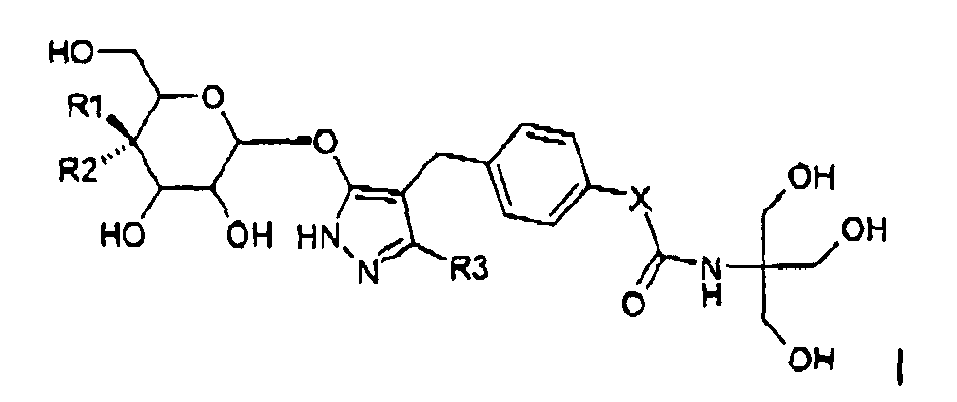
in which the meanings are
R1
H and R2 F; or
R1
F and R2 H; or
R1
F and R2 F;
R3
(C1-C8)-alkyl, where one, more than one or all hydrogen(s) may be replaced by fluorine;
X
(C1-C3)-alkylene, (C2-G3)-alkenylone.
R1
H and R2 F; or
R1
F and R2 H; or
R1
F and R2 F;
R3
(C1-C8)-alkyl, where one, more than one or all hydrogen(s) may be replaced by fluorine;
X
(C1-C3)-alkylene, (C2-G3)-alkenylone.
Description
- The present invention relates to a process for preparing pyrazole-glycoside derivatives of the general formula (I)

-
WO20051121161 
- These pyrazole-glycoside derivatives show biological activity which makes their use possible in particular in the prevention and treatment of type 1 and 2 diabetes.
- However, the late introduction of the butanoic side chain by Heck-coupling with vinyl acetate leads to undesired regioisomers which have to be separated by sophisticated HPLC methods. The lowering in yield and the effort for separation of these regioisomers makes this synthesis route not viable for a production in industrial scale.
- In view of the disadvantages and problems described above, there is a need to provide a process which avoids these disadvantages and problems and which moreover, without requiring great additional complexity, can be implemented in a simple manner and makes the desired products available in high yields with high conversion and high selectivity. High yields in particular are a central requirement for the process which is sought.
- This object is surprisingly achieved by a process for preparing compounds of the formula (I):

- R1
- H and R2 F; or
- R1
- F and R2 H; or
- R1
- F and R2 F;
- R3
- (C1-C8)-alkyl, where one, more than one or all hydrogen(s) may be replaced by fluorine;
- X
- (C1-C3)-alkylen.e, (C2-C3)-alkenylene;
-

- R3
- is (C1-C8)-alkyl, where one, more than one or all hydrogen(s) may be replaced by fluorine; preferably methyl, ethyl, propyl, isopropyl or t-butyl;
- R4
- is (C1-C8)-alkyl, preferably methyl, ethyl, propyl, isopropyl or t-butyl;
- X
- is (C1-C3)-alkylene, (C2-C3)-alkenylene;
- in which X, R3 and R4 are as defined above;
-

- in which X, R3 and R4 are as defined above;
- where R5 is is (C1-C6)-alkyl and X. R3 and R4 are as defined above;
- in which X, R3 and R5 are as defined above;
and
optionally the compound of the formula (VI) is purified by conventional purification methods such as crystallization, distillation or chromatography, preferably by crystallization from a solvent or a mixture of a plurality of solvents such as alkanes, aromatic compounds, halogenated solvents, ethers, ketones, esters, alcohols or water, particularly preferably purified by crystallization from methanol or from dichloromethane/heptane or methanol/water mixtures or by sodium salt and - after neutralization - crystallization from water; -

- in which X, R3 and R4 are as defined above.
- in which X and R3 are as defined above;
-


- R1 and R2 are defined as described above;
- PG is an OH protective group such as, for example, methyl, methoxymethyl (MOM), methylthiomethyl (MTM), phenyldimethylsilylmethoxymethyl (SMOM), benzyloxymethyl (BOM), p-methoxybenzyloxymethyl (PMBM), t-butoxymethyl, 4-pentenyloxymethyl, 2-methoxyethoxymethyl (MEM), 2-trimethylsilylethoxymethyl (SEM), trimethylsilyl (TMS), tert-butyldimethylsilyl (TBDMS), tert-butyldiphenylsilyl (TBDPS), triisopropylsilyl (TIPS), or similar silyl protective groups, 1-methyl-1-methoxyethyl (MIP), allyl, benzoyl, acetyl, trifluoroacetyl, Fmoc, THP, and preferably acetyl or benzoyl;
by adding 0.95 to 1.2 equivalents of a Li base to a compound of formula VI in an ethereal solvent, wherein suitable ethereal solvents are 1,2-dimethoxy ethane, 1,2-diethoxy ethane, 1,4-dioxane, tetrahydrofuran, methyl-tetrahydrofuran or cyclopentyl methyl ether, preferred is tetrahydrofuran, 1,4-dioxane or methyl tetrahydrofuran, more preferred tetrahydrofuran or methyl tetrahydrafuran, wherein suitable bases are LiH, alkyl lithium reagents, aryl lithium reagents or Li alkoxides, preferred are Li alkoxides, more preferred are Li alkoxides derived from hindered tertiary alcohols, such as Li tert-butoxide; - in which PG, X, R1, R2, R3 and R5 are as defined above;
and
optionally the compound of the formula (VIII) is purified by conventional purification methods such as crystallization, distillation or chromatography, preferably by crystallization from a solvent or a mixture of a plurality of solvents such as alkanes, aromatic compounds, halogenated solvents, ethers, ketones, esters, alcohols or water, particularly preferably purified by crystallization from methanol or from dichloromethane/heptane or methanol/water mixtures or by sodium salt and - after neutralization - crystallization from water; -


- R1 and R2 are defined as described above;
- PG is an OH protective group such as, for example, methyl, methoxymethyl (MOM), methylthiomethyl (MTM), phenyldimethylsilylmethoxymethyl (SMOM), benzyloxymethyl (BOM), p-methoxybenzyloxymethyl (PMBM), t-butoxymethyl, 4-pentenyloxymethyl, 2-methoxyethoxymethyl (MEM), 2-trimethylsilylethoxymethyl (SEM), trimethylsilyl (TMS), tert-butyldimethylsilyl (TBDMS), tert-butyldiphenylsilyl (TBDPS), triisopropylsilyl (TIPS), or similar silyl protective groups, 1-methyl-1-methoxyethyl (MIP), allyl, benzoyl, acetyl, trifluoroacetyl, Fmoc, THP, and preferably acetyl or benzoyl;
- in which PG, X, R1, R2, R3 and R5 are as defined above;
and
optionally the compound of the formula (VIII) is purified by conventional purification methods such as crystallization, distillation or chromatography, preferably by crystallization from a solvent or a mixture of a plurality of solvents such as alkanes, aromatic compounds, halogenated solvents, ethers, ketones, esters, alcohols or water, particularly preferably purified by crystallization from methanol or from dichloromethane/heptane or methanol/water mixtures or by sodium salt and - after neutralization - crystallization from water; -

- in which PG, X, R1, R2, R3 and R5 are as defined above;
- in which PG, X, R1, R2, R3 and R5 are as defined above;
- And the compound of the formula IX, where the definition of PG includes base sensitive protecting groups, such as acetate or benzoate, is subsequent converted to a compound of formula X

- in which X, R1, R2 and R3 are as defined above;
- R6 is (C1-C6)-alkyl, preferably methyl or ethyl;
by reaction with an excess of a salt of an alcohol in alcoholic solvent wherein referred is a lower alcohol, more preferred a lower primary alcohols, most preferred is MeOH or EtOH, wherein suitably salts are alkali or earthalkali metal salts, preferably Li, Na, K or Mg, with Na or K being more preferred;
preferred are 3 equivalents of alcoxide base, more preferred are 3 to 3.5 equivalents of NaOMe or KOMe in MeOH;
at +10°C to +90°C, with +20°C to +60°C being more preferred;
(As a consequence of this deprotection the ester R5 is converted largely to the alcohol used in this transformation. If MeOH is used, R6 will be largely Me, for EtOH R6 will be Ethyl); - in which X, R1, R2 and R3 are as defined above;
- Or
-

- in which PG, X, R1, R2, R3 and R5 are as defined above;
- in which X, R1, R2 and R3 are as defined above;
- in which X, R1, R2 and R3 are as defined above;
- The synthesis of compounds of formula II is described for example in W. Adam et al, JOC (1991), 56(20), 5782-5 and is the prototypical product of the Baylis-Hillman reaction.
- The synthesis of F-sugar derivatives of formula VII is described for example in C.S. Rye, S.G. Withers, JACS (2002), 124(33), 9756-9767; or P.J, Card, JOC (1983), 48(3), 393-5; or in
WO2004/052903 . - In an alternative embodiment the process step A. has the following meaning
-

- in which
- R3
- is (C1-C6)-alkyl, where one, more than one or all hydrogen(s) may be replaced by fluorine; preferably methyl, ethyl, propyl, isopropyl or t-butyl;
- R4
- is (C1-C6)-alkyl, preferably methyl, ethyl, propyl, isopropyl or t-butyl;

- X
- is (C1-C3)-alkylene, (C2-C3)-alkenylene;
- R5
- is (C1-C6)-alkyl;
metal hydrides, preferably NaH. wherein a suitable solvent is an ethereal solvent, preferably THF, methyl-THF, 1,4-dioxane or 1,2-dimethoxyethane;
at from -50°C to 50°C, preferably at from -20°C to 30 °C, particularly preferably at from -5°C to 5°C;
to give a compound of the formula (V),
- In an alternative embodiment the process step D. has the following meaning
-

- in which PG, X, R1, R2, R3 and R5 are as defined above;
- in which PG, X, R1, R2, R3 and R5 are as defined above;
- in which X, R1, R2 and R3 are as defined above;
- in which X, R1, R2 and R3 are as defined above;
-

- in which PG, X, R1, R2, R3 and R5 are as defined above;
- in which X, R1, R2 and R3 are as defined above;
- in which X, R1, R2 and R3 are as defined above;
- in which X, R1, R2 and R3 are as defined above;
- In a further preferred embodiment the compound of formula VII is

- PG is benzoyl or acetyl;
- R1 is H; and
- R2 is F;
- in which PG, X, R1, R2, R3 and R5 are as defined above;
- in which PG, X, R1, R2, R3 and R5 are as defined above;
- in which X, R1 and R3 are as defined above;
- in which X, R1 and R3 are as defined above;
- in which X, R1, R2 and R3 are as defined above;
- in which X, R1 and R3 are as defined above;
- in which X, R1, R2and R3 are as defined above;
- in which X, R1, R2 and R3 are as defined above;
- in which X, R1, R2 and R3 are as defined above.
- Preference is given to a multistage process for preparing the compounds of the formula (I), in which
- R1
- is H;
- R2
- is F;
- R3
- is isopropyl;
- R4, R5
- are ethyl or methyl;
- PG
- is benzoyl or acetyl;
- X
- is(CH2)3.
- The following examples illustrate the process without restricting it. Schemes 1 and 2 depict in an exemplary manner the preparation process.


- Ethylacrylate (230 ml, 2.16 mol, 1.0 eq), isobutyraldehyde (267 ml, 2.94 mol, 1.36 eq) and DABCO (167 g, 1.49 mol, 0.69 eq) were mixed together in the 3 component solvent mixture (300 ml PEG 400, 220 ml EtOH, 37 ml water) and stirred for 12 d. 1H-NMR (CDCl3) showed about 20% of the acrylate remained in the reaction mixture. DABCO (77 g, 0.69 mol, 0.32 eq) and aldehyde (100 ml, 1.10 mol, 1.1 eq) were added and the mixture was allowed stirring for 7 d (NMR showed nearly complete consumption of the acrylate). Water (1 I) was added and the aqueous layer was extracted with MTBE (1x 800 ml, 3x 350 ml). The combined organic layers were washed with NaHSO4 (2 M) until the pH of the resulting aqueous layer was about 3. The combined organic layers were washed with half conc. NH4Cl (2x 150 ml), NaHCO3 (300 ml), brine (400 ml), dried with MgSO4 and concentrated to yield a yellow oil which was dried in vacuum (0.4 mbar) for 10 h. 335 g (90%) of the Baylis-Hillman adduct were obtained as a yellow oil. 1H-NMR (500 MHz, d6-DMSO): δ = 0.74 (d, J = 6.9 Hz, 3H), 0.88 (d, J = 6.8 Hz, 3H), 1.22 (t, J = 7.2 Hz, 3H), 1.68-1.82 (m, 1H), 4.09-4.18 (m, 2H), 4.18.4.23 (m, 1H), 4.87 (d, J = 5.2 Hz, 1H), 5.77-5.80 (m, 1H), 6.11-6.23 (m, 1H).
-
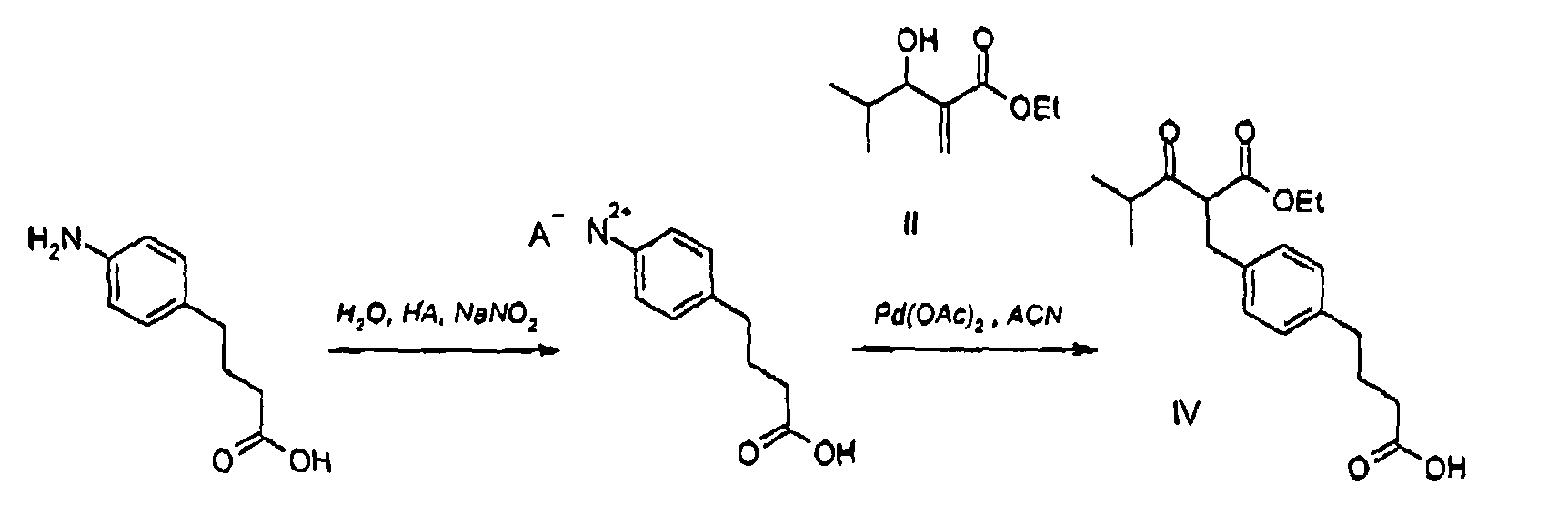
- 100 g 4-(4-Aminophenyl)-butyric acid in 400 ml water are treated with 43 ml conc. sulfuric acid 96-98% at 15-38°C (exothermic addition), followed by treatment with 38,5 g sodium nitrite in 100 ml water at -3°C to 0°C to form the corresponding diazonium salt. In a separate vessel 103 g compound II, 1.26 g palladium (II)-acetate and 5 g charcoal are suspended in 380 mL acetonitrile. The suspension is heated to 43°C and the cold diazonium solution is added at 42-49°C over 2 h and the reaction mixture is stirred at this temperature for another 2 h. After cooling to 25°C the resulting mixture is filtered over 25 g celite. The filter cake is washed with 530 ml ethyl acetate, followed by 50 ml water. After phase split the ethyl acetate phase is concentrated under reduced pressure and 200 g compound IV are obtained as a dark purple oily liquid, which is used in the next step without further purification.
- 200 g compound IV is solved in 650 ml ethanol and 4.7 ml sulfuric acid 96-98% are added. The solution is heated to 55°C and maintained at 55-58°C for 3 h to form the corresponding ethyl ester. The ethanol solution is cooled to ambient temperature and is used in the next step without treatment.
-

- 126 g sodium acetate and a solution of 162 g benzylhydrazine dihydrochloride in 250 ml water are added to the ethanol solution of compound V derived from example 3. The mixture is then heated to reflux (83°C) and maintained at this temperature for 6 h before cooling to ambient temperature. A first portion of 205 ml water are added over 15 minutes and the suspension is cooled over night at ambient temperature. The suspension is the cooled to 5°C and a second portion of 205 ml water is added. The slurry is stirred for another 1.5 h at 5°C, filtered, washed once with 200 ml ethanol/water (3:2) and four times with 100 ml water. The wet filter cake is then slurried for 2 h in 750 ml tert.-butyl methyl ether, filtered, washed with 150 ml tert.-butyl methyl ether and finally dried under reduced pressure to afford 156.9 g compound VI as a grey crystalline powder (65% yield over three steps based on 4-(4-Aminophenyl)-butyric acid).
- Aniline (15 g, 84 mmol) was ground in a mortar and then placed in a 3-neeked flask. Water (30 ml), followed by 50 ml aq. HBF4 (50%) were added and the mixture was cooled to -3°C (inner temperature). Sodium nitrite (6.01 g, 87 mmol), in 20 ml water, was added so slowly that the inner temp. was always below 0.5°C. After complete addition of the nitrite, the Baylis-Hillman adduct (compound II) (20.4 g, 119 mmol), in 200 ml acetonitrile, was added, followed by 5% Palladium acetate (inner temp 6°C). The mixture was then heated up to 65°C for 90 min. The heating was removed and the organic solvent was removed. The brown residue was brought to pH 9.5 with 2 M NaOH. The aqueous layer was extracted with MTBE (3x 100 ml). The combined organic layers were washed with water 60 ml (combined with the other basic aqueous layer), 100 ml brine (rejected), dried with MgSO4 and concentrated to yield excess Baylis-Hlllman adduct as a yellow oil. The basic aqueous layers were brought to pH 3.5 with NaHSO4 (solid). The aqueous layer was extracted with AcOEt (1x 150 ml, 2x 50 ml). The combined organic layers were dried with MgSO4 and concentrated to yield a brown oil, which was purified by chromatography on silica (n-heptane/AcOEt 4:1->3:1->2:1) to yield the product (17.6 g, 52.6 mmol, 63%) as a yellow oil. 1H-NMR (500 MHz, d6-DMSO): δ = 0.79 (d, J = 6.8 Hz, 3H), 0.96 (d, J = 6.8 Hz, 3H), 1.09 (t, J = 7.1 Hz, 3H), 1.71-1.81 (m, 2H), 4.00-4,08 (m, 2H), 4,16 (dd, J = 7.6, 7.8 Hz, 1H), 7.05-7.13 (m, 4H), 12.03 (bs, 1H); HPLC: tR = 1.46 min (YMC J' sphere ODS H 80 24x2.1mm, 4µm, A: H2O+0.05% TFA, B: MeCN, 4%→ 95% B in 2 min, 1mL/min, 30°C); Mass (ES+) (C19H26O5): calcd. 334, found 335 [M+H]+.
- Benzyl hydrazine (10.5 g, 53.8 mmol, 1.8 eq.) was suspended in 15 ml H2O. NaOH (4.42 g, 111 mmol, 3.7 eq) was added at 0°C. The pH was adjusted from 11 to 6 by addition of AcOH. Then 10.0 g (29.9 mmol, 1 eq) β-keto ester (compound V), dissolved in 45 ml AcOH, were added and the mixture was refluxed for 4 h. After cooling to room temperature water (30 ml) and AcOEt (80 ml) were added. The phases were separated and the aqueous layer was extracted with AcOEt (3x 50 ml). The combined organic layers were washed twice with 20 ml sat aqueous NH4Cl, dried with Na2SO4 and concentrated to yield a brown-orange oil. The oil was dried by azeotropic distillation with toluene (2x 30 ml). An aliquot (1 g) of the crude product was taken and purified by column chromatography (AcOEt-> AcOEt/EtOH 20:1) to yield a white solid after crystallization from AcOEt. The seed crystals so obtained were added to the crude oil in AcOEt (30 ml). The formed crystals were filtered and dried on air to yield 4.8 g (41 %) of the pyrazolone as a red-brown solid.
- HPLC: tR = 1.18 min (YMC J' sphere ODS H 80 20x2.1mm, 4µm, A: H2O+0.05% TFA, B: MeCN, 4%→ 95% B in 2 min, 1mL/min, 30°C); Mass (ES+) (C24H28N2O3): calcd. 392, found 393 [M+H]+.
- 1.1 ml (15 mmol, 2 eq.) acetyl chloride was carefully added to 40 ml EtOH with water bath cooling. After 10 min 3.0 g (7.6 mmol) benzyl pyrazolone were added and the mixture was stirred for 4 h at rt. The solvent was removed, the residue oil was distilled with 3x 20 ml AcOEt and dried in vacuum to yield 3.4 g (>100%) of the ester as a yellowish viscous oil.
- HPLC: tR = 1.42 min (YMC J' sphere ODS H 80 20x2.1mm, 4µm, A: H2O+0.05% TFA, B: MeCN, 4%→ 95% B in 2 min, 1mL/min, 30°C); Mass (ES+) (C26H32N2O3): calcd. 420, found 421 [M+H]+.
-


- 41.0 g (97.5 mmol. 1.2 eq) pyrazole VI was dissolved in 225 mL MeTHF at 50°C. To this solution 8.3 g (102 mmol, 1.25 eq) LiOtBu was added and the mixture was heated to reflux temperature. 45.3 g (81.2 mmol) flouro sugar VII was dissolved in 225 mL MeTHF and added dropwise over a period of 50 min to the refluxing reaction mixture. The reaction was kept at this temperature for 5 h.
- The pH of the reaction mixture was adjusted to 7 using 5 mL 3M hydrochloric acid. After the addition of 70 mL water the aqueous phase was separated. The organic phase was extracted with 50 mL water and twice with 50 mL sodium chloride solution (4%). The solvent was exchanged to n-propanol by concentration and addition of 300 mL n-propanol followed by azeotropic distillation of another 70 mL.
- During 2 h the solution was cooled to room temperature resulting in a slow precipitation of the product. During another 30 min the suspension was cooled to 0°C and was stirred for 1 h at this temperature. The product was filtered, washed four times with 60 mL ethanol and dried at 50°C under reduced pressure. 54 g (71%) of VIII was obtained.
HR-MS (ESI-FT-ICR): found [M+H]+: m/z=897.37698 (calculated for C53H54FN2010 897.37571) -

- 150 g (349 mmol) pyrazole VI and 197 g (349 mmol) flouro sugar VII were dissolved in 2720 mL acetonitrile and the mixture was heated to reflux temperature. 47 mL (334 mmol, 0.96 eq) triethylamine in 366 mL acetonitrile was added at this temperature over a period of 3 h. After the addition the solution was stirred for another 3h at reflux temperature. 800 mL water was added while keeping the temperature above 60°C. The mixture was cooled slowly to room temperature over night, The resulting suspension was cooled to 5°C and stirred at this temperature for 2.5 h. The product was filtered, washed twice with 440 mL ethanol, twice with 470 mL water and dried at 40°C under reduced pressure. 242 g (76%) of VIII was obtained.
-

- 106 g (114 mmol) pyrazole VIII and 107.5 g (887 mmol, 7.8 eq) 2-amino-2-hydroxymethyl-propane-1,3-diol were dissolved in 900 mL tert-butanol. 26.5 g (228 mmol, 2.0 eq) potassium tert-butylate was added and the reaction mixture was heated to 45°C and stirred for 2.5 h at this temperature. 28.5 g concentrated sulphuric acid in 250 mL water and subsequently 800 mL water was added while keeping the temperature above 40°C. The organic solvent was distilled of under reduced pressure. 1200 mL ethyl acetate was added and the resulting biphasic mixture was stirred at room temperature over night. The organic layer was washed three times with 850 mL sodium hydrogen carbonate solution (5%) and twice with 850 mL sodium chloride solution (5%) and filtered though charcoal. The charcoal was washed three times with 200 mL ethyl acetate. The resulting solution of XI was concentrated to a volume of 150 mL and was used for the next step without further purification.
-

- To a solution of pyrazole XI in ethyl acetate (total volume 150 mL) 650 mL methanol was added. 7.5 g palladium hydroxide on charcoal (20%, 55% water) was added to the solution. The reaction mixture was stirred for 21 h under a hydrogen atmosphere of 1 bar at 25°C. The catalyst was filtered of and washed with 525 mL water. The organic solvents were removed under reduced pressure and 165 mL ethyl acetate was added. The aqueous product layer was washed with 165 mL ethyl acetate and was filtered. The residual organic solvent was removed under reduced pressure. The product solution was cooled to 27°C and a few seed crystals were added. The suspension was stirred at 20°C over night and the product was filtered, washed with 35 mL water and dried under reduced pressure at 25°C. 34.2 g (52%, two steps) of I was obtained.
-

- 105 g (116 mmol) pyrazole VIII and 114 g (932 mmol, 8 eq) 2-amino-2-hydroxymethyl-propane-1,3-diol and 48.6 g potassium carbonate (348 mmol, 3 eq) were suspended in 400 ml N,N-dimethyl-acetamide. The reaction mixture was heated to 45°C and stirred for 7.5 h at this temperature. 750 ml 2-methyl-tetrahydrofurane was added and the mixture was cooled to 5°C. The suspension was filtered over charcoal and 250 ml 2-methyl-tetrahydrofurane was added. The filtrate was added to a solution of 200 g sodium chloride in 800 ml water and the phases were separated, The organic phase was washed twice with 5% NaCl solution and finally concentrated under reduced pressure. The residue was dissolved In 800 ml ethyl acetate and the solution was washed three times with 750 ml 5% NaCI solution. The organic phase was finally filtered over charcoal and concentrated to 150 ml under reduced pressure and was used for the next step without further purification.
-


- 60 g (63 mmol) pyrazole VIII was dissolved in 210 mL THF and 3 g palladium hydroxide on charcoal (20%, 55% water) was added to the solution. 420 mL ethanol was added and the reaction mixture was stirred for 6 h under a hydrogen atmosphere of 6 bar at 70°C, The catalyst was filtered of and washed with ethanol. The solvents were removed under reduced pressure. The resulting crude product IX (55.6 g) was used for the next step without further purification.
HR-MS (ESI-FT-ICR): found [M+H]+: m/z=807.3308 (calculated for C46H48FN2O10 807.328756) -

- 55.6 g pyrazole IX was dissolved in 600 mL methanol and 100 mL methanol was distilled to remove residual water. 3.9 g sodium methylate (25% solution in methanol) was added and the reaction mixture was stirred for 1 h at 35°C. The reaction mixture was adjusted to an apparent pH 5 using 0.67 mL concentrated sulphuric acid and concentrated to a volume of 120 mL. The resulting solution was washed four times with 500 mL n-heptan and concentrated under reduced pressure. The resulting crude product X (30 g) was used for the next step without further purification.
-


- 27.2 g pyrazole X was dissolved in 38 mL methanol. This solution was added over a period of 20 min to a solution of 164 g (1.3 mol, 25 eq) 2-amino-2-hydroxymethyl-propane-1,3-diol in 110 mL water. The reaction mixture was stirred for 5 h at 50°C.
- After cooling the mixture to room temperature excess of 2-amino-2-hydroxymethyl-propane-1,3-diol was filtered of. After concentration of the filtrate it was filtered again, The resulting solution of I was concentrated to a mass of 142 g. The product was purified by chromatography using Sepabeads SP70 and water and ethanol as eluent and by treatment with ion exchanger. After lyophilisation 21.3 g (68%, 3 steps) I was obtained.
MS (TOF MS ES+): found [M+H]+: m/z=570.28 (calculated for C27H41 FN309 570.28) -

- 3.62 g (60%, 91 mmol, 1.15 eq) sodium hydride was suspended in 200 mL tetrahydrofurane. 19.7 g (118 mmol, 1.5 eq) ethylisobutyryl acetate was added dropwise within 8 min at 20 °C. A vigorous gas formation was observed. 2.9 g (7.9 mmol, 0.1 eq) tetrabutylammoniumiodid and 20.0 g (79 mmol, 1.0 eq) 4-(4-chloromethyl-phenyl)-butyricacid ethylester were added. The reaction mixture was stirred for 3 h at 60 °C. After complete conversion the mixture was cooled to room temperature and the suspension was neutralised (pH 7) with 13 mL 0.5 M HCl. 45 mL water was added and the layers were separated. The organic layer was diluted with 70 mL ethyl acetate and washed five times with 100 mL sodium chloride solution (4%). The solvents were removed under reduced pressure. The resulting yellow oil contained about 7% of ethylisobutyryl acetate. This impurity was removed by stirring the crude product at 70 °C under vacuum (0.02 mbar). 29.3 g 8 (94%, 92% purity) was obtained.
- To a solution of 86 g (107 mmol) Compound IX in 950 mL ethanol 624 mL sodium hydroxide solution (1 M, 623 mmol, 5.8 eq) was added dropwise. The mixture was stirred for 6 h at room temperature and neutralised (pH 9) with 100 mL 1 M HCl solution. The solution was concentrated to a volume of 650 mL to remove ethanol. 320 mL 1 M HCl solution, 100 mL water and 800 mL diisopropylether were added. The product was isolated by filtration, was washed with water and diisopropylether and dried in vacuum at 40 °C. The crude product (48,4 g) was suspended in 500 mL diisopropylether stirred for 1 h, isolated by filtration, washed with diisopropylether and dried in vacuum at 40 °C. 47.1 g (92%) XII was obtained as slightly yellow powder.
- 1 g (2.1 mmol) XII and 300 mg (3.2 mmol, 1.5 eq) tris were dissolved in 3 mL NMP. 734 mg (3.0 mmol, 1.4 eq) EEDQ (2-ethoxy-1-ethoxycarbonyl-1,2-dihydrochinolin) was added and the reaction mixture was stirred at 55°C for 16h. After 6h 91 mg tris and after 8h 100 mg EEDQ were added to complete the reaction. In order to deplete impurities the mixture was treated portion wise with 220 mL 1 M LiOH solution and stirred at room temperature for 45h. 15 mL water was added and the aqueous layer was extracted seven times with 40 mL DCM and twice with 20 mL propyl acetate to remove NMP and impurities. The aqueous product solution was neutralised (pH 8) with 100 µL 1 M LiOH solution. The solution was concentrated from 25 g to 9 g and few seed crystals were added. The mixture was stirred for 4h at 0°C and the product
was isolated by filtration washed twice with 3 mL of cold water and dried in vacuum at 40 °C. 0.73 g (57%) of compound I was obtained as colourless solids. - 40 g (45 mmol) of compound VIII was suspended in 200 mL methanol and stirred at 40 °C for 3 h. 1.8 mL (9.5 mmol, 0.2 eq) sodium methylate was added. 45 mL THF were added and resulted in a better stirrable and a clear solution after 10 min. The reaction mixture was stirred for 5 h at 40 °C.
- A quarter of the solution was trated with 66 µl concentrated sulphuric acid (pH 3) and neutralised (pH 5-6) with 0.5 mL saturated NaHCO3 solution. The solution was concentrated under reduced pressure and three times 20 mL water was added and the mixture was concentrated each time under reduced pressure. The residue was extracted with ethyl acetate and water. The organic layer was concentrated and suspended twice in 60 mL DIPE and filtered each time. 4.2 g (64%) compound X was isolated as slightly yellow solids.
- 4.0 g (6.5 mmol) SP8 methyl ester was dissolved in 16 mL NMP. 1.7 g tris (14 mmol, 2.2 eq) and 0.17 g (2,0 mmol, 0.3 eq) LiOtBu were added. The mixture was stirred at room temperature for 18 h. The reaction mixture was added to 65 mL water and 10 mL NaHCO3 solution (8%) and extracted with 40 mL MeTHF. The aqueous layer was extracted with 40 mL MeTHF and the combined organic layers were washed four times with 20 mL NaCl solution (10%) and were concentrated under reduced pressure to give 3.9 g (88%) XI as slightly yellow solid.
- 6.0 g (10.5 mmol) VIII was dissolved in 40 mL THF, 20 mL water and 10 mL t-butanol. 10.5 mL (1M, 10.5 mmol, 1.0 eq) NaOH solution was added in 3 portions within 3 h. The first 2 h the reaction temperature was kept at 40 °C and stirred afterwards at room temperature over night. The reaction mixture was concentrated to a volume of 20 mL, diluted with 30 mL water and extracted with 100 mL DIPE. Traces of DIPE in the aqueous layer were removed by azeotropic distillation. The product solution was cooled to 0 °C and 9.5 mL 1M HCl solution was added (pH 5). The aqueous product was isolated by filtration, washed with water and dried in vacuum. 5.6 g (94%) XIII was isolated as slightly brown solids.
- 90 mg (0.162 mmol) XIII was dissolved in 1 mL DMF and the solution was cooled to 0 °C. 42 mg (0,37 mmol, 2.3 eq) N-ethylmorpholine and 22 mg (0.161 mmol, 0.99 eq) CASIBUT were added and the mixture was stirred for 5 min at 0 °C. 20 mg (1.65 mmol, 1.02 eq) tris were added and the reaction mixture was stirred at 0 °C for 2 h. 84 area% of XI were present in the reaction mixture (identified by LC MS). 8 area% of XIII were still present, too.

and by adding this mixture to a mixture of 0.8 to 1.5 equivalents, preferably 0.9 to 1.1 equivalents of the component of formula II comprising a catalyst, preferably Pd-catalyst, more preferably Pd-II-acetate, as a salt or in the presence of C-black to facilitate the subsequent Pd removal, or Pd on carbon, in a suitable solvent, which is watermiscible, preferably acetonitrile, at from 0°C to 100°C, preferably at from 0°C to 80 °C, more preferably from 20°C to 60°C;
to give a compound of the formula (IV),

optionally the compound of the formula (IV) is purified by conventional purification methods such as crystallization, distillation or chromatography, preferably by crystallization from a solvent or a mixture of a plurality of solvents such as alkanes, aromatic compounds, halogenated solvents, ethers, ketones, esters, alcohols or water, particularly preferably purified by crystallization from methanol or from dichloromethane/heptane or methanol/water mixtures or by sodium salt and - after neutralization - crystallization from water;

and the compound of formula V is subsequent reacted with 0.8 to 1.5 equivalents, preferably 0.9 to 1.1 equivalents the compound
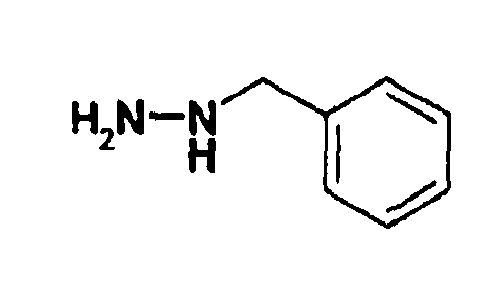
if the hydrazine is used in the form of a salt, addition of 0.5 to 2 equivalents of a base can speed up the reaction; suitable bases are the alkali salts of the respective carboxylic acids, such as sodium acetate or potassium propionate. It is apparent that these salts can be generated in situ by the addition of NaOH, KOH or NaOMe or KOMe to the carboxylic acid;
at from -50°C to +150°C, preferably at from -20°C to +100°C, particularly preferably at from 60°C to 75°C,
to give a compound of the formula (VI)


if the hydrazine is used in the form of a salt, addition of 0.5 to 2 equivalents of a base can speed up the reaction; suitable bases are the alkali salts of the respective carboxylic acids, such as sodium acetate or potassium propionate;
at from -50°C to +150°C, preferably at from -20°C to +100°C, particularly preferably at from 60°C to 75°C,
to give a compound of formula Via

to give a compound of formula VI

optionally the compound of the formula (VI) is purified by conventional purification methods such as crystallization, distillation or chromatography, preferably by crystallization from a solvent or a mixture of a plurality of solvents such as alkanes, aromatic compounds, halogenated solvents, ethers, ketones, esters, alcohols or water, particularly preferably purified by crystallization from methanol or from dichloromethane/heptane or methanol/water mixtures or by sodium salt and - after neutralization - crystallization from water;

at 40°C to 120°C, preferably of 60°C to 100°C;
to give a compound of formula VIII


and optionally the compound of formula IX can be isolated using techniques known to those skilled in the art, but it can also be used in crude, unisolated form;

and subsequent the compound of the formula (I) is purified by conventional purification methods such as crystallization or chromatography, preferably by crystallization from a solvent or a mixture of a plurality of solvents such as alkanes, aromatic compounds, halogenated solvents, ethers, ketones, esters, alcohols or water, particularly preferably by crystallization from alcohols or alcohols/water mixtures, very particularly preferably by crystallization from methanol/water.
preferable is the use of 5 to 50 equivalents of tris(hydroxymethyl)aminomethane, with 10 to 20 equivalents being more preferred,
to give a compound of formula XI

subsequent hydrogenolysis with a heterogeneous platinum metal catalyst, preferably Pd or Rh deposited on a solid support, wherein a preferred solid support is C with Pd; at a hydrogen pressure of 1 bar to 60 bars, with 1 bar to 20 bars being preferred, more preferred is a pressure of 5 bars to 10 bars;
at 20°C to 90°C, with 30°C to 50°C being more preferred,
to give a compound of formula I


and optionally the compound of formula IX can be isolated using techniques known to those skilled in the art, but it can also be used in crude, unisolated form;
and the compound of the formula IX is subsequent converted to a compound of formula XII

at +10°C to +90°C. preferably at +20°C to +60°C;
and subsequent reacting with an excess of tris(hydroxymethyl)aminomethane in a suitable solvent with an amide forming reagent to an solution or suspension of the compound of formula XII
to give the compound of formula I

and subsequent
isolation of the product is achieved by conventional methods like resin chromatography of the crude reaction mixture.
Or

at +10°C to +90°C, preferably at +20°C to +60°C ;
and subsequent reacting of an solution or suspension of the compound of formula XIII with an excess of tris(hydroxymethyl)aminomethane in a suitable solvent with an amide forming reagent
to give a compound of formula XI
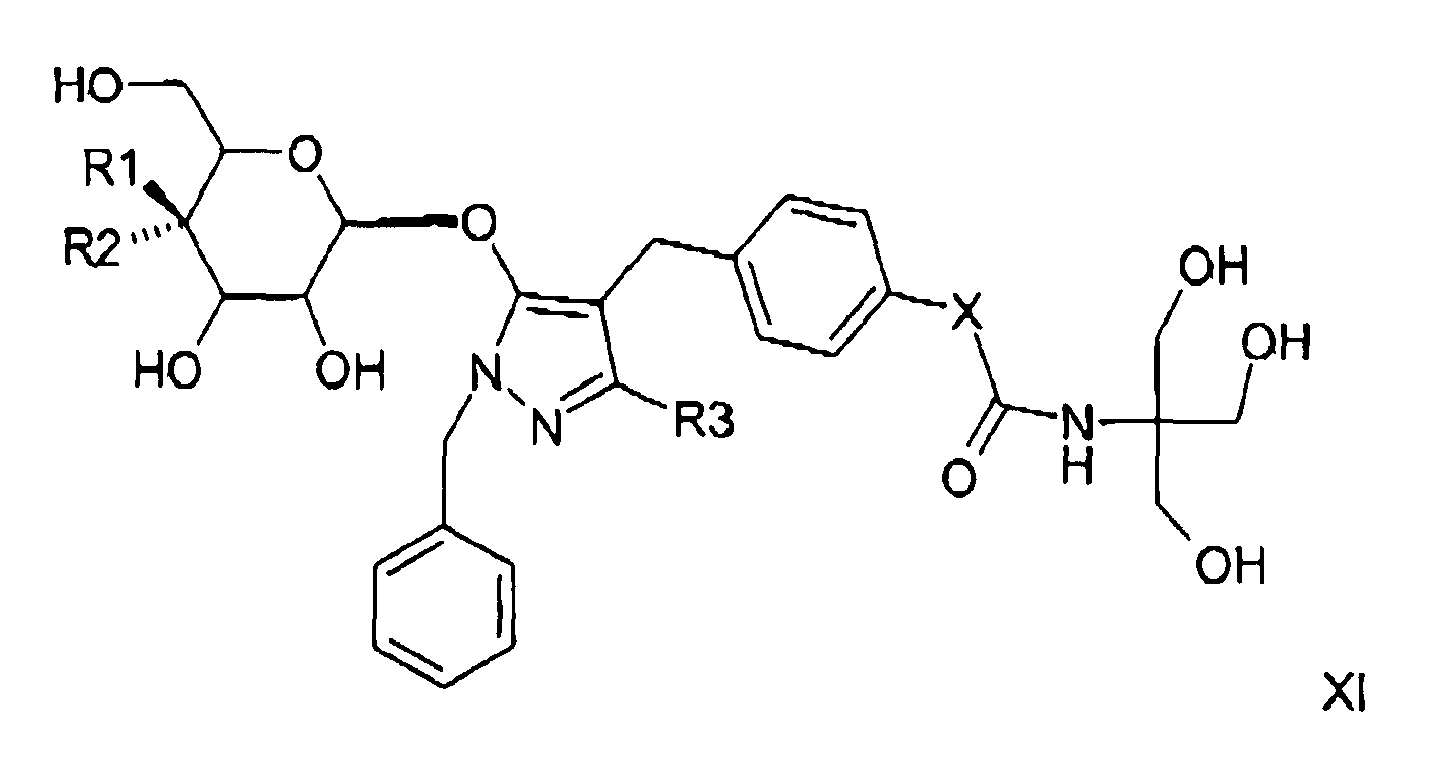
and
subsequent hydrogenolysis with a heterogeneous platinum metal catalyst, preferably Pd or Rh deposited on a solid support, wherein a preferred solid support is C, with Pd/C being more preferred; at a hydrogen pressure of 1 bar to 60 bars, preferably 1 bar to 20 bars, more preferred is a pressure of 5 bars to 10 bars,
at 20°C to 90°C, preferably at 30°C to 50°C.
to give a compound of formula I


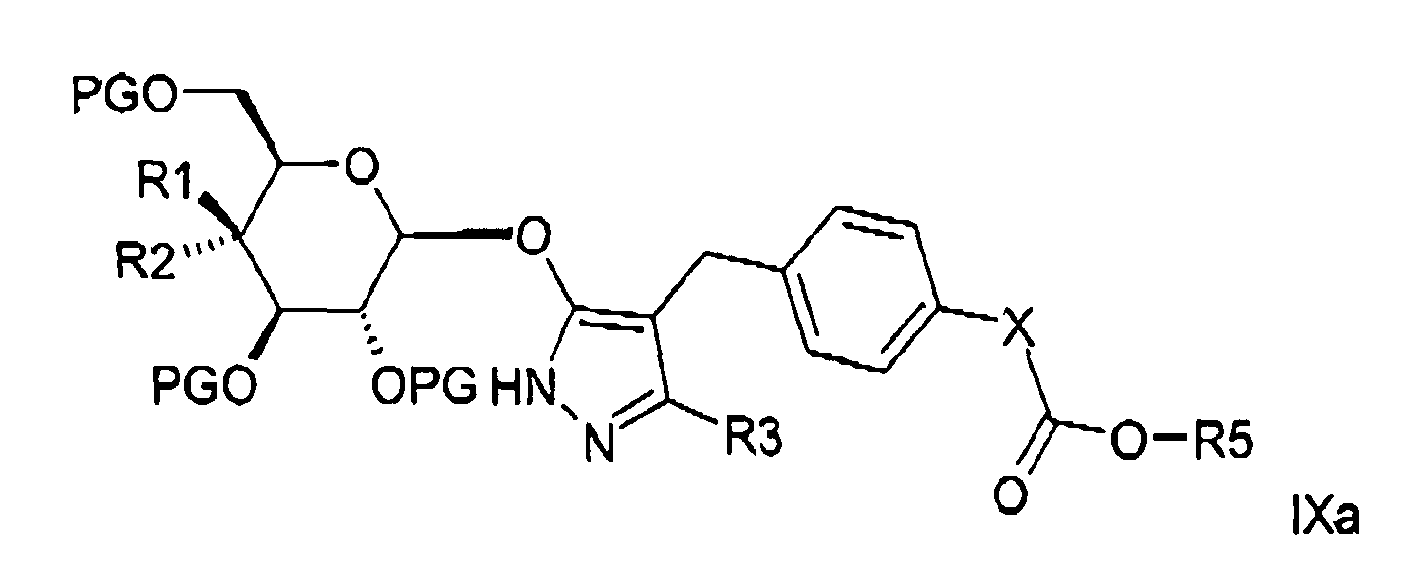


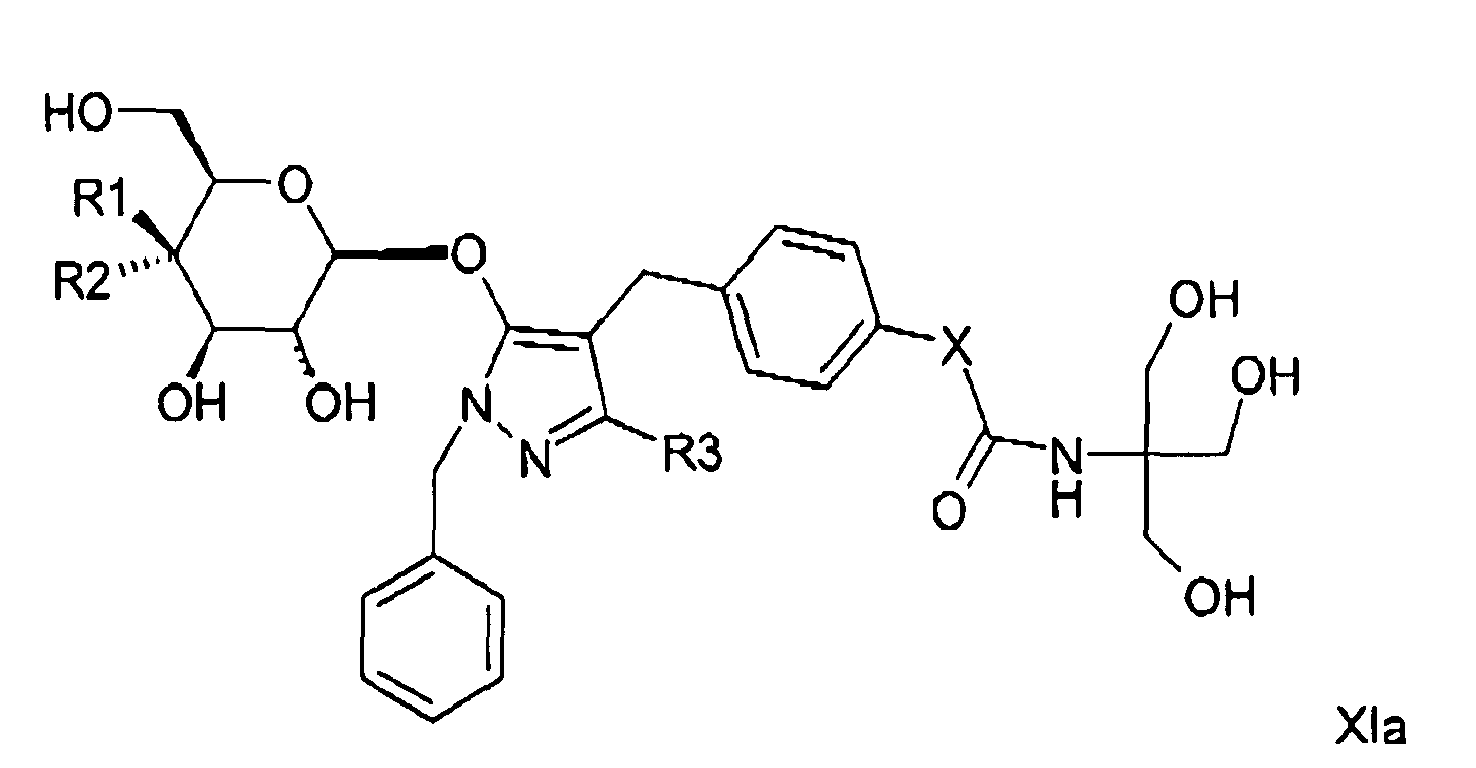


Claims (13)
- A process for preparing compounds of the general formula (I):
 R1 H and R2 F; orR1 F and R2 H; orR1 F and R2 F;R3 (C1-C8)-alkyl, where one, more than one or all hydrogen(s) may be replaced by fluorine; .X (C1-C3)-alkylene, (C2-C3)-alkenylene;which comprises applying a multistage process in which
A. Preparation of the beta-keto-ester
A.1. the component of the formula (II) R3 is (C1-C8)-alkyl, where one, more than one or all hydrogen(s) may be replaced by fluorine;R4 is (C1-C8)-alkyl;is reacted with 0.5 to 2 equivalents of compound of the formula (III)
 X is (C1-C3)-alkylene, (C2-C3)-alkenylene;by first treating compound of formula III in the presence of from 0.1 to 10 equivalents, of one or more acids in a suitable solvent, at from -50°C to 0°C, with 1.0 to 1.5 equivalents of NaNO2, and
by adding this mixture to a mixture of 0.8 to 1.5 equivalents of the component of formula II comprising a catalyst, in a suitable solvent, which is watermiscible, at 0°C to 100°C;
to give a compound of the formula (IV), in which X, R3 and R4 are as defined above;and
optionally the compound of the formula (IV) is purified by conventional purification methods such as crystallization, distillation or chromatography;
B. Preparation of pyrazolones
B.1. A compound of formula IV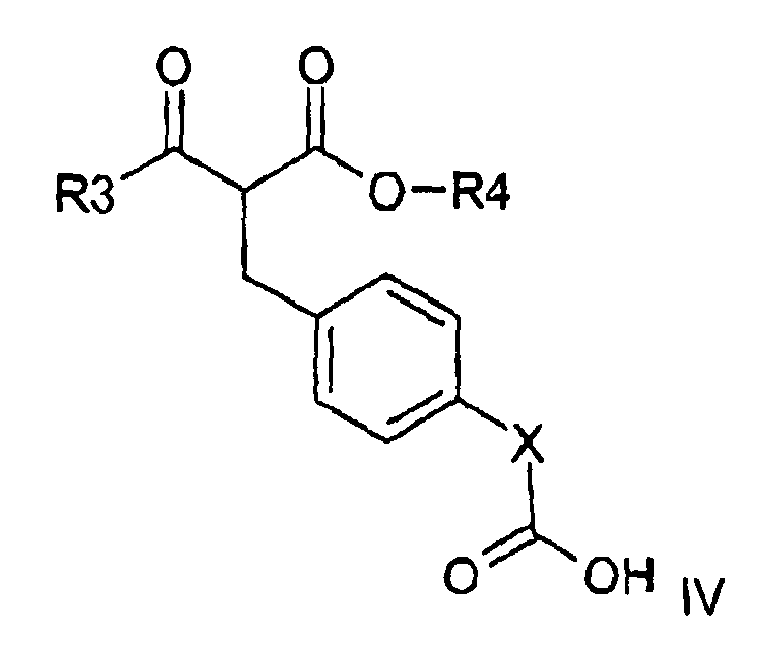 in which X, R3 and R4 are as defined above;is converted to a compound of formula V
 where R5 is is (C1-C6)-alkyl and X, R3 and R4 are as defined above;by treatment with R5-OH in the presence of an acidic catalyst and a water removing reagent;
and the compound of formula V is subsequent reacted with 0.8 to 1.5 equivalents of the compound
 in which X, R3 and R5 are as defined above;and
optionally the compound of the formula (VI) is purified by conventional purification methods such as crystallization, distillation or chromatography;
or
B.2. A compound of formula IV in which X, R3 and R4 are as defined above.is reacted reacted with 0.8 to 1.5 equivalents of the compound
to give a compound of formula VIa in which X and R3 are as defined above;which is reacted further in the presence by treatment with R5-OH in the presence of an acidic catalyst and a water removing reagent;
to give a compound of formula VI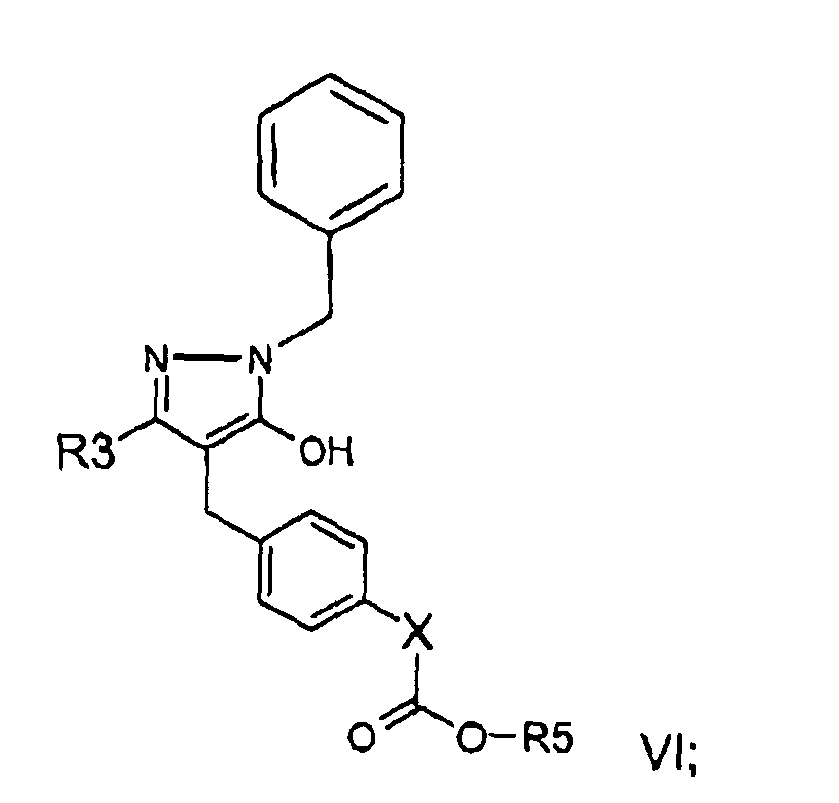
optionally the compound of the formula (VI) is purified by conventional purification methods such as crystallization, distillation or chromatography;
C. Preparation of pyrazolone glycoside
C.1. A compound of the formula (VI) where R3 and R5 are defined as described aboveis reacted with a sugar derivative of the formula (VII)
 R1 and R2 are defined as described above;PG is an OH protective group;by adding 0.95 to 1.2 equivalents of a Li base to compound VI In an ethereal solvent;
and the Li salt of the compound of the formula (VI) is subsequently reacted with 0.5 to 2 equivalents of the compound of the formula VII at 40°C to 120°C;
to give the compound of the formula (VIII); in which PG, X, R1, R2, R3 and R5 are as defined above;and
optionally the compound of the formula (VIII) is purified by conventional purification methods such as crystallization, distillation or chromatography;
or
C.2. the compound of the formula (VI)
 R1 and R2 are defined as described above;PG is an OH protective group;in an inert solvent in the presence of a trialkyl amine base at 40°C to 120°C, to give a compound of formula VIII
 in which PG, X, R1, R2, R3 and R5 are as defined above;and
optionally the compound of the formula (VIII) is purified by conventional purification. methods such as crystallization, distillation or chromatography;
D. Preparation of the pyrazole-glycoside derivative
D.1. The compound of formula VIII in which PG, X, R2 , R2, R3 and R5 are as defined above;Is converted to compound IX
 in which PG, X, R1, R2, R3 and R5 are as defined above;by hydrogenolysis with a transition metal catalyst in a suitable solvent at +10°C to +80°C at a hydrogen pressure of 1 bar to 60 bars;
The resulting free N unprotected 3-pyrazolone can be isolated or used in crude, unisolated form;
and the compound of the formula IX is subsequent converted to a compound of formula X in which X, R1, R2 and R3 are as defined above;R6 is (C1-C6)-alkyl;
by reaction with an excess of a salt of an alcohol In alcoholic solvent at +10°C to +94°C;
and subsequent reacting with an excess of a concentrated aqueous solution of tris(hydroxymethyl)aminomethane to an aqueous solution of the compound of formula X
gives the compound of formula I in which X, R2, R2 and R3 are as defined above;and subsequent
isolation of the product is achieved by conventional methods like resin chromatography of the crude reaction mixture.
OrD.2. a compound of formula VIII in which PG, X, R1, R2, R3 and R5 are as defined above;is reacted with an excess tris(hydroxymethyl)aminomethane in an alcoholic solvent in the presence of an alcoxide
to give a compound of formula XI in which X, R1, R2 and R3 are as defined above;and
subsequent hydrogenolysis with a heterogeneous platinum metal catalyst on a solid support at a hydrogen pressure of 1 bar to 60 bars at 20°C to 90°C
to give a compound of formula I in which X, R1, R2 and R3 are as defined above;and subsequently the compound of the formula (I) is purified by conventional purification methods such as crystallization or chromatography.
 - A process for preparing a compound of the general formula (I) as claimed in claim 1, where the process step A. has the following meaning
A.2. the component of the formula (Ila)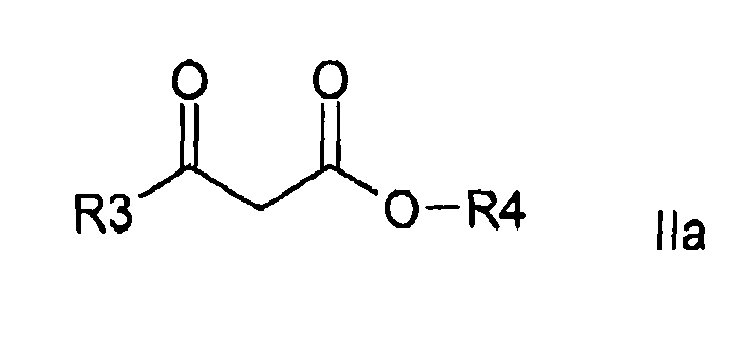 R3 is (C1-C8)-alkyl, where one, more than one or all hydrogen(s) may be replaced by fluorine;R4 is (C1-C8)-alkyl;is reacted with 0.5 to 2 equivalents of compound of the formula (Illa)
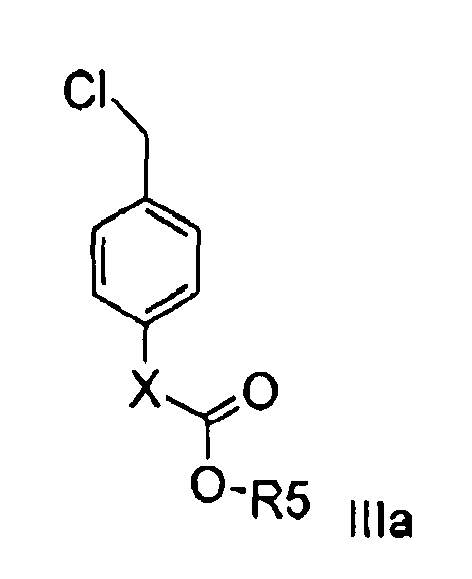 X is (C1-C3)-alkylene, (C2-C3)-alkenylene;R5 is (C1-C6)-alkyl;in the presence of from 0.1 to 10 equivalents of a strong non-nucleophic base, optionally in the presence of a phase transfer catalyst, with 0.05 to 0.5 equivalents of a phase transfer catalyst, in a suitable solvent at from -50°C to 50°C to give a compound of the formula (V),
- A process for preparing a compound of the general formula (I) as claimed in claim 1 or 2, where the process step D. has the following meaning
D. Preparation of the pyrazole-glycoside derivative
0.3 The compound of formula VIII in which PG, X, R1, R2, R3 and R5 are as defined above;is converted to compound IX
 in which PG, X, R1, R2, R3 and R5 are as defined above;by hydrogenolysis with a transition metal catalyst, in a suitable solvent at +10°C to +80°C at a hydrogen pressure of 1 bar to 60 bars;
and optionally the compound of formula IX can be isolated using techniques known to those skilled in the art, but it can also be used in crude, unisolated form;
and the compound of the formula IX is subsequent converted to a compound of formula XII in which X, R1, R2 and R3 are as defined above;by reaction with a base in an aqueous solvent at +10°C to +90°C;
and subsequent reacting with an excess of tris(hydroxymethyl)aminomethane in a suitable solvent with an amide forming reagent to an solution or suspension of the compound of formula XII
to give the compound of formula I in which X, R1, R2 and R3 are as defined above;and subsequent
isolation of the product is achieved by conventional methods like resin chromatography of the crude reaction mixture.
Or
D.4. a compound of formula VIII in which PG, X, R1, R2, R3 and R5 are as defined above;is converted to the compound of the formula XIII
 in which X, R1, R2 and R3 are as defined above;by reaction with a base in an aqueous solvent at +10°C to +90°C,
and subsequent reacting of an solution or suspension of the compound of formula XIII with an excess of tris(hydroxymethyl)aminomethane in a suitable solvent with an amide forming reagent
to give a compound of formula XI in which X, R1, R2 and R3 are as defined above;and
subsequent hydrogenolysis with a heterogeneous platinum metal catalyst at a hydrogen pressure of 1 bar to 60 bars at 20°C to 90°C,
to give a compound of formula I in which X, R1, R2 and R3 are as defined above;and subsequently the compound of the formula (I) is purified by conventional purification methods such as crystallization or chromatography, preferably by crystallization from a solvent or a mixture of a plurality of solvents such as alkanes, aromatic compounds, halogenated solvents, ethers, ketones, esters, alcohols or water, particularly preferably by crystallization from alcohols or alcohols/water mixtures, very particularly preferably by crystallization from methanol/water.
 - A process for preparing a compound of the general formula (I) as claimed in claim 1, 2 or 3, wherein the compound of formula VII is
 PG is benzoyl or acetyl;R1 is H; andR2 is F.
 - A process for preparing a compound of the general formula (I) as claimed in claim 1 to 4, in whichR1 is H;R2 is F;R3 is isopropyl;R4, R5 are ethyl or methyl;PG is benzoyl or acetyl;X is (CH2)3.
- The compound

- The compound

- The compound

- The compound

- The compound

- The compound

- The compound

- The compound

Priority Applications (14)
| Application Number | Priority Date | Filing Date | Title |
|---|---|---|---|
| EP09290651A EP2298782A1 (en) | 2009-08-26 | 2009-08-26 | Method for producing pyrazole glycoside derivatives |
| US13/391,759 US20120264925A1 (en) | 2009-08-26 | 2010-08-26 | Method for producing pyrazole glycoside derivatives |
| CA2770613A CA2770613A1 (en) | 2009-08-26 | 2010-08-26 | Method for producing pyrazole glycoside derivatives |
| JP2012526057A JP2013503136A (en) | 2009-08-26 | 2010-08-26 | Method for producing pyrazole glycoside derivative |
| AU2010288524A AU2010288524A1 (en) | 2009-08-26 | 2010-08-26 | Method for producing pyrazole glycoside derivatives |
| MX2012002167A MX2012002167A (en) | 2009-08-26 | 2010-08-26 | Method for producing pyrazole glycoside derivatives. |
| PCT/EP2010/062462 WO2011023755A1 (en) | 2009-08-26 | 2010-08-26 | Method for producing pyrazole glycoside derivatives |
| CN2010800379179A CN102482311A (en) | 2009-08-26 | 2010-08-26 | Process for preparing pyrazole glycoside derivatives |
| BR112012004152A BR112012004152A2 (en) | 2009-08-26 | 2010-08-26 | method for producing pyrazol glycoside derivatives |
| SG2012011755A SG178515A1 (en) | 2009-08-26 | 2010-08-26 | Method for producing pyrazole glycoside derivatives |
| EP10745265A EP2470551A1 (en) | 2009-08-26 | 2010-08-26 | Method for producing pyrazole glycoside derivatives |
| KR1020127004149A KR20120055562A (en) | 2009-08-26 | 2010-08-26 | Method for producing pyrazole glycoside derivatives |
| RU2012111356/04A RU2012111356A (en) | 2009-08-26 | 2010-08-26 | METHODS FOR PRODUCING PYRAZOLGLYCOSIDE DERIVATIVES |
| IL218222A IL218222A0 (en) | 2009-08-26 | 2012-02-20 | Method for producing pyrazole glycoside derivatives |
Applications Claiming Priority (1)
| Application Number | Priority Date | Filing Date | Title |
|---|---|---|---|
| EP09290651A EP2298782A1 (en) | 2009-08-26 | 2009-08-26 | Method for producing pyrazole glycoside derivatives |
Publications (1)
| Publication Number | Publication Date |
|---|---|
| EP2298782A1 true EP2298782A1 (en) | 2011-03-23 |
Family
ID=42711899
Family Applications (2)
| Application Number | Title | Priority Date | Filing Date |
|---|---|---|---|
| EP09290651A Withdrawn EP2298782A1 (en) | 2009-08-26 | 2009-08-26 | Method for producing pyrazole glycoside derivatives |
| EP10745265A Withdrawn EP2470551A1 (en) | 2009-08-26 | 2010-08-26 | Method for producing pyrazole glycoside derivatives |
Family Applications After (1)
| Application Number | Title | Priority Date | Filing Date |
|---|---|---|---|
| EP10745265A Withdrawn EP2470551A1 (en) | 2009-08-26 | 2010-08-26 | Method for producing pyrazole glycoside derivatives |
Country Status (13)
| Country | Link |
|---|---|
| US (1) | US20120264925A1 (en) |
| EP (2) | EP2298782A1 (en) |
| JP (1) | JP2013503136A (en) |
| KR (1) | KR20120055562A (en) |
| CN (1) | CN102482311A (en) |
| AU (1) | AU2010288524A1 (en) |
| BR (1) | BR112012004152A2 (en) |
| CA (1) | CA2770613A1 (en) |
| IL (1) | IL218222A0 (en) |
| MX (1) | MX2012002167A (en) |
| RU (1) | RU2012111356A (en) |
| SG (1) | SG178515A1 (en) |
| WO (1) | WO2011023755A1 (en) |
Families Citing this family (1)
| Publication number | Priority date | Publication date | Assignee | Title |
|---|---|---|---|---|
| TR201908247T4 (en) | 2012-11-20 | 2019-06-21 | Lexicon Pharmaceuticals Inc | Sodium glucose co-transporter 1 inhibitors. |
Citations (4)
| Publication number | Priority date | Publication date | Assignee | Title |
|---|---|---|---|---|
| WO2004052903A1 (en) | 2002-12-12 | 2004-06-24 | Aventis Pharma Deutschland Gmbh | Novel fluoroglycoside heterocyclic derivatives, pharmaceutical products containing said compounds and the use thereof |
| EP1544208A1 (en) * | 2002-08-08 | 2005-06-22 | Kissei Pharmaceutical Co., Ltd. | Pyrazole derivative, medicinal composition containing the same, medicinal use thereof, and intermediate for production thereof |
| EP1548024A1 (en) * | 2002-08-23 | 2005-06-29 | Kissei Pharmaceutical Co., Ltd. | Pyrazole derivatives, medicinal composition containing the same, medicinal use thereof, and intermediate for production thereof |
| WO2005121161A1 (en) | 2004-06-11 | 2005-12-22 | Sanofi-Aventis Deutschland Gmbh | Novel fluoroglycoside derivatives of pyrazoles, medicaments containing these compounds, and the use thereof |
Family Cites Families (4)
| Publication number | Priority date | Publication date | Assignee | Title |
|---|---|---|---|---|
| ATE216704T1 (en) * | 1996-12-26 | 2002-05-15 | Tanabe Seiyaku Co | PROPIOPHENONE DERIVATIVES AND METHOD FOR THE PRODUCTION THEREOF |
| WO2002036602A1 (en) * | 2000-11-02 | 2002-05-10 | Ajinomoto Co., Inc. | Novel pyrazole derivatives and diabetes remedies containing the same |
| CN100351263C (en) * | 2002-08-08 | 2007-11-28 | 橘生药品工业株式会社 | Pyrazole derivative, medicinal composition containing the same, medicinal use thereof, and intermediate for production thereof |
| CN100413878C (en) * | 2002-08-23 | 2008-08-27 | 橘生药品工业株式会社 | Pyrazole derivatives, pharmaceutical compositions containing the derivatives, their medical use and intermediates for their preparation |
-
2009
- 2009-08-26 EP EP09290651A patent/EP2298782A1/en not_active Withdrawn
-
2010
- 2010-08-26 KR KR1020127004149A patent/KR20120055562A/en not_active Withdrawn
- 2010-08-26 BR BR112012004152A patent/BR112012004152A2/en not_active IP Right Cessation
- 2010-08-26 EP EP10745265A patent/EP2470551A1/en not_active Withdrawn
- 2010-08-26 US US13/391,759 patent/US20120264925A1/en not_active Abandoned
- 2010-08-26 CN CN2010800379179A patent/CN102482311A/en active Pending
- 2010-08-26 RU RU2012111356/04A patent/RU2012111356A/en not_active Application Discontinuation
- 2010-08-26 SG SG2012011755A patent/SG178515A1/en unknown
- 2010-08-26 JP JP2012526057A patent/JP2013503136A/en not_active Abandoned
- 2010-08-26 CA CA2770613A patent/CA2770613A1/en not_active Abandoned
- 2010-08-26 MX MX2012002167A patent/MX2012002167A/en not_active Application Discontinuation
- 2010-08-26 AU AU2010288524A patent/AU2010288524A1/en not_active Abandoned
- 2010-08-26 WO PCT/EP2010/062462 patent/WO2011023755A1/en not_active Ceased
-
2012
- 2012-02-20 IL IL218222A patent/IL218222A0/en unknown
Patent Citations (4)
| Publication number | Priority date | Publication date | Assignee | Title |
|---|---|---|---|---|
| EP1544208A1 (en) * | 2002-08-08 | 2005-06-22 | Kissei Pharmaceutical Co., Ltd. | Pyrazole derivative, medicinal composition containing the same, medicinal use thereof, and intermediate for production thereof |
| EP1548024A1 (en) * | 2002-08-23 | 2005-06-29 | Kissei Pharmaceutical Co., Ltd. | Pyrazole derivatives, medicinal composition containing the same, medicinal use thereof, and intermediate for production thereof |
| WO2004052903A1 (en) | 2002-12-12 | 2004-06-24 | Aventis Pharma Deutschland Gmbh | Novel fluoroglycoside heterocyclic derivatives, pharmaceutical products containing said compounds and the use thereof |
| WO2005121161A1 (en) | 2004-06-11 | 2005-12-22 | Sanofi-Aventis Deutschland Gmbh | Novel fluoroglycoside derivatives of pyrazoles, medicaments containing these compounds, and the use thereof |
Non-Patent Citations (3)
| Title |
|---|
| C.S. RYE; S.G. WITHERS, JACS, vol. 124, no. 33, 2002, pages 9756 - 9767 |
| P.J, CARD, JOC, vol. 48, no. 3, 1983, pages 393 - 5 |
| W. ADAM ET AL., JOC, vol. 56, no. 20, 1991, pages 5782 - 5 |
Also Published As
| Publication number | Publication date |
|---|---|
| US20120264925A1 (en) | 2012-10-18 |
| IL218222A0 (en) | 2012-04-30 |
| BR112012004152A2 (en) | 2015-09-08 |
| CN102482311A (en) | 2012-05-30 |
| RU2012111356A (en) | 2013-10-10 |
| MX2012002167A (en) | 2012-04-11 |
| CA2770613A1 (en) | 2011-03-03 |
| AU2010288524A1 (en) | 2012-04-19 |
| WO2011023755A1 (en) | 2011-03-03 |
| EP2470551A1 (en) | 2012-07-04 |
| JP2013503136A (en) | 2013-01-31 |
| KR20120055562A (en) | 2012-05-31 |
| SG178515A1 (en) | 2012-04-27 |
Similar Documents
| Publication | Publication Date | Title |
|---|---|---|
| WO2008144980A1 (en) | The preparation method and intermediates of capecitabine | |
| EP2878595A1 (en) | Method of producing 4-[5-(pyridin-4-yl)-1h-1,2,4-triazole-3-yl]pyridin-2-carbonitrile, and intermediary thereof | |
| JP3042073B2 (en) | Nucleoside derivative and method for producing the same | |
| EP0072977A1 (en) | Process for the production of 2-beta-D-ribofuranosylthiazole-4-carboxamide | |
| JP2007269657A (en) | Method for producing α-glycerophosphorylcholine crystals | |
| US20120022282A1 (en) | Process for the preparation of 2,4,6-octatriene-1-oic acid and 2,4,6-octatriene-1-ol | |
| CA2702873C (en) | Improved process for preparing 2-(substituted phenyl)-2-hydroxy-ethyl carbamates | |
| US6891036B2 (en) | Process for the preparation of ribofuranose derivatives | |
| EP2470551A1 (en) | Method for producing pyrazole glycoside derivatives | |
| US12173028B2 (en) | Method for producing glycoside compound | |
| CN1982301B (en) | 2', 2'-difluoronucleoside and preparation method of its intermediate | |
| KR100699099B1 (en) | 1-α-halo-2,2-difluoro-2-deoxy-D-ribofuranose derivative and preparation method thereof | |
| CN116924934B (en) | A method for preparing an azide compound | |
| JP2004217540A (en) | Method for producing gallic acid glycoside | |
| JP2009256335A (en) | Preparation method of ribonucleic acid having alkyl protective group at position 2' | |
| JPH0798833B2 (en) | 2'-Bromo-2 ', 3'-didehydro-2', 3'-dideoxycytidine and process for producing the same | |
| EP4682155A1 (en) | Production methods for 2'-o-modified adenosine phosphoramidite and intermediate thereof | |
| US7968521B2 (en) | Stable cystal of protected pseudouridine | |
| HU198949B (en) | Process for producing 5-substituted-3'azido-2',3'-dideoxyribonucleosides | |
| CN118165058A (en) | Intermediate 5-fluoro-3 ' -O-acetyl-5 ' -O-tert-butyl dimethyl silicon-2 ' -deoxyuridine and preparation method thereof | |
| CN117700369A (en) | Preparation method of 2- (2-chloropyrimidine-5-yl) acetic acid/ester | |
| KR20090085445A (en) | Process for the preparation of 2-aminomalonamide as an intermediate for the production of 4-carbamoyl-1-β-D-ribofuranoslimidazolium-5-oleate | |
| JPH0692394B2 (en) | Method for producing 2 ', 3'-dideoxycytidine | |
| JPWO1999021872A1 (en) | Methods for synthesizing nucleotide compounds and oligonucleotides | |
| JP2004123699A (en) | Process for producing diglycosylated gallic acid derivatives |
Legal Events
| Date | Code | Title | Description |
|---|---|---|---|
| PUAI | Public reference made under article 153(3) epc to a published international application that has entered the european phase |
Free format text: ORIGINAL CODE: 0009012 |
|
| AK | Designated contracting states |
Kind code of ref document: A1 Designated state(s): AT BE BG CH CY CZ DE DK EE ES FI FR GB GR HR HU IE IS IT LI LT LU LV MC MK MT NL NO PL PT RO SE SI SK SM TR |
|
| AX | Request for extension of the european patent |
Extension state: AL BA RS |
|
| STAA | Information on the status of an ep patent application or granted ep patent |
Free format text: STATUS: THE APPLICATION HAS BEEN WITHDRAWN |
|
| RAP1 | Party data changed (applicant data changed or rights of an application transferred) |
Owner name: SANOFI |
|
| 18W | Application withdrawn |
Effective date: 20110527 |