EP2297991B1 - Methods and systems for obscuring network topologies - Google Patents
Methods and systems for obscuring network topologies Download PDFInfo
- Publication number
- EP2297991B1 EP2297991B1 EP09794718.8A EP09794718A EP2297991B1 EP 2297991 B1 EP2297991 B1 EP 2297991B1 EP 09794718 A EP09794718 A EP 09794718A EP 2297991 B1 EP2297991 B1 EP 2297991B1
- Authority
- EP
- European Patent Office
- Prior art keywords
- identity
- network
- cell
- base station
- network cell
- Prior art date
- Legal status (The legal status is an assumption and is not a legal conclusion. Google has not performed a legal analysis and makes no representation as to the accuracy of the status listed.)
- Not-in-force
Links
Images



Classifications
-
- H—ELECTRICITY
- H04—ELECTRIC COMMUNICATION TECHNIQUE
- H04W—WIRELESS COMMUNICATION NETWORKS
- H04W8/00—Network data management
- H04W8/02—Processing of mobility data, e.g. registration information at HLR [Home Location Register] or VLR [Visitor Location Register]; Transfer of mobility data, e.g. between HLR, VLR or external networks
- H04W8/08—Mobility data transfer
- H04W8/16—Mobility data transfer selectively restricting mobility data tracking
-
- H—ELECTRICITY
- H04—ELECTRIC COMMUNICATION TECHNIQUE
- H04L—TRANSMISSION OF DIGITAL INFORMATION, e.g. TELEGRAPHIC COMMUNICATION
- H04L63/00—Network architectures or network communication protocols for network security
- H04L63/04—Network architectures or network communication protocols for network security for providing a confidential data exchange among entities communicating through data packet networks
-
- H—ELECTRICITY
- H04—ELECTRIC COMMUNICATION TECHNIQUE
- H04W—WIRELESS COMMUNICATION NETWORKS
- H04W64/00—Locating users or terminals or network equipment for network management purposes, e.g. mobility management
-
- H—ELECTRICITY
- H04—ELECTRIC COMMUNICATION TECHNIQUE
- H04W—WIRELESS COMMUNICATION NETWORKS
- H04W8/00—Network data management
- H04W8/26—Network addressing or numbering for mobility support
Definitions
- the present invention generally relates to radio communication systems, devices, software and methods and, more particularly, to mechanisms and techniques for obscuring network topologies associated therewith.
- Mobile phones and services on mobile handsets have had a remarkable evolution over the last few decades.
- 3GPP third generation partnership project
- GSM Global System for Mobile communications
- 3G Third Generation
- circuit switched telephony and later Short Message Service were pretty much the only services available.
- mobile handsets and their networks have evolved to powerful devices capable of running local application and browser based services, connected to a network providing a bandwidth high enough for TV and interactive multimedia.
- IP Internet Protocol
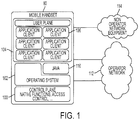
- FIG. 1 illustrates a conceptual view of a typical mobile handset 80.
- a bottom layer 100 represents the control plane, which provides the core functionality of the mobile handset 80, e.g., communications with the mobile phone via control signalling used to manage the connection, mobility and also some of the basic services (e.g., call control and SMS).
- the operating system OS 102 On top of the control layer 100 may be the operating system OS 102, which manages the phone's functionality and provides the interface to functionality for applications and clients in the user plane 104.
- Clients and/or applications 106 such as browsers, calendar and games, are examples of services implemented in the user plane 104, on top of the operating system 102.
- the mobile phones may also include a Java Virtual Machine (JVM) 110.
- JVM 110 may run on top of the operating system 102 and enables Java based applications to run on the handset 80.
- JVMs There are various JVMs which are adapted for platforms with different computing capacity and characteristics.
- One common JVM for mobile handsets is known as the Java Micro Edition, J2ME.
- J2ME provides a number of application programming interfaces (APIs) for application developers to use when developing applications for mobile handsets.
- APIs application programming interfaces
- the J2ME environment is advantageous for those developers that are not associated with a certain operator but intend to deploy applications on handsets subscribing to a certain operator.
- the exemplary embodiments describe how to allow these developers to access the sensitive information from the control plane when the operator has a relationship with the developers and how to deny other developers and/or operators to access the information in the control plane when these later developers and/or operators are not authorized to access that data.
- Java may be used, for example, to reduce the amount of customization of applications associated with different handset models, since the Java APIs used for different handset models are relatively similar to one another.
- Other OS may be used instead of JVM as discussed later.
- the user plane 104 is disposed above the operating system 102 and Java 110.
- the user plane 104 may include one or more applications and/or clients 106.
- One difference between a client and an application may be that an application provides a service to the user while the client may perform a function for the network and not a direct service to the user, i.e., the client has a low level functionality to the user.
- These applications and clients 106 may use the communication channels of the user plane for exchanging data with the operator's network or with third parties.
- Such communication channels may be General Packet Radio Services (GPRS) and TCP/IP. These channels may be used to communicate with application and content servers 112, inside the operator's network (control domain) or servers 114, which are outside the operator's domain (e.g., Internet servers).
- GPRS General Packet Radio Services
- Applications 106 may access information and functionality in the handset 80 either via the operating system 102 or Java 110. Additionally or alternately, a natively installed client 106, such as the OMA (Open Mobile Alliance) SUPL (Secure User Plane Location) client, may be provided in the user plane to access information in the control plane.
- a natively installed client 106 such as the OMA (Open Mobile Alliance) SUPL (Secure User Plane Location) client
- OMA Open Mobile Alliance
- SUPL Secure User Plane Location
- an application or client 106 in the handset 80 can extract, via APIs in the operation system (OS) 102 and Java 110, but also by using native clients such as the OMA SUPL 106, information from the control plane or invoke functionality and send this to servers 114 outside the operator's network 112.
- IP provides a technology platform where it is cheaper to deploy functionality. This is to a large extent due to economy of scale, as technology also used by the IT industry is cheaper than traditional telecom technology.
- the existing interfaces expose the native functionality and network information in such systems to the third parties without offering the operator of the network a capability to selectively provide that information to desired third parties, i.e., parties that are entitled to receive that information.
- the existing interfaces could not offer the network's operator the possibility to selectively decide which third party to access the network information and/or the native functionality. This selectivity may be decided, for example, based on a license agreement between the third party and the network's operator.
- the OS typically provides information regarding most of what is available in the handset.
- Symbian, Nokia Series 60, Windows Mobile and Linux are examples of OSs that provides interfaces for services and information in the control plane. Examples of such services and information include Call Control, SMS/MMS service, as well as network information such as the base station ID that a mobile terminal is currently attached to, neighbour list and active/passive set.
- Java J2ME also provides a wide set of standardized interfaces which enable a Java application to obtain access to the services and information associated with mobile terminals.
- OMA Since implementing services as user plane based services, rather than control plane based services, typically results in lower investment cost and shorter time to market, OMA have standardized service enablers based on user plane signaling.
- user plane based positioning standardized in OMA Secure User Plane Location (SUPL).
- SUPL a SUPL client in the terminal accesses network information and positioning capability. The client may communicate with a SUPL Server using IP and a provisioned IP address.
- IP IP and a provisioned IP address.
- EP 2 134 111 A1 relates to a technique for reconfiguring a cellular network.
- the cellular radio network includes a plurality of radio cells. Each cell is associated with a cell identifier.
- the network system comprises means for changing a cell identifier of a radio cell when a triggering condition is fulfilled.
- the network system further comprises means for communicating the changed value of the cell identifier to a radio device for establishing a connection in the radio cell.
- WO 2007/149264 A2 relates to a local calling area (LCA) determination system to determine whether an incoming call placed in the wireless network is in a home LCA.
- the LCA determination system comprises a processing system and a mapping data structure.
- the processing system receives a switch/cell identifier, masks the sector identifier from the switch/cell identifier, and searches the mapping data structure based on the masked switch/cell identifier to identify an associated set of LCA identifiers.
- the processing system compares the set of LCA identifiers to a subscriber profile to determine if an LCA identifier matches. If there is a match, then the processing system determines that the call is in a home LCA.
- the method includes receiving at a base station of the telecommunication network system information from a radio network controller of the telecommunication network; extracting, at the base station, the identity of the network cell from the received system information; changing, at the base station, the identity or one of multiple parts of the identity of the network cell wherein changing the identity or one of multiple parts of the identity of the network cell comprises scrambling the identity or the one of multiple parts of the identity based on a scrambling key received from the radio network controller; and sending the changed identity or the one of multiple parts of the identity to a user terminal.
- a base station of a telecommunication network configured to prevent an external party to map an identity of a network cell of the telecommunication network with a corresponding geographical location of the network cell.
- the base station includes a communication interface configured to receive system information from a radio network controller of the telecommunication network, and a processor.
- the processors is configured to, extract the identity of the network cell from the received system information, change the identity or one of multiple parts of the identity of the network cell wherein the identity or one of multiple parts of the identity of the network cell is changed by scrambling the identity or the one of multiple parts of the identity based on a scrambling key received from the radio network controller, and send the changed identity or the one of multiple parts of the identity to a user terminal.
- a computer readable medium including computer executable instructions, wherein the instructions, when executed, implement a method for preventing an external party to map an identity of a network cell of a telecommunication network with a corresponding geographical location of the network cell.
- the method includes receiving at a base station of the telecommunication network system information from a radio network controller of the telecommunication network; extracting, at the base station, the identity of the network cell from the received system information; changing, at the base station, the identity or one of multiple parts of the identity of the network cell; and sending the changed identity or the one of multiple parts of the identity to a user terminal.
- control plane information and functionality enable user plane services to obtain access to information from the control plane, and this information can be exported to entities outside the operators domain. Because this information may include, among other things, identities of base stations (which include, for example, country code, operator code, location area, and base station unique identity), a party outside an operator's network can create a database which contains the operator's network topology.
- the operator's network topology can also be associated with a geographical reference.
- a positioning mechanism e.g., GPS or an operator provided positioning service
- the base station identity (Cell-id) available in the phone can be used to associate the handset with a geographical location. This association can then be used in a wide set of services for the end user or simply for data mining. Examples of such services include user plane positioning according to OMA SUPL and IP Multimedia Subsystem services.
- topology maps are needed which are relatively reliable. If the topology information continuously changes, such databases will have difficulty maintaining the required level of accuracy.
- mechanisms are described herein to make it more difficult (i.e., for other third parties other than the operator/owner of a network or licensed third parties) to determine a valid mapping between network topology and geographical location. This may be achieved by, for example, providing for dynamic changes in the topology related information which is available in the handset, e.g., the Cell-ids.
- a network may be constantly re-planned. This means that the actual cell plan of the mobile communication system is constantly changed. All cells do not have to be changed all the time, but a sufficient number of cells are dynamically changed to make topology databases outside the operator's domain outdated (i.e., too outdated to provide a sufficient QoS).
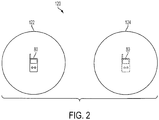
- a system (telecommunication network) 120 includes a user terminal 80, which is geographically located in cell 122, and at least another cell 124. Also suppose that an identity of cell 122 is Cell-id-122 and an identity of cell 124 is Cell-id-124.
- the network may determine to change the identity of cell 122 to Cell-id-124, which was the identity of cell 124 or to generate a brand new Cell-id.
- This cell identity change may be performed in various ways, for example, cells 122 and 124 simply swap their identities or cell 122 receives the identity of cell 124, cell 124 receives the identity of cell 126, and so on, or the cells may receive new identities, or a combination of these possibilities.
- the third party extracts the cell identity Cell-id-124 from the user terminal 80, not knowing about the changed cell identity, would wrongly associate the geographical position of user terminal 80 with the geographical location of cell 124, which are different.
- a third party that is authorized by the operator of the network will be provided with the cell identity change and will still be able to determine the correct location of the user terminal 80. As can be seen, not all cells have to undergo an identity change in order to prevent the unauthorized third users from accurately determining the locations of the user terminals.
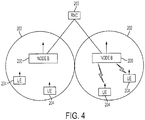
- a Wideband Code Division Multiple Access (WCDMA) system 120 may include a core network CN 201 connected to a radio network controller RNC 203.
- the RNC 203 may control one or more NodeBs 200.
- Each NodeB 200 is communicating with one or more user terminals 204.
- the communication links A between the CN 201, RNC 203, and NodeBs 200 carry the cell identities unscrambled while the communication links B between the NodeBs 200 and the user terminals 204 carry the cell identities scrambled.
- the exemplary embodiments are not limited in their applicability to transmitters or transmissions associated with WCDMA systems and can instead be used in any system including, but not limited to Long Term Evolution (LTE), GSM, Universal Terrestrial Radio Access (UTRA), Evolved-UTRA (E-UTRA), High Speed Packet Access (HSPA), UMB, Worlwide Interoperability for Microwave Access (WiMaX) and other, systems, devices and methods. Since, however, the example in Figure 4 is provided in terms of WCDMA, the network node which transmits and receives over the air interface is termed an NodeB, several of which NodeBs 200 are illustrated therein.
- NodeB the network node which transmits and receives over the air interface is termed an NodeB, several of which NodeBs 200 are illustrated therein.
- each NodeB 200 is responsible for transmitting signals toward, and receiving signals from, one or more cells 204.
- Each NodeB may include multiple antennas, e.g., 2, 4, or more transmit antennas, as well as potentially multiple receive antennas, e.g., 2, 4, or more receive antennas, and handles functions including, but not limited to coding, decoding, modulation, demodulation, interleaving, deinterleaving, etc., with respect to the physical layer of such signals.
- transmit antennas is specifically meant to include, and be generic to, physical antennas, virtual antennas and antenna ports.
- the NodeBs 200 are also responsible for many higher functions associated with handling communications in the system including, for example, scheduling users, handover decisions, and the like.
- the interested reader who desires more information regarding transmit or receive functions associated with WCDMA or other systems in which these exemplary embodiments may be deployed is directed toward the book entitled " 3G Evolution - HSPA and LTE for Mobile Broadband", to Erik Dahlman et al., published by Elsevier Ltd., 2007 .
- signals are transmitted over an air interface from the NodeB 200's (possibly transferred first through the core network exemplified by radio network controller (RNC) 203 to the NodeBs 200) and then into the cells 202 toward target mobile terminal, stations, or user equipments (UE) 204 in the downlink.
- RNC radio network controller
- signals are transmitted from the UEs 204 via an uplink over the air interface to their respective NodeBs 200.
- a UTRAN Cell-ID identifies each cell 202 within the whole radio access network (RAN).
- the UC-id has two portions: the first portion is the RNC-id, which identifies an RNC that controls the cell, and the second portion is the C-id (Cell id) which is unique within the scope of that RNC.
- the UC-id, or alternatively the C-id is used within the RAN both for traffic signaling (e.g., handover signaling on lur (the interface used for communication between different RNCs) and lub (the interface for communication between the NodeB and RNC) interfaces), and for organizing and management operations (e.g., configuring cell parameters for a given cell, or defining neighbour cell relations).
- traffic signaling e.g., handover signaling on lur (the interface used for communication between different RNCs) and lub (the interface for communication between the NodeB and RNC) interfaces
- organizing and management operations e.g., configuring cell parameters for a given cell, or defining neighbour cell relations.
- the UC-id is also broadcasted on the BCCH channel by the NodeBs 200, and is received by the UEs 204.
- the UC-id is typically not used by the handset for any critical functionality. Instead, the handset identifies the cells by the code of the primary channel CPICH (Common Pilot Channel), which is one out of a maximum of 512 codes.
- CPICH Common Pilot Channel
- neighbouring cells are identified referring to the primary CPICH code. Because there is a limited amount of possible codes for primary CPICH, there will be cells using the same code within one RAN.
- the RAN has the logic to correlate a given primary CPICH to the proper cell (identified by UC-id), based on the context of the current handset. This is typically realised through the neighbour cell definitions, so that if a handset is currently connected to one cell, and reports a measurement for a primary CPICH of a defined neighbouring cell, the RAN knows exactly which cell has been measured.
- a neighbour cell definition may exist for each cell and it may be maintained as a list of cells that are neighbours of the given cell.
- the neighbour cell list includes the identities of the neighbouring cells.
- the neighbour cell list may be stored at each node or at the RNC or as a combination of these two possibilities.
- the handset may use the UC-id to save some battery power, e.g., it would not need to decode all previously received cell information, if later returning to the same cell.
- the system will continue to operate properly if the UC-id that is broadcasted is occasionally changed as suggested herein according to exemplary embodiments to aid in obscuring the network topology from third parties.
- a process for replanning the network is illustrated in Figure 5 .
- the process starts with step 500 in which a timing mechanism triggers the replanning.
- the timing mechanism may be, for example, a timer.
- the timer mechanism may be located in the RNC or above.
- a new identity is generated for one or more cells. For simplicity, it is assumed that the identity of only one cell is changed. This cell is called the given cell.
- the new identities of the cells are sequentially generated while in another application the new identities of the cells are simultaneously generated.
- identities for plural cells, which are less than all the cells are generated.
- the new identities of all the cells are generated.
- the term new identity is understood to include generating a brand new identity (which does not exist in the system prior to generating it) and/or reusing an existing cell identity and assigning the existing cell identity as the new identity of another cell, i.e., shifting the cell identities among the existing cells.
- step 520 the current identity of the given cell is changed with the new identity.
- This change may be performed in a few substeps. For example, in a first substep, neighboring cells of the given cell that undergoes the identity change are identified. In a second substep, the cell configuration of the given cell is changed in the RNC. In a third substep, neighboring cell lists of the neighboring cells, which were identified in the second substep, are updated with the new identity of the given cell. After this substep, the new identity of the given cell is fully implemented in the RNC. In step 530, a portion of the new identity of the given cell is updated in one or more of the base stations.
- the Primary CPICH is not changed during this process according to an exemplary embodiment.
- changing the identity of the cell or cells is performed at night-time or any other time when the traffic in the network is low.
- the standardised protocol between RNC and NodeB needs to be changed, e.g., by updating the cell reconfiguration procedure to allow change of C-id.
- An alternative is to only change the RNC-id and leave the base stations unaffected by this process.
- Another alternative is to change both the C-id and the RNC-id.
- the above described exemplary embodiment addressed how an overall identity, including at least two parts, is changed.
- the exemplary embodiments may be applied to a non-WCDMA system that might have the cell identity including only one part or more than two parts.
- the part of the cell identity that is changed may coincide with the entire cell identity or may be one of many parts of the cell identity.
- the exemplary embodiments refer to a cell identity having two parts but this is not intended to limit the exemplary embodiments.
- Operations on the list can result in moving at least two of the codes to new positions in an updated list, such operations including one or more of: shift down 1 step, shift down k steps, shift up 1 step, shift up k steps, pair wise exchange between blocks of adjacent entries of the list, or any of the previous alternatives applied to subsets of the list.
- the operations may be decided and ordered from one deciding node and then signalled to a set of other depending nodes, wherein the depending nodes maintain the list and the list of neighbour cells, and execute the operations on the list.
- the deciding node may execute the operations on the list and send the results to the depending nodes.
- obscuring network topologies can be accomplished without reconfiguration of cell data by instead scrambling this information. Scrambling the information is understood to include encoding, encrypting, mixing up or other know methods to those skilled in the art for protecting the information from unauthorized parties.
- all UC-ids, C-ids and cell configurations, including neighbour cell configurations may remain static with respect to most of the network nodes, e.g., the RNC 203 and higher level nodes. Instead, the version of the UC-id that is broadcasted over the air interface to the user terminal, by the network, will be scrambled at regular intervals by the base station, for example, NodeBs 200.
- the NodeBs 200 will, when receiving new system information from RNC 203, scramble the UC-id received from RNC 203 with a random scrambling key for transmission. This scrambling process may take place periodically, e.g. every night.
- the random scrambling key is received by each base station from its corresponding RNC.
- the base station creates a new random scrambling key independent of the RNC.
- the random scrambling key is provided, via the network, either to an external server or a server internal to the network. This server may have a list of the third parties that are authorized/licensed to receive the identity of the cells, and thus, the server will provide these third parties with the random scrambling key so that the applications of the authorized third parties may receive the correct topology of the network even when the topology related information is scrambled as discussed above.
- the numbered signals operate as described below.
- the scrambling key is generated in the base station.
- the RNC 203 assembles the system information to be sent out to the base station. This step may be performed in the system information distribution function of the RNC 203.
- the RNC 203 transmits the system information to the NodeBs 200 (also referred to herein as radio base stations (RBSs)) using a SYSTEM INFORMATION UPDATE REQUEST message over the NodeB Application Part (NBAP) interface (which is a dedicated signalling protocol used by the RNC to control the NodeB) to the receiving RBS.
- NBAP NodeB Application Part
- the SYSTEM INFORMATION UPDATE REQUEST is a pre-defined command used in the WCDMA systems.
- DRNC Drift RNC
- RNSAP Radio Network Subsystem Application Part
- the RBS 200 receives the SYSTEM INFORMATION UPDATE REQUEST message and unpacks the UC-ld information.
- the RBS 200 scrambles the UC-ld information with the scrambling key, which is generated/administrated by the RBS 200.
- the RBS 200 packs Radio Resource Control (RRC) System Information in system information blocks (SIBs) received from the RNC 203 and stores it. This includes the scrambled UC-Id.
- the RBS 200 broadcasts the stored information in the RRC SYSTEM INFORMATION message over the BCH channel (broadcast channel) to the user terminal 204. This transmission may be performed every Transmission Time Interval (TTI).
- TTI Transmission Time Interval
- the dedicated commands of the WCDMA system are used here for simplicity. However, this method may be adapted to other communication systems.
- the RBS 200 may include a timer which is configured to generate a signal at predetermined times or at certain intervals. Based on the signal, the RBS 200 may change a scrambling code used to scramble the identities of the cells. The timer may be configured to randomly provide the signal. After the RBS 200 computes a new scrambling key, the timer T_key is reset. Typically, T_key is set to a value of the order of 24 h.
- the scrambling key is not generated by each base station or NodeB 200, but it is generated centrally for the whole RAN, and distributed to all base stations via a signaling message.
- paying service providers will receive a master key that is used to create new scrambling keys. This master key can then be provided to the applications from this provider in the handsets, enabling those particular applications to decode a stable UC-id that is exposed by the handset.
- This alternative exemplary embodiment is shown in the signaling diagram of Figure 7 .
- step 1 the RNC 203 computes a new scrambling key and resets timer T key. T key may be set to a value of the order of 24 h. Note that other nodes than the RNC 203 may perform this step.
- step 2 the RNC 203 sends the scrambling key to the NodeBs 200 it controls. A NEW MESSAGE signal may be used for this purpose.
- step 3 the system information to be sent out to the NodeBs 200. This can be done in the system information distribution function of the RNC.
- the RNC 203 transmits the system information to the NodeBs 200 using, for example, a SYSTEM INFORMATION UPDATE REQUEST message over the NBAP interface. In case of a DRNC connection the message is relayed over the RNSAP interface (not shown). This transmission may be performed at an update rate between a few 10s of milliseconds and a minute.
- the RBS 200 receives the SYSTEM INFORMATION UPDATE REQUEST message and unpacks the UC-ld information.
- the RBS 200 scrambles the UC-ld information with its scrambling key, which was received in step 2 from the RNC 203.
- the RBS 200 packs the RRC System Information in system information blocks (SIBs) and stores it.
- SIBs system information blocks
- step 7 the RBS 200 broadcasts the stored information including the scrambled UC-Id in the RRC SYSTEM INFORMATION message over, for example, the BCH channel (broadcast channel) to the user terminal 204. This transmission may be performed every TTI.
- the method includes a step 800 of receiving at a base station of the telecommunication network system information from a radio network controller of the telecommunication network, a step 802 of extracting, at the base station, the identity of the network cell from the received system information, a step 804 of changing, at the base station, at least one of first and second portions of the identity of the network cell, and a step 806 of sending the changed at least one of first and second portions of the identity to a user terminal such that the external party is prevented from determining the identity of the network cell.
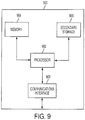
- FIG. 9 An exemplary communications node 900 which can be used, for example, to either transmit or receive the above-described signal is illustrated in Figure 9 .
- the communications node 900 can contain a processor 902 (or multiple processor cores), memory 904, one or more secondary storage devices 906 and a communications interface 908 to facilitate communications itself and the rest of the network(s).
- Processor 902 can also perform the above-described operation(s) of scrambling or changing the cell identities, etc., in response to a suitable command.
- the new or changed cell identities and the scrambling key, etc. may then be stored in memory 904.
- the exemplary embodiments may be embodied in a wireless communication device, a telecommunication network, as a method or in a computer program product. Accordingly, the exemplary embodiments may take the form of an entirely hardware embodiment or an embodiment combining hardware and software aspects. Further, the exemplary embodiments may take the form of a computer program product stored on a computer-readable storage medium having computer-readable instructions embodied in the medium. Any suitable computer readable medium may be utilized including hard disks, CD-ROMs, digital versatile disc (DVD), optical storage devices, or magnetic storage devices such a floppy disk or magnetic tape. Other non-limiting examples of computer readable media include flash-type memories or other known memories.
- the present exemplary embodiments may be implemented in a user equipment, a base station, a radio network controller and generally in a wireless communication network or system comprising both the user equipment, the base station and a higher level, network node.
- the exemplary embodiments may also be implemented in an application specific integrated circuit (ASIC), or a digital signal processor.
- ASIC application specific integrated circuit
- Suitable processors include, by way of example, a general purpose processor, a special purpose processor, a conventional processor, a digital signal processor (DSP), a plurality of microprocessors, one or more microprocessors in association with a DSP core, a controller, a microcontroller, Application Specific Integrated Circuits (ASICs), Field Programmable Gate Arrays (FPGAs) circuits, any other type of integrated circuit (IC), and/or a state machine.
- a processor in association with software may be used to implement a radio frequency transceiver for use in the user equipment, the base station or any host computer.
- the user equipment may be used in conjunction with modules, implemented in hardware and/or software, such as a camera, a video camera module, a videophone, a speakerphone, a vibration device, a speaker, a microphone, a television transceiver, a hands free headset, a keyboard, a Bluetooth module, a frequency modulated (FM) radio unit, a liquid crystal display (LCD) display unit, an organic light-emitting diode (OLED) display unit, a digital music player, a media player, a video game player module, an Internet browser, and/or any wireless local area network (WLAN) module.
- modules implemented in hardware and/or software, such as a camera, a video camera module, a videophone, a speakerphone, a vibration device, a speaker, a microphone, a television transceiver, a hands free headset, a keyboard, a Bluetooth module, a frequency modulated (FM) radio unit, a liquid crystal display (LCD) display unit, an organic light-emitting dio
- exemplary embodiments also relate to software, e.g., program code or instructions which are stored on a computer-readable medium and which, when read by a computer, processor or the like, perform certain steps associated with transmitting information signals which are abstracted or hidden in the manner described above.
- software e.g., program code or instructions which are stored on a computer-readable medium and which, when read by a computer, processor or the like, perform certain steps associated with transmitting information signals which are abstracted or hidden in the manner described above.
- Systems and methods for processing data according to exemplary embodiments of the present invention can be performed by one or more processors executing sequences of instructions contained in a memory device. Such instructions may be read into the memory device from other computer-readable mediums such as secondary data storage device(s). Execution of the sequences of instructions contained in the memory device causes the processor to operate, for example, as described above. In alternative embodiments, hard-wire circuitry may be used in place of or in combination with software instructions to implement the present invention.
Landscapes
- Engineering & Computer Science (AREA)
- Databases & Information Systems (AREA)
- Computer Networks & Wireless Communication (AREA)
- Signal Processing (AREA)
- Mobile Radio Communication Systems (AREA)
Applications Claiming Priority (2)
| Application Number | Priority Date | Filing Date | Title |
|---|---|---|---|
| US7884908P | 2008-07-08 | 2008-07-08 | |
| PCT/SE2009/050146 WO2010005363A1 (en) | 2008-07-08 | 2009-02-11 | Methods and systems for obscuring network topologies |
Publications (3)
| Publication Number | Publication Date |
|---|---|
| EP2297991A1 EP2297991A1 (en) | 2011-03-23 |
| EP2297991A4 EP2297991A4 (en) | 2016-04-06 |
| EP2297991B1 true EP2297991B1 (en) | 2018-09-26 |
Family
ID=41507284
Family Applications (1)
| Application Number | Title | Priority Date | Filing Date |
|---|---|---|---|
| EP09794718.8A Not-in-force EP2297991B1 (en) | 2008-07-08 | 2009-02-11 | Methods and systems for obscuring network topologies |
Country Status (5)
| Country | Link |
|---|---|
| US (1) | US8600349B2 (enExample) |
| EP (1) | EP2297991B1 (enExample) |
| JP (1) | JP5318949B2 (enExample) |
| CN (1) | CN102084673B (enExample) |
| WO (1) | WO2010005363A1 (enExample) |
Families Citing this family (8)
| Publication number | Priority date | Publication date | Assignee | Title |
|---|---|---|---|---|
| US9294911B2 (en) * | 2010-05-10 | 2016-03-22 | Telecommunication Systems, Inc. | Cell-ID translation in a location based system (LBS) |
| US20120124372A1 (en) * | 2010-10-13 | 2012-05-17 | Akamai Technologies, Inc. | Protecting Websites and Website Users By Obscuring URLs |
| CN104376499B (zh) * | 2013-01-04 | 2018-01-30 | 湖州电力局 | 图形调度操作票系统中电网拓扑结构冲突消解方法 |
| CN104376500B (zh) * | 2013-01-04 | 2017-09-08 | 湖州电力局 | 一种临时改变电网拓扑结构的方法 |
| CN104053155B (zh) * | 2014-07-08 | 2018-07-24 | 北京深思数盾科技股份有限公司 | 用于iBeacon基站的数据保护方法、设备及系统 |
| CN104066089B (zh) * | 2014-07-18 | 2018-12-07 | 北京深思数盾科技股份有限公司 | 用于iBeacon基站的数据保护系统及方法 |
| CN108318037B (zh) * | 2018-01-29 | 2021-09-24 | 京信网络系统股份有限公司 | 室内定位方法、装置及导航装置和系统 |
| CN113133061A (zh) * | 2019-12-30 | 2021-07-16 | 中兴通讯股份有限公司 | 选择业务规则的方法和装置、决策业务规则的方法和装置 |
Family Cites Families (28)
| Publication number | Priority date | Publication date | Assignee | Title |
|---|---|---|---|---|
| JPH09168006A (ja) * | 1995-12-15 | 1997-06-24 | Hitachi Ltd | 通信装置および通信方法 |
| US5940765A (en) * | 1996-08-30 | 1999-08-17 | Telefonaktiebolaget Lm Ericsson | Radio communications systems and methods for jittered beacon transmission |
| FI106353B (fi) * | 1998-01-09 | 2001-01-15 | Sonera Oyj | Menetelmä ja järjestelmä tilaajaprofiilin muuttamiseksi päätelaitetta palvelevan tukiaseman identiteetin perusteella |
| US6879832B1 (en) * | 1999-02-26 | 2005-04-12 | Telefonaktiebolaget Lm Ericsson (Publ) | Method and apparatus for transferring information between mobile terminals and entities in a radio access network |
| US6738625B1 (en) * | 2000-05-11 | 2004-05-18 | Telefonaktiebolaget Lm Ericsson (Publ) | Rehoming and resource sharing in communications networks |
| JP2002209253A (ja) * | 2001-01-09 | 2002-07-26 | Mitsubishi Electric Corp | Cdma網側装置およびオーバーリーチ除去方法 |
| JP2003061142A (ja) * | 2001-08-09 | 2003-02-28 | Matsushita Electric Ind Co Ltd | Cdma移動通信方法およびシステム |
| US7333442B2 (en) * | 2004-07-30 | 2008-02-19 | M-Stack Limited | Apparatus and method for applying ciphering in universal mobile telecommunications system |
| EP1810439A4 (en) * | 2004-10-14 | 2010-08-18 | Novatel Wireless Inc | SYSTEM AND METHOD FOR ENABLING THAT A WIRELESS SETUP CAN ONLY ACCESS NETWORK SERVICES WITHIN A SPECIFIC PLACE |
| JP4451286B2 (ja) * | 2004-11-12 | 2010-04-14 | 株式会社エヌ・ティ・ティ・ドコモ | 基地局、基地局制御局および移動通信システム並びにスクランブリングコード設定方法 |
| US7443819B2 (en) * | 2005-03-23 | 2008-10-28 | Lucent Technologies Inc. | Managing scrambling codes during serving radio network subsystem relocation |
| JP4674494B2 (ja) * | 2005-05-26 | 2011-04-20 | 日本電気株式会社 | パケット受信装置 |
| CN100454849C (zh) * | 2005-08-05 | 2009-01-21 | 华为技术有限公司 | 下一代网络中的故障检测方法 |
| EP1765030A1 (en) * | 2005-09-19 | 2007-03-21 | Mitsubishi Electric Information Technology Centre Europe B.V. | Method for transferring the context of a mobile terminal in a wireless telecommunication network |
| BRPI0617807A2 (pt) * | 2005-10-24 | 2011-08-09 | Seeker Wireless Pty Ltd | método para detectar uma inconsistência entre uma rede de radiocomunicações e um banco de dados de rede, processador de rede, rede de radiocomunicações, e, método para detectar uma célula não operacional em uma rede de radiocomunicações |
| US20070218920A1 (en) * | 2006-03-16 | 2007-09-20 | Telefonaktiebolaget L M Ericsson (Publ) | Method and apparatus for location determination in fixed communication access networks |
| US8139660B2 (en) * | 2006-04-14 | 2012-03-20 | Qualcomm Incorporated | Methods and apparatus related to using a wireless terminal scrambling identifier |
| US7725104B2 (en) | 2006-06-20 | 2010-05-25 | Alcatel-Lucent Usa Inc. | Local calling area determination in wireless networks |
| US20080039141A1 (en) * | 2006-08-10 | 2008-02-14 | Holger Claussen | Changing the scrambling code of a base station for wireless telecommunications |
| EP2064911A2 (en) * | 2006-08-24 | 2009-06-03 | QUALCOMM Incorporated | Method and apparatus for supporting positioning of roaming mobile stations |
| US7995994B2 (en) * | 2006-09-22 | 2011-08-09 | Kineto Wireless, Inc. | Method and apparatus for preventing theft of service in a communication system |
| US8588759B2 (en) * | 2007-08-14 | 2013-11-19 | Telefonaktiebolaget Lm Ericsson (Publ) | Cell identifier conflict avoidance |
| WO2009082307A1 (en) * | 2007-12-21 | 2009-07-02 | Telefonaktiebolaget Lm Ericsson (Publ) | Scrambling code allocation in a cellular communication network |
| CN101926187A (zh) * | 2008-01-21 | 2010-12-22 | 艾利森电话股份有限公司 | 移动手持装置的抽象功能 |
| US8533465B2 (en) * | 2008-03-05 | 2013-09-10 | The Johns Hopkins University | System and method of encrypting network address for anonymity and preventing data exfiltration |
| DK2134111T3 (da) | 2008-06-12 | 2012-05-14 | Teliasonera Finland Oyj | System og fremgangsmåde til rekonfiguration af et cellebaseret netværk |
| US9288216B2 (en) * | 2008-06-19 | 2016-03-15 | Qualcomm Incorporated | Methods and apparatus for reducing the effectiveness of chosen location attacks in a peer-to-peer overlay network |
| EP2297994A4 (en) | 2008-07-08 | 2016-05-11 | Ericsson Telefon Ab L M | METHODS AND SYSTEMS FOR REPLANIFYING CELL TO HIDE NETWORK TOPOLOGIES |
-
2009
- 2009-02-11 JP JP2011517378A patent/JP5318949B2/ja not_active Expired - Fee Related
- 2009-02-11 EP EP09794718.8A patent/EP2297991B1/en not_active Not-in-force
- 2009-02-11 WO PCT/SE2009/050146 patent/WO2010005363A1/en not_active Ceased
- 2009-02-11 US US13/002,817 patent/US8600349B2/en active Active
- 2009-02-11 CN CN200980126160.8A patent/CN102084673B/zh not_active Expired - Fee Related
Non-Patent Citations (1)
| Title |
|---|
| None * |
Also Published As
| Publication number | Publication date |
|---|---|
| US20110116632A1 (en) | 2011-05-19 |
| EP2297991A1 (en) | 2011-03-23 |
| WO2010005363A1 (en) | 2010-01-14 |
| US8600349B2 (en) | 2013-12-03 |
| CN102084673B (zh) | 2015-02-11 |
| JP2011527850A (ja) | 2011-11-04 |
| JP5318949B2 (ja) | 2013-10-16 |
| CN102084673A (zh) | 2011-06-01 |
| EP2297991A4 (en) | 2016-04-06 |
Similar Documents
| Publication | Publication Date | Title |
|---|---|---|
| EP2297991B1 (en) | Methods and systems for obscuring network topologies | |
| US11503533B2 (en) | Method of registration with access and mobility management function re-allocation | |
| US8467304B2 (en) | Self-configuration for femtocells | |
| US10397934B2 (en) | Radio resource manager devices and radio communication devices | |
| US8078165B2 (en) | Configuring preferred user zone lists for private access points for wireless networking | |
| RU2679182C1 (ru) | Сетевой узел, беспроводное устройство и способы, выполняемые в них для обработки контекстной информации сети радиодоступа (ran) в сети беспроводной связи | |
| EP2301277B1 (en) | Controlling access to a communication network using a local device database and a shared device database | |
| WO2014032502A1 (zh) | 终端接入方法、系统和终端 | |
| US12425929B2 (en) | Method of requesting a handover of a communications device | |
| US20240080340A1 (en) | Security for Groupcast Message in D2D Communication | |
| JP2011512573A (ja) | 移動ハンドセットにおける抽象化機能 | |
| US20140010218A1 (en) | Methods and Arrangements for Scrambling a Timing Advance Value in a Wireless Communication System | |
| US12149942B2 (en) | Systems and methods for network access security | |
| CN109565683B (zh) | 通信控制设备、无线通信设备、方法和程序 | |
| CN101536587A (zh) | 为进行无线联网的私有接入点配置优选的用户区列表 | |
| CN113873520B (zh) | 一种通信方法、终端设备和无线接入网设备 | |
| US20220256337A1 (en) | Methods, UE and Network Node for Handling System Information | |
| WO2006041794A2 (en) | A system and method for creating a spectrum agile wireless multi-hopping network | |
| JP2023514228A (ja) | Pucch、pusch、及びsrs用のul空間関係スイッチ | |
| WO2010005353A1 (en) | Methods and systems for cell re-planning to obscure network topologies | |
| US20220272615A1 (en) | Method and device for wireless communication | |
| WO2024216828A1 (en) | Systems and methods for supporting ue authentication and security | |
| CN114079922B (zh) | 一种终端设备鉴权的方法、终端设备和接入网设备 | |
| US20250386195A1 (en) | Avoiding communications over risky non-terrestrial networks | |
| WO2010026452A2 (en) | Inter-base stations communication using terminal device |
Legal Events
| Date | Code | Title | Description |
|---|---|---|---|
| PUAI | Public reference made under article 153(3) epc to a published international application that has entered the european phase |
Free format text: ORIGINAL CODE: 0009012 |
|
| 17P | Request for examination filed |
Effective date: 20101203 |
|
| AK | Designated contracting states |
Kind code of ref document: A1 Designated state(s): AT BE BG CH CY CZ DE DK EE ES FI FR GB GR HR HU IE IS IT LI LT LU LV MC MK MT NL NO PL PT RO SE SI SK TR |
|
| AX | Request for extension of the european patent |
Extension state: AL BA RS |
|
| DAX | Request for extension of the european patent (deleted) | ||
| REG | Reference to a national code |
Ref country code: DE Ref legal event code: R079 Ref document number: 602009054766 Country of ref document: DE Free format text: PREVIOUS MAIN CLASS: H04W0012000000 Ipc: H04W0008160000 |
|
| RA4 | Supplementary search report drawn up and despatched (corrected) |
Effective date: 20160309 |
|
| RIC1 | Information provided on ipc code assigned before grant |
Ipc: H04W 8/16 20090101AFI20160303BHEP |
|
| GRAP | Despatch of communication of intention to grant a patent |
Free format text: ORIGINAL CODE: EPIDOSNIGR1 |
|
| STAA | Information on the status of an ep patent application or granted ep patent |
Free format text: STATUS: GRANT OF PATENT IS INTENDED |
|
| INTG | Intention to grant announced |
Effective date: 20180507 |
|
| GRAS | Grant fee paid |
Free format text: ORIGINAL CODE: EPIDOSNIGR3 |
|
| GRAA | (expected) grant |
Free format text: ORIGINAL CODE: 0009210 |
|
| STAA | Information on the status of an ep patent application or granted ep patent |
Free format text: STATUS: THE PATENT HAS BEEN GRANTED |
|
| AK | Designated contracting states |
Kind code of ref document: B1 Designated state(s): AT BE BG CH CY CZ DE DK EE ES FI FR GB GR HR HU IE IS IT LI LT LU LV MC MK MT NL NO PL PT RO SE SI SK TR |
|
| REG | Reference to a national code |
Ref country code: GB Ref legal event code: FG4D |
|
| REG | Reference to a national code |
Ref country code: CH Ref legal event code: EP |
|
| REG | Reference to a national code |
Ref country code: AT Ref legal event code: REF Ref document number: 1047487 Country of ref document: AT Kind code of ref document: T Effective date: 20181015 |
|
| REG | Reference to a national code |
Ref country code: IE Ref legal event code: FG4D |
|
| REG | Reference to a national code |
Ref country code: DE Ref legal event code: R096 Ref document number: 602009054766 Country of ref document: DE |
|
| REG | Reference to a national code |
Ref country code: NL Ref legal event code: MP Effective date: 20180926 |
|
| PG25 | Lapsed in a contracting state [announced via postgrant information from national office to epo] |
Ref country code: FI Free format text: LAPSE BECAUSE OF FAILURE TO SUBMIT A TRANSLATION OF THE DESCRIPTION OR TO PAY THE FEE WITHIN THE PRESCRIBED TIME-LIMIT Effective date: 20180926 Ref country code: SE Free format text: LAPSE BECAUSE OF FAILURE TO SUBMIT A TRANSLATION OF THE DESCRIPTION OR TO PAY THE FEE WITHIN THE PRESCRIBED TIME-LIMIT Effective date: 20180926 Ref country code: GR Free format text: LAPSE BECAUSE OF FAILURE TO SUBMIT A TRANSLATION OF THE DESCRIPTION OR TO PAY THE FEE WITHIN THE PRESCRIBED TIME-LIMIT Effective date: 20181227 Ref country code: LT Free format text: LAPSE BECAUSE OF FAILURE TO SUBMIT A TRANSLATION OF THE DESCRIPTION OR TO PAY THE FEE WITHIN THE PRESCRIBED TIME-LIMIT Effective date: 20180926 Ref country code: NO Free format text: LAPSE BECAUSE OF FAILURE TO SUBMIT A TRANSLATION OF THE DESCRIPTION OR TO PAY THE FEE WITHIN THE PRESCRIBED TIME-LIMIT Effective date: 20181226 Ref country code: BG Free format text: LAPSE BECAUSE OF FAILURE TO SUBMIT A TRANSLATION OF THE DESCRIPTION OR TO PAY THE FEE WITHIN THE PRESCRIBED TIME-LIMIT Effective date: 20181226 |
|
| REG | Reference to a national code |
Ref country code: LT Ref legal event code: MG4D |
|
| PG25 | Lapsed in a contracting state [announced via postgrant information from national office to epo] |
Ref country code: HR Free format text: LAPSE BECAUSE OF FAILURE TO SUBMIT A TRANSLATION OF THE DESCRIPTION OR TO PAY THE FEE WITHIN THE PRESCRIBED TIME-LIMIT Effective date: 20180926 Ref country code: LV Free format text: LAPSE BECAUSE OF FAILURE TO SUBMIT A TRANSLATION OF THE DESCRIPTION OR TO PAY THE FEE WITHIN THE PRESCRIBED TIME-LIMIT Effective date: 20180926 |
|
| REG | Reference to a national code |
Ref country code: AT Ref legal event code: MK05 Ref document number: 1047487 Country of ref document: AT Kind code of ref document: T Effective date: 20180926 |
|
| PG25 | Lapsed in a contracting state [announced via postgrant information from national office to epo] |
Ref country code: IS Free format text: LAPSE BECAUSE OF FAILURE TO SUBMIT A TRANSLATION OF THE DESCRIPTION OR TO PAY THE FEE WITHIN THE PRESCRIBED TIME-LIMIT Effective date: 20190126 Ref country code: AT Free format text: LAPSE BECAUSE OF FAILURE TO SUBMIT A TRANSLATION OF THE DESCRIPTION OR TO PAY THE FEE WITHIN THE PRESCRIBED TIME-LIMIT Effective date: 20180926 Ref country code: ES Free format text: LAPSE BECAUSE OF FAILURE TO SUBMIT A TRANSLATION OF THE DESCRIPTION OR TO PAY THE FEE WITHIN THE PRESCRIBED TIME-LIMIT Effective date: 20180926 Ref country code: PL Free format text: LAPSE BECAUSE OF FAILURE TO SUBMIT A TRANSLATION OF THE DESCRIPTION OR TO PAY THE FEE WITHIN THE PRESCRIBED TIME-LIMIT Effective date: 20180926 Ref country code: EE Free format text: LAPSE BECAUSE OF FAILURE TO SUBMIT A TRANSLATION OF THE DESCRIPTION OR TO PAY THE FEE WITHIN THE PRESCRIBED TIME-LIMIT Effective date: 20180926 Ref country code: CZ Free format text: LAPSE BECAUSE OF FAILURE TO SUBMIT A TRANSLATION OF THE DESCRIPTION OR TO PAY THE FEE WITHIN THE PRESCRIBED TIME-LIMIT Effective date: 20180926 Ref country code: NL Free format text: LAPSE BECAUSE OF FAILURE TO SUBMIT A TRANSLATION OF THE DESCRIPTION OR TO PAY THE FEE WITHIN THE PRESCRIBED TIME-LIMIT Effective date: 20180926 Ref country code: RO Free format text: LAPSE BECAUSE OF FAILURE TO SUBMIT A TRANSLATION OF THE DESCRIPTION OR TO PAY THE FEE WITHIN THE PRESCRIBED TIME-LIMIT Effective date: 20180926 Ref country code: IT Free format text: LAPSE BECAUSE OF FAILURE TO SUBMIT A TRANSLATION OF THE DESCRIPTION OR TO PAY THE FEE WITHIN THE PRESCRIBED TIME-LIMIT Effective date: 20180926 |
|
| PG25 | Lapsed in a contracting state [announced via postgrant information from national office to epo] |
Ref country code: PT Free format text: LAPSE BECAUSE OF FAILURE TO SUBMIT A TRANSLATION OF THE DESCRIPTION OR TO PAY THE FEE WITHIN THE PRESCRIBED TIME-LIMIT Effective date: 20190126 Ref country code: SK Free format text: LAPSE BECAUSE OF FAILURE TO SUBMIT A TRANSLATION OF THE DESCRIPTION OR TO PAY THE FEE WITHIN THE PRESCRIBED TIME-LIMIT Effective date: 20180926 |
|
| REG | Reference to a national code |
Ref country code: DE Ref legal event code: R097 Ref document number: 602009054766 Country of ref document: DE |
|
| PG25 | Lapsed in a contracting state [announced via postgrant information from national office to epo] |
Ref country code: DK Free format text: LAPSE BECAUSE OF FAILURE TO SUBMIT A TRANSLATION OF THE DESCRIPTION OR TO PAY THE FEE WITHIN THE PRESCRIBED TIME-LIMIT Effective date: 20180926 |
|
| PLBE | No opposition filed within time limit |
Free format text: ORIGINAL CODE: 0009261 |
|
| STAA | Information on the status of an ep patent application or granted ep patent |
Free format text: STATUS: NO OPPOSITION FILED WITHIN TIME LIMIT |
|
| 26N | No opposition filed |
Effective date: 20190627 |
|
| REG | Reference to a national code |
Ref country code: CH Ref legal event code: PL |
|
| PG25 | Lapsed in a contracting state [announced via postgrant information from national office to epo] |
Ref country code: SI Free format text: LAPSE BECAUSE OF FAILURE TO SUBMIT A TRANSLATION OF THE DESCRIPTION OR TO PAY THE FEE WITHIN THE PRESCRIBED TIME-LIMIT Effective date: 20180926 Ref country code: LU Free format text: LAPSE BECAUSE OF NON-PAYMENT OF DUE FEES Effective date: 20190211 Ref country code: MC Free format text: LAPSE BECAUSE OF FAILURE TO SUBMIT A TRANSLATION OF THE DESCRIPTION OR TO PAY THE FEE WITHIN THE PRESCRIBED TIME-LIMIT Effective date: 20180926 |
|
| REG | Reference to a national code |
Ref country code: BE Ref legal event code: MM Effective date: 20190228 |
|
| REG | Reference to a national code |
Ref country code: IE Ref legal event code: MM4A |
|
| PG25 | Lapsed in a contracting state [announced via postgrant information from national office to epo] |
Ref country code: CH Free format text: LAPSE BECAUSE OF NON-PAYMENT OF DUE FEES Effective date: 20190228 Ref country code: LI Free format text: LAPSE BECAUSE OF NON-PAYMENT OF DUE FEES Effective date: 20190228 |
|
| PG25 | Lapsed in a contracting state [announced via postgrant information from national office to epo] |
Ref country code: IE Free format text: LAPSE BECAUSE OF NON-PAYMENT OF DUE FEES Effective date: 20190211 |
|
| PG25 | Lapsed in a contracting state [announced via postgrant information from national office to epo] |
Ref country code: BE Free format text: LAPSE BECAUSE OF NON-PAYMENT OF DUE FEES Effective date: 20190228 Ref country code: FR Free format text: LAPSE BECAUSE OF NON-PAYMENT OF DUE FEES Effective date: 20190228 |
|
| PG25 | Lapsed in a contracting state [announced via postgrant information from national office to epo] |
Ref country code: TR Free format text: LAPSE BECAUSE OF FAILURE TO SUBMIT A TRANSLATION OF THE DESCRIPTION OR TO PAY THE FEE WITHIN THE PRESCRIBED TIME-LIMIT Effective date: 20180926 |
|
| PGFP | Annual fee paid to national office [announced via postgrant information from national office to epo] |
Ref country code: GB Payment date: 20200227 Year of fee payment: 12 Ref country code: DE Payment date: 20200227 Year of fee payment: 12 |
|
| PG25 | Lapsed in a contracting state [announced via postgrant information from national office to epo] |
Ref country code: MT Free format text: LAPSE BECAUSE OF NON-PAYMENT OF DUE FEES Effective date: 20190211 |
|
| PG25 | Lapsed in a contracting state [announced via postgrant information from national office to epo] |
Ref country code: CY Free format text: LAPSE BECAUSE OF FAILURE TO SUBMIT A TRANSLATION OF THE DESCRIPTION OR TO PAY THE FEE WITHIN THE PRESCRIBED TIME-LIMIT Effective date: 20180926 |
|
| PG25 | Lapsed in a contracting state [announced via postgrant information from national office to epo] |
Ref country code: HU Free format text: LAPSE BECAUSE OF FAILURE TO SUBMIT A TRANSLATION OF THE DESCRIPTION OR TO PAY THE FEE WITHIN THE PRESCRIBED TIME-LIMIT; INVALID AB INITIO Effective date: 20090211 |
|
| REG | Reference to a national code |
Ref country code: DE Ref legal event code: R119 Ref document number: 602009054766 Country of ref document: DE |
|
| GBPC | Gb: european patent ceased through non-payment of renewal fee |
Effective date: 20210211 |
|
| PG25 | Lapsed in a contracting state [announced via postgrant information from national office to epo] |
Ref country code: GB Free format text: LAPSE BECAUSE OF NON-PAYMENT OF DUE FEES Effective date: 20210211 Ref country code: DE Free format text: LAPSE BECAUSE OF NON-PAYMENT OF DUE FEES Effective date: 20210901 |
|
| PG25 | Lapsed in a contracting state [announced via postgrant information from national office to epo] |
Ref country code: MK Free format text: LAPSE BECAUSE OF FAILURE TO SUBMIT A TRANSLATION OF THE DESCRIPTION OR TO PAY THE FEE WITHIN THE PRESCRIBED TIME-LIMIT Effective date: 20180926 |