EP2295240A1 - Verfahren zum Herstellen eines schalldämmenden Paneels und ein schalldämmendes Paneel - Google Patents
Verfahren zum Herstellen eines schalldämmenden Paneels und ein schalldämmendes Paneel Download PDFInfo
- Publication number
- EP2295240A1 EP2295240A1 EP10170172A EP10170172A EP2295240A1 EP 2295240 A1 EP2295240 A1 EP 2295240A1 EP 10170172 A EP10170172 A EP 10170172A EP 10170172 A EP10170172 A EP 10170172A EP 2295240 A1 EP2295240 A1 EP 2295240A1
- Authority
- EP
- European Patent Office
- Prior art keywords
- insulating layer
- overlay
- counter
- panel
- press
- Prior art date
- Legal status (The legal status is an assumption and is not a legal conclusion. Google has not performed a legal analysis and makes no representation as to the accuracy of the status listed.)
- Granted
Links
- 238000004519 manufacturing process Methods 0.000 title claims description 8
- 239000000463 material Substances 0.000 claims abstract description 35
- 238000000034 method Methods 0.000 claims abstract description 19
- 239000002023 wood Substances 0.000 claims abstract description 16
- 239000004033 plastic Substances 0.000 claims abstract description 13
- 229920003023 plastic Polymers 0.000 claims abstract description 13
- 239000004575 stone Substances 0.000 claims abstract description 7
- 239000011521 glass Substances 0.000 claims abstract description 6
- 239000004753 textile Substances 0.000 claims abstract description 5
- 229920001187 thermosetting polymer Polymers 0.000 claims description 22
- 238000009413 insulation Methods 0.000 claims description 18
- 239000007788 liquid Substances 0.000 claims description 5
- 239000002657 fibrous material Substances 0.000 claims description 4
- 238000003825 pressing Methods 0.000 claims description 4
- 239000012978 lignocellulosic material Substances 0.000 claims 1
- 239000000835 fiber Substances 0.000 abstract description 8
- 239000000123 paper Substances 0.000 description 22
- 230000000694 effects Effects 0.000 description 13
- 239000004698 Polyethylene Substances 0.000 description 8
- 239000011111 cardboard Substances 0.000 description 7
- 229920000642 polymer Polymers 0.000 description 6
- 229920003002 synthetic resin Polymers 0.000 description 6
- 239000000057 synthetic resin Substances 0.000 description 6
- -1 polyethylene Polymers 0.000 description 5
- 229920000573 polyethylene Polymers 0.000 description 5
- 230000009471 action Effects 0.000 description 4
- 239000000853 adhesive Substances 0.000 description 4
- 230000001070 adhesive effect Effects 0.000 description 4
- 239000000203 mixture Substances 0.000 description 4
- 230000008569 process Effects 0.000 description 4
- 229920005989 resin Polymers 0.000 description 4
- 239000011347 resin Substances 0.000 description 4
- 238000009408 flooring Methods 0.000 description 3
- 229920000965 Duroplast Polymers 0.000 description 2
- 239000004638 Duroplast Substances 0.000 description 2
- 238000004026 adhesive bonding Methods 0.000 description 2
- 239000006260 foam Substances 0.000 description 2
- 239000003365 glass fiber Substances 0.000 description 2
- 238000010438 heat treatment Methods 0.000 description 2
- 239000003779 heat-resistant material Substances 0.000 description 2
- 238000009434 installation Methods 0.000 description 2
- 238000010030 laminating Methods 0.000 description 2
- 229920001568 phenolic resin Polymers 0.000 description 2
- 238000012545 processing Methods 0.000 description 2
- 238000012546 transfer Methods 0.000 description 2
- XLYOFNOQVPJJNP-UHFFFAOYSA-N water Substances O XLYOFNOQVPJJNP-UHFFFAOYSA-N 0.000 description 2
- 229920000877 Melamine resin Polymers 0.000 description 1
- FAPWRFPIFSIZLT-UHFFFAOYSA-M Sodium chloride Chemical compound [Na+].[Cl-] FAPWRFPIFSIZLT-UHFFFAOYSA-M 0.000 description 1
- 229920001807 Urea-formaldehyde Polymers 0.000 description 1
- 238000007792 addition Methods 0.000 description 1
- 229920003180 amino resin Polymers 0.000 description 1
- 239000007864 aqueous solution Substances 0.000 description 1
- 230000008901 benefit Effects 0.000 description 1
- 230000015572 biosynthetic process Effects 0.000 description 1
- 238000000576 coating method Methods 0.000 description 1
- 239000007799 cork Substances 0.000 description 1
- 239000000428 dust Substances 0.000 description 1
- 239000011094 fiberboard Substances 0.000 description 1
- 239000011888 foil Substances 0.000 description 1
- 239000003292 glue Substances 0.000 description 1
- 230000001771 impaired effect Effects 0.000 description 1
- 229910052500 inorganic mineral Inorganic materials 0.000 description 1
- 239000002650 laminated plastic Substances 0.000 description 1
- 239000000155 melt Substances 0.000 description 1
- 238000003801 milling Methods 0.000 description 1
- 239000011707 mineral Substances 0.000 description 1
- 239000002557 mineral fiber Substances 0.000 description 1
- 238000012986 modification Methods 0.000 description 1
- 230000004048 modification Effects 0.000 description 1
- 239000004745 nonwoven fabric Substances 0.000 description 1
- 238000012803 optimization experiment Methods 0.000 description 1
- 239000011087 paperboard Substances 0.000 description 1
- 239000002245 particle Substances 0.000 description 1
- 239000002985 plastic film Substances 0.000 description 1
- 239000011092 plastic-coated paper Substances 0.000 description 1
- 230000000979 retarding effect Effects 0.000 description 1
- 239000004576 sand Substances 0.000 description 1
- 229920002994 synthetic fiber Polymers 0.000 description 1
- 239000004758 synthetic textile Substances 0.000 description 1
- 238000012360 testing method Methods 0.000 description 1
Images
Classifications
-
- B—PERFORMING OPERATIONS; TRANSPORTING
- B32—LAYERED PRODUCTS
- B32B—LAYERED PRODUCTS, i.e. PRODUCTS BUILT-UP OF STRATA OF FLAT OR NON-FLAT, e.g. CELLULAR OR HONEYCOMB, FORM
- B32B38/00—Ancillary operations in connection with laminating processes
- B32B38/0036—Heat treatment
- B32B38/004—Heat treatment by physically contacting the layers, e.g. by the use of heated platens or rollers
-
- B—PERFORMING OPERATIONS; TRANSPORTING
- B32—LAYERED PRODUCTS
- B32B—LAYERED PRODUCTS, i.e. PRODUCTS BUILT-UP OF STRATA OF FLAT OR NON-FLAT, e.g. CELLULAR OR HONEYCOMB, FORM
- B32B21/00—Layered products comprising a layer of wood, e.g. wood board, veneer, wood particle board
- B32B21/02—Layered products comprising a layer of wood, e.g. wood board, veneer, wood particle board the layer being formed of fibres, chips, or particles, e.g. MDF, HDF, OSB, chipboard, particle board, hardboard
-
- B—PERFORMING OPERATIONS; TRANSPORTING
- B32—LAYERED PRODUCTS
- B32B—LAYERED PRODUCTS, i.e. PRODUCTS BUILT-UP OF STRATA OF FLAT OR NON-FLAT, e.g. CELLULAR OR HONEYCOMB, FORM
- B32B21/00—Layered products comprising a layer of wood, e.g. wood board, veneer, wood particle board
- B32B21/04—Layered products comprising a layer of wood, e.g. wood board, veneer, wood particle board comprising wood as the main or only constituent of a layer, which is next to another layer of the same or of a different material
-
- B—PERFORMING OPERATIONS; TRANSPORTING
- B32—LAYERED PRODUCTS
- B32B—LAYERED PRODUCTS, i.e. PRODUCTS BUILT-UP OF STRATA OF FLAT OR NON-FLAT, e.g. CELLULAR OR HONEYCOMB, FORM
- B32B21/00—Layered products comprising a layer of wood, e.g. wood board, veneer, wood particle board
- B32B21/04—Layered products comprising a layer of wood, e.g. wood board, veneer, wood particle board comprising wood as the main or only constituent of a layer, which is next to another layer of the same or of a different material
- B32B21/06—Layered products comprising a layer of wood, e.g. wood board, veneer, wood particle board comprising wood as the main or only constituent of a layer, which is next to another layer of the same or of a different material of paper or cardboard
-
- B—PERFORMING OPERATIONS; TRANSPORTING
- B32—LAYERED PRODUCTS
- B32B—LAYERED PRODUCTS, i.e. PRODUCTS BUILT-UP OF STRATA OF FLAT OR NON-FLAT, e.g. CELLULAR OR HONEYCOMB, FORM
- B32B29/00—Layered products comprising a layer of paper or cardboard
- B32B29/06—Layered products comprising a layer of paper or cardboard specially treated, e.g. surfaced, parchmentised
-
- B—PERFORMING OPERATIONS; TRANSPORTING
- B32—LAYERED PRODUCTS
- B32B—LAYERED PRODUCTS, i.e. PRODUCTS BUILT-UP OF STRATA OF FLAT OR NON-FLAT, e.g. CELLULAR OR HONEYCOMB, FORM
- B32B37/00—Methods or apparatus for laminating, e.g. by curing or by ultrasonic bonding
- B32B37/10—Methods or apparatus for laminating, e.g. by curing or by ultrasonic bonding characterised by the pressing technique, e.g. using action of vacuum or fluid pressure
-
- E—FIXED CONSTRUCTIONS
- E04—BUILDING
- E04C—STRUCTURAL ELEMENTS; BUILDING MATERIALS
- E04C2/00—Building elements of relatively thin form for the construction of parts of buildings, e.g. sheet materials, slabs, or panels
- E04C2/02—Building elements of relatively thin form for the construction of parts of buildings, e.g. sheet materials, slabs, or panels characterised by specified materials
- E04C2/26—Building elements of relatively thin form for the construction of parts of buildings, e.g. sheet materials, slabs, or panels characterised by specified materials composed of materials covered by two or more of groups E04C2/04, E04C2/08, E04C2/10 or of materials covered by one of these groups with a material not specified in one of the groups
- E04C2/284—Building elements of relatively thin form for the construction of parts of buildings, e.g. sheet materials, slabs, or panels characterised by specified materials composed of materials covered by two or more of groups E04C2/04, E04C2/08, E04C2/10 or of materials covered by one of these groups with a material not specified in one of the groups at least one of the materials being insulating
- E04C2/296—Building elements of relatively thin form for the construction of parts of buildings, e.g. sheet materials, slabs, or panels characterised by specified materials composed of materials covered by two or more of groups E04C2/04, E04C2/08, E04C2/10 or of materials covered by one of these groups with a material not specified in one of the groups at least one of the materials being insulating composed of insulating material and non-metallic or unspecified sheet-material
-
- E—FIXED CONSTRUCTIONS
- E04—BUILDING
- E04F—FINISHING WORK ON BUILDINGS, e.g. STAIRS, FLOORS
- E04F15/00—Flooring
- E04F15/02—Flooring or floor layers composed of a number of similar elements
-
- E—FIXED CONSTRUCTIONS
- E04—BUILDING
- E04F—FINISHING WORK ON BUILDINGS, e.g. STAIRS, FLOORS
- E04F15/00—Flooring
- E04F15/18—Separately-laid insulating layers; Other additional insulating measures; Floating floors
- E04F15/181—Insulating layers integrally formed with the flooring or the flooring elements
-
- B—PERFORMING OPERATIONS; TRANSPORTING
- B32—LAYERED PRODUCTS
- B32B—LAYERED PRODUCTS, i.e. PRODUCTS BUILT-UP OF STRATA OF FLAT OR NON-FLAT, e.g. CELLULAR OR HONEYCOMB, FORM
- B32B2260/00—Layered product comprising an impregnated, embedded, or bonded layer wherein the layer comprises an impregnation, embedding, or binder material
- B32B2260/02—Composition of the impregnated, bonded or embedded layer
- B32B2260/028—Paper layer
-
- B—PERFORMING OPERATIONS; TRANSPORTING
- B32—LAYERED PRODUCTS
- B32B—LAYERED PRODUCTS, i.e. PRODUCTS BUILT-UP OF STRATA OF FLAT OR NON-FLAT, e.g. CELLULAR OR HONEYCOMB, FORM
- B32B2260/00—Layered product comprising an impregnated, embedded, or bonded layer wherein the layer comprises an impregnation, embedding, or binder material
- B32B2260/04—Impregnation, embedding, or binder material
- B32B2260/046—Synthetic resin
-
- B—PERFORMING OPERATIONS; TRANSPORTING
- B32—LAYERED PRODUCTS
- B32B—LAYERED PRODUCTS, i.e. PRODUCTS BUILT-UP OF STRATA OF FLAT OR NON-FLAT, e.g. CELLULAR OR HONEYCOMB, FORM
- B32B2305/00—Condition, form or state of the layers or laminate
- B32B2305/02—Cellular or porous
- B32B2305/022—Foam
-
- B—PERFORMING OPERATIONS; TRANSPORTING
- B32—LAYERED PRODUCTS
- B32B—LAYERED PRODUCTS, i.e. PRODUCTS BUILT-UP OF STRATA OF FLAT OR NON-FLAT, e.g. CELLULAR OR HONEYCOMB, FORM
- B32B2305/00—Condition, form or state of the layers or laminate
- B32B2305/10—Fibres of continuous length
-
- B—PERFORMING OPERATIONS; TRANSPORTING
- B32—LAYERED PRODUCTS
- B32B—LAYERED PRODUCTS, i.e. PRODUCTS BUILT-UP OF STRATA OF FLAT OR NON-FLAT, e.g. CELLULAR OR HONEYCOMB, FORM
- B32B2305/00—Condition, form or state of the layers or laminate
- B32B2305/22—Fibres of short length
-
- B—PERFORMING OPERATIONS; TRANSPORTING
- B32—LAYERED PRODUCTS
- B32B—LAYERED PRODUCTS, i.e. PRODUCTS BUILT-UP OF STRATA OF FLAT OR NON-FLAT, e.g. CELLULAR OR HONEYCOMB, FORM
- B32B2307/00—Properties of the layers or laminate
- B32B2307/10—Properties of the layers or laminate having particular acoustical properties
- B32B2307/102—Insulating
-
- B—PERFORMING OPERATIONS; TRANSPORTING
- B32—LAYERED PRODUCTS
- B32B—LAYERED PRODUCTS, i.e. PRODUCTS BUILT-UP OF STRATA OF FLAT OR NON-FLAT, e.g. CELLULAR OR HONEYCOMB, FORM
- B32B2307/00—Properties of the layers or laminate
- B32B2307/70—Other properties
- B32B2307/72—Density
-
- B—PERFORMING OPERATIONS; TRANSPORTING
- B32—LAYERED PRODUCTS
- B32B—LAYERED PRODUCTS, i.e. PRODUCTS BUILT-UP OF STRATA OF FLAT OR NON-FLAT, e.g. CELLULAR OR HONEYCOMB, FORM
- B32B2309/00—Parameters for the laminating or treatment process; Apparatus details
- B32B2309/02—Temperature
-
- B—PERFORMING OPERATIONS; TRANSPORTING
- B32—LAYERED PRODUCTS
- B32B—LAYERED PRODUCTS, i.e. PRODUCTS BUILT-UP OF STRATA OF FLAT OR NON-FLAT, e.g. CELLULAR OR HONEYCOMB, FORM
- B32B2309/00—Parameters for the laminating or treatment process; Apparatus details
- B32B2309/04—Time
-
- B—PERFORMING OPERATIONS; TRANSPORTING
- B32—LAYERED PRODUCTS
- B32B—LAYERED PRODUCTS, i.e. PRODUCTS BUILT-UP OF STRATA OF FLAT OR NON-FLAT, e.g. CELLULAR OR HONEYCOMB, FORM
- B32B2309/00—Parameters for the laminating or treatment process; Apparatus details
- B32B2309/08—Dimensions, e.g. volume
- B32B2309/10—Dimensions, e.g. volume linear, e.g. length, distance, width
- B32B2309/105—Thickness
-
- B—PERFORMING OPERATIONS; TRANSPORTING
- B32—LAYERED PRODUCTS
- B32B—LAYERED PRODUCTS, i.e. PRODUCTS BUILT-UP OF STRATA OF FLAT OR NON-FLAT, e.g. CELLULAR OR HONEYCOMB, FORM
- B32B2309/00—Parameters for the laminating or treatment process; Apparatus details
- B32B2309/12—Pressure
-
- B—PERFORMING OPERATIONS; TRANSPORTING
- B32—LAYERED PRODUCTS
- B32B—LAYERED PRODUCTS, i.e. PRODUCTS BUILT-UP OF STRATA OF FLAT OR NON-FLAT, e.g. CELLULAR OR HONEYCOMB, FORM
- B32B2317/00—Animal or vegetable based
- B32B2317/12—Paper, e.g. cardboard
-
- B—PERFORMING OPERATIONS; TRANSPORTING
- B32—LAYERED PRODUCTS
- B32B—LAYERED PRODUCTS, i.e. PRODUCTS BUILT-UP OF STRATA OF FLAT OR NON-FLAT, e.g. CELLULAR OR HONEYCOMB, FORM
- B32B2607/00—Walls, panels
-
- B—PERFORMING OPERATIONS; TRANSPORTING
- B32—LAYERED PRODUCTS
- B32B—LAYERED PRODUCTS, i.e. PRODUCTS BUILT-UP OF STRATA OF FLAT OR NON-FLAT, e.g. CELLULAR OR HONEYCOMB, FORM
- B32B37/00—Methods or apparatus for laminating, e.g. by curing or by ultrasonic bonding
- B32B37/0007—Methods or apparatus for laminating, e.g. by curing or by ultrasonic bonding involving treatment or provisions in order to avoid deformation or air inclusion, e.g. to improve surface quality
- B32B37/003—Methods or apparatus for laminating, e.g. by curing or by ultrasonic bonding involving treatment or provisions in order to avoid deformation or air inclusion, e.g. to improve surface quality to avoid air inclusion
-
- E—FIXED CONSTRUCTIONS
- E04—BUILDING
- E04F—FINISHING WORK ON BUILDINGS, e.g. STAIRS, FLOORS
- E04F2290/00—Specially adapted covering, lining or flooring elements not otherwise provided for
- E04F2290/04—Specially adapted covering, lining or flooring elements not otherwise provided for for insulation or surface protection, e.g. against noise, impact or fire
- E04F2290/041—Specially adapted covering, lining or flooring elements not otherwise provided for for insulation or surface protection, e.g. against noise, impact or fire against noise
- E04F2290/043—Specially adapted covering, lining or flooring elements not otherwise provided for for insulation or surface protection, e.g. against noise, impact or fire against noise with a bottom layer for sound insulation
Definitions
- the invention relates to a method for producing a sound-insulating panel and a sound-absorbing panel.
- Laminate flooring is composed of laminated panels.
- a carrier plate made of wood material, eg. As HDF or MDF, with a directly laminated decor (the decorative paper and the overlay) on the top and a counter-pull that prevents warping and twisting of the support plate is processed into a floor covering commonly used.
- the heated press plates have an immediate effect on overlay and counteraction and cause the curing of the resins contained therein, usually thermosets each on and with the top and bottom of the support plate.
- the wood-based panel is now sealed and ready for use after any splitting into panels and milling of the edge profiles.
- Laminate flooring can be made by gluing panels; typical, however, is the glueless laying of panels with profiled edges.
- Laminate flooring has poor soundproofing properties due to its multi-layered structure of different dense and thick layers. The impulse of hard heels on the top, the overlay is only slightly damped. Sand or dust particles trapped between the laminate and the floor also lead to undesirable acoustic effects.
- acoustic mats are known, the z. B. of foamed plastic, cork or lignocellulosic fibers. These mats are rolled out on the subfloor on which the laminate floor or the panels from which the laminate floor is assembled are laid.
- panels are also offered with an integrated sound insulation, which improves in particular the room sound insulation.
- WO 2007/145 572 proposed to compress the return in sections. The sound-absorbing effect is limited.
- Other panels with integrated sound insulation are provided in a second processing step after the production of the overlay and counter-sealed panel in the short-cycle press and in a second system with further insulation layers. But also unlaminated panels are provided with sound-insulating layers.
- Adhesive plastic mats are known ( DE 10 2005 031 187 ), Papers, cardboard ( DE 10 2004 056 540 ) and also in liquid form laminated plastics. This version is in the EP 1898 025 which is considered to be the closest prior art.
- thermosets which contain overlay and counter-pull are, as well as the discharge of the laminated wood-based panels.
- a pressing cycle ie the overlaying of overlay, if necessary decorative papers, carrier plate and counter-pull, the closing of the press, the action of the opposite, heated press plates on overlay or the counter-pull and the at least extensive curing of the thermosets, which contain overlay and counter-pull are, as well as the discharge of the laminated wood-based panels is about 20 seconds to about 30 seconds. Variations and deviations from the aforementioned temperatures and times may arise depending on the material of the carrier plate, the type or mixture of thermosets and the thickness of the individual layers.
- the insulating layer combines during curing of the counter-pull with the thermosetting material that first melts and then hardens under the action of elevated temperature, just as the support plate also connects to the counter-pull. The retreat continues to absorb the forces caused by the curing of the overlay. The result is a high-quality, completely flat product without weaknesses in terms of acoustic insulation effect.
- the action of the heated press plate on the insulating layer causes a full-surface connection of counteracting and insulating layer, so that the formation of unwanted air cushions is excluded. At the same time it has been found that no additional adhesive is required.
- the counter-pull already used is sufficiently equipped on both sides with duroplastic synthetic resin, so that the inventive method proves to be particularly economical.
- the temperature of the press plate, which acts on the overlay lower than the temperature of the press plate, which acts on the insulating layer and counteraction.
- phenol-formaldehyde resins phenoplasts
- aminoplasts such as melamine resins and urea-formaldehyde resins.
- Overlay and backing are not made of synthetic resin alone, because the synthetic resin film breaks during curing.
- Overlay and backing are reinforced by fibers, either by impregnating a carrier paper with thermosets, the impregnated paper, if appropriate still provided with decorative paper, then dried and used in this dried form as a so-called overlay for laminating wood-based panels. In the same way - though usually without decorative paper - a counter-pull can be made.
- the overlay can be made from a thermosetting resin applied to the carrier plate in liquid form, in which fibers are mixed.
- lignocellulose-containing material, textile material, plastic, glass or stone fiber material is preferably used as the insulating layer.
- any material is suitable, which has sound insulating properties, and that is stable under the working conditions. Frequently, these are materials which have a density greater than 50 kg / m3 to below 700 kg / m 3, and their light weight good acoustic insulation properties entails.
- the webs can be paper-thin, ie 10 microns thick, but they can also be up to 20 mm thick.
- the usual material thicknesses for the insulating layer are from 0.1 mm to 5 mm; insulating layers with a material thickness of 1 mm to 2 mm are particularly frequently used.
- the insulating layer is multi-layered.
- Plastic-coated paper or thin glass fiber mats covered by paper on one or two surfaces are just two examples of such multi-layer insulation layers.
- Insulating layers can have several layers if this achieves improved sound insulation. But it can also be used materials that can not withstand the conditions of the short-cycle press without a sheath made of heat-resistant material.
- the insulating layer acts - depending on the material more or less strong - as an insulating layer, which reduces the heat transfer from the press plate to the counter-train.
- the insulating layer is sprayed before being placed on the press plate with a heat-conducting liquid, usually water or an aqueous solution.
- a heat-conducting liquid usually water or an aqueous solution.
- the liquid chosen in accordance with the material of the insulating layer may be water or a saline solution. It causes a faster heat conduction. As a result, either the process can be carried out accelerated or the temperature of the pressure plate acting on the insulating layer and the counter-pull can be reduced.
- the method according to the invention can be carried out, if necessary, with a press plate which is smooth or structured.
- the sound-insulating effect can be improved if the outside of the insulating layer, which faces away from the support plate, is provided with an embossed structure. This happens through the use of correspondingly negatively stamped press plates, the insulating layer in the short-cycle press the desired structure to lend. The creation of areas of different density in the insulating layer causes an improved insulating effect.
- the individual panel can be produced directly, which is provided for gluing or provided with an edge profile for mechanical locking.
- a wood-based panel is laminated with the inventively applied insulation layer, which is then divided into individual panels.
- a panel is a preferred subject of the invention, in which the insulating layer is multi-layered.
- the insulating layer of the sound-insulating panel according to the invention advantageously has lignocellulose-containing material, such as paper, cardboard or cardboard, but also thin, soft fiberboard, but also textile material, plastic, glass or stone fiber material or consists exclusively of these materials. Mixtures of these materials may also be well suited to impart sound insulating properties to the panel.
- the sound insulating effect of the insulating layer is further supported if the insulating layer has a smooth or a profiled outside.
- the panel according to the invention therefore has particularly good sound insulating properties, because the insulating layer completely covers the underside of the wood-based panel, so that no gaps or voids arise that could reduce the sound-reducing effect of the insulating layer.
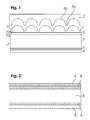
- Fig. 1 shows a layered arrangement 1 of materials to be pressed between the press plates 2, 3 to a sound-absorbing panel.
- the layered arrangement 1 is composed (from below) of an overlay 4, here a melaminharzgetränkten paper.
- the paper is printed with a decor.
- the overlay 4 later forms the top of the sound-absorbing panel.
- On the overlay 4 is a high density fibreboard (HDF plate) 5 of 8 mm thickness.
- HDF board 5 On the HDF board 5 is the counter-train 6, a melaminharzgetränktes paper.
- On the counter-train 6 is a three-layer insulating layer 7 of a first polyethylene film 7a, a heat-resistant, plastically moldable material 7b and a second polyethylene film 7c.
- the first PE film 7a is on the return.
- the heat-resistant, plastically moldable material 7b having a thickness of 1.5 mm is completed by the second PE film 7c, which forms the outside of the insulating layer 7.
- the insulation layer 7 is constructed in three layers, but the three layers 7a, 7b and 7c are prefabricated into one unit.
- the arrangement 1 is thus arranged one above the other in layers in such a way that the later upper side of the laminated panel (overlay 4) lies below, while the later underside of the laminated panel (Dämmlage 7 with return 6) is at the top.
- the first press plate 2 is arranged under the overlay 4.
- the second press plate 3 is arranged above the insulating layer 7, above the heat-resistant, plastically moldable material 7b.
- the second press plate 3 is provided on the insulating layer 7 side facing a structure consisting of webs 3a, between which recesses 3b are arranged. The depth of the recesses is 1.3 mm.
- the panel according to the invention is produced as follows: The arrangement 1 described above is aligned between the press plates 2 and 3.
- the lower press plate 2 is heated to 165 ° C
- the upper, structured press plate 3 is heated to 175 ° C.
- the press plates close and exert a pressure of 30 kg / cm 2 to 40 kg / cm 2 on the assembly 1 over 22 seconds.
- the thermoset contained in overlay 4 and 6 back-flow first liquefies and then hardens.
- the process of curing runs synchronously on both sides of the support plate, since the higher by 10 ° C temperature of the upper press plate 3 ensures a faster heat transfer, which compensates for the retarding effect of the insulating layer 7.
- the structure of the upper press plate 3 consisting of webs 3a and recesses 3b imparts to the plastically deformable, heat-resistant material 7b of the insulating layer through the second PE foil 7c, which is also deformed, a structure consisting of cushion-like elevations (that of the recesses 3b) are delimited from each other by embossments (which are formed by the webs 3a).
- This cushion-like structure of the insulating layer 7 is ready for use and is maintained during the service life of the panel.
- the embossments formed by the webs 3b are too small to interfere with the insulating effect of the insulating layer. They improve the insulating effect of Insulating layer and also represent an aesthetically pleasing underside of the panel.
- thermosets press plates 2 and 3 are moved apart.
- the assembly 1 has now become a laminated HDF board.
- This laminated HDF board is now cooled, possibly still stored until tensions are reduced, which were built up by the pressing process.
- the finished HDF board is flat, although the insulating layer 7 was laminated to the counter-train 4.
- the application of a fourth layer with a thickness of at least 1.5 mm contradicts the theory that wood-based panels should best be composed of an odd number of layers in order to minimize stresses and thus distortion of the plate. Nevertheless, it shows here that the plate is flat and therefore suitable as a wall, ceiling or in particular floor covering.
- the laminated HDF board is now divided into individual panels. Depending on requirements, these panels can be provided with edge profiles for mechanical locking or the edges can be prepared for laying using glue. If the edges of the panel are profiled, then the insulating layer 7 can be processed without disturbing effects, as far as the underside of the panel is to be profiled. It will be apparent from the foregoing that the manufacture of the sound-absorbing panel does not require an operation or apparatus more than hitherto for producing an uninsulated panel.
- Fig. 2 shows a second embodiment of the structure of a sound-insulated panel according to the invention.
- the following layers are laminated from top to bottom: the uppermost layer in the position of use of the panel is formed by the overlay 4, whose duroplastic during curing also connects a decor paper 8 arranged under the overlay 4 with the carrier plate 5.
- the support plate 5 (also an HDF plate of 8 mm thickness) is arranged under the decor paper 8.
- the support plate 5 is located on the return train 6 and is connected thereto.
- the counter-pull 6 binds on its side facing away from the support plate 5 side a machine board 9 as an insulating layer.
- the machine board 9 has a thickness of 1 mm and a weight of 700 kg / m3.
Landscapes
- Engineering & Computer Science (AREA)
- Architecture (AREA)
- Civil Engineering (AREA)
- Structural Engineering (AREA)
- Life Sciences & Earth Sciences (AREA)
- Wood Science & Technology (AREA)
- Physics & Mathematics (AREA)
- Thermal Sciences (AREA)
- Fluid Mechanics (AREA)
- Laminated Bodies (AREA)
- Building Environments (AREA)
Abstract
Description
- Die Erfindung betrifft ein Verfahren zum Herstellen eines schalldämmenden Paneels und ein schalldämmendes Paneel.
- Laminatfussboden wird aus laminierten Paneelen zusammengesetzt. Eine Trägerplatte aus Holzwerkstoff, z. B. HDF oder MDF, mit einem unmittelbar auflaminierten Dekor (dem Dekorpapier und dem Overlay) auf der Oberseite und einem Gegenzug, der ein Verziehen und Verwinden der Trägerplatte verhindert, wird zu einem häufig verwendeten Fußbodenbelag verarbeitet. Gegenzug, Trägerplatte und Overlay sowie das ggf. zwischen Overlay und Trägerplatte angeordnete Dekorpapier werden in einer Kurztaktpresse aufeinander geschichtet. Die erhitzten Pressbleche wirken unmittelbar auf Overlay und Gegenzug ein und bewirken das Aushärten der darin enthaltenen Kunstharze, meist Duroplasten jeweils auf und mit der Oberseite und der Unterseite der Trägerplatte. Die Holzwerkstoffplatte ist nun versiegelt und nach dem ggf. vorgesehenen Aufteilen in Paneele und Fräsen der Kantenprofile gebrauchsfertig. Laminatfussboden kann durch Verleimen von Paneelen hergestellt werden; typisch ist jedoch das leimlose Verlegen von Paneelen mit profilierten Kanten.
- Zu den wenigen Nachteilen des Laminatfußbodens zählen die als unzureichend empfundenen akustischen Eigenschaften. Laminatfussboden hat aufgrund seines mehrschichtigen Aufbaus aus unterschiedlich dichten und dicken Schichten schlechte schalldämmende Eigenschaften. Der Impuls harter Absätze auf der Oberseite, dem Overlay wird nur wenig gedämpft. Zwischen Laminat und Boden eingeschlossene Sand- oder Staubpartikel führen ebenfalls zu unerwünschten akustischen Effekten.
- Verschiedene Maßnahmen zur Verbesserung der Schalldämmung sind bekannt. Zum einen sind Akustikmatten bekannt, die z. B. aus geschäumtem Kunststoff, aus Kork oder lignocellulosehaltigen Fasern bestehen. Diese Matten werden auf dem Unterboden ausgerollt, auf dem der Laminatfussboden bzw. die Paneele, aus denen der Laminatfussboden zusammengesetzt wird, verlegt werden.
- Um das Verlegen einer separaten Akustikmatte zu vermeiden, werden auch Paneele mit einer integrierten Schalldämmung angeboten, die insbesondere die Raumschalldämmung verbessert. In einer einfachen Ausführung wird gemäß der
WO 2007/145 572 vorgeschlagen, den Gegenzug abschnittsweise zu verdichten. Der schalldämmende Effekt ist begrenzt. Andere Paneele mit integrierter Schalldämmung werden nach der Herstellung des durch Overlay und Gegenzug versiegelten Paneels in der Kurztaktpresse in einem zweiten Bearbeitungsschritt und in einer zweiten Anlage mit weiteren Dämmschichten versehen. Aber auch unlaminierte Paneele werden mit schalldämmenden Schichten versehen. Bekannt sind aufgeklebte Kunststoffmatten (DE 10 2005 031 187 ), Papiere, Pappen (DE 10 2004 056 540 ) und auch in flüssiger Form aufkaschierte Kunststoffe. Diese Ausführung wird in derEP 1898 025 offenbart, die als nächstkommender Stand der Technik angesehen wird. - Nachteilig an diesen Paneelen ist, dass das nachträgliche Aufbringen der Schalldämmung mit hohem Aufwand verbunden ist. Außerdem besteht das Risiko, dass bei nachträglich auf Paneele aufgeklebten Matten die Matten mit Untermaß bezogen auf die Unterseite des Paneels bemessen sind, um Überstände zu vermeiden, die das Verlegen des Paneels behindern. Dadurch entstehen aber Hohlräume, die die akustische Dämmwirkung beeinträchtigen.
- Es ist Aufgabe der Erfindung, ein Verfahren zum einfachen und wirtschaftlichen Herstellen von schalldämmenden Paneelen sowie ein einfach und wirtschaftlich hergestelltes schalldämmendes Paneel vorzuschlagen.
- Diese Aufgabe wird gelöst mit einem Verfahren nach Anspruch 1 und einem Paneel nach Anspruch 7.
- Das erfindungsgemäße Verfahren zum Herstellen eines schalldämmenden Paneels mit
- einem Overlay, enthaltend einen mit Fasern versetzten duroplastischen Kunststoff,
- einer Trägerplatte aus Holzwerkstoff,
- einer Dämmschicht und
- einem Gegenzug, enthaltend einen duroplastischen Kunststoff, der zwischen Trägerplatte und Dämmschicht angeordnet ist, sieht vor,
- das Anordnen von Overlay, Trägerplatte, Gegenzug und Dämmschicht zwischen zwei Pressblechen, wobei die Dämmschicht auf einem Pressblech aufliegt, und
- das Pressen von Overlay, Dämmschicht und Gegenzug zwischen zwei erhitzten Pressblechen, bei einer Temperatur und über eine Zeit, die das Aushärten von Overlay und Gegenzug gewährleistet, wodurch der Gegenzug die Dämmschicht an die Trägerplatte bindet. Dies findet erfindungsgemäß in einem einzigen Arbeitsgang statt, der schon bisher zum Herstellen des Paneels erforderlich war. Das erfindungsgemäße schalldämmende Paneel kann bereitgestellt werden, ohne dass Anlagen, Verfahrensschritte oder -maßnahmen erforderlich sind, die über das bisher Übliche hinausgehen. Gegenzug und Dämmschicht sind dabei nicht miteinander verzahnt sondern sind durch das verfließende und aushärtende Kunstharz des Gegenzugs miteinander verbunden.
- Es zählt -wie oben beschrieben- zum Stand der Technik, drei- oder mehrschichtige Paneele mit Overlay, ggf. Dekorpapier, Trägerplatte und Gegenzug in einer Kurztaktpresse bei Temperaturen von ca. 130 °C bis ca. 200°C herzustellen. Ein Presszyklus, also das Einschichten von Overlay, ggf. Dekorpapieren, Trägerplatte und Gegenzug, das Schließen der Presse, das Einwirken der einander gegenüberliegenden, erhitzten Pressbleche auf Overlay bzw. den Gegenzug und das mindestens weitgehende Aushärten der Duroplaste, die in Overlay und Gegenzug enthalten sind, sowie das Austragen der laminierten Holzwerkstoffplatten beträgt ca. 20 Sekunden bis ca. 30 Sekunden. Variationen und Abweichungen von den vorgenannten Temperaturen und Zeiten können sich je nach dem Material der Trägerplatte, der Art oder Mischung der Duroplaste und der Stärke der einzelnen Schichten ergeben.
- Bisher war der Fachmann davon ausgegangen, dass es erforderlich sei, das erhitzte Pressblech unmittelbar auf den Gegenzug einwirken zu lassen, um das vollständige Aushärten des duroplastischen Kunstharzes zu gewährleisten. Alle weiteren Dämmschichten wurden erst nachträglich auf den fertig laminierten Gegenzug aufgebracht. So schildert es auch die
EP 1898 025 . Es hat sich jedoch herausgestellt, dass eine Dämmschicht zwischen Gegenzug und erhitzter Pressplatte eingelegt werden kann, ohne dass die Qualität des Laminats, die durch das einwandfreie Aushärten von Overlay und Gegenzug wesentlich bestimmt wird, beeinträchtigt wird. Auf diese Weise wird in einem ohnehin bereits durchgeführten Arbeitsgang ein schalldämmendes Paneel hergestellt. - Die Dämmschicht verbindet sich beim Aushärten des Gegenzugs mit dem unter Einwirkung erhöhter Temperatur zunächst aufschmelzenden und dann aushärtenden Duroplasten, so wie sich auch die Trägerplatte mit dem Gegenzug verbindet. Der Gegenzug nimmt nach wie vor die Kräfte auf, die durch das Aushärten des Overlays verursacht werden. Es entsteht ein qualitativ hochwertiges, vollständig ebenes Produkt ohne Schwachstellen hinsichtlich der akustischen Dämmwirkung.
- Das Einwirken des erhitzten Pressblechs auf die Dämmschicht bewirkt eine vollflächige Verbindung von Gegenzug und Dämmschicht, so dass die Bildung von unerwünschten Luftpolstern ausgeschlossen ist. Gleichzeitig hat sich herausgestellt, dass kein zusätzlicher Klebstoff erforderlich ist. Der bereits jetzt eingesetzte Gegenzug ist ausreichend beidseitig mit duroplastischem Kunstharz ausgestattet, so dass das erfindungsgemäße Verfahren sich als besonders wirtschaftlich erweist.
- Nach einer bevorzugten Ausführung des erfindungsgemäßen Verfahrens ist die Temperatur des Pressblechs, das auf das Overlay einwirkt, niedriger als die Temperatur des Pressblechs, das auf Dämmschicht und Gegenzug einwirkt. Durch diese Maßnahme wird gewährleistet, dass das Erhitzen des im Gegenzug enthaltenen Duroplasten zeitgleich mit dem Erhitzen des im Overlay enthaltenen Duroplasten erfolgt. Das Einstellen der optimalen Temperaturen der einzelnen Pressbleche erfolgt in Abhängigkeit von Material und Stärke der Dämmschicht, die sich zwischen Gegenzug und Pressblech befindet und kann durch einfache Optimierungsversuche ermittelt werden. Die Temperaturdifferenz zwischen den beiden Pressblechen kann zwischen 3 °C und 25 °C betragen, sie wird häufig zwischen 5 °C und 15 °C liegen.
- Häufig verwendete Kunstharze sind Phenol-Formaldehydharze (Phenoplaste) und Aminoplaste wie Melaminharze und Harnstoff-Formaldehydharze. Dem Fachmann sind die zum Laminieren von Holzwerkstoffplatten geeigneten Kunstharze oder Kunstharz-Mischungen bekannt, sie werden hier nicht näher erläutert. Overlay und Gegenzug bestehen nicht allein aus Kunstharz, da der Kunstharzfilm beim Aushärten reißt. Overlay und Gegenzug sind durch Fasern verstärkt, entweder dadurch, dass ein Trägerpapier mit Duroplasten imprägniert wird, wobei das imprägnierte Papier, ggf. noch mit einem Dekorpapier versehen, dann getrocknet und in dieser getrockneten Form als sogenanntes Overlay zum Laminieren von Holzwerkstoffplatten eingesetzt wird. In gleicher Weise - wenn auch meist ohne Dekorpapier- kann ein Gegenzug hergestellt werden. Alternativ kann das Overlay aus einem flüssig auf die Trägerplatte aufgebrachten, duroplastischen Kunstharz hergestellt werden, in das Fasern eingemischt sind.
- Für das erfindungsgemäße Verfahren wird als Dämmschicht bevorzugt lignocellulosehaltiges Material, textiles Material, Kunststoff, Glas- oder Steinfasermaterial eingesetzt. Grundsätzlich ist jedes Material geeignet, das schalldämmende Eigenschaften besitzt, und dass unter den Arbeitsbedingungen beständig ist. Häufig sind dies Werkstoffe, die eine Dichte von mehr als 50 kg/m3 bis unter 700 kg/m3 aufweisen, und deren geringes Gewicht gute akustische Dämmeigenschaften mit sich bringt. Papier, Pappe, Karton oder andere bahnförmige Werkstoffe, gewobene, gefilzte oder non-woven Bahnen aus natürlichen und/oder synthetischen Textilfasern, aus Glasfasern oder aus mineralischen Fasern, sogenannten Steinfasern, die zum Zwecke der Isolierung eingesetzt werden, aber auch Bahnen aus Kunststoff sind für die Verwendung als Dämmschicht geeignet.
- Die Bahnen können papierdünn, also 10 Mikrometer stark sein, sie können aber auch bis zu 20 mm stark sein. Üblich sind Materialstärken für die Dämmschicht von 0,1 mm bis 5 mm, besonders häufig werden Dämmschichten mit einer Materialstärke von 1 mm bis 2 mm eingesetzt. Neben den vorgenannten Materialien jeweils in reiner Form können auch Mischungen von Werkstoffen eingesetzt werden. Beispielsweise Papier oder Pappe mit Kunststoffanteilen oder Non-wovens, z. B. aus trocken gestreuten, anschließend genadelten lignocellulosehaltigen Fasern, in die Füllkörper aus Kunststoff oder Mineralien eingestreut sind. Bei Prüfungen der erfindungsgemäß hergestellten Paneele hat sich herausgestellt, dass schon die dünnen Beschichtungen mit Kunststoffbahnen oder Bahnen aus Papier, Glas- oder Steinfasern signifikante Verbesserungen der schalldämmenden Eigenschaften bewirken. Die Verarbeitung der Dämmschicht in der Kurztaktpresse mindert die schalldämmenden Eigenschaften des Paneels nicht.
- Nach einer weiter bevorzugten Ausführung des erfindungsgemäßen Verfahrens ist die Dämmschicht mehrlagig. Kunststoffbeschichtetes Papier oder dünne Glasfasermatten, die auf einer oder zwei Flächen von einem Papier abgedeckt sind, sind nur zwei Beispiele für solche mehrlagigen Dämmschichten. Dämmschichten können mehrere Lagen aufweisen, wenn dadurch eine verbesserte Schalldämmung erreicht wird. Es können aber auch Werkstoffe eingesetzt werden, die ohne eine Umhüllung aus wärmebeständigem Material den Bedingungen der Kurztaktpresse nicht standhalten.
- Typische Dämmschichten können folgende Lagen aufweisen:
- ein mit Polyethylenschaum beschichtetes Papier, bei dem das Papier bevorzugt am Pressblech anliegt.
- ein beidseitig mit Papier umhüllter Polyethylenschaum
- eine mit plastisch verformbarem Kunststoff beschichtete Lage aus Papier, Karton oder Kunststoff (z. B. Polyethylenfolie)
- Die Dämmschicht wirkt -je nach Material mehr oder weniger stark- wie eine Isolierschicht, die den Wärmeübergang vom Pressblech auf den Gegenzug verringert. Nach einer vorteilhaften Ausführung des erfindungsgemäßen Verfahrens wird die Dämmschicht vor dem Anordnen auf dem Pressblech mit einer wärmeleitenden Flüssigkeit, meist Wasser oder einer wässrigen Lösung besprüht. Die Flüssigkeit, die in Abstimmung auf das Material der Dämmschicht gewählt wird, kann Wasser oder eine Salzlösung sein. Sie bewirkt eine schnellere Wärmeleitung. Dadurch kann entweder das Verfahren beschleunigt durchgeführt werden oder die Temperatur des auf die Dämmschicht und den Gegenzug einwirkenden Pressblechs kann verringert werden.
- Schließlich kann das erfindungsgemäße Verfahren bei Bedarf mit einem Pressblech durchgeführt werden, das glatt oder strukturiert ist. Für einige Werkstoffe, die die Dämmschicht bilden, kann die schalldämmende Wirkung verbessert werden, wenn die Außenseite der Dämmschicht, die von der Trägerplatte abgewandt ist, mit einer Prägestruktur versehen wird. Dies geschieht durch die Verwendung entsprechend negativ geprägter Pressbleche, die der Dämmschicht in der Kurztaktpresse die gewünschte Struktur verleihen. Das Erzeugen von Bereichen unterschiedlicher Dichte in der Dämmschicht bewirkt eine verbesserte Dämmwirkung.
- Durch das vorbeschriebene Verfahren und seine Abwandlungen, Ergänzungen oder Erweiterungen kann entweder unmittelbar das einzelne Paneel hergestellt werden, das zur Verleimung oder mit einem Kantenprofil versehen zur mechanischen Verriegelung vorgesehen ist. Bevorzugt wird jedoch zunächst eine Holzwerkstoffplatte mit der erfindungsgemäß angebrachten Dämmschicht laminiert, die anschließend in einzelne Paneele zerteilt wird.
- Die Erfindung betrifft weiter ein Paneel, aufweisend
- ein Overlay, enthaltend einen mit Fasern versetzten duroplastischen Kunststoff,
- eine Trägerplatte aus Holzwerkstoff,
- eine Dämmschicht und
- einen Gegenzug, enthaltend einen mit Fasern versetzten duroplastischen Kunststoff,
- Aus den vorstehend beschriebenen Gründen, insbesondere der verbesserten Schalldämmung, ist ein Paneel bevorzugter Gegenstand der Erfindung, bei dem die Dämmschicht mehrlagig ist.
- Die Dämmschicht des erfindungsgemäßen schalldämmenden Paneels weist vorteilhaft lignocellulosehaltiges Material, wie Papier, Pappe oder Karton, aber auch dünne, weiche Faserplatten, aber auch textiles Material, Kunststoff, Glas- oder Steinfasermaterial auf oder besteht ausschließlich aus diesen Werkstoffen. Mischungen dieser Werkstoffe können ebenfalls gut geeignet sein, dem Paneel schalldämmende Eigenschaften zu verleihen.
- Die schalldämmende Wirkung der Dämmschicht wird weiter unterstützt, wenn die Dämmschicht eine glatte oder eine profilierte Außenseite aufweist.
- Das erfindungsgemäße Paneel hat deshalb besonders gute schalldämmende Eigenschaften, weil die Dämmschicht die Unterseite der Holzwerkstoffplatte vollständig abdeckt, so dass keine Lücken oder Hohlräume entstehen, die die schallmindernde Wirkung der Dämmschicht herabsetzen könnten.
- Details der Erfindung werden im Folgenden an Hand von Ausführungsbeispielen erläutert. Es zeigen:
- Fig. 1:
- eine schematische Querschnittsdarstellung einer ersten Ausführungsform eines erfindungsgemäßen schalldämmenden Paneels in einer Kurztaktpresse
- Fig. 2:
- eine schematische Querschnittsdarstellung einer zweiten Ausführungsform eines erfindungsgemäßen schalldämmenden Paneels.
-
Fig. 1 zeigt eine schichtweise Anordnung 1 von Werkstoffen, die zwischen den Pressblechen 2, 3 zu einem schalldämmenden Paneel verpresst werden sollen. Die schichtweise Anordnung 1 setzt sich (von unten) zusammen aus einem Overlay 4, hier einem melaminharzgetränkten Papier. Das Papier ist mit einem Dekor bedruckt. Das Overlay 4 bildet später die Oberseite des schalldämmenden Paneels. Auf dem Overlay 4 liegt eine hochdichte Faserplatte (HDF-Platte) 5 von 8 mm Stärke. Auf der HDF-Platte 5 liegt der Gegenzug 6, ein melaminharzgetränktes Papier. Auf dem Gegenzug 6 liegt eine dreischichtige Dämmlage 7 aus einer ersten Polyethylenfolie 7a, einem hitzebeständigen, plastisch formbaren Material 7b und einer zweiten Polyethylenfolie 7c. Die erste PE-Folie 7a liegt auf dem Gegenzug. Das hitzebeständige, plastisch formbare Material 7b mit einer Stärke von 1,5 mm wird von der zweiten PE-Folie 7c abgeschlossen, die die Außenseite der Dämmlage 7 bildet. Die Dämmlage 7 ist dreilagig aufgebaut, die drei Schichten 7a, 7b und 7c sind jedoch zu einer Einheit vorgefertigt. - Die Anordnung 1 ist also in der Weise in Schichten übereinander angeordnet, dass die spätere Oberseite des laminierten Paneels (Overlay 4) unten liegt, während die spätere Unterseite des laminierten Paneels (Dämmlage 7 mit Gegenzug 6) oben liegt. Das erste Pressblech 2 ist unter dem Overlay 4 angeordnet. Das zweite Pressblech 3 ist über der Dämmlage 7, über dem hitzebeständigen, plastisch formbaren Material 7b angeordnet. Das zweite Pressblech 3 ist auf der der Dämmlage 7 zugewandten Seite mit einer Struktur versehen, die aus Stegen 3a besteht, zwischen denen Ausnehmungen 3b angeordnet sind. Die Tiefe der Ausnehmungen beträgt 1,3 mm.
- Das erfindungsgemäße Paneel wird wie folgt hergestellt: Die vorstehend beschriebene Anordnung 1 wird zwischen den Pressblechen 2 und 3 ausgerichtet. Das untere Pressblech 2 ist auf 165 °C aufgeheizt, das obere, strukturierte Pressblech 3 ist auf 175 °C aufgeheizt. Die Pressbleche schließen und üben über 22 Sekunden einen Druck von 30 kg/cm2 bis 40 kg/cm2 auf die Anordnung 1 aus. In dieser Zeit verflüssigt sich der in Overlay 4 und Gegenzug 6 enthaltene Duroplast zunächst und härtet dann aus. Beim Aushärten entsteht eine feste Verbindung zur Trägerplatte 5 einerseits und beim Gegenzug 6 zur Dämmlage 7 andererseits. Der Vorgang des Aushärtens läuft auf beiden Seiten der Trägerplatte synchron ab, da die um 10 °C höhere Temperatur des oberen Pressblechs 3 einen schnelleren Wärmeübergang gewährleistet, der die verzögernde Wirkung der Dämmlage 7 kompensiert. Gleichzeitig verleiht die aus Stegen 3a und Ausnehmungen 3b bestehende Struktur des oberen Pressblechs 3 dem plastisch verformbaren, hitzebeständigen Material 7b der Dämmlage durch die zweite PE-Folie7c hindurch, die ebenfalls verformt wird, eine Struktur, die aus polsterartigen Erhebungen besteht (die von den Ausnehmungen 3b geformt werden), voneinander abgegrenzt durch Prägungen (die von den Stegen 3a geformt werden). Diese polsterartige Struktur der Dämmlage 7 ist gebrauchsfertig und bleibt während der Nutzungsdauer des Paneels erhalten. Die Prägungen, die von den Stegen 3b geformt werden, sind zu klein, als dass sie die dämmende Wirkung der Dämmlage beeinträchtigen können. Sie verbessern die Dämmwirkung der Dämmschicht und stellen zudem eine ästhetisch ansprechende Unterseite des Paneels dar.
- Nach dem Abschluss des Aushärtens der Duroplaste werden die Pressbleche 2 und 3 auseinander gefahren. Die Anordnung 1 ist nun zu einer laminierten HDF-Platte geworden. Diese laminierte HDF-Platte wird nun gekühlt, ggf. noch gelagert bis Spannungen abgebaut sind, die durch den Pressvorgang aufgebaut wurden. Die fertige HDF-Platte ist eben, obwohl die Dämmlage 7 auf den Gegenzug 4 auflaminiert wurde. Das Aufbringen einer vierten Schicht mit einer Stärke von immerhin 1,5 mm widerspricht der Theorie, dass Holzwerkstoffplatten am besten aus einer ungeraden Anzahl von Schichten aufgebaut sein sollen, um Spannungen und damit ein Verziehen der Platte zu minimieren. Trotzdem zeigt sich hier, dass die Platte eben und damit als Wand-, Decken- oder insbesondere Fußbodenbelag geeignet ist.
- Die laminierte HDF-Platte wird nun aufgeteilt in einzelne Paneele. Je nach Bedarf können diese Paneele mit Kantenprofilen zur mechanischen Verriegelung versehen werden oder die Kanten können für eine Verlegung unter Verwendung von Leim vorbereitet werden. Werden die Kanten des Paneels profiliert, so lässt sich die Dämmlage 7 ohne störende Effekte bearbeiten, soweit die Unterseite des Paneels zu profilieren ist. Es ist aus dem Vorstehenden ersichtlich, dass zum Herstellen des schalldämmenden Paneels nicht ein Arbeitsgang oder eine Vorrichtung mehr erforderlich ist als bisher zur Herstellung eines ungedämmten Paneels.
-
Fig. 2 zeigt ein zweites Ausführungsbeispiel für den Aufbau eines erfindungsgemäß schallgedämmten Paneels. Von oben nach unten sind folgende Schichten aufeinander laminiert: die in der Gebrauchslage des Paneels oberste Schicht wird von dem Overlay 4 gebildet, dessen Duroplast beim Aushärten auch ein unter dem Overlay 4 angeordnetes Dekorpapier 8 mit der Trägerplatte 5 verbindet. Die Trägerplatte 5 (ebenfalls eine HDF-Platte von 8 mm Stärke) ist unter dem Dekorpapier 8 angeordnet. Die Trägerplatte 5 liegt auf dem Gegenzug 6 und ist mit diesem verbunden. Der Gegenzug 6 bindet auf seiner von der Trägerplatte 5 abgewandten Seite einen Maschinenkarton 9 als Dämmschicht. Der Maschinenkarton 9 hat eine Stärke von 1 mm und ein Gewicht von 700 kg/m3. - Zum Herstellen dieses schalldämmenden Paneels wird dieselbe Presse mit denselben Pressblechen 2 und 3 eingesetzt wie zuvor im Zusammenhang mit der
Fig. 1 erläutert.
Claims (10)
- Verfahren zum Herstellen eines schalldämmenden Paneels mit- einem Overlay, enthaltend einen mit Fasern versetzten, duroplastischen Kunststoff,- einer Trägerplatte aus Holzwerkstoff,- einer Dämmschicht und- einem Gegenzug, enthaltend einen duroplastischen Kunststoff, der zwischen Trägerplatte und Dämmschicht angeordnet ist,mit den Schritten- Anordnen von Overlay, Trägerplatte, Gegenzug und Dämmschicht zwischen zwei Pressblechen, wobei die Dämmschicht auf einem Pressblech aufliegt, und- Pressen von Overlay, Dämmschicht und Gegenzug zwischen zwei erhitzten Pressblechen, auf eine Temperatur und über eine Zeit, die das Aushärten von Overlay und Gegenzug gewährleistet, wodurch der Gegenzug die Dämmschicht an die Trägerplatte bindet.
- Verfahren nach Anspruch 1, dadurch gekennzeichnet, dass die Temperatur des Pressblechs, das auf das Overlay einwirkt, niedriger ist als die Temperatur des Pressblechs, das auf Dämmschicht und Gegenzug einwirkt.
- Verfahren nach einem der vorangehenden Ansprüche, dadurch gekennzeichnet, dass die Dämmschicht lignocellulosehaltiges Material, textiles Material, Kunststoff, Glas- oder Steinfasermaterial aufweist oder daraus besteht.
- Verfahren nach Anspruch 1 oder 2, dadurch gekennzeichnet, dass die Dämmschicht mehrlagig ist.
- Verfahren nach einem der vorstehenden Ansprüche, dadurch gekennzeichnet, dass die Dämmschicht vor dem Anordnen auf dem Pressblech mit einer wärmeleitenden Flüssigkeit besprüht wird.
- Verfahren nach einem der vorstehenden Ansprüche, dadurch gekennzeichnet, dass ein Pressblech glatt oder strukturiert ist.
- Paneel, aufweisend- ein Overlay, enthaltend einen mit Fasern versetzten duroplastischen Kunststoff,- eine Trägerplatte aus Holzwerkstoff,- eine Dämmschicht und- einen Gegenzug, enthaltend einen duroplastischen Kunststoff,dadurch gekennzeichnet, dass der Gegenzug zwischen Trägerplatte und Dämmschicht angeordnet ist.
- Paneel nach Anspruch 7, dadurch gekennzeichnet, dass die Dämmschicht mehrlagig ist.
- Paneel nach Anspruch 7 oder 8, dadurch gekennzeichnet, dass die Dämmschicht lignocellulosehaltiges Material, textiles Material, Kunststoff, Glas- oder Steinfasermaterial aufweist oder daraus besteht.
- Paneel nach Anspruch 7, 8 oder 9, dadurch gekennzeichnet, dass die Dämmschicht eine glatte oder eine strukturierte Außenseite aufweist.
Priority Applications (4)
| Application Number | Priority Date | Filing Date | Title |
|---|---|---|---|
| ES10170172T ES2397261T3 (es) | 2010-07-20 | 2010-07-20 | Procedimiento para la fabricación de un panel de insonorización |
| PT101701720T PT2295240E (pt) | 2010-07-20 | 2010-07-20 | Método para a produção de um painel de isolamento acústico |
| EP10170172A EP2295240B1 (de) | 2010-07-20 | 2010-07-20 | Verfahren zum Herstellen eines schalldämmenden Paneels |
| PL10170172T PL2295240T3 (pl) | 2010-07-20 | 2010-07-20 | Sposób wytwarzania panelu z izolacja dźwiękową |
Applications Claiming Priority (1)
| Application Number | Priority Date | Filing Date | Title |
|---|---|---|---|
| EP10170172A EP2295240B1 (de) | 2010-07-20 | 2010-07-20 | Verfahren zum Herstellen eines schalldämmenden Paneels |
Publications (2)
| Publication Number | Publication Date |
|---|---|
| EP2295240A1 true EP2295240A1 (de) | 2011-03-16 |
| EP2295240B1 EP2295240B1 (de) | 2012-11-07 |
Family
ID=42735713
Family Applications (1)
| Application Number | Title | Priority Date | Filing Date |
|---|---|---|---|
| EP10170172A Not-in-force EP2295240B1 (de) | 2010-07-20 | 2010-07-20 | Verfahren zum Herstellen eines schalldämmenden Paneels |
Country Status (4)
| Country | Link |
|---|---|
| EP (1) | EP2295240B1 (de) |
| ES (1) | ES2397261T3 (de) |
| PL (1) | PL2295240T3 (de) |
| PT (1) | PT2295240E (de) |
Cited By (2)
| Publication number | Priority date | Publication date | Assignee | Title |
|---|---|---|---|---|
| EP2784233A1 (de) | 2013-03-25 | 2014-10-01 | Organoid Technologies GmbH | Akustisches Paneel |
| EP2862724A1 (de) * | 2013-10-15 | 2015-04-22 | Kronotec AG | Verfahren zum Beschichten und Prägen eines Substrats |
Families Citing this family (1)
| Publication number | Priority date | Publication date | Assignee | Title |
|---|---|---|---|---|
| EP4764103A1 (de) | 2024-12-19 | 2026-06-24 | MeisterWerke Schulte GmbH | Plattenförmiges bauelement und verfahren zu dessen herstellung |
Citations (7)
| Publication number | Priority date | Publication date | Assignee | Title |
|---|---|---|---|---|
| DE10151614C1 (de) * | 2001-10-23 | 2003-04-24 | Kaindl Wals M | Paneel mit schallverbessernder Schicht nebst Herstellungsverfahren |
| DE20207218U1 (de) * | 2002-05-07 | 2003-09-18 | Fritz Egger Ges. M.B.H. & Co., Unterradlberg | Hartbodenbelag mit integriertem Schallschutz |
| EP1627977A1 (de) * | 2004-08-09 | 2006-02-22 | DAKOR Melamin Imprägnierungen GmbH | Ausgleichelement, insbesondere Gegenzugimprägnat, für Laminatbodenplatten, Laminatbodenplatte mit einem solchen Ausgleichelement sowie Verfahren und Vorrichtung zur Herstellung derselben |
| DE102004056540A1 (de) | 2004-11-23 | 2006-05-24 | Dakor Melamin Imprägnierungen Gmbh | Gegenzugimprägnat für Laminatbodenplatten, Laminatbodenplatte mit einem solchen Gegenzugimprägnat sowie Verfahren und Vorrichtung zu dessen Herstellung |
| DE102005031187A1 (de) | 2005-07-01 | 2007-01-04 | Hülsta-Werke Hüls Gmbh & Co. Kg | Paneel |
| WO2007145572A1 (en) | 2006-06-16 | 2007-12-21 | Pergo (Europe) Ab | A decorative, low noise laminate equipped with a patterned balance layer formed by compression |
| EP1898025A2 (de) | 2006-08-28 | 2008-03-12 | Kronotec Ag | Paneel mit Trittschall- und mit Raumschall-Dämmung, Belag aus Paneelen, schallmindernde Beschichtung, Verfahren zu dessen Herstellung und Vorrichtung hierzu |
-
2010
- 2010-07-20 PL PL10170172T patent/PL2295240T3/pl unknown
- 2010-07-20 PT PT101701720T patent/PT2295240E/pt unknown
- 2010-07-20 ES ES10170172T patent/ES2397261T3/es active Active
- 2010-07-20 EP EP10170172A patent/EP2295240B1/de not_active Not-in-force
Patent Citations (7)
| Publication number | Priority date | Publication date | Assignee | Title |
|---|---|---|---|---|
| DE10151614C1 (de) * | 2001-10-23 | 2003-04-24 | Kaindl Wals M | Paneel mit schallverbessernder Schicht nebst Herstellungsverfahren |
| DE20207218U1 (de) * | 2002-05-07 | 2003-09-18 | Fritz Egger Ges. M.B.H. & Co., Unterradlberg | Hartbodenbelag mit integriertem Schallschutz |
| EP1627977A1 (de) * | 2004-08-09 | 2006-02-22 | DAKOR Melamin Imprägnierungen GmbH | Ausgleichelement, insbesondere Gegenzugimprägnat, für Laminatbodenplatten, Laminatbodenplatte mit einem solchen Ausgleichelement sowie Verfahren und Vorrichtung zur Herstellung derselben |
| DE102004056540A1 (de) | 2004-11-23 | 2006-05-24 | Dakor Melamin Imprägnierungen Gmbh | Gegenzugimprägnat für Laminatbodenplatten, Laminatbodenplatte mit einem solchen Gegenzugimprägnat sowie Verfahren und Vorrichtung zu dessen Herstellung |
| DE102005031187A1 (de) | 2005-07-01 | 2007-01-04 | Hülsta-Werke Hüls Gmbh & Co. Kg | Paneel |
| WO2007145572A1 (en) | 2006-06-16 | 2007-12-21 | Pergo (Europe) Ab | A decorative, low noise laminate equipped with a patterned balance layer formed by compression |
| EP1898025A2 (de) | 2006-08-28 | 2008-03-12 | Kronotec Ag | Paneel mit Trittschall- und mit Raumschall-Dämmung, Belag aus Paneelen, schallmindernde Beschichtung, Verfahren zu dessen Herstellung und Vorrichtung hierzu |
Cited By (2)
| Publication number | Priority date | Publication date | Assignee | Title |
|---|---|---|---|---|
| EP2784233A1 (de) | 2013-03-25 | 2014-10-01 | Organoid Technologies GmbH | Akustisches Paneel |
| EP2862724A1 (de) * | 2013-10-15 | 2015-04-22 | Kronotec AG | Verfahren zum Beschichten und Prägen eines Substrats |
Also Published As
| Publication number | Publication date |
|---|---|
| EP2295240B1 (de) | 2012-11-07 |
| PT2295240E (pt) | 2013-01-23 |
| PL2295240T3 (pl) | 2013-04-30 |
| ES2397261T3 (es) | 2013-03-05 |
Similar Documents
| Publication | Publication Date | Title |
|---|---|---|
| EP1262607B1 (de) | Verfahren zur Herstellung einer Fussbodenplatte | |
| DE10151614C1 (de) | Paneel mit schallverbessernder Schicht nebst Herstellungsverfahren | |
| EP1938963B1 (de) | Bodenpaneel | |
| EP1898025B1 (de) | Paneel mit Trittschall- und mit Raumschall-Dämmung, Belag aus Paneelen, schallmindernde Beschichtung, Verfahren zu dessen Herstellung und Vorrichtung hierzu | |
| DE102005006532A1 (de) | Paneel mit dekorativer Schicht | |
| EP2082897B1 (de) | Fussbodenpaneele sowie Verfahren zu deren Herstellung | |
| EP3112545B1 (de) | Akustikpaneel | |
| EP2451655B1 (de) | Schichtstoffverbundplatte und verfahren zur herstellung | |
| DE20108358U1 (de) | Laminat, insbesondere Fußbodenlaminat | |
| EP2295240B1 (de) | Verfahren zum Herstellen eines schalldämmenden Paneels | |
| DE3906594A1 (de) | Verfahren zur herstellung eines postforming-laminats | |
| EP2525010B1 (de) | Leichtbauplatte, Verfahren und Vorrichtung zur Herstellung dieser Leichtbauplatte | |
| EP3898228A1 (de) | Verfahren zum herstellen eines furnierten holzwerkstoffs und holzwerkstoff aus einer trägerplatte und mindestens zwei furnieren | |
| DE102014104760A1 (de) | Schichtstoff und Verfahren zu dessen Herstellung | |
| DE20109321U1 (de) | Fußbodenpaneel | |
| DE102014012188A1 (de) | Platte für einen Boden-, Wand- oder Deckenbelag oder für ein Möbelbauteil sowie Verfahren und Pressvorrichtung zur Herstellung einer solchen Platte | |
| WO2006119807A1 (de) | Paneele mit zweilagiger trittschalldämpfung | |
| DE20207218U1 (de) | Hartbodenbelag mit integriertem Schallschutz | |
| EP3330076B1 (de) | Verfahren zum herstellen eines beidseitig furnierten laminats | |
| EP3269543B1 (de) | Paneel | |
| DE102017001477B4 (de) | Arbeitsplatte | |
| AT5825U1 (de) | Verfahren zur herstellung eines paneels | |
| EP2095941A1 (de) | Belagplatte | |
| DE20117646U1 (de) | Paneel mit schallverbessernder Schicht | |
| EP3181356A1 (de) | Verfahren zum herstellen eines schichtstoffs |
Legal Events
| Date | Code | Title | Description |
|---|---|---|---|
| PUAI | Public reference made under article 153(3) epc to a published international application that has entered the european phase |
Free format text: ORIGINAL CODE: 0009012 |
|
| AK | Designated contracting states |
Kind code of ref document: A1 Designated state(s): AL AT BE BG CH CY CZ DE DK EE ES FI FR GB GR HR HU IE IS IT LI LT LU LV MC MK MT NL NO PL PT RO SE SI SK SM TR |
|
| AX | Request for extension of the european patent |
Extension state: BA ME RS |
|
| 17P | Request for examination filed |
Effective date: 20110830 |
|
| 17Q | First examination report despatched |
Effective date: 20111021 |
|
| GRAP | Despatch of communication of intention to grant a patent |
Free format text: ORIGINAL CODE: EPIDOSNIGR1 |
|
| GRAS | Grant fee paid |
Free format text: ORIGINAL CODE: EPIDOSNIGR3 |
|
| GRAA | (expected) grant |
Free format text: ORIGINAL CODE: 0009210 |
|
| RAP1 | Party data changed (applicant data changed or rights of an application transferred) |
Owner name: FLOORING TECHNOLOGIES LTD. |
|
| AK | Designated contracting states |
Kind code of ref document: B1 Designated state(s): AL AT BE BG CH CY CZ DE DK EE ES FI FR GB GR HR HU IE IS IT LI LT LU LV MC MK MT NL NO PL PT RO SE SI SK SM TR |
|
| REG | Reference to a national code |
Ref country code: GB Ref legal event code: FG4D Free format text: NOT ENGLISH |
|
| REG | Reference to a national code |
Ref country code: CH Ref legal event code: EP Ref country code: AT Ref legal event code: REF Ref document number: 582817 Country of ref document: AT Kind code of ref document: T Effective date: 20121115 |
|
| REG | Reference to a national code |
Ref country code: IE Ref legal event code: FG4D Free format text: LANGUAGE OF EP DOCUMENT: GERMAN |
|
| REG | Reference to a national code |
Ref country code: CH Ref legal event code: NV Representative=s name: PATENTANWALT DIPL.-ING. (UNI.) WOLFGANG HEISEL, CH |
|
| REG | Reference to a national code |
Ref country code: DE Ref legal event code: R096 Ref document number: 502010001587 Country of ref document: DE Effective date: 20130103 |
|
| REG | Reference to a national code |
Ref country code: PT Ref legal event code: SC4A Free format text: AVAILABILITY OF NATIONAL TRANSLATION Effective date: 20130104 |
|
| REG | Reference to a national code |
Ref country code: SE Ref legal event code: TRGR |
|
| REG | Reference to a national code |
Ref country code: NL Ref legal event code: T3 |
|
| REG | Reference to a national code |
Ref country code: ES Ref legal event code: FG2A Ref document number: 2397261 Country of ref document: ES Kind code of ref document: T3 Effective date: 20130305 |
|
| REG | Reference to a national code |
Ref country code: SK Ref legal event code: T3 Ref document number: E 13395 Country of ref document: SK |
|
| REG | Reference to a national code |
Ref country code: LT Ref legal event code: MG4D |
|
| PG25 | Lapsed in a contracting state [announced via postgrant information from national office to epo] |
Ref country code: FI Free format text: LAPSE BECAUSE OF FAILURE TO SUBMIT A TRANSLATION OF THE DESCRIPTION OR TO PAY THE FEE WITHIN THE PRESCRIBED TIME-LIMIT Effective date: 20121107 Ref country code: IS Free format text: LAPSE BECAUSE OF FAILURE TO SUBMIT A TRANSLATION OF THE DESCRIPTION OR TO PAY THE FEE WITHIN THE PRESCRIBED TIME-LIMIT Effective date: 20130307 Ref country code: NO Free format text: LAPSE BECAUSE OF FAILURE TO SUBMIT A TRANSLATION OF THE DESCRIPTION OR TO PAY THE FEE WITHIN THE PRESCRIBED TIME-LIMIT Effective date: 20130207 Ref country code: LT Free format text: LAPSE BECAUSE OF FAILURE TO SUBMIT A TRANSLATION OF THE DESCRIPTION OR TO PAY THE FEE WITHIN THE PRESCRIBED TIME-LIMIT Effective date: 20121107 Ref country code: HR Free format text: LAPSE BECAUSE OF FAILURE TO SUBMIT A TRANSLATION OF THE DESCRIPTION OR TO PAY THE FEE WITHIN THE PRESCRIBED TIME-LIMIT Effective date: 20121107 |
|
| REG | Reference to a national code |
Ref country code: PL Ref legal event code: T3 |
|
| PG25 | Lapsed in a contracting state [announced via postgrant information from national office to epo] |
Ref country code: LV Free format text: LAPSE BECAUSE OF FAILURE TO SUBMIT A TRANSLATION OF THE DESCRIPTION OR TO PAY THE FEE WITHIN THE PRESCRIBED TIME-LIMIT Effective date: 20121107 Ref country code: SI Free format text: LAPSE BECAUSE OF FAILURE TO SUBMIT A TRANSLATION OF THE DESCRIPTION OR TO PAY THE FEE WITHIN THE PRESCRIBED TIME-LIMIT Effective date: 20121107 |
|
| PG25 | Lapsed in a contracting state [announced via postgrant information from national office to epo] |
Ref country code: DK Free format text: LAPSE BECAUSE OF FAILURE TO SUBMIT A TRANSLATION OF THE DESCRIPTION OR TO PAY THE FEE WITHIN THE PRESCRIBED TIME-LIMIT Effective date: 20121107 Ref country code: CZ Free format text: LAPSE BECAUSE OF FAILURE TO SUBMIT A TRANSLATION OF THE DESCRIPTION OR TO PAY THE FEE WITHIN THE PRESCRIBED TIME-LIMIT Effective date: 20121107 Ref country code: BG Free format text: LAPSE BECAUSE OF FAILURE TO SUBMIT A TRANSLATION OF THE DESCRIPTION OR TO PAY THE FEE WITHIN THE PRESCRIBED TIME-LIMIT Effective date: 20130207 Ref country code: EE Free format text: LAPSE BECAUSE OF FAILURE TO SUBMIT A TRANSLATION OF THE DESCRIPTION OR TO PAY THE FEE WITHIN THE PRESCRIBED TIME-LIMIT Effective date: 20121107 |
|
| PG25 | Lapsed in a contracting state [announced via postgrant information from national office to epo] |
Ref country code: RO Free format text: LAPSE BECAUSE OF FAILURE TO SUBMIT A TRANSLATION OF THE DESCRIPTION OR TO PAY THE FEE WITHIN THE PRESCRIBED TIME-LIMIT Effective date: 20121107 |
|
| PLBE | No opposition filed within time limit |
Free format text: ORIGINAL CODE: 0009261 |
|
| STAA | Information on the status of an ep patent application or granted ep patent |
Free format text: STATUS: NO OPPOSITION FILED WITHIN TIME LIMIT |
|
| 26N | No opposition filed |
Effective date: 20130808 |
|
| PG25 | Lapsed in a contracting state [announced via postgrant information from national office to epo] |
Ref country code: CY Free format text: LAPSE BECAUSE OF FAILURE TO SUBMIT A TRANSLATION OF THE DESCRIPTION OR TO PAY THE FEE WITHIN THE PRESCRIBED TIME-LIMIT Effective date: 20121107 |
|
| REG | Reference to a national code |
Ref country code: DE Ref legal event code: R097 Ref document number: 502010001587 Country of ref document: DE Effective date: 20130808 |
|
| PG25 | Lapsed in a contracting state [announced via postgrant information from national office to epo] |
Ref country code: MC Free format text: LAPSE BECAUSE OF FAILURE TO SUBMIT A TRANSLATION OF THE DESCRIPTION OR TO PAY THE FEE WITHIN THE PRESCRIBED TIME-LIMIT Effective date: 20121107 |
|
| REG | Reference to a national code |
Ref country code: IE Ref legal event code: MM4A |
|
| PG25 | Lapsed in a contracting state [announced via postgrant information from national office to epo] |
Ref country code: IE Free format text: LAPSE BECAUSE OF NON-PAYMENT OF DUE FEES Effective date: 20130720 |
|
| PG25 | Lapsed in a contracting state [announced via postgrant information from national office to epo] |
Ref country code: SM Free format text: LAPSE BECAUSE OF FAILURE TO SUBMIT A TRANSLATION OF THE DESCRIPTION OR TO PAY THE FEE WITHIN THE PRESCRIBED TIME-LIMIT Effective date: 20121107 |
|
| PG25 | Lapsed in a contracting state [announced via postgrant information from national office to epo] |
Ref country code: MT Free format text: LAPSE BECAUSE OF FAILURE TO SUBMIT A TRANSLATION OF THE DESCRIPTION OR TO PAY THE FEE WITHIN THE PRESCRIBED TIME-LIMIT Effective date: 20121107 |
|
| PG25 | Lapsed in a contracting state [announced via postgrant information from national office to epo] |
Ref country code: HU Free format text: LAPSE BECAUSE OF FAILURE TO SUBMIT A TRANSLATION OF THE DESCRIPTION OR TO PAY THE FEE WITHIN THE PRESCRIBED TIME-LIMIT; INVALID AB INITIO Effective date: 20100720 Ref country code: LU Free format text: LAPSE BECAUSE OF NON-PAYMENT OF DUE FEES Effective date: 20130720 Ref country code: MK Free format text: LAPSE BECAUSE OF FAILURE TO SUBMIT A TRANSLATION OF THE DESCRIPTION OR TO PAY THE FEE WITHIN THE PRESCRIBED TIME-LIMIT Effective date: 20121107 |
|
| PG25 | Lapsed in a contracting state [announced via postgrant information from national office to epo] |
Ref country code: GR Free format text: LAPSE BECAUSE OF NON-PAYMENT OF DUE FEES Effective date: 20121107 |
|
| REG | Reference to a national code |
Ref country code: FR Ref legal event code: PLFP Year of fee payment: 7 |
|
| REG | Reference to a national code |
Ref country code: CH Ref legal event code: PCOW Free format text: NEW ADDRESS: SMARTCITY MALTA SCM01 OFFICE 406 RICASOLI, KALKARA SCM1001 (MT) |
|
| REG | Reference to a national code |
Ref country code: DE Ref legal event code: R082 Ref document number: 502010001587 Country of ref document: DE Representative=s name: KALKOFF & PARTNER PATENTANWAELTE MBB, DE Ref country code: DE Ref legal event code: R082 Ref document number: 502010001587 Country of ref document: DE Representative=s name: KALKOFF & PARTNER PATENTANWAELTE, DE Ref country code: DE Ref legal event code: R081 Ref document number: 502010001587 Country of ref document: DE Owner name: FLOORING TECHNOLOGIES LTD., MT Free format text: FORMER OWNER: FLOORING TECHNOLOGIES LTD., PIETA, MT |
|
| REG | Reference to a national code |
Ref country code: FR Ref legal event code: PLFP Year of fee payment: 8 |
|
| REG | Reference to a national code |
Ref country code: SK Ref legal event code: TE4A Ref document number: E 13395 Country of ref document: SK Owner name: FLOORING TECHNOLOGIES LTD., KALKARA SCM 1001, MT Effective date: 20170710 |
|
| REG | Reference to a national code |
Ref country code: FR Ref legal event code: CA Effective date: 20171013 |
|
| REG | Reference to a national code |
Ref country code: FR Ref legal event code: PLFP Year of fee payment: 9 |
|
| PG25 | Lapsed in a contracting state [announced via postgrant information from national office to epo] |
Ref country code: AL Free format text: LAPSE BECAUSE OF FAILURE TO SUBMIT A TRANSLATION OF THE DESCRIPTION OR TO PAY THE FEE WITHIN THE PRESCRIBED TIME-LIMIT Effective date: 20121107 |
|
| PGFP | Annual fee paid to national office [announced via postgrant information from national office to epo] |
Ref country code: NL Payment date: 20190722 Year of fee payment: 10 |
|
| PGFP | Annual fee paid to national office [announced via postgrant information from national office to epo] |
Ref country code: ES Payment date: 20190822 Year of fee payment: 10 Ref country code: SE Payment date: 20190725 Year of fee payment: 10 Ref country code: PT Payment date: 20190708 Year of fee payment: 10 Ref country code: IT Payment date: 20190723 Year of fee payment: 10 |
|
| PGFP | Annual fee paid to national office [announced via postgrant information from national office to epo] |
Ref country code: AT Payment date: 20190719 Year of fee payment: 10 |
|
| REG | Reference to a national code |
Ref country code: SE Ref legal event code: EUG |
|
| REG | Reference to a national code |
Ref country code: NL Ref legal event code: MM Effective date: 20200801 |
|
| REG | Reference to a national code |
Ref country code: AT Ref legal event code: MM01 Ref document number: 582817 Country of ref document: AT Kind code of ref document: T Effective date: 20200720 |
|
| PG25 | Lapsed in a contracting state [announced via postgrant information from national office to epo] |
Ref country code: NL Free format text: LAPSE BECAUSE OF NON-PAYMENT OF DUE FEES Effective date: 20200801 Ref country code: PT Free format text: LAPSE BECAUSE OF NON-PAYMENT OF DUE FEES Effective date: 20210222 |
|
| PG25 | Lapsed in a contracting state [announced via postgrant information from national office to epo] |
Ref country code: AT Free format text: LAPSE BECAUSE OF NON-PAYMENT OF DUE FEES Effective date: 20200720 Ref country code: SE Free format text: LAPSE BECAUSE OF NON-PAYMENT OF DUE FEES Effective date: 20200721 |
|
| PG25 | Lapsed in a contracting state [announced via postgrant information from national office to epo] |
Ref country code: IT Free format text: LAPSE BECAUSE OF NON-PAYMENT OF DUE FEES Effective date: 20200720 |
|
| PGFP | Annual fee paid to national office [announced via postgrant information from national office to epo] |
Ref country code: FR Payment date: 20210722 Year of fee payment: 12 |
|
| PGFP | Annual fee paid to national office [announced via postgrant information from national office to epo] |
Ref country code: GB Payment date: 20210722 Year of fee payment: 12 Ref country code: CH Payment date: 20210723 Year of fee payment: 12 Ref country code: BE Payment date: 20210721 Year of fee payment: 12 Ref country code: PL Payment date: 20210702 Year of fee payment: 12 Ref country code: DE Payment date: 20210726 Year of fee payment: 12 Ref country code: TR Payment date: 20210708 Year of fee payment: 12 Ref country code: SK Payment date: 20210709 Year of fee payment: 12 |
|
| REG | Reference to a national code |
Ref country code: ES Ref legal event code: FD2A Effective date: 20211230 |
|
| PG25 | Lapsed in a contracting state [announced via postgrant information from national office to epo] |
Ref country code: ES Free format text: LAPSE BECAUSE OF NON-PAYMENT OF DUE FEES Effective date: 20200721 |
|
| REG | Reference to a national code |
Ref country code: DE Ref legal event code: R119 Ref document number: 502010001587 Country of ref document: DE |
|
| REG | Reference to a national code |
Ref country code: CH Ref legal event code: PL |
|
| REG | Reference to a national code |
Ref country code: SK Ref legal event code: MM4A Ref document number: E 13395 Country of ref document: SK Effective date: 20220720 |
|
| GBPC | Gb: european patent ceased through non-payment of renewal fee |
Effective date: 20220720 |
|
| REG | Reference to a national code |
Ref country code: BE Ref legal event code: MM Effective date: 20220731 |
|
| PG25 | Lapsed in a contracting state [announced via postgrant information from national office to epo] |
Ref country code: LI Free format text: LAPSE BECAUSE OF NON-PAYMENT OF DUE FEES Effective date: 20220731 Ref country code: FR Free format text: LAPSE BECAUSE OF NON-PAYMENT OF DUE FEES Effective date: 20220731 Ref country code: CH Free format text: LAPSE BECAUSE OF NON-PAYMENT OF DUE FEES Effective date: 20220731 |
|
| PG25 | Lapsed in a contracting state [announced via postgrant information from national office to epo] |
Ref country code: SK Free format text: LAPSE BECAUSE OF NON-PAYMENT OF DUE FEES Effective date: 20220720 Ref country code: GB Free format text: LAPSE BECAUSE OF NON-PAYMENT OF DUE FEES Effective date: 20220720 Ref country code: DE Free format text: LAPSE BECAUSE OF NON-PAYMENT OF DUE FEES Effective date: 20230201 Ref country code: BE Free format text: LAPSE BECAUSE OF NON-PAYMENT OF DUE FEES Effective date: 20220731 |
|
| PG25 | Lapsed in a contracting state [announced via postgrant information from national office to epo] |
Ref country code: PL Free format text: LAPSE BECAUSE OF NON-PAYMENT OF DUE FEES Effective date: 20220720 |
|
| PG25 | Lapsed in a contracting state [announced via postgrant information from national office to epo] |
Ref country code: TR Free format text: LAPSE BECAUSE OF NON-PAYMENT OF DUE FEES Effective date: 20220720 |