EP2292425B1 - Resin covered steel sheet, which can provide drawn and ironed cans having excellent luster, and method for manufacturing the resin covered steel sheet - Google Patents
Resin covered steel sheet, which can provide drawn and ironed cans having excellent luster, and method for manufacturing the resin covered steel sheet Download PDFInfo
- Publication number
- EP2292425B1 EP2292425B1 EP09758102.9A EP09758102A EP2292425B1 EP 2292425 B1 EP2292425 B1 EP 2292425B1 EP 09758102 A EP09758102 A EP 09758102A EP 2292425 B1 EP2292425 B1 EP 2292425B1
- Authority
- EP
- European Patent Office
- Prior art keywords
- resin
- steel plate
- tin
- plating layer
- resin layer
- Prior art date
- Legal status (The legal status is an assumption and is not a legal conclusion. Google has not performed a legal analysis and makes no representation as to the accuracy of the status listed.)
- Not-in-force
Links
- 239000011347 resin Substances 0.000 title claims description 189
- 229920005989 resin Polymers 0.000 title claims description 189
- 229910000831 Steel Inorganic materials 0.000 title claims description 108
- 239000010959 steel Substances 0.000 title claims description 108
- 238000004519 manufacturing process Methods 0.000 title claims description 21
- 238000000034 method Methods 0.000 title claims description 18
- 239000002932 luster Substances 0.000 title description 2
- ATJFFYVFTNAWJD-UHFFFAOYSA-N Tin Chemical compound [Sn] ATJFFYVFTNAWJD-UHFFFAOYSA-N 0.000 claims description 146
- 238000007747 plating Methods 0.000 claims description 90
- 230000009477 glass transition Effects 0.000 claims description 7
- 238000002844 melting Methods 0.000 claims description 6
- 230000008018 melting Effects 0.000 claims description 6
- 239000005028 tinplate Substances 0.000 claims description 5
- 241000282342 Martes americana Species 0.000 claims description 4
- 238000012360 testing method Methods 0.000 claims description 3
- 239000010410 layer Substances 0.000 description 185
- 238000010409 ironing Methods 0.000 description 26
- -1 polyethylene terephthalate Polymers 0.000 description 23
- 229910052751 metal Inorganic materials 0.000 description 22
- 239000002184 metal Substances 0.000 description 22
- 239000007788 liquid Substances 0.000 description 18
- 239000000796 flavoring agent Substances 0.000 description 16
- 235000019634 flavors Nutrition 0.000 description 16
- 238000000576 coating method Methods 0.000 description 15
- 239000011248 coating agent Substances 0.000 description 14
- 239000010408 film Substances 0.000 description 13
- 238000011282 treatment Methods 0.000 description 10
- 230000002349 favourable effect Effects 0.000 description 9
- 239000003973 paint Substances 0.000 description 9
- 229920000728 polyester Polymers 0.000 description 7
- 229920001577 copolymer Polymers 0.000 description 6
- 229910052782 aluminium Inorganic materials 0.000 description 5
- XAGFODPZIPBFFR-UHFFFAOYSA-N aluminium Chemical compound [Al] XAGFODPZIPBFFR-UHFFFAOYSA-N 0.000 description 5
- 230000007797 corrosion Effects 0.000 description 5
- 238000005260 corrosion Methods 0.000 description 5
- 239000000463 material Substances 0.000 description 5
- VYZAMTAEIAYCRO-UHFFFAOYSA-N Chromium Chemical compound [Cr] VYZAMTAEIAYCRO-UHFFFAOYSA-N 0.000 description 4
- VYPSYNLAJGMNEJ-UHFFFAOYSA-N Silicium dioxide Chemical compound O=[Si]=O VYPSYNLAJGMNEJ-UHFFFAOYSA-N 0.000 description 4
- 230000015572 biosynthetic process Effects 0.000 description 4
- 229910052804 chromium Inorganic materials 0.000 description 4
- 239000011651 chromium Substances 0.000 description 4
- 239000002826 coolant Substances 0.000 description 4
- ILRSCQWREDREME-UHFFFAOYSA-N dodecanamide Chemical compound CCCCCCCCCCCC(N)=O ILRSCQWREDREME-UHFFFAOYSA-N 0.000 description 4
- 239000007769 metal material Substances 0.000 description 4
- 230000003746 surface roughness Effects 0.000 description 4
- GVNWZKBFMFUVNX-UHFFFAOYSA-N Adipamide Chemical compound NC(=O)CCCCC(N)=O GVNWZKBFMFUVNX-UHFFFAOYSA-N 0.000 description 3
- 239000004698 Polyethylene Substances 0.000 description 3
- 238000005097 cold rolling Methods 0.000 description 3
- 230000002708 enhancing effect Effects 0.000 description 3
- 238000001125 extrusion Methods 0.000 description 3
- 238000009499 grossing Methods 0.000 description 3
- 238000010438 heat treatment Methods 0.000 description 3
- 230000001965 increasing effect Effects 0.000 description 3
- 239000011256 inorganic filler Substances 0.000 description 3
- 229910003475 inorganic filler Inorganic materials 0.000 description 3
- QQVIHTHCMHWDBS-UHFFFAOYSA-L isophthalate(2-) Chemical compound [O-]C(=O)C1=CC=CC(C([O-])=O)=C1 QQVIHTHCMHWDBS-UHFFFAOYSA-L 0.000 description 3
- 229920000573 polyethylene Polymers 0.000 description 3
- 239000000843 powder Substances 0.000 description 3
- 238000004381 surface treatment Methods 0.000 description 3
- LLLVZDVNHNWSDS-UHFFFAOYSA-N 4-methylidene-3,5-dioxabicyclo[5.2.2]undeca-1(9),7,10-triene-2,6-dione Chemical compound C1(C2=CC=C(C(=O)OC(=C)O1)C=C2)=O LLLVZDVNHNWSDS-UHFFFAOYSA-N 0.000 description 2
- 239000004925 Acrylic resin Substances 0.000 description 2
- XEEYBQQBJWHFJM-UHFFFAOYSA-N Iron Chemical compound [Fe] XEEYBQQBJWHFJM-UHFFFAOYSA-N 0.000 description 2
- 229910000655 Killed steel Inorganic materials 0.000 description 2
- 229910001128 Sn alloy Inorganic materials 0.000 description 2
- WGLPBDUCMAPZCE-UHFFFAOYSA-N Trioxochromium Chemical compound O=[Cr](=O)=O WGLPBDUCMAPZCE-UHFFFAOYSA-N 0.000 description 2
- 230000005856 abnormality Effects 0.000 description 2
- 239000002253 acid Substances 0.000 description 2
- PNEYBMLMFCGWSK-UHFFFAOYSA-N aluminium oxide Inorganic materials [O-2].[O-2].[O-2].[Al+3].[Al+3] PNEYBMLMFCGWSK-UHFFFAOYSA-N 0.000 description 2
- 238000000137 annealing Methods 0.000 description 2
- 239000007864 aqueous solution Substances 0.000 description 2
- 238000004532 chromating Methods 0.000 description 2
- 238000004140 cleaning Methods 0.000 description 2
- 239000010960 cold rolled steel Substances 0.000 description 2
- 239000003431 cross linking reagent Substances 0.000 description 2
- 230000002950 deficient Effects 0.000 description 2
- 238000001035 drying Methods 0.000 description 2
- 230000000694 effects Effects 0.000 description 2
- 238000009713 electroplating Methods 0.000 description 2
- 239000003822 epoxy resin Substances 0.000 description 2
- UHESRSKEBRADOO-UHFFFAOYSA-N ethyl carbamate;prop-2-enoic acid Chemical compound OC(=O)C=C.CCOC(N)=O UHESRSKEBRADOO-UHFFFAOYSA-N 0.000 description 2
- 238000011156 evaluation Methods 0.000 description 2
- NNIPDXPTJYIMKW-UHFFFAOYSA-N iron tin Chemical compound [Fe].[Sn] NNIPDXPTJYIMKW-UHFFFAOYSA-N 0.000 description 2
- QQVIHTHCMHWDBS-UHFFFAOYSA-N isophthalic acid Chemical compound OC(=O)C1=CC=CC(C(O)=O)=C1 QQVIHTHCMHWDBS-UHFFFAOYSA-N 0.000 description 2
- 238000005461 lubrication Methods 0.000 description 2
- FJXWKBZRTWEWBJ-UHFFFAOYSA-N nonanediamide Chemical compound NC(=O)CCCCCCCC(N)=O FJXWKBZRTWEWBJ-UHFFFAOYSA-N 0.000 description 2
- 229920000647 polyepoxide Polymers 0.000 description 2
- 229920006267 polyester film Polymers 0.000 description 2
- 229920000139 polyethylene terephthalate Polymers 0.000 description 2
- 239000005020 polyethylene terephthalate Substances 0.000 description 2
- 229920000874 polytetramethylene terephthalate Polymers 0.000 description 2
- 239000000377 silicon dioxide Substances 0.000 description 2
- 239000002904 solvent Substances 0.000 description 2
- 125000000383 tetramethylene group Chemical group [H]C([H])([*:1])C([H])([H])C([H])([H])C([H])([H])[*:2] 0.000 description 2
- XLYOFNOQVPJJNP-UHFFFAOYSA-N water Substances O XLYOFNOQVPJJNP-UHFFFAOYSA-N 0.000 description 2
- MRERMGPPCLQIPD-NBVRZTHBSA-N (3beta,5alpha,9alpha,22E,24R)-3,5,9-Trihydroxy-23-methylergosta-7,22-dien-6-one Chemical compound C1C(O)CCC2(C)C(CCC3(C(C(C)/C=C(\C)C(C)C(C)C)CCC33)C)(O)C3=CC(=O)C21O MRERMGPPCLQIPD-NBVRZTHBSA-N 0.000 description 1
- ZVYSYCLZXICWLH-UHFFFAOYSA-N 1,3-dioxetan-2-one Chemical compound O=C1OCO1 ZVYSYCLZXICWLH-UHFFFAOYSA-N 0.000 description 1
- PBLZLIFKVPJDCO-UHFFFAOYSA-N 12-aminododecanoic acid Chemical compound NCCCCCCCCCCCC(O)=O PBLZLIFKVPJDCO-UHFFFAOYSA-N 0.000 description 1
- SLXKOJJOQWFEFD-UHFFFAOYSA-N 6-aminohexanoic acid Chemical compound NCCCCCC(O)=O SLXKOJJOQWFEFD-UHFFFAOYSA-N 0.000 description 1
- XDOLZJYETYVRKV-UHFFFAOYSA-N 7-Aminoheptanoic acid Chemical compound NCCCCCCC(O)=O XDOLZJYETYVRKV-UHFFFAOYSA-N 0.000 description 1
- UQXNEWQGGVUVQA-UHFFFAOYSA-N 8-aminooctanoic acid Chemical compound NCCCCCCCC(O)=O UQXNEWQGGVUVQA-UHFFFAOYSA-N 0.000 description 1
- 229920000178 Acrylic resin Polymers 0.000 description 1
- BVKZGUZCCUSVTD-UHFFFAOYSA-L Carbonate Chemical group [O-]C([O-])=O BVKZGUZCCUSVTD-UHFFFAOYSA-L 0.000 description 1
- 239000004593 Epoxy Substances 0.000 description 1
- 229920000305 Nylon 6,10 Polymers 0.000 description 1
- 229920002302 Nylon 6,6 Polymers 0.000 description 1
- 239000005643 Pelargonic acid Substances 0.000 description 1
- 239000004952 Polyamide Chemical group 0.000 description 1
- BLRPTPMANUNPDV-UHFFFAOYSA-N Silane Chemical compound [SiH4] BLRPTPMANUNPDV-UHFFFAOYSA-N 0.000 description 1
- 229920002125 Sokalan® Polymers 0.000 description 1
- BWVAOONFBYYRHY-UHFFFAOYSA-N [4-(hydroxymethyl)phenyl]methanol Chemical compound OCC1=CC=C(CO)C=C1 BWVAOONFBYYRHY-UHFFFAOYSA-N 0.000 description 1
- 230000002159 abnormal effect Effects 0.000 description 1
- 238000010521 absorption reaction Methods 0.000 description 1
- 230000009471 action Effects 0.000 description 1
- 229910045601 alloy Inorganic materials 0.000 description 1
- 239000000956 alloy Substances 0.000 description 1
- 230000004888 barrier function Effects 0.000 description 1
- 125000002915 carbonyl group Chemical group [*:2]C([*:1])=O 0.000 description 1
- 230000008859 change Effects 0.000 description 1
- 239000003795 chemical substances by application Substances 0.000 description 1
- 238000004737 colorimetric analysis Methods 0.000 description 1
- 230000008878 coupling Effects 0.000 description 1
- 238000010168 coupling process Methods 0.000 description 1
- 238000005859 coupling reaction Methods 0.000 description 1
- 239000013078 crystal Substances 0.000 description 1
- 230000003247 decreasing effect Effects 0.000 description 1
- 230000002542 deteriorative effect Effects 0.000 description 1
- SOCTUWSJJQCPFX-UHFFFAOYSA-N dichromate(2-) Chemical class [O-][Cr](=O)(=O)O[Cr]([O-])(=O)=O SOCTUWSJJQCPFX-UHFFFAOYSA-N 0.000 description 1
- 239000006185 dispersion Substances 0.000 description 1
- 238000007765 extrusion coating Methods 0.000 description 1
- 238000011049 filling Methods 0.000 description 1
- 229910052736 halogen Inorganic materials 0.000 description 1
- 150000002367 halogens Chemical class 0.000 description 1
- 238000007654 immersion Methods 0.000 description 1
- 230000006872 improvement Effects 0.000 description 1
- 229910052742 iron Inorganic materials 0.000 description 1
- 239000000314 lubricant Substances 0.000 description 1
- 238000002156 mixing Methods 0.000 description 1
- 238000010422 painting Methods 0.000 description 1
- ISWSIDIOOBJBQZ-UHFFFAOYSA-N phenol group Chemical group C1(=CC=CC=C1)O ISWSIDIOOBJBQZ-UHFFFAOYSA-N 0.000 description 1
- 239000004584 polyacrylic acid Substances 0.000 description 1
- 229920002647 polyamide Chemical group 0.000 description 1
- 229920002312 polyamide-imide Polymers 0.000 description 1
- 229920000515 polycarbonate Polymers 0.000 description 1
- 239000004417 polycarbonate Substances 0.000 description 1
- 238000004321 preservation Methods 0.000 description 1
- 239000011241 protective layer Substances 0.000 description 1
- 230000009467 reduction Effects 0.000 description 1
- 238000003303 reheating Methods 0.000 description 1
- 238000005096 rolling process Methods 0.000 description 1
- 229910000077 silane Inorganic materials 0.000 description 1
- 239000007787 solid Substances 0.000 description 1
- 238000005507 spraying Methods 0.000 description 1
- 239000010409 thin film Substances 0.000 description 1
Images


Classifications
-
- B—PERFORMING OPERATIONS; TRANSPORTING
- B32—LAYERED PRODUCTS
- B32B—LAYERED PRODUCTS, i.e. PRODUCTS BUILT-UP OF STRATA OF FLAT OR NON-FLAT, e.g. CELLULAR OR HONEYCOMB, FORM
- B32B15/00—Layered products comprising a layer of metal
- B32B15/04—Layered products comprising a layer of metal comprising metal as the main or only constituent of a layer, which is next to another layer of the same or of a different material
- B32B15/08—Layered products comprising a layer of metal comprising metal as the main or only constituent of a layer, which is next to another layer of the same or of a different material of synthetic resin
-
- B—PERFORMING OPERATIONS; TRANSPORTING
- B32—LAYERED PRODUCTS
- B32B—LAYERED PRODUCTS, i.e. PRODUCTS BUILT-UP OF STRATA OF FLAT OR NON-FLAT, e.g. CELLULAR OR HONEYCOMB, FORM
- B32B15/00—Layered products comprising a layer of metal
- B32B15/18—Layered products comprising a layer of metal comprising iron or steel
-
- B—PERFORMING OPERATIONS; TRANSPORTING
- B32—LAYERED PRODUCTS
- B32B—LAYERED PRODUCTS, i.e. PRODUCTS BUILT-UP OF STRATA OF FLAT OR NON-FLAT, e.g. CELLULAR OR HONEYCOMB, FORM
- B32B27/00—Layered products comprising a layer of synthetic resin
- B32B27/30—Layered products comprising a layer of synthetic resin comprising vinyl (co)polymers; comprising acrylic (co)polymers
- B32B27/308—Layered products comprising a layer of synthetic resin comprising vinyl (co)polymers; comprising acrylic (co)polymers comprising acrylic (co)polymers
-
- B—PERFORMING OPERATIONS; TRANSPORTING
- B32—LAYERED PRODUCTS
- B32B—LAYERED PRODUCTS, i.e. PRODUCTS BUILT-UP OF STRATA OF FLAT OR NON-FLAT, e.g. CELLULAR OR HONEYCOMB, FORM
- B32B27/00—Layered products comprising a layer of synthetic resin
- B32B27/36—Layered products comprising a layer of synthetic resin comprising polyesters
-
- B—PERFORMING OPERATIONS; TRANSPORTING
- B32—LAYERED PRODUCTS
- B32B—LAYERED PRODUCTS, i.e. PRODUCTS BUILT-UP OF STRATA OF FLAT OR NON-FLAT, e.g. CELLULAR OR HONEYCOMB, FORM
- B32B27/00—Layered products comprising a layer of synthetic resin
- B32B27/40—Layered products comprising a layer of synthetic resin comprising polyurethanes
-
- B—PERFORMING OPERATIONS; TRANSPORTING
- B32—LAYERED PRODUCTS
- B32B—LAYERED PRODUCTS, i.e. PRODUCTS BUILT-UP OF STRATA OF FLAT OR NON-FLAT, e.g. CELLULAR OR HONEYCOMB, FORM
- B32B5/00—Layered products characterised by the non- homogeneity or physical structure, i.e. comprising a fibrous, filamentary, particulate or foam layer; Layered products characterised by having a layer differing constitutionally or physically in different parts
- B32B5/14—Layered products characterised by the non- homogeneity or physical structure, i.e. comprising a fibrous, filamentary, particulate or foam layer; Layered products characterised by having a layer differing constitutionally or physically in different parts characterised by a layer differing constitutionally or physically in different parts, e.g. denser near its faces
- B32B5/147—Layered products characterised by the non- homogeneity or physical structure, i.e. comprising a fibrous, filamentary, particulate or foam layer; Layered products characterised by having a layer differing constitutionally or physically in different parts characterised by a layer differing constitutionally or physically in different parts, e.g. denser near its faces by treatment of the layer
-
- C—CHEMISTRY; METALLURGY
- C09—DYES; PAINTS; POLISHES; NATURAL RESINS; ADHESIVES; COMPOSITIONS NOT OTHERWISE PROVIDED FOR; APPLICATIONS OF MATERIALS NOT OTHERWISE PROVIDED FOR
- C09D—COATING COMPOSITIONS, e.g. PAINTS, VARNISHES OR LACQUERS; FILLING PASTES; CHEMICAL PAINT OR INK REMOVERS; INKS; CORRECTING FLUIDS; WOODSTAINS; PASTES OR SOLIDS FOR COLOURING OR PRINTING; USE OF MATERIALS THEREFOR
- C09D5/00—Coating compositions, e.g. paints, varnishes or lacquers, characterised by their physical nature or the effects produced; Filling pastes
-
- B—PERFORMING OPERATIONS; TRANSPORTING
- B05—SPRAYING OR ATOMISING IN GENERAL; APPLYING FLUENT MATERIALS TO SURFACES, IN GENERAL
- B05D—PROCESSES FOR APPLYING FLUENT MATERIALS TO SURFACES, IN GENERAL
- B05D2202/00—Metallic substrate
- B05D2202/10—Metallic substrate based on Fe
-
- B—PERFORMING OPERATIONS; TRANSPORTING
- B05—SPRAYING OR ATOMISING IN GENERAL; APPLYING FLUENT MATERIALS TO SURFACES, IN GENERAL
- B05D—PROCESSES FOR APPLYING FLUENT MATERIALS TO SURFACES, IN GENERAL
- B05D2350/00—Pretreatment of the substrate
- B05D2350/60—Adding a layer before coating
- B05D2350/65—Adding a layer before coating metal layer
-
- B—PERFORMING OPERATIONS; TRANSPORTING
- B05—SPRAYING OR ATOMISING IN GENERAL; APPLYING FLUENT MATERIALS TO SURFACES, IN GENERAL
- B05D—PROCESSES FOR APPLYING FLUENT MATERIALS TO SURFACES, IN GENERAL
- B05D3/00—Pretreatment of surfaces to which liquids or other fluent materials are to be applied; After-treatment of applied coatings, e.g. intermediate treating of an applied coating preparatory to subsequent applications of liquids or other fluent materials
- B05D3/02—Pretreatment of surfaces to which liquids or other fluent materials are to be applied; After-treatment of applied coatings, e.g. intermediate treating of an applied coating preparatory to subsequent applications of liquids or other fluent materials by baking
-
- B—PERFORMING OPERATIONS; TRANSPORTING
- B05—SPRAYING OR ATOMISING IN GENERAL; APPLYING FLUENT MATERIALS TO SURFACES, IN GENERAL
- B05D—PROCESSES FOR APPLYING FLUENT MATERIALS TO SURFACES, IN GENERAL
- B05D7/00—Processes, other than flocking, specially adapted for applying liquids or other fluent materials to particular surfaces or for applying particular liquids or other fluent materials
- B05D7/50—Multilayers
- B05D7/52—Two layers
-
- B—PERFORMING OPERATIONS; TRANSPORTING
- B32—LAYERED PRODUCTS
- B32B—LAYERED PRODUCTS, i.e. PRODUCTS BUILT-UP OF STRATA OF FLAT OR NON-FLAT, e.g. CELLULAR OR HONEYCOMB, FORM
- B32B2250/00—Layers arrangement
- B32B2250/03—3 layers
-
- B—PERFORMING OPERATIONS; TRANSPORTING
- B32—LAYERED PRODUCTS
- B32B—LAYERED PRODUCTS, i.e. PRODUCTS BUILT-UP OF STRATA OF FLAT OR NON-FLAT, e.g. CELLULAR OR HONEYCOMB, FORM
- B32B2250/00—Layers arrangement
- B32B2250/40—Symmetrical or sandwich layers, e.g. ABA, ABCBA, ABCCBA
-
- B—PERFORMING OPERATIONS; TRANSPORTING
- B32—LAYERED PRODUCTS
- B32B—LAYERED PRODUCTS, i.e. PRODUCTS BUILT-UP OF STRATA OF FLAT OR NON-FLAT, e.g. CELLULAR OR HONEYCOMB, FORM
- B32B2255/00—Coating on the layer surface
- B32B2255/06—Coating on the layer surface on metal layer
-
- B—PERFORMING OPERATIONS; TRANSPORTING
- B32—LAYERED PRODUCTS
- B32B—LAYERED PRODUCTS, i.e. PRODUCTS BUILT-UP OF STRATA OF FLAT OR NON-FLAT, e.g. CELLULAR OR HONEYCOMB, FORM
- B32B2255/00—Coating on the layer surface
- B32B2255/20—Inorganic coating
- B32B2255/205—Metallic coating
-
- B—PERFORMING OPERATIONS; TRANSPORTING
- B32—LAYERED PRODUCTS
- B32B—LAYERED PRODUCTS, i.e. PRODUCTS BUILT-UP OF STRATA OF FLAT OR NON-FLAT, e.g. CELLULAR OR HONEYCOMB, FORM
- B32B2270/00—Resin or rubber layer containing a blend of at least two different polymers
-
- B—PERFORMING OPERATIONS; TRANSPORTING
- B32—LAYERED PRODUCTS
- B32B—LAYERED PRODUCTS, i.e. PRODUCTS BUILT-UP OF STRATA OF FLAT OR NON-FLAT, e.g. CELLULAR OR HONEYCOMB, FORM
- B32B2307/00—Properties of the layers or laminate
- B32B2307/40—Properties of the layers or laminate having particular optical properties
-
- B—PERFORMING OPERATIONS; TRANSPORTING
- B32—LAYERED PRODUCTS
- B32B—LAYERED PRODUCTS, i.e. PRODUCTS BUILT-UP OF STRATA OF FLAT OR NON-FLAT, e.g. CELLULAR OR HONEYCOMB, FORM
- B32B2307/00—Properties of the layers or laminate
- B32B2307/40—Properties of the layers or laminate having particular optical properties
- B32B2307/406—Bright, glossy, shiny surface
-
- B—PERFORMING OPERATIONS; TRANSPORTING
- B32—LAYERED PRODUCTS
- B32B—LAYERED PRODUCTS, i.e. PRODUCTS BUILT-UP OF STRATA OF FLAT OR NON-FLAT, e.g. CELLULAR OR HONEYCOMB, FORM
- B32B2307/00—Properties of the layers or laminate
- B32B2307/50—Properties of the layers or laminate having particular mechanical properties
-
- B—PERFORMING OPERATIONS; TRANSPORTING
- B32—LAYERED PRODUCTS
- B32B—LAYERED PRODUCTS, i.e. PRODUCTS BUILT-UP OF STRATA OF FLAT OR NON-FLAT, e.g. CELLULAR OR HONEYCOMB, FORM
- B32B2307/00—Properties of the layers or laminate
- B32B2307/50—Properties of the layers or laminate having particular mechanical properties
- B32B2307/536—Hardness
-
- B—PERFORMING OPERATIONS; TRANSPORTING
- B32—LAYERED PRODUCTS
- B32B—LAYERED PRODUCTS, i.e. PRODUCTS BUILT-UP OF STRATA OF FLAT OR NON-FLAT, e.g. CELLULAR OR HONEYCOMB, FORM
- B32B2307/00—Properties of the layers or laminate
- B32B2307/70—Other properties
- B32B2307/714—Inert, i.e. inert to chemical degradation, corrosion
-
- B—PERFORMING OPERATIONS; TRANSPORTING
- B32—LAYERED PRODUCTS
- B32B—LAYERED PRODUCTS, i.e. PRODUCTS BUILT-UP OF STRATA OF FLAT OR NON-FLAT, e.g. CELLULAR OR HONEYCOMB, FORM
- B32B2439/00—Containers; Receptacles
- B32B2439/40—Closed containers
- B32B2439/66—Cans, tins
-
- B—PERFORMING OPERATIONS; TRANSPORTING
- B32—LAYERED PRODUCTS
- B32B—LAYERED PRODUCTS, i.e. PRODUCTS BUILT-UP OF STRATA OF FLAT OR NON-FLAT, e.g. CELLULAR OR HONEYCOMB, FORM
- B32B2439/00—Containers; Receptacles
- B32B2439/70—Food packaging
Definitions
- the present invention relates to a resin-coated steel plate and a manufacturing method thereof, and more particularly to a resin-coated steel plate suitable for forming a drawn and ironed can whose barrel portion exhibits excellent brightness by dry lubrication without using a liquid coolant and a manufacturing method of the resin-coated steel plate.
- a drawn and ironed can having a thin-wall barrel portion.
- the drawn and ironed can is manufactured as follows. That is, a metal material such as an aluminum sheet or a tin plate is subject to drawing between a drawing die and a punch in at least one stage thus forming a cup which is constituted of a barrel portion having no seam on a side surface thereof and a bottom portion integrally joined to the barrel portion without a seam. Then, when desired, ironing is applied to the barrel portion by allowing the barrel portion to pass between an ironing punch and a die so that the barrel portion of the can becomes thin.
- a liquid coolant is used in general for lowering friction between a resin-coated metal plate and a tool. Further, forming of a resin-coated metal plate into the seamless can by drawing/ironing is also performed in a dry state by applying wax or the like as a lubricant. However, to realize such ironing of the resin-coated metal plate in such a dry state, the resin-coated metal plate is required to withstand severe forming.
- Patent document 1 JP-A-2003-34322
- the coated metal plate described in the above-mentioned patent document 1 does not take a condition on a material for acquiring brightness and hence, as a matter of course, patent document 1 completely fails to describe specific contents of conditions and a range which are considered necessary for acquiring brightness which the inventors of the present invention aim at.
- the coated metal plate described in patent document 1 uses an aluminum plate which may produce brightness more easily compared to a steel plate, it is hardly conceivable that the coated metal plate described in patent document 1 produces a can which exhibits appearance having brightness. Even if the coated metal plate described in patent document 1 may obtain a can which exhibits appearance having slight brightness, when the steel plate is used as the metal plate in place of aluminum, it is extremely difficult to form a seamless can which exhibits appearance having brightness.
- a resin-coated steel plate according to claim 1 used for forming a drawn and ironed can which includes: a steel plate; a first tin plating layer which is formed on a surface of the steel plate which becomes an outer surface of the can and has a free tin amount of #20 to #150; a first resin layer which is formed on the first tin plating layer and has a thickness of 0.01 to 3.0 ⁇ m; and a second resin layer which is formed on a surface of the steel plate which becomes an inner surface of the can and has a thickness of 10 to 50 ⁇ m, wherein a second tin plating layer which has a free tin amount of #2 to #16 is formed between the steel plate and the second resin layer.
- the resin-coated steel plate may also preferably be configured as follows.
- the free tin amount is a value measured by an electrolytic stripping method used in a tin adhesion amount testing method of tin plate stipulated in JIS G 3303-2998.
- Marten' s hardness is a value which is obtained by measuring Marten's hardness of the resin layer at a maximum weight which satisfies a condition that a pushing depth of a Berkovich indenter is not more than 1/10 of a thickness of a measure coated film in accordance with ISO 14577-2002 using a micro extrusion hardness tester ENT-1100A manufactured by ELONIX KK. Further, as the Berkovich indenter, an indenter in which a correction length ( ⁇ hc) indicative of wear of the indenter is set to a value not more than 15nm is used.
- the measured value may be substituted by a value obtained by measuring Martin's hardness of a resin layer of a sample in which a resin layer having a thickness of 1 ⁇ m is formed on the same steel plate using the same resin and under the substantially equal condition.
- the glass transition temperature in the present invention is a value measured by setting the resin layer treated in the present invention as an object to be measured in accordance with JIS C 6481-1996 using a TMA device TAS-300 made by RIGAKU DENKI Co., Ltd.
- the arithmetic average coarseness (Ra) is a value measured in accordance with JIS B 0601-1994.
- a method of manufacturing a resin-coated steel plate according to claim 5 which includes the steps of: forming a first tin plating layer having a free tin amount of #20 to #150 on one surface of a steel plate which becomes an outer surface of the can; forming a first resin layer having a thickness of 0.01 to 3.0 ⁇ m on the first tin plating layer; and forming a second resin layer having a thickness of 10 to 50 ⁇ m on a surface of the steel plate which becomes an inner surface of the can.
- the steel plate may preferably be heated to a temperature not lower than a melting point of tin after forming the first resin layer.
- a brightness enhancing method increases the number of steps and hence, it is necessary to determine whether or not such a method should be adopted by taking required brightness and economy into consideration.
- the resin-coated steel plate of the present invention even when the drawing and ironing are performed under a dry condition, it is possible to stably manufacture the drawn and ironed can (DI can) without producing metal powder or the like.
- a barrel portion of the obtained drawn and ironed can exhibits excellent brightness as well as excellent corrosion resistance.
- a resin coated steel plate according to the present invention is a resin-coated steel plate used in forming a drawn and ironed can.
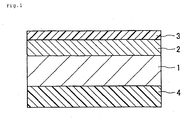
- the gist of the resin coated steel plate according to the present invention lies in that, as can be understood from the cross-sectional structure of the resin-coated steel plate shown in Fig.
- a first tin plating layer 2 having a free tin amount of #20 to #150 is formed on a surface of a steel plate 1 which constitutes an outer surface of the can, and a first resin layer 3 having a thickness of 0.01 to 3.0 ⁇ m is formed on the first tin plating layer 2, and a second resin layer 4 having a thickness of 10 to 50 ⁇ m is formed on a surface of the steel plate 1 which constitutes an inner surface of the can.
- the resin-coated steel plate according to the present invention exhibits excellent formability in drawing and ironing and can form a drawn and ironed can having excellent brightness and corrosion resistance (examples 1 to 16).
- the free tin amount of the tin layer formed on the surface of the steel plate which constitutes the outer surface side of the can falls within the above-mentioned range with respect to brightness of the manufactured can.
- the free tin amount is smaller than the above-mentioned range, as apparent from a result of a comparison example 1 described later, the regular reflectance is low and hence, the drawn and ironed can cannot have excellent brightness.
- the free tin amount is larger than the above-mentioned range, there exists a tendency that the surface roughness is increased resulting in lowering of the regular reflectance.
- the thickness of the first resin layer formed on the tin layer falls within the above-mentioned range with respect to the brightness and the formability of the obtained can.
- the thickness of the resin layer is smaller than the above-mentioned range, there may be a case where the metal surface is shaved so that metal powder is produced and pin holes are formed in an inner surface of the can attributed to this metal powder resulting in leaking of liquid (comparison example 2).
- the thickness of the resin layer is larger than the above-mentioned range, the can exhibits the poor brightness even when the tin layer whose free tin amount falls within the above-mentioned range is formed (comparison example 3).
- the thickness of the second resin layer formed on the surface which constitutes the inner surface of the can falls within the above-mentioned range.
- the thickness of the resin layer is smaller than the above-mentioned range, there may be a case that defective coating is formed leading to leaking of liquid (comparison example 4).
- the thickness of the resin layer is larger than the above-mentioned range, the further improvement of the quality of the can cannot be expected and hence, the excessive thickness of the resin layer merely brings about a disadvantage economically.
- a second tin plating layer 5 whose free tin amount falls within a range from #2 to #16 is formed between the surface of the steel plate 1 which constitutes a can-inner-side surface and the second resin layer 4.
- the free tin amount of the second tin layer falls within the above-mentioned range.
- a portion of the first tin plating layer 2 and a portion of the second tin plating layer 5 may be formed into an alloy by reflow treatment so that the first tin plating layer 2 is constituted of a first tin layer 2a and an iron-tin alloy layer 2b and second tin plating layer 5 is constituted of a second tin layer 5a and an iron-tin alloy layer 5b.
- a post treatment layer 6, 7 described later which is formed by chromating or the like may be formed on the first tin plating layer 2 and the second tin plating layer 5.
- a steel plate which can be used for forming the resin-coated steel plate of the present invention a steel plate which has been conventionally used in the manufacture of a drawn and ironed can be used.
- various kinds of steel plates can be suitably used depending on usage or application.
- a cold-rolled steel plate having a plate thickness ranging from 0.15 to 0.3mm which is manufactured by applying cold rolling to a hot rolled plate made of alumina killed steel and, thereafter, applying cold rolling again to the rolled steel after annealing for increasing a strength of the rolled plate or the like.
- Ra arithmetic average surface roughness
- the free tin amount of the first tin plating layer falls within a range from #20 to #150.
- the free tin amount can be adjusted to a value within such a range by adjusting tin plating amount (tin coated amount), reflow conditions (temperature, time) and the like.
- # used for indicating the free tin amount is a symbol used in expressing an amount of tin in a tin plate in general, wherein #1 indicates a tin amount of 0.112g/m 2 and the tin amount is proportional to numeral affixed to #.
- #20 indicates a tin amount of 2.24g/m 2
- #150 indicates a tin amount of 16.8g/m 2
- the arithmetic average surface roughness (Ra) of the surface of the first tin plating layer is not more than 0.15 ⁇ m from a viewpoint of brightness. That is, when the arithmetic average surface roughness (Ra) exceeds0.15 ⁇ m so that the surface of the first tin plating layer is coarse, the resin layer in valley portions is entangled at the time of ironing thus deteriorating surface smoothness of the resin-coated steel plate resulting in lowering of regular reflectance, that is, brightness of the resin-coated steel plate.
- the second tin plating layer is formed in the same manner as the first tin plating layer except for that the free tin amount of the second tin plating layer ranges from #2 to #16.
- Martin's hardness at a temperature of 25°C of the first resin layer formed on the first tin plating layer is not less than 50N/mm 2 .
- polyester having the rigid molecular structure as resin content or a crosslink-type resin such as a urethane-acrylate-based UV paint can be used.
- the resin layer may be prepared by blending a hard resin and a soft resin.
- the glass transition temperature of the first resin layer when the first resin layer is of a non-crosslink type and an inorganic filler such as silica is not added in the first resin layer, it is preferable to set the glass transition temperature of the first resin layer to a temperature not lower than 20°C, and more particularly to a temperature not lower than 70°C.
- a smoothing effect of the tin plating layer by way of the resin layer can be enhanced and hence, it is possible to enhance regular reflectance, that is, brightness of the manufactured drawn and ironed can.
- the proper glass transition temperature of the resin should be determined by taking a kind and an amount of the cross-linking agent or the inorganic filler into consideration.
- a resin which is used for forming the first resin layer of the resin-coated steel plate of the present invention constitutes a protective layer of the drawn and ironed can and hence, it is desirable that the first resin layer has following properties. That is, the resin layer per se receives the severe ironing and hence, it is desirable that the resin layer can be elongated to some extent. Particularly, it is desirable that the resin layer has the elongation after fracture of not less than 5% at a temperature of 25°C when measured in accordance with ASTM D-882. Further, it is desirable that there is no change in appearance due to corrosion of the steel plate. Particularly, it is desirable that water absorption measured in accordance with ASTM D-570-63 (at 23 degrees for 24 hours) is not more than 15%.
- the resin layer exhibits the excellent adhesiveness to a metal material and, more particularly, the excellent thermal adhesiveness to the metal material. It is also preferable that concentration of a carbonyl group in the resin is not less than 100meq/100g resin.
- the resin for forming the first resin layer of the present invention may be used as the resin for forming the first resin layer of the present invention.
- the resin for forming the first resin layer of the present invention is not limited to those resins.
- a polyester group such as polyethylene terephthalate, polyethylene terephthalate/isophthalate, polytetra methylene terephthalate, polyethylene/ tetra methylene terephthalate, polytetra methylene terephthalate/isophthalate, polytetra methylene/ ethylene terephthalate, polyethylene/ tetra methylene terephthalate/ isophthalate, polyethylene/ oxybenzoate or a blended material of these resins; polycarbonate group such as poly-p-xylene glycol biscarbonate, poly-dioxydiphenyl methane carbonate, poly-dioxydiphenol 2, 2-propane carbonate, poly-dioxydiphenyl 1, 1-ethane carbonate; polyamide group such as poly- ⁇ -aminocaproic acid, poly- ⁇ -aminoheptanoic acid, poly- ⁇ -aminocaprylic acid, poly- ⁇ -pelargonic acid, poly- ⁇ -a
- the first resin layer of the resin coated steel plate of the present invention can be formed by coating a paint which is formed by dissolving a resin content in a solvent, an aqueous dispersion agent in which a resin content is dispersed, or a ultraviolet-curing-type paint which contains 10% of solid content or by adhering a cast film, or by directly coating a resin by extrusion.
- the second resin layer which is formed on the surface of the steel plate which constitutes the inner-surface-side surface or on the second tin plating layer which is formed when necessary can be formed using the same material and the same method as the first resin layer.
- the second resin layer is brought into contact with a content of the can and hence, it is also necessary to pay attention to barrier property against metal corroding content in the content. That is, it is necessary to determine a resin to be applied by taking a content filled in the can and a preservation period.
- polyester particularly ethylene-terephthalate-based polyester which contains an isophthalic acid as a copolymer content is named.
- the resin-coated steel plate of the present invention can be formed by the manufacturing method which includes: a step in which a first tin plating layer is formed on one surface of a steel plate such that a free tin amount becomes #20 to #150; a step in which a first resin layer having a thickness of 0.01 to 3.0 ⁇ m is formed on the first tin plating layer; and a step in which a second resin layer having a thickness of 10 to 50 ⁇ m is formed on another surface of the steel plate.
- a known method such as alkaline electrolytic cleaning, acid cleaning or the like is applicable.
- the first tin plating layer is formed on the steel plate and, when necessary, the second tin plating layer is formed on the steel plate.
- the tin plating layer is formed on the above-mentioned steel plate as follows. That is, the tin plating layer is formed on the above-mentioned steel plate by electroplating using a known Ferrostan bath or halogen bath.
- a tin plating layer having a normal luster surface is formed on the above-mentioned steel plate such that a tin plating layer is formed on the steel plate by electroplating, the steel plate is heated at a temperature equal to or more than a melting point of tin, and the steel plate is quenched in water after tin is melted (reflow treatment).
- the free tin amount of the first tin plating layer falls within a range from #20 to #150, and the adjustment of free tin amount can be performed by adjusting tin plating amount (tin coated amount), reflow conditions (temperature, time) and the like.
- the arithmetic average roughness of the surface of the first tin plating layer is set to not more than 0.15 ⁇ m.
- the above range can be adjusted by adjusting the tin plating condition in addition to the adjustment of the coarseness of the using steel plate.
- the second tin plating layer is formed in the same manner as the first tin plating layer while adjusting the free tin amount to a value which falls within a range from #2 to #16.
- a post-treatment (surface treatment) layer may be formed on the first tin plating layer and the second tin plating layer from a viewpoint of enhancing adhesiveness between the first resin layer and the first tin plating layer and adhesiveness between the second resin layer and the second tin plating layer.
- immersion treatment which immerses the tin plating layer in an aqueous solution of dichromate salt, a method which forms a chromium hydrous oxide film on the tin plating layer by electrolytic treatment, a method which forms a two-layered film made of metal chromium and chromium hydrous oxide on the tin plating layer by electrolytic treatment in an aqueous solution of chromic anhydride, a method which forms a thin film made of an organic resin such as a polyacrylic acid or an epoxy resin on the tin plating layer, a method which applies silane coupling treatment to the tin plating layer are considered.
- These surface treatments can be performed by a conventionally known method.
- a first resin layer having a thickness of 0.01 to 3.0 ⁇ m is formed on the first tin plating layer and, at the same time, a second resin layer having a thickness of 10 to 50 ⁇ m is formed on another surface of the steel plate.
- the first resin layer may be formed by a conventionally known coating method such as roll coater coating including gravure coater coating, spray coating or the like.
- the adjustment of thickness of the coated film may be conducted by adjusting a coating amount or an amount of solvent or resin content in paint or the like. Further, when a gravure coater is used in coating, the adjustment of thickness of the coated film may be conducted by adjusting roughness of meshes of gravure or the like.
- the first resin layer may be also formed by adhering a preformed cast film to a steel plate by thermal adhesion or the like or by directly coating a resin on the steel plate by extrusion.
- the present invention it is desirable to heat the steel plate to a temperature not lower than a melting point of tin after forming the first resin layer from a viewpoint of brightness.
- this heating pushes up a manufacturing cost due to the increase of steps and hence, it is necessary to determine whether or not the heating is performed by taking economy and requested properties into consideration. It is considered that by reheating the resin-coated metal plate to a temperature not lower than a melting point of tin after forming the first resin layer, the first resin layer and the first tin plating layer can be brought into more uniform contact and hence, brightness of the resin-coated metal plate can be enhanced eventually.
- the second resin layer can be formed simultaneously with the formation of the first resin layer, or the second resin layer can be formed before or after the formation of the first resin layer.
- the selection of the respective resin layers and the resin forming method should be determined such that no defective appearance occurs on the first resin layer or the second resin layer due to adhesion of the first resin layer or the second resin layer to a roll.
- the second resin layer In forming the second resin layer on the steel plate by a resin film, in the same manner as the first resin layer, the second resin layer can be formed by coating of paint or by an extrusion coating method besides the adhesion of a cast film by thermal adhesion.
- the resin-coated steel plate of the present invention can be preferably used in forming the conventionally known drawn and ironed can. It is possible to form the resin-coated steel can with favorable formability also under a dry condition without using a coolant, not to mention, under a condition which uses a liquid coolant.
- a blank which is punched out from the resin-coated steel plate of the present invention is drawn into a cup-shaped body using drawing dies in one stage or in plural stages.
- ironing dies in one stage or plural stages ironing for increasing a height of a barrel portion of the cup-shaped body while decreasing a wall thickness of the barrel portion of the cup-shaped body is applied to the cup-shaped body in such a manner that the barrel portion is forcibly pushed into a clearance portion between the ironing die and a punch which is set smaller than a thickness of the barrel portion of the cup-shaped body.
- DI can relatively-small-diameter drawn and ironed can
- a barrel portion having a width of 20mm which is arranged at a position 60mm away from a can bottom of the formed drawn can is cut off in the circumferential direction, and the cut barrel portion having a width of 20mm is divided into eight pieces in the can height direction thus preparing measuring samples.
- a total reflectance and a diffuse reflectance of a center portion of each measuring sample are measured using a spectrophotometric colorimetry meter (made by Konica Minolta Holdings, Inc., Type: CM-3500), and regular reflectance is calculated using a following formula.
- Regular reflectance % total reflectance % - diffuse reflectance %
- An average value of regular reflectances of eight divided samples is calculated by dropping the fractional portion of the value and is used as the barrel-portion regular reflectance in the present invention.
- a portion of the barrel of the can obtained by drawing and ironing is cut in the circumferential direction using a position 2mm lower than a lowest portion of an undulated upper end of the barrel portion as a starting point, and the upper portion of the barrel portion is removed thus allowing the can to have a constant height. Thereafter, flange forming is applied to the can and a content (Coca Cola: registered trademark) is filled in the can such that the content reaches 90% of the total height of the can.
- An aluminum lid to which epoxy phenolic-based coating material is coated by baking with a thickness after drying of 10 ⁇ m is seamed to the can.
- each aluminum lid arranged up-side-down 100 pieces of these cans are left under respective atmospheres of 37°C and 50°C for 6 months, and the number of cans which exhibits leaking of liquid in the respective atmospheres are checked.
- the most favorable case may be a case where no cans exhibit leaking of liquid even when the cans are left under the atmosphere of 50°C for 6 months, it is determined the cans are practically usable in a case where no cans exhibit leaking of liquid even when the cans are left under the atmosphere of 37°C for 6 months.
- Contents of the cans which are left for 6 months under respective atmospheres of 37°C and 50°C for 6 months are sampled, and flavors of contents in all cans are checked by 30 people.
- it is determined that the flavor is abnormal while when the number of people who perceive such flavor abnormality is less than three, it is determined that the flavor is favorable.
- the most favorable case may be a case where cans exhibit favorable flavor even when the cans are left under the atmosphere of 50°C, it is determined the cans are practically usable in a case where cans exhibit favorable flavor even when the cans are left under the atmosphere of 37°C for 6 months.
- a copolymer polyester paint (product name: VYLON-1400) made by TOYOBO Co., Ltd. is applied to a surface of the metal plate which constitutes an outer surface of the can by painting and, thereafter, the metal plate is dried under atmosphere of 150°C for 10 minutes thus manufacturing a resin-coated steel plate having a coated film whose thickness after drying is 1 ⁇ m.
- 50mg/m 2 of glamour wax is applied to both surfaces of the resin-coated steel plate by coating and, thereafter, drawing and ironing are applied to the resin-coated steel plate in dry atmosphere under following forming conditions such that the inner surface of the can becomes the surface coated with a copolymer polyester film made by Toyo Kohan CO., Ltd. thus manufacturing a drawn and ironed can.
- Properties of the drawn and ironed can that is, regular reflectance of an outer surface of the can, leaking of liquid after a lapse of time from filling of liquid, and flavor of content are evaluated using the above-mentioned evaluation methods.
- a result of the evaluations is shown in Table 1. It is found that even when the can is left under 50°C for 6 months after content is filled in the can, no leaking of liquid is observed, and flavor of the content is favorable and hence, the can exhibits can-properties which prove that the can withstand the practical use. Further, a barrel portion of the can exhibits high regular reflectance so that the can obtains appearance of high brightness.
- the free tin quantities of the first tin plating layer and the second tin plating layer, the thicknesses of the first resin layer and the second resin layer, and Ra of the first tin plating layer are set to values shown in Table 1, using resin-coated steel plates which are manufactured in the same manner as the first embodiment, drawing and ironing are performed under forming conditions substantially equal to the forming conditions of the example 1 thus manufacturing drawn and ironed cans.
- Table 1 Properties of these drawn and ironed cans are shown in Table 1. From Table 1, it is found that even when the cans are left under 37°C and 50°C for 6 months after content is filled in the cans, and leaking of liquid is observed in no cans. All cans exhibit good flavor at least in the case where the cans are left for 6 months under 37°C. All can exhibit can-properties which prove that the cans withstand the practical use. Further, barrel portions of the cans exhibit high regular reflectance so that the cans obtain appearance of high brightness.
- Table 1 Properties of these drawn and ironed cans are shown in Table 1. From Table 1, it is found that even when the cans are left under 37°C and 50°C for 6 months after content is filled in the cans, leaking of liquid is observed in no cans. All cans exhibit favorable flavor under both temperatures. All can exhibit can-properties which prove that the cans withstand the practical use. Further, barrel portions of the cans exhibit high regular reflectance so that the cans obtain appearance of high brightness.
- the free tin quantities of the first tin plating layer and the second tin plating layer, and the thicknesses of the first resin layer and the second resin layer are set to values shown in Table 1, and chromating having a chromium amount of 4mg/m 2 is applied to the first tin plating layer and the second tin plating layer as post treatment after the formation of the first tin plating layer and the second tin plating layer, using resin-coated steel plates which are manufactured in the same manner as the first embodiment, drawing and ironing are performed under forming conditions substantially equal to the forming conditions of the example 1 thus manufacturing drawn and ironed cans.
- Table 1 Properties of these drawn and ironed cans are shown in Table 1. From Table 1, it is found that even when the cans are left under 37°C and 50°C for 6 months after content is filled in the can, leaking of liquid is observed in no cans. All cans exhibit favorable flavor under both temperatures. All can exhibit can-properties which prove that the cans withstand the practical use. Further, barrel portions of the cans exhibit high regular reflectance so that the cans obtain appearance of high brightness.
Landscapes
- Chemical & Material Sciences (AREA)
- Life Sciences & Earth Sciences (AREA)
- Engineering & Computer Science (AREA)
- Materials Engineering (AREA)
- Wood Science & Technology (AREA)
- Organic Chemistry (AREA)
- Laminated Bodies (AREA)
- Electroplating Methods And Accessories (AREA)
- Rigid Containers With Two Or More Constituent Elements (AREA)
- Extrusion Moulding Of Plastics Or The Like (AREA)
Description
- The present invention relates to a resin-coated steel plate and a manufacturing method thereof, and more particularly to a resin-coated steel plate suitable for forming a drawn and ironed can whose barrel portion exhibits excellent brightness by dry lubrication without using a liquid coolant and a manufacturing method of the resin-coated steel plate.
- As a side-wall seamless can (or seamless can), conventionally, there has been known a drawn and ironed can (DI can) having a thin-wall barrel portion. The drawn and ironed can is manufactured as follows. That is, a metal material such as an aluminum sheet or a tin plate is subject to drawing between a drawing die and a punch in at least one stage thus forming a cup which is constituted of a barrel portion having no seam on a side surface thereof and a bottom portion integrally joined to the barrel portion without a seam. Then, when desired, ironing is applied to the barrel portion by allowing the barrel portion to pass between an ironing punch and a die so that the barrel portion of the can becomes thin.
- In forming the metal material into the seamless can by drawing/ironing, a liquid coolant is used in general for lowering friction between a resin-coated metal plate and a tool. Further, forming of a resin-coated metal plate into the seamless can by drawing/ironing is also performed in a dry state by applying wax or the like as a lubricant. However, to realize such ironing of the resin-coated metal plate in such a dry state, the resin-coated metal plate is required to withstand severe forming.
- There has been proposed a coated metal plate which enables drawing and ironing under such a dry condition, and an amount of coating film on a surface of the sheet plate, a plating condition and a film thickness for drawing and ironing under the dry condition have been studied in
patent document 1. - Patent document 1:
JP-A-2003-34322 - Recently, there arises a strong demand for a drawn and ironed can which possesses appearance having brightness as a can property. The coated metal plate described in the above-mentioned
patent document 1 does not take a condition on a material for acquiring brightness and hence, as a matter of course,patent document 1 completely fails to describe specific contents of conditions and a range which are considered necessary for acquiring brightness which the inventors of the present invention aim at. Although the coated metal plate described inpatent document 1 uses an aluminum plate which may produce brightness more easily compared to a steel plate, it is hardly conceivable that the coated metal plate described inpatent document 1 produces a can which exhibits appearance having brightness. Even if the coated metal plate described inpatent document 1 may obtain a can which exhibits appearance having slight brightness, when the steel plate is used as the metal plate in place of aluminum, it is extremely difficult to form a seamless can which exhibits appearance having brightness. - Accordingly, it is an object of the present invention to provide a resin-coated steel plate capable of forming a seamless can which exhibits appearance having brightness stably and a manufacturing method of the resin-coated steel plate.
- It is another object of the present invention to provide a resin-coated steel plate which can cope with drawing and ironing under dry lubrication and a manufacturing method of the resin-coated steel plate.
- According to one aspect of the present invention, there is provided a resin-coated steel plate according to
claim 1 used for forming a drawn and ironed can which includes: a steel plate; a first tin plating layer which is formed on a surface of the steel plate which becomes an outer surface of the can and has a free tin amount of #20 to #150; a first resin layer which is formed on the first tin plating layer and has a thickness of 0.01 to 3.0 µm; and a second resin layer which is formed on a surface of the steel plate which becomes an inner surface of the can and has a thickness of 10 to 50µm, wherein a second tin plating layer which has a free tin amount of #2 to #16 is formed between the steel plate and the second resin layer. - The resin-coated steel plate may also preferably be configured as follows.
- 1. The first resin layer has Marten's hardness of 50N/mm2 at a temperature of 25°C.
- 2. Glass transition temperature of the first resin layer is not lower than 20°C.
- 3. An arithmetic average coarseness (Ra) of a surface of the first tin plating layer is not more than 0.15µm.
- In the present invention, the free tin amount is a value measured by an electrolytic stripping method used in a tin adhesion amount testing method of tin plate stipulated in JIS G 3303-2998.
- Further, in the present invention, Marten' s hardness is a value which is obtained by measuring Marten's hardness of the resin layer at a maximum weight which satisfies a condition that a pushing depth of a Berkovich indenter is not more than 1/10 of a thickness of a measure coated film in accordance with ISO 14577-2002 using a micro extrusion hardness tester ENT-1100A manufactured by ELONIX KK. Further, as the Berkovich indenter, an indenter in which a correction length (Δhc) indicative of wear of the indenter is set to a value not more than 15nm is used. When a thickness of the resin layer formed on the steel plate which is used as a sample and forms the tin plating layer thereon is less than 1µm, there exists a possibility that a measured value is largely influenced by a surface state of the resin layer. Accordingly, in this case, the measured value may be substituted by a value obtained by measuring Martin's hardness of a resin layer of a sample in which a resin layer having a thickness of 1µm is formed on the same steel plate using the same resin and under the substantially equal condition.
- Further, the glass transition temperature in the present invention is a value measured by setting the resin layer treated in the present invention as an object to be measured in accordance with JIS C 6481-1996 using a TMA device TAS-300 made by RIGAKU DENKI Co., Ltd.
- Further, in the present invention, the arithmetic average coarseness (Ra) is a value measured in accordance with JIS B 0601-1994.
- According to another aspect of the present invention, there is provided a method of manufacturing a resin-coated steel plate according to
claim 5 which includes the steps of: forming a first tin plating layer having a free tin amount of #20 to #150 on one surface of a steel plate which becomes an outer surface of the can; forming a first resin layer having a thickness of 0.01 to 3.0µm on the first tin plating layer; and forming a second resin layer having a thickness of 10 to 50µm on a surface of the steel plate which becomes an inner surface of the can. - In the method of manufacturing a resin-coated steel plate according to the present invention, as one of methods for further enhancing the brightness, the steel plate may preferably be heated to a temperature not lower than a melting point of tin after forming the first resin layer. However, such a brightness enhancing method increases the number of steps and hence, it is necessary to determine whether or not such a method should be adopted by taking required brightness and economy into consideration.
- According to the resin-coated steel plate of the present invention, even when the drawing and ironing are performed under a dry condition, it is possible to stably manufacture the drawn and ironed can (DI can) without producing metal powder or the like.
- Further, according to the resin-coated steel plate of the present invention, a barrel portion of the obtained drawn and ironed can exhibits excellent brightness as well as excellent corrosion resistance.
- A resin coated steel plate according to the present invention is a resin-coated steel plate used in forming a drawn and ironed can. The gist of the resin coated steel plate according to the present invention lies in that, as can be understood from the cross-sectional structure of the resin-coated steel plate shown in
Fig. 1 , a firsttin plating layer 2 having a free tin amount of #20 to #150 is formed on a surface of asteel plate 1 which constitutes an outer surface of the can, and afirst resin layer 3 having a thickness of 0.01 to 3.0µm is formed on the firsttin plating layer 2, and asecond resin layer 4 having a thickness of 10 to 50µm is formed on a surface of thesteel plate 1 which constitutes an inner surface of the can. - In the resin coated steel plate, it is difficult to suppress the generation of a rough surface caused by the deformation of crystal grains on a surface of iron due to drawing and hence, a drawn and ironed can which has excellent brightness cannot be obtained. According to the present invention, inventors of the present invention have found that by forming a tin layer which has malleability on the surface of the steel plate which constitutes the outer surface of the can such that the free tin amount falls within the above-mentioned range and, at the same time, by forming a resin layer having a thickness which falls within the above-mentioned range on the tin layer, ironing of the tin layer and the like is facilitated and hence, a surface smoothing action by ironing can be effectively acquired thus forming a drawn and ironed can which exhibits appearance having excellent brightness.
- It is also apparent from results of examples described later that the resin-coated steel plate according to the present invention exhibits excellent formability in drawing and ironing and can form a drawn and ironed can having excellent brightness and corrosion resistance (examples 1 to 16).
- That is, according to the present invention, it is important that the free tin amount of the tin layer formed on the surface of the steel plate which constitutes the outer surface side of the can falls within the above-mentioned range with respect to brightness of the manufactured can. When the free tin amount is smaller than the above-mentioned range, as apparent from a result of a comparison example 1 described later, the regular reflectance is low and hence, the drawn and ironed can cannot have excellent brightness. On the other hand, when the free tin amount is larger than the above-mentioned range, there exists a tendency that the surface roughness is increased resulting in lowering of the regular reflectance.
- Further, it is also important that the thickness of the first resin layer formed on the tin layer falls within the above-mentioned range with respect to the brightness and the formability of the obtained can. When the thickness of the resin layer is smaller than the above-mentioned range, there may be a case where the metal surface is shaved so that metal powder is produced and pin holes are formed in an inner surface of the can attributed to this metal powder resulting in leaking of liquid (comparison example 2). On the other hand, when the thickness of the resin layer is larger than the above-mentioned range, the can exhibits the poor brightness even when the tin layer whose free tin amount falls within the above-mentioned range is formed (comparison example 3).
- Further, according to the present invention, to allow the manufactured drawn and ironed can to perform a function as a container for preserving a content, it is important that the thickness of the second resin layer formed on the surface which constitutes the inner surface of the can falls within the above-mentioned range. When the thickness of the resin layer is smaller than the above-mentioned range, there may be a case that defective coating is formed leading to leaking of liquid (comparison example 4). On the other hand, when the thickness of the resin layer is larger than the above-mentioned range, the further improvement of the quality of the can cannot be expected and hence, the excessive thickness of the resin layer merely brings about a disadvantage economically.
- Further, in the resin-coated steel plate of the present invention, particularly from a viewpoint of a performance of preserving a content in the can, that is, corrosion resistance of the can, in addition to the basic structure shown in
Fig. 1 , as shown inFig. 2 , a secondtin plating layer 5 whose free tin amount falls within a range from #2 to #16 is formed between the surface of thesteel plate 1 which constitutes a can-inner-side surface and thesecond resin layer 4. Here, even when the free tin content is larger than the above-mentioned range, the further enhancement of the corrosion resistance is not expected and hence, the excessive increase of the free tin amount brings about a disadvantage economically. Accordingly, it is desirable that the free tin amount of the second tin layer falls within the above-mentioned range. - Further, in the resin-coated steel plate of the present invention, as shown in
Fig. 3 , a portion of the firsttin plating layer 2 and a portion of the secondtin plating layer 5 may be formed into an alloy by reflow treatment so that the firsttin plating layer 2 is constituted of afirst tin layer 2a and an iron-tin alloy layer 2b and secondtin plating layer 5 is constituted of asecond tin layer 5a and an iron-tin alloy layer 5b. Further, depending on a usage of the resin-coated steel plate, apost treatment layer 6, 7 described later which is formed by chromating or the like may be formed on the firsttin plating layer 2 and the secondtin plating layer 5. - As a steel plate which can be used for forming the resin-coated steel plate of the present invention, a steel plate which has been conventionally used in the manufacture of a drawn and ironed can be used. On the other hand, various kinds of steel plates can be suitably used depending on usage or application. For example, it is possible to use a cold-rolled steel plate having a plate thickness ranging from 0.15 to 0.3mm which is manufactured by applying cold rolling to a hot rolled plate made of alumina killed steel and, thereafter, applying temper rolling to the rolled steel after annealing. It is also possible to use a cold-rolled steel plate having a plate thickness ranging from 0.15 to 0.3mm which is manufactured by applying cold rolling to a hot rolled plate made of alumina killed steel and, thereafter, applying cold rolling again to the rolled steel after annealing for increasing a strength of the rolled plate or the like.
- To set arithmetic average surface roughness (Ra) of the surface of the first tin plating layer to a value not more than 0. 15µm, it may be possible to adopt a method which adjusts the degree of coarseness of a reduction roll used in the manufacture of a steel plate or the like.
- As mentioned previously, it is important that the free tin amount of the first tin plating layer falls within a range from #20 to #150. The free tin amount can be adjusted to a value within such a range by adjusting tin plating amount (tin coated amount), reflow conditions (temperature, time) and the like. In this specification, # used for indicating the free tin amount is a symbol used in expressing an amount of tin in a tin plate in general, wherein #1 indicates a tin amount of 0.112g/m2and the tin amount is proportional to numeral affixed to #.
- Accordingly, #20 indicates a tin amount of 2.24g/m2, and #150 indicates a tin amount of 16.8g/m2. Further, it is preferable that the arithmetic average surface roughness (Ra) of the surface of the first tin plating layer is not more than 0.15µm from a viewpoint of brightness. That is, when the arithmetic average surface roughness (Ra) exceeds0.15µm so that the surface of the first tin plating layer is coarse, the resin layer in valley portions is entangled at the time of ironing thus deteriorating surface smoothness of the resin-coated steel plate resulting in lowering of regular reflectance, that is, brightness of the resin-coated steel plate.
- With respect to the second tin plating layer which is formed when necessary, the second tin plating layer is formed in the same manner as the first tin plating layer except for that the free tin amount of the second tin plating layer ranges from #2 to #16.
- According to the present invention, it is preferable that Martin's hardness at a temperature of 25°C of the first resin layer formed on the first tin plating layer is not less than 50N/mm2. By setting Martin' s hardness of the first resin layer to such a value, a smoothing effect of the tin plating layer by way of the resin layer can be enhanced and hence, it is possible to enhance regular reflectance, that is, brightness of the drawn and ironed can.
- To form the resin layer which exhibits Martin's hardness of 50N/mm2 at a temperature of 25°C, for example, polyester having the rigid molecular structure as resin content or a crosslink-type resin such as a urethane-acrylate-based UV paint can be used. Further, the resin layer may be prepared by blending a hard resin and a soft resin.
- Further, according to the resin-coated steel plate of the present invention, when the first resin layer is of a non-crosslink type and an inorganic filler such as silica is not added in the first resin layer, it is preferable to set the glass transition temperature of the first resin layer to a temperature not lower than 20°C, and more particularly to a temperature not lower than 70°C. By setting the glass transition temperature of the first resin layer to such a temperature, a smoothing effect of the tin plating layer by way of the resin layer can be enhanced and hence, it is possible to enhance regular reflectance, that is, brightness of the manufactured drawn and ironed can.
- However, when a cross-linking agent or inorganic filler such as silica of nano order is added to the first resin layer, it is not always necessary to set a lower limit of the proper glass transition temperature to 20°C and may be set to a temperature below 20°C. Accordingly, the proper glass transition temperature of the resin should be determined by taking a kind and an amount of the cross-linking agent or the inorganic filler into consideration.
- A resin which is used for forming the first resin layer of the resin-coated steel plate of the present invention constitutes a protective layer of the drawn and ironed can and hence, it is desirable that the first resin layer has following properties. That is, the resin layer per se receives the severe ironing and hence, it is desirable that the resin layer can be elongated to some extent. Particularly, it is desirable that the resin layer has the elongation after fracture of not less than 5% at a temperature of 25°C when measured in accordance with ASTM D-882. Further, it is desirable that there is no change in appearance due to corrosion of the steel plate. Particularly, it is desirable that water absorption measured in accordance with ASTM D-570-63 (at 23 degrees for 24 hours) is not more than 15%. Further, it is desirable that the resin layer exhibits the excellent adhesiveness to a metal material and, more particularly, the excellent thermal adhesiveness to the metal material. It is also preferable that concentration of a carbonyl group in the resin is not less than 100meq/100g resin.
- Following resins may be used as the resin for forming the first resin layer of the present invention. However, the resin for forming the first resin layer of the present invention is not limited to those resins.
- That is, a polyester group such as polyethylene terephthalate, polyethylene terephthalate/isophthalate, polytetra methylene terephthalate, polyethylene/ tetra methylene terephthalate, polytetra methylene terephthalate/isophthalate, polytetra methylene/ ethylene terephthalate, polyethylene/ tetra methylene terephthalate/ isophthalate, polyethylene/ oxybenzoate or a blended material of these resins; polycarbonate group such as poly-p-xylene glycol biscarbonate, poly-dioxydiphenyl methane carbonate, poly-
dioxydiphenol 2, 2-propane carbonate, poly-dioxydiphenyl 1, 1-ethane carbonate; polyamide group such as poly-ω-aminocaproic acid, poly-ω-aminoheptanoic acid, poly-ω-aminocaprylic acid, poly-ω-pelargonic acid, poly-ω-aminodecanoic acid, poly-ω-aminoundecanoic acid, poly-ω-aminododecanoic acid, poly-ω-aminotridecanoic acid, polyhexamethylene adipamide, polyhexamethylene sebacamide, polyhexamethylene dodecamide, polyhexamethylene tridecamide, polydecamethylene adipamide, polydecamethylene sebacamide, polydecamethylene dodecamide, polydecamethylene tridecamide, polydodecamethylene adipamide, polydodecamethylene sebacamide, polydodecamethylene dodecamide, polytridecamethylene adipamide, polytridecamethylene sebacamide, polytridecamethylene dodecamide, polydodecamethylene azelamide, polytridecamethylene azelamide, or copolyamide of these resins; polyamidimide resin, acrylic resin, urethane acrylate resin, epoxy resin or the like may be used as the resin for forming the first resin layer. These resins may be also used in a form of a blended material or in a form of the stacked structure. - The first resin layer of the resin coated steel plate of the present invention can be formed by coating a paint which is formed by dissolving a resin content in a solvent, an aqueous dispersion agent in which a resin content is dispersed, or a ultraviolet-curing-type paint which contains 10% of solid content or by adhering a cast film, or by directly coating a resin by extrusion.
- In the present invention, the second resin layer which is formed on the surface of the steel plate which constitutes the inner-surface-side surface or on the second tin plating layer which is formed when necessary can be formed using the same material and the same method as the first resin layer. However, the second resin layer is brought into contact with a content of the can and hence, it is also necessary to pay attention to barrier property against metal corroding content in the content. That is, it is necessary to determine a resin to be applied by taking a content filled in the can and a preservation period. As the resin which can be preferably used by taking these matters into consideration, polyester, particularly ethylene-terephthalate-based polyester which contains an isophthalic acid as a copolymer content is named.
- The resin-coated steel plate of the present invention can be formed by the manufacturing method which includes: a step in which a first tin plating layer is formed on one surface of a steel plate such that a free tin amount becomes #20 to #150; a step in which a first resin layer having a thickness of 0.01 to 3.0µm is formed on the first tin plating layer; and a step in which a second resin layer having a thickness of 10 to 50µm is formed on another surface of the steel plate.
- As pretreatment necessary for the formation of the tin plating layer, a known method such as alkaline electrolytic cleaning, acid cleaning or the like is applicable.
- Next, the first tin plating layer is formed on the steel plate and, when necessary, the second tin plating layer is formed on the steel plate. The tin plating layer is formed on the above-mentioned steel plate as follows. That is, the tin plating layer is formed on the above-mentioned steel plate by electroplating using a known Ferrostan bath or halogen bath. Alternatively, a tin plating layer having a normal luster surface is formed on the above-mentioned steel plate such that a tin plating layer is formed on the steel plate by electroplating, the steel plate is heated at a temperature equal to or more than a melting point of tin, and the steel plate is quenched in water after tin is melted (reflow treatment).
- As mentioned previously, it is important that the free tin amount of the first tin plating layer falls within a range from #20 to #150, and the adjustment of free tin amount can be performed by adjusting tin plating amount (tin coated amount), reflow conditions (temperature, time) and the like.
- Further, it is preferable that the arithmetic average roughness of the surface of the first tin plating layer is set to not more than 0.15µm. As mentioned previously, the above range can be adjusted by adjusting the tin plating condition in addition to the adjustment of the coarseness of the using steel plate.
- In forming the second tin plating layer when necessary, the second tin plating layer is formed in the same manner as the first tin plating layer while adjusting the free tin amount to a value which falls within a range from #2 to #16.
- Further, a post-treatment (surface treatment) layer may be formed on the first tin plating layer and the second tin plating layer from a viewpoint of enhancing adhesiveness between the first resin layer and the first tin plating layer and adhesiveness between the second resin layer and the second tin plating layer.
- As such surface treatment, immersion treatment which immerses the tin plating layer in an aqueous solution of dichromate salt, a method which forms a chromium hydrous oxide film on the tin plating layer by electrolytic treatment, a method which forms a two-layered film made of metal chromium and chromium hydrous oxide on the tin plating layer by electrolytic treatment in an aqueous solution of chromic anhydride, a method which forms a thin film made of an organic resin such as a polyacrylic acid or an epoxy resin on the tin plating layer, a method which applies silane coupling treatment to the tin plating layer are considered. These surface treatments can be performed by a conventionally known method.
- After forming the first tin plating layer and, when necessary, forming the second tin plating layer, a first resin layer having a thickness of 0.01 to 3.0 µm is formed on the first tin plating layer and, at the same time, a second resin layer having a thickness of 10 to 50µm is formed on another surface of the steel plate.
- In forming the first resin layer by coating paint, the first resin layer may be formed by a conventionally known coating method such as roll coater coating including gravure coater coating, spray coating or the like. The adjustment of thickness of the coated film may be conducted by adjusting a coating amount or an amount of solvent or resin content in paint or the like. Further, when a gravure coater is used in coating, the adjustment of thickness of the coated film may be conducted by adjusting roughness of meshes of gravure or the like.
- Further, the first resin layer may be also formed by adhering a preformed cast film to a steel plate by thermal adhesion or the like or by directly coating a resin on the steel plate by extrusion.
- According to the present invention, it is desirable to heat the steel plate to a temperature not lower than a melting point of tin after forming the first resin layer from a viewpoint of brightness. However, there exists a possibility that this heating pushes up a manufacturing cost due to the increase of steps and hence, it is necessary to determine whether or not the heating is performed by taking economy and requested properties into consideration. It is considered that by reheating the resin-coated metal plate to a temperature not lower than a melting point of tin after forming the first resin layer, the first resin layer and the first tin plating layer can be brought into more uniform contact and hence, brightness of the resin-coated metal plate can be enhanced eventually.
- The second resin layer can be formed simultaneously with the formation of the first resin layer, or the second resin layer can be formed before or after the formation of the first resin layer. However, the selection of the respective resin layers and the resin forming method should be determined such that no defective appearance occurs on the first resin layer or the second resin layer due to adhesion of the first resin layer or the second resin layer to a roll.
- In forming the second resin layer on the steel plate by a resin film, in the same manner as the first resin layer, the second resin layer can be formed by coating of paint or by an extrusion coating method besides the adhesion of a cast film by thermal adhesion.
- The resin-coated steel plate of the present invention can be preferably used in forming the conventionally known drawn and ironed can. It is possible to form the resin-coated steel can with favorable formability also under a dry condition without using a coolant, not to mention, under a condition which uses a liquid coolant.
- That is, a blank which is punched out from the resin-coated steel plate of the present invention is drawn into a cup-shaped body using drawing dies in one stage or in plural stages. Next, using ironing dies in one stage or plural stages, ironing for increasing a height of a barrel portion of the cup-shaped body while decreasing a wall thickness of the barrel portion of the cup-shaped body is applied to the cup-shaped body in such a manner that the barrel portion is forcibly pushed into a clearance portion between the ironing die and a punch which is set smaller than a thickness of the barrel portion of the cup-shaped body. In this manner, it is possible to form a relatively-small-diameter drawn and ironed can (DI can) whose barrel portion has a large height and a small wall thickness.
- A barrel portion having a width of 20mm which is arranged at a position 60mm away from a can bottom of the formed drawn can is cut off in the circumferential direction, and the cut barrel portion having a width of 20mm is divided into eight pieces in the can height direction thus preparing measuring samples. A total reflectance and a diffuse reflectance of a center portion of each measuring sample are measured using a spectrophotometric colorimetry meter (made by Konica Minolta Holdings, Inc., Type: CM-3500), and regular reflectance is calculated using a following formula.

- An average value of regular reflectances of eight divided samples is calculated by dropping the fractional portion of the value and is used as the barrel-portion regular reflectance in the present invention.
- It is determined that the resin-coated steel plate is practically usable when the regular reflectance is not less than 10%.
- A portion of the barrel of the can obtained by drawing and ironing is cut in the circumferential direction using a position 2mm lower than a lowest portion of an undulated upper end of the barrel portion as a starting point, and the upper portion of the barrel portion is removed thus allowing the can to have a constant height. Thereafter, flange forming is applied to the can and a content (Coca Cola: registered trademark) is filled in the can such that the content reaches 90% of the total height of the can. An aluminum lid to which epoxy phenolic-based coating material is coated by baking with a thickness after drying of 10µm is seamed to the can. With a lid surface of each aluminum lid arranged up-side-down, 100 pieces of these cans are left under respective atmospheres of 37°C and 50°C for 6 months, and the number of cans which exhibits leaking of liquid in the respective atmospheres are checked. Although the most favorable case may be a case where no cans exhibit leaking of liquid even when the cans are left under the atmosphere of 50°C for 6 months, it is determined the cans are practically usable in a case where no cans exhibit leaking of liquid even when the cans are left under the atmosphere of 37°C for 6 months.
- Contents of the cans which are left for 6 months under respective atmospheres of 37°C and 50°C for 6 months are sampled, and flavors of contents in all cans are checked by 30 people. When more than three people perceive flavor abnormality even with respect to one can out of cans formed of respective kinds of coated metal plates, it is determined that the flavor is abnormal, while when the number of people who perceive such flavor abnormality is less than three, it is determined that the flavor is favorable. Although the most favorable case may be a case where cans exhibit favorable flavor even when the cans are left under the atmosphere of 50°C, it is determined the cans are practically usable in a case where cans exhibit favorable flavor even when the cans are left under the atmosphere of 37°C for 6 months.
- A first tin plating layer having free tin amount of #20 (Ra=0.12µm) is formed on a surface of a soft steel plate (plate thickness: 0.19mm, temper: T-1) which constitutes an outer surface of a can. Then, a second tin plating layer having free tin amount of #10 (Ra=0. 12µm) is formed on another surface of the soft steel plate which constitutes an inner surface of the can. The soft steel plate is heated until a plate temperature reaches 220°C, a non-stretched copolymer polyester film (melting point=210°C, film thickness=28µm) made by Toyo Kohan Co., Ltd. is applied to a surface of the metal plate which constitutes the inner surface of the can by coating and is cooled. Thereafter, a copolymer polyester paint (product name: VYLON-1400) made by TOYOBO Co., Ltd. is applied to a surface of the metal plate which constitutes an outer surface of the can by painting and, thereafter, the metal plate is dried under atmosphere of 150°C for 10 minutes thus manufacturing a resin-coated steel plate having a coated film whose thickness after drying is 1µm.
- 50mg/m2 of glamour wax is applied to both surfaces of the resin-coated steel plate by coating and, thereafter, drawing and ironing are applied to the resin-coated steel plate in dry atmosphere under following forming conditions such that the inner surface of the can becomes the surface coated with a copolymer polyester film made by Toyo Kohan CO., Ltd. thus manufacturing a drawn and ironed can.
- Properties of the drawn and ironed can, that is, regular reflectance of an outer surface of the can, leaking of liquid after a lapse of time from filling of liquid, and flavor of content are evaluated using the above-mentioned evaluation methods. A result of the evaluations is shown in Table 1. It is found that even when the can is left under 50°C for 6 months after content is filled in the can, no leaking of liquid is observed, and flavor of the content is favorable and hence, the can exhibits can-properties which prove that the can withstand the practical use. Further, a barrel portion of the can exhibits high regular reflectance so that the can obtains appearance of high brightness.
-
- 1. Forming temperature: temperature of punch immediately before forming: 55°C
- 2. Die temperature: 20°C
- 3. Flank diameter: 151mm
- 4. Drawing condition: 1st drawing ratio: 1.66, 2nd drawing ratio: 1.38
- 5. Ironing punch diameter: 66mm
- 6. Total ironing ratio: 63%
- Except for that the free tin quantities of the first tin plating layer and the second tin plating layer, the thicknesses of the first resin layer and the second resin layer, and Ra of the first tin plating layer are set to values shown in Table 1, using resin-coated steel plates which are manufactured in the same manner as the first embodiment, drawing and ironing are performed under forming conditions substantially equal to the forming conditions of the example 1 thus manufacturing drawn and ironed cans.
- Properties of these drawn and ironed cans are shown in Table 1. From Table 1, it is found that even when the cans are left under 37°C and 50°C for 6 months after content is filled in the cans, and leaking of liquid is observed in no cans. All cans exhibit good flavor at least in the case where the cans are left for 6 months under 37°C. All can exhibit can-properties which prove that the cans withstand the practical use. Further, barrel portions of the cans exhibit high regular reflectance so that the cans obtain appearance of high brightness.
- Except for that a copolymer polyester paint (made by TOYOBO Co., Ltd., product name: VYLONAL MD1480) is applied to a surface of the resin-coated steel plate which becomes an outer surface of a can in the example 10, and a copolymer polyester paint (made by TOYOBO Co., Ltd., product name: VYLONAL MD1500) is applied to a surface of the resin-coated steel plate which becomes an outer surface of a can in the examples 11 and 12, and the free tin quantities of the first tin plating layer and the second tin plating layer, and the thicknesses of the first resin layer and the second resin layer are set to values shown in Table 1 in all of the examples 10 to 12, using resin-coated steel plates which are manufactured in the same manner as the first embodiment, drawing and ironing are performed under forming conditions substantially equal to the forming conditions of the example 1 thus manufacturing drawn and ironed cans.
- Properties of these drawn and ironed cans are shown in Table 1. From Table 1, it is found that even when the cans are left under 37°C and 50°C for 6 months after content is filled in the cans, leaking of liquid is observed in no cans. All cans exhibit favorable flavor under both temperatures. All can exhibit can-properties which prove that the cans withstand the practical use. Further, barrel portions of the cans exhibit high regular reflectance so that the cans obtain appearance of high brightness.
- Except for that the free tin quantities of the first tin plating layer and the second tin plating layer, and the thicknesses of the first resin layer and the second resin layer are set to values shown in Table 1, and chromating having a chromium amount of 4mg/m2 is applied to the first tin plating layer and the second tin plating layer as post treatment after the formation of the first tin plating layer and the second tin plating layer, using resin-coated steel plates which are manufactured in the same manner as the first embodiment, drawing and ironing are performed under forming conditions substantially equal to the forming conditions of the example 1 thus manufacturing drawn and ironed cans.
- Properties of these drawn and ironed cans are shown in Table 1. From Table 1, it is found that even when the cans are left under 37°C and 50°C for 6 months after content is filled in the can, leaking of liquid is observed in no cans. All cans exhibit favorable flavor under both temperatures. All can exhibit can-properties which prove that the cans withstand the practical use. Further, barrel portions of the cans exhibit high regular reflectance so that the cans obtain appearance of high brightness.
- Except for that the free tin quantities of the first tin plating layer and the second tin plating layer, and the thicknesses of the first resin layer and the second resin layer are set to values shown in Table 1, using resin-coated steel plates which are manufactured in the same manner as the first embodiment, drawing and ironing are performed under forming conditions substantially equal to the forming conditions of the example 1 thus manufacturing drawn and ironed cans.
- Properties of these drawn and ironed cans are shown in Table 2. From Table 2, it is found that these examples cannot obtain the drawn and ironed cans which satisfy all of brightness, formability (leaking of liquid) and flavor property.
[Table 1] Embodiment Tin-plating layer Resin layer Re-heating Characteristics of formed can First tin-plating layer Second tin-plating layer First resin layer Second resin layer Regular reflectance of body portion liquid spill (%) Flavor Ra (µm) Amount of free tin Amount of free tin Tg (°C) Hardness (N/mm2) Thickness (µm) Thickness (µm) 37°C 50°C 37°C 50°C 1 0.12 #20 #10 83 266 0.01 28 None 22 0 0 Good Good 2 0.12 #80 #10 83 265 0.1 28 None 46 0 0 Good Good 3 0.12 #150 #10 83 265 0.1 28 None 47 0 0 Good Good 4 0.12 #80 #10 83 265 1 28 None 24 0 0 Good Good 5 0.12 #80 #10 83 205 3 21 None 13 0 0 Good Good G 0.12 #80 #10 83 265 0.5 10 None 32 0 0 Good Good 7 0.12 #80 #10 83 265 0.5 50 None 33 0 0 Good Good 8 0.12 #80 #2 83 265 0.5 28 None 32 0 0 Good Good 9 0.12 #80 #16 83 265 0.6 28 None 32 0 0 Good Good 10 0.12 #20 #10 20 50 0.5 28 None 12 0 0 Good Good 11 0.12 #80 #10 77 205 0.5 28 None 27 0 0 Good Good 12 0.12 #80 #10 77 205 0.5 28 Re-heated 33 0 0 Good Good 13 0.15 #80 #10 83 265 0.5 28 None 32 0 0 Good Good 14 0.18 #80 #10 83 265 0.5 28 None 28 0 0 Good Good 15 0.12 #80 #1.8 83 265 0.5 28 None 32 0 0 Good Bad 16 0.12 #80 #10 83 265 0.6 28 None 32 0 0 Good Good [Table 2] Embodiment Tin-plating layer Resin layer Re-heatin g Characteristics of formed can First tin-plating layer Second tin-plating layer First resin layer Second resin layer Regular reflectance of body portion Liquid spill (%) Flavor Ra (µm) Amount of free tin Amount of free tin Tg (°C) Hardnes s (N/mm2) Thickness (µm) Thicknes s (µm 37°C 50°C 37°C 50°C 1 0.12 #15 #10 83 265 0.01 28 None 9 0 0 Good Good 2 0.12 #80 #10 83 265 0.007 28 None 51 2 18 Bad Bad 3 0.12 #150 #10 83 265 4.0 28 None 8 0 0 Good Good 4 0.12 #80 #10 83 265 1.0 8 None 21 2 27 Bad Bad -
-
Fig. 1 is a view showing one example of the cross-sectional structure of a resin-coated steel plate of the present invention; -
Fig. 2 is a view showing another example of the cross-sectional structure of a resin-coated steel plate of the present invention; and -
Fig. 3 is a view showing still another example of the cross-sectional structure of a resin-coated steel plate of the present invention. -
- 1: A steel plate
- 2: A first tin plating layer
- 3: A first resin layer
- 4: A second resin layer
- 5: A second tin plating layer
- 6, 7: A post-treatment layer
Claims (6)
- A resin-coated steel plate used for forming a drawn and ironed can, the resin-coated steel plate comprising:a steel plate;a first tin plating layer which is formed on a surface of the steel plate which becomes the outer surface of the can and has a free tin amount of #20 to #150;a first resin layer which is formed on the first tin plating layer and has a thickness of 0.01 to 3.0µm; anda second resin layer which is formed on the surface of the steel plate which becomes the inner surface of the can and has a thickness of 10 to 50µm, wherein a second tin plating layer which has a free tin amount of #2 to #16 is formed between the steel plate and the second resin layer; the free tin amount being a value measured by an electrolytic stripping method used in a tin adhesion amount testing method of tin plate stipulated in JIS G 3303-2998.
- A resin-coated steel plate according to claim 1, wherein the first resin layer has a Marten's hardness of 50N/mm2 at a temperature of 25°C.
- A resin-coated steel plate according to claim 1, wherein the glass transition temperature of the first resin layer is not lower than 20°C.
- A resin-coated steel plate according to claim 1, wherein the arithmetic average coarseness of the surface of the first tin plating layer is not more than 0.15µm.
- A method of manufacturing a resin-coated steel plate comprising the steps of:forming a first tin plating layer having a free tin amount of #20 to #150 on one surface of a steel plate;forming a second tin plating layer having a free tin amount of #2 to #16 on the other surface of the steel plate;forming a first resin layer having a thickness of 0.01 to 3.0µm on the first tin plating layer; andforming a second resin layer having a thickness of 10 to 50µm on the other surface of the steel plate;the free tin amount being a value measured by an electrolytic stripping method used in a tin adhesion amount testing method of tin plate stipulated in JIS G 3303-2998.
- A method of manufacturing a resin-coated steel plate according to claim 5, wherein the steel plate is heated to a temperature not lower than the melting point of tin after forming the first resin layer.
Applications Claiming Priority (2)
| Application Number | Priority Date | Filing Date | Title |
|---|---|---|---|
| JP2008146119 | 2008-06-03 | ||
| PCT/JP2009/002465 WO2009147835A1 (en) | 2008-06-03 | 2009-06-02 | Resin covered steel sheet, which can provide drawn and ironed cans having excellent luster, and method for manufacturing the resin covered steel sheet |
Publications (3)
| Publication Number | Publication Date |
|---|---|
| EP2292425A1 EP2292425A1 (en) | 2011-03-09 |
| EP2292425A4 EP2292425A4 (en) | 2013-11-13 |
| EP2292425B1 true EP2292425B1 (en) | 2014-12-31 |
Family
ID=41397918
Family Applications (1)
| Application Number | Title | Priority Date | Filing Date |
|---|---|---|---|
| EP09758102.9A Not-in-force EP2292425B1 (en) | 2008-06-03 | 2009-06-02 | Resin covered steel sheet, which can provide drawn and ironed cans having excellent luster, and method for manufacturing the resin covered steel sheet |
Country Status (4)
| Country | Link |
|---|---|
| EP (1) | EP2292425B1 (en) |
| JP (1) | JP5462159B2 (en) |
| CN (1) | CN102015285B (en) |
| WO (1) | WO2009147835A1 (en) |
Families Citing this family (2)
| Publication number | Priority date | Publication date | Assignee | Title |
|---|---|---|---|---|
| JP5827789B2 (en) * | 2010-03-26 | 2015-12-02 | 東洋鋼鈑株式会社 | Resin-coated Al plate for squeezed iron cans with excellent luster and method for producing squeezed iron cans |
| JP6037777B2 (en) * | 2012-10-31 | 2016-12-07 | 東洋鋼鈑株式会社 | Resin-coated metal plate for squeezed iron can, squeezed iron can and method for producing squeezed iron can |
Family Cites Families (5)
| Publication number | Priority date | Publication date | Assignee | Title |
|---|---|---|---|---|
| CA2029943C (en) * | 1989-11-15 | 1999-10-12 | Ryousuke Wake | Resin-coated steel sheet for drawn-and-ironed cans and drawn-and-ironed cans manufactured therefrom |
| JP2534589B2 (en) * | 1991-01-21 | 1996-09-18 | 東洋鋼鈑株式会社 | Polyester resin coated steel plate and original plate for thinned deep drawn can |
| JP3872998B2 (en) * | 2001-04-09 | 2007-01-24 | 関西ペイント株式会社 | Painted metal plate and squeezed iron can using the same |
| JP2004098552A (en) * | 2002-09-11 | 2004-04-02 | Toyo Kohan Co Ltd | Laminated steel sheet for 2-piece can, and 2-piece can using the same |
| JP5377817B2 (en) * | 2005-11-11 | 2013-12-25 | 東洋製罐株式会社 | Can body applicable to cap with excellent corrosion resistance |
-
2009
- 2009-06-02 CN CN2009801163817A patent/CN102015285B/en not_active Expired - Fee Related
- 2009-06-02 WO PCT/JP2009/002465 patent/WO2009147835A1/en not_active Ceased
- 2009-06-02 JP JP2010515770A patent/JP5462159B2/en not_active Expired - Fee Related
- 2009-06-02 EP EP09758102.9A patent/EP2292425B1/en not_active Not-in-force
Also Published As
| Publication number | Publication date |
|---|---|
| EP2292425A1 (en) | 2011-03-09 |
| EP2292425A4 (en) | 2013-11-13 |
| CN102015285B (en) | 2013-10-23 |
| CN102015285A (en) | 2011-04-13 |
| WO2009147835A1 (en) | 2009-12-10 |
| JPWO2009147835A1 (en) | 2011-10-20 |
| JP5462159B2 (en) | 2014-04-02 |
Similar Documents
| Publication | Publication Date | Title |
|---|---|---|
| EP3725511B1 (en) | Resin coated metal plate for containers | |
| EP2159045B1 (en) | Resin-coated aluminum alloy sheet and formed object made therefrom | |
| EP2915759B1 (en) | Resin coated metal plate for drawn and ironed can, drawn and ironed can, and drawn and ironed can manufacturing method | |
| TW201514002A (en) | Molding material for package | |
| EP2444245B1 (en) | COMPOSITE Al MATERIAL FOR DRAWN AND IRONED CAN | |
| EP1378344A1 (en) | Metal sheet coated with thermoplastic resin and can obtained therefrom | |
| EP2292425A1 (en) | Resin covered steel sheet, which can provide drawn and ironed cans having excellent luster, and method for manufacturing the resin covered steel sheet | |
| EP2554277B1 (en) | Resin-coated al plate for drawn and ironed can with excellent luster and method for producing drawn and ironed can | |
| US20050100749A1 (en) | Metal sheet coated with thermoplastic resin and can obtained therefrom | |
| EP1627820B1 (en) | Laminated steel sheet | |
| EP2436609B1 (en) | Drawn and ironed can made of steel and method for producing same | |
| JP4254112B2 (en) | Press-formed cans using pre-coated steel sheets | |
| JP5060460B2 (en) | Resin-coated aluminum plate with excellent resin adhesion | |
| JPH06155656A (en) | Surface treated steel panel for car | |
| JP6281668B1 (en) | Laminated metal plate for metal container lid and method for producing the same | |
| JP5446688B2 (en) | Resin-coated steel sheet for containers | |
| JP3088507B2 (en) | Film-laminated steel sheet for food cans | |
| JP2001341232A (en) | Resin film for laminating metal plate, laminated metal plate and method for producing the same | |
| JP2005066439A (en) | Resin-coated metal sheet having excellent formability and method for producing the same | |
| JP2001342333A (en) | Resin film for laminating metal plate, laminated metal plate and method for producing the same | |
| JPH09271716A (en) | Low gloss black steel sheet excellent in workability and corrosion resistance after working | |
| JPH06155655A (en) | Lubricating steel panel excellent in corrosion resistance |
Legal Events
| Date | Code | Title | Description |
|---|---|---|---|
| PUAI | Public reference made under article 153(3) epc to a published international application that has entered the european phase |
Free format text: ORIGINAL CODE: 0009012 |
|
| 17P | Request for examination filed |
Effective date: 20110103 |
|
| AK | Designated contracting states |
Kind code of ref document: A1 Designated state(s): AT BE BG CH CY CZ DE DK EE ES FI FR GB GR HR HU IE IS IT LI LT LU LV MC MK MT NL NO PL PT RO SE SI SK TR |
|
| AX | Request for extension of the european patent |
Extension state: AL BA RS |
|
| DAX | Request for extension of the european patent (deleted) | ||
| A4 | Supplementary search report drawn up and despatched |
Effective date: 20131014 |
|
| RIC1 | Information provided on ipc code assigned before grant |
Ipc: C09D 167/00 20060101ALI20131008BHEP Ipc: B32B 27/36 20060101ALI20131008BHEP Ipc: B32B 15/08 20060101AFI20131008BHEP Ipc: B65D 1/12 20060101ALI20131008BHEP |
|
| GRAP | Despatch of communication of intention to grant a patent |
Free format text: ORIGINAL CODE: EPIDOSNIGR1 |
|
| RIC1 | Information provided on ipc code assigned before grant |
Ipc: B32B 27/36 20060101ALI20140623BHEP Ipc: B32B 15/08 20060101AFI20140623BHEP Ipc: B65D 1/12 20060101ALI20140623BHEP Ipc: C09D 167/00 20060101ALI20140623BHEP |
|
| INTG | Intention to grant announced |
Effective date: 20140708 |
|
| GRAS | Grant fee paid |
Free format text: ORIGINAL CODE: EPIDOSNIGR3 |
|
| GRAA | (expected) grant |
Free format text: ORIGINAL CODE: 0009210 |
|
| AK | Designated contracting states |
Kind code of ref document: B1 Designated state(s): AT BE BG CH CY CZ DE DK EE ES FI FR GB GR HR HU IE IS IT LI LT LU LV MC MK MT NL NO PL PT RO SE SI SK TR |
|
| REG | Reference to a national code |
Ref country code: CH Ref legal event code: EP Ref country code: GB Ref legal event code: FG4D |
|
| REG | Reference to a national code |
Ref country code: IE Ref legal event code: FG4D |
|
| REG | Reference to a national code |
Ref country code: AT Ref legal event code: REF Ref document number: 704116 Country of ref document: AT Kind code of ref document: T Effective date: 20150215 |
|
| REG | Reference to a national code |
Ref country code: DE Ref legal event code: R096 Ref document number: 602009028710 Country of ref document: DE Effective date: 20150219 |
|
| PG25 | Lapsed in a contracting state [announced via postgrant information from national office to epo] |
Ref country code: NO Free format text: LAPSE BECAUSE OF FAILURE TO SUBMIT A TRANSLATION OF THE DESCRIPTION OR TO PAY THE FEE WITHIN THE PRESCRIBED TIME-LIMIT Effective date: 20150331 Ref country code: LT Free format text: LAPSE BECAUSE OF FAILURE TO SUBMIT A TRANSLATION OF THE DESCRIPTION OR TO PAY THE FEE WITHIN THE PRESCRIBED TIME-LIMIT Effective date: 20141231 Ref country code: FI Free format text: LAPSE BECAUSE OF FAILURE TO SUBMIT A TRANSLATION OF THE DESCRIPTION OR TO PAY THE FEE WITHIN THE PRESCRIBED TIME-LIMIT Effective date: 20141231 |
|
| REG | Reference to a national code |
Ref country code: NL Ref legal event code: VDEP Effective date: 20141231 |
|
| REG | Reference to a national code |
Ref country code: LT Ref legal event code: MG4D |
|
| PG25 | Lapsed in a contracting state [announced via postgrant information from national office to epo] |
Ref country code: GR Free format text: LAPSE BECAUSE OF FAILURE TO SUBMIT A TRANSLATION OF THE DESCRIPTION OR TO PAY THE FEE WITHIN THE PRESCRIBED TIME-LIMIT Effective date: 20150401 Ref country code: LV Free format text: LAPSE BECAUSE OF FAILURE TO SUBMIT A TRANSLATION OF THE DESCRIPTION OR TO PAY THE FEE WITHIN THE PRESCRIBED TIME-LIMIT Effective date: 20141231 Ref country code: HR Free format text: LAPSE BECAUSE OF FAILURE TO SUBMIT A TRANSLATION OF THE DESCRIPTION OR TO PAY THE FEE WITHIN THE PRESCRIBED TIME-LIMIT Effective date: 20141231 Ref country code: SE Free format text: LAPSE BECAUSE OF FAILURE TO SUBMIT A TRANSLATION OF THE DESCRIPTION OR TO PAY THE FEE WITHIN THE PRESCRIBED TIME-LIMIT Effective date: 20141231 |
|
| REG | Reference to a national code |
Ref country code: AT Ref legal event code: MK05 Ref document number: 704116 Country of ref document: AT Kind code of ref document: T Effective date: 20141231 |
|
| PG25 | Lapsed in a contracting state [announced via postgrant information from national office to epo] |
Ref country code: NL Free format text: LAPSE BECAUSE OF FAILURE TO SUBMIT A TRANSLATION OF THE DESCRIPTION OR TO PAY THE FEE WITHIN THE PRESCRIBED TIME-LIMIT Effective date: 20141231 |
|
| PG25 | Lapsed in a contracting state [announced via postgrant information from national office to epo] |
Ref country code: CZ Free format text: LAPSE BECAUSE OF FAILURE TO SUBMIT A TRANSLATION OF THE DESCRIPTION OR TO PAY THE FEE WITHIN THE PRESCRIBED TIME-LIMIT Effective date: 20141231 Ref country code: ES Free format text: LAPSE BECAUSE OF FAILURE TO SUBMIT A TRANSLATION OF THE DESCRIPTION OR TO PAY THE FEE WITHIN THE PRESCRIBED TIME-LIMIT Effective date: 20141231 Ref country code: SK Free format text: LAPSE BECAUSE OF FAILURE TO SUBMIT A TRANSLATION OF THE DESCRIPTION OR TO PAY THE FEE WITHIN THE PRESCRIBED TIME-LIMIT Effective date: 20141231 Ref country code: RO Free format text: LAPSE BECAUSE OF FAILURE TO SUBMIT A TRANSLATION OF THE DESCRIPTION OR TO PAY THE FEE WITHIN THE PRESCRIBED TIME-LIMIT Effective date: 20141231 |
|
| PG25 | Lapsed in a contracting state [announced via postgrant information from national office to epo] |
Ref country code: IS Free format text: LAPSE BECAUSE OF FAILURE TO SUBMIT A TRANSLATION OF THE DESCRIPTION OR TO PAY THE FEE WITHIN THE PRESCRIBED TIME-LIMIT Effective date: 20150430 Ref country code: PL Free format text: LAPSE BECAUSE OF FAILURE TO SUBMIT A TRANSLATION OF THE DESCRIPTION OR TO PAY THE FEE WITHIN THE PRESCRIBED TIME-LIMIT Effective date: 20141231 Ref country code: AT Free format text: LAPSE BECAUSE OF FAILURE TO SUBMIT A TRANSLATION OF THE DESCRIPTION OR TO PAY THE FEE WITHIN THE PRESCRIBED TIME-LIMIT Effective date: 20141231 |
|
| REG | Reference to a national code |
Ref country code: DE Ref legal event code: R097 Ref document number: 602009028710 Country of ref document: DE |
|
| PG25 | Lapsed in a contracting state [announced via postgrant information from national office to epo] |
Ref country code: DK Free format text: LAPSE BECAUSE OF FAILURE TO SUBMIT A TRANSLATION OF THE DESCRIPTION OR TO PAY THE FEE WITHIN THE PRESCRIBED TIME-LIMIT Effective date: 20141231 Ref country code: EE Free format text: LAPSE BECAUSE OF FAILURE TO SUBMIT A TRANSLATION OF THE DESCRIPTION OR TO PAY THE FEE WITHIN THE PRESCRIBED TIME-LIMIT Effective date: 20141231 |
|
| PLBE | No opposition filed within time limit |
Free format text: ORIGINAL CODE: 0009261 |
|
| STAA | Information on the status of an ep patent application or granted ep patent |
Free format text: STATUS: NO OPPOSITION FILED WITHIN TIME LIMIT |
|
| 26N | No opposition filed |
Effective date: 20151001 |
|
| PG25 | Lapsed in a contracting state [announced via postgrant information from national office to epo] |
Ref country code: IT Free format text: LAPSE BECAUSE OF FAILURE TO SUBMIT A TRANSLATION OF THE DESCRIPTION OR TO PAY THE FEE WITHIN THE PRESCRIBED TIME-LIMIT Effective date: 20141231 |
|
| PG25 | Lapsed in a contracting state [announced via postgrant information from national office to epo] |
Ref country code: MC Free format text: LAPSE BECAUSE OF FAILURE TO SUBMIT A TRANSLATION OF THE DESCRIPTION OR TO PAY THE FEE WITHIN THE PRESCRIBED TIME-LIMIT Effective date: 20141231 |
|
| REG | Reference to a national code |
Ref country code: CH Ref legal event code: PL |
|
| PG25 | Lapsed in a contracting state [announced via postgrant information from national office to epo] |
Ref country code: LU Free format text: LAPSE BECAUSE OF FAILURE TO SUBMIT A TRANSLATION OF THE DESCRIPTION OR TO PAY THE FEE WITHIN THE PRESCRIBED TIME-LIMIT Effective date: 20150602 Ref country code: SI Free format text: LAPSE BECAUSE OF FAILURE TO SUBMIT A TRANSLATION OF THE DESCRIPTION OR TO PAY THE FEE WITHIN THE PRESCRIBED TIME-LIMIT Effective date: 20141231 |
|
| REG | Reference to a national code |
Ref country code: IE Ref legal event code: MM4A |
|
| PG25 | Lapsed in a contracting state [announced via postgrant information from national office to epo] |
Ref country code: CH Free format text: LAPSE BECAUSE OF NON-PAYMENT OF DUE FEES Effective date: 20150630 Ref country code: LI Free format text: LAPSE BECAUSE OF NON-PAYMENT OF DUE FEES Effective date: 20150630 Ref country code: IE Free format text: LAPSE BECAUSE OF NON-PAYMENT OF DUE FEES Effective date: 20150602 |
|
| PG25 | Lapsed in a contracting state [announced via postgrant information from national office to epo] |
Ref country code: BE Free format text: LAPSE BECAUSE OF FAILURE TO SUBMIT A TRANSLATION OF THE DESCRIPTION OR TO PAY THE FEE WITHIN THE PRESCRIBED TIME-LIMIT Effective date: 20141231 |
|
| REG | Reference to a national code |
Ref country code: FR Ref legal event code: PLFP Year of fee payment: 8 |
|
| PG25 | Lapsed in a contracting state [announced via postgrant information from national office to epo] |
Ref country code: MT Free format text: LAPSE BECAUSE OF FAILURE TO SUBMIT A TRANSLATION OF THE DESCRIPTION OR TO PAY THE FEE WITHIN THE PRESCRIBED TIME-LIMIT Effective date: 20141231 |
|
| PG25 | Lapsed in a contracting state [announced via postgrant information from national office to epo] |
Ref country code: HU Free format text: LAPSE BECAUSE OF FAILURE TO SUBMIT A TRANSLATION OF THE DESCRIPTION OR TO PAY THE FEE WITHIN THE PRESCRIBED TIME-LIMIT; INVALID AB INITIO Effective date: 20090602 Ref country code: BG Free format text: LAPSE BECAUSE OF FAILURE TO SUBMIT A TRANSLATION OF THE DESCRIPTION OR TO PAY THE FEE WITHIN THE PRESCRIBED TIME-LIMIT Effective date: 20141231 |
|
| REG | Reference to a national code |
Ref country code: FR Ref legal event code: PLFP Year of fee payment: 9 |
|
| PG25 | Lapsed in a contracting state [announced via postgrant information from national office to epo] |
Ref country code: CY Free format text: LAPSE BECAUSE OF FAILURE TO SUBMIT A TRANSLATION OF THE DESCRIPTION OR TO PAY THE FEE WITHIN THE PRESCRIBED TIME-LIMIT Effective date: 20141231 |
|
| PG25 | Lapsed in a contracting state [announced via postgrant information from national office to epo] |
Ref country code: TR Free format text: LAPSE BECAUSE OF FAILURE TO SUBMIT A TRANSLATION OF THE DESCRIPTION OR TO PAY THE FEE WITHIN THE PRESCRIBED TIME-LIMIT Effective date: 20141231 |
|
| REG | Reference to a national code |
Ref country code: FR Ref legal event code: PLFP Year of fee payment: 10 |
|
| PG25 | Lapsed in a contracting state [announced via postgrant information from national office to epo] |
Ref country code: MK Free format text: LAPSE BECAUSE OF FAILURE TO SUBMIT A TRANSLATION OF THE DESCRIPTION OR TO PAY THE FEE WITHIN THE PRESCRIBED TIME-LIMIT Effective date: 20141231 |
|
| PG25 | Lapsed in a contracting state [announced via postgrant information from national office to epo] |
Ref country code: PT Free format text: LAPSE BECAUSE OF FAILURE TO SUBMIT A TRANSLATION OF THE DESCRIPTION OR TO PAY THE FEE WITHIN THE PRESCRIBED TIME-LIMIT Effective date: 20141231 |
|
| PGFP | Annual fee paid to national office [announced via postgrant information from national office to epo] |
Ref country code: FR Payment date: 20200619 Year of fee payment: 12 Ref country code: DE Payment date: 20200618 Year of fee payment: 12 |
|
| PGFP | Annual fee paid to national office [announced via postgrant information from national office to epo] |
Ref country code: GB Payment date: 20200625 Year of fee payment: 12 |
|
| REG | Reference to a national code |
Ref country code: DE Ref legal event code: R119 Ref document number: 602009028710 Country of ref document: DE |
|
| GBPC | Gb: european patent ceased through non-payment of renewal fee |
Effective date: 20210602 |
|
| PG25 | Lapsed in a contracting state [announced via postgrant information from national office to epo] |
Ref country code: GB Free format text: LAPSE BECAUSE OF NON-PAYMENT OF DUE FEES Effective date: 20210602 Ref country code: DE Free format text: LAPSE BECAUSE OF NON-PAYMENT OF DUE FEES Effective date: 20220101 |
|
| PG25 | Lapsed in a contracting state [announced via postgrant information from national office to epo] |
Ref country code: FR Free format text: LAPSE BECAUSE OF NON-PAYMENT OF DUE FEES Effective date: 20210630 |