EP2290832A2 - GPS empfänger mit kurzer Akquisitionszeit - Google Patents
GPS empfänger mit kurzer Akquisitionszeit Download PDFInfo
- Publication number
- EP2290832A2 EP2290832A2 EP10009986A EP10009986A EP2290832A2 EP 2290832 A2 EP2290832 A2 EP 2290832A2 EP 10009986 A EP10009986 A EP 10009986A EP 10009986 A EP10009986 A EP 10009986A EP 2290832 A2 EP2290832 A2 EP 2290832A2
- Authority
- EP
- European Patent Office
- Prior art keywords
- code
- mode
- tracking
- correlation values
- navigation
- Prior art date
- Legal status (The legal status is an assumption and is not a legal conclusion. Google has not performed a legal analysis and makes no representation as to the accuracy of the status listed.)
- Withdrawn
Links
- 230000010354 integration Effects 0.000 claims abstract description 15
- 238000000034 method Methods 0.000 claims abstract description 10
- 238000001514 detection method Methods 0.000 claims abstract description 3
- 230000002123 temporal effect Effects 0.000 claims description 2
- 230000000977 initiatory effect Effects 0.000 claims 4
- 230000002596 correlated effect Effects 0.000 abstract 1
- PCHJSUWPFVWCPO-UHFFFAOYSA-N gold Chemical compound [Au] PCHJSUWPFVWCPO-UHFFFAOYSA-N 0.000 description 3
- 239000010931 gold Substances 0.000 description 3
- 229910052737 gold Inorganic materials 0.000 description 3
- 230000003213 activating effect Effects 0.000 description 2
- 238000010586 diagram Methods 0.000 description 2
- 230000007704 transition Effects 0.000 description 2
- 230000005540 biological transmission Effects 0.000 description 1
- 230000003111 delayed effect Effects 0.000 description 1
- 230000000694 effects Effects 0.000 description 1
- 238000005259 measurement Methods 0.000 description 1
Images
Classifications
-
- H—ELECTRICITY
- H04—ELECTRIC COMMUNICATION TECHNIQUE
- H04B—TRANSMISSION
- H04B1/00—Details of transmission systems, not covered by a single one of groups H04B3/00 - H04B13/00; Details of transmission systems not characterised by the medium used for transmission
- H04B1/69—Spread spectrum techniques
- H04B1/707—Spread spectrum techniques using direct sequence modulation
- H04B1/7073—Synchronisation aspects
- H04B1/7075—Synchronisation aspects with code phase acquisition
- H04B1/70751—Synchronisation aspects with code phase acquisition using partial detection
- H04B1/70752—Partial correlation
-
- G—PHYSICS
- G01—MEASURING; TESTING
- G01S—RADIO DIRECTION-FINDING; RADIO NAVIGATION; DETERMINING DISTANCE OR VELOCITY BY USE OF RADIO WAVES; LOCATING OR PRESENCE-DETECTING BY USE OF THE REFLECTION OR RERADIATION OF RADIO WAVES; ANALOGOUS ARRANGEMENTS USING OTHER WAVES
- G01S19/00—Satellite radio beacon positioning systems; Determining position, velocity or attitude using signals transmitted by such systems
- G01S19/01—Satellite radio beacon positioning systems transmitting time-stamped messages, e.g. GPS [Global Positioning System], GLONASS [Global Orbiting Navigation Satellite System] or GALILEO
- G01S19/13—Receivers
- G01S19/24—Acquisition or tracking or demodulation of signals transmitted by the system
- G01S19/29—Acquisition or tracking or demodulation of signals transmitted by the system carrier including Doppler, related
-
- G—PHYSICS
- G01—MEASURING; TESTING
- G01S—RADIO DIRECTION-FINDING; RADIO NAVIGATION; DETERMINING DISTANCE OR VELOCITY BY USE OF RADIO WAVES; LOCATING OR PRESENCE-DETECTING BY USE OF THE REFLECTION OR RERADIATION OF RADIO WAVES; ANALOGOUS ARRANGEMENTS USING OTHER WAVES
- G01S19/00—Satellite radio beacon positioning systems; Determining position, velocity or attitude using signals transmitted by such systems
- G01S19/01—Satellite radio beacon positioning systems transmitting time-stamped messages, e.g. GPS [Global Positioning System], GLONASS [Global Orbiting Navigation Satellite System] or GALILEO
- G01S19/13—Receivers
- G01S19/24—Acquisition or tracking or demodulation of signals transmitted by the system
- G01S19/30—Acquisition or tracking or demodulation of signals transmitted by the system code related
-
- H—ELECTRICITY
- H04—ELECTRIC COMMUNICATION TECHNIQUE
- H04B—TRANSMISSION
- H04B1/00—Details of transmission systems, not covered by a single one of groups H04B3/00 - H04B13/00; Details of transmission systems not characterised by the medium used for transmission
- H04B1/69—Spread spectrum techniques
- H04B1/707—Spread spectrum techniques using direct sequence modulation
- H04B1/7073—Synchronisation aspects
- H04B1/7075—Synchronisation aspects with code phase acquisition
- H04B1/708—Parallel implementation
Definitions
- Subject of the present invention is a navigation satellite receiver, and more particularly a GPS receiver circuit wherein the acquisition time, that is the time needed to obtain a first positional fix after a complete shutdown of the system is particularly low.
- GPS receiver system are nowadays used in a multitude of application, and it can be truly said that after a start phase, in which its applications were essentially confined to military, research, and few specialized fields, like maritime navigation, GPS is rapidly finding a place in many other professional and leisure applications.
- a GPS receiver is designed to determine its location by correlating the radio signal emitted from a constellation of space vehicles orbiting around the earth. It is a common problem with GPS receivers that they require a long start-up time before delivering a first positional fix after a cold start.
- the receiver During this start-up time the receiver has to acquire the signal of the available space vehicles, and download the navigational data from the 50 bps GPS NAV stream or from other sources. These operations are inherently time-consuming, so that the start time after a cold start is commonly of the order of several tens of seconds.
- TTFF time to the first fix
- An object of the present application is a GPS receiver overcoming the above shortcoming of the prior art, and a GPS receiver providing a faster time for delivering a first positional fix
- a GPS receiver comprising the characteristics of the appended claims, and in particular by Signal processor for use in a navigation satellite receiver, comprising a plurality of tracking modules, for processing a plurality of navigation ranging signals, each tracking module comprising:
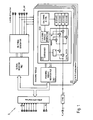
- Figure 1 shows a GPS processor according to the present invention.
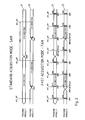
- Fiqure 2 shows a timing diagram of a signal processor according to the present invention.
- the 1575.42 MHz signal received from the Space Vehicles (SV) is down-converted to an intermediate frequency (IF), for example 4.092 MHz by an appropriate RF front-end.
- IF intermediate frequency
- An example of a RF down-converter adapted to this function is described in European Patent Application EP 1'198'068 , in the name of the applicant, which is hereby incorporated by reference.
- the IF signal is then fed, among others, to a correlation processor 3 according to the invention, whose function is to de-spread the signals received from each SV, and to align them temporally with locally generated copies of the pseudorandom ranging codes specific for each SV, for example, in case of a GPS receiver, the correlation processor 3 has the task of demodulating and tracking the coarse acquisition (C/A) GPS ranging signals.
- the correlators processor 3 comprises an array of tracking modules 20, each of which comprises two numerically controlled oscillators 210 and 220, for further converting the IF signal and generating a baseband signal.
- Each tracking module 20 comprises also a local Gold pseudorandom code generator 220, for generating a local replica of the C/A code corresponding to a particular GPS Space Vehicle.
- the Gold pseudorandom codes can be generated internally, for example by a tapped shift register, or, equivalently, extracted from a preloaded table or by any other technique.
- the Gold code generator 220 is piloted by an independent numerically controlled C/A clock at about 1.023 MHz.
- the exact frequency of the local carrier frequency as well as the local C/A code frequency are adjusted, by an external CPU (not shown), to compensate for Doppler shift on the SV signal and local oscillator drift and bias.
- the incoming IF signal is multiplied by the in-phase (I) and quadrature (Q) components of the local carder and by two time-shifted versions of the replica C/A code. The result of these operations is integrated for a programmable period of time, to generate an integrated correlation value, which is loaded into a tracking module register file 201 at the end of each integration period, to be accessible to the external CPU.
- the tracking module In addition to the prompt correlation value, the tracking module also generates a late correlation value and an early correlation value, which are obtained by multiplying the GPS signal with a 1 ⁇ 2 chip delayed and a 1 ⁇ 2 chip advanced version of the local replica code. These late and early correlation values are employed in the tracking algorithm, as it will be explained later.
- the external CPU reads the correlation value stored in the registers 201 of each tracking module 20, and implements SV acquisition and tracking algorithms.
- the acquisition algorithm repeatedly shifts the replica C/A code generated in a tracking module 20, by issuing a series of "slew" commands to said tracking unit, until a sufficient correlation level is reached, whereupon the CPU switches to tracking mode.
- the tracking module can be instructed by the external CPU to autonomously slew the replica C/A code on a periodical basis, for example every 1, 2 or 4 C/A code periods.
- the external CPU stops the periodical slewing and continuously monitors the integrated correlation value, and also the early and late correlation values described above. By comparing the current, early and late correlation the CPU keeps the replica C/A code time-aligned with the C/A code coming from the Space Vehicle, by appropriately adapting the replica C/A code offset and the frequency of the C/A clock, as it is known in the art.
- the tracking module can also compute a difference between early and late correlation (early minus late or EML), or alternate between early, prompt and late correlations. All these modes of functioning can be selected by the CPU, for example by acting on appropriate registers in the register file 210, and are autonomously taken in charge by the tracking module 20, without the need to interfere with the C/A code generator 220.
- EML early minus late
- the 50 bps GPS navigation message can be extracted.
- the amount by which the replica C/A code must be shifted of keep is aligned with the incoming signal is proportional to the pseudo-range between the receiver ant one particular Space Vehicle. If at least four tracking modules 20 track four different space vehicles, and as soon as a sufficient portion of the navigation message has been downloaded, a positional fix is possible.
- the complete start-up sequence which is needed when the system is switched on without a previous knowledge of satellite orbit parameters, comprises then the two phases of:
- the tracking module of the signal processor of the invention comprises also a special fast acquisition mode, whose aim is to speed up the acquisition phase 1 above.
- Figure 2 shows a time diagram of the fast acquisition mode (FAM) compared to the standard acquisition and tracking mode (SAM).
- each tracking module During standard acquisition mode the integrated correlation values in each tracking module are dumped into the output register at each C/A code overflow, that is the end of each C/A code period. In this way the correlation value is maximized. Dump times are therefore independent and uncorrelated for each tracking module, being only determined by the phase of the replica C/A code.
- the upper part of figure 2 shows the relative timing of two tracking modules, one of which 21, is in tracking mode, while the other 22, is in acquisition mode, with the C/A code slewed at each code overflow.
- the CPU reads periodically the register 210 of all the tracking modules 21, 22 in order to detect the completion of acquisition phases, and to implement the chosen tracking strategy. This is done in correspondence with the periodical interrupt ACC_INT.
- the lower part of figure 2 illustrates the fast acquisition mode FAM.
- FAM differs from SAM in that the accumulated data is dumped into the registers 210 on the ACC_INT signal, which is common to all tracking modules, instead of on C/A code overflow. Therefore the length of the integration period in the tracking modules is determined by the ACC_INT period.
- the reduced integration time By reducing the integration time it is possible to proportionally reduce the acquisition time of correlation data. A direct consequence of the reduced integration period, however, is that lover correlation levels are expected.
- the reduced integration time also increases the signal processor frequency bandwidth. As a consequence the scanning of the frequency space necessary during SV acquisition can be executed with larger steps (frequency bin). This further reduces the SV acquisition time. Only strong SV signals with a high signal-to noise ratio will produce reliable correlation values which can be detected in SAM mode.
- a cold start is the main application of SAM mode, during which an exhaustive search for all the available SV is made.
- each tracking module 20 automatically detects whether a C/A code overflow occurred within the last integration period. In this case data is dumped normally, but a special flag bit in the register file 210 is utilized to signal this to the CPU. This avoids interpreting a data bit transition of the GPS signal during FAM integration (which would result in a very low correlation value) as a C/A code misalignment. By checking the flag bit the software running on the CPU can skip over this data.
- the slew repeat option allows automatic slewing of the C/A code by 1 chip (or more) one each new ACC_INT.
- Software can check new correlation values with the slewed C/A code sequence without intervening with C/A code generation. Again, to avoid the effect of a GPS data bit transition, C/A code slewing is automatically inhibited (even with the slew repeat option enabled) in the integration following a C/A code overflow.
- Signal processor for use in a navigation satellite receiver, comprising a plurality of tracking modules, for processing a plurality of navigation ranging signals, each tracking module comprising:
- tracking modules comprise means to inhibit said temporal shift after completion of a period of said replica code sequence.
- Signal processor according to one of the preceding , wherein said signal processor is arranged to monitor said time-integrated correlation values and to maintain an alignment condition between said replica code sequences and said pseudorandom sequences contained in said navigation ranging signals, by selectively temporally shifting said replica code sequences.
- Signal processor according to one of the preceding , operatively arranged for selectively activating said first functioning mode at device start-up.
- Signal processor operatively arranged for selectively activating said first functioning mode when the strength of said navigation ranging signals exceeds a predefined value.
- GPS receiver comprising a signal processor according to one of the preceding
- Method for acquiring a plurality of navigation ranging signals from a plurality of space vehicles comprising the steps of:
Landscapes
- Engineering & Computer Science (AREA)
- Computer Networks & Wireless Communication (AREA)
- Radar, Positioning & Navigation (AREA)
- Remote Sensing (AREA)
- Signal Processing (AREA)
- Physics & Mathematics (AREA)
- General Physics & Mathematics (AREA)
- Position Fixing By Use Of Radio Waves (AREA)
Applications Claiming Priority (2)
| Application Number | Priority Date | Filing Date | Title |
|---|---|---|---|
| US48473703P | 2003-07-03 | 2003-07-03 | |
| EP04741948A EP1642152B1 (de) | 2003-07-03 | 2004-07-02 | Gps empfänger mit kurzer erfassungszeit |
Related Parent Applications (1)
| Application Number | Title | Priority Date | Filing Date |
|---|---|---|---|
| EP04741948.6 Division | 2004-07-02 |
Publications (2)
| Publication Number | Publication Date |
|---|---|
| EP2290832A2 true EP2290832A2 (de) | 2011-03-02 |
| EP2290832A3 EP2290832A3 (de) | 2011-03-23 |
Family
ID=33564026
Family Applications (2)
| Application Number | Title | Priority Date | Filing Date |
|---|---|---|---|
| EP10009986A Withdrawn EP2290832A3 (de) | 2003-07-03 | 2004-07-02 | GPS empfänger mit kurzer Akquisitionszeit |
| EP04741948A Expired - Lifetime EP1642152B1 (de) | 2003-07-03 | 2004-07-02 | Gps empfänger mit kurzer erfassungszeit |
Family Applications After (1)
| Application Number | Title | Priority Date | Filing Date |
|---|---|---|---|
| EP04741948A Expired - Lifetime EP1642152B1 (de) | 2003-07-03 | 2004-07-02 | Gps empfänger mit kurzer erfassungszeit |
Country Status (4)
| Country | Link |
|---|---|
| EP (2) | EP2290832A3 (de) |
| JP (1) | JP4499717B2 (de) |
| AT (1) | ATE521904T1 (de) |
| WO (1) | WO2005003807A1 (de) |
Families Citing this family (6)
| Publication number | Priority date | Publication date | Assignee | Title |
|---|---|---|---|---|
| EP1960804A1 (de) | 2005-12-16 | 2008-08-27 | Nemerix SA | Signalprozessor und signalverarbeitungsverfahren |
| EP1960806A1 (de) | 2005-12-16 | 2008-08-27 | Nemerix SA | Signalprozessor und signalverarbeitungsverfahren |
| EP1903346A1 (de) | 2006-09-21 | 2008-03-26 | Nemerix SA | Speicherverringerung in GNSS-Empfängern |
| EP1916535B1 (de) | 2006-10-26 | 2015-11-18 | Qualcomm Incorporated | Unterdrückung der Kreuzkorrelation in GNSS-Empfängern |
| EP2066040A1 (de) | 2007-11-27 | 2009-06-03 | Nemerix SA | GNSS-Empfänger mit Mehrwegkompensation |
| CN110658536B (zh) * | 2018-06-29 | 2023-02-10 | 北京自动化控制设备研究所 | 一种卫星接收机导航输出信号时序测试方法 |
Citations (1)
| Publication number | Priority date | Publication date | Assignee | Title |
|---|---|---|---|---|
| EP1198068A1 (de) | 2000-10-10 | 2002-04-17 | TChip Semiconductor SA | Elektronische Schaltung und RF-Empfänger mit Energiesparsteuerung |
Family Cites Families (8)
| Publication number | Priority date | Publication date | Assignee | Title |
|---|---|---|---|---|
| JPH10253738A (ja) * | 1997-03-11 | 1998-09-25 | Matsushita Electric Ind Co Ltd | Gps受信方式 |
| JP3752052B2 (ja) * | 1997-04-15 | 2006-03-08 | 日本無線株式会社 | コード位相捕捉回路 |
| US5955986A (en) * | 1997-11-20 | 1999-09-21 | Eagle Eye Technologies, Inc. | Low-power satellite-based geopositioning system |
| US6208291B1 (en) * | 1998-05-29 | 2001-03-27 | Snaptrack, Inc. | Highly parallel GPS correlator system and method |
| JP2001159670A (ja) * | 1999-12-03 | 2001-06-12 | Japan Radio Co Ltd | Gps受信機用相関検出回路 |
| US6735243B1 (en) * | 2000-11-08 | 2004-05-11 | Nokia Corporation | Method, apparatus and system for fast acquisition of a spread spectrum signal |
| JP2003032144A (ja) * | 2001-07-17 | 2003-01-31 | Furuno Electric Co Ltd | スペクトル拡散信号捕捉装置および方法 |
| US6775319B2 (en) * | 2001-08-16 | 2004-08-10 | Motorola, Inc. | Spread spectrum receiver architectures and methods therefor |
-
2004
- 2004-07-02 JP JP2006516200A patent/JP4499717B2/ja not_active Expired - Fee Related
- 2004-07-02 WO PCT/EP2004/051336 patent/WO2005003807A1/en not_active Ceased
- 2004-07-02 EP EP10009986A patent/EP2290832A3/de not_active Withdrawn
- 2004-07-02 EP EP04741948A patent/EP1642152B1/de not_active Expired - Lifetime
- 2004-07-02 AT AT04741948T patent/ATE521904T1/de not_active IP Right Cessation
Patent Citations (1)
| Publication number | Priority date | Publication date | Assignee | Title |
|---|---|---|---|---|
| EP1198068A1 (de) | 2000-10-10 | 2002-04-17 | TChip Semiconductor SA | Elektronische Schaltung und RF-Empfänger mit Energiesparsteuerung |
Also Published As
| Publication number | Publication date |
|---|---|
| JP4499717B2 (ja) | 2010-07-07 |
| ATE521904T1 (de) | 2011-09-15 |
| WO2005003807A1 (en) | 2005-01-13 |
| EP1642152A1 (de) | 2006-04-05 |
| JP2008506925A (ja) | 2008-03-06 |
| EP2290832A3 (de) | 2011-03-23 |
| EP1642152B1 (de) | 2011-08-24 |
Similar Documents
| Publication | Publication Date | Title |
|---|---|---|
| US7428259B2 (en) | Efficient and flexible GPS receiver baseband architecture | |
| US20090224976A1 (en) | Gps receiver with fast acquisition time | |
| US8170086B2 (en) | Method and apparatus for performing signal correlation | |
| US8369464B2 (en) | System and method for acquisition of signals | |
| US7800536B2 (en) | Signal acquisition/tracking method and correlator for the same | |
| US10838075B2 (en) | Sequential chip mixed frequency correlator array system | |
| US7085309B2 (en) | Radiofrequency signal receiver with means for correcting the effects of multipath signals, and method for activating the receiver | |
| US6724807B1 (en) | Methods and apparatuses for processing of global positioning system signals with a matched filter | |
| JP5801056B2 (ja) | 多相符号ジェネレータおよびgnss受信機 | |
| EP3537181B1 (de) | Globales satellitennavigationssystem mit niedriger leistung und minimaler rate zur signalverfolgung | |
| EP3413089B1 (de) | Sequenzielles chip-mischfrequenz-korrelator-array-system | |
| US8238411B2 (en) | Acquisition of a code modulated signal | |
| EP1642152B1 (de) | Gps empfänger mit kurzer erfassungszeit | |
| WO2000065751A1 (en) | Apparatus for computing gps correlations in parallel | |
| US20080123718A1 (en) | Positioning apparatus and control method thereof | |
| WO2009044205A2 (en) | Correlator for global navigation satellite systems | |
| EP1724600B1 (de) | System und Verfahren zur Signalakquisition |
Legal Events
| Date | Code | Title | Description |
|---|---|---|---|
| PUAI | Public reference made under article 153(3) epc to a published international application that has entered the european phase |
Free format text: ORIGINAL CODE: 0009012 |
|
| PUAL | Search report despatched |
Free format text: ORIGINAL CODE: 0009013 |
|
| 17P | Request for examination filed |
Effective date: 20100920 |
|
| AC | Divisional application: reference to earlier application |
Ref document number: 1642152 Country of ref document: EP Kind code of ref document: P |
|
| AK | Designated contracting states |
Kind code of ref document: A2 Designated state(s): AT BE BG CH CY CZ DE DK EE ES FI FR GB GR HU IE IT LI LU MC NL PL PT RO SE SI SK TR |
|
| AK | Designated contracting states |
Kind code of ref document: A3 Designated state(s): AT BE BG CH CY CZ DE DK EE ES FI FR GB GR HU IE IT LI LU MC NL PL PT RO SE SI SK TR |
|
| STAA | Information on the status of an ep patent application or granted ep patent |
Free format text: STATUS: THE APPLICATION IS DEEMED TO BE WITHDRAWN |
|
| 18D | Application deemed to be withdrawn |
Effective date: 20150211 |