EP2290208A1 - Electronic throttle control at idle speed - Google Patents
Electronic throttle control at idle speed Download PDFInfo
- Publication number
- EP2290208A1 EP2290208A1 EP10174179A EP10174179A EP2290208A1 EP 2290208 A1 EP2290208 A1 EP 2290208A1 EP 10174179 A EP10174179 A EP 10174179A EP 10174179 A EP10174179 A EP 10174179A EP 2290208 A1 EP2290208 A1 EP 2290208A1
- Authority
- EP
- European Patent Office
- Prior art keywords
- lower limit
- limit value
- angle
- throttle valve
- throttle
- Prior art date
- Legal status (The legal status is an assumption and is not a legal conclusion. Google has not performed a legal analysis and makes no representation as to the accuracy of the status listed.)
- Withdrawn
Links
- 238000001514 detection method Methods 0.000 claims description 3
- 239000006185 dispersion Substances 0.000 description 15
- 230000001276 controlling effect Effects 0.000 description 5
- 238000000034 method Methods 0.000 description 5
- 238000010586 diagram Methods 0.000 description 2
- 230000006870 function Effects 0.000 description 2
- 230000001105 regulatory effect Effects 0.000 description 2
- 230000005540 biological transmission Effects 0.000 description 1
- 238000002485 combustion reaction Methods 0.000 description 1
- 238000006073 displacement reaction Methods 0.000 description 1
- 239000000446 fuel Substances 0.000 description 1
- 238000002347 injection Methods 0.000 description 1
- 239000007924 injection Substances 0.000 description 1
- 239000000463 material Substances 0.000 description 1
- 239000011347 resin Substances 0.000 description 1
- 229920005989 resin Polymers 0.000 description 1
- 238000011144 upstream manufacturing Methods 0.000 description 1
- 239000013585 weight reducing agent Substances 0.000 description 1
Images


Classifications
-
- F—MECHANICAL ENGINEERING; LIGHTING; HEATING; WEAPONS; BLASTING
- F02—COMBUSTION ENGINES; HOT-GAS OR COMBUSTION-PRODUCT ENGINE PLANTS
- F02D—CONTROLLING COMBUSTION ENGINES
- F02D31/00—Use of speed-sensing governors to control combustion engines, not otherwise provided for
- F02D31/001—Electric control of rotation speed
- F02D31/002—Electric control of rotation speed controlling air supply
- F02D31/003—Electric control of rotation speed controlling air supply for idle speed control
-
- F—MECHANICAL ENGINEERING; LIGHTING; HEATING; WEAPONS; BLASTING
- F02—COMBUSTION ENGINES; HOT-GAS OR COMBUSTION-PRODUCT ENGINE PLANTS
- F02D—CONTROLLING COMBUSTION ENGINES
- F02D11/00—Arrangements for, or adaptations to, non-automatic engine control initiation means, e.g. operator initiated
- F02D11/06—Arrangements for, or adaptations to, non-automatic engine control initiation means, e.g. operator initiated characterised by non-mechanical control linkages, e.g. fluid control linkages or by control linkages with power drive or assistance
- F02D11/10—Arrangements for, or adaptations to, non-automatic engine control initiation means, e.g. operator initiated characterised by non-mechanical control linkages, e.g. fluid control linkages or by control linkages with power drive or assistance of the electric type
- F02D2011/101—Arrangements for, or adaptations to, non-automatic engine control initiation means, e.g. operator initiated characterised by non-mechanical control linkages, e.g. fluid control linkages or by control linkages with power drive or assistance of the electric type characterised by the means for actuating the throttles
- F02D2011/102—Arrangements for, or adaptations to, non-automatic engine control initiation means, e.g. operator initiated characterised by non-mechanical control linkages, e.g. fluid control linkages or by control linkages with power drive or assistance of the electric type characterised by the means for actuating the throttles at least one throttle being moved only by an electric actuator
-
- F—MECHANICAL ENGINEERING; LIGHTING; HEATING; WEAPONS; BLASTING
- F02—COMBUSTION ENGINES; HOT-GAS OR COMBUSTION-PRODUCT ENGINE PLANTS
- F02D—CONTROLLING COMBUSTION ENGINES
- F02D2200/00—Input parameters for engine control
- F02D2200/02—Input parameters for engine control the parameters being related to the engine
- F02D2200/04—Engine intake system parameters
- F02D2200/0404—Throttle position
-
- F—MECHANICAL ENGINEERING; LIGHTING; HEATING; WEAPONS; BLASTING
- F02—COMBUSTION ENGINES; HOT-GAS OR COMBUSTION-PRODUCT ENGINE PLANTS
- F02D—CONTROLLING COMBUSTION ENGINES
- F02D9/00—Controlling engines by throttling air or fuel-and-air induction conduits or exhaust conduits
- F02D9/08—Throttle valves specially adapted therefor; Arrangements of such valves in conduits
- F02D9/10—Throttle valves specially adapted therefor; Arrangements of such valves in conduits having pivotally-mounted flaps
- F02D9/1065—Mechanical control linkage between an actuator and the flap, e.g. including levers, gears, springs, clutches, limit stops of the like
Definitions
- the present invention relates to an electronic throttle control system for controlling the angle (position) of a throttle valve by motor drive.
- Japanese Patent Laid-Open No. 2008-88925 discloses an electronic throttle control system in which a lower limit value greater than a full closure angle (full closure position) of a throttle valve by a predetermined angle is set.
- the lower limit value is updated until an opener lever connected to a throttle shaft for turning the throttle valve abuts on a full closing stopper, and the angle at the moment of the abutment is set as the lower limit value, so as to reduce an idle speed.
- the present invention has been made in consideration of the above-mentioned problem involved in the prior art. Accordingly, it is an object of the present invention to provide an electronic throttle control system which enables appropriate control of idle speed even in a configuration in which use is made of a lower limit value for setting a lower limit angle for avoiding interference of a throttle valve with an intake passage.
- An electronic throttle control system described in claim 1 of the present invention is an electronic throttle control system including a throttle valve (14) driven by a motor (22), and a throttle position sensor (26) for detecting the actual angle of the throttle valve (14), the motor (22) being driven so as to control the angle of the throttle valve (14), characterized in that the electronic throttle control system further includes: engine rotating speed detection means (30); and control means (24) for driving the motor (22) so as to control the angle of the throttle valve (14); the control means (24) is so configured that a lower limit value of the angle of the throttle valve (14) controlled by driving the motor (22) is initially set to an angle which is greater than a full closure angle of the throttle valve (14) by a predetermined amount; and when a rise in the engine rotating speed by not less than a predetermined value from a preset idle speed is detected during idling in which the angle of the throttle valve (14) is controlled to the lower limit value, a re-setting is conducted such that the lower limit value is reduced by a predetermined amount to control the engine rotating speed
- the invention described in claim 2 is characterized in that, in the electronic throttle control system described in claim 1, the lower limit value which is initially set is a value obtained by adding a fluctuation width of sensor output inclusive of an output of the throttle position sensor (26) and a fluctuation width of control inclusive of control of the throttle valve (14) to the full closure angle of the throttle valve (14).
- the invention described in claim 3 is characterized in that, in the electronic throttle control system described in claim 2, in the re-setting of the lower limit value, the lower limit value is set to a value obtained by subtracting the sensor output fluctuation width from the lower limit value.
- the invention described in claim 4 is characterized in that, in the electronic throttle control system described in claim 1, the re-setting of the lower limit value is performed when a rise in the engine rotating speed has been continued for a predetermined period of time.
- the invention described in claim 5 is characterized in that, in the electronic throttle control system described in claim 1, the lower limit value is at the initially set value at other times than the time of idling when the angle of the throttle valve (14) is controlled to the lower limit value.
- the invention described in claim 6 is characterized in that, in the electronic throttle control system described in claim 1, the full closure angle of the throttle valve (14) is an angle where the throttle valve (14) is immediately ahead of making contact with a wall surface of an intake passage (18) and where an abutment on a stopper (42) occurs.
- the invention described in claim 7 is characterized in that, in the electronic throttle control system described in claim 6, the stopper (42) is a stopper for restricting the turning range of a reduction gear (38, 40) of the motor (22).
- the invention described in claim 8 is characterized in that, in the electronic throttle control system described in claim 2, the fluctuation width of control is a width corresponding to an overshoot of control inclusive of the control of the throttle valve (14).
- the invention described in claim 9 is characterized in that, in the electronic throttle control system described in claim 1, in the case where a target angle for the throttle valve (14) which is calculated based on the re-set lower limit value is smaller than the re-set lower limit value, the lower limit value is set as the target angle, thereby controlling the throttle valve (14).
- a lower limit value for the angle (position) of the throttle valve is initially set to an angle greater than a full closure angle by a predetermined amount, and, when a rise in the engine rotating speed by not less than a predetermined value is detected during idling, the lower limit value is re-set by subtracting a predetermined amount therefrom. Accordingly, the throttle valve is brought to the full closure position, and loading on a reduction gear or the like present between the throttle valve and the motor can be prevented.
- an appropriate quantity of air can be supplied to the engine during idling, even in the case where the vehicle is of a configuration in which the diameter of the intake passage is set large (overbore) and where it is difficult to appropriately set an idle speed due to dispersions (scattering) as to sensors or the like. Consequently, a rise in the engine rotating speed can be effectively prevented from occurring during idling, and it becomes easy to perform an engine rotating speed feedback control.
- the lower limit value initially set is preliminarily set as a value obtained by adding a sensor output fluctuation width, which represents dispersions of sensor outputs, and a control fluctuation width, which represents dispersions of control, to the full closure angle of the throttle valve. Therefore, it is unnecessary to successively update the lower limit value through learning, and it is possible to simplify a control program in control means, such as an ECU, and a corresponding reduction in cost.
- the lower limit value is re-set as a value obtained by subtracting the sensor output fluctuation width from the lower limit value. Therefore, the throttle valve can be appropriately closed by an amount corresponding to the sensor output fluctuation width at the time of idling, so that a rise in the idle speed can be effectively prevented.
- the re-setting of the lower limit value is carried out when a rise in the engine rotating speed has continued for a predetermined period of time. This makes it possible to re-set the lower limit value in a stable condition.
- the lower limit value is kept at the initially set value at other times than the time of idling. Consequently, the quantity of air can be prevented from being reduced at other times than the time of idling.
- the full closure angle of the throttle valve is an angle where the throttle valve is ahead of making contact with a wall surface of the intake passage and where an abutment on a stopper occurs. This makes it possible to assuredly prevent the throttle valve from making contact with a wall surface of the intake passage or being firmly attached to the wall surface.
- the stopper may be a stopper for restricting the turning range of a reduction gear of the motor. Consequently, it is possible to prevent more securely the throttle valve from making contact with the wall surface of the intake passage or being firmly attached to the wall surface.
- the fluctuation width of control is a width corresponding to an overshoot of control. Therefore, it is possible to set the lower limit value in consideration of dispersions of control.
- a margin corresponding to the control fluctuation width is present between the lower limit value and the full closure angle, even in the case where the sensor output fluctuation width is subtracted at the time of re-setting the lower limit value. Therefore, even in the case of an overshoot relating to the re-set lower limit value due to dispersions of control, the abutment of the reduction gear against the stopper can be obviated effectively.
- the lower limit value is set as a target angle. This makes it possible to appropriately restrict the throttle angle to the lower limit value, and to securely obviate abutment of the reduction gear against the stopper.
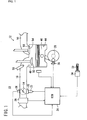
- FIG. 1 is a schematic block diagram of an electronic throttle control system 10 according to an embodiment of the present invention, illustrating an exemplary application of the electronic throttle control system 10 to an engine 12.
- the electronic throttle control system 10 (hereinafter, referred to also as “control system 10") according to this embodiment is mounted on a motorcycle, a passenger car or the like and is used for the so-called throttle-by-wire (TBW) control in which the angle (position) of a throttle valve 14 is controlled by driving of a motor 22.
- TSW throttle-by-wire
- the control system 10 includes a throttle valve 14 disposed in an intake passage 18 of the engine 12, the motor 22 for regulating the angle of the throttle valve 14 through a speed reduction mechanism 20, and an ECU (electronic control unit; control means) which appropriately drives and controls the motor 22 on the basis of detected values (detection signals) inputted thereto from various sensors and which performs a total control of the system as a whole.
- ECU electronic control unit; control means
- the control system 10 further includes a throttle position sensor 26 for detecting the actual angle of the throttle valve 14, an engine rotating speed sensor 30 for detecting the rotating speed of the engine 12 (a crankshaft 28), an accelerator angle sensor 34 for detecting the operating amount of an accelerator grip 32, and an airflow meter 36 for detecting the quantity of intake air in an intake passage 18, these sensors being connected to the ECU 24.
- the airflow meter 36 may be replaced by a vacuum sensor (not shown) provided on the downstream side of the throttle valve 14.
- the speed reduction mechanism 20 has a reduction gear 38 driven to rotate by a drive gear 22a secured to a driving shaft of the motor 22, and a link gear (reduction gear) 40 turned within a predetermined angle by the reduction gear 38, and turning of the link gear 40 causes an opening or closing operation of the throttle valve 14 through a transmission mechanism (not shown).
- a pair of projected parts 40a and 40b for determining the turning range of the link gear 40 are provided on a side surface on the side opposite to the side of meshing with the reduction gear 38.
- a housing 41 is provided, between the projected parts 40a and 40b, with a stopper 42 on which the projected parts 40a and 40b can abut.
- the engine 12 as an exemplary object to which the control system 10 is applied is, for example, a four-cylinder four-cycle internal combustion engine, as shown in FIG. 1 , which includes a piston 46 reciprocated inside a cylinder chamber 44 by rotation of the crankshaft 28, and an intake valve 52 and an exhaust valve 54 for opening and closing of an intake port 48 and an exhaust port 50, respectively.
- the intake port 48 communicates with the intake passage 18, and a fuel injection system 56 and the throttle valve 14 are disposed on the upstream side thereof.
- the exhaust port 50 communicates with an exhaust passage 58.
- the motor 22 is driven under the control of the ECU 24, so as to turn the link gear 40, thereby causing an opening or closing operation of the throttle valve 14.
- the opening/closing range of the throttle valve 14, that is, the turning range of the link gear 40, is physically (mechanically) regulated by the abutment of the projected parts 40a and 40b on the stopper 42.
- a stopper abutment position where the projected part 40a or 40b abuts on the stopper 42 corresponds to a full closure position or a full opening position of the angle of the throttle valve 14.
- the full closure angle is an angle where the throttle valve 14 is immediately ahead of making contact with a wall surface of the intake passage 18. Therefore, with the projected part 40a brought into abutment on the stopper 42 earlier, the throttle valve 14 is prevented from making contact with the wall surface of the intake passage 18.
- the reduction gear 38 and/or the link gear 40 constituting the speed reduction mechanism 20 may in some cases be made from a resin material, for weight reduction or the like purposes. Therefore, in a structure in which the projected part 40a (40b) abuts against the stopper 42 each time of idling where the throttle valve 14 is controlled to the full closure position, the loads on tooth surfaces of the reduction gear 38 and the link gear 40, the projected parts 40a and 40b, etc. are so high that these components must be provided with sufficient toughness against wear. Naturally, the same holds true even where metallic gears are used.
- the angle greater by a predetermined amount than the full closure angle at which the projected part 40a (40b) abuts on the stopper 42 is initially set as a lower limit value of the position of the throttle valve 14 controlled by driving of the motor 22, whereby the abutment of the projected part 40a (40b) against the stopper 42 is prevented.
- the lower limit value TH1 greater than the full closure angle (stopper abutment angle) TH0 by a predetermined amount is provided, and these values are initially set in memory means (not shown) in the ECU 24.
- the lower limit value TH1 is set at a value obtained by adding a sensor output fluctuation width X1, which represents dispersions of outputs from sensors inclusive of an output from the throttle position sensor 26, and a control fluctuation width X2, which represents dispersions of control inclusive of the control of the position (angle) of the throttle valve 14, to the full closure position TH0.
- the range represented by X3 in FIG. 3 shows dispersions (tolerance of tuning) due to tolerances in the case where a plurality of throttle valves are mounted.
- the sensor output fluctuation width X1 indicates, for example, a condition wherein the throttle position sensor 26 is outputting a minute voltage (e.g., about 0.2 V) notwithstanding the actual angle of the throttle valve 14 is 0°, in the case where, for example, the throttle position sensor 26 is so set that its output voltage is 0 V.
- the control fluctuation width X2 corresponds to a so-called overshoot of control, and indicates, for example, a condition wherein the throttle angle is momentarily lowered below the lower limit value TH1 when it is attempted to control the throttle angle down to the lower limit value TH1 in the case where the throttle angle is at a certain magnitude.
- the control system 10 initially set in this manner performs a control by which, for example, at the time of idling, the motor 22 is driven so as to bring the angle of the throttle valve 14 to the full closure angle, namely, to the lower limit value TH1.
- the quantity of air taken into the engine 12 may become an air quantity A1 in excess of a quantity of air necessary for idling, A0, possibly raising the engine rotating speed at the time of idling.
- a rise in the engine rotating speed means that the throttle valve is opened excessively wider than the angle corresponding to the quantity of air necessary for idling, A0; that is, the throttle angle at the lower limit value TH1 is needlessly larger by an amount corresponding to the sensor output fluctuation width X1, resulting in a condition where an excess of air, specifically, the quantity A1 of air can be supplied to the engine 12.
- a control (lower limit value change-over control) is performed in which the lower limit value TH1 is re-set, as required, so as to appropriately reduce the quantity of air at the time of idling to below the quantity of air necessary for idling, A0, and thereby to prevent the above-mentioned rise in the engine rotating speed from occurring.
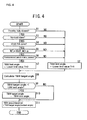
- FIG. 4 is a flow chart showing an example of the procedure for the lower limit value change-over control.
- the lower limit value change-over control is executed as follows, under the control performed by the ECU 24, such as arithmetic processing and decision processes.
- step S1 in FIG. 4 whether or not the throttle valve 14 is fully closed is decided, based on an output signal from the throttle position sensor 26 (TH full closure decision). Specifically, it is decided whether or not the throttle position sensor 26 is outputting a signal corresponding to a throttle angle of 0° due to a condition where the motor 22 is driven under the control of the ECU 24 and the angle of the throttle valve 14 is controlled to the lower limit value TH1, which is the full closure angle on the basis of the control according to the initial setting.
- step S2 is executed next.
- step S3 is subsequently carried out.
- step S3 it is decided whether or not the vehicle with the electronic throttle control system 10 mounted thereon is in a no-load state (in the state of being stopped or the like), based on a vehicle speed sensor (not shown) or the like. If it is decided that the vehicle is not in a no-load state (NO upon step S3), the control proceeds to step S2. If it is judged that the vehicle is in a no-load state (YES upon step S3), step S4 is subsequently executed.
- step S4 it is decided whether or not the control by the ECU 24 is in an idle feedback zone (IDLE F/B zone) in which a rotating speed feedback control according to an idling state is performed.
- an idle feedback zone ILE F/B zone
- step S5 is subsequently executed.
- step S5 it is decided, based on an output signal from the engine rotating speed sensor 30, whether or not the current engine rotating speed NE is greater than a rotating speed (IDLE_NE+ ⁇ ) obtained by adding a predetermined value ⁇ (a little fluctuation width) to an idle speed (preset idle speed) previously set as an engine rotating speed at the time of idling which is preliminarily set in the ECU 24.
- a rotating speed IDLE_NE+ ⁇
- step S5 when the engine rotating speed NE is decided as greater than the idle speed IDLE_NE+ ⁇ (YES upon step S5), it is judged that the engine rotating speed may have increased during idling, and step S6 is subsequently carried out.
- the engine rotating speed NE while the engine rotating speed NE is compared with the idle speed IDLE_NE+ ⁇ in consideration of the predetermined value ⁇ as a fluctuation width, in this step S5, the engine rotating speed NE may be compared with the idle speed IDLE_NE (which is the preset idle speed) without taking the predetermined value ⁇ into consideration.
- step S6 it is decided whether or not a condition where the engine rotating speed NE is above the idle speed IDLE_NE+ ⁇ and the rotating speed of the engine 12 is accordingly high has continued for a predetermined period of time.
- step S2 is executed next.
- step S6 when the predetermined period of time has elapsed since the condition of the condition of the engine rotating speed NE being above the idle speed IDEL_NE+ ⁇ started and it is judged that the rotating speed of the engine 12 is high notwithstanding the current time is the time of idling (YES upon step S6), it is judged that the excess quantity A1 of air is being supplied to the engine 12 (see FIG. 3 ), and step S7 is subsequently executed.
- step S7 as shown in FIG. 3 , the lower limit value (idle blow-up limit value) being a throttle angle obtained by subtracting the sensor output fluctuation width X1 from the lower limit value TH1 is re-set as a TBW limit angle, namely, a control limit value in the throttle-by-wire control.
- a TBW limit angle namely, a control limit value in the throttle-by-wire control.
- a control of lowering the quantity A1 of air in excess of the quantity of air necessary for idling, A0, to a quantity A2 of air below the quantity of air necessary for idling, A0, is carried out in order that the engine rotating speed NE will be within the predetermined value ⁇ from the idle speed IDLE_NE used as the preset idle speed (for example, within plus or minus several percent from the idle speed).
- step S2 the current lower limit value TH1 is re-set as the TBW limit angle (the setting is maintained).
- step S8 based on the TBW limit angle set in step S2 or step S7 (in step S2, the lower limit value TH1; in step S7, the lower limit TH2), the ECU 24 calculates a TBW target angle to be used as a target throttle angle in the throttle-by-wire control, by referring to the vehicle conditions such as the engine rotating speed NE.
- step S9 it is judged whether or not the TBW target angle calculated in step S8 is smaller than the TBW limit angle set in step S2 or step S7.
- step S10 is subsequently executed, in which the TBW limit angle is re-set as the TBW target angle, and then step S11 is carried out.
- the throttle angle is restricted to the TBW limit angle, to thereby obviate a situation in which the projected part 40a (40b) abuts against the stopper 42 due to excessive turning of the throttle valve 14 in a valve closing direction.
- step S11 is next performed.
- step S11 the proportion of the TBW target angle to the actual angle of the throttle valve 14 detected by the throttle position sensor 26, namely, (TBW target angle)/(actual angle), is calculated, and outputting of the TBW (throttle-by-wire control) is performed based on the calculation result. Therefore, the motor 22 is driven under the control of the ECU 24, and the throttle valve 14 is driven and brought to an angle position of the TBW target angle by the driving of the motor 22, whereby an appropriate idling state of the engine 12 is maintained.
- the following control is performed.
- a rise in the engine rotating speed NE by at least a predetermined value ⁇ from an idle speed IDLE_NE provided as a preset idle speed is detected during idling where the angle of the throttle valve is controlled to a full closure angle, or an initially set lower limit value TH1
- the lower limit value TH1 is re-set to a lower limit value TH2 reduced by a predetermined amount, whereby the engine rotating speed NE is controlled to within a predetermined value from the idle speed IDLE_NE used as the preset idle speed (for example, within plus or minus several percent from the idle speed).
- a control is performed in which the lower limit value is changed over to the lower limit value TH2 obtained by subtracting a sensor output fluctuation width X1 from the original lower limit value, whereby the quantity of air that can be supplied to the engine 12 is brought to equal to or below the quantity of air necessary for idling, A0.
- the lower limit change-over control is conducted when the condition of a high engine rotating speed during idling has continued for a predetermined period of time, whereby the re-setting of the lower limit value can always be performed in a stable condition.
- the re-set lower limit value TH2 is set by subtracting the sensor output fluctuation width X1, representing sensor dispersions, from the initially set lower limit value TH1. Therefore, the throttle can be appropriately closed by an amount corresponding to the sensor output fluctuation width X1 at the time of idling, whereby a rise in the idle speed can be effectively prevented.
- the lower limit value TH1 is preliminarily set by initial setting in consideration of the control fluctuation width X2, which represents dispersions of control, together with the sensor output fluctuation width X1.
- the lower limit value TH1 is preliminarily set as a value obtained by adding the sensor output fluctuation width X1 and the control fluctuation width X2 to the full closure angle TH0. Therefore, it is unnecessary to successively update the lower limit value TH1 through learning, and it is possible to achieve simplification of the control program in the ECU 24 and a corresponding reduction in cost.
- the re-setting of the lower limit value is not conducted but the initially set lower limit value TH1 is used, at other times than the time of idling when the angle of the throttle valve 14 is controlled to the full closure angle, namely, to the lower limit value TH1.
- the quantity of air supplied to the engine 12 can be prevented from being reduced at other times than the time of idling, and the processing load on the ECU 24 can be reduced.
- the speed reduction mechanism 20 for transmitting to the throttle valve 14 the rotation of the motor 22 being driven under the control of the ECU 24 may be of other configuration than the configuration in which the reduction gear 38 and the link gear 40 are used.
- control means having the functions of a lower limit value re-setting section for re-setting the lower limit value, a TH angle control section for controlling the throttle angle and a TBW angle calculating section for calculating a throttle angle in the TBW control, in the above embodiment, these sections or functions may be provided in other control means separate from the ECU 24.
Landscapes
- Engineering & Computer Science (AREA)
- Chemical & Material Sciences (AREA)
- Combustion & Propulsion (AREA)
- Mechanical Engineering (AREA)
- General Engineering & Computer Science (AREA)
- Control Of Throttle Valves Provided In The Intake System Or In The Exhaust System (AREA)
- Electrical Control Of Air Or Fuel Supplied To Internal-Combustion Engine (AREA)
Abstract
Description
- The present invention relates to an electronic throttle control system for controlling the angle (position) of a throttle valve by motor drive.
- In motorcycles and passenger cars, use is made of an electronic throttle control system based on application of the so-called throttle-by-wire (TBW) control in which an operating amount of an accelerator (grip or pedal) is detected, an optimum angle of a throttle valve is calculated based on the accelerator angle thus detected and signals from various sensors, and a motor is driven based on the thus calculated target angle to thereby open or close the throttle valve.
- Japanese Patent Laid-Open No.
2008-88925 - In the control system described in
Patent Document 1, however, for maintaining the idle speed at an appropriate level, it is necessary to bring the opener lever into abutment against the full closing stopper and, therefore, a heavy load is exerted on a reduction gear for driving the throttle valve due to the abutment. On the other hand, for controlling the throttle angle without using such a stopper, it is necessary to perform a control by use of a limit value such that the throttle valve will not interfere with an intake passage, in presumed operating conditions. However, in an engine required to exhibit a high output relative to engine displacement, the diameter of the intake passage is set at a high value (overbore), and dispersions of devices and sensors as well as overshoots of control and the like are generated. Accordingly, it has been difficult to set a limit value which enables appropriate setting of an idle speed. - The present invention has been made in consideration of the above-mentioned problem involved in the prior art. Accordingly, it is an object of the present invention to provide an electronic throttle control system which enables appropriate control of idle speed even in a configuration in which use is made of a lower limit value for setting a lower limit angle for avoiding interference of a throttle valve with an intake passage.
- An electronic throttle control system described in
claim 1 of the present invention is an electronic throttle control system including a throttle valve (14) driven by a motor (22), and a throttle position sensor (26) for detecting the actual angle of the throttle valve (14), the motor (22) being driven so as to control the angle of the throttle valve (14), characterized in that the electronic throttle control system further includes: engine rotating speed detection means (30); and control means (24) for driving the motor (22) so as to control the angle of the throttle valve (14); the control means (24) is so configured that a lower limit value of the angle of the throttle valve (14) controlled by driving the motor (22) is initially set to an angle which is greater than a full closure angle of the throttle valve (14) by a predetermined amount; and when a rise in the engine rotating speed by not less than a predetermined value from a preset idle speed is detected during idling in which the angle of the throttle valve (14) is controlled to the lower limit value, a re-setting is conducted such that the lower limit value is reduced by a predetermined amount to control the engine rotating speed to within a predetermined value from the preset idle speed, and the lower limit value is returned to the original lower limit value in other operating conditions than the idling. Incidentally, the parenthesized symbols are attached following the symbols used in the accompanying drawings for the purpose of easier understanding of the present invention, and the invention is not to be construed as limited to the components accompanied by the symbols; this applies hereinbelow. - The invention described in
claim 2 is characterized in that, in the electronic throttle control system described inclaim 1, the lower limit value which is initially set is a value obtained by adding a fluctuation width of sensor output inclusive of an output of the throttle position sensor (26) and a fluctuation width of control inclusive of control of the throttle valve (14) to the full closure angle of the throttle valve (14). - The invention described in
claim 3 is characterized in that, in the electronic throttle control system described inclaim 2, in the re-setting of the lower limit value, the lower limit value is set to a value obtained by subtracting the sensor output fluctuation width from the lower limit value. - The invention described in
claim 4 is characterized in that, in the electronic throttle control system described inclaim 1, the re-setting of the lower limit value is performed when a rise in the engine rotating speed has been continued for a predetermined period of time. - The invention described in
claim 5 is characterized in that, in the electronic throttle control system described inclaim 1, the lower limit value is at the initially set value at other times than the time of idling when the angle of the throttle valve (14) is controlled to the lower limit value. - The invention described in claim 6 is characterized in that, in the electronic throttle control system described in
claim 1, the full closure angle of the throttle valve (14) is an angle where the throttle valve (14) is immediately ahead of making contact with a wall surface of an intake passage (18) and where an abutment on a stopper (42) occurs. - The invention described in
claim 7 is characterized in that, in the electronic throttle control system described in claim 6, the stopper (42) is a stopper for restricting the turning range of a reduction gear (38, 40) of the motor (22). - The invention described in claim 8 is characterized in that, in the electronic throttle control system described in
claim 2, the fluctuation width of control is a width corresponding to an overshoot of control inclusive of the control of the throttle valve (14). - The invention described in
claim 9 is characterized in that, in the electronic throttle control system described inclaim 1, in the case where a target angle for the throttle valve (14) which is calculated based on the re-set lower limit value is smaller than the re-set lower limit value, the lower limit value is set as the target angle, thereby controlling the throttle valve (14). - According to the invention as described in
claim 1, a lower limit value for the angle (position) of the throttle valve is initially set to an angle greater than a full closure angle by a predetermined amount, and, when a rise in the engine rotating speed by not less than a predetermined value is detected during idling, the lower limit value is re-set by subtracting a predetermined amount therefrom. Accordingly, the throttle valve is brought to the full closure position, and loading on a reduction gear or the like present between the throttle valve and the motor can be prevented. In addition, an appropriate quantity of air can be supplied to the engine during idling, even in the case where the vehicle is of a configuration in which the diameter of the intake passage is set large (overbore) and where it is difficult to appropriately set an idle speed due to dispersions (scattering) as to sensors or the like. Consequently, a rise in the engine rotating speed can be effectively prevented from occurring during idling, and it becomes easy to perform an engine rotating speed feedback control. - According to the invention as described in
claim 2, the lower limit value initially set is preliminarily set as a value obtained by adding a sensor output fluctuation width, which represents dispersions of sensor outputs, and a control fluctuation width, which represents dispersions of control, to the full closure angle of the throttle valve. Therefore, it is unnecessary to successively update the lower limit value through learning, and it is possible to simplify a control program in control means, such as an ECU, and a corresponding reduction in cost. - According to the invention as described in
claim 3, the lower limit value is re-set as a value obtained by subtracting the sensor output fluctuation width from the lower limit value. Therefore, the throttle valve can be appropriately closed by an amount corresponding to the sensor output fluctuation width at the time of idling, so that a rise in the idle speed can be effectively prevented. - According to the invention as described in
claim 4, the re-setting of the lower limit value is carried out when a rise in the engine rotating speed has continued for a predetermined period of time. This makes it possible to re-set the lower limit value in a stable condition. - According to the invention as described in
claim 5, the lower limit value is kept at the initially set value at other times than the time of idling. Consequently, the quantity of air can be prevented from being reduced at other times than the time of idling. - According to the invention as described in claim 6, the full closure angle of the throttle valve is an angle where the throttle valve is ahead of making contact with a wall surface of the intake passage and where an abutment on a stopper occurs. This makes it possible to assuredly prevent the throttle valve from making contact with a wall surface of the intake passage or being firmly attached to the wall surface.
- According to the invention as described in
claim 7, the stopper may be a stopper for restricting the turning range of a reduction gear of the motor. Consequently, it is possible to prevent more securely the throttle valve from making contact with the wall surface of the intake passage or being firmly attached to the wall surface. - According to the invention as described in claim 8, the fluctuation width of control is a width corresponding to an overshoot of control. Therefore, it is possible to set the lower limit value in consideration of dispersions of control. In addition, a margin corresponding to the control fluctuation width is present between the lower limit value and the full closure angle, even in the case where the sensor output fluctuation width is subtracted at the time of re-setting the lower limit value. Therefore, even in the case of an overshoot relating to the re-set lower limit value due to dispersions of control, the abutment of the reduction gear against the stopper can be obviated effectively.
- According to the invention described in
claim 9, in the case where a target angle calculated based on the re-set lower limit value is smaller than the re-set lower limit value, the lower limit value is set as a target angle. This makes it possible to appropriately restrict the throttle angle to the lower limit value, and to securely obviate abutment of the reduction gear against the stopper. -
-
FIG. 1 is a schematic block diagram of an electronic throttle control system according to an embodiment of the present invention. -
FIG. 2 is a side view showing an example of a motor for driving and controlling a throttle valve, a speed reduction mechanism and the surroundings. -
FIG. 3 is a graph showing the relationship between throttle angle and quantity of air supplied. -
FIG. 4 is a flow chart illustrating an example of a control procedure for change-over of a lower limit value. - Now, an electronic throttle control system pertaining to the present invention will be described in detail below by showing a preferred embodiment and referring to the accompanying drawings.
-
FIG. 1 is a schematic block diagram of an electronicthrottle control system 10 according to an embodiment of the present invention, illustrating an exemplary application of the electronicthrottle control system 10 to anengine 12. The electronic throttle control system 10 (hereinafter, referred to also as "control system 10") according to this embodiment is mounted on a motorcycle, a passenger car or the like and is used for the so-called throttle-by-wire (TBW) control in which the angle (position) of athrottle valve 14 is controlled by driving of amotor 22. - As shown in
FIG. 1 , thecontrol system 10 includes athrottle valve 14 disposed in anintake passage 18 of theengine 12, themotor 22 for regulating the angle of thethrottle valve 14 through aspeed reduction mechanism 20, and an ECU (electronic control unit; control means) which appropriately drives and controls themotor 22 on the basis of detected values (detection signals) inputted thereto from various sensors and which performs a total control of the system as a whole. - The
control system 10 further includes athrottle position sensor 26 for detecting the actual angle of thethrottle valve 14, an enginerotating speed sensor 30 for detecting the rotating speed of the engine 12 (a crankshaft 28), anaccelerator angle sensor 34 for detecting the operating amount of anaccelerator grip 32, and anairflow meter 36 for detecting the quantity of intake air in anintake passage 18, these sensors being connected to theECU 24. Incidentally, theairflow meter 36 may be replaced by a vacuum sensor (not shown) provided on the downstream side of thethrottle valve 14. - As shown in
FIG. 2 , thespeed reduction mechanism 20 has areduction gear 38 driven to rotate by adrive gear 22a secured to a driving shaft of themotor 22, and a link gear (reduction gear) 40 turned within a predetermined angle by thereduction gear 38, and turning of thelink gear 40 causes an opening or closing operation of thethrottle valve 14 through a transmission mechanism (not shown). In thelink gear 40, a pair of projectedparts link gear 40 are provided on a side surface on the side opposite to the side of meshing with thereduction gear 38. Besides, ahousing 41 is provided, between the projectedparts stopper 42 on which the projectedparts - On the other hand, the
engine 12 as an exemplary object to which thecontrol system 10 is applied is, for example, a four-cylinder four-cycle internal combustion engine, as shown inFIG. 1 , which includes apiston 46 reciprocated inside acylinder chamber 44 by rotation of thecrankshaft 28, and anintake valve 52 and anexhaust valve 54 for opening and closing of anintake port 48 and anexhaust port 50, respectively. Theintake port 48 communicates with theintake passage 18, and afuel injection system 56 and thethrottle valve 14 are disposed on the upstream side thereof. Theexhaust port 50 communicates with anexhaust passage 58. - As shown in
FIGS. 1 and2 , in such acontrol system 10, themotor 22 is driven under the control of theECU 24, so as to turn thelink gear 40, thereby causing an opening or closing operation of thethrottle valve 14. - The opening/closing range of the
throttle valve 14, that is, the turning range of thelink gear 40, is physically (mechanically) regulated by the abutment of the projectedparts stopper 42. Specifically, a stopper abutment position where the projectedpart stopper 42 corresponds to a full closure position or a full opening position of the angle of thethrottle valve 14. The full closure angle is an angle where thethrottle valve 14 is immediately ahead of making contact with a wall surface of theintake passage 18. Therefore, with the projectedpart 40a brought into abutment on thestopper 42 earlier, thethrottle valve 14 is prevented from making contact with the wall surface of theintake passage 18. - Meanwhile, the
reduction gear 38 and/or thelink gear 40 constituting thespeed reduction mechanism 20 may in some cases be made from a resin material, for weight reduction or the like purposes. Therefore, in a structure in which the projectedpart 40a (40b) abuts against thestopper 42 each time of idling where thethrottle valve 14 is controlled to the full closure position, the loads on tooth surfaces of thereduction gear 38 and thelink gear 40, the projectedparts - In view of this, in the
control system 10 according to the present embodiment, the angle greater by a predetermined amount than the full closure angle at which the projectedpart 40a (40b) abuts on thestopper 42 is initially set as a lower limit value of the position of thethrottle valve 14 controlled by driving of themotor 22, whereby the abutment of the projectedpart 40a (40b) against thestopper 42 is prevented. - More specifically, as shown in
FIG. 3 , with respect to the throttle position, the lower limit value TH1 greater than the full closure angle (stopper abutment angle) TH0 by a predetermined amount is provided, and these values are initially set in memory means (not shown) in theECU 24. The lower limit value TH1 is set at a value obtained by adding a sensor output fluctuation width X1, which represents dispersions of outputs from sensors inclusive of an output from thethrottle position sensor 26, and a control fluctuation width X2, which represents dispersions of control inclusive of the control of the position (angle) of thethrottle valve 14, to the full closure position TH0. Incidentally, the range represented by X3 inFIG. 3 shows dispersions (tolerance of tuning) due to tolerances in the case where a plurality of throttle valves are mounted. - The sensor output fluctuation width X1 indicates, for example, a condition wherein the
throttle position sensor 26 is outputting a minute voltage (e.g., about 0.2 V) notwithstanding the actual angle of thethrottle valve 14 is 0°, in the case where, for example, thethrottle position sensor 26 is so set that its output voltage is 0 V. The control fluctuation width X2 corresponds to a so-called overshoot of control, and indicates, for example, a condition wherein the throttle angle is momentarily lowered below the lower limit value TH1 when it is attempted to control the throttle angle down to the lower limit value TH1 in the case where the throttle angle is at a certain magnitude. - The
control system 10 initially set in this manner performs a control by which, for example, at the time of idling, themotor 22 is driven so as to bring the angle of thethrottle valve 14 to the full closure angle, namely, to the lower limit value TH1. - As shown in
FIG. 3 , however, even if the throttle angle is controlled to the lower limit value TH1 which has been initially set, the quantity of air taken into theengine 12 may become an air quantity A1 in excess of a quantity of air necessary for idling, A0, possibly raising the engine rotating speed at the time of idling. A rise in the engine rotating speed means that the throttle valve is opened excessively wider than the angle corresponding to the quantity of air necessary for idling, A0; that is, the throttle angle at the lower limit value TH1 is needlessly larger by an amount corresponding to the sensor output fluctuation width X1, resulting in a condition where an excess of air, specifically, the quantity A1 of air can be supplied to theengine 12. - In view of this, in the electronic
throttle control system 10 according to this embodiment, a control (lower limit value change-over control) is performed in which the lower limit value TH1 is re-set, as required, so as to appropriately reduce the quantity of air at the time of idling to below the quantity of air necessary for idling, A0, and thereby to prevent the above-mentioned rise in the engine rotating speed from occurring. -
FIG. 4 is a flow chart showing an example of the procedure for the lower limit value change-over control. The lower limit value change-over control is executed as follows, under the control performed by theECU 24, such as arithmetic processing and decision processes. - First, in step S1 in
FIG. 4 , whether or not thethrottle valve 14 is fully closed is decided, based on an output signal from the throttle position sensor 26 (TH full closure decision). Specifically, it is decided whether or not thethrottle position sensor 26 is outputting a signal corresponding to a throttle angle of 0° due to a condition where themotor 22 is driven under the control of theECU 24 and the angle of thethrottle valve 14 is controlled to the lower limit value TH1, which is the full closure angle on the basis of the control according to the initial setting. When it is decided that thethrottle valve 14 is not fully closed (NO upon step S1), step S2 is executed next. On the other hand, when it is judged that thethrottle valve 14 is fully closed (YES upon step S1), step S3 is subsequently carried out. - In step S3, it is decided whether or not the vehicle with the electronic
throttle control system 10 mounted thereon is in a no-load state (in the state of being stopped or the like), based on a vehicle speed sensor (not shown) or the like. If it is decided that the vehicle is not in a no-load state (NO upon step S3), the control proceeds to step S2. If it is judged that the vehicle is in a no-load state (YES upon step S3), step S4 is subsequently executed. - In step S4, it is decided whether or not the control by the
ECU 24 is in an idle feedback zone (IDLE F/B zone) in which a rotating speed feedback control according to an idling state is performed. When it is judged that the control by theECU 24 is not in the idle feedback control zone (NO upon step S4), the control process then goes to step S2. On the other hand, when it is decided that the control by theECU 24 is in the idle feedback zone (YES upon step S4), step S5 is subsequently executed. - In step S5, it is decided, based on an output signal from the engine
rotating speed sensor 30, whether or not the current engine rotating speed NE is greater than a rotating speed (IDLE_NE+α) obtained by adding a predetermined value α (a little fluctuation width) to an idle speed (preset idle speed) previously set as an engine rotating speed at the time of idling which is preliminarily set in theECU 24. When it is decided that the engine rotating speed NE is not greater than the idle speed IDLE_NE+α (NO upon step S5), it is judged that the engine rotating speed at the time of idling is appropriate, and the control process proceeds to step S2. On the other hand, when the engine rotating speed NE is decided as greater than the idle speed IDLE_NE+α (YES upon step S5), it is judged that the engine rotating speed may have increased during idling, and step S6 is subsequently carried out. Incidentally, while the engine rotating speed NE is compared with the idle speed IDLE_NE+α in consideration of the predetermined value α as a fluctuation width, in this step S5, the engine rotating speed NE may be compared with the idle speed IDLE_NE (which is the preset idle speed) without taking the predetermined value α into consideration. - In step S6, it is decided whether or not a condition where the engine rotating speed NE is above the idle speed IDLE_NE+α and the rotating speed of the
engine 12 is accordingly high has continued for a predetermined period of time. When the predetermined period of time has not elapsed since the condition of the engine rotating speed NE being above the idle speed IDLE_NE+α started (NO upon step S6), step S2 is executed next. On the other hand, when the predetermined period of time has elapsed since the condition of the condition of the engine rotating speed NE being above the idle speed IDEL_NE+α started and it is judged that the rotating speed of theengine 12 is high notwithstanding the current time is the time of idling (YES upon step S6), it is judged that the excess quantity A1 of air is being supplied to the engine 12 (seeFIG. 3 ), and step S7 is subsequently executed. - In the case where the results of decision in all the steps S1 and S3 to S6 are thus YES and it is accordingly judged that the rotating speed of the
engine 12 is high notwithstanding the current time is the time of idling, a quantity A1 of air in excess of the quantity of air necessary for idling, A0, is being supplied to theengine 12 at the lower limit value TH1 adopted as the throttle full closure angle at present. In other words, at the current lower limit value TH1, the throttle angle cannot be lowered to a value corresponding to the quantity of air necessary for idling, A0. - In view of this, in step S7, as shown in
FIG. 3 , the lower limit value (idle blow-up limit value) being a throttle angle obtained by subtracting the sensor output fluctuation width X1 from the lower limit value TH1 is re-set as a TBW limit angle, namely, a control limit value in the throttle-by-wire control. In this manner, a control of lowering the quantity A1 of air in excess of the quantity of air necessary for idling, A0, to a quantity A2 of air below the quantity of air necessary for idling, A0, is carried out in order that the engine rotating speed NE will be within the predetermined value α from the idle speed IDLE_NE used as the preset idle speed (for example, within plus or minus several percent from the idle speed). - On the other hand, in the case where the result of decision in any of steps S1 and S3 to S6 is NO and it is judged that the engine rotating speed at the time of idling is appropriately controlled, air in an appropriate quantity equal to or below the quantity of air necessary for idling, A0, is being supplied to the
engine 12 owing to the lower limit value TH1 adopted as the throttle full closure control angle at present. In view of this, in step S2, the current lower limit value TH1 is re-set as the TBW limit angle (the setting is maintained). - Next, in step S8, based on the TBW limit angle set in step S2 or step S7 (in step S2, the lower limit value TH1; in step S7, the lower limit TH2), the
ECU 24 calculates a TBW target angle to be used as a target throttle angle in the throttle-by-wire control, by referring to the vehicle conditions such as the engine rotating speed NE. - In step S9, it is judged whether or not the TBW target angle calculated in step S8 is smaller than the TBW limit angle set in step S2 or step S7. When the TBW target angle is smaller than the TBW limit angle (YES upon step S9), step S10 is subsequently executed, in which the TBW limit angle is re-set as the TBW target angle, and then step S11 is carried out. Specifically, in step S10, the throttle angle is restricted to the TBW limit angle, to thereby obviate a situation in which the projected
part 40a (40b) abuts against thestopper 42 due to excessive turning of thethrottle valve 14 in a valve closing direction. Incidentally, when it is decided in step S9 that the TBW target angle is not less than the TBW limit angle (NO upon S9), also, step S11 is next performed. - In step S11, the proportion of the TBW target angle to the actual angle of the
throttle valve 14 detected by thethrottle position sensor 26, namely, (TBW target angle)/(actual angle), is calculated, and outputting of the TBW (throttle-by-wire control) is performed based on the calculation result. Therefore, themotor 22 is driven under the control of theECU 24, and thethrottle valve 14 is driven and brought to an angle position of the TBW target angle by the driving of themotor 22, whereby an appropriate idling state of theengine 12 is maintained. - Incidentally, when an accelerator operation is made starting from the condition where such an appropriate idling rotation is maintained and the vehicle is thereby put into an operating state (normal running state or the like) other than the idling state, a control is executed by which the re-set lower limit value TH2 is returned to the original lower limit value TH1.
- Thus, in the electronic
throttle control system 10 according to this embodiment, the following control is performed. When a rise in the engine rotating speed NE by at least a predetermined value α from an idle speed IDLE_NE provided as a preset idle speed is detected during idling where the angle of the throttle valve is controlled to a full closure angle, or an initially set lower limit value TH1, the lower limit value TH1 is re-set to a lower limit value TH2 reduced by a predetermined amount, whereby the engine rotating speed NE is controlled to within a predetermined value from the idle speed IDLE_NE used as the preset idle speed (for example, within plus or minus several percent from the idle speed). Specifically, when a predetermined condition (passage of a predetermined period of time from the start of a state of the engine rotating speed being high during idling) is satisfied, a control is performed in which the lower limit value is changed over to the lower limit value TH2 obtained by subtracting a sensor output fluctuation width X1 from the original lower limit value, whereby the quantity of air that can be supplied to theengine 12 is brought to equal to or below the quantity of air necessary for idling, A0. - As a result, loading on the
reduction gear 38 and/or thelink gear 40 constituting thespeed reduction mechanism 20 can be effectively prevented. Further, supply of an appropriate quantity of air to theengine 12 during idling can be achieved, even in the case where, for example, the vehicle is based on a system in which the diameter of the intake passage is set large (overbore) and where it is difficult to appropriately set an idle speed due to sensor dispersions or the like. Therefore, it is easy to perform an engine rotating speed feedback control, and it is possible to effectively prevent the engine rotating speed from being raised at during idling. In addition, in the case where the vehicle is brought into an operating state (normal running state or the like) other than the idling state after the lower limit value is re-set from TH1 to TH2, a control of returning the re-set lower limit value TH2 to the original lower limit value TH1 is performed. This ensures that, at the time of normal running or the like, a throttle control based on the lower limit value TH1 provided as an initial set point preliminarily set in consideration of sensor dispersions and control dispersions is carried out, whereby an appropriate control of the engine rotating speed according to the operating condition can be achieved. - Moreover, the lower limit change-over control is conducted when the condition of a high engine rotating speed during idling has continued for a predetermined period of time, whereby the re-setting of the lower limit value can always be performed in a stable condition.
- In this case, the re-set lower limit value TH2 is set by subtracting the sensor output fluctuation width X1, representing sensor dispersions, from the initially set lower limit value TH1. Therefore, the throttle can be appropriately closed by an amount corresponding to the sensor output fluctuation width X1 at the time of idling, whereby a rise in the idle speed can be effectively prevented. Besides, the lower limit value TH1 is preliminarily set by initial setting in consideration of the control fluctuation width X2, which represents dispersions of control, together with the sensor output fluctuation width X1. This makes it possible to effectively obviate the abutment of the projected
part 40a (40b) of thelink gear 40 against thestopper 42, even when the sensor output fluctuation width X1 is subtracted at the time of re-setting the lower limit value. - Moreover, even where the sensor output fluctuation width X1 is subtracted at the time of re-setting the lower limit value, a margin corresponding to the control fluctuation width X2 is provided ahead of the abutment of the projected
part 40a (40b) on thestopper 42. Therefore, even where an overshoot as to the re-set lower limit value TH2 is generated due to dispersions of control, the abutment of the projectedpart 40a (40b) on thestopper 42 can be avoided. - The lower limit value TH1 is preliminarily set as a value obtained by adding the sensor output fluctuation width X1 and the control fluctuation width X2 to the full closure angle TH0. Therefore, it is unnecessary to successively update the lower limit value TH1 through learning, and it is possible to achieve simplification of the control program in the
ECU 24 and a corresponding reduction in cost. - Besides, the re-setting of the lower limit value is not conducted but the initially set lower limit value TH1 is used, at other times than the time of idling when the angle of the
throttle valve 14 is controlled to the full closure angle, namely, to the lower limit value TH1. As a result, the quantity of air supplied to theengine 12 can be prevented from being reduced at other times than the time of idling, and the processing load on theECU 24 can be reduced. - It should be noted that the present invention is not limited to the above-described embodiment, and various configurations or steps may naturally be adopted within the scope of the invention.
- For example, the
speed reduction mechanism 20 for transmitting to thethrottle valve 14 the rotation of themotor 22 being driven under the control of theECU 24 may be of other configuration than the configuration in which thereduction gear 38 and thelink gear 40 are used. - In addition, while the
ECU 24 has been described as control means having the functions of a lower limit value re-setting section for re-setting the lower limit value, a TH angle control section for controlling the throttle angle and a TBW angle calculating section for calculating a throttle angle in the TBW control, in the above embodiment, these sections or functions may be provided in other control means separate from theECU 24. -
- 10
- Electronic throttle control system
- 12
- Engine
- 14
- Throttle valve
- 20
- Speed reduction mechanism
- 22
- Motor
- 24
- ECU
- 26
- Throttle sensor
- 30
- Engine rotating speed sensor
- 42
- Stopper
Claims (9)
- An electronic throttle control system comprising a throttle valve (14) driven by a motor (22), and a throttle position sensor (26) for detecting the actual angle of the throttle valve (14), the motor (22) being driven so as to control the angle of the throttle valve (14),
wherein the electronic throttle control system further comprises:engine rotating speed detection means (30); and control means (24) for driving the motor (22) so as to control the angle of the throttle valve (14);the control means (24) is so configured that a lower limit value of the angle of the throttle valve (14) controlled by driving the motor (22) is initially set to an angle which is greater than a full closure angle of the throttle valve (14) by a predetermined amount; andwhen a rise in the engine rotating speed by not less than a predetermined value from a preset idle speed is detected during idling in which the angle of the throttle valve (14) is controlled to the lower limit value, a re-setting is conducted such that the lower limit value is reduced by a predetermined amount to control the engine rotating speed to within a predetermined value from the preset idle speed, and the lower limit value is returned to the original lower limit value in other operating conditions than the idling. - The electronic throttle control system according to claim 1,
wherein the lower limit value which is initially set is a value obtained by adding a fluctuation width of sensor output inclusive of an output of the throttle position sensor (26) and a fluctuation width of control inclusive of control of the throttle valve (14) to the full closure angle of the throttle valve (14). - The electronic throttle control system according to claim 2,
wherein in the re-setting of the lower limit value, the lower limit value is set to a value obtained by subtracting the sensor output fluctuation width from the lower limit value. - The electronic throttle control system according to claim 1,
wherein the re-setting of the lower limit value is performed when a rise in the engine rotating speed has been continued for a predetermined period of time. - The electronic throttle control system according to claim 1,
wherein the lower limit value is at the initially set value at other times than the time of idling when the angle of the throttle valve (14) is controlled to the lower limit value. - The electronic throttle control system according to claim 1,
wherein the full closure angle of the throttle valve (14) is an angle where the throttle valve (14) is immediately ahead of making contact with a wall surface of an intake passage (18) and where an abutment on a stopper (42) occurs. - The electronic throttle control system according to claim 6,
wherein the stopper (42) is a stopper for restricting the turning range of a reduction gear (38, 40) of the motor (22). - The electronic throttle control system according to claim 2,
wherein the fluctuation width of control is a width corresponding to an overshoot of control inclusive of the control of the throttle valve (14). - The electronic throttle control system according to claim 1,
wherein in the case where a target angle for the throttle valve (14) which is calculated based on the re-set lower limit value is smaller than the re-set lower limit value, the lower limit value is set as the target angle, thereby controlling the throttle valve (14).
Applications Claiming Priority (1)
| Application Number | Priority Date | Filing Date | Title |
|---|---|---|---|
| JP2009198172A JP5184466B2 (en) | 2009-08-28 | 2009-08-28 | Electronic throttle control device |
Publications (1)
| Publication Number | Publication Date |
|---|---|
| EP2290208A1 true EP2290208A1 (en) | 2011-03-02 |
Family
ID=43303716
Family Applications (1)
| Application Number | Title | Priority Date | Filing Date |
|---|---|---|---|
| EP10174179A Withdrawn EP2290208A1 (en) | 2009-08-28 | 2010-08-26 | Electronic throttle control at idle speed |
Country Status (3)
| Country | Link |
|---|---|
| US (1) | US8434453B2 (en) |
| EP (1) | EP2290208A1 (en) |
| JP (1) | JP5184466B2 (en) |
Families Citing this family (4)
| Publication number | Priority date | Publication date | Assignee | Title |
|---|---|---|---|---|
| JP7135453B2 (en) | 2018-06-01 | 2022-09-13 | スズキ株式会社 | Throttle control method |
| CN109306908A (en) * | 2018-09-26 | 2019-02-05 | 潍柴动力股份有限公司 | Remote throttle idle speed adjustment method, system and controller |
| JP7086132B2 (en) * | 2020-04-30 | 2022-06-17 | 本田技研工業株式会社 | Control device |
| US11359557B2 (en) * | 2020-05-27 | 2022-06-14 | Caterpillar Inc. | Method and system for load control in an internal combustion engine |
Citations (5)
| Publication number | Priority date | Publication date | Assignee | Title |
|---|---|---|---|---|
| US5492095A (en) * | 1993-08-26 | 1996-02-20 | Nippondenso Co., Ltd. | Throttle valve control for internal combustion engine |
| DE19534844A1 (en) * | 1995-09-20 | 1997-03-27 | Bayerische Motoren Werke Ag | Idle speed control for IC engine |
| EP0852288A2 (en) * | 1997-01-04 | 1998-07-08 | Hella KG Hueck & Co. | Method of adaptation of the set point to control the position of motorised actuator |
| US20080083394A1 (en) * | 2006-10-04 | 2008-04-10 | Aisan Kogyo Kabushiki Kaisha | Electronic throttle control apparatus |
| JP2008088925A (en) | 2006-10-04 | 2008-04-17 | Aisan Ind Co Ltd | Electronic throttle control device |
Family Cites Families (4)
| Publication number | Priority date | Publication date | Assignee | Title |
|---|---|---|---|---|
| JPH10176550A (en) * | 1996-12-19 | 1998-06-30 | Toyota Motor Corp | Throttle control device |
| JP3511577B2 (en) * | 1998-10-06 | 2004-03-29 | 株式会社日立製作所 | Throttle device for internal combustion engine |
| US6488010B2 (en) * | 2000-01-18 | 2002-12-03 | Hitachi, Ltd. | Throttle device for internal-combustion engine |
| JP2003214232A (en) * | 2002-01-18 | 2003-07-30 | Denso Corp | Electronic throttle control device for internal combustion engine |
-
2009
- 2009-08-28 JP JP2009198172A patent/JP5184466B2/en not_active Expired - Fee Related
-
2010
- 2010-08-11 US US12/854,450 patent/US8434453B2/en not_active Expired - Fee Related
- 2010-08-26 EP EP10174179A patent/EP2290208A1/en not_active Withdrawn
Patent Citations (5)
| Publication number | Priority date | Publication date | Assignee | Title |
|---|---|---|---|---|
| US5492095A (en) * | 1993-08-26 | 1996-02-20 | Nippondenso Co., Ltd. | Throttle valve control for internal combustion engine |
| DE19534844A1 (en) * | 1995-09-20 | 1997-03-27 | Bayerische Motoren Werke Ag | Idle speed control for IC engine |
| EP0852288A2 (en) * | 1997-01-04 | 1998-07-08 | Hella KG Hueck & Co. | Method of adaptation of the set point to control the position of motorised actuator |
| US20080083394A1 (en) * | 2006-10-04 | 2008-04-10 | Aisan Kogyo Kabushiki Kaisha | Electronic throttle control apparatus |
| JP2008088925A (en) | 2006-10-04 | 2008-04-17 | Aisan Ind Co Ltd | Electronic throttle control device |
Also Published As
| Publication number | Publication date |
|---|---|
| US20110048373A1 (en) | 2011-03-03 |
| JP5184466B2 (en) | 2013-04-17 |
| JP2011047356A (en) | 2011-03-10 |
| US8434453B2 (en) | 2013-05-07 |
Similar Documents
| Publication | Publication Date | Title |
|---|---|---|
| US10513971B2 (en) | Valve control device | |
| EP3406880B1 (en) | Waste gate valve control method and control device | |
| US6293249B1 (en) | Unit for controlling electronically controlled throttle valve | |
| EP2063088A1 (en) | Vehicle and its control method | |
| US20090265076A1 (en) | Control device for internal combustion engine | |
| EP1308615A2 (en) | Electronic throttle control apparatus | |
| EP2290208A1 (en) | Electronic throttle control at idle speed | |
| EP2239443A1 (en) | Throttle control system | |
| KR940001680Y1 (en) | Air intake quantity controller for engine | |
| JP5700389B2 (en) | Intake air amount control method for internal combustion engine | |
| EP2058489B1 (en) | Control system for internal combustion engine | |
| JPH11257103A (en) | Throttle opening diagnostic device | |
| JP2006161561A (en) | Fuel injection control device for internal combustion engine | |
| JP4424372B2 (en) | Actuator control device | |
| JP4723448B2 (en) | Electronic throttle control device | |
| JP5112262B2 (en) | Electronic throttle valve control device | |
| JP4704992B2 (en) | Electronic throttle control device | |
| JP2003343286A (en) | Electronic throttle control device | |
| JP2000161112A (en) | Control device for electronically controlled throttle valve | |
| JP3946289B2 (en) | Engine fuel supply control system | |
| JPS63120828A (en) | Driving gear for throttle valve | |
| JPH0242151A (en) | Throttle opening control device for in-vehicle internal combustion engines |
Legal Events
| Date | Code | Title | Description |
|---|---|---|---|
| PUAI | Public reference made under article 153(3) epc to a published international application that has entered the european phase |
Free format text: ORIGINAL CODE: 0009012 |
|
| 17P | Request for examination filed |
Effective date: 20100826 |
|
| AK | Designated contracting states |
Kind code of ref document: A1 Designated state(s): AL AT BE BG CH CY CZ DE DK EE ES FI FR GB GR HR HU IE IS IT LI LT LU LV MC MK MT NL NO PL PT RO SE SI SK SM TR |
|
| AX | Request for extension of the european patent |
Extension state: BA ME RS |
|
| 17Q | First examination report despatched |
Effective date: 20110321 |
|
| RIC1 | Information provided on ipc code assigned before grant |
Ipc: F02D 11/10 20060101ALN20190731BHEP Ipc: F02D 31/00 20060101AFI20190731BHEP Ipc: F02D 9/10 20060101ALN20190731BHEP |
|
| GRAP | Despatch of communication of intention to grant a patent |
Free format text: ORIGINAL CODE: EPIDOSNIGR1 |
|
| STAA | Information on the status of an ep patent application or granted ep patent |
Free format text: STATUS: GRANT OF PATENT IS INTENDED |
|
| RIC1 | Information provided on ipc code assigned before grant |
Ipc: F02D 11/10 20060101ALN20190927BHEP Ipc: F02D 31/00 20060101AFI20190927BHEP Ipc: F02D 9/10 20060101ALN20190927BHEP |
|
| INTG | Intention to grant announced |
Effective date: 20191018 |
|
| STAA | Information on the status of an ep patent application or granted ep patent |
Free format text: STATUS: THE APPLICATION IS DEEMED TO BE WITHDRAWN |
|
| 18D | Application deemed to be withdrawn |
Effective date: 20200229 |