EP2290097B1 - Verfahren zur Bestimmung von biophysischen Eigenschaften - Google Patents
Verfahren zur Bestimmung von biophysischen Eigenschaften Download PDFInfo
- Publication number
- EP2290097B1 EP2290097B1 EP10181181.8A EP10181181A EP2290097B1 EP 2290097 B1 EP2290097 B1 EP 2290097B1 EP 10181181 A EP10181181 A EP 10181181A EP 2290097 B1 EP2290097 B1 EP 2290097B1
- Authority
- EP
- European Patent Office
- Prior art keywords
- change
- enzyme
- polymerase
- conformational
- electrodes
- Prior art date
- Legal status (The legal status is an assumption and is not a legal conclusion. Google has not performed a legal analysis and makes no representation as to the accuracy of the status listed.)
- Expired - Lifetime
Links
Images

Classifications
-
- G—PHYSICS
- G01—MEASURING; TESTING
- G01N—INVESTIGATING OR ANALYSING MATERIALS BY DETERMINING THEIR CHEMICAL OR PHYSICAL PROPERTIES
- G01N33/00—Investigating or analysing materials by specific methods not covered by groups G01N1/00 - G01N31/00
- G01N33/48—Biological material, e.g. blood, urine; Haemocytometers
- G01N33/50—Chemical analysis of biological material, e.g. blood, urine; Testing involving biospecific ligand binding methods; Immunological testing
- G01N33/53—Immunoassay; Biospecific binding assay; Materials therefor
- G01N33/543—Immunoassay; Biospecific binding assay; Materials therefor with an insoluble carrier for immobilising immunochemicals
- G01N33/54366—Apparatus specially adapted for solid-phase testing
- G01N33/54373—Apparatus specially adapted for solid-phase testing involving physiochemical end-point determination, e.g. wave-guides, FETS, gratings
-
- B—PERFORMING OPERATIONS; TRANSPORTING
- B82—NANOTECHNOLOGY
- B82Y—SPECIFIC USES OR APPLICATIONS OF NANOSTRUCTURES; MEASUREMENT OR ANALYSIS OF NANOSTRUCTURES; MANUFACTURE OR TREATMENT OF NANOSTRUCTURES
- B82Y35/00—Methods or apparatus for measurement or analysis of nanostructures
-
- G—PHYSICS
- G02—OPTICS
- G02B—OPTICAL ELEMENTS, SYSTEMS OR APPARATUS
- G02B5/00—Optical elements other than lenses
- G02B5/008—Surface plasmon devices
-
- G—PHYSICS
- G02—OPTICS
- G02B—OPTICAL ELEMENTS, SYSTEMS OR APPARATUS
- G02B5/00—Optical elements other than lenses
- G02B5/18—Diffraction gratings
- G02B5/1809—Diffraction gratings with pitch less than or comparable to the wavelength
Definitions
- This invention relates to a method for measuring the dynamic conformational or energetic state of a molecular species. This invention is particularly useful in polynucleotide sequencing techniques.
- Photobleaching is a well documented phenomenon in fluorescent dye systems. All dye systems have the ability to absorb a limited number of photons before the fluorescent dye is no longer visible to the observer, i.e. it has been photobleached. If the dye is conjugated to a molecule under study, the molecular kinetics, dynamics and reaction pathway under observation will no longer be visible. This is a particular problem in the study of polynucleotide processive enzymes, where conformational changes resulting from the interaction with a polynucleotide can be monitored to allow polynucleotide sequencing, as outlined in WO-A-99/05315 .
- Photobleaching is a problem in all high-resolution assays involving fluorescent dye molecules ( J. Histochem. Cytochem., 1999; 47:1179 ), especially when such dyes require repeated excitation at high frequency in order to obtain the information about the fluorophore required, for example Fluorescent Lifetime Imaging Spectroscopy (FLIMS) and Flourescent Polarisation Anisotropy measurements.
- FLIMS Fluorescent Lifetime Imaging Spectroscopy
- Flourescent Polarisation Anisotropy measurements for example Fluorescent Lifetime Imaging Spectroscopy (FLIMS) and Flourescent Polarisation Anisotropy measurements.
- Blinking is a phenomena that has been observed in conjunction with photobleaching and is a considerable limitation in the context of experiments requiring fluorescent labels. Blinking events, a particular problem in relation to quantum dots or nanocrystal dyes, are unpredictable and can add error to experimental data. Such 'quantum' events are of particular relevance to single molecule measurements.
- Non-fluorescence based techniques such as Surface Plasmon Resonance (SPR) and Evanescent Spectroscopy are therefore preferred for detecting single molecules.
- SPR Surface Plasmon Resonance
- Attempts to improve sensitivity have been made by monitoring changes in molecular dielectric information directly, to produce dynamic conformational information.
- One such approach is detailed in WO-A-01/18246 , wherein a device is used to measure changes in the capacitance of the fluid, gas, molecule, particle or cell under study as it passes through the device.
- the transient nature of this system allows only relative flow-through data to be obtained, and not conformational data.
- the ability to monitor real-time conformational changes of a single molecule is particularly applicable in the field of polynucleotide sequencing, where it is desirable to monitor the polynucleotide processive enzyme to detect the interaction(s) with the target polynucleotide, for example the addition of each successive base.
- This removes the need for labelled nucleotide substrates (particularly fluorescently-labelled), which can interfere with the catalytic activity of the enzyme, reducing the sequencing rate and increasing the mis-incorporation rate.
- a system capable of real-time sequencing without the use of labelled nucleotides or nucleotide analogues would therefore offer the considerable advantages of faster sequencing, longer read length and lower error rates.
- the present invention is based on the realisation that the conformational or energetic state of a molecular species can be obtained by immobilising the molecular species within a spatially localised and/or enhanced electromagnetic field and directly monitoring molecular dielectric information.
- the dielectric constant of the molecular species will be altered as the molecular species participates in a reaction.
- a method for detecting a change in the conformational or energetic state of a molecular species comprises the steps of:
- the method can be used to monitor a polynucleotide processive enzyme, allowing polynucleotide sequencing to be carried out with small amounts of nucleic acid, even single nucleic acid template molecules, which eliminates the need for amplification prior to sequencing.
- the present disclosure can be used to monitor with high accuracy a native polynucleotide processive enzyme system.
- Long sequence read lengths can beobtained and secondary structure considerations minimised. These long read lengths eliminate the need for extensive fragment reassembly. Further, the limitation of read length at the single molecule level as a function of photobleaching or other unpredictable fluorescence effects is circumvented, giving a regenerative system.
- the present invention relates to the measurement of the dynamic conformational and/or energetic state of a molecular species, through the detection of changes in the dielectric constant of the molecular species within a spatially localised electromagnetic field.
- the dielectric constant is a number relating to the ability of a material to carry alternating current to the ability of vacuum to carry alternating current.
- the capacitance created by the presence of a material is directly related to the dielectric constant of the material.
- the term “conformational state” refers to the change/alteration of a biological species structural conformation.
- the biological species is an enzyme
- the structural conformation of the enzyme changes depending on whether or not it interacts with its substrate.
- the term "energetic state” is intended to refer to the charge distribution of a molecule (electromagnetic permettivity).
- the term "molecular species” refers to any molecule, molecular complex or particle that has the capacity for dynamic conformational and/or energetic change.
- the molecular species is a biological molecule, preferably a protein (including peptides and polypeptides), nucleic acid (including oligonucleotides and polynucleotides), carbohydrate or lipid, or any combination thereof.
- the biological molecule is a protein, such as an enzyme. Most preferably the enzyme is a polynucleotide processive enzyme.
- polynucleotide processive enzyme as used herein is to be interpreted broadly, referring to any enzyme that interacts with and processes along a polynucleotide.
- the enzyme is a polymerase enzyme of any known type.
- the polymerase may be any DNA-dependent DNA polymerase. If the target polynucleotide is a RNA molecule, then the polymerase may bea RNA-dependent DNA polymerase, i.e. reverse transcriptase, or a RNA-dependent RNA polymerase, i.e. RNA replicase.
- the polymerase is T4 polymerase. In a further preferred embodiment, the polymerase is either E.
- the polynucleotide processive enzyme may be a helicase enzyme, primase, holoenzyme, topoisomerase, gyrase enzyme or combinations thereof.
- a helicase reduces the problem of secondary structures that exist within polynucleotide molecules, and helicases also offer the ability to directly sequence double-stranded DNA at room temperature, as disclosed in WO-A-00/60114 .
- polynucleotide as used herein is to be interpreted broadly, and includes DNA and RNA, including modified DNA and RNA, as well as other hybridising nucleic acid-like molecules including synthetic analogues such as peptide nucleic acid (PNA) and locked nucleic acid (LNA).
- PNA peptide nucleic acid
- LNA locked nucleic acid
- the polynucleotide processive enzyme processes along the target polynucleotide, its conformation will change depending on the nucleotide on the target with which it is brought into contact.
- the enzyme interacts with a single target polynucleotide molecule; the activity of the enzyme on the target polynucleotide to be sequenced can therefore be followed in real-time, thereby identifying the order of bases on the target polynucleotide.
- the enzyme is a polymerase
- a conformational change is brought about when the polymerase incorporates a nucleotide into a nascent strand complementary to the target polynucleotide.
- the conformational change for each of the different nucleotides, A, T, G or C will be different and therefore measuring the conformational change will identify which nucleotide is incorporated, this process is described in WO-A-99/05315 .
- the molecular species is localised in a fixed position.
- this localisation occurs by immobilisation of the molecular species onto a solid support.
- Immobilisation may be via covalent or non-covalent bonding.
- the immobilised molecular species retains its function, for example an enzyme retains its enzymatic activity.
- Immobilisation of biological molecules on solid supports is well known in the art. Suitable solid support materials include silicon, glass, ceramics and metals, amongst others. The choice of support will depend on the molecule to be immobilised and the detection method employed. For example, Surface Plasmon Resonance (SPR) detection requires a metal surface.
- the support is preferably a planar surface.
- the surface is a metal capable of sustaining a propagating plasmon wave
- immobilisation is carried out using selective modification of self-assembled mono-layers (SAMs) by an AFM or NSOM probe.
- SAMs self-assembled mono-layers
- Such modifications can be used with either non-specific absorption of the molecule to the gold surface in which the SAM has been selectively removed, or by the attachment of the molecule to a specifically modified SAM using a functional group.
- immobilisation using standard amine coupling procedures may be used, with attachment of ligand-associated amines to, for example, a dextran or N-hydroxysuccinimide ester-activated surface. Examples of procedures used to immobilise biomolecules to optical sensors are disclosed in EP-A-0589867 and Löfas et al.; Biosens. Bioelectron. (1995) 10:813-822 .
- the invention requires that at least part of the molecular species is immobilised within a localised electromagnetic field.
- the localised electromagnetic field is enhanced.
- the molecular species can be covalently attached to a solid support at areas of localised field enhancement, for example between two electrodes or near areas of plasmon wave enhancement. It will be appreciated by one skilled in the art that due to the dimensions involved, the electrodes can be position on a micro- or nanoscale structure.
- Any known method of localising an electromagnetic wave to a molecular species and monitoring the dielectric constant can be used in the present method.
- a first method of applying localised radiation to the immobilised molecular species of interest is by applying an electrical signal between two electrodes, between which at least part of the molecular species under study is immobilised. It is preferred that the applied electrical signal is alternating (A/C) in nature. Any frequency may be applied, although it is preferred that the frequency applied between the electrodes is in the range of 1 Hz to 100 GHz.
- the change in the dielectric constant associated with the conformational change in the molecular species can be detected by measuring a change in the impedance of the electrodes as will be appreciated by those skilled in the art.
- An alternative method for detection of change in dielectric constant consists of measuring the change in total capacitance between the electrodes.
- An A/C bridge may be employed in order to determine the change in total capacitance.
- a nanostructure consisting of two electrodes separated by a space in which the molecule of interest is immobilised is used.
- the space between the electrodes is between 1 nm and 1 micrometer but can range between 1 nm and 1 mm.
- the spacing of the electrodes is preferably approximate to the range of the molecular species under study (1-500nm), such that the molecular species substantially fills the space between the electrodes.
- the electrical current is applied to one of the electrodes.
- a second method of applying localised radiation to the immobilised molecular species is by the use of Surface Plasmons.
- Surface Plasmons or Surface Plasmon Polaritons
- SEW Surface Electromagnetic Wave
- the molecular species is immobilised within, or in close proximity to, the SEW concentrator structure, so that at least part of it is within the region of localised field enhancement. Any structure suitable for concentrating SEW waves may be used.
- the SEW concentrator is an integrated plasmon wave concentrator, microfabricated in a metal layer capable of supporting Surface Plasmon Resonance.
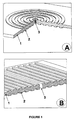
- the SEW concentrator is microfabricated in a gold layer ( Figures 1A & B ).
- the radiation applied in this embodiment is preferred to be in the visible or infrared range in order to excite plasmons on thin gold layers.
- the gold nanostructure is designed so that the surface plasmon wave travelling across it is concentrated locally in a defined sub-micron region or regions.
- a suitable surface plasmon concentrator takes the form of a subwavelength hole surrounded by a set of circular grooves, with dielectric layers above and below (see Figure 1A ).
- the concentrator structure can take the form of a subwavelength slit surrounded by a set of linear grooves ( Figure 1B ). This system allows measurements of dielectric constant to be carried out efficiently.
- An array of electrodes or concentrator structures on a chip surface may be created, such that a number of conformational monitoring experiments may be carried out in parallel.
- This array structure may be integrated with a series of micro-channel flow channels, arranged so that microfluidics may be employed to deliver different reactants to different concentrators/electrodes on the same chip surface.
- the first and second methods of applying localised radiation may be combined in a single system.
- This has the advantage of increasing the signal-to-noise ratio, a critical factor in single molecule detection systems.
- This signal enhancement occurs because an electrical field within the vicinity of a surface plasmon will cause attenuation of the field and/or the creation of scattering centres at points in space relative to the electrical field intensity. This leads to two useful characteristics. Firstly, the intensity of emitted light (and hence signal intensity) from the plasmon field is largely increased from a point relative to the electrode geometry.
- the emitted light signal from the field of interest (the molecular species) will be modulated with a frequency approximately equal to that of the applied electrical field.
- the applied A/C frequency may be between 1Hz and 100 GHz. This frequency modulation allows signal extraction and increases the signal to noise ratio.
- the application of the electrical field also allows for "tuning" of the applied field in such a way that resonant frequencies at which the molecular species responds can be more easily modulated.
- electrodes are "buried” in the plasmon field conducting layer.
- the buried electrodes do not interfere with the fluid flow over the surface layer, which is preferably gold, and prevent the presence of the electrodes from preventing or "collapsing" the surface plasmon field travelling along the surface of the gold film.
- An embedded array of electrodes under a gold plasmon supporting surface layer will allow the addressing or "selection" of specific regions on the chip surface where single molecules are immobilised. This can be ascertained by selectively activating different embedded electrodes such that different scattering centres are illuminated on the chip surface.
- conformational changes can be induced in the molecule which may then be observed via attenuation of the scattered/plasmon signal, if such signal originates substantially within the region of the molecular species. This can then be used as confirmation of the location of a single molecule at or near the embedded electrode location.
- the embedded electrode may then be used to further acquire further conformational data about the molecular species via continuous monitoring.
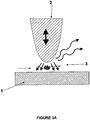
- a third method of creating localised electromagnetic field enhancement is achieved on a surface plasmon surface using a metalised Scanning Probe Microscope/Atomic Force Microscopy (SPM/AFM) tip. Dielectric changes are detected by monitoring changes in the scattered light intensity maximum relating to a particular tip-surface (sphere-plane) structure.
- This embodiment is an adaptation of a scanning plasmon near-field microscope operating in the tapping mode of an atomic force microscope. In this set-up, the electromagnetic resonance is of greater intensity when the tip and surface are noble metals, which are therefore preferred.
- the dimension of the light field localisation is of the order of L - (2dR) 1 ⁇ 2 , where d is the tip-surface distance and R is the tip radius.
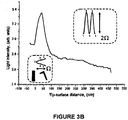
- a molecule can be immobilised on a surface, with the tip positioned over it, operating in stationary mode (still tapping) ( Figure 3 ). Conformational changes of the enzyme will result in localised dielectric changes within at least a part of the localised electromagnetic field (the surface plasmon), resulting in a scattered and/or reflected light signal. Therefore, by monitoring the light emitted at the second harmonic of the tapping frequency, a maximum will be observed. The position of this maximum (tip-surface distance plotted against light intensity) will reflect the dielectric constant between the tip and surface (sphere-plane) and movements of the maximum will reflect conformational changes in the localised molecular species.
- resonant distance information for the molecular species can be used to construct concentrators of the correct dimensions to create concentrator and/or electrode/plasmon structures, at or near the molecular species resonance condition.
- AFM/SPM cantilevers to enhance a surface plasmon is that a large number of molecular species (i.e. biological molecules) require a fluid environment to function correctly.
- the cantilevers employed must therefore be operated in fluid, limiting the resonant frequency of the cantilever to around 15-30 KHz, due to damping conditions.
- the second harmonic of such a set-up results in a relatively low sampling frequency with respect to relevant biological events which occur on the milli to microsecond time frame (multiple samples must also be considered in order to increase signal to noise ratio).
- Other negative effects when employing conventional AFM/SPM set-ups in such a configuration include unwanted force/noise effects on the tip due to the fact that many biological molecules function betterwhen placed ina flow stream. A flow stream creates forces on the cantilever which in turn produces noise in the system.
- a further problem is that conventional AFM/SPM systems utilise piezo-electric scanners/actuators, which results in a small lateral drift between the tip and sample/molecule surface.
- micro cantilevers with two attachment points can have resonant frequencies in the range of tens of megahertz.
- a preferred embodiment is the use of gold (or other plasmon supporting material) coated micro/nano-cantilevers for the achievement of conformational monitoring via the phenomenon of sphere-plane electromagnetic resonance.
- the cantilevers will possess a gold protrusion of less than 30 nm which will act as a sphere from which the electromagnetic field will emanate.
- the device is driven at its resonant frequency and illuminated from below or the side by a light source capable of producing surface plasmons on the metallic surfaces of the cantilever-plane system.
- the particle is a nanoparticle. More preferably, the nanoparticle is attached to the molecular species.
- the nanoparticle can be attached to the molecular species in a number of ways known in the art. A preferred method of attachment is to cover the surface of the nanoparticle with a Self Assembled Monolayer (SAM), as known in the art, and then to covalently link the particle to the molecular species.
- SAM Self Assembled Monolayer
- a number of techniques are well known in the art in order to provide covalent linkages. For example, the covalent linkage can be formed between the SAM side group and a cysteine residue within the (protein) molecular species of interest.
- the tip of the cantilever may take the form of an actual sphere.
- This sphere oscillates above the surface of the plane plasmon-supporting surface with the molecular species immobilised thereon in an analogous fashion to the resonant oscillation of an AFM/SPM cantilever.
- This oscillation can be created by the application of a "laser trap" as is well known in the art. This trap can be made to move the cantilever up and down above the molecule on the plasmon supporting surface.
- the cantilever can be made of a magnetic sphere covered with a layer of gold or similar plasmon supporting material.
- the metal nanoparticle By control of an external magnetic field, the metal nanoparticle can again be made to execute a motion analogous to the movement of a cantilever tip moving into and out of the sphere-plane resonance distance.
- the position of maximum intensity of the output light can be again registered from reflection and/or scattering mode as before.
- micro/nano-cantilever outlined herein may alternatively be embedded with a magnetic particle/substance such that the application of an oscillating external magnetic field will result in the creation of an oscillation micro/nano cantilever.
- the oscillating sphere-plane resonance may then be used to monitor conformational changes within a single molecular species as already outlined.
- Quartz chips (14mm in diameter, 0.3mm thick) were spin-coated with a 50nm thick layer of gold and then coated with a layer of planar dextran. These gold coated chips were then placed into the fluid cell of a custom built Apertureless Nearfield Scanning Optical Microscope (aNSOM). The fluid cell was then sealed and polymerase buffer was then allowed to flow over the chip.
- aNSOM Apertureless Nearfield Scanning Optical Microscope
- the polymerase (R869) (150 plat 400nm) was mixed with 10mM sodium acetate (100 ⁇ l, pH 5) and injected across the activated surface. Finally, residual N-hydroxysuccinimide esters on the chip surface were reacted with ethanolamine (35 ⁇ l, 1M in water, pH 8.5), and non-bound polymerase was washed from the surface. The immobilization procedure was performed with a continuous flow of running buffer (5 ⁇ l/min) at a temperature of 25 degrees Celsius.
- a gold coated AFM cantilever was used in tapping mode. A beam of a CW He-Ne laser was focused on the gold cantilever. Light scattered from the gold cantilever tip was then coupled into a double monochronometer and then into a detection Photamultiplier Tube (PMT) connected to a computer.
- PMT detection Photamultiplier Tube
- an initial scan was carried out over the chip surface with the aSNOM tip without nucleotides in the running buffer. Once a single immobilized polymerase was detected, the intensity peak of the scattered light radiation (scattered intensity v distance from surface) was measured while the aNSOM was operated in stationary mode.
- the two oligonucleotides were reacted under hybridizing conditions to form the target-primer complex.
- the primed DNA was then suspended in buffer (20 mM Tris-HCL, pH 7.5, 8mM MgCl2, 4% (v/v) glycerol, 5 mM dithiothreitol (DDT).
- the pre-primed complex was then injected into the flow cell at a flow rate of 500 ⁇ l with 0.4mM of all four nucleotides (dATP, dTTP, dGTP, dCTP).
- the change in resonant intensity was recorded.
- the change in peak position was recorded, indicating a change in refractive index due to polymerase activity. This shows incorporation of the nucleotide.
- a method for detecting a change in the conformational or energetic state of a molecular species during or after a reaction comprising the steps of:
- the molecular species is a polynucleotide processive enzyme.
- the plasmon wave concentrator comprises a sub-wavelength aperture surrounded by at least one linear groove, with dielectric layers above and below.
- An array of concentrator structures as defined in embodiment 16 or embodiment 17.
Landscapes
- Health & Medical Sciences (AREA)
- Immunology (AREA)
- Life Sciences & Earth Sciences (AREA)
- Engineering & Computer Science (AREA)
- Molecular Biology (AREA)
- Biomedical Technology (AREA)
- Chemical & Material Sciences (AREA)
- Hematology (AREA)
- Urology & Nephrology (AREA)
- Food Science & Technology (AREA)
- Biochemistry (AREA)
- Cell Biology (AREA)
- Biotechnology (AREA)
- Medicinal Chemistry (AREA)
- Physics & Mathematics (AREA)
- Analytical Chemistry (AREA)
- Microbiology (AREA)
- General Health & Medical Sciences (AREA)
- General Physics & Mathematics (AREA)
- Pathology (AREA)
- Measuring Or Testing Involving Enzymes Or Micro-Organisms (AREA)
- Investigating Or Analysing Materials By Optical Means (AREA)
- Investigating, Analyzing Materials By Fluorescence Or Luminescence (AREA)
- Investigating Or Analysing Biological Materials (AREA)
- Investigating Or Analyzing Materials By The Use Of Electric Means (AREA)
Claims (14)
- Verfahren zur Sequenzierung eines Ziel-Polynukleotids durch Erfassung einer Veränderung im konformativen oder energetischen Zustand eines Polymeraseenzyms während einer Polymerisationsreaktion, umfassend folgende Schritte:(i) Immobilisieren des Polymeraseenzyms auf einem festen Träger zwischen einer ersten und einer zweiten Elektrode;(ii) unter Bedingungen, die für das Stattfinden der Polymerisation des Ziel-Polynukleotids durch das Polymeraseenzym geeignet sind, Inkontaktbringen mindestens eines Teils des Enzyms mit einem örtlich begrenzten elektrischen Signal;(iii) Erfassen einer Veränderung in der Dielektrizitätskonstante während der Polymerisation des Ziel-Polynukleotids, um dadurch eine Veränderung im konformativen oder energetischen Zustand des Polymeraseenzyms zu erfassen, wobei das örtlich begrenzte elektrische Signal durch Anlegen eines elektrischen Wechselstromsignals an die erste Elektrode erzeugt wird, wobei der Raum zwischen der ersten und der zweiten Elektrode zwischen 1 nm und 1 µm beträgt, und wobei die Veränderung in der Dielektrizitätskonstante durch Messen der Impedanz der Elektroden oder der Veränderung in der Gesamtkapazität zwischen den Elektroden erfasst wird; und(iv) Ermitteln der Sequenz des Ziel-Polynukleotids.
- Verfahren nach Anspruch 1, wobei der Einbau jedes der Nukleotide A, T (U), G und C eine charakteristische Veränderung im energetischen Zustand/der Konformation der Polymerase verursacht.
- Verfahren nach gleich welchem vorhergehenden Anspruch, wobei die Kapazität unter Anwendung einer Wechselstrombrücke gemessen wird.
- Verfahren nach gleich welchem vorhergehenden Anspruch, wobei der Raum zwischen der ersten und der zweiten Elektrode zwischen 1 nm und 500 nm beträgt.
- Verfahren nach gleich welchem vorhergehenden Anspruch, wobei das elektrische Wechselstromsignal eine Wechselspannung von vorgegebener Frequenz ist.
- Verfahren nach Anspruch 5, wobei die Frequenz zwischen 1 Hz und 100 GHz beträgt.
- Verfahren nach gleich welchem vorhergehenden Anspruch, weiter die Anwendung einer elektromagnetischen Oberflächenwellen(SEW)-Konzentratorstruktur umfassend, die vorhanden ist, um das örtlich begrenzte elektromagnetische Feld zu verstärken, wobei die SEW-Konzentratorstruktur umfasst:(1) eine mikrogefertigte Metallschicht, die geeignet ist, Oberflächenplasmonen zu tragen, und ein Subwellenlängenloch aufweist, das von einem Satz kreisförmiger Rillen mit dielektrischen Schichten darüber und darunter umgeben ist; oder(2) eine mikrogefertigte Metallschicht, die geeignet ist, Oberflächenplasmonen zu tragen, und einen Subwellenlängenschlitz aufweist, der von einem Satz geradliniger Rillen mit dielektrischen Schichten darüber und darunter umgeben ist, undwobei die SEW-Konzentratorstruktur den festen Träger umfasst oder auf dem festen Träger in unmittelbarer Nähe zu dem Enzym angeordnet ist, sodass mindestens ein Teil des Enzyms sich innerhalb des Bereichs örtlich begrenzter elektromagnetischer Feldverstärkung befindet.
- Verfahren nach Anspruch 7, wobei die mindestens eine geradlinige Rille sich sowohl an der Ober- als auch der Rückseite der Metallschicht befindet.
- Verfahren nach Anspruch 7 oder Anspruch 8, wobei eine Veränderung im konformativen oder Energie-Zustand des Enzyms erfasst wird, indem ein sichtbarer oder infraroter Laser-Einfall auf die Metallschicht(en) erzeugt und eine Veränderung in der Intensität des aus der Subwellenlängenöffnung ausgestrahlten Lichts gemessen wird.
- Verfahren nach Anspruch 7 oder Anspruch 8, wobei eine Veränderung im konformativen oder Energie-Zustand des Enzyms erfasst wird, indem ein sichtbarer oder infraroter Laser-Einfall auf die Metallschicht(en) erzeugt und die Phasenverschiebung von aus der Subwellenlängenöffnung ausgestrahltem Licht bei seiner Passage durch eine Konzentratorstruktur gemessen wird.
- Verfahren nach Anspruch 7 oder Anspruch 8, wobei eine Veränderung im konformativen oder Energie-Zustand des Enzyms erfasst wird, indem ein elektromagnetischer Breitband-Strahleneinfall auf die Metallschicht(en) erzeugt und eine Veränderung in der Wellenlänge von aus der Subwellenlängenöffnung ausgestrahltem Licht gemessen wird.
- Verfahren nach Anspruch 1, wobei das Ziel-Polynukleotid ein einzelnes Nukleinsäuren-Matrizenmolekül ist.
- Verfahren nach Anspruch 1, wobei das Verfahren in Echtzeit ausgeführt wird, um die Reihenfolge der Basen auf dem Ziel-Polynukleotid zu identifizieren.
- Verfahren nach Anspruch 1, wobei die Polymerase eine DNA-abhängige DNA-Polymerase oder eine RNA-abhängige DNA-Polymerase oder eine RNA-abhängige RNA-Polymerase ist.
Priority Applications (1)
| Application Number | Priority Date | Filing Date | Title |
|---|---|---|---|
| EP18157349.4A EP3388531B1 (de) | 2004-06-11 | 2005-06-13 | Verfahren zur bestimmung von biophysischen eigenschaften |
Applications Claiming Priority (2)
| Application Number | Priority Date | Filing Date | Title |
|---|---|---|---|
| GBGB0413082.9A GB0413082D0 (en) | 2004-06-11 | 2004-06-11 | Method |
| EP05752343A EP1759014A2 (de) | 2004-06-11 | 2005-06-13 | Verfahren zur bestimmung von biophysikalischen eigenschaften |
Related Parent Applications (2)
| Application Number | Title | Priority Date | Filing Date |
|---|---|---|---|
| EP05752343A Division EP1759014A2 (de) | 2004-06-11 | 2005-06-13 | Verfahren zur bestimmung von biophysikalischen eigenschaften |
| EP05752343.3 Division | 2005-06-13 |
Related Child Applications (1)
| Application Number | Title | Priority Date | Filing Date |
|---|---|---|---|
| EP18157349.4A Division EP3388531B1 (de) | 2004-06-11 | 2005-06-13 | Verfahren zur bestimmung von biophysischen eigenschaften |
Publications (3)
| Publication Number | Publication Date |
|---|---|
| EP2290097A2 EP2290097A2 (de) | 2011-03-02 |
| EP2290097A3 EP2290097A3 (de) | 2012-01-25 |
| EP2290097B1 true EP2290097B1 (de) | 2018-02-21 |
Family
ID=32732348
Family Applications (4)
| Application Number | Title | Priority Date | Filing Date |
|---|---|---|---|
| EP18157349.4A Expired - Lifetime EP3388531B1 (de) | 2004-06-11 | 2005-06-13 | Verfahren zur bestimmung von biophysischen eigenschaften |
| EP05752343A Ceased EP1759014A2 (de) | 2004-06-11 | 2005-06-13 | Verfahren zur bestimmung von biophysikalischen eigenschaften |
| EP10181181.8A Expired - Lifetime EP2290097B1 (de) | 2004-06-11 | 2005-06-13 | Verfahren zur Bestimmung von biophysischen Eigenschaften |
| EP12180804.2A Expired - Lifetime EP2581452B1 (de) | 2004-06-11 | 2005-06-13 | Verfahren zur Bestimmung von biophysischen Eigenschaften |
Family Applications Before (2)
| Application Number | Title | Priority Date | Filing Date |
|---|---|---|---|
| EP18157349.4A Expired - Lifetime EP3388531B1 (de) | 2004-06-11 | 2005-06-13 | Verfahren zur bestimmung von biophysischen eigenschaften |
| EP05752343A Ceased EP1759014A2 (de) | 2004-06-11 | 2005-06-13 | Verfahren zur bestimmung von biophysikalischen eigenschaften |
Family Applications After (1)
| Application Number | Title | Priority Date | Filing Date |
|---|---|---|---|
| EP12180804.2A Expired - Lifetime EP2581452B1 (de) | 2004-06-11 | 2005-06-13 | Verfahren zur Bestimmung von biophysischen Eigenschaften |
Country Status (8)
| Country | Link |
|---|---|
| US (1) | US7608397B2 (de) |
| EP (4) | EP3388531B1 (de) |
| CN (1) | CN101001961A (de) |
| AU (1) | AU2005252441A1 (de) |
| CA (1) | CA2573551C (de) |
| GB (1) | GB0413082D0 (de) |
| RU (1) | RU2007101244A (de) |
| WO (1) | WO2005121363A2 (de) |
Families Citing this family (33)
| Publication number | Priority date | Publication date | Assignee | Title |
|---|---|---|---|---|
| JP2001511358A (ja) * | 1997-07-28 | 2001-08-14 | メディカル・バイオシステムズ・リミテッド | 核酸配列の解析 |
| GB9923644D0 (en) | 1999-10-06 | 1999-12-08 | Medical Biosystems Ltd | DNA sequencing |
| GB0112238D0 (en) * | 2001-05-18 | 2001-07-11 | Medical Biosystems Ltd | Sequencing method |
| JP2004347621A (ja) * | 2003-04-24 | 2004-12-09 | Dainippon Printing Co Ltd | 透過型スクリーン |
| GB0317343D0 (en) * | 2003-07-24 | 2003-08-27 | Medical Biosystems Ltd | Polynucleotide sequencing |
| EP2160589A4 (de) * | 2007-03-05 | 2013-07-17 | Univ Virginia Patent Found | Verfahren zur lokalen verstärkung des elektromagnetischen felds von terahertz-(thz-)strahlung in wellenlängen-teilbereichen und verbesserte strahlungskopplung an materialien über die verwendung des diskontinuitäts-kanteneffekts |
| DE102008014335B4 (de) * | 2008-03-14 | 2009-12-17 | Fraunhofer-Gesellschaft zur Förderung der angewandten Forschung e.V. | Vorrichtung und Verfahren zur Bestimmung einer Brechzahl eines Messobjekts |
| US9297955B2 (en) | 2009-10-02 | 2016-03-29 | Lehigh University | Plasmonic interferometer sensor |
| US9184099B2 (en) | 2010-10-04 | 2015-11-10 | The Board Of Trustees Of The Leland Stanford Junior University | Biosensor devices, systems and methods therefor |
| US9399217B2 (en) | 2010-10-04 | 2016-07-26 | Genapsys, Inc. | Chamber free nanoreactor system |
| NZ610129A (en) | 2010-10-04 | 2014-08-29 | Genapsys Inc | Systems and methods for automated reusable parallel biological reactions |
| US9926596B2 (en) | 2011-05-27 | 2018-03-27 | Genapsys, Inc. | Systems and methods for genetic and biological analysis |
| US8585973B2 (en) | 2011-05-27 | 2013-11-19 | The Board Of Trustees Of The Leland Stanford Junior University | Nano-sensor array |
| CN106591103B (zh) | 2011-12-01 | 2021-06-04 | 吉纳普赛斯股份有限公司 | 用于高效电子测序与检测的系统和方法 |
| CN110579435B (zh) | 2012-10-15 | 2023-09-26 | 纳诺赛莱克特生物医药股份有限公司 | 颗粒分选的系统、设备和方法 |
| EP2971141B1 (de) | 2013-03-15 | 2018-11-28 | Genapsys, Inc. | Systeme für biologische analysen |
| WO2015089238A1 (en) | 2013-12-11 | 2015-06-18 | Genapsys, Inc. | Systems and methods for biological analysis and computation |
| EP3556864B1 (de) | 2014-04-18 | 2020-12-09 | Genapsys, Inc. | Verfahren und systeme zur nukleinsäureamplifikation |
| US10077470B2 (en) | 2015-07-21 | 2018-09-18 | Omniome, Inc. | Nucleic acid sequencing methods and systems |
| EP3449012B1 (de) | 2016-04-29 | 2020-12-23 | Omniome, Inc. | Sequenzierungsverfahren mit destabilisierung eines ternären komplexes zur identifizierung von verwandten nukleotiden |
| US10544456B2 (en) | 2016-07-20 | 2020-01-28 | Genapsys, Inc. | Systems and methods for nucleic acid sequencing |
| EP3497236B1 (de) | 2016-08-15 | 2021-11-03 | Omniome, Inc. | Verfahren zur sequenzierung von nukleinsäuren |
| US10428378B2 (en) | 2016-08-15 | 2019-10-01 | Omniome, Inc. | Sequencing method for rapid identification and processing of cognate nucleotide pairs |
| EP3562962B1 (de) | 2016-12-30 | 2022-01-05 | Omniome, Inc. | Verfahren und system unter verwendung von unterscheidbaren polymerasen zum nachweis von ternären komplexen und zur identifizierung von verwandten nukleotiden |
| WO2018136487A1 (en) | 2017-01-20 | 2018-07-26 | Omniome, Inc. | Process for cognate nucleotide detection in a nucleic acid sequencing workflow |
| US9951385B1 (en) | 2017-04-25 | 2018-04-24 | Omniome, Inc. | Methods and apparatus that increase sequencing-by-binding efficiency |
| US10161003B2 (en) | 2017-04-25 | 2018-12-25 | Omniome, Inc. | Methods and apparatus that increase sequencing-by-binding efficiency |
| US10538808B2 (en) | 2017-05-26 | 2020-01-21 | Vibrant Holdings, Llc | Photoactive compounds and methods for biomolecule detection and sequencing |
| CA3076378A1 (en) | 2017-09-21 | 2019-03-28 | Genapsys, Inc. | Systems and methods for nucleic acid sequencing |
| EP3697932A1 (de) | 2017-10-19 | 2020-08-26 | Omniome, Inc. | Gleichzeitige hintergrundreduktion und komplexstabilisierung in bindungsassayarbeitsflüssen |
| GB201721611D0 (en) * | 2017-12-21 | 2018-02-07 | Univ College Dublin Nat Univ Ireland Dublin | Addressable plasmonic arrays |
| AU2019266303B2 (en) | 2018-05-09 | 2025-12-18 | Vibrant Holdings, Llc | Methods of synthesizing a polynucleotide array using photactivated agents |
| EP3757549A1 (de) | 2019-06-26 | 2020-12-30 | University College Dublin, National University of Ireland, Dublin | Adressierbare plasmonische arrays |
Family Cites Families (9)
| Publication number | Priority date | Publication date | Assignee | Title |
|---|---|---|---|---|
| SE462454B (sv) | 1988-11-10 | 1990-06-25 | Pharmacia Ab | Maetyta foer anvaendning i biosensorer |
| JP2001511358A (ja) * | 1997-07-28 | 2001-08-14 | メディカル・バイオシステムズ・リミテッド | 核酸配列の解析 |
| US6236033B1 (en) * | 1998-12-09 | 2001-05-22 | Nec Research Institute, Inc. | Enhanced optical transmission apparatus utilizing metal films having apertures and periodic surface topography |
| GB9907812D0 (en) | 1999-04-06 | 1999-06-02 | Medical Biosystems Ltd | Sequencing |
| WO2001018246A1 (en) | 1999-08-26 | 2001-03-15 | The Trustees Of Princeton University | Microfluidic and nanofluidic electronic devices for detecting changes in capacitance of fluids and methods of using |
| GB0112238D0 (en) * | 2001-05-18 | 2001-07-11 | Medical Biosystems Ltd | Sequencing method |
| CA2396859A1 (en) * | 2001-08-06 | 2003-02-06 | Coho Holdings, Llc | Optical device for filtering and sensing |
| WO2003019245A2 (en) * | 2001-08-31 | 2003-03-06 | Universite Louis Pasteur | Optical transmission apparatus with directionality and divergence control |
| CA2532220A1 (en) | 2003-07-15 | 2005-01-27 | Daniel Henry Densham | Measurement of a polynucleotide amplification reaction |
-
2004
- 2004-06-11 GB GBGB0413082.9A patent/GB0413082D0/en not_active Ceased
-
2005
- 2005-06-13 WO PCT/GB2005/002331 patent/WO2005121363A2/en not_active Ceased
- 2005-06-13 CA CA2573551A patent/CA2573551C/en not_active Expired - Lifetime
- 2005-06-13 EP EP18157349.4A patent/EP3388531B1/de not_active Expired - Lifetime
- 2005-06-13 RU RU2007101244/13A patent/RU2007101244A/ru unknown
- 2005-06-13 EP EP05752343A patent/EP1759014A2/de not_active Ceased
- 2005-06-13 US US11/629,245 patent/US7608397B2/en not_active Expired - Lifetime
- 2005-06-13 EP EP10181181.8A patent/EP2290097B1/de not_active Expired - Lifetime
- 2005-06-13 CN CNA2005800262681A patent/CN101001961A/zh active Pending
- 2005-06-13 AU AU2005252441A patent/AU2005252441A1/en not_active Abandoned
- 2005-06-13 EP EP12180804.2A patent/EP2581452B1/de not_active Expired - Lifetime
Non-Patent Citations (1)
| Title |
|---|
| HENK W. CH. POSTMA: "Rapid Sequencing of Individual DNA Molecules in Graphene Nanogaps", NANO LETTERS, vol. 10, no. 2, 10 February 2010 (2010-02-10), pages 420 - 425, XP055043958, ISSN: 1530-6984, DOI: 10.1021/nl9029237 * |
Also Published As
| Publication number | Publication date |
|---|---|
| US7608397B2 (en) | 2009-10-27 |
| EP2581452A1 (de) | 2013-04-17 |
| EP3388531B1 (de) | 2021-10-27 |
| RU2007101244A (ru) | 2013-10-27 |
| EP2290097A2 (de) | 2011-03-02 |
| EP3388531A1 (de) | 2018-10-17 |
| CA2573551C (en) | 2018-09-18 |
| CA2573551A1 (en) | 2005-12-22 |
| US20080064035A1 (en) | 2008-03-13 |
| AU2005252441A1 (en) | 2005-12-22 |
| EP2290097A3 (de) | 2012-01-25 |
| GB0413082D0 (en) | 2004-07-14 |
| EP1759014A2 (de) | 2007-03-07 |
| WO2005121363A3 (en) | 2006-04-27 |
| EP2581452B1 (de) | 2015-04-01 |
| WO2005121363A2 (en) | 2005-12-22 |
| CN101001961A (zh) | 2007-07-18 |
Similar Documents
| Publication | Publication Date | Title |
|---|---|---|
| EP2290097B1 (de) | Verfahren zur Bestimmung von biophysischen Eigenschaften | |
| US20250115899A1 (en) | Bistable polynucleotide devices for the sensing and quantification of molecular events | |
| US20220373543A1 (en) | Surface-immobilized bistable polynucleotide devices for the sensing and quantification of molecular events | |
| EP2430428B1 (de) | System und verfahren zur einzelmolekülerkennung | |
| Yue et al. | Label-free protein recognition two-dimensional array using nanomechanical sensors | |
| KR100442822B1 (ko) | 전단응력 측정을 이용한 생분자들간의 결합 여부 검출 방법 | |
| EP2217928B1 (de) | Alternative markierungsverfahren für einzelmolekülsequenzierung | |
| Laval et al. | Nanobiotechnology and its role in the development of new analytical devicesPresented at SAC 99, Dublin, Ireland, July 25–30, 1999. | |
| JP2009503548A (ja) | 金属ナノキャビティを含むバイオセンサー | |
| CN113677805B (zh) | 用于感测和定量分子事件的表面固定双稳态多核苷酸装置 | |
| KR20140043806A (ko) | 나노구조를 가지는 표면 플라스몬 공명(spr) 센서 장치 | |
| Krizkova et al. | Nanotechnologies in protein microarrays | |
| Alvarez et al. | Cantilever biosensors | |
| HK1110355A (en) | Method for determining biophysical properties | |
| Tan | Optical measurements on the nanometer scale | |
| Languirand et al. | 9 Nanoscale Optical | |
| US20060100787A1 (en) | Synthesis of nanocodes, and imaging using scanning probe microscopy | |
| Hegner et al. | Biological single molecule applications and advanced biosensing | |
| Languirand et al. | Nanoscale Optical Biosensors and Biochips for Cellular Diagnostics | |
| Cichos et al. | The ever-expanding optics of single-molecules and nanoparticles | |
| Vo-Dinh | Nanosensors for Single-Cell Analysis | |
| HUSALE et al. | Biological Single Molecule Applications | |
| Wu et al. | Fiber-optic Nano-biosensors and Near-Field Scanning Optical Microscopy for Biological Imaging | |
| Cullum | Nanoscale Optical Biosensors and Biochips for Cellular Diagnostics | |
| Rijal | Use of piezoelectric-excited millimeter-sized cantilever (PEMC) sensors for DNA-based detection of pathogens and disease conditions |
Legal Events
| Date | Code | Title | Description |
|---|---|---|---|
| PUAI | Public reference made under article 153(3) epc to a published international application that has entered the european phase |
Free format text: ORIGINAL CODE: 0009012 |
|
| AC | Divisional application: reference to earlier application |
Ref document number: 1759014 Country of ref document: EP Kind code of ref document: P |
|
| AK | Designated contracting states |
Kind code of ref document: A2 Designated state(s): AT BE BG CH CY CZ DE DK EE ES FI FR GB GR HU IE IS IT LI LT LU MC NL PL PT RO SE SI SK TR |
|
| RIC1 | Information provided on ipc code assigned before grant |
Ipc: B82Y 15/00 20110101ALI20110830BHEP Ipc: G01N 21/55 20060101ALI20110830BHEP Ipc: G01N 33/543 20060101ALI20110830BHEP Ipc: C12Q 1/68 20060101AFI20110830BHEP |
|
| PUAL | Search report despatched |
Free format text: ORIGINAL CODE: 0009013 |
|
| AK | Designated contracting states |
Kind code of ref document: A3 Designated state(s): AT BE BG CH CY CZ DE DK EE ES FI FR GB GR HU IE IS IT LI LT LU MC NL PL PT RO SE SI SK TR |
|
| RIC1 | Information provided on ipc code assigned before grant |
Ipc: B82Y 15/00 20110101ALI20111220BHEP Ipc: G01N 21/55 20060101ALI20111220BHEP Ipc: G01N 33/543 20060101ALI20111220BHEP Ipc: C12Q 1/68 20060101AFI20111220BHEP |
|
| 17P | Request for examination filed |
Effective date: 20120725 |
|
| 17Q | First examination report despatched |
Effective date: 20130829 |
|
| STAA | Information on the status of an ep patent application or granted ep patent |
Free format text: STATUS: EXAMINATION IS IN PROGRESS |
|
| GRAP | Despatch of communication of intention to grant a patent |
Free format text: ORIGINAL CODE: EPIDOSNIGR1 |
|
| STAA | Information on the status of an ep patent application or granted ep patent |
Free format text: STATUS: GRANT OF PATENT IS INTENDED |
|
| INTG | Intention to grant announced |
Effective date: 20170830 |
|
| GRAS | Grant fee paid |
Free format text: ORIGINAL CODE: EPIDOSNIGR3 |
|
| GRAA | (expected) grant |
Free format text: ORIGINAL CODE: 0009210 |
|
| STAA | Information on the status of an ep patent application or granted ep patent |
Free format text: STATUS: THE PATENT HAS BEEN GRANTED |
|
| AC | Divisional application: reference to earlier application |
Ref document number: 1759014 Country of ref document: EP Kind code of ref document: P |
|
| AK | Designated contracting states |
Kind code of ref document: B1 Designated state(s): AT BE BG CH CY CZ DE DK EE ES FI FR GB GR HU IE IS IT LI LT LU MC NL PL PT RO SE SI SK TR |
|
| REG | Reference to a national code |
Ref country code: GB Ref legal event code: FG4D |
|
| REG | Reference to a national code |
Ref country code: CH Ref legal event code: EP |
|
| REG | Reference to a national code |
Ref country code: AT Ref legal event code: REF Ref document number: 971782 Country of ref document: AT Kind code of ref document: T Effective date: 20180315 |
|
| REG | Reference to a national code |
Ref country code: IE Ref legal event code: FG4D |
|
| REG | Reference to a national code |
Ref country code: DE Ref legal event code: R096 Ref document number: 602005053548 Country of ref document: DE |
|
| REG | Reference to a national code |
Ref country code: NL Ref legal event code: FP |
|
| REG | Reference to a national code |
Ref country code: LT Ref legal event code: MG4D |
|
| REG | Reference to a national code |
Ref country code: AT Ref legal event code: MK05 Ref document number: 971782 Country of ref document: AT Kind code of ref document: T Effective date: 20180221 |
|
| PG25 | Lapsed in a contracting state [announced via postgrant information from national office to epo] |
Ref country code: CY Free format text: LAPSE BECAUSE OF FAILURE TO SUBMIT A TRANSLATION OF THE DESCRIPTION OR TO PAY THE FEE WITHIN THE PRESCRIBED TIME-LIMIT Effective date: 20180221 Ref country code: LT Free format text: LAPSE BECAUSE OF FAILURE TO SUBMIT A TRANSLATION OF THE DESCRIPTION OR TO PAY THE FEE WITHIN THE PRESCRIBED TIME-LIMIT Effective date: 20180221 Ref country code: ES Free format text: LAPSE BECAUSE OF FAILURE TO SUBMIT A TRANSLATION OF THE DESCRIPTION OR TO PAY THE FEE WITHIN THE PRESCRIBED TIME-LIMIT Effective date: 20180221 Ref country code: FI Free format text: LAPSE BECAUSE OF FAILURE TO SUBMIT A TRANSLATION OF THE DESCRIPTION OR TO PAY THE FEE WITHIN THE PRESCRIBED TIME-LIMIT Effective date: 20180221 |
|
| PG25 | Lapsed in a contracting state [announced via postgrant information from national office to epo] |
Ref country code: GR Free format text: LAPSE BECAUSE OF FAILURE TO SUBMIT A TRANSLATION OF THE DESCRIPTION OR TO PAY THE FEE WITHIN THE PRESCRIBED TIME-LIMIT Effective date: 20180522 Ref country code: BG Free format text: LAPSE BECAUSE OF FAILURE TO SUBMIT A TRANSLATION OF THE DESCRIPTION OR TO PAY THE FEE WITHIN THE PRESCRIBED TIME-LIMIT Effective date: 20180521 Ref country code: SE Free format text: LAPSE BECAUSE OF FAILURE TO SUBMIT A TRANSLATION OF THE DESCRIPTION OR TO PAY THE FEE WITHIN THE PRESCRIBED TIME-LIMIT Effective date: 20180221 Ref country code: AT Free format text: LAPSE BECAUSE OF FAILURE TO SUBMIT A TRANSLATION OF THE DESCRIPTION OR TO PAY THE FEE WITHIN THE PRESCRIBED TIME-LIMIT Effective date: 20180221 |
|
| PG25 | Lapsed in a contracting state [announced via postgrant information from national office to epo] |
Ref country code: PL Free format text: LAPSE BECAUSE OF FAILURE TO SUBMIT A TRANSLATION OF THE DESCRIPTION OR TO PAY THE FEE WITHIN THE PRESCRIBED TIME-LIMIT Effective date: 20180221 Ref country code: EE Free format text: LAPSE BECAUSE OF FAILURE TO SUBMIT A TRANSLATION OF THE DESCRIPTION OR TO PAY THE FEE WITHIN THE PRESCRIBED TIME-LIMIT Effective date: 20180221 Ref country code: IT Free format text: LAPSE BECAUSE OF FAILURE TO SUBMIT A TRANSLATION OF THE DESCRIPTION OR TO PAY THE FEE WITHIN THE PRESCRIBED TIME-LIMIT Effective date: 20180221 Ref country code: RO Free format text: LAPSE BECAUSE OF FAILURE TO SUBMIT A TRANSLATION OF THE DESCRIPTION OR TO PAY THE FEE WITHIN THE PRESCRIBED TIME-LIMIT Effective date: 20180221 |
|
| REG | Reference to a national code |
Ref country code: DE Ref legal event code: R097 Ref document number: 602005053548 Country of ref document: DE |
|
| PG25 | Lapsed in a contracting state [announced via postgrant information from national office to epo] |
Ref country code: DK Free format text: LAPSE BECAUSE OF FAILURE TO SUBMIT A TRANSLATION OF THE DESCRIPTION OR TO PAY THE FEE WITHIN THE PRESCRIBED TIME-LIMIT Effective date: 20180221 Ref country code: CZ Free format text: LAPSE BECAUSE OF FAILURE TO SUBMIT A TRANSLATION OF THE DESCRIPTION OR TO PAY THE FEE WITHIN THE PRESCRIBED TIME-LIMIT Effective date: 20180221 Ref country code: SK Free format text: LAPSE BECAUSE OF FAILURE TO SUBMIT A TRANSLATION OF THE DESCRIPTION OR TO PAY THE FEE WITHIN THE PRESCRIBED TIME-LIMIT Effective date: 20180221 |
|
| PLBE | No opposition filed within time limit |
Free format text: ORIGINAL CODE: 0009261 |
|
| STAA | Information on the status of an ep patent application or granted ep patent |
Free format text: STATUS: NO OPPOSITION FILED WITHIN TIME LIMIT |
|
| 26N | No opposition filed |
Effective date: 20181122 |
|
| REG | Reference to a national code |
Ref country code: CH Ref legal event code: PL |
|
| GBPC | Gb: european patent ceased through non-payment of renewal fee |
Effective date: 20180613 |
|
| PG25 | Lapsed in a contracting state [announced via postgrant information from national office to epo] |
Ref country code: SI Free format text: LAPSE BECAUSE OF FAILURE TO SUBMIT A TRANSLATION OF THE DESCRIPTION OR TO PAY THE FEE WITHIN THE PRESCRIBED TIME-LIMIT Effective date: 20180221 |
|
| REG | Reference to a national code |
Ref country code: BE Ref legal event code: MM Effective date: 20180630 |
|
| PG25 | Lapsed in a contracting state [announced via postgrant information from national office to epo] |
Ref country code: LU Free format text: LAPSE BECAUSE OF NON-PAYMENT OF DUE FEES Effective date: 20180613 Ref country code: MC Free format text: LAPSE BECAUSE OF FAILURE TO SUBMIT A TRANSLATION OF THE DESCRIPTION OR TO PAY THE FEE WITHIN THE PRESCRIBED TIME-LIMIT Effective date: 20180221 |
|
| PG25 | Lapsed in a contracting state [announced via postgrant information from national office to epo] |
Ref country code: GB Free format text: LAPSE BECAUSE OF NON-PAYMENT OF DUE FEES Effective date: 20180613 Ref country code: LI Free format text: LAPSE BECAUSE OF NON-PAYMENT OF DUE FEES Effective date: 20180630 Ref country code: CH Free format text: LAPSE BECAUSE OF NON-PAYMENT OF DUE FEES Effective date: 20180630 |
|
| PG25 | Lapsed in a contracting state [announced via postgrant information from national office to epo] |
Ref country code: BE Free format text: LAPSE BECAUSE OF NON-PAYMENT OF DUE FEES Effective date: 20180630 |
|
| PG25 | Lapsed in a contracting state [announced via postgrant information from national office to epo] |
Ref country code: TR Free format text: LAPSE BECAUSE OF FAILURE TO SUBMIT A TRANSLATION OF THE DESCRIPTION OR TO PAY THE FEE WITHIN THE PRESCRIBED TIME-LIMIT Effective date: 20180221 |
|
| PG25 | Lapsed in a contracting state [announced via postgrant information from national office to epo] |
Ref country code: PT Free format text: LAPSE BECAUSE OF FAILURE TO SUBMIT A TRANSLATION OF THE DESCRIPTION OR TO PAY THE FEE WITHIN THE PRESCRIBED TIME-LIMIT Effective date: 20180221 Ref country code: HU Free format text: LAPSE BECAUSE OF FAILURE TO SUBMIT A TRANSLATION OF THE DESCRIPTION OR TO PAY THE FEE WITHIN THE PRESCRIBED TIME-LIMIT; INVALID AB INITIO Effective date: 20050613 |
|
| PG25 | Lapsed in a contracting state [announced via postgrant information from national office to epo] |
Ref country code: IS Free format text: LAPSE BECAUSE OF FAILURE TO SUBMIT A TRANSLATION OF THE DESCRIPTION OR TO PAY THE FEE WITHIN THE PRESCRIBED TIME-LIMIT Effective date: 20180621 |
|
| PGFP | Annual fee paid to national office [announced via postgrant information from national office to epo] |
Ref country code: NL Payment date: 20220626 Year of fee payment: 18 Ref country code: IE Payment date: 20220627 Year of fee payment: 18 |
|
| PGFP | Annual fee paid to national office [announced via postgrant information from national office to epo] |
Ref country code: FR Payment date: 20220627 Year of fee payment: 18 |
|
| PGFP | Annual fee paid to national office [announced via postgrant information from national office to epo] |
Ref country code: DE Payment date: 20220629 Year of fee payment: 18 |
|
| P01 | Opt-out of the competence of the unified patent court (upc) registered |
Effective date: 20230522 |
|
| REG | Reference to a national code |
Ref country code: DE Ref legal event code: R119 Ref document number: 602005053548 Country of ref document: DE |
|
| REG | Reference to a national code |
Ref country code: NL Ref legal event code: MM Effective date: 20230701 |
|
| REG | Reference to a national code |
Ref country code: IE Ref legal event code: MM4A |
|
| PG25 | Lapsed in a contracting state [announced via postgrant information from national office to epo] |
Ref country code: NL Free format text: LAPSE BECAUSE OF NON-PAYMENT OF DUE FEES Effective date: 20230701 |
|
| PG25 | Lapsed in a contracting state [announced via postgrant information from national office to epo] |
Ref country code: IE Free format text: LAPSE BECAUSE OF NON-PAYMENT OF DUE FEES Effective date: 20230613 |
|
| PG25 | Lapsed in a contracting state [announced via postgrant information from national office to epo] |
Ref country code: IE Free format text: LAPSE BECAUSE OF NON-PAYMENT OF DUE FEES Effective date: 20230613 Ref country code: DE Free format text: LAPSE BECAUSE OF NON-PAYMENT OF DUE FEES Effective date: 20240103 |
|
| PG25 | Lapsed in a contracting state [announced via postgrant information from national office to epo] |
Ref country code: FR Free format text: LAPSE BECAUSE OF NON-PAYMENT OF DUE FEES Effective date: 20230630 |