EP2289979A1 - Organopolysilmethylene and a composition comprising the same - Google Patents
Organopolysilmethylene and a composition comprising the same Download PDFInfo
- Publication number
- EP2289979A1 EP2289979A1 EP10173282A EP10173282A EP2289979A1 EP 2289979 A1 EP2289979 A1 EP 2289979A1 EP 10173282 A EP10173282 A EP 10173282A EP 10173282 A EP10173282 A EP 10173282A EP 2289979 A1 EP2289979 A1 EP 2289979A1
- Authority
- EP
- European Patent Office
- Prior art keywords
- group
- organopolysilmethylene
- carbon atoms
- groups
- unsubstituted
- Prior art date
- Legal status (The legal status is an assumption and is not a legal conclusion. Google has not performed a legal analysis and makes no representation as to the accuracy of the status listed.)
- Granted
Links
- 0 C*[Si](c1ccccc1)c1ccccc1 Chemical compound C*[Si](c1ccccc1)c1ccccc1 0.000 description 1
Images
Classifications
-
- C—CHEMISTRY; METALLURGY
- C08—ORGANIC MACROMOLECULAR COMPOUNDS; THEIR PREPARATION OR CHEMICAL WORKING-UP; COMPOSITIONS BASED THEREON
- C08G—MACROMOLECULAR COMPOUNDS OBTAINED OTHERWISE THAN BY REACTIONS ONLY INVOLVING UNSATURATED CARBON-TO-CARBON BONDS
- C08G77/00—Macromolecular compounds obtained by reactions forming a linkage containing silicon with or without sulfur, nitrogen, oxygen or carbon in the main chain of the macromolecule
- C08G77/48—Macromolecular compounds obtained by reactions forming a linkage containing silicon with or without sulfur, nitrogen, oxygen or carbon in the main chain of the macromolecule in which at least two but not all the silicon atoms are connected by linkages other than oxygen atoms
- C08G77/50—Macromolecular compounds obtained by reactions forming a linkage containing silicon with or without sulfur, nitrogen, oxygen or carbon in the main chain of the macromolecule in which at least two but not all the silicon atoms are connected by linkages other than oxygen atoms by carbon linkages
-
- C—CHEMISTRY; METALLURGY
- C08—ORGANIC MACROMOLECULAR COMPOUNDS; THEIR PREPARATION OR CHEMICAL WORKING-UP; COMPOSITIONS BASED THEREON
- C08G—MACROMOLECULAR COMPOUNDS OBTAINED OTHERWISE THAN BY REACTIONS ONLY INVOLVING UNSATURATED CARBON-TO-CARBON BONDS
- C08G77/00—Macromolecular compounds obtained by reactions forming a linkage containing silicon with or without sulfur, nitrogen, oxygen or carbon in the main chain of the macromolecule
- C08G77/04—Polysiloxanes
-
- C—CHEMISTRY; METALLURGY
- C08—ORGANIC MACROMOLECULAR COMPOUNDS; THEIR PREPARATION OR CHEMICAL WORKING-UP; COMPOSITIONS BASED THEREON
- C08G—MACROMOLECULAR COMPOUNDS OBTAINED OTHERWISE THAN BY REACTIONS ONLY INVOLVING UNSATURATED CARBON-TO-CARBON BONDS
- C08G77/00—Macromolecular compounds obtained by reactions forming a linkage containing silicon with or without sulfur, nitrogen, oxygen or carbon in the main chain of the macromolecule
- C08G77/04—Polysiloxanes
- C08G77/12—Polysiloxanes containing silicon bound to hydrogen
-
- C—CHEMISTRY; METALLURGY
- C08—ORGANIC MACROMOLECULAR COMPOUNDS; THEIR PREPARATION OR CHEMICAL WORKING-UP; COMPOSITIONS BASED THEREON
- C08L—COMPOSITIONS OF MACROMOLECULAR COMPOUNDS
- C08L83/00—Compositions of macromolecular compounds obtained by reactions forming in the main chain of the macromolecule a linkage containing silicon with or without sulfur, nitrogen, oxygen or carbon only; Compositions of derivatives of such polymers
- C08L83/04—Polysiloxanes
-
- C—CHEMISTRY; METALLURGY
- C08—ORGANIC MACROMOLECULAR COMPOUNDS; THEIR PREPARATION OR CHEMICAL WORKING-UP; COMPOSITIONS BASED THEREON
- C08L—COMPOSITIONS OF MACROMOLECULAR COMPOUNDS
- C08L83/00—Compositions of macromolecular compounds obtained by reactions forming in the main chain of the macromolecule a linkage containing silicon with or without sulfur, nitrogen, oxygen or carbon only; Compositions of derivatives of such polymers
- C08L83/14—Compositions of macromolecular compounds obtained by reactions forming in the main chain of the macromolecule a linkage containing silicon with or without sulfur, nitrogen, oxygen or carbon only; Compositions of derivatives of such polymers in which at least two but not all the silicon atoms are connected by linkages other than oxygen atoms
-
- C—CHEMISTRY; METALLURGY
- C08—ORGANIC MACROMOLECULAR COMPOUNDS; THEIR PREPARATION OR CHEMICAL WORKING-UP; COMPOSITIONS BASED THEREON
- C08G—MACROMOLECULAR COMPOUNDS OBTAINED OTHERWISE THAN BY REACTIONS ONLY INVOLVING UNSATURATED CARBON-TO-CARBON BONDS
- C08G77/00—Macromolecular compounds obtained by reactions forming a linkage containing silicon with or without sulfur, nitrogen, oxygen or carbon in the main chain of the macromolecule
- C08G77/04—Polysiloxanes
- C08G77/20—Polysiloxanes containing silicon bound to unsaturated aliphatic groups
Definitions
- the present invention relates to an addition-curable organopolysilmethylene which yields a cured product having excellent heat resistance, mechanical strength, electrical insulation properties, electrical properties and water-proof properties, a composition comprising the same and a cured product thereof.
- Curable silicone rubber compositions which cure to form a silicone rubber elastomer are well known and widely used as a gasket material for electrical and electronic parts, a potting material, a coating material, a shaping material such as a molding material, a wire-covering material and automobile parts, on account of good properties of the compositions such as weathering resistance, heat resistance, and electrical insulation properties.
- Curable silicone rubber compositions have siloxane bonds which are inherent in a silicone. A siloxane bond is ionic and, therefore, the curable silicone rubber compositions cannot exert the excellent properties of silicones such as chemical resistance, for instance, acid and alkali resistance, water-proof properties and permeability for gas in extremely severe environments such as a hot and humid environments.
- Patent Literature 1 a polymer where a part of its siloxane bonds are a silethylene bond (Patent Literature 1) or a silphenylene bond (Patent Literature 2).
- Patent Literature 2 a polymer where a part of its siloxane bonds are a silethylene bond (Patent Literature 1) or a silphenylene bond (Patent Literature 2).
- Patent Literature 1 a silethylene bond
- Patent Literature 2 a silphenylene bond
- Patent Literatures 3 to 5 As a precursor for silicon carbide ceramics, polydiarylsilmethylenes having silmethylene bonds are known from Patent Literatures 3 to 5. These polymers are crystalline, thermoplastic silicon polymers having a high melting point and have good heat resistance, insulation properties, electrical properties, chemical resistance and water-proof properties. However, the polymer is poor in processability by molding and, therefore, is practically not used. Various efforts have been made to improve the processability by molding. For instance, Patent Literature 6 describes a mixture of a polydiarylsilmethylene with a silicone polymer. Patent Literatures 7 and 8 describe mixtures of a polydiarylsilmethylene with a polyalkylsilmethylene.
- Patent Literature 9 describes a method for preparing a film of a polydiarylsilmethylene on a substrate where a film of disilacyclobutane is formed on a substrate and is ring-opening polymerized using fine particles of metal.
- the thermoplastic diarylsilmethylene polymer is highly crystalline and, therefore, is difficult to be synthesized. Accordingly, the diarylsilmethylene polymer is expensive and poor in processability. Therefore, research has been conducted to adopt the diarylsilmethylene polymer as a precursor for silicon carbide ceramics.
- a thermosetting composition is not known which takes advantage of the properties as a polymer.
- Patent Literature 1 JP National Phase Publication No. 01/030887 .
- Patent Literature 2 Japanese Patent Application Laid-Open No. Hei-5-320350 .
- Patent Literature 3 Japanese Patent Application Laid-Open No. Hei-8-109264 .
- Patent Literature 4 Japanese Patent Application Laid-Open No. Hei-8-109265 .
- Patent Literature 5 Japanese Patent Application Laid-Open No. Hei-8-109266 .
- Patent Literature 6 Japanese Patent Application Laid-Open No. Hei-9-227781 .
- Patent Literature 7 Japanese Patent Application Laid-Open No. Hei-9-227782 .
- Patent Literature 8 Japanese Patent Application Laid-Open No. Hei-9-227783 .
- Patent Literature 9 Japanese Patent No. 3069655 .
- the object of the present invention is to provide an addition-curable organopolysilmethylene, i. e., silicon polymer having a silmethylene bond; an organopolysilmethylene composition which comprises an addition-curable organopolysilmethylene and, after curing, gives a product which has good heat resistance, electrical insulation properties, water-proof properties and processability by molding and low permeability for gas; and a cured product thereof.
- an addition-curable organopolysilmethylene i. e., silicon polymer having a silmethylene bond
- an organopolysilmethylene composition which comprises an addition-curable organopolysilmethylene and, after curing, gives a product which has good heat resistance, electrical insulation properties, water-proof properties and processability by molding and low permeability for gas
- an addition-curable organopolysilmethylene composition comprising:
- the present invention provides an organopolysilmethylene represented by the following general formula (1): wherein R 1 is, independently of each other, a group selected from the group consisting of an unsubstituted or substituted monovalent hydrocarbon group having 1 to 10 carbon atoms, an alkoxy group having 1 to 10 carbon atoms, a hydroxy group, R 3 SiCH 2 - and R 3 SiO-, wherein R is, independently of each other, a group selected from the group consisting of an unsubstituted or substituted monovalent hydrocarbon group having 1 to 10 carbon atoms, an alkoxy group and a hydroxy group,
- the present invention provides a method for preparing the organopolysilmethylene represented by the afore-mentioned general formula (1), wherein an organopolysilmethylene represented by the following average compositional formula (2):
- the present invention provides an organopolysilmethylene composition comprising
- the organopolysilmethylene composition of the present invention provides a cured product having excellent properties such as heat resistance, electrical insulation properties, mechanical properties and optical properties.
- the cured product also shows low permeability for gas and excellent water-proof properties and hydrolysis resistance even in extremely severe environments, whereas silicone rubbers do not show these properties.
- the organopolysilmethylene composition of the present invention exhibits processability by molding as good as that of conventional silicone rubbers and, therefore, can be processed by conventional processing machinery such as a molding instrument.
- Molded products obtained from the organopolysilmethylene composition of the present invention can be used in insulating materials, sealing materials, electric or electronic parts such as cables, packings, and connectors, automobile parts and semi-conductor devices, similarly to silicone rubbers. They can also be used for lenses or transparent sealing materials, taking advantage of its optical properties.
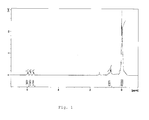
- Fig. 1 shows NMR spectra of the compound prepared in Example 1.
- Component (A) is an organopolysilmethylene which has at least two alkenyl groups, each of which is bonded to a silicon atom, and is represented by the following general formula (1): wherein m is an integer of 1 to 100, preferably 1 to 50 and n is an integer of 1 to 100, preferably 1 to 50, more preferably 1 to 20.
- R 1 is, independently of each other, a group selected from the group consisting of an unsubstituted or substituted monovalent hydrocarbon group having 1 to 10 carbon atoms, an alkoxy group having 1 to 10 carbon atoms, a hydroxy group, R 3 SiCH 2 - and R 3 SiO-, wherein R is, independently of each other, a group selected from the group consisting of an unsubstituted or substituted monovalent hydrocarbon group having 1 to 10 carbon atoms, an alkoxy group having 1 to 10 carbon atoms, and a hydroxy group.
- Examples of the monovalent hydrocarbon group include an alkyl group such as a methyl, ethyl, propyl, isopropyl, and butyl groups; a cycloalkyl group such as a cyclohexyl group; an alkenyl group such as a vinyl, allyl, 1-propenyl, 1-butenyl, 1-hexenyl, and cyclohexenyl groups; an aryl group such as a phenyl and tolyl groups; an aralkyl group such as a benzyl and 2-phenylethyl groups; and the groups where a part or all of the hydrogen atoms bonded to a carbon atom are replaced with a halogen atom or a cyano group, such as a chlormethyl, 3-chloropropyl, 3,3,3-trifluoropropyl, and 2-cyanoethyl groups.
- an alkyl group such as a methyl, ethyl, prop
- At least two out of R 1 's and R's are an alkenyl group such as a vinyl and allyl group.
- a vinyl group is preferred for easier preparation and heat resistance.
- R1's and R's other than the alkenyl group include a methyl and phenyl groups. Particularly, a methyl group is preferred for curing property of the composition and flexibility of the cured product. 50 Mol % or more of the total mol of R 1 and R is preferably a methyl group.
- organopolysilmethylene represented by the afore-mentioned formula (1) can be prepared by reacting an organopolysilmethylene represented by the following average compositional formula (2):
- R 4 e Cl f Si(CH 2 ) (4-e-f)/2 (2) wherein R 4 is, independently of each other, a group selected from the group consisting of unsubstituted or substituted monovalent hydrocarbon groups having 1 to 10 carbon atoms; e and f are the number satisfying the equation, e + f 1.5 to 2.8, preferably 1.8 to 2.5, more preferably 1.95 to 2.05, provided that 0.001 ⁇ f/ (e + f) ⁇ 0.9, preferably 0.005 ⁇ f/ (e + f) ⁇ 0.5, more preferably 0.005 ⁇ f/(e + f) ⁇ 0.1, with an alkenyl group-containing silane represented by the following formula (3):
- R 4 and R 5 include an alkyl group such as a methyl, ethyl, propyl, isopropyl, and butyl groups; a cycloalkyl group such as a cyclohexyl group; an aryl group such as a phenyl and toluyl groups; an aralkyl group such as a benzyl and 2-phenylethyl groups; and the groups where a part or all of the hydrogen atoms bonded to a carbon atom are replaced with a halogen atom or a cyano group, such as a chlormethyl, 3-chloropropyl, 3,3,3-trifluoropropyl, and 2-cyanoethyl groups.
- an alkyl group such as a methyl, ethyl, propyl, isopropyl, and butyl groups
- a cycloalkyl group such as a cyclohexyl group
- an aryl group such as
- R 6 is an alkenyl group such as a viny, allyl, 1-propenyl, 1-butenyl, 1-hexenyl, and cyclohexenyl group.
- alkenyl group-containing silane represented by formula (3) include dimethylvinylmonochlorosilane, methyldivinylmonochlorosilane, trivinylmonochlorosilane, methylphenylvinylmonochlorosilane, methylvinylchlorosilane, phenylvinyldichlorosilane and vinyltrichlorosialne.
- the present organopolysilmethylene is obtained in a method where the organopolysilmethylene of the afore-mentioned average compositional formula (2) and the alkenyl group-containing silane of formula (3) are co-hydrolyzed, or in a method where the organopolysilmethylene of average compositional formula (2) is hydrolyzed to introduce hydroxy groups, each of which is bonded to a silicon atom and, then the resulting hydroxyl groups are reacted with the silane of the general formula (3) while hydrogen chloride is eliminated.
- a silane which has no alkenyl group, R 5 g SiCl 4-g can also be used together with the silane of the general formula (3).
- organopolysilmethylene of the present invention examples include the following: In the afore-mentioned formulas, Vi represents a vinyl group; and Me, a methyl group. n is an integer of 1 to 100, preferably 1 to 50, more preferably 1 to 20.
- the present invention also provides an organopolysilmethylene composition
- an organopolysilmethylene composition comprising (A) the organopolysilmethylene represented by the afore-mentioned general formula (1); (C) a cross-linking agent having at least two SiH groups in a molecule, and selected from the group consisting of an organohydrogenpolysilmethylene and an organohydrogenpolysiloxane; and (D) a catalyst of a platinum group metal.
- the organopolysilmethylene composition of the present invention may further comprise (B) an organopolysiloxane having at least two alkenyl groups, each of which is bonded to a silicon atom in the molecule and represented by the average compositional formula (4) herein below.
- Component (B) is an optional component and replaces a part of the major component, organopolysilmethylene (A).
- Component (B) is an organopolysiloxane which has at least two alkenyl groups, each of which is bonded to a silicon atom in the molecule and is represented by the following average compositional formula (4): R 2 b SiO (4-b)/2 (4) wherein R 2 is, independently of each other, a group selected from the group consisting of an unsubstituted or substituted hydrocarbon group having 1 to 10 carbon atoms, an alkoxy group having 1 to 10 carbon atoms, a hydroxy group and R 3 SiO-, wherein R is, independently of each other, a group selected from the group consisting of an unsubstituted or substituted monovalent hydrocarbon group having 1 to 10 carbon atoms, an alkoxy group having 1 to 10 carbon atoms, and a hydroxy group, at least two out of R 2 's and R's are an alken
- Examples of the monovalent hydrocarbon group include an alkyl group such as a methyl, ethyl, propyl, isopropyl, and butyl groups; a cycloalkyl group such as a cyclohexyl group; an alkenyl group such as vinyl and allyl groups; an aryl group such as phenyl and toluyl groups; an aralkyl group such as benzyl and 2-phenylethyl groups; and the groups where a part or all of the hydrogen atoms bonded to the carbon atoms are replaced with a halogen atom or a cyano group, such as a chlormethyl, 3-chloropropyl, 3,3,3-trifluoropropyl, and 2-cyanoethyl groups.
- an alkyl group such as a methyl, ethyl, propyl, isopropyl, and butyl groups
- a cycloalkyl group such as a cyclohe
- At least two out of R 2 's and R's are an alkenyl group such as a vinyl, allyl, 1-propenyl, 1-butenyl, 1-hexenyl and cyclohexenyl group.
- a vinyl group is preferred for easier preparation and heat resistance.
- R 2 and R other than the alkenyl group include methyl and phenyl groups.
- a methyl group is preferred, because such an organopolysiloxane shows good compatibility with component (A) and the curing properties and flexibility of the composition are good.
- 50 mol % or more of R 2 's and R's is a methyl group.
- a part of R 2 or R is preferably a phenyl group for heat resistance and optical properties.
- organopolysiloxane examples include polydimethylsiloxane having vinyl groups on both ends, copolymers having vinyl groups on both ends of polydimethylsiloxane and methylphenylsiloxane, and copolymers having vinyl groups on both ends of polydimethylsiloxane and diphenylsiloxane, as represented by the following formulas. wherein m is an integer of 0 to 300, preferably 10 to 200, more preferably 50 to 150 and a total of p and q is an integer of 1 to 300, preferably 10 to 200, more preferably 50 to 150.
- the present organopolysilmethylene composition comprises 1 to 100 parts by weight of component (A) and 0 to 99 parts by weight of component (B), preferably 30 to 100 parts by weight of component (A) and 0 to 70 parts by weight of component (B), provided that the total of the amount of components (A) and (B) is 100 parts by weight. If the amount of component (A) is less than the afore-mentioned lower limit, the organopolysilmethylene does not exert its properties such as water resistance and optical properties.
- Cross-linking agent (C) reacts with organopolysilmethylene (A) and organopolysiloxane (B) to form a cross-linking bond and yield a rubber elastomer with a three dimensional network.
- the cross-linking agent employed in the present invention is selected from organohydrogenpolysilmethylenes and organohydrogenpolysiloxanes which have at least two SiH groups in the molecule.
- the cross-linking agent employed in the present invention has at least two, preferably at least three, SiH groups in the molecule.
- the molecular structure of the cross-linking agent is not particularly limited and may be any of, for instance, linear, cyclic or branched structure or three dimensional networks, e.g., resin.
- the preferred cross-linking agent is an organohydrogenpolysilmethylene or organohydrogenpolysiloxane which has 2 to 200, preferably 3 to 100, silicon atoms in the molecule and is liquid at 25 degrees C.
- an organohydrogenpolysiloxane is preferred because its preparation is easy and its molecular structure is selectable.
- organohydrogenpolysiloxane represented by the following average compositional formula (5): R 3 c H d SiO (4-c-d)/2 (5) wherein R 3 is, independently of each other, a group selected from the group consisting of an unsubstituted or substituted monovalent hydrocarbon group having 1 to 10 carbon atoms, alkoxy groups having 1 to 10 carbon atoms, and a hydroxy group, c and d are the numbers satisfying the following equations 0.7 ⁇ c ⁇ 2.1, 0.001 ⁇ d ⁇ 1.0, and 0.8 ⁇ c + d ⁇ 3.0, preferably 1.0 ⁇ c ⁇ 2.0, 0.01 ⁇ d ⁇ 1.0, and 1.5 ⁇ c + d ⁇ 2.5.
- the organohydrogenpolysiloxane has 2 to 200 siloxane units.
- organohydrogenpolysiloxane represented by the afore-mentioned average compositional formula (5) examples include 1,1,3,3-tetramethyldisiloxane, 1,3,5,7-tetramethylcyclotetrasiloxane, tris(hydrogendimethylsiloxy)methylsilane, tris(hydrogendimethylsiloxy)phenylsilane, methylhydrogencyclopolysiloxane, cyclic copolymers of methylhydrogensiloxane and dimethylsiloxane, methylhydrogenpolysiloxane with both ends blocked with trimethylsiloxy groups, copolymers of dimethylsiloxane and methylhydrogensiloxane with both ends blocked with trimethylsiloxy groups, dimethylpolysiloxane with both ends blocked with dimethylhydrogensiloxy groups, copolymers of dimethylsiloxane and methylhydrogensiloxane with both ends blocked with dimethylhydrogens
- Component (C) is preferably blended in such an amount that the amount of the SiH groups in component (C) is 0.1 to 5.0 mols, preferably 0.5 to 4.0 mols, more preferably 0.8 to 3.0 mols, per mol of the alkenyl groups of (A) or (A) and (B).
- the amount of the SiH groups in component (C) is 0.1 to 5.0 mols, preferably 0.5 to 4.0 mols, more preferably 0.8 to 3.0 mols, per mol of the alkenyl groups of (A) or (A) and (B).
- cross-link density of the cured product which is obtained from the composition of the present invention is so low that mechanical strength is not satisfactory; and heat resistance is also adversely affected, which is not preferred.
- the amount of the alkenyl group of component (A) is preferably 50 to 100 mol %, more preferably 80 to 100 mol %, relative to the amount of the alkenyl groups of components (A) and (B).
- a catalyst of a platinum group metal promotes the addition, i.e., hydrosilylation, of components (A) and (B) to component (C).
- the catalyst use may be made of known catalysts of platinum group metals. Platinum or platinum compounds are preferred. Examples of the catalyst of a platinum group metal include platinum black, platinum (II) chloride, chloroplatinic acid, alcohol-modified chloroplatinic acid, and complexes of chloroplatinic acid with an olefin, an aldehyde, a vinylsiloxane or an acetylenic alcohol.
- the catalyst of a platinum group metal may be blended in a catalytically effective amount.
- the amount may be properly increased or decreased, depending upon the desired curing rate.
- the amount is not particularly restricted, but may preferably be 0.1 to 1000 ppm by weight, more preferably 1 to 200 ppm by weight, reduced to a platinum group metal, relative to 100 parts by weight of component (A) or the total of components (A) and (B).
- the organopolysilmethylene composition of the present invention may comprise, in addition to the afore-mentioned components (A) to (D), a variety of functional additives, for instance, reinforcing fillers, heat stabilizers, antioxidants, ultraviolet ray absorbers, photo stabilizers, electrically conductive agents, agents for adhesiveness, coloring agents, lubricants, plasticizers, anti-static agents, and flame retardants, as long as the purposes and effects of the present invention are not impaired.
- a variety of functional additives for instance, reinforcing fillers, heat stabilizers, antioxidants, ultraviolet ray absorbers, photo stabilizers, electrically conductive agents, agents for adhesiveness, coloring agents, lubricants, plasticizers, anti-static agents, and flame retardants, as long as the purposes and effects of the present invention are not impaired.
- examples of the additives include reinforcing fillers such as fumed silica and precipitated silica; fillers such as diatom earth, graphite, aluminum oxide, mica, clay, carbon, titanium oxide and glass beads; electrically conductive materials; pigments; lubricants; and polydimethylsiloxane as a mold-release agent.
- the organopolysilmethylene composition of the present invention can be obtained by blending the afore-mentioned components in a planetary mixer or Shinagawa mixer according to any conventional methods.
- the curing conditions for the organopolysilmethylene composition of the present invention may be the same as those for known addition-curable silicone rubber compositions. For instance, the composition cures satisfactorily even at ambient temperature, but the composition may be heated, if needed. In the latter case, the composition is heated at 60 to 150 degrees C, particularly 80 to 120 degrees C, for 5 to 120 minutes, particularly 10 to 60 minutes.
- the cured product of the organopolysilmethylene composition of the present invention is excellent in mechanical strength, heat resistance, electrical insulation properties, water-proof properties, and optical properties; low in permeability for gas; and is most suitable as optical materials which particularly need transparency, such as LED lenses and sealing materials for LED.
- part or parts means part or parts by weight; Me, a methyl group; and Vi, a vinyl group.
- organopolysilmethylene represented by the following formula (10).
- D1 chloroplatinic acid solution in alcohol
- the resulting mixture was poured into a mold of 130 mm long X 170 mm wide X 2 mm deep, placed in a desiccator, defoamed under a reduced pressure of 10 Torr for 10 minutes, and heat cured at 150 degrees C for 1 hour to form a cured product of the organopolysilmethylene.
- the properties of the cured product are shown in Table 1.
- Example 4 Comparative Example Appearance Colorless and transparent Colorless and transparent Colorless and transparent Colorless and transparent Hardness(Type A) 80 40 30 20 Tensile Strength in MPa 3 5 2 0.3 Elongation in % 3 0 200 300 150 Density 1.07 1.07 1.07 1.07 Water Vapor Permeability in g/m 2 - 24hr 20 21 3 0 50 Volume Resistivity in T ⁇ . cm 100 30 30 5 Electrical Breakdown Strength in KV/ mm 30 25 23 20 Specific Inductive (50Hz) 3.00 2.98 2.88 2.80 Dielectric Tangent (50Hz) 0.001 0.001 0.001 0.001 Hardness after heated at 150 degrees C for 1000 hrs 85 45 35 25 25
- the cured products of Examples 3 to 5 are transparent, excellent in mechanical strength and less permeable for water vapor.
- the cured product of the Comparative Example is worse in mechanical strength, and water vapor permeability is larger.
- the organopolysilmethylene composition of the present invention provides a cured product excellent in mechanical properties, heat resistance, electrical insulation properties, water-proof properties, and optical properties; low in permeability for gas; and is most suitable as optical materials which particularly need transparency, such as LED lenses and sealing materials for LED.
Landscapes
- Chemical & Material Sciences (AREA)
- Health & Medical Sciences (AREA)
- Chemical Kinetics & Catalysis (AREA)
- Medicinal Chemistry (AREA)
- Polymers & Plastics (AREA)
- Organic Chemistry (AREA)
- Compositions Of Macromolecular Compounds (AREA)
- Silicon Polymers (AREA)
Abstract

m is an integer of 1 to 100, and
n is an integer of 1 to 100, and
wherein at least two out of R1's and R's are an alkenyl group.
Description
- This application claims the benefits of Japanese Patent Application No.
2009-191754 filed on August 21, 2009 - The present invention relates to an addition-curable organopolysilmethylene which yields a cured product having excellent heat resistance, mechanical strength, electrical insulation properties, electrical properties and water-proof properties, a composition comprising the same and a cured product thereof.
- Curable silicone rubber compositions which cure to form a silicone rubber elastomer are well known and widely used as a gasket material for electrical and electronic parts, a potting material, a coating material, a shaping material such as a molding material, a wire-covering material and automobile parts, on account of good properties of the compositions such as weathering resistance, heat resistance, and electrical insulation properties. Curable silicone rubber compositions have siloxane bonds which are inherent in a silicone. A siloxane bond is ionic and, therefore, the curable silicone rubber compositions cannot exert the excellent properties of silicones such as chemical resistance, for instance, acid and alkali resistance, water-proof properties and permeability for gas in extremely severe environments such as a hot and humid environments.
- As a countermeasure for the aforementioned problem, a polymer is known where a part of its siloxane bonds are a silethylene bond (Patent Literature 1) or a silphenylene bond (Patent Literature 2). However, the synthesis of these polymers and, accordingly, their mass production, are difficult and, therefore the polymers are expensive. Therefore, the polymers have been commercialized only in special applications or in special fields.
- As a precursor for silicon carbide ceramics, polydiarylsilmethylenes having silmethylene bonds are known from Patent Literatures 3 to 5. These polymers are crystalline, thermoplastic silicon polymers having a high melting point and have good heat resistance, insulation properties, electrical properties, chemical resistance and water-proof properties. However, the polymer is poor in processability by molding and, therefore, is practically not used. Various efforts have been made to improve the processability by molding. For instance, Patent Literature 6 describes a mixture of a polydiarylsilmethylene with a silicone polymer. Patent Literatures 7 and 8 describe mixtures of a polydiarylsilmethylene with a polyalkylsilmethylene.
Patent Literature 9 describes a method for preparing a film of a polydiarylsilmethylene on a substrate where a film of disilacyclobutane is formed on a substrate and is ring-opening polymerized using fine particles of metal. However, the thermoplastic diarylsilmethylene polymer is highly crystalline and, therefore, is difficult to be synthesized. Accordingly, the diarylsilmethylene polymer is expensive and poor in processability. Therefore, research has been conducted to adopt the diarylsilmethylene polymer as a precursor for silicon carbide ceramics. However, a thermosetting composition is not known which takes advantage of the properties as a polymer. - Patent Literature 1:
JP National Phase Publication No. 01/030887
Patent Literature 2: Japanese Patent Application Laid-Open No.Hei-5-320350
Patent Literature 3: Japanese Patent Application Laid-Open No.Hei-8-109264
Patent Literature 4: Japanese Patent Application Laid-Open No.Hei-8-109265
Patent Literature 5: Japanese Patent Application Laid-Open No.Hei-8-109266
Patent Literature 6: Japanese Patent Application Laid-Open No.Hei-9-227781
Patent Literature 7: Japanese Patent Application Laid-Open No.Hei-9-227782
Patent Literature 8: Japanese Patent Application Laid-Open No.Hei-9-227783
Patent Literature 9: Japanese Patent No.3069655 - The object of the present invention is to provide an addition-curable organopolysilmethylene, i. e., silicon polymer having a silmethylene bond; an organopolysilmethylene composition which comprises an addition-curable organopolysilmethylene and, after curing, gives a product which has good heat resistance, electrical insulation properties, water-proof properties and processability by molding and low permeability for gas; and a cured product thereof.
- The present inventors eagerly conducted research to attain the afore-mentioned objectives and have succeeded in synthesizing an organopolysilmethylene having, in the molecule, at least two addition-reactive alkenyl groups, each of which is bonded to a silicon atom, and have found that an addition-curable organopolysilmethylene composition comprising:
- the organopolysilmethylene;
- a cross-linking agent having, in the molecule, at least two hydrogen atoms which are each bonded to a silicon atom, and
- selected from the group consisting of an organohydrogenpolysilmethylene and an
- organohydrogenpolysiloxane, and
- a catalyst of a platinum group metal
- Namely, the present invention provides an organopolysilmethylene represented by the following general formula (1):

- m is an integer of 1 to 100, and
- n is an integer of 1 to 100, and
- Further, the present invention provides a method for preparing the organopolysilmethylene represented by the afore-mentioned general formula (1), wherein an organopolysilmethylene represented by the following average compositional formula (2):
-
R4 eClfSi(CH2)(4-e-f)/2 (2)
wherein R4 is, independently of each other, a group selected from the group consisting of unsubstituted or substituted monovalent hydrocarbon groups having 1 to 10 carbon atoms, - e and f are the numbers satisfying the equation: e + f = 1.5 to 2.8, provided that 0.001 ≦ f/(e + f) ≦ 0.9;
is reacted with an alkenyl group-containing silane represented by the following average compositional formula (3):
R5 gR6 hSiCl4-(g+h) (3)
wherein R5 is, independently of each other, unsubstituted or substituted monovalent hydrocarbon groups having 1 to 10 carbon atoms; - R6 is an alkenyl group having 2 to 10 carbon atoms;
- g is an integer of 0 to 2; and
- h is an integer of 1 to 3, provided that the total of g and h is 1 to 3.
- Furthermore, the present invention provides an organopolysilmethylene composition comprising
- (A) an organopolysilmethylene represented by the afore-mentioned general formula (1),
- (C) a cross-linking agent having, in the molecule, at least two hydrogen atoms which are each bonded to a silicon atom (hereinafter referred to as a SiH group), and selected from the group consisting of an organohydrogenpolysilmethylene and an organohydrogenpolysiloxane, in such an amount that the amount of the SiH groups of the cross-linking agent is 0.1 to 5.0 mols per mol of the alkenyl group of organopolysilmethylene (A), and (D) a catalyst of a platinum group metal in a catalytic amount; and also provides a cured product of the afore-mentioned composition.
- The organopolysilmethylene composition of the present invention provides a cured product having excellent properties such as heat resistance, electrical insulation properties, mechanical properties and optical properties. The cured product also shows low permeability for gas and excellent water-proof properties and hydrolysis resistance even in extremely severe environments, whereas silicone rubbers do not show these properties. The organopolysilmethylene composition of the present invention exhibits processability by molding as good as that of conventional silicone rubbers and, therefore, can be processed by conventional processing machinery such as a molding instrument. Molded products obtained from the organopolysilmethylene composition of the present invention can be used in insulating materials, sealing materials, electric or electronic parts such as cables, packings, and connectors, automobile parts and semi-conductor devices, similarly to silicone rubbers. They can also be used for lenses or transparent sealing materials, taking advantage of its optical properties.
-
Fig. 1 shows NMR spectra of the compound prepared in Example 1. - The present invention will be described below.
- (A) Organopolysilmethylene
- Component (A) is an organopolysilmethylene which has at least two alkenyl groups, each of which is bonded to a silicon atom, and is represented by the following general formula (1):

- In formula (1), R1 is, independently of each other, a group selected from the group consisting of an unsubstituted or substituted monovalent hydrocarbon group having 1 to 10 carbon atoms, an alkoxy group having 1 to 10 carbon atoms, a hydroxy group, R3SiCH2- and R3SiO-, wherein R is, independently of each other, a group selected from the group consisting of an unsubstituted or substituted monovalent hydrocarbon group having 1 to 10 carbon atoms, an alkoxy group having 1 to 10 carbon atoms, and a hydroxy group. Examples of the monovalent hydrocarbon group include an alkyl group such as a methyl, ethyl, propyl, isopropyl, and butyl groups; a cycloalkyl group such as a cyclohexyl group; an alkenyl group such as a vinyl, allyl, 1-propenyl, 1-butenyl, 1-hexenyl, and cyclohexenyl groups; an aryl group such as a phenyl and tolyl groups; an aralkyl group such as a benzyl and 2-phenylethyl groups; and the groups where a part or all of the hydrogen atoms bonded to a carbon atom are replaced with a halogen atom or a cyano group, such as a chlormethyl, 3-chloropropyl, 3,3,3-trifluoropropyl, and 2-cyanoethyl groups. At least two out of R1's and R's are an alkenyl group such as a vinyl and allyl group. Inter alia, a vinyl group is preferred for easier preparation and heat resistance. Examples of R1's and R's other than the alkenyl group include a methyl and phenyl groups. Particularly, a methyl group is preferred for curing property of the composition and flexibility of the cured product. 50 Mol % or more of the total mol of R1 and R is preferably a methyl group.
- The organopolysilmethylene represented by the afore-mentioned formula (1) can be prepared by reacting an organopolysilmethylene represented by the following average compositional formula (2):
-
R4 eClfSi(CH2)(4-e-f)/2 (2)
wherein R4 is, independently of each other, a group selected from the group consisting of unsubstituted or substituted monovalent hydrocarbon groups having 1 to 10 carbon atoms; e and f are the number satisfying the equation, e + f = 1.5 to 2.8, preferably 1.8 to 2.5, more preferably 1.95 to 2.05, provided that 0.001 ≦ f/ (e + f) ≦ 0.9, preferably 0.005 ≦ f/ (e + f) ≦ 0.5, more preferably 0.005 ≦ f/(e + f) ≦ 0.1, with an alkenyl group-containing silane represented by the following formula (3): -
R5 gR6 hSiCl4-(g+h) (3)
wherein R5 is, independently of each other, a group selected from unsubstituted or substituted monovalent hydrocarbon groups having 1 to 10 carbon atoms; R6 is an alkenyl group having 2 to 10 carbon atoms; g is an integer of 0 to 2; h is an integer of 1 to 3, provided that the total of g and h is 1 to 3. - Examples of R4 and R5 include an alkyl group such as a methyl, ethyl, propyl, isopropyl, and butyl groups; a cycloalkyl group such as a cyclohexyl group; an aryl group such as a phenyl and toluyl groups; an aralkyl group such as a benzyl and 2-phenylethyl groups; and the groups where a part or all of the hydrogen atoms bonded to a carbon atom are replaced with a halogen atom or a cyano group, such as a chlormethyl, 3-chloropropyl, 3,3,3-trifluoropropyl, and 2-cyanoethyl groups. R6 is an alkenyl group such as a viny, allyl, 1-propenyl, 1-butenyl, 1-hexenyl, and cyclohexenyl group. Examples of the alkenyl group-containing silane represented by formula (3) include dimethylvinylmonochlorosilane, methyldivinylmonochlorosilane, trivinylmonochlorosilane, methylphenylvinylmonochlorosilane, methylvinylchlorosilane, phenylvinyldichlorosilane and vinyltrichlorosialne.
- The present organopolysilmethylene is obtained in a method where the organopolysilmethylene of the afore-mentioned average compositional formula (2) and the alkenyl group-containing silane of formula (3) are co-hydrolyzed, or in a method where the organopolysilmethylene of average compositional formula (2) is hydrolyzed to introduce hydroxy groups, each of which is bonded to a silicon atom and, then the resulting hydroxyl groups are reacted with the silane of the general formula (3) while hydrogen chloride is eliminated. A silane which has no alkenyl group, R5 gSiCl4-g, can also be used together with the silane of the general formula (3).
- Examples of the organopolysilmethylene of the present invention include the following:


- The present invention also provides an organopolysilmethylene composition comprising
(A) the organopolysilmethylene represented by the afore-mentioned general formula (1); (C) a cross-linking agent having at least two SiH groups in a molecule, and selected from the group consisting of an organohydrogenpolysilmethylene and an organohydrogenpolysiloxane; and
(D) a catalyst of a platinum group metal.
The organopolysilmethylene composition of the present invention may further comprise (B) an organopolysiloxane having at least two alkenyl groups, each of which is bonded to a silicon atom in the molecule and represented by the average compositional formula (4) herein below. - Component (B) is an optional component and replaces a part of the major component, organopolysilmethylene (A). Component (B) is an organopolysiloxane which has at least two alkenyl groups, each of which is bonded to a silicon atom in the molecule and is represented by the following average compositional formula (4):
R2 bSiO (4-b)/2 (4)
wherein R2 is, independently of each other, a group selected from the group consisting of an unsubstituted or substituted hydrocarbon group having 1 to 10 carbon atoms, an alkoxy group having 1 to 10 carbon atoms, a hydroxy group and R3SiO-, wherein R is, independently of each other, a group selected from the group consisting of an unsubstituted or substituted monovalent hydrocarbon group having 1 to 10 carbon atoms, an alkoxy group having 1 to 10 carbon atoms, and a hydroxy group,
at least two out of R2's and R's are an alkenyl group and
b is the number of 1.5 to 2.8, preferably 1.8 to 2.5, more preferably 1.95 to 2.05. - Examples of the monovalent hydrocarbon group include an alkyl group such as a methyl, ethyl, propyl, isopropyl, and butyl groups; a cycloalkyl group such as a cyclohexyl group; an alkenyl group such as vinyl and allyl groups; an aryl group such as phenyl and toluyl groups; an aralkyl group such as benzyl and 2-phenylethyl groups; and the groups where a part or all of the hydrogen atoms bonded to the carbon atoms are replaced with a halogen atom or a cyano group, such as a chlormethyl, 3-chloropropyl, 3,3,3-trifluoropropyl, and 2-cyanoethyl groups. At least two out of R2's and R's are an alkenyl group such as a vinyl, allyl, 1-propenyl, 1-butenyl, 1-hexenyl and cyclohexenyl group. Inter alia, a vinyl group is preferred for easier preparation and heat resistance. Examples of R2 and R other than the alkenyl group include methyl and phenyl groups. Particularly, a methyl group is preferred, because such an organopolysiloxane shows good compatibility with component (A) and the curing properties and flexibility of the composition are good. Preferably, 50 mol % or more of R2's and R's is a methyl group. A part of R2 or R is preferably a phenyl group for heat resistance and optical properties.
- Preferred examples of the organopolysiloxane include polydimethylsiloxane having vinyl groups on both ends, copolymers having vinyl groups on both ends of polydimethylsiloxane and methylphenylsiloxane, and copolymers having vinyl groups on both ends of polydimethylsiloxane and diphenylsiloxane, as represented by the following formulas.


- The present organopolysilmethylene composition comprises 1 to 100 parts by weight of component (A) and 0 to 99 parts by weight of component (B), preferably 30 to 100 parts by weight of component (A) and 0 to 70 parts by weight of component (B), provided that the total of the amount of components (A) and (B) is 100 parts by weight. If the amount of component (A) is less than the afore-mentioned lower limit, the organopolysilmethylene does not exert its properties such as water resistance and optical properties.
- Cross-linking agent (C) reacts with organopolysilmethylene (A) and organopolysiloxane (B) to form a cross-linking bond and yield a rubber elastomer with a three dimensional network. The cross-linking agent employed in the present invention is selected from organohydrogenpolysilmethylenes and organohydrogenpolysiloxanes which have at least two SiH groups in the molecule.
- The cross-linking agent employed in the present invention has at least two, preferably at least three, SiH groups in the molecule. The molecular structure of the cross-linking agent is not particularly limited and may be any of, for instance, linear, cyclic or branched structure or three dimensional networks, e.g., resin. The preferred cross-linking agent is an organohydrogenpolysilmethylene or organohydrogenpolysiloxane which has 2 to 200, preferably 3 to 100, silicon atoms in the molecule and is liquid at 25 degrees C. Particularly, an organohydrogenpolysiloxane is preferred because its preparation is easy and its molecular structure is selectable.
- Particularly, preference is given to the organohydrogenpolysiloxane represented by the following average compositional formula (5):
R3 cHdSiO(4-c-d)/2 (5)
wherein R3 is, independently of each other, a group selected from the group consisting of an unsubstituted or substituted monovalent hydrocarbon group having 1 to 10 carbon atoms, alkoxy groups having 1 to 10 carbon atoms, and a hydroxy group,
c and d are the numbers satisfying the following equations 0.7 ≦ c ≦ 2.1, 0.001 ≦ d ≦ 1.0, and 0.8 ≦ c + d ≦ 3.0, preferably 1.0 ≦ c ≦ 2.0, 0.01 ≦ d ≦ 1.0, and 1.5 ≦ c + d ≦ 2.5. Inter alia, the organohydrogenpolysiloxane has 2 to 200 siloxane units. - Examples of the organohydrogenpolysiloxane represented by the afore-mentioned average compositional formula (5) include 1,1,3,3-tetramethyldisiloxane, 1,3,5,7-tetramethylcyclotetrasiloxane, tris(hydrogendimethylsiloxy)methylsilane, tris(hydrogendimethylsiloxy)phenylsilane, methylhydrogencyclopolysiloxane, cyclic copolymers of methylhydrogensiloxane and dimethylsiloxane, methylhydrogenpolysiloxane with both ends blocked with trimethylsiloxy groups, copolymers of dimethylsiloxane and methylhydrogensiloxane with both ends blocked with trimethylsiloxy groups, dimethylpolysiloxane with both ends blocked with dimethylhydrogensiloxy groups, copolymers of dimethylsiloxane and methylhydrogensiloxane with both ends blocked with dimethylhydrogensiloxy groups, copolymers of methylhydrogensiloxane and diphenylsiloxane with both ends blocked with trimethylsiloxy groups, copolymers of methylhydrogensiloxane, diphenylsiloxane and dimethylsiloxane with both ends blocked with trimethylsiloxy groups, copolymers of methylhydrogensiloxane, methylphenylsiloxane and dimethylsiloxane with both ends blocked with trimethylsiloxy groups, copolymers of methylhydrogensiloxane, dimethylsiloxane and diphenylsiloxane with both ends blocked with dimethylhydrogensiloxy groups, copolymers of methylhydrogensiloxane, dimethylsiloxane and methylphenylsiloxane with both ends blocked with dimethylhydrogensiloxy groups, copolymers of (CH3)2HSiO1/2 unit, (CH3)3SiO1/2 unit and SiO4/2 unit, copolymers of (CH3)2HSiO1/2 unit and SiO4/2 unit, and copolymers of (CH3)2HSiO1/2 unit, SiO4/2 unit and (C6H5)3SiO1/2 unit.
- Component (C) is preferably blended in such an amount that the amount of the SiH groups in component (C) is 0.1 to 5.0 mols, preferably 0.5 to 4.0 mols, more preferably 0.8 to 3.0 mols, per mol of the alkenyl groups of (A) or (A) and (B). Below the afore-mentioned lower limit, cross-link density of the cured product which is obtained from the composition of the present invention is so low that mechanical strength is not satisfactory; and heat resistance is also adversely affected, which is not preferred. Above the afore-mentioned upper limit, foaming occurs in the cured product due to dehydrogenation; the remaining SiH groups may change the properties of the cured product with time; and further heat resistance of the cured product may adversely be affected, which is not preferred. The amount of the alkenyl group of component (A) is preferably 50 to 100 mol %, more preferably 80 to 100 mol %, relative to the amount of the alkenyl groups of components (A) and (B).
- D) A catalyst of a platinum group metal promotes the addition, i.e., hydrosilylation, of components (A) and (B) to component (C). As the catalyst, use may be made of known catalysts of platinum group metals. Platinum or platinum compounds are preferred. Examples of the catalyst of a platinum group metal include platinum black, platinum (II) chloride, chloroplatinic acid, alcohol-modified chloroplatinic acid, and complexes of chloroplatinic acid with an olefin, an aldehyde, a vinylsiloxane or an acetylenic alcohol.
- The catalyst of a platinum group metal may be blended in a catalytically effective amount. The amount may be properly increased or decreased, depending upon the desired curing rate. The amount is not particularly restricted, but may preferably be 0.1 to 1000 ppm by weight, more preferably 1 to 200 ppm by weight, reduced to a platinum group metal, relative to 100 parts by weight of component (A) or the total of components (A) and (B).
- The organopolysilmethylene composition of the present invention may comprise, in addition to the afore-mentioned components (A) to (D), a variety of functional additives, for instance, reinforcing fillers, heat stabilizers, antioxidants, ultraviolet ray absorbers, photo stabilizers, electrically conductive agents, agents for adhesiveness, coloring agents, lubricants, plasticizers, anti-static agents, and flame retardants, as long as the purposes and effects of the present invention are not impaired. For instance, examples of the additives include reinforcing fillers such as fumed silica and precipitated silica; fillers such as diatom earth, graphite, aluminum oxide, mica, clay, carbon, titanium oxide and glass beads; electrically conductive materials; pigments; lubricants; and polydimethylsiloxane as a mold-release agent.
- The organopolysilmethylene composition of the present invention can be obtained by blending the afore-mentioned components in a planetary mixer or Shinagawa mixer according to any conventional methods. The curing conditions for the organopolysilmethylene composition of the present invention may be the same as those for known addition-curable silicone rubber compositions. For instance, the composition cures satisfactorily even at ambient temperature, but the composition may be heated, if needed. In the latter case, the composition is heated at 60 to 150 degrees C, particularly 80 to 120 degrees C, for 5 to 120 minutes, particularly 10 to 60 minutes.
- The cured product of the organopolysilmethylene composition of the present invention is excellent in mechanical strength, heat resistance, electrical insulation properties, water-proof properties, and optical properties; low in permeability for gas; and is most suitable as optical materials which particularly need transparency, such as LED lenses and sealing materials for LED.
- The present invention will be described below more in detail by referring to the Examples and Comparative Examples, but shall not be limited thereto. In the following description, "part" or "parts" means part or parts by weight; Me, a methyl group; and Vi, a vinyl group.
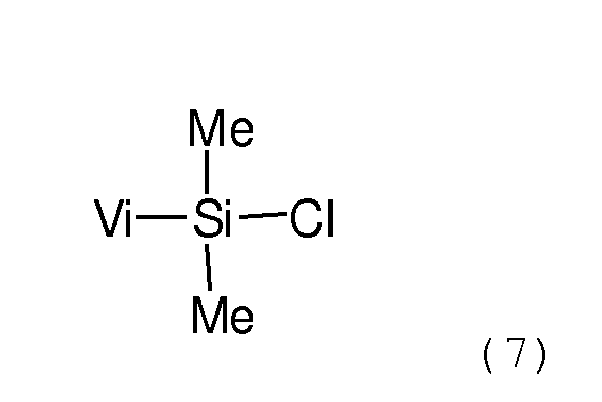
- 1540 grams (4.64 mol, 90 mol %) of chlorine-containing silmethylene of the following formula (6), and 54.2 grams (0.45 mol, 10 mol %) of dimethylvinylmonochlorosilane of the following formula (7) were dissolved in 1000 grams of xylene and added dropwise at a temperature of 60 degrees C to a solvent mixture composed of 600 grams of water and 300 grams of xylene to hydrolyze. Then, the reaction mixture was aged at room temperature for 3 hours, the formed acid was separated and removed, and the organic phase was washed with water and subjected to azeotropic dehydration at 140 degrees C.
-

- To this alkenyl group-containing polysilmethylene was added 0.2 grams of KOH to alkali polymerize at 140 degrees C for 10 hours. Then, the reaction mixture was neutralized, filtered and, then, evaporated at 160 degrees C/5mm Hg for 30 minutes. The product obtained was analyzed by 1H-NMR and was found to be organopolysilmethylene (referred to as A1) represented by the following formula (8):
- The NMR spectra of A1 are shown in
Fig. 1 (NMR: JNM-LA300WB ex JOEL, 300 MHz, 1H-NMR)
- 260.3 grams (0.335 mol, 67 mol %) of the chlorine-containing silmethylene of the following formula (9) and 19.9 grams (0.165 mol, 33 mol %) of the dimethylvinylmonochlorosilane of the afore-mentioned formula (7) were dissolved in 200 grams of xylene and added dropwise at a temperature of 60 degrees C to a solvent mixture composed of 200 grams of water and 100 grams of xylene to hydrolyze, as in Example 1. Then, the reaction mixture was aged at room temperature for 5 hours, the formed acid was separated and removed, and the organic phase was washed with water and subjected to azeotropic dehydration at 140 degrees C. To this alkenyl group-containing polysilmethylene was added 0.2 grams of KOH to alkali polymerize at 140 degrees C for 10 hours. Then, the reaction mixture was neutralized, filtered and, then, evaporated at 160 degrees C/5mm Hg for 30 minutes to obtain organopolysilmethylene (A2) represented by the following formula (10).
-


- To 100 grams of the alkenyl group-containing organopolysilmethylene (A1) prepared in Example 1 were added 34.7 grams of the SiH group-containing polysiloxane (C1) (Si-H/Si-Vi ratio in mol = 0.36) and, 0.1 grams of chloroplatinic acid solution in alcohol (D1) as a platinum catalyst, where a platinum content is 2 weight %, corresponding to 20 ppm of a platinum content, and mixed. The resulting mixture was poured into a mold of 130 mm long X 170 mm wide X 2 mm deep, placed in a desiccator, defoamed under a reduced pressure of 10 Torr for 10 minutes, and heat cured at 150 degrees C for 1 hour to form a cured product of the organopolysilmethylene. The properties of the cured product are shown in Table 1.
-

- To 100 grams of the alkenyl group-containing organopolysilmethylene (A2) prepared in Example 2 were added 25.7 grams of the SiH group-containing polysiloxane (C1) represented by the afore-mentioned formula (11), where Si-H/Si-Vi ratio in mol = 3, and 0.1 grams of platinum catalyst (D1), corresponding to 20 ppm of a platinum content, and mixed. The resulting mixture was heat cured at 150 degrees C for one hour, as in Example 1, to form a cured product of the organopolysilmethylene. The properties of the product are shown in Table 1.
- To 70 grams of the alkenyl group-containing organopolysilmethylene (A2) prepared in Example 2 were added 30 grams of the copolymer having vinyl groups on both ends of a dimethylpolysiloxane and a diphenylpolysiloxane (B1) represented by the following formula (12), 20.1 grams of the SiH group-containing polysiloxane (C1) represented by the afore-mentioned formula (11), where Si-H/Si-Vi ratio in mol = 3, and 0.1 grams of platinum catalyst (D1), corresponding to 20 ppm of a platinum content, and mixed. Then, the resulting mixture was heat cured at 150 degrees C for one hour, as in Example 1, to form a cured product of the organopolysilmethylene-organopolysiloxane. The properties of the product are shown in Table 1.

- To 100 grams of the copolymer of dimethylpolysiloxane and diphenylpolysiloxane having vinyl groups on both ends (B1) represented by the afore-mentioned formula (12) were added 7 grams of the SiH group-containing polysiloxane (C1) represented by the afore-mentioned formula (11), where Si-H/Si-Vi ratio in mol = 3, and 0.1 grams of platinum catalyst (D1), corresponding to 20 ppm of a platinum content, and mixed. Then the resulting mixture was heat cured at 150 degrees C for one hour, as in Example 1 to form a cured product of the organopolysiloxane. The properties of the product are shown in Table 1.
- Properties of each above-described cured product were evaluated in accordance with the following methods. Results are shown in Table 1.
- (1) Appearance of a cured product was observed visually to evaluate discoloration and transparency.
- (2) Hardness was determined with a durometer of type A which is in accordance with JIS K6253.
- (3) Tensile strength, elongation, density, volume resistivity, electrical breakdown strength, and a specific inductive and a dielectric tangent were determined according to JIS K6249.
- (4) Water vapor permeability was determined according to JIS Z0208.
-
Table 1 Properties after cured Example 3 Example 4 Example 5 Comparative Example Appearance Colorless and transparent Colorless and transparent Colorless and transparent Colorless and transparent Hardness(Type A) 80 40 30 20 Tensile Strength in MPa 3 5 2 0.3 Elongation in % 3 0 200 300 150 Density 1.07 1.07 1.07 1.07 Water Vapor Permeability in g/m2 - 24hr 20 21 3 0 50 Volume Resistivity in T Ω . cm 100 30 30 5 Electrical Breakdown Strength in KV/ mm 30 25 23 20 Specific Inductive (50Hz) 3.00 2.98 2.88 2.80 Dielectric Tangent (50Hz) 0.001 0.001 0.001 0.001 Hardness after heated at 150 degrees C for 1000 hrs 85 45 35 25 - As seen in Table 1, the cured products of Examples 3 to 5 are transparent, excellent in mechanical strength and less permeable for water vapor. The cured product of the Comparative Example is worse in mechanical strength, and water vapor permeability is larger.
- The organopolysilmethylene composition of the present invention provides a cured product excellent in mechanical properties, heat resistance, electrical insulation properties, water-proof properties, and optical properties; low in permeability for gas; and is most suitable as optical materials which particularly need transparency, such as LED lenses and sealing materials for LED.
Claims (7)
- An organopolysilmethylene represented by the following general formula (1):

m is an integer of 1 to 100, and
n is an integer of 1 to 100, and
wherein at least two out of R1's and R's are an alkenyl group. - A method for preparing the organopolysilmethylene described in claim 1, wherein
an organopolysilmethylene represented by the following average compositional formula (2):
R4 eClfSi(CH2)(4-e-f)/2 (2)
wherein R4 is, independently of each other, a group selected from the group consisting of unsubstituted or substituted monovalent hydrocarbon groups having 1 to 10 carbon atoms,
e and f are the numbers satisfying the equation: e + f = 1.5 to 2.8, provided that 0.001 ≦ f/(e + f) ≦ 0.9;
is reacted with an alkenyl group-containing silane represented by the following average compositional formula (3):
R5 gR6 hSiCl4-(g+h) (3)
wherein R5 is, independently of each other, unsubstituted or substituted monovalent hydrocarbon groups having 1 to 10 carbon atoms;R6 is an alkenyl group having 2 to 10 carbon atoms;g is an integer of 0 to 2; andh is an integer of 1 to 3, provided that the total of g and h is 1 to 3. - An organopolysilmethylene composition comprising (A) an organopolysilmethylene according to claim 1, (C) a cross-linking agent having, in the molecule, at least two hydrogen atoms which are each bonded to a silicon atom to constitute SiH groups, and selected from the group consisting of an organohydrogenpolysilmethylene and an organohydrogenpolysiloxane, in such an amount that the amount of the SiH groups of the cross-linking agent is 0.1 to 5.0 mols per mol of the alkenyl group of organopolysilmethylene (A), and (D) a catalyst of a platinum group metal in a catalytic amount.
- The organopolysilmethylene composition according to claim 3,
wherein the composition further comprises
(B) an organopolysiloxane represented by the following average compositional formula (4):
R2 bSiO(4-b)/2 (4)
wherein R2 is, independently of each other, a group selected from the group consisting of an unsubstituted or substituted hydrocarbon group having 1 to 10 carbon atoms, an alkoxy group having 1 to 10 carbon atoms, a hydroxyl group and R3SiO-, wherein R is, independently of each other, a group selected from the group consisting of an unsubstituted or substituted monovalent hydrocarbon group having 1 to 10 carbon atoms, an alkoxy group having 1 to 10 carbon atoms, and a hydroxy group,
at least two out of R2's and R's are an alkenyl group and
b is the number of 1.5 to 2.8; and
wherein cross-linking agent (C) described in claim 3 is present in such an amount that the amount of the SiH groups of the cross-linking agent is 0.1 to 5.0 mols per mol of the alkenyl groups of organopolysilmethylene (A) and organopolysiloxane (B). - The organopolysilmethylene composition according to claim 4, comprising:(A) 30 to 100 parts by weight of the organopolysilmethylene according to claim 1,(B) 0 to 70 parts by weight of the organopolysiloxane according to claim 4, provided that the total amount of (A) and (B) is 100 parts by weight,(C) the cross-linking agent according to claim 3 in such an amount that the amount of the SiH groups is 0.1 to 5.0 mols per mol of the alkenyl groups of (A) organopolysilmethylene and (B) organopolysiloxane, and(D) a catalytic amount of a catalyst of a platinum group metal.
- The organopolysilmethylene composition according to any one of claims 3 to 5, wherein the cross-linking agent (C) according to claim 3 is an organohydrogenpolysiloxane having, in a molecule, at least two hydrogen atoms which are each bonded to a silicon atom, and represented by the following average compositional formula (5):
R3 cHdSiO(4-c-d)/2 (5)
wherein R3 is, independently of each other, a group selected from the group consisting of an unsubstituted or substituted monovalent hydrocarbon group having 1 to 10 carbon atoms, an alkoxy group having 1 to 10 carbon atoms, and a hydroxy group,
c and d are the numbers satisfying the following equations 0.7 ≦ c ≦ 2.1, 0.001 ≦ d ≦ 1.0, and 0.8 ≦ c + d ≦ 3.0. - A cured product formed by curing the organopolysilmethylene composition according to any one of claims 3 to 6.
Applications Claiming Priority (1)
| Application Number | Priority Date | Filing Date | Title |
|---|---|---|---|
| JP2009191754A JP5345908B2 (en) | 2009-08-21 | 2009-08-21 | Organopolysilmethylene and organopolysilmethylene composition |
Publications (2)
| Publication Number | Publication Date |
|---|---|
| EP2289979A1 true EP2289979A1 (en) | 2011-03-02 |
| EP2289979B1 EP2289979B1 (en) | 2016-05-04 |
Family
ID=43264765
Family Applications (1)
| Application Number | Title | Priority Date | Filing Date |
|---|---|---|---|
| EP10173282.4A Active EP2289979B1 (en) | 2009-08-21 | 2010-08-18 | Organopolysilmethylene and a composition comprising the same |
Country Status (6)
| Country | Link |
|---|---|
| US (1) | US8173759B2 (en) |
| EP (1) | EP2289979B1 (en) |
| JP (1) | JP5345908B2 (en) |
| KR (1) | KR101761405B1 (en) |
| CN (1) | CN101993539B (en) |
| TW (1) | TWI538933B (en) |
Cited By (3)
| Publication number | Priority date | Publication date | Assignee | Title |
|---|---|---|---|---|
| US9646904B2 (en) | 2013-01-09 | 2017-05-09 | Daicel Corporation | Curable resin composition, and cured product of same |
| EP3214144A1 (en) * | 2015-12-22 | 2017-09-06 | Shin-Etsu Chemical Co., Ltd. | Addition curable resin composition and semiconductor package |
| EP3137552A4 (en) * | 2014-04-29 | 2017-12-06 | Henkel AG & Co. KGaA | Polycarbosiloxane containing curable compositions for led encapsulants |
Families Citing this family (8)
| Publication number | Priority date | Publication date | Assignee | Title |
|---|---|---|---|---|
| TWI435914B (en) * | 2010-12-31 | 2014-05-01 | Eternal Chemical Co Ltd | Curable organic polyoxane composition and preparation method thereof |
| JP5533906B2 (en) * | 2011-02-28 | 2014-06-25 | 信越化学工業株式会社 | Addition reaction curable organopolysilmethylenesiloxane copolymer composition |
| JP5697160B2 (en) * | 2011-11-10 | 2015-04-08 | 信越化学工業株式会社 | Organopolysiloxane composition and cured product thereof |
| US9434857B2 (en) | 2011-11-15 | 2016-09-06 | Ethicon, Inc. | Rapid cure silicone lubricious coatings |
| CN103012456B (en) * | 2012-12-18 | 2015-11-18 | 烟台德邦先进硅材料有限公司 | A kind of preparation method of high-power LED encapsulation organosilicon oligomer |
| WO2016043082A1 (en) * | 2014-09-17 | 2016-03-24 | 株式会社ダイセル | Curable silicone resin composition, and cured product thereof |
| CN104788678B (en) * | 2015-04-24 | 2018-01-19 | 浙江润禾有机硅新材料有限公司 | A kind of vinyl silicone oil containing alkylen structures and preparation method thereof |
| CN108976806A (en) * | 2018-06-01 | 2018-12-11 | 贵州电网有限责任公司 | A kind of moisture-proof plugging material of nonfluid and preparation method thereof |
Citations (11)
| Publication number | Priority date | Publication date | Assignee | Title |
|---|---|---|---|---|
| US5087720A (en) * | 1990-07-06 | 1992-02-11 | Shin-Etsu Chemical Co., Ltd. | Polysilethylenesiloxane |
| JPH05320350A (en) | 1992-05-25 | 1993-12-03 | Fujitsu Ltd | Silicone compound |
| JPH08109264A (en) | 1994-10-07 | 1996-04-30 | Dow Corning Asia Ltd | Method for producing polydiphenylsilmethylene by solution homogeneous polymerization |
| JPH08109265A (en) | 1994-10-07 | 1996-04-30 | Dow Corning Asia Ltd | Method for producing polydiphenylsilmethylene by solution slurry polymerization |
| JPH08109266A (en) | 1994-10-07 | 1996-04-30 | Dow Corning Asia Ltd | Method for producing polydiarylsilmethylene |
| JPH09227782A (en) | 1996-02-20 | 1997-09-02 | Dow Corning Asia Ltd | Polysilmethylene composition and method for producing the same |
| JPH09227783A (en) | 1996-02-20 | 1997-09-02 | Dow Corning Asia Ltd | Thermoplastic polysilmethylene composition and method for producing the same |
| JPH09227781A (en) | 1996-02-20 | 1997-09-02 | Dow Corning Asia Ltd | Thermoplastic silicon-based polymer composition and method for producing the same |
| JP3069655B2 (en) | 1997-11-14 | 2000-07-24 | 工業技術院長 | Polysilmethylene film forming method |
| WO2001030887A1 (en) | 1999-10-28 | 2001-05-03 | Japan Science And Technology Corporation | Method of polymerizing silalkylenesiloxane |
| US6534587B1 (en) * | 1998-06-24 | 2003-03-18 | Medtronic, Inc | Silalkylenesiloxane copolymer materials and methods for their preparation |
Family Cites Families (13)
| Publication number | Priority date | Publication date | Assignee | Title |
|---|---|---|---|---|
| JPH0615614B2 (en) * | 1990-07-06 | 1994-03-02 | 信越化学工業株式会社 | Polysilethylene siloxane |
| JPH0615615B2 (en) * | 1990-07-06 | 1994-03-02 | 信越化学工業株式会社 | Fluorine-containing polysilethylene siloxane |
| JPH0615617B2 (en) * | 1990-07-06 | 1994-03-02 | 信越化学工業株式会社 | Fluorine-containing polysilethylene siloxane |
| JPH0786175B2 (en) * | 1990-11-29 | 1995-09-20 | 信越化学工業株式会社 | Silicone rubber composition with excellent release durability |
| JP2636616B2 (en) * | 1991-12-12 | 1997-07-30 | 信越化学工業株式会社 | Room temperature curable silicone rubber composition and cured product thereof |
| JPH05222066A (en) * | 1992-02-17 | 1993-08-31 | Shin Etsu Chem Co Ltd | New organosilicon compound |
| US5763540A (en) | 1992-05-22 | 1998-06-09 | Fujitsu Limited | Epoxy resin composition for encapsulating semiconductor |
| JP3368005B2 (en) * | 1993-08-26 | 2003-01-20 | 東レ・ダウコーニング・シリコーン株式会社 | Antifoam composition |
| JPH07166134A (en) * | 1993-10-22 | 1995-06-27 | Toray Dow Corning Silicone Co Ltd | Silicone composition for forming a peelable cured film |
| DE19548474A1 (en) * | 1995-12-22 | 1997-06-26 | Wacker Chemie Gmbh | Organopolysiloxanes containing aliphatic unsaturated radicals, their preparation and their use in crosslinkable compositions |
| US5783540A (en) * | 1996-12-23 | 1998-07-21 | Lever Brothers Company, Division Of Conopco, Inc. | Machine dishwashing tablets delivering a rinse aid benefit |
| WO2001074957A1 (en) * | 2000-04-04 | 2001-10-11 | Asahi Kasei Kabushiki Kaisha | Coating composition for the production of insulating thin films |
| US7071244B2 (en) * | 2002-12-03 | 2006-07-04 | Staar Surgical Company | High refractive index and optically clear copoly (carbosilane and siloxane) elastomers |
-
2009
- 2009-08-21 JP JP2009191754A patent/JP5345908B2/en active Active
-
2010
- 2010-08-11 TW TW099126766A patent/TWI538933B/en active
- 2010-08-13 CN CN2010102547630A patent/CN101993539B/en active Active
- 2010-08-17 KR KR1020100079119A patent/KR101761405B1/en active Active
- 2010-08-18 EP EP10173282.4A patent/EP2289979B1/en active Active
- 2010-08-23 US US12/861,283 patent/US8173759B2/en not_active Expired - Fee Related
Patent Citations (11)
| Publication number | Priority date | Publication date | Assignee | Title |
|---|---|---|---|---|
| US5087720A (en) * | 1990-07-06 | 1992-02-11 | Shin-Etsu Chemical Co., Ltd. | Polysilethylenesiloxane |
| JPH05320350A (en) | 1992-05-25 | 1993-12-03 | Fujitsu Ltd | Silicone compound |
| JPH08109264A (en) | 1994-10-07 | 1996-04-30 | Dow Corning Asia Ltd | Method for producing polydiphenylsilmethylene by solution homogeneous polymerization |
| JPH08109265A (en) | 1994-10-07 | 1996-04-30 | Dow Corning Asia Ltd | Method for producing polydiphenylsilmethylene by solution slurry polymerization |
| JPH08109266A (en) | 1994-10-07 | 1996-04-30 | Dow Corning Asia Ltd | Method for producing polydiarylsilmethylene |
| JPH09227782A (en) | 1996-02-20 | 1997-09-02 | Dow Corning Asia Ltd | Polysilmethylene composition and method for producing the same |
| JPH09227783A (en) | 1996-02-20 | 1997-09-02 | Dow Corning Asia Ltd | Thermoplastic polysilmethylene composition and method for producing the same |
| JPH09227781A (en) | 1996-02-20 | 1997-09-02 | Dow Corning Asia Ltd | Thermoplastic silicon-based polymer composition and method for producing the same |
| JP3069655B2 (en) | 1997-11-14 | 2000-07-24 | 工業技術院長 | Polysilmethylene film forming method |
| US6534587B1 (en) * | 1998-06-24 | 2003-03-18 | Medtronic, Inc | Silalkylenesiloxane copolymer materials and methods for their preparation |
| WO2001030887A1 (en) | 1999-10-28 | 2001-05-03 | Japan Science And Technology Corporation | Method of polymerizing silalkylenesiloxane |
Cited By (3)
| Publication number | Priority date | Publication date | Assignee | Title |
|---|---|---|---|---|
| US9646904B2 (en) | 2013-01-09 | 2017-05-09 | Daicel Corporation | Curable resin composition, and cured product of same |
| EP3137552A4 (en) * | 2014-04-29 | 2017-12-06 | Henkel AG & Co. KGaA | Polycarbosiloxane containing curable compositions for led encapsulants |
| EP3214144A1 (en) * | 2015-12-22 | 2017-09-06 | Shin-Etsu Chemical Co., Ltd. | Addition curable resin composition and semiconductor package |
Also Published As
| Publication number | Publication date |
|---|---|
| JP5345908B2 (en) | 2013-11-20 |
| KR20110020183A (en) | 2011-03-02 |
| TW201107378A (en) | 2011-03-01 |
| JP2011042744A (en) | 2011-03-03 |
| US8173759B2 (en) | 2012-05-08 |
| CN101993539A (en) | 2011-03-30 |
| KR101761405B1 (en) | 2017-07-25 |
| TWI538933B (en) | 2016-06-21 |
| CN101993539B (en) | 2013-04-17 |
| US20110046310A1 (en) | 2011-02-24 |
| EP2289979B1 (en) | 2016-05-04 |
Similar Documents
| Publication | Publication Date | Title |
|---|---|---|
| EP2289979B1 (en) | Organopolysilmethylene and a composition comprising the same | |
| EP2289978B1 (en) | Organopolysilmethylene and a cured product thereof | |
| EP2110401B1 (en) | Addition-curable silicone composition and cured product thereof | |
| KR101610964B1 (en) | Method for improving defoamability of liquid curable fluorosilicone composition | |
| KR101748443B1 (en) | Organopolysiloxane containing vinylsiloxy group in both ends thereof and isocyanuric ring | |
| JP5533906B2 (en) | Addition reaction curable organopolysilmethylenesiloxane copolymer composition | |
| KR20060099408A (en) | Optical semiconductor device using hardened | cured product of an epoxy resin composition, its manufacturing method, and the hardened product | |
| KR20120099282A (en) | Organosilicon compound, method for producing thereof, and curable silicone composition containing the same | |
| EP3318593B1 (en) | Heat dissipation material | |
| KR102561851B1 (en) | Organopolysiloxane, method for producing same, and curable silicone composition | |
| EP0490523B1 (en) | One part heat curable organopolysiloxane compositions | |
| KR0152309B1 (en) | Process for preparing organo polysiloxanes containing si-bonded hydrogen using alkali catalysis | |
| EP0429069A2 (en) | Charge-dissipating silicone rubber compositions | |
| JP5605925B2 (en) | Organopolysilmethylene and organopolysilmethylene composition | |
| KR20200136444A (en) | Crosslinkable organosiloxane composition | |
| EP0455137A2 (en) | Charge-dissipating silicone rubber compositions | |
| JPH10152616A (en) | Thermosetting resin composition for electrical insulating materials |
Legal Events
| Date | Code | Title | Description |
|---|---|---|---|
| PUAI | Public reference made under article 153(3) epc to a published international application that has entered the european phase |
Free format text: ORIGINAL CODE: 0009012 |
|
| AK | Designated contracting states |
Kind code of ref document: A1 Designated state(s): AL AT BE BG CH CY CZ DE DK EE ES FI FR GB GR HR HU IE IS IT LI LT LU LV MC MK MT NL NO PL PT RO SE SI SK SM TR |
|
| AX | Request for extension of the european patent |
Extension state: BA ME RS |
|
| 17P | Request for examination filed |
Effective date: 20110825 |
|
| GRAP | Despatch of communication of intention to grant a patent |
Free format text: ORIGINAL CODE: EPIDOSNIGR1 |
|
| INTG | Intention to grant announced |
Effective date: 20151221 |
|
| GRAS | Grant fee paid |
Free format text: ORIGINAL CODE: EPIDOSNIGR3 |
|
| GRAA | (expected) grant |
Free format text: ORIGINAL CODE: 0009210 |
|
| AK | Designated contracting states |
Kind code of ref document: B1 Designated state(s): AL AT BE BG CH CY CZ DE DK EE ES FI FR GB GR HR HU IE IS IT LI LT LU LV MC MK MT NL NO PL PT RO SE SI SK SM TR |
|
| REG | Reference to a national code |
Ref country code: GB Ref legal event code: FG4D |
|
| REG | Reference to a national code |
Ref country code: CH Ref legal event code: EP |
|
| REG | Reference to a national code |
Ref country code: AT Ref legal event code: REF Ref document number: 796876 Country of ref document: AT Kind code of ref document: T Effective date: 20160515 |
|
| REG | Reference to a national code |
Ref country code: IE Ref legal event code: FG4D |
|
| REG | Reference to a national code |
Ref country code: DE Ref legal event code: R096 Ref document number: 602010032998 Country of ref document: DE |
|
| REG | Reference to a national code |
Ref country code: NL Ref legal event code: FP |
|
| REG | Reference to a national code |
Ref country code: LT Ref legal event code: MG4D |
|
| PG25 | Lapsed in a contracting state [announced via postgrant information from national office to epo] |
Ref country code: NO Free format text: LAPSE BECAUSE OF FAILURE TO SUBMIT A TRANSLATION OF THE DESCRIPTION OR TO PAY THE FEE WITHIN THE PRESCRIBED TIME-LIMIT Effective date: 20160804 Ref country code: LT Free format text: LAPSE BECAUSE OF FAILURE TO SUBMIT A TRANSLATION OF THE DESCRIPTION OR TO PAY THE FEE WITHIN THE PRESCRIBED TIME-LIMIT Effective date: 20160504 Ref country code: FI Free format text: LAPSE BECAUSE OF FAILURE TO SUBMIT A TRANSLATION OF THE DESCRIPTION OR TO PAY THE FEE WITHIN THE PRESCRIBED TIME-LIMIT Effective date: 20160504 |
|
| REG | Reference to a national code |
Ref country code: AT Ref legal event code: MK05 Ref document number: 796876 Country of ref document: AT Kind code of ref document: T Effective date: 20160504 |
|
| PG25 | Lapsed in a contracting state [announced via postgrant information from national office to epo] |
Ref country code: SE Free format text: LAPSE BECAUSE OF FAILURE TO SUBMIT A TRANSLATION OF THE DESCRIPTION OR TO PAY THE FEE WITHIN THE PRESCRIBED TIME-LIMIT Effective date: 20160504 Ref country code: GR Free format text: LAPSE BECAUSE OF FAILURE TO SUBMIT A TRANSLATION OF THE DESCRIPTION OR TO PAY THE FEE WITHIN THE PRESCRIBED TIME-LIMIT Effective date: 20160805 Ref country code: LV Free format text: LAPSE BECAUSE OF FAILURE TO SUBMIT A TRANSLATION OF THE DESCRIPTION OR TO PAY THE FEE WITHIN THE PRESCRIBED TIME-LIMIT Effective date: 20160504 Ref country code: ES Free format text: LAPSE BECAUSE OF FAILURE TO SUBMIT A TRANSLATION OF THE DESCRIPTION OR TO PAY THE FEE WITHIN THE PRESCRIBED TIME-LIMIT Effective date: 20160504 Ref country code: PT Free format text: LAPSE BECAUSE OF FAILURE TO SUBMIT A TRANSLATION OF THE DESCRIPTION OR TO PAY THE FEE WITHIN THE PRESCRIBED TIME-LIMIT Effective date: 20160905 Ref country code: HR Free format text: LAPSE BECAUSE OF FAILURE TO SUBMIT A TRANSLATION OF THE DESCRIPTION OR TO PAY THE FEE WITHIN THE PRESCRIBED TIME-LIMIT Effective date: 20160504 |
|
| PG25 | Lapsed in a contracting state [announced via postgrant information from national office to epo] |
Ref country code: BE Free format text: LAPSE BECAUSE OF NON-PAYMENT OF DUE FEES Effective date: 20160831 Ref country code: IT Free format text: LAPSE BECAUSE OF FAILURE TO SUBMIT A TRANSLATION OF THE DESCRIPTION OR TO PAY THE FEE WITHIN THE PRESCRIBED TIME-LIMIT Effective date: 20160504 |
|
| PG25 | Lapsed in a contracting state [announced via postgrant information from national office to epo] |
Ref country code: RO Free format text: LAPSE BECAUSE OF FAILURE TO SUBMIT A TRANSLATION OF THE DESCRIPTION OR TO PAY THE FEE WITHIN THE PRESCRIBED TIME-LIMIT Effective date: 20160504 Ref country code: CZ Free format text: LAPSE BECAUSE OF FAILURE TO SUBMIT A TRANSLATION OF THE DESCRIPTION OR TO PAY THE FEE WITHIN THE PRESCRIBED TIME-LIMIT Effective date: 20160504 Ref country code: DK Free format text: LAPSE BECAUSE OF FAILURE TO SUBMIT A TRANSLATION OF THE DESCRIPTION OR TO PAY THE FEE WITHIN THE PRESCRIBED TIME-LIMIT Effective date: 20160504 Ref country code: EE Free format text: LAPSE BECAUSE OF FAILURE TO SUBMIT A TRANSLATION OF THE DESCRIPTION OR TO PAY THE FEE WITHIN THE PRESCRIBED TIME-LIMIT Effective date: 20160504 Ref country code: SK Free format text: LAPSE BECAUSE OF FAILURE TO SUBMIT A TRANSLATION OF THE DESCRIPTION OR TO PAY THE FEE WITHIN THE PRESCRIBED TIME-LIMIT Effective date: 20160504 |
|
| REG | Reference to a national code |
Ref country code: DE Ref legal event code: R097 Ref document number: 602010032998 Country of ref document: DE |
|
| PG25 | Lapsed in a contracting state [announced via postgrant information from national office to epo] |
Ref country code: AT Free format text: LAPSE BECAUSE OF FAILURE TO SUBMIT A TRANSLATION OF THE DESCRIPTION OR TO PAY THE FEE WITHIN THE PRESCRIBED TIME-LIMIT Effective date: 20160504 Ref country code: BE Free format text: LAPSE BECAUSE OF FAILURE TO SUBMIT A TRANSLATION OF THE DESCRIPTION OR TO PAY THE FEE WITHIN THE PRESCRIBED TIME-LIMIT Effective date: 20160504 Ref country code: SM Free format text: LAPSE BECAUSE OF FAILURE TO SUBMIT A TRANSLATION OF THE DESCRIPTION OR TO PAY THE FEE WITHIN THE PRESCRIBED TIME-LIMIT Effective date: 20160504 Ref country code: PL Free format text: LAPSE BECAUSE OF FAILURE TO SUBMIT A TRANSLATION OF THE DESCRIPTION OR TO PAY THE FEE WITHIN THE PRESCRIBED TIME-LIMIT Effective date: 20160504 |
|
| PLBE | No opposition filed within time limit |
Free format text: ORIGINAL CODE: 0009261 |
|
| STAA | Information on the status of an ep patent application or granted ep patent |
Free format text: STATUS: NO OPPOSITION FILED WITHIN TIME LIMIT |
|
| PG25 | Lapsed in a contracting state [announced via postgrant information from national office to epo] |
Ref country code: MC Free format text: LAPSE BECAUSE OF FAILURE TO SUBMIT A TRANSLATION OF THE DESCRIPTION OR TO PAY THE FEE WITHIN THE PRESCRIBED TIME-LIMIT Effective date: 20160504 |
|
| REG | Reference to a national code |
Ref country code: CH Ref legal event code: PL |
|
| 26N | No opposition filed |
Effective date: 20170207 |
|
| GBPC | Gb: european patent ceased through non-payment of renewal fee |
Effective date: 20160818 |
|
| PG25 | Lapsed in a contracting state [announced via postgrant information from national office to epo] |
Ref country code: CH Free format text: LAPSE BECAUSE OF NON-PAYMENT OF DUE FEES Effective date: 20160831 Ref country code: LI Free format text: LAPSE BECAUSE OF NON-PAYMENT OF DUE FEES Effective date: 20160831 |
|
| REG | Reference to a national code |
Ref country code: FR Ref legal event code: ST Effective date: 20170428 |
|
| PG25 | Lapsed in a contracting state [announced via postgrant information from national office to epo] |
Ref country code: SI Free format text: LAPSE BECAUSE OF FAILURE TO SUBMIT A TRANSLATION OF THE DESCRIPTION OR TO PAY THE FEE WITHIN THE PRESCRIBED TIME-LIMIT Effective date: 20160504 |
|
| REG | Reference to a national code |
Ref country code: IE Ref legal event code: MM4A |
|
| PG25 | Lapsed in a contracting state [announced via postgrant information from national office to epo] |
Ref country code: GB Free format text: LAPSE BECAUSE OF NON-PAYMENT OF DUE FEES Effective date: 20160818 Ref country code: IE Free format text: LAPSE BECAUSE OF NON-PAYMENT OF DUE FEES Effective date: 20160818 Ref country code: FR Free format text: LAPSE BECAUSE OF NON-PAYMENT OF DUE FEES Effective date: 20160831 |
|
| PG25 | Lapsed in a contracting state [announced via postgrant information from national office to epo] |
Ref country code: LU Free format text: LAPSE BECAUSE OF NON-PAYMENT OF DUE FEES Effective date: 20160818 |
|
| PG25 | Lapsed in a contracting state [announced via postgrant information from national office to epo] |
Ref country code: CY Free format text: LAPSE BECAUSE OF FAILURE TO SUBMIT A TRANSLATION OF THE DESCRIPTION OR TO PAY THE FEE WITHIN THE PRESCRIBED TIME-LIMIT Effective date: 20160504 Ref country code: HU Free format text: LAPSE BECAUSE OF FAILURE TO SUBMIT A TRANSLATION OF THE DESCRIPTION OR TO PAY THE FEE WITHIN THE PRESCRIBED TIME-LIMIT; INVALID AB INITIO Effective date: 20100818 |
|
| PG25 | Lapsed in a contracting state [announced via postgrant information from national office to epo] |
Ref country code: MK Free format text: LAPSE BECAUSE OF FAILURE TO SUBMIT A TRANSLATION OF THE DESCRIPTION OR TO PAY THE FEE WITHIN THE PRESCRIBED TIME-LIMIT Effective date: 20160504 Ref country code: TR Free format text: LAPSE BECAUSE OF FAILURE TO SUBMIT A TRANSLATION OF THE DESCRIPTION OR TO PAY THE FEE WITHIN THE PRESCRIBED TIME-LIMIT Effective date: 20160504 Ref country code: MT Free format text: LAPSE BECAUSE OF NON-PAYMENT OF DUE FEES Effective date: 20160831 Ref country code: IS Free format text: LAPSE BECAUSE OF FAILURE TO SUBMIT A TRANSLATION OF THE DESCRIPTION OR TO PAY THE FEE WITHIN THE PRESCRIBED TIME-LIMIT Effective date: 20160504 |
|
| PG25 | Lapsed in a contracting state [announced via postgrant information from national office to epo] |
Ref country code: BG Free format text: LAPSE BECAUSE OF FAILURE TO SUBMIT A TRANSLATION OF THE DESCRIPTION OR TO PAY THE FEE WITHIN THE PRESCRIBED TIME-LIMIT Effective date: 20160504 |
|
| PG25 | Lapsed in a contracting state [announced via postgrant information from national office to epo] |
Ref country code: AL Free format text: LAPSE BECAUSE OF FAILURE TO SUBMIT A TRANSLATION OF THE DESCRIPTION OR TO PAY THE FEE WITHIN THE PRESCRIBED TIME-LIMIT Effective date: 20160504 |
|
| PGFP | Annual fee paid to national office [announced via postgrant information from national office to epo] |
Ref country code: NL Payment date: 20250704 Year of fee payment: 16 |
|
| PGFP | Annual fee paid to national office [announced via postgrant information from national office to epo] |
Ref country code: DE Payment date: 20250702 Year of fee payment: 16 |