EP2286901A1 - Method for improved scaling of filters - Google Patents
Method for improved scaling of filters Download PDFInfo
- Publication number
- EP2286901A1 EP2286901A1 EP10171837A EP10171837A EP2286901A1 EP 2286901 A1 EP2286901 A1 EP 2286901A1 EP 10171837 A EP10171837 A EP 10171837A EP 10171837 A EP10171837 A EP 10171837A EP 2286901 A1 EP2286901 A1 EP 2286901A1
- Authority
- EP
- European Patent Office
- Prior art keywords
- scaling
- performance
- distribution
- membrane
- subset
- Prior art date
- Legal status (The legal status is an assumption and is not a legal conclusion. Google has not performed a legal analysis and makes no representation as to the accuracy of the status listed.)
- Ceased
Links
Images


Classifications
-
- B—PERFORMING OPERATIONS; TRANSPORTING
- B01—PHYSICAL OR CHEMICAL PROCESSES OR APPARATUS IN GENERAL
- B01D—SEPARATION
- B01D69/00—Semi-permeable membranes for separation processes or apparatus characterised by their form, structure or properties; Manufacturing processes specially adapted therefor
- B01D69/02—Semi-permeable membranes for separation processes or apparatus characterised by their form, structure or properties; Manufacturing processes specially adapted therefor characterised by their properties
-
- B—PERFORMING OPERATIONS; TRANSPORTING
- B01—PHYSICAL OR CHEMICAL PROCESSES OR APPARATUS IN GENERAL
- B01D—SEPARATION
- B01D65/00—Accessories or auxiliary operations, in general, for separation processes or apparatus using semi-permeable membranes
- B01D65/10—Testing of membranes or membrane apparatus; Detecting or repairing leaks
-
- B—PERFORMING OPERATIONS; TRANSPORTING
- B01—PHYSICAL OR CHEMICAL PROCESSES OR APPARATUS IN GENERAL
- B01D—SEPARATION
- B01D2325/00—Details relating to properties of membranes
- B01D2325/20—Specific permeability or cut-off range
-
- G—PHYSICS
- G01—MEASURING; TESTING
- G01N—INVESTIGATING OR ANALYSING MATERIALS BY DETERMINING THEIR CHEMICAL OR PHYSICAL PROPERTIES
- G01N15/00—Investigating characteristics of particles; Investigating permeability, pore-volume or surface-area of porous materials
- G01N15/08—Investigating permeability, pore-volume, or surface area of porous materials
- G01N15/082—Investigating permeability by forcing a fluid through a sample
- G01N15/0826—Investigating permeability by forcing a fluid through a sample and measuring fluid flow rate, i.e. permeation rate or pressure change
-
- Y—GENERAL TAGGING OF NEW TECHNOLOGICAL DEVELOPMENTS; GENERAL TAGGING OF CROSS-SECTIONAL TECHNOLOGIES SPANNING OVER SEVERAL SECTIONS OF THE IPC; TECHNICAL SUBJECTS COVERED BY FORMER USPC CROSS-REFERENCE ART COLLECTIONS [XRACs] AND DIGESTS
- Y10—TECHNICAL SUBJECTS COVERED BY FORMER USPC
- Y10T—TECHNICAL SUBJECTS COVERED BY FORMER US CLASSIFICATION
- Y10T29/00—Metal working
- Y10T29/49—Method of mechanical manufacture
- Y10T29/496—Multiperforated metal article making
-
- Y—GENERAL TAGGING OF NEW TECHNOLOGICAL DEVELOPMENTS; GENERAL TAGGING OF CROSS-SECTIONAL TECHNOLOGIES SPANNING OVER SEVERAL SECTIONS OF THE IPC; TECHNICAL SUBJECTS COVERED BY FORMER USPC CROSS-REFERENCE ART COLLECTIONS [XRACs] AND DIGESTS
- Y10—TECHNICAL SUBJECTS COVERED BY FORMER USPC
- Y10T—TECHNICAL SUBJECTS COVERED BY FORMER US CLASSIFICATION
- Y10T29/00—Metal working
- Y10T29/49—Method of mechanical manufacture
- Y10T29/496—Multiperforated metal article making
- Y10T29/49604—Filter
-
- Y—GENERAL TAGGING OF NEW TECHNOLOGICAL DEVELOPMENTS; GENERAL TAGGING OF CROSS-SECTIONAL TECHNOLOGIES SPANNING OVER SEVERAL SECTIONS OF THE IPC; TECHNICAL SUBJECTS COVERED BY FORMER USPC CROSS-REFERENCE ART COLLECTIONS [XRACs] AND DIGESTS
- Y10—TECHNICAL SUBJECTS COVERED BY FORMER USPC
- Y10T—TECHNICAL SUBJECTS COVERED BY FORMER US CLASSIFICATION
- Y10T29/00—Metal working
- Y10T29/49—Method of mechanical manufacture
- Y10T29/49764—Method of mechanical manufacture with testing or indicating
- Y10T29/49778—Method of mechanical manufacture with testing or indicating with aligning, guiding, or instruction
- Y10T29/4978—Assisting assembly or disassembly
Definitions
- small scale devices should contain a minimum of membrane area or filtration media to save test fluid while also scaling linearly with their corresponding large scale devices.
- variability in the performance of small scale devices adds uncertainty to the scale-up requirements, resulting in potentially excessive sizing to guard against the possibility that the tested small scale device(s) represented the low end of the performance distribution.
- membrane performance there are many factors that influence membrane performance, including the pore size distribution, the membrane chemistry, membrane thickness, membrane porosity, and others. While membrane manufacturing processes are designed to control all of these factors to maximize uniformity and consistency, there inevitably will be some distribution within normal manufacturing conditions for all of these variables. This membrane variability limits device-to-device performance consistency and therefore limits the precision to which large scale performance can be predicted from small scale performance.
- a scaling safety factor of 1.3/0.7 1.86 must be applied to ensure that the large scale device requirements are not undersized (see FIG. 2 ). In this situation, the worst case performance of the full system will be accurately estimated.
- the small scale device could contain membrane at the low end of the distribution (0.7) while the large scale device contains high end (1.3) membrane. Applying the same safety factor would result in a full system performance of (1/3/0.7)/(0.7/1.3), or 3.45. The result would be a filtration system that is oversized by a factor of 3.45.
- F h is the full scale high end potential performance
- F l is the full scale low end potential performance
- S h is the scaling device high end potential performance
- S l is the scaling device low end potential performance.
- scaling device performance uncertainty is reduced, thereby reducing the scaling safety factor, by specifying a narrow range or subset of the set of all qualified manufactured membranes or filtration media for installation into scaling devices.
- the scalability factor is reduced by determining where within the performance distribution a particular membrane lies, and adjusting the scaling factor accordingly. Reducing scaling uncertainty results in significant cost savings, realized, for example, by a reduction in the scale-up sizing requirements.
- Membrane manufacturing processes inherently result in some variability in membrane properties even though materials and process conditions are kept as constant as possible. As a result, procedures have been instituted to classify or "rate" each batch or roll of membranes after manufacture, based on performance. For example, water permeability and throughput capacity tests are often carried out such as by constructing membrane devices using membranes from a given batch, measuring water permeability, and challenging the devices with a solution containing particles of a selected size and concentration to plug the membrane pores. Throughput capacity (volume filtered) within a specified time period, such as 10 minutes, or some flow reduction amount, such as 70% flow reduction, are measured, and relative capacity values are obtained. The membranes from the given batch are then performance rated based upon the results obtained.
- Filtration media is material that actively separates solids from a solution and/or binds select materials in solution.
- Types of filter media include: non-woven fabrics, activated carbon, activated clay, cellulose, ceramic, cotton, diatomaceous earth, glass fiber, ion exchange resins, metals, minerals, paper, nylon, sand, synthetic fiber, Teflon, polyethersulfone, polyester, polypropylene, polytetrafluoroethelyne, polyvinylidene fluoride, polyvinylidene chloride, and polysulfone.
- each batch of membranes or filtration media produced is characterized by performance, and a performance distribution is established. From that distribution, a small subset is selected for installation into scaling devices. By specifying only a narrow range of the distribution for scaling devices, the uncertainty in scaling from small scale to large scale devices (which by definition can contain any qualified membrane or filtration media) is minimized.
- FIG. 4 shows scaling safety factor as a function of small scale performance range for several levels of membrane variability.
- the current state of the art is defined by the upper end of each curve.
- the method disclosed herein allows for reduced scaling uncertainty as illustrated by the arrows in FIG. 4 .
- the scalability safety factor can be minimized by determining where, within the performance distribution, the small scale device lies (using either a surrogate or actual performance qualification test, for example), and then adjusting the scaling factor to account for the specific portion of the distribution that the scaling device came from.
- the scaling factor uncertainty ratio in this case becomes 1.3/0.7, or 1.86, which represents a 46% reduction compared to uninformed membrane selection.
- a key performance parameter of sterilizing grade membrane filters is water permeability, which relates to the productivity of the device.
- the water permeability was measured on a representative set of pleated cartridges each containing about 0.5 m 2 of polyethersulfone membrane with a nominal pore size of 0.2 ⁇ m. A plot of the distribution is shown in FIG. 5 . Water permeability ranged from about 1000 LMH/psi to about 1300 LMH/psi. A subset of the membranes contained in the entire population was selected for installation into small scale disc devices containing 0.0034 m 2 . The selected subset range was restricted to membranes with between about 1100 and 1200 LMH/psi, which constituted about half of the entire membrane population.
Landscapes
- Chemical & Material Sciences (AREA)
- Chemical Kinetics & Catalysis (AREA)
- Separation Using Semi-Permeable Membranes (AREA)
Abstract
Description
- This application claims priority of
U.S. Provisional Application Serial No. 61/274,142 filed August 13, 2009 - Manufacturers of filtration devices often offer small scale sizing tools for initial evaluation of process streams and for estimating membrane area requirements for the full scale process. Ideally, small scale devices should contain a minimum of membrane area or filtration media to save test fluid while also scaling linearly with their corresponding large scale devices. However, variability in the performance of small scale devices adds uncertainty to the scale-up requirements, resulting in potentially excessive sizing to guard against the possibility that the tested small scale device(s) represented the low end of the performance distribution.
- In the case of microfiltration membrane filters, for example, there are many factors that influence membrane performance, including the pore size distribution, the membrane chemistry, membrane thickness, membrane porosity, and others. While membrane manufacturing processes are designed to control all of these factors to maximize uniformity and consistency, there inevitably will be some distribution within normal manufacturing conditions for all of these variables. This membrane variability limits device-to-device performance consistency and therefore limits the precision to which large scale performance can be predicted from small scale performance.
- The performance of either large scale samples or small scale filtration devices is often used to estimate the sizing requirements of large scale devices. The use of small scale devices for sizing provides an obvious economic advantage. For example, in sterile filtration of biological fluids, 47 mm or 25 mm membrane discs offer a convenient format for evaluating performance against the discs to large scale membrane devices (e.g., cartridges containing tens to thousands of times more area). For accurate scale-up, the membrane in the small scale device must be representative of the membrane in the large scale devices. However, as in any manufacturing process, there is a finite tolerance in acceptable performance from one lot of membranes to another. The membrane in a scaling device could originate from anywhere within the acceptable performance range. Accordingly, when estimating the required sizing of full scale devices, the variability in membrane performance must be accounted for, necessitating the use of liberal safety factors in scaling estimates.
- This can be illustrated by considering a hypothetical distribution of membrane performances as shown in
FIG. 1 . In this example, average performance (either permeability or throughput capacity) of all membrane lots is normalized to one and the acceptable range of performance is defined as ± 30% of the mean. One commonly employed approach is to use a small scale device containing membrane randomly selected from the population, which could perform at anywhere from 0.7 to 1.3. Similarly, a large scale device could perform at anywhere within the same 0.7 to 1.3 range. When scaling from a small scale to a large scale device, the possibility that the small scale device contains high end (1.3) membrane while the large scale device could contain low end (0.7) membrane must be accounted for. That is, a scaling safety factor of 1.3/0.7 = 1.86 must be applied to ensure that the large scale device requirements are not undersized (seeFIG. 2 ). In this situation, the worst case performance of the full system will be accurately estimated. However, it is also possible that the small scale device could contain membrane at the low end of the distribution (0.7) while the large scale device contains high end (1.3) membrane. Applying the same safety factor would result in a full system performance of (1/3/0.7)/(0.7/1.3), or 3.45. The result would be a filtration system that is oversized by a factor of 3.45. This value is defined as the scaling factor uncertainty ratio (Usf) according to the following formula (1):
where Fh is the full scale high end potential performance, Fl is the full scale low end potential performance, Sh is the scaling device high end potential performance, and Sl is the scaling device low end potential performance. - It therefore would be desirable to reduce the range of scaling device performance in order to lower large scale device requirements and save costs.
- The problems of the prior art have been overcome by the present invention, which provides a method of reducing the range of scaling device performance uncertainty. In certain embodiments, scaling device performance uncertainty is reduced, thereby reducing the scaling safety factor, by specifying a narrow range or subset of the set of all qualified manufactured membranes or filtration media for installation into scaling devices. In certain embodiments, the scalability factor is reduced by determining where within the performance distribution a particular membrane lies, and adjusting the scaling factor accordingly. Reducing scaling uncertainty results in significant cost savings, realized, for example, by a reduction in the scale-up sizing requirements.
-
-
FIG. 1 is a graph of a hypothetical distribution of membrane performance showing an acceptable range; -
FIG. 2 is a graph of a hypothetical distribution of membrane performance showing possible values for large and small scale devices; -
FIG. 3 is a graph of a hypothetical distribution of membrane performance showing possible values for large and small scale devices; -
FIG. 4 is a graph of small scale device variability vs. scaling factor uncertainty ratio; and -
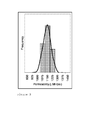
FIG. 5 is a graph of the water permeability distribution of a set of pleated cartridges in accordance with Example 1. - Membrane manufacturing processes inherently result in some variability in membrane properties even though materials and process conditions are kept as constant as possible. As a result, procedures have been instituted to classify or "rate" each batch or roll of membranes after manufacture, based on performance. For example, water permeability and throughput capacity tests are often carried out such as by constructing membrane devices using membranes from a given batch, measuring water permeability, and challenging the devices with a solution containing particles of a selected size and concentration to plug the membrane pores. Throughput capacity (volume filtered) within a specified time period, such as 10 minutes, or some flow reduction amount, such as 70% flow reduction, are measured, and relative capacity values are obtained. The membranes from the given batch are then performance rated based upon the results obtained. The performance of filtration media may also be similarly characterized. Filtration media is material that actively separates solids from a solution and/or binds select materials in solution. Types of filter media include: non-woven fabrics, activated carbon, activated clay, cellulose, ceramic, cotton, diatomaceous earth, glass fiber, ion exchange resins, metals, minerals, paper, nylon, sand, synthetic fiber, Teflon, polyethersulfone, polyester, polypropylene, polytetrafluoroethelyne, polyvinylidene fluoride, polyvinylidene chloride, and polysulfone.
- In certain embodiments of carrying out the methods disclosed herein, each batch of membranes or filtration media produced is characterized by performance, and a performance distribution is established. From that distribution, a small subset is selected for installation into scaling devices. By specifying only a narrow range of the distribution for scaling devices, the uncertainty in scaling from small scale to large scale devices (which by definition can contain any qualified membrane or filtration media) is minimized.
- For example, if only the middle third of the distribution is selected for small scale devices, as illustrated in
FIG. 3 , then the performance of the small scale device will range from 0.9 to 1.1. Since the large scale devices will range from 0.7 to 1.3, the scaling safety factor will be, (in accordance with equation (1), where Sh becomes the scaling device high end potential performance within the subset of the distribution, and Sl becomes the scaling device low end potential performance within the subset of the distribution), (1.3/0.9)/(0.7/1.1) = 2.3. In this example, this method results in about a 35% savings in scale-up sizing requirements compared to conventional random membrane selection used for scaling devices. -
FIG. 4 shows scaling safety factor as a function of small scale performance range for several levels of membrane variability. The current state of the art is defined by the upper end of each curve. The method disclosed herein allows for reduced scaling uncertainty as illustrated by the arrows inFIG. 4 . - In certain embodiments, the scalability safety factor can be minimized by determining where, within the performance distribution, the small scale device lies (using either a surrogate or actual performance qualification test, for example), and then adjusting the scaling factor to account for the specific portion of the distribution that the scaling device came from. In this approach, any membrane can be used in scaling devices. Information about membrane performance is collected and the information is then provided with the finished device. When the scaling device is evaluated, this membrane performance data is used in determining the scaling factor. For example, using the hypothetical distribution in
FIG. 1 , assume that a specific membrane has a performance value of 0.9. The scaling factor simply would be (0.9/0.7)=1.3. This factor represents the adjustment for the scaling device with respect to the low end of the full distribution. Since the performance range of the scaling device is well defined and known, Sh and Sl are the same, so equation (1) reduces to:
- The scaling factor uncertainty ratio in this case becomes 1.3/0.7, or 1.86, which represents a 46% reduction compared to uninformed membrane selection.
- A key performance parameter of sterilizing grade membrane filters is water permeability, which relates to the productivity of the device. Water permeability is measured by supplying water to the membrane, maintaining a pressure difference across the membrane, and measuring the water flow rate. Permeability is calculated according to the formula:

where Lp is water permeability, A is the membrane area, and ΔP is the pressure difference across the membrane. Water permeability is commonly expressed in units of L/(m2-hr-psi) or LMH/psi. - The water permeability was measured on a representative set of pleated cartridges each containing about 0.5 m2 of polyethersulfone membrane with a nominal pore size of 0.2 µm. A plot of the distribution is shown in
FIG. 5 . Water permeability ranged from about 1000 LMH/psi to about 1300 LMH/psi. A subset of the membranes contained in the entire population was selected for installation into small scale disc devices containing 0.0034 m2. The selected subset range was restricted to membranes with between about 1100 and 1200 LMH/psi, which constituted about half of the entire membrane population. In accordance with equation 1, the scaling factor uncertainty ratio using any membrane in the population (prior art method) is (1300/1000)*(1300/1000)= 1.69. Using the method of this invention, the scaling factor uncertainty ratio was reduced to (1300/1000)*(1200/1100) = 1.42, which represents a 16% improvement in scaling factor uncertainty and which translates directly to a proportionally smaller sized full size system compared to the prior art. - From the water permeability distribution of Example 1, a single membrane that had been characterized for water permeability was selected from the entire population of membranes. Since the water permeability of this membrane was known, equation 2 was applicable and the scaling factor uncertainty ratio was 1300/1000 = 1.3, represents a 23% improvement in scaling factor uncertainty compared to the prior art.
Claims (3)
- A method of reducing performance variability in a filtration scaling device used to estimate the requirements of a full scale filtration device, the method comprising:a. determining the performance distribution of a plurality of membranes or filtration media;b. selecting a subset of said distribution, said subset having a known range of performance with said distribution;c. inserting membrane or filtration media from said subset into said filtration scaling device; andd. assigning a scaling safety factor to said filtration scaling device, wherein said scaling factor is directly proportional to the product of the full scale device high end potential performance within said distribution and the scaling device high end potential performance within said subset of said distribution, and inversely proportional to the product of the scaling device low end potential performance within said subset of said distribution and the full scale device low end potential performance within said distribution.
- The method of claim 1, wherein said subset of membranes is a single membrane.
- The method of claim 1, wherein said scaling factor is the product of the full scale device high end potential performance within said distribution and the scaling device high end potential performance within said subset of said distribution, divided by the product of the scaling device low end potential performance within said subset of said distribution and the full scale device low end potential performance within said distribution.
Applications Claiming Priority (1)
| Application Number | Priority Date | Filing Date | Title |
|---|---|---|---|
| US27414209P | 2009-08-13 | 2009-08-13 |
Publications (1)
| Publication Number | Publication Date |
|---|---|
| EP2286901A1 true EP2286901A1 (en) | 2011-02-23 |
Family
ID=43037012
Family Applications (1)
| Application Number | Title | Priority Date | Filing Date |
|---|---|---|---|
| EP10171837A Ceased EP2286901A1 (en) | 2009-08-13 | 2010-08-04 | Method for improved scaling of filters |
Country Status (5)
| Country | Link |
|---|---|
| US (2) | US8387256B2 (en) |
| EP (1) | EP2286901A1 (en) |
| JP (1) | JP5138744B2 (en) |
| CN (2) | CN103432906B (en) |
| SG (2) | SG169279A1 (en) |
Families Citing this family (2)
| Publication number | Priority date | Publication date | Assignee | Title |
|---|---|---|---|---|
| US8387256B2 (en) * | 2009-08-13 | 2013-03-05 | Emd Millipore Corporation | Method for improved scaling of filters |
| CN109641167B (en) * | 2016-08-29 | 2021-05-25 | Emd密理博公司 | Fixed rigid wall device for filter elements with compact pleated configuration |
Citations (2)
| Publication number | Priority date | Publication date | Assignee | Title |
|---|---|---|---|---|
| US20050194317A1 (en) * | 2004-03-05 | 2005-09-08 | Norio Ikeyama | Filtration devices with embedded radio frequency identification (RFID) tags |
| EP2123348A1 (en) * | 2008-05-09 | 2009-11-25 | Millipore Corporation | Method for reducing performance variability of multi-layer filters |
Family Cites Families (12)
| Publication number | Priority date | Publication date | Assignee | Title |
|---|---|---|---|---|
| GB9102374D0 (en) * | 1991-02-04 | 1991-03-20 | Ici Plc | Polymeric film |
| DE4432627B4 (en) | 1994-09-14 | 2008-09-25 | Sartorius Stedim Biotech Gmbh | Filtration unit for the separation of substances with membrane adsorbers |
| DE4432628B4 (en) * | 1994-09-14 | 2008-01-10 | Sartorius Biotech Gmbh | Dead-end filtration unit for separating substances with membrane adsorbers |
| SE512540C2 (en) * | 1998-06-22 | 2000-04-03 | Umetri Ab | Method and apparatus for calibrating input data |
| AU2368300A (en) | 1998-12-17 | 2000-07-03 | Millipore Corporation | Hollow fiber separation module and methods for manufacturing same |
| JP2000218139A (en) * | 1999-01-28 | 2000-08-08 | Shinko Pantec Co Ltd | Membrane separation device, its performance prediction method, its performance prediction device, and recording medium |
| US7108791B2 (en) * | 1999-09-14 | 2006-09-19 | Millipore Corporation | High-resolution virus removal methodology and filtration capsule useful therefor |
| JP2005128788A (en) * | 2003-10-23 | 2005-05-19 | Hiromitsu Takahane | Separation membrane module simulation method, simulation apparatus, program, and computer-readable storage medium storing the program |
| US7587927B2 (en) * | 2006-11-14 | 2009-09-15 | Millipore Corporation | Rapid integrity testing of porous materials |
| JP4863488B2 (en) * | 2006-12-25 | 2012-01-25 | 独立行政法人産業技術総合研究所 | Method for identifying permeation pores |
| US7972493B2 (en) * | 2007-07-27 | 2011-07-05 | Gore Enterprise Holdings, Inc. | Filter wash for chloralkali process |
| US8387256B2 (en) * | 2009-08-13 | 2013-03-05 | Emd Millipore Corporation | Method for improved scaling of filters |
-
2010
- 2010-08-02 US US12/848,435 patent/US8387256B2/en active Active
- 2010-08-03 SG SG201005665-3A patent/SG169279A1/en unknown
- 2010-08-03 SG SG10201403185QA patent/SG10201403185QA/en unknown
- 2010-08-04 EP EP10171837A patent/EP2286901A1/en not_active Ceased
- 2010-08-10 JP JP2010179457A patent/JP5138744B2/en active Active
- 2010-08-12 CN CN201310186381.2A patent/CN103432906B/en active Active
- 2010-08-12 CN CN201010254453.9A patent/CN101992025B/en active Active
-
2013
- 2013-01-31 US US13/754,928 patent/US8904641B2/en active Active
Patent Citations (2)
| Publication number | Priority date | Publication date | Assignee | Title |
|---|---|---|---|---|
| US20050194317A1 (en) * | 2004-03-05 | 2005-09-08 | Norio Ikeyama | Filtration devices with embedded radio frequency identification (RFID) tags |
| EP2123348A1 (en) * | 2008-05-09 | 2009-11-25 | Millipore Corporation | Method for reducing performance variability of multi-layer filters |
Also Published As
| Publication number | Publication date |
|---|---|
| CN101992025A (en) | 2011-03-30 |
| CN103432906B (en) | 2015-11-18 |
| CN101992025B (en) | 2013-06-19 |
| JP5138744B2 (en) | 2013-02-06 |
| US20130140224A1 (en) | 2013-06-06 |
| US20110185552A1 (en) | 2011-08-04 |
| US8387256B2 (en) | 2013-03-05 |
| JP2011045876A (en) | 2011-03-10 |
| SG10201403185QA (en) | 2014-09-26 |
| CN103432906A (en) | 2013-12-11 |
| US8904641B2 (en) | 2014-12-09 |
| SG169279A1 (en) | 2011-03-30 |
Similar Documents
| Publication | Publication Date | Title |
|---|---|---|
| EP0814887B1 (en) | Filtration monitoring and control system | |
| Koĺtuniewicz et al. | Process factors during removal of oil-in-water emulsions with cross-flow microfiltration | |
| DE60004021T2 (en) | METHOD AND DEVICE FOR TESTING MEMBRANE FILTERS | |
| US6077435A (en) | Filtration monitoring and control system | |
| Salinas-Rodriguez et al. | The Modified Fouling Index Ultrafiltration constant flux for assessing particulate/colloidal fouling of RO systems | |
| Grenier et al. | Analysing flux decline in dead-end filtration | |
| Diez et al. | A modified method for evaluation of critical flux, fouling rate and in situ determination of resistance and compressibility in MBR under different fouling conditions | |
| Choong et al. | Separation of oil-in-water emulsions using electrospun fiber membranes and modeling of the fouling mechanism | |
| Al-Maas et al. | Validation and application of a membrane filtration evaluation protocol for oil-water separation | |
| WO2011153625A2 (en) | Method for fluorescence-based fouling forecasting and optimization in membrane filtration operations | |
| Alhadidi et al. | Silt density index and modified fouling index relation, and effect of pressure, temperature and membrane resistance | |
| EP2933011B1 (en) | Filtration membrane fouling index measuring methods | |
| US8904641B2 (en) | Method for improved scaling of filters | |
| Hashimoto et al. | 3D modeling of PVDF membrane aging using scanning electron microscope and OpenCV image analysis | |
| KR20130098812A (en) | Method for prediction and diagnosis of membrane fouling using combined-mechanistic fouling model and system thereof | |
| EP4200063A1 (en) | Monitoring the integrity of an ultrafiltration membrane during filter operation | |
| KR100922140B1 (en) | Method of filtering a fluid, method of controlling a filtration process, and method of obtaining a standard set of measuring data from a substantially unfoulded filter | |
| Wakeman | Filter media: Testing for liquid filtration | |
| KR100877499B1 (en) | Estimation Method of Stabilization Filtration Flow Rate | |
| EP3056259B1 (en) | Device for measuring membrane fouling index | |
| EP1479426A1 (en) | Filter device and method for indicating the condition of the filter element | |
| Salinas-Rodriguez et al. | Particulate fouling | |
| Iritani et al. | Analysis of clogging behaviors of diatomaceous ceramic membranes during membrane filtration based upon specific deposit | |
| Ponomarev et al. | Polypropylene multilayer melt-blown cartridge: the universal particles remover for liquids filtration | |
| Vigneswaran | Cartridge Filtration |
Legal Events
| Date | Code | Title | Description |
|---|---|---|---|
| PUAI | Public reference made under article 153(3) epc to a published international application that has entered the european phase |
Free format text: ORIGINAL CODE: 0009012 |
|
| AK | Designated contracting states |
Kind code of ref document: A1 Designated state(s): AL AT BE BG CH CY CZ DE DK EE ES FI FR GB GR HR HU IE IS IT LI LT LU LV MC MK MT NL NO PL PT RO SE SI SK SM TR |
|
| AX | Request for extension of the european patent |
Extension state: BA ME RS |
|
| 17P | Request for examination filed |
Effective date: 20110823 |
|
| RAP1 | Party data changed (applicant data changed or rights of an application transferred) |
Owner name: EMD MILLIPORE CORPORATION |
|
| 17Q | First examination report despatched |
Effective date: 20160405 |
|
| APBK | Appeal reference recorded |
Free format text: ORIGINAL CODE: EPIDOSNREFNE |
|
| APBN | Date of receipt of notice of appeal recorded |
Free format text: ORIGINAL CODE: EPIDOSNNOA2E |
|
| APBR | Date of receipt of statement of grounds of appeal recorded |
Free format text: ORIGINAL CODE: EPIDOSNNOA3E |
|
| APAF | Appeal reference modified |
Free format text: ORIGINAL CODE: EPIDOSCREFNE |
|
| RAP1 | Party data changed (applicant data changed or rights of an application transferred) |
Owner name: EMD MILLIPORE CORPORATION |
|
| APBT | Appeal procedure closed |
Free format text: ORIGINAL CODE: EPIDOSNNOA9E |
|
| STAA | Information on the status of an ep patent application or granted ep patent |
Free format text: STATUS: THE APPLICATION HAS BEEN REFUSED |
|
| 18R | Application refused |
Effective date: 20200707 |