EP2285946B1 - Cleaning compositions incorporating green solvents and methods for use - Google Patents
Cleaning compositions incorporating green solvents and methods for use Download PDFInfo
- Publication number
- EP2285946B1 EP2285946B1 EP09743083.9A EP09743083A EP2285946B1 EP 2285946 B1 EP2285946 B1 EP 2285946B1 EP 09743083 A EP09743083 A EP 09743083A EP 2285946 B1 EP2285946 B1 EP 2285946B1
- Authority
- EP
- European Patent Office
- Prior art keywords
- blend
- composition
- cleaning composition
- weight
- cleaning
- Prior art date
- Legal status (The legal status is an assumption and is not a legal conclusion. Google has not performed a legal analysis and makes no representation as to the accuracy of the status listed.)
- Active
Links
- 0 CC(CCC(O*)=O)C(ON)=O Chemical compound CC(CCC(O*)=O)C(ON)=O 0.000 description 4
Images


Classifications
-
- C—CHEMISTRY; METALLURGY
- C11—ANIMAL OR VEGETABLE OILS, FATS, FATTY SUBSTANCES OR WAXES; FATTY ACIDS THEREFROM; DETERGENTS; CANDLES
- C11D—DETERGENT COMPOSITIONS; USE OF SINGLE SUBSTANCES AS DETERGENTS; SOAP OR SOAP-MAKING; RESIN SOAPS; RECOVERY OF GLYCEROL
- C11D3/00—Other compounding ingredients of detergent compositions covered in group C11D1/00
- C11D3/16—Organic compounds
- C11D3/20—Organic compounds containing oxygen
- C11D3/2093—Esters; Carbonates
-
- C—CHEMISTRY; METALLURGY
- C11—ANIMAL OR VEGETABLE OILS, FATS, FATTY SUBSTANCES OR WAXES; FATTY ACIDS THEREFROM; DETERGENTS; CANDLES
- C11D—DETERGENT COMPOSITIONS; USE OF SINGLE SUBSTANCES AS DETERGENTS; SOAP OR SOAP-MAKING; RESIN SOAPS; RECOVERY OF GLYCEROL
- C11D3/00—Other compounding ingredients of detergent compositions covered in group C11D1/00
- C11D3/16—Organic compounds
- C11D3/20—Organic compounds containing oxygen
-
- C—CHEMISTRY; METALLURGY
- C08—ORGANIC MACROMOLECULAR COMPOUNDS; THEIR PREPARATION OR CHEMICAL WORKING-UP; COMPOSITIONS BASED THEREON
- C08G—MACROMOLECULAR COMPOUNDS OBTAINED OTHERWISE THAN BY REACTIONS ONLY INVOLVING UNSATURATED CARBON-TO-CARBON BONDS
- C08G65/00—Macromolecular compounds obtained by reactions forming an ether link in the main chain of the macromolecule
- C08G65/02—Macromolecular compounds obtained by reactions forming an ether link in the main chain of the macromolecule from cyclic ethers by opening of the heterocyclic ring
- C08G65/32—Polymers modified by chemical after-treatment
- C08G65/329—Polymers modified by chemical after-treatment with organic compounds
- C08G65/331—Polymers modified by chemical after-treatment with organic compounds containing oxygen
- C08G65/3311—Polymers modified by chemical after-treatment with organic compounds containing oxygen containing a hydroxy group
- C08G65/3314—Polymers modified by chemical after-treatment with organic compounds containing oxygen containing a hydroxy group cyclic
-
- C—CHEMISTRY; METALLURGY
- C08—ORGANIC MACROMOLECULAR COMPOUNDS; THEIR PREPARATION OR CHEMICAL WORKING-UP; COMPOSITIONS BASED THEREON
- C08L—COMPOSITIONS OF MACROMOLECULAR COMPOUNDS
- C08L71/00—Compositions of polyethers obtained by reactions forming an ether link in the main chain; Compositions of derivatives of such polymers
- C08L71/02—Polyalkylene oxides
-
- C—CHEMISTRY; METALLURGY
- C09—DYES; PAINTS; POLISHES; NATURAL RESINS; ADHESIVES; COMPOSITIONS NOT OTHERWISE PROVIDED FOR; APPLICATIONS OF MATERIALS NOT OTHERWISE PROVIDED FOR
- C09D—COATING COMPOSITIONS, e.g. PAINTS, VARNISHES OR LACQUERS; FILLING PASTES; CHEMICAL PAINT OR INK REMOVERS; INKS; CORRECTING FLUIDS; WOODSTAINS; PASTES OR SOLIDS FOR COLOURING OR PRINTING; USE OF MATERIALS THEREFOR
- C09D9/00—Chemical paint or ink removers
- C09D9/005—Chemical paint or ink removers containing organic solvents
-
- C—CHEMISTRY; METALLURGY
- C11—ANIMAL OR VEGETABLE OILS, FATS, FATTY SUBSTANCES OR WAXES; FATTY ACIDS THEREFROM; DETERGENTS; CANDLES
- C11D—DETERGENT COMPOSITIONS; USE OF SINGLE SUBSTANCES AS DETERGENTS; SOAP OR SOAP-MAKING; RESIN SOAPS; RECOVERY OF GLYCEROL
- C11D1/00—Detergent compositions based essentially on surface-active compounds; Use of these compounds as a detergent
- C11D1/66—Non-ionic compounds
- C11D1/72—Ethers of polyoxyalkylene glycols
-
- C—CHEMISTRY; METALLURGY
- C11—ANIMAL OR VEGETABLE OILS, FATS, FATTY SUBSTANCES OR WAXES; FATTY ACIDS THEREFROM; DETERGENTS; CANDLES
- C11D—DETERGENT COMPOSITIONS; USE OF SINGLE SUBSTANCES AS DETERGENTS; SOAP OR SOAP-MAKING; RESIN SOAPS; RECOVERY OF GLYCEROL
- C11D1/00—Detergent compositions based essentially on surface-active compounds; Use of these compounds as a detergent
- C11D1/86—Mixtures of anionic, cationic, and non-ionic compounds
-
- C—CHEMISTRY; METALLURGY
- C11—ANIMAL OR VEGETABLE OILS, FATS, FATTY SUBSTANCES OR WAXES; FATTY ACIDS THEREFROM; DETERGENTS; CANDLES
- C11D—DETERGENT COMPOSITIONS; USE OF SINGLE SUBSTANCES AS DETERGENTS; SOAP OR SOAP-MAKING; RESIN SOAPS; RECOVERY OF GLYCEROL
- C11D17/00—Detergent materials or soaps characterised by their shape or physical properties
-
- C—CHEMISTRY; METALLURGY
- C11—ANIMAL OR VEGETABLE OILS, FATS, FATTY SUBSTANCES OR WAXES; FATTY ACIDS THEREFROM; DETERGENTS; CANDLES
- C11D—DETERGENT COMPOSITIONS; USE OF SINGLE SUBSTANCES AS DETERGENTS; SOAP OR SOAP-MAKING; RESIN SOAPS; RECOVERY OF GLYCEROL
- C11D3/00—Other compounding ingredients of detergent compositions covered in group C11D1/00
- C11D3/43—Solvents
-
- C—CHEMISTRY; METALLURGY
- C11—ANIMAL OR VEGETABLE OILS, FATS, FATTY SUBSTANCES OR WAXES; FATTY ACIDS THEREFROM; DETERGENTS; CANDLES
- C11D—DETERGENT COMPOSITIONS; USE OF SINGLE SUBSTANCES AS DETERGENTS; SOAP OR SOAP-MAKING; RESIN SOAPS; RECOVERY OF GLYCEROL
- C11D2111/00—Cleaning compositions characterised by the objects to be cleaned; Cleaning compositions characterised by non-standard cleaning or washing processes
- C11D2111/10—Objects to be cleaned
- C11D2111/12—Soft surfaces, e.g. textile
-
- C—CHEMISTRY; METALLURGY
- C11—ANIMAL OR VEGETABLE OILS, FATS, FATTY SUBSTANCES OR WAXES; FATTY ACIDS THEREFROM; DETERGENTS; CANDLES
- C11D—DETERGENT COMPOSITIONS; USE OF SINGLE SUBSTANCES AS DETERGENTS; SOAP OR SOAP-MAKING; RESIN SOAPS; RECOVERY OF GLYCEROL
- C11D2111/00—Cleaning compositions characterised by the objects to be cleaned; Cleaning compositions characterised by non-standard cleaning or washing processes
- C11D2111/10—Objects to be cleaned
- C11D2111/14—Hard surfaces
Definitions
- This invention relates to cleaning compositions that are environmentally friendly, biodegradable, non-toxic and non-flammable with low odor, low vapor pressure and low volatile organic compound (VOC) content and, more particularly, cleaning compositions utilized for multiple consumer and industrial applications.
- VOC volatile organic compound
- VOCs volatile organic compounds
- many cleaning solutions contain high VOC solvents include toluene, xylene, methyl ethyl ketone, glycol ethers, tetrachloroethylene, methyl isobutyl ketone, methanol, 1,1,1-trichloroethane, dichloromethane and ethylene glycol.
- Many ink cleaning compositions contain aromatic groups that are in many cases toxic and are not environmentally friendly in that they do not biodegrade well. Often these solvents will be low vapor pressure solvents with low flashpoints that are also extremely flammable. Such compositions are undesirable in light of the increased awareness for human exposure to toxic materials and the demand for environmentally friendly, non-toxic solvents. However, the drawbacks in utilizing these solvents have not diminished their use.
- cleaners As another example with respect to surface (e.g., painted surface) cleaners, most commercially available cleaners contain hazardous or aggressive solvents that can remove some stains, but pose health hazards, fire hazards and/or have strong odors. For example, many solvents use aromatic-based compounds such as toluene, xylene, or are glycol ether-based solvents or chlorinated solvents. The use of these and related solvents is also not desirable because of the potential pollution and environmental problems associated with the disposal of such solvents. In addition, cleaners containing aggressive solvents also damages the underlying substrates that are being treated, such as painted surfaces, wood, carpet, and the like. Accordingly, there is an increasing consumer demand for environmentally friendly, biodegradable cleaning products.
- many commercially available graffiti cleaners contain high VOC components. Graffiti includes spray paint, marker and the like. Permanent markers are used on many substrates such as paper, writing boards, plastic panels, etc. It is, however, very difficult to completely remove permanent marker from many of these substrates, in particular plastic substrates. Generally, there is currently no satisfactory environmentally friendly cleaner for removing permanent marking pen from these substrate surfaces. Most of the commercially available "eco-friendly" cleaners are generally formulated for cleaning house-hold stains such as pen, crayons, pencils, lipsticks, washable marker and the like, but are not strong enough for hard-to-clean stains such as permanent marker and the like.
- cleaners can clean most of the permanent ink from the substrate, in most cases there remains some visible markings on the substrates.
- other cleaners contain hazardous or aggressive solvents such as NMP (N-methyl pyrrolidinone). These kinds of cleaners may pose health hazards, fire hazards and have strong odors. It is also possible that aggressive formulation may permanently damage the applied-upon substrates.
- WO 2009/013208 published on 29.01.2009 discloses the use of carboxylic acid diesters for cleaning paint stains on textile fibres in order to improve cleaning performance.
- a cleaning composition comprising: (a) from 1% to 60% by weight of the composition of a blend of dibasic esters comprising (i) a dialkyl methylglutarate and (ii) at least one of a dialkyl adipate or a dialkyl ethylsuccinate; (b) from 1% to 35% by weight of the composition of an alcohol ethoxylate; and (c) from 0.1% to 12% by weight of the composition of a terpene, terpene EO/PO, pinene, d-limonene, dipentene, oc-pinene, and any combination thereof, wherein the cleaning composition is used for an industrial or a consumer application selected from the group consisting of a graffiti cleaner, a painted-substrate cleaner, an ink cleaner, a metal substrate cleaner, a plastic substrate cleaner, a stain-spot cleaner, a hand cleaner, a resin
- the cleaning composition may optionally, comprise additional components and/or water.
- the dibasic esters can be derived from adipic, glutaric, and succinic diacids, or isomers thereof.
- the dibasic ester blend is comprised of a mixture dialkyl methylglutarate, dialkyl ethylsuccinate and dialkyl adipate, where the alkyl groups individually comprise C 1 -C 12 hydrocarbon groups.
- the present invention is a cleaning composition
- a cleaning composition comprising (a) a blend of dibasic esters comprising from 1% to 60% by weight of the composition of a blend of dibasic esters comprising (i) a dialkyl methylglutarate and (ii) at least one of a dialkyl adipate or a dialkyl ethylsuccinate, typically a mixture of dialkyl adipate, dialkyl methylglutarate and dialkyl ethylsuccinate, where the alkyl groups individually comprise C 1 -C 12 hydrocarbon groups; (b) from 1% to 35% by weight of the composition of an alcohol ethoxylate; and (c) from 0.1% to 12% by weight of the composition of a terpene, terpene EO/PO, pinene, d-limonene, dipentene, oc-pinene, and any combination thereof, wherein the cleaning composition is used for industrial or consumer applications including a graffiti cleaner,
- the cleaning composition of the present invention has desirable qualities including one or a combination of being: substantially non-toxic, non-flammable, biodegradable, high flash point, low vapor pressure and low odor; meets the consumer products LVP-VOC exemption criteria established by CARB and the EPA (certain sections).
- the cleaning composition further comprises 1% to 12% by weight d-limonene.
- the cleaning composition of the present invention can be used in a variety of consumer and/or industrial applications.
- the present invention is a cleaning composition in the form of a microemulsion comprising: from 1% to 60% by weight the blend of dibasic esters; as defined in claim 1; from 1% to 35% by weight alcohol ethoxylate; from 0.1 % to 12% by weight of the composition of a terpene, terpene EO/PO, pinene, d-limonene, dipentene, oc-pinene, and any combination thereof; and, optionally, water; more typically, from 5% to 40% by weight of the blend of dibasic esters.
- the cleaning composition microemulsion further comprises 1% to 12% by weight a terpene, terpene EO/PO, pinene or derivative thereof.
- additives such as fragrances and solubilizers, pH adjusting agents, whiteners, delaminates, opacifying agent, anticorrosion agents, anti-foaming agents, coloring agents, stabilizers and thickeners can be added.
- the cleaning composition of the present invention is typically in form of a microemulsion and provided as a liquid or spray formulation for use, depending upon the application.
- the present invention comprises a nonionic surfactant, namely an alcohol ethoxylate. More typically, the surfactant is a C 7 -C 12 alcohol ethoxylate, e.g., Rhodasurf 91-6 surfactant manufactured by Rhodia Inc. (Cranbury, NJ), and most typically, the surfactant is a C 9 -C 11 linear alcohol ethoxylate.
- the present invention can comprise additional surfactants which can be any number of amphoteric, cationic, anionic or nonionic surfactants or a blend of surfactants. In one embodiment, the additional surfactant is a nonionic surfactant, typically, an alkyl phenol ethoxylate or a terpene alkoxylate.
- the present invention is an industrial and/or consumer cleaning composition
- an industrial and/or consumer cleaning composition comprising: (a) from 1% to 55%, by weight of the cleaning composition, a blend of dibasic esters, wherein the blend comprises:
- the invention is a method of cleaning a coated surface comprising:
- the cleaning composition of the present invention is environmentally friendly, with a high flash point, low vapor pressure and low odor; it falls under the consumer products LVP-VOC exemption criteria established by CARB and the EPA (certain sections).
- the cleaning formulation of the present invention has environmentally friendly characteristics including but not limited to being non toxic, bio-degradable, non-flammable and the like.
- alkyl means a saturated straight chain, branched chain, or cyclic hydrocarbon radical, including but not limited to, methyl, ethyl, n-propyl, iso-propyl, n-butyl, sec-butyl, t-butyl, pentyl, n-hexyl, and cyclohexyl.
- aryl means a monovalent unsaturated hydrocarbon radical containing one or more six-membered carbon rings in which the unsaturation may be represented by three conjugated double bonds, which may be substituted one or more of carbons of the ring with hydroxy, alkyl, alkenyl, halo, haloalkyl, or amino, including but not limited to, phenoxy, phenyl, methylphenyl, dimethylphenyl, trimethylphenyl, chlorophenyl, trichloromethylphenyl, aminophenyl, and tristyrylphenyl.
- alkylene means a divalent saturated straight or branched chain hydrocarbon radical, such as for example, methylene, dimethylene, trimethylene.
- surfactant means a compound that when dissolved in an aqueous medium lowers the surface tension of the aqueous medium.
- the present invention is a cleaning composition
- a cleaning composition comprising a blend of dibasic esters as defined in claim 1.
- the blend comprises adducts of alcohol and diacids, the adducts having the formula R1-OOC-A-COO-R2 wherein R1 and/or R2 comprise, individually, a C1-C12 alkyl, more typically a C1-C8 alkyl, and A comprises a mixture of-(CH2)4-, -CH2CH2CH(CH3)-, and -CH2CH(C2H5)-.
- R1 and/or R2 comprise, individually, a C4-C12 alkyl, more typically a C4-C8 alkyl.
- One or more dibasic esters used in the present invention can be prepared by any appropriate process.
- a process for preparing the adduct of adipic acid and of fusel oil is, for example, described in the document " The Use of Egyptian Fusel Oil for the Preparation of Some Plasticizers Compatible with Polyvinyl Chloride", Chuiba et al., Indian Journal of Technology, Vol. 23, August 1985, pp. 309-311 .
- the dibasic esters of the present invention can be obtained by a process comprising an "esterification" stage by reaction of a diacid of formula HOOC-A-COOH or of a diester of formula MeOOC-A-COOMe with a branched alcohol or a mixture of alcohols.
- the reactions can be appropriately catalyzed. Use is preferably made of at least 2 molar equivalents of alcohols per diacid or diester.
- the reactions can, if appropriate, be promoted by extraction of the reaction by-products and followed by stages of filtration and/or of purification, for example by distillation.
- the diacids in the form of mixtures can in particular be obtained from a mixture of dinitrile compounds in particular produced and recovered in the process for the manufacture of adiponitrile by double hydrocyanation of butadiene.
- This process used on a large scale industrially to produce the greater majority of the adiponitrile consumed worldwide, is described in numerous patents and works.
- the reaction for the hydrocyanation of butadiene results predominantly in the formulation of linear dinitriles but also in formation of branched dinitriles, the two main ones of which are methylglutaronitrile and ethylsuccinonitrile.
- the branched dinitrile compounds are separated by distillation and recovered, for example, as top fraction in a distillation column, in the stages for separation and purification of the adiponitrile.
- the branched dinitriles can subsequently be converted to diacids or diesters (either to light diesters, for a subsequent transesterification reaction with the alcohol or the mixture of alcohols or the fusel oil, or directly to diesters in accordance with the invention).
- Dibasic esters of the present invention may be derived from one or more by-products in the production of polyamide, for example, polyamide 6,6.
- the cleaning composition comprises a blend of linear or branched, cyclic or noncyclic, C 1 -C 20 dialkyl esters of adipic diacids, methylglutaric diacids, and ethylsuccinic diacids
- polyamide is a copolymer prepared by a condensation reaction formed by reacting a diamine and a dicarboxylic acid.
- polyamide 6,6 is a copolymer prepared by a condensation reaction formed by reacting a diamine, typically hexamethylenediamine, with a dicarboxylic acid, typically adipic acid.
- the blend of esters is derived from by-products in the reaction, synthesis and/or production of hexamethylenediamine utilized in the production of polyamide, typically polyamide 6,6.
- the cleaning composition comprises a blend of dialkyl esters of adipic diacids, methylglutaric diacids, and ethylsuccinic diacids (herein referred to sometimes as "MGN", “MGN blend”).
- the boiling point of the dibasic ester blend of the present invention is between the range of 120°C to 450°C.
- the boiling point of the blend of the present invention is in the range of 160°C to 400°C; in one embodiment, the range is 210°C to 290°C; in another embodiment, the range is 210°C to 245°C; in another embodiment, the range is the range is 215°C to 225°C.
- the boiling point range of the blend of the present invention is between 210°C to 390°C, more typically in the range of 280°C to 390°C, more typically in the range of 295°C to 390°C.
- boiling point of the blend of the present invention is in the range of 215°C to 400°C, typically in the range of 220°C to 350°C.
- the blend of dibasic esters has a boiling point range of between 300°C and 330°C. Generally, a higher boiling point, typically, above 215°C, or high boiling point range corresponds to lower VOC.
- the dibasic esters or blend of dibasic esters are incorporated into a cleaning composition of the present invention which, in one embodiment, comprises (a) from 1% to 60% by weight of the compositiona blend of dialkyl esters of adipic, methylglutaric, and ethylsuccinic diacids; (b) from 1% to 35% by weight of the composition of an alcohol ethoxylate; (c) from 0.1% to 12% by weight of the composition of a terpene, terpene EO/PO, pinene, d-limonene, dipentene, oc-pinene, and any combination thereof; and, optionally, water or a solvent. Additional components may be added.
- the present invention may further comprise additional surfactants, which can be any number of cationic, amphoteric, zwitterionic, anionic or nonionic surfactants, derivatives thereof, as well as blends of such surfactants.
- the additional nonionic surfactants generally includes one or more of for example amides such as alkanolamides, ethoxylated alkanolamides, ethylene bisamides; esters such as fatty acid esters, glycerol esters, ethoxylated fatty acid esters, sorbitan esters, ethoxylated sorbitan; ethoxylates such as alkylphenol ethoxylates, tristyrylphenol ethoxylates, mercaptan ethoxylates; end-capped and EO/PO block copolymers such as ethylene oxide/propylene oxide block copolymers, chlorine capped ethoxylates, tetra-functional block copolymers; amine oxides such lauramine oxide, cocamine oxide, stearamine oxide, stearamidopropylamine oxide, palmitamidopropylamine oxide, decylamine oxide; fatty alcohols such as decyl alcohol
- the additional non-ionic surfactant is a glycol such as polyethylene glycol (PEG), alkyl PEG esters, polypropylene glycol (PPG) and derivatives thereof.
- the surfactant is an alkyl phenol ethoxylate or a terpene alkoxylate.
- the cleaning composition of the present invention comprises an alcohol ethoxylate.
- the alcohol ethoxylate is a C 6 -C 13 alcohol ethoxylate and, more typically, a C 8 -C 12 alcohol ethoxylate.
- the additional surfactant is a cationic surfactant.
- the cationic surfactant includes but is not limited to quaternary ammonium compounds, such as cetyl trimethyl ammonium bromide (also known as CETAB or cetrimonium bromide), cetyl trimethyl ammonium chloride (also known as cetrimonium chloride), myristyl trimethyl ammonium bromide (also known as myrtrimonium bromide or Quaternium-13), stearyl dimethyl distearyldimonium chloride, dicetyl dimonium chloride, stearyl octyldimonium methosulfate, dihydrogenated palmoylethyl hydroxyethylmonium methosulfate, isostearyl benzylimidonium chloride, cocoyl benzyl hydroxyethyl imidazolinium chloride, dicetyl dimonium chloride and distearyldimonium chloride; iso
- the additional surfactant is an anionic surfactant.
- the anionic surfactant includes but is not limited to linear alkylbenzene sulfonates, alpha olefin sulfonates, paraffin sulfonates, alkyl ester sulfonates, alkyl sulfates, alkyl alkoxy sulfates, alkyl sulfonates, alkyl alkoxy carboxylates, alkyl alkoxylated sulfates, monoalkyl phosphates, dialkyl phosphates, sarcosinates, sulfosuccinates, isethionates, and taurates, as well as mixtures thereof.
- anionic surfactants that are suitable as the anionic surfactant component of the composition of the present invention include, for example, ammonium lauryl sulfate, ammonium laureth sulfate, triethylamine lauryl sulfate, triethylamine laureth sulfate, triethanolamine lauryl sulfate, triethanolamine laureth sulfate, monoethanolamine lauryl sulfate, monoethanolamine laureth sulfate, diethanolamine lauryl sulfate, diethanolamine laureth sulfate, lauric monoglyceride sodium sulfate, sodium lauryl sulfate, sodium laureth sulfate, potassium lauryl sulfate, potassium laureth sulfate, sodium-monoalkyl phosphates, sodium dialkyl phosphates, sodium lauroyl sarcosinate, lauroyl sarcosine
- Branched anionic surfactants are particularly preferred, such as sodium trideceth sulfate, sodium tridecyl sulfate, ammonium trideceth sulfate, ammonium tridecyl sulfate, and sodium trideceth carboxylate.
- amphoteric surfactant that is acceptable for use includes but is not limited to derivatives of aliphatic secondary and tertiary amines in which the aliphatic radical can be straight chain or branched and wherein one of the aliphatic substituents contains from about 8 to about 18 carbon atoms and one contains an anionic water solubilizing group.
- amphoteric surfactants include the alkali metal, alkaline earth metal, ammonium or substituted ammonium salts of alkyl amphocarboxy glycinates and alkyl amphocarboxypropionates, alkyl amphodipropionates, alkyl amphodiacetates, alkyl amphoglycinates, and alkyl amphopropionates, as well as alkyl iminopropionates, alkyl iminodipropionates, and alkyl amphopropylsulfonates , such as for example, cocoamphoacetate cocoamphopropionate, cocoamphodiacetate, lauroamphoacetate, lauroamphodiacetate , lauroamphodipropionate, lauroamphodiacetate, cocoamphopropyl sulfonate caproamphodiacetate, caproamphoacetate, caproamphodipropionate, and stearoamphoacetate.
- Suitable zwitterionic surfactants include alkyl betaines, such as cocodimethyl carboxymethyl betaine, lauryl dimethyl carboxymethyl betaine, lauryl dimethyl alpha-carboxyethyl betaine, cetyl dimethyl carboxymethyl betaine, lauryl bis-(2-hydroxy-ethyl)carboxy methyl betaine, stearyl bis-(2-hydroxy-propyl)carboxymethyl betaine, oleyl dimethyl gamma-carboxypropyl betaine, and lauryl bis-(2-hydroxypropyl)alpha-carboxyethyl betaine, amidopropyl betaines, and alkyl sultaines, such as cocodimethyl sulfopropyl betaine, stearyldimethyl sulfopropyl betaine, lauryl dimethyl sulfoethyl betaine, lauryl bis-(2-hydroxy-ethyl)sulfopropyl betaine,
- the cleaning composition is a microemulsion comprising (a) a blend of 70-90% dialkyl dimethylglutarate, 5-30% dialkyl ethylsuccinate and 0-10% dialkyl adipate; (b) a surfactant composition comprising an alcohol alkoxylate; (c) a delaminate selected from a terpene, terpene EO/PO, pinene, d-limonene, dipentene, oc-pinene, and any combination thereof; and (d) water.
- one or more additives or additional components such as delaminating agents, buffering and/or pH control agents, fragrances, opacifying agents, anticorrosion agents, whiteners, defoamers, dyes, sudsing control agents, stabilizers, thickeners and the like can be added to the composition.
- microemulsions are generally thermodynamically stable systems generally comprising large amounts of emulsifiers.
- the other emulsions are generally systems in thermodynamically unstable state, conserving for a certain time, in metastable state, the mechanical energy supplied during the emulsification. These systems generally comprise smaller amounts of emulsifiers.
- the microemulsion of the present invention is an emulsion whose mean droplet size is generally less than or equal to 0.15 ⁇ m.
- the size of the microemulsion droplets may be measured by dynamic light scattering (DQEL), for example as described below.
- the apparatus used consists, for example, of a Spectra-Physics 2020 laser, a Brookhaven 2030 correlator and the associated computer-based equipment. If the sample is concentrated, it may be diluted in deionized water and filtered through a 0.22 ⁇ m filter to have a final concentration of 2% by weight. The diameter obtained is an apparent diameter. The measurements are taken at angles of 90° and 135°.
- the microemulsion is transparent.
- the microemulsion may have, for example, a transmittance of at least 90% and preferably of at least 95% at a wavelength of 600 nm, for example measured using a Lambda 40 UV-visible spectrometer.
- the emulsion is an emulsion whose mean droplet size is greater than or equal to 0.15 ⁇ m, for example greater than 0.5 ⁇ m, or 1 ⁇ m, or 2 ⁇ m, or 10 ⁇ m, or 20 ⁇ m, and preferably less than 100 ⁇ m.
- the droplet size may be measured by optical microscopy and/or laser granulometry (Horiba LA-910 laser scattering analyzer).
- the dibasic ester blend comprises:
- R 1 and/or R 2 can individually comprise a hydrocarbon having from 1 to 8 carbon atoms, typically, methyl, ethyl, propyl, isopropyl, butyl, isobutyl, n-butyl, isoamyl, hexyl, heptyl, or octyl.
- the blend typically comprises (by weight of the blend) (i) from 5% to 30% of the diester of formula IV, (ii) from 70% to 95% of the diester of formula V, and (iii) from 0% to 10% of the diester of formula VI.
- the blend typically comprises (by weight of the blend): (i) from 6% to 12% of the diester of formula IV, (ii) from 86% to 92% of the diester of formula V, and (iii) from 0.5% to 4% of the diester of formula VI.
- the blend comprises (by weight of the blend): (i) 9% of the diester of formula IV, (ii) 89% of the diester of formula V, and (iii) 1% of the diester of formula VI.
- the blend is generally characterized by a flash point of of 98 °C, a vapor pressure at 20 °C of less than 10 Pa, and a distillation temperature range of 200-275 °C. Mention may be made of Rhodiasolv® IRIS and Rhodiasolv® DEE/M, manufactured by Rhodia Inc. (manufactured by Rhodia Inc., Cranbury, NJ)
- water can include but is not limited to tap water, filtered water, bottled water, spring water, distilled water, deionized water, and/or industrial soft water.
- the solvent can include organic or nonorganic solvents, including but not limited to aliphatic or acyclic hydrocarbons solvents, halogenated solvents, aromatic hydrocarbon solvents, glycol ether, a cyclic terpene, unsaturated hydrocarbon solvents, halocarbon solvents, polyols, ethers, esters of a glycol ether, alcohols including short chain alcohols, ketones or mixtures thereof.
- organic or nonorganic solvents including but not limited to aliphatic or acyclic hydrocarbons solvents, halogenated solvents, aromatic hydrocarbon solvents, glycol ether, a cyclic terpene, unsaturated hydrocarbon solvents, halocarbon solvents, polyols, ethers, esters of a glycol ether, alcohols including short chain alcohols, ketones or mixtures thereof.
- nonionic surfactants include but are not limited to polyalkoxylated surfactants, for example chosen from alkoxylated alcohols, alkoxylated fatty alcohols, alkoxylated triglycerides, alkoxylated fatty acids, alkoxylated sorbitan esters, alkoxylated fatty amines, alkoxylated bis(1-phenylethyl)phenols, alkoxylated tris(1-phenylethyl)phenols and alkoxylated alkylphenols, in which the number of alkoxy and more particularly oxyethylene and/or oxypropylene units is such that the HLB value is greater than or equal to 10. More typically, the nonionic surfactant can be selected from the group consisting of ethylene oxide/propylene oxide copolymers, terpene alkoxylates, alkyl phenol ethoxylates and combinations thereof.
- the cleaning composition of the present invention comprises an alcohol ethoxylate.
- the alcohol ethoxylates used in connection with the present invention have the formula:
- R 7 is a hydrocarbon chain containing 5 to 25 carbon atoms, more typically from 7 to 14 carbon atoms, most typically, from 8 to 13 carbon atoms, and may be branched or straight-chained and saturated or unsaturated and is selected from the group consisting of alkyl, alkoxy, aryl, alkaryl, alkylarylalkyl and arylalkyl.
- "n" is an integer from 1 to 30, more typically an integer from 2 to about 20, and most typically an integer from 3 to 12.
- the alcohol ethoxylate is sold under the trade name Rhodasurf 91-6 (manufactured by Rhodia Inc., Cranbury, NJ).
- surfactants used in the present invention are non-ionic surfactants including but not limited to: polyoxyalkylenated C 6 -C 24 aliphatic alcohols comprising from 2 to 50 oxyalkylene (oxyethylene and/or oxypropylene) units, in particular of those with 12 (mean) carbon atoms or with 18 (mean) carbon atoms; mention may be made of Antarox B12DF, Antarox FM33, Antarox FM63 and Antarox V74, Rhodasurf ID 060, Rhodasurf ID 070 and Rhodasurf LA 42 from (Rhodia Inc., Cranbury, NJ), as well as polyoxyalkylenated C 8 -C 22 aliphatic alcohols containing from 1 to 25 oxyalkylene (oxyethylene or oxypropylene) units.
- polyoxyalkylenated C 6 -C 24 aliphatic alcohols comprising from 2 to 50 oxyalkylene (oxyethylene and/or oxypropylene) units, in particular of
- the surfactant comprises a terpene or a terpene alkoxylate.
- Terpene alkoxylates are terpene-based surfactants derived from a renewable raw materials such as ⁇ -pinene and ⁇ -pinene, and have a C-9 bicyclic alkyl hydrophobe and polyoxy alkylene units in an block distribution or intermixed in random or tapered distribution along the hydrophilic chain.
- the terpene alkoxylate surfactants are described in the U.S. Patent Application Publication No. 2006/0135683 to Adam al., June 22, 2006.
- Typical terpene alkoxylates are Nopol alkoxylate surfactants and have the general formula: where R 6 and R 7 are, individually, hydrogen, CH 3 , or C 2 H 5 ; "n” is from 1 to 30; “m” is from 0 to 20; and “p” is from 0 to 20.
- the “n”, “m” and/or “p” units may be of block distribution or intermixed in random or tapered distribution along the chain.
- R 6 is CH 3 ; "n” is from 20 to 25; “m” is from 5 to 10.
- R 6 and R 7 are individually CH 3 ; “n” is from 1 to 8; “m” is from 2 to 14; and “p” is from 10 to 20.
- Rhodoclean® HP a terpene EO/PO
- Rhodoclean® MSC a terpene EO/PO
- additional components or additives may be added to the cleaning composition of the present invention.
- the additional components include, but are not limited to, delaminates, buffering and/or pH control agents, fragrances, perfumes, defoamers, dyes, whiteners, brighteners, solubilizing materials, stabilizers, thickeners, corrosion inhibitors, and/or mineral oils, enzymes, cloud point modifiers, preservatives, ion exchangers, chelating agents, sudsing control agents, soil removal agents, softening agents, opacifiers, inert diluents, graying inhibitors, stabilizers, polymers and the like.
- the cleaning composition of the present invention comprises comprise one or more delaminatesselected from terpene, terpene EO/PO, pinene, d-limonene, dipentene and oc-pinene.
- the buffering and pH control agents include for example, organic acids, mineral acids, as well as alkali metal and alkaline earth salts of silicate, metasilicate, polysilicate, borate, carbonate, carbamate, phosphate, polyphosphate, pyrophosphates, triphosphates, ammonia, hydroxide, monoethanolamine, monopropanolamine, diethanolamine, dipropanolamine, triethanolamine, and/or 2-amino-2methylpropanol.
- the buffering agent can be a detergent or a low molecular weight, organic or inorganic material used for maintaining the desired pH.
- the buffer can be alkaline, acidic or neutral, including but not limited to 2-amino-2-methyl-propanol; 2-amino-2-methyl-1,3-propanol; disodium glutamate; methyl diethanolarnide; N,N-bis(2-hydroxyethyl)glycine; tris(hydroxymethyl)methyl glycine; ammonium carbamate; citric acid; acetic acid; ammonia; alkali metal carbonates; and/or alkali metal phosphates.
- thickeners when used, include, but are not limited to, cassia gum, tara gum, xanthan gum, locust beam gum, carrageenan gum, gum karaya, gum arabic, hyaluronic acids, succinoglycan, pectin, crystalline polysaccharides, branched polysaccharide, calcium carbonate, aluminum oxide, alginates, guar gum, hydroxypropyl guar gum, carboxymethyl guar gum, carboxymethylhydroxypropyl guar gum, and other modified guar gums, hydroxycelluloses, hydroxyalkyl cellulose, including hydroxyethyl cellulose, carboxymethylhydroxyethyl cellulose, hydroxypropyl cellulose, carboxymethylcellulose and/or other modified celluloses.
- the whiteners include, but are not limited to, percarbonates, peracids, perborates, chlorine-generating substances hydrogen peroxide, and/or hydrogen peroxide-based compounds.
- the polymer is generally a water soluble or dispersable polymer having a weight average molecular weight of generally below 2,000,000.
- dibasic esters are subject to hydrolysis under certain conditions, it is understood that the blend of dibasic esters can contain a minute amount of alcohol, typically a low molecular weight alcohol such as ethanol, in concentrations of 2% to 0.2%.
- alcohol typically a low molecular weight alcohol such as ethanol
- the composition may optionally contain water or a solvent in varying amounts, depending on the desired concentration. For example, it may be desirable to have the composition of the present invention as a concentrated composition for shipping, transportation purposes as well as for other cost savings. It may also be desirable to have the present invention in fully diluted form.
- the composition of the present invention is hydrolytically stable, typically up to 6 months or greater, more typically up to 12 months or greater for the diluted form and longer in the concentrated form.
- the formulations of the present invention which contain the dibasic ester blends, typically, MGN blends, have hydrolysis stability, where hydrolysis/decomposition typically produces the acid form of the ester and methanol.
- the methanol concentration of the formulation comprising the described dibasic ester blend was monitored and shown to generally be stable, typically less than 300 ppm (parts per million), more typically less than or 250 ppm, typically at or less than 210 ppm.
- the cleaning composition further comprises 1% to 12% by weight d-limonene.
- the cleaning composition of the present invention can be used in a variety of consumer and/or industrial applications.
- the present invention typically comprises from 5% to 40% by weight of the blend of dibasic esters.
- the cleaning composition comprises 1% to 12% by weight a pinene or derivative thereof, typically, d-limonene.
- additives such as fragrances and solubilizers, pH adjusting agents, whiteners, delaminates, opacifying agent, anticorrosion agents, anti-foaming agents, coloring agents, stabilizers and thickeners can be added.
- the cleaning composition of the present invention is typically in form of a microemulsion and provided as a liquid or spray formulation for use, depending upon the application.
- the cleaning composition of the present invention is typically in form of a microemulsion.
- the cleaning composition can also be provided as a liquid or spray formulation for use, depending upon the application.
- the present invention in one embodiment, is a method for removing stains (including but limited to pencil, crayon, highlighter, ketchup, permanent marker, mustard, ink, washable marker, lipstick, and hydrophobic stains in general), ink (typically, printing ink), organic stains on clothes, resin, tar-resin, graffiti, stains on painted surfaces or plastic or metal substrates, from skin or hair, paint from a surface, or as a degreasing composition, comprising obtaining the cleaning composition of the present invention, contacting the cleaning composition with a surface having any of the above-referenced stain on it, and removing the used cleaning composition from the cleaned surface.
- stains including but limited to pencil, crayon, highlighter, ketchup, permanent marker, mustard, ink, washable marker, lipstick, and hydrophobic stains in general
- ink typically, printing ink
- organic stains on clothes resin, tar-resin, graffiti, stains on painted surfaces or plastic or metal substrates
- paint from a surface or as
- the cleaning composition of the present invention can be particularly used in the removal of ink used for cleaning printing presses, blankets, rollers and the like. It is understood that the cleaning composition of the present invention can clean a variety of inks, for example, oil-based inks, UV inks, as well as waterbased inks, among others.
- the ink cleaning relates to printing ink cleaning primarily for offset/lithographic, flexographic, gravure, screen and ink jet ink cleaning.
- the cleaning composition of present invention can be in concentrated form or non-concentrated form, and is hydrolytically stable in both forms.
- the present invention is a cleaning composition for cleaning inks from rollers etc.
- composition comprising (based on the total weight of the composition) (a) from 1% to 60% by weight, more typically from 1% to 35%, of a blend of dibasic esters as defined in claim 1 typically an MGN blend of dibasic esters; (b) from 1% to about 35% of an alcohol ethoxylate; and (c) from 0.1% to 12% of a terpene, terpene EO/PO, pinene typically a terpene EO/PO.
- the composition may optionally contain water, typically from 1% to 85% by weight of the composition, or a solvent in varying amounts, depending on the desired concentration.
- Methods for cleaning an ink-stained surface such as those of printing presses, blankets, rollers and the like are also contemplated, which includes obtaining or preparing the ink cleaning composition, contacting the cleaning composition onto a surface or material to be cleaned, and, optionally, removing the used cleaning composition from the surface or material.
- the present invention is a cleaning composition for cleaning stained surfaces, typically painted surfaces.
- the stains include but are not limited to pencil, crayon, highlighter, ketchup, permanent marker, mustard, ink, washable marker, lipstick, and hydrophobic stains in general.
- the cleaning composition for cleaning stained surfaces, typically painted surfaces comprising (based on the total weight of the composition) (a) from 1% to 60% by weight, more typically from 1% to 35%, of a blend of dibasic esters, as defined in claim 1 typically an MGN blend of dibasic esters; (b) from 1% to 35% by weight, more typically from 1% to 25% by weight an alcohol ethoxylate.
- the surfactant is typically a C 8 -C 12 alcohol ethoxylate.
- the stained painted surface cleaning composition contains, based upon total weight of the composition, from 0.1% to 12% of a delaminate selected from terpene, terpene EO/PO, pinene even more typically, d-limonene.
- the composition may optionally contain water, typically from 1% to 85% by weight of the composition, or a solvent in varying amounts, depending on the desired concentration.
- Methods for cleaning a stained painted surface, more typically surfaces which are coated with latex paint, etc. are also contemplated, which includes obtaining or preparing the cleaning composition for painted surfaces, contacting the cleaning composition onto a surface or material to be cleaned, and, optionally, removing the used cleaning composition from the surface or material.
- the composition of the present invention can be used to remove graffiti and other stains from plastic substrates, as well as coated or non-porous surfaces, such as, for example, baked or high gloss enamel or polished surfaces, masonry, namely, cement and concrete, brick, tile and the like, stone and polished stone, metals including but not limited to aluminum, copper, bronze and steel, and wood.
- the plastic substrate cleaning composition comprises (based on the total weight of the composition)
- the composition of the present invention can be used to remove or aid the removal of stains from textiles, for example as a spot-stain cleaner.
- the textile cleaning composition in this embodiment comprises (based on the total weight of the composition) (a) from 1% to 60% by weight, typically from 1% to 45%, more typically from 1% to 35%, of a blend of dibasic as defined in claim 1, typically an MGN blend of dibasic esters; (b) from 1% to 35% by weight, more typically from 1% to 25% by weight an alcohol ethoxylate.
- the surfactant is typically a C 8 -C 12 alcohol ethoxylate.
- the textile cleaning composition contains, based upon total weight of the composition, from 0.1 % to 12% of a terpene, terpene EO/PO, pinene typically, terpene EO/PO.
- the composition may optionally contain water, typically from 1% to 85% by weight of the composition, or a solvent in varying amounts, depending on the desired concentration.
- Methods for cleaning a textile are also contemplated, which includes obtaining or preparing the textile cleaning composition, contacting the cleaning composition onto a surface or material to be cleaned, and, optionally, removing the used cleaning composition from the surface or material.
- the panels were then placed on a Gardco® scrubber.
- Principles of ASTM # D 2486-06 (Standard test methods for scrub resistance of house paint) test method were followed to conduct the experiments. These test method were developed in particular to clean stains from painted panels.
- a special assembly specifically designed to perform a rubbing action on a designated surface, was attached to the Gardco® scrubber.
- the special assembly comprised essentially of a device secured to a paint brush at one end, wherein a cotton pad was secured on paint brush on its other end with tape.
- One milliliter prepared formulation was applied to the cotton pad.
- the special assembly attached to the Gardco® scrubber then completed 20 rubs on the prepared panel. This operation was repeated two more times. After completing 60 cycles with 3 ml formulation and final 20 cycles were repeated without any formulations or solutions. This cleaning process was completed for each of the examples listed below.
- the panels utilizing the stains details above were continually monitored.
- Table 1(b) corresponds to Figure 1 .
- Goof-Off ® is believed to contain a composition of about, by weight of the total composition, 30-35% diethylene glycol monomethyl ether, 25-30% xylene isomers (c-, o-, p-) and 5-10% ethyl benzene. It was observed that Formulation R0765-35-18 removed the described stains, except with respect to the permanent marker and ink, such that no observable stain was present after the cleaning process. In the two exceptions, only a slight part of the stain was still observable. The Goof-Off ® composition did not remove any of the stains more so relative to Formulation R0765-35-18.
- Table 2(b) corresponds to Figure 2 .
- Goof-Off ® is believed to contain a composition of about, by weight of the total composition, 30-35% diethylene glycol monomethyl ether, 25-30% xylene isomers (c-, o-, p-) and 5-10% ethyl benzene. It was observed that Formulation R0765-41-16 removed stains at high cleaning or excellent cleaning (per the Legend) except with respect to the washable marker, which showed moderate cleaning. The Goof-Off® composition did not remove any of the stains more so relative to Formulation R0765-41-16 and, in fact, did not even slightly remove stains.
- Table 3(b) corresponds to Figure 3 .
- Goo-Gone ® is believed to contain a mixture of a citrus oil or derivative and a petroleum solvent. It was again observed that Formulation R0765-35-18 removed all but one of the stains with excellent cleaning. The Goo-Gone ® composition did not remove any of the stains more so relative to Formulation R0765-35-18.
- Table 4(b) corresponds to Figure 4 .
- Goo-Gone ® is believed to contain a mixture of a citrus oil or derivative and a petroleum solvent. It was again observed that Formulation R0765-41-16 removed the stains with high cleaning or excellent cleaning (per the Legend), with the exception of washable marker having moderate cleaning. The Goo-Gone ® composition did not remove any of the stains more so relative to Formulation R0765-41-16.
- Tables 4(c) and 4(d) refer to Figures 5 and 6 , respectively.
- EXPO® Commercial product EXPO® (manufactured by Sanford Brands) was used as a control. It is believed that EXPO® contains Butyl cellosolve and Isopropyl Alcohol solvents. Formulation R0765-35-18 was used to check performance against this control.
- ABS Advanced Chemical Vapor
- PP Polypropylene
- PC Polycarbonate
- PVC Polyvinyl Chloride
- the formulation of the present invention show improved cleaning with respect to ABS (Acrylonitrile butadiene styrene) and PVC (Polyvinyl Chloride).
- the solubility of UV Curable ink NuvaflexTM 3003 (Cyan) from Zeller Gmellin was studied when the solvent was blended with a blend of MGN esters according to the present invention as shown in Figure 1 , below. Samples were prepared by dispensing aliquots (5 mL) of solvent blends into a series of vials with a progressive variation in MGN blend content. A drop of ink (0.012-0.015 g) was added to the solvent blend which sinks and deposits on the bottom of the vial.
- the solution was then mixed by repeated aspiration of 0.5 ml of the solvent with a micropipette 5 times. The solution was then allowed to stand for at least 24 hr.
- the ink is insoluble in neat Isopar LTM.
- Increasing the MGN blend content increases the solubility of ink the blend.
- the cross over to complete solubility based on Figure 10 occurs between 60-70% MGN blend content.
- the data shows that saturated hydrocarbons are not effective for dissolution and cleaning of UV Curable ink alone. It is believed that blending with the MGN blend of the present invention may enhance the solubility of UV Inks in IsoparTM L based formulations.
- HisolTM 70R is an aromatic solvent with a described high evaporation rate compared to IsoparTM L.
- the solubility of UV Curable ink NuvaflexTM 3003 (Cyan) from Zeller Gmellin was studied when the solvent (HisolTM 70R) was blended with the MGN blend as photographically shown in Figure 11 .
- Samples were prepared by dispensing aliquots (5 mL) of solvent blends into a series of vials with a progressive variation in MGN blend content. A drop of ink (0.012-0.015 g) was added to the solvent blend which sinks and deposits on the bottom of the vial. The solution was then mixed by repeated aspiration of 0.5 ml of the solvent with a micropipette 5 times.
- Fatty acid methyl esters sourced from various vegetable oils are advocated to be more environmentally friendly which can replace some of the hazardous solvents used in the printing ink industry.
- Soy methyl esters (Methyl Soyate), Tall Oil mono-methyl esters are some examples of these environmentally-friendly solvents. These solvents, however, may not have the necessary solvency or the dissolution rates that are necessary at times for application in the printing industry.
- Methyl Oleate C 18 insaturated FAME
- Methyl oleate from Novance Inc (PhytorobTM 960.65) was used in this study.
- Samples were prepared by dispensing aliquots (5 mL) of solvent blends into a series of vials with a progressive variation in AGS blend content. A drop of ink (0.012-0.015 g) was added to the solvent blend which sinks and deposits on the bottom of the vial.
- formulations of MGN blends with surfactants may also be used to disperse the solvent in an aqueous emulsion to be used for cleaning printing inks.
- Rhodiasolv IRISTM (an embodiment of the MGN blend of the present invention) was formulated with surfactants (IRIS AQ-1) with the following composition: Table 15 Rhodiasolv IRIS 28.73 Terpene EO/PO 7.73 C 8 -C 13 alcohol ethoxylate 34.71 DI Water 28.83 100.00
- the formulation yields a clear microemulsion that may be used for cleaning printing ink.
- a comparison of cleaning efficiency with a benchmark "eco-friendly"-touted cleaner used in the industry is shown below.
- the benchmark is used for cleaning in Flexographic UV Printing (i.e., FlexoCleanersUV Plus Strong & Safe) as an Anilox Roll and Ink Cleaner.
- Flexographic UV Printing i.e., FlexoCleanersUV Plus Strong & Safe
- the benchmark has a citrus odor and the MSDS lists nonyl-phenol ethoxylate ( ⁇ 9%) as the surfactant.
- the example was tested on a Gardner Scrub Tester with a cotton Swab soaked in cleaner (1mL) rubbed 20 times across ink film per cycle. The test was performed for 2 cycles in each case. It was observed that the IRIS microemulsion (IRIS AQ-1) dissolved ink rapidly in cycle 1.
- IRIS AQ-2 A dilution of IRIS AQ-2 was prepared for ink cleaning formulation as below (Designated IRIS AQ-3).
- Table 16 Rhodiasolv Iris 9.50 Rhodoclean MSC 2.50 C 8 -C 13 alcohol ethoxylate 13.00 DI Water 75.00 100.00
- the formulation obtained is bidegradable and is an effective environmentally friendly printing ink cleaner with solvent content ⁇ 100 g/L.
- DV-9015, R0815-062-07 was prepared and monitored according the description below.
- DV-9015 sample stability was been monitored at 38°C for a 100 days and at room temperature for 1 year period.
- the methanol and moisture concentrations are been determined using a standard addition headspace Gas chromatography and Karl Fisher respectively.
- the sample was placed on scintillation vials for the moisture study and on sealed headspace vials (two for each analysis day) for the methanol experiment. Some vials were placed in an oven set at 38°C and others stored at room temperature.
- the moisture measurement were acquired using a 870 Karl Fisher Titrino Plus. Fifty microliter of sample were placed on the titration cell and titrated using a standardized Composite 5 solution. The sample was analyzed three times each testing day.
- the methanol concentration was obtained using a standard addition method.
- a Gas Chromatograph (GC Agilent 6890A) equipped with a flame ionization detector (FID) was used. Sample vials were equilibrated at 45°C for 15 min in the headspace oven, and then injected into a DB-1 (30 m X 0.32 mm X 1 ⁇ m) column. The column was initially kept at 40°C for 8 min, and then the temperature was raised at 40 °C/min rate to 200°C. After a little over six months the sample was still a clear emulsion and the pH has only drifted 0.3 pH units.
- the formulations have some hydrolysis propensity - the ester will hydrolysis and produced the acid form and methanol. Methanol generation was monitored and correlated to the hydrolysis of the dibasic ester of the present invention.
- Figure 17 illustratesthe methanol concentrations for the first 8 weeks, where the diamonds represent the concentrations at room temperature and circles represent samples at 38°C. Methanol concentration has been stable at between 250 ppm to about 190 ppm, typically around 210 ppm. The water content has been constant, at about 30%. Table 18.
- Formulation R0765-35-18 for testing hydrolytic stability R0765-35-18 Amount used (grams) Rhodiasolv® Iris 28.73 gms d-limonene 7.73 gms C 8 -C 13 alcohol ethoxylate 34.73 gms Water 28.81 gms 100 gms
Landscapes
- Chemical & Material Sciences (AREA)
- Organic Chemistry (AREA)
- Chemical Kinetics & Catalysis (AREA)
- Engineering & Computer Science (AREA)
- Wood Science & Technology (AREA)
- Life Sciences & Earth Sciences (AREA)
- Oil, Petroleum & Natural Gas (AREA)
- Health & Medical Sciences (AREA)
- General Chemical & Material Sciences (AREA)
- Medicinal Chemistry (AREA)
- Polymers & Plastics (AREA)
- Emergency Medicine (AREA)
- Materials Engineering (AREA)
- Detergent Compositions (AREA)
Description
- This invention relates to cleaning compositions that are environmentally friendly, biodegradable, non-toxic and non-flammable with low odor, low vapor pressure and low volatile organic compound (VOC) content and, more particularly, cleaning compositions utilized for multiple consumer and industrial applications.
- Many commercially available cleaners incorporate environmentally hazardous and toxic volatile organic compounds (VOCs). It has been found that VOCs are linked to ozone formation and contributed significantly other health hazards. In the printing industry, for example many cleaning solutions contain high VOC solvents include toluene, xylene, methyl ethyl ketone, glycol ethers, tetrachloroethylene, methyl isobutyl ketone, methanol, 1,1,1-trichloroethane, dichloromethane and ethylene glycol. Many ink cleaning compositions contain aromatic groups that are in many cases toxic and are not environmentally friendly in that they do not biodegrade well. Often these solvents will be low vapor pressure solvents with low flashpoints that are also extremely flammable. Such compositions are undesirable in light of the increased awareness for human exposure to toxic materials and the demand for environmentally friendly, non-toxic solvents. However, the drawbacks in utilizing these solvents have not diminished their use.
- As another example with respect to surface (e.g., painted surface) cleaners, most commercially available cleaners contain hazardous or aggressive solvents that can remove some stains, but pose health hazards, fire hazards and/or have strong odors. For example, many solvents use aromatic-based compounds such as toluene, xylene, or are glycol ether-based solvents or chlorinated solvents. The use of these and related solvents is also not desirable because of the potential pollution and environmental problems associated with the disposal of such solvents. In addition, cleaners containing aggressive solvents also damages the underlying substrates that are being treated, such as painted surfaces, wood, carpet, and the like. Accordingly, there is an increasing consumer demand for environmentally friendly, biodegradable cleaning products.
- As another example, many commercially available textile cleaners respond differently on food or beverage stains on clothing or other textiles. Some stains include cola, coffee, salad dressing, chocolate, mustard, lipstick, ketchup, etc. Most commercially available spot-stain cleaners contain hazardous or aggressive solvents such as NMP (N-methyl pyrrolidinone). These kinds of cleaners may pose health hazards, fire hazards and have strong odors. It is also possible that aggressive formulation may permanently damage clothing and textiles.
- As yet another example, many commercially available graffiti cleaners contain high VOC components. Graffiti includes spray paint, marker and the like. Permanent markers are used on many substrates such as paper, writing boards, plastic panels, etc. It is, however, very difficult to completely remove permanent marker from many of these substrates, in particular plastic substrates. Generally, there is currently no satisfactory environmentally friendly cleaner for removing permanent marking pen from these substrate surfaces. Most of the commercially available "eco-friendly" cleaners are generally formulated for cleaning house-hold stains such as pen, crayons, pencils, lipsticks, washable marker and the like, but are not strong enough for hard-to-clean stains such as permanent marker and the like. In addition, even if such cleaners can clean most of the permanent ink from the substrate, in most cases there remains some visible markings on the substrates. On the other hand, other cleaners contain hazardous or aggressive solvents such as NMP (N-methyl pyrrolidinone). These kinds of cleaners may pose health hazards, fire hazards and have strong odors. It is also possible that aggressive formulation may permanently damage the applied-upon substrates.
- The availability of environmentally friendly solvents, however, is limited because such alternatives generally do not provide satisfactory performance. A better ecotox profile often leads to a compromise in performance. Because many solvents are flammable and toxic to health, there is a need to develop provide an improved cleaning composition and methods of use which is environmentally friendly and effective at various industrial and consumer cleaning applications.
-
WO 2009/013208 published on 29.01.2009 discloses the use of carboxylic acid diesters for cleaning paint stains on textile fibres in order to improve cleaning performance. - The present invention will become apparent from the following detailed description and examples, which comprises in one aspect, is a cleaning composition comprising: (a) from 1% to 60% by weight of the composition of a blend of dibasic esters comprising (i) a dialkyl methylglutarate and (ii) at least one of a dialkyl adipate or a dialkyl ethylsuccinate; (b) from 1% to 35% by weight of the composition of an alcohol ethoxylate; and (c) from 0.1% to 12% by weight of the composition of a terpene, terpene EO/PO, pinene, d-limonene, dipentene, oc-pinene, and any combination thereof, wherein the cleaning composition is used for an industrial or a consumer application selected from the group consisting of a graffiti cleaner, a painted-substrate cleaner, an ink cleaner, a metal substrate cleaner, a plastic substrate cleaner, a stain-spot cleaner, a hand cleaner, a resin cleaner, a tar resin cleaner, a textile cleaner, a paint stripper and any combination thereof. The cleaning composition may optionally, comprise additional components and/or water. The dibasic esters can be derived from adipic, glutaric, and succinic diacids, or isomers thereof. In one particular embodiment, the dibasic ester blend is comprised of a mixture dialkyl methylglutarate, dialkyl ethylsuccinate and dialkyl adipate, where the alkyl groups individually comprise C1-C12 hydrocarbon groups.
- In one aspect, the present invention is a cleaning composition comprising (a) a blend of dibasic esters comprising from 1% to 60% by weight of the composition of a blend of dibasic esters comprising (i) a dialkyl methylglutarate and (ii) at least one of a dialkyl adipate or a dialkyl ethylsuccinate, typically a mixture of dialkyl adipate, dialkyl methylglutarate and dialkyl ethylsuccinate, where the alkyl groups individually comprise C1-C12 hydrocarbon groups; (b) from 1% to 35% by weight of the composition of an alcohol ethoxylate; and (c) from 0.1% to 12% by weight of the composition of a terpene, terpene EO/PO, pinene, d-limonene, dipentene, oc-pinene, and any combination thereof, wherein the cleaning composition is used for industrial or consumer applications including a graffiti cleaner, a painted-substrate cleaner, an ink cleaner, including printer ink, a metal substrate cleaner, a wood surface cleaner, a plastic substrate cleaner, a stain-spot cleaner, a textile cleaner, an industrial hand cleaner, a resin or tar-resin cleaner, a degreaser, a tar cleaner, a paint stripper, or the like, or any combination thereof.
- The cleaning composition of the present invention has desirable qualities including one or a combination of being: substantially non-toxic, non-flammable, biodegradable, high flash point, low vapor pressure and low odor; meets the consumer products LVP-VOC exemption criteria established by CARB and the EPA (certain sections).
- In another embodiment, the cleaning composition further comprises 1% to 12% by weight d-limonene. The cleaning composition of the present invention can be used in a variety of consumer and/or industrial applications.
- In another aspect, the present invention is a cleaning composition in the form of a microemulsion comprising: from 1% to 60% by weight the blend of dibasic esters; as defined in
claim 1; from 1% to 35% by weight alcohol ethoxylate; from 0.1 % to 12% by weight of the composition of a terpene, terpene EO/PO, pinene, d-limonene, dipentene, oc-pinene, and any combination thereof; and, optionally, water; more typically, from 5% to 40% by weight of the blend of dibasic esters. In another embodiment, the cleaning composition microemulsion further comprises 1% to 12% by weight a terpene, terpene EO/PO, pinene or derivative thereof. Optionally, additives such as fragrances and solubilizers, pH adjusting agents, whiteners, delaminates, opacifying agent, anticorrosion agents, anti-foaming agents, coloring agents, stabilizers and thickeners can be added. The cleaning composition of the present invention is typically in form of a microemulsion and provided as a liquid or spray formulation for use, depending upon the application. - The present invention comprises a nonionic surfactant, namely an alcohol ethoxylate. More typically, the surfactant is a C7-C12 alcohol ethoxylate, e.g., Rhodasurf 91-6 surfactant manufactured by Rhodia Inc. (Cranbury, NJ), and most typically, the surfactant is a C9-C11 linear alcohol ethoxylate. The present invention can comprise additional surfactants which can be any number of amphoteric, cationic, anionic or nonionic surfactants or a blend of surfactants. In one embodiment, the additional surfactant is a nonionic surfactant, typically, an alkyl phenol ethoxylate or a terpene alkoxylate.
- In a further aspect, the present invention is an industrial and/or consumer cleaning composition comprising: (a) from 1% to 55%, by weight of the cleaning composition, a blend of dibasic esters, wherein the blend comprises:
- (i) 7-14%, by weight of the blend, a diester of formula:

- (ii) 80-94%, by weight of the blend, a diester of formula

- (iii) 1-5% (by weight of the blend) a diester of formula

- In another aspect, the invention is a method of cleaning a coated surface comprising:
- (a) obtaining a cleaning composition of the present invention as defined in
claim 1 where the blend comprises a blend of dibasic esters comprising dialkyl adipate, dialkyl methylglutarate and dialkyl ethylsuccinate; - (b) contacting the cleaning composition with a coated surface having a stain on said surface; and
- (c) removing the used cleaning composition from the cleaned coated surface.
- The cleaning composition of the present invention is environmentally friendly, with a high flash point, low vapor pressure and low odor; it falls under the consumer products LVP-VOC exemption criteria established by CARB and the EPA (certain sections). The cleaning formulation of the present invention has environmentally friendly characteristics including but not limited to being non toxic, bio-degradable, non-flammable and the like.
-
-
FIG. 1 is a photograph comparison of Goof-Off™ with Formulation R0765-35-18 on high gloss paint. -
FIG. 2 is a photograph comparison of Goof-Off™ with Formulation R0765-41-16 on low gloss paint. -
FIG. 3 is a photograph comparison of Goo-Gone™ with Formulation R0765-35-18 on high gloss paint. -
FIG. 4 is a photograph comparison of Goo-Gone™ with Formulation R0765-41-16 on low gloss paint. -
FIG. 5 is a photograph illustrating formulations containing Rhodiasolv™ DEE, d-limonene and Rhodasurf 91-6 on high gloss paint. -
FIG. 6 is a photograph illustrating formulations containing Rhodiasolv™ DEE/m, d-limonene and Rhodasurf 91-6 on high gloss paint. -
FIG. 7 is a photograph showing various stains on cotton cloth. -
FIG. 8 is a photograph illustrating results using Whink™ as a textile spot-stain cleaner (after a water wash). -
FIG. 9 is a photograph illustrating results using the textile spot-stain cleaner of the present invention, formulation R0729-22-1C (after a water wash). -
FIG. 10 is a photograph showing the solubility of UV ink in blends of IsoparL and MGN blends (IRIS) of the present invention. -
FIG. 11 is a photograph showing the solubility of UV ink in blends ofHistol 70R and MGN blends (IRIS) of the present invention. -
FIG. 12 is a photograph showing the solubility of UV ink in blends of Me-Oleate and the AGS blend of the present invention. -
FIG. 13 is a photograph showing the solubility of UV ink in blends of Me-Oleate and the MGN blend of the present invention. -
FIG. 14 is a photograph comparing ink cleaning of an aqueous formulation of the present invention (IRIS) and the benchmark. -
FIG. 15 is a photograph illustrating that dilution of the present invention (IRIS AQ-2) shows stable emulsions at different dilution levels. -
FIG. 16 is a photograph illustrating Gardner scrub-testing of the present invention (IRIS AQ-3) compared with a benchmark. -
FIG. 17 illustrates the hydrolytic stability of the present invention in terms of methanol concentration monitoring over a period of time. - As used herein, the term "alkyl" means a saturated straight chain, branched chain, or cyclic hydrocarbon radical, including but not limited to, methyl, ethyl, n-propyl, iso-propyl, n-butyl, sec-butyl, t-butyl, pentyl, n-hexyl, and cyclohexyl.
- As used herein, the term "aryl" means a monovalent unsaturated hydrocarbon radical containing one or more six-membered carbon rings in which the unsaturation may be represented by three conjugated double bonds, which may be substituted one or more of carbons of the ring with hydroxy, alkyl, alkenyl, halo, haloalkyl, or amino, including but not limited to, phenoxy, phenyl, methylphenyl, dimethylphenyl, trimethylphenyl, chlorophenyl, trichloromethylphenyl, aminophenyl, and tristyrylphenyl.
- As used herein, the term "alkylene" means a divalent saturated straight or branched chain hydrocarbon radical, such as for example, methylene, dimethylene, trimethylene.
- As used herein, the terminology "(Cr-Cs)" in reference to an organic group, wherein r and s are each integers, indicates that the group may contain from r carbon atoms to s carbon atoms per group.
- As used herein, the terminology "surfactant" means a compound that when dissolved in an aqueous medium lowers the surface tension of the aqueous medium.
- The present invention is a cleaning composition comprising a blend of dibasic esters as defined in
claim 1. The blend comprises adducts of alcohol and diacids, the adducts having the formula R1-OOC-A-COO-R2 wherein R1 and/or R2 comprise, individually, a C1-C12 alkyl, more typically a C1-C8 alkyl, and A comprises a mixture of-(CH2)4-, -CH2CH2CH(CH3)-, and -CH2CH(C2H5)-. In another embodiment, R1 and/or R2 comprise, individually, a C4-C12 alkyl, more typically a C4-C8 alkyl. - One or more dibasic esters used in the present invention can be prepared by any appropriate process. For example, a process for preparing the adduct of adipic acid and of fusel oil is, for example, described in the document "The Use of Egyptian Fusel Oil for the Preparation of Some Plasticizers Compatible with Polyvinyl Chloride", Chuiba et al., Indian Journal of Technology, Vol. 23, August 1985, pp. 309-311.
- The dibasic esters of the present invention can be obtained by a process comprising an "esterification" stage by reaction of a diacid of formula HOOC-A-COOH or of a diester of formula MeOOC-A-COOMe with a branched alcohol or a mixture of alcohols. The reactions can be appropriately catalyzed. Use is preferably made of at least 2 molar equivalents of alcohols per diacid or diester. The reactions can, if appropriate, be promoted by extraction of the reaction by-products and followed by stages of filtration and/or of purification, for example by distillation.
- The diacids in the form of mixtures can in particular be obtained from a mixture of dinitrile compounds in particular produced and recovered in the process for the manufacture of adiponitrile by double hydrocyanation of butadiene. This process, used on a large scale industrially to produce the greater majority of the adiponitrile consumed worldwide, is described in numerous patents and works. The reaction for the hydrocyanation of butadiene results predominantly in the formulation of linear dinitriles but also in formation of branched dinitriles, the two main ones of which are methylglutaronitrile and ethylsuccinonitrile. The branched dinitrile compounds are separated by distillation and recovered, for example, as top fraction in a distillation column, in the stages for separation and purification of the adiponitrile. The branched dinitriles can subsequently be converted to diacids or diesters (either to light diesters, for a subsequent transesterification reaction with the alcohol or the mixture of alcohols or the fusel oil, or directly to diesters in accordance with the invention).
- Dibasic esters of the present invention may be derived from one or more by-products in the production of polyamide, for example,
polyamide - Generally, polyamide is a copolymer prepared by a condensation reaction formed by reacting a diamine and a dicarboxylic acid. Specifically,
polyamide - In one embodiment, the blend of esters is derived from by-products in the reaction, synthesis and/or production of hexamethylenediamine utilized in the production of polyamide, typically polyamide 6,6. The cleaning composition comprises a blend of dialkyl esters of adipic diacids, methylglutaric diacids, and ethylsuccinic diacids (herein referred to sometimes as "MGN", "MGN blend").
- The boiling point of the dibasic ester blend of the present invention is between the range of 120°C to 450°C. In one embodiment, the boiling point of the blend of the present invention is in the range of 160°C to 400°C; in one embodiment, the range is 210°C to 290°C; in another embodiment, the range is 210°C to 245°C; in another embodiment, the range is the range is 215°C to 225°C. In one embodiment, the boiling point range of the blend of the present invention is between 210°C to 390°C, more typically in the range of 280°C to 390°C, more typically in the range of 295°C to 390°C. In one embodiment, boiling point of the blend of the present invention is in the range of 215°C to 400°C, typically in the range of 220°C to 350°C.
- In one embodiment, the blend of dibasic esters has a boiling point range of between 300°C and 330°C. Generally, a higher boiling point, typically, above 215°C, or high boiling point range corresponds to lower VOC.
- The dibasic esters or blend of dibasic esters are incorporated into a cleaning composition of the present invention which, in one embodiment, comprises (a) from 1% to 60% by weight of the compositiona blend of dialkyl esters of adipic, methylglutaric, and ethylsuccinic diacids; (b) from 1% to 35% by weight of the composition of an alcohol ethoxylate; (c) from 0.1% to 12% by weight of the composition of a terpene, terpene EO/PO, pinene, d-limonene, dipentene, oc-pinene, and any combination thereof; and, optionally, water or a solvent. Additional components may be added. The present invention may further comprise additional surfactants, which can be any number of cationic, amphoteric, zwitterionic, anionic or nonionic surfactants, derivatives thereof, as well as blends of such surfactants.
- In one embodiment, the additional nonionic surfactants generally includes one or more of for example amides such as alkanolamides, ethoxylated alkanolamides, ethylene bisamides; esters such as fatty acid esters, glycerol esters, ethoxylated fatty acid esters, sorbitan esters, ethoxylated sorbitan; ethoxylates such as alkylphenol ethoxylates, tristyrylphenol ethoxylates, mercaptan ethoxylates; end-capped and EO/PO block copolymers such as ethylene oxide/propylene oxide block copolymers, chlorine capped ethoxylates, tetra-functional block copolymers; amine oxides such lauramine oxide, cocamine oxide, stearamine oxide, stearamidopropylamine oxide, palmitamidopropylamine oxide, decylamine oxide; fatty alcohols such as decyl alcohol, lauryl alcohol, tridecyl alcohol, myristyl alcohol, cetyl alcohol, stearyl alcohol, oleyl alcohol, linoleyl alcohol and linolenyl alcohol; and alkoxylated alcohols such as ethoxylated lauryl alcohol, trideceth alcohols; and fatty acids such as lauric acid, oleic acid, stearic acid, myristic acid, cetearic acid, isostearic acid, linoleic acid, linolenic acid, ricinoleic acid, elaidic acid, arichidonic acid, myristoleic acid and mixtures thereof.
- In another embodiment, the additional non-ionic surfactant is a glycol such as polyethylene glycol (PEG), alkyl PEG esters, polypropylene glycol (PPG) and derivatives thereof. In one embodiment, the surfactant is an alkyl phenol ethoxylate or a terpene alkoxylate. The cleaning composition of the present invention comprises an alcohol ethoxylate. Preferably, the alcohol ethoxylate is a C6-C13 alcohol ethoxylate and, more typically, a C8-C12 alcohol ethoxylate.
- In another embodiment, the additional surfactant is a cationic surfactant. The cationic surfactant includes but is not limited to quaternary ammonium compounds, such as cetyl trimethyl ammonium bromide (also known as CETAB or cetrimonium bromide), cetyl trimethyl ammonium chloride (also known as cetrimonium chloride), myristyl trimethyl ammonium bromide (also known as myrtrimonium bromide or Quaternium-13), stearyl dimethyl distearyldimonium chloride, dicetyl dimonium chloride, stearyl octyldimonium methosulfate, dihydrogenated palmoylethyl hydroxyethylmonium methosulfate, isostearyl benzylimidonium chloride, cocoyl benzyl hydroxyethyl imidazolinium chloride, dicetyl dimonium chloride and distearyldimonium chloride; isostearylaminopropalkonium chloride or olealkonium chloride; behentrimonium chloride; as well as mixtures thereof.
- In another embodiment, the additional surfactant is an anionic surfactant. The anionic surfactant includes but is not limited to linear alkylbenzene sulfonates, alpha olefin sulfonates, paraffin sulfonates, alkyl ester sulfonates, alkyl sulfates, alkyl alkoxy sulfates, alkyl sulfonates, alkyl alkoxy carboxylates, alkyl alkoxylated sulfates, monoalkyl phosphates, dialkyl phosphates, sarcosinates, sulfosuccinates, isethionates, and taurates, as well as mixtures thereof. Commonly used anionic surfactants that are suitable as the anionic surfactant component of the composition of the present invention include, for example, ammonium lauryl sulfate, ammonium laureth sulfate, triethylamine lauryl sulfate, triethylamine laureth sulfate, triethanolamine lauryl sulfate,
triethanolamine laureth sulfate, monoethanolamine lauryl sulfate, monoethanolamine laureth sulfate, diethanolamine lauryl sulfate, diethanolamine laureth sulfate, lauric monoglyceride sodium sulfate, sodium lauryl sulfate, sodium laureth sulfate, potassium lauryl sulfate, potassium laureth sulfate, sodium-monoalkyl phosphates, sodium dialkyl phosphates, sodium lauroyl sarcosinate, lauroyl sarcosine, cocoyl sarcosine, ammonium cocyl sulfate, ammonium lauryl sulfate, sodium cocyl sulfate, sodium trideceth sulfate, sodium tridecyl sulfate, ammonium trideceth sulfate, ammonium tridecyl sulfate, sodium cocoyl isethionate, disodium laureth sulfosuccinate, sodium methyl oleoyl taurate, sodium laureth carboxylate, sodium trideceth carboxylate, sodium lauryl sulfate, potassium cocyl sulfate, potassium lauryl sulfate, monoethanolamine cocyl sulfate, sodium tridecyl benzene sulfonate, and sodium dodecyl benzene sulfonate. Branched anionic surfactants are particularly preferred, such as sodium trideceth sulfate, sodium tridecyl sulfate, ammonium trideceth sulfate, ammonium tridecyl sulfate, and sodium trideceth carboxylate. - Any amphoteric surfactant that is acceptable for use includes but is not limited to derivatives of aliphatic secondary and tertiary amines in which the aliphatic radical can be straight chain or branched and wherein one of the aliphatic substituents contains from about 8 to about 18 carbon atoms and one contains an anionic water solubilizing group. Specific examples of suitable amphoteric surfactants include the alkali metal, alkaline earth metal, ammonium or substituted ammonium salts of alkyl amphocarboxy glycinates and alkyl amphocarboxypropionates, alkyl amphodipropionates, alkyl amphodiacetates, alkyl amphoglycinates, and alkyl amphopropionates, as well as alkyl iminopropionates, alkyl iminodipropionates, and alkyl amphopropylsulfonates , such as for example, cocoamphoacetate cocoamphopropionate, cocoamphodiacetate, lauroamphoacetate, lauroamphodiacetate , lauroamphodipropionate, lauroamphodiacetate, cocoamphopropyl sulfonate caproamphodiacetate, caproamphoacetate, caproamphodipropionate, and stearoamphoacetate.
- Suitable zwitterionic surfactants include alkyl betaines, such as cocodimethyl carboxymethyl betaine, lauryl dimethyl carboxymethyl betaine, lauryl dimethyl alpha-carboxyethyl betaine, cetyl dimethyl carboxymethyl betaine, lauryl bis-(2-hydroxy-ethyl)carboxy methyl betaine, stearyl bis-(2-hydroxy-propyl)carboxymethyl betaine, oleyl dimethyl gamma-carboxypropyl betaine, and lauryl bis-(2-hydroxypropyl)alpha-carboxyethyl betaine, amidopropyl betaines, and alkyl sultaines, such as cocodimethyl sulfopropyl betaine, stearyldimethyl sulfopropyl betaine, lauryl dimethyl sulfoethyl betaine, lauryl bis-(2-hydroxy-ethyl)sulfopropyl betaine, and alkylamidopropylhydroxy sultaines.
- In one embodiment, the cleaning composition is a microemulsion comprising (a) a blend of 70-90% dialkyl dimethylglutarate, 5-30% dialkyl ethylsuccinate and 0-10% dialkyl adipate; (b) a surfactant composition comprising an alcohol alkoxylate; (c) a delaminate selected from a terpene, terpene EO/PO, pinene, d-limonene, dipentene, oc-pinene, and any combination thereof; and (d) water. Each alkyl substituent individually chosen from a hydrocarbon group containing from 1 to 8 hydrocarbons such as methyl or ethyl, propyl, isopropyl, butyl, n-butyl or pentyl, or iso-amyl groups. Optionally, one or more additives or additional components such as delaminating agents, buffering and/or pH control agents, fragrances, opacifying agents, anticorrosion agents, whiteners, defoamers, dyes, sudsing control agents, stabilizers, thickeners and the like can be added to the composition.
- The blend of dibasic esters is typically present in the cleaning composition in microemulsion form (liquid droplets dispersed in the aqueous phase). Without wishing to be bound to any theory, it is pointed out that microemulsions are generally thermodynamically stable systems generally comprising large amounts of emulsifiers. The other emulsions (miniemulsions and macroemulsions) are generally systems in thermodynamically unstable state, conserving for a certain time, in metastable state, the mechanical energy supplied during the emulsification. These systems generally comprise smaller amounts of emulsifiers.
- In one embodiment, the microemulsion of the present invention is an emulsion whose mean droplet size is generally less than or equal to 0.15 µm. The size of the microemulsion droplets may be measured by dynamic light scattering (DQEL), for example as described below. The apparatus used consists, for example, of a Spectra-Physics 2020 laser, a Brookhaven 2030 correlator and the associated computer-based equipment. If the sample is concentrated, it may be diluted in deionized water and filtered through a 0.22 µm filter to have a final concentration of 2% by weight. The diameter obtained is an apparent diameter. The measurements are taken at angles of 90° and 135°. For the size measurements, besides the standard analysis with cumulents, three exploitations of the autocorrelation function are used (exponential sampling or EXPSAM described by Prof. Pike, the "Non Negatively Constrained Least Squares" or NNLS method, and the CONTIN method described by Prof. Provencher), which each give a size distribution weighted by the scattered intensity, rather than by the mass or the number. The refractive index and the viscosity of the water are taken into account.
- According to one embodiment, the microemulsion is transparent. The microemulsion may have, for example, a transmittance of at least 90% and preferably of at least 95% at a wavelength of 600 nm, for example measured using a
Lambda 40 UV-visible spectrometer. - According to another embodiment, the emulsion is an emulsion whose mean droplet size is greater than or equal to 0.15 µm, for example greater than 0.5 µm, or 1 µm, or 2 µm, or 10 µm, or 20 µm, and preferably less than 100 µm. The droplet size may be measured by optical microscopy and/or laser granulometry (Horiba LA-910 laser scattering analyzer).

- The dibasic ester blend comprises:
- a diester of the formula IV:


- a diester of the formula V:

- a diester of the formula VI:

- R1 and/or R2 can individually comprise a hydrocarbon having from 1 to 8 carbon atoms, typically, methyl, ethyl, propyl, isopropyl, butyl, isobutyl, n-butyl, isoamyl, hexyl, heptyl, or octyl. In such embodiments, the blend typically comprises (by weight of the blend) (i) from 5% to 30% of the diester of formula IV, (ii) from 70% to 95% of the diester of formula V, and (iii) from 0% to 10% of the diester of formula VI. More typically, the blend typically comprises (by weight of the blend): (i) from 6% to 12% of the diester of formula IV, (ii) from 86% to 92% of the diester of formula V, and (iii) from 0.5% to 4% of the diester of formula VI.
- Most typically, the blend comprises (by weight of the blend): (i) 9% of the diester of formula IV, (ii) 89% of the diester of formula V, and (iii) 1% of the diester of formula VI. The blend is generally characterized by a flash point of of 98 °C, a vapor pressure at 20 °C of less than 10 Pa, and a distillation temperature range of 200-275 °C. Mention may be made of Rhodiasolv® IRIS and Rhodiasolv® DEE/M, manufactured by Rhodia Inc. (manufactured by Rhodia Inc., Cranbury, NJ)
- In one embodiment, water can include but is not limited to tap water, filtered water, bottled water, spring water, distilled water, deionized water, and/or industrial soft water.
- In another embodiment, the solvent can include organic or nonorganic solvents, including but not limited to aliphatic or acyclic hydrocarbons solvents, halogenated solvents, aromatic hydrocarbon solvents, glycol ether, a cyclic terpene, unsaturated hydrocarbon solvents, halocarbon solvents, polyols, ethers, esters of a glycol ether, alcohols including short chain alcohols, ketones or mixtures thereof.
- In one embodiment, additional surfactants may be utilized in the present invention. Surfactants that are useful for preparing the microemulsion of the present invention can be one or more anionic surfactants, cationic surfactants, non-ionic surfactants, zwitterionic surfactants, amphoteric surfactants.
- Typically nonionic surfactants are utilized, which include but are not limited to polyalkoxylated surfactants, for example chosen from alkoxylated alcohols, alkoxylated fatty alcohols, alkoxylated triglycerides, alkoxylated fatty acids, alkoxylated sorbitan esters, alkoxylated fatty amines, alkoxylated bis(1-phenylethyl)phenols, alkoxylated tris(1-phenylethyl)phenols and alkoxylated alkylphenols, in which the number of alkoxy and more particularly oxyethylene and/or oxypropylene units is such that the HLB value is greater than or equal to 10. More typically, the nonionic surfactant can be selected from the group consisting of ethylene oxide/propylene oxide copolymers, terpene alkoxylates, alkyl phenol ethoxylates and combinations thereof.
- The cleaning composition of the present invention comprises an alcohol ethoxylate. In one embodiment, the alcohol ethoxylates used in connection with the present invention have the formula:

- Typically, R7 is a hydrocarbon chain containing 5 to 25 carbon atoms, more typically from 7 to 14 carbon atoms, most typically, from 8 to 13 carbon atoms, and may be branched or straight-chained and saturated or unsaturated and is selected from the group consisting of alkyl, alkoxy, aryl, alkaryl, alkylarylalkyl and arylalkyl. Typically, "n" is an integer from 1 to 30, more typically an integer from 2 to about 20, and most typically an integer from 3 to 12.
- In an alternative embodiment, the alcohol ethoxylate is sold under the trade name Rhodasurf 91-6 (manufactured by Rhodia Inc., Cranbury, NJ).
- In yet another embodiment, surfactants used in the present invention are non-ionic surfactants including but not limited to: polyoxyalkylenated C6-C24 aliphatic alcohols comprising from 2 to 50 oxyalkylene (oxyethylene and/or oxypropylene) units, in particular of those with 12 (mean) carbon atoms or with 18 (mean) carbon atoms; mention may be made of Antarox B12DF, Antarox FM33, Antarox FM63 and Antarox V74, Rhodasurf ID 060, Rhodasurf ID 070 and Rhodasurf LA 42 from (Rhodia Inc., Cranbury, NJ), as well as polyoxyalkylenated C8-C22 aliphatic alcohols containing from 1 to 25 oxyalkylene (oxyethylene or oxypropylene) units.
- In a further embodiment, the surfactant comprises a terpene or a terpene alkoxylate. Terpene alkoxylates are terpene-based surfactants derived from a renewable raw materials such as α-pinene and β-pinene, and have a C-9 bicyclic alkyl hydrophobe and polyoxy alkylene units in an block distribution or intermixed in random or tapered distribution along the hydrophilic chain. The terpene alkoxylate surfactants are described in the U.S. Patent Application Publication No.
2006/0135683 to Adam al., June 22, 2006. - Typical terpene alkoxylates are Nopol alkoxylate surfactants and have the general formula:
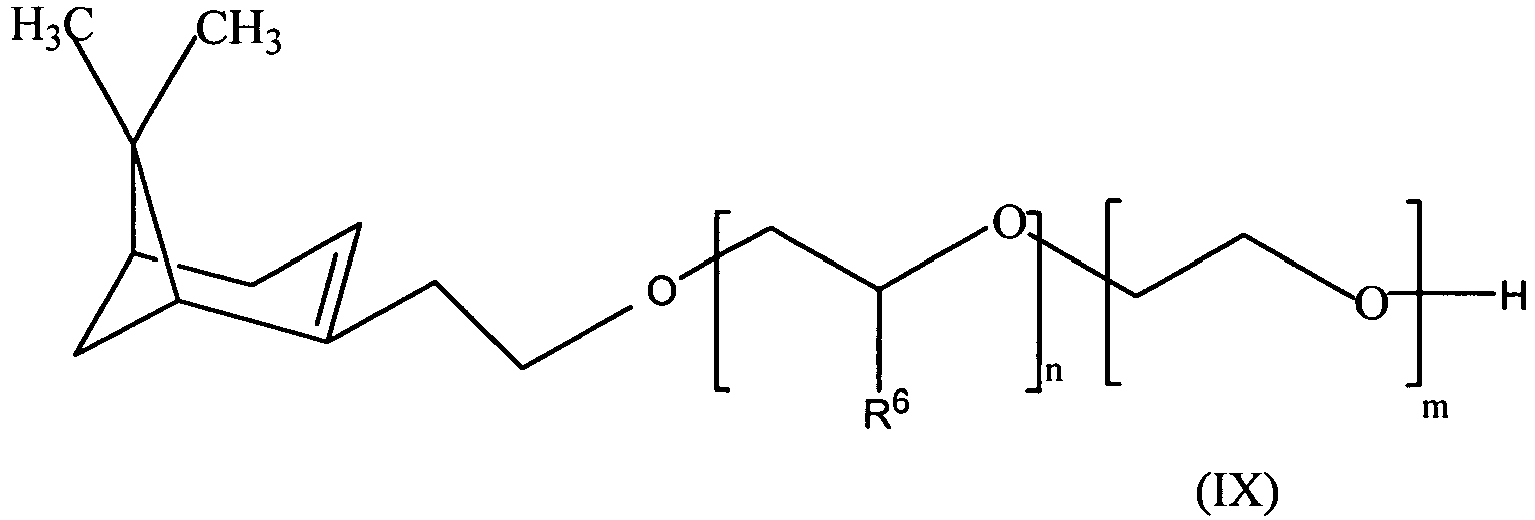


- In another embodiment, R6 is CH3; "n" is from 20 to 25; "m" is from 5 to 10. In yet another embodiment, R6 and R7 are individually CH3; "n" is from 1 to 8; "m" is from 2 to 14; and "p" is from 10 to 20. Mention can be made of Rhodoclean® HP (a terpene EO/PO)(manufactured by Rhodia Inc., Cranbury, NJ) and Rhodoclean® MSC (a terpene EO/PO)(manufactured by Rhodia Inc., Cranbury, NJ).
- In a further or alternative embodiment, additional components or additives may be added to the cleaning composition of the present invention. The additional components include, but are not limited to, delaminates, buffering and/or pH control agents, fragrances, perfumes, defoamers, dyes, whiteners, brighteners, solubilizing materials, stabilizers, thickeners, corrosion inhibitors, and/or mineral oils, enzymes, cloud point modifiers, preservatives, ion exchangers, chelating agents, sudsing control agents, soil removal agents, softening agents, opacifiers, inert diluents, graying inhibitors, stabilizers, polymers and the like.
- The cleaning composition of the present invention comprises comprise one or more delaminatesselected from terpene, terpene EO/PO, pinene, d-limonene, dipentene and oc-pinene.
- The buffering and pH control agents include for example, organic acids, mineral acids, as well as alkali metal and alkaline earth salts of silicate, metasilicate, polysilicate, borate, carbonate, carbamate, phosphate, polyphosphate, pyrophosphates, triphosphates, ammonia, hydroxide, monoethanolamine, monopropanolamine, diethanolamine, dipropanolamine, triethanolamine, and/or 2-amino-2methylpropanol.
- More specifically, the buffering agent can be a detergent or a low molecular weight, organic or inorganic material used for maintaining the desired pH. The buffer can be alkaline, acidic or neutral, including but not limited to 2-amino-2-methyl-propanol; 2-amino-2-methyl-1,3-propanol; disodium glutamate; methyl diethanolarnide; N,N-bis(2-hydroxyethyl)glycine; tris(hydroxymethyl)methyl glycine; ammonium carbamate; citric acid; acetic acid; ammonia; alkali metal carbonates; and/or alkali metal phosphates.
- In still another embodiment, thickeners, when used, include, but are not limited to, cassia gum, tara gum, xanthan gum, locust beam gum, carrageenan gum, gum karaya, gum arabic, hyaluronic acids, succinoglycan, pectin, crystalline polysaccharides, branched polysaccharide, calcium carbonate, aluminum oxide, alginates, guar gum, hydroxypropyl guar gum, carboxymethyl guar gum, carboxymethylhydroxypropyl guar gum, and other modified guar gums, hydroxycelluloses, hydroxyalkyl cellulose, including hydroxyethyl cellulose, carboxymethylhydroxyethyl cellulose, hydroxypropyl cellulose, carboxymethylcellulose and/or other modified celluloses. In a further embodiment, the whiteners include, but are not limited to, percarbonates, peracids, perborates, chlorine-generating substances hydrogen peroxide, and/or hydrogen peroxide-based compounds. In another embodiment, the polymer is generally a water soluble or dispersable polymer having a weight average molecular weight of generally below 2,000,000.
- Since dibasic esters are subject to hydrolysis under certain conditions, it is understood that the blend of dibasic esters can contain a minute amount of alcohol, typically a low molecular weight alcohol such as ethanol, in concentrations of 2% to 0.2%.
- The composition may optionally contain water or a solvent in varying amounts, depending on the desired concentration. For example, it may be desirable to have the composition of the present invention as a concentrated composition for shipping, transportation purposes as well as for other cost savings. It may also be desirable to have the present invention in fully diluted form.
- In either concentrated or diluted form, the composition of the present invention is hydrolytically stable, typically up to 6 months or greater, more typically up to 12 months or greater for the diluted form and longer in the concentrated form. The formulations of the present invention, which contain the dibasic ester blends, typically, MGN blends, have hydrolysis stability, where hydrolysis/decomposition typically produces the acid form of the ester and methanol. The methanol concentration of the formulation comprising the described dibasic ester blend was monitored and shown to generally be stable, typically less than 300 ppm (parts per million), more typically less than or 250 ppm, typically at or less than 210 ppm. (When prior art ester-based cleaning solutions sit in an aqueous solution, the esters typically begin to decompose. The decomposing ester produces undesirable and potentially hazardous byproducts. Furthermore, as the ester decomposes, the amount of ester, which is the active ingredient in the cleaning solution, is decreasing.)
- In another embodiment, the cleaning composition further comprises 1% to 12% by weight d-limonene. The cleaning composition of the present invention can be used in a variety of consumer and/or industrial applications.
- The present invention typically comprises from 5% to 40% by weight of the blend of dibasic esters. In another embodiment, the cleaning composition comprises 1% to 12% by weight a pinene or derivative thereof, typically, d-limonene. Optionally, additives such as fragrances and solubilizers, pH adjusting agents, whiteners, delaminates, opacifying agent, anticorrosion agents, anti-foaming agents, coloring agents, stabilizers and thickeners can be added. The cleaning composition of the present invention is typically in form of a microemulsion and provided as a liquid or spray formulation for use, depending upon the application. The cleaning composition of the present invention is typically in form of a microemulsion. The cleaning composition can also be provided as a liquid or spray formulation for use, depending upon the application.
- The present invention in one embodiment, is a method for removing stains (including but limited to pencil, crayon, highlighter, ketchup, permanent marker, mustard, ink, washable marker, lipstick, and hydrophobic stains in general), ink (typically, printing ink), organic stains on clothes, resin, tar-resin, graffiti, stains on painted surfaces or plastic or metal substrates, from skin or hair, paint from a surface, or as a degreasing composition, comprising obtaining the cleaning composition of the present invention, contacting the cleaning composition with a surface having any of the above-referenced stain on it, and removing the used cleaning composition from the cleaned surface.
- In one embodiment, the cleaning composition of the present invention can be particularly used in the removal of ink used for cleaning printing presses, blankets, rollers and the like. It is understood that the cleaning composition of the present invention can clean a variety of inks, for example, oil-based inks, UV inks, as well as waterbased inks, among others. The ink cleaning relates to printing ink cleaning primarily for offset/lithographic, flexographic, gravure, screen and ink jet ink cleaning. The cleaning composition of present invention can be in concentrated form or non-concentrated form, and is hydrolytically stable in both forms. In one embodiment, the present invention is a cleaning composition for cleaning inks from rollers etc. comprising (based on the total weight of the composition) (a) from 1% to 60% by weight, more typically from 1% to 35%, of a blend of dibasic esters as defined in
claim 1 typically an MGN blend of dibasic esters; (b) from 1% to about 35% of an alcohol ethoxylate; and (c) from 0.1% to 12% of a terpene, terpene EO/PO, pinene typically a terpene EO/PO. The composition may optionally contain water, typically from 1% to 85% by weight of the composition, or a solvent in varying amounts, depending on the desired concentration. Methods for cleaning an ink-stained surface, such as those of printing presses, blankets, rollers and the like are also contemplated, which includes obtaining or preparing the ink cleaning composition, contacting the cleaning composition onto a surface or material to be cleaned, and, optionally, removing the used cleaning composition from the surface or material. - In one embodiment, the present invention is a cleaning composition for cleaning stained surfaces, typically painted surfaces. The stains include but are not limited to pencil, crayon, highlighter, ketchup, permanent marker, mustard, ink, washable marker, lipstick, and hydrophobic stains in general. The cleaning composition for cleaning stained surfaces, typically painted surfaces comprising (based on the total weight of the composition) (a) from 1% to 60% by weight, more typically from 1% to 35%, of a blend of dibasic esters, as defined in
claim 1 typically an MGN blend of dibasic esters; (b) from 1% to 35% by weight, more typically from 1% to 25% by weight an alcohol ethoxylate. The surfactant is typically a C8-C12 alcohol ethoxylate. The stained painted surface cleaning composition contains, based upon total weight of the composition, from 0.1% to 12% of a delaminate selected from terpene, terpene EO/PO, pinene even more typically, d-limonene. The composition may optionally contain water, typically from 1% to 85% by weight of the composition, or a solvent in varying amounts, depending on the desired concentration. Methods for cleaning a stained painted surface, more typically surfaces which are coated with latex paint, etc., are also contemplated, which includes obtaining or preparing the cleaning composition for painted surfaces, contacting the cleaning composition onto a surface or material to be cleaned, and, optionally, removing the used cleaning composition from the surface or material. - In one embodiment, the composition of the present invention can be used to remove graffiti and other stains from plastic substrates, as well as coated or non-porous surfaces, such as, for example, baked or high gloss enamel or polished surfaces, masonry, namely, cement and concrete, brick, tile and the like, stone and polished stone, metals including but not limited to aluminum, copper, bronze and steel, and wood. The plastic substrate cleaning composition comprises (based on the total weight of the composition)
- (a) from 1% to 60% by weight, more typically from 1% to 35%, of a blend of dibasic esters, as defined in
claim 1 typically an MGN blend of dibasic esters; - (b) from 1% to 35% by weight, more typically from 1% to 25% by weight an alcohol ethoxylate. The surfactant is typically a C8-C12 alcohol ethoxylate. The plastic substrate cleaning composition contains, based upon total weight of the composition, from 0.1% to 12% of a delaminate, selected from terpene, terpene EO/PO, pinene even more typically, d-limonene. The composition may optionally contain water, typically from 1% to 85% by weight of the composition, or a solvent in varying amounts, depending on the desired concentration. Methods for cleaning an plastic substrate are also contemplated, which includes obtaining or preparing the plastic substrate cleaning composition, contacting the cleaning composition onto a surface or material to be cleaned, and, optionally, removing the used cleaning composition from the surface or material.
- In one embodiment, the composition of the present invention can be used to remove or aid the removal of stains from textiles, for example as a spot-stain cleaner. The textile cleaning composition in this embodiment comprises (based on the total weight of the composition) (a) from 1% to 60% by weight, typically from 1% to 45%, more typically from 1% to 35%, of a blend of dibasic as defined in
claim 1, typically an MGN blend of dibasic esters; (b) from 1% to 35% by weight, more typically from 1% to 25% by weight an alcohol ethoxylate. The surfactant is typically a C8-C12 alcohol ethoxylate. The textile cleaning composition contains, based upon total weight of the composition, from 0.1 % to 12% of a terpene, terpene EO/PO, pinene typically, terpene EO/PO. The composition may optionally contain water, typically from 1% to 85% by weight of the composition, or a solvent in varying amounts, depending on the desired concentration. Methods for cleaning a textile are also contemplated, which includes obtaining or preparing the textile cleaning composition, contacting the cleaning composition onto a surface or material to be cleaned, and, optionally, removing the used cleaning composition from the surface or material. - Experimental work leading to a particular embodiment of the present invention are described in the following Tables 1-4 which correspond to
Figures 1-4 , respectively. Commercially available Sherwin-Williams™ all-acrylic waterborne paint (both High & low gloss) was applied on lanetta chart using 7 mils wet draw-down bar. The coatings were allowed to dry for minimum 72 hours before applying stains. Various stains such as pencil, crayon, highlighter, ketchup, permanent marker, mustard, ink pen, washable marker, lipstick were applied on painted lanetta chart. These stains were allowed to dry for minimum 24 hours. - The panels were then placed on a Gardco® scrubber. Principles of ASTM # D 2486-06 (Standard test methods for scrub resistance of house paint) test method were followed to conduct the experiments. These test method were developed in particular to clean stains from painted panels. A special assembly, specifically designed to perform a rubbing action on a designated surface, was attached to the Gardco® scrubber. The special assembly comprised essentially of a device secured to a paint brush at one end, wherein a cotton pad was secured on paint brush on its other end with tape. One milliliter prepared formulation was applied to the cotton pad. The special assembly attached to the Gardco® scrubber then completed 20 rubs on the prepared panel. This operation was repeated two more times. After completing 60 cycles with 3 ml formulation and final 20 cycles were repeated without any formulations or solutions. This cleaning process was completed for each of the examples listed below. The panels utilizing the stains details above were continually monitored.
-
Cleaning Efficiency Description 0 No cleaning, i.e., no observable change in the stain or observable adverse effect in cleaning 1 Slight cleaning, i.e., slight observable change in stain 2 Moderate cleaning, i.e., some beneficial change in stain although stain still readily observable 3 High cleaning, i.e, substantial beneficial change in stain but some portions of stain still observable 4 Excellent cleaning, i.e., no observable portion of stain present -
Table 1(a): Formulation R0765-35-18: R0765-35-18 Amount used (grams) Rhodiasolv® Iris 28.73 gms d-limonene 7.73 gms C8-C13 alcohol ethoxylate 34.73 gms water 28.81 gms 100.00 gms Table 1(b): Comparison between R0765-35-18 and Goof Off® Comparison of Goof-Off® with Formulation R0765-35-18 on High Gloss paint Stain type Cleaning Efficiency of Goof-Off® Cleaning Efficiency of Formulation R0765-35-18 Pencil 0 4 Crayon 0 4 Highlighter 0 4 Ketchup 1 4 Permanent Marker 0 3 Mustard 0 4 Ink 0 3 Washable Marker 0 4 Lipstick 0 4 - Table 1(b) corresponds to
Figure 1 . Goof-Off® is believed to contain a composition of about, by weight of the total composition, 30-35% diethylene glycol monomethyl ether, 25-30% xylene isomers (c-, o-, p-) and 5-10% ethyl benzene. It was observed that Formulation R0765-35-18 removed the described stains, except with respect to the permanent marker and ink, such that no observable stain was present after the cleaning process. In the two exceptions, only a slight part of the stain was still observable. The Goof-Off® composition did not remove any of the stains more so relative to Formulation R0765-35-18. -
Table 2(a) Formulation: R0765-41-16 Amount used (grams) Rhodiasolv® Iris 10.38 gms d-limonene 10.37 gms C8-C13 alcohol ethoxylate 21.01 gms Water 58.24 gms 100.00 gms Table 2(b): Comparison between R0765-41-16 and Goof-Off® Comparison of Goof-Off® with Formulation R0765-41-16 on Low Gloss paint Stain type Cleaning Efficiency of Goof-Off® Cleaning Efficiency of Formulation R0765-41-16 Pencil 0 4 Crayon 0 4 Highlighter 0 3 Ketchup 0 4 Permanent Marker 0 3 Mustard 0 3 Ink 0 3 Washable Marker 0 2 Lipstick 0 4 - Table 2(b) corresponds to
Figure 2 . Goof-Off® is believed to contain a composition of about, by weight of the total composition, 30-35% diethylene glycol monomethyl ether, 25-30% xylene isomers (c-, o-, p-) and 5-10% ethyl benzene. It was observed that Formulation R0765-41-16 removed stains at high cleaning or excellent cleaning (per the Legend) except with respect to the washable marker, which showed moderate cleaning. The Goof-Off® composition did not remove any of the stains more so relative to Formulation R0765-41-16 and, in fact, did not even slightly remove stains. -
Table 3(b): Comparison between Formulation R0765-35-18 (Table 1(a)) and Goo-Gone® Comparison of Goo-Gone® with Formulation R0765-35-18 on High Gloss paint Stain type Cleaning Efficiency of Goo-Gone® Cleaning Efficiency of Formulation R0765-35-18 Pencil 3 4 Crayon 3 4 Highlighter 2 4 Ketchup 1 4 Permanent Marker 1 4 Mustard 1 4 Ink 0 3 Washable Marker 0 4 Lipstick 3 4 - Table 3(b) corresponds to
Figure 3 . Goo-Gone® is believed to contain a mixture of a citrus oil or derivative and a petroleum solvent. It was again observed that Formulation R0765-35-18 removed all but one of the stains with excellent cleaning. The Goo-Gone® composition did not remove any of the stains more so relative to Formulation R0765-35-18. -
Table 4(b): Comparison between R0765-41-16 (Table 2(a)) and Goo-Gone® Comparison of Goo-Gone® with Formulation R0765-41-16 on Low Gloss paint Stain type Cleaning Efficiency of Goo-Gone® Cleaning Efficiency of Formulation R0765-41-16 Pencil 2 4 Crayon 3 4 Highlighter 1 3 Ketchup 1 4 Permanent Marker 0 3 Mustard 1 4 Ink 0 4 Washable Marker 0 2 Lipstick 2 4 - Table 4(b) corresponds to
Figure 4 . Goo-Gone® is believed to contain a mixture of a citrus oil or derivative and a petroleum solvent. It was again observed that Formulation R0765-41-16 removed the stains with high cleaning or excellent cleaning (per the Legend), with the exception of washable marker having moderate cleaning. The Goo-Gone® composition did not remove any of the stains more so relative to Formulation R0765-41-16. - Tables 4(c) and 4(d) refer to
Figures 5 and6 , respectively.Table 4(c) Formulation: R0765-31-10 Amount used (grams) Rhodiasolv® DEE 9.79 gms d-limonene 10.24 gms C8-C13 alcohol ethoxylate 22.47 gms Water 57.50 gms 100.00 gms Table 4(d) Formulation R0765-45-13 Amount used (grams) Rhodiasolv® DEE/M 9.84 gms d-limonene 9.85 gms C8-C13 alcohol ethoxylate 24.04 gms DI Water 56.27 gms 100.00 gms - Experimental work leading to the present invention in this particular embodiment are described in the following Tables. Samples were prepared by mixing ingredients under constant agitation. The formulations was allowed to sit for 24 hours before using in applications. The formulation gave a very clear solution, as follows:
Table 5: Formulation R0765-35-18 Rhodiasolv® Iris 28.73 gms d-limonene 7.73 gms C8-C13 alcohol ethoxylate 34.73 gms water 28.81 gms 100.00 gms - Experiments were carried out as follows:
- The plastic substrates were cleaned with a cotton cloth piece to remove dirt from the substrates. Sharpie® permanent marking pens were used to make one or more straight line marking on the substrates. About 5 minutes were allowed for the ink to dry. A cotton cloth piece was placed on paint brush and tape was used to secure it to the paint brush. 1 ml of formulation R0765-35-18 was placed on the cotton cloth and rubbed against the substrate to remove the marking. The procedure was repeated two times. A dry cotton cloth was used for last run to remove excess formulation. Observations were made for cleaning of the markings from the surface of the plastic substrates.
- Commercial product EXPO® (manufactured by Sanford Brands) was used as a control. It is believed that EXPO® contains Butyl cellosolve and Isopropyl Alcohol solvents. Formulation R0765-35-18 was used to check performance against this control.
- Four plastic substrates were used, namely, ABS (Acrylonitrile butadiene styrene), PP (Polypropylene), PC (Polycarbonate) and PVC (Polyvinyl Chloride). Sharpie® Black and Red Permanent markers were used for the experiment.
- The results are as follows.
Table 6: R0765-35-18 Substrate Red Marking Pen Black Marking Pen PVC 5 5 PP 5 5 PC 5 5 ABS 4 5 Table 7: Control (EXPO®) Substrate Red Marking Pen Black Marking Pen PVC 4 4 PP 5 5 PC 5 5 ABS 3 3 Table 8: Legend Ranking Performance 5 No color or marking 4 Slight color or marking 3 Colored marking 2 Significant colored marking 1 No change from initial colored marking - From the results, the formulation of the present invention show improved cleaning with respect to ABS (Acrylonitrile butadiene styrene) and PVC (Polyvinyl Chloride).
- Experimental work leading to the present invention in this particular embodiment are described in the following Tables. Samples were prepared by mixing ingredients under constant agitation. Formulations were allowed to sit for 24 hours before using in applications.
Figure 9 corresponds to the formulation described in Table 11. The formulations described herein give very clear solutions. - Experiments were carried out as follows:
- A cotton cloth was placed on a hard surface. Referring to
Figure 7 , various stains such as cola, coffee, ketchup, mustard, lipstick, etc. were applied on the cotton cloth. These stains were allowed to sit on cotton cloth for approximately 24 hours. Excess amount of stain was removed with a wooden spatula. Formulation drops (10-30 drops) corresponding to the tables below were applied to the stains such that the entire or a substantial amount of the stain was covered. Whink® laundry stain remover was used as a control. (Whink® is believed to be a mixture of 1-methyl-2-pyrrolidinone, isopropanol and water.) The stain with applied formulation was allowed to sit for an additional 15 minutes (approximately). After the stain was allowed to sit, the cloth was cleaned with mildly warm water. Referring next toFigure 8 , the cotton cloth was allowed to dry for observation. - Following are results from formulations containing Rhodiasolv® Iris, a terpene EO/PO, a C8-C13 alcohol ethoxylate, d-Limonene and/or DI water.
-
Table 9 R0729-22-1A Rhodiasolv® Iris 6.17 gms Terpene EO/PO 0.20 gms C8-C13 alcohol ethoxylate 7.45 gms DI Water 6.18 gms 20.00 gms Table 10 R0729-22-1B Rhodiasolv® Iris 5.92 gms Terpene EO/PO 1.00 gms C8-C13 alcohol ethoxylate 7.15 gms DI Water 5.93 gms 20.00 gms Table 11 R0729-22-1C Rhodiasolv® Iris 5.60 gms Terpene EO/PO 2.00 gms C8-C13 alcohol ethoxylate 6.77 gms DI Water 5.62 gms 20.00 gms Table 12 R0729-22-1D Rhodiasolv® Iris 5.29 gms Terpene EO/PO 3.00 gms C8-C13 alcohol ethoxylate 6.38 gms DI Water 5.33 gms 20.00 gms Table 13 R0765-35-18 Rhodiasolv® Iris 28.73 gms D-limonene 7.73 gms C8-C13 alcohol ethoxylate 34.71 gms DI Water 28.83 gms 100.00 gms Table 14 R0765-41-16 Rhodiasolv® Iris 10.38 gms d-limonene 10.37 gms C8-C13 alcohol ethoxylate 21.01 gms DI Water 58.24 gms 100.00 gms - Isopar L™ is a high boiling mixture of saturated alkanes from Exxon with a described flash point of 68°C and an evaporation rate of 0.06 (nBuAc =100). The solubility of UV Curable ink Nuvaflex™ 3003 (Cyan) from Zeller Gmellin was studied when the solvent was blended with a blend of MGN esters according to the present invention as shown in
Figure 1 , below. Samples were prepared by dispensing aliquots (5 mL) of solvent blends into a series of vials with a progressive variation in MGN blend content. A drop of ink (0.012-0.015 g) was added to the solvent blend which sinks and deposits on the bottom of the vial. The solution was then mixed by repeated aspiration of 0.5 ml of the solvent with amicropipette 5 times. The solution was then allowed to stand for at least 24 hr. The ink is insoluble in neat Isopar L™. Increasing the MGN blend content increases the solubility of ink the blend. The cross over to complete solubility based onFigure 10 occurs between 60-70% MGN blend content. The data shows that saturated hydrocarbons are not effective for dissolution and cleaning of UV Curable ink alone. It is believed that blending with the MGN blend of the present invention may enhance the solubility of UV Inks in Isopar™ L based formulations. -
Hisol™ 70R is an aromatic solvent with a described high evaporation rate compared to Isopar™ L. The solubility of UV Curable ink Nuvaflex™ 3003 (Cyan) from Zeller Gmellin was studied when the solvent (Hisol™ 70R) was blended with the MGN blend as photographically shown inFigure 11 . Samples were prepared by dispensing aliquots (5 mL) of solvent blends into a series of vials with a progressive variation in MGN blend content. A drop of ink (0.012-0.015 g) was added to the solvent blend which sinks and deposits on the bottom of the vial. The solution was then mixed by repeated aspiration of 0.5 ml of the solvent with amicropipette 5 times. The solution was then allowed to stand for at least 24 hr. It was observed that the ink is insoluble inHisol™ 70R alone. Addition of the MGN blend of the present invention improves the solubility of ink with the crossover to complete solubility with an optically dense solution occurring between 30-40% MGN blend content. - Fatty acid methyl esters sourced from various vegetable oils are touted to be more environmentally friendly which can replace some of the hazardous solvents used in the printing ink industry. Soy methyl esters (Methyl Soyate), Tall Oil mono-methyl esters are some examples of these environmentally-friendly solvents. These solvents, however, may not have the necessary solvency or the dissolution rates that are necessary at times for application in the printing industry. Methyl Oleate (C18 insaturated FAME) is one of the key ingredients of most such mono-methyl esters derived from disparate sources. Methyl oleate from Novance Inc (Phytorob™ 960.65) was used in this study. The solubility of UV Curable ink Nuvaflex™ 3003 (Cyan) from Zeller Gmellin was studied when the solvent (Me-Oleate) was blended with a
particular dibasic ester blend AGS of the present invention (dimethyl glutarate / succinate / adipate blend = 63/24/13) as photographically shown inFigure 12 . Samples were prepared by dispensing aliquots (5 mL) of solvent blends into a series of vials with a progressive variation in AGS blend content. A drop of ink (0.012-0.015 g) was added to the solvent blend which sinks and deposits on the bottom of the vial. The solution was then mixed by repeated aspiration of 0.5 ml of the solvent with amicropipette 5 times. The solution was then allowed to stand for at least 24 hr. It was observed that the ink is not soluble in Me-Oleate. Based on the optical contrast as shown inFigure 12 the crossover to complete solubility of ink occurs at 50-60% AGS blend content. - As photographically illustrated in
Figure 13 , the experiment above was repeated with an MGN blend of the present invention (primarily dimethyl methyl-glutatrate). The two experiments show dissolution of ink compared to FAMEs (Fatty acid methyl esters). The crossover to complete solubility of the ink occurs at 30-40% MGN blend content. This is a sharper transition when compared to the more gradual change seen for the AGS blend. - To further improve the environmentally friendly profile, formulations of MGN blends with surfactants may also be used to disperse the solvent in an aqueous emulsion to be used for cleaning printing inks.
- Rhodiasolv IRIS™ (an embodiment of the MGN blend of the present invention) was formulated with surfactants (IRIS AQ-1) with the following composition:
Table 15 Rhodiasolv IRIS 28.73 Terpene EO/PO 7.73 C8-C13 alcohol ethoxylate 34.71 DI Water 28.83 100.00 - The formulation yields a clear microemulsion that may be used for cleaning printing ink. A comparison of cleaning efficiency with a benchmark "eco-friendly"-touted cleaner used in the industry is shown below. As photographically illustrated in
Figure 14 , the benchmark is used for cleaning in Flexographic UV Printing (i.e., FlexoCleanersUV Plus Strong & Safe) as an Anilox Roll and Ink Cleaner. The benchmark has a citrus odor and the MSDS lists nonyl-phenol ethoxylate (<9%) as the surfactant. - The example was tested on a Gardner Scrub Tester with a cotton Swab soaked in cleaner (1mL) rubbed 20 times across ink film per cycle. The test was performed for 2 cycles in each case. It was observed that the IRIS microemulsion (IRIS AQ-1) dissolved ink rapidly in
cycle 1. - In order to make an aqueous formulation that could be diluted to give stable emulsions, a new formulation was prepared with the following composition IRIS/ Rhodasurf DA-630/ Rhodaclean MSC (38/52/10) (Designated IRIS AQ-2) This can be diluted infinitely to give stable emulsion at room temperature as shown in
Figure 15 . - A dilution of IRIS AQ-2 was prepared for ink cleaning formulation as below (Designated IRIS AQ-3).
Table 16 Rhodiasolv Iris 9.50 Rhodoclean MSC 2.50 C8-C13 alcohol ethoxylate 13.00 DI Water 75.00 100.00 - This composition was used for ink cleaning as compared to the commercial benchmark. As photographically illustrated in
Figure 16 , this was tested as above with the Gardner scrub tester through 3 cycles of 20 strokes (1ml of cleaner per cycle) followed by a dry cotton swab (1 cycle). The figure below highlights that IRIS AQ-3 clearly outperforms the benchmark and cleans the substrate more effectively of UV Ink. - The formulation obtained is bidegradable and is an effective environmentally friendly printing ink cleaner with solvent content <100 g/L.
-
Table 17. Formulation R0815-062-07 for testing hydrolytic stability DV-9015 / R0815-062-07 Amount used (grams) Rhodiasolv® Iris 28.73 gms Terpene EO/PO 7.73 gms C8-C13 alcohol ethoxylate 34.74 gms water 28.8 gms 100 gms - DV-9015, R0815-062-07, was prepared and monitored according the description below. DV-9015 sample stability was been monitored at 38°C for a 100 days and at room temperature for 1 year period. The methanol and moisture concentrations are been determined using a standard addition headspace Gas chromatography and Karl Fisher respectively. The sample was placed on scintillation vials for the moisture study and on sealed headspace vials (two for each analysis day) for the methanol experiment. Some vials were placed in an oven set at 38°C and others stored at room temperature.
- The moisture measurement were acquired using a 870 Karl Fisher Titrino Plus. Fifty microliter of sample were placed on the titration cell and titrated using a standardized
Composite 5 solution. The sample was analyzed three times each testing day. - The methanol concentration was obtained using a standard addition method. A Gas Chromatograph (GC Agilent 6890A) equipped with a flame ionization detector (FID) was used. Sample vials were equilibrated at 45°C for 15 min in the headspace oven, and then injected into a DB-1 (30 m X 0.32 mm X 1µm) column. The column was initially kept at 40°C for 8 min, and then the temperature was raised at 40 °C/min rate to 200°C. After a little over six months the sample was still a clear emulsion and the pH has only drifted 0.3 pH units.
- Referring to
Figure 17 , the formulations have some hydrolysis propensity - the ester will hydrolysis and produced the acid form and methanol. Methanol generation was monitored and correlated to the hydrolysis of the dibasic ester of the present invention.Figure 17 , illustratesthe methanol concentrations for the first 8 weeks, where the diamonds represent the concentrations at room temperature and circles represent samples at 38°C. Methanol concentration has been stable at between 250 ppm to about 190 ppm, typically around 210 ppm. The water content has been constant, at about 30%.Table 18. Formulation R0765-35-18 for testing hydrolytic stability R0765-35-18 Amount used (grams) Rhodiasolv® Iris 28.73 gms d-limonene 7.73 gms C8-C13 alcohol ethoxylate 34.73 gms Water 28.81 gms 100 gms - Referring to Table 18, DV-9001, R0765-035-18, sample was prepared similar to the DV-9015 sample above and set aside. After over a year the sample remained a clear emulsion and the pH dropped less than one unit.
- The present invention, therefore, is well adapted to carry out the objects and attain the ends and advantages mentioned. While the invention has been depicted and described and is defined by reference to particular preferred embodiments of the invention, such references do not imply a limitation on the invention, and no such limitation is to be inferred. The depicted and described preferred embodiments of the invention are exemplary only and are not exhaustive of the scope of the invention.
Claims (14)
- A cleaning composition comprising:(a) from 1 % to 60% by weight of the composition of a blend of dibasic esters comprising (i) a dialkyl methylglutarate and (ii) at least one of a dialkyl adipate or a dialkyl ethylsuccinate;(b) from 1 % to 35% by weight of the composition of an alcohol ethoxylate; and(c) from 0.1 % to 12% by weight of the composition of a terpene, terpene EO/PO, pinene, d-limonene, dipentene, oc-pinene, and any combination thereof;wherein the cleaning composition is used for an industrial or a consumer application selected from the group consisting of a graffiti cleaner, a painted-substrate cleaner, an ink cleaner, a metal substrate cleaner, a plastic substrate cleaner, a stain-spot cleaner, a hand cleaner, a resin cleaner, a tar resin cleaner, a textile cleaner, a paint stripper and any combination thereof.
- The cleaning composition of claim 1 wherein the blend of dibasic esters comprises a dialkyl adipate, a dialkyl methylglutarate and a dialkyl ethylsuccinate.
- The composition of claim 1 further comprising an additive selected from the group consisting of delaminates, buffering agents, fragrances, perfumes, defoamers, dyes, whiteners, brighteners, solubilizing materials, stabilizers, thickeners, corrosion inhibitors, mineral oils, enzymes, cloud point modifiers, particles, preservatives, ion exchangers, chelating agents, sudsing control agents, soil removal agents, softening agents, opacifiers, inert diluents, graying inhibitors, stabilizers, polymers and any combination thereof.
- The composition of claim 3 wherein the additive comprises from 0.1 % to 40% by weight of the composition.
- The composition of claim 1 wherein the blend is characterized by a boiling point range between 210°C to 400°C, preferably between 215°C to 255°C, preferably between 255°C to 390°C, preferably between 275°C to 330°C.
- A cleaning composition of claim 1 for use on a coated surface wherein the blend of dibasic esters comprises a blend of dibasic esters having a general formula:

- The cleaning composition of claim 1 or claim 6 further comprising water from 2% to 85% by weight of the composition, wherein the composition is a microemulsion.
- The cleaning composition of claim 6 wherein the alcohol ethoxylate comprises formula:

- The cleaning composition of claim 2 or claim 6 wherein the blend comprises:(i) 7-14%, by weight of the blend, a dibasic ester of formula:
 (ii) 80-92% by weight of the blend, a dibasic ester of formula
 (iii) 0.5-5%,by weight of the blend, a dibasic ester of formula
- The cleaning composition of claim 1 or claim 6 wherein the blend of dibasic esters is derived from one or more by-products in the production of polyamide or wherein the blend of dibasic esters is derived from one or more by-products used in the production of adiponitrile.
- The use of a cleaning composition of claim 6 for cleaning a coated surface.
- The use of a cleaning composition of claim 11, wherein the coated surface is a painted surface.
- A method of cleaning a coated surface comprising:(a) obtaining a cleaning composition according to claim 2(b) contacting the cleaning composition with a coated surface having a stain; and(c) removing the used cleaning composition from the coated surface.
- The method of claim 13 wherein the cleaning composition is a microemulsion comprising:(a) from 1% to 55%, by weight of the cleaning composition, a blend of dibasic esters, wherein the blend is as defined in claim 9;(b) from 0.1% to 55%, by weight of the cleaning composition, an alcohol alkoxylate;(c) from 0.1% to 13%, by weight of the cleaning composition, a pinene, d-limonene, dipentene or oc-pinene; and(d) from 3% to 85%, by weight of the cleaning composition, water.
Applications Claiming Priority (5)
| Application Number | Priority Date | Filing Date | Title |
|---|---|---|---|
| US12702108P | 2008-05-09 | 2008-05-09 | |
| US18876008P | 2008-08-12 | 2008-08-12 | |
| US19189708P | 2008-09-12 | 2008-09-12 | |
| US21254509P | 2009-04-13 | 2009-04-13 | |
| PCT/US2009/002873 WO2009137096A1 (en) | 2008-05-09 | 2009-05-08 | Cleaning compositions incorporating green solvents and methods for use |
Publications (3)
| Publication Number | Publication Date |
|---|---|
| EP2285946A1 EP2285946A1 (en) | 2011-02-23 |
| EP2285946A4 EP2285946A4 (en) | 2013-06-26 |
| EP2285946B1 true EP2285946B1 (en) | 2017-06-21 |
Family
ID=41264896
Family Applications (1)
| Application Number | Title | Priority Date | Filing Date |
|---|---|---|---|
| EP09743083.9A Active EP2285946B1 (en) | 2008-05-09 | 2009-05-08 | Cleaning compositions incorporating green solvents and methods for use |
Country Status (12)
| Country | Link |
|---|---|
| US (1) | US8440598B2 (en) |
| EP (1) | EP2285946B1 (en) |
| JP (1) | JP2011520009A (en) |
| KR (1) | KR20110008210A (en) |
| CN (1) | CN102015994B (en) |
| AU (1) | AU2009244815B2 (en) |
| BR (1) | BRPI0911333A2 (en) |
| CA (1) | CA2723919A1 (en) |
| MX (1) | MX2010011939A (en) |
| RU (1) | RU2512551C2 (en) |
| WO (1) | WO2009137096A1 (en) |
| ZA (1) | ZA201006892B (en) |
Families Citing this family (56)
| Publication number | Priority date | Publication date | Assignee | Title |
|---|---|---|---|---|
| FR2915997B1 (en) * | 2007-05-07 | 2009-07-03 | Rhodia Recherches & Tech | ANTI-GRAFFITI TREATMENT. |
| US20160130527A9 (en) | 2008-05-09 | 2016-05-12 | Rhodia Operations | Dilutable cleaning compositions and methods for use |
| US8222194B2 (en) * | 2008-05-09 | 2012-07-17 | Rhodia Operations | Cleaning compositions incorporating green solvents and methods for use |
| FR2941462B1 (en) * | 2009-01-23 | 2013-07-05 | Rhodia Operations | STRIPPING COMPOSITION |
| WO2011019397A1 (en) * | 2009-08-12 | 2011-02-17 | Rhodia Operations | Methods for cleaning recyclable substrates or containers |
| CA2778222A1 (en) * | 2009-10-19 | 2011-04-28 | Rhodia Operations | Auto-emulsifying cleaning systems and methods for use |
| KR101673589B1 (en) * | 2009-10-30 | 2016-11-07 | 동우 화인켐 주식회사 | A detergent composition for a glass substrate of flat panel display device |
| EP2576748A4 (en) * | 2010-06-02 | 2016-06-08 | Rhodia Operations | USE OF ECOLOGICAL MICROEMULSIONS IN OIL CLEANING APPLICATIONS |
| US8512481B2 (en) * | 2010-10-22 | 2013-08-20 | Presstek, Inc. | Press cleaning with low-VOC solvent compositions |
| AU2011338993B2 (en) * | 2010-12-10 | 2015-01-29 | Rhodia Operations | Dibasic esters utilized as terpene co-solvents, substitutes and/or carriers in tar sand/bitumen/asphaltene cleaning applications |
| CN102051272B (en) * | 2011-01-24 | 2012-11-07 | 北京洛娃日化有限公司 | Multifunctional environmental-protection cleaning agent |
| MX2013008782A (en) * | 2011-01-31 | 2014-05-01 | Rhodia Operations | Hydraulic fluids containing dibasic esters and methods for use. |
| US9512387B2 (en) | 2011-02-11 | 2016-12-06 | Dubois Chemicals, Inc. | Cleaning compositions for removing polymeric contaminants from papermaking surfaces |
| US8569218B2 (en) * | 2011-03-07 | 2013-10-29 | Illinois Tool Works, Inc. | Cleaning composition containing polymer microemulsion |
| US8980012B2 (en) * | 2011-05-03 | 2015-03-17 | Ron Fuller | Apparatus and method for de-inking printed surfaces |
| KR101638655B1 (en) * | 2011-05-24 | 2016-07-11 | 도오꾜오까고오교 가부시끼가이샤 | Stripping composition and stripping method |
| WO2012166160A1 (en) | 2011-06-03 | 2012-12-06 | Hewlett-Packard Development Company, L.P. | Method of erasing an ink from a medium |
| US9523006B2 (en) * | 2011-06-03 | 2016-12-20 | Hewlett-Packard Development Company, L.P. | Erasure fluid |
| KR101803976B1 (en) | 2011-07-21 | 2017-12-04 | 애경산업(주) | Multipurpose Cleaning Composition Having Nanoemulsion Forms |
| US10633579B2 (en) * | 2011-08-01 | 2020-04-28 | Rhodia Operations | Use of environmentally friendly solvents to replace glycol-based solvents |
| ES2400155B1 (en) * | 2011-08-11 | 2014-02-13 | Universidad De Granada | STRIPPING COMPOSITIONS, PRE-CURRENT COMPOSITIONS OF THE SAME, THEIR PREPARATION PROCEDURE "IN SITU", AND THEIR USE TO STRIP PAINT, VARNISH AND LACQUER |
| WO2013106505A1 (en) * | 2012-01-10 | 2013-07-18 | Rhodia Operations | Systems and methods for polystyrene foam recycling using branched dibasis esters |
| US20150045225A1 (en) * | 2012-01-23 | 2015-02-12 | Syngenta Limited | Plant growth media wetting compositions |
| PT2811828T (en) * | 2012-01-23 | 2021-11-15 | Syngenta Ltd | Adjuvant compositions |
| FR2986535B1 (en) * | 2012-02-02 | 2015-07-24 | Techme Sarl | PRODUCT FOR THE REMOVAL OF COATINGS BASED ON BRAIS, TAR OR BITUMEN, IN THE FORM OF DIRECT EMULSION OF A PLANT SOLVENT IN WATER, ITS PREPARATION METHOD AND USE |
| SG11201406751RA (en) | 2012-04-24 | 2014-11-27 | Stepan Co | Aqueous hard surface cleaners based on terpenes and fatty acid derivatives |
| US8455426B1 (en) * | 2012-05-04 | 2013-06-04 | AGAIA International, Inc. | Cleaning compositions |
| EP2669341A1 (en) * | 2012-06-01 | 2013-12-04 | LCM GmbH | Cleaning agent |
| EP2867324A4 (en) * | 2012-06-28 | 2016-03-16 | Rhodia Operations S A | Environmentally friendly solvent systems/surfactant systems for drilling fluids |
| DE102012013137A1 (en) * | 2012-07-03 | 2014-01-09 | Häffner Gmbh & Co. Holding Kg | Demarkierungsmittel |
| US9434910B2 (en) | 2013-01-16 | 2016-09-06 | Jelmar, Llc | Mold and mildew stain removing solution |
| US9873854B2 (en) | 2013-01-16 | 2018-01-23 | Jelmar, Llc | Stain removing solution |
| DK3046425T3 (en) | 2013-09-20 | 2018-08-13 | Equator Global Ltd | FERMENTED FRUIT SOLUTIONS FOR CLEANING COMPOSITIONS |
| CZ305528B6 (en) * | 2013-10-18 | 2015-11-18 | Ústav Fyzikální Chemie J. Heyrovského Akademie Věd České Republiky, V. V. I. | Cleaning mixture for removing hydrophobic protective coatings based on organosilicon polymers |
| WO2015133996A1 (en) * | 2014-03-04 | 2015-09-11 | Motsenbocker Gregg A | Low voc composition to remove grafitti |
| US11053464B2 (en) * | 2014-03-22 | 2021-07-06 | United Laboratories International, Llc | Solvent composition and process for removal of asphalt and other contaminant materials |
| US11946021B2 (en) * | 2014-03-22 | 2024-04-02 | United Laboratories International, Llc | Solvent composition and process for removal of asphalt and other contaminant materials |
| JP2017526778A (en) * | 2014-08-19 | 2017-09-14 | ゲオ‐テック ポリマーズ,エルエルシー | Diester stripping composition |
| US9856398B2 (en) | 2014-12-22 | 2018-01-02 | Dubois Chemicals, Inc. | Method for controlling deposits on papermaking surfaces |
| JP6582451B2 (en) * | 2015-03-10 | 2019-10-02 | セイコーエプソン株式会社 | Inkjet recording apparatus and maintenance method thereof |
| US10851330B2 (en) | 2015-07-29 | 2020-12-01 | Dubois Chemicals, Inc. | Method of improving paper machine fabric performance |
| KR101631202B1 (en) * | 2016-02-18 | 2016-06-16 | 정재은 | Remover for metal powder coating and manufacturing method thereof |
| CN105838132A (en) * | 2016-05-05 | 2016-08-10 | 张小霞 | Environment-friendly high-performance printing ink cleaning agent and preparing method thereof |
| CA3066116A1 (en) * | 2017-07-28 | 2019-01-31 | Croda, Inc. | Cleaning formulation comprising a solvent additive |
| CN108133882A (en) * | 2017-12-21 | 2018-06-08 | 苏州赛源微电子有限公司 | A kind of cleaning method of integrated circuit plate |
| GB201815343D0 (en) | 2018-09-20 | 2018-11-07 | Mix 14 Ltd | Improvements in ink and stain removal |
| US10952430B2 (en) | 2019-02-06 | 2021-03-23 | Virox Technologies Inc. | Shelf-stable antimicrobial compositions |
| US12089590B2 (en) | 2019-02-06 | 2024-09-17 | Virox Technologies, Inc. | Shelf-stable antimicrobial compositions |
| CN114008184B (en) * | 2019-06-28 | 2024-12-06 | 联合利华知识产权控股有限公司 | Detergent composition |
| CN114555720B (en) * | 2019-10-03 | 2024-04-05 | 阿萨达股份公司 | Antifouling additive |
| EP4117896A1 (en) * | 2020-03-09 | 2023-01-18 | DyeMansion GmbH | Device and method for treating the surface of moulded parts |
| US20230295539A1 (en) | 2020-08-25 | 2023-09-21 | Dic Corporation | Ink cleaning agent used to recycle plastic laminates into recycle material, ink film detaching method, and method for separating and recovering detached ink films |
| JP7709740B2 (en) * | 2022-04-27 | 2025-07-17 | アジア原紙株式会社 | Liquid for maintaining ink application device, and method for maintaining ink application device |
| EP4634342A1 (en) * | 2022-12-13 | 2025-10-22 | Rohm and Haas Company | Dishwashing detergent formulation |
| US20240271063A1 (en) * | 2023-02-14 | 2024-08-15 | LeeAnn Rene Abrams | Skin Safe, One-Step Artists Brush Cleaner for Oil and Other Paint Applications |
| KR102850896B1 (en) * | 2023-06-20 | 2025-08-27 | 주식회사 지디원 | Plastic gloss restorer containing graphene |
Family Cites Families (35)
| Publication number | Priority date | Publication date | Assignee | Title |
|---|---|---|---|---|
| US4470928A (en) * | 1981-10-15 | 1984-09-11 | Asahi Kasei Kogyo Kabushiki Kaisha | Process for producing cyanovaleric esters and caprolactam |
| US4673524A (en) * | 1986-05-16 | 1987-06-16 | Dean Ralph R | Cleaner composition |
| US4780235A (en) * | 1987-04-16 | 1988-10-25 | E. I. Du Pont De Nemours And Company | Paint remover |
| US4934391A (en) * | 1988-02-08 | 1990-06-19 | 501 Petroleum Fermentations N.V. | Dibasic esters for cleaning electronic circuits |
| US5252780A (en) * | 1989-03-30 | 1993-10-12 | S&C Electric Company | Support arrangement for a rotatable insulator |
| US5024780A (en) * | 1989-08-30 | 1991-06-18 | A.G.P. Systems, Inc. | Cleaner for treating a surface |
| US5096501A (en) * | 1990-08-27 | 1992-03-17 | E. I. Du Pont De Nemours & Company | Environmentally safe cleaning process and cleaning composition useful therein |
| US6355113B1 (en) * | 1991-12-02 | 2002-03-12 | 3M Innovative Properties Company | Multiple solvent cleaning system |
| WO1994017145A1 (en) | 1993-01-25 | 1994-08-04 | Dotolo Research Corporation | Graphic ink remover solution |
| CN1065906C (en) * | 1993-03-30 | 2001-05-16 | 美国3M公司 | Multi-surface cleaning compositions and methods of use thereof |
| US5419848A (en) * | 1993-07-02 | 1995-05-30 | Buckeye International, Inc. | Aqueous degreaser emulsion compositions |
| FR2721921B1 (en) * | 1994-07-01 | 1996-10-31 | Rhone Poulenc Chimie | DERIVATIVES OF TERPENIC ORIGIN, SURFACTANT AND / OR PERFUMING COMPOSITION CONTAINING AND DETERGENT FORMULATION BASED ON THIS COMPOSITION |
| DE69523330T2 (en) * | 1994-11-15 | 2002-07-11 | Colgate-Palmolive Co., New York | LIQUID ALL-PURPOSE CLEANING COMPOSITIONS IN THE FORM OF A MICROEMULSION |
| US5672579A (en) * | 1995-02-06 | 1997-09-30 | Monsanto Company | Water based dimethyl ester cleaning solution |
| ATE255157T1 (en) * | 1995-05-18 | 2003-12-15 | Textil Color Ag | COMPOSITION FOR WASHING AND CLEANING TEXTILE MATERIALS |
| FR2751899B1 (en) * | 1996-08-01 | 1998-10-23 | Rhone Poulenc Chimie | DEGREASING PROCESS WITH SURFACTANT FREE COMPOSITION |
| US6165962A (en) * | 1997-07-31 | 2000-12-26 | E. I. Du Pont De Nemours And Comapny | Aqueous microemulsions |
| US6172031B1 (en) * | 1997-10-17 | 2001-01-09 | Edwin Stevens | Compositions and methods for use in cleaning textiles |
| DE19824236A1 (en) * | 1998-05-29 | 1999-12-02 | Basf Ag | Process for cleaning printing machines and printing forms |
| US6284720B1 (en) * | 1999-09-03 | 2001-09-04 | Vertec Biosolvents, Llc | Environmentally friendly ink cleaning preparation |
| AU1018401A (en) | 1999-10-25 | 2001-05-08 | Cps - Chemical Products And Services A/S | Textile stain remover composition and a method for removing stains |
| US6261381B1 (en) * | 2000-11-09 | 2001-07-17 | Macdermid, Incorporated | Composition and process for cleaning inks from various substrates including printing plates |
| US20040000329A1 (en) * | 2001-07-26 | 2004-01-01 | Albu Michael L. | Compositions and methods for paint overspray removal processes |
| US6706676B2 (en) * | 2002-05-15 | 2004-03-16 | New Dawn Manufacturing Company | Cleaning composition |
| GB2392166A (en) * | 2002-08-22 | 2004-02-25 | Reckitt Benckiser Inc | Composition separable into two phases |
| US7478455B2 (en) * | 2003-01-10 | 2009-01-20 | Lisa Ann Heim | Hand-held clothing spot remover |
| US20050059571A1 (en) | 2003-09-12 | 2005-03-17 | John Mahdessian | Comprehensive stain removal kit and method with absorbent backing material |
| US7271140B2 (en) * | 2004-09-08 | 2007-09-18 | Harris Research, Inc. | Composition for removing stains from textiles |
| WO2006055713A1 (en) | 2004-11-15 | 2006-05-26 | The Dial Corporation | A multi-surface cleaning device and an aqueous cleaning composition |
| US7501470B2 (en) * | 2004-12-03 | 2009-03-10 | Rhodia Inc. | Use of polyoxypropylene and polyoxyethylene terpene compounds in emulsion polymerization |
| US7309684B2 (en) * | 2005-05-12 | 2007-12-18 | The Lubrizol Corporation | Oil-in-water emulsified remover comprising an ethoxylated alcohol surfactant |
| US7547670B2 (en) * | 2005-10-25 | 2009-06-16 | Cognis Ip Management Gmbh | Low odor ester-based microemulsions for cleaning hard surfaces |
| FR2898356B1 (en) * | 2006-03-07 | 2008-12-05 | Rhodia Recherches & Tech | BRANCHED CARBOXYLIC ACID DIESTERS |
| CN101012414A (en) * | 2007-02-01 | 2007-08-08 | 大连三达奥克化学有限公司 | Environment-friendly and safe degreasing cleaning agent and using method thereof |
| FR2918994B1 (en) | 2007-07-20 | 2012-10-19 | Rhodia Operations | FORMULATIONS OF CARBOXYLIC ACID DIESTERS AND THEIR USE FOR TREATING MATERIALS. |
-
2009
- 2009-05-08 CA CA2723919A patent/CA2723919A1/en not_active Abandoned
- 2009-05-08 KR KR1020107024839A patent/KR20110008210A/en not_active Ceased
- 2009-05-08 EP EP09743083.9A patent/EP2285946B1/en active Active
- 2009-05-08 MX MX2010011939A patent/MX2010011939A/en unknown
- 2009-05-08 RU RU2010150349/04A patent/RU2512551C2/en not_active IP Right Cessation
- 2009-05-08 AU AU2009244815A patent/AU2009244815B2/en not_active Ceased
- 2009-05-08 JP JP2011508516A patent/JP2011520009A/en active Pending
- 2009-05-08 BR BRPI0911333A patent/BRPI0911333A2/en not_active IP Right Cessation
- 2009-05-08 CN CN2009801166355A patent/CN102015994B/en not_active Expired - Fee Related
- 2009-05-08 WO PCT/US2009/002873 patent/WO2009137096A1/en not_active Ceased
-
2010
- 2010-04-23 US US12/799,402 patent/US8440598B2/en active Active
- 2010-09-28 ZA ZA2010/06892A patent/ZA201006892B/en unknown
Also Published As
| Publication number | Publication date |
|---|---|
| AU2009244815A1 (en) | 2009-11-12 |
| AU2009244815B2 (en) | 2015-04-30 |
| WO2009137096A1 (en) | 2009-11-12 |
| US8440598B2 (en) | 2013-05-14 |
| RU2512551C2 (en) | 2014-04-10 |
| KR20110008210A (en) | 2011-01-26 |
| CA2723919A1 (en) | 2009-11-12 |
| BRPI0911333A2 (en) | 2015-10-06 |
| ZA201006892B (en) | 2011-06-29 |
| RU2010150349A (en) | 2012-06-20 |
| CN102015994B (en) | 2013-10-30 |
| EP2285946A4 (en) | 2013-06-26 |
| US20100273695A1 (en) | 2010-10-28 |
| JP2011520009A (en) | 2011-07-14 |
| EP2285946A1 (en) | 2011-02-23 |
| MX2010011939A (en) | 2010-12-01 |
| CN102015994A (en) | 2011-04-13 |
Similar Documents
| Publication | Publication Date | Title |
|---|---|---|
| US8440598B2 (en) | Ink cleaning composition and methods for use | |
| US8222194B2 (en) | Cleaning compositions incorporating green solvents and methods for use | |
| US8628626B2 (en) | Dibasic esters utilized as terpene co-solvents, substitutes and/or carriers in tar sand/bitumen/asphaltene cleaning applications | |
| AU2011262364B2 (en) | Use of eco-friendly microemulsions in oil cleaning applications | |
| US20120129756A1 (en) | Dilutable cleaning compositions and methods for use | |
| US20130157917A1 (en) | Industrial cleaning compositions and methods for using same | |
| EP2454359A2 (en) | Industrial cleaning compositions and methods for using same |
Legal Events
| Date | Code | Title | Description |
|---|---|---|---|
| PUAI | Public reference made under article 153(3) epc to a published international application that has entered the european phase |
Free format text: ORIGINAL CODE: 0009012 |
|
| 17P | Request for examination filed |
Effective date: 20101209 |
|
| AK | Designated contracting states |
Kind code of ref document: A1 Designated state(s): AT BE BG CH CY CZ DE DK EE ES FI FR GB GR HR HU IE IS IT LI LT LU LV MC MK MT NL NO PL PT RO SE SI SK TR |
|
| AX | Request for extension of the european patent |
Extension state: AL BA RS |
|
| DAX | Request for extension of the european patent (deleted) | ||
| A4 | Supplementary search report drawn up and despatched |
Effective date: 20130528 |
|
| RIC1 | Information provided on ipc code assigned before grant |
Ipc: C11D 3/20 20060101ALI20130522BHEP Ipc: C11D 3/43 20060101ALI20130522BHEP Ipc: C08G 63/00 20060101ALI20130522BHEP Ipc: C09D 9/00 20060101ALI20130522BHEP Ipc: C11D 17/00 20060101AFI20130522BHEP Ipc: C11D 1/72 20060101ALI20130522BHEP |
|
| GRAP | Despatch of communication of intention to grant a patent |
Free format text: ORIGINAL CODE: EPIDOSNIGR1 |
|
| STAA | Information on the status of an ep patent application or granted ep patent |
Free format text: STATUS: GRANT OF PATENT IS INTENDED |
|
| INTG | Intention to grant announced |
Effective date: 20161209 |
|
| GRAS | Grant fee paid |
Free format text: ORIGINAL CODE: EPIDOSNIGR3 |
|
| GRAA | (expected) grant |
Free format text: ORIGINAL CODE: 0009210 |
|
| STAA | Information on the status of an ep patent application or granted ep patent |
Free format text: STATUS: THE PATENT HAS BEEN GRANTED |
|
| AK | Designated contracting states |
Kind code of ref document: B1 Designated state(s): AT BE BG CH CY CZ DE DK EE ES FI FR GB GR HR HU IE IS IT LI LT LU LV MC MK MT NL NO PL PT RO SE SI SK TR |
|
| REG | Reference to a national code |
Ref country code: GB Ref legal event code: FG4D |
|
| REG | Reference to a national code |
Ref country code: CH Ref legal event code: EP |
|
| REG | Reference to a national code |
Ref country code: IE Ref legal event code: FG4D |
|
| REG | Reference to a national code |
Ref country code: AT Ref legal event code: REF Ref document number: 902955 Country of ref document: AT Kind code of ref document: T Effective date: 20170715 |
|
| REG | Reference to a national code |
Ref country code: DE Ref legal event code: R096 Ref document number: 602009046737 Country of ref document: DE |
|
| REG | Reference to a national code |
Ref country code: NL Ref legal event code: MP Effective date: 20170621 |
|
| PG25 | Lapsed in a contracting state [announced via postgrant information from national office to epo] |
Ref country code: GR Free format text: LAPSE BECAUSE OF FAILURE TO SUBMIT A TRANSLATION OF THE DESCRIPTION OR TO PAY THE FEE WITHIN THE PRESCRIBED TIME-LIMIT Effective date: 20170922 Ref country code: HR Free format text: LAPSE BECAUSE OF FAILURE TO SUBMIT A TRANSLATION OF THE DESCRIPTION OR TO PAY THE FEE WITHIN THE PRESCRIBED TIME-LIMIT Effective date: 20170621 Ref country code: LT Free format text: LAPSE BECAUSE OF FAILURE TO SUBMIT A TRANSLATION OF THE DESCRIPTION OR TO PAY THE FEE WITHIN THE PRESCRIBED TIME-LIMIT Effective date: 20170621 Ref country code: NO Free format text: LAPSE BECAUSE OF FAILURE TO SUBMIT A TRANSLATION OF THE DESCRIPTION OR TO PAY THE FEE WITHIN THE PRESCRIBED TIME-LIMIT Effective date: 20170921 Ref country code: FI Free format text: LAPSE BECAUSE OF FAILURE TO SUBMIT A TRANSLATION OF THE DESCRIPTION OR TO PAY THE FEE WITHIN THE PRESCRIBED TIME-LIMIT Effective date: 20170621 |
|
| REG | Reference to a national code |
Ref country code: LT Ref legal event code: MG4D |
|
| REG | Reference to a national code |
Ref country code: AT Ref legal event code: MK05 Ref document number: 902955 Country of ref document: AT Kind code of ref document: T Effective date: 20170621 |
|
| PG25 | Lapsed in a contracting state [announced via postgrant information from national office to epo] |
Ref country code: LV Free format text: LAPSE BECAUSE OF FAILURE TO SUBMIT A TRANSLATION OF THE DESCRIPTION OR TO PAY THE FEE WITHIN THE PRESCRIBED TIME-LIMIT Effective date: 20170621 Ref country code: NL Free format text: LAPSE BECAUSE OF FAILURE TO SUBMIT A TRANSLATION OF THE DESCRIPTION OR TO PAY THE FEE WITHIN THE PRESCRIBED TIME-LIMIT Effective date: 20170621 Ref country code: BG Free format text: LAPSE BECAUSE OF FAILURE TO SUBMIT A TRANSLATION OF THE DESCRIPTION OR TO PAY THE FEE WITHIN THE PRESCRIBED TIME-LIMIT Effective date: 20170921 Ref country code: SE Free format text: LAPSE BECAUSE OF FAILURE TO SUBMIT A TRANSLATION OF THE DESCRIPTION OR TO PAY THE FEE WITHIN THE PRESCRIBED TIME-LIMIT Effective date: 20170621 |
|
| PG25 | Lapsed in a contracting state [announced via postgrant information from national office to epo] |
Ref country code: RO Free format text: LAPSE BECAUSE OF FAILURE TO SUBMIT A TRANSLATION OF THE DESCRIPTION OR TO PAY THE FEE WITHIN THE PRESCRIBED TIME-LIMIT Effective date: 20170621 Ref country code: SK Free format text: LAPSE BECAUSE OF FAILURE TO SUBMIT A TRANSLATION OF THE DESCRIPTION OR TO PAY THE FEE WITHIN THE PRESCRIBED TIME-LIMIT Effective date: 20170621 Ref country code: CZ Free format text: LAPSE BECAUSE OF FAILURE TO SUBMIT A TRANSLATION OF THE DESCRIPTION OR TO PAY THE FEE WITHIN THE PRESCRIBED TIME-LIMIT Effective date: 20170621 Ref country code: EE Free format text: LAPSE BECAUSE OF FAILURE TO SUBMIT A TRANSLATION OF THE DESCRIPTION OR TO PAY THE FEE WITHIN THE PRESCRIBED TIME-LIMIT Effective date: 20170621 Ref country code: AT Free format text: LAPSE BECAUSE OF FAILURE TO SUBMIT A TRANSLATION OF THE DESCRIPTION OR TO PAY THE FEE WITHIN THE PRESCRIBED TIME-LIMIT Effective date: 20170621 |
|
| PG25 | Lapsed in a contracting state [announced via postgrant information from national office to epo] |
Ref country code: PL Free format text: LAPSE BECAUSE OF FAILURE TO SUBMIT A TRANSLATION OF THE DESCRIPTION OR TO PAY THE FEE WITHIN THE PRESCRIBED TIME-LIMIT Effective date: 20170621 Ref country code: IS Free format text: LAPSE BECAUSE OF FAILURE TO SUBMIT A TRANSLATION OF THE DESCRIPTION OR TO PAY THE FEE WITHIN THE PRESCRIBED TIME-LIMIT Effective date: 20171021 Ref country code: IT Free format text: LAPSE BECAUSE OF FAILURE TO SUBMIT A TRANSLATION OF THE DESCRIPTION OR TO PAY THE FEE WITHIN THE PRESCRIBED TIME-LIMIT Effective date: 20170621 Ref country code: ES Free format text: LAPSE BECAUSE OF FAILURE TO SUBMIT A TRANSLATION OF THE DESCRIPTION OR TO PAY THE FEE WITHIN THE PRESCRIBED TIME-LIMIT Effective date: 20170621 |
|
| REG | Reference to a national code |
Ref country code: DE Ref legal event code: R097 Ref document number: 602009046737 Country of ref document: DE |
|
| REG | Reference to a national code |
Ref country code: FR Ref legal event code: PLFP Year of fee payment: 10 |
|
| PLBE | No opposition filed within time limit |
Free format text: ORIGINAL CODE: 0009261 |
|
| STAA | Information on the status of an ep patent application or granted ep patent |
Free format text: STATUS: NO OPPOSITION FILED WITHIN TIME LIMIT |
|
| PG25 | Lapsed in a contracting state [announced via postgrant information from national office to epo] |
Ref country code: DK Free format text: LAPSE BECAUSE OF FAILURE TO SUBMIT A TRANSLATION OF THE DESCRIPTION OR TO PAY THE FEE WITHIN THE PRESCRIBED TIME-LIMIT Effective date: 20170621 |
|
| 26N | No opposition filed |
Effective date: 20180322 |
|
| PG25 | Lapsed in a contracting state [announced via postgrant information from national office to epo] |
Ref country code: SI Free format text: LAPSE BECAUSE OF FAILURE TO SUBMIT A TRANSLATION OF THE DESCRIPTION OR TO PAY THE FEE WITHIN THE PRESCRIBED TIME-LIMIT Effective date: 20170621 |
|
| REG | Reference to a national code |
Ref country code: CH Ref legal event code: PL |
|
| REG | Reference to a national code |
Ref country code: BE Ref legal event code: MM Effective date: 20180531 |
|
| PG25 | Lapsed in a contracting state [announced via postgrant information from national office to epo] |
Ref country code: MC Free format text: LAPSE BECAUSE OF FAILURE TO SUBMIT A TRANSLATION OF THE DESCRIPTION OR TO PAY THE FEE WITHIN THE PRESCRIBED TIME-LIMIT Effective date: 20170621 |
|
| REG | Reference to a national code |
Ref country code: IE Ref legal event code: MM4A |
|
| PG25 | Lapsed in a contracting state [announced via postgrant information from national office to epo] |
Ref country code: CH Free format text: LAPSE BECAUSE OF NON-PAYMENT OF DUE FEES Effective date: 20180531 Ref country code: LI Free format text: LAPSE BECAUSE OF NON-PAYMENT OF DUE FEES Effective date: 20180531 |
|
| PG25 | Lapsed in a contracting state [announced via postgrant information from national office to epo] |
Ref country code: LU Free format text: LAPSE BECAUSE OF NON-PAYMENT OF DUE FEES Effective date: 20180508 |
|
| PG25 | Lapsed in a contracting state [announced via postgrant information from national office to epo] |
Ref country code: IE Free format text: LAPSE BECAUSE OF NON-PAYMENT OF DUE FEES Effective date: 20180508 |
|
| PG25 | Lapsed in a contracting state [announced via postgrant information from national office to epo] |
Ref country code: BE Free format text: LAPSE BECAUSE OF NON-PAYMENT OF DUE FEES Effective date: 20180531 |
|
| PG25 | Lapsed in a contracting state [announced via postgrant information from national office to epo] |
Ref country code: MT Free format text: LAPSE BECAUSE OF NON-PAYMENT OF DUE FEES Effective date: 20180508 |
|
| PG25 | Lapsed in a contracting state [announced via postgrant information from national office to epo] |
Ref country code: TR Free format text: LAPSE BECAUSE OF FAILURE TO SUBMIT A TRANSLATION OF THE DESCRIPTION OR TO PAY THE FEE WITHIN THE PRESCRIBED TIME-LIMIT Effective date: 20170621 |
|
| PG25 | Lapsed in a contracting state [announced via postgrant information from national office to epo] |
Ref country code: HU Free format text: LAPSE BECAUSE OF FAILURE TO SUBMIT A TRANSLATION OF THE DESCRIPTION OR TO PAY THE FEE WITHIN THE PRESCRIBED TIME-LIMIT; INVALID AB INITIO Effective date: 20090508 Ref country code: PT Free format text: LAPSE BECAUSE OF FAILURE TO SUBMIT A TRANSLATION OF THE DESCRIPTION OR TO PAY THE FEE WITHIN THE PRESCRIBED TIME-LIMIT Effective date: 20170621 |
|
| PG25 | Lapsed in a contracting state [announced via postgrant information from national office to epo] |
Ref country code: MK Free format text: LAPSE BECAUSE OF NON-PAYMENT OF DUE FEES Effective date: 20170621 Ref country code: CY Free format text: LAPSE BECAUSE OF FAILURE TO SUBMIT A TRANSLATION OF THE DESCRIPTION OR TO PAY THE FEE WITHIN THE PRESCRIBED TIME-LIMIT Effective date: 20170621 |
|
| REG | Reference to a national code |
Ref country code: FR Ref legal event code: PLFP Year of fee payment: 15 |
|
| P01 | Opt-out of the competence of the unified patent court (upc) registered |
Effective date: 20230624 |
|
| REG | Reference to a national code |
Ref country code: GB Ref legal event code: 732E Free format text: REGISTERED BETWEEN 20240222 AND 20240228 |
|
| REG | Reference to a national code |
Ref country code: DE Ref legal event code: R082 Ref document number: 602009046737 Country of ref document: DE Ref country code: DE Ref legal event code: R081 Ref document number: 602009046737 Country of ref document: DE Owner name: SPECIALTY OPERATIONS FRANCE, FR Free format text: FORMER OWNER: RHODIA OPERATIONS, AUBERVILLIERS, FR |
|
| PGFP | Annual fee paid to national office [announced via postgrant information from national office to epo] |
Ref country code: DE Payment date: 20250402 Year of fee payment: 17 |
|
| PGFP | Annual fee paid to national office [announced via postgrant information from national office to epo] |
Ref country code: FR Payment date: 20250401 Year of fee payment: 17 |
|
| PGFP | Annual fee paid to national office [announced via postgrant information from national office to epo] |
Ref country code: GB Payment date: 20260313 Year of fee payment: 18 |