EP2278498A2 - Scalable indexing for layout based document retrieval and ranking - Google Patents
Scalable indexing for layout based document retrieval and ranking Download PDFInfo
- Publication number
- EP2278498A2 EP2278498A2 EP10170290A EP10170290A EP2278498A2 EP 2278498 A2 EP2278498 A2 EP 2278498A2 EP 10170290 A EP10170290 A EP 10170290A EP 10170290 A EP10170290 A EP 10170290A EP 2278498 A2 EP2278498 A2 EP 2278498A2
- Authority
- EP
- European Patent Office
- Prior art keywords
- document
- layout
- representative
- index
- block
- Prior art date
- Legal status (The legal status is an assumption and is not a legal conclusion. Google has not performed a legal analysis and makes no representation as to the accuracy of the status listed.)
- Granted
Links
Images




Classifications
-
- G—PHYSICS
- G06—COMPUTING OR CALCULATING; COUNTING
- G06F—ELECTRIC DIGITAL DATA PROCESSING
- G06F16/00—Information retrieval; Database structures therefor; File system structures therefor
- G06F16/30—Information retrieval; Database structures therefor; File system structures therefor of unstructured textual data
- G06F16/33—Querying
- G06F16/3331—Query processing
- G06F16/334—Query execution
- G06F16/3347—Query execution using vector based model
-
- G—PHYSICS
- G06—COMPUTING OR CALCULATING; COUNTING
- G06F—ELECTRIC DIGITAL DATA PROCESSING
- G06F16/00—Information retrieval; Database structures therefor; File system structures therefor
- G06F16/50—Information retrieval; Database structures therefor; File system structures therefor of still image data
- G06F16/58—Retrieval characterised by using metadata, e.g. metadata not derived from the content or metadata generated manually
- G06F16/583—Retrieval characterised by using metadata, e.g. metadata not derived from the content or metadata generated manually using metadata automatically derived from the content
-
- G—PHYSICS
- G06—COMPUTING OR CALCULATING; COUNTING
- G06V—IMAGE OR VIDEO RECOGNITION OR UNDERSTANDING
- G06V30/00—Character recognition; Recognising digital ink; Document-oriented image-based pattern recognition
- G06V30/40—Document-oriented image-based pattern recognition
- G06V30/41—Analysis of document content
- G06V30/414—Extracting the geometrical structure, e.g. layout tree; Block segmentation, e.g. bounding boxes for graphics or text
-
- G—PHYSICS
- G06—COMPUTING OR CALCULATING; COUNTING
- G06V—IMAGE OR VIDEO RECOGNITION OR UNDERSTANDING
- G06V30/00—Character recognition; Recognising digital ink; Document-oriented image-based pattern recognition
- G06V30/40—Document-oriented image-based pattern recognition
- G06V30/41—Analysis of document content
- G06V30/418—Document matching, e.g. of document images
Definitions
- the exemplary embodiment relates to indexing and querying documents. It finds particular application to querying medium to large sized databases of documents based on document layout, and will be described with particular reference thereto.
- querying document collections by document layout would be extremely useful when a user possesses visual, as opposed to textual, information, or when a query is difficult or even impossible to express with keywords. This is particularly true in the office environment, where documents often have a generic structure, such as financial bills, forms, templates, catalogs, CVs, letters, etc. It would be advantageous for office personnel to find documents with a layout similar to a given document. Unfortunately, none of the current document query systems is capable of addressing such a need.
- Example-based querying is widely used in the context of content-based image retrieval.
- images are inherently complex, the understanding and semantic indexing of images is limited to specialized query types such as exact image matching, logo recognition and more categorization-like tasks, such as recognizing sky, flower or bike images.
- Querying by document layout can be considered a form of example-based querying.
- accurate relevance ranking of images by their (semantic) similarity is still far beyond the capabilities of current systems.
- the present exemplary embodiment provides a system and method for indexing and querying documents by layout that avoids comparing the query document to all indexed documents through the use of clustering.
- a computer-implemented method for creating a set of indexes for a collection of documents according to document layout includes providing a plurality of documents to computer memory, extracting layout blocks from the provided documents, using a computer processor, clustering the layout blocks into a plurality of layout block clusters, computing a representative block for each of the layout block clusters, generating a document index for each provided document based on the layout blocks of the document and the computed representatives blocks, clustering the created document indexes into a plurality of document index clusters, generating a representative cluster index for each of the document index clusters, and outputting the created document indexes, representative blocks, document index clusters, and representative cluster indexes to a memory.
- the computing of the representative block for each of the layout block clusters comprises computing a first point and a second point which together define a location and a shape of the representative block, the representative block's first point being computed as a function of a first point of each layout block in the cluster, the representative block's second point being computed as a function of a second point of each layout block in the cluster, the first point and the second point of each layout block together defining a location and shape of the layout block.
- the computing of the similarity between each layout block in a provided document and each representative block comprises:
- the attribute value is selected from a first attribute value based on a shape ratio of the layout block, a second attribute value based on an overlap distance between the layout block and the representative block, a third attribute based on a block type, and combinations thereof.
- the method further comprises input document layout query, extracting layout blocks from the input layout query and retrieving responsive documents from the collection using the generated document indexes, representative blocks, document index clusters, and representative cluster indexes.
- a computer-implemented method for querying a collection of documents according to document layout includes providing in computer memory a set of representative blocks, each representative block being representative of a respective cluster of layout blocks extracted from documents in the collection, a set of document indexes, each document index being representative of layout blocks of a respective document in the collection, each of the document indexes being assigned to a respective one of a set of document index clusters, and a representative document index for each document index cluster, each representative document index being derived from the document indexes assigned to the document index cluster; extracting layout blocks from an input document layout query; projecting the extracted layout blocks from the document layout query onto the set of representative blocks to generate a query document index; with a computer processor, computing a measure of similarity between the query document index and each of the representative document indexes in the set of representative document indexes; identifying a top document index cluster which includes the representative document index determined to have the greatest similarity to the query document index; computing a measure of similarity between each document index in
- the query index comprises a vector and further including at least one of a) and b):
- a computer-based system for querying a collection of documents according to a document layout includes a data input module configured to receive into memory a set of document indexes, a set of representative blocks, a set of document index clusters, a set of representative indexes, a nd a document layout query; a document query module configured to extract layout blocks from the document layout query, project the extracted layout blocks from the document layout query onto the set of representative blocks to generate a query index, compute the similarity between the query index and each of the representative indexes in the set of document index clusters by using a ranking function, identify the document index cluster containing the representative index having the greatest similarity as the top document index cluster, and compute the similarity between each document index in the top document index cluster and the query index by using the ranking function; and a document ranking module configured to maintain an ordered list of the top k documents based on the computed similarity between each document index in the top document index cluster and the query index, and output the ordered list.
- the system outputs the ordered list to an associated client terminal.
- the system when the client terminal identifies to the system at least one document to retrieve from the ordered list, the system provides the at least one document to the client terminal.
- system further comprises a touchscreen, and wherein the document layout query is generated through the use of the touchscreen.
- FIGURE 1 is an example of a page of an input electronic document that is part of a document collection to be indexed;
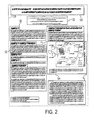
- FIGURE 2 illustrates the input document of FIGURE 1 , with text and image blocks outlined in a manner compatible with the exemplary embodiment
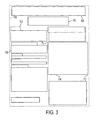
- FIGURE 3 illustrates the input document of FIGURE 2 , with the text and image content removed; the blocks are then input into an indexing algorithm;
- FIGURE 4 is a functional block diagram for a document layout indexing system
- FIGURE 5 is a functional block diagram of a system for a document query and ranking, which may be used in conjunction with the document layout indexing system of FIGURE 4 ;
- FIGURE 6 is a flow diagram illustrating a method for indexing a collection of document layouts
- FIGURE 7 is a detailed flow diagram illustrating the construction of representative blocks from a set of extracted layout blocks, which may be performed in the method of FIGURE 6 ;
- FIGURE 8 is a flow diagram illustrating a method for querying and ranking documents based upon a given document layout
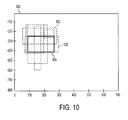
- FIGURES 9 and 10 are graphical illustrations of block clusters and representative blocks generated by the document layout indexing system of FIGURE 4 ;
- FIGURE 11 is a functional block block diagram for the communication between a client terminal and a document query system.
- aspects of the present exemplary embodiment relate to a system and method for indexing and querying documents according to a document layout. Through the use of clustering and the concept of "representative blocks," the method can avoid comparing the query document to all indexed documents.
- a "document” can be an electronic document in any suitable form, such as PDF, TIFF, BMP, or Microsoft Office document and may include images, text, or combinations thereof. Images can be photographs, graphics, etc.
- the exemplary method of indexing a collection of documents based on the layout of each document may include the following:
- the layout for each document in a collection is extracted from the document.
- a layout is defined by the arrangement of text and pictures in a given document.
- a layout can be thought of as one or more "blocks" arranged on a document, with each block containing contiguous text and/or pictures. Each block has an area which may be the minimum required to completely bound the text or image contained in the block.
- the first step comprises extracting all the "blocks" from each document in a collection, with each block comprising location information sufficient to define the block's size and page location, such as a set of two points to represent the upper left and bottom right corners.
- the layout extraction aims to assign all the visually displayed information in a document to a respective block.
- each page will include at least two and generally at least three blocks. The number of blocks can be up to about 50 per page.
- the entire group of extracted layout blocks is grouped into a pre-defined number of clusters according to a clustering algorithm based on the location information.
- the pre-defined number may vary depending on various factors, such as the size of the document collection and the desired results.
- Exemplary clustering algorithms such as k-means and/or a hierarchical clustering algorithm, may be used as a suitable method for clustering data.
- a hierarchy of clusters is constructed. See http://en.wikipedia.org/wiki/Hierarchical_clustering.
- a number m of clusters is selected. m may be, for example, from about 10 to 30. However, any other current or future clustering algorithm may be used.
- Each layout block cluster will contain a plurality of blocks extracted from different documents.
- a "representative block” is computed for each cluster that mathematically represents every layout block in the cluster.
- Each layout block cluster will have exactly one representative block.
- a document index D R is then generated for each document in the collection with respect to the collection of representative blocks.
- the document index is generated by projecting or measuring, among other things, the distance or similarity between each block in the document and each of the representative blocks, with identical blocks having a distance of 0. Any suitable measure for the distance between two blocks may be considered.
- Another suitable distance measure takes the block positions and extends them with other attributes, like shape, type, etc., by building a tuple containing a sequence of location information and at least one attribute element.
- xn, 1 yn, 1 ,xn, 2 ,yn, 2 are normalized x 1 , y 1 , x 2 , y 2 values, e.g., normalized to the [0,1] range
- ra is the shape ratio, given by normalized in such a way that a square shape is 0.5 while vertical and horizontal blocks tend to 0 and 1, respectively
- ov is the overlap distance d o ( b 1
- the tuple may include fewer or more than three attribute elements, such as one, two, four or more attribute elements.
- the tuple distance between them may be evaluated using the standard cosine function over their tuples t 1 and t 2 . Other distance measures suitable for measuring the distance between vectors may be considered.
- the document index can be a concatenation or matrix comprising all the distance measures between each block in the document and each representative block.
- the set of document indexes is itself clustered using a clustering algorithm, and a "representative document index" is computed for each document index cluster (D-cluster).
- the representative document index is a mathematical representative of all the document indexes in the cluster. There is one representative document index per cluster of document indexes.
- the number m' of document index clusters can be selected based on the number of documents in the collection, e.g., the square root of the number of documents.
- the exemplary method of querying and ranking documents according to a document layout query may include the following steps.
- the layout query is a set of data representing the blocks that a user (human or otherwise) wishes to find in a document collection.
- the layout blocks may be entered into a computer system in any suitable way.
- a user may compose a layout query by drawing blocks on a suitable device, such as a touchscreen, or the user may draw layout blocks using a computer input device such as a mouse.
- the user may enter location information, such as the x i , y i coordinates of two points of each block.
- the user may scan a document into memory and allow the system to extract the bounding blocks from the scanned document and use the extracted blocks as a layout query.
- the extracted layout blocks b 1 , b 2 , etc. from Q are projected onto the representative blocks created from the document collection in the indexing method, as described in further detail below. This results in a query document index that can be used to find document layouts similar to the query layout.
- the query document index is then compared to each representative document index using a ranking function, as described below.
- the document index cluster with a representative document index that is determined to be most similar to the query index is selected.
- all of the document indexes within the selected document index cluster are compared to the query index through the ranking function used above. As each comparison is made, an ordered list is maintained such that the top ranked document indexes (in order of similarity) may be returned as a product of the query.
- FIGURE 1 illustrates a sample document 100 that may be contained in a document collection 400 ( FIG. 4 ).
- the sample document 100 is composed of a single page and may contain both text 110 and images 112 arranged in any manner. Multiple-page documents are split into multiple individual pages 100 for the purpose of the exemplary embodiment.
- FIGURES 2 and 3 illustrate the sample document 100 of FIGURE 1 after the layout blocks 102, 104 have been computed.
- This computation can be performed by any device suitable for extracting bounding blocks from a document.
- software solutions that can perform such processing, such as PDF to XML standard converter software, as well as other PDF, Word, and Postscript software packages.
- these software packages can be adjusted to compute the layout blocks 102 based on multiple parameters such as whitespace, box type (image vs. text), color, text size, etc.
- the exemplary layout blocks are always in the shape of a rectangle and may overlap over one another.
- each document layout D is given by a set of rectangular blocks, where each block contains either text or at least one image and is defined by one or more of its position, shape, size, block content (i.e., image or text), etc.
- x and y are the horizontal and vertical coordinates of the document, respectively, and may be measured from a fixed point, such as the top left hand corner of the document.
- FIGURE 4 illustrates an exemplary system 404 for indexing layout blocks from documents contained in a document collection 400.
- the system 404 includes an input 402, for receiving the document collection 400.
- the document collection may be stored in any suitable tangible media such as a ROM or RAM drive or may be input into the system in the form of a carrier wave, e.g., via the Internet or other network.
- the document collection is provided within the computing device 404 itself or stored in a separate memory accessible to the system 404.
- the input may include a modem link, a wired or wireless connection, USB port, floppy or hard disk drive, or the like.
- the system 404 includes data memory 418 for storing an input document collection 400 (or part thereof) being processed.
- Main memory 406 of the system stores a block extraction module 408, block clustering module 409, representative block computation module 410, document indexing module 412, and an index clustering module 413.
- the block extraction module 408 extracts the layout blocks 102, 104 from each document 100 in the document collection 400.
- the block extraction module 408 may be any module suitable to extract bounding blocks from a document. Alternatively, a custom block extraction module may be implemented.
- the block clustering module 409 clusters (i.e. "groups") the extracted blocks 102, 104 from the block extraction module 408 into a pre-defined number k of clusters.
- the representative block computation module 410 computes a representative block ( FIGS. 9-10 , item 904) for each cluster ( FIGS. 9-10 , item 900) created by the block clustering module 409.
- the document indexing module 412 creates a document index for each document 100 from the document collection 400 by comparing the blocks 102, 104 in the document with each representative block ( FIGS. 9-10 , item 904) created by the representative block computation module 410.
- the index clustering module 413 then clusters the document indexes computed by the document indexing module 412 for future use.
- the block extraction module 408, block clustering module 409, representative block computation module 410, document indexing module 412, and the index clustering module 413 may be implemented as hardware or software or a combination thereof.
- these components 408, 409, 410, 412, 413 are in the form of software instructions stored in main memory 406, which are executed by a computer processor 416 in communication with memory 406.
- the processor 416 such as the computer's CPU, may control the overall operation of the computer system 404 by execution of processing instructions stored in memory 406.
- Components 406, 416, 418 of the computer system may be connected by a data control bus 414.
- the exemplary system 404 includes an input/output device 420, which outputs a set of document indexes 422 created by the modules 408, 409, 410, 410, 412, 413 residing in memory 406.
- the set of document indexes 422 for the documents in the collection may be stored locally in RAM memory 406, 418, or stored in a storage device such as a hard disk, database, or other now known or future storage medium and may be linked in some way to the respective documents for which they have been generated.
- the exemplary system 404 may comprise one or more computing devices, such as a personal computer, PDA, laptop computer, server computer, or combination thereof.
- Memories 406, 418 may be integral or separate and may represent any type of computer readable medium such as random access memory (RAM), read only memory (ROM), magnetic disk or tape, optical disk, flash memory, or holographic memory.
- the memories 406, 418 comprise a combination of random access memory and read only memory.
- the processor 416 and memory 406 and/or 418 may be combined in a single chip.
- FIGURE 5 illustrates an exemplary system 506 for querying and ranking documents based upon an input document layout D .
- the system 506 includes an input 504, for receiving both a layout query Q 500 and a set of document indexes, representative blocks, document index clusters (D-clusters), and representative document indexes 422.
- the set of document indexes, representative blocks, D-clusters, and representative indexes 422 of the document collection may be stored in any suitable tangible media such as a ROM or RAM drive or may be input into the system in the form of a carrier wave, e.g., via the Internet or a network.
- the layout query 500 and the set 422 of document indexes, representative blocks, index D-clusters, and representative indexes is generated within the computing device 506 itself (i.e., device 506 may include a document layout indexing system 404).
- the input 504 may include a modem link, a wired or wireless connection, USB port, floppy or hard disk receiver, or the like.
- the system 506 includes data memory 522 for storing the input layout query 500 while it is being processed.
- the set of document indexes, representative blocks, D-clusters, and representative indexes 422 is also stored in computer memory, such as memory 522 or a separate memory.
- Main memory 508 of the system stores a document query module 510 and a document ranking module 512.
- the document query module 510 identifies one or more indexes from the set of document indexes 422 that are likely to represent documents similar to the input layout query 500.
- the document ranking module 512 ranks the indexes identified by the document query module 510 according to one or more ranking functions.
- the document query module 510 and the document ranking module 512 may be implemented as hardware or software or a combination thereof.
- the document query module 510 and the document ranking module 512 include software instructions stored in main memory 508, which are executed by a computer processor 516 having access to memory 508.
- the processor 516 such as the computer's CPU, may control the overall operation of the computer system 506 by execution of processing instructions stored in memory 508.
- Components 508, 516, 518 of the computer system may be connected by a data control bus 514 .
- the exemplary system 506 of FIGURE 5 includes an input/output device 518, which outputs a list of ranked documents 520 which the system 506 identifies as having a layout similar to the layout query 500.
- the exemplary output 518 is linked by a wired or wireless link to one or more of a display 524, such as a screen or monitor, memory storage where a ranked document listing 520 may be stored, or a client terminal 1100.
- the user inputting the query can view the retrieved documents on the display screen and determine whether they are responsive to the search query. If not, the user may choose to add attributes to the layout query.
- the exemplary system 506 of FIGURE 5 may comprise one or more computing devices, such as a personal computer, PDA, laptop computer, server computer, or combination thereof.
- Memories 508, 522 may be integral or separate and may represent any type of computer readable medium such as random access memory (RAM), read only memory (ROM), magnetic disk or tape, optical disk, flash memory, or holographic memory.
- the memories 508, 522 comprise a combination of random access memory and read only memory.
- the processor 516 and memory 508 and/or 522 may be combined in a single chip.
- the exemplary systems 404, 506 embodied in FIGURES 4 and 5 may be combined into a single, unitary system.
- FIGURE 6 illustrates a method for creating indexes for a plurality of documents in a document collection which can be performed with the system of FIGURE 4 .
- the method begins at S600.
- a quantity of N documents 100 from a document collection 400 is provided to the input 402 (if they have not already been input into the system 404).
- the N documents 100 are imported into system memory 418 or data memory 406 for processing.
- the block extraction module 408 extracts the layout blocks 102, 104, etc. from each document 100, and stores the aggregate block data (i.e., all the blocks from all the documents) in memory 406, 418.
- the block clustering module 409 working in conjunction with the representative block computation module 410, clusters the aggregate block data stored in memory 406, 418 by the block extraction module 408, and constructs a representative block 904 for each cluster.
- the representative blocks 904 may represent the average of all the blocks in a given cluster 900.
- a document index D R is created by projecting the layout blocks 102, 104 contained in the document 100 onto the representative blocks 904.
- the similarity to representative blocks B j ⁇ B R is measured using a block distance function D, such as one of Eqn's (2) or (3) presented above.
- the document index can be optionally extended with more information.
- information compatible with the commonly used "term frequency-inverse document frequency” (TF-IDF) model used for indexing text documents can be added. See http://en.wikipedia.org/wiki/Tf-idf for an explanation of the TF-IDF model.
- v ij (computed above) is the weight of representative block b i ⁇ D with respect to the Representative Block B r,j , similar to the term frequency in the text documents.
- BWIBF block weight-inverted block frequency
- the index clustering module 413 clusters the document indexes created in step S608 into m' document index clusters (D-clusters) wherein module 413 performs the clustering with either the k-means or hierarchical clustering algorithms, although any clustering algorithm may be used.
- the document indexes, representative blocks, D-clusters, and the representative D-cluster indexes are stored in a memory 406, 418, or output to a storage device 422.
- the method ends at S616 .
- S606 Specific aspects of S606 are illustrated in FIGURE 7 and are described in greater detail below.
- step S606 N documents 100 from the document collection 400 have been imported into system memory 406 or data memory 418, and all the layout blocks 102, 104 have been extracted from the N documents 100 in memory 406, 418.
- the block clustering module 409 performs a clustering algorithm on all of the blocks contained in memory 406, 418.
- the clustering performed on B may be performed, for example, by a k-means algorithm with a predefined number of clusters m .
- the predefined number of clusters m is chosen based on factors such as the document collection size, number of blocks extracted, statistical variation within the blocks, etc.
- a set RB of representative blocks is constructed (one representative block per cluster).
- ( p i 1 , p i 2 b j ⁇ C i ).
- the centroid 904 consists of two points (p 1 and p 2 ) which are essentially the averages of the corresponding points of each block b 902 in the cluster 904. After the centroid 904 is computed, it is set as the representative block B r,i for the cluster 900.
- FIGURES 9 and 10 show examples of clusters 900 of blocks 902 taken from a sample collection 400 and the corresponding centroids (i.e., representative blocks) 904.
- Table 1 contains an exemplary algorithm summarizing the document indexing process of FIGURES 6 and 7 .
- Table 1 Document Layout Indexing Require: S, a set of N block-wise document layouts Require: m , the number of representative blocks Ensure: Representative block set B R and indexes for all D ⁇ DB 1: Create the block set BS ⁇ b
- b ⁇ D,D ⁇ DB ⁇ 2: Run a clustering method on BS with m clusters 3: for each cluster Ci , i 1, m do 4: Build the cluster centroid and assign it as the cluster representative, 5: end for 6: Let B R be the set of representative blocks, 7: for each document D ⁇ DB do 8: Build index D R as the projection of D on B R using (4)/(5) and (6) 9: end for 10: Cluster the set of indexes D R in m' D-clusters, where
- FIGURE 8 illustrates the process of processing an input query layout and producing the top k matching document indexes or corresponding documents.
- the illustrated method may be performed with the system described in FIGURE 5 .
- the method begins at S800.
- a layout query 500 and a set of document indexes, representative blocks, index D-clusters, and representative indexes 422 is provided to the input 504 (if they have not already been input into the system 506).
- the inputs 500, 422 are imported into system memory 508 or data memory 522 for processing.
- the document query module 510 extracts the layout blocks 102, 104 from the layout query 500.
- this step may be performed by any device suitable to extract bounding blocks from a document.
- software solutions that can perform such processing, such as PDF to XML standard converter software, as well as other PDF, Word, and Postscript software packages.
- these software packages can be adjusted to compute the layout blocks 102, 104 based on multiple parameters such as whitespace, box type (image vs. text), color, text size, etc.
- the layout blocks are always in the shape of a rectangle and may overlap over one another.
- the document query module 510 computes an index Q R for the query layout by projecting the extracted layout blocks 102, 104 contained in the layout query 500 onto the set of representative blocks 904 input into memory.
- the projection algorithm is the same as described above with respect to the document collection indexes of S608.
- the query index Q R is obtained, it can be compared to an index D R to determine the similarity between the layout query 500 and a document 100 represented by D R .
- the similarity between a query Q and a document D is approximated by their projections on the representative block set B R , B R,rank ( Q,D ) ⁇ ( Q R ,D R ), where the query and document indexes are vectors and
- the cosine function ranks all documents by giving them values between 1 (the best match) and 0.
- some irregularities may occur as illustrated by the following example.
- k 2
- a query index Q R ⁇ 0.86,0.0 ⁇ .
- the sparse index problem is addressed by correcting the cosine-based ranking function and integrating the index absolute values.
- any of the ranking functions of Eqns. (8), (9), and (10) can be used to compare the similarity of layout indexes, but the ranking function (10) may produce better results.
- the document query module 510 computes the distance (similarity) between the layout query index Q R and each of the D-cluster representative indexes input in S802 (computed previously by S612) using one of the rank functions (8), (9), and (10) above.
- the document query module 510 also keeps track of the most similar D-cluster representative index and designates the corresponding D-cluster as the "top D-cluster.”
- the top D-cluster contains a cluster of indexes D R that have been determined to be the most similar to the layout query index Q R .
- control is passed to the document ranking module 512 which computes the rank of each D R in the top D-cluster relative to the layout query Q R .
- the document ranking module 512 maintains an ordered list of the document indexes D R according to the computed rank.
- the document ranking module 512 outputs, through an input/output device 518, responsive documents, such as a list of the top k documents 520 according to the ordered list constructed in S810 to one or more of a display 524, client terminal 1100, or other human readable interface.
- responsive documents such as a list of the top k documents 520 according to the ordered list constructed in S810 to one or more of a display 524, client terminal 1100, or other human readable interface.
- the document ranking module may output the top k documents 100, rather than a list of the top k documents 520.
- Table 2 contains an algorithm summarizing the document indexing process of FIGURE 8 .
- Table 2 Querying and relevance ranking Require : D-clusters of document indexes D R , D ⁇ S , representative blocks B R Require : Query document Q Ensure: k top relevant documents for Q with ranking 1: Extract layout blocks from the query document 2: Get the projection Q R of the query layout on B R 3: for For each D-cluster do 4: Evaluate the distance between Q R and D-cluster using one of rank functions 5: Keep it as D top if yielding the minimal distance 6: end for 7: for For each document index in cluster D top do 8: Evaluate the rank w.r.t. Q R using one of rank functions 9: Keep it if yielding the k top ranks 10: end for 11: Retrieve k documents with the top ranks
- FIGURES 6-8 may be implemented in a computer program product or products that may be executed on a computer.
- the computer program product may be a tangible computer-readable recording medium on which a control program is recorded, such as a disk or hard drive.
- FIGURES 9 and 10 each illustrate a cluster 900 of layout blocks 902, with a representative block 904 computed as the average (here, the mean) of all the blocks 902 in the cluster 900.
- FIGURE 11 illustrates an exemplary system for querying a document query system by document layout.
- the system includes a document query system 506, a client terminal 1100, a network connection 1106, and network messages 500, 520, 1104, 1102.
- the document query system 506 is connected to at least one client terminal 1100 through a network connection 1106.
- the network connection 1106 may be wired or wireless, infrastructure or ad hoc, or a direct connection between the client terminal 1100 and the document query system 506 through a shared bus.
- the document query system 506 may further include a document layout indexing system 404.
- a user at the client terminal 1100 will send a layout query 500 to the document query system 506 over the network 1106.
- the document query system 506 then processes the layout query 500 and returns a list of k ranked documents 520 that most closely match the layout query 500.
- the client terminal 1100 then sends a network message 1104 to the document query system 506 indicating the documents 100 that the user would like to retrieve (or view).
- the document query system then retrieves the requested documents 1104 and sends them over the network 1106 to the client terminal 1100 for use by the user.
- the client terminal may include a display screen for displaying the retrieved documents and/or their layouts and for generating a query.
- a prototype system which implements querying by layout is constructed such that the system is capable of being tested locally.
- the system allows a person to select a query document from a collection, and to retrieve and rank the top k relevant documents. Additionally, it allows querying by navigating through the pages of multi-page documents and visualizing either the document image or the layout only.
- the indexes have been created for several collections, including a generic collection of a company's documents and a publicly available collection of documents (CPO) assembled by Vikef (Virtual Information and Knowledge Environment Framework).
- CPO Public Information and Knowledge Environment Framework
- the tuple block distance function of Eqn (3) and the maximum projection function of Eqn (5) are used.
- Ten random query documents from each collection are gathered and manually matched with the top 10 relevant documents per query.
- the top 10 relevant documents per query are manually annotated with a ranking of 1 to 10. Because the top 10 relevant documents for each query have been manually computed, it is possible to measure the rank error of the algorithm by comparing the algorithm's results with the results of the manual ranking.
- one of the ranking functions (8), (9), or (10) is applied to the layout query and the rank error is measured as ⁇ i
- the ranking error is 0.
- Table 3 reports the evaluation results for both collections. The total rank error is evaluated for the three ranking measures given in Eqns. (8), (9) and (10). As the table shows, using the third ranking function reduces the ranking error by about 27% and 32% for the generic document and CPO collections, respectively.
- Table 3 Evaluation of ranking functions Ranking function GENERIC CPO rank 1 in (8) 436 751 rank 2 in (9) 382 659 rank 3 in (10) 318 513
Landscapes
- Engineering & Computer Science (AREA)
- Theoretical Computer Science (AREA)
- Physics & Mathematics (AREA)
- Computer Vision & Pattern Recognition (AREA)
- General Physics & Mathematics (AREA)
- Library & Information Science (AREA)
- Artificial Intelligence (AREA)
- Multimedia (AREA)
- Data Mining & Analysis (AREA)
- Databases & Information Systems (AREA)
- General Engineering & Computer Science (AREA)
- Geometry (AREA)
- Computer Graphics (AREA)
- Computational Linguistics (AREA)
- Information Retrieval, Db Structures And Fs Structures Therefor (AREA)
Abstract
Description
- The exemplary embodiment relates to indexing and querying documents. It finds particular application to querying medium to large sized databases of documents based on document layout, and will be described with particular reference thereto.
- Much information is now available in electronic format and stored in personal, intranet and internet document collections. Over the last twenty years, significant progress has been achieved in the area of full text indexing and retrieval. Current techniques of information retrieval allow a user to query document collections with one or multiple keywords and retrieve and rank the relevant documents. In the case of documents available on the World Wide Web (Web), search engines such as Google, Yahoo and MSN crawl the Web and index Web pages as well as PDF and Word documents. For all document types, the search engines use text and link information contained within the documents in order to retrieve relevant documents and rank them. However, layout information contained within the document is ignored.
- Nevertheless, querying document collections by document layout would be extremely useful when a user possesses visual, as opposed to textual, information, or when a query is difficult or even impossible to express with keywords. This is particularly true in the office environment, where documents often have a generic structure, such as financial bills, forms, templates, catalogs, CVs, letters, etc. It would be advantageous for office personnel to find documents with a layout similar to a given document. Unfortunately, none of the current document query systems is capable of addressing such a need.
- Example-based querying is widely used in the context of content-based image retrieval. However, because images are inherently complex, the understanding and semantic indexing of images is limited to specialized query types such as exact image matching, logo recognition and more categorization-like tasks, such as recognizing sky, flower or bike images. Querying by document layout can be considered a form of example-based querying. However, accurate relevance ranking of images by their (semantic) similarity is still far beyond the capabilities of current systems.
- Existing methods of querying document collections by layout require intense processing for each (document, query) pair, including a 2-dimensional alignment between a query and each document in the collection. This alignment algorithm is time consuming and thus makes alignment based techniques limited to small and medium size collections. In a very large collection, the user is often interested in retrieving the top k relevant documents, thus the exhaustive document-to-query alignment becomes unnecessary and time wasting.
- The present exemplary embodiment provides a system and method for indexing and querying documents by layout that avoids comparing the query document to all indexed documents through the use of clustering.
- In one aspect, a computer-implemented method for creating a set of indexes for a collection of documents according to document layout is provided. The method includes providing a plurality of documents to computer memory, extracting layout blocks from the provided documents, using a computer processor, clustering the layout blocks into a plurality of layout block clusters, computing a representative block for each of the layout block clusters, generating a document index for each provided document based on the layout blocks of the document and the computed representatives blocks, clustering the created document indexes into a plurality of document index clusters, generating a representative cluster index for each of the document index clusters, and outputting the created document indexes, representative blocks, document index clusters, and representative cluster indexes to a memory.
- In a further embodiment the computing of the representative block for each of the layout block clusters comprises computing a first point and a second point which together define a location and a shape of the representative block, the representative block's first point being computed as a function of a first point of each layout block in the cluster, the representative block's second point being computed as a function of a second point of each layout block in the cluster, the first point and the second point of each layout block together defining a location and shape of the layout block.
- In one embodiment of the method of claim 7, the computing of the similarity between each layout block in a provided document and each representative block comprises:
- generating a tuple for each layout block and a tuple for each representative block, each of the tuples comprising location information for the respective block and at least one attribute value for the respective block; and
- computing a distance measure between the layout block tuple and the representative block tuple.
- In a further embodiment the attribute value is selected from a first attribute value based on a shape ratio of the layout block, a second attribute value based on an overlap distance between the layout block and the representative block, a third attribute based on a block type, and combinations thereof.
- In a further embodiment of the method of
claim 1, the method further comprises input document layout query, extracting layout blocks from the input layout query and retrieving responsive documents from the collection using the generated document indexes, representative blocks, document index clusters, and representative cluster indexes. - In another aspect, a computer-implemented method for querying a collection of documents according to document layout is provided. The method includes providing in computer memory a set of representative blocks, each representative block being representative of a respective cluster of layout blocks extracted from documents in the collection, a set of document indexes, each document index being representative of layout blocks of a respective document in the collection, each of the document indexes being assigned to a respective one of a set of document index clusters, and a representative document index for each document index cluster, each representative document index being derived from the document indexes assigned to the document index cluster; extracting layout blocks from an input document layout query; projecting the extracted layout blocks from the document layout query onto the set of representative blocks to generate a query document index; with a computer processor, computing a measure of similarity between the query document index and each of the representative document indexes in the set of representative document indexes; identifying a top document index cluster which includes the representative document index determined to have the greatest similarity to the query document index; computing a measure of similarity between each document index in the top document index cluster and the query index to identify a set of most similar documents; and outputting information on the documents in the set of most similar documents.
- In a further embodiment the query index comprises a vector and further including at least one of a) and b):
- a) each of the representative document indexes comprises a vector and wherein the computation of the similarity measure between the query index and each of the representative document indexes comprises assigning a first rank based on a cosine of the angle between the query vector and the representative document index vector; and
- b) each of the document indexes comprises a vector and wherein the computation of the similarity measure between the query index and each of the document indexes comprises assigning a second rank based on a cosine of the angle between the query vector and the document index vector.
- In a further embodiment at least one of:
- the first rank is a function of the cosine of the query vector and the representative document index vector and also of the number of the representative blocks; and
- the second rank is a function of the cosine of the query vector and the document index vector and also of the number of the representative blocks.
- In a further embodiment at least one of the first and second ranks is defined by one of rank 1(Q,D), rank 2(Q,D) and rank 3(Q,D), as follows:


and

QR is a vector equivalent to the query index, and optionally, DR is a vector equivalent to either a representative document index or a document index depending on the whether the first or second rank is computed, and optionally, and
m is the number of representative blocks. - In another aspect, a computer-based system for querying a collection of documents according to a document layout is provided. The system includes a data input module configured to receive into memory a set of document indexes, a set of representative blocks, a set of document index clusters, a set of representative indexes, a nd a document layout query; a document query module configured to extract layout blocks from the document layout query, project the extracted layout blocks from the document layout query onto the set of representative blocks to generate a query index, compute the similarity between the query index and each of the representative indexes in the set of document index clusters by using a ranking function, identify the document index cluster containing the representative index having the greatest similarity as the top document index cluster, and compute the similarity between each document index in the top document index cluster and the query index by using the ranking function; and a document ranking module configured to maintain an ordered list of the top k documents based on the computed similarity between each document index in the top document index cluster and the query index, and output the ordered list.
- In one embodiment of the system of claim 15, the system outputs the ordered list to an associated client terminal.
- In a further embodiment when the client terminal identifies to the system at least one document to retrieve from the ordered list, the system provides the at least one document to the client terminal.
- In a further embodiment the system further comprises a touchscreen, and wherein the document layout query is generated through the use of the touchscreen.
-
FIGURE 1 is an example of a page of an input electronic document that is part of a document collection to be indexed; -
FIGURE 2 illustrates the input document ofFIGURE 1 , with text and image blocks outlined in a manner compatible with the exemplary embodiment; -
FIGURE 3 illustrates the input document ofFIGURE 2 , with the text and image content removed; the blocks are then input into an indexing algorithm; -
FIGURE 4 is a functional block diagram for a document layout indexing system; -
FIGURE 5 is a functional block diagram of a system for a document query and ranking, which may be used in conjunction with the document layout indexing system ofFIGURE 4 ; -
FIGURE 6 is a flow diagram illustrating a method for indexing a collection of document layouts; -
FIGURE 7 is a detailed flow diagram illustrating the construction of representative blocks from a set of extracted layout blocks, which may be performed in the method ofFIGURE 6 ; -
FIGURE 8 is a flow diagram illustrating a method for querying and ranking documents based upon a given document layout; -
FIGURES 9 and10 are graphical illustrations of block clusters and representative blocks generated by the document layout indexing system ofFIGURE 4 ; and -
FIGURE 11 is a functional block block diagram for the communication between a client terminal and a document query system. - Aspects of the present exemplary embodiment relate to a system and method for indexing and querying documents according to a document layout. Through the use of clustering and the concept of "representative blocks," the method can avoid comparing the query document to all indexed documents.
- As used herein, a "document" can be an electronic document in any suitable form, such as PDF, TIFF, BMP, or Microsoft Office document and may include images, text, or combinations thereof. Images can be photographs, graphics, etc.
- As explained in further detail below, the exemplary method of indexing a collection of documents based on the layout of each document may include the following:
- First, the layout for each document in a collection is extracted from the document. A layout is defined by the arrangement of text and pictures in a given document. Conceptually, a layout can be thought of as one or more "blocks" arranged on a document, with each block containing contiguous text and/or pictures. Each block has an area which may be the minimum required to completely bound the text or image contained in the block. Thus, the first step comprises extracting all the "blocks" from each document in a collection, with each block comprising location information sufficient to define the block's size and page location, such as a set of two points to represent the upper left and bottom right corners. The layout extraction aims to assign all the visually displayed information in a document to a respective block. In general, each page will include at least two and generally at least three blocks. The number of blocks can be up to about 50 per page.
- Next, the entire group of extracted layout blocks is grouped into a pre-defined number of clusters according to a clustering algorithm based on the location information. The pre-defined number may vary depending on various factors, such as the size of the document collection and the desired results. Exemplary clustering algorithms, such as k-means and/or a hierarchical clustering algorithm, may be used as a suitable method for clustering data. In an approach using a hierarchical clustering algorithm, a hierarchy of clusters is constructed. See http://en.wikipedia.org/wiki/Hierarchical_clustering. In the k-means approach, a number m of clusters is selected. m may be, for example, from about 10 to 30. However, any other current or future clustering algorithm may be used.
- Each layout block cluster will contain a plurality of blocks extracted from different documents. In order to promote speed and efficiency, a "representative block" is computed for each cluster that mathematically represents every layout block in the cluster. Each layout block cluster will have exactly one representative block.
- A document index DR is then generated for each document in the collection with respect to the collection of representative blocks. The document index is generated by projecting or measuring, among other things, the distance or similarity between each block in the document and each of the representative blocks, with identical blocks having a distance of 0. Any suitable measure for the distance between two blocks may be considered. The block of interest may be represented by b 1=(p 11,p 12) and the representative block by b 2=(p 21,p 22) , where p 11 is the first point (i.e., the upper left point) of the first block, p 21 is the first point of the second block, p 12 is the second point (i.e., the bottom right point) of the first block, and p 22 is the second point of the second block.
- One exemplary distance measure is the Manhattan distance, which can be defined as follows:

where d m (p 1,p 2)=|x 1-x 2|+|y 1-y 2| is the Manhattan distance between two points p 1 and p 2, with each point p i defined by two coordinates (xi , yi ). - Another suitable distance measure is the overlapping distance between two blocks given by their area of overlap:

where operation (b 1^b 2) gives an overlap of two blocks b 1 and b 2 and area(p 1,p 2)=|x 1-x 2|×|y 1-y 2|. - Another suitable distance measure takes the block positions and extends them with other attributes, like shape, type, etc., by building a tuple containing a sequence of location information and at least one attribute element. For example, when ov, ra, and tp are all considered, the tuple t representing a block may be in the form:

where: xn,1yn,1,xn,2,yn,2 are normalized x 1,y 1,x 2,y 2 values, e.g., normalized to the [0,1] range;
ra is the shape ratio, given by normalized in such a way that a square shape is 0.5 while vertical and horizontal blocks tend to 0 and 1, respectively;
ov is the overlap distance do (b 1,b 2), where do is the overlapping distance measure function;
tp is the block type. For example, 0 for a text block, 1 for an image block. - As will be appreciated, the tuple may include fewer or more than three attribute elements, such as one, two, four or more attribute elements. For two blocks b 1 and b 2, the tuple distance between them may be evaluated using the standard cosine function over their tuples t 1 and t 2. Other distance measures suitable for measuring the distance between vectors may be considered.
- Any of these distance functions may be used in the exemplary embodiment for generating a distance measure for each block. The document index can be a concatenation or matrix comprising all the distance measures between each block in the document and each representative block.
- Additionally, the set of document indexes is itself clustered using a clustering algorithm, and a "representative document index" is computed for each document index cluster (D-cluster). The representative document index is a mathematical representative of all the document indexes in the cluster. There is one representative document index per cluster of document indexes. As for the clustering of blocks, the number m' of document index clusters can be selected based on the number of documents in the collection, e.g., the square root of the number of documents.
- The exemplary method of querying and ranking documents according to a document layout query may include the following steps.
- First, a sample document to be matched or layout query Q is received, and the layout blocks extracted therefrom. The layout query is a set of data representing the blocks that a user (human or otherwise) wishes to find in a document collection. The layout blocks may be entered into a computer system in any suitable way. For example, a user may compose a layout query by drawing blocks on a suitable device, such as a touchscreen, or the user may draw layout blocks using a computer input device such as a mouse. Alternatively, the user may enter location information, such as the x i, yi coordinates of two points of each block. In an alternative embodiment, the user may scan a document into memory and allow the system to extract the bounding blocks from the scanned document and use the extracted blocks as a layout query.
- Next, the extracted layout blocks b1, b2 , etc. from Q are projected onto the representative blocks created from the document collection in the indexing method, as described in further detail below. This results in a query document index that can be used to find document layouts similar to the query layout.
- The query document index is then compared to each representative document index using a ranking function, as described below. The document index cluster with a representative document index that is determined to be most similar to the query index is selected. Then, all of the document indexes within the selected document index cluster are compared to the query index through the ranking function used above. As each comparison is made, an ordered list is maintained such that the top ranked document indexes (in order of similarity) may be returned as a product of the query.
- To illustrate aspects of the exemplary embodiment,
FIGURE 1 illustrates asample document 100 that may be contained in a document collection 400 (FIG. 4 ). Thesample document 100 is composed of a single page and may contain bothtext 110 andimages 112 arranged in any manner. Multiple-page documents are split into multipleindividual pages 100 for the purpose of the exemplary embodiment. -
FIGURES 2 and3 illustrate thesample document 100 ofFIGURE 1 after the layout blocks 102, 104 have been computed. This computation can be performed by any device suitable for extracting bounding blocks from a document. For example, there are many software solutions that can perform such processing, such as PDF to XML standard converter software, as well as other PDF, Word, and Postscript software packages. Additionally, these software packages can be adjusted to compute the layout blocks 102 based on multiple parameters such as whitespace, box type (image vs. text), color, text size, etc. The exemplary layout blocks are always in the shape of a rectangle and may overlap over one another. - In mathematical terms, let S denote the collection of document layouts where each document layout D is given by a set of rectangular blocks, where each block contains either text or at least one image and is defined by one or more of its position, shape, size, block content (i.e., image or text), etc. Each document layout D is given by a set of blocks, D = {b 1,...,bn }, where each block bi is defined by two points (p 1,p 2). In the exemplary embodiment, the two points denote the top left and bottom-right corners of block bi where p1 =(x 1,y 1) and p 2=(x 2,y 2), shown by way of example, on
block 104. x and y are the horizontal and vertical coordinates of the document, respectively, and may be measured from a fixed point, such as the top left hand corner of the document. -
FIGURE 4 illustrates anexemplary system 404 for indexing layout blocks from documents contained in adocument collection 400. Thesystem 404 includes aninput 402, for receiving thedocument collection 400. Prior to inputting, the document collection may be stored in any suitable tangible media such as a ROM or RAM drive or may be input into the system in the form of a carrier wave, e.g., via the Internet or other network. Alternatively, the document collection is provided within thecomputing device 404 itself or stored in a separate memory accessible to thesystem 404. The input may include a modem link, a wired or wireless connection, USB port, floppy or hard disk drive, or the like. - The
system 404 includesdata memory 418 for storing an input document collection 400 (or part thereof) being processed.Main memory 406 of the system stores ablock extraction module 408,block clustering module 409, representativeblock computation module 410,document indexing module 412, and anindex clustering module 413. Theblock extraction module 408 extracts the layout blocks 102, 104 from eachdocument 100 in thedocument collection 400. Theblock extraction module 408 may be any module suitable to extract bounding blocks from a document. Alternatively, a custom block extraction module may be implemented. Theblock clustering module 409 clusters (i.e. "groups") the extractedblocks block extraction module 408 into a pre-defined number k of clusters. The representativeblock computation module 410 computes a representative block (FIGS. 9-10 , item 904) for each cluster (FIGS. 9-10 , item 900) created by theblock clustering module 409. Thedocument indexing module 412 creates a document index for eachdocument 100 from thedocument collection 400 by comparing theblocks FIGS. 9-10 , item 904) created by the representativeblock computation module 410. Theindex clustering module 413 then clusters the document indexes computed by thedocument indexing module 412 for future use. Theblock extraction module 408,block clustering module 409, representativeblock computation module 410,document indexing module 412, and theindex clustering module 413 may be implemented as hardware or software or a combination thereof. In the exemplary embodiment, thesecomponents main memory 406, which are executed by acomputer processor 416 in communication withmemory 406. Theprocessor 416, such as the computer's CPU, may control the overall operation of thecomputer system 404 by execution of processing instructions stored inmemory 406.Components data control bus 414. - The
exemplary system 404 includes an input/output device 420, which outputs a set ofdocument indexes 422 created by themodules memory 406. The set ofdocument indexes 422 for the documents in the collection may be stored locally inRAM memory - As will be appreciated, the
exemplary system 404 may comprise one or more computing devices, such as a personal computer, PDA, laptop computer, server computer, or combination thereof.Memories memories processor 416 andmemory 406 and/or 418 may be combined in a single chip. -
FIGURE 5 illustrates anexemplary system 506 for querying and ranking documents based upon an input document layout D. Thesystem 506 includes aninput 504, for receiving both alayout query Q 500 and a set of document indexes, representative blocks, document index clusters (D-clusters), andrepresentative document indexes 422. Prior to inputting thelayout query 500, the set of document indexes, representative blocks, D-clusters, andrepresentative indexes 422 of the document collection may be stored in any suitable tangible media such as a ROM or RAM drive or may be input into the system in the form of a carrier wave, e.g., via the Internet or a network. Alternatively, thelayout query 500 and theset 422 of document indexes, representative blocks, index D-clusters, and representative indexes is generated within thecomputing device 506 itself (i.e.,device 506 may include a document layout indexing system 404). Theinput 504 may include a modem link, a wired or wireless connection, USB port, floppy or hard disk receiver, or the like. - The
system 506 includesdata memory 522 for storing theinput layout query 500 while it is being processed. The set of document indexes, representative blocks, D-clusters, andrepresentative indexes 422 is also stored in computer memory, such asmemory 522 or a separate memory.Main memory 508 of the system stores adocument query module 510 and adocument ranking module 512. Thedocument query module 510 identifies one or more indexes from the set ofdocument indexes 422 that are likely to represent documents similar to theinput layout query 500. Thedocument ranking module 512 ranks the indexes identified by thedocument query module 510 according to one or more ranking functions. Thedocument query module 510 and thedocument ranking module 512 may be implemented as hardware or software or a combination thereof. In the exemplary embodiment, thedocument query module 510 and thedocument ranking module 512 include software instructions stored inmain memory 508, which are executed by acomputer processor 516 having access tomemory 508. Theprocessor 516, such as the computer's CPU, may control the overall operation of thecomputer system 506 by execution of processing instructions stored inmemory 508.Components data control bus 514. - The
exemplary system 506 ofFIGURE 5 includes an input/output device 518, which outputs a list of rankeddocuments 520 which thesystem 506 identifies as having a layout similar to thelayout query 500. Theexemplary output 518 is linked by a wired or wireless link to one or more of adisplay 524, such as a screen or monitor, memory storage where a rankeddocument listing 520 may be stored, or aclient terminal 1100. The user inputting the query can view the retrieved documents on the display screen and determine whether they are responsive to the search query. If not, the user may choose to add attributes to the layout query. - As will be appreciated, the
exemplary system 506 ofFIGURE 5 may comprise one or more computing devices, such as a personal computer, PDA, laptop computer, server computer, or combination thereof.Memories memories processor 516 andmemory 508 and/or 522 may be combined in a single chip. In some embodiments, theexemplary systems FIGURES 4 and5 may be combined into a single, unitary system. -
FIGURE 6 illustrates a method for creating indexes for a plurality of documents in a document collection which can be performed with the system ofFIGURE 4 . The method begins at S600. - At S602, a quantity of
N documents 100 from adocument collection 400 is provided to the input 402 (if they have not already been input into the system 404). The N documents 100 are imported intosystem memory 418 ordata memory 406 for processing. - At S604, the
block extraction module 408 extracts the layout blocks 102, 104, etc. from eachdocument 100, and stores the aggregate block data (i.e., all the blocks from all the documents) inmemory - At S606, the
block clustering module 409, working in conjunction with the representativeblock computation module 410, clusters the aggregate block data stored inmemory block extraction module 408, and constructs arepresentative block 904 for each cluster. The representative blocks 904 may represent the average of all the blocks in a givencluster 900. - At S608, for each
document 100 in thedocument collection 400, a document index DR is created by projecting the layout blocks 102, 104 contained in thedocument 100 onto the representative blocks 904. - To illustrate S608, assume that a document layout D is given by a set of
blocks 1,n } where n is the number of blocks in the layout. For each block bi , the similarity to representative blocks Bj ∈ BR (where Bj is a representative block in the set of representative blocks BR ) is measured using a block distance function D, such as one of Eqn's (2) or (3) presented above. This produces a matrix V(d) ={vij |i =1, n , j =1,m }, where vij = 1-D(bi,Bj ), m is the number of block clusters (or representative blocks). There are two ways of projecting the matrix V(d) on the set BR , as follows: - The first way employs a function which aggregates all "overlaps" of page blocks with a given representative block Bj ,

i.e., all of the distances contained in the V(d) matrix for a given cluster are added together to produce a single value. - The second function determines the closest block for each representative block BR and sets the index value as the distance between the selected page block and the representative block,

- Once the document index {wj }, j=
1,m is computed (by the projection of the document's blocks bi on the set BR ), the document index can be optionally extended with more information. For example, information compatible with the commonly used "term frequency-inverse document frequency" (TF-IDF) model used for indexing text documents can be added. See http://en.wikipedia.org/wiki/Tf-idf for an explanation of the TF-IDF model. In the exemplary embodiment described here, vij (computed above) is the weight of representative block bi ∈D with respect to the Representative Block Br,j , similar to the term frequency in the text documents. - Thus, additional weight can be given to the importance of Br,j in the
document collection 400. If bfj denotes the Representative Block Frequency (BF), given by the number of blocks associated with the block, bfj =|Cj |, then a block weight-inverted block frequency (BWIBF) model may be used to assign to block bi a weight bwibfij , in the layout D as:
where: - N is the number of documents in the
document collection 400; - i = 1 to n;
- j = 1 to m;
- n is the number of blocks in a cluster; and
- m is the number of block clusters.
- Further, the BWIBF index values are obtained by applying Eqn (4) or (5) to Eqn (6), producing Eqn (7):

where w'j is the index value relative to cluster j after w j has been weighted with the BWIBF value. - At S610, the
index clustering module 413 clusters the document indexes created in step S608 into m' document index clusters (D-clusters) where In the exemplary embodiment,module 413 performs the clustering with either the k-means or hierarchical clustering algorithms, although any clustering algorithm may be used. - At S612, a representative index is computed for each of the m' D-clusters created by the
index clustering module 413. This index is created by calculating the centroid (e.g., average) of all the indexes in the D-cluster. For example, if a D-cluster contains two indexes Index1 = {2, 6, 10, 5} and Index2 = {6, 12, 8, 11}, then the representative index for the D-cluster would be {4, 9, 9, 8}. - At S614, the document indexes, representative blocks, D-clusters, and the representative D-cluster indexes are stored in a
memory storage device 422. - The method ends at S616.
- Specific aspects of S606 are illustrated in
FIGURE 7 and are described in greater detail below. - Before step S606 is performed, N documents 100 from the
document collection 400 have been imported intosystem memory 406 ordata memory 418, and all the layout blocks 102, 104 have been extracted from the N documents 100 inmemory block clustering module 409 performs a clustering algorithm on all of the blocks contained inmemory blocks collection 400, B = {b | b ∈ D, D∈S}. The clustering performed on B may be performed, for example, by a k-means algorithm with a predefined number of clusters m. The predefined number of clusters m is chosen based on factors such as the document collection size, number of blocks extracted, statistical variation within the blocks, etc. Once the clustering algorithm has converged to a stable solution, clusters Ci ,i =1,m of blocks are produced. - Because using all of the individual blocks in B for indexing different layouts is unpractical, as the majority of the blocks are unique and cannot be used directly for indexing, a set RB of representative blocks is constructed (one representative block per cluster). As illustrated in S702, for each
cluster 900, Ci={bj }, acentroid 904 is computed using the equation (p 1,p 2)=(avg(p i1),)avg(p i2)|(p i1,p i2=bj ∈Ci ). Thecentroid 904 consists of two points (p1 and p2) which are essentially the averages of the corresponding points of eachblock b 902 in thecluster 904. After thecentroid 904 is computed, it is set as the representative block Br,i for thecluster 900.FIGURES 9 and10 show examples ofclusters 900 ofblocks 902 taken from asample collection 400 and the corresponding centroids (i.e., representative blocks) 904. - Table 1 contains an exemplary algorithm summarizing the document indexing process of
FIGURES 6 and7 .Table 1 Document Layout Indexing Require: S, a set of N block-wise document layouts Require: m, the number of representative blocks Ensure: Representative block set BR and indexes for all D∈DB 1: Create the block set BS={b|b∈D,D∈DB} 2: Run a clustering method on BS with m clusters 3: for each cluster Ci, i= 1,m do4: Build the cluster centroid and assign it as the cluster representative, 5: end for 6: Let BR be the set of representative blocks, 7: for each document D ∈ DB do 8: Build index DR as the projection of D on BR using (4)/(5) and (6) 9: end for 10: Cluster the set of indexes DR in m' D-clusters, where -
FIGURE 8 illustrates the process of processing an input query layout and producing the top k matching document indexes or corresponding documents. The illustrated method may be performed with the system described inFIGURE 5 . The method begins at S800. - At S802, a
layout query 500 and a set of document indexes, representative blocks, index D-clusters, andrepresentative indexes 422 is provided to the input 504 (if they have not already been input into the system 506). Theinputs system memory 508 ordata memory 522 for processing. - At S804, the the
document query module 510 extracts the layout blocks 102, 104 from thelayout query 500. As described above in connection withFIGURES 2 and3 , this step may be performed by any device suitable to extract bounding blocks from a document. For example, there are many software solutions that can perform such processing, such as PDF to XML standard converter software, as well as other PDF, Word, and Postscript software packages. Additionally, these software packages can be adjusted to compute the layout blocks 102, 104 based on multiple parameters such as whitespace, box type (image vs. text), color, text size, etc. The layout blocks are always in the shape of a rectangle and may overlap over one another. - At S806, the
document query module 510 computes an index QR for the query layout by projecting the extracted layout blocks 102, 104 contained in thelayout query 500 onto the set ofrepresentative blocks 904 input into memory. The projection algorithm is the same as described above with respect to the document collection indexes of S608. Once the query index QR is obtained, it can be compared to an index DR to determine the similarity between thelayout query 500 and adocument 100 represented by DR . In mathematical terms, the similarity between a query Q and a document D is approximated by their projections on the representative block set BR , BR,rank (Q,D)≈(QR,DR ), where the query and document indexes are vectors and The rank(Q,D) function can be defined as simply the standard cosine function:
- The cosine function ranks all documents by giving them values between 1 (the best match) and 0. In some cases, by approximating the distance between a document D and a query Q by using equation (8) above, some irregularities may occur as illustrated by the following example. Assume for simplicity k=2 and a query index QR = {0.86,0.0}. With such a sparse query index, two documents and yield the
same cosine value 1 while should clearly be better ranked than The problem comes from the fact that in k-dimensional space, an angle between two index vectors captures their similarity only partially. Sparse indexes are particularly susceptible to this problem. - In one embodiment, the sparse index problem is addressed by correcting the cosine-based ranking function and integrating the index absolute values. The following function factorizes the cosine by the difference between the query and document vectors:

- The function rank 2 yields 1 for the exact match. However, it is observed that for the same query index, two documents and still assign the same rank. Thus, the rank 2 function can be corrected further as follows:

where the element-based difference is biased toward higher values,
- Note that the last rank function in Eqns. (10)-(11) is asymmetric, unlike the first two functions in Eqns. (8) and (9).
- Thus, any of the ranking functions of Eqns. (8), (9), and (10) can be used to compare the similarity of layout indexes, but the ranking function (10) may produce better results.
- At S808, the
document query module 510 computes the distance (similarity) between the layout query index QR and each of the D-cluster representative indexes input in S802 (computed previously by S612) using one of the rank functions (8), (9), and (10) above. Thedocument query module 510 also keeps track of the most similar D-cluster representative index and designates the corresponding D-cluster as the "top D-cluster." The top D-cluster contains a cluster of indexes DR that have been determined to be the most similar to the layout query index QR . - At S810, control is passed to the
document ranking module 512 which computes the rank of each DR in the top D-cluster relative to the layout query QR . Concurrently, thedocument ranking module 512 maintains an ordered list of the document indexes DR according to the computed rank. - At S812, the
document ranking module 512 outputs, through an input/output device 518, responsive documents, such as a list of thetop k documents 520 according to the ordered list constructed in S810 to one or more of adisplay 524,client terminal 1100, or other human readable interface. Alternatively, the document ranking module may output thetop k documents 100, rather than a list of the top k documents 520. - The method ends at S814.
- Table 2 contains an algorithm summarizing the document indexing process of
FIGURE 8 .Table 2 Querying and relevance ranking Require: D-clusters of document indexes DR ,D∈S, representative blocks BR Require: Query document Q Ensure: k top relevant documents for Q with ranking 1: Extract layout blocks from the query document 2: Get the projection QR of the query layout on BR 3: for For each D-cluster do 4: Evaluate the distance between QR and D-cluster using one of rank functions 5: Keep it as Dtop if yielding the minimal distance 6: end for 7: for For each document index in cluster Dtop do 8: Evaluate the rank w.r.t. QR using one of rank functions 9: Keep it if yielding the k top ranks 10: end for 11: Retrieve k documents with the top ranks - The methods illustrated in
FIGURES 6-8 may be implemented in a computer program product or products that may be executed on a computer. The computer program product may be a tangible computer-readable recording medium on which a control program is recorded, such as a disk or hard drive.FIGURES 9 and10 each illustrate acluster 900 of layout blocks 902, with arepresentative block 904 computed as the average (here, the mean) of all theblocks 902 in thecluster 900. -
FIGURE 11 illustrates an exemplary system for querying a document query system by document layout. The system includes adocument query system 506, aclient terminal 1100, anetwork connection 1106, andnetwork messages document query system 506 is connected to at least oneclient terminal 1100 through anetwork connection 1106. Thenetwork connection 1106 may be wired or wireless, infrastructure or ad hoc, or a direct connection between theclient terminal 1100 and thedocument query system 506 through a shared bus. Thedocument query system 506 may further include a documentlayout indexing system 404. In the exemplary embodiment, a user at theclient terminal 1100 will send alayout query 500 to thedocument query system 506 over thenetwork 1106. Thedocument query system 506 then processes thelayout query 500 and returns a list of k rankeddocuments 520 that most closely match thelayout query 500. Theclient terminal 1100 then sends anetwork message 1104 to thedocument query system 506 indicating thedocuments 100 that the user would like to retrieve (or view). The document query system then retrieves the requesteddocuments 1104 and sends them over thenetwork 1106 to theclient terminal 1100 for use by the user. The client terminal may include a display screen for displaying the retrieved documents and/or their layouts and for generating a query. - A prototype system which implements querying by layout is constructed such that the system is capable of being tested locally. The system allows a person to select a query document from a collection, and to retrieve and rank the top k relevant documents. Additionally, it allows querying by navigating through the pages of multi-page documents and visualizing either the document image or the layout only. For the prototype system, the indexes have been created for several collections, including a generic collection of a company's documents and a publicly available collection of documents (CPO) assembled by Vikef (Virtual Information and Knowledge Environment Framework). For a given query, the document querying and ranking
system 506 applies the algorithm of Table 2. The prototype system is set to report k=15 top relevant documents. - For the preliminary evaluation, the tuple block distance function of Eqn (3) and the maximum projection function of Eqn (5) are used. Ten random query documents from each collection are gathered and manually matched with the top 10 relevant documents per query. The top 10 relevant documents per query are manually annotated with a ranking of 1 to 10. Because the top 10 relevant documents for each query have been manually computed, it is possible to measure the rank error of the algorithm by comparing the algorithm's results with the results of the manual ranking. For each query Q, one of the ranking functions (8), (9), or (10) is applied to the layout query and the rank error is measured as Σ i |ref(Di )-rank(Di )|, where ref(D) and rank(D) are the position of document D in the reference ranking and function ranking, respectively. When the function ranking matches the reference (i.e., manually computed) ranking, the ranking error is 0.
- Table 3 reports the evaluation results for both collections. The total rank error is evaluated for the three ranking measures given in Eqns. (8), (9) and (10). As the table shows, using the third ranking function reduces the ranking error by about 27% and 32% for the generic document and CPO collections, respectively.
Table 3: Evaluation of ranking functions Ranking function GENERIC CPO rank 1 in (8) 436 751 rank 2 in (9) 382 659 rank 3 in (10) 318 513
Claims (15)
- A computer-implemented method for creating a set of indexes for a collection of documents according to document layout, comprising:providing a plurality of documents to computer memory;extracting layout blocks from the provided documents;using a computer processor, clustering the layout blocks into a plurality of layout block clusters;computing a representative block for each of the layout block clusters;generating a document index for each provided document based on the layout blocks of the document and the computed representative blocks;clustering the created document indexes into a plurality of document index clusters;generating a representative cluster index for each of the document index clusters; andoutputting the generated document indexes, representative blocks, document index clusters, and representative cluster indexes to memory.
- The method of claim 1, wherein the clustering of the generated document indexes into document index clusters comprises:clustering the generated document indexes into m' document index clusters,where and N is the number of documents provided to computer memory.
- The method of claim 1, wherein at least one of the clustering of the generated document indexes into document index clusters and the clustering of the layout blocks into layout block clusters comprises using one of the following algorithms:a k-means clustering algorithm, anda hierarchical clustering algorithm.
- The method of claim 1, wherein each representative document index is computed by using an averaging function on all the document indexes in the document index cluster for which the representative document index is computed.
- The method of claim 1, wherein the extracting of layout blocks from the provided documents comprises extracting location information which defines a size and a location of each layout block on a document page.
- The method of claim 1, wherein each layout block is rectangular and has a height and width of a minimum size to bound a block of text or an image in the document.
- The method of claim 1, wherein the generating of a document index comprises:computing a similarity between each layout block in the provided document and each representative block; andgenerating a document index for each provided document based on the computed similarities.
- The method of claim 7, wherein the generating of the document index based on the computed similarities comprises using one of the following functions:

and
where n is the number of layout blocks in the document,
m is the number of representative blocks,
i = 1 to n,
j = 1 to m,
vij is a vector of values, with each value representing the computed similarity between a layout block and a representative block, and
the document index is a vector comprising m elements, with each element equal to wj for j = 1 to m. - The method of claim 8, further comprising:weighting the values in the document index as a function of the relative number of blocks associated with each representative block
- The method of claim 7, wherein the computing of the similarity between a layout block in a provided document and a representative block comprises computing a distance measure between the layout block and the representative block.
- The method of claim 10, wherein the computing of the distance measure comprises computing a function of the Manhattan distances between:a) a first point defining the layout block and a corresponding first point defining the representative block; andb) a second point defining the layout block and a corresponding second point defining the representative block.
- The method of claim 7, wherein the computing of the similarity between each layout block in a provided document and each representative block comprises determining an extent of overlap between the layout block and the representative block.
- A computer-implemented method for querying a collection of documents according to document layout, comprising:providing in computer memory:a set of representative blocks, each representative block being representative of a respective cluster of layout blocks extracted from documents in the collection,a set of document indexes, each document index being representative of layout blocks of a respective document in the collection, each of the document indexes being assigned to a respective one of a set of document index clusters, anda representative document index for each document index cluster, each representative document index being derived from the document indexes assigned to the document index cluster;extracting layout blocks from an input document layout query;projecting the extracted layout blocks from the document layout query onto the set of representative blocks to generate a query document index;with a computer processor, computing a measure of similarity between the query document index and each of the representative document indexes in the set of representative document indexes;identifying a top document index cluster which includes the representative document index determined to have the greatest similarity to the query document index;computing a measure of similarity between each document index in the top document index cluster and the query index to identify a set of most similar documents; andoutputting information on the documents in the set of most similar documents.
- A computer-based system for performing the method of claim 1, comprising:(i) a block extraction module configured to extract layout blocks from the provided documents;(ii) a block clustering module configured to cluster the layout blocks into layout block clusters;(iii)a representative block computation module configured to compute a representative block for each of the layout block clusters;(iv)a document indexing module configured to generate an index for each provided document with respect to the layout blocks of the document and the computed representative blocks; and(v) an index clustering module configured to:cluster the created indexes into document index clusters; andgenerate a representative document index for each of the document index clusters.
- A computer-based system for querying a collection of documents according to a document layout, comprising:(i) a data input module configured to receive into memory:a set of document indexes,a set of representative blocks,a set of document index clusters,a set of representative indexes, anda document layout query;(ii) a document query module configured to:extract layout blocks from the document layout query,project the extracted layout blocks from the document layout query onto the set of representative blocks to generate a query index,compute the similarity between the query index and each of the representative indexes in the set of document index clusters by using a ranking function,identify the document index cluster containing the representative index having the greatest similarity as the top document index cluster, andcompute the similarity between each document index in the top document index cluster and the query index by using the ranking function; and(iii) a document ranking module configured to:maintain an ordered list of the top k documents based on the computed similarity between each document index in the top document index cluster and the query index, and output the ordered list.
Applications Claiming Priority (2)
| Application Number | Priority Date | Filing Date | Title |
|---|---|---|---|
| US22749409P | 2009-07-22 | 2009-07-22 | |
| US12/556,098 US7953679B2 (en) | 2009-07-22 | 2009-09-09 | Scalable indexing for layout based document retrieval and ranking |
Publications (3)
| Publication Number | Publication Date |
|---|---|
| EP2278498A2 true EP2278498A2 (en) | 2011-01-26 |
| EP2278498A3 EP2278498A3 (en) | 2011-06-15 |
| EP2278498B1 EP2278498B1 (en) | 2016-10-12 |
Family
ID=43078142
Family Applications (1)
| Application Number | Title | Priority Date | Filing Date |
|---|---|---|---|
| EP10170290.0A Not-in-force EP2278498B1 (en) | 2009-07-22 | 2010-07-21 | Scalable indexing for layout based document retrieval and ranking |
Country Status (3)
| Country | Link |
|---|---|
| US (1) | US7953679B2 (en) |
| EP (1) | EP2278498B1 (en) |
| JP (1) | JP5378315B2 (en) |
Cited By (4)
| Publication number | Priority date | Publication date | Assignee | Title |
|---|---|---|---|---|
| US8447765B1 (en) * | 2008-04-14 | 2013-05-21 | Google Inc. | Height based indexing |
| GB2520936A (en) * | 2013-12-03 | 2015-06-10 | Ibm | Method and system for performing search queries using and building a block-level index |
| CN111078956A (en) * | 2019-12-17 | 2020-04-28 | 安徽中科大国祯信息科技有限责任公司 | A shrinkage storage query method for the distribution of intelligent pipe network inspection traces |
| US12393768B2 (en) | 2020-12-22 | 2025-08-19 | Google Llc | Layout-aware multimodal pretraining for multimodal document understanding |
Families Citing this family (199)
| Publication number | Priority date | Publication date | Assignee | Title |
|---|---|---|---|---|
| US8645137B2 (en) | 2000-03-16 | 2014-02-04 | Apple Inc. | Fast, language-independent method for user authentication by voice |
| US8677377B2 (en) | 2005-09-08 | 2014-03-18 | Apple Inc. | Method and apparatus for building an intelligent automated assistant |
| US9318108B2 (en) | 2010-01-18 | 2016-04-19 | Apple Inc. | Intelligent automated assistant |
| US8977255B2 (en) | 2007-04-03 | 2015-03-10 | Apple Inc. | Method and system for operating a multi-function portable electronic device using voice-activation |
| US10002189B2 (en) | 2007-12-20 | 2018-06-19 | Apple Inc. | Method and apparatus for searching using an active ontology |
| US9330720B2 (en) | 2008-01-03 | 2016-05-03 | Apple Inc. | Methods and apparatus for altering audio output signals |
| US8996376B2 (en) | 2008-04-05 | 2015-03-31 | Apple Inc. | Intelligent text-to-speech conversion |
| US10496753B2 (en) | 2010-01-18 | 2019-12-03 | Apple Inc. | Automatically adapting user interfaces for hands-free interaction |
| US20100030549A1 (en) | 2008-07-31 | 2010-02-04 | Lee Michael M | Mobile device having human language translation capability with positional feedback |
| US8676904B2 (en) | 2008-10-02 | 2014-03-18 | Apple Inc. | Electronic devices with voice command and contextual data processing capabilities |
| WO2010067118A1 (en) | 2008-12-11 | 2010-06-17 | Novauris Technologies Limited | Speech recognition involving a mobile device |
| TWI410265B (en) * | 2009-04-03 | 2013-10-01 | Academia Sinica | Multimedia game automatic recording and configuration of the image method |
| US10241644B2 (en) | 2011-06-03 | 2019-03-26 | Apple Inc. | Actionable reminder entries |
| US9858925B2 (en) | 2009-06-05 | 2018-01-02 | Apple Inc. | Using context information to facilitate processing of commands in a virtual assistant |
| US10706373B2 (en) | 2011-06-03 | 2020-07-07 | Apple Inc. | Performing actions associated with task items that represent tasks to perform |
| US10241752B2 (en) | 2011-09-30 | 2019-03-26 | Apple Inc. | Interface for a virtual digital assistant |
| US9431006B2 (en) | 2009-07-02 | 2016-08-30 | Apple Inc. | Methods and apparatuses for automatic speech recognition |
| US10705794B2 (en) | 2010-01-18 | 2020-07-07 | Apple Inc. | Automatically adapting user interfaces for hands-free interaction |
| US10553209B2 (en) | 2010-01-18 | 2020-02-04 | Apple Inc. | Systems and methods for hands-free notification summaries |
| US10679605B2 (en) | 2010-01-18 | 2020-06-09 | Apple Inc. | Hands-free list-reading by intelligent automated assistant |
| US10276170B2 (en) | 2010-01-18 | 2019-04-30 | Apple Inc. | Intelligent automated assistant |
| DE202011111062U1 (en) | 2010-01-25 | 2019-02-19 | Newvaluexchange Ltd. | Device and system for a digital conversation management platform |
| US8682667B2 (en) | 2010-02-25 | 2014-03-25 | Apple Inc. | User profiling for selecting user specific voice input processing information |
| US8713021B2 (en) * | 2010-07-07 | 2014-04-29 | Apple Inc. | Unsupervised document clustering using latent semantic density analysis |
| US20120013640A1 (en) * | 2010-07-15 | 2012-01-19 | Academia Sinica | Graphical representation of events |
| US10762293B2 (en) | 2010-12-22 | 2020-09-01 | Apple Inc. | Using parts-of-speech tagging and named entity recognition for spelling correction |
| US9262612B2 (en) | 2011-03-21 | 2016-02-16 | Apple Inc. | Device access using voice authentication |
| US10057736B2 (en) | 2011-06-03 | 2018-08-21 | Apple Inc. | Active transport based notifications |
| US8994660B2 (en) | 2011-08-29 | 2015-03-31 | Apple Inc. | Text correction processing |
| US8699789B2 (en) | 2011-09-12 | 2014-04-15 | Xerox Corporation | Document classification using multiple views |
| US8732192B2 (en) | 2012-02-28 | 2014-05-20 | International Business Machines Corporation | Searching for web pages based on user-recalled web page appearance |
| US10134385B2 (en) | 2012-03-02 | 2018-11-20 | Apple Inc. | Systems and methods for name pronunciation |
| US9483461B2 (en) | 2012-03-06 | 2016-11-01 | Apple Inc. | Handling speech synthesis of content for multiple languages |
| US9280610B2 (en) | 2012-05-14 | 2016-03-08 | Apple Inc. | Crowd sourcing information to fulfill user requests |
| US10417037B2 (en) | 2012-05-15 | 2019-09-17 | Apple Inc. | Systems and methods for integrating third party services with a digital assistant |
| US9721563B2 (en) | 2012-06-08 | 2017-08-01 | Apple Inc. | Name recognition system |
| US9495129B2 (en) | 2012-06-29 | 2016-11-15 | Apple Inc. | Device, method, and user interface for voice-activated navigation and browsing of a document |
| US9336302B1 (en) | 2012-07-20 | 2016-05-10 | Zuci Realty Llc | Insight and algorithmic clustering for automated synthesis |
| US9576574B2 (en) | 2012-09-10 | 2017-02-21 | Apple Inc. | Context-sensitive handling of interruptions by intelligent digital assistant |
| US20140090045A1 (en) * | 2012-09-11 | 2014-03-27 | First Data Corporation | Systems and methods for facilitating login aid functionality in mobile commerce |
| US9547647B2 (en) | 2012-09-19 | 2017-01-17 | Apple Inc. | Voice-based media searching |
| US8930353B2 (en) * | 2013-01-04 | 2015-01-06 | International Business Machines Corporation | System and method for reflective searching of previous search results |
| EP4560630A3 (en) | 2013-02-07 | 2025-08-06 | Apple Inc. | Voice trigger for a digital assistant |
| WO2014138210A1 (en) * | 2013-03-07 | 2014-09-12 | Elateral, Inc. | Template metadata |
| US9368114B2 (en) | 2013-03-14 | 2016-06-14 | Apple Inc. | Context-sensitive handling of interruptions |
| US10652394B2 (en) | 2013-03-14 | 2020-05-12 | Apple Inc. | System and method for processing voicemail |
| US10748529B1 (en) | 2013-03-15 | 2020-08-18 | Apple Inc. | Voice activated device for use with a voice-based digital assistant |
| WO2014144579A1 (en) | 2013-03-15 | 2014-09-18 | Apple Inc. | System and method for updating an adaptive speech recognition model |
| CN105027197B (en) | 2013-03-15 | 2018-12-14 | 苹果公司 | Training at least partly voice command system |
| US9582608B2 (en) | 2013-06-07 | 2017-02-28 | Apple Inc. | Unified ranking with entropy-weighted information for phrase-based semantic auto-completion |
| WO2014197336A1 (en) | 2013-06-07 | 2014-12-11 | Apple Inc. | System and method for detecting errors in interactions with a voice-based digital assistant |
| WO2014197334A2 (en) | 2013-06-07 | 2014-12-11 | Apple Inc. | System and method for user-specified pronunciation of words for speech synthesis and recognition |
| WO2014197335A1 (en) | 2013-06-08 | 2014-12-11 | Apple Inc. | Interpreting and acting upon commands that involve sharing information with remote devices |
| US10176167B2 (en) | 2013-06-09 | 2019-01-08 | Apple Inc. | System and method for inferring user intent from speech inputs |
| EP3008641A1 (en) | 2013-06-09 | 2016-04-20 | Apple Inc. | Device, method, and graphical user interface for enabling conversation persistence across two or more instances of a digital assistant |
| HK1220313A1 (en) | 2013-06-13 | 2017-04-28 | 苹果公司 | System and method for emergency calls initiated by voice command |
| US10791216B2 (en) | 2013-08-06 | 2020-09-29 | Apple Inc. | Auto-activating smart responses based on activities from remote devices |
| US10296160B2 (en) | 2013-12-06 | 2019-05-21 | Apple Inc. | Method for extracting salient dialog usage from live data |
| US9620105B2 (en) | 2014-05-15 | 2017-04-11 | Apple Inc. | Analyzing audio input for efficient speech and music recognition |
| US10592095B2 (en) | 2014-05-23 | 2020-03-17 | Apple Inc. | Instantaneous speaking of content on touch devices |
| US9502031B2 (en) | 2014-05-27 | 2016-11-22 | Apple Inc. | Method for supporting dynamic grammars in WFST-based ASR |
| US9430463B2 (en) | 2014-05-30 | 2016-08-30 | Apple Inc. | Exemplar-based natural language processing |
| US10289433B2 (en) | 2014-05-30 | 2019-05-14 | Apple Inc. | Domain specific language for encoding assistant dialog |
| US9760559B2 (en) | 2014-05-30 | 2017-09-12 | Apple Inc. | Predictive text input |
| US10078631B2 (en) | 2014-05-30 | 2018-09-18 | Apple Inc. | Entropy-guided text prediction using combined word and character n-gram language models |
| US9966065B2 (en) | 2014-05-30 | 2018-05-08 | Apple Inc. | Multi-command single utterance input method |
| US9734193B2 (en) | 2014-05-30 | 2017-08-15 | Apple Inc. | Determining domain salience ranking from ambiguous words in natural speech |
| US9715875B2 (en) | 2014-05-30 | 2017-07-25 | Apple Inc. | Reducing the need for manual start/end-pointing and trigger phrases |
| US9633004B2 (en) | 2014-05-30 | 2017-04-25 | Apple Inc. | Better resolution when referencing to concepts |
| US9785630B2 (en) | 2014-05-30 | 2017-10-10 | Apple Inc. | Text prediction using combined word N-gram and unigram language models |
| US9842101B2 (en) | 2014-05-30 | 2017-12-12 | Apple Inc. | Predictive conversion of language input |
| US10170123B2 (en) | 2014-05-30 | 2019-01-01 | Apple Inc. | Intelligent assistant for home automation |
| US10659851B2 (en) | 2014-06-30 | 2020-05-19 | Apple Inc. | Real-time digital assistant knowledge updates |
| US9338493B2 (en) | 2014-06-30 | 2016-05-10 | Apple Inc. | Intelligent automated assistant for TV user interactions |
| US10446141B2 (en) | 2014-08-28 | 2019-10-15 | Apple Inc. | Automatic speech recognition based on user feedback |
| US9818400B2 (en) | 2014-09-11 | 2017-11-14 | Apple Inc. | Method and apparatus for discovering trending terms in speech requests |
| US10789041B2 (en) | 2014-09-12 | 2020-09-29 | Apple Inc. | Dynamic thresholds for always listening speech trigger |
| US9606986B2 (en) | 2014-09-29 | 2017-03-28 | Apple Inc. | Integrated word N-gram and class M-gram language models |
| US10074360B2 (en) | 2014-09-30 | 2018-09-11 | Apple Inc. | Providing an indication of the suitability of speech recognition |
| US9668121B2 (en) | 2014-09-30 | 2017-05-30 | Apple Inc. | Social reminders |
| US9646609B2 (en) | 2014-09-30 | 2017-05-09 | Apple Inc. | Caching apparatus for serving phonetic pronunciations |
| US9886432B2 (en) | 2014-09-30 | 2018-02-06 | Apple Inc. | Parsimonious handling of word inflection via categorical stem + suffix N-gram language models |
| US10127911B2 (en) | 2014-09-30 | 2018-11-13 | Apple Inc. | Speaker identification and unsupervised speaker adaptation techniques |
| US10552013B2 (en) | 2014-12-02 | 2020-02-04 | Apple Inc. | Data detection |
| US9711141B2 (en) | 2014-12-09 | 2017-07-18 | Apple Inc. | Disambiguating heteronyms in speech synthesis |
| US9865280B2 (en) | 2015-03-06 | 2018-01-09 | Apple Inc. | Structured dictation using intelligent automated assistants |
| US10152299B2 (en) | 2015-03-06 | 2018-12-11 | Apple Inc. | Reducing response latency of intelligent automated assistants |
| US9721566B2 (en) | 2015-03-08 | 2017-08-01 | Apple Inc. | Competing devices responding to voice triggers |
| US9886953B2 (en) | 2015-03-08 | 2018-02-06 | Apple Inc. | Virtual assistant activation |
| US10567477B2 (en) | 2015-03-08 | 2020-02-18 | Apple Inc. | Virtual assistant continuity |
| US9899019B2 (en) | 2015-03-18 | 2018-02-20 | Apple Inc. | Systems and methods for structured stem and suffix language models |
| US9842105B2 (en) | 2015-04-16 | 2017-12-12 | Apple Inc. | Parsimonious continuous-space phrase representations for natural language processing |
| US10460227B2 (en) | 2015-05-15 | 2019-10-29 | Apple Inc. | Virtual assistant in a communication session |
| US10083688B2 (en) | 2015-05-27 | 2018-09-25 | Apple Inc. | Device voice control for selecting a displayed affordance |
| US10200824B2 (en) | 2015-05-27 | 2019-02-05 | Apple Inc. | Systems and methods for proactively identifying and surfacing relevant content on a touch-sensitive device |
| US10127220B2 (en) | 2015-06-04 | 2018-11-13 | Apple Inc. | Language identification from short strings |
| US10101822B2 (en) | 2015-06-05 | 2018-10-16 | Apple Inc. | Language input correction |
| US9578173B2 (en) | 2015-06-05 | 2017-02-21 | Apple Inc. | Virtual assistant aided communication with 3rd party service in a communication session |
| US10186254B2 (en) | 2015-06-07 | 2019-01-22 | Apple Inc. | Context-based endpoint detection |
| US10255907B2 (en) | 2015-06-07 | 2019-04-09 | Apple Inc. | Automatic accent detection using acoustic models |
| US11025565B2 (en) | 2015-06-07 | 2021-06-01 | Apple Inc. | Personalized prediction of responses for instant messaging |
| US20160378747A1 (en) | 2015-06-29 | 2016-12-29 | Apple Inc. | Virtual assistant for media playback |
| US10108695B1 (en) * | 2015-08-03 | 2018-10-23 | Amazon Technologies, Inc. | Multi-level clustering for associating semantic classifiers with content regions |
| US10176175B2 (en) * | 2015-08-19 | 2019-01-08 | International Business Machines Corporation | System and method for identifying candidates for back-of-book index |
| US10671428B2 (en) | 2015-09-08 | 2020-06-02 | Apple Inc. | Distributed personal assistant |
| US10740384B2 (en) | 2015-09-08 | 2020-08-11 | Apple Inc. | Intelligent automated assistant for media search and playback |
| US10747498B2 (en) | 2015-09-08 | 2020-08-18 | Apple Inc. | Zero latency digital assistant |
| US10331312B2 (en) | 2015-09-08 | 2019-06-25 | Apple Inc. | Intelligent automated assistant in a media environment |
| US9697820B2 (en) | 2015-09-24 | 2017-07-04 | Apple Inc. | Unit-selection text-to-speech synthesis using concatenation-sensitive neural networks |
| US11010550B2 (en) | 2015-09-29 | 2021-05-18 | Apple Inc. | Unified language modeling framework for word prediction, auto-completion and auto-correction |
| US10366158B2 (en) | 2015-09-29 | 2019-07-30 | Apple Inc. | Efficient word encoding for recurrent neural network language models |
| US11587559B2 (en) | 2015-09-30 | 2023-02-21 | Apple Inc. | Intelligent device identification |
| US10691473B2 (en) | 2015-11-06 | 2020-06-23 | Apple Inc. | Intelligent automated assistant in a messaging environment |
| US10956666B2 (en) | 2015-11-09 | 2021-03-23 | Apple Inc. | Unconventional virtual assistant interactions |
| US10049668B2 (en) | 2015-12-02 | 2018-08-14 | Apple Inc. | Applying neural network language models to weighted finite state transducers for automatic speech recognition |
| US10223066B2 (en) | 2015-12-23 | 2019-03-05 | Apple Inc. | Proactive assistance based on dialog communication between devices |
| US10446143B2 (en) | 2016-03-14 | 2019-10-15 | Apple Inc. | Identification of voice inputs providing credentials |
| US9934775B2 (en) | 2016-05-26 | 2018-04-03 | Apple Inc. | Unit-selection text-to-speech synthesis based on predicted concatenation parameters |
| US9972304B2 (en) | 2016-06-03 | 2018-05-15 | Apple Inc. | Privacy preserving distributed evaluation framework for embedded personalized systems |
| US11227589B2 (en) | 2016-06-06 | 2022-01-18 | Apple Inc. | Intelligent list reading |
| US10249300B2 (en) | 2016-06-06 | 2019-04-02 | Apple Inc. | Intelligent list reading |
| US10049663B2 (en) | 2016-06-08 | 2018-08-14 | Apple, Inc. | Intelligent automated assistant for media exploration |
| DK179588B1 (en) | 2016-06-09 | 2019-02-22 | Apple Inc. | Intelligent automated assistant in a home environment |
| US12223282B2 (en) | 2016-06-09 | 2025-02-11 | Apple Inc. | Intelligent automated assistant in a home environment |
| US10509862B2 (en) | 2016-06-10 | 2019-12-17 | Apple Inc. | Dynamic phrase expansion of language input |
| US10490187B2 (en) | 2016-06-10 | 2019-11-26 | Apple Inc. | Digital assistant providing automated status report |
| US10192552B2 (en) | 2016-06-10 | 2019-01-29 | Apple Inc. | Digital assistant providing whispered speech |
| US10067938B2 (en) | 2016-06-10 | 2018-09-04 | Apple Inc. | Multilingual word prediction |
| US10586535B2 (en) | 2016-06-10 | 2020-03-10 | Apple Inc. | Intelligent digital assistant in a multi-tasking environment |
| DK201670540A1 (en) | 2016-06-11 | 2018-01-08 | Apple Inc | Application integration with a digital assistant |
| DK179049B1 (en) | 2016-06-11 | 2017-09-18 | Apple Inc | Data driven natural language event detection and classification |
| DK179415B1 (en) | 2016-06-11 | 2018-06-14 | Apple Inc | Intelligent device arbitration and control |
| DK179343B1 (en) | 2016-06-11 | 2018-05-14 | Apple Inc | Intelligent task discovery |
| US10474753B2 (en) | 2016-09-07 | 2019-11-12 | Apple Inc. | Language identification using recurrent neural networks |
| US10043516B2 (en) | 2016-09-23 | 2018-08-07 | Apple Inc. | Intelligent automated assistant |
| US11281993B2 (en) | 2016-12-05 | 2022-03-22 | Apple Inc. | Model and ensemble compression for metric learning |
| US11205103B2 (en) | 2016-12-09 | 2021-12-21 | The Research Foundation for the State University | Semisupervised autoencoder for sentiment analysis |
| US10593346B2 (en) | 2016-12-22 | 2020-03-17 | Apple Inc. | Rank-reduced token representation for automatic speech recognition |
| US11204787B2 (en) | 2017-01-09 | 2021-12-21 | Apple Inc. | Application integration with a digital assistant |
| US10417266B2 (en) | 2017-05-09 | 2019-09-17 | Apple Inc. | Context-aware ranking of intelligent response suggestions |
| DK201770383A1 (en) | 2017-05-09 | 2018-12-14 | Apple Inc. | User interface for correcting recognition errors |
| DK201770439A1 (en) | 2017-05-11 | 2018-12-13 | Apple Inc. | Offline personal assistant |
| US10726832B2 (en) | 2017-05-11 | 2020-07-28 | Apple Inc. | Maintaining privacy of personal information |
| US10395654B2 (en) | 2017-05-11 | 2019-08-27 | Apple Inc. | Text normalization based on a data-driven learning network |
| DK201770428A1 (en) | 2017-05-12 | 2019-02-18 | Apple Inc. | Low-latency intelligent automated assistant |
| DK179496B1 (en) | 2017-05-12 | 2019-01-15 | Apple Inc. | USER-SPECIFIC Acoustic Models |
| DK179745B1 (en) | 2017-05-12 | 2019-05-01 | Apple Inc. | SYNCHRONIZATION AND TASK DELEGATION OF A DIGITAL ASSISTANT |
| US11301477B2 (en) | 2017-05-12 | 2022-04-12 | Apple Inc. | Feedback analysis of a digital assistant |
| DK201770432A1 (en) | 2017-05-15 | 2018-12-21 | Apple Inc. | Hierarchical belief states for digital assistants |
| DK201770431A1 (en) | 2017-05-15 | 2018-12-20 | Apple Inc. | Optimizing dialogue policy decisions for digital assistants using implicit feedback |
| US10311144B2 (en) | 2017-05-16 | 2019-06-04 | Apple Inc. | Emoji word sense disambiguation |
| US10403278B2 (en) | 2017-05-16 | 2019-09-03 | Apple Inc. | Methods and systems for phonetic matching in digital assistant services |
| DK179549B1 (en) | 2017-05-16 | 2019-02-12 | Apple Inc. | Far-field extension for digital assistant services |
| US10303715B2 (en) | 2017-05-16 | 2019-05-28 | Apple Inc. | Intelligent automated assistant for media exploration |
| US20180336892A1 (en) | 2017-05-16 | 2018-11-22 | Apple Inc. | Detecting a trigger of a digital assistant |
| RU2643467C1 (en) * | 2017-05-30 | 2018-02-01 | Общество с ограниченной ответственностью "Аби Девелопмент" | Comparison of layout similar documents |
| US10657328B2 (en) | 2017-06-02 | 2020-05-19 | Apple Inc. | Multi-task recurrent neural network architecture for efficient morphology handling in neural language modeling |
| US10445429B2 (en) | 2017-09-21 | 2019-10-15 | Apple Inc. | Natural language understanding using vocabularies with compressed serialized tries |
| US10755051B2 (en) | 2017-09-29 | 2020-08-25 | Apple Inc. | Rule-based natural language processing |
| US10636424B2 (en) | 2017-11-30 | 2020-04-28 | Apple Inc. | Multi-turn canned dialog |
| US10733982B2 (en) | 2018-01-08 | 2020-08-04 | Apple Inc. | Multi-directional dialog |
| US10733375B2 (en) | 2018-01-31 | 2020-08-04 | Apple Inc. | Knowledge-based framework for improving natural language understanding |
| US10789959B2 (en) | 2018-03-02 | 2020-09-29 | Apple Inc. | Training speaker recognition models for digital assistants |
| US10592604B2 (en) | 2018-03-12 | 2020-03-17 | Apple Inc. | Inverse text normalization for automatic speech recognition |
| US10818288B2 (en) | 2018-03-26 | 2020-10-27 | Apple Inc. | Natural assistant interaction |
| US10909331B2 (en) | 2018-03-30 | 2021-02-02 | Apple Inc. | Implicit identification of translation payload with neural machine translation |
| US10928918B2 (en) | 2018-05-07 | 2021-02-23 | Apple Inc. | Raise to speak |
| US11145294B2 (en) | 2018-05-07 | 2021-10-12 | Apple Inc. | Intelligent automated assistant for delivering content from user experiences |
| US10984780B2 (en) | 2018-05-21 | 2021-04-20 | Apple Inc. | Global semantic word embeddings using bi-directional recurrent neural networks |
| DK201870355A1 (en) | 2018-06-01 | 2019-12-16 | Apple Inc. | Virtual assistant operation in multi-device environments |
| US11386266B2 (en) | 2018-06-01 | 2022-07-12 | Apple Inc. | Text correction |
| US10892996B2 (en) | 2018-06-01 | 2021-01-12 | Apple Inc. | Variable latency device coordination |
| DK180639B1 (en) | 2018-06-01 | 2021-11-04 | Apple Inc | DISABILITY OF ATTENTION-ATTENTIVE VIRTUAL ASSISTANT |
| DK179822B1 (en) | 2018-06-01 | 2019-07-12 | Apple Inc. | Voice interaction at a primary device to access call functionality of a companion device |
| US11076039B2 (en) | 2018-06-03 | 2021-07-27 | Apple Inc. | Accelerated task performance |
| US11010561B2 (en) | 2018-09-27 | 2021-05-18 | Apple Inc. | Sentiment prediction from textual data |
| US11462215B2 (en) | 2018-09-28 | 2022-10-04 | Apple Inc. | Multi-modal inputs for voice commands |
| US11170166B2 (en) | 2018-09-28 | 2021-11-09 | Apple Inc. | Neural typographical error modeling via generative adversarial networks |
| US10839159B2 (en) | 2018-09-28 | 2020-11-17 | Apple Inc. | Named entity normalization in a spoken dialog system |
| US11475898B2 (en) | 2018-10-26 | 2022-10-18 | Apple Inc. | Low-latency multi-speaker speech recognition |
| US11638059B2 (en) | 2019-01-04 | 2023-04-25 | Apple Inc. | Content playback on multiple devices |
| US11348573B2 (en) | 2019-03-18 | 2022-05-31 | Apple Inc. | Multimodality in digital assistant systems |
| US11475884B2 (en) | 2019-05-06 | 2022-10-18 | Apple Inc. | Reducing digital assistant latency when a language is incorrectly determined |
| US11423908B2 (en) | 2019-05-06 | 2022-08-23 | Apple Inc. | Interpreting spoken requests |
| US11307752B2 (en) | 2019-05-06 | 2022-04-19 | Apple Inc. | User configurable task triggers |
| DK201970509A1 (en) | 2019-05-06 | 2021-01-15 | Apple Inc | Spoken notifications |
| US11140099B2 (en) | 2019-05-21 | 2021-10-05 | Apple Inc. | Providing message response suggestions |
| US11289073B2 (en) | 2019-05-31 | 2022-03-29 | Apple Inc. | Device text to speech |
| DK180129B1 (en) | 2019-05-31 | 2020-06-02 | Apple Inc. | USER ACTIVITY SHORTCUT SUGGESTIONS |
| US11496600B2 (en) | 2019-05-31 | 2022-11-08 | Apple Inc. | Remote execution of machine-learned models |
| DK201970510A1 (en) | 2019-05-31 | 2021-02-11 | Apple Inc | Voice identification in digital assistant systems |
| US11360641B2 (en) | 2019-06-01 | 2022-06-14 | Apple Inc. | Increasing the relevance of new available information |
| WO2021056255A1 (en) | 2019-09-25 | 2021-04-01 | Apple Inc. | Text detection using global geometry estimators |
| CN111046636B (en) * | 2019-12-12 | 2024-04-12 | 深圳前海环融联易信息科技服务有限公司 | Method, device, computer equipment and storage medium for screening PDF file information |
| US11043220B1 (en) | 2020-05-11 | 2021-06-22 | Apple Inc. | Digital assistant hardware abstraction |
| US11544727B2 (en) * | 2020-05-13 | 2023-01-03 | Capital One Services, Llc | System and method for generating financing structures using clustering |
| US20220350650A1 (en) * | 2021-04-30 | 2022-11-03 | Mobeus Industries, Inc. | Integrating overlaid digital content into displayed data via processing circuitry using a computing memory and an operating system memory |
| US11475610B1 (en) | 2021-04-30 | 2022-10-18 | Mobeus Industries, Inc. | Controlling interactivity of digital content overlaid onto displayed data via graphics processing circuitry using a frame buffer |
| US11682101B2 (en) | 2021-04-30 | 2023-06-20 | Mobeus Industries, Inc. | Overlaying displayed digital content transmitted over a communication network via graphics processing circuitry using a frame buffer |
Family Cites Families (18)
| Publication number | Priority date | Publication date | Assignee | Title |
|---|---|---|---|---|
| US5999664A (en) * | 1997-11-14 | 1999-12-07 | Xerox Corporation | System for searching a corpus of document images by user specified document layout components |
| US6542635B1 (en) * | 1999-09-08 | 2003-04-01 | Lucent Technologies Inc. | Method for document comparison and classification using document image layout |
| KR100403714B1 (en) | 2000-06-10 | 2003-11-01 | 씨씨알 주식회사 | System and method for facilitating internet search by providing web document layout image and web site structure |
| US7209906B2 (en) * | 2002-01-14 | 2007-04-24 | International Business Machines Corporation | System and method for implementing a metrics engine for tracking relationships over time |
| US7734627B1 (en) * | 2003-06-17 | 2010-06-08 | Google Inc. | Document similarity detection |
| GB0322600D0 (en) * | 2003-09-26 | 2003-10-29 | Univ Ulster | Thematic retrieval in heterogeneous data repositories |
| US7475061B2 (en) | 2004-01-15 | 2009-01-06 | Microsoft Corporation | Image-based document indexing and retrieval |
| US7707157B1 (en) * | 2004-03-25 | 2010-04-27 | Google Inc. | Document near-duplicate detection |
| US7844566B2 (en) * | 2005-04-26 | 2010-11-30 | Content Analyst Company, Llc | Latent semantic clustering |
| JP2007065763A (en) * | 2005-08-29 | 2007-03-15 | Sharp Corp | Image data search device, image data search method, program, and recording medium |
| US7836406B1 (en) * | 2005-12-19 | 2010-11-16 | Intuit Inc. | Method and apparatus for displaying a user interface enabling selection and instant display and access of pages |
| US7856411B2 (en) * | 2006-03-21 | 2010-12-21 | 21St Century Technologies, Inc. | Social network aware pattern detection |
| JP2008077382A (en) * | 2006-09-21 | 2008-04-03 | Kyocera Mita Corp | Electronic file management device, electronic file retrieval method and electronic file retrieval program |
| JP4274221B2 (en) * | 2006-10-02 | 2009-06-03 | ソニー株式会社 | Information processing apparatus and method, program, and recording medium |
| US7809718B2 (en) * | 2007-01-29 | 2010-10-05 | Siemens Corporation | Method and apparatus for incorporating metadata in data clustering |
| US7711668B2 (en) * | 2007-02-26 | 2010-05-04 | Siemens Corporation | Online document clustering using TFIDF and predefined time windows |
| WO2009087815A1 (en) * | 2008-01-09 | 2009-07-16 | Nec Corporation | Similar document retrieval system, similar document retrieval method and recording medium |
| US7836108B1 (en) * | 2008-03-31 | 2010-11-16 | Google Inc. | Clustering by previous representative |
-
2009
- 2009-09-09 US US12/556,098 patent/US7953679B2/en not_active Expired - Fee Related
-
2010
- 2010-07-20 JP JP2010162601A patent/JP5378315B2/en not_active Expired - Fee Related
- 2010-07-21 EP EP10170290.0A patent/EP2278498B1/en not_active Not-in-force
Non-Patent Citations (1)
| Title |
|---|
| None |
Cited By (4)
| Publication number | Priority date | Publication date | Assignee | Title |
|---|---|---|---|---|
| US8447765B1 (en) * | 2008-04-14 | 2013-05-21 | Google Inc. | Height based indexing |
| GB2520936A (en) * | 2013-12-03 | 2015-06-10 | Ibm | Method and system for performing search queries using and building a block-level index |
| CN111078956A (en) * | 2019-12-17 | 2020-04-28 | 安徽中科大国祯信息科技有限责任公司 | A shrinkage storage query method for the distribution of intelligent pipe network inspection traces |
| US12393768B2 (en) | 2020-12-22 | 2025-08-19 | Google Llc | Layout-aware multimodal pretraining for multimodal document understanding |
Also Published As
| Publication number | Publication date |
|---|---|
| JP2011028749A (en) | 2011-02-10 |
| US20110022599A1 (en) | 2011-01-27 |
| US7953679B2 (en) | 2011-05-31 |
| EP2278498A3 (en) | 2011-06-15 |
| JP5378315B2 (en) | 2013-12-25 |
| EP2278498B1 (en) | 2016-10-12 |
Similar Documents
| Publication | Publication Date | Title |
|---|---|---|
| EP2278498B1 (en) | Scalable indexing for layout based document retrieval and ranking | |
| Demner-Fushman et al. | Design and development of a multimodal biomedical information retrieval system | |
| US9372920B2 (en) | Identifying textual terms in response to a visual query | |
| US8606789B2 (en) | Method for layout based document zone querying | |
| JP3942290B2 (en) | How to send a document image to a client workstation | |
| JP4335335B2 (en) | How to sort document images | |
| US10019442B2 (en) | Method and system for peer detection | |
| US11182540B2 (en) | Passively suggesting text in an electronic document | |
| US20190026268A1 (en) | Associating still images and videos | |
| Punera et al. | Consensus-based ensembles of soft clusterings | |
| US9092520B2 (en) | Near-duplicate video retrieval | |
| US8429154B2 (en) | Document search device, imaging forming apparatus, and document search system | |
| US7930156B2 (en) | Method and apparatus for supporting analysis of gene interaction network, and computer product | |
| US20130110829A1 (en) | Method and Apparatus of Ranking Search Results, and Search Method and Apparatus | |
| US20080250007A1 (en) | Document Characteristic Analysis Device for Document To Be Surveyed | |
| US20200192921A1 (en) | Suggesting text in an electronic document | |
| JP2009539152A (en) | Content-based image readout | |
| US20110052074A1 (en) | Image database creation device, image retrieval device, image database creation method and image retrieval method | |
| Zhou et al. | Relevance feature mapping for content-based multimedia information retrieval | |
| JP2000311246A (en) | Recording medium storing similar image display method and similar image display processing program | |
| JP6173754B2 (en) | Image search system, image search apparatus, and image search method | |
| US20150169725A1 (en) | Clustering Queries For Image Search | |
| Ellena et al. | A novel hierarchical clustering algorithm for the analysis of 3D anthropometric data of the human head | |
| US20230360292A1 (en) | Visual database system for multidimensional data representation | |
| CN119761847A (en) | User solution recommending method based on enterprise user portrait analysis |
Legal Events
| Date | Code | Title | Description |
|---|---|---|---|
| PUAI | Public reference made under article 153(3) epc to a published international application that has entered the european phase |
Free format text: ORIGINAL CODE: 0009012 |
|
| AK | Designated contracting states |
Kind code of ref document: A2 Designated state(s): AL AT BE BG CH CY CZ DE DK EE ES FI FR GB GR HR HU IE IS IT LI LT LU LV MC MK MT NL NO PL PT RO SE SI SK SM TR |
|
| AX | Request for extension of the european patent |
Extension state: BA ME RS |
|
| PUAL | Search report despatched |
Free format text: ORIGINAL CODE: 0009013 |
|
| AK | Designated contracting states |
Kind code of ref document: A3 Designated state(s): AL AT BE BG CH CY CZ DE DK EE ES FI FR GB GR HR HU IE IS IT LI LT LU LV MC MK MT NL NO PL PT RO SE SI SK SM TR |
|
| AX | Request for extension of the european patent |
Extension state: BA ME RS |
|
| 17P | Request for examination filed |
Effective date: 20111215 |
|
| REG | Reference to a national code |
Ref country code: DE Ref legal event code: R079 Ref document number: 602010037090 Country of ref document: DE Free format text: PREVIOUS MAIN CLASS: G06F0017300000 Ipc: G06K0009000000 |
|
| RIC1 | Information provided on ipc code assigned before grant |
Ipc: G06K 9/00 20060101AFI20160421BHEP Ipc: G06F 17/30 20060101ALI20160421BHEP |
|
| GRAP | Despatch of communication of intention to grant a patent |
Free format text: ORIGINAL CODE: EPIDOSNIGR1 |
|
| INTG | Intention to grant announced |
Effective date: 20160602 |
|
| GRAS | Grant fee paid |
Free format text: ORIGINAL CODE: EPIDOSNIGR3 |
|
| GRAA | (expected) grant |
Free format text: ORIGINAL CODE: 0009210 |
|
| AK | Designated contracting states |
Kind code of ref document: B1 Designated state(s): AL AT BE BG CH CY CZ DE DK EE ES FI FR GB GR HR HU IE IS IT LI LT LU LV MC MK MT NL NO PL PT RO SE SI SK SM TR |
|
| REG | Reference to a national code |
Ref country code: GB Ref legal event code: FG4D |
|
| REG | Reference to a national code |
Ref country code: CH Ref legal event code: EP |
|
| REG | Reference to a national code |
Ref country code: AT Ref legal event code: REF Ref document number: 837103 Country of ref document: AT Kind code of ref document: T Effective date: 20161015 |
|
| REG | Reference to a national code |
Ref country code: IE Ref legal event code: FG4D |
|
| REG | Reference to a national code |
Ref country code: DE Ref legal event code: R096 Ref document number: 602010037090 Country of ref document: DE |
|
| REG | Reference to a national code |
Ref country code: LT Ref legal event code: MG4D |
|
| REG | Reference to a national code |
Ref country code: NL Ref legal event code: MP Effective date: 20161012 |
|
| PG25 | Lapsed in a contracting state [announced via postgrant information from national office to epo] |
Ref country code: LV Free format text: LAPSE BECAUSE OF FAILURE TO SUBMIT A TRANSLATION OF THE DESCRIPTION OR TO PAY THE FEE WITHIN THE PRESCRIBED TIME-LIMIT Effective date: 20161012 |
|
| REG | Reference to a national code |
Ref country code: AT Ref legal event code: MK05 Ref document number: 837103 Country of ref document: AT Kind code of ref document: T Effective date: 20161012 |
|
| PG25 | Lapsed in a contracting state [announced via postgrant information from national office to epo] |
Ref country code: LT Free format text: LAPSE BECAUSE OF FAILURE TO SUBMIT A TRANSLATION OF THE DESCRIPTION OR TO PAY THE FEE WITHIN THE PRESCRIBED TIME-LIMIT Effective date: 20161012 Ref country code: NO Free format text: LAPSE BECAUSE OF FAILURE TO SUBMIT A TRANSLATION OF THE DESCRIPTION OR TO PAY THE FEE WITHIN THE PRESCRIBED TIME-LIMIT Effective date: 20170112 Ref country code: GR Free format text: LAPSE BECAUSE OF FAILURE TO SUBMIT A TRANSLATION OF THE DESCRIPTION OR TO PAY THE FEE WITHIN THE PRESCRIBED TIME-LIMIT Effective date: 20170113 Ref country code: SE Free format text: LAPSE BECAUSE OF FAILURE TO SUBMIT A TRANSLATION OF THE DESCRIPTION OR TO PAY THE FEE WITHIN THE PRESCRIBED TIME-LIMIT Effective date: 20161012 |
|
| PG25 | Lapsed in a contracting state [announced via postgrant information from national office to epo] |
Ref country code: ES Free format text: LAPSE BECAUSE OF FAILURE TO SUBMIT A TRANSLATION OF THE DESCRIPTION OR TO PAY THE FEE WITHIN THE PRESCRIBED TIME-LIMIT Effective date: 20161012 Ref country code: IS Free format text: LAPSE BECAUSE OF FAILURE TO SUBMIT A TRANSLATION OF THE DESCRIPTION OR TO PAY THE FEE WITHIN THE PRESCRIBED TIME-LIMIT Effective date: 20170212 Ref country code: FI Free format text: LAPSE BECAUSE OF FAILURE TO SUBMIT A TRANSLATION OF THE DESCRIPTION OR TO PAY THE FEE WITHIN THE PRESCRIBED TIME-LIMIT Effective date: 20161012 Ref country code: AT Free format text: LAPSE BECAUSE OF FAILURE TO SUBMIT A TRANSLATION OF THE DESCRIPTION OR TO PAY THE FEE WITHIN THE PRESCRIBED TIME-LIMIT Effective date: 20161012 Ref country code: PL Free format text: LAPSE BECAUSE OF FAILURE TO SUBMIT A TRANSLATION OF THE DESCRIPTION OR TO PAY THE FEE WITHIN THE PRESCRIBED TIME-LIMIT Effective date: 20161012 Ref country code: NL Free format text: LAPSE BECAUSE OF FAILURE TO SUBMIT A TRANSLATION OF THE DESCRIPTION OR TO PAY THE FEE WITHIN THE PRESCRIBED TIME-LIMIT Effective date: 20161012 Ref country code: BE Free format text: LAPSE BECAUSE OF FAILURE TO SUBMIT A TRANSLATION OF THE DESCRIPTION OR TO PAY THE FEE WITHIN THE PRESCRIBED TIME-LIMIT Effective date: 20161012 Ref country code: HR Free format text: LAPSE BECAUSE OF FAILURE TO SUBMIT A TRANSLATION OF THE DESCRIPTION OR TO PAY THE FEE WITHIN THE PRESCRIBED TIME-LIMIT Effective date: 20161012 Ref country code: PT Free format text: LAPSE BECAUSE OF FAILURE TO SUBMIT A TRANSLATION OF THE DESCRIPTION OR TO PAY THE FEE WITHIN THE PRESCRIBED TIME-LIMIT Effective date: 20170213 |
|
| REG | Reference to a national code |
Ref country code: FR Ref legal event code: PLFP Year of fee payment: 8 |
|
| REG | Reference to a national code |
Ref country code: DE Ref legal event code: R097 Ref document number: 602010037090 Country of ref document: DE |
|
| PG25 | Lapsed in a contracting state [announced via postgrant information from national office to epo] |
Ref country code: EE Free format text: LAPSE BECAUSE OF FAILURE TO SUBMIT A TRANSLATION OF THE DESCRIPTION OR TO PAY THE FEE WITHIN THE PRESCRIBED TIME-LIMIT Effective date: 20161012 Ref country code: RO Free format text: LAPSE BECAUSE OF FAILURE TO SUBMIT A TRANSLATION OF THE DESCRIPTION OR TO PAY THE FEE WITHIN THE PRESCRIBED TIME-LIMIT Effective date: 20161012 Ref country code: SK Free format text: LAPSE BECAUSE OF FAILURE TO SUBMIT A TRANSLATION OF THE DESCRIPTION OR TO PAY THE FEE WITHIN THE PRESCRIBED TIME-LIMIT Effective date: 20161012 Ref country code: DK Free format text: LAPSE BECAUSE OF FAILURE TO SUBMIT A TRANSLATION OF THE DESCRIPTION OR TO PAY THE FEE WITHIN THE PRESCRIBED TIME-LIMIT Effective date: 20161012 Ref country code: CZ Free format text: LAPSE BECAUSE OF FAILURE TO SUBMIT A TRANSLATION OF THE DESCRIPTION OR TO PAY THE FEE WITHIN THE PRESCRIBED TIME-LIMIT Effective date: 20161012 |
|
| PGFP | Annual fee paid to national office [announced via postgrant information from national office to epo] |
Ref country code: FR Payment date: 20170621 Year of fee payment: 8 Ref country code: GB Payment date: 20170620 Year of fee payment: 8 |
|
| PLBE | No opposition filed within time limit |
Free format text: ORIGINAL CODE: 0009261 |
|
| STAA | Information on the status of an ep patent application or granted ep patent |
Free format text: STATUS: NO OPPOSITION FILED WITHIN TIME LIMIT |
|
| PG25 | Lapsed in a contracting state [announced via postgrant information from national office to epo] |
Ref country code: SM Free format text: LAPSE BECAUSE OF FAILURE TO SUBMIT A TRANSLATION OF THE DESCRIPTION OR TO PAY THE FEE WITHIN THE PRESCRIBED TIME-LIMIT Effective date: 20161012 Ref country code: BG Free format text: LAPSE BECAUSE OF FAILURE TO SUBMIT A TRANSLATION OF THE DESCRIPTION OR TO PAY THE FEE WITHIN THE PRESCRIBED TIME-LIMIT Effective date: 20170112 Ref country code: IT Free format text: LAPSE BECAUSE OF FAILURE TO SUBMIT A TRANSLATION OF THE DESCRIPTION OR TO PAY THE FEE WITHIN THE PRESCRIBED TIME-LIMIT Effective date: 20161012 |
|
| 26N | No opposition filed |
Effective date: 20170713 |
|
| PGFP | Annual fee paid to national office [announced via postgrant information from national office to epo] |
Ref country code: DE Payment date: 20170620 Year of fee payment: 8 |
|
| PG25 | Lapsed in a contracting state [announced via postgrant information from national office to epo] |
Ref country code: SI Free format text: LAPSE BECAUSE OF FAILURE TO SUBMIT A TRANSLATION OF THE DESCRIPTION OR TO PAY THE FEE WITHIN THE PRESCRIBED TIME-LIMIT Effective date: 20161012 |
|
| REG | Reference to a national code |
Ref country code: CH Ref legal event code: PL |
|
| REG | Reference to a national code |
Ref country code: IE Ref legal event code: MM4A |
|
| PG25 | Lapsed in a contracting state [announced via postgrant information from national office to epo] |
Ref country code: LI Free format text: LAPSE BECAUSE OF NON-PAYMENT OF DUE FEES Effective date: 20170731 Ref country code: IE Free format text: LAPSE BECAUSE OF NON-PAYMENT OF DUE FEES Effective date: 20170721 Ref country code: CH Free format text: LAPSE BECAUSE OF NON-PAYMENT OF DUE FEES Effective date: 20170731 |
|
| PG25 | Lapsed in a contracting state [announced via postgrant information from national office to epo] |
Ref country code: LU Free format text: LAPSE BECAUSE OF NON-PAYMENT OF DUE FEES Effective date: 20170721 |
|
| PG25 | Lapsed in a contracting state [announced via postgrant information from national office to epo] |
Ref country code: MT Free format text: LAPSE BECAUSE OF NON-PAYMENT OF DUE FEES Effective date: 20170721 |
|
| REG | Reference to a national code |
Ref country code: DE Ref legal event code: R119 Ref document number: 602010037090 Country of ref document: DE |
|
| GBPC | Gb: european patent ceased through non-payment of renewal fee |
Effective date: 20180721 |
|
| PG25 | Lapsed in a contracting state [announced via postgrant information from national office to epo] |
Ref country code: FR Free format text: LAPSE BECAUSE OF NON-PAYMENT OF DUE FEES Effective date: 20180731 Ref country code: DE Free format text: LAPSE BECAUSE OF NON-PAYMENT OF DUE FEES Effective date: 20190201 Ref country code: GB Free format text: LAPSE BECAUSE OF NON-PAYMENT OF DUE FEES Effective date: 20180721 |
|
| PG25 | Lapsed in a contracting state [announced via postgrant information from national office to epo] |
Ref country code: MC Free format text: LAPSE BECAUSE OF FAILURE TO SUBMIT A TRANSLATION OF THE DESCRIPTION OR TO PAY THE FEE WITHIN THE PRESCRIBED TIME-LIMIT Effective date: 20161012 Ref country code: HU Free format text: LAPSE BECAUSE OF FAILURE TO SUBMIT A TRANSLATION OF THE DESCRIPTION OR TO PAY THE FEE WITHIN THE PRESCRIBED TIME-LIMIT; INVALID AB INITIO Effective date: 20100721 |
|
| PG25 | Lapsed in a contracting state [announced via postgrant information from national office to epo] |
Ref country code: CY Free format text: LAPSE BECAUSE OF NON-PAYMENT OF DUE FEES Effective date: 20161012 |
|
| PG25 | Lapsed in a contracting state [announced via postgrant information from national office to epo] |
Ref country code: MK Free format text: LAPSE BECAUSE OF FAILURE TO SUBMIT A TRANSLATION OF THE DESCRIPTION OR TO PAY THE FEE WITHIN THE PRESCRIBED TIME-LIMIT Effective date: 20161012 |
|
| PG25 | Lapsed in a contracting state [announced via postgrant information from national office to epo] |
Ref country code: TR Free format text: LAPSE BECAUSE OF FAILURE TO SUBMIT A TRANSLATION OF THE DESCRIPTION OR TO PAY THE FEE WITHIN THE PRESCRIBED TIME-LIMIT Effective date: 20161012 |
|
| PG25 | Lapsed in a contracting state [announced via postgrant information from national office to epo] |
Ref country code: AL Free format text: LAPSE BECAUSE OF FAILURE TO SUBMIT A TRANSLATION OF THE DESCRIPTION OR TO PAY THE FEE WITHIN THE PRESCRIBED TIME-LIMIT Effective date: 20161012 |