EP2276406B1 - Gerät und verfahren zur nichtinvasiven messung einer substanz in einem körper - Google Patents
Gerät und verfahren zur nichtinvasiven messung einer substanz in einem körper Download PDFInfo
- Publication number
- EP2276406B1 EP2276406B1 EP09730011.5A EP09730011A EP2276406B1 EP 2276406 B1 EP2276406 B1 EP 2276406B1 EP 09730011 A EP09730011 A EP 09730011A EP 2276406 B1 EP2276406 B1 EP 2276406B1
- Authority
- EP
- European Patent Office
- Prior art keywords
- radiation
- normalized
- substance
- wavelength band
- filter
- Prior art date
- Legal status (The legal status is an assumption and is not a legal conclusion. Google has not performed a legal analysis and makes no representation as to the accuracy of the status listed.)
- Active
Links
Images



Classifications
-
- A—HUMAN NECESSITIES
- A61—MEDICAL OR VETERINARY SCIENCE; HYGIENE
- A61B—DIAGNOSIS; SURGERY; IDENTIFICATION
- A61B5/00—Measuring for diagnostic purposes; Identification of persons
- A61B5/145—Measuring characteristics of blood in vivo, e.g. gas concentration or pH-value ; Measuring characteristics of body fluids or tissues, e.g. interstitial fluid or cerebral tissue
- A61B5/1455—Measuring characteristics of blood in vivo, e.g. gas concentration or pH-value ; Measuring characteristics of body fluids or tissues, e.g. interstitial fluid or cerebral tissue using optical sensors, e.g. spectral photometrical oximeters
-
- A—HUMAN NECESSITIES
- A61—MEDICAL OR VETERINARY SCIENCE; HYGIENE
- A61B—DIAGNOSIS; SURGERY; IDENTIFICATION
- A61B5/00—Measuring for diagnostic purposes; Identification of persons
- A61B5/145—Measuring characteristics of blood in vivo, e.g. gas concentration or pH-value ; Measuring characteristics of body fluids or tissues, e.g. interstitial fluid or cerebral tissue
- A61B5/14532—Measuring characteristics of blood in vivo, e.g. gas concentration or pH-value ; Measuring characteristics of body fluids or tissues, e.g. interstitial fluid or cerebral tissue for measuring glucose, e.g. by tissue impedance measurement
-
- A—HUMAN NECESSITIES
- A61—MEDICAL OR VETERINARY SCIENCE; HYGIENE
- A61B—DIAGNOSIS; SURGERY; IDENTIFICATION
- A61B5/00—Measuring for diagnostic purposes; Identification of persons
- A61B5/145—Measuring characteristics of blood in vivo, e.g. gas concentration or pH-value ; Measuring characteristics of body fluids or tissues, e.g. interstitial fluid or cerebral tissue
- A61B5/14546—Measuring characteristics of blood in vivo, e.g. gas concentration or pH-value ; Measuring characteristics of body fluids or tissues, e.g. interstitial fluid or cerebral tissue for measuring analytes not otherwise provided for, e.g. ions, cytochromes
-
- A—HUMAN NECESSITIES
- A61—MEDICAL OR VETERINARY SCIENCE; HYGIENE
- A61B—DIAGNOSIS; SURGERY; IDENTIFICATION
- A61B2560/00—Constructional details of operational features of apparatus; Accessories for medical measuring apparatus
- A61B2560/02—Operational features
- A61B2560/0242—Operational features adapted to measure environmental factors, e.g. temperature, pollution
- A61B2560/0247—Operational features adapted to measure environmental factors, e.g. temperature, pollution for compensation or correction of the measured physiological value
- A61B2560/0252—Operational features adapted to measure environmental factors, e.g. temperature, pollution for compensation or correction of the measured physiological value using ambient temperature
-
- A—HUMAN NECESSITIES
- A61—MEDICAL OR VETERINARY SCIENCE; HYGIENE
- A61B—DIAGNOSIS; SURGERY; IDENTIFICATION
- A61B5/00—Measuring for diagnostic purposes; Identification of persons
- A61B5/01—Measuring temperature of body parts ; Diagnostic temperature sensing, e.g. for malignant or inflamed tissue
Definitions
- the present invention relates to measurement of a substance, such as glucose. within a body, such as the human body.
- US 4054487 discloses apparatus and methods for non-invasive material analysis in which a material (e.g., a liquid such as blood in a surface vein) is illuminated at a plurality of discrete wavelengths.
- the apparatus includes a multiple wavelength illumination source for illuminating a sample of the material, a wavelength specific detector array, and a reflection ratio analyzer.
- the illumination source can be a single multi-wavelength laser diode or a series of discrete diode elements, each emitting a distinct wavelength of light.
- the detector array detects light reflected from the sample, converts the reflected light into electrical signals indicative of the intensity of the reflected light at each wavelength and transmits the converted signals to the reflection ratio analyzer which processes the electrical signals and derives a reflectance ratio for at least two of the wavelengths transmitted.
- the analyzer compares the calculated reflectance ratio with predetermined values to detect the presence of an analyte e.g. glucose in the material sample.
- US 5666956 (Burchert) is said to be based on the discovery that natural infrared emission from the human body, especially from the tympanic membrane, is modulated by the state of the emitting tissue.
- Spectral emissivity of human infrared radiation from the tympanic membrane consists of spectral information of the blood analyte which can be directly correlated with the blood analyte concentration, e.g. glucose concentration.
- the detection system which is said to be the main embodiment of the invention consists, for example, of the dual element type P4488 series pyroelectric detector from the Hamamatsu Corporation, Bridgewater, N.J., with two pyroelectric sensing areas covered by a silicon window with a 5 ⁇ m long pass filter to pass only infrared radiation that corresponds to emission in the range of the internal temperature of a human body.
- One of the sensing elements is covered by a negative correlation filter when the other sensing area is covered by an appropriate attenuation filter which does not have spectral bands characteristic to the measured analyte.
- Spectrally modified infrared radiation from, for example, the tympanic membrane illuminates both windows, one with a negative correlating filter which blocks radiation in the absorption bands for the analyte to be measured and the other which passes through a neutral density filter capable of blocking radiation equally at all wavelengths in the range of interest to compensate for overall attenuation by the negative correlating filter in the first sensing area.
- the two sensing areas 11 and 12 of the detector 7, whose top view is shown on FIG. 4b are connected so that their outputs are subtracted. Difference of the radiation intensity between the two radiation paths provides a measure proportional to the analyte concentration.
- US 2005/043630 discloses a device that isolates and measures blood glucose levels from the eardrum using the body's natural heat emission.
- the device uses s a method of determining a human body tissue analyte concentration (e.g. glucose in blood) by non-invasive measurement of emission spectral lines characteristic to a body tissue analyte in an infrared spectral region emitted naturally by a human body as heat, comprising: measuring a spectral intensity of said emission lines having a wavelength dependence of tissue constituents.
- a human body tissue analyte concentration e.g. glucose in blood
- detecting the emission spectral lines at a predetermined emission wavelength analyzing the emission spectral lines in said infrared spectral region, measuring ambient temperature and humidity, measuring body temperature by means of heat conduction and also in a non-contact manner by means of radiation and correlating said spectral intensity of emission spectral lines, said ambient temperature and said optional humidity and said body temperature measured by means of conduction and means of radiation with body analyte concentrations.
- the detection system may comprise an infrared energy sensor which is a dual element pyroelectric or thermopile detector having two sensing areas in combination with a filter having areas, one of which blocks radiation in the absorption bands for the analyte to be measured and the other which passes through a neutral density filter capable of blocking radiation equally at all wavelengths in the range of interest.
- the two sensing areas are connected so that their outputs are subtracted. Difference of the radiation intensity between the two radiation paths provides a measure proportional to the analyte concentration which is then further processed.
- the invention provides a method for non-invasively measuring a concentration of a substance in a body, the method comprising the steps of:
- the invention also provides a system for non-invasively measuring a concentration of a substance in a body, the system comprising:
- the method comprises the steps of
- Embodiments of the present system and methods are configured to determine a concentration of a substance in a body.
- the measured substance may be glucose in the bloodstream.
- the present system and methods may be used to measure concentrations of other substances, such as cholesterol for example.
- the present system and methods are advantageously non-invasive, and therefore avoid the discomfort of skin punctures.
- the present embodiments measure infrared (IR) radiation emitted and/or absorbed from the body in different wavelengths and normalize these measurements against IR radiation emitted and/or absorbed from a blackbody.
- the present embodiments also measure the ambient temperature and the body surface temperature simultaneously with the IR radiation measurements. Ambient temperature and body surface temperature affect the accuracy of the IR radiation measurements, because they affect the equilibrium of heat transfer between the surrounding environment and the measured surface, and they also affect the probability of absorption or emission by the surface.
- the internal body temperature may be measured instead of, or in addition to, the body surface temperature.
- body surface temperature is used broadly to include either or both of the temperature at the body surface and the internal body temperature.
- a ratio of the normalized IR radiation measurements results in a normalized ratio parameter.
- the present system and methods return the substance concentration in the body by referencing an empirically derived lookup table.
- the empirically derived lookup table, and example methods for creating such a table are discussed in further detail below.
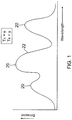
- Figure 1 illustrates a sample plot of the IR emission spectrum for a hypothetical body, where the ambient temperature T A is equal to x and the body temperature T B is equal to y. As shown, the body more readily absorbs and emits IR radiation at certain wavelengths, represented by the peaks 20 in the curve 22.
- IR absorption/emission is particularly distinctive in the far infrared (FIR).
- FIR far infrared
- Glucose is one example.
- FIR radiation emitted by the body it is advantageous to measure the FIR radiation emitted by the body.
- the term far infrared and the abbreviation FIR denote IR radiation at wavelengths greater than or equal to approximately 7 microns.
- Embodiments of the present system and methods measure the FIR radiation absorbed or emitted by a body at different wavelength bands.
- the first wavelength band (or bands) is selected to be in a band (or bands) where the substance is known to have significant FIR absorption/emission.
- the second wavelength band is selected to be the entire FIR absorption/emission spectrum of the body.
- the second wavelength band (or bands) is selected to be in a band (or bands) where the substance is known to have no or negligible FIR absorption/emission. After normalizing each measurement, their ratio can be used to determine the concentration of the substance in the body, as discussed in detail below.
- the FIR measurements are normalized against a blackbody.
- a blackbody as those of ordinary skill in the art will appreciate, is one that absorbs and emits radiation with theoretical emissivity of one.
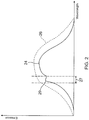
- Figure 2 illustrates a sample plot of the FIR absorption/emission spectrum for a hypothetical body (solid curve 24) and for a blackbody (dashed curve 26). For both the body and the blackbody the ambient temperature T A is the same. Similarly, for both the body and the blackbody the body/blackbody temperature T B is the same.
- the dashed vertical lines represent a first wavelength band 27 in which the substance whose concentration is to be measured is known to have an FIR absorption/emission peak 29. For example, for glucose the selected band 27 may be between 9.3 microns and 9.9 microns.
- the FIR radiation absorbed/emitted by the body in the first wavelength band is measured and then normalized against the blackbody FIR radiation in the first wavelength band.
- the FIR radiation absorbed/emitted by the body over the entire FIR spectrum is then measured and normalized against the blackbody FIR radiation over the entire FIR spectrum.
- Measurements of the body surface temperature and the ambient temperature are taken simultaneously with the first and second FIR measurements.
- the ratio of the first and second normalized measurements yields a normalized ratio parameter.
- the concentration of the substance in the body is correlated with the normalized ratio parameter, the body surface temperature and the ambient temperature.
- a logarithm, such as a natural logarithm (In) of the normalized ratio parameter may be used in the correlation step.
- the correlation step includes referencing an empirically derived lookup table.
- an empirically derived lookup table may be constructed by taking a series of measurements across a statistically representative population (hereinafter "the Group").
- the measurements taken for each member of the Group include a concentration of the substance of interest (such as glucose) taken according to a conventional invasive method, a first amount of FIR radiation absorbed or emitted from the body in a first wavelength band, a second amount of FIR radiation absorbed or emitted from the body in a second wavelength band, a temperature at a surface of the body and an ambient temperature.
- the first wavelength band (which may comprise multiple bands) is selected to be in a band where the substance is known to have significant FIR absorption/emission.
- the second wavelength band is selected to be the entire FIR absorption/emission spectrum of the body.
- the second wavelength band (or bands) is selected to be in a band (or bands) where the substance is known to have no or negligible FIR absorption/emission. The above measurement process is repeated in various ambient temperatures and for various substance concentrations.
- the first and second FIR radiation measurements are normalized against a blackbody at the same temperature.
- the lookup table is then created by plotting three of the measured parameters against one another for all members of the Group.
- the three parameters are the body surface temperature, the ambient temperature and the ratio of the first normalized FIR measurement to the second normalized FIR measurement, referred to herein as a normalized ratio parameter.
- a logarithm such as a natural logarithm (In) of the normalized ratio parameter may be plotted against the body surface temperature and the ambient temperature. If the population size is large enough, an accurate reference table can be created that enables easy determination of the substance concentration in the body using only noninvasive measurements of FIR absorption/emission, ambient temperature and body surface temperature.
- Figure 3 illustrates a conceptual embodiment of the present empirically derived lookup table 28.
- the table 28 comprises three axes: the body surface temperature 30, the ambient temperature 32 and the normalized ratio parameter 34.
- To determine the concentration of a given substance within the body three measurements, corresponding to the three axes, are taken from a body. The intersection 36 of the three measurements in the table 28 yields the substance concentration, as shown in Figure 3 .
- the lookup table may comprise a database containing a plurality of data points.
- the illustrated Cartesian plot of Figure 3 is intended to help the reader visualize the relationships between the three parameters of the body surface temperature 30, the ambient temperature 32 and the normalized ratio parameter 34.
- those of ordinary skill in the art will appreciate that not all of the present embodiments need include a lookup table that is plotted in three-dimensional space.
- the Applicant has not yet completed taking a series of measurements across a population in order to construct the empirically derived lookup table 28. These measurements are expected to yield a population distribution that will indicate to what extent FIR radiation readings will vary from one subject to the next under identical conditions (same substance concentration in bloodstream, same body surface temperature, same ambient temperature). If the results indicate that there is no or negligible variation, then embodiments of the present system 38 and methods can be used to determine the concentration of a substance in bloodstream without the need for any invasive measurements for each subject. However, if the results indicate that there is a substantial variation, then for each subject an initial measurement through conventional invasive methods may need to be taken in order to calibrate the system 38 and methods for that particular subject. Advantageously, however, only one or two invasive measurements are needed for the calibration.
- Figure 4 illustrates, schematically, one embodiment of the present system 38 for measuring a concentration of a substance in a body.
- the illustrated embodiment of the present system 38 comprises an IR radiation detector 40. an IR filter assembly 42. heating and/or cooling apparatus 44, and apparatus for measuring the ambient temperature 46.
- the IR detector 40 measures the body surface temperature.
- alternative apparatus for measuring the body surface temperature may be used.
- the IR detector 40 is a thermopile with collimating optics.
- the IR detector could comprise a different type of detector, such as a bolometer.
- the illustrated system 38 further comprises a display 48 for presenting information such as the substance concentration, the measured parameters and other information.
- the display 48 may be a liquid crystal display (LCD).
- the IR filter assembly 42 is positioned in front of the detector 40.
- the IR filter assembly 42 comprises three filters 50, although those of ordinary skill in the art will appreciate that the IR filter assembly 42 could include any number of filters.
- a first one of the filters 50 transmits only the spectral band in which the substance exhibits significant absorption/emission of IR radiation.
- a second one of the filters 50 transmits part of the spectral band in which the substance has no or negligible absorption/emission.
- a third one of the filters 50 transmits all of the IR radiation related to the body's temperature.
- the third filter 50 may transmit, for example, all of the IR radiation between approximately 7 microns and approximately 15 microns.
- the IR filter assembly 42 includes a filter wheel or drive 52 and a motor 54.
- the motor 54 may comprise a solenoid.
- the motor 54 or solenoid is configured to provide a motive force for changing a position of the filter assembly 42 with respect to the IR detector 40. Activation of the motor 54 or solenoid enables the filters 50 to be sequentially positioned in front of the detector 40 as each IR radiation measurement is taken.
- each IR detector 56 includes its own IR filter 58.
- the filters 58 may. for example, be substantially similar to the three filters 50 provided in the embodiment of Figure 4 with respect to the wavelengths of IR radiation that they transmit. In the embodiment of Figure 5 , there are advantageously no moving parts in the detector/filter assembly, and all measurements may be made simultaneously.
- the illustrated embodiments of the present system 38, 39 include apparatus for measuring ambient temperature 46.
- the ambient temperature measuring apparatus 46 may be a thermistor, such as a negative temperature coefficient (NTC) thermistor.
- NTC negative temperature coefficient
- the ambient temperature measuring apparatus will be referred to herein as a thermistor.
- the ambient temperature measuring apparatus 46 may be any apparatus that is suitable for measuring ambient temperature, such as a thermocouple. While in the illustrated embodiments the thermistor 46 is attached to the IR detector 40, 56. those of ordinary skill in the art will appreciate that it need not be.
- the thermistor 46 measures the temperature of a housing (not shown) of the IR detector 40, 56, which normally is equal to ambient temperature.
- control electronics 68 outputs 60, 62 of the IR detector(s) 40, 56 and the thermistor 46 and control inputs 64, 66 of the motor 54 and the heating/cooling apparatus 44 are connected to control electronics 68.
- Figure 6 illustrates further details of the control electronics 68, which include a processing unit 70 and memory 72.
- the memory 72 may include the lookup table 28 and/or other look up tables for calculating results of the measurements taken by the present system 38, 39.
- the processing unit 70 may comprise a central processing unit (CPU) running software and/or firmware. Alternatively, the processing unit 70 may comprise one or more application-specific integrated circuits (ASICs).
- the processing unit 70 processes signals from the IR detector(s) 40, 56 and the thermistor 46.
- the processing unit 70 also drives the display 48 to show results that may include the substance concentration, the measurements taken by the IR detector(s) 40. 56 and/or the thermistor 46. and other information.
- the processing unit 70 also controls a motor drive 74, which in turn controls the motor 54 to change the position of the filter assembly 42 with respect to the IR detector 40.
- the illustrated control electronics 68 include one or more switches 75 for switching between measurement channels.
- the switches 75 might change between a first channel that carries a signal from the IR detector 40, 56 and a second channel that carries a signal from the thermistor 46.
- the processing unit 70 controls the switches 75.
- the illustrated control electronics 68 further include an integrating amplifier 77.
- the integrating amplifier 77 amplifies a voltage generated by the IR detector 40, 56 to a measurable value.
- the voltage generated by the IR detector 40, 56 is proportional to the detected body radiation, and may be very small.
- the illustrated control electronics 68 further include a comparator 79.
- the comparator 79, together with the integrating amplifier 77 converts the voltage from the IR detector 40, 56 into a time interval that is inversely proportional to the input voltage and is measured by the processing unit 70.
- the heating/cooling apparatus 44 comprises a Peltier element 82 configured to provide a desired amount of heat or cold, a fan 84 to drive the heated or cooled air, and a funnel 86 to direct the heated or cooled air onto the body surface.
- Applying heat or cold to the skin surface stimulates the absorption or emission of IR radiation by the substance whose concentration is to be measured.
- IR radiation In the case of glucose, for example, cooling the skin stimulates the absorption of IR radiation while heating the skin stimulates the emission of IR radiation.
- a flow of ambient temperature air stimulates emission or absorption.
- the heating/cooling apparatus 44 may be replaced with an airflow apparatus to drive the ambient air.
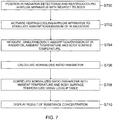
- the process flowchart of Figure 7 illustrates one embodiment of the present methods for measuring the concentration of a substance within a body.
- the IR radiation detector(s) and the heating/cooling/airflow apparatus are positioned with respect to the body.
- the heating/cooling/airflow apparatus is activated to stimulate absorption/emission of IR radiation by the substance.
- the absorption/emission of IR radiation, ambient temperature and body surface temperature are measured simultaneously.
- Step S704 is repeated to obtain IR radiation measurements in first and second wavelength bands, as discussed above.
- the normalized ratio parameter is calculated from the IR radiation measurements.
- the normalized ratio parameter is correlated with the ambient temperature and the body surface temperature using the lookup table 28.
- the substance concentration is displayed.
- an alternative method of measuring the absorption/emission of IR radiation, the ambient temperature and the body surface temperature is to scan the body surface while taking multiple measurements at various points on the body surface.
- Software for example, may then be used to identify the most desirable result from the plurality of measurements. Parameters for selecting the most desirable result may be, for example, repeatability, maximum signal, etc.
- the process flowchart of Figure 8 illustrates one embodiment of the present methods for constructing an empirically derived lookup table 28.
- a concentration of a substance of interest such as glucose
- This step may, for example, involve drawing a sample of blood from each member and testing the blood according to any known method.
- the IR radiation detector(s) and the heating/cooling/airflow apparatus are positioned with respect to the body of each member of the Group.
- the heating/cooling/airflow apparatus is activated to stimulate absorption/emission of IR radiation by the substance for each member of the Group.
- the absorption/emission of IR radiation, ambient temperature and body surface temperature are measured simultaneously for each member of the Group.
- Step S806 is repeated for each member of the Group to obtain IR radiation measurements in first and second wavelength bands, as discussed above.
- the normalized ratio parameter is calculated for each member of the Group from the IR radiation measurements.
- steps S802, S804, S806 and S808 are repeated at various ambient temperatures and for various substance concentrations.
- the body surface temperature, the ambient temperature and the normalized ratio parameter are plotted against one another and against the measured blood substance concentration for all members of the Group.
Landscapes
- Health & Medical Sciences (AREA)
- Life Sciences & Earth Sciences (AREA)
- Physics & Mathematics (AREA)
- Molecular Biology (AREA)
- Animal Behavior & Ethology (AREA)
- Pathology (AREA)
- Engineering & Computer Science (AREA)
- Biomedical Technology (AREA)
- Heart & Thoracic Surgery (AREA)
- Medical Informatics (AREA)
- Optics & Photonics (AREA)
- Surgery (AREA)
- Biophysics (AREA)
- General Health & Medical Sciences (AREA)
- Public Health (AREA)
- Veterinary Medicine (AREA)
- Spectroscopy & Molecular Physics (AREA)
- Emergency Medicine (AREA)
- Measurement Of The Respiration, Hearing Ability, Form, And Blood Characteristics Of Living Organisms (AREA)
- Investigating Or Analysing Materials By Optical Means (AREA)
- Measuring And Recording Apparatus For Diagnosis (AREA)
Claims (13)
- Verfahren zum nicht-invasiven Messen von einer Konzentration einer Substanz in einem Körper, wobei das Verfahren die folgenden Schritte umfasst:Messen von einer ersten Menge an Infrarot (IR)-Strahlung, die von dem Körper in einer ersten IR-Wellenlängenbande absorbiert oder emittiert wird, in welcher die Substanz IR-Strahlung emittiert oder absorbiert;Messen von einer zweiten Menge an Infrarotstrahlung (IR), die von dem Körper in einer zweiten IR-Wellenlängenbande absorbiert oder emittiert wird, die sich von der ersten IR-Wellenlängenbande unterscheidet und die entweder das gesamte Spektrum ist, in welchem der Körper IR-Strahlung in dem langweiligen IR-Spektrum (FIR; für Englisch: "far IR") emittiert oder absorbiert, oder eine Wellenlängenbande oder -banden ist, in der oder denen die Substanz keine oder eine vernachlässigbare Emission und Absorption von IR-Strahlung aufweist;Messen von einer Temperatur von einer Oberfläche des Körpers;Messen von einer Umgebungstemperatur;Betreiben von einer Verarbeitungseinheit (70), um (a) eine erste normalisierte IR-Strahlungsmessung zu berechnen, die die erste gemessene Menge an IR-Strahlung normalisiert gegen eine erste Schwarzkörperstrahlung in der ersten IR-Wellenlängenbande ist, (b) eine zweite normalisierte IR-Strahlungsmessung zu berechnen, die die zweite gemessene Menge an IR-Strahlung normalisiert gegen eine erste Schwarzkörperstrahlung in der zweiten IR-Wellenlängenbande ist, und (c) einen normalisierten Verhältnisparameterwert als das Verhältnis des normalisierten ersten Strahlungsmesswerts zu dem normalisierten zweiten Strahlungsmesswert zu berechnen;Speichern in einem Speicher (72) von Daten für eine Reihe von Messungen über eine statistisch repräsentative Population an verschiedenen Konzentrationen der Substanz, die entsprechend einem herkömmlichen invasiven Verfahren gewonnen und in einer empirisch hergeleiteten Nachschlagetabelle (28) angelegt wurden, indem für die Messungen in der Reihe Körperoberflächentemperaturen, Umgebungstemperaturen und normalisierte Verhältnisparameter gewonnen und gespeichert wurden; undBetreiben von der Verarbeitungseinheit (70), um die Konzentration der Substanz in dem Körper unter Verwendung der empirisch hergeleiteten Nachschlagetabelle zu berechnen, indem die Konzentration mit dem normalisierten Verhältnisparameter, der Körperoberflächentemperatur und der Umgebungstemperatur korreliert wird.
- Verfahren nach Anspruch 1, wobei der normalisierte Verhältnisparameter ein Logarithmus des Verhältnisses von der normalisierten ersten Menge zu der normalisierten zweiten Menge ist.
- Verfahren nach Anspruch 1 oder 2, wobei die Substanz Glucose ist.
- Verfahren nach einem der vorhergehenden Ansprüche, wobei der Körper ein menschlicher Körper ist.
- Verfahren nach einem der vorhergehenden Ansprüche, ferner umfassend den Schritt des Kühlens von der Körperoberfläche, um die Substanz zu veranlassen IR zu absorbieren, oder des Erwärmens von der Körperoberfläche, um die Substanz zu veranlassen IR zu emittieren, oder des Erzeugens von einer Umgebungsluftströmung über die Körperoberfläche.
- System zum nicht-invasiven Messen von einer Konzentration einer Substanz in einem Körper, wobei das System das Folgende umfasst:einen Infrarot (IR)-Detektor (40); undeine Filteranordnung (42), die mindestens einen ersten Filter und einen zweiten Filter umfasst und konfiguriert ist, um IR-Strahlung zu filtern, die zu dem Detektor (40) übertragen wird;wobei der erste Filter konfiguriert ist, um nur eine erste Menge an IR-Strahlung zu übertragen, die von dem Körper in einer ersten IR-Wellenlängenbande absorbiert oder emittiert wird, in welcher die Substanz IR-Strahlung emittiert oder absorbiert, und wobei der zweite Filter konfiguriert ist, um nur eine zweite Menge an IR-Strahlung zu übertragen, die von dem Körper in einer zweiten IR-Wellenlängenbande absorbiert oder emittiert wird, die sich von der ersten IR-Wellenlängenbande unterscheidet und die entweder das gesamte Spektrum ist, in welchem der Körper IR-Strahlung in dem langweiligen IR-Spektrum (FIR; für Englisch: "far IR") emittiert oder absorbiert, oder eine Wellenlängenbande oder -banden ist, in der oder denen die Substanz keine oder eine vernachlässigbare Emission und Absorption von IR-Strahlung aufweist;einen ersten Temperatursensor, der konfiguriert ist, um eine Oberflächentemperatur von einer Oberfläche des Körpers zu messen;einen zweiten Temperatursensor (46), der konfiguriert ist, um eine Umgebungstemperatur zu messen;eine Verarbeitungsvorrichtung (70), die konfiguriert ist, um (a) eine erste normalisierte IR-Strahlungsmessung zu berechnen, die die erste gemessene Menge an IR-Strahlung normalisiert gegen eine erste Schwarzkörperstrahlung in der ersten IR-Wellenlängenbande ist, (b) eine zweite normalisierte IR-Strahlungsmessung zu berechnen, die die zweite gemessene Menge an IR-Strahlung normalisiert gegen eine erste Schwarzkörperstrahlung in der zweiten IR-Wellenlängenbande ist, und (c) einen normalisierten Verhältnisparameterwert als das Verhältnis des normalisierten ersten Strahlungsmesswerts zu dem normalisierten zweiten Strahlungsmesswert zu berechnen;einen Speicher (72), der Daten für eine Reihe von Messungen über eine statistisch repräsentative Population an verschiedenen Konzentrationen der Substanz speichert, die entsprechend einem herkömmlichen invasiven Verfahren gewonnen und in einer empirisch hergeleiteten Nachschlagetabelle (28) angelegt wurden, indem für die Messungen in der Reihe Körperoberflächentemperaturen, Umgebungstemperaturen und normalisierte Verhältnisparameter gewonnen und gespeichert wurden; und wobei die Verarbeitungseinheit (70) ferner konfiguriert ist, um die Konzentration der Substanz in dem Körper unter Verwendung der empirisch hergeleiteten Nachschlagetabelle zu berechnen, indem die Konzentration mit dem normalisierten Verhältnisparameter, der Körperoberflächentemperatur und der Umgebungstemperatur korreliert wird.
- System nach Anspruch 6, ferner umfassend einen Temperaturveränderungsapparat (82), der operabel ist, um die Oberflächentemperatur von der Oberfläche des Körpers zu erhöhen oder zu erniedrigen.
- System nach Anspruch 6 oder 7, ferner umfassend einen Luftströmungsapparat (84), der operabel ist, um eine Umgebungsluftströmung über der Oberfläche des Körpers zu erzeugen.
- System nach einem der Ansprüche 6-8, wobei die Substanz Glucose ist und der Körper ein menschlicher Körper ist und wobei vorzugsweise der erste oder zweite Temperatursensor (46) einen Thermistor umfasst.
- System nach einem der Ansprüche 6-9, wobei der IR-Detektor (40) eine Thermosäule mit Kollimationsoptik umfasst.
- System nach einem der Ansprüche 6-10, wobei die Filteranordnung (42) bewegbar ist, um den ersten Filter und den zweiten Filter in Bezug auf den IR-Detektor (40) selektiv zu positionieren, und vorzugsweise ferner einen Antriebsapparat (54) zum Positionieren der Filteranordnung (42) in Bezug auf den IR-Detektor (46) umfasst.
- System nach einem der Ansprüche 6-11, wobei der IR-Detektor (46) einen ersten Detektor und einen zweiten Detektor umfasst und wobei der erste Filter in Bezug auf den ersten Detektor feststehend ist und der zweite Filter in Bezug auf den zweiten Detektor feststehend ist und wobei vorzugsweise die Filteranordnung mindestens einen dritten Filter umfasst.
- System nach einem der Ansprüche 6-12, ferner umfassend eine Anzeige (48), die konfiguriert ist, um die Konzentration der Substanz in dem Körper anzuzeigen.
Applications Claiming Priority (2)
| Application Number | Priority Date | Filing Date | Title |
|---|---|---|---|
| US12/101,859 US8401604B2 (en) | 2008-04-11 | 2008-04-11 | Apparatus and methods for non-invasive measurement of a substance within a body |
| PCT/US2009/037829 WO2009126422A2 (en) | 2008-04-11 | 2009-03-20 | Apparatus and methods for non-invasive measurement of a substance within a body |
Publications (3)
| Publication Number | Publication Date |
|---|---|
| EP2276406A2 EP2276406A2 (de) | 2011-01-26 |
| EP2276406A4 EP2276406A4 (de) | 2013-08-21 |
| EP2276406B1 true EP2276406B1 (de) | 2018-12-12 |
Family
ID=41162499
Family Applications (1)
| Application Number | Title | Priority Date | Filing Date |
|---|---|---|---|
| EP09730011.5A Active EP2276406B1 (de) | 2008-04-11 | 2009-03-20 | Gerät und verfahren zur nichtinvasiven messung einer substanz in einem körper |
Country Status (5)
| Country | Link |
|---|---|
| US (1) | US8401604B2 (de) |
| EP (1) | EP2276406B1 (de) |
| JP (1) | JP5887133B2 (de) |
| CN (1) | CN102065765B (de) |
| WO (1) | WO2009126422A2 (de) |
Families Citing this family (21)
| Publication number | Priority date | Publication date | Assignee | Title |
|---|---|---|---|---|
| US9681832B2 (en) * | 2008-04-11 | 2017-06-20 | Glucovista Inc. | Measurement apparatuses and methods using a combined substance cooling device |
| US8611975B2 (en) * | 2009-10-28 | 2013-12-17 | Gluco Vista, Inc. | Apparatus and method for non-invasive measurement of a substance within a body |
| US20110004080A1 (en) | 2008-04-11 | 2011-01-06 | Glucovista, Llc | Method for non-invasive analysis of a substance concentration within a body |
| US8903466B2 (en) | 2009-10-28 | 2014-12-02 | Glucovista Inc. | Apparatus and method for non-invasive measurement of a substance within a body |
| JP5579014B2 (ja) * | 2010-10-12 | 2014-08-27 | キヤノン株式会社 | 映像情報処理装置および方法 |
| EP2543316B1 (de) * | 2011-07-06 | 2018-09-26 | Cas Medical Systems, Inc. | Vorrichtung zum Messen der Helligkeit und Temperatur einer Lichtquelle einer spektrofotometrischen Vorrichtung |
| JP6594302B2 (ja) * | 2013-06-23 | 2019-10-23 | グルコビスタ・インコーポレイテッド | 吸熱反応を用いて冷却装置を使用する物質の濃度測定 |
| CN103479338A (zh) * | 2013-09-13 | 2014-01-01 | 深圳先进技术研究院 | 一种人体健康数据获取装置和人体健康状态评估系统 |
| JP6600635B2 (ja) * | 2014-01-10 | 2019-10-30 | グルコビスタ・インコーポレイテッド | 物質濃度を測定するための非侵襲的なシステムおよび方法 |
| US10588552B2 (en) | 2014-06-19 | 2020-03-17 | Glucovista Inc. | Substance concentration analysis methods and apparatuses |
| WO2015196138A1 (en) | 2014-06-19 | 2015-12-23 | Glucovista, Inc. | Substance concentration monitoring apparatuses and methods |
| US9459201B2 (en) | 2014-09-29 | 2016-10-04 | Zyomed Corp. | Systems and methods for noninvasive blood glucose and other analyte detection and measurement using collision computing |
| US9895543B2 (en) | 2014-12-22 | 2018-02-20 | Biotronik Se & Co. Kg | Implantable pulse generator system for vagal nerve stimulation |
| US9554738B1 (en) | 2016-03-30 | 2017-01-31 | Zyomed Corp. | Spectroscopic tomography systems and methods for noninvasive detection and measurement of analytes using collision computing |
| US10583296B2 (en) | 2016-04-26 | 2020-03-10 | Biotronik Se & Co. Kg | Implantable pulse generator system and method for vagal nerve stimulation |
| US10576196B2 (en) | 2017-04-10 | 2020-03-03 | Fresenius Medical Care Holdings, Inc. | Optical detection of air bubbles in either saline or blood or a mixture of both |
| EP3624679B1 (de) | 2017-05-19 | 2023-09-13 | GlucoVista Inc. | Vorrichtungen und verfahren zur nir-glukosekonzentrationsüberwachung |
| WO2019023093A1 (en) | 2017-07-26 | 2019-01-31 | Cardiac Pacemakers, Inc. | SYSTEMS AND METHODS FOR POSTURE DISAMBIGULATION |
| JP7653975B2 (ja) * | 2019-08-16 | 2025-03-31 | グルコマート ゲー・エム・ベー・ハー | 小型化アクティブセンシングシステムおよび方法 |
| CA3156102A1 (en) * | 2019-09-30 | 2021-04-08 | Inspirity Ag | DEVICE AND METHOD FOR NON-INVASIVE DETERMINATION OF ANALYTES |
| CN111238660B (zh) * | 2020-01-17 | 2022-08-26 | 昆明物理研究所 | 一种用于非制冷红外探测器的开孔光阑 |
Citations (3)
| Publication number | Priority date | Publication date | Assignee | Title |
|---|---|---|---|---|
| US5054487A (en) * | 1990-02-02 | 1991-10-08 | Boston Advanced Technologies, Inc. | Laser systems for material analysis based on reflectance ratio detection |
| US5666956A (en) * | 1996-05-20 | 1997-09-16 | Buchert; Janusz Michal | Instrument and method for non-invasive monitoring of human tissue analyte by measuring the body's infrared radiation |
| JP2007195653A (ja) * | 2006-01-25 | 2007-08-09 | Matsushita Electric Ind Co Ltd | 放射分光濃度計 |
Family Cites Families (29)
| Publication number | Priority date | Publication date | Assignee | Title |
|---|---|---|---|---|
| JPS50152097U (de) | 1974-06-04 | 1975-12-17 | ||
| US4041932A (en) * | 1975-02-06 | 1977-08-16 | Fostick Moshe A | Method for monitoring blood gas tension and pH from outside the body |
| US5370114A (en) | 1992-03-12 | 1994-12-06 | Wong; Jacob Y. | Non-invasive blood chemistry measurement by stimulated infrared relaxation emission |
| US5515847A (en) * | 1993-01-28 | 1996-05-14 | Optiscan, Inc. | Self-emission noninvasive infrared spectrophotometer |
| US5313941A (en) | 1993-01-28 | 1994-05-24 | Braig James R | Noninvasive pulsed infrared spectrophotometer |
| US5615672A (en) | 1993-01-28 | 1997-04-01 | Optiscan, Inc. | Self-emission noninvasive infrared spectrophotometer with body temperature compensation |
| US5553613A (en) * | 1994-08-17 | 1996-09-10 | Pfizer Inc. | Non invasive blood analyte sensor |
| US6072180A (en) * | 1995-10-17 | 2000-06-06 | Optiscan Biomedical Corporation | Non-invasive infrared absorption spectrometer for the generation and capture of thermal gradient spectra from living tissue |
| US6025597A (en) * | 1995-10-17 | 2000-02-15 | Optiscan Biomedical Corporation | Non-invasive infrared absorption spectrometer for measuring glucose or other constituents in a human or other body |
| US5823966A (en) * | 1997-05-20 | 1998-10-20 | Buchert; Janusz Michal | Non-invasive continuous blood glucose monitoring |
| EP1054620B1 (de) * | 1998-02-13 | 2010-01-27 | Non-Invasive Technology, Inc. | Untersuchung, beobachtung und bilddarstellung von abdominal-gewebe |
| US6002953A (en) * | 1998-05-06 | 1999-12-14 | Optix Lp | Non-invasive IR transmission measurement of analyte in the tympanic membrane |
| US6067463A (en) * | 1999-01-05 | 2000-05-23 | Abbott Laboratories | Method and apparatus for non-invasively measuring the amount of glucose in blood |
| US6198949B1 (en) * | 1999-03-10 | 2001-03-06 | Optiscan Biomedical Corporation | Solid-state non-invasive infrared absorption spectrometer for the generation and capture of thermal gradient spectra from living tissue |
| US6998247B2 (en) | 2002-03-08 | 2006-02-14 | Sensys Medical, Inc. | Method and apparatus using alternative site glucose determinations to calibrate and maintain noninvasive and implantable analyzers |
| US6617175B1 (en) * | 2002-05-08 | 2003-09-09 | Advanced Technology Materials, Inc. | Infrared thermopile detector system for semiconductor process monitoring and control |
| US6949070B2 (en) | 2003-08-21 | 2005-09-27 | Ishler Larry W | Non-invasive blood glucose monitoring system |
| US20050043630A1 (en) * | 2003-08-21 | 2005-02-24 | Buchert Janusz Michal | Thermal Emission Non-Invasive Analyte Monitor |
| JP2006094992A (ja) * | 2004-09-29 | 2006-04-13 | Hitachi Ltd | 血糖値測定装置及び血糖値測定方法 |
| JP2007105329A (ja) * | 2005-10-14 | 2007-04-26 | Hitachi Ltd | 血糖値測定装置及び代謝量測定装置 |
| US20090270698A1 (en) * | 2005-10-21 | 2009-10-29 | Masahiko Shioi | Bioinformation measurement device |
| US20090124873A1 (en) * | 2005-10-24 | 2009-05-14 | Shinji Uchida | Biocomponent concentration measuring device |
| JP2007144103A (ja) * | 2005-10-27 | 2007-06-14 | Matsushita Electric Ind Co Ltd | 生体成分濃度測定装置 |
| JP2007151641A (ja) * | 2005-12-01 | 2007-06-21 | Matsushita Electric Ind Co Ltd | 放射分光濃度計 |
| WO2007072300A2 (en) * | 2005-12-22 | 2007-06-28 | Koninklijke Philips Electronics N.V. | System for non-invasive measurement of blood glucose concentration |
| US7830519B2 (en) * | 2006-02-22 | 2010-11-09 | Vivum Nexus Llc | Method and device for analyte measurement |
| WO2007105596A1 (ja) * | 2006-03-10 | 2007-09-20 | Matsushita Electric Industrial Co., Ltd. | 生体成分濃度測定装置 |
| EP1905356A4 (de) * | 2006-03-10 | 2008-10-15 | Matsushita Electric Industrial Co Ltd | Instrument zur messung der konzentration eines bestandteiles eines lebenden körpers |
| US8364218B2 (en) * | 2008-02-11 | 2013-01-29 | Glucovista, Inc. | Apparatus and method for non-invasive measurement of the concentration of a substance in subjects blood |
-
2008
- 2008-04-11 US US12/101,859 patent/US8401604B2/en active Active
-
2009
- 2009-03-20 JP JP2011504045A patent/JP5887133B2/ja active Active
- 2009-03-20 WO PCT/US2009/037829 patent/WO2009126422A2/en not_active Ceased
- 2009-03-20 CN CN200980112612.7A patent/CN102065765B/zh active Active
- 2009-03-20 EP EP09730011.5A patent/EP2276406B1/de active Active
Patent Citations (3)
| Publication number | Priority date | Publication date | Assignee | Title |
|---|---|---|---|---|
| US5054487A (en) * | 1990-02-02 | 1991-10-08 | Boston Advanced Technologies, Inc. | Laser systems for material analysis based on reflectance ratio detection |
| US5666956A (en) * | 1996-05-20 | 1997-09-16 | Buchert; Janusz Michal | Instrument and method for non-invasive monitoring of human tissue analyte by measuring the body's infrared radiation |
| JP2007195653A (ja) * | 2006-01-25 | 2007-08-09 | Matsushita Electric Ind Co Ltd | 放射分光濃度計 |
Also Published As
| Publication number | Publication date |
|---|---|
| EP2276406A2 (de) | 2011-01-26 |
| CN102065765B (zh) | 2015-05-20 |
| US20090259407A1 (en) | 2009-10-15 |
| WO2009126422A3 (en) | 2009-12-23 |
| JP2011517975A (ja) | 2011-06-23 |
| CN102065765A (zh) | 2011-05-18 |
| US8401604B2 (en) | 2013-03-19 |
| HK1157165A1 (en) | 2012-06-29 |
| JP5887133B2 (ja) | 2016-03-16 |
| WO2009126422A2 (en) | 2009-10-15 |
| EP2276406A4 (de) | 2013-08-21 |
Similar Documents
| Publication | Publication Date | Title |
|---|---|---|
| EP2276406B1 (de) | Gerät und verfahren zur nichtinvasiven messung einer substanz in einem körper | |
| US5823966A (en) | Non-invasive continuous blood glucose monitoring | |
| US11141082B2 (en) | Method for non-invasive analysis of a substance concentration within a body | |
| EP0948284B1 (de) | Überwachung von gewebe-bestandteilen mittels infrarot-strahlung | |
| CN101969837B (zh) | 利用从视网膜回射的光非侵入式地测量物质的血液浓度的装置和方法 | |
| JP5581222B2 (ja) | 被検体の血液中の物質の濃度の非侵襲的測定のための装置および方法 | |
| Zheng et al. | Noninvasive glucose determination by oscillating thermal gradient spectrometry | |
| HK1157165B (en) | Apparatus and methods for non-invasive measurement of a substance within a body |
Legal Events
| Date | Code | Title | Description |
|---|---|---|---|
| PUAI | Public reference made under article 153(3) epc to a published international application that has entered the european phase |
Free format text: ORIGINAL CODE: 0009012 |
|
| 17P | Request for examination filed |
Effective date: 20101111 |
|
| AK | Designated contracting states |
Kind code of ref document: A2 Designated state(s): AT BE BG CH CY CZ DE DK EE ES FI FR GB GR HR HU IE IS IT LI LT LU LV MC MK MT NL NO PL PT RO SE SI SK TR |
|
| AX | Request for extension of the european patent |
Extension state: AL BA RS |
|
| DAX | Request for extension of the european patent (deleted) | ||
| A4 | Supplementary search report drawn up and despatched |
Effective date: 20130718 |
|
| RIC1 | Information provided on ipc code assigned before grant |
Ipc: A61B 5/1477 20060101AFI20130712BHEP Ipc: A61B 5/145 20060101ALI20130712BHEP Ipc: G05F 1/00 20060101ALI20130712BHEP Ipc: A61B 5/01 20060101ALI20130712BHEP Ipc: A61B 5/00 20060101ALN20130712BHEP |
|
| 17Q | First examination report despatched |
Effective date: 20140422 |
|
| STAA | Information on the status of an ep patent application or granted ep patent |
Free format text: STATUS: EXAMINATION IS IN PROGRESS |
|
| RAP1 | Party data changed (applicant data changed or rights of an application transferred) |
Owner name: GLUCOVISTA INC. Owner name: GERLITZ, JONATHAN |
|
| RIC1 | Information provided on ipc code assigned before grant |
Ipc: A61B 5/145 20060101ALI20180514BHEP Ipc: A61B 5/00 20060101ALN20180514BHEP Ipc: A61B 5/1455 20060101ALI20180514BHEP Ipc: A61B 5/1477 20060101AFI20180514BHEP Ipc: A61B 5/01 20060101ALI20180514BHEP Ipc: G05F 1/00 20060101ALI20180514BHEP |
|
| GRAP | Despatch of communication of intention to grant a patent |
Free format text: ORIGINAL CODE: EPIDOSNIGR1 |
|
| STAA | Information on the status of an ep patent application or granted ep patent |
Free format text: STATUS: GRANT OF PATENT IS INTENDED |
|
| INTG | Intention to grant announced |
Effective date: 20180703 |
|
| RAP1 | Party data changed (applicant data changed or rights of an application transferred) |
Owner name: GLUCOVISTA INC. |
|
| GRAS | Grant fee paid |
Free format text: ORIGINAL CODE: EPIDOSNIGR3 |
|
| GRAA | (expected) grant |
Free format text: ORIGINAL CODE: 0009210 |
|
| STAA | Information on the status of an ep patent application or granted ep patent |
Free format text: STATUS: THE PATENT HAS BEEN GRANTED |
|
| RAP1 | Party data changed (applicant data changed or rights of an application transferred) |
Owner name: GLUCOVISTA INC. |
|
| AK | Designated contracting states |
Kind code of ref document: B1 Designated state(s): AT BE BG CH CY CZ DE DK EE ES FI FR GB GR HR HU IE IS IT LI LT LU LV MC MK MT NL NO PL PT RO SE SI SK TR |
|
| REG | Reference to a national code |
Ref country code: GB Ref legal event code: FG4D |
|
| REG | Reference to a national code |
Ref country code: CH Ref legal event code: EP |
|
| REG | Reference to a national code |
Ref country code: AT Ref legal event code: REF Ref document number: 1074939 Country of ref document: AT Kind code of ref document: T Effective date: 20181215 |
|
| REG | Reference to a national code |
Ref country code: DE Ref legal event code: R096 Ref document number: 602009056165 Country of ref document: DE |
|
| REG | Reference to a national code |
Ref country code: IE Ref legal event code: FG4D |
|
| REG | Reference to a national code |
Ref country code: NL Ref legal event code: MP Effective date: 20181212 |
|
| REG | Reference to a national code |
Ref country code: LT Ref legal event code: MG4D |
|
| PG25 | Lapsed in a contracting state [announced via postgrant information from national office to epo] |
Ref country code: LV Free format text: LAPSE BECAUSE OF FAILURE TO SUBMIT A TRANSLATION OF THE DESCRIPTION OR TO PAY THE FEE WITHIN THE PRESCRIBED TIME-LIMIT Effective date: 20181212 Ref country code: FI Free format text: LAPSE BECAUSE OF FAILURE TO SUBMIT A TRANSLATION OF THE DESCRIPTION OR TO PAY THE FEE WITHIN THE PRESCRIBED TIME-LIMIT Effective date: 20181212 Ref country code: BG Free format text: LAPSE BECAUSE OF FAILURE TO SUBMIT A TRANSLATION OF THE DESCRIPTION OR TO PAY THE FEE WITHIN THE PRESCRIBED TIME-LIMIT Effective date: 20190312 Ref country code: NO Free format text: LAPSE BECAUSE OF FAILURE TO SUBMIT A TRANSLATION OF THE DESCRIPTION OR TO PAY THE FEE WITHIN THE PRESCRIBED TIME-LIMIT Effective date: 20190312 Ref country code: HR Free format text: LAPSE BECAUSE OF FAILURE TO SUBMIT A TRANSLATION OF THE DESCRIPTION OR TO PAY THE FEE WITHIN THE PRESCRIBED TIME-LIMIT Effective date: 20181212 Ref country code: LT Free format text: LAPSE BECAUSE OF FAILURE TO SUBMIT A TRANSLATION OF THE DESCRIPTION OR TO PAY THE FEE WITHIN THE PRESCRIBED TIME-LIMIT Effective date: 20181212 Ref country code: ES Free format text: LAPSE BECAUSE OF FAILURE TO SUBMIT A TRANSLATION OF THE DESCRIPTION OR TO PAY THE FEE WITHIN THE PRESCRIBED TIME-LIMIT Effective date: 20181212 |
|
| REG | Reference to a national code |
Ref country code: AT Ref legal event code: MK05 Ref document number: 1074939 Country of ref document: AT Kind code of ref document: T Effective date: 20181212 |
|
| PG25 | Lapsed in a contracting state [announced via postgrant information from national office to epo] |
Ref country code: SE Free format text: LAPSE BECAUSE OF FAILURE TO SUBMIT A TRANSLATION OF THE DESCRIPTION OR TO PAY THE FEE WITHIN THE PRESCRIBED TIME-LIMIT Effective date: 20181212 Ref country code: GR Free format text: LAPSE BECAUSE OF FAILURE TO SUBMIT A TRANSLATION OF THE DESCRIPTION OR TO PAY THE FEE WITHIN THE PRESCRIBED TIME-LIMIT Effective date: 20190313 |
|
| PG25 | Lapsed in a contracting state [announced via postgrant information from national office to epo] |
Ref country code: NL Free format text: LAPSE BECAUSE OF FAILURE TO SUBMIT A TRANSLATION OF THE DESCRIPTION OR TO PAY THE FEE WITHIN THE PRESCRIBED TIME-LIMIT Effective date: 20181212 |
|
| PG25 | Lapsed in a contracting state [announced via postgrant information from national office to epo] |
Ref country code: CZ Free format text: LAPSE BECAUSE OF FAILURE TO SUBMIT A TRANSLATION OF THE DESCRIPTION OR TO PAY THE FEE WITHIN THE PRESCRIBED TIME-LIMIT Effective date: 20181212 Ref country code: PT Free format text: LAPSE BECAUSE OF FAILURE TO SUBMIT A TRANSLATION OF THE DESCRIPTION OR TO PAY THE FEE WITHIN THE PRESCRIBED TIME-LIMIT Effective date: 20190412 Ref country code: PL Free format text: LAPSE BECAUSE OF FAILURE TO SUBMIT A TRANSLATION OF THE DESCRIPTION OR TO PAY THE FEE WITHIN THE PRESCRIBED TIME-LIMIT Effective date: 20181212 |
|
| PG25 | Lapsed in a contracting state [announced via postgrant information from national office to epo] |
Ref country code: SK Free format text: LAPSE BECAUSE OF FAILURE TO SUBMIT A TRANSLATION OF THE DESCRIPTION OR TO PAY THE FEE WITHIN THE PRESCRIBED TIME-LIMIT Effective date: 20181212 Ref country code: RO Free format text: LAPSE BECAUSE OF FAILURE TO SUBMIT A TRANSLATION OF THE DESCRIPTION OR TO PAY THE FEE WITHIN THE PRESCRIBED TIME-LIMIT Effective date: 20181212 Ref country code: IS Free format text: LAPSE BECAUSE OF FAILURE TO SUBMIT A TRANSLATION OF THE DESCRIPTION OR TO PAY THE FEE WITHIN THE PRESCRIBED TIME-LIMIT Effective date: 20190412 Ref country code: EE Free format text: LAPSE BECAUSE OF FAILURE TO SUBMIT A TRANSLATION OF THE DESCRIPTION OR TO PAY THE FEE WITHIN THE PRESCRIBED TIME-LIMIT Effective date: 20181212 |
|
| REG | Reference to a national code |
Ref country code: DE Ref legal event code: R097 Ref document number: 602009056165 Country of ref document: DE |
|
| PLBE | No opposition filed within time limit |
Free format text: ORIGINAL CODE: 0009261 |
|
| STAA | Information on the status of an ep patent application or granted ep patent |
Free format text: STATUS: NO OPPOSITION FILED WITHIN TIME LIMIT |
|
| PG25 | Lapsed in a contracting state [announced via postgrant information from national office to epo] |
Ref country code: SI Free format text: LAPSE BECAUSE OF FAILURE TO SUBMIT A TRANSLATION OF THE DESCRIPTION OR TO PAY THE FEE WITHIN THE PRESCRIBED TIME-LIMIT Effective date: 20181212 Ref country code: MC Free format text: LAPSE BECAUSE OF FAILURE TO SUBMIT A TRANSLATION OF THE DESCRIPTION OR TO PAY THE FEE WITHIN THE PRESCRIBED TIME-LIMIT Effective date: 20181212 Ref country code: AT Free format text: LAPSE BECAUSE OF FAILURE TO SUBMIT A TRANSLATION OF THE DESCRIPTION OR TO PAY THE FEE WITHIN THE PRESCRIBED TIME-LIMIT Effective date: 20181212 Ref country code: DK Free format text: LAPSE BECAUSE OF FAILURE TO SUBMIT A TRANSLATION OF THE DESCRIPTION OR TO PAY THE FEE WITHIN THE PRESCRIBED TIME-LIMIT Effective date: 20181212 |
|
| REG | Reference to a national code |
Ref country code: CH Ref legal event code: PL |
|
| 26N | No opposition filed |
Effective date: 20190913 |
|
| PG25 | Lapsed in a contracting state [announced via postgrant information from national office to epo] |
Ref country code: LU Free format text: LAPSE BECAUSE OF NON-PAYMENT OF DUE FEES Effective date: 20190320 |
|
| REG | Reference to a national code |
Ref country code: BE Ref legal event code: MM Effective date: 20190331 |
|
| PG25 | Lapsed in a contracting state [announced via postgrant information from national office to epo] |
Ref country code: CH Free format text: LAPSE BECAUSE OF NON-PAYMENT OF DUE FEES Effective date: 20190331 Ref country code: LI Free format text: LAPSE BECAUSE OF NON-PAYMENT OF DUE FEES Effective date: 20190331 Ref country code: IE Free format text: LAPSE BECAUSE OF NON-PAYMENT OF DUE FEES Effective date: 20190320 |
|
| PG25 | Lapsed in a contracting state [announced via postgrant information from national office to epo] |
Ref country code: BE Free format text: LAPSE BECAUSE OF NON-PAYMENT OF DUE FEES Effective date: 20190331 |
|
| PG25 | Lapsed in a contracting state [announced via postgrant information from national office to epo] |
Ref country code: TR Free format text: LAPSE BECAUSE OF FAILURE TO SUBMIT A TRANSLATION OF THE DESCRIPTION OR TO PAY THE FEE WITHIN THE PRESCRIBED TIME-LIMIT Effective date: 20181212 |
|
| PG25 | Lapsed in a contracting state [announced via postgrant information from national office to epo] |
Ref country code: MT Free format text: LAPSE BECAUSE OF NON-PAYMENT OF DUE FEES Effective date: 20190320 |
|
| PG25 | Lapsed in a contracting state [announced via postgrant information from national office to epo] |
Ref country code: CY Free format text: LAPSE BECAUSE OF FAILURE TO SUBMIT A TRANSLATION OF THE DESCRIPTION OR TO PAY THE FEE WITHIN THE PRESCRIBED TIME-LIMIT Effective date: 20181212 |
|
| PG25 | Lapsed in a contracting state [announced via postgrant information from national office to epo] |
Ref country code: HU Free format text: LAPSE BECAUSE OF FAILURE TO SUBMIT A TRANSLATION OF THE DESCRIPTION OR TO PAY THE FEE WITHIN THE PRESCRIBED TIME-LIMIT; INVALID AB INITIO Effective date: 20090320 |
|
| PG25 | Lapsed in a contracting state [announced via postgrant information from national office to epo] |
Ref country code: MK Free format text: LAPSE BECAUSE OF FAILURE TO SUBMIT A TRANSLATION OF THE DESCRIPTION OR TO PAY THE FEE WITHIN THE PRESCRIBED TIME-LIMIT Effective date: 20181212 |
|
| P01 | Opt-out of the competence of the unified patent court (upc) registered |
Effective date: 20230513 |
|
| PGFP | Annual fee paid to national office [announced via postgrant information from national office to epo] |
Ref country code: FR Payment date: 20250305 Year of fee payment: 17 |
|
| PGFP | Annual fee paid to national office [announced via postgrant information from national office to epo] |
Ref country code: GB Payment date: 20250324 Year of fee payment: 17 |
|
| PGFP | Annual fee paid to national office [announced via postgrant information from national office to epo] |
Ref country code: DE Payment date: 20250404 Year of fee payment: 17 |
|
| PGFP | Annual fee paid to national office [announced via postgrant information from national office to epo] |
Ref country code: IT Payment date: 20250331 Year of fee payment: 17 |