EP2270904A2 - Electroconductive material and positive electrode material for lithium ion secondary battery using the same - Google Patents
Electroconductive material and positive electrode material for lithium ion secondary battery using the same Download PDFInfo
- Publication number
- EP2270904A2 EP2270904A2 EP10006884A EP10006884A EP2270904A2 EP 2270904 A2 EP2270904 A2 EP 2270904A2 EP 10006884 A EP10006884 A EP 10006884A EP 10006884 A EP10006884 A EP 10006884A EP 2270904 A2 EP2270904 A2 EP 2270904A2
- Authority
- EP
- European Patent Office
- Prior art keywords
- oxide
- electroconductive material
- crystallite
- material according
- percent
- Prior art date
- Legal status (The legal status is an assumption and is not a legal conclusion. Google has not performed a legal analysis and makes no representation as to the accuracy of the status listed.)
- Withdrawn
Links
- 239000000463 material Substances 0.000 title claims abstract description 118
- 229910001416 lithium ion Inorganic materials 0.000 title claims description 37
- HBBGRARXTFLTSG-UHFFFAOYSA-N Lithium ion Chemical compound [Li+] HBBGRARXTFLTSG-UHFFFAOYSA-N 0.000 title claims description 36
- 239000007774 positive electrode material Substances 0.000 title claims description 23
- LEONUFNNVUYDNQ-UHFFFAOYSA-N vanadium atom Chemical compound [V] LEONUFNNVUYDNQ-UHFFFAOYSA-N 0.000 claims abstract description 17
- 229910052720 vanadium Inorganic materials 0.000 claims abstract description 16
- XHCLAFWTIXFWPH-UHFFFAOYSA-N [O-2].[O-2].[O-2].[O-2].[O-2].[V+5].[V+5] Chemical compound [O-2].[O-2].[O-2].[O-2].[O-2].[V+5].[V+5] XHCLAFWTIXFWPH-UHFFFAOYSA-N 0.000 claims abstract description 12
- 229910001935 vanadium oxide Inorganic materials 0.000 claims abstract description 12
- 229910001392 phosphorus oxide Inorganic materials 0.000 claims abstract description 11
- VSAISIQCTGDGPU-UHFFFAOYSA-N tetraphosphorus hexaoxide Chemical compound O1P(O2)OP3OP1OP2O3 VSAISIQCTGDGPU-UHFFFAOYSA-N 0.000 claims abstract description 11
- GNTDGMZSJNCJKK-UHFFFAOYSA-N Vanadium(V) oxide Inorganic materials O=[V](=O)O[V](=O)=O GNTDGMZSJNCJKK-UHFFFAOYSA-N 0.000 claims description 109
- 239000011521 glass Substances 0.000 claims description 71
- 239000000203 mixture Substances 0.000 claims description 67
- 239000013078 crystal Substances 0.000 claims description 53
- 238000002425 crystallisation Methods 0.000 claims description 28
- 230000008025 crystallization Effects 0.000 claims description 28
- DLYUQMMRRRQYAE-UHFFFAOYSA-N tetraphosphorus decaoxide Chemical compound O1P(O2)(=O)OP3(=O)OP1(=O)OP2(=O)O3 DLYUQMMRRRQYAE-UHFFFAOYSA-N 0.000 claims description 28
- QVQLCTNNEUAWMS-UHFFFAOYSA-N barium oxide Chemical compound [Ba]=O QVQLCTNNEUAWMS-UHFFFAOYSA-N 0.000 claims description 18
- 150000001768 cations Chemical class 0.000 claims description 17
- 229910052744 lithium Inorganic materials 0.000 claims description 17
- 239000000843 powder Substances 0.000 claims description 16
- FUJCRWPEOMXPAD-UHFFFAOYSA-N lithium oxide Chemical compound [Li+].[Li+].[O-2] FUJCRWPEOMXPAD-UHFFFAOYSA-N 0.000 claims description 13
- CHWRSCGUEQEHOH-UHFFFAOYSA-N potassium oxide Chemical compound [O-2].[K+].[K+] CHWRSCGUEQEHOH-UHFFFAOYSA-N 0.000 claims description 13
- KKCBUQHMOMHUOY-UHFFFAOYSA-N sodium oxide Chemical compound [O-2].[Na+].[Na+] KKCBUQHMOMHUOY-UHFFFAOYSA-N 0.000 claims description 13
- UQSXHKLRYXJYBZ-UHFFFAOYSA-N Iron oxide Chemical compound [Fe]=O UQSXHKLRYXJYBZ-UHFFFAOYSA-N 0.000 claims description 12
- WMWLMWRWZQELOS-UHFFFAOYSA-N bismuth(iii) oxide Chemical compound O=[Bi]O[Bi]=O WMWLMWRWZQELOS-UHFFFAOYSA-N 0.000 claims description 12
- NUJOXMJBOLGQSY-UHFFFAOYSA-N manganese dioxide Chemical compound O=[Mn]=O NUJOXMJBOLGQSY-UHFFFAOYSA-N 0.000 claims description 12
- JKQOBWVOAYFWKG-UHFFFAOYSA-N molybdenum trioxide Chemical compound O=[Mo](=O)=O JKQOBWVOAYFWKG-UHFFFAOYSA-N 0.000 claims description 12
- ZNOKGRXACCSDPY-UHFFFAOYSA-N tungsten(VI) oxide Inorganic materials O=[W](=O)=O ZNOKGRXACCSDPY-UHFFFAOYSA-N 0.000 claims description 12
- XUCJHNOBJLKZNU-UHFFFAOYSA-M dilithium;hydroxide Chemical compound [Li+].[Li+].[OH-] XUCJHNOBJLKZNU-UHFFFAOYSA-M 0.000 claims description 10
- 238000010438 heat treatment Methods 0.000 claims description 10
- AMWRITDGCCNYAT-UHFFFAOYSA-L hydroxy(oxo)manganese;manganese Chemical compound [Mn].O[Mn]=O.O[Mn]=O AMWRITDGCCNYAT-UHFFFAOYSA-L 0.000 claims description 10
- JEIPFZHSYJVQDO-UHFFFAOYSA-N iron(III) oxide Inorganic materials O=[Fe]O[Fe]=O JEIPFZHSYJVQDO-UHFFFAOYSA-N 0.000 claims description 10
- NOTVAPJNGZMVSD-UHFFFAOYSA-N potassium monoxide Inorganic materials [K]O[K] NOTVAPJNGZMVSD-UHFFFAOYSA-N 0.000 claims description 10
- 239000011734 sodium Substances 0.000 claims description 10
- 229910052700 potassium Inorganic materials 0.000 claims description 8
- 229910052708 sodium Inorganic materials 0.000 claims description 8
- ADCOVFLJGNWWNZ-UHFFFAOYSA-N antimony trioxide Inorganic materials O=[Sb]O[Sb]=O ADCOVFLJGNWWNZ-UHFFFAOYSA-N 0.000 claims description 7
- BERDEBHAJNAUOM-UHFFFAOYSA-N copper(I) oxide Inorganic materials [Cu]O[Cu] BERDEBHAJNAUOM-UHFFFAOYSA-N 0.000 claims description 7
- KRFJLUBVMFXRPN-UHFFFAOYSA-N cuprous oxide Chemical compound [O-2].[Cu+].[Cu+] KRFJLUBVMFXRPN-UHFFFAOYSA-N 0.000 claims description 7
- 229910000108 silver(I,III) oxide Inorganic materials 0.000 claims description 7
- 230000007704 transition Effects 0.000 claims description 7
- 239000010949 copper Substances 0.000 claims description 6
- 238000002360 preparation method Methods 0.000 claims description 6
- 239000011163 secondary particle Substances 0.000 claims description 6
- NDVLTYZPCACLMA-UHFFFAOYSA-N silver oxide Chemical compound [O-2].[Ag+].[Ag+] NDVLTYZPCACLMA-UHFFFAOYSA-N 0.000 claims description 6
- 229910000410 antimony oxide Inorganic materials 0.000 claims description 5
- 229910000416 bismuth oxide Inorganic materials 0.000 claims description 5
- TYIXMATWDRGMPF-UHFFFAOYSA-N dibismuth;oxygen(2-) Chemical compound [O-2].[O-2].[O-2].[Bi+3].[Bi+3] TYIXMATWDRGMPF-UHFFFAOYSA-N 0.000 claims description 5
- 229910000476 molybdenum oxide Inorganic materials 0.000 claims description 5
- QGLKJKCYBOYXKC-UHFFFAOYSA-N nonaoxidotritungsten Chemical compound O=[W]1(=O)O[W](=O)(=O)O[W](=O)(=O)O1 QGLKJKCYBOYXKC-UHFFFAOYSA-N 0.000 claims description 5
- VTRUBDSFZJNXHI-UHFFFAOYSA-N oxoantimony Chemical compound [Sb]=O VTRUBDSFZJNXHI-UHFFFAOYSA-N 0.000 claims description 5
- PQQKPALAQIIWST-UHFFFAOYSA-N oxomolybdenum Chemical compound [Mo]=O PQQKPALAQIIWST-UHFFFAOYSA-N 0.000 claims description 5
- 239000011164 primary particle Substances 0.000 claims description 5
- YEAUATLBSVJFOY-UHFFFAOYSA-N tetraantimony hexaoxide Chemical compound O1[Sb](O2)O[Sb]3O[Sb]1O[Sb]2O3 YEAUATLBSVJFOY-UHFFFAOYSA-N 0.000 claims description 5
- 229910001930 tungsten oxide Inorganic materials 0.000 claims description 5
- QPLDLSVMHZLSFG-UHFFFAOYSA-N Copper oxide Chemical compound [Cu]=O QPLDLSVMHZLSFG-UHFFFAOYSA-N 0.000 claims description 4
- 239000005751 Copper oxide Substances 0.000 claims description 4
- 229910052802 copper Inorganic materials 0.000 claims description 4
- 229910000431 copper oxide Inorganic materials 0.000 claims description 4
- 229910052709 silver Inorganic materials 0.000 claims description 4
- OKTJSMMVPCPJKN-UHFFFAOYSA-N Carbon Chemical compound [C] OKTJSMMVPCPJKN-UHFFFAOYSA-N 0.000 claims description 3
- 229910001947 lithium oxide Inorganic materials 0.000 claims description 3
- 229910001950 potassium oxide Inorganic materials 0.000 claims description 3
- 229910001923 silver oxide Inorganic materials 0.000 claims description 3
- 229910001948 sodium oxide Inorganic materials 0.000 claims description 3
- 239000007772 electrode material Substances 0.000 abstract description 12
- 239000003792 electrolyte Substances 0.000 abstract description 4
- 239000000523 sample Substances 0.000 description 25
- 239000011149 active material Substances 0.000 description 16
- 239000002245 particle Substances 0.000 description 10
- 238000010586 diagram Methods 0.000 description 9
- WHXSMMKQMYFTQS-UHFFFAOYSA-N Lithium Chemical compound [Li] WHXSMMKQMYFTQS-UHFFFAOYSA-N 0.000 description 8
- 238000010304 firing Methods 0.000 description 8
- 238000005259 measurement Methods 0.000 description 8
- 238000000034 method Methods 0.000 description 8
- 230000015572 biosynthetic process Effects 0.000 description 7
- 230000001351 cycling effect Effects 0.000 description 6
- 238000001878 scanning electron micrograph Methods 0.000 description 5
- 239000000126 substance Substances 0.000 description 5
- XEEYBQQBJWHFJM-UHFFFAOYSA-N Iron Chemical compound [Fe] XEEYBQQBJWHFJM-UHFFFAOYSA-N 0.000 description 4
- 238000011835 investigation Methods 0.000 description 4
- BASFCYQUMIYNBI-UHFFFAOYSA-N platinum Chemical compound [Pt] BASFCYQUMIYNBI-UHFFFAOYSA-N 0.000 description 4
- 239000004065 semiconductor Substances 0.000 description 4
- 238000002441 X-ray diffraction Methods 0.000 description 3
- 230000000052 comparative effect Effects 0.000 description 3
- 238000011156 evaluation Methods 0.000 description 3
- 239000011888 foil Substances 0.000 description 3
- 238000012423 maintenance Methods 0.000 description 3
- 229910052751 metal Inorganic materials 0.000 description 3
- 239000002184 metal Substances 0.000 description 3
- 238000012986 modification Methods 0.000 description 3
- 230000004048 modification Effects 0.000 description 3
- 230000008569 process Effects 0.000 description 3
- 229910001220 stainless steel Inorganic materials 0.000 description 3
- 239000010935 stainless steel Substances 0.000 description 3
- 238000012360 testing method Methods 0.000 description 3
- XLYOFNOQVPJJNP-UHFFFAOYSA-N water Substances O XLYOFNOQVPJJNP-UHFFFAOYSA-N 0.000 description 3
- SCYULBFZEHDVBN-UHFFFAOYSA-N 1,1-Dichloroethane Chemical compound CC(Cl)Cl SCYULBFZEHDVBN-UHFFFAOYSA-N 0.000 description 2
- KMTRUDSVKNLOMY-UHFFFAOYSA-N Ethylene carbonate Chemical compound O=C1OCCO1 KMTRUDSVKNLOMY-UHFFFAOYSA-N 0.000 description 2
- SECXISVLQFMRJM-UHFFFAOYSA-N N-Methylpyrrolidone Chemical compound CN1CCCC1=O SECXISVLQFMRJM-UHFFFAOYSA-N 0.000 description 2
- VUQNUNGXTZZBLC-UHFFFAOYSA-K P(=O)([O-])([O-])[O-].[V+5].[Fe+2] Chemical compound P(=O)([O-])([O-])[O-].[V+5].[Fe+2] VUQNUNGXTZZBLC-UHFFFAOYSA-K 0.000 description 2
- OAICVXFJPJFONN-UHFFFAOYSA-N Phosphorus Chemical compound [P] OAICVXFJPJFONN-UHFFFAOYSA-N 0.000 description 2
- 230000002776 aggregation Effects 0.000 description 2
- 238000004220 aggregation Methods 0.000 description 2
- 239000011230 binding agent Substances 0.000 description 2
- 239000006229 carbon black Substances 0.000 description 2
- 150000001875 compounds Chemical class 0.000 description 2
- 239000000470 constituent Substances 0.000 description 2
- 230000003247 decreasing effect Effects 0.000 description 2
- 238000004455 differential thermal analysis Methods 0.000 description 2
- 238000002149 energy-dispersive X-ray emission spectroscopy Methods 0.000 description 2
- 239000002241 glass-ceramic Substances 0.000 description 2
- 230000006872 improvement Effects 0.000 description 2
- 239000007773 negative electrode material Substances 0.000 description 2
- 239000011255 nonaqueous electrolyte Substances 0.000 description 2
- 125000004430 oxygen atom Chemical group O* 0.000 description 2
- 229910052698 phosphorus Inorganic materials 0.000 description 2
- 239000011574 phosphorus Substances 0.000 description 2
- 229910052697 platinum Inorganic materials 0.000 description 2
- 239000002002 slurry Substances 0.000 description 2
- 229910001251 solid state electrolyte alloy Inorganic materials 0.000 description 2
- IJGRMHOSHXDMSA-UHFFFAOYSA-N Atomic nitrogen Chemical compound N#N IJGRMHOSHXDMSA-UHFFFAOYSA-N 0.000 description 1
- RYGMFSIKBFXOCR-UHFFFAOYSA-N Copper Chemical compound [Cu] RYGMFSIKBFXOCR-UHFFFAOYSA-N 0.000 description 1
- 229910007086 Li1+xV3O8 Inorganic materials 0.000 description 1
- 229910019142 PO4 Inorganic materials 0.000 description 1
- RLTFLELMPUMVEH-UHFFFAOYSA-N [Li+].[O--].[O--].[O--].[V+5] Chemical compound [Li+].[O--].[O--].[O--].[V+5] RLTFLELMPUMVEH-UHFFFAOYSA-N 0.000 description 1
- 229910052783 alkali metal Inorganic materials 0.000 description 1
- 150000001340 alkali metals Chemical class 0.000 description 1
- 229910052782 aluminium Inorganic materials 0.000 description 1
- XAGFODPZIPBFFR-UHFFFAOYSA-N aluminium Chemical compound [Al] XAGFODPZIPBFFR-UHFFFAOYSA-N 0.000 description 1
- PNEYBMLMFCGWSK-UHFFFAOYSA-N aluminium oxide Inorganic materials [O-2].[O-2].[O-2].[Al+3].[Al+3] PNEYBMLMFCGWSK-UHFFFAOYSA-N 0.000 description 1
- GHPGOEFPKIHBNM-UHFFFAOYSA-N antimony(3+);oxygen(2-) Chemical compound [O-2].[O-2].[O-2].[Sb+3].[Sb+3] GHPGOEFPKIHBNM-UHFFFAOYSA-N 0.000 description 1
- 125000004429 atom Chemical group 0.000 description 1
- 229910052788 barium Inorganic materials 0.000 description 1
- DSAJWYNOEDNPEQ-UHFFFAOYSA-N barium atom Chemical compound [Ba] DSAJWYNOEDNPEQ-UHFFFAOYSA-N 0.000 description 1
- 230000005540 biological transmission Effects 0.000 description 1
- 229910000420 cerium oxide Inorganic materials 0.000 description 1
- 239000011362 coarse particle Substances 0.000 description 1
- 238000013329 compounding Methods 0.000 description 1
- 239000011889 copper foil Substances 0.000 description 1
- 230000001186 cumulative effect Effects 0.000 description 1
- 229910001873 dinitrogen Inorganic materials 0.000 description 1
- 239000002270 dispersing agent Substances 0.000 description 1
- 230000005611 electricity Effects 0.000 description 1
- 230000009881 electrostatic interaction Effects 0.000 description 1
- NBVXSUQYWXRMNV-UHFFFAOYSA-N fluoromethane Chemical compound FC NBVXSUQYWXRMNV-UHFFFAOYSA-N 0.000 description 1
- 230000009477 glass transition Effects 0.000 description 1
- 125000005843 halogen group Chemical group 0.000 description 1
- 230000006698 induction Effects 0.000 description 1
- 150000002500 ions Chemical class 0.000 description 1
- 229910052742 iron Inorganic materials 0.000 description 1
- 238000005224 laser annealing Methods 0.000 description 1
- 229910000464 lead oxide Inorganic materials 0.000 description 1
- 150000002641 lithium Chemical class 0.000 description 1
- XGZVUEUWXADBQD-UHFFFAOYSA-L lithium carbonate Chemical compound [Li+].[Li+].[O-]C([O-])=O XGZVUEUWXADBQD-UHFFFAOYSA-L 0.000 description 1
- 229910052808 lithium carbonate Inorganic materials 0.000 description 1
- 229910001496 lithium tetrafluoroborate Inorganic materials 0.000 description 1
- 229910000686 lithium vanadium oxide Inorganic materials 0.000 description 1
- 229910052748 manganese Inorganic materials 0.000 description 1
- 239000011572 manganese Substances 0.000 description 1
- 238000002156 mixing Methods 0.000 description 1
- 229910052759 nickel Inorganic materials 0.000 description 1
- 230000003287 optical effect Effects 0.000 description 1
- BMMGVYCKOGBVEV-UHFFFAOYSA-N oxo(oxoceriooxy)cerium Chemical compound [Ce]=O.O=[Ce]=O BMMGVYCKOGBVEV-UHFFFAOYSA-N 0.000 description 1
- YEXPOXQUZXUXJW-UHFFFAOYSA-N oxolead Chemical compound [Pb]=O YEXPOXQUZXUXJW-UHFFFAOYSA-N 0.000 description 1
- 238000001556 precipitation Methods 0.000 description 1
- 238000012545 processing Methods 0.000 description 1
- 238000010298 pulverizing process Methods 0.000 description 1
- 230000001105 regulatory effect Effects 0.000 description 1
- 239000011347 resin Substances 0.000 description 1
- 229920005989 resin Polymers 0.000 description 1
- 230000000717 retained effect Effects 0.000 description 1
- 238000005070 sampling Methods 0.000 description 1
- 238000004626 scanning electron microscopy Methods 0.000 description 1
- 239000002904 solvent Substances 0.000 description 1
- 239000000758 substrate Substances 0.000 description 1
- XOLBLPGZBRYERU-UHFFFAOYSA-N tin dioxide Chemical compound O=[Sn]=O XOLBLPGZBRYERU-UHFFFAOYSA-N 0.000 description 1
- 229910001887 tin oxide Inorganic materials 0.000 description 1
- 229910052723 transition metal Inorganic materials 0.000 description 1
- 150000003624 transition metals Chemical class 0.000 description 1
- 238000013519 translation Methods 0.000 description 1
Images




Classifications
-
- H—ELECTRICITY
- H01—ELECTRIC ELEMENTS
- H01M—PROCESSES OR MEANS, e.g. BATTERIES, FOR THE DIRECT CONVERSION OF CHEMICAL ENERGY INTO ELECTRICAL ENERGY
- H01M4/00—Electrodes
- H01M4/02—Electrodes composed of, or comprising, active material
- H01M4/36—Selection of substances as active materials, active masses, active liquids
- H01M4/48—Selection of substances as active materials, active masses, active liquids of inorganic oxides or hydroxides
- H01M4/485—Selection of substances as active materials, active masses, active liquids of inorganic oxides or hydroxides of mixed oxides or hydroxides for inserting or intercalating light metals, e.g. LiTi2O4 or LiTi2OxFy
-
- C—CHEMISTRY; METALLURGY
- C03—GLASS; MINERAL OR SLAG WOOL
- C03C—CHEMICAL COMPOSITION OF GLASSES, GLAZES OR VITREOUS ENAMELS; SURFACE TREATMENT OF GLASS; SURFACE TREATMENT OF FIBRES OR FILAMENTS MADE FROM GLASS, MINERALS OR SLAGS; JOINING GLASS TO GLASS OR OTHER MATERIALS
- C03C10/00—Devitrified glass ceramics, i.e. glass ceramics having a crystalline phase dispersed in a glassy phase and constituting at least 50% by weight of the total composition
-
- C—CHEMISTRY; METALLURGY
- C03—GLASS; MINERAL OR SLAG WOOL
- C03C—CHEMICAL COMPOSITION OF GLASSES, GLAZES OR VITREOUS ENAMELS; SURFACE TREATMENT OF GLASS; SURFACE TREATMENT OF FIBRES OR FILAMENTS MADE FROM GLASS, MINERALS OR SLAGS; JOINING GLASS TO GLASS OR OTHER MATERIALS
- C03C4/00—Compositions for glass with special properties
- C03C4/14—Compositions for glass with special properties for electro-conductive glass
-
- H—ELECTRICITY
- H01—ELECTRIC ELEMENTS
- H01M—PROCESSES OR MEANS, e.g. BATTERIES, FOR THE DIRECT CONVERSION OF CHEMICAL ENERGY INTO ELECTRICAL ENERGY
- H01M4/00—Electrodes
- H01M4/02—Electrodes composed of, or comprising, active material
- H01M4/36—Selection of substances as active materials, active masses, active liquids
- H01M4/362—Composites
- H01M4/366—Composites as layered products
-
- H—ELECTRICITY
- H01—ELECTRIC ELEMENTS
- H01M—PROCESSES OR MEANS, e.g. BATTERIES, FOR THE DIRECT CONVERSION OF CHEMICAL ENERGY INTO ELECTRICAL ENERGY
- H01M4/00—Electrodes
- H01M4/02—Electrodes composed of, or comprising, active material
- H01M4/36—Selection of substances as active materials, active masses, active liquids
- H01M4/58—Selection of substances as active materials, active masses, active liquids of inorganic compounds other than oxides or hydroxides, e.g. sulfides, selenides, tellurides, halogenides or LiCoFy; of polyanionic structures, e.g. phosphates, silicates or borates
- H01M4/5825—Oxygenated metallic salts or polyanionic structures, e.g. borates, phosphates, silicates, olivines
-
- H—ELECTRICITY
- H01—ELECTRIC ELEMENTS
- H01M—PROCESSES OR MEANS, e.g. BATTERIES, FOR THE DIRECT CONVERSION OF CHEMICAL ENERGY INTO ELECTRICAL ENERGY
- H01M10/00—Secondary cells; Manufacture thereof
- H01M10/05—Accumulators with non-aqueous electrolyte
- H01M10/052—Li-accumulators
- H01M10/0525—Rocking-chair batteries, i.e. batteries with lithium insertion or intercalation in both electrodes; Lithium-ion batteries
-
- H—ELECTRICITY
- H01—ELECTRIC ELEMENTS
- H01M—PROCESSES OR MEANS, e.g. BATTERIES, FOR THE DIRECT CONVERSION OF CHEMICAL ENERGY INTO ELECTRICAL ENERGY
- H01M10/00—Secondary cells; Manufacture thereof
- H01M10/05—Accumulators with non-aqueous electrolyte
- H01M10/056—Accumulators with non-aqueous electrolyte characterised by the materials used as electrolytes, e.g. mixed inorganic/organic electrolytes
- H01M10/0561—Accumulators with non-aqueous electrolyte characterised by the materials used as electrolytes, e.g. mixed inorganic/organic electrolytes the electrolyte being constituted of inorganic materials only
- H01M10/0562—Solid materials
-
- H—ELECTRICITY
- H01—ELECTRIC ELEMENTS
- H01M—PROCESSES OR MEANS, e.g. BATTERIES, FOR THE DIRECT CONVERSION OF CHEMICAL ENERGY INTO ELECTRICAL ENERGY
- H01M2300/00—Electrolytes
- H01M2300/0017—Non-aqueous electrolytes
- H01M2300/0065—Solid electrolytes
- H01M2300/0068—Solid electrolytes inorganic
- H01M2300/0071—Oxides
-
- H—ELECTRICITY
- H01—ELECTRIC ELEMENTS
- H01M—PROCESSES OR MEANS, e.g. BATTERIES, FOR THE DIRECT CONVERSION OF CHEMICAL ENERGY INTO ELECTRICAL ENERGY
- H01M4/00—Electrodes
- H01M4/02—Electrodes composed of, or comprising, active material
- H01M4/13—Electrodes for accumulators with non-aqueous electrolyte, e.g. for lithium-accumulators; Processes of manufacture thereof
- H01M4/131—Electrodes based on mixed oxides or hydroxides, or on mixtures of oxides or hydroxides, e.g. LiCoOx
-
- Y—GENERAL TAGGING OF NEW TECHNOLOGICAL DEVELOPMENTS; GENERAL TAGGING OF CROSS-SECTIONAL TECHNOLOGIES SPANNING OVER SEVERAL SECTIONS OF THE IPC; TECHNICAL SUBJECTS COVERED BY FORMER USPC CROSS-REFERENCE ART COLLECTIONS [XRACs] AND DIGESTS
- Y02—TECHNOLOGIES OR APPLICATIONS FOR MITIGATION OR ADAPTATION AGAINST CLIMATE CHANGE
- Y02E—REDUCTION OF GREENHOUSE GAS [GHG] EMISSIONS, RELATED TO ENERGY GENERATION, TRANSMISSION OR DISTRIBUTION
- Y02E60/00—Enabling technologies; Technologies with a potential or indirect contribution to GHG emissions mitigation
- Y02E60/10—Energy storage using batteries
Definitions
- the present invention relates to electroconductive materials and to positive electrode materials for lithium ion secondary batteries using the same.
- a glass based on vanadium containing vanadium pentoxide as a main component is known to be a glass semiconductor that conducts electricity and has been studied to be adopted typically to thermistors.
- JP-B Japanese Examined Patent Application Publication
- JP-B No. Sho 42(1967)-24785
- Document 1 discloses a vitrified resistive material composed of a glass composition containing 50 percent by mole or more of vanadium pentoxide, containing phosphorus pentoxide and barium oxide, and further containing cerium oxide, tin oxide and lead oxide as added.
- JP-B Japanese Examined Patent Application Publication
- JP-B No. Sho 39 (1964)-9140
- Document 2 discloses a thermistor made of a glass containing 70 percent by mole or more of vanadium pentoxide and 5 to 15 percent by mole of phosphorus pentoxide and further containing 13 percent by mole or less of copper oxide.
- Japanese Patent No. 3854985 discloses a glass semiconductor having a specific resistance of 10 1 to 10 4 ⁇ cm at room temperature. This glass semiconductor is prepared by heating a glass based on an oxide containing vanadium, barium and iron at a temperature equal to or higher than its glass transition temperature and equal to or lower than its crystallization temperature to reduce the strain of a glass skeleton.
- FIG. 1 shows a model for a crystal structure of vanadium pentoxide (V 2 O 5 ).
- V 2 O 5 is an orthorhombic crystal, has a layered structure composed of VO 5 pyramids as illustrated in FIG. 1 .
- V 2 O 5 has been investigated to be adopted to an active material for nonaqueous electrolyte secondary batteries.
- Japanese Patent No. 2973830 discloses a secondary battery that shows satisfactory cycling performance at a high energy density, because this secondary battery includes a positive electrode active material having coexisting two phases of an amorphous phase and a crystalline phase composed of a multiple oxide of vanadium and lithium or a first-row transition metal.
- JP-A Japanese Patent Application Laid-Open
- Document 5 discloses a battery using a glass ceramic including a glass containing a highly electroconductive lithium-containing iron vanadium phosphate. This battery has improved rate properties and improved low-temperature properties.
- JP-A Japanese Patent Application Laid-Open (JP-A) No. 2009-16277 (Document 6) discloses an electrode active material mainly containing at least one of a glass and a glass ceramic each composed of a lithium-containing iron vanadium phosphate containing at least one of Co, Mn and Ni; and a secondary battery using the electrode active material, which shows high discharge rate properties and a high energy density.
- JP-A Japanese Unexamined Patent Application Publication (Translation of PCT Application)
- JP-A Japanese Unexamined Patent Application Publication (Translation of PCT Application)
- JP-A Japanese Unexamined Patent Application Publication (Translation of PCT Application)
- JP-A Japanese Unexamined Patent Application Publication (Translation of PCT Application)
- JP-A Japanese Unexamined Patent Application Publication (Translation of PCT Application) No. 2005-506272
- Document 7 discloses an active material which is a lithium vanadium oxide corresponding to Li 1+x V 3 O 8 in which 0.1 ⁇ x ⁇ 0.25, and which has a monoclinic crystal structure; and also discloses a battery using the active material, which shows significantly improved capacity and cycling performance.
- the glass semiconductor material disclosed in Document 3 shows a specific resistance of 200 ⁇ cm which is excessively high as an electrode material or solid-state electrolyte, and there is a need of providing a material having a further lower specific resistance.
- the electrode active material disclosed in Document 5 When the electrode active material disclosed in Document 5 is used as an active material of a nonaqueous secondary battery and is annealed to have a specific resistance minimized to 290 ⁇ cm or less, the resulting secondary battery shows a decreasing battery capacity with a decreasing specific resistance. Independently, there has been provided no electrode active material that satisfies requirements to have higher capacity as battery typically for battery cars. Accordingly, investigations on active materials composed of oxides are actively made even now.
- the present invention has been made to solve such problems in known techniques, and an object of the present invention is to reduce the specific resistance of an electroconductive material and to improve the function typically of an electrode material, a solid-state electrolyte, or a sensor such as a thermistor using the electroconductive material.
- Another object of the present invention is to provide an electroconductive material using a glass based on vanadium which can give a battery that maintains a satisf actorybattery capacity even when it has a reduced specific resistance.
- the present invention provides an electroconductive material comprising a crystalline phase and an amorphous phase, and containing at least a vanadium oxide and a phosphorus oxide, wherein the crystalline phase contains a monoclinic vanadium-containing oxide, and wherein a volume of the crystalline phase is larger than that of the amorphous phase.
- the electroconductive material according to the present invention has a low specific resistance of 200 ⁇ cm or less and thereby gives an electrode having improved functions and efficiencies. Even in other applications than electrodes, a reduced specific resistance which is a fundamental performance contributes improvement of functions and efficiencies.
- the present invention relates to an electroconductive material which is advantageously usable typically as electrode materials, solid-state electrolytes, and sensors such as thermistors, which can have a controllable electroconductivity, and which is usable as an active material for nonaqueous electrolyte secondary batteries that have a long charge/discharge cycling lifetime at a high energy density.
- the electroconductive material according to the present invention is an electroconductive material including a crystalline phase (crystalline part) and an amorphous phase (non-crystalline part), and containing at least a vanadium oxide and a phosphorus oxide, wherein the crystalline phase contains a monoclinic vanadium-containing oxide, and wherein a volume of the crystalline phase is larger than that of the amorphous phase.
- the monoclinic vanadium-containing oxide may include a M x V 2 O 5 crystallite, where M is a monovalent cation; and x is in the range of 0.28 to 0.76, in which the M x V 2 O 5 crystallite may have a diameter of 50 nm to 300 nm in a direction of the (111) plane or (11-1) plane.
- the monovalent cation M of the M x V 2 O 5 crystallite may include at least one element selected from the group consisting of Li, Na, K, Cu and Ag.
- the crystalline phase preferably occupies 63% to 98% by volume of the electroconductive material, and the amorphous phase preferably contains a vanadium oxide and a phosphorus oxide.
- At least one of a grain boundary of the crystalline phase, a grain boundary of a primary particle of the M x V 2 O 5 crystallite, and a grain boundary of a secondary particle (agglomerated particle) of the M x V 2 O 5 crystallite is preferably composed of the amorphous phase.
- the amorphous phase may further contain at least one selected from the group consisting of a tungsten oxide, a molybdenum oxide, an iron oxide, a manganese oxide, a barium oxide, an antimony oxide and a bismuth oxide.
- the M x V 2 O 5 crystallite may have been precipitated through a heat treatment of a glass composition at a temperature equal to or higher than the crystallization onset temperature of the glass composition which includes a vanadium oxide and a phosphorus oxide and further include at least one selected from the group consisting of a lithium oxide, a sodium oxide, a potassium oxide, a copper oxide and a silver oxide.
- the glass composition may further include at least one selected from the group consisting of a tungsten oxide, a molybdenum oxide, an iron oxide, a manganese oxide, a barium oxide, an antimony oxide and a bismuth oxide.
- the glass composition may have a composition containing 62 to 92 percent by weight of V 2 O 5 ; 5 to 20 percent by weight of P 2 O 5 ; 1 to 15 percent by weight of at least one selected from the group consisting of Li 2 O, Na 2 O, K 2 O, Cu 2 O and Ag 2 O; and 0 to 22 percent by weight of at least one selected from the group consisting of WO 3 , MoO 3 , Fe 2 O 3 , MnO 2 , BaO, Sb 2 O 3 and Bi 2 O 3 in terms of oxides, and the glass composition may have a transition temperature of 300°C or lower and a crystallization onset temperature of 400°C or lower.
- the glass composition may have a composition containing 70 to 80 percent by weight of V 2 O 5 ; 8 to 14 percent by weight of P 2 O 5 ; 1 to 5 percent by weight of one selected from the group consisting of Li 2 O, Na 2 O and K 2 O; and a total of 10 to 20 percent by weight of at least one of WO 3 and Fe 2 O 3 in terms of oxides, and the glass composition may have a transition temperature of 300°C or lower and a crystallization onset temperature of 400°C or lower.
- the electroconductive material according to the present invention preferably has a specific resistance of 200 ⁇ cm or less at 25°C.
- the positive electrode material for the lithium ion secondary battery according to the present invention may further contain a powder of the electroconductive material.
- the number x in the M x V 2 O 5 crystallite is preferably in the range of 0.28 to 0.41.
- the monovalent cation M in the M x V 2 O 5 crystallite may include at least one selected from the group consisting of Li, Na and K.
- the M x V 2 O 5 crystallite preferably has a lattice constant ⁇ of 109.2° to 110.7°.
- the crystalline phase of the electroconductive material preferably occupies 80% to 95% by volume of the electroconductive material, and the M x V 2 O 5 crystallite preferably has a size of 100 nm to 300 nm in a direction of the (111) plane or (11-1) plane.
- the electroconductive material preferably has a specific resistance of 10 to 100 ⁇ cm at 25°C.
- lithium ions may have been doped into the crystalline phase of the electroconductive material after the preparation of the electroconductive material.
- the positive electrode material for the lithium ion secondary battery according to the present invention may further contain a carbon powder.
- the present invention provides an electroconductive material which is a crystallized glass composition composed of a crystalline phase and an amorphous phase, the crystallized glass composition containing at least a vanadium oxide and a phosphorus oxide, the crystalline phase being a monoclinic vanadium-containing oxide, and the crystalline phase is larger than the amorphous phase by volume.
- the crystalline phase preferably occupies 63% to 98% (by volume) of the electroconductive material, and the amorphous phase preferably occupies 2% to 37% (by volume) of the electroconductive material.
- the electroconductive material may have an excessively high specific resistance, if containing the crystalline phase in a volume less than 63% by volume. In contrast, the electroconductive material may show inferior chemical stability, if containing the crystalline phase in a volume more than 98% by volume.
- the crystalline phase preferably occupies 80% to 95% (by volume), and the amorphous phase preferably occupies 5% to 20% (by volume) of the electroconductive material.
- the more the M x V 2 O 5 crystalline phase occupies the better.
- the more the amorphous phase having larger intervals between elements i.e., the amorphous phase having larger intervals between constituent elements
- At least one of a grain boundary of the crystalline phase, a grain boundary of the monoclinic M x V 2 O 5 crystallite (primary particle), and a grain boundary of a polycrystalline particle (secondary particle) including a multiplicity of the monoclinic M x V 2 O 5 crystallites is composed of the amorphous phase.
- the amorphous phase is preferably present at grain boundaries, because the amorphous phase has large ion intervals and thereby plays a role as a passage typically for lithium ions.
- FIG. 2 shows a model for a crystal structure of the monoclinic M x V 2 O 5 .
- This monoclinic crystal has a tubular structure in which atoms between layers in a layered structure of a vanadium oxide are orderly bonded with the cations (M).
- the monoclinic crystal used in the present invention is superior in a chemical stability to orthorhombic V 2 O 5 crystals which laminate through electrostatic interactions.
- the monoclinic crystalline phase is composed of an M x V 2 O 5 crystallite, where M is a metal element which is stable in the state of a monovalent cation.
- M is preferably selected from the group consisting of Li, Na, K, Cu and Ag for satisfactory safety and availability.
- the number x is preferably 0.28 to 0.76 for the formation of the monoclinic crystal.
- the number x is preferably 0.28 to 0.41, because the electroconductive material may have an insufficient space for the lithium ions, and the battery may have an insufficient battery capacity if x is excessively large.
- the size (diameter) of the monoclinic M x V 2 O 5 crystallite is preferably 50 nm to 300 nm in a direction of the (111) plane or (11-1) plane (i.e., in the (111) plane or (11-1) plane).
- the size of the monoclinic crystallite is preferably 100 nm to 300 nm. This is because lithium ions should travel a larger distance and this may retard the charge/discharge speed if the crystallite size is excessively large; in contrast, the battery may have an insufficient battery capacity if the crystallite size is excessively small.
- the glass composition preferably has a composition including 62 to 92 percent by weight of V 2 O 5 ; 5 to 20 percent by weight of P 2 O 5 ; 1 to 15 percent by weight of at least one of Li 2 O, Na 2 O, K 2 O, Cu 2 O and Ag 2 O; and 0 to 22 percent by weight of at least one of WO 3 , MoO 3 , Fe 2 O 3 , MnO 2 , BaO, Sb 2 O 3 and Bi 2 O 3 in terms of oxides.
- Vanadium pentoxide and phosphorus pentoxide are substances constituting the skeleton (backbone) of this glass composition.
- the glass of this system is vitrified in such a manner that pentahedron units of VO 5 having vanadium atom as the center and oxygen atoms as vertices undergo two-dimensional covalent bonding with each other via the oxygen atoms to form a layered structure, and PO 4 tetrahedron units are bonded between layers of the layered structure to form a glass.
- V 2 O 5 If the content of V 2 O 5 is less than 62 percent by weight, crystals mayprecipitate in a smaller amount, and this may impede the electroconductive material to have a low specific resistance. If the content of V 2 O 5 exceeds 92 percent by weight, precipitated crystals may include an excessively large amount of V 2 O 5 having a high specific resistance, thus being undesirable.
- the glass may not be formed. If the content of P 2 O 5 exceeds 20 percent by weight, the electroconductive material may have an excessively high crystallization temperature.
- Li 2 O, Na 2 O, K 2 O, Cu 2 O and Ag 2 O are components that help the formation of the monoclinic crystal through firing, and it is known that Li 2 O, Na 2 O, K 2 O, Cu 2 O and Ag 2 O intercalate into a space between V 2 O 5 layers.
- the metal element that is stable in the state of a monovalent cation is preferably at least one of Li, Na and K, because these elements are alkali metals which have low electronegativity and easily give a glass.
- WO 3 , MoO 3 , Fe 2 O 3 , MnO 2 , BaO, Sb 2 O 3 and Bi 2 O 3 are glass-modifying components. They are components for regulating properties of the glass amorphous phase, such as water resistance (moisture resistance), thermal expansion, and characteristic temperatures and can be added as appropriate.
- the water resistance of the glass increases with an increasing total amount of these components, but the total amount exceeding 22 percent by weight is undesirable, because the amount of the monoclinic crystal decrease in the electroconductive material.
- the glass composition preferably contains 10 to 20 percent by weight of at least one of WO 3 and Fe 2 O 3 , because these materials are easily available and are highly safe.
- the glass composition of the electroconductive material according to the present invention preferably has a transition temperature of 300°C or lower and a crystallization (onset) temperature of 400°C or lower.
- the glass composition allows a crystalline phase to precipitate through a heat treatment at a temperature equal to or higher than the crystallization (onset) temperature.
- the state of formed crystal varies depending on the heat treatment conditions, because the crystalline phase grows in two stages, i.e. the formation of crystal nuclei and the growth of crystals.
- the glass composition is preferably maintained at the crystal nuclei formation temperature for a long duration to allow crystal nuclei to precipitate sufficiently, and the formed crystal nuclei are then allowed to grow.
- a device or process used in firing is not particularly limited, as long as being a device or process that can heat the non-crystalline (amorphous) glass at a temperature equal to or higher than the crystallization temperature.
- Exemplary devices or processes for use herein include a heating with a heater, a laser annealing, and an induction heating.
- the electrode active material according to the present invention can be used as a positive electrode active material or a negative electrode active material typically by choosing other constituent materials of the battery, particularly by choosing an electrode active material constituting the other electrode.
- Embodiments of the electrode active material as a positive electrode active material will be illustrated below.
- the powder When the material is used as a powder for a positive electrode active material of a lithium ion battery (LIB), the powder preferably has an average particle diameter of 1 to 10 ⁇ m.
- the powder may require a large amount of a dispersant to give a slurry, if having an average particle diameter of less than 1 ⁇ m, and this may cause the battery to have an insufficient battery capacity.
- a surface of a coated film may become rough due to coarse particles contained in the powder, if the powder having an excessively large average particle diameter.
- the powder preferably has an average particle diameter of 10 ⁇ m or less.
- the powder more preferably has an average particle diameter of 1 to 7 ⁇ m, and still more preferably has an average particle diameter of 2 to 6 ⁇ m.
- Such a slurry may be prepared by mixing 80 to 90 percent by weight of the powdery electroconductive material, 5 to 10 percent by weight of a carbon black acting as an electroconducting auxiliary, and 1 to 10 percent by weight of a fluorocarbon resin acting as a binder; and adding n-methylpyrrolidone as a solvent to the mixture to give a paste having a viscosity of about 15 Pa ⁇ s.
- the compounding ratio of components is not limited to one mentioned above, and can be appropriately chosen according typically to the required coatability and adhesion.
- a series of glass compositions was prepared and investigated. Their compositions and properties are shown in Table 1. Each component is indicated by weight ratio in terms of oxide. Vanadiumpentoxide, phosphorus pentoxide, iron oxide, antimony trioxide and tungsten trioxide were used as materials for respective components, and lithium carbonate was used as a lithium source.
- the preparations of the glass compositions were performed according to the following procedure.
- the material compounds were mixed to give a powdery mixture having the composition given in Table 1; 300 g of the powdery mixture was placed in a platinum crucible, heated in an electric furnace to 1100°C at a temperature rise rate of 5°C to 10°C per minute, and held at this temperature for 2 hours. The mixture was stirred during holding at the temperature to give a homogeneous glass. Next, the platinum crucible was taken out from the electric furnace, and the mixture (composition) was poured from the crucible onto a stainless steel sheet previously heated at 200°C to 300°C.
- compositions Nos. 1-02 and 1-03 had no gloss and were crystallized at the time when the compositions were poured onto the stainless steel sheet.
- the characteristic temperatures of glass samples were determined from peak temperatures as measured through differential thermal analysis (DTA) using glass powders.
- the glass powders as test specimens were prepared by pulverizing the glass compositions using a stamping mill.
- a series of electroconductive materials was prepared by processing each of the above-prepared glass composition to give a sample piece 10 mm long, 10 mm wide and 4 mm thick, placing the sample piece on an alumina substrate, heating the same at a temperature higher by 50°C than its crystallization onset temperature for 50 hours to form a crystalline phase.
- Each of the glass compositions after firing containing a crystalline phase was pulverized to give a powder, and the powder was subjected to crystal identification and measurements of crystallization rate and crystallite diameter using a wide-angleX-raydiffractometer (RINT2500HLsuppliedbyRigaku Corporation). The crystal identification and measurement of crystallization rate were performed under the following conditions.
- An X-ray source used herein was Cu, and the output thereof was set at 50 kV-250 mA.
- the identification and measurement were performed at a divergence slit of 0.5 degree, a receiving slit of 0.15 mm, and a scattering slit of 0.5 degree.
- the X-ray diffraction was performed with scan axes of 2 ⁇ / ⁇ coupled in the range of 5 ⁇ 2 ⁇ 100 degrees through continuous scanning at a scan speed of 1.0 degree per minute and sampling intervals of 0.01 degree.
- the crystal identification was performed by identifying crystals precipitated in the material using ICDD Data as an X-ray diffraction standard data list.
- the crystallization rate was determined by calculating the ratio of the diffraction peaks derived from crystals to the halos derived from the amorphous phase in the determined diffraction pattern. This ratio is considered to indicate the ratio by volume between the crystalline phase and the amorphous phase.
- the crystallite diameter was determined by choosing a diffraction peak having a highest peak intensity out of diffraction peaks derived from crystals, defining this peak asadetectedmainpeak, and calculating the crystallite diameter therefrom while using the (11-1) plane for Li 0.3 V 2 O 5 crystal and the (001) plane for V 2 O 5 crystal.
- the crystallite diameter was determined in the following manner.
- the measurement through narrow scanning was performed according to cumulative scanning while focusing the scan range to the vicinity of the detected main peak.
- the half-width of the detected main peak as determined through narrow scanning was substituted into the Scherrer' s equation to give the crystallite diameter. Crystallite diameters of 100 nm or more were not measurable according to this technique, and the crystallite diameter of a sample having a crystallite diameter exceeding the measurement limit was determined under transmission electron microscopic observation.
- Moisture resistance tests were performed by placing each glass powder in a thermo-hygrostat at 85°C and 85% for 48 hours. A sample having been dissolved or having undergone secondary aggregation was evaluated as having poor moisture resistance ("C”); a sample having been partially dissolved or having undergone partial secondary aggregation wasevaluated ashaving moderate moisture resistance (“B”) ; and a sample having retained its powdery appearance was evaluated as having good moisture resistance (“A").
- samples indicated by “Example” are samples satisfying conditions for the compositions of their material glass compositions before firing as given in Table 1, i.e. they satisfy the conditions: "63 to 88.8 percent by weight of V 2 O 5 ", “7 to 17.4 percent by weight of P 2 O 5 ", "1.1 to 14 percent by weight of at least one of Li 2 O, Na 2 O, K 2 O, Cu 2 O and Ag 2 O", and "0 to 22 percent by weight of at least one of Fe 2 O 3 , WO 3 , Sb 2 O 3, BaO, MoO 3 , MnO 2 and Bi 2 O 3 ".
- samples which do not satisfy the above conditions in the composition of the glass composition before firing are indicated as "Comparative Example (Com. Ex.)".
- a sample in Table 1 and another sample in Table 2 having identical last two figures of the sample number correspond to a material glass composition and an electroconductive material prepared by using the material glass composition, respectively.
- SampleNo. 1-01 in Table 1 corresponds to Sample No. 2-01 in Table 2.
- Sample Nos. 1-04, 1-05, 1-06, 1-08, 1-11, 1-12, 1-13, 1-15, 1-16, 1-17, 1-18, 1-19, 1-20, 1-21, 1-22, 1-23, 1-25, 1-26, 1-27, 1-28, 1-29, 1-30, 1-31, 1-32, 1-33, 1-34 and 1-36 are glass compositions corresponding to the examples.
- Sample Nos. 2-04, 2-05, 2-06, 2-08, 2-11, 2-12, 2-13, 2-15, 2-16, 2-17, 2-18, 2-19, 2-20, 2-21, 2-22, 2-23, 2-25, 2-26, 2-27, 2-28, 2-29, 2-30, 2-31, 2-32, 2-33, 2-34 and 2-36 are electroconductive material samples corresponding to examples of the present invention.
- precipitated main crystals are Li 0.3 V 2 O 5 , Na 0.287 V 2 O 5 , Na 0.76 V 2 O 5 , K 0.33 V 2 O 5 , Cu 0.261 (V 2 O 5 ) and Ag 0.333 (V 2 O 5 ), respectively.
- These crystals are compounds formed between a monovalent cation (M) and V 2 O 5 and are crystals represented by M x V 2 O 5 , in which x is 0.28 to 0.76.
- M monovalent cation
- M x V 2 O 5 in which x is 0.28 to 0.76.
- the electroconductive materials prepared from these compositions show satisfactory electroconductivity in terms of specific resistance of 200 ⁇ cm or less.
- the electroconductive materials of Sample Nos. 2-01, 2-02, 2-03, 2-07, 2-09, 2-10, 2-14, 2-24, 2-35, 2-37 and 2-38 inTable 2 corresponding to comparative examples include V 2 O 5 or Li 0.97 V 3 O 8 as a main precipitated crystal, or have a low crystallization rate of 60%, even if including a precipitated crystal of Li 0.3 V 2 O 5 .
- These samples corresponding to the comparative examples after crystallization (firing) have specific resistance exceeding 200 ⁇ cm and are considered to be unsuitable as electroconductive materials.
- samples having specific resistance of 200 ⁇ cm or less were subj ected to X-ray diffractometry to give diffraction patterns, and crystal lattice constants thereof were calculated based on peaks appearing in the patterns.
- FIG. 8 is a schematic diagram of a unit cell of the crystal.
- Lattice constants of the crystal unit cell will be defined below with reference to FIG. 8 .
- the lengths of the unit cell in the a-axis, b-axis and c-axis are definedas a, b and c, respectively, and angular measures (angles) formed by two axes out of the three axes are defined as ⁇ , ⁇ and ⁇ , respectively.
- angular measures (angles) formed by two axes out of the three axes are defined as ⁇ , ⁇ and ⁇ , respectively.
- Table 3 shows the calculated lattice constants of the samples.
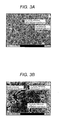
- FIGS. 3A and 3B show SEM images of the electroconductive material No. 2-12 as an example according to the present invention (SEM is the abbreviation for a scanning electron microscope).
- FIG. 3B is an enlarged view of the image of FIG. 3A .
- FIG. 3C is a schematic diagram of the SEM image of the electroconductive material in FIG. 3A ; and
- FIG. 3D is a schematic diagram of the enlarged view of the electroconductive material in FIG. 3B .
- FIG. 3A and 3C demonstrate that an amorphous grain boundary 103 is formed between adjacent secondary particles 102 of Li 0.3 V 2 O 5 crystals. As used herein the term “adjacent” means that "(being) next to each other".
- FIGS. 3B and 3D demonstrate that primary particles 101 of precipitated Li 0.3 V 2 O 5 crystals aggregate to form an aciniform secondary particle 102, and an amorphous grain boundary 103 (a layer of a glass amorphous phase) is formed around the secondary particle 102.
- FIG. 3B demonstrates that a fine amorphous grain boundary 103 is formed between the adjacent primary particles 101 of Li 0.3 V 2 O 5 crystals.
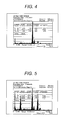
- FIG. 4 is a graph showing a result of the SEM-EDX of the crystalline part (Li 0.3 V 2 O 5 crystal) in FIG. 3B ; and FIG. 5 is a graph showing a result of the SEM-EDX of the amorphous phase (boundary between crystal grains) in FIG. 3B .
- EDX is the abbreviated name for an energy dispersive X-ray spectrometer.
- FIG. 4 demonstrates that the crystalline phase contains a large amount of vanadium (V) and a trace amount of iron (Fe) .
- FIG. 5 demonstrates that the amorphous phase contains iron (Fe) in an amount lager than that in the crystalline phase as shown in FIG. 4 and further contains phosphorus (P).
- the phosphorus content in the amorphous phase of the electroconductive material after firing is higher than that in the amorphous phase before firing.
- FIG. 6 is a schematic diagram of an exemplary lithium ion battery.
- the lithium ion battery will be illustrated below with reference to FIG. 6 .
- the electroconductive material acting as positive electrode active material 2 was pulverized to give a powder having an average particle diameter of 5 ⁇ m.
- 85 percent by weight of the powder, 10 percent by weight of a carbon black (acting as electroconducting auxiliary 3), and 5 percent by weight of a binder were mixed, followed by combining with n-methylpyrrolidone to give a paste having a viscosity of 15 Pa ⁇ s.
- the prepared paste was applied to an aluminum foil acting as a positive electrode current collector 1 with a doctor blade, dried, and thereby yielded a positive electrode layer 7. Both the positive electrode layer 7 and the positive electrode current collector 1 were punched and thereby yielded a positive electrode 9.
- a negative electrode layer 8 was formed from a negative electrode active material 5 on a copper foil acting as a negative electrode current collector 6, and was pressed with a roll. Both the negative electrode layer 8 and the negative electrode current collector 6 were punched in the same manner as in the positive electrode and thereby yielded a negative electrode 10.
- a separator 4 was sandwiched between the positive electrode 9 and the negative electrode 10 to give a coin cell (a battery).
- An electrolyte used herein was 1 mol/l LiBF 4 solution in a 1:3 mixture of ethylene carbonate (EC) and dichloroethane (DCE) ; and a lithium ion source used herein was a lithium foil.
- EC ethylene carbonate
- DCE dichloroethane
- Charge/discharge cycles of the coin cell were performed at a current density of 0.1 mA/cm 2 in the range of 4.2-1.5 V (vs. Li/Li + ), and an initial capacity and a capacity maintenance rate after 50 cycles of the coin cell were measured.
- Table 4 shows determined properties of batteries (cells) each in a crystalline state.
- the battery properties in Table 4 were evaluatedas follows. A sample having the initial capacity of less than 330 mAh/g was evaluated as "C”; a sample having the initial capacity of 330 mAh/g or more and less than 350 mAh/g was evaluated as "B”, a sample having the initial capacity of 350 mAh/g or more and less than 370 mAh/g was evaluated as "A”, and a sample having the initial capacity of 370 mAh/g or more was evaluated as "AA”. Samples having the capacity maintenance rates of 80% or less were all evaluatedas "C" regardless of their initial capacities.
- Table 4 demonstrates that all samples having the crystallization rates of 80% or more have the initial capacities as the battery properties of 330 mAh/g or more, but that a sample having the crystallization rate of 100% has low cycling performance and is not desirable. Table 4 also demonstrates that samples having the crystallite diameters of 50 nm or more show satisfactorily large capacities, of which those having the crystallite diameters of 100 nm to 300 nm are more preferred. [Table 4]
- FIG. 7 depicts a lithium ion doping apparatus.
- the lithium ion doping apparatus 11 illustrated in FIG. 7 is made from a stainless steel (SUS), where the right and left portions of a reactor 14 can be heated independently while evacuating the inside of the reactor 14.
- SUS stainless steel
- This apparatus was operated according to the following procedure.
- the lithium ion doping apparatus 11 was placed in a glove box purged with nitrogen gas, and 10 g of the electroconductive material Sample No. 2-12 (reference numeral 12) and 5 g of metal lithium (reference numeral 13) were placed in the reactor 14 so that these were not in contact with each other.
- the left portion of the reactor 14 where the electroconductive material 12 was placed was heated with a ribbon heater with evacuation for 3 hours.
- the reactor 14 was detached from the vacuum line by closing a valve thereof, and was heated at 350°C in a heating mantle to be reacted for 2 weeks.
- the doped electroconductive material was taken out from the reactor 14, and the coin cell was prepared and properties of the coin cell were evaluated by the procedure as above, except for not using a lithium foil as a lithium source.
- the coin cell was found to have satisfactory properties of the battery capacity (the initial capacity) of 372 mAh/g and the capacity maintenance rate of 82%.
Landscapes
- Chemical & Material Sciences (AREA)
- Chemical Kinetics & Catalysis (AREA)
- General Chemical & Material Sciences (AREA)
- Electrochemistry (AREA)
- Engineering & Computer Science (AREA)
- Inorganic Chemistry (AREA)
- Materials Engineering (AREA)
- Organic Chemistry (AREA)
- Crystallography & Structural Chemistry (AREA)
- Composite Materials (AREA)
- Life Sciences & Earth Sciences (AREA)
- Geochemistry & Mineralogy (AREA)
- Ceramic Engineering (AREA)
- Dispersion Chemistry (AREA)
- Glass Compositions (AREA)
- Battery Electrode And Active Subsutance (AREA)
- Secondary Cells (AREA)
- Conductive Materials (AREA)
Abstract
Description
- The present invention relates to electroconductive materials and to positive electrode materials for lithium ion secondary batteries using the same.
- A glass based on vanadium containing vanadium pentoxide as a main component is known to be a glass semiconductor that conducts electricity and has been studied to be adopted typically to thermistors.
- Japanese Examined Patent Application Publication (JP-B) No.
Sho 42(1967)-24785 - Japanese Examined Patent Application Publication (JP-B) No.
Sho 39 (1964)-9140 - Japanese Patent No.
3854985 -
FIG. 1 shows a model for a crystal structure of vanadium pentoxide (V2O5). V2O5 is an orthorhombic crystal, has a layered structure composed of VO5 pyramids as illustrated inFIG. 1 . And V2O5 has been investigated to be adopted to an active material for nonaqueous electrolyte secondary batteries. - Japanese Patent No.
2973830 - Japanese Patent Application Laid-Open (JP-A) No.
2007-42618 - Japanese Patent Application Laid-Open (JP-A) No.
2009-16277 - Japanese Unexamined Patent Application Publication (Translation of PCT Application) (JP-A) No.
2005-506272 - However, the glass semiconductor material disclosed in
Document 3 shows a specific resistance of 200 Ω·cm which is excessively high as an electrode material or solid-state electrolyte, and there is a need of providing a material having a further lower specific resistance. - When the electrode active material disclosed in
Document 5 is used as an active material of a nonaqueous secondary battery and is annealed to have a specific resistance minimized to 290 Ω·cm or less, the resulting secondary battery shows a decreasing battery capacity with a decreasing specific resistance. Independently, there has been provided no electrode active material that satisfies requirements to have higher capacity as battery typically for battery cars. Accordingly, investigations on active materials composed of oxides are actively made even now. - The present invention has been made to solve such problems in known techniques, and an object of the present invention is to reduce the specific resistance of an electroconductive material and to improve the function typically of an electrode material, a solid-state electrolyte, or a sensor such as a thermistor using the electroconductive material.
- Another object of the present invention is to provide an electroconductive material using a glass based on vanadium which can give a battery that maintains a satisf actorybattery capacity even when it has a reduced specific resistance.
- The present invention provides an electroconductive material comprising a crystalline phase and an amorphous phase, and containing at least a vanadium oxide and a phosphorus oxide, wherein the crystalline phase contains a monoclinic vanadium-containing oxide, and wherein a volume of the crystalline phase is larger than that of the amorphous phase.
- The electroconductive material according to the present invention has a low specific resistance of 200 Ω·cm or less and thereby gives an electrode having improved functions and efficiencies. Even in other applications than electrodes, a reduced specific resistance which is a fundamental performance contributes improvement of functions and efficiencies.
-
-
FIG. 1 is a schematic diagram of a model for a crystal structure of V2O5. -
FIG. 2 is a schematic diagram of a model for a crystal structure of MxV2O5. -
FIG. 3A is a scanning electron micrograph (SEM image) of an electroconductive material of an embodiment according to the present invention. -
FIG. 3B is an enlarged image of the electroconductive material shown inFIG. 3A . -
FIG. 3C is a schematic diagram of the scanning electron micrograph of the electroconductive material inFIG. 3A . -
FIG. 3D is a schematic diagram of the enlarged image of the electroconductive material inFIG. 3B . -
FIG. 4 is a graph showing data determined through a scanning electron microscopy with an energy dispersive X-ray analysis (SEM-EDX) of the crystalline phase (Li0.3V2O5 crystal) shown inFIG. 3B . -
FIG. 5 is a graph showing data determined through the SEM-EDX of the amorphous phase (amorphous grain boundary) inFIG. 3B . -
FIG. 6 is a cross-sectional view showing a structure of a lithium battery of an embodiment according to the present invention. -
FIG. 7 is a schematic cross-sectional view showing a lithium ion doping apparatus. -
FIG. 8 is a schematic diagram of a unit cell of a crystal. - The present invention relates to an electroconductive material which is advantageously usable typically as electrode materials, solid-state electrolytes, and sensors such as thermistors, which can have a controllable electroconductivity, and which is usable as an active material for nonaqueous electrolyte secondary batteries that have a long charge/discharge cycling lifetime at a high energy density.
- The electroconductive material according to the present invention is an electroconductive material including a crystalline phase (crystalline part) and an amorphous phase (non-crystalline part), and containing at least a vanadium oxide and a phosphorus oxide, wherein the crystalline phase contains a monoclinic vanadium-containing oxide, and wherein a volume of the crystalline phase is larger than that of the amorphous phase.
- For achieving the objects, further improvements or modifications as mentioned below may be made on the electroconductive material according to the present invention or on a glass composition relating to the present invention.
- (1) In an embodiment, the crystalline phase contains a monoclinic MxV2O5 crystallite, where M is a monovalent cation, and x is in the range of 0.28 to 0.76, and the MxV2O5 crystallite has a size of 50 nm to 300 nm in a direction of the (111) plane or (11-1) plane.
- (2) In another embodiment, the monovalent cation M of the monoclinic MxV2O5 crystallite is at least one element selected from the group consisting of Li, Na, K, Cu and Ag.
- (3) In yet another embodiment, the crystalline phase includes a monoclinic crystal having such lattice constants that a=1.003 to 1.010 nm, b=0.360 to 0.364 nm, c=1.520 to 1.542 nm, α=γ=90°, and β=105.5° to 110.7°.
- (4) In still another embodiment, the crystalline phase occupies 63% to 98% by volume of the electroconductive material and the
amorphous phase occupies 2% to 37% by volume of the electroconductive material, and the amorphous phase is a glass phase including a vanadium oxide and a phosphorus oxide. - (5) In another embodiment, at least one of a grain boundary of the crystalline phase, a grain boundary of the monoclinic MxV2O5 crystallite, and a grain boundary of a polycrystalline particle composed of a multiplicity of the monoclinic MxV2O5 crystallites is composed of the amorphous phase.
- (6) In yet another embodiment, the amorphous phase further contains at least one (an oxide) selected from the group consisting of a tungsten oxide, a molybdenum oxide, an iron oxide, a manganese oxide, a barium oxide, an antimony oxide and a bismuth oxide.
- (7) In still another embodiment, the monoclinic MxV2O5 crystallite has been precipitated through a heat treatment of a glass composition at a temperature equal to or higher than the crystallization temperature (crystallization onset temperature) of the glass composition which contains a vanadium oxide and a phosphorus oxide and further contains at least one (an oxide) selected from the group consisting of a lithium oxide, a sodium oxide, a potassium oxide, a copper oxide and a silver oxide.
- (8) In another embodiment, the glass composition has a composition containing 62 to 92 percent by weight of V2O5; 5 to 20 percent by weight of P2O5; 1 to 15 percent by weight of at least one selected from the group consisting of Li2O, Na2O, K2O, Cu2O and Ag2O; and 0 to 22 percent by weight of at least one selected from the group consisting of WO3, MoO3, Fe2O3, MnO2, BaO, Sb2O3 and Bi2O3 in terms of oxides, and the glass composition has a transition temperature of 300°C or lower and a crystallization temperature (crystallization onset temperature) of 400°C or lower.
- (9) In another embodiment, the glass composition has a composition containing 70 to 80 percent by weight of V2O5; 8 to 14 percent by weight of P2O5; 1 to 5 percent by weight of one selected from the group consisting of Li2O, Na2O and K2O; and a total of 10 to 20 percent by weight of WO3 and Fe2O3 in terms of oxides, and the glass composition has a transition temperature of 300°C or lower and a crystallization temperature (crystallization onset temperature) of 400°C or lower.
- (10) In another embodiment, the electroconductive material has a specific resistance of 200 Ω·cm or less at 25°C.
- (11) In another embodiment, there is provided an active material for a lithium ion secondary battery which includes the electroconductive material.
- (12) In yet another embodiment of the active material for the lithium ion secondary battery, x in the monoclinic MxV2O5 crystallite as the crystalline phase of the electroconductive material is in the range of 0.28 to 0.41.
- (13) In still another embodiment of the active material for the lithium ion secondary battery, M (a monovalent cation) in the monoclinic MxV2O5 crystallite as the crystalline phase of the electroconductive material is at least one selected from the group consisting of Li, Na and K.
- (14) In another embodiment of the active material for the lithium ion secondary battery, the monoclinic MxV2O5 crystallite as the crystalline phase of the electroconductive material has a lattice constant β in the range of 109.2° to 110.7°.
- (15) In another embodiment of the active material for the lithium ion secondary battery, the crystalline phase of the electroconductive material occupies 80% to 95% by volume of the electroconductive material, and the monoclinic MxV2O5 crystallite has a size of 100 nm to 300 nm in a direction of the (111) plane or (11-1) plane.
- (16) In another embodiment of the active material for the lithium ion secondary battery, the electroconductive material has a specific resistance of 10 to 100 Ω·cm at 25°C.
- (17) In another embodiment of the active material for the lithium ion secondary battery, lithium ions have been doped (intercalated) into the crystalline phase of the electroconductive material after the preparation of the electroconductive material.
- (18) In another embodiment, the active material for the lithium ion secondary battery further contains a carbon powder.
- (19) The electroconductive material is usable for the formation of electrode materials, solid-state electrolytes, and sensors such as thermistors.
- Specifically, in an embodiment of the electroconductive material according to the present invention, the monoclinic vanadium-containing oxide may include a MxV2O5 crystallite, where M is a monovalent cation; and x is in the range of 0.28 to 0.76, in which the MxV2O5 crystallite may have a diameter of 50 nm to 300 nm in a direction of the (111) plane or (11-1) plane.
- In the electroconductive material according to the present invention, the monovalent cation M of the MxV2O5 crystallite may include at least one element selected from the group consisting of Li, Na, K, Cu and Ag.
- In the electroconductive material according to the present invention, the crystalline phase may include monoclinic crystal having such lattice constants that a=1.003 to 1.010 nm, b=0.360 to 0.364 nm, c=1.520 to 1.542 nm, α=γ=90°, and β=105. 5° to 110.7°.
- In the electroconductive material according to the present invention, the crystalline phase preferably occupies 63% to 98% by volume of the electroconductive material, and the amorphous phase preferably contains a vanadium oxide and a phosphorus oxide.
- In the electroconductive material according to the present invention, at least one of a grain boundary of the crystalline phase, a grain boundary of a primary particle of the MxV2O5 crystallite, and a grain boundary of a secondary particle (agglomerated particle) of the MxV2O5 crystallite is preferably composed of the amorphous phase.
- In the electroconductive material according to the present invention, the amorphous phase may further contain at least one selected from the group consisting of a tungsten oxide, a molybdenum oxide, an iron oxide, a manganese oxide, a barium oxide, an antimony oxide and a bismuth oxide.
- In the electroconductive material according to the present invention, the MxV2O5 crystallite may have been precipitated through a heat treatment of a glass composition at a temperature equal to or higher than the crystallization onset temperature of the glass composition which includes a vanadium oxide and a phosphorus oxide and further include at least one selected from the group consisting of a lithium oxide, a sodium oxide, a potassium oxide, a copper oxide and a silver oxide.
- In the electroconductive material according to the present invention, the glass composition may further include at least one selected from the group consisting of a tungsten oxide, a molybdenum oxide, an iron oxide, a manganese oxide, a barium oxide, an antimony oxide and a bismuth oxide.
- In the electroconductive material according to the present invention, the glass composition may have a composition containing 62 to 92 percent by weight of V2O5; 5 to 20 percent by weight of P2O5; 1 to 15 percent by weight of at least one selected from the group consisting of Li2O, Na2O, K2O, Cu2O and Ag2O; and 0 to 22 percent by weight of at least one selected from the group consisting of WO3, MoO3, Fe2O3, MnO2, BaO, Sb2O3 and Bi2O3 in terms of oxides, and the glass composition may have a transition temperature of 300°C or lower and a crystallization onset temperature of 400°C or lower.
- In the electroconductive material according to the present invention, the glass composition may have a composition containing 70 to 80 percent by weight of V2O5; 8 to 14 percent by weight of P2O5; 1 to 5 percent by weight of one selected from the group consisting of Li2O, Na2O and K2O; and a total of 10 to 20 percent by weight of at least one of WO3 and Fe2O3 in terms of oxides, and the glass composition may have a transition temperature of 300°C or lower and a crystallization onset temperature of 400°C or lower.
- The electroconductive material according to the present invention preferably has a specific resistance of 200 Ω·cm or less at 25°C.
- The positive electrode material for the lithium ion secondary battery according to the present invention may further contain a powder of the electroconductive material.
- In the positive electrode material for the lithium ion secondarybatteryaccording to the present invention, the number x in the MxV2O5 crystallite is preferably in the range of 0.28 to 0.41.
- In the positive electrode material for the lithium ion secondary battery according to the present invention, the monovalent cation M in the MxV2O5 crystallite may include at least one selected from the group consisting of Li, Na and K. In the positive electrode material for the lithium ion secondary battery according to the present invention, the MxV2O5 crystallite preferably has a lattice constant β of 109.2° to 110.7°.
- In the positive electrode material for a lithium ion secondary battery according to the present invention, the crystalline phase of the electroconductive material preferably occupies 80% to 95% by volume of the electroconductive material, and the MxV2O5 crystallite preferably has a size of 100 nm to 300 nm in a direction of the (111) plane or (11-1) plane.
- In the positive electrode material for the lithium ion secondary battery according to the present invention, the electroconductive material preferably has a specific resistance of 10 to 100 Ω·cm at 25°C.
- In the positive electrode material for the lithium ion secondary battery according to the present invention, lithium ions may have been doped into the crystalline phase of the electroconductive material after the preparation of the electroconductive material.
- The positive electrode material for the lithium ion secondary battery according to the present invention may further contain a carbon powder.
- Certain embodiments according to the present invention will be illustrated below. It should be noted, however, these embodiments are not intended to limit the scope of the present invention, and appropriate alternations, modifications, and combinations are possible without departing from the spirit and scope of the present invention.
- The present invention provides an electroconductive material which is a crystallized glass composition composed of a crystalline phase and an amorphous phase, the crystallized glass composition containing at least a vanadium oxide and a phosphorus oxide, the crystalline phase being a monoclinic vanadium-containing oxide, and the crystalline phase is larger than the amorphous phase by volume.
- The crystalline phase preferably occupies 63% to 98% (by volume) of the electroconductive material, and the amorphous phase preferably occupies 2% to 37% (by volume) of the electroconductive material. The electroconductive material may have an excessively high specific resistance, if containing the crystalline phase in a volume less than 63% by volume. In contrast, the electroconductive material may show inferior chemical stability, if containing the crystalline phase in a volume more than 98% by volume.
- When the electroconductive material is adopted as a battery material, the crystalline phase preferably occupies 80% to 95% (by volume), and the amorphous phase preferably occupies 5% to 20% (by volume) of the electroconductive material. For increasing the battery capacity, the more the MxV2O5 crystalline phase occupies, the better. In contrast, for improving cycling performance, the more the amorphous phase having larger intervals between elements (i.e., the amorphous phase having larger intervals between constituent elements) occupies, the better.
- Previous investigations demonstrate that the resulting battery has an insufficient battery capacity at a crystallization rate of less than 80%; and the battery has an inferior chemical stability and thereby shows an inferior cycling performance at a crystallization rate of more than 95%.
- Preferably, at least one of a grain boundary of the crystalline phase, a grain boundary of the monoclinic MxV2O5 crystallite (primary particle), and a grain boundary of a polycrystalline particle (secondary particle) including a multiplicity of the monoclinic MxV2O5 crystallites is composed of the amorphous phase. Particularly when the electroconductive material is adopted as a battery material, the amorphous phase is preferably present at grain boundaries, because the amorphous phase has large ion intervals and thereby plays a role as a passage typically for lithium ions.
-
FIG. 2 shows a model for a crystal structure of the monoclinic MxV2O5. - This monoclinic crystal has a tubular structure in which atoms between layers in a layered structure of a vanadium oxide are orderly bonded with the cations (M). The monoclinic crystal used in the present invention is superior in a chemical stability to orthorhombic V2O5 crystals which laminate through electrostatic interactions.
- In an embodiment, the monoclinic crystalline phase is composed of an MxV2O5 crystallite, where M is a metal element which is stable in the state of a monovalent cation. The element M is preferably selected from the group consisting of Li, Na, K, Cu and Ag for satisfactory safety and availability.
- The number x is preferably 0.28 to 0.76 for the formation of the monoclinic crystal. Particularly when the electroconductive material is adopted as a battery material, the number x is preferably 0.28 to 0.41, because the electroconductive material may have an insufficient space for the lithium ions, and the battery may have an insufficient battery capacity if x is excessively large.
- The size (diameter) of the monoclinic MxV2O5 crystallite is preferably 50 nm to 300 nm in a direction of the (111) plane or (11-1) plane (i.e., in the (111) plane or (11-1) plane). When the electroconductive material is adopted as a battery material, the size of the monoclinic crystallite is preferably 100 nm to 300 nm. This is because lithium ions should travel a larger distance and this may retard the charge/discharge speed if the crystallite size is excessively large; in contrast, the battery may have an insufficient battery capacity if the crystallite size is excessively small.
- The glass composition preferably has a composition including 62 to 92 percent by weight of V2O5; 5 to 20 percent by weight of P2O5; 1 to 15 percent by weight of at least one of Li2O, Na2O, K2O, Cu2O and Ag2O; and 0 to 22 percent by weight of at least one of WO3, MoO3, Fe2O3, MnO2, BaO, Sb2O3 and Bi2O3 in terms of oxides.
- Vanadium pentoxide and phosphorus pentoxide are substances constituting the skeleton (backbone) of this glass composition. The glass of this system is vitrified in such a manner that pentahedron units of VO5 having vanadium atom as the center and oxygen atoms as vertices undergo two-dimensional covalent bonding with each other via the oxygen atoms to form a layered structure, and PO4 tetrahedron units are bonded between layers of the layered structure to form a glass.
- If the content of V2O5 is less than 62 percent by weight, crystals mayprecipitate in a smaller amount, and this may impede the electroconductive material to have a low specific resistance. If the content of V2O5 exceeds 92 percent by weight, precipitated crystals may include an excessively large amount of V2O5 having a high specific resistance, thus being undesirable.
- If the content of P2O5 is less than 5 percent by weight, the glass may not be formed. If the content of P2O5 exceeds 20 percent by weight, the electroconductive material may have an excessively high crystallization temperature.
- Li2O, Na2O, K2O, Cu2O and Ag2O are components that help the formation of the monoclinic crystal through firing, and it is known that Li2O, Na2O, K2O, Cu2O and Ag2O intercalate into a space between V2O5 layers.
- Precipitation of the monoclinic crystal may be difficult undesirably, both when the total content of these elements is less than 1 percent by weight and when it is more than 15 percent by weight. The metal element that is stable in the state of a monovalent cation is preferably at least one of Li, Na and K, because these elements are alkali metals which have low electronegativity and easily give a glass.
- WO3, MoO3, Fe2O3, MnO2, BaO, Sb2O3 and Bi2O3 are glass-modifying components. They are components for regulating properties of the glass amorphous phase, such as water resistance (moisture resistance), thermal expansion, and characteristic temperatures and can be added as appropriate. The water resistance of the glass increases with an increasing total amount of these components, but the total amount exceeding 22 percent by weight is undesirable, because the amount of the monoclinic crystal decrease in the electroconductive material. Independently, because the material having inferior water resistance is liable to absorb moisture, becomes unstable due to the absorbed moisture. The glass composition preferably contains 10 to 20 percent by weight of at least one of WO3 and Fe2O3, because these materials are easily available and are highly safe.
- The glass composition of the electroconductive material according to the present invention preferably has a transition temperature of 300°C or lower and a crystallization (onset) temperature of 400°C or lower. The glass composition allows a crystalline phase to precipitate through a heat treatment at a temperature equal to or higher than the crystallization (onset) temperature. The state of formed crystal varies depending on the heat treatment conditions, because the crystalline phase grows in two stages, i.e. the formation of crystal nuclei and the growth of crystals. To give crystallites having smaller diameters (crystallite diameters), the glass composition is preferably maintained at the crystal nuclei formation temperature for a long duration to allow crystal nuclei to precipitate sufficiently, and the formed crystal nuclei are then allowed to grow.
- For giving crystallites having larger diameters, it is general to allow the glass composition to pass through the crystal nuclei formation temperature in a short time, and maintain the formed crystal nuclei in a small number at a high temperature to allow crystals to grow. A device or process used in firing is not particularly limited, as long as being a device or process that can heat the non-crystalline (amorphous) glass at a temperature equal to or higher than the crystallization temperature. Exemplary devices or processes for use herein include a heating with a heater, a laser annealing, and an induction heating.
- The electrode active material according to the present invention can be used as a positive electrode active material or a negative electrode active material typically by choosing other constituent materials of the battery, particularly by choosing an electrode active material constituting the other electrode.
- Embodiments of the electrode active material as a positive electrode active material will be illustrated below.
- When the material is used as a powder for a positive electrode active material of a lithium ion battery (LIB), the powder preferably has an average particle diameter of 1 to 10 µm. The powder may require a large amount of a dispersant to give a slurry, if having an average particle diameter of less than 1 µm, and this may cause the battery to have an insufficient battery capacity. In contrast, a surface of a coated film may become rough due to coarse particles contained in the powder, if the powder having an excessively large average particle diameter. And then the powder preferably has an average particle diameter of 10 µm or less. The powder more preferably has an average particle diameter of 1 to 7 µm, and still more preferably has an average particle diameter of 2 to 6 µm.
- Such a slurry may be prepared by mixing 80 to 90 percent by weight of the powdery electroconductive material, 5 to 10 percent by weight of a carbon black acting as an electroconducting auxiliary, and 1 to 10 percent by weight of a fluorocarbon resin acting as a binder; and adding n-methylpyrrolidone as a solvent to the mixture to give a paste having a viscosity of about 15 Pa·s. The compounding ratio of components is not limited to one mentioned above, and can be appropriately chosen according typically to the required coatability and adhesion.
- Some embodiments of the present invention will be illustrated in further detail with reference to several working examples below. It should be noted, however, that these examples are never intended to limit the scope of the present invention, and that various modifications, alternations, and combinations are possible without departing from the spirit and scope of the present invention.
- A series of glass compositions was prepared and investigated. Their compositions and properties are shown in Table 1. Each component is indicated by weight ratio in terms of oxide. Vanadiumpentoxide, phosphorus pentoxide, iron oxide, antimony trioxide and tungsten trioxide were used as materials for respective components, and lithium carbonate was used as a lithium source.
- The preparations of the glass compositions were performed according to the following procedure.
- The material compounds were mixed to give a powdery mixture having the composition given in Table 1; 300 g of the powdery mixture was placed in a platinum crucible, heated in an electric furnace to 1100°C at a temperature rise rate of 5°C to 10°C per minute, and held at this temperature for 2 hours. The mixture was stirred during holding at the temperature to give a homogeneous glass. Next, the platinum crucible was taken out from the electric furnace, and the mixture (composition) was poured from the crucible onto a stainless steel sheet previously heated at 200°C to 300°C.
- The compositions Nos. 1-02 and 1-03 had no gloss and were crystallized at the time when the compositions were poured onto the stainless steel sheet.

- The characteristic temperatures of glass samples were determined from peak temperatures as measured through differential thermal analysis (DTA) using glass powders. The glass powders as test specimens were prepared by pulverizing the glass compositions using a stamping mill.
- A series of electroconductive materials was prepared by processing each of the above-prepared glass composition to give a
sample piece 10 mm long, 10 mm wide and 4 mm thick, placing the sample piece on an alumina substrate, heating the same at a temperature higher by 50°C than its crystallization onset temperature for 50 hours to form a crystalline phase. - Next, the specific resistance of each sample at 25°C was measured with a four-pin probe electrical resistance meter Loresta AP (supplied by Mitsubishi Chemical Corporation).
- Each of the glass compositions after firing containing a crystalline phase was pulverized to give a powder, and the powder was subjected to crystal identification and measurements of crystallization rate and crystallite diameter using a wide-angleX-raydiffractometer (RINT2500HLsuppliedbyRigaku Corporation). The crystal identification and measurement of crystallization rate were performed under the following conditions.
- An X-ray source used herein was Cu, and the output thereof was set at 50 kV-250 mA. Using a focusing optical system equipped with a monochromator, the identification and measurement were performed at a divergence slit of 0.5 degree, a receiving slit of 0.15 mm, and a scattering slit of 0.5 degree. The X-ray diffraction was performed with scan axes of 2θ/θ coupled in the range of 5≤2θ≤100 degrees through continuous scanning at a scan speed of 1.0 degree per minute and sampling intervals of 0.01 degree. The crystal identification was performed by identifying crystals precipitated in the material using ICDD Data as an X-ray diffraction standard data list. The crystallization rate was determined by calculating the ratio of the diffraction peaks derived from crystals to the halos derived from the amorphous phase in the determined diffraction pattern. This ratio is considered to indicate the ratio by volume between the crystalline phase and the amorphous phase.
- The crystallite diameter was determined by choosing a diffraction peak having a highest peak intensity out of diffraction peaks derived from crystals, defining this peak asadetectedmainpeak, and calculating the crystallite diameter therefrom while using the (11-1) plane for Li0.3V2O5 crystal and the (001) plane for V2O5 crystal.
- Specifically, the crystallite diameter was determined in the following manner.
- A detailed measurement was performed through narrow scanning at angles in the vicinity of the detected main peak. The measurement through narrow scanning was performed according to cumulative scanning while focusing the scan range to the vicinity of the detected main peak. The half-width of the detected main peak as determined through narrow scanning was substituted into the Scherrer' s equation to give the crystallite diameter. Crystallite diameters of 100 nm or more were not measurable according to this technique, and the crystallite diameter of a sample having a crystallite diameter exceeding the measurement limit was determined under transmission electron microscopic observation.
- Moisture resistance tests were performed by placing each glass powder in a thermo-hygrostat at 85°C and 85% for 48 hours. A sample having been dissolved or having undergone secondary aggregation was evaluated as having poor moisture resistance ("C"); a sample having been partially dissolved or having undergone partial secondary aggregation wasevaluated ashaving moderate moisture resistance ("B") ; and a sample having retained its powdery appearance was evaluated as having good moisture resistance ("A").
- The results are shown in Table 2.
- In Table 2, samples indicated by "Example" are samples satisfying conditions for the compositions of their material glass compositions before firing as given in Table 1, i.e. they satisfy the conditions: "63 to 88.8 percent by weight of V2O5", "7 to 17.4 percent by weight of P2O5", "1.1 to 14 percent by weight of at least one of Li2O, Na2O, K2O, Cu2O and Ag2O", and "0 to 22 percent by weight of at least one of Fe2O3, WO3, Sb2O3, BaO, MoO3, MnO2 and Bi2O3". In contrast, samples which do not satisfy the above conditions in the composition of the glass composition before firing are indicated as "Comparative Example (Com. Ex.)".
- A sample in Table 1 and another sample in Table 2 having identical last two figures of the sample number correspond to a material glass composition and an electroconductive material prepared by using the material glass composition, respectively. Specifically, for example, SampleNo. 1-01 in Table 1 corresponds to Sample No. 2-01 in Table 2.
-

- In Table 1, Sample Nos. 1-04, 1-05, 1-06, 1-08, 1-11, 1-12, 1-13, 1-15, 1-16, 1-17, 1-18, 1-19, 1-20, 1-21, 1-22, 1-23, 1-25, 1-26, 1-27, 1-28, 1-29, 1-30, 1-31, 1-32, 1-33, 1-34 and 1-36 are glass compositions corresponding to the examples.
- In Table 2, Sample Nos. 2-04, 2-05, 2-06, 2-08, 2-11, 2-12, 2-13, 2-15, 2-16, 2-17, 2-18, 2-19, 2-20, 2-21, 2-22, 2-23, 2-25, 2-26, 2-27, 2-28, 2-29, 2-30, 2-31, 2-32, 2-33, 2-34 and 2-36 are electroconductive material samples corresponding to examples of the present invention.
- In the examples in Table 2, precipitated main crystals ("Main precipitated crystal") are Li0.3V2O5, Na0.287V2O5, Na0.76V2O5, K0.33V2O5, Cu0.261(V2O5) and Ag0.333(V2O5), respectively. These crystals are compounds formed between a monovalent cation (M) and V2O5 and are crystals represented by MxV2O5, in which x is 0.28 to 0.76. These samples according to the examples have crystallization rates of 62% or more and crystallite diameters of 50 nm or more.
- The electroconductive materials prepared from these compositions show satisfactory electroconductivity in terms of specific resistance of 200 Ω·cm or less.
- In contrast, the electroconductive materials of Sample Nos. 2-01, 2-02, 2-03, 2-07, 2-09, 2-10, 2-14, 2-24, 2-35, 2-37 and 2-38
inTable 2 corresponding to comparative examples include V2O5 or Li0.97V3O8 as a main precipitated crystal, or have a low crystallization rate of 60%, even if including a precipitated crystal of Li0.3V2O5. These samples corresponding to the comparative examples after crystallization (firing) have specific resistance exceeding 200 Ω·cm and are considered to be unsuitable as electroconductive materials. - Next, samples having specific resistance of 200 Ω·cm or less were subj ected to X-ray diffractometry to give diffraction patterns, and crystal lattice constants thereof were calculated based on peaks appearing in the patterns.
-
FIG. 8 is a schematic diagram of a unit cell of the crystal. - Lattice constants of the crystal unit cell will be defined below with reference to
FIG. 8 . - As shown in
FIG. 8 , the lengths of the unit cell in the a-axis, b-axis and c-axis are definedas a, b and c, respectively, and angular measures (angles) formed by two axes out of the three axes are defined as α, β and γ, respectively. These lengths and angles are lattice constants of the unit cell. - Table 3 shows the calculated lattice constants of the samples.
- The crystalline parts (crystalline phases) of the electroconductive materials according to the examples have such lattice constants that a=1.003 to 1.016 nm, b=0.3580 to 0.3639 nm, c=1.510 to 1.6435 nm, α=γ=90°, and β=105.585 to 110.4°, the lattice constants demonstrating that these are monoclinic crystals.
-

-
FIGS. 3A and 3B show SEM images of the electroconductive material No. 2-12 as an example according to the present invention (SEM is the abbreviation for a scanning electron microscope).FIG. 3B is an enlarged view of the image ofFIG. 3A .FIG. 3C is a schematic diagram of the SEM image of the electroconductive material inFIG. 3A ; andFIG. 3D is a schematic diagram of the enlarged view of the electroconductive material inFIG. 3B . -
FIG. 3A and3C demonstrate that anamorphous grain boundary 103 is formed between adjacentsecondary particles 102 of Li0.3V2O5 crystals. As used herein the term "adjacent" means that "(being) next to each other". -
FIGS. 3B and3D demonstrate thatprimary particles 101 of precipitated Li0.3V2O5 crystals aggregate to form an aciniformsecondary particle 102, and an amorphous grain boundary 103 (a layer of a glass amorphous phase) is formed around thesecondary particle 102.FIG. 3B demonstrates that a fineamorphous grain boundary 103 is formed between the adjacentprimary particles 101 of Li0.3V2O5 crystals. -
FIG. 4 is a graph showing a result of the SEM-EDX of the crystalline part (Li0.3V2O5 crystal) inFIG. 3B ; andFIG. 5 is a graph showing a result of the SEM-EDX of the amorphous phase (boundary between crystal grains) inFIG. 3B . As used herein "EDX" is the abbreviated name for an energy dispersive X-ray spectrometer. -
FIG. 4 demonstrates that the crystalline phase contains a large amount of vanadium (V) and a trace amount of iron (Fe) .FIG. 5 demonstrates that the amorphous phase contains iron (Fe) in an amount lager than that in the crystalline phase as shown inFIG. 4 and further contains phosphorus (P). - Specifically, the phosphorus content in the amorphous phase of the electroconductive material after firing is higher than that in the amorphous phase before firing.
- Next, working examples of the electroconductive materials applied to lithium ion batteries will be illustrated.
-
FIG. 6 is a schematic diagram of an exemplary lithium ion battery. - The lithium ion battery will be illustrated below with reference to
FIG. 6 . - Specifically, the electroconductive material acting as positive electrode
active material 2 was pulverized to give a powder having an average particle diameter of 5 µm. Next, 85 percent by weight of the powder, 10 percent by weight of a carbon black (acting as electroconducting auxiliary 3), and 5 percent by weight of a binder were mixed, followed by combining with n-methylpyrrolidone to give a paste having a viscosity of 15 Pa·s. The prepared paste was applied to an aluminum foil acting as a positive electrode current collector 1 with a doctor blade, dried, and thereby yielded a positive electrode layer 7. Both the positive electrode layer 7 and the positive electrode current collector 1 were punched and thereby yielded a positive electrode 9. - Independently, a
negative electrode layer 8 was formed from a negative electrodeactive material 5 on a copper foil acting as a negative electrodecurrent collector 6, and was pressed with a roll. Both thenegative electrode layer 8 and the negative electrodecurrent collector 6 were punched in the same manner as in the positive electrode and thereby yielded anegative electrode 10. - A
separator 4 was sandwiched between the positive electrode 9 and thenegative electrode 10 to give a coin cell (a battery). - An electrolyte used herein was 1 mol/l LiBF4 solution in a 1:3 mixture of ethylene carbonate (EC) and dichloroethane (DCE) ; and a lithium ion source used herein was a lithium foil.
- Charge/discharge cycles of the coin cell were performed at a current density of 0.1 mA/cm2 in the range of 4.2-1.5 V (vs. Li/Li+), and an initial capacity and a capacity maintenance rate after 50 cycles of the coin cell were measured.
- Table 4 shows determined properties of batteries (cells) each in a crystalline state.
- The battery properties in Table 4 were evaluatedas follows. A sample having the initial capacity of less than 330 mAh/g was evaluated as "C"; a sample having the initial capacity of 330 mAh/g or more and less than 350 mAh/g was evaluated as "B", a sample having the initial capacity of 350 mAh/g or more and less than 370 mAh/g was evaluated as "A", and a sample having the initial capacity of 370 mAh/g or more was evaluated as "AA". Samples having the capacity maintenance rates of 80% or less were all evaluatedas "C" regardless of their initial capacities.
- The moisture resistances as the active materials are cited from Table 2.
- Comprehensive evaluations were performed based on the moisture resistance andbatteryproperties. A sample evaluated as "C" in either one property was evaluated as "C"; a sample evaluated as "B" in the moisture resistance and "B" or "A" in the battery properties was evaluated as "B"; a sample evaluated "B" in the moisture resistance and "AA" in the battery properties was evaluated as "A"; and a sample evaluatedas "A" in the moisture resistance and "A" or "AA" in the battery properties was evaluated as "AA".
- Table 4 demonstrates that all samples having the crystallization rates of 80% or more have the initial capacities as the battery properties of 330 mAh/g or more, but that a sample having the crystallization rate of 100% has low cycling performance and is not desirable. Table 4 also demonstrates that samples having the crystallite diameters of 50 nm or more show satisfactorily large capacities, of which those having the crystallite diameters of 100 nm to 300 nm are more preferred.
[Table 4]
-
FIG. 7 depicts a lithium ion doping apparatus. - The lithium
ion doping apparatus 11 illustrated inFIG. 7 is made from a stainless steel (SUS), where the right and left portions of areactor 14 can be heated independently while evacuating the inside of thereactor 14. - This apparatus was operated according to the following procedure.
- The lithium
ion doping apparatus 11 was placed in a glove box purged with nitrogen gas, and 10 g of the electroconductive material Sample No. 2-12 (reference numeral 12) and 5 g of metal lithium (reference numeral 13) were placed in thereactor 14 so that these were not in contact with each other. The left portion of thereactor 14 where theelectroconductive material 12 was placed was heated with a ribbon heater with evacuation for 3 hours. Next, thereactor 14 was detached from the vacuum line by closing a valve thereof, and was heated at 350°C in a heating mantle to be reacted for 2 weeks. - In a glove box where the dew point temperature is -90°C (minus 90 degrees Celsius), the doped electroconductive material was taken out from the
reactor 14, and the coin cell was prepared and properties of the coin cell were evaluated by the procedure as above, except for not using a lithium foil as a lithium source. - As a result, the coin cell was found to have satisfactory properties of the battery capacity (the initial capacity) of 372 mAh/g and the capacity maintenance rate of 82%.
Claims (20)
- An electroconductive material comprising a crystalline phase. and an amorphous phase, containing at least a vanadium oxide and a phosphorus oxide,
wherein the crystalline phase contains a monoclinic vanadium-containing oxide, and
wherein the volume of the crystalline phase is larger than that of the amorphous phase. - The electroconductive material according to claim 1,
wherein the monoclinic vanadium-containing oxide comprises a MXV2O5 crystallite, where M is a monovalent cation; and x is in a range of 0.28 to 0.76, and
wherein the MXV2O5 crystallite has a diameter of 50 nm to 300 nm in a direction of a (111) plane or a (11-1) plane. - The electroconductive material according to claim 2,
wherein the monovalent cation M of the MXV2O5 crystallite comprises an element selected from the group consisting of Li, Na, K, Cu and Ag. - The electroconductive material according to claim 1,
wherein the crystalline phase comprises monoclinic crystal having such lattice constants that a=1.003 to 1.010 nm, b=0.360 to 0.364 nm, c=1.520 to 1.542 nm, α=γ=90°, and β=105.5° to 110.7°. - The electroconductive material according to claim 1,
wherein the crystalline phase occupies 63% to 98% by volume, and
wherein the amorphous phase comprises a vanadium oxide and a phosphorus oxide. - The electroconductive material according to claim 2,
wherein at least one of a grain boundary of the crystalline phase, a grain boundary of a primary particle of the MXV2O5 crystallite, and a grain boundary of a secondary particle of the MXV2O5 crystallite comprises the amorphous phase. - The electroconductive material according to claim 5,
wherein the amorphous phase further comprises an oxide selected from the group consisting of a tungsten oxide, a molybdenum oxide, an iron oxide, a manganese oxide, a barium oxide, an antimony oxide and a bismuth oxide. - The electroconductive material according to claim 2,
wherein the MXV2O5 crystallite has been precipitated through a heat treatment of a glass composition at a temperature equal to or higher than the crystallization onset temperature of the glass composition, the glass composition comprising a vanadium oxide and a phosphorus oxide and further comprising an oxide selected from the group consisting of a lithium oxide, a sodium oxide, a potassium oxide, a copper oxide and a silver oxide. - The electroconductive material according to claim 8,
wherein the glass composition further comprises an oxide selected from the group consisting of a tungsten oxide, a molybdenum oxide, an iron oxide, a manganese oxide, a barium oxide, an antimony oxide and a bismuth oxide. - The electroconductive material according to claim 8,
wherein the glass composition has a composition comprising 62 to 92 percent by weight of V2O5; 5 to 20 percent by weight of P2O5; 1 to 15 percent by weight of at least one selected from the group consisting of Li2O, Na2O, K2O, Cu2O and Ag2O; and 0 to 22 percent by weight of at least one selected from the group consisting of WO3, MoO3, Fe2O3, MnO2, BaO, Sb2O3 and Bi2O3 in terms of oxides, and
wherein the glass composition has a transition temperature of 300°C or lower and a crystallization onset temperature of 400°C or lower. - The electroconductive material according to claim 8,
wherein the glass composition has a composition comprising 70 to 80 percent by weight of V2O5; 8 to 14 percent by weight of P2O5; 1 to 5 percent by weight of one selected from the group consisting of Li2O, Na2O and K2O; and 10 to 20 percent by weight of a sum of WO3 and Fe2O3 in terms of oxides, and
wherein the glass composition has a transition temperature of 300°C or lower and a crystallization onset temperature of 400°C or lower. - The electroconductive material according to claim 1, having a specific resistance of 200 Ω·cm or less at 25°C.
- A positive electrode material for a lithium ion secondary battery, comprising a powder of the electroconductive material according to claim 1.
- The positive electrode material according to claim 13,
wherein the monoclinic vanadium-containing oxide comprises a monoclinic MxV2O5 crystallite, where M is amonovalent cation; and x in the monoclinic MxV2O5 crystallite is in a range of 0.28 to 0.41. - The positive electrode material according to claim 13,
wherein the monoclinic vanadium-containing oxide comprises amonoclinic MxV2O5 crystallite, where M is amonovalent cation, and
wherein the monovalent cation M in the MxV2O5 crystallite comprises an element selected from the group consisting of Li, Na and K. - The positive electrode material according to claim 13,
wherein the monoclinic vanadium-containing oxide comprises amonoclinic MxV2O5 crystallite, where M is amonovalent cation, and
wherein the MxV2O5 crystallite has a lattice constant β in a range of 109.2° to 110.7°. - The positive electrode material according to claim 13,
wherein the crystalline phase occupies 80% to 95% by volume,
wherein the monoclinic vanadium-containing oxide comprises amonoclinic MxV2O5 crystallite, where M is amonovalent cation, and
wherein the MxV2O5 crystallite has a size in a range of 100 nm to 300 nm in a direction of a (111) plane or a (11-1) plane. - The positive electrode material according to claim 13,
wherein the electroconductive material has a specific resistance of 10 to 100 Ω·cm at 25°C. - The positive electrode material according to claim 13,
wherein lithium ions have been doped into a crystalline phase of the electroconductive material after the preparation of the electroconductive material. - The positive electrode material according to claim 13, further comprising a carbon powder.
Applications Claiming Priority (1)
| Application Number | Priority Date | Filing Date | Title |
|---|---|---|---|
| JP2009157394A JP2011014373A (en) | 2009-07-02 | 2009-07-02 | Conductive material and positive electrode material for lithium ion secondary battery using the same |
Publications (2)
| Publication Number | Publication Date |
|---|---|
| EP2270904A2 true EP2270904A2 (en) | 2011-01-05 |
| EP2270904A3 EP2270904A3 (en) | 2011-05-25 |
Family
ID=42830486
Family Applications (1)
| Application Number | Title | Priority Date | Filing Date |
|---|---|---|---|
| EP10006884A Withdrawn EP2270904A3 (en) | 2009-07-02 | 2010-07-02 | Electroconductive material and positive electrode material for lithium ion secondary battery using the same |
Country Status (6)
| Country | Link |
|---|---|
| US (1) | US8337723B2 (en) |
| EP (1) | EP2270904A3 (en) |
| JP (1) | JP2011014373A (en) |
| KR (1) | KR101166863B1 (en) |
| CN (1) | CN101958157B (en) |
| TW (1) | TW201121125A (en) |
Cited By (3)
| Publication number | Priority date | Publication date | Assignee | Title |
|---|---|---|---|---|
| EP2469631A1 (en) * | 2010-12-24 | 2012-06-27 | Hitachi Ltd. | Positive electrode active material for secondary battery and magnesium secondary battery using the same |
| WO2012172197A1 (en) * | 2011-06-16 | 2012-12-20 | Commissariat à l'Energie Atomique et aux Energies Alternatives | Solid electrolyte for lithium battery, comprising at least one zone of lithium-containing glass ceramic material and method of production. |
| WO2013011452A1 (en) * | 2011-07-21 | 2013-01-24 | Saint-Gobain Centre De Recherches Et D'etudes Europeen | Method for producing a molten material |
Families Citing this family (23)
| Publication number | Priority date | Publication date | Assignee | Title |
|---|---|---|---|---|
| DE112009004970B4 (en) * | 2009-03-27 | 2018-05-03 | Hitachi, Ltd. | Conductive paste and electronic component provided with an electrode wiring formed therefrom |
| JP2011014373A (en) | 2009-07-02 | 2011-01-20 | Hitachi Powdered Metals Co Ltd | Conductive material and positive electrode material for lithium ion secondary battery using the same |
| WO2012039265A1 (en) * | 2010-09-24 | 2012-03-29 | 株式会社日立製作所 | Semiconductor junction element, semiconductor device using same, and method for manufacturing semiconductor junction element |
| WO2013011568A1 (en) * | 2011-07-19 | 2013-01-24 | 株式会社日立製作所 | Electrode for ion secondary batteries, method for producing electrode for ion secondary batteries, lithium ion secondary battery, and magnesium ion secondary battery |
| WO2013129150A1 (en) * | 2012-03-01 | 2013-09-06 | 日立金属株式会社 | Electrode active material, electrode using electrode active material, and secondary battery |
| WO2014020654A1 (en) * | 2012-07-30 | 2014-02-06 | 株式会社 日立製作所 | All-solid ion secondary cell |
| US9246030B2 (en) * | 2012-09-25 | 2016-01-26 | E I Du Pont De Nemours And Company | Conductive silver paste for a metal-wrap-through silicon solar cell |
| JP5923619B2 (en) * | 2012-10-29 | 2016-05-24 | 株式会社日立製作所 | Thermal storage system, power generation system |
| JP5987103B2 (en) * | 2013-02-26 | 2016-09-06 | 株式会社日立製作所 | All solid ion secondary battery |
| WO2015012650A1 (en) | 2013-07-26 | 2015-01-29 | 주식회사 엘지화학 | Anode active material and method for manufacturing same |
| US9240588B2 (en) * | 2013-07-30 | 2016-01-19 | Ford Global Technologies, Llc | Anode active material for lithium-ion batteries |
| JP6102615B2 (en) * | 2013-08-01 | 2017-03-29 | 日立金属株式会社 | Negative electrode active material and secondary battery using the same |
| TWI476973B (en) * | 2014-03-25 | 2015-03-11 | Winbond Electronics Corp | Structure and formation method of memory device |
| WO2016136555A1 (en) * | 2015-02-25 | 2016-09-01 | 国立大学法人長岡技術科学大学 | Positive electrode active material for alkali ion secondary batteries |
| JP6837278B2 (en) * | 2015-02-25 | 2021-03-03 | 国立大学法人長岡技術科学大学 | Positive electrode active material for alkaline ion secondary batteries |
| KR102059978B1 (en) | 2015-11-30 | 2019-12-30 | 주식회사 엘지화학 | Positive electrode active material for secondary battery and secondary battery comprising the same |
| CN107221716B (en) * | 2017-05-23 | 2020-08-04 | 武汉理工大学 | A rechargeable aqueous zinc-ion battery |
| JP7137826B2 (en) * | 2017-06-29 | 2022-09-15 | 学校法人近畿大学 | Air electrode catalyst and method for producing the same |
| US11251430B2 (en) | 2018-03-05 | 2022-02-15 | The Research Foundation For The State University Of New York | ϵ-VOPO4 cathode for lithium ion batteries |
| JPWO2021054273A1 (en) * | 2019-09-20 | 2021-03-25 | ||
| CN112125339B (en) * | 2020-09-17 | 2022-08-26 | 江西师范大学 | Method for forming tungsten oxide and carbon nanosheet composite sodium storage material with single crystal face |
| KR102595758B1 (en) * | 2022-09-13 | 2023-10-31 | 주식회사 베이스 | Sintering aid of solid electrolyet for solid-state battery and solid electrolyet comprising the same |
| KR102595766B1 (en) * | 2022-09-16 | 2023-10-31 | 주식회사 베이스 | Solid electrolyet for solid-state battery |
Citations (4)
| Publication number | Priority date | Publication date | Assignee | Title |
|---|---|---|---|---|
| JP2973830B2 (en) | 1994-09-09 | 1999-11-08 | 株式会社日立製作所 | Lithium secondary battery |
| JP2005506272A (en) | 2001-10-25 | 2005-03-03 | ソントル ナショナル ド ラ ルシェルシュ ションティフィーク | Lithium vanadium oxide, its preparation process and its use as electrode active material |
| JP3854985B2 (en) | 2001-07-18 | 2006-12-06 | 財団法人北九州産業学術推進機構 | Vanadate glass and method for producing vanadate glass |
| JP2009016277A (en) | 2007-07-06 | 2009-01-22 | Toyota Motor Corp | Electrode active material, electrode, non-aqueous electrolyte secondary battery, vehicle, battery-mounted device, and method for producing electrode active material |
Family Cites Families (9)
| Publication number | Priority date | Publication date | Assignee | Title |
|---|---|---|---|---|
| JPH01128355A (en) | 1987-11-11 | 1989-05-22 | Nippon Telegr & Teleph Corp <Ntt> | Nonaqueous solvent cell |
| JPH07122275A (en) * | 1993-05-25 | 1995-05-12 | Wilson Greatbatch Ltd | Cathode for electrochemical cell, method for its preparation and electrochemical cell |
| JP3393621B2 (en) | 1993-06-07 | 2003-04-07 | 本田技研工業株式会社 | Positive electrode material for lithium secondary battery and method for producing the same |
| KR100351034B1 (en) | 1999-12-28 | 2002-08-28 | 손명모 | Preparation of Li2OV2O5 glass for cathod materials of Li Secondary battery |
| JP5099737B2 (en) * | 2005-06-30 | 2012-12-19 | 公益財団法人北九州産業学術推進機構 | Electrode active material, method for producing the same, and non-aqueous electrolyte secondary battery |
| CN101536219B (en) | 2006-11-10 | 2012-01-04 | 富士重工业株式会社 | Electrode material, method for producing electrode material, and non-aqueous lithium secondary battery |
| CN101212048A (en) * | 2006-12-30 | 2008-07-02 | 比亚迪股份有限公司 | A positive electrode material for a lithium-ion secondary battery and a battery containing the positive electrode material |
| JP2011014373A (en) | 2009-07-02 | 2011-01-20 | Hitachi Powdered Metals Co Ltd | Conductive material and positive electrode material for lithium ion secondary battery using the same |
| TWI383532B (en) * | 2009-09-18 | 2013-01-21 | 私立中原大學 | Electrode material and forming method and application thereof |
-
2009
- 2009-07-02 JP JP2009157394A patent/JP2011014373A/en active Pending
-
2010
- 2010-07-01 KR KR1020100063439A patent/KR101166863B1/en not_active Expired - Fee Related
- 2010-07-01 US US12/828,393 patent/US8337723B2/en not_active Expired - Fee Related
- 2010-07-01 TW TW099121689A patent/TW201121125A/en unknown
- 2010-07-02 CN CN2010102889093A patent/CN101958157B/en not_active Expired - Fee Related
- 2010-07-02 EP EP10006884A patent/EP2270904A3/en not_active Withdrawn
Patent Citations (4)
| Publication number | Priority date | Publication date | Assignee | Title |
|---|---|---|---|---|
| JP2973830B2 (en) | 1994-09-09 | 1999-11-08 | 株式会社日立製作所 | Lithium secondary battery |
| JP3854985B2 (en) | 2001-07-18 | 2006-12-06 | 財団法人北九州産業学術推進機構 | Vanadate glass and method for producing vanadate glass |
| JP2005506272A (en) | 2001-10-25 | 2005-03-03 | ソントル ナショナル ド ラ ルシェルシュ ションティフィーク | Lithium vanadium oxide, its preparation process and its use as electrode active material |
| JP2009016277A (en) | 2007-07-06 | 2009-01-22 | Toyota Motor Corp | Electrode active material, electrode, non-aqueous electrolyte secondary battery, vehicle, battery-mounted device, and method for producing electrode active material |
Cited By (7)
| Publication number | Priority date | Publication date | Assignee | Title |
|---|---|---|---|---|
| EP2469631A1 (en) * | 2010-12-24 | 2012-06-27 | Hitachi Ltd. | Positive electrode active material for secondary battery and magnesium secondary battery using the same |
| WO2012172197A1 (en) * | 2011-06-16 | 2012-12-20 | Commissariat à l'Energie Atomique et aux Energies Alternatives | Solid electrolyte for lithium battery, comprising at least one zone of lithium-containing glass ceramic material and method of production. |
| FR2976733A1 (en) * | 2011-06-16 | 2012-12-21 | Commissariat Energie Atomique | SOLID ELECTROLYTE FOR LITHIUM BATTERY, COMPRISING AT LEAST ONE AREA OF LITHIUM VITROCERAMIC MATERIAL AND METHOD OF MAKING SAME |
| US9356313B2 (en) | 2011-06-16 | 2016-05-31 | Commissariat à l'Energie Atomique et aux Energies Alternatives | Solid electrolyte for lithium battery, comprising at least one zone of lithium-containing glass ceramic material and method of production |
| WO2013011452A1 (en) * | 2011-07-21 | 2013-01-24 | Saint-Gobain Centre De Recherches Et D'etudes Europeen | Method for producing a molten material |
| FR2978137A1 (en) * | 2011-07-21 | 2013-01-25 | Saint Gobain Ct Recherches | MELT PRODUCT BASED ON LITHIUM |
| US9620778B2 (en) | 2011-07-21 | 2017-04-11 | Saint-Gobain Centre De Recherches Et D'etudes Europeen | Method for producing a fused product |
Also Published As
| Publication number | Publication date |
|---|---|
| US20110001094A1 (en) | 2011-01-06 |
| KR101166863B1 (en) | 2012-07-19 |
| KR20110002815A (en) | 2011-01-10 |
| CN101958157B (en) | 2013-06-05 |
| JP2011014373A (en) | 2011-01-20 |
| TW201121125A (en) | 2011-06-16 |
| US8337723B2 (en) | 2012-12-25 |
| CN101958157A (en) | 2011-01-26 |
| EP2270904A3 (en) | 2011-05-25 |
Similar Documents
| Publication | Publication Date | Title |
|---|---|---|
| EP2270904A2 (en) | Electroconductive material and positive electrode material for lithium ion secondary battery using the same | |
| US11735765B2 (en) | Solid ion conductor, solid electrolyte including the solid ion conductor, electrochemical device including the solid electrolyte, and method of preparing the solid ion conductor | |
| EP2086046A1 (en) | Manufacture of lithium ion secondary battery | |
| CN111755741B (en) | All-solid-state lithium secondary battery, method for manufacturing the same, method for using the same, and method for charging the same | |
| CN110492171B (en) | Method for producing solid electrolyte | |
| US12456751B2 (en) | Solid ion conductor compound, solid electrolyte comprising the same, electrochemical cell comprising the same, and method of preparing the same | |
| CN108075184B (en) | Solid electrolyte material, solid electrolyte layer, fluoride ion battery, and manufacturing method of fluoride ion battery | |
| US20250112270A1 (en) | Solid electrolyte, preparation method thereof, and electrochemical device including the same | |
| CN114303267A (en) | Lithium ion conductive oxide | |
| US20210408584A1 (en) | All-solid-state secondary battery | |
| KR102676940B1 (en) | Glass frit, crystallized glass, manufacturing method of crystallized glass, solid electrolyte, and lithium ion secondary battery | |
| JP7589750B2 (en) | Solid electrolyte ceramics and solid-state batteries | |
| JP7618959B2 (en) | Oxide-based solid electrolyte powder for use in lithium-ion secondary batteries, its manufacturing method, solid electrolyte layer, and lithium-ion secondary battery | |
| JP7666517B2 (en) | Solid electrolyte ceramics and solid-state batteries | |
| US12176481B2 (en) | Solid ion conductor, solid electrolyte and electrochemical device including the same, and method of preparing the solid ion conductor | |
| EP4657537A1 (en) | Electrode for all-solid-state secondary batteries, and all-solid-state secondary battery | |
| CN119856235A (en) | Ion conductive material, electrolyte and battery | |
| JP7556402B2 (en) | Solid electrolyte ceramics and solid-state batteries | |
| JP7666518B2 (en) | Solid electrolyte ceramics and solid-state batteries | |
| JP7768366B2 (en) | Solid electrolyte ceramics and solid-state batteries | |
| WO2024157640A1 (en) | Solid-state battery | |
| CN119365429A (en) | Lithium ion conductive glass material | |
| JP2026504263A (en) | Lithium nickel composite oxides as cathode active materials for rechargeable sulfide solid-state batteries | |
| EP4738550A1 (en) | Solid state battery | |
| WO2026071183A1 (en) | Solid electrolyte and solid-state battery |
Legal Events
| Date | Code | Title | Description |
|---|---|---|---|
| PUAI | Public reference made under article 153(3) epc to a published international application that has entered the european phase |
Free format text: ORIGINAL CODE: 0009012 |
|
| 17P | Request for examination filed |
Effective date: 20101105 |
|
| AK | Designated contracting states |
Kind code of ref document: A2 Designated state(s): AL AT BE BG CH CY CZ DE DK EE ES FI FR GB GR HR HU IE IS IT LI LT LU LV MC MK MT NL NO PL PT RO SE SI SK SM TR |
|
| AX | Request for extension of the european patent |
Extension state: BA ME RS |
|
| PUAL | Search report despatched |
Free format text: ORIGINAL CODE: 0009013 |
|
| AK | Designated contracting states |
Kind code of ref document: A3 Designated state(s): AL AT BE BG CH CY CZ DE DK EE ES FI FR GB GR HR HU IE IS IT LI LT LU LV MC MK MT NL NO PL PT RO SE SI SK SM TR |
|
| AX | Request for extension of the european patent |
Extension state: BA ME RS |
|
| 17Q | First examination report despatched |
Effective date: 20130701 |
|
| STAA | Information on the status of an ep patent application or granted ep patent |
Free format text: STATUS: THE APPLICATION IS DEEMED TO BE WITHDRAWN |
|
| 18D | Application deemed to be withdrawn |
Effective date: 20131112 |