EP2270472B1 - Verfahren zur Kennzeichnung umkehrbarer Assoziation von Makromolekülen in einer hochkonzentrierten Lösung - Google Patents
Verfahren zur Kennzeichnung umkehrbarer Assoziation von Makromolekülen in einer hochkonzentrierten Lösung Download PDFInfo
- Publication number
- EP2270472B1 EP2270472B1 EP10167833.2A EP10167833A EP2270472B1 EP 2270472 B1 EP2270472 B1 EP 2270472B1 EP 10167833 A EP10167833 A EP 10167833A EP 2270472 B1 EP2270472 B1 EP 2270472B1
- Authority
- EP
- European Patent Office
- Prior art keywords
- concentration
- solution
- association
- light scattering
- concentration detector
- Prior art date
- Legal status (The legal status is an assumption and is not a legal conclusion. Google has not performed a legal analysis and makes no representation as to the accuracy of the status listed.)
- Not-in-force
Links
- 238000000034 method Methods 0.000 title claims description 56
- 229920002521 macromolecule Polymers 0.000 title claims description 23
- 230000002441 reversible effect Effects 0.000 title description 13
- 239000000243 solution Substances 0.000 claims description 55
- 239000000178 monomer Substances 0.000 claims description 31
- 239000000203 mixture Substances 0.000 claims description 24
- 238000000149 argon plasma sintering Methods 0.000 claims description 19
- 239000002904 solvent Substances 0.000 claims description 16
- 238000010790 dilution Methods 0.000 claims description 7
- 239000012895 dilution Substances 0.000 claims description 7
- 238000002835 absorbance Methods 0.000 claims description 5
- 238000002296 dynamic light scattering Methods 0.000 claims description 5
- 238000002156 mixing Methods 0.000 claims description 5
- 238000000196 viscometry Methods 0.000 claims description 5
- 238000010521 absorption reaction Methods 0.000 claims description 4
- 239000011550 stock solution Substances 0.000 claims description 4
- 230000009977 dual effect Effects 0.000 claims description 3
- 230000036961 partial effect Effects 0.000 claims description 3
- 238000002474 experimental method Methods 0.000 claims 2
- 230000003595 spectral effect Effects 0.000 claims 2
- 238000007865 diluting Methods 0.000 claims 1
- 241000894007 species Species 0.000 description 33
- 230000003993 interaction Effects 0.000 description 17
- 238000005259 measurement Methods 0.000 description 12
- 238000004458 analytical method Methods 0.000 description 11
- 208000034628 Celiac artery compression syndrome Diseases 0.000 description 10
- BBWBEZAMXFGUGK-UHFFFAOYSA-N bis(dodecylsulfanyl)-methylarsane Chemical compound CCCCCCCCCCCCS[As](C)SCCCCCCCCCCCC BBWBEZAMXFGUGK-UHFFFAOYSA-N 0.000 description 10
- 238000000569 multi-angle light scattering Methods 0.000 description 10
- 239000000470 constituent Substances 0.000 description 7
- 238000012512 characterization method Methods 0.000 description 5
- 238000000111 isothermal titration calorimetry Methods 0.000 description 5
- 238000013459 approach Methods 0.000 description 4
- 238000004422 calculation algorithm Methods 0.000 description 4
- 238000009826 distribution Methods 0.000 description 4
- 238000005516 engineering process Methods 0.000 description 4
- 238000002360 preparation method Methods 0.000 description 4
- 238000002347 injection Methods 0.000 description 3
- 239000007924 injection Substances 0.000 description 3
- 230000002829 reductive effect Effects 0.000 description 3
- 238000004062 sedimentation Methods 0.000 description 3
- 238000001542 size-exclusion chromatography Methods 0.000 description 3
- 238000001370 static light scattering Methods 0.000 description 3
- 229940125644 antibody drug Drugs 0.000 description 2
- 238000001514 detection method Methods 0.000 description 2
- 238000010586 diagram Methods 0.000 description 2
- 230000004001 molecular interaction Effects 0.000 description 2
- 102000004169 proteins and genes Human genes 0.000 description 2
- 108090000623 proteins and genes Proteins 0.000 description 2
- 241001313846 Calypso Species 0.000 description 1
- 238000012897 Levenberg–Marquardt algorithm Methods 0.000 description 1
- HCHKCACWOHOZIP-UHFFFAOYSA-N Zinc Chemical compound [Zn] HCHKCACWOHOZIP-UHFFFAOYSA-N 0.000 description 1
- 230000002411 adverse Effects 0.000 description 1
- 238000012937 correction Methods 0.000 description 1
- 238000009795 derivation Methods 0.000 description 1
- 239000000539 dimer Substances 0.000 description 1
- 238000010494 dissociation reaction Methods 0.000 description 1
- 230000005593 dissociations Effects 0.000 description 1
- 239000003814 drug Substances 0.000 description 1
- 239000013583 drug formulation Substances 0.000 description 1
- 230000000694 effects Effects 0.000 description 1
- 238000011067 equilibration Methods 0.000 description 1
- 150000004676 glycans Chemical class 0.000 description 1
- 230000002163 immunogen Effects 0.000 description 1
- 230000002427 irreversible effect Effects 0.000 description 1
- 238000004519 manufacturing process Methods 0.000 description 1
- 239000000463 material Substances 0.000 description 1
- 229920001282 polysaccharide Polymers 0.000 description 1
- 239000005017 polysaccharide Substances 0.000 description 1
- 230000000750 progressive effect Effects 0.000 description 1
- 239000007787 solid Substances 0.000 description 1
- 238000010561 standard procedure Methods 0.000 description 1
- 230000003068 static effect Effects 0.000 description 1
- 229920001059 synthetic polymer Polymers 0.000 description 1
- 238000004448 titration Methods 0.000 description 1
- 238000000954 titration curve Methods 0.000 description 1
- 239000013638 trimer Substances 0.000 description 1
- 238000002424 x-ray crystallography Methods 0.000 description 1
Images


Classifications
-
- G—PHYSICS
- G01—MEASURING; TESTING
- G01N—INVESTIGATING OR ANALYSING MATERIALS BY DETERMINING THEIR CHEMICAL OR PHYSICAL PROPERTIES
- G01N21/00—Investigating or analysing materials by the use of optical means, i.e. using sub-millimetre waves, infrared, visible or ultraviolet light
- G01N21/17—Systems in which incident light is modified in accordance with the properties of the material investigated
- G01N21/47—Scattering, i.e. diffuse reflection
- G01N21/49—Scattering, i.e. diffuse reflection within a body or fluid
- G01N21/53—Scattering, i.e. diffuse reflection within a body or fluid within a flowing fluid, e.g. smoke
Definitions
- Macromolecules e.g. proteins, polysaccharides, synthetic polymers, etc. , undergo different types of interactions in solution. Some of these interactions which are non-specific and repulsive are commonly referred to as 'thermodynamic non-ideality'. Some, whether specific or non-specific, are attractive and lead to reversible association, wherein the ratio of partial concentrations of monomer and associated complexes reaches an equilibrium state that depends on the overall concentration of the molecules in solution, the specific properties of the molecules, and the solvent. The reversible association state in turn impacts the functionality of the solution. For example, in the pharmaceutical industry, the presence of reversible antibody oligomers can increase solution viscosity, which adversely affects manufacture and delivery of therapeutics containing these antibodies. Oligomeric forms of an antibody drug may present an increased immunogenic risk. Determination of the association state, in the form of equilibrium association constants and association stoichiometries, of such macromolecules is an essential step in understanding and controlling the underlying interactions.
- SEC size-exclusion chromatography
- SEC-MALS multi-angle static light scattering
- SV sedimentation velocity
- SE sedimentation equilibrium
- ITC isothermal titration calorimetry
- CG-MALS composition gradient multi-angle static light scattering
- the solution is titrated with respect to the solvent, in the case of self-association, or a solution initially containing only one macromolecule is titrated with respect to the second macromolecule, in the case of hetero-association, and the amount of heat given off or taken up by the solution is measured.
- This heat measurement and the corresponding shape of the titration curve i.e. heat vs. titration volume and concentration, contain the requisite information on interaction strength and association stoichiometry, though typically only a single stoichiometry may be characterized.
- CG-MALS a series of dilutions is prepared and delivered to a MALS detector.
- the dependence of the scattered light intensity on concentration may be analyzed to determine association stoichiometries and equilibrium association constants.
- CG-MALS is a particularly useful technique since it does not require the very long equilibration times of sedimentation equilibrium. In addition, it is superior to ITC in determining associations resulting in multiple oligomeric states and simultaneous self- and hetero-association.
- the solution is usually characterized at low concentration. However, when the associative interactions are weak, as is typically the case for antibody drug formulations, the solution must be characterized at high concentration, often in the range of 10-100 g/L.
- EHSA hard sphere approximation'
- the EHSA framework is useful in interpreting CG-MALS and other data at high concentrations of 10-150 g/L, which may otherwise be intractable. Fernandez and Minton, Biophysical J. 96, 1992-1998 (2009 ), have shown that fluctuation theory in combination with EHSA may be applied successfully to CG-MALS analysis of the reversible self-association of a protein to one or two oligomeric states at concentrations up to 70 g/L.
- This invention provides a method of representing CG-MALS data from a reversibly associating solution at high concentration in a highly tractable form amenable to simplified analysis of complex multiple stoichiometries.
- the inventive method provides for the determination of the equilibrium association parameters, i.e. the stoichiometry of associating complexes, the equilibrium association constants, and a measure of incompetent fractions present, of a macromolecular solution at high concentration via CG-MALS by means of the aforementioned tractable representation.
- R(c v , ⁇ ) represents the excess Rayleigh ratio detected at any scattering angle from a solution of macromolecules at a composition c x , where X represents the various monomeric species and c x represents the totality of weight/volume concentrations [ c 1 , c 2 , c 3 ...] of each species;
- the excess Rayleigh ratio is the difference between the Rayleigh ratio of the solution and that of the pure solvent;
- the Rayleigh ratio of a solution is Ir s 2 Iv ;
- I is the intensity of scattered light per unit solid angle observed at a distance r s from the point of scattering due to an incident intensity I ;
- v is the scattering volume;
- K 2 ⁇ n 0 2 N A ⁇ 0 4 ;
- n 0 is the refractive index of the solution;
- N A is Avogadro's number;
- ⁇ 0 is the wavelength of the incident light in vacuum;
- m and n represent the different species
- Equation (1) becomes very complex if more than two or three species are present, owing to the many terms incorporated in the determinant and subdeterminants.
- ⁇ ln ⁇ n ⁇ c m may be understood to represent the essential specific interaction volume V interaction / (M m +M n ) between macromolecular species m and n that leads to thermodynamic non-ideality.
- Contributions to ⁇ ln ⁇ n ⁇ c m include the hard-core repulsion as well as various electrostatic and fluctuating dipole interactions. In a solution of at least intermediate ionic strength, long-range interactions are well-screened, and the non-ideality is dominated by short range interactions.
- the specific interaction volume is approximately proportional to the sum of the molecular volumes divided by the sum of masses, which may be written in terms of effective molecular density ⁇ m : ⁇ ln ⁇ n ⁇ c m ⁇ M m / ⁇ m + M n / ⁇ n M m + M n .
- (1) may be reduced to a simplified form heretofore unknown in the scientific literature, wherein all the non-ideal self- and cross-interactions are captured in just the two parameters A 2 and A 3 :
- R c ⁇ K dn dc 2 ⁇ i iMc i P i ⁇ 1 + 2 A 2 M ⁇ i c i P i ⁇ + 3 A 3 M ⁇ i c i 2 .
- R ( c, ⁇ ) is the excess Rayleigh ratio observed at azimuth angle ⁇ and a total macromolecular concentration c ;
- M is the molar mass of the monomer;
- dn / dc is the differential refractive index increment of the molecules in the solvent;
- i is the order of self-association;
- c i is the weight concentration at equilibrium of the i -mer;
- ⁇ r g 2 ⁇ i is the angular dependence of the scattered light, within the plane perpendicular to the vertically polarized incident light, for the i -mer;
- ⁇ is measured relative to the direction of propagation of the beam;
- Equations (4) and (5) may be readily generalized to more than two distinct monomeric species.
- the non-ideality parameter A 2 may be estimated a priori , or it may be a parameter of the fit of the data to the non-ideality-corrected light scattering equation and the association model equations described below.
- the molecular radius of the monomer may be derived from structural information, e.g. as may be determined by x-ray crystallography, or estimated from a measurement of then hydrodynamic radius r h .
- the hydrodynamic radius may be calculated from measurements of dynamic light scattering or differential viscometry under dilute conditions, as is known to those familiar with macromolecular characterization.
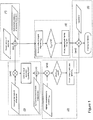
- a method for representing CG-MALS data from a reversibly hetero-associating solution at high concentration, in a highly simplified form amenable to further analysis, consists of the following steps as illustrated in Fig. 2 :
- the characterization method comprises the steps of: preparing a series of solutions comprising one or more macromolecular species; allowing each solution to reach equilibrium between the free monomers and any reversibly-associating complexes; measuring the light scattering intensity of each solution; reducing the light scattering data to a series of excess Rayleigh ratios; and fitting the data simultaneously to the appropriate simplified representation of non-ideal light scattering and the equations for the specific association model described below.
- a set of aliquots of the macromolecule of interest, at concentrations c 1 , c 2 , ... c k , are introduced into MALS detector 1, providing photodetectors at a plurality of scattering angles ⁇ v .
- MALS detector One example of a MALS detector is the DAWN-HELEOS ® , from Wyatt Technology Corporation, Santa Barbara, CA.
- Aliquots of each of the k concentrations may be prepared and introduced to the detectors by means of various methods. In one method, these aliquots are prepared manually and placed in the MALS detector by means of scintillation vials or cuvettes. In a second method, the aliquots are prepared manually and injected into the light scattering detector flow cell by means of a pump 2.
- the aliquots are prepared automatically by means of a dual pump 2 under computer control, which dilutes a stock solution 6 at a maximal concentration c max with a solvent 7, and subsequently delivers sequentially each aliquot as produced to the detector.
- a dual pump 2 under computer control
- an extant system capable of carrying out the dilution and delivery are the CalypsoTM SP3 accessory using the CalypsoTM software, from Wyatt Technology Corporation, Santa Barbara, CA.
- the actual concentrations of the aliquots in the flow cell may differ from the original, as-prepared values c s , as the sample dilutes in the course of flowing through the system and interacting with filters 3, surfaces, etc.
- a sufficient injection volume will fully equilibrate the detector flow cell at each injected concentration, so that knowledge of the as-prepared concentrations c s suffices to determine the actual concentration in the MALS flow cell.
- the optional in-line concentration detector 4 may be used to measure the actual sample concentrations.
- determining the concentration of a sample in solution In one method applicable to manual preparation of the aliquots, appropriate masses of concentrated or lyophilized sample are weighed out and dissolved in a known volume of the solvent. In a second method, the concentration is determined by measuring absorbance with a spectrophotometer. In a third method, the concentrations are determined by means of a suitable in-line concentration detector 4 connected in series with the MALS detector.
- a suitable in-line concentration detector 4 is the Optilab ® rEXTM, also from Wyatt Technology Corporation; other in-line concentration detectors are known, including UV/Vis absorption and fluorescence detectors.
- the in-line concentration detector may be connected in series or in parallel with the MALS detector.
- MALS and concentration detectors are connected in series, a sufficient volume of sample must be delivered so as to saturate both flow cells at the desired concentration. If the MALS and concentration detectors are connected in parallel, then the sample flow must be split between them in a controlled fashion so as to ensure that at the completion of each sample injection, the concentrations in the two detectors are the same. Sample flow splitting is typically controlled by a needle valve and monitored by means of suitable flow meters so as to maintain the required ratio.
- Data is acquired from the detectors while the sample is flowing and while it is stopped between injections, then stored and analyzed by a computer 5 performing the fitting procedure described previously.
- the data to be used for the analysis is that acquired after flow has stopped and the sample has equilibrated.
- Each successive sample passes through the MALS detector 1, whereby the values of the excess Rayleigh ratio, R s ( c s , ⁇ v ), at each detector angle ⁇ v , are measured at successive sample concentrations c s .
- the resultant light scattering and concentration signals are then stored and processed by a computer means 5 to calculate, for each injected aliquot s , the values c s , R s (c s , ⁇ v ) .
- Computer 5 also computes the molecular characteristics including M and ⁇ r g 2 > , and the molecular interaction characteristics A 2 and K i , by fitting the calculated results to Eq. (2) or a simplified form thereof, together with the association model equations.
- fitting procedures may be implemented to extract the molecular interaction characteristics.
- the fitting procedure consists of the Levenberg-Marquardt algorithm as applied to two variables (c and sin 2 ( ⁇ / 2 )), with M and A2 fixed.
- the fitting of the measured data to the form of the light scattering equation and association model equations may include statistical weighting whereby the data used to perform these fits is weighted by their reciprocal measured standard deviations.
- the measurement proceeds as for a single-species measurement, except that each aliquot contains different concentrations of two macromolecular species X and Y in various association states to be determined.
- k aliquots are prepared wherein the composition of the s th aliquot is [ s ⁇ c X , ( k - s ) ⁇ c Y ], and ⁇ c X and ⁇ c Y are fixed concentration step sizes.
- k aliquots are prepared wherein the composition of the s th aliquot is [ s ⁇ c X , s ⁇ c Y ], and ⁇ c X and ⁇ c Y are fixed concentration step sizes.
- the apparatus is similar to those of the single-species measurement, except that a computer-controlled triple-pump system is employed instead of a dual pump system, each pump controllable by means of computer to produce, mix and deliver an aliquot comprising species X, species Y, and solvent at the desired compositions.
- a computer-controlled triple-pump system is employed instead of a dual pump system, each pump controllable by means of computer to produce, mix and deliver an aliquot comprising species X, species Y, and solvent at the desired compositions.
- Such a triple-pump system and suitable controlling software are the Calypso system, of Wyatt Technology Corporation, Santa Barbara, CA.
- the total concentrations of constituents X and Y, c X tot and c Y tot respectively, may be determined from the predetermined stock solution concentrations and the mixing ratio as set in the preparation method, or by means of a method for measuring concentrations of two species in solution.
- the total concentration signal is measured by means of an on-line concentration detector 4, and the constituent concentrations calculated from the known ratio between the two constituent species and the relative contributions of each to the total concentration signal.
- a second method for measuring the concentrations of two distinct molecules in solution at least two different on-line concentration detection means are used, and the constituent concentrations determined from the concentration signals and the known responses of each constituent species to each concentration detection means.
- the signals of a differential refractometer and UV absorption detector may be analyzed to yield the concentrations of each of two species present in the same solution, if the responses of the molecules to the respective concentration detectors differs for at least one measurement.
Landscapes
- Physics & Mathematics (AREA)
- Health & Medical Sciences (AREA)
- Life Sciences & Earth Sciences (AREA)
- Chemical & Material Sciences (AREA)
- Analytical Chemistry (AREA)
- Biochemistry (AREA)
- General Health & Medical Sciences (AREA)
- General Physics & Mathematics (AREA)
- Immunology (AREA)
- Pathology (AREA)
- Investigating Or Analysing Materials By Optical Means (AREA)
Claims (19)
- Verfahren zur Kennzeichnung einer Selbstassoziation von umkehrbar assoziierenden Makromolekülen in einer hochkonzentrierten Lösung in einem Lösungsmittel, mit den Schritten,1.eine Reihe von k Aliquots von Lösungen der nachzuweisenden Moleküle mit Konzentrationen cf , f=1...k in ein Streulichtphotometer einzugeben, wobei das Streulichtphotometeri. jedes injizierte verdünnte Aliquot mit einem Lichtstrahl beleuchtet,ii. die Intensität des von diesem gestreuten Lichtes unter einer oder mehreren Winkellagen θ ermittelt, unter welchen ein lichtsensitiver Detektor angeordnet ist;2.die Konzentration cf jedes verdünnten Aliquot zu ermitteln;3.die überzähligen Rayleigh-Verhältnisse R(cf, θ) aus den ermittelten Streulichtintensitäten zu bilden;4.die überzähligen Rayleigh-Verhältnisse zur Durchführung einer Korrektur für einen nicht-idealen thermodynamischen Zustand in Bezug auf die k Verdünnungen cf, f=1...k als


 5.die Darstellungen der überzähligen Rayleigh-Verhältnisse an die Gleichungen eines Assoziationsmodells anzupassen, um einige oder sämtliche Gleichgewichtsassoziationskonstanten, Stöchiometrien einer Assoziation, inkompetenten Fraktionen, zweiten und dritten Virialkoeffizienten und Molmassen zu bestimmen.
 - Verfahren nach Anspruch 1, bei welchem A 2 als der ausgeschlossene Volumenwert,

- Verfahren nach Anspruch 1, bei welchem A 3 auf Null gesetzt ist.
- Verfahren nach Anspruch 1, bei welchem

- Verfahren nach Anspruch 1, bei welchem die Aliquots manuell präpariert und zu den Detektoren mit Hilfe von Szintillationsfläschchen oder mit Hilfe einer Pumpe geleitet werden oder bei welchem die Aliquots präpariert und zu den Detektoren automatisch mit Hilfe einer Doppel-Pumpe, die eine Stammlösung bei der höchsten geforderten Konzentration verdünnen, geleitet werden.
- Verfahren nach Anspruch 1, bei welchem die Bestimmung der Konzentrationen aus den Schritten besteht,a. einen Konzentrationsdetektor in Reihe mit dem Streulichtphotometer anzuordnen;b. ein verdünntes Aliquot mit ausreichendem Volumen zu injizieren, um die Flusszellen sowohl vom Streulichtphotometer als auch vom Konzentrationsdetektor zu füllen,c. das Signal vom Konzentrationsdetektor zu erfassen;d. das Signal in eine Konzentration auf der Grundlage des bekannten Response-Faktors des Makromoleküls umzuwandeln.
- Verfahren nach Anspruch 1, bei welchem die Bestimmung der Konzentration aus den Schritten besteht,a. die Konzentration der hochkonzentrierten Lösung in einem Konzentrationsdetektor zu messen;b. die Konzentrationen cj jedes verdünnten Aliquot aus den Parametern der Verdünnungsprozedur zu berechnen.
- Verfahren nach Anspruch 1, bei welchem der Konzentrationsdetektor ein Absorptionsphotometer für UV-Licht und sichtbares Licht aufweist und der Response-Faktor der Absorptionskoeffizient ist und der Konzentrationsdetektor ein Differentialrefraktometer aufweist oder bei welchem der Konzentrationsdetektor ein Differentialrefraktometer aufweist und der Response-Faktor das Brechungsinkrement ist.
- Verfahren nach Anspruch 1, bei welchem der Anpassungsschritt aus einem Schritt besteht, eine nicht-lineare Levenberg-Marquardt-Least-Squares-Anpassung vorzunehmen.
- Verfahren zur Kennzeichnung einer Hetero-Assoziation von zwei umkehrbar assoziierenden Makromolekülarten in einer hochkonzentrierten Lösung in einem Lösungsmittel mit den Schritten:1. hochkonzentrierte Lösungen von jeder Makromolekularart enthaltende Reservoirs und ein weiteres das Lösungsmittel enthaltendes Reservoir vorzubereiten;2. eine Reihe von k Kompositions-Aliquots [cX f , cX f ], f=1...k der hochkonzentrierten Lösung zu präparieren, indem die Aliquots der hochkonzentrierten Lösungen mit dem Lösungsmittel gemischt werden, wobei jedes Kompositions-Aluquot ein Makromolekül X mit einer Konzentration cX f und ein Makromolekül Y mit einer Konzentration cY f aufweist;3. der Reihe nach die Kompositions-Aliquots in ein Streulichtphotometer zu injizieren, wodurch das Streulichtphotometeri. jede injizierte Verdünnung mit einem Lichtstrahl beleuchtet,ii. die Intensität des von diesem gestreuten Lichtes unter einer oder mehrerer Winkellagen erfasst, unter welchen ein lichtsensitiver Detektor angeordnet ist,4. die Zusammensetzung [cX f, cY f ] jedes Kompositions-Aliquots f mit Hilfe eines Konzentrationsdetektors und des Response-Faktors der Makromoleküle in der Lösung zu ermitteln;5. die überzähligen Rayleigh-Verhältnisse R(cX f, cY f, θ) aus den erfassten Streulichtintensitäten zu bilden;6. die überzähligen Rayleigh-Verhältnisse zur Vornahme einer Korrektur für einen nicht-idealen thermodynamischen Zustand in Bezug auf die k Verdünnungen cf, f=1...k, als


 7. die Darstellungen der überzähligen Rayleigh-Verhältnisse an die Gleichungen eines Assoziationsmodells anzupassen, um einige oder sämtliche Gleichgewichtsassoziationskonstanten, Stöchiometrien der Assoziation, inkompetente Fraktionen, zweite Virialkoeffizienten und Molmassen zu bestimmen.
 - Verfahren nach Anspruch 10, bei welchem A 2,X und A 2,Y als die ausgeschlossenen Volumenwerte

- Verfahren nach Anspruch 10, bei welchem

- Verfahren nach Anspruch 10, bei welchem die Aliquots manuell präpariert und zu den Detektoren mit Hilfe von Szintillationsfläschchen oder mit Hilfe einer Pumpe geleitet werden oder bei welchem die Aliquots präpariert und direkt zu den Detektoren automatisch mit Hilfe einer Dreifach-Pumpe geleitet werden, welche Stammlösungen der Moleküle X und Y mit den höchsten erforderlichen Konzentrationen und ein Lösungsmittel fördern, diese drei Lösungen in die geforderten Zusammensetzungen mischen und anschließend die Aliquots zu den Detektoren leiten.
- Verfahren nach Anspruch 10, bei welchem die Bestimmung der Zusammensetzungen aus den Schritten besteht:a. einen Konzentrationsdetektor in Reihe mit dem Streulichtphotometer anzuordnen;b. ein Zusammensetzungs-Aliquot mit ausreichendem Volumen zu injizieren, um die Flusszellen sowohl des Streulichtphotometers als auch des Konzentrationsdetektors zu füllen,c. das Signal vom Konzentrationsdetektor zu erfassen;d. das Signal in einen Wert für die Zusammensetzung [cX f, cY f ] auf der Grundlage des bekannten Response-Faktors der Makromoleküle und deren Verhältnis, wie durch die Mischprozedur definiert, umzuwandeln.
- Verfahren nach Anspruch 10, bei welchem die Bestimmung der Zusammensetzungen aus den Schritten besteht:a. einen Konzentrationsdetektor in Reihe mit dem Streulichtphotometer anzuordnen, wobei der Konzentrationsdetektor auf zwei unabhängige Eigenschaften der Moleküle anspricht;b. ein Zusammensetzungs-Aliquot mit ausreichendem Volumen zu injizieren, um die Flusszellen sowohl des Streulichtphotometers als auch des Konzentrationsdetektors zu füllen;c. die Signale vom Konzentrationsdetektor zu erfassen;d. die Signale in einen Wert für die Zusammensetzung [cX f , cY f ] auf der Grundlage der bekannten Response-Faktoren der Makromoleküle auf die unabhängigen Eigenschaften umzuwandeln.
- Verfahren nach Anspruch 15, bei welchem die zwei Eigenschaften eine Spektralabsorption bei zwei unterschiedlichen Wellenlängen oder eine Spektralabsorption bei einer Wellenlänge und ein Brechungsinkrement sind.
- Verfahren nach Anspruch 10, bei welchem die Bestimmung der Zusammensetzungen aus den Schritten besteht:a. jede Hochkonzentrationslösung in einem Konzentrationsdetektor zu messen;b. die Zusammensetzungen [cX f, cY f ] jedes Zusammensetzungs-Aliquot aus den Parametern der Aliquotmischprozedur zu berechnen.
- Verfahren nach Anspruch 10, bei welchem der Konzentrationsdetektor ein Absorptionsphotometer für UV-Licht und sichtbares Licht aufweist und die Response-Faktoren die Absorptionskoeffizienten sind oder bei welchem der Konzentrationsdetektor ein Differentialrefraktometer aufweist und die Response-Faktoren Brechungsinkremente sind.
- Verfahren nach Anspruch 10, bei welchem der Anpassungsschritt aus einem Schritt besteht, eine nicht-lineare Levenberg-Marquardt-Least-Squares-Anpassung vorzunehmen.
Applications Claiming Priority (1)
| Application Number | Priority Date | Filing Date | Title |
|---|---|---|---|
| US12/459,437 US8195405B2 (en) | 2009-06-30 | 2009-06-30 | Method for characterizing reversible association of macromolecules at high concentration |
Publications (3)
| Publication Number | Publication Date |
|---|---|
| EP2270472A2 EP2270472A2 (de) | 2011-01-05 |
| EP2270472A3 EP2270472A3 (de) | 2012-09-19 |
| EP2270472B1 true EP2270472B1 (de) | 2016-11-09 |
Family
ID=42933131
Family Applications (1)
| Application Number | Title | Priority Date | Filing Date |
|---|---|---|---|
| EP10167833.2A Not-in-force EP2270472B1 (de) | 2009-06-30 | 2010-06-30 | Verfahren zur Kennzeichnung umkehrbarer Assoziation von Makromolekülen in einer hochkonzentrierten Lösung |
Country Status (4)
| Country | Link |
|---|---|
| US (1) | US8195405B2 (de) |
| EP (1) | EP2270472B1 (de) |
| JP (1) | JP5500365B2 (de) |
| CN (1) | CN101936901B (de) |
Families Citing this family (1)
| Publication number | Priority date | Publication date | Assignee | Title |
|---|---|---|---|---|
| WO2012017542A1 (ja) | 2010-08-05 | 2012-02-09 | トヨタ自動車株式会社 | 操舵制御装置 |
Family Cites Families (9)
| Publication number | Priority date | Publication date | Assignee | Title |
|---|---|---|---|---|
| US5269937A (en) * | 1990-10-23 | 1993-12-14 | Cetus Corporation | HPLC light scattering detector for biopolymers |
| CN1245623C (zh) * | 2003-03-04 | 2006-03-15 | 南京康海药业有限公司 | 香菇多糖分子量及分子量分布测定方法 |
| JP4439211B2 (ja) * | 2003-07-30 | 2010-03-24 | ワイアット テクノロジー コーポレイション | 分画されていない試料の重量平均モル質量、平均2乗半径、および第2ビリアル係数を決定する方法 |
| GB0413868D0 (en) * | 2004-06-21 | 2004-07-21 | Chiron Srl | Dimensional anlaysis of saccharide conjugates |
| JP2006288303A (ja) * | 2005-04-12 | 2006-10-26 | Sagami Keisoku Kk | リボフラビン配糖体の精製方法および分析方法 |
| US7518723B2 (en) * | 2005-09-19 | 2009-04-14 | Jmar Technologies, Inc. | Systems and methods for detecting radiation, biotoxin, chemical, and biological warfare agents using a multiple angle light scattering (MALS) instrument |
| JP2008032548A (ja) * | 2006-07-28 | 2008-02-14 | Shimadzu Corp | 光散乱検出装置 |
| US20090046274A1 (en) * | 2007-08-16 | 2009-02-19 | Mchugh Mark A | Light Scattering Methods and Systems Using Supercritical Fluid Solvents to Measure Polymer Molecular Weight and Molecular Weight Distribution |
| CN101441202B (zh) * | 2008-12-29 | 2011-08-10 | 河南工业大学 | 一种检测真菌多糖的方法 |
-
2009
- 2009-06-30 US US12/459,437 patent/US8195405B2/en active Active
-
2010
- 2010-06-29 JP JP2010147515A patent/JP5500365B2/ja not_active Expired - Fee Related
- 2010-06-30 CN CN201010221452.4A patent/CN101936901B/zh active Active
- 2010-06-30 EP EP10167833.2A patent/EP2270472B1/de not_active Not-in-force
Also Published As
| Publication number | Publication date |
|---|---|
| CN101936901B (zh) | 2014-09-17 |
| US8195405B2 (en) | 2012-06-05 |
| CN101936901A (zh) | 2011-01-05 |
| JP2011013217A (ja) | 2011-01-20 |
| EP2270472A2 (de) | 2011-01-05 |
| JP5500365B2 (ja) | 2014-05-21 |
| EP2270472A3 (de) | 2012-09-19 |
| US20100332146A1 (en) | 2010-12-30 |
Similar Documents
| Publication | Publication Date | Title |
|---|---|---|
| Attri et al. | New methods for measuring macromolecular interactions in solution via static light scattering: basic methodology and application to nonassociating and self-associating proteins | |
| Schuck | Simultaneous radial and wavelength analysis with the Optima XL-A analytical ultracentrifuge | |
| EP2096426B1 (de) | Verfahren zur Bestimmung gemittelter Eigenschaften von Molekülen in Lösung durch Injektion in ein fliessendes Lösungsmittel | |
| Tan et al. | Knowledge-based genetic algorithm for resolving the near-infrared spectrum and understanding the water structures in aqueous solution | |
| US9459207B2 (en) | Method of characterizing interactions and screening for effectors | |
| Durrani et al. | Phase diagram of mixtures of polymers in aqueous solution using Fourier-transform infrared spectroscopy | |
| Dawson et al. | Direct comparison of the submicron aerosol hygroscopicity of water-soluble sugars | |
| Prabhu et al. | Dimensions of polyelectrolyte chains and concentration fluctuations in semidilute solutions of sodium–poly (styrene sulfonate) as measured by small-angle neutron scattering | |
| Alford et al. | Measurement of the second osmotic virial coefficient for protein solutions exhibiting monomer–dimer equilibrium | |
| US6651009B1 (en) | Method for determining average solution properties of macromolecules by the injection method | |
| EP2270472B1 (de) | Verfahren zur Kennzeichnung umkehrbarer Assoziation von Makromolekülen in einer hochkonzentrierten Lösung | |
| US20210082541A1 (en) | Measuring attributes of a viral gene delivery vehicle sample via separation | |
| CN120277488A (zh) | 一种用于外泌体阳性质控品冻干的保护液组分优化方法 | |
| Garbett et al. | Sedimentation velocity ultracentrifugation analysis for hydrodynamic characterization of G-quadruplex structures | |
| US20230022034A1 (en) | Controlling the purification of a macromolecule solution via real-time multi-angle light scattering | |
| JP2016156807A (ja) | 分析方法及び分析装置 | |
| Some et al. | Characterizing protein-protein interactions via static light scattering: Nonspecific interactions | |
| Pecora | Dynamic light scattering from macromolecules | |
| EP1510807A1 (de) | Verfahren zur Bestimmung mittlerer Eigenschaften von in Lösung befindlichen Makromolekülen mittels des Injektionsverfahrens | |
| Gao et al. | Determination of molar mass and solution properties of cationic hydroxyethyl cellulose derivatives by multi‐angle laser light scattering with simultaneous refractive index detection | |
| Raşa et al. | Analytical ultracentrifugation studies on terpyridine-end-functionalized poly (ethylene oxide) and polystyrene systems complexed via Ru (II) ions | |
| Brûlé et al. | Protein intrinsic viscosity determination with the Viscosizer TD instrument: reaching beyond the initially expected applications | |
| Lin et al. | The analysis of small-angle scattering data from polydisperse rodlike particles by indirect transform and maximum-entropy methods | |
| US12385819B2 (en) | Measuring quality attributes of a virus sample | |
| Katzenstein et al. | Model of polydisperse wormlike stars and its application to dyestuff aggregates |
Legal Events
| Date | Code | Title | Description |
|---|---|---|---|
| PUAI | Public reference made under article 153(3) epc to a published international application that has entered the european phase |
Free format text: ORIGINAL CODE: 0009012 |
|
| AK | Designated contracting states |
Kind code of ref document: A2 Designated state(s): AL AT BE BG CH CY CZ DE DK EE ES FI FR GB GR HR HU IE IS IT LI LT LU LV MC MK MT NL NO PL PT RO SE SI SK SM TR |
|
| AX | Request for extension of the european patent |
Extension state: BA ME RS |
|
| PUAL | Search report despatched |
Free format text: ORIGINAL CODE: 0009013 |
|
| AK | Designated contracting states |
Kind code of ref document: A3 Designated state(s): AL AT BE BG CH CY CZ DE DK EE ES FI FR GB GR HR HU IE IS IT LI LT LU LV MC MK MT NL NO PL PT RO SE SI SK SM TR |
|
| AX | Request for extension of the european patent |
Extension state: BA ME RS |
|
| RIC1 | Information provided on ipc code assigned before grant |
Ipc: G01N 21/53 20060101AFI20120816BHEP |
|
| 17P | Request for examination filed |
Effective date: 20130319 |
|
| GRAP | Despatch of communication of intention to grant a patent |
Free format text: ORIGINAL CODE: EPIDOSNIGR1 |
|
| INTG | Intention to grant announced |
Effective date: 20160520 |
|
| GRAS | Grant fee paid |
Free format text: ORIGINAL CODE: EPIDOSNIGR3 |
|
| GRAA | (expected) grant |
Free format text: ORIGINAL CODE: 0009210 |
|
| AK | Designated contracting states |
Kind code of ref document: B1 Designated state(s): AL AT BE BG CH CY CZ DE DK EE ES FI FR GB GR HR HU IE IS IT LI LT LU LV MC MK MT NL NO PL PT RO SE SI SK SM TR |
|
| REG | Reference to a national code |
Ref country code: GB Ref legal event code: FG4D |
|
| REG | Reference to a national code |
Ref country code: AT Ref legal event code: REF Ref document number: 844397 Country of ref document: AT Kind code of ref document: T Effective date: 20161115 Ref country code: CH Ref legal event code: EP |
|
| REG | Reference to a national code |
Ref country code: IE Ref legal event code: FG4D |
|
| REG | Reference to a national code |
Ref country code: DE Ref legal event code: R096 Ref document number: 602010037780 Country of ref document: DE |
|
| PG25 | Lapsed in a contracting state [announced via postgrant information from national office to epo] |
Ref country code: LV Free format text: LAPSE BECAUSE OF FAILURE TO SUBMIT A TRANSLATION OF THE DESCRIPTION OR TO PAY THE FEE WITHIN THE PRESCRIBED TIME-LIMIT Effective date: 20161109 |
|
| REG | Reference to a national code |
Ref country code: LT Ref legal event code: MG4D |
|
| REG | Reference to a national code |
Ref country code: NL Ref legal event code: MP Effective date: 20161109 |
|
| REG | Reference to a national code |
Ref country code: AT Ref legal event code: MK05 Ref document number: 844397 Country of ref document: AT Kind code of ref document: T Effective date: 20161109 |
|
| PG25 | Lapsed in a contracting state [announced via postgrant information from national office to epo] |
Ref country code: GR Free format text: LAPSE BECAUSE OF FAILURE TO SUBMIT A TRANSLATION OF THE DESCRIPTION OR TO PAY THE FEE WITHIN THE PRESCRIBED TIME-LIMIT Effective date: 20170210 Ref country code: SE Free format text: LAPSE BECAUSE OF FAILURE TO SUBMIT A TRANSLATION OF THE DESCRIPTION OR TO PAY THE FEE WITHIN THE PRESCRIBED TIME-LIMIT Effective date: 20161109 Ref country code: LT Free format text: LAPSE BECAUSE OF FAILURE TO SUBMIT A TRANSLATION OF THE DESCRIPTION OR TO PAY THE FEE WITHIN THE PRESCRIBED TIME-LIMIT Effective date: 20161109 Ref country code: NL Free format text: LAPSE BECAUSE OF FAILURE TO SUBMIT A TRANSLATION OF THE DESCRIPTION OR TO PAY THE FEE WITHIN THE PRESCRIBED TIME-LIMIT Effective date: 20161109 Ref country code: NO Free format text: LAPSE BECAUSE OF FAILURE TO SUBMIT A TRANSLATION OF THE DESCRIPTION OR TO PAY THE FEE WITHIN THE PRESCRIBED TIME-LIMIT Effective date: 20170209 |
|
| PG25 | Lapsed in a contracting state [announced via postgrant information from national office to epo] |
Ref country code: PT Free format text: LAPSE BECAUSE OF FAILURE TO SUBMIT A TRANSLATION OF THE DESCRIPTION OR TO PAY THE FEE WITHIN THE PRESCRIBED TIME-LIMIT Effective date: 20170309 Ref country code: IS Free format text: LAPSE BECAUSE OF FAILURE TO SUBMIT A TRANSLATION OF THE DESCRIPTION OR TO PAY THE FEE WITHIN THE PRESCRIBED TIME-LIMIT Effective date: 20170309 Ref country code: FI Free format text: LAPSE BECAUSE OF FAILURE TO SUBMIT A TRANSLATION OF THE DESCRIPTION OR TO PAY THE FEE WITHIN THE PRESCRIBED TIME-LIMIT Effective date: 20161109 Ref country code: HR Free format text: LAPSE BECAUSE OF FAILURE TO SUBMIT A TRANSLATION OF THE DESCRIPTION OR TO PAY THE FEE WITHIN THE PRESCRIBED TIME-LIMIT Effective date: 20161109 Ref country code: PL Free format text: LAPSE BECAUSE OF FAILURE TO SUBMIT A TRANSLATION OF THE DESCRIPTION OR TO PAY THE FEE WITHIN THE PRESCRIBED TIME-LIMIT Effective date: 20161109 Ref country code: ES Free format text: LAPSE BECAUSE OF FAILURE TO SUBMIT A TRANSLATION OF THE DESCRIPTION OR TO PAY THE FEE WITHIN THE PRESCRIBED TIME-LIMIT Effective date: 20161109 Ref country code: AT Free format text: LAPSE BECAUSE OF FAILURE TO SUBMIT A TRANSLATION OF THE DESCRIPTION OR TO PAY THE FEE WITHIN THE PRESCRIBED TIME-LIMIT Effective date: 20161109 |
|
| REG | Reference to a national code |
Ref country code: FR Ref legal event code: PLFP Year of fee payment: 8 |
|
| PG25 | Lapsed in a contracting state [announced via postgrant information from national office to epo] |
Ref country code: SK Free format text: LAPSE BECAUSE OF FAILURE TO SUBMIT A TRANSLATION OF THE DESCRIPTION OR TO PAY THE FEE WITHIN THE PRESCRIBED TIME-LIMIT Effective date: 20161109 Ref country code: EE Free format text: LAPSE BECAUSE OF FAILURE TO SUBMIT A TRANSLATION OF THE DESCRIPTION OR TO PAY THE FEE WITHIN THE PRESCRIBED TIME-LIMIT Effective date: 20161109 Ref country code: DK Free format text: LAPSE BECAUSE OF FAILURE TO SUBMIT A TRANSLATION OF THE DESCRIPTION OR TO PAY THE FEE WITHIN THE PRESCRIBED TIME-LIMIT Effective date: 20161109 Ref country code: RO Free format text: LAPSE BECAUSE OF FAILURE TO SUBMIT A TRANSLATION OF THE DESCRIPTION OR TO PAY THE FEE WITHIN THE PRESCRIBED TIME-LIMIT Effective date: 20161109 Ref country code: CZ Free format text: LAPSE BECAUSE OF FAILURE TO SUBMIT A TRANSLATION OF THE DESCRIPTION OR TO PAY THE FEE WITHIN THE PRESCRIBED TIME-LIMIT Effective date: 20161109 |
|
| REG | Reference to a national code |
Ref country code: DE Ref legal event code: R097 Ref document number: 602010037780 Country of ref document: DE |
|
| PG25 | Lapsed in a contracting state [announced via postgrant information from national office to epo] |
Ref country code: IT Free format text: LAPSE BECAUSE OF FAILURE TO SUBMIT A TRANSLATION OF THE DESCRIPTION OR TO PAY THE FEE WITHIN THE PRESCRIBED TIME-LIMIT Effective date: 20161109 Ref country code: SM Free format text: LAPSE BECAUSE OF FAILURE TO SUBMIT A TRANSLATION OF THE DESCRIPTION OR TO PAY THE FEE WITHIN THE PRESCRIBED TIME-LIMIT Effective date: 20161109 Ref country code: BE Free format text: LAPSE BECAUSE OF FAILURE TO SUBMIT A TRANSLATION OF THE DESCRIPTION OR TO PAY THE FEE WITHIN THE PRESCRIBED TIME-LIMIT Effective date: 20161109 Ref country code: BG Free format text: LAPSE BECAUSE OF FAILURE TO SUBMIT A TRANSLATION OF THE DESCRIPTION OR TO PAY THE FEE WITHIN THE PRESCRIBED TIME-LIMIT Effective date: 20170209 |
|
| PLBE | No opposition filed within time limit |
Free format text: ORIGINAL CODE: 0009261 |
|
| STAA | Information on the status of an ep patent application or granted ep patent |
Free format text: STATUS: NO OPPOSITION FILED WITHIN TIME LIMIT |
|
| 26N | No opposition filed |
Effective date: 20170810 |
|
| PG25 | Lapsed in a contracting state [announced via postgrant information from national office to epo] |
Ref country code: SI Free format text: LAPSE BECAUSE OF FAILURE TO SUBMIT A TRANSLATION OF THE DESCRIPTION OR TO PAY THE FEE WITHIN THE PRESCRIBED TIME-LIMIT Effective date: 20161109 |
|
| PG25 | Lapsed in a contracting state [announced via postgrant information from national office to epo] |
Ref country code: MC Free format text: LAPSE BECAUSE OF FAILURE TO SUBMIT A TRANSLATION OF THE DESCRIPTION OR TO PAY THE FEE WITHIN THE PRESCRIBED TIME-LIMIT Effective date: 20161109 |
|
| REG | Reference to a national code |
Ref country code: CH Ref legal event code: PL |
|
| REG | Reference to a national code |
Ref country code: IE Ref legal event code: MM4A |
|
| PG25 | Lapsed in a contracting state [announced via postgrant information from national office to epo] |
Ref country code: CH Free format text: LAPSE BECAUSE OF NON-PAYMENT OF DUE FEES Effective date: 20170630 Ref country code: LU Free format text: LAPSE BECAUSE OF NON-PAYMENT OF DUE FEES Effective date: 20170630 Ref country code: LI Free format text: LAPSE BECAUSE OF NON-PAYMENT OF DUE FEES Effective date: 20170630 Ref country code: IE Free format text: LAPSE BECAUSE OF NON-PAYMENT OF DUE FEES Effective date: 20170630 |
|
| REG | Reference to a national code |
Ref country code: FR Ref legal event code: PLFP Year of fee payment: 9 |
|
| PG25 | Lapsed in a contracting state [announced via postgrant information from national office to epo] |
Ref country code: MT Free format text: LAPSE BECAUSE OF NON-PAYMENT OF DUE FEES Effective date: 20170630 |
|
| PG25 | Lapsed in a contracting state [announced via postgrant information from national office to epo] |
Ref country code: HU Free format text: LAPSE BECAUSE OF FAILURE TO SUBMIT A TRANSLATION OF THE DESCRIPTION OR TO PAY THE FEE WITHIN THE PRESCRIBED TIME-LIMIT; INVALID AB INITIO Effective date: 20100630 |
|
| PGFP | Annual fee paid to national office [announced via postgrant information from national office to epo] |
Ref country code: FR Payment date: 20190626 Year of fee payment: 10 |
|
| PG25 | Lapsed in a contracting state [announced via postgrant information from national office to epo] |
Ref country code: CY Free format text: LAPSE BECAUSE OF NON-PAYMENT OF DUE FEES Effective date: 20161109 |
|
| PGFP | Annual fee paid to national office [announced via postgrant information from national office to epo] |
Ref country code: DE Payment date: 20190702 Year of fee payment: 10 Ref country code: GB Payment date: 20190624 Year of fee payment: 10 |
|
| PG25 | Lapsed in a contracting state [announced via postgrant information from national office to epo] |
Ref country code: MK Free format text: LAPSE BECAUSE OF FAILURE TO SUBMIT A TRANSLATION OF THE DESCRIPTION OR TO PAY THE FEE WITHIN THE PRESCRIBED TIME-LIMIT Effective date: 20161109 |
|
| PG25 | Lapsed in a contracting state [announced via postgrant information from national office to epo] |
Ref country code: TR Free format text: LAPSE BECAUSE OF FAILURE TO SUBMIT A TRANSLATION OF THE DESCRIPTION OR TO PAY THE FEE WITHIN THE PRESCRIBED TIME-LIMIT Effective date: 20161109 |
|
| PG25 | Lapsed in a contracting state [announced via postgrant information from national office to epo] |
Ref country code: AL Free format text: LAPSE BECAUSE OF FAILURE TO SUBMIT A TRANSLATION OF THE DESCRIPTION OR TO PAY THE FEE WITHIN THE PRESCRIBED TIME-LIMIT Effective date: 20161109 |
|
| REG | Reference to a national code |
Ref country code: DE Ref legal event code: R119 Ref document number: 602010037780 Country of ref document: DE |
|
| GBPC | Gb: european patent ceased through non-payment of renewal fee |
Effective date: 20200630 |
|
| PG25 | Lapsed in a contracting state [announced via postgrant information from national office to epo] |
Ref country code: GB Free format text: LAPSE BECAUSE OF NON-PAYMENT OF DUE FEES Effective date: 20200630 Ref country code: FR Free format text: LAPSE BECAUSE OF NON-PAYMENT OF DUE FEES Effective date: 20200630 |
|
| PG25 | Lapsed in a contracting state [announced via postgrant information from national office to epo] |
Ref country code: DE Free format text: LAPSE BECAUSE OF NON-PAYMENT OF DUE FEES Effective date: 20210101 |