EP2270227A1 - Oligonucleotides, arrays thereof for detecting microorganisms, and an apparatus, a method and a kit for detecting microorganisms - Google Patents
Oligonucleotides, arrays thereof for detecting microorganisms, and an apparatus, a method and a kit for detecting microorganisms Download PDFInfo
- Publication number
- EP2270227A1 EP2270227A1 EP10171052A EP10171052A EP2270227A1 EP 2270227 A1 EP2270227 A1 EP 2270227A1 EP 10171052 A EP10171052 A EP 10171052A EP 10171052 A EP10171052 A EP 10171052A EP 2270227 A1 EP2270227 A1 EP 2270227A1
- Authority
- EP
- European Patent Office
- Prior art keywords
- nucleic acid
- oligonucleotide
- microorganism
- group
- acid sequences
- Prior art date
- Legal status (The legal status is an assumption and is not a legal conclusion. Google has not performed a legal analysis and makes no representation as to the accuracy of the status listed.)
- Granted
Links
- 244000005700 microbiome Species 0.000 title claims abstract description 295
- 108091034117 Oligonucleotide Proteins 0.000 title claims abstract description 250
- 238000000034 method Methods 0.000 title claims abstract description 70
- JLCPHMBAVCMARE-UHFFFAOYSA-N [3-[[3-[[3-[[3-[[3-[[3-[[3-[[3-[[3-[[3-[[3-[[5-(2-amino-6-oxo-1H-purin-9-yl)-3-[[3-[[3-[[3-[[3-[[3-[[5-(2-amino-6-oxo-1H-purin-9-yl)-3-[[5-(2-amino-6-oxo-1H-purin-9-yl)-3-hydroxyoxolan-2-yl]methoxy-hydroxyphosphoryl]oxyoxolan-2-yl]methoxy-hydroxyphosphoryl]oxy-5-(5-methyl-2,4-dioxopyrimidin-1-yl)oxolan-2-yl]methoxy-hydroxyphosphoryl]oxy-5-(6-aminopurin-9-yl)oxolan-2-yl]methoxy-hydroxyphosphoryl]oxy-5-(6-aminopurin-9-yl)oxolan-2-yl]methoxy-hydroxyphosphoryl]oxy-5-(6-aminopurin-9-yl)oxolan-2-yl]methoxy-hydroxyphosphoryl]oxy-5-(6-aminopurin-9-yl)oxolan-2-yl]methoxy-hydroxyphosphoryl]oxyoxolan-2-yl]methoxy-hydroxyphosphoryl]oxy-5-(5-methyl-2,4-dioxopyrimidin-1-yl)oxolan-2-yl]methoxy-hydroxyphosphoryl]oxy-5-(4-amino-2-oxopyrimidin-1-yl)oxolan-2-yl]methoxy-hydroxyphosphoryl]oxy-5-(5-methyl-2,4-dioxopyrimidin-1-yl)oxolan-2-yl]methoxy-hydroxyphosphoryl]oxy-5-(5-methyl-2,4-dioxopyrimidin-1-yl)oxolan-2-yl]methoxy-hydroxyphosphoryl]oxy-5-(6-aminopurin-9-yl)oxolan-2-yl]methoxy-hydroxyphosphoryl]oxy-5-(6-aminopurin-9-yl)oxolan-2-yl]methoxy-hydroxyphosphoryl]oxy-5-(4-amino-2-oxopyrimidin-1-yl)oxolan-2-yl]methoxy-hydroxyphosphoryl]oxy-5-(4-amino-2-oxopyrimidin-1-yl)oxolan-2-yl]methoxy-hydroxyphosphoryl]oxy-5-(4-amino-2-oxopyrimidin-1-yl)oxolan-2-yl]methoxy-hydroxyphosphoryl]oxy-5-(6-aminopurin-9-yl)oxolan-2-yl]methoxy-hydroxyphosphoryl]oxy-5-(4-amino-2-oxopyrimidin-1-yl)oxolan-2-yl]methyl [5-(6-aminopurin-9-yl)-2-(hydroxymethyl)oxolan-3-yl] hydrogen phosphate Polymers Cc1cn(C2CC(OP(O)(=O)OCC3OC(CC3OP(O)(=O)OCC3OC(CC3O)n3cnc4c3nc(N)[nH]c4=O)n3cnc4c3nc(N)[nH]c4=O)C(COP(O)(=O)OC3CC(OC3COP(O)(=O)OC3CC(OC3COP(O)(=O)OC3CC(OC3COP(O)(=O)OC3CC(OC3COP(O)(=O)OC3CC(OC3COP(O)(=O)OC3CC(OC3COP(O)(=O)OC3CC(OC3COP(O)(=O)OC3CC(OC3COP(O)(=O)OC3CC(OC3COP(O)(=O)OC3CC(OC3COP(O)(=O)OC3CC(OC3COP(O)(=O)OC3CC(OC3COP(O)(=O)OC3CC(OC3COP(O)(=O)OC3CC(OC3COP(O)(=O)OC3CC(OC3COP(O)(=O)OC3CC(OC3COP(O)(=O)OC3CC(OC3CO)n3cnc4c(N)ncnc34)n3ccc(N)nc3=O)n3cnc4c(N)ncnc34)n3ccc(N)nc3=O)n3ccc(N)nc3=O)n3ccc(N)nc3=O)n3cnc4c(N)ncnc34)n3cnc4c(N)ncnc34)n3cc(C)c(=O)[nH]c3=O)n3cc(C)c(=O)[nH]c3=O)n3ccc(N)nc3=O)n3cc(C)c(=O)[nH]c3=O)n3cnc4c3nc(N)[nH]c4=O)n3cnc4c(N)ncnc34)n3cnc4c(N)ncnc34)n3cnc4c(N)ncnc34)n3cnc4c(N)ncnc34)O2)c(=O)[nH]c1=O JLCPHMBAVCMARE-UHFFFAOYSA-N 0.000 title claims abstract description 45
- 238000003491 array Methods 0.000 title description 2
- 239000000523 sample Substances 0.000 claims abstract description 155
- 238000012360 testing method Methods 0.000 claims abstract description 74
- 238000009396 hybridization Methods 0.000 claims abstract description 73
- 108091028043 Nucleic acid sequence Proteins 0.000 claims abstract description 45
- 150000007523 nucleic acids Chemical group 0.000 claims description 192
- 241000722885 Brettanomyces Species 0.000 claims description 162
- 238000002966 oligonucleotide array Methods 0.000 claims description 61
- 108020004707 nucleic acids Proteins 0.000 claims description 60
- 102000039446 nucleic acids Human genes 0.000 claims description 60
- 239000002773 nucleotide Substances 0.000 claims description 54
- 125000003729 nucleotide group Chemical group 0.000 claims description 54
- 241000235062 Pichia membranifaciens Species 0.000 claims description 43
- 241001237431 Anomala Species 0.000 claims description 36
- 230000000295 complement effect Effects 0.000 claims description 34
- 238000001514 detection method Methods 0.000 claims description 30
- 241001149671 Hanseniaspora uvarum Species 0.000 claims description 29
- 244000286779 Hansenula anomala Species 0.000 claims description 29
- 235000014683 Hansenula anomala Nutrition 0.000 claims description 29
- 235000014680 Saccharomyces cerevisiae Nutrition 0.000 claims description 29
- 240000004808 Saccharomyces cerevisiae Species 0.000 claims description 29
- 241000566361 Hanseniaspora guilliermondii Species 0.000 claims description 28
- 244000206963 Saccharomyces cerevisiae var. diastaticus Species 0.000 claims description 28
- 235000001006 Saccharomyces cerevisiae var diastaticus Nutrition 0.000 claims description 27
- 241000235072 Saccharomyces bayanus Species 0.000 claims description 26
- 241001123227 Saccharomyces pastorianus Species 0.000 claims description 26
- 235000013305 food Nutrition 0.000 claims description 25
- 239000003153 chemical reaction reagent Substances 0.000 claims description 20
- 238000002360 preparation method Methods 0.000 claims description 19
- 238000006243 chemical reaction Methods 0.000 claims description 16
- IQPQWNKOIGAROB-UHFFFAOYSA-N isocyanate group Chemical group [N-]=C=O IQPQWNKOIGAROB-UHFFFAOYSA-N 0.000 claims description 9
- VPKDCDLSJZCGKE-UHFFFAOYSA-N carbodiimide group Chemical group N=C=N VPKDCDLSJZCGKE-UHFFFAOYSA-N 0.000 claims description 8
- 241000894007 species Species 0.000 abstract description 41
- 239000000758 substrate Substances 0.000 abstract description 40
- 238000002493 microarray Methods 0.000 abstract 1
- 239000013641 positive control Substances 0.000 description 28
- 239000013642 negative control Substances 0.000 description 20
- 239000000243 solution Substances 0.000 description 19
- 241000235648 Pichia Species 0.000 description 18
- 108020004414 DNA Proteins 0.000 description 17
- 239000000047 product Substances 0.000 description 16
- 235000013334 alcoholic beverage Nutrition 0.000 description 14
- GXCLVBGFBYZDAG-UHFFFAOYSA-N N-[2-(1H-indol-3-yl)ethyl]-N-methylprop-2-en-1-amine Chemical compound CN(CCC1=CNC2=C1C=CC=C2)CC=C GXCLVBGFBYZDAG-UHFFFAOYSA-N 0.000 description 13
- 241000235070 Saccharomyces Species 0.000 description 12
- 108090000790 Enzymes Proteins 0.000 description 11
- 102000004190 Enzymes Human genes 0.000 description 11
- 235000013405 beer Nutrition 0.000 description 11
- FAPWRFPIFSIZLT-UHFFFAOYSA-M Sodium chloride Chemical compound [Na+].[Cl-] FAPWRFPIFSIZLT-UHFFFAOYSA-M 0.000 description 10
- 239000002585 base Substances 0.000 description 9
- 239000000203 mixture Substances 0.000 description 9
- 230000003321 amplification Effects 0.000 description 7
- 239000000872 buffer Substances 0.000 description 7
- 238000003199 nucleic acid amplification method Methods 0.000 description 7
- 108091032973 (ribonucleotides)n+m Proteins 0.000 description 6
- 108091003079 Bovine Serum Albumin Proteins 0.000 description 6
- 235000013361 beverage Nutrition 0.000 description 6
- 229940098773 bovine serum albumin Drugs 0.000 description 6
- 239000003795 chemical substances by application Substances 0.000 description 6
- 238000011109 contamination Methods 0.000 description 6
- 238000002372 labelling Methods 0.000 description 6
- 241001149669 Hanseniaspora Species 0.000 description 5
- 150000001875 compounds Chemical class 0.000 description 5
- 239000011521 glass Substances 0.000 description 5
- 108090000623 proteins and genes Proteins 0.000 description 5
- 239000011780 sodium chloride Substances 0.000 description 5
- XLYOFNOQVPJJNP-UHFFFAOYSA-N water Substances O XLYOFNOQVPJJNP-UHFFFAOYSA-N 0.000 description 5
- YBJHBAHKTGYVGT-ZKWXMUAHSA-N (+)-Biotin Chemical compound N1C(=O)N[C@@H]2[C@H](CCCCC(=O)O)SC[C@@H]21 YBJHBAHKTGYVGT-ZKWXMUAHSA-N 0.000 description 4
- 241000222120 Candida <Saccharomycetales> Species 0.000 description 4
- ZHNUHDYFZUAESO-UHFFFAOYSA-N Formamide Chemical compound NC=O ZHNUHDYFZUAESO-UHFFFAOYSA-N 0.000 description 4
- DBMJMQXJHONAFJ-UHFFFAOYSA-M Sodium laurylsulphate Chemical compound [Na+].CCCCCCCCCCCCOS([O-])(=O)=O DBMJMQXJHONAFJ-UHFFFAOYSA-M 0.000 description 4
- 239000002253 acid Substances 0.000 description 4
- 238000007792 addition Methods 0.000 description 4
- 235000018102 proteins Nutrition 0.000 description 4
- 102000004169 proteins and genes Human genes 0.000 description 4
- 239000011541 reaction mixture Substances 0.000 description 4
- 150000003839 salts Chemical class 0.000 description 4
- QEIFSLUFHRCVQL-UHFFFAOYSA-N (5-bromo-4-chloro-1h-indol-3-yl) hydrogen phosphate;(4-methylphenyl)azanium Chemical compound CC1=CC=C(N)C=C1.C1=C(Br)C(Cl)=C2C(OP(O)(=O)O)=CNC2=C1 QEIFSLUFHRCVQL-UHFFFAOYSA-N 0.000 description 3
- QKNYBSVHEMOAJP-UHFFFAOYSA-N 2-amino-2-(hydroxymethyl)propane-1,3-diol;hydron;chloride Chemical compound Cl.OCC(N)(CO)CO QKNYBSVHEMOAJP-UHFFFAOYSA-N 0.000 description 3
- 208000037065 Subacute sclerosing leukoencephalitis Diseases 0.000 description 3
- 206010042297 Subacute sclerosing panencephalitis Diseases 0.000 description 3
- 230000000903 blocking effect Effects 0.000 description 3
- 238000001962 electrophoresis Methods 0.000 description 3
- 239000000796 flavoring agent Substances 0.000 description 3
- 239000007850 fluorescent dye Substances 0.000 description 3
- 239000000463 material Substances 0.000 description 3
- 238000012986 modification Methods 0.000 description 3
- 230000004048 modification Effects 0.000 description 3
- FSVCQIDHPKZJSO-UHFFFAOYSA-L nitro blue tetrazolium dichloride Chemical compound [Cl-].[Cl-].COC1=CC(C=2C=C(OC)C(=CC=2)[N+]=2N(N=C(N=2)C=2C=CC=CC=2)C=2C=CC(=CC=2)[N+]([O-])=O)=CC=C1[N+]1=NC(C=2C=CC=CC=2)=NN1C1=CC=C([N+]([O-])=O)C=C1 FSVCQIDHPKZJSO-UHFFFAOYSA-L 0.000 description 3
- 108700022487 rRNA Genes Proteins 0.000 description 3
- 108091008146 restriction endonucleases Proteins 0.000 description 3
- 108020004463 18S ribosomal RNA Proteins 0.000 description 2
- 241000922351 Anoma Species 0.000 description 2
- KRKNYBCHXYNGOX-UHFFFAOYSA-K Citrate Chemical compound [O-]C(=O)CC(O)(CC([O-])=O)C([O-])=O KRKNYBCHXYNGOX-UHFFFAOYSA-K 0.000 description 2
- KCXVZYZYPLLWCC-UHFFFAOYSA-N EDTA Chemical compound OC(=O)CN(CC(O)=O)CCN(CC(O)=O)CC(O)=O KCXVZYZYPLLWCC-UHFFFAOYSA-N 0.000 description 2
- 241000237537 Ensis Species 0.000 description 2
- LFQSCWFLJHTTHZ-UHFFFAOYSA-N Ethanol Chemical compound CCO LFQSCWFLJHTTHZ-UHFFFAOYSA-N 0.000 description 2
- 108020004711 Nucleic Acid Probes Proteins 0.000 description 2
- 102000004160 Phosphoric Monoester Hydrolases Human genes 0.000 description 2
- 108090000608 Phosphoric Monoester Hydrolases Proteins 0.000 description 2
- 108010004729 Phycoerythrin Proteins 0.000 description 2
- 239000013504 Triton X-100 Substances 0.000 description 2
- 229920004890 Triton X-100 Polymers 0.000 description 2
- 238000010521 absorption reaction Methods 0.000 description 2
- 239000000654 additive Substances 0.000 description 2
- 230000000996 additive effect Effects 0.000 description 2
- 239000003513 alkali Substances 0.000 description 2
- 125000003277 amino group Chemical group 0.000 description 2
- 235000013527 bean curd Nutrition 0.000 description 2
- 229960002685 biotin Drugs 0.000 description 2
- 235000020958 biotin Nutrition 0.000 description 2
- 239000011616 biotin Substances 0.000 description 2
- 238000007413 biotinylation Methods 0.000 description 2
- 239000005018 casein Substances 0.000 description 2
- BECPQYXYKAMYBN-UHFFFAOYSA-N casein, tech. Chemical compound NCCCCC(C(O)=O)N=C(O)C(CC(O)=O)N=C(O)C(CCC(O)=N)N=C(O)C(CC(C)C)N=C(O)C(CCC(O)=O)N=C(O)C(CC(O)=O)N=C(O)C(CCC(O)=O)N=C(O)C(C(C)O)N=C(O)C(CCC(O)=N)N=C(O)C(CCC(O)=N)N=C(O)C(CCC(O)=N)N=C(O)C(CCC(O)=O)N=C(O)C(CCC(O)=O)N=C(O)C(COP(O)(O)=O)N=C(O)C(CCC(O)=N)N=C(O)C(N)CC1=CC=CC=C1 BECPQYXYKAMYBN-UHFFFAOYSA-N 0.000 description 2
- 235000021240 caseins Nutrition 0.000 description 2
- 235000009508 confectionery Nutrition 0.000 description 2
- 239000006059 cover glass Substances 0.000 description 2
- 230000001419 dependent effect Effects 0.000 description 2
- 239000012153 distilled water Substances 0.000 description 2
- 239000003814 drug Substances 0.000 description 2
- 229940079593 drug Drugs 0.000 description 2
- 235000019634 flavors Nutrition 0.000 description 2
- GNBHRKFJIUUOQI-UHFFFAOYSA-N fluorescein Chemical compound O1C(=O)C2=CC=CC=C2C21C1=CC=C(O)C=C1OC1=CC(O)=CC=C21 GNBHRKFJIUUOQI-UHFFFAOYSA-N 0.000 description 2
- 235000020094 liqueur Nutrition 0.000 description 2
- 238000004519 manufacturing process Methods 0.000 description 2
- 239000012528 membrane Substances 0.000 description 2
- 102000042567 non-coding RNA Human genes 0.000 description 2
- 239000002853 nucleic acid probe Substances 0.000 description 2
- 102000013415 peroxidase activity proteins Human genes 0.000 description 2
- 108040007629 peroxidase activity proteins Proteins 0.000 description 2
- 235000013324 preserved food Nutrition 0.000 description 2
- 125000006850 spacer group Chemical group 0.000 description 2
- 238000005406 washing Methods 0.000 description 2
- UAIUNKRWKOVEES-UHFFFAOYSA-N 3,3',5,5'-tetramethylbenzidine Chemical compound CC1=C(N)C(C)=CC(C=2C=C(C)C(N)=C(C)C=2)=C1 UAIUNKRWKOVEES-UHFFFAOYSA-N 0.000 description 1
- YRNWIFYIFSBPAU-UHFFFAOYSA-N 4-[4-(dimethylamino)phenyl]-n,n-dimethylaniline Chemical compound C1=CC(N(C)C)=CC=C1C1=CC=C(N(C)C)C=C1 YRNWIFYIFSBPAU-UHFFFAOYSA-N 0.000 description 1
- 240000003291 Armoracia rusticana Species 0.000 description 1
- 235000011330 Armoracia rusticana Nutrition 0.000 description 1
- 244000027711 Brettanomyces bruxellensis Species 0.000 description 1
- 235000000287 Brettanomyces bruxellensis Nutrition 0.000 description 1
- 230000004544 DNA amplification Effects 0.000 description 1
- 108010014303 DNA-directed DNA polymerase Proteins 0.000 description 1
- 102000016928 DNA-directed DNA polymerase Human genes 0.000 description 1
- SHIBSTMRCDJXLN-UHFFFAOYSA-N Digoxigenin Natural products C1CC(C2C(C3(C)CCC(O)CC3CC2)CC2O)(O)C2(C)C1C1=CC(=O)OC1 SHIBSTMRCDJXLN-UHFFFAOYSA-N 0.000 description 1
- 239000004278 EU approved seasoning Substances 0.000 description 1
- 108010001336 Horseradish Peroxidase Proteins 0.000 description 1
- UGQMRVRMYYASKQ-KQYNXXCUSA-N Inosine Chemical compound O[C@@H]1[C@H](O)[C@@H](CO)O[C@H]1N1C2=NC=NC(O)=C2N=C1 UGQMRVRMYYASKQ-KQYNXXCUSA-N 0.000 description 1
- 229930010555 Inosine Natural products 0.000 description 1
- OKIZCWYLBDKLSU-UHFFFAOYSA-M N,N,N-Trimethylmethanaminium chloride Chemical compound [Cl-].C[N+](C)(C)C OKIZCWYLBDKLSU-UHFFFAOYSA-M 0.000 description 1
- 108020005187 Oligonucleotide Probes Proteins 0.000 description 1
- 108010006785 Taq Polymerase Proteins 0.000 description 1
- 241000209140 Triticum Species 0.000 description 1
- 235000021307 Triticum Nutrition 0.000 description 1
- 150000007513 acids Chemical class 0.000 description 1
- 238000004458 analytical method Methods 0.000 description 1
- 230000005540 biological transmission Effects 0.000 description 1
- 230000015572 biosynthetic process Effects 0.000 description 1
- 230000006287 biotinylation Effects 0.000 description 1
- 235000008429 bread Nutrition 0.000 description 1
- 150000001718 carbodiimides Chemical class 0.000 description 1
- 230000015556 catabolic process Effects 0.000 description 1
- 238000006555 catalytic reaction Methods 0.000 description 1
- 210000004027 cell Anatomy 0.000 description 1
- 230000001413 cellular effect Effects 0.000 description 1
- 235000013339 cereals Nutrition 0.000 description 1
- 239000003593 chromogenic compound Substances 0.000 description 1
- 238000001816 cooling Methods 0.000 description 1
- 238000012258 culturing Methods 0.000 description 1
- 235000013365 dairy product Nutrition 0.000 description 1
- 238000006731 degradation reaction Methods 0.000 description 1
- 238000012217 deletion Methods 0.000 description 1
- 230000037430 deletion Effects 0.000 description 1
- 238000010511 deprotection reaction Methods 0.000 description 1
- 230000000368 destabilizing effect Effects 0.000 description 1
- 230000006866 deterioration Effects 0.000 description 1
- 238000011161 development Methods 0.000 description 1
- QONQRTHLHBTMGP-UHFFFAOYSA-N digitoxigenin Natural products CC12CCC(C3(CCC(O)CC3CC3)C)C3C11OC1CC2C1=CC(=O)OC1 QONQRTHLHBTMGP-UHFFFAOYSA-N 0.000 description 1
- SHIBSTMRCDJXLN-KCZCNTNESA-N digoxigenin Chemical compound C1([C@@H]2[C@@]3([C@@](CC2)(O)[C@H]2[C@@H]([C@@]4(C)CC[C@H](O)C[C@H]4CC2)C[C@H]3O)C)=CC(=O)OC1 SHIBSTMRCDJXLN-KCZCNTNESA-N 0.000 description 1
- -1 dinitrophenyl Chemical group 0.000 description 1
- 230000000694 effects Effects 0.000 description 1
- 238000001914 filtration Methods 0.000 description 1
- 235000013312 flour Nutrition 0.000 description 1
- MHMNJMPURVTYEJ-UHFFFAOYSA-N fluorescein-5-isothiocyanate Chemical compound O1C(=O)C2=CC(N=C=S)=CC=C2C21C1=CC=C(O)C=C1OC1=CC(O)=CC=C21 MHMNJMPURVTYEJ-UHFFFAOYSA-N 0.000 description 1
- 238000001215 fluorescent labelling Methods 0.000 description 1
- 235000011194 food seasoning agent Nutrition 0.000 description 1
- 235000013611 frozen food Nutrition 0.000 description 1
- 238000000338 in vitro Methods 0.000 description 1
- 229960003786 inosine Drugs 0.000 description 1
- 238000003780 insertion Methods 0.000 description 1
- 230000037431 insertion Effects 0.000 description 1
- 230000010354 integration Effects 0.000 description 1
- 238000011835 investigation Methods 0.000 description 1
- 238000011005 laboratory method Methods 0.000 description 1
- 239000011159 matrix material Substances 0.000 description 1
- 235000013372 meat Nutrition 0.000 description 1
- 238000002844 melting Methods 0.000 description 1
- 230000008018 melting Effects 0.000 description 1
- 230000003020 moisturizing effect Effects 0.000 description 1
- 238000010369 molecular cloning Methods 0.000 description 1
- 235000012149 noodles Nutrition 0.000 description 1
- 238000007899 nucleic acid hybridization Methods 0.000 description 1
- 239000002417 nutraceutical Substances 0.000 description 1
- 235000021436 nutraceutical agent Nutrition 0.000 description 1
- 239000002751 oligonucleotide probe Substances 0.000 description 1
- 238000005457 optimization Methods 0.000 description 1
- 230000019612 pigmentation Effects 0.000 description 1
- 239000004033 plastic Substances 0.000 description 1
- 229920003023 plastic Polymers 0.000 description 1
- 239000004417 polycarbonate Substances 0.000 description 1
- 229920000515 polycarbonate Polymers 0.000 description 1
- 238000012545 processing Methods 0.000 description 1
- MKFWBVKQDGNXDW-SPIKMXEPSA-N proglumetacin dimaleate Chemical compound OC(=O)\C=C/C(O)=O.OC(=O)\C=C/C(O)=O.C=1C=CC=CC=1C(=O)NC(C(=O)N(CCC)CCC)CCC(=O)OCCCN(CC1)CCN1CCOC(=O)CC(C1=CC(OC)=CC=C11)=C(C)N1C(=O)C1=CC=C(Cl)C=C1 MKFWBVKQDGNXDW-SPIKMXEPSA-N 0.000 description 1
- 230000005180 public health Effects 0.000 description 1
- 238000000746 purification Methods 0.000 description 1
- 230000002285 radioactive effect Effects 0.000 description 1
- 239000011535 reaction buffer Substances 0.000 description 1
- 229920005989 resin Polymers 0.000 description 1
- 239000011347 resin Substances 0.000 description 1
- PYWVYCXTNDRMGF-UHFFFAOYSA-N rhodamine B Chemical compound [Cl-].C=12C=CC(=[N+](CC)CC)C=C2OC2=CC(N(CC)CC)=CC=C2C=1C1=CC=CC=C1C(O)=O PYWVYCXTNDRMGF-UHFFFAOYSA-N 0.000 description 1
- 101150116497 sacm1l gene Proteins 0.000 description 1
- 239000011734 sodium Substances 0.000 description 1
- 239000001509 sodium citrate Substances 0.000 description 1
- NLJMYIDDQXHKNR-UHFFFAOYSA-K sodium citrate Chemical compound O.O.[Na+].[Na+].[Na+].[O-]C(=O)CC(O)(CC([O-])=O)C([O-])=O NLJMYIDDQXHKNR-UHFFFAOYSA-K 0.000 description 1
- 239000001488 sodium phosphate Substances 0.000 description 1
- 229910000162 sodium phosphate Inorganic materials 0.000 description 1
- 239000000126 substance Substances 0.000 description 1
- 238000006467 substitution reaction Methods 0.000 description 1
- 239000013589 supplement Substances 0.000 description 1
- 239000004094 surface-active agent Substances 0.000 description 1
- 238000001308 synthesis method Methods 0.000 description 1
- 238000003786 synthesis reaction Methods 0.000 description 1
- 229920003002 synthetic resin Polymers 0.000 description 1
- 239000000057 synthetic resin Substances 0.000 description 1
- MPLHNVLQVRSVEE-UHFFFAOYSA-N texas red Chemical compound [O-]S(=O)(=O)C1=CC(S(Cl)(=O)=O)=CC=C1C(C1=CC=2CCCN3CCCC(C=23)=C1O1)=C2C1=C(CCC1)C3=[N+]1CCCC3=C2 MPLHNVLQVRSVEE-UHFFFAOYSA-N 0.000 description 1
- ANRHNWWPFJCPAZ-UHFFFAOYSA-M thionine Chemical class [Cl-].C1=CC(N)=CC2=[S+]C3=CC(N)=CC=C3N=C21 ANRHNWWPFJCPAZ-UHFFFAOYSA-M 0.000 description 1
- 238000013518 transcription Methods 0.000 description 1
- 230000035897 transcription Effects 0.000 description 1
- 239000001226 triphosphate Substances 0.000 description 1
- 235000011178 triphosphate Nutrition 0.000 description 1
- UNXRWKVEANCORM-UHFFFAOYSA-N triphosphoric acid Chemical compound OP(O)(=O)OP(O)(=O)OP(O)(O)=O UNXRWKVEANCORM-UHFFFAOYSA-N 0.000 description 1
- RYFMWSXOAZQYPI-UHFFFAOYSA-K trisodium phosphate Chemical compound [Na+].[Na+].[Na+].[O-]P([O-])([O-])=O RYFMWSXOAZQYPI-UHFFFAOYSA-K 0.000 description 1
- 238000011179 visual inspection Methods 0.000 description 1
- 238000012800 visualization Methods 0.000 description 1
Images

Classifications
-
- C—CHEMISTRY; METALLURGY
- C12—BIOCHEMISTRY; BEER; SPIRITS; WINE; VINEGAR; MICROBIOLOGY; ENZYMOLOGY; MUTATION OR GENETIC ENGINEERING
- C12Q—MEASURING OR TESTING PROCESSES INVOLVING ENZYMES, NUCLEIC ACIDS OR MICROORGANISMS; COMPOSITIONS OR TEST PAPERS THEREFOR; PROCESSES OF PREPARING SUCH COMPOSITIONS; CONDITION-RESPONSIVE CONTROL IN MICROBIOLOGICAL OR ENZYMOLOGICAL PROCESSES
- C12Q1/00—Measuring or testing processes involving enzymes, nucleic acids or microorganisms; Compositions therefor; Processes of preparing such compositions
- C12Q1/68—Measuring or testing processes involving enzymes, nucleic acids or microorganisms; Compositions therefor; Processes of preparing such compositions involving nucleic acids
- C12Q1/6876—Nucleic acid products used in the analysis of nucleic acids, e.g. primers or probes
- C12Q1/6888—Nucleic acid products used in the analysis of nucleic acids, e.g. primers or probes for detection or identification of organisms
-
- C—CHEMISTRY; METALLURGY
- C12—BIOCHEMISTRY; BEER; SPIRITS; WINE; VINEGAR; MICROBIOLOGY; ENZYMOLOGY; MUTATION OR GENETIC ENGINEERING
- C12N—MICROORGANISMS OR ENZYMES; COMPOSITIONS THEREOF; PROPAGATING, PRESERVING, OR MAINTAINING MICROORGANISMS; MUTATION OR GENETIC ENGINEERING; CULTURE MEDIA
- C12N15/00—Mutation or genetic engineering; DNA or RNA concerning genetic engineering, vectors, e.g. plasmids, or their isolation, preparation or purification; Use of hosts therefor
- C12N15/09—Recombinant DNA-technology
- C12N15/11—DNA or RNA fragments; Modified forms thereof; Non-coding nucleic acids having a biological activity
-
- C—CHEMISTRY; METALLURGY
- C12—BIOCHEMISTRY; BEER; SPIRITS; WINE; VINEGAR; MICROBIOLOGY; ENZYMOLOGY; MUTATION OR GENETIC ENGINEERING
- C12Q—MEASURING OR TESTING PROCESSES INVOLVING ENZYMES, NUCLEIC ACIDS OR MICROORGANISMS; COMPOSITIONS OR TEST PAPERS THEREFOR; PROCESSES OF PREPARING SUCH COMPOSITIONS; CONDITION-RESPONSIVE CONTROL IN MICROBIOLOGICAL OR ENZYMOLOGICAL PROCESSES
- C12Q1/00—Measuring or testing processes involving enzymes, nucleic acids or microorganisms; Compositions therefor; Processes of preparing such compositions
- C12Q1/68—Measuring or testing processes involving enzymes, nucleic acids or microorganisms; Compositions therefor; Processes of preparing such compositions involving nucleic acids
- C12Q1/6813—Hybridisation assays
- C12Q1/6834—Enzymatic or biochemical coupling of nucleic acids to a solid phase
-
- C—CHEMISTRY; METALLURGY
- C12—BIOCHEMISTRY; BEER; SPIRITS; WINE; VINEGAR; MICROBIOLOGY; ENZYMOLOGY; MUTATION OR GENETIC ENGINEERING
- C12Q—MEASURING OR TESTING PROCESSES INVOLVING ENZYMES, NUCLEIC ACIDS OR MICROORGANISMS; COMPOSITIONS OR TEST PAPERS THEREFOR; PROCESSES OF PREPARING SUCH COMPOSITIONS; CONDITION-RESPONSIVE CONTROL IN MICROBIOLOGICAL OR ENZYMOLOGICAL PROCESSES
- C12Q1/00—Measuring or testing processes involving enzymes, nucleic acids or microorganisms; Compositions therefor; Processes of preparing such compositions
- C12Q1/68—Measuring or testing processes involving enzymes, nucleic acids or microorganisms; Compositions therefor; Processes of preparing such compositions involving nucleic acids
- C12Q1/6813—Hybridisation assays
- C12Q1/6834—Enzymatic or biochemical coupling of nucleic acids to a solid phase
- C12Q1/6837—Enzymatic or biochemical coupling of nucleic acids to a solid phase using probe arrays or probe chips
-
- C—CHEMISTRY; METALLURGY
- C12—BIOCHEMISTRY; BEER; SPIRITS; WINE; VINEGAR; MICROBIOLOGY; ENZYMOLOGY; MUTATION OR GENETIC ENGINEERING
- C12Q—MEASURING OR TESTING PROCESSES INVOLVING ENZYMES, NUCLEIC ACIDS OR MICROORGANISMS; COMPOSITIONS OR TEST PAPERS THEREFOR; PROCESSES OF PREPARING SUCH COMPOSITIONS; CONDITION-RESPONSIVE CONTROL IN MICROBIOLOGICAL OR ENZYMOLOGICAL PROCESSES
- C12Q1/00—Measuring or testing processes involving enzymes, nucleic acids or microorganisms; Compositions therefor; Processes of preparing such compositions
- C12Q1/68—Measuring or testing processes involving enzymes, nucleic acids or microorganisms; Compositions therefor; Processes of preparing such compositions involving nucleic acids
- C12Q1/6876—Nucleic acid products used in the analysis of nucleic acids, e.g. primers or probes
- C12Q1/6888—Nucleic acid products used in the analysis of nucleic acids, e.g. primers or probes for detection or identification of organisms
- C12Q1/6895—Nucleic acid products used in the analysis of nucleic acids, e.g. primers or probes for detection or identification of organisms for plants, fungi or algae
Definitions
- the present invention relates to oligonucleotides, arrays thereof for detecting microorganisms, and an apparatus, a method and a kit for detecting microorganism.
- Contamination of food by harmful microorganisms causes deterioration in quality of the food.
- contamination of malt alcoholic beverages by harmful microorganisms causes turbidity and/or degradation of flavor of the beverages.
- contamination of beer by Brettanomyces (Dekkera) , Candida , Pichia , Hanseniaspora , Saccharomyces with exception of those for brewery yeasts, and the like deteriorates the quality of the beer, causing turbidity and/or off-flavor.
- the most commonly used method for detecting the harmful microorganisms in beer is a method that comprises filtering beer of interest through a membrane filter, thereafter culturing the beer and detecting a colony that has grown.
- a method that comprises performing PCR with a primer specific to the harmful organism using a DNA extracted from the colony as a template, and determining whether a PCR product is obtained by electrophoresis is used (see, for example, Japanese Laid-open Patent Publication No. 7-289295 ).
- this method is extremely cumbersome and time consuming because a multiple runs of PCR must be performed for each microorganism using a large numbers of primers.
- a large numbers of primers may be used as a mixture in a single tube for amplification reactions in order to shorten the time required for the method.
- the number of available primers is limited and it is difficult to perform precise determination provided there is trace amount of specimen.
- primers are designed in such a manner that only a portion of a gene that commonly exists across different microorganisms and that contains species-specific sequences is amplified. After the amplification, the amplified product is excised by restriction enzymes that recognize the species-specific sequences, and microorganism are identified based on the band size obtained by electrophoresis.
- restriction enzymes it is not necessarily the case that such restriction enzymes are available for all species of microorganisms to be tested.
- the methods require the highly complicated procedure of excising the amplified product with several different kinds of restriction enzymes for electrophoresis, the methods are also problematic in terms of speed and readiness.
- nucleic acid probe that can be used for the method described above with specificity and without the problem of cross-hybridization is desired.
- the present inventors made exhaustive investigations and as a result, found sequences specific to certain genus or species in the nucleotide sequence corresponding to the ITS region (a spacer region between the 18S ribosomal RNA gene and the 25S ribosomal RNA gene of a microorganism) of typical contaminating microorganisms for malt alcoholic beverages, and found that it is possible to quickly and precisely detect and/or identify a microorganism of interest in a test sample using the oligonucleotide based on the nucleotide sequence as a probe, and has come to accomplish the present invention.
- the ITS region a spacer region between the 18S ribosomal RNA gene and the 25S ribosomal RNA gene of a microorganism
- the present invention provides an oligonucleotide, an oligonucleotide array for detecting the presence of a microorganism in a test sample, an instrument, a kit for detecting a microorganism comprising such an array, and a method for detecting the presence of a microorganism in a test sample, as follows:
- an oligonucleotide probe that makes it possible to minimize the problem of cross-hybridization in the method for detecting and/or identifying a microorganism in a test sample.
- detection and/or identification of a microorganism in a test sample is performed by conducing hybridization of an oligonucleotide prepared based on a nucleotide sequence specific to the genus or the species to which the subject microorganism belongs with a nucleic acid derived from the test sample such that a precise and simple detection and/or identification of a microorganism can be made.
- an array that comprises a plurality of oligonucleotides based on nucleotide sequences specific to the species or the genus of the microorganisms is used such that a exhaustive detection can be made.
- the kit according to the present invention comprises the oligonucleotide array or the instrument for detecting a microorganism as well as a reagent required for the detection such that an improved operability is provided and the detection and/or identification of a microorganism is much easier than previous.
- Figure 1 shows (A) an arrangement of the oligonucleotides immobilized to a substrate of the microorganism detection instrument according to the present invention, which were used in the Example; and (B) the result of detection of Brettanomyces (Dekkera) bruxellensis using the microorganism detection instrument according to the present invention.
- an oligonucleotide comprising any one of the nucleic acid sequences of SEQ ID NOs.: 1 - 64 (see Table 1-1 and Table 1-2). These oligonucleotides can be used as a probe for detecting the presence of a microorganism in a test sample.
- the test sample may be, preferably, food, and more preferably, malt alcoholic beverage.
- the microorganisms that can be detected using the oligonucleotide according to the present invention are (i) a microorganism belonging to Brettanomyces (Dekkera) bruxellensis; (ii) a microorganism belonging to Brettanomyces (Dekkera) anomala ; (iii) a microorganism belonging to Saccharomyces cerevisiae, Saccharomyces diastaticus, Saccharomyces pastorianus, or Saccharomyces bayanus ; (iv) a microorganism belonging to Pichia anomala ; (v) a microorganism belonging to Hanseniaspora uvarum or Hanseniaspora gui / liermondii ; (vi) a microorganisn belonging to Candida valida or Pichia membranaefaciens; and (vii) a microorganism belonging to Brettanomyces (Dekkera) bruxellensis or Brettanomyces (Dekkera
- an oligonucleotide array for detecting the presence of a microorganism in a test sample.
- This oligonucleotide anay comprises at least one oligonucleotide comprising any one of the nucleic acid sequence selected from the group consisting of the nucleic acid sequences of SEQ ID NOs.: 1 - 64, wherein the oligonucleotide is immobilized to a support.
- the oligonucleotides used as a probe for detecting and/or identifying a microorganism in a test sample can be divided into several groups according to the species or the genus as shown below, In the oligonucleotide array or the instrument for detecting a microorganism according to the present invention, at least one of the oligonucleotides shown below is immobilized to the surface of the support.
- Contaminating microbes in food especially malt alcoholic beverages (beer), miscellaneous liquors (low-malt beer), liqueur, low alcoholic beverages (for example, malt alcoholic beverages with alcohol content of less than 1%, beer-test beverages) can be detected and/or identified using the oligonucleotide array or the instrument for detecting a microorganism of the present invention, wherein the oligonucleotide as described in any of (A) to (F) above is immobilized to a surface of a support (such as a substrate).
- a support such as a substrate
- the oligonucleotide as described below as (G) can also be immobilized to a surface of a substrate to make an oligonucleotide array or an instrument for detecting a microorganism of the present invention, which can be then used to exhaustively detect and/or identify the contaminating microbes in food.
- G An oligonucleotide based on a nucleotide sequence, which corresponds to the ITS region of a microorganism belonging to Brettanomyces (Dekkera) bruxe // ensis or Brettanomyces (Dekkera) anomala, and which is specific to the same species, wherein said oligonucleotide comprises any of the nucleotide sequence as shown in SEQ ID NOs.: 7, 9, 23 and 24.
- Table 1-1 and Table 1-2 show the sequences as represented by SEQ ID NOs.: 1 - 64, and the names of oligonucleotides which are named after corresponding microorganisms. Note that Table 1-3 shows, as described in more detail below, the sequences of control oligonucleotides used in the present invention. (Table1-1) SEQ ID NO.
- the present invention also provides a method for detecting and/or identifying a microorganism in a test sample.
- the method comprises preparing a nucleic acid of the microorganism that is in the test sample, preparing a labeled probe using the nucleic acid as a template, performing hybridization of an oligonucleotide immobilized to a surface of a support with the labeled probe using the oligonucleotide array or the instrument for detecting the microorganism according to the present invention, and detecting signals derived from the hybridization.
- a preferred test sample for the method to detect a microorgan ⁇ sm according to the present invention is food, and among others malt alcoholic beverages are most preferred.
- the present invention also provides a kit for detecting a microorganism.
- the kit is typically used for operating the method for detecting a microorganism according to the present invention.
- the kit comprises the instrument for detecting the microorganism according to the present invention. It is also preferred that the kit comprises reagents for use in the steps of hybridization, signal detection, probe preparation, and nucleic acid sequence preparation.
- an oligonucleotide that is based on a nucleotide sequence specific to the species or the genus to which the microorganism of interest belongs is immobilized to a surface of a support, such as a substrate, so that the microorganism in the test sample is detected and/or identified by hybridization of the oligonucleotide with a nucleic acid sequence derived from the test sample.
- the oligonucleotides can be bound to the support using any methods well known to those skilled in the art (for example, see procedures described in Japanese National Phase PCT Laid-open Patent Publication Nos. 2003-530861 ; 2004-526402 , etc.).
- the support has carbodiimide groups or isocyanate groups attached on its surface, and a covalent bond is formed as a result of a reaction between the carbodiimide group or the isocyanate group and the oligonucleotide or a linker attached to the terminus of the oligonucleotide.
- the oligonucleotide immobilized to the surface of the support used in the oligonucleotide array or the instrument for detecting a microorganism can be any oligonucleotide that is based on a nucleotide sequence specific to the species or the genus to which the microorganism of interest belong.
- a microorganism contained in a test sample that belongs to the species or the genus of interest can be detected by utilizing hybridization of the oligonucleotide with the nucleic acid derived from the test sample.
- the oligonucleotide prepared based on a nucleotide sequence specific to the species or the genus to which the subject microorganism belongs is hereinafter called "capture oligo" where appropriate.
- the specific nucleotide sequence can be obtained by selecting a nucleotide sequence specific to the genus or the species from genomic nucleotide sequences of a subject microorganism. It is however preferred that the specific nucleotide sequence is obtained from the nucleotide sequence corresponding to the ribosomal RNA gene of the subject microorganism. Among others, the nucleotide sequence specific to the genus or the species is preferably obtained from DNA sequences corresponding to the spacer region (ITS region) locate between the 18S ribosomal RNA gene and the 25S ribosomal RNA gene of the microorganism, since the ITS region is known to contain many of nucleotide sequences that are genus specific or species specific. The nucleotide sequence of the ITS region is available from database such as GenBank, EMBL, DDBL and the like.
- a capture oligo can be designed based on the genus- or species-specific nucleotide sequence. Therefore, the capture oligo may be the genus- or the species-specific nucleotide sequence per se. Alternatively, the capture oligo may contain variations such as several nucleotides replacements, deletions, insertions and/or additions and the like. The positions for the variations are not particularly limited.
- the length (the number of nucleotides) of the capture oligo is not particularly limited. However, detection of hybridization becomes difficult when it is too short. When it is too long, non-specific hybridization may result. After a series of analyses on optimum length of the capture oligo, the inventors determined that the optimum length was typically 12 to 24 base long, or mote preferably 13 to 22 base long. However, the length of capture oligo is not limited to these. For example, the length of the capture oligo can be shorter by several bases (e.g., 8, 9, 10, 11 bases), or longer by several bases (e.g., 25 bases, 26 bases, 27 bases, 28 bases) than the above-specified range.
- the inventors have confirmed that the nucleotide length is largely dependent on the sequence profile (the content of a specific nucleotide; the number of repeats of a specific nucleotide), and that even a short chain allows for specific hybridization if it possesses a good bonding capacity.
- the capture oligo has a steric structure such as a hairpin structure, loop structure or other structure that hinders hybridization of the capture oligo with the nucleic acids from a test sample
- the steric structure can be removed by replacing one or more nucleotides that constitute the capture oligo with inosine or a nucleic acid that does not pair with any nucleotide.
- a synthesis method of a capture oligo is not particularly limited. For example, a method described in Maniatis, T. et al., Molecular Cloning A Laboratory Manual, Second Edition, Cold Spring Harbor Laboratory Press (1989 ) may be used. Generally, the capture oligo can be synthesized using a commercially available DNA synthesizer.
- control capture oligo as well as the oligonucleotide based on the nucleotide sequence specific to the species or the genus to which the subject microorganism belongs are immobilized on the surface of the support.
- the control capture oligo includes a positive control capture oligo and a negative control capture oligo (see Table 1-3). The positive control capture oligo is used to check whether the amplification reaction is operated well in a probe-preparing step as described below, and whether hybridization is operated well.
- the negative control capture oligo is used to check for non-specific hybridization, i.e., a false-positive hybridization signal. Therefore, the present invention also encompassed an array or an instrument for detecting a microorganism in which the positive control capture oligo and negative control capture oligo are immobilized on the surface of the support.
- the positive control capture oligo may be any oligonucleotide that is designed based on a nucleotide sequence contained in the probe prepared from the subject microorganism. In the case where different subject microorganisms are detected using a single microorganism detecting instrument, a different positive control capture oligo may be designed for each of the subject microorganisms, or a single positive control capture oligo may be designed based on a common nucleotide sequence shared by the probes prepared from the different subject microorganisms. In the case where the probes prepared from different subject microorganisms do not share a common nucleotide sequence, a different positive control capture oligo may be designed for each of smaller groups of the subject microorganisms.
- a synthetic sequence may be designed so that it has a different sequence from a sequence of a subject microorganism but has a common primer sequence, and a part of the synthetic sequence may be used as a positive control capture oligo.
- a probe can be prepared (such a probe is herein called "control probe"), and the resulting probe is added to a probe prepared from a test sample. In this way, specificity of the hybridization can be tested. More details on the probes will be discussed below.
- the negative control capture oligo be designed such that it has a nucleotide sequence of a positive control capture oligo with artificial substitution of one or more nucleotides but less than 20% of the total nucleotides of the sequence.
- the number of substituted nucleotides is determined taking into consideration of the hybridization conditions so that the negative control capture oligo does not hybridize with the probes derived from a subject microorganism.
- the subject microorganism is not particularly limited, and is suitably selected from those contained in a test sample.
- a microorganism that is likely to contaminate and spoil foods may be selected as a subject microorganism.
- Contamination of food by harmful microorganisms is a big concern for public health.
- malt alcoholic beverages as represented by beer and low-malt beer
- contamination by harmful microorganisms deteriorates product quality by causing turbidity, loss of flavor, or other undesirable effects. Therefore, there is a strong demand for a method that allows for quick and accurate detection and identification of those harmful microorganisms.
- Examples of microorganisms, especially Eumycetes, which contaminates food including malt alcoholic beverages, include those belonging to genus of Brettanomyces (Dekkera), Candida, Pichia, Hanseniaspora, Saccharomyces except for those of brewer's yeast. Further, examples of Eumycetes that belong to genus of Brettanomyces (Dekkera) include Brettanomces (Dekkera) bruxe / lensis and Brettanomyces (Dekkera) anomala, Further, examples of Eumycetes that belong to genus of Saccharomyces except for those of brewer's yeast include Saccharomyces cerevisiae, Saccharomyces diastaticus or Saccharomyces bayanus.
- Eumycetes that contaminate food include Pichia anomala, Hanseniaspora uvarum, Hanseniaspora guilliermondii, Candida valida, and Pichia membranaefaciens.
- subject microorganisms are not limited to those listed above.
- the capture oligos for detecting and/or identifying the above-exemplified microorganism include those oligonucleotides prepared based on a species specific sequence and derived from Brettanomyces (Dekkera) bruxellensis, Brettanomyces (Dekkera) anomala, Saccharomyces cerevisiae, Saccharomyces diastaticus, Saccharomyces pastorianus, Saccharomyces bayanus, Pichia anomala, Hunseniaspora uvarum, Hanseniaspora guilliermondii, Candida valida, and Pichia membranaefaciens.
- Specific examples of these oligonucleotides include, but are not limited to, any of the nucleotide sequences as represented by SEQ ID NOs.: 1 - 64.
- the capture oligos that are immobilized to the surface of the support of the instrument for detecting a microorganism according to the present invention are not particularly limited, and can be any oligonucleotides that can hybridize with the probes prepared from the subject microorgan ⁇ sms. Therefore, the oligonucleotide of the present invention may consist only of a nucleotide sequence represented by any of SEQ ID NOs.: 1 - 64, or it may contain a nucleotide sequence other than the nucleotide sequence of any of SEQ ID NOs.: 1 - 64.
- the capture oligo that contains a sequence other than the sequence as represented by any of SEQ ID NOs.: 1 - 64 includes an oligonucleotide that has any of the sequences of SEQ ID NOs.: 1 - 64 with an extended nucleotide sequence at the 5'- or the 3'-terminal, or at both of the terminals of the oligonucleotide, where ⁇ n the extended sequence has been made based on the nucleotide sequence from each of the ITS regions.
- An instrument for detecting a microorganism in which such oligonucleotides are immobilized to a surface of a support is also included in the present invention.
- At least one capture oligo may be immobilized on a support and there is no upper limit for the number of the capture oligo.
- the instrument for detecting a microorganism according to the present invention is also constituted as so called a microarray-type instrument in which a multiple capture oligos that correspond to the species or the genus of the microorganisms of interest are immobilized on a single support.
- a microarray-type instrument in which a multiple capture oligos that correspond to the species or the genus of the microorganisms of interest are immobilized on a single support.
- the method to immobilize oligonucleotides to a surface of a support is not limited to any particular method, and any method known to those skilled in the art can be used as appropriate.
- a common procedure used in hybridization methods such as physical absorption, electrostatic bonding, molecular covalent bonding and the like.
- it is preferable to use a substrate having attached a carboiimide group or an isocyanate group on the surface US Patent No. 5,908,746 ; Japanese Laid-open Patent Publication No. 8-23975 ) for the immobilization.
- the oligonucleotides may be spotted on the support in an array or a matrix.
- the high integration spotting is expensive and requires an expensive high-precision detection instrument, such as a scanner, for detection utilizing fluorescent labeling of the probes or chemiluminescence. Therefore, it is preferable to immobilize the oligonucleotides within a size of 10 to 1,000 ⁇ m diameter on the surface of the substrate.
- the method for spotting the oligonucleotides on the surface of the substrate is not limited to any particular method.
- spotting can be performed by spotting a solution of the oligonucleotide on the substrate using a spotting machine. In this way the oligonucleotide solution can be generally spotted in a generally round shape.
- Japanese Laid-open Patent Publication No. 2002-65274 see, for example, description in paragraphs 0062 to 0066, for a method of immobilization of capture oligos to a support.
- the method for detecting a microorganism according to the present invention is a method for detecting and/or identifying a microorganism in a test sample that comprises the steps of: preparing a nucleic acid of the microorganism that is present in the test sample: preparing a labeled probe using the nucleic acid as a template hybridizing the labeled probe with an oligonucleotide prepared based on a sequence specific to the species or the genus to which the subject microorganism belongs; and detecting a signals from the hybridization.
- the hybridization step of the present detection method at least one oligonucleotide consisting of (or comprising) any of the nucleic acid sequences of SEQ ID NOs.
- an oligonucleotide array for detecting a microorganism for detecting a microorganism
- an instrument for detecting a microorganism according to the present invention may be used.
- an exhaustive detection and/or identification of a microorganism can be made easily, quickly and accurately.
- food is a preferable test sample for use in the present detection method, Hereinafter, each step is specifically described.
- the nucleic acid preparation step is a step of preparation of nucleic acids of a microorganism contained in a test sample. Any of known nucleic acid preparation methods may be selected for use in preparation of nucleic acids from a test sample. For example, in the preparation of DNA, a DNA may be extracted using the method described in R-F. Wang, Molecular and Cellular Probes (2000) 14, 1-5 . Other than such a typical preparation method, any of many alternative methods may be used as well. Further, a commercially available kit may also be used.
- the probe preparation step is a step of preparation of a labeled probe using the nucleic acids prepared in the nucleic acid preparation step as a template
- the probe can be prepared by nucleic acid amplification such that it comprises nucleotide sequences for a capture oligo and a positive control capture oligo.
- the method of the nucleic acid amplification includes, but not limited to, a DNA amplification method using PCR or a RNA amplification method using an in vitro transcription method.
- the primer used in the PCR is designed such that the probe comprises a nucleotide sequence complementary to both a capture oligo and a positive control capture oligo. It should be noted that the probe may be either longer or shorter than the capture oligo or the positive control capture oligo so long as it allows for the hybridization.
- the primer used in the PCR may be labeled beforehand to obtain a labeled probe. It is also possible to obtain a labeled probe by labeling the substrate of PCR (i.e., deoxynulceoside triphospate). Alternatively, the probe may be labeled after the PCR.
- the labeling agents are not limited to particular ones, and labeling agents such as those used for probes generally used for hybridization such as fluorescent agents, haptens, radioactive agents and the like may be used.
- the fluorescent agent includes fluorescein (FITC), rhodamine, phycoerythrin (PE), Texas red, cyanine series fluorescent dyes and the like
- the hapten includes biotin, digoxigenin (Dig), dinitrophenyl (DNP), fluorescein and the like.
- the hybridization step is a step of hybridizing the probe with an oligonucleotide prepared based on a sequence specific to the species or the genus to which the microorganism of interest belongs [e.g., at least one oligonucleotide consisting of (or comprising) any of the nucleic acid sequences of SEQ ID NOs.: 1 - 64].
- the hybridization may be performed on a membrane and the like to which the above oligonucleotides are immobilized.
- the oligonucleotide array or the instrument for detecting a microorganism according to the present invention may be used.
- oligonucleotide array or the instrument for detecting a microorganism, an exhaustive detection and/or identification can be made easily, quickly and accurately.
- the method to perform the hybridization is not limited to a particular method, and any known method for nucleic acid hybridization may be selected and used as appropriate for the hybridization. A specific example of hybridization is described below.
- the labeled probes are added to a hybridizing solution containing a saline solution such as standard saline citrate (SSC), a blocking solution such as bovine serum albumin (BSA), sodium dodecyl sulfate (SDS) and an additive to facilitate hybridization.
- a saline solution such as standard saline citrate (SSC)
- BSA bovine serum albumin
- SDS sodium dodecyl sulfate
- an additive to facilitate hybridization.
- SSC standard saline citrate
- BSA bovine serum albumin
- SDS sodium dodecyl sulfate
- the hybridization is performed under stringent conditions so that cross hybridization does not occur.
- stringent hybridization conditions refer to conditions in which the probe hybridizes with the target partial sequence while there is substantially no hybridization occurs between the probe and a sequence other than the target sequence or a sequence that differs from the target sequence by an identifiable amount.
- the stringent hybridization conditions are sequence dependent, and also vary with ambient conditions. The longer the sequence, the higher the temperature at which specific hybridization occurs. Generally, the temperature for stringent conditions is selected such that it is 5 °C lower than the melting temperature (T m ) of the specific sequence under specified ionic strength and pH.
- T m is the temperature at which 50% of the probes complementary to the target sequence hybridize to the target sequence at equilibrium under predetermined ionic strength, pH and nucleic acid concentration. Generally, at T m , 50% of the probes are occupied by the target because the target sequence is present in large excess.
- the stringent conditions are characterized by pH of 7.0 - 8.3, concentration of salt (such as Na and the like) being at least about 0.01 to 1.0 M, and a temperature of about 30 °C for a shorter probe (for example, 10 - 50 nucleotides).
- the stringent conditions can also be achieved by addition of destabilizing agents such as formamide.
- the phrase "specifically hybridize” or “capable of specifically hybridizing” means that a sequence can bind, be double stranded or hybridize substantially or only with a specific nucleotide sequence or a group of specific nucleotide sequences under stringent hybridization conditions when the sequence is present in a complex mixture of DNA or RNA.
- nucleic acids are denatured by elevated temperatures, or reduced concentrations of salts in a buffer containing the nuclei acids.
- hybrid double strands for example, DNA:DNA, RNA:RNA or RNA:DNA
- low stringent conditions such as low temperature and/or high salt concentrations
- high stringent conditions for example, high temperature or low salt concentration
- hybridization conditions can be selected such that an appropriate level of stringency is achieved.
- hybridization is performed under low stringency conditions such as 6 ⁇ SSPE-T at 37 °C (0.05% Triton X-100) to ascertain thorough hybridization.
- a wash is performed under high stringent conditions (such as 1 ⁇ SSPE-T at 37 °C) to remove mismatch hybrid double strands.
- a serial wash can be performed with increasingly high stringency (for example, 0.25 SSPE-T at 37 °C to 50 °C) until a desired level of hybridization specificity.
- the stringency can be also increased by addition of agents such as formamide.
- the specificity of the hybridization can be verified by comparing the hybridization of the sequence with a variety of probable control (for example, an expression level control, a standardization control, a mismatch control, etc.) with the hybridization of the sequence with a test probe.
- the success or failure of hybridization in the hybridization step is determined.
- the signal detection step is carried out successively after the hybridization step.
- a method used in the hybrid detecting step depends on the labeling material introduced into the probe prepared in the probe preparing step. That is, for the detection of hybrids, a fluorescent material, hapten, or other labeling materials introduced into the probe is used. As such, a method of detecting a labeling substance in the probe can be suitably selected from known methods.
- a compound is added that forms an insoluble compound only when there is a conjugate of the happen and the enzyme conjugate.
- the insoluble compound turns visible by being amplified by a catalytic reaction.
- alkali phosphatase alkali phosphatase
- BCIP nitroblue tetrazolium chloride
- BCIP BCIP
- TMB 3.3',5,5' tetramethyl benzidine
- Determination of microorganism species contained in the test sample is made based on the hybridization signal such as pigmentation or fluorescence of the hybrids at the immobilized capture oligos. That is, if a hybridization signal is detected, it means that the test sample at the spot where the hybridization signal is seen contains a microorganism that corresponds to the oligonucleotides. It should be noted here that the presence of a hybridization signal at places where the positive control capture oligos are immobilized means that the test functions properly. The absence of a hybridization signal at the places where the negative control capture oligos are immobilized means that the hybridization was conducted under appropriate conditions.
- a microorganism detecting kit according to the present invention is used to carry out the method for detecting a microorganism according to the present invention.
- the microorganism detecting kit is not just limited to a particular form as long as it can be used to carry out the method for detecting a microorganism according to the present invention.
- the microorganism detecting kit according to the present invention typically includes at least one oligonucleotide consisting of (or comprising) any of the nucleic acid sequences of SEQ ID NOs.: 1 - 64, an oligonucleotide array for detecting a microorganism, an instrument for detecting a microorganism according to the present invention.
- a microorganism detecting kit according to the present invention includes reagents used in the hybridization step and the signal detection step.
- Non-limiting examples of reagents used in the hybridization step include: a saline solution such as SSC (standard saline citrate); a blocking reagent such as bovine serum albumin (BSA), sodium dodecyl sulfate (SDS); and an additive for facilitating hybridization.
- a saline solution such as SSC (standard saline citrate)
- BSA bovine serum albumin
- SDS sodium dodecyl sulfate
- an additive for facilitating hybridization include: a conjugate (enzyme conjugate) of a hapten-recognizing protein and an enzyme: and a chromogenic substrate such as NBT, BCIP, or TMB.
- the reagents are suitably selected defending on intended use, and included in the kit.
- the microorganism detecting kit includes a reagent used in the probe preparing step, and more preferably a reagent used in the nucleic acid preparing step as well.
- a reagent used in the probe preparing step include: a PCR buffer; a heat-resistant DNA polymerase; and a mixture containing deoxynucleoside triphosphate
- Non-limiting examples of a reagent used in the nucleic acid preparing step include: a buffer for bacteriolysis; a DNA collecting column; and a DNA extracting buffer.
- the reagents are suitably selected depending on intended use, and included in the kit.
- microorganism detecting kit including the array or the instrument for detecting a microorganism and reagents used in the respective steps of the method
- detection and/or identification of a microorganism contained in a test sample can be performed in about 6 hours from the receipt of the test sample.
- the oligonucleotide according to the present invention can be used as a probe for detecting and/or identifying a microorganism in a test sample.
- the subject microorganism includes those belonging to (1) Brettanomyces (Dekkera) bruxellensis, (2) Brettanomyces (Dekkera) anomaly, (3) Saccharomyces cerevisiae or Saccharomyces diastaticus, Saccharomyces pasterianus, or Saccharomyces bayanus.
- the subject microorganism in the present invention includes (4) Pichia anomala, (5) Hanseniaspora uvarum , or (6) Hanseniaspora guilliermondii, Candida valida or Pichia membranaefaciens.
- the oligonucleotide, the oligonucleotide array, the instrument, the method and the kit for detecting a microorganism can be used for any use, without limitation, as long as it requires determination of a microorganism.
- the present invention can be suitably utilized in cases where there is a need to detect and/or identify microorganisms isolated from the industrial products or the environment of the production sites quickly and accurately.
- Non-limiting representative examples of such industrial products from which subject microorganisms are obtained include foods, beverages, medical drugs, reagents, quasi-drugs, and disposable medical instruments.
- the present invention is particularly suitable for foods.
- the foods include: bread, sweets of various kinds (including cold or frozen sweets), prepared food, dairy products, cereals, tofu, fried tofu, noodles, box lunch, seasonings, agricultural products such as wheat flour or meat, nutraceutical foods (including various supplements), and preserved food (canned food, frozen food, retort-packed food, etc.).
- the present invention is particularly suitable for beer, low-malt beer, liqueur, low-alcoholic beverages (for example, malt alcoholic beverages with the alcohol content of less than 1%; beer-taste beverages) and the like, but not limited thereto.
- low-alcoholic beverages for example, malt alcoholic beverages with the alcohol content of less than 1%; beer-taste beverages
- the oligonucleotides of SEQ ID NOs: 1 through 64 are capture oligos
- SEQ ID NO: 65 is the negative control capture oligo for subject microorganisms
- SEQ ID NO: 66 - 67 is the primer.
- SEQ ID NOs: 68 is the control probe
- SEQ ID NO.: 69 is the positive control capture oligo for the control probe.
- an amino group was ligated to the 5' end using the synthesizer.
- biotin was adapted to the 5' end.
- a microspotting solution (Telechem International Inc.) was mixed with a 10 ⁇ l solution containing an oligonucleotide having an amino group at the 5' end. The mixture was then placed in each well of a microtiter plate (the product of Greiner Laboratory Inc.). Then, the slide glass CarboStation for processing carbodiimide resin (the product of Nisshinbo Industries, Inc.) was set on a predetermined position of a spotting machine, and the spotting machine was operated. After the spotting, a steam of hot water was applied onto the slide class for several seconds, followed by irradiation of 600 mJ ultraviolet light.
- Fig. 1(A) shows positions of oligonucleotides immobilized on a substrate of the microorganisms detecting instrument actually used in the Examples.
- genomic DNA of each microorganisms was prepared using the Genomic DNA Purification Kit (the product of EdgeBioSystems, Cat. No. #85171).
- a probe nucleic acid was prepared by PCR.
- the reaction mixture of PCR contained 1 unit of Taq polymerase; 10 pmol each of biotinylated primers (SEQ ID NOs: 66 and 67); 5 ⁇ l of a reaction buffer (10 ⁇ ); 10 nmol each of dNTP; and 100 ng of template DNA.
- the reaction mixture had a total volume of 50 ⁇ l with the addition of sterilized distilled water.
- the mixture was maintained for 3 minutes at 95°C with a thermal cycle, and the reaction was carried out in 30 cycles at 95°C for 30 seconds, at 55°C for 15 seconds, and at 72°C for 1 minute. The mixture was then maintained at 72°C for 5 minute before finishing the reaction.
- control probe a synthetic sequence (control probe) was prepared that differed from the sequence of the subject microorganism except for the primer sequence.
- PCR was carried out to prepare a biotinylated control probe.
- the reaction mixture of PCR had the same composition as above except that 1 ng of template DNA was used.
- the reaction temperatures and the number of the cycles for the reactions were also the same as above.
- the reaction mixture was directly used as a probe solution in the later hybridization step, without purifying the probe.
- probe nucleic acid solution Three ⁇ l of the probe nucleic acid solution was mixed with 1 ⁇ l of a biotinylation control probe solution and 16 ⁇ l of an ArrayIT Unihyb Hybridization Solution (the product of TeleChem International Inc.). The mixture was heated for 1 minute at 100°C, and placed in ice for 5 minutes. A total amount of the probe nucleic acid solution was then placed on the capture oligo-immobilized substrate, and a cover glass was placed thereon. Then, the substrate was placed in a moisturizing container, and allowed to stand for 120 minutes in an incubator maintained at 37°C.
- ArrayIT Unihyb Hybridization Solution the product of TeleChem International Inc.
- the substrate was immediately immersed in a 2 ⁇ SSC solution (2 ⁇ SSC : 0.033 M NaCl, 0.033 M sodium citrate) at room temperature, the cover glass was removed, and the substrate was immersed in the 2 SSC solution for 5 minutes at a maintained temperature of 37°C .
- VECTOR VECTASTAIN Elite ABC kit
- Fig. 1(B) depicts a scanned image for Dekkera bruxellensis.
- Fig. 1(A) shows positions of oligonucleotides on the substrate.
- Tables 3 through 13 represent results for the 11 species of microorganisms used as specimens.
- "O” denotes spots that produced signals
- "-" denotes spots that did not produce any signals.
- the positive control capture oligo SEQ ID NO: 69
- the negative control capture oligo It was therefore conformed that the amplification and hybridization both functioned property. From this, it was confirmed that the nucleic acids prepared from the microorganisms were amplified. Note that, the discussions below disregard development of a signal in the positive control capture oligo SEQ ID NO: 69).
- Table 3 shows the result for Brettanomyces (Dekkera) bruxellensis.
- Brettanomyces (Dekkera) bruxel / ensis signals were observed only at 16 locations of the capture oligos for detecting Brettanomyces (Dekkera) bruxellensi (SEQ ID NOs: 1 - 14 and 23, 24) (see Figs. 1 ).
- Table 4 shows the result for Brettanomyces (Dekkera) anomala.
- For Brettanomyces (Dekkera) anomala signals were observed only at 17 locations of the capture oligos for detecting Brettanomyces (Dekkera) anoma / a (SEQ ID NOs: 7, 9 end 15 - 29).
- Table 5 shows the result for Saccharomyces cerevisiae. For Saccharomyces cerevisiae, signals were observed only at 14 locations of the capture oligos for detecting Saccharomyces (SEQ ID NOs: 30 to 43).
- Table 6 shows the results for Saccharomyces diastaticus. For Saccharomyces diastaticus, signals were observed only at 14 locations of the capture oligos for detecting Saccharomyces (SEQ ID NOs.: 30 43).
- Table 7 shows the result for Saccharomyces pastorianus. For Saccharomyces pastorianus, a signal was obserbed at at least 5 locations out of the 14 locations of the capture oligos for detecting Saccharomyces (SEQ ID NOs.: 30-43).
- Table 8 shows the result for Sccharomyces bayanus. For Saccharomyces bayanus, signals were observed at at least 5 locations out of the 14 locations of the capture oligos for detecting Saccharomyces (SEQ ID NOs.: 30 - 43). Table 9 shows the result for Pichia anomala. For Pichia anomala, signals were observed only at 9 locations of the capture oligos for detecting Pichia anomala (SEQ ID NOs.: 44- 52). Table 10 shows the result for Hanseniaspora uvarum.
- the present invention provides an instrument, a method and a kit for detecting a microorganism contaminating a subject test sample, which enables one to quickly and accurately identify the microorganism with an easy operation.
- the present invention can be used for controls of hygiene, processes, and quality in industries such as food industries, beverage industries, pharmaceutical industries and the like.
- the present invention also relates to the following items:
Landscapes
- Chemical & Material Sciences (AREA)
- Life Sciences & Earth Sciences (AREA)
- Organic Chemistry (AREA)
- Engineering & Computer Science (AREA)
- Proteomics, Peptides & Aminoacids (AREA)
- Health & Medical Sciences (AREA)
- Analytical Chemistry (AREA)
- Zoology (AREA)
- Wood Science & Technology (AREA)
- Biotechnology (AREA)
- Genetics & Genomics (AREA)
- Bioinformatics & Cheminformatics (AREA)
- General Engineering & Computer Science (AREA)
- Molecular Biology (AREA)
- General Health & Medical Sciences (AREA)
- Biochemistry (AREA)
- Physics & Mathematics (AREA)
- Microbiology (AREA)
- Biophysics (AREA)
- Immunology (AREA)
- Botany (AREA)
- Mycology (AREA)
- Biomedical Technology (AREA)
- Plant Pathology (AREA)
- Measuring Or Testing Involving Enzymes Or Micro-Organisms (AREA)
- Apparatus Associated With Microorganisms And Enzymes (AREA)
Abstract
Description
- The present invention relates to oligonucleotides, arrays thereof for detecting microorganisms, and an apparatus, a method and a kit for detecting microorganism.
- Contamination of food by harmful microorganisms causes deterioration in quality of the food. For example, contamination of malt alcoholic beverages by harmful microorganisms causes turbidity and/or degradation of flavor of the beverages. Moreover, contamination of beer by Brettanomyces (Dekkera), Candida, Pichia, Hanseniaspora, Saccharomyces with exception of those for brewery yeasts, and the like, deteriorates the quality of the beer, causing turbidity and/or off-flavor. Currently, the most commonly used method for detecting the harmful microorganisms in beer is a method that comprises filtering beer of interest through a membrane filter, thereafter culturing the beer and detecting a colony that has grown.
- Further, in order to determine whether the colony is the one that corresponds to the harmful microorganism, a method that comprises performing PCR with a primer specific to the harmful organism using a DNA extracted from the colony as a template, and determining whether a PCR product is obtained by electrophoresis is used (see, for example, Japanese Laid-open Patent Publication No.
7-289295 - In order to solve these problems, there have been proposed different methods of identifying microorganisms. In these methods, primers are designed in such a manner that only a portion of a gene that commonly exists across different microorganisms and that contains species-specific sequences is amplified. After the amplification, the amplified product is excised by restriction enzymes that recognize the species-specific sequences, and microorganism are identified based on the band size obtained by electrophoresis. However, it is not necessarily the case that such restriction enzymes are available for all species of microorganisms to be tested. Further, since the methods require the highly complicated procedure of excising the amplified product with several different kinds of restriction enzymes for electrophoresis, the methods are also problematic in terms of speed and readiness.
- Further, a method, in which a species-specific sequence is used as a probe, and the presence or absence of a complementary sequence in the tested DNA or RNA is determined by hybridization, has been used to solve these problems.
- However, the methods employing hybridization also pose a problem in that cross-hybridization with other species often occurs between closely related species having a high level of DNA homology. As this is often the case, it is difficult to accurately identify microorganisms.
- Therefore, a method for identifying a microorganism that makes it possible to determine the presence of a specific strain of microorganisms more accurately and more easily is desired.
- Specifically, a nucleic acid probe that can be used for the method described above with specificity and without the problem of cross-hybridization is desired.
- The present inventors made exhaustive investigations and as a result, found sequences specific to certain genus or species in the nucleotide sequence corresponding to the ITS region (a spacer region between the 18S ribosomal RNA gene and the 25S ribosomal RNA gene of a microorganism) of typical contaminating microorganisms for malt alcoholic beverages, and found that it is possible to quickly and precisely detect and/or identify a microorganism of interest in a test sample using the oligonucleotide based on the nucleotide sequence as a probe, and has come to accomplish the present invention.
- That is, the present invention provides an oligonucleotide, an oligonucleotide array for detecting the presence of a microorganism in a test sample, an instrument, a kit for detecting a microorganism comprising such an array, and a method for detecting the presence of a microorganism in a test sample, as follows:
- [1] An oligonucleotide comprising any one of the nucleic acid sequences of SEQ ID NOs: 1 - 64.
- [1a] An oligonucleotide consisting of any one of the nucleic acid sequences of SEQ ID NOs: 1 - 64.
- [2] The oligonucleotide according to [1] or [1a] for use as a probe for detecting the presence of a microorganism in a test sample.
- [2a] The oligonucleotide according to [2], wherein said test sample is food.
- [2b] The oligonucleotide according to [2], wherein said test sample is a malt alcoholic beverage.
- [3] An oligonucleotide having a nucleic acid sequence comprising either one of the sequences of SEQ ID NOs.: 1 - 64, and being capable of hybridizing to a complementary sequence of a nucleic acid sequence of a microorganism belonging to the group selected from the following groups (i) to (vii); or to a complementary sequence of a nucleic acid sequence of a microorganism belonging to the group each of which consists of a plurality of microorganisms selected from the following groups (i) to (vii):
- (i) a microorganism belonging to Brettonomyces (Dekkera) bruxellensis;
- (ii) a microorganism belonging to Brettanomyces (Dekkera) anoma/a;
- (iii) a microorganism belonging to Saccharomyces cerevisiae, Saccharomyces diastaricus, Saccharomyces pastorianus, or Saccharomyces bayanus;
- (iv) a microorganism belonging to Pichia anomala;
- (v) a microorganism belonging to Hanseniaspora uvarum or Hanseniaspora guilliermondii;
- (vi) a microorganism belonging to Candida valida or Pichia membranaefaciens; and
- (vii) a microorganism belonging to Brettanomyces (Dekkera) bruxellensis or Brettanomyces (Dekkera) anomala.
- [4] An oligonucleotide array for detecting the presence of a microorganism in a test sample, comprising at least one oligonucleotide comprising any one of nucleic acid sequences selected from the group consisting of the nucleic acid sequences of SEQ ID NOs.: 1 - 64, wherein said oligonucleotide is immobilized to a support.
- [4a] An oligonucleotide array for detecting the presence of a microorganism in a test sample, comprising at least one oligonucleotide consisting of any one of nucleotide sequences selected from the group consisting of the nucleic acid sequences of SEQ ID NOs.: 1 - 64, wherein said oligonucleotide is immobilized to a support.
- [5] An oligonucleotide array for detecting the presence of a microorganism in a test sample, Comprising any one of the oligonucleotides or any combination of the oligonucleotides of the following (A) to (G):
- (A) at least one oligonucleotide comprising any one of the nucleic acid sequences selected from the group consisting of the nucleic acid sequences of SEQ ID NOs.: 1 - 6, 8 and 10 - 14;
- (B) at least one oligonucleotide comprising any one of the nucleic acid sequences selected from the group consisting of the nucleic acid sequences of SEQ ID NOs.: 15 - 22 and 25 - 29;
- (C) at least one oligonucleotide comprising any one of the nucleic acid sequences selected from the group consisting of the nucleic acid sequences of SEQ ID NOs.: 30 - 43;
- (D) at least one oligonucleotide comprising any one of the nucleic acid sequences selected from the group consisting of the nucleic acid sequences of SEQ ID NOs.: 44 - 52;
- (E) at least one oligonucleotide comprising any one of the nucleic acid sequences selected from the group consisting of the nucleic acid sequences of SEQ ID NOs.: 53 - 56;
- (F) at least one oligonucleotide comprising any one of the nucleic acid sequences selected from the group consisting of the nucleic acid sequences of SEQ ID NOs.: 57-64; or
- (G) at least one oligonucleotide comprising any one of the nucleic acid sequences selected from the group consisting of the nucleic acid sequences of SEQ ID NOs.: 7. 9, 23 and 24,
- [5a] An oligonucleotide array for detecting the presence of a microorganism in a test sample, consisting any one of the oligonucleotides or any combination of the oligonucleotides of the following (A) to (G):
- (A) at least one oligonucleotide consisting any one of the nucleic acid sequences selected from the group consisting of the nucleic acid sequences of SEQ ID NOs.: 1 - 6, 8 and 10 - 14;
- (B) at least one oligonucleotide consisting any one of the nucleic acid sequences selected from the group consisting of the nucleic acid sequences of SEQ ID NOs.: 15 - 22 and 25 - 29;
- (C) at least one oligonucleotide consisting any one of the nucleic acid sequences selected from the group consisting of the nucleic acid sequences of SEQ ID NOs.: 30 - 43;
- (D) at least one oligonucleotide consisting any one of the nucleic acid sequences selected from the group consisting of the nucleic acid sequences of SEQ ID NOs.: 44 - 52;
- (E) at least one oligonucleotide consisting any one of the nucleic acid sequences selected from the group consisting of the nucleic acid sequences of SEQ ID NOs.: 53 - 56;
- (F) at least one oligonucleotide consisting any one of the nucleic acid sequences selected from the group consisting of the nucleic acid sequences of SEQ ID NOs.: 57 - 64; or
- (G) at least one oligonucleotide consisting any one of the nucleic acid sequences selected from the group consisting of the nucleic acid sequences of SEQ ID NOs.: 7, 9, 23 and 24,
- [6] The oligonucleotide array according to [5] comprising at least the oligonucleotide of the above (A).
- [7] The oligonucleotide array according to [6], wherein said microorganism belongs to Brettanomyces (Dekkera) bruxellensis.
- [8] The oligonucleotide array according to [5] comprising at least the oligonucleotide of the above (B).
- [9] The oligonucleotide array according to [8], wherein said microorganism belongs to Brettanomyces (Dekkera) anomala.
- [10] The oligonucleotide array according to [5] comprising at least the oligonucleotide of the above (C).
- [11] The oligonucleotide array according to [10], wherein said microorganism belongs to Saccharomyce 'cerevisiae, Saccharomyces diastaticus, Saccharomyces pastorianus, or Saccharomyces bayanus.
- [12] The oligonucleotide array according to [5] comprising at least the oligonucleotide of the above (D).
- [13] The oligonucleotide array according to [2], wherein said microorganism belongs to Pichia anomala.
- [14] The oligonucleotide array according to [5] comprising at least the oligonucleotide of the above (E).
- [15] The oligonucleotide array according to [14], wherein said microorganism belongs to Hanseniaspora uvarum or Hanseniaspora guilliermondii.
- [16] The oligonucleotide array according to [5] comprising at least the oligonucleotide of the above (F).
- [17] The oligonucleotide array according to [16], wherein said microorganism belongs to Candida valida or Pichia membranaefaciens.
- [18] The oligonucleotide array according to [5] comprising at least the oligonucleotide of the above (G).
- [19] The oligonucleotide array according to [18], wherein said microorganism belongs to Brettanomyces (Dekkera) bruxellensis or Brettanomyces (Dekkera) anomala.
- [20] The oligonucleotide array according to any one of [4] to [19], wherein said test sample is food.
- [20a] The oligonucleotide array according to any one of [4] to [19], wherein said test sample is malt alcoholic beverage.
- [21] An instrument for detecting and/or identifying that a microorganism in a test sample belongs to any one or more of groups of a microorganism selected from the following groups of microorganisms (i) to (vii):
- (i) a microorganism belonging to Brettanomyces (Dekkera) bruxellensis;
- (ii) a microorganism belonging to Brettanomyces (Dekkera) anomala;
- (iii) a microorganism belonging to Saccharomyces cerevisiae, Saccharomyces diastaticus, Saccharomyces pastorianus, or Saccharomyces bayanus;
- (iv) a microorganism belonging to Pichia anomala;
- (v) a microorganism belonging to Hanseniaspora uvarum or Hanseniaspora guilliermondii;
- (vi) a microorganism belonging to Candida valida or Pichia membranaefactens; and
- (vii) a microorganism belonging to Brettanomyces (Dekkera) bruxellensis or Brettanomyces (Dekkera) anomala,
- [22] The instrument according to [21], wherein said oligonucleotide capable of specifically hybridizing to the complementary strand of the nucleic acid of the microorganism that belongs to the above group (i) is an oligonucleotide comprising any of the nucleic acid sequence selected from the group consisting of the nucleic acid sequences of SEQ ID NOs.: 1 - 6, 8, and 10 - 14.
- [22a] The instrument according to [21], wherein said oligonucleotide capable of specifically hybridizing to the complementary strand of the nucleic acid of the microorganism that belongs to the above group (i) is an oligonucleotide consisting of any of the nucleic acid sequence selected from the group consisting of the nucleic acid sequences of SEQ ID NOs.: I - 6, 8, and 10 - 14.
- [23] The instrument according to [21], wherein said oligonucleotide capable of specifically hybridizing to the complementary strand of the nucleic acid of the microorganism that belongs to the above group (ii) is an oligonucleotide comprising any of the nucleic acid sequence selected from the group consisting of the nucleic acid sequences of SEQ ID NOs.: 15 - 22 and 25 - 29.
- [23a] The instrument according to [21], wherein said oligonucleotide capable of specifically hybridizing to the complementary strand of the nucleic acid of the microorganism that belongs to the above group (ii) is an oligonucleotide consisting of any of the nucleic acid sequence selected from the group consisting of the nucleic acid sequences of SEQ ID NOs.: 15 - 22 and 25 - 29.
- [24] The instrument according to [21], wherein said oligonucleotide capable of specifically hybridizing to the complementary strand of the nucleic acid of the microorganism that belongs to the above group (iii) is an oligonucleotide comprising any of the nucleic acid sequence selected from the group consisting of the nucleic acid sequences of SEQ ID NOs.: 30 - 43.
- [24a] The instrument according to [21], wherein said oligonucleotide capable of specifically hybridizing to the complementary strand of the nucleic acid of the microorganism that belongs to the above group (iii) is an oligonucleotide consisting of any of the nuclei acid sequence selected from the group consisting of the nucleic acid sequences of SEQ ID NOs.: 30 - 43.
- [25] The instrument according to [21], wherein said oligonucleotide capable of specifically hybridizing to the complementary strand of the nucleic acid of the microorganism that belongs to the above group (iv) is an oligonucleotide comprising any of the nucleic acid sequence selected from the group consisting of the nucleic acid sequences of SEQ ID NOs.: 44 - 52.
- [25a] The instrument according to [2], wherein said oligonucleotide capable of specifically hybridizing to the complementary strand of the nuclei acid of the microorganism that belongs to the above group (iv) is an oligonucleotide consisting of any of the nucleic acid sequence selected from the group consisting of the nucleic acid sequences of SEQ ID NOs.: 44 - 52.
- [26] The instrument according to [21], wherein said oligonucleotide capable of specifically hybridizing to the complementary strand of the nucleic acid of the microorganism that belongs to the above group (v) is an oligonucleotide comprising any of the nucleic acid sequence selected from the group consisting of the nucleic acid sequences of SEQ ID NOs.: 53 - 56.
- [26a] The instrument according to [21], wherein said oligonucleotide capable of specifically hybridizing to the complementary strand of the nucleic acid of the microorganism that belongs to the above group (v) is an oligonucleotide consisting of any of the nucleic acid sequence selected from the group consisting of the nucleic acid sequences of SEQ ID NOs.: 53 - 56.
- [27] The instrument according to [21], wherein said oligonucleotide capable of specifically hybridizing to the complementary strand of the nucleic acid of the microorganism that belongs to the above group (vi) is an oligonucleotide comprising any of the nucleic acid sequence selected from the group consisting of the nucleic acid sequences of SEQ ID NOs.: 57 - 64.
- [27a] The instrument according to [21], wherein said oligonucleotide capable of specifically hybridizing to the complementary strand of the nucleic acid of the microorganism that belongs to the above group (vi) is an oligonucleotide consisting of any of the nucleic acid sequence selected from the group consisting of the nucleic acid sequences of SEQ ID NOs.: 57 - 64.
- [28] The instrument according to [21], wherein said oligonucleotide capable of specifically hybridizing to the complementary strand of the nucleic acid of the microorganism that belongs to the above group (vii) is an oligonucleotide comprising any of the nucleic acid sequence selected from the group consisting of the nucleic acid sequences of SEQ ID NOs.: 7, 9, 23, and 24.
- [28a] The instrument according to [21], wherein said oligonucleotide capable of specifically hybridizing to the complementary strand of the nucleic acid of the microorganism that belongs to the above group (vii) is an oligonucleotide consisting of any of the nucleic acid sequence selected from the group consisting of the nucleic acid sequences of SEQ ID NOs.: 7, 9, 23, and 24.
- [29] The instrument according to any one of [211] to [28a], wherein said support has carbodiimide group or an isocyanate group on the surface, and wherein said instrument is characterized in that said nucleotide is immobilized to the support through a covalent bonding formed between the carbodiimide group or the isocyanate group and the olígonucleotide or a linker attached to the terminal of the oligonucleotide as a result of reaction thereof.
- [30] A method for detecting a microorganism in a test sample, identifying a group to which a microorganism in a test sample belongs, or detecting a microorganism in a test sample and identifying a group to which said microorganism belongs, comprising:
- preparing a nucleic acid of a microorganism that is in a test sample;
- preparing a labeled probe using said nucleic acid as a template;
- hybridizing said labeled probe with the oligonucleotide immobilized to a surface of a support using the oligonucleotide according to any one of [1] to [3], the oligonucleotide array according to any one of [4] to [20], or the instrument according to any one of [21] to [29]; and
- detecting signals derived from said hybridization.
- [31] The method according to [30], wherein said test sample is food.
- [31a] The method according to [30], wherein said test sample is malt alcoholic beverage.
- [32] A kit for detecting a microorganism for performing the method according to any one of [30] to [31a], comprising the oligonucleotide according to any one of [1] to [3], an array according to any one of [4] to [20], or the instrument according to any one of [2] to [29].
- [33] The kit for according to [32], further comprising a reagent for use in the steps of said hybridization and said detection of the signals
- [34] The kit according to [32] or [33] further comprising a reagent for use in the steps of the preparation of the probe and/or the preparation of a nucleic acid.
- According to the present invention, there is provided an oligonucleotide probe that makes it possible to minimize the problem of cross-hybridization in the method for detecting and/or identifying a microorganism in a test sample.
- According to the oligonucleotide array or the instrument for detecting a microorganism according to the present invention, detection and/or identification of a microorganism in a test sample is performed by conducing hybridization of an oligonucleotide prepared based on a nucleotide sequence specific to the genus or the species to which the subject microorganism belongs with a nucleic acid derived from the test sample such that a precise and simple detection and/or identification of a microorganism can be made.
- In addition, an array that comprises a plurality of oligonucleotides based on nucleotide sequences specific to the species or the genus of the microorganisms is used such that a exhaustive detection can be made.
- Furthermore, the kit according to the present invention comprises the oligonucleotide array or the instrument for detecting a microorganism as well as a reagent required for the detection such that an improved operability is provided and the detection and/or identification of a microorganism is much easier than previous.
-
Figure 1 shows (A) an arrangement of the oligonucleotides immobilized to a substrate of the microorganism detection instrument according to the present invention, which were used in the Example; and (B) the result of detection of Brettanomyces (Dekkera) bruxellensis using the microorganism detection instrument according to the present invention. - In one aspect of the present invention, there is provided an oligonucleotide comprising any one of the nucleic acid sequences of SEQ ID NOs.: 1 - 64 (see Table 1-1 and Table 1-2). These oligonucleotides can be used as a probe for detecting the presence of a microorganism in a test sample. The test sample may be, preferably, food, and more preferably, malt alcoholic beverage.
- The microorganisms that can be detected using the oligonucleotide according to the present invention are (i) a microorganism belonging to Brettanomyces (Dekkera) bruxellensis; (ii) a microorganism belonging to Brettanomyces (Dekkera) anomala; (iii) a microorganism belonging to Saccharomyces cerevisiae, Saccharomyces diastaticus, Saccharomyces pastorianus, or Saccharomyces bayanus; (iv) a microorganism belonging to Pichia anomala; (v) a microorganism belonging to Hanseniaspora uvarum or Hanseniaspora gui/liermondii; (vi) a microorganisn belonging to Candida valida or Pichia membranaefaciens; and (vii) a microorganism belonging to Brettanomyces (Dekkera) bruxellensis or Brettanomyces (Dekkera) anomala.
- In another aspect of the present invention, there is provided an oligonucleotide array for detecting the presence of a microorganism in a test sample. This oligonucleotide anay comprises at least one oligonucleotide comprising any one of the nucleic acid sequence selected from the group consisting of the nucleic acid sequences of SEQ ID NOs.: 1 - 64, wherein the oligonucleotide is immobilized to a support.
- In the present invention, the oligonucleotides used as a probe for detecting and/or identifying a microorganism in a test sample can be divided into several groups according to the species or the genus as shown below, In the oligonucleotide array or the instrument for detecting a microorganism according to the present invention, at least one of the oligonucleotides shown below is immobilized to the surface of the support.
- (A) An oligonucleotide based on a nucleotide sequence, which corresponds to the ITS region of a microorganism belonging to Brettanomyces (Dekkera) bruxellensis, and which is specific to the same species, wherein said oligonucleotide comprises any of the nucleotide sequence as shown in SEQ ID NOs.: 1 - 6, 8, and 10 - 14.
- (B) An oligonucleotide based on a nucleotide sequence, which corresponds to the ITS region of a microorganism belonging to Brettanomyces (Dekkera) anomala, and which is specific to the same species, wherein said oligonucleotide comprises any of the nucleotide sequence as shown in SEQ ID NOs.: 15-22 and 25 - 29.
- (C) An oligonucleotide based on a nucleotide sequence, which corresponds to the ITS region of a microorganism belonging to Saccharomyces cerevisiae, Saccharomyces diastaticus, Saccharomyces pastorianus, or Saccharomyces bayanus, and which is specific to the same species, wherein said oligonucleotide comprises any of the nucleotide sequence as shown in SEQ ID NOs.: 30 - 43.
- (D) An oligonucleotide based on a nucleotide sequence, which corresponds to the ITS region of a microorganism belonging to Pichia anomala, and which is specific to the same species, wherein said oligonucleotide comprises any of the nucleotide sequence as shown in SEQ ID NOs.: 44 - 52.
- (E) An oligonucleotide based on a nucleotide sequence, which corresponds to the ITS region of a microorganism belonging to Hanseniaspora uvarum or Hanseniaspora guilliermondii, and which is specific to the same species, wherein said oligonucleotide comprises any of the nucleotide sequence as shown in SEQ ID NOs.: 53 - 56.
- (F) An oligonucleotide based on a nucleotide sequence, which corresponds to the ITS region of a microorganism belonging to Candida valida or Pichia membranaefaciens, and which is specific to the same species, wherein said oligonucleotide comprises any of the nucleotide sequence as shown in SEQ ID NOs.: 57 - 64.
- Contaminating microbes in food, especially malt alcoholic beverages (beer), miscellaneous liquors (low-malt beer), liqueur, low alcoholic beverages (for example, malt alcoholic beverages with alcohol content of less than 1%, beer-test beverages) can be detected and/or identified using the oligonucleotide array or the instrument for detecting a microorganism of the present invention, wherein the oligonucleotide as described in any of (A) to (F) above is immobilized to a surface of a support (such as a substrate).
- In addition to the above-described oligonucleotides, the oligonucleotide as described below as (G) can also be immobilized to a surface of a substrate to make an oligonucleotide array or an instrument for detecting a microorganism of the present invention, which can be then used to exhaustively detect and/or identify the contaminating microbes in food.
- (G) An oligonucleotide based on a nucleotide sequence, which corresponds to the ITS region of a microorganism belonging to Brettanomyces (Dekkera) bruxe//ensis or Brettanomyces (Dekkera) anomala, and which is specific to the same species, wherein said oligonucleotide comprises any of the nucleotide sequence as shown in SEQ ID NOs.: 7, 9, 23 and 24.
- Table 1-1 and Table 1-2 show the sequences as represented by SEQ ID NOs.: 1 - 64, and the names of oligonucleotides which are named after corresponding microorganisms. Note that Table 1-3 shows, as described in more detail below, the sequences of control oligonucleotides used in the present invention.
(Table1-1) SEQ ID NO. NAME OF OLIGO SEQUENCE 1 Dbru1 AAGGATAAAAATACATTAAATT 2 Dbru1-2 GGATAAAAATACATTAAATT 3 Dbru2 GCAGACACGTGGATAAG 4 Dbru3 GGATAATGATTAAGGTTTC 5 Dbru3-2 TGATTTAAGGTTTCGG 6 Dbru3-3 TGAGGGGATAATGATTT 7 Dbru4 GGTTTCGGCCGTTCATT 8 Dbru4-2 GTTTCGGCCGTTCATT 9 Dbru4-3 GGTTTCGGCCGTTCAT 10 Dbru5 ACACGAGGGTGTTTTCT 11 Dbru5-2 CACGAGGGTGTTTTCT 12 Dbru5-3 ACACGAGGGTGTTTTC 13 Dbru6 CCTTCTCACTATTTAGTG 14 Dbru6-2 CCTTCTCACTATTTAGT 15 Dano1 AGAAACACArGTATGAGG 16 Dano1-2 GAGGAAATTATAGGGAG 17 Dano2 TAAAACACGCAAAATATA 18 Dano2-2 CCATATAAAACACGCAA 19 Dano3 CTCACTTCTCTGGAGTG 20 Dino3-2 CTGGAGTGGTTATGAGA 21 Dano4 CGGTAGTGTTTTCTTGA 22 Dano4-2 GCGGTAGTGTTTTCTTGAA 23 Dano5 ACAAGGTTTCGGCCG 24 Dano5-2 ACAAGGTTTCGGCC 25 Dano5-3 ACAAGGTTTCGGC 26 Dano5-4 ACAAGGTTTCGG 27 Dano6 GGGAGTATACTGGGAGG 28 Dano6-2 CGGTGGGGAGTATACTG 29 Dano6-3 GGGAGTATACTGGGAG 30 Sac1 TATTCCAAACGGTGAGA 31 Sac1-2 GTGAGAGATTTCTGTGCT 32 Sac2 TGTGGAGTTTTCATATC 33 Sac2-2 TTTCATATCTTTGCAAC 34 Sac3 TTTGGGCATTCGAGCA 35 Sac3-2 CTTTGGGCATTCGAG 36 Sac3-3 GGGCATTCGAGCA 37 Sac3-4 GCATTCGAGCAATCG 38 Sac3-5 GGCATTCGAGCAATC 39 Sac4 ACACACTGTGGAGTTTT 40 Sac4-2 AAAACCGTTTCAATACA 41 Sac5 GCAACTTTTTCTTTGGG 42 Sac6 TCATTATTTTTGTCAA 43 Sac6-2 GTCAAAAACAAGAATTTT (Table 1-2) 44 Pano1 ACACACATTGTCTAGTT 45 Pano3 TATTGACTTAGCAAGAG 46 Pano4 CTAATAAGCAGTCTTTC 47 Pano4-2 CAGTCTTTCTGAAATAATG 48 Pano4-3 CTAATAAGCAGTCTTTCT 49 Pano5 GTTAAAACCTTTAACCA 50 Pano6 TAGGCAGGTTTAGAAGT 51 Pano6-2 ATATCAGCTAGGCAGG 52 Pano7 GGCTCGGCTTAACAACA 53 HuvHgul AGATCTTTTACAATAATGTGTA 54 HuvHgu2 CGAAAGGTTCAAGGCAAA 55 HuvHgu3 CGTTTTACTTTACAAGG 56 HuvHgu5 AGGCAAAGGGTTGCTTT 57 CvaPme1 CCAACACCACACTGTGTG 58 CvaPme2 CACACGTCAACAAAAGA 59 CvaPme2-2 GTCAACAAAAGATCTAAAAG 60 CvaPme3 TGCGCAGAGCTGGCCG 61 CvaPme4 AAACGTTGCGGACGAAC 62 CvaPme4-2 ACGTTGCGGACGAAG 63 CvaPme4-3 GCCGAAAAGAAACGTTG 64 CvaPme5 TACATCGGGACGCTTTG (Table 1-3) SEQ ID NO. NAME OF OLIGO SEQUENCE REMARKS 65 Nega-con cctaatcggcttagcgtagg Negative control capture to the control probe 66 ITS18S16 TTGATTACGTCCCTGCCCTTTG Primer 67 ITS46 GATATGCTTAAGTTCAGCGG Primer 68 Posi-con template ttgattacgtccctgcccittggacgaacgctggcc ctacctaatcgcgatagcgtaggagccacggctaa ctacgtgcccgctgaacttaagcatatc Control probe 69 Posi-con cctaatcgcgatagcgtagg Positive control capture to the control probe - The present invention also provides a method for detecting and/or identifying a microorganism in a test sample. The method comprises preparing a nucleic acid of the microorganism that is in the test sample, preparing a labeled probe using the nucleic acid as a template, performing hybridization of an oligonucleotide immobilized to a surface of a support with the labeled probe using the oligonucleotide array or the instrument for detecting the microorganism according to the present invention, and detecting signals derived from the hybridization.
- A preferred test sample for the method to detect a microorganísm according to the present invention is food, and among others malt alcoholic beverages are most preferred.
- The present invention also provides a kit for detecting a microorganism. The kit is typically used for operating the method for detecting a microorganism according to the present invention. The kit comprises the instrument for detecting the microorganism according to the present invention. It is also preferred that the kit comprises reagents for use in the steps of hybridization, signal detection, probe preparation, and nucleic acid sequence preparation.
- Hereinafter, embodiments of the present invention are more specifically described. It should be noted that the present invention is not limited to these embodiments.
- In the oligonucleotide array or the instrument for detecting and/or identifying a microorganism in a test sample according to the present invention, an oligonucleotide that is based on a nucleotide sequence specific to the species or the genus to which the microorganism of interest belongs is immobilized to a surface of a support, such as a substrate, so that the microorganism in the test sample is detected and/or identified by hybridization of the oligonucleotide with a nucleic acid sequence derived from the test sample.
- Unless otherwise specified, the term "a" or "an" used herein shall mean "one or more".
- The support for use in the instrument for detecting a microorganism according to the present invention can be any support that can provide stable immobilization with the oligonucleotide. Non-limiting examples of such support include a substrate made from synthetic resins, such as polycarbonate or plastic, glass and the like. A shape of the substrate is not particularly limited. For example, a board-like or a film-like substrate and the like can be suitably used.
- Further, the oligonucleotides can be bound to the support using any methods well known to those skilled in the art (for example, see procedures described in Japanese National Phase PCT Laid-open Patent Publication Nos.
2003-530861 2004-526402 - The oligonucleotide immobilized to the surface of the support used in the oligonucleotide array or the instrument for detecting a microorganism can be any oligonucleotide that is based on a nucleotide sequence specific to the species or the genus to which the microorganism of interest belong. A microorganism contained in a test sample that belongs to the species or the genus of interest can be detected by utilizing hybridization of the oligonucleotide with the nucleic acid derived from the test sample. It should be noted that the oligonucleotide prepared based on a nucleotide sequence specific to the species or the genus to which the subject microorganism belongs is hereinafter called "capture oligo" where appropriate.
- The specific nucleotide sequence can be obtained by selecting a nucleotide sequence specific to the genus or the species from genomic nucleotide sequences of a subject microorganism. It is however preferred that the specific nucleotide sequence is obtained from the nucleotide sequence corresponding to the ribosomal RNA gene of the subject microorganism. Among others, the nucleotide sequence specific to the genus or the species is preferably obtained from DNA sequences corresponding to the spacer region (ITS region) locate between the 18S ribosomal RNA gene and the 25S ribosomal RNA gene of the microorganism, since the ITS region is known to contain many of nucleotide sequences that are genus specific or species specific. The nucleotide sequence of the ITS region is available from database such as GenBank, EMBL, DDBL and the like.
- A capture oligo can be designed based on the genus- or species-specific nucleotide sequence. Therefore, the capture oligo may be the genus- or the species-specific nucleotide sequence per se. Alternatively, the capture oligo may contain variations such as several nucleotides replacements, deletions, insertions and/or additions and the like. The positions for the variations are not particularly limited.
- The length (the number of nucleotides) of the capture oligo is not particularly limited. However, detection of hybridization becomes difficult when it is too short. When it is too long, non-specific hybridization may result. After a series of analyses on optimum length of the capture oligo, the inventors determined that the optimum length was typically 12 to 24 base long, or mote preferably 13 to 22 base long. However, the length of capture oligo is not limited to these. For example, the length of the capture oligo can be shorter by several bases (e.g., 8, 9, 10, 11 bases), or longer by several bases (e.g., 25 bases, 26 bases, 27 bases, 28 bases) than the above-specified range. The inventors have confirmed that the nucleotide length is largely dependent on the sequence profile (the content of a specific nucleotide; the number of repeats of a specific nucleotide), and that even a short chain allows for specific hybridization if it possesses a good bonding capacity.
- In the case where the capture oligo has a steric structure such as a hairpin structure, loop structure or other structure that hinders hybridization of the capture oligo with the nucleic acids from a test sample, the steric structure can be removed by replacing one or more nucleotides that constitute the capture oligo with inosine or a nucleic acid that does not pair with any nucleotide.
- A synthesis method of a capture oligo is not particularly limited. For example, a method described in Maniatis, T. et al., Molecular Cloning A Laboratory Manual, Second Edition, Cold Spring Harbor Laboratory Press (1989) may be used. Generally, the capture oligo can be synthesized using a commercially available DNA synthesizer.
- In the oligonucleotide array or the instrument for detecting a microorganism according to the present invention, it is preferable that so-called control capture oligo as well as the oligonucleotide based on the nucleotide sequence specific to the species or the genus to which the subject microorganism belongs are immobilized on the surface of the support. The control capture oligo includes a positive control capture oligo and a negative control capture oligo (see Table 1-3). The positive control capture oligo is used to check whether the amplification reaction is operated well in a probe-preparing step as described below, and whether hybridization is operated well. The negative control capture oligo is used to check for non-specific hybridization, i.e., a false-positive hybridization signal. Therefore, the present invention also encompassed an array or an instrument for detecting a microorganism in which the positive control capture oligo and negative control capture oligo are immobilized on the surface of the support.
- The positive control capture oligo may be any oligonucleotide that is designed based on a nucleotide sequence contained in the probe prepared from the subject microorganism. In the case where different subject microorganisms are detected using a single microorganism detecting instrument, a different positive control capture oligo may be designed for each of the subject microorganisms, or a single positive control capture oligo may be designed based on a common nucleotide sequence shared by the probes prepared from the different subject microorganisms. In the case where the probes prepared from different subject microorganisms do not share a common nucleotide sequence, a different positive control capture oligo may be designed for each of smaller groups of the subject microorganisms. Alternatively, a synthetic sequence may be designed so that it has a different sequence from a sequence of a subject microorganism but has a common primer sequence, and a part of the synthetic sequence may be used as a positive control capture oligo. Using such an artificial sequence as a template, a probe can be prepared (such a probe is herein called "control probe"), and the resulting probe is added to a probe prepared from a test sample. In this way, specificity of the hybridization can be tested. More details on the probes will be discussed below.
- It is preferable that the negative control capture oligo be designed such that it has a nucleotide sequence of a positive control capture oligo with artificial substitution of one or more nucleotides but less than 20% of the total nucleotides of the sequence. The number of substituted nucleotides is determined taking into consideration of the hybridization conditions so that the negative control capture oligo does not hybridize with the probes derived from a subject microorganism.
- The subject microorganism is not particularly limited, and is suitably selected from those contained in a test sample. For example, a microorganism that is likely to contaminate and spoil foods may be selected as a subject microorganism. Contamination of food by harmful microorganisms is a big concern for public health. In malt alcoholic beverages as represented by beer and low-malt beer, contamination by harmful microorganisms deteriorates product quality by causing turbidity, loss of flavor, or other undesirable effects. Therefore, there is a strong demand for a method that allows for quick and accurate detection and identification of those harmful microorganisms.
- Examples of microorganisms, especially Eumycetes, which contaminates food including malt alcoholic beverages, include those belonging to genus of Brettanomyces (Dekkera), Candida, Pichia, Hanseniaspora, Saccharomyces except for those of brewer's yeast. Further, examples of Eumycetes that belong to genus of Brettanomyces (Dekkera) include Brettanomces (Dekkera) bruxe/lensis and Brettanomyces (Dekkera) anomala, Further, examples of Eumycetes that belong to genus of Saccharomyces except for those of brewer's yeast include Saccharomyces cerevisiae, Saccharomyces diastaticus or Saccharomyces bayanus.
- Further Examples of Eumycetes that contaminate food, other than those listed above, include Pichia anomala, Hanseniaspora uvarum, Hanseniaspora guilliermondii, Candida valida, and Pichia membranaefaciens. However, subject microorganisms are not limited to those listed above.
- The capture oligos for detecting and/or identifying the above-exemplified microorganism include those oligonucleotides prepared based on a species specific sequence and derived from Brettanomyces (Dekkera) bruxellensis, Brettanomyces (Dekkera) anomala, Saccharomyces cerevisiae, Saccharomyces diastaticus, Saccharomyces pastorianus, Saccharomyces bayanus, Pichia anomala, Hunseniaspora uvarum, Hanseniaspora guilliermondii, Candida valida, and Pichia membranaefaciens. Specific examples of these oligonucleotides include, but are not limited to, any of the nucleotide sequences as represented by SEQ ID NOs.: 1 - 64.
- The capture oligos that are immobilized to the surface of the support of the instrument for detecting a microorganism according to the present invention are not particularly limited, and can be any oligonucleotides that can hybridize with the probes prepared from the subject microorganísms. Therefore, the oligonucleotide of the present invention may consist only of a nucleotide sequence represented by any of SEQ ID NOs.: 1 - 64, or it may contain a nucleotide sequence other than the nucleotide sequence of any of SEQ ID NOs.: 1 - 64. The capture oligo that contains a sequence other than the sequence as represented by any of SEQ ID NOs.: 1 - 64 includes an oligonucleotide that has any of the sequences of SEQ ID NOs.: 1 - 64 with an extended nucleotide sequence at the 5'- or the 3'-terminal, or at both of the terminals of the oligonucleotide, whereín the extended sequence has been made based on the nucleotide sequence from each of the ITS regions. An instrument for detecting a microorganism in which such oligonucleotides are immobilized to a surface of a support is also included in the present invention.
- At least one capture oligo may be immobilized on a support and there is no upper limit for the number of the capture oligo. Considering easy operability and speedy detection, it is preferable to detect microorganisms, which are detectable in a test sample, exhaustively on a single substrate when microorganisms contaminating a sample are to be detected. Therefore, it is most preferable that the instrument for detecting a microorganism according to the present invention is also constituted as so called a microarray-type instrument in which a multiple capture oligos that correspond to the species or the genus of the microorganisms of interest are immobilized on a single support. For example, when malt alcoholic beverages are the test sample, it is preferable to immobilize capture oligos that correspond to microorganisms belonging to Brettanomyces, Saccharomyces diastaticus and the like to the surface of the support.
- The method to immobilize oligonucleotides to a surface of a support (e.g., a substrate) is not limited to any particular method, and any method known to those skilled in the art can be used as appropriate. For example, a common procedure used in hybridization methods such as physical absorption, electrostatic bonding, molecular covalent bonding and the like. For the instrument for detecting a microorganism according to the present invention, it is preferable to use a substrate having attached a carboiimide group or an isocyanate group on the surface (
US Patent No. 5,908,746 ; Japanese Laid-open Patent Publication No.8-23975 - If the amount of the oligonucleotide spotted on the support is too small, any detection may be difficult because there may not be enough reaction between the oligonucleotides and the probes. In addition to such a technical problem, the high integration spotting is expensive and requires an expensive high-precision detection instrument, such as a scanner, for detection utilizing fluorescent labeling of the probes or chemiluminescence. Therefore, it is preferable to immobilize the oligonucleotides within a size of 10 to 1,000 µm diameter on the surface of the substrate. The method for spotting the oligonucleotides on the surface of the substrate is not limited to any particular method. For example, spotting can be performed by spotting a solution of the oligonucleotide on the substrate using a spotting machine. In this way the oligonucleotide solution can be generally spotted in a generally round shape. Further reference can be made to, for example, Japanese Laid-open Patent Publication No.
2002-65274 - The method for detecting a microorganism according to the present invention is a method for detecting and/or identifying a microorganism in a test sample that comprises the steps of: preparing a nucleic acid of the microorganism that is present in the test sample: preparing a labeled probe using the nucleic acid as a template hybridizing the labeled probe with an oligonucleotide prepared based on a sequence specific to the species or the genus to which the subject microorganism belongs; and detecting a signals from the hybridization. In the hybridization step of the present detection method, at least one oligonucleotide consisting of (or comprising) any of the nucleic acid sequences of SEQ ID NOs. 1 - 64, an oligonucleotide array for detecting a microorganism, an instrument for detecting a microorganism according to the present invention may be used. Using the oligonucleotide, the oligonucleotide array or the instrument according to the present invention, an exhaustive detection and/or identification of a microorganism can be made easily, quickly and accurately. In addition, food is a preferable test sample for use in the present detection method, Hereinafter, each step is specifically described.
- The nucleic acid preparation step is a step of preparation of nucleic acids of a microorganism contained in a test sample. Any of known nucleic acid preparation methods may be selected for use in preparation of nucleic acids from a test sample. For example, in the preparation of DNA, a DNA may be extracted using the method described in R-F. Wang, Molecular and Cellular Probes (2000) 14, 1-5. Other than such a typical preparation method, any of many alternative methods may be used as well. Further, a commercially available kit may also be used.
- The probe preparation step is a step of preparation of a labeled probe using the nucleic acids prepared in the nucleic acid preparation step as a template The probe can be prepared by nucleic acid amplification such that it comprises nucleotide sequences for a capture oligo and a positive control capture oligo. The method of the nucleic acid amplification includes, but not limited to, a DNA amplification method using PCR or a RNA amplification method using an in vitro transcription method.
- For example, when the labeled probe is prepared by PCR, the primer used in the PCR is designed such that the probe comprises a nucleotide sequence complementary to both a capture oligo and a positive control capture oligo. It should be noted that the probe may be either longer or shorter than the capture oligo or the positive control capture oligo so long as it allows for the hybridization. The primer used in the PCR may be labeled beforehand to obtain a labeled probe. It is also possible to obtain a labeled probe by labeling the substrate of PCR (i.e., deoxynulceoside triphospate). Alternatively, the probe may be labeled after the PCR. The labeling agents are not limited to particular ones, and labeling agents such as those used for probes generally used for hybridization such as fluorescent agents, haptens, radioactive agents and the like may be used. For example, the fluorescent agent includes fluorescein (FITC), rhodamine, phycoerythrin (PE), Texas red, cyanine series fluorescent dyes and the like, and the hapten includes biotin, digoxigenin (Dig), dinitrophenyl (DNP), fluorescein and the like.
- The hybridization step is a step of hybridizing the probe with an oligonucleotide prepared based on a sequence specific to the species or the genus to which the microorganism of interest belongs [e.g., at least one oligonucleotide consisting of (or comprising) any of the nucleic acid sequences of SEQ ID NOs.: 1 - 64]. The hybridization may be performed on a membrane and the like to which the above oligonucleotides are immobilized. Alternatively, the oligonucleotide array or the instrument for detecting a microorganism according to the present invention may be used. Using the oligonucleotide array or the instrument for detecting a microorganism, an exhaustive detection and/or identification can be made easily, quickly and accurately. The method to perform the hybridization is not limited to a particular method, and any known method for nucleic acid hybridization may be selected and used as appropriate for the hybridization. A specific example of hybridization is described below.
- The labeled probes are added to a hybridizing solution containing a saline solution such as standard saline citrate (SSC), a blocking solution such as bovine serum albumin (BSA), sodium dodecyl sulfate (SDS) and an additive to facilitate hybridization. When the probes are double stranded, they are denatured by applying heat, for example. Then, several micro liters of the labeled probe solution is dropped on a substate, and the whole is heated for several hours (generally at 37°C to 50°C), so as to allow the labeled probes to hybridize with the oligonucleotides immobilized on the substrate. Thereafter, 5 × SSC or 3M tetramethyl ammonium chloride is added onto the substrate, and the substrate is heated (generally at 37°C to 50°C) to remove labeled probes that did not form specific hybrids. As a result, only the specific hybrids selectively remain on the substrate.
- It is preferable that the hybridization is performed under stringent conditions so that cross hybridization does not occur. The "stringent hybridization conditions" refer to conditions in which the probe hybridizes with the target partial sequence while there is substantially no hybridization occurs between the probe and a sequence other than the target sequence or a sequence that differs from the target sequence by an identifiable amount. The stringent hybridization conditions are sequence dependent, and also vary with ambient conditions. The longer the sequence, the higher the temperature at which specific hybridization occurs. Generally, the temperature for stringent conditions is selected such that it is 5 °C lower than the melting temperature (Tm) of the specific sequence under specified ionic strength and pH. Tm is the temperature at which 50% of the probes complementary to the target sequence hybridize to the target sequence at equilibrium under predetermined ionic strength, pH and nucleic acid concentration. Generally, at Tm, 50% of the probes are occupied by the target because the target sequence is present in large excess. Typically, the stringent conditions are characterized by pH of 7.0 - 8.3, concentration of salt (such as Na and the like) being at least about 0.01 to 1.0 M, and a temperature of about 30 °C for a shorter probe (for example, 10 - 50 nucleotides). The stringent conditions can also be achieved by addition of destabilizing agents such as formamide.
- As used herein, the phrase "specifically hybridize" or "capable of specifically hybridizing" means that a sequence can bind, be double stranded or hybridize substantially or only with a specific nucleotide sequence or a group of specific nucleotide sequences under stringent hybridization conditions when the sequence is present in a complex mixture of DNA or RNA. Generally, it is known that nucleic acids are denatured by elevated temperatures, or reduced concentrations of salts in a buffer containing the nuclei acids. Under low stringent conditions (such as low temperature and/or high salt concentrations), hybrid double strands (for example, DNA:DNA, RNA:RNA or RNA:DNA) are formed as a result of gradual cooling even if the paired sequence is not completely complementary Therefore, the specificity of the hybridization is reduced under low stringent conditions. On the contrary, under high stringent conditions (for example, high temperature or low salt concentration), it is necessary to keep as little mismatch as possible for proper hybridization.
- Those skilled in the art would understand that hybridization conditions can be selected such that an appropriate level of stringency is achieved. In one exemplary embodiment, hybridization is performed under low stringency conditions such as 6× SSPE-T at 37 °C (0.05% Triton X-100) to ascertain thorough hybridization. Thereafter, a wash is performed under high stringent conditions (such as 1 × SSPE-T at 37 °C) to remove mismatch hybrid double strands. A serial wash can be performed with increasingly high stringency (for example, 0.25 SSPE-T at 37 °C to 50 °C) until a desired level of hybridization specificity. The stringency can be also increased by addition of agents such as formamide. The specificity of the hybridization can be verified by comparing the hybridization of the sequence with a variety of probable control (for example, an expression level control, a standardization control, a mismatch control, etc.) with the hybridization of the sequence with a test probe.
- Various methods for optimization of hybridization conditions are well known to those skilled in the art (for example, see P. Tijssen (Ed) "Laboratory Techniques in Biochemistry and Molecular Biology", vol. 24; Hybridization With Nucleic Acid Probes, 1993, Elsevier, N Y).
- In the signal detection step, the success or failure of hybridization in the hybridization step is determined. Generally, the signal detection step is carried out successively after the hybridization step.
- A method used in the hybrid detecting step depends on the labeling material introduced into the probe prepared in the probe preparing step. That is, for the detection of hybrids, a fluorescent material, hapten, or other labeling materials introduced into the probe is used. As such, a method of detecting a labeling substance in the probe can be suitably selected from known methods.
- For example, when using a hapten, a solution containing a conjugate (enzyme conjugate) of (i) a protein that recognizes the hapten or binds to the hapten and (ii) alkali phosphatase or horseradish peroxidase is applied onto the substrate. Then, the substrate is incubated for several ten minutes at room temperature. Note that, before allowing for the bonding reaction between the hapten and the enzyme conjugate, the regions of substrate other than those in which the oligonucleotides are immobilized may be completely coated with a protein such as casein. In this way, a non-specific absorption reaction between the enzyme conjugate and substrate can be avoided. This can be carried out by applying a solution of casein or other proteins onto the oligonucleotide-immobilized substrate, and by allowing the substrate to stand for several ten minutes at room temperature. After the completion of the bonding reaction between the enzyme conjugate and the hapten in the probe, the enzyme conjugate that did not bind to the hapten is washed away with a suitable buffer containing a surfactant. As a result, only the enzyme conjugate that formed a bond with the hapten in the probe remains on the substrate.
- For the visualization of the hybrids, a compound is added that forms an insoluble compound only when there is a conjugate of the happen and the enzyme conjugate. The insoluble compound turns visible by being amplified by a catalytic reaction. When alkali phosphatase is used for the enzyme conjugate, nitroblue tetrazolium chloride (NBT) and BCIP (5-bromo-4-chloro-3-indolyl phosphate, p-toluidine salt) are used as the added compounds. When the enzyme is horseradish peroxitase, TMB (3.3',5,5' tetramethyl benzidine) is used as the added compound, for example.
- Determination of microorganism species contained in the test sample is made based on the hybridization signal such as pigmentation or fluorescence of the hybrids at the immobilized capture oligos. That is, if a hybridization signal is detected, it means that the test sample at the spot where the hybridization signal is seen contains a microorganism that corresponds to the oligonucleotides. It should be noted here that the presence of a hybridization signal at places where the positive control capture oligos are immobilized means that the test functions properly. The absence of a hybridization signal at the places where the negative control capture oligos are immobilized means that the hybridization was conducted under appropriate conditions.
- A microorganism detecting kit according to the present invention is used to carry out the method for detecting a microorganism according to the present invention. As such, the microorganism detecting kit is not just limited to a particular form as long as it can be used to carry out the method for detecting a microorganism according to the present invention.
- The microorganism detecting kit according to the present invention typically includes at least one oligonucleotide consisting of (or comprising) any of the nucleic acid sequences of SEQ ID NOs.: 1 - 64, an oligonucleotide array for detecting a microorganism, an instrument for detecting a microorganism according to the present invention. Using the kit comprising these, an exhaustive detention and/or identification can be made easily, quickly and accurately. It is also preferable that a microorganism detecting kit according to the present invention includes reagents used in the hybridization step and the signal detection step. Non-limiting examples of reagents used in the hybridization step include: a saline solution such as SSC (standard saline citrate); a blocking reagent such as bovine serum albumin (BSA), sodium dodecyl sulfate (SDS); and an additive for facilitating hybridization. Non-limiting examples of reagents used in the signal detection step include: a conjugate (enzyme conjugate) of a hapten-recognizing protein and an enzyme: and a chromogenic substrate such as NBT, BCIP, or TMB. The reagents are suitably selected defending on intended use, and included in the kit.
- It is preferable that the microorganism detecting kit includes a reagent used in the probe preparing step, and more preferably a reagent used in the nucleic acid preparing step as well. Non-limiting examples of a reagent used in the probe preparing step include: a PCR buffer; a heat-resistant DNA polymerase; and a mixture containing deoxynucleoside triphosphate, Non-limiting examples of a reagent used in the nucleic acid preparing step include: a buffer for bacteriolysis; a DNA collecting column; and a DNA extracting buffer. The reagents are suitably selected depending on intended use, and included in the kit.
- With the microorganism detecting kit according to the present invention (including the array or the instrument for detecting a microorganism and reagents used in the respective steps of the method), detection and/or identification of a microorganism contained in a test sample can be performed in about 6 hours from the receipt of the test sample.
- The oligonucleotide according to the present invention can be used as a probe for detecting and/or identifying a microorganism in a test sample. The subject microorganism includes those belonging to (1) Brettanomyces (Dekkera) bruxellensis, (2) Brettanomyces (Dekkera) anomaly, (3) Saccharomyces cerevisiae or Saccharomyces diastaticus, Saccharomyces pasterianus, or Saccharomyces bayanus.
- Further, the subject microorganism in the present invention includes (4) Pichia anomala, (5) Hanseniaspora uvarum, or (6) Hanseniaspora guilliermondii, Candida valida or Pichia membranaefaciens.
- The oligonucleotide, the oligonucleotide array, the instrument, the method and the kit for detecting a microorganism can be used for any use, without limitation, as long as it requires determination of a microorganism. Specifically, during processes for manufacturing a variety of industrial products that are greatly affected by contamination with microorganisms, for example, the present invention can be suitably utilized in cases where there is a need to detect and/or identify microorganisms isolated from the industrial products or the environment of the production sites quickly and accurately.
- Non-limiting representative examples of such industrial products from which subject microorganisms are obtained include foods, beverages, medical drugs, reagents, quasi-drugs, and disposable medical instruments. Along these industrial products, the present invention is particularly suitable for foods. Specifically, non-limiting examples of the foods include: bread, sweets of various kinds (including cold or frozen sweets), prepared food, dairy products, cereals, tofu, fried tofu, noodles, box lunch, seasonings, agricultural products such as wheat flour or meat, nutraceutical foods (including various supplements), and preserved food (canned food, frozen food, retort-packed food, etc.).
- Among these examples, the present invention is particularly suitable for beer, low-malt beer, liqueur, low-alcoholic beverages (for example, malt alcoholic beverages with the alcohol content of less than 1%; beer-taste beverages) and the like, but not limited thereto.
- The present invention is not limited to any of the embodiments described above, and a variety of modifications are possible within the scope of what is described in the claims. Any embodiments obtainable from any suitable combination of technical means disclosed for each of different embodiments are also within the scope of the present invention.
- While the invention is susceptible to various modifications and alternative forms, a specific embodiment thereof will be described below in more detail by way of Examples with reference to the attached drawings. It should be understood, however, that it is not intended to limit the invention to the particular forms disclosed, but on the contrary, the invention is to cover all modifications, equivalents, and alternatives falling within the scope of the invention as defined in the appended claims.
- According to ordinary method, an oligonucleotide synthesizer (the product of Perkin-elmer Applied biosystems) was used to synthesize oligonucleotides, After deprotection, the product was dried. The dried mass of the oligonucleotide was dissolved using 10 mM Tris-HCl (pH = 7.5) and 1 mM EDTA buffer, so as to prepare 100 pmol/µL of oligonucleotide solution. All the oligonucleotides used in the Example were synthesized according to this procedure. The oligonucleotides had nucleotide sequences as represented by SEQ ID NOs: 1 through 69. The oligonucleotides of SEQ ID NOs: 1 through 64 are capture oligos, SEQ ID NO: 65 is the negative control capture oligo for subject microorganisms, SEQ ID NO: 66 - 67 is the primer. SEQ ID NOs: 68 is the control probe, and SEQ ID NO.: 69 is the positive control capture oligo for the control probe. For each capture oligo, an amino group was ligated to the 5' end using the synthesizer. For each primer, biotin was adapted to the 5' end.
- Ten µl of a microspotting solution (Telechem International Inc.) was mixed with a 10 µl solution containing an oligonucleotide having an amino group at the 5' end. The mixture was then placed in each well of a microtiter plate (the product of Greiner Laboratory Inc.). Then, the slide glass CarboStation for processing carbodiimide resin (the product of Nisshinbo Industries, Inc.) was set on a predetermined position of a spotting machine, and the spotting machine was operated. After the spotting, a steam of hot water was applied onto the slide class for several seconds, followed by irradiation of 600 mJ ultraviolet light. Alter exposed to the steam for several more seconds, the slide glass was placed on a hot plate to remove water. Then, the slide glass was immersed for 30 minutes at room temperature in a 3% BSA (bovine serum albumin)-containing mixture of 100 mM Tris-HCl (pH = 7.5), 100 mM NaCl, and 0.1% Triton X-100 for blocking, followed by washing with a 10 mM Tris-HCl (pH = 7.5) and 1 mM EDTA buffer. The slide glass was then dried at room temperature and was kept in cool and dark in a dried state for later use.
Fig. 1(A) shows positions of oligonucleotides immobilized on a substrate of the microorganisms detecting instrument actually used in the Examples. - For the specimens, 11 different species of microorganisms were used, including 2 species of Brettanomyces, 4 species of Saccharomyces, 2 species of Candida, 2 species of Pichia, and 2 species of Hanseniaspora. Table 2 represents microorganisms used as specimens.
[Table 2] Brettanomyces(Dekkera) bruxellensis Brettanomyces(Dekkera) anomala Saccharomyces cerevisiae Saccharomyces diastaticus Saccharomyces pastorianus Saccharomyces bayanus Pichia anomala Hanseniaspora uvarum Hanseniaspora guilliermondii Candida valid Pichia menbranaefaciens - From cells of each species cultured under optimum culture conditions, genomic DNA of each microorganisms was prepared using the Genomic DNA Purification Kit (the product of EdgeBioSystems, Cat. No. #85171).
- Using the DNA of each microorganism species as a template, a probe nucleic acid was prepared by PCR. The reaction mixture of PCR contained 1 unit of Taq polymerase; 10 pmol each of biotinylated primers (SEQ ID NOs: 66 and 67); 5 µl of a reaction buffer (10×); 10 nmol each of dNTP; and 100 ng of template DNA. The reaction mixture had a total volume of 50 µl with the addition of sterilized distilled water. The mixture was maintained for 3 minutes at 95°C with a thermal cycle, and the reaction was carried out in 30 cycles at 95°C for 30 seconds, at 55°C for 15 seconds, and at 72°C for 1 minute. The mixture was then maintained at 72°C for 5 minute before finishing the reaction.
- Meanwhile, a synthetic sequence (control probe) was prepared that differed from the sequence of the subject microorganism except for the primer sequence. Using the control probe as a template, PCR was carried out to prepare a biotinylated control probe. The reaction mixture of PCR had the same composition as above except that 1 ng of template DNA was used. The reaction temperatures and the number of the cycles for the reactions were also the same as above. The reaction mixture was directly used as a probe solution in the later hybridization step, without purifying the probe.
- Three µl of the probe nucleic acid solution was mixed with 1 µl of a biotinylation control probe solution and 16 µl of an ArrayIT Unihyb Hybridization Solution (the product of TeleChem International Inc.). The mixture was heated for 1 minute at 100°C, and placed in ice for 5 minutes. A total amount of the probe nucleic acid solution was then placed on the capture oligo-immobilized substrate, and a cover glass was placed thereon. Then, the substrate was placed in a moisturizing container, and allowed to stand for 120 minutes in an incubator maintained at 37°C. Out of the incubator, the substrate was immediately immersed in a 2 × SSC solution (2 × SSC : 0.033 M NaCl, 0.033 M sodium citrate) at room temperature, the cover glass was removed, and the substrate was immersed in the 2 SSC solution for 5 minutes at a maintained temperature of 37°C.
- The substrate was taken out of the 2 × SSC solution, set in a centrifuge (the product of Beckman), and centrifuged for 1 minute at 2,000 rpm. Thereafter, 1.4 mL of avidin-biotinylation peroxidase conjugate prepared by using the VECTASTAIN Elite ABC kit (VECTOR) was dropped on the substrate, and the substrate was allowed to stand for 30 minutes at room temperature, followed by washing in PBS (10 mM sodium phosphate (pH = 7.5), and 0.9% sodium chloride). Thereafter, 1.4 mL of chromogenic solution prepared by using the TMB substrate kit for peroxidase (VECTOR) was dropped on the substrate, and the substrate was allowed to stand for 30 minutes at room temperature. The substrate was then washed with distilled water to stop the chromogenic reaction.
- The hybridized region was scanned at 600 dpi using the EPSON scanner GT-8700F with its transmission unit The presence or absence of a signal was confirmed by visual inspection of the scanned image. As an example,
Fig. 1(B) depicts a scanned image for Dekkera bruxellensis.Fig. 1(A) shows positions of oligonucleotides on the substrate. - Tables 3 through 13 represent results for the 11 species of microorganisms used as specimens. In the tables, "O" denotes spots that produced signals, and "-" denotes spots that did not produce any signals. As is clear from Tables 3 to 13, in all cases, for the control probe, the positive control capture oligo (SEQ ID NO: 69) exhibited a signal, while no signal was observed in the negative control capture oligo. It was therefore conformed that the amplification and hybridization both functioned property. From this, it was confirmed that the nucleic acids prepared from the microorganisms were amplified. Note that, the discussions below disregard development of a signal in the positive control capture oligo SEQ ID NO: 69).
- Table 3 shows the result for Brettanomyces (Dekkera) bruxellensis. For Brettanomyces (Dekkera) bruxel/ensis, signals were observed only at 16 locations of the capture oligos for detecting Brettanomyces (Dekkera) bruxellensi (SEQ ID NOs: 1 - 14 and 23, 24) (see
Figs. 1 ). Similarly, Table 4 shows the result for Brettanomyces (Dekkera) anomala. For Brettanomyces (Dekkera) anomala, signals were observed only at 17 locations of the capture oligos for detecting Brettanomyces (Dekkera) anoma/a (SEQ ID NOs: 7, 9 end 15 - 29). Table 5 shows the result for Saccharomyces cerevisiae. For Saccharomyces cerevisiae, signals were observed only at 14 locations of the capture oligos for detecting Saccharomyces (SEQ ID NOs: 30 to 43). Table 6 shows the results for Saccharomyces diastaticus. For Saccharomyces diastaticus, signals were observed only at 14 locations of the capture oligos for detecting Saccharomyces (SEQ ID NOs.: 30 43). Table 7 shows the result for Saccharomyces pastorianus. For Saccharomyces pastorianus, a signal was obserbed at at least 5 locations out of the 14 locations of the capture oligos for detecting Saccharomyces (SEQ ID NOs.: 30-43). Table 8 shows the result for Sccharomyces bayanus. For Saccharomyces bayanus, signals were observed at at least 5 locations out of the 14 locations of the capture oligos for detecting Saccharomyces (SEQ ID NOs.: 30 - 43). Table 9 shows the result for Pichia anomala. For Pichia anomala, signals were observed only at 9 locations of the capture oligos for detecting Pichia anomala (SEQ ID NOs.: 44- 52). Table 10 shows the result for Hanseniaspora uvarum. For Hanseniaspora uvarum, signals were observed only at 4 locations of the capture oligos for detecting Hanseniaspora uvarum and Hansenia spora guilliermondii (SEQ ID NOs,: 53 - 56). Table 11 shows the result for Hanseniaspora guilliermondii. For Hanseniaspora guilliermondii, signals were observed only at the 4 locations of the capture oligos for detecting Hanseniaspora uvarum and Hanseniaspora guilliemondii (SEQ ID NOs,: 53 - 56). Table 12 shows the result for Candida Valida. For Candida valida, signals were observed only at the 8 locations of the capture oligos for Candida valida and Pichia membranaefaciens (SEQ ID NOs.: 57 - 64). Table 13 shows the result for Pichia membranaefaciens. For Pichia mebranaefaciens, a signal was observed only at the 8 locations of the capture oligos for Candida valida and Pichia membranaefaciens (SEQ ID NOs.:57 - 64).(Table 3) Subject microorganism: Brettanomyces(Dekkera) bruxellensis Names of tested microorganisms SEQ ID NO.:/ "o" = with signal, "-" = w/o signal detected Positive control 69 ○ Negative control 65 - 1 ○ 2 ○ 3 ○ Brettanomyces(Dekkera) 4 ○ 5 ○ 6 ○ bruxellensis 7 ○ 8 ○ 9 ○ 10 ○ 11 ○ 12 ○ 13 ○ 14 ○ 15 - 16 - 17 - 18 - Brettanomyces(Dekkera) 19 - 20- anomala 21 - 22 - 23 ○ 24 ○ 25 - 26 - 27 - 28 - 29 - 30 - 31 - Saccharomyces cerevisiae, 32 - 33 - Saccharomyces diastaticus, 34- 35 - 36 - 37 - 38 - Saccharomyces pastorianus, 39 - 40 - Saccharomyces bayanus 41 - 42 - 43 - Pichia anomala 44 - 45 - 46 - 47 - 48 - 49 - 50 - 51 - 52 - 53 - Hanseniaspora uvarum, 54 - Hanseniaspora guilliermondii 55 - 56 - 57 - 58 - 59- Candida valida, 60- Pichia menbranaefaciens 61 - 62 - 63 - 64- (Table 4) Subject microorganism: Brettanomyces(Dekkeva) anomala Names of tested microorganisms SEQ ID NO.:./ "o" = with signal, "-" = w/o signal detected Positive control 69 ○ Negative control 65 - 1 - 2 - 3 - Brettanomyces(Dekkera) 4 - 5 - 6 - bruxellensis 7 ○ 8 - 9 ○ 10 - 11 - 12 - 13 - 14 - Brettanomyces(Dekkera) 15 ○ 16 ○ anomala 17 ○ 18 ○ 19 ○ 20 ○ 21 ○ 22 ○ 23 ○ 24 ○ 25 ○ 26 ○ 27 ○ 28 ○ 29 ○ 30 - 31 - Saccharomyces cerevisiae, 32 - 33 - Saccharomycesdiastaticus, 34 - 35 - 36 - 37 - 38 - Saccharomyces pastorianus, 39 - 40 - Saccharomyces bayanus 41 - 42 - 43 - 44 - 45 - 46 - 47 - 48 - Pichia anomala 49- 50 - 51 - 52 - 53 - Hanseniaspora uvarum, 54 - Hanseniaspora guilliermondii 55 - 56 - 57 - 58 - 59 - Candida valida, 60 - Pichia menbranaefaciens 61 - 62 - 63 - 64 - (Table 5) Subject microorganism: Saccharomyces cerevisiae Names of tested microorganisms SEQ ID N0.:/ "o" = with signal, "-" = w/o signal detected Positive control 69 ○ Negative control 65 - 1 - 2 - 3 - Brettanomyces(Dekkera) 4 - 5 - 6 - bruxellensis 7 - 8 - 9 - 10 - 11 - 12 - 13 - 14 - 15 - 16 - 17 - 18 - Brettanomyces(Dekkera) 19 - 20 - anomala 21 - 22 - 21 - 24- 25 - 26 - 27 - 28 - 29 - 30 ○ 31 ○ Saccharomyces cerevisiae, 32 ○ 3 ○ Saccharomyces diastaticus, 34 ○ 35 ○ 6 ○ 37 ○ 38 ○ Saccharomyces pastorianus, 39 ○ 40 ○ Saccharomyces bayanus 41 ○ 42 ○ 43 ○ Pichia anomala 44 - 45 - 46 - 47 - 48 - 49 - 50 - 51 - 52 - 53 - Hanseniaspora uvarum, 54 - Hanseniaspora guilliermondii 55 - 56 - 57 - 58 - 59 - Candida valida, 60- Pichia menbranaefacíens 61 - 62 - 63 - 64 - (Table 6) Subject microorganism: Saccharomyces diastaticus Names of tested microorganisms SEQ ID NO.:/ "o" = with signal, "-" =w/o signal detected Positive control 69 ○ Negative control 65 - 1 - 2 - 3 - Brettanomyces(Dekkera) 4 - 5 - 6 - bruxellensis 7 - 8 - 9 - 10 - 11 - 12 - 13- 14 - Brettanomyces(Dekkera) 15 - 16 - anomala 17 - 18 - 19 - 20 - 21 - 22 - 23 - 24 - 25 - 26 - 27 - 28 - 29 - 30 ○ 31 ○ Saccharomyces cerevisiae, 32 ○ 33 ○ Saccharomyces diastaticus, 34 ○ 35 ○ 36 ○ 37 ○ 38 ○ Saccharomyces pastorianus, 39 ○ 40 ○ Saccharomyces bayanus 41 ○ 42 ○ 43 ○ 44- 45 - 46 - 47 - 48 - Pichia anomala 49 - 50 - 51 - 52 - 53 - Hanseniaspora uvarum, 54 - Hanseniaspora guilliermondii 55 - 56 - 57 - Candida valida, 58 - 59 - 60- Pichia menbranaefaciens 61 - 62 - 63 - 64 - (Table 7) Subject microorganism: Saccharomyces pastorianus Names of tested microorganisms SEQ ID NO.:/ "○" = with signal, "-" = w/o signal detected Positive control 69 ○ Negative control 65 - 1 - 2 - 3 - Brettanomyces(Dekkera) 4 - 5 - 6 - bruxellensis 7- 8 - 9 - 10 - 11 - 12 - 13- 14- 1 5 - 16 - 17 - 18 - Brettanomyces(Dekkera) 19- 20 - anomala 21 - 22 - 23 - 24 - 25 - 26 - 27 - 28 - 29 - 30 - 31 - Saccharomyces cerevisiae. 32 - 33 - Saccharomyces diastaticus, 34 - 35 - 36 - 37 - 38 - Saccharomyces pastorianus, 39 ○ 40 ○ Saccharomyces bayanus 41 ○ 42 ○ 43 ○ 44 - 45 - Pichia anomala 46 - 47 - 48 - 49 - 50 - 51 - 52 - 53 - Hanseniaspora uvarum, 54 - Hanseniaspora guilliermondii 55 - 56 - Candida valida, Pichia menbranaefaciens 57 - 58 - 59 - 60 - 61 - 62 - 63 - 64- (Table 8) Subject microorganism; Saccharomyces bayanus Names or tested microorganisms SEQ ID NO.:/ "o" = with signal, "-" = w/o signal detected Positive control 69 ○ Negative control 65 - 1 - 2 - 3 - Brettanomyces(Dekkera) 4 - 5 - 6 - bruxellensis 7 - 8 - 9 - 10 - 11 - 12 - 13 - 14 - 15 - 16 - 17 - 18 - Brettanomyces(Dekkera) 19 - 20 - anomala 21 - 22 - 23 - 24 - 25 - 26- 27 - 28 - 29 - 30 - 31 - Saccharomyces cerevisiae, 32 - 33 - Saccharomyces diastaticus, 34 - 35 - 36 - 37 - 38 - Saccharomyces pastorianus, 39 ○ 40 ○ Saccharomyces bayanus 41 ○ 42 ○ 43 ○ Pichia anomala 44- 45 - 46 - 47 - 48 - 49 - 50 - 51 - 52 - 53 - Hanseniaspora uvarum; 54 - Hanseniaspora guilliermondii 55 - 56 - Candida valida, Pichia menbranaefaciens 57 - 58 - 59 - 60 - 61 - 62 - 63 - 64 - (Table 9) Subject microorganism: Pichia anomala Names or tested microorganisms SEQ ID NO.:/ "○" = with signal, "-" = w/o signal detected Positive control 69 ○ Negative control 65 - 1 - 2 - 3 - Brettanomyces(Dekkera) 4 - 5 - 6 - bruxellensis 7 - 8 - 9 - 10 - 11 - 12 - 13 - 14 - 15 - 16 - 17 - 18 - Brettanomyces(Dekkera) 19 - 20 - anomala 21 - 22 - 23 - 24 - 25 - 26 - 27 - 28 - 29 - 30 - 31 - Saccharomyces cerevisiae, 32 - 33 - Saccharomyces diastaticus, 34 - 35 - 36 - 37 - 38 - Saccharomyces pastorianus, 39 - 40 - Saccharomyces bayanus 41 - 42 - 43 - Pichia anomala 44 ○ 45 ○ 46 ○ 47 ○ 48 ○ 49 ○ 50 ○ 51 ○ 52 ○ 53 - Hanseniaspora uvarum, 54 - Hanseniaspora guilliermondii 55 - 56 - Candida valida, Pichia menbranaefaciens 57 - 58 - 59- 60- 61 - 62 - 63 - 64 - (Table 10) Subject microorganism: Hanseniaspora uvarum Names or tested microorganisms SEQ ID N0.:/ "○" = with signal, "-" = w/o signal detected Positive control 69 ○ Negative control 65 - 1 - 2 - 3 - Brettanomyces(Dekkera) 4 - 5 - 6 - bruxellensis 7 - 8 - 9 - 10 - 11 - 12 - 13 - 14 - 15 - 16 - 17 - 18 - Brettanomyces(Dekkera) 19 - 20 - anomala 21 - 22 - 23 - 24 - 25 - 26 - 27 - 28 - 29 - Saccharomyces cerevisiae, 30 - 31 - Saccharomyces diastaticus, 32 - 33 - Saccharomyces pastorianus, 34 - 35 - 36 - 37 - 38 - Saccharomyces bayanus 39 - 40 - 41 - 42 - 43 - Pichia anomala 44- 45 - 46 - 47 - 48 - 49 - 50 - 51 - 52 - 53 ○ Hanseniaspora uvarum, 54 ○ Hanseniaspora guilliermondii 55 ○ 56 ○ Candida valida, Pichia menbranaefaciens 57 - 58 - 59 - 60- 61 - 62 - 63 - 64 - (Table 11) Subject microorganism: Hanseniaspora guilliermondii Names or tested microorganisms SEQ ID NO.:/ "○" = with signal, "-" = w/o signal detected Positive control 69 ○ Negative control 65 - Brettanomyces(Dekkera) 1 - 2 - bruxellensis 3 - 4 - 5 - 6 - 7 - 8 - 9 - 10- 11- 12 - 13 - 14- 15 - 16- 17 - 18 - Brettanomyces(Dekkera) 19 - 20 - anomala 21 - 22 - 23 - 24 - 25 - 26 - 27 - 28 - 29 - 30 - 31 - Saccharomyces cerevisiae, 32 - 33 - Saccharomyces diastaticus, 34 - 35 - 36 - 37 - 38 - Saccharomyces pastorianus, 39 - 40 - Saccharomyces bayanus 41 - 42 - 43 - Pichia anomala 44- 45 - 46 - 47 - 48 - 49- 50 - 51 - 52 - 53 ○ Hanseniaspora uvarum, 54 ○ Hanseniaspora guilliermondii 55 ○ 56 ○ Candida valida, 57 - Pichia menbranaefaciens 58 - 59 - 60- 61 - 62- 63 - 64 - (Table 12) Subject microorganism: Candid valida Names or tested microorganisms SEQ ID NO.:/ "○" = with signal "-" = w/o signal detected Positive control 69 ○ Negative control 65 - 1 - 2 - 3 - Brettanomyces(Dekkera) 4 - 5 - 6 - bruxellensis 7 - 8 - 9 - 10- 11 - 12 - 13- 14- 15 - 16- 17 - 18 - Brettanomyces(Dekkera) 19- 20 - anomala 21 - 22 - 23 - 24 - 25 - 26 - 27 - 28 - 29 - 30- 31 - Saccharomyces cerevisiae, 32 - 33 - Saccharomyces diastaticus, 34 - 35 - 36 - 37 - 38 - Saccharomyces pastorianus, 39 - 40 - Saccharomyces bayanus 41 - 42 - 43 - Pichia anomala 44 - 45 - 46- 47 - 48 - 49- 50- 51 - 52 - 53 - Hanseniaspora uvarum, 54 - Hanseniaspora guilliermondii 55 - 56 - Candida valida, Pichia menbranaefaciens 57 ○ 58 ○ 59 ○ 60 ○ 61 ○ 62 ○ 63 ○ 64 ○ (Table 13) Subject microorganism: Pichia menbranaefaciens Names or tested microorganisms SEQ ID NO.:/"○" = with signal, "-" = w/o signal detected Positive control 69 ○ Negative control 65 - 1 - 2- 3 - Brettanomyces(Dekkera) 4 - 5 - 6 - bruxellensis 7 - 8 - 9 - 10 - 11 - 12 - 13 - 14- Brettanomyces(Dekkera) 15 - 16 - anomala 17 - 18 - 19- 20- 21 - 22 - 23 - 24- 25 - 26- 27 - 28 - 29 - 30- 31 - Saccharomyces cerevisiae, 32 - 33 - Saccharomyces diastaticus, 34 - 35 - 36 - 37 - 38 - Saccharomyces pastorianus, 39 - 40 - Saccharomyces bayanus 41 - 42 - 43 - Pichia anomala 44- 45 - 46- 47- 48 - 49- 50- 51 - 52 - 53 - Hanseniaspora uvarum, 54 - Hanseniaspora guilliermondii 55 - 56 - Candida valida, Pichia menbranaefaciens 57 ○ 58 ○ 59 ○ 60 ○ 61 ○ 62 ○ 63 ○ 64 ○ - The above results show that, for each microorganism tested, chromogenic reaction was observed only at spots to which capture oligos that were specific to teach microorganism were immobilized, and that no unspecific chromogenic reactions were observed. Therefore, it has been confirmed that it is possible to detect the microorganisms listed in Table 2 in a species specific manner using the microorganism detection instrument manufactured in the present Example
- The present invention provides an instrument, a method and a kit for detecting a microorganism contaminating a subject test sample, which enables one to quickly and accurately identify the microorganism with an easy operation. Therefor, the present invention can be used for controls of hygiene, processes, and quality in industries such as food industries, beverage industries, pharmaceutical industries and the like.
- The present invention also relates to the following items:
- 1. An oligonucleotide comprising any one of the nucleic acid sequences of SEQ ID NOs: 1 - 64.
- 2. The oligonucleotide according to
item 1 for use as a probe for detecting presence of a microorganism in a test sample. - 3. An oligonucleotide having a nucleic acid sequence comprising either one of the sequences of SEQ ID NOs.: 1 - 64, and being capable of hybridizing to a complementary sequence of a nucleic acid sequence of a microorganism belonging to the group selected from the following groups (i) to (vii); or to a complementary sequence of a nucleic acid sequence of a microorganism belonging to the group each of which consists of a plurality of microorganisms selected from the following groups (i) to (vii):
- (i) a microorganism belonging to Brettanomyces (Dikkera) bruxellensis;
- (ii) a microorganism belonging to Brettanomyces (Dekkera) anomala;
- (iii) a microorganism belonging to Saccharomyces cerevisiae, Saccharomyces diastaticus, Saccharomyces pastorianus, or Saccharomyces bayanus;
- (iv) a microorganism belonging to Pichia anomala;
- (v) a microorganism belonging to Hanseniaspora uvarum or Hanseniaspora guilliermondii;
- (vi) a microorganism belonging to Candida valida or Pichia membranaefaciens; and
- (vii) a microorganism belonging to Brettanomyces (Dekkera) bruxellensis or Brettanomyces (Dekkera) anomala.
- 4. An oligonucleotide array for detecting the presence of a microorganism in a test sample, comprising at least one oligonucleotide comprising any one of nucleic acid sequences selected from the group consisting of the nucleic acid sequences of SEQ ID NOS.: 1 - 64, wherein said oligonucleotide is immobilized to a support.
- 5. An oligonucleotide array for detecting the presence of a microorganism in a test sample, comprising any one of the oligonucleotides or any combination of the oligonucleotides of the following (A) to (G):
- (A) at least one oligonucleotide comprising any one of the nucleic acid sequences selected from the group consisting of the nucleic acid sequences of SEQ ID NOs.: 1 - 6, 8 and 10 - 14;
- (B) at least one oligonucleotide comprising any one of the nucleic acid sequences selected from the group consisting of the nucleic acid sequences of SEQ ID NOs.: 15 - 22 and 25 - 29;
- (C) at least one oligonucleotide comprising any one of the nucleic acid sequences selected from the group consisting of the nucleic acid sequences of SEQ ID NOs.: 30 - 43;
- (D) at least one oligonucleotide comprising any one of the nucleic acid sequences selected from the group consisting of the nucleic acid sequences of SEQ ID NOs.: 44 - 52;
- (E) at least one oligonucleotide comprising any one of the nucleic acid sequences selected from the group consisting of the nucleic acid sequences of SEQ ID NQs.: 53 - 56;
- (F) at least one oligonucleotide comprising any one of the nucleic acid sequences selected from the group consisting of the nucleic acid sequences of SEQ ID NOs.: 57 - 64; or
- (G) at least one oligonucleotide comprising any one of the nucleic acid sequences selected from the group consisting of the nucleic acid sequences of SEQ ID NOs.: 7, 9, 23 and 24,
- 6. The oligonucleotide array according to
item 5 comprising at least the oligonucleotide of the above (A). - 7. The oligonucleotide array according to
item 6, wherein said microorganism belongs to Brettanomyces (Dekkera) bruxellensis. - 8. The oligonucleotide array according to
item 5 comprising at least the oligonucleotide of the above (B). - 9. The oligonucleotide array according to item 8, wherein said microorganism belongs to Brettanomyces (Dekkera) anomala.
- 10. The oligonucleotide array according to
item 5 comprising at least the oligonucleotide of the above(C). - 11. The oligonucleotide array according to item 10, wherein said microorganism belongs to Saccharomyces cerevisiae, Saccharomyces diastaticus, Saccharomyces pastorianus, or Saccharomyces baynus.
- 12. The oligonucleotide array according to
item 5 comprising at least the oligonucleotide of the above (D). - 13. The oligonucleotide array according to item 12, wherein said microorganism belongs to Pichia anomala.
- 14. The oligonucleotide array according to
item 5 comprising at least the oligonucleotide of the above (E). - 15. The oligonucleotide array according to item 14, wherein said microorganism belongs to Hanseniaspora uvarum or Hanseniaspora guilliermondii.
- 16. The oligonucleotide array according to
item 5 comprising at least the oligonucleotide of the above (F). - 17. The oligonucleotide array according to
item 16, wherein said microorganism belongs to Candida valida or Pichia membranaefaciens. - 18. The oligonucleotide array according to
item 5 comprising at least the oligonucleotide of the above (G). - 19. The oligonucleotide array according to
item 18, wherein said microorganism belongs to Brettanomyces (Dekkera) bruxellensis or Brettanomyces (Dekkera) anomala. - 20. The oligonucleotide array according to any one of items 4 to 19. wherein said test sample is food.
- 21. An instrument for detecting and/or identifying that a microorganism in a test sample belongs to any one or more of groups of a microorganism selected from the following groups of microorganisms (i) to (vii):
- (i) a microorganism belonging to Brettanomyces (Dekkera) bruxellensis;
- (ii) a microorganism belonging to Brettanomyces (Dekkera) anomala;
- (iii) a microorganism belonging to Saccharomyces cerevisiae, Saccharomyces diastaticus, Saccharomyces pastorianus, or Saccharomyces bayanus;
- (iv) a microorganism belonging to Pichia anomala;
- (v) a microorganism belonging to Hanseniaspora uvarum or Hanseniaspora guilliermondii;
- (vi) a microorganism belonging to Candida valida or Pichia membranaefaciens; and
- (vii) a microorganism belonging to Brettanomyces (Dekkera) bruxellensis or Brettanomyces (Dekkera) anomala,
- 22. The instrument according to
item 21, wherein said oligonucleotide capable of specifically hybridizing to the complementary strand of the nucleic acid of the microorganism that belongs to the above group (i) is an oligonucleotide comprising any of the nuclei acid sequence selected from the group consisting of the nucleic acid sequences of SEQ ID NOs.: 1 - 6, 8, and 10 - 14. - 23. The instrument according to
item 21, wherein said oligonucleotide capable of specifically hybridizing to the complementary strand of the nucleic acid of the microorganism that belongs to the above group (ii) is an oligonucleotide comprising any of the nucleic acid sequence selected from the group consisting of the nucleic acid sequences of SEQ ID NOs.: 15 - 22 and 25 - 29. - 24. The instrument according to
item 21, wherein said oligonucleotide capable of specifically hybridizing to the complementary strand of the nucleic acid of the microorganism that belongs to the above group (iii) is an oligonucleotide comprising any of the nucleic acid sequence selected from the group consisting of the nucleic acid sequences of SEQ ID NOs.: 30 - 43. - 25. The instrument according to
item 21, wherein said oligonucleotide capable of specifically hybridizing to the complementary strand of the nucleic acid of the microorganism that belongs to the above group (iv) is an oligonucleotide comprising any of the nucleic acid sequence selected from the group consisting of the nucleic acid sequences of SEQ ID NOs.: 44 - 52. - 26. The instrument according to
item 21, wherein said oligonucleotide capable of specifically hybridizing to the complementary strand of the nucleic acid of the microorganism that belongs to the above group (v) is an oligonucleotide comprising any of the nucleic acid sequence selected from the group consisting of the nucleic acid sequences of SEQ ID NOs.; 53 - 56. - 27. The instrument according to
item 21, wherein said oligonucleotide capable of specifically hybridizing to the complementary strand of the nucleic acid of the microorganism that belongs to the above group (vi) is an oligonucleotide comprising any of the nucleic acid sequence selected from the group consisting of the nucleic acid sequences of SEQ ID NOs.: 57 - 64. - 28. The instrument according to
item 21, wherein said oligonucleotide capable of specifically hybridizing to the complementary strand of the nucleic acid of the microorganism that belongs to the above group (vii) is an oligonucleotide comprising any of the nucleic acid sequence selectee from the group consisting of the nucleic acid sequences of SEQ ID NOs.: 7, 9, 23, and 24. - 29. The instrument according to any one of
items 21 to 28, wherein said support has carbodiimide group or an isocyanate group on the surface, and wherein said instrument is characterized in that said nucleotide is immobilized to the support trough a covalent bonding formed between the carbodiimide group or the isocyanate group and the oligonucleotide or a linker attached to the terminal of the oligonucleotide as a result of reaction thereof. - 30. A method for detecting a microorganism in a test sample, identifying a group to which a microorganism in a test sample belongs, or detecting a microorganism in a test sample and identifying a group to which said microorganism belongs, comprising:
- preparing a nucleic acid of a microorganism that is in a test sample;
- preparing a labeled probe using said nucleic acid as a template;
- hybridizing said labeled probe with the oligonucleotide immobilized to a surface of a support using the oligonucleotide according to any one of
items 1 to 3, the oligonucleotide array according to any one of items 4 to 20, or the instrument according to any one ofitems 2 to 29; and - detecting signals derived from said hybridization.
- 31. The method according to
item 30, wherein said test sample is food. - 32. A kit for detecting a microorganism for performing the method according to any one of
items 30 to 31, comprising the oligonucleotide according to any one ofitems 1 to 3, an array according to any one of items 4 to 20, or the instrument according to any one ofitems 21 to 29. - 33. The kit for according to item 32 further comprising a reagent for use in the steps of said hybridization and said detection of the signals
- 34. The kit according to item 32 or 33 further comprising a reagent for use in the steps of the preparation of the probe and/or the preparation of a nucleic acid.


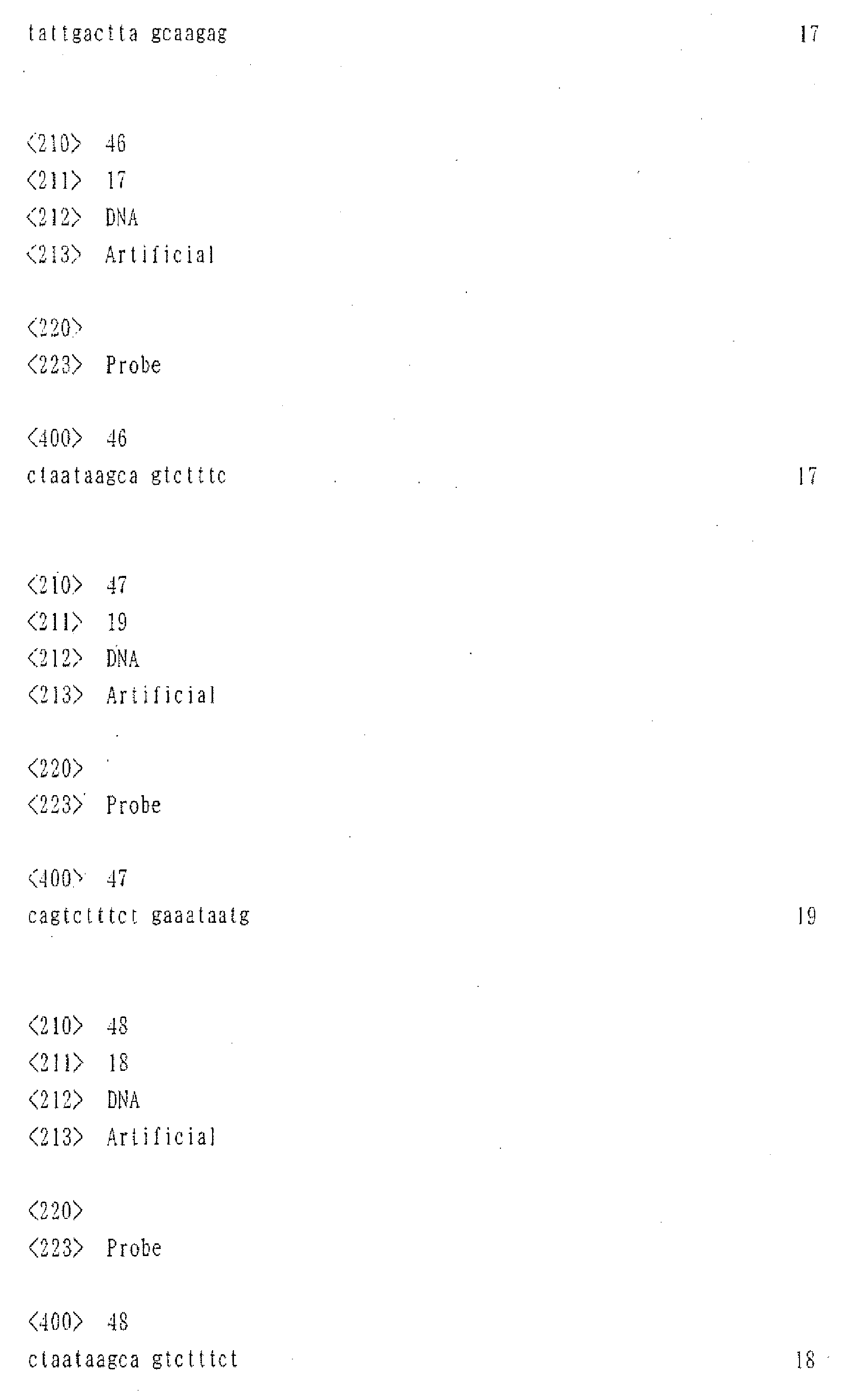


Claims (19)
- An oligonucleotide array for detecting the presence of a microorganism in a test sample, comprising any combination of the oligonucleotides of the following (A) and (B):(A) at least one oligonucleotide consisting of any one of the nucleic acid sequences selected from the group consisting of the nucleic acid sequences of SEQ ID NOs.: 1 - 6, 8 and 10 - 14, to detect Brettanomyces (Dekkera) bruxellensis; and(B) at least one oligonucleotide consisting of any one of the nucleic acid sequences selected from the group consisting of the nucleic acid sequences of SEQ ID NOs.: 15 - 22 and 25 - 29, to detect Brettanomyces (Dekkera) anomala,wherein said oligonucleotide is immobilized to a support.
- The array according to Claim 1, which further comprises (C) at least one oligonucleotide consisting of any one of the nucleic acid sequences selected from the group consisting of the nucleic acid sequences of SEQ ID NOs.: 30 - 43, to detect Saccharomyces cerevisiae, Saccharomyces diastaticus, Saccharomyces pastorianus, or Saccharomyces bayanu, wherein said oligonucleotide is immobilized to the support.
- The array according to Claim 1 or 2, which further comprises (D) at least one oligonucleotide consisting of any one of the nucleic acid sequences selected from the group consisting of the nucleic acid sequences of SEQ ID NOs.: 44 - 52, to detect Pichia anomala, wherein said oligonucleotide is immobilized to the support.
- The array according to any one of Claims 1 to 3, which further comprises (E) at least one oligonucleotide consisting of any one of the nucleic acid sequences selected from the group consisting of the nucleic acid sequences of SEQ ID NOs.: 53 - 56, to detect Hanseniaspora uvarum or Hanseniaspora guilliermondii, wherein said oligonucleotide is immobilized to the support.
- The array according to any one of Claims 1 to 4, which further comprises (F) at least one oligonucleotide consisting of any one of the nucleic acid sequences selected from the group consisting of the nucleic acid sequences of SEQ ID NOs.: 57 - 64, to detect Candida valida or Pichia membranaefaciens, wherein said oligonucleotide is immobilized to the support.
- The array according to any one of Claims 1 to 5, which further comprises (G) at least one oligonucleotide consisting of any one of the nucleic acid sequences selected from the group consisting of the nucleic acid sequences of SEQ ID NOs.: 7, 9, 23 and 24, to detect Brettanomyces (Dekkera) bruxellensis or Brettanomyces (Dekkera) anomala, wherein said oligonucleotide is immobilized to the support.
- The oligonucleotide array according to any one of claims 1 to 6, wherein said test sample is food.
- An instrument for detecting and/or identifying that a microorganism in a test sample belongs to any one or more of groups of a microorganism selected from the following groups of microorganisms (i) to (vii):(i) a microorganism belonging to Brettanomyces (Dekkera) bruxellensis;(ii) a microorganism belonging to Brettanomyces (Dekkera) anomala;(iii) a microorganism belonging to Saccharomyces cerevisiae, Saccharomyces diastaticus, Saccharomyces pastorianus, or Saccharomyces bayanus;(iv) a microorganism belonging to Pichia anomala;(v) a microorganism belonging to Hanseniaspora uvarum or Hanseniaspora guilliermondii;(vi) a microorganism belonging to Candida valida or Pichia membranaefaciens; and(vii) a microorganism belonging to Brettanomyces (Dekkera) bruxellensis or Brettanomyces (Dekkera) anomala,wherein said instrument comprises a support to which at least two oligonucleotides that are capable of specifically hybridizing to the complementary strand of the nucleic acid of the microorganism that belongs to either of the selected plurality of the groups are immobilized,
wherein said instrument comprises an oligonucleotide consisting of any of the nucleic acid sequence selected from the group consisting of the nucleic acid sequences of SEQ ID NOs.: 1 - 6, 8, and 10 - 14, and an oligonucleotide consisting of any of the nucleic acid sequence selected from the group consisting of the nucleic acid sequences of SEQ ID NOs.: 15 - 22 and 25 - 29. - The instrument according to claim 8, which further comprises an oligonucleotide consisting of any of the nucleic acid sequence selected from the group consisting of the nucleic acid sequences of SEQ ID NOs.: 30 - 43.
- The instrument according to claim 8, which further comprises an oligonucleotide consisting of any of the nucleic acid sequence selected from the group consisting of the nucleic acid sequences of SEQ ID NOs.: 44 - 52.
- The instrument according to claim 8, which further comprises an oligonucleotide consisting of any of the nucleic acid sequence selected from the group consisting of the nucleic acid sequences of SEQ ID NOs.: 53 - 56.
- The instrument according to claim 8, which further comprises an oligonucleotide consisting of any of the nucleic acid sequence selected from the group consisting of the nucleic acid sequences of SEQ ID NOs.: 57 - 64.
- The instrument according to claim 8, which further comprises an oligonucleotide consisting of any of the nucleic acid sequence selected from the group consisting of the nucleic acid sequences of SEQ ID NOs.: 7, 9, 23, and 24.
- The instrument according to any one of claim 8 to 13, wherein said support has carbodiimide group or an isocyanate group on the surface, and wherein said instrument is characterized in that said nucleotide is immobilized to the support through a covalent bonding formed between the carbodiimide group or the isocyanate group and the oligonucleotide or a linker attached to the terminal of the oligonucleotide as a result of reaction thereof.
- A method for detecting a microorganism in a test sample, identifying a group to which a microorganism in a test sample belongs, or detecting a microorganism in a test sample and identifying a group to which said microorganism belongs, comprising:preparing a nucleic acid of a microorganism that is in a test sample;preparing a labeled probe using said nucleic acid as a template;hybridizing said labeled probe with the oligonucleotide immobilized to a surface of a support using the oligonucleotide array according to any one of claims 1 to 6, or the instrument according to any one of claims 8 to 14; anddetecting signals derived from said hybridization.
- The method according to claim 15, wherein said test sample is food.
- A kit for detecting a microorganism for performing the method according to claim 15 or 16, comprising the array according to any one of claims 1 to 7 or the instrument according to any one of claims 8 to 14.
- The kit for according to claim 17 further comprising a reagent for use in the steps of said hybridization and said detection of the signals
- The kit according to claim 17 or 18 further comprising a reagent for use in the steps of the preparation of the probe and/or the preparation of a nucleic acid.
Applications Claiming Priority (2)
| Application Number | Priority Date | Filing Date | Title |
|---|---|---|---|
| JP2005236174 | 2005-08-16 | ||
| EP06796654A EP1926832A1 (en) | 2005-08-16 | 2006-08-16 | Oligonucleotides, arrays thereof for detecting microorganisms, and an apparatus, a method and a kit for detecting microorganisms |
Related Parent Applications (1)
| Application Number | Title | Priority Date | Filing Date |
|---|---|---|---|
| EP06796654.9 Division | 2006-08-16 |
Publications (2)
| Publication Number | Publication Date |
|---|---|
| EP2270227A1 true EP2270227A1 (en) | 2011-01-05 |
| EP2270227B1 EP2270227B1 (en) | 2013-10-30 |
Family
ID=37114552
Family Applications (2)
| Application Number | Title | Priority Date | Filing Date |
|---|---|---|---|
| EP10171052.3A Expired - Lifetime EP2270227B1 (en) | 2005-08-16 | 2006-08-16 | Oligonucleotides, arrays thereof for detecting microorganisms, and an apparatus, a method and a kit for detecting microorganisms |
| EP06796654A Withdrawn EP1926832A1 (en) | 2005-08-16 | 2006-08-16 | Oligonucleotides, arrays thereof for detecting microorganisms, and an apparatus, a method and a kit for detecting microorganisms |
Family Applications After (1)
| Application Number | Title | Priority Date | Filing Date |
|---|---|---|---|
| EP06796654A Withdrawn EP1926832A1 (en) | 2005-08-16 | 2006-08-16 | Oligonucleotides, arrays thereof for detecting microorganisms, and an apparatus, a method and a kit for detecting microorganisms |
Country Status (10)
| Country | Link |
|---|---|
| US (1) | US7893008B2 (en) |
| EP (2) | EP2270227B1 (en) |
| JP (1) | JP5328343B2 (en) |
| KR (1) | KR101261086B1 (en) |
| CN (1) | CN101300362B (en) |
| AU (1) | AU2006280651B2 (en) |
| CA (1) | CA2619743C (en) |
| DK (1) | DK2270227T3 (en) |
| TW (1) | TWI394838B (en) |
| WO (1) | WO2007021027A1 (en) |
Families Citing this family (5)
| Publication number | Priority date | Publication date | Assignee | Title |
|---|---|---|---|---|
| KR100997983B1 (en) | 2008-05-27 | 2010-12-03 | 삼성전기주식회사 | Mobile communication terminal |
| US20140302486A1 (en) * | 2011-09-02 | 2014-10-09 | President And Fellows Of Harvard College | Systems and methods for detecting biomarkers of interest |
| BRPI1106599A2 (en) * | 2011-09-26 | 2015-09-01 | Brasil Pesquisa Agropec | Oligonucleotides, use, method and kit for detecting yeast contamination of samples |
| CN103740821B (en) * | 2013-12-30 | 2016-03-30 | 西南林业大学 | The authentication method of saccharomyces bayanus resistant to sulfur cross-breeding offspring |
| CN110846436B (en) * | 2019-12-25 | 2021-09-28 | 江南大学 | Method for rapidly identifying Ale and Lager type beer yeast |
Citations (3)
| Publication number | Priority date | Publication date | Assignee | Title |
|---|---|---|---|---|
| JPH07289295A (en) | 1994-04-28 | 1995-11-07 | Kirin Brewery Co Ltd | Method for detecting or identifying lactic acid bacteria |
| JP2002065274A (en) | 2000-08-31 | 2002-03-05 | Canon Inc | Method for detecting a target component in a sample sample and a detection substrate used therefor |
| US20040166492A1 (en) * | 2002-02-05 | 2004-08-26 | Engel Stacia R. | Quantitative detection of dekkera and saccharomyces |
Family Cites Families (4)
| Publication number | Priority date | Publication date | Assignee | Title |
|---|---|---|---|---|
| JP2001066304A (en) | 1999-06-21 | 2001-03-16 | Nisshinbo Ind Inc | Nucleic acid immobilized substrate |
| JP2001103981A (en) * | 1999-08-03 | 2001-04-17 | Nisshinbo Ind Inc | Mycobacterium tuberculosis diagnostic kit |
| JP2003189869A (en) | 2001-12-27 | 2003-07-08 | Nisshinbo Ind Inc | Method for determining biological species contained in a subject and kit used therefor |
| DE10344057B3 (en) * | 2003-09-23 | 2005-06-09 | Vermicon Ag | Method for the specific rapid detection of harmful microorganisms |
-
2006
- 2006-08-16 TW TW095130040A patent/TWI394838B/en not_active IP Right Cessation
- 2006-08-16 CN CN200680038320XA patent/CN101300362B/en not_active Expired - Fee Related
- 2006-08-16 EP EP10171052.3A patent/EP2270227B1/en not_active Expired - Lifetime
- 2006-08-16 JP JP2008505681A patent/JP5328343B2/en not_active Expired - Fee Related
- 2006-08-16 KR KR1020087006242A patent/KR101261086B1/en not_active Expired - Fee Related
- 2006-08-16 WO PCT/JP2006/316440 patent/WO2007021027A1/en not_active Ceased
- 2006-08-16 US US11/990,484 patent/US7893008B2/en not_active Expired - Fee Related
- 2006-08-16 DK DK10171052.3T patent/DK2270227T3/en active
- 2006-08-16 EP EP06796654A patent/EP1926832A1/en not_active Withdrawn
- 2006-08-16 AU AU2006280651A patent/AU2006280651B2/en not_active Ceased
- 2006-08-16 CA CA2619743A patent/CA2619743C/en not_active Expired - Fee Related
Patent Citations (3)
| Publication number | Priority date | Publication date | Assignee | Title |
|---|---|---|---|---|
| JPH07289295A (en) | 1994-04-28 | 1995-11-07 | Kirin Brewery Co Ltd | Method for detecting or identifying lactic acid bacteria |
| JP2002065274A (en) | 2000-08-31 | 2002-03-05 | Canon Inc | Method for detecting a target component in a sample sample and a detection substrate used therefor |
| US20040166492A1 (en) * | 2002-02-05 | 2004-08-26 | Engel Stacia R. | Quantitative detection of dekkera and saccharomyces |
Non-Patent Citations (4)
| Title |
|---|
| LI J ET AL: "A DNA MICROARRAY-BASED METHOD FOR SIMULTANEOUS DETECTION AND IDENTIFICATION OF SIX BACTERIAL PATHOGENS IN A SINGLE SAMPLE", ABSTRACTS OF THE GENERAL MEETING OF THE AMERICAN SOCIETY FOR MICROBIOLOGY, THE SOCIETY, WASHINGTON, DC, US, vol. 101, 23 May 2001 (2001-05-23), pages 575, XP009014436, ISSN: 1060-2011 * |
| NAKAMURA M ET AL: "DEVELOPMENT OF THE DNA MICRO ARRAY FOR IDENTIFICATION OF INFECTIOUS DISEASE CAUSACTIVE BACTERIA IN HUMAN", ABSTRACTS OF THE GENERAL MEETING OF THE AMERICAN SOCIETY FOR MICROBIOLOGY, THE SOCIETY, WASHINGTON, DC, US, vol. 103, 18 May 2003 (2003-05-18), XP008047725, ISSN: 1060-2011 * |
| R-F. WANG, MOLECULAR AND CELLULAR PROBES, vol. 14, 2000, pages 1 - 5 |
| VINNERE O ET AL: "A new plant pathogenic sterile white basidiomycete from Australia", EUROPEAN JOURNAL OF PLANT PATHOLOGY, vol. 112, no. 1, May 2005 (2005-05-01), pages 63 - 77, XP002404779, ISSN: 0929-1873 * |
Also Published As
| Publication number | Publication date |
|---|---|
| AU2006280651A1 (en) | 2007-02-22 |
| WO2007021027A1 (en) | 2007-02-22 |
| JP2009504134A (en) | 2009-02-05 |
| TWI394838B (en) | 2013-05-01 |
| DK2270227T3 (en) | 2013-11-18 |
| CA2619743A1 (en) | 2007-02-22 |
| EP1926832A1 (en) | 2008-06-04 |
| KR20080049044A (en) | 2008-06-03 |
| JP5328343B2 (en) | 2013-10-30 |
| US20090048118A1 (en) | 2009-02-19 |
| CA2619743C (en) | 2013-09-17 |
| AU2006280651B2 (en) | 2012-01-19 |
| TW200734465A (en) | 2007-09-16 |
| CN101300362B (en) | 2011-11-30 |
| EP2270227B1 (en) | 2013-10-30 |
| KR101261086B1 (en) | 2013-05-06 |
| CN101300362A (en) | 2008-11-05 |
| US7893008B2 (en) | 2011-02-22 |
Similar Documents
| Publication | Publication Date | Title |
|---|---|---|
| JP5196862B2 (en) | Probe set, probe carrier and inspection method | |
| JP5196863B2 (en) | Probe set, probe carrier and inspection method | |
| JP5196857B2 (en) | Probe set, probe carrier and inspection method | |
| US9290818B2 (en) | Probe, probe set, probe carrier, and testing method | |
| JP5196865B2 (en) | Probe set, probe carrier and inspection method | |
| JP5196866B2 (en) | Probe set, probe carrier and inspection method | |
| JP5196854B2 (en) | Probe set, probe carrier and inspection method | |
| JP5196864B2 (en) | Probe set, probe carrier and inspection method | |
| JP5196845B2 (en) | Probe set, probe carrier and inspection method | |
| US8153371B2 (en) | Probe, probe set, probe carrier, and testing method | |
| JP5196855B2 (en) | Probe set, probe carrier and inspection method | |
| US7935809B2 (en) | Probe, probe set, probe carrier, and testing method | |
| JP5196847B2 (en) | Probe set, probe carrier and inspection method | |
| US8026061B1 (en) | Probe, probe set, probe carrier, and testing method | |
| JP5196853B2 (en) | Probe set, probe carrier and inspection method | |
| JP2008278870A (en) | Probe, probe set, probe carrier, and genetic testing method | |
| JP2008278860A (en) | Probe, probe set, probe carrier, and inspection method | |
| WO2007114519A1 (en) | Probe, probe set, probe-immobilized carrier, and genetic testing method | |
| WO2007114510A1 (en) | Probe, probe set, probe-immobilized carrier, and genetic testing method | |
| JP2008278852A (en) | Probe, probe set, probe carrier, and inspection method | |
| EP2270227B1 (en) | Oligonucleotides, arrays thereof for detecting microorganisms, and an apparatus, a method and a kit for detecting microorganisms |
Legal Events
| Date | Code | Title | Description |
|---|---|---|---|
| PUAI | Public reference made under article 153(3) epc to a published international application that has entered the european phase |
Free format text: ORIGINAL CODE: 0009012 |
|
| AC | Divisional application: reference to earlier application |
Ref document number: 1926832 Country of ref document: EP Kind code of ref document: P |
|
| AK | Designated contracting states |
Kind code of ref document: A1 Designated state(s): AT BE BG CH CY CZ DE DK EE ES FI FR GB GR HU IE IS IT LI LT LU LV MC NL PL PT RO SE SI SK TR |
|
| AX | Request for extension of the european patent |
Extension state: AL BA HR MK RS |
|
| 17P | Request for examination filed |
Effective date: 20110513 |
|
| 17Q | First examination report despatched |
Effective date: 20120213 |
|
| GRAP | Despatch of communication of intention to grant a patent |
Free format text: ORIGINAL CODE: EPIDOSNIGR1 |
|
| GRAS | Grant fee paid |
Free format text: ORIGINAL CODE: EPIDOSNIGR3 |
|
| GRAP | Despatch of communication of intention to grant a patent |
Free format text: ORIGINAL CODE: EPIDOSNIGR1 |
|
| GRAJ | Information related to disapproval of communication of intention to grant by the applicant or resumption of examination proceedings by the epo deleted |
Free format text: ORIGINAL CODE: EPIDOSDIGR1 |
|
| GRAS | Grant fee paid |
Free format text: ORIGINAL CODE: EPIDOSNIGR3 |
|
| GRAP | Despatch of communication of intention to grant a patent |
Free format text: ORIGINAL CODE: EPIDOSNIGR1 |
|
| INTG | Intention to grant announced |
Effective date: 20130719 |
|
| INTG | Intention to grant announced |
Effective date: 20130730 |
|
| GRAA | (expected) grant |
Free format text: ORIGINAL CODE: 0009210 |
|
| AC | Divisional application: reference to earlier application |
Ref document number: 1926832 Country of ref document: EP Kind code of ref document: P |
|
| AK | Designated contracting states |
Kind code of ref document: B1 Designated state(s): AT BE BG CH CY CZ DE DK EE ES FI FR GB GR HU IE IS IT LI LT LU LV MC NL PL PT RO SE SI SK TR |
|
| REG | Reference to a national code |
Ref country code: GB Ref legal event code: FG4D |
|
| REG | Reference to a national code |
Ref country code: CH Ref legal event code: EP |
|
| REG | Reference to a national code |
Ref country code: AT Ref legal event code: REF Ref document number: 638509 Country of ref document: AT Kind code of ref document: T Effective date: 20131115 |
|
| REG | Reference to a national code |
Ref country code: DK Ref legal event code: T3 Effective date: 20131111 |
|
| REG | Reference to a national code |
Ref country code: IE Ref legal event code: FG4D |
|
| REG | Reference to a national code |
Ref country code: DE Ref legal event code: R096 Ref document number: 602006039073 Country of ref document: DE Effective date: 20131224 |
|
| REG | Reference to a national code |
Ref country code: NL Ref legal event code: T3 |
|
| REG | Reference to a national code |
Ref country code: NL Ref legal event code: T3 |
|
| REG | Reference to a national code |
Ref country code: AT Ref legal event code: MK05 Ref document number: 638509 Country of ref document: AT Kind code of ref document: T Effective date: 20131030 |
|
| REG | Reference to a national code |
Ref country code: LT Ref legal event code: MG4D |
|
| PG25 | Lapsed in a contracting state [announced via postgrant information from national office to epo] |
Ref country code: BE Free format text: LAPSE BECAUSE OF FAILURE TO SUBMIT A TRANSLATION OF THE DESCRIPTION OR TO PAY THE FEE WITHIN THE PRESCRIBED TIME-LIMIT Effective date: 20131030 Ref country code: SE Free format text: LAPSE BECAUSE OF FAILURE TO SUBMIT A TRANSLATION OF THE DESCRIPTION OR TO PAY THE FEE WITHIN THE PRESCRIBED TIME-LIMIT Effective date: 20131030 Ref country code: LT Free format text: LAPSE BECAUSE OF FAILURE TO SUBMIT A TRANSLATION OF THE DESCRIPTION OR TO PAY THE FEE WITHIN THE PRESCRIBED TIME-LIMIT Effective date: 20131030 Ref country code: FI Free format text: LAPSE BECAUSE OF FAILURE TO SUBMIT A TRANSLATION OF THE DESCRIPTION OR TO PAY THE FEE WITHIN THE PRESCRIBED TIME-LIMIT Effective date: 20131030 Ref country code: IS Free format text: LAPSE BECAUSE OF FAILURE TO SUBMIT A TRANSLATION OF THE DESCRIPTION OR TO PAY THE FEE WITHIN THE PRESCRIBED TIME-LIMIT Effective date: 20140228 |
|
| PG25 | Lapsed in a contracting state [announced via postgrant information from national office to epo] |
Ref country code: ES Free format text: LAPSE BECAUSE OF FAILURE TO SUBMIT A TRANSLATION OF THE DESCRIPTION OR TO PAY THE FEE WITHIN THE PRESCRIBED TIME-LIMIT Effective date: 20131030 Ref country code: CY Free format text: LAPSE BECAUSE OF FAILURE TO SUBMIT A TRANSLATION OF THE DESCRIPTION OR TO PAY THE FEE WITHIN THE PRESCRIBED TIME-LIMIT Effective date: 20131030 Ref country code: AT Free format text: LAPSE BECAUSE OF FAILURE TO SUBMIT A TRANSLATION OF THE DESCRIPTION OR TO PAY THE FEE WITHIN THE PRESCRIBED TIME-LIMIT Effective date: 20131030 Ref country code: LV Free format text: LAPSE BECAUSE OF FAILURE TO SUBMIT A TRANSLATION OF THE DESCRIPTION OR TO PAY THE FEE WITHIN THE PRESCRIBED TIME-LIMIT Effective date: 20131030 |
|
| PG25 | Lapsed in a contracting state [announced via postgrant information from national office to epo] |
Ref country code: PT Free format text: LAPSE BECAUSE OF FAILURE TO SUBMIT A TRANSLATION OF THE DESCRIPTION OR TO PAY THE FEE WITHIN THE PRESCRIBED TIME-LIMIT Effective date: 20140228 |
|
| PG25 | Lapsed in a contracting state [announced via postgrant information from national office to epo] |
Ref country code: EE Free format text: LAPSE BECAUSE OF FAILURE TO SUBMIT A TRANSLATION OF THE DESCRIPTION OR TO PAY THE FEE WITHIN THE PRESCRIBED TIME-LIMIT Effective date: 20131030 |
|
| REG | Reference to a national code |
Ref country code: DE Ref legal event code: R097 Ref document number: 602006039073 Country of ref document: DE |
|
| PG25 | Lapsed in a contracting state [announced via postgrant information from national office to epo] |
Ref country code: PL Free format text: LAPSE BECAUSE OF FAILURE TO SUBMIT A TRANSLATION OF THE DESCRIPTION OR TO PAY THE FEE WITHIN THE PRESCRIBED TIME-LIMIT Effective date: 20131030 Ref country code: IT Free format text: LAPSE BECAUSE OF FAILURE TO SUBMIT A TRANSLATION OF THE DESCRIPTION OR TO PAY THE FEE WITHIN THE PRESCRIBED TIME-LIMIT Effective date: 20131030 Ref country code: CZ Free format text: LAPSE BECAUSE OF FAILURE TO SUBMIT A TRANSLATION OF THE DESCRIPTION OR TO PAY THE FEE WITHIN THE PRESCRIBED TIME-LIMIT Effective date: 20131030 Ref country code: RO Free format text: LAPSE BECAUSE OF FAILURE TO SUBMIT A TRANSLATION OF THE DESCRIPTION OR TO PAY THE FEE WITHIN THE PRESCRIBED TIME-LIMIT Effective date: 20131030 Ref country code: SK Free format text: LAPSE BECAUSE OF FAILURE TO SUBMIT A TRANSLATION OF THE DESCRIPTION OR TO PAY THE FEE WITHIN THE PRESCRIBED TIME-LIMIT Effective date: 20131030 |
|
| PLBE | No opposition filed within time limit |
Free format text: ORIGINAL CODE: 0009261 |
|
| STAA | Information on the status of an ep patent application or granted ep patent |
Free format text: STATUS: NO OPPOSITION FILED WITHIN TIME LIMIT |
|
| 26N | No opposition filed |
Effective date: 20140731 |
|
| REG | Reference to a national code |
Ref country code: DE Ref legal event code: R097 Ref document number: 602006039073 Country of ref document: DE Effective date: 20140731 |
|
| PG25 | Lapsed in a contracting state [announced via postgrant information from national office to epo] |
Ref country code: SI Free format text: LAPSE BECAUSE OF FAILURE TO SUBMIT A TRANSLATION OF THE DESCRIPTION OR TO PAY THE FEE WITHIN THE PRESCRIBED TIME-LIMIT Effective date: 20131030 |
|
| PG25 | Lapsed in a contracting state [announced via postgrant information from national office to epo] |
Ref country code: LU Free format text: LAPSE BECAUSE OF FAILURE TO SUBMIT A TRANSLATION OF THE DESCRIPTION OR TO PAY THE FEE WITHIN THE PRESCRIBED TIME-LIMIT Effective date: 20140816 Ref country code: MC Free format text: LAPSE BECAUSE OF FAILURE TO SUBMIT A TRANSLATION OF THE DESCRIPTION OR TO PAY THE FEE WITHIN THE PRESCRIBED TIME-LIMIT Effective date: 20131030 |
|
| REG | Reference to a national code |
Ref country code: CH Ref legal event code: PL |
|
| GBPC | Gb: european patent ceased through non-payment of renewal fee |
Effective date: 20140816 |
|
| PG25 | Lapsed in a contracting state [announced via postgrant information from national office to epo] |
Ref country code: CH Free format text: LAPSE BECAUSE OF NON-PAYMENT OF DUE FEES Effective date: 20140831 Ref country code: LI Free format text: LAPSE BECAUSE OF NON-PAYMENT OF DUE FEES Effective date: 20140831 |
|
| REG | Reference to a national code |
Ref country code: IE Ref legal event code: MM4A |
|
| REG | Reference to a national code |
Ref country code: FR Ref legal event code: ST Effective date: 20150430 |
|
| PG25 | Lapsed in a contracting state [announced via postgrant information from national office to epo] |
Ref country code: GB Free format text: LAPSE BECAUSE OF NON-PAYMENT OF DUE FEES Effective date: 20140816 |
|
| PG25 | Lapsed in a contracting state [announced via postgrant information from national office to epo] |
Ref country code: IE Free format text: LAPSE BECAUSE OF NON-PAYMENT OF DUE FEES Effective date: 20140816 Ref country code: FR Free format text: LAPSE BECAUSE OF NON-PAYMENT OF DUE FEES Effective date: 20140901 |
|
| PG25 | Lapsed in a contracting state [announced via postgrant information from national office to epo] |
Ref country code: BG Free format text: LAPSE BECAUSE OF FAILURE TO SUBMIT A TRANSLATION OF THE DESCRIPTION OR TO PAY THE FEE WITHIN THE PRESCRIBED TIME-LIMIT Effective date: 20131030 |
|
| PG25 | Lapsed in a contracting state [announced via postgrant information from national office to epo] |
Ref country code: GR Free format text: LAPSE BECAUSE OF FAILURE TO SUBMIT A TRANSLATION OF THE DESCRIPTION OR TO PAY THE FEE WITHIN THE PRESCRIBED TIME-LIMIT Effective date: 20140131 |
|
| PG25 | Lapsed in a contracting state [announced via postgrant information from national office to epo] |
Ref country code: TR Free format text: LAPSE BECAUSE OF FAILURE TO SUBMIT A TRANSLATION OF THE DESCRIPTION OR TO PAY THE FEE WITHIN THE PRESCRIBED TIME-LIMIT Effective date: 20131030 Ref country code: HU Free format text: LAPSE BECAUSE OF FAILURE TO SUBMIT A TRANSLATION OF THE DESCRIPTION OR TO PAY THE FEE WITHIN THE PRESCRIBED TIME-LIMIT; INVALID AB INITIO Effective date: 20060816 |
|
| PGFP | Annual fee paid to national office [announced via postgrant information from national office to epo] |
Ref country code: NL Payment date: 20160711 Year of fee payment: 11 |
|
| PGFP | Annual fee paid to national office [announced via postgrant information from national office to epo] |
Ref country code: DE Payment date: 20160809 Year of fee payment: 11 Ref country code: DK Payment date: 20160810 Year of fee payment: 11 |
|
| REG | Reference to a national code |
Ref country code: DE Ref legal event code: R119 Ref document number: 602006039073 Country of ref document: DE |
|
| REG | Reference to a national code |
Ref country code: DK Ref legal event code: EBP Effective date: 20170831 |
|
| REG | Reference to a national code |
Ref country code: NL Ref legal event code: MM Effective date: 20170901 |
|
| PG25 | Lapsed in a contracting state [announced via postgrant information from national office to epo] |
Ref country code: NL Free format text: LAPSE BECAUSE OF NON-PAYMENT OF DUE FEES Effective date: 20170901 |
|
| PG25 | Lapsed in a contracting state [announced via postgrant information from national office to epo] |
Ref country code: DK Free format text: LAPSE BECAUSE OF NON-PAYMENT OF DUE FEES Effective date: 20170831 Ref country code: DE Free format text: LAPSE BECAUSE OF NON-PAYMENT OF DUE FEES Effective date: 20180301 |