EP2269716A1 - Oxygen enrichment membrane and composition for preparing the membrane - Google Patents
Oxygen enrichment membrane and composition for preparing the membrane Download PDFInfo
- Publication number
- EP2269716A1 EP2269716A1 EP10176364A EP10176364A EP2269716A1 EP 2269716 A1 EP2269716 A1 EP 2269716A1 EP 10176364 A EP10176364 A EP 10176364A EP 10176364 A EP10176364 A EP 10176364A EP 2269716 A1 EP2269716 A1 EP 2269716A1
- Authority
- EP
- European Patent Office
- Prior art keywords
- membrane
- composition
- polymer
- mixture
- composition according
- Prior art date
- Legal status (The legal status is an assumption and is not a legal conclusion. Google has not performed a legal analysis and makes no representation as to the accuracy of the status listed.)
- Withdrawn
Links
- 239000012528 membrane Substances 0.000 title claims abstract description 70
- 239000000203 mixture Substances 0.000 title claims abstract description 63
- QVGXLLKOCUKJST-UHFFFAOYSA-N atomic oxygen Chemical compound [O] QVGXLLKOCUKJST-UHFFFAOYSA-N 0.000 title description 14
- 239000001301 oxygen Substances 0.000 title description 14
- 229910052760 oxygen Inorganic materials 0.000 title description 13
- 229920000642 polymer Polymers 0.000 claims abstract description 42
- 239000002904 solvent Substances 0.000 claims abstract description 19
- 239000004793 Polystyrene Substances 0.000 claims abstract description 10
- 229920002223 polystyrene Polymers 0.000 claims abstract description 10
- 125000002534 ethynyl group Chemical group [H]C#C* 0.000 claims abstract description 6
- 239000004215 Carbon black (E152) Substances 0.000 claims abstract description 5
- LFQSCWFLJHTTHZ-UHFFFAOYSA-N Ethanol Chemical compound CCO LFQSCWFLJHTTHZ-UHFFFAOYSA-N 0.000 claims abstract description 5
- 125000004432 carbon atom Chemical group C* 0.000 claims abstract description 5
- 238000005227 gel permeation chromatography Methods 0.000 claims abstract description 5
- 229930195733 hydrocarbon Natural products 0.000 claims abstract description 5
- 150000002430 hydrocarbons Chemical class 0.000 claims abstract description 5
- 125000000217 alkyl group Chemical group 0.000 claims abstract description 4
- XLYOFNOQVPJJNP-UHFFFAOYSA-N water Substances O XLYOFNOQVPJJNP-UHFFFAOYSA-N 0.000 claims description 15
- 239000002131 composite material Substances 0.000 claims description 6
- 125000002496 methyl group Chemical group [H]C([H])([H])* 0.000 claims description 6
- 238000001704 evaporation Methods 0.000 claims description 5
- 125000004435 hydrogen atom Chemical group [H]* 0.000 claims description 5
- 238000000034 method Methods 0.000 claims description 5
- 238000003892 spreading Methods 0.000 claims description 5
- 239000006185 dispersion Substances 0.000 claims description 2
- 125000000962 organic group Chemical group 0.000 claims description 2
- 230000035699 permeability Effects 0.000 description 22
- 239000000178 monomer Substances 0.000 description 21
- -1 polysiloxane Polymers 0.000 description 20
- 239000007789 gas Substances 0.000 description 19
- YXFVVABEGXRONW-UHFFFAOYSA-N Toluene Chemical compound CC1=CC=CC=C1 YXFVVABEGXRONW-UHFFFAOYSA-N 0.000 description 18
- IJGRMHOSHXDMSA-UHFFFAOYSA-N Atomic nitrogen Chemical compound N#N IJGRMHOSHXDMSA-UHFFFAOYSA-N 0.000 description 12
- 239000003054 catalyst Substances 0.000 description 11
- 229910001882 dioxygen Inorganic materials 0.000 description 11
- MYMOFIZGZYHOMD-UHFFFAOYSA-N Dioxygen Chemical compound O=O MYMOFIZGZYHOMD-UHFFFAOYSA-N 0.000 description 10
- 229910001873 dinitrogen Inorganic materials 0.000 description 10
- 239000010408 film Substances 0.000 description 10
- 238000006116 polymerization reaction Methods 0.000 description 7
- 238000002360 preparation method Methods 0.000 description 7
- 238000000926 separation method Methods 0.000 description 7
- 235000002597 Solanum melongena Nutrition 0.000 description 6
- 244000061458 Solanum melongena Species 0.000 description 6
- 238000006243 chemical reaction Methods 0.000 description 6
- 150000001875 compounds Chemical class 0.000 description 6
- HSFWRNGVRCDJHI-UHFFFAOYSA-N alpha-acetylene Natural products C#C HSFWRNGVRCDJHI-UHFFFAOYSA-N 0.000 description 5
- 229920001577 copolymer Polymers 0.000 description 5
- 150000003961 organosilicon compounds Chemical class 0.000 description 5
- PPBRXRYQALVLMV-UHFFFAOYSA-N Styrene Chemical compound C=CC1=CC=CC=C1 PPBRXRYQALVLMV-UHFFFAOYSA-N 0.000 description 4
- 239000003795 chemical substances by application Substances 0.000 description 4
- 239000002685 polymerization catalyst Substances 0.000 description 4
- 238000003756 stirring Methods 0.000 description 4
- UHOVQNZJYSORNB-UHFFFAOYSA-N Benzene Chemical compound C1=CC=CC=C1 UHOVQNZJYSORNB-UHFFFAOYSA-N 0.000 description 3
- XDTMQSROBMDMFD-UHFFFAOYSA-N Cyclohexane Chemical compound C1CCCCC1 XDTMQSROBMDMFD-UHFFFAOYSA-N 0.000 description 3
- OKKJLVBELUTLKV-UHFFFAOYSA-N Methanol Chemical compound OC OKKJLVBELUTLKV-UHFFFAOYSA-N 0.000 description 3
- 239000004743 Polypropylene Substances 0.000 description 3
- XUIMIQQOPSSXEZ-UHFFFAOYSA-N Silicon Chemical compound [Si] XUIMIQQOPSSXEZ-UHFFFAOYSA-N 0.000 description 3
- 229910052799 carbon Inorganic materials 0.000 description 3
- 238000004587 chromatography analysis Methods 0.000 description 3
- 238000005649 metathesis reaction Methods 0.000 description 3
- 125000005375 organosiloxane group Chemical group 0.000 description 3
- 229920001155 polypropylene Polymers 0.000 description 3
- 230000001681 protective effect Effects 0.000 description 3
- 229910052710 silicon Inorganic materials 0.000 description 3
- 239000010703 silicon Substances 0.000 description 3
- 239000010409 thin film Substances 0.000 description 3
- HECLRDQVFMWTQS-RGOKHQFPSA-N 1755-01-7 Chemical compound C1[C@H]2[C@@H]3CC=C[C@@H]3[C@@H]1C=C2 HECLRDQVFMWTQS-RGOKHQFPSA-N 0.000 description 2
- 238000005160 1H NMR spectroscopy Methods 0.000 description 2
- SOGAXMICEFXMKE-UHFFFAOYSA-N Butylmethacrylate Chemical compound CCCCOC(=O)C(C)=C SOGAXMICEFXMKE-UHFFFAOYSA-N 0.000 description 2
- 238000005033 Fourier transform infrared spectroscopy Methods 0.000 description 2
- BAPJBEWLBFYGME-UHFFFAOYSA-N Methyl acrylate Chemical compound COC(=O)C=C BAPJBEWLBFYGME-UHFFFAOYSA-N 0.000 description 2
- CTQNGGLPUBDAKN-UHFFFAOYSA-N O-Xylene Chemical compound CC1=CC=CC=C1C CTQNGGLPUBDAKN-UHFFFAOYSA-N 0.000 description 2
- 229910019142 PO4 Inorganic materials 0.000 description 2
- 239000004695 Polyether sulfone Substances 0.000 description 2
- 239000004642 Polyimide Substances 0.000 description 2
- 0 [*+2]C(CC1C2)C2C2C1C1C=CC2C1 Chemical compound [*+2]C(CC1C2)C2C2C1C1C=CC2C1 0.000 description 2
- 238000004458 analytical method Methods 0.000 description 2
- 239000003945 anionic surfactant Substances 0.000 description 2
- PNPBGYBHLCEVMK-UHFFFAOYSA-L benzylidene(dichloro)ruthenium;tricyclohexylphosphane Chemical compound Cl[Ru](Cl)=CC1=CC=CC=C1.C1CCCCC1P(C1CCCCC1)C1CCCCC1.C1CCCCC1P(C1CCCCC1)C1CCCCC1 PNPBGYBHLCEVMK-UHFFFAOYSA-L 0.000 description 2
- ZSWFCLXCOIISFI-UHFFFAOYSA-N cyclopentadiene Chemical compound C1C=CC=C1 ZSWFCLXCOIISFI-UHFFFAOYSA-N 0.000 description 2
- KPUWHANPEXNPJT-UHFFFAOYSA-N disiloxane Chemical class [SiH3]O[SiH3] KPUWHANPEXNPJT-UHFFFAOYSA-N 0.000 description 2
- FJKIXWOMBXYWOQ-UHFFFAOYSA-N ethenoxyethane Chemical compound CCOC=C FJKIXWOMBXYWOQ-UHFFFAOYSA-N 0.000 description 2
- 230000008020 evaporation Effects 0.000 description 2
- 238000004817 gas chromatography Methods 0.000 description 2
- VLKZOEOYAKHREP-UHFFFAOYSA-N n-Hexane Chemical compound CCCCCC VLKZOEOYAKHREP-UHFFFAOYSA-N 0.000 description 2
- JRZJOMJEPLMPRA-UHFFFAOYSA-N olefin Natural products CCCCCCCC=C JRZJOMJEPLMPRA-UHFFFAOYSA-N 0.000 description 2
- NBIIXXVUZAFLBC-UHFFFAOYSA-K phosphate Chemical compound [O-]P([O-])([O-])=O NBIIXXVUZAFLBC-UHFFFAOYSA-K 0.000 description 2
- 239000010452 phosphate Substances 0.000 description 2
- 229920006393 polyether sulfone Polymers 0.000 description 2
- 229920001721 polyimide Polymers 0.000 description 2
- 229920001296 polysiloxane Polymers 0.000 description 2
- 238000004445 quantitative analysis Methods 0.000 description 2
- 239000011541 reaction mixture Substances 0.000 description 2
- 238000001228 spectrum Methods 0.000 description 2
- 238000005292 vacuum distillation Methods 0.000 description 2
- 239000008096 xylene Substances 0.000 description 2
- ZRPFJAPZDXQHSM-UHFFFAOYSA-L 1,3-bis(2,4,6-trimethylphenyl)-4,5-dihydroimidazole;dichloro-[(2-propan-2-yloxyphenyl)methylidene]ruthenium Chemical compound CC(C)OC1=CC=CC=C1C=[Ru](Cl)(Cl)=C1N(C=2C(=CC(C)=CC=2C)C)CCN1C1=C(C)C=C(C)C=C1C ZRPFJAPZDXQHSM-UHFFFAOYSA-L 0.000 description 1
- VFWCMGCRMGJXDK-UHFFFAOYSA-N 1-chlorobutane Chemical compound CCCCCl VFWCMGCRMGJXDK-UHFFFAOYSA-N 0.000 description 1
- 238000005698 Diels-Alder reaction Methods 0.000 description 1
- VGGSQFUCUMXWEO-UHFFFAOYSA-N Ethene Chemical compound C=C VGGSQFUCUMXWEO-UHFFFAOYSA-N 0.000 description 1
- 239000005977 Ethylene Substances 0.000 description 1
- 206010021143 Hypoxia Diseases 0.000 description 1
- 239000004698 Polyethylene Substances 0.000 description 1
- KJTLSVCANCCWHF-UHFFFAOYSA-N Ruthenium Chemical compound [Ru] KJTLSVCANCCWHF-UHFFFAOYSA-N 0.000 description 1
- 206010041349 Somnolence Diseases 0.000 description 1
- PJANXHGTPQOBST-VAWYXSNFSA-N Stilbene Natural products C=1C=CC=CC=1/C=C/C1=CC=CC=C1 PJANXHGTPQOBST-VAWYXSNFSA-N 0.000 description 1
- 239000002253 acid Substances 0.000 description 1
- 125000005396 acrylic acid ester group Chemical group 0.000 description 1
- 238000012644 addition polymerization Methods 0.000 description 1
- 239000000853 adhesive Substances 0.000 description 1
- 230000001070 adhesive effect Effects 0.000 description 1
- 230000002411 adverse Effects 0.000 description 1
- XYLMUPLGERFSHI-UHFFFAOYSA-N alpha-Methylstyrene Chemical compound CC(=C)C1=CC=CC=C1 XYLMUPLGERFSHI-UHFFFAOYSA-N 0.000 description 1
- 239000003963 antioxidant agent Substances 0.000 description 1
- 230000003078 antioxidant effect Effects 0.000 description 1
- 239000004760 aramid Substances 0.000 description 1
- 150000004945 aromatic hydrocarbons Chemical class 0.000 description 1
- 229920003235 aromatic polyamide Polymers 0.000 description 1
- 125000003118 aryl group Chemical group 0.000 description 1
- FCDPQMAOJARMTG-UHFFFAOYSA-L benzylidene-[1,3-bis(2,4,6-trimethylphenyl)imidazolidin-2-ylidene]-dichlororuthenium;tricyclohexylphosphane Chemical compound C1CCCCC1P(C1CCCCC1)C1CCCCC1.CC1=CC(C)=CC(C)=C1N(CCN1C=2C(=CC(C)=CC=2C)C)C1=[Ru](Cl)(Cl)=CC1=CC=CC=C1 FCDPQMAOJARMTG-UHFFFAOYSA-L 0.000 description 1
- 229920001400 block copolymer Polymers 0.000 description 1
- 238000009835 boiling Methods 0.000 description 1
- 238000010504 bond cleavage reaction Methods 0.000 description 1
- 125000000484 butyl group Chemical group [H]C([*])([H])C([H])([H])C([H])([H])C([H])([H])[H] 0.000 description 1
- 238000005266 casting Methods 0.000 description 1
- 229920002678 cellulose Polymers 0.000 description 1
- 239000001913 cellulose Substances 0.000 description 1
- 238000006757 chemical reactions by type Methods 0.000 description 1
- 238000001035 drying Methods 0.000 description 1
- 150000002148 esters Chemical class 0.000 description 1
- 125000001495 ethyl group Chemical group [H]C([H])([H])C([H])([H])* 0.000 description 1
- 239000004744 fabric Substances 0.000 description 1
- 238000001914 filtration Methods 0.000 description 1
- 239000000446 fuel Substances 0.000 description 1
- 238000001879 gelation Methods 0.000 description 1
- 239000011521 glass Substances 0.000 description 1
- 125000005843 halogen group Chemical group 0.000 description 1
- 239000012510 hollow fiber Substances 0.000 description 1
- 239000011987 hoveyda–grubbs catalyst Substances 0.000 description 1
- 230000007062 hydrolysis Effects 0.000 description 1
- 238000006460 hydrolysis reaction Methods 0.000 description 1
- 230000007774 longterm Effects 0.000 description 1
- 238000004519 manufacturing process Methods 0.000 description 1
- 239000012968 metallocene catalyst Substances 0.000 description 1
- 238000002156 mixing Methods 0.000 description 1
- 125000004123 n-propyl group Chemical group [H]C([H])([H])C([H])([H])C([H])([H])* 0.000 description 1
- 229910052757 nitrogen Inorganic materials 0.000 description 1
- 239000012299 nitrogen atmosphere Substances 0.000 description 1
- 150000002894 organic compounds Chemical class 0.000 description 1
- 125000001147 pentyl group Chemical group C(CCCC)* 0.000 description 1
- 150000002978 peroxides Chemical class 0.000 description 1
- 229920002492 poly(sulfone) Polymers 0.000 description 1
- 239000004417 polycarbonate Substances 0.000 description 1
- 229920000515 polycarbonate Polymers 0.000 description 1
- 229920000573 polyethylene Polymers 0.000 description 1
- 229920000139 polyethylene terephthalate Polymers 0.000 description 1
- 239000005020 polyethylene terephthalate Substances 0.000 description 1
- 230000000379 polymerizing effect Effects 0.000 description 1
- QQONPFPTGQHPMA-UHFFFAOYSA-N propylene Natural products CC=C QQONPFPTGQHPMA-UHFFFAOYSA-N 0.000 description 1
- 125000004805 propylene group Chemical group [H]C([H])([H])C([H])([*:1])C([H])([H])[*:2] 0.000 description 1
- 239000011241 protective layer Substances 0.000 description 1
- 238000010526 radical polymerization reaction Methods 0.000 description 1
- 229910052707 ruthenium Inorganic materials 0.000 description 1
- 230000007017 scission Effects 0.000 description 1
- 238000007789 sealing Methods 0.000 description 1
- 239000007787 solid Substances 0.000 description 1
- PJANXHGTPQOBST-UHFFFAOYSA-N stilbene Chemical compound C=1C=CC=CC=1C=CC1=CC=CC=C1 PJANXHGTPQOBST-UHFFFAOYSA-N 0.000 description 1
- 235000021286 stilbenes Nutrition 0.000 description 1
- 239000000126 substance Substances 0.000 description 1
- 125000001424 substituent group Chemical group 0.000 description 1
- 238000003786 synthesis reaction Methods 0.000 description 1
- WFKWXMTUELFFGS-UHFFFAOYSA-N tungsten Chemical compound [W] WFKWXMTUELFFGS-UHFFFAOYSA-N 0.000 description 1
- 229910052721 tungsten Inorganic materials 0.000 description 1
- 239000010937 tungsten Substances 0.000 description 1
- 125000000391 vinyl group Chemical group [H]C([*])=C([H])[H] 0.000 description 1
Classifications
-
- C—CHEMISTRY; METALLURGY
- C08—ORGANIC MACROMOLECULAR COMPOUNDS; THEIR PREPARATION OR CHEMICAL WORKING-UP; COMPOSITIONS BASED THEREON
- C08G—MACROMOLECULAR COMPOUNDS OBTAINED OTHERWISE THAN BY REACTIONS ONLY INVOLVING UNSATURATED CARBON-TO-CARBON BONDS
- C08G61/00—Macromolecular compounds obtained by reactions forming a carbon-to-carbon link in the main chain of the macromolecule
- C08G61/02—Macromolecular compounds containing only carbon atoms in the main chain of the macromolecule, e.g. polyxylylenes
- C08G61/04—Macromolecular compounds containing only carbon atoms in the main chain of the macromolecule, e.g. polyxylylenes only aliphatic carbon atoms
- C08G61/06—Macromolecular compounds containing only carbon atoms in the main chain of the macromolecule, e.g. polyxylylenes only aliphatic carbon atoms prepared by ring-opening of carbocyclic compounds
- C08G61/08—Macromolecular compounds containing only carbon atoms in the main chain of the macromolecule, e.g. polyxylylenes only aliphatic carbon atoms prepared by ring-opening of carbocyclic compounds of carbocyclic compounds containing one or more carbon-to-carbon double bonds in the ring
-
- B—PERFORMING OPERATIONS; TRANSPORTING
- B01—PHYSICAL OR CHEMICAL PROCESSES OR APPARATUS IN GENERAL
- B01D—SEPARATION
- B01D67/00—Processes specially adapted for manufacturing semi-permeable membranes for separation processes or apparatus
- B01D67/0002—Organic membrane manufacture
- B01D67/0009—Organic membrane manufacture by phase separation, sol-gel transition, evaporation or solvent quenching
- B01D67/00091—Organic membrane manufacture by phase separation, sol-gel transition, evaporation or solvent quenching by evaporation
-
- B—PERFORMING OPERATIONS; TRANSPORTING
- B01—PHYSICAL OR CHEMICAL PROCESSES OR APPARATUS IN GENERAL
- B01D—SEPARATION
- B01D69/00—Semi-permeable membranes for separation processes or apparatus characterised by their form, structure or properties; Manufacturing processes specially adapted therefor
- B01D69/10—Supported membranes; Membrane supports
-
- C—CHEMISTRY; METALLURGY
- C01—INORGANIC CHEMISTRY
- C01B—NON-METALLIC ELEMENTS; COMPOUNDS THEREOF; METALLOIDS OR COMPOUNDS THEREOF NOT COVERED BY SUBCLASS C01C
- C01B13/00—Oxygen; Ozone; Oxides or hydroxides in general
- C01B13/02—Preparation of oxygen
- C01B13/0229—Purification or separation processes
- C01B13/0248—Physical processing only
- C01B13/0251—Physical processing only by making use of membranes
- C01B13/0255—Physical processing only by making use of membranes characterised by the type of membrane
-
- C—CHEMISTRY; METALLURGY
- C08—ORGANIC MACROMOLECULAR COMPOUNDS; THEIR PREPARATION OR CHEMICAL WORKING-UP; COMPOSITIONS BASED THEREON
- C08F—MACROMOLECULAR COMPOUNDS OBTAINED BY REACTIONS ONLY INVOLVING CARBON-TO-CARBON UNSATURATED BONDS
- C08F210/00—Copolymers of unsaturated aliphatic hydrocarbons having only one carbon-to-carbon double bond
- C08F210/02—Ethene
-
- C—CHEMISTRY; METALLURGY
- C08—ORGANIC MACROMOLECULAR COMPOUNDS; THEIR PREPARATION OR CHEMICAL WORKING-UP; COMPOSITIONS BASED THEREON
- C08J—WORKING-UP; GENERAL PROCESSES OF COMPOUNDING; AFTER-TREATMENT NOT COVERED BY SUBCLASSES C08B, C08C, C08F, C08G or C08H
- C08J5/00—Manufacture of articles or shaped materials containing macromolecular substances
- C08J5/20—Manufacture of shaped structures of ion-exchange resins
- C08J5/22—Films, membranes or diaphragms
- C08J5/2206—Films, membranes or diaphragms based on organic and/or inorganic macromolecular compounds
- C08J5/2218—Synthetic macromolecular compounds
- C08J5/2231—Synthetic macromolecular compounds based on macromolecular compounds obtained by reactions involving unsaturated carbon-to-carbon bonds
-
- C—CHEMISTRY; METALLURGY
- C08—ORGANIC MACROMOLECULAR COMPOUNDS; THEIR PREPARATION OR CHEMICAL WORKING-UP; COMPOSITIONS BASED THEREON
- C08L—COMPOSITIONS OF MACROMOLECULAR COMPOUNDS
- C08L65/00—Compositions of macromolecular compounds obtained by reactions forming a carbon-to-carbon link in the main chain; Compositions of derivatives of such polymers
-
- H—ELECTRICITY
- H01—ELECTRIC ELEMENTS
- H01M—PROCESSES OR MEANS, e.g. BATTERIES, FOR THE DIRECT CONVERSION OF CHEMICAL ENERGY INTO ELECTRICAL ENERGY
- H01M8/00—Fuel cells; Manufacture thereof
- H01M8/10—Fuel cells with solid electrolytes
- H01M8/1016—Fuel cells with solid electrolytes characterised by the electrolyte material
- H01M8/1018—Polymeric electrolyte materials
- H01M8/102—Polymeric electrolyte materials characterised by the chemical structure of the main chain of the ion-conducting polymer
- H01M8/1023—Polymeric electrolyte materials characterised by the chemical structure of the main chain of the ion-conducting polymer having only carbon, e.g. polyarylenes, polystyrenes or polybutadiene-styrenes
-
- H—ELECTRICITY
- H01—ELECTRIC ELEMENTS
- H01M—PROCESSES OR MEANS, e.g. BATTERIES, FOR THE DIRECT CONVERSION OF CHEMICAL ENERGY INTO ELECTRICAL ENERGY
- H01M8/00—Fuel cells; Manufacture thereof
- H01M8/10—Fuel cells with solid electrolytes
- H01M8/1016—Fuel cells with solid electrolytes characterised by the electrolyte material
- H01M8/1018—Polymeric electrolyte materials
- H01M8/1041—Polymer electrolyte composites, mixtures or blends
-
- H—ELECTRICITY
- H01—ELECTRIC ELEMENTS
- H01M—PROCESSES OR MEANS, e.g. BATTERIES, FOR THE DIRECT CONVERSION OF CHEMICAL ENERGY INTO ELECTRICAL ENERGY
- H01M8/00—Fuel cells; Manufacture thereof
- H01M8/10—Fuel cells with solid electrolytes
- H01M8/1016—Fuel cells with solid electrolytes characterised by the electrolyte material
- H01M8/1018—Polymeric electrolyte materials
- H01M8/1069—Polymeric electrolyte materials characterised by the manufacturing processes
- H01M8/1081—Polymeric electrolyte materials characterised by the manufacturing processes starting from solutions, dispersions or slurries exclusively of polymers
-
- B—PERFORMING OPERATIONS; TRANSPORTING
- B01—PHYSICAL OR CHEMICAL PROCESSES OR APPARATUS IN GENERAL
- B01D—SEPARATION
- B01D2325/00—Details relating to properties of membranes
- B01D2325/20—Specific permeability or cut-off range
-
- C—CHEMISTRY; METALLURGY
- C01—INORGANIC CHEMISTRY
- C01B—NON-METALLIC ELEMENTS; COMPOUNDS THEREOF; METALLOIDS OR COMPOUNDS THEREOF NOT COVERED BY SUBCLASS C01C
- C01B2210/00—Purification or separation of specific gases
- C01B2210/0043—Impurity removed
- C01B2210/0046—Nitrogen
-
- C—CHEMISTRY; METALLURGY
- C08—ORGANIC MACROMOLECULAR COMPOUNDS; THEIR PREPARATION OR CHEMICAL WORKING-UP; COMPOSITIONS BASED THEREON
- C08J—WORKING-UP; GENERAL PROCESSES OF COMPOUNDING; AFTER-TREATMENT NOT COVERED BY SUBCLASSES C08B, C08C, C08F, C08G or C08H
- C08J2385/00—Characterised by the use of macromolecular compounds obtained by reactions forming in the main chain of the macromolecule a linkage containing atoms other than silicon, sulfur, nitrogen, oxygen, and carbon; Derivatives of such polymers
-
- H—ELECTRICITY
- H01—ELECTRIC ELEMENTS
- H01M—PROCESSES OR MEANS, e.g. BATTERIES, FOR THE DIRECT CONVERSION OF CHEMICAL ENERGY INTO ELECTRICAL ENERGY
- H01M2300/00—Electrolytes
- H01M2300/0017—Non-aqueous electrolytes
- H01M2300/0065—Solid electrolytes
- H01M2300/0082—Organic polymers
-
- Y—GENERAL TAGGING OF NEW TECHNOLOGICAL DEVELOPMENTS; GENERAL TAGGING OF CROSS-SECTIONAL TECHNOLOGIES SPANNING OVER SEVERAL SECTIONS OF THE IPC; TECHNICAL SUBJECTS COVERED BY FORMER USPC CROSS-REFERENCE ART COLLECTIONS [XRACs] AND DIGESTS
- Y02—TECHNOLOGIES OR APPLICATIONS FOR MITIGATION OR ADAPTATION AGAINST CLIMATE CHANGE
- Y02E—REDUCTION OF GREENHOUSE GAS [GHG] EMISSIONS, RELATED TO ENERGY GENERATION, TRANSMISSION OR DISTRIBUTION
- Y02E60/00—Enabling technologies; Technologies with a potential or indirect contribution to GHG emissions mitigation
- Y02E60/30—Hydrogen technology
- Y02E60/50—Fuel cells
-
- Y—GENERAL TAGGING OF NEW TECHNOLOGICAL DEVELOPMENTS; GENERAL TAGGING OF CROSS-SECTIONAL TECHNOLOGIES SPANNING OVER SEVERAL SECTIONS OF THE IPC; TECHNICAL SUBJECTS COVERED BY FORMER USPC CROSS-REFERENCE ART COLLECTIONS [XRACs] AND DIGESTS
- Y02—TECHNOLOGIES OR APPLICATIONS FOR MITIGATION OR ADAPTATION AGAINST CLIMATE CHANGE
- Y02P—CLIMATE CHANGE MITIGATION TECHNOLOGIES IN THE PRODUCTION OR PROCESSING OF GOODS
- Y02P70/00—Climate change mitigation technologies in the production process for final industrial or consumer products
- Y02P70/50—Manufacturing or production processes characterised by the final manufactured product
Definitions
- the present invention relates to a composition to prepare a membrane having high gas permeability and oxygen gas permeability, particularly an oxygen enrichment membrane.
- air conditioners are indispensable to provide comfortable environment to homes and automobiles.
- a space where an air conditioner is used is highly hermetically sealed for high energy efficiency.
- oxygen deficiency leading to decrease in operating efficiency or even to drowsiness, particularly in an automobile, which may cause safety problem.
- an air conditioner provided with an oxygen enrichment membrane permeating oxygen more than nitrogen, or having a selectivity of oxygen gas over nitrogen gas, has been developed, but satisfactory performance has not yet been attained.
- an organosiloxane has good oxygen permeability.
- the organosiloxane itself is not mechanically strong enough for practical use.
- Copolymers of an organosiloxane are known, for example, a copolymer with polycarbonate from Japanese Patent Application Laid-Open No. H05-261260 and a polysiloxane-aromatic polyamide block copolymer from Japanese Patent Application Laid-Open No. H05-285216 . Syntheses of these copolymers, however, are very complicated, and long-term stability of these copolymers is not so good due to hydrolysis.
- Polymers having organosilicon substituents are also known, for example, a silicon-containing polystyrene from Japanese Patent Application Laid-Open No. H04-88004 , a silicon-containing polystilbene from Japanese Patent Application Laid-Open No. H08-198881 , and a silicon-containing cellulose from Japanese Patent Application Laid-Open No. 2001-79375 .
- a silicon-containing polystyrene from Japanese Patent Application Laid-Open No. H04-88004
- a silicon-containing polystilbene from Japanese Patent Application Laid-Open No. H08-198881
- a silicon-containing cellulose from Japanese Patent Application Laid-Open No. 2001-79375 .
- none of them meet all the requirements of high oxygen permeability, oxygen gas selectivity over nitrogen gas, and mechanical strength.
- the cast film is easy to industrially produce, and has good gas permeability and high selectivity of oxygen gas over nitrogen gas.
- An object of the present invention is to improve gas permeability of the film.
- a thin film or membrane is generally prepared by the water surface spreading method where a polymer dissolved in a solvent is dropped and spread on water surface, and then the solvent is allowed to evaporate.
- a spreader agent such as phosphate type anionic surfactant and polyfumaric acid ester is used.
- phosphate type anionic surfactant and polyfumaric acid ester is used.
- a membrane of the polymer can be prepared by using an alcohol having an ethynyl group as a spreader.
- the film so prepared has not only high selectivity of oxygen gas over nitrogen gas but also high gas permeability.
- a membrane comprising a polymer having repeating units represented by the following formula (1): wherein R 1 and R 2 may be the same or different from each other and are substituted or unsubstituted alkyl groups having 1 to 12 carbon atoms, a is a number of 0, 1, 2 or a mixture thereof, and b is a number of 0, 1, 2 or a mixture thereof.
- a composite membrane comprising a porous support membrane and the aforesaid film laminated on the porous support membrane.
- the present invention is a composition for preparing a membrane comprising
- the membrane has excellent gas permeability, oxygen gas selectivity over nitrogen gas so as to be useful for preparing an oxygen enrichment membrane.
- examples of R 1 and R 2 include methyl, ethyl, n-propyl, butyl, pentyl groups and fluorinated groups thereof, among which methyl group is preferred.
- the number, a is 0, 1, 2 or a mixture thereof. That is, the polymer may have a mixture of a repeating unit with a being 0 and the unit with a being 1.
- a is 0, 1, or a mixture thereof, and most preferably 0, because of good oxygen permeability.
- the number, b, is 0, 1, 2 or a mixture thereof.
- b is 0, 1, or a mixture thereof, and most preferably 0, because of good polymerization property.
- the aforesaid repeating unit of the formula (1) can be derived from the organosilicon compound represented by the following formula (3): wherein R 1 , R 2 , a and b are as defined above.
- organosilicon compound of the formula (3) examples are as shown below, wherein Me represents a methyl group. A mixture of these compounds may be used.
- the organosilicon compound can be prepared by subjecting the polysiloxane of the following formula having a vinyl group and cyclopentadiene to Diels-Alder reaction. Details of the preparation will be described later in Examples.
- (CH 2 CH) SiR 1 a (OSiR 2 ) 3-a
- the polymer underlying the composition of the present invention can be obtained by subjecting the organosilicon compound of the formula (3) to a metathesis polymerization.
- the metathesis polymerization can be performed in a usual manner, for example, by dissolving monomers in an aromatic hydrocarbon solvent such as toluene and xylene, and polymerizing the monomers in the presence of a polymerization catalyst at a temperature of from 40 to 60°C and at an atmospheric pressure in nitrogen atmosphere while stirring.
- a generally used radical polymerization catalyst can be used, for example, various kinds of peroxides, Ziegler catalysts, metallocene catalysts, and carbene-type catalysts such as tungsten catalyst or ruthenium catalyst.
- Grubbs catalyst 1st Generation Preferably, Grubbs catalyst 1st Generation, Grubbs catalyst 2nd Generation, or Hoveyda-Grubbs catalyst is used.
- the catalyst may be used in an amount of from 1 to 1000 ppm, preferably from 5 to 500 ppm based on a weight of the monomer. With less than 5 ppm of the catalyst, the polymerization proceeds impractically slowly. On the other hand, with more than 500 ppm of the catalyst, production costs would be high and moreover scission reaction of a polymer may occur, causing gelation of the polymer.
- another olefin compound may be used as a co-monomer which is subjected to an addition polymerization or metathesis polymerization.
- the olefin compound include aliphatic olefins such as ethylene and propylene; norbornenyl alicyclic olefins; aromatic olefins such as styrene, ⁇ -methylstyrene and stilbene; and acrylic acid esters such as methyl acrylate and butyl methacrylate.
- the alicyclic organic compound which can ring-open to polymerize for example, the one represented by the following formula (4) is used.
- a polymer having, in addition to the repeating units of the formula (1), the repeating unit of the formula (2) can be prepared: wherein R 3 and R 4 may be the same or different from each other and are hydrogen atoms or monovalent organic groups, for example, alkyl, aryl, or alkylalkoxycarbonyl groups each having 1 to 7 carbon atoms.
- R 3 and R 4 are hydrogen atoms or methyl groups because of good oxygen permeability.
- the number, c, is 0, 1, 2 or a mixture thereof.
- c is preferably 0, 1 or a mixture thereof, among which 0 is most preferred.
- Examples of the alicyclic organic compound of the formula (4) are as shown below.
- an amount of the co-monomer to be used can be varied depending on an intended degree of oxygen gas permeability.
- the co-monomer may be used in an amount of 0 to 2.0 parts by weight per 100 parts by weight of the compound of the formula (3).
- Polymerization catalyst and conditions may be the same as those employed when no co-monomer is used.
- the polymer (A) has a number average molecular weight (Mn) of from 10,000 to 5,000,000, preferably from 50,000 to 500,000, as determined by gel permeation chromatography (GPC) using polystyrene standards.
- Mn number average molecular weight
- GPC gel permeation chromatography
- a polymer having a Mn below the aforesaid lower limit tends to lack sufficient mechanical strength, and the one with a Mn above the aforesaid upper limit tends to lack film-forming property.
- the polymer has a dispersion (Mw/Mn) of from 2 to 4.
- the hydrocarbon solvent (B) may be any solvent which can dissolve the polymer (A).
- a part of the hydrogen atoms of the solvent (B) may be replaced with halogen atoms.
- the solvent preferably has low boiling point so as to evaporate rapidly after the composition has been spread on a surface of water.
- examples of the solvent (B) include cyclohexane, n-hexane, benzene, toluene, xylene, and butyl chloride, among which cyclohexane and toluene are preferred.
- the hydrocarbon solvent (B) is typically incorporated in the composition in an amount of from 1 to 500 parts by weight, preferably from 10 to 150 parts by weight per part by weight of component (A), though the amount can be varied depending on a molecular weight of component (A). If the amount is below the aforesaid lower limit, a solid concentration of such a composition is too high to form a thin membrane or to handle with ease. If the amount is above the aforesaid upper limit, a membrane spread on water surface may be too thin to be transferred to a support membrane. When the component (B) is a mixture of two or more of the solvents, the mixing ratio can be adjusted according to an intended evaporation speed on a water surface.
- component (C) is an alcohol having an ethynyl group or acetylene group, hereinafter referred to acetylene alcohol.
- the acetylene alcohol preferably has 3 to 60, more preferably 5 to 22, carbon atoms.
- n is an integer of from 1 to 10.
- the component(C) is incorporated in the composition in an amount of from 0.1 to 10 parts by weight, preferably from 0.5 to 5 parts by weight, per total 100 parts by weight of the components (A) and (B). If the amount is below the aforesaid lower limit, a uniformly thin film may not be formed on water surface. If the amount is above the aforesaid upper limit, mechanical strength of a membrane is not strong enough for practical uses.
- a membrane obtained by spreading the composition comprising the components (A) to (C) on a water surface can subsequently be combined with various kinds of porous membranes to form a composite membrane with excellent gas permeability and oxygen gas selectivity over nitrogen gas.
- the present composition can further comprise other components, in an amount so as to not to adversely affect the composition, such as an adhesion aid to promote adhesion of the membrane to a porous membrane and an antioxidant.
- the thickness of the membrane can be varied according to desired gas permeability. Typically, an upper limit of an average thickness of the membrane is 0.3 ⁇ m, more typically 0.1 ⁇ m. There is no lower limit, but a membrane thinner than 0.01 ⁇ m is practically difficult to prepare.
- the composite membrane can be prepared by spreading the composition comprising the components (A) to (C) and an optional component as desired on a water surface, evaporating the solvent (B), and then transferring the obtained membrane, hereinafter referred to as a separation membrane, to a surface of a porous support membrane.
- a separation membrane can be laminated on the separation membrane.
- a protective membrane comprising a siloxane polymer can be laminated on the separation membrane.
- the protective membrane can be prepared in the same manner as described above. That is, a solution of the siloxane polymer is spread on a water surface followed by evaporation of the solvent, and then the membrane obtained is transferred onto the separation membrane.
- porous membranes commonly used for gas separation composite membranes can be used such as those comprising one or more polymers selected from the group consisting of polyethylene, polypropylene, polysulfone, polyether sulfone, polystyrene, polyethylene terephthalate, and polyimide.
- the porous support membrane is composed of a polymer selected from the group consisting of polypropylene, polyethersulfone, and polyimide.
- the support membrane may be in the form of a flat membrane, tubular membrane or a hollow fiber membrane, and may be those formed on a woven or nonwoven cloth.
- a thickness of the porous support membrane can be selected according to handling property or the like, but typically ranges from 10 to 300 ⁇ m, more typically from 20 to 100 ⁇ m.
- the aforesaid protective membrane can be prepared from a copolymer of a siloxane compound and styrene.
- a quick-drying dealcohol reaction type adhesive sealing agent, a solvent type silicone releasing agent or a blend thereof may be applied as a protective layer to the separation membrane.
- a 100 ml eggplant type flask provided with a stirrer and a three way cock was purged with Ar(or N 2 ) gas, in which 1.57g(5.0 mmol) of Monomer Mixture A prepared in Preparation Example 1 and 45 ml of toluene were placed to prepare a solution of the monomer mixture.
- the eggplant type flask was put in the oven kept at 40 °C. When a temperature of the monomer solution reached to about 40 °C, the Schlenk flask and the eggplant type flask were taken out from the oven.
- the catalyst solution was added via a syringe while stirring.
- the eggplant type flask was put in the oven. Twenty minutes later, 1 ml of ethylvinylether was added to the eggplant type flask to stop polymerization and stirred for 5 minutes. Subsequently, the solution in the eggplant type flask was slowly dropped in 100 ml of methanol while stirring. A polymer was precipitated which was then isolated by filtration and dried.
- the polymer obtained, hereinafter referred to as Polymer A weighed 1.5 g, corresponding to a reaction yield of 96%.
- the polymer had a Mn of 114,300, and a Mw/Mn of 2.74, as determined with a gel permeation chromatograph, Chromatography 10A series, ex Shimadzu Co., using polystyrene standards.
- a polymer was prepared in the same manner as in Example 1 except that 1.94 g (5.0 mmol) of Monomer Mixture B was used in place of Monomer Mixture A.
- the polymer obtained, hereinafter referred to as Polymer B weighed 1.9g, corresponding to a reaction yield of 96%.
- the polymer had a Mn of 123,300, and a Mw/Mn of 3.96, as determined with a gel permeation chromatograph, Chromatography 10A series, ex Shimadzu Co. using polystyrene standards.
- a polymer was prepared in the same manner as in Example 1 except that 1.0 g (2.6 mmol) of Monomer Mixture B and 1.0g of tetracyclo[6.2.1.1 3,6 .0 2,7 ]dodeca-4-ene of the following formula: was used in place of Monomer Mixture A.
- the polymer obtained, hereinafter referred to as Polymer C weighed 1.9g, corresponding to a reaction yield of 96%.
- the polymer had a Mn of 156,000, and a Mw/Mn of 3.12, as determined with a gel permeation chromatograph, Chromatography 10A series, ex Shimadzu Co. using polystyrene standards.
- compositions were prepared according to the recipes, expressed in parts by weight, as shown in Table 1.
- One drop, which weighs about 0.02g, of composition was spread over a surface of pure water which was allowed to stand while the solvent evaporated.
- a thin membrane having an average thickness of from 0.05 to 0.13 ⁇ m was obtained.
- the membrane was transferred onto a 80- ⁇ m thick polypropylene porous support membrane to form an oxygen enrichment membrane.
- a diameter and a thickness of the thin membranes are as shown in Table 1.
- Oxygen and nitrogen gas permeability coefficients of the enrichment membrane as shown in Table 2 were determined at 25 °C with a gas permeability meter manufactured by Rika Seiki Kogyo K.K.
- Example 1 As the component (C), the following acetylene alcohol A or B was used. Table 1 Example 1 Example 2 Example 3 Referential Example 1 Referential Example 2 Referential Example 3 Polymer A 2 2 2 Polymer B 4 4 Polymer C 6 Cyclohexane 98 94 98 98 Toluene 96 96 Phosphate type anionic surfactant 1.0 Acetylene alcohol A 1.5 2.0 Acetylene alcohol B 0.5 Diameter of membrane (cm) 5.0 4.5 5.5 Not spread Not spread Not spread Thickness of membrane (nanometer) 50 95 130 - - - Gas permeability coefficient (p) O 2 N 2 ⁇ (O 2 ) / ⁇ (N 2 ) Example 1 63 ⁇ 10 5 26 ⁇ 10 5 2.4 Example 2 127 ⁇ 10 5 60 ⁇ 10 5 2.1 Example 3 90 ⁇ 10 5 47 ⁇ 10 5 1.9 Referential Example 3* 0.14 ⁇ 10 5 0.045 ⁇ 10 5 3.1 The unit of gas permeability coefficient : cc(STP)/(m 2 )
- a cast film was prepared by casting the composition on a glass plate and then evaporating the solvent.
- the cast film had a thickness of 55 ⁇ m, as measured with a dial gage. Gas permeability coefficients of the cast film were measured in the same manner as described above.
- compositions of Referential Examples 1 to 3 without the component (C) could not be spread over a water surface.
- the cast film prepared from the composition of Referential Example 3 was as thick as 55 ⁇ m and accordingly its gas permeability was low, although its oxygen gas selectivity over nitrogen gas was high.
- the compositions of Examples 1 to 3, on the other hand, could be spread very well on a water surface and the membranes obtained had high gas permeability and oxygen gas selectivity.
- the composite membrane prepared using the composition of the present invention is suitable for an oxygen enrichment membrane used in air conditioners or fuel cells.
Landscapes
- Chemical & Material Sciences (AREA)
- Chemical Kinetics & Catalysis (AREA)
- Engineering & Computer Science (AREA)
- Manufacturing & Machinery (AREA)
- Organic Chemistry (AREA)
- Health & Medical Sciences (AREA)
- Polymers & Plastics (AREA)
- Medicinal Chemistry (AREA)
- Life Sciences & Earth Sciences (AREA)
- Electrochemistry (AREA)
- General Chemical & Material Sciences (AREA)
- Sustainable Energy (AREA)
- Sustainable Development (AREA)
- Inorganic Chemistry (AREA)
- Dispersion Chemistry (AREA)
- Analytical Chemistry (AREA)
- Composite Materials (AREA)
- Crystallography & Structural Chemistry (AREA)
- Materials Engineering (AREA)
- Separation Using Semi-Permeable Membranes (AREA)
- Manufacture Of Macromolecular Shaped Articles (AREA)
- Laminated Bodies (AREA)
- Compositions Of Macromolecular Compounds (AREA)
- Polyoxymethylene Polymers And Polymers With Carbon-To-Carbon Bonds (AREA)
Abstract
A composition for preparing a membrane, said composition comprising
(A) a polymer having a number average molecular weight (Mn) of from 10,000 to 5,000,000, as determined by gel permeation chromatography and reduced to polystyrene, and repeating units represented by the following formula (1), 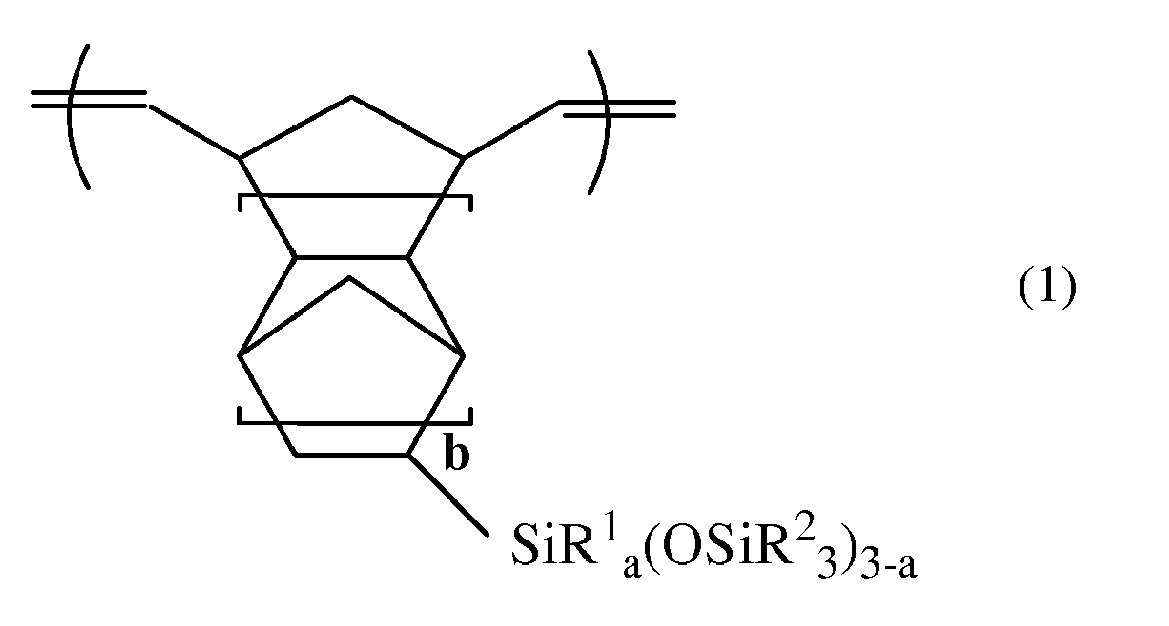
wherein R1 and R2 may be the same or different from each other and are substituted or unsubstituted alkyl groups having 1 to 12 carbon atoms, a is a number of 0, 1, 2 or a mixture thereof, and b is a number of 0, 1, 2 or a mixture thereof,
(B) a hydrocarbon solvent, and
(C) an alcohol having an ethynyl group.
(A) a polymer having a number average molecular weight (Mn) of from 10,000 to 5,000,000, as determined by gel permeation chromatography and reduced to polystyrene, and repeating units represented by the following formula (1),
(B) a hydrocarbon solvent, and
(C) an alcohol having an ethynyl group.
Description
- The present invention relates to a composition to prepare a membrane having high gas permeability and oxygen gas permeability, particularly an oxygen enrichment membrane.
- In these days, air conditioners are indispensable to provide comfortable environment to homes and automobiles. Usually, a space where an air conditioner is used is highly hermetically sealed for high energy efficiency. When a man continues working in such a sealed space, he may suffer from oxygen deficiency, leading to decrease in operating efficiency or even to drowsiness, particularly in an automobile, which may cause safety problem. To avoid the problem, an air conditioner provided with an oxygen enrichment membrane permeating oxygen more than nitrogen, or having a selectivity of oxygen gas over nitrogen gas, has been developed, but satisfactory performance has not yet been attained.
- It is known that an organosiloxane has good oxygen permeability. However, the organosiloxane itself is not mechanically strong enough for practical use. Copolymers of an organosiloxane are known, for example, a copolymer with polycarbonate from Japanese Patent Application Laid-Open No.
H05-261260 H05-285216 H04-88004 H08-198881 2001-79375 - As a result of extensive studies to solve the problem, the present inventor invented a polymer and a cast film thereof, as disclosed in the patent applications, Japanese Patent Application No.
2006-117977 EP Application No.07106552.8 - An object of the present invention is to improve gas permeability of the film.
- To improve gas permeability, one may reduce thickness of the film. A thin film or membrane is generally prepared by the water surface spreading method where a polymer dissolved in a solvent is dropped and spread on water surface, and then the solvent is allowed to evaporate. In the method, a spreader agent such as phosphate type anionic surfactant and polyfumaric acid ester is used. However, it has been found to be difficult to prepare a thin film of the aforesaid novel polymer because it does not spread even when the aforesaid spreader agent is used.
- After extensive studies, the present inventor has found that a membrane of the polymer can be prepared by using an alcohol having an ethynyl group as a spreader. The film so prepared has not only high selectivity of oxygen gas over nitrogen gas but also high gas permeability.
- Disclosed herein is a membrane comprising a polymer having repeating units represented by the following formula (1):

- Further disclosed herein is a composite membrane comprising a porous support membrane and the aforesaid film laminated on the porous support membrane.
- The present invention is a composition for preparing a membrane comprising
- (A) a polymer having a number average molecular weight (Mn) of from 10,000 to 5,000,000, as determined by gel permeation chromatography and reduced to polystyrene, and repeating units represented by the above formula (1),
- (B) a hydrocarbon solvent, and
- (C) an alcohol having an ethynyl group.
- The membrane has excellent gas permeability, oxygen gas selectivity over nitrogen gas so as to be useful for preparing an oxygen enrichment membrane.
- In the above formula (1), examples of R1 and R2 include methyl, ethyl, n-propyl, butyl, pentyl groups and fluorinated groups thereof, among which methyl group is preferred.
- The number, a, is 0, 1, 2 or a mixture thereof. That is, the polymer may have a mixture of a repeating unit with a being 0 and the unit with a being 1. Preferably, a is 0, 1, or a mixture thereof, and most preferably 0, because of good oxygen permeability. The number, b, is 0, 1, 2 or a mixture thereof. Preferably, b is 0, 1, or a mixture thereof, and most preferably 0, because of good polymerization property.
- The aforesaid repeating unit of the formula (1) can be derived from the organosilicon compound represented by the following formula (3):

- Examples of the organosilicon compound of the formula (3) are as shown below, wherein Me represents a methyl group. A mixture of these compounds may be used.


- The organosilicon compound can be prepared by subjecting the polysiloxane of the following formula having a vinyl group and cyclopentadiene to Diels-Alder reaction. Details of the preparation will be described later in Examples.
(CH2=CH) SiR1 a(OSiR2)3-a
- The polymer underlying the composition of the present invention can be obtained by subjecting the organosilicon compound of the formula (3) to a metathesis polymerization. The metathesis polymerization can be performed in a usual manner, for example, by dissolving monomers in an aromatic hydrocarbon solvent such as toluene and xylene, and polymerizing the monomers in the presence of a polymerization catalyst at a temperature of from 40 to 60°C and at an atmospheric pressure in nitrogen atmosphere while stirring. As the polymerization catalyst, a generally used radical polymerization catalyst can be used, for example, various kinds of peroxides, Ziegler catalysts, metallocene catalysts, and carbene-type catalysts such as tungsten catalyst or ruthenium catalyst. Preferably, Grubbs catalyst 1st Generation, Grubbs catalyst 2nd Generation, or Hoveyda-Grubbs catalyst is used. The catalyst may be used in an amount of from 1 to 1000 ppm, preferably from 5 to 500 ppm based on a weight of the monomer. With less than 5 ppm of the catalyst, the polymerization proceeds impractically slowly. On the other hand, with more than 500 ppm of the catalyst, production costs would be high and moreover scission reaction of a polymer may occur, causing gelation of the polymer.
- In addition to the organosilicon compound of the formula (3), another olefin compound may be used as a co-monomer which is subjected to an addition polymerization or metathesis polymerization. Examples of the olefin compound include aliphatic olefins such as ethylene and propylene; norbornenyl alicyclic olefins; aromatic olefins such as styrene, α-methylstyrene and stilbene; and acrylic acid esters such as methyl acrylate and butyl methacrylate. Preferably, the alicyclic organic compound which can ring-open to polymerize, for example, the one represented by the following formula (4) is used. By using the organic compound, a polymer having, in addition to the repeating units of the formula (1), the repeating unit of the formula (2) can be prepared:


- Examples of the alicyclic organic compound of the formula (4) are as shown below.

- An amount of the co-monomer to be used can be varied depending on an intended degree of oxygen gas permeability. For an oxygen enrichment membrane application and oxygen permeability, the co-monomer may be used in an amount of 0 to 2.0 parts by weight per 100 parts by weight of the compound of the formula (3). Polymerization catalyst and conditions may be the same as those employed when no co-monomer is used.
- In the composition of the present invention, the polymer (A) has a number average molecular weight (Mn) of from 10,000 to 5,000,000, preferably from 50,000 to 500,000, as determined by gel permeation chromatography (GPC) using polystyrene standards. A polymer having a Mn below the aforesaid lower limit tends to lack sufficient mechanical strength, and the one with a Mn above the aforesaid upper limit tends to lack film-forming property. Preferably, the polymer has a dispersion (Mw/Mn) of from 2 to 4.
- In the composition of the present invention, the hydrocarbon solvent (B) may be any solvent which can dissolve the polymer (A). A part of the hydrogen atoms of the solvent (B) may be replaced with halogen atoms. The solvent preferably has low boiling point so as to evaporate rapidly after the composition has been spread on a surface of water. Examples of the solvent (B) include cyclohexane, n-hexane, benzene, toluene, xylene, and butyl chloride, among which cyclohexane and toluene are preferred.
- The hydrocarbon solvent (B) is typically incorporated in the composition in an amount of from 1 to 500 parts by weight, preferably from 10 to 150 parts by weight per part by weight of component (A), though the amount can be varied depending on a molecular weight of component (A). If the amount is below the aforesaid lower limit, a solid concentration of such a composition is too high to form a thin membrane or to handle with ease. If the amount is above the aforesaid upper limit, a membrane spread on water surface may be too thin to be transferred to a support membrane. When the component (B) is a mixture of two or more of the solvents, the mixing ratio can be adjusted according to an intended evaporation speed on a water surface.
- In the composition of the present invention, component (C) is an alcohol having an ethynyl group or acetylene group, hereinafter referred to acetylene alcohol. The acetylene alcohol preferably has 3 to 60, more preferably 5 to 22, carbon atoms. When a mixture of the components (A), (B) and (C) is dropped on a water surface, it spreads instantaneously to form a satisfactorily thin and uniform membrane. The following are examples of the component (C), all available from Nisshin Chemical Industry Co., Ltd.


- In the above formulas, n is an integer of from 1 to 10.
- The component(C) is incorporated in the composition in an amount of from 0.1 to 10 parts by weight, preferably from 0.5 to 5 parts by weight, per total 100 parts by weight of the components (A) and (B). If the amount is below the aforesaid lower limit, a uniformly thin film may not be formed on water surface. If the amount is above the aforesaid upper limit, mechanical strength of a membrane is not strong enough for practical uses.
- A membrane obtained by spreading the composition comprising the components (A) to (C) on a water surface can subsequently be combined with various kinds of porous membranes to form a composite membrane with excellent gas permeability and oxygen gas selectivity over nitrogen gas. The present composition can further comprise other components, in an amount so as to not to adversely affect the composition, such as an adhesion aid to promote adhesion of the membrane to a porous membrane and an antioxidant. The thickness of the membrane can be varied according to desired gas permeability. Typically, an upper limit of an average thickness of the membrane is 0.3 µm, more typically 0.1 µm. There is no lower limit, but a membrane thinner than 0.01 µm is practically difficult to prepare.
- The composite membrane can be prepared by spreading the composition comprising the components (A) to (C) and an optional component as desired on a water surface, evaporating the solvent (B), and then transferring the obtained membrane, hereinafter referred to as a separation membrane, to a surface of a porous support membrane. One or more separation membranes can be laminated on the separation membrane. If necessary, a protective membrane comprising a siloxane polymer can be laminated on the separation membrane. The protective membrane can be prepared in the same manner as described above. That is, a solution of the siloxane polymer is spread on a water surface followed by evaporation of the solvent, and then the membrane obtained is transferred onto the separation membrane.
- As the porous support membrane, porous membranes commonly used for gas separation composite membranes can be used such as those comprising one or more polymers selected from the group consisting of polyethylene, polypropylene, polysulfone, polyether sulfone, polystyrene, polyethylene terephthalate, and polyimide. Preferably, the porous support membrane is composed of a polymer selected from the group consisting of polypropylene, polyethersulfone, and polyimide. The support membrane may be in the form of a flat membrane, tubular membrane or a hollow fiber membrane, and may be those formed on a woven or nonwoven cloth. A thickness of the porous support membrane can be selected according to handling property or the like, but typically ranges from 10 to 300 µm, more typically from 20 to 100 µm.
- The aforesaid protective membrane can be prepared from a copolymer of a siloxane compound and styrene. Alternatively, a quick-drying dealcohol reaction type adhesive sealing agent, a solvent type silicone releasing agent or a blend thereof may be applied as a protective layer to the separation membrane.
- The present invention will be explained with reference to the following Examples, but not limited thereto.
- In a 100 ml of a reactor, 13 g (0.10 mol) of dicyclopentadiene, and 50 g(0.20 mol) bistrimethylsiloxy-methylvinylsilane were placed which were subjected to a reaction at a temperature of from 160 to 175 °C for 4 hours under nitrogen gas flow. The reaction mixture obtained was subjected to vacuum distillation to obtain 37 g of a fraction at a temperature of from 97 to 102 °C and at 9mm Hg. The fraction had a refractive index (nD 25) of 1.444. Structural analyses of the fraction with a 1H-NMR spectrometer, LAMBDA LA-300W, ex JEOL Ltd., and a FT-IR spectrometer, Spectrum One, ex PerkinElmer Inc., and quantitative analysis by gas chromatography based on a peak area ratio, as determined with a gas chromatograph, GC-14B, ex Shimadzu Co., of the fraction found that the fraction was a mixture of 89 mol% of the following compound,


- The fraction obtained will be hereinafter referred to as Monomer Mixture A.
- In a 500 ml of a reactor, 132 g (1.00 mol) of dicyclopentadiene, and 322 g(1.00 mol) of tristrimethylsiloxy-vinylsilane were placed which were subjected to a reaction at a temperature of from 160 to 175 °C for 4 hours under nitrogen gas seal. The reaction mixture obtained was subjected to vacuum distillation to obtain 220 g of a fraction at a temperature of from 118 to 120 °C and at 5mm Hg. Structural analyses of the fraction with a 1H-NMR spectrometer, LAMBDA LA-300W, ex JEOL Ltd., and a FT-IR spectrometer, Spectrum One, ex PerkinElmer Inc., and quantitative analysis by gas chromatography based on a peak area ratio, as determined with a gas chromatograph, C-14B, ex Shimadzu Co., of the fraction found that the fraction was a mixture of 95 % of the following compound,


- The fraction obtained will be hereinafter referred to as Monomer Mixture B.
- In a Schlenk flask provided with a three way cock, 4.1 mg(0.005 mmol) of a Grubbs catalyst 1st Generation(Ru catalyst) was placed and the flask was purged with Ar(or N2) gas. To the flask, 5 ml of toluene was added to make a solution of the catalyst and then the flask was put in an oven kept at 40 °C. Separately, a 100 ml eggplant type flask provided with a stirrer and a three way cock was purged with Ar(or N2) gas, in which 1.57g(5.0 mmol) of Monomer Mixture A prepared in Preparation Example 1 and 45 ml of toluene were placed to prepare a solution of the monomer mixture. After stirring the solution to uniformly disperse the monomer mixture, the eggplant type flask was put in the oven kept at 40 °C. When a temperature of the monomer solution reached to about 40 °C, the Schlenk flask and the eggplant type flask were taken out from the oven. To the monomer solution, the catalyst solution was added via a syringe while stirring. After the catalyst solution was uniformly mixed with the monomer solution, the eggplant type flask was put in the oven. Twenty minutes later, 1 ml of ethylvinylether was added to the eggplant type flask to stop polymerization and stirred for 5 minutes. Subsequently, the solution in the eggplant type flask was slowly dropped in 100 ml of methanol while stirring. A polymer was precipitated which was then isolated by filtration and dried. The polymer obtained, hereinafter referred to as Polymer A, weighed 1.5 g, corresponding to a reaction yield of 96%. The polymer had a Mn of 114,300, and a Mw/Mn of 2.74, as determined with a gel permeation chromatograph, Chromatography 10A series, ex Shimadzu Co., using polystyrene standards.
- A polymer was prepared in the same manner as in Example 1 except that 1.94 g (5.0 mmol) of Monomer Mixture B was used in place of Monomer Mixture A. The polymer obtained, hereinafter referred to as Polymer B, weighed 1.9g, corresponding to a reaction yield of 96%. The polymer had a Mn of 123,300, and a Mw/Mn of 3.96, as determined with a gel permeation chromatograph, Chromatography 10A series, ex Shimadzu Co. using polystyrene standards.
- A polymer was prepared in the same manner as in Example 1 except that 1.0 g (2.6 mmol) of Monomer Mixture B and 1.0g of tetracyclo[6.2.1.13,6.02,7]dodeca-4-ene of the following formula:

- The compositions were prepared according to the recipes, expressed in parts by weight, as shown in Table 1. One drop, which weighs about 0.02g, of composition was spread over a surface of pure water which was allowed to stand while the solvent evaporated. A thin membrane having an average thickness of from 0.05 to 0.13 µm was obtained.
- Subsequently, the membrane was transferred onto a 80-µm thick polypropylene porous support membrane to form an oxygen enrichment membrane.
- A diameter and a thickness of the thin membranes are as shown in Table 1.
- Oxygen and nitrogen gas permeability coefficients of the enrichment membrane as shown in Table 2 were determined at 25 °C with a gas permeability meter manufactured by Rika Seiki Kogyo K.K.
- As the component (C), the following acetylene alcohol A or B was used.


Table 1 Example 1 Example 2 Example 3 Referential Example 1 Referential Example 2 Referential Example 3 Polymer A 2 2 2 Polymer B 4 4 Polymer C 6 Cyclohexane 98 94 98 98 Toluene 96 96 Phosphate type anionic surfactant 1.0 Acetylene alcohol A 1.5 2.0 Acetylene alcohol B 0.5 Diameter of membrane (cm) 5.0 4.5 5.5 Not spread Not spread Not spread Thickness of membrane (nanometer) 50 95 130 - - - Gas permeability coefficient (p) O2 N2 ρ (O2) /ρ (N2) Example 1 63×105 26×105 2.4 Example 2 127×105 60×105 2.1 Example 3 90×105 47×105 1.9 Referential Example 3* 0.14×105 0.045×10⁵ 3.1 The unit of gas permeability coefficient : cc(STP)/(m2) (hr) (atm)
* A membrane could not be obtained by the water surface spreading method. Instead, a cast film was prepared by casting the composition on a glass plate and then evaporating the solvent. The cast film had a thickness of 55µm, as measured with a dial gage. Gas permeability coefficients of the cast film were measured in the same manner as described above. - The compositions of Referential Examples 1 to 3 without the component (C) could not be spread over a water surface. The cast film prepared from the composition of Referential Example 3 was as thick as 55 µm and accordingly its gas permeability was low, although its oxygen gas selectivity over nitrogen gas was high. The compositions of Examples 1 to 3, on the other hand, could be spread very well on a water surface and the membranes obtained had high gas permeability and oxygen gas selectivity.
- Thus, the composite membrane prepared using the composition of the present invention is suitable for an oxygen enrichment membrane used in air conditioners or fuel cells.
Claims (8)
- A composition for preparing a membrane, said composition comprising(A) a polymer having a number average molecular weight (Mn) of from 10,000 to 5,000,000, as determined by gel permeation chromatography and reduced to polystyrene, and repeating units represented by the following formula (1),
 (B) a hydrocarbon solvent, and(C) an alcohol having an ethynyl group.
 - The composition according to claim 1, wherein the composition comprises 1 to 500 parts by weight of the component (B) per part by weight of component (A), and 0.1 to 10 parts by weight of the component (C) per total 100 parts by weight of the components (A) and (B).
- The composition according to claim 1 or 2, wherein the polymer further has repeating units represented by the following formula (2):

- The composition according to any one of claims 1 to 3, wherein R1 and R2 are methyl groups and a is 1.
- The composition according to any one of claims 1 to 3, wherein R1 and R2 are methyl groups and a is 0.
- The composition according to any one of claims 3 to 5, wherein R3 and R4 are hydrogen atoms and c is 0.
- The composition according to any one of claims 1 to 6, wherein the polymer has a number average molecular weight (Mn), reduced to polystyrene, of from 50,000 to 500,000 and a dispersion (Mw/Mn) of from 2 to 4.
- A method of preparing a composite membrane, said method comprising the steps of( 1) spreading a predetermined amount of the composition according to any one of claims 1 to 7 on a surface of water,( 2) evaporating the solvent to form a thin membrane, and( 3) transferring the thin membrane to a surface of a porous support membrane to laminate the thin membrane on the porous support membrane.
Applications Claiming Priority (2)
| Application Number | Priority Date | Filing Date | Title |
|---|---|---|---|
| JP2006193286A JP4242403B2 (en) | 2006-07-13 | 2006-07-13 | Oxygen-enriched film and composition for forming the film |
| EP07112151A EP1878488B1 (en) | 2006-07-13 | 2007-07-10 | Oxygen enrichment membrane and composition for preparing the membrane |
Related Parent Applications (1)
| Application Number | Title | Priority Date | Filing Date |
|---|---|---|---|
| EP07112151.1 Division | 2007-07-10 |
Publications (1)
| Publication Number | Publication Date |
|---|---|
| EP2269716A1 true EP2269716A1 (en) | 2011-01-05 |
Family
ID=38566968
Family Applications (2)
| Application Number | Title | Priority Date | Filing Date |
|---|---|---|---|
| EP10176364A Withdrawn EP2269716A1 (en) | 2006-07-13 | 2007-07-10 | Oxygen enrichment membrane and composition for preparing the membrane |
| EP07112151A Ceased EP1878488B1 (en) | 2006-07-13 | 2007-07-10 | Oxygen enrichment membrane and composition for preparing the membrane |
Family Applications After (1)
| Application Number | Title | Priority Date | Filing Date |
|---|---|---|---|
| EP07112151A Ceased EP1878488B1 (en) | 2006-07-13 | 2007-07-10 | Oxygen enrichment membrane and composition for preparing the membrane |
Country Status (4)
| Country | Link |
|---|---|
| US (1) | US20080011406A1 (en) |
| EP (2) | EP2269716A1 (en) |
| JP (1) | JP4242403B2 (en) |
| DE (1) | DE602007012326D1 (en) |
Families Citing this family (12)
| Publication number | Priority date | Publication date | Assignee | Title |
|---|---|---|---|---|
| JP2009275130A (en) * | 2008-05-15 | 2009-11-26 | Shin Etsu Chem Co Ltd | Alicyclic polymer having silicon-containing group, and method for producing the same |
| JP5235514B2 (en) * | 2008-06-12 | 2013-07-10 | 信越ポリマー株式会社 | Residential permselective material and residential air conditioning system |
| JP4993509B2 (en) * | 2008-07-16 | 2012-08-08 | 信越化学工業株式会社 | Powder surface treatment agent, powder treated with the treatment agent, and cosmetics containing the powder |
| JP2010174099A (en) * | 2009-01-28 | 2010-08-12 | Shin-Etsu Chemical Co Ltd | Cycloolefin addition polymer and method for producing the same |
| JP5281970B2 (en) * | 2009-06-30 | 2013-09-04 | 信越ポリマー株式会社 | Air conditioning system |
| JP5155255B2 (en) * | 2009-06-30 | 2013-03-06 | 信越化学工業株式会社 | Asymmetric membrane of siloxane functional cyclic olefin (co) polymer and process for producing the same |
| JP5469132B2 (en) * | 2010-12-06 | 2014-04-09 | 信越ポリマー株式会社 | Reefer container |
| JP5798277B1 (en) * | 2012-08-07 | 2015-10-21 | プロメラス, エルエルシー | Cycloalkylnorbornene monomers, polymers derived therefrom, and their use in pervaporation |
| JP7060451B2 (en) * | 2018-06-06 | 2022-04-26 | 東芝ライフスタイル株式会社 | Method for manufacturing oxygen-enriched membrane |
| US11597784B2 (en) * | 2020-03-30 | 2023-03-07 | Saudi Arabian Oil Company | Enhanced yield, structural control, and transport properties of polynorbornenes for natural gas upgrading through Mizoroki-Heck cross-couplings |
| CN112225852B (en) * | 2020-09-28 | 2021-10-08 | 浙江大学 | A kind of polysiloxane functionalized ethylene-norbornene copolymer and preparation method thereof |
| CN114432892B (en) * | 2020-10-31 | 2023-07-04 | 中国石油化工股份有限公司 | Preparation method of pervaporation membrane |
Citations (7)
| Publication number | Priority date | Publication date | Assignee | Title |
|---|---|---|---|---|
| JPH0488004A (en) | 1990-07-31 | 1992-03-19 | Idemitsu Kosan Co Ltd | Styrene-based polymer, production thereof and gas separation membrane composed of the same polymer |
| DE4128932A1 (en) * | 1991-08-30 | 1993-03-04 | Wacker Chemie Gmbh | Novel organo(poly)siloxane(s) with 5-norbornene-2-yl gps. - are useful in adhesive coating compsns. crosslinked by the thiol-ene reaction |
| JPH05261260A (en) | 1992-03-17 | 1993-10-12 | Teijin Chem Ltd | Oxygen enriching membrane |
| JPH05285216A (en) | 1992-04-14 | 1993-11-02 | Nippon Oil & Fats Co Ltd | Anti-thrombogenic material |
| JPH08198881A (en) | 1995-01-20 | 1996-08-06 | Menicon Co Ltd | Silicon-containing stilbene derivative |
| JP2001079375A (en) | 1999-08-26 | 2001-03-27 | Hong Jae-Jin | New oxygen-enriched membrane |
| JP2006117977A (en) | 2004-10-20 | 2006-05-11 | Sumitomo Kinzoku Kozan Shindo Kk | Rolled copper foil |
Family Cites Families (7)
| Publication number | Priority date | Publication date | Assignee | Title |
|---|---|---|---|---|
| US4279855A (en) * | 1973-05-02 | 1981-07-21 | General Electric Company | Method for the casting of ultrathin polymer membranes |
| US4877820A (en) * | 1987-03-20 | 1989-10-31 | Hercules Incorporated | Cross-linked organosiloxane polymers |
| US5264606A (en) * | 1990-10-09 | 1993-11-23 | Union Carbide Chemicals & Plastics Technology Corporation | Process for the preparation of polyvinyl compounds |
| DE4416330A1 (en) * | 1994-05-09 | 1995-11-16 | Hoechst Ag | Composite membrane and process for its manufacture |
| TW200513483A (en) * | 2003-10-10 | 2005-04-16 | Shinetsu Chemical Co | Curable composition |
| JP4889097B2 (en) * | 2005-08-11 | 2012-02-29 | 信越化学工業株式会社 | Polycycloolefin functional polysiloxane |
| JP2007291150A (en) * | 2006-04-20 | 2007-11-08 | Shin Etsu Chem Co Ltd | High oxygen permeability polymer |
-
2006
- 2006-07-13 JP JP2006193286A patent/JP4242403B2/en active Active
-
2007
- 2007-07-10 EP EP10176364A patent/EP2269716A1/en not_active Withdrawn
- 2007-07-10 DE DE602007012326T patent/DE602007012326D1/en active Active
- 2007-07-10 EP EP07112151A patent/EP1878488B1/en not_active Ceased
- 2007-07-12 US US11/826,177 patent/US20080011406A1/en not_active Abandoned
Patent Citations (7)
| Publication number | Priority date | Publication date | Assignee | Title |
|---|---|---|---|---|
| JPH0488004A (en) | 1990-07-31 | 1992-03-19 | Idemitsu Kosan Co Ltd | Styrene-based polymer, production thereof and gas separation membrane composed of the same polymer |
| DE4128932A1 (en) * | 1991-08-30 | 1993-03-04 | Wacker Chemie Gmbh | Novel organo(poly)siloxane(s) with 5-norbornene-2-yl gps. - are useful in adhesive coating compsns. crosslinked by the thiol-ene reaction |
| JPH05261260A (en) | 1992-03-17 | 1993-10-12 | Teijin Chem Ltd | Oxygen enriching membrane |
| JPH05285216A (en) | 1992-04-14 | 1993-11-02 | Nippon Oil & Fats Co Ltd | Anti-thrombogenic material |
| JPH08198881A (en) | 1995-01-20 | 1996-08-06 | Menicon Co Ltd | Silicon-containing stilbene derivative |
| JP2001079375A (en) | 1999-08-26 | 2001-03-27 | Hong Jae-Jin | New oxygen-enriched membrane |
| JP2006117977A (en) | 2004-10-20 | 2006-05-11 | Sumitomo Kinzoku Kozan Shindo Kk | Rolled copper foil |
Non-Patent Citations (7)
| Title |
|---|
| CHEVALIER P M ET AL: "RING-OPENING OLEFIN METATHESIS POLYMERISATION (ROMP) AS A POTENTIAL CROSS-LINKING MECHANISM FOR SILOXANE POLYMERS", JOURNAL OF INORGANIC AND ORGANOMETALLIC POLYMERS, NEW YORK, NY, US, vol. 9, no. 3, 1999, pages 151 - 164, XP009021103 * |
| FINKELSHTEIN E SH ET AL: "RING-OPENING METATHESIS POLYMERIZATION OF NORBORNENES WITH ORGANOSILICON SUBSTITUENTS. GAS PERMEABILITY OF POLYMERS OBTAINED", MAKROMOLEKULARE CHEMIE, MACROMOLECULAR CHEMISTRY AND PHYSICS, HUTHIG UND WEPF VERLAG, BASEL, CH, vol. 192, no. 1, January 1991 (1991-01-01), pages 1 - 9, XP000209137, ISSN: 0025-116X * |
| FINKELSHTEIN E SH: "OLEFIN METHATHESIS IN ORGANOSILICON CHEMISTRY", NATO ASI SERIES. SERIES C: MATHEMATICAL AND PHYSICAL SCIENCES, REIDEL, DORDRECHT, NL, vol. 506, 1998, pages 201 - 224, XP002900463, ISSN: 0258-2023 * |
| KARLOU-EYRISCH K ET AL: "ETHENOLYSIS OF SILICON CONTAINING CYCLOOLEFINS", JOURNAL OF ORGANOMETALLIC CHEMISTRY, ELSEVIER-SEQUOIA S.A. LAUSANNE, CH, vol. 606, no. 1, 14 July 2000 (2000-07-14), pages 3 - 7, XP002906755, ISSN: 0022-328X * |
| KAWAKAMI, Y.; TODA, H.; HIGASHINO, M.; YAMASHITA, Y.: "Polynorbornenes with Oligodimethylsiloxanyl Substituents for Selectively Oxygen Permeable Membrane Material", POLYMER JOURNAL, vol. 20, no. 4, 1988, TOKYO, JAPAN, pages 285 - 292, XP009091216 * |
| LECHNER M D ET AL: "Makromolekulare Chemie - Ein Lehrbuch für Chemiker, Physiker, Materialwissenschaftler und Verfahrenstechniker", 1 January 1996, MAKROMOLEKULARE CHEMIE,, PAGE(S) 295 - 299, ISBN: 978-3-7643-5343-8, XP002563735 * |
| ULRIKE WENZEL: "Charakterisierung eines ultrahochmolekularen Polymethacrylats mit flüssigkristalliner Seitengruppe in verdünnter Lösung", DISSERTATION,, vol. D83/2000, 5 July 2000 (2000-07-05), pages 78PP, XP007912815, Retrieved from the Internet <URL:http://opus.kobv.de/tuberlin/volltexte/2000/171/pdf/wenzel_ulrike.pdf> [retrieved on 20100426] * |
Also Published As
| Publication number | Publication date |
|---|---|
| EP1878488A1 (en) | 2008-01-16 |
| EP1878488B1 (en) | 2011-02-02 |
| US20080011406A1 (en) | 2008-01-17 |
| JP4242403B2 (en) | 2009-03-25 |
| DE602007012326D1 (en) | 2011-03-17 |
| JP2008018363A (en) | 2008-01-31 |
Similar Documents
| Publication | Publication Date | Title |
|---|---|---|
| EP1878488B1 (en) | Oxygen enrichment membrane and composition for preparing the membrane | |
| EP1849806B1 (en) | Highly oxygen permeable polymer | |
| US8440765B2 (en) | Nanostructured polymer membranes for selective alcohol transport | |
| EP3075764B1 (en) | Hydrophilically modified fluorinated membrane | |
| EP2870129B1 (en) | Cycloalkylnorbornene monomers, polymers derived therefrom and their use in pervaporation | |
| JP4295096B2 (en) | Ring-opening metathesis polymerization of bridged bicyclic and polycyclic olefins containing two or more heteroatoms | |
| EP3075440B1 (en) | Hydrophilically modified fluorinated membrane | |
| EP2213691A1 (en) | Cycloolefin addition polymer and making method | |
| EP3075762B1 (en) | Hydrophilically modified fluorinated membrane | |
| JP2016196625A (en) | Hydrophilically modified fluorinated membrane (i) | |
| JP6060448B2 (en) | Hydrophilic modified fluorinated membrane (II) | |
| KR890003548B1 (en) | Method for preparing multi component membrane | |
| Sakaguchi et al. | A series of poly (diphenylacetylene) s bearing sulfonic acids: synthesis, characterization, and gas permeability | |
| JPS60163887A (en) | Cyclosiloxane derivative | |
| Sakaguchi et al. | Synthesis and gas permeability of novel poly (diphenylacetylenes) having polyethylene glycol moieties | |
| JP2009275130A (en) | Alicyclic polymer having silicon-containing group, and method for producing the same | |
| Nagasaki et al. | Novel organosilicon‐containing polymers for an oxygen permselective membrane | |
| JP5127648B2 (en) | Curable resin composition | |
| EP0245516A1 (en) | Polymer membrane for separating liquid mixture | |
| JPS61268745A (en) | Organopolysiloxane-substituted polyacetylene composition | |
| KR20210142397A (en) | Crosslinked-type copolymer, polymer membrane comprising the same, gas separation membrane comprising the polymer membrane, and manufacturing method of the crosslinked-type copolymer | |
| JPS61120817A (en) | Copolymer of substituted acetylene compound with cycloolefin and its production | |
| JPH0475050B2 (en) | ||
| Kim et al. | Synthesis and characterization of poly [4, 4‐bis (pivaloxymethyl)‐1, 6‐heptadiyne] having high oxygen permselectivity | |
| JP2009256468A (en) | Method for producing fluoropolymer |
Legal Events
| Date | Code | Title | Description |
|---|---|---|---|
| PUAI | Public reference made under article 153(3) epc to a published international application that has entered the european phase |
Free format text: ORIGINAL CODE: 0009012 |
|
| 17P | Request for examination filed |
Effective date: 20100913 |
|
| AC | Divisional application: reference to earlier application |
Ref document number: 1878488 Country of ref document: EP Kind code of ref document: P |
|
| AK | Designated contracting states |
Kind code of ref document: A1 Designated state(s): DE FR GB |
|
| 17Q | First examination report despatched |
Effective date: 20110601 |
|
| STAA | Information on the status of an ep patent application or granted ep patent |
Free format text: STATUS: THE APPLICATION IS DEEMED TO BE WITHDRAWN |
|
| 18D | Application deemed to be withdrawn |
Effective date: 20111213 |