EP2269672B1 - Verfahren und Gerät zur Knochenwiederherstellung - Google Patents
Verfahren und Gerät zur Knochenwiederherstellung Download PDFInfo
- Publication number
- EP2269672B1 EP2269672B1 EP09180345.2A EP09180345A EP2269672B1 EP 2269672 B1 EP2269672 B1 EP 2269672B1 EP 09180345 A EP09180345 A EP 09180345A EP 2269672 B1 EP2269672 B1 EP 2269672B1
- Authority
- EP
- European Patent Office
- Prior art keywords
- bone
- composition
- hydrating
- tube
- chamber
- Prior art date
- Legal status (The legal status is an assumption and is not a legal conclusion. Google has not performed a legal analysis and makes no representation as to the accuracy of the status listed.)
- Expired - Lifetime
Links
Images

Classifications
-
- A—HUMAN NECESSITIES
- A61—MEDICAL OR VETERINARY SCIENCE; HYGIENE
- A61L—METHODS OR APPARATUS FOR STERILISING MATERIALS OR OBJECTS IN GENERAL; DISINFECTION, STERILISATION OR DEODORISATION OF AIR; CHEMICAL ASPECTS OF BANDAGES, DRESSINGS, ABSORBENT PADS OR SURGICAL ARTICLES; MATERIALS FOR BANDAGES, DRESSINGS, ABSORBENT PADS OR SURGICAL ARTICLES
- A61L27/00—Materials for grafts or prostheses or for coating grafts or prostheses
- A61L27/36—Materials for grafts or prostheses or for coating grafts or prostheses containing ingredients of undetermined constitution or reaction products thereof, e.g. transplant tissue, natural bone, extracellular matrix
- A61L27/3641—Materials for grafts or prostheses or for coating grafts or prostheses containing ingredients of undetermined constitution or reaction products thereof, e.g. transplant tissue, natural bone, extracellular matrix characterised by the site of application in the body
- A61L27/3645—Connective tissue
- A61L27/365—Bones
-
- A—HUMAN NECESSITIES
- A61—MEDICAL OR VETERINARY SCIENCE; HYGIENE
- A61L—METHODS OR APPARATUS FOR STERILISING MATERIALS OR OBJECTS IN GENERAL; DISINFECTION, STERILISATION OR DEODORISATION OF AIR; CHEMICAL ASPECTS OF BANDAGES, DRESSINGS, ABSORBENT PADS OR SURGICAL ARTICLES; MATERIALS FOR BANDAGES, DRESSINGS, ABSORBENT PADS OR SURGICAL ARTICLES
- A61L27/00—Materials for grafts or prostheses or for coating grafts or prostheses
- A61L27/36—Materials for grafts or prostheses or for coating grafts or prostheses containing ingredients of undetermined constitution or reaction products thereof, e.g. transplant tissue, natural bone, extracellular matrix
- A61L27/3604—Materials for grafts or prostheses or for coating grafts or prostheses containing ingredients of undetermined constitution or reaction products thereof, e.g. transplant tissue, natural bone, extracellular matrix characterised by the human or animal origin of the biological material, e.g. hair, fascia, fish scales, silk, shellac, pericardium, pleura, renal tissue, amniotic membrane, parenchymal tissue, fetal tissue, muscle tissue, fat tissue, enamel
- A61L27/3608—Bone, e.g. demineralised bone matrix [DBM], bone powder
-
- A—HUMAN NECESSITIES
- A61—MEDICAL OR VETERINARY SCIENCE; HYGIENE
- A61L—METHODS OR APPARATUS FOR STERILISING MATERIALS OR OBJECTS IN GENERAL; DISINFECTION, STERILISATION OR DEODORISATION OF AIR; CHEMICAL ASPECTS OF BANDAGES, DRESSINGS, ABSORBENT PADS OR SURGICAL ARTICLES; MATERIALS FOR BANDAGES, DRESSINGS, ABSORBENT PADS OR SURGICAL ARTICLES
- A61L27/00—Materials for grafts or prostheses or for coating grafts or prostheses
- A61L27/36—Materials for grafts or prostheses or for coating grafts or prostheses containing ingredients of undetermined constitution or reaction products thereof, e.g. transplant tissue, natural bone, extracellular matrix
- A61L27/3604—Materials for grafts or prostheses or for coating grafts or prostheses containing ingredients of undetermined constitution or reaction products thereof, e.g. transplant tissue, natural bone, extracellular matrix characterised by the human or animal origin of the biological material, e.g. hair, fascia, fish scales, silk, shellac, pericardium, pleura, renal tissue, amniotic membrane, parenchymal tissue, fetal tissue, muscle tissue, fat tissue, enamel
- A61L27/3616—Blood, e.g. platelet-rich plasma
-
- A—HUMAN NECESSITIES
- A61—MEDICAL OR VETERINARY SCIENCE; HYGIENE
- A61L—METHODS OR APPARATUS FOR STERILISING MATERIALS OR OBJECTS IN GENERAL; DISINFECTION, STERILISATION OR DEODORISATION OF AIR; CHEMICAL ASPECTS OF BANDAGES, DRESSINGS, ABSORBENT PADS OR SURGICAL ARTICLES; MATERIALS FOR BANDAGES, DRESSINGS, ABSORBENT PADS OR SURGICAL ARTICLES
- A61L27/00—Materials for grafts or prostheses or for coating grafts or prostheses
- A61L27/36—Materials for grafts or prostheses or for coating grafts or prostheses containing ingredients of undetermined constitution or reaction products thereof, e.g. transplant tissue, natural bone, extracellular matrix
- A61L27/3683—Materials for grafts or prostheses or for coating grafts or prostheses containing ingredients of undetermined constitution or reaction products thereof, e.g. transplant tissue, natural bone, extracellular matrix subjected to a specific treatment prior to implantation, e.g. decellularising, demineralising, grinding, cellular disruption/non-collagenous protein removal, anti-calcification, crosslinking, supercritical fluid extraction, enzyme treatment
-
- A—HUMAN NECESSITIES
- A61—MEDICAL OR VETERINARY SCIENCE; HYGIENE
- A61L—METHODS OR APPARATUS FOR STERILISING MATERIALS OR OBJECTS IN GENERAL; DISINFECTION, STERILISATION OR DEODORISATION OF AIR; CHEMICAL ASPECTS OF BANDAGES, DRESSINGS, ABSORBENT PADS OR SURGICAL ARTICLES; MATERIALS FOR BANDAGES, DRESSINGS, ABSORBENT PADS OR SURGICAL ARTICLES
- A61L27/00—Materials for grafts or prostheses or for coating grafts or prostheses
- A61L27/36—Materials for grafts or prostheses or for coating grafts or prostheses containing ingredients of undetermined constitution or reaction products thereof, e.g. transplant tissue, natural bone, extracellular matrix
- A61L27/3683—Materials for grafts or prostheses or for coating grafts or prostheses containing ingredients of undetermined constitution or reaction products thereof, e.g. transplant tissue, natural bone, extracellular matrix subjected to a specific treatment prior to implantation, e.g. decellularising, demineralising, grinding, cellular disruption/non-collagenous protein removal, anti-calcification, crosslinking, supercritical fluid extraction, enzyme treatment
- A61L27/3691—Materials for grafts or prostheses or for coating grafts or prostheses containing ingredients of undetermined constitution or reaction products thereof, e.g. transplant tissue, natural bone, extracellular matrix subjected to a specific treatment prior to implantation, e.g. decellularising, demineralising, grinding, cellular disruption/non-collagenous protein removal, anti-calcification, crosslinking, supercritical fluid extraction, enzyme treatment characterised by physical conditions of the treatment, e.g. applying a compressive force to the composition, pressure cycles, ultrasonic/sonication or microwave treatment, lyophilisation
-
- A—HUMAN NECESSITIES
- A61—MEDICAL OR VETERINARY SCIENCE; HYGIENE
- A61B—DIAGNOSIS; SURGERY; IDENTIFICATION
- A61B17/00—Surgical instruments, devices or methods
- A61B17/56—Surgical instruments or methods for treatment of bones or joints; Devices specially adapted therefor
- A61B17/58—Surgical instruments or methods for treatment of bones or joints; Devices specially adapted therefor for osteosynthesis, e.g. bone plates, screws or setting implements
- A61B17/88—Osteosynthesis instruments; Methods or means for implanting or extracting internal or external fixation devices
- A61B17/8802—Equipment for handling bone cement or other fluid fillers
- A61B17/8805—Equipment for handling bone cement or other fluid fillers for introducing fluid filler into bone or extracting it
- A61B17/8825—Equipment for handling bone cement or other fluid fillers for introducing fluid filler into bone or extracting it characterised by syringe details
-
- A—HUMAN NECESSITIES
- A61—MEDICAL OR VETERINARY SCIENCE; HYGIENE
- A61L—METHODS OR APPARATUS FOR STERILISING MATERIALS OR OBJECTS IN GENERAL; DISINFECTION, STERILISATION OR DEODORISATION OF AIR; CHEMICAL ASPECTS OF BANDAGES, DRESSINGS, ABSORBENT PADS OR SURGICAL ARTICLES; MATERIALS FOR BANDAGES, DRESSINGS, ABSORBENT PADS OR SURGICAL ARTICLES
- A61L2430/00—Materials or treatment for tissue regeneration
- A61L2430/02—Materials or treatment for tissue regeneration for reconstruction of bones; weight-bearing implants
Definitions
- This invention relates to a bone repairing composition, methods of production and use thereof and related hydration apparatus.
- this invention relates to formed compositions useful in repairing osseous defects which may be inserted into the defect without preparation or manipulation.
- a bone repairing composition or filler may be used to correct defects caused by trauma, pathological disease, surgical intervention or other situations where defects need to be managed in osseous surgery. Because defects are usually jagged or irregularly shaped, it may be important to have the bone filler of an appropriate composition to facilitate placement of the filler into the surgical site. The surgeon may trowel the filler into the injury site and use his or her fingers and/or suitable instruments to shape it into the proper configuration.
- Bone reconstruction may be performed with various pastes, gels or putty-like materials containing a natural collagen or human cadaveric donor bone base.
- compositions are prepared from demineralized allograft bone matrix (DBM) that is taken from cadavers.
- DBM demineralized allograft bone matrix
- the sterile DBM is available in cubes, shavings or powder and is freeze-dried. Because the DBM is dry and difficult to manipulate, it may be made flowable or malleable with the addition of a wetting agent.
- the patient's blood has been used to mix the bone, bone powder or collagen because blood offers the benefits of being available at the operative site, is non-immunogenic to the patient and contains proteins, monosaccharides, polysaccharides and glucoronic acid which increase the heating process and regeneration of bone.
- Other wetting agents include monosaccharides, disaccharides, water dispersible oligosaccharides, polysaccharides, low weight organic solvents, including glycerol, polyhydroxy compounds, such as mucopolysaccharide or polyuronic acid and various aqueous solutions. (See, e.g., U.S. Patent Nos.
- compositions known in the art are difficult to handle and shape.
- the malleable filler must be molded by the surgeon to fit into the proper configuration of the defect site. Even when the surgeon uses great care to mix the paste or gel and sculpt a form, there may be a risk that the implant will become dislodged and carried away by body fluids. Subsequently, these compositions may not be suitable for large defects.
- the present invention provides a hydration apparatus, comprising:
- the hydration apparatus according to the invention may be used in methods of augmenting bone at a site in need thereof in a human or animal subject, comprising:
- the invention also provides a hydration apparatus as set forth above, wherein said composition is formed into a shape suitable for administration to said bone, and the shape is selected from a sheet, a patch, a block, a ring, a disc, a cylinder, or a site-specific pre-form.
- the present invention also provides a hydration apparatus as set forth above, wherein the substantially closed cover of said hydration tube is a plunger.
- the present invention also provides methods of hydrating a formed bone composition, comprising:
- the invention provides benefits over apparatus among those known in the art. Such benefits may include one or more of affording a graft material that is not easily dislodged from the site to which it is implanted, even in the presence of body fluids and after the passage of time, enhanced strength, and resistance to dissolution by blood or other fluids and easy hydration. Further areas of applicability will become apparent from the detailed description provided hereinafter. It should be understood that the detailed description and specific examples, while indicating preferred embodiments of the invention, are intended for purposes of illustration only and are not intended to limit the scope of the invention.
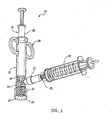
- Figure 1 depicts a side view of an apparatus according to various embodiments
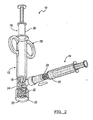
- Figure 2 depicts a side view of an apparatus according to various embodiments
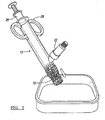
- Figure 3 depicts a partial view of a retaining tube and cap according to various embodiments
- Figure 4 depicts a view of a cap according to various embodiments.
- Figure 5 depicts a method of using an apparatus according to various embodiments.
- compositions used in this invention comprise a bone material and a carrier component.
- references herein does not constitute an admission that those references are prior art or have any relevance to the patentability of the invention disclosed herein. Any discussion of the content of references cited in the Introduction is intended merely to provide a general summary of assertions made by the authors of the references, and does not constitute an admission as to the accuracy of the content of such references.
- the words "preferred” and “preferably” refer to embodiments of the invention that afford certain benefits, under certain circumstances. However, other embodiments may also be preferred, under the same or other circumstances. Furthermore, the recitation of one or more preferred embodiments does not imply that other embodiments are not useful, and is not intended to exclude other embodiments from the scope of the invention. As referred to herein, all compositional percentages are by weight of the total composition, unless otherwise specified.
- the word "include,” and its variants, is intended to be non-limiting, such that recitation of items in a list is not to the exclusion of other like items that may also be useful in the materials, compositions, devices, and methods of this invention.
- the present invention involves the use of a formed composition for application to a bone surface of a human or animal subject, comprising:
- Bone used in embodiments of this invention may be obtained from cortical, cancellous and/or corticocancellous bone. (See, e.g., U.S. Patent. 5,507,813, Dowd, et al., issued April 16, 1996 ).
- the bone is autologous bone or donated from a single member of the same species as the patient to reduce or prevent an immunogenic response.
- bone from multiple donors may be used in the compositions.
- the "bone material” component used in the present invention is selected from bone powder, bone chips, bone shavings and mixtures thereof.
- the bone material is dried demineralized bone powder. Suitable drying techniques include freeze drying, vacuum drying, air drying, temperature flux drying, molecular sieve drying and other appropriate techniques.
- the bone material comprises freeze dried bone.
- freeze dried or “lyophilization” and variants thereof, means the process of isolating a solid substance from solution by freezing the solution and evaporating the ice under a vacuum.
- the dried bone material has a final moisture level of about less than 6% as recommended by the American Association of Tissue Banks.
- the term "demineralized” and variants thereof, means a loss or decrease of the mineral constituents or mineral salts of the individual tissues or bone relative to their natural state.
- the demineralized bone has a calcium concentration of about 1%.
- the demineralized bone powder has a particle size of less than about 1500 microns, more preferably less than about 1000 microns and more preferably, less than about 850 microns. In another preferred embodiment, the demineralized bone material has a particle size less than about 710 microns.
- the bone material may additionally comprise bone chips.
- the bone chips may be natural or demineralized.
- the bone chips range from 750 to 2000 microns, preferably from 750 to 1500 microns.
- the carrier component is comprised of demineralized bone and an aqueous solution.
- the carrier component particles sizes are less than about 1500 microns, more preferably less than about 1000 microns and more preferably, less than about 850 microns.
- the demineralized bone material has a particle size less than about 710 microns.
- the carrier component comprises from 0.2% to 40% of demineralized denatured bone, by weight of the carrier, more preferably from 0.5% to 25% and more preferably, from 10% to 20%.
- An aqueous solution such as water or saline makes up the remainder of the carrier component.
- autoclaving the carrier component results in the bone and water or saline mixture forming a gel or having a gel like consistency.
- autoclaving refers to a thermal procedure, such as that used for sterilization, where the solution is placed in a sealed chamber and subjected to high temperature and pressure. Specific autoclaving methods among those useful herein are further described in the methods section below. Methods among those useful herein are also disclosed in U.S. Patent No. 6,576,249, Gendler et al., issued June 10, 2003 .
- the formed product comprises from 10% to 40% bone material, preferably from 20% to 30%.
- the carrier component comprises from 60% to 90%, preferably from 70% to 80% of the formed composition.
- the relative percentages of the bone material and carrier component may vary based on the amounts of each component used and the addition of other materials such as bone building materials.
- a "bone building material” is a compound that stimulates the growth of bone to replace the bone repairing composition.
- “Bone building material” includes calcium containing materials, nutrient factors, bone morphogenic proteins, growth factors, antimicrobials, anti-inflammatory agents, blood products and mixtures thereof. (See, e.g., U.S. Patent No. 6,180,606, Chen, et al., issued January 30, 2001 ).
- the composition is osteogenic and osteoinductive.
- the bone building materials may be contained in or coated onto the surface of the composition.
- Calcium containing materials include hydroxyapatite, monobasic, dibasic and tribasic calcium phosphates, calcium aluminates, calcium containing ceramics, porous calcium containing ceramic particles and amorphous calcium phosphate.
- a "nutrient factor” is a compound or series of compounds used to sustain metabolic activities or used to promote normal physiologic function or optimal health. Nutrient factors include vitamins, hormones, individual or combinations of amino acids, carbohydrates or derivatives thereof, fats or derivatives thereof, alcohols or derivatives thereof, inorganic salts and trace elements.
- Bone Morphogenic Protein is any of the zinc metalloendopeptidase enzymes that are involved in induction of bone and cartilage formation.
- Bone Morphgenic Proteins include Bone Morphogenic Protein-2 (BMP-2), Bone Morphogenic Protein-2a (BMP-2a), Bone Morphogenic Protein-4 (BMP-4), Bone Morphogenic Protein-5 (BMP-5), Bone Morphogenic Protein-6 (BMP-6), Bone Morphogenic Protein-7 (BMP-7) and Bone Morphogenic Protein-8 (BMP-8).
- a “growth factor” is a substance that is operable to increase the size of a living being or any of its parts or to stimulate cell growth.
- Growth factors include Transforming Growth Factor-beta (TGF- ⁇ ), Transforming Growth Factor-alpha (TGF- ⁇ ), Epidermal Growth Factor (EGF), Insulin-like Growth Factor-I or II, Interleukin-I, Interferon, Tumor Necrosis Factor, Fibroblast Growth Factor (FGF), Platelet Derived Growth Factor (PDGF) and Nerve Growth Factor (NGF).
- an “anti-inflammatory” is an agent that reduces inflammation without directly antagonizing the causative agent.
- Anti-inflammatories include steroidal and non-steroidal anti-inflammatory agents.
- a "blood product” is a product, any component of which is derived from blood.
- Blood products include whole blood and blood fractions, such as plasma, blood cells, blood factors, blood related proteins, unspecialized cells such as stem cells (including adipose derived stem cells), or specialized cells, e.g., types of leukocytes such as lymphocytes and dendritic cells.
- suitable materials may include inorganic materials, metals, such as mesh titanium or titanium alloy, amino acids, gelatin, collagen, naturally occurring or synthetic therapeutic drugs, proteins and enzymes.
- the bone repairing composition is formed into a shape.
- formed refers to a rigid object having fixed dimensions and specific volume due to the cohesion of its components.
- the formed shape may be a block, disc, patch, ring, cylinder or be site-specific preformed to fit the injury site.
- the hydration apparatus according to the present invention may be used in methods of making a formed composition and methods of augmenting bone at a site in need of augmentation.
- Such methods include those for making a formed composition for application to a bone surface of a human or animal subject, said methods comprising:
- Bone is collected from a donor source and may include the entire bone or bone fragments from cancellous or cortical bone.
- the subject is of the same species as the donor.
- all of the bone used to prepare a composition for a human patient may be sourced from a single human cadaveric donor. Any adherent tissues may be removed from the bone by standard bone cleaning protocol.
- the bone is milled into particles ranging from 700 microns to 2000 microns.
- milled and conjugations thereof, refers to shaping a tissue to the desired size by crushing, chopping, cutting, shaving, grinding or pulverizing. In embodiments where several sizes of bone are be used, it is understood that the milling process may be repeated and the respective bone portions may be reserved and assigned accordingly.
- Commercially available milling and sieving devices may be used or bone may be purchased in the form of an allograft matrix in the desired particle size or sizes.
- Milled bone may be defatted by soaking or washing the bone in ethanol because the high polarity of ethanol solubizes the less polar lipids.
- a preferred ethanol solution is at least 60% ethanol, volume to volume, in deionized/distilled water.
- a more preferred ethanol solution is 100% ethanol.
- the ethanol bath also disinfects the bone by killing vegetative microorganisms and viruses.
- a further antiseptic step may include treatment of the milled bone with a hydrogen peroxide solution.
- a portion of the milled bone may be set aside before demineralizing of the other components.
- milled bone is demineralized using an acidification or chelating process.
- Acids used include inorganic acids such as hydrochloric acid or organic acids such as peracetic acid.
- Chelating agents include disodium ethylenediaminetetraacetic acid (Na 2 EDTA).
- the time required to demineralize the bone may vary depending on the concentration of acid or chelating agent used, the displacement or flow of the solution and the desired final concentration of calcium in the bone.
- the bones may be soaked in the acid bath for up to 24 hours.
- the calcium or mineral concentration in the milled bone may be monitored by measuring the pH of the acid solution using a calcium specific electrode or a standard pH meter.
- the acid wash or soak ceases when the calcium concentration of the bone is less than 1%.
- the pH of the bone is adjusted by removing the acid with a deionized/distilled water wash until the pH of the bone approximates that of the water. It possible to expedite the neutralization of the bone using an ionic strength adjuster such as a biocompatible buffer solution.
- Bone for the bone material may then be lyophilized to a moisture level of less than 6% using standard drying techniques including, but not limited to, freeze drying, vacuum drying and evaporation.
- the milled bone is demineralized according to the procedure set forth above.
- the demineralized bone is then added to an aqueous component such as water or a saline solution.
- the demineralized bone may be in a wet, moist or dry state or a combination of states.
- Each 5 to 25 grams of demineralized bone requires the addition of about 100 grams of water or a saline solution. It is understood that adjustments may be made to these ratios depending on the bone size and bone state (chips, powder, fragments, etc.).
- the carrier is then heat treated. Suitable heat treatments incorporate boiling, steaming or the use of an oven.
- the carrier is autoclaved at a temperature of from about 100°C to 150°C, at a pressure of from 0.7 MPa (10 psi) to 1.4 MPa (20 psi), for a period of a 0 minutes to 2 hours.
- the mix is autoclaved at 121°C under a pressure of 1.05 Mpa (15 psi) for 60 minutes.
- the duration of autoclaving may be adjusted depending upon the amount of demineralized bone and the amount and type of liquid used.
- the carrier component and bone material component are combined to form a paste or moldable material.
- This mixing may be achieved when the carrier component is mostly in the liquid state or when it has formed a gelatinous mass such as that achieved by cooling.
- the mixing may be performed in a separate container or it may be performed in the mold, as detailed later herein.
- Embodiments of the material used in this invention consist of about 100 grams of the carrier component mixed with 25 to 40 grams of the bone material component. In a preferred embodiment, about 100 grams of the carrier component is mixed with 27 to 35 grams of the bone material component.
- the carrier component comprises from 72% to 80% of the paste weight and the bone material component comprises from 20% to 28% of the paste weight.
- the bone chips comprise about 10% of the bone material weight or about 2% of the total paste weight.
- the bone chips may be added during or after mixing of the carrier component and bone material component.
- Bone building materials such as those described herein, may also be added during or after the paste preparation step. The timing of addition is important because the bone building properties of the material may be compromised if the material is added before the demineralization step. For example, the bone enhancing qualities of supplemental calcium phosphate would be futile because it would wash away during the acidification or chelating process. Nonetheless, it is possible to add other biologically active agents in the formulation at this stage. These biological agents include, for example, antibiotics and growth factors.
- This paste is then "cast” into the formed shape.
- the term “cast” relates to the process of making impressions or of shaping in a mold.
- the casts may be formed by placing the moldable material into sterilized and possibly disposable molds.
- the paste may be placed into the mold by dispensing with a syringe.
- Packaging is preferably durable, flexible, has barrier resistance to moisture, chemicals, grease and bacteria, maintains its integrity upon exposure to low temperatures and is easy to handle in a medical or clinical setting.
- Suitable packaging materials may include materials selected from the group consisting of thermoplastic films, polyester films, para-aramid fibers, polyethylene fibers, and combinations thereof.
- the inner packaging includes a polyester film, such as Mylar® and a polyethylene fiber, such as Tyvek® (both DuPont, Wilmington, Deleware, USA) and the outer compartment is a moisture resistant foil bag made of aluminum and transparent plastic with a Tyvek® Header pouch.
- Moisture may be drawn from the filled Tyvek Mylar® aluminum/plastic chamber by lyophilizing, vacuum drying, air drying, temperature flux drying, molecular sieve drying and other suitable drying techniques.
- moisture is removed by lyophilizing until the moisture content decreases to about 6% of the cast weight. In a preferred embodiment, the moisture level is less than 6%.
- the mold may be lined with the bone building material or biologically active ingredients which coat the outer surface of the composition.
- the mold may also incorporate structural features such as ridges, corrugation or other surface indentations to impart structural stability and rigidity.
- the paste is placed into a cast using a syringe; a system which incorporates the mold and places it in communication with a syringe. Suitable devices are discussed later herein.
- the formed composition may have a generic or site specific shape.
- Generic formed compositions include sheets, patches, rings, cubes, cylinders or discs to be formed to an injury site during surgery.
- the rigidity of the composition may be altered.
- a sheet material which is more pliable or less pliable may be accomplished by changing the sheet thickness or adding ridges or corrugation, for example.
- a site specific formed composition may have the dimensions of the void to be filled and does not require additional manipulation in the operating room.
- the dimensions may be acquired using an x-ray of the site of the defect as a reference for size and shape.
- the x-ray may be scaled to the appropriate dimensions for the cast.
- a plurality of generic and site specific formed compositions may be used during the surgery.
- Embodiments of this invention may be used to repair bone defects.
- bone defects or “injury sites”, and variants thereof, refer to bone imperfections caused by birth defect, trauma, disease, decay or surgical intervention, and the desired repair may be for cosmetic or therapeutic reasons.
- Embodiments of the bone repairing composition may be used to correct bone defects in orthopedic, neurosurgical plastic or reconstructive surgery, in periodontal procedures, and in endodontic procedures. Examples include repair of simple and compound fractures and non-unions, external and internal fixations, joint reconstructions such as arthrodesis, general arthroplasty, cup arthroplasty of the hip, femoral and humeral head replacement, femoral head surface replacement and total joint replacement, repairs of the vertebral column including spinal fusion and internal fixation, tumor surgery, e.g.
- aqueous solution preferably containing water
- adding water to the dried bone may be achieved by adding blood to the composition.
- Hydration blood includes, but is not limited to, whole blood and blood components such as, red blood cells and components, white blood cells and components, plasma, plasma fractions, plasma serum, platelet concentrate, blood proteins, thrombin, and coagulation factors.
- the surgeon may simply place a single patch or several patches in the defect and shape it appropriately by hand or with a surgical tool.
- the surgeon may match the contour of the composition with the contour of the injury and inserts the composition into the void. Any combination of site specific or generic patches may be used to fill a defect.
- the formed composition may reconstitute or rehydrate while in the defect site.
- Ambient fluids such as blood are absorbed after a few minutes.
- Extra corpus fluids including but not limited to, saline, water or a balanced salt solution (140 mm NaCl, 5.4 mm KCI, pH 7.6) are used to expedite the hydration.
- the device may be reconstituted away from the defect site using the subject's blood or extra corpus fluids.
- various hydration apparatus may also be used to facilitate hydration of the formed composition before augmenting the bone site.
- the composition may be made pliable to soften the device, allowing for easy manipulation and fit into the defect site. Suitable methods include application of heat or hydration by the direct application of warm aqueous based solutions to the formed composition.
- a heating element may be used to transfer thermal energy to the formed composition. Suitable heating elements may use electrical, mechanical or chemical means to generate the thermal energy.
- a heat pack may include a self-contained and user activated exothermic chemical means to generate heat and the pack may be disposed adjacent to or enclose a receptacle containing the formed composition. Upon initiating the exothermic reaction, heat is transferred through the heat pack and to the formed composition. Exemplary heating devices are disclosed in U.S. Patent No. 5,263,991, Wiley, et al, issued November 23, 1993 . It is understood that the appropriate temperature and timing of the heat application depends on the dimensions, quantity and contents of the formed composition(s) and the selected heating techniques.
- an apparatus 10 of the present invention may include a retaining tube 12 and a hydrating tube 14.
- a "tube" may include any elongated hollow structure defined by a wall having at least one opening which allows for either the containment or passage of a material. While certain embodiments are depicted with the tube having a cylindrical shape, the tube may be of any other suitable shape.
- the tubes and related components of the present invention may be made of any suitable material such as plastics, glass or metals. The selection of materials or combinations thereof may be made in anticipation of material storage and conditions. For example, it may be desirable to use an expendable material in an embodiment where the apparatus 10 is disposable. In other embodiments, it may be desirable to use a durable biocompatible polymer when the apparatus 10 will store materials which may be implanted into a defect site, or store those materials for a long period of time or under particular temperature, humidity and/or pressure conditions.
- the retaining tube 12 has a proximal end and a distal end and comprises a removable plunger 16 having a base 18, a cap 20, a side port 22 having a one way valve and a chamber 24.
- the removable plunger 16 comprising a rod 26 and a base 18 is located at the proximal end of the retaining tube 12.
- the size of plunger base 18 may be selected to fit within the retaining tube proximal end opening and pass through at least a segment of the retaining tube 12.
- the rod 26 may be operably attached to the plunger base 18 such that upon engaging the rod 26, the plunger base 18 passes through the retaining tube 12.
- the retaining tube 12 may also include a handle 28 or other suitable control means to facilitate movement of the rod 26 and base 18 through the retaining tube 12.
- the cap 20 is located at the distal end of the retaining tube 12.
- the cap 20 may be of a sufficiently larger diameter than the distal end of the retaining tube 12 to allow the cap 20 to securely fit around the retaining tube 12 distal end.
- the cap 20 and the retaining tube 12 distal end may include mated threads to screw the cap 20 into place or the cap 20 may attach by snapping on the retaining tube 12.
- the cap 20 may be made of a liquid impervious material to prevent the passage of any fluids out of the retaining tube 12.
- the cap 20 may be reinforced using a sealing gasket 30.
- a resizable chamber 24 is formed by the space between the cap 20 and the plunger base 18.
- the chamber 24 size may be selected or adapted by depressing the plunger base 18 to an appropriate distance from the cap 20.
- the plunger 16 may be depressed such that the plunger base 18 contacts the bone material 32.
- the chamber 24 may be resized by retracting the plunger 16 to accommodate for changes in the bone material 32 contained in the chamber 24.
- a locking mechanism such as a notch or flap inside of the retaining tube wall may be included to maintain chamber 24 size where the plunger base 18 may not be retracted beyond the notch.
- the side port 22 is located towards the distal end of the retaining tube 12. Preferably, the side port 22 is located in close proximity to the cap 20.
- the side port 22 is a valve which allows for the passage of a material into the chamber 24. In various embodiments, the side port valve 22 may also allow for the passage of fluids out of the chamber. The side port valve 22 may also allow for the selective passage of solid materials. Any suitable syringe may be attached to the side port 22 to inject the bone material 32 into the chamber 24. Optionally, the bone material 32 may be placed inside of the chamber 24 through a retaining tube 12 opening.
- the chamber 24 contents are under a vacuum.
- Air may be withdrawn from the chamber 24 using a vacuum syringe 34 at the side port 24 to create a partial vacuum in the cavity where the bone composition resides.
- the plunger base 18 and the cap 20 may be utilized to prevent disruption of the vacuum state.
- the chamber 24 and the cap 20 may be a single unit, as depicted in Figure 3 .
- the combined cap 20 and chamber 24 may provide various shapes of the formed composition. As depicted in Figure 4 and for exemplary purposes only, the formed composition will be a disc.
- the hydrating tube 14 comprises a distal end, a proximal end and a connector 36 for attachment to the side port valve 22.
- the connector 36 may include a syringe tip adapted to mate with the side port 22.
- the hydrating tube 14 may be a closed surface or it may include a plunger 38, as depicted. The plunger 38 may be used to facilitate the uptake hydration media 40 or displacement of vacuum space inside of the chamber with the hydration media 40.
- the hydrating media 40 is preferably an aqueous solution including, but not limited to, saline, water or a balanced salt solution (e.g., 140 ml NaCl, 5.4 ml KCI, pH 7.6).
- aqueous hydrating media 40 also include blood including, but not limited to, whole blood and blood components such as, red blood cells and components, white blood cells and components, plasma, plasma fractions, plasma serum, platelet concentrate, blood proteins, thrombin, and coagulation factors.
- a pressure differential draws the hydration media 40 into the chamber 24 of the retaining tube 12.
- the hydration apparatus 10 may also include a vacuum syringe 34.
- the vacuum syringe 34 also has a connector 36 adapted to mate with the side port valve 22 of the retaining tube.
- Kits may be provided to comprise:
- kits may also include formed bone compositions 32.
- the kit may comprise a plurality of apparatus 10 each having a chamber 24 of different shapes such as a ring, a cylinder and a block, for example, to provide formed bone compositions which may be individually or successively inserted into a site in need thereof.
- Instructions for use of the apparatus 10 and the hydrating media 40 may also be included in the kit, such as a pamphlet, handbook, audio recording or video.
- Formed bone compositions 32 are provided in the retaining tube 12 in a vacuum or under partial vacuum conditions.
- the composition 32 may be dehydrated before addition to the chamber or may be dehydrated while in the chamber 24 via the side port 22, as described above.
- the hydrating tube 14 containing the hydrating media 40 is connected to the side port 22.
- the hydrating tube 14 may also include a gas space to facilitate passage of the liquid into the chamber 24.
- the formed bone composition 32 and the pores therein are under at least partial vacuum conditions. The combined vacuum conditions within the apparatus 10 and within the pores aids in drawing the hydration media 40 liquid into the pores and thereby use of the system achieves near complete hydration in minutes.
- hydration time may range between one and ten minutes.
- the fixed amount of vacuum space in the chamber 24 prevents the excessive uptake of hydration media 40.
- the cap 20 on the apparatus 10 may be unscrewed and the user may engage the plunger 16 to eject the hydrated graft from the chamber 24, as depicted in Figure 5 .
- the hydrated composition may be placed directly into the defect site at the surgery or may be placed into a holding dish prior to use in a bone site, as depicted.
- Cancellous bone is harvested and adherent tissue are removed.
- the bone is milled into particles of 1500 microns and 810 microns.
- the bone is soaked in a solution of 100% ethanol, volume to volume, in deionized/distilled water to remove fat and kill microorganisms.
- the larger (1500 microns) bone particles are set aside.
- the smaller (810 microns) bone particles are placed in a 0.5 N hydrochloric acid bath and soaked overnight.
- the calcium ion concentration of the bone particles is monitored by measuring the ion concentration of the acid solution with a calcium specific electrode. The calcium concentration reaches 1% and the bone is removed from the acid bath.
- the de-calcified bone is washed with deionized/distilled water until the runoff rinse solution reaches a neutral pH level.
- a bone repairing composition 25 grams of the demineralized bone (1% calcium, 810 microns) is mixed with 100 grams of a saline solution. The mixture is autoclaved at 121°C under a pressure of 15 psi for 60 minutes to form the gel carrier. The carrier is mixed with 28 grams of demineralized bone (1% calcium, 810 microns) and a paste is formed. Additionally, 2.8 grams of the reserved natural bone chips (1500 microns) are added to the paste. The paste is spread into a square shaped mold using a spatula.
- the mold and paste are placed inside of a sterilized Tyvek®Mylar® dual chamber package. Moisture is withdrawn from the package by lyophilization and removed until the moisture content in the paste is less than about 6% of the cast weight.
- the freeze dried formed bone composition is a square patch measuring 4 cm x 4 cm and having a thickness of 0.3 cm.
- a bone repairing composition is prepared according to the method described in Example 1.
- the carrier comprises 100 grams of saline and 20 grams of demineralized bone.
- the paste is formed by adding 30 grams of bone material to the carrier.
- the paste is placed into a tubular shaped mold which is lined with platelet concentrate to coat outer surfaces of the composition.
- the final dried composition is a cylinder having a diameter of 1.25 cm and a base height of 2.5 cm.
- a bone repairing composition is prepared according to the method of Example 1.
- the carrier comprises 100 grams of saline and 15 grams of demineralized bone.
- the paste is formed by adding 32.85 g of bone material to the carrier. Additionally, 3.285 grams of reserved natural bone chips are added.
- the composition is formed into a rectangular patch, and lyophilized.
- the pre-lyophilization mixture has the following weight percentages: 9.92% of the carrier, 21.74% of the bone material component, 66.17% water and 2.17% natural bone chips. After lyophilization, the final formed composition has the following weight percentages: 29.33% carrier component, 64.24% bone material component and 6.41 % natural bone chips.
- a patch for use in craniofacial surgery is prepared according to the method of Example 1.
- the carrier component comprises 100 grams of saline and 25 grams of demineralized bone.
- the paste is formed by adding 35.714g of demineralized bone to the carrier. Additionally, 3.57 grams of natural bone chips are added.
- the patch has the following weight percentages: 38.89% carrier component, 55.56% bone material component and 5.55% natural bone chips.
- the patch is a circle having a diameter of 9.5 cm and a thickness of 0.5 cm. The patch is hydrated while in the injury site using the subject's blood as the source of water.
- the patch is heated using the LactoSorb® Heat Pack (Biomet, Inc.; Warsaw, Indiana, USA) for 1 minute prior to application into the injury site.
- the patch is malleable thereby facilitating anatomical contouring into the injury site.
- the patch is hydrated while in the injury site using the subject's blood as the source of water.
- An x-ray is taken of a subject's fractured hip.
- the x-ray dimensions are scaled to match the subject's height/size and a site specific cast composition according to Example I is prepared.
- the composition is implanted at the site of the fracture.
- a kit is provided containing an apparatus and a formed bone composition according to the formula in Example 4.
- the apparatus (depicted in Figure 2 ) includes a retaining tube having a side port and a hydrating tube containing a hydrating media which is adapted to connect with the side port.
- the dried formed bone composition is lodged in a cylindrical chamber formed between a plunger disposed in the retaining tube and a capped end on the tube.
- the hydrating tube is connected with the side port valve. Vacuum pressure within the pores of the formed bone composition draws hydrating media from the hydrating tube into the pores of the dehydrated formed composition. After five minutes, the formed composition is hydrated and ready for implantation.
- the kit as described in Example 8 includes four tubes of hydration media comprising one platelet concentrate solution, two saline solutions and one plasma serum solution.
- the hydrating tube is connected to the side port and the media is transferred into the chamber. The process is repeated with each of the four tubes of hydration media until the formed composition is completely hydrated. Instructions for using the kit and optimizing the order of hydration media addition are also provided.
Landscapes
- Health & Medical Sciences (AREA)
- Life Sciences & Earth Sciences (AREA)
- Chemical & Material Sciences (AREA)
- Engineering & Computer Science (AREA)
- Biomedical Technology (AREA)
- Public Health (AREA)
- Transplantation (AREA)
- Veterinary Medicine (AREA)
- General Health & Medical Sciences (AREA)
- Botany (AREA)
- Chemical Kinetics & Catalysis (AREA)
- Dermatology (AREA)
- Medicinal Chemistry (AREA)
- Oral & Maxillofacial Surgery (AREA)
- Animal Behavior & Ethology (AREA)
- Epidemiology (AREA)
- Molecular Biology (AREA)
- Orthopedic Medicine & Surgery (AREA)
- Urology & Nephrology (AREA)
- Zoology (AREA)
- Vascular Medicine (AREA)
- Hematology (AREA)
- Materials For Medical Uses (AREA)
- Prostheses (AREA)
Claims (10)
- Hydratationsapparatur, umfassend:(a) ein Halterohr, das ein distales und ein proximales Ende hat, das umfasst:(i) einen entfernbaren Kolben, der zum Einsatz in das proximale Ende des Halterohres angepasst ist, wobei der Kolben eine Basis umfasst;(ii) eine Kappe an dem distalen Ende des Halterohres;(iii) eine Kammer, die durch den Raum zwischen der Kolbenbasis und der Kappe gebildet wird, und(iv) eine seitliche Öffnung, die ein Ventil hat, wobei die seitliche Öffnung zum distalen Ende des Halterohres hin lokalisiert ist und das Ventil für die Passage eines Materials in die Kammer sorgt und auch für die Passage von Flüssigkeiten aus der Kammer oder die selektive Passage von festen Materialien sorgen kann;(b) ein Hydratisierungsrohr, das ein distales Ende und ein proximales Ende hat, das umfasst:(i) ein Verbindungselement zur Befestigung an das Ventil, das sich am distalen Ende des Hydratisierungsrohres befindet und(ii) eine im Wesentlichen geschlossene Abdeckung am proximalen Ende des Hydratisierungsrohres und(c) eine getrocknete Zusammensetzung in der Kammer, die umfasst:(i) ein Knochenmaterial und(ii) einen Träger, der denaturierten, demineralisierten Knochen umfasst,
wobei die Zusammensetzung in eine Form geformt ist, die zur Verabreichung an einen Knochen geeignet ist. - Apparatur gemäß Anspruch 1, wobei die Zusammensetzung in eine Form geformt ist, die zur Verabreichung an den Knochen geeignet ist, und wobei die Form aus einer Folie,
einem Pflaster, einem Block, einem Ring, einer Scheibe, einem Zylinder, oder einer ortsspezifischen Vorform ausgewählt ist. - Apparatur gemäß Anspruch 1, wobei die getrocknete Zusammensetzung umfasst:(a) ein Knochenmaterial und(b) einen Träger, der denaturierten, demineralisierten Knochen umfasst;wobei die Zusammensetzung in eine steife Form geformt ist, die zur Verabreichung an den Knochen geeignet ist, wobei der Träger durch ein Verfahren hergestellt wird, das umfasst:(a) Mischen von demineralisiertem Knochen mit Wasser und(b) Erwärmen des Gemisches aus demineralisiertem Knochen und Wasser unter Druck, wobei das Erwärmen Autoklavieren des Gemisches umfasst.
- Apparatur gemäß Anspruch 1, wobei die im Wesentlichen geschlossene Abdeckung des Hydratisierungsrohres ein Kolben ist.
- Apparatur gemäß Anspruch 1, wobei das Hydratisierungsrohr eine hydratisierende Flüssigkeit umfasst.
- Apparatur gemäß Anspruch 5, wobei die hydratisierende Flüssigkeit aus der Gruppe, bestehend aus Wasser, physiologischer Kochsalzlösung, Blut und Blutkomponenten, ausgewählt ist.
- Verfahren zum Hydratisieren einer geformten Knochenzusammensetzung, umfassend:(a) Bereitstellen einer dehydratisierten, geformten Knochenzusammensetzung unter Vakuum- oder Partialvakuum-Bedingungen, die in einer Hydratationsapparatur gemäß Anspruch 1 enthalten ist;(b) Anschließen eines Hydratisierungsrohres, das ein hydratisierendes Medium enthält, an die seitliche Öffnung und(c) Ziehen des hydratisierenden Mediums durch die seitliche Öffnung und in das Halterohr, um die geformte Knochenzusammensetzung zu hydratisieren.
- Verfahren gemäß Anspruch 7, wobei die geformte Knochenzusammensetzung umfasst:(a) ein Knochenmaterial und(b) einen Träger, der denaturierten, demineralisierten Knochen umfasst;
wobei die Zusammensetzung in eine Form geformt ist, die zur Verabreichung an den Knochen geeignet ist, wobei die Form aus einer Folie, einem Pflaster, einem Block, einem Ring, einer Scheibe, einem Zylinder oder einer ortsspezifischen Vorform ausgewählt ist. - Verfahren gemäß Anspruch 8, wobei die geformte Zusammensetzung umfasst:(a) ein Knochenmaterial und(b) einen Träger, der denaturierten, demineralisierten Knochen umfasst;wobei die Zusammensetzung in eine steife Form geformt ist, die zur Verabreichung an den Knochen geeignet ist und die Form aus einer Folie, einem Pflaster, einem Block, einem Ring, einer Scheibe, einem Zylinder oder einer ortsspezifischen Vorform ausgewählt ist, die zur Verabreichung an den Knochen geeignet ist, wobei der Träger durch ein Verfahren hergestellt wird, das umfasst:(a) Mischen von demineralisiertem Knochen mit Wasser und(b) Erwärmen des Gemisches aus demineralisiertem Knochen und Wasser unter Druck, wobei das Erwärmen Autoklavieren des Gemisches umfasst.
- Verfahren gemäß Anspruch 7, wobei das hydratisierende Medium aus der Gruppe, bestehend aus Wasser, physiologischer Kochsalzlösung, Blut und Blutkomponenten, ausgewählt wird.
Applications Claiming Priority (2)
| Application Number | Priority Date | Filing Date | Title |
|---|---|---|---|
| US10/964,950 US20060083769A1 (en) | 2004-10-14 | 2004-10-14 | Method and apparatus for preparing bone |
| EP05022468A EP1647288B1 (de) | 2004-10-14 | 2005-10-14 | Verfahren und Gerät zur Knochenwiederherstellung |
Related Parent Applications (1)
| Application Number | Title | Priority Date | Filing Date |
|---|---|---|---|
| EP05022468.2 Division | 2005-10-14 |
Publications (2)
| Publication Number | Publication Date |
|---|---|
| EP2269672A1 EP2269672A1 (de) | 2011-01-05 |
| EP2269672B1 true EP2269672B1 (de) | 2013-12-11 |
Family
ID=35709199
Family Applications (2)
| Application Number | Title | Priority Date | Filing Date |
|---|---|---|---|
| EP09180345.2A Expired - Lifetime EP2269672B1 (de) | 2004-10-14 | 2005-10-14 | Verfahren und Gerät zur Knochenwiederherstellung |
| EP05022468A Expired - Lifetime EP1647288B1 (de) | 2004-10-14 | 2005-10-14 | Verfahren und Gerät zur Knochenwiederherstellung |
Family Applications After (1)
| Application Number | Title | Priority Date | Filing Date |
|---|---|---|---|
| EP05022468A Expired - Lifetime EP1647288B1 (de) | 2004-10-14 | 2005-10-14 | Verfahren und Gerät zur Knochenwiederherstellung |
Country Status (5)
| Country | Link |
|---|---|
| US (1) | US20060083769A1 (de) |
| EP (2) | EP2269672B1 (de) |
| AT (1) | ATE452663T1 (de) |
| DE (1) | DE602005018428D1 (de) |
| ES (2) | ES2336681T3 (de) |
Families Citing this family (18)
| Publication number | Priority date | Publication date | Assignee | Title |
|---|---|---|---|---|
| US7670384B2 (en) * | 2004-10-14 | 2010-03-02 | Biomet Manufacturing Corp. | Bone graft composition comprising a bone material and a carrier comprising denatured demineralized bone |
| US20070092494A1 (en) * | 2005-10-26 | 2007-04-26 | Biomet Manufacturing Corp. | Composition for wound healing using lyophilized skin or skin-derived collagen |
| EP3058972A1 (de) * | 2005-11-17 | 2016-08-24 | Zogenix, Inc. | Abgabe von viskosen formulierungen durch nadellose injektion |
| US20080262633A1 (en) * | 2006-05-08 | 2008-10-23 | Williams Michelle Leroux | Cancellous bone treated with collagenase and essentially free of blood cells |
| CN101453961B (zh) | 2006-05-08 | 2011-08-10 | 纽瓦西弗公司 | 胶原酶处理的并且基本上不含血细胞的松质骨 |
| BRPI0704227B1 (pt) * | 2007-04-16 | 2019-09-17 | União Brasileira De Educação E Assistência - Ubea | Produto Farmacêutico para Modular a Formação Óssea |
| CA2710207C (en) * | 2007-12-21 | 2017-06-06 | Rti Biologics, Inc. | Osteoinductive putties and methods of making and using such putties |
| US10130736B1 (en) | 2010-05-14 | 2018-11-20 | Musculoskeletal Transplant Foundation | Tissue-derived tissuegenic implants, and methods of fabricating and using same |
| US9352003B1 (en) | 2010-05-14 | 2016-05-31 | Musculoskeletal Transplant Foundation | Tissue-derived tissuegenic implants, and methods of fabricating and using same |
| US10780197B1 (en) | 2012-10-29 | 2020-09-22 | Nuvasive, Inc. | Malleable, cryopreserved osteogenic compositions with viable cells |
| EP3217925B1 (de) * | 2014-11-14 | 2025-04-02 | Warsaw Orthopedic, Inc. | Knochentransplantatmaterialien, vorrichtungen und verwendung |
| US10596298B2 (en) * | 2016-04-22 | 2020-03-24 | Vivex Biologics Group, Inc. | Malleable demineralized bone composition and method of manufacture |
| US11253630B2 (en) * | 2016-04-22 | 2022-02-22 | Vivex Biologics Group, Inc. | Malleable demineralized bone composition and method of manufacture |
| WO2019028240A1 (en) * | 2017-08-03 | 2019-02-07 | Dfine, Inc. | SYSTEM AND METHODS FOR MIXING AND CEMENT INJECTION |
| US12311076B1 (en) | 2018-06-07 | 2025-05-27 | Seaspine, Inc. | Demineralized bone matrix composition with enhanced osteoinductivity and osteoconductivity |
| US10813676B2 (en) | 2018-08-29 | 2020-10-27 | Warsaw Orthopedic, Inc. | Bone material hydration devices and methods |
| WO2021050566A1 (en) | 2019-09-11 | 2021-03-18 | Warsaw Orthopedic, Inc. | Hydratable bone material and methods of use |
| WO2024091960A1 (en) * | 2022-10-25 | 2024-05-02 | Merit Medical Systems, Inc. | Injectable material hydrating devices and related methods |
Family Cites Families (56)
| Publication number | Priority date | Publication date | Assignee | Title |
|---|---|---|---|---|
| US1456469A (en) * | 1921-03-10 | 1923-05-22 | Becton Dickinson Co | Syringe |
| US2261213A (en) * | 1940-02-27 | 1941-11-04 | Bierman William | Syringe adapter |
| US2541621A (en) * | 1947-10-14 | 1951-02-13 | Louis F Thompson | Hypodermic syringe |
| US4172128A (en) * | 1975-03-26 | 1979-10-23 | Erhard Thiele | Process of degrading and regenerating bone and tooth material and products |
| DE2657370C2 (de) * | 1976-12-17 | 1982-11-11 | Hans Dr.med. Dr.med.dent. 8000 München Scheicher | Mittel zum Bedecken und/oder Ausfüllen von Knochendefekten |
| US4200478A (en) * | 1978-05-30 | 1980-04-29 | Anthony Jacino | Glass break repair apparatus and method |
| US4277184A (en) * | 1979-08-14 | 1981-07-07 | Alan Solomon | Disposable orthopedic implement and method |
| US4394370A (en) * | 1981-09-21 | 1983-07-19 | Jefferies Steven R | Bone graft material for osseous defects and method of making same |
| US4958622A (en) * | 1983-05-11 | 1990-09-25 | Selenke William M | Hypodermic syringe for taking and transporting a specimen |
| US4789663A (en) * | 1984-07-06 | 1988-12-06 | Collagen Corporation | Methods of bone repair using collagen |
| US4698055A (en) * | 1986-11-24 | 1987-10-06 | Sealfon Andrew I | Hypodermic syringe |
| US5290558A (en) * | 1989-09-21 | 1994-03-01 | Osteotech, Inc. | Flowable demineralized bone powder composition and its use in bone repair |
| US5073373A (en) * | 1989-09-21 | 1991-12-17 | Osteotech, Inc. | Flowable demineralized bone powder composition and its use in bone repair |
| US5236456A (en) * | 1989-11-09 | 1993-08-17 | Osteotech, Inc. | Osteogenic composition and implant containing same |
| US5356629A (en) * | 1991-07-12 | 1994-10-18 | United States Surgical Corporation | Composition for effecting bone repair |
| US5314476A (en) * | 1992-02-04 | 1994-05-24 | Osteotech, Inc. | Demineralized bone particles and flowable osteogenic composition containing same |
| US5334163A (en) * | 1992-09-16 | 1994-08-02 | Sinnett Kevin B | Apparatus for preparing and administering a dose of a fluid mixture for injection into body tissue |
| US5263991A (en) * | 1992-10-21 | 1993-11-23 | Biomet, Inc. | Method for heating biocompatible implants in a thermal packaging line |
| US5531791A (en) * | 1993-07-23 | 1996-07-02 | Bioscience Consultants | Composition for repair of defects in osseous tissues, method of making, and prosthesis |
| US5507813A (en) * | 1993-12-09 | 1996-04-16 | Osteotech, Inc. | Shaped materials derived from elongate bone particles |
| US6180606B1 (en) * | 1994-09-28 | 2001-01-30 | Gensci Orthobiologics, Inc. | Compositions with enhanced osteogenic potential, methods for making the same and uses thereof |
| US5707962A (en) * | 1994-09-28 | 1998-01-13 | Gensci Regeneration Sciences Inc. | Compositions with enhanced osteogenic potential, method for making the same and therapeutic uses thereof |
| US5697932A (en) * | 1994-11-09 | 1997-12-16 | Osteonics Corp. | Bone graft delivery system and method |
| US5562616A (en) * | 1995-03-01 | 1996-10-08 | Habley Medical Technology Corporation | Semi-automatic reconstituting system for binary oncolytic pharmaceuticals |
| ES2260783T3 (es) * | 1996-01-17 | 2006-11-01 | Osteotech, Inc. | Procedimiento para producir laminas flexibles a partir de particulas oseas alargadas y desmineralizadas. |
| US5697903A (en) * | 1996-02-22 | 1997-12-16 | Ultradent Products, Inc. | Methods and apparatus for dispensing compositions |
| US5824084A (en) * | 1996-07-03 | 1998-10-20 | The Cleveland Clinic Foundation | Method of preparing a composite bone graft |
| US6395017B1 (en) * | 1996-11-15 | 2002-05-28 | C. R. Bard, Inc. | Endoprosthesis delivery catheter with sequential stage control |
| US5842786A (en) * | 1997-03-07 | 1998-12-01 | Solomon; Alan | Method and device for mixing medical compositions |
| US20020098222A1 (en) * | 1997-03-13 | 2002-07-25 | John F. Wironen | Bone paste |
| US5957166A (en) * | 1997-06-16 | 1999-09-28 | Fusion Medical Technologies, Inc. | Method and apparatus for dispersing fluid into a material |
| US5908054A (en) * | 1997-06-16 | 1999-06-01 | Fusion Medical Technologies, Inc. | Fluid dispersion and delivery assembly and method |
| US6062722A (en) * | 1997-10-21 | 2000-05-16 | Micron Communications, Inc. | Fluid mixing and withdrawing methods |
| US20020076429A1 (en) * | 1998-01-28 | 2002-06-20 | John F. Wironen | Bone paste subjected to irradiative and thermal treatment |
| US20020018796A1 (en) * | 1998-01-28 | 2002-02-14 | John F. Wironen | Thermally sterilized bone paste |
| US6326018B1 (en) * | 1998-02-27 | 2001-12-04 | Musculoskeletal Transplant Foundation | Flexible sheet of demineralized bone |
| US6437018B1 (en) * | 1998-02-27 | 2002-08-20 | Musculoskeletal Transplant Foundation | Malleable paste with high molecular weight buffered carrier for filling bone defects |
| US6030635A (en) * | 1998-02-27 | 2000-02-29 | Musculoskeletal Transplant Foundation | Malleable paste for filling bone defects |
| US6458375B1 (en) * | 1998-02-27 | 2002-10-01 | Musculoskeletal Transplant Foundation | Malleable paste with allograft bone reinforcement for filling bone defects |
| USRE38522E1 (en) * | 1998-02-27 | 2004-05-25 | Musculoskeletal Transplant Foundation | Malleable paste for filling bone defects |
| US6019765A (en) * | 1998-05-06 | 2000-02-01 | Johnson & Johnson Professional, Inc. | Morsellized bone allograft applicator device |
| DE60006356T2 (de) * | 1999-02-04 | 2004-09-09 | SDGI Holding, Inc., Wilmington | Hochmineralisierte osteogene schwammzusammensetzungen und ihre verwendung |
| US6294187B1 (en) * | 1999-02-23 | 2001-09-25 | Osteotech, Inc. | Load-bearing osteoimplant, method for its manufacture and method of repairing bone using same |
| US6696073B2 (en) * | 1999-02-23 | 2004-02-24 | Osteotech, Inc. | Shaped load-bearing osteoimplant and methods of making same |
| AU6406700A (en) * | 1999-03-16 | 2000-10-04 | Regeneration Technologies, Inc. | Molded implants for orthopedic applications |
| JP4293689B2 (ja) * | 1999-10-05 | 2009-07-08 | 株式会社根本杏林堂 | 造影剤注入装置 |
| AU1848601A (en) * | 1999-12-09 | 2001-06-18 | Bio Syntech Canada Inc | Mineral-polymer hybrid composition |
| SE0001893D0 (sv) * | 2000-05-22 | 2000-05-22 | Pharmacia & Upjohn Ab | Medical arrangement |
| AU2001275999B2 (en) * | 2000-07-19 | 2007-03-29 | Warsaw Orthopedic, Inc. | Osteoimplant and method of making same |
| US9387094B2 (en) * | 2000-07-19 | 2016-07-12 | Warsaw Orthopedic, Inc. | Osteoimplant and method of making same |
| US6576249B1 (en) * | 2000-11-13 | 2003-06-10 | El Gendler | Bone putty and method |
| US7175336B2 (en) * | 2001-01-26 | 2007-02-13 | Depuy Acromed, Inc. | Graft delivery system |
| US6723131B2 (en) * | 2001-02-28 | 2004-04-20 | The Cleveland Clinic Foundation | Composite bone marrow graft material with method and kit |
| US6648133B1 (en) * | 2001-07-18 | 2003-11-18 | Biomet, Inc. | Device and method for hydrating and rehydrating orthopedic graft materials |
| US7077339B2 (en) * | 2003-02-03 | 2006-07-18 | Biomet, Inc. | Spray applicator |
| US7141054B2 (en) * | 2003-02-03 | 2006-11-28 | Biomet, Inc. | Method and apparatus for intramedullary delivery of a material |
-
2004
- 2004-10-14 US US10/964,950 patent/US20060083769A1/en not_active Abandoned
-
2005
- 2005-10-14 EP EP09180345.2A patent/EP2269672B1/de not_active Expired - Lifetime
- 2005-10-14 AT AT05022468T patent/ATE452663T1/de not_active IP Right Cessation
- 2005-10-14 ES ES05022468T patent/ES2336681T3/es not_active Expired - Lifetime
- 2005-10-14 EP EP05022468A patent/EP1647288B1/de not_active Expired - Lifetime
- 2005-10-14 DE DE602005018428T patent/DE602005018428D1/de not_active Expired - Lifetime
- 2005-10-14 ES ES09180345.2T patent/ES2442271T3/es not_active Expired - Lifetime
Also Published As
| Publication number | Publication date |
|---|---|
| EP1647288A2 (de) | 2006-04-19 |
| EP1647288B1 (de) | 2009-12-23 |
| ES2442271T3 (es) | 2014-02-10 |
| EP1647288A3 (de) | 2006-07-12 |
| ES2336681T3 (es) | 2010-04-15 |
| DE602005018428D1 (de) | 2010-02-04 |
| US20060083769A1 (en) | 2006-04-20 |
| EP2269672A1 (de) | 2011-01-05 |
| ATE452663T1 (de) | 2010-01-15 |
Similar Documents
| Publication | Publication Date | Title |
|---|---|---|
| US7670384B2 (en) | Bone graft composition comprising a bone material and a carrier comprising denatured demineralized bone | |
| EP2269672B1 (de) | Verfahren und Gerät zur Knochenwiederherstellung | |
| JP6964560B2 (ja) | 骨移植片からなる微粉化組成物ならびにその製造および使用方法 | |
| US20080281431A1 (en) | Resorbable bone graft materials | |
| EP1988853B1 (de) | Knochentransplantatmaterialien aus mineralisierter gelatine | |
| US9138508B2 (en) | Bone graft materials derived from mineralized gelatin | |
| EP1272232B1 (de) | Künstlicher calciumphosphat-knochen als osteokonduktives und biologisch abbaubares knochenersatzmaterial | |
| US7785634B2 (en) | Bone graft materials derived from mineralized gelatin | |
| EP3530295B1 (de) | Entmineralisierte knochenmatrix mit verbesserten handhabungseigenschaften | |
| AU2018383017B2 (en) | Dried implant composition and injectable aqueous implant formulation | |
| US7531190B2 (en) | Porous ceramic structure containing biologics | |
| CN114129774A (zh) | 一种复合富血小板血浆和脱钙骨基质的骨修复材料及其制备方法 | |
| AU2020292778B2 (en) | Injectable aqueous implant formulation containing ascorbic acid | |
| US20120195971A1 (en) | Method for Preparing Mechanically Macerated Demineralized Bone Materials and Compositions Comprising the same | |
| Mohammed et al. | Evaluation of The Role of Hydroxyapatite Nano Gel as Filling Materials for Improving The Healing of Repaired Tibial Bone Defect In Dogs | |
| Giardino et al. | A resorbable biomaterial shaped as a tubular chamber and containing stem cells: a pilot study on artificial bone regeneration | |
| HK40030240B (en) | Use of a dried implant composition for the preparation of an injectable aqueous implant formulation | |
| HK40030240A (en) | Use of a dried implant composition for the preparation of an injectable aqueous implant formulation |
Legal Events
| Date | Code | Title | Description |
|---|---|---|---|
| PUAI | Public reference made under article 153(3) epc to a published international application that has entered the european phase |
Free format text: ORIGINAL CODE: 0009012 |
|
| PUAI | Public reference made under article 153(3) epc to a published international application that has entered the european phase |
Free format text: ORIGINAL CODE: 0009012 |
|
| AC | Divisional application: reference to earlier application |
Ref document number: 1647288 Country of ref document: EP Kind code of ref document: P |
|
| AK | Designated contracting states |
Kind code of ref document: A1 Designated state(s): AT BE BG CH CY CZ DE DK EE ES FI FR GB GR HU IE IS IT LI LT LU LV MC NL PL PT RO SE SI SK TR |
|
| AX | Request for extension of the european patent |
Extension state: AL BA HR MK YU |
|
| 17P | Request for examination filed |
Effective date: 20110705 |
|
| 17Q | First examination report despatched |
Effective date: 20120206 |
|
| GRAP | Despatch of communication of intention to grant a patent |
Free format text: ORIGINAL CODE: EPIDOSNIGR1 |
|
| RIC1 | Information provided on ipc code assigned before grant |
Ipc: A61M 5/20 20060101ALN20120821BHEP Ipc: A61L 27/36 20060101ALI20120821BHEP Ipc: A61M 5/19 20060101AFI20120821BHEP |
|
| GRAP | Despatch of communication of intention to grant a patent |
Free format text: ORIGINAL CODE: EPIDOSNIGR1 |
|
| RIC1 | Information provided on ipc code assigned before grant |
Ipc: A61L 27/36 20060101ALI20130517BHEP Ipc: A61M 5/19 20060101AFI20130517BHEP Ipc: A61B 17/88 20060101ALI20130517BHEP Ipc: A61M 5/20 20060101ALN20130517BHEP |
|
| INTG | Intention to grant announced |
Effective date: 20130621 |
|
| GRAS | Grant fee paid |
Free format text: ORIGINAL CODE: EPIDOSNIGR3 |
|
| GRAA | (expected) grant |
Free format text: ORIGINAL CODE: 0009210 |
|
| AC | Divisional application: reference to earlier application |
Ref document number: 1647288 Country of ref document: EP Kind code of ref document: P |
|
| AK | Designated contracting states |
Kind code of ref document: B1 Designated state(s): AT BE BG CH CY CZ DE DK EE ES FI FR GB GR HU IE IS IT LI LT LU LV MC NL PL PT RO SE SI SK TR |
|
| REG | Reference to a national code |
Ref country code: GB Ref legal event code: FG4D |
|
| REG | Reference to a national code |
Ref country code: CH Ref legal event code: EP |
|
| REG | Reference to a national code |
Ref country code: AT Ref legal event code: REF Ref document number: 644145 Country of ref document: AT Kind code of ref document: T Effective date: 20140115 |
|
| REG | Reference to a national code |
Ref country code: IE Ref legal event code: FG4D |
|
| REG | Reference to a national code |
Ref country code: DE Ref legal event code: R096 Ref document number: 602005042172 Country of ref document: DE Effective date: 20140206 |
|
| REG | Reference to a national code |
Ref country code: ES Ref legal event code: FG2A Ref document number: 2442271 Country of ref document: ES Kind code of ref document: T3 Effective date: 20140210 |
|
| REG | Reference to a national code |
Ref country code: NL Ref legal event code: T3 |
|
| REG | Reference to a national code |
Ref country code: AT Ref legal event code: MK05 Ref document number: 644145 Country of ref document: AT Kind code of ref document: T Effective date: 20131211 |
|
| PG25 | Lapsed in a contracting state [announced via postgrant information from national office to epo] |
Ref country code: SE Free format text: LAPSE BECAUSE OF FAILURE TO SUBMIT A TRANSLATION OF THE DESCRIPTION OR TO PAY THE FEE WITHIN THE PRESCRIBED TIME-LIMIT Effective date: 20131211 Ref country code: FI Free format text: LAPSE BECAUSE OF FAILURE TO SUBMIT A TRANSLATION OF THE DESCRIPTION OR TO PAY THE FEE WITHIN THE PRESCRIBED TIME-LIMIT Effective date: 20131211 Ref country code: LT Free format text: LAPSE BECAUSE OF FAILURE TO SUBMIT A TRANSLATION OF THE DESCRIPTION OR TO PAY THE FEE WITHIN THE PRESCRIBED TIME-LIMIT Effective date: 20131211 |
|
| REG | Reference to a national code |
Ref country code: LT Ref legal event code: MG4D |
|
| PG25 | Lapsed in a contracting state [announced via postgrant information from national office to epo] |
Ref country code: CY Free format text: LAPSE BECAUSE OF FAILURE TO SUBMIT A TRANSLATION OF THE DESCRIPTION OR TO PAY THE FEE WITHIN THE PRESCRIBED TIME-LIMIT Effective date: 20131211 Ref country code: AT Free format text: LAPSE BECAUSE OF FAILURE TO SUBMIT A TRANSLATION OF THE DESCRIPTION OR TO PAY THE FEE WITHIN THE PRESCRIBED TIME-LIMIT Effective date: 20131211 Ref country code: LV Free format text: LAPSE BECAUSE OF FAILURE TO SUBMIT A TRANSLATION OF THE DESCRIPTION OR TO PAY THE FEE WITHIN THE PRESCRIBED TIME-LIMIT Effective date: 20131211 |
|
| PG25 | Lapsed in a contracting state [announced via postgrant information from national office to epo] |
Ref country code: EE Free format text: LAPSE BECAUSE OF FAILURE TO SUBMIT A TRANSLATION OF THE DESCRIPTION OR TO PAY THE FEE WITHIN THE PRESCRIBED TIME-LIMIT Effective date: 20131211 Ref country code: BE Free format text: LAPSE BECAUSE OF FAILURE TO SUBMIT A TRANSLATION OF THE DESCRIPTION OR TO PAY THE FEE WITHIN THE PRESCRIBED TIME-LIMIT Effective date: 20131211 Ref country code: IS Free format text: LAPSE BECAUSE OF FAILURE TO SUBMIT A TRANSLATION OF THE DESCRIPTION OR TO PAY THE FEE WITHIN THE PRESCRIBED TIME-LIMIT Effective date: 20140411 |
|
| PG25 | Lapsed in a contracting state [announced via postgrant information from national office to epo] |
Ref country code: RO Free format text: LAPSE BECAUSE OF FAILURE TO SUBMIT A TRANSLATION OF THE DESCRIPTION OR TO PAY THE FEE WITHIN THE PRESCRIBED TIME-LIMIT Effective date: 20131211 Ref country code: PT Free format text: LAPSE BECAUSE OF FAILURE TO SUBMIT A TRANSLATION OF THE DESCRIPTION OR TO PAY THE FEE WITHIN THE PRESCRIBED TIME-LIMIT Effective date: 20140411 Ref country code: CZ Free format text: LAPSE BECAUSE OF FAILURE TO SUBMIT A TRANSLATION OF THE DESCRIPTION OR TO PAY THE FEE WITHIN THE PRESCRIBED TIME-LIMIT Effective date: 20131211 Ref country code: SK Free format text: LAPSE BECAUSE OF FAILURE TO SUBMIT A TRANSLATION OF THE DESCRIPTION OR TO PAY THE FEE WITHIN THE PRESCRIBED TIME-LIMIT Effective date: 20131211 Ref country code: PL Free format text: LAPSE BECAUSE OF FAILURE TO SUBMIT A TRANSLATION OF THE DESCRIPTION OR TO PAY THE FEE WITHIN THE PRESCRIBED TIME-LIMIT Effective date: 20131211 |
|
| REG | Reference to a national code |
Ref country code: DE Ref legal event code: R097 Ref document number: 602005042172 Country of ref document: DE |
|
| PLBE | No opposition filed within time limit |
Free format text: ORIGINAL CODE: 0009261 |
|
| STAA | Information on the status of an ep patent application or granted ep patent |
Free format text: STATUS: NO OPPOSITION FILED WITHIN TIME LIMIT |
|
| PG25 | Lapsed in a contracting state [announced via postgrant information from national office to epo] |
Ref country code: DK Free format text: LAPSE BECAUSE OF FAILURE TO SUBMIT A TRANSLATION OF THE DESCRIPTION OR TO PAY THE FEE WITHIN THE PRESCRIBED TIME-LIMIT Effective date: 20131211 |
|
| 26N | No opposition filed |
Effective date: 20140912 |
|
| REG | Reference to a national code |
Ref country code: DE Ref legal event code: R097 Ref document number: 602005042172 Country of ref document: DE Effective date: 20140912 |
|
| PG25 | Lapsed in a contracting state [announced via postgrant information from national office to epo] |
Ref country code: SI Free format text: LAPSE BECAUSE OF FAILURE TO SUBMIT A TRANSLATION OF THE DESCRIPTION OR TO PAY THE FEE WITHIN THE PRESCRIBED TIME-LIMIT Effective date: 20131211 |
|
| PG25 | Lapsed in a contracting state [announced via postgrant information from national office to epo] |
Ref country code: LU Free format text: LAPSE BECAUSE OF FAILURE TO SUBMIT A TRANSLATION OF THE DESCRIPTION OR TO PAY THE FEE WITHIN THE PRESCRIBED TIME-LIMIT Effective date: 20141014 Ref country code: MC Free format text: LAPSE BECAUSE OF FAILURE TO SUBMIT A TRANSLATION OF THE DESCRIPTION OR TO PAY THE FEE WITHIN THE PRESCRIBED TIME-LIMIT Effective date: 20131211 |
|
| REG | Reference to a national code |
Ref country code: CH Ref legal event code: PL |
|
| REG | Reference to a national code |
Ref country code: IE Ref legal event code: MM4A |
|
| PG25 | Lapsed in a contracting state [announced via postgrant information from national office to epo] |
Ref country code: LI Free format text: LAPSE BECAUSE OF NON-PAYMENT OF DUE FEES Effective date: 20141031 Ref country code: CH Free format text: LAPSE BECAUSE OF NON-PAYMENT OF DUE FEES Effective date: 20141031 |
|
| REG | Reference to a national code |
Ref country code: FR Ref legal event code: PLFP Year of fee payment: 11 |
|
| PG25 | Lapsed in a contracting state [announced via postgrant information from national office to epo] |
Ref country code: IE Free format text: LAPSE BECAUSE OF NON-PAYMENT OF DUE FEES Effective date: 20141014 |
|
| PGFP | Annual fee paid to national office [announced via postgrant information from national office to epo] |
Ref country code: NL Payment date: 20151012 Year of fee payment: 11 |
|
| PG25 | Lapsed in a contracting state [announced via postgrant information from national office to epo] |
Ref country code: BG Free format text: LAPSE BECAUSE OF FAILURE TO SUBMIT A TRANSLATION OF THE DESCRIPTION OR TO PAY THE FEE WITHIN THE PRESCRIBED TIME-LIMIT Effective date: 20131211 |
|
| PG25 | Lapsed in a contracting state [announced via postgrant information from national office to epo] |
Ref country code: GR Free format text: LAPSE BECAUSE OF FAILURE TO SUBMIT A TRANSLATION OF THE DESCRIPTION OR TO PAY THE FEE WITHIN THE PRESCRIBED TIME-LIMIT Effective date: 20140312 Ref country code: IT Free format text: LAPSE BECAUSE OF FAILURE TO SUBMIT A TRANSLATION OF THE DESCRIPTION OR TO PAY THE FEE WITHIN THE PRESCRIBED TIME-LIMIT Effective date: 20131211 |
|
| PG25 | Lapsed in a contracting state [announced via postgrant information from national office to epo] |
Ref country code: HU Free format text: LAPSE BECAUSE OF FAILURE TO SUBMIT A TRANSLATION OF THE DESCRIPTION OR TO PAY THE FEE WITHIN THE PRESCRIBED TIME-LIMIT; INVALID AB INITIO Effective date: 20051014 Ref country code: TR Free format text: LAPSE BECAUSE OF FAILURE TO SUBMIT A TRANSLATION OF THE DESCRIPTION OR TO PAY THE FEE WITHIN THE PRESCRIBED TIME-LIMIT Effective date: 20131211 |
|
| REG | Reference to a national code |
Ref country code: FR Ref legal event code: PLFP Year of fee payment: 12 |
|
| REG | Reference to a national code |
Ref country code: NL Ref legal event code: MM Effective date: 20161101 |
|
| PG25 | Lapsed in a contracting state [announced via postgrant information from national office to epo] |
Ref country code: NL Free format text: LAPSE BECAUSE OF NON-PAYMENT OF DUE FEES Effective date: 20161101 |
|
| REG | Reference to a national code |
Ref country code: FR Ref legal event code: PLFP Year of fee payment: 13 |
|
| PGFP | Annual fee paid to national office [announced via postgrant information from national office to epo] |
Ref country code: FR Payment date: 20170918 Year of fee payment: 13 |
|
| PGFP | Annual fee paid to national office [announced via postgrant information from national office to epo] |
Ref country code: DE Payment date: 20171011 Year of fee payment: 13 |
|
| PGFP | Annual fee paid to national office [announced via postgrant information from national office to epo] |
Ref country code: GB Payment date: 20171011 Year of fee payment: 13 Ref country code: ES Payment date: 20171102 Year of fee payment: 13 |
|
| REG | Reference to a national code |
Ref country code: DE Ref legal event code: R119 Ref document number: 602005042172 Country of ref document: DE |
|
| GBPC | Gb: european patent ceased through non-payment of renewal fee |
Effective date: 20181014 |
|
| PG25 | Lapsed in a contracting state [announced via postgrant information from national office to epo] |
Ref country code: DE Free format text: LAPSE BECAUSE OF NON-PAYMENT OF DUE FEES Effective date: 20190501 |
|
| PG25 | Lapsed in a contracting state [announced via postgrant information from national office to epo] |
Ref country code: FR Free format text: LAPSE BECAUSE OF NON-PAYMENT OF DUE FEES Effective date: 20181031 |
|
| PG25 | Lapsed in a contracting state [announced via postgrant information from national office to epo] |
Ref country code: GB Free format text: LAPSE BECAUSE OF NON-PAYMENT OF DUE FEES Effective date: 20181014 |
|
| REG | Reference to a national code |
Ref country code: ES Ref legal event code: FD2A Effective date: 20191202 |
|
| PG25 | Lapsed in a contracting state [announced via postgrant information from national office to epo] |
Ref country code: ES Free format text: LAPSE BECAUSE OF NON-PAYMENT OF DUE FEES Effective date: 20181015 |