EP2266979A1 - 2-morpholino-4-pyrimidone compounds - Google Patents
2-morpholino-4-pyrimidone compounds Download PDFInfo
- Publication number
- EP2266979A1 EP2266979A1 EP10179893A EP10179893A EP2266979A1 EP 2266979 A1 EP2266979 A1 EP 2266979A1 EP 10179893 A EP10179893 A EP 10179893A EP 10179893 A EP10179893 A EP 10179893A EP 2266979 A1 EP2266979 A1 EP 2266979A1
- Authority
- EP
- European Patent Office
- Prior art keywords
- substituted
- cdcl
- phenyl
- morpholin
- methyl
- Prior art date
- Legal status (The legal status is an assumption and is not a legal conclusion. Google has not performed a legal analysis and makes no representation as to the accuracy of the status listed.)
- Withdrawn
Links
- 0 CC(C1)CN(C)C2CC1*C*C2 Chemical compound CC(C1)CN(C)C2CC1*C*C2 0.000 description 7
- KNYILUPJNQDYBV-UHFFFAOYSA-O CC(C)CCC(CCOC)[NH2+]C Chemical compound CC(C)CCC(CCOC)[NH2+]C KNYILUPJNQDYBV-UHFFFAOYSA-O 0.000 description 1
Classifications
-
- C—CHEMISTRY; METALLURGY
- C07—ORGANIC CHEMISTRY
- C07D—HETEROCYCLIC COMPOUNDS
- C07D413/00—Heterocyclic compounds containing two or more hetero rings, at least one ring having nitrogen and oxygen atoms as the only ring hetero atoms
- C07D413/14—Heterocyclic compounds containing two or more hetero rings, at least one ring having nitrogen and oxygen atoms as the only ring hetero atoms containing three or more hetero rings
-
- A—HUMAN NECESSITIES
- A61—MEDICAL OR VETERINARY SCIENCE; HYGIENE
- A61K—PREPARATIONS FOR MEDICAL, DENTAL OR TOILETRY PURPOSES
- A61K31/00—Medicinal preparations containing organic active ingredients
- A61K31/33—Heterocyclic compounds
- A61K31/395—Heterocyclic compounds having nitrogen as a ring hetero atom, e.g. guanethidine or rifamycins
- A61K31/535—Heterocyclic compounds having nitrogen as a ring hetero atom, e.g. guanethidine or rifamycins having six-membered rings with at least one nitrogen and one oxygen as the ring hetero atoms, e.g. 1,2-oxazines
- A61K31/5375—1,4-Oxazines, e.g. morpholine
- A61K31/5377—1,4-Oxazines, e.g. morpholine not condensed and containing further heterocyclic rings, e.g. timolol
-
- A—HUMAN NECESSITIES
- A61—MEDICAL OR VETERINARY SCIENCE; HYGIENE
- A61P—SPECIFIC THERAPEUTIC ACTIVITY OF CHEMICAL COMPOUNDS OR MEDICINAL PREPARATIONS
- A61P17/00—Drugs for dermatological disorders
- A61P17/14—Drugs for dermatological disorders for baldness or alopecia
-
- A—HUMAN NECESSITIES
- A61—MEDICAL OR VETERINARY SCIENCE; HYGIENE
- A61P—SPECIFIC THERAPEUTIC ACTIVITY OF CHEMICAL COMPOUNDS OR MEDICINAL PREPARATIONS
- A61P25/00—Drugs for disorders of the nervous system
-
- A—HUMAN NECESSITIES
- A61—MEDICAL OR VETERINARY SCIENCE; HYGIENE
- A61P—SPECIFIC THERAPEUTIC ACTIVITY OF CHEMICAL COMPOUNDS OR MEDICINAL PREPARATIONS
- A61P25/00—Drugs for disorders of the nervous system
- A61P25/02—Drugs for disorders of the nervous system for peripheral neuropathies
-
- A—HUMAN NECESSITIES
- A61—MEDICAL OR VETERINARY SCIENCE; HYGIENE
- A61P—SPECIFIC THERAPEUTIC ACTIVITY OF CHEMICAL COMPOUNDS OR MEDICINAL PREPARATIONS
- A61P25/00—Drugs for disorders of the nervous system
- A61P25/14—Drugs for disorders of the nervous system for treating abnormal movements, e.g. chorea, dyskinesia
- A61P25/16—Anti-Parkinson drugs
-
- A—HUMAN NECESSITIES
- A61—MEDICAL OR VETERINARY SCIENCE; HYGIENE
- A61P—SPECIFIC THERAPEUTIC ACTIVITY OF CHEMICAL COMPOUNDS OR MEDICINAL PREPARATIONS
- A61P25/00—Drugs for disorders of the nervous system
- A61P25/18—Antipsychotics, i.e. neuroleptics; Drugs for mania or schizophrenia
-
- A—HUMAN NECESSITIES
- A61—MEDICAL OR VETERINARY SCIENCE; HYGIENE
- A61P—SPECIFIC THERAPEUTIC ACTIVITY OF CHEMICAL COMPOUNDS OR MEDICINAL PREPARATIONS
- A61P25/00—Drugs for disorders of the nervous system
- A61P25/24—Antidepressants
-
- A—HUMAN NECESSITIES
- A61—MEDICAL OR VETERINARY SCIENCE; HYGIENE
- A61P—SPECIFIC THERAPEUTIC ACTIVITY OF CHEMICAL COMPOUNDS OR MEDICINAL PREPARATIONS
- A61P25/00—Drugs for disorders of the nervous system
- A61P25/28—Drugs for disorders of the nervous system for treating neurodegenerative disorders of the central nervous system, e.g. nootropic agents, cognition enhancers, drugs for treating Alzheimer's disease or other forms of dementia
-
- A—HUMAN NECESSITIES
- A61—MEDICAL OR VETERINARY SCIENCE; HYGIENE
- A61P—SPECIFIC THERAPEUTIC ACTIVITY OF CHEMICAL COMPOUNDS OR MEDICINAL PREPARATIONS
- A61P27/00—Drugs for disorders of the senses
- A61P27/02—Ophthalmic agents
-
- A—HUMAN NECESSITIES
- A61—MEDICAL OR VETERINARY SCIENCE; HYGIENE
- A61P—SPECIFIC THERAPEUTIC ACTIVITY OF CHEMICAL COMPOUNDS OR MEDICINAL PREPARATIONS
- A61P27/00—Drugs for disorders of the senses
- A61P27/02—Ophthalmic agents
- A61P27/06—Antiglaucoma agents or miotics
-
- A—HUMAN NECESSITIES
- A61—MEDICAL OR VETERINARY SCIENCE; HYGIENE
- A61P—SPECIFIC THERAPEUTIC ACTIVITY OF CHEMICAL COMPOUNDS OR MEDICINAL PREPARATIONS
- A61P3/00—Drugs for disorders of the metabolism
- A61P3/04—Anorexiants; Antiobesity agents
-
- A—HUMAN NECESSITIES
- A61—MEDICAL OR VETERINARY SCIENCE; HYGIENE
- A61P—SPECIFIC THERAPEUTIC ACTIVITY OF CHEMICAL COMPOUNDS OR MEDICINAL PREPARATIONS
- A61P3/00—Drugs for disorders of the metabolism
- A61P3/08—Drugs for disorders of the metabolism for glucose homeostasis
- A61P3/10—Drugs for disorders of the metabolism for glucose homeostasis for hyperglycaemia, e.g. antidiabetics
-
- A—HUMAN NECESSITIES
- A61—MEDICAL OR VETERINARY SCIENCE; HYGIENE
- A61P—SPECIFIC THERAPEUTIC ACTIVITY OF CHEMICAL COMPOUNDS OR MEDICINAL PREPARATIONS
- A61P35/00—Antineoplastic agents
-
- A—HUMAN NECESSITIES
- A61—MEDICAL OR VETERINARY SCIENCE; HYGIENE
- A61P—SPECIFIC THERAPEUTIC ACTIVITY OF CHEMICAL COMPOUNDS OR MEDICINAL PREPARATIONS
- A61P35/00—Antineoplastic agents
- A61P35/02—Antineoplastic agents specific for leukemia
-
- A—HUMAN NECESSITIES
- A61—MEDICAL OR VETERINARY SCIENCE; HYGIENE
- A61P—SPECIFIC THERAPEUTIC ACTIVITY OF CHEMICAL COMPOUNDS OR MEDICINAL PREPARATIONS
- A61P43/00—Drugs for specific purposes, not provided for in groups A61P1/00-A61P41/00
-
- A—HUMAN NECESSITIES
- A61—MEDICAL OR VETERINARY SCIENCE; HYGIENE
- A61P—SPECIFIC THERAPEUTIC ACTIVITY OF CHEMICAL COMPOUNDS OR MEDICINAL PREPARATIONS
- A61P5/00—Drugs for disorders of the endocrine system
- A61P5/48—Drugs for disorders of the endocrine system of the pancreatic hormones
-
- A—HUMAN NECESSITIES
- A61—MEDICAL OR VETERINARY SCIENCE; HYGIENE
- A61P—SPECIFIC THERAPEUTIC ACTIVITY OF CHEMICAL COMPOUNDS OR MEDICINAL PREPARATIONS
- A61P9/00—Drugs for disorders of the cardiovascular system
-
- A—HUMAN NECESSITIES
- A61—MEDICAL OR VETERINARY SCIENCE; HYGIENE
- A61P—SPECIFIC THERAPEUTIC ACTIVITY OF CHEMICAL COMPOUNDS OR MEDICINAL PREPARATIONS
- A61P9/00—Drugs for disorders of the cardiovascular system
- A61P9/10—Drugs for disorders of the cardiovascular system for treating ischaemic or atherosclerotic diseases, e.g. antianginal drugs, coronary vasodilators, drugs for myocardial infarction, retinopathy, cerebrovascula insufficiency, renal arteriosclerosis
Definitions
- the present invention relates to compounds that are useful as an active ingredient of a medicament for preventive and/or therapeutic, treatment of diseases mainly caused by abnormal activity of tau protein kinase 1, such as neurodegenerative diseases (e.g. Alzheimer disease).
- diseases mainly caused by abnormal activity of tau protein kinase 1 such as neurodegenerative diseases (e.g. Alzheimer disease).
- Alzheimer disease is progressive senile dementia, in which marked cerebral cortical atrophy is observed due to degeneration of nerve cells and decrease of nerve cell number.
- Pathologically numerous senile plaques and neurofibrillary tangles are observed in brain. The number of patients has been increased with the increment of aged population, and the disease arises a serious social problem.
- various theories have been proposed, a cause of the disease has not yet been elucidated. Early resolution of the cause has been desired.
- PHF paired helical filament
- presenilins 1 and 2 were found as causative genes of familial Alzheimer disease ( Nature, 375, 754 (1995 ); Science, 269, 973 (1995 ); Nature. 376, 775 (1995 )), and it has been revealed that presence of mutants of presenilins 1 and 2 promotes the secretion of A ⁇ ( Neuron, 17, 1005 (1996 ); Proc. Natl. Acad. Sci. USA, 94, 2025 (1997 )). From these results, it is considered that, in Alzheimer disease, A ⁇ abnormally accumulates and agglomerates, due to a certain reason, which engages with the formation of PHF to cause death of nerve cells. It is also expected that extracellular outflow of glutamic acid and activation of glutamate receptor responding to the outflow may possibly be important factors in an early process of the nerve cell death caused by ischemic cerebrovascular accidents.
- diseases in which abnormal accumulation and agglomeration of A ⁇ are observed include, for example, Down syndrome, cerebral bleeding due to solitary cerebral amyloid angiopathy, Lewy body disease and the like, Furthermore, as diseases showing neurofibrillary tangles due to the PHF accumulation, examples include progressive supranuclear palsy, subacute sclerosing panencephalitic parkinsonism, postencephalitic parkinsonism, pugilistic encephalitis, Guam parkinsonism-dementia complex, Lewy, body disease and the like.
- the tau protein is generally composed of a group of related proteins that forms several bands at molecular weights of 48-65 kDa in SDS polyacrylamide gel electrophoresis, and it promotes the formation of microtubules. It has been verified that tau protein incorporated in the PHF in the brain suffering from Alzheimer disease is abnormally phosphorylated compared with usual tau protein ( J. Biochem., 99, 1807 (1986 ); Proc. Natl. Acad. Sci. USA, 83, 4913 (1986 )). An enzyme catalyzing the abnormal phosphorylation has been isolated.
- TPK1 tau protein kinase 1
- cDNA of rat TPK1 was cloned from a rat cerebral cortex cDNA library based on a partial amino acid sequence of TPK1, and its nucleotide sequence was determined and an amino acid sequence was deduced.
- rat TPK1 corresponds to that of the enzyme known as rat GSK-3 ⁇ (glycogen synthase kinase 3 ⁇ , FEBS Lett., 32-5, 167 (1993 )).
- a ⁇ the main component of senile plaques, is neurotoxic ( Science, 250, 279 (1990 )).
- various theories have been proposed as for the reason why A ⁇ causes the cell death, and any authentic theory has not yet been established. Takashima et al. observed that the cell death was caused by A ⁇ treatment of fetal rat hippocampus primary culture system, and then found that the TPK1 activity was increased by A ⁇ treatment and the cell death by A ⁇ was inhibited by antisense of TPK1 ( Proc. Natl. Acad. Sci. USA, 90, 7789 (1993 ); EP616032 ).
- compounds which inhibit the TPK1 activity may possibly suppress the neurotoxicity of A ⁇ and the formation of PHF and inhibit the nerve cell death in the Alzheimer disease, thereby cease or defer the progress of the disease.
- the compounds may also be possibly used as a medicament for therapeutic treatment of ischemic cerebrovascular disorder, Down syndrome, cerebral amyloid angiopathy, cerebral bleeding due to Lewy body disease and the like by suppressing the cytotoxicity of A ⁇ .
- the compounds may possibly be used as a medicament for therapeutic treatment of neurodegenerative diseases such as progressive supranuclear palsy, subacute sclerosing panencephalitic parkinsonism, postencephalitic parkinsonism, pugilistic encephalitis, Guam parkinsonism dementia complex, Lewy body disease, Pick's disease, corticobasal degeneration and frontotemporal dementia, vascular dementia, traumatic injuries, brain and spinal cord trauma, peripheral neuropathies, retinopathies and glaucoma, as well as other diseases such as non-insulin dependent diabetes, obesity, manic depressive illness, schizophrenia, alopecia, breast cancer, non-small cell lung carcinoma, thyroid cancer T or B-cell leukemia, and several virus-induced tumors.
- neurodegenerative diseases such as progressive supranuclear palsy, subacute sclerosing panencephalitic parkinsonism, postencephalitic parkinsonism, pugilistic encephalitis, Guam parkinsonism dementia complex,
- An object of the present invention is to provide compounds useful as an active ingredient of a medicament for preventive and/or therapeutic treatment of diseases such has Alzheimer disease. More specifically, the object is to provide novel compounds useful as an active ingredient of a medicament that enables radical prevention and/or treatment of the neurodegenerative diseases such as Alzheimer disease by inhibiting the TPK1 activity to suppress the neurotoxicity of A ⁇ and the formation of the PHF and by inhibiting the death of nerve cells.
- the inventors of the present invention conducted screenings of various compounds having inhibitory activity against the phosphorylation of TPK1. As a result, they found that compounds represented by the following formula (I) had the desired activity and were useful as an active ingredient of a medicament for preventive and/or therapeutic treatment of the aforementioned diseases.
- the present invention was achieved on the basis of these findings.
- the present invention thus provides;
- C 1 -C 6 alkyl means alkyl group having 1 to 6 carbon atoms which may be either linear or branched, for example, methyl, ethyl, n-propyl isopropyl, n-butyl, isobutyl, sec-butyl, tert-butyl, n-pentyl, isopentyl, neopentyl, 1,1-dimethylpropyl, n-hexyl, isohexyl.
- C 1 -C 12 alkyl means alkyl group having 1 to 12 carbon atoms which may be either linear or branched, for example, methyl, ethyl, n-propyl, isopropyl, n-butyl, isobutyl, sec-butyl, tert-butyl, n-pentyl, isopentyl, neopentyl, 1,1-dimethylpropyl, n-hexyl isohexyl, heptyl, octyl, nonyl, decyl, undecyl or dodecyl.
- C 3 -C 7 cycoalkyl means cycloalkyl having 3 to 7 atoms, for example, cyclopropyl, cyclobutyl, cyclopentyl, cyclohexyl, cycloheptyl.
- C 6 -C 10 aryl means a group having 6 to 10 carbon atoms derived from, for example, benzene, naphtalene, indane, indene, tetrahydronaphthalene.
- the bond position in the cycle is not limited.
- heterocyclic group and "heterocycle” mean cyclic group derived from, for example, furan, dihydrofuran, tetrahydrofuran, pyran, dihydropyran, tetrahydropyran, benzofuran, dihydrobenzofuran, isobenzofuran, chromene, chroman, isochroman, thiophene, benzothiophene, pyrrole, pyrroline, pyrrolidine, imidazole, imidazoline, imidazolidine, pyrazole, pyrazoline, pyrazolidine, triazole, tetrazole, pyridine, pyridine oxide, piperidine, pyrazine, piperazine, pyrimidine, pyridazine, indole, indoline, isoindole, isoindoline, indazole, benzimidazole, benzotriazole, tetrahydrois
- C 1 -C 6 alkoxy means alkoxy group having 1 to 6 carbon atoms which may be either linear or branched, for Example, methoxy, ethoxy, n-propoxy, isopropoxy, n-butoxy, isobutoxy, sec-butoxy, tert-butoxy, n-pentyloxy isopentyloxy, neopentyloxy, 1,1-dimethylpropoxy, n-hexyloxy, isohexyloxy.
- C 2 -C 6 alkenyl means alkenyl group having 2 to 6 carbon atoms, for example, vinyl, propenyl, buteny,l, pentenyl, hexenyl.
- C 2 -C 6 alkynyl means alkynyl group having 2 to 6 carbon atoms, for example, ethynyl, propynl, butynyl, pentynyl, hexynyl.
- C 3 -C 7 cycloalkenyl means cycloalkenyl group having 3 to 7 carbon atoms, for example, cyclopropenyl cyclobutenyl, cyclopentenyl, cyclohexenyl cycloheptenyl.
- nitrogen containing heterocycle formed by Ra and Rb together with the adjacent nitrogen atom means, for example, pyrrolidinyl which may be substituted, piperidinyl which may be substituted, morpholino which may be substituted, thiomorpholino which may be substituted, piperazinyl which may be substituted, homopiperazinyl which may be substituted.
- the term "which may be substituted” means a group which may have one or more substituents.
- the substituent in the present specification means, for example, C 1- C 6 alkyl, C 2 -C 6 alkenyl, C 2 -C 6 alkynyl, C 3- C 7 cycloalkyl, C 3- C 7 cycloalkenyl, C 6 -C 10 aryl, heterocycles, C 1 -C 6 alkoxy, C 3- C 6 alkenyloxy, C 3 -C 6 alkynyloxy, C 3 -C 7 cycloalkyloxy, C 3 -C 7 cycloalkenyloxy C 6 -C 10 aryloxy, heterocycleoxy, halogen (chlorine, bromine, fluorine, iodine), nitro, amino, cyano, hydroxyl, oxo, C 1 -C 6 alkylcarbonyl, C 2- C 6 alkenylcarbonyl, C 2 -C 6 alkyn
- substituents as well as their types and substituting positions are not particularly limited, and when two or more substituents are present, they may be the same or different.
- every term expressed by "C 1 -C 6 alkyl, C 2 -C 6 alkenyl, C 2 -C 6 alkynyl, C 8 -C 7 cycloalkyl, C 3 -C 7 cycloalkenyl, C 6 -C 10 aryl, heterocycle or C 1 -C 6 alkoxy" represents the same meaning as defined in the above.
- R 1 may preferably be a C 1 -C 3 alkyl group, more preferably be a methyl group.
- R 2 may preferably be a hydrogen atom, p may preferably be 0.
- R may preferably be the group of formula (1).
- the pharmaceutically acceptable salt of the compound represented by the aforementioned formula (I) may include the salt with inorganic acid such as hydrochloric acid, hydrobromic acid and the like and the salt with organic acid such as acetic acid, propionic acid, tartaric acid, fumaric acid, maleic acid, malic acid, oxalic acid, succinic acid, citric acid, benzoic acid and the like,
- an optically active isomer thereof, or a pharmaceutically acceptable salt thereof may have one or more asymmetric carbon atoms.
- the stereochemistry of such asymmetric carbon atoms they may independently be in either (R) and (S) configuration, and the pyrimidone derivative may exist as stereoisomers such as optical isomers, or diastereoisomers. Any stereoisomers of pure form, any mixtures of stereoisomers, racemates and the like fall within the scope of the present invention
- Table 1 Compound No. X 1 N 2 CH 3 N 4 N 5 CH Table 2 Compound No. X 6 CH 7 N 8 CH 9 N 10 CH 11 N 12 CH 13 N 14 N 15 CH 16 N 17 CH 18 CH 19 CH 20 CH 21 CH 22 N 23 CH 24 CH 25 CH 26 CH 27 CH 28 CH 29 N 30 CH 31 N 32 CH 33 CH 34 CH 35 CH 36 CH 37 CH 38 CH 39 CH 40 N 41 CH 42 CH 43 N 44 CH 45 N 46 CH 47 N 48 CH 49 N 50 CH 51 CH 52 CH 53 N 54 CH 55 N 56 CH 57 N 58 CH 59 N 60 CH 61 N 62 CH 63 N 64 CH 65 N 66 CH 67 N 68 CH 69 N 70 CH 71 N 72 CH 73 N 74 CH 75 N 76 CH 77 N 78 CH 79 N 80 CH 81 N 82 CH 83 N 84 CH 85 N 86 CH 87 N 88 CH 89 N 90 CH
- STRUCTURE 201 202 203 204 205 206 207 208 209 210 211 212 213 214 215 216 217 218 219 220 221 222 223 224 225 226 227 228 229 230 231 232 233 234 235 236 237 238 239 240 241 242 243 244 245 246 247 248 249 250 251 252 253 254 255 256 257 258 259 260 261 262 263 264 265 266 267 268 269 270 271 272 273 274 275 276 277 278 279 280 281 282 283 284 285 286 287 288 289 290 291 292
- Particularly preferred compounds of the present invention represented by formula (I) include:
- Salts of the aforementioned preferred compound, and solvates or hydrates of the aforementioned compounds and salts thereof are also preferred.
- the 2-chloropyrimidome represented by the above formula (II) is prepared easily by the method described in the specification of WO2003/027080 and WO 2003/037888 .
- the chloride derivative (II) is allowed to react with the amine (III) or salts thereof in the presence of a base such as sodium hydroxide, potassium hydroxide, sodium methoxide, sodium ethoxide, sodium carbonate, sodium hydrogencarbonate, potassium carbonate, triethylamine, diisopropylothylamine, and 1,8-diazabicyclo[5,4,0]undec-7-en for 1 to 100 hours at a suitable temperature ranging from 0 °C to 200 °C under nitrogen or argon atmosphere or under ordinary air to afford the desired compound (I).
- a base such as sodium hydroxide, potassium hydroxide, sodium methoxide, sodium ethoxide, sodium carbonate, sodium hydrogencarbonate, potassium carbonate, triethylamine, diisopropylothylamine, and 1,8-diazabicyclo[5,4,0]undec-7-en for 1 to 100 hours at a suitable temperature ranging from 0 °C to 200 °C
- a solvent for the reactions examples include, for example, alcoholic solvents such as methanol, ethanol, 1-propanol, isopropanol, tert-butanol, ethylene glycol, propylene glycol, etheric solvents such as diethyl ether, tert-butyl methyl ether, tetrahydrofuran, isopropyl ether; hydrocarbonic solvents such as benzene, toluene, xylene; halogenated hydrocarbonic solvents such as dichloromethane, chloroform, dichloroethane; aprotic polar solvents such as formamide, N,N-dimethylformamide N,N-dimethylacetamide, N-methylpyrrolidone, dimethyl sulfoxide, sulfolane, hexamethylphosphoric triamide, water and the like.
- alcoholic solvents such as methanol, ethanol, 1-propanol, isopropanol, ter
- the compounds of the present invention have inhibitory activity against TPK1, and they inhibit TPK1 activity in neurodegenerative diseases such as Alzheimer disease, thereby suppress the neurotoxicity of A ⁇ and the formation of PHF and inhibit the nerve cell death. Accordingly, the compound of the present invention are useful as an active ingredient of a medicament which radically enables preventive and/or therapeutic treatment of Alzheimer disease.
- the compounds of the present invention are also useful as an active ingredient of a medicament for preventive and/or therapeutic treatment of ischemic cerebrovascular accidents, Down syndrome, cerebral bleeding due to solitary cerebral amyloid angiopathy, progressive supranuclear palsy, subacute sclerosing panencephalitis, postencephalitic parkinsonism, pugilistic encephalosis, Guam parkinsonism-dementia complex, Lewy body disease, Pick's disease, corticobasal degeneration frontotemporal dementia, vascular dementia, traumatic injuries, brain and spinal cord trauma, peripheral neuropathies, retinopathies and glaucoma, non-insulin dependent diabetes, obesity; manic depressive illness, schizophrenia, alopecia, breast cancer, non-small cell lung carcinoma, thyroid cancer, T or B-cell leukemia, and several virus-induced tumors.
- the compound of the present invention has good safety and good pharmacokinetics, the compound has preferable characteristics as a medicament.
- a substance may be used which is selected from the group consisting of the compounds represented by the aforementioned formula (I) and pharmacologically acceptable salts thereof, and solvates thereof and, hydrates thereof.
- the substance per se may be administered as the medicament of the present invention, however, it is desirable to administer the medicament in a form of a pharmaceutical composition wich comprises the aforementioned substance as an active ingredient and one or more of pharmaceutical additives.
- a pharmaceutical composition wich comprises the aforementioned substance as an active ingredient and one or more of pharmaceutical additives.
- two or more of the aforementioned substance may be used in combination.
- a type of the pharmaceutical composition is not particularly limited, and the composition may be provided as any formulation for oral or parenteral administration.
- the pharmaceutical composition may be formulated, for example, in the form of pharmaceutical compositions for oral administration such as granules, fine granules, powders, hard capsules, soft capsules, syrups, emulsions, suspensions, solution and the like, or in the form of pharmaceutical compositions for parenteral administrations such as injections for intravenous, intramuscular, or subcutaneous administration,drip infusions, transdermal preparations, transmucosal preparations, nasal drops, inhalants, suppositories and the like.
- Dose and frequency of administration of the medicament of the present invention are not particularly limited, and they may be appropriately chosen depending on conditions such as a purpose of preventive and/or therapeutic treatment, a type of a disease, the body weight or age of a patient, severity of a disease and the like.
- a daily dose for oral administration to an adult may be 0,01 to 1,000 mg (the weight of an active ingredient), and the dose may be administered once a day or several times a day as divided portions, or once in several days.
- administrations may preferably be performed continuously or intermittently in a daily dose of 0.001 to 3000 mg (the weight of an active ingredient) to an adult.
- N-(4-((2S)-4-((1R)-1-phenylethyl)morpholin-2-yl)phenyl) acetamide (6.47 g, 20 mmol) and ammonium formate (6.3 g, 100 mmol) in mixture of tetrahydrofuran (136 ml), methanol (270 ml) and water (70 ml) was added 10% palladium on carbon (wet, 270 mg) and the solution was stirred at 95 °C for 3 hours. After filtration, the solvent was removed in vacuo and the residue was partitioned between water and dichloromethane. The organic layer was dried over anhydrous sodium sulfate and the solvent was evaporated under reduced pressure to give N-(4-((2S)-morpholin-2-yl)phenil)acetamide (6-78 g, quant) as an yellow oil.
- N-Methyl-N-(4-((2S)-4-((1R)-1-phenylethyl)morpholin-2-yl)-phenyl)pyridin-2-amine (0.57 g, 1.5 mmol) and ammonium formate (0.48g,7.6 mmol in tetrahydrofuran (15 ml) - methanol (30 ml) - water (16 ml) was added 10% palladium on carbon (wet, 200 mg) and stirred at 95°C for one hour.
- Phenyltrimethylammonium tribromide (276 g, 734 mmol) was added to a suspension of 4-hydroxyacotophenone (100 g, 734 mmol) in tetrahydrofuran (1000 ml) at room temperature. After stirring for 3 hours, the resulting suspension was filtered, and the filtrate was concentrated under reduced pressure. The residue was washed with diisopropyl ether to afford 2-bromo-1-(4-hydrophenyl)-ethan-1-one (85 g, 54%) as white crystals.
- Chlorotrimethylsilane (96 g, 884 mmol) was added to a solution of lithium borohydride (9.6 g, 441 mmol) in tetrahydrofuran (500 ml) and stirred for one hour at room temperature.
- a solution of 4-((2S)-4-benzyl-5-oxo-morpholin-2-yl)phenyl methanesulfonate (79.8 g, 221 mmol) in tetrahydrofuran (200 ml) was added to the solution and stirred at room temperature for one hour. After careful addition of methanol (60 ml) under ice-cooling the solvent was removed under reduced pressure.
- Diisopropyl azodicarboxylate (40% in toluene, 13.6 g, 26.9 mmol) was added to a solution of tert-butyl (2S)-2-(4-hydroxyphenyl)morpholine-4-carboxylate (5.0 g, 17.9 mmol), triphenylphosphine (7.1 g, 27.1 mmol) and 3-bromopropanol (3.75 g, 27.0 mmol) in tetrahydrofuran (100 ml) and the solution was stirred for 10 hours at room temperature. The mixture was partitioned between water and ethyl acetate.
- 1,1'-Carbonyldiimidazole (540 mg, 3.30 mmol) was added to a solution of 4-[(-2S)-4-((1R)-1-phenyl-ethy)-morpholin-2-yl]-benzoic acid (944 mg, 3.03 mmol) in dichloromethane at 0°C. After stirring for 2 hours, ethanolamine (0.36 ml, 6.0 mmol) was added to the reaction mixture and the mixture was stirred over night.
- N-(2-hydroxy-ethyl)-4-[(2S)-4-((1R)-1-phenyl-ethy)-morpholin-2-yl]-benzamide 789 mg, 2.20 mmol
- 20% palladium hydroxide on carbon (0.30 g)
- the mixture was filtered through celite and the filtrate was concentrated under reduced pressure to yield N-(2-hydroxy-ethyl)-[(2S)-4-morpholin-2-yl]-benzamide (650 mg, 100%) as a clear oil.
- Methyl chloroformate (0.13 g, 1.38 mmol) was added to a solution of 2-((2S)-2-(4-aminophenyl)morpholine-4-yl)-3-methyl-6-(pyridin-4-yl)-3H-pyrimidin-4-one (0.45 g, 1.24 mmol) and triethylamine (0.25 g, 2.47 mmol) in tetrahydrofuran (20 ml) and stirred for one hour at room temperature. The mixture was partitioned between water and chloroform. The organic layer was washed with brine, dried over magnesium sulfate and concentrated in vacuo.
- N,N-Dimethylcarbonyl chloride (0.24 g, 2.23 mmol) was added to a solution of 2-[(2S)-2-(4-aminophenyl)morpholin-4yl]-3-methyl-6-(pyridin-4-yl)-pyrimidin-4(3 H )-one (0.40 g, 1.10 mmol) and triethylamine (1.1 g, 10.9 mmol) in tetrahydrofuran (20 ml) and the solution was stirred at 50 °C for 48 hours. The mixture was partitioned between water and chloroform. The organic layer was washed with brine, dried over magnesium sulfate and concentrated in vacuo.
- the phosphorylation was startad by adding ATP, and the reaction was conducted at 25°C for 2 hours, and then stopped by adding 21% perchloric acid on ice cooling.
- the reaction mixture was centrifuged at 12,000 rpm for 5 minutes and adsorbed on P81 paper (Whatmann), and then the paper was washed four times with 75 mM phosphoric acid, three times with water and once with acetone.
- the paper was dried, and the residual radioactivity was measured using a liquid scintillation counter. The results are shown in the table below.
- the test compound markedly inhibited the P-GS1 phosphorylation byTPK1.
- Test compound was administrated to male CD-1 mice of 5-6 weeks weighing 25.35 g (Charles River Japan, inc.) at 1, 3, 10, 30 mg/kg p.o. (0.5% Tween/H 2 O suspension) and after 1h, mice were decapitated and cortex was promptly removed, followed by being frozen in liquid N 2 .
- Cortex was directly homogenized with 2.3% SDS homogenization buffer (62.5 mM Tris-HCl, 2.3% SDS, 1 mM each of EDTA, EGTA and DTT, protease inhibitor cocktail (sigma P2714) containing 0.2 ⁇ M 4-(2-Aminoethyl)benzenesulfonyl fluoride (AEBSF), 13 ⁇ M bestatin, 1.4 ⁇ M E-64,0.1 mM leupeptin, 30 nM aprotinin, pH 6.8) and centrifuged at 15000 ⁇ g for 15 min at 4°C. Protein concentrations were determined using DC protein assay kit (BIO-RAD).
- SDS homogenization buffer 62.5 mM Tris-HCl, 2.3% SDS, 1 mM each of EDTA, EGTA and DTT, protease inhibitor cocktail (sigma P2714) containing 0.2 ⁇ M 4-(2-Aminoethyl)benzenesulfony
- the compounds of the present invention have TPK1 inhibitory activity and are useful as an active ingredient of a medicament for preventive and/or therapeutic treatment of diseases caused by abnormal advance of TPK1 such as neurodegenerative diseases (e.g. Alzheimer disease) and, the above-mentioned diseases.
- diseases caused by abnormal advance of TPK1 such as neurodegenerative diseases (e.g. Alzheimer disease) and, the above-mentioned diseases.
- the invention provides:
Landscapes
- Health & Medical Sciences (AREA)
- Chemical & Material Sciences (AREA)
- Organic Chemistry (AREA)
- Engineering & Computer Science (AREA)
- Bioinformatics & Cheminformatics (AREA)
- Life Sciences & Earth Sciences (AREA)
- Veterinary Medicine (AREA)
- Public Health (AREA)
- General Health & Medical Sciences (AREA)
- Medicinal Chemistry (AREA)
- Animal Behavior & Ethology (AREA)
- Pharmacology & Pharmacy (AREA)
- Chemical Kinetics & Catalysis (AREA)
- Nuclear Medicine, Radiotherapy & Molecular Imaging (AREA)
- General Chemical & Material Sciences (AREA)
- Neurology (AREA)
- Neurosurgery (AREA)
- Biomedical Technology (AREA)
- Diabetes (AREA)
- Ophthalmology & Optometry (AREA)
- Psychiatry (AREA)
- Hematology (AREA)
- Heart & Thoracic Surgery (AREA)
- Endocrinology (AREA)
- Obesity (AREA)
- Cardiology (AREA)
- Hospice & Palliative Care (AREA)
- Oncology (AREA)
- Emergency Medicine (AREA)
- Vascular Medicine (AREA)
- Pain & Pain Management (AREA)
- Psychology (AREA)
- Urology & Nephrology (AREA)
- Child & Adolescent Psychology (AREA)
- Dermatology (AREA)
- Epidemiology (AREA)
- Pharmaceuticals Containing Other Organic And Inorganic Compounds (AREA)
- Plural Heterocyclic Compounds (AREA)
Abstract

Description
- The present invention relates to compounds that are useful as an active ingredient of a medicament for preventive and/or therapeutic, treatment of diseases mainly caused by abnormal activity of tau protein kinase 1, such as neurodegenerative diseases (e.g. Alzheimer disease).
- Alzheimer disease is progressive senile dementia, in which marked cerebral cortical atrophy is observed due to degeneration of nerve cells and decrease of nerve cell number. Pathologically, numerous senile plaques and neurofibrillary tangles are observed in brain. The number of patients has been increased with the increment of aged population, and the disease arises a serious social problem. Although various theories have been proposed, a cause of the disease has not yet been elucidated. Early resolution of the cause has been desired.
- It has been known that the degree of appearance of two characteristic pathological changes of Alzheimer disease well correlates to the degree of intellectual dysfunction. Therefore, researches have been conducted from early 1980's to reveal the cause of the disease through molecular level investigations of components of the two pathological changes. Senile plaques accumulate extracellularly, and β amyloid protein has been elucidated as their main component (abbreviated as "Aβ" hereinafter in the specification: Biochem. Biophys. Res. Commun., 120, 885 (1984); EMBO J., 4, 2757 (1985); Proc. Natl. Acad. Sci. USA, 82, 4245 (1985)). In the other pathological change, i.e., the neurofibrillary tangles, a double-helical filamentous substance called paired helical filament (abbreviated as "PHF" hereinafter in the specification) accumulate intracellularly, and tau protein, which is a kind of microtubule associated protein specific for brain, has been revealed as its main component (Proc. Natl. Acad. Sci. USA, 85, 4506 (1988); Neuron, 1, 827 (1988)).
- Furthermore, on the basis of genetic investigations, presenilins 1 and 2 were found as causative genes of familial Alzheimer disease (Nature, 375, 754 (1995); Science, 269, 973 (1995); Nature. 376, 775 (1995)), and it has been revealed that presence of mutants of presenilins 1 and 2 promotes the secretion of Aβ (Neuron, 17, 1005 (1996); Proc. Natl. Acad. Sci. USA, 94, 2025 (1997)). From these results, it is considered that, in Alzheimer disease, Aβ abnormally accumulates and agglomerates, due to a certain reason, which engages with the formation of PHF to cause death of nerve cells. It is also expected that extracellular outflow of glutamic acid and activation of glutamate receptor responding to the outflow may possibly be important factors in an early process of the nerve cell death caused by ischemic cerebrovascular accidents.
- It has been reported that kainic acid treatment that stimulates the AMPA receptor, one of glutamate receptor, increases mRNA of the amyloid precursor protein (abbreviated as "APP" hereinafter in the specification) as a precursor of Aβ (Society for Neuroscience Abstracts, 17, 1445 (1991)) and also promotes metabolism of APP (The Journal of Neuroscience, 10, 2400 (1990)). Therefore, it has been strongly suggested that the accumulation of Aβ is involved in cellular death due to ischemic cerebrovascular disorders. Other diseases in which abnormal accumulation and agglomeration of Aβ are observed include, for example, Down syndrome, cerebral bleeding due to solitary cerebral amyloid angiopathy, Lewy body disease and the like, Furthermore, as diseases showing neurofibrillary tangles due to the PHF accumulation, examples include progressive supranuclear palsy, subacute sclerosing panencephalitic parkinsonism, postencephalitic parkinsonism, pugilistic encephalitis, Guam parkinsonism-dementia complex, Lewy, body disease and the like.
- The tau protein is generally composed of a group of related proteins that forms several bands at molecular weights of 48-65 kDa in SDS polyacrylamide gel electrophoresis, and it promotes the formation of microtubules. It has been verified that tau protein incorporated in the PHF in the brain suffering from Alzheimer disease is abnormally phosphorylated compared with usual tau protein (J. Biochem., 99, 1807 (1986); Proc. Natl. Acad. Sci. USA, 83, 4913 (1986)). An enzyme catalyzing the abnormal phosphorylation has been isolated. The protein was named as tau protein kinase 1 (abbreviated as "TPK1" hereinafter in the specification), and its physicochemical properties have been elucidated (J. Biol. Chem., 267, 10897 (1992)). Moreover, cDNA of rat TPK1 was cloned from a rat cerebral cortex cDNA library based on a partial amino acid sequence of TPK1, and its nucleotide sequence was determined and an amino acid sequence was deduced. As a result, it has been revealed that the primary structure of the rat TPK1 corresponds to that of the enzyme known as rat GSK-3 β (glycogen synthase kinase 3 β, FEBS Lett., 32-5, 167 (1993)).
- It has been reported that A β, the main component of senile plaques, is neurotoxic (Science, 250, 279 (1990)). However, various theories have been proposed as for the reason why A β causes the cell death, and any authentic theory has not yet been established. Takashima et al. observed that the cell death was caused by A β treatment of fetal rat hippocampus primary culture system, and then found that the TPK1 activity was increased by A β treatment and the cell death by A β was inhibited by antisense of TPK1 (Proc. Natl. Acad. Sci. USA, 90, 7789 (1993);
EP616032 - In view of the foregoing, compounds which inhibit the TPK1 activity may possibly suppress the neurotoxicity of A β and the formation of PHF and inhibit the nerve cell death in the Alzheimer disease, thereby cease or defer the progress of the disease. The compounds may also be possibly used as a medicament for therapeutic treatment of ischemic cerebrovascular disorder, Down syndrome, cerebral amyloid angiopathy, cerebral bleeding due to Lewy body disease and the like by suppressing the cytotoxicity of A β. Furthermore, the compounds may possibly be used as a medicament for therapeutic treatment of neurodegenerative diseases such as progressive supranuclear palsy, subacute sclerosing panencephalitic parkinsonism, postencephalitic parkinsonism, pugilistic encephalitis, Guam parkinsonism dementia complex, Lewy body disease, Pick's disease, corticobasal degeneration and frontotemporal dementia, vascular dementia, traumatic injuries, brain and spinal cord trauma, peripheral neuropathies, retinopathies and glaucoma, as well as other diseases such as non-insulin dependent diabetes, obesity, manic depressive illness, schizophrenia, alopecia, breast cancer, non-small cell lung carcinoma, thyroid cancer T or B-cell leukemia, and several virus-induced tumors.
- As structurally similar compounds to the compounds of the present invention represented by formula (I) described later, the compounds disclosed in the International Publication Nos.
WO01/70729 WO03/037888 WO03/027080 - An object of the present invention is to provide compounds useful as an active ingredient of a medicament for preventive and/or therapeutic treatment of diseases such has Alzheimer disease. More specifically, the object is to provide novel compounds useful as an active ingredient of a medicament that enables radical prevention and/or treatment of the neurodegenerative diseases such as Alzheimer disease by inhibiting the TPK1 activity to suppress the neurotoxicity of A β and the formation of the PHF and by inhibiting the death of nerve cells.
- In order to achieve the foregoing object, the inventors of the present invention conducted screenings of various compounds having inhibitory activity against the phosphorylation of TPK1. As a result, they found that compounds represented by the following formula (I) had the desired activity and were useful as an active ingredient of a medicament for preventive and/or therapeutic treatment of the aforementioned diseases. The present invention was achieved on the basis of these findings.
- The present invention thus provides;
- 1. A compound represented by the formula (I), an optically active isomer thereof, or a pharmaceutical acceptable salt thereof;

X represents CH or N;
R1 represents a C1-C12 alkyl which may be substituted;
R2 represents a hydrogen atom, a halogen or a C1-C6 alkyl which may be substituted;
R' represents a C1-C6 alkyl which may be substituted,
a C2-C6 alkenyl which may be substituted,
a C2-C6 alkynyl which may be substituted,
a C3-C7 cycloalkyl which may be substituted,
a C3-C7 cycloalkenyl which may be substituted,
a heterocyclic group which may be substituted,
a C2-C6 alkoxy which may be substituted,
a C3-C6 alkenyloxy which may be substituted,
a C3-C6 alkynyloxy which may be substituted,
a C3-C7 cycloalkyloxy which may be substituted,
a C3-C7 cycloalkenyloxy which may be substituted,
a hydroxyl,
an oxo group,
a halogen,
a nitro, or
a cyano;
q represents 0 or an integer of 1 to 3;
Y represents a C1-C6 alkyl which may be substituted,
a C2-C6 alkenyl which may be substituted,
a C2-C6, alkynyl which may be substituted,
a C3-C7 cycloalkyl which may be substituted,
a C3-C7 cycloalkenyl which may be substituted,
a C1-C6 alkoxy which may be substituted,
a C3-C6 alkenyloxy which may be substituted,
a C3-C6 alkynyloxy which may be substituted,
a C3-C7 cycloalkyloxy which may be substituted,
a C3-C7 cycloalkenyloxy which may be substituted,
a halogen,
a nitro,
a cyano,
an amino
a C1-C6 alkylamino which may be substituted,
a C3-C6 alkenylamino which may be substituted,
a C3-C6 alkynylamino which may be substituted,
a N,N-di-C1-C6 alkylamino which may be substituted,
a N-C1-C6 alkyl-N-C3-C6 alkenylamino which may be substituted,
a N-C1C6 alkyl-N-C3-C6 alkynylamino which may be substituted,
a N,N-di-C3-C6 alkenylamino which may be substituted,
a N-C3-C6 alkenyl-N-C3-C6 alkynylamino which may be substituted, or
a N,N-di-C3-C6 alkynylamino which may be substituted,
p represents 0 or an integer of 1 to 4;
R represent
a carboxyl group,
a 2,3-dihydroindolyl,
a perhydroindolyl,
a perhydroisoindolyl,
a perhydroquinolinyl,
a perhydroisoquinolinyl, or
a formula (1) or (2);
a C1-C6 alkyl which may be substituted,
a C3-C6 alkenyl which may be substituted,
a C3-C6 alkynyl which may be substituted,
a C3-C7 cycloalkyl which may be substituted,
a C3-C7 cycloalkenyl which may be substituted,
a C6-C10 aryl which may be substituted, or
a heterocyclic group which may be substituted;
R4 represents an adamantly,
a C3-C7 cycloalkyl which may be substituted,
a C3-C7 cycloalkenyl which may be substituted,
a C6-C7 aryl which may be substituted,
a heterocyclic group which may be substituted, or
a formula (3)
Z1 represents a carbonyl group, a thiocarbonyl group, or a sulfonyl group,
R20 and R21 are the same or different and each represents a hydrogen atom or a C1-C6 alkyl;
R7 represents a C1-C6 alkyl which may be substituted,
a C3-C6 alkenyl which may be substituted,
a C3-C6 alkynyl which may be substituted,
a C3-C7 cycloalkyl which may be substituted,
a C3-C7 cycloalkenyl which may be substituted,
a C6-C10 aryl which may be substituted,
a heterocyclic group which may be substituted,
a C1-C6 alkoxy which may be substituted,
a C3-C6 alkenyloxy which may be substituted,
a C3-C6 alkynyloxy which may be substituted,
a C3-C7 cycloalkyloxy which may be substituted,
a C3-C7 cycloalkenyloxy which may be substituted,
a C6-C10 aryloxy which may be substituted,
a heterocycle-oxy which may be substituted, or
a group represented by -NRa Rb;
wherein Ra and Rb are the same or different and each represents a hydrogen atom,
a C1-C6 alkyl which may be substituted,
a C3-C6 alkenyl which may be substituted,
a C3-C6 alkynyl which may be substituted,
a C3-C7 cycloalkenyl which may be substituted,
a C3-C7 cycloalkyl which may be substituted,
a C6-C10 aryl which may be substituted,
a heterocyclic group which may be substituted,
a C1-C6 alkylcarbonyl which may be substituted,
a C2-C6 alkenylcarbonyl which may he substituted,
a C2-C6 alkynylcarbonyl which may be substituted,
a C3-C7 cycloalkylcarbonyl which may be substituted,
a C3-C7 cycloalkenylcarbonyl which may be substituted,
a C6-C10 arylcarbonyl which may be substituted,
a heterocycle-carbonyl which may be substituted,
a C1-C6 alkoxycarbonyl which may be substituted,
a C3-C6 alkenyloxycarbonyl which may be substituted,
a C3-C6; alkynyloxycarbonyl which may be substituted,
a C3-C7 cycloalkyloxycarbonyl which may be substituted,
a C3-C7 cycloakenyloxycarbonyl which may be substituted,
a C6-C10 aryloxycarbonyl which may be substituted,
a C1-C6 alkylsulfonyl which may be substituted,
a C2-C6 alkenylsulfonyl which may be substituted,
a C2-C6 alkynylsulfonyl which may be substituted,
a C3-C7 cycloalkylsulfonyl which may be substituted,
a Q3-C7 cycloalkenylsulfonyl which may be substituted,
a C6-C10 arylsulfonyl which may be substituted,
a heterocycle-sulfonyl which may be substituted,
an aminocarbonyl,
a C1-C6 alkylaminocarbonyl which may be substituted,
a C3-C6 alkenylaminocarbonyl which may be substituted,
a C3-C6 alkynylaminocarbonyl which may be substituted,
a C3-C7 cycloalkylaminocarbonyl which may be substituted,
a C3-C7 cycloalkenylaminocarbonyl which may be substituted,
a C6-C10 arylaminocarbonyl which may be substituted,
a heterocycle-aminocarbonyl which may be substituted,
a N,N-di-C1-C6 alkylaminocarbonyl which may be substituted,
a N-C1-C6 alkyl-N-C3-C7 alken-ylaminocarbonyl which may be substituted,
a N-C1-C6 alkyl-N-C3-C7 alkynylaminocarbonyl which may be substituted,
a N-C1-C6 alkyl-N-C3-C7 cycloalkylaminocarbonyl which may be substituted,
a N-C1-C6 alkyl-N-C3-C7 cycloalkenylaminocarbonyl which may be substituted,
a N-C1-C6 alkyl-N-C6-C10 arylaminocarbonyl which may be substituted,
a N-C1-C6 alkyl-N-heterocyple-aminocarbonyl which may be substituted,
a N,N-di-C3-C6 alkenylaminocarbonyl which may be substituted,
a N-C3-C6 alkenyl-N-C3-C6 alkynylaminocarbonyl which may be substituted,
a N-C3-C6 alkenyl-N-C3-C7 cycloalkylaminocarbonyl which may be substituted,
a N-C3-C6 alkenyl-N-C3-C7 cycloalkenylaminocarbonyl which may be substituted,
a N-C3-C6 alkenyl-N-C6-C10 arylaminocarbonyl which may be substituted,
a N-C3-C6 alkenyl- N-heterocycle-aminocarbonyl which may be substituted,
a N,N-di-C3-C6 alkynylaminocarbonyl which may be substituted,
a N-C3-C6 alkynyl-N-C3-C7 cycloalkylaminocarbonyl which may be substituted,
a N-C3-C6 alkynyl-N-C3-C7 cycloalkenylaminocarbonyl which may be substituted,
a N-C3-C6 alkynyl-N-C6-C10 arylaminocarbonyl which may be substituted,
a N-C3-C6 arkynyl-N-heterocycle-aminocarbonyl which may be substituted,
a N,N-di-C3-C7 cycloalkylaminocarhonyl which may be substituted,
a N-C3-C7 cycloalkyl-N-C3-C7 cycloalkenylaminocarbonyl which may be substituted,
a N-C3-C7 cycloalkyl-N-C6-C10 arylaminocarbonyl which may be substituted,
a N-C3-C7 cycloalkyl-N-heterocycle-aminocarbonyl which may be substituted,
a N,N-di-C6-C14 dicycloalkenylaminocarbonyl which may be substituted,
a N-C3-C7 cycloalkenyl-N-C6-C10 arylaminocarbonyl which-may be substituted,
a N-C3-C7 cycloalkenyl-N-heterocycle-aminocarbonyl which may be substituted,
a N,N-di-C6-C10 arylaminocarbonyl which may be substituted, or
a N-C6-C10 aryl-N-heterocycle-aminocarbonyl which may be substituted, or
a N,N-di-heterocycle-aminocarbonyl which may be substituted;
or Ra and Rb bind to form a nitrogen containing heterocycle which may contain sulfur atom or oxygen atom together with the adjacent nitrogen atom, or R7 and R3 may bind to form a cycle, and further Ra or Rb may binds R3 to form a cycle together with the adjacent nitrogen atom, or R7 may form a cycle together with Y;
In the formula (2), Z represents a carbonyl group, a sulfonyl group, or a group represented by -O-W- wherein W represents a C1-C6 alkylene group which may be substituted;
R6 and R6 are the same or different and each represents a hydrogen atom,
a C1-C6 alkyl which may be substituted,
a C3-C6 alkenyl which may be substituted,
a C3-C6 alkynyl which may be substituted,
a G3-C7 cycloalkyl which may be substituted,
a C3-C7 cycloalkenyl which may be substituted,
a C6-C10 aryl which may be substituted, or
a heterocyclic group which may be substituted;
or R2 and R4, or R5 and R6 may combine with the adjacent nitrogen atom to form a cyclic amino group represented by the formula (4):
a C3-C6 alkenyl which may be substituted,
a C3-C6 alkynyl which may be substituted,
a C3-C7 cycloalkyl which may be substituted,
a C3-C7 cycloalkenyl which may be substituted,
a C6-C10 aryl which may be substituted,
a heterocyclic group which may be substituted,
a C1-C6 alkoxy Which may be substituted,
a C3-C6 alkenyloxy which may be substituted,
a C3-C6 alkynyloxy which may be substituted,
a C3-C7 cycloalkyloxy which may be substituted,
a C3-C7 cycloalkenyloxy which may be substituted,
a C6-C10 aryloxy which may be substituted,
a hydroxyl,
an oxo group,
a halogen,
a nitro, or
a cyano;
r represents 0 or an integer of 1 to n+2;
n represents an integer of 1 to 4;
with the proviso that when n represents 2, then r is not 0; Q represents a bond, an oxygen atom, sulfur atom or a formula:
a C1-C6 alkyl which may be substituted,
a C3-C6 alkenyl which may be substituted,
a C3-C6 alkynyl which may be substituted,
a C3-C7 cycloalkyl which may be substituted,
a C3-C7 cycloalkenyl which may be substituted,
an C6-C10 aryl which may be substituted,
a heterocyclic group which may be substituted,
a C1-C6 alkylcarbonyl which may be substituted,
a C2-C6 alkenylcarbonyl which may be substituted,
a C2-C6 alkynylcarbonyl which may be substituted,
a C3-C7 cycloalkylcarbonyl which may be substituted,
a C3-G7 cycloalkenylcarbonyl which may be substituted,
a C6-C10 arylcarbonyl which may be substituted,
a hoterocycle-carbonyl which may be substituted,
a C1-C6 alkoxycarbonyl which may be substituted,
a C3-C6 alkenyloxycarbonyl which may be substituted,
a C3-C6 alkynyloxycarbonyl which may be substituted,
a C3-C7 cycloalkyloxycarbonyl which may be substituted,
a C3-C7 cycloalkenyloxycarbonyl which may be substituted,
a C6-C10 oryloxycarbonyl which may be substituted,
a C1-C6 alkylsulfonyl which may be substituted,
a C2-C6 alkenylsulfonyl which may be substituted,
a C2-C6 alkynylsulfonyl which may be substituted,
a C3-C7 cycloalkylsulfonyl which may be substituted,
a C3-C7 cycloalkenylsulfonyl which may be substituted,
a C6-C10 arylsulfonyl which may be substituted,
an aminocarbonyl,
a C1-C6 alkylaminocarbonyl which may be substituted,
a C3-C6 alkenylaminocarbonyl which may be substituted,
a C3-C6 alkynylaminocarbonyl which may be substituted,
a C3-C7 cycloalkylaminocarbonyl which may be substituted,
a C3-C7 cycloalkenylaminocarbonyl which may be substituted,
a C6-C10 arylaminocarbonyl which may be substituted,
a heterocycle-aminocarbonyl which may be substituted,
a N,N-di-C1-C6 alkylaminocarbonyl which may be substituted,
a N-C1-C6 alkyl-N-C3-C7 alkenylaminocarbonyl which may be substituted,
a N-C1-C6 alkyl-N-C3-C7 alkynylaminocarbonyl which may be substituted,
a N-C1-C6 alkyl-N-C3-C7 cycloalkylaminocarbonyl which may be substituted,
a N-C1-C6 alkyl-N-C3-C7 cycloalkenylaminocarbonyl which may be substituted,
a N-C1-C6 alkyl-N-C6-C10 arylaminocarbonyl which may be substituted,
a N-C1-C6 alkyl-N-heterocycle-aminocarbonyl which may be substituted,
a N,N-di-C3-C6 alkenylaminocarbonyl which may be substituted,
a N-C3-C6 alkenyl-N-C3-C6 alkynylaminocarbonyl which may be substituted,
a N-C3-C6 alkenyl-N-C3-C7 cycloalkylaminocarbonyl which may be substituted,
a N-C3-C6 alkenyl-N-C3-C7 cycloalkenylaminocarbonyl which may be substituted,
a N-C3-C6 alkenyl- N-C6-C10 arylaminocarbonyl which may be substituted,
a N-C3-C6, alkenyl-N-heterocycle-aminocarbonyl which may be substituted,
a N,N-di-C3-C6 alkenylaminocarbonyl which may be substituted,
a N-C3-C6 alkynyl-N-C3-C7 cycloalkylaminocarbonyl which may be substituted,
a N-C3-C6 alkenyl-N-C3-C7 which may be substituted,
a N-C3-C6 alkynyl-N-C6-C10 arylaminocarbonyl which may be substituted,
a N-C3-C6 alkynyl-N-heterocycle-aminocarbonyl which may be substituted,
a N,N-di-C3-C7 cycloalkylaminocarbonyl which may be substituted,
a N-C3-C7 cycloalkyl-N-C3-C7 cycloalkenylaminocarbonyl which may be substituted,
a N-C3-C7 cycloalkyl-N-C3-C10 arylaminocarbonyl which may be substituted,
a N-C3-C7 cycloalkyl-N-heterocycle-aminocarbonyl which may be substituted,
a N,N-di-C6-C14 dicycloalkenylaminocarbonyl which may be substituted,
a N-C3-C7 cycloalkenyl-N-C6-C10 arylaminocarbonyl which may be substituted,
a N-C3-C7 cycloalkenyl-N-heterocyele-aminocarbonyl which may be substituted,
a N,N-di-C6-C10 arylaminocarbonyl which may be substituted,
a N-C6-C10 aryl-N-heterocycle-aminocarbonyl which may be substituted, or
a N,N-di-heterocycle-aminocarbonyl which may be substituted;
or Q further represents a formula:
a C1-C6 alkyl which may be substituted,
a C3-C6 alkenyl which may be substituted,
a C3-C6 alkynyl which may be substituted,
a C3-C7 cycloalkyl which may be substituted,
a C3-C7 cycloalkenyl which may be substituted,
a C6-C10 aryl which may be substituted,
a heterocyclic group which may be substituted,
a C1-C6 alkyloxycarbonyl which may be substituted,
a C3-C6 alkenyloxycarbonyl which may be substituted,
a C3-C6 alkynyloxycarbonyl which may be substituted,
a C3-C7 cycloalkyloxycarbonyl which may be substituted,
a C3-C7 cycloalkenyloxycarbonyl which may be substituted,
a C6-C10 aryloxycarbonyl which may be substituted,
a C1-C6 alkoxy which may be substituted,
a C3-C6 alkenyloxy which may be substituted,
a C3-C6 alkynyloxy which may be substituted,
a C3-C7 cycloalkyloxy which may be substituted,
a C3-C7 cycloalkenyloxy which may be substituted,
a C6-C10 aryloxy which may be substituted,
a heterocyl-oxy which may be substituted,
an amino,
a C1-C5 alkylamino which may be substituted,
a C3-C6 alkenylamino which may be substituted,
a C3-C6 alkynylamino which may be substituted,
a C3-C7 cycloalkylamino which may be substituted,
a C3-C7 cycloalkenylamino which may be substituted,
an C6-C10 arylamino which may be substituted,
a hetexocycle-amino which may be substituted,
a N,N-di-C1-C6 alkylamino which may be substituted,
a N-C1-C6 alkyl-N-C3-C6 alkenylamino which may be substituted,
a N-C1-C6 alkyl-N-C3-C6 alkynylamino which may be substituted,
a N-C1-C6 alkyl-N-C3-C7 cycloalkylamino which may be substituted,
a N-C1-C6 alkyl-N-C3-C7 cycloalkenylamino which may be substituted,
a N-C1-C6 alkyl-N-C6-C10 arylamino which may be substituted,
a N-C1-C6 alkyl-N-heterocycle-amino which may be substituted,
a N,N-di-C3-C6 alkenylamino which may be substituted,
a N-C3-C6 alkenyl-N-C3-C6 alkynylamino which may be substituted,
a N-C3-C6 alkenyl-N-C3-C7 cycloalkylamino which may be substituted,
a N-C3-C6 alkenyl-N-C3-C7 cycloalkenylamino which may be substituted,
a N-C3-C6 alkenyl-N-C6-C10 arylamino which may be substituted,
a N-C3-C5 alkenyl-N-heterocycle-amino which may be substituted,
a N,N-di-C3-C6 alkynylamino which may be substituted,
a N-C3-C6 alkynyl-N-C3-C7 cycloalkylamino which may be substituted,
a N-C3-C6 alkynyl-N-C3-C7 cycloalkenylamino which may be substituted,
a N-C3-C6 alkynyl-N-C6-C10 arylamino which may be substituted,
a N-C3-C6 alkynyl-N-heterocycle-amino which may be substituted,
a N,N-di-C3-C7 cycloalkylamino which may be substituted,
a N-C3-C7 cycloalkyl-N-C3-C7 cycloalkenylamino which may be substituted,
a N-C3-C7 cycloalkyl-N-C6-C10 arylamino which may be substituted,
a N-C3-C7 cycloalkyl-N-heterocycle-amino which may be substituted,
a N,N-di-C3-C7 cycloalkenylamino which may be substituted,
a N-C3-C7 cycloalkenyl-N-C6-C10 arylamino which may be substituted,
a N-C3-C7 cycloalkenyl-N-heterocycle-amino which may be substituted,
a N,N-di-C6-C10 arylamino which may be substituted,
a N-C6-C10 aryl-N-heterocycle-amino which may be substituted,
a N-N-diheterocycle-amino which may be substituted,
a C1-C6 alkylcarbonyl which may be substituted,
a C2-C6 alkenylcarbonyl which may be substituted,
a C2-C6alkynylcarbonyl which may be substituted,
a C3-C7 cycloalkylcarbonyl which may be substituted,
a C3-C7 cycloalkenylcarbonyl which may be substituted,
a C6-C10 arylcarbonyl which may be substituted,
a heterocycle-carbonyl which may be substituted,
a C1-C5 alkylsulfonyl which may be substituted,
a C2-C3 alkenylsulfonyl which may be substituted,
a C2-C6 alkynylsulfonyl which may be substituted
a C3-C7 cycloalkylsulfonyl which may be substituted,
a C3-C7 cycloalkenylsulfonyl which may be substituted
a C6-C10 arylsulfonyl which may be substituted,
an aminocarbonyl,
a C1-C6 alkylaminocarbonyl which may be substituted,
a C3-C6 alkenylaminocarbonyl which may be substituted,
a C3-C7 alkynylaminocabonyl which may be substituted,
a C3-C7 cycloalkylaminocarbonyl which may be substituted,
a C3-C7 cycloalkenylaminocarbonyl which may be substituted,
a C6-C10 arylaminocarbonyl which may be substituted,
a heterocycle-aminocarbonyl which may be substituted,
a N,N-di-C1-C6 alkylaminocarbonyl which may be substituted,
a N-C1-C6 alkyl-N-C3-C7 alkyenylaminocarbonyl which may be substituted,
a N-C1-C6 alkyl-N-C3-C7 alkynylaminocarbonyl which may be substituted,
a N-C1-C6 alkyl-N-C3-C7 cycloalkylaminocarbonyl which may be substituted,
a N-C1-C6 alkyl-N-C3-C7 cycloalkenylaminocarbonyl which may be substituted,
a N-C1-C6 alkyl-N-C6-C10 arylaminocarbonyl which may be substituted,
a N-C1-C6 alkyl-N-heterocycle-aminocarbonyl which may be substituted,
a N,N-di-C3-C6 alkenylaminocarbonyl which may be substituted,
a N-C3-C6 alkenyl-N-C3-C6 alkynylaminocarbonyl which may substituted,
a N-C3-C6 alkenyl-N-C3-C7 cycloalkylaminocarbonyl which may be substituted,
a N-C3-C6 alkenyl-N-C3-C7 cycloalkenylaminocarbonyl which may be substituted,
a N-C3-C6 alkenyl-N-C6-C10 arylaminocarbonyl which may be substituted,
a N-C3-C6 alkenyl-N-heterocycle-aminocarbonyl which may be substituted,
a N,N-di-C3-C6 alkynylaminocarbonyl which may be substituted,
a N-C3-C6 alkynyl-N-C3-C7 cycloalkylaminocarbonyl which may be substituted,
a N-C3-C6 alkynyl-N-C3-C7 cycloalkenylaminocarbonyl which may be substituted,
a N-C3-C6 alkynyl-N-C6-C10 arylaminocarbonyl which may be substituted,
a N-C3-C6 alkynyl-N-heterocycle-aminocarbonyl which may be substituted,
a N-N-di-C3-C7 cycloalkylaminocarbonyl which may be substituted,
a N-C3-C7 cycloalkyl-C3-C7 cycloalkenylaminocarbonyl which may be substituted,
a N-C3-C7 cycloalkyl-N-C6C10 arylaminocarbonyl which may be substituted,
a N-C3-C7 cycloalkyl-N-heterocycle-aminocarbonyl which may be substituted,
a N,N-di-C6-C14 dicycloalkenylaminocarbonyl which may be substituted,
a N-C3-C7 cycloalkenyl-N-C6-C10 arylaminocarbonyl which may be substituted,
a N-C3-C7 cycloalkenyl-N-heterocycle-aminocarbonyl which may be substituted,
a N,N-di-C6-C10 arylaminocarbonyl which may be substituted,
a N-C6-C10 aryl-N-heterocycle-aminocarbonyl which may be substituted, or
a N,N-di-heterocycle-aminocarbonyl which may be substituted, - 2. The compound, an optimally active isomer thereof, or a pharmarceutical acceptable salt thereof according to the above 1, wherein R2 is a hydrogen atom or a halogen.
- 3. The compound, an optically active isomer thereof, or a pharmaceutical acceptable salt thereof according to the above 1, wherein R2 is a hydrogen atom.
- 4. The compound, an optically active isomer thereof, or a pharmaceutical acceptable salt thereof according to the above 1, wherein R1 is methyl group.
- 5. The compound, an optically active isomer thereof, or a pharmaceutical acceptable salt thereof according to the above 1, wherein q is 0.
- 6. The compound, an optically active isomer thereof, or a pharmaceutical acceptable salt thereof according to the above 1, Wherein Y is a C1-C6 alkyl which may be substituted, a C1-C6 alkoxy which may be substituted, a halogen, a nitro, a cyano, an amino, a C1-C6 alkylamino which may be substituted or a N,N-di-C1-C6 alkylamino which may be substituted.
- 7. The compound, an optically active isomer thereof, or a pharmaceutical acceptable salt thereof according to the above 1, wherein R represents a formula (1).
- 8. The compound, an optically active isomer thereof or a pharmaceutical acceptable salt thereof according to the above 1, wherein R represents a formula (2).
- 9. The compound, an optically active isomer thereof or a pharmaceutical acceptable salt thereof according to the above 7, wherein R4 represents a formula (3).
- 10. The compound, an optically active isomer thereof or a pharmaceutical acceptable salt thereof according to the above 1, wherein R1 is methyl group, R2 is hydrogen atom, and p is 0.
- 11. A compound according to claim 1 selected from the group consisting of:
- 2-(2-(4-((4-Pyrrolidin-1-yl)piperidin-1-yl)phenyl)morpholin-4-yl)-3-methyl-6-pyrimidin-4-yl-3H-pyrimidin-4-one,
- 2-(2-(4-((4-Piperidin-1-yl)piperidin-1-yl)phenyl)morpholin-4-yl)-3-methyl-6-pyrimidin-4-yl-3H-pyrimidin-4-one,
- 2-(2-(4-(N-Cyclohexyl-N-methylamino)phenyl)morpholin-4-yl)3methyl-6-pyridin-4-yl-3H-pyrimidin-4-one,
- 2-(2-(4-(4-(2-Hydroxyethyl)piperazin-1-yl)phenyl)morpholin-4-yl)-3-methyl-6-pyridin-4-yl-3H-pyrimidin-4-one,
- 2-(2-(4-((3-Pyrrolidin-1-yl)pyrrolidin-1-yl)phenyl)morpholin-4-yl)-3-methyl-6-pyrimidin-4-yl-3H-pyrimidin-4-one,
- 2-(2-(4-(3-N-acetyl-N-methylaminopyrrolidin-1-yl)phenyl)morpholin-4-yl)-3-methyl-6-pyridin-4-yl-3H-pyrimidin-4-one,
- 2-{2-[4-(3-Hydroxy-azetidin-1-yl)phenyl]morpholin-4yl}-3-methyl-6-pyridin-4-yl-3H-pyrimidin-4-one,
- N-(4-(4(1-Methyl-6-oxo-4-(pyridin-4-yl)-1,6.dihydropyrimidin-2-yl)morpholin-2-yl)-phenyl)-acetamide,
- N-(4-(4-(1,6-Dihydro-1-methyl-6-oxo-4,4'-bipyrimidin-2-yl)morpholin-2-yl)phenyl)-acetamide,
- 2-(2-(4-(2-Pyridylamino)phenyl)morpholin-4-yl)-3-methyl-6-pyrimidin-4-yl-3H-pyrimidin-4-one,
- 2-(2-(4-Cyclopropycarbonylamino)phenyl)morpholin-4-yl)-3-methyl-6-pyridin-4-yl-3H-pyrimidin-4-one,
- 2-(2-(4-Cyclopropylcarbonylamino)phenyl)morpholin-4-yl)-3-methyl-6-pyrimidin-4-yl-3H-pyrimidin-4-one,
- 2-(2-(4-Tetrahydrofuran-3-ylamino)phenyl)morpholinb-4-yl)-3-methyl-6-pyrimidin-4-yl-3H-pyrimdin-4-one,
- 2-(2-(4-(N-Tetrahydrofuran-3-yl-N-methylamino)phenyl)morpholin-4-yl-3-methyl-6-pyrimidin-4-yl-3H-pyrimidin-4-one,
- N-{4-[(2S)-4-(1-Methyl-6-oxo-4-pyridin-4-yl-1,6-dihydropyrimidin-2-yl)morpholin-2-yl]phenyl}-2-pyrrolidin-1-ylacetamide,
- N-{4-[(2S)-4-(1-Methyl-6-oxo-1,6-dihydro-4,4'-bipyrimidin-2-yl)morpholin-2-yl]phenyl}' 2-pyrrolidin-1-ylacetamide,
- N2,N2-Dimethyl-N1-{4-[(2S)-4-(1-methyl-6-oxo-1,6-dihydro-4,4-bipyrimidin-2-yl)-morpholin-2-yl]-phenyl}glycinamide,
- Methyl {4-[(2S)-4-(1-methyl-6-oxo-4-pyridin-4-yl-1,6-dihydropyrimidin-2-yl)morpholin-2-yl]phenyl}carbamate,
- Ethyl {4-[(2S)-4-(1-methyl-6-oxo-1,6-dihydro-4,4-bipyrimidin-2-yl)morpholin-2-yl]-phenyl}carbamate,
- N-{4-Methoxy-3-[(2S)-4-(1-methyl-6-oxo-4pyridin-4-yl-1,6-dihydropyrimidin-2-yl)-morpholin-2-yl]phenyl}acetamide
- N-{4-Methoxy-3-[(2S)-4-(1-methyl-6-oxo-1,6-dihydro-4,4'-bipyrimidin-2-yl)morpholin-2-yl]phenyl}acetamide, and
- N-{3-{(2S)-4-(1-Methyl-6-oxo-4-pyridin-4-yl-1,6-dihydropyrimidin-2-yl)morpholin-2-yl]phenyl}acetamide,
- an optically active isomer thereof, or a pharmaceutically acceptable salt thereof.
- 12. A medicament comprising as an active ingredient a substance selected from the group consisting of the compound represented by the formula (I) and an optically active isomer thereof, or a pharmaceutically acceptable salt thereof according to the above 1.
- 13. A tau protein kinase 1 inhibitor selected from the group consisting of the compound represented by the formula (I) and an optically active isomer thereof, or a pharmaceutically acceptable salt thereof according to the above 1.
- 14. The medicament according to the above 12 which is used for preventive and/or therapeutic treatment of a disease caused by tau protein kinase 1 hyperactivity.
- 15. The medicament according to the above 12 which is used for preventive and/or therapeutic treatment of a neurodegenerative disease.
- 16. The medicament according to the above 15, wherein the disease is selected from the group consisting of Alzheimer disease, ischemic cerebrovascular accidents, Down syndrome, cerebral bleeding due to cerebral amyloid angiopathy, progressive supranuclear palsy, subacute sclerosing panencephalitis parkinsonism postencephalitic parkinsonism, pugilistic encephalitis, Guam parkinsonism-dementia complex, Lewy body disease, Pick's disease, corticobasal degeneration, frontotemporal dementia, vascular dementia, traumatic injuries, brain and spinal cord trauma, peripheral neuropathies, retinopathies and glaucoma.
- 17. The medicament according to the above 12, which is used for preventive and/or therapeutic treatment of a disease selected from the group consisting of non-insulin dependent diabetes obesity, manic depressive illness, schizophrenia, alopecia, breast cancer, non-small cell lung carcinoma, thyroid cancer,T or B-cell leukemia, and a virus-induced tumor.
- Unless otherwise indicated, the following definitions are set forth to illustrate and defined the meaning and scope of the various terms used to describe the invention herein.
- The term "C1-C6 alkyl" means alkyl group having 1 to 6 carbon atoms which may be either linear or branched, for example, methyl, ethyl, n-propyl isopropyl, n-butyl, isobutyl, sec-butyl, tert-butyl, n-pentyl, isopentyl, neopentyl, 1,1-dimethylpropyl, n-hexyl, isohexyl.
- The term "C1-C12alkyl" means alkyl group having 1 to 12 carbon atoms which may be either linear or branched, for example, methyl, ethyl, n-propyl, isopropyl, n-butyl, isobutyl, sec-butyl, tert-butyl, n-pentyl, isopentyl, neopentyl, 1,1-dimethylpropyl, n-hexyl isohexyl, heptyl, octyl, nonyl, decyl, undecyl or dodecyl.
- The term "C3-C7cycoalkyl" means cycloalkyl having 3 to 7 atoms, for example, cyclopropyl, cyclobutyl, cyclopentyl, cyclohexyl, cycloheptyl.
- The term "C6-C10aryl" means a group having 6 to 10 carbon atoms derived from, for example, benzene, naphtalene, indane, indene, tetrahydronaphthalene. The bond position in the cycle is not limited.
- The term "heterocyclic group" and "heterocycle" mean cyclic group derived from, for example, furan, dihydrofuran, tetrahydrofuran, pyran, dihydropyran, tetrahydropyran, benzofuran, dihydrobenzofuran, isobenzofuran, chromene, chroman, isochroman, thiophene, benzothiophene, pyrrole, pyrroline, pyrrolidine, imidazole, imidazoline, imidazolidine, pyrazole, pyrazoline, pyrazolidine, triazole, tetrazole, pyridine, pyridine oxide, piperidine, pyrazine, piperazine, pyrimidine, pyridazine, indole, indoline, isoindole, isoindoline, indazole, benzimidazole, benzotriazole, tetrahydroisoquinoline, benzothiazolinone, benzoxazolinone, purine, quinolizine, quinoline, phthalazine, naphthyridine, quinoxaline, quinazoline, cinnoline, pteridine, oxazole, oxazolidine, isoxazole, isoxazolidine, oxadiazole, thiazole, benzothiazole, thiazylidine, isothiazole, isothiazolidine, benzodioxole, dioxane, benzodioxane, dithian, morpholine, thiomorpholine, phthalimide homopiperidinyl, homopiperazinyl. The bond position in the cycle is not limited.
- The term "C1-C6alkoxy" means alkoxy group having 1 to 6 carbon atoms which may be either linear or branched, for Example, methoxy, ethoxy, n-propoxy, isopropoxy, n-butoxy, isobutoxy, sec-butoxy, tert-butoxy, n-pentyloxy isopentyloxy, neopentyloxy, 1,1-dimethylpropoxy, n-hexyloxy, isohexyloxy.
- The term "C2-C6 alkenyl" means alkenyl group having 2 to 6 carbon atoms, for example, vinyl, propenyl, buteny,l, pentenyl, hexenyl.
- The term "C2-C6 alkynyl" means alkynyl group having 2 to 6 carbon atoms, for example, ethynyl, propynl, butynyl, pentynyl, hexynyl.
- The term "C3-C7 cycloalkenyl" means cycloalkenyl group having 3 to 7 carbon atoms, for example, cyclopropenyl cyclobutenyl, cyclopentenyl, cyclohexenyl cycloheptenyl.
- The term "nitrogen containing heterocycle formed by Ra and Rb together with the adjacent nitrogen atom" means, for example, pyrrolidinyl which may be substituted, piperidinyl which may be substituted, morpholino which may be substituted, thiomorpholino which may be substituted, piperazinyl which may be substituted, homopiperazinyl which may be substituted.
- The term "which may be substituted" means a group which may have one or more substituents. The substituent in the present specification means, for example, C1-C6 alkyl, C2-C6 alkenyl, C2-C6 alkynyl, C3-C7 cycloalkyl, C3-C7 cycloalkenyl, C6-C10 aryl, heterocycles, C1-C6 alkoxy, C3-C6 alkenyloxy, C3-C6 alkynyloxy, C3-C7 cycloalkyloxy, C3-C7 cycloalkenyloxy C6-C10 aryloxy, heterocycleoxy, halogen (chlorine, bromine, fluorine, iodine), nitro, amino, cyano, hydroxyl, oxo, C1-C6 alkylcarbonyl, C2-C6 alkenylcarbonyl, C2-C6 alkynylcarbonyl, C3-C7 cycloalkylcarbonyl, C3-C7 cycloalkenylcarbonyl, C6-C10 arylcarbonyl, heterecyclecarbonyl, C1-C6 alkylsulfonyl. C2-C6 alkenysulfonyl, C2-C6 alkynylsulfonyl, C3-C7cycloalkylsulfonyl, C3-C7 cycloalkenylsulfonyl, C6-C10 arylsulfonyl, heterocyclesulfonyl, C1-C6 alkoxycarbonyl, C3-C6 alkenyloxycarbonyl, C3-C6 alkynyloxycarbonyl, C3-C7 cycloalkyloxycarbonyl, C3-C7 cycloalkenyloxycarbonyl, C6-C10 aryloxycarbonyl, heterocycleoxycarbonyl, amino, C1-C6 alkylamino, C3-C6 alkenylamino, C3-C6 alkynylamino, C3-C7 cycloalkylamino, C3-C7 cycloalkenylamino, C6-C10 arylamino, heterocycle-amino, N,N-di-C1-C6 alkylamino, aminocarbonyl, C1-C6 alkylaminocarbonyl, C3-C6 alkenylaminocarbonyl, C3-C6 alkynylaminocarbonyl, C3-C7 cycloalkylaminocarbonyl, C3-C7 cycloalkenylaminocarbonyl, C6-C10 arylaminocarbonyl, heterocycle-aminocarbonyl, N,N-di-C1-C6-dialkylaminocarbonyl. The number of substituents as well as their types and substituting positions are not particularly limited, and when two or more substituents are present, they may be the same or different. In the above substituents, every term expressed by "C1-C6 alkyl, C2-C6 alkenyl, C2-C6 alkynyl, C8-C7 cycloalkyl, C3-C7 cycloalkenyl, C6-C10 aryl, heterocycle or C1-C6 alkoxy" represents the same meaning as defined in the above. These substituents may be also substituted by the substituents described above.
R1 may preferably be a C1-C3 alkyl group, more preferably be a methyl group.
R2 may preferably be a hydrogen atom,
p may preferably be 0.
R may preferably be the group of formula (1). - The pharmaceutically acceptable salt of the compound represented by the aforementioned formula (I) may include the salt with inorganic acid such as hydrochloric acid, hydrobromic acid and the like and the salt with organic acid such as acetic acid, propionic acid, tartaric acid, fumaric acid, maleic acid, malic acid, oxalic acid, succinic acid, citric acid, benzoic acid and the like,
- In addition to the compound represented by the aforementioned formula (I), an optically active isomer thereof, or a pharmaceutically acceptable salt thereof, their solvates and hydrates also fall within the scope of the present invention. The compound represented by the formula (I) may have one or more asymmetric carbon atoms. As for the stereochemistry of such asymmetric carbon atoms, they may independently be in either (R) and (S) configuration, and the pyrimidone derivative may exist as stereoisomers such as optical isomers, or diastereoisomers. Any stereoisomers of pure form, any mixtures of stereoisomers, racemates and the like fall within the scope of the present invention
- Examples of preferred compounds of the present invention are shown in the tables set out below. However, the scope of the present invention is not limited by the following compounds.
Table 1 
Compound No. 
X 1 
N 2 
CH 3 
N 4 
N 5 
CH Table 2 
Compound No. 
X 6 
CH 7 
N 8 
CH 9 
N 10 
CH 11 
N 12 
CH 13 
N 14 
N 15 
CH 16 
N 17 
CH 18 
CH 19 
CH 20 
CH 21 
CH 22 
N 23 
CH 24 
CH 25 
CH 26 
CH 27 
CH 28 
CH 29 
N 30 
CH 31 
N 32 
CH 33 
CH 34 
CH 35 
CH 36 
CH 37 
CH 38 
CH 39 
CH 40 
N 41 
CH 42 
CH 43 
N 44 
CH 45 
N 46 
CH 47 
N 48 
CH 49 
N 50 
CH 51 
CH 52 
CH 53 
N 54 
CH 55 
N 56 
CH 57 
N 58 
CH 59 
N 60 
CH 61 
N 62 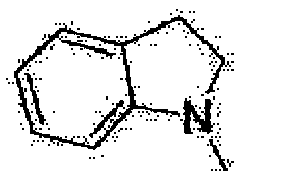
CH 63 
N 64 
CH 65 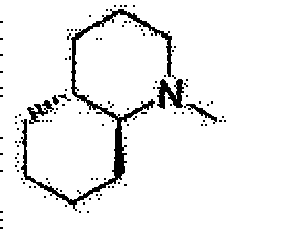
N 66 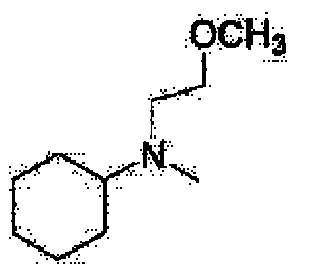
CH 67 
N 68 
CH 69 
N 70 
CH 71 
N 72 
CH 73 
N 74 
CH 75 
N 76 
CH 77 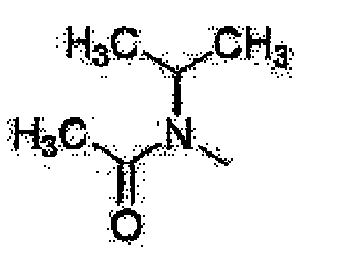
N 78 
CH 79 
N 80 
CH 81 
N 82 
CH 83 
N 84 
CH 85 
N 86 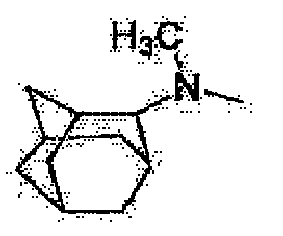
CH 87 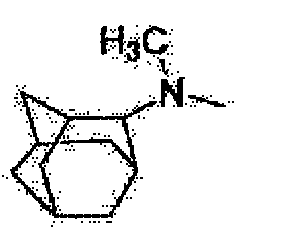
N 88 
CH 89 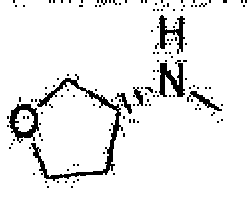
N 90 
CH 91 
N 92 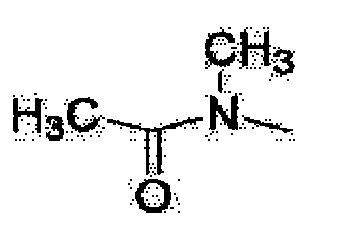
N 93 
CH 94 
N 95 
N 96 
CH 97 
N 98 
CH 99 
N 100 
CH 101 
N Compound No. STRUCTURE 201 
202 
203 
204 
205 
206 
207 
208 
209 
210 
211 
212 
213 
214 
215 
216 
217 
218 
219 
220 
221 
222 
223 
224 
225 
226 
227 
228 
229 
230 
231 
232 
233 
234 
235 
236 
237 
238 
239 
240 
241 
242 
243 
244 
245 
246 
247 
248 
249 
250 
251 
252 
253 
254 
255 
256 
257 
258 
259 
260 
261 
262 
263 
264 
265 
266 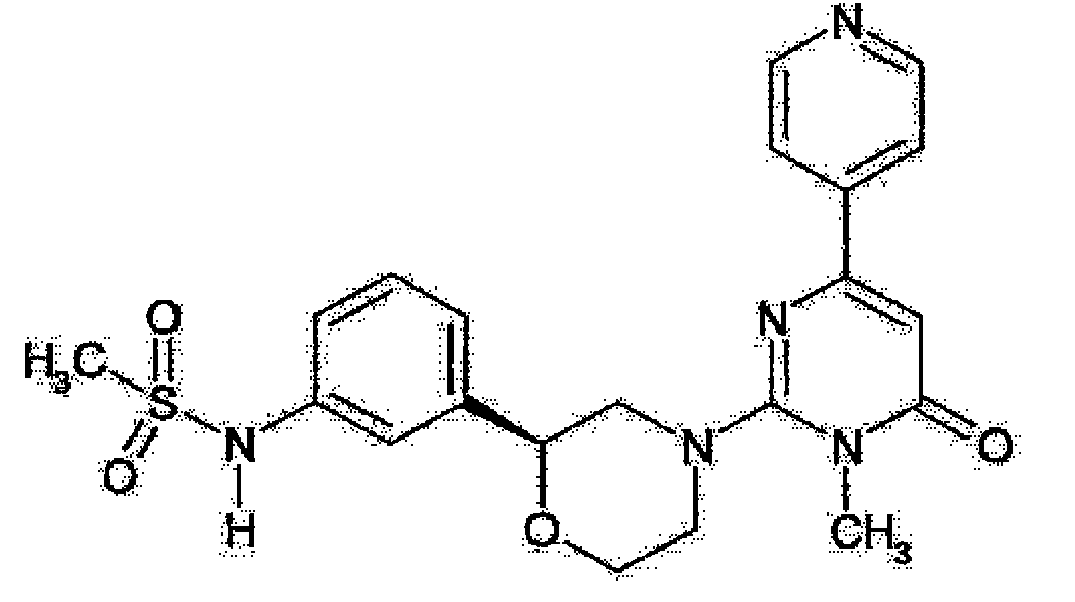
267 
268 
269 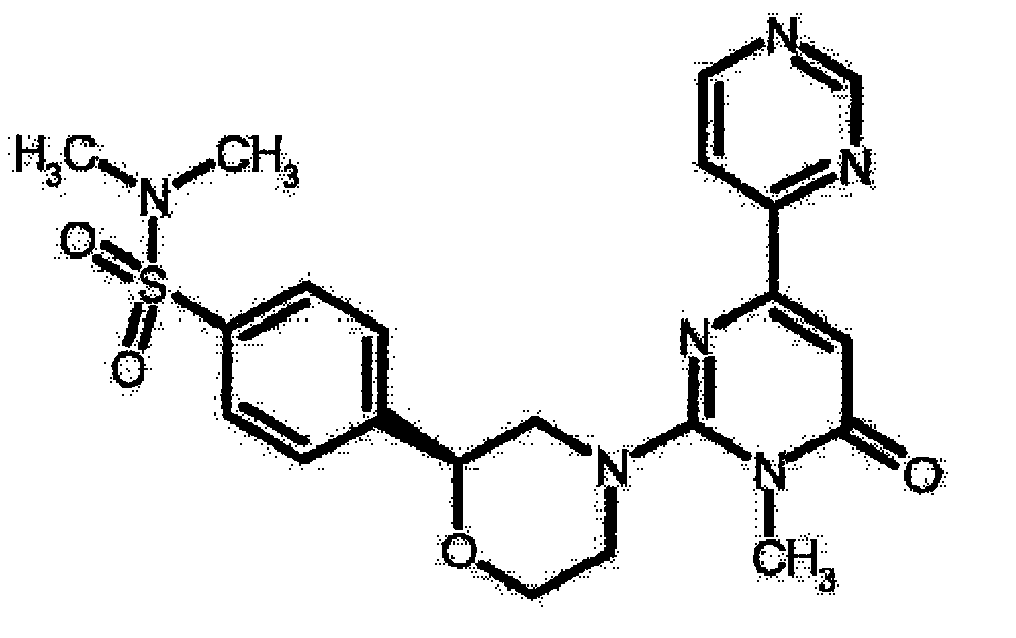
270 
271 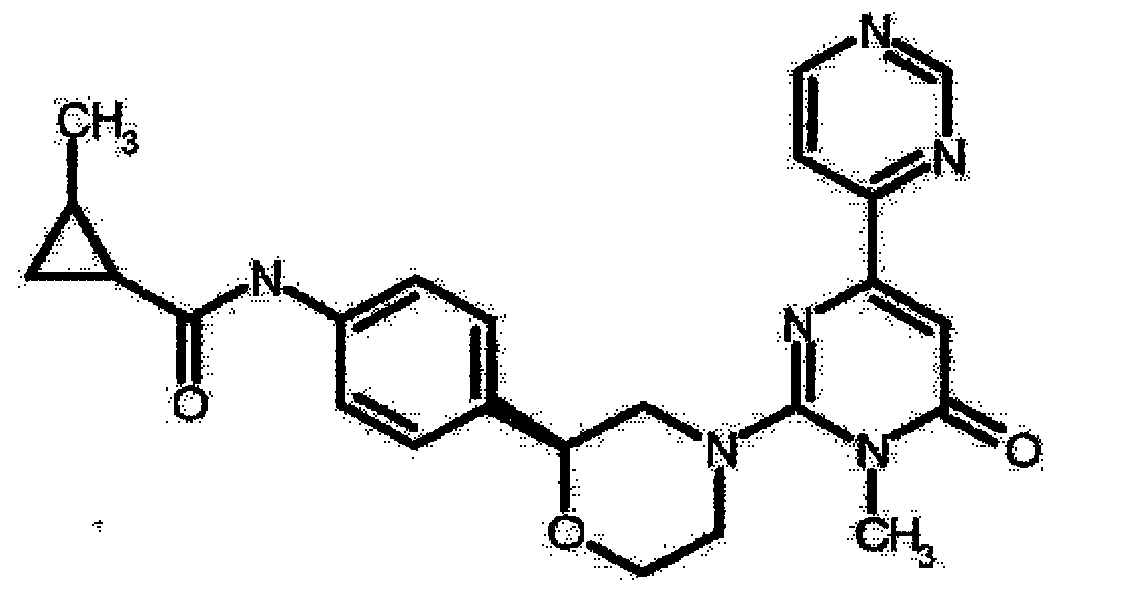
272 
273 
274 
275 
276 
277 
278 
279 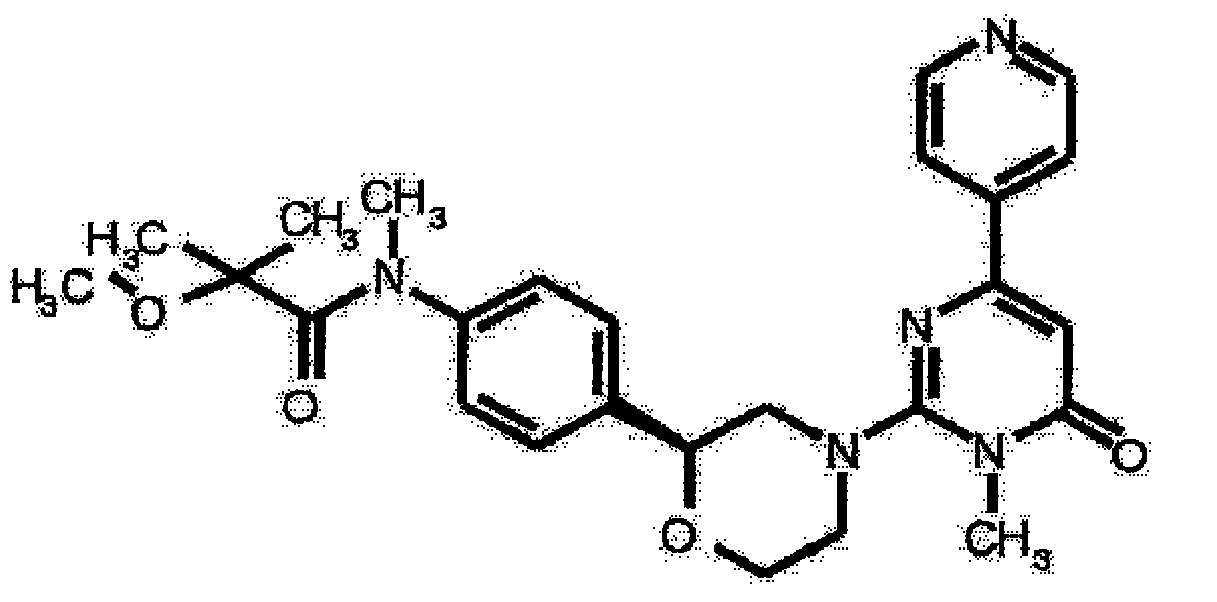
280 
281 
282 
283 
284 
285 
286 
287 
288 
289 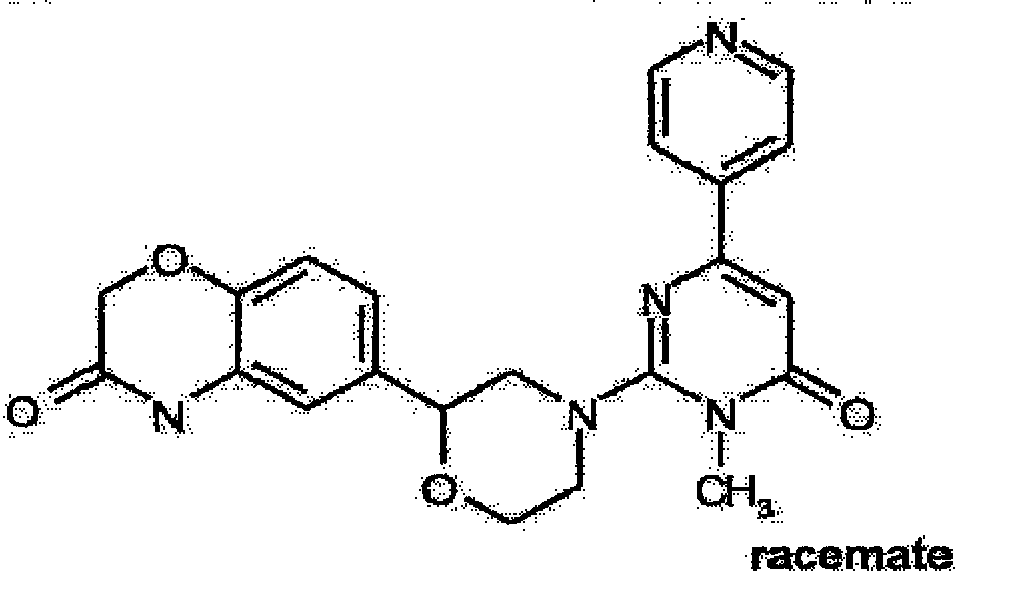
290 
291 
292 
- Particularly preferred compounds of the present invention represented by formula (I) include:
- 2-(2-4((4-Pyrrolidin-1-yl)piperidin-1-yl)phenyl)morpholin-4-yl)-3-methyl-6-pyrimidin-4-yl-3H-pyrimidin-4-one,
- 2-(2-(4-((4-Piperidin-1-yl)piperidin-1-yl)phenyl)morpholin-4-yl)-3-methyl-6-pyrimidin-4-yl-3H-pyrimidin-4-one,
- 2-(2-(4-(N-Cyclohexyl-N-methylamino)phenyl)morpholin-4-yl)-3-methyl-6-pyridin-4-yl-3H-pyrimidin-4-one,
- 2-(-2-(4-(2-Hydroxyethyl)piperazin-1-yl)phenyl)morpholin-4-yl)-3-methyl-6-pyridin-4-yl-3H-pyrimidin-4-one,
- 2-(2(4-((3-Pyrrolidin-1-yl)pyrrolidin-1-yl)phenyl)morpholin-4-yl)-3-methyl-6-pyrimidin-4-yl-3H-pyrimidin-4-one,
- 2-(2-(4-(3-N-acetyl-N-methylaminopyrrolidin-1-yl)phenyl)morpholin-4-yl)-3-methyl-6-pyridin-4-yl-3H-pyrimidin-4-one,
- 2-{2-[4-(3-Hydroxy-azetidin-1-yl)phenyl]morpholin-4-yl}-3-methyl-6-pyridin-4-yl-3H-pyrimidin-4-one,
- N-(4-(4-(1-Methyl-6-oxo-4-(pyridin-4-yl)-1,6-dihydropyrimidin-2-yl)morpholin-2-yl)-phenyl)-acetamide,
- N-(4-(4-(1,6-Dihydro-1-methyl-6-oxo-4,4'-bipyrimidin-2-yl)morpholin-2-phenyl)-acetamide,
- 2-(2-(4-(2-Pyridylamino)phenyl)morpholin-4-yl)-3-methyl-6-pyrimidin-4-yl-3H-pyrimidin-4-one,
- 2-(2-(4-Cyclopropylcarbonylamino)phenyl)morpholin-4-yl)-3-methyl-6-pyridin-4-yl-3H-pyrimidin-4-one,
- 2-(2-(4-Cyclopropylcarbonylamino)phenyl)morpholin-4-yl)-3-methyl-6-pyrimidin-4-yl-3H-pyrimidin-4-one,
- 2-(2-(4-Tetrahydrofuran-3-ylamino)phenyl)morpholin-4-yl)-3-methyl-6-pyrimidin-4-yl-3H-pyrimidin-4-one,
- 2-(2-(4-(N-Tetrehydrofuran-3-yl-N-methylamino)phenyl)morpholin-4-yl)-3-methyl-6-pyrimidin-4-yl-3H-pyrimidin-4-one,
- N-{4-[(2S)-4-(1-Methyl-6-oxo-4-pyridin-4-yl-1,6-dihydropyrimidin-2-yl)morpholin-2-yl]phenyl}-2-pyrrolidin-1-ylacetamide,
- N-{4-[(2S)-4-(1-Methyl-6-oxo-1,6-dihydro-4,4'-bipyrimidin-2-yl)morpholin-2-yl]phenyl}-2-pyrrolidin-1-ylacetamide,
- N2,N2-Dimethyl-N1-{4-[(2S)-4-(1-methyl-6-oxo-1,6-dihydro-4,4'-bipyrimidin-2-yl) morpholin-2-yl]phenyl}glycinamide,
- Methyl {4-[(2S)-4-(1-methyl-6-oxo-4-pyridin-4-yl-1,6-dihydropyrimidin-2-yl)morpholin-2-yl]phenyl}carbamate,
- Ethyl {4-[(2S)-4-(1-methyl-6-oxo-1,6-dihydro-4,4'-bipyrimidin-2-yl)morpholin-2-yl]-phenyl}carbamate,
- N-{4-Methoxy-3-[(2S)-4-(1-methyl-6-oxo-4-pyridin-4-yl-1,6-dihydropyrimidin-2-yl) morpholin-2-yl]phenyl}acetamide,
- N-{4-Methoxy-3-[(2S)-4-(1-methyl-6-oxo-1,6-dihydro-4,4'-bipyrimidin-2-yl)morpholin-2-yl]phenyl}acetamide, and
- N-{3-[(2S)-4-(1-Methyl-6-oxo-4-pyridin-4-yl-1,6-dihydropyrimidin-2-yl)morpholin-2-yl]phenyl}acetamide,
- an optically active isomer thereof, or a pharmaceutically acceptable salt thereof.
- Salts of the aforementioned preferred compound, and solvates or hydrates of the aforementioned compounds and salts thereof are also preferred,
- The compounds represented by the aforementioned formula (I) can be prepared, for example, according to the method explained below.

- The 2-chloropyrimidome represented by the above formula (II) is prepared easily by the method described in the specification of
WO2003/027080 andWO 2003/037888 . - Then the chloride derivative (II) is allowed to react with the amine (III) or salts thereof in the presence of a base such as sodium hydroxide, potassium hydroxide, sodium methoxide, sodium ethoxide, sodium carbonate, sodium hydrogencarbonate, potassium carbonate, triethylamine, diisopropylothylamine, and 1,8-diazabicyclo[5,4,0]undec-7-en for 1 to 100 hours at a suitable temperature ranging from 0 °C to 200 °C under nitrogen or argon atmosphere or under ordinary air to afford the desired compound (I).
- Examples of a solvent for the reactions include, for example, alcoholic solvents such as methanol, ethanol, 1-propanol, isopropanol, tert-butanol, ethylene glycol, propylene glycol, etheric solvents such as diethyl ether, tert-butyl methyl ether, tetrahydrofuran, isopropyl ether; hydrocarbonic solvents such as benzene, toluene, xylene; halogenated hydrocarbonic solvents such as dichloromethane, chloroform, dichloroethane; aprotic polar solvents such as formamide, N,N-dimethylformamide N,N-dimethylacetamide, N-methylpyrrolidone, dimethyl sulfoxide, sulfolane, hexamethylphosphoric triamide, water and the like. Generally, a single solvent or a mixture of two or more solvents may be used so as to be suitable to a base used,
- The compounds of the present invention have inhibitory activity against TPK1, and they inhibit TPK1 activity in neurodegenerative diseases such as Alzheimer disease, thereby suppress the neurotoxicity of Aβ and the formation of PHF and inhibit the nerve cell death. Accordingly, the compound of the present invention are useful as an active ingredient of a medicament which radically enables preventive and/or therapeutic treatment of Alzheimer disease. In addition, the compounds of the present invention are also useful as an active ingredient of a medicament for preventive and/or therapeutic treatment of ischemic cerebrovascular accidents, Down syndrome, cerebral bleeding due to solitary cerebral amyloid angiopathy, progressive supranuclear palsy, subacute sclerosing panencephalitis, postencephalitic parkinsonism, pugilistic encephalosis, Guam parkinsonism-dementia complex, Lewy body disease, Pick's disease, corticobasal degeneration frontotemporal dementia, vascular dementia, traumatic injuries, brain and spinal cord trauma, peripheral neuropathies, retinopathies and glaucoma, non-insulin dependent diabetes, obesity; manic depressive illness, schizophrenia, alopecia, breast cancer, non-small cell lung carcinoma, thyroid cancer, T or B-cell leukemia, and several virus-induced tumors. As the compound of the present invention has good safety and good pharmacokinetics, the compound has preferable characteristics as a medicament.
- As the active ingredient of the medicament of the present invention, a substance may be used which is selected from the group consisting of the compounds represented by the aforementioned formula (I) and pharmacologically acceptable salts thereof, and solvates thereof and, hydrates thereof. The substance per se, may be administered as the medicament of the present invention, however, it is desirable to administer the medicament in a form of a pharmaceutical composition wich comprises the aforementioned substance as an active ingredient and one or more of pharmaceutical additives. As the active ingredient of the medicament of the present invention, two or more of the aforementioned substance may be used in combination.
- A type of the pharmaceutical composition is not particularly limited, and the composition may be provided as any formulation for oral or parenteral administration. For example, the pharmaceutical composition may be formulated, for example, in the form of pharmaceutical compositions for oral administration such as granules, fine granules, powders, hard capsules, soft capsules, syrups, emulsions, suspensions, solution and the like, or in the form of pharmaceutical compositions for parenteral administrations such as injections for intravenous, intramuscular, or subcutaneous administration,drip infusions, transdermal preparations, transmucosal preparations, nasal drops, inhalants, suppositories and the like.
- Dose and frequency of administration of the medicament of the present invention are not particularly limited, and they may be appropriately chosen depending on conditions such as a purpose of preventive and/or therapeutic treatment, a type of a disease, the body weight or age of a patient, severity of a disease and the like. Generally, a daily dose for oral administration to an adult may be 0,01 to 1,000 mg (the weight of an active ingredient), and the dose may be administered once a day or several times a day as divided portions, or once in several days. When the medicament is used as an injection, administrations may preferably be performed continuously or intermittently in a daily dose of 0.001 to 3000 mg (the weight of an active ingredient) to an adult.
- The present invention will be explained more specifically with reference to examples. However, the scope of the present invention is not limited to the following examples. The compound number in the examples corresponds to that in the table above.
- A borane-tetrahydrofuran complex (1.0 M solution in tetrahydrofuran, 270 ml, 270 mmol) was added to the solution of (S)-CBS ((S)-2-Methyl-CBS-oxazaborolidine, 50 ml, 1.0M solution in toluene) at -30 °C over 15 min and the solution was stirred for 15 minutes. 4-Bromophenacyl bromide (75.0g, 270 mmol) in dichloromethane (350 ml) was dropped over 70 minutes keeping the temperature -32 to -28 °C. After one hour stirring, solution was warmed to room temperature, and methanol (10 ml) was added slowly any then 0.5 M hydrochloric acid (300 ml) was dropped over 10 minutes. The solution was filtered after 40 minutes stirring and filtrate was extracted by dichloromethane. The combined organic layer was washed with 0.5 M hydrochloric acid, 0.1M aqueous sodium hydroxide and brine and dried over anhydrous sodium sulfate. Concentration of the organic layer yielded 2-bromo-(1S)-1-4-bromophenyl)ethanol (77 g) as a pale brown oil.
- Aqueous sodium hydroxide (1M ,400 ml) was added to 2-bromo-(1S)-1-(4-bromophenyl)ethanol (77.0 g) in diethyl ether (400 ml) and stirred at room temperature for 5 hours. The organic layer was separated and water layer was extracted with ether. Combined organic layer was washed with brine and dried over anhydrous sodium sulfate. Removal of the solvent yielded
- A mixture of (-2S)-2-(4-bromophenyl)oxirane (65.0 g) and (R)-1-phenylethylamine (98.2g, 810 mmol) was heated at 80 °C for 6 hours. Addition of isopropyl other (200 ml) to the residue after distillation of excess phenethylamine and successive filtration yielded (1S)-1-(4-bromophenyl)-2-((1R)-1-phenylethylamino) ethanol (57.0 g) as white crystals. Further crystallization was performed by the concentration of the filtrate in vacuo and cooling the residue in refrigerators Filtration of the crystal with isopropyl ether (30 ml) yielded additional title compound (5.60 g) as crystals (72.4% yield, 3 steps).
- A solution of chloroacetyl chloride (24.3g, 215 mmol) in dichloromethane (100 ml) was dropped into the ice-cooled solution of (1S)-1-(4-bromophenyl)-2-1((R)-1-phenylethylamino)ethanol (62.6 g, 215 mmol) and triethylamine (21.8g, 215 mmol) in dichloromethane (600 ml) over 30 minutes and stirred for one hour at the same temperature. Resulting solution was washed with 0.5 M hydrochoric acid, saturated sodium hydrogen carbonate, brine and dried over anhydrous magnesium sulfate. The solvents were removed under reduced pressure and potassium hydroxide (85%, 16.1g, 244 mmol was added to a solution of resulting pate brown oil in isopropyl alcohol (600 ml) and stirred for 16 hour. The solvent was removed in vacuo and the residue was partitioned between water any ethyl acetate. The organic layer was washed with 0.5 M hydrochloric acid, saturated sodium hydrogen carbonate, brine and dried over anhydrous magnesium sulfate. Removal of the solvent under reduced pressure furnished (6S)-6-(4-bromophenyl)- 4-((1R)-1-phenyethyl)morpholin-3-one(70.2 g) as a brown oil.
- Aborane-tetrahydrofuran complex(1.0M solution in tetrahydrofuran,51mL 510 mm) was added to the ice-cooled solution of (6S)-6-(4-bromophenyl)-4-((IR)-1-phenyl)-morpholin-3-one (70.2 g) in tetrahydrofuran (500 ml) over 45 minutes and the solution was stirred at the same temperature for one hour and room temperature for 20 minutes. After careful addition of methanol (60 ml) to the ice-cooled solution, the solvent was removed under reduced pressure and the residue in methanol (750 ml) and 1M aqueous sodium hydroxide (280 ml) was stirred at 80 °C for one, hour with addition of 1M aqueous sodium hydroxide (70 ml) in every 15 minutes. The solvents was removed under reduced pressure and the residue was partitioned between water and ethyl acetate. The organic layer was washed with water and brine and dried over anhydrous magnesium sulfate. Removal of the solvent yielded (2S).
- 2-(4-bromophenyl)-4-((1R)-1-phenylethyl)morpholine (65.0 g,96.3% yield, 2 steps) as white crystals.
Melting point; 85-87°C
IR: 1487, 1449, 1117,1098,809. 758, 699, 550 cm-1
1H.NMR(CDl3) δ :1.35(3H,d),2.10(2H,m), 2.60(1H,m), 3.051(1H,m),3.35(1H,q), 3.75(3.89(1H,m), 7,25(7H,m), 7.46(2H,d) - A solution of (2S)-2-(4-bromophenyl)-4-((1R)-1-phenylethyl)morpholine (15.6 g, 45 mmol), benzophenone imine (9 g, 50 mmol), tris(dibenzylideneacetone)-dipalladium(0)-chloro form adduct (0.98 g, 0.9 mmol), sodium tert-butoxide (6.0 g, 63 mmol) and 2-(di-t-butylphosphino)piphenyl (0.53 g, 1.8 mmol) in toluene (135 ml) was stirred at 95 °C for 4 hours. The solvent was removed in vacuo and the residue was partitioned between water and ethyl acetate. The organic layer was dried over anhydrous sodium sulfate and the solvent was removed under reduced pressure. To a solution of the resulting residue in tetrahydrofuran (180 ml) was added 6N hydrochloric acid (180 ml) and the mixture was stirred at room temperature for one hour. The solvent was removed in vacuo and the residue was partitioned between water and ethyl acetate. The organic layer was dried over anhydrous sodium sulfate and the solvent was evaporated. The resulting residue was purified by column chromatography on silica gel (hexane-AcOEt, 2:1) to give (2S)-2-(4-aminophenyl)-4-((1R)-1-phenylethyl)morpholine (12.2 g, 96%) as an oil.
- To a solution of (2S)-2-(4-aminophenyl)-4-((1R)-1-phenylethyl)morpholine (7.9 g, 38 mmol) and triethylamine (8.5 g, 84 mmal) in tetrahydrofuran (180 ml) was added acetyl chloride (4.4 g, 56 mmol). The mixture was stirred at room temperature for 2 hours and partitioned between water and chloroform. The organic extract was washed with brine and dried over anhydrous sodium sulfate. The solvent was removed under reduced pressure and the precipitated crystals were collected by filtration, washed with isopropyl ether to give N-(4-((2S)-4-((1R)-1-phenyhethyl)morpholin-2-yl)phenyl)- acetamide (6.47 g, 71%) as yellow crystals.
- To a solution of N-(4-((2S)-4-((1R)-1-phenylethyl)morpholin-2-yl)phenyl) acetamide (6.47 g, 20 mmol) and ammonium formate (6.3 g, 100 mmol) in mixture of tetrahydrofuran (136 ml), methanol (270 ml) and water (70 ml) was added 10% palladium on carbon (wet, 270 mg) and the solution was stirred at 95 °C for 3 hours. After filtration, the solvent was removed in vacuo and the residue was partitioned between water and dichloromethane. The organic layer was dried over anhydrous sodium sulfate and the solvent was evaporated under reduced pressure to give N-(4-((2S)-morpholin-2-yl)phenil)acetamide (6-78 g, quant) as an yellow oil.
- A solution of N-(4-((2S)-morpholin-2-yl)-phenyl)acetamide (2,63 g, 11.9 mmol), 2-chloro-1-methyl-6-oxo-4-(pyridin-4-yl)-1.6-dihydropyrimidine (2.60 g, 11.9 mmol), and triethylamine (3.60 g, 35,7 mmol in tetrahydrofuran (100 ml) was stirred at 95°C for one hour. The solvent was removed in vacuo and the residue was partitioned between water and dichloromethane. The organic layer was dried over anhydrous sodium sulfate and the solvent was removed under reduced pressure. The resulting residue was purified by column chromatography on silica gel (chloroform-methanol, 10:1) to afford N-(4-((2S)-4-(1-Methyl-6-oxo-4-(pyridin-4-yl)-1,6-dihydropyrimidin-2-yl)morpholin-2-yl)pheny)acetamide (2.8 g, 58%) as pale yellow crystals.
- A solution of N-(4-((2S)-morpholin-2-yl)phenyl)acetamide(5.78 g. 26.2 mmol), 2-chloro-1,6-dihydro-1-methyl-6-oxo-4'4-bipyrimidine(4.00 g, 18 mmol), and triethylamine (6.00 g, 60 mmol) in tetrahydrofuran (100 ml) was stirred at 95 °C for one hour. The solvent was removed in vacuo and the residue was partitioned between water and dichloromethane.The organic layer was dried over anhydrous sodium sulfate and the solvent was evaporated under reduced pressure. The resulting residue was purified by column chromatography on silica gel (chloroform-methanol, 10:1) to afford N-(4-((2S)-4-(1,6-Dihydro-1-methyl-6-oxo-4,4'-bipyrimidin-2-yl)morpholin-2-yl)phenyl)acetamide (5.7 g, 30%) as pale yellow crystals.
- To a suspension of (2S)-2-(4-bromophenyl)-4-((1R)-1-phenylethyl)morpholine (7,62 g. 22.0 mmol), palladium acetate (198 mg, 0.88 mmol), 2-(di-t-butylphosphino) biphenyl (525 mg, 1.76 mmol), and sodium tert-butoxide (2.96 g, 30.8 mmol) in toluene (40 ml) was added cyclohexylamine (3.78 ml, 83.0 mmol) at room temperature. After heating at 90 °C for 2.5 hours, the resulting suspension was passed through a Celite column. The filtrate was concentrated under reduced pressure, and the residue was purified by silica gel chromatography eluting 5-25% of ethyl acetate in hexane to afford (S)-2-(4-(cyclohexyl-amino)phenyl)-4-(R)-1-phenylethyl)morpholine (6.95 g, 87%) as white crystals,
- To a solution of (S)-2-(4-(cyclohexylamino)phenyl)-4-((R)-1-phenylethyl) morpholine (6.95 g, 19.1 mmol) and formalin (35%, 8.18 ml, 95.4 mmol) was added sodium triacetoxyborohydride (12.1 g,57.2 mmol) at room temperature. After stirring for 30 minutes, the resulting suspension was partitioned between ethyl acetate and 1N sodium hydroxide. The aqueous layer was extracted with ethyl acetate. The combined organic layer was washed with brine, dried over magnesium sulfate, and concentrated in vacuo. The residue was purified by silica gel chromatography eluting 5-20% ethyl acetate in hexane to furnish (2S)-2-(4(N-cyclohexyl-N-methylamino)phenyl)-4-((1R)-1-phenylethyl)morpholine (7.27 g, quant.) as a pale yellow oil.
- A 300-ml flask containing a solution of (S)-2-(4-(N-cyclohexyl-N-methylamino)phenyl)-4-((R)-1-phenyletlyl)morpholine (7.27 g, 19.07 mmol) and 10% palladium on carbon (3.0 g) in ethanol (30 ml) was charged with hydrogen. The reaction mixture was stirred vigorously at 50 °C for 10 hours. The catalyst was filtered off with a Celite pad, and the filtrate was concentrated under reduced pressure to yield (2S)-2-(4-(N-cyclohexyl-N-methylamino)phenyl)morpholine (4.95 g, 95%) as a clear oiL
- To a solution of(2S)-2-(4-(N-cyclohexyl-N-methylamino)phenyl)morpholine (4.47 g, 16.30 mmol) and triethylamine (3.1 ml, 22.2 mmol) in tetrahydrofuran (50 ml) was added 2-chloro-3-methyl-6-(4-pyridyl)-3H-pyrimidin-4-one(3.28 g, 14.82 mmol) portionwise. Upon disappearance of the chloropyrimidone, the reaction mixture was condensed under reduced pressure. The residue was partitioned between 1N sodium hydroxide and dichloromethane. The organic layer was washed with water, dried over anhydrous sodium sulfate, filtered, and concentrated under reduced pressure to give a pale yellow solid, which was recrystallized from ethanol to afford
2-((2S)-2-(4-(N-cyclhexyl-N-methylamino)phenyl)morpholin-4-yl)-3-ethyl-6-(4-pyridyl)-pyrimidin-4-one (5.15 g. 75.7%) as white crystals. - A solution of (2S)-2-(4-aminophenyl)-4-((1R)-1-phenylethyl)morpholine(1.5 g, 5.31 mmol), 2-chloropyridine (1.21 g, 10.6 mmol), tris(dibenzylideneacetone)-dipalladium(0) (52.6 mg, 0.05 mmol), potassium tert-butoxide (0.88 g, 7.8 mmol) and 1,3-bis(2,6-di-propylphenyl)imidazolium chloride (89.6 mg, 0.21 mmol) in dioxane (17 ml) was stirred at 90°C for 15 hours. The solvent was removed under reduced pressure and the residue was partitioned between water and ethyl acetate. The organic layer was dried over anhydrous sodium sulfate and the solvent was evaporated under reduced pressure. The resulting residue was purified by column chromatography on silica gel (hexane-ethyl acetate, 1:2) to afford N-(4-((2S)-4-((1R)-1-Phenylethyl)-morpholin-2-yl)phenyl)pyridin-2-amine (0.68 g, 36%) as red crystals.
- To a solution of N-(4-((2S)-4-((1R)-1-phenylethyl) morpholin-2-yl) phenyl)-pyridin-2-amine (0-89 g, 2.5 mmol) and ammonium formate (0.78 g, 12.5 mmol) in tetrahydrofuran (15ml) - methanol (24 ml) - water (18 ml) was added 10% palladium on carbon (wet, 200 mg) and the mixture was stirred at 95°C for one hour. After filtration, the solvent was removed in vacuo and the residue was partitioned between water and dichloromethane. The organic layer was dried over anhydrous sodium sulfate and the solvent was concentrated under reduced pressure to yield N-(4-((2S)-Morpholin-2-yl)phenyl)pyridin- 2-amine (0.60 g, 94%) as a yellow oil.
- A solution of N-{4-[(2S)-morpholin-2-yl]phenyl}pyridin-2-amine (0-2 g, 0.78 mmol), 2-chloro-1-methyl-6-oxo-4-(pyridin-4-yl)-1,6-dihydropyrimidine (0.13 g, 0.62 mmol), and triethylamine (0.23 g. 2.3 mmol) in tetrahydrofuran (10 ml) was stirred at 95 °C for 3 hours. The solvent was removed under reduced pressure and the residue was partitioned between water and dichloromethane. The organic layer was dried over anhydrous sodium sulfate and the solvent was concentrated under reduced pressure. The resulting residue was purified by column chromatography on silica gel (chloroform methanol, 10:1) to afford 3-Methyl-2-((2S)-2-((pyridin-2-yl)amino) phenyl)morpholin-4-yl)-6-(pyridin-4-yl) pyrimidin-4(3H)-one (100 mg, 37%) as a yellow oil.
- To a solution of N-(4,-((2S)-4-((1R)-1-phenyl)morpholin-2-yl)phenyl) pyridin-2-amine (0.57g,1.5 mmol) and iodomethane (1.6 g, 11.2 mmol) in tetrahydrofuran (50 ml) was added potassium tert-butoxide (1,6 g, 9,45 mmol). After stirring at room temperature for 4 hours, water was added and the mixture was extracted with ethyl acetate. The organic layer was washed with brine, dried over anhydrous sodium sulfate, and evaporated. The crude product was purified by column chromatography on silica gel (hexane - ethyl acetate, 1:1) to afford N-Methyl-N-(4-((2S)-4-((1R)-1-pheylethyl)-morpholin-2-yl)phenyl)pyridin-2-amine(0.57 g, 81%) as a yellow oil.
- To a solution of N-Methyl-N-(4-((2S)-4-((1R)-1-phenylethyl)morpholin-2-yl)-phenyl)pyridin-2-amine (0.57 g, 1.5 mmol) and ammonium formate (0.48g,7.6 mmol in tetrahydrofuran (15 ml) - methanol (30 ml) - water (16 ml) was added 10% palladium on carbon (wet, 200 mg) and stirred at 95°C for one hour. After filtration, the solvent was removed under reduced pressure and the residue was partitioned between water and dichloromethane, The organic layer was dried over anhydrous sodium sulfate and the solvent was concentrated under reduced pressure to give N-Methyl-N-(4-((2S)-morpholin-2-yl)phenyl)pyridin-2-amine (0.38 g, 94%) as a yellow oil.
- A solution of N-Methyl-N-(4-((2S)-morpholin-2-yl)phenyl)pyridin-2-amine (0.12 g, 0.46 mmol), 2-chloro-1-methyl-6-oxo-4-(pyridin-4-yl)-1,6-dihydropyrimidine (0.08 g, 0.37 mmol), and triethylamine (0.33 g, 2.3 mmol) in tetrahydrofuran (10 ml) was stirred at 85 °C for 3 hours. The solvent was removed under reduced pressure and the residue was partitioned between water and dichloromethane. The organic layer was dried over anhydrous sodium sulfate and the solvent was concentrated under reduced pressure. The resulting residue was purified by column chromatography on silica gel (chloroform-methanol, 10:1) to give 3-Methyl-2- ((2S)-2-(4-(methyl (pyridin-2-yl)amino)phenyl)morpholin-4-yl)-6-(pyridin-4-yl)- pyrimidin-4(3H)- one (65 mg, 13%) as a yellow oil.
- (R)-(+)-3-Aminotetrahydrofuran toluene-4-sulfonate (2.0 g, 7.7 mmol) was added to a suspension of (2S)-2-(4-bromophenyl)-4-((1R)-1-phenylethyl)morpholine (2.4 g, 6.9 mmol), palladium acetate (65 mg. 0.29 mmol), 2-(di-t-butylphosphino)biphenyl (170 mg, 0.57 mmol), and sodium tert-butoxide (3.4 g, 35.4 mmol) in tert-butanol (50 ml) at room temperature. After heating at 90°C for 6 hours, the resulting suspension was passed through a Celite column. The filtrate was concentrated under reduced pressure, and the residue was purified by silica gel chromatography eluting 5-10% methanol in chloroform to afford 4-((1R)-1-phenylethyl)-(2S)-2-(4-(N-(3R)-tetrahydrofuran-3-yl)amino)phenyl)morpholine (1.3 g, 53%) as white crystals. 1H-NMR(CDCl3) δ : 1.35 (3H, d, J=6.8 Hz), 2.04-2.16 (4H, m), 2.55-2.62 (1H, m), 3.08-3.12 (1H, m), 3.33-3.38(1H, m), 3.67-3.93 (5H, m) ,3.98-4.02 1H ,m) ,4.46-4.58 (2H,m) ,6.57 (2H, d, J=7.2 Hz), 6.83 (1H, d, J=9.0 Hz), 7.21-7.33 (7H, m)
- Sodium triacetoxyborohydride (2.4 g, 11.3 mmol) was added to a solution of 4-((1R)-1-phenylethyl)-(2S)-2-(4-(N-((3R)-tetrahydrofuran-3yl)amino)phenyl)morpholi ne (1.3 g, 3.69 mmol) and formalin (35%, 1.6 g, 18.6 mmol) in dichloroethane (50 mL) at room temperature. After stirring for 2 hours, the resulting suspension was partitioned between ethyl acetate and 1 N sodium hydroxide. The aqueous layer was extracted with ethyl acetate. The combined organic layer was washed with brine, dried over magnesium sulfate, and concentrated in vacuo. The residue was purified by silica gel chromatography eluting 5-10% methanol in chloroform to furnish (2S)-2-(4-(N-methyl-N-((3R)-tetrahydrofuran-3-yl)amino)phenyl)-4-((1R)-1-phenylethy l)morpholine, (1.36 g, 100%) as a pale yellow oil.
1H-NMR(CDCl3)δ :1.33(3H, d, J=6.8Hz), 2.02-2.13(4H,m), 2.53-2.60 (1H, m), 3.00(3H, s),3.08-3.12 (1H, m), 3.30-3.34 (1H, m), 3.70-3.98 (5H, m), 4.00-4.06 (1H, m), 4.46-4.58 (2H, m), 6.60 (2H, d, J=7.2 Hz), 7.28-7.37 (7H, m) - A solution of 10% palladium on carbon (1.0 g) and (2S)-2-(4-(N-methyl-N-((3R)-tetrahydrofuran-3yl)amino)phenyl)-4-((1R)-1-phenylethyl)morpholine (3.69 mmol) in methanol (10 ml) was stirred under hydrogen atmosphere vigorously at 50°C for 10 hours, The catalyst was filtered off with a Celite pad, and the filtrate was concentrated under reduced pressure. The residue was treated with 4N hydrogen chloride in ethyl acetate and concentrated under reduced pressure to give a pale yellow solid, which was recrystallized from ethanol to afford
(2S)-2-(4-(N-methyl-N-(3R)-tetrahydrofuran-3yl)amino)phenyl)morpholine hydrochloride (0.9 g, 73%) as white crystals.
1H-NMR(DMSO-d6) δ : 2.99 (3H, s), 3.00-3.12 (2H, m), 3.28-3.28 (1H, m), 3,61-4.02 (9H, m), 4.51-4.53 (1H, m), 4.79 (1H, d, J=10.1 Hz), 7.42-7.48 (4H, m), 9.63 (2H, br) - A solution of 2-chloro-3-methyl-6-(4-pyrimidin-4-yl)-3H-pyrimidin-4-one (0.24 g, 1.08 mmol), (2S)-2-(4-(N-methyl-N-((3R)-tetrahydrofuran-3yl)amino)-phenyl) morpholine hydrochloride (0.4 g, 1,19 mmol) and triethylamine (0.6 g, 5.93 mmol) in tetrahydrofuran (20 ml) was stirred for 15 hours at room temperature. The mixture was partitioned between water and chloroform, and the organic layer was washed with brine, dried over magnesium sulfate, and concentrated in vacuo. The residue was purified by silica gel column chromatography eluting 5-10% methanol in chloroform to furnish (2-(2S)-2-(4-(N-methyl-N-(3R)-tetrahydrofuran-3-yl)amino)phenyl)-morpholin-4-yl)-3-methyl-6-(pyrimidin-4-yl)-pyrimidin-4-one (0.23 g, 47%) as pale yellow crystals.
- Phenyltrimethylammonium tribromide (276 g, 734 mmol) was added to a suspension of 4-hydroxyacotophenone (100 g, 734 mmol) in tetrahydrofuran (1000 ml) at room temperature. After stirring for 3 hours, the resulting suspension was filtered, and the filtrate was concentrated under reduced pressure. The residue was washed with diisopropyl ether to afford 2-bromo-1-(4-hydrophenyl)-ethan-1-one (85 g, 54%) as white crystals.
1R-NMR(CDCl3) δ : 3.84 (1H, br), 4.40 (2H, s), 6.98 (2H, d, J=7.2 Hz), 7.91 (2H, d, J=7.2 Hz) - Methanesulfonyl chloride (50 g, 436 mmol) was added to a solution of 2 -bromo-1-(4-hydroxyphenyl)-ethan-1-one (85g, 395 mmol) and triethylamine (48g, 474 mmol in tetrahydrofuran (1000 ml) at 0 °C and the mixture wax stirred for 30 minutes at room temperature: The mixture was partitioned between water and ethyl acetate, and the organic layer was washed with brine, dried ever magnesium sulfate, The solvent was evaporated under reduced pressure and the residue was washed with diisopropyl ether to afford 4-(2-bromoacetyl)phenyl methanesulfonate (96 g, 83%) as white crystals,
1H-NMR(CDCl3) δ : 3.22 (3H, s), 4.41 (2H, s), 7.41 (2H, d, J=7.2 Hz), 8.06 (2H, d, J=7.2 Hz) - Borane-tetrahydrofuran complex (1.0 M solution in tetrahydrofuran, 330 ml) was added to a solution af (S)-CBS ((S)-2-Methyl-CBS-oxazaborolidine 50 ml, 1.0 M solution in toluene) at -30 °C over 15 minutes and the solution was stirred for 30 minutes. 4-(2-Bromoacetyl)phenyl methanesulfonate (96 g, 328 mmol) in tetrahydrofuran (500 ml) was dropped over 70 minutes keeping the temperature -32 to -28 °C. After stirring for one hour, the solution was warmed to room temperature, and methanol (10 ml) was added slowly and then 0.5 M hydrochloric acid (300 ml) was dropped over 10 minutes. The solution was filtered after 40 minutes stirring and filtrate was extracted with ethyl acetate. The combined organic layer was washed with 0.5 M hydrochloric acid, 0.1 M aqueous sodium hydroxide, and brine and dried over anhydrous sodium sulfate. Concentration of the organic layer yielded 4-((2S)-2-bromo-1-hydrom-xyethyl)phenyl methanesulfonate as a pale brown oil. 1H-NMR(CDCl3) δ : 2.72 (1H, d, J=1.2 Hz), 3.10 (3H, s), 3-44-3.58 (2H, m), 4.93-4.97 (1H, m), 7.30 (2H, d, J=7.2 Hz), 7.46 (2H, d, J=7.2 Hz)
- An aqueous sodium hydroxide (1M, 600 ml) was added to 4-((2S)-2-bromo-1-hydroxyethyl)phenyl methanesulfonate (328 mmol) in diethyl ether (400 ml) and the solution was stirred at room temperature for 5 hours. The organic layer was separated and the aqueous layer was extracted with ethyl acetate. Combined organic layer was washed with brine and dried over anhydrous sodium sulfate. The solvent was evaporated under reduced pressure and the residue was washed with diisopropyl ether to afford 4-((S)-oxiranyl)phenyl methanesulfonate (69 g, 98%) as white crystals
1H-NMR(CDCl3) δ : 2.75 (1H, dd, J=1.2 Hz, 6.8 Hz), 3.14-3.16 (4H, m), 3.88 (1H, dd, J=1.2 Hz, 7.2 Hz), 7.28 (2H, d, J=7.2 Hz), 7.42 (2H, d, J=7.2Hz) - A mixture, of 4-((S)-oxiranyl)phenyl methanesulfonate (69 g, 322 mmol) and benzylamine (104 g, 971 mmol) was heated at 80 °C for 3 hours. An excess benzylamine was evaporated under reduced pressure and the residue was washed with diisopropyl ether to afford 4-((1S)-2-benzylamino-1-hydroxyethyl)phenyl methanesulfonate (71.0 g, 69%) as white crystals,
1H-NMR(CDCl3 δ % : 2.68-2.73 (1H, m), 2.96 (1H, dd, J=4.8 Hz, 10.2 Hz). 3.12 (3H, s), 3.84 (2H, d, J=1.2Hz), 4,72 (1H, dd, J=1.2 Hz, 10-2Hz), 7.23-7.43 (9H, m) - Chloroacetyl chloride (27.5 g, 243 mmol) was dropped to a solution of 4-((1S)-2-benzylamino-1-hydroxyethyl)phenyl methanesulfonate (71 g, 221 mmol in 1N aqueous sodium hydroxide (330 ml) and stirred for one hour at room temperature. Resulting solution was extracted with chloroform, and dried over anhydrous sodium sulfate. The solvent was removed under reduced pressure. Potassium hydroxide (86%, 17.5 g, 265 mmol) was added to a solution of the resulting pale brown oil in 2-propanol (600 ml), and the mixture was stirred for 10 hours. The solvent was removed in vacuo and the residue was partitioned between water and chloroform. The organic layer was washed with 0.5 M hydrochloric acid saturated sodium hydrogen carbonate, brine and dried over anhydrous magnesium sulfate. Removal of the solvent under reduced pressure furnished 4-((2S)-4-benzyl-5-oxo-morpholin-2-yl)phenyl methanesulfonate (79.8 g, 100%) as a brown oil.
1H-NMR(CDCl3) δ : 3.13 (3H. s), 3-29-3.36 (2H, m), 4.36-4.46 (4H, m), 4.81 (1H, dd, J=1.2 Hz, 10 Hz), 7.24-7.42 (9H, m) - Chlorotrimethylsilane (96 g, 884 mmol) was added to a solution of lithium borohydride (9.6 g, 441 mmol) in tetrahydrofuran (500 ml) and stirred for one hour at room temperature. A solution of 4-((2S)-4-benzyl-5-oxo-morpholin-2-yl)phenyl methanesulfonate (79.8 g, 221 mmol) in tetrahydrofuran (200 ml) was added to the solution and stirred at room temperature for one hour. After careful addition of methanol (60 ml) under ice-cooling the solvent was removed under reduced pressure. Potassium hydroxide (145 g, 2.2 mol) was added to a solution of the residue in ethanol (300 ml) and water (300 ml) and the mixture was stirred at 80 °C for 2 hours, The solvent was removed under reduced pressure and the residue was extracted with ethyl acetate and dried over anhydrous magnesium sulfate. Removal of the solvent yielded (2S)-4-benzyl-2-(4-hydroxyphenyl)morpholíne (39.8 g, 67 %) as white crystals.
1H-NMR(CDCl3) δ ; 2.05-2.31 (2H, m), 2.72-2.89(2H, m), 3.54 (2H, s), 3.81-3.86 (1H, m), 3.96-4.00 (1H, m), 4.60 C1H. dd, J=1.2 Hz, 10.2 Hz), 5.12 (1H, br), 6.75 (2H, d, J=7.2 Hz), 7.19-1.32 (7H, m) - A solution of 10% palladium on carbon (1.0 g) and
(2S)-4-benzyl-2-(4-hydroxyphanyl)morpholine (10g, 37.1 mmol) in methanol (100 ml) was stirred under hydrogen atmosphere vigorously at 50 °C for 10 hours. The catalyst was filtered off with a Celite pad, and the filtrate was concentrated under reduced pressure. Di-tert-butyldicarbonate (9.7 g, 44.4 mmol) was added to a solution of the residue in 1N aqueous sodium hydroxide (200 ml) at 0 °C and the mixture was stirred for one hour at room temperature. The mixture was partitioned between water and ethyl acetate. The organic layer was washed with brine, dried over magnesium sulfate, and concentrated in vacuo. The residue was purified by silica gel chromatography eluting 5-10% methanol in chloroform to furnish tert-buflyl (2S)-2-(4-hydroxyphenyl)morpholine-4-carboxylate (8.6 g, 83 %) as white crystals. 1H-NMR(CDCl3) δ : 1.48 (9H, s), 2-80-3,07 (2H, m), 3.62-3.70 1H, m), 3.86-4-02 (3H, m), 4.33 (1H, dd, J=1.2 Hz, 10-2 Hz), 5.72 (1H, br),6.81 (2H, d, J=7.2 HZ), 7.22 (2H, d, J=7.2 Hz) - Diisopropyl azodicarboxylate (40% in toluene, 13.6 g, 26.9 mmol) was added to a solution of tert-butyl (2S)-2-(4-hydroxyphenyl)morpholine-4-carboxylate (5.0 g, 17.9 mmol), triphenylphosphine (7.1 g, 27.1 mmol) and 3-bromopropanol (3.75 g, 27.0 mmol) in tetrahydrofuran (100 ml) and the solution was stirred for 10 hours at room temperature. The mixture was partitioned between water and ethyl acetate. The organic layer was washed with brine, dried over magnesium sulfate and concentrated in vacuo. The residue was purified by silica gel chromatography eluting 5-10% methanol in chloroform to furnish tert-butyl
(2S)-2-(4-(3-bromopropyloxy)phenyl)morpholine-4-carboxylate (7.16 g, 100%) as a colorless oil.
1H-NMR(CDCl3) δ : 1.48 (9H, s), 2-29-2.35 (2H, m), 2.83-3.08 2H, m), 3-58-3,70 (3H, m), 3.98-4-13 (5H, m), 4.36 (1H, d, J=1.2 Hz, 10.2 Hz), 6.90 (2H, d, J=7-2 Hz), 7.28 (2H, d, J=7.2 Hz) - tert-Butyl (2S)-2-(4-(3-bromopropyloxy)phenyl)morpholiline-4-carboxylate (2.0 g, 5.0 mmol) was added to a solution of sodium hydride (60% in oil, 0.22 g, 5.50 mmol) and pyrrolidine (0.43 g, 6.05 mmol) in tetrahydrofuran (40 ml) at room temperature and the mixture was stirred at 80 °C for 5 hours. The mixture was partitioned between water and chloroform. The organic layer was washed with brine, dried over magnesium sulfate and concentrated in vacuo. The residue was purified by silica gel column chromatography eluting 5-10% methanol in chloroform to furnish tert-butyl (2S)-2-(4-(3-(pyrrolidin-1-yl)propyloxy)morpholine-4-carboxylate (1.13 g, 58%) as a colorless oil.
1H-NMR(CDCl3) δ : 1.48 (9H, s), 1.78-1.82 (4H, m), 1.99-2.03 (2H, m), 2.53-2.67 (6H, m), 2.80-3.06 (2H, m), 3.62-3.68 (1H, m), 3.97-4.05 (5H, m), 4.36 (1H, dd, J=1.2 Hz, 10.2 Hz), 6.88 (2H, d, J=7.2 Hz), 7.26 (2H, d, J=7.2 Hz) - Hydrogen chloride in ethyl acetate solution (4N) was added to a solution of tert-butyl (2S)-2-(4-(3-(pyrrolidin-1-yl)propyloxy)phenyl)morpholine-4-carboxylate (1.13 g, 2.89 mmol) in methanol. The mixture was stirred for one hour at room temperature and the solvent, was evaporated under reduced pressure to give a white solid, which was recrystallized from ethanol to afford
(2S)-2-(4-(3-(pyrrolidin-1-yl)propyloxy)phenyl)morpholine hydrochloride (0.9 g, 86% as white crystals.
1H-NMR(DMSO-d6) δ : 1.88-2.18 (6H, m), 2.96-3.02 (4H, m), 3.01-3.22 (4H, m), 3.51-3.54 (2H, m), 3,91-3,96 (1H, m), 4.05-4.09 (3H, m), 4.74 (1H, dd, J=1.2 Hz, 10.2 Hz), 6.94 (2H, d, J=7.2 Hz), 7.30 (2H, d, J=7.2 Hz), 9.60 (2H, br). 10.94 (1H, br) - A solution of 2-chloro-3-methyl-6-(4-pyrimidin-4-yl)-3H-pyrimidin-4-one (0.15 g, 0.67 mmol), (2S)-2-(4-(3-(pyrrolidin-1-yl)propyloxy)phenyl)morpholine hydrochloride (0.25 g, 0.69 mmol) and triethylamine (0-42 g, 4.15 mmol) in tetrahydrofuran (10 ml) was stirred for 15 hours at room temperature. The mixture was partitioned between water and chloroform. The organic layer was washed with brine, dried over magnesium sulfate and concentrated in vacuo. The residue was purified by silica gel column chromatography eluting 5-10% methanol in chloroform to furnish 2-((2S)-2-(4-(3-(pyrrolidin-1-yl)propyloxy)phenyl)morpholine-4-yl)-3methyl-6-(pyriddin-4-yl)-pyrmzidin-4-one (90 mg, 28%) as white crystals.
- To a suspension of (2S)-2-(4-bromophenyl)-4-((1R)-1-phenylethyl)morpholine (3.46 g, 10.0 mmol) in tetrahydrofuran (80 ml) was added n-butyllithium (7.7 ml, 12.0 mmol, 1.56 M in hexane) at -78°C. After stirring the mixture for 10 minutes, excess of dry ice was added to the mixture and the reaction mixture was maintained at -76°C for 1.5 hours and then partitioned between diethyl ether and 0.2 N aqueous sodium hydroxide. The aqueous layer was washed with diethyl ether and neutralized with 1N hydrochloric acid. The resulting aqueous layer was extracted with ethyl acetate. The organic layer was washed with brine, dried over sodium sulfate and concentrated in vacuo. Filtration of the precipitate gave 4-[(2S)-4-((1R)-4-phenyl-ethy)-morpholin, 2-yl]-benzoic acid (3.05 g, 98%) as white crystals.
1H-NMR(CDCl3) δ: 1.39(3H, d, J=6.9 Hz), 2.10-2.18(2H,m), 2.63(1H,m), 3.15(1H,m), 3.41(1H, q, J=6.9 Hz), 3.78(1H, m), 3.93(1H, m), 4.55(1H, dd, J=10.2, 2.1 Hz), 7.26-7.39(5H,m), 7.47(2H, d, J=8.4 Hz), 8.07(2H, d, J=8.4 Hz). - 1,1'-Carbonyldiimidazole (540 mg, 3.30 mmol) was added to a solution of 4-[(-2S)-4-((1R)-1-phenyl-ethy)-morpholin-2-yl]-benzoic acid (944 mg, 3.03 mmol) in dichloromethane at 0°C. After stirring for 2 hours, ethanolamine (0.36 ml, 6.0 mmol) was added to the reaction mixture and the mixture was stirred over night. The resulting suspension was concentrated in vacuo and the residue was purified by silica gel chromatography (ethyl acetate-hexane) to afford N-(2-hydroxy-ethyl)-4-[(2S)-4-((1R)-1-phenyl-ethy)-morpholin-2yl]-benzamide (789 mg, 73%.) as a colorless oil. 1H-NMR(CDCl3) δ: 1.36(3H, d, J=6.9 Hz), 2.10-2.15(2H,m), 2-61(1H, dd, J=11.7, 1.5 Hz), 3.11(1H,m), 3.36(1H, q, J=6.9 Hz), 3.59-3.94(2H, m), 3.73-3.77(1H, m), 3.78-3.83(2H, m), 3.84-3.91(1H, m), 4.63(1H, dd, J=10.2, 2.4 Hz), 7.26-7.39(2H,m), 7.41(2H, d, J=8.4 Hz), 7.65(3H,m), 7.75(2H, d, J=8.4 Hz).
- A solution of N-(2-hydroxy-ethyl)-4-[(2S)-4-((1R)-1-phenyl-ethy)-morpholin-2-yl]-benzamide (789 mg, 2.20 mmol) and 20% palladium hydroxide on carbon (0.30 g) in ethanol (6.0 ml) was stirred under hydrogen atmosphere for 10 hours at room temperature. The mixture was filtered through celite and the filtrate was concentrated under reduced pressure to yield N-(2-hydroxy-ethyl)-[(2S)-4-morpholin-2-yl]-benzamide (650 mg, 100%) as a clear oil. 1H-NMR(CD3OD) δ : 2.80(1H, dd, J=12.6, 11.1 Hz), 3.02-3.06(1H,m), 3.16-3.21(1H, m), 3.51(2H, d, J=5.7 Hz), 3.72(2H, d, J=5.7 Hz), 3.80-3.97(1H, m), 4.08-4.12(1H,m). 4.65(1H, dd, J=10.8, 2.4 Hz). 7.46(2H, d, J=8.4 Hz), 7.84(2H, d, J=8.4 Hz).
- A solution of N-(2-hydroxyl-ethyl)-[(2S)-4-morpholin-2-yl]-benzamide (190 mg, 0.76 mmol), 2-chloro-3-methyl-6-(4-pyridyl)-pyrimidine-4-one (111 mg, 0.50 mmol and triethylamine (0.28 ml, 2.0 mmol) in tetrahydrofuran (6.0 ml) was stirred at room temperature for 6 hours. The reaction mixture was evaporated in vacuo and the residue was partitioned between dichoromethane and water. The whole was extracted with dichloromethane. The organic layer was washed with water, dried and concentrated in vacuo. Washing the precipitate with diethyl ether and dichloromethane gave N-(2-hydroxy-ethyl)-4-[(2S)-4-(1-methyl-6-oxo-4-pyridin-4-yl-1,6-dihydro-pyrimidin-2-yl)-morpholin-2-yl]-benzamide-(90.8 mg, 42%) as white crystals.
- A solution of N-(2-hydroxy-ethyl)-[(2S)-4-morpholin-2-yl]-benzamide (190 mg, 0.76 mmol), 2-chloro-3-methyl-6-(4-pyrimidyl)-pyririmidine-4-one (111 mg, 0.50 mmol) and triethylamine (0.28 m, 2.0 mmol) in tetrahydrofuran (6 ml) was stirred at room temperature for 6 hours. The reaction mixture was evaporated in vacuo and the residue was partitioned between dichloromethane and water. The whole was extracted with dichloromethane. The organic layer was washed with water, dried and concentrated in vacuo. Purification of the residue by preparative high performance liquid chromatography gave N-(2-hydroxy-ethyl)-4-[(2S)-4-(1-methyl-6-oxo-pyridin-4-yl1,6-dihydro-pyrimidin-2-yl)-morpholin-2-yl]-benzamide-49.8 mg, 23%) as white crystals.
- To a solution of (2S)-2-(4-aminophenyl)-4-((1R)-1-phenylethyl)morpholine (2.93 g, 10 mmol) and triethylamine (3.0 g, 30 mmol) in tetrahydrofuran (50 ml) was added chloroacetyl chloride (2.26 g, 20, mmol). The mixture Was stirred at room temperature for 2 hours and partitioned between water and chloroform The organic extract was washed with brine and dried over anhydrous sodium sulfate. The solvent was removed under reduced pressure and the precipitated crystals were collected by filtration, washed with isopropyl ether to give 2-chloro-N-{4-[(2S)-4-((1R)-1-phenylethyl)morpholin-2-yl]phenyl}acetamide (3.5 g, 97%) as yellow crystals. 1H-NMR(CDCl3) δ : 1.35 (3H, d, J=6.6 Hz), 2.02-2.17 (2H, m), 2.60 (1H, d, J=11.1 Hz), 3.08 (1H, d, J=11.1 Hz, 3.36 (1H, q, J=6.9 Hz), 3.75 (1H, td, J=11.4 Hz, 2.4 Hz), 3.91 (1H, dd, J=,9.9 Hz, 1.5 Hz), 4.19 (2H s), 4.57 (1H, dd, J=10.2 Hz, 2.1Hz), 7.23-7.32 (5H, m), 7.36 (2Hz, d, J=8.4 Hz), 7.51 (2H, d, J=8.1 Hz) 8.21 (1H, br.s).
- A solution of 2-chloro-N{4-[(2S)-4-((1R)-1-phonylethyl)morpholin-2-yl]phenyl}acetamide (0.9 g, 2.5 mmol, potassium carbonate (1.72 g, 12.5 mmol), and dimethylamine hydrochloride (1.00 g, 12.5 mmol) in tetrahydrofuran (40 ml) and acetonitrile (80 ml) was stirred at 95 °C for 10 hours. After filtration, the solvent was removed in vacuo and the residue was partitioned between water, and dichloromethane. The organic layer was dried over anhydrous sodium sulfate and the solvent was evaporated under reduced pressure to give N2,N2-dimethyl-N1-{4-[(2S)-4-((1R)-1-phenylethyl)morpholin-2yl] phenyl}glycinamide (1.15 g, quant.) as a yellow oil. 1H-NMR(CDCl3) δ: 1.36 (3H, d, J=6.6 Hz), 2.05-2.13 (2H, m), 2.38 (6H, s), 2.57 (1H, m), 3.07 (2H, s), 3.10 (1H, m), 3.35 (1H, q, J=6.6 Hz), 3.72 (1H, m), 3.90 (1H, m), 4.56 (1H, dd, J=10.2Hz, 2.1Hz), 7.20-7.39 (7H, m), 7.66 (2H, d, J=8.4 Hz), 9.90 (1H, brs).
- To a solution of N2,N2-dimethyl-N1-{4-[(2S)-4-((1R)-1-phenylethyl)morpholin-2-yl] phenyl}glycinamide (0.91 g, 2.5 mmol) and ammonium formate (0.79 g, 12.5 mmol) in tetrahydrofuran (20 ml), methanol (40 ml) and water (7 ml) was added 10% palladium on carbon (wet, 300 mg) and the mixture was stirred at 95 °C for 3 hours. After filtration, the solvent was removed in vacua and the residue was partitioned between water and dichloromethane. The organic layer was dried over anhydrous sodium sulfate and the solvent was evaporated under reduced pressure to give N2,N2-dimethyl-N1-{4-[(2S)-morpholin-2-yl]phenyl}glycinamide (0.63 g, 96%) as a colorless oil.
1H-NMR(CDCla) δ : 2.05-2.13 (2H, m), 2.38 (6H, s), 2.57 (1H, m), 3.07 (2H, s), 3,10 (1H, m), 3.72 (1H, m), 3.90 (1H, m), 4.56 (1H, dd, J=10.2 Hz, 2.1 Hz), 7,35 (2H, d, J=8.4 Hz), 7.56 (2H, d, J=8.4 Hz), 9.90 (1H, br.s). - A solution of N2,N2-diméthyl-N1-{4-[(2S)-morpholin-2-yl]phenyl}glycinamide (0.21 g, 0.8 mmol), 2-chloro-1,6-dihydro-1-methyl-6-oxo-4'4-bipyrimidine (0.14 g, 0.64 mmol), and triethylamine (0.40 g, 4 mmol) in tetrahydrofuran (10 ml) was stirred at 95 °C for one hour. The solvent was removed in vacuo and the residue was partitioned between water and dichloromethane. The organic layer was dried over anhydrous sodium sulfate and the solvent was removed under reduced pressure. The resulting residue was purified by column chromatography on silica gel (chloroform/methanol = 10/1) to afford N2,N2-dimethyl-N1-{4-[(2S)-4(1-methyl-6-oxo-1,6-dihydro-4,4'-bipyrimidin-2-yl)morpholin-2-yl]phenyl}glycinamide (0,17 g, 47%) as white crystals.
- Tb a solution of (2S)-2-(4-aminophenyl)-4-((1R)-1-phenylethyl)morpholine (17-45 g, 61.8 mmol) and ammonium formate (11.7 g, 185.4 mmol) in mixture of tetrahydrofuran (180 ml), methanol (180 ml) and water (45 ml) was added 10% palladium on carbon (wet, 1.8 g) and the mixture was stirred at 95 °C for a hours. After filtration, the solvent was removed in vacuo and the residue was partitioned between water and dichloromethane. The organic layer was dried over anhydrous sodium sulfate and the solvent was evaporated under reduced pressure to give 4-((2S)-morpholin-2-yl)phnylamine (10.45 g, 95 %) as pale yellow crystals. 1H-NMR(CDCl3) δ : 2.46-2.50 (2H, m), 2.68 (2H, d, J=5.8 Hz), 2.76 (1H, d, J=12.2 Hz), 3.52 (1H, m), 3.79 (1H, d, J=10.9 Hz), 4.13 (1H, d, J=9.7 Hz), 4,95 (2H, br.s), 6.49 (2H, d, J=8,1 Hz), 6.94 (2H, d, J=8.1 Hz).
- A solution of 4-((2S)-morpholin-2-yl)phenylamine (0.17 g, 0.95 mmol), 2-chloro-3-methyl-4-oxo-6-(pyridin-4-yl)-3,4-dihydropyrimidine (0.17 g, 0.76 mmol), and triethylamine (0.25 g, 2.85 mmol) in tetrahydrofuran (10 ml) was stirred at 95 °C for one hour. The solvent was removed in vacuo and the residue was partitioned between water and dichloromethane. The organic layer was dried over anhydrous sodium sulfate and the solvent was removed under reduced pressure. The resulting residue was purified by silica gel column chromatography (chloroform/methanol = 10/1) to afford 2-[(2S)-2-(4-aminophenyl)morpholin-4-yl]-3-methyl-6-(pyridin-4-yl)-pyrimidin-4(3H)-one (0.15 g, 54%) as pale yellow crystals.
- Methyl chloroformate (0.13 g, 1.38 mmol) was added to a solution of 2-((2S)-2-(4-aminophenyl)morpholine-4-yl)-3-methyl-6-(pyridin-4-yl)-3H-pyrimidin-4-one (0.45 g, 1.24 mmol) and triethylamine (0.25 g, 2.47 mmol) in tetrahydrofuran (20 ml) and stirred for one hour at room temperature. The mixture was partitioned between water and chloroform. The organic layer was washed with brine, dried over magnesium sulfate and concentrated in vacuo. The residue was purified by silica gel column chromatography eluting 5-10% methanol in chloroform to furnish methyl (4-((2S)-4-(3-methyl-4-oxo-6-(pyridin-4-yl)-3H-pyrimidin-2-yl)morpholin-2-yl)phenyl) carbamate (0.35 g, 67%) as white crystals.
- N,N-Dimethylcarbonyl chloride (0.24 g, 2.23 mmol) was added to a solution of 2-[(2S)-2-(4-aminophenyl)morpholin-4yl]-3-methyl-6-(pyridin-4-yl)-pyrimidin-4(3H)-one (0.40 g, 1.10 mmol) and triethylamine (1.1 g, 10.9 mmol) in tetrahydrofuran (20 ml) and the solution was stirred at 50 °C for 48 hours. The mixture was partitioned between water and chloroform. The organic layer was washed with brine, dried over magnesium sulfate and concentrated in vacuo. The residue was purified by silica gel chromatography eluting 5-10% methanol in chloroform to furnish 1,1-Dimethyl-3-{4-[4-(1-methyl-6-oxo-4-pyridin-4-yl-1,6-dihydro-pyrimidin-2-yl) morpholin-2-yl]-phenyl}-urea (0.14 g, 30 %) as white crystals.
- The compounds in the following table wete prepared in the same manner as the methods described above. The compound numbers in the following table correspond to those shown in the above described table of preferred compounds.
Table 4 Compound No. 1H-NMR δ: LC-MS (M+1) 1 1-48 (9H, s) 309-3, 17 (5H, m) 3.57-3, 3.57-3.62 (9H), m), 3.98(1H, td, J=2.4, 10.8Hz), 4.14(1H, dd, J=1.8, 10.8Hz), 4.65(1H, dd, J=2.4, 10.8Hz), 6.94(2H, d, J=9.0Hz), 7.26-7.41(3H, m), 8.14(1H,dd, J=1.2, 4.8Hz), 8.85(1H, d, J=5.1Hz), 9.27(1H, d, J=1.2Hz) (CDCl3) 534 2 2. 19 (2H, quintet, J=7. 1 Hz), 2.64 (2H, t, J = 7. 1 Hz), 3.11 (1H, dd, J = 10.5, 12.9 Hz), 3.30 (1H, td, J = 11.6, 2.1 Hz), 3.55 (1H, d, J = 11.6 Hz), 3.58 (3H, s), 3. 64 (1H, d, J=12.9 Hz), 3.89 (2H, t, J = 7.1 Hz), 4.00 (1H, td, J = 11.6, 2.1 Hz), 4.19 (1K, dd, J = 11.6, 2.1 Hz), 4.73 (1H, dd, J = 10.5, 2.1 Hz), 6.71 (1H, s), 7.42 (2H, d, J = 8.4 Hz), 7.66 (2H, d, J = 8.4 Hz), 7.80 (2H, d, J = 5.1 Hz), 8.74 (2H, br s) (CDCl3) 3 2. 19 (2H, quintet, J = 7.0 Hz), 2.63 (2H, t, J = 7.0 Hz), 3.10 (1H, dd, J = 13.0, 10.8 Hz), 3. 27 (1H, td, J = 12.7, 2.3 Hz), 3.53 (1H, d, J = 12.7 Hz), 3.58 (3H, s), 3.63 (1H, d, J = 13.0 Hz), 3.88 (2H, t, J = 7.0 Hz), 4.00 (1H, td, J=12.7, 2.3 Hz), 4.18 (1H, d, J = 13.7 Hz), 4.72 (1H, d, J = 10.8 Hz), 7.35 (1H, s), 7.43 (2H, d, J = 8.6 Hz), 7.66 (2H, d, J = 8.6 Hz), 8.14 (1H, d, J = 5.1 Hz), 8.87 (1H, d, J = 5.1 Hz), 9.27 (1H, s) (CDCl3) 4 2.29(3H, s), 3.01-3.05(4H, m), 3.12(1H, dd, J=10.8, 12.9Hz), 3.21-3.23(5H, m), 3.58(3H, s), 3.52-3.61(2H, m), 3.99(1H, m), 4.13(1H, m), 4.64(1H, d, J=9. 0Hz), 5.74(1H, s), 6.92(1H, d, J=4.2Hz), 6.95(1H, s), 7.26-7.30(5H, m), 7.41(1H, dd, J=7.5, 8.1Hz), 7.80(2H, d, J=7.5Hz), 8.14(1H, d, J=5.4Hz), 8.86(1H, d, J=5.1Hz), 9.28(1H, d, J=1.25Hz) (CDCl3) 590 5 2,29(3H, s), 3.01-3.05(4H, m), 3.12(1H, dd, J=10.8, 12. 3.21-3.23(5H, m), 3.58(3H, s), 3.52-3.61(2H, m), 3.99(1H, m), 4.13(1H, m), 4.64(1H, d, J=9.0Hz), 5.73(1H, s), 6.69(1H, s), 6.93(2H, d, J=8.8Hz), 7.26-7.32 (4H, m), 7.41(1H, dd, J=7.5, 8.1Hz), 7.77-7.81(4H, m), 8.71(2H, d, J=5.9Hz) (CDCl3) 589 6 1.67-2.18 (9H, m), 2.62-2.83(6H, m), 3.09-3.17(1H, m), 3.26-3.33(1H, m), 3.53-3.74(7H, m), 3.93-4.00(1H, m), 4.13-4.17 (1H, m), 4.62(1H, dd, J=1.2, 10.2Hz), 6.69(1H, s), 6.93(2H, d, J=7.3Hz), 7.26(2H, d, J=7.3Hz), 7.79(2H, d, J=4.2Hz), 8.71(2H, d, J=4.2Hz) (CDCl3) 501 s) 1.64-2.15 (9H, m), 2.61-2.83(6H, m), 3.09-3-17(1H, m), 3.26-3.33(1H, m), 3.51-3.70(7H, m), 3.93-4.00(1H, m), 4.13-4.17(1H, m), 4.61(1K, dd, J=1.2, 10.2Hz), 6.94(2H, d, J=7.3Hz), 7.28(2H, d, J=7.3Hz), 7.34(1H, s), 8.14(1H, d, J=4.2Hz), 8.86 (1H, d, J=4.2Hz), 9.27(1H, (CDCl3) 502 8 1.44-1.89(10H, m), 2.30 2.38(1H, m)2.51-2.55 (4H, m), 2.70-2.76(2H, m), 3.13-3.17(1H, m), 3.26-3.2(1H, m), 3.53-3.59 (5H, m), 3.75-3.79(2H, m), 3.92-4.00(1H, m), 4.12-4.16 (1H, m), 4.62 (1H, dd, J-1.2, 10.2 Hz), 6.69(1H, s), 6.92 (2H, d, J=7.3Hz), 7.29(2H, d, J=7.3Hz), 7.78(2H, d, J=4.2Hz), 8.71 (2H, d, J=4.2Hz) (CDCl3) 515 9 1.46-1.97(10H, m), 2,59-2.78 (7H, m), 3.08-3.16 (1H, m), 3.96-3.32(1H, m), 3.51-3.62(5H, m), 3.75-3.79(2H, m), 3.92-4.00(1H, m), 4.12-4.16(1H, m), 4.64(1H, dd, J=1.2, 10.2Hz), 6.93(2H, d, J=7.3Hz), 7.26-7.33(3H, m), 8.13(1H, d, J=4.2Hz), 8.86(1H, d, J=4.2Hz), 9.27(1H, s) (CDCl3) 516 10 1.14 (1H, m), 1.40(4H, m), 1.66(2H, m), 1.81(3H, m), 2.79(3H, s), 3. 16 (1H, dd, J = 12.9, 10.8Hz), 3.29(1H, td, J = 11.4, 1.5 Hz), 3.53(3H, s), 3.54 (3H, m), 3.95(1H, td, J = 11.4, 1.5 Hz), 4.14(1H, td, J=11.4, 1. 5 Hz), 4.61 (1H, dd, J = 10.8, 2.4 Hz), 6.69(1H, s), 6.17(2H, d, J = 8.9 Hz), 7. 25 (2H, d, J = 8.9 Hz), 7.80(2H, J = 4.8, 1.5 Hz, 2H), 8.71(2H, dd, J=4.8, 1.5 Hz) (CDCl3) 460 11 1.10-1.18(1H, m), 1.35-1.49(4H, m), 1.62-1.80(5H, m), 2.71(3H, s), 2.98-3.06(2H, m), 3.46(3H, s), 3.59-3.76(3H, m), 3.83-3.89(1H, m), 4.01-4.04(1H, m), 4.60(1H, d, 10.2Hz), 6.75(2H, d, J=7.2Hz), 6.88(1H, s), 7.23(2H, d, J=7.3Hz), 8.19(1H, d, J=4.2Hz), 9.00(1H, d, J=4.2Hz), 9.29(1H, s) (CDCl3 461 12 1.62(1H, br. s), 2.62(1H, t, J=5.3Hz), 2.68 (4H, t, J=4.9Hz), 3.14(1H, dd, J=10.8, 12.9Hz), 3.23(4H, t, J=4.7Hz), 3.31(1H, m), 3.53-3.69(5H, m), 3.57(3H, s), 3.98(1H, m), 4.14(1H, m), 4.64(1H, dd, J=1.9, 10.4Hz), 6.70(1H, s), 6.95 (2H, d, J=8.7Hz), 7.31 (2H, d, J=8.6Hz), 7.79(2H, d, J=6.0Hz), 8.71 (2H, d, J=6.0Hz) (CDCl3) 477 13 1.61(1H, br. s), 2.61(1H, t. J=5.3Hz), 2.68(4H, t, J=4.9Hz), 3.13(1H, dd, J=10.8, 12.9Hz), 3.24(4H, t, J=4.7Hz), 3.31(1H, m), 3.53-3.69(5H, m); 3.57(3H, s), 3.98(1H, m), 4.16(1H, m), 4.63(1H, dd, J=1.9, 10.4Hz), 6.97(2H, d, J=8.7Hz), 7.30(1H, s), 8.14(2H, d, J=5.4Hz), 8.86(2H, d, J=5.1Hz), 9.28(1H, s) (CDCl3) 478 14 1.50(8H, m), 2.20(1H, m), 2.55(3H, m), 3.00(1H, m), 3.15(1H, dd, J=10.8, 12.9Hz), 3.28-3.31(3H, m), 3.45-3.60(4H, m), 3.51(3H, s), 3.98(1H, m), 4.16(1H, m), 4.60(1H, dd, J=1.9, 10.4Hz), 6,97(2H, d, J=8.7Hz), 7.30(1H, s), 8.14(2H, d, J=5.4Hz), 8.86(2H, d, J=5.1Hz), 9.28(1H, s) (CDCl3) 502 15 1.47-1.65(8H, m), 2.20(1H, m), 2.55(3H, m), 3.00(1H, m), 3.15(1H, dd, J=10.8, 12.9Hz), 3.28-3.31(3H, m), 3.45-3.60(4H, m), 3.57(3H, s), 3.98(1H, m), 4.16(1H, m), 4.60(1H, dd, J=1.9, 10.4Hz), 6.55(2H, d, J=8.7Hz), 6.68(1H, s), 7.31(2H, d, J=8.6Hz), 7.79(2H, d, J=6.0Hz), 8.71 (2H, d, J=6.0Hz) (CDCl3) 501 16 1.94(1H, m), 2.20(1H, m), 2.54(4H, m), 3.00(1H, m), 3.16-3.62(8H, m), 3.56(3H, s), 3.74(4H, t, J=4.6Hz), 3.97(1H, m), 4.16(1H, m), 4.61(1H, dd, J=1.9, 10.4Hz), 6.55(2H, d, J=8.7Hz), 7.27(2H, d, J=8.7Hz), 7.35(1H, s). 8.15(1H, d, J=5.4Hz), 8.85(1H, d, J=5.1Hz), 9.27(1H, s) (CDCl3) 504 17 1.90(1H, m), 2.20(1H, m), 2.54(4H, m), 3.00(1H, m), 3.14-3.60(8H, m), 3.57(3H, s), 3.76(4H, t, J=4.6Hz), 3.97(1H, m), 4.17(1H, m), 4.61(1H, dd, J=1.9, 10.4Hz), 6.55(2H, d, J=8.7Hz), 6.60(1H, s), 7.27(2H; d, J=8.6Hz), 7.79(2H, d, J=6.0Hz), 8.70(2H, d, J=6,0Hz) (CDCl3) 503 18 1.83-2.05 (5H, m) 2.20(1H, m), 2.55 (4H, m), 3.00 (1H, m), 3.15-3.63 (8, m), 3.56 (3H, s), 3.97 (1H, m), 4.16 (1H, m) 4.61 (1H, dd, J=1.9, 10. 4Hz), 6.56 (2H, d, J=8.7Hz), 6.69 (m, s), 7.31 (2H, d, J=8.6Hz), 7.80 (2H, d, J=6.0Hz), 8.71 (2H, d, J=6.0Hz) (CDCl3) 486 19 1.47-1.94 (7H, m), 2.20 (1H, m), 2.65 (4H, m), 3.00(1H, m), 3.15-3.63 (8H, m), 3.56 (3H, s), 3.97 (1H, m), 4.16 (1H, m), 4.61 (1H, dd, J=1.9, 10. 4Hz), 6.65 (2H, d, J=8.7Hz) 6.69 (1H, s), 7.31 (2H, d, J=8.6Hz), 7.80 (2H, d, J=6.0Hz), 8.71(2H, d, J=6.0Hz) (CDCl3) 500 20 1.94 (1H, m), 2.20(1H, m), 2.54 (4H,m), 3.00(1H, m), 3.16-3.62 (8H, m), 3.56 (3H, s), 3.74 (4H, t, J=4.6Hz), 3.97 (1H, m), 4.16 (1H, m), 4.61 (1H, dd, J=1.9, 10.4Hz), 6.55 (2H, d, J=8, 7Hz), 6.69 (1H, s), 7.27 (2H, d, J=8.6Hz), 7.79 (2H, d, J=6.0Hz), 8.70 (2H, d, J=6.0Hz) (CDCl3) 502 21 1.68-1.73 (4H, m), 1.80-1.86(1H, m), 2.12-2.18 (1H, m), 2.81-3.26 (10H, m), 3.44(3H, s), 3.63-3.66 (3H, m), 3.84-4.00(2H, m), 4.58(1H, dd, J=2Hz, 10.2Hz), 6.51 (2H, d, J=7.2Hz), 6.82 (1H, s), 7.21 (2H, d, J=7.2Hz), 7.96 (2H, d, J=4.2Hz), 8.68 (2H, d, J=4.2Hz) (DMSO-d6) 487 22 1.68-1.72 (4H, m), 1.87-1.91 (1H, 2.07-2.11 (1H, m), 2.98-3.18 (10H, m), 3.42 (3H, s), 3.45-3.60 (3H, m), 3.86-4.02 (2H, m), 4.51 (1H, dd, J=1.2Hz, 10. 2Hz), 6.51 (2H, d, J=7.2Hz), 7.00 (1H, s), 7.23 (2H, d, J=7.2Hz), 8.19 (1H, dd, J=1.2Hz, 4.2Hz), 9.00 (1H, d, J=4.2Hz), 9.29 (1H, d, J=1.2Hz) (DMS0-d6) 488 23 1.97-2.20 (2H, m), 1.98 (3H, s), 3.13-3.62(9H, m), 3.58 (3H, s), 3.97 (1H, m), 4.60-464 (2H, m), 6.58 (2H, d, J=8.7 Hz), 6.69 (1H, s), 7.32(2H, d, J= 9.0 Hz), 7-79 (2H, d, J=6.0 Hz), 8.71 (2H, d, J=6.0 Hz) (CDCl3) 475 24 2.04-2.23 (2H, m), 2.12 (3H, s), 2.94 (3H, s), 3.15 (1H, dd, J=10.8, 12.8Hz), 3.25-3.35 (3H, m), 3.47-3.63 (4H, m), 3.56 (3H, s), 3.98 (1H, t, J=4.6Hz), 4.12 (1H, m), 4.16 (1H, m), 4.62 (1H, d, J=10.5Hz), 5.40 (1H, m), 6.59 (2H, d, J=8.7Hz), 6.69 (1H, s), 7.29 (2H, d, J=8.6Hz), 7.80 (2H, d, J=6.0Hz), 8.70(2H, d, J=6.0Hz) (CDCl3) 488 25 1.48( 9H, s), 2.04-2.23 (2H, m), 2.80 (3H, s), 3.15 (1H, dd, J=10.8, 546 12.8Hz), 3.25-3.35 (3H, m), 3.47-3.63 (4H, m), 3.56 (3H, s), 3.98 (1H, t, J=4.6Hz), 4.13 (1H, m), 4.62 (1H, dd, J=1.7, 10. 3Hz), 4.91 (1H, m), 6.59(2H, d, J=8.7Hz), 6.68 (1H, s), 7.29 (2H, d, J=8.6Hz), 7.80(2H, d, J=6. 0Hz), 8.70(2H, d, J=6. 0Hz) (CDCl3) 546 26 1.48 (9H, s), 2.10-2.20 (2H, m), 2.81 (3H, s), 3.14-4.62 (9H, m), 3.98 (1H, m), 6.58 (2H, d, J=8.7 Hz), 6.69 (1H, s), 7.28 (2H, d, J= 8.7 Hz), 7.79 (2H, dd, J=4.8, 1.5 Hz), 8.71 (2H, dd, J=4.5, 1.2 Hz) (CDCl3) 547 27 2.04-2.21 (2H, m), 2.07 (3H, s), 2.94 (3H, s), 3.15-3.58(7H, m), 3.56 (3H, s), 3.98-4.15 (2H, m), 4.61-4.64 (2H, m), 5.44 (1H, m), 6.59 (2H, m), 6.70 (1H, s), 7.30 (2H, m), 7.80 (2H, d, J= 5.4 Hz), 8.71 (2H, d, J=5.4 Hz) (CDCl3) 489 28 1.60(4H, m), 1.72(2H, m, 1.86(2H, m), 2. 80(3H, s), 3.16(1H, dd, J = 12.8, 10.8 Hz), 3.30(1H, dd, J = 11.4, 2.0 Hz), 3.56(3H, s), 3.57 (2H, m), 3.97 (1H, td, J = 11.4, 2.0Hz), 3.56 (3H, s), 3.57 (2H, m), 3.97 (1H, td, J= 11.4, 2.4 Hz), 4.18 (2H, m), 4.61 (1H, dd, J= 10. 4, 2.2 Hz), 6.88 (1H, s), 6.82 (2H, d, J = 8.0 Hz), 7.25 (2H, d, J= 8.0 Hz), 7.80 (2H, dd, J = 4.8, 1.2 Hz), 8.71 (2H, dd, J = 4.8, 1.2 Hz) (CDCl3) 446 29 1.59(4H, m), 1.72 (2H, m), 1.88 (2H, m), 2.80 (3H, s), 3.15 (1H, ad, J = 12.7, 10.6 Hz), 3.30(1H, td, J = 11.4, 2.0 Hz), 3.56(2H, m), 3.57 (3H, s), 3.97 (1H, td J = 11. 4, 2. 0 Hz), 4.17 (2H, m), 4.61 (1H, dd, J = 10, 6, 2.1 Hz), 6.82 (2H, d, J = 8.7 Hz), 7.25(2H, d, J = 8.7 Hz), 7.32(1H, s), 8.15 (1H, d, J = 5.2 Hz), 8.86(1H, d, J = 5.2 Hz), 9.27(1H, s) (CDCl3) 447 30 1.51(4H, m), 1.62(4H, m), 1.72(3H, m), 1.82(2H, m), 2.77(3H, s), 3.16(1H, dd, J = 12.8, 10. 4 Hz), 3.13(1H, td, J = 11.4, 2.0 Hz), 3.56(3H, s), 3.60(2H, m), 3.77 (1H, m), 3.97(1H, td, J = 11.4, 2.0 Hz), 4.14(1H, dd, J = 11.4, 2.0 Hz), 4.60(1H, dd. J = 10.4, 2.0 Hz), 6.68(1H, s), 6.75(2H, d, J = 9. 2 Hz), 7, 25(2H, d, J = 9.2 Hz), 7.80(2H, dd, J = 4.4, 1.6 Hz), 8.71(2H, dd, J = 4.4, 1.6 Hz) (CDCl3) 474 31 1.52 (4H, m), 1.64 (4H, m), 1.72 (2H, m), 1.83 (2H, m), 2.77 (3H, s), 3.16 (1H, dd, J = 13.2, 10.8 Hz), 3.29 (1H, td, J = 11.4, 2.0 Hz), 3.56 (2H, m), 3.57 (3H, s), 3.97 (1H, td, J = 11.4, 2.0 Hz), 4.17 (1H, dd, J = 11.4, 2.0 Hz), 4.60 (1H, dd, J = 10.8, 2.0 Hz), 6.75 (2H, d, J = 8.4 Hz), 7.25 (2H, d, J = 8.4 Hz), 7.34 (1H, s), 8.15 (1H, dd, J=5.2, 1.2 Hz), 8.86 (1H, d, J = 5.2 Hz), 9.27 (1H, d, J = 1.2 Hz) (CDCl3) 475 32 1.17 (3H, m), 1.36 (2H, m), 1. 62 (1H, m), 1.75 (2H, m), 2.03 (2H, m), 3.14 (1H, dd, J = 12.9, 10.8 Hz), 3.29 (2H, m), 3.56 (3H, s), 3.57 (3H, m), 3.97 (1H, t, J = 11.7 Hz), 4.14 (1H, d, J = 11.7 Hz), 4.58 (1H, dd, J = 10.5, 1.8 Hz), 6.59 (2H, d, J = 8.4 Hz), 6.69 (1H, s), 7.19 (2H, d, J = 8.4 Hz), 7.80 (2H, dd, J=4.5, 1.08 Hz), 8.71 (2H, dd, J = 4.5, 1.8 Hz) (CDCl3) 446 33 1.44 (2H, m), 1.62 (2H m), 1.74 (2H, m), 2.02 (2H, m), 3.14 (1H, dd, J = 12.8, 10.8 Hz), 3.30 (1H, td, J = 11.4, 2.8 Hz), 3.56 (3H, s), 3.58 (2H, m), 3.71 (br s, 1H), 3.79 (1H, m), 3.96 (1H, td, J = 11.4, 2.0 Hz), 4.13 (1H, td, 11.4, 2.0 Hz), 4.58 (1H, dd, J = 10.4, 2.0 Hz), 6.60 (2H, d, J = 8.4 Hz), 6.68 (1H, s), 7.20 (2H, d, J = 8.4 Hz), 7.80 (2H, dd, J = 6.0, 1.2 Hz), 8.71 (2H, dd, J = 6.0, 1.2 Hz) (CDCl3) 432 34 3.13 (1H, dd, J=10.8, 12.9Hz), 3.30 (1H, m), 3.56 (3H, s), 3.50-3.72 (4H, m), 3.97-4.22(5H, m), 4.60(1H dd, J=1.9, 10.4Hz), 4.80(1H, m), 6.49 (2H, d, J=8.7Hz), 6.69 (1H, s), 7.26(2H, d, J=8.6Hz), 7.79 (2H, d, J=6.0Hz), 8.71 (2H, d, J=6.0Hz) (CDCl3) 420 35 1.16 (3H, t, J = 6.9 Hz), 1.16 (1H, m), 1. 39 (4H, m), L 69 (1H, m), 1.85 (4H, m), 3.18 (1H, dd, J = 12.9, 10.8 Hz), 3.30 (3H, m), 3.56 (3H, s), 3.57 (3H, m), 3.97 (1H, t, J = 12.9 Hz), 4.15 (1H, d, J = 12.9 Hz), 4.59 (1H, dd, J = 10.8, 2.1 Hz), 6.69 (1H, s), 6,72 (2H, d. J = 8.7 Hz), 7.24 (2H, d, J = 8.7 Hz), 7.81 (2H, dd, J=6.4, 2.0 Hz), 8.72 (2H, dd, J = 6.4, 2.0 Hz) (CDCl3) 474 36 0.92 (3H, t, J = 8.0 Hz), 1.17 (1H, m), 1.38 (4H, m), 1.54 (2H, m), 1.70 (1H, d, J = 13.8 Hz) 1.83 (4H, m), 3.11 (2H, t, J = 8.0 Hz), 3.17 (1H, dd, J = 12.8, 10.8 Hz), 3.30 (1H, td, J = 11.4, 2.0 Hz), 3.59 (3H, s), 3.61 (2H, m), 3.96 (1H, td, J = 11.4, 1.2 Hz), 4.16 (1H, d, J = 11.4 Hz), 4.59 (1H, dd, J = 19.4, 2.0 Hz), 6.68 (1H, s), 6, 70 (2H, d, J = 8.8 Hz), 7.23 (2H, d, J = 8.8 Hz), 7.79 (2H, d, J = 6.0 Hz), 8.71 (2H, d, J = 6. 0 Hz) (CDCl3) 488 37 1.43 (2H, m), 1.58 (2H, m), 1.79 (2H, m), 2.08 (2H, m), 2.77 (3H, s), 3.15 (1H, dd, J = 13.2, 11.2 Hz), 3.30 (1H, td, J = 11.4, 2.0 Hz), 3.59 (4H, m), 3.97 (1H, td, J = 11.4, 1.2 Hz), 4.14 (1H, d, J = 11.4 Hz), 4.61 (1H, dd, J = 10.8, 2.4 Hz), 6.68 (1H, s), 6.78 (2H, d, J = 8.8 Hz), 7.26 (2H, d, J = 8.8 Hz), 7.80 (2H, d, J = 4.8 Hz), 8.71 (2H, d, J = 4.8 Hz) (CDCl3) 476 38 1.45 (2H, m), 2.03 (2H, d, J = 12.8 Hz), 3.13 (1H, dd, J = 13.2, 10.8 Hz), 3.30 (1H, t, J = 11.4 Hz), 3.54 (6H, m), 4.00 (3H, m), 4.12 (1H, d. J = 11.4 Hz), 4.59 (1H, d, J = 11.4 Hz), 6.62 (2H, d, J = 8.4 Hz), 6.68 (1H, s), 7.21 (2H, d, J = 8.4 Hz), 7.79 (2H, dd, J = 4.8, 1.6 Hz), 8.71 (2H, dd, J = 4.8, 1.6 Hz) (CDCl3) 448 39 2.20 (3H, s), 3.15 (1H, dd, J=10.8, 12.9Hz), 3.29 (1H, m), 3.525-3.65 (2H, m), 3.58 (3H, s), 3.98(1H, m, 4.16 (1H, m), 4.70 (1H, dd, J=1.9, 10.4Hz), 6.70(1H, s), 6.91(1H, s), 7.38 (2H, d, J=8.4Hz), 7.54 (2H, d, J=8.4Hz), 7.79 (2H, d, J=6.0Hz), 8.71 (2H, d, J=6, 0Hz) (CDCl3) 406 40 2.20(3H, s), 3.15 (1H, dd, J=10.8, 12.9Hz), 3.29(1H, m), 3,52-3.65(2H, m), 3.63(3H, s), 3.98(1H, m), 4.16(1H, m), 4.70(1H, dd, J=1.9, 10.4Hz), 7.26 (1H, s), 7.36 (2H, d, J=8.7Hz), 7.39(1H, s), 7.55(2H, d, J=8.7Hz), 8.14(1H, d, J=5.4Hz), 8.87(1H, d, J=5.1Hz), 9.27 (1H, s) (CDCl3) 407 41 1.88(3H, s), 3.15 (1H, dd, J=10.8, 12.9Hz), 3.28(3H, s), 3.34 (1H, m), 3.55 3.71(2H, m), 3.59(3H, s), 4,01(1H, m), 4.16(1H, m), 4.77(1H, dd, J=1.9, 10.4Hz.), 6.71(1H, s), 7.22(2H, d, J=8.4Hz), 7-48(2H, d, J=8.4Hz), 7.79(2H, J=6.0Hz), 8.72(2H, d, J=6.0Hz) (CDCl3) 420 42 1.68 (2H, dd, J = 11.2 4,4Hz), 1.84 (2H, qd, J = 11.2, 4.4 Hz). 2.81 (3H, s), 3.15 (1H, dd, J = 12.8, 10.4 Hz), 3.29 (1H, td, J = 11.4, 2.0 Hz), 3.51 (3H, m), 3.56 (3H, s), 3.62 (1H, d, J=13.2Hz), 3.83 (1H, m). 3.97 (1H, td. J = 11.4, 2,4 Hz), 4.07 (2H, dd, J = 11.2, 4.4 Hz), 4.14 (1H, dd, J = 11.4, 2.4 Hz), 4.62 (1H, dd, J= 10.8, 2.4 Hz), 6.68 (1H, s), 6.82 (2H, d, J = 9.2 Hz), 7,27 (2H, d, J = 9.2 Hz), 7.79 (2H, d, J = 6.0 Hz) 8. 71 (2H, d, J = 6. 0 Hz) (CDCl) 462 43 1.68 (2H, dd, J = 11.2, 4. 4 Hz). 1.85 2H, qd, J = 11.2, 4.4 Hz), 3,14 (1H, dd, J = 12.8, 10.8 Hz), 3.28 (1H, td, J = 11.4, 2.0 Hz), 3.45 (2H, t, J = 11.8Hz), 3.57 (3H, s), 3.58 (2H, m), 3.82 (1H, m), 3.98 (1H, td, J = 11.4, 2.4 Hz), 4.07 (2H, dd, J = 11.2, 4.4Hz), 4.16 (1H, dd, J = 11.2, 4.4 Hz), 4.62 (1H, dd, J = 10.4, 2.0 Hz), 6.82 (2H, d, J=11.6Hz), 7.27 (2H, d, J = 11.6 Hz), 7.34 (1H, s), 8.14 (1H, dd, J = 4.8, 1,2 Hz), 8.85 (1H, d, J = 4.8 Hz), 9.27 (1H, d, J = 1. 2 Hz) (CDCl3) 463 44 2.38(2H, t, J = 7.3Hz), 3.13(1H, dd, J = 10.8, 12.98Hz), 3.30 (1H, m), 3.56 (3H, s), 3.50 - 3.59(2H, m), 3.88(4H, t, J = 7.3 Hz), 3.96 (1H, td, J = 2.2, 11. 6Hz), 4.14 (1H, d, J = 11.8Hz), 4.61 (1H, dd, J = 2.1, 10.4 Hz), 6.45 (2H, d, J = 8.6Hz), 6.68 (1H, s), 7.24 (2H, d, J = 8.6Hz), 7.96 (2H, d, J = 6.0 Hz), 8.11 (2H, d, J = 6.0 Hz) (CDCl2) 404 45 2.38 (2H, t. J = 7.3Hz), 3.13(1H, dd, J = 10.8, 12.9 Hz) 3.30(1H, m), 3.56 (3H, s), 3.50 - 3.59 (2H, m), 3.88 (4H, t, J = 7.3Hz), 3.96 (1H, td, J=2.2, 11.6Hz), 4.14(1H, d, J=11.8Hz), 4.61(1H, dd, J=2.1, 10.4Hz), 6.47(2H, d, J=8.7Hz), 7.26(2H, d, J=8.7Hz), 7.34(1H, s), 8.14(1H d, J=5.4Hz), 8.87(1H, d, J=5.1Hz), 9.27(1H, s) (CDCl3) 405 46 0.82 (1H, m), 1.00 (2H, m), 1.39 (2H, m), 1.68 (1H, m), 1.71 (2H, m), 1.73 (3H, s), 1.81 (2H, m), 3.14 (1H, dd, J = 13.1, 10.6 Hz), 3.36 (1H, td, J = 11.4, 2.4 Hz), 3.57 (1H, d, J = 11.4Hz), 3.60 (3H, s), 3.72 (1H, d, J = 13.1 Hz), 4.01 (1H, td, J = 11.4, 2.4 Hz), 4.20 (1H, dd, J = 11.4, 1.8 Hz), 4.59 (1H, m), 4.9 (1H, dd, J = 10.6, 1.8 Hz), 670 (1H, s), 7.13 (2H, d, J = 8.3 Hz), 7.46 (2H, d, J = 8,3 Hz), 7.79 (2H, dd, J = 4.8, 1.4 Hz), 8.72 (2H, dd, J = 4.8, 1.4 Hz) (CDCl3) 488 47 0.88 (1H, m), 1.01 (2H, m), 1. 39 (2H, m), 1.68 (1H, m), 1. 70 (2H, 489 m), 1.73 (3H, s), 1.81 (2H, m), 3.14 (1H, dd, J = 12.8, 10.6 Hz), 3.33 (1H, td, J = 12.0, 2.4 Hz), 3.56 (1H, d. J = 12.0), 3.61 (3Hz, s), 3.69 (1H, d, J = 12.8 Hz), 4.03 (1H, td, J = 12.0, 2.4 Hz), 4.21 (1H, td, J = 12.0, 2.4 Hz), 4.60 (1H, m), 4.79 (1H, dd, J = 10.6, 1.6 Hz), 7. 14 (2H, d, J = 8.4 Hz), 7.36 (1H, s), 7.47 (2H, d, J = 8.4 Hz), 8.14 (1H, dd, J = 4.8, 1.2 Hz), 8.88 (m d, J = 4.8Hz), 9.28 (1H, d, J = 1.2 Hz) (CDCl3) 489 48 3.14 (1H, dd, J=10.8, 12.9Hz), 3.31 (1H, m), 3.52-3.65 (2H, m), 3.61(3H, s), 3.99(1H, m), 4.16(1H, m), 4.69(1H, dd, J=1.9, 10.4 Hz), 6.58 (1H, br, s), 6.69-6.77(1H, m), 6.87(1H. d, J=8 4Hz), 7.19 (1H, m), 7.38 (4H, m), 7.49-7.51 (1H, m), 7.80 (2H, d, J=6.2Hz), 8.21(1H, d, J=6.0Hz), 8.72(2H, d, J=6.2Hz) (CDCl3) 441 49 3.14 (1H, dd, J=10.8, 12.9Hz), 3.31(1H, m), 3.52-3.65(2H, m), 3.61 (3H, s), 3.99(1H, m), 4.16(1H, m), 4.69(1H, dd, J=1.9, 10.4Hz), 6.58 (1H, br,s), 6.69-6.77 (1H, m), 6.87(1H, d, J=8.4Hz), 7.38 (4H, m), 7.49-7.51 (1H, m), 8.21(1H, d, J=6.0Hz), 8.14(1H, dd, J=1.2, 4.8Hz), 8.86 (1H, J=5.1Hz), 9.28(1H, d, J=1.2Hz) (CDCl3) 442 50 3.14(1H, dd, J=10.8, 12.9Hz),3.30 (1H, m), 3.58-3.67(2H, m), 3.59(3H, s), 4.00(1H, m), 4.16(1H, m), 4.70(1H, dd, J=1.9, 10.4Hz), 6.70(1H, s), 7.23(1H, s), 7.38(2.H, d, J=8, 3Hz), 7.55(2H, d, J=8.3Hz), 7.80(4H, m), 8.72 (4H, m) (CDCl3) 441 51 3.15 (1H, dd, J = 10.8, 13.2 Hz), 3.32 (1H, m), 3.54-3.67 (2H, m), 3.58 (3H, m), 4.00-4.16 (3H, m), 4.68 (1H, dd, J = 2.4, 10.8 Hz), 5.78 (1H, s), 6.70 (1H, s), 7.10 (2H, d, J = 8.4 Hz), 7.20-7.22 (1H, m), 7.35 (2H, d, J = 8.7Hz), 7.36 (1H, m), 7.80 (2H, d, J = 6.0 Hz), 8.20 (1H, dd, J = 1. 5, 4. 5 Hz), 8.41 1 (1H, d, J = 2. 7 Hz), 8.72 (2H, d, J =6.0 Hz) (CDCl3) 441 52 0.85 (1H, m), 1.27 (2H, m), 1.37 (2H, m), 1.58 (1H, m), 1.78 (2H, m), 1.97 (2H, m), 2.97 (3H, s), 3.14 (1H, dd, J = 13.2, 10.8 Hz), 3.32 (1H, td, J = 11.2, 2.0 Hz), 3.56 (1H, d, J = 11.2 Hz), 3.59 (3H, s), 3.71 (1H, d, J = 13.2 Hz), 4.01 (1H, td, J =11.2, 2.0, Hz), 4. 08 (1H, m), 4.19 (1H, dd, J = 11.2, 2,0 Hz), 4.78 (1H, dd, J = 10.8, 2.4 Hz), 6.71 (1H, s), 7.29 (2H, d, J = 8.41 Hz), 7.46 (2H, d, J = 8.4 Hz), 7.80 (2H, dd, J = 4.8, 1.2 Hz), 8.73 (2H, dd, J = 4.8, 1.2 Hz) (CDCl3) 524 53 0.87 (1H, m), 1.18 (2H, m), 1.39 (2H, m), 1.69 (1H, m), 1.78 (2H, m), 1.97 (2H, m), 2.98 (3H, m), 3.28 (1H, td, J = 11.2, 2.2 Hz), 3.55 (1H, d, J = 11.2 Hz), 3.60(3H, s), 3.69 (1H, d, J = 13.2 Hz), 4.00 (1H, td, J = 11.2, 2.2 Hz), 4.07 (1H, m), 4.20 (1H, dd, J = 11.2, 2.2 Hz), 4.77 (1H, dd, J = 10.40, 2.0 Hz), 7.30 (2H, d, J = 8.0 Hz), 7.37 (1H, s), 7.47 (2H, d, J = 8.0 Hz), 8.16 (1H, dd, J = 4.8, 1.2 Hz), 8.89 (1H, d, J = 4.8Hz), 9.28 (1H, d, J = 1.2 Hz) (CDCl3) 525 54 0.97 (1H, m), 1.22 (2H, m), 1.42 (2H, m), 1.60 (1H, m), 1.76 (2H, m), 1.95 (2H, m), 3.01 (1H, dd, J = 12.8, 10.8 Hz), 3.30 (1H, td, J = 11.2, 2, 4 Hz), 3.52 1H, d, J = 11, 2 Hz), 3.56 (3H, s), 3.57 (1H, d, J = 12.8 Hz), 3.95 (1H, td, J = 11.2, 2.4 Hz), 4.16 (1H, dd, J = 11.2, 2.4 Hz), 4.66 (1H,m), 4.67 (1H, d, J = 10.8 Hz), 6.69 (1H, s), 7.05 (2H, d, J = 8.0 Hz), 7.15 (1H, t, J = 8.0 Hz), 7.25 (2H, t, J = 8.0 Hz), 7.78 (2H, dd, J = 5.2, 1.2 Hz), 8.72 (2H, dd, J = 5.2, 1.2 Hz) (CDCl3) 550 55 0.96 (1H, m), 1.20 (2H,m), 1.40 (2H, m), 1.60 (1H, m), 1.78 (2H, m), 1.95 (2H, m), 3.01 (1H, t, J = 11.7 Hz), 3.29 (1H, td, J = 11.6, 2.4 Hz), 3.51 (2H, m), 3.57 (3H, s), 3.96 (1H, t, J = 11.6 Hz), 4.16 (1H, d, J = 11.6 Hz), 4.66 (1H, m), 4.67 (1H, d, J =9.0Hz), 7.06 (2H, d, J = 8.0 Hz) , 7.15 (1H, t, J = 8.0Hz), 7.26 (2H, t, J = 8.0 Hz), 7.35 (1H, s), 8.11 (1H, d, J = 5.1 Hz), 8.87 (1H, d, J = 5.1 Hz), 9.28 (1H, s) (CDCl3) 551 56 0 57 (2H, 0.90 (1H, m), 0.99 (2H, m), 1.07 (2H, m), 1.39 (2H, m), 1.59 (1H, m), 1.74 (2H, m), 1.83 (2H, m), 3.16 (1H, dd, J = 12.8, 10.4Hz), 3.38 (1H, td, J = 13.2, 2.4 Hz), 3.57 (1H, d, J = 13.2 Hz), 3. 60 (3H, s), 3. 71 (1H, d, J = 13.2 Hz), 4. 02 (1H, td, J = 13.2, 2.4 Hz), 4.21 (1H, dd, J = 13.2, 2.4 Hz), 4, 60 (1H, m), 4.79 (1H, dd, J = 10.4, 2.0Hz), 6.70 (1H, s), 7. 22 (2H, d, J = 8.4Hz), 7.47 (2H, d, J = 8.4Hz), 7. 80 (2H, dd, J = 5.2, 1.2 Hz), 8.73 (2H, dd, J = 5.2, 1.2 Hz) (CDCl3) 514 57 0.50 (2H, m), 0.90 (1H, m), 0.99 (2H, m), 1.08 (2H, m), 1.40 (2H, m), 1.57 (1H, m), 1. 73 (2H, m), L 82 (2H, m), 3.15 (1H, dd, J = 12.8, 10.8 Hz), 3.37 (1H, td, J = 13.2, 2.4Hz), 3.57 (1H, d, J = 13.2Hz), 3.61 (3H, s), 3.70 (1H, d, J = 12.8 Hz), 4.03 (1H, td, J = 13.2, 2.4 Hz), 4. 21 (1H, dd, J = 13.2, 2.4 Hz), 4.60 (1H, m), 4.79 (1H, dd, J = 10.8, 2.0 Hz), 7.23 (2H, d, J 8.0 Hz), 7.36 (1H, s), 7.48 (2H, d, J = 8.0 Hz), 8.15 1H, d, J = 5.2 Hz), 8.88 (1H, d, J = 5.2 Hz), 9.29 (1H, s) (CDCl3) 515 58 0.82 (1H, m), 1.05 (2H, m), 1.37 (2H, m), 1.65 (1H, m), 1.70 (2H, m), 1.82 (2H, m), 3.13 (1H, dd, J = 13.2, 10.6 Hz), 3.33 (1H, td, J = 13.6, 2.4 Hz), 3.55 (1H, d, J = 13.6 Hz), 3.59 (3H, s), 3.70 (1H, d, J = 13.2 Hz), 4.00 (1H, td, J = 13.6, 2.4 Hz), 4.17 (2H, m), 4.75 (1H, dd, J = 10.6, 2.0 Hz), 6.71 (1H, s), 7.07 (2H, d, J = 8.4 Hz), 7.38 (2H, d, J = 8.4 Hz), 7.47 (2H, t, J = 7.6 Hz), 7.56 (1H, t, J = 7.6Hz), 7.76 (2H, d, J = 7.6 Hz), 7.81 (2H, dd, J = 4.4, 1.6Hz), 8.74 (2H, dd, J = 4.4, 1.6 Hz) (CDCl3) 586 59 0.81 (1H, m), 1.05 (2H, m) 1.36 (2H, m), 1. 63 (1H, m), 1.70 (2H, m), 1.81 (2H, m), 3.13 (1H, dd, J= 12.2, 10.8 Hz), 3.30 (1H, td, J = 13.2, 2.4 Hz), 3.54 (1H, d, J = 13.2 Hz) 3.60 (3H, s), 3. 68 (1H, d, J = 12.2 Hz), 4.01 (1H, td, J = 13.2, 2.4 Hz) 4.15 (2H, m), 4.75 (1H, dd, J = 10.8, 2.0 Hz), 7.07 (2H, d, J = 7.6 Hz), 7.37 (1H, s), 7.38 (2H, d, J = 7.6 Hz), 7.48 (2H, t, J = 7.6 Hz), 7.56 (1H, t, J = 7.6 Hz), 7.77 (2H, d, J = 8.0 Hz), 8.18 (1H, dd, J = 5.2, 1.2 Hz), 8.90 (1H, d, J = 5.2 Hz), 9.29 (1H, d, J = 1.2 Hz) (CDCl3) 587 60 1.13 (1H, m), 1.39 (4H, m), 1.67 (1H, m), 1.82 (4H, m), 3.15 (1H, dd, J = 13.2, 10.8 Hz), 3.30 (1H, m), 3.39 (2H, t, J = 6.2 Hz), 3.52 (2H, m), 3.56 (3H, s), 3.62 (1H, d, J = 12.8 Hz), 3.69 (2H, br s), 3.97 (1H, td, J = 11.4, 2.4 Hz), 4.15 (1H, d, J = 11.4 Hz), 4.62 (1H, dd, J = 10.8, 2.4 Hz), 6.69 (1H, s), 6.87 (2H, d, J = 8.8 Hz), 7.27 (2H, d, J = 8.8 Hz), 7.80 (2H, dd, J = 4.8, 1.6 Hz), 8.71 (2H, dd, J =4.8, 1.6 Hz) (CDCl2) 490 61 1.12 (1H, m), 1.38 (4H, m), 1.71 (1H, m), 1.83 (4H, m), 3.15 (1H, dd, J = 12.8, 10.4 Hz), 3.30 (1H, m), 3.39 (1H, J = 6.2 Hz) 3.51 (1H, m), 3.58 (3H, s), 3.62 (1H, m), 3.69 (1H, q, J = 6.2 Hz), 3.74 (1H, m), 3.98 (1H, td, J = 11.4, 2.0 Hz), 4.16 (1H, d, J = 11.4 Hz), 4.62 (1H, dd, J = 10.4, 2.0 Hz), 6.88 (2H, d, J = 8.4 Hz), 7. 27 (2H, d, J = 8.4 Hz), 7.34 (1H, s), 8.15 (1H, dd, J = 5.2, 0.8 Hz), 8.87 (1H, d, J =5.2 Hz), 9.27 (1H, d, J = 0.8 Hz) (CDCl3) 491 62 3.07-3.12(2H, m), 3.62(3H, s), 3.62-3.63(1H, m), 3.16-3.80 (2H, m), 3.90-4.09 (5H, m), 4.38 (2H, br), 4.70(1H, dd, J=1.2Hz, 4.2Hz) 6.7(1H, dd, J=7.2Hz, 7.3Hz), 7.05-7.44(4H, m), 8.31 (2H, d, J=7.2Hz), 8.48(2H, d, J=7.2Hz), 8.90-8.96(4H, m) (DMS0-d6). 466 63 3.02-3.12(4H, m), 3.51(3H, s), 3.69-3.76(2H, m), 3.90-4.07 (4H, m), 4.70 (1H, dd, J=1.2Hz, 10.2Hz), 6.73(1H, dd, J=7.2Hz, 7.3Hz), 7.01-7.26(6H, m), 7.43(2H, d, J=7.2Hz, 8.21(1H, dd, J=1.2Hz 4.2Hz), 9.00(1H, d, J=4.2Hz), 9.30(1H, d, J=1.2Hz) (DMS0-d6). 467 64 0.86-1.24 (6H, m), 1.52-1.63(7H, m), 2.33-2.36(1H, m), 2.62-2.72(1H, m), 2.96-3.04(2H, m), 3.12-3.20(1H, m), 3.46(3H, s), 3.65-3.74(2H, 3.83-3.86(1H, m), 4,03-4.06 (1H, m), 4.69 (1H, dd, J=1.2Hz, 10.2Hz), 6.83 (1H, s), 7.10 (2H, d, J=7.2Hz), 7.35(2H, d, J=7.2Hz), 7.96(2H, d, J=4.2Hz), 8.70(2H, d, J=4.2Hz) (DMS0-d6). 486 65 0.82-1.35(7H, m), 1.59-1.66(7H, m), 2.33-2.36(1H, m), 2.66(1H, m), 2.98-3.00 (2H, m), 3.04-3.18 (1H, m), 3.47 (3H, s), 3.67-4.03(4H, m), 4.68(1H, dd, J=1.2Hz, 10.2Hz), 6.87(1H, s), 7.10(2H, d, J=7.2Hz), 7.38(2H, d, J=7.2Hz), 8.20(1H, dd, J=1.2Hz, 4.2Hz), 9.02(1H, d, J=4.2Hz), 9.29(1H, d, J=1.2Hz) (DMS0-d6). 487 66 1.05-1.95 (10H, m), 3.16 (1H, dd, J = 12.8, 11.4 Hz), 3.31 (1H, m), 3.37 (3H, s), 3.45 (4H, m), 3.45 (2H, m), 3.56 (3H, s), 3.57 (1H, d, J = 13.2 Hz), 3.97 (1H, td, J = 13.3, 2.4 Hz), 4.13 (1H, dd, J = 13.3, 2.4 Hz), 4.60 (1H, dd, J = 10.4, 2.0 Hz), 6.69 (1H, s), 6.78 (2H, d, J = 8.8 Hz), 7.24 (2H, d, J = 8.8 Hz), 7.80 (2H, d, J = 4.8 Hz), 8.71 (2H, d, J = 4.8 Hz) (CDCl3) 504 67 1.18 (1H, m), 1.40 (4H, m), 1.70 (1H, m), 1.83 (1H, m), 3.16 (1H, dd, J = 13.2, 10.8 Hz), 3.31 (1H, m), 3.38 (3H, s), 3.45 (4H, m), 3.56 (4H, m), 3.57 (3H, s), 3.97 (1H, m), 4.13 (1H, m), 4.60 (1H, dd, J = 10.8, 2.4 Hz), 6.78 (2H, d, J = 8.8 Hz), 7.25 (2H, d, J= 8.8 Hz), 7.26 (1H, s), 8.15 (1H, d, J = 5.6 Hz), 8.86 (1H, d, J = 5.6Hz), 9.27 (1H, s) (CDCl3) 505 68 1.27-1.98 (10H, m), 2.24 (1H, m) 3.09 (1H, dd, J = 10.8 12.9 Hz), 3.30 (1H, m), 3.53-3.65 (2H, m), 3.57 (3H, m), 3.99 (1H, td, J = 2.1, 13.5 Hz), 4.16 (1H, dd, J = 2.1, 11.8Hz), 4.69 (1H, dd, J = 2.4, 10.8 Hz), 6.70 (1H, s), 7.25 (1H, br. s), 7.37 (2H, d, J = 8.7 Hz), 7.56 (2H, d, J = 8.7 Hz), 7.78 (2H, d, J = 6.3Hz), 8.71 (2H, d, J = 6.3Hz) (CDCl3). 474 69 1.27-1.99 (10H, m), 2.20 (1H, t), 3.09 (1H, dd, J = 10.8, 12.9 3.30 (1H, m), 3.51-3.67 (2H, m), 3.58 (3H, s), 3.99 (1H, td, J = 2.1, 13.5Hz), 4.16 (1H, dd, J = 2.1, 11.8 Hz), 4.70 (1H, dd, J = 2.4, 10.8 Hz), 7.20 (1H, br. s), 7.35 (1H, s), 7.36 (2H, d, J = 8.4 Hz), 7.56 (2H, d, J = 8.4 Hz), 8.13 (1H, d, J = 5.1 Hz), 8.86 (1H, d, J = 5.4 Hz), 9.27 (1H, s), CDCl3) 475 70 3.12 (1H, dd, J = 10.5, 12.9 Hz) 3.31 (1H, td, J = 3.0 12.0 Hz), 3.54-3.68 (2H, m), 3.58 (3H, s), 4.01 (m, td, J = 2.1, 11.4 Hz), 4.18 (1H, dd, J = 1.8 11.7 Hz), 4.73 (1H, dd, J =2.1, 10.5 Hz), 6.70 (1H, s), 7.42-7.57 (5H, m), 7.70 (2H, d, J = 8.1 Hz), 7.19 (2H, d, J = 6.0Hz), 7.88 (2H, d, J = 8.1 Hz), 7.92 (1H) br. s), 8.71 (2H, d, J = 6.3 Hz) (CDCl3) 468 71 3.12 (1H, dd, J = 10.4, 12.9 Hz), 3.29 (1H, td, J = 3.0, 12.0 Hz), 3.52-3.66 (2H, m), 3.59 (3H, s), 4.01 (1H, td, J = 2.1, 11.4 Hz), 4.20 (1H, dd, J = 1.2, 11. 1 Hz), 4.74 (1H, dd, J = 2.1, 10.5. Hz), 7.36 (1H, s), 7.43-55 (5H, m), 7.70 (2H, d, J=8.4Hz), 7.88 (2H, d, J = 8.4 Hz), 7.92 (1H, br. s), 14 (1H, d, J = 5.4 Hz), 8.87 (1H, d, J = 5.1 Hz), 9.27 (1H, d, J = 1.2 Hz) (CDCl3) 469 72 3.17 (1H, dd, J = 10.4, 12.9 Hz), 3.37 (1H, t, J = 11.4 Hz), 3.49 (3H, s), 3.60 (3H, s), 3.58-3.72 (2H, m), 4.01-4.20 (2H, m), 4.74 (1H, d, J = 10.5 Hz), 6.60-6.67 (2H, m), 6.71 (1H, s), 7.25-7.37 (1H, m), 7.31 (2H, d, J = 8.4 Hz), 7.45 (2H, d, J = 8.4 Hz), 7.81 (2H, d, J = 6.0 Hz), 8.24 (1H, d, J = 3. 6 Hz), 8. 72 (2H, d, J= 6. 0 Hz) (CDCl3) 455 73 3.17 (1H, dd, J = 10.8, 12.9 Hz), 3.32 (1H, td, J = 2.8, 11.4 3.49 (3H, s), 3.61 (3H, s), 3.54-3.71 (2H, m), 4.02 (1H, td, J = 2.4, 11.4 Hz), 4.18 (1H, dd, J = 11.7, 18.0 Hz), 4. 74 (1H, dd, J = 2.3, 10.6 Hz), 6.61 (1H, d, J = 8.8 Hz), 6.65 (1H, d, J = 1.9 Hz), 7.26-7.36 (4H, m), 7.45 (2H, d, J = 8.4 Hz), 8, 17 (1H, d, J = 6.5 Hz), 8.24 (1H, d, J = 3.5 Hz), 8. 88 (1H, d, J=5.1 Hz), 9.28 (1H, d, J = 1.1 Hz) (CDCl3) 456 74 0.84-0.89 (2H, m), 1.08-1.13 (2H, m), 1.51 (1H, m), 3.09 (1H, 46, J = 10.6, 13.0 Hz), 3.30 (1H, td, J = 2.9, 13.0 Hz), 3.52-3.65 (2H, m), 3.67 (3H, s), 3.98 (1H, td, J = 2.1, 11. 4 Hz), 4.16 (1H, dd, J = 11.7, 18.0 Hz), 4.70 (1H, dd, J = 1.9, 10.3 Hz). 6.69 (1H, s), 7.36 (2H, d, J = 8.3 Hz), 7. 50 (1H, br, s), 7.55 (2H, d, J = 8.3 Hz), 7.79 (2H, d, J = 6.0 Hz), 8.71 (2H, d, J = 6.0 Hz) (CDCl3) 432 75 0.86-0.90 (2H, m), 1.09-1.13 (2H, m), 1.51 (1H, m), 3.19 (1H, dd, J=10.6, 13.0Hz), 3.28 (1H, t, J = 99 Hz), 3.52-3.65 (2H, m), 3.59 (3H, s), 3.98 (1H, td, J = 2.1, 11.4 Hz), 4.16 (1H, dd, J = 11.7, 18.0 Hz), 4.70 (1H, dd, J = 1.9, 10.3 Hz), 7.24-7.44 (3H, m), 7.43 (1H, br. s), 7.56 (2H, d, J = 8.4 Hz), 8.13 (1H, d, J = 5.4Hz), 8.86 (1H, d, J = 5.4Hz), 9.27 (1H, s) (CDCl3) 433 76 1.05 (6H, d, J = 6.9Hz), 1.74 (3H, s), 3.14 (1H, dd, J = 10.8, 13.2 Hz), 3.40 (1H, td, J = 2.9, 13.0 Hz), 3.55-3.74 (2H, m), 3.60 (3H, s), 4.02 (1H, td, J = 2.1, 11.4 Hz), 4.20 (1H, dd, J = 11.7, 18.0 Hz), 4. 80 (1H, dd, J = 2.1, 10.5 Hz), 5.02 (1H, q, J = 6.9 Hz), 6.71 (1H, s), 7.15 (2H, d, J = 8.4 Hz), 7.48 (2H, d, J = 8.4 Hz), 7.80 (2H, d, J = 6.0 Hz), 8. 73 (2H, d, J = 6.0 Hz) (CDCl3) 448 77 1.05 (6H, d, J = 6.8 Hz), 1.74 (3H, s), 3.14 (1H, dd, J = 19.6, 12.8 Hz), 3.35 (1H, td, J= 2.9, 11.4 Hz), 3.54-3. 71 (2H, m), 3.61 (3H, s), 4.03 (1H, td, J = 2.4, 11.6 Hz), 4.20 (1H, dd, J = 11.7, 18.0 Hz), 4.80 (1H, dd, J = 2.1, 10.6 Hz), 5.03 (1H, q, J = 6.8 Hz), 7.15 (2H, d, J = 8.3 Hz), 7.27 (1H, s), 7.48 (2H d, J = 8.3 Hz), 8.15 (1H, dd, J = 1.1, 5.2Hz), 8.88 (1H, d, J = 5.1 Hz), 9.28 (1H, d, J = 1.2Hz) (CDCl3) 449 78 1.23 (9H, s), 3. 09 (1H, dd, J = 10.5, 12.9 Hz), 3. 27 (1H, td, J = 3.0, 12.0 Hz), 3. 51-3. 64 (2H, m), 3. 58 (3H, s), 3. 99 (1H, td, J = 2.1, 11.4 Hz), 4.18 (1H, dd, J = 11.7, 18.0 Hz), 4.70 (1H dd, J= 2.1, 10.5 Hz), 6.70 (1H, s), 7.33 (1H, br, s), 7.38 (2H, d, J = 8,4 Hz), 7.57 (2H, d, J = 8.4 Hz), 7.78 (2H, d, J = 6.0 Hz), 8.70 (2H, J= 5.7 Hz) (CDCl) 448 79 1.23 (9H, s), 3.09 (2H, dd, J = 10.5, 12.9 Hz), 3.27 (1H, td, J = 3.0, 12.0 Hz), 3.51-3.64 (2H, m), 3.58 (3H, s), 3.99 (1H, td, J= 2.1, 11.4 Hz), 4.18 (1H, dd, J =11.7, 18.0 Hz), 4.70 (1H, dd, J = 2.1, 10.5 Hz), 7.34 (1H, s), 7.40 (2H,d,J=12.3 Hz). 7.43 (1H, br.s), 7.59 (2H, d, J = 12.3 Hz), 8.13 (1H, d,J=5.4Hz, 8,86 (1H, d, J=5.1Hz), 9.27 (1H, d, J =1.5 Hz) (CDCl3) 449 80 1.62-1.68 (5H, m), 1.89 (6H, m), 2.04-2.11 (3Hm), 3.10-3.73 (6H, m), 3.56 (3H, s), 3.96 (1H, t, J = 12.6Hz). 4.14 (1H, d, J= 11.7 Hz), 4.60 (1H, d, J=9.9Hz), 6.69 (1H, s), 6.79 (2H, d, J=6.6 Hz), 7.17 (2H, d, J =7.0 Hz), 7.80 (2H, br, d), 8.71 (2H, br, d) (CDCl3) 498 81 1.63-1.67 (5H, m), 1.84-1,90 (6H, m), 2.12 (3H, m), 3,14 (1H, dd, J= 10.5, 12.9 Hz), 3.29 (1H, td, J= 3.0, 12.0 Hz), 3.40 (1H, br, s), 3.51-3.62 (2H, m), 3.57 (3H, s), 3.74 (1H, m), 3.97 (1H, td, J=2.4, 11- 8Hz), 4.13 (1H, dd,J=2.4, 11. 7 Hz), 4. 60 (1H, dd, J=2.1, 10.5 Hz), 6.78 (2H, d, J=10.8 Hz), 7.18 (2H, d,J=10.8 Hz), 7.35 (1H, s), 8.16 (1H, dd, J = 1.2, 5.1 Hz), 8. 86 (1H, d,J= 5.1 Hz), 9.27 (1H, s) (CDCl3) 499 82 1.35-1.67 (12H, m), 2.07 (3H, m), 2.79 (3H, s), 3.14 (1H, dd, J = 10.5, 12.9 Hz), 3.29 (1H, td, J= 3.0, 12.0 Hz), 3.54 3.69 (1H, td, J=3.0, 12.0 Hz), 3.54-3,69 (2H, m), 3.58 (3H, s), 3.99 (1H, td, J=2.4, 11.8 Hz), 4.17 (1H, dd, J=2.4, 11.7 Hz), 4.70 (1H, dd, J= 2.1, 10.5 Hz), 6.70 (1H, s), 7.16 (2H, d, J= 8.1 Hz), 7.30 (2H, d, J=8.1 Hz), Hz), 7.80 (1H, d, J =6.3 Hz), 8.72 (1H, d, J =6.3 Hz) = 512 83 1.52 - 1.73 (12H, m), 2.06 (3H, m), 2.78 (3H, s) , 3.14 (1H, dd, J= 10.5, 12.9 Hz), 3.29 (1H, td, J= 3.0, 12.0 Hz), 3.53-3.68 (2H, m), 3.59 (3H, s), 3.99 (1H, td, J= 2.4, 11.7 Hz), 4.17 (1H, dd, J= 2.4, 11.7 Hz), 4.68 (1H, dd, J= 2.1, 10. 5 Hz), 7. 16 (2H, d, J= 8.2 Hz), 7.31 (2H, d, J= 8.2 Hz), 7.35 (1H, s), 8.16 (1H,d,J= 5.3 Hz), 8.88 (1H, d, J =5.2Hz), 9.28 (1H, d, J= 1.1 Hz) (CDCl3) 513 84 1.58 2.05 (14H, m), 3.15 (1H, J= 10.5, 12,9 Hz), 3,30 (1H, td, J= 3.3, 12.0Hz), Hz), 3.53-3.62 (3H, m), 3,56 (3H, s), 3.97 (1H, td, J=2.1, 11.8 Hz), 4.00 (1H, m), 4.14 (1H, td,J= 2.1, 4.4 Hz), 4.58 (1H, dd, J= 2.1, 10.5 Hz), 6. 59 (2H, d, J= 8.0 Hz), 6.69 (1H, s), 7.19 (2H, d, J=8.0 Hz), 7.80 (2H, d, J=6.3 Hz), 8.70 (2H, d, J = 6.3 Hz) (CDCl3) 498 85 1.58-2 04 (14H, m), 3.14 (1H, dd J=10.8, 12.9 Hz), 3. 28 (1H, td, J =3.0, 12.0 Hz), 3.57-3.61 (3H, m), 3.57 (3H, s), 4.00 (1H, td, J= 2.1, 11.7 Hz), 4.07 (1H, m), 4.14 (1H, td, J=2.1, 11.4 Hz), 4.57 (1H, dd,J=1.8, 10. 5 Hz), 6. 60 (2H, d, J = 8.7 Hz), 7.19 (2H, d, J=8.7Hz), 7.34 (1H, s), 8.15 (2H, dd, J= 0, 9, 3.1 Hz), 8.86 (1H, d , J=5.1 Hz), 9.27(1H, s) (CDCl3) 499 86 1.40-1.85 (10H, m), 2.06-2. 11 (4H, m), 2.78 (1H, dd,J= 10. 5, 12.9 Hz), 3.30 (1H, td, J=3.3, 12.0 Hz), 3,53-3.62 (2H, m), 3.56 (3H, s), 3.97 (1H, td, J=2.1, 11.8 Hz), 4.00 (1H, m), 4.14 (1H, td, J =2.1, 4.4 Hz), 4.58 (1H, dd, J= 2.1, 10. 5 Hz), 6.59 (2H, d, J= 8.0 Hz), 6.69 (1H, s) 7.19 (2H, d, J=8.0 Hz), 7.80 2H, d, J= 6.3 Hz, 8.70 (2H, d, J = 6.3 Hz) (CDCl3) 512 87 1.26-1.8:6 (10H, m), 2.06-2.11 (4H m), 2.78 (3H, s), 3.14 (1H, dd, J= 10.8, 13.2 Hz) 3.20 (1H, s), 3.30 (1H, td, J= 3.0, 12.0 Hz), 3.51-3.66 (2H, m), 3.58 (3H, s), 3.99 (1H, td, J=2.7, 11.4 Hz), 4.14 (1H, td, J=11.7, 18.0 Hz), 4. 60 (1H, dd, J=2. 1, 10.5 Hz), 7.07 (2H, d,J=11.0Hz), 7.29 (2H, d, J=11.0Hz), 7.35 (1H, s), 8.16 (1H, dd, J = 1.5, 5.4 Hz), 8.87 (1H, d, J= 5.4 Hz), 9, 27 (1H, (CDCl3) 513 88 1.90 (1H, s), 2. 24-2. 28 (1H, m), 14 (1H, dd,J = 10.5, 12.9 Hz), 3.30 (1H, td, J = 3.0, 12.0 Hz), 3. 53-3.58 (2H, m), 3.56 (3H, 3.84-4.13 (8H, m), 4.60 (1H, dd, J= 2.1, 10.5 Hz), 6.60 (2H, J = 8.7 Hz), 6.69 (1H, s), 7.20 (2H, d, J = 8.7 Hz), 7.79 (2H, d, J = 6.3 Hz), 8.70 (2H, d, J = 6.3 Hz) (CDCl3) 434 89 1.90 (1H, s), 2.24-2.28 (1H, m), 3.14 (1H, dd, J=10.5, 12.9 Hz) 3.30 (1H, td, J = 3.0, 12.0 Hz), 3.53-3.58 (2H, m), 3.56 (3H,s), 3.84-4. 13 (8H, m), 4.60 (1H, dd, J = 2.1, 10.5 Hz), 6.62 (2H, J = 8.7 Hz), 7.32 (2H, d, J=8.4 Hz), 7.36 (1H, s), 8.15 (1H, d, J= 4.8 Hz), 8.86 (1H, d, J = 5.1 Hz), 9.28 (1H, s) (CDCl3) 435 90 1.90-1.96 (1H, m), 2.20-2.25 (1H, m), 2.28 (3H, s), 3.15 (1H, dd, J=10.8, 12.9 Hz), 3.30 (1H, td, J=3.0, 12.0 Hz), 3. 53-1. 64 (2H, m), 3.57 (3H, s), 3.75-4.13 (6H, m), 4.48 (1H, m), 4,63 (1H, dd, J =1.8, 16.5 Hz), 6.89 (1H, s), 6. 83 (2H, J = 8.7 Hz), 7.27 (2H,d, J=8.7 Hz), 7.80 (2H, d, J=6.3Hz), 8.71 (2H, d, J=6.3Hz) (CDCl3) 448 91 1.90-1.97 (1H, m), 2.20-2.25 (1H, m), 2.88 (3H, s), 3.15 (1H, dd, J = 10.5, 12.9 Hz), 3.51-3.62 (2H, m), 3.58 (3H, s), 3.75-4.13 (7H, m), 4.44 (1H, m), 4.62 (1H, dd, J = 2.1, 10.5 Hz), 6.83 (2H, J= 8.7 Hz), 7.29 (2H, d, J=8.7Hz), 7.34 (1H, s), 8.15 (1H, dd. J= 1.2, 5.1 Hz), 8.85 (1H, d , J= 5.1 Hz), 9.27 (1H, d, J=1.2 Hz) (CDCl3) 449 92 1.89 (3H, s), 3.12 (1H, dd, J=10.8, 13.2 Hz), 3.28 (3H, s), 3.30 (1H, td, J=10.5, 12.9 Hz), 3.54-3.74 (2H, m), 3.60 (3H, s), 4.02 (1H, td, J=2.7, 11.4 Hz), 4.19 (1H, dd, J = 11.7, 18.0 Hz), 4.76 (1H, dd, J=1.8, 10.5 Hz), 7.25 (2H, d, J=8.4 Hz). 7.36 (1H, s), 7.48 (2H, d, J=8.4Hz), 8.13 (1H, d, J= 5.1 Hz), 8.87 (1H, d, J= 5.1 Hz), 9.28 (1H, s) (CDCl3) 421 93 1.90 (1H, m), 2.85 (1H, m), 2.90-2.93 (2H, m), 3,16 (1H, dd, J=10.8, 12.9 Hz), 3.54-3.64 (2H, m), 3.57 (3H, s), 4.00 (2H, td, J = 2.1, 11.8 Hz), 4. 14 (1H, dd, J = 2.1, 10.5 Hz), 4.62, (1H, dd, J = 2.1, 10.5 Hz), 5.00 (1H, m), 6.69 (1H, s), 6.72 (21t, d, J = 5.5 Hz), 7.25 (2H, d, J= 5.5 Hz), 7.20-7.37 (4H, m), 7.80 (2H, d, J=6.0Hz), 8.72 (2H, d, J=6.0 Hz) (CDCl3) 480 94 1.92 (1H, m), 2.59 (1H, m), 2.88-3.03 (2H, m), 3.12-3.29 (2H, m), 3.34-3.63 (2H, m), 3.59 (3H, s), 4.01 (1H, t, J= 8.7 Hz), 4.16 (1H, d, J= 12.7 Hz), 4.61 (1H, d, J= 10.5 Hz), 5.03 (1H, m), 6.74 (2H, d, J=8.4 Hz), 7.25 (2H, d, J=8.4Hz), 7.24-7.37 (6N, m), 8.16 (1H, d, J = 5.1 Hz), 8.87 (1H, d, J = 5.1 Hz). 9.28 (1H, s) (CDCl3) 481 95 2.04-2.31 (2H, m), 2.13(3H, s), 2.94 (3H, 2) 3.10-3.61(7H, m), 3.57(3H, s), 3.94-4.18(2H, m), 4.62(1H, m), 5.43(1H, m), 6.58(2H, m), 7,28(2H, m), 7.34(1H, s), 8.14(1H, d, J=4.8 Hz), 8.85(1H, d, J=5.1 Hz), 9.27 (1H, s) (CDCl,3) 490 96 2.64 (4H, t, J = 4. 5 Hz), 3.10 (1H, dd, J= 10. 5, 12.9 Hz), 3.16 (2h, s), 3.30 (1H, td, J= 10.5, 12.9 Hz), 3.53-3.66 (2H, m), 3.58 (3H, s), 3.79 (4H, t, J = 4.5 Hz), 3.99 (1H, t, J = 11.7 Hz), 4.18 (1H, d, J=9,3Hz), 4.72 (1H, d, J=10.5Hz), 6.71 (1H, s), 7.32 (2H, d, J= 8.7 Hz), 7.40 (2H, d, J = 8. 7 Hz), 7,79 (2H, d, J = 6.0 Hz), 8.71 (2H, d, J = 6,0 Hz), 9.11 (1H, br,s) (CDCl3) 491 97 2.66 (4H, t, J = 4.5 Hz), 3.11 (1H, dd, J= 10.0, 12.7Hz), 3.15 (2H, s), 3.32 (1H, td, J = 10. 5, 12.9 Hz), 3.60-3.66 (2H, m), 3.60 (3H, s), 3.79 (4H, t, J= 4.5Hz), 3.99 (1H, t, J = 11.7 Hz), 4. 18 (1H, d, J = 9.0 Hz), 4. 72 (1H, d. J = 10. 5 Hz), 6. 71 (1H, s), 7.32 (2H, d, J = 8.7 Hz), 7. 40 (2H, d, J = 8.7 Hz), 8.13 (1H, d, J = 5.1 Hz), 8.87 (1H, d, J = 5.1 Hz), 9.28 (1H, s) (CDCl3) 492 98 2.36 (3H, s), 2.53-2.67 (8H, s), 3.11 (1H, dd, J = 10.0, 12.7 Hz), 3.16 (2H, s), 3.34 (1H, t, J = 9.0 Hz), 3.47-3.61 (2H, m), 3.57 (3H, s), 3.99 (1H, t, J = 11.8 Hz), 4.17 (1H, d, J = 11.8 Hz), 4.72 (1H, d, J=8.3 Hz), 6.70 (1H, s), 7.39 (2H, d, J = 8.5 Hz), 7.61 (2H, d, J = 8.4 Hz), 7.80 (2H, d, J = 6.2 Hz), 8.71 (2H, d, J = 6.2 Hz), 9.18 (1H, br. s) (CDCl3) 504 99 2.34 (3H, s), 2.52-2.67 (8H, s), 3.12 (1H, dd, J = 10.0, 12.7 Hz), 3.16 (2H, s), 3.29 (1H, td, J = 12.3, 2.7 Hz), 3.52-3.71 (2H, m), 3.59 (3H, s), 4.00 (1H, t, J = 9. 6 Hz), 4.18 (1H, d, J = 11.4 Hz), 4.72 (1H, d, J = 8.7 Hz), 7.32 (1H, s), 7. 38 (2H, d, J = 8.3 Hz), 7.61 (2H, d, J = 8.3 Hz), 8.14 (1H, d, J = 4.8 Hz), 8.86 (1H, d, J = 5.1 Hz), 9.19 (1H, br.s), 9.28 (1H, s) (CDCl3) 505 100 2.81 (4H, t, J = 5.1 Hz), 3.10 (1H, dd, J = 10.8, 13.2 Hz), 3.23 (2H, s), 3.28 (4H, t, J = 5.1 Hz) 3.40 (1H, m), 3.52-3.66 (2H, m), 3.57 (3H, s), 3.99 (1H, td, J = 2.1, 11.8 Hz), 4.15 (1H, d, J = 11.4 Hz), 4.72 (1H, dd, J = 2.1, 10.5 Hz), 6.70 (1H, s), 6.90-6.98 (4H, m), 7.30 (1H, d, J = 7.8 Hz), 7.40 (2H, d, J = 8.7 Hz), 7.62 (2H, d, J = 8.4 Hz), 7.79 (2H, d, J = 6.3 Hz), 8.71 (2H, d, J = 6.3 Hz), 9.19 (1H, br. s) (CDCl3) 566 101 2.81 (4H, t, J = 4.9 Hz), 3.10 (1H, dd, J = 10.2, 12.8 Hz), 3.23 (2h, s), 3.28 (4H, t, J = 4.9 Hz), 3.30 (1H, m), 3.51-3.67 (2H, m), 3.59 (3H, s), 3.99 (1H, td, J = 2.1, 11. 8 Hz), 4.15 (1H, d, J=11.4Hz), 4.72 (1H, dd, J = 2.1, 10.5 Hz), 6.91-6.98 (4H, m) 7.26-7.41 (4H, m), 7.61 (2H, d, J=8.6 Hz), 8.14 (1H, d, J = 6.2 Hz), 8.86 (1H, d, J = 5.1 Hz), 9.20 (1H, br. s), 9.27 (1H, br. s) (CDCl3) 567 201 1.90-2.14 (6H, m), 2.95-3.18 (8H, m), 3.46 (3H, s), 3.65-3.69 (2H, m), 3.87-3.91 (1H, m), 4.03-4.01 (3H, m), 4.66 (1H, dd, J = 1.2Hz, 10.2Hz), 6.84 (1H, s), 6.96 (2H, d, J=7.2Hz), 7.38 (2H, d, J=7.2Hz), 7.96 (2H, d, J=4.2Hz), 8.68 (2H, d, J =4.2Hz) (CDCl3) 476 202 1.94-2.17 (6H, m), 4.97-3.18 (8H, m), 3.50 (3H, s), 3.67-3.72 (2H, m), 3.86-3.90 (1H, m), 4.03-4.09 (3H, m), 4.68 (1H, dd, J=1.2 Hz, 10.2Hz), 6.96 (2H, d, J=7.2Hz), 7.00 (1H, s), 7,38 (2H, d, J=7.2Hz), 8.19 (1H, dd, J=1.2Hz, 4.2Hz), 8.99 (1H, d, J = 4.2Hz), 9.30 (1H, d, J= 1.2Hz) (CDCl3) 477 203 1.41-1.44 (2H, m), 1.4 1.58 (4H, m), 1.82-1.87 (2H, m), 2.32-2.39 (6H, m), 2.97-3.05 (1H, m), 3.17-3.20 (1H, m), 3.45 (3H, s), 3.64- 3.69 (2H, m), 3.86-3.90 (1H, m), 3.97-4.01 (3H, m), 4.67 (1H, dd, J=1.2Hz, 10.2Hz), 6.84 (1H, s), 6.93 (2H, d, J=7.2Hz), 7.35 (2H, d, J=7.2Hz), 7.96 (2H, d, J=4.2Hz), 8.69 (2H, d, J=4.2Hz) (CDCl3) 490 204 1.41-1.44 (2H, m), 1.52-1.60 (4H, m), 1.92-1.96 (2H, m), 2.52-2.83 (6H, m), 2.97-3.05 (1H, m), 3.17-3.20 (1H, m), 3.49 (3H, s) , 3.67- 3.72 (2H, m), 3.86-3.90 (1H, m), 3.97-4.07 (3H, m), 4.67 (1H, dd, J=1.2Hz, 10.2Hz), 6.93 (2H, d, J=47.2Hz), 7.00 (1H, s), 7.36 (2H, d, J=7.2Hz), 8.20 (1H, dd, J=1.2Hz, 4.2Hz), 8.99 (1H, d, J=4.2Hz), 9.29 (1H, d, J=1.2Hz) (CDCl3) 491 205 1.83-1.88 (2H, m), 2.14 (3H, s), 2.31-2.45 (9H, m), 2.98-3.05 (1H, m), 3.13-3.20 (1H, m), 3.26-3.30 (1H, m), 3.45 (3H, s), 3.67-3.69 (2H, m), 3.86-3.88 (1H, m), 3.97-4.02 (3H, m), 4.67 (1H, dd, J=1.2Hz, 10.2Hz), 6.84 (1H, s), 6.93 (2H, d, J=7.2Hz), 7.35 (2H, d, J=7.2Hz) , 7.96 (2H, d, J=4.2Hz), 8.68 (2H, d, J=4.2Hz) (CDCl3) 505 206 1.83-1.88 (2H, m), 2.14 (3H, s), 2.31-2.45 (9H, m), 2.98-3.05 (1H, m), 3.14-3.20 (1H, m), 3.26-3.30 (1H, m), 3.47 (3H, s) 3.67-3.72 (2H, m), 3.86-3.90 (1H, m), 3.97-4.02 (3H, m), 4.67 (1H, dd, J=1.2Hz, 10.2Hz), 6.93 (2H, d, J=1.2Hz). 7.00 (1H, s), 7.36 (2H, d, J=7.2Hz), 820 (1H, dd, J=1.2Hz, 4.2Hz), 8.99 (1 H, d, J=4.2Hz), 9.29 (1H, d, J = 1.2Hz) (CDCl3) 506 207 1.19-1.50 (5H, m), 1.57-1.79 (3H, m), 2.03-2.06 (2H, m), 3.08 (1 H, dd, J=12.9, 10.5Hz,), 3.16 (1H, m), 3.53-3.58 (1H, m), 3.58 (3H, s), 3.65-3.69 (1H, m), 3.97-4.04 (2H, m), 4.18-4.21 (1 H, m), 4.80 (1H, d, J=10.5Hz), 5.95 (1 H, d, J=8.4Hz), 6.71 (1H, s), 7.48 (2H, d, J=8.1Hz), 7.77-7.80 (4H, m), 8.71 (2H, d, J=6.0Hz) (CDCl3) H, 474 208 1.22-147 (5H, m), 1.63-1.79 (3H, m), 2.03-2.06 (2H, m), 3.07 (1H, dd, J=12.9, 10.5Hz), 3.16 (1H, m), 3.52-3.59 (1H, m), 3.59 (3H, s), 3.61-3.67 (1H, m), 3.96-4.01 (2H, m), 4.18-4.21 (1H, m), 4.79 (1H, dd, J=10.5, 2.1Hz), 5.95 (1H, d, J=7.8Hz), 7.36 (1H, s), 7.48 (2H, d, J=8.4Hz), 7.79 (2H, d, J=8.4Hz), 8, 11 (1H, dd, J=5.1, 1.2Hz), 8.86 (1H, d, J=5.4Hz), 9.28 (1H, d, J=1.2Hz) (CDCl3) 475 209 3.09 (1H, dd, J=12.9, 10.8Hz), 3.31 (1H, m), 3.46-3.53 (1H, m), 3.58 (3H, s), 3.65-3.70 (3H, m), 3.84-3.87 (2H, m), 4.00 (1H, m), 4.18- 4.21 (1H, m), 4.81 (1H, d, J=8.4Hz), 6.61 (1H, m), 6.71 (1H, s), 7.50 (2H, d, J=8.4Hz), 7.75 (2H, d, J=6.0Hz), 7.84 (2H, d, J=8.4Hz), 8.71 (2H, d, J=6.0Hz) (CDCl3) 3.58 436 210 3.08 (1H, dd, J=12.9, 10.8Hz), 3.29 (1H, m), 3.52-3.56 (1H, m), 3.59 (3H, s), 3.63-3.68 (3H, m), 3.83-3.88 (2H, m), 4.01 (1H, m), 4.18- 4.21 (1H, m), 4.81 (1H, dd, J=12.9, 2.4Hz), 6.65 (1H, m), 7.36 (1H, s), 7.51 (2H, d, J=8.4Hz), 7.84 (2H, d, J=8.4Hz), 8.10 (1H, dd, J=5.7, 1.5Hz), 8.86 (1H, d, J=5.1Hz), 9.27 (1H, d, J=1.2Hz) (CDCl3) 437 211 2.99-3.14 (7H, m), 3.31 (1H, m), 3.54-3.58 (1H, m), 3.58 (3H, s), 3.64-3.69 (1H. m), 4.00 (1H, m), 4.17-4.22 (1H, m), 4.81 (1H, d, J=10.5, 2.1Hz), 6.71 (1H, s), 7.46 (4H, s), 1.79 (2H, dd, J=4.8Hz, 1.5Hz), 8.71 (2H, dd, J=4.8Hz, 1.5Hz) (CDCl3) 420 212 2.99-3.14 (7H, m), 3.28 (1 H, m), 3.53-3.57 (1H, m), 3.59 (3H, s), 3.61-3.66 (1H, m), 4.01 (1H, m), 4.17-4.22 (1H, m), 4.77 (1H, d, J=10.5Hz, 2.4Hz), 7.37 (1H, s), 7.47 (4H, s), 8.14 (1H, dd, J=5.4Hz, 1.5Hz), 8.88 (1H, d, J=5.1Hz), 9.28(1H, s), (CDCl3) 421 213 2.99 (3H, s), 3.09 (1H, t, J=11.9Hz), 3.38 (2H, m), 3.59 (3H, s), 3.67 (1H, d, J=11.7Hz), 4.01 (1H, t, J= 11.6Hz), 4.19 (1H, d, J=11.7Hz), 4.73 (1H, d, J=10.2Hz), 5.32 (1H, s), 6.72 (1H, s), 7.28 (2H, d, J=8.4Hz), 7.40 (2H, d, J=8.4Hz), 7.86 (2H, d, J=4.8Hz), 8.66 (2H, d, J=4.8Hz) (CDCl3) 442 214 3.04 (3H, s), 3,10 (1H, dd, J=10.8Hz, 12.8Hz), 3.29 (1H, td, J=3.0Hz, 12.0Hz), 3.62-3.65 (2H, m), 3.59 (3H, s), 4.00 (1H, td, J=2.4Hz, 11.0Hz), 4.18 (1H, dd, J=1.8Hz, 11.4Hz), 4.73 (1H, dd, J=2.1Hz, 10.5Hz), 6.67 (1H, br.s), 7.26-7.29 (3H, m), 7.42 (2H, d, J=8.4Hz), 8.14 (1H, dd, J=1.2Hz, 5.1Hz), 8.87 (1H, d, J=5.1Hz), 9.28 (1H, d, J=1.2Hz) (CDCl3) 443 215 1.50 (2H, m), 1.67 (4H, t, J=5.7Hz), 2.54 (4H, m), 3.08 (2H, s), 3.11 (1H, dd, J=2.4Hz, 13.2Hz), 3.30 (1H, td, J=3.0Hz, 11.9Hz), 3.53-3.66 (2H, m), 3.58 (3H, s), 3.99 (1H, t, J=2.4Hz, 11.6Hz), 4.16 (1H, dd, J=1.5Hz, 11.7Hz), 4.71 (1H, dd, J=1.8Hz, 10.2Hz), 6.70 (1H, s), 7.39 (2H, d, J=8.7Hz), 7.62 (2H, d, J=8.4Hz), 7.79 (2H, d, J=6.0Hz), 8.71 (2H, d, J=6.3Hz), 9.33 (1H, br.s) (CDCl3) 489 216 1.51 (2H, m), 1.60-1.67 (4H, m), 2.55 (4H, m), 3.04 (2H, s), 3.11 (1H, dd, J=2.4Hz, 13.2Hz), 3.29 (1H, td, J=3.0Hz, 11.9Hz), 3.51-3.63 (2H, m), 3.58 (3H, s), 3.99 (1H, t, J=2.4Hz, 11.6Hz), 4.17 (1 H, dd, J= 1.5Hz, 11.7Hz), 4.71 (1H, dd, J=1.8Hz, 10.2Hz), 6.89 (1H, s), 7.38 (2H, d, J=8.7Hz), 7.61 (2H, d, J=8.7Hz), 7.95 (1H, d, J=5.1Hz), 8.51 (1H, d, J=4.8Hz), 8.55 (1H, d, J=3.0Hz), 9.34 (1H, br.s) (CDCl3) (1H, 490 217 1.85 (4H, m), 2.27 (4H, m), 3.10 (1H, dd, J=10.8Hz, 12.9Hz). 329 (2H, s), 3.33 (1H, m), 3.53-3.66 (2H, m), 3.62 (3H, s), 3.99 (1H, td, J=2.1Hz, 11.7Hz), 4.18 (1H, dd, J=2.4Hz, 12.0Hz), 4.71 (1H, dd, J=2.1Hz, 10.5Hz), 6.70 (1H, s), 7.38 (2H, d, J=8.4Hz), 7.62 (2H, d, J=6.0Hz), 7.79 (2H, d, J=3.0Hz), 8.71 (2H, d, J=6.3Hz), 9.16 (1H, br.s) (CDCl3) 475 218 1.87 (4H, m), 2.70 (4H, m), 3.09 (1H, dd, J=10.8Hz, 12.9Hz), 3.28 (1H, m), 3.30 (2H, s), 3.58-3.67 (2H, m), 3.59 (3H, s), 4.00 (1H, td, J=2.1Hz, 11.7Hz), 4.16 (1H, dd, J=2.4Hz, 12.0Hz), 4.71 (1H, dd, J=2.1Hz, 10.5Hz), 7.26 (1H, s), 7.35 (2H, d, J=8.7Hz), 7.62 (2H, d, J=8.7Hz), 8.13 (1H, d, J=6.3Hz), 8.86 (1H, d, J=5.1Hz), 9.16 (1H, br.s), 9.28 (1H, s) (CDCl3) 476 219 2.39 (6H, s), 3.06-3.14 (1H, m), 3.09 (2H, s), 3.31 (1H, td, J=3.0Hz, 12.0Hz), 3.53-3.66 (2H, m), 3.57 (3H, s), 3.96 (1H, td, J=2.0Hz, 11.3Hz), 4.17 (1H, d, J=9.7Hz), 4.71 (1H, dd, J=2.6Hz, 10.5Hz), 6.70 (1H, s), 7.39 (2H, d, J=8.4Hz), 7.63 (2H, d, J=8.5Hz), 7.79 (2H, d, J=6.1Hz), 8.71 (2H, d, J=6.0Hz), 9.16 (1H, br.s) (CDCl3) 449 220 2.39 (6H, s), 3.07-3.14 (1H, m), 3.09 (2H, s), 3.28 (1H, td, J=3Hz, 12Hz), 3.52-3.64 (2H, m), 3.59 (3H, s), 4.00 (1H, td, J=3.2Hz, 11.3Hz), 4.17 (1H, d, J=9.7Hz), 4.71 (1H, dd, J=2.1Hz, 10.5Hz), 7.26 (1H, s), 7.39 (2H, d, J=8.4Hz), 7.63 (2H, d, J=8.5Hz), 8.14 (1H, dd, J=1.4Hz, 5.4Hz), 8.86 (1H, d, J=5.1Hz), 9.17 (1H, br.s), 9.27 (1H, d, J=1.2Hz) (CDCl3) 450 221 3.09 (1H, dd, J=12.9,10.5Hz), 3.31 (1H, m), 3.53-3.58 (1H, m), 3.58 (3H, s), 3.67-3.7 1(1H, m), 4.01 (1H, ddd, J=11.7Hz, 11.7Hz, 2.4Hz), 4.18-4.22 (1H, m), 4.82 (1H, dd, J=10.5Hz, 2.1Hz), 6.71 (1H, s), 7.52 (2H, d, J=8.1Hz), 1.79 (2H, dd, J=4.5Hz, 1.5Hz), 7.86 (2H, d, J=8.1Hz), 8.72 (2H, d, J=4.5, 1.5Hz) (CDCl3) 392 222 3.09(1H, dd, J=12.8Hz, 10.7Hz), 3.29(1H, ddd, J=12.3Hz, 12.3Hz, 3.1Hz), 3.53-3.57(1H, m), 3.60(3H, s), 3.64-3.69(1H, m), 4.02(1 H, ddd, J=11.7Hz, 11.7Hz, 2.3Hz), 4.21(1H, dd, J=12.6Hz, 2.0Hz), dd, J=10.4Hz, 1.9Hz), 7.38(1H, s), 7,52(2H, d, J=8.1Hz), 7.87(2H, d, J=8.1Hz), 8.12(1H, d, J=5.3Hz), 8.86(1H, d, J=5.1Hz), 9-28(1H, s) (CDCl3) 393 223 2.30 (3H, s), 2.64-2.80 (8H, m), 2.82 (2H, t, J=7.2Hz), 3,11-3.15 (1H, m), 3.26-3.32 (1H, m), 3.53-3.63 (2H, m), 3,59 (3H, s), 3.98- 4.02 (1H, m), 4.10-4.18 (3H, m), 4.67 (1H, dd, J=1.2Hz, 10.2Hz), 6.93 (1H,s), 6.94 (2H, d, J=7,2Hz), 7.31 (2H, d, J=7.2Hz), 7.78 (2H, d, J=4.2Hz, 8.71 (2H, d, J=4,2Hz) (CDCl3) 491 224 1.52-1.93 (6H, m), 3.11 (1H, dd, J=12.9, 10.5Hz), 3.30-3.37 (3H, m), 3.54-3-58 (1H, m), 3.58 (3H, s), 3.55-3.74 (3H, m), 4,00 (1H, m), 4.19 (1H, dd, +J=11.7, 2.1Hz), 4.78 (1H, dd, J=10.5, 2.1Hz), 6.71 (1H, s), 7.38-7.45 (4H, m), 7.79 (2H, d, J=5.4Hz), 8.72 (2H, m) (CDCl3) 460 225 1.60-1.69 (6H, m), 3.10 (1H, dd, J=12.9, 10.5Hz), 3,27-3.35 (3H, m), 3,62-3,57 (1H, m), 3.59 (3H, s), 3.61-3.67 (3H, m), 4.01 (1H, m), 4.17-4.19 (1H, m), 4.78 (1H, dd, J=10.5, 2.4Hz), 7.36 (1H, s), 7.41- 7.48 (4H, m), 8.13 (1H, dd, J=5.1, 1.2Hz), 8.88 (1H, d, J=5.1Hz), 9.28 (1H, d, J=1.2Hz) (CDCl3) 461 226 .3.04 (1H, dd, J=10.5Hx, 12.6Hz), 3.27 (1H, td, J=11.7Hz. 2.4Hz), 3.48-3.58 (2H, m), 3.50 (3H, s), 3.97 (1H, td, J=2.1Hz, 11.7Hz), 4.18 (1H, dd, J=11.8Hz, 2.1Hz), 4.67 (1H, d, J=10.5Hz), 7.11 (1H, br.s), 7.13 (2H, d, J=8.4Hz), 7.27-1.55 (6H, m), 7.80 (2H, d, J=7.2Hz), 8.12 (1H, dd, J=1,2Hz, 5.1Hz), 8.87 (1H, d, J=5.1Hz), 9.27 (1H, d, J=0.9Hz) (CDCl3) 505 227 3.07 (1 H, m), 3.14 (3H, d, J=4.4Hz), 3.30 (1H, t, J=11.8Hz), 3.48- 3,58 (2H, m), 3.50 (3H, s), 4.00 (1H, t, J=11.6Hz), 4.18 (1H, d, J= 11.6Hz), 4.75 (1H, d, J=10.4Hz), 6.09 (1H, brs), 6.71 (1H, s), 7.26 (2H, d, J=7.5Hz), 749 (2H, d, J=8.1Hz), 7.18 (2H, d, J=5.5Hz), 7.93 (1H, brs), 8.71 (2H, d, J=5.7Hz) (CDCl3). 437 228 3.11 (1H, dd, J=12.9Hz 10.8Hz), 3.32 (1H, td, J=3.0Hz, 12.0Hz), 3.62-3.87 (2H, m), 3.58 (3H, s), 3.99 (1H, td, J=2.1Hz, 11.7Hz), 4,17 (1H, d, J=11.7Hz), 4.73 (1H, dd, J=1.5Hz, 9.9Hz), 6.71 (1H, s), 7.25- 7.47 (8H, m), 7.72 (1H, br.s), 7.78 (2H, d, J=6.0Hz), 8.70 (2H, d, J=6.0Hz) (CDCl3). 499 229 3.11 (1H, dd, J=12.9Hz, 10.5Hz), 3.14 d, J=4.5Hz), 3.30 (1H, td, J=12.0Hz, 3.0Hz), 3.53-3.67 (2H, m), 3.59 (3H, s), 4,01 (1H, td, J=2.4Hz, 12.0Hz), 4.18 (1H, dd, J=2.1Hz, 11.7Hz), 4.75 (1H, dd, J=2.1Hz, 10.5Hz), 6.11 (1H, br,s), 7.28 (2H, d, J=8.4Hz), 7.35 (1H, s), 7.50 (2H, d, J=8.4Hz), 8,00 (1H, d, J=6.6Hz), 8.12 (1H, d, J=5.4Hz), 8.87 (1H, d, J =5.1Hz), 9.27 (1H, d, J=1.2Hz) (CDCl3). 438 230 3.11 (1H, dd, J=12.9Hz, 10.5Hz), 3.30 (1H, td, J=12.0Hz, 3.0Hz), 3.33-3.67 (2H, m), 3.69 (3H, s), 4.00 (1H, td, J=2.4Hz, 12.0Hz), 4.18 (1H, dd, J=2.1Hz, 11.7Hz), 4.75 (1H, dd, J=2.1Hz, 10.5Hz), 7.26- 7.48 (10H, m), 8.15 (1H, d, J=5.4Hz), 8.87 (1H, d, J=5.1Hz), 9.27 (1H, s) (CDCl3) 500 231 3.07-3.14 (1H, m), 3.30-9.34 (1H, m), 3.53-3.65 (5H, m), 3.79 (3H, s), 3.96-4.02 (1H, m), 4.15-4.19 (1H, m), 4.71 (1H, dd, J=1.2Hz, 10.2Hz), 6.70 (1H, s), 6.73 (1H, br.s), 7.26-7.38 (4H, m), 7.79 (2H, d, J=4.2Hz), 8.71 (2H, d, J=4.2Hz) (PMSO-d6) 422 232 3.06-3.10 (1H, m), (1H, m), 3.51-3.63 (5H, m), 3.79 (3H, s), 3.96-4.00 (1H, m), 4.16-4.20 (1H, m), 4.69 (1H, dd, J=1.2Hz, 10.2Hz), 0.68 (1H, br), 733-7.44 (5H, m), 8.13 (1H, dd, J=1.2Hz, 4,2Hz), 8.66 (1H, d, J=4.2Hz), 9.27 (1H) d, J=1.2Hz) (DMSO-d6) 423 233 1-84-1.88 (4H, m), 2.49-2.55 (3H, m), 2,69-2,71 (2H, m), 2.76-2.62. (1H, m), 3.08-3.15 (1H, m), 3.24-3.32 (1H, m), 3.53-3.64 (2H, m), 3.57 (3H, s), 3.99-4.14 (5H, m), 4.68 (1H, dd, J=1.2Hz. 10.2Hz), 6.95 (1H, s), 6.95 (2H, d, J=6.8Hz), 7.33 (2H, d, J=6,8Hz), 7.78 (2H, d, J=4.2Hz), 8.71 (2H, d, J=4.2Hz) (CDCl3) 492 234 1.78-1.85(4H, m), 2.50-2.55 (3H, m), 2.70-2.72 (2h, m), 2.79-2.82 (1H, m), 3.08-3.12 (1H, m) 3.23-3.28 (1H, m), 3.52-5.62 (2H, m), 3.58 (3H, s) 4.00-4.15 (5H, m), 4.67 (1H, dd, J=1.2Hz, 10.2Hz), 6.97(2H, d, J=6.8Hz), 7.32 (2H, d, J=6.8Hz), 8.13 (1 H, dd, J=1.2Hz, 4.2Hz) 8.86 (1H, d, J=4.2Hz), 9.27 (1H, d, J=1.2Hz) (CDCl3) 493 235 3.06-3.10 (1H, m), 3.24-3.32 (1H, m), 3.48-3.65 (9H, m), 3.73-3-77 (4H, m), 3.96-4.02 (1H, m), 4.12-4.18 (1H, m), 4.68 (1H, dd, J=1,2Hz, 10.2Hz), 6.40 (1 H, br), 6.97 (1H, s), 7.34-7.41 (4H, m), 7.78 (2H, d, J=4.2Hz), 8.71 (2H, d, J=4,2Hz) (CDCl3) 477 236 3.06-3.10 (1H, m), 3.18-3.38 (1H, m), 3.48-3.62 (9H, m9, 3.74-3.77 (4H, m), 3.92-4.00 (1H, m), 4.15.4.20 (1H, m), 4.68 (1H, dd, J=1.2Hz, 10.2Hz) , 6.43 (1H, br.s), 7.34-7.41 (5H, m), 8.14 (1H, dd, J=1.2Hz, 4.2Hz), 8.88 (1H, d, J=4.2Hz), 9.27 (1H, d, J=12Hz) (CDCl3) 478 237 3.04 (6H, s), 3.14-3.18 (1H, m), 3.26-3.34 (1H, m), 3.52-3.64 (5H, m), 3.95-4.01 (1H, m), 4.14-4.18 (1H, m), 4.68 (1H, dd, J=1.2Hz, 10.2Hz), 6.38 (1H, br.s), 6.97 (1H, s), 7.33 (2H, d, J=7.2Hz), 7.42 (2H, d, J=7.2Hz), 7.80 (2H, d, J=4.2Hz), 8.71 (2H, d, J=4.2Hz) 435 238 3.05 (6H, s), 3.10-3.14 (1H, m), 3.27-3.34 (1H, m), 3.51-3.62 (5H, m), 3.96-4.02 (1H, m), 4.15-4.20 (1 H, m), 4.67 (1H, dd, J=1.2Hz, 10.2Hz), 6.37 (1H, br.s), 7.28-7.43 (5H, m), 8.15 (1H, dd, J=1.2Hz, 4.2Hz), 8.87 (1H, d, J=4,2Hz), 9.271 (1H, d, J=1.2Hz) (CDCl3) 436 239 3.11 (1H, dd, J=10.8Hz, 13.2Hz), 3.31 (1H, td, J=12.1Hz, 3.0Hz), 3.54-3.67 (2H, m), 3.69 (3H, s), 4.00 (1H, td, J=11.7Hz. 1.8Hz), 4.20 (1H, d, J=11.7Hz), 4.34 (2H, s), 4.73 (1H, dd, J=1,8Hz, 10.5Hz), 6.72 (1H, brs), 7.19-7.42 (10H, m), 8.14 (1H, dd, J=0.9Hz, 5.1Hz), 8.86 (1H, d, J=5.1Hz), 9.26 (1H, s) (CDCl3) 519 240 2.87 (6H, s), 2.09 (1H, dd, J=10,6Hz, 13.3Hz), 3.21 (1H, td, J=12.1Hz, 3.0Hz), 3.47-3.50 (3H, m), 3.55 (3H, s), 3.92 (1H, td, J=2.1Hz, 11.7Hz), 4.11-4.16 (1H, m), 4.59 (1H, dd, J=1.9Hz, 10.4Hz), 7.02 (2H, m), 7.19-7.42 (10H, m), 8.14 (1H, dd, J=0.9Hz, 5.1Hz), 8.86 (1H, d, J=5.1Hz), 9.26 (1H, s) (CDCl3) 598 241 3.09 (1H, dd, J=10.6Hz, 12.8Hz), 3.28 (1H, td, J=12.1Hz, 3.0Hz), 3.62-3.67 (2H, m), 3.58 (3H, s), 3.92 (1H, td, J=2.1Hz, 11.7Hz), 4.17 (1H, m), 4.75 (1H, dd, J=2.4Hz, 10.8Hz), 7.34 (2H, m), 7.43 (2H, d, J=8.7Hz), 7.51 (1H, d, d, J=8.7Hz), 8.05 (1H, m), 8.10 (1H, br,s), 8.13 (1H, dd, J=1.2Hz, 5.1Hz), 8.43-8.45 (2H, m), 8.51 (2H, dd), 8.86 (1H, d, J=5.1Hz), 9.27 (1H, d, J=1.2Hz) (CDCl3) 501 242 3.05 (1H, dd, J=10.7Hz, 12.9Hz), 3.30 (1H, td, J=12.2Hz, 3.0Hz), 3.51-3.62 (2H, m), 3.56 (3H, s), 3.96 (1H, td, J=11.4Hz, 2.0Hz), 4.00- 4.17 (1H, m), 4.67 (1H, dd, J=1.9Hz, 10.4Hz), 6.71(1H, s), 7.13 (2H, d, J=8,6Hz), 7.27 (2H, d, d, J=8.6Hz), 7.41-7.46 (3H, m), 7.54 (1H, t, J=7.4Hz), 7.78-7.80 (4H, m), 8.71 (2H, d, J=6.0Hz) (CDCl3). 504 243 3.11 (1H, dd, J=10.8Hz, 13.2Hz), 3.31 (1H, td, J=12.1Hz, 3.0Hz), 3.54-3-67 (2H, m), 3.59 (3H, s), 4.00 (1H, td, J=11.7Hz, 7.8Hz), 4.20 (1H, d, J=11.7Hz), 4.34 (2H, s), 4.73 (1H, dd, J=9.8Hz, 10.5Hz), 6.68 (1H, s), 6.94 (1H, br.s), 7.19-7.41 (9H, m), 7.83 (2H, dd, J=1.5Hz, 4.5Hz), 8.69 (2H, dd, J=1.2Hz, 4.5Hz) (CDCl3) 518 244 2.87 (6H, s), 2.97 (1H, dd, J=10.6Hz, 13.3Hz), 3.14 (1H, td, J=12.1Hz, 3.0Hz), 3.46-3.60 (2H, m), 3.63 (3H, s), 3.90 (1H, m), 4.08-4.16 (1H, m), 4.57 (1H, dd, J=1.9Hz, 10.4Hz), 6.70 (1H, s), 7,01 (2H, d, J=8.7Hz), 7.17-7.20 (3H, m), 7.45 (1H, t, J=8.1Hz), 7.57 (1H, d), 7.76 (2H, dd, J=1.5Hz, 4.5Hz), 8.21 (1H, d, J=7.8Hz), 8.33 (1H, d, J=8.6Hz), 8.48 (1H, d, J=7.8Hz), 8.71 (1H, dd, J=1.5Hz, 4.5Hz) (CDCl3) 597 246 3.09 (1H, dd, J=10.8Hz, 12.8Hz), 3.28 td, J=7.0Hz, 12.0Hz), 3.52-3.67 (2H, m), 3.58 (3H, s), 4.00 (1H, td, J=12.0Hz, 3.1Hz), 4.18 (1H, d, J=12,0Hz), 4.75 (1H, dd, J=2.4Hz, 10.8Hz), 6.71 (1H, s), 7.36-7.54 (9H, m), 7.78 (2H, d, J=4.8Hz), 7.90 (1H, brs), 8.10 (1H, d), 8.20 (1H, brs), 8.47 (1H, d, J=5.1Hz), 8.61 (1H, d, J=2.7Hz), 8.70 (2H, d, J=4.8Hz) (CDCl3) 500 246 3.06-3.11 (1H, m), 3.2-6-3.32 (1H, m), 3.53-3.95 (5H, m), 3.95-3.99 (1H, m), 4.15-4.18 (1H, m), 4.68 (1H, dd, J=1.2Hz, 10.2Hz), 5.21 (2H, s), 6.70 (1H, s), 6.79 (1H, br), 7.35-7.45 (9H, m), 7.80 (2H, d, J=7.2Hz), 8.71 (2H, d, J=7.2Hz) (CDCl3) 498 247 2.63-2.68 (2H, m), 2.97-3.12 (3H, m), 3.22-3,32 (1H, m), 3.54-3.64 (5H, m), 3.98-4.04 (1H, m), 4.14-4.118 (1H, m), 4.68 (1H, dd, J=1.2Hz, 10.2Hz), 4.68 (1H, s), 6.78 (1H, d, J=7.2Hz), 7.20-7.26 (2H, m), 7.79 (2H, d, J=4.2Hz), 7.97 (1H, br.s), 8.72 (2H, d, J=4.2Hz) (CDCl3) 418 248 2.63-2.68 (2H, m), 2.98-3.15 (3H, m), 3.21-3.32 (1H, m), 3.53-3.63 (5H, m), 3.96-4.01 (1H, m), 4.154.20 (1H, m), 4.66 (1H, dd, J=1.2Hz, 10.2Hz), 6.78 (1H, d, J=7.2Hz), 7.21-7.26 (2H, m), 7.36 (1H, s), 7.59 (1H, br,s), 8.13 (1H, dd, J=1.2Hz, 4.2Hz), 8.57 (1H, d, J=4.2Hz), 9.28 (1H, d, J=1.2Hz) (CDCl3) 419 249 1.36 (6H, s), 2.50 (2H, s), 3.09.3.16 (1H, m), 3.34-3.39 (1H, m), 3.55-3.67(5H, m), 3.99-4.05 (1H, m), 4.16-4.20 (1H, m), 4.70 (1H, dd, J=1.2Hz, 10.2Hz), 6.71 (1H, s), 6.79 (1H, d, J=7.2Hz), 7.21 (1H, dd, J=1.2,Hz, 7.2Hz), 7.34 (1 H, d, J=1.2Hz), 7.73 (1H, br), 7.78 (2H, d, J=4.2Hz), 8.72 (2H, d, J=4.2Hz) (CDCl3) 446 250 1.36 (6H, s), 2.50 (2H, s), 3.08-3.16 (1H, m), 3.32-3.36 (1H, m), 3.51-3.62 (5H, m) 3.97-4.05 (1H, m), 4.17-4.21 (1H, m), 4.71 (1H, dd, J=1.2Hz 10.2Hz), 6.18 (1H, d, J=7.2Hz), 7.22-7.26 (2H, m), 7.35 (1H, s), 7.83 (1H, brs), 8.13 (1H, dd, J=1.2Hz, 4.2Hz), 8.87 (1H, d, J=4.2Hz), 9.28 (1H, d, J=1,2Hz) (CDCl3) 447 251 3.06-3.11(1H, m), 3,24-3.31 (1H, m), 3.51-3.62 (5H, m), 3.9604.02 (1H, m), 4.16-4.20 (1H, m), 4.67 (1H, dd, J=1.2Hz, 10.2Hz), 5.22 (2H, s), 6.74 (1H, br), 7.26 (1H, s), 7.36-7.45 (9H, m), 8.14 (1H, dd, J=1.2Hz, 4.2Hz), 8.87 (1H, d, J=4.2Hz), 9.28 (1H, d, J=1.2Hz) (CDCl3) 499 252 1.31 (3H, t, J=7.2Hz), 3.07-3.11 (1H, m), 328-3.33 (1H, m), 3.53- 3.65 (5H, m), 3.95-4.00 (1H, m), 4.15-4.26 (3H, m), 4.68 (1H, dd, J=1.2Hz, 10.2Hz), 6.70 (1H, s), 6.72 (1H, br, s), 7.36 (2H, d, J=7.2Hz), 7.40 (2H, d, J=7.2Hz), 7.78 (2H, d, J=4.2Hz), 8.72 (2H, d, J=4.2Hz) (CDCl3) 436 253 1.32 (3H, t, J=7.2Hz), 3.07-3.10 (1H, m), 3.27-3.31 (1H, m), 3.52-3.63 (5H, m), 3.96-4.02 (1H, m), 4.16-4.27 (3H, m), 4.69 (1H, dd, J=1.2Hz, 10,2Hz), 6,65 (1H, br.s), 7.33-7.44 (5H, m), 8.14 (1H, dd, J=1.2Hz, 4.ZHz), 8.87 (1H, d, J=4.2Hz), 9.28 (1H, d, J=1.2Hz) (CDCl3) 437 254 3.11 (1H, dd, J=12.9Hz, 10.5Hz), 3.30-3.43 (1H, m), 3.64-3.58 (1H, m), 3.64 (3H, s), 3.64-3.75 (9H, m), 4.01 (1H, m), 4.17 (1H, m), 4.78 (1H, dd, J=10.5Hz, 2.1 1Hz). 6.71(1H, s), 7.44-7.50(4H, m), 7.79(2H, dd, J=5,1Hz, 1.5Hz), 8.71(2H, dd, J=4.8Hz, 1.5Hz) (CDCl3) 461 255 3.09 (1H, dd, J=12.9Hz, 10.5Hz), 3.28 (1H, m), 3.56-3.58 (1H, m), 3.59 (3H, s), 3.61-3.75 (9H, m), 4.02 (1H, m), 4.17 (1H, m), 4.78 (1H, dd, J=10.5Hz, 2.1Hz), 7.36 (1H, s), 7.43-7.51 (4H, m), 8.13 (1H, dd, J=5.1Hz, 1.2Hz), 8.87 (1H, dd, J=5.1Hz, 2.1Hz), 9.28 (1H, d, J=0.9Hz) (CDCl3) 462 256 2.16 (3H, s), 2.79 (1H, dd, J=12.6Hz, 9.9Hz), 3.28-3.36 (1H, m), 3.54-3.61 (1H, m), 3.61 (3H, s), 3,81-3.84 (1H, m), 3.84 (3H, s), 4.00 (1H, m), 4.18-4.22 (1H m), 5.02(1H, dd, J=9.6Hz, 1.8Hz), 6.69 (1H, s), 6,86 (1H, d, J=9.0Hz), 7.09 (1H, m), 7.46 (1H, d, J=2.4Hz), 7.60 (1H, dd, J=8.7Hz, 2.7Hz), 7.82 (2H, dd, J=4.5Hz, 1.5Hz), 8.71 (2H, dd, J=4.8Hz, 1.5Hz) (CDCl3) 436 257 2.17 (3H, s), 2,80 (1H, dd, J=12.9Hz, 10.2Hz), 3.29-3.34 (1H, m), 3,52-3.57 (1 H, m), 3.63 (3H, s), 3.79-3.83 (1H, m), 3.85 (3H, s), 4.00 (1H, ddd, J=12.0Hz, 12.0Hz, 2.4Hz), 4.18 (1H, dd, J=11.7Hz, 2.4Hz), 5.02 (1H, d, J=14.1Hz), 6.69 (1H, s), 6.86 (1H, d, J=8.7Hz), 7.15 (1H, s), 7.35 (1H, s), 7.48(1 H, d, J=2.4Hz), 7.58(1H, dd, J=8.7z, 2.7Hz), 8.20(1H, dd, J=5.1, 1.2Hz), 8.87 (1H, d, J=5.4Hz), 9.28 (1H, d, J=1.2Hz) (CDCl3) 437 258 2.19 (3H, s), 3.07-3.14 (1H, m), 3.27-3.46 (1H, m), 3.52-3.57 (1H, m), 3.58 (3H, s), 3.66-3.71 (1H, m), 3.94-4.02 (1H, m), 4.15-4.19 (1H, m), 4.74 (1H, d, J=9.6Hz), 6.70 (1H, s), 7.16 (1H, m), 7.31-7.40 (3H, m), 7.71 (1H, s), 7.80 (2H, d, J=3.9Hz), 8.72 (2H, d, J=3.9Hz) (CDCl3) 406 259 2.20 (3H, s), 3.10 (1H, dd, J=13.2Hz, 10.5Hz), 3.29-3.34 (1H, 3.50.3.54 (1H, m), 3.62 (3H, s), 3.72-3.79 (1H, m), 3.98 (1H, ddd, J=11.7Hz, 11.7Hz, 2.4Hz), 4.11 (1H, m), 4.76 (1H, dd, J=10.5, 2.1Hz), 7.16-7.21 (2H, m), 7.35-7.38 (3H, m), 7.76 (1H, s), 8.18 (1H, d, J=5,4Hz). 8.91 (1H, d, J=5.4Hz), 9.28 (1H, d, J=0.9Hz) (CDCl3) 407 260 1.23 (6H, t, J=7,2Hz), 3.06-3.13 (1H, m). 3.28-3.42 (5H m), 3.52- 3.63 (5H, m), 3.64-4.00 (1H, m), 4.14-4.18 (1H, m), 4.70 (1H, dd, J=1.2Hz, 10.2Hz), 6.38 (1H, br.s), 6.70 (1H, s), 7.30 (2H, d, J=7.2Hz), 7.41 (2H, d, J=7.2Hz), 7.79 (2H, d, J=4,2Hz), 8.71 (2H, d, J=4.2Hz) (CDCl3) 463 261 1.24 (6H, t J=7.3Hz), 3.06-3.13 (1H, m), 3.26-3.42 (5H, m), 3.51 - 3.62 (5H, m), 3.96-4.00 (1H, m), 4.14-4.17 (1H, m), 4.68 (1H, dd, J=1.2Hz, 10.2Hz), 6.31 (1H, br.s), 7.32-7.38 (3H, m), 7.43 (2H, d, J=7.2Hz), 8.14 (1H, dd, J=1.2Hz, 4.2Hz), 8.87 (1H, d, J=4.2Hz), 927 (1H, d, J=1,2Hz) (CDCl3) 464 262 3.08-3.13 (1H, m), 3.28-3.33 (1H, m), 3.54-3.64 (7H, m), 3.96-4.03 (1H, m), 4.15-4.20 (1H, m), 4.68 (1H, dd, 4=1.2Hz, 10,2Hz), 6.71 (1H, s), 6.90 (1H, d, J=7.2Hz), 7.26 (1H, dd, J=1 2Hz, 7.2Hz), 7.33 (1H, d, J=1.2Hz), 7.78 (2H, d, J=4.2Hz), 8.00 (1H, br.s), 8.72 (2H, d, J=4,2Hz) (COCl3) 404 263 3.08-3-13 (1H, m), 3.28-3.32 (1H, m), 3.52-3.62 (7H, m), 3.96-4.02 (1H, m), 4.16-4.20 (1H, m), 4.69 (1H, dd, J=1.2Hz, 10.2Hz), 6.89 (1H, d, J=7.2Hz), 7.25-7.35 (3H, m), 7.84 (1H, br), 8.12 (1H, dd, J=1.2Hz, 4.2Hz), 8.86 (1H, d, J=4.2Hz), 9.28 (1H, d, J=1.2Hz) (CDCl3) 405 264 3.10 (1H, dd, J=10.6Hz, 12.8Hz), 3.29 (1H, td, J=12.1Hz, 2.5Hz), 3.52-3.66 (2H, m), 3.60 (3H, s), 4.03 (1H, td, J=11.7Hz, 72Hz), 4.20 (1H, d, J=11.6Hz), 4.48 (2H, s), 4.73 (1H, dd, J=10.5Hz, 2.1Hz), 7.34 (2H, d, J=6.4Hz), 7,36 (1H, br.s), 7.45 (2H, d, J=5.6Hz), 8.13 (1H, d, J=5.6Hz), 8.88 (1H, d, J=5.2Hz), 9.28 (1 H, d, J- 1.3Hz) (CDCl3). 477 265 3 12 (1H, dd, J=10.5Hz, 12,9Hz), 3.33 (1H, m), 3.57-3.69 (2H, m),3.58 (3H, s), 4.00 (1H, td. J=11.7Hz, 2.4Hz), 4.19 (1H, dd, J=11.7Hz, 2.1Hz), 4.48 (2H, s), 4.73 (1H, dd, J=10.8Hz, 2.4Hz), 6.72 (1H, s), 7.34 (2H, d, J=6.3Hz), 7.42 (2H, d, J=6.3Hz), 7.85 (2H, d, J=6.0Hz), 8.66 (2H, d, J=6.3Hz) (CDCl3). m), 476 266 3.03 (3H, s), 3.10 (1H, dd, J=13.2Hz, 10.6Hz), 3.24 (1H, m), 3.53- 3.57 (1H, m), 3.58 (3H, s), 3.66-3.71 (1H, m), 4.00 (1 H, m), 4.15- 4.19 (1H, m), 4.75 (1 H, dd, J=10.5Hz, 2.1Hz), 6.71 (1H, s), 6,92 (1H, s), 7.20-7.42 (4H, m), 7.80 (2H, dd, J=4.5Hz, 1.5Hz), 8.12 (2H, dd, J=4.8Hz, 1.5Hz). (CDCl3) 442 267 3.04 (3H, s), 3.10 (1H, dd, J=12.9Hz, 10.8Hz), 3.23 (1H, m), 3.53- 3.58 (1H, m), 3.59 (3H, s), 3.68-3.72 (1 H, m), 3.99 (1H, m), 4.15- 4.20 (1H, m), 4.77 (1H, dd, J=10.2Hz, 1.6Hz), 7.03 (1H, s), 7.21-7.43 (5H, m), 8.15 (1H, d, J=5.1Hz), 8.89 (1H, d, J=5.4Hz), 9.27 (1H, s) (CDCl3) 443 268 2.73 (6H, s), 3.41 (1H, dd, J=10.6Hz, 12.9Hz), 3.35 (1H, td, J=12.6Hz, 3.3Hz), 3.55-3.41 (2H, m), 3.61 (3H, s), 4.03 (1H, td, J=11.7Hz, 2.1Hz), 4.20 (1H, dd, J=11.4Hz, 2.1Hz), 4.83 (1H, dd, J=10.5Hz, 1.8Hz), 6.72 (1H, s), 7.61 (2H, d, J=8.4Hz), 7.81-7.84 (4H, m), 8.81 (2H, m) (CDCl3) 456 269 2.73 (6H, s), 3.11 (1H, dd, J=10.6Hz, 12.8Hz), 3-35 (1H, td, J=12.6Hz, 3.3Hz), 3.55-3.41 (2H, m), 3.61 (3H, s), 4.03 (1 H, td, J=11.7Hz, 2.1 Hz), 4.20 (1H, dd, J=11.4Hz, 2.1 Hz), 4.83 (1H, dd, J=10.5Hz, 1.8Hz), 7.36 (1H, s), 7.62 (2H, d, J=8.4Hz), 7.83 (2H, d, J=8.4Hz), 8.12 (1H, d, J=1.2Hz), 8,88 (1H, d, J=5.1Hz) , 9.29 (1H, d, J=1.2Hz) (CDCl3). 457 270 0.68 (1H, m) 1.15 (3H, d, J=3.4Hz), 1.25 (2H, m), 1.44 (1H, m), 3.09 (1H, t, J=11.7Hz), 3.29 (1H, t, J=11.1Hz). 3.52-3.64 (2H. m), 3.57 (3H, s), 3.98 (1H. dd, J=10.4Hz, 11.0Hz, 4,16 (1H, d, J=11.3Hz), 4.69 (1 H, d, J=9.9Hz), 6.70 (1H, s), 7.35 (2H, d, J=8.1Hz), 7.55 (2H, d, J=7.4Hz), 7.63 (1H, br.s), 7.79 (2H, d, J=4.9Hz), 8.71 (2H, d, J=4.9Hz) (CDCl3). 446 271 0.69 (1H, m), 1.14 (3H, d, J=3.4Hz), 1.25 (2H, m), 1.44 (1H, m), 3.09 (1H, t, J=11.7Hz), 3.29 (1H, t, J=11.1Hz), 3.52-3.64 (2H, m), 3.57 (3H, s), 3.98 (1H, dd, J=10.4Hz, 11.0Hz), 4.16 (1H, d, J=11.3Hz), 4.69 (1H, d, J=9.9Hz), 7.27 (1H, s), 7,36 (2H, d, J=7.5Hz), 7.55 (1H, br.), 7.56 (2H, d, J=7.5Hz), 8.14 (1H, d, J=4.7Hz), 8.86 (1H, d, J=5.0Hz), 9.27(1H,s) (CDCl3). 447 272 1.61-1.94 (8H, m), 2.69 (1H, t, J=8.1Hz), 3.09 (1H, dd, J=10.8Hz, 12.8Hz), 3.25 (1H, td, J=3.0Hz, 12.0Hz), 3.52-3.64 (2H, m), 3.57 (3H, s), 3.98 (1H, td, J=12.0Hz, 2.1Hz), 4.15 (1H, dd, J=12.0Hz, 1.5Hz), 4.70 (1H, dd, J=10.8Hz, 2.1Hz), 6.70 (1H, s), 7.32 (1 H, br.s), 7.35 (2H, d, J=8.4Hz), 7.56 (2H, d, J=8.4Hz), 7.78 (2H, d, J=4.8Hz), 8.71 (2H, d, J=4.8Hz) (CDCl3) 460 273 1.61-1.95 (8H, m), 2.69 (1H, t, J=8.1Hz), 3.09 (1H, dd, J=10.8Hz, 12.8Hz), 3.25 (1H, td, J=3.0Hz, 12.0Hz), 3.51-3.63 (2H, m), 3.58 (3H, s), 3.99 (1H, td, J=12.0Hz, 2.1Hz), 4.16 (1H, dd, J=12.0Hz. 1.5Hz), 4.70 (1H, dd, J=10.8Hz, 2.1Hz), 7.27 (1H, s), 7.31 (1H, br.s), 7.36 (2H, d, J=8.4Hz), 7.57 (2H, d, J=8.4Hz), 8.14 (1H, dd, J=5.4Hz, 1.5Hz), 8.86 (1H, d, J=5.1Hz), 9.27 (1H, d, J=1.2Hz) (CDCl3) 461 274 0.09 (2H, m), 1.32 (2H, m), 1.72 (3H, s), 3.09 (1H, dd, J=10.8Hz, 13.4Hz), 3.30 (1H, td, J=7.0Hz, 12.0Hz), 3.52-3.64 (2H, m), 3.57 (3H, s), 4.01 (1H, td, J=11.4Hz. 2.1Hz), 4.15 (1H, d, J=12.0Hz), 4.69 (1H, d, J=9.48Hz), 6.70 (1H, s), 7.37 (2H, d, J=8.4Hz), 7.53 (1H, br.s), 7.55 (2H, d, J=8.4Hz), 7.79 (2H, d, J=4.5Hz), 8.71 (2H, dd, J=4.5Hz, 1.5Hz) (CDCl3) 446 275 0.69 (2H, m), 1,32 (2H, m), 1.49 (3H, s), 3.09 (1H, dd, J=10.8Hz, 12.8Hz), 3.27 (1H, td, J=7.0Hz, 12.0Hz), 3.51-3.62 (2H, m), 3.55 (3H, s), 4.02 (1H, td, J=12.5Hz, 2.3Hz), 4.17 (1H, dd, J=12.0Hz, 1.9Hz), 4.70 (1H, dd, J=10.5Hz, 2. 1Hz), 7.35 (1H, s), 7.37 (2H, d, J=6.7Hz), 7.51 (1H, br.s), 7.54 (2H, d, J=6.7Hz), 8.14 (1H, dd, J=5.4Hz, 1.5Hz), 8.86 (1H, d, J=5.1Hz), 9.27 (1H, d, J=1.1Hz) (CDCl3) 447 276 1.56 (6H, s), 3.03 (1H, br.s), 3.10 (1H, dd, J=10.7Hz, 13.0Hz), 3.30 (1H, td, J=2.9Hz, 12.2Hz), 3.53-3.65 (2H, m), 3.57 (3H, s), 3.99 (1H, td, J=11.4Hz, 1.9Hz), 4.16 (1H, dd, J=11.5Hz, 1.8Hz), 4.71 (1H, dd, J=10.4Hz, 2.0Hz). 6.70 (1H, s), 7.38 (2H, d, J=8.5Hz), 7.63 (2H, d, J=8.5Hz), 7.80 (2H, d, J=5.9Hz), 8.70 (2H, d, J=6.2Hz), 8.80 (1H, br.s) (CDCl3) 450 277 1.57 (6H s), 2,16 (1H, br,s), 3.10 (1H, dd, J=10.7Hz, 13.0Hz), 3.30 (1H, td, J=2.9Hz, 12.2Hz), 3.52-3.64 (2H, m), 3.59 (3H, s), 4.00 (1H, td, J=11.4Hz, 1.9Hz), 4.16 (1H, dd, J=11.5Hz, 1.8Hz), 4.71 (1H, dd, J=10.4Hz, 2.0Hz), 7.25 (1H, s), 7.39 (2H, d, J=8.4Hz), 7.63 (2H, d, J=8.4Hz), 8.14 (1H, d, J=5.4Hz), 8.75 (1H, br.s), 8.66 (1H, d, J=5.1Hz), 9.27 (1H, d, J= 1.2Hz) (CDCl3) 451 278 2.97-3.04 (1H, m), 3.20-3.25 (1H, m), 3.33 (1H, br.s), 3.48 (3H, s), 3,70-3.82 (2H, m), 3.86-3.94 (1H, m), 4.07-4.11 (1H, m), 4.86 (1H, dd, J=1.2Hz, 10.2Hz), 7.02 (1H, s), 7.58 (2H, d, J=6.8Hz), 7.97 (2H, d, J=68Hz), 8.20 (1H, dd, J=1.2Hz, 4.2Hz), 8.99 (1H, d, J=4.2Hz), 9.29 (1H, d, J=1.2Hz) (CDCl3) 394 279 1.45 (3H, s), 1.47 (3H, s), 3.08-3.37 (3H, m), 3.19 (3H, s), 3.48 (3H, s), 3.58-3.67 (2H, m), 3.58 (3H, s), 4.00 (1H, td, J=11.5Hz, 1.8Hz), 4.76 (1H, dd, J=10.5Hz, 2.1Hz), 6.70 (1H, s), 7.24 (2H, d, J=8.3Hz), 7.43 (2H, d, J=8.3Hz), 7.80 (2H, d, J=6.1Hz), 8.72 (2H, d, J=6.1Hz) (CDCl3) 478 280 1.45 (3H, s), 1.47 (3H, s), 3.08-337 (4H, m), 3.20 (3H, s), 3.38 (3H, s), 3.59 (3H, s), 4.01 (1H, t, J=11.5Hz), 4.20 (1H, d, J=11,8Hz), 4.75 (1H, d, J=10.6Hz), 7.25 (2H, d, J=7.9Hz), 7.36 (1H, s), 7.44 (2H, d, J=7.8Hz), 8.15 (1H, d, J=5.1Hz), 8.88 (1H, d, J=4.8Hz), 9.27 (1H, s) CCDCl3) 479 281 1.20 (6H, s), 3.11 (1H, dd. J=10.5Hz, 12.9Hz), 3.30-3.37 (1H, m), 3.32 (3H, s), 3.54 (1H, m), 3.60 (3H, s), 3.71 (1H, d, J=1 2.9Hz), 4.01 (1H, td, J=11.7Hz, 2.1 Hz), 4.20 (1 H, dd, J=11.8Hz 2.1Hz), 4.37 (1H, br.s), 4.80 (1H, dd, J=10.2Hz, 1.8Hz), 6.71 (1H), s), 7.29 (2H, d, J=8.4Hz), 7.49 (2H, d, J=8.4Hz), 7.79 (2H, d, J=6.0Hz), 8.73 (2H, d, J=6.0Hz) (CDCl3) 464 282 1.21 (6H, s), 3.11 (1H, dd, J=10.5Hz, 12.9Hz), 3.30-3.37 (1H, m), 3.32 (3H, s), 3.50 (1H, m), 3.60 (3H, s), 3.71 (1H, d, J=12.9Hz), 4.01 (1 H, td, J=11.7Hz, 2,4Hz), 4.20 (1H, dd, J=11.8Hz, 2.1Hz), 4.37 (1H, br.s), 4.80 (1H, dd, J=10.2Hz, 1.8Hz), 7.25 (2H, d, J=8.1Hz), 7.31 (1H, s), 7.49 (2H, d, J=8.1Hz), 8.13 (1H, d, J=5.0Hz), 8.88 (1H, d, J=5.1Hz), 9.28 (1H,s) (CDCl3) 465 283 0.84-0.86 (2H, m), 1.09-1.12 (2H, m), 1.52 (1H, m), 3.10 (1H, dd, J=12.9Hz, 10.5Hz), 3.27-3.46 (1H, m), 3.52-3.56 (1H, m), 3.57 (3H, s), 3.69 (1H, dd, J=12.9Hz, 1.8Hz), 3.97 (1H, m), 4.15-4.18 (1H, m), 4.74 (1H, dd, J=10.5Hz. 2.1 Hz), 6.70 (1H, s), 7.13 (1H. m), 7.33-7.37 (2H, m), 7.57 (1H, s), 7.80(2H, dd, J=4.5, 1.5Hz), 7.81 (1H, s). 8.72 (2H, dd, J=4.5Hz, 1.5Hz) (CDCl3) 432 284 0.86-0.91 (2H, m), 1.08-1.12 (2H, m), 1.50 (1H, m), 3.11 (1H, dd, J=13.2Hz, 10.8Hz), 3.31 (1H, m), 3.50-3.54 (1H, m), 3.58 (3H, s), 3.70 (1H, m), 3.96 (1H, m), 4.17 (1H) dd, J=11.7Hz, 2.4Hz), 4.76 (1H, dd, J=10.5, 2. 1Hz), 7.15 (1H, m), 7.31-7.40 (4H, m), 7.85 (1H, s), 8.17 (1H, dd, J=6.0Hz, 1.2Hz), 8.90 (1H, d, J=5.4Hz), 9.28 (1H, s) (CDCl3) 433 285 0.92-0.86 (2H) m), 1.07-1.10 (2H, m), 1.52 (1H, m), 2.81 (1H, dd, J=12.3Hz, 10.2Mz), 3.31 (1H, m), 3.54-3,58 (1H, m), 3.61 (3H, s), 3.80-3.83 (1H, m), 3.84 (3H, s), 4.00 (1H, m), 4.18 (1H, m), 5.05 (1H, d, J=8-1Hz), 6.69 (1H, s), 6.85 (1 H, d, J=8.7Hz), 7.32 (1H, m), 7.53- 7.57 (2H, m), 7.82 (2H, dd, J=4.5,1.5Hz), 8.72 (2H, dd, J=4.5, 1.5Hz) (CDCl3) 462 286 0.83-0.86 (2H, m), 1.07-1.10 (2H, m), 1.52 (1H, m), 2.81 (1H, -dd, J=12.6Hz, 10,2Hz), 3.31 (1H, m), 3.52-3.57 (1H, m), 3.63 (3H, s), 3.78-3.82 (1H, m), 3.84 (3H, s), 4.00 (1H, m), 4.19 (1H, m), 5.05(1H, d, J=8.4Hz), 6.85 (1H, m), 7.32 (1H, m), 7.34 (1H, s), 7.47-7.59 (2H, m), 8.20 1H, d, J=5.4Hz), 8.87 (1H, d, J=5.4Hz), 9.28 (1H, d, J=1.2Hz) (CDCl3) 463 287 2.77 (1H, m), 2,98 (3H, s), 3.36 (1H, m), 3.54-3.59 (1H, m), 3 62 (3H, s), 3.83-3.86 (1H, m), 3.86 (3H, s), 4.03 (1 H, m), 4.22 (1 H, m), 5.04 (1H, d, J=9.3Hz), 6.44 (1H, s), 6.70 (1H, s), 6.89 (1H. d, J=8.7Hz), 7.30-7.39 (1H, m), 7.32 (1H, m), 7.82 (2H, d, J=5.1Hz) 8.71 (2H, d, J=5.1Hz) (CDCl3) 472 288 2.76 (1H, dd, J=12.9Hz, 10.5Hz, 2.98 (3H, 3.34 (1H, ddd, J=12.6Hz, 12.6Hz, 3.0Hz), 3.53-3.57 (1H, m), 3.63 (3H, s), 3.-81-3.85 (1H, m), 3.87 (3H, s), 4.00 (1H, ddd, J=11.7Hz, 11.7Hz, 2.4Hz), 4.22 (1H, dd, J=11.7Hz, 2.1Hz), 5.04 (1H, dd, J=10.2Hz, 1.8Hz), 6.32 (1H,s), 6,90 (1H, d, J=8.7Hz), 7.26-7.29 (1H, m), 7.35 (1H, s), 7.40 (1H,d, J=2.7Hz), 8.19 (1H, d, J=2.7Hz). 8.87 (1H, d, J=2.4Hz), 9.28 (1H, d, J=0.9Hz) (CDCl3) 473 289 2.90-3.00 (1H, m), 3.15-3.20 (1H, m), 3.45 (3H, s), 3.65-3.71 (2H, m), 3.84-3.91 (1H, m), 4.03-4.07 (1H, m), 4.57 (2H, s), 4.68 (1H, dd, J=1.2Hz, 10.2Hz), 6.84 (1H, s), 8.93-7.01 (3H, m), 7,97 (2H, d, J=4.2Hz), 8.70 (2H, d, J=4.2Hz), 10.75 (1H, br.s) (CDCl3) 420 290 2.92-3.00 (1H, m), 3.13-3.20 (1H, m), 3.47(3H, s), 3.67-3.74 (2H, m), 3.85-3.92 (1H, m), 4,03-4,07 (1H, m), 4.56 (2H, s), 4.68 (1H, dd, J=1.2Hz, 10.2Hz), 6.94-7.02 (4H, m), 8.20 (1H, dd, J=1.2Hz, 4.2Hz), 9.00 (1H, d, J=4.2Hz), 9.30 (1H, d, J=1.2Hz), 10.75 (1H, br,s) (CDCl3) 421 291 1.22-1,62 (2H, m), 1.44-1.46 (2H, m), 3.10 (1H, dd, J=10.7Hz, 13.0Hz), 3.30 (1H, td, J=2.9Hz, 12.2Hz), 3.51-3.63 (2H, m), 3.58 (3H, s) 4.00 (1H, td, J=11.4Hz, 1.9Hz), 4.16 (1H, dd, J=11.5Hz, 1.8Hz), 4.27 (1H, br,s), 4.71 (1H, dd, J=10.4Hz, 2.0Hz), 7.27 (1H, s), 7,39 (2H, d, J=8.5Hz), 7.62 (2H, d. J=8.5Hz), 8.14 (1H, d, J=5.4Hz), 8.84 (1H, br,s), 8.86 (1H, d, J=5.1Hz), 9.27 (1H, d, J=1.2Hz) (CDCl3) 449 292 1.15-1.17 (2H, m), 1.37-1.42 (2H, m), 3.10 (1H, dd, J=10.7Hz, 13.0Hz), 3.30 (1H, td, J=2.9Hz, 12.2Hz), 3.49 (3H, s), 3.52-3.64 (2H, m), 3,59 (3H, s), 4.00 (1 H, td. J=11.4Hz, 1.9Hz), 4.16 (1H, dd, J=11.5Hz, 1.8Hz), 4.71 (1H, dd, J=10.4Hz, 2.0Hz), 7.27 (1H, s), 7.39 (2H, d, J=8.5Hz), 7.62 (2H, d, J=8.5Hz), 8.14 (1H, d, J=5.4Hz), 8.51 (1 H, br,s), 8.86 (1H, d, J=5.1Hz), 9.27 (1H, d, J=1.2Hz), (CDCl3) 463 - A mixture containing 100 mM MES-sodium hydroxide (pH 6.5), 1 mL magnesium acetate, 0.5 mM EGTA, 5 mM β-mercaptoethanol, 0.02% Tween 20,10% glycerol, 12 µg/ml P-GS1, 41.7 µM [γ-32-P] ATP (68 kBq/ml), bovine cerebral TPK1 and a compound shown in Table (a final mixture contained 1,7% DMSO deriving from a solution of a test compound prepared in the presence of 10% DMSO) was used as a reaction system. The phosphorylation was startad by adding ATP, and the reaction was conducted at 25°C for 2 hours, and then stopped by adding 21% perchloric acid on ice cooling. The reaction mixture was centrifuged at 12,000 rpm for 5 minutes and adsorbed on P81 paper (Whatmann), and then the paper was washed four times with 75 mM phosphoric acid, three times with water and once with acetone. The paper was dried, and the residual radioactivity was measured using a liquid scintillation counter. The results are shown in the table below. The test compound markedly inhibited the P-GS1 phosphorylation byTPK1. The results strongly suggest that the medicaments of the present invention inhibit the TPK1 activity, thereby suppress the Aβ neurotoxicity and the PHF formation, and that the medicaments of the present invention are effective for preventive and/or therapeutic treatment of Alzheimer disease and the above-mentioned diseases.
Table 5 Compound No. IC50 (nM) 6 3.4 24 6.4 50 4.8 70 5.1 100 5.2 091 6.1 202 0.48 210 5.4 220 0.48 231 5.8 237 9.7 - Test compound was administrated to male CD-1 mice of 5-6 weeks weighing 25.35 g (Charles River Japan, inc.) at 1, 3, 10, 30 mg/kg p.o. (0.5% Tween/H2O suspension) and after 1h, mice were decapitated and cortex was promptly removed, followed by being frozen in liquid N2. Cortex was directly homogenized with 2.3% SDS homogenization buffer (62.5 mM Tris-HCl, 2.3% SDS, 1 mM each of EDTA, EGTA and DTT, protease inhibitor cocktail (sigma P2714) containing 0.2 µM 4-(2-Aminoethyl)benzenesulfonyl fluoride (AEBSF), 13 µM bestatin, 1.4 µM E-64,0.1 mM leupeptin, 30 nM aprotinin, pH 6.8) and centrifuged at 15000 × g for 15 min at 4°C. Protein concentrations were determined using DC protein assay kit (BIO-RAD). Supernatants were diluted with sample buffer (62.5 mM Tris-HCl, 25% glycerol, 2% SDS, 0.01% Bromophenol Blue, pH6.8) to adjust the protein concentrations around 0.5·2 mg/mg and then boiled for 5 min, 10 µg of samples were applied on 10% SDS-PAGE mini slab gels and transferred onto PVDF membranes. Membranes were incubated with PBS containing 5% non-fat milk for 1h at r.t. and then probed with pS396 anti-body BIOSOURCE) over night at 4°C. Anti-rabbit IgG HRP-conjugated anti-body (Promega) was used as secondary anti-body. Membranes were visualized by ECL kit (Amerasham Bioscience) and detected by LAS1000 (Fuji Photo Film).
- The ingredients below were mixed by an ordinary method and compressed by using a conventional apparatus.
Compound of Example 1 30 mg Crystalline cellulose 60 mg Corn starch 100 mg Lactose 200 mg Magnesium stearate 4 mg - The ingredients below were mixed by an ordinary method and filled in soft capsules.
Compound of Example 1 30 mg Olive oil 300 mg Lecithin 20 mg - The compounds of the present invention have TPK1 inhibitory activity and are useful as an active ingredient of a medicament for preventive and/or therapeutic treatment of diseases caused by abnormal advance of TPK1 such as neurodegenerative diseases (e.g. Alzheimer disease) and, the above-mentioned diseases.
- The invention provides:
- 1. A compound represented by the formula (I), an optically active isomer
thereof, or a pharmaceutical acceptable salt thereof;
X represents CH or N;
R1 represents a C1-C12 alkyl which may be substituted;
R2 represents a hydrogen atom, a halogen or a C6-C6 alkyl which may be ssubstituted;
R' represents a C1-C6 alkyl which may be substituted,
a C2-C6 alkenyl which may be substituted,
a C2-C6 alkynyl which may be substituted,
a C3-C7 cycloalkyl which may be substituted,
a C3-C7 cycloalkenyl which may be substituted,
a heterocyclic group which may be substituted,
a C1-C6 alkoxy which may be substituted,
a C3-C6 alkenyloxy which may be substituted,
a C3-C6 alkynyloxy which may be substituted,
a C3-C7 cycloalkyloxy which may be substituted,
a C3-C7 cycloalkenyloxy which may be substituted,
a hydroxyl,
an oxo group,
a halogen,
a nitro, or
a cyano;
q represents 0 or an integer of 1 to 3;
Y represents a C1-C6 alkyl which may be substituted,
a C2-C6 alkenyl which may be substituted,
a C2-C6 alkynyl which may be substituted,
a C3-C7 cycloalkyl which may be substituted,
a G3-C7 cycloalkenyl which may be substituted,
a C1-C6 alkoxy which may he substituted,
a C3C6 alkenyloxy which may be substituted,
a C3-C6 alkynyloxy which may be substituted,
a C3-C7 cycloalkyloxy which may be substituted,
a C3-C7 cycloalkenyloxy which may be substituted,
a halogen,
a nitro,
a cyano,
an amino,
a C1-C6 alkylamino which may be substituted,
a C3-C6 alkenylamino which may be substituted,
a C3-C6 alkynylamino which may be substituted,
a N,N-di-C1-C6 alkylamino which may be substituted,
a N-C1-C6 alkyl-N-C3-C6-alkenylamino which may be substituted, a N-C1-C6 alkyl-N-C3-C6 alkynylamino which may be substituted,
a N,N-di-C3-C6 alkenylamino which may be substituted,
a N-C3-C6 alkenyl-N-C3-C6 alkynylamino which may be substituted, or
a N,N-di-C3-C6 alkynylamino which may be substituted,
p represents 0 or an integer of 1 to 4;
R represents
a Carboxyl group,
a 2,3-dihydroindolyl,
a perhydroindolyl,
a perhydroisoindolyl,
a perhydroquinolinyl,
a perhydroisoquinolinyl, or
a formula (1) or (2);
a C1-C6 alkyl which may be substituted,
a C3-C6 alkenyl which may be substituted,
a C3-C6 alkynyl which may be substituted,
a C3-C7 cycloalkyl which may be substituted,
a C3-C7 cycloalkenyl which may be substituted,
a C3-C10 aryl which may be substituted, or
a heterocyclic group which may be substituted,
R4 represents an adamantly,
a C3-C7 cycloalkyl which may be substituted,
a C3-C7 cycloalkenyl which may be substituted,
a C6-C10 aryl which may be substituted,
a heterocyclic group which may be substituted, or
a formula (3)
Z1 represents a carbonyl group, a thiocarbonyl group or a sulfonyl group,
R20 and R21 are the same or different and each represents a hydrogen atom or a C1-C6 alkyl;
R7 represents a C1-C6 alkyl which may be substituted,
a C3-C6 alkenyl which may be substituted,
a C3-C6 alkynyl which may be substituted,
a C3-C7 cycloalkyl which may be substituted,
a C3-C7 cycloalkenyl which may be substituted,
a C6-C10 aryl which may be substituted,
a heterocyclic group which may be substituted,
a C1-C6 alkoxy which may be substituted,
a C3-C6 alkenyloxy which may be substituted,
a C3-C6 alkynyloxy which may be substituted,
a C3-C7 cycloalkyloxy which may be substituted,
a C3-C7 cycloalkenyloxy which may be substituted,
a C6-C10 aryloxy which may be substituted,
a heterocycle-oxy which may be substituted, or
a group represented by -NRa Rb;
wherein Ra and Rb are the same or different and each represents a hydrogen atom,
a C1-C6 alkyl which may be substituted,
a C3-C6 alkenyl which may be substituted,
a C3-C6 alkynyl which may be substituted,
a C3-C7 cycloalkenyl which may be substituted,
a C3-C7 cycloalkyl which may be substituted,
a C6-C10 aryl which may be substituted,
a heterocyclic group which may be substituted,
a C1-C6 alkylcarbonyl which may be substituted,
a C2-C6 alkenylcarbonyl which may be substituted,
a C2-C6 alkynylcarbonyl which may be substituted,
a C3-C7 cycloalkylcarbonyl which may be substituted,
a C3-C7 cycloalkenylcarbonyl which may be substituted,
a C6-C10 arylcarbonyl which may be substituted,
a heterocycle-carbonyl which may be substituted,
a C1-C6 alkoxycarbonyl which may be substituted,
a C3-C6 alkenyloxycarbonyl which may be substituted,
a C3-C6 alkynyloxycarbonyl which may be substituted,
a C3-C7 cycloalkyloxycarbonyl which may be substituted,
a C3-C7 cycloalkenyloxycarbonyl which may be substituted,
a C6-C10 aryloxycarbonyl which may be substituted,
a C1-C6 alkylsulfonyl which may be substituted.
a C2-C6 alkenylsulfonyl which may be substituted,
a C2-C6 alkynylsulfonyl which may be substituted.
a C3-C7 cycloalkylsulfonyl which may be substituted,
a C3-C7 cycloalkenylsulfonyl whith may be substituted,
a C6-C10 arylsulfonyl which may be substituted,
a heterocycle-sulfonyl which may be substituted,
an aminocarbonyl,
a C1-C6 alkylaminocarbonyl which may be substituted,
a C3-C6 alkenylaminocarbonyl which may be substituted,
a C3-C6 alkynylaminocarbonyl which may be substituted,
a C3-C7 cycloalkylaminocarbonyl which may be substituted,
a C3-C7 cycloalkenylaminocarbonyl which may be substituted,
a C6-C10 arylaminocarbonyl which may be substituted,
a heterocycle-aminocarbonyl which may be substituted,
a N,N-di-C1-C6 alkylaminocarbonyl which may be substituted,
a N-C1-C6 alkyl-N-C3-C7 alkenylaminocarbonyl which may be substituted,
a N-C1-C6 alkyl-N-C3-C7 alkynylaminocarbonyl which may be substituted,
a N-C1-C6 alkyl-N-C3-C7 cycloalkylaminocarbonyl which may be substituted,
a N-C1-C6 alkyl-N-C3-C7 cycloalkenylaminocarbonyl which may be substituted,
a N-C1-C6 alkyl-N-C6-C10 arylaminocarbonyl which may be substituted,
a N-C1-C6 alkyl-N-heterocycle-aminocarbonyl which may be substituted.
a N,N-di-C3-C6 alkenylaminocarbonyl which may be substituted,
a N-C3-C6 alkenyl-N-C3-C6 alkynylaminocarbonyl which may be substituted,
a N-C3-C6 alkenyl-N-C3-C7 cycloalkylaminocarbonyl which may be substituted,
a N-C3-C6 alkenyl-N-C3-C7 cycloalkenylaminocarbonyl which may be substituted,
a N-C3-C6 alkenyl- N-C6-C10 arylaminocarbonyl which may be substituted.
a N-C3-C6 alkenyl- N-heterocycle-aminocarbonyl which may be substituted.
a N,N-di-C3-C6 alkynylaminocarbonyl which way be substituted,
a N-C3-C5 alkynyl-N-C3-C7 cycloalkylaminocarbonyl which may be substituted,
a N-C3-C6 alkynyl-N-C3-C7 cycloalkenylaminocarbonyl which may be substituted,
a N-C3-C6 alkynyl-N-C6-C10 arylaminocarbonyl which may be substituted,
a N-C3-C6 alkynyl-N-heterocycle-aminocarbonyl which may be substituted,
a N,N-di-C3-C7 which may be substituted,
a N-C3-C7 cycloalkyl-N-C3-C7 cycloalkenylaminocarbonyl which may be substituted,
a N-C3-C7 cycloalkyl-N-C6-C10 arylaminocarbonyl which may be substituted,
a N-C3-C7 cycloalkyl-N-heteroacycle-aminocarbonyl which may be substituted,
a N,N-di-C6-C14 dicycloalkenylaminocarbonyl which may be substituted,
a N-C3-C7 cycloalkenyl-N-C6-C10 arylaminocarbonyl which may be substituted,
a N-C3-C7 cycloalkenyl-N-heterocycle-aminocarbonyl which may be substituted,
a N,N-di-C6-C10 arylaminocarbonyl which may be substituted, or
a N-C6-C10 aryl-N-heterocycle-aminocarbonyl which may be substituted, or
a N,N-di-heterocycle-aminocarbonyl which may be substituted;
or Ra and Rb bind to form a nitrogen containing heterocycle which may contain sulfur atom or oxygen atom together with the adjacent nitrogen atom, or R7 and R3 may bind to form a cycle, and further Ra or Rb may binds R3 to form a cycle together with the adjacent nitrogen atom, or R7 may form a cycle together with Y;
In the formula (2), Z represents a carbonyl group, a sulfonyl group, or a group represented by -O-W- wherein W represents a C1-C6 allylene group wich may be substituted;
R5 and R6 are the same or different and each represents a hydrogen atom,
a C1-C6 alkyl which may be substituted,
a C3-C5 alkenyl which may be substituted,
a C3-C6 alkynyl which may be substituted,
a C3-C7 cyloalkyl which may be substituted,
a C3-C7 cycloalkenyl which may be substituted,
a C6-C10 aryl which may be substituted, or
a heterocyclic group which may be substituted;
or R3 and R4, or R5 and R6 may combine with the adjacent nitrogen atom to form a cyclic amino group represented by the formula (4):
a C3-C6 alkenyl which may be substituted,
a C3-C6 alkynyl which may be substituted,
a C3-C7 cycloalkyl which may be substituted,
a C3-C7 cycloalkenyl which may be substituted,
a C6-C10 aryl which may be substituted,
a heterocyclic group which may be substituted,
a C1-C6 alkoxy which may be substituted,
a C3-C6 alkenyloxy which may be substituted,
a C3-C6 alkynyloxy which may be substituted,
a C3-C7 cycloalkyloxy which may be substituted,
a C3-C7 cycloalkenyloxy which may be substituted,
a C3-C10 aryloxy which may be substituted,
a hydroxyl,
an oxo group,
a halogen,
a nitro, or
a cyano;
represents 0 or an integer of 1 to n+2;
n represents an integer of 1 to 4;
with the proviso that when n represents 2, then r is not 0;
Q represents a band, an oxygen atom, sulfur atom or a formula:
a C1-C6 alkyl which may be substituted,
a C3-C6 alkenyl which may be substituted,
a C3-C6 alkynyl which may be substituted,
a C3-C7 cycloalkyl which may be substituted,
a C3-C7 cycloalkenyl which may be substituted,
an C6-C10 aryl which may be substituted,
a heterocyclic group which may be substituted,
a C1-C6 alkylcarbonyl which may be substituted,
a C2-C6 alkenylcarbonyl which may be substituted,
a C2-C6 alkynylcarbonyl which may be substituted,
a C3-C7 cycloalkylcarbonyl which may be substituted,
a C3-C7 cycloalkenylcarbonyl which may be substituted,
a C6-C10 arylcarbonyl which may be substituted,
a heterocycle-carbonyl which may be substituted,
a C1-C6 alkoxycarbonyl which may be substituted,
a C3-C6 alkenyloxycarbonyl which may be substituted,
a C3-C6 alkynyloxycarbonyl which may be substituted,
a O3-C7 cycloalkyloxycarbonyl which may he substituted,
a C3-C7 cycloalkenyloxycarbonyl whith may be substituted, a C6-C10 aryloxycarbonyl which may be substituted,
a C1-C6 alkylsulfonyl which may be substituted.
a C2-C6 alkenylsulfonyl which may be substituted,
a C2-C6 alkynylsulfonyl which may be substituted,
a C3-C7 cycloalkylsulfonyl which may be substituted,
a C3-C7 cycloalkenylsulfonyl which may be substituted,
a C6-C10 arylsulfonyl which may be substituted,
an aminocarbonyl,
a C1-C6 alkylaminocarbonyl which may be substituted,
a C3-C6 alkenylaminocarbonyl which may be substituted,
a C3-C6 alkypylaminocarbonyl which may be substituted,
a C3-C7 cycloalkylaminocarbonyl which may be substituted.
a C3-C7 which may be substituted,
a C6-C10 arylalminocarbonyl which may be substituted,
a heterocycle-aminocarbonyl which may be substituted,
a N,N-di-C1-C6 alkylaminocarbonyl which may be substituted,
a N-C1-C6 alkyl-N-C3-C7 alkenylaminocarbonyl which may be substituted,
a N-C1-C6 alkyl-N-C3-C7 alkynylaminocarbonyl which may be substituted.
a N-C1-C6 alkyl-N-C3-C7 cycloalkylaminocarbonyl which may be substituted,
a N-C1-C6, alkyl-N-C3-C7 cycloalkenylaminocarbonyl which may be substituted,
a N-C3-C6 alkyl-N-C6-C10 arylaminocarbonyl which may be substituted,
a N-C1-C6 alkyl-N-heterocycle-aminocarbonyl which may be substituted,
a N,N-di-C3-C6 alkenylaminocarbonyl which may be substituted,
a N-C3-C6 alkenyl-N-C3-C6 alkynylaminocarbonyl which may be substituted,
a N-C3-C6 alkenyl-N-C3-C7 cycloalkylaminocarbonyl which may be substituted,
a N-C3-C6 alkenyl-N-C3-C7 cycloalkenylaminocarbonyl which, may be substituted,
a N-C3-C6 alkenyl- N-C6-C10 arylaminocarbonyl which may be substituted,
a N-C3-C6 alkenyl- N-heterocycle-aminocarbonyl which may be substituted,
a N,N-di-C3-C6 alkynylaminocarbonyl which may be substituted,
a N-C3-C6 alkynyl-C3-C7 cycloalkylaminocarbonyl which may be substituted,
a N-C3-C8 alkynyl-N-C3-C7 cycloalkenylaminocarbonyl which may be substituted,
a N-C3-C6 alkynyl-N-C6-C10 arylaminocarbonyl which may be substituted,
a N-C3-C6 alkynyl-N-heterocycle-aminocarbonyl which may be substituted,
a N,N-di-C3-C7 cycloalkylaminocarbonyl which may be substituted.
a N-C3-C7 cycloalkyl-N-C3-C7 cycloalkenylaminocarbonyl which may be substituted,
a N-C3-C7 cycloalkyl-N-C6-C10 arylaminocarbonyl which may be substituted,
a N-C3-C7 cycloalkyl-N-heterocycle-aminocarbonyl which may be substituted,
a N,N-di-C6-C14 dicycloalkenylaminocarbonyl which may be substituted,
a N-C2-C7 cyclaolkenyl-N-C6-C10 arylaminocarbonyl which may be substituted,
a N-C3-C7 cycloalkenyl-N-heterocycle-aminocarbonyl which may be substituted,
a N,N-di-C6-C10 arylaminocarbonyl which may be substituted,
a N-C6-C10 aryl-N-heterocycle-aminocarbonyl which may be substituted, or
a N,N-di-heterocycle-aminocarbonyl which may be substituted;
or Q further represents a formula:
a C1-C6 alkyl which may be substituted,
a C3-C6 alkanyl which may be substituted,
a C3-C6 alkynyl which may be substituted,
a C3-C7 cycloakyl which may be substituted,
a C3-C7 cycloalkenyl which may be substituted,
a C6-C10 aryl which may be substituted,
a heterocyclic group which may be substituted,
a C1-C6 alkyloxycarbonyl which may be substituted,
a C3-C6 alkenyloxycarbonyl which may be substituted,
a C3-C6 alkynyloxycarbonyl which may be substituted,
a C3-C7 cycloalkyloxycarbonyl which may be substituted,
a C3-C7 cycloalkenyloxycarbonyl which may be substituted,
a C6-C10 aryloxycarbonyl which may be substituted,
a C1-C6 alkoxy which may be substituted,
a C3-C6 alkenyloxy which may be substituted,
a C3-C6 alkynyloxy which may be substituted,
a C3-C7 cycloalkyloxy which may be substituted,
a C3-C7 cycloalkenyloxy which may be substituted,
a C6-C10 aryloxy which may be substituted,
a heterocycloxy which may be substituted,
an amino,
a C1-C6 alkylamino which may be substituted,
a C3-C6 alkenylamino which may be substituted,
a C3-C6 alkynylamino which may be substituted,
a C3-C7 cycloalkylamino which may be substituted,
a C3-C7 cycloalkenylamino which may be substituted,
an C6-C10 arylamino which may be substituted,
a heterocycle amino which may be substituted,
a N,N-di-C1-C6 alkylamino which may be substituted,
a N-C1-C6 alkyl-N-C3-C6 alkenylamino which may be substituted,
a N-C1-C6-alkyl-N-C3-C6 alkynylamino which may be substituted,
a N-C1-C6 alkyl-N-C3-C7 cycloalkylamino which may be substituted,
a N-C1-C6 alkyl-N-C3-C7 cycloalkenylamino which may be substituted,
a N-C1-C6 alkylamino which may be substituted,
a N-C1-C6 alkyl-N-heterocycle-amino which may be substituted,
a N,N-di-C3-C6 alkenylamino which may be substituted,
a N-C3-C6 alkenyl-N-C3-C6 alkynylamino which may be substituted,
a N-C3-C6 alkenyl-N-C3-C7 cycloalkylamino which, may be substituted,
a N-C3-C6-alkenyl-N-C3-C7 cycloalkenylamino which may be substituted,
a N-C3-C6 alkenyl-N-C6-C10 arylamino which may be substituted,
a N-C3-C6 alkenyl-N-heterocycle-amino which may be substituted,
a N,N-di-C3-C6 alkynylamino which may be substituted,
a N-C3-C6 alkynyl-N-C3-C7 cycloalkylamino which may be substituted,
a N-C3-C6 alkynyl-N-C3-C7 cycloalkenylamino which may be substituted
a N-C3-C6 alkynyl-N-C6 C10 arylamino which may be substituted,
a N-C3-C6 which may be substituted.
a N,N-di-C3-C7 cycloalkylamino which may be substituted,
a N-C3-C7 cycloalkyl-N-C3-C7 cycloalkenylamino which may be substituted,
a N-C3-C7 cycloalkyl-N-C6-C10 arylamino which may be substituted,
a N-C3-C7 cycloalkyl-N-heterocycle-amino which may be substituted,
a N,N-di-C3-C7 cycloalkenylamino which may be substituted,
a N-C3-C7 cycloalkenyl-N-C6-C10 arylamino which may be substituted,
a N-C3-C7 cycloalkenyl-N-heterocycle-amino which may be substituted,
a N,N-di-C6-C10 arylamino which may be substituted,
a N-C6-C10 aryl-N-heterocycle-amino which, may be substituted,
a N,N-diheterocycle-amino which may be substituted,
a C1-C6 alkylcarbonyl which may be substituted,
a C2-C6 alkenylcarbonyl which may be substituted.
a C2-C6 alkynylcarbonyl which may be substituted,
a C3-C7 cycloalkylcarbonyl which may be substituted,
a C3-C7 cycloalkenylcarbonyl which may be substituted,
a C6-C10 arylcarbonyl which may be substituted,
a heterocyclecarbonyl which may be substituted,
a C1-C6 alkylsulfonyl which may be substituted,
a C2-C6 alkenylsulfonyl which may be substituted,
a C2-C6 alkynylsulfonyl which may be substituted,
a C3-C7 cycloalkylsulfonyl which may be substituted,
a C3-C7 cycloalkenysulfonyl which may be substituted
a C6-C10 arylsulfonyl which may be substituted,
an aminocarbonyl,
a C1-C6 alkylaminocarbonyl which may be substituted,
a C3-C6 alkenylaminocarbonyl which may be substituted,
a C3-C6 alkynylaminocarbonyl which may be substituted,
a C3-C7 cycloalkylaminocarbonyl which may be substituted,
a C3-C7 cycloalkenylaminocarbonyl which may be substituted,
a C6-C10 arylaminocarbonyl which may be substituted,
a heterocycle-aminocarbonyl which may be substituted,
a N,N-di-C1-C6 alkylaminocarbonyl which may be substituted,
a N-C1-C6 alkyl-N-C3-C7 alkenylaminocarbonyl which may be substituted,
a N-C1-C6, alkyl-N-C3-C7 alkynylaminocarbonyl which may be substituted,
a N-C1-C6 alkyl-N-C3-C7 cycloalkylaminocarbonyl which may be substituted,
a N-C1-C6 alkyl-N-C3-C7 cycloalkenylaminocarbonyl which may be substituted,
a N-C1-C6 alkyl-N-C5-C10 arylaminocarbonyl which may be substituted,
a N-C1-C6 alkyl-N-heterocycle-aminocarbonyl which may be substituted,
a N,N-di-C3-C6 alkenylaminocarbonyl which may be substituted,
a N-C3-C6 alkenyl-N-C3-C6 alkynylaminocarbonyl which may be substituted,
a N-C3-C6 alkenyl-N-C3C7 cycloalkylaminocarbonyl which may be substituted,
a N-C3-C6 alkenyl-N-C3-C7 cycloalkenylaminocarbonyl which may be substituted,
a N-C3-C6 alkenyl N-C6-C10 arylaminocarnobyl which may be substituted,
a N-C3-C6 alkenyl- N-heterocycle-aminocarbonyl which may be substituted,
a N,N-di-C3-C6 alkynylaminocarbonyl which may be substituted,
a N-C3-C6 alkynyl-N-C3-C7 cycloalkylaminocarbonyl which may be substituted,
a N-C3-C6 alkynyl-N-C3-C7 cycloalkenylaminocarbonyl which may be substituted,
a N-C3-C6 alkynyl-N-C6-C10 arylaminocarbonyl which may be substituted,
a N-C3-C6 alkynyl-N-herocycle-aminocarbonyl which may be substituted,
a N,N-di-C3-C7 cycloalkylaminocarbonyl which may be substituted,
a N-C3C7 cycloalkyl-N-C3-C7 cycloalkenylaminocarbonyl which may be substituted,
a N-C3-C7 cycloalkyl-N-C6-C10 arylaminocarbonyl which may be substituted,
a N-C3-C7 cycloalkyl-N-heterocylce-aminocabonyl which may be substituted,
a N,N-di-C6-C14 dicyctoalkenylaminocarbonyl which may be substituted,
a N-C3-C7 cycloalkenyl-N-C6-C10 arylaminocarbonyl which may be substituted,
a N-C3-C7 cycloalkenyl-N-heterocycle-aminocarbonyl which may, be substituted,
a N,N-di-C6-C10 arylaminocarbonyl which may be substituted,
a N-C6C10 aryl-N-heterocycle-aminocarbonyl which may be substituted, or
a N,N-di-he-heterocycle-aminocarbonyl which may be substituted. - 2. The compound, an optically active isomer thereof, or a pharmaceutical acceptable salt thereof according to 1, wherein R2 is a hydrogen atom or a halogen.
- 3. The compound, an optically active isomer thereof, or a pharmaceutical accceptable salt thereof according to 1, wherein R2 is a hydrogen atom.
- 4. The compound, an optically active isomer thereof, or a pharmaceutical acceptable salt thereof according to 1, wherein R-1 is methyl group.
- 5. The compound, an optically active isomer thereof, or a pharmaceutical acceptable salt thereof according to 1, wherein q is 0.
- 6. The compound, an optically active isomer thereof, or a pharmaceutical acceptable salt thereof according to 1, wherein Y is a C1-C6 alkyl which may be substituted, a C1-C6 alkoxy which may be substituted, a halogen, a nitro, a cyano, an amino, a C1-C6 alkylamino which may be substituted or a N,N-di-C1-C6 alkylamino which may be substituted.
- 7. The compound, an optically active isomer thereof, or a pharmaceutical acceptable salt thereof according to 1, wherein R represents a formula (1).
- 8. The compound, an optically active isomer thereof, or a pharmaceutical acceptable salt thereof according to 1, wherein R represents a formula (2).
- 9. The compound, an optically active isomer thereof, or a pharmaceutical acceptable salt thereof according to 7, wherein R4 represents a formula (3).
- 10. The compound, an optically active isomer thereof, or a pharmaceutical acceptable salt thereof according to 1, wherein R1 is methyl group, R2 is hydrogen atom, and p is 0.
- 11. A compound according to 1 selected from the group consisting of.
- 2-(2-(4-((4-Pyrrolidin-1-yl)piperidin-1-yl)phenyl)morpholin-4-yl)-3-methyl-6-pyrimidin-4-yl-3H-pyrimidin-4-one,
- 2-(2-(4-((4-Piperidin-1-yl)piperidin-1-yl)phenyl)morpholin-4-yl)-3-methyl-6-pyrimidin-4-yl-3H-pyrimidin-4-one,
- 2-(2-(4-(N-Cyclohexyl-N-methylamino)phenyl)morpholin-4-yl)-3-methyl-6-pyridin-4-yl-3H- pyrimidin-4-one,
- 2-(2-(4-(4-(2-Hydroxyethyl)piperazin-1-yl)phenyl)morpholin-4-yl)-3-methyl-6-pyridin-4-yl-3H-pyrimidin-4-one,
- 2-(2-(4-((3-Pyrrolidin-1-yl)pyrralidin-1-yl)phenyl)morpholin-4-yl)-3-methyl-6-pyrimidin-4-yl-3H-pyrimidin-4-one,
- 2-(2-(4-(3-N-acetyl-N-methylaminopyrrolidin-1yl)phenyl)morpholin-4-yl)-3-methyl-6-pyridin-4-yl-3H-pyridin-4-one,
- 2-{2-[4-(3-Hydroxy-azetidin-1-yl)phenyl]morpholin-4-yl}-3-methyl-6-pyridin-4-yl-3H-pyrimidin-4-one,
- N-(4-(4-(1-Methyl-6-oxo-4-(pyridin-4-yl)-1,6-dihydropyrimidin-2-yl)morpholin-2-yl)-phenyl)-acetamide,
- N-(4-(4-(1,6-Dihydro-1-methyl-6-oxo-4,4'-bipyrimidin-2-yl)morpholin-2-yl)phenyl-acetamide.
- 2-(2-(4-(2-Pyridylamino)phenyl)morpholin-4-yl)-3-methyl-6-pyrimidin-4-yl-3H-pyrimidin-4-one,
- 2-(2-(4-Cyclopropylcarbonylamino)phenyl)morpholin-4-yl)-3-methyl-6-,pyridin-4-yl-3H-pyridin-4-one,
- 2-(2-(4-Cyclopropylcarbonyl)phenyl)morpholin-4-yl-)-3-methyl-6-pyrimidin-4yl-3H-pyrimidin-4-one,
- 2-(2-(4-Tetrahydrofuran-3-ylamino)phenyl)morpholin-4-yl)-3-methyl-6-pyrimidin-4-yl-3H-pyrimidin-4-one,
- 2-(2-(4-(N-Tetrahydrofuran-3-yl-N-methylamino)phenyl)morpholin-4-yl)-3-methyl-6-pyrimidin-4-yl-3H-pyrimidin-4-one,
- N-{4-[(2S)-4-(1-Methyl-6-oxo-4-pyridin-4-yl-1,6-dihydropyrimidin-2-yl)morpholin-2-yl]phenyl}-2-pyrrolidin-2-pyrrodin-1-ylacetamide,
- N-{4-[(2S)-4-(1-Methyl-6-oxo-1,6-dihydro-4,4'-bipyrimidin-2-yl)morpholin-2-yl]phenyl}-2-pyrrolidin-1-ylacetamide,
- N2,N2-Dimethyl-N1-{4-[(2S)-4-(1-methyl-6-oxo-1,6-dihydro-4,4'-bipyrimidin-2-yl)-morpholin-2-yl]phenyl]glycinamide,
- Methyl {4-[(2S)-4-(1-methyl-6-oxo-4-pyridin-4-yl-1,6-dihydropyrimidin-2-yl)-morpholin-2-yl]phenyl}carbomate,
- Ethyl {4-[(2S)-4-(1-methyl-6-oxo-1,6-dihydro-4-4'-bipyrimidin-2-yl)morpholin-2-yl]-phenyl}carbomate,
- N-{4-Methoxy-3-[(2S)-4-(1-methyl-6-oxo-4-pyridin-4-yl-1,6-dihydropyrimidin-2-yl)-morpholin-2-yl]phenyl}acetamide,
- N-{4-Methoxy-3-[(2S)-4-(1-methyl-6-oxo1,6-dihydro-4,-4-bipyrimidin-2-y)bipyrimidin-2-)morpholin 2-yl]phenyl}acetamide, and
- N-{3-[(2S)-4-(1-Methyl-6-oxo-4-pyridin-4-yl-1,6-dihydropyrimidin-2yl)morpholin-2-yl]phenyl}acetamide,
- an optically active isomer thereof, or a pharmaceutically acceptable salt thereof.
- 12. A medicament comprising as an active ingredient a substance selected from the group consisting of the compound represented by the formula (I) and an optically active isomer thereof, or a pharmaceutically acceptable salt thereof according to I.
- 13. A tau protein kinase 1 inhibitor selected from the group consisting of the compound represented by the formula (I) and an optically active isomer thereof, or a pharmaceutically acceptable salt thereof according to 1.
- 14. The medicament according to 12 which is used for preventive and/or therapeutic treatment of a disease caused by tau protein kinase 1 hyperactivity.
- 15. The medicament according to 112 which is used for preventive and/or therapeutic treatment of a neurodegenerative disease.
- 16. The medicament according to 15, wherein the disease is selected from the group consisting of Alzheimer disease, ischemic cerebrovascular accidents, Down syndrome, cerebral bleeding due to cerebral amyloid angiopathy, progressive supranuclear palsy, subacute sclerosing panencephalitic parkinsonism, postencephalitic parkinsonism, pugilistic encephalitis, Guam parkinsonism dementia complex, Lewy body disease, Pick's disease, corticobasal degeneration, frontotemporal dementia, vascular dementia, traumatic injuries, brain and spinal cord trauma, peripheral neuropathies, retinopathies and glaucoma.
- 17. The medicament acoording to 12, which is used for preventive and/or therapeutic treatment of a disease selected from the group consisting of non-insulin dependent diabetes, obesity, manic depressive illness, schizophrenia, alopecia, breast cancer, non-small cell lung carcinoma, thyroid cancer, T or B-cell leukemia, and a virus-induced tumor.
Claims (12)
- A compound represented by the formula (I), an optically active isomer thereof, or a pharmaceutical acceptable salt thereof,
 X represents CH or N;R1 represents a C1-C12 alkyl ;R representsa formula (1-1)
 wherein R3 represents a hydrogen atom, a C1-C6 alkyl or a C3C7 cycloalkyl;R4 represents a pyridyl, an indan-1-yl, or a formula (I-3)
- Z1-R7 (I-3)
wherein Z1 represents a carbonyl group or a sulfonyl group,R7 represents a C1-C6 alkyl, phenyl, a C3-C7 cycloalkyl which may be substituted by a nydroxyl group or C1-C6 alkyloxy, or a formula (I-3-b) wherein R2 represents a C1-C6 alkyl or phenyl;or formula (I-2)
 wherein Z represents a carbonyl group or a sulfonyl group;R5 represents a hydrogen atom; R6 represents C3-C7 cycloalkyl; or R5- and R6 bind to form a nitrogen containing heterocylic group which may contain oxygen atom together with the adjacent nitrogen atom;wherein(1-1) when R3 represents a hydrogen atom, R4 represents a formula (I-3-b),(1-2) when R3 represents a C1-C6 alkyl, R4 represents a pyridine ring,(1-3) when R3 represents a C3-C7 cycloalkyl, R4 represents a formula (I-2).
 - The compound, according to claim 1 selected from the group consisting of compounds of Example No. 46, 47, 54, 55, 56, 57, 58, 59, 72, 73, 93, 94, 98, 99, 100, 101, 207, 208, 224, 225, 254, 255, 291 and 292,
or an optically active isomer thereof, or a pharmaceutical acceptable salt thereof - The compound, an optically active isomer thereof, or a pharmaceutical acceptable salt thereof according to claim 1, wherein R1 is methyl group.
- The compound, an optically active isomer thereof, or a pharmaceutical acceptable salt thereof according to claim 1, wherein R represents a formula (I-1).
- The compound, an optically active isomer thereof, or a pharmaceutical acceptable salt thereof according to claim 1. wherein R represents a formula (I-2).
- The compound, an optically active isomer thereof, or a pharmaceutical acceptable salt thereof according to claim 3, wherein R4 represents a formula (I-3),
- A medicament comprising as an active ingredient a substance selected from the group consisting of the compound represented by the formula (I) and an optically active isomer thereof, or a pharmaceutically acceptable salt thereof according to claim 1.
- A tau protein kinase 1 inhibitor selected from the group consisting of the compound represented by the formula (I) and an optically active isomer thereof, or a pharmaceutically acceptable salt thereof according to claim 1.
- The medicament according to claim 7 which is used for therapeutic treatment of a disease caused by tau protein kinase 1 hyperactivity.
- The medicament according to claim 7 witch is used for therapeutic treatment of a neurodegenerative disease.
- The medicament according to claim 10, wherein the disease is selected from the group consisting of Alzheimer disease, ischemic cerebrovascular accidents, progressive supranuclear palsy, Pick's disease, corticobasal degeneration, front temporal dementia, traumatic injuries, and brain and spinal cord trauma.
- The medicament according to claim 7, wherein the disease is non-insulin dependent diabetes.
Applications Claiming Priority (2)
| Application Number | Priority Date | Filing Date | Title |
|---|---|---|---|
| JP2004296926 | 2004-09-09 | ||
| EP05783586A EP1789414A1 (en) | 2004-09-09 | 2005-09-09 | 2-morpholino-4-pyrimidone compound |
Related Parent Applications (1)
| Application Number | Title | Priority Date | Filing Date |
|---|---|---|---|
| EP05783586.0 Division | 2005-09-09 |
Publications (1)
| Publication Number | Publication Date |
|---|---|
| EP2266979A1 true EP2266979A1 (en) | 2010-12-29 |
Family
ID=35385631
Family Applications (3)
| Application Number | Title | Priority Date | Filing Date |
|---|---|---|---|
| EP10179860A Withdrawn EP2258701A1 (en) | 2004-09-09 | 2005-09-09 | 2-morpholino-4-pyrimidone compound |
| EP10179893A Withdrawn EP2266979A1 (en) | 2004-09-09 | 2005-09-09 | 2-morpholino-4-pyrimidone compounds |
| EP05783586A Withdrawn EP1789414A1 (en) | 2004-09-09 | 2005-09-09 | 2-morpholino-4-pyrimidone compound |
Family Applications Before (1)
| Application Number | Title | Priority Date | Filing Date |
|---|---|---|---|
| EP10179860A Withdrawn EP2258701A1 (en) | 2004-09-09 | 2005-09-09 | 2-morpholino-4-pyrimidone compound |
Family Applications After (1)
| Application Number | Title | Priority Date | Filing Date |
|---|---|---|---|
| EP05783586A Withdrawn EP1789414A1 (en) | 2004-09-09 | 2005-09-09 | 2-morpholino-4-pyrimidone compound |
Country Status (17)
| Country | Link |
|---|---|
| US (1) | US8106045B2 (en) |
| EP (3) | EP2258701A1 (en) |
| JP (1) | JP5060287B2 (en) |
| KR (1) | KR20070058586A (en) |
| CN (1) | CN101035781A (en) |
| AR (1) | AR050865A1 (en) |
| AU (1) | AU2005280885B2 (en) |
| BR (1) | BRPI0515628A (en) |
| CA (1) | CA2578434A1 (en) |
| EA (1) | EA013839B1 (en) |
| IL (1) | IL181732A0 (en) |
| MX (1) | MX2007002807A (en) |
| NO (1) | NO20071787L (en) |
| NZ (1) | NZ554300A (en) |
| TW (1) | TW200621760A (en) |
| WO (1) | WO2006028290A1 (en) |
| ZA (1) | ZA200702266B (en) |
Families Citing this family (21)
| Publication number | Priority date | Publication date | Assignee | Title |
|---|---|---|---|---|
| TW200740779A (en) * | 2005-07-22 | 2007-11-01 | Mitsubishi Pharma Corp | Intermediate compound for synthesizing pharmaceutical agent and production method thereof |
| TW200813015A (en) * | 2006-03-15 | 2008-03-16 | Mitsubishi Pharma Corp | 2-(cyclic amino)-pyrimidone derivatives |
| CA2661334C (en) * | 2006-08-23 | 2011-11-29 | Pfizer Products Inc. | Pyrimidone compounds as gsk-3 inhibitors |
| WO2008026046A1 (en) * | 2006-08-30 | 2008-03-06 | Pfizer Products Inc. | Morpholine d3 dopamine antagonists |
| AR064660A1 (en) * | 2006-12-26 | 2009-04-15 | Mitsubishi Tanabe Pharma Corp | DERIVATIVES OF PIRIMIDINONA 6-HETEROCICLICA 2-REPLACED, MEDICINES THAT CONTAIN THEM AND USES TO PREVENT AND / OR TREAT NEURODEGENERATIVE DISEASES BETWEEN OTHER |
| BRPI0815591B8 (en) | 2007-08-22 | 2021-05-25 | Astrazeneca Ab | compound, pharmaceutical composition, and use of a compound. |
| MX2010002765A (en) | 2007-09-14 | 2010-05-19 | Mitsubishi Tanabe Pharma Corp | 6-pyrimidinyl-pyrimid-2-one derivative. |
| DE102008010363A1 (en) * | 2008-02-18 | 2009-08-20 | Lang, Florian, Prof. Dr.med. | Sgk1 as a therapeutic and diagnostic target for carcinomatous diseases |
| TW201039825A (en) | 2009-02-20 | 2010-11-16 | Astrazeneca Ab | Cyclopropyl amide derivatives 983 |
| US9006232B2 (en) | 2009-08-13 | 2015-04-14 | Mitsubishi Tanabe Pharma Corporation | Pyrimidone derivatives |
| JP5442852B2 (en) * | 2009-08-13 | 2014-03-12 | 田辺三菱製薬株式会社 | Pyrimidone derivatives as tau protein kinase 1 inhibitors |
| TWI557127B (en) | 2009-09-04 | 2016-11-11 | 百健Ma公司 | Bruton's tyrosine kinase inhibitors |
| AU2011218491C1 (en) | 2010-02-18 | 2015-05-14 | Astrazeneca Ab | Processes for making cyclopropyl amide derivatives and intermediates associated therewith |
| AR081034A1 (en) * | 2010-05-11 | 2012-05-30 | Sanofi Aventis | DERIVATIVES OF N-HETEROARIL TETRAHIDRO-ISOQUINOLINA SUBSTITUTED, PHARMACEUTICAL COMPOSITIONS CONTAINING THEM AND USE OF THE SAME FOR THE TREATMENT OF DISEASES OF THE CENTRAL NERVOUS SYSTEM |
| US8802673B2 (en) * | 2011-03-24 | 2014-08-12 | Hoffmann-La Roche Inc | Heterocyclic amine derivatives |
| US9029370B2 (en) * | 2011-06-10 | 2015-05-12 | Hoffmann-La Roche Inc. | Substituted benzamide derivatives |
| AR091273A1 (en) | 2012-06-08 | 2015-01-21 | Biogen Idec Inc | PYRIMIDINYL TIROSINE KINASE INHIBITORS |
| CU20130027A7 (en) | 2013-02-28 | 2014-10-30 | Ct De Neurociencias De Cuba | CHEMICAL CHAPERONINS AS NEW MOLECULAR MODULATORS OF THE BETA PROTEIC AGGREGATION PRESENT IN THE CONFORMATIONAL DISEASES |
| CN104974017B (en) * | 2014-04-09 | 2017-11-17 | 上海医药工业研究院 | The preparation method of (1R, 2S) 2 (3,4 difluorophenyl) cyclopropylamine D mandelates |
| CA3031443A1 (en) | 2016-07-21 | 2018-01-25 | Biogen Ma Inc. | Succinate of pyrimidinyl derivatives and solid forms thereof as bruton's tyrosine kinase inhibitors |
| CN108299252A (en) * | 2018-04-04 | 2018-07-20 | 梯尔希(南京)药物研发有限公司 | A kind of synthetic method of Norepinephrine Salonc Acid metabolite |
Citations (2)
| Publication number | Priority date | Publication date | Assignee | Title |
|---|---|---|---|---|
| WO2003027080A1 (en) * | 2001-09-21 | 2003-04-03 | Mitsubishi Pharma Corporation | 3-substituted-4-pyrimidone derivatives |
| WO2003037888A1 (en) * | 2001-09-21 | 2003-05-08 | Mitsubishi Pharma Corporation | 3-substituted-4-pyrimidone derivatives |
Family Cites Families (7)
| Publication number | Priority date | Publication date | Assignee | Title |
|---|---|---|---|---|
| CA2116460A1 (en) | 1993-03-02 | 1994-09-03 | Mitsubishi Chemical Corporation | Preventive or therapeutic agents for alzheimer's disease, a screening method of alzheimer's disease and tau-protein kinase i originated from human being |
| AR023052A1 (en) | 1998-09-25 | 2002-09-04 | Mitsuharu Yoshimura Milton | DERIVATIVES OF PIRIMIDONA |
| AU2001262150A1 (en) * | 2000-03-23 | 2001-10-03 | Mitsubishi Pharma Corporation | 2-(nitrogen-heterocyclic)pyrimidone derivatives |
| EP1136482A1 (en) | 2000-03-23 | 2001-09-26 | Sanofi-Synthelabo | 2-Amino-3-(alkyl)-pyrimidone derivatives as GSK3beta inhibitors |
| JP4616003B2 (en) | 2002-12-16 | 2011-01-19 | 田辺三菱製薬株式会社 | 3-substituted-4-pyrimidone derivatives |
| TWI357408B (en) | 2003-03-26 | 2012-02-01 | Mitsubishi Tanabe Pharma Corp | 3-substituted-4-pyrimidone derivatives |
| BRPI0515851A (en) * | 2004-09-29 | 2008-08-12 | Mitsubishi Pharma Corp | pyrimidone compound |
-
2005
- 2005-09-08 AR ARP050103749A patent/AR050865A1/en not_active Application Discontinuation
- 2005-09-08 TW TW094130958A patent/TW200621760A/en unknown
- 2005-09-09 KR KR1020077007681A patent/KR20070058586A/en not_active Abandoned
- 2005-09-09 CN CNA2005800303535A patent/CN101035781A/en active Pending
- 2005-09-09 ZA ZA200702266A patent/ZA200702266B/en unknown
- 2005-09-09 JP JP2007511563A patent/JP5060287B2/en not_active Expired - Fee Related
- 2005-09-09 AU AU2005280885A patent/AU2005280885B2/en not_active Ceased
- 2005-09-09 BR BRPI0515628-9A patent/BRPI0515628A/en not_active IP Right Cessation
- 2005-09-09 US US11/573,476 patent/US8106045B2/en not_active Expired - Fee Related
- 2005-09-09 MX MX2007002807A patent/MX2007002807A/en not_active Application Discontinuation
- 2005-09-09 EP EP10179860A patent/EP2258701A1/en not_active Withdrawn
- 2005-09-09 EA EA200700572A patent/EA013839B1/en not_active IP Right Cessation
- 2005-09-09 NZ NZ554300A patent/NZ554300A/en not_active IP Right Cessation
- 2005-09-09 EP EP10179893A patent/EP2266979A1/en not_active Withdrawn
- 2005-09-09 CA CA002578434A patent/CA2578434A1/en not_active Abandoned
- 2005-09-09 EP EP05783586A patent/EP1789414A1/en not_active Withdrawn
- 2005-09-09 WO PCT/JP2005/017080 patent/WO2006028290A1/en not_active Ceased
-
2007
- 2007-03-06 IL IL181732A patent/IL181732A0/en unknown
- 2007-04-04 NO NO20071787A patent/NO20071787L/en not_active Application Discontinuation
Patent Citations (2)
| Publication number | Priority date | Publication date | Assignee | Title |
|---|---|---|---|---|
| WO2003027080A1 (en) * | 2001-09-21 | 2003-04-03 | Mitsubishi Pharma Corporation | 3-substituted-4-pyrimidone derivatives |
| WO2003037888A1 (en) * | 2001-09-21 | 2003-05-08 | Mitsubishi Pharma Corporation | 3-substituted-4-pyrimidone derivatives |
Also Published As
| Publication number | Publication date |
|---|---|
| MX2007002807A (en) | 2007-05-16 |
| AU2005280885B2 (en) | 2011-09-22 |
| WO2006028290A1 (en) | 2006-03-16 |
| CA2578434A1 (en) | 2006-03-16 |
| EP1789414A1 (en) | 2007-05-30 |
| CN101035781A (en) | 2007-09-12 |
| ZA200702266B (en) | 2008-09-25 |
| AR050865A1 (en) | 2006-11-29 |
| EA200700572A1 (en) | 2007-10-26 |
| US20090124618A1 (en) | 2009-05-14 |
| JP5060287B2 (en) | 2012-10-31 |
| US8106045B2 (en) | 2012-01-31 |
| BRPI0515628A (en) | 2008-03-04 |
| KR20070058586A (en) | 2007-06-08 |
| TW200621760A (en) | 2006-07-01 |
| NZ554300A (en) | 2009-12-24 |
| EA013839B1 (en) | 2010-08-30 |
| EP2258701A1 (en) | 2010-12-08 |
| IL181732A0 (en) | 2007-07-04 |
| NO20071787L (en) | 2007-05-09 |
| JP2008512347A (en) | 2008-04-24 |
| AU2005280885A1 (en) | 2006-03-16 |
Similar Documents
| Publication | Publication Date | Title |
|---|---|---|
| US8106045B2 (en) | 2-morpholino-4-pyrimidone compound | |
| EP1805164B9 (en) | 6-(pyridinyl)-4-pyrimidone derivates as tau protein kinase 1 inhibitors | |
| EP1427720A1 (en) | 3-substituted-4-pyrimidone derivatives | |
| AU2002337499A1 (en) | 3-substituted-4-pyrimidone derivatives | |
| US20100113775A1 (en) | 2-substituted-6-heterocyclic pyrimidone derivatives as tau protein kinase 1 inhibitors | |
| EP2197877B1 (en) | 3-methyl-2- ( (2s) -2- (4- (3-methyl-1, 2, 4-oxadiazol-5-yl) phenyl) morpholino) -6- (pyrimidin-4-yl) pyrimidin-4 (3h) -one as tau protein kinase inhibitor | |
| US8518939B2 (en) | 6-pyrimidinyl-pyrimid-4-one derivative | |
| US7683069B2 (en) | 3-substituted-4-pyrimidone derivatives |
Legal Events
| Date | Code | Title | Description |
|---|---|---|---|
| PUAI | Public reference made under article 153(3) epc to a published international application that has entered the european phase |
Free format text: ORIGINAL CODE: 0009012 |
|
| AC | Divisional application: reference to earlier application |
Ref document number: 1789414 Country of ref document: EP Kind code of ref document: P |
|
| AK | Designated contracting states |
Kind code of ref document: A1 Designated state(s): AT BE BG CH CY CZ DE DK EE ES FI FR GB GR HU IE IS IT LI LT LU LV MC NL PL PT RO SE SI SK TR |
|
| RIN1 | Information on inventor provided before grant (corrected) |
Inventor name: WATANABE, KAZUTOSHI Inventor name: HIKI, SHINSUKE Inventor name: KOHARA, TOSHIYUKI Inventor name: UEHARA, FUMIAKI Inventor name: YOKOSHIMA, SATOSHI Inventor name: FUKUNAGA, KENJI |
|
| 17P | Request for examination filed |
Effective date: 20110611 |
|
| RAP1 | Party data changed (applicant data changed or rights of an application transferred) |
Owner name: MITSUBISHI TANABE PHARMA CORPORATION Owner name: SANOFI |
|
| RAP1 | Party data changed (applicant data changed or rights of an application transferred) |
Owner name: MITSUBISHI TANABE PHARMA CORPORATION Owner name: SANOFI |
|
| RIN1 | Information on inventor provided before grant (corrected) |
Inventor name: FUKUNAGA, KENJI Inventor name: KOHARA, TOSHIYUKI Inventor name: UEHARA, FUMIAKI Inventor name: YOKOSHIMA, SATOSHI Inventor name: HIKI, SHINSUKE Inventor name: WATANABE, KAZUTOSHI |
|
| 17Q | First examination report despatched |
Effective date: 20110726 |
|
| RAP1 | Party data changed (applicant data changed or rights of an application transferred) |
Owner name: MITSUBISHI TANABE PHARMA CORPORATION Owner name: SANOFI |
|
| RAP1 | Party data changed (applicant data changed or rights of an application transferred) |
Owner name: MITSUBISHI TANABE PHARMA CORPORATION Owner name: SANOFI |
|
| STAA | Information on the status of an ep patent application or granted ep patent |
Free format text: STATUS: THE APPLICATION IS DEEMED TO BE WITHDRAWN |
|
| 18D | Application deemed to be withdrawn |
Effective date: 20140403 |