EP2264964A2 - Verfahren zur Codesequenzerweiterung per Übertragung in drahtlosen Kommunikationsumgebungen - Google Patents
Verfahren zur Codesequenzerweiterung per Übertragung in drahtlosen Kommunikationsumgebungen Download PDFInfo
- Publication number
- EP2264964A2 EP2264964A2 EP10166469A EP10166469A EP2264964A2 EP 2264964 A2 EP2264964 A2 EP 2264964A2 EP 10166469 A EP10166469 A EP 10166469A EP 10166469 A EP10166469 A EP 10166469A EP 2264964 A2 EP2264964 A2 EP 2264964A2
- Authority
- EP
- European Patent Office
- Prior art keywords
- code sequence
- padded
- transmission method
- zadoff
- section
- Prior art date
- Legal status (The legal status is an assumption and is not a legal conclusion. Google has not performed a legal analysis and makes no representation as to the accuracy of the status listed.)
- Withdrawn
Links
- 230000005540 biological transmission Effects 0.000 title claims abstract description 78
- 238000000034 method Methods 0.000 title claims abstract description 47
- 238000004891 communication Methods 0.000 title claims abstract description 24
- 239000000969 carrier Substances 0.000 claims abstract description 35
- 230000003247 decreasing effect Effects 0.000 claims abstract description 10
- 238000001514 detection method Methods 0.000 claims abstract description 8
- 230000001360 synchronised effect Effects 0.000 claims 1
- 230000010363 phase shift Effects 0.000 abstract 1
- 238000010586 diagram Methods 0.000 description 20
- 238000005516 engineering process Methods 0.000 description 13
- 238000006243 chemical reaction Methods 0.000 description 3
- 230000004075 alteration Effects 0.000 description 1
- 125000004122 cyclic group Chemical group 0.000 description 1
- 230000007774 longterm Effects 0.000 description 1
- 238000012986 modification Methods 0.000 description 1
- 230000004048 modification Effects 0.000 description 1
Images








Classifications
-
- H—ELECTRICITY
- H04—ELECTRIC COMMUNICATION TECHNIQUE
- H04L—TRANSMISSION OF DIGITAL INFORMATION, e.g. TELEGRAPHIC COMMUNICATION
- H04L27/00—Modulated-carrier systems
- H04L27/26—Systems using multi-frequency codes
- H04L27/2601—Multicarrier modulation systems
- H04L27/2602—Signal structure
- H04L27/261—Details of reference signals
- H04L27/2613—Structure of the reference signals
-
- H—ELECTRICITY
- H04—ELECTRIC COMMUNICATION TECHNIQUE
- H04L—TRANSMISSION OF DIGITAL INFORMATION, e.g. TELEGRAPHIC COMMUNICATION
- H04L5/00—Arrangements affording multiple use of the transmission path
- H04L5/003—Arrangements for allocating sub-channels of the transmission path
- H04L5/0044—Allocation of payload; Allocation of data channels, e.g. PDSCH or PUSCH
Definitions
- the invention generally relates to wireless communication technologies, and more particularly, to code sequence generation systems and methods for providing a padded code sequence.
- Orthogonal Frequency-Division Multiplexing For a wireless communication environment utilizing Orthogonal Frequency-Division Multiplexing (OFDM) technology.
- Transmission data is carried in a plurality of orthogonal sub-carriers. For example, the transmission data is divided into multiple groups and each group is mapped into one modulation symbol, and these modulation symbols are further placed on these sub-carriers.
- transmitter performs Fast Fourier Transform (FFT) and produces time-domain samples, and then the transmitter performs digital to analog (D/A) conversion and generates time-domain continuous waveform. Then the transmitter performs up-conversion on the produced time-domain waveform to a carrier.
- FFT Fast Fourier Transform
- D/A digital to analog
- SC-OFDM Single carrier OFDM
- SC-OFDM is a similar technology to the OFDM.
- the transmitter performs FFT on the modulation symbols, and allocates the transformed samples on frequency domain. Transmitter continues with performing inversed FFT (IFFT), and then performing the D/A conversion and up-covert to a carrier.
- IFFT inversed FFT
- the OFDM technology is widely adopted in a large number of wireless communication standards, such as IEEE 802.11a/g, the Ultra-WideBand (UWB), the Worldwide Interoperability for Microwave Access (WiMAX), 3GPP Long Term Evolution (LTE), etc. SC-OFDM is applied in the uplink for the 3GPP LTE.
- Zadoff-Chu code features low peak to average power ratio, zero cross-correlation, low complexity receiver, etc.
- the LTE has adopted this code in synchronization channel, uplink control channel, etc.
- There are some other codes with similar features such as generalized chirp-like code, CAZAC sequence.
- the codes are orthogonal and provide excellent detection probability if match detection is used. However, when the differential detection is applied, this code is not optimal.
- a transmission method for a wireless communication device comprises the steps of generating a padded code sequence comprising a plurality of symbols with the last symbol being a duplication of the first symbol, and transmitting the padded code sequence to a receiver via an air interface.
- a transmission method for an OFDM wireless communication device comprises the steps of generating a padded Zadoff-Chu code sequence comprising a plurality of symbols for a ranging preamble code with the last symbol being a duplication of the first symbol, and transmitting the padded Zadoff-Chu code sequence to a receiver via an air interface.
- Fig. 1 is a block diagram illustrating a wireless communication system according to an embodiment of the invention
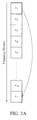
- Figs. 2A to 2C are block diagrams illustrating padded Zadoff-Chu code sequences on frequency domain according to an embodiment of the invention
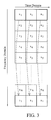
- Fig. 3 is a block diagram illustrating duplications of a padded Zadoff-Chu code sequence on time domain according to an embodiment of the invention
- Fig. 4 is a block diagram illustrating a padded Zadoff-Chu code sequence on both frequency and time domains according to an embodiment of the invention
- Fig. 5 is a block diagram illustrating duplications of a padded Zadoff-Chu code sequence on time domain according to an embodiment of the invention
- Fig. 6 is a block diagram illustrating duplications of padded Zadoff-Chu code sequences with distributed structure on frequency domain according to an embodiment of the invention
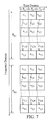
- Fig. 7 is a block diagram illustrating multiple padded Zadoff-Chu code sequences with distributed structure according on frequency domain to an embodiment of the invention
- Fig. 8 is a block diagram illustrating a padded Zadoff-Chu code sequence with distributed structure on frequency domain according to an embodiment of the invention
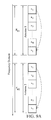
- Figs. 9A to 9B are block diagrams illustrating duplications of a padded Zadoff-Chu code sequence in relation to 2 antennas on the frequency domain according to an embodiment of the invention
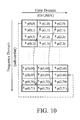
- Fig. 10 is a block diagram illustrating a padded Zadoff-Chu code sequence with cyclical shifts for Ranging Preamble (RP) codes according to an embodiment of the invention.
- Fig. 11 is a flow chart illustrating a transmission method with code sequence extension according to an embodiment of the invention.
- Fig. 1 is a block diagram illustrating a wireless communication system according to an embodiment of the invention.
- a transmitter 110 and a receiver 120 are provided for wireless communications therebetween via the air interface.
- the transmitter 110 generates a padded code sequence comprising a plurality of symbols with the last symbol being a duplication of the first symbol, to maintain orthogonality of the code sequence in the differential domain. Subsequently, the transmitter 110 transmits the padded code sequence to the receiver 120 via the air interface.
- the receiver 120 may perform differential detection to detect the padded code sequence.
- the transmission between the transmitter 110 and the receiver 120 may utilize the OFDM technology or the Single Carrier-OFDM (SC-OFDM) technology, and the code sequence may be a Zadoff-Chu code sequence, a Generalized Chirp-Like (GCL) code sequence, or a Constant Amplitude Zero AutoCorrelation (CAZAC) code sequence.
- GCL Generalized Chirp-Like
- CAZAC Constant Amplitude Zero AutoCorrelation
- Figs. 2A to 2C are block diagrams illustrating padded Zadoff-Chu code sequences on frequency domain according to an embodiment of the invention.
- the original codeword to be transmitted is a Zadoff-Chu code sequence comprising a plurality of symbols denoted as s 1 to s N .
- the transmitter 110 duplicates the first symbol s 1 and cyclically pads the duplicated symbol to the end of the Zadoff-Chu code sequence.
- each symbol of the padded Zadoff-Chu code sequence is carried on a sub-carrier corresponding to a respective radio frequency selected in an increasing order on the frequency domain, as shown in Fig.
- the corresponding radio frequencies may be selected in a decreasing order on the frequency domain, as shown in Fig. 2B .
- the symbols of the padded Zadoff-Chu code sequence may be allocated in a circular shift order. That is, the padded Zadoff-Chu code sequence may be placed, starting with the ( m+1 )-th symbol to the N -th symbol and continuing with the first symbol to the m-th symbol, as shown in Fig. 2C , wherein m may be any number larger than zero and not greater than N .
- s m equals to s 1 + (m mod N ) if m is larger than N , wherein ( m mod N) means the remainder of m divided by N.
- Fig. 3 is a block diagram illustrating duplications of a padded Zadoff-Chu code sequence on time domain according to an embodiment of the invention. Similar to the embodiment of Fig. 2A to 2C , the original codeword to be transmitted is a Zadoff-Chu code sequence comprising a plurality of symbols denoted as s 1 to s N , and the first symbol s 1 is duplicated and cyclically padded to the end of the Zadoff-Chu code sequence. However, the padded Zadoff-Chu code sequence is transmitted not only during the time period T 1 , but also during the time periods T 2 and T 3 , wherein the time periods T 1 to T 3 are continuously located in an increasing order in the time domain.
- the transmitter 110 further duplicates the padded Zadoff-Chu code sequence twice and transmits the duplicated and padded Zadoff-Chu code sequences during the time period T 2 and T 3 , respectively.
- each symbol of the two duplicated and padded Zadoff-Chu code sequences may be allocated on the same sub-carrier as the corresponding symbol of the padded Zadoff-Chu code sequence.
- the number of duplications may be configured to be any number other than two.
- Fig. 4 is a block diagram illustrating a padded Zadoff-Chu code sequence on both frequency and time domains according to an embodiment of the invention.
- the original codeword to be transmitted is a Zadoff-Chu code sequence comprising a plurality of symbols denoted as s 1 to s 3R .
- 3R may be specified in advance.
- Transmitter 110 and receiver 120 know the number 3R.
- the receiver 120 may negotiate with the transmitter 110 to acquire the number 3R.
- the receiver 120 may read broadcasting channel to acquire the number.
- the transmitter 110 subsequently divides the Zadoff-Chu code sequence into 3 sections according to the transmission length R .
- the first section comprises R symbols denoted as s 1 to s R
- the second section comprises R symbols denoted as s R+1 to s 2R
- the third section comprises R symbols denoted as s 2R + 1 to s 3R .
- Each symbol of one of the sections may be allocated on a respective sub-carrier corresponding to a respective radio frequency selected in an increasing order from the frequency domain, and each section is transmitted in a respective time period continuously selected from the time domain, as shown in Fig. 4 .
- These sections may be aligned in the time domain such that the symbols in the same position of the sections are corresponding to the same sub-carriers.
- the transmitter 110 further duplicates and cyclically pads the first symbol of the second section, i.e. the symbol s R + 1 , to the end of the first section, the first symbol of the third section, i.e. the symbol s 2R + 1, to the end of the second section, and the first symbol of the first section, i.e. the symbol s1 , to the end of the third section.
- the radio frequencies corresponding to the symbols may be selected in a decreasing order from the frequency domain. Note that the symbol s 1 is padded after the last symbol of Zadoff-Chu code sequence in the last section.
- the transmitter 110 may leave the slots corresponding to the residual sub-carriers in the third section empty or assign zero to the slots corresponding to the residual sub-carriers in the third section, after the duplications and cyclical padding are done.
- Fig. 5 is a block diagram illustrating duplications of a padded Zadoff-Chu code sequence on time domain according to an embodiment of the invention. Similar to the embodiment of Fig. 4 , the original codeword to be transmitted is a Zadoff-Chu code sequence comprising a plurality of symbols denoted as s 1 to s 3R , and the Zadoff-Chu code sequence is divided into sections and cyclically padded among the sections. However, the transmitter 110 further duplicates the cyclically padded Zadoff-Chu code sequence, and transmits the duplication of the cyclically padded Zadoff-Chu code sequence in the subsequent OFDM symbols, as shown in Fig. 5 .
- the sections are aligned in the time domain such that the symbols in the same position of the sections are corresponding to the same radio frequency, and the symbol s 1 is padded after the last symbol of Zadoff-Chu code sequence in the last section. If the length of the Zadoff-Chu code sequence is less than 3R, the transmitter 110 may further leave the slots corresponding to the residual sub-carriers in the third section empty or assign zero to the slots corresponding to the residual sub-carriers in the third section.
- Figs. 2A to 2B and Figs. 3 to 5 may be applied in the ranging channel or random access channel in the OFDM or SC-OFDM system.
- the padded Zadoff-Chu code sequence may by further duplicated in the frequency domain in the distributed structure.
- Fig. 6 is a block diagram illustrating duplications of padded Zadoff-Chu code sequences with distributed structure on frequency domain according to an embodiment of the invention.
- the padded Zadoff-Chu code sequence and the duplications of the padded Zadoff-Chu code sequence may be taken as a transmission block for simplicity, wherein the symbols in each padded Zadoff-Chu code sequence of the transmission block are allocated on sub-carriers in an increasing order corresponding to the radio frequency range F R1 .
- the transmitter 110 may further duplicate the transmission block, and transmit the duplicated transmission block in the radio frequency range F R2 .
- the symbols in each padded Zadoff-Chu code sequence of the duplicated transmission block are allocated on sub-carriers in an increasing order corresponding to the radio frequency range F R2 .
- the padded Zadoff-Chu code sequences in each transmission block are transmitted in three subsequent time periods, i.e., the first padded Zadoff-Chu code sequences of the transmission blocks are transmitted during the time period T 1 , the second padded Zadoff-Chu code sequences of the transmission blocks are transmitted during the time period T 2 , and the third padded Zadoff-Chu code sequences of the transmission blocks are transmitted during the time period T 3 .
- the distributed structure may be applied to ranging code or random access channel in an OFDM or SC-OFDM system.
- Fig. 7 is a block diagram illustrating multiple padded Zadoff-Chu code sequences with distributed structure on frequency domain according to an embodiment of the invention.
- all the Zadoff-Chu code sequences may be padded as described in the embodiment of Fig. 2A , except that the placements of the padded Zadoff-Chu code sequences are on both of the frequency and time domains.
- the first Zadoff-Chu code sequence comprising N symbols denoted as s 1,1 to s 1,N , is padded with s 1 , 1
- the second Zadoff-Chu code sequence comprising N symbols denoted as s 2,1 to s 2,N
- s 2,1 is padded with s 2,1
- the third Zadoff-Chu code sequence comprising N symbols denoted as s 3,1 to s 3,N , is padded with s 3,1 , etc.
- every three padded Zadoff-Chu code sequences may be taken as a transmission block, i.e., the first transmission block comprises the padded first, second, and third Zadoff-Chu code sequences, and the second transmission block comprises the padded fourth, fifth, and sixth Zadoff-Chu code sequences.
- the symbols in each padded Zadoff-Chu code sequence of the first transmission block are allocated on sub-carriers in an increasing order corresponding to the radio frequency range F R1
- the symbols in each padded Zadoff-Chu code sequence of the second transmission block are allocated on sub-carriers in an increasing order corresponding to the radio frequency range F R2 .
- the padded Zadoff-Chu code sequences in each transmission block are transmitted in three subsequent time periods, i.e., the padded first and fourth Zadoff-Chu code sequences are transmitted during the time period T 1 , the padded second and fifth Zadoff-Chu code sequences are transmitted during the time period T 2 , and the padded third and sixth Zadoff-Chu code sequences are transmitted during the time period T 3 .
- the distributed structure may be applied to ranging code or random access channel in an OFDM or SC-OFDM system.
- Fig. 8 is a block diagram illustrating a padded Zadoff-Chu code sequence with distributed structure on frequency domain according to an embodiment of the invention.
- the length of the Zadoff-Chu code sequence is 6R and the Zadoff-Chu code sequence is divided into 6 sections with R symbols.
- the transmitter 110 duplicates and pads the first symbol of the second section, i.e. the symbol s R + 1 to the end of the first section, the first symbol of the third section, i.e. the symbol s 2R + 1 to the end of the second section, the first symbol of the fourth section, i.e.
- the transmitter 110 duplicates and pads the first symbol of the fifth section, i.e. the symbol s 4R+1 , to the end of the fourth section, the first symbol of the sixth section, i.e. the symbol s 5R + 1 , to the end of the fifth section, and lastly, cyclically duplicates and pads the first symbol of the first section, i.e. the symbol s 1 , to the end of the sixth section.
- every three padded sections of the Zadoff-Chu code sequence may be taken as a transmission block, wherein the symbols in each padded section of the first transmission block are allocated on sub-carriers in an increasing order corresponding to the radio frequency range F R1 , and the symbols in each padded section of the second transmission block are allocated on sub-carriers in an increasing order corresponding to the radio frequency range F R2 .
- the padded sections of each transmission block are transmitted in three subsequent time periods, i.e., the first padded sections of the first and second transmission blocks are transmitted during the time period T 1 , the second padded sections of the first and second transmission blocks are transmitted during the time period T 2 , and the third padded sections of the first and second transmission blocks are transmitted during the time period T 3 .
- the distributed structure may be applied to ranging code or random access channel in an OFDM or SC-OFDM system.
- the embodiments of Figs. 2A to 2B and Figs. 3 to 5 may also be applied to the synchronization channel in the OFDM or SC-OFDM system. If the transmitter 110 has only one antenna (now shown) coupled therein for transmitting the code sequences, the embodiments of Figs. 2A to 2B and Figs. 3 to 5 may be applied to padding the code sequences as described above. Otherwise, if the transmitter 110 has multiple antennas (now shown) coupled therein for transmitting the code sequence, the transmitter 110 may further duplicate the padding of the code sequences on the frequency domain. Figs.
- FIGS. 9A to 9B are block diagrams illustrating duplications of a padded Zadoff-Chu code sequence in relation to 2 antennas on the frequency domain according to an embodiment of the invention.
- the transmitter 110 may transmit, in the same time period, code sequences in multiple radio frequency ranges.
- the transmitter 110 may use a first antenna to transmit the padded Zadoff-Chu code sequence of Fig. 2A in the radio frequency range F R1 , and use a second antenna to transmit the duplication of the padded Zadoff-Chu code sequence in the radio frequency range F R2 , as shown in Fig. 9A .
- the transmitter 110 may use a first antenna to transmit the padded first section of the Zadoff-Chu code sequence of Fig.
- the number of antennas coupled in the transmitter 110 may be more than two.
- Fig. 10 is a block diagram illustrating a padded Zadoff-Chu code sequence with cyclic shifts for Ranging Preamble (RP) codes according to an embodiment of the invention.
- x' p (0,71) is the same as x' p (1,0)
- x' p (1,71) is the same as x' p (2,0)
- x' p (2,69) is the same as x' p (0,0).
- x' p (0,71) is the same as x' p (1,0) with exp - j ⁇ ⁇ 2 ⁇ 71 ⁇ s p ⁇ N TCS N FFT phase rotation
- x p (1,71) is the same as x p (2,0) with exp - j ⁇ ⁇ 2 ⁇ 71 ⁇ s p ⁇ N TCS N FFT phase rotation
- x p (2,69) is the same as x p (0,0) with exp - j ⁇ ⁇ 2 ⁇ 69 ⁇ s p ⁇ N TCS N FFT phase rotation.
- the residual slots in the end of the padded third section are further padded with the duplication of the second and third symbols of the first section, i.e., the x p (0,1) and x p (0,2), according to the same cyclical padding manner.
- Fig. 11 is a flow chart illustrating a transmission method with code sequence extension according to an embodiment of the invention.
- the transmission method may be applied in a wireless communication device, such as the transmitter 110, for code sequence transmission to a receiver via the air interface.
- the wireless communication device and the receiver may be in compliance with the OFDM technology or the SC-OFDM technology.
- the wireless communication device generates a padded code sequence comprising a plurality of symbols with the last symbol being a duplication of the first symbol (step S1101).
- the wireless communication device may first generate an original code sequence. Subsequently, the wireless communication device extends the original code sequence with cyclical padding a duplication of the first symbol to the end of the original code sequence.
- the wireless communication device After generating the padded code sequence, the wireless communication device further transmits the padded code sequence to the receiver via the air interface (step 1102).
- the padded code sequence may be carried out in several embodiments as described above.
- the first symbol of the original code sequence may be duplicated and cyclically padded to the end of the original code sequence, as shown in Fig. 2A , 2B , or 2C , and even more, the padded code sequence may be further duplicated in the time domain, as shown in Fig. 3 .
- the original code sequence may be divided into sections and the first symbol of each section is duplicated and cyclically padded to the end of the previous section, as shown in Fig. 4 , and even more, the padded code sequence may be further duplicated on the time domain, as shown in Fig. 5 .
- the padding rule of the padded code sequence as described above with respect to Figs. 2A to 2C may be used for each distributed transmission block, as shown in Fig. 6A , or the padding rule as described above with respect to Fig. 4 may be used, as shown in Fig. 6C .
- the padding rule as described above with respect to Figs. 2A to 2C may also be used for each original code sequence and the padded original code sequences are aligned on the time domain for each distributed transmission block.
- the code sequence may be padded, duplicated, and transmitted using the multiple antennas according to the padding rule as described above with respect to Figs. 2A to 2C with a respective antenna, as shown in Fig. 9A , or may be divided, padded, and transmitted according to the padding rule as described above with respect to Fig. 4 , as shown in Fig. 9B .
- the code sequence may be a Zadoff-Chu code sequence, a GCL code sequence, or a CAZAC code sequence.
- the Zadoff-Chu code sequence is a complex-valued mathematical sequence, and when applied to radio signals, gives rise to an electromagnetic signal of constant amplitude.
- the cyclically padded version of the code sequence as proposed in the invention exhibits a useful property that the symbols therein do not cross-correlate with each other (i.e., each symbol remains orthogonal to one another), so that the radio signals may be recovered at the receiver end.
- the Zadoff-Chu code sequence for the RP code is divided into sections, and then duplicated and cyclically shifted according to the padding rule as described above with respect to Fig. 4 .
- the residual slots may be padded with the duplication of the symbols following the padding symbol, or may be padded with zero-valued symbols.
- the cyclically shifting rule for the RP code may be used as described above with respect to Figs. 2A to 2C , 3, 5, 6A to 6C , and 9A to 9B .
- the wireless communication device such as the transmitter 110, and the receiver may be communicating with each other according to any wireless communication standards adopting the OFDM technology, the SC-OFDM technology, or other evolutionary technologies of the OFDM technology family, including the WLAN, the UWB, the WiMAX, the Wireless Broadband (WiBro), and the LTE, etc. Therefore, the scope of the invention shall be defined and protected by the following claims and their equivalents.
Landscapes
- Engineering & Computer Science (AREA)
- Signal Processing (AREA)
- Computer Networks & Wireless Communication (AREA)
- Mobile Radio Communication Systems (AREA)
- Time-Division Multiplex Systems (AREA)
Applications Claiming Priority (1)
| Application Number | Priority Date | Filing Date | Title |
|---|---|---|---|
| US21868509P | 2009-06-19 | 2009-06-19 |
Publications (2)
| Publication Number | Publication Date |
|---|---|
| EP2264964A2 true EP2264964A2 (de) | 2010-12-22 |
| EP2264964A3 EP2264964A3 (de) | 2012-12-12 |
Family
ID=42751696
Family Applications (1)
| Application Number | Title | Priority Date | Filing Date |
|---|---|---|---|
| EP10166469A Withdrawn EP2264964A3 (de) | 2009-06-19 | 2010-06-18 | Verfahren zur Codesequenzerweiterung per Übertragung in drahtlosen Kommunikationsumgebungen |
Country Status (2)
| Country | Link |
|---|---|
| US (2) | US8520753B2 (de) |
| EP (1) | EP2264964A3 (de) |
Families Citing this family (9)
| Publication number | Priority date | Publication date | Assignee | Title |
|---|---|---|---|---|
| CN101668336B (zh) * | 2008-09-04 | 2012-05-02 | 电信科学技术研究院 | 高速分组接入演进系统mimo传输的方法及设备 |
| WO2012030319A2 (en) | 2009-06-26 | 2012-03-08 | Hypres, Inc. | System and method for controlling combined radio signals |
| KR102534519B1 (ko) * | 2011-02-18 | 2023-05-18 | 선 페이턴트 트러스트 | 신호생성방법 및 신호생성장치 |
| US9285206B1 (en) * | 2012-02-07 | 2016-03-15 | Pile Dynamics, Inc. | Measurement device for pile displacement and method for use of the same |
| KR102023296B1 (ko) | 2014-06-13 | 2019-09-19 | 애플 인크. | 전력 절감, 범위 개선 및 개선된 검출을 위한 향상된 prach 방식 |
| US9860349B2 (en) * | 2015-03-25 | 2018-01-02 | Newracom, Inc. | Method for transmitting and receiving frame, and wireless device implementing the same method |
| DE202017007174U1 (de) * | 2016-11-04 | 2019-11-25 | Telefonaktiebolaget Lm Ericsson (Publ) | PT-RS-Konfiguration, die von Planungsparametern abhängt |
| US20210211257A1 (en) * | 2017-06-16 | 2021-07-08 | Telefonaktiebolaget Lm Ericsson (Publ) | Joint resource map design of dm-rs and pt-rs |
| WO2020217146A1 (en) * | 2019-04-22 | 2020-10-29 | King Abdullah University Of Science And Technology | High-accuracy velocity and range estimation of a moving target using differential zadoff-chu codes by means of correlation |
Family Cites Families (12)
| Publication number | Priority date | Publication date | Assignee | Title |
|---|---|---|---|---|
| US6542556B1 (en) * | 2000-03-31 | 2003-04-01 | Nokia Mobile Phones Ltd. | Space-time code for multiple antenna transmission |
| KR100541285B1 (ko) * | 2002-10-02 | 2006-01-10 | 엘지전자 주식회사 | 다중 입출력 통신 시스템에서의 신호 처리 방법 |
| US7616698B2 (en) * | 2003-11-04 | 2009-11-10 | Atheros Communications, Inc. | Multiple-input multiple output system and method |
| WO2006015108A2 (en) * | 2004-07-27 | 2006-02-09 | Zte San Diego, Inc. | Transmission and reception of reference preamble signals in ofdma or ofdm communication systems |
| US7970064B2 (en) * | 2004-08-13 | 2011-06-28 | Agency For Science, Technology And Research | Transmitter, method for generating a plurality of long preambles and communication device |
| USRE44351E1 (en) | 2005-12-20 | 2013-07-09 | Lg Electronics Inc. | Method of generating code sequence and method of transmitting signal using the same |
| US7983143B2 (en) * | 2006-02-08 | 2011-07-19 | Motorola Mobility, Inc. | Method and apparatus for initial acquisition and cell search for an OFDMA system |
| US8320360B2 (en) * | 2006-11-06 | 2012-11-27 | Motorola Mobility Llc | Method and apparatus for fast cell search |
| KR101445388B1 (ko) * | 2007-09-03 | 2014-09-26 | 엘지전자 주식회사 | 반복 코딩을 이용한 데이터 전송 방법 |
| KR101443633B1 (ko) * | 2008-01-01 | 2014-09-23 | 엘지전자 주식회사 | 새로운 레인징 구조를 이용한 레인징 수행 방법 |
| KR101468226B1 (ko) * | 2008-03-19 | 2014-12-04 | 엘지전자 주식회사 | 무선 통신 시스템에서 랜덤 액세스를 위한 프리앰블 생성 방법 |
| US8817818B2 (en) * | 2008-04-23 | 2014-08-26 | Texas Instruments Incorporated | Backward compatible bandwidth extension |
-
2010
- 2010-06-17 US US12/817,424 patent/US8520753B2/en active Active
- 2010-06-18 EP EP10166469A patent/EP2264964A3/de not_active Withdrawn
-
2013
- 2013-07-05 US US13/935,849 patent/US9444593B2/en active Active
Non-Patent Citations (1)
| Title |
|---|
| None |
Also Published As
| Publication number | Publication date |
|---|---|
| US9444593B2 (en) | 2016-09-13 |
| US20100322332A1 (en) | 2010-12-23 |
| US8520753B2 (en) | 2013-08-27 |
| US20130294378A1 (en) | 2013-11-07 |
| EP2264964A3 (de) | 2012-12-12 |
Similar Documents
| Publication | Publication Date | Title |
|---|---|---|
| US9444593B2 (en) | Systems and methods for code sequence extension over transmission in wireless communication environments | |
| US12289158B2 (en) | Preamble sequence for a random access channel | |
| US8005153B2 (en) | Method and apparatus for increasing the number of orthogonal signals using block spreading | |
| EP2824864A1 (de) | Sprung-Pilotmuster für Telekommunikation | |
| KR101527613B1 (ko) | 다중안테나 시스템에서 동기신호의 전송장치 | |
| US10284406B2 (en) | Method and apparatus for generating code sequence in a communication system | |
| CN1934812A (zh) | 用于导频信号传输的方法和装置 | |
| US20240291697A1 (en) | Systems and methods for transmitting control data in a communication network | |
| WO2010117913A2 (en) | Techniques to format a symbol for transmission | |
| KR20100003770A (ko) | 광대역 무선통신시스템에서 동기 채널 생성 장치 및 방법 | |
| CN101222459B (zh) | 频域均衡系统的导频插入和信道估计方法 | |
| KR100964691B1 (ko) | 다수의 반송파를 이용하여 데이터를 전송하는 장치 및 방법 | |
| CN101005471B (zh) | 多载波通信系统导频信道时频资源分配方法、装置及系统 | |
| KR20080056423A (ko) | 셀 탐색을 위한 참조 신호의 구성 방법 | |
| WO2007126280A2 (en) | Method and apparatus for generating code sequence in a communication system | |
| CN102299881A (zh) | 传输方法 |
Legal Events
| Date | Code | Title | Description |
|---|---|---|---|
| PUAI | Public reference made under article 153(3) epc to a published international application that has entered the european phase |
Free format text: ORIGINAL CODE: 0009012 |
|
| AK | Designated contracting states |
Kind code of ref document: A2 Designated state(s): AL AT BE BG CH CY CZ DE DK EE ES FI FR GB GR HR HU IE IS IT LI LT LU LV MC MK MT NL NO PL PT RO SE SI SK SM TR |
|
| AX | Request for extension of the european patent |
Extension state: BA ME RS |
|
| PUAL | Search report despatched |
Free format text: ORIGINAL CODE: 0009013 |
|
| AK | Designated contracting states |
Kind code of ref document: A3 Designated state(s): AL AT BE BG CH CY CZ DE DK EE ES FI FR GB GR HR HU IE IS IT LI LT LU LV MC MK MT NL NO PL PT RO SE SI SK SM TR |
|
| AX | Request for extension of the european patent |
Extension state: BA ME RS |
|
| RIC1 | Information provided on ipc code assigned before grant |
Ipc: H04J 11/00 20060101ALN20121106BHEP Ipc: H04L 27/26 20060101AFI20121106BHEP |
|
| 17P | Request for examination filed |
Effective date: 20130607 |
|
| RBV | Designated contracting states (corrected) |
Designated state(s): AL AT BE BG CH CY CZ DE DK EE ES FI FR GB GR HR HU IE IS IT LI LT LU LV MC MK MT NL NO PL PT RO SE SI SK SM TR |
|
| 17Q | First examination report despatched |
Effective date: 20130628 |
|
| STAA | Information on the status of an ep patent application or granted ep patent |
Free format text: STATUS: THE APPLICATION IS DEEMED TO BE WITHDRAWN |
|
| 18D | Application deemed to be withdrawn |
Effective date: 20131109 |