EP2259533A2 - PAPR Reduzierung unter Verwendung von Verwürfelungssequenzen - Google Patents
PAPR Reduzierung unter Verwendung von Verwürfelungssequenzen Download PDFInfo
- Publication number
- EP2259533A2 EP2259533A2 EP10180764A EP10180764A EP2259533A2 EP 2259533 A2 EP2259533 A2 EP 2259533A2 EP 10180764 A EP10180764 A EP 10180764A EP 10180764 A EP10180764 A EP 10180764A EP 2259533 A2 EP2259533 A2 EP 2259533A2
- Authority
- EP
- European Patent Office
- Prior art keywords
- sequence
- scrambling
- combination
- sequences
- papr
- Prior art date
- Legal status (The legal status is an assumption and is not a legal conclusion. Google has not performed a legal analysis and makes no representation as to the accuracy of the status listed.)
- Ceased
Links
Images

Classifications
-
- H—ELECTRICITY
- H04—ELECTRIC COMMUNICATION TECHNIQUE
- H04L—TRANSMISSION OF DIGITAL INFORMATION, e.g. TELEGRAPHIC COMMUNICATION
- H04L27/00—Modulated-carrier systems
- H04L27/26—Systems using multi-frequency codes
- H04L27/2601—Multicarrier modulation systems
- H04L27/2614—Peak power aspects
Definitions
- the present invention relates generally to a manner by which to communicate a data block in an OFDM-based or other MCM-based communication system. More particularly, the present invention relates to apparatus, and an associated method, by which to combine the data block with a randomized, scrambling sequence to form a combination sequence that leads to a PAPR (Peak-to-Average Power Ratio) of selected characteristics.
- PAPR Peak-to-Average Power Ratio
- the data block is combined with successive scrambling sequences until a combination sequence is formed that leads to the PAPR of selected characteristics. And, the combination sequence that leads to these selected characteristics is transmitted. If none of the combination sequences leads to a PAPR of the selected characteristics, then the combination sequence that leads to the smallest PAPR is transmitted. Through random or appropriate selection of the combination sequence, the informational content of the data block is communicated while avoiding problems that sometimes result when transmitting data blocks that lead to high PAPRs.
- Radio communication systems through which to communicate is pervasive in modem society.
- Cellular communication systems for instance, are deployed throughout significant portions of the populated areas of the world, providing users access to communicate therethrough when positioned in an area encompassed by a cellular communication system.
- Successive generations of cellular communication systems have been developed and deployed, each successive generation providing increased communication capabilities. For instance, while early-generation cellular communication systems were used primarily for voice communications, successor-generation cellular communication systems provide increased data communication capabilities. New-generation systems are capable of providing multimedia communication services at guaranteed levels of quality.
- any radio, as well as another, communication system channel bandwidth allocation is limited.
- the frequency spectrum allocated for use by a cellular communication system is limited, and such limitation is regularly a limiting factor in the communication capacity of the system. Effort is made, therefore, to utilize the allocated capacity in an efficient manner.
- OFDM Orthogonal Frequency Division Multiplexing
- MCM Multi-Carrier Modulation
- e.g. provide the possibility of more efficient usage of channel bandwidth, thereby permitting increased speed for data to be communicated within a given channel bandwidth.
- sub-carriers are defined that are orthogonal.
- power management is an important function. Power efficiency, e.g., is, dependent upon power characteristics of communications upon OFDM-defined channels.
- One power characteristic of interest is a PAPR, Peak-To-Average Power Ratio. It is generally desired to communicate data at a relatively low PAPR.
- the power amplifier (PA) at a transmit station has to operate at a lower level of average power.
- the resultant signal is of lower transmit power, and the coverage area of service is reduced.
- the PA operates with a lower power efficiency, resulting in a higher service cost, and reduced battery longevity if the transmit station is powered by a battery power supply.
- Figure 1 illustrates a functional block diagram of a radio communication system in which an embodiment of the present invention is operable.
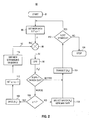
- Figure 2 illustrates a process diagram representative of the process of operation of an embodiment of the present invention.
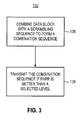
- Figure 3 illustrates a method flow diagram representative of the method of operation of an embodiment of the present invention.
- the present invention accordingly, advantageously provides apparatus, and an associated method, for communicating a data block in an OFDM-based, or other MCM-based, communication system.
- a manner is provided by which to combine the data block with a randomized, scrambling sequence to form a combination sequence that leads to a PAPR (Peak-to-Average Power Ratio) of selected characteristics.
- PAPR Peak-to-Average Power Ratio
- the data block is combined with successive scrambling sequences until a combination sequence is formed that leads to the PAPR of the selected characteristics. Once the combination sequence that leads to the PAPR of the selected characteristics is formed, the combination sequence is transmitted.
- the informational content of the data block is communicated while reducing the likelihood of occurrence of problems that sometimes result when data blocks leading to high PAPRs are transmitted.
- a product sequence is formed of a data block that is to be communicated multiplied with a binary sequence. Once formed, an inverse discrete Fourier transform (IDFT) is performed upon the product sequence and the PAPR after IDFT is calculated. If the calculated PAPR is smaller than a pre-defined threshold, then the product sequence is caused for transmission.
- IDFT inverse discrete Fourier transform
- the PAPR level and the transformed product sequence are buffered, and a new product sequence is formed, formed of another scrambling sequence multiplied with the data block.
- An iterative procedure of performing an IDFT on the newly created product sequence, calculation of the PAPR, and comparison with the threshold value is performed. The iterative procedure continues until a PAPR associated with a product sequence is smaller than the threshold or unique scrambling sequences no longer remain available to form new product sequences.
- a scrambling sequence that is combined with a data block in each iteration is selected from a set of scrambling sequences.
- Each scrambling sequence is independent from other sequences.
- each scrambling sequence is of the length corresponding to the length of the data block.
- the values of the binary, scrambling sequence are of randomly-generated "1" or minus "1" values.
- the scrambling sequences are, e.g., randomly generated off-line and in advance, then saved at both the transmitting and receiving stations. The receiving station thereby knows the entire set of sequences in advance.
- a buffer is provided to buffer values of sequences out of IDFT together with their associated, calculated PAPRs.
- the sequence after IDFT exhibits a PAPR that is larger than the threshold
- the sequence after IDFT and its associated PAPR are buffered.
- a determination is made of which of the buffered sequences exhibits the smallest PAPR. The buffered sequence that exhibits the smallest PAPR is selected for transmission and is retrieved from the buffer and caused to be communicated.
- apparatus, and an associated method are provided for forming a transmit block formed of a data block.
- the transmit block is for communication pursuant to an OFDM scheme.
- a combiner is configured to combine the data block with a selected, scrambling sequence to form a combination sequence.
- the transmitter is configured to transmit the transformed combination sequence after IDFT when a PAPR associated with the combination sequence after IDFT is of a selected level.
- portions of a radio communication system include a set of communication stations 12 and 14, interconnected by way of a radio air interface, here represented by the segment 16.
- the communication system 10 forms an OFDM (Orthogonal Frequency Division Multiplexing)-based communication system, or other MCM (Multi-Carrier Modulation)-based communication system.
- OFDM-based communication schemes are proposed for a so-called fourth generation (4G) cellular communication system.
- 4G fourth generation
- the following description shall describe exemplary operation with respect to implementation of the communication system as a 4G, OFDM-based cellular communication system. It should be understood, however, that the following description is analogously also representative of many other communication systems, both wireless and wireline, in which data blocks are communicated. Additionally, description of operation shall be described with respect to the communication station 12 forming a network station, and the communication station 14 forming a mobile station or vice versa. In the exemplary implementation, both the communication stations include analogous functionality and are operable in analogous manners.
- a data source 22 sources data. Each data is a value taken from an M-ary signal constellation. And, each data block is formed of N such values in general.
- a data block sourced at the data source is provided, here indicated by way of the line 24, to a multiplier 28 that forms a combiner.
- the multiplier multiplies symbol values together with a scrambling sequence provided to the multiplier on the line 32.
- the scrambling sequence is provided on the line 32 by a scrambling sequence provider 34.
- the scrambling sequence provider forms a sequence generator or a cache of scrambling sequences, available for retrieval and use for combination with the data block at the multiplier 28.
- Each scrambling sequence is a sequence of binary values with different binary sequences forming independent sequences, each consisting of N numbers of randomly generated 1 and -1 values.
- the multiplier combines the data block and the scrambling sequence to form a product sequence, viz., a combination sequence.
- the sequence is provided, here indicated by way of the line 38, to an IDFT (Inverse Discrete Fourier Transform) operator 42.
- the IDFT operator performs an IDFT operation upon the combination sequence on the line 38 and generates a transformed block of values on the line 44.
- the transformed block of values is provided to a PAPR (Peak to Average Power Ratio) calculator 48.
- the PAPR calculator calculates a value of the PAPR for the transformed block of values thereto.
- the calculated PAPR value, formed on the line 52 is provided to a threshold comparator 54.
- the threshold comparator compares the value of the PAPR calculated by the calculator 48 with a pre-determined threshold value. If the calculated PAPR associated with the transformed block of values is smaller than the threshold, then a decision is made to send the transformed values of the product sequence associated with the acceptable PAPR value.
- An indication of the scrambling sequence used in the formation of the product sequence is provided to a control signal generator comprising a scrambling sequence ID provider 58.
- the provider 58 generates a control signal that identifies the scrambling sequence used in the product sequence formation.
- the provider 58 for instance, generates control bits that populate a field of a control signal that is sent by the communication station.
- the transmit chain includes a D/A (Digital-to-Analog) and an IF/RF (Intermediate Frequency/Radio Frequency) element 62.
- the control signal generated by the control signal generator 58 is caused to be transmitted by the element 62.
- the threshold comparator permits the associated product sequence after IDFT to be provided to the element 62 to be transmitted therefrom.
- the product sequence after IDFT and its associated PAPR value are buffered at a buffer 66. And, an indication is provided, here indicated by the line 68 to the scrambling sequence provider 34 and to the multiplier 28 to indicate the negative results of the comparison made by the comparator.
- a new iteration commences. That is to say, a new scrambling sequence is provided by the scrambling sequence provider to the multiplier 28, and a new combination, i.e., product, sequence is formed.
- the new product sequence is transformed by the IDFT operator, its PAPR is calculated by the calculator 48, and the threshold comparator compares the calculated PAPR value against the threshold. Responsive to the comparison, the new product sequence after IDFT is of a PAPR that is acceptable, or not. If acceptable, the control signal generator operates, and the product sequence after IDFT is caused by the element 62 to be transmitted. Otherwise, the product sequence after IDFT and its associated PAPR are buffered at the buffer and additional iteration is performed, if a unique scrambling sequence remains to be provided.
- the threshold comparator accesses the buffer contents of the buffer 66 and compares the PAPR values stored therein.
- the buffered sequence associated with the smallest of the buffered PAPR values is selected to be sent by the communication station.
- Buffered information associated with the scrambling sequence used in the formation of the selected product sequence is also retrieved and provided to the control signal generator 58.
- the control signal generator causes a control signal to be sent by the communication station 12, to the receiving station, here the communication station 14, to alert the communication station 14 of the scrambling sequence used in the formation of the product sequence that is to be communicated thereto.
- a data block is altered, through the combination with a scrambling sequence, to alter the PAPR to facilitate its communication to the communication station 14.
- the operation is iterative such that unneeded operations are not performed. That is to say, if the first combination sequence, i.e., product sequence, leads to an acceptable PAPR after IDFT, additional product sequences need not be formed. And, during any iteration, if a product sequence is formed of an acceptable PAPR after IDFT, additional product sequences are not formed. And, if none of the product sequences exhibits an acceptable PAPR, selection is made of the product sequence associated with the smallest, albeit otherwise unacceptable, PAPR. And, by notifying the receiving communication system of the scrambling sequence that is used to form the product sequence, the receiving station is able, in its receive chain operation, to recover the informational content of the data block.
- Figure 2 illustrates a process diagram shown generally at 82, representative of the process of operation of an embodiment of the present invention, such as that provided during operation of the apparatus 12, shown in Figure 1 .
- the data set is multiplied with a scrambling sequence B (q) provided by way of the path 92.
- a product sequence is formed and provided, by way of the line 94, to the block 96 at which an IDFT is performed upon the product sequence.
- the subsequent iteration of operation is only carried out in the event that the earlier iteration fails to form a product sequence that leads to an acceptable PAPR.
- the "no" branch is taken to the block 118 whereat selection of a transformed product sequence from amongst saved sequences in prior iterations of the process is made. Selection is made of the saved sequence that exhibits a best, i.e., the smallest, PAPR value.
- f c the carrier frequency
- R e ⁇ u(t) ⁇ stands for the real part of u(t).
- E [ ⁇ ] denotes expectation
- r k is the normalized power of x k
- the sequence ⁇ x k ⁇ in Eq.(4) is interpreted as the inverse discrete Fourier transform (IDFT) of the data block X with ( m -1) N zeroes padded.
- IDFT inverse discrete Fourier transform
- x k is a complex random variable.
- a different data block of X usually yields a different sequence of ⁇ X k ⁇ with a different PAPR.
- binary scrambling sequences are used pursuant to an embodiment of the present invention.
- B (1) consists of all ones.
- B ( q )'s are independent sequences, each consisting of N numbers of randomly generated 1 or -1.
- Step (2) Each time when Step (2) is performed, X is multiplied with a new binary sequence B (q) to yield a new product sequence of ⁇ x k ( q ) ⁇ , and in turn yield a different PAPR after IDFT.
- a PAPR below, or closer to, the threshold is obtainable with a high probability.
- Figure 3 illustrates a method block diagram, shown generally at 132, representative of the method of operation of an embodiment of the present invention.
- the method facilitates formation of a transmit block formed of a data block.
- the transmit block is for communication pursuant to an OFDM, or other MCM, communication scheme.
- the data block is combined with a selected scrambling sequence to form a combination sequence.
- the combination sequence is selectably transmitted if a PAPR associated with the combination sequence is smaller than a selected level.
- Apparatus for forming a transmit block formed of a data block, the transmit block for communication pursuant to an OFDM scheme comprising:
- the apparatus further comprises a scrambling sequence provider configured to provide the selected scrambling sequence to said combiner.
- said scrambling sequence provider and said combiner are configured iteratively to provide successive scrambling sequences and successive combination sequences for a selected number of iterations.
- the selected scrambling sequence combined by said combiner in each iteration by said combiner is independent of others of the scrambling sequences.
- the apparatus further comprises a selector configured to select which of the successive combination sequences formed pursuant to iterations thereof provided by said combiner is to be transmitted by said transmitter.
- said selector is configured to select the combination sequence that exhibits a power ratio indicia better than a selected threshold.
- said selector is configured to select the combination sequence that exhibits a best power ratio indicia.
- the selected scrambling sequence combined by said combiner with the data block comprises a binary sequence.
- the data block is of a selected number of data symbols and wherein the selected scrambling sequence is of a sequence length at least of a corresponding selected number.
- the combination sequence formed by said combiner is formed of a product of the data block and the combination sequence.
- the power ratio indicia associated with the combination sequence comprises a peak-to-average power ratio value.
- said transmitter is configured selectably to transmit the combination sequence if the peak-to-average power ratio value associated therewith is less than the selected level.
- the apparatus further comprises a transformer configured to perform an inverse fast Fourier transform upon the combination sequence.
- the method further comprises the operation, prior to said operation of combining, of forming the selected scrambling sequence.
- said operations of forming and combining are iteratively performed a selected number of iterations, forming a plurality of scrambling sequences and a plurality of combination sequences.
- the method further comprises the operation of selecting which of the plurality of combination sequences to transmit during said operation of selectably transmitting.
- selection made during said operation of selecting is of a combination sequence of the plurality of combination sequences that has associated therewith a power ratio indicia of a best level.
- the selected level of the power ratio indicia associated with the combination sequence is better than a selected level.
- Apparatus for an MCM, Multicarrier Modulation, transmitter comprising:
Landscapes
- Engineering & Computer Science (AREA)
- Computer Networks & Wireless Communication (AREA)
- Signal Processing (AREA)
- Mobile Radio Communication Systems (AREA)
- Synchronisation In Digital Transmission Systems (AREA)
Applications Claiming Priority (1)
| Application Number | Priority Date | Filing Date | Title |
|---|---|---|---|
| EP07101695A EP1953981A1 (de) | 2007-02-02 | 2007-02-02 | PAPR Reduzierung unter Verwendung von Verwürfelungssequenzen |
Related Parent Applications (1)
| Application Number | Title | Priority Date | Filing Date |
|---|---|---|---|
| EP07101695.0 Division | 2007-02-02 |
Publications (2)
| Publication Number | Publication Date |
|---|---|
| EP2259533A2 true EP2259533A2 (de) | 2010-12-08 |
| EP2259533A3 EP2259533A3 (de) | 2011-03-02 |
Family
ID=38179936
Family Applications (2)
| Application Number | Title | Priority Date | Filing Date |
|---|---|---|---|
| EP10180764A Ceased EP2259533A3 (de) | 2007-02-02 | 2007-02-02 | PAPR Reduzierung unter Verwendung von Verwürfelungssequenzen |
| EP07101695A Withdrawn EP1953981A1 (de) | 2007-02-02 | 2007-02-02 | PAPR Reduzierung unter Verwendung von Verwürfelungssequenzen |
Family Applications After (1)
| Application Number | Title | Priority Date | Filing Date |
|---|---|---|---|
| EP07101695A Withdrawn EP1953981A1 (de) | 2007-02-02 | 2007-02-02 | PAPR Reduzierung unter Verwendung von Verwürfelungssequenzen |
Country Status (3)
| Country | Link |
|---|---|
| EP (2) | EP2259533A3 (de) |
| CA (1) | CA2676385C (de) |
| WO (1) | WO2008092278A1 (de) |
Cited By (1)
| Publication number | Priority date | Publication date | Assignee | Title |
|---|---|---|---|---|
| US9008223B1 (en) | 2013-12-24 | 2015-04-14 | Freescale Semiconductor, Inc. | Transmitter and method for reducing the peak-to-average power ratio of a digitally modulated communication signal |
Families Citing this family (10)
| Publication number | Priority date | Publication date | Assignee | Title |
|---|---|---|---|---|
| US8559496B1 (en) | 2012-06-20 | 2013-10-15 | MagnaCom Ltd. | Signal reception using non-linearity-compensated, partial response feedback |
| US8982724B2 (en) * | 2012-12-17 | 2015-03-17 | Intel Corporation | Systems and methods for implementing peak-to-average power ratio reduction for OFDMA modulation |
| JP6260127B2 (ja) * | 2013-07-09 | 2018-01-17 | アイコム株式会社 | プリアンブル生成装置、プリアンブル生成方法およびプログラム |
| JP6194680B2 (ja) * | 2013-07-31 | 2017-09-13 | アイコム株式会社 | プリアンブル生成装置、プリアンブル生成方法およびプログラム |
| US9118519B2 (en) | 2013-11-01 | 2015-08-25 | MagnaCom Ltd. | Reception of inter-symbol-correlated signals using symbol-by-symbol soft-output demodulator |
| US9496900B2 (en) | 2014-05-06 | 2016-11-15 | MagnaCom Ltd. | Signal acquisition in a multimode environment |
| US9246523B1 (en) | 2014-08-27 | 2016-01-26 | MagnaCom Ltd. | Transmitter signal shaping |
| GB2547041A (en) * | 2016-02-05 | 2017-08-09 | Tcl Communication Ltd | Uplink peak average power ratio reduction |
| CN108270708B (zh) * | 2016-12-30 | 2020-07-07 | 维沃移动通信有限公司 | 一种降低papr的信息传输方法、发送端及接收端 |
| US11765011B2 (en) | 2021-07-06 | 2023-09-19 | Huawei Technologies Co., Ltd. | Method and apparatus for transmitting and receiving data |
Citations (1)
| Publication number | Priority date | Publication date | Assignee | Title |
|---|---|---|---|---|
| US20050089116A1 (en) * | 2003-10-23 | 2005-04-28 | Moffatt Christopher D. | System and method for reducing peak-to-average power ratio for multi-carrier communication systems |
Family Cites Families (4)
| Publication number | Priority date | Publication date | Assignee | Title |
|---|---|---|---|---|
| US6301268B1 (en) * | 1998-03-10 | 2001-10-09 | Lucent Technologies Inc. | Communication method for frequency division multiplexing signalling systems with reduced average power requirements |
| WO2000072543A1 (en) * | 1999-05-21 | 2000-11-30 | Koninklijke Philips Electronics N.V. | Reduction of peak to average power ratio in multicarrier transmission |
| US7010028B2 (en) * | 2001-07-16 | 2006-03-07 | Broadcom Corporation | System and method for rapid generation of low par Q-mode signals |
| US7318185B2 (en) * | 2001-08-23 | 2008-01-08 | Nortel Networks Limited | Method and apparatus for scrambling based peak-to-average power ratio reduction without side information |
-
2007
- 2007-02-02 EP EP10180764A patent/EP2259533A3/de not_active Ceased
- 2007-02-02 EP EP07101695A patent/EP1953981A1/de not_active Withdrawn
-
2008
- 2008-02-04 WO PCT/CA2008/000223 patent/WO2008092278A1/en not_active Ceased
- 2008-02-04 CA CA2676385A patent/CA2676385C/en not_active Expired - Fee Related
Patent Citations (1)
| Publication number | Priority date | Publication date | Assignee | Title |
|---|---|---|---|---|
| US20050089116A1 (en) * | 2003-10-23 | 2005-04-28 | Moffatt Christopher D. | System and method for reducing peak-to-average power ratio for multi-carrier communication systems |
Non-Patent Citations (3)
| Title |
|---|
| BAUML R W ET AL: "REDUCING THE PEAK-TO-AVERAGE POWER RATIO OF MULTICARRIER MODULATIONBY SELECTED MAPPING", ELECTRONICS LETTERS, IEE STEVENAGE, GB, vol. 32, no. 22, 24 October 1996 (1996-10-24), pages 2056/2057, XP000643915, ISSN: 0013-5194, DOI: 10.1049/EL:19961384 * |
| HEISKALA, J. ET AL.: "OFDM Wireless LANs: A Theoretical and Practical Guide", 2 September 2002, SAMS PUBLISHING, USA, ISBN: 0672321572, pages: 202 - 202 * |
| MENEZES, A.J.; VAN OORSCHOT, P.C.; VANSTONE, S.A.: "Handbook of applied cryptography", 16 December 1996, CRC PRESS, New York, ISBN: 0849385237, pages: 20 - 21 * |
Cited By (1)
| Publication number | Priority date | Publication date | Assignee | Title |
|---|---|---|---|---|
| US9008223B1 (en) | 2013-12-24 | 2015-04-14 | Freescale Semiconductor, Inc. | Transmitter and method for reducing the peak-to-average power ratio of a digitally modulated communication signal |
Also Published As
| Publication number | Publication date |
|---|---|
| CA2676385A1 (en) | 2008-08-07 |
| WO2008092278A1 (en) | 2008-08-07 |
| CA2676385C (en) | 2015-06-16 |
| EP1953981A1 (de) | 2008-08-06 |
| EP2259533A3 (de) | 2011-03-02 |
Similar Documents
| Publication | Publication Date | Title |
|---|---|---|
| US7944980B2 (en) | Apparatus, and associated method, for communicating a data block in a multi carrier modulation communication scheme | |
| EP2259533A2 (de) | PAPR Reduzierung unter Verwendung von Verwürfelungssequenzen | |
| US8351520B2 (en) | Dynamically selecting methods to reduce distortion in multi-carrier modulated signals resulting from high peak-to-average power ratios | |
| JP4303288B2 (ja) | 直交周波数分割多元通信システムにおけるピーク電力対平均電力比を減少させる装置及び方法 | |
| US20080075191A1 (en) | Reduction of Peak-To-Average-Power Ratio in a Telecommunications System | |
| CN101572687B (zh) | 正交频分复用信号处理方法及系统 | |
| US8842758B2 (en) | Dynamically selecting methods to reduce distortion in multi-carrier modulated signals resulting from high peak-to-average power ratios | |
| CN111478871A (zh) | 基于补给索引的高频谱效率载波索引调制方法 | |
| Lin et al. | Modified selective mapping technique for PAPR reduction in OFDM systems | |
| Gouda et al. | PAPR reduction performance for LTE OFDM systems with different techniques | |
| Wang et al. | A low-complexity peak-to-average power ratio reduction technique for OFDM-based systems | |
| CN101404638A (zh) | 一种提高正交频分复用发信机效率的方法和装置 | |
| Wu et al. | Conjugate interleaved partitioning PTS scheme for PAPR reduction of OFDM signals | |
| CN1885843B (zh) | 基于多带滤波器组的多载波系统降低峰均比的装置和方法 | |
| Fathy et al. | PAPR reduction based on genetic algorithm for PTS wavelet-OFDM systems | |
| You et al. | Reducing peak-to-average power ratio using simple transformed CDMA/OFDM signals | |
| Hlaing et al. | Hybrid PAPR reduction schemes for MIMO-OFDM system | |
| Mary et al. | Generalized frequency division multiplexing system performance with companding transform and pulse shaping filter | |
| Kapoor et al. | Hybrid PAPR Reduction Technique of OFDM based Cognitive Radio | |
| Zhidkov | Detection of clipped code-division multiplexed signals | |
| Ngajikin et al. | Peak to average power ratio in WLAN-OFDM system | |
| Liu et al. | A Low Complexity VCS Method for PAPR Reduction in Multicarrier Code Division Multiple Access | |
| Ngajikin et al. | Peak to Average Power Ratio in WAN-OFDM System |
Legal Events
| Date | Code | Title | Description |
|---|---|---|---|
| PUAI | Public reference made under article 153(3) epc to a published international application that has entered the european phase |
Free format text: ORIGINAL CODE: 0009012 |
|
| 17P | Request for examination filed |
Effective date: 20100928 |
|
| AC | Divisional application: reference to earlier application |
Ref document number: 1953981 Country of ref document: EP Kind code of ref document: P |
|
| AK | Designated contracting states |
Kind code of ref document: A2 Designated state(s): AT BE BG CH CY CZ DE DK EE ES FI FR GB GR HU IE IS IT LI LT LU LV MC NL PL PT RO SE SI SK TR |
|
| AX | Request for extension of the european patent |
Extension state: AL BA HR MK RS |
|
| PUAL | Search report despatched |
Free format text: ORIGINAL CODE: 0009013 |
|
| AK | Designated contracting states |
Kind code of ref document: A3 Designated state(s): AT BE BG CH CY CZ DE DK EE ES FI FR GB GR HU IE IS IT LI LT LU LV MC NL PL PT RO SE SI SK TR |
|
| AX | Request for extension of the european patent |
Extension state: AL BA HR MK RS |
|
| 17Q | First examination report despatched |
Effective date: 20110915 |
|
| APBK | Appeal reference recorded |
Free format text: ORIGINAL CODE: EPIDOSNREFNE |
|
| APBN | Date of receipt of notice of appeal recorded |
Free format text: ORIGINAL CODE: EPIDOSNNOA2E |
|
| APBR | Date of receipt of statement of grounds of appeal recorded |
Free format text: ORIGINAL CODE: EPIDOSNNOA3E |
|
| APAF | Appeal reference modified |
Free format text: ORIGINAL CODE: EPIDOSCREFNE |
|
| RAP1 | Party data changed (applicant data changed or rights of an application transferred) |
Owner name: BLACKBERRY LIMITED |
|
| RAP1 | Party data changed (applicant data changed or rights of an application transferred) |
Owner name: BLACKBERRY LIMITED |
|
| APBT | Appeal procedure closed |
Free format text: ORIGINAL CODE: EPIDOSNNOA9E |
|
| APBV | Interlocutory revision of appeal recorded |
Free format text: ORIGINAL CODE: EPIDOSNIRAPE |
|
| STAA | Information on the status of an ep patent application or granted ep patent |
Free format text: STATUS: THE APPLICATION HAS BEEN REFUSED |
|
| 18R | Application refused |
Effective date: 20170607 |