EP2259331A1 - Sealing film for solar cells and solar cell using the same - Google Patents
Sealing film for solar cells and solar cell using the same Download PDFInfo
- Publication number
- EP2259331A1 EP2259331A1 EP09718546A EP09718546A EP2259331A1 EP 2259331 A1 EP2259331 A1 EP 2259331A1 EP 09718546 A EP09718546 A EP 09718546A EP 09718546 A EP09718546 A EP 09718546A EP 2259331 A1 EP2259331 A1 EP 2259331A1
- Authority
- EP
- European Patent Office
- Prior art keywords
- sealing film
- solar cell
- ethylene
- weight
- parts
- Prior art date
- Legal status (The legal status is an assumption and is not a legal conclusion. Google has not performed a legal analysis and makes no representation as to the accuracy of the status listed.)
- Withdrawn
Links
Images
Classifications
-
- B—PERFORMING OPERATIONS; TRANSPORTING
- B32—LAYERED PRODUCTS
- B32B—LAYERED PRODUCTS, i.e. PRODUCTS BUILT-UP OF STRATA OF FLAT OR NON-FLAT, e.g. CELLULAR OR HONEYCOMB, FORM
- B32B17/00—Layered products essentially comprising sheet glass, or glass, slag, or like fibres
- B32B17/06—Layered products essentially comprising sheet glass, or glass, slag, or like fibres comprising glass as the main or only constituent of a layer, next to another layer of a specific material
- B32B17/10—Layered products essentially comprising sheet glass, or glass, slag, or like fibres comprising glass as the main or only constituent of a layer, next to another layer of a specific material of synthetic resin
- B32B17/10005—Layered products essentially comprising sheet glass, or glass, slag, or like fibres comprising glass as the main or only constituent of a layer, next to another layer of a specific material of synthetic resin laminated safety glass or glazing
- B32B17/10009—Layered products essentially comprising sheet glass, or glass, slag, or like fibres comprising glass as the main or only constituent of a layer, next to another layer of a specific material of synthetic resin laminated safety glass or glazing characterized by the number, the constitution or treatment of glass sheets
- B32B17/10018—Layered products essentially comprising sheet glass, or glass, slag, or like fibres comprising glass as the main or only constituent of a layer, next to another layer of a specific material of synthetic resin laminated safety glass or glazing characterized by the number, the constitution or treatment of glass sheets comprising only one glass sheet
-
- H—ELECTRICITY
- H10—SEMICONDUCTOR DEVICES; ELECTRIC SOLID-STATE DEVICES NOT OTHERWISE PROVIDED FOR
- H10F—INORGANIC SEMICONDUCTOR DEVICES SENSITIVE TO INFRARED RADIATION, LIGHT, ELECTROMAGNETIC RADIATION OF SHORTER WAVELENGTH OR CORPUSCULAR RADIATION
- H10F19/00—Integrated devices, or assemblies of multiple devices, comprising at least one photovoltaic cell covered by group H10F10/00, e.g. photovoltaic modules
- H10F19/80—Encapsulations or containers for integrated devices, or assemblies of multiple devices, having photovoltaic cells
-
- B—PERFORMING OPERATIONS; TRANSPORTING
- B32—LAYERED PRODUCTS
- B32B—LAYERED PRODUCTS, i.e. PRODUCTS BUILT-UP OF STRATA OF FLAT OR NON-FLAT, e.g. CELLULAR OR HONEYCOMB, FORM
- B32B17/00—Layered products essentially comprising sheet glass, or glass, slag, or like fibres
- B32B17/06—Layered products essentially comprising sheet glass, or glass, slag, or like fibres comprising glass as the main or only constituent of a layer, next to another layer of a specific material
- B32B17/10—Layered products essentially comprising sheet glass, or glass, slag, or like fibres comprising glass as the main or only constituent of a layer, next to another layer of a specific material of synthetic resin
- B32B17/10005—Layered products essentially comprising sheet glass, or glass, slag, or like fibres comprising glass as the main or only constituent of a layer, next to another layer of a specific material of synthetic resin laminated safety glass or glazing
- B32B17/1055—Layered products essentially comprising sheet glass, or glass, slag, or like fibres comprising glass as the main or only constituent of a layer, next to another layer of a specific material of synthetic resin laminated safety glass or glazing characterized by the resin layer, i.e. interlayer
- B32B17/10614—Layered products essentially comprising sheet glass, or glass, slag, or like fibres comprising glass as the main or only constituent of a layer, next to another layer of a specific material of synthetic resin laminated safety glass or glazing characterized by the resin layer, i.e. interlayer comprising particles for purposes other than dyeing
- B32B17/10623—Whitening agents reflecting visible light
-
- B—PERFORMING OPERATIONS; TRANSPORTING
- B32—LAYERED PRODUCTS
- B32B—LAYERED PRODUCTS, i.e. PRODUCTS BUILT-UP OF STRATA OF FLAT OR NON-FLAT, e.g. CELLULAR OR HONEYCOMB, FORM
- B32B17/00—Layered products essentially comprising sheet glass, or glass, slag, or like fibres
- B32B17/06—Layered products essentially comprising sheet glass, or glass, slag, or like fibres comprising glass as the main or only constituent of a layer, next to another layer of a specific material
- B32B17/10—Layered products essentially comprising sheet glass, or glass, slag, or like fibres comprising glass as the main or only constituent of a layer, next to another layer of a specific material of synthetic resin
- B32B17/10005—Layered products essentially comprising sheet glass, or glass, slag, or like fibres comprising glass as the main or only constituent of a layer, next to another layer of a specific material of synthetic resin laminated safety glass or glazing
- B32B17/1055—Layered products essentially comprising sheet glass, or glass, slag, or like fibres comprising glass as the main or only constituent of a layer, next to another layer of a specific material of synthetic resin laminated safety glass or glazing characterized by the resin layer, i.e. interlayer
- B32B17/10678—Layered products essentially comprising sheet glass, or glass, slag, or like fibres comprising glass as the main or only constituent of a layer, next to another layer of a specific material of synthetic resin laminated safety glass or glazing characterized by the resin layer, i.e. interlayer comprising UV absorbers or stabilizers, e.g. antioxidants
-
- B—PERFORMING OPERATIONS; TRANSPORTING
- B32—LAYERED PRODUCTS
- B32B—LAYERED PRODUCTS, i.e. PRODUCTS BUILT-UP OF STRATA OF FLAT OR NON-FLAT, e.g. CELLULAR OR HONEYCOMB, FORM
- B32B17/00—Layered products essentially comprising sheet glass, or glass, slag, or like fibres
- B32B17/06—Layered products essentially comprising sheet glass, or glass, slag, or like fibres comprising glass as the main or only constituent of a layer, next to another layer of a specific material
- B32B17/10—Layered products essentially comprising sheet glass, or glass, slag, or like fibres comprising glass as the main or only constituent of a layer, next to another layer of a specific material of synthetic resin
- B32B17/10005—Layered products essentially comprising sheet glass, or glass, slag, or like fibres comprising glass as the main or only constituent of a layer, next to another layer of a specific material of synthetic resin laminated safety glass or glazing
- B32B17/1055—Layered products essentially comprising sheet glass, or glass, slag, or like fibres comprising glass as the main or only constituent of a layer, next to another layer of a specific material of synthetic resin laminated safety glass or glazing characterized by the resin layer, i.e. interlayer
- B32B17/10788—Layered products essentially comprising sheet glass, or glass, slag, or like fibres comprising glass as the main or only constituent of a layer, next to another layer of a specific material of synthetic resin laminated safety glass or glazing characterized by the resin layer, i.e. interlayer containing ethylene vinylacetate
-
- C—CHEMISTRY; METALLURGY
- C08—ORGANIC MACROMOLECULAR COMPOUNDS; THEIR PREPARATION OR CHEMICAL WORKING-UP; COMPOSITIONS BASED THEREON
- C08K—Use of inorganic or non-macromolecular organic substances as compounding ingredients
- C08K3/00—Use of inorganic substances as compounding ingredients
- C08K3/01—Use of inorganic substances as compounding ingredients characterized by their specific function
- C08K3/013—Fillers, pigments or reinforcing additives
-
- C—CHEMISTRY; METALLURGY
- C08—ORGANIC MACROMOLECULAR COMPOUNDS; THEIR PREPARATION OR CHEMICAL WORKING-UP; COMPOSITIONS BASED THEREON
- C08K—Use of inorganic or non-macromolecular organic substances as compounding ingredients
- C08K5/00—Use of organic ingredients
- C08K5/0008—Organic ingredients according to more than one of the "one dot" groups of C08K5/01 - C08K5/59
- C08K5/0025—Crosslinking or vulcanising agents; including accelerators
-
- C—CHEMISTRY; METALLURGY
- C08—ORGANIC MACROMOLECULAR COMPOUNDS; THEIR PREPARATION OR CHEMICAL WORKING-UP; COMPOSITIONS BASED THEREON
- C08K—Use of inorganic or non-macromolecular organic substances as compounding ingredients
- C08K5/00—Use of organic ingredients
- C08K5/49—Phosphorus-containing compounds
- C08K5/51—Phosphorus bound to oxygen
- C08K5/52—Phosphorus bound to oxygen only
- C08K5/524—Esters of phosphorous acids, e.g. of H3PO3
-
- C—CHEMISTRY; METALLURGY
- C08—ORGANIC MACROMOLECULAR COMPOUNDS; THEIR PREPARATION OR CHEMICAL WORKING-UP; COMPOSITIONS BASED THEREON
- C08L—COMPOSITIONS OF MACROMOLECULAR COMPOUNDS
- C08L23/00—Compositions of homopolymers or copolymers of unsaturated aliphatic hydrocarbons having only one carbon-to-carbon double bond; Compositions of derivatives of such polymers
- C08L23/02—Compositions of homopolymers or copolymers of unsaturated aliphatic hydrocarbons having only one carbon-to-carbon double bond; Compositions of derivatives of such polymers not modified by chemical after-treatment
- C08L23/04—Homopolymers or copolymers of ethene
- C08L23/08—Copolymers of ethene
- C08L23/0846—Copolymers of ethene with unsaturated hydrocarbons containing atoms other than carbon or hydrogen
- C08L23/0853—Ethylene vinyl acetate copolymers
-
- H—ELECTRICITY
- H10—SEMICONDUCTOR DEVICES; ELECTRIC SOLID-STATE DEVICES NOT OTHERWISE PROVIDED FOR
- H10F—INORGANIC SEMICONDUCTOR DEVICES SENSITIVE TO INFRARED RADIATION, LIGHT, ELECTROMAGNETIC RADIATION OF SHORTER WAVELENGTH OR CORPUSCULAR RADIATION
- H10F19/00—Integrated devices, or assemblies of multiple devices, comprising at least one photovoltaic cell covered by group H10F10/00, e.g. photovoltaic modules
- H10F19/80—Encapsulations or containers for integrated devices, or assemblies of multiple devices, having photovoltaic cells
- H10F19/804—Materials of encapsulations
-
- B—PERFORMING OPERATIONS; TRANSPORTING
- B32—LAYERED PRODUCTS
- B32B—LAYERED PRODUCTS, i.e. PRODUCTS BUILT-UP OF STRATA OF FLAT OR NON-FLAT, e.g. CELLULAR OR HONEYCOMB, FORM
- B32B2367/00—Polyesters, e.g. PET, i.e. polyethylene terephthalate
-
- C—CHEMISTRY; METALLURGY
- C08—ORGANIC MACROMOLECULAR COMPOUNDS; THEIR PREPARATION OR CHEMICAL WORKING-UP; COMPOSITIONS BASED THEREON
- C08K—Use of inorganic or non-macromolecular organic substances as compounding ingredients
- C08K3/00—Use of inorganic substances as compounding ingredients
- C08K3/18—Oxygen-containing compounds, e.g. metal carbonyls
- C08K3/20—Oxides; Hydroxides
- C08K3/22—Oxides; Hydroxides of metals
- C08K2003/2237—Oxides; Hydroxides of metals of titanium
- C08K2003/2241—Titanium dioxide
-
- C—CHEMISTRY; METALLURGY
- C08—ORGANIC MACROMOLECULAR COMPOUNDS; THEIR PREPARATION OR CHEMICAL WORKING-UP; COMPOSITIONS BASED THEREON
- C08K—Use of inorganic or non-macromolecular organic substances as compounding ingredients
- C08K2201/00—Specific properties of additives
- C08K2201/002—Physical properties
- C08K2201/003—Additives being defined by their diameter
-
- Y—GENERAL TAGGING OF NEW TECHNOLOGICAL DEVELOPMENTS; GENERAL TAGGING OF CROSS-SECTIONAL TECHNOLOGIES SPANNING OVER SEVERAL SECTIONS OF THE IPC; TECHNICAL SUBJECTS COVERED BY FORMER USPC CROSS-REFERENCE ART COLLECTIONS [XRACs] AND DIGESTS
- Y02—TECHNOLOGIES OR APPLICATIONS FOR MITIGATION OR ADAPTATION AGAINST CLIMATE CHANGE
- Y02E—REDUCTION OF GREENHOUSE GAS [GHG] EMISSIONS, RELATED TO ENERGY GENERATION, TRANSMISSION OR DISTRIBUTION
- Y02E10/00—Energy generation through renewable energy sources
- Y02E10/50—Photovoltaic [PV] energy
Definitions
- the present invention relates to a sealing film for a solar cell comprising, as a main component, ethylene-polar monomer copolymer, in particular to a sealing film including an inorganic filler and provides an excellent adhesive property.
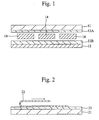
- a solar cell generally includes a front side transparent protection member 11, a front side sealing film 13A, photovoltaic cells 14 such as power generation elements made of silicon, a back side sealing film 13B, and a back side protection member (back cover) 12.
- the forgoing elements are successively superimposed in this order.
- the solar cell is subjected to vacuum degassing, heat and pressure are applied to the solar cell so that the front side sealing film 13A and back side sealing film 13B are adhesively integrated with each other by crosslinking or curing the films 13A and 13B.
- Known solar cells are prepared by connecting a plurality of photovoltaic cells 14 with each other for generating a large electrical output.
- the sealing layers 13A and 13B are provided with electrical insulation properties for sealing the photovoltaic cells 14.
- ethylene-polar monomer copolymer such as ethylene-vinyl acetate copolymer (EVA) and ethylene-ethyl acrylate copolymer (EEA) are used as sealing films in solar cells (Patent literature 1).
- the ethylene-polar monomer film is prepared by application of heat and pressure by use of rollers, to a composition comprising ethylene-polar monomer copolymer and a crosslinking agent.
- various fillers are used in the sealing films of the solar cells.
- the back side sealing film colored by a pigment when used, light reflection occurs at an interface between the back side sealing film and the light-receipt side (front side) sealing film, or diffused light reflection occurs due to the presence of pigment in the back side sealing film. Namely, an incident light is irradiated to parts between the photovoltaic cells and light is transmitted through the cells. These lights are subjected to the diffused light reflection, and the diffused light enters the photovoltaic cells again as incident light. Accordingly, efficiency for using light, and power generation capability are improved. By use of pigments, an aesthetic or design property of the sealing film can be also improved.
- pigments in general, various inorganic or organic pigments such as white, black, blue, red or the like are used. More specifically, for example, white pigments based on titanium oxide or calcium carbonate; blue pigments based on ultramarine; black pigments based on carbon black; and translucent pigments such as glass beads and a light scattering agent are used.
- Patent Literature 1 JP-A 06(1994)-177412
- a sealing film for a solar cell includes an inorganic filler
- the surface of the inorganic filler will be rough.
- the dispersibility of the inorganic filler is low, a film surface with irregular roughness is obtained.
- the adhesive property of the sealing film of the solar cell is decreased, and hence bubble formation or pealing can be observed at an interface between the sealing film and the protection member.
- the inventors of the present invention studied variously and found that the dispersibility of an inorganic filer can be improved in the presence of a particular phosphite compound. Thus, it is possible to obtain a sealing film with an excellent adhesive property.
- a sealing film for a solar cell of the present invention comprising ethylene-polar monomer copolymer, a crosslinking agent, an inorganic filler and a phosphite compound of following formula (I)
- R 1 is a hydrocarbon having 1 to 20 carbon
- the phosphite compound is included in an amount of 0.01 to 5 parts by weight, based on 100 parts by weight of ethylene-polar monomer copolymer.
- the ethylene-polar copolymer is ethylene-vinyl acetate copolymer.
- the inorganic filler is a white inorganic pigment.
- the sealing film for a solar cell of the present invention has an excellent adhesive property, due to the presence of the phosphite compound of the above formula (I). Therefore, in the sealing film for a solar cell of the present invention, it is possible to prevent the interface between the sealing film and the protection member from forming bubbles and peeling off of layers from each other. In other words, the solar cell obtained in the invention maintains a large electrical power generation capability for a long time from the time of installation.
- a sealing film for a solar cell of the present invention comprises a phosphite compound, in addition to ethylene-polar monomer copolymer, crosslinking agent, and inorganic filler.
- the phosphite compound has a phosphor atom and three straight- or branched-chain hydrocarbon groups connected to the phosphor atom via an oxygen atom.
- the compound of the following formula (I) is preferably used:
- R1 is a hydrocarbon group having 1 to 20 carbon atoms.
- Secondary phosphite compound represented by (HO)P(OR 2 ) 2 is also known, wherein R 2 is a hydrocarbon group having 1 to 20 carbon atoms.
- the secondary phosphite compound is easily hydrolyzed, e.g., to phosphonic acid. Namely, a sealing film for a solar cell having an excellent adhesive property cannot be obtained.
- R 1 is a hydrocarbon group having 1 to 20 carbon atoms. Each of R 1 can be the same or different from each other. More specifically, alkyl groups, aryl groups, aralkyl groups can be preferably used.
- alkyl groups straight- or branched-chain alkyl groups such as methyl group, ethyl group, n-propyl group, iso-propyl group, tert-butyl group, iso-butyl group, n-butyl group, sec-butyl group, hexyl group, n-octyl group, iso-octyl group, n-decyl group, iso-decyl group, n-dodecyl group, iso-dodecyl group, n-tridecyl group, iso-tridecyl group, n-tetradecyl group, n-hexadecyl group, iso-hexadecyl group, stearyl group, nonadecyl group or the like can be used.
- aryl group phenyl group, nonylphenyl group, 4-propylphenyl group, 4-pentylphenyl group, 4-octylphenyl group, 4-methoxyphenyl group, 4-propoxyphenyl group, 4-penthyloxyphenyl group, 4-octyloxyphenyl group, 4-butoxymethylphenyl group, 4-octyloxyethylphenyl group, 4-butoxyethoxyphenyl group, 4-octyloxyethoxyphenyl group, 4-butoxybutoxyphenyl group or the like can be used.
- benzyl group phenethyl group, phenylpropyl group, phenylbutyl group, phenylhexyl group or the like can be used.
- hydrocarbons having 1 to 20 carbon atoms for R 1 it is preferable to use straight- or branched-chain alkyl group having 6 to 18 carbon atoms, more preferably having 8 to 14 carbon atoms.
- branched-chain aliphatic alkyl groups are preferably used.
- the phosphite compound are triarylphosphite such as triphenyl phosphate or tri(nonylphenyl) phosphate; alkyl-aryl phosphite such as diphenylisooctyl phosphite, diphenylisodecyl phosphite, diisodecylphenyl phosphite, diisooctyloctylphenyl phosphite, phenyl neopentylglycol phosphite, or 2,4,6-tri-t-butylphenyl-(2-butyl-2-ethyl-1,3-propanediol) phosphite; and trialkyl phosphite such as trisisodecyl phosphite, trilauryl phosphite or tris(tridecyl) phosphite.
- trisisodecyl phosphite is preferably used. This is because trisisodecyl phosphite is excellent for highly dispersing an inorganic filler, and then for obtaining a sealing film with an excellent adhesive property. Moreover, trisdecyl phosphite is a safe material which it is not an environmental hormone material.
- the content of the phosphite compound of formula (I) in the sealing film of the present invention is preferably in the range of 0.01 to 5 parts by weight, more preferably in the range of 0.1 to 1 part by weight, and particularly preferably in the range of 0.1 to 0.5 parts by weight, based on 100 parts by weight of ethylene-polar monomer. Accordingly, a sealing film can be obtained, which has a good dispersibility of inorganic fillers and an excellent adhesive property.
- Examples of the polar monomer used for the ethylene-polar monomer copolymer used in the sealing film of the present invention are unsaturated carboxylic acids, salts thereof, esters thereof, and amides thereof, vinyl esters, and carbon monoxide.
- Specific examples of the monomer are unsaturated carboxylic acids such as acrylic acid, methacrylic acid, fumaric acid, itaconic acid, monomethyl maleate, monoethyl maleate, maleic anhydride, and itaconic anhydride, salts of these unsaturated carboxylic acids, such as monovaleic metal salts such as lithium, sodium and potassium salts of the carboxylic acids, and polyvaleic metal salts such as magnesium, calcium, and zinc salts of the carboxylic acids; and unsaturated carboxylic esters such as methyl acrylate, ethyl acrylate, isopropyl acrylate, isobutyl acrylate, n-butyl acrylate, isooctyl acrylate
- ethylene-polar monomer copolymer examples include ethylene-unsaturated carboxylic acid copolymer such as ethylene-acrylic acid copolymer, and ethylene-methacrylic acid copolymer; ionomers which are obtained by partially or entirely neutralizing carboxylic group of the above-mentioned ethylene-unsaturated carboxylic acid copolymer by using the above-mentioned metals; ethylene-unsaturated carboxylate copolymers such as ethylene-methyl acrylate copolymer, ethylene-ethyl acrylate copolymer, ethylene-methyl methacrylate copolymer, ethylene-isobutyl acrylate copolymer, ethylene-n-butylacrylate copolymer; ethylene-unsaturated carboxylate-unsaturated carboxylic acid copolymers such as ethylene-isobutyl acrylate-methacrylic acid copolymer, and ethylene-n-buty
- ethylene-vinyl acetate copolymer (EVA) is most preferable as the ethylene-polar monomer copolymer.
- EVA ethylene-vinyl acetate copolymer
- a sealing film having excellent transparency and adhesive property is obtained by using the copolymer.
- the vinyl acetate content in the ethylene-vinyl acetate copolymer is in the range of 20 to 30 parts by weight, and particularly in the range of 24 to 28 parts by weight, based on 100 parts by weight of ethylene-vinyl acetate copolymer.
- the vinyl acetate content is less than 20 parts by weight, it is possible that transparency of the sealing film becomes insufficient after the sealing film is crosslinked and cured at a high temperature. Further, when the vinyl acetate content exceeds 30 parts by weight, it is possible that bubbles are generated at the interface between the sealing film and the protective member in the solar cell.
- crosslinking agent for the sealing film of the present invention it is preferable to use an organic peroxide or an photo polymerization initiator. It is possible to prepare a cured/crosslinked film of the ethylene-polar monomer copolymer by use of the crosslinking agent. By using the cured film, the sealing property of a solar cell is increased. A sealing film having improved adhesive property, transparency, moisture resistance and temperature dependency of penetration property is obtained. For this reason, it is preferable to use an organic peroxide.
- an organic peroxide to be used is selected, with the film forming temperature, conditions for formulating the composition, curing temperature, heat resistance of the adhesion substrate, and storage stability taking into account.
- a material having a decomposition temperature of 70°C or more in a 10-hour half-life time is preferable to use.
- organic peroxide it is particularly preferable to use 2,5-dimethyl-2,5-di(2-ethylhexanoylperoxy)hexane, and 1,1-di(tert-hexylperoxy)-3,3,5-trimethylcyclohexane.
- the content of the organic peroxide as the crosslinking agent in the sealing film is preferably in the range of 0.1 to 5 parts by weight, more preferably in the range of 0.2 to 1.5 parts by weight, based on 100 parts by weight of ethylene-polar monomer copolymer.
- the content of the organic peroxide is smaller than in the above range, it is possible that the transparency of the sealing film is decreased. While when the content of the organic peroxide is larger than in the above range, it is possible that bubbles are generated from reaction gas of the crosslinking agent.
- photopolymerization initiators can be used in the present invention. It is preferable that a polymerization initiator is used which imparts an excellent storage property to the sealing film after blending.
- the photopolymerization initiators include acetophenone type initiators such as 2-hydroxy-2-methyl-1-phenylpropane-1-on, 1-hydroxycyclohexylphenylketone and 2-methyl-1-[4-(methylthio)phenyl]-2-morphorinopropane-1; benzoin type initiators such as benzylmethylketal; benzophenone type initiators such as benzophenone, 4-phenylbenzophenone and hydroxybenzophenone; and thioxanthone type initiators such as isopropylthioxanthone and 2,4-diethythioxanthone.
- methylphenylglyoxylate can be used.
- Especially preferred initiators are 2-hidroxy-2-methyl-1-phenylpropan-1-on, 1-hydroxycyclohexylphenylketone, 2-methyl-1-[4-(methylthio)phenyl]-2-morphorinopropane-1 and benzophenone.
- These photopolymerization initiators can be employed, if desired, together with one or more kinds of conventional photopolymerization promoter such as a benzoic acid type promoter (e.g., 4-dimethylaminobenzoic acid) or a tertiary amine type promoter by mixing these with the initiator at an optional mixing ratio. Only the photopolymerization initiator can be used alone or in combination of two or more kinds.
- the content of the photopolymerization initiator in the sealing film of the invention is in the range of 0.5 to 5.0 parts by weight, based on 100 parts by weight of ethylene-polar monomer copolymer.
- any inorganic filler which imparts an additional function to the sealing film can be used without any limitation, for the sealing film of the present invention.
- inorganic fillers such as white, black, blue, red and other inorganic pigments can be used as the inorganic filler, e.g., for improving power generation capability of the solar cells by improving the efficiency for using light.
- inorganic filler titanium oxide, calcium carbonate, zinc oxide, white lead, litopon, barite, precipitated barium sulfate, and calcium sulfate are preferably used, by which the incident light is used to enhance greatly the efficiency of the solar cell.
- an inorganic acid acceptor comprising metal oxide, metal hydroxide, metal carbonate, or multi-metal hydroxide can be used as the inorganic filler, for preventing internal parts of solar cell from metal corrosion.
- organic acid acceptor are oxides, hydroxides, carbonate, carboxylate, silicates, borates, phosphites, metaborates of metal of group II in the periodic table of element such as magnesium oxide, calcium oxide, magnesium hydroxide, calcium hydroxide, barium hydroxide, magnesium carbonate, barium carbonate, calcium carbonate, calcium borate, zinc stearate, calcium phthalate, calcium phosphite, zinc oxide, calcium silicate, magnesium silicate, magnesium borate, magnesium meth-borate, and calcium metaborate, barium metaborate; oxides, basic carbonate, basic carboxylate, basic phosphites, and basic sulfite of group XIV in the periodic table of elements such as tin oxide, basic tin carbonate, tin stearate, basic tin phosphite, basic tin sulfite, lead saline oxide, silicon oxides, and silicon stearate; zinc oxide, aluminum oxide, aluminum hydroxide, iron
- an inorganic filler in the form of plates, such as talc, clay and mica, for improving the mechanical strength of the sealing film for the solar cell to be obtained.
- the mean particle diameter of the inorganic filler is preferably in the range of 1 nm to 5 ⁇ m, in particular in the range of 0.1 to 2.5 ⁇ m. If the mean particle diameter of the inorganic filler is too large, it is possible that a sealing film with a sufficient adhesive property cannot be obtained. On the other hand, when the mean particle diameter of the inorganic filler is too small, the inorganic fillers easily agglomerate, and are difficult to be highly dispersed.
- the mean particle diameter of the inorganic fillers is obtained as follows:
- the sealing film of the solar cell is observed by an electron microscope (preferably a transmission electron microscope) with a magnitude of about 1,000,000, and obtaining equivalent circle diameters of projected area, with respect to at least 100 particles of the inorganic filler. Then, the average value of the particle diameters is obtained, as the mean particle diameter.
- the content of the above-mentioned inorganic filler is preferably in the range of 0.01 to 10 parts by weight, and in particular in the range of 0.1 to 5 parts by weight, based on 100 parts by weight of the ethylene-polar monomer copolymer. Accordingly, it is possible to highly disperse the inorganic filler so that a sealing film having an excellent adhesive property can be obtained.
- the sealing film for a solar cell of the invention preferably contains a crosslinking auxiliary agent.
- the crosslinking auxiliary agent improves gel fraction of ethylene-polar monomer copolymer and adhesive property and durability of the sealing film.
- the crosslinking auxiliary agent is generally used in an amount of 10 parts by weight or less, preferably in the range of 0.1 to 5 parts by weight, based on 100 parts by weight of ethylene-vinyl acetate copolymer. Accordingly, a sealing film with an excellent adhesive property can be obtained.
- crosslinking auxiliary agent examples include tri-functional crosslinking auxiliary agents such as triallyl cyanurate and triallyl isocyanurate; and mono- or di-functional crosslinking auxiliary agents such as (meth)acrylic esters (e.g., NK esters).
- tri-functional crosslinking auxiliary agents such as triallyl cyanurate and triallyl isocyanurate
- mono- or di-functional crosslinking auxiliary agents such as (meth)acrylic esters (e.g., NK esters).
- triallyl cyanurate and triallyl isocyanurate are preferably used, and triallyl isocyanurate is particularly preferably used.
- the sealing film of the present invention further includes additives such as a plasticizer, an adhesion promoter, an acryloxy-group-containing compound, a methacryloxy-group-containing compound and/or an epoxy-group-containing compound.
- plasticizer examples include dioctyl phthalate, dihexyladipate, triethylene glycol-di-2-ethylbutylate, butyl sebacate, tetraethylene glycol heptanoate and triethylene glycol dipelargonate.
- the plasticizer can be used singly, or in combination of two or more kinds.
- the plasticizer is used preferably in an amount of not more than 5 parts by weight, based on 100 parts by weight of ethylene-polar monomer copolymer.
- a silane coupling agent can be used as the adhesion promoter.
- the silane coupling agent include ⁇ -chloropropylmethoxysilane, vinylethoxysilane, vinyltris( ⁇ -methoxyethoxy)silane, ⁇ -methacryloxypropyltrimethoxysilane, vinyltriacetoxysilane, ⁇ - glycidoxypropyltrimethoxysilane, ⁇ -glycidoxypropyltriethoxysilane, ⁇ -(3,4-epoxycyclohexyl) ethyltrimethoxysilane, vinyltrichloroslane, ⁇ -mercaptopropyltrimethoxysilane, ⁇ -aminopropyltriethoxysilane, , and N- ⁇ -(aminoethyl)- ⁇ -amino
- acrylic acid or methacrylic acid derivatives for instance, esters or amides of acrylic acid or methacrylic acid are used, as the above-mentioned acryloxy-group containing compound and the methacryloxy-group containing compound.
- ester residue are straight-chain alkyl groups, such as methyl, ethyl, dodecyl, stearyl, lauryl, and cyclohexyl group, tetrahydrofurfuryl group, amino ethyl group, 2-hydroxyethyl group, 3-hydroxypropyl group, and 3-chloro-2-hydroxypropyl group.
- the amide are diacetone acrylamide.
- esters obtained from a polyhydric alcohol such as ethylene glycol, triethylene glycol, polypropylene glycol, polyethylene glycol, triemthylol propane, or pentaerythritol and acrylic acid or methacrylic acid.
- epoxy-group-containing compound triglycidyl tris(2-hydroxyethyl)isocyanurate, neopentylglycol diglycidyl ether, 1,6-hexanediol diglycidyl ether, allyl glycidyl ether, 2-ethylhexyl glycidyl ether, phenyl glycidyl ether, phenol(ethyleneoxy) 5 glycidyl ether, p-tert-butylphenyl glycidyl ether, diglycidyl adipate, diglycidyl phthalate, glycidyl methacrylate and butyl glycidyl ether can be used.
- the acryloxy group-containing compound, methacryloxy group-containing compound or epoxy group-containing compound is preferably contained in an amount of 0.5 to 5.0 parts by weight, and preferably 1.0 to 4.0 parts by weight, based on 100 parts by weight of ethylene-polar monomer copolymer.
- sealing film of the present invention may further contain ultraviolet absorber, light stabilizer, and/or anti-aging agent.
- the ultraviolet absorber By adding the ultraviolet absorber to the sealing film for a solar cell of the invention, it is possible to prevent ethylene-polar monomer copolymer from being deteriorated by the effect of light irradiation or the like, and the sealing film for a solar cell from yellowing.
- the ultraviolet absorber there is no particular restrictions to the ultraviolet absorber to be used in the present invention.
- the ultraviolet absorber are benzophenone-based ultraviolet absorbers such as 2-hydroxy-4-methoxybenzophenone, 2-hydroxy-4-n-dodecyloxybenzophenone, 2,4-dihydroxybenzophenone, 2,2'-dihydroxy-4-methoxybenzophenone, 2-hydroxy-4-n-octoxybanzophenone.
- the benzophenone-based ultraviolet absorber preferably in an amount of 0.01 to 5 parts by weight is added based on 100 parts by weight of ethylene-polar monomer copolymer.
- a hindered amine photostabilizer can be used as the photo stabilizer.
- photostabilizer examples include LA-52, LA-57, LA-62, LA-63, LA-63p, LA-67 and LA-68 (each manufactured by ADEKA Co., Ltd.), Tinuvin 744, Tinuvin 770, Tinuvin 765, Tinuvin 144, Tinuvin 622LD, and CHIMASSORB 944LD (each manufactured by Ciba Specialty Chemicals Co., Ltd.), and UV-3034 (each manufactured by B. F. Goodrich).
- the photostabilizers can be each used singly, or in combination of two or more kinds.
- the blend content of the photostabilizer preferably is in the range of 0.01 to 5 parts by weight based on 100 parts by weight of ethylene-polar monomer copolymer.
- anti-aging agent examples include hindered phenol antioxidants such as N,N'-hexan-1,6-diyl-bis[3-(3,5-di-tert-butyl-4- hydroxyphenyl) propionamide], phosphorus-type heat stabilizers, lactone-type heat stabilizers, vitamin E-type heat stabilizers and sulfur-type heat stabilizers.
- the sealing film for a solar cell of the invention is prepared in accordance with a conventional film forming method.
- the composition including the above-discussed materials is molded into a sheet-shaped article by extrusion molding, or calendar molding (calendaring).
- the composition is dissolved in a solvent, the thus obtained solution is applied to an appropriate substrate by an appropriate coater, and the applied solution is dried to obtain a coat.
- the heat application temperature is generally in the range of 50 to 90 ⁇ , when a film is formed, e.g. by application of heat and pressure by use of rollers in accordance with extrusion molding.
- the thickness of the sealing film for a solar cell of the invention does not have any particular restriction, and is possible to be in the range of 50 ⁇ m to 2 mm.
- the structure of the solar cell obtained by use of the sealing film of the present invention does not have any particular restriction. It is possible that the photovoltaic cell is sealed by interposing the sealing film(s) between the front side transparent protection member and the back side protection member, and that the sealing film(s) is/are crosslinked so as to be integral with the other members/layers.
- the front side transparent protection member 11, front side sealing film 13A, photovoltaic cell(s) 14, back side sealing film 13B and back side protection member 12 are successively overlaid as shown in Fig. 1 . Thereafter, the sealing film is crosslinked/cured in accordance with a conventional method such as heat and pressure application.
- the thus obtained laminate is subjected to heat and pressure application at a temperature of 135 to 180°C, more preferably 140 to 180°C, in particular 155 to 180°C, by using a vacuum laminator with a degassing time of 0.1 to 5 minutes, a pressure of 0.1 to 1.5 kg/cm 2 , and a press time of 5 to 15 minutes.
- ethylene-vinyl acetate copolymer included in the front side sealing film 13A and the back side sealing film 13B is crosslinked. Accordingly, the front side transparent protection member 11, back side transparent member 12 and photovoltaic cell 14 are integrated with each other via the front side sealing film 13A and the back side sealing film 13B.
- the photovoltaic cell 14 can be sealed.
- the sealing film for a solar cell of the invention is particularly preferably used as the back side sealing film to be provided between the photovoltaic cell and the back side protective member, since the sealing film includes the inorganic filler.
- a side of a photovoltaic cell from which the light is irradiated is referred to as "front side”, and a reversed side, with respect to the light-receipt side, of photovoltaic cell is referred to as "bask side”.
- the front side transparent protection member of the solar cell of the invention is usually a glass substrate such as silicate glass.
- the thickness of the glass substrate is generally in the range of 0.1 to 10 mm, preferably 0. 3 to 5 mm.
- the glass plate can be thermally or chemically tempered.
- the back side protection member for use in the present invention is a plastic film such as PET.
- a plastic film such as PET.
- a laminate film including fluorinated polyethylene film, in particular fluorinated polyethylene film, A1 film, and fluorinated polyethylene film in this order is preferable.
- the sealing film of the present invention is used for a solar cell which has a plastic film such as a PET film as the back side protection member, since the plastic film such as PET has a low adhesive property with respect to a sealing film for a solar cell.
- the solar cell of the present invention is characterized by the sealing films used as the front side and the back side films. Namely, there is no particular restriction on the members of the solar cell except for the sealing films.
- the front side transparent protection member, back side protection member, and photovoltaic cells can have structures/compositions as those in known solar cells.
- compositions for a sealing film for a solar cell Materials with the formulation in Table 1 were supplied to a roll mill, and kneaded at 70°C to prepare a composition for a sealing film for a solar cell.
- the composition for a sealing film was formed by calendaring at a temperature of 70°C. After the formed composition was allowed to cool, a sealing film (thickness: 0.6 mm) for a solar cell was obtained.
- compositions for sealing films were prepared in the same way as in Example 1, except that the materials and the formulations are changed into those in Table 1. By using these compositions, sealing films for solar cells were prepared.
- compositions for sealing films were prepared in the same way as in Example 1, except that the materials and the formulations are changed into those in Table 2. By using these compositions, sealing films for solar cells were prepared.
- the sealing film 23 for a solar cell and PCT film 22 (thickness: 50 mm, width: 10 cm) are superimposed on the glass substrate 21 in this order.
- the thus obtained laminate was subjected to vacuum degassing by using a vacuum laminator, and preliminary pressure contact treatment at a temperature of 100 ⁇ . Subsequently, the laminate was brought into an oven, and treated by application of pressure and heat thereto for 4 minutes, under a condition at a temperature of 155 ⁇ . Thereafter, the laminate was left in an atmosphere of 23 ⁇ and 50% RH for 24 hours. Then, the sealing film 23 and the PET film 22 were partially released from the glass substrate. The released part of the PET film 22 was folded by 180° turn. By using a tensile tester (Autograph, manufactured by Shimadzu Corporation), peal strength at a tensile speed of 100 mm/min was measured, as PET adhesion strength (N/cm). The results are shown in Tables 1 and 2.
- the sealing films of the invention which comprise the tertiary phosphite compound of the present invention, have excellent adhesive properties. Therefore, it is possible to prevent the solar cell from bubble formation at the interface between the sealing film and the protection member, and the layers from being peeled from each other.
- a solar cell is provided, which maintains an high power generation performance for a long time, from the time of installation.
Landscapes
- Chemical & Material Sciences (AREA)
- Health & Medical Sciences (AREA)
- Chemical Kinetics & Catalysis (AREA)
- Medicinal Chemistry (AREA)
- Polymers & Plastics (AREA)
- Organic Chemistry (AREA)
- Life Sciences & Earth Sciences (AREA)
- Biochemistry (AREA)
- Photovoltaic Devices (AREA)
- Sealing Material Composition (AREA)
- Compositions Of Macromolecular Compounds (AREA)
Abstract
Description
- The present invention relates to a sealing film for a solar cell comprising, as a main component, ethylene-polar monomer copolymer, in particular to a sealing film including an inorganic filler and provides an excellent adhesive property.
- In recent years, a solar cell, that is, a device that directly converts solar energy into electric energy has become widely used. Such solar cells provide an effective use of natural resources and prevent environmental pollution. Further development of solar cells is in progress.
- As shown in
Fig. 1 , a solar cell generally includes a front sidetransparent protection member 11, a frontside sealing film 13A,photovoltaic cells 14 such as power generation elements made of silicon, a backside sealing film 13B, and a back side protection member (back cover) 12. The forgoing elements are successively superimposed in this order. After the solar cell is subjected to vacuum degassing, heat and pressure are applied to the solar cell so that the frontside sealing film 13A and backside sealing film 13B are adhesively integrated with each other by crosslinking or curing thefilms photovoltaic cells 14 with each other for generating a large electrical output. To maintain the electrical insulation property of thephotovoltaic cells 14, thesealing layers photovoltaic cells 14. - Films of ethylene-polar monomer copolymer such as ethylene-vinyl acetate copolymer (EVA) and ethylene-ethyl acrylate copolymer (EEA) are used as sealing films in solar cells (Patent literature 1). The ethylene-polar monomer film is prepared by application of heat and pressure by use of rollers, to a composition comprising ethylene-polar monomer copolymer and a crosslinking agent.
- Depending on the properties required for the solar cells, various fillers are used in the sealing films of the solar cells. For instance, when the back side sealing film colored by a pigment is used, light reflection occurs at an interface between the back side sealing film and the light-receipt side (front side) sealing film, or diffused light reflection occurs due to the presence of pigment in the back side sealing film. Namely, an incident light is irradiated to parts between the photovoltaic cells and light is transmitted through the cells. These lights are subjected to the diffused light reflection, and the diffused light enters the photovoltaic cells again as incident light. Accordingly, efficiency for using light, and power generation capability are improved. By use of pigments, an aesthetic or design property of the sealing film can be also improved. As the pigments, in general, various inorganic or organic pigments such as white, black, blue, red or the like are used. More specifically, for example, white pigments based on titanium oxide or calcium carbonate; blue pigments based on ultramarine; black pigments based on carbon black; and translucent pigments such as glass beads and a light scattering agent are used.
- Patent Literature 1:
JP-A 06(1994)-177412 - Conventional sealing films including inorganic fillers such as titanium oxide pigments have poor adhesive properties between the surface side transparent protection member and the back side protective member. It is possible that bubbles are generated or peeling occurs at an interface between the front or back side sealing film and the front or back side transparent protective member in a sealing film having a low adhesive property, when heat and pressure are applied to the solar cell during the preparation thereof, or when the solar cell is set outdoors.
When bubbles or pealing occurs, water penetrates the interface between the sealing film and the protection member, and the insulation property of the solar cell is decreased. Further, in this case, the steam barrier or gas barrier properties of the protection member may be damaged. Consequently, power generation capability of the solar cell is decreased. On the other hand, it is desired for solar cells to continue to have excellent power generation capability for a long time, e.g., for several decades or more from the time of installation. - It is therefore an object of the present invention to provide a sealing film for a solar cell having an excellent adhesive property, which includes an inorganic filler.
- When a sealing film for a solar cell includes an inorganic filler, the surface of the inorganic filler will be rough. Especially when the dispersibility of the inorganic filler is low, a film surface with irregular roughness is obtained. Based on the irregularity, the adhesive property of the sealing film of the solar cell is decreased, and hence bubble formation or pealing can be observed at an interface between the sealing film and the protection member. The inventors of the present invention studied variously and found that the dispersibility of an inorganic filer can be improved in the presence of a particular phosphite compound. Thus, it is possible to obtain a sealing film with an excellent adhesive property.
- The above object is attained by a sealing film for a solar cell of the present invention, comprising ethylene-polar monomer copolymer, a crosslinking agent, an inorganic filler and a phosphite compound of following formula (I)
-
[Formula I] P(OR1)3 (I)
- (wherein, R1 is a hydrocarbon having 1 to 20 carbon)
- Preferred embodiments of the sealing film for a solar cell of the present invention will now be discussed below.
- (1) The phosphite compound is included in an amount of 0.01 to 5 parts by weight, based on 100 parts by weight of ethylene-polar monomer copolymer.
- (2) The ethylene-polar copolymer is ethylene-vinyl acetate copolymer.
- (3) The inorganic filler is a white inorganic pigment.
- The sealing film for a solar cell of the present invention has an excellent adhesive property, due to the presence of the phosphite compound of the above formula (I). Therefore, in the sealing film for a solar cell of the present invention, it is possible to prevent the interface between the sealing film and the protection member from forming bubbles and peeling off of layers from each other. In other words, the solar cell obtained in the invention maintains a large electrical power generation capability for a long time from the time of installation.
-
- [
Fig. 1] Fig. 1 is a cross section of a generally used solar cell. - [
Fig. 2] Fig. 2 is a schematic diagram for explaining 180°peel test. -
- 11,12
- Front side transparent protection member
- 12, 22
- Back side protection member
- 13A
- Front side sealing film
- 13B
- Back side sealing film
- 14
- Photovoltaic cell
- 26
- Sealing film for determining quantity of acetic acid generation
- 21
- Glass substrate
- 22
- Sealing film for solar cell
- 23
- PET film
- A sealing film for a solar cell of the present invention comprises a phosphite compound, in addition to ethylene-polar monomer copolymer, crosslinking agent, and inorganic filler.
- The phosphite compound has a phosphor atom and three straight- or branched-chain hydrocarbon groups connected to the phosphor atom via an oxygen atom.
- As the phosphite compound, the compound of the following formula (I) is preferably used:
- [Formula 2] P (OR1)3 (I)
- (wherein, R1 is a hydrocarbon group having 1 to 20 carbon atoms).
- Secondary phosphite compound represented by (HO)P(OR2)2 is also known, wherein R2 is a hydrocarbon group having 1 to 20 carbon atoms. The secondary phosphite compound, however, is easily hydrolyzed, e.g., to phosphonic acid. Namely, a sealing film for a solar cell having an excellent adhesive property cannot be obtained. On the other hand, it is possible to provide a sealing film for a solar cell, which has an excellent adhesive property, by using the tertiary phosphite compound as shown in the above-mentioned formula (I).
- In formula (I), R1 is a hydrocarbon group having 1 to 20 carbon atoms. Each of R1 can be the same or different from each other. More specifically, alkyl groups, aryl groups, aralkyl groups can be preferably used.
- As the alkyl groups, straight- or branched-chain alkyl groups such as methyl group, ethyl group, n-propyl group, iso-propyl group, tert-butyl group, iso-butyl group, n-butyl group, sec-butyl group, hexyl group, n-octyl group, iso-octyl group, n-decyl group, iso-decyl group, n-dodecyl group, iso-dodecyl group, n-tridecyl group, iso-tridecyl group, n-tetradecyl group, n-hexadecyl group, iso-hexadecyl group, stearyl group, nonadecyl group or the like can be used.
- As the aryl group, phenyl group, nonylphenyl group, 4-propylphenyl group, 4-pentylphenyl group, 4-octylphenyl group, 4-methoxyphenyl group, 4-propoxyphenyl group, 4-penthyloxyphenyl group, 4-octyloxyphenyl group, 4-butoxymethylphenyl group, 4-octyloxyethylphenyl group, 4-butoxyethoxyphenyl group, 4-octyloxyethoxyphenyl group, 4-butoxybutoxyphenyl group or the like can be used.
- As the aralkyl group, benzyl group, phenethyl group, phenylpropyl group, phenylbutyl group, phenylhexyl group or the like can be used.
- Among the hydrocarbons having 1 to 20 carbon atoms for R1 discussed above, it is preferable to use straight- or branched-chain alkyl group having 6 to 18 carbon atoms, more preferably having 8 to 14 carbon atoms. In particular, branched-chain aliphatic alkyl groups are preferably used. Specifically, it is preferable to use iso-decyl group, iso-dodecyl group, iso-tridecyl group, iso-tetredecyl group, and iso-hexadecyl groups. When R1 is such hydrocarbon group, it is possible to disperse an inorganic filler in the sealing film, without having bleed out phenomenon from the sealing film when the solar cell is stored.
- Specific examples of the phosphite compound are triarylphosphite such as triphenyl phosphate or tri(nonylphenyl) phosphate; alkyl-aryl phosphite such as diphenylisooctyl phosphite, diphenylisodecyl phosphite, diisodecylphenyl phosphite, diisooctyloctylphenyl phosphite, phenyl neopentylglycol phosphite, or 2,4,6-tri-t-butylphenyl-(2-butyl-2-ethyl-1,3-propanediol) phosphite; and trialkyl phosphite such as trisisodecyl phosphite, trilauryl phosphite or tris(tridecyl) phosphite. Among these, trisisodecyl phosphite is preferably used. This is because trisisodecyl phosphite is excellent for highly dispersing an inorganic filler, and then for obtaining a sealing film with an excellent adhesive property. Moreover, trisdecyl phosphite is a safe material which it is not an environmental hormone material.
- The content of the phosphite compound of formula (I) in the sealing film of the present invention is preferably in the range of 0.01 to 5 parts by weight, more preferably in the range of 0.1 to 1 part by weight, and particularly preferably in the range of 0.1 to 0.5 parts by weight, based on 100 parts by weight of ethylene-polar monomer. Accordingly, a sealing film can be obtained, which has a good dispersibility of inorganic fillers and an excellent adhesive property.
- Examples of the polar monomer used for the ethylene-polar monomer copolymer used in the sealing film of the present invention are unsaturated carboxylic acids, salts thereof, esters thereof, and amides thereof, vinyl esters, and carbon monoxide. Specific examples of the monomer are unsaturated carboxylic acids such as acrylic acid, methacrylic acid, fumaric acid, itaconic acid, monomethyl maleate, monoethyl maleate, maleic anhydride, and itaconic anhydride, salts of these unsaturated carboxylic acids, such as monovaleic metal salts such as lithium, sodium and potassium salts of the carboxylic acids, and polyvaleic metal salts such as magnesium, calcium, and zinc salts of the carboxylic acids; and unsaturated carboxylic esters such as methyl acrylate, ethyl acrylate, isopropyl acrylate, isobutyl acrylate, n-butyl acrylate, isooctyl acrylate, methyl methacrylate, ethyl methacrylate, isobutyl methacrylate, and dimethyl maleate; and vinyl esters such as vinyl acetate, vinyl propionate, and carbon monoxide and sulfur dioxide. One, two or more of the above-mentioned monomers can be used.
- More specifically, representative examples of the ethylene-polar monomer copolymer are ethylene-unsaturated carboxylic acid copolymer such as ethylene-acrylic acid copolymer, and ethylene-methacrylic acid copolymer; ionomers which are obtained by partially or entirely neutralizing carboxylic group of the above-mentioned ethylene-unsaturated carboxylic acid copolymer by using the above-mentioned metals; ethylene-unsaturated carboxylate copolymers such as ethylene-methyl acrylate copolymer, ethylene-ethyl acrylate copolymer, ethylene-methyl methacrylate copolymer, ethylene-isobutyl acrylate copolymer, ethylene-n-butylacrylate copolymer; ethylene-unsaturated carboxylate-unsaturated carboxylic acid copolymers such as ethylene-isobutyl acrylate-methacrylic acid copolymer, and ethylene-n-butyl acrylate-methacrylic acid copolymer; and ionomers which are obtained by partially or entirely neutralizing carboxylic group of the above-mentioned ethylene-unsaturated carboxylate-unsaturated carboxylic acid copolymer; and ethylene-vinyl ester copolymers such as ethylene-vinyl acetate copolymer.
- Among the above examples, ethylene-vinyl acetate copolymer (EVA) is most preferable as the ethylene-polar monomer copolymer. A sealing film having excellent transparency and adhesive property is obtained by using the copolymer.
- The vinyl acetate content in the ethylene-vinyl acetate copolymer is in the range of 20 to 30 parts by weight, and particularly in the range of 24 to 28 parts by weight, based on 100 parts by weight of ethylene-vinyl acetate copolymer. When the vinyl acetate content is less than 20 parts by weight, it is possible that transparency of the sealing film becomes insufficient after the sealing film is crosslinked and cured at a high temperature. Further, when the vinyl acetate content exceeds 30 parts by weight, it is possible that bubbles are generated at the interface between the sealing film and the protective member in the solar cell.
- As a crosslinking agent for the sealing film of the present invention, it is preferable to use an organic peroxide or an photo polymerization initiator. It is possible to prepare a cured/crosslinked film of the ethylene-polar monomer copolymer by use of the crosslinking agent. By using the cured film, the sealing property of a solar cell is increased. A sealing film having improved adhesive property, transparency, moisture resistance and temperature dependency of penetration property is obtained. For this reason, it is preferable to use an organic peroxide.
- It is possible to use any organic peroxide as long as the organic peroxide decomposes at a temperature of 100°C or more to generate radicals. Generally speaking, an organic peroxide to be used is selected, with the film forming temperature, conditions for formulating the composition, curing temperature, heat resistance of the adhesion substrate, and storage stability taking into account. In particular, it is preferable to use a material having a decomposition temperature of 70°C or more in a 10-hour half-life time.
- As the above-discussed organic peroxide, 2,5-dimethylhexane, 2,5-dihydroperoxide, 2,5-dimethyl-2,5-di(tert-butylperoxy)hexane, 3-di-tert-butylperoxide, tert-dicumylperoxide, 2,5-dimethyl-2,5-di(2-ethylhexanoylperoxy)hexane, 2,5-dimethyl-2,5-di(tert-butylperoxy)hexane, 2,5-dimethyl-2,5-di(tert-butylperoxy)hexine, dicumylperoxide, tert-butylcumylperoxide, α,α'-bis(tert-butyloxyisopropyl)benzene, α,α'-butyl-4,4-bis(tert-butylperoxy)diisopropylbenzene, n-butyl-4,4-bis(tert-butylperoxy)butane, 2,2-bis(tert-butylperoxy)butane, 1,1-bis(tert-butylperoxy)cyclohexane, 1,1-bis(tert-butylperoxy)3,3,5-trimethylcyclohexane, tert-butylperoxybenzoate, benzoylperoxide, and 1,1-di(tert-hexylperoxy)-3,3,5-trimethylcyclohexane are used, from the view point of process temperature and storage stability of the resin, are.
- As the organic peroxide, it is particularly preferable to use 2,5-dimethyl-2,5-di(2-ethylhexanoylperoxy)hexane, and 1,1-di(tert-hexylperoxy)-3,3,5-trimethylcyclohexane. By use of these organic peroxides, a sealing film having an excellent adhesive property can be obtained.
- The content of the organic peroxide as the crosslinking agent in the sealing film is preferably in the range of 0.1 to 5 parts by weight, more preferably in the range of 0.2 to 1.5 parts by weight, based on 100 parts by weight of ethylene-polar monomer copolymer. When the content of the organic peroxide is smaller than in the above range, it is possible that the transparency of the sealing film is decreased. While when the content of the organic peroxide is larger than in the above range, it is possible that bubbles are generated from reaction gas of the crosslinking agent.
- Any known photopolymerization initiators can be used in the present invention. It is preferable that a polymerization initiator is used which imparts an excellent storage property to the sealing film after blending. Examples of the photopolymerization initiators include acetophenone type initiators such as 2-hydroxy-2-methyl-1-phenylpropane-1-on, 1-hydroxycyclohexylphenylketone and 2-methyl-1-[4-(methylthio)phenyl]-2-morphorinopropane-1; benzoin type initiators such as benzylmethylketal; benzophenone type initiators such as benzophenone, 4-phenylbenzophenone and hydroxybenzophenone; and thioxanthone type initiators such as isopropylthioxanthone and 2,4-diethythioxanthone. Further, as special type, methylphenylglyoxylate can be used. Especially preferred initiators are 2-hidroxy-2-methyl-1-phenylpropan-1-on, 1-hydroxycyclohexylphenylketone, 2-methyl-1-[4-(methylthio)phenyl]-2-morphorinopropane-1 and benzophenone. These photopolymerization initiators can be employed, if desired, together with one or more kinds of conventional photopolymerization promoter such as a benzoic acid type promoter (e.g., 4-dimethylaminobenzoic acid) or a tertiary amine type promoter by mixing these with the initiator at an optional mixing ratio. Only the photopolymerization initiator can be used alone or in combination of two or more kinds.
- It is preferable that the content of the photopolymerization initiator in the sealing film of the invention is in the range of 0.5 to 5.0 parts by weight, based on 100 parts by weight of ethylene-polar monomer copolymer.
- Any inorganic filler which imparts an additional function to the sealing film can be used without any limitation, for the sealing film of the present invention.
- Various inorganic fillers such as white, black, blue, red and other inorganic pigments can be used as the inorganic filler, e.g., for improving power generation capability of the solar cells by improving the efficiency for using light. Among the above-mentioned pigments, titanium oxide, calcium carbonate, zinc oxide, white lead, litopon, barite, precipitated barium sulfate, and calcium sulfate are preferably used, by which the incident light is used to enhance greatly the efficiency of the solar cell.
- In addition to the above-discussed fillers, an inorganic acid acceptor comprising metal oxide, metal hydroxide, metal carbonate, or multi-metal hydroxide can be used as the inorganic filler, for preventing internal parts of solar cell from metal corrosion.
Specific examples of the organic acid acceptor are oxides, hydroxides, carbonate, carboxylate, silicates, borates, phosphites, metaborates of metal of group II in the periodic table of element such as magnesium oxide, calcium oxide, magnesium hydroxide, calcium hydroxide, barium hydroxide, magnesium carbonate, barium carbonate, calcium carbonate, calcium borate, zinc stearate, calcium phthalate, calcium phosphite, zinc oxide, calcium silicate, magnesium silicate, magnesium borate, magnesium meth-borate, and calcium metaborate, barium metaborate; oxides, basic carbonate, basic carboxylate, basic phosphites, and basic sulfite of group XIV in the periodic table of elements such as tin oxide, basic tin carbonate, tin stearate, basic tin phosphite, basic tin sulfite, lead saline oxide, silicon oxides, and silicon stearate; zinc oxide, aluminum oxide, aluminum hydroxide, iron hydroxide, and multi-metal hydroxides such as hydrotalcite; and aluminum hydroxide gel compound. - It is possible to use an inorganic filler in the form of plates, such as talc, clay and mica, for improving the mechanical strength of the sealing film for the solar cell to be obtained.
- The mean particle diameter of the inorganic filler is preferably in the range of 1 nm to 5 µm, in particular in the range of 0.1 to 2.5 µm. If the mean particle diameter of the inorganic filler is too large, it is possible that a sealing film with a sufficient adhesive property cannot be obtained. On the other hand, when the mean particle diameter of the inorganic filler is too small, the inorganic fillers easily agglomerate, and are difficult to be highly dispersed.
- In the present invention, the mean particle diameter of the inorganic fillers is obtained as follows: The sealing film of the solar cell is observed by an electron microscope (preferably a transmission electron microscope) with a magnitude of about 1,000,000, and obtaining equivalent circle diameters of projected area, with respect to at least 100 particles of the inorganic filler. Then, the average value of the particle diameters is obtained, as the mean particle diameter.
- The content of the above-mentioned inorganic filler is preferably in the range of 0.01 to 10 parts by weight, and in particular in the range of 0.1 to 5 parts by weight, based on 100 parts by weight of the ethylene-polar monomer copolymer. Accordingly, it is possible to highly disperse the inorganic filler so that a sealing film having an excellent adhesive property can be obtained.
- The sealing film for a solar cell of the invention preferably contains a crosslinking auxiliary agent. The crosslinking auxiliary agent improves gel fraction of ethylene-polar monomer copolymer and adhesive property and durability of the sealing film.
- The crosslinking auxiliary agent is generally used in an amount of 10 parts by weight or less, preferably in the range of 0.1 to 5 parts by weight, based on 100 parts by weight of ethylene-vinyl acetate copolymer. Accordingly, a sealing film with an excellent adhesive property can be obtained.
- Examples of the above-mentioned crosslinking auxiliary agent (a compound having a free radical polymerization group) include tri-functional crosslinking auxiliary agents such as triallyl cyanurate and triallyl isocyanurate; and mono- or di-functional crosslinking auxiliary agents such as (meth)acrylic esters (e.g., NK esters). Among these compounds, triallyl cyanurate and triallyl isocyanurate are preferably used, and triallyl isocyanurate is particularly preferably used.
- In order to improve or adjust various physical properties (mechanical strength, adhesive property, optical properties such as transparency, heat resistance, light resistance, and crosslinking rate, etc), particularly in order to improve mechanical strength of the sealing film of the invention, it is possible, if necessary, that the sealing film of the present invention further includes additives such as a plasticizer, an adhesion promoter, an acryloxy-group-containing compound, a methacryloxy-group-containing compound and/or an epoxy-group-containing compound.
- Generally speaking, polybasic acid esters and polyhydric alcohol esters are used as the above mentioned plasticizer, although there is no special restrictions to the plasticizer to be used. Examples of the plasticizer include dioctyl phthalate, dihexyladipate, triethylene glycol-di-2-ethylbutylate, butyl sebacate, tetraethylene glycol heptanoate and triethylene glycol dipelargonate. The plasticizer can be used singly, or in combination of two or more kinds. The plasticizer is used preferably in an amount of not more than 5 parts by weight, based on 100 parts by weight of ethylene-polar monomer copolymer.
- As the adhesion promoter, a silane coupling agent can be used. By using the silane coupling agent, a sealing film for a solar cell having an excellent adhesive property can be obtained. Examples of the silane coupling agent include γ-chloropropylmethoxysilane, vinylethoxysilane, vinyltris(β-methoxyethoxy)silane, γ-methacryloxypropyltrimethoxysilane, vinyltriacetoxysilane, γ- glycidoxypropyltrimethoxysilane, γ-glycidoxypropyltriethoxysilane, β-(3,4-epoxycyclohexyl) ethyltrimethoxysilane, vinyltrichloroslane, γ-mercaptopropyltrimethoxysilane, γ-aminopropyltriethoxysilane, , and N-β-(aminoethyl)- γ-aminopropyltrimethoxysilane. These silane coupling agents can be used alone or as a combination of two or more. The content of the silane coupling agent is preferably not more than 5 parts by weight, based on 100 parts by weight of ethylene-polar monomer copolymer.
- Generally speaking, acrylic acid or methacrylic acid derivatives, for instance, esters or amides of acrylic acid or methacrylic acid are used, as the above-mentioned acryloxy-group containing compound and the methacryloxy-group containing compound. Examples of the ester residue are straight-chain alkyl groups, such as methyl, ethyl, dodecyl, stearyl, lauryl, and cyclohexyl group, tetrahydrofurfuryl group, amino ethyl group, 2-hydroxyethyl group, 3-hydroxypropyl group, and 3-chloro-2-hydroxypropyl group. Examples of the amide are diacetone acrylamide. Further, it is possible to use esters obtained from a polyhydric alcohol such as ethylene glycol, triethylene glycol, polypropylene glycol, polyethylene glycol, triemthylol propane, or pentaerythritol and acrylic acid or methacrylic acid.
- As the afore-mentioned epoxy-group-containing compound, triglycidyl tris(2-hydroxyethyl)isocyanurate, neopentylglycol diglycidyl ether, 1,6-hexanediol diglycidyl ether, allyl glycidyl ether, 2-ethylhexyl glycidyl ether, phenyl glycidyl ether, phenol(ethyleneoxy)5glycidyl ether, p-tert-butylphenyl glycidyl ether, diglycidyl adipate, diglycidyl phthalate, glycidyl methacrylate and butyl glycidyl ether can be used..
- The acryloxy group-containing compound, methacryloxy group-containing compound or epoxy group-containing compound is preferably contained in an amount of 0.5 to 5.0 parts by weight, and preferably 1.0 to 4.0 parts by weight, based on 100 parts by weight of ethylene-polar monomer copolymer.
- Further, the sealing film of the present invention may further contain ultraviolet absorber, light stabilizer, and/or anti-aging agent.
- By adding the ultraviolet absorber to the sealing film for a solar cell of the invention, it is possible to prevent ethylene-polar monomer copolymer from being deteriorated by the effect of light irradiation or the like, and the sealing film for a solar cell from yellowing. There is no particular restrictions to the ultraviolet absorber to be used in the present invention. Preferable examples of the ultraviolet absorber are benzophenone-based ultraviolet absorbers such as 2-hydroxy-4-methoxybenzophenone, 2-hydroxy-4-n-dodecyloxybenzophenone, 2,4-dihydroxybenzophenone, 2,2'-dihydroxy-4-methoxybenzophenone, 2-hydroxy-4-n-octoxybanzophenone. Moreover, the benzophenone-based ultraviolet absorber preferably in an amount of 0.01 to 5 parts by weight is added based on 100 parts by weight of ethylene-polar monomer copolymer.
- It is also possible, by adding the photostabilizer to the sealing film for a solar cell of the invention, to prevent ethylene-polar monomer copolymer from being deteriorated by the effect of light irradiation or the like, and the sealing film from yellowing. A hindered amine photostabilizer can be used as the photo stabilizer. Examples of the photostabilizer include LA-52, LA-57, LA-62, LA-63, LA-63p, LA-67 and LA-68 (each manufactured by ADEKA Co., Ltd.), Tinuvin 744, Tinuvin 770, Tinuvin 765, Tinuvin 144, Tinuvin 622LD, and CHIMASSORB 944LD (each manufactured by Ciba Specialty Chemicals Co., Ltd.), and UV-3034 (each manufactured by B. F. Goodrich). The photostabilizers can be each used singly, or in combination of two or more kinds. The blend content of the photostabilizer preferably is in the range of 0.01 to 5 parts by weight based on 100 parts by weight of ethylene-polar monomer copolymer.
- Examples of the anti-aging agent are hindered phenol antioxidants such as N,N'-hexan-1,6-diyl-bis[3-(3,5-di-tert-butyl-4- hydroxyphenyl) propionamide], phosphorus-type heat stabilizers, lactone-type heat stabilizers, vitamin E-type heat stabilizers and sulfur-type heat stabilizers.
- It is possible that the sealing film for a solar cell of the invention is prepared in accordance with a conventional film forming method. For instance, the composition including the above-discussed materials is molded into a sheet-shaped article by extrusion molding, or calendar molding (calendaring). Alternatively, the composition is dissolved in a solvent, the thus obtained solution is applied to an appropriate substrate by an appropriate coater, and the applied solution is dried to obtain a coat. Thus, a sheet-shaped article can be prepared. The heat application temperature is generally in the range of 50 to 90□, when a film is formed, e.g. by application of heat and pressure by use of rollers in accordance with extrusion molding.
- The thickness of the sealing film for a solar cell of the invention does not have any particular restriction, and is possible to be in the range of 50µm to 2 mm.
- The structure of the solar cell obtained by use of the sealing film of the present invention does not have any particular restriction. It is possible that the photovoltaic cell is sealed by interposing the sealing film(s) between the front side transparent protection member and the back side protection member, and that the sealing film(s) is/are crosslinked so as to be integral with the other members/layers.
- For sufficiently sealing the photovoltaic cell in the solar cell, the front side
transparent protection member 11, frontside sealing film 13A, photovoltaic cell(s) 14, backside sealing film 13B and backside protection member 12 are successively overlaid as shown inFig. 1 . Thereafter, the sealing film is crosslinked/cured in accordance with a conventional method such as heat and pressure application. - The thus obtained laminate is subjected to heat and pressure application at a temperature of 135 to 180°C, more preferably 140 to 180°C, in particular 155 to 180°C, by using a vacuum laminator with a degassing time of 0.1 to 5 minutes, a pressure of 0.1 to 1.5 kg/cm2, and a press time of 5 to 15 minutes. When the heat and pressure application is carried out, ethylene-vinyl acetate copolymer included in the front
side sealing film 13A and the backside sealing film 13B is crosslinked. Accordingly, the front sidetransparent protection member 11, back sidetransparent member 12 andphotovoltaic cell 14 are integrated with each other via the frontside sealing film 13A and the backside sealing film 13B. Thus, thephotovoltaic cell 14 can be sealed. - The sealing film for a solar cell of the invention is particularly preferably used as the back side sealing film to be provided between the photovoltaic cell and the back side protective member, since the sealing film includes the inorganic filler.
- In the present invention, a side of a photovoltaic cell from which the light is irradiated is referred to as "front side", and a reversed side, with respect to the light-receipt side, of photovoltaic cell is referred to as "bask side".
- The front side transparent protection member of the solar cell of the invention is usually a glass substrate such as silicate glass. The thickness of the glass substrate is generally in the range of 0.1 to 10 mm, preferably 0. 3 to 5 mm. The glass plate can be thermally or chemically tempered.
- The back side protection member for use in the present invention is a plastic film such as PET. With heat resistance and moisture resistance taking into account, a laminate film including fluorinated polyethylene film, in particular fluorinated polyethylene film, A1 film, and fluorinated polyethylene film in this order is preferable. It is preferable that the sealing film of the present invention is used for a solar cell which has a plastic film such as a PET film as the back side protection member, since the plastic film such as PET has a low adhesive property with respect to a sealing film for a solar cell.
- The solar cell of the present invention is characterized by the sealing films used as the front side and the back side films. Namely, there is no particular restriction on the members of the solar cell except for the sealing films. In other words, the front side transparent protection member, back side protection member, and photovoltaic cells can have structures/compositions as those in known solar cells.
- The present invention will now be explained by referring to Examples. The present invention is not restricted to the examples below.
- Materials with the formulation in Table 1 were supplied to a roll mill, and kneaded at 70°C to prepare a composition for a sealing film for a solar cell. The composition for a sealing film was formed by calendaring at a temperature of 70°C. After the formed composition was allowed to cool, a sealing film (thickness: 0.6 mm) for a solar cell was obtained.
- Compositions for sealing films were prepared in the same way as in Example 1, except that the materials and the formulations are changed into those in Table 1. By using these compositions, sealing films for solar cells were prepared.
- Compositions for sealing films were prepared in the same way as in Example 1, except that the materials and the formulations are changed into those in Table 2. By using these compositions, sealing films for solar cells were prepared.
- The adhesive properties of the sealing films prepared as discussed above, with respect to a PET film, were evaluated, in accordance with 180°peel test (JIS K 6584, 1994). 180°peel test was carried out in the following procedure as shown in
Fig. 2 . - The sealing
film 23 for a solar cell and PCT film 22 (thickness: 50 mm, width: 10 cm) are superimposed on theglass substrate 21 in this order. The thus obtained laminate was subjected to vacuum degassing by using a vacuum laminator, and preliminary pressure contact treatment at a temperature of 100□. Subsequently, the laminate was brought into an oven, and treated by application of pressure and heat thereto for 4 minutes, under a condition at a temperature of 155□. Thereafter, the laminate was left in an atmosphere of 23□ and 50% RH for 24 hours. Then, the sealingfilm 23 and thePET film 22 were partially released from the glass substrate. The released part of thePET film 22 was folded by 180° turn. By using a tensile tester (Autograph, manufactured by Shimadzu Corporation), peal strength at a tensile speed of 100 mm/min was measured, as PET adhesion strength (N/cm). The results are shown in Tables 1 and 2. -
Table 1 Ex. 1 Ex. 2 Ex. 3 Ex. 4 Ex. 5 Comp. Ex. 1 Formulation (parts by weight) EVA*1 100 100 100 100 100 100 Crosslinking agent*2 1.3 1.3 1.3 1.3 1.3 1.3 Crosslinking auxiliary agent*3 2 2 2 2 2 2 White inorganic pigment*4 4.2 4.2 4.2 4.2 4.2 4.2 Phosphite compound (1)*5 0.1 0.2 0.3 0 0 0 Phosphite compound (2)*6 0 0 0 0.05 0.1 0 PET Adhesion Strength [N/cm] 24.0 26.4 26.0 21.1 25.2 8.1 Note)*1 : The content of vinyl acetate is 25 parts by weight, based on 100 parts by weight of EVA
*2 2,5-dimethyl-2,5-di(2-ethylhexanoylperoxy)hexane
*3 : triallyl isocyanurate
*4 : titanium oxide (mean particle diameter: 1 µm)
*5 : trisisodecyl phosphite
*6 : tris(nonylphenyl) phosphite -
Table 2 Comp. Ex. 2 Comp. Ex. 3 Comp. Ex. 4 Comp. Ex. 5 Formulation (parts by weight) EVA*1 100 100 100 100 Crosslinking agent*2 1.3 1.3 1.3 1.3 Crosslinking auxiliary agent*3 2 2 2 2 White inorganic pigment*4 4.2 4.2 4.2 4.2 Phosphite compound (3)*7 0.1 0.3 0 0 Phosphite compound (4)*8 0 0 0.1 0.3 PET Adhesion Strength [N/cm] 3.1 7.5 2.1 4.1 Note) *1 : The content of vinyl acetate is 25 parts by weight, based on 100 parts by weight of EVA
*2 : 2,5-dimethyl-2,5-di(2-ethylhexanoylperoxy)hexane
*3 : triallyl isocyanurate
*4 : titanium oxide (mean particle diameter: 1 µm)
*7 : dioleyl hydrogen phosphite
*8 : di-2-ethylhexyl hydrogen phosphite - As shown in Tables 1 and 2, it can be seen that the sealing films of the invention, which comprise the tertiary phosphite compound of the present invention, have excellent adhesive properties. Therefore, it is possible to prevent the solar cell from bubble formation at the interface between the sealing film and the protection member, and the layers from being peeled from each other. In the present invention, a solar cell is provided, which maintains an high power generation performance for a long time, from the time of installation.
Claims (13)
- A sealing film for a solar cell, comprising:ethylene-polar monomer copolymer;a crosslinking agent,an inorganic filler, anda phosphite compound of formula (I):(wherein, R1 is a hydrocarbon group having 1 to 20 carbon atoms.)
[Formula 1] P (OR1)3 (I)
- The sealing film for a solar cell as defined in claim 1, wherein R1 in formula (I) is a branched aliphatic alkyl group having 8 to 14 carbon atoms.
- The sealing film for a solar cell as defined in claim 1 or 2, wherein the phosphite compound is trisisodecyl phosphite.
- The sealing film for a solar cell as defined in any of claims 1 to 3, wherein the phosphite compound is contained in an amount of 0.01 to 5 parts by weight, based on 100 parts by weight of the ethylene-polar monomer copolymer.
- The sealing film for a solar cell as defined in any of claims 1 to 4, wherein the ethylene-polar monomer copolymer is ethylene-vinyl acetate copolymer.
- The sealing film for a solar cell as defined in claim 5, wherein the vinyl acetate content in the ethylene-vinyl acetate copolymer is in the range of 20 to 30 parts by weight, based on 100 parts by weight of the ethylene-vinyl acetate copolymer.
- The sealing film for a solar cell as defined in any of claims 1 to 6, wherein the inorganic filler is a white inorganic pigment.
- The sealing film for a solar cell as defined in any of claims 1 to 7, wherein the inorganic filler has a mean particle diameter in the range of 1 nm to 5 µm.
- The sealing film for a solar cell as defined in any of claims 1 to 8, wherein the inorganic filler is contained in an amount of 0.01 to 10 parts by weight, based on 100 parts by weight of the ethylene-polar monomer copolymer.
- The sealing film for a solar cell as defined in any of claims 1 to 9, further comprising a crosslinking auxiliary agent.
- The sealing film for a solar cell as defined in claim 10, wherein the crosslinking auxiliary agent is contained in an amount in the range of 0.1 to 5 parts by weight, based on 100 parts by weight of ethylene-vinyl acetate copolymer.
- The sealing film for a solar cell as defined in claim 10 or 11, wherein the crosslinking auxiliary agent is triallyl isocyanurate.
- A solar cell comprising:a front side transparent protection member,a back side protection member, andphotovoltaic cells sealed between the front side transparent protection member and the back side protection member, with a sealing film interposed therebetween,the sealing film being crosslinked to be integral with the photovoltaic cells, the sealing films are those as claimed in any of claims 1 to 12.
Applications Claiming Priority (2)
| Application Number | Priority Date | Filing Date | Title |
|---|---|---|---|
| JP2008054881 | 2008-03-05 | ||
| PCT/JP2009/054080 WO2009110511A1 (en) | 2008-03-05 | 2009-03-04 | Sealing film for solar cells and solar cell using the same |
Publications (2)
| Publication Number | Publication Date |
|---|---|
| EP2259331A1 true EP2259331A1 (en) | 2010-12-08 |
| EP2259331A4 EP2259331A4 (en) | 2012-04-25 |
Family
ID=41056064
Family Applications (1)
| Application Number | Title | Priority Date | Filing Date |
|---|---|---|---|
| EP09718546A Withdrawn EP2259331A4 (en) | 2008-03-05 | 2009-03-04 | SEALING FILM FOR SOLAR CELLS AND SOLAR CELL USING THE SAME |
Country Status (6)
| Country | Link |
|---|---|
| US (1) | US9112081B2 (en) |
| EP (1) | EP2259331A4 (en) |
| JP (1) | JP4479933B2 (en) |
| KR (1) | KR101255423B1 (en) |
| CN (1) | CN101960616B (en) |
| WO (1) | WO2009110511A1 (en) |
Families Citing this family (13)
| Publication number | Priority date | Publication date | Assignee | Title |
|---|---|---|---|---|
| CN101978511A (en) * | 2008-03-21 | 2011-02-16 | 株式会社普利司通 | Pair of sealing films and solar battery using the pair of sealing films |
| US8791182B2 (en) * | 2008-11-12 | 2014-07-29 | Bridgestone Corporation | Solar cell sealing film and solar cell using the sealing film |
| DE102009021712A1 (en) * | 2009-05-18 | 2010-11-25 | Mitsubishi Polyester Film Gmbh | Coextruded, biaxially oriented polyester films with improved adhesive properties, backside laminates for solar modules and solar modules |
| JP5869211B2 (en) * | 2010-05-31 | 2016-02-24 | 株式会社ブリヂストン | Solar cell sealing film and solar cell using the same |
| KR101106240B1 (en) * | 2010-06-10 | 2012-01-20 | (주)두하 | Solar cell encapsulant and solar cell module comprising same |
| KR101349734B1 (en) * | 2011-04-26 | 2014-01-16 | 율촌화학 주식회사 | Back sheet for solar cell module and solar cell module comprising the same |
| JP5820151B2 (en) * | 2011-06-09 | 2015-11-24 | 株式会社ブリヂストン | Manufacturing method of solar cell module |
| KR101229678B1 (en) * | 2011-06-20 | 2013-02-05 | 삼성토탈 주식회사 | Preparation method for high thermally conductive and electrically insulating EVA sheet for solar cell encapsulant |
| CN102391568A (en) * | 2011-09-29 | 2012-03-28 | 东方电气集团东方汽轮机有限公司 | Ethylene-vinyl acetate copolymer packaging thin film |
| JP2014049544A (en) * | 2012-08-30 | 2014-03-17 | Mitsubishi Electric Corp | Solar cell module |
| WO2014132516A1 (en) * | 2013-02-26 | 2014-09-04 | 三洋電機株式会社 | Solar cell, solar cell module, and production method for solar cell |
| CN108780822B (en) * | 2016-03-31 | 2021-10-08 | 松下知识产权经营株式会社 | solar cell module |
| CN110730803A (en) * | 2017-06-16 | 2020-01-24 | 博里利斯股份公司 | Polymer compositions for photovoltaic applications |
Family Cites Families (17)
| Publication number | Priority date | Publication date | Assignee | Title |
|---|---|---|---|---|
| GB1272867A (en) | 1969-12-17 | 1972-05-03 | Ici Ltd | Stabilisation of polymer compositions |
| JP3323560B2 (en) | 1992-12-10 | 2002-09-09 | 株式会社ブリヂストン | Solar cell encapsulant film |
| JP3510646B2 (en) * | 1993-05-10 | 2004-03-29 | 三井・デュポンポリケミカル株式会社 | Adhesive sheet for solar cells |
| JPH07202243A (en) | 1993-12-28 | 1995-08-04 | Bridgestone Corp | Solar cell module |
| JPH07247468A (en) * | 1994-03-09 | 1995-09-26 | Daicel Chem Ind Ltd | Hot-melt adhesive composition |
| US5660645A (en) * | 1994-04-28 | 1997-08-26 | Canon Kabushiki Kaisha | Solar cell module |
| JP3722867B2 (en) | 1995-05-12 | 2005-11-30 | 三井・デュポンポリケミカル株式会社 | Manufacturing method of flame retardant sheet for sealing solar cell |
| JP3387741B2 (en) | 1995-07-19 | 2003-03-17 | キヤノン株式会社 | Protective material for semiconductor element, semiconductor element having the protective material, and semiconductor device having the element |
| US6093757A (en) * | 1995-12-19 | 2000-07-25 | Midwest Research Institute | Composition and method for encapsulating photovoltaic devices |
| JP3825843B2 (en) * | 1996-09-12 | 2006-09-27 | キヤノン株式会社 | Solar cell module |
| JPH10209474A (en) * | 1997-01-21 | 1998-08-07 | Canon Inc | Solar cell module and method of manufacturing the same |
| JP3878734B2 (en) | 1997-11-26 | 2007-02-07 | シャープ株式会社 | Solar cell module and manufacturing method thereof |
| WO2001032772A1 (en) * | 1999-11-01 | 2001-05-10 | Bridgestone Corporation | Sealing composition and sealing method |
| JP4336442B2 (en) * | 2000-05-23 | 2009-09-30 | キヤノン株式会社 | Solar cell module |
| US20040202866A1 (en) * | 2003-04-11 | 2004-10-14 | Kernander Carl P. | Bright white protective laminates |
| JP2006036874A (en) | 2004-07-26 | 2006-02-09 | Du Pont Mitsui Polychem Co Ltd | Ethylene copolymer composition for sealing solar cell and solar cell module using the same |
| US8791182B2 (en) * | 2008-11-12 | 2014-07-29 | Bridgestone Corporation | Solar cell sealing film and solar cell using the sealing film |
-
2009
- 2009-03-04 KR KR1020107019684A patent/KR101255423B1/en not_active Expired - Fee Related
- 2009-03-04 CN CN2009801075407A patent/CN101960616B/en not_active Expired - Fee Related
- 2009-03-04 WO PCT/JP2009/054080 patent/WO2009110511A1/en not_active Ceased
- 2009-03-04 EP EP09718546A patent/EP2259331A4/en not_active Withdrawn
- 2009-03-04 US US12/921,100 patent/US9112081B2/en not_active Expired - Fee Related
- 2009-03-05 JP JP2009051486A patent/JP4479933B2/en not_active Expired - Fee Related
Also Published As
| Publication number | Publication date |
|---|---|
| JP4479933B2 (en) | 2010-06-09 |
| KR20100105903A (en) | 2010-09-30 |
| EP2259331A4 (en) | 2012-04-25 |
| US20110005592A1 (en) | 2011-01-13 |
| KR101255423B1 (en) | 2013-04-17 |
| CN101960616A (en) | 2011-01-26 |
| US9112081B2 (en) | 2015-08-18 |
| JP2009239277A (en) | 2009-10-15 |
| WO2009110511A1 (en) | 2009-09-11 |
| CN101960616B (en) | 2013-12-18 |
Similar Documents
| Publication | Publication Date | Title |
|---|---|---|
| US9112081B2 (en) | Sealing film for solar cell and solar cell obtained by use of the sealing film | |
| EP2056356B1 (en) | Composition for solar cell sealing film, solar cell sealing film, and solar cell using the sealing film | |
| CN101542748B (en) | Sealing films for solar cell | |
| EP2808906B1 (en) | Sealing film for solar cells, and solar cell using same | |
| US9368663B2 (en) | Solar cell sealing film and solar cell using the sealing film | |
| EP2262001B1 (en) | Pair of sealing films and solar battery using the pair of sealing films | |
| EP2680318B1 (en) | Solar cell sealing film and solar cell utilizing same | |
| JP5416345B2 (en) | Method for producing sealing film for solar cell | |
| JP2009256459A (en) | Sealing film for solar battery and solar battery using the same | |
| JP2008115344A (en) | Back side sealing film for solar cells | |
| JP2012004146A (en) | Sealing film for solar cell and solar cell using the same | |
| JP4522478B2 (en) | A pair of sealing films for solar cells | |
| JP4918329B2 (en) | Solar cell sorting method | |
| JP2013004595A (en) | Sealing film for solar cell and solar cell using the same | |
| JP2008053377A (en) | Composition for solar cell sealing film, and solar cell sealing film employing the same | |
| JP2009188425A (en) | Pair or solar battery sealing films | |
| JP5869211B2 (en) | Solar cell sealing film and solar cell using the same | |
| JP2008153520A (en) | Sealing film for solar battery and solar battery using same | |
| JP2013030584A (en) | Sealing film for solar cell, and solar cell using the same | |
| JP2013030583A (en) | Sealing film for solar cell, and solar cell using the same |
Legal Events
| Date | Code | Title | Description |
|---|---|---|---|
| PUAI | Public reference made under article 153(3) epc to a published international application that has entered the european phase |
Free format text: ORIGINAL CODE: 0009012 |
|
| 17P | Request for examination filed |
Effective date: 20101005 |
|
| AK | Designated contracting states |
Kind code of ref document: A1 Designated state(s): AT BE BG CH CY CZ DE DK EE ES FI FR GB GR HR HU IE IS IT LI LT LU LV MC MK MT NL NO PL PT RO SE SI SK TR |
|
| AX | Request for extension of the european patent |
Extension state: AL BA RS |
|
| DAX | Request for extension of the european patent (deleted) | ||
| A4 | Supplementary search report drawn up and despatched |
Effective date: 20120322 |
|
| RIC1 | Information provided on ipc code assigned before grant |
Ipc: H01L 31/048 20060101AFI20120316BHEP Ipc: C08J 5/18 20060101ALI20120316BHEP Ipc: B32B 17/10 20060101ALI20120316BHEP Ipc: C08K 5/524 20060101ALN20120316BHEP Ipc: C08L 23/08 20060101ALN20120316BHEP |
|
| 17Q | First examination report despatched |
Effective date: 20130419 |
|
| GRAP | Despatch of communication of intention to grant a patent |
Free format text: ORIGINAL CODE: EPIDOSNIGR1 |
|
| RIC1 | Information provided on ipc code assigned before grant |
Ipc: C08J 5/18 20060101ALI20170831BHEP Ipc: H01L 31/048 20140101AFI20170831BHEP Ipc: C08K 5/524 20060101ALN20170831BHEP Ipc: B32B 17/10 20060101ALI20170831BHEP Ipc: C08L 23/08 20060101ALN20170831BHEP |
|
| RIC1 | Information provided on ipc code assigned before grant |
Ipc: H01L 31/048 20140101AFI20170901BHEP Ipc: C08L 23/08 20060101ALN20170901BHEP Ipc: B32B 17/10 20060101ALI20170901BHEP Ipc: C08J 5/18 20060101ALI20170901BHEP Ipc: C08K 5/524 20060101ALN20170901BHEP |
|
| INTG | Intention to grant announced |
Effective date: 20170928 |
|
| STAA | Information on the status of an ep patent application or granted ep patent |
Free format text: STATUS: THE APPLICATION IS DEEMED TO BE WITHDRAWN |
|
| 18D | Application deemed to be withdrawn |
Effective date: 20180209 |