EP2256366A1 - Stretchable belt with a polyamide 6.6 cord, especially for automotive use - Google Patents
Stretchable belt with a polyamide 6.6 cord, especially for automotive use Download PDFInfo
- Publication number
- EP2256366A1 EP2256366A1 EP10009850A EP10009850A EP2256366A1 EP 2256366 A1 EP2256366 A1 EP 2256366A1 EP 10009850 A EP10009850 A EP 10009850A EP 10009850 A EP10009850 A EP 10009850A EP 2256366 A1 EP2256366 A1 EP 2256366A1
- Authority
- EP
- European Patent Office
- Prior art keywords
- dynamic
- tooth
- belt
- elongation
- strand
- Prior art date
- Legal status (The legal status is an assumption and is not a legal conclusion. Google has not performed a legal analysis and makes no representation as to the accuracy of the status listed.)
- Granted
Links
- 239000004952 Polyamide Substances 0.000 title claims description 19
- 229920002647 polyamide Polymers 0.000 title claims description 19
- 230000003014 reinforcing effect Effects 0.000 claims description 3
- 238000000034 method Methods 0.000 claims description 2
- 238000006073 displacement reaction Methods 0.000 description 6
- 238000004519 manufacturing process Methods 0.000 description 4
- 230000000052 comparative effect Effects 0.000 description 2
- 230000003068 static effect Effects 0.000 description 2
- 238000005406 washing Methods 0.000 description 2
- 230000005540 biological transmission Effects 0.000 description 1
- 238000007796 conventional method Methods 0.000 description 1
- 230000005284 excitation Effects 0.000 description 1
- 238000009998 heat setting Methods 0.000 description 1
- 238000009434 installation Methods 0.000 description 1
- 238000005259 measurement Methods 0.000 description 1
- 230000000717 retained effect Effects 0.000 description 1
- 230000006641 stabilisation Effects 0.000 description 1
- 238000011105 stabilization Methods 0.000 description 1
- 238000010998 test method Methods 0.000 description 1
- 238000004804 winding Methods 0.000 description 1
Images
Classifications
-
- F—MECHANICAL ENGINEERING; LIGHTING; HEATING; WEAPONS; BLASTING
- F16—ENGINEERING ELEMENTS AND UNITS; GENERAL MEASURES FOR PRODUCING AND MAINTAINING EFFECTIVE FUNCTIONING OF MACHINES OR INSTALLATIONS; THERMAL INSULATION IN GENERAL
- F16G—BELTS, CABLES, OR ROPES, PREDOMINANTLY USED FOR DRIVING PURPOSES; CHAINS; FITTINGS PREDOMINANTLY USED THEREFOR
- F16G5/00—V-belts, i.e. belts of tapered cross-section
- F16G5/20—V-belts, i.e. belts of tapered cross-section with a contact surface of special shape, e.g. toothed
Definitions
- the subject of the present invention is an extensible V-ribbed belt having a polyamide 6.6 cord, intended in particular for applications to motor vehicles.
- Stretchable belts with a polyamide 6.6 cord are already used for power transmission in household appliances such as washing machines, where the driven power ( ⁇ 1 kW) and acyclism are low.
- This low dynamic modulus is due to the fact that the polyamide 6.6 has lower performance than the polyamide 4.6 which is used to form the strands of stretchable belts for automotive applications.
- PA 66 polyamide 6.6
- PA 46 polyamide 4.6
- Polyamide 6.6 cordless automotive belts already exist on the market, but their dynamic modulus is much lower than that of polyamide 4.6 cord belts, as shown in the Comparative Example later in the description.
- these belts have the particularity of a hot overvoltage S which is negative, which is unfavorable, since the vast majority of the operating time of the belt operates hot, and therefore with a lower voltage than the nominal voltage at rest.
- the basic idea of the invention is to provide an extensible belt from an improved polyamide 6.6 cord by modifying the yarn manufacturing parameters.
- the invention thus relates to an extensible V-ribbed belt having a reinforcing structure constituted by a polyamide 6.6 cord, characterized in that it has a dynamic modulus M 2 after 2 hours at 120 ° C., which is between 7000 N / tooth /% elongation and 10,000 N / tooth /% elongation, and for example greater than 7200 N / tooth /% elongation.
- the dynamic modulus M 24 to 24 hours is advantageously between 8000 and 11000 N / tooth / strand /% elongation, and more particularly between 8000 to 10000 N / tooth / strand /% elongation (or between 8000 and 9500 ). It may in particular be greater than 8500 N / tooth / strand /% elongation.
- the belt advantageously has a positive ST overvoltage as measured under the conditions defined below.
- this overvoltage ST is at least equal to 5% and is in particular between 5% and 20%.
- the belt advantageously has a DT stress, measured under the conditions defined below, which is greater than -25%, and especially between -25% and -10%.
- the cord may be made of a polyamide wire 6.6, of diameter for example between 0.9 and 1.2 mm, obtained by a method in which there is at least one drawing step of the cord to a voltage of between 100 mN / dtex and 160 mN / dtex and at a temperature between 180 ° C and 220 ° C, and more particularly between 180 ° C and 200 ° C.
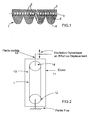
- a K-type belt 1 conventionally has an elastomeric outer layer 2, an elastomeric cushion layer 3, and an elastomeric inner layer 4 having V-shaped ribs 6 having a standard pitch of 3.56 mm.
- Reference 5 denotes the reinforcing cord consisting of a braided wire of diameter d which is wound helically with a pitch p. This winding is carried out edge to edge or optionally with a spacing.
- the cord 5 is obtained from a polyamide 6.6 thread.
- the dynamic properties of the cord are increased by stretching and heat setting during its manufacturing process.
- At least one drawing step of the cord is carried out at a high temperature and a stretching tension, the temperature being between 180 ° C. and 220 ° C. ° C and more particularly between 180 ° C and 200 ° C and the drawing tension being between 100 mN / dtex and 160 mN / dtex.
- the dynamic modulus at 120 ° C is measured by a dynamic dynamic relaxation test on an extensometer bench such as an INSTRON dynamic pulsator 10 having two pulleys 12 and 14, one of which is fixed and the other 14 is mobile.
- the dynamical bench INSTRON makes it possible to apply to the mobile part (crosspiece 15) connected to the pulley 14, a dynamic excitation either in effort or in displacement.
- the belt 1 and the bench 10 are integrated in an oven 11 for varying the temperature.
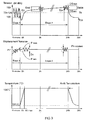
- This dynamic hot test which is continued for at least 2 hours, but which is advantageously extended to 24 hours to completely stabilize the belt, allows to determine a dynamic module that is more relevant to characterize the operation of a machine. belt than a traditional static test made for example from the first curve force elongation, or the fifth curve force elongation.
- ST is usually a positive number, while DT is always a negative number.
- a belt according to the invention has a positive ST overvoltage while the DT detension is greater than -25% (for example, it is equal to -20%).
- the tension in N / dt / b is equal to the force of the crosspiece divided by the number of teeth and by 2 (because of the presence of two strands and two pulleys of the same diameter).
- Hot dynamic module at time t M t EM t / D2, EM t denoting the amplitude of the dynamic tension in a strand in N / dt / b and D2 the dynamic elongation of the belt in%.
- Hot dynamic module Hot ST overvoltage 120 ° C DT at room temperature M 2 to 2 H (N / dt / b)%) M 24 to 24 H (N / dt / b)%) after 24 hours (%) after 26 H (%) Automotive belt wired in PA 4.6 7250 9330 20 - 7 Belt of Example I wired in PA 6.6 7270 8930 10 - 20 Automotive belt in wired PA 6.6 6380 7730 - 8 - 30
Landscapes
- Engineering & Computer Science (AREA)
- General Engineering & Computer Science (AREA)
- Mechanical Engineering (AREA)
- Tires In General (AREA)
- Devices For Conveying Motion By Means Of Endless Flexible Members (AREA)
- Ropes Or Cables (AREA)
- Compositions Of Macromolecular Compounds (AREA)
- Belt Conveyors (AREA)
- Electrostatic Charge, Transfer And Separation In Electrography (AREA)
- Yarns And Mechanical Finishing Of Yarns Or Ropes (AREA)
- Manufacture Of Porous Articles, And Recovery And Treatment Of Waste Products (AREA)
Abstract
Description
La présente invention a pour objet une courroie extensible à nervures en V présentant un câblé en polyamide 6.6, destinée notamment à des applications à des véhicules automobiles.The subject of the present invention is an extensible V-ribbed belt having a polyamide 6.6 cord, intended in particular for applications to motor vehicles.
L'intérêt de ces courroies connues également sous la dénomination anglo-saxonne de "snap-on" est qu'elles peuvent être montées par simple extension. Après mise en place, elles sont capables, contrairement aux courroies dites "standard", de conserver une tension de service suffisante pour ne pas nécessiter la présence d'un tendeur fixe.The advantage of these belts known also under the name of the Anglo-Saxon "snap-on" is that they can be mounted by simple extension. After installation, they are capable, unlike so-called "standard" belts, to maintain a sufficient operating voltage to not require the presence of a fixed tensioner.
Des courroies extensibles ayant un câblé en polyamide 6.6 sont déjà utilisées pour la transmission de puissance dans des appareils électro-ménagers tels que des lave-linge, pour lesquels la puissance entraînée (≤ 1 kW) et l'acyclisme sont faibles.Stretchable belts with a polyamide 6.6 cord are already used for power transmission in household appliances such as washing machines, where the driven power (≤ 1 kW) and acyclism are low.
Ces courroies présentent un module dynamique faible, qui les rend incompatibles avec des applications automobiles, pour lesquelles les puissances sont plus élevées et dans lesquelles on rencontre des phénomènes d'acyclisme, qui sont particulièrement sévères dans le cas des moteurs Diesel.These belts have a low dynamic modulus, which makes them incompatible with automotive applications, for which the powers are higher and in which there are phenomena of acyclism, which are particularly severe in the case of diesel engines.
Ce faible module dynamique est dû au fait que le polyamide 6.6 présente des performances inférieures à celles du polyamide 4.6 qui est utilisé pour former les câblés des courroies extensibles pour applications automobiles.This low dynamic modulus is due to the fact that the polyamide 6.6 has lower performance than the polyamide 4.6 which is used to form the strands of stretchable belts for automotive applications.
Or, le polyamide 6.6 (PA 66) est moins cher que le polyamide 4.6 (PA 46). Il est donc souhaitable de pouvoir disposer d'une courroie extensible en polyamide 6.6 qui convient aux applications automobiles, et dont les propriétés s'approchent le plus possible de performances du PA 46.However, polyamide 6.6 (PA 66) is less expensive than polyamide 4.6 (PA 46). It is therefore desirable to have an expandable polyamide 6.6 belt that is suitable for automotive applications, and whose properties are as close as possible to the performance of PA 46.
Il existe déjà sur le marché des courroies automobiles à câblé en polyamide 6.6, mais leur module dynamique est nettement inférieur à celui des courroies à câblé en polyamide 4.6, ainsi que le montre l'Exemple comparatif plus loin dans la description.Polyamide 6.6 cordless automotive belts already exist on the market, but their dynamic modulus is much lower than that of polyamide 4.6 cord belts, as shown in the Comparative Example later in the description.
De plus, ces courroies présentent la particularité d'une surtension à chaud S qui est négative, ce qui est défavorable, car la grande majorité du temps de fonctionnement de la courroie s'opère à chaud, et donc avec une tension plus faible que la tension nominale au repos.In addition, these belts have the particularity of a hot overvoltage S which is negative, which is unfavorable, since the vast majority of the operating time of the belt operates hot, and therefore with a lower voltage than the nominal voltage at rest.
L'idée de base de l'invention est de réaliser une courroie extensible à partir d'un câblé en polyamide 6.6 amélioré en modifiant les paramètres de fabrication du fil.The basic idea of the invention is to provide an extensible belt from an improved polyamide 6.6 cord by modifying the yarn manufacturing parameters.
L'invention concerne ainsi une courroie extensible à nervures en V présentant une structure de renforcement constituée par un câblé en polyamide 6.6 caractérisée en ce qu'elle présente un module dynamique M2 après 2 heures à 120°C, qui est compris entre 7000 N/dent/% d'allongement et 10000 N/dent/% d'allongement, et par exemple supérieur à 7200 N/dent/% d'allongement.The invention thus relates to an extensible V-ribbed belt having a reinforcing structure constituted by a polyamide 6.6 cord, characterized in that it has a dynamic modulus M 2 after 2 hours at 120 ° C., which is between 7000 N / tooth /% elongation and 10,000 N / tooth /% elongation, and for example greater than 7200 N / tooth /% elongation.
Le module dynamique M24 à 24 heures est avantageusement compris entre 8000 et 11000 N/dent/brin/% d'allongement, et plus particulièrement entre 8000 à 10000 N/dent/brin/% d'allongement (ou bien entre 8000 et 9500). Il peut notamment être supérieur à 8500 N/dent/brin/% d'allongement.The dynamic modulus M 24 to 24 hours is advantageously between 8000 and 11000 N / tooth / strand /% elongation, and more particularly between 8000 to 10000 N / tooth / strand /% elongation (or between 8000 and 9500 ). It may in particular be greater than 8500 N / tooth / strand /% elongation.
La courroie présente avantageusement une surtension ST positive telle que mesurée dans les conditions définies ci-après. A titre d'exemple non limitatif, cette surtension ST est au moins égale à 5% et est notamment comprise entre 5% et 20 %.The belt advantageously has a positive ST overvoltage as measured under the conditions defined below. By way of nonlimiting example, this overvoltage ST is at least equal to 5% and is in particular between 5% and 20%.
La courroie présente avantageusement une détension DT, mesurée dans les conditions définies ci-après, qui est supérieure à -25%, et notamment comprise entre -25% et -10%.The belt advantageously has a DT stress, measured under the conditions defined below, which is greater than -25%, and especially between -25% and -10%.
Les procédés classiques de fabrication d'un fil pour câblés mettent en général en oeuvre deux étapes successives d'étirage.Conventional methods for manufacturing a wire for cords generally implement two successive stages of drawing.
Selon l'invention, le câblé peut être réalisé en un fil de polyamide 6.6, de diamètre par exemple compris entre 0,9 et 1, 2 mm, obtenu par un procédé dans lequel il existe au moins une étape d'étirage du câblé à une tension comprise entre 100 mN/dtex et 160 mN/dtex et à une température comprise entre 180 °C et 220°C, et plus particulièrement entre 180°C et 200°C.According to the invention, the cord may be made of a polyamide wire 6.6, of diameter for example between 0.9 and 1.2 mm, obtained by a method in which there is at least one drawing step of the cord to a voltage of between 100 mN / dtex and 160 mN / dtex and at a temperature between 180 ° C and 220 ° C, and more particularly between 180 ° C and 200 ° C.
L'invention sera mieux comprise à la lecture de la description ci-après, en liaison avec les dessins dans lesquels :
- la
figure 1 est une vue en coupe d'une courroie selon l'invention ; - les
figures 2 et3 illustrent la mesure de module dynamique, de la surtension et de la détension.
- the
figure 1 is a sectional view of a belt according to the invention; - the
figures 2 and3 illustrate the measurement of dynamic modulus, overvoltage and detension.
Une courroie 1 de type K présente de manière classique une couche externe 2 en élastomère, une couche de coussin 3 en élastomère, et une couche interne en élastomère 4 présentant des nervures 6 en V présentant un pas p normalisé de 3,56 mm. La référence 5 désigne le câblé de renforcement constitué d'un fil tressé de diamètre d qui est enroulé hélicoïdalement avec un pas p. Cet enroulement est réalisé bord à bord ou éventuellement avec un espacement.A K-
Le câblé 5 est obtenu à partir d'un fil en polyamide 6.6. Les propriétés dynamiques du câblé sont augmentées par étirage et thermofixation au cours de son procédé de fabrication.The cord 5 is obtained from a polyamide 6.6 thread. The dynamic properties of the cord are increased by stretching and heat setting during its manufacturing process.
Au cours du procédé de fabrication du câblé, on met en oeuvre au moins une étape d'étirage du câblé, par exemple 940 x 2 x 3, à température et une tension d'étirage élevés, la température étant comprise entre180 °C et 220 °C et plus particulièrement entre 180°C et 200°C et la tension d'étirage étant comprise entre 100 mN/dtex et 160 mN/dtex.During the manufacturing process of the cord, at least one drawing step of the cord, for example 940 x 2 x 3, is carried out at a high temperature and a stretching tension, the temperature being between 180 ° C. and 220 ° C. ° C and more particularly between 180 ° C and 200 ° C and the drawing tension being between 100 mN / dtex and 160 mN / dtex.
Pour un câblé en polyamide 6.6 par exemple de même type que celui qui est déjà utilisé pour les courroies extensibles dites "à module adapté" pour machine à laver, on obtient une augmentation notable du module dynamique de la courroie, avec un module dynamique à 120 °C qui à 2 heures est supérieur à 7000 N/dent/brin/% d'allongement et à 24 heures qui est supérieur à 7700 N/dent/brin /% d'allongement, à comparer à une valeur de 3000 N/dent/brin/% d'allongement pour une courroie similaire mais qui aurait été réalisée avec ce câblé de polyamide 6.6 de l'art antérieur.For a cable made of polyamide 6.6 for example of the same type as that already used for stretch belts called "adapted module" for washing machine, we obtain a significant increase in dynamic modulus of the belt, with a dynamic module 120 ° C which at 2 hours is greater than 7000 N / tooth / strand /% elongation and 24 hours which is greater than 7700 N / tooth / strand /% elongation, compared to a value of 3000 N / tooth / strand /% elongation for a similar belt but which would have been made with this cable of polyamide 6.6 of the prior art.
Le module dynamique à 120°C est mesuré par un essai de relaxation dynamique à chaud sur un banc d'extensomètrie tel qu'un pulsateur dynamique INSTRON 10 présentant deux poulies 12 et 14, dont une 12 est fixe et dont l'autre 14 est mobile. Le banc dynamique INSTRON permet d'appliquer à la partie mobile (traverse 15) liée à la poulie 14, une excitation dynamique soit en effort, soit en déplacement. La courroie 1 et le banc 10 sont intégrés dans une étuve 11 permettant de faire varier la température.The dynamic modulus at 120 ° C is measured by a dynamic dynamic relaxation test on an extensometer bench such as an INSTRON
Ce test dynamique à chaud, qui est poursuivi pendant au moins 2 heures, mais que l'on prolonge avantageusement jusqu'à 24 heures pour stabiliser complètement la courroie, permet de déterminer un module dynamique qui est plus pertinent pour caractériser le fonctionnement d'une courroie qu'un test statique traditionnel réalisé par exemple à partir de la première courbe force allongement, ou de la cinquième courbe force allongement.This dynamic hot test, which is continued for at least 2 hours, but which is advantageously extended to 24 hours to completely stabilize the belt, allows to determine a dynamic module that is more relevant to characterize the operation of a machine. belt than a traditional static test made for example from the first curve force elongation, or the fifth curve force elongation.
-
1) On applique pendant 15 minutes à température ambiante (20°C ±5) une tension de brin initiale T0 de 125 N/dent/brin que l'on module par une tension dynamique variant de manière sinusoïdale, à une fréquence de 37Hz, avec une amplitude E0 de 50 N/dent/brin crête à crête. Au bout de 15 minutes et avant interruption de l'effort dynamique, on relève la position moyenne P1 de la traverse du banc dynamique, qui est la demi somme des positions maximale Pmax et minimale Pmin de la traverse dus à ladite tension dynamique à l'instant t = 15 minutes, ainsi que l'amplitude de déplacement dynamique D1 de la traverse (amplitude crête à crête D1) qui est générée à l'instant t = 15 minutes par la tension dynamique de ± 25N/dent/brin (amplitude E0 de 50 N/dent/brin).
Le pourcentage d'allongement D2 de la courroie qui correspond à l'amplitude de déplacement dynamique D1 de la traverse a pour valeur :
L désignant la longueur effective de la courroie.1) An initial strand tension T 0 of 125 N / tooth / strand is applied for 15 minutes at room temperature (20 ° C. ± 5) and is modulated by a sinusoidally varying dynamic voltage at a frequency of 37 Hz. with an amplitude E 0 of 50 N / tooth / peak to peak. At the end of 15 minutes and before interruption of the dynamic force, the average position P1 of the crossbar of the dynamical bench is noted, which is the half sum of the maximum positions Pmax and minimum Pmin of the crossbar due to said dynamic tension at the instant t = 15 minutes, as well as the dynamic displacement amplitude D1 of the crossbar (peak-to-peak amplitude D1) which is generated at time t = 15 minutes by the dynamic voltage of ± 25N / tooth / strand (amplitude E 0 of 50 N / tooth / strand).
The elongation percentage D2 of the belt corresponding to the dynamic displacement amplitude D1 of the crossmember has the value:
L denoting the effective length of the belt. -
2) A la fin de l'étape 1 qui permet une stabilisation de la courroie, on positionne la traverse à la position P1 définie ci-dessus et on applique à la traverse l'amplitude de déplacement dynamique D1 définie ci-dessus. La montée en température du banc s'effectue au démarrage de l'étape 2. Elle dure au maximum 15 minutes.
L'essai dynamique est poursuivi pendant 24 heures à 120°C. On relève à un ou plusieurs instants t l'amplitude de tension dynamique EMt dans un brin qui est la différence entre la tension dynamique maximale Emax et tension dynamique minimale Emin. EMt permet de calculer le module dynamique.
On déduit du rapport entre EMt exprimé en N/dent/brin et D2 exprimé en % d'allongement, le module dynamique M à l'instant t qui s'exprime en N/dent/brin/% d'allongement, soit M = EMt/D2.
On détermine le module dynamique M2 au temps t = 2 heures et M24 au temps t = 24 heures, grâce aux amplitudes dynamiques de tension à 2 heures et à 24 heures désignés respectivement par EM2 et EM24.2) At the end ofstep 1 which allows stabilization of the belt, the crossbar is positioned at the position P1 defined above and the dynamic displacement amplitude D1 defined above is applied to the crossmember. The bench is warmed up at the start ofstep 2. It lasts for a maximum of 15 minutes.
The dynamic test is continued for 24 hours at 120 ° C. At one or more times, the dynamic voltage amplitude E Mt is recorded in a strand which is the difference between the maximum dynamic voltage E max and the minimum dynamic voltage E min . E Mt calculates the dynamic module.
We deduce the ratio between E Mt expressed in N / tooth / strand and D2 expressed as% elongation, the dynamic modulus M at time t which is expressed in N / tooth / strand /% elongation, ie M = E Mt / D2.
The dynamic modulus M 2 is determined at time t = 2 hours and M 24 at time t = 24 hours, thanks to the dynamic amplitudes of voltage at 2 hours and 24 hours respectively designated by E M2 and E M24 . -
3) Les caractéristiques de surtension ST et de détension DT de la courroie sont également déterminées au cours de l'essai.
On mesure la tension dynamique moyenne T24 (en N/dent/brin) d'un brin de la courroie à t =24 heures (à 120 °C). On a :
La surtension ST exprimée en % a pour valeur :
The average dynamic tension T 24 (in N / tooth / strand) of a strand of the belt is measured at t = 24 hours (at 120 ° C.). We have :
The overvoltage ST expressed in% has the value: - 4) On laisse refroidir la courroie pendant deux heures en statique en maintenant la traverse à la position P1 (Etape 3) et on mesure la tension T26 dans un brin (en N/dent/brin) au temps t = 26 heures.4) The belt is allowed to cool for two hours in a static state while maintaining the crossbar at the P1 position (Step 3) and the tension T 26 is measured in a strand (in N / tooth / strand) at time t = 26 hours.
La détension DT (en N/dent/brin) a pour valeur : 
ST est en général un nombre positif, alors que DT est toujours un nombre négatif.ST is usually a positive number, while DT is always a negative number.
Une courroie selon l'invention présente une surtension ST positive alors que la détension DT est supérieure à -25 % (par exemple, elle est égale à -20%).A belt according to the invention has a positive ST overvoltage while the DT detension is greater than -25% (for example, it is equal to -20%).
EXEMPLE I : Une courroie de type K6 de longueur L = 1200 mm, présentant un câblé 940 x 2 x 3 en polyamide 6.6 (PA66) de diamètre 1 mm ayant subi deux étapes d'étirage entre 100 et 160 mN/dtex à une température comprise entre 180°C et 200°C a été soumise au test défini ci-dessus. On rappelle ici que l'amplitude EO (étape 1) est de 50 N/dt/b. EXAMPLE I : A type K6 belt of length L = 1200 mm, having a 940 x 2 x 3 cord of polyamide 6.6 (PA66) of
Les données relevées sont les suivantes :
(mm)
(%)
(N/dt/b)
T24
(N/dt/b)
T26
(N/dt/b)
(N/dt/b)
(Mm)
(%)
(N / dt / b)
T 24
(N / dt / b)
T 26
(N / dt / b)
(N / dt / b)
Pour mémoire, la tension en N/dt/b est égale à l'effort de la traverse divisé par le nombre de dents et par 2 (à cause de la présence de deux brins et de deux poulies de même diamètre).For the record, the tension in N / dt / b is equal to the force of the crosspiece divided by the number of teeth and by 2 (because of the presence of two strands and two pulleys of the same diameter).
Pour une courroie K6 T0 = 125 N/dt/b = 1500 N (Effort traverse) / 6 (nombre de dent) et / 2 brins.For a belt K6 T 0 = 125 N / dt / b = 1500 N (through force) / 6 (number of teeth) and / 2 strands.
Module dynamique à chaud à l'instant t Mt = EMt/D2, EMt désignant l'amplitude de la tension dynamique dans un brin en N/dt/b et D2 l'allongement dynamique de la courroie en %.Hot dynamic module at time t M t = EM t / D2, EM t denoting the amplitude of the dynamic tension in a strand in N / dt / b and D2 the dynamic elongation of the belt in%.
Dans l'exemple selon le tableau ci-dessus, on a :
- EM2 = 27,2 N/dt/b; EM24 = 33,4 N/dt/b
- D1 = 2,247 mm
- L = 1200 mm
- D2 = 2D1/L x 100 = 200 x 2,247 / 1200 = 0,374 %
- M2 = EM2/D2 = 27,2 / 0,374 = 7270 en N/dt/b/%
- M24 = EM24/D2 = 33,4 / 0,374 = 8930 en N/dt/b/%
- E M2 = 27.2 N / dt / b; E M24 = 33.4 N / dt / b
- D1 = 2,247 mm
- L = 1200 mm
- D 2 = 2D1 / L x 100 = 200 x 2.247 / 1200 = 0.374%
- M 2 = E M2 / D2 = 27.2 / 0.374 = 7270 in N / dt / b /%
- M 24 = E M24 / D2 = 33.4 / 0.374 = 8930 in N / dt / b /%
Surtension à chaud ST (%)= 100 (T24 - T0)/ T0, avec
- T0 = 125 N/dt/b et T24 = 137,5 N/dt/b
- ST = 100 (137,5 - 125) / 125 = 10 %
- T 0 = 125 N / dt / b and T 24 = 137.5 N / dt / b
- ST = 100 (137.5 - 125) / 125 = 10%
Evolution de la tension dans un brin à l'ambiante ou détension DT (%) = 100
- (T26 - T0)/ T0, avec
- T0 = 125 N/dt/b et T26 = 100 N/dt/b
- DT = 100 x (100 - 125 )/125 = -20%
- (T 26 - T 0 ) / T 0 , with
- T 0 = 125 N / dt / b and T 26 = 100 N / dt / b
- DT = 100 x (100 - 125) / 125 = -20%
(120°C)Hot ST overvoltage
(120 ° C)
(N/dt/b)%)M 2 to 2 H
(N / dt / b)%)
(N/dt/b)%)M 24 to 24 H
(N / dt / b)%)
(%)after 24 hours
(%)
(%)after 26 H
(%)
Claims (8)
Applications Claiming Priority (2)
| Application Number | Priority Date | Filing Date | Title |
|---|---|---|---|
| FR0413057A FR2878924B1 (en) | 2004-12-08 | 2004-12-08 | EXPANDABLE BELT HAVING A POLYAMIDE CABLE 6.6, IN PARTICULAR FOR AUTOMOTIVE APPLICATION |
| EP05292437A EP1669637B1 (en) | 2004-12-08 | 2005-11-17 | Stretchable automotive belt with a polyamide 6.6 cord |
Related Parent Applications (1)
| Application Number | Title | Priority Date | Filing Date |
|---|---|---|---|
| EP05292437.0 Division | 2005-11-17 |
Publications (2)
| Publication Number | Publication Date |
|---|---|
| EP2256366A1 true EP2256366A1 (en) | 2010-12-01 |
| EP2256366B1 EP2256366B1 (en) | 2011-12-07 |
Family
ID=34952027
Family Applications (2)
| Application Number | Title | Priority Date | Filing Date |
|---|---|---|---|
| EP05292437A Expired - Lifetime EP1669637B1 (en) | 2004-12-08 | 2005-11-17 | Stretchable automotive belt with a polyamide 6.6 cord |
| EP10009850A Expired - Lifetime EP2256366B1 (en) | 2004-12-08 | 2005-11-17 | Stretchable belt with a polyamide 6.6 cord, especially for automotive use |
Family Applications Before (1)
| Application Number | Title | Priority Date | Filing Date |
|---|---|---|---|
| EP05292437A Expired - Lifetime EP1669637B1 (en) | 2004-12-08 | 2005-11-17 | Stretchable automotive belt with a polyamide 6.6 cord |
Country Status (7)
| Country | Link |
|---|---|
| US (1) | US20060154769A1 (en) |
| EP (2) | EP1669637B1 (en) |
| JP (1) | JP4889294B2 (en) |
| AT (2) | ATE536497T1 (en) |
| DE (1) | DE602005027163D1 (en) |
| ES (2) | ES2378289T3 (en) |
| FR (1) | FR2878924B1 (en) |
Cited By (1)
| Publication number | Priority date | Publication date | Assignee | Title |
|---|---|---|---|---|
| EP4146956A1 (en) * | 2020-05-07 | 2023-03-15 | Valeo Embrayages | Power transmission system for a powertrain of a motor vehicle |
Families Citing this family (1)
| Publication number | Priority date | Publication date | Assignee | Title |
|---|---|---|---|---|
| WO2009153816A1 (en) | 2008-06-19 | 2009-12-23 | Dayco Europe S.R.L. | Starter alternator assembly comprising a poli-v belt and poli-v belt |
Citations (2)
| Publication number | Priority date | Publication date | Assignee | Title |
|---|---|---|---|---|
| EP0339249A1 (en) * | 1988-04-27 | 1989-11-02 | DAYCO PTI S.p.A. | Flexible belt and relative driving system |
| EP1043517A1 (en) * | 1999-03-29 | 2000-10-11 | Bando Chemical Industries Ltd. | Power transmission belt |
Family Cites Families (6)
| Publication number | Priority date | Publication date | Assignee | Title |
|---|---|---|---|---|
| US3564835A (en) * | 1969-03-12 | 1971-02-23 | Du Pont | High tenacity tire yarn |
| FR2753766B1 (en) * | 1996-09-20 | 1998-11-27 | RIBBED BELT, ITS MANUFACTURING PROCESS AND TRANSMISSION DEVICE INCLUDING IT | |
| JP2000074603A (en) * | 1998-08-28 | 2000-03-14 | Mitsuboshi Belting Ltd | Wear measuring apparatus of v-ribbed belt |
| JP2000304103A (en) * | 1999-04-21 | 2000-11-02 | Bando Chem Ind Ltd | V-ribbed belt |
| US6832968B2 (en) * | 2001-05-03 | 2004-12-21 | Dayco Products, Llc | Low modulus belt for automotive applications |
| US6626784B1 (en) * | 2001-11-28 | 2003-09-30 | The Gates Corporation | Low modulus belt |
-
2004
- 2004-12-08 FR FR0413057A patent/FR2878924B1/en not_active Expired - Fee Related
-
2005
- 2005-11-17 ES ES10009850T patent/ES2378289T3/en not_active Expired - Lifetime
- 2005-11-17 AT AT10009850T patent/ATE536497T1/en active
- 2005-11-17 ES ES05292437T patent/ES2363777T3/en not_active Expired - Lifetime
- 2005-11-17 EP EP05292437A patent/EP1669637B1/en not_active Expired - Lifetime
- 2005-11-17 AT AT05292437T patent/ATE503946T1/en not_active IP Right Cessation
- 2005-11-17 DE DE602005027163T patent/DE602005027163D1/en not_active Expired - Lifetime
- 2005-11-17 EP EP10009850A patent/EP2256366B1/en not_active Expired - Lifetime
- 2005-12-06 JP JP2005352487A patent/JP4889294B2/en not_active Expired - Fee Related
- 2005-12-07 US US11/295,631 patent/US20060154769A1/en not_active Abandoned
Patent Citations (2)
| Publication number | Priority date | Publication date | Assignee | Title |
|---|---|---|---|---|
| EP0339249A1 (en) * | 1988-04-27 | 1989-11-02 | DAYCO PTI S.p.A. | Flexible belt and relative driving system |
| EP1043517A1 (en) * | 1999-03-29 | 2000-10-11 | Bando Chemical Industries Ltd. | Power transmission belt |
Cited By (1)
| Publication number | Priority date | Publication date | Assignee | Title |
|---|---|---|---|---|
| EP4146956A1 (en) * | 2020-05-07 | 2023-03-15 | Valeo Embrayages | Power transmission system for a powertrain of a motor vehicle |
Also Published As
| Publication number | Publication date |
|---|---|
| ATE503946T1 (en) | 2011-04-15 |
| EP2256366B1 (en) | 2011-12-07 |
| FR2878924B1 (en) | 2007-02-23 |
| JP4889294B2 (en) | 2012-03-07 |
| ATE536497T1 (en) | 2011-12-15 |
| ES2378289T3 (en) | 2012-04-10 |
| FR2878924A1 (en) | 2006-06-09 |
| EP1669637A2 (en) | 2006-06-14 |
| DE602005027163D1 (en) | 2011-05-12 |
| ES2363777T3 (en) | 2011-08-16 |
| EP1669637B1 (en) | 2011-03-30 |
| JP2006162073A (en) | 2006-06-22 |
| US20060154769A1 (en) | 2006-07-13 |
| EP1669637A3 (en) | 2008-08-27 |
Similar Documents
| Publication | Publication Date | Title |
|---|---|---|
| US6033331A (en) | Power transmission belt for automotive applications | |
| Lefrant | RESONANCE RAMAN SCATTERING INDUCED BY POLYACETYLENE AND DERIVATIVES | |
| FR2472040A1 (en) | TIRE WITH RADIAL CARCASS | |
| FR2499603A1 (en) | METALLIC CABLE, METHOD FOR OBTAINING SAME AND APPLICATION TO REINFORCEMENT OF A VEHICLE TIRE | |
| EP0281432B1 (en) | Transmission belt | |
| EP2256366B1 (en) | Stretchable belt with a polyamide 6.6 cord, especially for automotive use | |
| EP0081866A1 (en) | Method and apparatus for extruding films of vinylidene fluoride polymers | |
| CN101133262B (en) | Elastic telescopic multiple V-shaped driving belt used for driving internal combustion engine fittings | |
| EP2981735B1 (en) | Power transmission belt having an elastomer toothing provided with fabric on the surface | |
| EP2773788B1 (en) | Method for low-pressure carbonitriding having an extended temperature range in an initial nitridation phase | |
| JP4931594B2 (en) | Ribbed belt for power transmission | |
| FR2742774A1 (en) | TENSION ELEMENT FOR BELT AND POWER TRANSMISSION BELT | |
| EP1796923B1 (en) | Tyre whereof the crown comprises a plurality of zones formed with a circumferential reinforcement cord | |
| EP0947621B1 (en) | Method for treating protective sleeves | |
| EP2773789B1 (en) | Carbonitriding method having a final nitridation step during temperature decrease | |
| FR2726060A1 (en) | POWER TRANSMISSION BELT | |
| JPH04210143A (en) | Elastic driving belt and method of detecting residual elastic elongation thereof | |
| KR101945004B1 (en) | Method for low-pressure carbonitriding using a reduced temperature gradient in an initial nitridation phase | |
| RU1807910C (en) | Method of making flexible rope drive | |
| BE436410A (en) | ||
| BE444997A (en) | ||
| BE432162A (en) |
Legal Events
| Date | Code | Title | Description |
|---|---|---|---|
| PUAI | Public reference made under article 153(3) epc to a published international application that has entered the european phase |
Free format text: ORIGINAL CODE: 0009012 |
|
| AC | Divisional application: reference to earlier application |
Ref document number: 1669637 Country of ref document: EP Kind code of ref document: P |
|
| AK | Designated contracting states |
Kind code of ref document: A1 Designated state(s): AT BE BG CH CY CZ DE DK EE ES FI FR GB GR HU IE IS IT LI LT LU LV MC NL PL PT RO SE SI SK TR |
|
| 17P | Request for examination filed |
Effective date: 20110112 |
|
| GRAP | Despatch of communication of intention to grant a patent |
Free format text: ORIGINAL CODE: EPIDOSNIGR1 |
|
| GRAS | Grant fee paid |
Free format text: ORIGINAL CODE: EPIDOSNIGR3 |
|
| GRAA | (expected) grant |
Free format text: ORIGINAL CODE: 0009210 |
|
| AC | Divisional application: reference to earlier application |
Ref document number: 1669637 Country of ref document: EP Kind code of ref document: P |
|
| AK | Designated contracting states |
Kind code of ref document: B1 Designated state(s): AT BE BG CH CY CZ DE DK EE ES FI FR GB GR HU IE IS IT LI LT LU LV MC NL PL PT RO SE SI SK TR |
|
| REG | Reference to a national code |
Ref country code: GB Ref legal event code: FG4D Free format text: NOT ENGLISH |
|
| REG | Reference to a national code |
Ref country code: CH Ref legal event code: EP |
|
| REG | Reference to a national code |
Ref country code: IE Ref legal event code: FG4D Free format text: LANGUAGE OF EP DOCUMENT: FRENCH |
|
| REG | Reference to a national code |
Ref country code: DE Ref legal event code: R096 Ref document number: 602005031607 Country of ref document: DE Effective date: 20120209 |
|
| REG | Reference to a national code |
Ref country code: NL Ref legal event code: VDEP Effective date: 20111207 |
|
| REG | Reference to a national code |
Ref country code: ES Ref legal event code: FG2A Ref document number: 2378289 Country of ref document: ES Kind code of ref document: T3 Effective date: 20120410 |
|
| PG25 | Lapsed in a contracting state [announced via postgrant information from national office to epo] |
Ref country code: LT Free format text: LAPSE BECAUSE OF FAILURE TO SUBMIT A TRANSLATION OF THE DESCRIPTION OR TO PAY THE FEE WITHIN THE PRESCRIBED TIME-LIMIT Effective date: 20111207 |
|
| LTIE | Lt: invalidation of european patent or patent extension |
Effective date: 20111207 |
|
| PG25 | Lapsed in a contracting state [announced via postgrant information from national office to epo] |
Ref country code: SI Free format text: LAPSE BECAUSE OF FAILURE TO SUBMIT A TRANSLATION OF THE DESCRIPTION OR TO PAY THE FEE WITHIN THE PRESCRIBED TIME-LIMIT Effective date: 20111207 Ref country code: SE Free format text: LAPSE BECAUSE OF FAILURE TO SUBMIT A TRANSLATION OF THE DESCRIPTION OR TO PAY THE FEE WITHIN THE PRESCRIBED TIME-LIMIT Effective date: 20111207 Ref country code: NL Free format text: LAPSE BECAUSE OF FAILURE TO SUBMIT A TRANSLATION OF THE DESCRIPTION OR TO PAY THE FEE WITHIN THE PRESCRIBED TIME-LIMIT Effective date: 20111207 Ref country code: LV Free format text: LAPSE BECAUSE OF FAILURE TO SUBMIT A TRANSLATION OF THE DESCRIPTION OR TO PAY THE FEE WITHIN THE PRESCRIBED TIME-LIMIT Effective date: 20111207 Ref country code: GR Free format text: LAPSE BECAUSE OF FAILURE TO SUBMIT A TRANSLATION OF THE DESCRIPTION OR TO PAY THE FEE WITHIN THE PRESCRIBED TIME-LIMIT Effective date: 20120308 |
|
| PG25 | Lapsed in a contracting state [announced via postgrant information from national office to epo] |
Ref country code: CY Free format text: LAPSE BECAUSE OF FAILURE TO SUBMIT A TRANSLATION OF THE DESCRIPTION OR TO PAY THE FEE WITHIN THE PRESCRIBED TIME-LIMIT Effective date: 20111207 |
|
| REG | Reference to a national code |
Ref country code: IE Ref legal event code: FD4D |
|
| PG25 | Lapsed in a contracting state [announced via postgrant information from national office to epo] |
Ref country code: EE Free format text: LAPSE BECAUSE OF FAILURE TO SUBMIT A TRANSLATION OF THE DESCRIPTION OR TO PAY THE FEE WITHIN THE PRESCRIBED TIME-LIMIT Effective date: 20111207 Ref country code: BG Free format text: LAPSE BECAUSE OF FAILURE TO SUBMIT A TRANSLATION OF THE DESCRIPTION OR TO PAY THE FEE WITHIN THE PRESCRIBED TIME-LIMIT Effective date: 20120307 Ref country code: CZ Free format text: LAPSE BECAUSE OF FAILURE TO SUBMIT A TRANSLATION OF THE DESCRIPTION OR TO PAY THE FEE WITHIN THE PRESCRIBED TIME-LIMIT Effective date: 20111207 Ref country code: IS Free format text: LAPSE BECAUSE OF FAILURE TO SUBMIT A TRANSLATION OF THE DESCRIPTION OR TO PAY THE FEE WITHIN THE PRESCRIBED TIME-LIMIT Effective date: 20120407 Ref country code: IE Free format text: LAPSE BECAUSE OF FAILURE TO SUBMIT A TRANSLATION OF THE DESCRIPTION OR TO PAY THE FEE WITHIN THE PRESCRIBED TIME-LIMIT Effective date: 20111207 Ref country code: SK Free format text: LAPSE BECAUSE OF FAILURE TO SUBMIT A TRANSLATION OF THE DESCRIPTION OR TO PAY THE FEE WITHIN THE PRESCRIBED TIME-LIMIT Effective date: 20111207 |
|
| PG25 | Lapsed in a contracting state [announced via postgrant information from national office to epo] |
Ref country code: RO Free format text: LAPSE BECAUSE OF FAILURE TO SUBMIT A TRANSLATION OF THE DESCRIPTION OR TO PAY THE FEE WITHIN THE PRESCRIBED TIME-LIMIT Effective date: 20111207 Ref country code: PL Free format text: LAPSE BECAUSE OF FAILURE TO SUBMIT A TRANSLATION OF THE DESCRIPTION OR TO PAY THE FEE WITHIN THE PRESCRIBED TIME-LIMIT Effective date: 20111207 Ref country code: PT Free format text: LAPSE BECAUSE OF FAILURE TO SUBMIT A TRANSLATION OF THE DESCRIPTION OR TO PAY THE FEE WITHIN THE PRESCRIBED TIME-LIMIT Effective date: 20120409 |
|
| REG | Reference to a national code |
Ref country code: AT Ref legal event code: MK05 Ref document number: 536497 Country of ref document: AT Kind code of ref document: T Effective date: 20111207 |
|
| PLBE | No opposition filed within time limit |
Free format text: ORIGINAL CODE: 0009261 |
|
| STAA | Information on the status of an ep patent application or granted ep patent |
Free format text: STATUS: NO OPPOSITION FILED WITHIN TIME LIMIT |
|
| PG25 | Lapsed in a contracting state [announced via postgrant information from national office to epo] |
Ref country code: DK Free format text: LAPSE BECAUSE OF FAILURE TO SUBMIT A TRANSLATION OF THE DESCRIPTION OR TO PAY THE FEE WITHIN THE PRESCRIBED TIME-LIMIT Effective date: 20111207 |
|
| 26N | No opposition filed |
Effective date: 20120910 |
|
| REG | Reference to a national code |
Ref country code: DE Ref legal event code: R097 Ref document number: 602005031607 Country of ref document: DE Effective date: 20120910 |
|
| PG25 | Lapsed in a contracting state [announced via postgrant information from national office to epo] |
Ref country code: AT Free format text: LAPSE BECAUSE OF FAILURE TO SUBMIT A TRANSLATION OF THE DESCRIPTION OR TO PAY THE FEE WITHIN THE PRESCRIBED TIME-LIMIT Effective date: 20111207 |
|
| PG25 | Lapsed in a contracting state [announced via postgrant information from national office to epo] |
Ref country code: FI Free format text: LAPSE BECAUSE OF FAILURE TO SUBMIT A TRANSLATION OF THE DESCRIPTION OR TO PAY THE FEE WITHIN THE PRESCRIBED TIME-LIMIT Effective date: 20111207 |
|
| REG | Reference to a national code |
Ref country code: CH Ref legal event code: PL |
|
| PG25 | Lapsed in a contracting state [announced via postgrant information from national office to epo] |
Ref country code: LI Free format text: LAPSE BECAUSE OF NON-PAYMENT OF DUE FEES Effective date: 20121130 Ref country code: CH Free format text: LAPSE BECAUSE OF NON-PAYMENT OF DUE FEES Effective date: 20121130 |
|
| PG25 | Lapsed in a contracting state [announced via postgrant information from national office to epo] |
Ref country code: TR Free format text: LAPSE BECAUSE OF FAILURE TO SUBMIT A TRANSLATION OF THE DESCRIPTION OR TO PAY THE FEE WITHIN THE PRESCRIBED TIME-LIMIT Effective date: 20111207 Ref country code: MC Free format text: LAPSE BECAUSE OF NON-PAYMENT OF DUE FEES Effective date: 20121130 |
|
| PG25 | Lapsed in a contracting state [announced via postgrant information from national office to epo] |
Ref country code: LU Free format text: LAPSE BECAUSE OF NON-PAYMENT OF DUE FEES Effective date: 20121117 |
|
| PG25 | Lapsed in a contracting state [announced via postgrant information from national office to epo] |
Ref country code: HU Free format text: LAPSE BECAUSE OF FAILURE TO SUBMIT A TRANSLATION OF THE DESCRIPTION OR TO PAY THE FEE WITHIN THE PRESCRIBED TIME-LIMIT Effective date: 20051117 |
|
| PGFP | Annual fee paid to national office [announced via postgrant information from national office to epo] |
Ref country code: DE Payment date: 20141119 Year of fee payment: 10 Ref country code: ES Payment date: 20141126 Year of fee payment: 10 Ref country code: GB Payment date: 20141119 Year of fee payment: 10 Ref country code: FR Payment date: 20141030 Year of fee payment: 10 |
|
| PGFP | Annual fee paid to national office [announced via postgrant information from national office to epo] |
Ref country code: IT Payment date: 20141128 Year of fee payment: 10 |
|
| PGFP | Annual fee paid to national office [announced via postgrant information from national office to epo] |
Ref country code: BE Payment date: 20141118 Year of fee payment: 10 |
|
| REG | Reference to a national code |
Ref country code: DE Ref legal event code: R119 Ref document number: 602005031607 Country of ref document: DE |
|
| GBPC | Gb: european patent ceased through non-payment of renewal fee |
Effective date: 20151117 |
|
| PG25 | Lapsed in a contracting state [announced via postgrant information from national office to epo] |
Ref country code: IT Free format text: LAPSE BECAUSE OF NON-PAYMENT OF DUE FEES Effective date: 20151117 |
|
| REG | Reference to a national code |
Ref country code: FR Ref legal event code: ST Effective date: 20160729 |
|
| PG25 | Lapsed in a contracting state [announced via postgrant information from national office to epo] |
Ref country code: GB Free format text: LAPSE BECAUSE OF NON-PAYMENT OF DUE FEES Effective date: 20151117 Ref country code: DE Free format text: LAPSE BECAUSE OF NON-PAYMENT OF DUE FEES Effective date: 20160601 |
|
| PG25 | Lapsed in a contracting state [announced via postgrant information from national office to epo] |
Ref country code: FR Free format text: LAPSE BECAUSE OF NON-PAYMENT OF DUE FEES Effective date: 20151130 |
|
| REG | Reference to a national code |
Ref country code: ES Ref legal event code: FD2A Effective date: 20170102 |
|
| PG25 | Lapsed in a contracting state [announced via postgrant information from national office to epo] |
Ref country code: ES Free format text: LAPSE BECAUSE OF NON-PAYMENT OF DUE FEES Effective date: 20151118 |
|
| PG25 | Lapsed in a contracting state [announced via postgrant information from national office to epo] |
Ref country code: BE Free format text: LAPSE BECAUSE OF NON-PAYMENT OF DUE FEES Effective date: 20151130 |