EP2255494B1 - System und verfahren zum export von strukturierten daten in einer netzverwaltungsumgebung - Google Patents
System und verfahren zum export von strukturierten daten in einer netzverwaltungsumgebung Download PDFInfo
- Publication number
- EP2255494B1 EP2255494B1 EP10716937.7A EP10716937A EP2255494B1 EP 2255494 B1 EP2255494 B1 EP 2255494B1 EP 10716937 A EP10716937 A EP 10716937A EP 2255494 B1 EP2255494 B1 EP 2255494B1
- Authority
- EP
- European Patent Office
- Prior art keywords
- data
- template
- information
- templates
- network
- Prior art date
- Legal status (The legal status is an assumption and is not a legal conclusion. Google has not performed a legal analysis and makes no representation as to the accuracy of the status listed.)
- Not-in-force
Links
- 238000000034 method Methods 0.000 title claims description 26
- 238000007726 management method Methods 0.000 claims description 32
- 230000007246 mechanism Effects 0.000 claims description 10
- 238000007435 diagnostic evaluation Methods 0.000 claims description 3
- 238000007619 statistical method Methods 0.000 claims description 3
- 230000004044 response Effects 0.000 claims description 2
- 238000013498 data listing Methods 0.000 claims 2
- 238000010586 diagram Methods 0.000 description 23
- 238000004891 communication Methods 0.000 description 20
- 230000008569 process Effects 0.000 description 18
- 230000000694 effects Effects 0.000 description 10
- 230000002776 aggregation Effects 0.000 description 7
- 238000004220 aggregation Methods 0.000 description 7
- 230000005540 biological transmission Effects 0.000 description 5
- 230000006855 networking Effects 0.000 description 4
- 238000012545 processing Methods 0.000 description 4
- 230000008901 benefit Effects 0.000 description 3
- 238000005259 measurement Methods 0.000 description 3
- 230000002265 prevention Effects 0.000 description 2
- 230000001960 triggered effect Effects 0.000 description 2
- 230000004075 alteration Effects 0.000 description 1
- 238000013459 approach Methods 0.000 description 1
- 230000003416 augmentation Effects 0.000 description 1
- 238000004422 calculation algorithm Methods 0.000 description 1
- 230000000295 complement effect Effects 0.000 description 1
- 238000001514 detection method Methods 0.000 description 1
- 230000006870 function Effects 0.000 description 1
- 238000007689 inspection Methods 0.000 description 1
- 230000003993 interaction Effects 0.000 description 1
- 238000012986 modification Methods 0.000 description 1
- 230000004048 modification Effects 0.000 description 1
- 238000004806 packaging method and process Methods 0.000 description 1
- 230000037361 pathway Effects 0.000 description 1
- 230000001902 propagating effect Effects 0.000 description 1
- 238000005070 sampling Methods 0.000 description 1
- 238000006467 substitution reaction Methods 0.000 description 1
- 230000009897 systematic effect Effects 0.000 description 1
- 238000013519 translation Methods 0.000 description 1
- 230000007723 transport mechanism Effects 0.000 description 1
- 238000012384 transportation and delivery Methods 0.000 description 1
- 238000013024 troubleshooting Methods 0.000 description 1
- 230000005641 tunneling Effects 0.000 description 1
Images


Classifications
-
- H—ELECTRICITY
- H04—ELECTRIC COMMUNICATION TECHNIQUE
- H04L—TRANSMISSION OF DIGITAL INFORMATION, e.g. TELEGRAPHIC COMMUNICATION
- H04L43/00—Arrangements for monitoring or testing data switching networks
- H04L43/02—Capturing of monitoring data
- H04L43/026—Capturing of monitoring data using flow identification
-
- H—ELECTRICITY
- H04—ELECTRIC COMMUNICATION TECHNIQUE
- H04L—TRANSMISSION OF DIGITAL INFORMATION, e.g. TELEGRAPHIC COMMUNICATION
- H04L63/00—Network architectures or network communication protocols for network security
- H04L63/02—Network architectures or network communication protocols for network security for separating internal from external traffic, e.g. firewalls
-
- H—ELECTRICITY
- H04—ELECTRIC COMMUNICATION TECHNIQUE
- H04L—TRANSMISSION OF DIGITAL INFORMATION, e.g. TELEGRAPHIC COMMUNICATION
- H04L63/00—Network architectures or network communication protocols for network security
- H04L63/14—Network architectures or network communication protocols for network security for detecting or protecting against malicious traffic
- H04L63/1408—Network architectures or network communication protocols for network security for detecting or protecting against malicious traffic by monitoring network traffic
- H04L63/1416—Event detection, e.g. attack signature detection
Definitions
- This disclosure relates in general to the field of communications and, more particularly, to exporting structured data in a network environment.
- Networking architectures have grown increasingly complex in communications environments.
- the augmentation of clients or end users wishing to communicate in a network environment has caused many networking configurations and systems to respond by adding elements to accommodate the increase in networking traffic.
- the increase in network traffic and in end users has created even more data to be routed, managed, and analyzed.
- data records containing information about traffic can be exported from one point to another. These records can be used for a variety of purposes. As data has grown in complexity and sophistication, there is a significant challenge in optimally exporting this information.
- US2008/250153 describes a method including determining a first template defining a data format for one or more first data records and a second template defining a data format for one or more second data records.
- the template may be needed to decode the information included in an associated data record.
- the first template is sent on a first stream of a multi-stream protocol in an ordered fashion, such as SCTP.
- the one or more first data records are also sent on the first stream in an ordered fashion and include first flow information for data sent through a network device.
- a second template is sent on a second stream using the multi-stream protocol in an ordered fashion.
- One or more second data records are sent on the second stream including second flow information for data sent through the network device.
- US 2007/217425 describes a networking device includes which when executed is operable to cause performing receiving a command to collect a unique object identifier that represents a unique management information base (MIB) object; retrieving, in response to receiving the command, a Simple Network Management Protocol (SNMP) MIB variable or table that corresponds to the MIB object; creating an Internet Protocol Flow Information Export (IPFIX) template data structure that includes the object identifier; in which the object identifier is encoded in the IPFIX template data structure as a string that has a variable length; and exporting the encoded object identifier with the variable length string.
- MIB unique management information base
- SNMP Simple Network Management Protocol
- IPFIX Internet Protocol Flow Information Export
- An apparatus in one example and includes a network element configured to receive a plurality of packets.
- the network element is configured to couple to a module, the module being configured to generate a data record that is based on information associated with the packets.
- the data record is interpreted according to a template in which multiple information elements can be positioned to create a hierarchical relationship within the structured data.
- the structured data further includes references to the information elements.
- the network element further including an export module configured to export the data record to a network management station.
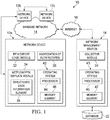
- FIGURE 1 is a simplified communication system 10 for exporting structured and repeated data in accordance with one example embodiment.
- Communication system 10 may include a set of network devices 12a-c, a managed network 14, an Internet 16, a network management station 18, which may include a collector module 24, and network management station 18 may be coupled to a database 22.
- Each network device 12a-c may include an IP flow Information export (IPFIX) logic module 32, a NetFlow/IPFIX template module 34 (which may include a structured data information element 36 that could also be present in the data records), an aggregation of flow records element 38, and an operating system 42, which may include a processor 44 and a memory element 46.
- IPFIX IP flow Information export
- NetFlow/IPFIX template module 34 which may include a structured data information element 36 that could also be present in the data records
- an operating system 42 which may include a processor 44 and a memory element 46.
- network management station 18 may include an operating system 43, a processor 45, and a memory element 47.
- FIGURE 1 includes multiple network devices 12a-c being coupled to managed network 14. Note that the numerical and letter designations assigned to the network devices do not connote any type of hierarchy; the designations are arbitrary and have been used for purposes of teaching only. These designations should not be construed in any way to limit their capabilities, functionalities, or applications in the potential environments that may benefit from the features of communication system 10.
- Communication system 10 may include a configuration capable of transmission control protocol/internet protocol (TCP/IP) communications for the transmission or reception of packets in a network.
- Communication system 10 may also operate in conjunction with a user datagram protocol/IP (UDP/IP) or any other suitable protocol or tunneling technique, where appropriate and based on particular needs.
- TCP/IP transmission control protocol/internet protocol
- UDP/IP user datagram protocol/IP
- an approach is defined in communication system 10 that specifies an extension to the IPFIX protocol specification provided in RFC5101 and the IPFIX information model specified in RFC5102 to support hierarchical structured data and lists (sequences) of information elements in data records.
- This extension enables a defining of complex data structures such as variable-length lists and, further, specifications for hierarchical containment relationships between templates.
- IPFIX offers a protocol based on NetFlow (as defined in RFC3954).
- An IPFIX (or NetFlow) exporting process can export data records. Although IPFIX was originally developed for exporting flow information, it can be used for exporting any kind of data.
- a data record can consist of one or more attributes, each of which corresponds to an information element.
- the IPFIX information model offers the base set of information elements for IPFIX. For each information element, the information model defines a numeric identifier, an abstract data type, an encoding mechanism for the data type, and any semantic constraints. Only basic, single-valued data types (e.g., numbers, strings, and network addresses) are currently supported.
- IPFIX Hierarchical structured data and lists (sequences) of such data as fields within IPFIX and NetFlow records.
- a data record in IPFIX is a "flat" list of single-valued attributes.
- NetFlow and IPFIX have customarily exported “flat” data records. This mechanism has been appropriate for the requirements thus far.
- a new series of network management applications can request the export of structured data records in NetFlow and IPFIX.
- One example is the export of repeated and/or variable data from a router, or a firewall device (i.e., a network security element of some kind).
- Communication system 10 can readily accommodate this request, as detailed herein.
- Example embodiments presented offer an enhanced data-modeling proposition to compose complex hierarchies of data types. More specifically, an extension to IPFIX and to NetFlow is offered to support hierarchical structured data and variable-length lists (sequences) of information elements in data.
- the system can define templates to represent the structured hierarchical relationship.
- the template mechanism for representing the "flat" data is defined in RFCs 5101/5102, where part of the innovation presented is in applying this existing template mechanism to represent structured data.
- hierarchical data structures can be defined having an arbitrary depth.
- This can be exported from a network device (e.g., via IPFIX export logic module 32) to a receiving end (e.g., network management station 18), which can interpret the data records according to templates and subsequently provide various reports, statistical analysis, diagnostic evaluations, etc. Templates can be sent ahead of data records and these templates could possibly have structured data as information elements. Data records that contain structured data are sent later and these data records can be interpreted according to the templates.
- the extensions provide a packaging mechanism for the data that is being collected by the network device. Note that as used herein in this Specification, the term 'export' is meant to encompass any type of transmitting activity from one node to another in the context of the data communications outlined herein.
- network device 12a can be any type of network element that receives packets. It is consistently establishing flows and generating records associated with the data passing through it.
- Network device 12a can collect information related to these packets (e.g., via aggregation of flow records element 38) and subsequently encode the data in the format explained herein.
- the aggregation can be spatial aggregation (i.e. the aggregation of data records observed from multiple observation points), or time composition (i.e. the aggregation of data records observed from different points in time).
- This information can be aggregated and sent to network management station 18, which can receive it and process this information. This could involve IPFIX export logic module 32, NetFlow/IPFIX template module 34, and structured data information element 36: all of which can assist in these operations.
- Network management station 18 can take this information and develop statistics or create reports that highlight significant issues associated with the data propagating through the network device.
- the raw data can be used for virtually any type of reporting application, performance analysis, troubleshooting activities, etc. occurring in the network.
- the raw data can be any content that is relevant to activities associated with the particular network device, or the data can relate to other components in the network for which the transmitting network device has developed some knowledge.
- network device 12a and network management station 18 include elements (e.g., software) that facilitate the extensions outlined herein.
- Network device 12a can include the ability to construct hierarchical data and export this information (e.g., via templates), where data could be received and processed by elements residing within network management station 18.
- these two devices offer symmetrical, complementary operations in which data being transmitted by network device 12a can be understood and processed effectively by network management station 18 (for example, through collector module 24).
- the extensions discussed herein could have particular value in activities associated with telemetry, which allows for the remote measurement and reporting of information to a system designer or to a network operator.
- Other applications could involve routing packets, intrusion detection and security, load balancing, deep packet inspection, network address translation (NAT-ing), label switching (e.g., in the context of MPLS activities), and any other scenario in which such metrics would be valuable.
- NAT-ing network address translation
- label switching e.g., in the context of MPLS activities
- a given network device can use any one or more of the information elements defined herein. Any of these structured data elements can be leveraged in order to optimally deliver information to network management station 18, or to any other destination that would seek to obtain this information.
- the new data types being introduced herein are general-purpose in that they can be used in various ways.
- the transport mechanism being offered can be employed by a given network device in any manner that suits its particular reporting needs.
- IPFIX IP Security Flow Flow Flow Flow Flow Flow Flow Flow
- the following items could be provided in the data: source and destination IP addresses, protocol, source and destination port numbers, packet and byte counters the transport, and a list of information elements.
- the first segment of this flow could be time stamped and the second segment could refer to the metrics.
- the NetFlow IPFIX protocol could be used in its conventional manner such that a template could be exported to network management station 18 (or more specifically to collector module 24), which would know how to decode information (specifically decipher the flow records) based on the templates discussed herein.
- collector module 24 resides within network management station 18, but alternatively could be positioned or located elsewhere in the network.
- An IPS (Intrusion Prevention System) alert data structure could contain multiple participants. Each participant can contain multiple attackers and multiple targets, with each target potentially composed of multiple applications.
- An intrusion prevention system alert (IPSAlert) data structure could be composed of: Participant, Attacker, Target, and ApplD. Each Participant can have multiple Attackers, multiple Targets, and multiple AppIDs.
- a top level Collection Process can request the video data records from the Collection Processes in the network.
- Each collector module or collector element (or any other type of export module) could export a structure composed of: Router, Line Card, and video-related data records. Each router can have multiple line cards, which in turn can have multiple video-related data records.
- Example embodiments presented herein offer an IPFIX extension to support hierarchical structured data and variable-length lists by defining three new information elements and three corresponding new abstract data types, which are called basicList, subTemplateList, and subTemplateMultiList.
- the basic list represents a list of zero or more instances of any single information element, which can be primarily used for single-valued data types (for example, a list of port numbers, list of interface indexes, etc.).
- the sub-template list represents a list of zero or more instances of structured data, where the data type of each list element is the same and corresponds with a single template record (for example, structured data composed of multiple pairs of IP addresses).
- the sub-template multi-list represents a list of zero or more instances of structured data, where the data type of each list element can be different and corresponds with different template definitions (for example, a structured data composed of multiple access-list entries, where entries can be composed of different criteria types).
- network device 12a and network management station 18 are 'network elements' that can exchange data in a network environment. Both network management station 18 and network device 12a can initiate or facilitate any type of data exchange within communication system 10.
- Data refers to any information element types: video, numeric, audio, or script data, or any type of source or object code, or any other suitable information in any appropriate format that may be communicated from one point to another.
- network device 12a and network management station 18 can be any network element, a proprietary device, switches, servers, routers, gateways, firewalls, bridges, loadbalancers, or any other suitable device, network appliance, component, element, or object operable to exchange or to process information in a network environment.
- network device 12a and network management station 18 may include any suitable hardware, software, components, modules, interfaces, or objects that facilitate the operations thereof. This may be inclusive of appropriate algorithms and communication protocols that allow for the effective delivery and coordination of data or information.
- Network device 12a and network management station 18 can be equipped with appropriate software to execute the described extension operations in an example embodiment of the present disclosure.
- Memory elements e.g., memory element 46, 47
- processors which facilitate these outlined operations
- the processors e.g., processor 44, 45
- the processors can readily execute code (software) for effectuating the activities described.
- the memory elements identified above can store information to be referenced by network device 12a and network management station 18.
- the term 'memory element' is inclusive of any suitable database (e.g., database 22) or storage medium (provided in any appropriate format) that is capable of maintaining information pertinent to the coordination and/or processing operations of network device 12a and network management station 18.
- the memory elements may store such information in an electronic register, diagram, record, index, list, or queue.
- the memory elements may keep such information in any suitable random access memory (RAM), read only memory (ROM), erasable programmable ROM (EPROM), electronically erasable PROM (EEPROM), application specific integrated circuit (ASIC), software, hardware, or in any other suitable component, device, element, or object where appropriate and based on particular needs.
- RAM random access memory
- ROM read only memory
- EPROM erasable programmable ROM
- EEPROM electronically erasable PROM
- ASIC application specific integrated circuit
- network device 12a and network management station 18 include software to achieve the extension operations, as outlined herein in this document.
- This may include software (e.g., reciprocating software or software that assists in the transmitting/receiving signals, processing signals, requesting signals, etc.) to help coordinate the extension activities explained herein.
- this processing and/or coordination feature may be provided external to these devices or included in some other device to achieve this intended functionality.
- FIGURES 2-23 illustrate example embodiments of some of the activities associated with communication system 10.
- IPFIX Protocol provides network administrators with access to IP flow information.
- the architecture for the export of measured IP flow information (out of an IPFIX Exporting Process to a Collecting Process) is defined in the IPFIX Architecture, per the requirements defined in RFC 3917.
- the IPFIX Architecture [of RFC5470] specifies how IPFIX data records and templates are carried via a congestion-aware transport protocol from IPFIX Exporting Processes to IPFIX Collecting Processes.
- IPFIX has a formal description of IPFIX information elements, their name, type, and additional semantic information, as specified in the IPFIX information model.
- the PSAMP protocol [of RFC5476] specifies the export of packet information from a PSAMP Exporting Process to a PSAMP Collecting Process.
- PSAMP has a formal description of its information elements, their name, type, and additional semantic information.
- the PSAMP information model is defined in [RFC5477].
- the PSAMP protocol specifications are based on the IPFIX protocol specifications, the specifications in this document are also valid for the PSAMP protocol.
- One difference between IPFIX and PSAMP is that the IPFIX protocol exports flow records, while the PSAMP protocol exports packet reports.
- IPFIX does not distinguish a flow record composed of several packets aggregated together, from a flow record composed of a single packet. Therefore, the PSAMP export can be seen as special IPFIX flow record containing information about a single packet.
- a structured data information element is one of the information elements supporting structured data (i.e., the basicList, subTemplateList, or subTemplateMultiList).
- Example embodiments presented herein have specified a protocol to export structured data (some of which may be related to IP flow information).
- the IPFIX protocol is designed to export information about IP traffic flows and related measurement data, where a flow can be defined by a set of key attributes (e.g. source and destination IP address, source and destination port, etc.).
- the IPFIX protocol specifies that IP traffic measurements for flows are exported using a TLV (type, length, value) format.
- TLV type, length, value
- the information is exported using a template record that is sent once to export the ⁇ type, length ⁇ pairs that define the data format for the information elements in a flow.
- the data records specify values for each flow.
- the IPFIX protocol has been optimized to export flow related information.
- the IPFIX protocol can export any type of information, as long as the relevant information element is specified in the IPFIX information model, or is registered with the Internet Assigned Numbers Authority (IANA), or is specified as an enterprise-specific information element, etc.
- the IPFIX information model defines a numeric identifier, an abstract data type, an encoding mechanism for the data type, and any semantic constraints.
- IPFIX has several current limitations. Consider the example scenario of an IPS alert data structure containing multiple participants, where each participant contains multiple attackers and multiple targets with each target potentially composed of multiple applications, as depicted below:
- IPFIX IPFIX
- the data would need to be flattened (thus losing the hierarchical relationships) and a new IPFIX template created for each alert, according to the number of applicationId elements in each target, the number of targets and attackers in each participant and the number of participants in each alert.
- Each template would be unique to each alert, and a large amount of CPU, memory, and export bandwidth is wasted in creating, exporting, maintaining, and withdrawing the templates.
- the new information elements can be sent in canonical format in network-byte order (also known as the big-endian byte ordering).
- the following explanations help define the encoding of the data types identified above.
- the element length can be encoded in the corresponding template record.
- variable-length data, hierarchical data, and repeated data with variable element counts these can be encoded as a variable-length information element with the length carried in one or three octets before the structured data information element encoding.
- the basicList information element represents a list of zero or more instances of an information element in accordance with one example configuration.
- FIGURE 2 illustrates an encoding example 20, showing how the basicList information element could be encoded.
- the Field ID is the information element identifier of the information element(s) contained in the list.
- the Element Length indicates the length of each element or contains the value 0xFFFF if the length is encoded as an IPFIX variable-length information element.
- a Collection Process decodes list elements from the BasicList Content until no further data remains. A record count is not included but can be derived when the information element is decoded.
- the Field ID can be shown with the Enterprise bit (most significant bit) set to 0.
- FIGURE 3 depicts an example of a basicList encoding with enterprise number.
- FIGURE 4 depicts an example basicList information element encoding 40 (Length ⁇ 255 octets).
- FIGURE 5 depicts an example variable-Length basicList information element encoding 50 (Length 0 to 65535 octets).
- FIGURE 6 shows how a subTemplateList information element 60 can be encoded within a data record in accordance with one example.
- FIGURE 7 illustrates an example subTemplateList information element encoding 70 (Length ⁇ 255 octets).
- the template ID is the ID of the template used to encode and decode the SubTemplateList Content.
- the SubTemplateList Content consists of zero or more instances of data records corresponding to the template ID.
- a Collecting Process decodes the data records until no further data remains.
- a record count is not included but can be derived when the subTemplateList is decoded. Encoding and decoding are performed recursively if the specified template itself contains structured data information elements as described herein. Note that, if a subTemplateList has zero elements, the encoded data contains just the template ID; the SubTemplateList Content is empty.
- FIGURE 8 depicts an example of a variable-length subTemplateList information element encoding 80 (Length 0 to 65535 octets). Whereas each top-level element in a subTemplateList information element corresponds with a single template ID and, therefore, has the same data type, sometimes it is useful for a list to contain elements of more than one data type. To support this case, each top-level element in a subTemplateMultiList information element carries a template ID and Length.
- FIGURE 9 shows how a subTemplateMultiList information element is encoded within an IPFIX data record.
- FIGURE 9 depicts an example of a subTemplateMultiList encoding Element Length 90.
- each list element contains an Element Length and element template ID, which specifies the encoding of the following Element Content.
- the Element Content consists of zero or more instances of data records corresponding to the element template ID.
- a Collecting Process decodes the data records until no further data remains.
- a record count is not included but can be derived when the Element Content is decoded. Encoding and decoding are performed recursively if the specified template itself contains structured data information elements.
- FIGURE 10 depicts an example variable-length subTemplateMultiList information element encoding 100 (Length ⁇ 255 octets).
- FIGURE 11 depicts an example of a variable-length subTemplateMultiList information element encoding 110 (Length 0 to 65535 octets).
- the new structured data information elements can represent a list that potentially carries complex hierarchical and repeated data in accordance with one example implementation. In the normal case where the number and length of elements can vary from record to record, these information elements can be encoded as variable-length information elements.
- a Collecting Process can note the information element identifier of any information element that it does not understand and may discard that information element from the flow record. Therefore, a Collection Process that does not support the extension specified herein can ignore the structured data information elements in a data record, or it can ignore data records containing these new structured data information elements while continuing to process other data records.
- a user_record containing the following data can be encoded as follows.
- the userld is used to uniquely identify the user.
- the user_record contains the data for a user from a particular IP address accessing a set of applications, where the number of applications could be variable.
- the template record for the user_record, with the template ID 258, is shown in FIGURE 12.
- FIGURE 12 depicts an encoding of a template record containing a basicList 120.
- the list of applications is represented as a basicList; the Length of the list is chosen to be encoded in three bytes even though it may be less than 255 octets.
- the data set can be represented as shown in FIGURE 13.
- FIGURE 13 depicts an example encoding of a data record containing a basicList 130.
- FIGURE 12 The 'N/A' in FIGURE 12 is used to identify that this space is not applicable because there is no such information element currently in IANA. This notation would similarly apply to FIGURES 17 and 22 . Note also that the values XXX, YYY, and ZZZ throughout the examples represent information elements to be assigned by IANA in the future.
- an IPS alert consists of the following mandatory attributes: signatureld, protocolldentifier, and riskRating. It can also contain zero or more participants, and each participant can contain zero or more attackers and zero or more targets. An attacker can contain the attributes sourcelPv4Address and applicationld and a target contains the attribute destinationIPv4Address and zero or more occurrences of the attribute applicationld. Note that the signatureld and riskRating information element fields are created for these examples only, the Field IDs are shown as N/A. The signatureld helps to uniquely identify the IPS signature that triggered the alert. The riskRating identifies the potential risk, on a scale of 0-100 (100 being most serious), of the traffic that triggered the alert.
- FIGURE 14 offers an example of a template 140 containing a basicList.
- the list of applicationld in the target is represented as a basicList.
- the template Record 150 for the attacker is shown in FIGURE 15 .
- the template record for a participant with the template ID 260 is shown by FIGURE 16.
- FIGURE 16 illustrates an example encoding subTemplateList template 160 for a Participant.
- the first subTemplateList in the participant contains a list of attackers; the second subTemplateList contains a list of targets.
- An example template record 170 for an alert is shown in FIGURE 17 , with the template ID 261. This represents an encoding of a template containing a subTemplateList for an IPS Alert.
- the subTemplateList in the alert template Record contains a list of participants.
- FIGURE 18 The data record is represented in FIGURE 18 , where the Length of the basicList and subTemplateList information elements are encoded in three bytes even though they may be less than 255 octets.
- FIGURE 18 illustrates an example encoding of a data set containing a subTemplateList 180.
- a subTemplateMultiList For encoding a subTemplateMultiList, consider the following contrived example of an IPS alert.
- the participant can contain attackers and targets in any order and the sequence conveys some information to the Collector and needs to be preserved. In the example below, there are two attackers A1 and A2, and one target, T1. This information is encoded as a subTemplateMultiList.
- sigId Participant protocol risk attacker tar get Id Rating ip appId ip appld(s) 1003 17 10 192.0.2.3 103 192.0.2.103 3001, 3002 192.0.2.4 104
- FIGURE 19 illustrates an encoding subTemplateMultiList template 190 for Target.
- the list of applicationId in the target template Record is represented as a basicList.
- the template Record for the attacker with the template ID 259, is shown in FIGURE 20.
- FIGURE 20 depicts an example encoding subTemplateMultiList template 200 for the attacker.
- the template record for the participant has one subTemplateMultiList information element, which is a list that can include attackers and targets repeated in any order.
- An example template Record 220 for an IPS alert using template ID 261, is shown in FIGURE 22 .
- the subTemplateList in the alert template record contains a list of participants.
- the Length of basicList, subTemplateList, and subTemplateMultiList can be encoded in three bytes even though it may be less than 255 octets.
- the data set can be represented as shown in FIGURE 23 , which is an example of encoding a subTemplateMultiList data set 230.
- RFC5473 defines the commonPropertiesID information element for exporting Common Properties.
- the new structured data types listed above may be used to define a list of commonPropertiesID.
- When structured data contains repeated elements, these elements may be replaced with a commonPropertiesID information element as described in RFC5473.
- the replaced elements may include the basicList, subTemplateList, and subTemplateMultiList information elements.
- communication system 10 (and its teachings) are readily scalable and can accommodate a large number of components, as well as more complicated or sophisticated arrangements and configurations.
Landscapes
- Engineering & Computer Science (AREA)
- Computer Networks & Wireless Communication (AREA)
- Signal Processing (AREA)
- Computer Hardware Design (AREA)
- Computer Security & Cryptography (AREA)
- Computing Systems (AREA)
- General Engineering & Computer Science (AREA)
- Data Exchanges In Wide-Area Networks (AREA)
Claims (7)
- Vorrichtung zum Erweitern von IP-Flow-Information-Export-Funktionalität (IPFIX-Funktionalität) und/oder Netflow-Funktionalität, umfassend:ein Netzwerkelement (12), das konfiguriert ist, um eine Vielzahl von Paketen zu empfangen, wobei das Netzwerkelement ein Modul (34) umfasst, das Modul (34) konfiguriert ist, um einen IPFIX- oder Netflow-Datensatz zu generieren, der auf Informationen basiert, die mit den Paketen assoziiert sind, und angepasst ist, um gemäß einem Template interpretiert zu werden, in dem mehrere Informationselemente in dem Datensatz positioniert werden können, um eine hierarchische Beziehung innerhalb strukturierter Daten zu erzeugen, und wobei die strukturierten Daten ferner Referenzen zu den Informationselementen beinhalten, wobei das Netzwerkelement (12) ferner ein Exportmodul (32) beinhaltet, das konfiguriert ist, um gemäß einem Exportprotokoll, das konfiguriert ist, um die Generierung des Datensatzes auszulösen, den Datensatz an eine nächste Destination zu exportieren, und wodurch, für jedes der Informationselemente, eine numerische Kennung, ein abstrakter Datentyp und ein Codierungsmechanismus für abstrakte Datentypen spezifiziert wird, wobei abstrakte Datentypen strukturell sind und Referenzen zu anderen Informationselementen und zu Templates enthalten;wobei das Netzwerkelement (12) ferner konfiguriert ist, um mehrere Templates, einschließlich mindestens des genannten Templates, zu generieren und senden;wobei die Vorrichtung ferner eine Netzwerkverwaltungsstation (18) umfasst, die konfiguriert ist, um mehrere Templates, einschließlich mindestens des genannten Templates, zu empfangen;wobei die Netzwerkverwaltungsstation (18) ferner konfiguriert ist, um den Datensatz von dem Netzwerkelement (12) zu empfangen, die Netzwerkverwaltungsstation konfiguriert ist, um den Datensatz gemäß dem Template zu interpretieren, und wobei die Netzwerkverwaltungsstation konfiguriert ist, um basierend auf dem Datensatz Berichte, statistische Analysen oder diagnostische Bewertungen bezogen auf die genannte Vielzahl von Paketen zu erzeugen, um wesentliche Probleme hervorzuheben, wobei die strukturierten Daten einer Liste mit variabler Länge entsprechen, die eine hierarchische Beziehung zwischen mehreren der Templates spezifiziert.
- Vorrichtung nach Anspruch 1, wobei die Informationselemente in einem kanonischen Format in Netzwerk-Byte-Reihenfolge gesendet werden.
- Vorrichtung nach Anspruch 1, wobei die abstrakten Datentypen Teil einer Gruppe von Datentypen sind, wobei die Gruppe aus Folgendem besteht:(a) einer Basis-Liste, welche eine einfache Datenauflistung ist;(b) einer Subtemplate-Liste, die Teil von einem der Templates ist; und(c) einer Subtemplate-Multiliste, die Teil von einem der Templates ist und die mehrere Listen von Daten beinhaltet.
- Verfahren zum Erweitern von IP-Flow-Information-Export-Funktionalität (IPFIX-Funktionalität) und/oder Netflow-Funktionalität, umfassend:Empfangen, an einem Netzwerkelement (12), einer Vielzahl von Paketen;Generieren, am Netzwerkelement (12), eines IPFIX-Netflow-Datensatzes, der auf Informationen basiert, die mit den Paketen assoziiert sind, und der angepasst ist, um gemäß einem Template interpretiert zu werden, in dem mehrere Informationselemente in dem Datensatz positioniert werden können, um eine hierarchische Beziehung innerhalb strukturierter Daten zu erzeugen, und wobei die strukturierten Daten ferner Referenzen zu den Informationselementen beinhalten;Generieren, am Netzwerkelement (12), mehrerer Templates, einschließlich mindestens des Templates, wobei jedes der Templates durch die strukturierten Daten referenziert wird;Senden der mehreren Templates, einschließlich mindestens des Templates; undExportieren das Datensatzes gemäß einem Exportprotokoll, das konfiguriert ist, um die Generierung des Datensatzes auszulösen, und das für jedes der Informationselemente eine numerische Kennung, einen abstrakten Datentyp und einen Codierungsmechanismus für abstrakte Datentypen spezifiziert, wobei abstrakte Datentypen strukturell sind und Referenzen zu anderen Informationselementen und zu Templates enthalten;wobei der Datensatz und die mehreren Templates empfangen werden und das Template an einer Netzwerkverwaltungsstation (18) bewertet wird, um den Datensatz gemäß dem Template zu interpretieren und um basierend auf dem Datensatz Berichte, statistische Analysen oder diagnostische Bewertungen bezogen auf die genannte Vielzahl von Paketen zu erzeugen, um wesentliche Probleme hervorzuheben, wobei die strukturierten Daten einer Liste mit variabler Länge entsprechen, die eine hierarchische Beziehung zwischen mehreren der Templates spezifiziert.
- Verfahren nach Anspruch 4, wobei die Informationselemente in einem kanonischen Format in Netzwerk-Byte-Reihenfolge gesendet werden.
- Verfahren nach Anspruch 4, wobei die abstrakten Datentypen Teil einer Gruppe von Datentypen sind, wobei die Gruppe aus Folgendem besteht:(a) einer Basis-Liste, welche eine einfache Datenauflistung ist;(b) einer Subtemplate-Liste, die Teil von einem der Templates ist; und(c) einer Subtemplate-Multiliste, die Teil von einem der Templates ist und die mehrere Listen von Daten beinhaltet.
- Verfahren nach Anspruch 4, wobei der Datensatz als Reaktion auf eine Anfrage für variable Daten von einem Netzwerksicherheitselement generiert wird.
Applications Claiming Priority (3)
| Application Number | Priority Date | Filing Date | Title |
|---|---|---|---|
| US15733609P | 2009-03-04 | 2009-03-04 | |
| US12/465,707 US8125920B2 (en) | 2009-03-04 | 2009-05-14 | System and method for exporting structured data in a network environment |
| PCT/US2010/030607 WO2010102311A1 (en) | 2009-03-04 | 2010-04-09 | System and method for exporting structured data in a network management environment |
Publications (2)
| Publication Number | Publication Date |
|---|---|
| EP2255494A1 EP2255494A1 (de) | 2010-12-01 |
| EP2255494B1 true EP2255494B1 (de) | 2020-08-12 |
Family
ID=42678190
Family Applications (1)
| Application Number | Title | Priority Date | Filing Date |
|---|---|---|---|
| EP10716937.7A Not-in-force EP2255494B1 (de) | 2009-03-04 | 2010-04-09 | System und verfahren zum export von strukturierten daten in einer netzverwaltungsumgebung |
Country Status (3)
| Country | Link |
|---|---|
| US (1) | US8125920B2 (de) |
| EP (1) | EP2255494B1 (de) |
| WO (1) | WO2010102311A1 (de) |
Families Citing this family (14)
| Publication number | Priority date | Publication date | Assignee | Title |
|---|---|---|---|---|
| US8125920B2 (en) | 2009-03-04 | 2012-02-28 | Cisco Technology, Inc. | System and method for exporting structured data in a network environment |
| US9158649B2 (en) * | 2009-08-14 | 2015-10-13 | Microsoft Technology Licensing, Llc | Methods and computer program products for generating a model of network application health |
| US8724487B1 (en) | 2010-02-15 | 2014-05-13 | Cisco Technology, Inc. | System and method for synchronized reporting in a network environment |
| US9172591B2 (en) * | 2012-02-06 | 2015-10-27 | Deepfield Networks | System and method for management of cloud-based systems |
| US9065767B2 (en) * | 2012-04-03 | 2015-06-23 | Cisco Technology, Inc. | System and method for reducing netflow traffic in a network environment |
| CN102932285B (zh) * | 2012-10-26 | 2015-10-21 | 华为技术有限公司 | 报文封装方法、解析方法及装置 |
| US9438488B2 (en) * | 2012-11-09 | 2016-09-06 | Citrix Systems, Inc. | Systems and methods for appflow for datastream |
| CA3046178C (en) * | 2016-12-30 | 2024-02-20 | Bitdefender Netherlands B.V. | System for preparing network traffic for fast analysis |
| US10715378B2 (en) | 2017-06-19 | 2020-07-14 | Keysight Technologies Singapore (Sales) Pte. Ltd. | Hash-based selection of network packets for packet flow sampling in network communication systems |
| US10764722B2 (en) | 2018-01-12 | 2020-09-01 | Keysight Technologies, Inc. | Subscriber sampling for network packet forwarding based upon unique subscriber identifiers |
| AU2019307885B2 (en) | 2018-07-18 | 2024-03-07 | Bitdefender Ipr Management Ltd | Systems and methods for reporting computer security incidents |
| US11265257B2 (en) | 2020-04-16 | 2022-03-01 | Cisco Technology, Inc. | Rapid network traffic telemetry exports with split templates and flow records |
| WO2021240663A1 (ja) * | 2020-05-26 | 2021-12-02 | パナソニック インテレクチュアル プロパティ コーポレーション オブ アメリカ | 通信ログ集約装置および通信ログ集約方法 |
| US20260067250A1 (en) * | 2024-08-29 | 2026-03-05 | Arista Networks, Inc. | Exporting network flow information records using network storage |
Citations (1)
| Publication number | Priority date | Publication date | Assignee | Title |
|---|---|---|---|---|
| US20070217425A1 (en) * | 2006-03-20 | 2007-09-20 | Cisco Technology, Inc. | Exporting management information base data using IPFIX |
Family Cites Families (54)
| Publication number | Priority date | Publication date | Assignee | Title |
|---|---|---|---|---|
| US91809A (en) * | 1869-06-22 | Improved harness-loop | ||
| US160464A (en) * | 1875-03-02 | Improvement in mittens | ||
| US147246A (en) * | 1874-02-10 | Improvement in inkstands | ||
| US212767A (en) * | 1879-02-25 | Improvement in machines for damping paper webs | ||
| US192448A (en) * | 1877-06-26 | Improvement in flanging-machines | ||
| US133581A (en) * | 1872-12-03 | Improvement in lubricators | ||
| US285501A (en) * | 1883-09-25 | Harrow | ||
| US56193A (en) * | 1866-07-10 | Improvement in filters | ||
| US274213A (en) * | 1883-03-20 | Vyvvvvvvvvv | ||
| US217425A (en) * | 1879-07-08 | Improvement in bottle-stoppers | ||
| US105394A (en) * | 1870-07-12 | Improvement in harvesters | ||
| US230060A (en) * | 1880-07-13 | Geoege s | ||
| US112955A (en) * | 1871-03-21 | Improvement in lifters for fruit-jars | ||
| US21547A (en) * | 1858-09-21 | Plow-press and drill | ||
| US78261A (en) * | 1868-05-26 | Improved apparatus for tee atinb offal | ||
| US192047A (en) * | 1877-06-19 | Improvement in cigar-boxes | ||
| US5291583A (en) * | 1990-12-14 | 1994-03-01 | Racal-Datacom, Inc. | Automatic storage of persistent ASN.1 objects in a relational schema |
| US5737518A (en) * | 1996-07-31 | 1998-04-07 | Novell, Inc. | Method and apparatus for testing an object management system |
| US5864865A (en) * | 1997-03-24 | 1999-01-26 | Novell, Inc. | Management information base listing viewer |
| US6317748B1 (en) | 1998-05-08 | 2001-11-13 | Microsoft Corporation | Management information to object mapping and correlator |
| US6405251B1 (en) * | 1999-03-25 | 2002-06-11 | Nortel Networks Limited | Enhancement of network accounting records |
| JP2000315198A (ja) | 1999-05-06 | 2000-11-14 | Hitachi Ltd | 分散処理システム及びその性能モニタリング方法 |
| US6704780B1 (en) * | 1999-12-21 | 2004-03-09 | Cisco Technology | Efficient representation of system network management object identifiers |
| US6694304B1 (en) * | 2000-02-17 | 2004-02-17 | Cisco Technology | System and method for retrieving network management table entries |
| US20020078261A1 (en) | 2000-12-15 | 2002-06-20 | Wiles Roger Keith | System and method for uniform access of managed data objects |
| US6836796B2 (en) | 2001-03-16 | 2004-12-28 | Digi International, Inc. | System and method to manage network-enabled embedded devices operating under various protocols |
| US7010780B2 (en) | 2001-09-17 | 2006-03-07 | Intel Corporation | Method and system for software modularization and automatic code generation for embedded systems |
| US20030192047A1 (en) | 2002-03-22 | 2003-10-09 | Gaul Michael A. | Exporting data from a digital home communication terminal to a client device |
| US20030212767A1 (en) | 2002-05-07 | 2003-11-13 | Siew-Hong Yang-Huffman | Dynamic network configuration system and method |
| US7433304B1 (en) * | 2002-09-06 | 2008-10-07 | Packeteer, Inc. | Classification data structure enabling multi-dimensional network traffic classification and control schemes |
| FR2848042B1 (fr) | 2002-11-28 | 2005-02-25 | Cit Alcatel | Dispositif de mesures de bout en bout, d'informations de reseau |
| US7120689B2 (en) * | 2003-01-23 | 2006-10-10 | Sbc Properties, L.P. | Receiving network metrics data from disparate devices and displaying in a host format |
| US20040160464A1 (en) | 2003-02-14 | 2004-08-19 | David Reyna | System and method for providing a graphical user interface and alternate mappings of management information base objects |
| FR2860367A1 (fr) | 2003-09-26 | 2005-04-01 | France Telecom | Procede et systeme pour le transfert d'informations d'administation de reseau de communication |
| US7385924B1 (en) * | 2003-09-30 | 2008-06-10 | Packeteer, Inc. | Enhanced flow data records including traffic type data |
| US7487541B2 (en) * | 2003-12-10 | 2009-02-03 | Alcatel Lucent | Flow-based method for tracking back single packets |
| US7606895B1 (en) * | 2004-07-27 | 2009-10-20 | Cisco Technology, Inc. | Method and apparatus for collecting network performance data |
| FR2877174A1 (fr) | 2004-10-25 | 2006-04-28 | France Telecom | Procede, systeme et dispositif d'administration reseau |
| US7143006B2 (en) * | 2005-03-23 | 2006-11-28 | Cisco Technology, Inc. | Policy-based approach for managing the export of network flow statistical data |
| US7580936B2 (en) * | 2005-03-31 | 2009-08-25 | Xerox Corporation | Extendable discovery of network device information |
| US7733794B2 (en) | 2005-06-17 | 2010-06-08 | Alcatel Lucent | Performance monitoring of frame transmission in data network OAM protocols |
| US7580356B1 (en) * | 2005-06-24 | 2009-08-25 | Packeteer, Inc. | Method and system for dynamically capturing flow traffic data |
| US7639613B1 (en) * | 2005-06-24 | 2009-12-29 | Packeteer, Inc. | Adaptive, flow-based network traffic measurement and monitoring system |
| US7562140B2 (en) * | 2005-11-15 | 2009-07-14 | Cisco Technology, Inc. | Method and apparatus for providing trend information from network devices |
| US7843827B2 (en) | 2005-12-22 | 2010-11-30 | International Business Machines Corporation | Method and device for configuring a network device |
| US7945651B2 (en) | 2006-02-15 | 2011-05-17 | Cisco Technology, Inc. | Method and system for network configuration |
| US7787462B2 (en) * | 2006-03-06 | 2010-08-31 | Cisco Technology, Inc. | Applying features to packets in the order specified by a selected feature order template |
| JP4658098B2 (ja) * | 2006-11-21 | 2011-03-23 | 日本電信電話株式会社 | フロー情報制限装置および方法 |
| KR20090099519A (ko) * | 2006-12-19 | 2009-09-22 | 인터내셔널 비지네스 머신즈 코포레이션 | 네트워크 흐름을 분석하기 위한 장치 및 방법 |
| US7801130B2 (en) * | 2007-01-31 | 2010-09-21 | At&T Intellectual Property I, L.P. | Methods, systems and computer program products for integrating network traffic |
| US8156233B2 (en) * | 2007-04-06 | 2012-04-10 | Cisco Technology, Inc. | Streaming of templates and data records in individual streams using a multistream protocol |
| US7911975B2 (en) * | 2008-08-26 | 2011-03-22 | International Business Machines Corporation | System and method for network flow traffic rate encoding |
| US8125920B2 (en) | 2009-03-04 | 2012-02-28 | Cisco Technology, Inc. | System and method for exporting structured data in a network environment |
| CN102124698B (zh) | 2009-05-14 | 2014-11-19 | 思科技术公司 | 用于在网络管理环境中导出结构化数据的系统和方法 |
-
2009
- 2009-05-14 US US12/465,707 patent/US8125920B2/en active Active
-
2010
- 2010-04-09 WO PCT/US2010/030607 patent/WO2010102311A1/en not_active Ceased
- 2010-04-09 EP EP10716937.7A patent/EP2255494B1/de not_active Not-in-force
Patent Citations (1)
| Publication number | Priority date | Publication date | Assignee | Title |
|---|---|---|---|---|
| US20070217425A1 (en) * | 2006-03-20 | 2007-09-20 | Cisco Technology, Inc. | Exporting management information base data using IPFIX |
Non-Patent Citations (1)
| Title |
|---|
| ANONYMOUS: "RFC 1065 - Structure and identification of management information for TCP/IP-based internets", 1 August 1988 (1988-08-01), XP055462718, Retrieved from the Internet <URL:https://tools.ietf.org/html/rfc1065> [retrieved on 20180326] * |
Also Published As
| Publication number | Publication date |
|---|---|
| EP2255494A1 (de) | 2010-12-01 |
| US8125920B2 (en) | 2012-02-28 |
| WO2010102311A1 (en) | 2010-09-10 |
| US20100226282A1 (en) | 2010-09-09 |
Similar Documents
| Publication | Publication Date | Title |
|---|---|---|
| US8125920B2 (en) | System and method for exporting structured data in a network environment | |
| US9065767B2 (en) | System and method for reducing netflow traffic in a network environment | |
| US5850386A (en) | Protocol analyzer for monitoring digital transmission networks | |
| Duffield et al. | A framework for packet selection and reporting | |
| Inacio et al. | {YAF}: Yet another flowmeter | |
| CN102714606B (zh) | 用于经采样的通信量数据的管理的方法和系统 | |
| Trammell et al. | An introduction to IP flow information export (IPFIX) | |
| US10296551B2 (en) | Analytics for a distributed network | |
| EP1063818A2 (de) | System zur mehrschichtigen Bereitstellung in Computernetzwerken | |
| US8121043B2 (en) | Approach for managing the consumption of resources using adaptive random sampling | |
| US11146468B1 (en) | Intelligent export of network information | |
| CN102124698B (zh) | 用于在网络管理环境中导出结构化数据的系统和方法 | |
| Claise et al. | Export of structured data in IP flow information export (IPFIX) | |
| Kobayashi et al. | IP flow information export (IPFIX) mediation: Problem statement | |
| Brownlee | Flow-based measurement: IPFIX development and deployment | |
| Ehrlich et al. | Passive flow monitoring of hybrid network connections regarding quality of service parameters for the industrial automation | |
| Muenz et al. | Configuration Data Model for the IP Flow Information Export (IPFIX) and Packet Sampling (PSAMP) Protocols | |
| Boschi et al. | Reducing redundancy in IP flow information export (IPFIX) and packet sampling (PSAMP) reports | |
| Silva et al. | A modular traffic sampling architecture: bringing versatility and efficiency to massive traffic analysis | |
| Dressler et al. | History-high speed network monitoring and analysis | |
| WO1998006200A1 (en) | Protocol analyzer for monitoring digital transmission networks | |
| Munz et al. | Using netconf for configuring monitoring probes | |
| Kobayashi et al. | IP flow information export (IPFIX) mediation: Framework | |
| Fatemipour et al. | Design and implementation of a monitoring system based on IPFIX protocol | |
| US10887204B2 (en) | Network infrastructure management |
Legal Events
| Date | Code | Title | Description |
|---|---|---|---|
| PUAI | Public reference made under article 153(3) epc to a published international application that has entered the european phase |
Free format text: ORIGINAL CODE: 0009012 |
|
| 17P | Request for examination filed |
Effective date: 20101019 |
|
| AK | Designated contracting states |
Kind code of ref document: A1 Designated state(s): AT BE BG CH CY CZ DE DK EE ES FI FR GB GR HR HU IE IS IT LI LT LU LV MC MK MT NL NO PL PT RO SE SI SK SM TR |
|
| AX | Request for extension of the european patent |
Extension state: AL BA ME RS |
|
| DAX | Request for extension of the european patent (deleted) | ||
| 17Q | First examination report despatched |
Effective date: 20160209 |
|
| STAA | Information on the status of an ep patent application or granted ep patent |
Free format text: STATUS: EXAMINATION IS IN PROGRESS |
|
| RAP1 | Party data changed (applicant data changed or rights of an application transferred) |
Owner name: CISCO TECHNOLOGY, INC. |
|
| GRAP | Despatch of communication of intention to grant a patent |
Free format text: ORIGINAL CODE: EPIDOSNIGR1 |
|
| STAA | Information on the status of an ep patent application or granted ep patent |
Free format text: STATUS: GRANT OF PATENT IS INTENDED |
|
| INTG | Intention to grant announced |
Effective date: 20191126 |
|
| GRAJ | Information related to disapproval of communication of intention to grant by the applicant or resumption of examination proceedings by the epo deleted |
Free format text: ORIGINAL CODE: EPIDOSDIGR1 |
|
| STAA | Information on the status of an ep patent application or granted ep patent |
Free format text: STATUS: EXAMINATION IS IN PROGRESS |
|
| GRAP | Despatch of communication of intention to grant a patent |
Free format text: ORIGINAL CODE: EPIDOSNIGR1 |
|
| STAA | Information on the status of an ep patent application or granted ep patent |
Free format text: STATUS: GRANT OF PATENT IS INTENDED |
|
| INTG | Intention to grant announced |
Effective date: 20200414 |
|
| GRAS | Grant fee paid |
Free format text: ORIGINAL CODE: EPIDOSNIGR3 |
|
| GRAA | (expected) grant |
Free format text: ORIGINAL CODE: 0009210 |
|
| STAA | Information on the status of an ep patent application or granted ep patent |
Free format text: STATUS: THE PATENT HAS BEEN GRANTED |
|
| AK | Designated contracting states |
Kind code of ref document: B1 Designated state(s): AT BE BG CH CY CZ DE DK EE ES FI FR GB GR HR HU IE IS IT LI LT LU LV MC MK MT NL NO PL PT RO SE SI SK SM TR |
|
| REG | Reference to a national code |
Ref country code: GB Ref legal event code: FG4D |
|
| REG | Reference to a national code |
Ref country code: CH Ref legal event code: EP |
|
| REG | Reference to a national code |
Ref country code: DE Ref legal event code: R096 Ref document number: 602010065159 Country of ref document: DE |
|
| REG | Reference to a national code |
Ref country code: IE Ref legal event code: FG4D |
|
| REG | Reference to a national code |
Ref country code: AT Ref legal event code: REF Ref document number: 1302645 Country of ref document: AT Kind code of ref document: T Effective date: 20200915 |
|
| REG | Reference to a national code |
Ref country code: LT Ref legal event code: MG4D |
|
| REG | Reference to a national code |
Ref country code: NL Ref legal event code: MP Effective date: 20200812 |
|
| PG25 | Lapsed in a contracting state [announced via postgrant information from national office to epo] |
Ref country code: FI Free format text: LAPSE BECAUSE OF FAILURE TO SUBMIT A TRANSLATION OF THE DESCRIPTION OR TO PAY THE FEE WITHIN THE PRESCRIBED TIME-LIMIT Effective date: 20200812 Ref country code: GR Free format text: LAPSE BECAUSE OF FAILURE TO SUBMIT A TRANSLATION OF THE DESCRIPTION OR TO PAY THE FEE WITHIN THE PRESCRIBED TIME-LIMIT Effective date: 20201113 Ref country code: NO Free format text: LAPSE BECAUSE OF FAILURE TO SUBMIT A TRANSLATION OF THE DESCRIPTION OR TO PAY THE FEE WITHIN THE PRESCRIBED TIME-LIMIT Effective date: 20201112 Ref country code: HR Free format text: LAPSE BECAUSE OF FAILURE TO SUBMIT A TRANSLATION OF THE DESCRIPTION OR TO PAY THE FEE WITHIN THE PRESCRIBED TIME-LIMIT Effective date: 20200812 Ref country code: SE Free format text: LAPSE BECAUSE OF FAILURE TO SUBMIT A TRANSLATION OF THE DESCRIPTION OR TO PAY THE FEE WITHIN THE PRESCRIBED TIME-LIMIT Effective date: 20200812 Ref country code: BG Free format text: LAPSE BECAUSE OF FAILURE TO SUBMIT A TRANSLATION OF THE DESCRIPTION OR TO PAY THE FEE WITHIN THE PRESCRIBED TIME-LIMIT Effective date: 20201112 Ref country code: LT Free format text: LAPSE BECAUSE OF FAILURE TO SUBMIT A TRANSLATION OF THE DESCRIPTION OR TO PAY THE FEE WITHIN THE PRESCRIBED TIME-LIMIT Effective date: 20200812 Ref country code: ES Free format text: LAPSE BECAUSE OF FAILURE TO SUBMIT A TRANSLATION OF THE DESCRIPTION OR TO PAY THE FEE WITHIN THE PRESCRIBED TIME-LIMIT Effective date: 20200812 |
|
| REG | Reference to a national code |
Ref country code: AT Ref legal event code: MK05 Ref document number: 1302645 Country of ref document: AT Kind code of ref document: T Effective date: 20200812 |
|
| PG25 | Lapsed in a contracting state [announced via postgrant information from national office to epo] |
Ref country code: LV Free format text: LAPSE BECAUSE OF FAILURE TO SUBMIT A TRANSLATION OF THE DESCRIPTION OR TO PAY THE FEE WITHIN THE PRESCRIBED TIME-LIMIT Effective date: 20200812 Ref country code: NL Free format text: LAPSE BECAUSE OF FAILURE TO SUBMIT A TRANSLATION OF THE DESCRIPTION OR TO PAY THE FEE WITHIN THE PRESCRIBED TIME-LIMIT Effective date: 20200812 Ref country code: PL Free format text: LAPSE BECAUSE OF FAILURE TO SUBMIT A TRANSLATION OF THE DESCRIPTION OR TO PAY THE FEE WITHIN THE PRESCRIBED TIME-LIMIT Effective date: 20200812 Ref country code: IS Free format text: LAPSE BECAUSE OF FAILURE TO SUBMIT A TRANSLATION OF THE DESCRIPTION OR TO PAY THE FEE WITHIN THE PRESCRIBED TIME-LIMIT Effective date: 20201212 |
|
| PG25 | Lapsed in a contracting state [announced via postgrant information from national office to epo] |
Ref country code: DK Free format text: LAPSE BECAUSE OF FAILURE TO SUBMIT A TRANSLATION OF THE DESCRIPTION OR TO PAY THE FEE WITHIN THE PRESCRIBED TIME-LIMIT Effective date: 20200812 Ref country code: CZ Free format text: LAPSE BECAUSE OF FAILURE TO SUBMIT A TRANSLATION OF THE DESCRIPTION OR TO PAY THE FEE WITHIN THE PRESCRIBED TIME-LIMIT Effective date: 20200812 Ref country code: EE Free format text: LAPSE BECAUSE OF FAILURE TO SUBMIT A TRANSLATION OF THE DESCRIPTION OR TO PAY THE FEE WITHIN THE PRESCRIBED TIME-LIMIT Effective date: 20200812 Ref country code: SM Free format text: LAPSE BECAUSE OF FAILURE TO SUBMIT A TRANSLATION OF THE DESCRIPTION OR TO PAY THE FEE WITHIN THE PRESCRIBED TIME-LIMIT Effective date: 20200812 Ref country code: RO Free format text: LAPSE BECAUSE OF FAILURE TO SUBMIT A TRANSLATION OF THE DESCRIPTION OR TO PAY THE FEE WITHIN THE PRESCRIBED TIME-LIMIT Effective date: 20200812 |
|
| REG | Reference to a national code |
Ref country code: DE Ref legal event code: R097 Ref document number: 602010065159 Country of ref document: DE |
|
| PG25 | Lapsed in a contracting state [announced via postgrant information from national office to epo] |
Ref country code: AT Free format text: LAPSE BECAUSE OF FAILURE TO SUBMIT A TRANSLATION OF THE DESCRIPTION OR TO PAY THE FEE WITHIN THE PRESCRIBED TIME-LIMIT Effective date: 20200812 |
|
| PLBE | No opposition filed within time limit |
Free format text: ORIGINAL CODE: 0009261 |
|
| STAA | Information on the status of an ep patent application or granted ep patent |
Free format text: STATUS: NO OPPOSITION FILED WITHIN TIME LIMIT |
|
| PG25 | Lapsed in a contracting state [announced via postgrant information from national office to epo] |
Ref country code: SK Free format text: LAPSE BECAUSE OF FAILURE TO SUBMIT A TRANSLATION OF THE DESCRIPTION OR TO PAY THE FEE WITHIN THE PRESCRIBED TIME-LIMIT Effective date: 20200812 |
|
| 26N | No opposition filed |
Effective date: 20210514 |
|
| PG25 | Lapsed in a contracting state [announced via postgrant information from national office to epo] |
Ref country code: IT Free format text: LAPSE BECAUSE OF FAILURE TO SUBMIT A TRANSLATION OF THE DESCRIPTION OR TO PAY THE FEE WITHIN THE PRESCRIBED TIME-LIMIT Effective date: 20200812 |
|
| PGFP | Annual fee paid to national office [announced via postgrant information from national office to epo] |
Ref country code: FR Payment date: 20210426 Year of fee payment: 12 Ref country code: DE Payment date: 20210428 Year of fee payment: 12 |
|
| PG25 | Lapsed in a contracting state [announced via postgrant information from national office to epo] |
Ref country code: SI Free format text: LAPSE BECAUSE OF FAILURE TO SUBMIT A TRANSLATION OF THE DESCRIPTION OR TO PAY THE FEE WITHIN THE PRESCRIBED TIME-LIMIT Effective date: 20200812 |
|
| PGFP | Annual fee paid to national office [announced via postgrant information from national office to epo] |
Ref country code: GB Payment date: 20210427 Year of fee payment: 12 |
|
| REG | Reference to a national code |
Ref country code: DE Ref legal event code: R079 Ref document number: 602010065159 Country of ref document: DE Free format text: PREVIOUS MAIN CLASS: H04L0012260000 Ipc: H04L0043000000 |
|
| PG25 | Lapsed in a contracting state [announced via postgrant information from national office to epo] |
Ref country code: MC Free format text: LAPSE BECAUSE OF FAILURE TO SUBMIT A TRANSLATION OF THE DESCRIPTION OR TO PAY THE FEE WITHIN THE PRESCRIBED TIME-LIMIT Effective date: 20200812 |
|
| PG25 | Lapsed in a contracting state [announced via postgrant information from national office to epo] |
Ref country code: LU Free format text: LAPSE BECAUSE OF NON-PAYMENT OF DUE FEES Effective date: 20210409 |
|
| REG | Reference to a national code |
Ref country code: BE Ref legal event code: MM Effective date: 20210430 |
|
| PG25 | Lapsed in a contracting state [announced via postgrant information from national office to epo] |
Ref country code: LI Free format text: LAPSE BECAUSE OF NON-PAYMENT OF DUE FEES Effective date: 20210430 Ref country code: CH Free format text: LAPSE BECAUSE OF NON-PAYMENT OF DUE FEES Effective date: 20210430 |
|
| PG25 | Lapsed in a contracting state [announced via postgrant information from national office to epo] |
Ref country code: IE Free format text: LAPSE BECAUSE OF NON-PAYMENT OF DUE FEES Effective date: 20210409 |
|
| PG25 | Lapsed in a contracting state [announced via postgrant information from national office to epo] |
Ref country code: IS Free format text: LAPSE BECAUSE OF FAILURE TO SUBMIT A TRANSLATION OF THE DESCRIPTION OR TO PAY THE FEE WITHIN THE PRESCRIBED TIME-LIMIT Effective date: 20201212 |
|
| PG25 | Lapsed in a contracting state [announced via postgrant information from national office to epo] |
Ref country code: BE Free format text: LAPSE BECAUSE OF NON-PAYMENT OF DUE FEES Effective date: 20210430 |
|
| REG | Reference to a national code |
Ref country code: DE Ref legal event code: R119 Ref document number: 602010065159 Country of ref document: DE |
|
| GBPC | Gb: european patent ceased through non-payment of renewal fee |
Effective date: 20220409 |
|
| PG25 | Lapsed in a contracting state [announced via postgrant information from national office to epo] |
Ref country code: GB Free format text: LAPSE BECAUSE OF NON-PAYMENT OF DUE FEES Effective date: 20220409 Ref country code: FR Free format text: LAPSE BECAUSE OF NON-PAYMENT OF DUE FEES Effective date: 20220430 Ref country code: DE Free format text: LAPSE BECAUSE OF NON-PAYMENT OF DUE FEES Effective date: 20221103 |
|
| PG25 | Lapsed in a contracting state [announced via postgrant information from national office to epo] |
Ref country code: PT Free format text: LAPSE BECAUSE OF FAILURE TO SUBMIT A TRANSLATION OF THE DESCRIPTION OR TO PAY THE FEE WITHIN THE PRESCRIBED TIME-LIMIT Effective date: 20201214 |
|
| PG25 | Lapsed in a contracting state [announced via postgrant information from national office to epo] |
Ref country code: HU Free format text: LAPSE BECAUSE OF FAILURE TO SUBMIT A TRANSLATION OF THE DESCRIPTION OR TO PAY THE FEE WITHIN THE PRESCRIBED TIME-LIMIT; INVALID AB INITIO Effective date: 20100409 Ref country code: CY Free format text: LAPSE BECAUSE OF FAILURE TO SUBMIT A TRANSLATION OF THE DESCRIPTION OR TO PAY THE FEE WITHIN THE PRESCRIBED TIME-LIMIT Effective date: 20200812 |
|
| P01 | Opt-out of the competence of the unified patent court (upc) registered |
Effective date: 20230525 |
|
| PG25 | Lapsed in a contracting state [announced via postgrant information from national office to epo] |
Ref country code: MK Free format text: LAPSE BECAUSE OF FAILURE TO SUBMIT A TRANSLATION OF THE DESCRIPTION OR TO PAY THE FEE WITHIN THE PRESCRIBED TIME-LIMIT Effective date: 20200812 |
|
| PG25 | Lapsed in a contracting state [announced via postgrant information from national office to epo] |
Ref country code: TR Free format text: LAPSE BECAUSE OF FAILURE TO SUBMIT A TRANSLATION OF THE DESCRIPTION OR TO PAY THE FEE WITHIN THE PRESCRIBED TIME-LIMIT Effective date: 20200812 |
|
| PG25 | Lapsed in a contracting state [announced via postgrant information from national office to epo] |
Ref country code: MT Free format text: LAPSE BECAUSE OF FAILURE TO SUBMIT A TRANSLATION OF THE DESCRIPTION OR TO PAY THE FEE WITHIN THE PRESCRIBED TIME-LIMIT Effective date: 20200812 |