EP2254856B1 - Verfahren zur Beduftung von Oberflächen durch Strahlung von photolabile Duftspeicherstoffe und Herstellung der Duftspeicherstoffe - Google Patents
Verfahren zur Beduftung von Oberflächen durch Strahlung von photolabile Duftspeicherstoffe und Herstellung der Duftspeicherstoffe Download PDFInfo
- Publication number
- EP2254856B1 EP2254856B1 EP09723845.5A EP09723845A EP2254856B1 EP 2254856 B1 EP2254856 B1 EP 2254856B1 EP 09723845 A EP09723845 A EP 09723845A EP 2254856 B1 EP2254856 B1 EP 2254856B1
- Authority
- EP
- European Patent Office
- Prior art keywords
- general formula
- ketone
- substituted
- carbon atoms
- group
- Prior art date
- Legal status (The legal status is an assumption and is not a legal conclusion. Google has not performed a legal analysis and makes no representation as to the accuracy of the status listed.)
- Not-in-force
Links
- 238000000034 method Methods 0.000 title claims description 16
- 239000003205 fragrance Substances 0.000 title description 68
- 238000002360 preparation method Methods 0.000 title description 22
- 239000000126 substance Substances 0.000 title description 14
- 230000008569 process Effects 0.000 title description 10
- 238000003860 storage Methods 0.000 title description 4
- 125000004432 carbon atom Chemical group C* 0.000 claims description 75
- 150000002576 ketones Chemical class 0.000 claims description 56
- -1 cyclic terpene Chemical class 0.000 claims description 50
- 150000001875 compounds Chemical class 0.000 claims description 37
- XCPQUQHBVVXMRQ-UHFFFAOYSA-N (-)-7,7-Dimethyl-2-methylenebicyclo[2.2.1]heptane Chemical compound C1CC2C(=C)CC1C2(C)C XCPQUQHBVVXMRQ-UHFFFAOYSA-N 0.000 claims description 26
- 125000000217 alkyl group Chemical group 0.000 claims description 24
- WTARULDDTDQWMU-UHFFFAOYSA-N Pseudopinene Natural products C1C2C(C)(C)C1CCC2=C WTARULDDTDQWMU-UHFFFAOYSA-N 0.000 claims description 23
- CRPUJAZIXJMDBK-UHFFFAOYSA-N camphene Chemical compound C1CC2C(=C)C(C)(C)C1C2 CRPUJAZIXJMDBK-UHFFFAOYSA-N 0.000 claims description 20
- 229910052739 hydrogen Inorganic materials 0.000 claims description 20
- 239000001257 hydrogen Substances 0.000 claims description 20
- NDVASEGYNIMXJL-UHFFFAOYSA-N sabinene Chemical compound C=C1CCC2(C(C)C)C1C2 NDVASEGYNIMXJL-UHFFFAOYSA-N 0.000 claims description 20
- 125000003545 alkoxy group Chemical group 0.000 claims description 19
- 125000005843 halogen group Chemical group 0.000 claims description 19
- 235000007586 terpenes Nutrition 0.000 claims description 18
- 229930006722 beta-pinene Natural products 0.000 claims description 15
- 229910052799 carbon Inorganic materials 0.000 claims description 15
- NJZUUYADLXBQPA-UHFFFAOYSA-N 2,2-dimethyl-5-methylidenebicyclo[2.2.1]heptane Chemical compound C1C2C(C)(C)CC1C(=C)C2 NJZUUYADLXBQPA-UHFFFAOYSA-N 0.000 claims description 14
- LFJQCDVYDGGFCH-UHFFFAOYSA-N beta-phellandrene Natural products CC(C)C1CCC(=C)C=C1 LFJQCDVYDGGFCH-UHFFFAOYSA-N 0.000 claims description 14
- UFHFLCQGNIYNRP-UHFFFAOYSA-N Hydrogen Chemical compound [H][H] UFHFLCQGNIYNRP-UHFFFAOYSA-N 0.000 claims description 13
- WTARULDDTDQWMU-IUCAKERBSA-N (-)-Nopinene Natural products C1[C@@H]2C(C)(C)[C@H]1CCC2=C WTARULDDTDQWMU-IUCAKERBSA-N 0.000 claims description 12
- 150000002431 hydrogen Chemical class 0.000 claims description 11
- WTARULDDTDQWMU-RKDXNWHRSA-N (+)-β-pinene Chemical compound C1[C@H]2C(C)(C)[C@@H]1CCC2=C WTARULDDTDQWMU-RKDXNWHRSA-N 0.000 claims description 10
- 229930006739 camphene Natural products 0.000 claims description 10
- LCWMKIHBLJLORW-UHFFFAOYSA-N gamma-carene Natural products C1CC(=C)CC2C(C)(C)C21 LCWMKIHBLJLORW-UHFFFAOYSA-N 0.000 claims description 10
- 229930006696 sabinene Natural products 0.000 claims description 10
- 238000003776 cleavage reaction Methods 0.000 claims description 9
- 230000007017 scission Effects 0.000 claims description 9
- FNXUOGPQAOCFKU-UHFFFAOYSA-N 1,8,8-trimethyl-5-methylenecycloundeca-1,6-diene Chemical compound CC1=CCCC(=C)C=CC(C)(C)CCC1 FNXUOGPQAOCFKU-UHFFFAOYSA-N 0.000 claims description 8
- 238000006197 hydroboration reaction Methods 0.000 claims description 8
- 125000003118 aryl group Chemical group 0.000 claims description 7
- YFLSTROSSKYYNK-CABCVRRESA-N Trichodiene Chemical compound C1CC(C)=CC[C@@]1(C)[C@]1(C)C(=C)CCC1 YFLSTROSSKYYNK-CABCVRRESA-N 0.000 claims description 6
- NDVASEGYNIMXJL-NXEZZACHSA-N (+)-sabinene Natural products C=C1CC[C@@]2(C(C)C)[C@@H]1C2 NDVASEGYNIMXJL-NXEZZACHSA-N 0.000 claims description 5
- HBAQYPYDRFILMT-UHFFFAOYSA-N 8-[3-(1-cyclopropylpyrazol-4-yl)-1H-pyrazolo[4,3-d]pyrimidin-5-yl]-3-methyl-3,8-diazabicyclo[3.2.1]octan-2-one Chemical class C1(CC1)N1N=CC(=C1)C1=NNC2=C1N=C(N=C2)N1C2C(N(CC1CC2)C)=O HBAQYPYDRFILMT-UHFFFAOYSA-N 0.000 claims description 5
- PXRCIOIWVGAZEP-UHFFFAOYSA-N Primaeres Camphenhydrat Natural products C1CC2C(O)(C)C(C)(C)C1C2 PXRCIOIWVGAZEP-UHFFFAOYSA-N 0.000 claims description 5
- KQAZVFVOEIRWHN-UHFFFAOYSA-N alpha-thujene Natural products CC1=CCC2(C(C)C)C1C2 KQAZVFVOEIRWHN-UHFFFAOYSA-N 0.000 claims description 5
- ZYPYEBYNXWUCEA-UHFFFAOYSA-N camphenilone Natural products C1CC2C(=O)C(C)(C)C1C2 ZYPYEBYNXWUCEA-UHFFFAOYSA-N 0.000 claims description 5
- BXWQUXUDAGDUOS-UHFFFAOYSA-N gamma-humulene Natural products CC1=CCCC(C)(C)C=CC(=C)CCC1 BXWQUXUDAGDUOS-UHFFFAOYSA-N 0.000 claims description 5
- 229930006721 pinocarveol Natural products 0.000 claims description 5
- LCYXQUJDODZYIJ-UHFFFAOYSA-N pinocarveol Chemical compound C1C2C(C)(C)C1CC(O)C2=C LCYXQUJDODZYIJ-UHFFFAOYSA-N 0.000 claims description 5
- LFJQCDVYDGGFCH-JTQLQIEISA-N (+)-β-phellandrene Chemical compound CC(C)[C@@H]1CCC(=C)C=C1 LFJQCDVYDGGFCH-JTQLQIEISA-N 0.000 claims description 4
- LFJQCDVYDGGFCH-SNVBAGLBSA-N (+/-)-beta-Phellandrene Natural products CC(C)[C@H]1CCC(=C)C=C1 LFJQCDVYDGGFCH-SNVBAGLBSA-N 0.000 claims description 4
- 230000005670 electromagnetic radiation Effects 0.000 claims description 4
- 238000004519 manufacturing process Methods 0.000 claims description 4
- YFLSTROSSKYYNK-UHFFFAOYSA-N beta-bazzanene Natural products C1CC(C)=CCC1(C)C1(C)C(=C)CCC1 YFLSTROSSKYYNK-UHFFFAOYSA-N 0.000 claims description 2
- 230000005923 long-lasting effect Effects 0.000 claims description 2
- 229930000027 trichodiene Natural products 0.000 claims description 2
- ROEGBSQRNMFRKN-RYRBEGAXSA-N CC1=CCC(C)(C)\C=C\CC(=C)CCC1.C\C1=C/CC(C)(C)\C=C\CC(=C)CCC1 Chemical compound CC1=CCC(C)(C)\C=C\CC(=C)CCC1.C\C1=C/CC(C)(C)\C=C\CC(=C)CCC1 ROEGBSQRNMFRKN-RYRBEGAXSA-N 0.000 claims 1
- 239000000203 mixture Substances 0.000 description 39
- 239000003795 chemical substances by application Substances 0.000 description 20
- KWOLFJPFCHCOCG-UHFFFAOYSA-N Acetophenone Chemical compound CC(=O)C1=CC=CC=C1 KWOLFJPFCHCOCG-UHFFFAOYSA-N 0.000 description 18
- RTZKZFJDLAIYFH-UHFFFAOYSA-N Diethyl ether Chemical compound CCOCC RTZKZFJDLAIYFH-UHFFFAOYSA-N 0.000 description 18
- 239000002304 perfume Substances 0.000 description 18
- 239000003599 detergent Substances 0.000 description 17
- 239000004753 textile Substances 0.000 description 17
- 150000001299 aldehydes Chemical class 0.000 description 15
- WYURNTSHIVDZCO-UHFFFAOYSA-N Tetrahydrofuran Chemical compound C1CCOC1 WYURNTSHIVDZCO-UHFFFAOYSA-N 0.000 description 14
- 238000006243 chemical reaction Methods 0.000 description 12
- 239000002537 cosmetic Substances 0.000 description 11
- 239000000243 solution Substances 0.000 description 11
- 229910004013 NO 2 Inorganic materials 0.000 description 10
- 239000002979 fabric softener Substances 0.000 description 10
- 238000005406 washing Methods 0.000 description 10
- 239000012756 surface treatment agent Substances 0.000 description 8
- 150000003505 terpenes Chemical class 0.000 description 8
- 239000011232 storage material Substances 0.000 description 7
- FEJUGLKDZJDVFY-UHFFFAOYSA-N 9-borabicyclo(3.3.1)nonane Chemical compound C1CCC2CCCC1B2 FEJUGLKDZJDVFY-UHFFFAOYSA-N 0.000 description 6
- CSCPPACGZOOCGX-UHFFFAOYSA-N Acetone Chemical compound CC(C)=O CSCPPACGZOOCGX-UHFFFAOYSA-N 0.000 description 6
- YXFVVABEGXRONW-UHFFFAOYSA-N Toluene Chemical compound CC1=CC=CC=C1 YXFVVABEGXRONW-UHFFFAOYSA-N 0.000 description 6
- 150000002148 esters Chemical class 0.000 description 6
- 239000004615 ingredient Substances 0.000 description 6
- 125000002496 methyl group Chemical group [H]C([H])([H])* 0.000 description 6
- VLKZOEOYAKHREP-UHFFFAOYSA-N n-Hexane Chemical compound CCCCCC VLKZOEOYAKHREP-UHFFFAOYSA-N 0.000 description 6
- 239000003921 oil Substances 0.000 description 6
- 239000002904 solvent Substances 0.000 description 6
- YNVICAZBRMEVNO-UHFFFAOYSA-N 3-(6,6-dimethyl-4-bicyclo[3.1.1]heptanyl)-1-phenylpropan-1-one Chemical compound CC1(C)C(CC2)CC1C2CCC(=O)C1=CC=CC=C1 YNVICAZBRMEVNO-UHFFFAOYSA-N 0.000 description 5
- 230000015572 biosynthetic process Effects 0.000 description 5
- 125000001424 substituent group Chemical group 0.000 description 5
- 238000006467 substitution reaction Methods 0.000 description 5
- 239000004094 surface-active agent Substances 0.000 description 5
- RRHGJUQNOFWUDK-UHFFFAOYSA-N Isoprene Chemical compound CC(=C)C=C RRHGJUQNOFWUDK-UHFFFAOYSA-N 0.000 description 4
- BZLVMXJERCGZMT-UHFFFAOYSA-N Methyl tert-butyl ether Chemical compound COC(C)(C)C BZLVMXJERCGZMT-UHFFFAOYSA-N 0.000 description 4
- 239000002585 base Substances 0.000 description 4
- HINAOCRDJFBYGD-UHFFFAOYSA-N beta-Fenchen Natural products C1CC2C(C)(C)CC1(C)C2 HINAOCRDJFBYGD-UHFFFAOYSA-N 0.000 description 4
- HAVYZKHVTLAPDZ-RCHZWEEESA-N beta-Humulene Natural products C\C1=C\CC(C)(C)\C=C\CC(=C)CCC1 HAVYZKHVTLAPDZ-RCHZWEEESA-N 0.000 description 4
- 150000004215 beta-humulene derivatives Chemical class 0.000 description 4
- 239000003153 chemical reaction reagent Substances 0.000 description 4
- 239000012459 cleaning agent Substances 0.000 description 4
- 125000001495 ethyl group Chemical group [H]C([H])([H])C([H])([H])* 0.000 description 4
- 229930195733 hydrocarbon Natural products 0.000 description 4
- 150000002430 hydrocarbons Chemical class 0.000 description 4
- 239000003112 inhibitor Substances 0.000 description 4
- 239000007788 liquid Substances 0.000 description 4
- 239000011541 reaction mixture Substances 0.000 description 4
- 238000003786 synthesis reaction Methods 0.000 description 4
- 125000004213 tert-butoxy group Chemical group [H]C([H])([H])C(O*)(C([H])([H])[H])C([H])([H])[H] 0.000 description 4
- 238000012360 testing method Methods 0.000 description 4
- XLYOFNOQVPJJNP-UHFFFAOYSA-N water Substances O XLYOFNOQVPJJNP-UHFFFAOYSA-N 0.000 description 4
- HAVYZKHVTLAPDZ-UHFFFAOYSA-N (4E,8E)-beta-humulene Chemical compound CC1=CCC(C)(C)C=CCC(=C)CCC1 HAVYZKHVTLAPDZ-UHFFFAOYSA-N 0.000 description 3
- OKKJLVBELUTLKV-UHFFFAOYSA-N Methanol Chemical compound OC OKKJLVBELUTLKV-UHFFFAOYSA-N 0.000 description 3
- HEMHJVSKTPXQMS-UHFFFAOYSA-M Sodium hydroxide Chemical compound [OH-].[Na+] HEMHJVSKTPXQMS-UHFFFAOYSA-M 0.000 description 3
- 239000002253 acid Substances 0.000 description 3
- 150000007513 acids Chemical class 0.000 description 3
- 239000013543 active substance Substances 0.000 description 3
- 229910052783 alkali metal Inorganic materials 0.000 description 3
- 150000001340 alkali metals Chemical class 0.000 description 3
- 150000001336 alkenes Chemical group 0.000 description 3
- 239000002280 amphoteric surfactant Substances 0.000 description 3
- 125000000129 anionic group Chemical group 0.000 description 3
- 125000004429 atom Chemical group 0.000 description 3
- 230000008901 benefit Effects 0.000 description 3
- 230000003111 delayed effect Effects 0.000 description 3
- 235000014113 dietary fatty acids Nutrition 0.000 description 3
- 239000000194 fatty acid Substances 0.000 description 3
- 229930195729 fatty acid Natural products 0.000 description 3
- 125000005842 heteroatom Chemical group 0.000 description 3
- KVWWIYGFBYDJQC-UHFFFAOYSA-N methyl dihydrojasmonate Chemical compound CCCCCC1C(CC(=O)OC)CCC1=O KVWWIYGFBYDJQC-UHFFFAOYSA-N 0.000 description 3
- 229910052757 nitrogen Inorganic materials 0.000 description 3
- 239000002736 nonionic surfactant Substances 0.000 description 3
- 229910052760 oxygen Inorganic materials 0.000 description 3
- 239000000047 product Substances 0.000 description 3
- 150000003856 quaternary ammonium compounds Chemical class 0.000 description 3
- 230000009257 reactivity Effects 0.000 description 3
- 239000007787 solid Substances 0.000 description 3
- QLAJNZSPVITUCQ-UHFFFAOYSA-N 1,3,2-dioxathietane 2,2-dioxide Chemical compound O=S1(=O)OCO1 QLAJNZSPVITUCQ-UHFFFAOYSA-N 0.000 description 2
- RYHBNJHYFVUHQT-UHFFFAOYSA-N 1,4-Dioxane Chemical compound C1COCCO1 RYHBNJHYFVUHQT-UHFFFAOYSA-N 0.000 description 2
- QPRQEDXDYOZYLA-UHFFFAOYSA-N 2-methylbutan-1-ol Chemical compound CCC(C)CO QPRQEDXDYOZYLA-UHFFFAOYSA-N 0.000 description 2
- 0 CCC1(CC)*2C(C)CCC12 Chemical compound CCC1(CC)*2C(C)CCC12 0.000 description 2
- XTHFKEDIFFGKHM-UHFFFAOYSA-N Dimethoxyethane Chemical compound COCCOC XTHFKEDIFFGKHM-UHFFFAOYSA-N 0.000 description 2
- LYCAIKOWRPUZTN-UHFFFAOYSA-N Ethylene glycol Chemical compound OCCO LYCAIKOWRPUZTN-UHFFFAOYSA-N 0.000 description 2
- CSNNHWWHGAXBCP-UHFFFAOYSA-L Magnesium sulfate Chemical compound [Mg+2].[O-][S+2]([O-])([O-])[O-] CSNNHWWHGAXBCP-UHFFFAOYSA-L 0.000 description 2
- OFBQJSOFQDEBGM-UHFFFAOYSA-N Pentane Chemical compound CCCCC OFBQJSOFQDEBGM-UHFFFAOYSA-N 0.000 description 2
- WQDUMFSSJAZKTM-UHFFFAOYSA-N Sodium methoxide Chemical compound [Na+].[O-]C WQDUMFSSJAZKTM-UHFFFAOYSA-N 0.000 description 2
- HEDRZPFGACZZDS-MICDWDOJSA-N Trichloro(2H)methane Chemical compound [2H]C(Cl)(Cl)Cl HEDRZPFGACZZDS-MICDWDOJSA-N 0.000 description 2
- 150000001298 alcohols Chemical class 0.000 description 2
- 125000003368 amide group Chemical group 0.000 description 2
- 150000001408 amides Chemical class 0.000 description 2
- 239000003945 anionic surfactant Substances 0.000 description 2
- QUKGYYKBILRGFE-UHFFFAOYSA-N benzyl acetate Chemical compound CC(=O)OCC1=CC=CC=C1 QUKGYYKBILRGFE-UHFFFAOYSA-N 0.000 description 2
- AKGGYBADQZYZPD-UHFFFAOYSA-N benzylacetone Chemical compound CC(=O)CCC1=CC=CC=C1 AKGGYBADQZYZPD-UHFFFAOYSA-N 0.000 description 2
- MPQAQJSAYDDROO-VMAIWCPRSA-N bis[(1r,3r,4s,5r)-4,6,6-trimethyl-3-bicyclo[3.1.1]heptanyl]boron Chemical compound C([C@H]([C@@H]1C)[B][C@@H]2C[C@@H]3C[C@@H](C3(C)C)[C@H]2C)[C@H]2C(C)(C)[C@@H]1C2 MPQAQJSAYDDROO-VMAIWCPRSA-N 0.000 description 2
- 238000009835 boiling Methods 0.000 description 2
- 150000001732 carboxylic acid derivatives Chemical class 0.000 description 2
- ULDHMXUKGWMISQ-UHFFFAOYSA-N carvone Chemical compound CC(=C)C1CC=C(C)C(=O)C1 ULDHMXUKGWMISQ-UHFFFAOYSA-N 0.000 description 2
- 125000002091 cationic group Chemical group 0.000 description 2
- 238000004440 column chromatography Methods 0.000 description 2
- 150000004292 cyclic ethers Chemical class 0.000 description 2
- 125000004122 cyclic group Chemical group 0.000 description 2
- 150000005690 diesters Chemical class 0.000 description 2
- SBZXBUIDTXKZTM-UHFFFAOYSA-N diglyme Chemical compound COCCOCCOC SBZXBUIDTXKZTM-UHFFFAOYSA-N 0.000 description 2
- 238000004851 dishwashing Methods 0.000 description 2
- 230000000694 effects Effects 0.000 description 2
- 230000007717 exclusion Effects 0.000 description 2
- 239000004744 fabric Substances 0.000 description 2
- 150000004665 fatty acids Chemical class 0.000 description 2
- 238000009472 formulation Methods 0.000 description 2
- 150000002097 gamma-humulene derivatives Chemical class 0.000 description 2
- 238000006317 isomerization reaction Methods 0.000 description 2
- 150000002596 lactones Chemical class 0.000 description 2
- XMGQYMWWDOXHJM-UHFFFAOYSA-N limonene Chemical compound CC(=C)C1CCC(C)=CC1 XMGQYMWWDOXHJM-UHFFFAOYSA-N 0.000 description 2
- 239000012669 liquid formulation Substances 0.000 description 2
- 239000000463 material Substances 0.000 description 2
- 238000002844 melting Methods 0.000 description 2
- 230000008018 melting Effects 0.000 description 2
- 238000002156 mixing Methods 0.000 description 2
- 239000005445 natural material Substances 0.000 description 2
- 230000007935 neutral effect Effects 0.000 description 2
- 125000001997 phenyl group Chemical group [H]C1=C([H])C([H])=C(*)C([H])=C1[H] 0.000 description 2
- 229920000642 polymer Polymers 0.000 description 2
- LPNYRYFBWFDTMA-UHFFFAOYSA-N potassium tert-butoxide Chemical compound [K+].CC(C)(C)[O-] LPNYRYFBWFDTMA-UHFFFAOYSA-N 0.000 description 2
- 125000006239 protecting group Chemical group 0.000 description 2
- 238000000746 purification Methods 0.000 description 2
- 230000008707 rearrangement Effects 0.000 description 2
- 150000003839 salts Chemical class 0.000 description 2
- 230000035807 sensation Effects 0.000 description 2
- MFRIHAYPQRLWNB-UHFFFAOYSA-N sodium tert-butoxide Chemical compound [Na+].CC(C)(C)[O-] MFRIHAYPQRLWNB-UHFFFAOYSA-N 0.000 description 2
- 229910052717 sulfur Inorganic materials 0.000 description 2
- 238000013268 sustained release Methods 0.000 description 2
- 239000012730 sustained-release form Substances 0.000 description 2
- YLQBMQCUIZJEEH-UHFFFAOYSA-N tetrahydrofuran Natural products C=1C=COC=1 YLQBMQCUIZJEEH-UHFFFAOYSA-N 0.000 description 2
- 150000005691 triesters Chemical class 0.000 description 2
- YFNKIDBQEZZDLK-UHFFFAOYSA-N triglyme Chemical compound COCCOCCOCCOC YFNKIDBQEZZDLK-UHFFFAOYSA-N 0.000 description 2
- 239000002888 zwitterionic surfactant Substances 0.000 description 2
- JWZZKOKVBUJMES-UHFFFAOYSA-N (+-)-Isoprenaline Chemical compound CC(C)NCC(O)C1=CC=C(O)C(O)=C1 JWZZKOKVBUJMES-UHFFFAOYSA-N 0.000 description 1
- 229930006715 (-)-beta-pinene Natural products 0.000 description 1
- JNYAEWCLZODPBN-JGWLITMVSA-N (2r,3r,4s)-2-[(1r)-1,2-dihydroxyethyl]oxolane-3,4-diol Chemical compound OC[C@@H](O)[C@H]1OC[C@H](O)[C@H]1O JNYAEWCLZODPBN-JGWLITMVSA-N 0.000 description 1
- 239000001147 (3aR,5aS,9aS,9bR)-3a,6,6,9a-tetramethyl-2,4,5,5a,7,8,9,9b-octahydro-1H-benzo[e][1]benzofuran Substances 0.000 description 1
- GRWFGVWFFZKLTI-YGPZHTELSA-N (5r)-4,6,6-trimethylbicyclo[3.1.1]hept-3-ene Chemical compound C1C2CC=C(C)[C@]1([H])C2(C)C GRWFGVWFFZKLTI-YGPZHTELSA-N 0.000 description 1
- 239000001674 (E)-1-(2,6,6-trimethyl-1-cyclohexenyl)but-2-en-1-one Substances 0.000 description 1
- XEJGJTYRUWUFFD-FNORWQNLSA-N (e)-1-(2,6,6-trimethyl-1-cyclohex-3-enyl)but-2-en-1-one Chemical compound C\C=C\C(=O)C1C(C)C=CCC1(C)C XEJGJTYRUWUFFD-FNORWQNLSA-N 0.000 description 1
- JRJBVWJSTHECJK-LUAWRHEFSA-N (z)-3-methyl-4-(2,6,6-trimethylcyclohex-2-en-1-yl)but-3-en-2-one Chemical compound CC(=O)C(\C)=C/C1C(C)=CCCC1(C)C JRJBVWJSTHECJK-LUAWRHEFSA-N 0.000 description 1
- YGFGZTXGYTUXBA-UHFFFAOYSA-N (±)-2,6-dimethyl-5-heptenal Chemical compound O=CC(C)CCC=C(C)C YGFGZTXGYTUXBA-UHFFFAOYSA-N 0.000 description 1
- 238000011925 1,2-addition Methods 0.000 description 1
- FVUGZKDGWGKCFE-UHFFFAOYSA-N 1-(2,3,8,8-tetramethyl-1,3,4,5,6,7-hexahydronaphthalen-2-yl)ethanone Chemical compound CC1(C)CCCC2=C1CC(C(C)=O)(C)C(C)C2 FVUGZKDGWGKCFE-UHFFFAOYSA-N 0.000 description 1
- CRIGTVCBMUKRSL-FNORWQNLSA-N 1-(2,6,6-trimethylcyclohex-2-en-1-yl)but-2-enone Chemical compound C\C=C\C(=O)C1C(C)=CCCC1(C)C CRIGTVCBMUKRSL-FNORWQNLSA-N 0.000 description 1
- BGTBFNDXYDYBEY-UHFFFAOYSA-N 1-(2,6,6-trimethylcyclohexen-1-yl)but-2-en-1-one Chemical compound CC=CC(=O)C1=C(C)CCCC1(C)C BGTBFNDXYDYBEY-UHFFFAOYSA-N 0.000 description 1
- GIEMHYCMBGELGY-UHFFFAOYSA-N 10-undecen-1-ol Chemical compound OCCCCCCCCCC=C GIEMHYCMBGELGY-UHFFFAOYSA-N 0.000 description 1
- DFZFZKDSPYJVRQ-UHFFFAOYSA-N 2,3-dimethylbutan-2-ylborane Chemical compound BC(C)(C)C(C)C DFZFZKDSPYJVRQ-UHFFFAOYSA-N 0.000 description 1
- AAYWIXGLVAEPTP-UHFFFAOYSA-N 2,3-dimethylbutan-2-ylboron Chemical compound [B]C(C)(C)C(C)C AAYWIXGLVAEPTP-UHFFFAOYSA-N 0.000 description 1
- CTLDWNVYXLHMAS-UHFFFAOYSA-N 2,4,4,7-tetramethyloct-6-en-3-one Chemical compound CC(C)C(=O)C(C)(C)CC=C(C)C CTLDWNVYXLHMAS-UHFFFAOYSA-N 0.000 description 1
- MZZRKEIUNOYYDF-UHFFFAOYSA-N 2,4-dimethylcyclohex-3-ene-1-carbaldehyde Chemical compound CC1C=C(C)CCC1C=O MZZRKEIUNOYYDF-UHFFFAOYSA-N 0.000 description 1
- UEGBWDUVDAKUGA-UHFFFAOYSA-N 2,6,10-trimethylundec-9-enal Chemical compound CC(C)=CCCC(C)CCCC(C)C=O UEGBWDUVDAKUGA-UHFFFAOYSA-N 0.000 description 1
- HGDVHRITTGWMJK-UHFFFAOYSA-N 2,6-dimethylheptan-2-ol Chemical compound CC(C)CCCC(C)(C)O HGDVHRITTGWMJK-UHFFFAOYSA-N 0.000 description 1
- MJTPMXWJHPOWGH-UHFFFAOYSA-N 2-Phenoxyethyl isobutyrate Chemical compound CC(C)C(=O)OCCOC1=CC=CC=C1 MJTPMXWJHPOWGH-UHFFFAOYSA-N 0.000 description 1
- RNDNSYIPLPAXAZ-UHFFFAOYSA-N 2-Phenyl-1-propanol Chemical compound OCC(C)C1=CC=CC=C1 RNDNSYIPLPAXAZ-UHFFFAOYSA-N 0.000 description 1
- 125000000954 2-hydroxyethyl group Chemical group [H]C([*])([H])C([H])([H])O[H] 0.000 description 1
- PFNHSEQQEPMLNI-UHFFFAOYSA-N 2-methyl-1-pentanol Chemical compound CCCC(C)CO PFNHSEQQEPMLNI-UHFFFAOYSA-N 0.000 description 1
- QCDWFXQBSFUVSP-UHFFFAOYSA-N 2-phenoxyethanol Chemical compound OCCOC1=CC=CC=C1 QCDWFXQBSFUVSP-UHFFFAOYSA-N 0.000 description 1
- YGRCLLQIAOXAHD-UHFFFAOYSA-N 3,5,7,7a-tetrahydro-1h-[1,3]oxazolo[3,4-c][1,3]oxazole Chemical class C1OCC2COCN21 YGRCLLQIAOXAHD-UHFFFAOYSA-N 0.000 description 1
- AJQVASAUQUTVJK-UHFFFAOYSA-N 3-methylidenebicyclo[2.2.1]heptane Chemical compound C1CC2C(=C)CC1C2 AJQVASAUQUTVJK-UHFFFAOYSA-N 0.000 description 1
- BGTBFNDXYDYBEY-FNORWQNLSA-N 4-(2,6,6-Trimethylcyclohex-1-enyl)but-2-en-4-one Chemical compound C\C=C\C(=O)C1=C(C)CCCC1(C)C BGTBFNDXYDYBEY-FNORWQNLSA-N 0.000 description 1
- UNDXPKDBFOOQFC-UHFFFAOYSA-N 4-[2-nitro-4-(trifluoromethyl)phenyl]morpholine Chemical compound [O-][N+](=O)C1=CC(C(F)(F)F)=CC=C1N1CCOCC1 UNDXPKDBFOOQFC-UHFFFAOYSA-N 0.000 description 1
- MBZRJSQZCBXRGK-UHFFFAOYSA-N 4-tert-Butylcyclohexyl acetate Chemical compound CC(=O)OC1CCC(C(C)(C)C)CC1 MBZRJSQZCBXRGK-UHFFFAOYSA-N 0.000 description 1
- QGZKDVFQNNGYKY-UHFFFAOYSA-O Ammonium Chemical compound [NH4+] QGZKDVFQNNGYKY-UHFFFAOYSA-O 0.000 description 1
- 241000086254 Arnica montana Species 0.000 description 1
- ZOXJGFHDIHLPTG-UHFFFAOYSA-N Boron Chemical group [B] ZOXJGFHDIHLPTG-UHFFFAOYSA-N 0.000 description 1
- 239000004215 Carbon black (E152) Substances 0.000 description 1
- 239000005973 Carvone Substances 0.000 description 1
- 229920002101 Chitin Polymers 0.000 description 1
- 229920001661 Chitosan Polymers 0.000 description 1
- 241000196324 Embryophyta Species 0.000 description 1
- 102000004190 Enzymes Human genes 0.000 description 1
- 108090000790 Enzymes Proteins 0.000 description 1
- DGAQECJNVWCQMB-PUAWFVPOSA-M Ilexoside XXIX Chemical compound C[C@@H]1CC[C@@]2(CC[C@@]3(C(=CC[C@H]4[C@]3(CC[C@@H]5[C@@]4(CC[C@@H](C5(C)C)OS(=O)(=O)[O-])C)C)[C@@H]2[C@]1(C)O)C)C(=O)O[C@H]6[C@@H]([C@H]([C@@H]([C@H](O6)CO)O)O)O.[Na+] DGAQECJNVWCQMB-PUAWFVPOSA-M 0.000 description 1
- 241000234269 Liliales Species 0.000 description 1
- 240000004760 Pimpinella anisum Species 0.000 description 1
- 235000012550 Pimpinella anisum Nutrition 0.000 description 1
- ZLMJMSJWJFRBEC-UHFFFAOYSA-N Potassium Chemical compound [K] ZLMJMSJWJFRBEC-UHFFFAOYSA-N 0.000 description 1
- 238000007316 Wagner-Meerwein rearrangement reaction Methods 0.000 description 1
- 239000006096 absorbing agent Substances 0.000 description 1
- 238000010521 absorption reaction Methods 0.000 description 1
- 230000009471 action Effects 0.000 description 1
- 239000012190 activator Substances 0.000 description 1
- 125000001931 aliphatic group Chemical group 0.000 description 1
- 150000001338 aliphatic hydrocarbons Chemical class 0.000 description 1
- CRIGTVCBMUKRSL-UHFFFAOYSA-N alpha-Damascone Natural products CC=CC(=O)C1C(C)=CCCC1(C)C CRIGTVCBMUKRSL-UHFFFAOYSA-N 0.000 description 1
- 229910052782 aluminium Inorganic materials 0.000 description 1
- YPZUZOLGGMJZJO-LQKXBSAESA-N ambroxan Chemical compound CC([C@@H]1CC2)(C)CCC[C@]1(C)[C@@H]1[C@]2(C)OCC1 YPZUZOLGGMJZJO-LQKXBSAESA-N 0.000 description 1
- 150000001412 amines Chemical class 0.000 description 1
- 125000003277 amino group Chemical group 0.000 description 1
- 239000001408 angelica archangelica l. root oil Substances 0.000 description 1
- 230000000845 anti-microbial effect Effects 0.000 description 1
- 239000012753 anti-shrinkage agent Substances 0.000 description 1
- 239000004599 antimicrobial Substances 0.000 description 1
- 239000003963 antioxidant agent Substances 0.000 description 1
- 239000002216 antistatic agent Substances 0.000 description 1
- 238000013459 approach Methods 0.000 description 1
- 239000003125 aqueous solvent Substances 0.000 description 1
- 150000004945 aromatic hydrocarbons Chemical class 0.000 description 1
- QVGXLLKOCUKJST-UHFFFAOYSA-N atomic oxygen Chemical compound [O] QVGXLLKOCUKJST-UHFFFAOYSA-N 0.000 description 1
- 229940007550 benzyl acetate Drugs 0.000 description 1
- POIARNZEYGURDG-FNORWQNLSA-N beta-damascenone Chemical compound C\C=C\C(=O)C1=C(C)C=CCC1(C)C POIARNZEYGURDG-FNORWQNLSA-N 0.000 description 1
- POIARNZEYGURDG-UHFFFAOYSA-N beta-damascenone Natural products CC=CC(=O)C1=C(C)C=CCC1(C)C POIARNZEYGURDG-UHFFFAOYSA-N 0.000 description 1
- 150000001590 beta-phellandrene derivatives Chemical class 0.000 description 1
- 229930003642 bicyclic monoterpene Natural products 0.000 description 1
- 150000001604 bicyclic monoterpene derivatives Chemical class 0.000 description 1
- 229920001222 biopolymer Polymers 0.000 description 1
- JZGHUJPUKVEMSW-UHFFFAOYSA-N bis(2-hexadecanoyloxyethyl)-(2-hydroxyethyl)-methylazanium Chemical compound CCCCCCCCCCCCCCCC(=O)OCC[N+](C)(CCO)CCOC(=O)CCCCCCCCCCCCCCC JZGHUJPUKVEMSW-UHFFFAOYSA-N 0.000 description 1
- 239000007844 bleaching agent Substances 0.000 description 1
- 229910052796 boron Inorganic materials 0.000 description 1
- 150000004649 carbonic acid derivatives Chemical class 0.000 description 1
- 239000000969 carrier Substances 0.000 description 1
- ZDQWVKDDJDIVAL-UHFFFAOYSA-N catecholborane Chemical compound C1=CC=C2O[B]OC2=C1 ZDQWVKDDJDIVAL-UHFFFAOYSA-N 0.000 description 1
- 229920006317 cationic polymer Polymers 0.000 description 1
- 239000000919 ceramic Substances 0.000 description 1
- 230000008859 change Effects 0.000 description 1
- 238000004140 cleaning Methods 0.000 description 1
- 239000000470 constituent Substances 0.000 description 1
- 239000012050 conventional carrier Substances 0.000 description 1
- 238000007796 conventional method Methods 0.000 description 1
- 238000005260 corrosion Methods 0.000 description 1
- 230000007797 corrosion Effects 0.000 description 1
- 239000012043 crude product Substances 0.000 description 1
- 238000002425 crystallisation Methods 0.000 description 1
- 230000008025 crystallization Effects 0.000 description 1
- 150000001923 cyclic compounds Chemical class 0.000 description 1
- 238000000354 decomposition reaction Methods 0.000 description 1
- 239000006185 dispersion Substances 0.000 description 1
- 238000004821 distillation Methods 0.000 description 1
- 229930004069 diterpene Natural products 0.000 description 1
- 125000000567 diterpene group Chemical group 0.000 description 1
- 238000001035 drying Methods 0.000 description 1
- 239000000975 dye Substances 0.000 description 1
- 239000003792 electrolyte Substances 0.000 description 1
- 239000000839 emulsion Substances 0.000 description 1
- 125000004185 ester group Chemical group 0.000 description 1
- 150000002170 ethers Chemical class 0.000 description 1
- 239000000945 filler Substances 0.000 description 1
- 239000000706 filtrate Substances 0.000 description 1
- 239000006260 foam Substances 0.000 description 1
- 239000012634 fragment Substances 0.000 description 1
- 238000013467 fragmentation Methods 0.000 description 1
- 238000006062 fragmentation reaction Methods 0.000 description 1
- 238000007306 functionalization reaction Methods 0.000 description 1
- 239000000417 fungicide Substances 0.000 description 1
- 239000000499 gel Substances 0.000 description 1
- 230000002070 germicidal effect Effects 0.000 description 1
- 239000011521 glass Substances 0.000 description 1
- 239000008187 granular material Substances 0.000 description 1
- 229910052736 halogen Inorganic materials 0.000 description 1
- 150000002367 halogens Chemical class 0.000 description 1
- 238000010438 heat treatment Methods 0.000 description 1
- 230000007062 hydrolysis Effects 0.000 description 1
- 238000006460 hydrolysis reaction Methods 0.000 description 1
- 125000002887 hydroxy group Chemical group [H]O* 0.000 description 1
- WGCNASOHLSPBMP-UHFFFAOYSA-N hydroxyacetaldehyde Natural products OCC=O WGCNASOHLSPBMP-UHFFFAOYSA-N 0.000 description 1
- 238000010409 ironing Methods 0.000 description 1
- SDQFDHOLCGWZPU-UHFFFAOYSA-N lilial Chemical compound O=CC(C)CC1=CC=C(C(C)(C)C)C=C1 SDQFDHOLCGWZPU-UHFFFAOYSA-N 0.000 description 1
- 235000001510 limonene Nutrition 0.000 description 1
- 229940087305 limonene Drugs 0.000 description 1
- 150000004668 long chain fatty acids Chemical class 0.000 description 1
- 230000007774 longterm Effects 0.000 description 1
- 229910052943 magnesium sulfate Inorganic materials 0.000 description 1
- 235000019341 magnesium sulphate Nutrition 0.000 description 1
- 239000000155 melt Substances 0.000 description 1
- 229910052751 metal Inorganic materials 0.000 description 1
- 239000002184 metal Substances 0.000 description 1
- 239000004530 micro-emulsion Substances 0.000 description 1
- 229930003647 monocyclic monoterpene Natural products 0.000 description 1
- 150000002767 monocyclic monoterpene derivatives Chemical class 0.000 description 1
- 229930003658 monoterpene Natural products 0.000 description 1
- 150000002773 monoterpene derivatives Chemical class 0.000 description 1
- 235000002577 monoterpenes Nutrition 0.000 description 1
- 238000000465 moulding Methods 0.000 description 1
- 238000007040 multi-step synthesis reaction Methods 0.000 description 1
- 230000003287 optical effect Effects 0.000 description 1
- 239000012074 organic phase Substances 0.000 description 1
- 239000001301 oxygen Substances 0.000 description 1
- 239000006072 paste Substances 0.000 description 1
- 230000008447 perception Effects 0.000 description 1
- 239000003208 petroleum Substances 0.000 description 1
- LIGACIXOYTUXAW-UHFFFAOYSA-N phenacyl bromide Chemical compound BrCC(=O)C1=CC=CC=C1 LIGACIXOYTUXAW-UHFFFAOYSA-N 0.000 description 1
- 229960005323 phenoxyethanol Drugs 0.000 description 1
- 108091008695 photoreceptors Proteins 0.000 description 1
- XOKSLPVRUOBDEW-UHFFFAOYSA-N pinane of uncertain configuration Natural products CC1CCC2C(C)(C)C1C2 XOKSLPVRUOBDEW-UHFFFAOYSA-N 0.000 description 1
- 239000004033 plastic Substances 0.000 description 1
- 229920000768 polyamine Polymers 0.000 description 1
- 229920001748 polybutylene Polymers 0.000 description 1
- 125000003367 polycyclic group Chemical group 0.000 description 1
- 229910052700 potassium Inorganic materials 0.000 description 1
- 239000011591 potassium Substances 0.000 description 1
- RPDAUEIUDPHABB-UHFFFAOYSA-N potassium ethoxide Chemical compound [K+].CC[O-] RPDAUEIUDPHABB-UHFFFAOYSA-N 0.000 description 1
- BDAWXSQJJCIFIK-UHFFFAOYSA-N potassium methoxide Chemical group [K+].[O-]C BDAWXSQJJCIFIK-UHFFFAOYSA-N 0.000 description 1
- KSMZVPIOUNBGJI-UHFFFAOYSA-M potassium;2,6-ditert-butylphenolate Chemical compound [K+].CC(C)(C)C1=CC=CC(C(C)(C)C)=C1[O-] KSMZVPIOUNBGJI-UHFFFAOYSA-M 0.000 description 1
- 239000000843 powder Substances 0.000 description 1
- 239000003755 preservative agent Substances 0.000 description 1
- 238000002203 pretreatment Methods 0.000 description 1
- 239000003531 protein hydrolysate Substances 0.000 description 1
- 239000002994 raw material Substances 0.000 description 1
- 239000005871 repellent Substances 0.000 description 1
- 230000002940 repellent Effects 0.000 description 1
- 229920006395 saturated elastomer Polymers 0.000 description 1
- 229930195734 saturated hydrocarbon Natural products 0.000 description 1
- 230000008786 sensory perception of smell Effects 0.000 description 1
- 229930004725 sesquiterpene Natural products 0.000 description 1
- 150000004354 sesquiterpene derivatives Chemical class 0.000 description 1
- 150000004760 silicates Chemical class 0.000 description 1
- 229920002545 silicone oil Polymers 0.000 description 1
- 239000012748 slip agent Substances 0.000 description 1
- 238000002791 soaking Methods 0.000 description 1
- 229910052708 sodium Inorganic materials 0.000 description 1
- 239000011734 sodium Substances 0.000 description 1
- QDRKDTQENPPHOJ-UHFFFAOYSA-N sodium ethoxide Chemical compound [Na+].CC[O-] QDRKDTQENPPHOJ-UHFFFAOYSA-N 0.000 description 1
- XFMBKGCZPCVSIE-UHFFFAOYSA-M sodium;2,6-ditert-butylphenolate Chemical compound [Na+].CC(C)(C)C1=CC=CC(C(C)(C)C)=C1[O-] XFMBKGCZPCVSIE-UHFFFAOYSA-M 0.000 description 1
- 239000013042 solid detergent Substances 0.000 description 1
- 238000004611 spectroscopical analysis Methods 0.000 description 1
- 238000001228 spectrum Methods 0.000 description 1
- 238000003756 stirring Methods 0.000 description 1
- 239000000758 substrate Substances 0.000 description 1
- 239000000725 suspension Substances 0.000 description 1
- 230000008961 swelling Effects 0.000 description 1
- 150000003535 tetraterpenes Chemical class 0.000 description 1
- 235000009657 tetraterpenes Nutrition 0.000 description 1
- 238000012546 transfer Methods 0.000 description 1
- 150000003648 triterpenes Chemical class 0.000 description 1
- 229930195735 unsaturated hydrocarbon Natural products 0.000 description 1
- 239000000341 volatile oil Substances 0.000 description 1
- 239000010457 zeolite Substances 0.000 description 1
- 229930007850 β-damascenone Natural products 0.000 description 1
Classifications
-
- C—CHEMISTRY; METALLURGY
- C11—ANIMAL OR VEGETABLE OILS, FATS, FATTY SUBSTANCES OR WAXES; FATTY ACIDS THEREFROM; DETERGENTS; CANDLES
- C11D—DETERGENT COMPOSITIONS; USE OF SINGLE SUBSTANCES AS DETERGENTS; SOAP OR SOAP-MAKING; RESIN SOAPS; RECOVERY OF GLYCEROL
- C11D3/00—Other compounding ingredients of detergent compositions covered in group C11D1/00
- C11D3/50—Perfumes
- C11D3/502—Protected perfumes
- C11D3/507—Compounds releasing perfumes by thermal or chemical activation
-
- A—HUMAN NECESSITIES
- A61—MEDICAL OR VETERINARY SCIENCE; HYGIENE
- A61K—PREPARATIONS FOR MEDICAL, DENTAL OR TOILETRY PURPOSES
- A61K8/00—Cosmetics or similar toiletry preparations
- A61K8/18—Cosmetics or similar toiletry preparations characterised by the composition
- A61K8/30—Cosmetics or similar toiletry preparations characterised by the composition containing organic compounds
- A61K8/31—Hydrocarbons
-
- A—HUMAN NECESSITIES
- A61—MEDICAL OR VETERINARY SCIENCE; HYGIENE
- A61K—PREPARATIONS FOR MEDICAL, DENTAL OR TOILETRY PURPOSES
- A61K8/00—Cosmetics or similar toiletry preparations
- A61K8/18—Cosmetics or similar toiletry preparations characterised by the composition
- A61K8/30—Cosmetics or similar toiletry preparations characterised by the composition containing organic compounds
- A61K8/33—Cosmetics or similar toiletry preparations characterised by the composition containing organic compounds containing oxygen
- A61K8/35—Ketones, e.g. benzophenone
-
- A—HUMAN NECESSITIES
- A61—MEDICAL OR VETERINARY SCIENCE; HYGIENE
- A61Q—SPECIFIC USE OF COSMETICS OR SIMILAR TOILETRY PREPARATIONS
- A61Q13/00—Formulations or additives for perfume preparations
-
- C—CHEMISTRY; METALLURGY
- C07—ORGANIC CHEMISTRY
- C07C—ACYCLIC OR CARBOCYCLIC COMPOUNDS
- C07C45/00—Preparation of compounds having >C = O groups bound only to carbon or hydrogen atoms; Preparation of chelates of such compounds
- C07C45/61—Preparation of compounds having >C = O groups bound only to carbon or hydrogen atoms; Preparation of chelates of such compounds by reactions not involving the formation of >C = O groups
- C07C45/67—Preparation of compounds having >C = O groups bound only to carbon or hydrogen atoms; Preparation of chelates of such compounds by reactions not involving the formation of >C = O groups by isomerisation; by change of size of the carbon skeleton
- C07C45/68—Preparation of compounds having >C = O groups bound only to carbon or hydrogen atoms; Preparation of chelates of such compounds by reactions not involving the formation of >C = O groups by isomerisation; by change of size of the carbon skeleton by increase in the number of carbon atoms
-
- C—CHEMISTRY; METALLURGY
- C07—ORGANIC CHEMISTRY
- C07C—ACYCLIC OR CARBOCYCLIC COMPOUNDS
- C07C49/00—Ketones; Ketenes; Dimeric ketenes; Ketonic chelates
- C07C49/76—Ketones containing a keto group bound to a six-membered aromatic ring
- C07C49/782—Ketones containing a keto group bound to a six-membered aromatic ring polycyclic
- C07C49/792—Ketones containing a keto group bound to a six-membered aromatic ring polycyclic containing rings other than six-membered aromatic rings
-
- C—CHEMISTRY; METALLURGY
- C11—ANIMAL OR VEGETABLE OILS, FATS, FATTY SUBSTANCES OR WAXES; FATTY ACIDS THEREFROM; DETERGENTS; CANDLES
- C11B—PRODUCING, e.g. BY PRESSING RAW MATERIALS OR BY EXTRACTION FROM WASTE MATERIALS, REFINING OR PRESERVING FATS, FATTY SUBSTANCES, e.g. LANOLIN, FATTY OILS OR WAXES; ESSENTIAL OILS; PERFUMES
- C11B9/00—Essential oils; Perfumes
- C11B9/0061—Essential oils; Perfumes compounds containing a six-membered aromatic ring not condensed with another ring
Definitions
- fragrances which give the compositions a pleasant and fresh odor.
- the fragrances which can be both synthetic and natural, usually mask the natural fragrance of the other ingredients, giving the consumer a positive olfactory impression.
- fragrances are particularly important constituents of the composition, since the laundry should have a pleasant and fresh fragrance both in the moist and in the dry state.
- a fundamental problem with the use of fragrances here is that these are naturally volatile substances, otherwise no fragrant effect could be achieved. It is therefore in the use of fragrances in detergents and cleaners, as well as in the use of cosmetic products before the problem that it is the fragrances are naturally volatile compounds, but on the other hand would like to cause a long-lasting and consistent odor effect.
- the scent of a perfume changes over time, because the fragrances, which represent the fresh and light notes of the perfume evaporate faster due to their high vapor pressure than the fragrances that represent the heart and base notes.
- fragrances for example, cyclodextrin-perfume complexes
- a carrier-bound perfume preform is also referred to as a "pro-fragrance" or fragrance storage material.
- the international patent application discloses WO2007 / 087977 the use of 1-aza-3,7-dioxabicyclo [3.3.0] octane compounds as fragrance storage agents for the sustained release of fragrance aldehydes and fragrance ketones by hydrolysis.
- An alternative possibility of sustained release of fragrances is the use of so-called photoactivatable substances as fragrance storage materials.
- the action of sunlight or other electromagnetic radiation source of particular wavelength induces the breaking of a covalent bond in the fragrance storage molecule, thereby releasing a fragrance.
- the described process must tolerate the presence of oxygen and water for effective fragrance release.
- Patent 6,949,680 not the photoinduced release of cyclic alkenes with semicyclic double bond as active substances or the production or use of the corresponding fragrance storage materials.
- Cyclic alkenes having a semicyclic double bond which may be, for example, the olfactorily significant class of cyclic terpenes having a semicyclic double bond, represent an important class of odorous substances. These may contribute, for example, to a pleasant and fresh textile and surface treatment agents or cosmetic agents To give a smell.
- the alkenes mentioned are generally distinguished by their high vapor pressure and are chemically difficult to bind to conventional carrier media due to their low degree of functionalization. Also, no photoactivatable substances are known which can release the said alkenes over a relatively long period of time.
- the aim of the present invention was therefore to provide photoactivatable substances as fragrance storage materials which permit the delayed release of cyclic alkenes having a semicyclic double bond, in particular of cyclic terpenes or cyclic terpenoids having a semicyclic double bond.
- Another object of the invention was to provide a simple, inexpensive and convergent synthesis process for the preparation of said fragrance storage materials.
- secondary C atom is to be understood as meaning a carbon atom which is covalently bonded to two further carbon atoms.
- tertiary C atom or quaternary C atom means a C atom which is covalently linked to three or four further carbon atoms.
- R1 and R2 independently represent a secondary or tertiary carbon atom.
- one of the two radicals R 1 and R 2 is a secondary carbon atom, while the other radical is a tertiary carbon atom.
- composition such as in particular a washing or cleaning agent (preferably textile or surface treatment agent) or a cosmetic agent containing at least one ketone of the general formula (I) as defined above, wherein said ketone is preferably used in amounts between 0.001 and 5 Wt .-%, advantageously between 0.01 and 4 wt .-%, more preferably between 0.1 and 3 wt .-%, in particular between 0.5 and 2 wt .-%, each based on the total amount of the composition, is included.
- a washing or cleaning agent preferably textile or surface treatment agent
- cosmetic agent containing at least one ketone of the general formula (I) as defined above, wherein said ketone is preferably used in amounts between 0.001 and 5 Wt .-%, advantageously between 0.01 and 4 wt .-%, more preferably between 0.1 and 3 wt .-%, in particular between 0.5 and 2 wt .-%, each based on the total amount of the composition, is included.
- the present invention is a process for the long-term scenting of surfaces, characterized in that a ketone of the general formula (I) wherein by cleavage of the C ⁇ -Cß bond, a ketone of the general formula (II) and a compound of the general formula ( III), wherein the compound of the general formula (III) is a cyclic terpene or cyclic terpenoid having a semicyclic double bond selected from the group consisting of ⁇ -phellandrene (p-mentha-1 (7), 2 -diene), ⁇ -fenchen (7,7-dimethyl-2-methylenebicyclo [2.2.1] heptane), ⁇ -fenchen (2,2-dimethyl-5-methylenebicyclo [2.2.1] heptane), camphene ( 2,2-dimethyl-3-methylenebicyclo [2.2.1] heptane), sabinene (4-methylene-1- (1-methylethyl) bicyclo [3.1.0]
- a ketone of the general formula (I) as a fragrance and the use of a ketone of the formula (I) in liquid or solid detergents, fabric softeners, softening detergents, washing aids or cosmetic agents for skin and hair treatment.
- ketones of formula (I) especially their composition, e.g. Detergents or cleansers or cosmetics, to improve the perfume yield, especially on textiles.
- a ketone of general formula (I) wherein R1 and / or R2 and / or at least one bridging divalent group Q has a substitution with at least one heteroatom selected from the group consisting of N, O or S.
- R 1 and / or R 2 and / or at least one bivalent group Q bridging R 1 and R 2 has a substitution in the form of a -OH, -OR a , -SH, -SR b or - NR c R d group, wherein R a , R b , R c and R d are independently selected from the group consisting of hydrogen and branched or unbranched, substituted or unsubstituted alkyl groups containing 1 to 10, especially 1 to 4 and more preferably 1, 2 or 3 carbon atoms.
- a ketone of the general formula (I) is disclosed in which four of the five aryl substituents R3, R4, R5, R6 and R7 are hydrogen.
- R3, R4, R6 and R7 are hydrogen.
- R5 is a halogen atom, especially -F, -Cl or -Br, NO 2, a linear or branched, substituted or unsubstituted alkoxy group having 1 to 15 C atoms or a linear or branched, substituted or unsubstituted alkyl group having 1 to 15 carbon atoms.
- R 5 is -Cl, -Br, -NO 2, or an alkyl or alkoxy group comprising 1 to 4 C atoms.
- the linear or branched, substituted or unsubstituted alkyl group is a methyl or ethyl group and / or the linear or branched, substituted or unsubstituted alkoxy group is a methoxy, ethoxy, isopropoxy or tert-butoxy group.
- ketone of general formula (I) wherein R3, R4, R5, R6 and R7 are hydrogen.
- a ketone of the general formula (I), from which by cleavage of the C ⁇ -C ⁇ bond, a ketone of the general formula (II) and a compound of general formula (III) is formed, where i 1 or 2, R 3, R 4, R 5, R 6 and R 7 independently of one another represent hydrogen, a halogen atom, NO 2 , a linear or branched, substituted or unsubstituted alkoxy group having 1 to 15 C atoms or a linear or branched, substituted or unsubstituted alkyl group having 1 to 15 carbon atoms and R1 and R2 are independently a secondary, tertiary or quaternary C atom and Q is at least one R1 and R2 bridging divalent substituted or unsubstituted group having 1 to 10 carbon atoms, wherein the compound of the general formula (III) is a cyclic terpene or cyclic terpenoid having a semicyclic double bond
- R1 and R2 in formula (III) independently represent a secondary or tertiary carbon atom.
- one of the two radicals R1 and R2 for a secondary carbon atom, while the other radical is a tertiary carbon atom.
- R3, R4, R6 and R7 is hydrogen
- the substituent in the para position R5 is a halogen atom, NO 2 , a linear or branched, substituted or unsubstituted alkoxy group having 1 to 15 C atoms or a linear or branched, substituted or unsubstituted alkyl group having 1 to 15 C atoms stands.
- R 5 is -Cl, -Br, -NO 2 or an alkyl or alkoxy group comprising 1 to 4 C atoms.
- the linear or branched, substituted or unsubstituted alkyl group is a methyl or ethyl group and / or the linear or branched, substituted or unsubstituted alkoxy group is a methoxy, ethoxy, isopropoxy or tert-butoxy group.
- a ketone of the general formula (I), from which by cleavage of the C ⁇ -C ⁇ bond results in a compound of general formula (III), in which i 2 and at least one of the R1 and R2 bridging, divalent substituted or unsubstituted Groups Q comprises 2 to 6 C atoms.
- R1 and / or R2 and / or at least one divalent group Q bridging R1 and R2 has a substitution with at least one heteroatom selected from the group consisting of N, O or S.
- a divalent group Q bridging R1 and R2 comprises a ketone, carboxylic acid, lactone, amide, ester and / or aldehyde structure.
- a compound of the general formula (III) which is a cyclic terpene or cyclic terpenoid having a semicyclic double bond.
- sicyclic double bond means a double bond between two carbon atoms in which one carbon atom of the double bond occupies an exocyclic position, while the other carbon atom of the double bond is part of a ring system.
- terpenes are to be understood as meaning all natural substances and derivatives made up of isoprene base units.
- terpenoids are understood as meaning all natural substances and derivatives built up from isoprene base units which have a high structural relationship to the terpenes, but differ from these by, for example, the loss or rearrangement of a fragment, preferably a methyl group.
- the terpenes are divided into monoterpenes, sesquiterpenes, diterpenes, sesterpenes, triterpenes and tetraterpenes.
- All terpenes of the process according to the invention comprise at least one semicyclic double bond, whose exocyclic carbon atom is covalently linked to the C ⁇ atom prior to cleavage of the C ⁇ -C ⁇ bond in the ketone of the general formula (I) according to the invention, the cyclic terpenes or cyclic terpenoids having a semicyclic double bond being selected from the group consisting of ⁇ -phellandrenes (p-mentha-1 (7), 2-diene), ⁇ -fenchen (7,7-dimethyl-2-methylenebicyclo [2.2.1] heptane), ⁇ -fenchen (2,2-dimethyl-5-) methylenebicyclo [2.2.1] heptane), camphene (2,2-dimethyl-3-methylenebicyclo [2.2.1] heptane
- the stated cyclic terpenes or cyclic terpenoids with a semicyclic double bond are generally distinguished by a high isomerization tendency.
- Long exposure to sunlight may result in skeletal rearrangements (e.g., by Wagner-Meerwein rearrangements) or the formation of double bond isomers. This is undesirable because the isomers often differ significantly in their odor impression from the originally present cyclic terpenes or cyclic terpenoids with semicyclic double bond.
- the fragrance impression of a multi-component perfume oil mixture can be decisively changed.
- An advantage of the present invention is therefore the fact that the terpenes or terpenoids according to the invention are only released directly upon use by sunlight exposure, whereby a fragrance change by previous isomerization reactions can be almost excluded.
- the radical X after cleavage of the C ⁇ -X bond is a cyclic terpene having a semicyclic double bond selected from the group consisting of ⁇ -phellandrene (p-mentha-1 (7), 2-diene), ⁇ - Fenchen (7,7-dimethyl-2-methylenebicyclo [2.2.1] heptane), ⁇ -fenchen (2,2-dimethyl-5-methylenebicyclo [2.2.1] heptane), camphene (2,2-dimethyl 3-methylenebicyclo [2.2.1] heptane), sabinene (4-methylene-1- (1-methylethyl) bicyclo [3.1.0] hexane), pinocarveol, ⁇ -pinene (6,6-dimethyl-2-methylenebicyclo - [3.1.1] heptane), trichlorides (1,4-dimethyl-4- (1-methyl-2-methylenecyclopentyl) cyclohexen
- R3, R4, R6 and R7 are hydrogen
- the substituent in para position R5 is a halogen atom, NO2, a linear or branched, substituted or unsubstituted alkoxy group having 1 to 15 carbon atoms or a linear or branched, substituted or unsubstituted alkyl group having 1 to 15 carbon atoms.
- R 5 is -Cl, -Br, -NO 2 or an alkyl or alkoxy group comprising 1 to 4 C atoms.
- the linear or branched, substituted or unsubstituted alkyl group is a methyl or ethyl group and / or the linear or branched, substituted or unsubstituted alkoxy group is a methoxy, ethoxy, isopropoxy or tert-butoxy group.
- the composition such as washing or cleaning agent or cosmetic agent, preferably contains at least one further perfume.
- the preferred perfumes or perfume oils are not subject to any restrictions.
- fragrances synthetic or natural fragrance compounds of the ester type ethers, aldehydes (fragrance aldehydes), ketones (fragrance ketones), alcohols, hydrocarbons, acids, carbonic esters, aromatic hydrocarbons, aliphatic hydrocarbons, saturated and / or unsaturated hydrocarbons and mixtures thereof used become.
- fragrance aldehydes and fragrance ketones can be used, which are typically used to bring about a pleasant fragrance sensation.
- Suitable fragrance aldehydes and fragrance ketones are well known to those skilled in the art.
- the fragrance ketones can all comprise ketones which can impart a desired fragrance or freshness. It is also possible to use mixtures of different ketones.
- Useful ketones include Alpha Damascone, Delta Damascone, Iso Damascone, Carvone, gamma-methyl-ionone, Iso-E-Super, 2,4,4,7-tetramethyl-oct-6-en-3-one, benzylacetone, beta Damascone, damascenone, methyl dihydrojasmonate, methyl cedrylon, hedione and mixtures thereof.
- Suitable fragrance aldehydes may be any aldehydes which, in accordance with the fragrance ketones, impart a desired fragrance or sensation of freshness. In turn, they may be individual aldehydes or aldehyde mixtures.
- Suitable aldehydes are, for example, Melonal, Triplal, Ligustral, Adoxal, Lilial, etc.
- the fragrance aldehydes and fragrance ketones have an aliphatic, cycloaliphatic, aromatic, ethylenically unsaturated structure or a combination of these structures. There may also be other heteroatoms or polycyclic structures. The structures may have suitable substituents such as hydroxyl or amino groups.
- suitable fragrances selected from Aldehydes and ketones is on Steffen Arctander Published 1960 and 1969 respectively, Reprinted 2000 ISBN: Aroma Chemicals Vol. 1: 0-931710-37-5, Aroma Chemicals Vol. 2: 0-931710-38-3, referenced.
- Suitable fragrances of the ester type are, for example, benzyl acetate, phenoxyethyl isobutyrate, p-tert-butylcyclohexyl acetate, etc.
- Fragrance compounds of the hydrocarbon type are, for example, terpenes, such as limonene and pinene.
- Suitable fragrances of the ether type are, for example, benzyl ethyl ether and ambroxan.
- suitable fragrance-containing alcohols are 10-undecen-1-ol, 2,6-dimethylheptan-2-ol, 2-methylbutanol, 2-methylpentanol, 2-phenoxyethanol, 2-phenylpropanol, etc.
- Fragrances or perfume oils can also be natural fragrance mixtures, such as they are accessible from plant sources.
- the fragrances or perfume oils may also be essential oils, such as angelica root oil, aniseed oil, arnica blossom oil, etc.
- the total amount of the at least one perfume in the preparation according to the invention is preferably between 0.001 and 5 wt .-%, advantageously between 0.01 and 4 wt .-%, more preferably between 0.1 and 3 wt .-% and most preferably between 0.5 and 2 wt .-% based on the total amount of the preparation.
- Preference is given to using mixtures of different fragrances (from the various above-mentioned classes of fragrance) which together produce an appealing fragrance.
- the total mass of the perfume mixture based on the total mass of the preparation corresponds to the total amount of the at least one perfume in the preparation according to the invention.
- the disclosed preparation is a textile or surface treatment agent, said agents most preferably additionally containing at least one surfactant selected from the group consisting of anionic, cationic, nonionic, zwitterionic, amphoteric surfactants or mixtures thereof.
- at least one surfactant selected from the group consisting of anionic, cationic, nonionic, zwitterionic, amphoteric surfactants or mixtures thereof.
- the disclosed preparation is a textile treatment agent in the form of a detergent, fabric conditioner, softening detergent or washing aid.
- the disclosed ketone of the general formula (I) or the mixture of various ketones of the general formula (I) in the preparation in the form of a detergent, fabric softener, softening detergent or washing aid in amounts of preferably between 0.001 and 5 wt .-%, advantageously between 0.01 and 4 wt .-%, more preferably between 0.1 and 3 wt .-%, in particular between 0.5 and 2 wt .-%, each based on the total amount of the preparation.
- a composition comprising at least one ketone of the general formula (I), wherein said composition is a textile or surface treatment agent, preferably a detergent, fabric softener, washing aid or cleaning agent, said ketone preferably being used in amounts between 0.001 and 5% by weight.
- said composition is a textile or surface treatment agent, preferably a detergent, fabric softener, washing aid or cleaning agent, said ketone preferably being used in amounts between 0.001 and 5% by weight.
- between 0.01 and 4 wt .-%, more preferably between 0.1 and 3 wt .-%, in particular between 0.5 and 2 wt .-%, each based on the total amount of the composition is included thus another subject of the disclosure.
- the textile treatment agent may be solid or liquid, liquid detergents being preferred.
- the disclosed agent is a detergent
- the agent of the invention is a softening detergent ("2in1")
- Detergents are used for targeted pretreatment of the laundry before washing in the event of stains or heavy soiling.
- the washing aids include, for example, pre-treatment agents, soaking agents, decolorizers and stain remover.
- the disclosed agent is a fabric softener
- Fabric softeners are preferred as the means, since they only come in contact with the textiles in the last step of a conventional textile washing process, the rinse, and thus can attract the largest possible amount of fragrances to the textile, without the risk that the fragrances in subsequent Steps are removed again.
- the softening component is an alkylated quaternary ammonium compound wherein at least one alkyl chain is interrupted by an ester or amido group.
- the softening component includes, for example, quaternary ammonium compounds such as monoalk (en) yltrimethylammonium compounds, dialk (en) yldimethylammonium compounds, mono-, di- or triesters of fatty acids with alkanolamines.
- Further softening components which can be used according to the invention are quaternized protein hydrolyzates or protonated amines.
- cationic polymers are also suitable softening components.
- polyquaternized polymers e.g., Luviquat® Care from BASF
- Chitosan® manufactured under the trade name Chitosan® (manufacturer: Cognis).
- softening components include protonated or quaternized polyamines.
- Particularly preferred plasticizing components are alkylated quaternary ammonium compounds of which at least one alkyl chain is interrupted by an ester group and / or amido group.
- Very particularly preferred are N-methyl-N- (2-hydroxyethyl) -N, N- (ditalgacyloxyethyl) ammonium methosulfate or bis (palmitoyloxyethyl) hydroxyethyl-methyl-ammonium methosulfate.
- the disclosed formulation in the form of fabric conditioners may also contain nonionic softening components, such as, in particular, polyoxyalkylene glycol alkanoates, polybutylenes, long-chain fatty acids, ethoxylated fatty acid ethanolamides, alkyl polyglucosides, in particular sorbitan mono, di- and triesters, and fatty acid esters of polycarboxylic acids.
- the softening component is advantageously used in amounts of from 0.1 to 80% by weight, usually from 1 to 40% by weight, preferably from 2 to 20% by weight and in particular from 3 to 15% by weight.
- the at least one perfume or the mixture of different fragrances in amounts of advantageously 0.1 to 20 wt .-%, preferably 1 to 13 wt .-% and in particular 2 to 8 wt .-%, each based on the total amount of the disclosed agent , contain.
- the preparation in the form of a softener may optionally contain one or more nonionic surfactants, it being possible to use those which are customarily also used in detergents.
- the preparation in the form of a textile or surface treatment agent additionally contains further advantageous ingredients which the Are known in the art.
- the disclosed composition in the form of a fabric treatment composition may contain other ingredients which further enhance the performance and / or aesthetics of the fabric treatment composition.
- preferred textile treatment agents additionally contain one or more substances from the group of builders, bleaches, bleach activators, enzymes, electrolytes, nonaqueous solvents, pH adjusters, perfumes, perfume carriers, fluorescers, dyes, hydrotopes, foam inhibitors, silicone oils, antiredeposition agents, optical brighteners, grayness inhibitors, anti-shrinkage agents, anti-wrinkling agents, color transfer inhibitors, antimicrobial agents, germicides, fungicides, antioxidants, preservatives, corrosion inhibitors, antistatic agents, bittering agents, ironing aids, repellents and impregnating agents, swelling and anti-slip agents, neutral filler salts and UV absorbers.
- builders which may be present in the textile treatment agents, in particular silicates, aluminum silicates (in particular zeolites), carbonates, salts of organic di- and polycarboxylic acids and mixtures of these substances may be mentioned.
- the preparation of the fabric softener as a textile treatment agent can be obtained according to techniques familiar to the person skilled in the art for the preparation of fabric softeners. This can be done for example by mixing the raw materials, optionally using high-shear mixing equipment. It is recommended to melt the softening component (s) and then to disperse the melt in a solvent, preferably water. The other ingredients can be integrated into the softener by simply adding.
- the preparation of the liquid detergent as a textile treatment agent by means of conventional methods and methods in which, for example, the components are simply mixed in stirred tanks, water, non-aqueous solvents and surfactants are conveniently presented and the other ingredients are added. Separate heating in the preparation is not required, if desired, the temperature of the mixture should not exceed 80 ° C.
- the disclosed composition can be used for hard-surface cleaning. These may be, for example, dishwashing detergents used for manual or automatic dishwashing. It can also be common industrial or household cleaners, which are used to clean hard surfaces such as furniture surfaces, tiles, tiles, wall and floor coverings. In addition to tableware, all other hard surfaces, in particular of glass, ceramic, plastic or metal, in household and in trade are also considered hard surfaces.
- the textile or surface treatment agents may be solid or liquid formulations, with solid formulations as powder, granules, extrudate, in tab form, as tablet or as pressed and / or molten molding may be present. Liquid formulations may be solutions, emulsions, dispersions, suspensions, microemulsions, gels or pastes. As a surface treatment agent, the composition may accordingly contain conventional ingredients of detergents in conventional amounts.
- the preparation is a cosmetic agent for skin and hair treatment.
- the disclosed ketone of the general formula (I) or the mixture of various disclosed ketones of the general formula (I) in the preparation is in the form of a cosmetic agent for skin and hair treatment in amounts of preferably between 0.001 and 5 wt .-%, advantageously between 0.01 and 4 wt .-%, more preferably between 0.1 and 3 wt .-%, in particular between 0.5 and 2 wt .-%, each based on the total amount of the preparation.
- a composition comprising at least one disclosed ketone of the general formula (I), wherein said composition is a skin and hair treatment cosmetic, said ketone being preferably present in amounts between 0.001 and 5% by weight, advantageously between 0.01 and 4 wt .-%, more preferably between 0.1 and 3 wt .-%, in particular between 0.5 and 2 wt .-%, each based on the total amount of the composition, is included, another object of the present disclosure.
- X in a compound of the general formula (IV) is -Cl or -Br, in particular -Br.
- R3, R4, R6 and R7 are hydrogen, while the substituent in para position R5 is a halogen atom, NO2, a linear or branched, substituted or unsubstituted alkoxy group having 1 to 15 carbon atoms or a linear or branched, substituted or unsubstituted alkyl group having 1 to 15 carbon atoms.
- R 5 is -Cl, -Br, -NO 2 or an alkyl or alkoxy group comprising 1 to 4 C atoms.
- the linear or branched, substituted or unsubstituted alkyl group is a methyl or ethyl group and / or the linear or branched, substituted or unsubstituted alkoxy group is a methoxy, ethoxy, isopropoxy or tert-butoxy group.
- hydroboration is to be understood in the context of the invention as 1,2-addition of an organoborane reagent to at least one semicyclic double bond of the compound of general formula (III), whereby between the exocyclic C ⁇ atom of the semicyclic double bond and the boron atom of the used Organoboranereagenzes a covalent carbon-boron bond and thus an organoboron adduct is formed.
- Suitable hydroboration processes are in J. March, Advanced Organic Chemistry, 4th ed., Pp. 783-789 described, which is hereby incorporated by reference.
- the hydroboration is carried out in a solvent.
- Suitable solvents for the hydroboration are, for example, acyclic ethers, such as diethyl ether, methyl tert-butyl ether, dimethoxyethane, diethylene glycol dimethyl ether, triethylene glycol dimethyl ether, cyclic ethers, such as tetrahydrofuran or dioxane, and hydrocarbons, such as hexane or toluene, or mixtures thereof.
- the reaction temperature is usually determined by the reactivity of the hydroboration agent and is preferably between the melting and boiling points of the reaction mixture.
- Suitable organoborane reagents are preferably sterically demanding organoborane reagents, which may for example be selected from the group consisting of 9-borabicyclo [3.3.1] nonane (9-BBN), 1,1,2-trimethylpropylborane (thexylborane), catecholborane or diisopinocampheylborane (Ipc2BH).
- organoborane reagent is employed in equimolar amounts or in excess, based on the at least one semicyclic double bond of the compound of the general formula (III).
- An advantage of said method lies in the fact that the organoboron adducts formed preferably do not have to be isolated, but can be reacted directly with a compound of general formula (IV) without prior purification.
- the said reaction of the organoborane adduct with the compound of the general formula (IV) is preferably carried out in a suitable solvent, for example in acyclic ethers such as diethyl ether, methyl tert-butyl ether, dimethoxyethane, diethylene glycol dimethyl ether, triethylene glycol dimethyl ether, in cyclic ethers such as tetrahydrofuran or in dioxane, and in hydrocarbons such as hexane or toluene or in mixtures thereof, wherein the reaction described is most preferably carried out in the presence of an alkali metal alcoholate.
- a suitable solvent for example in acyclic ethers such as diethyl ether, methyl tert-butyl ether, dimethoxyethane, diethylene glycol dimethyl ether, triethylene glycol dimethyl ether, in cyclic ethers such as tetrahydrofuran or in dioxane, and in
- the reaction temperature is usually determined by the reactivity of the compound of the general formula (IV) and / or the reactivity of the organoboron adduct and is preferably between the melting and boiling point of the reaction mixture.
- the reaction in THF and / or diethyl ether at temperatures between -100 ° C and 40 ° C, preferably between -90 ° C and 0 ° C and in particular between -78 ° C and -40 ° C are performed.
- said alkali metal alcoholate is selected from potassium methoxide, sodium methoxide, potassium ethoxide, sodium ethoxide, potassium propylate, sodium propylate, potassium tert-butoxide, sodium tert-butoxide, potassium-2,6 di-tert-butylphenolate, sodium 2,6-di-tert-butylphenolate and any of their mixtures.
- the alkali metal alcoholate is preferably employed in equimolar amounts or in slight excess (1.05 to 1.30 eq.) Relative to the organoborane adduct formed.
- the purification of the formed ketone of the general formula (I) is preferably carried out by crystallization, distillation and / or column chromatography.
- An advantage of the described production method lies in the fact that the ketones of the general formula (I) can generally be prepared directly and inexpensively in a one-step convergent synthesis without expensive protective group operations.
- This results in a fragrance material AB which is composed essentially of a photoreceptor (A) and a cyclic alkene with semicyclic double bond (B). By irradiation of said fragrance material AB then decomposes easily into its individual components A and B.
- Scent intensity was rated by 3 trained subjects on a scale of 0 to 6, with 6 being the highest score and 0 indicating no scent perception.
Landscapes
- Chemical & Material Sciences (AREA)
- Organic Chemistry (AREA)
- Life Sciences & Earth Sciences (AREA)
- Health & Medical Sciences (AREA)
- Chemical Kinetics & Catalysis (AREA)
- Animal Behavior & Ethology (AREA)
- General Health & Medical Sciences (AREA)
- Public Health (AREA)
- Veterinary Medicine (AREA)
- Epidemiology (AREA)
- Birds (AREA)
- Engineering & Computer Science (AREA)
- Oil, Petroleum & Natural Gas (AREA)
- Wood Science & Technology (AREA)
- Emergency Medicine (AREA)
- Detergent Compositions (AREA)
- Organic Low-Molecular-Weight Compounds And Preparation Thereof (AREA)
- Fats And Perfumes (AREA)
- Cosmetics (AREA)
Description
- Textil- und Oberflächenbehandlungsmittel bzw. kosmetische Mittel enthalten zumeist Duftstoffe, die den Mitteln einen angenehmen und frischen Geruch verleihen. Die Duftstoffe, die sowohl synthetischer als auch natürlicher Art sein können, maskieren dabei zumeist die Eigenduftnote der anderen Inhaltstoffe, so dass beim Verbraucher ein positiver Geruchseindruck entsteht. Im Bereich Waschmittel sind Duftstoffe besonders wichtige Bestandteile der Zusammensetzung, da die Wäsche sowohl im feuchten als auch im trockenen Zustand einen angenehmen und frischen Duft aufweisen soll. Ein grundsätzliches Problem bei der Verwendung von Duftstoffen besteht hierbei darin, dass es sich bei diesen naturgemäß um flüchtige Substanzen handelt, ansonsten könnte kein Dufteffekt erzielt werden. Man steht daher bei dem Einsatz von Duftstoffen in Wasch- und Reinigungsmitteln ebenso wie bei dem Einsatz in kosmetischen Mitteln vor dem Problem, dass es sich bei den Duftstoffen naturgemäß um flüchtige Verbindungen handelt, man aber andererseits einen langanhaltenden und möglichst gleichbleibenden Dufteffekt bewirken möchte. Hinzu kommt des weiteren, dass sich der Dufteindruck eines Parfums im Laufe der Zeit verändert, weil die Riechstoffe, die die frischen und leichten Noten des Parfüms darstellen durch ihren hohen Dampfdruck schneller abdampfen als die Duftstoffe, die die Herz- und Basisnoten darstellen.
- Ein Ansatz zur Lösung dieses Problems besteht darin, Duftstoffe auf Trägermaterialien aufzubringen und die bedufteten Träger zu beschichten, oder Duftstoffe zu verkapseln oder in Verbindungen einzulagern (beispielsweise Cyclodextrin-Parfüm-Komplexe). Des Weiteren existiert die Möglichkeit, die Duftstoffe chemisch an Trägermedien zu binden, wobei die chemische Bindung langsam gespalten und der Duftstoff hierdurch freigesetzt wird. Eine solche Träger-gebundene Vorform eines Duftstoffes wird auch als "Pro-Fragrance" oder Duftspeicherstoff bezeichnet.
- In diesem Zusammenhang offenbart die internationale Patentanmeldung
WO2007/087977 die Verwendung von 1-Aza-3,7-dioxabicyclo[3.3.0]octan-Verbindungen als Duftspeicherstoffe zur verzögerten Freisetzung von Duftaldehyden und Duftketonen durch Hydrolyse. Eine alternative Möglichkeit der verzögerten Freisetzung von Duftstoffen stellt der Einsatz von so genannten photoaktivierbaren Substanzen als Duftspeicherstoffe dar. Durch die Einwirkung des Sonnenlichts oder einer anderen elektromagnetischen Strahlungsquelle bestimmter Wellenlänge wird der Bruch einer kovalenten Bindung im Duftspeicherstoff-Molekül induziert, wodurch ein Duftstoff freigesetzt wird. - Der beschriebene Prozess muss dabei für eine wirksame Freisetzung des Duftstoffs die Anwesenheit von Sauerstoff und Wasser tolerieren.
- In diesem Zusammenhang offenbart das
US-Patent 6,949,680 undWO0196272 US-Patent 6,949,680 nicht die photoinduzierte Freisetzung von cyclischen Alkenen mit semicyclischer Doppelbindung als Aktivstoffe oder die Herstellung oder Verwendung der entsprechenden Duftspeicherstoffe. Cyclische Alkene mit semicyclischer Doppelbindung, bei denen es sich beispielsweise um die olfaktorisch bedeutende Klasse der cyclischen Terpene mit semicyclischer Doppelbindung handeln kann, stellen eine wichtige Klasse von Geruchsstoffen dar. Diese können beispielsweise dazu beitragen, Textil- und Oberflächenbehandlungsmittel oder kosmetischen Mitteln einen angenehmen und frischen Geruch zu verleihen. Die genannten Alkene zeichnen sich in der Regel durch ihren hohen Dampfdruck aus und sind aufgrund ihres niedrigen Funktionalisierungsgrads chemisch nur schwer an herkömmliche Trägermedien zu binden. Auch sind keine photoaktivierbaren Substanzen bekannt, welche die genannten Alkene über einen längeren Zeitraum hinweg freisetzen können. - Ziel der vorliegenden Erfindung war daher die Bereitstellung photoaktivierbarer Substanzen als Duftspeicherstoffe, welche die verzögerte Freisetzung von cyclischen Alkenen mit semicyclischer Doppelbindung, insbesondere von cyclischen Terpenen oder cyclischen Terpenoiden mit semicyclischer Doppelbindung erlauben. Ein weiteres Ziel der Erfindung war die Bereitstellung eines einfachen, kostengünstigen und konvergenten Syntheseverfahrens zur Herstellung der genannten Duftspeicherstoffe.
- Überraschenderweise wurde nun gefunden, dass bestimmte cyclische Phenylketone als photoaktivierbare Duftspeicherstoffe die verzögerte Freisetzung von cyclischen Alkenen mit semicyclischer Doppelbindung erlauben. Offenbart ist daher ein Keton der allgemeinen Formel (I),

- i =1 oder 2 ist,
- R3, R4, R5, R6 und R7 unabhängig voneinander für Wasserstoff, ein Halogenatom, NO2, eine lineare oder verzweigte, substituierte oder unsubstituierte Alkoxygruppe mit 1 bis 15 C-Atomen oder eine lineare oder verzweigte, substituierte oder unsubstituierte Alkylgruppe mit 1 bis 15 C-Atomen stehen und R1 und R2 unabhängig voneinander für ein sekundäres, tertiäres oder quartäres C-Atom stehen und Q für mindestens eine R1 und R2 verbrückende zweiwertige substituierte oder unsubstituierte Gruppe mit 1 bis 10 Kohlenstoffatomen steht.
- Unter dem Begriff sekundäres C-Atom ist im Sinne der Erfindung ein Kohlenstoffatom zu verstehen, dass mit zwei weiteren Kohlenstoffatomen kovalent verbunden ist. Unter dem Begriff tertiäres C-Atom bzw. quartäres C-Atom ist im Sinne der Erfindung ein C-Atom zu verstehen, dass mit drei bzw. vier weiteren Kohlenstoffatomen kovalent verbunden ist.
- Vorzugsweise stehen R1 und R2 unabhängig voneinander für ein sekundäres oder tertiäres Kohlenstoffatom. In einer ganz besonders bevorzugten Ausführungsform steht einer der beiden Reste R1 und R2 für ein sekundäres Kohlenstoffatom, während der jeweils andere Rest für ein tertiäres Kohlenstoffatom steht.
- Weiter ist eine Zusammensetzung offenbart, wie insbesondere ein Wasch- oder Reinigungsmittel (vorzugsweise Textil- oder Oberflächenbehandlungsmittel) oder ein kosmetisches Mittel, enthaltend mindestens ein Keton der allgemeinen Formel (I) wie zuvor definiert, wobei das genannte Keton vorzugsweise in Mengen zwischen 0,001 und 5 Gew.-%, vorteilhafterweise zwischen 0,01 und 4 Gew.-%, weiter vorteilhaft zwischen 0,1 und 3 Gew.-%, insbesondere zwischen 0,5 und 2 Gew.-%, jeweils bezogen auf die Gesamtmenge der Zusammensetzung, enthalten ist.
- Gegenstand der vorliegenden Erfindung ist ein Verfahren zur lang anhaltenden Beduftung von Oberflächen, dadurch gekennzeichnet, dass ein Keton der allgemeinen Formel (I) wobei durch Spaltung der Cα-Cß-Bindung ein Keton der allgemeinen Formel (II) und eine Verbindung der allgemeinen Formel (III) gebildet wird, wobei es sich bei der Verbindung der allgemeinen Formel (III) um ein cyclisches Terpen oder cyclisches Terpenoid mit einer semicyclischen Doppelbindung handelt, ausgewählt aus der Gruppe bestehend aus ß-Phellandren (p-Mentha-1 (7),2-dien), α-Fenchen (7,7-Dimethyl-2-methylen-bicyclo[2.2.1]heptan), ß-Fenchen (2,2-Dimethyl-5-methylenbicyclo[2.2.1]heptan), Camphen (2,2-Dimethyl-3-methylenbicyclo[2.2.1]heptan), Sabinen (4-Methylen-1-(1-methylethyl)bicyclo-[3.1.0]hexan), Pinocarveol, ß-Pinen (6,6-Dimethyl-2-methylenbicyclo[3.1.1]heptan), Trichodien (1,4-Dimethyl-4-(1-methyl-2-methylencyclopentyl)cyclohexen), ß-Humulen ((1E,SE)-1,4,4 trimethyl-8- methylenecycloundeca-1,5-dien) oder γ-Humulen ((1E,6E)-1,8,8-trimethyl-5- methylenecycloundeca-1 ,6-dien) sowie aus deren Enantiomeren und/oder Diastereomeren, auf die zu beduftende Oberfläche aufgebracht wird und die genannte Oberfläche anschließend einer elektromagnetischen Strahlung umfassend die Wellenlängen von 200 bis 400 nm ausgesetzt wird. Als elektromagnetische Strahlung im Sinne der vorliegenden Erfindung kann vorzugsweise das natürliche Sonnenlicht gelten.
- Ebenfalls Gegenstand der vorliegenden Erfindung ist ein Verfahren zur Herstellung eines erfindungsgemäßen Ketons der allgemeinen Formel (I) umfassend folgende Schritte:
- a) Hydroborierung einer Verbindung der allgemeinen Formel (III),
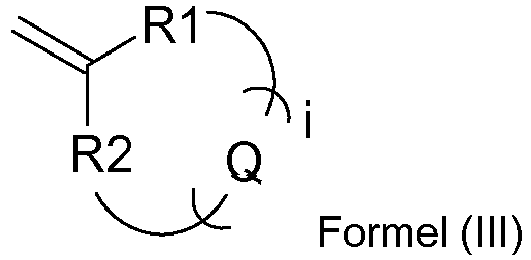
- b) Umsetzung des in Schritt a) erzeugten Organoboraddukts mit einer Verbindung der allgemeinen Formel (IV),

- Offenbart ist die Verwendung eines Ketons der allgemeinen Formel (I) als Duftspeicherstoff und die Verwendung eines Ketons der Formel (I) in flüssigen oder festen Waschmitteln, Weichspülern, weichmachenden Waschmitteln, Waschhilfsmitteln oder kosmetischen Mitteln zur Haut- und Haarbehandlung.
- Ebenfalls offenbart ist die Verwendung Ketone der Formel (I) insbesondere deren Zusammensetzung wie z.B. Wasch- oder Reinigungsmittel oder kosmetisches Mittel, zur Verbesserung der Duftstoffausbeute, insbesondere auf Textilien.
- Offenbart ist ein Keton der allgemeinen Formel (I), in dem i =2 ist und mindestens eine der R1 und R2 verbrückenden, zweiwertigen substituierten oder unsubstituierten Gruppen Q 2 bis 6 C-Atome umfasst.
- Weiterhin offenbart ist ein Ketone der allgemeinen Formel (I), in dem i =2 ist und eine der R1 und R2 verbrückenden, zweiwertigen Gruppen Q unverzweigt ist und 2, 3 oder 4 Kohlenstoffatome, insbesondere 3 oder 4 Kohlenstoffatome umfasst.
- Ebenfalls offebart ist ein Keton der allgemeinen Formel (I), in dem i =2 ist und eine der R1 und R2 verbrückenden, zweiwertigen Gruppen Q verzweigt ist und die kürzeste direkte Verbindung zwischen R1 und R2 aus 2, 3 oder 4 jeweils kovalent miteinander verknüpften Kohlenstoffatomen gebildet wird. Offebart ist insbesondere ein Keton der allgemeinen Formel (I), in dem i =2 ist und eine der R1 und R2 verbrückenden, zweiwertigen Gruppen Q unverzweigt ist und 2, 3 oder 4 Kohlenstoffatome, insbesondere 3 oder 4 Kohlenstoffatome umfasst, während die andere R1 und R2 verbrückende, zweiwertige Gruppen Q verzweigt ist und die kürzeste direkte Verbindung zwischen R1 und R2 aus 2, 3 oder 4 jeweils kovalent miteinander verknüpften Kohlenstoffatomen gebildet wird.
- Ebenfalls offenbart ist ein Keton der allgemeinen Formel (I), in dem R1 und/oder R2 und/oder mindestens eine R1 und R2 verbrückende zweiwertige Gruppe Q eine Substitution mit mindestens einem Heteroatom ausgewählt aus der Gruppe bestehend aus N, O oder S aufweist. Besonders bevorzugt ist ein Keton der allgemeinen Formel (I), in dem R1 und/oder R2 und/oder mindestens eine R1 und R2 verbrückende zweiwertige Gruppe Q eine Substitution in Form einer -OH, -ORa, -SH, -SRb oder - NRcRd-Gruppe aufweist, wobei Ra, Rb, Rc und Rd unabhängig voneinander ausgewählt werden aus der Gruppe bestehend aus Wasserstoff und verzweigten oder unverzweigten, substituierten oder unsubstituierten Alkylgruppen, die 1 bis 10, insbesondere 1 bis 4 und besonders bevorzugt 1, 2 oder 3 Kohlenstoffatome umfassen.
- Ebenfalls besonders offenbart ist ein Keton der allgemeinen Formel (I), in dem eine R1 und R2 verbrückende zweiwertige Gruppe Q eine Keton-, Carbonsäure-, Lacton-, Amid-, Ester- und/oder Aldehydstruktur umfasst.
- Weiterhin ist ein Keton der allgemeinen Formel (I) offenbart in dem vier der fünf Arylsubstituenten R3, R4, R5, R6 und R7 für Wasserstoff stehen. Vorzugsweise stehen R3, R4, R6 und R7 für Wasserstoff, während der Substituent in para-Position R5 für ein Halogenatom, insbesondere -F, -Cl oder -Br, NO2, eine lineare oder verzweigte, substituierte oder unsubstituierte Alkoxygruppe mit 1 bis 15 C-Atomen oder eine lineare oder verzweigte, substituierte oder unsubstituierte Alkylgruppe mit 1 bis 15 C-Atomen steht. In einer überaus bevorzugten Ausführungsform der Offenbarung steht R5 für -Cl, -Br, -NO2 oder eine Alkyl- oder Alkoxygruppe umfassend 1 bis 4 C-Atome. Vorzugsweise handelt es sich bei der linearen oder verzweigten, substituierten oder unsubstituierten Alkylgruppe um eine Methyl- oder Ethylgruppe und/oder bei der linearen oder verzweigten, substituierten oder unsubstituierten Alkoxygruppe um eine Methoxy-, Ethoxy-, Isopropoxy- oder tert-Butoxy-Gruppe.
- Eine Substitution in para-Position (R5) ist besonders bevorzugt, da die elektronische Struktur des aromatischen Rings hier am effektivsten modifiziert werden kann, wodurch das Absorptionsmaximum von Ketonen der allgemeinen Formel (I) leicht an eine bestimmte Wellenlänge angepasst werden kann.
- Ebenfalls bevorzugt ist ein Keton der allgemeinen Formel (I), in dem R3, R4, R5, R6 und R7 für Wasserstoff stehen.
- Im Sinne der Erfindung ist ein Keton der allgemeinen Formel (I), aus dem durch Spaltung der Cα-Cβ-Bindung ein Keton der allgemeinen Formel (II)


- Vorzugsweise stehen R1 und R2 in Formel (III) unabhängig voneinander für ein sekundäres oder tertiäres Kohlenstoffatom. Insbesondere steht einer der beiden Reste R1 und R2 für ein sekundäres Kohlenstoffatom, während der jeweils andere Rest für ein tertiäres Kohlenstoffatom steht.
- Bevorzugt ist eine Verbindung der allgemeinen Formel (II), in der vier der fünf Arylsubstituenten R3, R4, R5, R6 und R7 für Wasserstoff stehen. Vorzugsweise stehen R3, R4, R6 und R7 für Wasserstoff, während der Substituent in para-Position R5 für ein Halogenatom, NO2, eine lineare oder verzweigte, substituierte oder unsubstituierte Alkoxygruppe mit 1 bis 15 C-Atomen oder eine lineare oder verzweigte, substituierte oder unsubstituierte Alkylgruppe mit 1 bis 15 C-Atomen steht. In einer überaus bevorzugten Ausführungsform der Erfindung steht R5 für -Cl, -Br, -NO2 oder eine Alkyl- oder Alkoxygruppe umfassend 1 bis 4 C-Atome.
Vorzugsweise handelt es sich bei der linearen oder verzweigten, substituierten oder unsubstituierten Alkylgruppe um eine Methyl- oder Ethylgruppe und/oder bei der linearen oder verzweigten, substituierten oder unsubstituierten Alkoxygruppe um eine Methoxy-, Ethoxy-, Isopropoxy- oder tert-Butoxy-Gruppe. - Offenbart ist ein Keton der allgemeinen Formel (I), aus dem durch Spaltung der Cα-Cβ-Bindung eine Verbindung der allgemeinen Formel (III) hervorgeht, in der i =2 ist und mindestens eine der R1 und R2 verbrückenden, zweiwertigen substituierten oder unsubstituierten Gruppen Q 2 bis 6 C-Atome umfasst.
- Besonders offenbart ist dabei eine Verbindung der allgemeinen Formel (III), in der i = 2 ist und eine der R1 und R2 verbrückenden, zweiwertigen Gruppen Q unverzweigt ist und 2, 3 oder 4 Kohlenstoffatome, insbesondere 3 oder 4 Kohlenstoffatome umfasst.
- Ebenfalls offenbart ist eine Verbindung der allgemeinen Formel (III), in der i =2 ist und eine der R1 und R2 verbrückenden, zweiwertigen Gruppen Q verzweigt ist und die kürzeste direkte Verbindung zwischen R1 und R2 aus 2, 3 oder 4 jeweils kovalent miteinander verknüpften Kohlenstoffatomen gebildet wird.
- Weiter ist ein Keton der allgemeinen Formel (I) offenbart, aus dem durch Spaltung der Cα-Cβ-Bindung eine Verbindung der allgemeinen Formel (III) hervorgeht, in der i =2 ist und eine der R1 und R2 verbrückenden, zweiwertigen Gruppen Q unverzweigt ist und 2, 3 oder 4 Kohlenstoffatome, insbesondere 3 oder 4 Kohlenstoffatome umfasst, während die andere R1 und R2 verbrückende, zweiwertige Gruppen Q verzweigt ist und die kürzeste direkte Verbindung zwischen R1 und R2 aus 2, 3 oder 4 jeweils kovalent miteinander verknüpften Kohlenstoffatomen gebildet wird.
- Ebenfalls offenbart ist eine Verbindung der allgemeinen Formel (III), in der R1 und/oder R2 und/oder mindestens eine R1 und R2 verbrückende zweiwertige Gruppe Q eine Substitution mit mindestens einem Heteroatom ausgewählt aus der Gruppe bestehend aus N, O oder S aufweist. Besonders offenbart ist eine Verbindung der allgemeinen Formel (III), in der R1 und/oder R2 und/oder mindestens eine R1 und R2 verbrückende zweiwertige Gruppe Q eine Substitution in Form einer -OH, -ORa, -SH, -SRb oder -NRcRd-Gruppe aufweist, wobei Ra, Rb, Rc und Rd unabhängig voneinander ausgewählt werden aus der Gruppe bestehend aus Wasserstoff und verzweigten oder unverzweigten, substituierten oder unsubstituierten Alkylgruppen, die 1 bis 10 Kohlenstoffatome umfassen.
- Ebenfalls besonders offenbart ist eine Verbindung der allgemeinen Formel (III), in der eine R1 und R2 verbrückende zweiwertige Gruppe Q eine Keton-, Carbonsäure-, Lacton-, Amid-, Ester- und/oder Aldehydstruktur umfasst.
- Weiterhin offenbart ist eine Verbindung der allgemeinen Formel (III), bei der es sich um ein cyclisches Terpen oder cyclisches Terpenoid mit einer semicyclischen Doppelbindung handelt. Unter dem Begriff der "semicyclischen Doppelbindung" ist im Sinne der Erfindung eine Doppelbindung zwischen zwei Kohlenstoffatomen zu verstehen, in der das eine Kohlenstoffatom der Doppelbindung eine exocyclische Position einnimmt, während das andere Kohlenstoffatom der Doppelbindung Teil eines Ringsystems ist.
- Die nachfolgende Zeichnung (B-I) soll den Begriff der semicyclischen Doppelbindung weiter erläutern.

- Unter Terpenen sind erfindungsgemäß alle aus Isoprenbasiseinheiten aufgebauten Naturstoffe und Derivate zu verstehen.
- Unter Terpenoiden sind erfindungsgemäß alle aus Isoprenbasiseinheiten aufgebauten Naturstoffe und Derivate zu verstehen, die eine hohe strukturelle Verwandtschaft zu den Terpenen aufweisen, sich von diesen aber beispielsweise durch den Verlust oder die Umlagerung eines Fragments, vorzugsweise einer Methylgruppe unterscheiden.
- Je nach Zahl der Basiseinheiten teilt man die Terpene in Monoterpene, Sesquiterpene, Diterpene, Sesterpene, Triterpene und Tetraterpene ein.
- Gemäß einer bevorzugten Ausführungsform der Offenbarung sind insbesondere monocyclische Monoterpene, bicyclische Monoterpene und cyclische Sesquiterpene. Alle Terpene des erfindungsgemäßen Verfahren umfassen dabei mindestens eine semicyclische Doppelbindung, deren exocyclisches Kohlenstoffatom vor der Spaltung der Cα-Cβ-Bindung in dem erfindungsgemäßen Keton der allgemeinen Formel (I) mit dem Cα-Atom kovalent verknüpft ist, wobei die cyclische Terpene oder cyclische Terpenoide mit semicyclischer Doppelbindung werden aus der Gruppe bestehend aus β-Phellandren (p-Mentha-1(7),2-dien), α-Fenchen (7,7-Dimethyl-2-methylen-bicyclo[2.2.1]heptan), β-Fenchen (2,2-Dimethyl-5-methylenbicyclo[2.2.1]heptan), Camphen (2,2-Dimethyl-3-methylenbicyclo[2.2.1]heptan), Sabinen (4-Methylen-1-(1-methylethyl)bicyclo-[3.1.0]hexan), Pinocarveol, β-Pinen (6,6-Dimethyl-2-methylenbicyclo[3.1.1]heptan), Trichodien (1,4-Dimethyl-4-(1-methyl-2-methylencyclopentyl)cyclohexen), β-Humulen (1E,5E)-1,4,4 trimethyl-8-methylenecycloundeca-1,5-dien oder oder γ-Humulen (1E,6E)-1,8,8-trimethyl-5-methylenecycloundeca-1,6-dien ausgewählt. Ebenfalls besonders bevorzugt sind alle möglichen Enantiomere oder Diastereomere der genannten cyclischen Terpene oder cyclischen Terpenoide mit semicyclischer Doppelbindung.
- Die genannten cyclischen Terpene oder cyclischen Terpenoide mit semicyclischer Doppelbindung zeichnen sich in der Regel durch eine hohe Isomerisierungstendenz aus. Bei langer Sonnenlichtexposition kann es zu Gerüstumlagerungen (z.B. durch Wagner-Meerwein-Umlagerungen) oder zur Bildung von Doppelbindungsisomeren kommen. Dies ist unerwünscht, da die genannten Isomere sich oft deutlich in ihrem Geruchseindruck von den ursprünglich vorhandenen cyclischen Terpenen oder cyclischen Terpenoiden mit semicyclischer Doppelbindung unterscheiden. Unter Umständen kann so der Dufteindruck einer Mehrkomponenten-Parfümölmischung entscheidend verändert werden. Ein Vorteil der vorliegenden Erfindung ist daher die Tatsache, dass die erfindungsgemäßen Terpene oder Terpenoide erst direkt bei der Anwendung durch Sonnenlichtexposition freigesetzt werden, wodurch eine Duftveränderung durch vorhergehende Isomerisierungsreaktionen nahezu ausgeschlossen werden kann.
- Gegenstand der vorliegenden Offenbarung ist ebenfalls eine Zusammensetzung, enthaltend mindestens eine Verbindung der allgemeinen Formel (la),

- R1, R2, R3, R4 und R5 unabhängig voneinander für Wasserstoff, ein Halogenatom, NO2, eine lineare oder verzweigte, substituierte oder unsubstituierte Alkoxygruppe mit 1 bis 15 C-Atomen oder eine lineare oder verzweigte, substituierte oder unsubstituierte Alkylgruppe mit 1 bis 15 C-Atomen stehen,
- und X nach Spaltung der Cα-X-Bindung für eine zyklische Verbindung, enthaltend mindestens eine semicyclische Doppelbindung steht, wobei das exocyclische Kohlenstoffatom der semicyclische Doppelbindung vor der Spaltung der Cα-X-Bindung kovalent mit dem Cα-Atom verknüpft ist.
- Insbesondere handelt es sich bei dem Rest X nach Spaltung der Cα-X-Bindung um ein cyclisches Terpen mit semicyclischer Doppelbindung, ausgewählt aus der Gruppe bestehend aus β-Phellandren (p-Mentha-1(7),2-dien), α-Fenchen (7,7-Dimethyl-2-methylen-bicyclo[2.2.1]heptan), β-Fenchen (2,2-Dimethyl-5-methylenbicyclo-[2.2.1]heptan), Camphen (2,2-Dimethyl-3-methylenbicyclo[2.2.1]heptan), Sabinen (4-Methylen-1-(1-methylethyl)bicyclo-[3.1.0]hexan), Pinocarveol, β-Pinen (6,6-Dimethyl-2-methylenbicyclo-[3.1.1]heptan), Trichodien (1,4-Dimethyl-4-(1-methyl-2-methylencyclopentyl)cyclohexen), β-Humulen (1E,5E)-1,4,4 trimethyl-8-methylenecycloundeca-1,5-dien oder γ-Humulen (1E,6E)-1,8,8-trimethyl-5-methylenecycloundeca-1,6-dien. Ebenfalls besonders bevorzugt sind alle möglichen Enantiomere oder Diastereomere der genannten cyclischen Terpene oder cyclischen Terpenoide mit semicyclischer Doppelbindung.
- Bevorzugt ist eine Verbindung der allgemeinen Formel (la), in der vier der fünf Arylsubstituenten R3, R4, R5, R6 und R7 für Wasserstoff stehen. Vorzugsweise stehen R3, R4, R6 und R7 für Wasserstoff, während der Substituent in para-Position R5 für ein Halogenatom, NO2, eine lineare oder verzweigte, substituierte oder unsubstituierte Alkoxygruppe mit 1 bis 15 C-Atomen oder eine lineare oder verzweigte, substituierte oder unsubstituierte Alkylgruppe mit 1 bis 15 C-Atomen steht. In einer überaus bevorzugten Ausführungsform der Erfindung steht R5 für -Cl, -Br, -NO2 oder eine Alkyl- oder Alkoxygruppe umfassend 1 bis 4 C-Atome. Vorzugsweise handelt es sich bei der linearen oder verzweigten, substituierten oder unsubstituierten Alkylgruppe um eine Methyl- oder Ethylgruppe und/oder bei der linearen oder verzweigten, substituierten oder unsubstituierten Alkoxygruppe um eine Methoxy-, Ethoxy-, Isopropoxy- oder tert-Butoxy-Gruppe.
- Vorzugsweise enthält die Zusammensetzung, wie z.B. Wasch- oder Reinigungsmittel oder kosmetisches Mittel, mindestens einen weiteren Duftstoff. Die bevorzugt eingesetzten Duftstoffe bzw. Parfümöle sind keinerlei Beschränkungen unterworfen. So können vorzugsweise als Duftstoffe synthetische oder natürliche Riechstoffverbindungen vom Typ der Ester, Ether, Aldehyde (Duftaldehyde), Ketone (Duftketone), Alkohole, Kohlenwasserstoffe, Säuren, Kohlensäureester, aromatischen Kohlenwasserstoffe, aliphatischen Kohlenwasserstoffe, gesättigten und / oder ungesättigten Kohlenwasserstoffe und Mischungen daraus verwendet werden.
- Als Duftaldehyde oder Duftketone können dabei alle üblichen Duftaldehyde und Duftketone eingesetzt werden, die typischerweise zur Herbeiführung eines angenehmen Duftempfindens eingesetzt werden. Geeignete Duftaldehyde und Duftketone sind dem Fachmann allgemein bekannt. Die Duftketone können alle Ketone umfassen, die einen erwünschten Duft oder ein Frischeempfinden verleihen können. Es können auch Gemische unterschiedlicher Ketone eingesetzt werden. Einsetzbare Ketone sind z.B. Alpha Damascon, Delta Damascon, Iso Damascon, Carvon, Gamma-Methyl-ionon, Iso-E-Super, 2,4,4,7-Tetramethyl-oct-6-en-3-on, Benzylaceton, Beta Damascon, Damascenon, Methyldihydrojasmonat, Methyl-cedrylon, Hedion und Gemischen davon. Geeignete Duftaldehyde können beliebige Aldehyde sein, die entsprechend der Duftketone einen gewünschten Duft oder eine Frischeempfinden vermitteln. Es kann sich wiederum um einzelne Aldehyde oder Aldehydgemische handeln. Geeignete Aldehyde sind beispielsweise Melonal, Triplal, Ligustral, Adoxal, Lilial usw. Die Duftaldehyde und Duftketone eine aliphatische, cycloaliphatische, aromatische, ethylenisch ungesättigte Struktur oder eine Kombination dieser Strukturen aufweisen. Es können ferner weitere Heteroatome oder polycyclische Strukturen vorliegen. Die Strukturen können geeignete Substituenten wie Hydroxyl- oder Aminogruppen aufweisen. Für weitere geeignete Duftstoffe, ausgewählt aus Aldehyden und Ketonen, wird auf Steffen Arctander Published 1960 and 1969 respectively, Reprinted 2000 ISBN: Aroma Chemicals Vol. 1: 0-931710-37-5, Aroma Chemicals Vol. 2: 0-931710-38-3, verwiesen. Geeignete Duftstoffe vom Typ der Ester sind beispielsweise Benzylacetat, Phenoxyethylisobutyrat, p-tert.-Butylcyclohexylacetat usw. Riechstoffverbindungen vom Typ der Kohlenwasserstoffen sind z.B. Terpene wie Limonen und Pinen. Geeignete Duftstoffe vom Typ Ether sind beispielsweise Benzylethylether und Ambroxan. Geeignete Duftsstoffalkohole sind beispielsweise 10-Undecen-1-ol, 2,6-Dimethylheptan-2-ol, 2-Methylbutanol, 2-Methylpentanol, 2-Phenoxyethanol, 2-Phenylpropanol usw. Duftstoffe bzw. Parfümöle können auch natürliche Riechstoffgemische sein, wie sie aus pflanzlichen Quellen zugänglich sind. Bei den Duftstoffen bzw. Parfümölen kann es sich auch um ätherische Öle, wie z.B. Angelikawurzelöl, Anisöl, Arnikablütenöl usw. handeln. Die Gesamtmenge des mindestens einen Duftstoffs in der erfindungsgemäßen Zubereitung, wie z.B. Wasch- oder Reinigungsmittel oder kosmetisches Mittel, beträgt vorzugsweise zwischen 0,001 und 5 Gew.-%, vorteilhafterweise zwischen 0,01 und 4 Gew.-%, weiter vorteilhaft zwischen 0,1 und 3 Gew.-% sowie ganz besonders bevorzugt zwischen 0,5 und 2 Gew.-% bezogen auf die Gesamtmenge der Zubereitung. Bevorzugt werden Mischungen verschiedener Duftstoffe (aus den verschiedenen oben genannten Duftstoffklassen) verwendet, die gemeinsam eine ansprechende Duftnote erzeugen. In diesem Fall entspricht die Gesamtmasse der Duftstoffmischung bezogen auf die Gesamtmasse der Zubereitung der Gesamtmenge des mindestens einen Duftstoffs in der erfindungsgemäßen Zubereitung.
- Vorzugsweise handelt es sich bei der offenbarten Zubereitung um ein Textil- oder Oberflächenbehandlungsmittel, wobei die genannten Mittel überaus bevorzugt zusätzlich mindestens ein Tensid ausgewählt aus der Gruppe bestehend aus anionischen, kationischen, nichtionischen, zwitterionischen, amphoteren Tensiden oder deren Mischungen enthalten.
- Vorzugsweise handelt es sich bei der offenbarten Zubereitung um ein Textilbehandlungsmittel in Form eines Waschmittels, Weichspülers, weichmachenden Waschmittels oder Waschhilfsmittels.
- Vorzugsweise ist das offenbarte Keton der allgemeinen Formel (I) oder die Mischung verschiedener Ketone der allgemeinen Formel (I) in der Zubereitung in Form eines Waschmittels, Weichspülers, weichmachenden Waschmittels oder Waschhilfsmittels in Mengen von vorzugsweise zwischen 0,001 und 5 Gew.-%, vorteilhafterweise zwischen 0,01 und 4 Gew.-%, weiter vorteilhaft zwischen 0,1 und 3 Gew.-%, insbesondere zwischen 0,5 und 2 Gew.-%, jeweils bezogen auf die Gesamtmenge der Zubereitung, enthalten.
- Eine Zusammensetzung enthaltend mindestens ein Keton der allgemeinen Formel (I), wobei die genannte Zusammensetzung ein Textil- oder Oberflächenbehandlungsmittel ist, vorzugsweise ein Waschmittel, Weichspüler, Waschhilfsmittel oder Reinigungsmittel ist, wobei das genannte Keton vorzugsweise in Mengen zwischen 0,001 und 5 Gew.-%, vorteilhafterweise zwischen 0,01 und 4 Gew.-%, weiter vorteilhaft zwischen 0,1 und 3 Gew.-%, insbesondere zwischen 0,5 und 2 Gew.-%, jeweils bezogen auf die Gesamtmenge der Zusammensetzung, enthalten ist, ist somit ein weiterer Gegenstand der Offenbarung.
- Das Textilbehandlungsmittel kann dabei fest oder flüssig sein, wobei flüssige Waschmittel bevorzugt sind. Für den Fall, dass das offenbarte Mittel ein Waschmittel ist, ist es bevorzugt, dass es mindestens ein Tensid ausgewählt aus der Gruppe bestehend aus anionischen, nichtionischen, zwitterionischen und amphoteren Tensiden enthält. Für den Fall, dass das erfindungsgemäße Mittel ein weichmachendes Waschmittel ("2in1") ist, ist es bevorzugt, dass es eine weichmachende Komponente sowie mindestens ein Tensid ausgewählt aus der Gruppe bestehend aus anionischen, nichtionischen, zwitterionischen und amphoteren Tensiden enthält. Waschhilfsmittel werden zur gezielten Vorbehandlung der Wäsche vor dem Waschen bei Flecken oder starker Verschmutzung eingesetzt. Zu den Waschhilfsmitteln gehören beispielsweise Vorbehandlungsmittel, Einweichmittel, Entfärber und Fleckensalz.
- Für den Fall, dass das offenbarte Mittel ein Weichspüler ist, ist es bevorzugt, dass es eine weichmachende Komponente enthält. Weichspüler sind als Mittel bevorzugt, da sie erst im letzten Schritt eines konventionellen Textilwaschvorgangs, dem Spülgang, in Kontakt mit den Textilien kommen und somit eine möglichst große Menge der Duftstoffe auf das Textil aufziehen kann, ohne dass die Gefahr besteht, dass die Duftstoffe bei anschließenden Schritten wieder entfernt werden. Es ist ganz besonders bevorzugt, dass die weichmachende Komponente eine alkylierte, quaternäre Ammoniumverbindung ist, wobei mindestens eine Alkylkette durch eine Ester- oder Amidogruppe unterbrochen ist. Die weichmachende Komponente umfasst beispielsweise quaternäre Ammoniumverbindungen wie Monoalk(en)yltrimethylammonium-Verbindungen, Dialk(en)yldimethylammonium-Verbindungen, Mono-, Di- oder Triester von Fettsäuren mit Alkanolaminen. Weitere erfindungsgemäß verwendbare weichmachende Komponenten stellen quaternisierten Proteinhydrolysate oder protonierte Amine dar. Weiterhin sind auch kationische Polymere geeignete weichmachende Komponente. Ebenfalls einsetzbar sind polyquaternierte Polymere (z.B. Luviquat® Care von BASF) und auch kationische Biopolymere auf Chitinbasis und deren Derivate, beispielsweise das unter der Handelsbezeichnung Chitosan® (Hersteller: Cognis) erhältliche Polymer. Weitere geeignete weichmachende Komponenten umfassen protonierte oder quaternierte Polyamine. Besonders bevorzugte weichmachende Komponenten sind alkylierte quaternäre Ammoniumverbindungen, von denen mindestens eine Alkylkette durch eine Estergruppe und/oder Amidogruppe unterbrochen ist. Ganz besonders bevorzugt sind N-Methyl-N-(2-hydroxyethyl)-N,N-(ditalgacyloxyethyl)ammonium-methosulfat oder Bis-(palmitoyloxyethyl)-hydroxyethyl-methyl-ammonium-methosulfat. Die offenbarte Zubereitung in Form von Weichspülern kann auch nichtionische weichmachende Komponenten enthalten, wie vor allem Polyoxyalkylenglycerolalkanoate, Polybutylene, langkettige Fettsäuren, ethoxylierte Fettsäureethanolamide, Alkylpolyglucoside, insbesondere Sorbitanmono,-di- und - triester, und Fettsäureester von Polycarbonsäuren. In dem offenbarten Weichspüler als Zubereitung ist vorteilhafterweise die weichmachende Komponente in Mengen von 0,1 bis 80 Gew.-%, üblicherweise 1 bis 40 Gew.-%, vorzugsweise 2 bis 20 Gew.-% und insbesondere 3 bis 15 Gew.-% und der mindestens eine Duftstoff oder die Mischung verschiedener Duftstoffe in Mengen von vorteilhafterweise 0,1 bis 20 Gew.-%, vorzugsweise 1 bis 13 Gew.-% und insbesondere 2 bis 8 Gew.-%, jeweils bezogen auf die Gesamtmenge des offenbarten Mittels, enthalten.
- Als weitere Komponente kann die Zubereitung in Form eines Weichspülers gegebenenfalls ein oder mehrere nichtionische Tenside enthalten, wobei solche eingesetzt werden können, die üblicherweise auch in Waschmitteln verwendet werden.
- Es ist weiterhin bevorzugt, dass die Zubereitung in Form eines Textil- oder Oberflächenbehandlungsmittels zusätzlich weitere vorteilhafte Inhaltsstoffe enthält, die dem Fachmann bekannt sind. So kann die offenbarte Zusammensetzung in Form eines Textilbehandlungsmittels zusätzlich zu den Tensiden und/oder weichmachenden Verbindungen weitere Inhaltsstoffe enthalten, die die anwendungstechnischen und/oder ästhetischen Eigenschaften des Textilbehandlungsmittels weiter verbessern. Im Rahmen der vorliegenden Erfindung enthalten bevorzugte Textilbehandlungsmittel zusätzlich einen oder mehrere Stoffe aus der Gruppe der Gerüststoffe, Bleichmittel, Bleichaktivatoren, Enzyme, Elektrolyte, nichtwässrigen Lösungsmittel, pH-Stellmittel, Parfüme, Parfümträger, Fluoreszenzmittel, Farbstoffe, Hydrotope, Schauminhibitoren, Silikonöle, Antiredepositionsmittel, optischen Aufheller, Vergrauungsinhibitoren, Einlaufverhinderer, Knitterschutzmittel, Farbübertragungsinhibitoren, antimikrobiellen Wirkstoffe, Germizide, Fungizide, Antioxidantien, Konservierungsmittel, Korrosionsinhibitoren, Antistatika, Bittermittel, Bügelhilfsmittel, Phobier- und Imprägniermittel, Quell- und Schiebefestmittel, neutrale Füllsalze sowie UV-Absorber. Als Gerüststoffe, die in den Textilbehandlungsmitteln enthalten sein können, sind insbesondere Silikate, Aluminiumsilikate (insbesondere Zeolithe), Carbonate, Salze organischer Di- und Polycarbonsäuren sowie Mischungen dieser Stoffe zu nennen.
- Die Herstellung der Weichspüler als Textilbehandlungsmittel kann nach dem Fachmann geläufigen Techniken zur Herstellung von Weichspülern erhalten werden. Dies kann beispielsweise durch Aufmischen der Rohstoffe, gegebenenfalls unter Einsatz von hochscherenden Mischapparaturen, geschehen. Es empfiehlt sich ein Aufschmelzen der weichmachenden Komponente(n) und ein nachfolgendes Dispergieren der Schmelze in einem Lösungsmittel, vorzugsweise Wasser. Die weiteren Inhaltsstoffe können durch einfaches Zumischen in die Weichspüler integriert werden. Die Herstellung der flüssigen Waschmittel als Textilbehandlungsmittel erfolgt mittels üblicher und bekannter Methoden und Verfahren in dem beispielsweise die Bestandteile einfach in Rührkesseln vermischt werden, wobei Wasser, nichtwässrige Lösungsmittel und Tenside, zweckmäßigerweise vorgelegt werden und die weiteren Bestandteile hinzugefügt werden. Ein gesondertes Erwärmen bei der Herstellung ist nicht erforderlich, wenn es gewünscht ist, sollte die Temperatur der Mischung 80°C nicht übersteigen.
- Als Oberflächenbehandlungsmittel kann die offenbarte Zubereitung zur Reinigung harter Oberflächen eingesetzt werden. Es kann sich dabei beispielsweise um Geschirrreinigungsmittel handeln, die zur manuellen oder maschinellen Reinigung von Geschirr eingesetzt werden. Es kann sich auch um übliche Industrie- oder Haushaltsreiniger handeln, mit denen harte Oberflächen wie Möbeloberflächen, Fliesen, Kacheln, Wand- und Bodenbeläge gereinigt werden. Als harte Oberflächen kommen neben Geschirr auch alle übrigen harten Oberflächen, insbesondere aus Glas, Keramik, Kunststoff oder Metall, in Haushalt und Gewerbe in Frage. Dabei kann es sich bei den Textil- oder Oberflächenbehandlungsmitteln um feste oder flüssige Formulierungen handeln, wobei feste Formulierungen als Pulver, Granulat, Extrudat, in Tab-Form, als Tablette oder als gepresster und/oder geschmolzener Formkörper vorliegen können. Bei flüssigen Formulierungen kann es sich um Lösungen, Emulsionen, Dispersionen Suspensionen, Mikroemulsionen, Gels oder Pasten handeln. Als Oberflächenbehandlungsmittel kann das Mittel dementsprechend übliche Inhaltsstoffe von Reinigungsmitteln in üblichen Mengen enthalten.
- In einer weiteren bevorzugten Ausführungsform der Offenbarung handelt es sich bei der Zubereitung um ein kosmetisches Mittel zur Haut- und Haarbehandlung. Vorzugsweise ist das offenbarte Keton der allgemeinen Formel (I) oder die Mischung verschiedener offenbarten Ketone der allgemeinen Formel (I) in der Zubereitung in Form eines kosmetischen Mittels zur Haut- und Haarbehandlung in Mengen von vorzugsweise zwischen 0,001 und 5 Gew.-%, vorteilhafterweise zwischen 0,01 und 4 Gew.-%, weiter vorteilhaft zwischen 0,1 und 3 Gew.-%, insbesondere zwischen 0,5 und 2 Gew.-%, jeweils bezogen auf die Gesamtmenge der Zubereitung, enthalten. Eine Zusammensetzung enthaltend mindestens ein offenbarten Keton der allgemeinen Formel (I), wobei die genannte Zusammensetzung ein kosmetisches Mittel zur Haut- und Haarbehandlung ist, wobei das genannte Keton vorzugsweise in Mengen zwischen 0,001 und 5 Gew.-%, vorteilhafterweise zwischen 0,01 und 4 Gew.-%, weiter vorteilhaft zwischen 0,1 und 3 Gew.-%, insbesondere zwischen 0,5 und 2 Gew.-%, jeweils bezogen auf die Gesamtmenge der Zusammensetzung, enthalten ist, ist ein weiterer Gegenstand der vorliegenden Offenbarung.
- Gegenstand der vorliegenden Erfindung ist das bereits genannte Verfahren zur Herstellung eines erfindungsgemäßen Ketons der allgemeinen Formel (I) umfassend folgende Schritte:
- a) Hydroborierung einer Verbindung der allgemeinen Formel (III)

- b) Umsetzung des in Schritt a) erzeugten Organoboraddukts mit einer Verbindung der allgemeinen Formel (IV),

- In einer besonders bevorzugten Ausführungsform des genannten Verfahrens steht X in einer Verbindung der allgemeinen Formel (IV) für -Cl oder -Br, insbesondere für -Br. In einer ebenfalls bevorzugten Ausführungsform des genannten Verfahrens ist eine Verbindung der allgemeinen Formel (IV) bevorzugt, in der vier der fünf Arylsubstituenten R3, R4, R5, R6 und R7 für Wasserstoff stehen. Vorzugsweise stehen R3, R4, R6 und R7 für Wasserstoff, während der Substituent in para-Position R5 für ein Halogenatom, NO2, eine lineare oder verzweigte, substituierte oder unsubstituierte Alkoxygruppe mit 1 bis 15 C-Atomen oder eine lineare oder verzweigte, substituierte oder unsubstituierte Alkylgruppe mit 1 bis 15 C-Atomen steht. In einer überaus bevorzugten Ausführungsform der Erfindung steht R5 für -Cl, -Br, -NO2 oder eine Alkyl- oder Alkoxygruppe umfassend 1 bis 4 C-Atome. Vorzugsweise handelt es sich bei der linearen oder verzweigten, substituierten oder unsubstituierten Alkylgruppe um eine Methyl- oder Ethylgruppe und/oder bei der linearen oder verzweigten, substituierten oder unsubstituierten Alkoxygruppe um eine Methoxy-, Ethoxy-, Isopropoxy- oder tert-Butoxy-Gruppe. Unter dem Begriff Hydroborierung ist im Sinne der Erfindung eine 1,2-Addition eines Organoboranreagenzes an zumindest eine semicyclische Doppelbindung der Verbindung der allgemeinen Formel (III) zu verstehen, wodurch zwischen dem exocyclischen Cβ-Atom der semicyclischen Doppelbindung und dem Bor-Atom des verwendeten Organoboranreagenzes eine kovalente Kohlenstoff-Bor-Bindung und damit ein Organoboraddukt gebildet wird. Geeignete Verfahren zur Hydroborierung sind in J. March, Advanced Organic Chemistry, 4. Aufl., S. 783-789 beschrieben, worauf hier Bezug genommen wird.
- Vorzugsweise führt man die Hydroborierung in einem Lösungsmittel durch. Geeignete Lösungsmittel für die Hydroborierung sind beispielsweise acyclische Ether wie Diethylether, Methyl-tert.-butylether, Dimethoxyethan, Diethylenglykoldimethylether, Triethylenglykoldimethylether, cyclische Ether wie Tetrahydrofuran oder Dioxan sowie Kohlenwasserstoffe wie Hexan oder Toluol oder Gemische davon. Die Reaktionstemperatur wird in der Regel von der Reaktivität des Hydroborierungsmittels bestimmt und liegt vorzugsweise zwischen dem Schmelz -und Siedepunkt des Reaktionsgemisches. Insbesondere kann die Reaktion in THF und/oder Diethylether bei Temperaturen zwischen -100°C und 40°C, vorzugsweise zwischen -40°C und 30°C und insbesondere zwischen 0°C und 20°C durchgeführt werden. Geeignete Organoboranreagenzien sind vorzugsweise sterisch anspruchsvolle Organoboranreagenzien, wobei diese beispielsweise ausgewählt werden können aus der Gruppe bestehend aus 9-Borabicyclo[3.3.1]nonan (9-BBN), 1,1,2-Trimethylpropyl-boran (Thexylboran), Catecholboran oder Diisopinocampheylboran (Ipc2BH). Vorzugsweise setzt man das Organoboranreagenz äquimolar oder im Überschuß bezogen auf die mindestens eine semicyclische Doppelbindung der Verbindung der allgemeinen Formel (III) ein. Ein Vorteil des genannten Verfahrens liegt in der Tatsache, dass die gebildeten Organoboraddukte vorzugsweise nicht isoliert werden müssen, sondern ohne vorhergehende Aufreinigung direkt mit einer Verbindung der allgemeinen Formel (IV) umgesetzt werden können. Die genannte Umsetzung des Organoboranaddukts mit der Verbindung der allgemeinen Formel (IV) erfolgt vorzugsweise in einem geeigneten Lösungsmittel, beispielsweise in acyclischen Ethern wie Diethylether, Methyl-tert.-butylether, Dimethoxyethan, Diethylenglykoldimethylether, Triethylenglykoldimethylether, in cyclischen Ethern wie Tetrahydrofuran oder in Dioxan sowie in Kohlenwasserstoffen wie Hexan oder Toluol oder in Gemischen davon, wobei die beschriebene Umsetzung überaus bevorzugt in Gegenwart eines Alkalimetallalkoholats durchgeführt wird. Die Reaktionstemperatur wird in der Regel von der Reaktivität der Verbindung der allgemeinen Formel (IV) und/oder von der Reaktivität des Organoboraddukts bestimmt und liegt vorzugsweise zwischen dem Schmelz -und Siedepunkt des Reaktionsgemisches. Insbesondere kann die Reaktion in THF und/oder Diethylether bei Temperaturen zwischen -100°C und 40°C, vorzugsweise zwischen -90°C und 0°C und insbesondere zwischen -78°C und -40°C durchgeführt werden.
- In einer überaus bevorzugten Ausführungsform wird das genannte Alkalimetallalkoholat ausgewählt aus Kalium-methanolat, Natrium-methanolat, Kalium-ethanolat, Natrium-ethanolat, Kaliumpropylat, Natrium-propylat, Kalium-tert-butanolat, Natrium-tert-butanolat, Kalium-2,6-di-tert-butylphenolat, Natrium-2,6-di-tert-butylphenolat und aus deren beliebigen Mischungen. Vorzugsweise setzt man das Alkalimetallalkoholat äquimolar oder im leichten Überschuss (1,05 bis 1,30 eq.) bezogen auf das gebildete Organoboranaddukt ein.
- Die Aufreinigung des gebildeten Ketons der allgemeinen Formel (I) erfolgt vorzugsweise durch Kristallisation, Destillation und/oder Säulenchromatographie. Ein Vorteil des beschriebenen Herstellungsverfahrens liegt in der Tatsache, dass die Ketone der allgemeinen Formel (I) in der Regel in einer einstufigen konvergenten Synthese ohne aufwendige Schutzgruppenoperationen direkt und kostengünstig hergestellt werden können. Es entsteht somit ein Duftspeicherstoff AB, der im Wesentlichen aus einem Photorezeptor (A) und einem cyclischen Alken mit semicyclischer Doppelbindung (B) zusammengesetzt ist. Durch Bestrahlung zerfällt der genannte Duftspeicherstoff AB dann wieder problemlos in seine einzelnen Bestandteile A und B.
- Synthese von 3-(6, 6-Dimethylbicyclo [3.1.1]-heptan-2-yl)-1-phenylpropan-1-on

- 1H NMR (300 MHz, CDCl3) (δ, ppm): 1.03 (s, 3H), 1.19 (s, 3H), 1.76-2.10 (m, 8H), 2.34 (q, 1H, 7.2 Hz), 2.95 (t, 2H, 8.1 Hz), 7.46 (t, 2H, 7.8 Hz,), 7.55 (t, 1H, 7.2 Hz), 7.96 (d, 2H, 8.1 Hz); 13C NMR (75 MHz, CDCl3) (δ, ppm): 22.4, 23.3, 26.5, 28.2, 32.0, 33.8, 37.3, 38.7, 41.3, 41.5, 46.2, 128.1, 128.5, 132.8, 137.1, 200.8;
GC/MS (50-300M), m/z: 256, 238, 223, 195, 133, 119, 105, 91, 77, 55, 41. - 20 mg 3-(6,6-Dimethylbicyclo[3.1.1]heptan-2-yl)-1-phenylpropan-1-on wurden in 8 ml Methanol gelöst. Die Reaktionslösung wurde in einem Multilamp-Photoreactor (8 W-Lampen (4×), Firma Luxchem) mit Emissionmaximum λ = 350 nm eine Stunde lang belichtet. Die Reaktion wurde mit Hilfe der GC/MS-Spektrometrie verfolgt. Nach spätestens 60 Minuten Belichtung wurde die weitgehend vollständige Umwandlung von 3-(6,6-Dimethylbicyclo[3.1.1]heptan-2-yl)-1-phenylpropan-1-on in Acetophenon und β-Pinen beobachtet.
- Zum Vergleich wurden Lösungen von 0,1 mmol beta-Pinen und 0.1 mmol Acetophenon in je 1 ml Aceton und eine Mischung von 0.1 mmol beta-Pinen und 0.1 mmol Acetophenon in 1 ml Aceton hergestellt. Anschließend wurde in jede Lösung ein Riechstreifen 2 cm tief eingetaucht, wobei jeder Riechstreifen anschließend unter Lichtausschluss bei 20°C getrocknet wurde.
Nach erfolgreicher Trocknung wird jeder Riechstreifen über den gesamten Testzeitraum hinweg mit einer handelsüblichen Leuchtstoffröhre (gemäß DIN 5035 neutralweiß (nw); Farbtemperatur 3300 bis 5500 K) bestrahlt und die Duftintensität zu den jeweils angegebenen Zeitpunkten bestimmt. - Die Duftintensität wurde von 3 trainierten Probanden auf einer Skala von 0 bis 6 bewertet, wobei 6 die höchste Note ist und 0 für keine Duftwahrnehmung steht.
- Definition der Skalierung:
- 6
- unangenehm stark
- 5
- sehr stark
- 4
- stark
- 3
- intensiv
- 2
- angenehm
- 1
- wahrnehmbar
- 0
- nicht mehr wahrnehmbar
- Es zeigt sich, dass die ca. 1-minütige Bestrahlung mit einer 20 Watt Tageslichtlampe (LifeLite Full Spectrum Daylight Lamp) auch noch nach 24 Stunden die photoinduzierte Freisetzung des Geruchsstoffs Pinen bewirkt.
| nach 1 Minute | nach 20 Minuten | nach 45 Minuten | nach 1,5 Stunden | nach 24 Stunden | |
| Photocage Pinen | chemischer Geruch stark nach Acetophenon 1 | 0-1 | 0-1 | 0 wird durch Tageslichlampe erneut riechbar 0-1 | 0 wird durch Tageslichlampe erneut riechbar 0-1 |
| Acetophenon | 3 | 3 | 2-3 | 2 | 0 |
| beta-Pinen | 0-1 | 0 | 0 | 0 | 0 |
| Acetophenon/ beta-Pinen | nur Acetophenon wahrnehmbar 2-3 | 2-3 | 2 | 2 | 0 |
Claims (4)
- Verfahren zur lang anhaltenden Beduftung von Oberflächen, dadurch gekennzeichnet, dass ein Keton auf die zu beduftende Oberfläche aufgebracht wird und die genannte Oberfläche anschließend einer elektromagnetischen Strahlung umfassend die Wellenlängen von 200 bis 400 nm ausgesetzt wird, wobei das Keton der allgemeinen Formel (I) genügt,
 i =1 oder 2 ist,R3, R4, R5, R6 und R7 unabhängig voneinander für Wasserstoff, ein Halogenatom, NO2, eine lineare oder verzweigte, substituierte oder unsubstituierte Alkoxygruppe mit 1 bis 15 C-Atomen oder eine lineare oder verzweigte, substituierte oder unsubstituierte Alkylgruppe mit 1 bis 15 C-Atomen stehen undR1 und R2 unabhängig voneinander für ein sekundäres, tertiäres oder quartäres C-Atom stehen undQ für mindestens eine R1 und R2 verbrückende zweiwertige substituierte oder unsubstituierte Gruppe mit 1 bis 10 Kohlenstoffatomen steht,wobei durch Spaltung der Cα-Cβ-Bindung ein Keton der allgemeinen Formel (II)

ausgewählt aus der Gruppe bestehend aus β-Phellandren (p-Mentha-1(7),2-dien), α-Fenchen (7,7-Dimethyl-2-methylen-bicyclo[2.2.1]heptan), β-Fenchen (2,2-Dimethyl-5-methylenbicyclo-[2.2.1]heptan), Camphen (2,2-Dimethyl-3-methylenbicyclo[2.2.1]heptan), Sabinen (4-Methylen-1-(1-methylethyl)bicyclo-[3.1.0]hexan), Pinocarveol, β-Pinen (6,6-Dimethyl-2-methylenbicyclo-[3.1.1]heptan), Trichodien (1,4-Dimethyl-4-(1-methyl-2-methylencyclopentyl)cyclohexen), β-Humulen ((1E,5E)-1,4,4 trimethyl-8-methylenecycloundeca-1,5-dien) oder γ-Humulen ((1E,6E)-1,8,8-trimethyl-5-methylenecycloundeca-1,6-dien) sowie aus deren Enantiomeren und/oder Diastereomeren. - Verfahren gemäß Anspruch 1 dadurch gekennzeichnet, dass bei dem Keton der allgemeinen Formel (I) vier der fünf Arylsubstituenten R3, R4, R5, R6 und R7 für Wasserstoff stehen.
- Verfahren gemäß Anspruch 1 oder 2, dadurch gekennzeichnet, dass bei dem Keton der allgemeinen Formel (I) R3, R4, R5, R6 und R7 für Wasserstoff stehen.
- Verfahren zur Herstellung eines Ketons der allgemeinen Formel (I) gemäß Anspruch 1 umfassend folgende Schritte:a) Hydroborierung einer Verbindung der allgemeinen Formel (III)
 b) Umsetzung des in Schritt a) erzeugten Organoboraddukts mit einer Verbindung der allgemeinen Formel (IV),
Applications Claiming Priority (2)
| Application Number | Priority Date | Filing Date | Title |
|---|---|---|---|
| DE102008016327A DE102008016327A1 (de) | 2008-03-28 | 2008-03-28 | Photolabile Duftspeicherstoffe |
| PCT/EP2009/051674 WO2009118219A1 (de) | 2008-03-28 | 2009-02-13 | Photolabile duftspeicherstoffe |
Publications (2)
| Publication Number | Publication Date |
|---|---|
| EP2254856A1 EP2254856A1 (de) | 2010-12-01 |
| EP2254856B1 true EP2254856B1 (de) | 2016-08-24 |
Family
ID=40568596
Family Applications (1)
| Application Number | Title | Priority Date | Filing Date |
|---|---|---|---|
| EP09723845.5A Not-in-force EP2254856B1 (de) | 2008-03-28 | 2009-02-13 | Verfahren zur Beduftung von Oberflächen durch Strahlung von photolabile Duftspeicherstoffe und Herstellung der Duftspeicherstoffe |
Country Status (4)
| Country | Link |
|---|---|
| US (1) | US8129569B2 (de) |
| EP (1) | EP2254856B1 (de) |
| DE (1) | DE102008016327A1 (de) |
| WO (1) | WO2009118219A1 (de) |
Families Citing this family (15)
| Publication number | Priority date | Publication date | Assignee | Title |
|---|---|---|---|---|
| DE102010002006A1 (de) | 2010-02-17 | 2011-08-18 | Henkel AG & Co. KGaA, 40589 | Photolabile Duftspeicherstoffe |
| DE102010002007A1 (de) | 2010-02-17 | 2011-08-18 | Henkel AG & Co. KGaA, 40589 | Photolabile Duftspeicherstoffe |
| DE102011005947A1 (de) | 2011-03-23 | 2012-09-27 | Henkel Ag & Co. Kgaa | Diels-Alder-Addukte als thermisch spaltbare Riechstoffvorläufer |
| DE102011006314A1 (de) | 2011-03-29 | 2012-10-04 | Henkel Ag & Co. Kgaa | Riechstoffzusammensetzung mit Allylethern als Riechstoffvorläufer |
| DE102011078416A1 (de) | 2011-06-30 | 2013-01-03 | Henkel Ag & Co. Kgaa | Photolabile Duftspeicherstoffe |
| DE102011078415A1 (de) | 2011-06-30 | 2013-01-03 | Henkel Ag & Co. Kgaa | Photolabile Duftspeicherstoffe |
| WO2013189646A1 (de) * | 2012-06-22 | 2013-12-27 | Henkel Ag & Co. Kgaa | Photolabile duftspeicherstoffe |
| DE102014203252A1 (de) * | 2014-02-24 | 2015-08-27 | Henkel Ag & Co. Kgaa | Photolabile Duftspeicherstoffe |
| DE102014205390A1 (de) | 2014-03-24 | 2015-09-24 | Henkel Ag & Co. Kgaa | Photolabile Duftspeicherstoffe |
| DE102014226196A1 (de) | 2014-12-17 | 2016-06-23 | Henkel Ag & Co. Kgaa | Photolabile Duftstoffvorläuferverbindung |
| DE102015220929A1 (de) | 2015-10-27 | 2017-04-27 | Henkel Ag & Co. Kgaa | Photolabile Duftspeicherstoffe |
| DE102015224955A1 (de) | 2015-12-11 | 2017-06-14 | Henkel Ag & Co. Kgaa | Synthese von Ketonen freisetzenden Photocages |
| DE102015220928A1 (de) | 2015-10-27 | 2017-04-27 | Henkel Ag & Co. Kgaa | Photolabile Duftspeicherstoffe |
| DE102015220926A1 (de) | 2015-10-27 | 2017-04-27 | Henkel Ag & Co. Kgaa | Ketone freisetzende Photocages |
| EP3533786A1 (de) | 2018-03-02 | 2019-09-04 | Givaudan SA | Thioether-vorstufen für keton- und aldehydduftstoffe |
Family Cites Families (6)
| Publication number | Priority date | Publication date | Assignee | Title |
|---|---|---|---|---|
| US2686808A (en) * | 1949-08-31 | 1954-08-17 | Merck & Co Inc | Mannich reaction compounds |
| CA2135167A1 (en) * | 1992-05-20 | 1993-11-25 | Donald W. Graham | New 17-ester, amide, and ketone derivatives of 3-oxo-4- azasteroids as 5a-reductase inhibitors |
| EP1294671B1 (de) * | 2000-06-15 | 2008-10-15 | Firmenich Sa | Verwendung von ketonen als vorstufen von aktiven verbindungen |
| US20020094938A1 (en) * | 2000-11-08 | 2002-07-18 | The Procter & Gamble Company | Photo-labile pro-fragrance conjugates |
| US7132421B2 (en) * | 2003-06-17 | 2006-11-07 | Hoffmann-La Roche Inc. | CIS-imidazoles |
| DE102006003092A1 (de) | 2006-01-20 | 2007-07-26 | Henkel Kgaa | 1-Aza-3,7-dioxabicyclo[3.3.0]octan-Verbindungen und ihre Verwendung als Pro-Fragrances |
-
2008
- 2008-03-28 DE DE102008016327A patent/DE102008016327A1/de not_active Ceased
-
2009
- 2009-02-13 WO PCT/EP2009/051674 patent/WO2009118219A1/de not_active Ceased
- 2009-02-13 EP EP09723845.5A patent/EP2254856B1/de not_active Not-in-force
-
2010
- 2010-09-27 US US12/890,796 patent/US8129569B2/en not_active Expired - Fee Related
Also Published As
| Publication number | Publication date |
|---|---|
| DE102008016327A1 (de) | 2009-10-01 |
| EP2254856A1 (de) | 2010-12-01 |
| US8129569B2 (en) | 2012-03-06 |
| US20110027208A1 (en) | 2011-02-03 |
| WO2009118219A1 (de) | 2009-10-01 |
Similar Documents
| Publication | Publication Date | Title |
|---|---|---|
| EP2254856A1 (de) | Photolabile duftspeicherstoffe | |
| EP2364186B1 (de) | Photolabile duftspeicherstoffe | |
| DE60013353T2 (de) | Anwendung von substituierten Acetaldehyden mit einem cyclischen Substituent als Riechstoffbestandteile | |
| EP2536678B1 (de) | Photolabile duftspeicherstoffe | |
| DE69405350T2 (de) | Aromatische verbindungen und ihre anwendung in der parfümerie | |
| DE2910579C2 (de) | ||
| DE69314121T2 (de) | Verwendung einer Cyclopentadecenone als Parfümszutat | |
| AT525502B1 (de) | Mischungen enthaltend enantiomerenreines Ambrocenide® | |
| EP3004042B1 (de) | Photolabile duftspeicherstoffe | |
| DE2812288C2 (de) | ||
| DE602005002492T2 (de) | Parfümierende Bestandteile des holzigen Typs | |
| DE60014639T2 (de) | Riechstoffe | |
| DE69523404T2 (de) | Verwendung von dihydrobenzofuranonen als parfüminhaltstoffe | |
| DE60107580T2 (de) | Riechstoffe | |
| DE3415067C2 (de) | Verwendung von 1-Phenylpenten-4-on-1 und dessen Methylhomologen zur Vergrößerung oder Steigerung des Aromas von Parfumzusammensetzungen, Kölnisch Wässern und parfümierten Artikeln | |
| DE69103198T2 (de) | Optisch aktive aliphatische Alkohole und deren Anwendung als Riechstoffbestandteile. | |
| DE60209664T2 (de) | Duftstoffzusammensetzung enthaltend 3-(3-Hexenyl)-2-Cyclopentenon | |
| DE69803429T2 (de) | Von 3-Isopropenyl-1,2-dimethyl-1-cyclopentanol abgeleitete Nitrile und Aldehyde und ihre Verwendung in der Parfümerie | |
| DE2617816A1 (de) | Verwendung von epoxynitrilen als riechstoffe sowie diese enthaltende riechstoffkompositionen | |
| DE69504117T2 (de) | Cyclische Ketone und deren Verwendung als Riechstoffe | |
| DE10022076A1 (de) | Trimethyldecen-Verbindungen | |
| DE69116101T2 (de) | Substituierte Cyclopentenyl-oxabicyclooctane, Cyclopentenyl-formylcyclohexene, Cyclopentenylhydroxymethyl-cyclohexene und Camphonyl-spirocyclooctan enthaltende Kompositionen, organoleptische Anwendungen davon und Prozess zu deren Darstellung | |
| EP2864287A1 (de) | Photolabile duftspeicherstoffe | |
| DE2507778A1 (de) | Verwendung von dichlorcyclopropanderivaten als riechstoffe | |
| CH707393A2 (de) | Nitril-Verbindung. |
Legal Events
| Date | Code | Title | Description |
|---|---|---|---|
| PUAI | Public reference made under article 153(3) epc to a published international application that has entered the european phase |
Free format text: ORIGINAL CODE: 0009012 |
|
| 17P | Request for examination filed |
Effective date: 20100611 |
|
| AK | Designated contracting states |
Kind code of ref document: A1 Designated state(s): AT BE BG CH CY CZ DE DK EE ES FI FR GB GR HR HU IE IS IT LI LT LU LV MC MK MT NL NO PL PT RO SE SI SK TR |
|
| AX | Request for extension of the european patent |
Extension state: AL BA RS |
|
| RIN1 | Information on inventor provided before grant (corrected) |
Inventor name: PEREZ-RUIZ, RAOUL Inventor name: HUCHEL, URSULA Inventor name: GRIESBECK, AXEL Inventor name: HINZE, OLGA Inventor name: KROPF, CHRISTIAN |
|
| DAX | Request for extension of the european patent (deleted) | ||
| GRAP | Despatch of communication of intention to grant a patent |
Free format text: ORIGINAL CODE: EPIDOSNIGR1 |
|
| RIC1 | Information provided on ipc code assigned before grant |
Ipc: A61K 8/35 20060101ALI20160323BHEP Ipc: C07C 45/68 20060101ALI20160323BHEP Ipc: A61Q 13/00 20060101ALI20160323BHEP Ipc: C11D 3/50 20060101ALI20160323BHEP Ipc: C07C 49/792 20060101AFI20160323BHEP Ipc: A61K 8/31 20060101ALI20160323BHEP Ipc: C11B 9/00 20060101ALI20160323BHEP |
|
| INTG | Intention to grant announced |
Effective date: 20160421 |
|
| GRAS | Grant fee paid |
Free format text: ORIGINAL CODE: EPIDOSNIGR3 |
|
| GRAA | (expected) grant |
Free format text: ORIGINAL CODE: 0009210 |
|
| AK | Designated contracting states |
Kind code of ref document: B1 Designated state(s): AT BE BG CH CY CZ DE DK EE ES FI FR GB GR HR HU IE IS IT LI LT LU LV MC MK MT NL NO PL PT RO SE SI SK TR |
|
| REG | Reference to a national code |
Ref country code: GB Ref legal event code: FG4D Free format text: NOT ENGLISH |
|
| REG | Reference to a national code |
Ref country code: CH Ref legal event code: EP |
|
| REG | Reference to a national code |
Ref country code: AT Ref legal event code: REF Ref document number: 822931 Country of ref document: AT Kind code of ref document: T Effective date: 20160915 |
|
| REG | Reference to a national code |
Ref country code: IE Ref legal event code: FG4D Free format text: LANGUAGE OF EP DOCUMENT: GERMAN |
|
| REG | Reference to a national code |
Ref country code: DE Ref legal event code: R096 Ref document number: 502009012995 Country of ref document: DE |
|
| REG | Reference to a national code |
Ref country code: LT Ref legal event code: MG4D |
|
| REG | Reference to a national code |
Ref country code: NL Ref legal event code: MP Effective date: 20160824 |
|
| PG25 | Lapsed in a contracting state [announced via postgrant information from national office to epo] |
Ref country code: NO Free format text: LAPSE BECAUSE OF FAILURE TO SUBMIT A TRANSLATION OF THE DESCRIPTION OR TO PAY THE FEE WITHIN THE PRESCRIBED TIME-LIMIT Effective date: 20161124 Ref country code: NL Free format text: LAPSE BECAUSE OF FAILURE TO SUBMIT A TRANSLATION OF THE DESCRIPTION OR TO PAY THE FEE WITHIN THE PRESCRIBED TIME-LIMIT Effective date: 20160824 Ref country code: HR Free format text: LAPSE BECAUSE OF FAILURE TO SUBMIT A TRANSLATION OF THE DESCRIPTION OR TO PAY THE FEE WITHIN THE PRESCRIBED TIME-LIMIT Effective date: 20160824 Ref country code: LT Free format text: LAPSE BECAUSE OF FAILURE TO SUBMIT A TRANSLATION OF THE DESCRIPTION OR TO PAY THE FEE WITHIN THE PRESCRIBED TIME-LIMIT Effective date: 20160824 Ref country code: FI Free format text: LAPSE BECAUSE OF FAILURE TO SUBMIT A TRANSLATION OF THE DESCRIPTION OR TO PAY THE FEE WITHIN THE PRESCRIBED TIME-LIMIT Effective date: 20160824 |
|
| REG | Reference to a national code |
Ref country code: FR Ref legal event code: PLFP Year of fee payment: 9 |
|
| PG25 | Lapsed in a contracting state [announced via postgrant information from national office to epo] |
Ref country code: ES Free format text: LAPSE BECAUSE OF FAILURE TO SUBMIT A TRANSLATION OF THE DESCRIPTION OR TO PAY THE FEE WITHIN THE PRESCRIBED TIME-LIMIT Effective date: 20160824 Ref country code: GR Free format text: LAPSE BECAUSE OF FAILURE TO SUBMIT A TRANSLATION OF THE DESCRIPTION OR TO PAY THE FEE WITHIN THE PRESCRIBED TIME-LIMIT Effective date: 20161125 Ref country code: LV Free format text: LAPSE BECAUSE OF FAILURE TO SUBMIT A TRANSLATION OF THE DESCRIPTION OR TO PAY THE FEE WITHIN THE PRESCRIBED TIME-LIMIT Effective date: 20160824 Ref country code: PT Free format text: LAPSE BECAUSE OF FAILURE TO SUBMIT A TRANSLATION OF THE DESCRIPTION OR TO PAY THE FEE WITHIN THE PRESCRIBED TIME-LIMIT Effective date: 20161226 Ref country code: SE Free format text: LAPSE BECAUSE OF FAILURE TO SUBMIT A TRANSLATION OF THE DESCRIPTION OR TO PAY THE FEE WITHIN THE PRESCRIBED TIME-LIMIT Effective date: 20160824 |
|
| PG25 | Lapsed in a contracting state [announced via postgrant information from national office to epo] |
Ref country code: EE Free format text: LAPSE BECAUSE OF FAILURE TO SUBMIT A TRANSLATION OF THE DESCRIPTION OR TO PAY THE FEE WITHIN THE PRESCRIBED TIME-LIMIT Effective date: 20160824 Ref country code: RO Free format text: LAPSE BECAUSE OF FAILURE TO SUBMIT A TRANSLATION OF THE DESCRIPTION OR TO PAY THE FEE WITHIN THE PRESCRIBED TIME-LIMIT Effective date: 20160824 |
|
| REG | Reference to a national code |
Ref country code: DE Ref legal event code: R097 Ref document number: 502009012995 Country of ref document: DE |
|
| PG25 | Lapsed in a contracting state [announced via postgrant information from national office to epo] |
Ref country code: BG Free format text: LAPSE BECAUSE OF FAILURE TO SUBMIT A TRANSLATION OF THE DESCRIPTION OR TO PAY THE FEE WITHIN THE PRESCRIBED TIME-LIMIT Effective date: 20161124 Ref country code: BE Free format text: LAPSE BECAUSE OF NON-PAYMENT OF DUE FEES Effective date: 20170228 Ref country code: DK Free format text: LAPSE BECAUSE OF FAILURE TO SUBMIT A TRANSLATION OF THE DESCRIPTION OR TO PAY THE FEE WITHIN THE PRESCRIBED TIME-LIMIT Effective date: 20160824 Ref country code: PL Free format text: LAPSE BECAUSE OF FAILURE TO SUBMIT A TRANSLATION OF THE DESCRIPTION OR TO PAY THE FEE WITHIN THE PRESCRIBED TIME-LIMIT Effective date: 20160824 Ref country code: CZ Free format text: LAPSE BECAUSE OF FAILURE TO SUBMIT A TRANSLATION OF THE DESCRIPTION OR TO PAY THE FEE WITHIN THE PRESCRIBED TIME-LIMIT Effective date: 20160824 Ref country code: SK Free format text: LAPSE BECAUSE OF FAILURE TO SUBMIT A TRANSLATION OF THE DESCRIPTION OR TO PAY THE FEE WITHIN THE PRESCRIBED TIME-LIMIT Effective date: 20160824 |
|
| PLBE | No opposition filed within time limit |
Free format text: ORIGINAL CODE: 0009261 |
|
| STAA | Information on the status of an ep patent application or granted ep patent |
Free format text: STATUS: NO OPPOSITION FILED WITHIN TIME LIMIT |
|
| 26N | No opposition filed |
Effective date: 20170526 |
|
| PG25 | Lapsed in a contracting state [announced via postgrant information from national office to epo] |
Ref country code: SI Free format text: LAPSE BECAUSE OF FAILURE TO SUBMIT A TRANSLATION OF THE DESCRIPTION OR TO PAY THE FEE WITHIN THE PRESCRIBED TIME-LIMIT Effective date: 20160824 |
|
| PG25 | Lapsed in a contracting state [announced via postgrant information from national office to epo] |
Ref country code: MC Free format text: LAPSE BECAUSE OF FAILURE TO SUBMIT A TRANSLATION OF THE DESCRIPTION OR TO PAY THE FEE WITHIN THE PRESCRIBED TIME-LIMIT Effective date: 20160824 |
|
| REG | Reference to a national code |
Ref country code: CH Ref legal event code: PL |
|
| PG25 | Lapsed in a contracting state [announced via postgrant information from national office to epo] |
Ref country code: LI Free format text: LAPSE BECAUSE OF NON-PAYMENT OF DUE FEES Effective date: 20170228 Ref country code: CH Free format text: LAPSE BECAUSE OF NON-PAYMENT OF DUE FEES Effective date: 20170228 |
|
| REG | Reference to a national code |
Ref country code: IE Ref legal event code: MM4A |
|
| PG25 | Lapsed in a contracting state [announced via postgrant information from national office to epo] |
Ref country code: LU Free format text: LAPSE BECAUSE OF NON-PAYMENT OF DUE FEES Effective date: 20170213 |
|
| REG | Reference to a national code |
Ref country code: BE Ref legal event code: MM Effective date: 20170228 |
|
| REG | Reference to a national code |
Ref country code: FR Ref legal event code: PLFP Year of fee payment: 10 |
|
| PG25 | Lapsed in a contracting state [announced via postgrant information from national office to epo] |
Ref country code: IE Free format text: LAPSE BECAUSE OF NON-PAYMENT OF DUE FEES Effective date: 20170213 |
|
| REG | Reference to a national code |
Ref country code: AT Ref legal event code: MM01 Ref document number: 822931 Country of ref document: AT Kind code of ref document: T Effective date: 20170213 |
|
| PG25 | Lapsed in a contracting state [announced via postgrant information from national office to epo] |
Ref country code: AT Free format text: LAPSE BECAUSE OF NON-PAYMENT OF DUE FEES Effective date: 20170213 |
|
| PG25 | Lapsed in a contracting state [announced via postgrant information from national office to epo] |
Ref country code: MT Free format text: LAPSE BECAUSE OF FAILURE TO SUBMIT A TRANSLATION OF THE DESCRIPTION OR TO PAY THE FEE WITHIN THE PRESCRIBED TIME-LIMIT Effective date: 20160824 |
|
| PG25 | Lapsed in a contracting state [announced via postgrant information from national office to epo] |
Ref country code: HU Free format text: LAPSE BECAUSE OF FAILURE TO SUBMIT A TRANSLATION OF THE DESCRIPTION OR TO PAY THE FEE WITHIN THE PRESCRIBED TIME-LIMIT; INVALID AB INITIO Effective date: 20090213 |
|
| PG25 | Lapsed in a contracting state [announced via postgrant information from national office to epo] |
Ref country code: CY Free format text: LAPSE BECAUSE OF NON-PAYMENT OF DUE FEES Effective date: 20160824 |
|
| PG25 | Lapsed in a contracting state [announced via postgrant information from national office to epo] |
Ref country code: MK Free format text: LAPSE BECAUSE OF FAILURE TO SUBMIT A TRANSLATION OF THE DESCRIPTION OR TO PAY THE FEE WITHIN THE PRESCRIBED TIME-LIMIT Effective date: 20160824 |
|
| PG25 | Lapsed in a contracting state [announced via postgrant information from national office to epo] |
Ref country code: TR Free format text: LAPSE BECAUSE OF FAILURE TO SUBMIT A TRANSLATION OF THE DESCRIPTION OR TO PAY THE FEE WITHIN THE PRESCRIBED TIME-LIMIT Effective date: 20160824 |
|
| PGFP | Annual fee paid to national office [announced via postgrant information from national office to epo] |
Ref country code: GB Payment date: 20200219 Year of fee payment: 12 Ref country code: IT Payment date: 20200225 Year of fee payment: 12 Ref country code: DE Payment date: 20200219 Year of fee payment: 12 |
|
| PGFP | Annual fee paid to national office [announced via postgrant information from national office to epo] |
Ref country code: FR Payment date: 20200219 Year of fee payment: 12 |
|
| PG25 | Lapsed in a contracting state [announced via postgrant information from national office to epo] |
Ref country code: IS Free format text: LAPSE BECAUSE OF FAILURE TO SUBMIT A TRANSLATION OF THE DESCRIPTION OR TO PAY THE FEE WITHIN THE PRESCRIBED TIME-LIMIT Effective date: 20161224 |
|
| REG | Reference to a national code |
Ref country code: DE Ref legal event code: R119 Ref document number: 502009012995 Country of ref document: DE |
|
| GBPC | Gb: european patent ceased through non-payment of renewal fee |
Effective date: 20210213 |
|
| PG25 | Lapsed in a contracting state [announced via postgrant information from national office to epo] |
Ref country code: GB Free format text: LAPSE BECAUSE OF NON-PAYMENT OF DUE FEES Effective date: 20210213 Ref country code: FR Free format text: LAPSE BECAUSE OF NON-PAYMENT OF DUE FEES Effective date: 20210228 Ref country code: DE Free format text: LAPSE BECAUSE OF NON-PAYMENT OF DUE FEES Effective date: 20210901 |
|
| PG25 | Lapsed in a contracting state [announced via postgrant information from national office to epo] |
Ref country code: IT Free format text: LAPSE BECAUSE OF NON-PAYMENT OF DUE FEES Effective date: 20210213 |