EP2254445B1 - Formkörper und seine verwendungen - Google Patents
Formkörper und seine verwendungen Download PDFInfo
- Publication number
- EP2254445B1 EP2254445B1 EP09711769A EP09711769A EP2254445B1 EP 2254445 B1 EP2254445 B1 EP 2254445B1 EP 09711769 A EP09711769 A EP 09711769A EP 09711769 A EP09711769 A EP 09711769A EP 2254445 B1 EP2254445 B1 EP 2254445B1
- Authority
- EP
- European Patent Office
- Prior art keywords
- temperature
- thermoelastic
- section
- shaped body
- body according
- Prior art date
- Legal status (The legal status is an assumption and is not a legal conclusion. Google has not performed a legal analysis and makes no representation as to the accuracy of the status listed.)
- Active
Links
Images



Classifications
-
- A—HUMAN NECESSITIES
- A47—FURNITURE; DOMESTIC ARTICLES OR APPLIANCES; COFFEE MILLS; SPICE MILLS; SUCTION CLEANERS IN GENERAL
- A47C—CHAIRS; SOFAS; BEDS
- A47C31/00—Details or accessories for chairs, beds, or the like, not provided for in other groups of this subclass, e.g. upholstery fasteners, mattress protectors, stretching devices for mattress nets
- A47C31/12—Means, e.g. measuring means, for adapting chairs, beds or mattresses to the shape or weight of persons
- A47C31/126—Means, e.g. measuring means, for adapting chairs, beds or mattresses to the shape or weight of persons for chairs
-
- A—HUMAN NECESSITIES
- A47—FURNITURE; DOMESTIC ARTICLES OR APPLIANCES; COFFEE MILLS; SPICE MILLS; SUCTION CLEANERS IN GENERAL
- A47C—CHAIRS; SOFAS; BEDS
- A47C27/00—Spring, stuffed or fluid mattresses or cushions specially adapted for chairs, beds or sofas
- A47C27/14—Spring, stuffed or fluid mattresses or cushions specially adapted for chairs, beds or sofas with foamed material inlays
- A47C27/148—Spring, stuffed or fluid mattresses or cushions specially adapted for chairs, beds or sofas with foamed material inlays of different resilience
-
- A—HUMAN NECESSITIES
- A47—FURNITURE; DOMESTIC ARTICLES OR APPLIANCES; COFFEE MILLS; SPICE MILLS; SUCTION CLEANERS IN GENERAL
- A47C—CHAIRS; SOFAS; BEDS
- A47C31/00—Details or accessories for chairs, beds, or the like, not provided for in other groups of this subclass, e.g. upholstery fasteners, mattress protectors, stretching devices for mattress nets
- A47C31/12—Means, e.g. measuring means, for adapting chairs, beds or mattresses to the shape or weight of persons
- A47C31/123—Means, e.g. measuring means, for adapting chairs, beds or mattresses to the shape or weight of persons for beds or mattresses
Definitions
- the present invention relates to a molded article for use as a recliner or seat pad, a control device for such a molded article, a method for adjusting the strength of such a molded article, a computer program product, and various uses of such a molded article.
- Shaped bodies for use as lying or seat underlay are found in a wide variety of forms, such as in the form of mattresses and cushions, or also seating in the home or in means of transport. Such items are not only used by humans, but also by animals.
- the assessment of firmness or firmness may be subject to subjective fluctuations.
- the strength of a shaped body can also change in the course of its use. Thus, although the initial strength of a molded article can be tested by trial or trial before buying. As the strength of the molded article changes over time, the user has few options for correcting the strength to the desired value.
- the on slatted frames it is possible, for example, to move sliders on the slatted frame in order to adjust the strength of the slatted frame.
- Another known possibility is to change the strength of the shaped body via changes in the volume or density. This is usually done with air or water bubbles, which are placed in or on the molding.
- a self-inflating air mattress is known based on compressed rubber foam within a fabric wrap, with air being drawn into the wrap on decompression of the rubber foam.
- heating wires are also provided. These allow the rubber to be brought to a temperature which is sufficient for sucking in the outside air, even in cold outside temperatures. For better comfort of the user, the air mattress can also be kept at a comfortable temperature after inflation.
- thermoelastic and viscoelastic plastic is understood here to be a plastic whose strength or elasticity changes significantly with its temperature. That is, temperature-dependent strength changes are so large that they can be detected by the user without special gauges by their own perception. In addition, he is characterized by the fact that he returns after applying pressure on him only slowly to its original shape. This effect is also called slow recovery effect and leads to a pressure-reducing behavior and a very good pressure distribution.
- the one or more sections of thermoelastic and viscoelastic plastic can be specifically arranged at locations in the molded body, in which it can be easily changed Strength is particularly important, such as in the shoulder or heel area when used as a mattress or in the back area as a lumbar support when used as a seat pad.
- the one or more sections of thermoelastic and viscoelastic plastic can be combined with sections of any other materials, as conventionally used for such moldings, such as any foams, latex, steel springs or down or feather fillings.
- the section of thermoelastic and viscoelastic plastic can also be so large that it essentially forms the shaped body.
- the tempering unit serves to change the temperature of the at least one section of thermoelastic and viscoelastic plastic and thus to influence its strength. Depending on the thermoelastic and viscoelastic plastic and on the normal ambient temperature when using the molded body, a temperature increase or a temperature reduction will be necessary to achieve the desired strength.
- the tempering unit can be designed so that it leads over the entire at least one section of thermoelastic and viscoelastic plastic to a substantially homogeneous temperature distribution. But it can also be designed so that it allows to set inhomogeneous temperature distributions targeted, resulting in strength distributions over the at least one section of thermoelastic and viscoelastic plastic.
- the temperature control unit is controlled by a control device in which the correlation between the strength of the concrete molded body and its temperature is stored. This can be done in the simplest way, switched on for low strength, the tempering and it is turned off for high strength. By means of electrical switching elements, the tempering device can be switched to a higher temperature for a lower strength and to a lower temperature for a higher strength, wherein, if necessary, intermediate values can also be set.
- thermoelastic and viscoelastic plastic used in each case can also be stored as data in a memory and / or in the form of an algorithm which is accessed and / or accessed by a microprocessor to convert desired strength into a desired temperature range and to generate a corresponding output signal to the tempering device.
- thermoelastic material By controlled temperature supply or cooling of the at least one section of thermoelastic material is controlled influence on the strength taken without that a complex conversion of the molding would be necessary.
- control device By manual operation or by automatic operation of the control device can be adjusted by the user at any time just desired strength or strength distribution.
- control device for a shaped article described above which is set up in such a manner to adjust the strength of one or more sections of thermoelastic and viscoelastic plastic in a controlled manner by changing the temperature.
- the object is achieved by the use of a shaped body as described above as a mattress, futon, cushion, upholstery component padding, upholstery component of a wheelchair or support for one of the aforementioned objects, in particular for decubitus prophylaxis, or as part of a chair, armchair, sofa, Wheelchair, motor vehicle, railway, aircraft seat or as a support for one of the aforementioned objects.
- FIGS. 1a, b schematically an embodiment of the shaped body with variably adjustable strength is shown as a cushion 10.
- the cushion 10 is connected via a cable connection 12 to a control unit 11.
- the cushion 10 consists of several layers.
- Its basic component is a section 13 of thermoelastic and viscoelastic plastic.
- Particularly foamed plastics, in particular cold-foamed plastics are preferred for the use of the molded body as a lying or seat pad.
- the portion 13 of the pad 10 is made of a polyurethane foam which is thermoelastic and viscoelastic.
- Foams in particular polyurethane foams, which have a density of about 25 kg / m 3 to about 85 kg / m 3 , particularly preferably a density of about 30 kg / m 3 to 65 kg / m 3 , have proved to be particularly suitable ,
- thermoelastic and viscoelastic polyurethane foam are shown between its strength and its temperature.
- foam V5040 from Eurofoam Germany.
- thermoelastic and viscoelastic plastic can be characterized in terms of the temperature dependence of its strength by simple measurements.
- thermoelastic and viscoelastic plastic can be used for the control of the tempering to adjust desired strengths of the molding. Preference is given to using thermoelastic and viscoelastic plastics whose strength has a temperature dependence, in particular in the temperature range between about 20 ° C. and about 35 ° C.
- an electric heater is used as tempering device, which has the special feature that heat is generated via electrically conductive textile threads 14, which are arranged here centrally in section 13. They are enveloped by a shield 15 which shields electromagnetic radiation as much as possible. This is especially important if the pillow 10 should be used as a pillow.
- a thermal contact between the electrically conductive textile threads 14 and the section 13 is to influence the strength of the section 13 can be targeted over temperature changes.
- the shield can also be placed further out. In the selection of materials, particular care should be taken to ensure that air and moisture pass through as unhindered as possible in order not to adversely affect the climate properties of the respective molded body.
- the temperature control is in in FIG. 1 controlled example via the control unit 11 which increases depending on the desired strength of the pad 11, the power supply to the electrically conductive textile threads 14 or throttles, so that more or less energy is dissipated as flow through the textile threads as heat.
- the dissipation heat radiates into section 13, whose strength changes accordingly.
- a section 17 are provided from down.
- heat deflectors 16 are provided at the transition between sections 13 and 17. They serve to prevent a heat transfer from the tempering device, ie in the in FIG. 1 example shown the textile threads 14 takes place. The generated heat is used here only to influence the strength, without the user would feel it.
- the heat reflectors 16 have one side that reflects more heat than the other, this side being arranged facing the textile threads 14 in the present example.
- FIGS. 2a, b schematically an embodiment of the shaped body with variably adjustable strength is shown as a futon 20.
- the futon 20 is connected via a cable connection 22 to a control unit 21, which controls an electric heating on the basis of heating wires 24 as tempering device.
- the futon 20 consists essentially of the portion 23 of thermoelastic and viscoelastic plastic, which may be, for example, a polyurethane foam or other suitable thermoelastic and viscoelastic plastic.
- the futon 20 is enveloped by an allergensperrenden layer 25. This allergensperrende layer 25 serves mainly to prevent nesting of mites in the futon 20 and leakage of mites from the futon 20.
- the material of the layer 25 is not only allergen-tight, but also permeable to air, so as not to impair the climate in the futon 20 and to offer a pleasant lying comfort. Incidentally, some air permeability prevents overheating of the futon 20 in the event of a malfunction of the controller 21.
- FIGS. 3a, b show an embodiment of the variable strength molded body as a cushion bed 30.
- the mattress base is jacked up on four support legs 32.
- the control unit 31 is integrated in the upholstered bed 30.
- the upholstered bed 30 has at the bottom a section 33 with steel springs.
- a section 35 of thermoelastic and viscoelastic plastic is arranged. Center through the section 35 extends a layer 36 with electrically conductive plastic. This layer is supplied with power via the control unit 31 in order to generate dissipation heat in proportion to the current flow, which influences the strength of the upholstered bed.
- the layer 36 may be e.g. a carrier layer of fabric or nonwoven, on which there is a support layer formed by a flexible film.
- This may be, for example, a polyurethane, which is used to increase the conductivity, e.g. Graphite is added.
- the thermoelastic and viscoelastic plastic of the section 35 itself can serve as a carrier.
- Ventilation ducts 37 are distributed in section 35 according to orthopedic considerations. They also serve the ventilation to prevent heat accumulation in the upholstered bed 30.
- a heat reflector 34 is between provided for in sections 33 and 35. It reflects dissipation heat from the electrically conductive plastic layer 36 into the section 35 of thermoelastic material and to a user when lying on the cushion bed 30. Especially for users who fear excessive body heat loss when lying down because they have low blood circulation or are older, it may also be welcome to use the generated heat not only to set the desired strength, but also to warm the user to use.
- FIGS. 4a, b an embodiment of the shaped body with variably adjustable strength is shown as a mattress 40.
- the regulation of the temperature is achieved here through the circulation of fluids through the section 43 of thermoelastic and viscoelastic plastic.
- the control device is combined with a pump 41 which, for example, pumps air or water of the required temperature through the fluid channels 42.
- the channels can be drilled directly in the thermoelastic material. But you can also have a conversion of fluid-tight, but thermally conductive material. They may also be disposed adjacent to the portion 43 of thermoelastic and viscoelastic plastic, as long as a heat transfer exists.
- the fluid channels 42 are arranged in the illustrated example such that in particular in the region of the heels and in the region of the head support heat is supplied or removed by the fluid flow in order to change the strength. Cooling may be desired if the body heat supplied by the resting user would result in undesirably low strength.
- the in the FIGS. 4a, b Mattress 40 illustrated by way of example, has a spacer fabric 44 over the section 43 made of thermoelastic and viscoelastic plastic in order to allow a flow of air within the mattress 40. This reduces unwanted, because poorly controllable heat transfer from or to the user lying.
- a gel layer 45 is provided on the spacer fabric 44, which leads to a better pressure distribution, as well as a foam layer 46 in order to increase the sleeping comfort.
- the gel layer can also be used to produce a thermal contact between tempering and one or more sections of thermoelastic and viscoelastic plastic.
- tempering devices can also be designed such that they cumulate different possibilities for heat transfer, e.g. Fluid flow, such as for cooling, and electric heating.
- FIG. 5 Another embodiment of the variable strength molded article as mattress 50 is shown in FIG. 5 shown.
- a plurality of sections 54, 55, 56 of thermoelastic and viscoelastic plastic are provided, which are embedded in a mattress body 57 made of latex in the neck, lumbar and heel area.
- Each of these sections 54, 55, 56 is connected to its own control unit 51, 52, 53. This makes it possible to regulate the strength in the neck, lumbar or heel area regardless of the strength in the other areas as needed.
- a single control unit can also be provided, which can receive inputs for the individual sections 54, 55, 56 and convert them into control signals for the respective temperature control units.
- FIG. 6 an embodiment is shown as a mattress pad 61, which is placed on a conventional mattress 60.
- the support 61 is essentially formed by the section 64 of thermoelastic and viscoelastic plastic, which is penetrated by a heating wire 63 and is adjusted by a control unit 62 in their strength by appropriate temperature regulation.
- 61 recesses 65 are provided on the user-facing side of the support. The distribution of the recesses 65 on the support 61 is advantageously carried out according to orthopedic considerations.
- FIG. 7 An embodiment as a support, as a seat pad 71 for a wheelchair 70 is in figure 7 exemplified.
- the seat pad 71 consists essentially of a foam part 74, in which two sections 72, 73 of thermoelastic and viscoelastic plastic in the neck and in the lumbar area are embedded. These sections 72, 73 are regulated by a tempering device, not shown here in their temperature and thus their strength at will.
- the tempering is designed as an electric heater, which is powered by manually operated wheelchairs via an additional battery and electric wheelchairs on the existing power supply with electricity.
- the control unit 75 is disposed on the armrest to be easily accessible and operable for the user.
- designs as a support can also be smaller in size, so that they can be used e.g. Cover only a portion of a mattress or seat, such as the back, neck, loin, or others.
- FIG. 8 For example, an embodiment is shown as seating 80. It can be a sofa, an armchair or a cushioned chair with armrests.
- a control unit 81 is integrated with the seating 80 and provides the desired strength of the thermoelastic and viscoelastic plastic pads 82, 83 by being brought to a temperature corresponding to the desired strength by separate heating wires 84, 85 respectively.
- each heating wire 84, 85 can be controlled separately in order to adjust the strength in the pads 82, 83 regardless of the other pad.
- an intermediate change in strength is often required by the user and also for health reasons.
- FIG. 9 Another embodiment is in FIG. 9 shown.
- This is a seat 90, as it could be used in an airplane, on the train or in a vehicle such as car, bus or truck.
- the design as an office chair.
- the upholstery 94 is the thermoelastic and viscoelastic plastic backrest to which heating wire assemblies 92,93 are contiguously provided in two areas.
- Both Thompsondrahtan füren 92, 93 can be independently controlled by the attached to the armrest 95 control unit 91 to set a desired strength of the pad 94 in the two back regions.
- Especially an automatic change of strengths during the sitting period may have orthopedic advantages as lordosis support, but also prevent over-fatigue and even microsleep.
- a variable-strength seat results in improved circulation of the overlying skin, which is beneficial to both passengers and crew. This is also advantageous in office chairs.
- Main components are a unit 105 for determining a desired strength distribution, a microprocessor 106, which serves to determine from the desired strength distribution, the corresponding desired temperature distribution, and a unit 107 to this target temperature distribution via a suitable interface 108 at to issue a temperature control unit.
- the target strength distribution determining unit 105 is connected to a user interface 101 in the illustrated example. This may be an operating display via which a desired current strength value, a possibly preset strength distribution over the entire strength-variable seating or lying support or a temporal strength course is entered manually or selected from preset possibilities.
- the user interface 101 can also be designed as a remote control.
- an operating switch can also be provided, which can be switched back and forth between two strength values.
- the control unit is thus arranged to cooperate with one or more tempering devices by converting an input of a desired strength into a desired temperature range, be it mechanical, electrical, electromechanical or electronic, and from this a corresponding output signal for the tempering device (s) is generated ,
- the sensor (s) 102, 103, 104 are connected to the unit 105 for determining a desired strength distribution.
- the sensor (s) 102, 103, 104 may be e.g. be about sensors that respond to pressure or movement and so register body movements. It may also be sensors that detect sleep or wake phases based on body functions. These include sensors to determine the respiratory rate, the oxygen content in the blood, the heart rate or the blood pressure. A change of these parameters may e.g. initiate a time course of a strength distribution, such as changes in strength at different locations of a mattress during a sleep cycle with, for example, a softer strength distribution in the fall asleep, firmer strengths in the subsequent deep sleep phase and again softer strengths during the REM phases. The transition from one sleeping phase to the next can be detected by the sensors 102, 103, 104.
- the sensors can also be temperature or strength sensors, by means of which the current temperature or strength can be controlled to determine whether the desired state has already been reached.
- control device 100 may be set for periodic strength changes in the entire mattress or only in certain areas, without requiring manual operation by the bedridden user would be necessary.
- the regular strength changes support a good and regular circulation of all skin to avoid bedsores.
- the time-variable strength distribution can also be used to prepare the body of the person lying down for waking up by increasing the strength at a specific wake-up time.
- the unit 105 determines a target temporal strength distribution (step 203). From this, the microprocessor 106 determines the time course of the necessary temperature distribution (step 205).
- the temperature values for example, can be read from stored data tables and / or calculated.
- the specific thermo-and visco-elastic properties of the relevant section, its geometry as well as the geometry and concrete properties of the tempering device used should be taken into account.
- the individual parameters can be determined by simple measurements for each thermoelastic and viscoelastic plastic.
- the desired temperature distribution determined in this way is set via output from the unit 107 via the interface 108 to the tempering device (step 207). In order to increase the comfort of the user, it is also preferable to specify temperature gradients for setting the desired temperature distribution, so that the change in strength is carried out neither too quickly nor too slowly.
- thermoelastic and viscoelastic plastics are used which correspond to significantly different temperatures but which, for reasons of minimized energy consumption and a faster change of strength also not too far apart.
- temperature steps of about 1.5 ° C to 2.5 ° C offer.
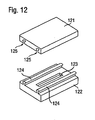
- FIG. 12 an example of a possible structure of a shaped body is shown.
- the molded body has an upper part 121 and a lower part 122, which are shown in the separated state. While the upper part 121 has two parallel grooves in the manner of grooves 125, the lower part 122 has two complementary strips in the manner of springs 124. As a result, upper and lower parts 121, 122 can be easily connected and disconnected again if necessary. However, other means than groove 125 and spring 124 may be provided to allow a positive connection of the parts.
- a recess 123 is provided, in which the tempering and / or the control device can be partially or completely admitted.
- the tempering and / or the control device can be partially or completely admitted.
- the upper and lower parts 121, 122 are made of thermoelastic material.
- thermo-elastic material may also be embedded in one or more parts.
- FIG. 14 schematically another embodiment of the molding as a mattress 140 is shown in section.
- the upper side of the mattress 140 may be a lying one.
- the thermoelastic viscoelastic foam portion 143 is provided with an upper portion 146 and a lower portion Section 145 of a plastic, combined in the present example of a foam having a lower strength at room temperature than the portion 143 of thermoelastic viscoelastic foam.
- the sections 145, 146 are made of a conventional, ie non-thermoelastic and viscoelastic foam, in which no appreciable temperature dependence of the strength can be established, in particular in the temperature range between room temperature and body temperature.
- the sections 145, 146 are integrally formed. In other variants, they can also be designed in several parts. Likewise, further sections may be provided from a conventional or a thermoelastic and viscoelastic plastic. In some variants, it is also possible to dispense with an upper section 146 so that a lying leg rests on the section 145 of thermoelastic viscoelastic foam.
- thermoelastic viscoelastic plastic which is relatively strong at room temperature
- an underlying portion of softer plastic at room temperature the softness of which remains substantially constant even at temperatures above this, enhances the effect of changing the strength of the molded body having these portions, especially at higher levels
- Temperatures eg in the range between about 30 ° C and body temperature, in which some thermoelastic viscoelastic plastics show a lower strength change than at lower temperatures, e.g. in the range between room temperature and approx. 30 ° C.
- thermoelastic, viscoelastic plastic has fallen below a specific strength by appropriate temperature control, the softness of the underlying soft plastic section, which has previously been covered by the solid section of thermoelastic, viscoelastic plastic, is additionally perceptible.
- plastic sections of different strengths and different temperature dependencies of their strengths moldings can be made available that allow perceptible strength changes in different temperature ranges.
- sections of thermoelastic, viscoelastic plastics can also be combined for this purpose, as long as they have different strengths at different temperatures.
- a heating fleece 142 which is connected via a heating cable with a control device 141 and is applied directly on top of the section 143 of thermoelastic, viscoelastic foam, the temperature of this section 143 changed to achieve a strength change.
- the heating fleece can be replaced, inter alia, by a heating foil or a textile of heating filaments.
- the respective current temperature is controlled by the temperature sensor 147, which is arranged at a distance from the tempering device formed here as a heating fleece 142.
- two, three or more temperature sensors can be provided.
- the temperature signal is passed via the sensor cable 149 to the control device 141, which in turn determines depending on the desired strength and the necessary temperature on the one hand and the current temperature, whether a temperature change by the temperature control is necessary or not and a corresponding signal on the heating cable 148th to the Schuvlies 142 passes.
- the position of the temperature sensor 147 at a distance from the heating fleece 142 ensures that the plastic temperature and not the actual temperature of the heating fleece 142 is measured.
- the temperature sensor 147 disposed on the side facing the footwall of Schulllieses 142 This also takes into account the influence of the body heat of the person lying on the temperature of the plastic and thus also on the strength. By placing the temperature sensor closer to the horizontal or closer to the respective temperature device, the control unit weights the respectively considered influence of these heat sources accordingly.
- the heating fleece 142 is provided with a metal coating 144a, which serves to shield electromagnetic radiation emitted by the heating fleece from the floor.
- the metal coating 144a is grounded.
- it has a grounding cable 144b.
Landscapes
- Mattresses And Other Support Structures For Chairs And Beds (AREA)
- Chair Legs, Seat Parts, And Backrests (AREA)
- Diaphragms For Electromechanical Transducers (AREA)
- Transition And Organic Metals Composition Catalysts For Addition Polymerization (AREA)
- Materials For Medical Uses (AREA)
- Organic Low-Molecular-Weight Compounds And Preparation Thereof (AREA)
Applications Claiming Priority (2)
| Application Number | Priority Date | Filing Date | Title |
|---|---|---|---|
| DE102008010380A DE102008010380A1 (de) | 2008-02-21 | 2008-02-21 | Formkörper und seine Verwendungen |
| PCT/EP2009/051930 WO2009103740A1 (de) | 2008-02-21 | 2009-02-18 | Formkörper und seine verwendungen |
Publications (2)
| Publication Number | Publication Date |
|---|---|
| EP2254445A1 EP2254445A1 (de) | 2010-12-01 |
| EP2254445B1 true EP2254445B1 (de) | 2011-11-16 |
Family
ID=40600183
Family Applications (1)
| Application Number | Title | Priority Date | Filing Date |
|---|---|---|---|
| EP09711769A Active EP2254445B1 (de) | 2008-02-21 | 2009-02-18 | Formkörper und seine verwendungen |
Country Status (8)
| Country | Link |
|---|---|
| US (1) | US8499389B2 (https=) |
| EP (1) | EP2254445B1 (https=) |
| JP (1) | JP5530937B2 (https=) |
| AT (1) | ATE533386T1 (https=) |
| CA (1) | CA2714590A1 (https=) |
| DE (1) | DE102008010380A1 (https=) |
| DK (1) | DK2254445T3 (https=) |
| WO (1) | WO2009103740A1 (https=) |
Cited By (1)
| Publication number | Priority date | Publication date | Assignee | Title |
|---|---|---|---|---|
| WO2025242254A1 (de) | 2024-05-24 | 2025-11-27 | Bayerische Motoren Werke Aktiengesellschaft | Sitzanlage für ein fahrzeug sowie fahrzeug |
Families Citing this family (15)
| Publication number | Priority date | Publication date | Assignee | Title |
|---|---|---|---|---|
| US9119479B2 (en) * | 2008-12-22 | 2015-09-01 | Tempur-Pedic Management, Llc | Adjustable-firmness body support and method |
| US9071152B2 (en) | 2012-07-03 | 2015-06-30 | Cognipower, Llc | Power converter with demand pulse isolation |
| US9089462B1 (en) * | 2012-07-05 | 2015-07-28 | Stryker Corporation | Pressure ulcer management pad |
| PL2908699T3 (pl) | 2012-10-18 | 2018-12-31 | Tempur-Pedic Management, Llc | Poduszka podpierająca |
| US20140182063A1 (en) * | 2012-12-27 | 2014-07-03 | Peterson Chemical Technology, Inc. | Enhanced Thermally-Conductive Cushioning Foams by Addition of Graphite |
| ES2885425T3 (es) * | 2013-07-05 | 2021-12-13 | Mascull Roger Thomas And Mascull Elizabeth Jocelyn As Trustees Of The Rt And Ej Mascull Family Trust | Dispositivo de contorneado de respaldo |
| US20180310719A1 (en) * | 2017-04-28 | 2018-11-01 | Hill-Rom Services, Inc. | Adaptable Mattress |
| US12440038B2 (en) | 2018-04-27 | 2025-10-14 | Variowell Development Gmbh | Shaped body made from a foam and springs as well as uses thereof |
| LU100788B1 (en) * | 2018-04-27 | 2019-10-28 | Variowell Dev Gmbh | A shaped body made from a foam and springs as well as uses thereof |
| US11730279B2 (en) * | 2019-01-15 | 2023-08-22 | Hest Corporation | Portable mattress with drop-stitch inflatable chamber |
| CN110393388A (zh) * | 2019-07-02 | 2019-11-01 | 武汉科技大学 | 一种可调温按摩沙发椅 |
| US11627911B2 (en) * | 2020-04-03 | 2023-04-18 | The Hong Kong Research Institute Of Textiles And Apparel Limited | System for evaluating sleeping comfort of bedding system |
| LU101825B1 (en) | 2020-05-29 | 2021-11-29 | Variowell Dev Gmbh | A shaped body with a heating element made to heat polyurethane foam |
| US20220355571A1 (en) * | 2021-04-29 | 2022-11-10 | Variowell Development Gmbh | Multilayer plate |
| WO2023287987A2 (en) * | 2021-07-14 | 2023-01-19 | Anthro Form, Llc | Support surface |
Family Cites Families (22)
| Publication number | Priority date | Publication date | Assignee | Title |
|---|---|---|---|---|
| GB426210A (en) * | 1932-10-13 | 1935-03-29 | Electric Cushions Ltd | Improvements in electrically heated cushions, pillows, blankets or the like |
| DE3716263A1 (de) * | 1987-05-15 | 1988-11-24 | Edgar Dipl Ing Zahoransky | Antidekubitusunterlage |
| JPH0277211A (ja) * | 1988-06-10 | 1990-03-16 | Mazda Motor Corp | 車両のシート装置 |
| EP0862901A1 (en) * | 1997-03-05 | 1998-09-09 | Ohmeda Inc. | Thermoelectric infant mattress |
| US6277770B1 (en) * | 1997-10-08 | 2001-08-21 | Precision Fabrics Group, Inc. | Durable, comfortable, air-permeable allergen-barrier fabrics |
| JP3048262U (ja) * | 1997-10-21 | 1998-05-06 | 株式会社金子製作所 | 仮眠用マット |
| DE29800506U1 (de) | 1998-01-14 | 1998-09-10 | Diamona Hermann Koch GmbH & Co. KG Fabrik für Wohn- und Schlafkomfort, 38446 Wolfsburg | Matratze |
| DE19900257C2 (de) * | 1999-01-07 | 2003-08-21 | Univ Dresden Tech | System zur Dekubitusprophylaxe und/oder -therapie |
| JP2001231821A (ja) * | 2000-02-21 | 2001-08-28 | Koden:Kk | 蓄熱材ウオーターベット |
| JP2001238924A (ja) * | 2000-02-25 | 2001-09-04 | Inoac Corp | 手術台用マットレス |
| US6933469B2 (en) * | 2000-06-14 | 2005-08-23 | American Healthcare Products, Inc. | Personal warming systems and apparatuses for use in hospitals and other settings, and associated methods of manufacture and use |
| US6653607B2 (en) * | 2000-06-14 | 2003-11-25 | American Healthcare Products, Inc. | Heating pad systems, such as for patient warming applications |
| US20070272673A1 (en) * | 2001-08-29 | 2007-11-29 | Keane Barry P | Electric mattress and mattress pad |
| JP2003299554A (ja) * | 2002-04-10 | 2003-10-21 | France Bed Co Ltd | マットレス装置 |
| US7045743B2 (en) * | 2003-01-15 | 2006-05-16 | Ki-Woong Park | Heated vehicle cushion |
| US20070056957A1 (en) * | 2003-05-16 | 2007-03-15 | Michael Diemer | Heating device and method for the production thereof and heatable object and method for the production thereof |
| GB0417587D0 (en) * | 2004-08-06 | 2004-09-08 | Connaught Motor Co Ltd | Conformable structures |
| US20060151459A1 (en) | 2005-01-07 | 2006-07-13 | Tun-Jen Ku | Air mattress with temperature keeping device |
| US20070013213A1 (en) * | 2005-04-12 | 2007-01-18 | Hyperion Innovations, Inc. | Portable heated seating |
| DE202006013471U1 (de) * | 2005-09-08 | 2006-11-16 | Beurer Gmbh & Co. Kg | Schmiegsames Wärmegerät |
| US9119479B2 (en) * | 2008-12-22 | 2015-09-01 | Tempur-Pedic Management, Llc | Adjustable-firmness body support and method |
| WO2010075291A1 (en) * | 2008-12-23 | 2010-07-01 | Tempur-Pedic Management, Inc. | Adjustable-firmness body support and method |
-
2008
- 2008-02-21 DE DE102008010380A patent/DE102008010380A1/de not_active Withdrawn
-
2009
- 2009-02-18 CA CA2714590A patent/CA2714590A1/en not_active Abandoned
- 2009-02-18 JP JP2010547170A patent/JP5530937B2/ja not_active Expired - Fee Related
- 2009-02-18 WO PCT/EP2009/051930 patent/WO2009103740A1/de not_active Ceased
- 2009-02-18 DK DK09711769.1T patent/DK2254445T3/da active
- 2009-02-18 US US12/735,847 patent/US8499389B2/en active Active
- 2009-02-18 AT AT09711769T patent/ATE533386T1/de active
- 2009-02-18 EP EP09711769A patent/EP2254445B1/de active Active
Cited By (1)
| Publication number | Priority date | Publication date | Assignee | Title |
|---|---|---|---|---|
| WO2025242254A1 (de) | 2024-05-24 | 2025-11-27 | Bayerische Motoren Werke Aktiengesellschaft | Sitzanlage für ein fahrzeug sowie fahrzeug |
Also Published As
| Publication number | Publication date |
|---|---|
| JP2011512214A (ja) | 2011-04-21 |
| CA2714590A1 (en) | 2009-08-27 |
| WO2009103740A1 (de) | 2009-08-27 |
| US20110000018A1 (en) | 2011-01-06 |
| EP2254445A1 (de) | 2010-12-01 |
| DK2254445T3 (da) | 2012-03-05 |
| US8499389B2 (en) | 2013-08-06 |
| JP5530937B2 (ja) | 2014-06-25 |
| ATE533386T1 (de) | 2011-12-15 |
| DE102008010380A1 (de) | 2009-09-03 |
Similar Documents
| Publication | Publication Date | Title |
|---|---|---|
| EP2254445B1 (de) | Formkörper und seine verwendungen | |
| DE102018201943B4 (de) | Sitzsystem mit Sitz mit einzeln steuerbaren Wärmeeinheiten | |
| Ng et al. | Evaluation of an intelligent seat system | |
| DE102005038289B3 (de) | Verfahren zur Ermittlung und Veränderung einer durch einen menschlichen Körper bewirkten Druckverteilung auf eine Sitz- oder Liegeanordnung und eine solche Sitz- oder Liegeanordnung | |
| CA2988639C (en) | Arrangements with resting units for a person with an adjustable lying and sitting surface as well as method for controlling resting units | |
| US11134783B2 (en) | Engineered seating system for use in medical lift chairs | |
| EP1068821B1 (de) | Matratze oder Polster | |
| JP2011512214A5 (https=) | ||
| EP3045081B1 (de) | Sitz- und liegemöbel | |
| DE4302778A1 (de) | Liegefläche für Betten, Sofas und dergleichen mit Luftversorgung | |
| EP2939572B1 (de) | Sitzvorrichtung, stuhl oder sofa | |
| CN105686443A (zh) | 可调的智能加热椅 | |
| CN216220876U (zh) | 一种智能沙发 | |
| ANTAL et al. | Body pressure distribution analysis of layered foam systems. | |
| CN215456743U (zh) | 一种可调式沙发床 | |
| DE2113371A1 (de) | Sitz- oder Liegemoebel | |
| CN100407966C (zh) | 无源自适应式记忆性垫子的制备方法 | |
| NL2013707B1 (en) | Viscoelastic foam product with inserts. | |
| EP2022373A2 (de) | Matratze | |
| CH681951A5 (en) | Air-filled foam mattress for domestic or therapeutic use - has control unit providing manual or automatic control of pressure with automatic pressure top-up and safety overpressure release | |
| CN2090653U (zh) | 一种两用沙发 | |
| DE202015100428U1 (de) | Sitz- und Liegemöbel | |
| DE20009168U1 (de) | Druckelastisches dreidimensionales textiles Flächengebilde | |
| DE102006041384A1 (de) | Sitz mit Rückenlehne | |
| HK1245603B (zh) | 具有用於人员的带有可调节躺坐面的休息单元的系统以及用於控制休息单元的方法 |
Legal Events
| Date | Code | Title | Description |
|---|---|---|---|
| PUAI | Public reference made under article 153(3) epc to a published international application that has entered the european phase |
Free format text: ORIGINAL CODE: 0009012 |
|
| 17P | Request for examination filed |
Effective date: 20100914 |
|
| AK | Designated contracting states |
Kind code of ref document: A1 Designated state(s): AT BE BG CH CY CZ DE DK EE ES FI FR GB GR HR HU IE IS IT LI LT LU LV MC MK MT NL NO PL PT RO SE SI SK TR |
|
| AX | Request for extension of the european patent |
Extension state: AL BA RS |
|
| 17Q | First examination report despatched |
Effective date: 20110114 |
|
| DAX | Request for extension of the european patent (deleted) | ||
| GRAP | Despatch of communication of intention to grant a patent |
Free format text: ORIGINAL CODE: EPIDOSNIGR1 |
|
| RIN1 | Information on inventor provided before grant (corrected) |
Inventor name: KIRCHHOFF, TOBIAS |
|
| RAP1 | Party data changed (applicant data changed or rights of an application transferred) |
Owner name: VARIOWELL DEVELOPMENT GMBH |
|
| GRAS | Grant fee paid |
Free format text: ORIGINAL CODE: EPIDOSNIGR3 |
|
| GRAA | (expected) grant |
Free format text: ORIGINAL CODE: 0009210 |
|
| RIN1 | Information on inventor provided before grant (corrected) |
Inventor name: KIRCHHOFF, TOBIAS |
|
| AK | Designated contracting states |
Kind code of ref document: B1 Designated state(s): AT BE BG CH CY CZ DE DK EE ES FI FR GB GR HR HU IE IS IT LI LT LU LV MC MK MT NL NO PL PT RO SE SI SK TR |
|
| REG | Reference to a national code |
Ref country code: GB Ref legal event code: FG4D Free format text: NOT ENGLISH |
|
| REG | Reference to a national code |
Ref country code: CH Ref legal event code: EP |
|
| REG | Reference to a national code |
Ref country code: IE Ref legal event code: FG4D Free format text: LANGUAGE OF EP DOCUMENT: GERMAN |
|
| REG | Reference to a national code |
Ref country code: DE Ref legal event code: R096 Ref document number: 502009001951 Country of ref document: DE Effective date: 20120126 |
|
| REG | Reference to a national code |
Ref country code: NL Ref legal event code: T3 |
|
| REG | Reference to a national code |
Ref country code: DK Ref legal event code: T3 |
|
| REG | Reference to a national code |
Ref country code: SE Ref legal event code: TRGR |
|
| LTIE | Lt: invalidation of european patent or patent extension |
Effective date: 20111116 |
|
| PG25 | Lapsed in a contracting state [announced via postgrant information from national office to epo] |
Ref country code: NO Free format text: LAPSE BECAUSE OF FAILURE TO SUBMIT A TRANSLATION OF THE DESCRIPTION OR TO PAY THE FEE WITHIN THE PRESCRIBED TIME-LIMIT Effective date: 20120216 Ref country code: LT Free format text: LAPSE BECAUSE OF FAILURE TO SUBMIT A TRANSLATION OF THE DESCRIPTION OR TO PAY THE FEE WITHIN THE PRESCRIBED TIME-LIMIT Effective date: 20111116 Ref country code: IS Free format text: LAPSE BECAUSE OF FAILURE TO SUBMIT A TRANSLATION OF THE DESCRIPTION OR TO PAY THE FEE WITHIN THE PRESCRIBED TIME-LIMIT Effective date: 20120316 |
|
| PG25 | Lapsed in a contracting state [announced via postgrant information from national office to epo] |
Ref country code: LV Free format text: LAPSE BECAUSE OF FAILURE TO SUBMIT A TRANSLATION OF THE DESCRIPTION OR TO PAY THE FEE WITHIN THE PRESCRIBED TIME-LIMIT Effective date: 20111116 Ref country code: SI Free format text: LAPSE BECAUSE OF FAILURE TO SUBMIT A TRANSLATION OF THE DESCRIPTION OR TO PAY THE FEE WITHIN THE PRESCRIBED TIME-LIMIT Effective date: 20111116 Ref country code: GR Free format text: LAPSE BECAUSE OF FAILURE TO SUBMIT A TRANSLATION OF THE DESCRIPTION OR TO PAY THE FEE WITHIN THE PRESCRIBED TIME-LIMIT Effective date: 20120217 Ref country code: HR Free format text: LAPSE BECAUSE OF FAILURE TO SUBMIT A TRANSLATION OF THE DESCRIPTION OR TO PAY THE FEE WITHIN THE PRESCRIBED TIME-LIMIT Effective date: 20111116 Ref country code: PT Free format text: LAPSE BECAUSE OF FAILURE TO SUBMIT A TRANSLATION OF THE DESCRIPTION OR TO PAY THE FEE WITHIN THE PRESCRIBED TIME-LIMIT Effective date: 20120316 Ref country code: PL Free format text: LAPSE BECAUSE OF FAILURE TO SUBMIT A TRANSLATION OF THE DESCRIPTION OR TO PAY THE FEE WITHIN THE PRESCRIBED TIME-LIMIT Effective date: 20111116 |
|
| REG | Reference to a national code |
Ref country code: IE Ref legal event code: FD4D |
|
| PG25 | Lapsed in a contracting state [announced via postgrant information from national office to epo] |
Ref country code: CY Free format text: LAPSE BECAUSE OF FAILURE TO SUBMIT A TRANSLATION OF THE DESCRIPTION OR TO PAY THE FEE WITHIN THE PRESCRIBED TIME-LIMIT Effective date: 20111116 |
|
| PGFP | Annual fee paid to national office [announced via postgrant information from national office to epo] |
Ref country code: IT Payment date: 20120228 Year of fee payment: 4 |
|
| PG25 | Lapsed in a contracting state [announced via postgrant information from national office to epo] |
Ref country code: EE Free format text: LAPSE BECAUSE OF FAILURE TO SUBMIT A TRANSLATION OF THE DESCRIPTION OR TO PAY THE FEE WITHIN THE PRESCRIBED TIME-LIMIT Effective date: 20111116 Ref country code: SK Free format text: LAPSE BECAUSE OF FAILURE TO SUBMIT A TRANSLATION OF THE DESCRIPTION OR TO PAY THE FEE WITHIN THE PRESCRIBED TIME-LIMIT Effective date: 20111116 Ref country code: IE Free format text: LAPSE BECAUSE OF FAILURE TO SUBMIT A TRANSLATION OF THE DESCRIPTION OR TO PAY THE FEE WITHIN THE PRESCRIBED TIME-LIMIT Effective date: 20111116 Ref country code: CZ Free format text: LAPSE BECAUSE OF FAILURE TO SUBMIT A TRANSLATION OF THE DESCRIPTION OR TO PAY THE FEE WITHIN THE PRESCRIBED TIME-LIMIT Effective date: 20111116 Ref country code: BG Free format text: LAPSE BECAUSE OF FAILURE TO SUBMIT A TRANSLATION OF THE DESCRIPTION OR TO PAY THE FEE WITHIN THE PRESCRIBED TIME-LIMIT Effective date: 20120216 |
|
| PG25 | Lapsed in a contracting state [announced via postgrant information from national office to epo] |
Ref country code: RO Free format text: LAPSE BECAUSE OF FAILURE TO SUBMIT A TRANSLATION OF THE DESCRIPTION OR TO PAY THE FEE WITHIN THE PRESCRIBED TIME-LIMIT Effective date: 20111116 |
|
| PLBE | No opposition filed within time limit |
Free format text: ORIGINAL CODE: 0009261 |
|
| STAA | Information on the status of an ep patent application or granted ep patent |
Free format text: STATUS: NO OPPOSITION FILED WITHIN TIME LIMIT |
|
| PG25 | Lapsed in a contracting state [announced via postgrant information from national office to epo] |
Ref country code: MC Free format text: LAPSE BECAUSE OF NON-PAYMENT OF DUE FEES Effective date: 20120229 |
|
| 26N | No opposition filed |
Effective date: 20120817 |
|
| REG | Reference to a national code |
Ref country code: DE Ref legal event code: R097 Ref document number: 502009001951 Country of ref document: DE Effective date: 20120817 |
|
| PG25 | Lapsed in a contracting state [announced via postgrant information from national office to epo] |
Ref country code: MK Free format text: LAPSE BECAUSE OF FAILURE TO SUBMIT A TRANSLATION OF THE DESCRIPTION OR TO PAY THE FEE WITHIN THE PRESCRIBED TIME-LIMIT Effective date: 20111116 |
|
| PG25 | Lapsed in a contracting state [announced via postgrant information from national office to epo] |
Ref country code: ES Free format text: LAPSE BECAUSE OF FAILURE TO SUBMIT A TRANSLATION OF THE DESCRIPTION OR TO PAY THE FEE WITHIN THE PRESCRIBED TIME-LIMIT Effective date: 20120227 |
|
| PG25 | Lapsed in a contracting state [announced via postgrant information from national office to epo] |
Ref country code: FI Free format text: LAPSE BECAUSE OF FAILURE TO SUBMIT A TRANSLATION OF THE DESCRIPTION OR TO PAY THE FEE WITHIN THE PRESCRIBED TIME-LIMIT Effective date: 20111116 |
|
| PG25 | Lapsed in a contracting state [announced via postgrant information from national office to epo] |
Ref country code: MT Free format text: LAPSE BECAUSE OF FAILURE TO SUBMIT A TRANSLATION OF THE DESCRIPTION OR TO PAY THE FEE WITHIN THE PRESCRIBED TIME-LIMIT Effective date: 20111116 |
|
| REG | Reference to a national code |
Ref country code: SE Ref legal event code: EUG |
|
| PG25 | Lapsed in a contracting state [announced via postgrant information from national office to epo] |
Ref country code: SE Free format text: LAPSE BECAUSE OF NON-PAYMENT OF DUE FEES Effective date: 20130219 |
|
| PG25 | Lapsed in a contracting state [announced via postgrant information from national office to epo] |
Ref country code: TR Free format text: LAPSE BECAUSE OF FAILURE TO SUBMIT A TRANSLATION OF THE DESCRIPTION OR TO PAY THE FEE WITHIN THE PRESCRIBED TIME-LIMIT Effective date: 20111116 |
|
| PG25 | Lapsed in a contracting state [announced via postgrant information from national office to epo] |
Ref country code: HU Free format text: LAPSE BECAUSE OF FAILURE TO SUBMIT A TRANSLATION OF THE DESCRIPTION OR TO PAY THE FEE WITHIN THE PRESCRIBED TIME-LIMIT Effective date: 20090218 |
|
| PG25 | Lapsed in a contracting state [announced via postgrant information from national office to epo] |
Ref country code: BE Free format text: LAPSE BECAUSE OF NON-PAYMENT OF DUE FEES Effective date: 20150228 |
|
| REG | Reference to a national code |
Ref country code: DE Ref legal event code: R082 Ref document number: 502009001951 Country of ref document: DE |
|
| REG | Reference to a national code |
Ref country code: CH Ref legal event code: PCOW Free format text: NEW ADDRESS: MAX WINKLEMANN STR. 19A, 48165 MUENSTER (DE) |
|
| PGFP | Annual fee paid to national office [announced via postgrant information from national office to epo] |
Ref country code: SE Payment date: 20150707 Year of fee payment: 7 |
|
| PG25 | Lapsed in a contracting state [announced via postgrant information from national office to epo] |
Ref country code: IT Free format text: LAPSE BECAUSE OF NON-PAYMENT OF DUE FEES Effective date: 20140218 |
|
| REG | Reference to a national code |
Ref country code: FR Ref legal event code: PLFP Year of fee payment: 8 |
|
| PGFP | Annual fee paid to national office [announced via postgrant information from national office to epo] |
Ref country code: LU Payment date: 20160831 Year of fee payment: 8 |
|
| PGFP | Annual fee paid to national office [announced via postgrant information from national office to epo] |
Ref country code: NL Payment date: 20160830 Year of fee payment: 8 |
|
| PGFP | Annual fee paid to national office [announced via postgrant information from national office to epo] |
Ref country code: AT Payment date: 20160830 Year of fee payment: 8 |
|
| REG | Reference to a national code |
Ref country code: FR Ref legal event code: PLFP Year of fee payment: 9 |
|
| PGFP | Annual fee paid to national office [announced via postgrant information from national office to epo] |
Ref country code: RO Payment date: 20170801 Year of fee payment: 12 |
|
| PGFP | Annual fee paid to national office [announced via postgrant information from national office to epo] |
Ref country code: BE Payment date: 20170523 Year of fee payment: 9 |
|
| REG | Reference to a national code |
Ref country code: NL Ref legal event code: MM Effective date: 20170301 |
|
| REG | Reference to a national code |
Ref country code: AT Ref legal event code: MM01 Ref document number: 533386 Country of ref document: AT Kind code of ref document: T Effective date: 20170218 |
|
| PG25 | Lapsed in a contracting state [announced via postgrant information from national office to epo] |
Ref country code: AT Free format text: LAPSE BECAUSE OF NON-PAYMENT OF DUE FEES Effective date: 20170218 |
|
| PG25 | Lapsed in a contracting state [announced via postgrant information from national office to epo] |
Ref country code: NL Free format text: LAPSE BECAUSE OF NON-PAYMENT OF DUE FEES Effective date: 20170301 |
|
| PG25 | Lapsed in a contracting state [announced via postgrant information from national office to epo] |
Ref country code: LU Free format text: LAPSE BECAUSE OF NON-PAYMENT OF DUE FEES Effective date: 20170218 |
|
| REG | Reference to a national code |
Ref country code: FR Ref legal event code: PLFP Year of fee payment: 10 |
|
| REG | Reference to a national code |
Ref country code: CH Ref legal event code: PCOW Free format text: NEW ADDRESS: AM MITTELHAFEN 10, 48155 MUENSTER (DE) |
|
| REG | Reference to a national code |
Ref country code: DK Ref legal event code: EBP Effective date: 20180228 |
|
| PGFP | Annual fee paid to national office [announced via postgrant information from national office to epo] |
Ref country code: FR Payment date: 20180726 Year of fee payment: 10 |
|
| REG | Reference to a national code |
Ref country code: BE Ref legal event code: MM Effective date: 20180228 |
|
| PG25 | Lapsed in a contracting state [announced via postgrant information from national office to epo] |
Ref country code: DK Free format text: LAPSE BECAUSE OF NON-PAYMENT OF DUE FEES Effective date: 20180228 |
|
| PG25 | Lapsed in a contracting state [announced via postgrant information from national office to epo] |
Ref country code: BE Free format text: LAPSE BECAUSE OF NON-PAYMENT OF DUE FEES Effective date: 20180228 |
|
| REG | Reference to a national code |
Ref country code: CH Ref legal event code: AECN Free format text: DAS PATENT WURDE AUFGRUND DES WEITERBEHANDLUNGSANTRAGS VOM 18.09.2019 REAKTIVIERT. Ref country code: CH Ref legal event code: PL |
|
| PG25 | Lapsed in a contracting state [announced via postgrant information from national office to epo] |
Ref country code: FR Free format text: LAPSE BECAUSE OF NON-PAYMENT OF DUE FEES Effective date: 20190228 |
|
| REG | Reference to a national code |
Ref country code: DE Ref legal event code: R082 Ref document number: 502009001951 Country of ref document: DE Representative=s name: SONNENBERG HARRISON PARTNERSCHAFT MBB PATENT- , DE Ref country code: DE Ref legal event code: R081 Ref document number: 502009001951 Country of ref document: DE Owner name: VARIOWELL DEVELOPMENT GMBH, DE Free format text: FORMER OWNER: VARIOWELL DEVELOPMENT GMBH, 48308 SENDEN, DE |
|
| PGFP | Annual fee paid to national office [announced via postgrant information from national office to epo] |
Ref country code: CH Payment date: 20240301 Year of fee payment: 16 |
|
| PGFP | Annual fee paid to national office [announced via postgrant information from national office to epo] |
Ref country code: DE Payment date: 20250225 Year of fee payment: 17 |
|
| PGFP | Annual fee paid to national office [announced via postgrant information from national office to epo] |
Ref country code: GB Payment date: 20250206 Year of fee payment: 17 |
|
| REG | Reference to a national code |
Ref country code: CH Ref legal event code: PL |
|
| PG25 | Lapsed in a contracting state [announced via postgrant information from national office to epo] |
Ref country code: CH Free format text: LAPSE BECAUSE OF NON-PAYMENT OF DUE FEES Effective date: 20250228 |