EP2253617A1 - Halogen-substituierte Verbindungen als Pestizide - Google Patents
Halogen-substituierte Verbindungen als Pestizide Download PDFInfo
- Publication number
- EP2253617A1 EP2253617A1 EP09160715A EP09160715A EP2253617A1 EP 2253617 A1 EP2253617 A1 EP 2253617A1 EP 09160715 A EP09160715 A EP 09160715A EP 09160715 A EP09160715 A EP 09160715A EP 2253617 A1 EP2253617 A1 EP 2253617A1
- Authority
- EP
- European Patent Office
- Prior art keywords
- alkyl
- cycloalkyl
- carbonyl
- alkoxy
- optionally substituted
- Prior art date
- Legal status (The legal status is an assumption and is not a legal conclusion. Google has not performed a legal analysis and makes no representation as to the accuracy of the status listed.)
- Ceased
Links
- 150000001875 compounds Chemical class 0.000 title claims description 132
- 239000000575 pesticide Substances 0.000 title description 4
- 125000002915 carbonyl group Chemical group [*:2]C([*:1])=O 0.000 claims abstract description 242
- 229910052757 nitrogen Inorganic materials 0.000 claims abstract description 195
- 229910052760 oxygen Inorganic materials 0.000 claims abstract description 64
- 125000000217 alkyl group Chemical group 0.000 claims abstract description 61
- 229910052717 sulfur Inorganic materials 0.000 claims abstract description 54
- 238000002360 preparation method Methods 0.000 claims abstract description 29
- 229920006395 saturated elastomer Polymers 0.000 claims abstract description 16
- 239000013543 active substance Substances 0.000 claims abstract description 15
- 125000002373 5 membered heterocyclic group Chemical group 0.000 claims abstract description 5
- 125000004070 6 membered heterocyclic group Chemical group 0.000 claims abstract description 5
- -1 C 2 -C 6 -alkylene Chemical group 0.000 claims description 706
- 125000005913 (C3-C6) cycloalkyl group Chemical group 0.000 claims description 284
- IJGRMHOSHXDMSA-UHFFFAOYSA-N Atomic nitrogen Chemical compound N#N IJGRMHOSHXDMSA-UHFFFAOYSA-N 0.000 claims description 150
- 239000001257 hydrogen Substances 0.000 claims description 115
- 229910052739 hydrogen Inorganic materials 0.000 claims description 115
- 125000003917 carbamoyl group Chemical group [H]N([H])C(*)=O 0.000 claims description 107
- UFHFLCQGNIYNRP-UHFFFAOYSA-N Hydrogen Chemical compound [H][H] UFHFLCQGNIYNRP-UHFFFAOYSA-N 0.000 claims description 106
- 125000004093 cyano group Chemical group *C#N 0.000 claims description 100
- 125000006700 (C1-C6) alkylthio group Chemical group 0.000 claims description 99
- 229910052736 halogen Inorganic materials 0.000 claims description 99
- 150000002367 halogens Chemical class 0.000 claims description 99
- 125000000882 C2-C6 alkenyl group Chemical group 0.000 claims description 96
- 125000000171 (C1-C6) haloalkyl group Chemical group 0.000 claims description 90
- 125000004738 (C1-C6) alkyl sulfinyl group Chemical group 0.000 claims description 88
- 125000002924 primary amino group Chemical group [H]N([H])* 0.000 claims description 88
- 125000004739 (C1-C6) alkylsulfonyl group Chemical group 0.000 claims description 87
- 125000001997 phenyl group Chemical group [H]C1=C([H])C([H])=C(*)C([H])=C1[H] 0.000 claims description 85
- 125000003601 C2-C6 alkynyl group Chemical group 0.000 claims description 71
- 238000000034 method Methods 0.000 claims description 70
- 150000002431 hydrogen Chemical class 0.000 claims description 66
- 125000004076 pyridyl group Chemical group 0.000 claims description 61
- 239000001301 oxygen Substances 0.000 claims description 60
- 150000003254 radicals Chemical class 0.000 claims description 59
- SNOOUWRIMMFWNE-UHFFFAOYSA-M sodium;6-[(3,4,5-trimethoxybenzoyl)amino]hexanoate Chemical compound [Na+].COC1=CC(C(=O)NCCCCCC([O-])=O)=CC(OC)=C1OC SNOOUWRIMMFWNE-UHFFFAOYSA-M 0.000 claims description 57
- 125000004737 (C1-C6) haloalkoxy group Chemical group 0.000 claims description 54
- 125000006771 (C1-C6) haloalkylthio group Chemical group 0.000 claims description 54
- 125000004432 carbon atom Chemical group C* 0.000 claims description 54
- NINIDFKCEFEMDL-UHFFFAOYSA-N Sulfur Chemical compound [S] NINIDFKCEFEMDL-UHFFFAOYSA-N 0.000 claims description 51
- 125000004749 (C1-C6) haloalkylsulfinyl group Chemical group 0.000 claims description 50
- 125000004741 (C1-C6) haloalkylsulfonyl group Chemical group 0.000 claims description 50
- 125000000449 nitro group Chemical group [O-][N+](*)=O 0.000 claims description 43
- 125000004399 C1-C4 alkenyl group Chemical group 0.000 claims description 42
- 125000003178 carboxy group Chemical group [H]OC(*)=O 0.000 claims description 37
- QVGXLLKOCUKJST-UHFFFAOYSA-N atomic oxygen Chemical compound [O] QVGXLLKOCUKJST-UHFFFAOYSA-N 0.000 claims description 35
- 125000004433 nitrogen atom Chemical group N* 0.000 claims description 35
- 125000003118 aryl group Chemical group 0.000 claims description 32
- 229910052799 carbon Inorganic materials 0.000 claims description 32
- 239000011593 sulfur Substances 0.000 claims description 32
- 125000001495 ethyl group Chemical group [H]C([H])([H])C([H])([H])* 0.000 claims description 31
- 125000002496 methyl group Chemical group [H]C([H])([H])* 0.000 claims description 31
- 241001465754 Metazoa Species 0.000 claims description 28
- OKTJSMMVPCPJKN-UHFFFAOYSA-N Carbon Chemical group [C] OKTJSMMVPCPJKN-UHFFFAOYSA-N 0.000 claims description 26
- 125000001072 heteroaryl group Chemical group 0.000 claims description 26
- 241000607479 Yersinia pestis Species 0.000 claims description 25
- 241000238631 Hexapoda Species 0.000 claims description 24
- 125000003636 chemical group Chemical group 0.000 claims description 23
- 239000000126 substance Substances 0.000 claims description 22
- JUJWROOIHBZHMG-UHFFFAOYSA-N Pyridine Chemical compound C1=CC=NC=C1 JUJWROOIHBZHMG-UHFFFAOYSA-N 0.000 claims description 21
- 125000004430 oxygen atom Chemical group O* 0.000 claims description 21
- 125000004434 sulfur atom Chemical group 0.000 claims description 21
- 239000000460 chlorine Substances 0.000 claims description 20
- 125000002023 trifluoromethyl group Chemical group FC(F)(F)* 0.000 claims description 20
- 125000001028 difluoromethyl group Chemical group [H]C(F)(F)* 0.000 claims description 19
- ZAMOUSCENKQFHK-UHFFFAOYSA-N Chlorine atom Chemical compound [Cl] ZAMOUSCENKQFHK-UHFFFAOYSA-N 0.000 claims description 18
- 239000011737 fluorine Substances 0.000 claims description 18
- 229910052731 fluorine Inorganic materials 0.000 claims description 18
- 125000000959 isobutyl group Chemical group [H]C([H])([H])C([H])(C([H])([H])[H])C([H])([H])* 0.000 claims description 18
- 125000004765 (C1-C4) haloalkyl group Chemical group 0.000 claims description 17
- XEEYBQQBJWHFJM-UHFFFAOYSA-N Iron Chemical compound [Fe] XEEYBQQBJWHFJM-UHFFFAOYSA-N 0.000 claims description 17
- 229910052801 chlorine Inorganic materials 0.000 claims description 17
- 125000001995 cyclobutyl group Chemical group [H]C1([H])C([H])([H])C([H])(*)C1([H])[H] 0.000 claims description 17
- 125000001449 isopropyl group Chemical group [H]C([H])([H])C([H])(*)C([H])([H])[H] 0.000 claims description 17
- 125000004108 n-butyl group Chemical group [H]C([H])([H])C([H])([H])C([H])([H])C([H])([H])* 0.000 claims description 17
- 125000004123 n-propyl group Chemical group [H]C([H])([H])C([H])([H])C([H])([H])* 0.000 claims description 17
- 125000002914 sec-butyl group Chemical group [H]C([H])([H])C([H])([H])C([H])(*)C([H])([H])[H] 0.000 claims description 17
- 125000000999 tert-butyl group Chemical group [H]C([H])([H])C(*)(C([H])([H])[H])C([H])([H])[H] 0.000 claims description 17
- YLQBMQCUIZJEEH-UHFFFAOYSA-N Furan Chemical compound C=1C=COC=1 YLQBMQCUIZJEEH-UHFFFAOYSA-N 0.000 claims description 15
- RAXXELZNTBOGNW-UHFFFAOYSA-N imidazole Natural products C1=CNC=N1 RAXXELZNTBOGNW-UHFFFAOYSA-N 0.000 claims description 15
- 125000001559 cyclopropyl group Chemical group [H]C1([H])C([H])([H])C1([H])* 0.000 claims description 14
- 125000003754 ethoxycarbonyl group Chemical group C(=O)(OCC)* 0.000 claims description 13
- 125000005928 isopropyloxycarbonyl group Chemical group [H]C([H])([H])C([H])(OC(*)=O)C([H])([H])[H] 0.000 claims description 13
- 125000001160 methoxycarbonyl group Chemical group [H]C([H])([H])OC(*)=O 0.000 claims description 13
- 125000004674 methylcarbonyl group Chemical group CC(=O)* 0.000 claims description 13
- 230000008569 process Effects 0.000 claims description 13
- 125000005930 sec-butyloxycarbonyl group Chemical group [H]C([H])([H])C([H])([H])C([H])(OC(*)=O)C([H])([H])[H] 0.000 claims description 13
- 125000005931 tert-butyloxycarbonyl group Chemical group [H]C([H])([H])C(OC(*)=O)(C([H])([H])[H])C([H])([H])[H] 0.000 claims description 13
- 125000001731 2-cyanoethyl group Chemical group [H]C([H])(*)C([H])([H])C#N 0.000 claims description 12
- WKBOTKDWSSQWDR-UHFFFAOYSA-N Bromine atom Chemical compound [Br] WKBOTKDWSSQWDR-UHFFFAOYSA-N 0.000 claims description 12
- KAESVJOAVNADME-UHFFFAOYSA-N Pyrrole Chemical compound C=1C=CNC=1 KAESVJOAVNADME-UHFFFAOYSA-N 0.000 claims description 12
- GDTBXPJZTBHREO-UHFFFAOYSA-N bromine Substances BrBr GDTBXPJZTBHREO-UHFFFAOYSA-N 0.000 claims description 12
- 229910052794 bromium Inorganic materials 0.000 claims description 12
- 125000005745 ethoxymethyl group Chemical group [H]C([H])([H])C([H])([H])OC([H])([H])* 0.000 claims description 12
- 125000004184 methoxymethyl group Chemical group [H]C([H])([H])OC([H])([H])* 0.000 claims description 12
- 150000002829 nitrogen Chemical class 0.000 claims description 12
- 125000005767 propoxymethyl group Chemical group [H]C([H])([H])C([H])([H])C([H])([H])[#8]C([H])([H])* 0.000 claims description 12
- 125000004206 2,2,2-trifluoroethyl group Chemical group [H]C([H])(*)C(F)(F)F 0.000 claims description 11
- 125000003903 2-propenyl group Chemical group [H]C([*])([H])C([H])=C([H])[H] 0.000 claims description 11
- 125000004218 chloromethyl group Chemical group [H]C([H])(Cl)* 0.000 claims description 11
- 125000005347 halocycloalkyl group Chemical group 0.000 claims description 11
- 125000005843 halogen group Chemical group 0.000 claims description 11
- 125000001255 4-fluorophenyl group Chemical group [H]C1=C([H])C(*)=C([H])C([H])=C1F 0.000 claims description 10
- KYQCOXFCLRTKLS-UHFFFAOYSA-N Pyrazine Chemical compound C1=CN=CC=N1 KYQCOXFCLRTKLS-UHFFFAOYSA-N 0.000 claims description 10
- YTPLMLYBLZKORZ-UHFFFAOYSA-N Thiophene Chemical compound C=1C=CSC=1 YTPLMLYBLZKORZ-UHFFFAOYSA-N 0.000 claims description 10
- 125000000753 cycloalkyl group Chemical group 0.000 claims description 10
- 125000006216 methylsulfinyl group Chemical group [H]C([H])([H])S(*)=O 0.000 claims description 10
- 125000003866 trichloromethyl group Chemical group ClC(Cl)(Cl)* 0.000 claims description 10
- 125000000391 vinyl group Chemical group [H]C([*])=C([H])[H] 0.000 claims description 10
- 125000006017 1-propenyl group Chemical group 0.000 claims description 9
- 125000004172 4-methoxyphenyl group Chemical group [H]C1=C([H])C(OC([H])([H])[H])=C([H])C([H])=C1* 0.000 claims description 9
- ZCQWOFVYLHDMMC-UHFFFAOYSA-N Oxazole Chemical compound C1=COC=N1 ZCQWOFVYLHDMMC-UHFFFAOYSA-N 0.000 claims description 9
- WTKZEGDFNFYCGP-UHFFFAOYSA-N Pyrazole Chemical compound C=1C=NNC=1 WTKZEGDFNFYCGP-UHFFFAOYSA-N 0.000 claims description 9
- FZWLAAWBMGSTSO-UHFFFAOYSA-N Thiazole Chemical compound C1=CSC=N1 FZWLAAWBMGSTSO-UHFFFAOYSA-N 0.000 claims description 9
- 125000003854 p-chlorophenyl group Chemical group [H]C1=C([H])C(*)=C([H])C([H])=C1Cl 0.000 claims description 9
- UMJSCPRVCHMLSP-UHFFFAOYSA-N pyridine Natural products COC1=CC=CN=C1 UMJSCPRVCHMLSP-UHFFFAOYSA-N 0.000 claims description 9
- 125000001889 triflyl group Chemical group FC(F)(F)S(*)(=O)=O 0.000 claims description 9
- 125000006643 (C2-C6) haloalkenyl group Chemical group 0.000 claims description 8
- 125000004778 2,2-difluoroethyl group Chemical group [H]C([H])(*)C([H])(F)F 0.000 claims description 8
- 125000004199 4-trifluoromethylphenyl group Chemical group [H]C1=C([H])C(=C([H])C([H])=C1*)C(F)(F)F 0.000 claims description 8
- 239000000463 material Substances 0.000 claims description 8
- 244000045947 parasite Species 0.000 claims description 8
- 125000004776 1-fluoroethyl group Chemical group [H]C([H])([H])C([H])(F)* 0.000 claims description 7
- 125000000453 2,2,2-trichloroethyl group Chemical group [H]C([H])(*)C(Cl)(Cl)Cl 0.000 claims description 7
- 125000004780 2-chloro-2,2-difluoroethyl group Chemical group [H]C([H])(*)C(F)(F)Cl 0.000 claims description 7
- 125000004777 2-fluoroethyl group Chemical group [H]C([H])(F)C([H])([H])* 0.000 claims description 7
- 125000004179 3-chlorophenyl group Chemical group [H]C1=C([H])C(*)=C([H])C(Cl)=C1[H] 0.000 claims description 7
- CZPWVGJYEJSRLH-UHFFFAOYSA-N Pyrimidine Chemical compound C1=CN=CN=C1 CZPWVGJYEJSRLH-UHFFFAOYSA-N 0.000 claims description 7
- 125000005997 bromomethyl group Chemical group 0.000 claims description 7
- 125000004775 chlorodifluoromethyl group Chemical group FC(F)(Cl)* 0.000 claims description 7
- 125000004774 dichlorofluoromethyl group Chemical group FC(Cl)(Cl)* 0.000 claims description 7
- 125000004672 ethylcarbonyl group Chemical group [H]C([H])([H])C([H])([H])C(*)=O 0.000 claims description 7
- 125000006253 t-butylcarbonyl group Chemical group [H]C([H])([H])C(C(*)=O)(C([H])([H])[H])C([H])([H])[H] 0.000 claims description 7
- FKTXDTWDCPTPHK-UHFFFAOYSA-N 1,1,1,2,3,3,3-heptafluoropropane Chemical group FC(F)(F)[C](F)C(F)(F)F FKTXDTWDCPTPHK-UHFFFAOYSA-N 0.000 claims description 6
- 125000004201 2,4-dichlorophenyl group Chemical group [H]C1=C([H])C(*)=C(Cl)C([H])=C1Cl 0.000 claims description 6
- 241000244206 Nematoda Species 0.000 claims description 6
- 125000004216 fluoromethyl group Chemical group [H]C([H])(F)* 0.000 claims description 6
- 125000006341 heptafluoro n-propyl group Chemical group FC(F)(F)C(F)(F)C(F)(F)* 0.000 claims description 6
- ZLTPDFXIESTBQG-UHFFFAOYSA-N isothiazole Chemical compound C=1C=NSC=1 ZLTPDFXIESTBQG-UHFFFAOYSA-N 0.000 claims description 6
- CTAPFRYPJLPFDF-UHFFFAOYSA-N isoxazole Chemical compound C=1C=NOC=1 CTAPFRYPJLPFDF-UHFFFAOYSA-N 0.000 claims description 6
- 125000006252 n-propylcarbonyl group Chemical group [H]C([H])([H])C([H])([H])C([H])([H])C(*)=O 0.000 claims description 6
- 125000006344 nonafluoro n-butyl group Chemical group FC(F)(F)C(F)(F)C(F)(F)C(F)(F)* 0.000 claims description 6
- WCPAKWJPBJAGKN-UHFFFAOYSA-N oxadiazole Chemical compound C1=CON=N1 WCPAKWJPBJAGKN-UHFFFAOYSA-N 0.000 claims description 6
- 125000006340 pentafluoro ethyl group Chemical group FC(F)(F)C(F)(F)* 0.000 claims description 6
- PBMFSQRYOILNGV-UHFFFAOYSA-N pyridazine Chemical compound C1=CC=NN=C1 PBMFSQRYOILNGV-UHFFFAOYSA-N 0.000 claims description 6
- VLLMWSRANPNYQX-UHFFFAOYSA-N thiadiazole Chemical compound C1=CSN=N1.C1=CSN=N1 VLLMWSRANPNYQX-UHFFFAOYSA-N 0.000 claims description 6
- 150000003852 triazoles Chemical class 0.000 claims description 6
- 125000004105 2-pyridyl group Chemical group N1=C([*])C([H])=C([H])C([H])=C1[H] 0.000 claims description 5
- 125000004189 3,4-dichlorophenyl group Chemical group [H]C1=C([H])C(Cl)=C(Cl)C([H])=C1* 0.000 claims description 5
- 125000004207 3-methoxyphenyl group Chemical group [H]C1=C([H])C(*)=C([H])C(OC([H])([H])[H])=C1[H] 0.000 claims description 5
- 125000003349 3-pyridyl group Chemical group N1=C([H])C([*])=C([H])C([H])=C1[H] 0.000 claims description 5
- 125000000339 4-pyridyl group Chemical group N1=C([H])C([H])=C([*])C([H])=C1[H] 0.000 claims description 5
- 125000001037 p-tolyl group Chemical group [H]C1=C([H])C(=C([H])C([H])=C1*)C([H])([H])[H] 0.000 claims description 5
- 125000004890 (C1-C6) alkylamino group Chemical group 0.000 claims description 4
- JYEUMXHLPRZUAT-UHFFFAOYSA-N 1,2,3-triazine Chemical compound C1=CN=NN=C1 JYEUMXHLPRZUAT-UHFFFAOYSA-N 0.000 claims description 4
- 241000239223 Arachnida Species 0.000 claims description 4
- PCNDJXKNXGMECE-UHFFFAOYSA-N Phenazine Natural products C1=CC=CC2=NC3=CC=CC=C3N=C21 PCNDJXKNXGMECE-UHFFFAOYSA-N 0.000 claims description 4
- 125000006255 cyclopropyl carbonyl group Chemical group [H]C1([H])C([H])([H])C1([H])C(*)=O 0.000 claims description 4
- 125000002534 ethynyl group Chemical group [H]C#C* 0.000 claims description 4
- 125000000040 m-tolyl group Chemical group [H]C1=C([H])C(*)=C([H])C(=C1[H])C([H])([H])[H] 0.000 claims description 4
- 125000003261 o-tolyl group Chemical group [H]C1=C([H])C(*)=C(C([H])=C1[H])C([H])([H])[H] 0.000 claims description 4
- 229930192474 thiophene Natural products 0.000 claims description 4
- 125000004215 2,4-difluorophenyl group Chemical group [H]C1=C([H])C(*)=C(F)C([H])=C1F 0.000 claims description 3
- 125000004182 2-chlorophenyl group Chemical group [H]C1=C([H])C(Cl)=C(*)C([H])=C1[H] 0.000 claims description 3
- 125000004362 3,4,5-trichlorophenyl group Chemical group [H]C1=C(Cl)C(Cl)=C(Cl)C([H])=C1* 0.000 claims description 3
- 125000004801 4-cyanophenyl group Chemical group [H]C1=C([H])C(C#N)=C([H])C([H])=C1* 0.000 claims description 3
- HSFWRNGVRCDJHI-UHFFFAOYSA-N alpha-acetylene Natural products C#C HSFWRNGVRCDJHI-UHFFFAOYSA-N 0.000 claims description 3
- 125000000636 p-nitrophenyl group Chemical group [H]C1=C([H])C(=C([H])C([H])=C1*)[N+]([O-])=O 0.000 claims description 3
- 239000008194 pharmaceutical composition Substances 0.000 claims description 3
- 239000011814 protection agent Substances 0.000 claims description 3
- 125000004972 1-butynyl group Chemical group [H]C([H])([H])C([H])([H])C#C* 0.000 claims description 2
- 125000000530 1-propynyl group Chemical group [H]C([H])([H])C#C* 0.000 claims description 2
- 125000004863 4-trifluoromethoxyphenyl group Chemical group [H]C1=C([H])C(OC(F)(F)F)=C([H])C([H])=C1* 0.000 claims description 2
- PXGOKWXKJXAPGV-UHFFFAOYSA-N Fluorine Chemical compound FF PXGOKWXKJXAPGV-UHFFFAOYSA-N 0.000 claims 2
- 239000004606 Fillers/Extenders Substances 0.000 claims 1
- 125000004188 dichlorophenyl group Chemical group 0.000 claims 1
- 125000001153 fluoro group Chemical group F* 0.000 claims 1
- 125000000623 heterocyclic group Chemical group 0.000 abstract description 26
- 230000000694 effects Effects 0.000 abstract description 10
- 239000003085 diluting agent Substances 0.000 abstract description 6
- 125000003107 substituted aryl group Chemical group 0.000 abstract description 5
- 230000000507 anthelmentic effect Effects 0.000 abstract description 3
- 230000000855 fungicidal effect Effects 0.000 abstract description 3
- 239000002917 insecticide Substances 0.000 abstract description 3
- 230000000895 acaricidal effect Effects 0.000 abstract description 2
- 239000000642 acaricide Substances 0.000 abstract description 2
- 239000000417 fungicide Substances 0.000 abstract 1
- 230000010534 mechanism of action Effects 0.000 abstract 1
- 230000001069 nematicidal effect Effects 0.000 abstract 1
- 239000005645 nematicide Substances 0.000 abstract 1
- 239000002423 protozoacide Substances 0.000 abstract 1
- 239000012873 virucide Substances 0.000 abstract 1
- 241000196324 Embryophyta Species 0.000 description 225
- 125000004169 (C1-C6) alkyl group Chemical group 0.000 description 90
- 108090000623 proteins and genes Proteins 0.000 description 64
- 125000004191 (C1-C6) alkoxy group Chemical group 0.000 description 54
- 238000006243 chemical reaction Methods 0.000 description 48
- 125000005842 heteroatom Chemical group 0.000 description 39
- 102000004169 proteins and genes Human genes 0.000 description 37
- 239000000203 mixture Substances 0.000 description 27
- MYMOFIZGZYHOMD-UHFFFAOYSA-N Dioxygen Chemical compound O=O MYMOFIZGZYHOMD-UHFFFAOYSA-N 0.000 description 25
- 230000000749 insecticidal effect Effects 0.000 description 25
- 125000001424 substituent group Chemical group 0.000 description 22
- 238000003786 synthesis reaction Methods 0.000 description 22
- 230000009261 transgenic effect Effects 0.000 description 20
- 239000003054 catalyst Substances 0.000 description 19
- 241000238876 Acari Species 0.000 description 18
- YCKRFDGAMUMZLT-UHFFFAOYSA-N Fluorine atom Chemical compound [F] YCKRFDGAMUMZLT-UHFFFAOYSA-N 0.000 description 18
- 240000008042 Zea mays Species 0.000 description 17
- 235000002017 Zea mays subsp mays Nutrition 0.000 description 17
- 230000015572 biosynthetic process Effects 0.000 description 17
- 241000193388 Bacillus thuringiensis Species 0.000 description 16
- 239000004480 active ingredient Substances 0.000 description 16
- 229940097012 bacillus thuringiensis Drugs 0.000 description 16
- 239000003153 chemical reaction reagent Substances 0.000 description 16
- 150000003839 salts Chemical class 0.000 description 16
- 125000004122 cyclic group Chemical group 0.000 description 15
- 239000004009 herbicide Substances 0.000 description 14
- RTZKZFJDLAIYFH-UHFFFAOYSA-N Diethyl ether Chemical compound CCOCC RTZKZFJDLAIYFH-UHFFFAOYSA-N 0.000 description 13
- 102000004190 Enzymes Human genes 0.000 description 13
- 108090000790 Enzymes Proteins 0.000 description 13
- 239000003795 chemical substances by application Substances 0.000 description 13
- 230000001976 improved effect Effects 0.000 description 13
- BASFCYQUMIYNBI-UHFFFAOYSA-N platinum Chemical compound [Pt] BASFCYQUMIYNBI-UHFFFAOYSA-N 0.000 description 13
- 239000002904 solvent Substances 0.000 description 13
- 230000009466 transformation Effects 0.000 description 13
- 241001128004 Demodex Species 0.000 description 12
- KDLHZDBZIXYQEI-UHFFFAOYSA-N Palladium Chemical compound [Pd] KDLHZDBZIXYQEI-UHFFFAOYSA-N 0.000 description 12
- 125000004390 alkyl sulfonyl group Chemical group 0.000 description 12
- 150000001732 carboxylic acid derivatives Chemical class 0.000 description 12
- LFQSCWFLJHTTHZ-UHFFFAOYSA-N Ethanol Chemical compound CCO LFQSCWFLJHTTHZ-UHFFFAOYSA-N 0.000 description 11
- 238000010353 genetic engineering Methods 0.000 description 11
- 108700019146 Transgenes Proteins 0.000 description 10
- 235000005824 Zea mays ssp. parviglumis Nutrition 0.000 description 10
- 235000005822 corn Nutrition 0.000 description 10
- 238000009472 formulation Methods 0.000 description 10
- 230000002068 genetic effect Effects 0.000 description 10
- 230000036541 health Effects 0.000 description 10
- 125000000229 (C1-C4)alkoxy group Chemical group 0.000 description 9
- UHOVQNZJYSORNB-UHFFFAOYSA-N Benzene Chemical compound C1=CC=CC=C1 UHOVQNZJYSORNB-UHFFFAOYSA-N 0.000 description 9
- 229920000742 Cotton Polymers 0.000 description 9
- YMWUJEATGCHHMB-UHFFFAOYSA-N Dichloromethane Chemical compound ClCCl YMWUJEATGCHHMB-UHFFFAOYSA-N 0.000 description 9
- 241000219146 Gossypium Species 0.000 description 9
- OKKJLVBELUTLKV-UHFFFAOYSA-N Methanol Chemical compound OC OKKJLVBELUTLKV-UHFFFAOYSA-N 0.000 description 9
- YXFVVABEGXRONW-UHFFFAOYSA-N Toluene Chemical compound CC1=CC=CC=C1 YXFVVABEGXRONW-UHFFFAOYSA-N 0.000 description 9
- 239000002253 acid Substances 0.000 description 9
- 125000003545 alkoxy group Chemical group 0.000 description 9
- 125000003277 amino group Chemical group 0.000 description 9
- 239000002585 base Substances 0.000 description 9
- 229930195733 hydrocarbon Natural products 0.000 description 9
- 238000007254 oxidation reaction Methods 0.000 description 9
- 125000006274 (C1-C3)alkoxy group Chemical group 0.000 description 8
- 241001480803 Hyalomma Species 0.000 description 8
- 241001113970 Linognathus Species 0.000 description 8
- ZMXDDKWLCZADIW-UHFFFAOYSA-N N,N-Dimethylformamide Chemical compound CN(C)C=O ZMXDDKWLCZADIW-UHFFFAOYSA-N 0.000 description 8
- PXHVJJICTQNCMI-UHFFFAOYSA-N Nickel Chemical compound [Ni] PXHVJJICTQNCMI-UHFFFAOYSA-N 0.000 description 8
- 241000283898 Ovis Species 0.000 description 8
- 241000509416 Sarcoptes Species 0.000 description 8
- 125000004644 alkyl sulfinyl group Chemical group 0.000 description 8
- 125000000304 alkynyl group Chemical group 0.000 description 8
- 230000002363 herbicidal effect Effects 0.000 description 8
- 230000035772 mutation Effects 0.000 description 8
- 230000003647 oxidation Effects 0.000 description 8
- 239000000047 product Substances 0.000 description 8
- 238000006722 reduction reaction Methods 0.000 description 8
- 125000004178 (C1-C4) alkyl group Chemical group 0.000 description 7
- 108010020183 3-phosphoshikimate 1-carboxyvinyltransferase Proteins 0.000 description 7
- 240000002791 Brassica napus Species 0.000 description 7
- 241000233866 Fungi Species 0.000 description 7
- 240000002024 Gossypium herbaceum Species 0.000 description 7
- 235000004341 Gossypium herbaceum Nutrition 0.000 description 7
- 235000016383 Zea mays subsp huehuetenangensis Nutrition 0.000 description 7
- 125000003342 alkenyl group Chemical group 0.000 description 7
- 238000009395 breeding Methods 0.000 description 7
- 244000038559 crop plants Species 0.000 description 7
- 125000004438 haloalkoxy group Chemical group 0.000 description 7
- 125000001188 haloalkyl group Chemical group 0.000 description 7
- 235000009973 maize Nutrition 0.000 description 7
- 230000009467 reduction Effects 0.000 description 7
- 238000003860 storage Methods 0.000 description 7
- CSCPPACGZOOCGX-UHFFFAOYSA-N Acetone Chemical compound CC(C)=O CSCPPACGZOOCGX-UHFFFAOYSA-N 0.000 description 6
- WEVYAHXRMPXWCK-UHFFFAOYSA-N Acetonitrile Chemical compound CC#N WEVYAHXRMPXWCK-UHFFFAOYSA-N 0.000 description 6
- 241000238421 Arthropoda Species 0.000 description 6
- 241000193755 Bacillus cereus Species 0.000 description 6
- XEKOWRVHYACXOJ-UHFFFAOYSA-N Ethyl acetate Chemical compound CCOC(C)=O XEKOWRVHYACXOJ-UHFFFAOYSA-N 0.000 description 6
- SJRJJKPEHAURKC-UHFFFAOYSA-N N-Methylmorpholine Chemical compound CN1CCOCC1 SJRJJKPEHAURKC-UHFFFAOYSA-N 0.000 description 6
- WYURNTSHIVDZCO-UHFFFAOYSA-N Tetrahydrofuran Chemical compound C1CCOC1 WYURNTSHIVDZCO-UHFFFAOYSA-N 0.000 description 6
- ZMANZCXQSJIPKH-UHFFFAOYSA-N Triethylamine Chemical compound CCN(CC)CC ZMANZCXQSJIPKH-UHFFFAOYSA-N 0.000 description 6
- 241000700605 Viruses Species 0.000 description 6
- 125000004414 alkyl thio group Chemical group 0.000 description 6
- WPYMKLBDIGXBTP-UHFFFAOYSA-N benzoic acid Chemical class OC(=O)C1=CC=CC=C1 WPYMKLBDIGXBTP-UHFFFAOYSA-N 0.000 description 6
- 230000001488 breeding effect Effects 0.000 description 6
- 210000004027 cell Anatomy 0.000 description 6
- 238000005859 coupling reaction Methods 0.000 description 6
- 235000013399 edible fruits Nutrition 0.000 description 6
- 150000002148 esters Chemical class 0.000 description 6
- 239000003112 inhibitor Substances 0.000 description 6
- 239000003921 oil Substances 0.000 description 6
- CTSLXHKWHWQRSH-UHFFFAOYSA-N oxalyl chloride Chemical compound ClC(=O)C(Cl)=O CTSLXHKWHWQRSH-UHFFFAOYSA-N 0.000 description 6
- 230000003032 phytopathogenic effect Effects 0.000 description 6
- 230000035882 stress Effects 0.000 description 6
- CAAMSDWKXXPUJR-UHFFFAOYSA-N 3,5-dihydro-4H-imidazol-4-one Chemical compound O=C1CNC=N1 CAAMSDWKXXPUJR-UHFFFAOYSA-N 0.000 description 5
- ZCYVEMRRCGMTRW-UHFFFAOYSA-N 7553-56-2 Chemical compound [I] ZCYVEMRRCGMTRW-UHFFFAOYSA-N 0.000 description 5
- 108010000700 Acetolactate synthase Proteins 0.000 description 5
- 101001053401 Arabidopsis thaliana Acid beta-fructofuranosidase 3, vacuolar Proteins 0.000 description 5
- 235000004977 Brassica sinapistrum Nutrition 0.000 description 5
- RYGMFSIKBFXOCR-UHFFFAOYSA-N Copper Chemical compound [Cu] RYGMFSIKBFXOCR-UHFFFAOYSA-N 0.000 description 5
- 101710151559 Crystal protein Proteins 0.000 description 5
- 244000068988 Glycine max Species 0.000 description 5
- 235000010469 Glycine max Nutrition 0.000 description 5
- 229920002472 Starch Polymers 0.000 description 5
- 125000004453 alkoxycarbonyl group Chemical group 0.000 description 5
- 244000078703 ectoparasite Species 0.000 description 5
- 239000000835 fiber Substances 0.000 description 5
- 125000004440 haloalkylsulfinyl group Chemical group 0.000 description 5
- 244000000013 helminth Species 0.000 description 5
- 229910052740 iodine Inorganic materials 0.000 description 5
- 229910052751 metal Inorganic materials 0.000 description 5
- 239000002184 metal Substances 0.000 description 5
- 244000005700 microbiome Species 0.000 description 5
- 150000002825 nitriles Chemical class 0.000 description 5
- 229910052697 platinum Inorganic materials 0.000 description 5
- 125000006239 protecting group Chemical group 0.000 description 5
- 230000035484 reaction time Effects 0.000 description 5
- 238000001228 spectrum Methods 0.000 description 5
- 235000019698 starch Nutrition 0.000 description 5
- 239000008107 starch Substances 0.000 description 5
- 239000003053 toxin Substances 0.000 description 5
- 231100000765 toxin Toxicity 0.000 description 5
- 108700012359 toxins Proteins 0.000 description 5
- 125000006273 (C1-C3) alkyl group Chemical group 0.000 description 4
- UOCLXMDMGBRAIB-UHFFFAOYSA-N 1,1,1-trichloroethane Chemical compound CC(Cl)(Cl)Cl UOCLXMDMGBRAIB-UHFFFAOYSA-N 0.000 description 4
- VHYFNPMBLIVWCW-UHFFFAOYSA-N 4-Dimethylaminopyridine Chemical compound CN(C)C1=CC=NC=C1 VHYFNPMBLIVWCW-UHFFFAOYSA-N 0.000 description 4
- HBAQYPYDRFILMT-UHFFFAOYSA-N 8-[3-(1-cyclopropylpyrazol-4-yl)-1H-pyrazolo[4,3-d]pyrimidin-5-yl]-3-methyl-3,8-diazabicyclo[3.2.1]octan-2-one Chemical class C1(CC1)N1N=CC(=C1)C1=NNC2=C1N=C(N=C2)N1C2C(N(CC1CC2)C)=O HBAQYPYDRFILMT-UHFFFAOYSA-N 0.000 description 4
- 241001580860 Acarapis Species 0.000 description 4
- 241000238678 Boophilus Species 0.000 description 4
- 239000004215 Carbon black (E152) Substances 0.000 description 4
- HEDRZPFGACZZDS-UHFFFAOYSA-N Chloroform Chemical compound ClC(Cl)Cl HEDRZPFGACZZDS-UHFFFAOYSA-N 0.000 description 4
- 241001307956 Chorioptes bovis Species 0.000 description 4
- 241001124179 Chrysops Species 0.000 description 4
- 108020004414 DNA Proteins 0.000 description 4
- 241000577477 Dermacentor reticulatus Species 0.000 description 4
- XTHFKEDIFFGKHM-UHFFFAOYSA-N Dimethoxyethane Chemical compound COCCOC XTHFKEDIFFGKHM-UHFFFAOYSA-N 0.000 description 4
- 241000255925 Diptera Species 0.000 description 4
- 241001660203 Gasterophilus Species 0.000 description 4
- 241001480796 Haemaphysalis Species 0.000 description 4
- 241000562576 Haematopota Species 0.000 description 4
- 241000775881 Haematopota pluvialis Species 0.000 description 4
- 241000771999 Hippobosca Species 0.000 description 4
- 241000561960 Hybomitra Species 0.000 description 4
- VEXZGXHMUGYJMC-UHFFFAOYSA-N Hydrochloric acid Chemical compound Cl VEXZGXHMUGYJMC-UHFFFAOYSA-N 0.000 description 4
- 206010021929 Infertility male Diseases 0.000 description 4
- KFZMGEQAYNKOFK-UHFFFAOYSA-N Isopropanol Chemical compound CC(C)O KFZMGEQAYNKOFK-UHFFFAOYSA-N 0.000 description 4
- 208000007466 Male Infertility Diseases 0.000 description 4
- LRHPLDYGYMQRHN-UHFFFAOYSA-N N-Butanol Chemical compound CCCCO LRHPLDYGYMQRHN-UHFFFAOYSA-N 0.000 description 4
- MZRVEZGGRBJDDB-UHFFFAOYSA-N N-Butyllithium Chemical compound [Li]CCCC MZRVEZGGRBJDDB-UHFFFAOYSA-N 0.000 description 4
- 241001084186 Neotrombicula Species 0.000 description 4
- JCXJVPUVTGWSNB-UHFFFAOYSA-N Nitrogen dioxide Chemical compound O=[N]=O JCXJVPUVTGWSNB-UHFFFAOYSA-N 0.000 description 4
- 241000238887 Ornithodoros Species 0.000 description 4
- 241000722350 Phlebotomus <genus> Species 0.000 description 4
- 102000012338 Poly(ADP-ribose) Polymerases Human genes 0.000 description 4
- 108010061844 Poly(ADP-ribose) Polymerases Proteins 0.000 description 4
- 229920000776 Poly(Adenosine diphosphate-ribose) polymerase Polymers 0.000 description 4
- 241001649229 Psoroptes Species 0.000 description 4
- 241001481703 Rhipicephalus <genus> Species 0.000 description 4
- 229940100389 Sulfonylurea Drugs 0.000 description 4
- 241000255626 Tabanus <genus> Species 0.000 description 4
- 241000216750 Wilhelmia Species 0.000 description 4
- 125000004448 alkyl carbonyl group Chemical group 0.000 description 4
- 125000005119 alkyl cycloalkyl group Chemical group 0.000 description 4
- 150000001412 amines Chemical class 0.000 description 4
- 150000001413 amino acids Chemical class 0.000 description 4
- QARVLSVVCXYDNA-UHFFFAOYSA-N bromobenzene Chemical compound BrC1=CC=CC=C1 QARVLSVVCXYDNA-UHFFFAOYSA-N 0.000 description 4
- MVPPADPHJFYWMZ-UHFFFAOYSA-N chlorobenzene Chemical compound ClC1=CC=CC=C1 MVPPADPHJFYWMZ-UHFFFAOYSA-N 0.000 description 4
- 239000010941 cobalt Substances 0.000 description 4
- 229910017052 cobalt Inorganic materials 0.000 description 4
- GUTLYIVDDKVIGB-UHFFFAOYSA-N cobalt atom Chemical compound [Co] GUTLYIVDDKVIGB-UHFFFAOYSA-N 0.000 description 4
- 229910052802 copper Inorganic materials 0.000 description 4
- 239000010949 copper Substances 0.000 description 4
- 230000008878 coupling Effects 0.000 description 4
- 238000010168 coupling process Methods 0.000 description 4
- 125000006254 cycloalkyl carbonyl group Chemical group 0.000 description 4
- 230000006378 damage Effects 0.000 description 4
- 238000007598 dipping method Methods 0.000 description 4
- 244000079386 endoparasite Species 0.000 description 4
- XDDAORKBJWWYJS-UHFFFAOYSA-N glyphosate Chemical compound OC(=O)CNCP(O)(O)=O XDDAORKBJWWYJS-UHFFFAOYSA-N 0.000 description 4
- IGMNYECMUMZDDF-UHFFFAOYSA-N homogentisic acid Chemical compound OC(=O)CC1=CC(O)=CC=C1O IGMNYECMUMZDDF-UHFFFAOYSA-N 0.000 description 4
- 238000005984 hydrogenation reaction Methods 0.000 description 4
- 125000002887 hydroxy group Chemical group [H]O* 0.000 description 4
- 125000002768 hydroxyalkyl group Chemical group 0.000 description 4
- 239000011630 iodine Substances 0.000 description 4
- 230000001404 mediated effect Effects 0.000 description 4
- 201000002266 mite infestation Diseases 0.000 description 4
- 125000002950 monocyclic group Chemical group 0.000 description 4
- VLKZOEOYAKHREP-UHFFFAOYSA-N n-Hexane Chemical group CCCCCC VLKZOEOYAKHREP-UHFFFAOYSA-N 0.000 description 4
- LQNUZADURLCDLV-UHFFFAOYSA-N nitrobenzene Chemical compound [O-][N+](=O)C1=CC=CC=C1 LQNUZADURLCDLV-UHFFFAOYSA-N 0.000 description 4
- 238000005457 optimization Methods 0.000 description 4
- 229910052763 palladium Inorganic materials 0.000 description 4
- 125000006413 ring segment Chemical group 0.000 description 4
- 239000002689 soil Substances 0.000 description 4
- YROXIXLRRCOBKF-UHFFFAOYSA-N sulfonylurea Chemical class OC(=N)N=S(=O)=O YROXIXLRRCOBKF-UHFFFAOYSA-N 0.000 description 4
- VZGDMQKNWNREIO-UHFFFAOYSA-N tetrachloromethane Chemical compound ClC(Cl)(Cl)Cl VZGDMQKNWNREIO-UHFFFAOYSA-N 0.000 description 4
- FYSNRJHAOHDILO-UHFFFAOYSA-N thionyl chloride Chemical compound ClS(Cl)=O FYSNRJHAOHDILO-UHFFFAOYSA-N 0.000 description 4
- 230000017260 vegetative to reproductive phase transition of meristem Effects 0.000 description 4
- XLYOFNOQVPJJNP-UHFFFAOYSA-N water Substances O XLYOFNOQVPJJNP-UHFFFAOYSA-N 0.000 description 4
- 125000004767 (C1-C4) haloalkoxy group Chemical group 0.000 description 3
- RYHBNJHYFVUHQT-UHFFFAOYSA-N 1,4-Dioxane Chemical compound C1COCCO1 RYHBNJHYFVUHQT-UHFFFAOYSA-N 0.000 description 3
- QWENRTYMTSOGBR-UHFFFAOYSA-N 1H-1,2,3-Triazole Chemical compound C=1C=NNN=1 QWENRTYMTSOGBR-UHFFFAOYSA-N 0.000 description 3
- OISVCGZHLKNMSJ-UHFFFAOYSA-N 2,6-dimethylpyridine Chemical compound CC1=CC=CC(C)=N1 OISVCGZHLKNMSJ-UHFFFAOYSA-N 0.000 description 3
- ZWEHNKRNPOVVGH-UHFFFAOYSA-N 2-Butanone Chemical compound CCC(C)=O ZWEHNKRNPOVVGH-UHFFFAOYSA-N 0.000 description 3
- BSKHPKMHTQYZBB-UHFFFAOYSA-N 2-methylpyridine Chemical compound CC1=CC=CC=N1 BSKHPKMHTQYZBB-UHFFFAOYSA-N 0.000 description 3
- 229920000856 Amylose Polymers 0.000 description 3
- 101001053395 Arabidopsis thaliana Acid beta-fructofuranosidase 4, vacuolar Proteins 0.000 description 3
- 235000006008 Brassica napus var napus Nutrition 0.000 description 3
- QOSSAOTZNIDXMA-UHFFFAOYSA-N Dicylcohexylcarbodiimide Chemical compound C1CCCCC1N=C=NC1CCCCC1 QOSSAOTZNIDXMA-UHFFFAOYSA-N 0.000 description 3
- 239000005562 Glyphosate Substances 0.000 description 3
- KWYUFKZDYYNOTN-UHFFFAOYSA-M Potassium hydroxide Chemical compound [OH-].[K+] KWYUFKZDYYNOTN-UHFFFAOYSA-M 0.000 description 3
- KJTLSVCANCCWHF-UHFFFAOYSA-N Ruthenium Chemical compound [Ru] KJTLSVCANCCWHF-UHFFFAOYSA-N 0.000 description 3
- HEMHJVSKTPXQMS-UHFFFAOYSA-M Sodium hydroxide Chemical compound [OH-].[Na+] HEMHJVSKTPXQMS-UHFFFAOYSA-M 0.000 description 3
- 230000036579 abiotic stress Effects 0.000 description 3
- 102000005421 acetyltransferase Human genes 0.000 description 3
- 108020002494 acetyltransferase Proteins 0.000 description 3
- 150000007513 acids Chemical class 0.000 description 3
- 125000001931 aliphatic group Chemical group 0.000 description 3
- 125000004457 alkyl amino carbonyl group Chemical group 0.000 description 3
- 150000004945 aromatic hydrocarbons Chemical class 0.000 description 3
- 125000004429 atom Chemical group 0.000 description 3
- AXLOCHLTNQDFFS-BESJYZOMSA-N azastene Chemical compound C([C@H]1[C@@H]2CC[C@@]([C@]2(CC[C@@H]1[C@@]1(C)C2)C)(O)C)C=C1C(C)(C)C1=C2C=NO1 AXLOCHLTNQDFFS-BESJYZOMSA-N 0.000 description 3
- JFDZBHWFFUWGJE-UHFFFAOYSA-N benzonitrile Chemical compound N#CC1=CC=CC=C1 JFDZBHWFFUWGJE-UHFFFAOYSA-N 0.000 description 3
- 125000001797 benzyl group Chemical group [H]C1=C([H])C([H])=C(C([H])=C1[H])C([H])([H])* 0.000 description 3
- MUALRAIOVNYAIW-UHFFFAOYSA-N binap Chemical compound C1=CC=CC=C1P(C=1C(=C2C=CC=CC2=CC=1)C=1C2=CC=CC=C2C=CC=1P(C=1C=CC=CC=1)C=1C=CC=CC=1)C1=CC=CC=C1 MUALRAIOVNYAIW-UHFFFAOYSA-N 0.000 description 3
- 238000009835 boiling Methods 0.000 description 3
- 150000001721 carbon Chemical group 0.000 description 3
- 150000001733 carboxylic acid esters Chemical class 0.000 description 3
- 150000001735 carboxylic acids Chemical class 0.000 description 3
- 125000001316 cycloalkyl alkyl group Chemical group 0.000 description 3
- 230000007123 defense Effects 0.000 description 3
- 238000011161 development Methods 0.000 description 3
- 230000018109 developmental process Effects 0.000 description 3
- ZUOUZKKEUPVFJK-UHFFFAOYSA-N diphenyl Chemical compound C1=CC=CC=C1C1=CC=CC=C1 ZUOUZKKEUPVFJK-UHFFFAOYSA-N 0.000 description 3
- 238000005516 engineering process Methods 0.000 description 3
- 230000035558 fertility Effects 0.000 description 3
- 230000006870 function Effects 0.000 description 3
- 238000007429 general method Methods 0.000 description 3
- 230000035784 germination Effects 0.000 description 3
- 229940097068 glyphosate Drugs 0.000 description 3
- 125000004441 haloalkylsulfonyl group Chemical group 0.000 description 3
- 238000003306 harvesting Methods 0.000 description 3
- 150000002430 hydrocarbons Chemical class 0.000 description 3
- 229910052500 inorganic mineral Inorganic materials 0.000 description 3
- 239000000543 intermediate Substances 0.000 description 3
- 150000002576 ketones Chemical class 0.000 description 3
- 239000010985 leather Substances 0.000 description 3
- 238000004519 manufacturing process Methods 0.000 description 3
- 235000010755 mineral Nutrition 0.000 description 3
- 239000011707 mineral Substances 0.000 description 3
- 238000002703 mutagenesis Methods 0.000 description 3
- 231100000350 mutagenesis Toxicity 0.000 description 3
- 229910052759 nickel Inorganic materials 0.000 description 3
- 210000000056 organ Anatomy 0.000 description 3
- 239000007800 oxidant agent Substances 0.000 description 3
- 125000004043 oxo group Chemical group O=* 0.000 description 3
- 230000003071 parasitic effect Effects 0.000 description 3
- 229910052698 phosphorus Inorganic materials 0.000 description 3
- 102000004196 processed proteins & peptides Human genes 0.000 description 3
- 108090000765 processed proteins & peptides Proteins 0.000 description 3
- 229910052707 ruthenium Inorganic materials 0.000 description 3
- 238000009331 sowing Methods 0.000 description 3
- 239000007921 spray Substances 0.000 description 3
- 238000005507 spraying Methods 0.000 description 3
- 230000007480 spreading Effects 0.000 description 3
- 238000003892 spreading Methods 0.000 description 3
- 125000000547 substituted alkyl group Chemical group 0.000 description 3
- 230000002195 synergetic effect Effects 0.000 description 3
- 230000001131 transforming effect Effects 0.000 description 3
- IMFACGCPASFAPR-UHFFFAOYSA-N tributylamine Chemical compound CCCCN(CCCC)CCCC IMFACGCPASFAPR-UHFFFAOYSA-N 0.000 description 3
- QPFMBZIOSGYJDE-UHFFFAOYSA-N 1,1,2,2-tetrachloroethane Chemical compound ClC(Cl)C(Cl)Cl QPFMBZIOSGYJDE-UHFFFAOYSA-N 0.000 description 2
- QVCUKHQDEZNNOC-UHFFFAOYSA-N 1,2-diazabicyclo[2.2.2]octane Chemical compound C1CC2CCN1NC2 QVCUKHQDEZNNOC-UHFFFAOYSA-N 0.000 description 2
- FEWLNYSYJNLUOO-UHFFFAOYSA-N 1-Piperidinecarboxaldehyde Chemical compound O=CN1CCCCC1 FEWLNYSYJNLUOO-UHFFFAOYSA-N 0.000 description 2
- DURPTKYDGMDSBL-UHFFFAOYSA-N 1-butoxybutane Chemical compound CCCCOCCCC DURPTKYDGMDSBL-UHFFFAOYSA-N 0.000 description 2
- OEBXWWBYZJNKRK-UHFFFAOYSA-N 1-methyl-2,3,4,6,7,8-hexahydropyrimido[1,2-a]pyrimidine Chemical compound C1CCN=C2N(C)CCCN21 OEBXWWBYZJNKRK-UHFFFAOYSA-N 0.000 description 2
- 125000006021 1-methyl-2-propenyl group Chemical group 0.000 description 2
- PAMIQIKDUOTOBW-UHFFFAOYSA-N 1-methylpiperidine Chemical compound CN1CCCCC1 PAMIQIKDUOTOBW-UHFFFAOYSA-N 0.000 description 2
- AVFZOVWCLRSYKC-UHFFFAOYSA-N 1-methylpyrrolidine Chemical compound CN1CCCC1 AVFZOVWCLRSYKC-UHFFFAOYSA-N 0.000 description 2
- KOPFEFZSAMLEHK-UHFFFAOYSA-N 1h-pyrazole-5-carboxylic acid Chemical class OC(=O)C=1C=CNN=1 KOPFEFZSAMLEHK-UHFFFAOYSA-N 0.000 description 2
- JYYNAJVZFGKDEQ-UHFFFAOYSA-N 2,4-Dimethylpyridine Chemical compound CC1=CC=NC(C)=C1 JYYNAJVZFGKDEQ-UHFFFAOYSA-N 0.000 description 2
- 125000004974 2-butenyl group Chemical group C(C=CC)* 0.000 description 2
- SZNYYWIUQFZLLT-UHFFFAOYSA-N 2-methyl-1-(2-methylpropoxy)propane Chemical compound CC(C)COCC(C)C SZNYYWIUQFZLLT-UHFFFAOYSA-N 0.000 description 2
- 125000001494 2-propynyl group Chemical group [H]C#CC([H])([H])* 0.000 description 2
- 125000003542 3-methylbutan-2-yl group Chemical group [H]C([H])([H])C([H])(*)C([H])(C([H])([H])[H])C([H])([H])[H] 0.000 description 2
- 241001580838 Acarapis woodi Species 0.000 description 2
- 241000934067 Acarus Species 0.000 description 2
- KWOLFJPFCHCOCG-UHFFFAOYSA-N Acetophenone Chemical compound CC(=O)C1=CC=CC=C1 KWOLFJPFCHCOCG-UHFFFAOYSA-N 0.000 description 2
- 241000251468 Actinopterygii Species 0.000 description 2
- 241000256111 Aedes <genus> Species 0.000 description 2
- 241000256118 Aedes aegypti Species 0.000 description 2
- 241000256173 Aedes albopictus Species 0.000 description 2
- 241000238679 Amblyomma Species 0.000 description 2
- 241000238682 Amblyomma americanum Species 0.000 description 2
- 241001480735 Amblyomma cajennense Species 0.000 description 2
- 241001480736 Amblyomma hebraeum Species 0.000 description 2
- 241001480737 Amblyomma maculatum Species 0.000 description 2
- 241001480834 Amblyomma variegatum Species 0.000 description 2
- 241000256186 Anopheles <genus> Species 0.000 description 2
- 241000256182 Anopheles gambiae Species 0.000 description 2
- 241000132163 Anopheles maculipennis Species 0.000 description 2
- 241000272517 Anseriformes Species 0.000 description 2
- 241001480748 Argas Species 0.000 description 2
- 241001480752 Argas persicus Species 0.000 description 2
- 241001480754 Argas reflexus Species 0.000 description 2
- 241000238708 Astigmata Species 0.000 description 2
- 241000982146 Atylotus Species 0.000 description 2
- 241000894006 Bacteria Species 0.000 description 2
- 241000216129 Boophthora Species 0.000 description 2
- 241000322475 Bovicola Species 0.000 description 2
- 241000322476 Bovicola bovis Species 0.000 description 2
- 241001283755 Bovicola caprae Species 0.000 description 2
- 241000463528 Bovicola limbata Species 0.000 description 2
- 241001113967 Bovicola ovis Species 0.000 description 2
- 241000219198 Brassica Species 0.000 description 2
- 235000014698 Brassica juncea var multisecta Nutrition 0.000 description 2
- 240000000385 Brassica napus var. napus Species 0.000 description 2
- 235000006618 Brassica rapa subsp oleifera Nutrition 0.000 description 2
- 241000941072 Braula Species 0.000 description 2
- 241000941069 Braula coeca Species 0.000 description 2
- OYPRJOBELJOOCE-UHFFFAOYSA-N Calcium Chemical compound [Ca] OYPRJOBELJOOCE-UHFFFAOYSA-N 0.000 description 2
- 241000257160 Calliphora Species 0.000 description 2
- 241000257163 Calliphora vicina Species 0.000 description 2
- 241000333978 Caloglyphus Species 0.000 description 2
- 241000282465 Canis Species 0.000 description 2
- CURLTUGMZLYLDI-UHFFFAOYSA-N Carbon dioxide Chemical compound O=C=O CURLTUGMZLYLDI-UHFFFAOYSA-N 0.000 description 2
- 241001098608 Ceratophyllus Species 0.000 description 2
- 240000001817 Cereus hexagonus Species 0.000 description 2
- 241000359266 Chorioptes Species 0.000 description 2
- 241000983417 Chrysomya bezziana Species 0.000 description 2
- 241001262789 Chrysomya chloropyga Species 0.000 description 2
- 241001574870 Chrysops caecutiens Species 0.000 description 2
- 241001414836 Cimex Species 0.000 description 2
- 241000258922 Ctenocephalides Species 0.000 description 2
- 241000490513 Ctenocephalides canis Species 0.000 description 2
- 241000258924 Ctenocephalides felis Species 0.000 description 2
- 241000256054 Culex <genus> Species 0.000 description 2
- 241000256059 Culex pipiens Species 0.000 description 2
- 241000256057 Culex quinquefasciatus Species 0.000 description 2
- 241000256061 Culex tarsalis Species 0.000 description 2
- 241000134316 Culicoides <genus> Species 0.000 description 2
- 241001128002 Demodex canis Species 0.000 description 2
- 241000445733 Demodex caprae Species 0.000 description 2
- 241001480824 Dermacentor Species 0.000 description 2
- 241000865080 Dermacentor albipictus Species 0.000 description 2
- 241001480819 Dermacentor andersoni Species 0.000 description 2
- 241000227772 Dermacentor marginatus Species 0.000 description 2
- 241001480793 Dermacentor variabilis Species 0.000 description 2
- 241001481694 Dermanyssus Species 0.000 description 2
- 241001481695 Dermanyssus gallinae Species 0.000 description 2
- 241000202828 Dermatobia hominis Species 0.000 description 2
- LCGLNKUTAGEVQW-UHFFFAOYSA-N Dimethyl ether Chemical compound COC LCGLNKUTAGEVQW-UHFFFAOYSA-N 0.000 description 2
- IAZDPXIOMUYVGZ-UHFFFAOYSA-N Dimethylsulphoxide Chemical compound CS(C)=O IAZDPXIOMUYVGZ-UHFFFAOYSA-N 0.000 description 2
- 102000016680 Dioxygenases Human genes 0.000 description 2
- 108010028143 Dioxygenases Proteins 0.000 description 2
- 241000216093 Eusimulium Species 0.000 description 2
- 241000371383 Fannia Species 0.000 description 2
- 241000953886 Fannia canicularis Species 0.000 description 2
- 241000322646 Felicola Species 0.000 description 2
- 241000322648 Felicola subrostratus Species 0.000 description 2
- KRHYYFGTRYWZRS-UHFFFAOYSA-N Fluorane Chemical compound F KRHYYFGTRYWZRS-UHFFFAOYSA-N 0.000 description 2
- ZHNUHDYFZUAESO-UHFFFAOYSA-N Formamide Chemical compound NC=O ZHNUHDYFZUAESO-UHFFFAOYSA-N 0.000 description 2
- 241000692264 Gasterophilus haemorrhoidalis Species 0.000 description 2
- 241001660201 Gasterophilus intestinalis Species 0.000 description 2
- 241001194754 Gasterophilus nasalis Species 0.000 description 2
- 241000510076 Gasterophilus nigricornis Species 0.000 description 2
- 241001194755 Gasterophilus pecorum Species 0.000 description 2
- 241000257324 Glossina <genus> Species 0.000 description 2
- 229920001503 Glucan Polymers 0.000 description 2
- ZRALSGWEFCBTJO-UHFFFAOYSA-N Guanidine Chemical compound NC(N)=N ZRALSGWEFCBTJO-UHFFFAOYSA-N 0.000 description 2
- 241001046324 Haemaphysalis concinna Species 0.000 description 2
- 241000179419 Haemaphysalis leachi Species 0.000 description 2
- 241000179420 Haemaphysalis longicornis Species 0.000 description 2
- 241000227776 Haemaphysalis punctata Species 0.000 description 2
- 241000257224 Haematobia Species 0.000 description 2
- 241001276563 Haematobia irritans irritans Species 0.000 description 2
- 241000562487 Haematobosca stimulans Species 0.000 description 2
- 241000790933 Haematopinus Species 0.000 description 2
- 241000875835 Haematopinus asini Species 0.000 description 2
- 241000894055 Haematopinus eurysternus Species 0.000 description 2
- 241000670091 Haematopinus suis Species 0.000 description 2
- 241000771993 Hippobosca equina Species 0.000 description 2
- 241000750136 Hyalomma anatolicum Species 0.000 description 2
- 241001480807 Hyalomma marginatum Species 0.000 description 2
- 241000238729 Hydrotaea Species 0.000 description 2
- 241000402053 Hydrotaea albipuncta Species 0.000 description 2
- 241000562421 Hydrotaea irritans Species 0.000 description 2
- 241001590577 Hypodectes Species 0.000 description 2
- 241000257176 Hypoderma <fly> Species 0.000 description 2
- 241000543830 Hypoderma bovis Species 0.000 description 2
- 241000257174 Hypoderma lineatum Species 0.000 description 2
- DGAQECJNVWCQMB-PUAWFVPOSA-M Ilexoside XXIX Chemical compound C[C@@H]1CC[C@@]2(CC[C@@]3(C(=CC[C@H]4[C@]3(CC[C@@H]5[C@@]4(CC[C@@H](C5(C)C)OS(=O)(=O)[O-])C)C)[C@@H]2[C@]1(C)O)C)C(=O)O[C@H]6[C@@H]([C@H]([C@@H]([C@H](O6)CO)O)O)O.[Na+] DGAQECJNVWCQMB-PUAWFVPOSA-M 0.000 description 2
- 206010061217 Infestation Diseases 0.000 description 2
- 241000238681 Ixodes Species 0.000 description 2
- 241000545319 Ixodes canisuga Species 0.000 description 2
- 241001480840 Ixodes hexagonus Species 0.000 description 2
- 241000922049 Ixodes holocyclus Species 0.000 description 2
- 241000179530 Ixodes pilosus Species 0.000 description 2
- 241001480843 Ixodes ricinus Species 0.000 description 2
- 241000472347 Ixodes rubicundus Species 0.000 description 2
- 241000238703 Ixodes scapularis Species 0.000 description 2
- 241001467800 Knemidokoptes Species 0.000 description 2
- 241000670112 Linognathus ovillus Species 0.000 description 2
- 244000309753 Linognathus pedalis Species 0.000 description 2
- 241001113946 Linognathus vituli Species 0.000 description 2
- 241000692237 Lipoptena Species 0.000 description 2
- 241000786150 Lipoptena capreoli Species 0.000 description 2
- 241000692235 Lipoptena cervi Species 0.000 description 2
- 241001535742 Listrophorus Species 0.000 description 2
- 241001332052 Longipalpa Species 0.000 description 2
- 241000257162 Lucilia <blowfly> Species 0.000 description 2
- 241000257166 Lucilia cuprina Species 0.000 description 2
- 241000736227 Lucilia sericata Species 0.000 description 2
- 241000255134 Lutzomyia <genus> Species 0.000 description 2
- 235000007688 Lycopersicon esculentum Nutrition 0.000 description 2
- 241000677589 Macrocephalus Species 0.000 description 2
- 101000763602 Manilkara zapota Thaumatin-like protein 1 Proteins 0.000 description 2
- 101000763586 Manilkara zapota Thaumatin-like protein 1a Proteins 0.000 description 2
- 241000771995 Melophagus Species 0.000 description 2
- 241000771994 Melophagus ovinus Species 0.000 description 2
- 241000035436 Menopon Species 0.000 description 2
- 241001481698 Mesostigmata Species 0.000 description 2
- AFVFQIVMOAPDHO-UHFFFAOYSA-N Methanesulfonic acid Chemical compound CS(O)(=O)=O AFVFQIVMOAPDHO-UHFFFAOYSA-N 0.000 description 2
- BZLVMXJERCGZMT-UHFFFAOYSA-N Methyl tert-butyl ether Chemical compound COC(C)(C)C BZLVMXJERCGZMT-UHFFFAOYSA-N 0.000 description 2
- 229920000881 Modified starch Polymers 0.000 description 2
- 239000004368 Modified starch Substances 0.000 description 2
- 241001351098 Morellia Species 0.000 description 2
- 101000966653 Musa acuminata Glucan endo-1,3-beta-glucosidase Proteins 0.000 description 2
- 241000257229 Musca <genus> Species 0.000 description 2
- 241000238745 Musca autumnalis Species 0.000 description 2
- 241001373727 Myobia Species 0.000 description 2
- JGFZNNIVVJXRND-UHFFFAOYSA-N N,N-Diisopropylethylamine (DIPEA) Chemical compound CCN(C(C)C)C(C)C JGFZNNIVVJXRND-UHFFFAOYSA-N 0.000 description 2
- JLTDJTHDQAWBAV-UHFFFAOYSA-N N,N-dimethylaniline Chemical compound CN(C)C1=CC=CC=C1 JLTDJTHDQAWBAV-UHFFFAOYSA-N 0.000 description 2
- IMNFDUFMRHMDMM-UHFFFAOYSA-N N-Heptane Chemical compound CCCCCCC IMNFDUFMRHMDMM-UHFFFAOYSA-N 0.000 description 2
- AHVYPIQETPWLSZ-UHFFFAOYSA-N N-methyl-pyrrolidine Natural products CN1CC=CC1 AHVYPIQETPWLSZ-UHFFFAOYSA-N 0.000 description 2
- ATHHXGZTWNVVOU-UHFFFAOYSA-N N-methylformamide Chemical compound CNC=O ATHHXGZTWNVVOU-UHFFFAOYSA-N 0.000 description 2
- 108010019703 Nicotinamidase Proteins 0.000 description 2
- 241000562097 Notoedres Species 0.000 description 2
- 241000562094 Notoedres cati Species 0.000 description 2
- 241000036147 Ochlerotatus taeniorhynchus Species 0.000 description 2
- 241000543819 Oestrus ovis Species 0.000 description 2
- 241000273340 Ornithonyssus Species 0.000 description 2
- 241000566163 Ornithonyssus bursa Species 0.000 description 2
- 241000273374 Ornithonyssus sylviarum Species 0.000 description 2
- 241001480755 Otobius Species 0.000 description 2
- 241001480756 Otobius megnini Species 0.000 description 2
- 241000790250 Otodectes Species 0.000 description 2
- 241000790252 Otodectes cynotis Species 0.000 description 2
- 229910019142 PO4 Inorganic materials 0.000 description 2
- 208000002193 Pain Diseases 0.000 description 2
- 241000919536 Panstrongylus Species 0.000 description 2
- 241000517325 Pediculus Species 0.000 description 2
- 241000517307 Pediculus humanus Species 0.000 description 2
- 241000517306 Pediculus humanus corporis Species 0.000 description 2
- OFBQJSOFQDEBGM-UHFFFAOYSA-N Pentane Chemical compound CCCCC OFBQJSOFQDEBGM-UHFFFAOYSA-N 0.000 description 2
- 241000238675 Periplaneta americana Species 0.000 description 2
- 241001432757 Philipomyia Species 0.000 description 2
- 241001157810 Phlebotomus papatasi Species 0.000 description 2
- NBIIXXVUZAFLBC-UHFFFAOYSA-N Phosphoric acid Chemical compound OP(O)(O)=O NBIIXXVUZAFLBC-UHFFFAOYSA-N 0.000 description 2
- OAICVXFJPJFONN-UHFFFAOYSA-N Phosphorus Chemical compound [P] OAICVXFJPJFONN-UHFFFAOYSA-N 0.000 description 2
- 241001674048 Phthiraptera Species 0.000 description 2
- ZLMJMSJWJFRBEC-UHFFFAOYSA-N Potassium Chemical compound [K] ZLMJMSJWJFRBEC-UHFFFAOYSA-N 0.000 description 2
- 241000238705 Prostigmata Species 0.000 description 2
- 241000543705 Przhevalskiana silenus Species 0.000 description 2
- 241001016411 Psorergates Species 0.000 description 2
- 241000620638 Psoroptes cuniculi Species 0.000 description 2
- 241001649230 Psoroptes ovis Species 0.000 description 2
- 241001645381 Pterolichoidea Species 0.000 description 2
- 241001534486 Pterolichus Species 0.000 description 2
- 241000517309 Pthirus Species 0.000 description 2
- 241000517304 Pthirus pubis Species 0.000 description 2
- 241001675082 Pulex Species 0.000 description 2
- 241000718000 Pulex irritans Species 0.000 description 2
- SMWDFEZZVXVKRB-UHFFFAOYSA-N Quinoline Chemical compound N1=CC=CC2=CC=CC=C21 SMWDFEZZVXVKRB-UHFFFAOYSA-N 0.000 description 2
- 241001408411 Raillietia Species 0.000 description 2
- 239000007868 Raney catalyst Substances 0.000 description 2
- 229910000564 Raney nickel Inorganic materials 0.000 description 2
- 108020004511 Recombinant DNA Proteins 0.000 description 2
- 241001236639 Relictus Species 0.000 description 2
- 241001194723 Rhinoestrus Species 0.000 description 2
- 241001480837 Rhipicephalus annulatus Species 0.000 description 2
- 241001481704 Rhipicephalus appendiculatus Species 0.000 description 2
- 241000949016 Rhipicephalus bursa Species 0.000 description 2
- 241000864246 Rhipicephalus decoloratus Species 0.000 description 2
- 241000864202 Rhipicephalus evertsi Species 0.000 description 2
- 241000238680 Rhipicephalus microplus Species 0.000 description 2
- 241001481696 Rhipicephalus sanguineus Species 0.000 description 2
- 241001481697 Rhipicephalus turanicus Species 0.000 description 2
- 241000864200 Rhipicephalus zambeziensis Species 0.000 description 2
- 241000722251 Rhodnius Species 0.000 description 2
- 241000257190 Sarcophaga <genus> Species 0.000 description 2
- 241000304160 Sarcophaga carnaria Species 0.000 description 2
- 241000509427 Sarcoptes scabiei Species 0.000 description 2
- 241000256108 Simulium <genus> Species 0.000 description 2
- 241000925083 Simulium ornatum Species 0.000 description 2
- 241000861933 Simulium reptans Species 0.000 description 2
- 241000258242 Siphonaptera Species 0.000 description 2
- UIIMBOGNXHQVGW-UHFFFAOYSA-M Sodium bicarbonate Chemical compound [Na+].OC([O-])=O UIIMBOGNXHQVGW-UHFFFAOYSA-M 0.000 description 2
- WQDUMFSSJAZKTM-UHFFFAOYSA-N Sodium methoxide Chemical compound [Na+].[O-]C WQDUMFSSJAZKTM-UHFFFAOYSA-N 0.000 description 2
- 240000003768 Solanum lycopersicum Species 0.000 description 2
- 244000061456 Solanum tuberosum Species 0.000 description 2
- 235000002595 Solanum tuberosum Nutrition 0.000 description 2
- 241000044136 Solenopotes Species 0.000 description 2
- 241000044147 Solenopotes capillatus Species 0.000 description 2
- 241001147695 Staphylococcus caprae Species 0.000 description 2
- 241001513492 Sternostoma Species 0.000 description 2
- 241001494139 Stomoxys Species 0.000 description 2
- 241001494115 Stomoxys calcitrans Species 0.000 description 2
- QAOWNCQODCNURD-UHFFFAOYSA-N Sulfuric acid Chemical compound OS(O)(=O)=O QAOWNCQODCNURD-UHFFFAOYSA-N 0.000 description 2
- 241001649251 Supella Species 0.000 description 2
- 241000255632 Tabanus atratus Species 0.000 description 2
- 241000925066 Tabanus bromius Species 0.000 description 2
- 241000511648 Tabanus sudeticus Species 0.000 description 2
- DKGAVHZHDRPRBM-UHFFFAOYSA-N Tert-Butanol Chemical compound CC(C)(C)O DKGAVHZHDRPRBM-UHFFFAOYSA-N 0.000 description 2
- 229910021626 Tin(II) chloride Inorganic materials 0.000 description 2
- 241000131345 Tipula <genus> Species 0.000 description 2
- 241000511627 Tipula paludosa Species 0.000 description 2
- 241000869417 Trematodes Species 0.000 description 2
- 241001414833 Triatoma Species 0.000 description 2
- 241001259047 Trichodectes Species 0.000 description 2
- 241001259048 Trichodectes canis Species 0.000 description 2
- 241000790999 Trinoton Species 0.000 description 2
- 235000021307 Triticum Nutrition 0.000 description 2
- 244000098338 Triticum aestivum Species 0.000 description 2
- 241001232874 Tunga Species 0.000 description 2
- 241001584775 Tunga penetrans Species 0.000 description 2
- 241000132125 Tyrophagus Species 0.000 description 2
- 241000895647 Varroa Species 0.000 description 2
- 241000895650 Varroa jacobsoni Species 0.000 description 2
- 241000061203 Werneckiella Species 0.000 description 2
- 241000061220 Werneckiella equi Species 0.000 description 2
- 241000609108 Wohlfahrtia Species 0.000 description 2
- 241000353224 Xenopsylla Species 0.000 description 2
- 241000353223 Xenopsylla cheopis Species 0.000 description 2
- 230000002378 acidificating effect Effects 0.000 description 2
- DZBUGLKDJFMEHC-UHFFFAOYSA-N acridine Chemical compound C1=CC=CC2=CC3=CC=CC=C3N=C21 DZBUGLKDJFMEHC-UHFFFAOYSA-N 0.000 description 2
- 230000009471 action Effects 0.000 description 2
- 125000002252 acyl group Chemical group 0.000 description 2
- 125000004442 acylamino group Chemical group 0.000 description 2
- 239000000654 additive Substances 0.000 description 2
- 239000002671 adjuvant Substances 0.000 description 2
- 150000001298 alcohols Chemical class 0.000 description 2
- 229910052783 alkali metal Inorganic materials 0.000 description 2
- 125000005090 alkenylcarbonyl group Chemical group 0.000 description 2
- 125000003302 alkenyloxy group Chemical group 0.000 description 2
- 125000005092 alkenyloxycarbonyl group Chemical group 0.000 description 2
- 125000005108 alkenylthio group Chemical group 0.000 description 2
- 125000004183 alkoxy alkyl group Chemical group 0.000 description 2
- 125000006350 alkyl thio alkyl group Chemical group 0.000 description 2
- 125000005087 alkynylcarbonyl group Chemical group 0.000 description 2
- 125000005133 alkynyloxy group Chemical group 0.000 description 2
- 125000005225 alkynyloxycarbonyl group Chemical group 0.000 description 2
- 125000005109 alkynylthio group Chemical group 0.000 description 2
- 150000001408 amides Chemical class 0.000 description 2
- AVKUERGKIZMTKX-NJBDSQKTSA-N ampicillin Chemical compound C1([C@@H](N)C(=O)N[C@H]2[C@H]3SC([C@@H](N3C2=O)C(O)=O)(C)C)=CC=CC=C1 AVKUERGKIZMTKX-NJBDSQKTSA-N 0.000 description 2
- 150000008064 anhydrides Chemical class 0.000 description 2
- IMHBYKMAHXWHRP-UHFFFAOYSA-N anilazine Chemical compound ClC1=CC=CC=C1NC1=NC(Cl)=NC(Cl)=N1 IMHBYKMAHXWHRP-UHFFFAOYSA-N 0.000 description 2
- 244000000054 animal parasite Species 0.000 description 2
- RDOXTESZEPMUJZ-UHFFFAOYSA-N anisole Chemical compound COC1=CC=CC=C1 RDOXTESZEPMUJZ-UHFFFAOYSA-N 0.000 description 2
- 125000003710 aryl alkyl group Chemical group 0.000 description 2
- 230000008901 benefit Effects 0.000 description 2
- 125000000051 benzyloxy group Chemical group [H]C1=C([H])C([H])=C(C([H])=C1[H])C([H])([H])O* 0.000 description 2
- 238000010352 biotechnological method Methods 0.000 description 2
- 230000004790 biotic stress Effects 0.000 description 2
- 235000010290 biphenyl Nutrition 0.000 description 2
- 239000004305 biphenyl Substances 0.000 description 2
- BTANRVKWQNVYAZ-UHFFFAOYSA-N butan-2-ol Chemical compound CCC(C)O BTANRVKWQNVYAZ-UHFFFAOYSA-N 0.000 description 2
- 239000011575 calcium Substances 0.000 description 2
- 229910052791 calcium Inorganic materials 0.000 description 2
- 125000002837 carbocyclic group Chemical group 0.000 description 2
- 150000004649 carbonic acid derivatives Chemical class 0.000 description 2
- 235000013339 cereals Nutrition 0.000 description 2
- FWXAUDSWDBGCMN-ZEQRLZLVSA-N chiraphos Chemical compound C=1C=CC=CC=1P([C@@H](C)[C@H](C)P(C=1C=CC=CC=1)C=1C=CC=CC=1)C1=CC=CC=C1 FWXAUDSWDBGCMN-ZEQRLZLVSA-N 0.000 description 2
- KRVSOGSZCMJSLX-UHFFFAOYSA-L chromic acid Chemical class O[Cr](O)(=O)=O KRVSOGSZCMJSLX-UHFFFAOYSA-L 0.000 description 2
- 238000010367 cloning Methods 0.000 description 2
- 238000007796 conventional method Methods 0.000 description 2
- 238000005520 cutting process Methods 0.000 description 2
- 150000004292 cyclic ethers Chemical class 0.000 description 2
- 125000000392 cycloalkenyl group Chemical group 0.000 description 2
- 125000004850 cyclobutylmethyl group Chemical group C1(CCC1)C* 0.000 description 2
- JHIVVAPYMSGYDF-UHFFFAOYSA-N cyclohexanone Chemical compound O=C1CCCCC1 JHIVVAPYMSGYDF-UHFFFAOYSA-N 0.000 description 2
- 125000004186 cyclopropylmethyl group Chemical group [H]C([H])(*)C1([H])C([H])([H])C1([H])[H] 0.000 description 2
- 230000034994 death Effects 0.000 description 2
- 231100000517 death Toxicity 0.000 description 2
- 230000005595 deprotonation Effects 0.000 description 2
- 238000010537 deprotonation reaction Methods 0.000 description 2
- 238000010790 dilution Methods 0.000 description 2
- 239000012895 dilution Substances 0.000 description 2
- 125000000118 dimethyl group Chemical group [H]C([H])([H])* 0.000 description 2
- MKRTXPORKIRPDG-UHFFFAOYSA-N diphenylphosphoryl azide Chemical compound C=1C=CC=CC=1P(=O)(N=[N+]=[N-])C1=CC=CC=C1 MKRTXPORKIRPDG-UHFFFAOYSA-N 0.000 description 2
- VURFVHCLMJOLKN-UHFFFAOYSA-N diphosphane Chemical compound PP VURFVHCLMJOLKN-UHFFFAOYSA-N 0.000 description 2
- 230000002222 downregulating effect Effects 0.000 description 2
- 239000004495 emulsifiable concentrate Substances 0.000 description 2
- 230000032050 esterification Effects 0.000 description 2
- 238000005886 esterification reaction Methods 0.000 description 2
- 230000012173 estrus Effects 0.000 description 2
- 125000006437 ethyl cyclopropyl group Chemical group 0.000 description 2
- 230000002349 favourable effect Effects 0.000 description 2
- 210000003746 feather Anatomy 0.000 description 2
- YYJNOYZRYGDPNH-MFKUBSTISA-N fenpyroximate Chemical compound C=1C=C(C(=O)OC(C)(C)C)C=CC=1CO/N=C/C=1C(C)=NN(C)C=1OC1=CC=CC=C1 YYJNOYZRYGDPNH-MFKUBSTISA-N 0.000 description 2
- 230000004927 fusion Effects 0.000 description 2
- 230000009368 gene silencing by RNA Effects 0.000 description 2
- 235000003869 genetically modified organism Nutrition 0.000 description 2
- ZDXPYRJPNDTMRX-UHFFFAOYSA-N glutamine Natural products OC(=O)C(N)CCC(N)=O ZDXPYRJPNDTMRX-UHFFFAOYSA-N 0.000 description 2
- 230000012010 growth Effects 0.000 description 2
- 125000000262 haloalkenyl group Chemical group 0.000 description 2
- 125000004995 haloalkylthio group Chemical group 0.000 description 2
- 150000008282 halocarbons Chemical class 0.000 description 2
- 230000002140 halogenating effect Effects 0.000 description 2
- KIUKXJAPPMFGSW-MNSSHETKSA-N hyaluronan Chemical compound CC(=O)N[C@H]1[C@H](O)O[C@H](CO)[C@@H](O)C1O[C@H]1[C@H](O)[C@@H](O)[C@H](O[C@H]2[C@@H](C(O[C@H]3[C@@H]([C@@H](O)[C@H](O)[C@H](O3)C(O)=O)O)[C@H](O)[C@@H](CO)O2)NC(C)=O)[C@@H](C(O)=O)O1 KIUKXJAPPMFGSW-MNSSHETKSA-N 0.000 description 2
- 229920002674 hyaluronan Polymers 0.000 description 2
- 229940099552 hyaluronan Drugs 0.000 description 2
- 125000001841 imino group Chemical group [H]N=* 0.000 description 2
- 239000012770 industrial material Substances 0.000 description 2
- 208000000509 infertility Diseases 0.000 description 2
- 230000036512 infertility Effects 0.000 description 2
- 208000021267 infertility disease Diseases 0.000 description 2
- 230000005764 inhibitory process Effects 0.000 description 2
- PNDPGZBMCMUPRI-UHFFFAOYSA-N iodine Chemical compound II PNDPGZBMCMUPRI-UHFFFAOYSA-N 0.000 description 2
- ZXEKIIBDNHEJCQ-UHFFFAOYSA-N isobutanol Chemical compound CC(C)CO ZXEKIIBDNHEJCQ-UHFFFAOYSA-N 0.000 description 2
- 125000002462 isocyano group Chemical group *[N+]#[C-] 0.000 description 2
- AWJUIBRHMBBTKR-UHFFFAOYSA-N isoquinoline Chemical compound C1=NC=CC2=CC=CC=C21 AWJUIBRHMBBTKR-UHFFFAOYSA-N 0.000 description 2
- ZCSHNCUQKCANBX-UHFFFAOYSA-N lithium diisopropylamide Chemical compound [Li+].CC(C)[N-]C(C)C ZCSHNCUQKCANBX-UHFFFAOYSA-N 0.000 description 2
- 238000006263 metalation reaction Methods 0.000 description 2
- 125000000956 methoxy group Chemical group [H]C([H])([H])O* 0.000 description 2
- UAEPNZWRGJTJPN-UHFFFAOYSA-N methylcyclohexane Chemical compound CC1CCCCC1 UAEPNZWRGJTJPN-UHFFFAOYSA-N 0.000 description 2
- 125000004170 methylsulfonyl group Chemical group [H]C([H])([H])S(*)(=O)=O 0.000 description 2
- 108091040857 miR-604 stem-loop Proteins 0.000 description 2
- 235000019426 modified starch Nutrition 0.000 description 2
- 125000006682 monohaloalkyl group Chemical group 0.000 description 2
- 238000006396 nitration reaction Methods 0.000 description 2
- 101150038594 nodC gene Proteins 0.000 description 2
- 231100000252 nontoxic Toxicity 0.000 description 2
- 230000003000 nontoxic effect Effects 0.000 description 2
- 235000015097 nutrients Nutrition 0.000 description 2
- 235000016709 nutrition Nutrition 0.000 description 2
- TVMXDCGIABBOFY-UHFFFAOYSA-N octane Chemical compound CCCCCCCC TVMXDCGIABBOFY-UHFFFAOYSA-N 0.000 description 2
- 150000007530 organic bases Chemical class 0.000 description 2
- 235000021317 phosphate Nutrition 0.000 description 2
- 150000003013 phosphoric acid derivatives Chemical class 0.000 description 2
- 239000011574 phosphorus Substances 0.000 description 2
- XHXFXVLFKHQFAL-UHFFFAOYSA-N phosphoryl trichloride Chemical compound ClP(Cl)(Cl)=O XHXFXVLFKHQFAL-UHFFFAOYSA-N 0.000 description 2
- 230000008635 plant growth Effects 0.000 description 2
- 125000003367 polycyclic group Chemical group 0.000 description 2
- 229920000157 polyfructose Polymers 0.000 description 2
- 229920001184 polypeptide Polymers 0.000 description 2
- 229920001282 polysaccharide Polymers 0.000 description 2
- 239000011591 potassium Substances 0.000 description 2
- 229910052700 potassium Inorganic materials 0.000 description 2
- BWHMMNNQKKPAPP-UHFFFAOYSA-L potassium carbonate Chemical compound [K+].[K+].[O-]C([O-])=O BWHMMNNQKKPAPP-UHFFFAOYSA-L 0.000 description 2
- 239000012286 potassium permanganate Substances 0.000 description 2
- 239000000843 powder Substances 0.000 description 2
- BDERNNFJNOPAEC-UHFFFAOYSA-N propan-1-ol Chemical compound CCCO BDERNNFJNOPAEC-UHFFFAOYSA-N 0.000 description 2
- 210000001938 protoplast Anatomy 0.000 description 2
- KIDHWZJUCRJVML-UHFFFAOYSA-N putrescine Chemical compound NCCCCN KIDHWZJUCRJVML-UHFFFAOYSA-N 0.000 description 2
- XSCHRSMBECNVNS-UHFFFAOYSA-N quinoxaline Chemical compound N1=CC=NC2=CC=CC=C21 XSCHRSMBECNVNS-UHFFFAOYSA-N 0.000 description 2
- 239000011541 reaction mixture Substances 0.000 description 2
- 229910052703 rhodium Inorganic materials 0.000 description 2
- 239000010948 rhodium Substances 0.000 description 2
- MHOVAHRLVXNVSD-UHFFFAOYSA-N rhodium atom Chemical compound [Rh] MHOVAHRLVXNVSD-UHFFFAOYSA-N 0.000 description 2
- 239000011734 sodium Substances 0.000 description 2
- 229910052708 sodium Inorganic materials 0.000 description 2
- JQWHASGSAFIOCM-UHFFFAOYSA-M sodium periodate Chemical compound [Na+].[O-]I(=O)(=O)=O JQWHASGSAFIOCM-UHFFFAOYSA-M 0.000 description 2
- 239000004071 soot Substances 0.000 description 2
- 241000894007 species Species 0.000 description 2
- 235000011150 stannous chloride Nutrition 0.000 description 2
- 238000005728 strengthening Methods 0.000 description 2
- 125000005346 substituted cycloalkyl group Chemical group 0.000 description 2
- 239000004546 suspension concentrate Substances 0.000 description 2
- 150000003512 tertiary amines Chemical class 0.000 description 2
- HFRXJVQOXRXOPP-UHFFFAOYSA-N thionyl bromide Chemical compound BrS(Br)=O HFRXJVQOXRXOPP-UHFFFAOYSA-N 0.000 description 2
- AXZWODMDQAVCJE-UHFFFAOYSA-L tin(II) chloride (anhydrous) Chemical compound [Cl-].[Cl-].[Sn+2] AXZWODMDQAVCJE-UHFFFAOYSA-L 0.000 description 2
- 231100000419 toxicity Toxicity 0.000 description 2
- 230000001988 toxicity Effects 0.000 description 2
- 125000004665 trialkylsilyl group Chemical group 0.000 description 2
- GETQZCLCWQTVFV-UHFFFAOYSA-N trimethylamine Chemical compound CN(C)C GETQZCLCWQTVFV-UHFFFAOYSA-N 0.000 description 2
- RIOQSEWOXXDEQQ-UHFFFAOYSA-N triphenylphosphine Chemical compound C1=CC=CC=C1P(C=1C=CC=CC=1)C1=CC=CC=C1 RIOQSEWOXXDEQQ-UHFFFAOYSA-N 0.000 description 2
- 235000013311 vegetables Nutrition 0.000 description 2
- 239000002023 wood Substances 0.000 description 2
- 210000002268 wool Anatomy 0.000 description 2
- 125000002861 (C1-C4) alkanoyl group Chemical group 0.000 description 1
- WRIDQFICGBMAFQ-UHFFFAOYSA-N (E)-8-Octadecenoic acid Natural products CCCCCCCCCC=CCCCCCCC(O)=O WRIDQFICGBMAFQ-UHFFFAOYSA-N 0.000 description 1
- SYYSBZOSEAUMEY-UHFFFAOYSA-N 1,1,1-trifluoro-2-$l^{1}-sulfanylethane Chemical group FC(F)(F)C[S] SYYSBZOSEAUMEY-UHFFFAOYSA-N 0.000 description 1
- 125000006079 1,1,2-trimethyl-2-propenyl group Chemical group 0.000 description 1
- YCABKYHNWMZGBG-UHFFFAOYSA-N 1,1,3,3-tetrabutyl-2-cyclohexylguanidine Chemical compound CCCCN(CCCC)C(N(CCCC)CCCC)=NC1CCCCC1 YCABKYHNWMZGBG-UHFFFAOYSA-N 0.000 description 1
- SEQRDAAUNCRFIT-UHFFFAOYSA-N 1,1-dichlorobutane Chemical compound CCCC(Cl)Cl SEQRDAAUNCRFIT-UHFFFAOYSA-N 0.000 description 1
- 125000006059 1,1-dimethyl-2-butenyl group Chemical group 0.000 description 1
- 125000006033 1,1-dimethyl-2-propenyl group Chemical group 0.000 description 1
- 125000006060 1,1-dimethyl-3-butenyl group Chemical group 0.000 description 1
- VYKNVAHOUNIVTQ-UHFFFAOYSA-N 1,2,2,3,3-pentamethylpiperidine Chemical compound CN1CCCC(C)(C)C1(C)C VYKNVAHOUNIVTQ-UHFFFAOYSA-N 0.000 description 1
- 125000005919 1,2,2-trimethylpropyl group Chemical group 0.000 description 1
- SSUJUUNLZQVZMO-UHFFFAOYSA-N 1,2,3,4,8,9,10,10a-octahydropyrimido[1,2-a]azepine Chemical compound C1CCC=CN2CCCNC21 SSUJUUNLZQVZMO-UHFFFAOYSA-N 0.000 description 1
- 125000004529 1,2,3-triazinyl group Chemical group N1=NN=C(C=C1)* 0.000 description 1
- RELMFMZEBKVZJC-UHFFFAOYSA-N 1,2,3-trichlorobenzene Chemical compound ClC1=CC=CC(Cl)=C1Cl RELMFMZEBKVZJC-UHFFFAOYSA-N 0.000 description 1
- 125000001376 1,2,4-triazolyl group Chemical group N1N=C(N=C1)* 0.000 description 1
- 125000004506 1,2,5-oxadiazolyl group Chemical group 0.000 description 1
- WSLDOOZREJYCGB-UHFFFAOYSA-N 1,2-Dichloroethane Chemical compound ClCCCl WSLDOOZREJYCGB-UHFFFAOYSA-N 0.000 description 1
- KNKRKFALVUDBJE-UHFFFAOYSA-N 1,2-dichloropropane Chemical compound CC(Cl)CCl KNKRKFALVUDBJE-UHFFFAOYSA-N 0.000 description 1
- GOYDNIKZWGIXJT-UHFFFAOYSA-N 1,2-difluorobenzene Chemical compound FC1=CC=CC=C1F GOYDNIKZWGIXJT-UHFFFAOYSA-N 0.000 description 1
- WCFAPJDPAPDDAQ-UHFFFAOYSA-N 1,2-dihydropyrimidine Chemical compound C1NC=CC=N1 WCFAPJDPAPDDAQ-UHFFFAOYSA-N 0.000 description 1
- 125000006062 1,2-dimethyl-2-butenyl group Chemical group 0.000 description 1
- 125000006035 1,2-dimethyl-2-propenyl group Chemical group 0.000 description 1
- 125000006063 1,2-dimethyl-3-butenyl group Chemical group 0.000 description 1
- CYSGHNMQYZDMIA-UHFFFAOYSA-N 1,3-Dimethyl-2-imidazolidinon Chemical compound CN1CCN(C)C1=O CYSGHNMQYZDMIA-UHFFFAOYSA-N 0.000 description 1
- 125000006065 1,3-dimethyl-2-butenyl group Chemical group 0.000 description 1
- OCJBOOLMMGQPQU-UHFFFAOYSA-N 1,4-dichlorobenzene Chemical compound ClC1=CC=C(Cl)C=C1 OCJBOOLMMGQPQU-UHFFFAOYSA-N 0.000 description 1
- ASOKPJOREAFHNY-UHFFFAOYSA-N 1-Hydroxybenzotriazole Chemical compound C1=CC=C2N(O)N=NC2=C1 ASOKPJOREAFHNY-UHFFFAOYSA-N 0.000 description 1
- 125000005939 1-azabicyclo[2.2.1]heptyl group Chemical group 0.000 description 1
- LOWMYOWHQMKBTM-UHFFFAOYSA-N 1-butylsulfinylbutane Chemical compound CCCCS(=O)CCCC LOWMYOWHQMKBTM-UHFFFAOYSA-N 0.000 description 1
- BFCFYVKQTRLZHA-UHFFFAOYSA-N 1-chloro-2-nitrobenzene Chemical compound [O-][N+](=O)C1=CC=CC=C1Cl BFCFYVKQTRLZHA-UHFFFAOYSA-N 0.000 description 1
- NVJUHMXYKCUMQA-UHFFFAOYSA-N 1-ethoxypropane Chemical compound CCCOCC NVJUHMXYKCUMQA-UHFFFAOYSA-N 0.000 description 1
- 125000006080 1-ethyl-1-methyl-2-propenyl group Chemical group 0.000 description 1
- 125000006074 1-ethyl-2-butenyl group Chemical group 0.000 description 1
- 125000006082 1-ethyl-2-methyl-2-propenyl group Chemical group 0.000 description 1
- 125000006037 1-ethyl-2-propenyl group Chemical group 0.000 description 1
- LMDZBCPBFSXMTL-UHFFFAOYSA-N 1-ethyl-3-(3-dimethylaminopropyl)carbodiimide Chemical compound CCN=C=NCCCN(C)C LMDZBCPBFSXMTL-UHFFFAOYSA-N 0.000 description 1
- 125000006075 1-ethyl-3-butenyl group Chemical group 0.000 description 1
- 125000006218 1-ethylbutyl group Chemical group [H]C([H])([H])C([H])([H])C([H])([H])C([H])(*)C([H])([H])C([H])([H])[H] 0.000 description 1
- 125000006420 1-fluorocyclopropyl group Chemical group [H]C1([H])C([H])([H])C1(F)* 0.000 description 1
- MCTWTZJPVLRJOU-UHFFFAOYSA-N 1-methyl-1H-imidazole Chemical compound CN1C=CN=C1 MCTWTZJPVLRJOU-UHFFFAOYSA-N 0.000 description 1
- 125000006028 1-methyl-2-butenyl group Chemical group 0.000 description 1
- 125000006048 1-methyl-2-pentenyl group Chemical group 0.000 description 1
- 125000006030 1-methyl-3-butenyl group Chemical group 0.000 description 1
- 125000006055 1-methyl-4-pentenyl group Chemical group 0.000 description 1
- JSZOAYXJRCEYSX-UHFFFAOYSA-N 1-nitropropane Chemical compound CCC[N+]([O-])=O JSZOAYXJRCEYSX-UHFFFAOYSA-N 0.000 description 1
- 125000004343 1-phenylethyl group Chemical group [H]C1=C([H])C([H])=C(C([H])=C1[H])C([H])(*)C([H])([H])[H] 0.000 description 1
- BQCCJWMQESHLIT-UHFFFAOYSA-N 1-propylsulfinylpropane Chemical compound CCCS(=O)CCC BQCCJWMQESHLIT-UHFFFAOYSA-N 0.000 description 1
- 125000001462 1-pyrrolyl group Chemical group [*]N1C([H])=C([H])C([H])=C1[H] 0.000 description 1
- YBYIRNPNPLQARY-UHFFFAOYSA-N 1H-indene Natural products C1=CC=C2CC=CC2=C1 YBYIRNPNPLQARY-UHFFFAOYSA-N 0.000 description 1
- 125000006067 2,2-dimethyl-3-butenyl group Chemical group 0.000 description 1
- JVSFQJZRHXAUGT-UHFFFAOYSA-N 2,2-dimethylpropanoyl chloride Chemical compound CC(C)(C)C(Cl)=O JVSFQJZRHXAUGT-UHFFFAOYSA-N 0.000 description 1
- XBNGYFFABRKICK-UHFFFAOYSA-N 2,3,4,5,6-pentafluorophenol Chemical compound OC1=C(F)C(F)=C(F)C(F)=C1F XBNGYFFABRKICK-UHFFFAOYSA-N 0.000 description 1
- 125000006069 2,3-dimethyl-2-butenyl group Chemical group 0.000 description 1
- QTPLBROYULJYDF-UHFFFAOYSA-N 2-(1,1,2,2,2-pentafluoroethyl)-4-(trifluoromethyl)pyrimidine-5-carboxylic acid Chemical compound OC(=O)C1=CN=C(C(F)(F)C(F)(F)F)N=C1C(F)(F)F QTPLBROYULJYDF-UHFFFAOYSA-N 0.000 description 1
- QQZOPKMRPOGIEB-UHFFFAOYSA-N 2-Oxohexane Chemical compound CCCCC(C)=O QQZOPKMRPOGIEB-UHFFFAOYSA-N 0.000 description 1
- NGNBDVOYPDDBFK-UHFFFAOYSA-N 2-[2,4-di(pentan-2-yl)phenoxy]acetyl chloride Chemical compound CCCC(C)C1=CC=C(OCC(Cl)=O)C(C(C)CCC)=C1 NGNBDVOYPDDBFK-UHFFFAOYSA-N 0.000 description 1
- IAJOBQBIJHVGMQ-UHFFFAOYSA-N 2-amino-4-[hydroxy(methyl)phosphoryl]butanoic acid Chemical compound CP(O)(=O)CCC(N)C(O)=O IAJOBQBIJHVGMQ-UHFFFAOYSA-N 0.000 description 1
- 125000000069 2-butynyl group Chemical group [H]C([H])([H])C#CC([H])([H])* 0.000 description 1
- LMDPNRIZSVFXLG-UHFFFAOYSA-N 2-cyclohexyl-1,1,3,3-tetramethylguanidine Chemical compound CN(C)C(N(C)C)=NC1CCCCC1 LMDPNRIZSVFXLG-UHFFFAOYSA-N 0.000 description 1
- 125000006077 2-ethyl-2-butenyl group Chemical group 0.000 description 1
- 125000006078 2-ethyl-3-butenyl group Chemical group 0.000 description 1
- 125000006176 2-ethylbutyl group Chemical group [H]C([H])([H])C([H])([H])C([H])(C([H])([H])*)C([H])([H])C([H])([H])[H] 0.000 description 1
- 125000004198 2-fluorophenyl group Chemical group [H]C1=C([H])C(F)=C(*)C([H])=C1[H] 0.000 description 1
- 125000006040 2-hexenyl group Chemical group 0.000 description 1
- MCDJZKPTBCWNSJ-UHFFFAOYSA-N 2-methyl-1-(2-methylpropylsulfinyl)propane Chemical compound CC(C)CS(=O)CC(C)C MCDJZKPTBCWNSJ-UHFFFAOYSA-N 0.000 description 1
- 125000006029 2-methyl-2-butenyl group Chemical group 0.000 description 1
- 125000006049 2-methyl-2-pentenyl group Chemical group 0.000 description 1
- 125000006022 2-methyl-2-propenyl group Chemical group 0.000 description 1
- 125000006031 2-methyl-3-butenyl group Chemical group 0.000 description 1
- 125000006056 2-methyl-4-pentenyl group Chemical group 0.000 description 1
- XWKFPIODWVPXLX-UHFFFAOYSA-N 2-methyl-5-methylpyridine Natural products CC1=CC=C(C)N=C1 XWKFPIODWVPXLX-UHFFFAOYSA-N 0.000 description 1
- HDECRAPHCDXMIJ-UHFFFAOYSA-N 2-methylbenzenesulfonyl chloride Chemical compound CC1=CC=CC=C1S(Cl)(=O)=O HDECRAPHCDXMIJ-UHFFFAOYSA-N 0.000 description 1
- 125000004493 2-methylbut-1-yl group Chemical group CC(C*)CC 0.000 description 1
- 125000005916 2-methylpentyl group Chemical group 0.000 description 1
- YOETUEMZNOLGDB-UHFFFAOYSA-N 2-methylpropyl carbonochloridate Chemical compound CC(C)COC(Cl)=O YOETUEMZNOLGDB-UHFFFAOYSA-N 0.000 description 1
- PLAZTCDQAHEYBI-UHFFFAOYSA-N 2-nitrotoluene Chemical compound CC1=CC=CC=C1[N+]([O-])=O PLAZTCDQAHEYBI-UHFFFAOYSA-N 0.000 description 1
- 125000006024 2-pentenyl group Chemical group 0.000 description 1
- 125000000094 2-phenylethyl group Chemical group [H]C1=C([H])C([H])=C(C([H])=C1[H])C([H])([H])C([H])([H])* 0.000 description 1
- LQJBNNIYVWPHFW-UHFFFAOYSA-N 20:1omega9c fatty acid Natural products CCCCCCCCCCC=CCCCCCCCC(O)=O LQJBNNIYVWPHFW-UHFFFAOYSA-N 0.000 description 1
- SELKVOUVWXWOSJ-UHFFFAOYSA-N 3,4,4a,5,6,7-hexahydro-2h-cyclopenta[c]pyridazine Chemical compound C1CNN=C2CCCC21 SELKVOUVWXWOSJ-UHFFFAOYSA-N 0.000 description 1
- KKADPXVIOXHVKN-UHFFFAOYSA-M 3-(4-hydroxyphenyl)pyruvate Chemical compound OC1=CC=C(CC(=O)C([O-])=O)C=C1 KKADPXVIOXHVKN-UHFFFAOYSA-M 0.000 description 1
- SEOZPKYDFRZJMV-UHFFFAOYSA-N 3-[(2-oxo-1,3-oxazolidin-3-yl)phosphanyl]-1,3-oxazolidin-2-one Chemical compound O=C1OCCN1PN1C(=O)OCC1 SEOZPKYDFRZJMV-UHFFFAOYSA-N 0.000 description 1
- BMYNFMYTOJXKLE-UHFFFAOYSA-N 3-azaniumyl-2-hydroxypropanoate Chemical compound NCC(O)C(O)=O BMYNFMYTOJXKLE-UHFFFAOYSA-N 0.000 description 1
- 125000004975 3-butenyl group Chemical group C(CC=C)* 0.000 description 1
- 125000000474 3-butynyl group Chemical group [H]C#CC([H])([H])C([H])([H])* 0.000 description 1
- WBUOVKBZJOIOAE-UHFFFAOYSA-N 3-chlorobenzonitrile Chemical compound ClC1=CC=CC(C#N)=C1 WBUOVKBZJOIOAE-UHFFFAOYSA-N 0.000 description 1
- 125000004180 3-fluorophenyl group Chemical group [H]C1=C([H])C(*)=C([H])C(F)=C1[H] 0.000 description 1
- 125000006041 3-hexenyl group Chemical group 0.000 description 1
- HJBLUNHMOKFZQX-UHFFFAOYSA-N 3-hydroxy-1,2,3-benzotriazin-4-one Chemical compound C1=CC=C2C(=O)N(O)N=NC2=C1 HJBLUNHMOKFZQX-UHFFFAOYSA-N 0.000 description 1
- WXYDKGMJJFFORR-UHFFFAOYSA-N 3-methyl-1-(3-methylbutylsulfinyl)butane Chemical compound CC(C)CCS(=O)CCC(C)C WXYDKGMJJFFORR-UHFFFAOYSA-N 0.000 description 1
- 125000006050 3-methyl-2-pentenyl group Chemical group 0.000 description 1
- 125000006032 3-methyl-3-butenyl group Chemical group 0.000 description 1
- 125000006054 3-methyl-3-pentenyl group Chemical group 0.000 description 1
- 125000006057 3-methyl-4-pentenyl group Chemical group 0.000 description 1
- 125000005917 3-methylpentyl group Chemical group 0.000 description 1
- ITQTTZVARXURQS-UHFFFAOYSA-N 3-methylpyridine Chemical compound CC1=CC=CN=C1 ITQTTZVARXURQS-UHFFFAOYSA-N 0.000 description 1
- QGXQKGLWWDUOEY-UHFFFAOYSA-N 3-n-hydroxybicyclo[2.2.1]hept-5-ene-2,3-dicarboxamide Chemical compound C1C2C=CC1C(C(=O)N)C2C(=O)NO QGXQKGLWWDUOEY-UHFFFAOYSA-N 0.000 description 1
- 125000006042 4-hexenyl group Chemical group 0.000 description 1
- 125000006051 4-methyl-2-pentenyl group Chemical group 0.000 description 1
- 125000003119 4-methyl-3-pentenyl group Chemical group [H]\C(=C(/C([H])([H])[H])C([H])([H])[H])C([H])([H])C([H])([H])* 0.000 description 1
- 125000006058 4-methyl-4-pentenyl group Chemical group 0.000 description 1
- RGUKYNXWOWSRET-UHFFFAOYSA-N 4-pyrrolidin-1-ylpyridine Chemical compound C1CCCN1C1=CC=NC=C1 RGUKYNXWOWSRET-UHFFFAOYSA-N 0.000 description 1
- 125000006043 5-hexenyl group Chemical group 0.000 description 1
- PRZRAMLXTKZUHF-UHFFFAOYSA-N 5-oxo-n-sulfonyl-4h-triazole-1-carboxamide Chemical compound O=S(=O)=NC(=O)N1N=NCC1=O PRZRAMLXTKZUHF-UHFFFAOYSA-N 0.000 description 1
- QSBYPNXLFMSGKH-UHFFFAOYSA-N 9-Heptadecensaeure Natural products CCCCCCCC=CCCCCCCCC(O)=O QSBYPNXLFMSGKH-UHFFFAOYSA-N 0.000 description 1
- 241000589159 Agrobacterium sp. Species 0.000 description 1
- 229920000945 Amylopectin Polymers 0.000 description 1
- 241000256837 Apidae Species 0.000 description 1
- 235000017060 Arachis glabrata Nutrition 0.000 description 1
- 244000105624 Arachis hypogaea Species 0.000 description 1
- 235000010777 Arachis hypogaea Nutrition 0.000 description 1
- 235000018262 Arachis monticola Nutrition 0.000 description 1
- 241001167018 Aroa Species 0.000 description 1
- 235000007319 Avena orientalis Nutrition 0.000 description 1
- 244000075850 Avena orientalis Species 0.000 description 1
- 241000271566 Aves Species 0.000 description 1
- 241000193830 Bacillus <bacterium> Species 0.000 description 1
- 108010016529 Bacillus amyloliquefaciens ribonuclease Proteins 0.000 description 1
- 241000194110 Bacillus sp. (in: Bacteria) Species 0.000 description 1
- 101000878902 Bacillus thuringiensis Pesticidal crystal protein Cry6Aa Proteins 0.000 description 1
- 101000878906 Bacillus thuringiensis Pesticidal crystal protein Cry6Ba Proteins 0.000 description 1
- 101710183938 Barstar Proteins 0.000 description 1
- 241001028523 Bentholebouria blatta Species 0.000 description 1
- 235000016068 Berberis vulgaris Nutrition 0.000 description 1
- 241000335053 Beta vulgaris Species 0.000 description 1
- 241000219310 Beta vulgaris subsp. vulgaris Species 0.000 description 1
- ZNSMNVMLTJELDZ-UHFFFAOYSA-N Bis(2-chloroethyl)ether Chemical compound ClCCOCCCl ZNSMNVMLTJELDZ-UHFFFAOYSA-N 0.000 description 1
- 241000238662 Blatta orientalis Species 0.000 description 1
- 241000283690 Bos taurus Species 0.000 description 1
- 235000011293 Brassica napus Nutrition 0.000 description 1
- 240000007124 Brassica oleracea Species 0.000 description 1
- 235000003899 Brassica oleracea var acephala Nutrition 0.000 description 1
- 235000011301 Brassica oleracea var capitata Nutrition 0.000 description 1
- 235000001169 Brassica oleracea var oleracea Nutrition 0.000 description 1
- 235000000540 Brassica rapa subsp rapa Nutrition 0.000 description 1
- DKPFZGUDAPQIHT-UHFFFAOYSA-N Butyl acetate Natural products CCCCOC(C)=O DKPFZGUDAPQIHT-UHFFFAOYSA-N 0.000 description 1
- NQCLMFLXALIOHW-UHFFFAOYSA-N COCl(OC(F)F)(OCF)(OC(C)C)(OCCC)OCC Chemical compound COCl(OC(F)F)(OCF)(OC(C)C)(OCCC)OCC NQCLMFLXALIOHW-UHFFFAOYSA-N 0.000 description 1
- 241000282832 Camelidae Species 0.000 description 1
- 241000282472 Canis lupus familiaris Species 0.000 description 1
- 241000283707 Capra Species 0.000 description 1
- KXDHJXZQYSOELW-UHFFFAOYSA-N Carbamic acid Chemical class NC(O)=O KXDHJXZQYSOELW-UHFFFAOYSA-N 0.000 description 1
- 241000700198 Cavia Species 0.000 description 1
- 108700040089 Chitin synthases Proteins 0.000 description 1
- VYZAMTAEIAYCRO-UHFFFAOYSA-N Chromium Chemical compound [Cr] VYZAMTAEIAYCRO-UHFFFAOYSA-N 0.000 description 1
- 241000186650 Clavibacter Species 0.000 description 1
- 241000224483 Coccidia Species 0.000 description 1
- 108091026890 Coding region Proteins 0.000 description 1
- 241000699800 Cricetinae Species 0.000 description 1
- XDTMQSROBMDMFD-UHFFFAOYSA-N Cyclohexane Chemical compound C1CCCCC1 XDTMQSROBMDMFD-UHFFFAOYSA-N 0.000 description 1
- 102000004127 Cytokines Human genes 0.000 description 1
- 108090000695 Cytokines Proteins 0.000 description 1
- AQZGPSLYZOOYQP-UHFFFAOYSA-N Diisoamyl ether Chemical compound CC(C)CCOCCC(C)C AQZGPSLYZOOYQP-UHFFFAOYSA-N 0.000 description 1
- ZAFNJMIOTHYJRJ-UHFFFAOYSA-N Diisopropyl ether Chemical compound CC(C)OC(C)C ZAFNJMIOTHYJRJ-UHFFFAOYSA-N 0.000 description 1
- GKQLYSROISKDLL-UHFFFAOYSA-N EEDQ Chemical compound C1=CC=C2N(C(=O)OCC)C(OCC)C=CC2=C1 GKQLYSROISKDLL-UHFFFAOYSA-N 0.000 description 1
- 235000007351 Eleusine Nutrition 0.000 description 1
- 241000209215 Eleusine Species 0.000 description 1
- 241000283086 Equidae Species 0.000 description 1
- 241000283074 Equus asinus Species 0.000 description 1
- 101000999829 Escherichia coli (strain K12) NH(3)-dependent NAD(+) synthetase Proteins 0.000 description 1
- VGGSQFUCUMXWEO-UHFFFAOYSA-N Ethene Chemical compound C=C VGGSQFUCUMXWEO-UHFFFAOYSA-N 0.000 description 1
- 239000005977 Ethylene Substances 0.000 description 1
- IAYPIBMASNFSPL-UHFFFAOYSA-N Ethylene oxide Chemical compound C1CO1 IAYPIBMASNFSPL-UHFFFAOYSA-N 0.000 description 1
- 241000282326 Felis catus Species 0.000 description 1
- 241000287828 Gallus gallus Species 0.000 description 1
- 241000896533 Gliocladium Species 0.000 description 1
- 241000235503 Glomus Species 0.000 description 1
- 239000005561 Glufosinate Substances 0.000 description 1
- 108030006517 Glyphosate oxidoreductases Proteins 0.000 description 1
- 241000257232 Haematobia irritans Species 0.000 description 1
- 241001481667 Haematobia irritans exigua Species 0.000 description 1
- 241000047428 Halter Species 0.000 description 1
- 244000020551 Helianthus annuus Species 0.000 description 1
- 235000003222 Helianthus annuus Nutrition 0.000 description 1
- 101000589450 Homo sapiens Poly(ADP-ribose) glycohydrolase Proteins 0.000 description 1
- 240000005979 Hordeum vulgare Species 0.000 description 1
- 235000007340 Hordeum vulgare Nutrition 0.000 description 1
- CPELXLSAUQHCOX-UHFFFAOYSA-N Hydrogen bromide Chemical class Br CPELXLSAUQHCOX-UHFFFAOYSA-N 0.000 description 1
- 229920001202 Inulin Polymers 0.000 description 1
- 238000005684 Liebig rearrangement reaction Methods 0.000 description 1
- WHXSMMKQMYFTQS-UHFFFAOYSA-N Lithium Chemical compound [Li] WHXSMMKQMYFTQS-UHFFFAOYSA-N 0.000 description 1
- FYYHWMGAXLPEAU-UHFFFAOYSA-N Magnesium Chemical compound [Mg] FYYHWMGAXLPEAU-UHFFFAOYSA-N 0.000 description 1
- LISVNGUOWUKZQY-UHFFFAOYSA-N Methyl benzyl sulfoxide Chemical compound CS(=O)CC1=CC=CC=C1 LISVNGUOWUKZQY-UHFFFAOYSA-N 0.000 description 1
- NTIZESTWPVYFNL-UHFFFAOYSA-N Methyl isobutyl ketone Chemical compound CC(C)CC(C)=O NTIZESTWPVYFNL-UHFFFAOYSA-N 0.000 description 1
- UIHCLUNTQKBZGK-UHFFFAOYSA-N Methyl isobutyl ketone Natural products CCC(C)C(C)=O UIHCLUNTQKBZGK-UHFFFAOYSA-N 0.000 description 1
- 241000237852 Mollusca Species 0.000 description 1
- 241000699670 Mus sp. Species 0.000 description 1
- 241000257159 Musca domestica Species 0.000 description 1
- FXHOOIRPVKKKFG-UHFFFAOYSA-N N,N-Dimethylacetamide Chemical compound CN(C)C(C)=O FXHOOIRPVKKKFG-UHFFFAOYSA-N 0.000 description 1
- XFTIKWYXFSNCQF-UHFFFAOYSA-N N,N-dipropylformamide Chemical compound CCCN(C=O)CCC XFTIKWYXFSNCQF-UHFFFAOYSA-N 0.000 description 1
- NQTADLQHYWFPDB-UHFFFAOYSA-N N-Hydroxysuccinimide Chemical compound ON1C(=O)CCC1=O NQTADLQHYWFPDB-UHFFFAOYSA-N 0.000 description 1
- OVRNDRQMDRJTHS-UHFFFAOYSA-N N-acelyl-D-glucosamine Natural products CC(=O)NC1C(O)OC(CO)C(O)C1O OVRNDRQMDRJTHS-UHFFFAOYSA-N 0.000 description 1
- OVRNDRQMDRJTHS-FMDGEEDCSA-N N-acetyl-beta-D-glucosamine Chemical compound CC(=O)N[C@H]1[C@H](O)O[C@H](CO)[C@@H](O)[C@@H]1O OVRNDRQMDRJTHS-FMDGEEDCSA-N 0.000 description 1
- MBLBDJOUHNCFQT-LXGUWJNJSA-N N-acetylglucosamine Natural products CC(=O)N[C@@H](C=O)[C@@H](O)[C@H](O)[C@H](O)CO MBLBDJOUHNCFQT-LXGUWJNJSA-N 0.000 description 1
- CHJJGSNFBQVOTG-UHFFFAOYSA-N N-methyl-guanidine Natural products CNC(N)=N CHJJGSNFBQVOTG-UHFFFAOYSA-N 0.000 description 1
- ZWXPDGCFMMFNRW-UHFFFAOYSA-N N-methylcaprolactam Chemical compound CN1CCCCCC1=O ZWXPDGCFMMFNRW-UHFFFAOYSA-N 0.000 description 1
- UQFQONCQIQEYPJ-UHFFFAOYSA-N N-methylpyrazole Chemical compound CN1C=CC=N1 UQFQONCQIQEYPJ-UHFFFAOYSA-N 0.000 description 1
- 150000001204 N-oxides Chemical class 0.000 description 1
- BAWFJGJZGIEFAR-NNYOXOHSSA-N NAD zwitterion Chemical compound NC(=O)C1=CC=C[N+]([C@H]2[C@@H]([C@H](O)[C@@H](COP([O-])(=O)OP(O)(=O)OC[C@@H]3[C@H]([C@@H](O)[C@@H](O3)N3C4=NC=NC(N)=C4N=C3)O)O2)O)=C1 BAWFJGJZGIEFAR-NNYOXOHSSA-N 0.000 description 1
- 244000061176 Nicotiana tabacum Species 0.000 description 1
- 235000002637 Nicotiana tabacum Nutrition 0.000 description 1
- 102000015532 Nicotinamide phosphoribosyltransferase Human genes 0.000 description 1
- 108010064862 Nicotinamide phosphoribosyltransferase Proteins 0.000 description 1
- 102000000780 Nicotinate phosphoribosyltransferase Human genes 0.000 description 1
- 108700040046 Nicotinate phosphoribosyltransferases Proteins 0.000 description 1
- GRYLNZFGIOXLOG-UHFFFAOYSA-N Nitric acid Chemical compound O[N+]([O-])=O GRYLNZFGIOXLOG-UHFFFAOYSA-N 0.000 description 1
- CTQNGGLPUBDAKN-UHFFFAOYSA-N O-Xylene Chemical compound CC1=CC=CC=C1C CTQNGGLPUBDAKN-UHFFFAOYSA-N 0.000 description 1
- 239000005642 Oleic acid Substances 0.000 description 1
- ZQPPMHVWECSIRJ-UHFFFAOYSA-N Oleic acid Natural products CCCCCCCCC=CCCCCCCCC(O)=O ZQPPMHVWECSIRJ-UHFFFAOYSA-N 0.000 description 1
- 241000283973 Oryctolagus cuniculus Species 0.000 description 1
- 240000007594 Oryza sativa Species 0.000 description 1
- 235000007164 Oryza sativa Nutrition 0.000 description 1
- 101000708283 Oryza sativa subsp. indica Protein Rf1, mitochondrial Proteins 0.000 description 1
- 241000346285 Ostrinia furnacalis Species 0.000 description 1
- CBENFWSGALASAD-UHFFFAOYSA-N Ozone Chemical compound [O-][O+]=O CBENFWSGALASAD-UHFFFAOYSA-N 0.000 description 1
- 240000000267 Pandorea jasminoides Species 0.000 description 1
- 240000001090 Papaver somniferum Species 0.000 description 1
- 235000008753 Papaver somniferum Nutrition 0.000 description 1
- 241001494479 Pecora Species 0.000 description 1
- 240000007377 Petunia x hybrida Species 0.000 description 1
- 241000286209 Phasianidae Species 0.000 description 1
- ABLZXFCXXLZCGV-UHFFFAOYSA-N Phosphorous acid Chemical compound OP(O)=O ABLZXFCXXLZCGV-UHFFFAOYSA-N 0.000 description 1
- 102100032347 Poly(ADP-ribose) glycohydrolase Human genes 0.000 description 1
- 108010035004 Prephenate Dehydrogenase Proteins 0.000 description 1
- GOOHAUXETOMSMM-UHFFFAOYSA-N Propylene oxide Chemical compound CC1CO1 GOOHAUXETOMSMM-UHFFFAOYSA-N 0.000 description 1
- 241000589516 Pseudomonas Species 0.000 description 1
- 238000012228 RNA interference-mediated gene silencing Methods 0.000 description 1
- 108091030071 RNAI Proteins 0.000 description 1
- 241000700159 Rattus Species 0.000 description 1
- 241000589180 Rhizobium Species 0.000 description 1
- 101710141795 Ribonuclease inhibitor Proteins 0.000 description 1
- 229940122208 Ribonuclease inhibitor Drugs 0.000 description 1
- 102100037968 Ribonuclease inhibitor Human genes 0.000 description 1
- 108010083644 Ribonucleases Proteins 0.000 description 1
- 102000006382 Ribonucleases Human genes 0.000 description 1
- 241000293869 Salmonella enterica subsp. enterica serovar Typhimurium Species 0.000 description 1
- 241000209056 Secale Species 0.000 description 1
- 235000007238 Secale cereale Nutrition 0.000 description 1
- 241000607720 Serratia Species 0.000 description 1
- XUIMIQQOPSSXEZ-UHFFFAOYSA-N Silicon Chemical compound [Si] XUIMIQQOPSSXEZ-UHFFFAOYSA-N 0.000 description 1
- KEAYESYHFKHZAL-UHFFFAOYSA-N Sodium Chemical compound [Na] KEAYESYHFKHZAL-UHFFFAOYSA-N 0.000 description 1
- 244000062793 Sorghum vulgare Species 0.000 description 1
- 241000187747 Streptomyces Species 0.000 description 1
- 108010043934 Sucrose synthase Proteins 0.000 description 1
- 108700006291 Sucrose-phosphate synthases Proteins 0.000 description 1
- 235000021536 Sugar beet Nutrition 0.000 description 1
- 241000282887 Suidae Species 0.000 description 1
- 240000000324 Tradescantia zebrina Species 0.000 description 1
- 108090000992 Transferases Proteins 0.000 description 1
- XSTXAVWGXDQKEL-UHFFFAOYSA-N Trichloroethylene Chemical group ClC=C(Cl)Cl XSTXAVWGXDQKEL-UHFFFAOYSA-N 0.000 description 1
- 241000223259 Trichoderma Species 0.000 description 1
- DTQVDTLACAAQTR-UHFFFAOYSA-N Trifluoroacetic acid Chemical class OC(=O)C(F)(F)F DTQVDTLACAAQTR-UHFFFAOYSA-N 0.000 description 1
- 239000007983 Tris buffer Substances 0.000 description 1
- 240000006064 Urena lobata Species 0.000 description 1
- 241000726445 Viroids Species 0.000 description 1
- HCHKCACWOHOZIP-UHFFFAOYSA-N Zinc Chemical compound [Zn] HCHKCACWOHOZIP-UHFFFAOYSA-N 0.000 description 1
- 150000001242 acetic acid derivatives Chemical class 0.000 description 1
- 125000005073 adamantyl group Chemical group C12(CC3CC(CC(C1)C3)C2)* 0.000 description 1
- 230000000996 additive effect Effects 0.000 description 1
- 239000000853 adhesive Substances 0.000 description 1
- 230000001070 adhesive effect Effects 0.000 description 1
- 239000000443 aerosol Substances 0.000 description 1
- 239000003905 agrochemical Substances 0.000 description 1
- 230000009418 agronomic effect Effects 0.000 description 1
- 150000001339 alkali metal compounds Chemical class 0.000 description 1
- 229910000102 alkali metal hydride Inorganic materials 0.000 description 1
- 150000008046 alkali metal hydrides Chemical class 0.000 description 1
- 150000008044 alkali metal hydroxides Chemical class 0.000 description 1
- 150000001340 alkali metals Chemical class 0.000 description 1
- 229910052784 alkaline earth metal Inorganic materials 0.000 description 1
- 150000001341 alkaline earth metal compounds Chemical class 0.000 description 1
- 125000005083 alkoxyalkoxy group Chemical group 0.000 description 1
- 125000005907 alkyl ester group Chemical group 0.000 description 1
- 125000004647 alkyl sulfenyl group Chemical group 0.000 description 1
- 125000001118 alkylidene group Chemical group 0.000 description 1
- DTOSIQBPPRVQHS-PDBXOOCHSA-N alpha-linolenic acid Chemical compound CC\C=C/C\C=C/C\C=C/CCCCCCCC(O)=O DTOSIQBPPRVQHS-PDBXOOCHSA-N 0.000 description 1
- 235000020661 alpha-linolenic acid Nutrition 0.000 description 1
- 230000004075 alteration Effects 0.000 description 1
- 229910000147 aluminium phosphate Inorganic materials 0.000 description 1
- 150000001409 amidines Chemical class 0.000 description 1
- 125000004397 aminosulfonyl group Chemical group NS(=O)(=O)* 0.000 description 1
- 150000003863 ammonium salts Chemical class 0.000 description 1
- 238000004458 analytical method Methods 0.000 description 1
- 150000001448 anilines Chemical class 0.000 description 1
- 238000010171 animal model Methods 0.000 description 1
- 239000000921 anthelmintic agent Substances 0.000 description 1
- 229940124339 anthelmintic agent Drugs 0.000 description 1
- 125000005428 anthryl group Chemical group [H]C1=C([H])C([H])=C2C([H])=C3C(*)=C([H])C([H])=C([H])C3=C([H])C2=C1[H] 0.000 description 1
- 239000003242 anti bacterial agent Substances 0.000 description 1
- 230000000692 anti-sense effect Effects 0.000 description 1
- 229940088710 antibiotic agent Drugs 0.000 description 1
- 239000002519 antifouling agent Substances 0.000 description 1
- 239000003904 antiprotozoal agent Substances 0.000 description 1
- 125000006615 aromatic heterocyclic group Chemical group 0.000 description 1
- 125000001769 aryl amino group Chemical group 0.000 description 1
- 125000005129 aryl carbonyl group Chemical group 0.000 description 1
- 125000005161 aryl oxy carbonyl group Chemical group 0.000 description 1
- 150000005840 aryl radicals Chemical class 0.000 description 1
- 125000005110 aryl thio group Chemical group 0.000 description 1
- 125000004104 aryloxy group Chemical group 0.000 description 1
- 239000012298 atmosphere Substances 0.000 description 1
- 125000003725 azepanyl group Chemical group 0.000 description 1
- 125000002785 azepinyl group Chemical group 0.000 description 1
- 125000002393 azetidinyl group Chemical group 0.000 description 1
- 125000000852 azido group Chemical group *N=[N+]=[N-] 0.000 description 1
- 125000004069 aziridinyl group Chemical group 0.000 description 1
- 229910052788 barium Inorganic materials 0.000 description 1
- DSAJWYNOEDNPEQ-UHFFFAOYSA-N barium atom Chemical compound [Ba] DSAJWYNOEDNPEQ-UHFFFAOYSA-N 0.000 description 1
- TZCXTZWJZNENPQ-UHFFFAOYSA-L barium sulfate Inorganic materials [Ba+2].[O-]S([O-])(=O)=O TZCXTZWJZNENPQ-UHFFFAOYSA-L 0.000 description 1
- 238000003287 bathing Methods 0.000 description 1
- 230000009286 beneficial effect Effects 0.000 description 1
- JUHORIMYRDESRB-UHFFFAOYSA-N benzathine Chemical compound C=1C=CC=CC=1CNCCNCC1=CC=CC=C1 JUHORIMYRDESRB-UHFFFAOYSA-N 0.000 description 1
- SRSXLGNVWSONIS-UHFFFAOYSA-N benzenesulfonic acid Chemical class OS(=O)(=O)C1=CC=CC=C1 SRSXLGNVWSONIS-UHFFFAOYSA-N 0.000 description 1
- KCXMKQUNVWSEMD-UHFFFAOYSA-N benzyl chloride Chemical compound ClCC1=CC=CC=C1 KCXMKQUNVWSEMD-UHFFFAOYSA-N 0.000 description 1
- 125000000440 benzylamino group Chemical group [H]N(*)C([H])([H])C1=C([H])C([H])=C([H])C([H])=C1[H] 0.000 description 1
- GINJFDRNADDBIN-FXQIFTODSA-N bilanafos Chemical compound OC(=O)[C@H](C)NC(=O)[C@H](C)NC(=O)[C@@H](N)CCP(C)(O)=O GINJFDRNADDBIN-FXQIFTODSA-N 0.000 description 1
- 239000011230 binding agent Substances 0.000 description 1
- 230000004071 biological effect Effects 0.000 description 1
- 230000008033 biological extinction Effects 0.000 description 1
- 230000005540 biological transmission Effects 0.000 description 1
- 230000006696 biosynthetic metabolic pathway Effects 0.000 description 1
- 125000006267 biphenyl group Chemical group 0.000 description 1
- 239000008280 blood Substances 0.000 description 1
- 210000004369 blood Anatomy 0.000 description 1
- 229910052796 boron Inorganic materials 0.000 description 1
- 230000031709 bromination Effects 0.000 description 1
- 238000005893 bromination reaction Methods 0.000 description 1
- 230000001680 brushing effect Effects 0.000 description 1
- 244000309464 bull Species 0.000 description 1
- 125000000484 butyl group Chemical group [H]C([*])([H])C([H])([H])C([H])([H])C([H])([H])[H] 0.000 description 1
- KVNRLNFWIYMESJ-UHFFFAOYSA-N butyronitrile Chemical compound CCCC#N KVNRLNFWIYMESJ-UHFFFAOYSA-N 0.000 description 1
- 239000002775 capsule Substances 0.000 description 1
- 125000001589 carboacyl group Chemical group 0.000 description 1
- 150000001718 carbodiimides Chemical class 0.000 description 1
- 150000001720 carbohydrates Chemical class 0.000 description 1
- 235000014633 carbohydrates Nutrition 0.000 description 1
- 239000001569 carbon dioxide Substances 0.000 description 1
- 229910002092 carbon dioxide Inorganic materials 0.000 description 1
- 125000005521 carbonamide group Chemical group 0.000 description 1
- 150000003857 carboxamides Chemical class 0.000 description 1
- 239000011111 cardboard Substances 0.000 description 1
- 230000003197 catalytic effect Effects 0.000 description 1
- 238000009903 catalytic hydrogenation reaction Methods 0.000 description 1
- 238000006555 catalytic reaction Methods 0.000 description 1
- 238000004113 cell culture Methods 0.000 description 1
- 108010040093 cellulose synthase Proteins 0.000 description 1
- 159000000006 cesium salts Chemical class 0.000 description 1
- KXZJHVJKXJLBKO-UHFFFAOYSA-N chembl1408157 Chemical compound N=1C2=CC=CC=C2C(C(=O)O)=CC=1C1=CC=C(O)C=C1 KXZJHVJKXJLBKO-UHFFFAOYSA-N 0.000 description 1
- 235000013330 chicken meat Nutrition 0.000 description 1
- 238000005660 chlorination reaction Methods 0.000 description 1
- 150000001805 chlorine compounds Chemical class 0.000 description 1
- 210000003763 chloroplast Anatomy 0.000 description 1
- 229910052804 chromium Inorganic materials 0.000 description 1
- 239000011651 chromium Substances 0.000 description 1
- 229940117975 chromium trioxide Drugs 0.000 description 1
- WGLPBDUCMAPZCE-UHFFFAOYSA-N chromium trioxide Inorganic materials O=[Cr](=O)=O WGLPBDUCMAPZCE-UHFFFAOYSA-N 0.000 description 1
- GAMDZJFZMJECOS-UHFFFAOYSA-N chromium(6+);oxygen(2-) Chemical compound [O-2].[O-2].[O-2].[Cr+6] GAMDZJFZMJECOS-UHFFFAOYSA-N 0.000 description 1
- 238000003776 cleavage reaction Methods 0.000 description 1
- 239000011248 coating agent Substances 0.000 description 1
- 238000000576 coating method Methods 0.000 description 1
- 239000007822 coupling agent Substances 0.000 description 1
- 239000012043 crude product Substances 0.000 description 1
- 125000004465 cycloalkenyloxy group Chemical group 0.000 description 1
- 125000000000 cycloalkoxy group Chemical group 0.000 description 1
- 125000005366 cycloalkylthio group Chemical group 0.000 description 1
- 125000006637 cyclobutyl carbonyl group Chemical group 0.000 description 1
- 125000006640 cycloheptyl carbonyl group Chemical group 0.000 description 1
- 125000000582 cycloheptyl group Chemical group [H]C1([H])C([H])([H])C([H])([H])C([H])([H])C([H])(*)C([H])([H])C1([H])[H] 0.000 description 1
- 125000006639 cyclohexyl carbonyl group Chemical group 0.000 description 1
- 125000000113 cyclohexyl group Chemical group [H]C1([H])C([H])([H])C([H])([H])C([H])(*)C([H])([H])C1([H])[H] 0.000 description 1
- 125000004210 cyclohexylmethyl group Chemical group [H]C([H])(*)C1([H])C([H])([H])C([H])([H])C([H])([H])C([H])([H])C1([H])[H] 0.000 description 1
- 125000006641 cyclooctyl carbonyl group Chemical group 0.000 description 1
- 125000000640 cyclooctyl group Chemical group [H]C1([H])C([H])([H])C([H])([H])C([H])([H])C([H])(*)C([H])([H])C([H])([H])C1([H])[H] 0.000 description 1
- 125000006638 cyclopentyl carbonyl group Chemical group 0.000 description 1
- 125000001511 cyclopentyl group Chemical group [H]C1([H])C([H])([H])C([H])([H])C([H])(*)C1([H])[H] 0.000 description 1
- 125000004851 cyclopentylmethyl group Chemical group C1(CCCC1)C* 0.000 description 1
- 210000000805 cytoplasm Anatomy 0.000 description 1
- 230000001086 cytosolic effect Effects 0.000 description 1
- 238000007257 deesterification reaction Methods 0.000 description 1
- 230000036576 dermal application Effects 0.000 description 1
- 125000004473 dialkylaminocarbonyl group Chemical group 0.000 description 1
- 229940117389 dichlorobenzene Drugs 0.000 description 1
- XBPCUCUWBYBCDP-UHFFFAOYSA-O dicyclohexylazanium Chemical compound C1CCCCC1[NH2+]C1CCCCC1 XBPCUCUWBYBCDP-UHFFFAOYSA-O 0.000 description 1
- 235000005911 diet Nutrition 0.000 description 1
- 230000037213 diet Effects 0.000 description 1
- ZWWWLCMDTZFSOO-UHFFFAOYSA-N diethoxyphosphorylformonitrile Chemical compound CCOP(=O)(C#N)OCC ZWWWLCMDTZFSOO-UHFFFAOYSA-N 0.000 description 1
- 125000004177 diethyl group Chemical group [H]C([H])([H])C([H])([H])* 0.000 description 1
- 125000004786 difluoromethoxy group Chemical group [H]C(F)(F)O* 0.000 description 1
- 125000004852 dihydrofuranyl group Chemical group O1C(CC=C1)* 0.000 description 1
- 125000005043 dihydropyranyl group Chemical group O1C(CCC=C1)* 0.000 description 1
- SWSQBOPZIKWTGO-UHFFFAOYSA-N dimethylaminoamidine Natural products CN(C)C(N)=N SWSQBOPZIKWTGO-UHFFFAOYSA-N 0.000 description 1
- 125000000532 dioxanyl group Chemical group 0.000 description 1
- 125000005879 dioxolanyl group Chemical group 0.000 description 1
- ZPWVASYFFYYZEW-UHFFFAOYSA-L dipotassium hydrogen phosphate Chemical compound [K+].[K+].OP([O-])([O-])=O ZPWVASYFFYYZEW-UHFFFAOYSA-L 0.000 description 1
- 201000010099 disease Diseases 0.000 description 1
- 208000037265 diseases, disorders, signs and symptoms Diseases 0.000 description 1
- 238000009826 distribution Methods 0.000 description 1
- SNRUBQQJIBEYMU-UHFFFAOYSA-N dodecane Chemical group CCCCCCCCCCCC SNRUBQQJIBEYMU-UHFFFAOYSA-N 0.000 description 1
- 238000010410 dusting Methods 0.000 description 1
- 235000013601 eggs Nutrition 0.000 description 1
- 239000000839 emulsion Substances 0.000 description 1
- 230000002708 enhancing effect Effects 0.000 description 1
- 230000007613 environmental effect Effects 0.000 description 1
- 230000002255 enzymatic effect Effects 0.000 description 1
- 230000008029 eradication Effects 0.000 description 1
- 150000002170 ethers Chemical class 0.000 description 1
- 125000001301 ethoxy group Chemical group [H]C([H])([H])C([H])([H])O* 0.000 description 1
- 125000004494 ethyl ester group Chemical group 0.000 description 1
- 125000006260 ethylaminocarbonyl group Chemical group [H]N(C(*)=O)C([H])([H])C([H])([H])[H] 0.000 description 1
- 125000000219 ethylidene group Chemical group [H]C(=[*])C([H])([H])[H] 0.000 description 1
- 125000006125 ethylsulfonyl group Chemical group 0.000 description 1
- 238000001704 evaporation Methods 0.000 description 1
- 230000003631 expected effect Effects 0.000 description 1
- 210000003414 extremity Anatomy 0.000 description 1
- 238000011049 filling Methods 0.000 description 1
- 230000009969 flowable effect Effects 0.000 description 1
- 125000003983 fluorenyl group Chemical group C1(=CC=CC=2C3=CC=CC=C3CC12)* 0.000 description 1
- 230000037406 food intake Effects 0.000 description 1
- 150000004675 formic acid derivatives Chemical class 0.000 description 1
- 125000002485 formyl group Chemical group [H]C(*)=O 0.000 description 1
- 125000000524 functional group Chemical group 0.000 description 1
- 125000002541 furyl group Chemical group 0.000 description 1
- 239000000499 gel Substances 0.000 description 1
- 238000012239 gene modification Methods 0.000 description 1
- 230000005017 genetic modification Effects 0.000 description 1
- 235000013617 genetically modified food Nutrition 0.000 description 1
- 239000003292 glue Substances 0.000 description 1
- 239000008187 granular material Substances 0.000 description 1
- 125000004994 halo alkoxy alkyl group Chemical group 0.000 description 1
- 125000004993 haloalkoxycarbonyl group Chemical group 0.000 description 1
- 125000004692 haloalkylcarbonyl group Chemical group 0.000 description 1
- 125000000232 haloalkynyl group Chemical group 0.000 description 1
- 238000005658 halogenation reaction Methods 0.000 description 1
- 150000002390 heteroarenes Chemical class 0.000 description 1
- 125000005549 heteroarylene group Chemical group 0.000 description 1
- FUZZWVXGSFPDMH-UHFFFAOYSA-M hexanoate Chemical compound CCCCCC([O-])=O FUZZWVXGSFPDMH-UHFFFAOYSA-M 0.000 description 1
- 125000004051 hexyl group Chemical group [H]C([H])([H])C([H])([H])C([H])([H])C([H])([H])C([H])([H])C([H])([H])* 0.000 description 1
- 235000012907 honey Nutrition 0.000 description 1
- 238000003898 horticulture Methods 0.000 description 1
- 230000007366 host health Effects 0.000 description 1
- 125000000717 hydrazino group Chemical group [H]N([*])N([H])[H] 0.000 description 1
- 150000004678 hydrides Chemical class 0.000 description 1
- BHEPBYXIRTUNPN-UHFFFAOYSA-N hydridophosphorus(.) (triplet) Chemical compound [PH] BHEPBYXIRTUNPN-UHFFFAOYSA-N 0.000 description 1
- 150000003840 hydrochlorides Chemical class 0.000 description 1
- XMBWDFGMSWQBCA-UHFFFAOYSA-N hydrogen iodide Chemical compound I XMBWDFGMSWQBCA-UHFFFAOYSA-N 0.000 description 1
- 230000007062 hydrolysis Effects 0.000 description 1
- 238000006460 hydrolysis reaction Methods 0.000 description 1
- 150000004679 hydroxides Chemical class 0.000 description 1
- NPZTUJOABDZTLV-UHFFFAOYSA-N hydroxybenzotriazole Substances O=C1C=CC=C2NNN=C12 NPZTUJOABDZTLV-UHFFFAOYSA-N 0.000 description 1
- 125000004029 hydroxymethyl group Chemical group [H]OC([H])([H])* 0.000 description 1
- 125000002632 imidazolidinyl group Chemical group 0.000 description 1
- 125000002636 imidazolinyl group Chemical group 0.000 description 1
- 125000002883 imidazolyl group Chemical group 0.000 description 1
- 230000001771 impaired effect Effects 0.000 description 1
- 239000007943 implant Substances 0.000 description 1
- 230000006872 improvement Effects 0.000 description 1
- 125000003392 indanyl group Chemical group C1(CCC2=CC=CC=C12)* 0.000 description 1
- 125000003454 indenyl group Chemical group C1(C=CC2=CC=CC=C12)* 0.000 description 1
- 125000000593 indol-1-yl group Chemical group [H]C1=C([H])C([H])=C2N([*])C([H])=C([H])C2=C1[H] 0.000 description 1
- 230000001939 inductive effect Effects 0.000 description 1
- 239000012442 inert solvent Substances 0.000 description 1
- 208000015181 infectious disease Diseases 0.000 description 1
- 230000002458 infectious effect Effects 0.000 description 1
- 238000001802 infusion Methods 0.000 description 1
- 230000002401 inhibitory effect Effects 0.000 description 1
- 238000002347 injection Methods 0.000 description 1
- 239000007924 injection Substances 0.000 description 1
- 150000007529 inorganic bases Chemical class 0.000 description 1
- 238000007918 intramuscular administration Methods 0.000 description 1
- 238000007912 intraperitoneal administration Methods 0.000 description 1
- 238000001990 intravenous administration Methods 0.000 description 1
- JYJIGFIDKWBXDU-MNNPPOADSA-N inulin Chemical compound O[C@H]1[C@H](O)[C@@H](CO)O[C@@]1(CO)OC[C@]1(OC[C@]2(OC[C@]3(OC[C@]4(OC[C@]5(OC[C@]6(OC[C@]7(OC[C@]8(OC[C@]9(OC[C@]%10(OC[C@]%11(OC[C@]%12(OC[C@]%13(OC[C@]%14(OC[C@]%15(OC[C@]%16(OC[C@]%17(OC[C@]%18(OC[C@]%19(OC[C@]%20(OC[C@]%21(OC[C@]%22(OC[C@]%23(OC[C@]%24(OC[C@]%25(OC[C@]%26(OC[C@]%27(OC[C@]%28(OC[C@]%29(OC[C@]%30(OC[C@]%31(OC[C@]%32(OC[C@]%33(OC[C@]%34(OC[C@]%35(OC[C@]%36(O[C@@H]%37[C@@H]([C@@H](O)[C@H](O)[C@@H](CO)O%37)O)[C@H]([C@H](O)[C@@H](CO)O%36)O)[C@H]([C@H](O)[C@@H](CO)O%35)O)[C@H]([C@H](O)[C@@H](CO)O%34)O)[C@H]([C@H](O)[C@@H](CO)O%33)O)[C@H]([C@H](O)[C@@H](CO)O%32)O)[C@H]([C@H](O)[C@@H](CO)O%31)O)[C@H]([C@H](O)[C@@H](CO)O%30)O)[C@H]([C@H](O)[C@@H](CO)O%29)O)[C@H]([C@H](O)[C@@H](CO)O%28)O)[C@H]([C@H](O)[C@@H](CO)O%27)O)[C@H]([C@H](O)[C@@H](CO)O%26)O)[C@H]([C@H](O)[C@@H](CO)O%25)O)[C@H]([C@H](O)[C@@H](CO)O%24)O)[C@H]([C@H](O)[C@@H](CO)O%23)O)[C@H]([C@H](O)[C@@H](CO)O%22)O)[C@H]([C@H](O)[C@@H](CO)O%21)O)[C@H]([C@H](O)[C@@H](CO)O%20)O)[C@H]([C@H](O)[C@@H](CO)O%19)O)[C@H]([C@H](O)[C@@H](CO)O%18)O)[C@H]([C@H](O)[C@@H](CO)O%17)O)[C@H]([C@H](O)[C@@H](CO)O%16)O)[C@H]([C@H](O)[C@@H](CO)O%15)O)[C@H]([C@H](O)[C@@H](CO)O%14)O)[C@H]([C@H](O)[C@@H](CO)O%13)O)[C@H]([C@H](O)[C@@H](CO)O%12)O)[C@H]([C@H](O)[C@@H](CO)O%11)O)[C@H]([C@H](O)[C@@H](CO)O%10)O)[C@H]([C@H](O)[C@@H](CO)O9)O)[C@H]([C@H](O)[C@@H](CO)O8)O)[C@H]([C@H](O)[C@@H](CO)O7)O)[C@H]([C@H](O)[C@@H](CO)O6)O)[C@H]([C@H](O)[C@@H](CO)O5)O)[C@H]([C@H](O)[C@@H](CO)O4)O)[C@H]([C@H](O)[C@@H](CO)O3)O)[C@H]([C@H](O)[C@@H](CO)O2)O)[C@@H](O)[C@H](O)[C@@H](CO)O1 JYJIGFIDKWBXDU-MNNPPOADSA-N 0.000 description 1
- 229940029339 inulin Drugs 0.000 description 1
- 230000026045 iodination Effects 0.000 description 1
- 238000006192 iodination reaction Methods 0.000 description 1
- LRDFRRGEGBBSRN-UHFFFAOYSA-N isobutyronitrile Chemical compound CC(C)C#N LRDFRRGEGBBSRN-UHFFFAOYSA-N 0.000 description 1
- 125000004491 isohexyl group Chemical group C(CCC(C)C)* 0.000 description 1
- QXJSBBXBKPUZAA-UHFFFAOYSA-N isooleic acid Natural products CCCCCCCC=CCCCCCCCCC(O)=O QXJSBBXBKPUZAA-UHFFFAOYSA-N 0.000 description 1
- 125000001972 isopentyl group Chemical group [H]C([H])([H])C([H])(C([H])([H])[H])C([H])([H])C([H])([H])* 0.000 description 1
- 125000001786 isothiazolyl group Chemical group 0.000 description 1
- 125000000842 isoxazolyl group Chemical group 0.000 description 1
- AIHDCSAXVMAMJH-GFBKWZILSA-N levan Chemical compound O[C@H]1[C@H](O)[C@@H](CO)O[C@@]1(CO)OC[C@@H]1[C@@H](O)[C@H](O)[C@](CO)(CO[C@@H]2[C@H]([C@H](O)[C@@](O)(CO)O2)O)O1 AIHDCSAXVMAMJH-GFBKWZILSA-N 0.000 description 1
- 239000003446 ligand Substances 0.000 description 1
- 229960004488 linolenic acid Drugs 0.000 description 1
- KQQKGWQCNNTQJW-UHFFFAOYSA-N linolenic acid Natural products CC=CCCC=CCC=CCCCCCCCC(O)=O KQQKGWQCNNTQJW-UHFFFAOYSA-N 0.000 description 1
- 229910052744 lithium Inorganic materials 0.000 description 1
- UBJFKNSINUCEAL-UHFFFAOYSA-N lithium;2-methylpropane Chemical compound [Li+].C[C-](C)C UBJFKNSINUCEAL-UHFFFAOYSA-N 0.000 description 1
- WGOPGODQLGJZGL-UHFFFAOYSA-N lithium;butane Chemical compound [Li+].CC[CH-]C WGOPGODQLGJZGL-UHFFFAOYSA-N 0.000 description 1
- 244000144972 livestock Species 0.000 description 1
- 239000011777 magnesium Substances 0.000 description 1
- 229910052749 magnesium Inorganic materials 0.000 description 1
- 159000000003 magnesium salts Chemical class 0.000 description 1
- IUYHWZFSGMZEOG-UHFFFAOYSA-M magnesium;propane;chloride Chemical compound [Mg+2].[Cl-].C[CH-]C IUYHWZFSGMZEOG-UHFFFAOYSA-M 0.000 description 1
- 150000002688 maleic acid derivatives Chemical class 0.000 description 1
- 235000013372 meat Nutrition 0.000 description 1
- UKVIEHSSVKSQBA-UHFFFAOYSA-N methane;palladium Chemical compound C.[Pd] UKVIEHSSVKSQBA-UHFFFAOYSA-N 0.000 description 1
- AFVFQIVMOAPDHO-UHFFFAOYSA-M methanesulfonate group Chemical class CS(=O)(=O)[O-] AFVFQIVMOAPDHO-UHFFFAOYSA-M 0.000 description 1
- 229940098779 methanesulfonic acid Drugs 0.000 description 1
- UZKWTJUDCOPSNM-UHFFFAOYSA-N methoxybenzene Substances CCCCOC=C UZKWTJUDCOPSNM-UHFFFAOYSA-N 0.000 description 1
- GHDIHPNJQVDFBL-UHFFFAOYSA-N methoxycyclohexane Chemical compound COC1CCCCC1 GHDIHPNJQVDFBL-UHFFFAOYSA-N 0.000 description 1
- XMSZANIMCDLNKA-UHFFFAOYSA-N methyl hypofluorite Chemical compound COF XMSZANIMCDLNKA-UHFFFAOYSA-N 0.000 description 1
- GYNNXHKOJHMOHS-UHFFFAOYSA-N methyl-cycloheptane Natural products CC1CCCCCC1 GYNNXHKOJHMOHS-UHFFFAOYSA-N 0.000 description 1
- 125000004458 methylaminocarbonyl group Chemical group [H]N(C(*)=O)C([H])([H])[H] 0.000 description 1
- 125000000325 methylidene group Chemical group [H]C([H])=* 0.000 description 1
- 230000000813 microbial effect Effects 0.000 description 1
- 235000013336 milk Nutrition 0.000 description 1
- 239000008267 milk Substances 0.000 description 1
- 210000004080 milk Anatomy 0.000 description 1
- 235000019713 millet Nutrition 0.000 description 1
- 150000007522 mineralic acids Chemical class 0.000 description 1
- 230000001483 mobilizing effect Effects 0.000 description 1
- 125000004573 morpholin-4-yl group Chemical group N1(CCOCC1)* 0.000 description 1
- 125000002757 morpholinyl group Chemical group 0.000 description 1
- 238000000465 moulding Methods 0.000 description 1
- OYFWLCJAPSAGCG-UHFFFAOYSA-N n'-methylhexane-1,6-diamine Chemical compound CNCCCCCCN OYFWLCJAPSAGCG-UHFFFAOYSA-N 0.000 description 1
- JDEJGVSZUIJWBM-UHFFFAOYSA-N n,n,2-trimethylaniline Chemical compound CN(C)C1=CC=CC=C1C JDEJGVSZUIJWBM-UHFFFAOYSA-N 0.000 description 1
- DIHKMUNUGQVFES-UHFFFAOYSA-N n,n,n',n'-tetraethylethane-1,2-diamine Chemical compound CCN(CC)CCN(CC)CC DIHKMUNUGQVFES-UHFFFAOYSA-N 0.000 description 1
- DLMICMXXVVMDNV-UHFFFAOYSA-N n,n-di(propan-2-yl)propan-1-amine Chemical compound CCCN(C(C)C)C(C)C DLMICMXXVVMDNV-UHFFFAOYSA-N 0.000 description 1
- MXHTZQSKTCCMFG-UHFFFAOYSA-N n,n-dibenzyl-1-phenylmethanamine Chemical compound C=1C=CC=CC=1CN(CC=1C=CC=CC=1)CC1=CC=CC=C1 MXHTZQSKTCCMFG-UHFFFAOYSA-N 0.000 description 1
- NZMAJUHVSZBJHL-UHFFFAOYSA-N n,n-dibutylformamide Chemical compound CCCCN(C=O)CCCC NZMAJUHVSZBJHL-UHFFFAOYSA-N 0.000 description 1
- FRQONEWDWWHIPM-UHFFFAOYSA-N n,n-dicyclohexylcyclohexanamine Chemical compound C1CCCCC1N(C1CCCCC1)C1CCCCC1 FRQONEWDWWHIPM-UHFFFAOYSA-N 0.000 description 1
- DIAIBWNEUYXDNL-UHFFFAOYSA-N n,n-dihexylhexan-1-amine Chemical compound CCCCCCN(CCCCCC)CCCCCC DIAIBWNEUYXDNL-UHFFFAOYSA-N 0.000 description 1
- OOHAUGDGCWURIT-UHFFFAOYSA-N n,n-dipentylpentan-1-amine Chemical compound CCCCCN(CCCCC)CCCCC OOHAUGDGCWURIT-UHFFFAOYSA-N 0.000 description 1
- 229950006780 n-acetylglucosamine Drugs 0.000 description 1
- 125000006095 n-butyl sulfinyl group Chemical group 0.000 description 1
- 125000006126 n-butyl sulfonyl group Chemical group 0.000 description 1
- SQDFHQJTAWCFIB-UHFFFAOYSA-N n-methylidenehydroxylamine Chemical group ON=C SQDFHQJTAWCFIB-UHFFFAOYSA-N 0.000 description 1
- 125000006093 n-propyl sulfinyl group Chemical group 0.000 description 1
- 125000006124 n-propyl sulfonyl group Chemical group 0.000 description 1
- 229950006238 nadide Drugs 0.000 description 1
- 125000001624 naphthyl group Chemical group 0.000 description 1
- 125000001971 neopentyl group Chemical group [H]C([*])([H])C(C([H])([H])[H])(C([H])([H])[H])C([H])([H])[H] 0.000 description 1
- 229910000480 nickel oxide Inorganic materials 0.000 description 1
- 229930027945 nicotinamide-adenine dinucleotide Natural products 0.000 description 1
- OGCWVIVNTBZPBW-BHRXDNSCSA-N nicotinic acid mononucleotide Chemical compound O1[C@H](COP(O)([O-])=O)[C@@H](O)[C@@H](O)[C@@H]1[N+]1=CC=CC(C(O)=O)C1 OGCWVIVNTBZPBW-BHRXDNSCSA-N 0.000 description 1
- 229910017604 nitric acid Inorganic materials 0.000 description 1
- MCSAJNNLRCFZED-UHFFFAOYSA-N nitroethane Chemical compound CC[N+]([O-])=O MCSAJNNLRCFZED-UHFFFAOYSA-N 0.000 description 1
- 230000014075 nitrogen utilization Effects 0.000 description 1
- LYGJENNIWJXYER-UHFFFAOYSA-N nitromethane Chemical compound C[N+]([O-])=O LYGJENNIWJXYER-UHFFFAOYSA-N 0.000 description 1
- 229910000510 noble metal Inorganic materials 0.000 description 1
- ZCYXXKJEDCHMGH-UHFFFAOYSA-N nonane Chemical compound CCCC[CH]CCCC ZCYXXKJEDCHMGH-UHFFFAOYSA-N 0.000 description 1
- BKIMMITUMNQMOS-UHFFFAOYSA-N normal nonane Natural products CCCCCCCCC BKIMMITUMNQMOS-UHFFFAOYSA-N 0.000 description 1
- 230000001473 noxious effect Effects 0.000 description 1
- 108020004707 nucleic acids Proteins 0.000 description 1
- 150000007523 nucleic acids Chemical class 0.000 description 1
- 102000039446 nucleic acids Human genes 0.000 description 1
- 238000010534 nucleophilic substitution reaction Methods 0.000 description 1
- ZQPPMHVWECSIRJ-KTKRTIGZSA-N oleic acid Chemical compound CCCCCCCC\C=C/CCCCCCCC(O)=O ZQPPMHVWECSIRJ-KTKRTIGZSA-N 0.000 description 1
- 150000002894 organic compounds Chemical class 0.000 description 1
- 239000003960 organic solvent Substances 0.000 description 1
- 230000008723 osmotic stress Effects 0.000 description 1
- 125000005961 oxazepanyl group Chemical group 0.000 description 1
- 125000000160 oxazolidinyl group Chemical group 0.000 description 1
- 125000003551 oxepanyl group Chemical group 0.000 description 1
- 125000003585 oxepinyl group Chemical group 0.000 description 1
- 125000003566 oxetanyl group Chemical group 0.000 description 1
- 125000000466 oxiranyl group Chemical group 0.000 description 1
- GNRSAWUEBMWBQH-UHFFFAOYSA-N oxonickel Chemical compound [Ni]=O GNRSAWUEBMWBQH-UHFFFAOYSA-N 0.000 description 1
- HBEQXAKJSGXAIQ-UHFFFAOYSA-N oxopalladium Chemical compound [Pd]=O HBEQXAKJSGXAIQ-UHFFFAOYSA-N 0.000 description 1
- MUMZUERVLWJKNR-UHFFFAOYSA-N oxoplatinum Chemical compound [Pt]=O MUMZUERVLWJKNR-UHFFFAOYSA-N 0.000 description 1
- 125000005476 oxopyrrolidinyl group Chemical group 0.000 description 1
- HFPZCAJZSCWRBC-UHFFFAOYSA-N p-cymene Chemical compound CC(C)C1=CC=C(C)C=C1 HFPZCAJZSCWRBC-UHFFFAOYSA-N 0.000 description 1
- 239000003973 paint Substances 0.000 description 1
- 229910003445 palladium oxide Inorganic materials 0.000 description 1
- NXJCBFBQEVOTOW-UHFFFAOYSA-L palladium(2+);dihydroxide Chemical compound O[Pd]O NXJCBFBQEVOTOW-UHFFFAOYSA-L 0.000 description 1
- 239000000123 paper Substances 0.000 description 1
- 238000007911 parenteral administration Methods 0.000 description 1
- 244000052769 pathogen Species 0.000 description 1
- 235000020232 peanut Nutrition 0.000 description 1
- IZUPBVBPLAPZRR-UHFFFAOYSA-N pentachloro-phenol Natural products OC1=C(Cl)C(Cl)=C(Cl)C(Cl)=C1Cl IZUPBVBPLAPZRR-UHFFFAOYSA-N 0.000 description 1
- BNIXVQGCZULYKV-UHFFFAOYSA-N pentachloroethane Chemical compound ClC(Cl)C(Cl)(Cl)Cl BNIXVQGCZULYKV-UHFFFAOYSA-N 0.000 description 1
- 125000003538 pentan-3-yl group Chemical group [H]C([H])([H])C([H])([H])C([H])(*)C([H])([H])C([H])([H])[H] 0.000 description 1
- 125000001147 pentyl group Chemical group C(CCCC)* 0.000 description 1
- 238000010647 peptide synthesis reaction Methods 0.000 description 1
- 125000005010 perfluoroalkyl group Chemical group 0.000 description 1
- KHIWWQKSHDUIBK-UHFFFAOYSA-N periodic acid Chemical class OI(=O)(=O)=O KHIWWQKSHDUIBK-UHFFFAOYSA-N 0.000 description 1
- 239000003208 petroleum Substances 0.000 description 1
- 239000000546 pharmaceutical excipient Substances 0.000 description 1
- 239000012071 phase Substances 0.000 description 1
- 125000001792 phenanthrenyl group Chemical group C1(=CC=CC=2C3=CC=CC=C3C=CC12)* 0.000 description 1
- DLRJIFUOBPOJNS-UHFFFAOYSA-N phenetole Chemical compound CCOC1=CC=CC=C1 DLRJIFUOBPOJNS-UHFFFAOYSA-N 0.000 description 1
- 125000000951 phenoxy group Chemical group [H]C1=C([H])C([H])=C(O*)C([H])=C1[H] 0.000 description 1
- 150000003003 phosphines Chemical class 0.000 description 1
- XYFCBTPGUUZFHI-UHFFFAOYSA-O phosphonium Chemical compound [PH4+] XYFCBTPGUUZFHI-UHFFFAOYSA-O 0.000 description 1
- FAIAAWCVCHQXDN-UHFFFAOYSA-N phosphorus trichloride Chemical compound ClP(Cl)Cl FAIAAWCVCHQXDN-UHFFFAOYSA-N 0.000 description 1
- 230000029553 photosynthesis Effects 0.000 description 1
- 238000010672 photosynthesis Methods 0.000 description 1
- 230000000885 phytotoxic effect Effects 0.000 description 1
- 125000004193 piperazinyl group Chemical group 0.000 description 1
- 125000003386 piperidinyl group Chemical group 0.000 description 1
- 230000008121 plant development Effects 0.000 description 1
- 230000037039 plant physiology Effects 0.000 description 1
- 239000004476 plant protection product Substances 0.000 description 1
- 239000004033 plastic Substances 0.000 description 1
- 229920003023 plastic Polymers 0.000 description 1
- 229910003446 platinum oxide Inorganic materials 0.000 description 1
- 229920000570 polyether Polymers 0.000 description 1
- 125000006684 polyhaloalkyl group Polymers 0.000 description 1
- 229920000642 polymer Polymers 0.000 description 1
- 230000032361 posttranscriptional gene silencing Effects 0.000 description 1
- 229910000027 potassium carbonate Inorganic materials 0.000 description 1
- 235000012015 potatoes Nutrition 0.000 description 1
- 244000144977 poultry Species 0.000 description 1
- 235000013594 poultry meat Nutrition 0.000 description 1
- 239000004540 pour-on Substances 0.000 description 1
- 125000001844 prenyl group Chemical group [H]C([*])([H])C([H])=C(C([H])([H])[H])C([H])([H])[H] 0.000 description 1
- 238000012545 processing Methods 0.000 description 1
- 230000035755 proliferation Effects 0.000 description 1
- 230000001902 propagating effect Effects 0.000 description 1
- FVSKHRXBFJPNKK-UHFFFAOYSA-N propionitrile Chemical compound CCC#N FVSKHRXBFJPNKK-UHFFFAOYSA-N 0.000 description 1
- 230000001681 protective effect Effects 0.000 description 1
- 125000003373 pyrazinyl group Chemical group 0.000 description 1
- 150000003217 pyrazoles Chemical class 0.000 description 1
- 125000003072 pyrazolidinyl group Chemical group 0.000 description 1
- 125000003226 pyrazolyl group Chemical group 0.000 description 1
- 125000002098 pyridazinyl group Chemical group 0.000 description 1
- JUJWROOIHBZHMG-UHFFFAOYSA-O pyridinium Chemical compound C1=CC=[NH+]C=C1 JUJWROOIHBZHMG-UHFFFAOYSA-O 0.000 description 1
- 125000005344 pyridylmethyl group Chemical group [H]C1=C([H])C([H])=C([H])C(=N1)C([H])([H])* 0.000 description 1
- 125000004528 pyrimidin-5-yl group Chemical group N1=CN=CC(=C1)* 0.000 description 1
- 125000000714 pyrimidinyl group Chemical group 0.000 description 1
- 125000002112 pyrrolidino group Chemical group [*]N1C([H])([H])C([H])([H])C([H])([H])C1([H])[H] 0.000 description 1
- 125000000719 pyrrolidinyl group Chemical group 0.000 description 1
- 125000001422 pyrrolinyl group Chemical group 0.000 description 1
- 125000000168 pyrrolyl group Chemical group 0.000 description 1
- 150000003856 quaternary ammonium compounds Chemical class 0.000 description 1
- 239000000376 reactant Substances 0.000 description 1
- 230000009257 reactivity Effects 0.000 description 1
- 108020003175 receptors Proteins 0.000 description 1
- 102000005962 receptors Human genes 0.000 description 1
- 230000001850 reproductive effect Effects 0.000 description 1
- QBERHIJABFXGRZ-UHFFFAOYSA-M rhodium;triphenylphosphane;chloride Chemical compound [Cl-].[Rh].C1=CC=CC=C1P(C=1C=CC=CC=1)C1=CC=CC=C1.C1=CC=CC=C1P(C=1C=CC=CC=1)C1=CC=CC=C1.C1=CC=CC=C1P(C=1C=CC=CC=1)C1=CC=CC=C1 QBERHIJABFXGRZ-UHFFFAOYSA-M 0.000 description 1
- 239000003161 ribonuclease inhibitor Substances 0.000 description 1
- 235000009566 rice Nutrition 0.000 description 1
- 230000005070 ripening Effects 0.000 description 1
- 230000002786 root growth Effects 0.000 description 1
- 229910001927 ruthenium tetroxide Inorganic materials 0.000 description 1
- 150000004671 saturated fatty acids Chemical class 0.000 description 1
- 229930195734 saturated hydrocarbon Natural products 0.000 description 1
- 230000007017 scission Effects 0.000 description 1
- 125000003548 sec-pentyl group Chemical group [H]C([H])([H])C([H])([H])C([H])([H])C([H])(*)C([H])([H])[H] 0.000 description 1
- 239000002453 shampoo Substances 0.000 description 1
- 229910052710 silicon Inorganic materials 0.000 description 1
- 239000010703 silicon Substances 0.000 description 1
- 229910000030 sodium bicarbonate Inorganic materials 0.000 description 1
- 235000017557 sodium bicarbonate Nutrition 0.000 description 1
- QDRKDTQENPPHOJ-UHFFFAOYSA-N sodium ethoxide Chemical compound [Na+].CC[O-] QDRKDTQENPPHOJ-UHFFFAOYSA-N 0.000 description 1
- 239000012312 sodium hydride Substances 0.000 description 1
- 229910000104 sodium hydride Inorganic materials 0.000 description 1
- 239000001488 sodium phosphate Substances 0.000 description 1
- 239000000243 solution Substances 0.000 description 1
- 235000015096 spirit Nutrition 0.000 description 1
- 125000003003 spiro group Chemical group 0.000 description 1
- 239000004544 spot-on Substances 0.000 description 1
- 239000007858 starting material Substances 0.000 description 1
- 238000007920 subcutaneous administration Methods 0.000 description 1
- 125000005017 substituted alkenyl group Chemical group 0.000 description 1
- 238000006467 substitution reaction Methods 0.000 description 1
- 235000000346 sugar Nutrition 0.000 description 1
- HXJUTPCZVOIRIF-UHFFFAOYSA-N sulfolane Chemical compound O=S1(=O)CCCC1 HXJUTPCZVOIRIF-UHFFFAOYSA-N 0.000 description 1
- 150000003457 sulfones Chemical class 0.000 description 1
- 150000003460 sulfonic acids Chemical class 0.000 description 1
- 230000006103 sulfonylation Effects 0.000 description 1
- 238000005694 sulfonylation reaction Methods 0.000 description 1
- 239000000829 suppository Substances 0.000 description 1
- 238000001308 synthesis method Methods 0.000 description 1
- 230000009885 systemic effect Effects 0.000 description 1
- 239000003826 tablet Substances 0.000 description 1
- 150000003899 tartaric acid esters Chemical class 0.000 description 1
- 125000004213 tert-butoxy group Chemical group [H]C([H])([H])C(O*)(C([H])([H])[H])C([H])([H])[H] 0.000 description 1
- ISIJQEHRDSCQIU-UHFFFAOYSA-N tert-butyl 2,7-diazaspiro[4.5]decane-7-carboxylate Chemical compound C1N(C(=O)OC(C)(C)C)CCCC11CNCC1 ISIJQEHRDSCQIU-UHFFFAOYSA-N 0.000 description 1
- 125000001973 tert-pentyl group Chemical group [H]C([H])([H])C([H])([H])C(*)(C([H])([H])[H])C([H])([H])[H] 0.000 description 1
- 125000003718 tetrahydrofuranyl group Chemical group 0.000 description 1
- 125000001712 tetrahydronaphthyl group Chemical group C1(CCCC2=CC=CC=C12)* 0.000 description 1
- 125000001412 tetrahydropyranyl group Chemical group 0.000 description 1
- ISXOBTBCNRIIQO-UHFFFAOYSA-N tetrahydrothiophene 1-oxide Chemical compound O=S1CCCC1 ISXOBTBCNRIIQO-UHFFFAOYSA-N 0.000 description 1
- BUGOPWGPQGYYGR-UHFFFAOYSA-N thiane 1,1-dioxide Chemical compound O=S1(=O)CCCCC1 BUGOPWGPQGYYGR-UHFFFAOYSA-N 0.000 description 1
- 125000001984 thiazolidinyl group Chemical group 0.000 description 1
- 125000000335 thiazolyl group Chemical group 0.000 description 1
- 125000005302 thiazolylmethyl group Chemical group [H]C1=C([H])N=C(S1)C([H])([H])* 0.000 description 1
- 125000001544 thienyl group Chemical group 0.000 description 1
- 125000005301 thienylmethyl group Chemical group [H]C1=C([H])C([H])=C(S1)C([H])([H])* 0.000 description 1
- 125000003777 thiepinyl group Chemical group 0.000 description 1
- 125000005505 thiomorpholino group Chemical group 0.000 description 1
- 125000004568 thiomorpholinyl group Chemical group 0.000 description 1
- JOXIMZWYDAKGHI-UHFFFAOYSA-N toluene-4-sulfonic acid Chemical class CC1=CC=C(S(O)(=O)=O)C=C1 JOXIMZWYDAKGHI-UHFFFAOYSA-N 0.000 description 1
- 238000006276 transfer reaction Methods 0.000 description 1
- 238000000844 transformation Methods 0.000 description 1
- ZMANZCXQSJIPKH-UHFFFAOYSA-O triethylammonium ion Chemical compound CC[NH+](CC)CC ZMANZCXQSJIPKH-UHFFFAOYSA-O 0.000 description 1
- 125000005034 trifluormethylthio group Chemical group FC(S*)(F)F 0.000 description 1
- 125000000876 trifluoromethoxy group Chemical group FC(F)(F)O* 0.000 description 1
- RKBCYCFRFCNLTO-UHFFFAOYSA-N triisopropylamine Chemical compound CC(C)N(C(C)C)C(C)C RKBCYCFRFCNLTO-UHFFFAOYSA-N 0.000 description 1
- RYFMWSXOAZQYPI-UHFFFAOYSA-K trisodium phosphate Chemical compound [Na+].[Na+].[Na+].[O-]P([O-])([O-])=O RYFMWSXOAZQYPI-UHFFFAOYSA-K 0.000 description 1
- 229910000406 trisodium phosphate Inorganic materials 0.000 description 1
- 235000019801 trisodium phosphate Nutrition 0.000 description 1
- 238000002604 ultrasonography Methods 0.000 description 1
- 125000005500 uronium group Chemical group 0.000 description 1
- 230000008016 vaporization Effects 0.000 description 1
- 229920002554 vinyl polymer Polymers 0.000 description 1
- 238000005406 washing Methods 0.000 description 1
- 239000008096 xylene Substances 0.000 description 1
- 150000003739 xylenols Chemical class 0.000 description 1
Classifications
-
- C—CHEMISTRY; METALLURGY
- C07—ORGANIC CHEMISTRY
- C07D—HETEROCYCLIC COMPOUNDS
- C07D401/00—Heterocyclic compounds containing two or more hetero rings, having nitrogen atoms as the only ring hetero atoms, at least one ring being a six-membered ring with only one nitrogen atom
- C07D401/02—Heterocyclic compounds containing two or more hetero rings, having nitrogen atoms as the only ring hetero atoms, at least one ring being a six-membered ring with only one nitrogen atom containing two hetero rings
- C07D401/12—Heterocyclic compounds containing two or more hetero rings, having nitrogen atoms as the only ring hetero atoms, at least one ring being a six-membered ring with only one nitrogen atom containing two hetero rings linked by a chain containing hetero atoms as chain links
-
- A—HUMAN NECESSITIES
- A61—MEDICAL OR VETERINARY SCIENCE; HYGIENE
- A61P—SPECIFIC THERAPEUTIC ACTIVITY OF CHEMICAL COMPOUNDS OR MEDICINAL PREPARATIONS
- A61P33/00—Antiparasitic agents
-
- C—CHEMISTRY; METALLURGY
- C07—ORGANIC CHEMISTRY
- C07D—HETEROCYCLIC COMPOUNDS
- C07D213/00—Heterocyclic compounds containing six-membered rings, not condensed with other rings, with one nitrogen atom as the only ring hetero atom and three or more double bonds between ring members or between ring members and non-ring members
- C07D213/02—Heterocyclic compounds containing six-membered rings, not condensed with other rings, with one nitrogen atom as the only ring hetero atom and three or more double bonds between ring members or between ring members and non-ring members having three double bonds between ring members or between ring members and non-ring members
- C07D213/04—Heterocyclic compounds containing six-membered rings, not condensed with other rings, with one nitrogen atom as the only ring hetero atom and three or more double bonds between ring members or between ring members and non-ring members having three double bonds between ring members or between ring members and non-ring members having no bond between the ring nitrogen atom and a non-ring member or having only hydrogen or carbon atoms directly attached to the ring nitrogen atom
- C07D213/24—Heterocyclic compounds containing six-membered rings, not condensed with other rings, with one nitrogen atom as the only ring hetero atom and three or more double bonds between ring members or between ring members and non-ring members having three double bonds between ring members or between ring members and non-ring members having no bond between the ring nitrogen atom and a non-ring member or having only hydrogen or carbon atoms directly attached to the ring nitrogen atom with substituted hydrocarbon radicals attached to ring carbon atoms
- C07D213/54—Radicals substituted by carbon atoms having three bonds to hetero atoms with at the most one bond to halogen, e.g. ester or nitrile radicals
- C07D213/56—Amides
-
- C—CHEMISTRY; METALLURGY
- C07—ORGANIC CHEMISTRY
- C07D—HETEROCYCLIC COMPOUNDS
- C07D231/00—Heterocyclic compounds containing 1,2-diazole or hydrogenated 1,2-diazole rings
- C07D231/02—Heterocyclic compounds containing 1,2-diazole or hydrogenated 1,2-diazole rings not condensed with other rings
- C07D231/10—Heterocyclic compounds containing 1,2-diazole or hydrogenated 1,2-diazole rings not condensed with other rings having two or three double bonds between ring members or between ring members and non-ring members
- C07D231/14—Heterocyclic compounds containing 1,2-diazole or hydrogenated 1,2-diazole rings not condensed with other rings having two or three double bonds between ring members or between ring members and non-ring members with hetero atoms or with carbon atoms having three bonds to hetero atoms with at the most one bond to halogen, e.g. ester or nitrile radicals, directly attached to ring carbon atoms
-
- C—CHEMISTRY; METALLURGY
- C07—ORGANIC CHEMISTRY
- C07D—HETEROCYCLIC COMPOUNDS
- C07D239/00—Heterocyclic compounds containing 1,3-diazine or hydrogenated 1,3-diazine rings
- C07D239/02—Heterocyclic compounds containing 1,3-diazine or hydrogenated 1,3-diazine rings not condensed with other rings
- C07D239/24—Heterocyclic compounds containing 1,3-diazine or hydrogenated 1,3-diazine rings not condensed with other rings having three or more double bonds between ring members or between ring members and non-ring members
- C07D239/28—Heterocyclic compounds containing 1,3-diazine or hydrogenated 1,3-diazine rings not condensed with other rings having three or more double bonds between ring members or between ring members and non-ring members with hetero atoms or with carbon atoms having three bonds to hetero atoms with at the most one bond to halogen, directly attached to ring carbon atoms
- C07D239/32—One oxygen, sulfur or nitrogen atom
- C07D239/34—One oxygen atom
- C07D239/36—One oxygen atom as doubly bound oxygen atom or as unsubstituted hydroxy radical
-
- C—CHEMISTRY; METALLURGY
- C07—ORGANIC CHEMISTRY
- C07D—HETEROCYCLIC COMPOUNDS
- C07D277/00—Heterocyclic compounds containing 1,3-thiazole or hydrogenated 1,3-thiazole rings
- C07D277/02—Heterocyclic compounds containing 1,3-thiazole or hydrogenated 1,3-thiazole rings not condensed with other rings
- C07D277/20—Heterocyclic compounds containing 1,3-thiazole or hydrogenated 1,3-thiazole rings not condensed with other rings having two or three double bonds between ring members or between ring members and non-ring members
- C07D277/32—Heterocyclic compounds containing 1,3-thiazole or hydrogenated 1,3-thiazole rings not condensed with other rings having two or three double bonds between ring members or between ring members and non-ring members with hetero atoms or with carbon atoms having three bonds to hetero atoms with at the most one bond to halogen, e.g. ester or nitrile radicals, directly attached to ring carbon atoms
- C07D277/56—Carbon atoms having three bonds to hetero atoms with at the most one bond to halogen
Definitions
- the present application relates to novel halogen-substituted compounds, processes for their preparation and their use for controlling animal pests, especially arthropods and in particular insects, arachnids and nematodes.
- halogen-substituted compounds have cytokine inhibitory activities ( WO2006 / 067445 ; WO2006 / 067446 ; WO2000 / 007980 ).
- the object of the present invention was to provide compounds which broaden the spectrum of pesticides from various aspects.
- alkyl - alone or as part of a chemical group - for straight-chain or branched hydrocarbon hydrocarbons, preferably having 1 to 6 carbon atoms, such as methyl, ethyl, n-propyl, isopropyl, n-butyl, isobutyl, sec-butyl, tert-butyl, pentyl, 1-methylbutyl, 2-methylbutyl, 3-methylbutyl, 1,2-dimethylpropyl, 1,1-dimethylpropyl, 2,2-dimethylpropyl, 1-ethylpropyl, hexyl, 1-methylpentyl, 2-methylpentyl, 3-methylpentyl, 4-methylpentyl, 1,2-dimethylpropyl, 1,3-dimethylbutyl, 1,4-dimethylbutyl, 2,3-dimethylbutyl, 1,1-dimethylbutyl, 2,2-dimethylbutyl, 3,3-di
- alkyls having 1 to 4 carbon atoms such as, inter alia, methyl, ethyl, ethyl, n-propyl, isopropyl, n-butyl, isobutyl, sec-butyl or tert-butyl.
- the alkyls according to the invention may be substituted by one or more, identical or different radicals.
- alkenyl - alone or as part of a chemical group - is straight-chain or branched hydrocarbon hydrocarbons, preferably having 2 to 6 carbon atoms and at least one double bond, such as vinyl, 2-propenyl, 2-butenyl, 3-butenyl, 1- Methyl 2-propenyl, 2-methyl-2-propenyl, 2-pentenyl, 3-pentenyl, 4-pentenyl, 1-methyl-2-butenyl, 2-methyl-2-butenyl, 3-methyl-2-butenyl, 1-methyl-3-butenyl, 2-methyl-3-butenyl, 3-methyl-3-butenyl, 1,1-dimethyl-2-propenyl, 1,2-dimethyl-2-propenyl, 1-ethyl-2- propenyl, 2-hexenyl, 3-hexenyl, 4-hexenyl, 5-hexenyl, 1-methyl-2-pentenyl, 2-methyl-2-pentenyl, 3-methyl-2-
- alkenyls having 2 to 4 carbon atoms such as, inter alia, 2-propenyl, 2-butenyl or 1-methyl-2-propenyl.
- the alkenyls according to the invention may be substituted by one or more identical or different radicals.
- alkynyl - alone or as part of a chemical group - for straight-chain or branched hydrocarbon hydrocarbons, preferably with 2 to 6 Carbon atoms and at least one triple bond such as 2-propynyl, 2-butynyl, 3-butynyl, 1-methyl-2-propynyl, 2-pentynyl, 3-pentynyl, 4-pentynyl, 1-methyl-3-butynyl, 2-methyl 3-butynyl, 1-methyl-2-butynyl, 1,1-dimethyl-2-propynyl, 1-ethyl-2-propynyl, 2-hexynyl, 3-hexynyl, 4-hexynyl, 5-hexynyl, 1-methyl 2-pentynyl, 1-methyl-3-pentynyl, 1-methyl-4-pentynyl, 2-methyl-3-pentynyl, 2-methyl-4-pentynyl, 3-methyl
- alkynyls having 2 to 4 carbon atoms such as, inter alia, ethynyl, 2-propynyl or 2-butynyl-2-propenyl.
- the alkynyls according to the invention may be substituted by one or more, identical or different radicals.
- cycloalkyl alone or as part of a chemical group - for mono-, bi- or tricyclic hydrocarbons, preferably having 3 to 10 carbons such as cyclopropyl, cyclobutyl, cyclopentyl, cyclohexyl, cycloheptyl, cyclooctyl, bicyclo [2.2.1 ] heptyl, bicyclo [2.2.2] octyl or adamantyl. Further preferred for cycloalkyls having 3, 4, 5, 6 or 7 carbon atoms, such as, inter alia, cyclopropyl or cyclobutyl.
- the cycloalkyls of the invention may be substituted by one or more, identical or different radicals.
- alkylcycloalkyl is mono-, bi- or tricyclic alkylcycloalkyl, preferably having 4 to 10 or 4 to 7 carbon atoms, such as ethylcyclopropyl, isopropylcyclobutyl, 3-methylcyclopentyl and 4-methylcyclohexyl. Further preferred for alkylcycloalkyls having 4, 5 or 7 carbon atoms, such as, among others, ethylcyclopropyl or 4-methylcyclohexyl.
- the alkylcycloalkyls of the invention may be substituted by one or more, identical or different radicals.
- cycloalkylalkyl is mono-, bi- or tricyclic cycloalkylalkyl, preferably having 4 to 10 or 4 to 7 carbon atoms, such as cyclopropylmethyl, cyclobutylmethyl, cyclopentylmethyl, cyclohexylmethyl and cyclopentylethyl. Further preferred for Cycloalkylalkyle with 4, 5 or 7 carbon atoms such as cyclopropylmethyl or cyclobutylmethyl.
- the cycloalkylalkyls of the invention may be substituted by one or more, identical or different radicals.
- halogen is fluorine, chlorine, bromine or iodine, in particular fluorine, chlorine or bromine.
- halogen-substituted chemical groups of the invention such as haloalkyl, halocycloalkyl, haloalkyloxy, haloalkylthio, haloalkylsulfinyl or Haloalkylsulfonyl are monosubstituted or polysubstituted by halogen up to the maximum possible number of substituents.
- the halogen atoms may be the same or different and may all be bonded to one or more carbon atoms.
- halogen is in particular fluorine, chlorine, bromine or iodine, preferably fluorine, chlorine or bromine and particularly preferably fluorine.
- halocycloalkyl is mono-, bi- or tricyclic halocycloalkyl, preferably having 3 to 10 carbon atoms, such as 1-fluoro-cyclopropyl, 2-fluoro-cyclopropyl or 1-fluoro-cyclobutyl. Further preferred for halocycloalkyl having 3, 5 or 7 carbon atoms.
- the halogenocycloalkyls of the invention may be substituted by one or more, identical or different radicals.
- Haloalkoxy is, for example, OCF 3 , OCHF 2 , OCH 2 F, OCF 2 CF 3 , OCH 2 CF 3 and OCH 2 CH 2 Cl;
- haloalkyls are trichloromethyl, chlorodifluoromethyl, dichlorofluoromethyl, chloromethyl, bromomethyl, 1-fluoroethyl, 2-fluoroethyl, 2,2-difluoroethyl, 2,2,2-trifluoroethyl, 2,2,2-trichloroethyl, 2-chloro-2 , 2-difluoroethyl, pentafluoroethyl and pentafluoro-tert-butyl.
- Preferred are haloalkyls having 1 to 4 carbon atoms and 1 to 9, preferably 1 to 5 identical or different halogen atoms, which are selected from fluorine, chlorine or bromine.
- haloalkyls having 1 or 2 carbon atoms and having 1 to 5 identical or different halogen atoms, which are selected from fluorine or chlorine, such as, inter alia, difluoromethyl, trifluoromethyl or 2,2-difluoroethyl.
- hydroxyalkyl is straight-chain or branched alcohol, preferably having 1 to 6 carbon atoms, such as methanol, ethanol, n-propanol, isopropanol, n-butanol, isobutanol, sec-butanol and tert-butanol. Further preferred for hydroxyalkyl groups having 1 to 4 carbon atoms.
- the hydroxyalkyl groups according to the invention may be substituted by one or more identical or different radicals
- alkoxy represents straight-chain or branched O-alkyl, preferably having 1 to 6 carbon atoms, such as methoxy, ethoxy, n-propoxy, isopropoxy, n-butoxy, isobutoxy, sec-butoxy and tert-butoxy. Further preferred for alkoxy groups having 1 to 4 Carbon atoms.
- the alkoxy groups according to the invention may be substituted by one or more identical or different radicals.
- halogenoalkoxy denotes halogen-substituted straight-chain or branched O-alkyl, preferably having 1 to 6 carbon atoms, such as inter alia difluoromethoxy, trifluoromethoxy, 2,2-difluoroethoxy, 1,1,2,2-tetrafluoroethoxy, 2,2, 2-trifluoroethoxy and 2-chloro-1,1,2-trifluoroethoxy. Further preferred for haloalkoxy groups having 1 to 4 carbon atoms.
- the haloalkoxy groups according to the invention may be substituted by one or more identical or different radicals.
- alkylthio is straight-chain or branched S-alkyl, preferably having 1 to 6 carbon atoms, such as methylthio, ethylthio, n-propylthio, isopropylthio, n-butylthio, isobutylthio, sec-butylthio and tert-butylthio. Further preferred for alkylthio groups having 1 to 4 carbon atoms.
- the alkylthio groups according to the invention may be substituted by one or more identical or different radicals.
- haloalkylthioalkyls i. alkylthio groups which are substituted by halogen
- alkylsulfinyl is straight-chain or branched alkylsulfinyl, preferably having 1 to 6 carbon atoms such as methylsulfinyl, ethylsulfinyl, n-propylsulfinyl, isopropylsulfinyl, n-butylsulfinyl, isobutylsulfinyl, sec-butylsulfinyl and tert-butylsulfinyl. Further preferred for alkylsulfinyl groups having 1 to 4 carbon atoms.
- the alkylsulfinyl groups according to the invention may be substituted by one or more, identical or different radicals.
- haloalkylsulfinyl groups i. alkylsulfinyl groups substituted with halogen include difluoromethylsulfinyl, trifluoromethylsulfinyl, trichloromethylsulfinyl, chlorodifluoromethylsulfinyl, 1-fluoroethylsulfinyl, 2-fluoroethylsulfinyl, 2,2-difluoroethylsulfinyl, 1,1,2,2-tetrafluoroethylsulfinyl, 2,2,2-trifluoroethylsulfinyl and 2- chloro-1,1,2-trifluoroethylsulfinyl.
- alkylsulfonyl is straight-chain or branched alkylsulfonyl, preferably having 1 to 6 carbon atoms such as methylsulfonyl, ethylsulfonyl, n-propylsulfonyl, isopropylsulfonyl, n-butylsulfonyl, isobutylsulfonyl, sec-butylsulfonyl and tert-butylsulfonyl. Further preferred for alkylsulfonyl groups having 1 to 4 carbon atoms.
- the Alkylsulfonyl groups according to the invention may be substituted by one or more identical or different radicals.
- haloalkylsulfonyl groups i. halosubstituted alkylsulfonyl groups include difluoromethylsulfonyl, trifluoromethylsulfonyl, trichloromethylsulfonyl, chlorodifluoromethylsulfonyl, 1-fluoroethylsulfonyl, 2-fluoroethylsulfonyl, 2,2-difluoroethylsulfonyl, 1,1,2,2-tetrafluoroethylsulfonyl, 2,2,2-trifluoroethylsulfonyl and 2-chloro -1,1,2-trifluoroethylsulfonyl.
- the alkylcarbonyls according to the invention may be substituted by one or more identical or different radicals.
- cycloalkylcarbonyl represents straight-chain or branched cycloalkylcarbonyl, preferably having 3 to 10 carbon atoms in the cycloalkyl moiety, such as cyclopropylcarbonyl, cyclobutylcarbonyl, cyclopentylcarbonyl, cyclohexylcarbonyl, cycloheptylcarbonyl, cyclooctylcarbonyl, bicyclo [2.2.1] heptyl, bycyclo [2.2.2] octylcarbonyl and adamantylcarbonyl. Further preferred for cycloalkylcarbonyl having 3, 5 or 7 carbon atoms in the cycloalkyl moiety.
- the cycloalkylcarbonyl groups according to the invention may be substituted by one or more, identical or different radicals.
- alkoxycarbonyl alone or as part of a chemical group - is straight-chain or branched alkoxycarbonyl, preferably having 1 to 6 carbon atoms or 1 to 4 carbon atoms in the alkoxy, such as methoxycarbonyl, ethoxycarbonyl, n-propoxycarbonyl, isopropoxycarbonyl, sec-butoxycarbonyl and tert-butoxycarbonyl.
- the alkoxycarbonyl groups according to the invention may be substituted by one or more, identical or different radicals.
- alkylaminocarbonyl means straight-chain or branched alkylaminocarbonyl having preferably 1 to 6 carbon atoms or 1 to 4 carbon atoms in the alkyl moiety, such as methylaminocarbonyl, ethylaminocarbonyl, n-propylaminocarbonyl, isopropylaminocarbonyl, sec-butylaminocarbonyl and tert-butylaminocarbonyl.
- the alkylaminocarbonyl groups according to the invention may be substituted by one or more identical or different radicals.
- N , N- dialkylamino-carbonyl is straight-chain or branched N , N- dialkylaminocarbonyl having preferably 1 to 6 carbon atoms or 1 to 4 Carbon atoms in the alkyl moiety, such as N , N- dimethylamino-carbonyl, N , N -diethylamino-carbonyl, N , N- di (n-propylamino) carbonyl, N , N -di (isopropylamino) carbonyl and N , N -Di - (sec-butylamino) carbonyl.
- the N , N- dialkylamino-carbonyl groups according to the invention may be substituted by one or more, identical or different radicals.
- aryl is a mono-, bi- or polycyclic aromatic system having preferably 6 to 14, in particular 6 to 10 ring carbon atoms, such as phenyl, naphthyl, anthryl, phenanthrenyl, preferably phenyl.
- aryl also represents polycyclic systems, such as tetrahydronaphthyl, indenyl, indanyl, fluorenyl, biphenyl, where the binding site is on the aromatic system.
- the aryl groups according to the invention may be substituted by one or more, identical or different radicals.
- substituted aryls are the arylalkyls, which may likewise be substituted by one or more identical or different radicals in the alkyl and / or aryl moiety.
- arylalkyls include benzyl and 1-phenylethyl.
- heterocycle is a carbocyclic ring system having at least one ring in which at least one carbon atom is replaced by a heteroatom, preferably by a heteroatom from the group N, O, S, P, B, Si, Se and which is saturated, unsaturated or heteroaromatic and may be unsubstituted or substituted by a substituent Z, wherein the binding site is located on a ring atom.
- the heterocyclic ring preferably contains 3 to 9 ring atoms, in particular 3 to 6 ring atoms, and one or more, preferably 1 to 4, in particular 1, 2 or 3 heteroatoms in the heterocyclic ring, preferably from the group N, O, and S, but not two oxygen atoms should be directly adjacent.
- the heterocyclic rings usually contain not more than 4 nitrogen atoms, and / or not more than 2 oxygen atoms and / or not more than 2 sulfur atoms.
- the heterocyclyl or heterocyclic ring is optionally substituted, it may be fused with other carbocyclic or heterocyclic rings.
- the invention also includes polycyclic systems, such as, for example, 8-azabicyclo [3.2.1] octanyl or 1-azabicyclo [2.2.1] heptyl.
- polycyclic systems such as, for example, 8-azabicyclo [3.2.1] octanyl or 1-azabicyclo [2.2.1] heptyl.
- the invention also includes spirocyclic systems, for example 1-oxa-5-aza-spiro [2.3] hexyl.
- Heterocyclyl groups according to the invention are, for example, piperidinyl, piperazinyl, morpholinyl, thiomorpholinyl, dihydropyranyl, tetrahydropyranyl, dioxanyl, pyrrolinyl, pyrrolidinyl, imidazolinyl, imidazolidinyl, thiazolidinyl, oxazolidinyl, dioxolanyl, dioxolyl, pyrazolidinyl, tetrahydrofuranyl, dihydrofuranyl, oxetanyl, oxiranyl, azetidinyl, aziridinyl, oxazetidinyl, Oxaziridinyl, oxazepanyl, oxazinanyl, azepanyl, oxopyrrolidinyl, dioxopyrrolidinyl, oxomorpholiny
- heteroarylene ie heteroaromatic systems.
- heteroaryl means heteroaromatic compounds, that is, fully unsaturated aromatic heterocyclic compounds falling within the above definition of heterocycles.
- heteroaryls are furyl, thienyl, pyrazolyl, imidazolyl, 1,2,3- and 1,2,4-triazolyl, isoxazolyl, thiazolyl, isothiazolyl, 1,2,3-, 1,3,4-, 1,2 , 4- and 1,2,5-oxadiazolyl, azepinyl, pyrrolyl, pyridyl, pyridazinyl, pyrimidinyl, pyrazinyl, 1,3,5-, 1,2,4- and 1,2,3-triazinyl, 1,2, 4-, 1,3,2-, 1,3,6- and 1,2,6-oxazinyl, oxepinyl, thiepinyl, 1,2,4-triazolonyl and 1,2,4-diazepinyl.
- the heteroaryl groups according to the invention may furthermore be substituted by one or more identical or different radicals.
- Substituted groups such as a substituted alkyl, alkenyl, alkynyl, cycloalkyl, aryl, phenyl, benzyl, heterocyclyl and heteroaryl radical, mean, for example, a substituted radical derived from the unsubstituted radical, where the substituents are, for example, one or more preferably 1, 2 or 3 radicals selected from the group consisting of halogen, alkoxy, alkylthio, hydroxy, amino, nitro, carboxy or a carboxy group equivalent group, cyano, isocyano, azido, alkoxycarbonyl, alkylcarbonyl, formyl, carbamoyl, mono- and N , N Dialkylamino-carbonyl, substituted amino such as acylamino, mono- and N , N- dialkylamino, trialkylsilyl and optionally substituted cycloalkyl, optionally substituted aryl, optionally substituted heterocycly
- substituted groups such as substituted alkyl etc. as substituents in addition to the said saturated hydrocarbon-containing radicals corresponding unsaturated aliphatic and aromatic radicals such as optionally substituted alkenyl, alkynyl, alkenyloxy, alkynyloxy, alkenylthio, alkynylthio, alkenyloxycarbonyl, alkynyloxycarbonyl, alkenylcarbonyl, alkynylcarbonyl , Mono- and N , N- dialkenylamino-carbonyl, mono- and dialkynylaminocarbonyl, mono- and N , N- dialkenylamino, mono- and N , N- dialkynylamino, trialkenylsilyl, trialkynylsilyl, optionally substituted cycloalkenyl, optionally substituted cycloalkynyl, phenyl, phenoxy, etc.
- cyclic systems are also included.
- substituents attached to the ring by a double bond e.g. B. with an alkylidene group such as methylidene or ethylidene or an oxo group, imino group and a substituted imino group.
- radicals form one or more rings, these may be carbocyclic, heterocyclic, saturated, partially saturated, unsaturated, for example also aromatic and further substituted.
- first substituent level if they contain hydrocarbon-containing moieties, may optionally be further substituted there (“second substituent plane"), for example by one of the substituents as defined for the first substituent level.
- second substituent plane corresponds further substituent levels.
- substituted radical includes only one or two substituent levels.
- Preferred substituents for the substituent levels are, for example, amino, hydroxyl, halogen, nitro, cyano, isocyano, mercapto, isothiocyanato, carboxy, carbonamide, SF 5 , aminosulfonyl, alkyl, cycloalkyl, alkenyl, cycloalkenyl, alkynyl, N -monoalkyl-amino, N , N- dialkylamino, N- alkanoylamino, alkoxy, alkenyloxy, alkynyloxy, cycloalkoxy, cycloalkenyloxy, alkoxycarbonyl, alkenyloxycarbonyl, alkynyloxycarbonyl, aryloxycarbonyl, alkanoyl, alkenylcarbonyl, alkynylcarbonyl, arylcarbonyl, alkanoyl, alkenylcarbonyl, alkynylcarbonyl,
- Substituents composed of plural substituent levels are preferably alkoxyalkyl, alkylthioalkyl, alkylthioalkoxy, alkoxyalkoxy, phenethyl, benzyloxy, haloalkyl, halocycloalkyl, haloalkoxy, haloalkylthio, haloalkylsulfinyl, haloalkylsulfonyl, haloalkanoyl, haloalkylcarbonyl, haloalkoxycarbonyl, haloalkoxyalkoxy, haloalkoxyalkylthio, haloalkoxyalkanoyl, haloalkoxyalkyl.
- radicals with carbon atoms preference is given to those having 1 to 6 C atoms, preferably 1 to 4 C atoms, in particular 1 or 2 C atoms.
- substituents from the group halogen for example fluorine and chlorine, (C 1 -C 4 ) alkyl, preferably methyl or ethyl, (C 1 -C 4 ) haloalkyl, preferably trifluoromethyl, (C 1 -C 4 ) alkoxy , preferably methoxy or ethoxy, (C 1 -C 4 ) haloalkoxy, nitro and cyano.
- substituents methyl, methoxy, fluorine and chlorine are particularly preferred.
- Substituted amino such as mono- or disubstituted amino means a radical from the group of substituted amino radicals which are N- substituted, for example, by one or two identical or different radicals from the group consisting of alkyl, hydroxyl, amino, alkoxy, acyl and aryl; preferably N- mono- and N , N- dialkylamino, (eg methylamino, ethylamino, N , N- dimethylamino, N , N- diethylamino, N , N- di-n-propylamino, N , N- diisopropylamino or N, N- Dibutylamino), N -mono- or N , N- dialkoxyalkylamino groups (eg N- methoxymethylamino, N- methoxyethylamino, N , N -di (methoxymethyl) -amino or N , N -di (methoxy
- cyclic amino groups includes heteroaromatic or aliphatic ring systems having one or more nitrogen atoms.
- the heterocycles are saturated or unsaturated, consist of one or more, optionally fused ring systems and optionally contain further heteroatoms, such as one or two nitrogen, oxygen and / or sulfur atoms.
- the term also includes such groups having a spiro or bridged ring system.
- the number of atoms forming the cyclic amino group is arbitrary and may be e.g. in the case of a single-ring system of 3 to 8 ring atoms and in the case of a two-ring system of 7 to 11 atoms.
- Exemplary of cyclic amino groups with saturated and unsaturated monocyclic groups having one nitrogen atom as heteroatom are 1-azetidinyl, pyrrolidino, 2-pyrrolidin-1-yl, 1-pyrrolyl, piperidino, 1,4-dihydropyrazine-1-yl, 1,2, 5,6-tetrahydropyrazine-1-yl, 1,4-dihydropyridin-1-yl, 1,2,5,6-tetrahydropyridin-1-yl, called homopiperidinyl;
- Exemplary of cyclic amino groups with saturated and unsaturated monocyclic groups having two or more nitrogen atoms as heteroatoms are 1-imidazolidinyl, 1-imidazolyl, 1-pyrazolyl, 1-triazolyl, 1-tetrazolyl, 1-piperazinyl, 1-homopiperazinyl, 1,2- Dihydro-piperazin-1-yl, 1,2-dihydro-pyrimidin-1-yl,
- Substituted amino also includes quaternary ammonium compounds (salts) having four organic substituents on the nitrogen atom.
- Optionally substituted phenyl is preferably phenyl which is unsubstituted or mono- or polysubstituted, preferably up to three times by identical or different radicals from the group halogen, (C 1 -C 4 ) alkyl, (C 1 -C 4 ) alkoxy, (C 1 -C 4) alkoxy- (C 1 -C 4) alkoxy, (C 1 -C 4) alkoxy- (C 1 -C 4) alkyl, (C 1 -C 4) haloalkyl, (C 1 -C 4) haloalkoxy , (C 1 -C 4 ) -alkylthio, (C 1 -C 4 ) -haloalkylthio, cyano, isocyano and nitro, for example o-, m- and p-tolyl, dimethylphenols, 2-, 3- and 4-chlorophenyl, 2-, 3- and 4-fluorophenyl, 2-,
- Optionally substituted cycloalkyl is preferably cycloalkyl which is unsubstituted or mono- or polysubstituted, preferably up to three times by identical or different radicals from the group halogen, cyano, (C 1 -C 4 ) -alkyl, (C 1 -C 4 ) -alkoxy, ( C 1 -C 4 ) alkoxy (C 1 -C 4 ) alkoxy, (C 1 -C 4 ) alkoxy (C 1 -C 4 ) alkyl, (C 1 -C 4 ) haloalkyl and (C 1 -C 4 ) Haloalkoxy is substituted, in particular by one or two (C 1 -C 4 ) alkyl radicals,
- Optionally substituted heterocyclyl is preferably heterocyclyl which is unsubstituted or mono- or polysubstituted, preferably up to three times by identical or different radicals from the group halogen, cyano, (C 1 -C 4 ) alkyl, (C 1 -C 4 ) alkoxy, ( C 1 -C 4) alkoxy- (C 1 -C 4) alkoxy, (C 1 -C 4) alkoxy- (C 1 -C 4) alkyl, (C 1 -C 4) haloalkyl, (C 1 -C 4 ) Halogenoalkoxy, nitro and oxo, in particular mono- or polysubstituted by radicals from the group consisting of halogen, (C 1 -C 4 ) alkyl, (C 1 -C 4 ) alkoxy, (C 1 -C 4 ) haloalkyl and oxo, is particularly substituted by one or two (C 1 -
- alkyl substituted heteroaryls are furylmethyl, thienylmethyl, pyrazolylmethyl, imidazolylmethyl, 1,2,3- and 1,2,4-triazolylmethyl, isoxazolylmethyl, thiazolylmethyl, isothiazolylmethyl, 1,2,3-, 1,3,4-, 1 , 2,4- and 1,2,5-oxadiazolylmethyl, azepinylmethyl, pyrrolylmethyl, pyridylmethyl "pyridazinylmethyl, pyrimidinylmethyl, pyrazinylmethyl, 1,3,5-, 1,2,4- and 1,2,3-triazinylmethyl, 1, 2,4-, 1,3,2-, 1,3,6- and 1,2,6-oxazinylmethyl, oxepinylmethyl, thiepinylmethyl and 1,2,4-diazepinylmethyl.
- Salts of the compounds according to the invention which are suitable according to the invention are all customary non-toxic salts, preferably agriculturally and / or physiologically acceptable salts.
- salts with bases or acid addition salts are all customary non-toxic salts, preferably agriculturally and / or physiologically acceptable salts.
- salts with inorganic bases for example alkali metal salts (for example sodium, potassium or cesium salts), alkaline earth metal salts (for example calcium or magnesium salts), ammonium salts or salts with organic bases, in particular with organic amines, for example triethylammonium, dicyclohexylammonium, N, N'- dibenzylethylenediammonium, pyridinium, picolinium or ethanolammonium salts, salts with inorganic acids (eg hydrochlorides, hydrobromides, dihydrosulfates, trihydrosulfates, or phosphates), salts with organic carboxylic acids or organic sulfonic acids (eg formates, acetates, trifluoroacetates, maleates , Tartrates, methanesulfonates, benzenesulfonates or 4-toluenesulfonates).
- tertiary amines for example sodium, potassium or cesium
- the compounds according to the invention can be present as geometrical and / or as optically active isomers or corresponding isomer mixtures in different compositions.
- These stereoisomers are, for example, enantiomers, diastereomers, atropisomers or geometric isomers.
- the invention thus comprises pure stereoisomers as well as any mixtures of these isomers.
- the compounds of the invention may optionally be present in different polymorphic forms or as a mixture of different polymorphic forms. Both the pure polymorphs and the polymorph mixtures are the subject of the invention and can be used according to the invention.
- novel compounds of the formula (I) with good plant tolerance, favorable toxicity to warm-blooded animals and good environmental compatibility, are used, in particular, for controlling animal pests, in particular arthropods, insects, arachnids, helminths, nematodes and mollusks, which are used in agriculture, in the forestry, storage and material protection as well as in the hygiene sector or in the field of animal health.
- animal pests in particular arthropods, insects, arachnids, helminths, nematodes and mollusks
- the compounds according to the invention can be used in the field of animal health, for example for the control of endo- and / or ectoparasites.
- the compounds of the invention can be used as agents for controlling animal pests, preferably as crop protection agents. They are effective against normally sensitive and resistant species as well as against all or individual stages of development.
- the compounds of the invention can be converted into generally known formulations.
- Such formulations generally contain from 0.01 to 98% by weight of active ingredient, preferably from 0.5 to 90% by weight.
- the compounds according to the invention can be present in their commercial formulations and in the formulations prepared from these formulations in admixture with other active substances or synergists.
- Synergists are compounds which increase the effect of the active ingredients without the added synergist itself having to be active.
- the active substance content of the application forms prepared from the commercial formulations can vary within wide ranges.
- the active ingredient concentration of the use forms may be from 0.00000001 up to 95% by weight of active ingredient, preferably from 0.00001 to 1% by weight.
- the application is done in a custom forms adapted to the application.
- plants and parts of plants can be treated.
- plants are understood as meaning all plants and plant populations, such as desired and undesired wild plants or crop plants (including naturally occurring crop plants).
- Crop plants can be plants which can be obtained by conventional breeding and optimization methods or by biotechnological and genetic engineering methods or combinations of these methods, including the transgenic plants and including the plant varieties which can or can not be protected by plant breeders' rights.
- Plant parts are to be understood as meaning all aboveground and underground parts and organs of the plants, such as shoot, leaf, flower and root, by way of example leaves, needles, stems, stems, flowers, fruiting bodies, fruits and seeds and roots, tubers and rhizomes.
- the plant parts also include crops and vegetative and generative propagation material, such as cuttings, tubers, rhizomes, offshoots and seeds.
- the treatment according to the invention of the plants and plant parts with the active ingredients is carried out directly or by acting on their environment, habitat or storage space according to the usual treatment methods, e.g. by dipping, spraying, evaporating, atomizing, spreading, brushing, injecting and in propagating material, in particular in seeds, further by single or multilayer coating.
- plants and their parts can be treated.
- wild-type or plant species obtained by conventional biological breeding methods such as crossing or protoplast fusion
- plant cultivars and their parts are treated.
- transgenic plants and plant cultivars obtained by genetic engineering if appropriate in combination with conventional methods (Genetically Modified Organisms), and parts thereof are treated.
- the terms "parts” or “parts of plants” or “plant parts” have been explained above.
- Plant varieties are understood as meaning plants having new traits which have been bred by conventional breeding, by mutagenesis or by recombinant DNA techniques. These can be varieties, biotypes and genotypes.
- the active substances according to the present invention act against animal parasites, in particular ectoparasites or endoparasites.
- the term endoparasites includes in particular helminths such as cestodes, nematodes or trematodes, and protozoans such as coccidia.
- Ectoparasites are typically and preferably arthropods, especially insects such as flies (stinging and licking), parasitic fly larvae, lice, hair-pieces, feathers, fleas and the like; or acarids such as ticks, for example ticks or leather ticks, or mites such as mange mites, mites, feather mites and the like.
- the compounds according to the invention show a high insecticidal activity against insects which destroy industrial materials.
- Technical materials in the present context are non-living materials, such as preferably plastics, adhesives, glues, papers and cardboard, leather, wood, wood processing products and paints.
- the compounds according to the invention can be used alone or in combinations with other active substances as antifouling agents.
- the active substances are also suitable for controlling animal pests in household, hygiene and storage protection, in particular of insects, arachnids and mites, which are used in enclosed spaces, such as, for example, apartments, factory halls, offices, vehicle cabins and the like. occurrence. They can be used to control these pests, alone or in combination with other active ingredients and adjuvants in household insecticide products. They are effective against sensitive and resistant species and against all stages of development.
- plants are meant all plant species, plant varieties and plant populations, such as desirable and undesirable wild plants or crop plants.
- Crop plants to be treated according to the invention are plants which occur naturally or those which have been obtained by conventional breeding and optimization methods or by biotechnological and genetic engineering methods or by combinations of the abovementioned methods.
- the term crop also includes transgenic plants.
- Plant varieties are understood as meaning plants having new properties, so-called traits, which have been bred either by conventional breeding, by mutagenesis or by recombinant DNA techniques or a combination thereof. These may be varieties, breeds, biotypes and genotypes.
- Plant parts are understood to mean all aboveground and subterranean parts and organs of the plants, such as shoot, leaf, flower and root, in particular leaves, needles, stems, stems, flowers, fruiting bodies, fruits, seeds, roots, tubers and rhizomes.
- the term plant parts further comprises crops as well as vegetative and generative propagation material, such as e.g. Cuttings, tubers, rhizomes, offshoots and seeds or seeds.
- naturally occurring or plant species and plant cultivars obtained by conventional breeding and optimization methods e.g., crossing or protoplast fusion
- plant parts thereof are treated.
- transgenic plants which have been obtained by genetic engineering, if appropriate in combination with conventional methods, and their parts are treated.
- the treatment method of the invention is preferably used on genetically modified organisms such as plants or plant parts.
- transgenic plants are plants in which a heterologous gene has been stably integrated into the genome.
- heterologous gene essentially refers to a gene which is provided or assembled outside the plant and which, when introduced into the nuclear genome, chloroplast genome or hypochondriacal genome, imparts new or improved agronomic or other properties to the transformed plant Expressing protein or polypeptide or that it is downregulating or shutting down another gene present in the plant or other genes present in the plant (for example by antisense technology, cosuppression technology or RNAi technology [RNA Interference]).
- a heterologous gene present in the genome is also referred to as a transgene.
- a transgene defined by its specific presence in the plant genome is referred to as a transformation or transgenic event.
- the treatment according to the invention can also lead to superadditive (“synergistic”) effects.
- the following effects are possible, which go beyond the expected effects: reduced application rates and / or extended spectrum of action and / or increased efficacy of the active ingredients and compositions that can be used according to the invention, better plant growth, increased tolerance to high or low Temperatures, increased tolerance to drought or water or soil salinity, increased flowering, harvest relief, ripening, higher yields, larger fruits, greater plant height, intense green color of the leaf, earlier flowering, higher quality and / or higher nutritional value of the harvested products, higher sugar concentration in the fruits, better storage and / or processability of the harvested products.
- the active compound combinations according to the invention can also exert a strengthening effect on plants. They are therefore suitable for mobilizing the plant defense system against attack by undesirable phytopathogenic fungi and / or microorganisms and / or viruses. This may optionally be one of the reasons for the increased effectiveness of the combinations according to the invention, for example against fungi.
- Plant-strengthening (resistance-inducing) substances in the present context should also mean those substances or combinations of substances which are able to stimulate the plant defense system such that the treated plants, when subsequently inoculated with undesirable phytopathogenic fungi and / or microorganisms and / or viruses a considerable degree of resistance to these unwanted phytopathogenic fungi and / or microorganisms and / or viruses.
- phytopathogenic fungi, bacteria and viruses are understood to be undesirable phytopathogenic fungi and / or microorganisms and / or viruses.
- the substances according to the invention can therefore be employed for the protection of plants against attack by the mentioned pathogens within a certain period of time after the treatment.
- the period of time over which a protective effect is achieved generally extends from 1 to 10 days, preferably 1 to 7 days, after the treatment of the plants with the active substances.
- Plants which are further preferably treated according to the invention are resistant to one or more biotic stress factors, i. H. These plants have an improved defense against animal and microbial pests such as nematodes, insects, mites, phytopathogenic fungi, bacteria, viruses and / or viroids.
- Abiotic stress conditions may include, for example, drought, cold and heat conditions, osmotic stress, waterlogging, increased soil salinity, increased exposure to minerals, ozone conditions, high light conditions, limited availability of nitrogen nutrients, limited availability of phosphorous nutrients, or avoidance of shade.
- Plants and plant varieties which can also be treated according to the invention are those plants which are characterized by increased yield properties. An increased yield can in these plants z. B. based on improved plant physiology, improved plant growth and improved plant development, such as water efficiency, water retention efficiency, improved nitrogen utilization, increased carbon assimilation, improved photosynthesis, increased germination and accelerated Abreife.
- the yield may be further influenced by improved plant architecture (under stress and non-stress conditions), including early flowering, control of flowering for hybrid seed production, seedling vigor, plant size, internode count and spacing, root growth, seed size, fruit size, Pod size, pod or ear number, number of seeds per pod or ear, seed mass, increased seed filling, reduced seed drop, reduced pod popping and stability.
- improved plant architecture under stress and non-stress conditions
- Other yield-related traits include seed composition such as carbohydrate content, protein content, oil content and composition, nutritional value, reduction of nontoxic compounds, improved processability, and improved shelf life.
- Plants which can be treated according to the invention are hybrid plants which already express the properties of heterosis or hybrid effect, which generally leads to higher yield, higher vigor, better health and better resistance to biotic and abiotic stress factors.
- Such plants are typically produced by crossing an inbred male sterile parental line (the female crossover partner) with another inbred male fertile parent line (the male crossbred partner).
- the hybrid seed is typically harvested from the male sterile plants and sold to propagators.
- Pollen sterile plants can sometimes be produced (eg in maize) by delaving (ie mechanical removal of the male reproductive organs or male flowers); however, it is more common for male sterility to be due to genetic determinants in the plant genome.
- a particularly favorable means for the production of male sterile plants is in WO 89/10396
- a ribonuclease such as a barnase is selectively expressed in the tapetum cells in the stamens.
- the fertility can then be restorated by expression of a ribonuclease inhibitor such as barstar in the tapetum cells.
- Plants or plant varieties obtained by methods of plant biotechnology, such as genetic engineering which can be treated according to the invention are herbicide-tolerant plants, i. H. Plants tolerant to one or more given herbicides. Such plants can be obtained either by genetic transformation or by selection of plants containing a mutation conferring such herbicide tolerance.
- Herbicide-tolerant plants are, for example, glyphosate-tolerant plants, ie plants that have been tolerated to the herbicide glyphosate or its salts.
- glyphosate-tolerant plants can be obtained by transforming the plant with a gene encoding the enzyme 5-enolpyruvylshikimate-3-phosphate synthase (EPSPS).
- EPSPS 5-enolpyruvylshikimate-3-phosphate synthase
- EPSPS 5-enolpyruvylshikimate-3-phosphate synthase
- EPSPS genes are the AroA gene (mutant CT7) of the bacterium Salmonella typhimurium, the CP4 gene of the bacterium Agrobacterium sp., The genes for a EPSPS from the petunia, for a EPSPS from the tomato or for a Encoding EPSPS from Eleusine.
- Glyphosate-tolerant plants can also be obtained by expressing a gene encoding a glyphosate oxidoreductase enzyme. Glyphosate-tolerant plants can also be obtained by expressing a gene encoding a glyphosate acetyltransferase enzyme. Glyphosate-tolerant plants can also be obtained by selecting plants which select for naturally occurring mutations of the above mentioned genes.
- herbicide-resistant plants are, for example, plants which have been tolerated to herbicides which inhibit the enzyme glutamine synthase, such as bialaphos, phosphinotricin or glufosinate.
- Such plants can be obtained by expressing an enzyme which detoxifies the herbicide or a mutant of the enzyme glutamine synthase, which is resistant to inhibition.
- an effective detoxifying enzyme is, for example, an enzyme encoding a phosphinotricin acetyltransferase (such as the bar or pat protein from Streptomyces species). Plants expressing an exogenous phosphinotricin acetyltransferase have been described.
- hydroxyphenylpyruvate dioxygenase HPPD
- the hydroxyphenylpyruvate dioxygenases are enzymes responsible for the reaction in which para-hydroxyphenylpyruvate (HPP) is converted to homogentisate catalyze.
- Plants tolerant to HPPD inhibitors can be transformed with a gene encoding a naturally occurring resistant HPPD enzyme or a gene encoding a mutant HPPD enzyme.
- Tolerance to HPPD inhibitors can also be achieved by transforming plants with genes encoding certain enzymes that allow the formation of homogentisate despite inhibition of the native HPPD enzyme by the HPPD inhibitor.
- the tolerance of plants to HPPD inhibitors can also be improved by transforming plants with a gene coding for a prephenate dehydrogenase enzyme in addition to a gene coding for an HPPD-tolerant enzyme.
- ALS inhibitors include sulfonylurea, imidazolinone, triazolopyrimidines, pyrimidinyloxy (thio) benzoates and / or sulfonylaminocarbonyltriazolinone herbicides.
- ALS also known as acetohydroxy acid synthase, AHAS
- AHAS acetohydroxy acid synthase
- plants tolerant to imidazolinone and / or sulfonylurea can be obtained by induced mutagenesis, selection in cell cultures in the presence of the herbicide or by mutation breeding.
- Plants or plant varieties obtained by plant biotechnology methods such as genetic engineering which can also be treated according to the invention are insect-resistant transgenic plants, i. Plants that have been made resistant to attack by certain target insects. Such plants can be obtained by genetic transformation or by selection of plants containing a mutation conferring such insect resistance.
- insect-resistant transgenic plants in the present context also include any plant comprising a combination of genes encoding the proteins of any of the above classes 1 to 8.
- an insect-resistant plant contains more than one transgene encoding a protein of any one of the above 1 to 8 in order to extend the spectrum of the corresponding target insect species or to delay the development of resistance of the insects to the plants by use different proteins which are insecticidal for the same target insect species, but have a different mode of action, such as binding to different receptor binding sites in the insect.
- transgenic plants which can be treated according to the invention are plants with one or more genes coding for one or more toxins, the transgenic plants offered under the following commercial names: YIELD GARD® (for example maize, cotton, Soybeans), KnockOut® (for example corn), BiteGard® (for example maize), BT-Xtra® (for example corn), StarLink® (for example maize), Bollgard® (cotton), Nucotn® (cotton), Nucotn 33B® (cotton), NatureGard® (for example corn), Protecta® and NewLeaf® (potato).
- YIELD GARD® for example maize, cotton, Soybeans
- KnockOut® for example corn
- BiteGard® for example maize
- BT-Xtra® for example corn
- StarLink® for example maize
- Bollgard® cotton
- Nucotn® cotton
- Nucotn 33B® cotton
- NatureGard® for example corn
- Protecta® and NewLeaf® pot
- Herbicide-tolerant crops to be mentioned are, for example, corn, cotton and soybean varieties sold under the following tradenames: Roundup Ready® (glyphosate tolerance, for example corn, cotton, soybean), Liberty Link® (phosphinotricin tolerance, for example rapeseed) , IMI® (imidazolinone tolerance) and SCS® (sylphonylurea tolerance), for example corn.
- Herbicide-resistant plants (plants traditionally grown for herbicide tolerance) to be mentioned include the varieties sold under the name Clearfield® (for example corn).
- transgenic plants that can be treated according to the invention are plants that contain transformation events, or a combination of transformation events, and that are listed, for example, in the files of various national or regional authorities (see, for example, http: // /gmoinfojrc.it/gmp_browse.aspx and http://www.agbios.com/dbase.php).
- the treatment according to the invention of the plants and plant parts with the active compound combinations takes place directly or by acting on their environment, habitat or storage space according to the usual treatment methods, e.g. by dipping, spraying, vaporizing, atomizing, spreading, spreading and in propagation material, in particular in seeds, further by single or multi-layer wrapping.
- the mixtures according to the invention are suitable for the treatment of seed.
- This phase is particularly critical, as the roots and shoots of the growing plant are particularly sensitive and even minor damage can lead to the death of the entire plant. There is therefore a particular interest in protecting the seed and the germinating plant by the use of suitable agents.
- the present invention therefore more particularly relates to a method of protecting seed and germinating plants from infestation by pests by treating the seed with an agent according to the invention.
- the invention also relates to the Use of the agents according to the invention for the treatment of seed for the protection of the seed and the plant resulting therefrom from pests.
- the invention relates to seed which has been treated with an agent according to the invention for protection against pests.
- One of the advantages of the present invention is that because of the particular systemic properties of the compositions of the invention, treatment of the seed with these agents not only protects the seed itself, but also the resulting plants after emergence from pests. In this way, the immediate treatment of the culture at the time of sowing or shortly afterwards can be omitted.
- a further advantage consists in the synergistic increase of the insecticidal activity of the agents according to the invention over the insecticidal single active substance, which goes beyond the expected effectiveness of the two individually applied active substances. Also advantageous is the synergistic increase in the fungicidal activity of the compositions of the invention over the fungicidal single active ingredient, which goes beyond the expected efficacy of the single active ingredient. This allows optimization of the amount of active ingredients used.
- the mixtures according to the invention can also be used in particular in the case of transgenic seed, wherein the plants resulting from this seed are capable of expressing a protein directed against pests.
- certain pests may already be affected by the expression of e.g. insecticidal protein are controlled, and additionally be protected by the means according to the invention from damage.
- compositions of the invention are suitable for the protection of seed of any plant variety as mentioned above, which is used in agriculture, in the greenhouse, in forests or in horticulture.
- these are corn, peanut, canola, rapeseed, poppy, soybean, cotton, turnip (eg sugarbeet and fodder beet), rice, millet, wheat, barley, oats, rye, sunflower, tobacco, potatoes or vegetables ( eg tomatoes, cabbage).
- the compositions according to the invention are likewise suitable for the treatment of the seed of fruit plants and vegetables as already mentioned above. Of particular importance is the treatment of the seeds of maize, soya, cotton, wheat and canola or rapeseed.
- transgenic seed with an agent according to the invention is of particular importance.
- the heterologous genes in transgenic seed can come from microorganisms such as Bacillus, Rhizobium, Pseudomonas, Serratia, Trichoderma, Clavibacter, Glomus or Gliocladium .
- the present invention is particularly useful for the treatment of transgenic seed containing at least one heterologous gene derived from Bacillus sp. and whose gene product shows activity against corn borer and / or corn rootworm. Most preferably, this is a heterologous gene derived from Bacillus thuringiensis .
- the agent according to the invention is applied to the seed alone or in a suitable formulation.
- the seed is treated in a condition that is so stable that no damage occurs during the treatment.
- the treatment of the seed can be done at any time between harvesting and sowing.
- seed is used which has been separated from the plant and freed from flasks, shells, stems, hull, wool or pulp.
- the compounds of the present invention can be used to control a variety of pests including, for example, noxious sucking insects, biting insects and other plant parasitic pests, storage pests, pests that destroy industrial materials, and use and control pests, including animal health parasites, such as their extinction and eradication.
- the present invention thus also includes a method of controlling pests.
- the active substances according to the present invention act against animal parasites, in particular ectoparasites or endoparasites.
- the term endoparasites includes in particular helminths such as cestodes, nematodes or trematodes, and protozoa such as kozzidia.
- Ectoparasites are typically and preferably arthropods, especially insects such as flies (stinging and licking), parasitic fly larvae, lice, hair-pieces, feathers, fleas and the like; or acarids such as ticks, for example ticks or leather ticks, or mites such as mange mites, mites, feather mites and the like.
- the active compounds according to the invention are also suitable for controlling arthropods, helminths and protozoa which infect animals.
- the animals include farm animals such as e.g. Cattle, sheep, goats, horses, pigs, donkeys, camels, buffalo, rabbits, chickens, turkeys, ducks, geese, farmed fish, honey bees.
- farm animals such as e.g. Cattle, sheep, goats, horses, pigs, donkeys, camels, buffalo, rabbits, chickens, turkeys, ducks, geese, farmed fish, honey bees.
- the animals also include domestic animals - also referred to as pets - such as pets. Dogs, cats, caged birds, aquarium fish and so-called experimental animals such. Hamsters, guinea pigs, rats and mice.
- control of the parasites can also help to prevent the transmission of infectious substances.
- control means that the active ingredients act by reducing the incidence of the parasite in question in an animal affected by such parasites to harmless levels. More specifically, as used herein, “control” means that the agent kills the subject parasite, inhibits its growth, or inhibits its proliferation.
- the active compounds of the invention when used for the treatment of animals, can be used directly.
- they are used as pharmaceutical compositions which may contain pharmaceutically acceptable excipients and / or adjuvants known in the art.
- the active compounds can be formulated as a shampoo or as suitable, in aerosols or non-pressurized sprays, eg pump sprays and atomizer sprays, applicable formulations.
- the active compounds according to the invention can be used as formulations (for example powders, wettable powders, WP), emulsions, emulsifiable concentrates (EC), flowable agents, homogeneous solutions and Suspension concentrates ["suspension concentrates," SC "]) containing the active ingredients in an amount of 1 to 80% by weight, apply directly or after dilution (eg 100 to 10 000 times dilution) or use them as a chemical bath.
- formulations for example powders, wettable powders, WP), emulsions, emulsifiable concentrates (EC), flowable agents, homogeneous solutions and Suspension concentrates ["suspension concentrates," SC "]
- the active compounds according to the invention can be used in combination with suitable synergists or other active substances such as, for example, acaricides, insecticides, anthelmintics, antiprotozoal agents.
- the compounds according to the invention can be prepared by customary methods known to the person skilled in the art.
- the compounds according to the invention can be prepared by customary methods known to the person skilled in the art.
- Reaction Scheme 1 shows the general method A for the novel compounds of general formula (I-1) .
- Compounds (I-1) according to the invention can be prepared by the reaction of (hetero) aromatic amino compounds of the general formula ( V ) with activated carboxylic acid derivatives of the general formula (VI) .
- the reaction may optionally be carried out in the presence of a diluent.
- a suitable basic reaction auxiliary may be used in this reaction step.
- Mixtures of the diluent or solvent can also be used.
- the diluent or solvent are advantageously used in an amount such that the reaction mixture is readily stirrable throughout the process.
- Suitable diluents or solvents for carrying out the processes according to the invention are in principle all organic solvents which are inert under the specific reaction conditions.
- halogenated hydrocarbons eg chlorohydrocarbons, such as tetraethylene, tetrachloroethane, dichloropropane, methylene chloride, dichlorobutane, chloroform, carbon tetrachloride, trichloroethane, trichlorethylene, pentachloroethane, difluorobenzene, 1,2-dichloroethane, chlorobenzene, bromobenzene, dichlorobenzene, chlorotoluene, trichlorobenzene) , Alcohols (eg, methanol, ethanol, isopropanol, butanol), ethers (eg Ethyl propyl ether, methyl tert-butyl ether, n-butyl ether, anisole
- any solvent which does not affect the reaction such as water
- aromatic hydrocarbons such as benzene or toluene
- halogenated hydrocarbons such as dichloromethane, chloroform or carbon tetrachloride, open-chain or cyclic ethers such as diethyl ether, dioxane, tetrahydrofuran or 1,2-dimethoxyethane
- Esters such as ethyl acetate and butyl acetate
- Ketones such as acetone, methyl isobutyl ketone and cyclohexanone
- Amides such as dimethylformamide and dimethylacetamide
- Nitriles such as acetonitrile
- other inert solvents such as 1,3-dimethyl-2-imidazolidinone
- the solvents may be used alone or in combination of 2 or more.
- alkaline earth or alkali metal compounds for example hydroxides, hydrides, oxides and carbonates of lithium, sodium, potassium, magnesium, calcium and barium
- amidine bases or guanidine bases for example 7-methyl-1,5,7-triaza-bicyclo (4.4.0) dec-5-ene (MTBD); Diazabicyclo (4.3.0) nonene (DBN), diazabicyclo (2.2.2) octane (DABCO), 1,8-diazabicyclo (5.4.0) undecene (DBU), cyclohexyltetrabutyl-guanidine (CyTBG), cyclohexyltetramethylguanidine (CyTMG), N , N, N, N-tetramethyl-1,8-naphthalenediamine, pentamethylpiperidine) and amines, especially ter
- an organic base such as triethylamine, ethyl-diisopropylamine, tri-n-butylamine, pyridine and 4-dimethylamino-pyridine may be used;
- the following bases can be used: alkali metal hydroxides such as sodium hydroxide and potassium hydroxide; Carbonates such as sodium bicarbonate and potassium carbonate; Phosphates such as dipotassium hydrogen phosphate and trisodium phosphate; Alkali metal hydrides such as sodium hydride; Alkali metal alcoholates such as sodium methoxide and sodium ethanolate.
- These basic reaction auxiliaries can be used in ratios of from 0.01 to 5.0 molar equivalents relative to the compounds of formula (V) and (VI) .
- the suitable reaction temperature is in the range of -20 ° C to the boiling point of the respective solvent and the reaction time is depending on the choice of reactants, solvents and reaction temperature between a few minutes to 96 hours.
- suitable halogenating reagents for example, inorganic acid halides such as thionyl chloride, thionyl bromide, oxalyl chloride, phosphorus tri- or phosphorus pentahalides can be used for the halogenation reaction, with the chlorides being preferred [ Houben-Weyl, Methods of Organic Chemistry, Vol. VIII, 4th Edition, 1952, G. Thieme Verlag Stuttgart-New York, p. 359, 463 et seq .].
- carboxamides represented by the formula (I-1) can also be carried out using coupling reagents.
- Suitable coupling agents are all those which are suitable for the preparation of an ester or amide bond (cf. Houben-Weyl, Methods of Organic Chemistry, Volume 15/2 ; Bodansky et al., Peptide Synthesis 2nd Ed. (Wiley & Sons, New York 1976 ) or Gross, Meienhofer, The Peptides: Analysis, Synthesis, Biology (Academic Press, New York 1979 ), Use.
- Compounds of the general formula (V) can be prepared by a reduction reaction from compounds of the general formula (IV). Suitable methods for such reductions are hydrogenations and metal-mediated reactions, e.g. by tin (II) chloride, iron powder, zinc powder and similar compounds.
- Suitable catalysts for carrying out the catalytic hydrogenation are all customary hydrogenation catalysts, for example platinum catalysts (platinum plate, platinum sponge, platinum black, colloidal platinum, platinum oxide, platinum wire, etc.), palladium catalysts (for example palladium sponge, Palladium black, palladium oxide, palladium-carbon, colloidal palladium, palladium-barium sulfate, palladium-barium carbonate, palladium hydroxide, etc.), nickel catalysts, for example, reduced nickel, nickel oxide, Raney nickel, etc.), ruthenium catalysts, cobalt catalysts ( for example, reduced cobalt, Raney cobalt, etc.), copper catalysts (e.g., reduced copper, Raney copper, Ullmann copper, etc.).
- platinum catalysts platinum plate, platinum sponge, platinum black, colloidal platinum, platinum oxide, platinum wire, etc.
- palladium catalysts for example palladium sponge, Palladium black, palladium oxide, palladium-carbon, colloidal palladium,
- noble metal catalysts such as, for example, platinum and palladium or ruthenium catalysts, optionally on a suitable support such as for example, on carbon or silicon, rhodium catalysts such as tris (triphenylphosphine) rhodium (I) chloride in the presence of triphenylphosphine.
- palladium catalysts such as e.g. Palladium on carbon
- nickel catalysts such as Raney nickel
- cobalt catalysts ruthenium catalysts
- rhodium catalysts platinum catalysts and similar compounds.
- Suitable solvents are water, alcohols such as methanol and ethanol, aromatic hydrocarbons such as benzene and toluene, open-chain or cyclic ethers such as diethyl ether, dioxane and tetrahydrofuran, and esters such as ethyl acetate.
- the reductions can be carried out in a pressure range from 1 bar to 100 bar, wherein the temperature can vary between -20 ° C and the boiling point of the solvent used. Depending on the reaction conditions, the reaction times are between a few minutes and 96 hours.
- the metal-mediated reductions such as with tin (II) chloride can be prepared according to a in Organic Syntheses Coll. Vol. ( III ), 453 described methods.
- Scheme 2 shows the general method of preparation B for the synthesis of the compounds of the general formula (I-1) according to the invention .
- Compounds of the general formula (I-1) according to the invention can be prepared by the reaction of a (hetero) aromatic amino compound of the general formula (VII) with activated carboxylic acid derivatives of the general formula (IX) .
- the same conditions for the choice of solvent, the reaction conditions, the reaction time and the reagents apply as in the reaction of compounds of the general formulas (V) and (VI) to (I-1) described in preparation process A.
- the preparation of activated carboxylic acid derivatives of the general formula (IX) can be carried out by a two-stage synthesis from the corresponding carboxylic acid esters of the general formula (VIII) .
- the protected in the form of a carboxylic acid ester carboxylic acid function (O-alk) of the compound (VIII) depending on the alkyl ester used deprotected with a suitable reagent Greene's protective groups in Organic Synthesis, 4th Edition, PGM Wuts, TW Greene, John Wiley & Sons, Inc., Hoboken, New Jersey ] and the resulting free hydroxyl group of the acid function of (IX-1) into a suitable leaving group X.
- the synthesis can be carried out via the preparation process C (compare Reaction Scheme 3).
- the chemical moieties A 1 , A have 2 , A 3 and A 4 and the radicals Z 1 , Z 3 , and Q have the meanings described above.
- the radical Z 2a is an optionally substituted aryl or heteroaryl radical, an optionally substituted alkyl, alkenyl or alkynyl radical, preferably one Perfluoroalkyl.
- X is a suitable leaving group.
- Hal represents a halogen from the series chlorine, bromine or iodine.
- Compounds of the general formula (I-3) according to the invention can be prepared from compounds of the general formula (I-2) in which Hal represents iodine.
- the iodine atom can be metal mediated for example by a perfluoroalkyl radical [ WO 2005/095351 ], Aryl [ J..Org. Chem. 2007, 72 (9), 3589-3591 ; Synthesis 1997, (5), 563-566 ; Heterocycles 2006, 68 (11), 2247-2252 ] or alkenyl radical [ WO 2005/060749 ; Org. Proc. Res. & Dev. 2005, 9 (5), 694-696 ; Chem. & Pharm. Bull. 2005, 53 (2), 153-163 ; J. Org. Chem. 1986, 51 (26), 5286-90 ] replace.
- the compounds of the general formula (I-2) according to the invention can be prepared by reacting activated carboxylic acid derivatives of the general formula (VI-3) with (hetero) aromatic amino compounds of the general formula (V) .
- the reaction conditions for this reaction have already been described in the preparation process A in the synthesis of compounds of general formula (I-1) .
- the compounds of the general formula (VI-3) can be prepared in a two-stage reaction process starting from pyrazole-5-carboxylic acids of the type (VI-1) which can be prepared by methods known from the literature [ J..Org. Chem. 2008, 73 (9), 3523-3529 ; Bioorg. & Med. Chem. Letters 2005, 15 (22), 4898-4906 ; US Pat. 2006/069270 ].
- the pyrazoles of the general formula (VI-1) are halogenated in the 4-position by methods known from the literature [ Chlorination: Bioorg. Med. Chem. Lett. 2007, 17, 5620-5623 ; Bromination: Chem. Ber.
- Reaction Scheme 4 shows the general method of preparation D for the preparation of the compounds of the general formula (I-4) according to the invention.
- the synthesis of compounds of the general formula (I-4) can be carried out according to two different reaction routes starting from intermediates of the general formula (VI-9) .
- these intermediates (VI-9) can be converted to (I-4) by coupling with (hetero) aromatic amino compounds of the general formula (V) .
- the intermediates (VI-9) can also be coupled with (hetero) aromatic amino compounds of the general formula (VII) .
- the processes mentioned in Preparation Method A for the preparation of the compounds of the general formula (I-1) from (V) and (VI) be used.
- the methods of preparation A for the preparation of the compounds of the general formula (I-1) of (V) and (VI) can be used.
- the central activated carboxylic acid derivatives of general formula (VI-9) are accessible from the corresponding carboxylic acids of general formula (VI-8) according to methods described in the synthesis of (VI) .
- the compounds of the general formula (VI-8) are accessible from the corresponding ethyl ester (VI-7) by literature methods by ester cleavage [ Greene's protective groups in Organic Synthesis, 4th Edition, PGM Wuts, TW Greene, John Wiley & Sons, Inc., Hoboken, New Jersey ].
- the compounds of the general formula (VI-7) can be formed from compounds of the general formula (VI-6) with substituted 5-membered heterocycles of the general formula (X) . Preference is given here to using 5-membered heterocycles which contain at least one halogenated substituent, for example a perfluorinated alkyl radical.
- the compounds of general formula (VI-6) can be prepared by sulfonylation of compounds of general formula (VI-5) with suitable sulfonating reagents such as methanesulfonic acid or toluenesulfonic acid chloride. Both reactions can be carried out according to a method known from the literature [ Tetrahedron Assym. 2006, 17, 2149-2153 ].
- the hydroxymethyl compounds of the general formula (VI-5) can be prepared analogously to a known literature process by selective reduction from compounds of the general formula (VI-4) [ J. Med. Chem. 2007, 50, 6291-6294 ].
- Compounds of the general formula (VI-4) can be prepared by methods known from the literature [ J. Fluorine Chem. 1993, 61, 17-21 ].
- Y is an alkyl or (het) aryl radical, for example methyl or para- tolyl.
- the chemical group B is independently an optionally substituted carbon atom or a nitrogen atom, wherein the N- heterocycle contain up to four nitrogen atoms.
- Preferred substituents for the carbon atom are fluorinated alkyl radicals of the formula - [C x F (2x + 1) ] o , in which the value x can stand for the numbers 1-3 and the value o for the numbers 1-2.
- Activated carboxylic acid derivatives of general formula (II) are obtainable from (hetero) aromatic carboxylic acids of general formula (II-1) as already described in method A presentation methods for preparation of (VI).
- Substances of the general formula (II-1) are generally known compounds of organic chemistry, which can be obtained by also known synthesis methods. Possible synthetic routes of the (hetero) aromatic aminocarboxylic acids of the general formula (II-1) are shown in Reaction Scheme 5.
- halogenated (hetero) aromatic nitro compounds of the formula (XI) can be used.
- the halogen atom can be replaced by a cyano group and these are then hydrolyzed under acidic or basic reaction conditions.
- the halogen-cyano exchange can be carried out, for example, by nucleophilic substitution on the (hetero) aromatic with suitable metal cyanides, for example sodium cyanide [ US 4,766,219 ] or by a copper-mediated reaction [ J. Antibiotics 1994, 47 (12), 1456-65 ] respectively.
- (hetero) aromatic aminocarboxylic acids of the general formula (II-1) can also be prepared from the corresponding methyl compounds of the type (XII) by oxidation with a suitable oxidizing agent (cf. Oxidation Reagents in: Comprehensive Organic Transformations; RC Larock, Wiley-VCH, 1999; on pages 1213-1215 quoted literature; Methods for the Oxidation of Organic Compounds; AH Haines, Academic Press 1985; Chapter 3.4, page 117 ; Houbel-Weyl, Methods of Organic Chemistry, Vol. VII / 2b Ketones Part II, Georg Thieme Verlag Stuttgart, 1976, page 1287 ).
- a suitable oxidizing agent cf. Oxidation Reagents in: Comprehensive Organic Transformations; RC Larock, Wiley-VCH, 1999; on pages 1213-1215 quoted literature; Methods for the Oxidation of Organic Compounds; AH Haines, Academic Press 1985; Chapter 3.4, page 117 ; Houbel-We
- Suitable oxidizing agents are, for example, acid dichromates (cf. Chromium Oxidations in Organic Chemistry; Cainelli, Cardillo, Springer Publisher: New York, 1984 ; Reagents for Organic Synthesis; Fieser, Vol. 1, Wiley: New York, 1967, pp. 142-147, 1059-1064 and further volumes from this series), chromium trioxide and similar compounds [ Tetrahedron Lett. 1995, 36 (25), 4369-72 ; Bioorg. Med. Chem. Lett. 2007, 17 (4), 1043-1046 ] or permanganates, such as potassium permanganate, or periodates, such as sodium periodate.
- the oxidation reagents may also be present in a polymer-bound form (cf.
- (hetero) aromatic aminocarboxylic acids of the general formula (II) can be prepared from the corresponding (hetero) aryl triflates of the type (XIII) by means of a palladium-catalyzed process [ Synthesis 2006, (4), 594-596 ].
- the (hetero) aromatic carboxylic acids of the general formula (VI-1) can be prepared inter alia from methyl derivatives of the general formula (XVI), for example by oxidation of the methyl group.
- the methods already mentioned in the oxidation of methyl groups of the compounds of general formula (XII) can be used.
- the (hetero) aromatic carboxylic acids of general structure (VI-1) can also be prepared from suitable compounds of general formula (XVII) by deprotonation with a suitable base and by trapping the corresponding carbanion with carbon dioxide [ J. Med. Chem. 2008, 51 (4), 937-947 ; Bioorg..Med. Chem. Lett. 2007, 17 (22), 6274-6279 ].
- suitable bases include, for example, lithium diisopropylamide, n-butyllithium, sec-butyllithium and similar compounds.
- the (hetero) aromatic carboxylic acids of general formula (VII-1) can also be prepared from halogenated compounds of general formula (XVIII) by means of known from the literature Converted palladium-catalyzed reactions in the corresponding (hetero) aromatic carboxylic acid esters Soot. J.Appl. Chem. 2007, 80 (4), 571-575 ]. These (hetero) aromatic carboxylic acid esters can then be cleaved by methods known from the literature. [ Greene's protective groups in Organic Synthesis, 4th Edition, PGM Wuts, TW Greene, John Wiley & Sons, Inc., Hoboken, New Jersey ]
- the (hetero) aromatic carboxylic acids of the general formula (VII-1) can be further prepared from halogenated compounds of the general formula (XVIII) by a substitution reaction of the halogens with cyanides and subsequent hydrolysis of the nitrile function with strong acid or bases [ WO 2005/079801 ].
- acidic reaction auxiliaries for carrying out the process according to the invention it is possible to use all mineral acids (for example hydrohalic acids such as hydrofluoric acid, hydrochloric acid, hydrobromic acid or hydriodic acid and also sulfuric acid, phosphoric acid, phosphorous acid, nitric acid).
- hydrohalic acids such as hydrofluoric acid, hydrochloric acid, hydrobromic acid or hydriodic acid and also sulfuric acid, phosphoric acid, phosphorous acid, nitric acid.
- the (hetero) aromatic activated carboxylic acid derivatives such as (hetero) aromatic carboxylic acid halides represented by the general formula (VI) can be obtained by reacting a (hetero) aromatic carboxylic acid of the general formula (VI-1) with suitable halogenating reagents such as thionyl chloride , Thionyl bromide, phosphoryl chloride, oxalyl chloride, phosphorus trichloride, etc. [ Organikum, Wiley-VCH, 22nd Edition, 496ff ].
- Activated (hetero) aromatic carboxylic acid derivatives of the general formula (II) can be prepared by generally known methods from (hetero) aromatic carboxylic acids of the formula (II-1) [ Organikum, Wiley-VCH, 22nd Edition, 496ff ; Chem. Ber. 1970, 788 ; J. Am. Chem. Soc. 1967, 5012 ].
- the compounds of the formula (II-1) are commercially available or can be prepared by known literature methods [ Synthesis 2006, (4), 594-596 ; Tetrahedron Lett. 1995, 36 (25), 4369-72 ; Bioorg..Med. Chem. Lett. 2007, 17 (4), 1043-1046 ; WO 95/02061 . J..Org. Chem. 1954, 19, 357-64 ; WO 2001/083459 ].
- Example Ia-32 N - ⁇ 4-Chloro-3-r (3-chloro-phenyl) -carbamoyl] -phenyl ⁇ -2- (pentafluoroethyl) -4- (trifluoromethyl) -pyrimidine-5-carboxamide
- Example Ia-3 N - ⁇ 4-Chloro-3 - [(4-fluorophenyl) carbamoyl] phenyl ⁇ -2-methyl-6- (trifluoromethxl) nicotinamide
- Example Ic-1 N - [3-Bromo-2- (4-fluoro-phenylcarbamoyl) pyrid-6-yl] -1-methyl-3- (pentafluoroethyl) -4- (trifluoromethyl) -1H-pyrazole-5-carboxylic acid amide
- Example Ib-1 N- [2- (4-fluoro-phenylcarbamoyl) pyrid-4-yl] -1-methyl-3- (pentafluoroethyl) -4- (trifluoromethyl) -1 H -pyrazole-5-carboxamide
- Example Ia-18 N - ⁇ 4-Chloro-3 - [(2-fluoro-phenyl) carbamoyl] -phenyl ⁇ -1-methyl-3- (pentafluoroethyl) -4- (trifluoromethyl) -1H-pyrazole-5-carboxamide
- reaction mixture was concentrated by evaporation and the resulting crude product was purified by preparative HPLC (C18, sapphire 110, 5 ⁇ m, 20x125 mm, gradient: 0-1.5 min 94% water, 5% acetonitrile, 1% formic acid, 1.5-6.0 min linear gradient 4% water, 95% acetonitrile, 1% formic acid, 6.0-14.0 min 4% water, 95% acetonitrile, 1% formic acid).
- Example Ia-8 N - [4-chloro-3- (ptrid-2-yl-carbamoyl) phenyl] -1-methyl-3- (pentafluoroethyl) -4- (trifluoromethyl) -1 H -pyrazole-5-carboxamide
- reaction mixture was concentrated by evaporation and the resulting crude product was purified by preparative HPLC (C18, sapphire 110, 5 ⁇ m, 20x125 mm, gradient: 0-1.5 min 94% water, 5% acetonitrile, 1% formic acid, 1.5-6.0 min linear gradient 4% water, 95% acetonitrile, 1% formic acid, 6.0-14.0 min 4% water, 95% acetonitrile, 1% formic acid) cleaned.
- preparative HPLC C18, sapphire 110, 5 ⁇ m, 20x125 mm, gradient: 0-1.5 min 94% water, 5% acetonitrile, 1% formic acid, 1.5-6.0 min linear gradient 4% water, 95% acetonitrile, 1% formic acid, 6.0-14.0 min 4% water, 95% acetonitrile, 1% formic acid) cleaned.
- Example Ia-42 N - ⁇ 4-chloro-3- [3,4-dichlorophenyl) carbamoyl] phenyl ⁇ -1-meth-3- (pentafluoroethyl) -4- (trifluoromethyl) -1 H -pyrazole-5-carboxamide
- reaction mixture was concentrated by evaporation and the resulting crude product was purified by preparative HPLC (C18, sapphire 110, 5 ⁇ m, 20x125 mm, gradient: 0-1.5 min 94% water, 5% acetonitrile, 1% formic acid, 1.5-6.0 min linear gradient 4% water, 95% acetonitrile, 1% formic acid, 6.0-14.0 min 4% water, 95% acetonitrile, 1% formic acid).
- Example Ia-35 4-Bromo- N - ⁇ 4-chloro-3 - [(4-chloropyridin-2-yl) carbamoyl] phenyl ⁇ -1-methyl-3- (pentafluoroethyl) -1 H -pyrazole-5- carboxamide
- the dioxane is distilled off largely at reduced pressure on a rotary evaporator and the residue is mixed with 10 ml of water.
- the aqueous phase is extracted three times with ethyl acetate and the organic phase is then washed three times with saturated brine.
- the solvent is distilled off on a rotary evaporator under reduced pressure and the residue is purified by flash chromatography on silica gel (eluent: cyclohexane / ethyl acetate, gradient: 2 hours, from 0% to 100% ethyl acetate).
- Example Ia-43 3 - ⁇ [3,5-Bis (pentafluoroethyl) -1H-pyrazol-1-yl] methyl ⁇ - N - ⁇ 4-chloro-3 - [(4-fluorophenyl) carbamoyl] phenyl ⁇ -1-methyl -4- (trifluoromethyl) -1H-pyrazole-5-carboxamide
- Mass detection takes place via an Agilend MSD system.
- the alkaline solution is extracted three times with ethyl acetate and then adjusted to pH 2 with 1N hydrochloric acid.
- the aqueous phase is extracted three times with ethyl acetate and the organic phase is dried over sodium sulfate. After distilling off the solvent on a rotary evaporator under reduced pressure to obtain 1.00 g (32.15% of theory) of 14-bromo-1-methyl-3-pentafluoroethyl-1H-pyrazole-5-carboxylic acid as a solid.
- the dioxane is distilled off on a rotary evaporator under reduced pressure and the reaction mixture is mixed with 50 ml of water.
- the aqueous phase is extracted three times with ethyl acetate and the organic phase is dried over sodium sulfate.
- the residue is Purified by flash chromatography on silica gel (eluent: cyclohexane / ethyl acetate, gradient: 2 hours, from 0% to 100% ethyl acetate).
- reaction mixture is filtered and the solvent mixture removed in vacuo.
- the remaining residue is purified by column chromatography on silica gel (silica gel 60 - Merck, particle size: 0.04 to 0.063 mm) with the mobile phase mixture cyclohexane: acetone (gradient).
- reaction mixture is filtered and the solvent mixture removed in vacuo.
- the remaining residue is purified by column chromatography on silica gel (silica gel 60 - Merck, particle size: 0.04 to 0.063 mm) with the mobile phase mixture cyclohexane: acetone (gradient).
- CTECFE Ctenocephalides felis oral
- active compound For the preparation of a suitable preparation of active compound, 10 mg of active compound are mixed with 0.5 ml of dimethyl sulfoxide. A portion of the concentrate is diluted with citrated bovine blood and the desired concentration produced.
- active compound 10 mg are mixed with 0.5 ml of dimethyl sulfoxide and the concentrate is diluted with water to the desired concentration. Vessels containing horsemeat which have been treated with the preparation of active compound of the desired concentration are covered with Lucilia cuprina larvae.
- Boophilus microplus test (BOOPMI injection)
- active compound 10 mg of active compound are mixed with 0.5 ml of solvent and the concentrate is diluted with water to the desired concentration.
- the drug solution is injected into the abdomen (Boophilus microplus) , the animals are transferred to trays and stored in an air-conditioned room. The effect control takes place on storage of fertile eggs. After 7 days, the effect is determined in%. 100% means that no ticks have laid fertile eggs.
- active compound 1 part by weight of active compound is mixed with the indicated amounts of solvent and emulsifier, and the concentrate is diluted with emulsifier-containing water to the desired concentration.
- Chinese cabbage leaf discs (Brassica pekinensis) are sprayed with a preparation of active compound of the desired concentration and, after drying, are populated with larvae of the horseradish leaf beetle (Phaedon cochleariae) .
- active compound 1 part by weight of active compound is mixed with the indicated amounts of solvent and emulsifier, and the concentrate is diluted with emulsifier-containing water to the desired concentration.
- Maize leaf discs ( Zea mays) are sprayed with an active compound preparation of the desired concentration and, after drying, are infested with caterpillars of the armyworm ( Spodoptera frugiperda ). After 7 days, the effect is determined in%. 100% means that all caterpillars have been killed; 0% means that no caterpillar has been killed.
- active compound 1 part by weight of active compound is mixed with the indicated amounts of solvent and emulsifier, and the concentrate is diluted with emulsifier-containing water to the desired concentration.
- Bean leaf discs Phaseolus vulgaris infected by all stages of the common spider mite (Tetranychus urticae) are sprayed with an active compound preparation of the desired concentration.
Landscapes
- Organic Chemistry (AREA)
- Chemical & Material Sciences (AREA)
- Health & Medical Sciences (AREA)
- Veterinary Medicine (AREA)
- Nuclear Medicine, Radiotherapy & Molecular Imaging (AREA)
- Chemical Kinetics & Catalysis (AREA)
- General Chemical & Material Sciences (AREA)
- Medicinal Chemistry (AREA)
- Tropical Medicine & Parasitology (AREA)
- Pharmacology & Pharmacy (AREA)
- Life Sciences & Earth Sciences (AREA)
- Animal Behavior & Ethology (AREA)
- General Health & Medical Sciences (AREA)
- Public Health (AREA)
- Plural Heterocyclic Compounds (AREA)
- Agricultural Chemicals And Associated Chemicals (AREA)
- Pharmaceuticals Containing Other Organic And Inorganic Compounds (AREA)
Abstract
Die Erfindung betrifft Verbindungen der allgemeinen Formel (I),
in welcher die Reste A 1 , A 2 , A 3 , A 4 , Lm, Q, R 1 , T und U die in der Beschreibung angegebene Bedeutung besitzen sowie die Verwendung der Verbindungen zur Bekämpfung von tierischen Schädlingen. Ferner betrifft die Erfindung Verfahren und Intermediate zur Herstellung der Verbindungen gemäß Formel (I).
Description
- Die vorliegende Anmeldung betrifft neue Halogen-substituierte Verbindungen, Verfahren zu ihrer Herstellung und ihre Verwendung zur Bekämpfung von tierischen Schädlingen, vor allem von Arthropoden und insbesondere von Insekten, Spinnentieren und Nematoden.
- Bestimmte Halogen-substituierte Verbindungen mit insektizider Wirkung sind bereits beschrieben (
W02008/031534 ;WO2008/074427 ;W02008/000438 ;WO2007/128410 ;WO2007/051560 ;WO2008/012027 ;W02006/137376 ). - Ferner ist bekannt, dass bestimmte Halogen-substituierte Verbindungen herbizid wirksam (vgl. J. Org. Chem. 1997, 62(17), 5908-5919, J. Heterocycl. Chem. 1998, 35(6), 1493-1499,
WO 2004/035545 ,WO 2004/106324 ,US 2006/069132 ,WO 2008/029084 ) oder fungizid wirksam sind und zur Bekämpfung von Pflanzenkrankheiten eingesetzt werden können (vgl.WO 2009/028280 ). - Darüber hinaus ist bekannt, dass bestimmte Halogen-substituierte Verbindungen Cytokininhibitorische Aktivitäten aufweisen (
WO2006/067445 ;WO2006/067446 ;WO2000/007980 ). - Über die Verwendung der in dieser Anmeldung beanspruchten Halogen-substituierten Verbindungen zur Bekämpfung von tierischen Schädlingen, insbesondere als Pflanzenschutzmittel, ist jedoch nichts bekannt.
- Moderne Pflanzenschutzmittel müssen vielen Anforderungen genügen, beispielsweise in Bezug auf Höhe, Dauer und Breite ihrer Wirkung und möglichen Verwendung. Es spielen Fragen der Toxizität, der Kombinierbarkeit mit anderen Wirkstoffen oder Formulierhilfsmitteln eine Rolle sowie die Frage des Aufwands, der für die Synthese eines Wirkstoffs betrieben werden muss. Ferner können Resistenzen auftreten. Aus all diesen Gründen kann die Suche nach neuen Pflanzenschutzmitteln nie als abgeschlossen betrachtet werden und es besteht ständig Bedarf an neuen Verbindungen mit gegenüber den bekannten Verbindungen zumindest in Bezug auf einzelne Aspekte verbesserten Eigenschaften.
- Aufgabe der vorliegenden Erfindung war es, Verbindungen bereitzustellen, durch die das Spektrum der Schädlingsbekämpfungsmittel unter verschiedenen Aspekten verbreitert wird.
- Es wurde nun überraschenderweise gefunden, dass bestimmte Halogen-substituierte Verbindungen, sowie deren N-Oxide und Salze biologische Eigenschaften aufweisen und sich insbesondere zur Bekämpfung von tierischen Schädlingen eignen, und deshalb besonders gut im agrochemischen Bereich und im Bereich der Tiergesundheit einsetzbar sind.
- Die erfindungsgemäßen Halogen-substituierten Verbindungen sind durch die Formel (I)

- R1
- für Wasserstoff, gegebenenfalls substituiertes C1-C6-Alkyl, C1-C6-Halogenalkyl, C2-C6- Alkylen, C2-C6-Alkinyl, C3-C7-Cycloalkyl, (C1-C6-Alkyl)carbonyl, (C1-C6- Alkoxy)carbonyl, (Cl1-C2-Alkoxy)-(C1-C2-alkyl), Cyan-(C1-C2-alkyl), Aryl-(C1-C3-alkyl), Heteroaryl-(C1-C3-alkyl) steht,
- A1
- für CR2, einen gegebenenfalls mit G substituierten Stickstoff, Sauerstoff, Schwefel oder eine Bindung,
- A2
- für CR3 oder einen gegebenenfalls mit G substituierten Stickstoff, Sauerstoff oder Schwefel,
- A3
- für CR4 oder einen gegebenenfalls mit G substituierten Stickstoff, Sauerstoff oder Schwefel und
- A4
- für CR5 oder einen gegebenenfalls mit G substituierten Stickstoff, Sauerstoff oder Schwefel stehen,
- G
- für Wasserstoff, gegebenenfalls substituiertes C1-C6-Alkyl, C1-C4-Alkenyl, C1-C4-Alkinyl, C1-C6-Halogenalkyl, C3-C6-Cycloalkyl, C3-C6-Halogencycloalkyl und gegebenenfalls mit R14 substituiertes Phenyl und Pyridinyl steht;
- U
- für eine Gruppierung C(=W), SO oder SO2 steht,
- W
- für Sauerstoff oder Schwefel steht;
- L
- für eine bivalente chemische Gruppierung steht, die ausgewählt ist aus den Gruppierungen, -CH2NHC(=W)-, -CH2NR6C(=W)-, -C(=W)NH-, -C(=W)NR6, -C(=W)NHCH2-, -C(=W)NR6CH2-, -CH=N-OCH2C(=W)NH-, -CH=N- OCH2C(=W)NR6-, -CH2NHC(=W)NH-, -CH2NHC(=W)NR6-, -NHC(=W)NH-, -NHC(=W)NR6-, -NR6C(=W)NH-, -NR6C(=W)NR6-, -C(=W)-, -C(=W)O-, -C(=W)OCH2C(=W)-, -C(=W)OCH2C(=W)NR6-, -C(=W)OCH2C(=W)NHC(=W)NH-, -C(=W)OCH2C(=W)NH-, -CH2-, -(CH2)2-, -(CH2)3-, -Si-, -O-, -S(O)p-, und -CH2-S(O)p-, -SO(=NH)-, -SO(=N-CN)- und -S(=N-CN)-, -C(=W)NHSO2-, bei der die rechte Seite der Gruppierung direkt an den Rest Q anknüpft und wobei,
- p
- die Werte 0, 1 oder 2 annehmen kann;
- R6
- für Wasserstoff, gegebenenfalls substituiertes C1-C6-Alkyl, C1-C6-Halogenalkyl, Aryl-(C1- C3-alkyl), Heteroaryl-(C1-C3-alkyl), C2-C6-Alkenyl, C2-C6-Alkinyl, C3-C6-Cycloalkyl, (C1- C2-Alkyl)-(C3-C5-cycloalkyl), (C3-C5-Cycloalkyl)-(C1-C2-alkyl), (C1-C6-Alkyl)carbonyl und (C1-C6-Alkoxy)carbonyl steht;
- m
- die Werte 0 oder 1 annehmen kann;
- Q
- für einen gegebenenfalls mehrfach mit V substituierten gesättigten oder ungesättigten 5- oder 6-gliedrigen Ring steht, oder für einen gegebenenfalls mehrfach substituierten 5- oder 6-gliedrigen, heterozyklischen Ring steht, wobei
- V
- für Halogen, Cyano, Nitro, gegebenenfalls substituiertes C1-C6-Alkyl, C1-C4-Alkenyl, C1- C4-Alkinyl, C1-C6-Halogenalkyl, C3-C6-Cycloalkyl, C3-C6-Halogencycloalkyl, C1-C6- Alkoxy, C1-C6-Halogenalkoxy, C1-C6-Alkylthio, C1-C6-Halogenalkylthio, C1-C6- Alkylsulfinyl, C1-C6-Halogenalkylsulfinyl, C1-C6-Alkylsulfonyl, C1-C6- Halogenalkylsulfonyl, N,N-Di-(C1-C6-alkyl)amino steht
- Z
- für Wasserstoff, Halogen, Cyano, Nitro, gegebenenfalls substituiertes C1-C6-Alkyl, C1-C4- Alkenyl, C1-C4-Alkinyl, C1-C6-Halogenalkyl, C3-C6-Cycloalkyl, C3-C6-Halogencycloalkyl, C1-C6-Alkoxy, C1-C6-Halogenalkoxy, C1-C6-Alkylthio, C1-C6-Halogenalkylthio, C1-C6- Alkylsulfinyl, C1-C6-Halogenalkylsulfinyl, C1-C6-Alkylsulfonyl, C1-C6-Halogenalkyl- sulfonyl, N,N-Di-(C1-C6-alkyl)amino, -C(=W)NR7R6, -C(=W)OR8, -S(O)2NR9R10, -S(O)pR11, -S(O)(=NR12)R13, (C3-C6-Cycloalkyl)carbonyl, (C3-C6-Cycloalkyl)-(C1-C3- alkyl), Aryl-(C1-C3-alkyl), Heteroaryl-(C1-C3-alkyl) und gegebenenfalls mit R14 substituiertes Phenyl und Pyridinyl steht;
- R7
- ausgewählt ist aus Wasserstoff oder den gegebenenfalls substituierten Gruppierungen C1- C6-Alkyl, C2-C6-Alkenyl, C2-C6-Alkinyl, C3-C6-Cycloalkyl, (C1-C6-Alkyl)carbonyl und (C1-C6-Alkoxy)carbonyl;
- R8
- ausgewählt ist aus Wasserstoff oder den gegebenenfalls mit R6 substituierten Gruppierungen C1-C6-Alkyl, C1-C6-Halogenalkyl, C2-C6-Alkenyl, C2-C6-Halogenalkenyl, C2-C6-Alkinyl, C3-C6-Cycloalkyl, C3-C6-Halogencycloalkyl, (C1-C2-Alkyl)-(C3-C6- cycloalkyl) und (C3-C6-Cycloalkyl)-(C1-C2-Alkyl);
- R9
- ausgewählt ist aus Wasserstoff oder den gegebenenfalls substituierten Gruppierungen C1- C6-Alkyl, C1-C6-Halogenalkyl, C2-C6-Alkenyl, C2-C6-Alkinyl, C3-C6-Cycloalkyl, (C1-C2- Alkyl)-(C3-C6-cycloalkyl), (C3-C6-Cycloalkyl)-(C1-C2-Alkyl), (C1-C6-Alkyl)carbonyl und (C1-C6-Alkoxy)carbonyl;
- R10
- ausgewählt ist aus Wasserstoff oder den gegebenenfalls mit R15 substituierten Gruppierungen C1-C6-Alkyl, C2-C6-Alkenyl, C2-C6-Alkinyl, C3-C6-Cycloalkyl, (C1-C2- Alkyl)-(C3-C6-cycloalkyl) und (C3-C6-Cycloalkyl)-(C1-C2-Alkyl);
- R11
- ausgewählt ist aus den gegebenenfalls mit R16 substituierten Gruppierungen C1-C6-Alkyl, C2-C6-Alkenyl, C2-C6-Alkinyl, C3-C6-Cycloalkyl, (C1-C2-Alkyl)-(C3-C6-cycloalkyl) und (C3C6-Cycloalkyl)-(C1-C2alkyl), C1-C4-Haloalkyl;
- R12
- ausgewählt ist aus Wasserstoff, C1-C6-Alkyl, C1-C6-Halogenalkyl, C2-C6-Alkenyl, C2-C6- Alkinyl, C3-C6-Cycloalkyl, (C1-C2-Alkyl)-(C3-C6-cycloalkyl), (C3-C6-Cycloalkyl)-(C1-C2- alkyl), (C1-C6-Alkyl)carbonyl und (C1-C6-Alkoxy)carbonyl;
- R13
- ausgewählt ist aus Wasserstoff oder den gegebenenfalls mit R16 substituierten Gruppierungen C1-C6-Alkyl, C2-C6-Alkenyl, C2-C6-Alkinyl, C3-C6-Cycloalkyl, (C1-C2- Alkyl)-(C3-C6-cycloalkyl) und (C3-C6-Cycloalkyl)-(C1-C2-alkyl);
- R14
- ausgewählt ist aus Halogen, -OH, -NH2, -COOH, -CN, -NO2, C1-C6-Alkyl, C1-C6- Halogenalkyl, C1-C6-Alkoxy, C1-C6-Halogenalkoxy, C1-C6-Alkylthio, C1-C6- Halogenalkylthio, C1-C6-Alkylsulfinyl, C1-C6-Halogenalkylsulfinyl, C1-C6-Alkylsulfonyl, C1-C6-Halogenalkylsulfonyl, N-C1-C6-Alkylanüno, N,N-Di-(C1-C6)alkylamino, (C1-C6- Alkyl)carbonyl, (C1-C6-Alkoxy)carbonyl, N-(C1-C6-Alkyl)aminocarbonyl und N,N-Di-(C1- C6-alkyl)aminocarbonyl;
- R15
- ausgewählt ist aus Wasserstoff oder den gegebenenfalls mit R17 substituierten Gruppierungen C1-C6-Alkyl, C1-C6-Alkoxy, C1-C6-Alkylthio, C1-C6-Alkylsulfinyl, C1-C6- Alkylsulfonyl, -CN, -NO2 sowie gegebenenfalls mit R16 substituiertem Phenyl oder Pyridyl;
- R16
- ausgewählt ist aus Halogen, -CN, -NO2, C1-C6-Alkyl, C1-C6-Alkoxy, C1-C6-Alkylthio, C1- C6-Alkylsulfinyl, C1-C6-Alkylsulfonyl, (C1-C6-Alkyl)carbonyl, (C1-C6-Alkoxy)carbonyl, N-(C1-C6-Alkyl)aminocarbonyl, oder gegebenenfalls mit R18 substituiertem Phenyl oder Pyridyl;
- R17
- ausgewählt ist aus Halogen, -OH, -NH2, -COOH, -CN, -NO2 oder den gegebenenfalls subsitutierten Gruppierungen C1-C6-Alkyl, C1-C6-Halogenalkyl, C1-C6-Alkoxy, C1-C6- Halogenalkoxy, C1-C6-Alkylthio, C1-C6-Halogenalkylthio, C1-C6-Alkylsulfinyl, C1-C6- Halogenalkylsulfinyl, C1-C6-Alkylsulfonyl, C1-C6-Halogenalkylsulfonyl, N-C1-C6- Alkylamino, N,N-Di-(C1-C6)alkylamino, (C1-C3-Alkyl)carbonyl, (C1-C3-Alkoxy)carbonyl, N-(C1-C6-Alkyl)aminocarbonyl und N,N-Di-(C1-C6-alkyl)aminocarbonyl, wobei,
- R18
- ausgewählt ist aus Halogen, -OH, -NH2, -COOH, -CN -NO2, C1-C6-Alkyl, C1-C6- Halogenalkyl, C1-C6-Alkoxy, C1-C6-Halogenalkoxy, C1-C6-Alkylthio, C1-C6- Halogenalkylthio, C1-C6-Alkylsulfinyl, C1-C6-Halogenalkylsulfinyl, C1-C6-Alkylsulfonyl, C1-C6-Halogenalkylsulfonyl, N-C1-C6-Alkylamino, N,N-Di-(C1-C6)alkylamino, (C1-C3- Alkyl)carbonyl, (C1-C3-Alkoxy)carbonyl, N-(C1-C6-Alkyl)aminocarbonyl, N,N-Di-(C1-C6- alkyl)aminocarbonyl; oder
- Bevorzugt sind Verbindungen der Formel (I)

- R1
- für Wasserstoff, gegebenenfalls substituiertes C1-C6-Alkyl, C2-C6-Alkylen, C2-C6-Alkinyl, C3-C7-Cycloalkyl, (C1-C6-Alkyl)carbonyl, (C1-C6-Alkoxy)carbonyl, (C1-C2-Alkoxy)-(C1- C2-alkyl), Cyan-(C1-C2-alkyl), Aryl(C1-C3-alkyl), Heteroaryl(C1-C3-alkyl) steht,
- A1
- für CR2, einen gegebenenfalls mit G substituierten Stickstoff, Sauerstoff, Schwefel oder eine Bindung,
- A2
- für CR3 oder einen gegebenenfalls mit G substituierten Stickstoff, Sauerstoff oder Schwefel,
- A3
- für CR4 oder einen gegebenenfalls mit G substituierten Stickstoff, Sauerstoff oder Schwefel und
- A4
- für CR5 oder einen gegebenenfalls mit G substituierten Stickstoff, Sauerstoff oder Schwefel stehen, wobei aber nicht mehr als drei der chemischen Gruppierungen A1 bis A4 gleichzeitig für Stickstoff stehen;
- G
- für Wasserstoff, gegebenenfalls substituiertes C1-C6-Alkyl, C1-C4-Alkenyl, C1-C4-Alkinyl, C1-C6-Halogenalkyl, C3-C6-Cycloalkyl, C3-C6-Halogencycloalkyl und gegebenenfalls mit R14 substituiertes Phenyl und Pyridinyl steht;
- U
- für eine Gruppierung C(=W), SO oder SO2 steht,
- W
- für Sauerstoff oder Schwefel steht;
- L
- für eine bivalente chemische Gruppierung steht, die ausgewählt ist aus den Gruppierungen -CH2NHC(=W)-, -CH2NR6C(=W)-, -C(=W)NH-, -C(=W)NR6, -C(=W)NHCH2-, -C(=W)NR6CH2-, -CH=N-OCH2C(=W)NH-, -CH=N- OCH2C(=W)NR6-, -CH2NHC(=W)NH-, -CH2NHC(=W)NR6-, -NHC(=W)NH-, -NHC(=W)NR6-, -NR6C(=W)NH-, -NR6C(=W)NR6-, -C(=W)-, -C(=W)O-, -C(=W)OCH2C(=W)-, -C(=W)OCH2C(=W)NR6-, -C(=W)OCH2C(=W)NHC(=W)NH-, -C(=W)OCH2C(=W)NH-, -CH2-, -(CH2)2-, -(CH2)3-, -Si-, -O-, -S(O)p-, und -CH2-S(O)p-, -SO(=N-CN)- und -S(=N-CN)-, -C(=W)NHSO2-, bei der die rechte Seite der Gruppierung direkt an den Rest Q anknüpft und wobei,
- p
- die Werte 0, 1 oder 2 annehmen kann;
- R6
- für Wasserstoff, gegebenenfalls substituiertes C1-C6-Alkyl, C1-C6-Halogenalkyl, Aryl-(C1- C3-alkyl), Heteroaryl-(C1-C3-alkyl), C2-C6-Alkenyl, C2-C6-Alkinyl, C3-C6-Cycloalkyl, (C1- C2-Alkyl)-(C3-C6-cycloalkyl), (C3-C6-Cycloalkyl)-(C1-C2-alkyl), (C1-C6-Alkyl)carbonyl und (C1-C6-Alkoxy)carbonyl steht;
- m
- den Wert 1 annimmt;
- Q
- für ein gegebenenfalls mehrfach mit V substituiertes Phenyl, Pyridazin, Pyrazin, Pyrimidin, Triazin, Pyridin, Pyrazol, Thiazol, Isothiazol, Oxazol, Isoxazol, Triazol, Imidazol, Furan, Thiophen, Pyrrol, Oxadiazol, Thiadiazol steht, wobei
- V
- für Halogen, Cyano, Nitro, gegebenenfalls substituiertes C1-C6-Alkyl, C1-C4-Alkenyl, C1- C4-Alkinyl, C1-C6-Halogenalkyl, C3-C6-Cycloalkyl, C3-C6-Halogencycloalkyl, C1-C6- Alkoxy, C1-C6-Halogenalkoxy, C1-C6-Alkylthio, C1-C6-Halogenalkylthio, C1-C6- Alkylsulfinyl, C1-C6-Halogenalkylsulfinyl, C1-C6-Alkylsulfonyl, C1-C6- Halogenalkylsulfonyl, N,N-Di-(C1-C6-alkyl)amino steht;
- Z
- für Wasserstoff, Halogen, Cyano, Nitro, gegebenenfalls substituiertes C1-C6-Alkyl, C1-C4- Alkenyl, C1-C4-Alkinyl, C1-C6-Halogenalkyl, C3-C6-Cycloalkyl, C3-C6-Halogencycloalkyl, C1-C6-Alkoxy, C1-C6-Halogenalkoxy, C1-C6-Alkylthio, C1-C6-Halogenalkylthio, C1-C6- Alkylsulfinyl, C1-C6-Halogenalkylsulfinyl, C1-C6-Alkylsulfonyl, C1-C6- Halogenalkylsulfonyl, N,N-Di-(C1-C6-alkyl)amino, -C(=W)NR7R6, -C(=W)OR8, -S(O)2NR9R10, -S(O)pR11, -S(O)(=NR12)R13, (C3-C6-Cycloalkyl)carbonyl, (C3-C6- Cycloalkyl)-(C1-C3-alkyl), Aryl-(C1-C3-alkyl), Heteroaryl-(C1-C3-alkyl) und gegebenenfalls mit R14 substituiertes Phenyl und Pyridinyl steht;
- R7
- ausgewählt ist aus Wasserstoff oder den gegebenenfalls substituierten Gruppierungen C1- C6-Alkyl, C2-C6-Alkenyl, C2-C6-Alkinyl, C3-C6-Cycloalkyl, (C1-C6-Alkyl)carbonyl und (C1-C6-Alkoxy)carbonyl;
- R8
- ausgewählt ist aus Wasserstoff oder den gegebenenfalls mit R6 substituierten Gruppierungen C1-C6-Alkyl, C1-C6-Halogenalkyl, C2-C6-Alkenyl, C2-C6-Halogenalkenyl,
- R9
- C2-C6-Alkinyl, C3-C6-Cycloalkyl, C3-C6-Halogencycloalkyl, (C1-C2-Alkyl)-(C3-C6- cycloalkyl) und (C3-C6-Cycloalkyl)-(C1-C2-Alkyl); ausgewählt ist aus Wasserstoff oder den gegebenenfalls substituierten Gruppierungen C1- C6-Alkyl, C1-C6-Halogenalkyl, C2-C6-Alkenyl, C2-C6-Alkinyl, C3-C6-Cycloalkyl, (C1-C2- Alkyl)-(C3-C6-cycloalkyl), (C3-C6-Cycloalkyl)-(C1-C2-Alkyl), (C1-C6-Alkyl)carbonyl und (C1-C6-Alkoxy)carbonyl;
- R10
- ausgewählt ist aus Wasserstoff oder den gegebenenfalls mit R15 substituierten Gruppierungen C1-C6-Alkyl, C2-C6-Alkenyl, C2-C6-Alkinyl, C3-C6-Cycloalkyl, (C1-C2- Alkyl)-(C3-C6-cycloalkyl) und (C3-C6-Cycloalkyl)-(C1-C2-Alkyl);
- R11
- ausgewählt ist aus den gegebenenfalls mit R16 substituierten Gruppierungen C1-C6-Alkyl, C2-C6-Alkenyl, C2-C6-Alkinyl, C3-C6-Cycloalkyl, (C1-C2-Alkyl)-(C3-C6-cycloalkyl) und (C3-C6-Cycloalkyl)-(C1-C2alkyl), C1-C4-Haloalkyl;
- R12
- ausgewählt ist aus Wasserstoff, C1-C6-Alkyl, C1-C6-Halogenalkyl, C2-C6-Alkenyl, C2-C6- Alkinyl, C3-C6-Cycloalkyl, (C1-C2-Alkyl)-(C3-C6-cycloalkyl), (C3-C6-Cycloalkyl)-(C1-C2- alkyl), (C1-C6-Alkyl)carbonyl und (C1-C6-Alkoxy)carbonyl;
- R13
- ausgewählt ist aus Wasserstoff oder den gegebenenfalls mit R16 substituierten Gruppierungen C1-C6-Alkyl, C2-C6-Alkenyl, C2-C6-Alkinyl, C3-C6-Cycloalkyl, (C1-C2- Alkyl)-(C3-C6-cycloalkyl) und (C3-C6-Cycloalkyl)-(C1-C2-alkyl);
- R14
- ausgewählt ist aus Halogen, -OH, -NH2, -COOH, -CN, -NO2, C1-C6-Alkyl, C1-C6- Halogenalkyl, C1-C6-Alkoxy, C1-C6-Halogenalkoxy, C1-C6-Alkylthio, C1-C6- Halogenalkylthio, C1-C6-Alkylsulfinyl, C1-C6-Halogenalkylsulfinyl, C1-C6-Alkylsulfonyl, C1-C6-Halogenalkylsulfonyl, N-C1-C6-Alkylamino, N,N-Di-(C1-C6-alkyl)amino, (C1-C6- Alkyl)carbonyl, (C1-C6-Alkoxy)carbonyl, N-(C1-C6-Alkyl)aminocarbonyl und N,N-Di-(C1- C6-alkyl)aminocarbonyl;
- R15
- ausgewählt ist aus Wasserstoff oder den gegebenenfalls mit R17 substituierten Gruppierungen C1-C6-Alkyl, C1-C6-Alkoxy, C1-C6-Alkylthio, C1-C6-Alkylsulfinyl, C1-C6- Alkylsulfonyl, -CN, -NO2 sowie gegebenenfalls mit R16 substituiertem Phenyl oder Pyridyl;
- R16
- ausgewählt ist aus Halogen, -CN, -NO2, C1-C6-Alkyl, C1-C6-Alkoxy, C1-C6-Alkylthio, C1- C6-Alkylsulfinyl, C1-C6-Alkylsulfonyl, (C1-C6-Alkyl)carbonyl, (C1-C6-Alkoxy)carbonyl, N-(C1-C6-Alkyl)aminocarbonyl, oder gegebenenfalls mit R18 substituiertem Phenyl oder Pyridyl;
- R17
- ausgewählt ist aus Halogen, -OH, -NH2, -COOH, -CN, -NO2 oder den gegebenenfalls subsitutierten Gruppierungen C1-C6-Alkyl, C1-C6-Halogenalkyl, C1-C6-Alkoxy, C1-C6- Halogenalkoxy, C1-C6-Alkylthio, C1-C6-Halogenalkylthio, C1-C6-Alkylsulfinyl, C1-C6- Halogenalkylsulfinyl, C1-C6-Alkylsulfonyl, C1-C6-Halogenalkylsulfonyl, N-C1-C6- Alkylamino, N,N-Di-(C1-C6-alkyl)amino, (C1-C3-Alkyl)carbonyl, (C1-C3-Alkoxy)carbonyl, N-(C1-C6-Alkyl)aminocarbonyl und N,N-Di-(C1-C6-alkyl)aminocarbonyl, wobei,
- R18
- ausgewählt ist aus Halogen, -OH, -NH2, -COOH, -CN -NO2, C1-C6-Alkyl, C1-C6- Halogenalkyl, C1-C6-Alkoxy, C1-C6-Halogenalkoxy, C1-C6-Alkylthio, C1-C6- Halogenalkylthio, C1-C6-Alkylsulfinyl, C1-C6-Halogenalkylsulfinyl, C1-C6-Alkylsulfonyl, C1-C6-Halogenalkylsulfonyl, N-(C1-C6-Alkyl)amino, N,N-Di-(C1-C6-alkyl)amino, (C1-C3- Alkyl)carbonyl, (C1-C3-Alkoxy)carbonyl, N-(C1-C6-Alkyl)aminocarbonyl, N,N-Di-(C1-C6- alkyl)aminocarbonyl; oder
- Besonders bevorzugt sind Verbindungen der Formel (I)

- R1
- für Wasserstoff, gegebenenfalls substituiertes C1-C6-Alkyl, C2-C6-Alkylen, C2-C6-Alkinyl, C3-C7-Cycloalkyl, (C1-C6-Alkyl)carbonyl, (C1-C6-Alkoxy)carbonyl, (C1-C2-Alkoxy)-(C1- C2-alkyl), Cyan-(C1-C2-alkyl), Aryl(C1-C3-alkyl), Heteroaryl(C1-C3-alkyl) steht,
- A1
- für CR2, einen gegebenenfalls mit G substituierten Stickstoff, Sauerstoff, Schwefel oder eine Bindung,
- A2
- für CR3 oder einen gegebenenfalls mit G substituierten Stickstoff, Sauerstoff oder Schwefel,
- A3
- für CR4 oder einen gegebenenfalls mit G substituierten Stickstoff, Sauerstoff oder Schwefel und
- A4
- für CR5 oder einen gegebenenfalls mit G substituierten Stickstoff, Sauerstoff oder Schwefel stehen,
- G
- für Wasserstoff, gegebenenfalls substituiertes C1-C6-Alkyl, C1-C4-Alkenyl, C1-C4-Alkinyl, C1-C6-Halogenalkyl, C3-C6-Cycloalkyl, C3-C6-Halogencycloalkyl und gegebenenfalls mit R14 substituiertes Phenyl und Pyridinyl steht;
- U
- für eine Gruppierung C(=W), SO oder SO2 steht,
- W
- für Sauerstoff oder Schwefel steht;
- L
- für eine bivalente chemische Gruppierung steht, die ausgewählt ist aus den Gruppierungen -CH2NHC(=W)-, -CH2NR6C(=W)-, -C(=W)NH-, -C(=W)NR6, -C(=W)NHCH2-, -C(=W)NR6CH2-, -CH=N-OCH2C(=W)NH-, -CH=N- OCH2C(=W)NR6-, -CH2NHC(=W)NH-, -CH2NHC(=W)NR6-, -NHC(=W)NH-, -NHC(=W)NR6-, -NR6C(=W)NH-, -NR6C(=W)NR6-, -C(=W)-, -C(=W)O-, -C(=W)OCH2C(=W)-, -C(=W)OCH2C(=W)NR6-, -C(=W)OCH2C(=W)NHC(=W)NH-, -C(=W)OCH2C(=W)NH-, -CH2-, -(CH2)2-, -(CH2)3-, -Si-, -O-, -S(O)p-, und -CH2-S(O)p-, -SO(=N-CN)- und -S(=N-CN)-, -C(=W)NHSO2-, bei der die rechte Seite der Gruppierung direkt an den Rest Q anknüpft und wobei,
p die Werte 0, 1 oder 2 annehmen kann; - R6
- für Wasserstoff, gegebenenfalls substituiertes C1-C6-Alkyl, Aryl-(C1-C3-alkyl), Heteroaryl- (C1-C3-alkyl), C2-C6-Alkenyl, C2-C6-Alkinyl, C3-C6-Cycloalkyl, (C1-C2-Alkyl)-(C3-C6- cycloalkyl), (C3-C6-Cycloalkyl)-(C1-C2-alkyl), (C1-C6-Alkyl)carbonyl und (C1-C6- Alkoxy)carbonyl steht;
- m
- den Wert 1 annimmt;
- Q
- für ein gegebenenfalls mehrfach mit V substituiertes Phenyl, Pyridin, Oxadiazol, Oxazol, Isoxazol, Pyrazol, Thiazol, Thiadiazol, Triazol steht, wobei
- V
- für Halogen, Cyano, Nitro, gegebenenfalls substituiertes C1-C6-Alkyl, C1-C4-Alkenyl, C1- C4-Alkinyl, C1-C6-Halogenalkyl, C3-C6-Cycloalkyl, C3-C6-Halogencycloalkyl, C1-C6- Alkoxy, C1-C6-Halogenalkoxy, C1-C6-Alkylthio, C1-C6-Halogenalkylthio, C1-C6- Alkylsulfinyl, C1-C6-Halogenalkylsulfinyl, C1-C6-Alkylsulfonyl, C1-C6- Halogenalkylsulfonyl, N,N-Di-(C1-C6-alkyl)amino steht,
- T
- für einen der unten dargestellten Reste (T-1) - (T-56) stehen kann,


- Z1
- für ein gegebenenfalls substituiertes C1-C6-Halogenalkyl, C3-C6-Halogencycloalkyl, C1-C6- Halogenalkoxy, C1-C6-Halogenalkylthio, C1-C6-Halogenalkylsulfinyl, C1-C6- Halogenalkylsulfonyl, (C3-C6-Cycloalkyl)carbonyl, (C3-C6-Cycloalkyl)-(C1-C3-alkyl), Aryl-(C1-C3-alkyl), Heteroaryl-(C1-C3-alkyl) oder gegebenenfalls mit R14 substituiertes Phenyl und Pyridinyl steht,
- Z2
- für Wasserstoff, Halogen, Cyano, Nitro, gegebenenfalls substituiertes C1-C6-Alkyl, C1-C4- Alkenyl, C1-C4-Alkinyl, C1-C6-Halogenalkyl, C3-C6-Cycloalkyl, C3-C6-Halogencycloalkyl, C1-C6-Alkoxy, C1-C6-Halogenalkoxy, C1-C6-Alkylthio, C1-C6-Halogenalkylthio, C1-C6- Alkylsulfinyl, C1-C6-Halogenalkylsulfinyl, C1-C6-Alkylsulfonyl, C1-C6-Halogen- alkylsulfonyl, N,N-Di-(C1-C6-alkyl)amino, -C(=W)NR7R6, -C(=W)OR8, -S(O)2NR9R10, -S(O)pR11, -S(O)(=NR12)R13 und gegebenenfalls mit R14 substituiertes Phenyl und Pyridinyl steht;
- Z3
- für Wasserstoff, gegebenenfalls substituiertes C1-C6-Alkyl, C1-C4-Alkenyl, C1-C4-Alkinyl, C1-C6-Halogenalkyl, C3-C6-Cycloalkyl, C3-C6-Halogencycloalkyl, C1-C6-Alkoxy, C1-C6- Halogenalkoxy, C1-C6-Alkylthio, C1-C6-Halogenalkylthio, und gegebenenfalls mit R14 substituiertes Phenyl und Pyridinyl steht;
- R7
- ausgewählt ist aus Wasserstoff oder den gegebenenfalls substituierten Gruppierungen C1- C6-Alkyl, C2-C6-Alkenyl, C2-C6-Alkinyl, C3-C6-Cycloalkyl, (C1-C6-Alkyl)carbonyl und (C1-C6-Alkoxy)carbonyl;
- R8
- ausgewählt ist aus Wasserstoff oder den gegebenenfalls mit R6 substituierten Gruppierung C1-C6-Alkyl, C1-C6-Halogenlkyl, C2-C6-Alkenyl, C2-C6-Halogenalkenyl, C2-C6-Alkinyl, C3-C6-Cycloalkyl, C3-C6-Halogencycloalkyl, (C1-C2-Alkyl)-(C3-C6-cycloalkyl) und (C3-C6- Cycloalkyl)-(C1-C2-Alkyl);
- R9
- ausgewählt ist aus Wasserstoff oder den gegebenenfalls substituierten Gruppierungen C1- C6-Alkyl, C1-C6-Halogenalkyl, C2-C6-Alkenyl, C2-C6-Alkinyl, C3-C6-Cycloalkyl, (C1-C2- Alkyl)-(C3-C6-cycloalkyl), (C3-C6-Cycloalkyl)-(C1-C2-Alkyl), (C1-C6-Alkyl)carbonyl und (C1-C6-Alkoxy)carbonyl;
- R10
- ausgewählt ist aus Wasserstoff oder den gegebenenfalls mit R15 substituierten Gruppierungen C1-C6-Alkyl, C2-C6-Alkenyl, C2-C6-Alkinyl, C3-C6-Cycloalkyl, (C1-C2- Alkyl)-(C3-C6-cycloalkyl) und (C3-C6-Cycloalkyl)-(C1-C2-Alkyl);
- R11
- ausgewählt ist aus den gegebenenfalls mit R16 substituierten Gruppierungen C1-C6-Alkyl, C2-C6-Alkenyl, C2-C6-Alkinyl, C3-C6-Cycloalkyl, (C1-C2-Alkyl)-(C3-C6-cycloalkyl), (C3- C6-Cycloalkyl)-(C1-C2-alkyl) und C1-C4-Haloalkyl;
- R12
- ausgewählt ist aus Wasserstoff, C1-C6-Alkyl, C1-C6-Halogenalkyl, C2-C6-Alkenyl, C2-C6- Alkinyl, C3-C6-Cycloalkyl, (C1-C2-Alkyl)-(C3-C6-cycloalkyl), (C3-C6-Cycloalkyl)-(C1-C2- alkyl), (C1-C6-Alkyl)carbonyl und (C1-C6-Alkoxy)carbonyl;
- R13
- ausgewählt ist aus Wasserstoff oder den gegebenenfalls mit R16 substituierten Gruppierungen C1-C6-Alkyl, C2-C6-Alkenyl, C2-C6-Alkinyl, C3-C6-Cycloalkyl, (C1-C2- Alkyl)-(C3-C6-cycloalkyl) und (C3-C6-Cycloalkyl)-(C1-C2-alkyl);
- R14
- ausgewählt ist aus Halogen, -OH, -NH2, -COOH, -CN, -NO2, C1-C6-Alkyl, C1-C6- Halogenalkyl, C1-C6-Alkoxy, C1-C6-Halogenalkoxy, C1-C6-Alkylthio, C1-C6- Halogenalkylthio, C1-C6-Alkylsulfinyl, C1-C6-Halogenalkylsulfinyl, C1-C6-Alkylsulfonyl, C1-C6-Halogenalkylsulfonyl, N-C1-C6-Alkylamio, N,N-Di-(C1-C6-alkyl)amino, (C1-C6- Alkyl)carbonyl, (C1-C6-Alkoxy)carbonyl, N-(C1-C6-Alkyl)amiocarbonyl und N,N-Di-(C1- C6-alkyl)aminocarbonyl;
- R15
- ausgewählt ist aus Wasserstoff oder den gegebenenfalls mit R17 substituierten Gruppierungen C1-C6-Alkyl, C1-C6-Alkoxy, C1-C6-Alkylthio, C1-C6-Alkylsulfinyl, C1-C6- Alkylsulfonyl, -CN, -NO2 sowie gegebenenfalls mit R16 substituiertem Phenyl oder Pyridyl;
- R16
- ausgewählt ist aus Halogen, -CN, -NO2, C1-C6-Alkyl, C1-C6-Alkoxy, C1-C6-Alkylthio, C1- C6-Alkylsulfinyl, C1-C6-Alkylsulfonyl, (C1-C6-Alkyl)carbonyl, (C1-C6-Alkoxy)carbonyl, N-(C1-C6-Alkyl)aminocarbonyl, oder gegebenenfalls mit R18 substituiertem Phenyl oder Pyridyl;
- R17
- ausgewählt ist aus Halogen, -OH, -NH2, -COOH, -CN, -NO2 oder den gegebenenfalls subsitutierten Gruppierungen C1-C6-Alkyl, C1-C6-Halogenalkyl, C1-C6-Alkoxy, C1-C6- Halogenalkoxy, C1-C6-Alkylthio, C1-C6-Halogenalkylthio, C1-C6-Alkylsulfinyl, C1-C6- Halogenalkylsulfinyl, C1-C6-Alkylsulfonyl, C1-C6-Halogenalkylsulfonyl, N-C1-C6- Alkylamino, N,N-Di-(C1-C6-alkyl)amino, (C1-C3-Alkyl)carbonyl, (C1-C3-Alkoxy)carbonyl, N-(C1-C6-Alkyl)aminocarbonyl und N,N-Di-(C1-C6-alkyl)aminocarbonyl, wobei,
- R18
- ausgewählt ist aus Halogen, -OH, -NH2, -COOH, -CN -NO2, C1-C6-Alkyl, C1-C6- Halogenalkyl, C1-C6-Alkoxy, C1-C6-Halogenalkoxy, C1-C6-Alkylthio, C1-C6- Halogenalkylthio, C1-C6-Alkylsulfinyl, C1-C6-Halogenalkylsulfinyl, C1-C6-Alkylsulfonyl, C1-C6-Halogenalkylsulfonyl, N-(C1-C6-Alkyl)amino, N,N-Di-(C1-C6-alkyl)amino, (C1-C3- Alkyl)carbonyl, (C1-C3-Alkoxy)carbonyl, N-(C1-C6-Alkyl)aminocarbonyl, N,N-Di-(C1-C6- alkyl)aminocarbonyl; oder
- Ganz besonders bevorzugt sind Verbindungen der Formel (I)

- R1
- für Wasserstoff, gegebenenfalls substituiertes C1-C6-Alkyl, C2-C6-Alkylen, C2-C6-Alkinyl, C3-C7-Cycloalkyl, (C1-C6-Alkyl)carbonyl, (C1-C6-Alkoxy)carbonyl, Cyan-(C1-C2-alkyl), (C1-C2-Alkoxy)-(C1-C2-alkyl), Aryl(C1-C3-alkyl), Heteroaryl(C1-C3-alkyl) steht,
- A1
- für CR2, einen gegebenenfalls mit G substituierten Stickstoff, Sauerstoff, Schwefel oder eine Bindung"
- A2
- für CR3 oder einen gegebenenfalls mit G substituierten Stickstoff, Sauerstoff oder Schwefel,
- A3
- für CR4 oder einen gegebenenfalls mit G substituierten Stickstoff, Sauerstoff oder Schwefel und
- A4
- für CR5 oder einen gegebenenfalls mit G substituierten Stickstoff, Sauerstoff oder Schwefel stehen,
- G
- für Wasserstoff, gegebenenfalls substituiertes C1-C6-Alkyl, C1-C4-Alkenyl, C1-C4-Alkinyl, C1-C6-Halogenalkyl, C3-C6-Cycloalkyl, C3-C6-Halogencycloalkyl und gegebenenfalls mit R14 substituiertes Phenyl und Pyridinyl steht;
- U
- für eine Gruppierung C(=W), SO oder SO2 steht,
- W
- für Sauerstoff oder Schwefel steht;
- L
- für eine bivalente chemische Gruppierung steht, die ausgewählt ist aus den Gruppierungen -C(=O)NH-, -C(=O)NR6, -C(=O)NHSO2-, bei der die rechte Seite der Gruppierung direkt an den Rest Q anknüpft und wobei,
- R6
- für Wasserstoff, gegebenenfalls substituiertes C1-C6-Alkyl, Aryl-(C1-C3-alkyl), Heteroaryl- (C1-C3-alkyl), C2-C6-Alkenyl, C2-C6-Alkinyl, C3-C6-Cycloalkyl, (C1-C2-Alkyl)-(C3-C6- cycloalkyl), (C3C6-Cycloalkyl)-(C1-C2alkyl), (C1-C6-Alkyl)carbonyl und (C1-C6- Alkoxy)carbonyl steht;
- m
- den Wert 1 annimmt;
- Q
- für einen der unten dargestellten Reste (Q-1) - (Q-8) steht,
- V
- für Halogen, Cyano, Nitro, gegebenenfalls substituiertes C1-C6-Alkyl, C1-C4-Alkenyl, C1- C4-Alkinyl, C1-C6-Halogenalkyl, C3-C6-Cycloalkyl, C3-C6-Halogencycloalkyl, C1-C6- Alkoxy, C1-C6-Halogenalkoxy, C1-C6-Alkylthio, C1-C6-Halogenalkylthio, C1-C6- Alkylsulfinyl, C1-C6-Halogenalkylsulfinyl, C1-C6-Alkylsulfonyl, C1-C6- Halogenalkylsulfonyl, N,N-Di-(C1-C6-alkyl)amino steht;
- T
- für (T-1), (T-2), (T-3), (T-4), (T-5), (T-8), (T-9), (T-11), (T-12), (T-13), (T-14), (T-17), (T- 18), (T-19), (T-20), (T-21), (T-22), (T-23), (T-24), (T-25), (T-26), (T-27), (T-28), (T-29), (T-30), (T-31), (T-33), (T-34), (T-35), (T-44) (T-45), (T-46), (T-47), (T-48), (T-49), (T- 50), (T-51), (T-53), (T-55), (T-57),(T-58),(T-59),(T-60),
- Z1
- für ein gegebenenfalls substituiertes C1-C6-Halogenalkyl, C3-C6-Halogencycloalkyl,, C1- C6-Halogenalkoxy, C1-C6-Halogenalkylthio, C1-C6-Halogenalkylsulfinyl, C1-C6- Halogenalkylsulfonyl, (C3-C6-Cycloalkyl)carbonyl, (C3-C6-Cycloalkyl)-(C1-C3-alkyl), Aryl-(C1-C3-alkyl), Heteroaryl-(C1-C3-alkyl) oder gegebenenfalls mit R14 substituiertes Phenyl und Pyridinyl steht,
- Z2
- für Wasserstoff, Halogen, Cyano, Nitro, gegebenenfalls substituiertes C1-C6-Alkyl, C1-C4- Alkenyl, C1-C4-Alkinyl, C1-C6-Halogenalkyl, C3-C6-Cycloalkyl, C3-C6-Halogencycloalkyl, C1-C6-Alkoxy, C1-C6-Halogenalkoxy, C1-C6-Alkylthio, C1-C6-Halogenalkylthio, C1-C6- Alkylsulfinyl, C1-C6-Halogenalkylsulfinyl, C1-C6-Alkylsulfonyl, C1-C6- Halogenalkylsulfonyl, N,N-Di-(C1-C6-alkyl)amino, -C(=W)NR7R6, -C(=W)OR8, -S(O)2NR9R10, -S(O)pR11, -S(O)(=NR12)R13 und gegebenenfalls mit R14 substituiertes Phenyl und Pyridinyl steht;
- Z3
- für Wasserstoff, gegebenenfalls substituiertes C1-C6-Alkyl, C1-C4-Alkenyl, C1-C4-Alkinyl, C1-C6-Halogenalkyl, C3-C6-Cycloalkyl, C3-C6-Halogencycloalkyl und gegebenenfalls mit R14 substituiertes Phenyl und Pyridinyl steht;
- R7
- ausgewählt ist aus Wasserstoff oder den gegebenenfalls substituierten Gruppierungen C1- C6-Alkyl, C2-C6-Alkenyl, C2-C6-Alkinyl, C3-C6-Cycloalkyl, (C1-C6-Alkyl)carbonyl und (C1-C6-Alkoxy)carbonyl;
- R8
- ausgewählt ist aus Wasserstoff oder den gegebenenfalls mit R6 substituierten Gruppierung C1-C6-Alkyl, C1-C6-Halogenlkyl, C2-C6-Alkenyl, C2-C6-Halogenalkenyl, C2-C6-Alkinyl, C3-C6-Cycloalkyl, C3-C6-Halogencycloalkyl, (C1-C2-Alkyl)-(C3-C6-cycloalkyl) und (C3-C6- Cycloalkyl)-(C1-C2-Alkyl);
- R9
- ausgewählt ist aus Wasserstoff oder den gegebenenfalls substituierten Gruppierungen C1- C6-Alkyl, C1-C6-Halogenalkyl, C2-C6-Alkenyl, C2-C6-Alkinyl, C3-C6-Cycloalkyl, (C1-C2- Alkyl)-(C3-C6-cycloalkyl), (C3-C6-Cycloalkyl)-(C1-C2-Alkyl), (C1-C6-Alkyl)carbonyl und (C1-C6-Alkoxy)carbonyl;
- R10
- ausgewählt ist aus Wasserstoff oder den gegebenenfalls mit R15 substituierten Gruppierungen C1-C6-Alkyl, C2-C6-Alkenyl, C2-C6-Alkinyl, C3-C6-Cycloalkyl, (C1-C2- Alkyl)-(C3-C6-cycloalkyl) und (C3-C6-Cycloalkyl)-(C1-C2-Alkyl);
- R11
- ausgewählt ist aus den gegebenenfalls mit R16 substituierten Gruppierungen C1-C6-Alkyl, C2-C6-Alkenyl, C2-C6-Alkinyl, C3-C6-Cycloalkyl, (C1-C2-Alkyl)-(C3-C6-cycloalkyl), (C3- C6-Cycloalkyl)-(C1-C2-alkyl) und C1-C4-Haloalkyl;
- R12
- ausgewählt ist aus Wasserstoff, C1-C6-Alkyl, C1-C6-Halogenalkyl, C2-C6-Alkenyl, C2-C6- Alkinyl, C3-C6-Cycloalkyl, (C1-C2-Alkyl)-(C3-C6-cycloalkyl), (C3-C6-Cycloalkyl)-(C1-C2- alkyl), (C1-C6-Alkyl)carbonyl und (C1-C6-Alkoxy)carbonyl;
- R13
- ausgewählt ist aus Wasserstoff oder den gegebenenfalls mit R16 substituierten Gruppierungen C1-C6-Alkyl, C2-C6-Alkenyl, C2-C6-Alkinyl, C3-C6-Cycloalkyl, (C1-C2- Alkyl)-(C3-C6-cycloalkyl) und (C3-C6-Cycloalkyl)-(C1-C2-alkyl);
- R14
- ausgewählt ist aus Halogen, -OH, -NH2, -COOH, -CN, -NO2, C1-C6-Alkyl, C1-C6- Halogenalkyl, C1-C6-Alkoxy, C1-C6-Halogenalkoxy, C1-C6-Alkylthio, C1-C6- Halogenalkylthio, C1-C6-Alkylsulfinyl, C1-C6-Halogenalkylsulfinyl, C1-C6-Alkylsulfonyl, C1-C6-Halogenalkylsulfonyl, N-C1-C6-Alkylamino, N,N-Di-(C1-C6-alkyl)amino, (C1-C6- Alkyl)carbonyl, (C1-C6-Alkoxy)carbonyl, N-(C1-C6-Alkyl)aminocarbonyl und N,N-Di-(C1- C6-alkyl)aminocarbonyl;
- R15
- ausgewählt ist aus Wasserstoff oder den gegebenenfalls mit R17 substituierten Gruppierungen C1-C6-Alkyl, C1-C6-Alkoxy, C1-C6-Alkylthio, C1-C6-Alkylsulfinyl, C1-C6-
- R16
- Alkylsulfonyl, -CN, -NO2 sowie gegebenenfalls mit R16 substituiertem Phenyl oder Pyridyl; ausgewählt ist aus Halogen, -CN, -NO2, C1-C6-Alkyl, C1-C6-Alkoxy, C1-C6-Alkylthio, C1- C6-Alkylsulfinyl, C1-C6-Alkylsulfonyl, (C1-C6-Alkyl)carbonyl, (C1-C6-Alkoxy)carbonyl, N-(C1-C6-Alkyl)aminocarbonyl, oder gegebenenfalls mit R18 substituiertem Phenyl oder Pyridyl;
- R17
- ausgewählt ist aus Halogen, -OH, -NH2, -COOH, -CN, -NO2 oder den gegebenenfalls subsitutierten Gruppierungen C1-C6-Alkyl, C1-C6-Halogenalkyl, C1-C6-Alkoxy, C1-C6- Halogenalkoxy, C1-C6-Alkylthio, C1-C6-Halogenalkylthio, C1-C6-Alkylsulfinyl, C1-C6- Halogenalkylsulfinyl, C1-C6-Alkylsulfonyl, C1-C6-Halogenalkylsulfonyl, N-C1-C6- Alkylamino, N,N-Di-(C1-C6-alkyl)amino, (C1-C3-Alkyl)carbonyl, (C1-C3-Alkoxy)carbonyl, N-(C1-C6-Alkyl)aminocarbonyl und N,N-Di-(C1-C6-alkyl)aminocarbonyl, wobei,
- R18
- ausgewählt ist aus Halogen, -OH, -NH2, -COOH, -CN -NO2, C1-C6-Alkyl, C1-C6- Halogenalkyl, C1-C6-Alkoxy, C1-C6-Halogenalkoxy, C1-C6-Alkylthio, C1-C6- Halogenalkylthio, C1-C6-Alkylsulfinyl, C1-C6-Halogenalkylsulfinyl, C1-C6-Alkylsulfonyl, C1-C6-Halogenalkylsulfonyl, N-(C1-C6-Alkyl)amino, N,N-Di-(C1-C6-alkyl)amino, (C1-C3- Alkyl)carbonyl, (C1-C3-Alkoxy)carbonyl, N-(C1-C6-Alkyl)aminocarbonyl, N,N-Di-(C1-C6- alkyl)aminocarbonyl; oder
- R1
- für Wasserstoff, Methyl, Ethyl, n-Propyl, Isopropyl, n-Butyl, Isobutyl, sec-Butyl, tert- Butyl, Methoxymethyl, Ethoxymethyl, Propoxymethyl, Methylcarbonyl, Ethylcarbonyl, n- Propylcarbonyl, Isopropylcarbonyl, sec-Butylcarbonyl, tert-Butylcarbonyl, Methoxycarbonyl, Ethoxycarbonyl, n-Propoxycarbonyl, Isopropoxycarbonyl, sec-Butoxycarbonyl, tert-Butoxycarbonyl, Cyanomethyl, 2-Cyanoethyl steht;
- A1
- für CR2, einen gegebenenfalls mit G substituierten Stickstoff, Sauerstoff, Schwefel oder eine Bindung,
- A2
- für CR3 oder einen gegebenenfalls mit G substituierten Stickstoff, Sauerstoff oder Schwefel,
- A3
- für CR4 oder einen gegebenenfalls mit G substituierten Stickstoff, Sauerstoff oder Schwefel und
- A4
- für CR5 oder einen gegebenenfalls mit G substituierten Stickstoff, Sauerstoff oder Schwefel stehen,
- R2 und R5
- unabhängig voneinander für Wasserstoff, Methyl, Fluor und Chlor stehen und
- R3 und R4
- unabhängig voneinander für Wasserstoff, Fluor, Chlor, Brom, Cyano, Nitro, Methyl, Ethyl, Fluormethyl, Difluormethyl, Trifluormethyl, 2,2,2-Trilfluorethyl, Methoxy, Ethoxy, n-Propoxy, 1-Methylethoxy, Fluormethoxy, Difluormethoxy, Chlor-difluormethoxy, Dichlor-fluormethoxy, Trifluormethoxy, 2,2,2-Trifluorethoxy, 2-Chlor-2,2-difluorethoxy, Pentafluorethoxy, Methylsulfonyl, Methylsulfinyl, Trifluormethylsulfonyl, Trifluormethylsulfinyl und N-Cyclopropylaminocarbonyl stehen;
- G
- für Wasserstoff, Methyl, Ethyl, n-Propyl, Isopropyl, n-Butyl, Isobutyl, sec-Butyl, tert- Butyl" Ethenyl, 1-Propenyl, 2-Propenyl, Fluormethyl, Difluormethyl, Trifluormethyl, Chlormethyl, Pentafluorethyl, 2,2,2-Trifluorethyl, Cyclopropyl, Cyclobutyl, Methoxymethyl, Ethoxymethyl, Propoxymethyl, 2-Methoxyethoxymethyl, Methylcarbonyl, Methoxycarbonyl, Ethoxycarbonyl, n-Propoxycarbonyl, Isopropoxycarbonyl, sec-Butoxycarbonyl, tert-Butoxycarbonyl, Cyanomethyl, 2- Cyanoethyl, Phenyl, 4-Fluorphenyl, 4-Chlorphenyl, 4-Trifluormethylphenyl, 2,4- Dichlorphenyl, 2-Chlor-4-trifluormethyl-phenyl steht;
- U
- für C(=W) und,
- W
- für Sauerstoff steht;
- L
- für eine bivalente chemische Gruppierung steht, die ausgewählt ist aus den Gruppierungen -C(=O)NH-, -C(=O)NR6, -C(=O)NHSO2-, bei der die rechte Seite der Gruppierung direkt an den Rest Q anknüpft und wobei,
- R6
- für Wasserstoff, Methyl, Ethyl, n-Propyl, Isopropyl, n-Butyl, Isobutyl, sec-Butyl, tert- Butyl, Methoxymethyl, Ethoxymethyl, Propoxymethyl, Methylcarbonyl, Ethylcarbonyl, n- Propylcarbonyl, Isopropylcarbonyl, sec-Butylcarbonyl, tert-Butylcarbonyl, Methoxycarbonyl, Ethoxycarbonyl, n-Propoxycarbonyl, Isopropoxycarbonyl, sec- Butoxycarbonyl, tert-Butoxycarbonyl, Cyanomethyl, 2-Cyanoethyl, Pyrid-2-yl-methyl, Pyrid-3-yl-methyl und Pyrid-4-yl-methyl steht;
- m
- den Wert 1 annimmt;
- Q
- für einen der unten dargestellten Reste (Q-1) - (Q-8) steht,

- V
- für Fluor, Chlor, Brom, Iod, Cyano, Nitro, Methyl, Ethyl, Difluormethyl, Trichlormethyl, Chlordifluormethyl, Dichlorfluormethyl, Trifluormethyl, Chlormethyl, Brommethyl, 1- Fluorethyl, 2-Fluorethyl, 2,2-Difluorethyl, 2,2,2-Trifluorethyl, 1,2,2,2-Tetrafluorethyl, 1- Chlor-1,2,2,2-tetrafluorethyl, 2,2,2-Trichlorethyl, 2-Chlor-2,2-difluorethyl, 1,1- Dilfluorethyl, Pentafluorethyl Pentafluor-tert-butyl, Heptafluor-n-propyl, Heptafluor- isopropyl, Nonafluor-n-butyl, Cyclopropyl, Cyclobutyl, Methoxy, Ethoxy, n-Propoxy, 1- Methylethoxy, Fluormethoxy, Difluormethoxy, Chlor-difluormethoxy, Dichlor- fluormethoxy, Trifluormethoxy, 2,2,2-Trifluorethoxy, 2-Chlor-2,2-difluorethoxy, Pentafluorethoxy, Methylthio, Methylsulfonyl, Methylsulfinyl, Trifluormethylsulfonyl, Trifluormethylsulfinyl steht;
- T
- für (T-8), (T-9), (T-11), (T-17), (T-18), (T-19), (T-21), (T-29), (T-35), (T-44), (T-49), (T- 50), (T-53), (T-55), (T-57),
- Z1
- für Difluormethyl, Trichlormethyl, Chlordifluormethyl, Dichlorfluormethyl, Trifluormethyl, Chlormethyl, Brommethyl, 1-Fluorethyl, 1-Fluor-1-methylethyl, 2- Fluorethyl, 2,2-Difluorethyl, 2,2,2-Trifluorethyl, 1,2,2,2-Tetrafluorethyl, 1-Chlor-1,2,2,2- tetrafluorethyl, 2,2,2-Trichlorethyl, 2-Chlor-2,2-difluorethyl, 1,1-Dilfluorethyl, Pentafluorethyl Pentafluor-tert-butyl, Heptafluor-n-propyl, Heptafluor-isopropyl, Nonafluor-n-butyl, Trifluormethoxy-1,1,2,2-tetrafluorethoxy-difluormethyl, Trifluor- methylthio, Trifluormethylsulfinyl, Trifluormethylsulfonyl, Trifluormethoxy, Difluor- methoxy, Cyclopropyl, Cyclobutyl, Cyclopropyl-hydroxymethyl, Cyclopropyl- fluormethyl, Cyclopropylcarbonyl, 2,2,2-Trifluorethoxy, 1-Trifluormethylethoxy, 3,3,3,2,2-Pentafluorpropoxy, Phenyl, 2-Chlorphenyl, 3-Chlorphenyl, 4-Chlorphenyl, 4- Fluorphenyl, 2-Methylphenyl, 3-Methylphenyl, 4-Methylphenyl, 3-Trifluormethylphenyl, 4-Trifluormethylphenyl, 4-Nitrophenyl, 4-(tert-Butyl)phenyl, 4-Methoxyphenyl, 4- Phenoxyphenyl, 2,4-Dichlorphenyl, 3,4-Dichlorphenyl, 3,5-Dichlorphenyl, 2,5- Dichlorphenyl, 2,6-Difluorphenyl, 4-Trifluormethoxyphenyl, 4-Cyanophenyl, 2- Trifluormethyl-pyrid-5-yl, 3-Chlor-5-trifluormethyl-pyrid-2-yl, (3,5-Bis(trifluormethyl)- 1H-pyrazol-1-yl)-methyl, (3,5-Bis(pentafluorethyl)-1H-pyrazol-1-yl)-methyl, (3,5- Bis(trifluormethyl)-1H-triazol-1-yl)-methyl, (2-Methyl-2-H-tetrazol-5-yl)-methyl, (5- Trifluormethyl-2H-tetrazol-2-yl)-methyl, (3,5-Dichlorphenyl)-methyl, (3,5-Bis(trifluor- methyl)phenyl)-methyl, (2,4-Dichlorphenyl)-methyl, (2,6-Dichlorphenyl)-methyl, (4- Chlorphenyl)-methyl, (4-Trifluormethylphenyl)-methyl steht,
- Z2
- für Wasserstoff, Halogen, Cyano, Nitro, Methyl, Ethyl, n-Propyl, Isopropyl, n-Butyl, Isobutyl, sec-Butyl, tert-Butyl, Ethenyl, 1-Propenyl, 2-Propenyl, Ethinyl, 1-Propinyl, 1- Butinyl, Difluormethyl, Trichlormethyl, Chlordifluormethyl, Dichlorfluormethyl, Trifluormethyl, Chlormethyl, Brommethyl, 1-Fluorethyl, 1-Fluor-1-methylethyl, 2- Fluorethyl, 2,2-Difluorethyl, 2,2,2-Trifluorethyl, 1,2,2,2-Tetrafluorethyl, 1-Chlor-1,2,2,2- tetrafluorethyl, 2,2,2-Trichlorethyl, 2-Chlor-2,2-difluorethyl, 1,1-Dilfluorethyl, Pentafluorethyl Pentafluor-tert-butyl, Heptafluor-n-propyl, Heptafluor-isopropyl, Nonafluor-n-butyl, Cyclopropyl, Cyclobutyl, Methoxy, Ethoxy, n-Propoxy, 1- Methylethoxy, Fluormethoxy, Difluormethoxy, Chlor-difluormethoxy, Dichlor- fluormethoxy, Trifluormethoxy, 2,2,2-Trifluorethoxy, 2-Chlor-2,2-difluorethoxy, Pentafluorethoxy, Methylthio, Methylsulfonyl, Methylsulfinyl, Trifluormethylsulfonyl, Trifluormethylsulfinyl, N,N-Dimethylamino, 4-Fluorphenyl, 4-Chlorphenyl, 4- Trifluormethylphenyl steht;
- Z3
- für Wasserstoff, Methyl, Ethyl, n-Propyl, Isopropyl, n-Butyl, Isobutyl, sec-Butyl, tert- Butyl" Ethenyl, 1-Propenyl, 2-Propenyl, Fluormethyl, Difluormethyl, Trifluormethyl, Chlormethyl, Pentafluorethyl, 2,2,2-Trifluorethyl, Cyclopropyl, Cyclobutyl, Methoxymethyl, Ethoxymethyl, Propoxymethyl, 2-Methoxyethoxymethyl, Methyl- carbonyl, Methoxycarbonyl, Ethoxycarbonyl, n-Propoxycarbonyl, Isopropoxycarbonyl, sec-Butoxycarbonyl, tert-Butoxycarbonyl, Cyanomethyl, 2-Cyanoethyl, Phenyl, 4- Fluorphenyl, 4-Chlorphenyl, 4-Trifluormethylphenyl, 2,4-Dichlorphenyl, 2-Chlor-4- trifluormethyl-phenyl steht;
- Insbesondere bevorzugt sind Verbindungen der allgemeinen Formel (Iaa),

- Methyl-3-(pentafluorethyl)-4-(trifluormethyl)-1H-pyrazol-5-yl, 2-Methyl-6-(trifluormethyl)pyridin-3-yl, 2-(Trifluormethyl)-1,3-thiazol-4-yl, 4-Brom-1-methyl-3-(trifluormethyl)-1H-pyrazol-5-yl, 4-(Difluormethyl)-2-(pentafluorethyl)pyrimidin-5-yl, 4-Cyclopropyl-2-(pentafluorethyl)pyrimidin-5-yl, 2,4-Bis(pentafluorethyl)pyrimidin-5-yl, 3-{[3,5-Bis(pentafluorethyl)-1H-pyrazol-1-yl]methyl}-1-methyl-4-(trifluormethyl)-1H-pyrazol-5-yl,und
- der Rest Q ausgewählt sein kann aus: Pyridin-4-yl, Pyridin-3-yl, 4-Fluorphenyl, 4-Chlorpyridin-3-yl, 2-Chlorpyridin-4-yl, 6-Chlorpyridin-3-yl, Pyridin-2-yl, 3-Chlorphenyl, 4-Methoxyphenyl, 2-Chlorpyridin-3-yl, Phenyl, 3-Methoxyphenyl, 6-Chlorpyridin-2-yl, 2,4-Difluorphenyl, 4-Fluor-2-methylphenyl, 4-Chlorpyridin-2-yl, 4-Fluor-3-methylphenyl, 3-Chlor-4-fluor-2-methylphenyl, 5-Chlorpyridin-2-yl, 4-Fluor-3-(trifluormethyl)phenyl, 3,4-Dichlorphenyl, 3,4,5-Trichlorphenyl.
- Erfindungsgemäß steht "Alkyl" - in Alleinstellung oder als Bestandteil einer chemischen Gruppe - für geradkettige oder verzweigte Kohlenstoffwasserstoffe, vorzugsweise mit 1 bis 6 Kohlenstoffatomen, wie beispielsweise Methyl, Ethyl, n-Propyl, Isopropyl, n-Butyl, Isobutyl, sec-Butyl, tert-Butyl, Pentyl, 1-Methylbutyl, 2-Methylbutyl, 3-Methylbutyl, 1,2-Dimethylpropyl, 1,1-Dimethylpropyl, 2,2-Dimethylpropyl, 1-Ethylpropyl, Hexyl, 1-Methylpentyl, 2-Methylpentyl, 3-Methylpentyl, 4-Methylpentyl, 1,2-Dimethylpropyl, 1,3-Dimethylbutyl, 1,4-Dimethylbutyl, 2,3-Dimethylbutyl, 1,1-Dimethylbutyl, 2,2-Dimethylbutyl, 3,3-Dimethylbutyl, 1,1,2-Trimethylpropyl, 1,2,2-Trimethylpropyl, 1-Ethylbutyl und 2-Ethylbutyl. Ferner bevorzugt für Alkyle mit 1 bis 4 Kohlenstoffatomen, wie unter anderem Methyl, Ethyl, Ethyl, n-Propyl, Isopropyl, n-Butyl, Isobutyl, sec-Butyl oder tert-Butyl. Die erfindungsgemäßen Alkyle können mit einem oder mehreren, gleichen oder verschiedenen Resten substituiert sein.
- Erfindungsgemäß steht "Alkenyl" - in Alleinstellung oder als Bestandteil einer chemischen Gruppe - für geradkettige oder verzweigte Kohlenstoffwasserstoffe, vorzugsweise mit 2 bis 6 Kohlenstoffatomen und mindestens einer Doppelbindung, wie beispielsweise Vinyl, 2-Propenyl, 2-Butenyl, 3-Butenyl, 1-Methyl-2-propenyl, 2-Methyl-2-propenyl, 2-Pentenyl, 3-Pentenyl, 4-Pentenyl, 1-Methyl-2-butenyl, 2-Methyl-2-butenyl, 3-Methyl-2-butenyl, 1-Methyl-3-butenyl, 2-Methyl-3-butenyl, 3-Methyl-3-butenyl, 1,1-Dimethyl-2-propenyl, 1,2-Dimethyl-2-propenyl, 1-Ethyl-2-propenyl, 2-Hexenyl, 3-Hexenyl, 4-Hexenyl, 5-Hexenyl, 1-Methyl-2-pentenyl, 2-Methyl-2-pentenyl, 3-Methyl-2-pentenyl, 4-Methyl-2-pentenyl, 3-Methyl-3-pentenyl, 4-Methyl-3-pentenyl, 1-Methyl-4-pentenyl, 2-Methyl-4-pentenyl, 3-Methyl-4-pentenyl, 4-Methyl-4-pentenyl, 1,1-Dimethyl-2-butenyl, 1,1-dimethyl-3-butenyl, 1,2-Dimethyl-2-butenyl, 1,2-Dimethyl-3-butenyl, 1,3-Dimethyl-2-butenyl, 2,2-Dimethyl-3-butenyl, 2,3-Dimethyl-2-butenyl, 2,3-Dimethyl-3-butenyl, 1-Ethyl-2-butenyl, 1-Ethyl-3-butenyl, 2-Ethyl-2-butenyl, 2-Ethyl-3-butenyl, 1,1,2-Trimethyl-2-propenyl, 1-Ethyl-1-methyl-2-propenyl und 1-Ethyl-2-methyl-2-propenyl. Ferner bevorzugt für Alkenyle mit 2 bis 4 Kohlenstoffatomen, wie unter anderem 2-Propenyl, 2-Butenyl oder 1-Methyl-2-propenyl. Die erfindungsgemäßen Alkenyle können mit einem oder mehreren, gleichen oder verschiedenen Resten substituiert sein.
- Erfindungsgemäß steht "Alkinyl" - in Alleinstellung oder als Bestandteil einer chemischen Gruppe - für geradkettige oder verzweigte Kohlenstoffwasserstoffe, vorzugsweise mit 2 bis 6 Kohlenstoffatomen und mindestens einer Dreifachbindung wie beispielsweise 2-Propinyl, 2-Butinyl, 3-Butinyl, 1-Methyl-2-propinyl, 2-Pentinyl, 3-Pentinyl, 4-Pentinyl, 1-Methyl-3-butinyl, 2-Methyl-3-butinyl, 1-Methyl-2-butinyl, 1,1-dimethyl-2-propinyl, 1-Ethyl-2-propinyl, 2-Hexinyl, 3-Hexinyl, 4-Hexinyl, 5-Hexinyl, 1-Methyl-2-pentinyl, 1-Methyl-3-pentinyl, 1-Methyl-4-pentinyl, 2-Methyl-3-pentinyl, 2-Methyl-4-pentinyl, 3-Methyl-4-pentinyl, 4-Methyl-2-pentinyl, 1,1-Dimethyl-3-butinyl, 1,2-Dimethyl-3-butinyl, 2,2-Dimethyl-3-butinyl, 1-Ethyl-3-butinyl, 2-Ethyl-3-butinyl, 1-Ethyl-1-methyl-2-propinyl und 2,5-Hexadiynyl. Ferner bevorzugt für Alkinyle mit 2 bis 4 Kohlenstoffatomen wie unter anderem Ethinyl, 2-Propinyl oder 2-Butinyl-2-propenyl. Die erfindungsgemäßen Alkinyle können mit einem oder mehreren, gleichen oder verschiedenen Resten substituiert sein.
- Erfindungsgemäß steht "Cycloalkyl" - in Alleinstellung oder als Bestandteil einer chemischen Gruppe - für mono-, bi- oder tricyclische Kohlenwasserstoffe, vorzugsweise mit 3 bis 10 Kohlenstoffen wie beispielsweise Cyclopropyl, Cyclobutyl, Cyclopentyl, Cyclohexyl, Cycloheptyl, Cyclooctyl, Bicyclo[2.2.1]heptyl, Bicyclo[2.2.2]octyl oder Adamantyl. Ferner bevorzugt für Cycloalkyle mit 3, 4, 5, 6 oder 7 Kohlenstoffatomen, wie unter anderem Cyclopropyl oder Cyclobutyl. Die erfindungsgemäßen Cycloalkyle können mit einem oder mehreren, gleichen oder verschiedenen Resten substituiert sein.
- Erfindungsgemäß steht "Alkylcycloalkyl" für mono-, bi- oder tricyclisches Alkylcycloalkyl, vorzugsweise mit 4 bis 10 oder 4 bis 7 Kohlenstoffatomen, wie beispielsweise Ethylcyclopropyl, Isopropylcyclobutyl, 3-Methylcyclopentyl und 4-Methyl-cyclohexyl. Ferner bevorzugt für Alkylcycloalkyle mit 4, 5 oder 7 Kohlenstoffatomen wie unter anderen Ethylcyclopropyl oder 4-Methyl-cyclohexyl. Die erfindungsgemäßen Alkylcycloalkyle können mit einem oder mehreren, gleichen oder verschiedenen Resten substituiert sein.
- Erfindungsgemäß steht "Cycloalkylalkyl" für mono, bi- oder tricyclisches Cycloalkylalkyl, vorzugsweise mit 4 bis 10 oder 4 bis 7 Kohlenstoffatomen, wie beispielsweise Cyclopropylmethyl, Cyclobutylmethyl, Cyclopentylmethyl, Cyclohexylmethyl und Cyclopentylethyl. Ferner bevorzugt für Cycloalkylalkyle mit 4, 5 oder 7 Kohlenstoffatomen wie unter anderen Cyclopropylmethyl oder Cyclobutylmethyl. Die erfindungsgemäßen Cycloalkylalkyle können mit einem oder mehreren, gleichen oder verschiedenen Resten substituiert sein.
- Erfindungsgemäß steht "Halogen" für Fluor, Chlor, Brom oder Iod, insbesondere für Fluor, Chlor oder Brom.
- Die erfindungsgemäßen mit Halogen substituierten chemischen Gruppen, wie beispielsweise Halogenalkyl, Halogencycloalkyl, Halogenalkyloxy, Halogenalkylthio, Halogenalkylsunfinyl oder Halogenalkylsulfonyl sind einfach oder mehrfach bis zur maximal möglichen Substituentenzahl mit Halogen substituiert. Bei mehrfacher Substitution mit Halogen, können die Halogenatome gleich oder verschieden sein und können alle an eines oder an mehrere Kohlenstoffatome gebunden sein. Dabei steht Halogen insbesondere für Fluor, Chlor, Brom oder Iod, vorzugsweise für Fluor, Chlor oder Brom und besonders bevorzugt für Fluor.
- Erfindungsgemäß steht "Halogencycloalkyl" für mono-, bi- oder tricyclisches Halogencycloalkyl, vorzugsweise mit 3 bis 10 Kohlenstoffatomen, wie unter anderen 1-Fluor-cyclopropyl, 2-Fluor-cyclopropyl oder 1-Fluor-cyclobutyl. Ferner bevorzugt für Halogencycloalkyl mit 3, 5 oder 7 Kohlenstoffatomen. Die erfindungsgemäßen Halogencycloalkyle können mit einem oder mehreren, gleichen oder verschiedenen Resten substituiert sein.
- Erfindungsgemäß steht "Halogenalkyl" "Halogenalkenyl" oder "Halogenalkinyl" für mit Halogen substituierte Alkyle, Alkenyle oder Alkinyle mit vorzugsweise 1 bis 9 gleichen oder verschiedenen Halogenatomen, wie beispielsweise Monohaloalkyl (= Monohalogenalkyl) wie CH2CH2Cl, CH2CH2F, CHClCH3, CHFCH3, CH2Cl, CH2F; Perhaloalkyl wie CCl3 oder CF3 oder CF2CF3; Polyhaloalkyl wie CHF2, CH2F, CH2CHFCl, CHCl2, CF2CF2H, CH2CF3. Entsprechendes gilt für Haloalkenyl und andere durch Halogen substituierten Reste. Haloalkoxy ist z.B. OCF3, OCHF2, OCH2F, OCF2CF3, OCH2CF3 und OCH2CH2Cl;
- Weitere Beispiele für Halogenalkyle sind Trichlormethyl, Chlordifluormethyl, Dichlorfluormethyl, Chlormethyl, Brommethyl, 1-Fluorethyl, 2-Fluorethyl, 2,2-Difluorethyl, 2,2,2-Trifluorethyl, 2,2,2-Trichlorethyl, 2-Chlor-2,2-difluorethyl, Pentafluorethyl und Pentafluor-tert-butyl. Bevorzugt sind Halogenalkyle mit 1 bis 4 Kohlenstoffatomen und 1 bis 9, vorzugsweise 1 bis 5 gleichen oder verschiedenen Halogenatomen, die ausgewählt sind unter Fluor, Chlor oder Brom. Besonders bevorzugt sind Halogenalkyle mit 1 oder 2 Kohlenstoffatomen und mit 1 bis 5 gleichen oder verschiedenen Halogenatomen, die ausgewählt sind unter Fluor oder Chlor, wie unter anderen Difluormethyl, Trifluormethyl oder 2,2-Difluorethyl.
- Erfindungsgemäß steht "Hydroxyalkyl" für geradkettigen oder verzweigten Alkohol, vorzugsweise mit 1 bis 6 Kohlenstoffatomen, wie beispielsweise Methanol, Ethanol, n-Propanol, Isopropanol, n-Butanol, Isobutanol, sec-Butanol und tert-Butanol. Ferner bevorzugt für Hydroxyalkylgruppen mit 1 bis 4 Kohlenstoffatomen. Die erfindungsgemäßen Hydroxyalkylgruppen können mit einem oder mehreren, gleichen oder verschiedenen Resten substituiert sein
- Erfindungsgemäß steht "Alkoxy" für geradkettiges oder verzweigtes O-Alkyl, vorzugsweise mit 1 bis 6 Kohlenstoffatomen, wie beispielsweise Methoxy, Ethoxy, n-Propoxy, Isopropoxy, n-Butoxy, Isobutoxy, sec-Butoxy und tert-Butoxy. Ferner bevorzugt für Alkoxygruppen mit 1 bis 4 Kohlenstoffatomen. Die erfindungsgemäßen Alkoxygruppen können mit einem oder mehreren, gleichen oder verschiedenen Resten substituiert sein.
- Erfindungsgemäß steht "Halogenalkoxy" für mit Halogen substituiertes geradkettiges oder verzweigtes O-Alkyl, vorzugsweise mit 1 bis 6 Kohlenstoffatomen, wie unter anderem Difluormethoxy, Trifluormethoxy, 2,2-Difluorethoxy, 1,1,2,2-Tetrafluorethoxy, 2,2,2-Trifluorethoxy und 2-Chlor-1,1,2-trifluorethoxy. Ferner bevorzugt für Halogenalkoxygruppen mit 1 bis 4 Kohlenstoffatomen. Die erfindungsgemäßen Halogenalkoxygruppen können mit einem oder mehreren, gleichen oder verschiedenen Resten substituiert sein.
- Erfindungsgemäß steht "Alkylthio" für geradkettiges oder verzweigtes S-Alkyl, vorzugsweise mit 1 bis 6 Kohlenstoffatomen, wie beispielsweise Methylthio, Ethylthio, n-Propylthio, Isopropylthio, n-Butylthio, Isobutylthio, sec-Butylthio und tert-Butylthio. Ferner bevorzugt für Alkylthiogruppen mit 1 bis 4 Kohlenstoffatomen. Die erfindungsgemäßen Alkylthiogruppen können mit einem oder mehreren, gleichen oder verschiedenen Resten substituiert sein.
- Beispiele für Halogenalkylthioalkyle, d.h. mit Halogen substituierte Alkylthiogruppen, sind unter anderem Difluormethylthio, Trifluormethylthio, Trichlormethylthio, Chlordifluormethylthio, 1-Fluorethylthio, 2-Fluorethylthio, 2,2-Difluorethylthio, 1,1,2,2-Tetrafluorethylthio, 2,2,2-Trifluorethylthio oder 2-Chlor-1,1,2-trifluorethylthio.
- Erfindungsgemäß steht "Alkylsulfinyl" für geradkettiges oder verzweigtes Alkylsulfinyl, vorzugsweise mit 1 bis 6 Kohlenstoffatomen wie beispielsweise Methylsulfinyl, Ethylsulfinyl, n-Propylsulfinyl, Isopropylsulfinyl, n-Butylsulfinyl, Isobutylsulfinyl, sec-Butylsulfinyl und tert-Butylsulfinyl. Ferner bevorzugt für Alkylsulfinylgruppen mit 1 bis 4 Kohlenstoffatomen. Die erfindungsgemäßen Alkylsulfinylgruppen können mit einem oder mehreren, gleichen oder verschiedenen Resten substituiert sein.
- Beispiele für Halogenalkylsulfinylgrupen, d.h. mit Halogen substituierte Alkylsulfinylgruppen, sind unter anderem Difluormethylsulfinyl, Trifluormethylsulfinyl, Trichlormethylsulfinyl, Chlordifluormethylsulfinyl, 1-Fluorethylsulfinyl, 2-Fluorethylsulfinyl, 2,2-Difluorethylsulfinyl, 1,1,2,2-Tetrafluorethylsulfinyl, 2,2,2-Trifluorethylsulfinyl und 2-Chlor-1,1,2-trifluorethylsulfinyl.
- Erfindungsgemäß steht "Alkylsulfonyl" für geradkettiges oder verzweigtes Alkylsulfonyl, vorzugsweise mit 1 bis 6 Kohlenstoffatomen wie beispielsweise Methylsulfonyl, Ethylsulfonyl, n-Propylsulfonyl, Isopropylsulfonyl, n-Butylsulfonyl, Isobutylsulfonyl, sec-Butylsulfonyl und tert-Butylsulfonyl. Ferner bevorzugt für Alkylsulfonylgruppen mit 1 bis 4 Kohlenstoffatomen. Die erfindungsgemäßen Alkylsulfonylgruppen können mit einem oder mehreren, gleichen oder verschiedenen Resten substituiert sein.
- Beispiele für Halogenalkylsulfonylgrupen, d.h. mit Halogen substituierte Alkylsulfonylgruppen sind unter anderem Difluormethylsulfonyl, Trifluormethylsulfonyl, Trichlormethylsulfonyl, Chlordifluormethylsulfonyl, 1-Fluorethylsulfonyl, 2-Fluorethylsulfonyl, 2,2-Difluorethylsulfonyl, 1,1,2,2-Tetrafluorethylsulfonyl, 2,2,2-Trifluorethylsulfonyl und 2-Chlor-1,1,2-trifluorethylsulfonyl.
- Erfindungsgemäß steht "Alkylcarbonyl" für geradkettiges oder verzweigtes Alkyl-C(=O), vorzugsweise mit 2 bis 7 Kohlenstoffatomen, wie Methylcarbonyl, Ethylcarbonyl, n-Propylcarbonyl, Isopropylcarbonyl, sec-Butylcarbonyl und tert-Butylcarbonyl. Ferner bevorzugt für Alkylcarbonyle mit 1 bis 4 Kohlenstoffatomen. Die erfindungsgemäßen Alkylcarbonyle können mit einem oder mehreren, gleichen oder verschiedenen Resten substituiert sein.
- Erfindungsgemäß steht "Cycloalkylcarbonyl" für geradkettiges oder verzweigtes Cycloalkylcarbonyl, vorzugsweise mit 3 bis 10 Kohlenstoffatomen im Cycloalkylteil, wie beispielsweise Cyclopropylcarbonyl, Cyclobutylcarbonyl, Cyclopentylcarbonyl, Cyclohexylcarbonyl, Cycloheptylcarbonyl, Cyclooctylcarbonyl, Bicyclo[2.2.1]heptyl, Bycyclo[2.2.2]octylcarbonyl und Adamantylcarbonyl. Ferner bevorzugt für Cycloalkylcarbonyl mit 3, 5 oder 7 Kohlenstoffatomen im Cycloalkylteil. Die erfindungsgemäßen Cycloalkylcarbonylgruppen können mit einem oder mehreren, gleichen oder verschiedenen Resten substituiert sein.
- Erfindungsgemäß steht "Alkoxycarbonyl" - in Alleinstellung oder als Bestandteil einer chemischen Gruppe - für geradkettiges oder verzweigtes Alkoxycarbonyl, vorzugsweise mit 1 bis 6 Kohlenstoffatomen oder 1 bis 4 Kohlenstoffatomen im Alkoxyteil, wie beispielsweise Methoxycarbonyl, Ethoxycarbonyl, n-Propoxycarbonyl, Isopropoxycarbonyl, sec-Butoxycarbonyl und tert-Butoxycarbonyl. Die erfindungsgemäßen Alkoxycarbonylgruppen können mit einem oder mehreren, gleichen oder verschiedenen Resten substituiert sein.
- Erfindungsgemäß steht "Alkylaminocarbonyl" für geradkettiges oder verzweigtes Alkylaminocarbonyl mit vorzugsweise 1 bis 6 Kohlenstoffatomen oder 1 bis 4 Kohlenstoffatomen im Alkylteil, wie beispielsweise Methylaminocarbonyl, Ethylaminocarbonyl, n-Proylaminocarbonyl, Isopropylaminocarbonyl, sec-Butylaminocarbonyl und tert-Butylaminocarbonyl. Die erfindungsgemäßen Alkylaminocarbonylgruppen können mit einem oder mehreren, gleichen oder verschiedenen Resten substituiert sein.
- Erfindungsgemäß steht "N,N-Dialkylamino-carbonyl" für geradkettiges oder verzweigtes N,N-Dialkylaminocarbonyl mit vorzugsweise 1 bis 6 Kohlenstoffatomen oder 1 bis 4 Kohlenstoffatomen im Alkylteil, wie beispielsweise N,N-Dimethylamino-carbonyl, N.N-Diethylamino-carbonyl, N,N-Di(n-propylamino)-carbonyl, N,N-Di-(isopropylamino)-carbonyl und N,N-Di-(sec-butylamino)-carbonyl. Die erfindungsgemäßen N,N-Dialkylamino-carbonylgruppen können mit einem oder mehreren, gleichen oder verschiedenen Resten substituiert sein.
- Erfindungsgemäß steht "Aryl" für ein mono-, bi- oder polycyclisches aromatisches System mit vorzugsweise 6 bis 14, insbesondere 6 bis 10 Ring-Kohlenstoffatomen, wie beispielsweise Phenyl, Naphthyl, Anthryl, Phenanthrenyl, vorzugsweise Phenyl. Ferner steht Aryl auch für mehrcyclische Systeme, wie Tetrahydronaphtyl, Indenyl, Indanyl, Fluorenyl, Biphenyl, wobei die Bindungsstelle am aromatischen System ist. Die erfindungsgemäßen Arylgruppen können mit einem oder mehreren, gleichen oder verschiedenen Resten substituiert sein.
- Beispiele substitutierter Aryle stellen die Arylalkyle dar, die gleichfalls mit einem oder mehreren, gleichen oder verschiedenen Resten im Alkyl- und/oder Arylteil substituiert sein können. Beispiele solcher Arylalkyle sind unter anderem Benzyl und 1-Phenylethyl.
- Erfindungsgemäß steht "Heterocyclus", "heterocyclischer Ring" oder "heterocyclisches Ringsystem" für ein carbocyclisches Ringsystem mit mindestens einem Ring, in dem mindestens ein Kohlenstoffatom durch ein Heteroatom ersetzt ist, vorzugsweise durch ein Heteroatom aus der Gruppe N, O, S, P, B, Si, Se und der gesättigt, ungesättigt oder heteroaromatisch ist und dabei unsubstituiert oder mit einem Substituenten Z substituiert sein kann, wobei die Bindungsstelle an einem Ringatom lokalisiert ist. Wenn nicht anders definiert, enthält der heterocyclische Ring vorzugsweise 3 bis 9 Ringatome, insbesondere 3 bis 6 Ringatome, und ein oder mehrere, vorzugsweise 1 bis 4, insbesondere 1, 2 oder 3 Heteroatome im heterocyclischen Ring, vorzugsweise aus der Gruppe N, O, und S, wobei jedoch nicht zwei Sauerstoffatome direkt benachbart sein sollen. Die heterocyclischen Ringe enthalten gewöhnlicherweise nicht mehr als 4 Stickstoffatome, und/oder nicht mehr als 2 Sauerstoffatome und/oder nicht mehr als 2 Schwefelatome. Ist der Heterocyclylrest oder der heterocyclische Ring gegebenenfalls substituiert, kann er mit anderen carbocyclischen oder heterocyclischen Ringen annelliert sein. Im Falle von gegebenenfalls substituiertem Heterocyclyl werden erfindungsgemäß auch mehrcyclische Systeme umfaßt, wie beispielsweise 8-Aza-bicyclo[3.2.1]octanyl oder 1-Aza-bicyclo[2.2.1]heptyl. Im Falle von gegebenenfalls substituiertem Heterocyclyl werden erfindungsgemäß auch spirocyclische Systeme umfasst, wie beispielsweise 1-Oxa-5-aza-spiro[2.3]hexyl.
- Erfindungsgemäße Heterocyclylgruppen sind beispielsweise Piperidinyl, Piperazinyl, Morpholinyl, Thiomorpholinyl, Dihydropyranyl, Tetrahydropyranyl, Dioxanyl, Pyrrolinyl, Pyrrolidinyl, Imidazolinyl, Imidazolidinyl, Thiazolidinyl, Oxazolidinyl, Dioxolanyl, Dioxolyl, Pyrazolidinyl, Tetrahydrofuranyl, Dihydrofuranyl, Oxetanyl, Oxiranyl, Azetidinyl, Aziridinyl, Oxazetidinyl, Oxaziridinyl, Oxazepanyl, Oxazinanyl, Azepanyl, Oxopyrrolidinyl, Dioxopyrrolidinyl, Oxomorpholinyl, Oxopiperazinyl und Oxepanyl.
- Eine besondere Bedeutung kommt Heteroarylen, also heteroaromatischen Systemen zu. Erfindungsgemäß steht der Ausdruck Heteroaryl für heteroaromatische Verbindungen, das heißt vollständig ungesättigte aromatische heterocyclische Verbindungen, die unter die vorstehende Definiton von Heterocyclen fallen. Vorzugsweise für 5- bis 7-gliedrige Ringe mit 1 bis 3, vorzugsweise 1 oder 2 gleichen oder verschiedenen Heteroatomen aus der oben genannten Gruppe. Erfindungsgemäße Heteroaryle sind beispielsweise Furyl, Thienyl, Pyrazolyl, Imidazolyl, 1,2,3- und 1,2,4-Triazolyl, Isoxazolyl, Thiazolyl, Isothiazolyl, 1,2,3-, 1,3,4-, 1,2,4- und 1,2,5-Oxadiazolyl, Azepinyl, Pyrrolyl, Pyridyl, Pyridazinyl, Pyrimidinyl, Pyrazinyl, 1,3,5-, 1,2,4- und 1,2,3-Triazinyl, 1,2,4-, 1,3,2-, 1,3,6- und 1,2,6-Oxazinyl, Oxepinyl, Thiepinyl, 1,2,4-Triazolonyl und 1,2,4-Diazepinyl. Die erfindungsgemäßen Heteroarylgruppen können ferner mit einem oder mehreren, gleichen oder verschiedenen Resten substituiert sein.
- Substituierte Gruppen, wie ein substituierter Alkyl-, Alkenyl-, Alkinyl-, Cycloalkyl-, Aryl-, Phenyl-, Benzyl-, Heterocyclyl- und Heteroarylrest, bedeuten beispielsweise einen vom unsubstituierten Grundkörper abgeleiteten substituierten Rest, wobei die Substituenten beispielsweise einen oder mehrere, vorzugsweise 1, 2 oder 3 Reste aus der Gruppe Halogen, Alkoxy, Alkylthio, Hydroxy, Amino, Nitro, Carboxy oder eine der Carboxygruppe äquivalente Gruppe, Cyano, Isocyano, Azido, Alkoxycarbonyl, Alkylcarbonyl, Formyl, Carbamoyl, Mono- und N,N-Dialkylamino-carbonyl, substituiertes Amino, wie Acylamino, Mono- und N,N-Dialkylamino, Trialkylsilyl und gegebenenfalls substituiertes Cycloalkyl, gegebenenfalls substituiertes Aryl, gegebenenfalls substituiertes Heterocyclyl, wobei jeder der letztgenannten cyclischen Gruppen auch über Heteroatome oder divalente funktionelle Gruppen wie bei den genannten Alkylresten gebunden sein kann, und Alkylsulfinyl, wobei beide Enantiomere der Alkylsulfonylgruppe umfasst sind, Alkylsulfonyl, Alkylphosphinyl, Alkylphosphonyl und, im Falle cyclischer Reste (= "cyclischer Grundkörper"), auch Alkyl, Haloalkyl, Alkylthio-alkyl, Alkoxy-alkyl, gegebenfalls substituiertes Mono- und N,N-Dialkyl-aminoalkyl und Hydroxyalkyl bedeutet.
- Im Begriff "substituierte Gruppen" wie substituiertes Alkyl etc. sind als Substituenten zusätzlich zu den genannten gesättigten kohlenwasserstoffhaltigen Resten entsprechende ungesättigte aliphatische und aromatische Reste, wie gegebenenfalls substituiertes Alkenyl, Alkinyl, Alkenyloxy, Alkinyloxy, Alkenylthio, Alkinylthio, Alkenyloxycarbonyl, Alkinyloxycarbonyl, Alkenylcarbonyl, Alkinylcarbonyl, Mono- und N,N-Dialkenylamino-carbonyl, Mono- und Dialkinylaminocarbonyl, Mono- und N,N-Dialkenylamino, Mono- und N,N-Dialkinylamino, Trialkenylsilyl, Trialkinylsilyl, gegebenenfalls substituiertes Cycloalkenyl, gegebenenfalls substituiertes Cycloalkinyl, Phenyl, Phenoxy etc. eingeschlossen. Im Falle von substituierten cyclischen Resten mit aliphatischen Anteilen im Ring werden auch cyclische Systeme mit solchen Substituenten umfaßt, die mit einer Doppelbindung am Ring gebunden sind, z. B. mit einer Alkylidengruppe wie Methyliden oder Ethyliden oder einer Oxogruppe, Iminogruppe sowie einer substituierten Iminogruppe.
- Wenn zwei oder mehrere Reste einen oder mehrere Ringe bilden, so können diese carbocyclisch, heterocyclisch, gesättigt, teilgesättigt, ungesättigt, beispielsweise auch aromatisch und weiter substituiert sein.
- Die beispielhaft genannten Substituenten ("erste Substituentenebene") können, sofern sie kohlenwasserstoffhaltige Anteile enthalten, dort gegebenenfalls weiter substituiert sein ("zweite Substitutentenebene"), beispielsweise durch einen der Substituenten, wie er für die erste Substituentenebene definiert ist. Entsprechende weitere Substituentenebenen sind möglich. Vorzugsweise werden vom Begriff "substituierter Rest" nur ein oder zwei Substitutentenebenen umfasst.
- Bevorzugte Substituenten für die Substituentenebenen sind beispielsweise Amino, Hydroxy, Halogen, Nitro, Cyano, Isocyano, Mercapto, Isothiocyanato, Carboxy, Carbonamid, SF5, Aminosulfonyl, Alkyl, Cycloalkyl, Alkenyl, Cycloalkenyl, Alkinyl, N-Monoalkyl-amino, N,N-Dialkylamino, N-Alkanoylamino, Alkoxy, Alkenyloxy, Alkinyloxy, Cycloalkoxy, Cycloalkenyloxy, Alkoxycarbonyl, Alkenyloxycarbonyl, Alkinyloxycarbonyl, Aryloxycarbonyl, Alkanoyl, Alkenylcarbonyl, Alkinylcarbonyl, Arylcarbonyl, Alkylthio, Cycloalkylthio, Alkenylthio, Cycloalkenylthio, Alkinylthio, Alkylsulfenyl und Alkylsulfinyl, wobei beide Enantiomere der Alkylsulfinylgruppe umfasst sind, Alkylsulfonyl, N-Mono-alkylaminosulfonyl, N,N-Dialkyl-aminosulfonyl, Alkylphosphinyl, Alkylphosphonyl, wobei für Alkylphosphinyl bzw. Alkylphosphonyl beide Enantiomere umfasst sind, N-Alkyl-aminocarbonyl, N,N-Dialkyl-amino-carbonyl, N-Alkanoyl-amino-carbonyl, N-Alkanoyl-N-alkyl-aminocarbonyl, Aryl, Aryloxy, Benzyl, Benzyloxy, Benzylthio, Arylthio, Arylamino, Benzylamino, Heterocyclyl und Trialkylsilyl.
- Substituenten, die aus mehreren Substituentenebenen zusammengesetzt sind, sind bevorzugt Alkoxyalkyl, Alkylthioalkyl, Alkylthioalkoxy, Alkoxyalkoxy, Phenethyl, Benzyloxy, Halogenalkyl, Halogencycloalkyl, Halogenalkoxy, Halogenalkylthio, Halogenalkylsulfinyl, Halogenalkylsulfonyl, Halogenalkanoyl, Halogenalkylcarbonyl, Halogenalkoxycarbonyl, Halogenalkoxyalkoxy, Halogenalkoxyalkylthio, Halogenalkoxyalkanoyl, Halogenalkoxyalkyl.
- Bei Resten mit C-Atomen sind solche mit 1 bis 6 C-Atomen, vorzugsweise 1 bis 4 C-Atomen, insbesondere 1 oder 2 C-Atomen bevorzugt. Bevorzugt sind in der Regel Substituenten aus der Gruppe Halogen, z.B. Fluor und Chlor, (C1-C4)Alkyl, vorzugsweise Methyl oder Ethyl, (C1-C4)Haloalkyl, vorzugsweise Trifluormethyl, (C1-C4)Alkoxy, vorzugsweise Methoxy oder Ethoxy, (C1-C4)Haloalkoxy, Nitro und Cyano. Besonders bevorzugt sind dabei die Substituenten Methyl, Methoxy, Fluor und Chlor.
- Substituiertes Amino wie mono- oder disubstituiertes Amino bedeutet einen Rest aus der Gruppe der substituierten Aminoreste, welche beispielsweise durch einen bzw. zwei gleiche oder verschiedene Reste aus der Gruppe Alkyl, Hydroxy, Amino, Alkoxy, Acyl und Aryl N-substituiert sind; vorzugsweise N-Mono- und N,N-Dialkylamino, (z.B. Methylamino, Ethylamino, N,N-Dimethylamino, N,N-Diethylamino, N,N-Di-n-propylamino, N,N-Diisopropylamino oder N,N-Dibutylamino), N-Mono- oder N,N-Dialkoxyalkylaminogruppen (z.B. N-Methoxymethylamino, N-Methoxyethylamino, N,N-Di-(methoxymethyl)-amino oder N,N-Di-(methoxyethyl)-amino), N-Mono- und N,N-Diarylamino, wie gegebenenfalls substituierte Aniline, Acylamino, N,N-diacylamino, N-Alkyl-N-arylamino, N-Alkyl-N-acylamino sowie gesättigte N-Heterocyclen; dabei sind Alkylreste mit 1 bis 4 C-Atomen bevorzugt; Aryl ist dabei vorzugsweise Phenyl oder substituiertes Phenyl; für Acyl gilt dabei die weiter unten genannte Definition, vorzugsweise (C1-C4)Alkanoyl. Entsprechenes gilt für substituiertes Hydroxylamino oder Hydrazino.
- Erfindungsgemäß umfasst der Begriff "cyclische Aminogruppen" heteroaromatische oder aliphatische Ringsysteme mit einem oder mehreren Stickstoffatomen. Die Heterocyclen sind gesättigt oder ungesättigt, bestehen aus einem oder mehreren, gegebenenfalls kondensierten Ringsystemen und beinhalten gegebenenfalls weitere Heteroatome, wie beispielsweise ein oder zwei Stickstoff-, Sauerstoff- und/oder Schwefelatome. Ferner umfasst der Begriff auch solche Gruppen, die einen Spiroring oder verbrücktes Ringsystem aufweisen. Die Anzahl der Atome, die die cyclische Aminogruppe bilden, ist beliebig und kann z.B. im Falle eines Einringsystems aus 3 bis 8 Ringatomen und im Falle eines Zweiringsystems aus 7 bis 11 Atomen.
- Beispielhaft für cyclische Aminogruppen mit gesättigten und ungesättigten monocyclischen Gruppen mit einem Stickstoffatom als Heteroatom seien 1-Azetidinyl, Pyrrolidino, 2-Pyrrolidin-1-yl, 1-Pyrrolyl, Piperidino, 1,4-Dihydropyrazin-1-yl, 1,2,5,6-Tetrahydropyrazin-1-yl, 1,4-Dihydropyridin-1-yl, 1,2,5,6-Tetrahydropyridin-1-yl, Homopiperidinyl genannt; beispielhaft für cyclische Aminogruppen mit gesättigten und ungesättigten monocyclischen Gruppen mit zwei oder mehreren Stickstoffatomen als Heteroatome seien 1-Imidazolidinyl, 1-Imidazolyl, 1-Pyrazolyl, 1-Triazolyl, 1-Tetrazolyl, 1-Piperazinyl, 1-Homopiperazinyl, 1,2-Dihydro-piperazin-1-yl, 1,2-Dihydro-pyrimidin-1-yl, Perhydropyrimidin-1-yl, 1,4-Diazacycloheptan-1-yl, genannt; beispielhaft für cyclische Aminogruppen mit gesättigten und ungesättigten monocyclischen Gruppen mit einem oder zwei Sauerstoffatomen und einem bis drei Stickstoffatomen als Heteroatome, wie beispielsweise Oxazolidin-3-yl, 2,3-Dihydroisoxazol-2-yl, Isoxazol-2-yl, 1,2,3-Oxadiazin-2-yl, Morpholino, beispielhaft für cyclische Aminogruppen mir gesättigten und ungesättigten monocyclischen Gruppen mit einem bis drei Stickstoffatomen und einem bis zwei Schwefelatomen als Heteroatome seien Thiazolidin-3-yl, Isothiazolin-2-yl, Thiomorpholino, oder Dioxothiomorpholino genannt; beispielhaft für cyclische Aminogruppen mit gesättigten und ungesättigten kondensierten cyclischen Gruppen seien Indol-1-yl, 1,2-Dihydrobenzimidazol-1-yl, Perhydropyrrolo[1,2-a]pyrazin-2-yl genannt; beispielhaft für cyclische Aminogruppen mit spirocyclischen Gruppen sei das 2-Azaspiro[4,5]decan-2-yl genannt; beispielhaft für cyclische Aminogruppen mit verbrückten heterocyclischen Gruppen sei das 2-Azabicyclo[2,2,1]heptan-7-yl genannt.
- Substituiertes Amino schließt auch quartäre Ammoniumverbindungen (Salze) mit vier organischen Substituenten am Stickstoffatom ein.
- Gegebenenfalls substituiertes Phenyl ist vorzugsweise Phenyl, das unsubstituiert oder ein- oder mehrfach, vorzugsweise bis zu dreifach durch gleiche oder verschiedene Reste aus der Gruppe Halogen, (C1-C4)Alkyl, (C1-C4)Alkoxy, (C1-C4)Alkoxy-(C1-C4)alkoxy, (C1-C4)Alkoxy-(C1-C4)alkyl, (C1-C4)Halogenalkyl, (C1-C4)Halogenalkoxy, (C1-C4)Alkylthio, (C1-C4)Halogenalkylthio, Cyano, Isocyano und Nitro substituiert ist, z.B. o-, m- und p-Tolyl, Dimethylphenyle, 2-, 3- und 4-Chlorphenyl, 2-, 3- und 4-Fluorphenyl, 2-, 3- und 4-Trifluormethyl- und -Trichlormethylphenyl, 2,4-, 3,5-, 2,5- und 2,3-Dichlorphenyl, o-, m- und p-Methoxyphenyl.
- Gegebenenfalls substituiertes Cycloalkyl ist vorzugsweise Cycloalkyl, das unsubstituiert oder ein-oder mehrfach, vorzugsweise bis zu dreifach durch gleiche oder verschiedene Reste aus der Gruppe Halogen, Cyano, (C1-C4)Alkyl, (C1-C4)Alkoxy, (C1-C4)Alkoxy-(C1-C4)alkoxy , (C1-C4)Alkoxy-(C1-C4)alkyl, (C1-C4)Halogenalkyl und (C1-C4)Halogenalkoxy substituiert ist, insbesondere durch einen oder zwei (C1-C4)Alkylreste substituiert ist,
- Gegebenenfalls substituiertes Heterocyclyl ist vorzugsweise Heterocyclyl, das unsubstituiert oder ein- oder mehrfach, vorzugsweise bis zu dreifach durch gleiche oder verschiedene Reste aus der Gruppe Halogen, Cyano, (C1-C4)Alkyl, (C1-C4)Alkoxy, (C1-C4)Alkoxy-(C1-C4)alkoxy, (C1-C4)Alkoxy-(C1-C4)alkyl, (C1-C4)Halogenalkyl, (C1-C4)Halogenalkoxy, Nitro und Oxo substituiert ist, insbesondere ein- oder mehrfach durch Reste aus der Gruppe Halogen, (C1-C4)Alkyl, (C1-C4)Alkoxy, (C1-C4)Halogenalkyl und Oxo, ganz besonders durch einen oder zwei (C1-C4)Alkylreste substituiert ist.
- Beispiele für Alkyl substituierte Heteroaryle sind Furylmethyl, Thienylmethyl, Pyrazolylmethyl, Imidazolylmethyl, 1,2,3- und 1,2,4-Triazolylmethyl, Isoxazolylmethyl, Thiazolylmethyl, Isothiazolylmethyl, 1,2,3-, 1,3,4-, 1,2,4- und 1,2,5-Oxadiazolylmethyl, Azepinylmethyl, Pyrrolylmethyl, Pyridylmethyl" Pyridazinylmethyl, Pyrimidinylmethyl, Pyrazinylmethyl, 1,3,5-, 1,2,4- und 1,2,3-Triazinylmethyl, 1,2,4-, 1,3,2-, 1,3,6- und 1,2,6-Oxazinylmethyl, Oxepinylmethyl, Thiepinylmethyl und 1,2,4-Diazepinylmethyl.
- Erfindungsgemäß geeignete Salze der erfindungsgemäßen Verbindungen, beispielsweise Salze mit Basen oder Säureadditionssalze, sind alle üblichen nicht toxischen Salze, vorzugsweise landwirtschaftlich und/oder physiologisch annehmbare Salze. Beispielsweise Salze mit Basen oder Säureadditionssalze. Bevorzugt werden Salze mit anorganischen Basen, wie beispielsweise Alkalimetallsalze (z.B. Natrium-, Kalium- oder Cäsiumsalze), Erdalkalimetallsalze (z.B. Calzium- oder Magnesiumsalze), Ammoniumsalze oder Salze mit organischen Basen, insbesondere mit organischen Aminen, wie beispielsweise Triethylammonium-, Dicyclohexylammonium-, N,N'-Dibenzylethylendiammonium-, Pyridinium-, Picolinium- oder Ethanolammoniumsalze, Salze mit anorganischen Säuren (z.B. Hydrochloride, Hydrobromide, Dihydrosulfate, Trihydrosulfate, oder Phosphate), Salze mit organischen Carbonsäuren oder organischen Sulfosäuren (z.b. Formiate, Acetate, Trifluoracetate, Maleate, Tartrate, Methansulfonate, Benzolsulfonate oder 4-Toluolsulfonate). Bekannterweise können tert- Amine, wie beispielsweise manche der erfindungsgemäßen Verbindungen, N-Oxide bilden, welche ebenfalls erfindungsgemäße Salze darstellen.
- Ferner bevorzugte Ausführungsformen der Erfindung stellen die Verbindungen der allgemeinen Formeln (Ia) bis (Ij) dar.
- In den nachfolgenden allgemeinen Formeln (Ia) bis (Ij) haben die Gruppierungen und Substituenten U, L, m, Q, T, R1, R 2 R 3, R 4 und R 5 die oben angegebenen Bedeutungen.


- Insbesondere bevorzugt sind Verbindungen der allgemeinen Formel (I-a-a)

- T
- für einen Rest ausgewählt aus Methyl-3-(pentafluorethyl)-4-(trifluormethyl)-1H-pyrazol-5- yl, 2-Methyl-6-(trifluormethyl)pyridin-3-yl, 2-(Trifluormethyl)-1,3-thiazol-4-yl, 4-Brom-1- methyl-3-(trifluormethyl)-1H-pyrazol-5-yl, 4-(Difluormethyl)-2-(pentafluorethyl)pyri- midin-5-yl, 4-Cyclopropyl-2-(pentafluorethyl)pyrimidin-5-yl, 2,4-Bis(pentafluor- ethyl)pyrimidin-5-yl, 3-{[3,5-Bis(pentailuorethyl)-1H-pyrazol-l-yl]methyl}-l-methyl-4- (trifluormethyl)-1H-pyrazol-5-yl steht,
- Q
- für einen Rest ausgewählt aus Pyridin-4-yl, Pyridin-3-yl, 4-Fluorphenyl, 4-Chlorpyridin-3- yl, 2-Chlorpyridin-4-yl, 6-Chlorpyridin-3-yl, Pyridin-2-yl, 3-Chlorphenyl, 4- Methoxyphenyl, 2-Chlorpyridin-3-yl, Phenyl, 3-Methoxyphenyl, 6-Chlorpyridin-2-yl, 2,4- Difluorphenyl, 4-Fluor-2-methylphenyl, 4-Chlorpyridin-2-yl, 4-Fluor-3-methylphenyl, 3- Chlor-4-fluor-2-methylphenyl, 5-Chlorpyridin-2-yl, 4-Fluor-3-(trifluormethyl)phenyl, 3,4- Dichlorphenyl, 3,4,5-Trichlorphenyl Bezüglich der Definitionen im Text
- Die erfindungsgemäßen Verbindungen können in Abhängigkeit von der Art der Substituenten als geometrische und/oder als optisch aktive Isomere oder entsprechende Isomerengemische in unterschiedlicher Zusammensetzung vorliegen. Diese Stereoisomere sind beispielsweise Enantiomere, Diastereomere, Atropisomere oder geometrische Isomere. Die Erfindung umfasst somit reine Stereoisomere als auch beliebige Gemische dieser Isomere.
- Die erfindungsgemäßen Verbindungen können gegebenenfalls in verschiedenen polymorphen Formen oder als Mischung verschiedener polymorpher Formen vorliegen. Sowohl die reinen Polymorphe als auch die Polymorphgemische sind Gegenstand der Erfindung und können erfindungsgemäß verwendet werden.
- Schließlich wurde gefunden, dass die neuen Verbindungen der Formel (I) sich bei guter Pflanzenverträglichkeit, günstiger Warmblütertoxizität und guter Umweltverträglichkeit vor allem zur Bekämpfung von tierischen Schädlingen, insbesondere von Arthropoden, Insekten, Spinnentieren, Helminthen, Nematoden und Mollusken, die in der Landwirtschaft, in den Forsten, im Vorrats- und Materialschutz sowie auf dem Hygienesektor oder im Bereich der Tiergesundheit vorkommen, eignen. Gleichfalls können die erfindungsgemäßen Verbindungen im Bereich der Tiergesundheit verwendet werden, beispielsweise zur Bekämpfung von Endo- und/oder Ectoparasiten.
- Die erfindungsgemäßen Verbindungen können als Mittel zur Bekämpfung tierischer Schädlinge, vorzugsweise als Pflanzenschutzmittel eingesetzt werden. Sie sind gegen normal sensible und resistente Arten sowie gegen alle oder einzelne Entwicklungsstadien wirksam.
- Die erfindungsgemäßen Verbindungen können in allgemein bekannte Formulierungen überführt werden. Solche Formulierungen enthalten im Allgemeinen von 0,01 bis 98 Gew.-% Wirkstoff, vorzugsweise von 0,5 bis 90 Gew.-%.
- Die erfindungsgemäßen Verbindungen können in ihren handelsüblichen Formulierungen sowie in den aus diesen Formulierungen bereiteten Anwendungsformen in Mischung mit anderen Wirkstoffen oder Synergisten vorliegen. Synergisten sind Verbindungen, durch die die Wirkung der Wirkstoffe gesteigert wird, ohne daß der zugesetzte Synergist selbst aktiv wirksam sein muß.
- Der Wirkstoffgehalt der aus den handelsüblichen Formulierungen bereiteten Anwendungsformen kann in weiten Bereichen variieren. Die Wirkstoffkonzentration der Anwendungsformen kann von 0,00000001 bis zu 95 Gew.-% Wirkstoff, vorzugsweise von 0,00001 bis 1 Gew.-% liegen.
- Erfindungsgemäß können alle Pflanzen und Pflanzenteile behandelt werden. Unter Pflanzen werden hierbei alle Pflanzen und Pflanzenpopulationen verstanden, wie erwünschte und unerwünschte Wildpflanzen oder Kulturpflanzen (einschließlich natürlich vorkommender Kulturpflanzen). Kulturpflanzen können Pflanzen sein, die durch konventionelle Züchtungs- und Optimierungsmethoden oder durch biotechnologische und gentechnologische Methoden oder Kombinationen dieser Methoden erhalten werden können, einschließlich der transgenen Pflanzen und einschließlich der durch Sortenschutzrechte schützbaren oder nicht schützbaren Pflanzensorten. Unter Pflanzenteilen sollen alle oberirdischen und unterirdischen Teile und Organe der Pflanzen, wie Sproß, Blatt, Blüte und Wurzel verstanden werden, wobei beispielhaft Blätter, Nadeln, Stengel, Stämme, Blüten, Fruchtkörper, Früchte und Saatgut sowie Wurzeln, Knollen und Rhizome aufgeführt werden. Zu den Pflanzenteilen gehört auch Erntegut sowie vegetatives und generatives Vermehrungsmaterial, beispielsweise Stecklinge, Knollen, Rhizome, Ableger und Saatgut.
- Die erfindungsgemäße Behandlung der Pflanzen und Pflanzenteile mit den Wirkstoffen erfolgt direkt oder durch Einwirkung auf deren Umgebung, Lebensraum oder Lagerraum nach den üblichen Behandlungsmethoden, z.B. durch Tauchen, Sprühen, Verdampfen, Vernebeln, Streuen, Aufstreichen, Injizieren und bei Vermehrungsmaterial, insbesondere bei Saatgut, weiterhin durch ein- oder mehrschichtiges Umhüllen.
- Wie bereits oben erwähnt, können erfindungsgemäß alle Pflanzen und deren Teile behandelt werden. In einer bevorzugten Ausführungsform werden wild vorkommende oder durch konventionelle biologische Zuchtmethoden, wie Kreuzung oder Protoplastenfusion erhaltenen Pflanzenarten und Pflanzensorten sowie deren Teile behandelt. In einer weiteren bevorzugten Ausführungsform werden transgene Pflanzen und Pflanzensorten, die durch gentechnologische Methoden gegebenenfalls in Kombination mit konventionellen Methoden erhalten wurden (Genetically Modified Organisms) und deren Teile behandelt. Die Begriffe "Teile" bzw. "Teile von Pflanzen" oder "Pflanzenteile" wurden oben erläutert.
- Besonders bevorzugt werden erfindungsgemäß Pflanzen der jeweils handelsüblichen oder in Gebrauch befindlichen Pflanzensorten behandelt. Unter Pflanzensorten versteht man Pflanzen mit neuen Eigenschaften ("Traits"), die sowohl durch konventionelle Züchtung, durch Mutagenese oder durch rekombinante DNA-Techniken gezüchtet worden sind. Dies können Sorten, Bio- und Genotypen sein.
- Im Bereich Tiergesundheit, d.h. auf dem veterinärmedizinischen Gebiet, wirken die Wirkstoffe gemäß der vorliegenden Erfindung gegen tierische Parasiten, insbesondere Ektoparasiten oder Endoparasiten. Der Begriff Endoparasiten schließt insbesondere Helminthen wie Cestoden, Nematoden oder Trematoden, und Protozoen wie Coccidien ein. Ektoparasiten sind typischerweise und vorzugsweise Arthropoden, insbesondere Insekten wie Fliegen (stechend und leckend), parasitische Fliegenlarven, Läuse, Haarlinge, Federlinge, Flöhe und dergleichen; oder Akariden wie Zecken, zum Beispiel Schildzecken oder Lederzecken, oder Milben wie Räudemilben, Laufmilben, Federmilben und dergleichen.
- Außerdem wurde gefunden, daß die erfindungsgemäßen Verbindungen eine hohe insektizide Wirkung gegen Insekten zeigen, die technische Materialien zerstören. Unter technischen Materialien sind im vorliegenden Zusammenhang nicht-lebende Materialien zu verstehen, wie vorzugsweise Kunststoffe, Klebstoffe, Leime, Papiere und Kartone, Leder, Holz, Holzverarbeitungsprodukte und Anstrichmittel.
- Weiter können die erfindungsgemäßen Verbindungen allein oder in Kombinationen mit anderen Wirkstoffen als Antifouling-Mittel eingesetzt werden.
- Die Wirkstoffe eignen sich auch zur Bekämpfung von tierischen Schädlingen im Haushalts-, Hygiene- und Vorratsschutz, insbesondere von Insekten, Spinnentieren und Milben, die in geschlossenen Räumen, wie beispielsweise Wohnungen, Fabrikhallen, Büros, Fahrzeugkabinen u.ä. vorkommen. Sie können zur Bekämpfung dieser Schädlinge allein oder in Kombination mit anderen Wirk- und Hilfsstoffen in Haushaltsinsektizid-Produkten verwendet werden. Sie sind gegen sensible und resistente Arten sowie gegen alle Entwicklungsstadien wirksam.
- Unter Pflanzen werden alle Pflanzenarten, Pflanzensorten und Pflanzenpopulationen, wie erwünschte und unerwünschte Wildpflanzen oder Kulturpflanzen verstanden. Erfindungsgemäß zu behandelnde Kulturpflanzen sind Pflanzen, die natürlich vorkommen, oder solche, die durch konventionelle Züchtungs- und Optimierungsmethoden oder durch biotechnologische und gentechnologische Methoden oder durch Kombinationen der vorgenannten Methoden erhalten wurden. Der Begriff Kulturpflanze umfasst selbstverständlich auch transgene Pflanzen.
- Unter Pflanzensorten versteht man Pflanzen mit neuen Eigenschaften, sogenannten Traits, die sowohl durch konventionelle Züchtung, durch Mutagenese oder durch rekombinante DNA-Techniken oder einer Kombination hieraus gezüchtet worden sind. Dies können Sorten, Rassen, Bio- und Genotypen sein.
- Unter Pflanzenteilen werden alle oberirdischen und unterirdischen Teile und Organe der Pflanzen, wie Spross, Blatt, Blüte und Wurzel verstanden, insbesondere Blätter, Nadeln, Stängel, Stämme, Blüten, Fruchtkörper, Früchte, Samen, Wurzeln, Knollen und Rhizome. Der Begriff Pflanzenteilen umfasst weiterhin Erntegut sowie vegetatives und generatives Vermehrungsmaterial, wie z.B. Stecklinge, Knollen, Rhizome, Ableger und Samen bzw. Saatgut.
- In einer erfindungsgemäßen Ausführungsform werden natürlich vorkommende oder durch konventionelle Züchtungs- und Optimierungsmethoden (z.B. Kreuzung oder Protoplastenfusion) erhaltene Pflanzenarten und Pflanzensorten sowie deren Pflanzenteile behandelt.
- In einer weiteren erfindungsgemäßen Ausführungsform werden transgene Pflanzen, die durch gentechnologische Methoden gegebenenfalls in Kombination mit konventionellen Methoden erhalten wurden und deren Teile behandelt.
- Das erfindungsgemäße Behandlungsverfahren wird vorzugsweise auf genetisch modifizierten Organismen, wie beispielsweise Pflanzen oder Pflanzenteile, verwendet.
- Genetisch modifizierte Pflanzen, sogenannte transgene Pflanzen, sind Pflanzen, bei denen ein heterologes Gen stabil in das Genom integriert worden ist.
- Der Begriff "heterologes Gen" bedeutet im wesentlichen ein Gen, das außerhalb der Pflanze bereitgestellt oder assembliert wird und das bei Einführung in das Zellkerngenom, das Chloroplastengenom oder das Hypochondriengenom der transformierten Pflanze dadurch neue oder verbesserte agronomische oder sonstige Eigenschaften verleiht, daß es ein interessierendes Protein oder Polypeptid exprimiert oder daß es ein anderes Gen, das in der Pflanze vorliegt bzw. andere Gene, die in der Pflanze vorliegen, herunterreguliert oder abschaltet (zum Beispiel mittels Antisense-Technologie, Cosuppressionstechnologie oder RNAi-Technologie [RNA Interference]). Ein heterologes Gen, das im Genom vorliegt, wird ebenfalls als Transgen bezeichnet. Ein Transgen, das durch sein spezifisches Vorliegen im Pflanzengenom definiert ist, wird als Transformations- bzw. transgenes Event bezeichnet.
- In Abhängigkeit von den Pflanzenarten oder Pflanzensorten, ihrem Standort und ihren Wachstumsbedingungen (Böden, Klima, Vegetationsperiode, Ernährung) kann die erfindungsgemäße Behandlung auch zu überadditiven ("synergistischen") Effekten führen. So sind zum Beispiel die folgenden Effekte möglich, die über die eigentlich zu erwartenden Effekte hinausgehen: verringerte Aufwandmengen und/oder erweitertes Wirkungsspektrum und/oder erhöhte Wirksamkeit der Wirkstoffe und Zusammensetzungen, die erfindungsgemäß eingesetzt werden können, besseres Pflanzenwachstum, erhöhte Toleranz gegenüber hohen oder niedrigen Temperaturen, erhöhte Toleranz gegenüber Trockenheit oder Wasser- oder Bodensalzgehalt, erhöhte Blühleistung, Ernteerleichterung, Reifebeschleunigung, höhere Erträge, größere Früchte, größere Pflanzenhöhe, intensiver grüne Farbe des Blatts, frühere Blüte, höhere Qualität und/oder höherer Nährwert der Ernteprodukte, höhere Zuckerkonzentration in den Früchten, bessere Lagerfähigkeit und/oder Verarbeitbarkeit der Ernteprodukte.
- In gewissen Aufwandmengen können die erfindungsgemäßen Wirkstoffkombinationen auch eine stärkende Wirkung auf Pflanzen ausüben. Sie eignen sich daher für die Mobilisierung des pflanzlichen Abwehrsystems gegen Angriff durch unerwünschte phytopathogene Pilze und/oder Mikroorganismen und/oder Viren. Dies kann gegebenenfalls einer der Gründe für die erhöhte Wirksamkeit der erfindungsgemäßen Kombinationen sein, zum Beispiel gegen Pilze. Pflanzenstärkende (resistenzinduzierende) Substanzen sollen im vorliegenden Zusammenhang auch solche Substanzen oder Substanzkombinationen bedeuten, die fähig sind, das pflanzliche Abwehrsystem so zu stimulieren, daß die behandelten Pflanzen, wenn sie im Anschluß daran mit unerwünschten phytopathogenen Pilzen und/oder Mikroorganismen und/oder Viren inokkuliert werde, einen beträchtlichen Resistenzgrad gegen diese unerwünschten phytopathogenen Pilze und/oder Mikroorganismen und/oder Viren aufweisen. Im vorliegenden Fall versteht man unter unerwünschten phytopathogenen Pilzen und/oder Mikroorganismen und/oder Viren phytopathogene Pilze, Bakterien und Viren. Die erfindungsgemäßen Substanzen lassen sich daher zum Schutz von Pflanzen gegen Angriff durch die erwähnten Pathogene innerhalb eines gewissen Zeitraums nach der Behandlung einsetzen. Der Zeitraum, über den eine Schutzwirkung erzielt wird, erstreckt sich im allgemeinen von 1 bis 10 Tagen, vorzugsweise 1 bis 7 Tagen, nach der Behandlung der Pflanzen mit den Wirkstoffen.
- Pflanzen, die weiterhin vorzugsweise erfindungsgemäß behandelt werden, sind gegen einen oder mehrere biotische Streßfaktoren resistent, d. h. diese Pflanzen weisen eine verbesserte Abwehr gegen tierische und mikrobielle Schädlinge wie Nematoden, Insekten, Milben, phytopathogene Pilze, Bakterien, Viren und/oder Viroide auf.
- Neben den vorgenannten Pflanzen und Pflanzensorten, können auch solche erfindungsgemäß behandelt werden, die gegen einen oder mehrere abiotische Streßfaktoren widerstandsfähig sind.
- Zu den abiotischen Streßbedingungen können zum Beispiel Dürre, Kälte- und Hitzebedingungen, osmotischer Streß, Staunässe, erhöhter Bodensalzgehalt, erhöhtes Ausgesetztsein an Mineralien, Ozonbedingungen, Starklichtbedingungen, beschränkte Verfügbarkeit von Stickstoffnährstoffen, beschränkte Verfügbarkeit von Phosphornährstoffen oder Vermeidung von Schatten zählen. Pflanzen und Pflanzensorten, die ebenfalls erfindungsgemäß behandelt werden können, sind solche Pflanzen, die durch erhöhte Ertragseigenschaften gekennzeichnet sind. Ein erhöhter Ertrag kann bei diesen Pflanzen z. B. auf verbesserter Pflanzenphysiologie, verbessertem Pflanzenwuchs und verbesserter Pflanzenentwicklung, wie Wasserverwertungseffizienz, Wasserhalteeffizienz, verbesserter Stickstoffverwertung, erhöhter Kohlenstoffassimilation, verbesserter Photosynthese, verstärkter Keimkraft und beschleunigter Abreife beruhen. Der Ertrag kann weiterhin durch eine verbesserte Pflanzenarchitektur (unter Streß- und nicht-Streß-Bedingungen) beeinflußt werden, darunter frühe Blüte, Kontrolle der Blüte für die Produktion von Hybridsaatgut, Keimpflanzenwüchsigkeit, Pflanzengröße, Internodienzahl und -abstand, Wurzelwachstum, Samengröße, Fruchtgröße, Schotengröße, Schoten- oder Ährenzahl, Anzahl der Samen pro Schote oder Ähre, Samenmasse, verstärkte Samenfüllung, verringerter Samenausfall, verringertes Schotenplatzen sowie Standfestigkeit. Zu weiteren Ertragsmerkmalen zählen Samenzusammensetzung wie Kohlenhydratgehalt, Proteingehalt, Ölgehalt und Ölzusammensetzung, Nährwert, Verringerung der nährwidrigen Verbindungen, verbesserte Verarbeitbarkeit und verbesserte Lagerfähigkeit.
- Pflanzen, die erfindungsgemäß behandelt werden können, sind Hybridpflanzen, die bereits die Eigenschaften der Heterosis bzw. des Hybrideffekts exprimieren, was im allgemeinen zu höherem Ertrag, höherer Wüchsigkeit, besserer Gesundheit und besserer Resistenz gegen biotische und abiotische Streßfaktoren führt. Solche Pflanzen werden typischerweise dadurch erzeugt, daß man eine ingezüchtete pollensterile Elternlinie (den weiblichen Kreuzungspartner) mit einer anderen ingezüchteten pollenfertilen Elternlinie (dem männlichen Kreuzungspartner) kreuzt. Das Hybridsaatgut wird typischerweise von den pollensterilen Pflanzen geerntet und an Vermehrer verkauft. Pollensterile Pflanzen können manchmal (z. B. beim Mais) durch Entfahnen (d. h. mechanischem Entfernen der männlichen Geschlechtsorgane bzw. der männlichen Blüten), produziert werden; es ist jedoch üblicher, daß die Pollensterilität auf genetischen Determinanten im Pflanzengenom beruht. In diesem Fall, insbesondere dann, wenn es sich bei dem gewünschten Produkt, da man von den Hybridpflanzen ernten will, um die Samen handelt, ist es üblicherweise günstig, sicherzustellen, daß die Pollenfertilität in Hybridpflanzen, die die für die Pollensterilität verantwortlichen genetischen Determinanten enthalten, völlig restoriert wird. Dies kann erreicht werden, indem sichergestellt wird, daß die männlichen Kreuzungspartner entsprechende Fertilitätsrestorergene besitzen, die in der Lage sind, die Pollenfertilität in Hybridpflanzen, die die genetischen Determinanten, die für die Pollensterilität verantwortlich sind, enthalten, zu restorieren. Genetische Determinanten für Pollensterilität können im Cytoplasma lokalisiert sein. Beispiele für cytoplasmatische Pollensterilität (CMS) wurden zum Beispiel für Brassica-Arten beschrieben. Genetische Determinanten für Pollensterilität können jedoch auch im Zellkerngenom lokalisiert sein. Pollensterile Pflanzen können auch mit Methoden der pflanzlichen Biotechnologie, wie Gentechnik, erhalten werden. Ein besonders günstiges Mittel zur Erzeugung von pollensterilen Pflanzen ist in
WO 89/10396 - Pflanzen oder Pflanzensorten (die mit Methoden der Pflanzenbiotechnologie, wie der Gentechnik, erhalten werden), die erfindungsgemäß behandelt werden können, sind herbizidtolerante Pflanzen, d. h. Pflanzen, die gegenüber einem oder mehreren vorgegebenen Herbiziden tolerant gemacht worden sind. Solche Pflanzen können entweder durch genetische Transformation oder durch Selektion von Pflanzen, die eine Mutation enthalten, die solch eine Herbizidtoleranz verleiht, erhalten werden.
- Herbizidtolerante Pflanzen sind zum Beispiel glyphosatetolerante Pflanzen, d. h. Pflanzen, die gegenüber dem Herbizid Glyphosate oder dessen Salzen tolerant gemacht worden sind. So können zum Beispiel glyphosatetolerante Pflanzen durch Transformation der Pflanze mit einem Gen, das für das Enzym 5-Enolpyruvylshikimat-3-phosphatsynthase (EPSPS) kodiert, erhalten werden. Beispiele für solche EPSPS-Gene sind das AroA-Gen (Mutante CT7) des Bakterium Salmonella typhimurium, das CP4-Gen des Bakteriums Agrobacterium sp., die Gene, die für eine EPSPS aus der Petunie, für eine EPSPS aus der Tomate oder für eine EPSPS aus Eleusine kodieren. Es kann sich auch um eine mutierte EPSPS handeln. Glyphosatetolerante Pflanzen können auch dadurch erhalten werden, daß man ein Gen exprimiert, das für ein Glyphosate-Oxidoreduktase-Enzym kodiert. Glyphosatetolerante Pflanzen können auch dadurch erhalten werden, daß man ein Gen exprimiert, das für ein Glyphosate-acetyltransferase-Enzym kodiert. Glyphosatetolerante Pflanzen können auch dadurch erhalten werden, daß man Pflanzen, die natürlich vorkommende Mutationen der oben erwähnten Gene selektiert.
- Sonstige herbizidresistente Pflanzen sind zum Beispiel Pflanzen, die gegenüber Herbiziden, die das Enzym Glutaminsynthase hemmen, wie Bialaphos, Phosphinotricin oder Glufosinate, tolerant gemacht worden sind. Solche Pflanzen können dadurch erhalten werden, daß man ein Enzym exprimiert, das das Herbizid oder eine Mutante des Enzyms Glutaminsynthase, das gegenüber Hemmung resistent ist, entgiftet. Solch ein wirksames entgiftendes Enzym ist zum Beispiel ein Enzym, das für ein Phosphinotricin-acetyltransferase kodiert (wie zum Beispiel das bar- oder pat-Protein aus Streptomyces-Arten). Pflanzen, die eine exogene Phosphinotricin-acetyltransferase exprimieren, sind beschrieben.
- Weitere herbizidtolerante Pflanzen sind auch Pflanzen, die gegenüber den Herbiziden, die das Enzym Hydroxyphenylpyruvatdioxygenase (HPPD) hemmen, tolerant gemacht worden sind. Bei den Hydroxyphenylpyruvatdioxygenasen handelt es sich um Enzyme, die die Reaktion, in der para-Hydroxyphenylpyruvat (HPP) zu Homogentisat umgesetzt wird, katalysieren. Pflanzen, die gegenüber HPPD-Hemmern tolerant sind, können mit einem Gen, das für ein natürlich vorkommendes resistentes HPPD-Enzym kodiert, oder einem Gen, das für ein mutiertes HPPD-Enzym kodiert, transformiert werden. Eine Toleranz gegenüber HPPD-Hemmern kann auch dadurch erzielt werden, daß man Pflanzen mit Genen transformiert, die für gewisse Enzyme kodieren, die die Bildung von Homogentisat trotz Hemmung des nativen HPPD-Enzyms durch den HPPD-Hemmer ermöglichen. Die Toleranz von Pflanzen gegenüber HPPD-Hemmern kann auch dadurch verbessert werden, daß man Pflanzen zusätzlich zu einem Gen, das für ein HPPDtolerantes Enzym kodiert, mit einem Gen transformiert, das für ein Prephenatdehydrogenase-Enzym kodiert.
- Weitere herbizidresistente Pflanzen sind Pflanzen, die gegenüber Acetolactatsynthase (ALS)-Hemmern tolerant gemacht worden sind. Zu bekannten ALS-Hemmern zählen zum Beispiel Sulfonylharnstoff, Imidazolinon, Triazolopyrimidine, Pyrimidinyloxy(thio)benzoate und/oder Sulfonylaminocarbonyltriazolinon-Herbizide. Es ist bekannt, daß verschiedene Mutationen im Enzym ALS (auch als Acetohydroxysäure-Synthase, AHAS, bekannt) eine Toleranz gegenüber unterschiedlichen Herbiziden bzw. Gruppen von Herbiziden verleihen. Die Herstellung von sulfonylharnstofftoleranten Pflanzen und imidazolinontoleranten Pflanzen ist in der internationalen Veröffentlichung
WO 1996/033270 beschrieben. Weitere sulfonylharnstoff- und imidazolinontolerante Pflanzen sind auch in z.B.WO 2007/024782 beschrieben. - Weitere Pflanzen, die gegenüber Imidazolinon und/oder Sulfonylharnstoff tolerant sind, können durch induzierte Mutagenese, Selektion in Zellkulturen in Gegenwart des Herbizids oder durch Mutationszüchtung erhalten werden.
- Pflanzen oder Pflanzensorten (die nach Methoden der pflanzlichen Biotechnologie, wie der Gentechnik, erhalten wurden), die ebenfalls erfindungsgemäß behandelt werden können, sind insektenresistente transgene Pflanzen, d.h. Pflanzen, die gegen Befall mit gewissen Zielinsekten resistent gemacht wurden. Solche Pflanzen können durch genetische Transformation oder durch Selektion von Pflanzen, die eine Mutation enthalten, die solch eine Insektenresistenz verleiht, erhalten werden.
- Der Begriff "insektenresistente transgene Pflanze" umfaßt im vorliegenden Zusammenhang jegliche Pflanze, die mindestens ein Transgen enthält, das eine Kodiersequenz umfaßt, die für folgendes kodiert:
- 1) ein insektizides Kristallprotein aus Bacillus thuringiensis oder einen insektiziden Teil davon, wie die insektiziden Kristallproteine, die online bei: http://www.lifesci.sussex.ac.uk/Home/Neil_CrickmoreBt/ beschrieben sind, zusammengestellt wurden, oder insektizide Teile davon, z.B. Proteine der Cry-Proteinklassen Cry1Ab, Cry1Ac, Cry1F, Cry2Ab, Cry3Ae oder Cry3Bb oder insektizide Teile davon; oder
- 2) ein Kristallprotein aus Bacillus thuringiensis oder einen Teil davon, der in Gegenwart eines zweiten, anderen Kristallproteins als Bacillus thuringiensis oder eines Teils davon insektizid wirkt, wie das binäre Toxin, das aus den Kristallproteinen Cy34 und Cy35 besteht; oder
- 3) ein insektizides Hybridprotein, das Teile von zwei unterschiedlichen insektiziden Kristallproteinen aus Bacillus thuringiensis umfaßt, wie zum Beispiel ein Hybrid aus den Proteinen von 1) oben oder ein Hybrid aus den Proteinen von 2) oben, z. B. das Protein Cry1A.105, das von dem Mais-Event MON98034 produziert wird (
WO 2007/027777 ); oder - 4) ein Protein gemäß einem der Punkte 1) bis 3) oben, in dem einige, insbesondere 1 bis 10, Aminosäuren durch eine andere Aminosäure ersetzt wurden, um eine höhere insektizide Wirksamkeit gegenüber einer Zielinsektenart zu erzielen und/oder um das Spektrum der entsprechenden Zielinsektenarten zu erweitern und/oder wegen Veränderungen, die in die Kodier- DNA während der Klonierung oder Transformation induziert wurden, wie das Protein Cry3Bb1 in Mais-Events MON863 oder MON88017 oder das Protein Cry3A im Mais-Event MIR 604;
- 5) ein insektizides sezerniertes Protein aus Bacillus thuringiensis oder Bacillus cereus oder einen insektiziden Teil davon, wie die vegetativ wirkenden insektentoxischen Proteine (vegetative insecticidal proteins, VIP), die unter http://www.lifesci.sussex.ac.uk/Home/Neil_Crickmore/Bt/vip.html angeführt sind, z. B. Proteine der Proteinklasse VIP3Aa; oder
- 6) ein sezerniertes Protein aus Bacillus thuringiensis oder Bacillus cereus, das in Gegenwart eines zweiten sezernierten Proteins aus Bacillus thuringiensis oder B. cereus insektizid wirkt, wie das binäre Toxin, das aus den Proteinen VIP1A und VIP2A besteht.
- 7) ein insektizides Hybridprotein, das Teile von verschiedenen sezernierten Proteinen von Bacillus thuringiensis oder Bacillus cereus umfaßt, wie ein Hybrid der Proteine von 1) oder ein Hybrid der Proteine von 2) oben; oder
- 8) ein Protein gemäß einem der Punkte 1) bis 3) oben, in dem einige, insbesondere 1 bis 10, Aminosäuren durch eine andere Aminosäure ersetzt wurden, um eine höhere insektizide Wirksamkeit gegenüber einer Zielinsektenart zu erzielen und/oder um das Spektrum der entsprechenden Zielinsektenarten zu erweitern und/oder wegen Veränderungen, die in die Kodier- DNA während der Klonierung oder Transformation induziert wurden (wobei die Kodierung für ein insektizides Protein erhalten bleibt), wie das Protein VIP3Aa im Baumwoll-Event COT 102.
- Natürlich zählt zu den insektenresistenten transgenen Pflanzen im vorliegenden Zusammenhang auch jegliche Pflanze, die eine Kombination von Genen umfaßt, die für die Proteine von einer der oben genannten Klassen 1 bis 8 kodieren. In einer Ausführungsform enthält eine insektenresistente Pflanze mehr als ein Transgen, das für ein Protein nach einer der oben genannten 1 bis 8 kodiert, um das Spektrum der entsprechenden Zielinsektenarten zu erweitern oder um die Entwicklung einer Resistenz der Insekten gegen die Pflanzen dadurch hinauszuzögern, daß man verschiedene Proteine einsetzt, die für dieselbe Zielinsektenart insektizid sind, jedoch eine unterschiedliche Wirkungsweise, wie Bindung an unterschiedliche Rezeptorbindungsstellen im Insekt, aufweisen.
- Pflanzen oder Pflanzensorten (die nach Methoden der pflanzlichen Biotechnologie, wie der Gentechnik, erhalten wurden), die ebenfalls erfindungsgemäß behandelt werden können, sind gegenüber abiotischen Streßfaktoren tolerant. Solche Pflanzen können durch genetische Transformation oder durch Selektion von Pflanzen, die eine Mutation enthalten, die solch eine Streßresistenz verleiht, erhalten werden. Zu besonders nützlichen Pflanzen mit Streßtoleranz zählen folgende:
- a. Pflanzen, die ein Transgen enthalten, das die Expression und/oder Aktivität des Gens für die Poly(ADP-ribose)polymerase (PARP) in den Pflanzenzellen oder Pflanzen zu reduzieren vermag.
- b. Pflanzen, die ein streßtoleranzförderndes Transgen enthalten, das die Expression und/oder Aktivität der für PARG kodierenden Gene der Pflanzen oder Pflanzenzellen zu reduzieren vermag;
- c. Pflanzen, die ein streßtoleranzförderndes Transgen enthalten, das für ein in Pflanzen funktionelles Enzym des Nicotinamidadenindinukleotid-Salvage-Biosynthesewegs kodiert, darunter Nicotinamidase, Nicotinatphosphoribosyltransferase, Nicotinsäuremononukleotid-adenyltransferase, Nicotinamidadenindinukleotidsynthetase oder Nicotinamidphosphoribosyltransferase.
- Pflanzen oder Pflanzensorten (die nach Methoden der pflanzlichen Biotechnologie, wie der Gentechnik, erhalten wurden), die ebenfalls erfindungsgemäß behandelt werden können, weisen eine veränderte Menge, Qualität und/oder Lagerfähigkeit des Ernteprodukts und/oder veränderte Eigenschaften von bestimmten Bestandteilen des Ernteprodukts auf, wie zum Beispiel:
- 1) Transgene Pflanzen, die eine modifizierte Stärke synthetisieren, die bezüglich ihrer chemisch-physikalischen Eigenschaften, insbesondere des Amylosegehalts oder des Amylose/Amylopektin-Verhältnisses, des Verzweigungsgrads, der durchschnittlichen Kettenlänge, der Verteilung der Seitenketten, des Viskositätsverhaltens, der Gelfestigkeit, der Stärkekorngröße und/oder Stärkekornmorphologie im Vergleich mit der synthetisierten Stärke in Wildtyppflanzenzellen oder -pflanzen verändert ist, so daß sich diese modifizierte Stärke besser für bestimmte Anwendungen eignet.
- 2) Transgene Pflanzen, die Nichtstärkekohlenhydratpolymere synthetisieren, oder Nichtstärkekohlenhydratpolymere, deren Eigenschaften im Vergleich zu Wildtyppflanzen ohne genetische Modifikation verändert sind. Beispiele sind Pflanzen, die Polyfructose, insbesondere des Inulin- und Levantyps, produzieren, Pflanzen, die alpha-1,4-Glucane produzieren, Pflanzen, die alpha-1,6-verzweigte alpha-1,4-Glucane produzieren und Pflanzen, die Alternan produzieren.
- 3) Transgene Pflanzen, die Hyaluronan produzieren.
- Pflanzen oder Pflanzensorten (die nach Methoden der pflanzlichen Biotechnologie, wie der Gentechnik, erhalten wurden), die ebenfalls erfindungsgemäß behandelt werden können, sind Pflanzen wie Baumwollpflanzen mit veränderten Fasereigenschaften. Solche Pflanzen können durch genetische Transformation oder durch Selektion von Pflanzen, die eine Mutation enthalten, die solche veränderten Fasereigenschaften verleiht, erhalten werden; dazu zählen:
- a) Pflanzen wie Baumwollpflanzen, die eine veränderte Form von Cellulosesynthasegenen enthalten,
- b) Pflanzen wie Baumwollpflanzen, die eine veränderte Form von rsw2- oder rsw3-homologen Nukleinsäuren enthalten;
- c) Pflanzen wie Baumwollpflanzen mit einer erhöhten Expression der Saccharosephosphatsynthase;
- d) Pflanzen wie Baumwollpflanzen mit einer erhöhten Expression der Saccharosesynthase;
- e) Pflanzen wie Baumwollpflanzen bei denen der Zeitpunkt der Durchlaßsteuerung der Plasmodesmen an der Basis der Faserzelle verändert ist, z. B. durch Herunterregulieren der faserselektiven β-1,3-Glucanase;
- f) Pflanzen wie Baumwollpflanzen mit Fasern mit veränderter Reaktivität, z. B. durch Expression des N-Acetylglucosamintransferasegens, darunter auch nodC, und von Chitinsynthasegenen.
- Pflanzen oder Pflanzensorten (die nach Methoden der pflanzlichen Biotechnologie, wie der Gentechnik, erhalten wurden), die ebenfalls erfindungsgemäß behandelt werden können, sind Pflanzen wie Raps oder verwandte Brassica-Pflanzen mit veränderten Eigenschaften der Ölzusammensetzung. Solche Pflanzen können durch genetische Transformation oder durch Selektion von Pflanzen, die eine Mutation enthalten, die solche veränderten Öleigenschaften verleiht, erhalten werden; dazu zählen:
- a) Pflanzen wie Rapspflanzen, die Öl mit einem hohen Ölsäuregehalt produziere;
- b) Pflanzen wie Rapspflanzen, die Öl mit einem niedrigen Linolensäuregehalt produzieren.
- c) Pflanzen wie Rapspflanzen, die Öl mit einem niedrigen gesättigten Fettsäuregehalt produzieren.
- Besonders nützliche transgene Pflanzen, die erfindungsgemäß behandelt werden können, sind Pflanzen mit einem oder mehreren Genen, die für ein oder mehrere Toxine kodieren, sind die transgenen Pflanzen, die unter den folgenden Handelsbezeichnungen angeboten werden: YIELD GARD® (zum Beispiel Mais, Baumwolle, Sojabohnen), KnockOut® (zum Beispiel Mais), BiteGard® (zum Beispiel Mais), BT-Xtra® (zum Beispiel Mais), StarLink® (zum Beispiel Mais), Bollgard® (Baumwolle), Nucotn® (Baumwolle), Nucotn 33B® (Baumwolle), NatureGard® (zum Beispiel Mais), Protecta® und NewLeaf® (Kartoffel). Herbizidtolerante Pflanzen, die zu erwähnen sind, sind zum Beispiel Maissorten, Baumwollsorten und Sojabohnensorten, die unter den folgenden Handelsbezeichnungen angeboten werden: Roundup Ready® (Glyphosatetoleranz, zum Beispiel Mais, Baumwolle, Sojabohne), Liberty Link® (Phosphinotricintoleranz, zum Beispiel Raps), IMI® (Imidazolinontoleranz) und SCS® (Sylfonylharnstofftoleranz), zum Beispiel Mais. Zu den herbizidresistenten Pflanzen (traditionell auf Herbizidtoleranz gezüchtete Pflanzen), die zu erwähnen sind, zählen die unter der Bezeichnung Clearfield® angebotenen Sorten (zum Beispiel Mais).
- Besonders nützliche transgene Pflanzen, die erfindungsgemäß behandelt werden können, sind Pflanzen, die Transformations-Events, oder eine Kombination von Transformations-Events, enthalten und die zum Beispiel in den Dateien von verschiedenen nationalen oder regionalen Behörden angeführt sind (siehe zum Beispiel http://gmoinfojrc.it/gmp_browse.aspx und http://www.agbios.com/dbase.php).
- Die erfindungsgemäße Behandlung der Pflanzen und Pflanzenteile mit den Wirkstoffkombinationen erfolgt direkt oder durch Einwirkung auf deren Umgebung, Lebensraum oder Lagerraum nach den üblichen Behandlungsmethoden, z.B. durch Tauchen, Sprühen, Verdampfen, Vernebeln, Streuen, Aufstreichen und bei Vermehrungsmaterial, insbesondere bei Saatgut, weiterhin durch ein- oder mehrschichtiges Umhüllen.
- Insbesondere eignen sich die erfindungsgemäßen Mischungen zur Behandlung von Saatgut. Bevorzugt sind dabei die vorstehend als bevorzugt oder besonders bevorzugt genannten erfindungsgemäßen Kombinationen zu nennen. So entsteht ein großer Teil des durch Schädlinge verursachten Schadens an Kulturpflanzen bereits durch den Befall des Saatguts während der Lagerung und nach dem Einbringen des Saatguts in den Boden sowie während und unmittelbar nach der Keimung der Pflanzen. Diese Phase ist besonders kritisch, da die Wurzeln und Sprosse der wachsenden Pflanze besonders empfindlich sind und bereits ein geringer Schaden zum Absterben der ganzen Pflanze führen kann. Es besteht daher ein insbesondere großes Interesse daran, das Saatgut und die keimende Pflanze durch den Einsatz geeigneter Mittel zu schützen.
- Die Bekämpfung von Schädlingen durch die Behandlung des Saatguts von Pflanzen ist seit langem bekannt und ist Gegenstand ständiger Verbesserungen. Dennoch ergeben sich bei der Behandlung von Saatgut eine Reihe von Problemen, die nicht immer zufriedenstellend gelöst werden können. So ist es erstrebenswert, Verfahren zum Schutz des Saatguts und der keimenden Pflanze zu entwickeln, die das zusätzliche Ausbringen von Pflanzenschutzmitteln nach der Saat oder nach dem Auflaufen der Pflanzen überflüssig machen. Es ist weiterhin erstrebenswert, die Menge des eingesetzten Wirkstoffs dahingehend zu optimieren, dass das Saatgut und die keimende Pflanze vor dem Befall durch Schädlinge bestmöglich geschützt wird, ohne jedoch die Pflanze selbst durch den eingesetzten Wirkstoff zu schädigen. Insbesondere sollten Verfahren zur Behandlung von Saatgut auch die intrinsischen insektiziden Eigenschaften transgener Pflanzen einbeziehen, um einen optimalen Schutz des Saatguts und auch der keimenden Pflanze bei einem minimalen Aufwand an Pflanzenschutzmitteln zu erreichen.
- Die vorliegende Erfindung bezieht sich daher insbesondere auch auf ein Verfahren zum Schutz von Saatgut und keimenden Pflanzen vor dem Befall von Schädlingen, indem das Saatgut mit einem erfindungsgemäßen Mittel behandelt wird. Die Erfindung bezieht sich ebenfalls auf die Verwendung der erfindungsgemäßen Mittel zur Behandlung von Saatgut zum Schutz des Saatguts und der daraus entstehenden Pflanze vor Schädlingen. Weiterhin bezieht sich die Erfindung auf Saatgut, welches zum Schutz vor Schädlingen mit einem erfindungsgemäßen Mittel behandelt wurde.
- Einer der Vorteile der vorliegenden Erfindung ist es, dass aufgrund der besonderen systemischen Eigenschaften der erfindungsgemäßen Mittel die Behandlung des Saatguts mit diesen Mitteln nicht nur das Saatgut selbst, sondern auch die daraus hervorgehenden Pflanzen nach dem Auflaufen vor Schädlingen schützt. Auf diese Weise kann die unmittelbare Behandlung der Kultur zum Zeitpunkt der Aussaat oder kurz danach entfallen.
- Ein weiterer Vorteil besteht in der synergistischen Erhöhung der insektiziden Wirksamkeit der erfindungsgemäßen Mittel gegenüber dem insektiziden Einzelwirkstoff, die über die zu erwartende Wirksamkeit der beiden einzeln angewendeten Wirkstoffe hinausgeht. Vorteilhaft ist auch die synergistische Erhöhung der fungiziden Wirksamkeit der erfindungsgemäßen Mittel gegenüber dem fungiziden Einzelwirkstoff, die über die zu erwartende Wirksamkeit des einzeln angewendeten Wirkstoffs hinausgeht. Damit wird eine Optimierung der Menge der eingesetzten Wirkstoffe ermöglicht.
- Ebenso ist es als vorteilhaft anzusehen, dass die erfindungsgemäßen Mischungen insbesondere auch bei transgenem Saatgut eingesetzt werden können, wobei die aus diesem Saatgut hervorgehenden Pflanzen zur Expression eines gegen Schädlinge gerichteten Proteins befähigt sind. Durch die Behandlung solchen Saatguts mit den erfindungsgemäßen Mitteln können bestimmte Schädlinge bereits durch die Expression des z.B. insektiziden Proteins kontrolliert werden, und zusätzlich durch die erfindungsgemäßen Mittel vor Schäden bewahrt werden.
- Die erfindungsgemäßen Mittel eignen sich zum Schutz von Saatgut jeglicher Pflanzensorte wie bereits vorstehend genannt, die in der Landwirtschaft, im Gewächshaus, in Forsten oder im Gartenbau eingesetzt wird. Insbesondere handelt es sich dabei um Saatgut von Mais, Erdnuss, Canola, Raps, Mohn, Soja, Baumwolle, Rübe (z.B. Zuckerrübe und Futterrübe), Reis, Hirse, Weizen, Gerste, Hafer, Roggen, Sonnenblume, Tabak, Kartoffeln oder Gemüse (z.B. Tomaten, Kohlgewächs). Die erfindungsgemäßen Mittel eignen sich ebenfalls zur Behandlung des Saatguts von Obstpflanzen und Gemüse wie vorstehend bereits genannt. Besondere Bedeutung kommt der Behandlung des Saatguts von Mais, Soja, Baumwolle, Weizen und Canola oder Raps zu.
- Wie vorstehend bereits erwähnt, kommt auch der Behandlung von transgenem Saatgut mit einem erfindungsgemäßen Mittel eine besondere Bedeutung zu. Dabei handelt es sich um das Saatgut von Pflanzen, die in der Regel zumindest ein heterologes Gen enthalten, das die Expression eines Polypeptids mit insbesondere insektiziden Eigenschaften steuert. Die heterologen Gene in transgenem Saatgut können dabei aus Mikroorganismen wie Bacillus, Rhizobium, Pseudomonas, Serratia, Trichoderma, Clavibacter, Glomus oder Gliocladium stammen. Die vorliegende Erfindung eignet sich besonders für die Behandlung von transgenem Saatgut, das zumindest ein heterologes Gen enthält, das aus Bacillus sp. stammt und dessen Genprodukt Wirksamkeit gegen Maiszünsler und/oder Maiswurzel-Bohrer zeigt. Besonders bevorzugt handelt es sich dabei um ein heterologes Gen, das aus Bacillus thuringiensis stammt.
- Im Rahmen der vorliegenden Erfindung wird das erfindungsgemäßes Mittel alleine oder in einer geeigneten Formulierung auf das Saatgut aufgebracht. Vorzugsweise wird das Saatgut in einem Zustand behandelt, in dem so stabil ist, dass keine Schäden bei der Behandlung auftreten. Im Allgemeinen kann die Behandlung des Saatguts zu jedem Zeitpunkt zwischen der Ernte und der Aussaat erfolgen. Üblicherweise wird Saatgut verwendet, das von der Pflanze getrennt und von Kolben, Schalen, Stängeln, Hülle, Wolle oder Fruchtfleisch befreit wurde.
- Im Allgemeinen muss bei der Behandlung des Saatguts darauf geachtet werden, dass die Menge des auf das Saatgut aufgebrachten erfindungsgemäßen Mittels und/oder weiterer Zusatzstoffe so gewählt wird, dass die Keimung des Saatguts nicht beeinträchtigt bzw. die daraus hervorgehende Pflanze nicht geschädigt wird. Dies ist vor allem bei Wirkstoffen zu beachten, die in bestimmten Aufwandmengen phytotoxische Effekte zeigen können.
- Darüber hinaus können die erfindungsgemäßen Verbindungen zur Bekämpfung einer Vielzahl verschiedener Schädlinge einschließlich beispielsweise schädlicher saugender Insekten, beißender Insekten und anderen an Pflanzen parasitierenden Schädlingen, Vorratsschädlingen, Schädlingen, die industrielle Materialien zerstören und Hygieneschädlingen einschließlich Parasiten im Bereich Tiergesundheit verwendet und zu ihrer Bekämpfung wie zum Beispiel ihrer Auslöschung und Ausmerzung eingesetzt werden. Die vorliegende Erfindung schließt somit auch ein Verfahren zur Bekämpfung von Schädlingen ein.
- Im Bereich Tiergesundheit, d.h. auf dem veterinärmedizinischen Gebiet, wirken die Wirkstoffe gemäß der vorliegenden Erfindung gegen tierische Parasiten, insbesondere Ektoparasiten oder Endoparasiten. Der Begriff Endoparasiten schließt insbesondere Helminthen wie Cestoden, Nematoden oder Trematoden, und Protozoen wie Kozzidien ein. Ektoparasiten sind typischerweise und vorzugsweise Arthropoden, insbesondere Insekten wie Fliegen (stechend und leckend), parasitische Fliegenlarven, Läuse, Haarlinge, Federlinge, Flöhe und dergleichen; oder Akariden wie Zecken, zum Beispiel Schildzecken oder Lederzecken, oder Milben wie Räudemilben, Laufmilben, Federmilben und dergleichen.
- Zu diesen Parasiten gehören:
- Aus der Ordnung der Anoplurida z.B. Haematopinus spp., Linognathus spp., Pediculus spp., Phtirus spp., Solenopotes spp.; spezielle Beispiele sind: Linognathus setosus, Linognathus vituli, Linognathus ovillus, Linognathus oviformis, Linognathus pedalis, Linognathus stenopsis, Haematopinus asini macrocephalus, Haematopinus eurysternus, Haematopinus suis, Pediculus humanus capitis, Pediculus humanus corporis, Phylloera vastatrix, Phthirus pubis, Solenopotes capillatus;
- Aus der Ordnung der Mallophagida und den Unterordnungen Amblycerina und Ischnocerina z.B. Trimenopon spp., Menopon spp., Trinoton spp., Bovicola spp., Werneckiella spp., Lepikentron spp., Damalina spp., Trichodectes spp., Felicola spp.; spezielle Beispiele sind: Bovicola bovis, Bovicola ovis, Bovicola limbata, Damalina bovis, Trichodectes canis, Felicola subrostratus, Bovicola caprae, Lepikentron ovis, Werneckiella equi;
- Aus der Ordnung der Diptera und den Unterordnungen Nematocerina und Brachycerina z.B. Aedes spp., Anopheles spp., Culex spp., Simulium spp., Eusimulium spp., Phlebotomus spp., Lutzomyia spp., Culicoides spp., Chrysops spp., Odagmia spp., Wilhelmia spp., Hybomitra spp., Atylotus spp., Tabanus spp., Haematopota spp., Philipomyia spp., Braula spp., Musca spp., Hydrotaea spp., Stomoxys spp., Haematobia spp., Morellia spp., Fannia spp., Glossina spp., Calliphora spp., Lucilia spp., Chrysomyia spp., Wohlfahrtia spp., Sarcophaga spp., Oestrus spp., Hypoderma spp., Gasterophilus spp., Hippobosca spp., Lipoptena spp., Melophagus spp., Rhinoestrus spp., Tipula spp.; spezielle Beispiele sind: Aedes aegypti, Aedes albopictus, Aedes taeniorhynchus, Anopheles gambiae, Anopheles maculipennis, Calliphora erythrocephala, Chrysozona pluvialis, Culex quinquefasciatus, Culex pipiens, Culex tarsalis, Fannia canicularis, Sarcophaga carnaria, Stomoxys calcitrans, Tipula paludosa, Lucilia cuprina, Lucilia sericata, Simulium reptans, Phlebotomus papatasi, Phlebotomus longipalpis, Odagmia ornata, Wilhelmia equina, Boophthora erythrocephala, Tabanus bromius, Tabanus spodopterus, Tabanus atratus, Tabanus sudeticus, Hybomitra ciurea, Chrysops caecutiens, Chrysops relictus, Haematopota pluvialis, Haematopota italica, Musca autumnalis, Musca domestica, Haematobia irritans irritans, Haematobia irritans exigua, Haematobia stimulans, Hydrotaea irritans, Hydrotaea albipuncta, Chrysomya chloropyga, Chrysomya bezziana, Oestrus ovis, Hypoderma bovis, Hypoderma lineatum, Przhevalskiana silenus, Dermatobia hominis, Melophagus ovinus, Lipoptena capreoli, Lipoptena cervi, Hippobosca variegata, Hippobosca equina, Gasterophilus intestinalis, Gasterophilus haemorroidalis, Gasterophilus inermis, Gasterophilus nasalis, Gasterophilus nigricornis, Gasterophilus pecorum, Braula coeca;
- Aus der Ordnung der Siphonapterida z.B. Pulex spp., Ctenocephalides spp., Tunga spp., Xenopsylla spp., Ceratophyllus spp.; spezielle Beispiele sind: Ctenocephalides canis, Ctenocephalides felis, Pulex irritans, Tunga penetrans, Xenopsylla cheopis;
- Aus der Ordnung der Heteropterida z.B. Cimex spp., Triatoma spp., Rhodnius spp., Panstrongylus spp.
- Aus der Ordnung der Blattarida z.B. Blatta orientalis, Periplaneta americana, Blattela germanica, Supella spp. (z.B. Suppella longipalpa);
- Aus der Unterklasse der Acari (Acarina) und den Ordnungen der Meta- und Mesostigmata z.B. Argas spp., Ornithodorus spp., Otobius spp., Ixodes spp., Amblyomma spp., Rhipicephalus (Boophilus) spp., Dermacentor spp., Haemophysalis spp., Hyalomma spp., Dermanyssus spp., Rhipicephalus spp. (der ursprünglichen Gattung der Mehrwirtszecken), Ornithonyssus spp., Pneumonyssus spp., Raillietia spp., Pneumonyssus spp., Sternostoma spp., Varroa spp., Acarapis spp.; spezielle Beispiele sind: Argas persicus, Argas reflexus, Ornithodorus moubata, Otobius megnini, Rhipicephalus (Boophilus) microplus, Rhipicephalus (Boophilus) decoloratus, Rhipicephalus (Boophilus) annulatus, Rhipicephalus (Boophilus) calceratus, Hyalomma anatolicum, Hyalomma aegypticum, Hyalomma marginatum, Hyalomma transiens, Rhipicephalus evertsi, Ixodes ricinus, Ixodes hexagonus, Ixodes canisuga, Ixodes pilosus, Ixodes rubicundus, Ixodes scapularis, Ixodes holocyclus, Haemaphysalis concinna, Haemaphysalis punctata, Haemaphysalis cinnabarina, Haemaphysalis otophila, Haemaphysalis leachi, Haemaphysalis longicorni, Dermacentor marginatus, Dermacentor reticulatus, Dermacentor pictus, Dermacentor albipictus, Dermacentor andersoni, Dermacentor variabilis, Hyalomma mauritanicum, Rhipicephalus sanguineus, Rhipicephalus bursa, Rhipicephalus appendiculatus, Rhipicephalus capensis, Rhipicephalus turanicus, Rhipicephalus zambeziensis, Amblyomma americanum, Amblyomma variegatum, Amblyomma maculatum, Amblyomma hebraeum, Amblyomma cajennense, Dermanyssus gallinae, Ornithonyssus bursa, Ornithonyssus sylviarum, Varroa jacobsoni;
- Aus der Ordnung der Actinedida (Prostigmata) und Acaridida (Astigmata) z.B. Acarapis spp., Cheyletiella spp., Ornithocheyletia spp., Myobia spp., Psorergates spp., Demodex spp., Trombicula spp., Listrophorus spp., Acarus spp., Tyrophagus spp., Caloglyphus spp., Hypodectes spp., Pterolichus spp., Psoroptes spp., Chorioptes spp., Otodectes spp., Sarcoptes spp., Notoedres spp., Knemidocoptes spp., Cytodites spp., Laminosioptes spp.; spezielle Beispiele sind: Cheyletiella yasguri, Cheyletiella blakei, Demodex canis, Demodex bovis, Demodex ovis, Demodex caprae, Demodex equi, Demodex caballi, Demodex suis, Neotrombicula autumnalis, Neotrombicula desaleri, Neoschöngastia xerothermobia, Trombicula akamushi, Otodectes cynotis, Notoedres cati, Sarcoptis canis, Sarcoptes bovis, Sarcoptes ovis, Sarcoptes rupicaprae (=S. caprae), Sarcoptes equi, Sarcoptes suis, Psoroptes ovis, Psoroptes cuniculi, Psoroptes equi, Chorioptes bovis, Psoergates ovis, Pneumonyssoidic mange, Pneumonyssoides caninum, Acarapis woodi.
- Die erfindungsgemäßen Wirkstoffe eignen sich auch zur Bekämpfung von Arthropoden, Helminthen und Protozoen, die Tiere befallen. Zu den Tieren zählen landwirtschaftliche Nutztiere wie z.B. Rinder, Schafe, Ziegen, Pferde, Schweine, Esel, Kamele, Büffel, Kaninchen, Hühner, Puten, Enten, Gänse, Zuchtfische, Honigbienen. Zu den Tieren zählen außerdem Haustiere - die auch als Heimtiere bezeichnet werden - wie z.B. Hunde, Katzen, Stubenvögel, Aquarienfische sowie sogenannte Versuchstiere wie z.B. Hamster, Meerschweinchen, Ratten und Mäuse.
- Durch die Bekämpfung dieser Arthropoden, Helminthen und/oder Protozoen sollen Todesfälle vermindert und die Leistung (bei Fleisch, Milch, Wolle, Häuten, Eiern, Honig usw.) und die Gesundheit des Wirtstieres verbessert werden, so dass durch den Einsatz der erfindungsgemäßen Wirkstoffe eine wirtschaftlichere und einfachere Tierhaltung möglich ist.
- So ist es beispielsweise wünschenswert, die Aufnahme von Blut des Wirts durch die Parasiten (falls zutreffend) zu verhindern oder zu unterbrechen. Eine Bekämpfung der Parasiten kann außerdem dazu beitragen, die Übertragung infektiöser Substanzen zu verhindern.
- Der Begriff "Bekämpfung", so wie er hier bezogen auf den Bereich Tiergesundheit verwendet wird, bedeutet, dass die Wirkstoffe wirken, indem sie das Vorkommen des betreffenden Parasiten in einem mit solchen Parasiten befallenen Tier auf unschädliche Niveaus reduzieren. Genauer gesagt bedeutet "Bekämpfung", wie hier verwendet, dass der Wirkstoff den betreffenden Parasiten tötet, sein Wachstum hemmt oder seine Proliferation inhibiert.
- Im allgemeinen können die erfindungsgemäßen Wirkstoffe, wenn sie für die Behandlung von Tieren eingesetzt werden, direkt angewendet werden. Vorzugsweise werden sie als pharmazeutische Zusammensetzungen angewendet, die im Stand der Technik bekannte pharmazeutisch unbedenkliche Exzipienten und/oder Hilfsstoffe enthalten können.
- Die Anwendung (= Verabreichung) der Wirkstoffe im Bereich Tiergesundheit und in der Tierhaltung erfolgt in bekannter Weise durch enterale Verabreichung in Form von beispielsweise Tabletten, Kapseln, Tränken, Drenchen, Granulaten, Pasten, Boli, des feed-through-Verfahrens, von Zäpfchen, durch parenterale Verabreichung, wie zum Beispiel durch Injektionen (intramuskulär, subkutan, intravenös, intraperitoneal u.a.), Implantate, durch nasale Applikation, durch dermale Applikation in Form beispielsweise des Tauchens oder Badens (Dippen), Sprühens (Spray), Aufgießens (Pour-on und Spot-on), des Waschens, des Einpuderns sowie mit Hilfe von wirkstoffhaltigen Formkörpern, wie Halsbändern, Ohrmarken, Schwanzmarken, Gliedmaßenbändern, Halftern, Markierungsvorrichtungen usw. Die Wirkstoffe können als Shampoo oder als geeignete, in Aerosolen oder drucklosen Sprays, z.B. Pumpsprays und Zerstäubersprays, anwendbare, Formulierungen formuliert werden.
- Bei der Anwendung für Nutztiere, Geflügel, Haustiere etc. kann man die erfindungsgemäßen Wirkstoffe als Formulierungen (beispielsweise Pulver, Spritzpulver [wettable powders, "WP"], Emulsionen, Emulsionskonzentrate [emulsifiable concentrates ,"EC"], fließfähige Mittel, homogene Lösungen und Suspensionskonzentrate [suspension concentrates, "SC"]), die die Wirkstoffe in einer Menge von 1 bis 80 Gew.-% enthalten, direkt oder nach Verdünnung (z.B. 100-bis 10 000facher Verdünnung) anwenden oder sie als chemisches Bad verwenden.
- Beim Einsatz im Bereich Tiergesundheit können die erfindungsgemäßen Wirkstoffe in Kombination mit geeigneten Synergisten oder anderen Wirkstoffen wie beispielsweise Akariziden, Insektiziden, Anthelmintika, Mittel gegen Protozoen, verwendet werden.
- Die erfindungsgemäßen Verbindungen können nach üblichen, dem Fachmann bekannten Methoden hergestellt werden.
- Die erfindungsgemäßen Verbindungen können nach üblichen, dem Fachmann bekannten Methoden hergestellt werden.
- Im Reaktionsschema 1 ist das allgemeine Darstellungsverfahren A für die erfindungsgemäßen Verbindungen der allgemeinen Formel (I-1) abgebildet.

- In den allgemeinen Formeln der Verbindungen (I-1), (II), (III), (IV), (V) und (VI) im Reaktionsschema 1 haben die chemischen Gruppierungen A1, A2, A3 und A4 sowie die Reste Q und T die weiter oben beschriebenen Bedeutungen. In den allgemeinen Formeln (II) und (VI) steht X für eine geeignete Abgangsgruppe.
- Erfindungsgemäße Verbindungen des Typs (I-1) können durch die Umsetzung von (hetero)aromatischen Aminoverbindungen der allgemeinen Formel (V) mit aktivierten Carbonsäurederivaten der allgemeinen Formel (VI) dargestellt werden. Die Reaktion kann gegebenenfalls in Gegenwart eines Verdünnungsmittels durchgeführt werden. In diesem Reaktionsschritt kann gegebenenfalls ein geeignetes basisches Reaktionshilfsmittel zum Einsatz kommen.
- Mischungungen der Verdünnungs- bzw. Lösungsmittel sind ebenfalls einsetzbar. Die Verdünnungs- bzw. Lösungsmittel werden vorteilhafterweise in einer solchen Menge eingesetzt, dass das Reaktionsgemisch während des ganzen Verfahrens gut rührbar ist.
- Als Verdünnungs- bzw. Lösungsmittel zur Durchführung der erfindungsgemäßen Verfahren kommen grundsätzlich alle unter den spezifischen Reaktionsbedingungen inerten organischen Lösungsmittel in Frage. Als Beispiele sind zu nennen: Halogenkohlenwasserstoffe (z.B. Chlorkohlenwasserstoffe, wie Tetraethylen, Tetrachlorethan, Dichlorpropan, Methylenchlorid, Dichlorbutan, Chloroform, Tetrachlorkohlenstoff, Trichlorethan, Trichlorethylen, Pentachlorethan, Difluorbenzol, 1,2-Dichlorethan, Chlorbenzol, Brombenzol, Dichlorbenzol, Chlortoluol, Trichlorbenzol), Alkohole (z.B. Methanol, Ethanol, Isopropanol, Butanol), Ether (z.B. Ethylpropylether, Methyl-tert-butylether, n-Butylether, Anisol, Phenetol, Cyclohexylmethylether, Dimethylether, Diethylether, Diproplether, Diisopropylether, Di-n-butylether, Diisobutylether, Diisoamylether, Ethylenglycoldimethylether, Tetrahydrofuran, Dioxan, Dichlordiethylether und Polyether des Ethylenoxids und/oder Propylenoxids), Amine (z.B. Trimethyl-, Triethyl-, Triprcpyl-, Tributylamin, N-Methylmorpholin, Pyridin und Tetramethylendiamin), Nitrokohlenwasserstoffe (z.B. Nitromethan, Nitroethan, Nitropropan, Nitrobenzol, Chlornitrobenzol, o-Nitrotoluol; Nitrile wie Acetonitril, Propionitril, Butyronitril, Isobutyronitril, Benzonitril, m-Chlorbenzonitril), Tetrahydrothiophendioxid, Dimethylsulfoxid, Tetramethylensulfoxid, Dipropylsulfoxid, Benzylmethylsulfoxid, Diisobutylsulfoxid, Dibutylsulfoxid, Diisoamylsulfoxid, Sulfone (z.B. Dimethyl-, Diethyl-, Dipropyl-, Dibutyl-, Diphenyl-, Dihexyl-, Methylethyl-, Ethylpropyl-, Ethylisobutyl- und Pentamethylensulfon), aliphatische, cycloaliphatische oder aromatische Kohlenwasserstoffe (z.B. Pentan, Hexan, Heptan, Oktan, Nonan und technische Kohlenwasserstoffe), ferner sogenannte "White Spirits" mit Komponenten mit Siedepunkten im Bereich von beispielsweise 40°C bis 250°C, Cymol, Benzinfraktionen innerhalb eines Siedeinterwalles von 70°C bis 190°C, Cyclohexan, Methylcyclohexan, Petrolether, Ligroin, Octan, Benzol, Toluol, Chlorbenzol, Brombenzol, Nitrobenzol, Xylol, Ester (z.B. Methyl-, Ethyl-, Butyl-, Isobutylacetat, Dimethyl-, Dibutyl-, Ethylencarbonat); Amide (z.B. Hexamethylenphosphorsäuretriamid, Formamid, N-Methyl-formamid, N,N-Dimethyl-formamid, N,N-Dipropyl-formamid, N,N-Dibutyl-formamid, N-Methyl-pyrrolidin, N-Methyl-caprolactam, 1,3-Dimethyl-3,4,5,6-tetrahydro-2(1H)-pyrimidin, Octylpyrrolidon, Octylcaprolactam, 1,3-Dimethyl-2-imidazolindion, N-Formyl-piperidin, N,N'-1,4-Diformyl-piperazin) und Ketone (z.B. Aceton, Acetophenon, Methylethylketon, Methylbutylketon).
- Als bevorzugte Verdünnungsmittel kann jedes Lösungsmittel verwendet werden, das die Reaktion nicht beeinträchtigt, wie zum Beispiel Wasser. In Frage kommen aromatische Kohlenwasserstoffe wie Benzol oder Toluol; halogenierte Kohlenwasserstoffe wie Dichlormethan, Chloroform oder Tetrachlorkohlenwasserstoff, offenkettige oder zyklische Ether wie Diethylether, Dioxan, Tetrahydrofuran oder 1,2-Dimethoxyethan; Ester wie Ethylacetat und Butylacetat; Ketone wie zum Beispiel Aceton, Methyl-isobutylketon und Cyclohexanon; Amide wie Dimethylformamid und Dimethylacetamid; Nitrile wie Acetonitril; und andere inerte Lösungsmittel wie 1,3-Dimethyl-2-imidazolidinon; die Lösungsmittel können allein oder in Kombination von 2 oder mehr eingesetzt werden.
- Als basische Reaktionshilfsmittel zur Durchführung des erfindungsgemäßen Verfahrens können alle geeigneten Säurebindemittel eingesetzt werden. Als Beispiele sind zu nennen Erdalkali- oder Alkalimetallverbindungen (z.B. Hydroxide, Hydride, Oxide und Carbonate des Lithiums, Natriums, Kaliums, Magnesiums, Calciums und Bariums), Amidinbasen oder Guanidinbasen (z.B. 7-Methyl-1,5,7-triaza-bicyclo(4.4.0)dec-5-en (MTBD); Diazabicyclo(4.3.0)nonen (DBN), Diazabicyclo(2.2.2)octan (DABCO), 1,8-Diazabicyclo(5.4.0)undecen (DBU), Cyclohexyltetrabutyl-guanidin (CyTBG), Cyclohexyltetramethylguanidin (CyTMG), N,N,N,N-Tetramethyl-1,8-naphthalindiamin, Pentamethylpiperidin) und Amine, insbesondere tertiäre Amine, (z.B. Triethylamin, Trimethylamin, Tribenzylamin, Triisopropylamin, Tributylamin, Tricyclohexylamin, Triamylamin, Trihexylamin, N,N-Dimethylanilin, N,N-Dimethyl-toluidin, N,N-Dimethyl-p-aminopyridin, N-Methyl-pyrrolidin, N-Methyl-piperidin, N-Methyl-imidazol, N-Methyl-pyrazol, N-Methyl-morpholin, N-Methyl-hexamethylendiamin, Pyridin, 4-Pyrrolidinopyridin, 4-Dimethylamino-pyridin, Chinolin, α-Picolin, β-Picolin, Isochinolin, Pyrimidin, Acridin, N,N,N',N'-Tetramethylendiamin, N,N,N',N'-Tetraethylendiamin, Chinoxalin, N-Propyl-diisopropylamin, N-Ethyl-diisopropylamin, N,N'-Dimethyl-cyclohexylamin, 2,6-Lutidin, 2,4-Lutidin oder Triethyldiamin).
- Als bevorzugtes basisches Reaktionshilfsmittel kann eine organische Base wie Triethylamin, Ethyl-diisopropylamin, Tri-n-butylamin, Pyridin und 4-Dimethylamino-pyridin verwendet werden; Des Weiteren können beispielsweise folgende Basen eingesetzt werden: Alkalimetallhydroxide wie z.B Natriumhydroxid und Kaliumhydroxid; Carbonate wie Natriumhydrogencarbonat und Kaliumcarbonat; Phosphate wie Dikalium-hydrogenphosphat und Tri-natriumphosphat; Alkalimetallhydride wie Natriumhydrid; Alkalimetallalkoholate wie Natriummethanolat und Natriumethanolat. Diese basischen Reaktionshilfmittel können in Verhältnissen von 0.01 bis 5.0 Moläquivalenten in Bezug auf die Verbindungen der Formel (V) und (VI) eingesetzt werden.
- Die geeignete Reaktionstemperatur liegt im Bereich von -20°C bis zum Siedepunkt des jeweiligen Lösungsmittels und die Reaktionsdauer liegt je nach Wahl der Reaktanden, Lösungsmittel und Reaktionstemperatur zwischen wenigen Minuten bis 96 Stunden.
- Carbonsäurehalogenide (X = Halogen), wie sie durch die allgemeine Formel (VI) repräsentiert werden, können in üblicher Art und Weise durch die Umsetzung einer Carbonsäure mit geeigneten Halogenierungsreagenzien erhalten werden. Beispielsweise können anorganische Säurehalogenide wie Thionylchlorid, Thionylbromid, Oxalylchlorid, Phosphortri- oder Phosphorpentahalogenide für die Halogenierungsreaktion verwendet werden, wobei die Chloride bevorzugt sind [Houben-Weyl, Methoden der organischen Chemie, Bd. VIII, 4. Auflage, 1952, G. Thieme Verlag Stuttgart-New York, S. 359, 463 ff.].
- Die Darstellung von Carboxamiden repräsentiert durch die Formel (I-1) kann aber auch unter der Verwendung von Kupplungsreagenzien durchgeführt werden. Als Kupplungsagenzien finden alle, die zur Herstellung einer Ester- oder Amidbindung geeignet sind (vgl. z. B. Houben-Weyl, Methoden der Organischen Chemie, Band 15/2; Bodansky et al., Peptide Synthesis 2nd ed. (Wiley & Sons, New York 1976) oder Gross, Meienhofer, The Peptides: Analysis, Synthesis, Biology (Academic Press, New York 1979), Verwendung. Vorzugsweise werden folgende Methoden herangezogen: Aktivestermethode mit Pentachlor (Pcp) und Pentafluorphenol (Pfp), N-Hydroxysuccinimid (HOSu), N-Hydroxy5-norbornen-2,3-dicarboxamid (HONB), 1-Hydroxybenzotriazol (HOBt) oder 3-Hydroxy-4-oxo-3,4-dihydro-1,2,3-benzotriazin als Alkoholkomponente, Kupplung mit Carbodiimiden wie N-(3-Dimethylaminopropyl)-N'-ethylcarbodiimid oder Dicyclohexylcarbodiimid (DCCI), nach dem DCC-Additiv-Verfahren, oder mit n-Propanphosphonsäureanhydrid (PPA) und Gemischt-Anhydrid-Methode mit Pivaloylchlorid, Ethyl- (EEDQ) und Isobutylchlorformiat) (IIDQ) oder Kupplung mit Phosphoniumreagenzien, wie Benzotriazol-1-yl-oxy-tris(dimethylaminophosphonium)hexafluoro-phosphat (BOP), Bis(2-oxo-3-oxazolidinyl)-phosphonium-säurechlorid (BOP-Cl), Benzotriazol-1-yl-trispyrrolidinophosphonium-hexafluorophosphat (PyBOP®) Bromo-tris-pyrrolidino-phosphoniumhexafluorophosphat (PyBroP®) oder mit Phosphonsäurereagenzien, wie Cyanphosphon-säurediethylester (DEPC) und Diphenylphosphorylazid (DPPA), Uronium-reagenzien, wie 2-(1H-Benzotriazol-1-yl)-1,1,3,3-tetramethyluronium-tetrafluoroborat (TNTU), 2-(2-Oxo-1(2H)-pyridyl)-1,1,3,3-bis-pentamethylen-tetramethyluronium-tetrafluoroborat (TOPPipU), O-(N-Succinimidyl-1,1,3,3-tetramethyluronium-tetrafluoroborat (TSTU) oder wie 2-(1H-Benzo-triazol-1-yl)-1,1,3,3-tetramethyluronium-hexafluorophosphat (HBTU) oder Reagenzien vom Onium Typ, wie beispielsweise 1-Ethyl-2-fluoropyridiniumtetrafluoroborat (FEP) oder Reagenzien vom Hetarylcarbonyl Typ wie beispielsweise 1,1'-Carbonyl-1H-imidazol.
- Verbindungen der allgemeinen Formel (V) können durch eine Reduktionsreaktion aus Verbindungen der allgemeinen Formel (IV) hergestellt werden. Geeignete Verfahren für solche Reduktionen sind Hydrierungen und Metall-vermittelte Reaktionen wie z.B. durch Zinn(II)chlorid, Eisenpulver, Zinkpulver und diesen ähnliche Verbindungen.
- Hydrierungen können in einem geeigneten Lösungsmittel in Anwesenheit eines Katalysators unter Wasserstoffatmosphäre (Normaldruck oder Hochdruck). Als geeignete Katalysatoren zur Durchführung der katalytischen Hydrierung kommen alle üblichen Hydrierkatalysatoren, wie beispielsweise Platin-Katalysatoren (Platin-Platte, Platin-Schwamm, Platin-Schwarz, kolloidales Platin, Platinoxid, Platindraht usw.), Palladium-Katalysatoren (beispielsweise Palladium-Schwamm, Palladium-Schwarz, Palladiumoxid, Palladium-Kohle, kolloidales Palladium, Palladium-Bariumsulfat, Palladium-Bariumcarbonat, Palladium-Hydroxid usw.), NickelKatalysatoren beispielsweise reduziertes Nickel, Nickeloxid, Raney-Nickel usw.), Ruthenium-Katalysatoren, Cobalt-Katalysatoren (beispielsweise reduziertes Cobalt, Raney-Cobalt usw.), Kupfer-Katalysatoren (beispielsweise reduziertes Kupfer, Raney-Kupfer, Ullmann-Kupfer usw.) in Frage. Vorzugsweise verwendet man jedoch Edelmetallkatalysatoren, wie beispielsweise Platin- und Palladium- oder Ruthenium-Katalysatoren gegebenenfalls auf einem geeigneten Träger wie beispielsweise auf Kohlenstoff oder Silizium, Rhodium-Katalysatoren, wie beispielsweise Tris(triphenylphosphin)rhodium(I)-chlorid in Gegenwart von Triphenylphosphin.
- Selbstverständlich kann durch Verwendung eines "chiralen Hydrierkatalysators" z. B. mit chiralen Diphosphinliganden, beispielsweise (2S,3S)-(-)-2,3-Bis(diphenylphosphino)-butan [(S,S)-Chiraphos] (N. K. Roberts in "Catalytic Aspects of Metal Phosphine Complexes", ACS Washington, S. 337 (1982)) oder (R)-(+)-2,2'- bzw. (S)-(-)-2,2'-Bis(diphenylphosphino)-1,1'-binaphthalin [R(+)-BINAP bzw. S(-)-BINAP] (vgl. A. Miyashita et al. Tetrahedron 40, 1245 (1984)) auch der Anteil eines Isomers im Isomerengemisch deutlich erhöht werden bzw. lässt sich das Entstehen eines weiteren Isomers sogar vollständig unterdrücken.
- Bevorzugt verwendet man Palladiumkatalysatoren wie z.B. Palladium auf Kohle, Nickelkatalysatoren wie Raney-Nickel, Kobaltkatalysatoren, Rutheniumkatalysatoren, Rhodiumkatalysatoren, Platinkatalysatoren und diesen ähnliche Verbindungen.
- Geeignete Lösungsmittel sind Wasser, Alkohole wie Methanol und Ethanol, aromatische Kohlenwasserstoffe wie Benzol und Toluol, offenkettige oder zyklische Ether wie Diethylether, Dioxan und Tetrahydrofuran sowie Ester wie Essigsäureethylester. Die Reduktionen können in einem Druckbereich von 1 bar bis 100 bar durchgeführt werden, wobei die Temperatur zwischen - 20°C und dem Siedepunkt des eingesetzten Lösungsmittels variieren kann. Je nach Reaktionsbedingungen liegen die Reaktionszeiten zwischen wenigen Minuten und 96 Stunden.
- Die Metall-vermittelten Reduktionen wie z.B. mit Zinn(II)chlorid können nach einem in Organic Syntheses Coll. Vol. (III), 453 beschriebenen Verfahren durchgeführt werden.
- Verbindungen der allgemeinen Formel (IV) können durch die Umsetzung eines Amins der allgemeinen Formel (III) mit aktivierten Carbonsäurederivaten der allgemeinen Formel (II) dargestellt werden. Dabei gelten dieselben Bedingungen für die Wahl des Lösungsmittels, der Reaktionsbedingungen, der Reaktionsdauer und der Reagenzien wie bei der oben beschriebenen Darstellung von Verbindungen der allgemeinen Formel (I-1).
- Das Reaktionsschema 2 zeigt das allgemeine Darstellungsverfahren B für die Synthese der erfindungsgemäßen Verbindungen der allgemeinen Formel (I-1).

- In den allgemeinen Formeln der Verbindungen (I-1), (III), (VI), (VII), (VIII), (IX-1) und (IX) im Reaktionsschema 2 haben die chemischen Gruppierungen A1, A2, A3 und A4 sowie die Reste Q und T die weiter oben beschriebenen Bedeutungen. In den allgemeinen Formeln (VI) und (IX) steht X für eine geeignete Abgangsgruppe und "Alk" für einen geeigneten Alkylrest, wie z.B. Methyl oder Ethyl.
- Erfindungsgemäße Verbindungen der allgemeinen Formel (I-1) können durch die Umsetzung einer (hetero)aromatischen Aminoverbindungen der allgemeinen Formel (VII) mit aktivierten Carbonsäurederivaten der allgemeinen Formel (IX) dargestellt werden. Dabei gelten dieselben Bedingungen für die Wahl des Lösungsmittels, der Reaktionsbedingungen, der Reaktionsdauer und der Reagenzien wie bei der im Darstellungsverfahren A beschriebenen Umsetzung von Verbindungen der allgemeinen Formeln (V) und (VI) zu (I-1).
- Die Darstellung von aktivierten Carbonsäurederivaten der allgemeinen Formel (IX) kann durch eine zweistufige Synthese aus den entsprechenden Carbonsäureestern der allgemeinen Formel (VIII) erfolgen. Im ersten Reaktionsschritt wird die in Form eines Carbonsäureesters geschützte Carbonsäurefunktion (O-Alk) der Verbindung (VIII) in Abhängigkeit des verwendeten Alkylesters mit einem geeigneten Reagenz entschützt [Greene's protective groups in organic synthesis, 4. Edition, P. G. M. Wuts, T. W. Greene, John Wiley & Sons, Inc., Hoboken, New Jersey] und die daraus resultierende freie Hydroxygruppe der Säurefunktion von (IX-1) in eine geeignete Abgangsgruppe X überführt. Dabei können dieselben Verfahren eingesetzt werden, die bereits in der Darstellung von (VI) beschrieben wurden. Verbindungen der allgemeinen Formel (VIII) können durch die Umsetzung von (hetero)aromatischen Aminoverbindungen der allgemeinen Formel (VII) mit aktivierten Carbonsäurederivaten der allgemeinen Formel (VI) dargestellt werden. Dabei gelten dieselben Bedingungen für die Wahl des Lösungsmittels, der Reaktionsbedingungen, der Reaktionsdauer, der Reagenzien wie bei der im Darstellungsverfahren A beschriebenen Synthese von Verbindungen der allgemeinen Formel (I-1).
- Wenn es sich bei den erfindungsgemäßen Verbindungen der allgemeinen Formel (I) um Verbindungen der allgemeinen Formeln (I-2) und (I-3) handelt, kann die Synthese über das Darstellungsverfahren C erfolgen (vgl. Reaktionsschema 3).

- In den allgemeinen Formeln der Verbindungen (I-2), (I-3), (V), (VI-1), (VI-2) und (VI-3) im Reaktionsschema 3 haben die chemischen Gruppierungen A1, A2, A3 und A4 sowie die Reste Z1, Z3, und Q die weiter oben beschriebenen Bedeutungen. In den Verbindungen mit der allgemeinen Formel (I-3) steht der Rest Z2a für einen gegebenenfalls substituierten Aryl- oder Heteroarylrest, für einen gegebenenfalls substituierten Alkyl-, Alkenyl- oder Akinylrest, bevorzugt für einen Perfluoralkylrest. In den Verbindungen der allgemeinen Formel (VI-3) steht X für eine geeignete Abgangsgruppe. In den Verbindungen der allgemeinen Formel (I-2), (VI-2) und (VI-3) steht Hal steht für ein Halogen aus der Reihe Chlor, Brom oder Iod.
- Erfindungsgemäße Verbindungen der allgemeinen Formel (I-3) können aus Verbindungen der allgemeinen Formel (I-2), worin Hal für Iod steht, dargestellt werden. In den Verbindungen der allgemeinen Formel (I-2) lässt sich das Iodatom metallvermittelt beispielsweise durch einen Perfluoralkylrest [
WO 2005/095351 ], Aryl [J..Org. Chem. 2007, 72(9), 3589-3591; Synthesis 1997, (5), 563-566; Heterocycles 2006, 68(11), 2247-2252] oder Alkenylrest [WO 2005/060749 ; Org. Proc. Res. & Dev. 2005, 9(5), 694-696; Chem. & Pharm. Bull. 2005, 53(2), 153-163; J. Org. Chem. 1986, 51(26), 5286-90] ersetzen. - Die erfindungsgemäßen Verbindungen der allgemeinen Formel (I-2) können durch Umsetzung von aktivierten Carbonsäurederivaten der allgemeinen Formel (VI-3) mit (hetero)aromatischen Aminoverbindungen der allgemeinen Formel (V) dargestellt werden. Die Reaktionsbedingungen für diese Umsetzung sind bereits im Darstellungsverfahren A bei der Synthese von Verbindungen der allgemeinen Formel (I-1) beschrieben worden.
- Die Verbindungen der allgemeinen Formel (VI-3) können in einem zweistufigen Reaktionsverfahren ausgehend von Pyrazol-5-carbonsäuren des Typs (VI-1), die nach literaturbekannten Methoden hergestellt werden können [J..Org. Chem. 2008, 73(9), 3523-3529; Bioorg. & Med. Chem. Letters 2005, 15(22), 4898-4906;
US-Pat. 2006/069270 ], erhalten werden. Dabei werden im ersten Reaktionsschritt die Pyrazole der allgemeinen Formel (VI-1) nach literaturbekannten Methoden in der 4-Position halogeniert [Chlorierung: Bioorg. Med. Chem. Lett. 2007, 17, 5620-5623; Bromierung: Chem. Ber. 1976, 109, 268-273; Iodierung: Tetrahedron Lett. 2001, 42, 863-865]. Die Hydroxyfunktion der Pyrazol-5-carbonsäure von (VI-2) wird anschließend nach denen bereits im Darstellungsverfahren A zur Herstellung von (VI) beschriebenen Methoden in die Abgangsgruppe X überführt. - Im Reaktionschema 4 ist das allgemeine Darstellungsverfahren D für die Darstellung der erfindungsgemäßen Verbindungen der allgemeinen Formel (I-4) abgebildet. Die Synthese von Verbindungen der allgemeinen Formel (I-4) kann dabei nach zwei verschiedenen Reaktionswegen ausgehend von Intermediaten der allgemeinen Formel (VI-9) erfolgen. Zum Einen können diese Intermediate (VI-9) durch Kupplung mit (hetero)aromatischen Aminoverbindungen der allgemeinen Formel (V) zu (I-4) umgesetzt werden. Zum Anderen können die Intermediate (VI-9) auch mit (hetero)aromatischen Aminoverbindungen der allgemeinen Formel (VII) gekuppelt werden. Bei beiden Kupplungsreaktionen können die im Darstellungsverfahren A genannten Verfahren zur Darstellung der Verbindungen der allgemeinen Formel (I-1) aus (V) und (VI) verwendet werden. Anschließend wird der jeweilige Carbonsäureester von Verbindungen der allgemeinen Formel (VIII-1) unter literaturbekannten Bedingungen gespalten [Greene's protective groups in organic synthesis, 4. Edition, P. G. M. Wuts, T. W. Greene, John Wiley & Sons, Inc., Hoboken, New Jersey]. Die Hydroxyfunktionen der so erhaltenen Carbonsäuren der allgemeinen Formel (IX-2) werden anschließend analog zu denen im Darstellungsverfahren A beschriebenen Verfahren zur Herstellung von Verbindungen der allgemeinen Formel (VI) beschriebenen Methoden aktiviert und die so erhaltenen aktivierten Carbonsäurederivate der allgemeinen Formel (IX-3) mit (hetero)aromatischen Aminoverbindungen der allgemeinen Formel (III) zu den erfindungsgemäßen Verbindungen der allgemeinen Formel (I-5) gekuppelt. Bei der Kupplungsreaktion können die im Darstellungsverfahren A genannten Verfahren zur Darstellung der Verbindungen der allgemeinen Formel (I-1) aus (V) und (VI) verwendet werden. Die zentralen aktivierten Carbonsäurederivate der allgemeinen Formel (VI-9) sind aus den entsprechenenden Carbonsäuren der allgmeinen Formel (VI-8) nach denen bei der Synthese von (VI) beschrieben Methoden zugänglich. Die Verbindungen der allgemeinen Formel (VI-8) sind aus dem entsprechenden Ethylester (VI-7) nach literaturbekannten Verfahren durch Esterspaltung zugänglich [Greene's protective groups in organic synthesis, 4. Edition, P. G. M. Wuts, T. W. Greene, John Wiley & Sons, Inc., Hoboken, New Jersey]. Die Verbindungen der allgemeinen Formel (VI-7) können aus Verbindungen der allgemeinen Formel (VI-6) mit substituierten 5-gliedrigen Heterozyklen der allgemeinen Formel (X) gebildet werden. Bevorzugt werden hierbei 5-gliedrige Heterozyklen verwendet, die mindestens einen halogenierten Substituenten, beispielsweise einen perfluorierten Alkylrest enthalten.
- Die Verbindungen der allgemeinen Formel (VI-6) können durch Sulfonylierung von Verbindungen der allgemeinen Formel (VI-5) mit geeigneten Sulfonierungsreagenzien wie z.B. Methansulfonsäure- oder Toluolsulfonsäurechlorid dargestellt werden. Beide Reaktionen können gemäß einem literaturbekannten Verfahren durchgeführt werden [Tetrahedron Assym. 2006, 17, 2149-2153]. Die Hydroxymethylverbindungen der allgemeinen Formel (VI-5) können analog zu einen bekannten Literaturverfahren durch selektive Reduktion aus Verbindungen der allgemeinen Formel (VI-4) dargestellt werden [J. Med. Chem. 2007, 50, 6291-6294]. Verbindungen der allgemeinen Formel (VI-4) lassen nach literaturbekannten Verfahren darstellen [J. Fluorine Chem. 1993, 61, 17-21].

- In den allgemeinen Formeln der Verbindungen (I-4), (III), (V), (VI-4), (VI-5), (VI-6), (VI-7), (VI-8), (VI-9), (VII), (VIII-1), (IX-2), (IX-3) und (X) im Reaktionsschema 4 haben die chemische Gruppierungen A1, A2, A3 und A4 sowie die Reste Z2, Z3, und Q die weiter oben beschriebenen Bedeutungen. In den Verbindungen der Formel (IX-3) und (VI-9) steht X für eine geeignete Abgangsgruppe und "Alk" für einen Alkylrest, wie z.B. Methyl oder Ethyl. In den Verbindungen der Formel (VI-6) steht Y für einen Alkyl- bzw. (Het)Arylrest wie z.B. Methyl oder para-Tolyl. In den allgemeinen Formeln der Verbindungen (I-4), (VI-7), (VI-8), (VI-9), (VIII-1), (IX-2), (IX-3) und (X) steht die chemische Gruppierung B unabhängig voneinander für ein gegebenenfalls substituiertes Kohlenstoffatom oder für ein Stickstoffatom, wobei der N-Heterozyklus bis zu vier Stickstoffatome enthalten. Bevorzugte Substituenten für das Kohlenstoffatom sind fluorierte Alkylreste der Formel -[CxF(2x+1)]o, in denen der Wert x für die Zahlen 1-3 und der Wert o für die Zahlen 1-2 stehen kann.
- Aktivierte Carbonsäurederivate der allgemeinen Formel (II) sind aus (hetero)aromatischen Carbonsäuren der allgemeinen Formel (II-1) nach bereits im Darstellungsverfahren A beschriebenen Methoden zur Darstellung von (VI) zugänglich. Substanzen der allgemeinen Formel (II-1) sind allgemein bekannte Verbindungen der organischen Chemie, die nach ebenfalls bekannten Syntheseverfahren erhalten werden können. Mögliche Synthesewege der (hetero)aromatischen Aminocarbonsäuren der allgemeinen Formel (II-1) sind im Reaktionsschema 5 abgebildet.

- In den allgemeinen Formeln der Verbindungen (II-1), (II-2), (XI), (XII), (XIII), (XIV) und (XV) im Reaktionsschema 5 haben die chemische Gruppierungen A1, A2, A3 und A4 die oben beschriebenen Bedeutungen. Beispielsweise steht in den Verbindungen mit den allgemeinen Formeln (II-2), (XIV) und (XV) "Alk" für einen Alkylrest, wie z. B. Methyl oder Ethyl und in den Verbindungen der allgemeinen Formel (XI) "Hal" für ein Halogenatom aus der Reihe Fluor, Chlor, Brom und Iod.
- Als Edukte zur Darstellung von Aminocarbonsäuren der allgemeinen Formel (II-1) können z.B. halogenierte (hetero)aromatische Nitroverbindungen der Formel (XI) eingesetzt werden. In den Verbindungen der Formel (XI) kann das Halogenatom durch eine Cyanogruppe ersetzt und diese anschließend unter saueren oder basischen Reaktionsbedingungen hydrolysiert werden. Der Halogen-Cyan-Austausch kann z.B. durch eine nucleophile Substitution am (Hetero)aromaten mit geeigneten Metallcyaniden wie z.B. Natriumcyanid [
US 4,766,219 ] oder auch durch eine Kupfervermittelte Reaktion [J. Antibiotics 1994, 47(12), 1456-65] erfolgen. - Des Weiteren können (hetero)aromatische Aminocarbonsäuren der allgemeinen Formel (II-1) auch aus den entsprechenden Methylverbindungen des Typs (XII) durch Oxidation mit einem geeigneten Oxidationsmittel dargestellt werden (vgl. z. B. Oxidationsreagenzien in: Comprehensive Organic Transformations; R. C. Larock, Wiley-VCH, 1999; die auf den Seiten 1213-1215 zitierte Literatur; Methods for the Oxidation of Organic Compounds; A. H. Haines, Academic Press 1985; Kapitel 3.4, Seite 117; Houbel-Weyl, Methoden der Organischen Chemie, Bd. VII/2b Ketone Teil II, Georg Thieme Verlag Stuttgart, 1976, Seite 1287).
- Als geeignete Oxidationsmittel sind beispielsweise saure Dichromate (vgl. Chromium Oxidations in Organic Chemistry; Cainelli, Cardillo, Springer Verlag: New York, 1984; Reagents for Organic Synthesis; Fieser, Vol. 1, Wiley: New York, 1967, S. 142-147, 1059-1064 und weitere Bände aus dieser Reihe), Chromtrioxid und diesen ähnliche Verbindungen [Tetrahedron Lett. 1995, 36(25), 4369-72; Bioorg. Med. Chem. Lett. 2007, 17(4), 1043-1046] oder Permanganate, wie Kaliumpermanganat, oder Periodate wie beispielsweise Natriumperiodat, bekannt. Die Oxidationsreagenzien können aber auch polymergebunden vorliegen (vgl. Review: McKillop, Young Synthesis 401-422 (1979)). Sowohl Chromsäuren als auch Permanganate wurden auf diese Weise als Oxidationsmittel verwendet. Ebenfalls sind zahlreiche Phasen-Transfer-Reaktionen mit Permanganaten, Chromsäuren (Tetrahedron Lett. 4167 (1977), Landini et al. 134 (1979)) und Rutheniumtetroxid (Morris, Kiely J. Org. Chem. 52, 1149 (1987)) bekannt. Selbst Ultraschallinduzierte Oxidationsreaktionen sind denkbar - so ist die Verwendung von Kaliumpermanganat erwähnt (Yamawaki et al. 379 (1983)). Ebenso können für solche Oxidationen auch enzymatische Verfahren verwendet werden [
WO 95/02061 - Die anschließend notwendige Reduktion der Nitrofunktion kann analog zu den weiter oben beschriebenen Verfahren durchgeführt werden.
- Des Weiteren können (hetero)aromatische Aminocarbonsäuren der allgemeinen Formel (II) aus den entsprechenden (Hetero)aryl-Triflaten des Typs (XIII) mit Hilfe eines Palladium-katalysierten Verfahrens hergestellt werden [Synthesis 2006, (4), 594-596].
- Eine weitere Methode zur Darstellung von (hetero)aromatischen Aminocarbonsäuren der allgemeinen Formel (II-1) ist die literaturbekannte Spaltung von Carbonsäureestern der allgemeinen Formel (II-2) [Greene's protective groups in organic synthesis, 4. Edition, P. G. M. Wuts, T. W. Greene, John Wiley & Sons, Inc., Hoboken, New Jersey]. Diese Ester sind über verschiedene literaturbekannte Verfahren zugänglich und können beispielsweise aus den Verbindungen der allgemeinen Formeln (XIV) und (XV) durch Nitrierung dargestellt werden. Die Nitrierungen können beispielsweise analog zu literaturbekannten Verfahren durchgeführt werden [Justus Liebigs Ann..Chem. 1958, 611, 194-205; Organikum, Wiley-VCH, 22. Auflage, 358ff].
- Die Synthese der (hetero)aromatischen Carbonsäurederivate der allgemeinen Formel (VII) sind im Reaktionsschema 6 abgebildet. Die Darstellung von Verbindungen der allgemeinen Formel (VII) kann durch die Reduktion der Nitrofunktion von Verbindungen der allgemeinen Formel (II-2) erfolgen. Die Herstellung von Verbindungen der allgemeinen Formel (II-2) ist bereits im weiter oben genannten Reaktionschema 5 beschrieben. Des Weiteren können diese Verbindungen auch durch Veresterung der Carbonsäurefunktion von Verbindungen der allgemeinen Formel (II-1) synthetisiert werden. Die Veresterungen können beispielsweise nach literaturbekannten Verfahren durchgeführt werden [Organikum, Wiley-VCH, 22. Auflage, 474ff; Bioorg. Med. Chem. Lett. 2007, 17(22), 6305-6310].

- In den allgemeinen Formeln der Verbindungen (II-1), (II-2) und (VII) im Reaktionsschema 6 haben die chemische Gruppierungen A1, A2, A3 und A4 die weiter oben beschriebenen Bedeutungen. In den allgemeinen Formeln (II-2) und (VII) steht "Alk" für einen Alkylrest, wie z.B. Methyl oder Ethyl.
- Die Synthese der (hetero)aromatischen Carbonsäurederivate der allgemeinen Formel (VI) ist im Reaktionsschema 7 abgebildet.

- In den Formeln der Verbindungen (VI-1), (VI), (XVI), (XVII) und (XVIII) im Reaktionsschema 7 hat der Rest T hat die weiter oben beschriebene Bedeutung. In der Formel (XVIII) steht Hal für ein Halogenatom aus der Reihe Fluor, Chlor, Brom und Iod. In der Formel (VI) steht X steht für eine geeignete Abgangsgruppe.
- Die (hetero)aromatischen Carbonsäuren der allgemeinen Formel (VI-1) können unter anderem aus Methylderivaten der allgemeinen Formel (XVI), beispielsweise durch Oxidation der Methylgruppe dargestellt werden. Dabei können die bereits bei der Oxidation von Methylgruppen der Verbindungen der allgemeinen Formel (XII) genannten Verfahren angewendet werden.
- Die (hetero)aromatischen Carbonsäuren der allgemeinen Struktur (VI-1) können ebenfalls aus geeigneten Verbindungen der allgemeinen Formel (XVII) durch Deprotonierung mit einer geeigneten Base und durch Abfangen des entsprechenden Carbanions mit Kohlendioxid dargestellt werden [J. Med. Chem. 2008, 51(4), 937-947; Bioorg..Med. Chem. Lett. 2007, 17(22), 6274-6279]. Als Base eignen sich z.B. Lithiumdiisopropylamid, n-Butyllithium, sec-Butyllithium und diesen ähnliche Verbindungen.
- Für das oben beschriebene Verfahren zur Darstellung von (hetero)aromatischen Carbonsäuren der allgemeinen Formel (VI-1) eignen sich ebenfalls die entsprechenden halogenierten Heterozyklen der allgemeinen Formel (XVIII). Dabei wird das Carbanion allerdings nicht durch Deprotonierung generiert, sondern durch eine Metallierungsreaktion [Angew. Chem., Intern. Ed. 2008, 47(2), 311-315]. Für diese Metallierungsreaktionen eignen sich vorzugsweise n-Butyllithium, tert-Butyllithium und iso-Propylmagnesiumchlorid.
- Die (hetero)aromatischen Carbonsäuren der allgemeinen Formel (VII-1) können ebenfalls aus halogenierten Verbindungen der allgemeinen Formel (XVIII) mit Hilfe von literaturbekannten Palladium-katalysierten Reaktionen in die entsprechenden (hetero)aromatischen Carbonsäureester überführt [Russ. J. .Appl. Chem. 2007, 80(4), 571-575]. Diese (hetero)aromatischen Carbonsäureester können dann nach literaturbekannten Verfahren gespalten werden. [Greene's protective groups in organic synthesis, 4. Edition, P. G. M. Wuts, T. W. Greene, John Wiley & Sons, Inc., Hoboken, New Jersey]
- Die (hetero)aromatischen Carbonsäuren der allgemeinen Formel (VII-1) können des Weiteren aus halogenierten Verbindungen der allgemeinen Formel (XVIII) durch eine Substitutionsreaktion der Halogene mit Cyaniden und anschließender Hydrolyse der Nitrilfunktion mit starken Säure oder Basen dargestellt werden [
WO 2005/079801 ]. - Als saure Reaktionshilfsmittel zur Durchführung des erfindungsgemäßen Verfahrens können alle Mineralsäuren (z.B. Halogenwasserstoff-säuren wie Fluorwasserstoffsäure, Chlorwasserstoffsäure, Bromwasserstoffsäure oder Iodwasserstoffsäure sowie Schwefelsäure, Phosphorsäure, Phosphorige Säure, Salpetersäure) eingesetzt werden.
- Bevorzugt werden Mineralsäuren wie Chlorwasserstoffsäure eingesetzt.
- Die (hetero)aromatischen aktivierten Carbonsäurederivate, wie z.B. (hetero)aromatische Carbonsäurehalogenide, wie sie durch die allgemeine Formel (VI) repräsentiert werden, können durch Umsetzung einer (hetero)aromatischen Carbonsäure der allgemeinen Formel (VI-1) mit geeigneten Halogenierungsreagenzien wie Thionylchlorid, Thionylbromid, Phosphorylchlorid, Oxalylchlorid, Phosphortrichlorid, etc. hergestellt werden [Organikum, Wiley-VCH, 22. Auflage, 496ff].
- Aktivierte (hetero)aromatische Carbonsäurederivate der allgemeinen Formel (II) können nach allgemein bekannten Methoden aus (hetero)aromatischen Carbonsäuren der Formel (II-1) dargestellt werden [Organikum, Wiley-VCH, 22. Auflage, 496ff; Chem. Ber. 1970, 788; J. Am. Chem. Soc 1967, 5012]. Die Verbindungen der Formel (II-1) sind kommerziell erhältlich oder können nach bekannten Literaturverfahren hergestellt werden [Synthesis 2006, (4), 594-596; Tetrahedron Lett. 1995, 36(25), 4369-72; Bioorg..Med. Chem. Lett. 2007, 17(4), 1043-1046;
WO 95/02061 WO 2001/083459 ]. - Verbindungen der allgemeinen Formel (III) sind kommerziell erhältlich und/oder können nach allgemein in der Fachliteratur bekannten Verfahren hergestellt werden [Houben-Weyl (1992), Vol. E, 16d, 646ff; Tetrahedron Lett., 33(24), 3487-90; 1992].
- Verbindungen der allgemeinen Formel (VI) sind im Allgemeinen ebenfalls kommerziell erhältlich und/oder können nach bekannten Literaturverfahren dargestellt werden [Journal of Medicinal Chemistry 2008, 51(4), 937-947; Bioorg. Med. Chem. Lett. 2007, 17(22), 6274-6279; Russ. J. .Appl. Chem. 2007, 80(4), 571-575;
WO 2005079801 ; J. Org.Chem. 2008, 73(9), 3523-3529; Bioorg. Med. Chem. Lett. 2005, 15(22), 4898-4906;US-Pat. 2006/069270 ; J. Fluorine Chem. 1993, 61, 17-21] -

- In 50,0 ml Dichlormethan werden 2,10 g (6,77 mM, 1,0 eq) 2-(Pentafluorethyl)-4-(trifluormethyl)pyrimidin-5-carbonsäure mit 2 Tropfen DMF versetzt und auf 0 °C gekühlt. Nach tropfenweiser Zugabe von 0,71 ml (8,13 mM, 1,2 eq) Oxalsaeuredichlorid wird das Reaktionsgemisch 3h bei Raumtemperatur gerührt und anschließend eingeengt. Man erhält das Rohprodukt 2-(Pentafluorethyl)-4-(trifluormethyl)pyrimidin-5-carbonylchlorid.
- In 2 mL absolutem Essigsäureethylester werden 84,3 mg (0,3 mM) 5-Amino-2-chlor-N-(3-chlorphenyl)benzamid, 3,05 mg (0,025 mM) N,N-Dimethylpyridin-4-amin (DMPA) gelöst. Die Lösung wird mit einem Eisbad auf 0 °C gekühlt und mit 96.9 mg (0.750 mM) N-Ethyl-diisopropylamin versetzt. 88,1 mg (0.25 mM) 2-(Pentafluorethyl)-4-(trifluormethyl)pyrimidin-5-carbonylchlorid (wird als Rohprodukt eingesetzt) werden in 2 mL absolutem Essigsäureethylester gelöst bzw. suspendiert und dann zu der gekühlten Reaktionslösung hinzugegeben. Das Reaktionsgemisch wird 6 Stunden in einem Ölbad (Badtemperatur 50 °C) erhitzt und anschließend 16 Stunden bei Raumtemperatur weitergerührt. Die Reaktionslösung wird mit 8 mL Essigsäureethylester verdünnt. Die organische Phase wird zweimal mit 1 N Salzsäure, einmal mit 1 N Natronlauge und einmal mit gesättigter Natriumchloridlösung gewaschen. Die organische Phase wird über Natriumsulfat getrocknet, filtriert und Lösungsmittel am Rotationsverdampfer unter vermindertem Druck entfernt. Nach chromatographischer Reinigung mit einer Mischung von Cyclohexan und Essigsäureethylester (2:1) erhält man 82 mg (0,14 mM, 57 % der Theorie) N-{4-Chlor-3-[(3-chlorphenyl)carbamoyl]phenyl}-2-(pentafluorethyl)-4-(trifluormethyl)pyrimidin-5-carboxamid als weißen Feststoff.
1H-NMR (400 MHz, d6-DMSO): δ = 11.02 (bs, 1H), 10.59 (bs, 1H), 9.71 (s, 1H), 7.87 (s, 1H), 7.82 ( d, 1H), 7.74 (dd, 1H), 7.61-7.58 (m, 2H), 7.38 (t, 1H), 7.18-7.15 (m, 1H) ppm. - HPLC-MSa): logP = 4,32 Masse (m/z) = 573 [M+H]+.
-

- In 4,8 ml Dichlormethan werden 246,2 mg (1,2 mM, 1,0 eq) 2-Methyl-6-(trifluormethyl)nicotinsäure mit 2 Tropfen DMF versetzt und auf 0 °C gekühlt. Nach tropfenweiser Zugabe von 0,13 ml (1,44 mM, 1,2 eq) Oxalsaeuredichlorid wird das Reaktionsgemisch 3h bei Raumtemperatur gerührt und anschließend eingeengt. Man erhält das Rohprodukt 2-Methyl-6-(trifluormethyl)nicotinoylchlorid.
- In 2 mL absolutem Essigsäureethylester werden 95,3 mg (0.36 mM) 5-Amino-2-chlor-N-(4-fluorphenyl)benzamid, 18,3 mg (0,15 mM) N,N-Dimethylpyridin-4-amin (DMPA) gelöst. Die Lösung wird mit einem Eisbad auf 0 °C gekühlt und mit 0,16ml (0.90 mM) N-Ethyl-diisopropylamin versetzt. 67,1 mg (0.30 mM) 2-Methyl-6-(trifluormethyl)nicotinoylchlorid (wird als Rohprodukt eingesetzt) werden in 2 mL absolutem Essigsäureethylester gelöst bzw. suspendiert und dann zu der gekühlten Reaktionslösung hinzugegeben. Das Reaktionsgemisch wird 6 Stunden in einem Ölbad (Badtemperatur 50 °C) erhitzt und anschließend 16 Stunden bei Raumtemperatur weitergerührt. Die Reaktionslösung wird mit 8 mL Essigsäureethylester verdünnt. Die organische Phase wird zweimal mit 1 N Salzsäure, einmal mit 1 N Natronlauge und einmal mit gesättigter Natriumchloridlösung gewaschen. Die organische Phase wird über Natriumsulfat getrocknet, filtriert und Lösungsmittel am Rotationsverdampfer unter vermindertem Druck entfernt.
- Man erhält 135 mg (0,29 mM, 96,6% der Theorie) N-{4-Chlor-3-[(4-fluorphenyl)carbamoyl]phenyl}-2-methyl-6-(trifluormethyl)nicotinamid als weißen Feststoff.
1H-NMR (400 MHz, d6-DMSO): δ = 10.69 (bs, 1H), 10.41 (bs, 1H), 8.16 (d, 1H), 7.91 (d, 1H), 7.85 (d, 1H), 7.79 (dd, 1H), 7.73-7.70 (m, 2H), 7.54 (d, 1H), 7.19-7.14 (m, 2H), 2.65(s, 3H) ppm HPLC-MSa): logP = 3,15 Masse (m/z) = 452 [M+H]+. -

- Man erhält 51,2 mg (43,3% der Theorie) N-[3-Brom-2-(4-fluor-phenylcarbamoyl)pyrid-6-yl]-1-methyl-3-(pentafluorethyl)-4-(trifluormethyl)-1H-pyrazol-5-carbonsäureamid.
1H-NMR (400 MHz, d6-DMSO): δ = 12.0 (s, 1H), 10.5 (s, 1H), 8.29 (d, 1H), 8.15 (br. 1H), 7.68 (dd, 2H), 7,17 (dd, 2H), 3.98 (s, 3H) ppm.
HPLC-MSa): logP = 4.45, Masse [M]+ = 604,0. -

- Man erhält 94,9 mg (52,0 % der Theorie) N-[2-(4-fluor-phenylcarbamoyl)pyrid-4-yl]-1-methyl-3-(pentafluorethyl)-4-(trifluormethyl)-1H-pyrazol-5-carbonsäureamid.
1H-NMR (400 MHz, CDCl3,) δ = 9.88 (s, 1H), 8.52 (s, 1H), 8.19 (d, 1H), 8.11 (s, 1H), 7.58 (s, 1H), 7.08 (d, 2H), 7.05 (d, 2H),1.61 (s, 3H) ppm.
HPLC-MSa): logP = 4.30, Masse [M+H]+ = 526,0. -

1H-NMR (400 MHz, d6-DMSO): δ = 11.30 (s, 1H), 10.20 (s, 1H), 7.88 (d, 1H), 7.75 (m, 2H), 7.60 (d, 1H), 7.25 (m, 3H), 4.02 (s, 3H) ppm.
HPLC-MSb): logP = 3.94, Masse [M+H]+ = 558.9 -

1H-NMR (400 MHz, d6-DMSO): δ = 11.30 (s, 1H), 10.80 (s, 1H), 8.35 (dd, 1H), 8.13 (d, 1H), 7.85 (m, 2H), 7.73 (dd, 1H), 7.55 (d, 1H), 7.15 (dd, 1H), 4.02 (s, 3H) ppm.
HPLC-MSb): logP = 3.53, Masse [M+H]+ = 541.9 -

1H-NMR (400 MHz, d6-DMSO): δ = 11.30 (s, 1H), 10.70 (s, 1H), 8.05 (s, 1H), 7.85 (d, 1H), 7.75 (dd, 1H), 7.60 (m, 3H), 4.02 (s, 3H) ppm.
HPLC-MSb): logP = 4.65, Masse [M+H]+ = 610.8 -

- Zu einer Lösung von 0,10 g (0,21mmol) 5-({[4-Bromo-1-methyl-3-(pentafluoroethyl)-1H-pyrazol-5-yl]carbonyl}amino)-2-chlorobenzoesäure und 0,0483 g (0,25 mmol) 1-Ethyl-3-[3-dimethylaminopropyl]carbodiimid Hydrochlorid in 20 ml Dioxan werden 0,0270 g (0,210 mmol) 5-chloropyridin-2-amin gelöst in 0,5 ml Dioxan getropft und das Reaktionsgemisch 18 Stunden bei Raumtemperatur gerührt. Das Dioxan wird zum Großteil bei vermindertem Druck am Rotationsverdampfer abdestilliert und der Rückstand mit 10 ml Wasser versetzt. Die wässrige Phase wird dreimal mit Ethylacetat extrahiert und die organische Phase anschließend dreimal mit gesättigter Kochsalzlösung gewaschen. Nach Trocknen über Natriumsulfat wird das Lösungsmittel am Rotationsverdampfer bei vermindertem Druck abdestilliert und der Rückstand mittels Flashchromatographie an Kieselgel gereinigt (Eluent: Cyclohexan/Essigester; Gradient: 2 Stunden, von 0% auf 100 % Essigester). Man erhält 0,011 g (8,1 % der Theorie) 4-Bromo-N-{4-chloro-3-[(4-chloropyridin-2-yl)carbamoyl]phenyl}-1-methyl-3-(pentafluoroethyl)-1H-pyrazole-5-carboxamide als Öl.
1H-NMR (400 MHz, d3-Acetonitril): δ = 4.08 (s, 3H), 7.21 (m, 1H), 7.55 (m, 1H), 7.80 (m, 1H), 7.93 (m, 1H), 8.24 (m, 1H), 8.34 (s, 1H), 9.01 (br. s, 1H), 9.29 (br. s, 1H)ppm.
HPLC-MSa): logP = 4,38, Masse (m/z) = 587,8 [M+H]+. -

- Zu 0,28 g 5-Amino-2-chlor-N-(4-fluorphenyl)benzamid (1,04 mM) und 0,11 g 4-Methylmorpholin (1,04 mM) in 15 mL Dichlormethan wird bei -10°C 0,50 g 3-{[3,5-Bis(pentafluorethyl)-1H-pyrazol-1-yl]methyl}-1-methyl-4-(trifluormethyl)-1H-pyrazol-5-carbonylchlorid (0,95 mM) in 5 mL Dichlormethan zugetropft. Es wird auf Raumtemperatur erwärmt und 1 h nachgerührt. Nach Zugabe von 10 mL Wasser wird mit gesättigter wässriger Natriumhydrogencarbonat-Lösung gewaschen, über Natriumsulfat getrocknet und im Vakuum eingeengt. Nach säulenchromatographischer Aufreinigung erhält man 0,17 g 3-{[3,5-Bis(pentafluorethyl)-1H-pyrazol-1-yl]methyl}N-{4-chlor-3-[(4-fluorphenyl)carbamoyl]phenyl}-1-methyl-4-(trifluormethyl)-1H-pyrazol-5-carboxamid (24% der Theorie).
1H-NMR (400 MHz, d6-DMSO): δ = 11.13 (s, 1H), 10.42 (s, 1H), 7.84 (m, 1H), 7.70-7.76 (m, 3H), 7.56 (d, 1H), 7.52 (s, 1H), 7.16 (m, 2H), 5.72 (s, 2H), 3.85 (s, 3H) ppm.
HPLC-MSa): logP = 4,99, Masse (m/z) = 757 [M+H]+.
a) Anmerkung zur Bestimmung der logP-Werte und Massendetektion: Die Bestimmung der angegebenen logP-Werte erfolgte gemäß EEC-Direktive 79/831 Annex V.A8 durch HPLC (High Performance Liquid Chromatography) an einer Phasenumkehrsäule (C18).Agilent 1100 LC-System; 50*4,6 Zorbax Eclipse Plus C18 1,8 microm; Eluent A: Acetonitril (0,1 % Ameisensäure); Eluent B: Wasser (0,09 % Ameisensäure); linearer Gradient von 10 % Acetonitril bis 95 % Acetonitril in 4,25 min, dann 95% Acetonitril für weitere 1,25 min; Ofentemperatur 55 °C; Fluß:2,0 mL/min. Die Massendetektion erfolgt über ein Agilend MSD-System.
b) Anmerkung zur Bestimmung der logP-Werte und Massendetektion: Die Bestimmung der angegebenen logP-Werte erfolgte gemäß EEC-Direktive 79/831 Annex V.A8 durch HPLC (High Performance Liquid Chromatography) an einer Phasenumkehrsäule (C18). HP1100; 50*4,6 Zorbax Eclipse Plus C18 1,8 microm; Eluent A: Acetonitril (0,1 % Ameisensäure); Eluent B: Wasser (0,08 % Ameisensäure); linearer Gradient von 5 % Acetonitril bis 95 % Acetonitril in 1,70 min, dann 95 % Acetonitril für weitere 1,00 min; Ofentemperatur 55°C; Fluß:2,0 mL/min. Die Massendetektion erfolgt über den Massendetektor Micromass ZQ2000 der Firma Waters.
Mit Hilfe der oben beschriebenen Darstellungsverfahren A bis D wurden die in den Tabellen 1 - 3 aufgeführten Verbindungen dargestellt.Tabelle 1 
Bsp.- Nr. T U R1 R2 R3 R4 R5 L m Q log p 1H-NMR Ia-1 1-Methyl-3-(pentafluorethyl)-4-(trifluormethyl)-1H-pyrazol-5-yl -CO- H H H Cl H -CONH- 1 Pyridin-4-yl 1,99b) 1H-NMR (400 MHz, d6-DMSO): δ = 11.30 (s, 1H), 10.80 (s, 1H), 8.48 (dd, 2H), 7.88 (d, 1H), 7.75(dd,1H), 7.65(dd,2H), 7.60(d, 1H), 4.02 (s, 3H) ppm Ia-2 1-Methyl-3-(pentafluorethyl)-4-(trifluormethyl)-1H-pyrazol-5-yl -CO- H H H Cl H -CONH- 1 Pyridin-3-yl 2,69b) 1H-NMR (400 MHz, d6-DMSO): δ = 11.30 (s, 1H), 10.70 (s, 1H), 8.83 (s, 1H), 8.32 (d, 1H), 8.10 (d, 1H), 7.88 (d, 1H), 7.75 (dd, 1H), 7.63 (d, 1H), 7.40 (dd, 1H), 4.02 (s, 3H) ppm Ia-3 2-Methyl-6-(trifluormethyl)pyridin -3-yl -CO- H H H Cl H -CONH- 1 4-Fluorphenyl 3,15a) 1H-NMR (400 MHz, d6-DMSO): δ = 10.69 (bs, 1H), 10.41 (bs, 1H), 8.16 (d, 1H), 7.91 (d, 1H), 7.85 (d, 1H), 7.79 (dd, 1H), 7.73-7.70 (m, 2H), 7.54 (d, 1H), 7.19-7.14 (m, 2H), 2.65(s, 3H) ppm Ia-4 1-Methyl-3-(pentafluorethyl)-4-(trifluormethyl)-1H-pyrazol-5-yl -CO- H H H Cl H -CONH- 1 4-Chlorpyridin-3-yl 3,33b) 1H-NMR(400 MHz, d6-DMSO): δ = 11.30 (s, 1H), 10.75 (s, 1H), 8.90 (d, 1H), 8.68 (d, 1H), 7.95 (d, 1H), 7.88 (d, 1H), 7.75 (dd, 1H), 7.60 (d, 1H), 4.02 (s, 3H) ppm Ia-5 2-(Trifluormethyl)-1,3-thiazol-4-yl -CO- H H H Cl H -CONH- 1 4-Fluorphenyl 3,35a) 1H-NMR (400 MHz, d6-DMSO): δ = 10.52 (bs, 1H), 10.40 (bs, 1H), 8.84 (s, 1H), 8.05 (d, 1H), 7.97 (dd, 1H), 7.73 (m, 2H), 7.53 (d, 1H), 7.20-7.14 (m, 2H) ppm Ia-6 1-Methyl-3-(pentafluorethyl)-4-(trifluormethyl)-1H-pyrazol-5-yl -CO- H H H Cl H -CONH- 1 2-Chlorpyridin-4-yl 3,37b) - Ia-7 4-Brom-1-methyl-3-(trifluormethyl)-1H-pyrazol-5-yl -CO- H H H Cl H -CONH- 1 6-Chlorpyridin-3-yl 3,42a) 1H-NMR (400 MHz, d6-DMSO): δ = 11.16 (s, 1H), 10.98 (s, 1H), 8.72 (d, 1H), 8.20 (dd, 1H), 7.98 (d, 1H), 7.78 (dd, 1 H), 7.64 (d, 1H), 7.55 (d, 1H), 4.04 (s, 3H) ppm. Ia-8 1-Methyl-3-(pentafluorethyl)-4-(trifluormethyl)-1H-pyrazol-5-yl -CO- H H H Cl H -CONH- 1 Pyridin-2-yl 3,53b) 1H-NMR (400 MHz, d6-DMSO): δ = 11.30 (s, 1H), 10.80 (s, 1H), 8.35 (dd, 1H), 8.13 (d, 1H), 7.85 (m, 2H), 7.73 (dd, 1H), 7.55 (d, 1H), 7.15 (dd, 1H), 4.02 (s, 3H) ppm Ia-9 2-Methyl-6-(trifluormethyl)pyridin -3-yl -CO- H H H Cl H -CONH- 1 3-Chlorphenyl 3,6a) 1H-NMR (400 MHz, d6-DMSO): δ = 10.70 (bs, 1H), 10.56 (bs, 1H), 8.16 (d, 1H), 7.92 (d, 1H), 7.88 (s, 1H), 7.84 (d, 1H), 7.80 (dd, 1H), 7.59 (d, 1H), 7.56 (d, 1H), 7.37 (t, 1H), 7.18-7.15 (m, 1H), 2.65(s, 3H) ppm Ia-10 4-(Difluormethyl)-2-(pentafluorethyl)pyrimi din-5-yl -CO- H H H Cl H -CONH- 1 4-Fluorphenyl 3,67a) 1H-NMR (400 MHz, d6-DMSO): δ = 10.99 (bs, 1H), 10.34 (bs, 1H), 9.57 (s, 1H), 7.88 (d, 1H), 7.78-7.70 (m, 3H), 7.58 (d, 1H), 7.34 (t, 1H), 7.18-7.11 (m, 2H) ppm Ia-11 1-Methyl-3-(pentafluorethyl)-4-(trifluormethyl)-1H-pyrazol-5-yl -CO- H H H Cl H -CONH- 1 6-Chlorpyridin-3-yl 3,68b) - Ia-12 1-Methyl-3-(pentafluorethyl)-4-(trifluormethyl)-1H-pyrazol-5-yl -CO- H H H Cl H -CONH- 1 4-Methoxyphen yl 3,68b) 1H-NMR (400 MHz, d6-DMSO): δ = 11.30 (s, 1H), 10.20 (s, 1H), 7.88 (s, 1H), 7.75 (dd, 1H), 7.55 (m, 3H), 6.90 (d, 2H), 4.02 (s, 3H), 3.73 (s, 3H) ppm Ia-13 1-Methyl-3-(pentafluorethyl)-4-(trifluormethyl)-1H-pyrazol-5-yl -CO- H H H Cl H -CONH- 1 2-Chlorpyridin-3-yl 3,73b) 1H-NMR (400 MHz, d6-DMSO): δ = 11.40 (s, 1H), 10.30 (s, 1H), 8.30 (dd, 1H), 8.15 (d, 1H), 7.88 (d, 1H), 7.75 (dd, 1H), 7.60 (d, 1H), 7.50 (dd, 1H), 4.02 (s, 3H) ppm Ia-14 2-(Trifluormethyl)-1,3-thiazol-4-yl -CO- H H H Cl H -CONH- 1 3-Chlorphenyl 3,82a) 1H-NMR (400 MHz, d6-DMSO): δ = 10.55 (bs, 1H), 10.53 (bs, 1H), 8.84 (s, 1H), 8.06 (d, 1H), 7.98 (dd, 1H), 7.88 (s, 1H), 7.60 (d, 1H), 7.54 (d, 1H), 7.37 (t, 1H), 7.16 (m, 1H) ppm Ia-15 1-Methyl-3-(pentafluorethyl)-4-(trifluormethyl)-1H-pyrazol-5-yl -CO- H H H Cl H -CONH- 1 Phenyl 3,84b) 1H-NMR (400 MHz, d6-DMSO): δ = 11.40 (s, 1H), 10.30 (s, 1H), 7.82 (d, 1H), 7.75 (dd, 1H), 7.70 (d, 2H), 7.60 (d, 1H), 7.35 (m, 2H), 7.10 (t, 2H), 4.02 (s, 3H) ppm Ia-16 1-Methyl-3-(pentafluorethyl)-4-(trifluormethyl)-1H-pyrazol-5-yl -CO- H H H Cl H -CONH- 1 3-Methoxyphen yl 3,84b) 1H-NMR (400 MHz, d6-DMSO): δ = 11.30 (s, 1H), 10.40 (s, 1H), 7.82 (d, 1H), 7.75 (dd, 1H), 7.60 (d, 1H), 7.37 (s, 1H), 7.23 (d, 2H), 6.70 (m, 2H), 4.02 (s, 3H), 3.75 (s, 3H) ppm Ia-17 1-Methyl-3-(pentafluorethyl)-4-(trifluormethyl)-1H-pyrazol-5-yl -CO- H H H Cl H -CONH- 1 4-Fluorphenyl 3,89b) 1H-NMR (400 MHz, d6-DMSO): δ = 11.30 (s, 1H), 10.50 (s, 1H), 7.85 (d, 1H), 7.75 (m, 2H), 7.55 (d, 1H), 7.15 (t, 2H), 4.03 (s, 3H) ppm Ia-18 1-Methyl-3-(pentafluorethyl)-4-(trifluormethyl)-1H-pyrazol-5-yl -CO- H H H Cl H -CONH- 1 2-Fluorphenyl 3,94b) 1H-NMR(400 MHz, d6-DMSO): δ = 11.30 (s, 1H), 10.20 (s, 1H), 7.88 (d, 1H), 7.75 (m, 2H), 7.60 (d, 1H), 7.25 (m, 3H), 4.02 (s, 3H) ppm Ia-19 1-Methyl-3-(pentafluorethyl)-4-(trifluormethyl)-1H-pyrazol-5-yl -CO- H H H Cl H -CONH- 1 6-Chlorpyridin-2-yl 3,94b) - Ia-20 2-(Pentafluorethyl)-4-(trifluormethyl)pyrimid in-5-yl -CO- H H H Cl H -CONH- 1 4-Fluorphenyl 3,98a) 1H-NMR (400 MHz, d6-DMSO): δ = 11.0 (bs, 1H), 10.44 (bs, 1H), 9.71 (s, 1H), 7.82 (d, 1H), 7.74-7.70 (m, 3H), 7.59 (d, 1H), 7.19 - 7.14 (m, 2H) ppm Ia-21 1-Methyl-3-(pentafluorethyl)-4-(trifluormethyl)-1H-pyrazol-5-yl -CO- H H H Cl H -CONH- 1 3-Fluorphenyl 4,00b) - Ia-22 1-Methyl-3-(pentafluorethyl)-4-(trifluormethyl)-1H-pyrazol-5-yl -CO- H H H Cl H -CONH- 1 2,4-Difluorphenyl 4,05b) 1H-NMR (400 MHz, d6-DMSO): δ = 10.20 (s, 1H), 7.85 (d, 1H), 7.75 (m, 2H), 7.60 (d, 1H), 7.28 (ddd, 1H), 7.10 (ddd, 1H), 4.02 (s, 3H) ppm Ia-23 1-Methyl-3-(pentafluorethyl)-4-(trifluormethyl)-1H-pyrazol-5-yl -CO- H H H Cl H -CONH- 1 4-Fluor-2-methylphenyl 4,05b) 1H-NMR (400 MHz, d6-DMSO): δ = 11.30 (s, 1H), 10.00 (s, 1H), 7.88 (s, 1H), 7.75 (d, 1H), 7.60 (d, 1H), 7.40 (s, 1H), 7.10 (dd, 1H), 7.02 (m, 1H), 4.02 (s, 3H), 2.30 (s, 3H) ppm Ia-24 4-Cyclopropyl-2-(pentafluorethyl)pyrimi din-5-yl -CO- H H H Cl H -CONH- 1 4-Fluorphenyl 4,08a) 1H-NMR (400 MHz, d6-DMSO): δ = 10.93 (bs, 1H), 10.41 (bs, 1H), 9.06 (s, 1H), 7.92 (d, 1H), 7.79 (dd, 1H), 7.73-7.69 (m, 2H), 7.56 (d, 1H), 7.17 (t, 2H), 2.5 (m, 1H), 1.29-1.25 (m, 2H), 1.20-1.17 (m, 2H) ppm Ia-25 4-(Difluormethyl)-2-(pentafluorethyl)pyrimi din-5-yl -CO- H H H Cl H -CONH- 1 3-Chlorphenyl 4,08a) 1H-NMR (400 MHz, d6-DMSO): δ = 11.0 (bs, 1H), 10.59 (bs, 1H), 9.58 (s, 1H), 7.88 (d, 2H), 7.74 (dd, 1H), 7.59 (d, 2H), 7.38 (t, 1H), 7.34 (t, 1H), 7.18 (dd, 1H) ppm Ia-26 1-Methyl-3-(pentafluorethyl)-4-(trifluormethyl)-1H-pyrazol-5-yl -CO- H H H Cl H -CONH- 1 4-Chlorpyridin-2-yl 4,17b) - Ia-27 1-Methyl-3-(pentafluorethyl)-4-(trifluormethyl)-1H-pyrazol-5-yl -CO- H H H Cl H -CONH- 1 5-Chlorpyridin-2-yl 4,17b) - Ia-28 1-Methyl-3-(pentafluorethyl)-4-(trifluormethyl)-1H-pyrazol-5-yl -CO- H H H Cl H -CONH- 1 4-Chlorphenyl 4,23b) - Ia-29 1-Methyl-3-(pentafluorethyl)-4-(trifluormethyl)-1H-pyrazol-5-yl -CO- H H H Cl H -CONH- 1 4-Fluor-3-methylphenyl 4,23b) 1H-NMR (400 MHz, d6-DMSO): δ = 11.40 (s, 1H), 10.30 (s, 1H), 7.88 (d, 1H), 7.75 (dd, 1H), 7.63 (s, 1H), 7.60 (d, 1H), 7.50 (s, 1H), 7.10 (t, 1H), 4.02 (s, 3H), 2.22 (s, 3H) ppm Ia-30 1-Methyl-3-(pentafluorethyl)-4-(trifluormethyl)-1H-pyrazol-5-yl -CO- H H H Cl H -CONH- 1 3-Chlorphenyl 4,28b) 1H-NMR (400 MHz, d6-DMSO): δ = 11.30 (s, 1H), 10.60 (s, 1H), 7.90 (s, 1H), 7.85 (s, 1H), 7.75 (dd, 1H), 7.60 (m, 2H), 7.35 (dd, 1H), 7.15 (d, 1H), 4.02 (s, 3H) ppm Ia-31 1-Methyl-3-(pentafluorethyl)-4-(trifluormethyl)-1H-pyrazol-5-yl -CO- H H H Cl H -CONH- 1 2-Chlorphenyl 4,28b) 1H-NMR (400 MHz, d6-DMSO): δ = 11.40 (s, 1H), 10.00 (s, 1H), 7.90 (d, 1H), 7.75 (dd, 1H), 7.68 (d, 1H), 7.60 (d, 1H), 7.53 (d, 1H), 7.40 (t, 1H), 7.25 (dd, 1H), 4.02 (s, 3H) ppm Ia-32 2-(Pentafluorethyl)-4-(trifluormethyl)pyrimid in-5-yl -CO- H H H Cl H -CONH- 1 3-Chlorphenyl 4,32a) 1H-NMR (400 MHz, d6-DMSO): δ = 11.02 (bs, 1H), 10.59 (bs, 1H), 9.71 (s, 1H), 7.87 (s, 1H), 7.82 ( d, 1H), 7.74 (dd, 1H), 7.61-7.58 (m, 2H), 7.38 (t, 1H), 7.18-7.15 (m, 1H) ppm Ia-33 1-Methyl-3-(pentafluorethyl)-4-(trifluormethyl)-1H-pyrazol-5-yl -CO- H H H Cl H -CONH- 1 3-Chlor-4-fluor-2-methylphenyl 4,34b) 1H-NMR (400 MHz, d6-DMSO): δ = 11.30 (s, 1H), 10.10 (s, 1H), 7.88 (s, 1H), 7.75 (dd, 1H), 7.60 (d, 1H), 7.40 (m, 1H), 7.25 (t, 1H), 4.02 (s, 3H), 2.35 (s, 3H) ppm Ia-34 2,4-Bis(pentafluorethyl)pyr imidin-5-yl -CO- H H H Cl H -CONH- 1 4-Fluorphenyl 4,36a) 1H-NMR (400 MHz, d3-Acetonitril): δ = 9.39 (s, 1H), 9.07 (bs, 1H), 8.75 (bs, 1H), 7.83 (d, 1H), 7.73 (dd, 1H), 7.67 (m, 2H), 7.53 (d, 1H), 7.15- 7.11 (m, 2H) ppm Ia-35 4-Brom-1-methyl-3-(pentafluorethyl)-1 H-pyrazol-5-yl -CO- H H H Cl H -CONH- 1 5-Chlorpyridin-2-yl 4,38a) 1H-NMR (400 MHz, d3-Acetonitril): δ =4.07 (s, 3H), 7.20 (dd, 1H), 7.50 (d, 1H), 7.78(m, 1H), 7.93(m, 1H), 8.25(dd, 1H), 8.34(m, 1H), 9.01 (bs, 1H), 9.29 (bs, 1H) Ia-36 1-Methyl-3-(pentafluorethyl)-4-(trifluormethyl)-1H-pyrazol-5-yl -CO- H H H Cl H -CONH- 1 4-(Trifluormeth yl)phenyl 4,40b) 1H-NMR (400 MHz, d6-DMSO): δ = 11.30 (s, 1H), 10.80 (s, 1H), 7.90 (d, 2H), 7.88 (d, 1H), 7.75 (dd, 1H), 7.70 (d, 2H), 7.60 (d, 1H), 4.02 (s, 3H) ppm Ia-37 1-Methyl-3-(pentafluorethyl)-4-(trifluormethyl)-1H-pyrazol-5-yl -CO- H H H Cl H -CONH- 1 3-(Trifluormeth yl)phenyl 4,40b) - Ia-38 4-Brom-1-methyl-3-(pentafluorethyl)-1H-pyrazol-5-yl -CO- H H H Cl H -CONH- 1 4-Chlorphenyl 4,43a) 1H-NMR (400 MHz, d3-Acetonitril): δ =4.04 (s, 3H), 7.34 (m, 1H), 7.50 (d, 1H), 7.78(m, 2H), 7.93(m, 2H), 8.34(m, 1H), 9.06 (bs, 1H), 9.15 (bs, 1H) Ia-39 1-Methyl-3-(pentafluorethyl)-4-(trifluormethyl)-1H-pyrazol-5-yl -CO- H H H Cl H -CONH- 1 4-Fluor-3-(trifluormethy 1)phenyl 4,51b) 1H-NMR (400 MHz, d6-DMSO): δ = 11.40 (s, 1H), 10.80 (s, 1H), 8.15 (m, 1H), 7.95 (m, 1H), 7.88 (s, 1H), 7.75 (dd, 1H), 7.60 (d, 1H), 7.50 (m, 1H), 4.02 (s, 3H) ppm Ia-40 4-Cyclopropyl-2-(pentafluorethyl)pyrimi din-5-yl -CO- H H H Cl H -CONH- 1 3-Chlorphenyl 4,54a) 1H-NMR (400 MHz, d6-DMSO): δ = 10.95 (bs, 1H), 10.56 (bs, 1H), 9.06 (s, 1H), 7.93 (d, 1H), 7.87 (s, 1H), 7.80 (dd, 1H), 7.59 (t, 2H), 7.37 (t, 1H), 7.17 (m, 1H), 2.5 (m, 1H), 1.29-1.25 (m, 2H), 1.20-1.16 (m, 2H) ppm Ia-41 1-Methyl-3-(pentafluorethyl)-4-(trifluormethyl)-1H-pyrazol-5-yl -CO- H H H Cl H -CONH- 1 2-Chlor-4-fluor-5-methylphenyl 4,64b) 1H-NMR (400 MHz, d6-DMSO): δ = 11.30 (s, 1H), 10.10 (s, 1H), 7.90 (s, 1H), 7.75 (d, 1H), 7.60 (d, 1H), 7.55 (d, 1H), 7.40 (d, 1H), 4.02 (s, 3H), 2.23 (s, 3H) ppm Ia-42 1-Methyl-3-(pentafluorethyl)-4-(trifluormethyl)-1H-pyrazol-5-yl -CO- H H H Cl H -CONH- 1 3,4-Dichlorphenyl 4,65b) 1H-NMR (400 MHz, d6-DMSO): δ = 11.30 (s, 1H, small), 10.70 (s, 1H), 8.05 (s, 1H), 7.85 (d, 1H), 7.75 (dd, 1H), 7.60 (m, 3H), 4.02 (s, 3H) ppm Ia-43 3-{[3,5-Bis(pentafluorethyl)-1H-pyrazol-1-yl]methyl} -1-methyl-4-(trifluormethyl)-1H-pyrazol-5-yl -CO- H H H Cl H -CONH- 1 4-Fluorphenyl 4,99a) 1H-NMR (400 MHz, d3-Acetonitril): δ = 11.13 (bs, 1H), 10.42 (bs, 1H), 7.84 (m, 1H), 7.69 - 7.75 (m, 3H), 7.56 (d, 1H), 7.52 (s, 1H), 7.14 - 7.19 (m, 2H), 5.72 (s, 2H), 3.85 (s, 3H) ppm Ia-44 1-Methyl-3-(pentafluorethyl)-4-(trifluormethyl)-1H-pyrazol-5-yl -CO- H H H Cl H -CONH- 1 3,4,5-Trichlorpheny 1 5,15b) 1H-NMR (400 MHz, d6-DMSO): δ = 11.40 (s, 1H), 10.80 (s, 1H), 7.95 (s, 2H), 7.88 (d, 1H), 7.75 (dd, 1H), 7.60 (d, 1H), 4.02 (s, 3H) ppm Tabelle 2 
Bsp.-Nr. T U R2 R3 R5 L m log p 1H-NMR Ib-1 1-Methyl-3-(pentafluorethyl)-4-(trifluormethyl)-1H-pyrazol-5-yl -CO- H H H H -CONH- 1 4-Fluorphenyl 4.30a) 1H-NMR (400 MHz, CDCl3,) δ = 9.88 (s, 1H), 8.52 (s, 1H), 8.19 (d, 1H), 8.11 (s, 1H), 7.58 (s, 1H), 7.08 (d, 2H), 7.05 (d, 2H),1.61 (s, 3H) ppm. Tabelle 3 
Bsp.-Nr. T U R2 R3 R4 L m Q log p 1H-NMR Ic-1 1-Methyl-3-(pentafluorethyl)-4-(trifluormethyl)-1H-pyrazol-5-yl -CO- H H H Br -CONH- 1 4-Fluorphenyl 4,45a) 1H-NMR (400 MHz, d6-DMSO): δ = 12.0 (s, 1H), 10.5 (s, 1H), 8.29 (d, 1H), 8.15(br.1H), 7.68(dd,2H), 7,17 (dd, 2H), 3.98 (s, 3H) ppm a) Anmerkung zur Bestimmung der logP-Werte und Massendetektion: Die Bestimmung der angegebenen logP-Werte erfolgte gemäß EEC-Direktive 79/831 Annex V.A8 durch HPLC (High Performance Liquid Chromatography) an einer Phasenumkehrsäule (C18).Agilent 1100 LC-System; 50*4,6 Zorbax Eclipse Plus C18 1,8 microm; Eluent A: Acetonitril (0,1 % Ameisensäure); Eluent B: Wasser (0,09 % Ameisensäure); linearer Gradient von 10 % Acetonitril bis 95 % Acetonitril in 4,25 min, dann 95% Acetonitril für weitere 1,25 min; Ofentemperatur 55 °C; Fluß:2,0 mL/min. Die Massendetektion erfolgt über ein Agilend MSD-System.
b) Anmerkung zur Bestimmung der logP-Werte und Massendetektion: Die Bestimmung der angegebenen logP-Werte erfolgte gemäß EEC-Direktive 79/831 Annex V.A8 durch HPLC (High Performance Liquid Chromatography) an einer Phasenumkehrsäule (C18). HP1100; 50*4,6 Zorbax Eclipse Plus C18 1,8 microm; Eluent A: Acetonitril (0,1 % Ameisensäure); Eluent B: Wasser (0,08 % Ameisensäure); linearer Gradient von 5 % Acetonitril bis 95 % Acetonitril in 1,70 min, dann 95 % Acetonitril für weitere 1,00 min; Ofentemperatur 55°C; Fluß:2,0 mL/min. Die Massendetektion erfolgt über den Massendetektor Micromass ZQ2000 der Firma Waters. -

- Zu einer Lösung von 30,90 g (141,67 mmol) (E)-5-Ethoxy-1,1,1,2,2-pentafluoropent-4-en-3-one (Herstellung : Synthesis 2000, 5, 738-42) in 56 ml Methanol werden 7.18 g (155.83 mmol) Methylhydrazin getropft und das Reaktionsgemisch 18 Stunden lang unter Rückfluß erhitzt. Das Methanol wird zum Großteil bei Normaldruck abdestillert abdestilliert und der Rückstand auf Eis gegeben. Die wässrige Phase wird dreimal mit Dichlormethan extrahiert und die organische Phase anschließend dreimal mit gesättigter Kochsalzlösung gewaschen. Nach Trocknen über Natriumsulfat wird das Lösungsmittel am Rotationsverdampfer bei vermindertem Druck abdestilliert. Man erhält 15,81 g (51,82 % der Theorie) 1-Methyl-3-pentafluorethyl-1H-pyrazol als Öl.
1H-NMR (400 MHz, d3-Acetonitril) δ = 3.89 (s, 3H, CH3), 6.57 (m, 1H, CH), 7.61(m, 1H, CH) ppm;
HPLC-MS: logP = 2,29; Masse (m/z): 201 (M+H)+. -

- Zu einer Lösung von 4,20 g (20,90 mmol) 1-Methyl-3-pentafluorethyl-1H-pyrazol in 18 ml Wasser werden bei 40°C 3,27 g (20,45 mmol) Brom getropft und das Reaktionsgemisch zunächst 1Stunde bei 60°C und dann 18 Stunden bei Raumtemperatur nachgerührt. Die wässrige Phase wird dreimal mit Dichlormethan extrahiert und die organische Phase über Natriumsulfat getrocknet. Das Dichlormethan wird am Rotationsverdampfer bei vermindertem Druck abdestilliert. Man erhält 5,42 g (70,90 % der Theorie) 4-Brom-1-Methyl-3-pentafluorethyl-1H-pyrazol als Öl.
1H-NMR (400 MHz, d3-Acetonitril) δ = 3.90 (s, 3H, CH3), 7.77(m, 1H, CH) ppm;
HPLC-MSa): logP = 2,99; Masse (m/z): 280 (M+H)+. -

- Unter Argonatmosphäre werden 2,70 g (9,67 mmol) 4-Brom-1-Methyl-3-pentafluorethyl-1H-pyrazolin Diethylether vorgelegt und die Lösung auf -78°C gekühlt. Man tropft 5,32 ml (10,60 mmol) 2M Lithiumdiisopropylamidlösung in THF/Heptan zu und gibt bei -30°C unter starkem Rühren 250 g zerstoßenes Trockeneis zu. Nach Beendigung der Gasentwicklung versetzt man das Reaktionsgemisch mit 235 ml Wasser und stellt mit 1N Natronlauge pH 11 ein. Die alkalische Lösung wird dreimal mit Ethylacetat extrahiert und daraufhin mit 1N Salzsäure auf pH 2 gestellt. Die wässrige Phase wird dreimal mit Ethylacetat extrahiert und die organische Phase über Natriumsulfat getrocknet. Nach Abdestillieren des Lösungsmittels am Rotationsverdampfer unter vermindertem Druck erhält man 1,00 g (32,15 % der Theorie) 14-Brom-1-Methyl-3-pentafluoroethyl-1H-pyrazol-5-carbonsäure als Feststoff.
-

1H-NMR (400 MHz, d3-Acetonitril) δ = 1.36 (t, 3H), 4.10 (s, 3H), 4.40 (q, 2H), 7.52 (m, 1H), 7.60 (m, 1H), 8.10 (s, 1H), 8.87 (br. s, 1H) ppm;
HPEC-MSa): logP = 4,48; Masse (m/z): 505,8 (M+H)+. -

- Zu einer Lösung von 0,551 g (1,09 mmol) Ethyl-5-({[4-brom-1-methyl-3-(pentafluorethyl)-1H-pyrazol-5-yl]carbonyl}amino)-2-chlorbenzoat in 6 ml Ethanol wird eine Lösung von 0,105 g (4,36 mmol) Lithiumhydroxid in 1,50 ml Wasser getropft und die Lösung 18 Stunden bei Raumtemperatur gerührt. Das Ethanol wird am Rotationsverdampfer bei vermindertem Druck abdestilliert und die Lösung mit halbkonzentrierter Salsäure auf pH1 gestellt. Die wässrige Phase wird dreimal mit Ethylacetat extrahiert und die organische Phase über Natriumsulfat getrocknet. Nach Abdestillieren des Lösungsmittels am Rotationsverdampfer unter vermindertem Druck erhält man 0,540 g (85,5 % der Theorie) 5-({[4-Brom-1-methyl-3-(pentafluorethyl)-1H-pyrazol-5-yl]carbonyl}amino)-2-chlorbenzoesäure.
1H-NMR (400 MHz, d3-Acetonitril) δ = 4.06 (s, 3H), 7.53 (m. 1H), 7.80 (m, 1H), 8.17 (s, 1H), 9.05 (br. s, 1H) ppm;
HPLC-MSa): logP = 3,13; Masse (m/z): 475,8 (M+H)+. -

- Eine Mischung von 8,1 g (50 mmol) 2,2,3,3,3-Pentafluorpropanimidamid (käuflich) und 12,0 g (50 mmol) Ethyl-2-(ethoxymethyliden)-4,4,4-trifluor-3-oxobutanoat (kommerziell verfügbar) in 70 ml absolutem Ethanol wird nach Zugabe von 3,4 g (50 mmol) Natriumethylat 3 Tage unter Rückfluss gerührt. Anschließend wird im Vakuum eingeengt und der Rückstand in 50 ml Wasser aufgenommen und zweimal mit 50 ml Essigsäureethylester extrahiert. Die organischen Phasen werden successiv mit 20 ml Wasser und 20 ml gesättigter Natriumchloridlösung gewaschen, über Natriumsulfat getrocknet, filtriert und im Vakuum eingeengt. Nach chromatographischer Reinigung mit einer Mischung von Cyclohexan und Essigsäureethylester (5:1) erhält man 9,546 g (28,23 mM, 56,5 % der Theorie) Ethyl-2-(pentafluorethyl)-4-(trifluormethyl)pyrimidin-5-carboxylat als weißen Feststoff..
1H-NMR (400 MHz, d6-DMSO): δ = 9.66 (s, 1H), 4.45 (q, 2H), 1.36 (t, 3H) ppm.
HPLC-MSa): logP = 3,86 Masse (m/z) = 339 [M+H]+. -

- In 5 ml absolutem Ethanol werden 4,470 g (13,2 mM) Ethyl-2-(pentafluorethyl)-4-(trifluormethyl)pyrimidin-5-carboxylat gelöst. Es werden 19,8 ml (39,66 mM) 2N Natronlauge zugegeben und das Reaktionsgemisch wird 4 h bei Raumtemperatur gerührt. Es wird durch Zugabe von 2N Salzsäure auf pH 2-3 gestellt. Der entstandene Feststoff wird abgesaugt, mit wenig Wasser gewaschen und mit Cyclohexan verrieben. Man erhält 3,741 g (12,07 mM, 91,1% der Theorie) 2-(Pentafluorethyl)-4-(trifluormethyl)pyrimidin-5-carbonsäure als weißen Feststoff.
1H-NMR (400 MHz, d6-DMSO): δ = 9.40 (s, 1H) ppm.
HPLC-MSa): logP = 1,80 Masse (m/z) = 311 [M+H]+. -

- Zu einer Lösung aus 369,0 mg (2,0 eq, 1,59 mM) 6-Amino-3-brom-pyridin-2-carbonsäuremethylester (vgl.
WO 2008/084717 ) in 13,4 ml Dichlormethan werden 528,0 mg (2,0 eq., 1.59 mM) 1-Methyl-3-(pentafluorethyl)-4-(trifluormethyl)-1H-pyrazol-5-carbonsäurechlorid und eine Suspension aus 213,8 mg Silber(I)-cyanid in 13,4 ml Acetonitril gegeben. Anschließend wird das Reaktionsgemisch 24 Stunden bei Raumtemperatur gerührt. Danach wird die Reaktionsmischung filtriert und das Lösungsmittelgemisch im Vakuum abgezogen. Der verbleibende Rückstand wird mittels Säulenchromatographie an Kieselgel (Kieselgel 60 - Merck, Korngröße: 0,04 bis 0,063 mm) mit dem Laufmittelgemisch Cyclohexan:Aceton (Gradient) gereinigt. - Man erhält 301,7 mg (34,1 % der Theorie) 3-Brom-6-({[1-methyl-3-(pentafluorethyl)-4-(trifluormethyl)-1H-pyrazol-5-yl]carbonyl}-amino)pyridin-2-carbonsäuremethylester.
LC-MSa): logP = 4,06, Masse (m/z) = 526.9 [M+H]+ -

- Man erhält 360,2 mg (65,3 % der Theorie; Reinheit: 75 %ig) 3-Brom-6-({[1-methyl-3-(pentafluorethyl)-4-(trifluormethyl)-1H-pyrazol-5-yl]carbonyl}-amino)pyridin-2-carbonsäure, die ohne weitere Reinigung für Folgereaktionen verwendet werden kann..
LC-MSa): logP = 2,78, Masse (m/z) = 512.9 [M+H]+. -

- Zu einer Lösung aus 486,0 mg (2,0 eq, 3,19 mM) 4-Amino-pyridin-2-carbonsäuremethylester (vgl.
WO 2001/074788 ) in 26,8 ml Dichlormethan werden 1056,0 mg (2,0 eq., 3,19 mM) 1-Methyl-3-(pentafluorethyl)-4-(trifluormethyl)-1H-pyrazol-5-carbonsäurechlorid und eine Suspension aus 427,7 mg Silber(I)-cyanid in 26,8 ml Acetonitril gegeben. Anschließend wird das Reaktionsgemisch 24 Stunden bei Raumtemperatur gerührt. Danach wird die Reaktionsmischung filtriert und das Lösungsmittelgemisch im Vakuum abgezogen. Der verbleibende Rückstand wird mittels Säulenchromatographie an Kieselgel (Kieselgel 60 - Merck, Korngröße: 0,04 bis 0,063 mm) mit dem Laufmittelgemisch Cyclohexan:Aceton (Gradient) gereinigt. - Man erhält 984,3 mg (69,0 % der Theorie) 4-({[1-methyl-3-(pentafluorethyl)-4-(trifluormethyl)-1H-pyrazol-5-yl]carbonyl}-amino)pyridin-2-carbonsäuremethylester.
1H-NMR (400 MHz, d6-DMSO): δ = 8,67 (d, 1H), 8,31 (s, 1H), 7,80 (d, 1H), 4,03 (s, 3H), 3.90 (s, 3H) ppm.
LC-MSa): logP = 3,01, Masse (m/z) = 447.1 [M+H]+ -

- Man erhält 806,5 mg (92,5 % der Theorie) 4-({[1-methyl-3-(pentafluorethyl)-4-(trifluormethyl)-1H-pyrazol-5-yl]carbonyl}-amino)pyridin-2-carbonsäure, die für Folgereaktionen verwendet werden kann.
LC-MSa): logP = 2,06, Masse (m/z) = 433.1 [M+H]+. - Zwecks Herstellung einer zweckmäßigen Wirkstoffzubereitung vermischt man 10 mg Wirkstoff mit 0,5 ml Dimethylsulfoxid. Ein Teil des Konzentrats wird mit citriertem Rinderblut verdünnt und die gewünschte Konzentration hergestellt.
- 20 nüchterne adulte Flöhe (Ctenocephalides felis) werden in eine Kammer eingesetzt, die oben und unten mit Gaze verschlossen ist. Auf die Kammer wird ein Metallzylinder gestellt, dessen Unterseite mit Parafilm verschlossen ist. Der Zylinder enthält die Blut-Wirkstoffzubereitung, die von den Flöhen durch die Parafilmmembran aufgenommen werden kann. Nach 2 Tagen wird die Abtötung in % bestimmt. Dabei bedeutet 100 %, dass alle Flöhe abgetötet wurden; 0 % bedeutet, dass kein Floh abgetötet wurde.
- Bei diesem Test zeigen z.B. die folgenden Verbindungen der Herstellungsbeispiele eine Wirkung von 80 % bei einer Aufwandmenge von 100 ppm :
- Ia-11, Ia-26, Ia-28
Bei diesem Test zeigen z.B. die folgenden Verbindungen der Herstellungsbeispiele eine Wirkung von 90 % bei einer Aufwandmenge von 100 ppm : - Ia-17, Ia-29, Ia-30
Bei diesem Test zeigen z.B. die folgenden Verbindungen der Herstellungsbeispiele eine Wirkung von 95 % bei einer Aufwandmenge von 100 ppm : - Ia-16, Ia-21, Ia-31
Bei diesem Test zeigen z.B. die folgenden Verbindungen der Herstellungsbeispiele eine Wirkung von 100 % bei einer Aufwandmenge von 100 ppm : - Ia-2, Ia-8, Ia-15, Ia-18, Ia-22
- Zur Herstellung einer zweckmäßigen Wirkstoffzubereitung vermischt man 10 mg Wirkstoff mit 0,5 ml Dimethylsulfoxid und verdünnt das Konzentrat mit Wasser auf die gewünschte Konzentration.Gefäße, die Pferdefleisch enthalten, das mit der Wirkstoffzubereitung der gewünschten Konzentration behandelt wurde, werden mit Lucilia cuprina Larven besetzt.
- Nach 2 Tagen wird die Abtötung in % bestimmt. Dabei bedeutet 100 %, dass alle Larven abgetötet wurden; 0 % bedeutet, dass keine Larven abgetötet wurden.
- Bei diesem Test zeigen z.B. die folgenden Verbindungen der Herstellungsbeispiele eine Wirkung von 90 % bei einer Aufwandmenge von 100 ppm :
- Ia-16, Ia-36
Bei diesem Test zeigen z.B. die folgenden Verbindungen der Herstellungsbeispiele eine Wirkung von 100 % bei einer Aufwandmenge von 100 ppm : - Ia-8, Ia-11, Ia-15, Ia-17, Ia-18, Ia-21, Ia-22, Ia-26, Ia-28, Ia-29, Ia-30
- Zur Herstellung einer zweckmäßigen Wirkstoffzubereitung vermischt man 10 mg Wirkstoff mit 0,5 ml Dimethylsulfoxid und verdünnt das Konzentrat mit Wasser auf die gewünschte Konzentration. Gefäße, die einen Schwamm enthalten, der mit der Wirkstoffzubereitung der gewünschten Konzentration behandelt wurde, werden mit Musca domestica Adulten besetzt.
- Nach 2 Tagen wird die Abtötung in % bestimmt. Dabei bedeutet 100 %, dass alle Fliegen abgetötet wurden; 0 % bedeutet, dass keine Fliegen abgetötet wurden.
- Bei diesem Test zeigen z.B. die folgenden Verbindungen der Herstellungsbeispiele eine Wirkung von 80 % bei einer Aufwandmenge von 100 ppm :
- Ia-26
Bei diesem Test zeigen z.B. die folgenden Verbindungen der Herstellungsbeispiele eine Wirkung von 90 % bei einer Aufwandmenge von 100 ppm : - Ia-22
Bei diesem Test zeigen z.B. die folgenden Verbindungen der Herstellungsbeispiele eine Wirkung von 100 % bei einer Aufwandmenge von 100 ppm : - Ia-17
- Zur Herstellung einer zweckmäßigen Wirkstoffzubereitung vermischt man 10 mg Wirkstoff mit 0,5 ml Lösungsmittel und verdünnt das Konzentrat mit Wasser auf die gewünschte Konzentration. Die Wirkstofflösung wird in das Abdomen (Boophilus microplus) injiziert, die Tiere werden in Schalen überführt und in einem klimatisierten Raum aufbewahrt. Die Wirkungskontrolle erfolgt auf Ablage fertiler Eier. Nach 7 Tagen wird die Wirkung in % bestimmt. Dabei bedeutet 100%, dass keine Zecke fertile Eier gelegt hat.
- Bei diesem Test zeigen z.B. die folgenden Verbindungen der Herstellungsbeispiele eine Wirkung von 100 % bei einer Aufwandmenge von 20 µg / Tier :
- Ia-2, Ia-8, Ia-11, Ia-15, Ia-16, Ia-17, Ia-18, Ia-21, Ia-22, Ia-26, Ia-28, Ia-29, Ia-30, Ia-36
-
- Lösungsmittel: 78,0 GewichtsteileAceton
1,5 Gewichtsteile Dimethylformamid - Emulgator: 0,5 Gewichtsteile Alkylarylpolyglykolether
- Zur Herstellung einer zweckmäßigen Wirkstoffzubereitung vermischt man 1 Gewichtsteil Wirkstoff mit den angegebenen Mengen Lösungsmittel und Emulgator und verdünnt das Konzentrat mit emulgatorhaltigem Wasser auf die gewünschte Konzentration.
- Chinakohlblattscheiben (Brassica pekinensis) werden mit einer Wirkstoffzubereitung der gewünschten Konzentration gespritzt und nach dem Abtrocknen mit Larven des Meerrettichblattkäfers (Phaedon cochleariae) besetzt.
- Nach 7 Tagen wird die Wirkung in % bestimmt. Dabei bedeutet 100 %, dass alle Käferlarven abgetötet wurden; 0 % bedeutet, dass keine Käferlarven abgetötet wurden.
- Bei diesem Test zeigen z.B. die folgenden Verbindungen der Herstellungsbeispiele eine Wirkung von 80 % bei einer Aufwandmenge von 500 g/ha:
- Ia-38,Ia-9
Bei diesem Test zeigen z.B. die folgenden Verbindungen der Herstellungsbeispiele eine Wirkung von 100 % bei einer Aufwandmenge von 500 g/ha : - Ia-1, Ia-2, Ia-3, Ia-4, Ia-6, Ia-8, Ia-10, Ia-11, Ia-13, Ia-15, Ia-16, Ia-17, Ia-18, Ia-19, Ia-20,
- Ia-21,Ia-22, Ia-23, Ia-24, Ia-25, Ia-26, Ia-27, Ia-28, Ia-29, Ia-30, Ia-31, Ia-32, Ia-33, Ia-34,
- Ia-35, Ia-36, Ia-37, Ia-39, Ia-41, Ia-42, Ia-43, Ia-44, Ic-1
- Bei diesem Test zeigen z.B. die folgenden Verbindungen der Herstellungsbeispiele eine Wirkung von 100 % bei einer Aufwandmenge von 100 g/ha :
- Ia-7
-
- Lösungsmittel: 78,0 GewichtsteileAceton
1,5 Gewichtsteile Dimethylformamid - Emulgator: 0,5 Gewichtsteile Alkylarylpolyglykolether
- Zur Herstellung einer zweckmäßigen Wirkstoffzubereitung vermischt man 1 Gewichtsteil Wirkstoff mit den angegebenen Mengen Lösungsmittel und Emulgator und verdünnt das Konzentrat mit emulgatorhaltigem Wasser auf die gewünschte Konzentration.
- Maisblattscheiben (Zea mays) werden mit einer Wirkstoffzubereitung der gewünschten Konzentration gespritzt und nach dem Abtrocknen mit Raupen des Heerwurms (Spodoptera frugiperda) besetzt.Nach 7 Tagen wird die Wirkung in % bestimmt. Dabei bedeutet 100 %, dass alle Raupen abgetötet wurden; 0 % bedeutet, dass keine Raupe abgetötet wurde.
- Bei diesem Test zeigen z.B. die folgenden Verbindungen der Herstellungsbeispiele eine Wirkung von 80 % bei einer Aufwandmenge von 500 g/ha :
- Ia-4, Ia-35
Bei diesem Test zeigen z.B. die folgenden Verbindungen der Herstellungsbeispiele eine Wirkung von 100 % bei einer Aufwandmenge von 500 g/ha : - Ia-2, Ia-3, Ia-6, Ia-8, Ia-11, Ia-12, Ia-13, Ia-15, Ia-16, Ia-17, Ia-18, Ia-19, Ia-20, Ia-21, Ia-22, Ia-23, Ia-24, Ia-25, Ia-26, Ia-27, Ia-28, Ia-29, Ia-30, Ia-31, Ia-32, Ia-33, Ia-34, Ia-36, Ia-37, Ia-39, Ia-40, Ia-42, Ia-43, Ia-44, Ic-1
-
- Lösungsmittel: 78,0 GewichtsteileAceton
1,5 Gewichtsteile Dimethylformamid - Emulgator: 0,5 Gewichtsteile Alkylarylpolyglykolether
- Zur Herstellung einer zweckmäßigen Wirkstoffzubereitung vermischt man 1 Gewichtsteil Wirkstoff mit den angegebenen Mengen Lösungsmittel und Emulgator und verdünnt das Konzentrat mit emulgatorhaltigem Wasser auf die gewünschte Konzentration.
- Bohnenblattscheiben (Phaseolus vulgaris), die von allen Stadien der Gemeinen Spinnmilbe (Tetranychus urticae) befallen sind, werden mit einer Wirkstoffzubereitung der gewünschten Konzentration gespritzt.
- Nach 6 Tagen wird die Wirkung in % bestimmt. Dabei bedeutet 100 %, dass alle Spinnmilben abgetötet wurden; 0 % bedeutet, dass keine Spinnmilben abgetötet wurden.
- Bei diesem Test zeigen z.B. die folgenden Verbindungen der Herstellungsbeispiele eine Wirkung von 80 % bei einer Aufwandmenge von 500 g/ha :
- Ia-6, Ia-8, Ia-16, Ia-17, Ia-21, Ia-28, Ia-34
Bei diesem Test zeigen z.B. die folgenden Verbindungen der Herstellungsbeispiele eine Wirkung von 90 % bei einer Aufwandmenge von 500 g/ha : - Ia-2, Ia-11, Ia-13, Ia-15, Ia-23, Ia-26, Ia-30, Ia-33
Bei diesem Test zeigen z.B. die folgenden Verbindungen der Herstellungsbeispiele eine Wirkung von 100 % bei einer Aufwandmenge von 500 g/ha: - Ia-18, Ia-19, Ia-22
Bei diesem Test zeigen z.B. die folgenden Verbindungen der Herstellungsbeispiele eine Wirkung von 80 % bei einer Aufwandmenge von 100 g/ha : - Ia-7
R2, R3, R4 und R5 unabhängig voneinander für Wasserstoff, Halogen, CN, NO2, gegebenenfalls substituiertes C1-C6-Alkyl, C1-C6-Halogenalkyl, C3-C6-Cycloalkyl, C3-C6-Halogencycloalkyl, C1-C6-Alkoxy, C1-C6-Halogenalkoxy, C1-C6-Alkylthio, C1-C6-Halogenalkylthio, C1-C6-Alkylsulfinyl, C1-C6-Halogenalkylsulfinyl, C1-C6-Alkylsulfonyl, C1-C6-Halogenalkylsulfonyl, N-(C1-C6-Alkyl)amino, N,N-Di-(C1-C6-alkyl)amino, N-(C1-C6-Alkyl)aminocarbonyl, N-(C3-C7-Cycloalkyl)aminocarbonyl oder (C1-C4-Alkoxy)carbonyl, stehen; wenn keine der Gruppierungen A2 und A3 für Stickstoff steht, können R3 und R4 gemeinsam mit dem Kohlenstoff an das sie gebunden sind einen 5- oder 6-gliedrigen Ring bilden, der 0, 1 oder 2 Stickstoffatome und/oder 0 oder 1 Sauerstoffatom und/oder 0 oder 1 Schwefelatom enthält und gegebenenfalls substituiert ist, oder
wenn keine der Gruppierungen A1 und A2 für Stickstoff steht, können R2 und R3 gemeinsam mit dem Kohlenstoff an das sie gebunden sind einen 6-gliedrigen Ring bilden, der 0, 1 oder 2 Stickstoffatome enthält und gegebenenfalls substituiert ist;
wenn keine der Gruppierungen A2 und A3 für Stickstoff steht, können R3 und R4 gemeinsam mit dem Kohlenstoff an das sie gebunden sind einen 5- oder 6-gliedrigen Ring bilden, der 0, 1 oder 2 Stickstoffatome und/oder 0 oder 1 Sauerstoffatom und/oder 0 oder 1 Schwefelatom enthält, oder
wenn keine der Gruppierungen A1 und A2 für Stickstoff steht, können R2 und R3 gemeinsam mit dem Kohlenstoff an das sie gebunden sind einen 6-gliedrigen Ring bilden, der 0, 1 oder 2 Stickstoffatome enthält;
R2, R3, R4 und R5 unabhängig voneinander für Wasserstoff, Halogen, CN, NO2, gegebenenfalls substituiertes C1-C6-Alkyl, C1-C6-Halogenalkyl, C3-C6-Cycloalkyl, C3-C6-Halogencycloalkyl, C1-C6-Alkoxy, C1-C6-Halogenalkoxy, C1-C6-Alkylthio, C1-C6-Halogenalkylthio, C1-C6-Alkylsulfinyl, C1-C6-Halogenalkylsulfinyl, C1-C6-Alkylsulfonyl, C1-C6-Halogenalkylsulfonyl, N-(C1-C6-Alkyl)amino, N,N-Di-(C1-C6-alkyl)amino, N-(C1-C6-Alkyl)aminocarbonyl, N-(C3-C6-Cycloalkyl)aminocarbonyl oder (C1-C4-Alkoxy)carbonyl, stehen;
wenn keine der Gruppierungen A2 und A3 für Stickstoff steht, können R3 und R4 gemeinsam mit dem Kohlenstoff an das sie gebunden sind einen 5- oder 6-gliedrigen Ring bilden, der 0, 1 oder 2 Stickstoffatome und/oder 0 oder 1 Sauerstoffatom und/oder 0 oder 1 Schwefelatom enthält, oder
wenn keine der Gruppierungen A1 und A2 für Stickstoff steht, können R2 und R3 gemeinsam mit dem Kohlenstoff an das sie gebunden sind einen 6-gliedrigen Ring bilden, der 0, 1 oder 2 Stickstoffatome enthält;
R2, R3, R4 und R5 unabhängig voneinander für Wasserstoff, Halogen, CN, NO2, gegebenenfalls substituiertes C1-C6-Alkyl, C1-C6-Halogenalkyl, C3-C6-Cycloalkyl, C3-C6-Halogencycloalkyl, C1-C6-Alkoxy, C1-C6-Halogenalkoxy, C1-C6-Alkylthio, C1-C6-Halogenalkylthio, C1-C6-Alkylsulfinyl, C1-C6-Halogenalkylsulfinyl, C1-C6-Alkylsulfonyl, C1-C6-Halogenalkylsulfonyl, N-(C1-C6-Alkyl)amino, N,N-Di-(C1-C6-alkyl)amino, N-(C1-C6-Alkyl)aminocarbonyl, N-(C3-C6-Cycloalkyl)aminocarbonyl oder (C1-C4-Alkoxy)carbonyl, stehen; wenn keine der Gruppierungen A2 und A3 für Stickstoff steht, können R3 und R4 gemeinsam mit dem Kohlenstoff an das sie gebunden sind einen 5- oder 6-gliedrigen Ring bilden, der 0, 1 oder 2 Stickstoffatome und/oder 0 oder 1 Sauerstoffatom und/oder 0 oder 1 Schwefelatom enthält, oder
wenn keine der Gruppierungen A1 und A2 für Stickstoff steht, können R2 und R3 gemeinsam mit dem Kohlenstoff an das sie gebunden sind einen 6-gliedrigen Ring bilden, der 0, 1 oder 2 Stickstoffatome enthält;


Ganz besonders bevorzugt sind auch Verbindungen der Formel (I)

L, Q und R4 zusammen mit den Kohlenstoffatomen, an die sie gebunden sind, einen gegebenenfalls substituierten 5- oder 6-gliedrigen Ring bilden, der gegebenenfalls 0, 1 oder 2 Stickstoffatome und/oder 0 oder 1 Sauerstoffatom und/oder 0 oder 1 Schwefelatom enthält.
Claims (13)
- Verbindungen der allgemeinen Formel (I),
 R1 für Wasserstoff, gegebenenfalls substituiertes C1-C6-Alkyl, C1-C6-Halogenalkyl, C2-C6-Alkylen, C2-C6-Alkinyl, C3-C7-Cycloalkyl, (C1-C6-Alkyl)carbonyl, (C1-C6- Alkoxy)carbonyl, (C1-C2-Alkoxy)-(C1-C2-alkyl), Cyan-(C1-C2-alkyl), Aryl-(C1-C3- alkyl), Heteroaryl-(C1-C3-alkyl) steht,die chemischen GruppierungenA1 für CR2, einen gegebenenfalls mit G substituierten Stickstoff, Sauerstoff, Schwefel oder eine Bindung,A2 für CR3 oder einen gegebenenfalls mit G substituierten Stickstoff, Sauerstoff oder Schwefel,A3 für CR4 oder einen gegebenenfalls mit G substituierten Stickstoff, Sauerstoff oder Schwefel undA4 für CR5 oder einen gegebenenfalls mit G substituierten Stickstoff, Sauerstoff oder Schwefel stehen,unter der Maßgabe, dass nicht mehr als drei der chemischen Gruppierungen A1 bis A4 gleichzeitig für Stickstoff stehen;
R2, R3, R4 und R5 unabhängig voneinander für Wasserstoff, Halogen, CN, NO2, gegebenenfalls substituiertes C1-C6-Alkyl, C1-C6-Halogenalkyl, C3-C6-Cycloalkyl, C3-C6-Halogencycloalkyl, C1-C6-Alkoxy, C1-C6-Halogenalkoxy, C1-C6-Alkylthio, C1-C6-Halogenalkylthio, C1-C6-Alkylsulfinyl, C1-C6-Halogenalkylsulfinyl, C1-C6-Alkylsulfonyl, C1-C6-Halogenalkylsulfonyl, N-(C1-C6-Alkyl)amino, N,N-Di-(C1-C6-alkyl)amino, N-(C1-C6-Alkyl)aminocarbonyl, N-(C3-C7- Cycloalkyl)amino-carbonyl oder (C1-C4-Alkoxy)carbonyl, stehen;
wenn keine der Gruppierungen A2 und A3 für Stickstoff steht, können R3 und R4 gemeinsam mit dem Kohlenstoff an den sie gebunden sind einen 5- oder 6-gliedrigen Ring bilden, der 0, 1 oder 2 Stickstoffatome und/oder 0 oder 1 Sauerstoffatom und/oder 0 oder 1 Schwefelatom enthält und gegebenenfalls substituiert ist, oder
wenn keine der Gruppierungen A1 und A2 für Stickstoff steht, können R2 und R3 gemeinsam mit dem Kohlenstoff an den sie gebunden sind einen 6-gliedrigen Ring bilden, der 0, 1 oder 2 Stickstoffatome enthält und gegebenenfalls substituiert ist;G für Wasserstoff, gegebenenfalls substituiertes C1-C6-Alkyl, C1-C4-Alkenyl, C1-C4- Alkinyl, C1-C6-Halogenalkyl, C3-C6-Cycloalkyl, C3-C6-Halogencycloalkyl und gegebenenfalls mit R14 substituiertes Phenyl und Pyridinyl steht;U für eine Gruppierung C(=W), SO oder SO2 steht,wobeiW für Sauerstoff oder Schwefel steht;L für eine bivalente chemische Gruppierung steht, die ausgewählt ist aus den Gruppierungen, -CH2NHC(=W)-, -CH2NR6C(=W)-, -C(=W)NH-, -C(=W)NR6, -C(=W)NHCH2-, -C(=W)NR6CH2-, -CH=N-OCH2C(=W)NH-, -CH=N- OCH2C(=W)NR6-, -CH2NHC(=W)NH-, -CH2NHC(=W)NR6-, -NHC(=W)NH-, -NHC(=W)NR6-, -NR6C(=W)NH-, -NR6C(=W)NR6-, -C(=W)-, -C(=W)O-, -C(=W)OCH2C(=W)-, -C(=W)OCH2C(=W)NR6-, -C(=W)OCH2C(=W)NHC(=W)NH-, -C(=W)OCH2C(=W)NH-, -CH2-, -(CH2)2-, -(CH2)3-, -Si-, -O-, -S(O)p-, und -CH2-S(O)p-, -SO(=NH)-, -SO(=N-CN)- und -S(=N-CN)-, -C(=W)NHSO2-, bei der die rechte Seiteder Gruppierung direkt an den Rest Q anknüpft und wobei,p die Werte 0, 1 oder 2 annehmen kann;R6 für Wasserstoff, gegebenenfalls substituiertes C1-C6-Alkyl, C1-C6-Halogenalkyl, Aryl-(C1-C3-alkyl), Heteroaryl-(C1-C3-alkyl), C2-C6-Alkenyl, C2-C6-Alkinyl, C3- C6-Cycloalkyl, (C1-C2-Alkyl)-(C3-C5-cyloalkyl), (C3-C5-Cycloalkyl)-(C1-C2- alkyl), (C1-C6-Alkyl)carbonyl und (C1-C6-Alkoxy)carbonyl steht;m die Werte 0 oder 1 annehmen kann;Q für einen gegebenenfalls mehrfach mit V substituierten gesättigten oder ungesättigten 5- oder 6-gliedrigen Ring steht, oder für einen gegebenenfalls mehrfach substituierten 5- oder 6-gliedrigen, heterozyklischen Ring steht, wobei V für Halogen, Cyano, Nitro, gegebenenfalls substituiertes C1-C6-Alkyl, C1-C4- Alkenyl, C1-C4-Alkinyl, C1-C6-Halogenalkyl, C3-C6-Cycloalkyl, C3-C6- Halogencycloalkyl, C1-C6-Alkoxy, C1-C6-Halogenalkoxy, C1-C6-Alkylthio, C1-C6- Halogenalkylthio, C1-C6-Alkylsulfinyl, C1-C6-Halogenalkylsulfinyl, C1-C6- Alkylsulfonyl, C1-C6-Halogenalkylsulfonyl, N,N-Di-(C1-C6-alkyl)amino stehtdie chemische Gruppierung T für einen gegebenenfalls. mehrfach mit Z substituierten gesättigten oder ungesättigten 5- oder 6-gliedrigen Ring steht, oder für einen gegebenenfalls mehrfach mit Z substituierten 5- oder 6-gliedrigen, heterozyklischen Ring steht;Z für Wasserstoff, Halogen, Cyano, Nitro, gegebenenfalls substituiertes C1-C6-Alkyl, C1-C4-Alkenyl, C1-C4-Alkinyl, C1-C6-Halogenalkyl, C3-C6-Cycloalkyl, C3-C6- Halogencycloalkyl, C1-C6-Alkoxy, C1-C6-Halogenalkoxy, C1-C6-Alkylthio, C1-C6- Halogenalkylthio, C1-C6-Alkylsulfinyl, C1-C6-Halogenalkylsulfinyl, C1-C6- Alkylsulfonyl, C1-C6-Halogenalkylsulfonyl, N,N-Di-(C1-C6-alkyl)amino, -C(=W)NR7R6, -C(=W)OR8, -S(O)2NR9R10, -S(O)pR11, -S(O)(=NR12)R13, (C3-C6- Cycloalkyl)carbonyl, (C3-C6-Cycloalkyl)-(C1-C3-alkyl), Aryl-(C1-C3-alkyl), Heteroaryl-(C1-C3-alkyl) und gegebenenfalls mit R14 substituiertes Phenyl und Pyridinyl steht;R7 ausgewählt ist aus Wasserstoff oder den gegebenenfalls substituierten Gruppierungen C1-C6-Alkyl, C2-C6-Alkenyl, C2-C6-Alkinyl, C3-C6-Cycloalkyl, (C1-C6-Alkyl)carbonyl und (C1-C6-Alkoxy)carbonyl;R8 ausgewählt ist aus Wasserstoff oder den gegebenenfalls mit R6 substituierten Gruppierung C1-C6-Alkyl, C1-C6-Halogenalkyl, C2-C6-Alkenyl, C2-C6- Halogenalkenyl, C2-C6-Alkinyl, C3-C6-Cycloalkyl, C3-C6-Halogencycloalkyl, (C1- C2-Alkyl)-(C3-C6-cycloalkyl) und (C3C6-Cycloalkyl)-(C1-C2Alkyl);R9 ausgewählt ist aus Wasserstoff oder den gegebenenfalls substituierten Gruppierungen C1-C6-Alkyl, C1-C6-Halogenalkyl, C2-C6-Alkenyl, C2-C6-Alkinyl, C3-C6-Cycloalkyl, (C1-C2-Alkyl)-(C3-C6-cycloalkyl), (C3-C6-Cycloalkyl)-(C1-C2- Alkyl), (C1-C6-Alkyl)carbonyl und (C1-C6-Alkoxy)carbonyl;R10 ausgewählt ist aus Wasserstoff oder den gegebenenfalls mit R15 substituierten Gruppierungen C1-C6-Alkyl, C2-C6-Alkenyl, C2-C6-Alkinyl, C3-C6-Cycloalkyl, (C1-C2Alkyl)-(C3-C6-cycloalkyl) und (C3-C6-Cycloalkyl)-(C1-C2Alkyl);R11 ausgewählt ist aus den gegebenenfalls mit R16 substituierten Gruppierungen C1-C6- Alkyl, C2-C6-Alkenyl, C2-C6-Alkinyl, C3-C6-Cycloalkyl, (C1-C2-Alkyl)-(C3-C6- cycloalkyl) und (C3-C6-Cycloalkyl)-(C1-C2-alkyl), C1-C4-Haloalkyl;R12 ausgewählt ist aus Wasserstoff, C1-C6-Alkyl, C1-C6-Halogenalkyl, C2-C6-Alkenyl, C2-C6-Alkinyl, C3-C6-Cycloalkyl, (C1-C2-Alkyl)-(C3-C6-cycloalkyl), (C3-C6- Cycloalkyl)-(C1-C2-alkyl), (C1-C6-Alkyl)carbonyl und (C1-C6-Alkoxy)carbonyl;R13 ausgewählt ist aus Wasserstoff oder den gegebenenfalls mit R16 substituierten Gruppierungen C1-C6-Alkyl, C2-C6-Alkenyl, C2-C6-Alkinyl, C3-C6-Cycloalkyl, (C1-C2Alkyl)-(C3C6-cycloalkyl) und (C3C6-Cycloalkyl)-(C1-C2alkyl);R14 ausgewählt ist aus Halogen, -OH, -NH2, -COOH, -CN, -NO2, C1-C6-Alkyl, C1-C6- Halogenalkyl, C1-C6-Alkoxy, C1-C6-Halogenalkoxy, C1-C6-Alkylthio, C1-C6- Halogenalkylthio, C1-C6-Alkylsulfinyl, C1-C6-Halogenalkylsulfinyl, C1-C6- Alkylsulfonyl, C1-C6-Halogenalkylsulfonyl, N-C1-C6-Alkylamino, N,N-Di-(C1- C6)alkylamino, (C1-C6-Alkyl)carbonyl, (C1-C6-Alkoxy)carbonyl, N-(C1-C6- Alkyl)aminocarbonyl und N,N-Di-(C1-C6-alkyl)aminocarbonyl;R15 ausgewählt ist aus Wasserstoff oder den gegebenenfalls mit R17 substituierten Gruppierungen C1-C6-Alkyl, C1-C6-Alkoxy, C1-C6-Alkylthio, C1-C6-Alkylsulfinyl, C1-C6-Alkylsulfonyl, -CN, -NO2 sowie gegebenenfalls mit R16 substituiertem Phenyl oder Pyridyl;R16 ausgewählt ist aus Halogen, -CN, -NO2, C1-C6-Alkyl, C1-C6-Alkoxy, C1-C6- Alkylthio, C1-C6-Alkylsulfinyl, C1-C6-Alkylsulfonyl, (C1-C6-Alkyl)carbonyl, (C1- C6-Alkoxy)carbonyl, N-(C1-C6-Alkyl)aminocarbonyl, oder gegebenenfalls mit R18 substituiertem Phenyl oder Pyridyl;R17 ausgewählt ist aus Halogen, -OH, -NH2, -COOH, -CN, -NO2 oder den gegebenenfalls subsitutierten Gruppierungen C1-C6-Alkyl, C1-C6-Halogenalkyl, C1-C6-Alkoxy, C1-C6-Halogenalkoxy, C1-C6-Alkylthio, C1-C6-Halogenalkylthio, C1-C6-Alkylsulfinyl, C1-C6-Halogenalkylsulfinyl, C1-C6-Alkylsulfonyl, C1-C6- Halogenalkylsulfonyl, N-C1-C6-Alkylamino, N,N-Di-(C1-C6)alkylamino, (C1-C3- Alkyl)carbonyl, (C1-C3-Alkoxy)carbonyl, N-(C1-C6-Alkyl)aminocarbonyl und N,N-Di-(C1-C6-alkyl)aminocarbonyl, wobei,R18 ausgewählt ist aus Halogen, -OH, -NH2, -COOH, -CN -NO2, C1-C6-Alkyl, C1-C6- Halogenalkyl, C1-C6-Alkoxy, C1-C6-Halogenalkoxy, C1-C6-Alkylthio, C1-C6- Halogenalkylthio, C1-C6-Alkylsulfinyl, C1-C6-Halogenalkylsulfinyl, C1-C6- Alkylsulfonyl, C1-C6-Halogenalkylsulfonyl, N-C1-C6-Alkylamino, N,N-Di-(C1- C6)alkylamino, (C1-C3-Alkyl)carbonyl, (C1-C3-Alkoxy)carbonyl, N-(C1-C6- Alkyl)aminocarbonyl, N,N-Di-(C1-C6-alkyl)aminocarbonyl; oderL, Q und R4 und zusammen mit den Kohlenstoffatomen, an die sie gebunden sind, einen gegebenenfalls substituierten 5- oder 6-gliedrigen Ring bilden, der gegebenenfalls 0, 1 oder 2 Stickstoffatome und/oder 0 oder 1 Sauerstoffatom und/oder 0 oder 1 Schwefelatom enthält. - Verbindungen der allgemeinen Formel (I) gemäß Anspruch 1, in welcherR1 für Wasserstoff, gegebenenfalls substituiertes C1-C6-Alkyl, C2-C6-Alkylen, C2-C6-Alkinyl, C3-C7-Cycloalkyl, (C1-C6-Alkyl)carbonyl, (C1-C6-Alkoxy)carbonyl, (C1-C2-Alkoxy)-(C1- C2-alkyl), Cyan-(C1-C2-alkyl), Aryl(C1-C3-alkyl), Heteroaryl(C1-C3-alkyl) steht,
R2, R3, R4 und R5 unabhängig voneinander für Wasserstoff, Halogen, CN, NO2, gegebenenfalls substituiertes C1-C6-Alkyl, C1-C6-Halogenalkyl, C3-C6- Cycloalkyl, C3-C6-Halogencycloalkyl, C1-C6-Alkoxy, C1-C6-Halogenalkoxy, C1- C6-Alkylthio, C1-C6-Halogenalkylthio, C1-C6-Alkylsulfinyl, C1-C6- Halogenalkylsulfinyl, C1-C6-Alkylsulfonyl, C1-C6-Halogenalkylsulfonyl, N-(C1- C6-Alkyl)amino, N,N-Di-(C1-C6-alkyl)amino, N-(C1-C6-Alkyl)aminocarbonyl, N-(C3-C6-Cycloalkyl)aminocarbonyl oder (C1-C4-Alkoxy)carbonyl, stehen; wenn keine der Gruppierungen A2 und A3 für Stickstoff steht, können R3 und R4 gemeinsam mit dem Kohlenstoff an das sie gebunden sind einen 5- oder 6- gliedrigen Ring bilden, der 0, 1 oder 2 Stickstoffatome und/oder 0 oder 1 Sauerstoffatom und/oder 0 oder 1 Schwefelatom enthält, oder wenn keine der Gruppierungen A1 und A2 für Stickstoff steht, können R2 und R3 gemeinsam mit dem Kohlenstoff an das sie gebunden sind einen 6- gliedrigen Ring bilden, der 0, 1 oder 2 Stickstoffatome enthält;G für Wasserstoff, gegebenenfalls substituiertes C1-C6-Alkyl, C1-C4- Alkenyl, C1-C4-Alkinyl, C1-C6-Halogenalkyl, C3-C6-Cycloalkyl, C3-C6- Halogencycloalkyl und gegebenenfalls mit R14 substituiertes Phenyl und Pyridinyl steht;U für eine Gruppierung C(=W), SO oder SO2 steht,wobeiW für Sauerstoff oder Schwefel steht;L für eine bivalente chemische Gruppierung steht, die ausgewählt ist aus den Gruppierungen -CH2NHC(=W)-, -CH2NR6C(=W)-, -C(=W)NH-, -C(=W)NR6, -C(=W)NHCH2-, -C(=W)NR6CH2-, -CH=N-OCH2C(=W)NH-, -CH=N- OCH2C(=W)NR6-, -CH2NHC(=W)NH-, -CH2NHC(=W)NR6-, -NHC(=W)NH-, -NHC(=W)NR6-, -NR6C(=W)NH-, -NR6C(=W)NR6-, -C(=W)-, -C(=W)O-, -C(=W)OCH2C(=W)-, -C(=W)OCH2C(=W)NR6-, -C(=W)OCH2C(=W)NHC(=W)NH-, -C(=W)OCH2C(=W)NH-, -CH2-, -(CH2)2-, -(CH2)3-, -Si-, -O-, -S(O)p-, und -CH2-S(O)p-, -SO(=N-CN)- und -S(=N-CN)-, -C(=W)NHSO2-, bei der die rechte Seite der Gruppierung direkt an den Rest Q anknüpft und wobei,p die Werte 0, 1 oder 2 annehmen kann;R6 für Wasserstoff, gegebenenfalls substituiertes C1-C6-Alkyl, C1-C6-Halogenalkyl, Aryl-(C1-C3-alkyl), Heteroaryl-(C1-C3-alkyl), C2-C6-Alkenyl, C2-C6-Alkinyl, C3- C6-Cycloalkyl, (C1-C2-Alkyl)-(C3-C6-cycloalkyl), (C3-C6-Cycloalkyl)-(C1-C2- alkyl), (C1-C6-Alkyl)carbonyl und (C1-C6-Alkoxy)carbonyl steht;m den Wert 1 annimmt;Q für ein gegebenenfalls mehrfach mit V substituiertes Phenyl, Pyridazin, Pyrazin, Pyrimidin, Triazin, Pyridin, Pyrazol, Thiazol, Isothiazol, Oxazol, Isoxazol, Triazol, Imidazol, Furan, Thiophen, Pyrrol, Oxadiazol, Thiadiazol steht, wobeiV für Halogen, Cyano, Nitro, gegebenenfalls substituiertes C1-C6-Alkyl, C1-C4- Alkenyl, C1-C4-Alkinyl, C1-C6-Halogenalkyl, C3-C6-Cycloalkyl, C3-C6- Halogencycloalkyl, C1-C6-Alkoxy, C1-C6-Halogenalkoxy, C1-C6-Alkylthio, C1C6-Halogenalkylthio, C1-C6-Alkylsulfinyl, C1-C6-Halogenalkylsulfinyl, C1- C6-Alkylsulfonyl, C1-C6-Halogenalkylsulfonyl, N,N-Di-(C1-C6-alkyl)amino steht, die Gruppierung T für ein gegebenenfalls mehrfach mit Z substituiertes Pyridazin, Pyrazin, Pyrimidin, Triazin, Pyridin, Pyrazol, Thiazol, Isothiazol, Oxazol, Isoxazol, Triazol, Imidazol, Furan, Thiophen, Pyrrol, Oxdiazol oder Thiadiazol stehen kann,Z für Wasserstoff, Halogen, Cyano, Nitro, gegebenenfalls substituiertes C1-C6- Alkyl, C1-C4-Alkenyl, C1-C4-Alkinyl, C1-C6-Halogenalkyl, C3-C6-Cycloalkyl, C3-C6-Halogencycloalkyl, C1-C6-Alkoxy, C1-C6-Halogenalkoxy, C1-C6- Alkylthio, C1-C6-Halogenalkylthio, C1-C6-Alkylsulfinyl, C1-C6- Halogenalkylsulfinyl, C1-C6-Alkylsulfonyl, C1-C6-Halogenalkylsulfonyl, N,N- Di-(C1-C6-alkyl)amino, -C(=W)NR7R6, -C(=W)OR8, -S(O)2NR9R10, -S(O)pR11, - S(O)(=NR12)R13, (C3-C6-Cycloalkyl)carbonyl, (C3C6-Cycloalkyl)-(C1-C3alkyl), Aryl-(C1-C3-alkyl), Heteroaryl-(C1-C3-alkyl) und gegebenenfalls mit R14 substituiertes Phenyl und Pyridinyl steht;R7 ausgewählt ist aus Wasserstoff oder den gegebenenfalls substituierten Gruppierungen C1-C6-Alkyl, C2-C6-Alkenyl, C2-C6-Alkinyl, C3-C6-Cycloalkyl, (C1-C6-Alkyl)carbonyl und (C1-C6-Alkoxy)carbonyl;R8 ausgewählt ist aus Wasserstoff oder den gegebenenfalls mit R6 substituierten Gruppierung C1-C6-Alkyl, C1-C6-Halogenalkyl, C2-C6-Alkenyl, C2-C6- Halogenalkenyl, C2-C6-Alkinyl, C3-C6-Cycloalkyl, C3-C6-Halogencycloalkyl, (C1-C2Alkyl)-(C3C6-cycloalkyl) und (C3C6-Cycloalkyl)-(C1-C2Alkyl);R9 ausgewählt ist aus Wasserstoff oder den gegebenenfalls substituierten Gruppierungen C1-C6-Alkyl, C1-C6-Halogenalkyl, C2-C6-Alkenyl, C2-C6- Alkinyl, C3-C6-Cycloalkyl, (C1-C2-Alkyl)-(C3-C6-cycloalkyl), (C3-C6- Cycloalkyl)-(C1-C2-Alkyl), (C1-C6-Alkyl)carbonyl und (C1-C6-Alkoxy)carbonyl;R10 ausgewählt ist aus Wasserstoff oder den gegebenenfalls mit R15 substituierten Gruppierungen C1-C6-Alkyl, C2-C6-Alkenyl, C2-C6-Alkinyl, C3-C6-Cycloalkyl, (C1-C2Alkyl)-(C3C6-cycloalkyl) und (C3C6-Cycloalkyl)-(C1-C2Alkyl);R11 ausgewählt ist aus den gegebenenfalls mit R16 substituierten Gruppierungen C1- C6-Alkyl, C2-C6-Alkenyl, C2-C6-Alkinyl, C3-C6-Cycloalkyl, (C1-C2-Alkyl)-(C3- C6-cycloalkyl) und (C3C6-Cycloalkyl)-(C1-C2alkyl), C1-C4-Haloalkyl;R12 ausgewählt ist aus Wasserstoff, C1-C6-Alkyl, C1-C6-Halogenalkyl, C2-C6- Alkenyl, C2-C6-Alkinyl, C3-C6-Cycloalkyl, (C1-C2-Alkyl)-(C3-C6-cycloalkyl), (C3-C6-Cycloalkyl)-(C1-C2-alkyl), (C1-C6-Alkyl)carbonyl und (C1-C6- Alkoxy)carbonyl;R13 ausgewählt ist aus Wasserstoff oder den gegebenenfalls mit R16 substituierten Gruppierungen C1-C6-Alkyl, C2-C6-Alkenyl, C2-C6-Alkinyl, C3-C6-Cycloalkyl, (C1-C2Alkyl)-(C3C6-cycloalkyl) und (C3C6-Cycloalkyl)-(C1-C2alkyl);R14 ausgewählt ist aus Halogen, -OH, -NH2, -COOH, -CN, -NO2, C1-C6-Alkyl, C1- C6-Halogenalkyl, C1-C6-Alkoxy, C1-C6-Halogenalkoxy, C1-C6-Alkylthio, C1-C6- Halogenalkylthio, C1-C6-Alkylsulfinyl, C1-C6-Halogenalkylsulfinyl, C1-C6- Alkylsulfonyl, C1-C6-Halogenalkylsulfonyl, N-C1-C6-Alkylamino, N,N-Di-(C1- C6-alkyl)amino, (C1-C6-Alkyl)carbonyl, (C1-C6-Alkoxy)carbonyl, N-(C1-C6- Alkyl)aminocarbonyl und N,N-Di-(C1-C6-alkyl)aminocarbonyl;R15 ausgewählt ist aus Wasserstoff oder den gegebenenfalls mit R17 substituierten Gruppierungen C1-C6-Alkyl, C1-C6-Alkoxy, C1-C6-Alkylthio, C1-C6- Alkylsulfinyl, C1-C6-Alkylsulfonyl, -CN, -NO2 sowie gegebenenfalls mit R16 substituiertem Phenyl oder Pyridyl;R16 ausgewählt ist aus Halogen, -CN, -NO2, C1-C6-Alkyl, C1-C6-Alkoxy, C1-C6- Alkylthio, C1-C6-Alkylsulfinyl, C1-C6-Alkylsulfonyl, (C1-C6-Alkyl)carbonyl, (C1-C6-Alkoxy)carbonyl, N-(C1-C6-Alkyl)aminocarbonyl, oder gegebenenfalls mit R18 substituiertem Phenyl oder Pyridyl;R17 ausgewählt ist aus Halogen, -OH, -NH2, -COOH, -CN, -NO2 oder den gegebenenfalls subsitutierten Gruppierungen C1-C6-Alkyl, C1-C6-Halogenalkyl, C1-C6-Alkoxy, C1-C6-Halogenalkoxy, C1-C6-Alkylthio, C1-C6-Halogenalkylthio, C1-C6-Alkylsulfinyl, C1-C6-Halogenalkylsulfinyl, C1-C6-Alkylsulfonyl, C1-C6- Halogenalkylsulfonyl, N-C1-C6-Alkylamino, N,N-Di-(C1-C6-alkyl)amino, (C1- C3-Alkyl)carbonyl, (C1-C3-Alkoxy)carbonyl, N-(C1-C6-Alkyl)aminocarbonyl und N,N-Di-(C1-C6-alkyl)aminocarbonyl, wobei, R18 ausgewählt ist aus Halogen, -OH, -NH2, -COOH, -CN -No2, C1-C6-Alkyl, C1- C6-Halogenalkyl, C1-C6-Alkoxy, C1-C6-Halogenalkoxy, C1-C6-Alkylthio, C1-C6- Halogenalkylthio, C1-C6-Alkylsulfinyl, C1-C6-Halogenalkylsulfinyl, C1-C6- Alkylsulfonyl, C1-C6-Halogenalkylsulfonyl, N-(C1-C6-Alkyl)amino, N,N-Di- (C1-C6-alkyl)amino, (C1-C3-Alkyl)carbonyl, (C1-C3-Alkoxy)carbonyl, N-(C1-C6- Alkyl)aminocarbonyl, N,N-Di-(C1-C6-alkyl)aminocarbonyl; oderL, Q und R4 zusammen mit den Kohlenstoffatomen, an die sie gebunden sind, einen gegebenenfalls substituierten 5- oder 6-gliedrigen Ring bilden, der gegebenenfalls 0, 1 oder 2 Stickstoffatome und/oder 0 oder 1 Sauerstoffatom und/oder 0 oder 1 Schwefelatom enthält. - Verbindungen der allgemeinen Formel (I) gemäß einem der Ansprüche 1 oder 2, in welcherR1 für Wasserstoff, gegebenenfalls substituiertes C1-C6-Alkyl, C2-C6-Alkylen, C2-C6- Alkinyl, C3-C7-Cycloalkyl, (C1-C6-Alkyl)carbonyl, (C1-C6-Alkoxy)carbonyl, (C1- C2-Alkoxy)-(C1-C2-alkyl), Cyan-(C1-C2-alkyl), Aryl(C1-C3-alkyl), Heteroaryl(C1- C3-alkyl) steht,R2 R3 R4 und R5 unabhängig voneinander für Wasserstoff, Halogen, CN, NO2, gegebenenfalls substituiertes C1-C6-Alkyl, C1-C6-Halogenalkyl, C3-C6-Cycloalkyl, C3-C6-Halogencycloalkyl, C1-C6-Alkoxy, C1-C6-Halogenalkoxy, C1-C6-Alkylthio, C1-C6-Halogenalkylthio, C1-C6-Alkylsulfinyl, C1-C6-Halogenalkylsulfinyl, C1-C6- Alkylsulfonyl, C1-C6-Halogenalkylsulfonyl, N-(C1-C6-Alkyl)amino, N,N-Di-(C1- C6-alkyl)amino, N-(C1-C6-Alkyl)aminocarbonyl, N-(C3-C6- Cycloalkyl)amino- carbonyl oder (C1-C4-Alkoxy)carbonyl, stehen;wenn keine der Gruppierungen A2 und A3 für Stickstoff steht, können R3 und R4 gemeinsam mit dem Kohlenstoff an das sie gebunden sind einen 5- oder 6-gliedrigen Ring bilden, der 0, 1 oder 2 Stickstoffatome und/oder 0 oder 1 Sauerstoffatom und/oder 0 oder 1 Schwefelatom enthält, oder
wenn keine der Gruppierungen A1 und A2 für Stickstoff steht, können R2 und R3 gemeinsam mit dem Kohlenstoff an das sie gebunden sind einen 6-gliedrigen Ring bilden, der 0, 1 oder 2 Stickstoffatome enthält;G für Wasserstoff, gegebenenfalls substituiertes C1-C6-Alkyl, C1-C4-Alkenyl, C1-C4- Alkinyl, C1-C6-Halogenalkyl, C3-C6-Cycloalkyl, C3-C6-Halogencycloalkyl und gegebenenfalls mit R14 substituiertes Phenyl und Pyridinyl steht;U für eine Gruppierung C(=W), SO oder SO2 steht,wobeiW für Sauerstoff oder Schwefel steht;L für eine bivalente chemische Gruppierung steht, die ausgewählt ist aus den Gruppierungen -CH2NHC(=W)-, -CH2NR6C(=W)-, -C(=W)NH-, -C(=W)NR6, -C(=W)NHCH2-, -C(=W)NR6CH2-, -CH=N-OCH2C(=W)NH-, -CH=N- OCH2C(=W)NR6-, -CH2NHC(=W)NH-, -CH2NHC(=W)NR6-, -NHC(=W)NH-, -NHC(=W)NR6-, -NR6C(=W)NH-, -NR6C(=W)NR6-, -C(=W)-, -C(=W)O-, -C(=W)OCH2C(=W)-, -C(=W)OCH2C(=W)NR6-, -C(=W)OCH2C(=W)NHC(=W)NH-, -C(=W)OCH2C(=W)NH-, -CH2-, -(CH2)2-, -(CH2)3-, -Si-, -O-, -S(O)p-, und -CH2-S(O)p-, -SO(=N-CN)- und -S(=N-CN)-, -C(=W)NHSO2-, bei der die rechte Seite der Gruppierung direkt an den Rest Q anknüpft und wobei, p die Werte 0, 1 oder 2 annehmen kann;R6 für Wasserstoff, gegebenenfalls substituiertes C1-C6-Alkyl, Aryl-(C1-C3-alkyl), Heteroaryl-(C1-C3-alkyl), C2-C6-Alkenyl, C2-C6-Alkinyl, C3-C6-Cycloalkyl, (C1- C2-Alkyl)-(C3-C6-cycloalkyl), (C3-C6-Cycloalkyl)-(C1-C2-alkyl), (C1-C6- Alkyl)carbonyl und (C1-C6-Alkoxy)carbonyl steht;m den Werte 1 annimmt;Q für ein gegebenenfalls mehrfach mit V substituiertes Phenyl, Pyridin, Oxadiazol, Oxazol, Isoxazol, Pyrazol, Thiazol, Thiadiazol, Triazol steht, wobeiV für Halogen, Cyano, Nitro, gegebenenfalls substituiertes C1-C6-Alkyl, C1-C4- Alkenyl, C1-C4-Alkinyl, C1-C6-Halogenalkyl, C3-C6-Cycloalkyl, C3-C6-T Halogencycloalkyl, C1-C6-Alkoxy, C1-C6-Halogenalkoxy, C1-C6-Alkylthio, C1-C6- Halogenalkylthio, C1-C6-Alkylsulfinyl, C1-C6-Halogenalkylsulfinyl, C1-C6- Alkylsulfonyl, C1-C6-Halogenalkylsulfonyl, N,N-Di-(C1-C6-alkyl)amino steht; für einen der unten dargestellten Reste (T-1) - (T-56),


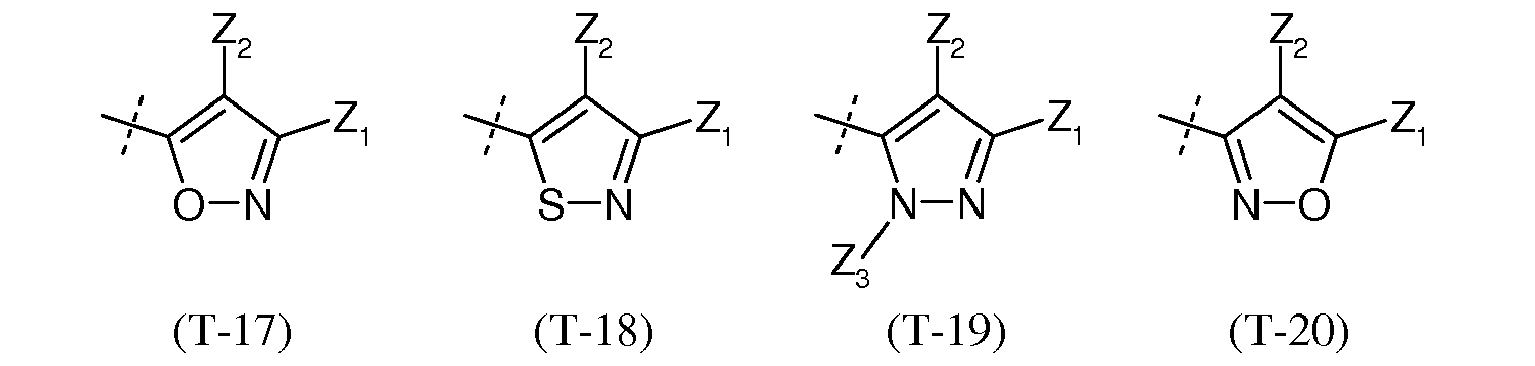


 Z1 für ein gegebenenfalls substituiertes C1-C6-Halogenalkyl, C3-C6-Halogencyclo alkyl, C1-C6-Halogenalkoxy, C1-C6-Halogenalkylthio, C1-C6-Halogenalkylsulfinyl, C1-C6-Halogenalkylsulfonyl, (C3-C6-Cycloalkyl)carbonyl, (C3-C6-Cycloalkyl)-(C1- C3-alkyl), Aryl-(C1-C3-alkyl), Heteroaryl-(C1-C3-alkyl) oder gegebenenfalls mit R14 substituiertes Phenyl und Pyridinyl steht,Z2 für Wasserstoff, Halogen, Cyano, Nitro, gegebenenfalls substituiertes C1-C6-Alkyl, C1-C4-Alkenyl, C1-C4-Alkinyl, C1-C6-Halogenalkyl, C3-C6-Cycloalkyl, C3-C6- Halogencycloalkyl, C1-C6-Alkoxy, C1-C6-Halogenalkoxy, C1-C6-Alkylthio, C1-C6- Halogenalkylthio, C1-C6-Alkylsulfinyl, C1-C6-Halogenalkylsulfinyl, C1-C6- Alkylsulfonyl, C1-C6-Halogenalkylsulfonyl, N,N-Di-(C1-C6-alkyl)amino, -C(=W)NR7R6, -C(=W)OR8, -S(O)2NR9R10, -S(O)pR11, -S(O)(=NR12)R13 und gegebenenfalls mit R14 substituiertes Phenyl und Pyridinyl steht;Z3 für Wasserstoff, gegebenenfalls substituiertes C1-C6-Alkyl, C1-C4-Alkenyl, C1-C4- Alkinyl, C1-C6-Halogenalkyl, C3-C6-Cycloalkyl, C3-C6-Halogencycloalkyl, C1-C6- Alkoxy, C1-C6-Halogenalkoxy, C1-C6-Alkylthio, C1-C6-Halogenalkylthio, und gegebenenfalls mit R14 substituiertes Phenyl und Pyridinyl steht;R7 ausgewählt ist aus Wasserstoff oder den gegebenenfalls substituierten Gruppierungen C1-C6-Alkyl, C2-C6-Alkenyl, C2-C6-Alkinyl, C3-C6-Cycloalkyl, (C1-C6-Alkyl)carbonyl und (C1-C6-Alkoxy)carbonyl;R8 ausgewählt ist aus Wasserstoff oder den gegebenenfalls mit R6 substituierten Gruppierung C1-C6-Alkyl, C1-C6-Halogenlkyl, C2-C6-Alkenyl, C2-C6- Halogenalkenyl, C2-C6-Alkinyl, C3-C6-Cycloalkyl, C3-C6-Halogencycloalkyl, (C1- C2-Alkyl)-(C3-C6-cycloalkyl) und (C3-C6-Cycloalkyl)-(C1-C2-Alkyl);R9 ausgewählt ist aus Wasserstoff oder den gegebenenfalls substituierten Gruppierungen C1-C6-Alkyl, C1-C6-Halogenalkyl, C2-C6-Alkenyl, C2-C6-Alkinyl, C3-C6-Cycloalkyl, (C1-C2-Alkyl)-(C3-C6-cycloalkyl), (C3-C6-Cycloalkyl)-(C1-C2- Alkyl), (C1-C6-Alkyl)carbonyl und (C1-C6-Alkoxy)carbonyl;R10 ausgewählt ist aus Wasserstoff oder den gegebenenfalls mit R15 substituierten Gruppierungen C1-C6-Alkyl, C2-C6-Alkenyl, C2-C6-Alkinyl, C3-C6-Cycloalkyl, (C1-C2-Alkyl)-(C3-C6-cycloalkyl) und (C3-C6-Cycloalkyl)-(C1-C2-Alkyl);R11 ausgewählt ist aus den gegebenenfalls mit R16 substituierten Gruppierungen C1-C6- Alkyl, C2-C6-Alkenyl, C2-C6-Alkinyl, C3-C6-Cycloalkyl, (C1-C2-Alkyl)-(C3-C6- cycloalkyl), (C3-C6-Cycloalkyl)-(C1-C2-alkyl) und C1-C4-Haloalkyl;R12 ausgewählt ist aus Wasserstoff, C1-C6-Alkyl, C1-C6-Halogenalkyl, C2-C6-Alkenyl, C2-C6-Alkinyl, C3-C6-Cycloalkyl, (C1-C2-Alkyl)-(C3-C6-cycloalkyl), (C3-C6- Cycloalkyl)-(C1-C2-alkyl), (C1-C6-Alkyl)carbonyl und (C1-C6-Alkoxy)carbonyl;R13 ausgewählt ist aus Wasserstoff oder den gegebenenfalls mit R16 substituierten Gruppierungen C1-C6-Alkyl, C2-C6-Alkenyl, C2-C6-Alkinyl, C3-C6-Cycloalkyl, (C1-C2-Alkyl)-(C3-C6-cycloalkyl) und (C3-C6-Cycloalkyl)-(C1-C2-alkyl);R14 ausgewählt ist aus Halogen, -OH, -NH2, -COOH, -CN, -NO2, C1-C6-Alkyl, C1-C6- Halogenalkyl, C1-C6-Alkoxy, C1-C6-Halogenalkoxy, C1-C6-Alkylthio, C1-C6- Halogenalkylthio, C1-C6-Alkylsulfinyl, C1-C6-Halogenalkylsulfinyl, C1-C6- Alkylsulfonyl, C1-C6-Halogenalkylsulfonyl, N-C1-C6-Alkylamino, N,N-Di-(C1-C6- alkyl)amino, (C1-C6-Alkyl)carbonyl, (C1-C6-Alkoxy)carbonyl, N-(C1-C6- Alkyl)aminocarbonyl und N,N-Di-(C1-C6-alkyl)aminocarbonyl;R15 ausgewählt ist aus Wasserstoff oder den gegebenenfalls mit R17 substituierten Gruppierungen C1-C6-Alkyl, C1-C6-Alkoxy, C1-C6-Alkylthio, C1-C6-Alkylsulfinyl, C1-C6-Alkylsulfonyl, -CN, -NO2 sowie gegebenenfalls mit R16 substituiertem Phenyl oder Pyridyl;R16 ausgewählt ist aus Halogen, -CN, -NO2, C1-C6-Alkyl, C1-C6-Alkoxy, C1-C6- Alkylthio, C1-C6-Alkylsulfinyl, C1-C6-Alkylsulfonyl, (C1-C6-Alkyl)carbonyl, (C1-R17 C6-Alkoxy)carbonyl, N-(C1-C6-Alkyl)aminocarbonyl, oder gegebenenfalls mit R18 substituiertem Phenyl oder Pyridyl; ausgewählt ist aus Halogen, -OH, -NH2, -COOH, -CN, -NO2 oder den gegebenenfalls subsitutierten Gruppierungen C1-C6-Alkyl, C1-C6-Halogenalkyl, C1-C6-Alkoxy, C1-C6-Halogenalkoxy, C1-C6-Alkylthio, C1-C6-Halogenalkylthio, C1-C6-Alkylsulfinyl, C1-C6-Halogenalkylsulfinyl, C1-C6-Alkylsulfonyl, C1-C6- Halogenalkylsulfonyl, N-C1-C6-Alkylamino, N,N-Di-(C1-C6-alkyl)amino, (C1-C3- Alkyl)carbonyl, (C1-C3-Alkoxy)carbonyl, N-(C1-C6-Alkyl)aminocarbonyl und N,N-Di-(C1-C6-alkyl)aminocarbonyl, wobei,R18 ausgewählt ist aus Halogen, -OH, -NH2, -COOH, -CN -NO2, C1-C6-Alkyl, C1-C6- Halogenalkyl, C1-C6-Alkoxy, C1-C6-Halogenalkoxy, C1-C6-Alkylthio, C1-C6- Halogenalkylthio, C1-C6-Alkylsulfinyl, C1-C6-Halogenalkylsulfinyl, C1-C6- Alkylsulfonyl, C1-C6-Halogenalkylsulfonyl, N-(C1-C6-Alkyl)amino, N,N-Di-(C1- C6-alkyl)amino, (C1-C3-Alkyl)carbonyl, (C1-C3-Alkoxy)carbonyl, N-(C1-C6- Alkyl)aminocarbonyl, N,N-Di-(C1-C6-alkyl)aminocarbonyl; oderL, Q und R4 zusammen mit den Kohlenstoffatomen, an die sie gebunden sind, einen gegebenenfalls substituierten 5- oder 6-gliedrigen Ring bilden, der gegebenenfalls 0, 1 oder 2 Stickstoffatome und/oder 0 oder 1 Sauerstoffatom und/oder 0 oder 1 Schwefelatom enthält.
 - Verbindungen der allgemeinen Formel (I) gemäß einem der Ansprüche 1bis 3, in welchenR1 für Wasserstoff, gegebenenfalls substituiertes C1-C6-Alkyl, C2-C6-Alkylen, C2-C6- Alkinyl, C3-C7-Cycloalkyl, (C1-C6-Alkyl)carbonyl, (C1-C6-Alkoxy)carbonyl, Cyan-(C1-C2-alkyl), (C1-C2-Alkoxy)-(C1-C2-alkyl), Aryl(C1-C3-alkyl), Heteroaryl(C1-C3-alkyl) steht,R2, R3, R4 und R5 unabhängig voneinander für Wasserstoff, Halogen, CN, NO2, gegebenenfalls substituiertes C1-C6-Alkyl, C1-C6-Halogenalkyl, C3-C6-Cycloalkyl, C3-C6-Halogencycloalkyl, C1-C6-Alkoxy, C1-C6-Halogenalkoxy, C1-C6-Alkylthio, C1-C6-Halogenalkylthio, C1-C6-Alkylsulfinyl, C1-C6-Halogenalkylsulfinyl, C1-C6- Alkylsulfonyl, C1-C6-Halogenalkylsulfonyl, N-(C1-C6-Alkyl)amino, N,N-Di-(C1- C6-alkyl)amino, N-(C1-C6-Alkyl)aminocarbonyl, N-(C3-C6-Cycloalkyl)amino- carbonyl oder (C1-C4-Alkoxy)carbonyl, stehen;wenn keine der Gruppierungen A2 und A3 für Stickstoff steht, können R3 und R4 gemeinsam mit dem Kohlenstoff an das sie gebunden sind einen 5- oder 6-gliedrigen Ring bilden, der 0, 1 oder 2 Stickstoffatome und/oder 0 oder 1 Sauerstoffatom und/oder 0 oder 1 Schwefelatom enthält, oder
wenn keine der Gruppierungen A1 und A2 für Stickstoff steht, können R2 und R3 emeinsam mit dem Kohlenstoff an das sie gebunden sind einen 6-gliedrigen Ring bilden, der 0, 1 oder 2 Stickstoffatome enthält;G für Wasserstoff, gegebenenfalls substituiertes C1-C6-Alkyl, C1-C4-Alkenyl, C1-C4- Alkinyl, C1-C6-Halogenalkyl, C3-C6-Cycloalkyl, C3-C6-Halogencycloalkyl und gegebenenfalls mit R14 substituiertes Phenyl und Pyridinyl steht;U für eine Gruppierung C(=W), SO oder SO2 steht,wobeiW für Sauerstoff oder Schwefel steht;L für eine bivalente chemische Gruppierung steht, die ausgewählt ist aus den Gruppierungen -C(=O)NH-, -C(=O)NR6, -C(=O)NHSO2-, bei der die rechte Seite der Gruppierung direkt an den Rest Q anknüpft und wobei,R6 für Wasserstoff, gegebenenfalls substituiertes C1-C6-Alkyl, Aryl-(C1-C3-alkyl), Heteroaryl-(C1-C3-alkyl), C2-C6-Alkenyl, C2-C6-Alkinyl, C3-C6-Cycloalkyl, (C1- C2-Alkyl)-(C3-C6-cycloalkyl), (C3-C6-Cycloalkyl)-(C1-C2-alkyl), (C1-C6- Alkyl)carbonyl und (C1-C6-Alkoxy)carbonyl steht;m den Wert 1 annimmt;Q für einen der unten dargestellten Reste (Q-1) - (Q-8) steht,
 V für Halogen, Cyano, Nitro, gegebenenfalls substituiertes C1-C6-Alkyl, C1-C4- Alkenyl, C1-C4-Alkinyl, C1-C6-Halogenalkyl, C3-C6-Cycloalkyl, C3-C6- Halogencycloalkyl, C1-C6-Alkoxy, C1-C6-Halogenalkoxy, C1-C6-Alkylthio, C1-C6- Halogenalkylthio, C1-C6-Alkylsulfinyl, C1-C6-Halogenalkylsulfinyl, C1-C6- Alkylsulfonyl, C1-C6-Halogenalkylsulfonyl, N,N-Di-(C1-C6-alkyl)amino steht;T für einen der Reste (T-1), (T-2), (T-3), (T-4), (T-5), (T-8), (T-9), (T-11), (T-12), (T-13), (T-14), (T-17), (T-18), (T-19), (T-20), (T-21), (T-22), (T-23), (T-24), (T- 25), (T-26), (T-27), (T-28), (T-29), (T-30), (T-31), (T-33), (T-34), (T-35), (T-44) (T-45), (T-46), (T-47), (T-48), (T-49), (T-50), (T-51), (T-53), (T-55), (T-57),(T- 58),(T-59),(T-60) steht,wobeiZ1 für ein gegebenenfalls substituiertes C1-C6-Halogenalkyl, C3-C6-Halogencyclo alkyl" C1-C6-Halogenalkoxy, C1-C6-Halogenalkylthio, C1-C6- Halogenalkylsulfinyl, C1-C6-Halogenalkylsulfonyl, (C3-C6-Cycloalkyl)carbonyl, (C3-C6-Cycloalkyl)-(C1-C3-alkyl), Aryl-(C1-C3-alkyl), Heteroaryl-(C1-C3-alkyl) oder gegebenenfalls mit R14 substituiertes Phenyl und Pyridinyl steht,Z2 für Wasserstoff, Halogen, Cyano, Nitro, gegebenenfalls substituiertes C1-C6-Alkyl, C1-C4-Alkenyl, C1-C4-Alkinyl, C1-C6-Halogenalkyl, C3-C6-Cycloalkyl, C3-C6- Halogencycloalkyl, C1-C6-Alkoxy, C1-C6-Halogenalkoxy, C1-C6-Alkylthio, C1-C6- Halogenalkylthio, C1-C6-Alkylsulfinyl, C1-C6-Halogenalkylsulfinyl, C1-C6- Alkylsulfonyl, C1-C6-Halogenalkylsulfonyl, N,N-Di-(C1-C6-alkyl)amino, - C(=W)NR7R6, -C(=W)OR8, -S(O)2NR9R10, -S(O)pR11, -S(O)(=NR12)R13 und gegebenenfalls mit R14 substituiertes Phenyl und Pyridinyl steht;Z3 für Wasserstoff, gegebenenfalls substituiertes C1-C6-Alkyl, C1-C4-Alkenyl, C1-C4- Alkinyl, C1-C6-Halogenalkyl, C3-C6-Cycloalkyl, C3-C6-Halogencycloalkyl und gegebenenfalls mit R14 substituiertes Phenyl und Pyridinyl steht;R7 ausgewählt ist aus Wasserstoff oder den gegebenenfalls substituierten Gruppierungen C1-C6-Alkyl, C2-C6-Alkenyl, C2-C6-Alkinyl, C3-C6-Cycloalkyl, (C1-C6-Alkyl)carbonyl und (C1-C6-Alkoxy)carbonyl;R8 ausgewählt ist aus Wasserstoff oder den gegebenenfalls mit R6 substituierten Gruppierung C1-C6-Alkyl, C1-C6-Halogenlkyl, C2-C6-Alkenyl, C2-C6- Halogenalkenyl, C2-C6-Alkinyl, C3-C6-Cycloalkyl, C3-C6-Halogencycloalkyl, (C1- C2-Alkyl)-(C3-C6-cycloalkyl) und (C3-C6-Cycloalkyl)-(C1-C2-Alkyl);R9 ausgewählt ist aus Wasserstoff oder den gegebenenfalls substituierten Gruppierungen C1-C6-Alkyl, C1-C6-Halogenalkyl, C2-C6-Alkenyl, C2-C6-Alkinyl, C3-C6-Cycloalkyl, (C1-C2-Alkyl)-(C3-C6-cycloalkyl), (C3-C6-Cycloalkyl)-(C1-C2- Alkyl), (C1-C6-Alkyl)carbonyl und (C1-C6-Alkoxy)carbonyl;R10 ausgewählt ist aus Wasserstoff oder den gegebenenfalls mit R15 substituierten Gruppierungen C1-C6-Alkyl, C2-C6-Alkenyl, C2-C6-Alkinyl, C3-C6-Cycloalkyl, (C1-C2-Alkyl)-(C3-C6-cycloalkyl) und (C3-C6-Cycloalkyl)-(C1-C2-Alkyl);R11 ausgewählt ist aus den gegebenenfalls mit R16 substituierten Gruppierungen C1-C6- Alkyl, C2-C6-Alkenyl, C2-C6-Alkinyl, C3-C6-Cycloalkyl, (C1-C2-Alkyl)-(C3-C6- cycloalkyl), (C3-C6-Cycloalkyl)-(C1-C2-alkyl) und C1-C4-Haloalkyl;R12 ausgewählt ist aus Wasserstoff, C1-C6-Alkyl, C1-C6-Halogenalkyl, C2-C6-Alkenyl, C2-C6-Alkinyl, C3-C6-Cycloalkyl, (C1-C2-Alkyl)-(C3-C6-cycloalkyl), (C3-C6- Cycloalkyl)-(C1-C2-alkyl), (C1-C6-Alkyl)carbonyl und (C1-C6-Alkoxy)carbonyl;R13 ausgewählt ist aus Wasserstoff oder den gegebenenfalls mit R16 substituierten Gruppierungen C1-C6-Alkyl, C2-C6-Alkenyl, C2-C6-Alkinyl, C3-C6-Cycloalkyl, (C1-C2-Alkyl)-(C3-C6-cycloalkyl) und (C3-C6-Cycloalkyl)-(C1-C2alkyl);R14 ausgewählt ist aus Halogen, -OH, -NH2, -COOH, -CN, -NO2, C1-C6-Alkyl, C1-C6- Halogenalkyl, C1-C6-Alkoxy, C1-C6-Halogenalkoxy, C1-C6-Alkylthio, C1-C6- Halogenalkylthio, C1-C6-Alkylsulfinyl, C1-C6-Halogenalkylsulfinyl, C1-C6- Alkylsulfonyl, C1-C6-Halogenalkylsulfonyl, N-C1-C6-Alkylamino, N,N-Di-(C1-C6- alkyl)amino, (C1-C6-Alkyl)carbonyl, (C1-C6-Alkoxy)carbonyl, N-(C1-C6- Alkyl)aminocarbonyl und N,N-Di-(C1-C6-alkyl)aminocarbonyl;R15 ausgewählt ist aus Wasserstoff oder den gegebenenfalls mit R17 substituierten Gruppierungen C1-C6-Alkyl, C1-C6-Alkoxy, C1-C6-Alkylthio, C1-C6-Alkylsulfinyl, C1-C6-Alkylsulfonyl, -CN, -NO2 sowie gegebenenfalls mit R16 substituiertem Phenyl oder Pyridyl;R16 ausgewählt ist aus Halogen, -CN, -NO2, C1-C6-Alkyl, C1-C6-Alkoxy, C1-C6- Alkylthio, C1-C6-Alkylsulfinyl, C1-C6-Alkylsulfonyl, (C1-C6-Alkyl)carbonyl, (C1- C6-Alkoxy)carbonyl, N-(C1-C6-Alkyl)aminocarbonyl, oder gegebenenfalls mit R18 substituiertem Phenyl oder Pyridyl;R17 ausgewählt ist aus Halogen, -OH, -NH2, -COOH, -CN, -NO2 oder den gegebenenfalls subsitutierten Gruppierungen C1-C6-Alkyl, C1-C6-Halogenalkyl, C1-C6-Alkoxy, C1-C6-Halogenalkoxy, C1-C6-Alkylthio, C1-C6-Halogenalkylthio, C1-C6-Alkylsulfinyl, C1-C6-Halogenalkylsulfinyl, C1-C6-Alkylsulfonyl, C1-C6- Halogenalkylsulfonyl, N-C1-C6-Alkylamino, N,N-Di-(C1-C6-alkyl)amino, (C1-C3- Alkyl)carbonyl, (C1-C3-Alkoxy)carbonyl, N-(C1-C6-Alkyl)aminocarbonyl und N,N-Di-(C1-C6-alkyl)aminocarbonyl, wobei,R18 ausgewählt ist aus Halogen, -OH, -NH2, -COOH, -CN -NO2, C1-C6-Alkyl, C1-C6- Halogenalkyl, C1-C6-Alkoxy, C1-C6-Halogenalkoxy, C1-C6-Alkylthio, C1-C6- Halogenalkylthio, C1-C6-Alkylsulfinyl, C1-C6-Halogenalkylsulfinyl, C1-C6- Alkylsulfonyl, C1-C6-Halogenalkylsulfonyl, N-(C1-C6-Alkyl)amino, N,N-Di-(C1- C6-alkyl)amino, (C1-C3-Alkyl)carbonyl, (C1-C3-Alkoxy)carbonyl, N-(C1-C6- Alkyl)aminocarbonyl, N,N-Di-(C1-C6-alkyl)aminocarbonyl; oderL, Q und R4 zusammen mit den Kohlenstoffatomen, an die sie gebunden sind, einen gegebenenfalls substituierten 5- oder 6-gliedrigen Ring bilden, der gegebenenfalls 0, 1 oder 2 Stickstoffatome und/oder 0 oder 1 Sauerstoffatom und/oder 0 oder 1 Schwefelatom enthält.
 - Verbindungen der allgemeinen Formel (I) gemäß einem der Ansprüche 1 bis 4, in welchenR1 für Wasserstoff, Methyl, Ethyl, n-Propyl, Isopropyl, n-Butyl, Isobutyl, sec-Butyl, tert-Butyl, Methoxymethyl, Ethoxymethyl, Propoxymethyl, Methylcarbonyl, Ethylcarbonyl, n-Propylcarbonyl, Isopropylcarbonyl, sec-Butylcarbonyl, tert- Butylcarbonyl, Methoxycarbonyl, Ethoxycarbonyl, n-Propoxycarbonyl, Isopropoxycarbonyl, sec-Butoxycarbonyl, tert-Butoxycarbonyl, Cyanomethyl, 2- Cyanoethyl steht;R2 und R5 unabhängig voneinander für Wasserstoff, Methyl, Fluor und Chlor stehen undR3 und R4 unabhängig voneinander für Wasserstoff, Fluor, Chlor, Brom, Cyano, Nitro, Methyl, Ethyl, Fluormethyl, Difluormethyl, Trifluormethyl, 2,2,2-Trilfluorethyl, Methoxy, Ethoxy, n-Propoxy, 1-Methylethoxy, Fluormethoxy, Difluormethoxy, Chlor-difluormethoxy, Dichlor-fluormethoxy, Trifluormethoxy, 2,2,2- Trifluorethoxy, 2-Chlor-2,2-difluorethoxy, Pentafluorethoxy, Methylsulfonyl, Methylsulfinyl, Trifluormethylsulfonyl, Trifluormethylsulfinyl und N- Cyclopropylaminocarbonyl stehen;G für Wasserstoff, Methyl, Ethyl, n-Propyl, Isopropyl, n-Butyl, Isobutyl, sec-Butyl, tert-Butyl" Ethenyl, 1-Propenyl, 2-Propenyl, Fluormethyl, Difluormethyl, Trifluormethyl, Chlormethyl, Pentafluorethyl, 2,2,2-Trifluorethyl, Cyclopropyl, Cyclobutyl, Methoxymethyl, Ethoxymethyl, Propoxymethyl, 2- Methoxyethoxymethyl, Methylcarbonyl, Methoxycarbonyl, Ethoxycarbonyl, n- Propoxycarbonyl, Isopropoxycarbonyl, sec-Butoxycarbonyl, tert-Butoxycarbonyl, Cyanomethyl, 2-Cyanoethyl, Phenyl, 4-Fluorphenyl, 4-Chlorphenyl, 4- Trifluormethylphenyl, 2,4-Dichlorphenyl, 2-Chlor-4-trifluormethyl-phenyl steht;wobeiU für C(=W) undW für Sauerstoff steht;L für eine bivalente chemische Gruppierung steht, die ausgewählt ist aus den Gruppierungen -C(=O)NH-, -C(=O)NR6, -C(=O)NHSO2-, bei der die rechte Seite der Gruppierung direkt an den Rest Q anknüpft und wobei,R6 für Wasserstoff, Methyl, Ethyl, n-Propyl, Isopropyl, n-Butyl, Isobutyl, sec-Butyl, tert-Butyl, Methoxymethyl, Ethoxymethyl, Propoxymethyl, Methylcarbonyl, Ethylcarbonyl, n-Propylcarbonyl, Isopropylcarbonyl, sec-Butylcarbonyl, tert- Butylcarbonyl, Methoxycarbonyl, Ethoxycarbonyl, n-Propoxycarbonyl, Isopropoxycarbonyl, sec-Butoxycarbonyl, tert-Butoxycarbonyl, Cyanomethyl, 2- Cyanoethyl, Pyrid-2-yl-methyl, Pyrid-3-yl-methyl und Pyrid-4-yl-methyl steht;m den Wert 1 annimmt;Q für einen der unten dargestellten Reste (Q-1) - (Q-8) steht;

 V für Fluor, Chlor, Brom, Iod, Cyano, Nitro, Methyl, Ethyl, Difluormethyl, Trichlormethyl, Chlordifluormethyl, Dichlorfluormethyl, Trifluormethyl, Chlormethyl, Brommethyl, 1-Fluorethyl, 2-Fluorethyl, 2,2-Difluorethyl, 2,2,2- Trifluorethyl, 1,2,2,2-Tetrafluorethyl, 1-Chlor-1,2,2,2-tetrafluorethyl, 2,2,2- Trichlorethyl, 2-Chlor-2,2-difluorethyl, 1,1-Dilfluorethyl, Pentafluorethyl Pentafluor-tert-butyl, Heptafluor-n-propyl, Heptafluor-isopropyl, Nonafluor-n- butyl, Cyclopropyl, Cyclobutyl, Methoxy, Ethoxy, n-Propoxy, 1-Methylethoxy, Fluormethoxy, Difluormethoxy, Chlor-difluormethoxy, Dichlor-fluormethoxy, Trifluormethoxy, 2,2,2-Trifluorethoxy, 2-Chlor-2,2-difluorethoxy, Pentafluorethoxy, Methylthio, Methylsulfonyl, Methylsulfinyl, Trifluormethylsulfonyl, Trifluormethylsulfinyl steht;T für einen der Reste (T-8), (T-9), (T-11, (T-17), (T-18), (T-19), (T-21, (T-29), (T- 35), (T-44), (T-49), (T-50), (T-53), (T-55), (T-57) steht,wobeiZ1 für Difluormethyl, Trichlormethyl, Chlordifluormethyl, Dichlorfluormethyl, Trifluormethyl, Chlormethyl, Brommethyl, 1-Fluorethyl, 1-Fluor-1-methylethyl, 2- Fluorethyl, 2,2-Difluorethyl, 2,2,2-Trifluorethyl, 1,2,2,2-Tetrafluorethyl, 1-Chlor- 1,2,2,2-tetrafluorethyl, 2,2,2-Trichlorethyl, 2-Chlor-2,2-difluorethyl, 1,1- Dilfluorethyl, Pentafluorethyl Pentafluor-tert-butyl, Heptafluor-n-propyl, Heptafluor-isopropyl, Nonafluor-n-butyl, Trifluormethoxy-1,1,2,2- tetrafluorethoxy-difluormethyl, Trifluormethylthio, Trifluormethylsulfinyl, Trifluormethylsulfonyl, Trifluormethoxy, Difluormethoxy, Cyclopropyl, Cyclobutyl, Cyclopropyl-hydroxymethyl, Cyclopropyl-fluormethyl, Cyclopropylcarbonyl, 2,2,2-Trifluorethoxy, 1-Trifluormethylethoxy, 3,3,3,2,2- Pentafluorpropoxy, Phenyl, 2-Chlorphenyl, 3-Chlorphenyl, 4-Chlorphenyl, 4- Fluorphenyl, 2-Methylphenyl, 3-Methylphenyl, 4-Methylphenyl, 3- Trifluormethylphenyl, 4-Trifluormethylphenyl, 4- Nitrophenyl, 4-(tert- Butyl)phenyl, 4-Methoxyphenyl, 4-Phenoxyphenyl, 2,4-Dichlorphenyl, 3,4- Dichlorphenyl, 3,5-Dichlorphenyl, 2,5-Dichlorphenyl, 2,6-Difluorphenyl, 4- Trifluormethoxyphenyl, 4-Cyanophenyl, 2-Trifluormethyl-pyrid-5-yl, 3-Chlor-5- trifluormethyl-pyrid-2-yl, (3,5-Bis(trifluormethyl)-1H-pyrazol-1-yl)-methyl, (3,5- Bis(pentafluorethyl)-1H-pyrazol-1-yl)-methyl, (3,5-Bis(trifluormethyl)-1H-triazol- 1-yl)-methyl, (2-Methyl-2-H-tetrazol-5-yl)-methyl, (5-Trifluormethyl-2H-tetrazol- 2-yl)-methyl, (3,5-Dichlorphenyl)-methyl, (3,5-Bis(trifluormethyl)phenyl)-methyl, (2,4-Dichlorphenyl)-methyl, (2,6-Dichlorphenyl)-methyl, (4-Chlorphenyl)-methyl, (4-Trifluormethylphenyl)-methyl steht,Z2 für Wasserstoff, Halogen, Cyano, Nitro, Methyl, Ethyl, n-Propyl, Isopropyl, n- Butyl, Isobutyl, sec-Butyl, tert-Butyl, Ethenyl, 1-Propenyl, 2-Propenyl, Ethinyl, 1- Propinyl, 1-Butinyl, Difluormethyl, Trichlormethyl, Chlordifluormethyl, Dichlorfluormethyl, Trifluormethyl, Chlormethyl, Brommethyl, 1-Fluorethyl, 1- Fluor-1-methylethyl, 2-Fluorethyl, 2,2-Difluorethyl, 2,2,2-Trifluorethyl, 1,2,2,2- Tetrafluorethyl, 1-Chlor-1,2,2,2-tetrafluorethyl, 2,2,2-Trichlorethyl, 2-Chlor-2,2- difluorethyl, 1,1-Dilfluorethyl, Pentafluorethyl Pentafluor-tert-butyl, Heptafluor-n- propyl, Heptafluor-isopropyl, Nonafluor-n-butyl, Cyclopropyl, Cyclobutyl, Methoxy, Ethoxy, n-Propoxy, 1-Methylethoxy, Fluormethoxy, Difluormethoxy, Chlor-difluormethoxy, Dichlor-fluormethoxy, Trifluormethoxy, 2,2,2- Trifluorethoxy, 2-Chlor-2,2-difluorethoxy, Pentafluorethoxy, Methylthio, Methylsulfonyl, Methylsulfinyl, Trifluormethylsulfonyl, Trifluormethylsulfinyl, N,N-Dimethylamino, 4-Fluorphenyl, 4-Chlorphenyl, 4-Trifluormethylphenyl steht;Z3 für Wasserstoff, Methyl, Ethyl, n-Propyl, Isopropyl, n-Butyl, Isobutyl, sec-Butyl, tert-Butyl" Ethenyl, 1-Propenyl, 2-Propenyl, Fluormethyl, Difluormethyl, Trifluormethyl, Chlormethyl, Pentafluorethyl, 2,2,2-Trifluorethyl, Cyclopropyl, Cyclobutyl, Methoxymethyl, Ethoxymethyl, Propoxymethyl, 2- Methoxyethoxymethyl, Methylcarbonyl, Methoxycarbonyl, Ethoxycarbonyl, n- Propoxycarbonyl, Isopropoxycarbonyl, sec-Butoxycarbonyl, tert-Butoxycarbonyl, Cyanomethyl, 2-Cyanoethyl, Phenyl, 4-Fluorphenyl, 4-Chlorphenyl, 4- Trifluormethylphenyl, 2,4-Dichlorphenyl, 2-Chlor-4-trifluormethyl-phenyl steht;ferner können
L, Q und R4 zusammen mit den Kohlenstoffatomen, an die sie gebunden sind, einen gegebenenfalls substituierten 5- oder 6-gliedrigen Ring bilden, der gegebenenfalls 0, 1 oder 2 Stickstoffatome und/oder 0 oder 1 Sauerstoffatom und/oder 0 oder 1 Schwefelatom enthält. - Verbindungen der allgemeinen Formeln (Ia) bis (Ij),


- Verbindungen der allgemeinen Formel (Iaa),

der Rest Q ausgewählt sein kann aus
Pyridin-4-yl, Pyridin-3-yl, 4-Fluorphenyl, 4-Chlorpyridin-3-yl, 2-Chlorpyridin-4yl, 6-Chlorpyridin-3-yl, Pyridin-2-yl, 3-Chlorphenyl, 4-Methoxyphenyl, 2-Chlorpyridin-3-yl, Phenyl, 3-Methoxyphenyl, 6-Chlorpyridin-2-yl, 2,4-Difluorphenyl, 4-Fluor-2-methylphenyl, 4-Chlorpyridin-2-yl, 4-Fluor-3-methylphenyl, 3-Chlor-4-fluor-2-methylphenyl, 5-Chlorpyridin-2-yl, 4-Fluor-3-(trifluormethyl)phenyl, 3,4-Dichlorphenyl, 3,4,5-Trichlorphenyl. - Verwendung von Verbindungen der allgemeinen Formel (I) gemäß einem der Ansprüche 1 bis 5 oder Verbindungen der allgemeinen Formeln (Ia) bis (Ij) oder Verbindungen der allgemeinen Formel (Iaa) gemäß Anspruch 6 zur Bekämpfung von Insekten, Spinnentieren und Nematoden.
- Pharmazeutische Zusammensetzungen, enthaltend wenigstens eine Verbindung gemäß einem der Ansprüche 1 bis 8.
- Verwendung von Verbindungen der allgemeinen Formel (I) gemäß einem der Ansprüche 1 bis 5 oder Verbindungen der allgemeinen Formeln (Ia) bis (Ij) gemäß Anspruch 6 oder der Verbindungen allgemeinen Formel (Iaa) zur Herstellung pharmazeutischer Zusammensetzungen zur Bekämpfung von Parasiten auf Tieren.
- Verfahren zur Herstellung von Pflanzenschutzmitteln enthaltend Verbindungen der allgemeinen Formel (I) gemäß einem der Ansprüche 1 bis 5 oder der allgemeinen Formeln (Ia) bis (Ij) gemäß Anspruch 6 oder Verbindungen der allgemeinen Formel (Iaa) sowie übliche Streckmittel und/oder oberflächenaktive Substanzen.
- Verfahren zur Bekämpfung von Schädlingen, dadurch gekennzeichnet, dass man eine Verbindung der allgemeinen Formel (I) gemäß einem der Ansprüche 1 bis 5 oder der allgemeinen Formeln (Ia) bis (Ij) gemäß Anspruch 6 oder Verbindungen der allgemeinen Formel (Iaa) auf die Schädlinge und/oder ihren Lebensraum einwirken lässt.
- Verwendung von Verbindungen der allgemeinen Formel (I) gemäß einem der Ansprüche 1 bis 5 sowie der Verbindungen der allgemeinen Formeln (Ia) bis (Ij) gemäß Anspruch 6 oder Verbindungen der allgemeinen Formel (Iaa) zum Schutz des Vermehrungsmaterials von Pflanzen, insbesondere von Saatgut.
Priority Applications (2)
| Application Number | Priority Date | Filing Date | Title |
|---|---|---|---|
| EP09160715A EP2253617A1 (de) | 2009-05-20 | 2009-05-20 | Halogen-substituierte Verbindungen als Pestizide |
| PCT/EP2010/002944 WO2010133312A1 (de) | 2009-05-20 | 2010-05-12 | Halogen-substituierte verbindungen als pestizide |
Applications Claiming Priority (1)
| Application Number | Priority Date | Filing Date | Title |
|---|---|---|---|
| EP09160715A EP2253617A1 (de) | 2009-05-20 | 2009-05-20 | Halogen-substituierte Verbindungen als Pestizide |
Publications (1)
| Publication Number | Publication Date |
|---|---|
| EP2253617A1 true EP2253617A1 (de) | 2010-11-24 |
Family
ID=40810403
Family Applications (1)
| Application Number | Title | Priority Date | Filing Date |
|---|---|---|---|
| EP09160715A Ceased EP2253617A1 (de) | 2009-05-20 | 2009-05-20 | Halogen-substituierte Verbindungen als Pestizide |
Country Status (2)
| Country | Link |
|---|---|
| EP (1) | EP2253617A1 (de) |
| WO (1) | WO2010133312A1 (de) |
Cited By (4)
| Publication number | Priority date | Publication date | Assignee | Title |
|---|---|---|---|---|
| EP2835366A4 (de) * | 2012-04-03 | 2015-10-14 | Mitsui Chemicals Agro Inc | Verfahren zur herstellung eines alkylierten aromatischen amidderivats |
| CN114130366A (zh) * | 2021-11-24 | 2022-03-04 | 浙江省海洋水产研究所 | 一种水产水质改良剂及其制备方法 |
| CN115611767A (zh) * | 2021-07-12 | 2023-01-17 | 沈阳化工大学 | 一种酰胺类化合物及其用途 |
| NL2033448A (en) * | 2021-12-29 | 2023-07-04 | Beijing Yinong Biotechnology Co Ltd | Synthesis method of aromatic amine carboxylic acid derivative |
Families Citing this family (22)
| Publication number | Priority date | Publication date | Assignee | Title |
|---|---|---|---|---|
| CN104379561B (zh) * | 2012-06-22 | 2016-12-21 | 住友化学株式会社 | 酰胺化合物及其有害生物防除用途 |
| PT2953942T (pt) | 2013-02-06 | 2018-01-17 | Bayer Cropscience Ag | Derivados de pirazol substituídos com halogéneo como agentes pesticidas |
| WO2015101622A1 (de) | 2014-01-03 | 2015-07-09 | Bayer Cropscience Ag | Neue pyrazolyl-heteroarylamide als schädlingsbekämpfungsmittel |
| JP2017521441A (ja) | 2014-07-15 | 2017-08-03 | バイエル・アニマル・ヘルス・ゲゼルシャフト・ミット・ベシュレンクテル・ハフツングBayer Animal Health Gmbh | 有害生物防除剤としてのアリール−トリアゾリルピリジン類 |
| AU2016231174B2 (en) | 2015-03-10 | 2020-09-10 | Bayer Animal Health Gmbh | Pyrazolyl-derivatives as pest control agents |
| WO2017108569A1 (en) | 2015-12-22 | 2017-06-29 | Syngenta Participations Ag | Pesticidally active pyrazole derivatives |
| TW201811766A (zh) | 2016-08-29 | 2018-04-01 | 瑞士商諾華公司 | N-(吡啶-2-基)吡啶-磺醯胺衍生物及其用於疾病治療之用途 |
| WO2018185187A1 (en) | 2017-04-05 | 2018-10-11 | Syngenta Participations Ag | Pesticidally active pyrazole derivatives |
| US11040962B2 (en) | 2017-04-05 | 2021-06-22 | Syngenta Participations Ag | Pesticidally active pyrazole derivatives |
| WO2018185191A1 (en) | 2017-04-05 | 2018-10-11 | Syngenta Participations Ag | Pesticidally active pyrazole derivatives |
| AU2018300150A1 (en) | 2017-07-11 | 2020-01-30 | Vertex Pharmaceuticals Incorporated | Carboxamides as modulators of sodium channels |
| EP3665166A1 (de) | 2017-08-11 | 2020-06-17 | Syngenta Participations AG | Pestizidwirksame pyrazolderivate |
| AR112673A1 (es) | 2017-08-11 | 2019-11-27 | Syngenta Participations Ag | Derivados de pirazol activos como plaguicidas |
| WO2019030355A1 (en) | 2017-08-11 | 2019-02-14 | Syngenta Participations Ag | ACTIVE PYRAZOLE DERIVATIVES ON THE PESTICIDE PLAN |
| US11459318B2 (en) | 2017-10-06 | 2022-10-04 | Syngenta Participations Ag | Pesticidally active pyrrole derivatives |
| CN108503599B (zh) * | 2018-06-11 | 2020-07-07 | 青岛泰源科技发展有限公司 | 一种吡嗪酰胺类化合物及其制备方法与应用 |
| WO2020146682A1 (en) | 2019-01-10 | 2020-07-16 | Vertex Pharmaceuticals Incorporated | Carboxamides as modulators of sodium channels |
| WO2020146612A1 (en) | 2019-01-10 | 2020-07-16 | Vertex Pharmaceuticals Incorporated | Esters and carbamates as modulators of sodium channels |
| WO2020164994A1 (en) | 2019-02-13 | 2020-08-20 | Syngenta Crop Protection Ag | Pesticidally active pyrazole derivatives |
| EP4448492B1 (de) | 2021-12-17 | 2026-03-04 | Reglagene, Inc. | Zusammensetzungen und verfahren zur herstellung und verwendung kleiner moleküle bei der behandlung von krebs |
| JP7894535B2 (ja) | 2023-02-28 | 2026-07-23 | レグラジーン、インコーポレイテッド | 健康状態の治療のための小分子を作製および使用するための組成物および方法 |
| US12384773B2 (en) | 2023-11-02 | 2025-08-12 | Arcus Biosciences, Inc. | Thiazole compounds and methods of use thereof |
Citations (33)
| Publication number | Priority date | Publication date | Assignee | Title |
|---|---|---|---|---|
| US4766219A (en) | 1985-06-03 | 1988-08-23 | The Dow Chemical Company | Preparation of 2-cyano-6-chloropyridine compounds |
| WO1989010396A1 (en) | 1988-04-28 | 1989-11-02 | Plant Genetic Systems N.V. | Plants with modified stamen cells |
| WO1995002061A1 (de) | 1993-07-05 | 1995-01-19 | Basf Aktiengesellschaft | Verfahren zur biotechnologischen herstellung von alkoholen, aldehyden und carbonsäuren |
| WO1996033270A1 (en) | 1995-04-20 | 1996-10-24 | American Cyanamid Company | Structure-based designed herbicide resistant products |
| WO2000007980A1 (en) | 1998-08-04 | 2000-02-17 | Astrazeneca Ab | Amide derivatives which are useful as cytokine inhibitors |
| WO2001074788A1 (en) | 2000-04-04 | 2001-10-11 | Smithkline Beecham Plc | 2-hydroxy-mutilin carbamate derivatives for antibacterial use |
| WO2001083459A2 (en) | 2000-05-04 | 2001-11-08 | Basf Aktiengesellschaft | Uracil substituted phenyl sulfamoyl carboxamides |
| WO2004035545A2 (en) | 2002-10-18 | 2004-04-29 | E.I. Du Pont De Nemours And Company | Azolecarboxamide herbicides |
| WO2004085419A1 (de) * | 2003-03-24 | 2004-10-07 | Basf Aktiengesellschaft | Trifluormethyl-thiophencarbonsäureanilide und ihre verwendung als fungizide |
| WO2004106324A1 (en) | 2003-05-27 | 2004-12-09 | E.I. Dupont De Nemours And Company | Azolecarboxamide herbicides |
| WO2005060749A1 (en) | 2003-12-18 | 2005-07-07 | Pfizer Limited | Substituted arylpyrazoles as parasiticidal agents |
| WO2005079801A1 (en) | 2004-02-12 | 2005-09-01 | Vernalis (R & D) Ltd | Pyrimidine compounds as purine receptor antagonist |
| WO2005095351A1 (en) | 2004-03-12 | 2005-10-13 | Bayer Cropscience Ag | N1 - ((pyrazol-1-ymethyl) -2-methylphenyl)- phatalamide derivatives and related compounds insecticides |
| WO2006022442A1 (ja) * | 2004-08-24 | 2006-03-02 | Santen Pharmaceutical Co., Ltd. | ジヒドロオロテートデヒドロゲナーゼ阻害活性を有する新規複素環アミド誘導体 |
| US20060069132A1 (en) | 2004-04-07 | 2006-03-30 | Armel Gregory R | Azolecarboxamide herbicides |
| US20060069270A1 (en) | 2004-09-27 | 2006-03-30 | Rafael Shapiro | Process for the preparation of 1,3,5-trisubstituted pyrazoles via [3+2] cycloaddition |
| WO2006067445A2 (en) | 2004-12-22 | 2006-06-29 | Astrazeneca Ab | Csf-1r kinase inhibitors |
| WO2006067446A1 (en) | 2004-12-22 | 2006-06-29 | Astrazeneca Ab | Pyridine carboxamide derivatives for use as anticancer agents |
| EP1714958A1 (de) * | 2004-01-28 | 2006-10-25 | Mitsui Chemicals, Inc. | Amidderivative, verfahren zu deren herstellung und verfahren zu deren anwendung als insektizide |
| WO2006137376A1 (ja) | 2005-06-21 | 2006-12-28 | Mitsui Chemicals, Inc. | アミド誘導体ならびに該化合物を含有する殺虫剤 |
| WO2007017075A1 (en) * | 2005-07-29 | 2007-02-15 | Bayer Cropscience Ag | Insecticidal 3-acylaminobenzanilides |
| WO2007024782A2 (en) | 2005-08-24 | 2007-03-01 | Pioneer Hi-Bred International, Inc. | Compositions providing tolerance to multiple herbicides and methods of use thereof |
| WO2007027777A2 (en) | 2005-08-31 | 2007-03-08 | Monsanto Technology Llc | Nucleotide sequences encoding insecticidal proteins |
| WO2007051560A1 (en) | 2005-10-31 | 2007-05-10 | Bayer Cropscience Ag | Insecticidal 2 -acylaminothiazole-4 -carboxamides |
| WO2007128410A1 (en) | 2006-04-28 | 2007-11-15 | Syngenta Participations Ag | Insecticidal compounds |
| WO2008000438A1 (en) | 2006-06-27 | 2008-01-03 | Syngenta Participations Ag | Insecticidal compounds |
| WO2008012027A1 (en) | 2006-07-24 | 2008-01-31 | Syngenta Participations Ag | Insecticidal compounds |
| WO2008029084A1 (en) | 2006-09-06 | 2008-03-13 | Syngenta Limited | Herbicidal compounds and compositions |
| WO2008031534A1 (en) | 2006-09-11 | 2008-03-20 | Syngenta Participations Ag | Insecticidal compounds |
| WO2008074427A1 (en) | 2006-12-21 | 2008-06-26 | Syngenta Participations Ag | Insecticidal compounds |
| WO2008084717A1 (ja) | 2006-12-28 | 2008-07-17 | Takeda Pharmaceutical Company Limited | 三環性化合物およびその医薬用途 |
| US20080234270A1 (en) * | 2004-07-30 | 2008-09-25 | Exelixis, Inc. | Pyrrole Derivatives As Pharmaceutical Agents |
| WO2009028280A1 (ja) | 2007-08-29 | 2009-03-05 | Mitsui Chemicals, Inc. | ピラゾールカルボン酸誘導体及びその製造方法、並びに殺菌剤 |
Family Cites Families (1)
| Publication number | Priority date | Publication date | Assignee | Title |
|---|---|---|---|---|
| DE69926148D1 (en) * | 1998-11-09 | 2005-08-18 | Black James Foundation | Gastrin und cholecystokinin rezeptor ligande |
-
2009
- 2009-05-20 EP EP09160715A patent/EP2253617A1/de not_active Ceased
-
2010
- 2010-05-12 WO PCT/EP2010/002944 patent/WO2010133312A1/de not_active Ceased
Patent Citations (34)
| Publication number | Priority date | Publication date | Assignee | Title |
|---|---|---|---|---|
| US4766219A (en) | 1985-06-03 | 1988-08-23 | The Dow Chemical Company | Preparation of 2-cyano-6-chloropyridine compounds |
| WO1989010396A1 (en) | 1988-04-28 | 1989-11-02 | Plant Genetic Systems N.V. | Plants with modified stamen cells |
| WO1995002061A1 (de) | 1993-07-05 | 1995-01-19 | Basf Aktiengesellschaft | Verfahren zur biotechnologischen herstellung von alkoholen, aldehyden und carbonsäuren |
| WO1996033270A1 (en) | 1995-04-20 | 1996-10-24 | American Cyanamid Company | Structure-based designed herbicide resistant products |
| WO2000007980A1 (en) | 1998-08-04 | 2000-02-17 | Astrazeneca Ab | Amide derivatives which are useful as cytokine inhibitors |
| WO2001074788A1 (en) | 2000-04-04 | 2001-10-11 | Smithkline Beecham Plc | 2-hydroxy-mutilin carbamate derivatives for antibacterial use |
| WO2001083459A2 (en) | 2000-05-04 | 2001-11-08 | Basf Aktiengesellschaft | Uracil substituted phenyl sulfamoyl carboxamides |
| WO2004035545A2 (en) | 2002-10-18 | 2004-04-29 | E.I. Du Pont De Nemours And Company | Azolecarboxamide herbicides |
| WO2004085419A1 (de) * | 2003-03-24 | 2004-10-07 | Basf Aktiengesellschaft | Trifluormethyl-thiophencarbonsäureanilide und ihre verwendung als fungizide |
| WO2004106324A1 (en) | 2003-05-27 | 2004-12-09 | E.I. Dupont De Nemours And Company | Azolecarboxamide herbicides |
| WO2005060749A1 (en) | 2003-12-18 | 2005-07-07 | Pfizer Limited | Substituted arylpyrazoles as parasiticidal agents |
| EP1714958A1 (de) * | 2004-01-28 | 2006-10-25 | Mitsui Chemicals, Inc. | Amidderivative, verfahren zu deren herstellung und verfahren zu deren anwendung als insektizide |
| WO2005079801A1 (en) | 2004-02-12 | 2005-09-01 | Vernalis (R & D) Ltd | Pyrimidine compounds as purine receptor antagonist |
| WO2005095351A1 (en) | 2004-03-12 | 2005-10-13 | Bayer Cropscience Ag | N1 - ((pyrazol-1-ymethyl) -2-methylphenyl)- phatalamide derivatives and related compounds insecticides |
| US20060069132A1 (en) | 2004-04-07 | 2006-03-30 | Armel Gregory R | Azolecarboxamide herbicides |
| US20080234270A1 (en) * | 2004-07-30 | 2008-09-25 | Exelixis, Inc. | Pyrrole Derivatives As Pharmaceutical Agents |
| WO2006022442A1 (ja) * | 2004-08-24 | 2006-03-02 | Santen Pharmaceutical Co., Ltd. | ジヒドロオロテートデヒドロゲナーゼ阻害活性を有する新規複素環アミド誘導体 |
| US20060069270A1 (en) | 2004-09-27 | 2006-03-30 | Rafael Shapiro | Process for the preparation of 1,3,5-trisubstituted pyrazoles via [3+2] cycloaddition |
| WO2006067445A2 (en) | 2004-12-22 | 2006-06-29 | Astrazeneca Ab | Csf-1r kinase inhibitors |
| WO2006067446A1 (en) | 2004-12-22 | 2006-06-29 | Astrazeneca Ab | Pyridine carboxamide derivatives for use as anticancer agents |
| EP1911751A1 (de) * | 2005-06-21 | 2008-04-16 | Mitsui Chemicals, Inc. | Amidderivat und pestizid, das eine solche verbindung enthält |
| WO2006137376A1 (ja) | 2005-06-21 | 2006-12-28 | Mitsui Chemicals, Inc. | アミド誘導体ならびに該化合物を含有する殺虫剤 |
| WO2007017075A1 (en) * | 2005-07-29 | 2007-02-15 | Bayer Cropscience Ag | Insecticidal 3-acylaminobenzanilides |
| WO2007024782A2 (en) | 2005-08-24 | 2007-03-01 | Pioneer Hi-Bred International, Inc. | Compositions providing tolerance to multiple herbicides and methods of use thereof |
| WO2007027777A2 (en) | 2005-08-31 | 2007-03-08 | Monsanto Technology Llc | Nucleotide sequences encoding insecticidal proteins |
| WO2007051560A1 (en) | 2005-10-31 | 2007-05-10 | Bayer Cropscience Ag | Insecticidal 2 -acylaminothiazole-4 -carboxamides |
| WO2007128410A1 (en) | 2006-04-28 | 2007-11-15 | Syngenta Participations Ag | Insecticidal compounds |
| WO2008000438A1 (en) | 2006-06-27 | 2008-01-03 | Syngenta Participations Ag | Insecticidal compounds |
| WO2008012027A1 (en) | 2006-07-24 | 2008-01-31 | Syngenta Participations Ag | Insecticidal compounds |
| WO2008029084A1 (en) | 2006-09-06 | 2008-03-13 | Syngenta Limited | Herbicidal compounds and compositions |
| WO2008031534A1 (en) | 2006-09-11 | 2008-03-20 | Syngenta Participations Ag | Insecticidal compounds |
| WO2008074427A1 (en) | 2006-12-21 | 2008-06-26 | Syngenta Participations Ag | Insecticidal compounds |
| WO2008084717A1 (ja) | 2006-12-28 | 2008-07-17 | Takeda Pharmaceutical Company Limited | 三環性化合物およびその医薬用途 |
| WO2009028280A1 (ja) | 2007-08-29 | 2009-03-05 | Mitsui Chemicals, Inc. | ピラゾールカルボン酸誘導体及びその製造方法、並びに殺菌剤 |
Non-Patent Citations (59)
| Title |
|---|
| "Bioorg. Med. Chem. Lett.", vol. 17, 2007, pages: 6305 - 6310 |
| "Justus Liebigs Ann..Chem.", vol. 611, 1958, ORGANIKUM, WILEY-VCH, pages: 194 - 205 |
| "Organikum", WILEY-VCH, pages: 474 |
| "Organikum", WILEY-VCH, pages: 496 |
| A. H. HAINES: "Literatur; Methods for the Oxidation of Organic Compounds", 1985, ACADEMIC PRESS, pages: 117 |
| A. MIYASHITA ET AL., TETRAHEDRON, vol. 40, 1984, pages 1245 |
| ANGEW. CHEM., INTERN. ED., vol. 47, no. 2, 2008, pages 311 - 315 |
| ARYL, J..ORG. CHEM., vol. 72, no. 9, 2007, pages 3589 - 3591 |
| BALZARINI J ET AL: "Identification of novel thiocarboxanilide derivatives that suppress a variety of drug-resistant mutant human immunodeficiency virus type 1 strains at a potency similar to that for wild-type virus.", ANTIMICROBIAL AGENTS AND CHEMOTHERAPY JUN 1996, vol. 40, no. 6, June 1996 (1996-06-01), pages 1454 - 1466, XP002540056, ISSN: 0066-4804 * |
| BIOORG. & MED. CHEM. LETTERS, vol. 15, no. 22, 2005, pages 4898 - 4906 |
| BIOORG. MED. CHEM. LETT., vol. 15, no. 22, 2005, pages 4898 - 4906 |
| BIOORG. MED. CHEM. LETT., vol. 17, no. 22, 2007, pages 6274 - 6279 |
| BIOORG. MED. CHEM. LETT., vol. 17, no. 4, 2007, pages 1043 - 1046 |
| BIOORG..MED. CHEM. LETT., vol. 17, no. 22, 2007, pages 6274 - 6279 |
| BIOORG..MED. CHEM. LETT., vol. 17, no. 4, 2007, pages 1043 - 1046 |
| BODANSKY ET AL.: "Peptide Synthesis", 1976, WILEY & SONS |
| BROMIERUNG, CHEM. BER., vol. 109, 1976, pages 268 - 273 |
| CAINELLI; CARDILLO: "Organic Chemistry", 1984, SPRINGER VERLAG |
| CHEM. & PHARM. BULL., vol. 53, no. 2, 2005, pages 153 - 163 |
| CHEM. BER., 1970, pages 788 |
| CHLORIERUNG, BIOORG. MED. CHEM. LETT., vol. 17, 2007, pages 5620 - 5623 |
| FIESER: "Reagents for Organic Synthesis", vol. 1, 1967, WILEY, pages: 142 - 147 |
| GROSS; MEIENHOFER: "The Peptides: Analysis, Synthesis, Biology", 1979, ACADEMIC PRESS |
| HERSTELLUNG : SYNTHESIS, vol. 5, 2000, pages 738 - 42 |
| HETEROCYCLES, vol. 68, no. 11, 2006, pages 2247 - 2252 |
| HOUBEL-WEYL: "Methoden der Organischen Chemie", vol. VII/2B, 1976, GEORG THIEME VERLAG, pages: 1287 |
| HOUBEN-WEYL, vol. E, no. 16D, 1992, pages 646FF |
| HOUBEN-WEYL: "Methoden der Organischen Chemie", vol. 15/2 |
| HOUBEN-WEYL: "Methoden der organischen Chemie", vol. VIII, 1952, G. THIEME VERLAG, pages: 359 |
| IODIERUNG, TETRAHEDRON LETT., vol. 42, 2001, pages 863 - 865 |
| J. AM. CHEM. SOC, 1967, pages 5012 |
| J. ANTIBIOTICS, vol. 47, no. 12, 1994, pages 1456 - 65 |
| J. FLUORINE CHEM., vol. 61, 1993, pages 17 - 21 |
| J. HETEROCYCL. CHEM., vol. 35, no. 6, 1998, pages 1493 - 1499 |
| J. MED. CHEM., vol. 50, 2007, pages 6291 - 6294 |
| J. MED. CHEM., vol. 51, no. 4, 2008, pages 937 - 947 |
| J. ORG. CHEM., vol. 51, no. 26, 1986, pages 5286 - 90 |
| J. ORG. CHEM., vol. 62, no. 17, 1997, pages 5908 - 5919 |
| J. ORG.CHEM., vol. 73, no. 9, 2008, pages 3523 - 3529 |
| J..ORG. CHEM., vol. 19, 1954, pages 357 - 64 |
| J..ORG. CHEM., vol. 73, no. 9, 2008, pages 3523 - 3529 |
| JOURNAL OF MEDICINAL CHEMISTRY, vol. 51, no. 4, 2008, pages 937 - 947 |
| LANDINI ET AL., RUTHENIUMTETROXID, vol. 134, 1979 |
| MCKILLOP, YOUNG SYNTHESIS, 1979, pages 401 - 422 |
| MORRIS, KIELY J. ORG. CHEM., vol. 52, 1987, pages 1149 |
| N. K. ROBERTS, CATALYTIC ASPECTS OF METAL PHOSPHINE COMPLEXES, 1982, pages 337 |
| ORG. PROC. RES. & DEV., vol. 9, no. 5, 2005, pages 694 - 696 |
| P. G. M. WUTS; T. W. GREENE: "Greene's protective groups in organic synthesis", JOHN WILEY & SONS, INC. |
| P. G. M. WUTS; T. W. GREENE: "organic synthesis", JOHN WILEY & SONS, INC. |
| PARLOW J. J. ; MISCHKE D. A. ; WOODARD S. S.: "UTILITY OF COMPLEMENTARY MOLECULAR REACTIVITY AND MOLECULAR RECOGNITION (CMR/R) TECHNOLOGY AND POLYMER-SUPPORTED REAGENTS IN THE SOLUTION-PHASE SYNTHE SIS OF HETEROCYCLIC CARBOXAMIDES", JOURNAL OF ORGANIC CHEMISTRY, vol. 62, 1997, pages 5908 - 5919, XP002213047 * |
| R. C. LAROCK: "Oxidationsreagenzien in: Comprehensive Organic Transformations", 1999, WILEY-VCH, pages: 1213 - 1215 |
| RUSS. J. .APPL. CHEM., vol. 80, no. 4, 2007, pages 571 - 575 |
| RUSS. J..APPL. CHEM., vol. 80, no. 4, 2007, pages 571 - 575 |
| SYNTHESIS, no. 4, 2006, pages 594 - 596 |
| SYNTHESIS, vol. 5, 1997, pages 563 - 566 |
| TETRAHEDRON ASSYM., vol. 17, 2006, pages 2149 - 2153 |
| TETRAHEDRON LETT., 1977, pages 4167 |
| TETRAHEDRON LETT., vol. 33, no. 24, 1992, pages 3487 - 90 |
| TETRAHEDRON LETT., vol. 36, no. 25, 1995, pages 4369 - 72 |
Cited By (7)
| Publication number | Priority date | Publication date | Assignee | Title |
|---|---|---|---|---|
| EP2835366A4 (de) * | 2012-04-03 | 2015-10-14 | Mitsui Chemicals Agro Inc | Verfahren zur herstellung eines alkylierten aromatischen amidderivats |
| US9353046B2 (en) | 2012-04-03 | 2016-05-31 | Mitsui Chemicals Agro, Inc. | Method for producing alkylated aromatic amide derivative |
| RU2640302C2 (ru) * | 2012-04-03 | 2017-12-27 | Митсуй Кемикалз Агро, Инк. | Способ получения алкилированного ароматического амидного производного |
| CN115611767A (zh) * | 2021-07-12 | 2023-01-17 | 沈阳化工大学 | 一种酰胺类化合物及其用途 |
| CN114130366A (zh) * | 2021-11-24 | 2022-03-04 | 浙江省海洋水产研究所 | 一种水产水质改良剂及其制备方法 |
| CN114130366B (zh) * | 2021-11-24 | 2023-05-16 | 浙江省海洋水产研究所 | 一种水产水质改良剂及其制备方法 |
| NL2033448A (en) * | 2021-12-29 | 2023-07-04 | Beijing Yinong Biotechnology Co Ltd | Synthesis method of aromatic amine carboxylic acid derivative |
Also Published As
| Publication number | Publication date |
|---|---|
| WO2010133312A1 (de) | 2010-11-25 |
Similar Documents
| Publication | Publication Date | Title |
|---|---|---|
| EP2352723B1 (de) | Pestizide n-aryl- oder n-heteroaryl-pyrazolcarboxamidverbindungen | |
| KR101834362B1 (ko) | N-(3-카바모일페닐)-1h-피라졸-5-카복사미드 유도체 및 동물 해충을 구제하기 위한 그의 용도 | |
| WO2010133312A1 (de) | Halogen-substituierte verbindungen als pestizide | |
| BR112015018311B1 (pt) | compostos derivados de pirazol substituídos por halogêneo como agentes de controle de pragas, composição farmacêutica e uso dos mesmos, processo para a preparação de composições de proteção de colheitas e método para o controle de pragas | |
| EP2964631B1 (de) | Halogen-substituierte n-[3-(1h-pyrazol-4-yl)phenylmethyl]-sulfonamid-derivate und verwandte verbindungen als pestizide zur verwendung im pflanzenschutz, in der veterinärmedizin und im materialschutz | |
| EP2794573B1 (de) | Neue insektizide aromatische amide | |
| WO2009141096A1 (de) | Substituierte spiroisoxazoline |
Legal Events
| Date | Code | Title | Description |
|---|---|---|---|
| PUAI | Public reference made under article 153(3) epc to a published international application that has entered the european phase |
Free format text: ORIGINAL CODE: 0009012 |
|
| AK | Designated contracting states |
Kind code of ref document: A1 Designated state(s): AT BE BG CH CY CZ DE DK EE ES FI FR GB GR HR HU IE IS IT LI LT LU LV MC MK MT NL NO PL PT RO SE SI SK TR |
|
| AX | Request for extension of the european patent |
Extension state: AL BA RS |
|
| STAA | Information on the status of an ep patent application or granted ep patent |
Free format text: STATUS: THE APPLICATION HAS BEEN REFUSED |
|
| 18R | Application refused |
Effective date: 20110310 |