EP2248564A1 - Storage medium storing information processing program, information processing apparatus and information processing method - Google Patents
Storage medium storing information processing program, information processing apparatus and information processing method Download PDFInfo
- Publication number
- EP2248564A1 EP2248564A1 EP09177598A EP09177598A EP2248564A1 EP 2248564 A1 EP2248564 A1 EP 2248564A1 EP 09177598 A EP09177598 A EP 09177598A EP 09177598 A EP09177598 A EP 09177598A EP 2248564 A1 EP2248564 A1 EP 2248564A1
- Authority
- EP
- European Patent Office
- Prior art keywords
- information processing
- load
- cycle
- frame
- motion
- Prior art date
- Legal status (The legal status is an assumption and is not a legal conclusion. Google has not performed a legal analysis and makes no representation as to the accuracy of the status listed.)
- Withdrawn
Links
- 230000010365 information processing Effects 0.000 title claims description 112
- 238000003860 storage Methods 0.000 title claims description 26
- 238000003672 processing method Methods 0.000 title claims description 7
- 230000033001 locomotion Effects 0.000 claims abstract description 330
- 238000000034 method Methods 0.000 claims description 69
- 238000001228 spectrum Methods 0.000 claims description 26
- 230000037396 body weight Effects 0.000 claims description 18
- 238000012545 processing Methods 0.000 description 74
- 230000001133 acceleration Effects 0.000 description 60
- 230000008569 process Effects 0.000 description 45
- 238000001514 detection method Methods 0.000 description 25
- 238000004891 communication Methods 0.000 description 16
- 239000003550 marker Substances 0.000 description 15
- 230000005484 gravity Effects 0.000 description 12
- 238000005452 bending Methods 0.000 description 11
- 230000004044 response Effects 0.000 description 10
- 238000004088 simulation Methods 0.000 description 8
- 230000008859 change Effects 0.000 description 7
- 230000003287 optical effect Effects 0.000 description 7
- 230000007423 decrease Effects 0.000 description 6
- 238000010586 diagram Methods 0.000 description 6
- 230000010354 integration Effects 0.000 description 6
- 230000009471 action Effects 0.000 description 4
- 238000012937 correction Methods 0.000 description 4
- 230000003247 decreasing effect Effects 0.000 description 4
- 230000008901 benefit Effects 0.000 description 3
- 230000000694 effects Effects 0.000 description 3
- 238000002474 experimental method Methods 0.000 description 3
- 230000006870 function Effects 0.000 description 3
- 238000010137 moulding (plastic) Methods 0.000 description 3
- 230000001360 synchronised effect Effects 0.000 description 3
- 210000001015 abdomen Anatomy 0.000 description 2
- 238000010276 construction Methods 0.000 description 2
- 230000001939 inductive effect Effects 0.000 description 2
- 230000002093 peripheral effect Effects 0.000 description 2
- 238000002360 preparation method Methods 0.000 description 2
- 230000003068 static effect Effects 0.000 description 2
- 241001669573 Galeorhinus galeus Species 0.000 description 1
- 239000005862 Whey Substances 0.000 description 1
- 102000007544 Whey Proteins Human genes 0.000 description 1
- 108010046377 Whey Proteins Proteins 0.000 description 1
- 230000003213 activating effect Effects 0.000 description 1
- 230000004913 activation Effects 0.000 description 1
- 230000002238 attenuated effect Effects 0.000 description 1
- 230000005540 biological transmission Effects 0.000 description 1
- 238000006243 chemical reaction Methods 0.000 description 1
- 125000004122 cyclic group Chemical group 0.000 description 1
- 238000006073 displacement reaction Methods 0.000 description 1
- 210000000245 forearm Anatomy 0.000 description 1
- 238000003384 imaging method Methods 0.000 description 1
- 230000006872 improvement Effects 0.000 description 1
- 230000009191 jumping Effects 0.000 description 1
- 239000002184 metal Substances 0.000 description 1
- 238000003825 pressing Methods 0.000 description 1
- 239000000047 product Substances 0.000 description 1
- 238000004080 punching Methods 0.000 description 1
- 230000009467 reduction Effects 0.000 description 1
- 230000000630 rising effect Effects 0.000 description 1
- 239000007787 solid Substances 0.000 description 1
- 230000005236 sound signal Effects 0.000 description 1
- 239000013589 supplement Substances 0.000 description 1
- 238000012549 training Methods 0.000 description 1
- 230000001131 transforming effect Effects 0.000 description 1
- 230000000007 visual effect Effects 0.000 description 1
Images










Classifications
-
- A—HUMAN NECESSITIES
- A63—SPORTS; GAMES; AMUSEMENTS
- A63F—CARD, BOARD, OR ROULETTE GAMES; INDOOR GAMES USING SMALL MOVING PLAYING BODIES; VIDEO GAMES; GAMES NOT OTHERWISE PROVIDED FOR
- A63F13/00—Video games, i.e. games using an electronically generated display having two or more dimensions
- A63F13/40—Processing input control signals of video game devices, e.g. signals generated by the player or derived from the environment
- A63F13/42—Processing input control signals of video game devices, e.g. signals generated by the player or derived from the environment by mapping the input signals into game commands, e.g. mapping the displacement of a stylus on a touch screen to the steering angle of a virtual vehicle
-
- A—HUMAN NECESSITIES
- A63—SPORTS; GAMES; AMUSEMENTS
- A63F—CARD, BOARD, OR ROULETTE GAMES; INDOOR GAMES USING SMALL MOVING PLAYING BODIES; VIDEO GAMES; GAMES NOT OTHERWISE PROVIDED FOR
- A63F13/00—Video games, i.e. games using an electronically generated display having two or more dimensions
- A63F13/20—Input arrangements for video game devices
- A63F13/21—Input arrangements for video game devices characterised by their sensors, purposes or types
- A63F13/214—Input arrangements for video game devices characterised by their sensors, purposes or types for locating contacts on a surface, e.g. floor mats or touch pads
-
- A—HUMAN NECESSITIES
- A63—SPORTS; GAMES; AMUSEMENTS
- A63F—CARD, BOARD, OR ROULETTE GAMES; INDOOR GAMES USING SMALL MOVING PLAYING BODIES; VIDEO GAMES; GAMES NOT OTHERWISE PROVIDED FOR
- A63F13/00—Video games, i.e. games using an electronically generated display having two or more dimensions
- A63F13/20—Input arrangements for video game devices
- A63F13/21—Input arrangements for video game devices characterised by their sensors, purposes or types
- A63F13/218—Input arrangements for video game devices characterised by their sensors, purposes or types using pressure sensors, e.g. generating a signal proportional to the pressure applied by the player
-
- A—HUMAN NECESSITIES
- A63—SPORTS; GAMES; AMUSEMENTS
- A63F—CARD, BOARD, OR ROULETTE GAMES; INDOOR GAMES USING SMALL MOVING PLAYING BODIES; VIDEO GAMES; GAMES NOT OTHERWISE PROVIDED FOR
- A63F13/00—Video games, i.e. games using an electronically generated display having two or more dimensions
- A63F13/20—Input arrangements for video game devices
- A63F13/24—Constructional details thereof, e.g. game controllers with detachable joystick handles
- A63F13/245—Constructional details thereof, e.g. game controllers with detachable joystick handles specially adapted to a particular type of game, e.g. steering wheels
-
- A—HUMAN NECESSITIES
- A63—SPORTS; GAMES; AMUSEMENTS
- A63F—CARD, BOARD, OR ROULETTE GAMES; INDOOR GAMES USING SMALL MOVING PLAYING BODIES; VIDEO GAMES; GAMES NOT OTHERWISE PROVIDED FOR
- A63F13/00—Video games, i.e. games using an electronically generated display having two or more dimensions
- A63F13/40—Processing input control signals of video game devices, e.g. signals generated by the player or derived from the environment
- A63F13/42—Processing input control signals of video game devices, e.g. signals generated by the player or derived from the environment by mapping the input signals into game commands, e.g. mapping the displacement of a stylus on a touch screen to the steering angle of a virtual vehicle
- A63F13/428—Processing input control signals of video game devices, e.g. signals generated by the player or derived from the environment by mapping the input signals into game commands, e.g. mapping the displacement of a stylus on a touch screen to the steering angle of a virtual vehicle involving motion or position input signals, e.g. signals representing the rotation of an input controller or a player's arm motions sensed by accelerometers or gyroscopes
-
- A—HUMAN NECESSITIES
- A63—SPORTS; GAMES; AMUSEMENTS
- A63F—CARD, BOARD, OR ROULETTE GAMES; INDOOR GAMES USING SMALL MOVING PLAYING BODIES; VIDEO GAMES; GAMES NOT OTHERWISE PROVIDED FOR
- A63F13/00—Video games, i.e. games using an electronically generated display having two or more dimensions
- A63F13/60—Generating or modifying game content before or while executing the game program, e.g. authoring tools specially adapted for game development or game-integrated level editor
- A63F13/65—Generating or modifying game content before or while executing the game program, e.g. authoring tools specially adapted for game development or game-integrated level editor automatically by game devices or servers from real world data, e.g. measurement in live racing competition
-
- A—HUMAN NECESSITIES
- A63—SPORTS; GAMES; AMUSEMENTS
- A63F—CARD, BOARD, OR ROULETTE GAMES; INDOOR GAMES USING SMALL MOVING PLAYING BODIES; VIDEO GAMES; GAMES NOT OTHERWISE PROVIDED FOR
- A63F13/00—Video games, i.e. games using an electronically generated display having two or more dimensions
- A63F13/20—Input arrangements for video game devices
- A63F13/23—Input arrangements for video game devices for interfacing with the game device, e.g. specific interfaces between game controller and console
- A63F13/235—Input arrangements for video game devices for interfacing with the game device, e.g. specific interfaces between game controller and console using a wireless connection, e.g. infrared or piconet
-
- A—HUMAN NECESSITIES
- A63—SPORTS; GAMES; AMUSEMENTS
- A63F—CARD, BOARD, OR ROULETTE GAMES; INDOOR GAMES USING SMALL MOVING PLAYING BODIES; VIDEO GAMES; GAMES NOT OTHERWISE PROVIDED FOR
- A63F2300/00—Features of games using an electronically generated display having two or more dimensions, e.g. on a television screen, showing representations related to the game
- A63F2300/10—Features of games using an electronically generated display having two or more dimensions, e.g. on a television screen, showing representations related to the game characterized by input arrangements for converting player-generated signals into game device control signals
- A63F2300/105—Features of games using an electronically generated display having two or more dimensions, e.g. on a television screen, showing representations related to the game characterized by input arrangements for converting player-generated signals into game device control signals using inertial sensors, e.g. accelerometers, gyroscopes
-
- A—HUMAN NECESSITIES
- A63—SPORTS; GAMES; AMUSEMENTS
- A63F—CARD, BOARD, OR ROULETTE GAMES; INDOOR GAMES USING SMALL MOVING PLAYING BODIES; VIDEO GAMES; GAMES NOT OTHERWISE PROVIDED FOR
- A63F2300/00—Features of games using an electronically generated display having two or more dimensions, e.g. on a television screen, showing representations related to the game
- A63F2300/10—Features of games using an electronically generated display having two or more dimensions, e.g. on a television screen, showing representations related to the game characterized by input arrangements for converting player-generated signals into game device control signals
- A63F2300/1056—Features of games using an electronically generated display having two or more dimensions, e.g. on a television screen, showing representations related to the game characterized by input arrangements for converting player-generated signals into game device control signals involving pressure sensitive buttons
-
- A—HUMAN NECESSITIES
- A63—SPORTS; GAMES; AMUSEMENTS
- A63F—CARD, BOARD, OR ROULETTE GAMES; INDOOR GAMES USING SMALL MOVING PLAYING BODIES; VIDEO GAMES; GAMES NOT OTHERWISE PROVIDED FOR
- A63F2300/00—Features of games using an electronically generated display having two or more dimensions, e.g. on a television screen, showing representations related to the game
- A63F2300/10—Features of games using an electronically generated display having two or more dimensions, e.g. on a television screen, showing representations related to the game characterized by input arrangements for converting player-generated signals into game device control signals
- A63F2300/1068—Features of games using an electronically generated display having two or more dimensions, e.g. on a television screen, showing representations related to the game characterized by input arrangements for converting player-generated signals into game device control signals being specially adapted to detect the point of contact of the player on a surface, e.g. floor mat, touch pad
Definitions
- the present invention relates to a storage medium storing an information processing program, an information processing apparatus, and an information processing method. More specifically, the present invention relates to a storage medium storing an information processing program, an information processing apparatus, and an information processing method which performs an operation by utilizing a load value indicating a load of a user.
- it is a primary object of the present invention is to provide a novel storage medium storing an information processing program, a novel information processing apparatus, and a novel information processing method.
- Another object of the present invention is to provide a storage medium storing an information processing program, an information processing apparatus, and an information processing method which are able to execute many kinds of processing in correspondence with a variation of an input operation by utilizing a load value.
- the present invention employs following features in order to solve the above-described problems. It should be noted that reference numerals and the supplements inside the parentheses show one example of a corresponding relationship with the embodiments described later for easy understanding of the present invention, and do not limit the present invention.
- a first invention is a storage medium storing an information processing program causing a computer to execute at least a load value acquiring step for acquiring a load value indicating a load of a user on the basis of a signal from a load detecting apparatus, said information processing program is characterized by causing said computer to execute: a cycle judging step for judging a cycle of a load variation of the user on the basis of the load value acquired by the load value acquiring step, and an information processing step for executing predetermined information processing on the basis of the cycle judged by the cycle judging step.
- an information processing program causes a computer to execute a load value acquiring step (40, S3, S7), a cycle judging step (40, S121, S131), and an information processing step (40, S15, S17, S21, S23, S57, S75, S77).
- the load value acquiring step acquires a load value indicating a load of a user on the basis of a signal from a load detecting apparatus (36).
- the cycle judging step judges a cycle of a load variation of the user on the basis of the load value acquired by the load value acquiring step.
- the information processing step executes predetermined information processing on the basis of the cycle judged by the cycle judging step.
- the predetermined information processing is executed on the basis of the cycle of the load variation of the user, and therefore, it is possible to execute many kinds of processing according to the variation of the input operations by the load values.
- a second invention is according to the first invention, and the information processing step executes at least first information processing or second information processing different from the first information processing on the basis of the cycle judged by the cycle judging step.
- the information processing step executes at leas first information processing (S21, S23, S75, S77) or second information processing (S15, S17, S75, S77) different from the first information processing on the basis of the cycle judged by the cycle judging step.
- At least the two different information processing are performed on the basis of the cycle of the load variation of the user, so that it is possible to execute many kinds of processing according to the variation of the input operations by the load values.
- a third invention is according to the second invention, and the information processing program causes a computer to further execute a condition determining step for determining whether or not the cycle judged by the cycle judging step satisfies a predetermined condition, and the information processing step executes the first information processing when the condition determining step determines that the cycle satisfies the predetermined condition, and executes the second information processing when the condition determining step determines that the cycle does not satisfy the predetermined condition.
- an information processing program causes a computer to further execute a condition determining step (40, S137).
- the condition determining step determines whether or not the cycle judged by the cycle judging step satisfies a predetermined condition.
- the information processing step executes the first information processing when the condition determining step determines that the cycle satisfies the predetermined condition ("YES" in S137), and executes the second information processing when the condition determining step determines that the cycle does not satisfy the predetermined condition ("NO" in S137).
- the third invention it is possible to execute different information processing by merely determining whether or not the cycle of the load variation of the user satisfies the predetermined condition.
- a fourth invention is according to the third invention, and the condition determining step determines whether or not a frequency of the cycle judged by the cycle judging step is equal to or more than a first predetermined value, and the information processing step executes the second information processing when the condition determining step determines that the frequency is equal to or more than the first predetermined value.
- the condition determining step determines whether or not a frequency of the cycle judged by the cycle judging step is equal to or more than a first predetermined value.
- the information processing step executes the second information processing when the condition determining step determines that the frequency is equal to or more than the first predetermined value ("YES" in S137).
- the fourth invention it is possible to execute the second information processing by merely determining whether or not the frequency of the cycle of the load variation of the user is equal to or more than the threshold value.
- a fifth invention is according to the third invention, and the cycle judging step judges the cycle on the basis of a frequency spectrum of the load variation of the user, the condition determining step determines whether or not the frequency of the cycle judged by the cycle judging step is a second predetermined value and a power spectrum of a frequency larger than the frequency is equal to or more than a maximum value of a spectrum noise, and the information processing step executes the second information processing when the condition determining step determines that the frequency is a second predetermined value, and a power spectrum of a frequency larger than the frequency is equal to or more than a maximum value of a spectrum noise.
- the cycle judging step judges the cycle on the basis of a frequency spectrum of the load variation of the user. Furthermore, the condition determining step determines whether or not the frequency of the cycle judged by the cycle judging step is a second predetermined value and a power spectrum of a frequency larger than the frequency is equal to or more than a maximum value of a spectrum noise.
- the information processing step executes the second information processing when the condition determining step determines that the frequency is a second predetermined value, and a power spectrum of a frequency larger than the frequency is equal to or more than a maximum value of a spectrum noise ("YES" in S137).
- the fifth invention in a case that the cycle is judged on the basis of the frequency spectrum of the load variation of the user as well, by merely comparing the magnitude of the power spectrum with the maximum value of the spectrum noise, it is possible to execute the second information processing.
- a sixth invention is according to the first invention, and the information processing program causes a computer to further execute a movement controlling step for controlling a magnitude of at least a moving distance or a moving velocity of an object displayed on a display screen on the basis of the load value acquired by the load acquiring step.
- the information processing program causes a computer to further execute a movement controlling step (40, S25-S35, S36, S39, S93-S107).
- the movement controlling step controls a magnitude of at least a moving distance or a moving velocity of an object displayed on a display screen on the basis of the load value of the user. That is, the parameter as to the moving distance or the moving velocity is decided.
- the magnitude of the moving distance or the moving amount of the object is decided on the basis of the load value, and therefore, it is possible to execute a variety of processing in correspondence with the load value of the user, and control the movement of the object in correspondence with the load value.
- a seventh invention is according to the sixth invention, and the movement controlling step increases the moving distance or the moving velocity of the object as an amplitude of the variation of the load value acquired by the load value acquiring step is large.
- the movement controlling step increases the moving distance or the moving velocity of the object as an amplitude of the variation of the load value acquired by the load value acquiring step is large, that is, as the load variation of the user is large.
- the seventh invention as the load variation of the user is large, the moving distance or the moving velocity of the object is increased, and therefore, it is possible to control the movement of the object in accordance with the motion of the user.
- An eighth invention is according to the sixth invention, and the movement controlling step increases the moving distance or the moving velocity of the object when the load value acquired by the load acquiring step is less than a predetermined value.
- the movement controlling step increases the moving distance or the moving velocity of the object when the load value acquired by the load acquiring step is less than a predetermined value. That is, when an unweight is made, the moving distance or the moving velocity of the object is increased.
- the eighth invention similar to the sixth invention, it is possible to execute a variety of processing in accordance with the load value of the user, and control the movement of the object in accordance with the load value.
- a ninth invention is according to the sixth invention, and the movement controlling step increases the moving distance or the moving velocity of the object when the cycle of the variation of the load value acquired by the load acquiring step is long.
- the movement controlling step increases the moving distance or the moving velocity when the cycle of the variation of the load value acquired by the load acquiring step is long. That is, even when the user performs the same motion, if the motion is made largely, the moving distance or the moving velocity of the object is also increased in associated therewith.
- the ninth invention similar to the sixth invention, it is possible to execute a variety of processing in correspondence with the load value of the user, and control the movement of the object in correspondence with the load value.
- a tenth invention is according to the sixth invention, and the information processing program causes a computer to further execute a barycentric position detecting step for detecting a barycentric position of the user on a two-dimensional plane on the basis of a signal from the load detecting apparatus, and the movement controlling step controls a moving direction of the object on the basis the barycentric position detected by the barycentric position detecting step.
- the information processing program causes a computer to further execute a barycentric position detecting step (40, S9).
- the barycentric position detecting step detects a barycentric position of the user on a two-dimensional plane on the basis of a signal from the load detecting apparatus.
- the movement controlling step controls a moving direction of the object on the basis of the barycentric position detected by the barycentric position detecting step. That is, the parameter as to the moving direction is decided.
- the moving direction of the object is controlled according to the baricentric position, so that it is possible to control the moving direction of the object as well as the moving distance or the moving velocity depending on how to impose the load.
- An eleventh invention is according to the tenth invention, and the object moves in the virtual space, and the movement controlling step decides the moving direction of the object according to different deciding processing between when the object moves to a predetermined direction and when the object moves to a direction other than the direction.
- the object moves in the virtual space
- the movement controlling step decides the moving direction of the object according to different deciding method between when the object moves to a predetermined direction ("YES" in S35) and when the object moves to a direction other than the direction (“NO" in S35).
- the deciding method of the moving direction by the barycentric position is changed according to the moving direction of the object, so that it is possible to enrich a variation of the movement of the object.
- a twelfth invention is according to the eleventh invention, and the movement controlling step decides a first moving direction as a moving direction of the object on the basis of the barycentric position detected by the barycentric position detecting step in a case that the object moves to the predetermined direction, and decides a second moving direction as a moving direction of the object on the basis of the barycentric position detected by the barycentric position detecting step in a case that the object moves to the direction other than the predetermined direction.
- the movement controlling step decides a first moving direction as a moving direction of the object on the basis of the barycentric position detected by the barycentric position detecting step (S36) in a case that the object moves to the predetermined direction ("YES" in S35), and decides a second moving direction as a moving direction of the object on the basis of the barycentric position detected by the barycentric position detecting step (S39) in a case that the object moves to the direction other than the predetermined direction ("NO" in S35).
- a thirteenth invention is according to the first invention, and the information processing step changes at least a display manner of the object displayed on the display screen on the basis of the cycle judged by the cycle judging step.
- the information processing step changes at least a display manner of the object displayed on the display screen on the basis of the cycle judged by the cycle judging step.
- the display manner of the object is changed on the basis of the cycle of the load value, and therefore, it is possible to execute many kinds of processing according to the variation of the input operations by the load values.
- a fourteenth invention is according to the thirteenth invention, and the object is a moving image object, and the information processing step displays the moving image object on the display screen by a different animation on the basis of the cycle judged by the cycle judging step.
- the object is a moving image object.
- the information processing step displays the moving image object on the display screen by a different animation on the basis of the cycle judged by the cycle judging step.
- the fourteenth invention it is possible to display the moving image object by a different animation in accordance with a variation of the input operations by the load values.
- a fifteenth invention is according to the fourteenth invention, and the information processing step changes an updating velocity of an animation frame on the basis of the cycle judged by the cycle judging step and a frame number of the animation frame constructing of the animation.
- the information processing step changes an updating velocity of an animation frame on the basis of the cycle judged by the cycle judging step and a frame number of the animation frame constructing of the animation.
- the fifteenth invention by changing the updating velocity of the animation frame, it is possible to synchronize the cycle of the load value with the animation.
- a sixteenth invention is according to the first invention, and the information processing program causes a computer to further execute a ratio calculating step for calculating a ratio of the load value acquired by the load value acquiring step to a body weight value of the user, and the cycle judging step judges a cycle as to the variation of the ratio calculated by the ratio calculating step.
- the information processing program causes a computer to further execute a ratio calculating step (40, S91).
- the ratio calculating step calculates a ratio of the load value to the body weight value of the user.
- the cycle judging step judges a cycle as to the variation of the ratio calculated by the ratio calculating step.
- a cycle of the ratio of the load value to the body weight value of the user is calculated to thereby judge the cycle, capable of absorbing the difference in the body weight between the users.
- a seventeenth invention is an information processing apparatus including a load value acquiring means for acquiring a load value indicating a load of a user on the basis of a signal from a load detecting apparatus is characterized by comprising a cycle judging means for judging a cycle of a load variation of the user on the basis of the load value acquired by the load value acquiring means, and an information processing means for executing predetermined information processing on the basis of the cycle judged by the cycle judging means.
- An eighteenth invention is an information processing method including a step (a) of acquiring a load value indicating a load of a user on the basis of a signal from a load detecting apparatus is characterized by including following steps of (b) judging a cycle of a load variation of the user on the basis of the load value acquired by step (a), and (c) executing predetermined information processing on the basis of the cycle judged by the step (b).
- a game system 10 of one embodiment of the present invention includes a video game apparatus (hereinafter, simply referred to as "game apparatus") 12, a controller 22 and a load controller 36.
- game apparatus 12 the game apparatus 12 of this embodiment is designed such that it can be connected to four controllers (22, 36) at the maximum.
- the game apparatus 12 and the respective controllers (22, 36) are connected in a wireless manner.
- the wireless communication is executed according to a Bluetooth (registered trademark) standard, for example, but may be executed by other standards such as infrared rays, a wireless LAN.
- the game apparatus 12 includes a roughly rectangular parallelepiped housing 14, and the housing 14 is furnished with a disk slot 16 on a front surface.
- An optical disk 18 as one example of an information storage medium storing game program, etc. as one example of an information processing program is inserted from the disk slot 16 to be loaded into a disk drive 54 (see Figure 2 ) within the housing 14.
- a disk drive 54 see Figure 2
- an LED and a light guide plate are arranged so as to be light on or off in accordance with various processing.
- a power button 20a and a reset button 20b are provided at the upper part thereof, and an eject button 20c is provided below them.
- a connector cover for external memory card 28 is provided between the reset button 20b and the eject button 20c, and in the vicinity of the disk slot 16.
- an connector for memory card 62 (see Figure 2 ) is provided, through which an external memory card (hereinafter simply referred to as a "memory card") not shown is inserted.
- the memory card is employed for loading the game program, etc.
- storing the game data described above may be performed on an internal memory, such as a flash memory 44 (see Figure 2 ) inside the game apparatus 12 in place of the memory card. Also, the memory card may be utilized as a backup memory of the internal memory.
- a general-purpose SD card can be employed as a memory card, but other general-purpose memory cards, such as MemoryStick, Multimedia Card (registered trademark) can be employed.
- the game apparatus 12 has an AV cable connector 58 (see Figure 2 ) on the rear surface of the housing 14, and by utilizing the AV cable connector 58, a monitor 34 and a speaker 34a are connected to the game apparatus 12 through an AV cable 32a.
- the monitor 34 and the speaker 34a are typically a color television receiver, and through the AV cable 32a, a video signal from the game apparatus 12 is input to a video input terminal of the color television, and a sound signal from the game apparatus 12 is input to a sound input terminal.
- a game image of a three-dimensional (3D) video game for example, is displayed on the screen of the color television (monitor) 34, and stereo game sound, such as a game music, a sound effect, etc.
- a marker unit 34b including two infrared ray LEDs (markers) 340m and 340n is provided around the monitor 34 (on the top side of the monitor 34, in this embodiment).
- the marker unit 34b is connected to the game apparatus 12 through a power source cable 32b. Accordingly, the marker unit 34b is supplied with power from the game apparatus 12.
- the markers 340m and 340n emit lights ahead of the monitor 34.
- the power of the game apparatus 12 is applied by means of a general AC adapter (not illustrated).
- the AC adapter is inserted into a standard wall socket for home use, and the game apparatus 12 transforms the house current (commercial power supply) to a low DC voltage signal suitable for driving.
- a battery may be utilized as a power supply.
- a user or a player turns the power of the game apparatus 12 on for playing the game (or applications other than the game). Then, the user selects an appropriate optical disk 18 storing a program of a video game (or other applications the player wants to play), and loads the optical disk 18 into the disk drive 54 of the game apparatus 12. In response thereto, the game apparatus 12 starts to execute a video game or other applications on the basis of the program recorded in the optical disk 18.
- the user operates the controller 22 in order to apply an input to the game apparatus 12. For example, by operating any one of the operating buttons of the input means 26, a game or other application is started. Besides the operation on the input means 26, by moving the controller 22 itself, it is possible to move a moving image object (player object) in different directions or change the perspective of the user (camera position) in a 3-dimensional game world.
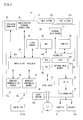
- FIG 2 is a block diagram showing an electric configuration of the video game system 10 shown in Figure 1 embodiment. Although illustration is omitted, respective components within the housing 14 are mounted on a printed board.
- the game apparatus 12 has a CPU 40.
- the CPU 40 functions as a game processor.
- the CPU 40 is connected with a system LSI 42.
- the system LSI 42 is connected with an external main memory 46, a ROM/RTC 48, a disk drive 54, and an AV IC 56.
- the external main memory 46 is utilized as a work area and a buffer area of the CPU 40 by storing programs like a game program, etc. and various data.
- the ROM/RTC 48 which is a so-called boot ROM, is incorporated with a program for activating the game apparatus 12, and is provided with a time circuit for counting a time.
- the disk drive 54 reads program data, texture data, etc. from the optical disk 18, and writes them in an internal main memory 42e described later or the external main memory 46 under the control of the CPU 40.
- the system LSI 42 is provided with an input-output processor 42a, a GPU (Graphics Processor Unit) 42b, a DSP (Digital Signal Processor) 42c, a VRAM 42d and an internal main memory 42e, and these are connected with one another by internal buses although illustration is omitted.
- a GPU Graphics Processor Unit
- DSP Digital Signal Processor
- the input-output processor (I/O processor) 42a executes transmitting and receiving data and executes downloading of the data. Reception and transmission and download of the data are explained in detail later.
- the GPU 42b is made up of a part of a drawing means, and receives a graphics command (construction command) from the CPU 40 to generate game image data according to the command. Additionally, the CPU 40 applies an image generating program required for generating game image data to the GPU 42b in addition to the graphics command.
- the GPU 42b is connected with the VRAM 42d as described above.
- the GPU 42b accesses the VRAM 42d to acquire data (image data: data such as polygon data, texture data, etc.) required to execute the construction command. Additionally, the CPU 40 writes image data required for drawing to the VRAM 42d via the GPU 42b.
- the GPU 42b accesses the VRAM 42d to create game image data for drawing.
- the DSP 42c functions as an audio processor, and generates audio data corresponding to a sound, a voice, music, or the like to be output from the speaker 34a by means of the sound data and the sound wave (tone) data stored in the internal main memory 42e and the external main memory 46.
- the game image data and audio data generated as described above are read by the AV IC 56, and output to the monitor 34 and the speaker 34a via the AV connector 58. Accordingly, a game screen is displayed on the monitor 34, and a sound (music) necessary for the game is output from the speaker 34a.
- the input-output processor 42a is connected with a flash memory 44, a wireless communication module 50 and a wireless controller module 52, and is also connected with an expansion connector 60 and a connector for memory card 62.
- the wireless communication module 50 is connected with an antenna 50a
- the wireless controller module 52 is connected with an antenna 52a.
- the input-output processor 42a can communicate with other game apparatuses and various servers to be connected to a network via a wireless communication module 50. It should be noted that it is possible to directly communicate with another game apparatus without going through the network.
- the input-output processor 42a periodically accesses the flash memory 44 to detect the presence or absence of data (referred to as data to be transmitted) being required to be transmitted to a network, and transmits it to the network via the wireless communication module 50 and the antenna 50a in a case that data to be transmitted is present. Furthermore, the input-output processor 42a receives data (referred to as received data) transmitted from another game apparatuses via the network, the antenna 50a and the wireless communication module 50, and stores the received data in the flash memory 44.
- the input-output processor 42a can receive data (download data) downloaded from the download server via the network, the antenna 50a and the wireless communication module 50, and store the download data in the flash memory 44.
- the input-output processor 42a receives input data transmitted from the controller 22 and the load controller 36 via the antenna 52a and the wireless controller module 52, and (temporarily) stores it in the buffer area of the internal main memory 42e or the external main memory 46.
- the input data is erased from the buffer area after being utilized in game processing by the CPU 40.
- the wireless controller module 52 makes communications with the controller 22 and the load controller 36 in accordance with Bluetooth standards.
- Figure 2 collectively shows the controller 22 and the load controller 36.
- the input-output processor 42a is connected with the expansion connector 60 and the connector for memory card 62.
- the expansion connector 60 is a connector for interfaces, such as USB, SCSI, etc., and can be connected with medium such as an external storage, and peripheral devices such as another controller.
- the expansion connector 60 is connected with a cable LAN adaptor, and can utilize the cable LAN in place of the wireless communication module 50.
- the connector for memory card 62 can be connected with an external storage like a memory card.
- the input-output processor 42a accesses the external storage via the expansion connector 60 and the connector for memory card 62 to store and read the data.
- the game apparatus 12 (housing 14) is furnished with the power button 20a, the reset button 20b, and the eject button 20c.
- the power button 20a is connected to the system LSI 42.
- the system LSI 42 sets a mode of a normal energized state (referred to as "normal mode") in which the respective components of the game apparatus 12 are supplied with power through an AC adapter not shown.
- the power button 20a is turned off, the system LSI 42 sets a mode in which a part of the components of the game apparatus 12 is supplied with power, and the power consumption is reduced to minimum (hereinafter referred to as "standby mode").
- the system LSI 42 issues an instruction to stop supplying the power to the components except for the input-output processor 42a, the flash memory 44, the external main memory 46, the ROM/RTC 48 and the wireless communication module 50, and the wireless controller module 52. Accordingly, the standby mode is a mode in which the CPU 40 never executes an application.
- a fan is provided for excluding heat of the IC, such as the CPU 40, the system LSI 42, etc. to outside. In the standby mode, the fan is also stopped.
- switching between the normal mode and the standby mode can be performed by turning on and off the power switch 26h of the controller 22 by remote control. If the remote control is not performed, setting is made such that the power supply to the wireless controller module 52 is not performed in the standby mode.
- the reset button 20b is also connected with the system LSI 42. When the reset button 20b is pushed, the system LSI 42 restarts the activation program of the game apparatus 12.
- the eject button 20c is connected to the disk drive 54. When the eject button 20c is pushed, the optical disk 18 is ejected from the disk drive 54.
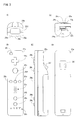
- Figure 3 (A) to Figure 3 (E) shows one example of an external appearance of the controller 22.
- Figure 3 (A) shows a front end surface of the controller 22
- Figure 3 (B) shows a top surface of the controller 22
- Figure 3 (C) shows a right side surface of the controller 22
- Figure 3 (D) shows a lower surface of the controller 22
- Figure 3 (E) shows a back end surface of the controller 22.
- the controller 22 has a housing 22a formed by plastic molding, for example.
- the housing 22a is formed into an approximately rectangular parallelepiped shape and has a size to be held by one hand of a user.
- the housing 22a (controller 22) is provided with the input means (a plurality of buttons or switches) 26.
- the input means a plurality of buttons or switches
- FIG 3 (B) on an upper face of the housing 22a, there are provided a cross key 26a, a 1 button 26b, a 2 button 26c, an A button 26d, a - button 26e, a HOME button 26f, a + button 26g and a power switch 26h.
- an inclined surface is formed on a lower surface of the housing 22a, and a B-trigger switch 26i is formed on the inclined surface.
- the cross key 26a is a four directional push switch, including four directions of front (or upper), back (or lower), right and left operation parts. By operating any one of the operation parts, it is possible to instruct a moving direction of a character or object (player character or player object) that is be operable by a player or instruct the moving direction of a cursor.
- the 1 button 26b and the 2 button 26c are respectively push button switches, and are used for a game operation, such as adjusting a viewpoint position and a viewpoint direction on displaying the 3D game image, i.e. a position and an image angle of a virtual camera.
- the 1 button 26b and the 2 button 26c can be used for the same operation as that of the A-button 26d and the B-trigger switch 26i or an auxiliary operation.
- the A-button switch 26d is the push button switch, and is used for causing the player character or the player object to take an action other than that instructed by a directional instruction, specifically arbitrary actions such as hitting (punching), throwing, grasping (acquiring), riding, and jumping, etc.
- a directional instruction specifically arbitrary actions such as hitting (punching), throwing, grasping (acquiring), riding, and jumping, etc.
- an action game it is possible to give an instruction to jump, punch, move a weapon, and so forth.
- RPG roll playing game
- simulation RPG it is possible to give an instruction to acquire an item, select and determine the weapon and command, and so forth.
- the - button 26e, the HOME button 26f, the + button 26g, and the power supply switch 26h are also push button switches.
- the - button 26e is used for selecting a game mode.
- the HOME button 26f is used for displaying a game menu (menu screen).
- the + button 26g is used for starting (re-starting) or pausing the game.
- the power supply switch 26h is used for turning on/off a power supply of the game apparatus 12 by remote control.
- the power supply switch for turning on/off the controller 22 itself is not provided, and the controller 22 is set at on-state by operating any one of the switches or buttons of the input means 26 of the controller 22, and when not operated for a certain period of time (30 seconds, for example) or more, the controller 22 is automatically set at off-state.
- the B-trigger switch 26i is also the push button switch, and is mainly used for inputting a trigger such as shooting and designating a position selected by the controller 22. In a case that the B-firigger switch 26i is continued to be pushed, it is possible to make movements and parameters of the player object constant. In a fixed case, the B-trigger switch 26i functions in the same way as a normal B-button, and is used for canceling the action determined by the A-button 26d.
- an external expansion connector 22b is provided on a back end surface of the housing 22a, and as shown in Figure 3 (B) , an indicator 22c is provided on the top surface and the side of the back end surface of the housing 22a.
- the external expansion connector 22b is utilized for connecting another expansion controller not shown.
- the indicator 22c is made up of four LEDs, for example, and shows identification information (controller number) of the controller 22 corresponding to the lighting LED by lighting any one of the four LEDs, and shows the remaining amount of power of the controller 22 depending on the number of LEDs to be emitted.
- the controller 22 has an imaged information arithmetic section 80 (see Figure 4 ), and as shown in Figure 3 (A) , on the front end surface of the housing 22a, a light incident opening 22d of the imaged information arithmetic section 80 is provided. Furthermore, the controller 22 has a speaker 86 (see Figure 4 ), and the speaker 86 is provided inside the housing 22a at the position corresponding to a sound release hole 22e between the 1 button 26b and the HOME button 26f on the tope surface of the housing 22a as shown in Figure 3 (B) .
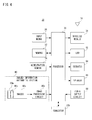
- FIG 4 is a block diagram showing an electric configuration of the controller 22.
- the controller 22 includes a processor 70, and the processor 70 is connected with the external expansion connector 22b, the input means 26, a memory 72, an acceleration sensor 74, a wireless communication module 76, the imaged information arithmetic section 80, an LED 82 (the indicator 22c), an vibrator 84, a speaker 86, and a power supply circuit 88 by an internal bus (not shown).
- an antenna 78 is connected to the wireless communication module 76.
- the processor 70 is in charge of an overall control of the controller 22, and transmits (inputs) information (input information) inputted by the input means 26, the acceleration sensor 74, and the imaged information arithmetic section 80 as input data, to the game apparatus 12 via the wireless communication module 76 and the antenna 78. At this time, the processor 70 uses the memory 72 as a working area or a buffer area.
- An operation signal (operation data) from the aforementioned input means 26 (26a to 26i) is inputted to the processor 70, and the processor 70 stores the operation data once in the memory 72.
- the acceleration sensor 74 detects each acceleration of the controller 22 in directions of three axes of vertical direction (y-axial direction), lateral direction (x-axial direction), and forward and rearward directions (z-axial direction).
- the acceleration sensor 74 is typically an acceleration sensor of an electrostatic capacity type, but the acceleration sensor of other type may also be used.
- the acceleration sensor 74 detects the accelerations (ax, ay, and az) in each direction of x-axis, y-axis, z-axis for each first predetermined time, and inputs the data of the acceleration (acceleration data) thus detected in the processor 70.
- the acceleration sensor 74 detects the acceleration in each direction of the axes in a range from -2.0g to 2.0g (g indicates a gravitational acceleration. The same thing can be said hereafter.)
- the processor 70 detects the acceleration data given from the acceleration sensor 74 for each second predetermined time, and stores it in the memory 72 once.
- the processor 70 creates input data including at least one of the operation data, acceleration data and marker coordinate data as described later, and transmits the input data thus created to the game apparatus 12 for each third predetermined time (5 msec, for example).
- the acceleration sensor 74 is provided inside the housing 22a and in the vicinity on the circuit board where the cross key 26a is arranged.
- the wireless communication module 76 modulates a carrier of a predetermined frequency by the input data, by using a technique of Bluetooth, for example, and emits its weak radio wave signal from the antenna 78. Namely, the input data is modulated to the weak radio wave signal by the wireless communication module 76 and transmitted from the antenna 78 (controller 22). The weak radio wave signal is received by the radio controller module 52 provided to the aforementioned game apparatus 12. The weak radio wave thus received is subjected to demodulating and decoding processing. This makes it possible for the game apparatus 12 (CPU 40) to acquire the input data from the controller 22. Then, the CPU 40 performs game processing, following the input data and the program (game program).
- a technique of Bluetooth for example
- the controller 22 is provided with the imaged information arithmetic section 80.
- the imaged information arithmetic section 80 is made up of an infrared rays filter 80a, a lens 80b, an imager 80c, and an image processing circuit 80d.
- the infrared rays filter 80a passes only infrared rays from the light incident from the front of the controller 22.
- the markers 340m and 340n placed near (around) the display screen of the monitor 34 are infrared LEDs for outputting infrared lights ahead of the monitor 34. Accordingly, by providing the infrared rays filter 80a, it is possible to image the image of the markers 340m and 340n more accurately.
- the lens 80b condenses the infrared rays passing thorough the infrared rays filter 80a to emit them to the imager 80c.
- the imager 80c is a solid imager, such as a CMOS sensor and a CCD, for example, and images the infrared rays condensed by the lens 80b. Accordingly, the imager 80c images only the infrared rays passing through the infrared rays filter 80a to generate image data.
- the image imaged by the imager 80c is called an "imaged image”.
- the image data generated by the imager 80c is processed by the image processing circuit 80d.
- the image processing circuit 80d calculates a position of an object to be imaged (markers 340m and 340n) within the imaged image, and outputs each coordinate value indicative of the position to the processor 70 as imaged data for each fourth predetermined time. It should be noted that a description of the process in the image processing circuit 80d is made later.
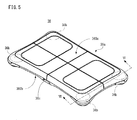
- FIG 5 is a perspective view showing an appearance of the load controller 36 shown in Figure 1 .
- the load controller 36 includes a board 36a on which a player rides (a player puts his or her foot) and at least four load sensors 36b that detect loads applied on the board 36a.
- the load sensors 36b are accommodated in the board 36a (see Figure 6 and Figure 7 ), and the arrangement of the load sensors 36b is shown by dotted line in Figure 5 .
- the board 36a is formed in a substantially rectangle, and the board 36a has a substantially rectangular shape when viewed from above. For example, a short side of the rectangular is set in the order of 30 cm, and a long side thereof is set in the order of 50 cm. An upper surface of the board 36a on which the player rides is formed in flat. Side faces at four corners of the board 36a are formed so as to be partially projected in a cylindrical shape.
- the four load sensors 36b are arranged at predetermined intervals.
- the four load sensors 36b are arranged in peripheral portions of the board 36a, specifically, at the four corners.
- the interval between the load sensors 36b is set an appropriate value such that player's intention can accurately be detected for the load applied to the board 36a in a game manipulation.
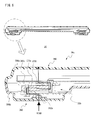
- Figure 6 shows a sectional view taken along the line VI-VI of the load controller 36 shown in Figure 5 , and also shows an enlarged corner portion disposed in the load sensor 36b.
- the board 36a includes a support plate 360 on which the player rides and legs 362.
- the legs 362 are provided at positions where the load sensors 36b are arranged. In the embodiment, because the four load sensors 36b are arranged at four corners, the four legs 362 are provided at the four corners.
- the leg 362 is formed in a cylindrical shape with bottom by, e.g., plastic molding.
- the load sensor 36b is placed on a spherical part 362a provided in the bottom of the leg 362.
- the support plate 360 is supported by the leg 362 while the load sensor 36b is interposed.
- the support plate 360 includes an upper-layer plate 360a that constitutes an upper surface and an upper side face, a lower-layer plate 360b that constitutes a lower surface and a lower side face, and an intermediate-layer plate 360c provided between the upper-layer plate 360a and the lower-layer plate 360b.
- the upper-layer plate 360a and the lower-layer plate 360b are formed by plastic molding and integrated with each other by bonding.
- the intermediate-layer plate 360c is formed by pressing one metal plate.
- the intermediate-layer plate 360c is fixed onto the four load sensors 36b.
- the upper-layer plate 360a has a lattice-shaped rib (not shown) in a lower surface thereof, and the upper-layer plate 360a is supported by the intermediate-layer plate 360c while the rib is interposed.
- the load sensor 36b is formed by, e.g., a strain gage (strain sensor) type load cell, and the load sensor 36b is a load transducer that converts the input load into an electric signal.
- a strain inducing element 370a is deformed to generate a strain according to the input load.
- the strain is converted into a change in electric resistance by a strain sensor 370b adhering to the strain inducing element 370a, and the change in electric resistance is converted into a change in voltage. Accordingly, the load sensor 36b outputs a voltage signal indicating the input load from an output terminal.
- load sensors such as a folk vibrating type, a string vibrating type, an electrostatic capacity type, a piezoelectric type, a magneto-striction type, and gyroscope type may be used as the load sensor 36b.
- the load controller 36 is further provided with a power button 36c.
- the power button 36c When the power button 36c is turned on, power is supplied to the respective circuit components (see Figure 7 ) of the load controller 36.
- the load controller 36 may be turned on in accordance with an instruction from the game apparatus 12.
- the power of the load controller 36 is turned off when a state that the player does not ride continues for a given time of period (30 seconds, for example).
- the power may be turned off when the power button 36c is turned on in a state that the load controller 36 is activated.
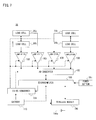
- Figure 7 is a block diagram showing an example of an electric configuration of the load controller 36.
- the signal and communication stream are indicated by solid-line arrows, and electric power supply is indicated by broken-line arrows.
- the load controller 36 includes a microcomputer 100 that controls an operation of the load controller 36.
- the microcomputer 100 includes a CPU, a ROM and a RAM (not shown), and the CPU controls the operation of the load controller 36 according to a program stored in the ROM.
- the microcomputer 100 is connected with the power button 36c, the A/D converter 102, a DC-DC converter 104 and a wireless module 106.
- the wireless module 106 is connected with an antenna 106a.
- the four load sensors 36b are displayed as a load cell 36b in Figure 3 . Each of the four load sensors 36b is connected to the A/D converter 102 via an amplifier 108.
- the load controller 36 is provided with a battery 110 for power supply.
- an AC adapter in place of the battery is connected to supply a commercial power supply.
- a power supply circuit has to be provided for converting alternating current into direct current and stepping down and rectifying the direct voltage in place of the DC-DC converter.
- the power supply to the microcomputer 100 and the wireless module 106 are directly made from the battery. That is, power is constantly supplied to a part of the component (CPU) inside the microcomputer 100 and the wireless module 106 to thereby detect whether or not the power button 36c is turned on, and whether or not a power-on (load detection) command is transmitted from the game apparatus 12.
- power from the battery 110 is supplied to the load sensor 36b, the A/D converter 102 and the amplifier 108 via the DC-DC converter 104.
- the DC-DC converter 104 converts the voltage level of the direct current from the battery 110 into a different voltage level, and applies it to the load sensor 36b, the A/D converter 102 and the amplifier 108.
- the electric power may be supplied to the load sensor 36b, the A/D converter 102, and the amplifier 108 if needed such that the microcomputer 100 controls the DC-DC converter 104. That is, when the microcomputer 100 determines that a need to operate the load sensor 36b to detect the load arises, the microcomputer 100 may control the DC-DC converter 104 to supply the electric power to each load sensor 36b, the A/D converter 102, and each amplifier 108.
- each load sensor 36b outputs a signal indicating the input load.
- the signal is amplified by each amplifier 108, and the analog signal is converted into digital data by the A/D converter 102. Then, the digital data is inputted to the microcomputer 100.
- Identification information on each load sensor 36b is imparted to the detection value of each load sensor 36b, allowing for distinction among the detection values of the load sensors 36b.
- the microcomputer 100 can obtain the pieces of data indicating the detection values of the four load sensors 36b at the same time.
- the microcomputer 100 determines that the need to operate the load sensor 36b does not arise, i.e., when the microcomputer 100 determines it is not the time the load is detected, the microcomputer 100 controls the DC-DC converter 104 to stop the supply of the electric power to the load sensor 36b, the A/D converter 102 and the amplifier 108.
- the load sensor 36b is operated to detect the load only when needed, so that the power consumption for detecting the load can be suppressed.
- the time the load detection is required shall means the time the game apparatus 12 ( Figure 1 ) obtains the load data.
- the game apparatus 12 transmits a load obtaining command to the load controller 36.
- the microcomputer 100 controls the DC-DC converter 104 to supply the electric power to the load sensor 36b, etc., thereby detecting the load.
- the microcomputer 100 controls the DC-DC converter 104 to stop the electric power supply.
- the microcomputer 100 determines it is the time the load is detected at regular time interval, and the microcomputer 100 may control the DC-DC converter 104.
- information on the period may initially be imparted from the game machine 12 to the microcomputer 100 or previously stored in the microcomputer 100.
- the data indicating the detection value from the load sensor 36b is transmitted as the manipulation data (input data) of the load controller 36 from the microcomputer 100 to the game apparatus 12 ( Figure 1 ) through the wireless module 106 and the antenna 106a.
- the microcomputer 100 transmits the detection value data to the game apparatus 12 when receiving the detection value data of the load sensor 36b from the A/D converter 102.
- the microcomputer 100 may transmit the detection value data to the game apparatus 12 at regular time intervals.
- the wireless module 106 can communicate by a radio standard (Bluetooth, wireless LAN, etc.) the same as that of the radio controller module 52 of the game apparatus 12. Accordingly, the CPU 40 of the game apparatus 12 can transmit a load obtaining command to the load controller 36 via the radio controller module 52, etc.
- the microcomputer 100 of the load controller 36 can receive a command from the game apparatus 12 via the wireless module 106 and the antenna 106a, and transmit input data including load detecting values (or load calculating values) of the respective load sensors 36b to the game apparatus 12.
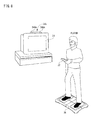
- FIG 8 is an illustrative view roughly explaining a state in which the virtual game is played using the controller 22 and load controller 36.
- the player grasps the controller 22 in one hand while riding on the load controller 36.
- the player grasps the controller 22 with the front-end surface (the side of the incident port 22d to which the light imaged by the imaged information arithmetic section 80 is incident) of the controller 22 orientated toward the markers 340m and 340n while riding on the load controller 36.
- the markers 340m and 340n are disposed in parallel with the crosswise direction of the screen of the monitor 34. In this state of things, the player changes the position on the screen indicated by the controller 22 or the distance between the controller 22 and the marker 340m or 340n to perform the game manipulation.
- the load controller 36 is vertically placed such that the player turns sideways with respect to the screen of the monitor 34, but depending on the game, the load controller 36 may be horizontally placed such that the player turns front with respect to the screen of the monitor 34.
- Figure 9 is an illustrative view for explaining view angles of the markers 340m and 340n and controller 22.
- the markers 340m and 340n each emit the infrared ray in a range of a view angle ⁇ 1.
- the imager 80c of the imaged information arithmetic section 80 can receive the incident light in a range of a view angle ⁇ 2 around a visual axis direction of the controller 22.
- each of the markers 340m and 340n has the view angle ⁇ 1 of 34° (half-value angle), and the imager 80c has the view angle ⁇ 2 of 41°.
- the player grasps the controller 22 such that the imager 80c is set to the position and orientation at which the infrared rays can be received from the two markers 340m and 340n. Specifically, the player grasps the controller 22 such that at least one of the markers 340m and 340n exists in the view angle ⁇ 2 of the imager 80c while the controller 22 exists in the view angle ⁇ 1 of at least one of the markers 340m and 340n. In this state, the controller 22 can detect at least one of the markers 340m and 340n. The player can change the position and orientation of the controller 22 to perform the game manipulation in the range satisfying this state.
- the images of the markers 340m and 340n are taken by the imaged information arithmetic section 80. That is, the imaged image obtained by the imager 80c includes the images (target images) of the markers 340m and 340n that are of the imaging target.
- Figure 10 is a view showing an example of the imaged image including the target image.
- the image processing circuit 80d uses the image data of the imaged image including the target image, the image processing circuit 80d computes the coordinate (marker coordinate) indicating the position in the imaged images of the markers 340m and 340n.
- the image processing circuit 80d detects the high-brightness portion as a candidate of the target image. Then, the image processing circuit 80d determines whether or not the high-brightness portion is the target image based on the size of the detected high-brightness portion.
- the imaged image includes not only images 340m' and 340n' corresponding to the two markers 340m and 340n that are of the target image but also the image except for the target image due to the sunlight from a window or a fluorescent light.
- the processing of the determination whether or not the high-brightness portion is the target image is performed in order to distinguish the images 340m' and 340n' of the makers 340m and 340n that are of the target image from other images to exactly detect the target image. Specifically, the determination whether or not the detected high-brightness portion has the size within a predetermined range is made in the determination processing. When the high-brightness portion has the size within the predetermined range, it is determined that the high-brightness portion indicates the target image. On the contrary, when the high-brightness portion does not have the size within the predetermined range, it is determined that the high-brightness portion indicates the image except for the target image.
- the image processing circuit 80d computes the position of the high-brightness portion for the high-brightness portion in which it is determined indicate the target image as a result of the determination processing. Specifically, a position of the center of gravity of the high-brightness portion is computed.
- the coordinate of the position of the center of gravity is referred to as marker coordinate.
- the position of the center of gravity can be computed in more detail compared with resolution of the imager 80c. At this point, it is assumed that the image taken by the imager 80c has the resolution of 126x96 and the position of the center of gravity is computed in a scale of 1024x768. That is, the marker coordinate is expressed by an integer number of (0, 0) to (1024, 768).
- the position in the imaged image is expressed by a coordinate system (XY-coordinate system) in which an origin is set to an upper left of the imaged image, a downward direction is set to a positive Y-axis direction, and a rightward direction is set to a positive X-axis direction.
- XY-coordinate system a coordinate system in which an origin is set to an upper left of the imaged image, a downward direction is set to a positive Y-axis direction, and a rightward direction is set to a positive X-axis direction.
- the image processing circuit 80d outputs the pieces of data indicating the two computed marker coordinates. As described above, the outputted pieces of marker coordinate data are added to the input data by the processor 70 and transmitted to the game apparatus 12.
- the game apparatus 12 When the game apparatus 12 (CPU 40) detects the marker coordinate data from the received input data, the game apparatus 12 can compute the position (indicated coordinate) indicated by the controller 22 on the screen of the monitor 34 and the distances between the controller 22 and the markers 340m and 340n based on the marker coordinate data. Specifically, the position toward which the controller 22 is orientated, i.e., the indicated position is computed from the position at the midpoint of the two marker coordinates. The distance between the target images in the imaged image is changed according to the distances between the controller 22 and the markers 340m and 340n, and therefore, by computing the distance between the marker coordinates, the game apparatus 12 can compute the current distances between the controller 22 and the markers 340m and 340n.
- game processing can be executed on the basis of a load value detected in the load controller 36.
- load values of the four load sensors 36b in a state the player is in a static state are detected by the load controller 36, from the detected four load values, a body weight value of the player is calculated (measured), the measured body weight value is set as a reference value (stored in the main memory 42e or 46), and the game processing is executed on the basis of the set reference value and the load value detected during execution of the virtual game (total value of the load values detected by the four load sensors 36b in this embodiment), for example.
- the body weight value of the player becomes a reference value in a case that the game processing is executed.
- the game processing is executed according to the value (hereinafter referred to as "weight ratio") obtained by dividing the current load value by the reference value.
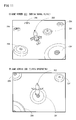
- Figure 11(A) and Figure 11(B) each shows an example of a game screen 200 to be displayed on the monitor 34 in a case of playing the virtual game of this embodiment.
- Figure 11(A) shows the game screen 200 when the player object 202 flies in the sky with its wings flapping (during normal flying).
- Figure 11(B) shows the game screen 200 when the player object 202 descends with its wings spread widely in an upstanding state almost in order to land in a non player object 204 (during descending).
- the player object 202 is displayed, and a plurality of non player objects 204 are displayed.
- the player object (game character) 202 is an object (moving image object) imitating a bird.
- the non player object 204 is an object as a target to be landed by the player object 202.
- the player object 202 moves (flies) according to an operation by the player, and aims at a final target position (goal) while landing in the plurality of non player objects 204.
- the game is to be cleared.
- the time limit expires before the player object 202 arrives at the goal, when a certain period of time (10 seconds, for example) elapses after the player object 202 falls in the sea surrounding the non player object 204, or when the player object 202 falls by fixed number of times (three times, for example), the game is over.
- the player rides on the load controller 36, and moves his or her both hands up and down as if a bird flaps (performs a flapping operation).
- the load value detected by the load controller 36 is varied.
- the weight ratio WR is also varied.
- the movement of the player object 202 is controlled.
- the moving amount (moving velocity) of the player object 202 is controlled depending on the strength (change amount of the weight ratio WR) of the swing of the hands (arms) when the player performs a flapping motion, and the moving direction of the player object 202 is controlled in correspondence with a barycentric position of the player on the load controller 36.
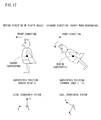
- the player object 202 when the player performs a motion of largely flapping (large-flapping motion), the player object 202 is also displayed by the animation of a large-flapping motion on the monitor 34, and when the player performs a motion of small flapping (small-flapping motion), the player object 202 is also displayed by the animation of a small-flapping motion on the monitor 34.
- the animation of the large-flapping motion is set to make the movable range (movable range in the up and down direction) of the wings wider (larger) in comparison with the animation of the small-flapping motion.
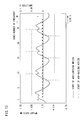
- Figure 13 shows one example of a graph of a time variation of the weight ratio WR when the player performs a large-flapping motion shown in Figure 12(A) .
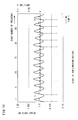
- Figure 14 shows one example of a graph of a variation of the weight ratio WR when the player performs a small-flapping motion shown in Figure 12(B) .
- the time variation of the weight ratio WR is indicated by a solid line waveform.
- the upper side of the graph is a side where the load of the player detected by the load controller 36 is added, and on the lower side of the graph is a side where the load of the player detected by the load controller 36 is reduced.
- a time interval shall be dt (seconds)
- the frequencies f are 1/(x ⁇ dt) intervals.
- x 30
- dt 1/60 (game frame)
- the frequencies f (Hz) is 2 intervals. Accordingly, the value obtained by doubling the index number n becomes the frequency f (Hz).
- the game frame is a screen updating rate.
- the amplitude A sometimes becomes the maximum value due to the influence of a noise.
- an animation is selected depending on the kind of the flapping motion, and selected animation is reproduced. Accordingly, as described above, according to the flapping motion of the player, an animation showing the flapping motion of the player object 202 is displayed on the monitor 34.
- the player riding on the load controller 36 performs a flapping motion, so that the load value detected by the load controller 36 is varied, and the weight ratio WR is also varied.
- the load value detected by the load controller 36 is cyclically varied similar to a case that the player performs a flapping motion.
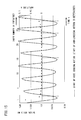
- One example of the graph of a time variation of the weight ratio WR is shown in Figure 15 . As can be understood by comparison with Figure 13 or Figure 15 , in a case that the bending and stretching exercises is performed, the variation of the weight ratio WR is made larger in comparison with a case that a flapping motion is performed.
- a driving force depending on the magnitude of the weight ratio WR (negative value) is given to the player object 202, and by the driving force, the player object 202 moves within the three-dimensional virtual space.
- a driving force larger than a case that the player performs a flapping motion can be applied to the player object 202 to thereby allow the player object 202 to be moved largely.
- such the bending and stretching exercises is not an operation method that the developer, et al. intends to.
- a section from the start of the last-but-one-arm-lowering motion to the start of the previous (immediately-preceding)-arm-lowering motion is recognized as an immediately-preceding -flapping motion (flapping section).
- the start point of an arm-lowering motion is represented by alternate long and short dash lines.
- the arm-lowering motion means a motion of lowering the both hands or the arms down in the flapping motion. The determination method of the start of the arm-lowering motion is explained in detail later.
- a driving force Acc based on the weight ratio WR is applied to the player object 202.
- the driving force Acc is calculated according to Equation 2.
- the weight ratio WR is less than a predetermined threshold value (0.985 in this embodiment).
- the driving force Acc is given when the weight ratio WR is less than the predetermined threshold value and the driving force Acc is reflected on the movement of the player object 202 every one game frame, so that the longer the time during which the weight ratio WR is less than the predetermined threshold value is, that is, the longer the one cycle of the flapping motion is, such as a large-flapping motion, the more the number of obtainments of the driving force Acc is.
- a large driving force Acc is applied to the player object 202, and thus, a moving distance or a moving velocity of the player object 202 is increased (see Equation 3 and Equation 4).
- the driving force Acc calculated in the Equation 2 is a scalar quantity, but in the three-dimensional virtual space, a unit vector (Y vector)AccDir extending from the head directly above in a state that the player object 202 stands still is multiplied by the scalar quantity which is transformed into a value (Accsim) utilized in an integration simulation.
- the unit vector AccDir is decided by rotating the player object 202 about the x-axis and the y-axis of the local coordinates in correspondence with the barycentric position of the player as described later.
- the position (three-dimensional position) Pos of the player object 202 after movement is calculated according to Equation 3 and Equation 4 on the basis of the driving force Acc.
- the player object 202 is moved to a direction the head turns to, that is, the direction of the unit vector AccDir in the current game frame (current frame).
- a velocity of the player object 202 in a next game frame shall be Vel_new
- a velocity before movement that is, the velocity in the current frame shall be Vel_old
- a gravitational acceleration vector in the three-dimensional virtual space shall be Gravity
- a three-dimensional position in the current frame shall be Pos_old
- a three-dimensional position in the next frame shall be Pos_new.
- an acceleration vector (AccBoard ⁇ FallTransDir) in a case that the player object 202 moves in a forward and backward direction during descending is reflected on the velocity in the next frame Vel_new.
- the AccBoard is a translational acceleration (acceleration in the horizontal direction)
- the FallTransDir is a direction vector in a translational direction (horizontal direction) (vector of the front direction or back direction of the player object 202).
- Vel_new Vel_old + AccSim ⁇ AccDir + AccBoard ⁇ FallTransDir + Gravity ⁇ 0. 994
- Pos_new Pos_old + Vel_new
- the gravitational acceleration vector Gravity shall be (0, -0.014, 0).
- the distance 1m in the real world shall be a distance 10 within the three-dimensional virtual space, but when the gravitational acceleration Gravity is set in correspondence with the ratio, it is difficult to obtain enough driving force to fly the player object 202 by the flapping motion of the player, and therefore, the gravitational acceleration Gravity is set to a relatively smaller value empirically obtained by experiments, etc.
- 0.994 is air resistance. This is not required to be a constant, and may be variably set in correspondence to the progress of the virtual game.
- the velocity in the next frameVel_new can be obtained by adding the acceleration vector ((AccSimxAccDir) or (AccBoardxFallTransDir)) and the gravitational acceleration vector Gravity to the velocity in the current frame Vel_old and then multiplying the added value by the air resistance.
- the coordinate in the next frame Pos_new is obtained by adding the velocity in the next frameVel_new to the coordinate in the current frame Pos old. This is obtained as a result of integrating the driving force AccSim to be used in the simulation (twice integration).
- the acceleration vector (AccBoardxFallTransDir) of the player object 202 in the forward and backward direction during descending becomes 0 according to the Equation 3.
- each element of the determinant A shown in Figure 6 means as follows.
- An element (Xx, Xy, Xz) is a direction to which an x-axis of the local coordinate of the player object 202 is applied
- an element (Yx, Yy, Yz) is a direction to which a y-axis of the local coordinate of the player object 202 is applied
- an element (Zx, Zy, Zz) is a direction to which a z-axis of the local coordinates of the player object 202 is applied
- an element (Px, Py, Pz) is world coordinate (three-dimensional coordinate) where the center (gravity) of the local coordinate of the player object 202 is placed.
- A Xx Yx Zx Px Xy Yy Zy Py Xz Yz Zz Pz
- the direction of travel (moving direction) of the player object 202 is decided (controlled).
- the center of the top surface (surface of the upper-layer plate 360a of the support plate 360) of the load controller 36 that is, the center of the range of detection of the barycentric position is set to the origin point O (0, 0), and the orientation (moving direction) of the head of the player object 202 is decided by a shift length of the barycentric position from the origin point O in a horizontal plane.
- a horizontal direction of the support plate 360 of the load controller 36 is an x-axis direction of the range of detection, and a vertical direction thereof is a y-axis direction of the range of detection.
- the direction of the face when the player correctly rides on the load controller 36 (front direction) is an upper direction of the paper in Figure 16(A) .
- a right direction of the range of detection is a plus direction of the x-axis, and an upper direction of the range of detection is a plus direction of the y-axis.
- the load detection value at the upper left of the load sensor 36b is R1
- the load detection value at the lower left of the load sensor 36b is R2
- the load detection value at the upper right of the load sensor 36b is R3
- the load detection value at the lower right of the load sensor 36b is R4
- an x coordinate (XG) of the barycenter in the coordinate system of the range of detection is calculated on the basis of the difference between the right load value and the left load value
- a y coordinate (YG) of the barycenter is calculated on the basis of the difference between the upper load value and the lower load value.
- the x coordinate (XG) of the barycenter is calculated according to Equation 7, and the y coordinate of the barycenter (YG) is calculated according to Equation 8.
- XG R ⁇ 3 + R ⁇ 4 - R ⁇ 1 + R ⁇ 2 ⁇ k ⁇ 1
- YG R ⁇ 1 + R ⁇ 3 - R ⁇ 2 + R ⁇ 4 ⁇ k ⁇ 2
- k1, k2 are constants. Noted that -1 ⁇ XG ⁇ 1, -1 ⁇ YG ⁇ 1.
- the center of the range of detection of the load controller 36 is set to be the origin point O, but a standing position is different from player to player, and therefore, the barycentric position when the player rides on the load controller 36 and measure the body weight value may be set to the origin point O.
- a controlling method of the moving direction is differentiated between when the player object 202 descends and does not descend. Each case is explained in detail hereafter.
- the player object 202 rotates in the right and left direction according to the x coordinate of the barycentric position of the load detected by the load controller 36 and rotates in the forward and backward direction according to the y coordinate of the barycentric position.
- the player object 202 is rotated counterclockwise (to the left direction) about the y-axis of the local coordinate. Furthermore, in a case that the barycentric position is included in an area (II) or an area (IV) within the range of detection, and the x coordinate of the barycentric position is positive, the player object 202 is rotated clockwise (to the right direction) about the y-axis of the local coordinate.
- a counterclockwise rotation amount of the player object 202 about the y-axis of the local coordinates is decided according to the negative value of the x-coordinate of the barycentric position
- a clockwise rotation amount of the player object 202 about the y-axis of the local coordinate is decided according to the positive value of the x-coordinate of the barycentric position.
- the rotation amount is proportional to the magnitude of the x-coordinate of the barycentric position.
- the player object 202 continues to rotate clockwise about the y-axis of the local coordinate.
- a lateral (horizontal) direction is an x-axis direction
- a longitudinal (vertical) direction is a y-axis direction
- a backward and forward (depth) direction is a z-axis direction.
- each axis passes through the center or the barycenter of the player object 202.
- the left hand (left wing) direction is a plus direction of the x-axis of the local coordinate
- the upper direction is a plus direction of the y-axis of the local coordinate
- the forward direction is a plus direction of the z-axis of the local coordinate.
- the player object 202 is rotated about the x-axis of the local coordinate such that the head is inclined forward (front direction) as shown in Figure 17 .
- the inclination amount (rotation amount) to the front direction is proportion to the magnitude of the y-coordinate of the barycentric position, but the maximum inclination amount is 55 degrees from the standstill state of the player object 202.
- the player object 202 is rotated about the x-axis of the local coordinate backward. It should be noted that the maximum inclination amount of the player object 202 backward is set to 35 degrees. This is because of eliminating an undesired state in which the player object 202 flies with the belly upward.
- the player object 202 is rotated to the horizontal direction according to the x-coordinate of the barycentric position of the load detected by the load controller 36, and translated in the forward and backward direction according to the y-coordinate of the barycentric position.
- the player object 202 is moved (translated) in the forward and backward direction according to the y-coordinate of the barycentric position as shown in Figure 18 . That is, in such a case, the head of the player object 202 is not inclined. Furthermore, the moving amount (displacement amount) when the player object 202 is translated is decided by the magnitude of the y-coordinate of the barycentric position. The reason why the player object 202 is thus translated according to the y-coordinate of the barycentric position when descending is to make it easy to land the player object 202 in the non player object 204.
- the player object 202 In a case that the y-coordinate of the barycentric position is positive, the player object 202 is moved (translated) in the front direction. At this time, when the y-coordinate becomes large, the moving amount is also increased. On the other hand, in a case that the y-coordinate of the barycentric position is negative, the player object 202 translates in a direction opposite to the front direction (rear direction). At this time, when the y-coordinate becomes small, that is, becomes large in the negative direction, the moving amount is increased. It should be noted that the maximum value of the moving amount by the player object 202 for one game frame is set in advance.
- a start of a motion of raising the arms upward by the player is determined (arm-raising determination) while a start of a motion of lowering the arms downward (arm-lowering motion) is determined (arm-lowering determination). This is because of synchronizing the flapping motion of the player and the animation of the flapping motion of the player object 202.
- the weight ratio WR in the previous frame is smaller than the weight ratio WR in a last-but-one game frame (last but one frame), and the weight ratio WR in the current frame is equal to or more than the weight ratio WR in the previous frame by a certain value (0.001) or more, it is detected that the weight ratio WR is decreased and then increased, and moreover, in a case that the weight ratio WR in the previous frame is equal to or more than the certain value (0.98), it is determined that an arm-raising motion is started.
- the decrease of the weight ratio WR means that the weight ratio WR in the current frame is smaller than the weight ratio WR in the previous frame
- the increase of the weight ratio WR means that the weight ratio WR in the current frame is larger than the weight ratio WR in the previous frame.
- the reason why in a case of determining the start of an arm-raising motion, the weight ratio WR is equal to or more than the certain value is made as a condition is to prevent the start of the arm-raising motion in the vicinity of the minimum value, such as around 0.9, from being determined as shown in Figure 13 .
- a motion of raising the both hands (the both arms) as high as or higher than the shoulder is determined to be an "arm-raising motion". This is the "arm-raising motion" of the player intended by a developer, et al.
- the animation of the player object 202 is constructed of 60 frames irrespective of the kind (large or small) of flapping motion. As described above, the difference depending on the flapping kinds is only the size of a movable range of the wing.
- the synchronization between the flapping motion of the player and the animation of the flapping motion of the player object 202 is explained later as to the large-flapping motion, but this holds true for the small-flapping motion.
- the characteristic animation frames (0 (60), 7,15, 22, 30, 37, 45, 52, here) out of 60 frames (animation frame) as to the large-flapping animation are extracted.
- the animation frame starts from 0 to 59, and returns to 0 at the animation frame 60.
- the front direction of the player object 202 is a vertical direction with respect to the paper.
- the animation frame from 0 to 30 is represented, and on the lower line, the animation frame from 30 to 60 (0) is shown.
- the player object 202 when the animation frame is 0, the player object 202 spreads the wings in the horizontal direction, for example, and the angle formed by the wings with respect to the horizontal plane of the three-dimensional virtual space is 0 degrees.
- the player object 202 when the animation frame is reproduced, the player object 202 raises the wing from the spread state in the horizontal direction, and reaches the wings at the highest position when the animation frame is the 15th frame, and then lowers the wings. Then, the wings reach the lowest position when the animation frame is 45th frame, and then is raised to return to the initial state at the 60th frame (0th frame).
- an arm-lowering-acceleration-probable section (15-30th frames) is set in correspondence with an arm-lowering motion of the player object 202 or the animation frame (15-45th frames), and an arm-ralsing-acceleration-probable section (30-60th frames) is set in correspondence with an arm-raising motion of the player object 202 or the animation frame (45-15th frames). That is, the arm-lowering-acceleration-probable section is set from the start to the middle of the animation frame as the arm-lowering motion. Alternatively, the arm-raising-acceleration-probable section is set from the middle of the animation frame as to the arm-lowering motion to the middle of the animation frame as to the arm-raising motion.
- the arm-raising-acceleration-probable section includes the animation frame (30-45th frames) as to a part of the arm-lowering motion (preliminary motion for the arm-raising motion).
- the reasons why the arm-lowering-acceleration-probable section and the arm-raising-acceleration-probable section are set is described later, and are omitted here.
- the animation frame is 60 pieces (60 frames), the number of frames (fame number) may be designated by arithmetic point.
- the angle (angle formed by the horizontal plane) of the arms of the player object 202 is 0 degrees of the 0th frame in the animation frame, and the angle of the arms of the player object 202 in the first frame in the animation frame is 10 degrees, and when 0.5 is designated as a frame number, it is possible to obtain the player object 202 with 5 degrees of the angle of the arms. Accordingly, logically, the pose of the player object 202 can take limitless kinds.
- a method of taking a synchronization between the flapping motion of the player and the animation frame of the player object 202 there are an advancing method A of the animation frame when it is determined that the arm-lowering motion is started or after it is determined that the arm-lowering motion is started and an advancing method B of the animation frame when it is determined that an arm-raising motion is started or after it is determined that an arm-raising motion is started.
- the arm-raising motion is not determined, and therefore, the synchronization is taken only by the advancing method A of the animation frame. That is, in a case that the player performs a large-flapping motion intended by the developer, et al.
- an arm-lowering motion and the arm-raising motion are determined, and therefore, by utilizing the advancing method A of the animation frame and the advancing method B of the animation fame, a synchronization is taken between the flapping motion of the player and the animation frame of the player object 202.
- an arm-lowering-acceleration flag 404p (see Figure 21 ) described later is turned on.
- the arm-lowering-acceleration flag 404p it is determined whether or not the current animation frame is within the arm-lowering-acceleration-probable section (fame number: equal to or more than 15 and less than 30) shown in Figure 19 .
- the arm-lowering-acceleration flag 404p is turned off when an updating (advancing) velocity of the animation frame in the arm-lowering-acceleration-probable section is accelerated.
- the frame acceleration FrameAcc of the animation frame is calculated according to the Equation 9.
- the AnimFrameMax is the maximum number of frames (60, in this embodiment).
- the CycleSwing is a time required for one flapping motion (flapping section), that is, a time interval during which an arm-lowering determination is made, and is represented by the number of game frames. This holds true hereafter. Accordingly, as a cycle during which a flapping motion is performed is short, the frame acceleration FrameAcc of the animation frame is set to a larger value, and the updating velocity of the animation frame is made high.
- FrameAcc AnimFrameMax / CycleSwing
- the number of frames of the animation frame when the game screen is displayed (updated) is decided according to Equation 10 and Equation 11.
- the updating (advancing) velocity of the animation frame (frame velocity) is represented by FrameVel
- the acceleration of the animation frame (frame acceleration) is represented by FrameAcc
- the number of frames (number) of the animation frame is represented by Frame.
- "old” is applied to the value of the current frame (at this time), and "new” is applied to the next frame (at the next time).
- the next frame velocity taking the air resistance into account is calculated, and in the Equation 11, the next frame number is calculated.
- FrameVel_new FrameVe ⁇ 1 _old + FrameAcc ⁇ 0.99
- Frame_new Frame_old + Frame Vel_new
- the air resistance need not to be a constant, and may be variably set in correspondence with the progress of the game.
- the frame velocity obtained in the Equation 12 is 1.7 times as fast as the acceleration FrameAcc obtained in the Equation 9.
- the animation frame advances to reach the 15th frame at the 1.7-fold frame velocity obtained in the Equation 12, and then advances to reach the 30th frame at the frame velocity calculated in the Equation 10.
- the arm-lowering motion is performed outside the arm-lowering-acceleration-probable section, and therefore the acceleration FrameAcc is 0 from the 15th frame to the 30th frame.
- the frame velocity of the animation frame is reduced (attenuated) from the 15th frame to the 30th frame due to the air resistance (0.99, here). That is, the frame velocity from the 7th frame to the 15th frame is faster than the frame velocity from the 15th frame to the 30th frame (arm-lowering-acceleration-probable section), and is constant velocity.
- the updating velocity of the animation frame is not temporarily accelerated and then decelerated from the 15th frame to the 30th frame, and therefore, it is impossible to make the player object 202 perform a motion as if a real bird (relatively large bird) is flapping.
- the animation frame advances to the 15th frame at the 1.7-fold frame velocity, decelerates from the 15th frame to the 30th frame, and then enter a next arm-lowering determination, as a cycle (hereinafter, referred to as "cycle A"), so that one flapping motion by the player ensures one flapping motion by the player object 202 (animation frame advances from the 0-th frame to the 59th frame).
- cycle A a next arm-lowering determination
- the frame velocity is not accelerated, but the animation frame is updated at the 1.7-fold frame velocity in response to the player starting an arm-lowering motion. That is, in response to a motion by the player, the motion of the player object 202 is controlled, so that the player does not feel uncomfortably.
- the frame velocity evaluated according to the Equation 12 is inverse proportion to the flapping section (flapping cycle) CycleSwing being a time interval for determining the start of an arm-lowering motion, so that if a slow flapping motion is performed, the cycle A slowly proceeds, and if a quickly flapping motion is performed, the cycle A quickly proceeds.
- the frame acceleration FrameAcc is generated, and then, the animation frame is updated through inertia according to the Equation 10 and Equation 11.
- the advancement of the animation frame is controlled not only by the advancing method A of the animation frame but also the advancing method B of the animation frame.
- the synchronization between a flapping motion of the player and the animation frame is taken to a certain degree by the advancing method A of the animation frame, and the synchronization between the flapping motion of the player and the animation frame is taken more precisely by the advancing method B of the animation frame.
- the frame velocity obtained in the Equation 12 is 1.7 times as fast as the acceleration FrameAcc obtained in the Equation 9. This is the magnification set for making the frame velocity higher than the acceleration FrameAcc obtained by the flapping motion (arm-lowering motion) of the player, and is a numerical value empirically obtained by experiment, etc.
- an arm-raising-acceleration flag 404n (see Figure 21 ) described later is turned on.
- the arm-raising-acceleration flag 404n it is determined whether or not the current animation frame is within the arm-raising-acceleration-probable section (fame number : equal to or more than 30 and less than 60) shown in Figure 19 .
- the arm-raising-acceleration flag 404n is turned off.
- an arm-raising acceleration is generated. That is, a value larger than 0 (2, in this embodiment) is set to the frame acceleration FrameAcc, and the updating velocity is set to be faster than the game frame (1/60(seconds)).
- the frame acceleration FrameAcc is set to 0. That is, when or directly after an arm-raising motion by the player is performed, a frame acceleration FrameAcc is generated, and the advancement of the animation frame is made the fastest at this moment, and an animation showing that the player object 202 moves the wings upward at the same time.
- the flapping motion of the player and the flapping motion of the player object 202 are synchronized with each other. Accordingly, in a case that it does not seem that the flapping motion of the player and the animation frame are synchronized, the player can understand that his or her own flapping motion, especially, an arm-raising motion is not correctly performed through the screen (game screen 200, etc.). It is considered that this prompts the player to perform a (correct) flapping motion (motion for training) intended by the developer, et al.
- the animation frame advances through inertia.
- the number of frames in a case of the arm-raising motion is also calculated according to the above-described Equation 10 and Equation 11.
- the reason why the arm-lowering-acceleration-probable section is set to equal to or more than the 15th frame and less than the 30th frame is that if the animation frame is accelerated during the period, the player feels that the player object 202 moves down the wings in synchronization with the arm-lowering motion by the player.
- the player feels that the player object 202 moves the wing downward, and then moves the wing upward soon. That is, the player feels that an arm-raising motion is confirmed irrespective of the player performing an arm-lowering motion.
- the reason why the arm-raising-acceleration-probable section is set to the section equal to or more than 30th frame and less than 60th frame is that when with respect to section equal to or more than the 45th frame and less than the 60th frame, the animation frame is accelerated during the period similar to the arm-lowering-acceleration-probable section, the player feels that the player object 202 raises the wings in synchronization with the arm-raising motion of the player.
- the reason why the arm-raising-acceleration-probable section includes the section equal to or more than the 30th frame and less than the 45th frame is that the animation frame moves to the arm-lowering-acceleration-probable section as close as possible in preparation for the determination of the start of an arm-lowering motion of the player which is to be made several frames after.
- the section equal to or more than the 30th frame and less than the 45th frame of the animation frame to the eye, an arm-lowering animation is reproduced, and thus, the arm-lowering animation is reproduced irrespective of the player performing an arm-raising motion.
- the player performs an arm-lowering motion directly after an arm-raising motion, and therefore, by making it easy to advance the animation frame by making a projection on a next motion, it is possible to take a synchronization between the flapping motion of the player and the animation.
- the player is not required to perform an arm-raising motion directly after an arm-lowering motion. This is because an arm-lowering motion may be performed and remained as it is, and eve if the player performs an arm-raising motion, the start of the arm-raising motion may not be determined according to the above-described method, sot that there is no need of making it easy to advance the animation frame by making a projection on a next motion.
- the reason why the arm-raising-acceleration-probable section includes the section equal to or more than the 30th frame and less than the 45th frame is that in the above-described cycle A, the section (hereinafter referred to as "correction section"), in which the animation frame is advanced at the 1.7-fold frame velocity before the 15th frame, is made smaller. More specifically, when the arm-raising-acceleration-probable section is long, a start of the arm-raising motion is determined during the section, the updating velocity (frame velocity) of the animation frame is accelerated, and the animation frame advances largely.
- the frame acceleration FrameAcc by the arm-raising motion after the arm-lowering motion by the player can be obtained, and when a start of an arm-lowering motion is determined next, the animation frame increase the chance of advancing in the vicinity of the 15th frame. That is, the correction section can be shortened. Furthermore, depending on the timing, the correction section may be lost. If the correction section is lost, the start of the arm-lowering motion is determined from the 15th frame to the 30th frame, and the animation frame is accelerated once, and then decelerated. In such a case, the flapping motion of the player and the animation are correctly synchronized with each other.
- the determination processing of the start of the arm-raising motion is performed, and the acceleration processing in the arm-raising-acceleration-probable section is executed.
- Figure 20 is an illustrative view showing one example of a memory map 400 of a main memory (42e, 46) shown in Figure 2 .
- a program memory area 402 and a data memory area 404 are provided in a main memory (42e, 46).
- the program memory area 402 stores a game program, and the game program is constructed of a main processing program 402a, an image generating program 402b, an image displaying program 402c, a load acquiring program 402d, a weight ratio calculating program 402e, a barycentre calculating program 402f, a motion judging program 402g, a translational motion calculating program 402h, a rotational motion calculating program 402i, an animation synchronizing program 402j, etc.
- the main processing program 402a is a program to perform a main routine of the virtual game of this embodiment.
- the image generating program 402b is a program for generating (updating) game image data by utilizing image data 404b described later.
- the image displaying program 402c is a program for displaying (outputting) game image data generated according to the image generating program 402b as the game screen (200, etc.) on the monitor 34.
- the load acquiring program 402d is a program for acquiring a current load value measured (detected) by the load controller 36. More specifically, the load values detected by the four load sensors 36b are added up.
- the body weight value of the player prior to the start of the main part of the virtual game, the body weight value of the player is detected in a state that the player rides on the load controller 36 in a static state.
- the numerical value data corresponding to the body weight value is acquired, and is stored in the data memory area 404 as reference value data 404f described later.
- a load value is detected for each game frame, and numerical value data corresponding to the detected load value is acquired, and stored as current load value data 404g described later in the data memory area 404.
- the weight ratio calculating program 402e is for calculating a weight ratio WR for each game frame obtained by dividing the current load value (in the current frame) acquired according to the load acquiring program 402d by the body weight value (reference value) of the player acquired according to the load acquiring program 402d.
- the numerical value data of the weight ratio WR calculated according to the weight ratio calculating program 402e is stored in chronological order as weight ratio data in the weight ratio data buffer 404a described later.
- the barycentre calculating program 402f is a program for calculating coordinate (XG, YG) of the barycentric position according to the Equation 7 and the Equation 8 by utilizing the load value in each load sensor 36b detected according to the load acquiring program 402d, and storing the coordinate data corresponding to the calculate coordinate (XG, YG) as barycentric position data 404h described later in the data memory area 404.
- the motion judging program 402g is a program for determining a presence or absence of a flapping motion by the player and the kind of the flapping motion (large-flapping motion or small-flapping motion) on the basis of the result obtained by performing discrete Fourier transform on the time variation of the weight ratio WR calculated for each game frame for a certain period of time (30 game frames in this embodiment).
- the translational motion calculating program 402h is a program for calculating a position (three-dimensional coordinate) after a certain period of time (1 game frame) of the player object 202 on the basis of a driving force obtained by a flapping motion or the y-coordinate of the barycentric position (YG) calculated according to the barycentre calculating program 402.
- the rotational motion calculating program 402i is a program for calculating a rotation amount about the x-axis of the local coordinate of the player object 202 and a rotation amount about the y-axis of the local coordinate of the player object 202 on the basis of the coordinate (XG, YG) of the barycentric position calculated according to the barycentre calculating program 402f.
- the animation synchronizing program 402j is a program for synchronizing an animation of the flapping motion of the player object 202 with the flapping motion of the player.
- the game program includes a sound output program, a backup program, etc.
- the sound output program is a program for generating a sound necessary for the game, such as a voice of the player object (onomatopoeic sound), a sound effect, a music (BGM), and outputting the same from the speaker 34a.
- the backup program is a program for saving game data (proceeding data, result data) stored in the main memory (42e, 46) in the flash memory 44 and an SD card.
- Figure 21 shows a detailed content of the data memory area 404.
- the data memory area 404 is provided with a weight ratio data buffer 404a.
- the data memory area 404 stores image data 404b, large-flapping animation data 404c, small-flapping animation data 404d, descending-time animation data 404e, reference value data 404f, current load value data 404g and barycentric position data 404h.
- the data memory area 404 is provided with a during-descending flag 404i, a weight-ratio-declining flag 404j, an arm-raising-determination flag 404k, an arm-lowering-determination flag 404m, an arm-raising-acceleration flag 404n, an arm-lowering-acceleration flag 404p, a large-flapping flag 404q, a small-flapping flag 404r, a landing-successful flag 404s, a landing-unsuccessful flag 404t, a game clear flag 404u, and a game over flag 404v.
- the weight ratio data buffer 404a is a data buffer for storing in chronological order weight ratio data calculated for each game frame according to the ratio calculating program 402e.
- the image data 404b is data, such as polygon data, texture data, etc. to be used when game image data is generated according to the image generating program 402b.
- the large-flapping animation data 404c is animation data in a case that the player object 202 performs a large-flapping motion, and is constructed of 60 pieces (frames) of the animation frame.
- the small-flapping animation data 404d is animation data in a case that the player object 202 performs a small-flapping motion, and is constructed of 60 pieces of animation frame. As described above, only a movable range of the wings is different between the large-flapping motion and the small-flapping motion.
- the descending-time animation data 404e is animation data in a case that the player object 202 is descending, and is constructed of 45 pieces of animation frame.
- the reference value data 404f is numerical value data as to the load value acquired according to the load acquiring program 402d prior to the start of the main part of the virtual game, that is, as to the body weight value of the player.
- the current load value data 404g is numerical value data as to the current load value (in the current frame) acquired according to the load acquiring program 402d.
- the barycentric position data 404h is coordinate data as to coordinate (XG, YG) of the current barycentric position (in the current frame) calculated according to the barycentre calculating program 402f.
- the during-descending flag 404i is a flag for determining whether or not the player object 202 is being descending, and is constructed of a one-bit register. In a case that the player object 202 is descending, the during-descending flag 404i is established (turned on), and a data value of "1" is set to the register. On the other hand, in a case that the player object 202 is not descending, the during-descending flag 404i is not established (turned off), and a data value of "0" is set to the register.
- the weight-ratio-declining flag 404j is a flag for determining whether or not the weight ratio WR declines (reduces), and is constructed of a one-bit register. In a case that the weight ratio WR declines, the weight-ratio-declining flag 404j is turned on, and a data value of "1" is set to the register. On the other hand, in a case that the weight ratio WR does not decline, that is, in a case that the weight ratio WR rises or does not change, the weight-ratio-declining flag 404j is turned off, and a data value of "0" is set to the register.
- the arm-raising-determination flag 404k is a flag for determining whether or not the start of the arm-raising motion is judged, and is constructed of a one-bit register. When it is determined that an arm-raising motion is started, the arm-raising-determination flag 404k is turned on, and a data value of "1" is set to the register. On the other hand, when it is determined an arm-lowering motion is started, the arm-raising-determination flag 404k is turned off, and a data value of "0" is set to the register. It should be noted that in a case that the arm-lowering-determination flag 404m described later is turned on as well, the arm-raising-determination flag 404k is turned off.
- the arm-lowering-determination flag 404m is a flag for determining whether or not an arm-lowering motion is started, and is constructed of a one-bit register. When it is determined that an arm-lowering motion is started, the arm-lowering-determination flag 404m is turned on, and a data value of "1" is set to the register, On the other hand, when it is determined an arm-raising motion is started, the arm-lowering-determination flag 404m is turned off, and a data value of "0" is set to the register. It should be noted that in a case that the above-described arm-raising-determination flag 404k is turned on as well, the arm-lowering-determination flag 404m is turned off.
- the arm-raising-acceleration flag 404n is a flag for determining whether or not the animation frame is accelerated in correspondence with an arm-raising motion, and is constructed of a one-bit register. When it is determined that an arm-raising motion is started, the arm-raising-acceleration flag 404n is turned on, and a data value of "1" is set to the register. Furthermore, when it is determined that the arm-raising motion is started, and the animation frame is accelerated, the arm-raising-acceleration flag 404n is turned off, and a data value of "0" is set to the register.
- the arm-lowering-acceleration flag 404p is a flag for determining whether or not the animation frame is accelerated in correspondence with an arm-lowering motion, and is constructed of a one-bit register. When it is determined that an arm-lowering motion is started, the arm-lowering-acceleratian flag 404p is turned on, and a data value of "1" is set to the register. Furthermore, it is determined that an arm-lowering motion is started, and the animation frame is accelerated, the arm-lowering-acceleration flag 404p is turned off, and a data value of "0" is set to the register.
- the large-flapping flag 404q is a flag for determining whether or not a large-flapping motion is judged, and is constructed of a one-bit register. When a large-flapping motion is judged, the large-flapping flag 404q is turned on, and a data value of "1" is set to the register. On the other hand, when a large-flapping motion is not judged, the large-flapping flag 404q is turned off, and a data value of "0" is set to the register. It should be noted that in a case that the small-flapping flag 404r described later is turned on and in a case that the player performs no flapping motion as well, the large-flapping flag 404q is turned off.
- the small-flapping flag 404r is a flag for determining whether or not a small-flapping motion is judged, and is constructed of a one-bit register. When a small-flapping motion is judged, the small-flapping flag 404r is turned on, and a data value of "1" is set to the register. On the other hand, if a small-flapping motion is not judged, the small-flapping flag 404r is turned off, and a data value of "0" is set to the register. It should be noted that in a case that the above-described large-flapping flag 404q is turned on, and in a case that the player performs no flapping motion as well, the small-flapping flag 404r is turned off.
- the landing-successful flag 404s is a flag for determining whether or not the player object 202 is successful in landing in the non player object 204, and is constructed of a one-bit register.
- the landing-successful flag 404s is turned on, and a data value of "1" is set to the register.
- the landing-successful flag 404s is turned off, and a data value of "0" is set to the register.
- the landing-unsuccessful flag 404t is a flag for determining whether or not the player object 202 is unsuccessful in landing in the non player object 204, and is constructed of a one-bit register.
- the landing-unsuccessful fla404t is turned on, and a data value of "1" is set to the register.
- the landing-unsuccessful flag 404t is turned off, and a data value of "0" is set to the register.
- the game clear flag 404u is a flag for determining whether or not the virtual game is to be cleared, and is constructed of a one-bit register. When the game is to be cleared, the game clear flag 404u is turned on, and a data value "1" is set to the register. On the other hand, when the game is not to be cleared, the game clear flag 404u is turned off, and a data value "0" is set to the register.
- the game over flag 404v is a flag for determining whether or not the virtual game becomes a game over, is constructed of a one-bit register. When it becomes the game over, the game over flag 404v is turned on, and a data value of "1" is set to the register. On the other hand, when it does not become a game over, the game over flag 404v is turned off, and a data value of "0" is set to the register.
- the data memory area 404 stores other data such as sound data, and is provided with a timer (counter) and other flags necessary for execution of the game program.
- the CPU 40 shown in Figure 2 executes entire processing according to a flowchart shown in Figure 22- Figure 25 . Although illustration is omitted, the CPU 40 performs a discrete Fourier transform processing on the time variation of the weight ratio WR every certain period of time (30 game frames) by a task separate from the entire processing.
- step S1 when the entire processing is started, an initial setting is executed in a step S1.
- the CPU 40 clears the weight ratio data buffer 404a, the reference value data 404f, the current load value data 404g and the barycentric position data 404h, loads the image data 404b, the large-flapping animation data 404c, the small-flapping animation data 404d and the descending-time animation data 404e into the data memory area 404, and turns each of the flags 404i-404v off.
- a body weight value of the player is detected, and stored as a reference value. That is, prior to the start of the main part of the virtual game, the CPU 40 acquires a sum of the load values detected in the four load sensors 36b as a body weight value, and stores the numerical value data as the reference value data 404f in the data memory area 404. Then, in a step S5, the main part of the virtual game is started.
- a current load value (in the current frame) is acquired, and the acquired load value is stored. That is, the CPU 40 acquires a sum of the load values detected by the four load sensors 36b as a current load value, and stores the numerical value data as the current load value data 404g in the data memory area 404.
- the scan time for the processing of the steps S7-S79 is one game frame (1/60 (seconds)), so that the current load value is detected for each game frame during the virtual game. That is, the current load value data 404g is updated for each game frame. This is true for the barycentric position data 404h described next.
- a current barycentric position is calculated, and the calculated barycentric position is stored. That is, the CPU 40 calculates the coordinate (XG, YG) of the barycentric position of the current frame according to the Equation 2 and the Equation 3 by utilizing the load value acquired from the four load sensors 36b, and stores the coordinate data as to the coordinate (XG, YG) of the calculated barycentric position as the barycentric position data 404h in the data memory area 404.
- step S11 motion judging processing (see Figure 26- Figure 28 ) described later is executed.
- step S13 it is determined whether or not a large-flapping motion is performed on the basis of the result of the motion judging processing.
- the CPU 40 determines whether or not the large-flapping flag 404q is turned on.
- step S13 if "NO" is determined in the step S13, that is, if the large-flapping flag 404q is turned off, it is determined whether or not a small-flapping motion is performed in a step S 19. That is, the CPU 40 determines whether or not the small-flapping flag 404r is turned on. If "NO" is determined in the step S19, that is, if a small-flapping motion is not performed, it is determined that the player performs no flapping motion, and the process proceeds to the step S25 as it is.
- a translational acceleration AccBoard by the barycenter in the forward and backward direction that is, the y-coordinate of the barycentric position (YG) is calculated.
- a velocity Vel_new (in the next frame) after movement of the player object 202 is calculated according to the Equation 3.
- a step S29 it is determined whether or not the velocity Vel_new is larger than a maximum velocity VelMax. If "NO" is determined in the step S29, that is, if the velocity Vel_new is equal to or less than the maximum velocity VelMax, the process proceeds to a step S33 as it is.
- step S29 determines whether the velocity Vel_new is larger than the maximum velocity VelMax. If “YES” is determined in the step S29, that is, if the velocity Vel_new is larger than the maximum velocity VelMax, the maximum velocity VelMax is set to the velocity Vel_new in a step S31, and the process proceeds to the step S33. That is, in the step S31, the velocity Vel_new is restricted by the maximum velocity VelMax.
- a three-dimensional position Pos new after movement of the player object 202 is calculated according to the Equation 4.
- a next step S35 it is determined whether or not the player object 202 is descending.
- the CPU 40 determines whether or not a Y component of the current velocity Vel old of the player object 202 is less than a certain value (-0.7 in this embodiment).
- step S35 determines whether the player object 202 is not descending. If “NO” is determined in the step S35, that is, if the Y component of the current velocity Vel_old is equal to or more than the certain value, it is determined that the player object 202 is not descending, and in a step S39, a rotation amount of the player object 202 is calculated on the basis of the x-coordinate (XG) and the y-coordinate (YG) of the barycentric position and, and in a step S41, the during-descending flag 404i is turned off, and the process proceeds to a step 53 shown in Figure 24 .
- the CPU 40 calculates the rotation amount about the x-axis of the local coordinate on the basis of the y-coordinate of the barycentric position (YG) and the rotation amount about the y-axis of the local coordinates on the basis of the x-coordinate of the barycentric position (XG).
- a direction Z vector (Xz, Yz, Zz)) to which the z-axis of the local coordinate of the player object 202 is applied is first decided in the three-dimensional virtual space.
- a direction (X vector (Xx, Yx, Zx)) which is orthogonal to the Z vector, and to which the x-axis of the local coordinate extending to the direction of the left hand of the player object 202 is applied is decided.
- an outer product between the Z vector and the X vector is evaluated, and in the three-dimensional virtual space, a direction (Y vector (Xy, Yy, Zy)) to which the y-axis of the local coordinate of the player object 202 is applied, that is, a unit vector AccDir is decided.
- each of the X vector, the Y vector, and the Z vector is a unit vector of a magnitude "1".
- step S35 determines whether the player object 202 is descending. If “YES” is determined in the step S35, that is, if the Y component of the current velocity Vel_old is less than the certain value, it is determined that the player object 202 is descending, and in a step S36, a rotation amount of the player object 202 is calculated on the basis of the x-coordinate of the barycentric position (XG), and in a step S37, an animation during descending of the player object 202 is selected, and the process proceeds to a step S43 shown in Figure 24 .
- the CPU 40 calculates only the rotation amount about the y-axis of the local coordinate of the player object 202 on the basis of the x-coordinate of the barycentric position (XG), and decides a direction (z vector) to which the z-axis of the local coordinate of the player object 202 is applied in the three-dimensional virtual space. Thereafter, as described above, a direction (x vector) to which the x-axis of the local coordinate of the player object 202 is applied in the three-dimensional virtual space is decided. In addition, a direction (y vector) to which the y-axis of the local coordinate of the player object 202 is applied in the three-dimensional virtual space is decided.
- step S43 shown in Figure 24 it is determined whether or not the during-descending flag 404i is turned off. That is, the CPU 40 determines whether or not the player object 202 starts to descend. If "YES" is determined in the step S43, that is, if the during-descending flag 404i is turned off, it is determined that that the player object 202 starts to descend, the during-descending flag 404i is turned on in a step S45, and an initial value (0 in this embodiment) of the frame number is set to the animation frame Frame_new in a step S47, an animation of the decided animation frame Frame_new is set in a step S51, and then, the process proceeds to a step S59 shown in Figure 25 .
- step S37 in a case that the player object 202 is not descending, "NO" is determined in the step S37, the during-descending flag 404i is turned off in a step S41, and then, it is determined whether or not the flapping animation (large-flapping animation and small-flapping animation) selected in the step S17 or the S23 is different from the current flapping animation in the step S53. If "NO" is determined in the step S53, that is, if the selected flapping animation and the current flapping animation match with each other, the process proceeds to a step S57 as it is.
- step S53 determines whether the selected flapping animation and the current flapping animation are different from each other. If “YES” is determined in the step S53, that is, if the selected flapping animation and the current flapping animation are different from each other, the flapping animation is switched in a step S55, and the process proceeds to the step S57.
- the animation is merely switched, but if the switching is abruptly made between the large-flapping animation and the small-flapping animation, the player watching the game screen 200 may have uncomfortable feeling.
- these animations are configured to be blended.
- the large-flapping animation is switched to the small-flapping animation, both of the animations are reproduced.
- the reproduction ratio of the large-flapping motion is 1.0
- the reproduction ratio of the small-flapping motion is 0.0.
- the large-flapping animation and the small-flapping animation are coincident with each other in the frame number of the animation frame.
- the reproduction ratio of the large-flapping motion becomes 0.0
- the reproduction ratio of the small-flapping motion becomes 1.0.
- the large-flapping animation is switched to the small-flapping animation.
- an explanation is omitted, this is true for a case that the small-flapping animation is switched to the large-flapping animation.
- step S57 synchronizing processing ( Figure 29- Figure 31 ) described later is executed.
- step S59 shown in Figure 25 it is determined whether or not the player object 202 is successful in landing in a predetermined place.
- the CPU 40 determines whether or not the player object 202 lands in the non player object 204 to be landed.
- the non player object 204 to be landed is set in advance, or is variably set in correspondence with the progress of the virtual game.
- the CPU 40 determines whether or not the player object 202 is on, that is, lands in the non player object 204 by performing a hit determination between the player object 202 and the non player object 204 to be landed.
- step S59 determines whether or not the player object 202 lands in a non player object 204 except for the non player object 204 to be landed or falls in the sea surrounding the non player object 204.
- step S63 determines whether the player object 202 is flying, it is determined that the player object 202 is not unsuccessful in landing in the predetermined place, and the process proceeds to the step S67.
- step S65 determines whether the player object 202 is unsuccessful in landing in the predetermined place.
- step S67 it is determined whether or not a game is to be cleared. That is, the CPU 40 determines whether or not the player object 202 reaches the goal via all the predetermined landing places. If "YES" is determined in the step S67, that is, if the game is to be cleared, the game clear flag 404u is turned on in a step S69, and the process proceeds to a step S75.
- step S67 determines whether a game is to be over in the step S71.
- the CPU 40 determines whether or not the time limit expires before the player object 202 reaches the goal, whether or not the player object 202 fails in landing by a predetermined number of times (3 times, for example), or whether or not a time during which the player object 202 falls in the sea is above a predetermined time (10 seconds, for example). If "NO” is determined in the step S71, that is, if the game is not to be over, the process directly proceeds to the step S75. On the other hand, if "YES" is determined in the step S71, that is, if the game is to be over, the game over flag 404v is turned on in a step S73, and the process proceeds to the step S75.
- a game image is generated.
- the CPU 40 arranges the player object 202 in the three-dimensional virtual space according to the determinant A shown in the Equation 6, and draws (updates) the game image by reading the animation of the animation frame set in the step S51 from the descending-time animation data 404e, and reading the animation of the animation frame set in the synchronizing processing in the step S57 from the flapping animation data (404c, 404d). Furthermore, a background image including the non player object 204 is drawn (updated).
- the landing-successful flag 404s, the landing-unsuccessful flag 404t, the game clear flag 404u or the game over flag 404v is turned on, an image representing successful landing, unsuccessful landing, game clear or game over is generated. For example, a text indicating successful landing, unsuccessful landing, game clear or game over overwrites the game image. At this time, although illustration is omitted, a sound effect or music in correspondence with successful landing, unsuccessful landing, game clear or game over is output.
- a next step S77 the game image is displayed. That is, the CPU 40 displays the game image generated (updated) in the step S75 as a game screen (200, etc.) on the monitor 34. Then, in a step S79, it is determined whether the game is to be ended or not. Here, the CPU 40 determines whether or not a game end is instructed according to an operation by the player. If "NO" is determined in the step S79, that is, if the game is not to be ended, the process returns to the step S7 shown in Figure 22 . However, if the game is to be over, the virtual game is started from the top. On the other hand, if "YES" is determined in the step S79, that is, if the game is to be ended, the entire processing is ended as it is.
- the landing-successful flag 404s and the landing-unsuccessful flag 404t are turned off from the step S75 to when the process returns to the step S7 in response to "NO" being determined in the step S79.
- Figure 26- Figure 28 is a flowchart showing motion judging processing in the step S11 shown in Figure 22 .
- the CPU 40 calculates and stores the current weight ratio WR in a step S91. That is, a current weight ratio WR is calculated by dividing the load value indicated by current load value data 404g by the reference value (body weight value) indicated by the reference value data 404f, and the weight ratio data is stored in the weight ratio data buffer 404a.
- a next step S93 it is determined whether or not the current weight ratio WR is less than a first threshold value (0.985 in this embodiment). That is, the CPU 40 determines whether or not a driving force Acc is to be applied to the player object 202. If "YES" is determined in the step S93, that is, if the current weight ratio WR is less than the first threshold value, 1-weight ratio WR is set to the driving force Acc in a step S95, and the process proceeds to a step S99. That is, the driving force Acc in correspondence with the weight ratio WR is calculated (set).
- step S93 determines whether the current weight ratio WR is equal to or more than the first threshold value. If "NO" is determined in the step S93, that is, if the current weight ratio WR is equal to or more than the first threshold value, 0 is set to the driving force Ace in a step S97, and the process proceeds to the step S99.
- the CPU 40 determines whether or not an operation input by the player is performed by bending and stretching exercises.
- the immediately-preceding flapping section means a section from when the start of the last-but-one-arm-lowering motion is determined to when the start of the previous (immediately-preceding)-arm-lowering motion is determined.
- step S99 determines whether "YES" is determined in the step S99, that is, if the maximum value of the weight ratio WR in the immediately-preceding flapping motion is larger than the second threshold value, it is determined that the operation input by the player is performed by the bending and stretching exercises.
- the player object 202 in a case of an operation input intended by the developer, et al. of the virtual game, the player object 202 is configured to be easily advanced, and on the contrary thereto, in a case of an operation input not intended by the developer, et al., the player object 202 is configured not to be easily advanced. Accordingly, the numerical value set to the maximum velocity VelMax and the coefficient to be multiplied by the driving force Acc are not required to be restricted to the values in this embodiment.
- step S109 it is determined whether or not the difference between the current weight ratio WR (in the current frame) and the previous weight ratio WR (in the previous frame) is less than a third threshold value (0.001 in this embodiment). If “YES” is determined in the step S109, that is, if the difference between the current weight ratio WR and the previous weight ratio WR is less than the third threshold value, it is determined whether or not the current weight ratio WR is equal to or more than a fourth threshold value (0.99 in this embodiment) and equal to or less than a fifth threshold value (1.01 in this embodiment) in a step S111 shown in Figure 27 .
- step S111 determines whether “YES” is determined in the step S111, that is, if the current weight ratio WR is equal to or more than the fourth threshold value and equal to or less than the fifth threshold value, it is determined that weight ratio WR does not rise or decline, and the motion judging processing is ended as it is as shown in Figure 28 .
- step S111 determines whether the current weight ratio WR is less than the fourth threshold value, or more than the fifth threshold value.
- step S109 determines whether or not the difference between the current weight ratio WR and the previous weight ratio WR is equal to or more than the third threshold value. That is, the CPU 40 determines whether or not the weight ratio WR declines or rises. If "NO" is determined in the step S113, that is, if the current weight ratio WR is larger than the previous weight ratio WR, it is determined that the weight ratio WR rises, and it is determined whether or not the weight-ratio-declining flag 404j is turned on in a step S115. That is, the CPU 40 determines whether or not the weight ratio WR declines and then rises.
- step S115 determines whether or not an arm-raising motion intended by a developer, et al. is performed.
- step S119 determines whether the current weight ratio WR is less than the sixth threshold value, it is determined not to be an arm-raising motion, and the process proceeds to the step S137 as it is.
- step S121 determines whether the current weight ratio WR is equal to or more than the sixth threshold value, it is determined to be an arm-raising motion
- step S121 the arm-raising-determination flag 404k is turned on, in a step S123, the arm-raising-acceleration flag 404n is turned on, in a step S125, the arm-lowering-determination flag 404m is turned off, and the process proceeds to the step S137.
- step S113 determines whether the current weight ratio WR is smaller than the previous weight ratio WR, it is determined that the weight ratio WR declines
- the weight-ratio-declining flag 404j is turned on in a step S127, and it is determined whether or not the current weight ratio WR is less than a seventh threshold value (0.985 in this embodiment) in a step S129. That is, the CPU 40 determines whether an arm-lowering motion or not. If "NO" is determined in the step S129, that is, if the current weight ratio WR is equal to or more than the seventh threshold value, it is determined not to be an arm-lowering motion, and the process proceeds to the step S137 as it is.
- step S129 determines whether the current weight ratio WR is less than the seventh threshold value, it is determined to be an arm-lowering motion.
- step S131 the arm-lowering-determination flag 404m is turned on, in a step S133, the arm-lowering-acceleration flag 404p is turned on, in a step S135, the arm-raising-determination flag 404k is turned off, and the process proceeds to the step S137.
- Figure 29- Figure 31 is a flowchart showing synchronizing processing shown in the step S57 in Figure 24 .
- the CPU 40 determines whether or not the arm-lowering-determination flag 404m is turned on in a step S161.
- the player object 202 is not descending, but a flapping motion is performed by the player, and therefore, the arm-raising-determination flag 404k or the arm-lowering-determination flag 404m is sure to be turned on.
- step S161 If “NO” is determined in the step S161, that is, if the arm-lowering-determination flag 404m is turned off, and the arm-raising-determination flag 404k is turned on, the process proceeds to a step S181 shown in Figure 30 .
- step S163 if "YES” is determined in the step S161, that is, the arm-lowering-determination flag 404m is turned on, and the arm-raising-determination flag 404k is turned off, it is determined whether or not the arm-lowering-acceleration flag 404p is turned on in a step S163. That is, the CPU 40 determines whether or not the animation frame is accelerated in response to the start of the arm-lowering motion by the player.
- step S163 If "NO” is determined in the step S163, that is, if the arm-lowering-acceleration flag 404p is turned off, it is determined that the animation frame has already been accelerated in response to the start of the arm-lowering motion in the current flapping section, 0 is set to the frame acceleration FrameAcc in a step S165, and the process proceeds to a step S193 shown in Figure 31 .
- step S163 if "YES" is determined in the step S163, that is, if the arm-lowering-acceleration flag 404p is turned on, it is determined that the animation frame has not yet been accelerated in response to the start of the arm-lowering motion in the current flapping section, and it is determined whether or not the current animation frame is equal to or more than the 15th frame and less than the 30th frame in a step S167. That is, the CPU 40 determines whether or not the animation frame is within the arm-lowering-acceleration-probable section.
- step S167 determines whether “YES” is if the current animation frame is equal to or more than the 15th frame and less than the 30th frame, it is determined that the animation frame is within the arm-lowering-acceleration-probable section.
- step S169 a value obtained by dividing the maximum number of frames AnimFrameMax of the animation frame by the arm-lowering determination cycle CycleSwing is set to the frame acceleration FrameAcc. That is, when the frame velocity FrameVel_new is calculated thereafter, the animation frame is accelerated.
- step S171 the arm-lowering-acceleration flag 404p is turned off, and the process proceeds to the step S193.
- step S167 if "NO" is determined in the step S167, that is, if the current animation frame is not equal to or more than the 15th frame and less than the 30th frame, it is determined that the animation frame is not within the arm-lowering-acceleration-probable section, 0 is set to the frame acceleration FrameAcc in a step S173, and a value obtained by dividing the 1.7-fold maximum number of frames AnimFrameMax of the animation frame by the arm-lowering determination cycle CycleSwing is set to the current frame velocity Frame Vel_old according to the Equation 12 in a step S175. That is, the CPU 40 makes the animation frame close to the arm-lowering-acceleration-probable section faster.
- a step S177 it is determined whether or not the current frame velocity Frame Vel_old is larger than 6. If “NO” is determined in the step S177, that is, if the current frame velocity FrameVel_old is equal to or less than 6, the process proceeds to the step S193 as it is. On the other hand, if "YES” is determined in the step S177, that is, if the current frame velocity FrameVel_old is more than 6, 6 is set to the current frame velocity FrameVel_old in a step S179, and the process proceeds to the step S181. That is, current frame velocity FrameVel_old is restricted.
- step S181 it is determined whether or not the arm-raising-acceleration flag 404n is turned on. If "NO" is determined in the step S181, that is, if the arm-raising-acceleration flag 404n is turned off, it is determined that the animation frame has already been accelerated in response to the start of the arm-raising motion in the current flapping section, in a step S191, 0 is set to the frame acceleration FrameAcc, and the process proceeds to the step S193.
- step S181 that is, if the arm-raising-acceleration flag 404n is turned on, it is determined that the animation frame has not yet been accelerated in response to the start of the arm-raising motion in the current flapping section, and it is determined whether or not the current animation frame is equal to or more than the 30th frame and less than the 60th frame in a step S183. That is, the CPU 40 determines whether or not the animation frame is within the arm-raising-acceleration-probable section.
- step S183 If “NO” is determined in the step S183, that is, if the current animation frame is not equal to or more than the 30th frame and less than the 60th frame, it is determined that the animation frame is not within the arm-raising-acceleration-probable section, and the process proceeds to the step S191.
- step S183 determines whether or not the current animation frame velocity FrameVel_old is less than 2.
- step S185 determines whether the current frame velocity FrameVel_old is equal to or more than 2 or more than 2. If “NO” is determined in the step S185, that is, if the current frame velocity FrameVel_old is equal to or more than 2, the process proceeds to the step S191. On the other hand, if "YES” is determined in the step S185, that is, if the current frame velocity FrameVel_old is less than 2, 2 is set to the frame acceleration FrameAcc in a step S187, the arm-raising-acceleration flag 404n is turned off in a step S189, and the process proceeds to the step S193.
- step S193 it is determined whether or not the frame acceleration FrameAcc is not 0. If “NO” is determined in the step S193, that is, if the frame acceleration FrameAcc is 0, the process proceeds to a step S197 as it is. On the other hand, if "YES” is determined in the step S193, that is, if the frame acceleration FrameAcc is not 0, 0 is set to the current frame velocity FrameVel_old in a step S195, and the process proceeds to the step S197.
- a next frame velocity FrameVel_new is calculated.
- the next animation frame Frame_new is decided. That is, the CPU 40 calculates the next frame velocity FrameVel_new according to the Equation 10, and calculates the next animation frame Frame_new according to the Equation 11.
- the animation at the decsicded animation frame Frame_new is set, and the process returns to the entire processing shown in Figure 22- Figure 25 .
- a flapping motion of the player is determined on the basis of the cycle of the variation of the weight ratio, this is reflected on the animation of the player object, and the moving amount of the player object is controlled on the basis of the magnitude of the weight ratio, and therefore, it is possible to execute wide variety of processing in comparison with a case that the game processing is merely executed in accordance with the variation of the load.
- the updating velocity of the animation frame is changed according to an arm-lowering motion and an arm-raising motion, and therefore, it is possible to smoothly synchronize the flapping motion of the player and the animation by canceling the delay of the animation frame.
- the player can absorb in the virtual game, and enjoy playing the game play.
- the weight ratio based on the load value of the player is equal to or more than the predetermined threshold value
- the weight ratio obtained by dividing the current load value by the body weight value (reference value) is utilized, but the load value may be used as it is.
- a threshold value may be provided for each weight (for each rank of the weights).
- the presence or absence of a flapping motion by the player and the kind of the flapping motion are determined, but a fast Fourier transform may be executed.
- an arm-raising motion of the player is determined on the basis of the time variation of the weight ratio as shown in Figure 13 , but there is no need of being restricted to this.
- a predetermined motion is determined on the basis of the waveform reversed upside down.
- the value of the weight ratio is equal to or less than the certain value (1.02, for example), and the weight ratio rises and then declines, it is determined that the predetermined motion is started.
Landscapes
- Engineering & Computer Science (AREA)
- Multimedia (AREA)
- Human Computer Interaction (AREA)
- User Interface Of Digital Computer (AREA)
- Processing Or Creating Images (AREA)
Abstract
Description
- The present invention relates to a storage medium storing an information processing program, an information processing apparatus, and an information processing method. More specifically, the present invention relates to a storage medium storing an information processing program, an information processing apparatus, and an information processing method which performs an operation by utilizing a load value indicating a load of a user.
- One example of the related art is disclosed in a Japanese Patent Application Laid-Open No.
2008-264195 A63F 13/04,A63F 13/00] (Document 1) laid-open on November 6, 2008. In the game apparatus of theDocument 1, a player rides the legs on a support plate of a game controller which includes four load sensors, and a load value detected by the four load sensors is input as operation data. Accordingly, in the game apparatus, the game processing is executed on the basis of the load value input as operation data. - However, in the game apparatus shown in the
Document 1, the game processing is executed only on the basis of the variation of the load value input as the operation data, so that the game relatively becomes simple. Thus, there is room for improvement of execution of many kinds of processing according to a variation of an input operation by a load value and enrichment of an interest to the game. - Therefore, it is a primary object of the present invention is to provide a novel storage medium storing an information processing program, a novel information processing apparatus, and a novel information processing method.
- Another object of the present invention is to provide a storage medium storing an information processing program, an information processing apparatus, and an information processing method which are able to execute many kinds of processing in correspondence with a variation of an input operation by utilizing a load value.
- The present invention employs following features in order to solve the above-described problems. It should be noted that reference numerals and the supplements inside the parentheses show one example of a corresponding relationship with the embodiments described later for easy understanding of the present invention, and do not limit the present invention.
- A first invention is a storage medium storing an information processing program causing a computer to execute at least a load value acquiring step for acquiring a load value indicating a load of a user on the basis of a signal from a load detecting apparatus, said information processing program is characterized by causing said computer to execute: a cycle judging step for judging a cycle of a load variation of the user on the basis of the load value acquired by the load value acquiring step, and an information processing step for executing predetermined information processing on the basis of the cycle judged by the cycle judging step.
- In the first invention, an information processing program causes a computer to execute a load value acquiring step (40, S3, S7), a cycle judging step (40, S121, S131), and an information processing step (40, S15, S17, S21, S23, S57, S75, S77). The load value acquiring step acquires a load value indicating a load of a user on the basis of a signal from a load detecting apparatus (36). The cycle judging step judges a cycle of a load variation of the user on the basis of the load value acquired by the load value acquiring step. The information processing step executes predetermined information processing on the basis of the cycle judged by the cycle judging step.
- According to the first invention, the predetermined information processing is executed on the basis of the cycle of the load variation of the user, and therefore, it is possible to execute many kinds of processing according to the variation of the input operations by the load values.
- A second invention is according to the first invention, and the information processing step executes at least first information processing or second information processing different from the first information processing on the basis of the cycle judged by the cycle judging step.
- In the second invention, the information processing step executes at leas first information processing (S21, S23, S75, S77) or second information processing (S15, S17, S75, S77) different from the first information processing on the basis of the cycle judged by the cycle judging step.
- According to the second invention, at least the two different information processing are performed on the basis of the cycle of the load variation of the user, so that it is possible to execute many kinds of processing according to the variation of the input operations by the load values.
- A third invention is according to the second invention, and the information processing program causes a computer to further execute a condition determining step for determining whether or not the cycle judged by the cycle judging step satisfies a predetermined condition, and the information processing step executes the first information processing when the condition determining step determines that the cycle satisfies the predetermined condition, and executes the second information processing when the condition determining step determines that the cycle does not satisfy the predetermined condition.
- In the third invention, an information processing program causes a computer to further execute a condition determining step (40, S137). The condition determining step determines whether or not the cycle judged by the cycle judging step satisfies a predetermined condition. The information processing step executes the first information processing when the condition determining step determines that the cycle satisfies the predetermined condition ("YES" in S137), and executes the second information processing when the condition determining step determines that the cycle does not satisfy the predetermined condition ("NO" in S137).
- According to the third invention, it is possible to execute different information processing by merely determining whether or not the cycle of the load variation of the user satisfies the predetermined condition.
- A fourth invention is according to the third invention, and the condition determining step determines whether or not a frequency of the cycle judged by the cycle judging step is equal to or more than a first predetermined value, and the information processing step executes the second information processing when the condition determining step determines that the frequency is equal to or more than the first predetermined value.
- In the fourth invention, the condition determining step determines whether or not a frequency of the cycle judged by the cycle judging step is equal to or more than a first predetermined value. The information processing step executes the second information processing when the condition determining step determines that the frequency is equal to or more than the first predetermined value ("YES" in S137).
- According to the fourth invention, it is possible to execute the second information processing by merely determining whether or not the frequency of the cycle of the load variation of the user is equal to or more than the threshold value.
- A fifth invention is according to the third invention, and the cycle judging step judges the cycle on the basis of a frequency spectrum of the load variation of the user, the condition determining step determines whether or not the frequency of the cycle judged by the cycle judging step is a second predetermined value and a power spectrum of a frequency larger than the frequency is equal to or more than a maximum value of a spectrum noise, and the information processing step executes the second information processing when the condition determining step determines that the frequency is a second predetermined value, and a power spectrum of a frequency larger than the frequency is equal to or more than a maximum value of a spectrum noise.
- In the fifth invention, the cycle judging step, for example, judges the cycle on the basis of a frequency spectrum of the load variation of the user. Furthermore, the condition determining step determines whether or not the frequency of the cycle judged by the cycle judging step is a second predetermined value and a power spectrum of a frequency larger than the frequency is equal to or more than a maximum value of a spectrum noise. The information processing step executes the second information processing when the condition determining step determines that the frequency is a second predetermined value, and a power spectrum of a frequency larger than the frequency is equal to or more than a maximum value of a spectrum noise ("YES" in S137).
- According to the fifth invention, in a case that the cycle is judged on the basis of the frequency spectrum of the load variation of the user as well, by merely comparing the magnitude of the power spectrum with the maximum value of the spectrum noise, it is possible to execute the second information processing.
- A sixth invention is according to the first invention, and the information processing program causes a computer to further execute a movement controlling step for controlling a magnitude of at least a moving distance or a moving velocity of an object displayed on a display screen on the basis of the load value acquired by the load acquiring step.
- In the sixth invention, the information processing program causes a computer to further execute a movement controlling step (40, S25-S35, S36, S39, S93-S107). The movement controlling step controls a magnitude of at least a moving distance or a moving velocity of an object displayed on a display screen on the basis of the load value of the user. That is, the parameter as to the moving distance or the moving velocity is decided.
- According to the sixth invention, the magnitude of the moving distance or the moving amount of the object is decided on the basis of the load value, and therefore, it is possible to execute a variety of processing in correspondence with the load value of the user, and control the movement of the object in correspondence with the load value.
- A seventh invention is according to the sixth invention, and the movement controlling step increases the moving distance or the moving velocity of the object as an amplitude of the variation of the load value acquired by the load value acquiring step is large.
- In the seventh invention, the movement controlling step increases the moving distance or the moving velocity of the object as an amplitude of the variation of the load value acquired by the load value acquiring step is large, that is, as the load variation of the user is large.
- According to the seventh invention, as the load variation of the user is large, the moving distance or the moving velocity of the object is increased, and therefore, it is possible to control the movement of the object in accordance with the motion of the user.
- An eighth invention is according to the sixth invention, and the movement controlling step increases the moving distance or the moving velocity of the object when the load value acquired by the load acquiring step is less than a predetermined value.
- In the eighth invention, for example, the movement controlling step increases the moving distance or the moving velocity of the object when the load value acquired by the load acquiring step is less than a predetermined value. That is, when an unweight is made, the moving distance or the moving velocity of the object is increased.
- According to the eighth invention, similar to the sixth invention, it is possible to execute a variety of processing in accordance with the load value of the user, and control the movement of the object in accordance with the load value.
- A ninth invention is according to the sixth invention, and the movement controlling step increases the moving distance or the moving velocity of the object when the cycle of the variation of the load value acquired by the load acquiring step is long.
- In the ninth invention, for example, the movement controlling step increases the moving distance or the moving velocity when the cycle of the variation of the load value acquired by the load acquiring step is long. That is, even when the user performs the same motion, if the motion is made largely, the moving distance or the moving velocity of the object is also increased in associated therewith.
- According to the ninth invention, similar to the sixth invention, it is possible to execute a variety of processing in correspondence with the load value of the user, and control the movement of the object in correspondence with the load value.
- A tenth invention is according to the sixth invention, and the information processing program causes a computer to further execute a barycentric position detecting step for detecting a barycentric position of the user on a two-dimensional plane on the basis of a signal from the load detecting apparatus, and the movement controlling step controls a moving direction of the object on the basis the barycentric position detected by the barycentric position detecting step.
- In the tenth invention, the information processing program causes a computer to further execute a barycentric position detecting step (40, S9). The barycentric position detecting step detects a barycentric position of the user on a two-dimensional plane on the basis of a signal from the load detecting apparatus. The movement controlling step controls a moving direction of the object on the basis of the barycentric position detected by the barycentric position detecting step. That is, the parameter as to the moving direction is decided.
- According to the tenth invention, the moving direction of the object is controlled according to the baricentric position, so that it is possible to control the moving direction of the object as well as the moving distance or the moving velocity depending on how to impose the load.
- An eleventh invention is according to the tenth invention, and the object moves in the virtual space, and the movement controlling step decides the moving direction of the object according to different deciding processing between when the object moves to a predetermined direction and when the object moves to a direction other than the direction.
- In the eleventh invention, the object moves in the virtual space, and the movement controlling step decides the moving direction of the object according to different deciding method between when the object moves to a predetermined direction ("YES" in S35) and when the object moves to a direction other than the direction ("NO" in S35).
- According to the eleventh invention, the deciding method of the moving direction by the barycentric position is changed according to the moving direction of the object, so that it is possible to enrich a variation of the movement of the object.
- A twelfth invention is according to the eleventh invention, and the movement controlling step decides a first moving direction as a moving direction of the object on the basis of the barycentric position detected by the barycentric position detecting step in a case that the object moves to the predetermined direction, and decides a second moving direction as a moving direction of the object on the basis of the barycentric position detected by the barycentric position detecting step in a case that the object moves to the direction other than the predetermined direction.
- In the twelfth invention, for example, the movement controlling step decides a first moving direction as a moving direction of the object on the basis of the barycentric position detected by the barycentric position detecting step (S36) in a case that the object moves to the predetermined direction ("YES" in S35), and decides a second moving direction as a moving direction of the object on the basis of the barycentric position detected by the barycentric position detecting step (S39) in a case that the object moves to the direction other than the predetermined direction ("NO" in S35).
- According to the twelfth invention, similar to the eleventh invention, it is possible to enrich a variation of the movement of the object.
- A thirteenth invention is according to the first invention, and the information processing step changes at least a display manner of the object displayed on the display screen on the basis of the cycle judged by the cycle judging step.
- In the thirteenth invention, the information processing step changes at least a display manner of the object displayed on the display screen on the basis of the cycle judged by the cycle judging step.
- According to the thirteenth invention, the display manner of the object is changed on the basis of the cycle of the load value, and therefore, it is possible to execute many kinds of processing according to the variation of the input operations by the load values.
- A fourteenth invention is according to the thirteenth invention, and the object is a moving image object, and the information processing step displays the moving image object on the display screen by a different animation on the basis of the cycle judged by the cycle judging step.
- In the fourteenth invention, the object is a moving image object. The information processing step displays the moving image object on the display screen by a different animation on the basis of the cycle judged by the cycle judging step.
- According to the fourteenth invention, it is possible to display the moving image object by a different animation in accordance with a variation of the input operations by the load values.
- A fifteenth invention is according to the fourteenth invention, and the information processing step changes an updating velocity of an animation frame on the basis of the cycle judged by the cycle judging step and a frame number of the animation frame constructing of the animation.
- In the fifteenth invention, the information processing step changes an updating velocity of an animation frame on the basis of the cycle judged by the cycle judging step and a frame number of the animation frame constructing of the animation.
- According to the fifteenth invention, by changing the updating velocity of the animation frame, it is possible to synchronize the cycle of the load value with the animation.
- A sixteenth invention is according to the first invention, and the information processing program causes a computer to further execute a ratio calculating step for calculating a ratio of the load value acquired by the load value acquiring step to a body weight value of the user, and the cycle judging step judges a cycle as to the variation of the ratio calculated by the ratio calculating step.
- In the sixteenth invention, the information processing program causes a computer to further execute a ratio calculating step (40, S91). The ratio calculating step calculates a ratio of the load value to the body weight value of the user. The cycle judging step judges a cycle as to the variation of the ratio calculated by the ratio calculating step.
- According to the sixteenth invention, a cycle of the ratio of the load value to the body weight value of the user is calculated to thereby judge the cycle, capable of absorbing the difference in the body weight between the users.
- A seventeenth invention is an information processing apparatus including a load value acquiring means for acquiring a load value indicating a load of a user on the basis of a signal from a load detecting apparatus is characterized by comprising a cycle judging means for judging a cycle of a load variation of the user on the basis of the load value acquired by the load value acquiring means, and an information processing means for executing predetermined information processing on the basis of the cycle judged by the cycle judging means.
- In the seventeenth invention as well, similar to the first invention, it is possible to execute many kinds of processing according to the variation of the input operations by the load values.
- An eighteenth invention is an information processing method including a step (a) of acquiring a load value indicating a load of a user on the basis of a signal from a load detecting apparatus is characterized by including following steps of (b) judging a cycle of a load variation of the user on the basis of the load value acquired by step (a), and (c) executing predetermined information processing on the basis of the cycle judged by the step (b).
- In the eighteenth invention, similar to the first invention, it is possible to execute many kinds of processing according to the variation of the input operations by the load values.
- The above described objects and other objects, features, aspects and advantages of the present invention will become more apparent from the following detailed description of the present invention when taken in conjunction with the accompanying drawings.
-
-
Figure 1 is an illustrative view showing one embodiment of a game system of the present invention; -
Figure 2 is a block diagram showing an electric configuration of the game system shown inFigure 1 ; -
Figure 3 is an illustrative view showing an appearance of a controller shown inFigure 1 ; -
Figure 4 is a block diagram showing an electric configuration of the controller shown inFigure 3 ; -
Figure 5 is an illustrative view showing an appearance of a load controller shown inFigure 1 ; -
Figure 6 is a cross-sectional view of the load controller shown inFigure 5 ; -
Figure 7 is a block diagram showing an electric configuration of the load controller shown inFigure 5 ; -
Figure 8 is an illustrative view showing a situation in which a virtual game is played by utilizing the controller and the load controller shown inFigure 1 ; -
Figure 9 is an illustrative view showing viewing angles of markers and the controller shown inFigure 1 ; -
Figure 10 is an illustrative view showing one example of an imaged image including object images; -
Figure 11 is an illustrative view showing one example of a game screen to be displayed on a monitor shown inFigure 1 ; -
Figure 12 is an illustrative view showing an example of a motion of a player when the virtual game of this embodiment is played; -
Figure 13 is a graph indicating a time variation of a weight ratio which is detected when the player performs a large-flapping motion as shown inFigure 12(A) and a frequency spectrum of it; -
Figure 14 is a graph indicating a time variation of a weight ratio and a frequency spectrum which is detected when the player performs a small-flapping motion as shown inFigure 12(B) and a frequency spectrum of it; -
Figure 15 is a graph indicating a time variation of a weight ratio which is detected when the player performs bending and stretching exercises and a frequency spectrum of it; -
Figure 16 is an illustrative view showing a barycentric position of the player detected by the load controller and a direction of a player object corresponding thereto; -
Figure 17 is an illustrative view showing a direction of the player object except when the player object is falling in correspondence with the barycentric position of the player detected by the load controller; -
Figure 18 is an illustrative view showing a direction of the player object when the player object is falling in correspondence with the barycentric position of the player detected by the load controller; -
Figure 19 is an illustrative view showing a part of an animation frame as to the player object; -
Figure 20 is an illustrative view showing an example of a memory map of a main memory shown inFigure 2 ; -
Figure 21 is an illustrative view showing a detailed content of a data memory area shown inFigure 20 ; -
Figure 22 is a flowchart showing a part of game entire processing by the CPU shown inFigure 2 ; -
Figure 23 is a flowchart being sequel toFigure 22 and showing another part of the game entire processing by the CPU shown inFigure 2 ; -
Figure 24 is a flowchart being sequel toFigure 23 and showing a still another part of the game entire processing by the CPU shown inFigure 2 ; -
Figure 25 is a flowchart being sequel toFigure 24 and showing a farther part of the game entire processing by the CPU shown inFigure 2 ; -
Figure 26 is a flowchart showing a part of a motion judging processing by the CPU shown inFigure 2 ; -
Figure 27 is a flowchart being sequel toFigure 26 and showing another part of the motion judging processing by the CPU shown inFigure 2 ; -
Figure 28 is a flowchart being sequel toFigure 27 and showing still another part of the motion judging processing by the CPU shown inFigure 2 ; -
Figure 29 is a flowchart showing a part of synchronizing processing by the CPU shown inFigure 2 ; -
Figure 30 is a flowchart showing another part of the synchronizing processing by the CPU shown inFigure 2 ; and -
Figure 31 is a flowchart being sequel toFigure 29 andFigure 30 , and showing a still another part of the synchronizing processing by the CPU shown inFigure 2 . - Referring to
Figure 1 , agame system 10 of one embodiment of the present invention includes a video game apparatus (hereinafter, simply referred to as "game apparatus") 12, acontroller 22 and aload controller 36. Although illustration is omitted, thegame apparatus 12 of this embodiment is designed such that it can be connected to four controllers (22, 36) at the maximum. Furthermore, thegame apparatus 12 and the respective controllers (22, 36) are connected in a wireless manner. The wireless communication is executed according to a Bluetooth (registered trademark) standard, for example, but may be executed by other standards such as infrared rays, a wireless LAN. - The
game apparatus 12 includes a roughlyrectangular parallelepiped housing 14, and thehousing 14 is furnished with adisk slot 16 on a front surface. Anoptical disk 18 as one example of an information storage medium storing game program, etc. as one example of an information processing program is inserted from thedisk slot 16 to be loaded into a disk drive 54 (seeFigure 2 ) within thehousing 14. Around thedisk slot 16, an LED and a light guide plate are arranged so as to be light on or off in accordance with various processing. - Furthermore, on a front surface of the
housing 14 of thegame apparatus 12, apower button 20a and areset button 20b are provided at the upper part thereof, and aneject button 20c is provided below them. In addition, a connector cover forexternal memory card 28 is provided between thereset button 20b and theeject button 20c, and in the vicinity of thedisk slot 16. Inside the connector cover forexternal memory card 28, an connector for memory card 62 (seeFigure 2 ) is provided, through which an external memory card (hereinafter simply referred to as a "memory card") not shown is inserted. The memory card is employed for loading the game program, etc. read from theoptical disk 18 to temporarily store it, storing (saving) game data (result data or proceeding data of the game) of the game played by means of thegame system 10, and so forth. It should be noted that storing the game data described above may be performed on an internal memory, such as a flash memory 44 (seeFigure 2 ) inside thegame apparatus 12 in place of the memory card. Also, the memory card may be utilized as a backup memory of the internal memory. - It should be noted that a general-purpose SD card can be employed as a memory card, but other general-purpose memory cards, such as MemoryStick, Multimedia Card (registered trademark) can be employed.
- The
game apparatus 12 has an AV cable connector 58 (seeFigure 2 ) on the rear surface of thehousing 14, and by utilizing theAV cable connector 58, amonitor 34 and aspeaker 34a are connected to thegame apparatus 12 through anAV cable 32a. Themonitor 34 and thespeaker 34a are typically a color television receiver, and through theAV cable 32a, a video signal from thegame apparatus 12 is input to a video input terminal of the color television, and a sound signal from thegame apparatus 12 is input to a sound input terminal. Accordingly, a game image of a three-dimensional (3D) video game, for example, is displayed on the screen of the color television (monitor) 34, and stereo game sound, such as a game music, a sound effect, etc. is output from right and leftspeakers 34a. Around the monitor 34 (on the top side of themonitor 34, in this embodiment), amarker unit 34b including two infrared ray LEDs (markers) 340m and 340n is provided. Themarker unit 34b is connected to thegame apparatus 12 through apower source cable 32b. Accordingly, themarker unit 34b is supplied with power from thegame apparatus 12. Thus, themarkers monitor 34. - Furthermore, the power of the
game apparatus 12 is applied by means of a general AC adapter (not illustrated). The AC adapter is inserted into a standard wall socket for home use, and thegame apparatus 12 transforms the house current (commercial power supply) to a low DC voltage signal suitable for driving. In another embodiment, a battery may be utilized as a power supply. - In the
game system 10, a user or a player turns the power of thegame apparatus 12 on for playing the game (or applications other than the game). Then, the user selects an appropriateoptical disk 18 storing a program of a video game (or other applications the player wants to play), and loads theoptical disk 18 into thedisk drive 54 of thegame apparatus 12. In response thereto, thegame apparatus 12 starts to execute a video game or other applications on the basis of the program recorded in theoptical disk 18. The user operates thecontroller 22 in order to apply an input to thegame apparatus 12. For example, by operating any one of the operating buttons of the input means 26, a game or other application is started. Besides the operation on the input means 26, by moving thecontroller 22 itself, it is possible to move a moving image object (player object) in different directions or change the perspective of the user (camera position) in a 3-dimensional game world. -
Figure 2 is a block diagram showing an electric configuration of thevideo game system 10 shown inFigure 1 embodiment. Although illustration is omitted, respective components within thehousing 14 are mounted on a printed board. As shown inFigure 2 , thegame apparatus 12 has aCPU 40. TheCPU 40 functions as a game processor. TheCPU 40 is connected with asystem LSI 42. Thesystem LSI 42 is connected with an externalmain memory 46, a ROM/RTC 48, adisk drive 54, and anAV IC 56. - The external
main memory 46 is utilized as a work area and a buffer area of theCPU 40 by storing programs like a game program, etc. and various data. The ROM/RTC 48, which is a so-called boot ROM, is incorporated with a program for activating thegame apparatus 12, and is provided with a time circuit for counting a time. Thedisk drive 54 reads program data, texture data, etc. from theoptical disk 18, and writes them in an internalmain memory 42e described later or the externalmain memory 46 under the control of theCPU 40. - The
system LSI 42 is provided with an input-output processor 42a, a GPU (Graphics Processor Unit) 42b, a DSP (Digital Signal Processor) 42c, aVRAM 42d and an internalmain memory 42e, and these are connected with one another by internal buses although illustration is omitted. - The input-output processor (I/O processor) 42a executes transmitting and receiving data and executes downloading of the data. Reception and transmission and download of the data are explained in detail later.
- The
GPU 42b is made up of a part of a drawing means, and receives a graphics command (construction command) from theCPU 40 to generate game image data according to the command. Additionally, theCPU 40 applies an image generating program required for generating game image data to theGPU 42b in addition to the graphics command. - Although illustration is omitted, the
GPU 42b is connected with theVRAM 42d as described above. TheGPU 42b accesses theVRAM 42d to acquire data (image data: data such as polygon data, texture data, etc.) required to execute the construction command. Additionally, theCPU 40 writes image data required for drawing to theVRAM 42d via theGPU 42b. TheGPU 42b accesses theVRAM 42d to create game image data for drawing. - In this embodiment, a case that the
GPU 42b generates game image data is explained, but in a case of executing an arbitrary application except for the game application, theGPU 42b generates image data as to the arbitrary application. - Furthermore, the
DSP 42c functions as an audio processor, and generates audio data corresponding to a sound, a voice, music, or the like to be output from thespeaker 34a by means of the sound data and the sound wave (tone) data stored in the internalmain memory 42e and the externalmain memory 46. - The game image data and audio data generated as described above are read by the
AV IC 56, and output to themonitor 34 and thespeaker 34a via theAV connector 58. Accordingly, a game screen is displayed on themonitor 34, and a sound (music) necessary for the game is output from thespeaker 34a. - Furthermore, the input-
output processor 42a is connected with aflash memory 44, awireless communication module 50 and awireless controller module 52, and is also connected with anexpansion connector 60 and a connector formemory card 62. Thewireless communication module 50 is connected with anantenna 50a, and thewireless controller module 52 is connected with anantenna 52a. - The input-
output processor 42a can communicate with other game apparatuses and various servers to be connected to a network via awireless communication module 50. It should be noted that it is possible to directly communicate with another game apparatus without going through the network. The input-output processor 42a periodically accesses theflash memory 44 to detect the presence or absence of data (referred to as data to be transmitted) being required to be transmitted to a network, and transmits it to the network via thewireless communication module 50 and theantenna 50a in a case that data to be transmitted is present. Furthermore, the input-output processor 42a receives data (referred to as received data) transmitted from another game apparatuses via the network, theantenna 50a and thewireless communication module 50, and stores the received data in theflash memory 44. If the received data does not satisfy a predetermined condition, the reception data is abandoned as it is. In addition, the input-output processor 42a can receive data (download data) downloaded from the download server via the network, theantenna 50a and thewireless communication module 50, and store the download data in theflash memory 44. - Furthermore, the input-
output processor 42a receives input data transmitted from thecontroller 22 and theload controller 36 via theantenna 52a and thewireless controller module 52, and (temporarily) stores it in the buffer area of the internalmain memory 42e or the externalmain memory 46. The input data is erased from the buffer area after being utilized in game processing by theCPU 40. - In this embodiment, as described above, the
wireless controller module 52 makes communications with thecontroller 22 and theload controller 36 in accordance with Bluetooth standards. - Furthermore, for the sake of the drawings,
Figure 2 collectively shows thecontroller 22 and theload controller 36. - In addition, the input-
output processor 42a is connected with theexpansion connector 60 and the connector formemory card 62. Theexpansion connector 60 is a connector for interfaces, such as USB, SCSI, etc., and can be connected with medium such as an external storage, and peripheral devices such as another controller. Furthermore, theexpansion connector 60 is connected with a cable LAN adaptor, and can utilize the cable LAN in place of thewireless communication module 50. The connector formemory card 62 can be connected with an external storage like a memory card. Thus, the input-output processor 42a, for example, accesses the external storage via theexpansion connector 60 and the connector formemory card 62 to store and read the data. - Although a detailed description is omitted, as shown in
Figure 1 , the game apparatus 12 (housing 14) is furnished with thepower button 20a, thereset button 20b, and theeject button 20c. Thepower button 20a is connected to thesystem LSI 42. When thepower button 20a is turned on, thesystem LSI 42 sets a mode of a normal energized state (referred to as "normal mode") in which the respective components of thegame apparatus 12 are supplied with power through an AC adapter not shown. On the other hand, when thepower button 20a is turned off, thesystem LSI 42 sets a mode in which a part of the components of thegame apparatus 12 is supplied with power, and the power consumption is reduced to minimum (hereinafter referred to as "standby mode"). In this embodiment, in a case that the standby mode is set, thesystem LSI 42 issues an instruction to stop supplying the power to the components except for the input-output processor 42a, theflash memory 44, the externalmain memory 46, the ROM/RTC 48 and thewireless communication module 50, and thewireless controller module 52. Accordingly, the standby mode is a mode in which theCPU 40 never executes an application. - Although the
system LSI 42 is supplied with power even in the standby mode, supply of clocks to theGPU 42b, theDSP 42c and theVRAM 42d are stopped so as not to be driven, realizing reduction in power consumption. - Although illustration is omitted, inside the
housing 14 of thegame apparatus 12, a fan is provided for excluding heat of the IC, such as theCPU 40, thesystem LSI 42, etc. to outside. In the standby mode, the fan is also stopped. - However, in a case that the standby mode is not desired to be utilized, when the
power button 20a is turned off, by making the standby mode unusable, the power supply to all the circuit components are completely stopped. - Furthermore, switching between the normal mode and the standby mode can be performed by turning on and off the
power switch 26h of thecontroller 22 by remote control. If the remote control is not performed, setting is made such that the power supply to thewireless controller module 52 is not performed in the standby mode. - The
reset button 20b is also connected with thesystem LSI 42. When thereset button 20b is pushed, thesystem LSI 42 restarts the activation program of thegame apparatus 12. Theeject button 20c is connected to thedisk drive 54. When theeject button 20c is pushed, theoptical disk 18 is ejected from thedisk drive 54. - Each of
Figure 3 (A) to Figure 3 (E) shows one example of an external appearance of thecontroller 22.Figure 3 (A) shows a front end surface of thecontroller 22,Figure 3 (B) shows a top surface of thecontroller 22,Figure 3 (C) shows a right side surface of thecontroller 22,Figure 3 (D) shows a lower surface of thecontroller 22, andFigure 3 (E) shows a back end surface of thecontroller 22. - Referring to
Figure 3 (A) and Figure 3 (E) , thecontroller 22 has ahousing 22a formed by plastic molding, for example. Thehousing 22a is formed into an approximately rectangular parallelepiped shape and has a size to be held by one hand of a user. Thehousing 22a (controller 22) is provided with the input means (a plurality of buttons or switches) 26. Specifically, as shown inFigure 3 (B) , on an upper face of thehousing 22a, there are provided a cross key 26a, a 1button 26b, a 2button 26c, anA button 26d, a -button 26e, aHOME button 26f, a+ button 26g and apower switch 26h. Moreover, as shown inFigure 3 (C) and Figure 3 (D) , an inclined surface is formed on a lower surface of thehousing 22a, and a B-trigger switch 26i is formed on the inclined surface. - The cross key 26a is a four directional push switch, including four directions of front (or upper), back (or lower), right and left operation parts. By operating any one of the operation parts, it is possible to instruct a moving direction of a character or object (player character or player object) that is be operable by a player or instruct the moving direction of a cursor.
- The 1
button 26b and the 2button 26c are respectively push button switches, and are used for a game operation, such as adjusting a viewpoint position and a viewpoint direction on displaying the 3D game image, i.e. a position and an image angle of a virtual camera. Alternatively, the 1button 26b and the 2button 26c can be used for the same operation as that of the A-button 26d and the B-trigger switch 26i or an auxiliary operation. - The
A-button switch 26d is the push button switch, and is used for causing the player character or the player object to take an action other than that instructed by a directional instruction, specifically arbitrary actions such as hitting (punching), throwing, grasping (acquiring), riding, and jumping, etc. For example, in an action game, it is possible to give an instruction to jump, punch, move a weapon, and so forth. Also, in a roll playing game (RPG) and a simulation RPG, it is possible to give an instruction to acquire an item, select and determine the weapon and command, and so forth. - The -
button 26e, theHOME button 26f, the +button 26g, and thepower supply switch 26h are also push button switches. The -button 26e is used for selecting a game mode. TheHOME button 26f is used for displaying a game menu (menu screen). The+ button 26g is used for starting (re-starting) or pausing the game. Thepower supply switch 26h is used for turning on/off a power supply of thegame apparatus 12 by remote control. - In this embodiment, note that the power supply switch for turning on/off the
controller 22 itself is not provided, and thecontroller 22 is set at on-state by operating any one of the switches or buttons of the input means 26 of thecontroller 22, and when not operated for a certain period of time (30 seconds, for example) or more, thecontroller 22 is automatically set at off-state. - The B-
trigger switch 26i is also the push button switch, and is mainly used for inputting a trigger such as shooting and designating a position selected by thecontroller 22. In a case that the B-firigger switch 26i is continued to be pushed, it is possible to make movements and parameters of the player object constant. In a fixed case, the B-trigger switch 26i functions in the same way as a normal B-button, and is used for canceling the action determined by the A-button 26d. - As shown in
Figure 3 (E) , anexternal expansion connector 22b is provided on a back end surface of thehousing 22a, and as shown inFigure 3 (B) , anindicator 22c is provided on the top surface and the side of the back end surface of thehousing 22a. Theexternal expansion connector 22b is utilized for connecting another expansion controller not shown. Theindicator 22c is made up of four LEDs, for example, and shows identification information (controller number) of thecontroller 22 corresponding to the lighting LED by lighting any one of the four LEDs, and shows the remaining amount of power of thecontroller 22 depending on the number of LEDs to be emitted. - In addition, the
controller 22 has an imaged information arithmetic section 80 (seeFigure 4 ), and as shown inFigure 3 (A) , on the front end surface of thehousing 22a, a light incident opening 22d of the imaged informationarithmetic section 80 is provided. Furthermore, thecontroller 22 has a speaker 86 (seeFigure 4 ), and thespeaker 86 is provided inside thehousing 22a at the position corresponding to asound release hole 22e between the 1button 26b and theHOME button 26f on the tope surface of thehousing 22a as shown inFigure 3 (B) . - Note that, the shape of the
controller 22 and the shape, number and setting position of each input means 26 shown inFigure 3 (A) to Figure 3 (E) are simply examples, and needless to say, even if they are suitably modified, the present invention can be realized. -
Figure 4 is a block diagram showing an electric configuration of thecontroller 22. Referring toFigure 4 , thecontroller 22 includes aprocessor 70, and theprocessor 70 is connected with theexternal expansion connector 22b, the input means 26, amemory 72, anacceleration sensor 74, awireless communication module 76, the imaged informationarithmetic section 80, an LED 82 (theindicator 22c), anvibrator 84, aspeaker 86, and apower supply circuit 88 by an internal bus (not shown). Moreover, anantenna 78 is connected to thewireless communication module 76. - The
processor 70 is in charge of an overall control of thecontroller 22, and transmits (inputs) information (input information) inputted by the input means 26, theacceleration sensor 74, and the imaged informationarithmetic section 80 as input data, to thegame apparatus 12 via thewireless communication module 76 and theantenna 78. At this time, theprocessor 70 uses thememory 72 as a working area or a buffer area. - An operation signal (operation data) from the aforementioned input means 26 (26a to 26i) is inputted to the
processor 70, and theprocessor 70 stores the operation data once in thememory 72. - Moreover, the
acceleration sensor 74 detects each acceleration of thecontroller 22 in directions of three axes of vertical direction (y-axial direction), lateral direction (x-axial direction), and forward and rearward directions (z-axial direction). Theacceleration sensor 74 is typically an acceleration sensor of an electrostatic capacity type, but the acceleration sensor of other type may also be used. - For example, the
acceleration sensor 74 detects the accelerations (ax, ay, and az) in each direction of x-axis, y-axis, z-axis for each first predetermined time, and inputs the data of the acceleration (acceleration data) thus detected in theprocessor 70. For example, theacceleration sensor 74 detects the acceleration in each direction of the axes in a range from -2.0g to 2.0g (g indicates a gravitational acceleration. The same thing can be said hereafter.) Theprocessor 70 detects the acceleration data given from theacceleration sensor 74 for each second predetermined time, and stores it in thememory 72 once. Theprocessor 70 creates input data including at least one of the operation data, acceleration data and marker coordinate data as described later, and transmits the input data thus created to thegame apparatus 12 for each third predetermined time (5 msec, for example). - In this embodiment, although omitted in
Figure 3 (A) to Figure 3 (E) , theacceleration sensor 74 is provided inside thehousing 22a and in the vicinity on the circuit board where the cross key 26a is arranged. - The
wireless communication module 76 modulates a carrier of a predetermined frequency by the input data, by using a technique of Bluetooth, for example, and emits its weak radio wave signal from theantenna 78. Namely, the input data is modulated to the weak radio wave signal by thewireless communication module 76 and transmitted from the antenna 78 (controller 22). The weak radio wave signal is received by theradio controller module 52 provided to theaforementioned game apparatus 12. The weak radio wave thus received is subjected to demodulating and decoding processing. This makes it possible for the game apparatus 12 (CPU 40) to acquire the input data from thecontroller 22. Then, theCPU 40 performs game processing, following the input data and the program (game program). - In addition, as described above, the
controller 22 is provided with the imaged informationarithmetic section 80. The imaged informationarithmetic section 80 is made up of an infrared rays filter 80a, alens 80b, animager 80c, and animage processing circuit 80d. The infrared rays filter 80a passes only infrared rays from the light incident from the front of thecontroller 22. As described above, themarkers monitor 34 are infrared LEDs for outputting infrared lights ahead of themonitor 34. Accordingly, by providing the infrared rays filter 80a, it is possible to image the image of themarkers lens 80b condenses the infrared rays passing thorough the infrared rays filter 80a to emit them to theimager 80c. Theimager 80c is a solid imager, such as a CMOS sensor and a CCD, for example, and images the infrared rays condensed by thelens 80b. Accordingly, theimager 80c images only the infrared rays passing through the infrared rays filter 80a to generate image data. Hereafter, the image imaged by theimager 80c is called an "imaged image". The image data generated by theimager 80c is processed by theimage processing circuit 80d. Theimage processing circuit 80d calculates a position of an object to be imaged (markers processor 70 as imaged data for each fourth predetermined time. It should be noted that a description of the process in theimage processing circuit 80d is made later. -
Figure 5 is a perspective view showing an appearance of theload controller 36 shown inFigure 1 . As shown inFigure 5 , theload controller 36 includes aboard 36a on which a player rides (a player puts his or her foot) and at least fourload sensors 36b that detect loads applied on theboard 36a. Theload sensors 36b are accommodated in theboard 36a (seeFigure 6 andFigure 7 ), and the arrangement of theload sensors 36b is shown by dotted line inFigure 5 . - The
board 36a is formed in a substantially rectangle, and theboard 36a has a substantially rectangular shape when viewed from above. For example, a short side of the rectangular is set in the order of 30 cm, and a long side thereof is set in the order of 50 cm. An upper surface of theboard 36a on which the player rides is formed in flat. Side faces at four corners of theboard 36a are formed so as to be partially projected in a cylindrical shape. - In the
board 36a, the fourload sensors 36b are arranged at predetermined intervals. In the embodiment, the fourload sensors 36b are arranged in peripheral portions of theboard 36a, specifically, at the four corners. The interval between theload sensors 36b is set an appropriate value such that player's intention can accurately be detected for the load applied to theboard 36a in a game manipulation. -
Figure 6 shows a sectional view taken along the line VI-VI of theload controller 36 shown inFigure 5 , and also shows an enlarged corner portion disposed in theload sensor 36b. As can be seen fromFigure 6 , theboard 36a includes asupport plate 360 on which the player rides andlegs 362. Thelegs 362 are provided at positions where theload sensors 36b are arranged. In the embodiment, because the fourload sensors 36b are arranged at four corners, the fourlegs 362 are provided at the four corners. Theleg 362 is formed in a cylindrical shape with bottom by, e.g., plastic molding. Theload sensor 36b is placed on aspherical part 362a provided in the bottom of theleg 362. Thesupport plate 360 is supported by theleg 362 while theload sensor 36b is interposed. - The
support plate 360 includes an upper-layer plate 360a that constitutes an upper surface and an upper side face, a lower-layer plate 360b that constitutes a lower surface and a lower side face, and an intermediate-layer plate 360c provided between the upper-layer plate 360a and the lower-layer plate 360b. For example, the upper-layer plate 360a and the lower-layer plate 360b are formed by plastic molding and integrated with each other by bonding. For example, the intermediate-layer plate 360c is formed by pressing one metal plate. The intermediate-layer plate 360c is fixed onto the fourload sensors 36b. The upper-layer plate 360a has a lattice-shaped rib (not shown) in a lower surface thereof, and the upper-layer plate 360a is supported by the intermediate-layer plate 360c while the rib is interposed. - Accordingly, when the player rides on the
board 36a, the load is transmitted to thesupport plate 360, theload sensor 36b, and theleg 362. As shown by an arrow inFigure 6 , reaction generated from a floor by the input load is transmitted from thelegs 362 to the upper-layer plate 360a through thespherical part 362a, theload sensor 36b, and the intermediate-layer plate 360c. - The
load sensor 36b is formed by, e.g., a strain gage (strain sensor) type load cell, and theload sensor 36b is a load transducer that converts the input load into an electric signal. In theload sensor 36b, astrain inducing element 370a is deformed to generate a strain according to the input load. The strain is converted into a change in electric resistance by astrain sensor 370b adhering to thestrain inducing element 370a, and the change in electric resistance is converted into a change in voltage. Accordingly, theload sensor 36b outputs a voltage signal indicating the input load from an output terminal. - Other types of load sensors such as a folk vibrating type, a string vibrating type, an electrostatic capacity type, a piezoelectric type, a magneto-striction type, and gyroscope type may be used as the
load sensor 36b. - Returning to
Figure 5 , theload controller 36 is further provided with apower button 36c. When thepower button 36c is turned on, power is supplied to the respective circuit components (seeFigure 7 ) of theload controller 36. It should be noted that theload controller 36 may be turned on in accordance with an instruction from thegame apparatus 12. Furthermore, the power of theload controller 36 is turned off when a state that the player does not ride continues for a given time of period (30 seconds, for example). Alternatively, the power may be turned off when thepower button 36c is turned on in a state that theload controller 36 is activated. -
Figure 7 is a block diagram showing an example of an electric configuration of theload controller 36. InFigure 7 , the signal and communication stream are indicated by solid-line arrows, and electric power supply is indicated by broken-line arrows. - The
load controller 36 includes amicrocomputer 100 that controls an operation of theload controller 36. Themicrocomputer 100 includes a CPU, a ROM and a RAM (not shown), and the CPU controls the operation of theload controller 36 according to a program stored in the ROM. - The
microcomputer 100 is connected with thepower button 36c, the A/D converter 102, a DC-DC converter 104 and awireless module 106. In addition, thewireless module 106 is connected with anantenna 106a. Furthermore, the fourload sensors 36b are displayed as aload cell 36b inFigure 3 . Each of the fourload sensors 36b is connected to the A/D converter 102 via anamplifier 108. - Furthermore, the
load controller 36 is provided with abattery 110 for power supply. In another embodiment, an AC adapter in place of the battery is connected to supply a commercial power supply. In such a case, a power supply circuit has to be provided for converting alternating current into direct current and stepping down and rectifying the direct voltage in place of the DC-DC converter. In this embodiment, the power supply to themicrocomputer 100 and thewireless module 106 are directly made from the battery. That is, power is constantly supplied to a part of the component (CPU) inside themicrocomputer 100 and thewireless module 106 to thereby detect whether or not thepower button 36c is turned on, and whether or not a power-on (load detection) command is transmitted from thegame apparatus 12. On the other hand, power from thebattery 110 is supplied to theload sensor 36b, the A/D converter 102 and theamplifier 108 via the DC-DC converter 104. The DC-DC converter 104 converts the voltage level of the direct current from thebattery 110 into a different voltage level, and applies it to theload sensor 36b, the A/D converter 102 and theamplifier 108. - The electric power may be supplied to the
load sensor 36b, the A/D converter 102, and theamplifier 108 if needed such that themicrocomputer 100 controls the DC-DC converter 104. That is, when themicrocomputer 100 determines that a need to operate theload sensor 36b to detect the load arises, themicrocomputer 100 may control the DC-DC converter 104 to supply the electric power to eachload sensor 36b, the A/D converter 102, and eachamplifier 108. - Once the electric power is supplied, each
load sensor 36b outputs a signal indicating the input load. The signal is amplified by eachamplifier 108, and the analog signal is converted into digital data by the A/D converter 102. Then, the digital data is inputted to themicrocomputer 100. Identification information on eachload sensor 36b is imparted to the detection value of eachload sensor 36b, allowing for distinction among the detection values of theload sensors 36b. Thus, themicrocomputer 100 can obtain the pieces of data indicating the detection values of the fourload sensors 36b at the same time. - On the other hand, when the
microcomputer 100 determines that the need to operate theload sensor 36b does not arise, i.e., when themicrocomputer 100 determines it is not the time the load is detected, themicrocomputer 100 controls the DC-DC converter 104 to stop the supply of the electric power to theload sensor 36b, the A/D converter 102 and theamplifier 108. Thus, in theload controller 36, theload sensor 36b is operated to detect the load only when needed, so that the power consumption for detecting the load can be suppressed. - Typically, the time the load detection is required shall means the time the game apparatus 12 (
Figure 1 ) obtains the load data. For example, when thegame apparatus 12 requires the load information, thegame apparatus 12 transmits a load obtaining command to theload controller 36. When themicrocomputer 100 receives the load obtaining command from thegame apparatus 12, themicrocomputer 100 controls the DC-DC converter 104 to supply the electric power to theload sensor 36b, etc., thereby detecting the load. On the other hand, when themicrocomputer 100 does not receive the load obtaining command from thegame apparatus 12, themicrocomputer 100 controls the DC-DC converter 104 to stop the electric power supply. Alternatively, themicrocomputer 100 determines it is the time the load is detected at regular time interval, and themicrocomputer 100 may control the DC-DC converter 104. In the case when themicrocomputer 100 periodically obtains the load, information on the period may initially be imparted from thegame machine 12 to themicrocomputer 100 or previously stored in themicrocomputer 100. - The data indicating the detection value from the
load sensor 36b is transmitted as the manipulation data (input data) of theload controller 36 from themicrocomputer 100 to the game apparatus 12 (Figure 1 ) through thewireless module 106 and theantenna 106a. For example, in the case where the command is received from thegame apparatus 12 to detect the load, themicrocomputer 100 transmits the detection value data to thegame apparatus 12 when receiving the detection value data of theload sensor 36b from the A/D converter 102. Alternatively, themicrocomputer 100 may transmit the detection value data to thegame apparatus 12 at regular time intervals. - Additionally, the
wireless module 106 can communicate by a radio standard (Bluetooth, wireless LAN, etc.) the same as that of theradio controller module 52 of thegame apparatus 12. Accordingly, theCPU 40 of thegame apparatus 12 can transmit a load obtaining command to theload controller 36 via theradio controller module 52, etc. Themicrocomputer 100 of theload controller 36 can receive a command from thegame apparatus 12 via thewireless module 106 and theantenna 106a, and transmit input data including load detecting values (or load calculating values) of therespective load sensors 36b to thegame apparatus 12. -
Figure 8 is an illustrative view roughly explaining a state in which the virtual game is played using thecontroller 22 andload controller 36. As shown inFigure 8 , when playing the virtual game by utilizing thecontroller 22 and theload controller 36 in thevideo game system 10, the player grasps thecontroller 22 in one hand while riding on theload controller 36. Exactly, the player grasps thecontroller 22 with the front-end surface (the side of theincident port 22d to which the light imaged by the imaged informationarithmetic section 80 is incident) of thecontroller 22 orientated toward themarkers load controller 36. However, as can be seen fromFigure 1 , themarkers monitor 34. In this state of things, the player changes the position on the screen indicated by thecontroller 22 or the distance between thecontroller 22 and themarker - It should be noted that in
Figure 8 , theload controller 36 is vertically placed such that the player turns sideways with respect to the screen of themonitor 34, but depending on the game, theload controller 36 may be horizontally placed such that the player turns front with respect to the screen of themonitor 34. -
Figure 9 is an illustrative view for explaining view angles of themarkers controller 22. As shown inFigure 9 , themarkers imager 80c of the imaged informationarithmetic section 80 can receive the incident light in a range of a view angle θ2 around a visual axis direction of thecontroller 22. For example, each of themarkers imager 80c has the view angle θ2 of 41°. The player grasps thecontroller 22 such that theimager 80c is set to the position and orientation at which the infrared rays can be received from the twomarkers controller 22 such that at least one of themarkers imager 80c while thecontroller 22 exists in the view angle θ1 of at least one of themarkers controller 22 can detect at least one of themarkers controller 22 to perform the game manipulation in the range satisfying this state. - In the case where the position and orientation of the
controller 22 are out of the range, the game manipulation cannot be performed based on the position and orientation of thecontroller 22. Hereinafter the range is referred to as "manipulable range". - In the case where the
controller 22 is grasped in the manipulable range, the images of themarkers arithmetic section 80. That is, the imaged image obtained by theimager 80c includes the images (target images) of themarkers Figure 10 is a view showing an example of the imaged image including the target image. Using the image data of the imaged image including the target image, theimage processing circuit 80d computes the coordinate (marker coordinate) indicating the position in the imaged images of themarkers - Because the target image appears as a high-brightness portion in the image data of the imaged image, the
image processing circuit 80d detects the high-brightness portion as a candidate of the target image. Then, theimage processing circuit 80d determines whether or not the high-brightness portion is the target image based on the size of the detected high-brightness portion. Sometimes the imaged image includes not onlyimages 340m' and 340n' corresponding to the twomarkers images 340m' and 340n' of themakers - Then, the
image processing circuit 80d computes the position of the high-brightness portion for the high-brightness portion in which it is determined indicate the target image as a result of the determination processing. Specifically, a position of the center of gravity of the high-brightness portion is computed. Hereinafter, the coordinate of the position of the center of gravity is referred to as marker coordinate. The position of the center of gravity can be computed in more detail compared with resolution of theimager 80c. At this point, it is assumed that the image taken by theimager 80c has the resolution of 126x96 and the position of the center of gravity is computed in a scale of 1024x768. That is, the marker coordinate is expressed by an integer number of (0, 0) to (1024, 768). - The position in the imaged image is expressed by a coordinate system (XY-coordinate system) in which an origin is set to an upper left of the imaged image, a downward direction is set to a positive Y-axis direction, and a rightward direction is set to a positive X-axis direction.
- In the case where the target image is correctly detected, two marker coordinates are computed because the two high-brightness portions are determined as the target image by the determination processing. The
image processing circuit 80d outputs the pieces of data indicating the two computed marker coordinates. As described above, the outputted pieces of marker coordinate data are added to the input data by theprocessor 70 and transmitted to thegame apparatus 12. - When the game apparatus 12 (CPU 40) detects the marker coordinate data from the received input data, the
game apparatus 12 can compute the position (indicated coordinate) indicated by thecontroller 22 on the screen of themonitor 34 and the distances between thecontroller 22 and themarkers controller 22 is orientated, i.e., the indicated position is computed from the position at the midpoint of the two marker coordinates. The distance between the target images in the imaged image is changed according to the distances between thecontroller 22 and themarkers game apparatus 12 can compute the current distances between thecontroller 22 and themarkers - As described above, in a case that the virtual game is played by utilizing the
controller 22 and theload controller 36, game processing can be executed on the basis of a load value detected in theload controller 36. In this embodiment, when the virtual game is started, prior to starting of the main part, load values of the fourload sensors 36b in a state the player is in a static state are detected by theload controller 36, from the detected four load values, a body weight value of the player is calculated (measured), the measured body weight value is set as a reference value (stored in themain memory 42e or 46), and the game processing is executed on the basis of the set reference value and the load value detected during execution of the virtual game (total value of the load values detected by the fourload sensors 36b in this embodiment), for example. That is, the body weight value of the player becomes a reference value in a case that the game processing is executed. Here, in the virtual game of this embodiment, in order to eliminate advantage and disadvantage due to the difference in weight of the player, the game processing is executed according to the value (hereinafter referred to as "weight ratio") obtained by dividing the current load value by the reference value. -
Figure 11(A) and Figure 11(B) each shows an example of agame screen 200 to be displayed on themonitor 34 in a case of playing the virtual game of this embodiment. For example,Figure 11(A) shows thegame screen 200 when theplayer object 202 flies in the sky with its wings flapping (during normal flying). Furthermore,Figure 11(B) shows thegame screen 200 when theplayer object 202 descends with its wings spread widely in an upstanding state almost in order to land in a non player object 204 (during descending). As shown inFigure 11(A) and Figure 11(B) , on thegame screen 200, theplayer object 202 is displayed, and a plurality of non player objects 204 are displayed. The player object (game character) 202 is an object (moving image object) imitating a bird. Thenon player object 204 is an object as a target to be landed by theplayer object 202. - In the virtual game, the
player object 202 moves (flies) according to an operation by the player, and aims at a final target position (goal) while landing in the plurality of non player objects 204. For example, when theplayer object 202 arrives at the goal within a time limit via all of the non player objects 204 to be landed, the game is to be cleared. On the other hand, when the time limit expires before theplayer object 202 arrives at the goal, when a certain period of time (10 seconds, for example) elapses after theplayer object 202 falls in the sea surrounding thenon player object 204, or when theplayer object 202 falls by fixed number of times (three times, for example), the game is over. - During the game, the player rides on the
load controller 36, and moves his or her both hands up and down as if a bird flaps (performs a flapping operation). Thereupon, the load value detected by theload controller 36 is varied. Accordingly, the weight ratio WR is also varied. Based on the variation of the weight ratio WR, the movement of theplayer object 202 is controlled. In this embodiment, the moving amount (moving velocity) of theplayer object 202 is controlled depending on the strength (change amount of the weight ratio WR) of the swing of the hands (arms) when the player performs a flapping motion, and the moving direction of theplayer object 202 is controlled in correspondence with a barycentric position of the player on theload controller 36. - More specifically, as shown in
Figure 12(A) , the player largely spreads both of the hands on theload controller 36, and performs a motion of largely swinging the both hands up and down with centering on the shoulder (a motion of largely flapping), or as shown inFigure 12(B) , the player small spreads both of the hands on theload controller 36, and performs a motion of swinging the forearms up and down with centering on the elbows (motion of small flapping). - Although illustration is omitted, when the player performs a motion of largely flapping (large-flapping motion), the
player object 202 is also displayed by the animation of a large-flapping motion on themonitor 34, and when the player performs a motion of small flapping (small-flapping motion), theplayer object 202 is also displayed by the animation of a small-flapping motion on themonitor 34. Although illustration is omitted, the animation of the large-flapping motion is set to make the movable range (movable range in the up and down direction) of the wings wider (larger) in comparison with the animation of the small-flapping motion. - Here, judgment method as to the large-flapping motion and the small-flapping motion which are to be performed by the player is explained.
Figure 13 shows one example of a graph of a time variation of the weight ratio WR when the player performs a large-flapping motion shown inFigure 12(A) . Furthermore,Figure 14 shows one example of a graph of a variation of the weight ratio WR when the player performs a small-flapping motion shown inFigure 12(B) . InFigure 13 andFigure 14 (this is true forFigure 15 ), the time variation of the weight ratio WR is indicated by a solid line waveform. Here, by regarding when the weight ratio WR is 1.0, that is, when the body weight value (reference value) and the current load value match with each other as a reference, the upper side of the graph is a side where the load of the player detected by theload controller 36 is added, and on the lower side of the graph is a side where the load of the player detected by theload controller 36 is reduced. - When each of the time variations of the weight ratio WR as shown in
Figure 13 andFigure 14 is subjected to a discrete Fourier transform, a power spectrum (the amplitude A with respect to the index number n of the frequency) is obtained. InFigure 13 andFigure 14 (this holds true forFigure 15 ), the power spectrum is indicated by a dot. The reason why the discrete Fourier transforming processing is executed is for correctly confirming a flapping motion of the player (specifically, large-flapping motion). That is, this is because that it is difficult to distinguish between the small-flapping motion and the large-flapping motion from the waveform of the time variation of the weight ratio WR. - Here, when in the discrete Fourier transform, and the number of data of the waveform shall be x, a time interval shall be dt (seconds), the frequencies f are 1/(x·dt) intervals. In this embodiment, x=30, dt=1/60 (game frame), and thus the frequencies f (Hz) is 2 intervals. Accordingly, the value obtained by doubling the index number n becomes the frequency f (Hz). Here, the game frame is a screen updating rate.
- As understood from
Figure 13 , in a case of a large-flapping motion, when the index number n=1 of the frequency, the amplitude A becomes the maximum value. Furthermore, as understood fromFigure 14 , in a case of a small-flapping motion, when the index number n=2 of the frequency, the amplitude A becomes the maximum value. Accordingly, the time variation of the weight ratio WR is subjected to the discrete Fourier transform, and by searching the index number n of the frequency when the amplitude A is the maximum, it is considered that whether a large-flapping motion or a small-flapping motion is performed can be judged. Although illustration is omitted, depending on the result of the experiments, in a case of that the player performs a large-flapping motion as well, when the index number n=2 of the frequency, the amplitude A sometimes becomes the maximum value due to the influence of a noise. Thus, in this embodiment, whether the large-flapping motion or the small-flapping motion is judged according toEquation 1. In a case that the index number n, or the index number n of the frequency when the amplitude A becomes the maximum value and the amplitude A satisfy theEquation 1, the small-flapping motion is judged, and when they do not satisfy theEquation 1, the large-flapping motion is judged. Here, the maximum value of the noise (spectrum noise) when the large-flapping motion is performed shall be Pn (0.0001).
or
n=2 and the A is the maximum, and n=3 and A≧Pn - However, when the
Equation 1 is not satisfied, if as to all the index numbers n=1-15 of the frequency, each of all the amplitude A is less than Pn, it is considered that there is no cyclic motion, and thus, it is determined that the player does not perform a flapping motion. - When the presence or absence of a flapping motion of the player and the kind (large-flapping motion or small-flapping motion) of the flapping motion are judged, an animation is selected depending on the kind of the flapping motion, and selected animation is reproduced. Accordingly, as described above, according to the flapping motion of the player, an animation showing the flapping motion of the
player object 202 is displayed on themonitor 34. - Here, if the player does not perform a flapping motion, and the
player object 202 descends in the three-dimensional virtual space, an animation showing that theplayer object 202 is descending (animation during descending) is reproduced. - As described above, in this embodiment, the player riding on the
load controller 36 performs a flapping motion, so that the load value detected by theload controller 36 is varied, and the weight ratio WR is also varied. Accordingly, for example, in a case that the player riding on theload controller 36 performs bending and stretching exercises as well, the load value detected by theload controller 36 is cyclically varied similar to a case that the player performs a flapping motion. One example of the graph of a time variation of the weight ratio WR is shown inFigure 15 . As can be understood by comparison withFigure 13 orFigure 15 , in a case that the bending and stretching exercises is performed, the variation of the weight ratio WR is made larger in comparison with a case that a flapping motion is performed. - Although shown in detail later, in this embodiment, a driving force depending on the magnitude of the weight ratio WR (negative value) is given to the
player object 202, and by the driving force, theplayer object 202 moves within the three-dimensional virtual space. Thus, in a case that the player performs the bending and stretching exercises, a driving force larger than a case that the player performs a flapping motion can be applied to theplayer object 202 to thereby allow theplayer object 202 to be moved largely. However, such the bending and stretching exercises is not an operation method that the developer, et al. intends to. - Accordingly, in this embodiment, in a case that there is a weight ratio WR above a fixed threshold value (1.3, for example) in the immediately-preceding flapping motion (flapping section) of the player, it is determined that an unintended motion, such as the bending and stretching exercises is performed, the score of the virtual game is decreased, or the
player object 202 is made to be hard to advance. - In this embodiment, a section from the start of the last-but-one-arm-lowering motion to the start of the previous (immediately-preceding)-arm-lowering motion is recognized as an immediately-preceding -flapping motion (flapping section). Here, in
Figure 13-Figure 15 , the start point of an arm-lowering motion is represented by alternate long and short dash lines. The arm-lowering motion means a motion of lowering the both hands or the arms down in the flapping motion. The determination method of the start of the arm-lowering motion is explained in detail later. However, as described above, since the time variation of the weight ratio WR shown inFigure 15 is obtained is when the player performs the bending and stretching exercises, in the determination processing described later, not the start of an arm-lowering motion but the start of a leg-bending motion is determined. - As described above, during the game, a driving force Acc based on the weight ratio WR is applied to the
player object 202. In this embodiment, the driving force Acc is calculated according toEquation 2. Here, the weight ratio WR is less than a predetermined threshold value (0.985 in this embodiment). The reason why the driving force Ace is applied when the weight ratio WR is smaller than 1.0 is to allow theplayer object 202 to obtain a driving force when the player performs an arm-lowering motion just as a bird obtains a driving force when it moves the wings down. Accordingly, it can be said that in the flapping motion to be performed by the player, raising the both hands or the both arms upward (arm-raising motion) is a preparation motion of an arm-lowering motion to obtain a driving force. Furthermore, the reason whey the weight ratio WR is less than the predetermined threshold value is to eliminate the influence of the noise.
- Here, as understood from the
Equation 2, the smaller the weight ratio WR is, the larger the driving force Ace is. That is, in a case of a large variation of the load value, the driving force Acc becomes large. In addition, the driving force Acc is given when the weight ratio WR is less than the predetermined threshold value and the driving force Acc is reflected on the movement of theplayer object 202 every one game frame, so that the longer the time during which the weight ratio WR is less than the predetermined threshold value is, that is, the longer the one cycle of the flapping motion is, such as a large-flapping motion, the more the number of obtainments of the driving force Acc is. As a result, a large driving force Acc is applied to theplayer object 202, and thus, a moving distance or a moving velocity of theplayer object 202 is increased (seeEquation 3 and Equation 4). - The driving force Acc calculated in the
Equation 2 is a scalar quantity, but in the three-dimensional virtual space, a unit vector (Y vector)AccDir extending from the head directly above in a state that theplayer object 202 stands still is multiplied by the scalar quantity which is transformed into a value (Accsim) utilized in an integration simulation. Here, the unit vector AccDir is decided by rotating theplayer object 202 about the x-axis and the y-axis of the local coordinates in correspondence with the barycentric position of the player as described later. - In the integration simulation, the position (three-dimensional position) Pos of the
player object 202 after movement is calculated according toEquation 3 andEquation 4 on the basis of the driving force Acc. Here, theplayer object 202 is moved to a direction the head turns to, that is, the direction of the unit vector AccDir in the current game frame (current frame). In addition, in theEquation 3 andEquation 4, a velocity of theplayer object 202 in a next game frame (next frame) shall be Vel_new, a velocity before movement, that is, the velocity in the current frame shall be Vel_old, a gravitational acceleration vector in the three-dimensional virtual space shall be Gravity, a three-dimensional position in the current frame shall be Pos_old, and a three-dimensional position in the next frame shall be Pos_new. Furthermore, in theEquation 3, an acceleration vector (AccBoard×FallTransDir) in a case that theplayer object 202 moves in a forward and backward direction during descending is reflected on the velocity in the next frame Vel_new. Here, the AccBoard is a translational acceleration (acceleration in the horizontal direction), and the FallTransDir is a direction vector in a translational direction (horizontal direction) (vector of the front direction or back direction of the player object 202).
994
- Here, in this embodiment, the gravitational acceleration vector Gravity shall be (0, -0.014, 0). In this embodiment, the distance 1m in the real world shall be a
distance 10 within the three-dimensional virtual space, but when the gravitational acceleration Gravity is set in correspondence with the ratio, it is difficult to obtain enough driving force to fly theplayer object 202 by the flapping motion of the player, and therefore, the gravitational acceleration Gravity is set to a relatively smaller value empirically obtained by experiments, etc. In addition, 0.994 is air resistance. This is not required to be a constant, and may be variably set in correspondence to the progress of the virtual game. - As understood from the
Equation 3, the velocity in the next frameVel_new can be obtained by adding the acceleration vector ((AccSimxAccDir) or (AccBoardxFallTransDir)) and the gravitational acceleration vector Gravity to the velocity in the current frame Vel_old and then multiplying the added value by the air resistance. Furthermore, as understood from theEquation 4, the coordinate in the next frame Pos_new is obtained by adding the velocity in the next frameVel_new to the coordinate in the current frame Pos old. This is obtained as a result of integrating the driving force AccSim to be used in the simulation (twice integration). - Additionally, in a case that no flapping operation is made by the player, the weight ratio WR is 1 or approximately 1, and the driving force AccSim (acceleration vector (AccSimxAccDir)) to be used for the simulation becomes 0, and the
Equation 3 is shown as inEquation 5.
- Accordingly, a Y component of the velocity in the next frameVel_new is reduced by 0.014 for each game frame. Thus, free fall in the three-dimensional virtual space is represented. That is, in the
Equation 3, a translational movement of the object when a driving force occurs in the gravitational filed within the three-dimensional virtual space is described. - Furthermore, in a case that a flapping operation by the player occurs, and the
player object 202 does not descend, the acceleration vector (AccBoardxFallTransDir) of theplayer object 202 in the forward and backward direction during descending becomes 0 according to theEquation 3. - In this manner, the three-dimensional position Pos_new after movement in the three-dimensional virtual space of the
player object 202 is calculated, and theplayer object 202 is placed in the three-dimensional virtual space according to the determinant A shown inEquation 6. Here, each element of the determinant A shown inFigure 6 means as follows. An element (Xx, Xy, Xz) is a direction to which an x-axis of the local coordinate of theplayer object 202 is applied, an element (Yx, Yy, Yz) is a direction to which a y-axis of the local coordinate of theplayer object 202 is applied, an element (Zx, Zy, Zz) is a direction to which a z-axis of the local coordinates of theplayer object 202 is applied, and an element (Px, Py, Pz) is world coordinate (three-dimensional coordinate) where the center (gravity) of the local coordinate of theplayer object 202 is placed.
- Furthermore, during the game, depending on the barycentric position of the load of the player on the
load controller 36, the direction of travel (moving direction) of theplayer object 202 is decided (controlled). InFigure 16(A) , the center of the top surface (surface of the upper-layer plate 360a of the support plate 360) of theload controller 36, that is, the center of the range of detection of the barycentric position is set to the origin point O (0, 0), and the orientation (moving direction) of the head of theplayer object 202 is decided by a shift length of the barycentric position from the origin point O in a horizontal plane. Here, a horizontal direction of thesupport plate 360 of theload controller 36 is an x-axis direction of the range of detection, and a vertical direction thereof is a y-axis direction of the range of detection. It should be noted that the direction of the face when the player correctly rides on the load controller 36 (front direction) is an upper direction of the paper inFigure 16(A) . Furthermore, as shown inFigure 16(A) , a right direction of the range of detection is a plus direction of the x-axis, and an upper direction of the range of detection is a plus direction of the y-axis. - Here, in a situation in
Figure 16(A) , the load detection value at the upper left of theload sensor 36b is R1, the load detection value at the lower left of theload sensor 36b is R2, the load detection value at the upper right of theload sensor 36b is R3, and the load detection value at the lower right of theload sensor 36b is R4, an x coordinate (XG) of the barycenter in the coordinate system of the range of detection is calculated on the basis of the difference between the right load value and the left load value, and a y coordinate (YG) of the barycenter is calculated on the basis of the difference between the upper load value and the lower load value. The x coordinate (XG) of the barycenter is calculated according toEquation 7, and the y coordinate of the barycenter (YG) is calculated according to Equation 8.

- Here, k1, k2 are constants. Noted that -1≦XG≦1, -1≦YG≦1.
- Additionally, in this embodiment, the center of the range of detection of the
load controller 36 is set to be the origin point O, but a standing position is different from player to player, and therefore, the barycentric position when the player rides on theload controller 36 and measure the body weight value may be set to the origin point O. In this embodiment, in a case that theplayer object 202 flies, a controlling method of the moving direction is differentiated between when theplayer object 202 descends and does not descend. Each case is explained in detail hereafter. - In a case that the
player object 202 does not descend, theplayer object 202 rotates in the right and left direction according to the x coordinate of the barycentric position of the load detected by theload controller 36 and rotates in the forward and backward direction according to the y coordinate of the barycentric position. - In a case that the barycentric position is included in an area (I) or an area (III) within the range of detection, and the x coordinate of the barycentric position is negative, the
player object 202 is rotated counterclockwise (to the left direction) about the y-axis of the local coordinate. Furthermore, in a case that the barycentric position is included in an area (II) or an area (IV) within the range of detection, and the x coordinate of the barycentric position is positive, theplayer object 202 is rotated clockwise (to the right direction) about the y-axis of the local coordinate. - More specifically, as shown in
Figure 16(B) , in a case that theplayer object 202 is seen from above, a counterclockwise rotation amount of theplayer object 202 about the y-axis of the local coordinates is decided according to the negative value of the x-coordinate of the barycentric position, and a clockwise rotation amount of theplayer object 202 about the y-axis of the local coordinate is decided according to the positive value of the x-coordinate of the barycentric position. The rotation amount is proportional to the magnitude of the x-coordinate of the barycentric position. Furthermore, in a case that the x-coordinate of the barycentric position is a positive value, theplayer object 202 continues to rotate clockwise about the y-axis of the local coordinate. - Here, in this embodiment, in the local coordinate system, when the
player object 202 is a standstill state, a lateral (horizontal) direction is an x-axis direction, and a longitudinal (vertical) direction is a y-axis direction, and a backward and forward (depth) direction is a z-axis direction. Furthermore, each axis passes through the center or the barycenter of theplayer object 202. In addition, when theplayer object 202 is in a standstill state, the left hand (left wing) direction is a plus direction of the x-axis of the local coordinate, the upper direction is a plus direction of the y-axis of the local coordinate, and the forward direction (direction of the belly) is a plus direction of the z-axis of the local coordinate. - Furthermore, in a case that the barycentric position is included in the area (I) or the area (II) within the range of detection, and the y-coordinate of the barycentric position is positive, the
player object 202 is rotated about the x-axis of the local coordinate such that the head is inclined forward (front direction) as shown inFigure 17 . The inclination amount (rotation amount) to the front direction is proportion to the magnitude of the y-coordinate of the barycentric position, but the maximum inclination amount is 55 degrees from the standstill state of theplayer object 202. - Although illustration is omitted, in a case that the barycentric position is included in the area (III) or the area (IV) within the range of detection, and the y-coordinate of the barycentric position is negative, the
player object 202 is rotated about the x-axis of the local coordinate backward. It should be noted that the maximum inclination amount of theplayer object 202 backward is set to 35 degrees. This is because of eliminating an undesired state in which theplayer object 202 flies with the belly upward. - On the other hand, in a case that the
player object 202 descends, theplayer object 202 is rotated to the horizontal direction according to the x-coordinate of the barycentric position of the load detected by theload controller 36, and translated in the forward and backward direction according to the y-coordinate of the barycentric position. - In a case that the
player object 202 descends as well, theplayer object 202 is rotated about the y-axis of the local coordinate according to the x-coordinate of the barycentric position. This is the same explanation as that made with reference toFigure 16(B) , and therefore, a redundant explanation is omitted. - Furthermore, in a case that the
player object 202 descends, theplayer object 202 is moved (translated) in the forward and backward direction according to the y-coordinate of the barycentric position as shown inFigure 18 . That is, in such a case, the head of theplayer object 202 is not inclined. Furthermore, the moving amount (displacement amount) when theplayer object 202 is translated is decided by the magnitude of the y-coordinate of the barycentric position. The reason why theplayer object 202 is thus translated according to the y-coordinate of the barycentric position when descending is to make it easy to land theplayer object 202 in thenon player object 204. In a case that the y-coordinate of the barycentric position is positive, theplayer object 202 is moved (translated) in the front direction. At this time, when the y-coordinate becomes large, the moving amount is also increased. On the other hand, in a case that the y-coordinate of the barycentric position is negative, theplayer object 202 translates in a direction opposite to the front direction (rear direction). At this time, when the y-coordinate becomes small, that is, becomes large in the negative direction, the moving amount is increased. It should be noted that the maximum value of the moving amount by theplayer object 202 for one game frame is set in advance. - Furthermore, from the time variation of the weight ratio WR shown in
Figure 13-Figure 15 , a start of a motion of raising the arms upward by the player (arm-raising motion) is determined (arm-raising determination) while a start of a motion of lowering the arms downward (arm-lowering motion) is determined (arm-lowering determination). This is because of synchronizing the flapping motion of the player and the animation of the flapping motion of theplayer object 202. - Explanation is made on an arm-lowering determination method, an arm-raising determination method, and a synchronization between the flapping motion of the player and the animation of the flapping motion of the
player object 202, in order. - In this embodiment, when the weight ratio WR in the current frame is smaller than weight ratio WR in the immediately-preceding game frame (previous frame), and the value of the weight ratio WR in the current frame becomes less than a certain value (0.985), it is determined that an arm-lowering motion is started. Alternatively, in this embodiment, when the value of the weight ratio WR is equal to or more than a certain value (0.98), and the weight ratio WR is decreased and then increased, it is determined that an arm-raising motion is started. More specifically, in a case that the weight ratio WR in the previous frame is smaller than the weight ratio WR in a last-but-one game frame (last but one frame), and the weight ratio WR in the current frame is equal to or more than the weight ratio WR in the previous frame by a certain value (0.001) or more, it is detected that the weight ratio WR is decreased and then increased, and moreover, in a case that the weight ratio WR in the previous frame is equal to or more than the certain value (0.98), it is determined that an arm-raising motion is started. Thus, when on the side of the area where the weight ratio WR is lager than the reference value (1.0) (upper side), on the basis of the variation of the weight ratio WR during a fixed section (3 game frames), it is detected that the weight ratio WR is locally (temporarily) decreased (decrease of the load value) and increased, it is determined that a arm-raising motion is started. These are determination methods empirically obtained on the basis of the time variation of the weight ratio WR as shown in
Figure 13 andFigure 14 . - Here, the decrease of the weight ratio WR means that the weight ratio WR in the current frame is smaller than the weight ratio WR in the previous frame, and the increase of the weight ratio WR means that the weight ratio WR in the current frame is larger than the weight ratio WR in the previous frame. Furthermore, the reason why in a case of determining the start of an arm-raising motion, the weight ratio WR is equal to or more than the certain value is made as a condition is to prevent the start of the arm-raising motion in the vicinity of the minimum value, such as around 0.9, from being determined as shown in
Figure 13 . That is, in this embodiment, in a case that the player performs a large-flapping motion, a motion of raising the both hands (the both arms) as high as or higher than the shoulder is determined to be an "arm-raising motion". This is the "arm-raising motion" of the player intended by a developer, et al. - In
Figure 13-Figure 15 described above, the start of the arm-lowering motion is shown by the alternate long and short dash line. Furthermore, inFigure 13 , the start of the arm-raising motion is shown by alternate long and two short dashes line. - Next, the synchronization between the flapping motion of the player and the animation of the flapping motion of the
player object 202 is explained. First, the animation of theplayer object 202 is constructed of 60 frames irrespective of the kind (large or small) of flapping motion. As described above, the difference depending on the flapping kinds is only the size of a movable range of the wing. The synchronization between the flapping motion of the player and the animation of the flapping motion of theplayer object 202 is explained later as to the large-flapping motion, but this holds true for the small-flapping motion. - In
Figure 19 , the characteristic animation frames (0 (60), 7,15, 22, 30, 37, 45, 52, here) out of 60 frames (animation frame) as to the large-flapping animation are extracted. The animation frame starts from 0 to 59, and returns to 0 at theanimation frame 60. Here, inFigure 19 , for simplicity, only the head, the body, and the wings of theplayer object 202 are shown. Furthermore, inFigure 19 , the front direction of theplayer object 202 is a vertical direction with respect to the paper. In addition, inFigure 19 , on the upper line, the animation frame from 0 to 30 is represented, and on the lower line, the animation frame from 30 to 60 (0) is shown. - As shown in
Figure 19 , when the animation frame is 0, theplayer object 202 spreads the wings in the horizontal direction, for example, and the angle formed by the wings with respect to the horizontal plane of the three-dimensional virtual space is 0 degrees. In this embodiment, when the animation frame is reproduced, theplayer object 202 raises the wing from the spread state in the horizontal direction, and reaches the wings at the highest position when the animation frame is the 15th frame, and then lowers the wings. Then, the wings reach the lowest position when the animation frame is 45th frame, and then is raised to return to the initial state at the 60th frame (0th frame). - Accordingly, from the 15th frame until just before the 45th frame (15→22→30→ 37→45) correspond to the animation frame as to an arm-lowering motion of the
player object 202, and from the 45th frame until just before the 15th frame (45→52→60(0)→7 →15) correspond to the animation frame as to an arm-raising motion of theplayer object 202. - Furthermore, as shown in
Figure 19 , an arm-lowering-acceleration-probable section (15-30th frames) is set in correspondence with an arm-lowering motion of theplayer object 202 or the animation frame (15-45th frames), and an arm-ralsing-acceleration-probable section (30-60th frames) is set in correspondence with an arm-raising motion of theplayer object 202 or the animation frame (45-15th frames). That is, the arm-lowering-acceleration-probable section is set from the start to the middle of the animation frame as the arm-lowering motion. Alternatively, the arm-raising-acceleration-probable section is set from the middle of the animation frame as to the arm-lowering motion to the middle of the animation frame as to the arm-raising motion. Accordingly, the arm-raising-acceleration-probable section includes the animation frame (30-45th frames) as to a part of the arm-lowering motion (preliminary motion for the arm-raising motion). As shown inFigure 19 , the reasons why the arm-lowering-acceleration-probable section and the arm-raising-acceleration-probable section are set is described later, and are omitted here. - It should be noted that the animation frame is 60 pieces (60 frames), the number of frames (fame number) may be designated by arithmetic point. For example, the angle (angle formed by the horizontal plane) of the arms of the
player object 202 is 0 degrees of the 0th frame in the animation frame, and the angle of the arms of theplayer object 202 in the first frame in the animation frame is 10 degrees, and when 0.5 is designated as a frame number, it is possible to obtain theplayer object 202 with 5 degrees of the angle of the arms. Accordingly, logically, the pose of theplayer object 202 can take limitless kinds. - In this embodiment, as a method of taking a synchronization between the flapping motion of the player and the animation frame of the
player object 202, there are an advancing method A of the animation frame when it is determined that the arm-lowering motion is started or after it is determined that the arm-lowering motion is started and an advancing method B of the animation frame when it is determined that an arm-raising motion is started or after it is determined that an arm-raising motion is started. Here, in a case that the player performs a small-flapping motion, the arm-raising motion is not determined, and therefore, the synchronization is taken only by the advancing method A of the animation frame. That is, in a case that the player performs a large-flapping motion intended by the developer, et al. as explained with reference toFigure 12(A) , an arm-lowering motion and the arm-raising motion are determined, and therefore, by utilizing the advancing method A of the animation frame and the advancing method B of the animation fame, a synchronization is taken between the flapping motion of the player and the animation frame of theplayer object 202. - First, the advancing method A of the animation frame is explained. As described above, when it is determined that an arm-lowering motion is started, an arm-lowering-
acceleration flag 404p (seeFigure 21 ) described later is turned on. In a case that the arm-lowering-acceleration flag 404p is turned on, it is determined whether or not the current animation frame is within the arm-lowering-acceleration-probable section (fame number: equal to or more than 15 and less than 30) shown inFigure 19 . - Here, as described later, the arm-lowering-
acceleration flag 404p is turned off when an updating (advancing) velocity of the animation frame in the arm-lowering-acceleration-probable section is accelerated. - When it is determined that an arm-lowering motion is started, if the current animation frame is within the arm-lowering-acceleration-probable section, an arm-lowering acceleration is generated. That is, a value larger than 0 is set to the acceleration FrameAcc of the animation frame, and the updating velocity is made faster than the game frame (1/60 (seconds)). In this embodiment, the frame acceleration FrameAcc of the animation frame is calculated according to the
Equation 9. Here, the AnimFrameMax is the maximum number of frames (60, in this embodiment). Furthermore, the CycleSwing is a time required for one flapping motion (flapping section), that is, a time interval during which an arm-lowering determination is made, and is represented by the number of game frames. This holds true hereafter. Accordingly, as a cycle during which a flapping motion is performed is short, the frame acceleration FrameAcc of the animation frame is set to a larger value, and the updating velocity of the animation frame is made high.
- Thus, when the frame acceleration FrameAcc is generated at a time when or directly after the arm-lowering motion by the player is made, the advance of the animation frame is made faster at this moment, and the animation showing that the
player object 202 moves the wings downward is reproduced at the same time. Thus, it seems that the flapping motion of the player and flapping motion of theplayer object 202 take synchronization (are linked). Thereafter, the animation frame advances through inertia until a next arm-lowering motion or arm-raising motion is determined. That is, if there is no acceleration (FrameAcc=0), the frame velocity of the animation frame is reduced due to the air resistance, and becomes 0 to thereby stop reproducing the animation soon. - More specifically, the number of frames of the animation frame when the game screen is displayed (updated) is decided according to
Equation 10 andEquation 11. Here, the updating (advancing) velocity of the animation frame (frame velocity) is represented by FrameVel, the acceleration of the animation frame (frame acceleration) is represented by FrameAcc, and the number of frames (number) of the animation frame is represented by Frame. Furthermore, "old" is applied to the value of the current frame (at this time), and "new" is applied to the next frame (at the next time). Accordingly, in theEquation 10, the next frame velocity taking the air resistance into account is calculated, and in theEquation 11, the next frame number is calculated.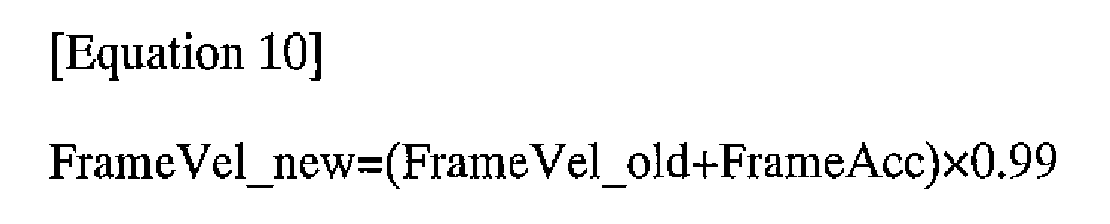

- Here, 0.99 is air resistance. Accordingly, the air resistance need not to be a constant, and may be variably set in correspondence with the progress of the game.
- On the other hand, when it is determined that the arm-lowering motion is started, if the current animation frame is not within the arm-lowering-acceleration-probable section, the animation frame is advanced according to the frame velocity (Noted that frame acceleration AnimeVcc=0) calculated in
Equation 12 to the arm-lowering-acceleration-probable section.
- Then, when the animation frame advance to the arm-lowering-acceleration-probable section, the frame acceleration FrameAcc is generated as described above, the synchronization between the flapping motion of the player and the flapping motion of the
player object 202 is taken - Here, as understood by comparing the
Equation 9 and theEquation 12, the frame velocity obtained in theEquation 12 is 1.7 times as fast as the acceleration FrameAcc obtained in theEquation 9. For example, in a case that the animation frame is 7th frame, when it is determined that an arm-lowering motion is started, the animation frame advances to reach the 15th frame at the 1.7-fold frame velocity obtained in theEquation 12, and then advances to reach the 30th frame at the frame velocity calculated in theEquation 10. Here, in this case, the arm-lowering motion is performed outside the arm-lowering-acceleration-probable section, and therefore the acceleration FrameAcc is 0 from the 15th frame to the 30th frame. Accordingly, the frame velocity of the animation frame is reduced (attenuated) from the 15th frame to the 30th frame due to the air resistance (0.99, here). That is, the frame velocity from the 7th frame to the 15th frame is faster than the frame velocity from the 15th frame to the 30th frame (arm-lowering-acceleration-probable section), and is constant velocity. - Accordingly, in this case, the updating velocity of the animation frame is not temporarily accelerated and then decelerated from the 15th frame to the 30th frame, and therefore, it is impossible to make the
player object 202 perform a motion as if a real bird (relatively large bird) is flapping. - However, in a case that the determination as to the start of the arm-lowering motion is out of the arm-lowering-acceleration-probable section as described above, the animation frame advances to the 15th frame at the 1.7-fold frame velocity, decelerates from the 15th frame to the 30th frame, and then enter a next arm-lowering determination, as a cycle (hereinafter, referred to as "cycle A"), so that one flapping motion by the player ensures one flapping motion by the player object 202 (animation frame advances from the 0-th frame to the 59th frame). Furthermore, in such a case, in the arm-lowering-acceleration-probable section, the frame velocity is not accelerated, but the animation frame is updated at the 1.7-fold frame velocity in response to the player starting an arm-lowering motion. That is, in response to a motion by the player, the motion of the
player object 202 is controlled, so that the player does not feel uncomfortably. - In addition, the frame velocity evaluated according to the
Equation 12 is inverse proportion to the flapping section (flapping cycle) CycleSwing being a time interval for determining the start of an arm-lowering motion, so that if a slow flapping motion is performed, the cycle A slowly proceeds, and if a quickly flapping motion is performed, the cycle A quickly proceeds. - Thus, even if the advance of the animation frame is controlled by merely determining the start of the arm-lowering motion, it is possible to take a synchronization between the flapping motion of the player and animation.
- As described above, when it is determined that an arm-lowering motion is started, in a case that the current animation frame is within the arm-lowering-acceleration-probable section, the frame acceleration FrameAcc is generated, and then, the animation frame is updated through inertia according to the
Equation 10 andEquation 11. However, this results in the animation frame being late for a flapping motion including a next arm-lowering motion by the player. - In order to cancel the delay, in this embodiment, in a case it is determined that an arm-raising motion is started in accordance with the player performing a large-flapping motion, the advancement of the animation frame is controlled not only by the advancing method A of the animation frame but also the advancing method B of the animation frame.
- That is, the synchronization between a flapping motion of the player and the animation frame is taken to a certain degree by the advancing method A of the animation frame, and the synchronization between the flapping motion of the player and the animation frame is taken more precisely by the advancing method B of the animation frame.
- As described above, the frame velocity obtained in the
Equation 12 is 1.7 times as fast as the acceleration FrameAcc obtained in theEquation 9. This is the magnification set for making the frame velocity higher than the acceleration FrameAcc obtained by the flapping motion (arm-lowering motion) of the player, and is a numerical value empirically obtained by experiment, etc. - Next, the advancing method B of the animation frame is explained. As described above, when it is determined that an arm-raising motion is started, an arm-raising-
acceleration flag 404n (seeFigure 21 ) described later is turned on. In a case that the arm-raising-acceleration flag 404n is turned on, it is determined whether or not the current animation frame is within the arm-raising-acceleration-probable section (fame number : equal to or more than 30 and less than 60) shown inFigure 19 . - As described later, when the updating velocity of the animation frame is accelerated in the arm-raising-acceleration-probable section, the arm-raising-
acceleration flag 404n is turned off. - When it is determined that the arm-raising motion is started, in a case that the current animation frame is within the arm-raising-acceleration-probable section, an arm-raising acceleration is generated. That is, a value larger than 0 (2, in this embodiment) is set to the frame acceleration FrameAcc, and the updating velocity is set to be faster than the game frame (1/60(seconds)). Here, if the current frame velocity FrameVel_old is equal to or more than 2, the frame acceleration FrameAcc is set to 0. That is, when or directly after an arm-raising motion by the player is performed, a frame acceleration FrameAcc is generated, and the advancement of the animation frame is made the fastest at this moment, and an animation showing that the
player object 202 moves the wings upward at the same time. Thus, it seems that the flapping motion of the player and the flapping motion of theplayer object 202 are synchronized with each other. Accordingly, in a case that it does not seem that the flapping motion of the player and the animation frame are synchronized, the player can understand that his or her own flapping motion, especially, an arm-raising motion is not correctly performed through the screen (game screen 200, etc.). It is considered that this prompts the player to perform a (correct) flapping motion (motion for training) intended by the developer, et al. - On the other hand, when it is determined that an arm-raising motion is started, in a case that the current animation frame is not within the arm-raising-acceleration-probable section, the animation frame advances through inertia. Although detailed explanation is omitted, the number of frames in a case of the arm-raising motion is also calculated according to the above-described
Equation 10 andEquation 11. - Here, the reason why the arm-lowering-acceleration-probable section is set to equal to or more than the 15th frame and less than the 30th frame is that if the animation frame is accelerated during the period, the player feels that the
player object 202 moves down the wings in synchronization with the arm-lowering motion by the player. - Assuming that a progress of the animation frame accelerates in the vicinity of the 37th frame to advance faster to the 45th frame, the player feels that the
player object 202 moves the wing downward, and then moves the wing upward soon. That is, the player feels that an arm-raising motion is confirmed irrespective of the player performing an arm-lowering motion. - Furthermore, the reason why the arm-raising-acceleration-probable section is set to the section equal to or more than 30th frame and less than 60th frame is that when with respect to section equal to or more than the 45th frame and less than the 60th frame, the animation frame is accelerated during the period similar to the arm-lowering-acceleration-probable section, the player feels that the
player object 202 raises the wings in synchronization with the arm-raising motion of the player. - In addition, the reason why the arm-raising-acceleration-probable section includes the section equal to or more than the 30th frame and less than the 45th frame is that the animation frame moves to the arm-lowering-acceleration-probable section as close as possible in preparation for the determination of the start of an arm-lowering motion of the player which is to be made several frames after. In this case, in the section equal to or more than the 30th frame and less than the 45th frame of the animation frame, to the eye, an arm-lowering animation is reproduced, and thus, the arm-lowering animation is reproduced irrespective of the player performing an arm-raising motion. However, in the flapping motion, the player performs an arm-lowering motion directly after an arm-raising motion, and therefore, by making it easy to advance the animation frame by making a projection on a next motion, it is possible to take a synchronization between the flapping motion of the player and the animation. On the contrary, the player is not required to perform an arm-raising motion directly after an arm-lowering motion. This is because an arm-lowering motion may be performed and remained as it is, and eve if the player performs an arm-raising motion, the start of the arm-raising motion may not be determined according to the above-described method, sot that there is no need of making it easy to advance the animation frame by making a projection on a next motion.
- Furthermore, the reason why the arm-raising-acceleration-probable section includes the section equal to or more than the 30th frame and less than the 45th frame is that in the above-described cycle A, the section (hereinafter referred to as "correction section"), in which the animation frame is advanced at the 1.7-fold frame velocity before the 15th frame, is made smaller. More specifically, when the arm-raising-acceleration-probable section is long, a start of the arm-raising motion is determined during the section, the updating velocity (frame velocity) of the animation frame is accelerated, and the animation frame advances largely. Thus, the frame acceleration FrameAcc by the arm-raising motion after the arm-lowering motion by the player can be obtained, and when a start of an arm-lowering motion is determined next, the animation frame increase the chance of advancing in the vicinity of the 15th frame. That is, the correction section can be shortened. Furthermore, depending on the timing, the correction section may be lost. If the correction section is lost, the start of the arm-lowering motion is determined from the 15th frame to the 30th frame, and the animation frame is accelerated once, and then decelerated. In such a case, the flapping motion of the player and the animation are correctly synchronized with each other.
- Although illustration is omitted, in a case that the player performs a small-flapping motion, without performing the arm-raising determination, by merely accelerating the animation frame during the arm-lowering-acceleration-probable section, it is possible to take the synchronization between the flapping motion of the player and the animation of the flapping motion of the
player object 202. This holds true for a case that the player performs a large-flapping motion. Accordingly, it is considered that a determination processing of the start of the arm-raising motion and the acceleration processing in the arm-raising-acceleration-probable section are not required to be executed. - However, in this embodiment, in order to take a more precise synchronization, the determination processing of the start of the arm-raising motion is performed, and the acceleration processing in the arm-raising-acceleration-probable section is executed.
-
Figure 20 is an illustrative view showing one example of amemory map 400 of a main memory (42e, 46) shown inFigure 2 . As shown inFigure 20 , in a main memory (42e, 46), aprogram memory area 402 and adata memory area 404 are provided. Theprogram memory area 402 stores a game program, and the game program is constructed of amain processing program 402a, animage generating program 402b, animage displaying program 402c, aload acquiring program 402d, a weightratio calculating program 402e, abarycentre calculating program 402f, amotion judging program 402g, a translationalmotion calculating program 402h, a rotational motion calculating program 402i, ananimation synchronizing program 402j, etc. - The
main processing program 402a is a program to perform a main routine of the virtual game of this embodiment. Theimage generating program 402b is a program for generating (updating) game image data by utilizingimage data 404b described later. Theimage displaying program 402c is a program for displaying (outputting) game image data generated according to theimage generating program 402b as the game screen (200, etc.) on themonitor 34. - The
load acquiring program 402d is a program for acquiring a current load value measured (detected) by theload controller 36. More specifically, the load values detected by the fourload sensors 36b are added up. In this embodiment, prior to the start of the main part of the virtual game, the body weight value of the player is detected in a state that the player rides on theload controller 36 in a static state. The numerical value data corresponding to the body weight value is acquired, and is stored in thedata memory area 404 asreference value data 404f described later. Furthermore, during the game, a load value is detected for each game frame, and numerical value data corresponding to the detected load value is acquired, and stored as currentload value data 404g described later in thedata memory area 404. - The weight
ratio calculating program 402e is for calculating a weight ratio WR for each game frame obtained by dividing the current load value (in the current frame) acquired according to theload acquiring program 402d by the body weight value (reference value) of the player acquired according to theload acquiring program 402d. The numerical value data of the weight ratio WR calculated according to the weightratio calculating program 402e is stored in chronological order as weight ratio data in the weightratio data buffer 404a described later. - The
barycentre calculating program 402f is a program for calculating coordinate (XG, YG) of the barycentric position according to theEquation 7 and the Equation 8 by utilizing the load value in eachload sensor 36b detected according to theload acquiring program 402d, and storing the coordinate data corresponding to the calculate coordinate (XG, YG) asbarycentric position data 404h described later in thedata memory area 404. - The
motion judging program 402g is a program for determining a presence or absence of a flapping motion by the player and the kind of the flapping motion (large-flapping motion or small-flapping motion) on the basis of the result obtained by performing discrete Fourier transform on the time variation of the weight ratio WR calculated for each game frame for a certain period of time (30 game frames in this embodiment). - The translational
motion calculating program 402h is a program for calculating a position (three-dimensional coordinate) after a certain period of time (1 game frame) of theplayer object 202 on the basis of a driving force obtained by a flapping motion or the y-coordinate of the barycentric position (YG) calculated according to thebarycentre calculating program 402. - The rotational motion calculating program 402i is a program for calculating a rotation amount about the x-axis of the local coordinate of the
player object 202 and a rotation amount about the y-axis of the local coordinate of theplayer object 202 on the basis of the coordinate (XG, YG) of the barycentric position calculated according to thebarycentre calculating program 402f. Theanimation synchronizing program 402j is a program for synchronizing an animation of the flapping motion of theplayer object 202 with the flapping motion of the player. - Although illustration is omitted, the game program includes a sound output program, a backup program, etc. The sound output program is a program for generating a sound necessary for the game, such as a voice of the player object (onomatopoeic sound), a sound effect, a music (BGM), and outputting the same from the
speaker 34a. The backup program is a program for saving game data (proceeding data, result data) stored in the main memory (42e, 46) in theflash memory 44 and an SD card. -
Figure 21 shows a detailed content of thedata memory area 404. As shown inFigure 21 , thedata memory area 404 is provided with a weightratio data buffer 404a. Furthermore, thedata memory area 404stores image data 404b, large-flappinganimation data 404c, small-flappinganimation data 404d, descending-time animation data 404e,reference value data 404f, currentload value data 404g andbarycentric position data 404h. In addition, thedata memory area 404 is provided with a during-descending flag 404i, a weight-ratio-decliningflag 404j, an arm-raising-determination flag 404k, an arm-lowering-determination flag 404m, an arm-raising-acceleration flag 404n, an arm-lowering-acceleration flag 404p, a large-flappingflag 404q, a small-flappingflag 404r, a landing-successful flag 404s, a landing-unsuccessful flag 404t, a gameclear flag 404u, and a game overflag 404v. - The weight
ratio data buffer 404a is a data buffer for storing in chronological order weight ratio data calculated for each game frame according to theratio calculating program 402e. - The
image data 404b is data, such as polygon data, texture data, etc. to be used when game image data is generated according to theimage generating program 402b. The large-flappinganimation data 404c is animation data in a case that theplayer object 202 performs a large-flapping motion, and is constructed of 60 pieces (frames) of the animation frame. The small-flappinganimation data 404d is animation data in a case that theplayer object 202 performs a small-flapping motion, and is constructed of 60 pieces of animation frame. As described above, only a movable range of the wings is different between the large-flapping motion and the small-flapping motion. The descending-time animation data 404e is animation data in a case that theplayer object 202 is descending, and is constructed of 45 pieces of animation frame. - The
reference value data 404f is numerical value data as to the load value acquired according to theload acquiring program 402d prior to the start of the main part of the virtual game, that is, as to the body weight value of the player. The currentload value data 404g is numerical value data as to the current load value (in the current frame) acquired according to theload acquiring program 402d. Thebarycentric position data 404h is coordinate data as to coordinate (XG, YG) of the current barycentric position (in the current frame) calculated according to thebarycentre calculating program 402f. - The during-descending flag 404i is a flag for determining whether or not the
player object 202 is being descending, and is constructed of a one-bit register. In a case that theplayer object 202 is descending, the during-descending flag 404i is established (turned on), and a data value of "1" is set to the register. On the other hand, in a case that theplayer object 202 is not descending, the during-descending flag 404i is not established (turned off), and a data value of "0" is set to the register. - The weight-ratio-declining
flag 404j is a flag for determining whether or not the weight ratio WR declines (reduces), and is constructed of a one-bit register. In a case that the weight ratio WR declines, the weight-ratio-decliningflag 404j is turned on, and a data value of "1" is set to the register. On the other hand, in a case that the weight ratio WR does not decline, that is, in a case that the weight ratio WR rises or does not change, the weight-ratio-decliningflag 404j is turned off, and a data value of "0" is set to the register. - The arm-raising-
determination flag 404k is a flag for determining whether or not the start of the arm-raising motion is judged, and is constructed of a one-bit register. When it is determined that an arm-raising motion is started, the arm-raising-determination flag 404k is turned on, and a data value of "1" is set to the register. On the other hand, when it is determined an arm-lowering motion is started, the arm-raising-determination flag 404k is turned off, and a data value of "0" is set to the register. It should be noted that in a case that the arm-lowering-determination flag 404m described later is turned on as well, the arm-raising-determination flag 404k is turned off. - The arm-lowering-
determination flag 404m is a flag for determining whether or not an arm-lowering motion is started, and is constructed of a one-bit register. When it is determined that an arm-lowering motion is started, the arm-lowering-determination flag 404m is turned on, and a data value of "1" is set to the register, On the other hand, when it is determined an arm-raising motion is started, the arm-lowering-determination flag 404m is turned off, and a data value of "0" is set to the register. It should be noted that in a case that the above-described arm-raising-determination flag 404k is turned on as well, the arm-lowering-determination flag 404m is turned off. - The arm-raising-
acceleration flag 404n is a flag for determining whether or not the animation frame is accelerated in correspondence with an arm-raising motion, and is constructed of a one-bit register. When it is determined that an arm-raising motion is started, the arm-raising-acceleration flag 404n is turned on, and a data value of "1" is set to the register. Furthermore, when it is determined that the arm-raising motion is started, and the animation frame is accelerated, the arm-raising-acceleration flag 404n is turned off, and a data value of "0" is set to the register. - The arm-lowering-
acceleration flag 404p is a flag for determining whether or not the animation frame is accelerated in correspondence with an arm-lowering motion, and is constructed of a one-bit register. When it is determined that an arm-lowering motion is started, the arm-lowering-acceleratian flag 404p is turned on, and a data value of "1" is set to the register. Furthermore, it is determined that an arm-lowering motion is started, and the animation frame is accelerated, the arm-lowering-acceleration flag 404p is turned off, and a data value of "0" is set to the register. - The large-flapping
flag 404q is a flag for determining whether or not a large-flapping motion is judged, and is constructed of a one-bit register. When a large-flapping motion is judged, the large-flappingflag 404q is turned on, and a data value of "1" is set to the register. On the other hand, when a large-flapping motion is not judged, the large-flappingflag 404q is turned off, and a data value of "0" is set to the register. It should be noted that in a case that the small-flappingflag 404r described later is turned on and in a case that the player performs no flapping motion as well, the large-flappingflag 404q is turned off. - The small-flapping
flag 404r is a flag for determining whether or not a small-flapping motion is judged, and is constructed of a one-bit register. When a small-flapping motion is judged, the small-flappingflag 404r is turned on, and a data value of "1" is set to the register. On the other hand, if a small-flapping motion is not judged, the small-flappingflag 404r is turned off, and a data value of "0" is set to the register. It should be noted that in a case that the above-described large-flappingflag 404q is turned on, and in a case that the player performs no flapping motion as well, the small-flappingflag 404r is turned off. - The landing-
successful flag 404s is a flag for determining whether or not theplayer object 202 is successful in landing in thenon player object 204, and is constructed of a one-bit register. When theplayer object 202 is successful in landing in thenon player object 204, the landing-successful flag 404s is turned on, and a data value of "1" is set to the register. On the other hand, if theplayer object 202 is not successful in landing in thenon player object 204, the landing-successful flag 404s is turned off, and a data value of "0" is set to the register. - The landing-
unsuccessful flag 404t is a flag for determining whether or not theplayer object 202 is unsuccessful in landing in thenon player object 204, and is constructed of a one-bit register. When theplayer object 202 is unsuccessful in landing in thenon player object 204, the landing-unsuccessful fla404t is turned on, and a data value of "1" is set to the register. On the other hand, when theplayer object 202 is not unsuccessful in landing in thenon player object 204, the landing-unsuccessful flag 404t is turned off, and a data value of "0" is set to the register. - The game
clear flag 404u is a flag for determining whether or not the virtual game is to be cleared, and is constructed of a one-bit register. When the game is to be cleared, the gameclear flag 404u is turned on, and a data value "1" is set to the register. On the other hand, when the game is not to be cleared, the gameclear flag 404u is turned off, and a data value "0" is set to the register. - The game over
flag 404v is a flag for determining whether or not the virtual game becomes a game over, is constructed of a one-bit register. When it becomes the game over, the game overflag 404v is turned on, and a data value of "1" is set to the register. On the other hand, when it does not become a game over, the game overflag 404v is turned off, and a data value of "0" is set to the register. - Although illustration is omitted, the
data memory area 404 stores other data such as sound data, and is provided with a timer (counter) and other flags necessary for execution of the game program. - More specifically, the
CPU 40 shown inFigure 2 executes entire processing according to a flowchart shown inFigure 22-Figure 25 . Although illustration is omitted, theCPU 40 performs a discrete Fourier transform processing on the time variation of the weight ratio WR every certain period of time (30 game frames) by a task separate from the entire processing. - As shown in
Figure 22 , when the entire processing is started, an initial setting is executed in a step S1. In the step S1, theCPU 40 clears the weightratio data buffer 404a, thereference value data 404f, the currentload value data 404g and thebarycentric position data 404h, loads theimage data 404b, the large-flappinganimation data 404c, the small-flappinganimation data 404d and the descending-time animation data 404e into thedata memory area 404, and turns each of the flags 404i-404v off. - In a next step S3, a body weight value of the player is detected, and stored as a reference value. That is, prior to the start of the main part of the virtual game, the
CPU 40 acquires a sum of the load values detected in the fourload sensors 36b as a body weight value, and stores the numerical value data as thereference value data 404f in thedata memory area 404. Then, in a step S5, the main part of the virtual game is started. - Succeedingly, in a step S7, a current load value (in the current frame) is acquired, and the acquired load value is stored. That is, the
CPU 40 acquires a sum of the load values detected by the fourload sensors 36b as a current load value, and stores the numerical value data as the currentload value data 404g in thedata memory area 404. - Here, the scan time for the processing of the steps S7-S79 is one game frame (1/60 (seconds)), so that the current load value is detected for each game frame during the virtual game. That is, the current
load value data 404g is updated for each game frame. This is true for thebarycentric position data 404h described next. - In a step S9, a current barycentric position is calculated, and the calculated barycentric position is stored. That is, the
CPU 40 calculates the coordinate (XG, YG) of the barycentric position of the current frame according to theEquation 2 and theEquation 3 by utilizing the load value acquired from the fourload sensors 36b, and stores the coordinate data as to the coordinate (XG, YG) of the calculated barycentric position as thebarycentric position data 404h in thedata memory area 404. - Succeedingly, in a step S11, motion judging processing (see
Figure 26- Figure 28 ) described later is executed. In a next step S13, it is determined whether or not a large-flapping motion is performed on the basis of the result of the motion judging processing. Here, theCPU 40 determines whether or not the large-flappingflag 404q is turned on. If "YES" is determined in the step S13, that is, if the large-flappingflag 404q is turned on, it is determined that a large-flapping motion is performed, and in a step S15, to the driving force AccSim to be utilized in the integration simulation, a value obtained by multiplying the driving force Acc calculated by the weight ratio WR by 0.05 (AccSim=Acc×0.05) is set, in a step S17, a large-flapping animation is selected, and the process proceeds to a step S25 shown inFigure 23 . - Alternatively, if "NO" is determined in the step S13, that is, if the large-flapping
flag 404q is turned off, it is determined whether or not a small-flapping motion is performed in astep S 19. That is, theCPU 40 determines whether or not the small-flappingflag 404r is turned on. If "NO" is determined in the step S19, that is, if a small-flapping motion is not performed, it is determined that the player performs no flapping motion, and the process proceeds to the step S25 as it is. On the other hand, if "YES" is determined in the step S19, that is, if a small-flapping motion is performed, in a step S21, to the driving force AccSim to be utilized in the integration simulation, a value obtained by multiplying the driving force Acc calculated by the weight ratio WR by 0.0425 (AccSim=Acc×0.0425) is set, in a step S23, a small-flapping animation is selected, and the process proceeds to the step S25. - In the step S25 shown in
Figure 23 , a translational acceleration AccBoard by the barycenter in the forward and backward direction, that is, the y-coordinate of the barycentric position (YG) is calculated. In a next step S27, a velocity Vel_new (in the next frame) after movement of theplayer object 202 is calculated according to theEquation 3. Succeedingly, in a step S29, it is determined whether or not the velocity Vel_new is larger than a maximum velocity VelMax. If "NO" is determined in the step S29, that is, if the velocity Vel_new is equal to or less than the maximum velocity VelMax, the process proceeds to a step S33 as it is. On the other hand, if "YES" is determined in the step S29, that is, if the velocity Vel_new is larger than the maximum velocity VelMax, the maximum velocity VelMax is set to the velocity Vel_new in a step S31, and the process proceeds to the step S33. That is, in the step S31, the velocity Vel_new is restricted by the maximum velocity VelMax. - In the step S33, a three-dimensional position Pos new after movement of the
player object 202 is calculated according to theEquation 4. In a next step S35, it is determined whether or not theplayer object 202 is descending. Here, theCPU 40 determines whether or not a Y component of the current velocity Vel old of theplayer object 202 is less than a certain value (-0.7 in this embodiment). If "NO" is determined in the step S35, that is, if the Y component of the current velocity Vel_old is equal to or more than the certain value, it is determined that theplayer object 202 is not descending, and in a step S39, a rotation amount of theplayer object 202 is calculated on the basis of the x-coordinate (XG) and the y-coordinate (YG) of the barycentric position and, and in a step S41, the during-descending flag 404i is turned off, and the process proceeds to astep 53 shown inFigure 24 . - That is, in the step S39, the
CPU 40 calculates the rotation amount about the x-axis of the local coordinate on the basis of the y-coordinate of the barycentric position (YG) and the rotation amount about the y-axis of the local coordinates on the basis of the x-coordinate of the barycentric position (XG). By the rotation amount about the x-axis and the rotation amount about the y-axis, a direction (Z vector (Xz, Yz, Zz)) to which the z-axis of the local coordinate of theplayer object 202 is applied is first decided in the three-dimensional virtual space. Next, a direction (X vector (Xx, Yx, Zx)) which is orthogonal to the Z vector, and to which the x-axis of the local coordinate extending to the direction of the left hand of theplayer object 202 is applied is decided. In addition, an outer product between the Z vector and the X vector is evaluated, and in the three-dimensional virtual space, a direction (Y vector (Xy, Yy, Zy)) to which the y-axis of the local coordinate of theplayer object 202 is applied, that is, a unit vector AccDir is decided. Here, each of the X vector, the Y vector, and the Z vector is a unit vector of a magnitude "1". - On the other hand, if "YES" is determined in the step S35, that is, if the Y component of the current velocity Vel_old is less than the certain value, it is determined that the
player object 202 is descending, and in a step S36, a rotation amount of theplayer object 202 is calculated on the basis of the x-coordinate of the barycentric position (XG), and in a step S37, an animation during descending of theplayer object 202 is selected, and the process proceeds to a step S43 shown inFigure 24 . - That is, in the step S36, the
CPU 40 calculates only the rotation amount about the y-axis of the local coordinate of theplayer object 202 on the basis of the x-coordinate of the barycentric position (XG), and decides a direction (z vector) to which the z-axis of the local coordinate of theplayer object 202 is applied in the three-dimensional virtual space. Thereafter, as described above, a direction (x vector) to which the x-axis of the local coordinate of theplayer object 202 is applied in the three-dimensional virtual space is decided. In addition, a direction (y vector) to which the y-axis of the local coordinate of theplayer object 202 is applied in the three-dimensional virtual space is decided. - In the step S43 shown in
Figure 24 , it is determined whether or not the during-descending flag 404i is turned off. That is, theCPU 40 determines whether or not theplayer object 202 starts to descend. If "YES" is determined in the step S43, that is, if the during-descending flag 404i is turned off, it is determined that that theplayer object 202 starts to descend, the during-descending flag 404i is turned on in a step S45, and an initial value (0 in this embodiment) of the frame number is set to the animation frame Frame_new in a step S47, an animation of the decided animation frame Frame_new is set in a step S51, and then, the process proceeds to a step S59 shown inFigure 25 . - On the other hand, if "NO" is determined in the step S43, that is, if the during-descending flag 404i is turned on, it is determined that the
player object 202 has already been descending, in a step S49, 1 is added to the animation frame Frame_new, and the process proceeds to the step S51. Here, if the current value of the animation frame Frame_new is "44", that is, if the animation frame is the last frame, when the animation frame Frame_new is added by one in the step S49, the value is set to "0". That is, the frame number of the animation frame is returned to the initial value. - Furthermore, as shown in
Figure 23 , in a case that theplayer object 202 is not descending, "NO" is determined in the step S37, the during-descending flag 404i is turned off in a step S41, and then, it is determined whether or not the flapping animation (large-flapping animation and small-flapping animation) selected in the step S17 or the S23 is different from the current flapping animation in the step S53. If "NO" is determined in the step S53, that is, if the selected flapping animation and the current flapping animation match with each other, the process proceeds to a step S57 as it is. On the other hand, if "YES" is determined in the step S53, that is, if the selected flapping animation and the current flapping animation are different from each other, the flapping animation is switched in a step S55, and the process proceeds to the step S57. - It should be noted that in the step S55, the animation is merely switched, but if the switching is abruptly made between the large-flapping animation and the small-flapping animation, the player watching the
game screen 200 may have uncomfortable feeling. Thus, in this embodiment, these animations are configured to be blended. Briefly speaking, in a case that the large-flapping animation is switched to the small-flapping animation, both of the animations are reproduced. For example, at the moment of switching the animation, the reproduction ratio of the large-flapping motion is 1.0, and the reproduction ratio of the small-flapping motion is 0.0. Here, the large-flapping animation and the small-flapping animation are coincident with each other in the frame number of the animation frame. The reproduction ratio is varied for a certain period of time (30 game frames = 0.5 seconds in this embodiment) gradually (linearly or step-by-step, for example), that is, the reproduction ratio of the large-flapping motion is reduced while the reproduction ratio of the small-flapping motion is increased. When a certain period of time elapses from the start of switching the animation (the 30th game frame for example), the reproduction ratio of the large-flapping motion becomes 0.0, and the reproduction ratio of the small-flapping motion becomes 1.0. Thus, the large-flapping animation is switched to the small-flapping animation. Although an explanation is omitted, this is true for a case that the small-flapping animation is switched to the large-flapping animation. - Returning to
Figure 24 , in the step S57, synchronizing processing (Figure 29-Figure 31 ) described later is executed. Succeedingly, in the step S59 shown inFigure 25 , it is determined whether or not theplayer object 202 is successful in landing in a predetermined place. Here, theCPU 40 determines whether or not the player object 202 lands in thenon player object 204 to be landed. Although detailed explanation is omitted, thenon player object 204 to be landed is set in advance, or is variably set in correspondence with the progress of the virtual game. Here, theCPU 40 determines whether or not theplayer object 202 is on, that is, lands in thenon player object 204 by performing a hit determination between theplayer object 202 and thenon player object 204 to be landed. - If "YES" is determined in the step S59, that is, if it is determined that the
player object 202 is successful in landing in the predetermined place, if the landing-successful flag 404s is turned on in a step S61, and the process proceeds to a step S67. If "NO" is determined in the step S59, that is, if theplayer object 202 is flying, falls in the sea, lands again in thenon player object 204 where theplayer object 202 has already been landed in, it is determined that theplayer object 202 is not successful in landing the predetermined place, and in a step S63, it is determined whether or not theplayer object 202 is unsuccessful in landing in the predetermined place. Here, theCPU 40 determines whether or not the player object 202 lands in anon player object 204 except for thenon player object 204 to be landed or falls in the sea surrounding thenon player object 204. - If "NO" is determined in the step S63, that is, if the
player object 202 is flying, it is determined that theplayer object 202 is not unsuccessful in landing in the predetermined place, and the process proceeds to the step S67. On the other hand, if "YES" is determined in the step S63, that is, if the player object 202 lands in thenon player object 204 except for thenon player object 204 to be landed, or theplayer object 202 falls in the sea surrounding thenon player object 204, it is determined that theplayer object 202 is unsuccessful in landing in the predetermined place, in a step S65, the landing-unsuccessful flag 404t is turned on, and the process proceeds to a step S71 as it is. - In the step S67, it is determined whether or not a game is to be cleared. That is, the
CPU 40 determines whether or not theplayer object 202 reaches the goal via all the predetermined landing places. If "YES" is determined in the step S67, that is, if the game is to be cleared, the gameclear flag 404u is turned on in a step S69, and the process proceeds to a step S75. - On the other hand, if "NO" is determined in the step S67, that is, if the game is not to be cleared, it is determined whether a game is to be over in the step S71. Here, the
CPU 40 determines whether or not the time limit expires before theplayer object 202 reaches the goal, whether or not theplayer object 202 fails in landing by a predetermined number of times (3 times, for example), or whether or not a time during which theplayer object 202 falls in the sea is above a predetermined time (10 seconds, for example). If "NO" is determined in the step S71, that is, if the game is not to be over, the process directly proceeds to the step S75. On the other hand, if "YES" is determined in the step S71, that is, if the game is to be over, the game overflag 404v is turned on in a step S73, and the process proceeds to the step S75. - In the step S75, a game image is generated. Here, the
CPU 40 arranges theplayer object 202 in the three-dimensional virtual space according to the determinant A shown in theEquation 6, and draws (updates) the game image by reading the animation of the animation frame set in the step S51 from the descending-time animation data 404e, and reading the animation of the animation frame set in the synchronizing processing in the step S57 from the flapping animation data (404c, 404d). Furthermore, a background image including thenon player object 204 is drawn (updated). In addition, if the landing-successful flag 404s, the landing-unsuccessful flag 404t, the gameclear flag 404u or the game overflag 404v is turned on, an image representing successful landing, unsuccessful landing, game clear or game over is generated. For example, a text indicating successful landing, unsuccessful landing, game clear or game over overwrites the game image. At this time, although illustration is omitted, a sound effect or music in correspondence with successful landing, unsuccessful landing, game clear or game over is output. - In a next step S77, the game image is displayed. That is, the
CPU 40 displays the game image generated (updated) in the step S75 as a game screen (200, etc.) on themonitor 34. Then, in a step S79, it is determined whether the game is to be ended or not. Here, theCPU 40 determines whether or not a game end is instructed according to an operation by the player. If "NO" is determined in the step S79, that is, if the game is not to be ended, the process returns to the step S7 shown inFigure 22 . However, if the game is to be over, the virtual game is started from the top. On the other hand, if "YES" is determined in the step S79, that is, if the game is to be ended, the entire processing is ended as it is. - Although illustration is omitted, the landing-
successful flag 404s and the landing-unsuccessful flag 404t are turned off from the step S75 to when the process returns to the step S7 in response to "NO" being determined in the step S79. -
Figure 26- Figure 28 is a flowchart showing motion judging processing in the step S11 shown inFigure 22 . As shown inFigure 26 , when starting the motion judging processing, theCPU 40 calculates and stores the current weight ratio WR in a step S91. That is, a current weight ratio WR is calculated by dividing the load value indicated by currentload value data 404g by the reference value (body weight value) indicated by thereference value data 404f, and the weight ratio data is stored in the weightratio data buffer 404a. - In a next step S93, it is determined whether or not the current weight ratio WR is less than a first threshold value (0.985 in this embodiment). That is, the
CPU 40 determines whether or not a driving force Acc is to be applied to theplayer object 202. If "YES" is determined in the step S93, that is, if the current weight ratio WR is less than the first threshold value, 1-weight ratio WR is set to the driving force Acc in a step S95, and the process proceeds to a step S99. That is, the driving force Acc in correspondence with the weight ratio WR is calculated (set). On the other hand, if "NO" is determined in the step S93, that is, if the current weight ratio WR is equal to or more than the first threshold value, 0 is set to the driving force Ace in a step S97, and the process proceeds to the step S99. - In the step S99, it is determined whether or not the maximum value of the weight ratio WR in an immediately-preceding flapping motion (flapping section) is larger than a second threshold value (1.3 in this embodiment). That is, the
CPU 40 determines whether or not an operation input by the player is performed by bending and stretching exercises. It should be noted that the immediately-preceding flapping section means a section from when the start of the last-but-one-arm-lowering motion is determined to when the start of the previous (immediately-preceding)-arm-lowering motion is determined. - If "NO" is determined in the step S99, that is, if the maximum value of the weight ratio WR in the immediately-preceding flapping motion is equal to or less than the second threshold value, it is determined that the operation input by the player is not performed by the bending and stretching exercises, the maximum velocity VelMax is set to the highest velocity (4 in this embodiment) of the
player object 202 in a step S101, the driving force Acc is multiplied by 1.3 (Acc=Acc×1.3) in a step S103, and then, the process proceeds to a step S109. On the other hand, if "YES" is determined in the step S99, that is, if the maximum value of the weight ratio WR in the immediately-preceding flapping motion is larger than the second threshold value, it is determined that the operation input by the player is performed by the bending and stretching exercises, in a step S105, the maximum velocity VelMax is set to the half the highest velocity (2 in this embodiment) of theplayer object 202, in a step S107, the driving force Acc is multiplied by 0.8 (Acc=Acc×0.8), and the process proceeds to the step S109. - Thus, in the steps S99-S107, in a case of an operation input intended by the developer, et al. of the virtual game, the
player object 202 is configured to be easily advanced, and on the contrary thereto, in a case of an operation input not intended by the developer, et al., theplayer object 202 is configured not to be easily advanced. Accordingly, the numerical value set to the maximum velocity VelMax and the coefficient to be multiplied by the driving force Acc are not required to be restricted to the values in this embodiment. - In the step S109, it is determined whether or not the difference between the current weight ratio WR (in the current frame) and the previous weight ratio WR (in the previous frame) is less than a third threshold value (0.001 in this embodiment). If "YES" is determined in the step S109, that is, if the difference between the current weight ratio WR and the previous weight ratio WR is less than the third threshold value, it is determined whether or not the current weight ratio WR is equal to or more than a fourth threshold value (0.99 in this embodiment) and equal to or less than a fifth threshold value (1.01 in this embodiment) in a step S111 shown in
Figure 27 . - If "YES" is determined in the step S111, that is, if the current weight ratio WR is equal to or more than the fourth threshold value and equal to or less than the fifth threshold value, it is determined that weight ratio WR does not rise or decline, and the motion judging processing is ended as it is as shown in
Figure 28 . On the other hand, if "NO" is determined in the step S111, that is, if the current weight ratio WR is less than the fourth threshold value, or more than the fifth threshold value, the process proceeds to a step S137 shown inFigure 28 as it is. Although illustration is omitted, in such a case, the previous determination result as to the rise and decline of the weight ratio WR is maintained. - Returning to
Figure 26 , if "NO" is determined in the step S109, that is, if the difference between the current weight ratio WR and the previous weight ratio WR is equal to or more than the third threshold value, it is determined that the current weight ratio WR is smaller than the previous weight ratio WR in a step S113 shown inFigure 27 . That is, theCPU 40 determines whether or not the weight ratio WR declines or rises. If "NO" is determined in the step S113, that is, if the current weight ratio WR is larger than the previous weight ratio WR, it is determined that the weight ratio WR rises, and it is determined whether or not the weight-ratio-decliningflag 404j is turned on in a step S115. That is, theCPU 40 determines whether or not the weight ratio WR declines and then rises. - If "NO" is determined in the step S115, that is, if the weight-ratio-declining
flag 404j is turned off, it is determined that the weight ratio WR is rising, and the process proceeds to the step S137 as it is. On the other hand, if "YES" is determined in the step S115, that is, if the weight-ratio-decliningflag 404j is turned on, it is determined that the weight ratio WR declines and then rises, in a step S117, the weight-ratio-decliningflag 404j is turned off, and in a step S119, it is determined whether or not the current weight ratio WR is equal to or more than a sixth threshold value (0.98 in this embodiment). That is, it is determined whether or not an arm-raising motion intended by a developer, et al. is performed. - If "NO" is determined in the step S119, that is, if the current weight ratio WR is less than the sixth threshold value, it is determined not to be an arm-raising motion, and the process proceeds to the step S137 as it is. On the other hand, if "YES" is determined in the step S119, that is, if the current weight ratio WR is equal to or more than the sixth threshold value, it is determined to be an arm-raising motion, in a step S121, the arm-raising-
determination flag 404k is turned on, in a step S123, the arm-raising-acceleration flag 404n is turned on, in a step S125, the arm-lowering-determination flag 404m is turned off, and the process proceeds to the step S137. - Alternatively, if "YES" is determined in the step S113, that is, if the current weight ratio WR is smaller than the previous weight ratio WR, it is determined that the weight ratio WR declines, the weight-ratio-declining
flag 404j is turned on in a step S127, and it is determined whether or not the current weight ratio WR is less than a seventh threshold value (0.985 in this embodiment) in a step S129. That is, theCPU 40 determines whether an arm-lowering motion or not. If "NO" is determined in the step S129, that is, if the current weight ratio WR is equal to or more than the seventh threshold value, it is determined not to be an arm-lowering motion, and the process proceeds to the step S137 as it is. On the other hand, if "YES" is determined in the step S129, that is, if the current weight ratio WR is less than the seventh threshold value, it is determined to be an arm-lowering motion, in a step S131, the arm-lowering-determination flag 404m is turned on, in a step S133, the arm-lowering-acceleration flag 404p is turned on, in a step S135, the arm-raising-determination flag 404k is turned off, and the process proceeds to the step S137. - As shown in
Figure 28 , in the step S137, it is determined whether or not the amplitude A is maximum at the index number n=2 of the frequency and the amplitude A at the index number n=3 is equal to or more than an eighth threshold value (0.0001, here), or whether or not the amplitude A is maximum at the index number n=3 or more of the frequency. If "YES" is determined in the step S137, that is, if the amplitude A is the maximum at the index number n=2 of the frequency and the amplitude A at the index number n=3 is equal to or more than the eighth threshold value, or if the amplitude A is the maximum at the index number n=3 or more of the frequency, it is determined to be a small-flapping motion, the small-flappingflag 404r is turned on in a step S139, the large-flappingflag 404q is turned off in a step S141, and the process returns to the entire processing. - On the other hand, if "NO" is determined in the step S137, that is, if the amplitude A is not the maximum at the index number n=2 of the frequency, if the amplitude A at the index number n=3 is less than the eighth threshold value, or if the amplitude A is not the maximum at the index number n=3 or more of the frequency, all the amplitudes A at the index numbers n=1-15 of the frequency are less than the eighth threshold value in a step S143.
- If "NO" is determined in the step S143, that is, if there is the amplitude A being equal to or more than the eighth threshold value out of the amplitudes A at the index number n=1-15 of the frequency, it is determined to be a large-flapping motion, the large-flapping
flag 404q is turned on in a step S145, the small-flappingflag 404r is turned off in a step S147, and the process returns to the entire processing. - On the other hand, if "YES" is determined in the step S143, that is, if all the amplitudes A at the index number n=1-15 of the frequency are less than the eighth threshold value, it is determined that no flapping motion is performed, and in a step S149, the large-flapping
flag 404q and the small-flappingflag 404r are turned off, and the process returns to the entire processing. -
Figure 29-Figure 31 is a flowchart showing synchronizing processing shown in the step S57 inFigure 24 . As shown inFigure 29 , when starting the synchronizing processing, theCPU 40 determines whether or not the arm-lowering-determination flag 404m is turned on in a step S161. Although detailed explanation is omitted, in the synchronizing processing, theplayer object 202 is not descending, but a flapping motion is performed by the player, and therefore, the arm-raising-determination flag 404k or the arm-lowering-determination flag 404m is sure to be turned on. - If "NO" is determined in the step S161, that is, if the arm-lowering-
determination flag 404m is turned off, and the arm-raising-determination flag 404k is turned on, the process proceeds to a step S181 shown inFigure 30 . On the other hand, if "YES" is determined in the step S161, that is, the arm-lowering-determination flag 404m is turned on, and the arm-raising-determination flag 404k is turned off, it is determined whether or not the arm-lowering-acceleration flag 404p is turned on in a step S163. That is, theCPU 40 determines whether or not the animation frame is accelerated in response to the start of the arm-lowering motion by the player. - If "NO" is determined in the step S163, that is, if the arm-lowering-
acceleration flag 404p is turned off, it is determined that the animation frame has already been accelerated in response to the start of the arm-lowering motion in the current flapping section, 0 is set to the frame acceleration FrameAcc in a step S165, and the process proceeds to a step S193 shown inFigure 31 . On the other hand, if "YES" is determined in the step S163, that is, if the arm-lowering-acceleration flag 404p is turned on, it is determined that the animation frame has not yet been accelerated in response to the start of the arm-lowering motion in the current flapping section, and it is determined whether or not the current animation frame is equal to or more than the 15th frame and less than the 30th frame in a step S167. That is, theCPU 40 determines whether or not the animation frame is within the arm-lowering-acceleration-probable section. - If "YES" is determined in the step S167, that is, if the current animation frame is equal to or more than the 15th frame and less than the 30th frame, it is determined that the animation frame is within the arm-lowering-acceleration-probable section, and in a step S169, a value obtained by dividing the maximum number of frames AnimFrameMax of the animation frame by the arm-lowering determination cycle CycleSwing is set to the frame acceleration FrameAcc. That is, when the frame velocity FrameVel_new is calculated thereafter, the animation frame is accelerated. In a next step S171, the arm-lowering-
acceleration flag 404p is turned off, and the process proceeds to the step S193. - On the other hand, if "NO" is determined in the step S167, that is, if the current animation frame is not equal to or more than the 15th frame and less than the 30th frame, it is determined that the animation frame is not within the arm-lowering-acceleration-probable section, 0 is set to the frame acceleration FrameAcc in a step S173, and a value obtained by dividing the 1.7-fold maximum number of frames AnimFrameMax of the animation frame by the arm-lowering determination cycle CycleSwing is set to the current frame velocity Frame Vel_old according to the
Equation 12 in a step S175. That is, theCPU 40 makes the animation frame close to the arm-lowering-acceleration-probable section faster. - Succedingly, in a step S177, it is determined whether or not the current frame velocity Frame Vel_old is larger than 6. If "NO" is determined in the step S177, that is, if the current frame velocity FrameVel_old is equal to or less than 6, the process proceeds to the step S193 as it is. On the other hand, if "YES" is determined in the step S177, that is, if the current frame velocity FrameVel_old is more than 6, 6 is set to the current frame velocity FrameVel_old in a step S179, and the process proceeds to the step S181. That is, current frame velocity FrameVel_old is restricted.
- As shown in
Figure 30 , in the step S181, it is determined whether or not the arm-raising-acceleration flag 404n is turned on. If "NO" is determined in the step S181, that is, if the arm-raising-acceleration flag 404n is turned off, it is determined that the animation frame has already been accelerated in response to the start of the arm-raising motion in the current flapping section, in a step S191, 0 is set to the frame acceleration FrameAcc, and the process proceeds to the step S193. On the other hand, if "YES" is determined in the step S181, that is, if the arm-raising-acceleration flag 404n is turned on, it is determined that the animation frame has not yet been accelerated in response to the start of the arm-raising motion in the current flapping section, and it is determined whether or not the current animation frame is equal to or more than the 30th frame and less than the 60th frame in a step S183. That is, theCPU 40 determines whether or not the animation frame is within the arm-raising-acceleration-probable section. - If "NO" is determined in the step S183, that is, if the current animation frame is not equal to or more than the 30th frame and less than the 60th frame, it is determined that the animation frame is not within the arm-raising-acceleration-probable section, and the process proceeds to the step S191. On the other hand, if "YES" is determined in the step S183, that is, if the current animation frame is equal to or more than the 30th frame and less than the 60th frame, it is determined that the animation frame is within the arm-raising-acceleration-probable section, and in a step S185, it is determined whether or not the current frame velocity FrameVel_old is less than 2.
- If "NO" is determined in the step S185, that is, if the current frame velocity FrameVel_old is equal to or more than 2, the process proceeds to the step S191. On the other hand, if "YES" is determined in the step S185, that is, if the current frame velocity FrameVel_old is less than 2, 2 is set to the frame acceleration FrameAcc in a step S187, the arm-raising-
acceleration flag 404n is turned off in a step S189, and the process proceeds to the step S193. - In the step S193 shown in
Figure 31 , it is determined whether or not the frame acceleration FrameAcc is not 0. If "NO" is determined in the step S193, that is, if the frame acceleration FrameAcc is 0, the process proceeds to a step S197 as it is. On the other hand, if "YES" is determined in the step S193, that is, if the frame acceleration FrameAcc is not 0, 0 is set to the current frame velocity FrameVel_old in a step S195, and the process proceeds to the step S197. - In the step S197, according to the integration simulation, a next frame velocity FrameVel_new is calculated. Succeedingly, in a step S199, the next animation frame Frame_new is decided. That is, the
CPU 40 calculates the next frame velocity FrameVel_new according to theEquation 10, and calculates the next animation frame Frame_new according to theEquation 11. Then, in a step S201, the animation at the decsicded animation frame Frame_new is set, and the process returns to the entire processing shown inFigure 22-Figure 25 . - According to the embodiment, a flapping motion of the player is determined on the basis of the cycle of the variation of the weight ratio, this is reflected on the animation of the player object, and the moving amount of the player object is controlled on the basis of the magnitude of the weight ratio, and therefore, it is possible to execute wide variety of processing in comparison with a case that the game processing is merely executed in accordance with the variation of the load.
- Furthermore, according to this embodiment, the updating velocity of the animation frame is changed according to an arm-lowering motion and an arm-raising motion, and therefore, it is possible to smoothly synchronize the flapping motion of the player and the animation by canceling the delay of the animation frame. Thus, the player can absorb in the virtual game, and enjoy playing the game play.
- In addition, according to this embodiment, in a case that the weight ratio based on the load value of the player is equal to or more than the predetermined threshold value, when it is detected that the weight ratio locally declines (decreases) and increases, it is determined that an arm-raising motion in the large-flapping motion is started, and the moving velocity of the player object is changed in accordance with the arm-raising motion, and the updating velocity of the animation frame is changed in accordance with the arm-raising motion as well as the arm-lowering motion, so that it is possible to make the player perform a motion that the developer, et al. intended, and perform the processing in response to the detection of such a motion. That is, it is possible to execute wide variety of processing by detecting a complex motion.
- Additionally, in this embodiment, the weight ratio obtained by dividing the current load value by the body weight value (reference value) is utilized, but the load value may be used as it is. In such a case, in order to eliminate advantage and disadvantage due to the difference in the weight of the player, a threshold value may be provided for each weight (for each rank of the weights).
- Furthermore, in this embodiment, on the basis of the frequency spectrum obtained by performing a discrete Fourier transform on the time variation of the weight ratio, the presence or absence of a flapping motion by the player and the kind of the flapping motion are determined, but a fast Fourier transform may be executed.
- In addition, in this embodiment, in a repeating motion, such as a flapping motion, an arm-raising motion of the player is determined on the basis of the time variation of the weight ratio as shown in
Figure 13 , but there is no need of being restricted to this. For example, when a waveform obtained by reversing upside down the waveform shown inFigure 13 at the reference value of the weight ratio is acquired, a predetermined motion is determined on the basis of the waveform reversed upside down. In such a case, when the value of the weight ratio is equal to or less than the certain value (1.02, for example), and the weight ratio rises and then declines, it is determined that the predetermined motion is started. - Although the present invention has been described and illustrated in detail, it is clearly understood that the same is by way of illustration and example only and is not to be taken by way of limitation, the scope of the present invention being limited only by the terms of the appended claims.
Claims (18)
- A storage medium storing an information processing program causing a computer (40) to execute at least a load value acquiring step (S3, S7) for acquiring a load value indicating a load of a user on the basis of a signal from a load detecting apparatus (36), said information processing program is characterized by causing said computer (40) to execute:a cycle judging step (S121, S131) for judging a cycle of a load variation of said user on the basis of the load value acquired by said load value acquiring step (S3, S7), andan information processing step (S15, S17, S21, S23, S57, S75, S77) for executing predetermined information processing on the basis of the cycle judged by said cycle judging step (S121, S131).
- A storage medium storing an information processing program according to claim 1, wherein
said information processing step (S15, S17, S21, S23, S57, S75, S77) executes at least first information processing (S21, S23, S75, S77) or second information processing (S15, S17, S75, S77) different from said first information processing (S21, S23, S75, S77) on the basis of the cycle judged by said cycle judging step (S121, S131). - A storage medium storing an information processing program according to claim 2, wherein
said information processing program causes a computer (40) to further execute a condition determining step (S137) for determining whether or not the cycle judged by said cycle judging step (S121, S131) satisfies a predetermined condition, and
said information processing step (S15, S17, S21, S23, S57, S75, S77) executes said first information processing (S21, S23, S75, S77) when said condition determining step (S137) determines that said cycle satisfies the predetermined condition, and executes said second information processing (S15, S17, S75, S77) when said condition determining step (S137) determines that said cycle does not satisfy the predetermined condition. - A storage medium storing an information processing program according to claim 3, wherein
said condition determining step (S137) determines whether or not a frequency of the cycle judged by said cycle judging step (S121, S131) is equal to or more than a first predetermined value, and
said information processing step (S15, S17, S21, S23, S57, S75, S77) executes said second information processing (S15, S17, S75, S77) when said condition determining step (S137) determines that said frequency is equal to or more than the first predetermined value. - A storage medium storing an information processing program according to claim 3, wherein
said cycle judging step (S121, S131) judges said cycle on the basis of a frequency spectrum of the load variation of said user,
said condition determining step (S137) determines whether or not the frequency of the cycle judged by said cycle judging step (S121, S131) is a second predetermined value and a power spectrum of a frequency larger than said frequency is equal to or more than a maximum value of a spectrum noise, and
said information processing step (S15, S17, S21, S23, S57, S75, S77) executes said second information processing (S15, S17, S75, S77) when said condition determining step (S137) determines that said frequency is a second predetermined value, and a power spectrum of a frequency larger than said frequency is equal to or more than a maximum value of a spectrum noise. - A storage medium storing an information processing program according to claim 1, wherein
said information processing program causes a computer (40) to further execute a movement controlling step (S25, S27, S29, S31, S33, S35, S36, S39, S93, S95, S97, S99, S101, S103, S105, S107) for controlling a magnitude of at least a moving distance or a moving velocity of an object (202) displayed on a display screen on the basis of the load value acquired by said load value acquiring step (S3, S7). - A storage medium storing an information processing program according to claim 6, wherein
said movement controlling step (S25, S27, S29, S31, S33, S35, S36, S39, S93, S95, S97, S99, S101, S103, S105, S107) increases the moving distance or the moving velocity of said object (202) as an amplitude of the variation of the load value acquired by said load value acquiring step (S3, S7) is large. - A storage medium storing an information processing program according to claim 6, wherein
said movement controlling step (S25, S27, S29, S31, S33, S35, S36, S39, S93, S95, S97, S99, S101, S103, S105, S107) increases the moving distance or the moving velocity of said object (202) when the load value acquired by said load value acquiring step (S3, S7) is less than a predetermined value. - A storage medium storing an information processing program according to claim 6, wherein
said movement controlling step (S25, S27, S29, S31, S33, S35, S36, S39, S93, S95, S97, S99, S101, S103, S105, S107) increases the moving distance or the moving velocity of said object (202) when the cycle of the variation of the load value acquired by said load value acquiring step (S3, S7) is long. - A storage medium storing an information processing program according to claim 6, wherein,
said information processing program causes a computer (40) to further execute a barycentric position detecting step (S9) for detecting a barycentric position of said user on a two-dimensional plane on the basis of a signal from said load detecting apparatus (36), and
said movement controlling step (S25, S27, S29, S31, S33, S35, S36, S39, S93, S95, S97, S99, S101, S103, S105, S107) controls a moving direction of said object (202) on the basis of the barycentric position detected by said barycentric position detecting step (S9). - A storage medium storing an information processing program according to claim 10, wherein,
said object (202) moves in the virtual space, and
said movement controlling step (S25, S27, S29, S31, S33, S35, S36, S39, S93, S95, S97, S99, S101, S103, S105, S107) decides the moving direction of said object (202) according to different deciding method between when said object (202) moves to a predetermined direction and when said object (202) moves to a direction other than the direction. - A storage medium storing an information processing program according to claim 11, wherein,
said movement controlling step (S25, S27, S29, S31, S33, S35, S36, S39, S93, S95, S97, S99, S101, S103, S105, S107) decides a first moving direction as a moving direction of said object (202) on the basis of the barycentric position detected by said barycentric position detecting step (S9) in a case that said object (202) moves to said predetermined direction, and decides a second moving direction as a moving direction of said object (202) on the basis of the barycentric position detected by said barycentric position detecting step (S9) in a case that said object (202) moves to the direction other than said predetermined direction. - A storage medium storing an information processing program according to claim 1, wherein,
said information processing step (S15, S17, S21, S23, S57, S75, S77) changes at least a display manner of the object (202) displayed on the display screen on the basis of the cycle judged by said cycle judging step (S121, S131). - A storage medium storing an information processing program according to claim 13, wherein,
said object (202) is a moving image object (202), and
said information processing step (S15, S17, S21, S23, S57, S75, S77) displays said moving image object (202) on said display screen by a different animation on the basis of the cycle judged by said cycle judging step (S121, S131). - A storage medium storing an information processing program according to claim 14, wherein,
said information processing step (S15, S17, S21, S23, S57, S75, S77) changes an updating velocity of an animation frame on the basis of the cycle judged by said cycle judging step (S121, S131) and a frame number of the animation frame constructing of said animation. - A storage medium storing an information processing program according to claim 1, wherein,
said information processing program causes a computer (40) to further execute a ratio calculating step (S91) for calculating a ratio of the load value acquired by said load value acquiring step (S3, S7) to a body weight value of said user, and
said cycle judging step (S121, S131) judges a cycle as to the variation of the ratio calculated by said ratio calculating step (S91). - An information processing apparatus including a load value acquiring means (40, S3, S7) for acquiring a load value indicating a load of a user on the basis of a signal from a load detecting apparatus (36) is characterized by comprising:a cycle judging means (40, S121, S131) for judging a cycle of a load variation of said user on the basis of the load value acquired by said load value acquiring means (40, S3, S7); andan information processing means (40, S15, S17, S21, S23, S57, S75, S77) for executing predetermined information processing on the basis of the cycle judged by said cycle judging means (40, S121, S131).
- An information processing method of a computer (40) including a step (a) (S3, S7) of acquiring a load value indicating a load of a user on the basis of a signal from a load detecting apparatus (36) is characterized by including following steps of:,(b) judging a cycle of a load variation of said user on the basis of the load value acquired by step (a) (S3, S7) (S121, S131), and(c) executing predetermined information processing on the basis of the cycle judged by said step (b) (S121, S131) (S15, S17, S21, S23, S57, S75, S77).
Applications Claiming Priority (1)
| Application Number | Priority Date | Filing Date | Title |
|---|---|---|---|
| JP2009112465A JP5819580B2 (en) | 2009-05-07 | 2009-05-07 | GAME PROGRAM, GAME DEVICE, GAME SYSTEM, AND GAME CONTROL METHOD |
Publications (1)
| Publication Number | Publication Date |
|---|---|
| EP2248564A1 true EP2248564A1 (en) | 2010-11-10 |
Family
ID=41429398
Family Applications (1)
| Application Number | Title | Priority Date | Filing Date |
|---|---|---|---|
| EP09177598A Withdrawn EP2248564A1 (en) | 2009-05-07 | 2009-12-01 | Storage medium storing information processing program, information processing apparatus and information processing method |
Country Status (3)
| Country | Link |
|---|---|
| US (1) | US9833705B2 (en) |
| EP (1) | EP2248564A1 (en) |
| JP (1) | JP5819580B2 (en) |
Cited By (2)
| Publication number | Priority date | Publication date | Assignee | Title |
|---|---|---|---|---|
| KR101014266B1 (en) | 2010-11-17 | 2011-02-16 | (주)크레노바 | Game device and its method using measurement of relative change of center of gravity movement |
| EP2455148A1 (en) * | 2010-11-18 | 2012-05-23 | Nintendo Co., Ltd. | Music performance program, music performance apparatus, music performance method, and music performance system |
Families Citing this family (26)
| Publication number | Priority date | Publication date | Assignee | Title |
|---|---|---|---|---|
| US7459624B2 (en) | 2006-03-29 | 2008-12-02 | Harmonix Music Systems, Inc. | Game controller simulating a musical instrument |
| US8690670B2 (en) | 2007-06-14 | 2014-04-08 | Harmonix Music Systems, Inc. | Systems and methods for simulating a rock band experience |
| US8678896B2 (en) | 2007-06-14 | 2014-03-25 | Harmonix Music Systems, Inc. | Systems and methods for asynchronous band interaction in a rhythm action game |
| US7935880B2 (en) | 2009-05-29 | 2011-05-03 | Harmonix Music Systems, Inc. | Dynamically displaying a pitch range |
| US20100304810A1 (en) * | 2009-05-29 | 2010-12-02 | Harmonix Music Systems, Inc. | Displaying A Harmonically Relevant Pitch Guide |
| US7982114B2 (en) * | 2009-05-29 | 2011-07-19 | Harmonix Music Systems, Inc. | Displaying an input at multiple octaves |
| US20100304811A1 (en) * | 2009-05-29 | 2010-12-02 | Harmonix Music Systems, Inc. | Scoring a Musical Performance Involving Multiple Parts |
| US8465366B2 (en) | 2009-05-29 | 2013-06-18 | Harmonix Music Systems, Inc. | Biasing a musical performance input to a part |
| US7923620B2 (en) * | 2009-05-29 | 2011-04-12 | Harmonix Music Systems, Inc. | Practice mode for multiple musical parts |
| US8080722B2 (en) * | 2009-05-29 | 2011-12-20 | Harmonix Music Systems, Inc. | Preventing an unintentional deploy of a bonus in a video game |
| US8076564B2 (en) * | 2009-05-29 | 2011-12-13 | Harmonix Music Systems, Inc. | Scoring a musical performance after a period of ambiguity |
| US8449360B2 (en) | 2009-05-29 | 2013-05-28 | Harmonix Music Systems, Inc. | Displaying song lyrics and vocal cues |
| US9981193B2 (en) | 2009-10-27 | 2018-05-29 | Harmonix Music Systems, Inc. | Movement based recognition and evaluation |
| EP2494432B1 (en) | 2009-10-27 | 2019-05-29 | Harmonix Music Systems, Inc. | Gesture-based user interface |
| US8636572B2 (en) | 2010-03-16 | 2014-01-28 | Harmonix Music Systems, Inc. | Simulating musical instruments |
| CA2802348A1 (en) | 2010-06-11 | 2011-12-15 | Harmonix Music Systems, Inc. | Dance game and tutorial |
| US8562403B2 (en) | 2010-06-11 | 2013-10-22 | Harmonix Music Systems, Inc. | Prompting a player of a dance game |
| US9358456B1 (en) | 2010-06-11 | 2016-06-07 | Harmonix Music Systems, Inc. | Dance competition game |
| US9024166B2 (en) | 2010-09-09 | 2015-05-05 | Harmonix Music Systems, Inc. | Preventing subtractive track separation |
| EP2497544A3 (en) | 2011-03-08 | 2012-10-03 | Nintendo Co., Ltd. | Information processing program, information processing system, and information processing method |
| US9925464B2 (en) | 2011-03-08 | 2018-03-27 | Nintendo Co., Ltd. | Computer-readable storage medium, information processing system, and information processing method for displaying an image on a display device using attitude data of a display device |
| JP5792971B2 (en) | 2011-03-08 | 2015-10-14 | 任天堂株式会社 | Information processing system, information processing program, and information processing method |
| EP2497547B1 (en) | 2011-03-08 | 2018-06-27 | Nintendo Co., Ltd. | Information processing program, information processing apparatus, information processing system, and information processing method |
| US9539511B2 (en) | 2011-03-08 | 2017-01-10 | Nintendo Co., Ltd. | Computer-readable storage medium, information processing system, and information processing method for operating objects in a virtual world based on orientation data related to an orientation of a device |
| EP2497543A3 (en) | 2011-03-08 | 2012-10-03 | Nintendo Co., Ltd. | Information processing program, information processing system, and information processing method |
| JP5767575B2 (en) * | 2011-11-28 | 2015-08-19 | 日本放送協会 | Position measuring apparatus and position measuring system |
Citations (6)
| Publication number | Priority date | Publication date | Assignee | Title |
|---|---|---|---|---|
| JPH09108391A (en) * | 1995-10-20 | 1997-04-28 | Shimadzu Corp | Simulation equipment |
| GB2345440A (en) * | 1998-11-21 | 2000-07-12 | Advanced Motion Tech Llc | Load support with adjustable pressure support surface. |
| US6225977B1 (en) * | 1997-03-25 | 2001-05-01 | John Li | Human balance driven joystick |
| US20060262120A1 (en) * | 2005-05-19 | 2006-11-23 | Outland Research, Llc | Ambulatory based human-computer interface |
| US20080261696A1 (en) * | 2007-04-20 | 2008-10-23 | Nintendo Co., Ltd. | Game controller, storage medium storing game program, and game apparatus |
| US20090093315A1 (en) * | 2007-10-04 | 2009-04-09 | Nintendo Co., Ltd. | Storage medium storing load detection program, load detection apparatus, and load detection method |
Family Cites Families (11)
| Publication number | Priority date | Publication date | Assignee | Title |
|---|---|---|---|---|
| JPS5237472A (en) | 1975-09-20 | 1977-03-23 | Koden Electronics Co Ltd | Weight measuring method |
| WO1996035494A1 (en) * | 1995-05-08 | 1996-11-14 | Sports Sciences, Inc. | Riding board game controller |
| JP3910656B2 (en) | 1996-01-16 | 2007-04-25 | 株式会社バンダイナムコゲームス | Motion determination apparatus and method |
| US5613690A (en) * | 1996-02-13 | 1997-03-25 | Mcshane; Jerry M. | Balance and proprioception training and enhancement devices |
| US6362817B1 (en) * | 1998-05-18 | 2002-03-26 | In3D Corporation | System for creating and viewing 3D environments using symbolic descriptors |
| JP2001269431A (en) * | 2000-03-24 | 2001-10-02 | Yamaha Corp | Body movement state evaluation device |
| JP2005352580A (en) * | 2004-06-08 | 2005-12-22 | National Univ Corp Shizuoka Univ | Pointer control signal generation method and apparatus |
| JP4130458B2 (en) * | 2005-11-25 | 2008-08-06 | ウン イクス | Japanese input method for mobile devices |
| JP2008015887A (en) * | 2006-07-07 | 2008-01-24 | Ricoh Co Ltd | User interface device and user interface method |
| JPWO2008099582A1 (en) * | 2007-02-08 | 2010-05-27 | 新世代株式会社 | Input system, entertainment device, and local brain training device |
| JP4980105B2 (en) * | 2007-03-19 | 2012-07-18 | シャープ株式会社 | Coordinate input device and control method of coordinate input device |
-
2009
- 2009-05-07 JP JP2009112465A patent/JP5819580B2/en active Active
- 2009-12-01 EP EP09177598A patent/EP2248564A1/en not_active Withdrawn
- 2009-12-04 US US12/631,211 patent/US9833705B2/en active Active
Patent Citations (7)
| Publication number | Priority date | Publication date | Assignee | Title |
|---|---|---|---|---|
| JPH09108391A (en) * | 1995-10-20 | 1997-04-28 | Shimadzu Corp | Simulation equipment |
| US6225977B1 (en) * | 1997-03-25 | 2001-05-01 | John Li | Human balance driven joystick |
| GB2345440A (en) * | 1998-11-21 | 2000-07-12 | Advanced Motion Tech Llc | Load support with adjustable pressure support surface. |
| US20060262120A1 (en) * | 2005-05-19 | 2006-11-23 | Outland Research, Llc | Ambulatory based human-computer interface |
| US20080261696A1 (en) * | 2007-04-20 | 2008-10-23 | Nintendo Co., Ltd. | Game controller, storage medium storing game program, and game apparatus |
| JP2008264195A (en) | 2007-04-20 | 2008-11-06 | Nintendo Co Ltd | GAME CONTROLLER, GAME PROGRAM, AND GAME DEVICE |
| US20090093315A1 (en) * | 2007-10-04 | 2009-04-09 | Nintendo Co., Ltd. | Storage medium storing load detection program, load detection apparatus, and load detection method |
Cited By (4)
| Publication number | Priority date | Publication date | Assignee | Title |
|---|---|---|---|---|
| KR101014266B1 (en) | 2010-11-17 | 2011-02-16 | (주)크레노바 | Game device and its method using measurement of relative change of center of gravity movement |
| WO2012067294A1 (en) * | 2010-11-17 | 2012-05-24 | (주)크레노바 | Game device using measurement of relative change in movement of gravity center and method thereof |
| EP2455148A1 (en) * | 2010-11-18 | 2012-05-23 | Nintendo Co., Ltd. | Music performance program, music performance apparatus, music performance method, and music performance system |
| US8337307B2 (en) | 2010-11-18 | 2012-12-25 | Nintendo Co., Ltd. | Computer-readable storage medium having stored therein music performance program, music performance apparatus, music performance method, and music performance system |
Also Published As
| Publication number | Publication date |
|---|---|
| JP2010259611A (en) | 2010-11-18 |
| JP5819580B2 (en) | 2015-11-24 |
| US9833705B2 (en) | 2017-12-05 |
| US20100283723A1 (en) | 2010-11-11 |
Similar Documents
| Publication | Publication Date | Title |
|---|---|---|
| US9833705B2 (en) | Storage medium storing information processing program, information processing apparatus and information processing method | |
| EP2308573A1 (en) | Storage medium storing information processing program, information processing apparatus and information processing method | |
| US8740705B2 (en) | Game controller, storage medium storing game program, and game apparatus | |
| US10343058B2 (en) | Storage medium storing a load detecting program and load detecting apparatus | |
| US8888594B2 (en) | Storage medium storing information processing program, information processing apparatus and information processing method | |
| EP2497542A2 (en) | Information processing system, information processing program, and information processing method | |
| US9005035B2 (en) | Storage medium storing game program, game apparatus, and game controlling method for changing game parameters based on game progress | |
| JP5780755B2 (en) | GAME SYSTEM, GAME DEVICE, GAME PROGRAM, AND GAME PROCESSING METHOD | |
| US8905844B2 (en) | Storage medium storing load detecting program and load detecting apparatus | |
| EP2161690A1 (en) | Computer readable recording medium recording image processing program and image processing apparatus | |
| JP5756299B2 (en) | GAME SYSTEM, GAME DEVICE, GAME PROGRAM, AND GAME PROCESSING METHOD | |
| US20120302345A1 (en) | Game system, game apparatus, computer-readable storage medium having stored therein game program, and game processing method | |
| EP2529806A1 (en) | Information processing program, information processing apparatus, information processing system, and information processing method | |
| US20100265173A1 (en) | Information processing program and information processing apparatus | |
| JP5745247B2 (en) | GAME PROGRAM, GAME DEVICE, GAME SYSTEM, AND GAME CONTROL METHOD | |
| US8482519B2 (en) | Storage medium storing information processing program, information processing apparatus and information processing method | |
| US20090093314A1 (en) | Game program and game apparatus | |
| EP2529809A2 (en) | Game program, game apparatus, game system, and game processing method | |
| JP5202432B2 (en) | Information processing program and information processing apparatus | |
| EP2241961A1 (en) | Correcting the location of a virtual object controlled by a motion-sensing input device in order to facilitate hitting an intended target | |
| EP2497546A2 (en) | Information processing program, information processing system, and information processing method |
Legal Events
| Date | Code | Title | Description |
|---|---|---|---|
| PUAI | Public reference made under article 153(3) epc to a published international application that has entered the european phase |
Free format text: ORIGINAL CODE: 0009012 |
|
| AK | Designated contracting states |
Kind code of ref document: A1 Designated state(s): AT BE BG CH CY CZ DE DK EE ES FI FR GB GR HR HU IE IS IT LI LT LU LV MC MK MT NL NO PL PT RO SE SI SK SM TR |
|
| AX | Request for extension of the european patent |
Extension state: AL BA RS |
|
| 17P | Request for examination filed |
Effective date: 20110105 |
|
| RAP1 | Party data changed (applicant data changed or rights of an application transferred) |
Owner name: NINTENDO CO., LTD. |
|
| 17Q | First examination report despatched |
Effective date: 20150105 |
|
| RIC1 | Information provided on ipc code assigned before grant |
Ipc: A63F 13/218 20140101AFI20161209BHEP |
|
| RIC1 | Information provided on ipc code assigned before grant |
Ipc: A63F 13/42 20140101ALN20190329BHEP Ipc: A63F 13/235 20140101ALN20190329BHEP Ipc: A63F 13/214 20140101ALN20190329BHEP Ipc: A63F 13/218 20140101AFI20190329BHEP |
|
| STAA | Information on the status of an ep patent application or granted ep patent |
Free format text: STATUS: THE APPLICATION IS DEEMED TO BE WITHDRAWN |
|
| 18D | Application deemed to be withdrawn |
Effective date: 20191127 |