EP2248519A2 - Non-mucoadhesive film dosage forms - Google Patents
Non-mucoadhesive film dosage forms Download PDFInfo
- Publication number
- EP2248519A2 EP2248519A2 EP10007501A EP10007501A EP2248519A2 EP 2248519 A2 EP2248519 A2 EP 2248519A2 EP 10007501 A EP10007501 A EP 10007501A EP 10007501 A EP10007501 A EP 10007501A EP 2248519 A2 EP2248519 A2 EP 2248519A2
- Authority
- EP
- European Patent Office
- Prior art keywords
- film
- ondansetron
- max
- pharmaceutically acceptable
- acceptable salt
- Prior art date
- Legal status (The legal status is an assumption and is not a legal conclusion. Google has not performed a legal analysis and makes no representation as to the accuracy of the status listed.)
- Granted
Links
- 0 CCCCC(CCC)=C([C@@]1C(CC2)=CC(*)=CC1)C1C2=CCC*1 Chemical compound CCCCC(CCC)=C([C@@]1C(CC2)=CC(*)=CC1)C1C2=CCC*1 0.000 description 4
Images


Classifications
-
- A—HUMAN NECESSITIES
- A61—MEDICAL OR VETERINARY SCIENCE; HYGIENE
- A61K—PREPARATIONS FOR MEDICAL, DENTAL OR TOILETRY PURPOSES
- A61K9/00—Medicinal preparations characterised by special physical form
- A61K9/0012—Galenical forms characterised by the site of application
- A61K9/0053—Mouth and digestive tract, i.e. intraoral and peroral administration
- A61K9/0056—Mouth soluble or dispersible forms; Suckable, eatable, chewable coherent forms; Forms rapidly disintegrating in the mouth; Lozenges; Lollipops; Bite capsules; Baked products; Baits or other oral forms for animals
-
- A—HUMAN NECESSITIES
- A61—MEDICAL OR VETERINARY SCIENCE; HYGIENE
- A61K—PREPARATIONS FOR MEDICAL, DENTAL OR TOILETRY PURPOSES
- A61K9/00—Medicinal preparations characterised by special physical form
- A61K9/70—Web, sheet or filament bases ; Films; Fibres of the matrix type containing drug
-
- A—HUMAN NECESSITIES
- A61—MEDICAL OR VETERINARY SCIENCE; HYGIENE
- A61K—PREPARATIONS FOR MEDICAL, DENTAL OR TOILETRY PURPOSES
- A61K31/00—Medicinal preparations containing organic active ingredients
- A61K31/13—Amines
-
- A—HUMAN NECESSITIES
- A61—MEDICAL OR VETERINARY SCIENCE; HYGIENE
- A61K—PREPARATIONS FOR MEDICAL, DENTAL OR TOILETRY PURPOSES
- A61K31/00—Medicinal preparations containing organic active ingredients
- A61K31/13—Amines
- A61K31/135—Amines having aromatic rings, e.g. ketamine, nortriptyline
- A61K31/137—Arylalkylamines, e.g. amphetamine, epinephrine, salbutamol, ephedrine or methadone
-
- A—HUMAN NECESSITIES
- A61—MEDICAL OR VETERINARY SCIENCE; HYGIENE
- A61K—PREPARATIONS FOR MEDICAL, DENTAL OR TOILETRY PURPOSES
- A61K31/00—Medicinal preparations containing organic active ingredients
- A61K31/16—Amides, e.g. hydroxamic acids
- A61K31/165—Amides, e.g. hydroxamic acids having aromatic rings, e.g. colchicine, atenolol, progabide
- A61K31/166—Amides, e.g. hydroxamic acids having aromatic rings, e.g. colchicine, atenolol, progabide having the carbon of a carboxamide group directly attached to the aromatic ring, e.g. procainamide, procarbazine, metoclopramide, labetalol
-
- A—HUMAN NECESSITIES
- A61—MEDICAL OR VETERINARY SCIENCE; HYGIENE
- A61K—PREPARATIONS FOR MEDICAL, DENTAL OR TOILETRY PURPOSES
- A61K31/00—Medicinal preparations containing organic active ingredients
- A61K31/185—Acids; Anhydrides, halides or salts thereof, e.g. sulfur acids, imidic, hydrazonic or hydroximic acids
- A61K31/19—Carboxylic acids, e.g. valproic acid
- A61K31/195—Carboxylic acids, e.g. valproic acid having an amino group
- A61K31/196—Carboxylic acids, e.g. valproic acid having an amino group the amino group being directly attached to a ring, e.g. anthranilic acid, mefenamic acid, diclofenac, chlorambucil
-
- A—HUMAN NECESSITIES
- A61—MEDICAL OR VETERINARY SCIENCE; HYGIENE
- A61K—PREPARATIONS FOR MEDICAL, DENTAL OR TOILETRY PURPOSES
- A61K31/00—Medicinal preparations containing organic active ingredients
- A61K31/33—Heterocyclic compounds
- A61K31/335—Heterocyclic compounds having oxygen as the only ring hetero atom, e.g. fungichromin
- A61K31/365—Lactones
- A61K31/375—Ascorbic acid, i.e. vitamin C; Salts thereof
-
- A—HUMAN NECESSITIES
- A61—MEDICAL OR VETERINARY SCIENCE; HYGIENE
- A61K—PREPARATIONS FOR MEDICAL, DENTAL OR TOILETRY PURPOSES
- A61K31/00—Medicinal preparations containing organic active ingredients
- A61K31/33—Heterocyclic compounds
- A61K31/395—Heterocyclic compounds having nitrogen as a ring hetero atom, e.g. guanethidine or rifamycins
- A61K31/40—Heterocyclic compounds having nitrogen as a ring hetero atom, e.g. guanethidine or rifamycins having five-membered rings with one nitrogen as the only ring hetero atom, e.g. sulpiride, succinimide, tolmetin, buflomedil
- A61K31/4015—Heterocyclic compounds having nitrogen as a ring hetero atom, e.g. guanethidine or rifamycins having five-membered rings with one nitrogen as the only ring hetero atom, e.g. sulpiride, succinimide, tolmetin, buflomedil having oxo groups directly attached to the heterocyclic ring, e.g. piracetam, ethosuximide
-
- A—HUMAN NECESSITIES
- A61—MEDICAL OR VETERINARY SCIENCE; HYGIENE
- A61K—PREPARATIONS FOR MEDICAL, DENTAL OR TOILETRY PURPOSES
- A61K31/00—Medicinal preparations containing organic active ingredients
- A61K31/33—Heterocyclic compounds
- A61K31/395—Heterocyclic compounds having nitrogen as a ring hetero atom, e.g. guanethidine or rifamycins
- A61K31/40—Heterocyclic compounds having nitrogen as a ring hetero atom, e.g. guanethidine or rifamycins having five-membered rings with one nitrogen as the only ring hetero atom, e.g. sulpiride, succinimide, tolmetin, buflomedil
- A61K31/403—Heterocyclic compounds having nitrogen as a ring hetero atom, e.g. guanethidine or rifamycins having five-membered rings with one nitrogen as the only ring hetero atom, e.g. sulpiride, succinimide, tolmetin, buflomedil condensed with carbocyclic rings, e.g. carbazole
- A61K31/404—Indoles, e.g. pindolol
- A61K31/4045—Indole-alkylamines; Amides thereof, e.g. serotonin, melatonin
-
- A—HUMAN NECESSITIES
- A61—MEDICAL OR VETERINARY SCIENCE; HYGIENE
- A61K—PREPARATIONS FOR MEDICAL, DENTAL OR TOILETRY PURPOSES
- A61K31/00—Medicinal preparations containing organic active ingredients
- A61K31/33—Heterocyclic compounds
- A61K31/395—Heterocyclic compounds having nitrogen as a ring hetero atom, e.g. guanethidine or rifamycins
- A61K31/41—Heterocyclic compounds having nitrogen as a ring hetero atom, e.g. guanethidine or rifamycins having five-membered rings with two or more ring hetero atoms, at least one of which being nitrogen, e.g. tetrazole
- A61K31/4164—1,3-Diazoles
- A61K31/4172—Imidazole-alkanecarboxylic acids, e.g. histidine
-
- A—HUMAN NECESSITIES
- A61—MEDICAL OR VETERINARY SCIENCE; HYGIENE
- A61K—PREPARATIONS FOR MEDICAL, DENTAL OR TOILETRY PURPOSES
- A61K31/00—Medicinal preparations containing organic active ingredients
- A61K31/33—Heterocyclic compounds
- A61K31/395—Heterocyclic compounds having nitrogen as a ring hetero atom, e.g. guanethidine or rifamycins
- A61K31/41—Heterocyclic compounds having nitrogen as a ring hetero atom, e.g. guanethidine or rifamycins having five-membered rings with two or more ring hetero atoms, at least one of which being nitrogen, e.g. tetrazole
- A61K31/4164—1,3-Diazoles
- A61K31/4178—1,3-Diazoles not condensed 1,3-diazoles and containing further heterocyclic rings, e.g. pilocarpine, nitrofurantoin
-
- A—HUMAN NECESSITIES
- A61—MEDICAL OR VETERINARY SCIENCE; HYGIENE
- A61K—PREPARATIONS FOR MEDICAL, DENTAL OR TOILETRY PURPOSES
- A61K31/00—Medicinal preparations containing organic active ingredients
- A61K31/33—Heterocyclic compounds
- A61K31/395—Heterocyclic compounds having nitrogen as a ring hetero atom, e.g. guanethidine or rifamycins
- A61K31/435—Heterocyclic compounds having nitrogen as a ring hetero atom, e.g. guanethidine or rifamycins having six-membered rings with one nitrogen as the only ring hetero atom
- A61K31/44—Non condensed pyridines; Hydrogenated derivatives thereof
- A61K31/4402—Non condensed pyridines; Hydrogenated derivatives thereof only substituted in position 2, e.g. pheniramine, bisacodyl
-
- A—HUMAN NECESSITIES
- A61—MEDICAL OR VETERINARY SCIENCE; HYGIENE
- A61K—PREPARATIONS FOR MEDICAL, DENTAL OR TOILETRY PURPOSES
- A61K31/00—Medicinal preparations containing organic active ingredients
- A61K31/33—Heterocyclic compounds
- A61K31/395—Heterocyclic compounds having nitrogen as a ring hetero atom, e.g. guanethidine or rifamycins
- A61K31/435—Heterocyclic compounds having nitrogen as a ring hetero atom, e.g. guanethidine or rifamycins having six-membered rings with one nitrogen as the only ring hetero atom
- A61K31/44—Non condensed pyridines; Hydrogenated derivatives thereof
- A61K31/445—Non condensed piperidines, e.g. piperocaine
-
- A—HUMAN NECESSITIES
- A61—MEDICAL OR VETERINARY SCIENCE; HYGIENE
- A61K—PREPARATIONS FOR MEDICAL, DENTAL OR TOILETRY PURPOSES
- A61K31/00—Medicinal preparations containing organic active ingredients
- A61K31/33—Heterocyclic compounds
- A61K31/395—Heterocyclic compounds having nitrogen as a ring hetero atom, e.g. guanethidine or rifamycins
- A61K31/435—Heterocyclic compounds having nitrogen as a ring hetero atom, e.g. guanethidine or rifamycins having six-membered rings with one nitrogen as the only ring hetero atom
- A61K31/44—Non condensed pyridines; Hydrogenated derivatives thereof
- A61K31/445—Non condensed piperidines, e.g. piperocaine
- A61K31/4453—Non condensed piperidines, e.g. piperocaine only substituted in position 1, e.g. propipocaine, diperodon
-
- A—HUMAN NECESSITIES
- A61—MEDICAL OR VETERINARY SCIENCE; HYGIENE
- A61K—PREPARATIONS FOR MEDICAL, DENTAL OR TOILETRY PURPOSES
- A61K31/00—Medicinal preparations containing organic active ingredients
- A61K31/33—Heterocyclic compounds
- A61K31/395—Heterocyclic compounds having nitrogen as a ring hetero atom, e.g. guanethidine or rifamycins
- A61K31/435—Heterocyclic compounds having nitrogen as a ring hetero atom, e.g. guanethidine or rifamycins having six-membered rings with one nitrogen as the only ring hetero atom
- A61K31/44—Non condensed pyridines; Hydrogenated derivatives thereof
- A61K31/445—Non condensed piperidines, e.g. piperocaine
- A61K31/4523—Non condensed piperidines, e.g. piperocaine containing further heterocyclic ring systems
- A61K31/4535—Non condensed piperidines, e.g. piperocaine containing further heterocyclic ring systems containing a heterocyclic ring having sulfur as a ring hetero atom, e.g. pizotifen
-
- A—HUMAN NECESSITIES
- A61—MEDICAL OR VETERINARY SCIENCE; HYGIENE
- A61K—PREPARATIONS FOR MEDICAL, DENTAL OR TOILETRY PURPOSES
- A61K31/00—Medicinal preparations containing organic active ingredients
- A61K31/33—Heterocyclic compounds
- A61K31/395—Heterocyclic compounds having nitrogen as a ring hetero atom, e.g. guanethidine or rifamycins
- A61K31/435—Heterocyclic compounds having nitrogen as a ring hetero atom, e.g. guanethidine or rifamycins having six-membered rings with one nitrogen as the only ring hetero atom
- A61K31/47—Quinolines; Isoquinolines
- A61K31/485—Morphinan derivatives, e.g. morphine, codeine
-
- A—HUMAN NECESSITIES
- A61—MEDICAL OR VETERINARY SCIENCE; HYGIENE
- A61K—PREPARATIONS FOR MEDICAL, DENTAL OR TOILETRY PURPOSES
- A61K31/00—Medicinal preparations containing organic active ingredients
- A61K31/33—Heterocyclic compounds
- A61K31/395—Heterocyclic compounds having nitrogen as a ring hetero atom, e.g. guanethidine or rifamycins
- A61K31/495—Heterocyclic compounds having nitrogen as a ring hetero atom, e.g. guanethidine or rifamycins having six-membered rings with two or more nitrogen atoms as the only ring heteroatoms, e.g. piperazine or tetrazines
-
- A—HUMAN NECESSITIES
- A61—MEDICAL OR VETERINARY SCIENCE; HYGIENE
- A61K—PREPARATIONS FOR MEDICAL, DENTAL OR TOILETRY PURPOSES
- A61K31/00—Medicinal preparations containing organic active ingredients
- A61K31/33—Heterocyclic compounds
- A61K31/395—Heterocyclic compounds having nitrogen as a ring hetero atom, e.g. guanethidine or rifamycins
- A61K31/495—Heterocyclic compounds having nitrogen as a ring hetero atom, e.g. guanethidine or rifamycins having six-membered rings with two or more nitrogen atoms as the only ring heteroatoms, e.g. piperazine or tetrazines
- A61K31/505—Pyrimidines; Hydrogenated pyrimidines, e.g. trimethoprim
- A61K31/519—Pyrimidines; Hydrogenated pyrimidines, e.g. trimethoprim ortho- or peri-condensed with heterocyclic rings
-
- A—HUMAN NECESSITIES
- A61—MEDICAL OR VETERINARY SCIENCE; HYGIENE
- A61K—PREPARATIONS FOR MEDICAL, DENTAL OR TOILETRY PURPOSES
- A61K31/00—Medicinal preparations containing organic active ingredients
- A61K31/33—Heterocyclic compounds
- A61K31/395—Heterocyclic compounds having nitrogen as a ring hetero atom, e.g. guanethidine or rifamycins
- A61K31/495—Heterocyclic compounds having nitrogen as a ring hetero atom, e.g. guanethidine or rifamycins having six-membered rings with two or more nitrogen atoms as the only ring heteroatoms, e.g. piperazine or tetrazines
- A61K31/505—Pyrimidines; Hydrogenated pyrimidines, e.g. trimethoprim
- A61K31/519—Pyrimidines; Hydrogenated pyrimidines, e.g. trimethoprim ortho- or peri-condensed with heterocyclic rings
- A61K31/52—Purines, e.g. adenine
- A61K31/522—Purines, e.g. adenine having oxo groups directly attached to the heterocyclic ring, e.g. hypoxanthine, guanine, acyclovir
-
- A—HUMAN NECESSITIES
- A61—MEDICAL OR VETERINARY SCIENCE; HYGIENE
- A61K—PREPARATIONS FOR MEDICAL, DENTAL OR TOILETRY PURPOSES
- A61K31/00—Medicinal preparations containing organic active ingredients
- A61K31/33—Heterocyclic compounds
- A61K31/395—Heterocyclic compounds having nitrogen as a ring hetero atom, e.g. guanethidine or rifamycins
- A61K31/54—Heterocyclic compounds having nitrogen as a ring hetero atom, e.g. guanethidine or rifamycins having six-membered rings with at least one nitrogen and one sulfur as the ring hetero atoms, e.g. sulthiame
- A61K31/5415—Heterocyclic compounds having nitrogen as a ring hetero atom, e.g. guanethidine or rifamycins having six-membered rings with at least one nitrogen and one sulfur as the ring hetero atoms, e.g. sulthiame ortho- or peri-condensed with carbocyclic ring systems, e.g. phenothiazine, chlorpromazine, piroxicam
-
- A—HUMAN NECESSITIES
- A61—MEDICAL OR VETERINARY SCIENCE; HYGIENE
- A61K—PREPARATIONS FOR MEDICAL, DENTAL OR TOILETRY PURPOSES
- A61K31/00—Medicinal preparations containing organic active ingredients
- A61K31/33—Heterocyclic compounds
- A61K31/395—Heterocyclic compounds having nitrogen as a ring hetero atom, e.g. guanethidine or rifamycins
- A61K31/55—Heterocyclic compounds having nitrogen as a ring hetero atom, e.g. guanethidine or rifamycins having seven-membered rings, e.g. azelastine, pentylenetetrazole
- A61K31/551—Heterocyclic compounds having nitrogen as a ring hetero atom, e.g. guanethidine or rifamycins having seven-membered rings, e.g. azelastine, pentylenetetrazole having two nitrogen atoms, e.g. dilazep
-
- A—HUMAN NECESSITIES
- A61—MEDICAL OR VETERINARY SCIENCE; HYGIENE
- A61K—PREPARATIONS FOR MEDICAL, DENTAL OR TOILETRY PURPOSES
- A61K31/00—Medicinal preparations containing organic active ingredients
- A61K31/56—Compounds containing cyclopenta[a]hydrophenanthrene ring systems; Derivatives thereof, e.g. steroids
- A61K31/57—Compounds containing cyclopenta[a]hydrophenanthrene ring systems; Derivatives thereof, e.g. steroids substituted in position 17 beta by a chain of two carbon atoms, e.g. pregnane or progesterone
- A61K31/573—Compounds containing cyclopenta[a]hydrophenanthrene ring systems; Derivatives thereof, e.g. steroids substituted in position 17 beta by a chain of two carbon atoms, e.g. pregnane or progesterone substituted in position 21, e.g. cortisone, dexamethasone, prednisone or aldosterone
-
- A—HUMAN NECESSITIES
- A61—MEDICAL OR VETERINARY SCIENCE; HYGIENE
- A61P—SPECIFIC THERAPEUTIC ACTIVITY OF CHEMICAL COMPOUNDS OR MEDICINAL PREPARATIONS
- A61P1/00—Drugs for disorders of the alimentary tract or the digestive system
- A61P1/08—Drugs for disorders of the alimentary tract or the digestive system for nausea, cinetosis or vertigo; Antiemetics
-
- A—HUMAN NECESSITIES
- A61—MEDICAL OR VETERINARY SCIENCE; HYGIENE
- A61P—SPECIFIC THERAPEUTIC ACTIVITY OF CHEMICAL COMPOUNDS OR MEDICINAL PREPARATIONS
- A61P25/00—Drugs for disorders of the nervous system
- A61P25/28—Drugs for disorders of the nervous system for treating neurodegenerative disorders of the central nervous system, e.g. nootropic agents, cognition enhancers, drugs for treating Alzheimer's disease or other forms of dementia
-
- A—HUMAN NECESSITIES
- A61—MEDICAL OR VETERINARY SCIENCE; HYGIENE
- A61K—PREPARATIONS FOR MEDICAL, DENTAL OR TOILETRY PURPOSES
- A61K9/00—Medicinal preparations characterised by special physical form
- A61K9/70—Web, sheet or filament bases ; Films; Fibres of the matrix type containing drug
- A61K9/7007—Drug-containing films, membranes or sheets
Definitions
- the present invention relates to orally disintegrating film dosage forms for delivering active pharmaceutical agents, methods of formulating the dosage forms to promote gastrointestinal absorption comparable to immediate release solid oral dosage forms, and to methods of using the dosage forms for the treatment of various medical conditions.
- the absolute bioavailability of diphenhydramine when ingested orally is approximately 61%, and the time to maximum serum concentration is about 3-4 hours.
- Phenylephrine is subject to extensive presystemic metabolism in the gut wall, such that the absolute bioavailability of phenylephrine when ingested orally is approximately 40% relative to intravenous dosing, and peak plasma concentrations are achieved in about 1-2 hours.
- the films have an adhesive layer and a non-adhesive backing layer and are intended to adhere to the mucosal surface.
- Biegajski et al. U.S. Patent No. 5,700,478 , describes a water-soluble pressure-sensitive mucoadhesive suitable for use in a mucosal-lined body cavity.
- the purported advantage of these mucoadhesive films resides in their ability to bypass the gastrointestinal tract, and barriers in the gastrointestinal tract to drug absorption such as first pass metabolism and decomposition of the active ingredient in the stomach.
- An additional advantage for these dosage forms, when compared to tablets, capsules and other dosage forms that must be swallowed, is that some patient populations have difficulty swallowing, such as children and the elderly.
- non-mucoadhesive orally disintegrating film dosage forms that mimic the pharmacokinetic profile of orally administered drug products such as tablets, capsules, liquid suspensions, and orally dissolving/dispersing tablet (ODT).
- orally administered drug products such as tablets, capsules, liquid suspensions, and orally dissolving/dispersing tablet (ODT).
- Another object of the invention is to provide non-mucoadhesive orally disintegrating film dosage forms that follow the same metabolic and bioabsorption pathways through the gastrointestinal tract as existing orally administered drugs, such as tablets, capsules, liquid suspensions, and orally dissolving/dispersing tablet (ODT).
- existing orally administered drugs such as tablets, capsules, liquid suspensions, and orally dissolving/dispersing tablet (ODT).
- Still another object of the present invention is to provide methods of formulating and testing non-mucoadhesive orally disintegrating film dosage forms so that they follow the same metabolic and bioabsorption pathways, and obtain the same pharmacokinetic profiles, as existing orally administered drugs such as tablets, capsules, liquid suspensions, and orally dissolving/dispersing tablet (ODT).
- existing orally administered drugs such as tablets, capsules, liquid suspensions, and orally dissolving/dispersing tablet (ODT).
- Another object of the present invention is to provide methods of treatment using the film dosage forms of the present invention, and methods that promote bioequivalence to orally administered drug products such as tablets, capsules, liquid suspensions, and orally dissolving/dispersing tablet (ODT).
- orally administered drug products such as tablets, capsules, liquid suspensions, and orally dissolving/dispersing tablet (ODT).
- Yet another object of the present invention is to provide techniques and methodologies for retarding the absorption of drugs from orally disintegrating films through the oral mucosa.
- the present invention provides film dosage forms that are formulated or administered for gastrointestinal absorption of the active pharmaceutical agent, and that are bioequivalent to and interchangeable with existing orally administered drug products.
- These film dosage forms are non-mucoadhesive; they quickly disintegrate in the mouth when exposed to saliva; and they are absorbed predominantly through the gastrointestinal tract.
- these dosage forms are specially formulated to meet exacting bioavailability requirements, or to be bioequivalent to existing orally administered dosage forms.
- the invention provides a non-mucoadhesive orally disintegrating film, able to disintegrate upon contact with saliva in the buccal cavity within about sixty seconds, comprising a defined amount of an active pharmaceutical agent, a hydrophilic binder and a water-soluble diluent, wherein: (a) said film is formulated for delivers of said active agent through the gastrointestinal tract when applied to the tongue; (b) said film comprises from about 0.05% to about 50% (w/w) of said active pharmaceutical agent, based on the total weight of the formulation; and (c) said film is bioequivalent to an immediate release tablet or or orally dissolving/dispersing tablet (ODT) that comprises said active pharmaceutical agent in said defined amount.
- ODT immediate release tablet or or orally dissolving/dispersing tablet
- the immediate release tablet or orally dissolving/dispersing tablet is characterized by slow or delayed bioavailability (i.e. a "slowly bioavailable drug").
- slow or delayed bioavailability i.e. a "slowly bioavailable drug”
- the inventors have developed orally disintegrating film dosage forms which, it is believed, will unexpectedly be bioequivalent to these conventional "slowly bioavailable drugs," without any substantial modification of the release characteristics from the film dosage form, as long as the film can disintegrate when placed on the tongue within about sixty seconds.
- the immediate release dosage form can be characterized by:
- the invention could also be practiced with drugs having other pharmacokinetic profiles, and in other embodiments the T max of the drug is less than 3.0, 2.5, 2.0, 1.5 or 1.0 hours.
- the film strip of the present invention, or the immediate release dosage form can be defined by its pharmacokinetics, and in one embodiment, the film strip or immediate release dosage form has an absolute bioavailability of greater than 65%, 75%, 85% or even 95% when administered orally. In another embodiment, the film strip or immediate release dosage form has an absolute bioavailability that is greater than about 45%, 50%, or 55%, and peak plasma concentrations (C max ) in less than 3.0, 2.5 or 2.0 hours. Finally, because the film dosage form is specially formulated or administered for gastrointestinal absorption, the film dosage form has a comparable absolute bioavailability or T max as an immediate release tablet or capsule or orally dissolving/dispersing tablet (ODT) that comprises the same amount of active pharmaceutical agent.
- ODT peak plasma concentrations
- the films themselves, and the methods of using the films are characterized by a number of features that ensure their bioequivalence to a comparable immediate release tablet or capsule or orally dissolving/dispersing tablet (ODT), including:
- a particularly preferred drug of the present invention is a donepezil film strip, which demonstrates bioequivalence to existing immediate release tablets of donepezil hydrochloride, and which exhibits a peak plasma concentration of donepezil in from about three to about four hours.
- Another preferred drug is an ondansetron film strip, which is characterized by an absolute bioavailability of ondansetron of from about 45% to about 75%, and which is formulated as a base to retard absorption through the oral mucosa.
- Other preferred drugs are set forth in the detailed description of invention and examples which follow.
- disintegrate has its usual and customary meaning in the pharmaceutical arts, as described in ⁇ 701> of the U.S. Pharmacopoeia (2005 USP/NF) for uncoated tablets, using a basket rack assembly operating at 30 cycles per minute through a distance of 5.5 cm, in a disintegration medium at 37 °C.
- disintegration requirements are discussed herein, they are preferably met under the foregoing testing conditions, at a pH of 4.0 or 6.8.
- a film or other dosage form is said to be "disintegrated” if it is completely disintegrated, a state in which any residue of the unit remaining on the screen of the test apparatus, or in the mouth, is a soft mass having no palpably film core, or fragments of a tablet coating or capsule shell.
- Disintegration thus does not imply complete dissolution of the dosage unit or even the active constituent, although a dissolved dosage unit would typically be completely disintegrated.
- disintegration is made herein, it will be understood that the disintegration conditions described above under ⁇ 701> USP can also be employed.
- dissolution also has its usual and customary meaning in the pharmaceutical arts, as described in ⁇ 711> and ⁇ 724> of the U.S. Pharmacopoeia (2005 USP/NF). Therefore, a film is said to be "dissolved” if, upon testing by the method of U.S. Pharmacopoeia (2005 USP/NF), the amount of active agent dissolved in the dissolution medium exceeds a predetermined percentage.
- immediate release refers to a dosage form that allows the drug to dissolve in the gastrointestinal contents, with no intention of delaying or prolonging the dissolution or absorption of the drug.
- the term includes tablets, capsules, liquid suspensions, orally disintegrating/dispersing tablet (ODT), and other dosage forms intended for immediate release of active ingredient upon administration (preferably oral administration).
- ODT oral disintegrating/dispersing tablet
- a “modified release” dosage form is a dosage form whose drug release characteristics of time course and/or location are chosen to accomplish therapeutic or convenience objectives not offered by conventional dosage forms such as a solution or immediate release dosage form.
- Modified release solid oral dosage forms include both delayed and extended release drug products.
- An immediate release solid oral dosage form is considered "rapidly dissolving" when not less than 80% of the label amount of the drug substance dissolves (i.e. releases) within 15 minutes in each of the following media: (1) pH 1.2, (2) pH 4.0, and (3) pH 6.8, in accordance with Q6 ICH-guideline.
- ODT orally dissolving or orally dispersible tablet
- non-mucoadhesive means that the dosage form is not designed for administration of the active pharmaceutical agent through the oral mucosa. I.e. the dosage form is not designed to adhere to the mucosal surfaces of the buccal cavity as an intact film or disintegrated film residue.
- wt. % as used herein with reference to the final product (i.e., the film, as opposed to the formulation used to create it), denotes the percentage of the total dry weight contributed by the subject ingredient. This theoretical value can differ from the experimental value, because in practice, the film typically retains some of the water and/or ethanol used in preparation.
- the calculated dose is based on the molecular weight of the active pharmaceutical ingredient, which includes the cationic and anionic species in the case of a salt, and just the base when the active principle is not present as a salt.
- the salt of a drug and pharmaceutically acceptable salts thereof it will be understood that salts of the base form of the base drug are intended.
- ranges are given by specifying the lower end of a range separately from the upper end of the range, it will be understood that the range can be defined by selectively combining any one of the lower end variables with any one of the upper end variables that is mathematically possible.
- the term “about” or “ca.” will compensate for variability allowed for in the pharmaceutical industry and inherent in pharmaceutical products, such as differences in product strength due to manufacturing variation and time-induced product degradation.
- the term allows for any variation which in the practice of pharmaceuticals would allow the product being evaluated to be considered bioequivalent to the recited strength of a claimed product.
- absolute bioavailability refers to the availability of the active drug in systemic circulation after non-intravenous administration (i.e., after oral, rectal, transdermal, subcutaneous administration).
- a pharmacokinetic study must be done to obtain a plasma drug concentration versus time plot for the drug after both intravenous (IV) and non-intravenous administration.
- the absolute bioavailability is the dose-corrected area under curve (AUC) non-intravenous divided by AUC intravenous.
- the invention provides a physiologically acceptable film that is particularly well adapted to disintegrate rapidly when placed on the tongue of a patient, and to facilitate gastrointestinal absorption of the pharmaceutically active agent.
- the film and active agent need not dissolve entirely in the mouth, and preferably the film is not entirely dissolved.
- the film When tested according to Ph. Eur. 2.9.3, paddle over disc, the film preferably dissolves (at least 80% or 100% active agent release) within about 15, 10 or 5 minutes, when tested at pH 1.2, 4.0 or 6.8.
- the film may also be characterized by the time it takes to disintegrate completely, and it preferably disintegrates to a soft residue within about 10, 20, 30 or 60 seconds of administration, after which it is swallowed. These disintegration times are preferably observed in the oral cavity when the film is administered, as well as when tested for disintegration using the method described in Ph. Eur. 2.9.1.
- the prompt disintegration and swallowing of the film helps to assure gastrointestinal absorption of the dosage form.
- the film is not of the conventional mucoadhesive type, designed to deliver active agent transmucosally.
- the film is defined by its long T max , and in various embodiments, the film has a T max of greater than about 3.0, 3.5, 4.0, 4.5, or 5.0 hours.
- the film can be defined by the absolute bioavailability (i.e. total extent of absorption) of the active ingredient and, in various embodiments, the film has an absolute bioavailability that is greater than about 45%, 55%, 65%, 75%, 85% or even 95%.
- the film is defined by the rate or extent of absorption of active agent into the bloodstream, in addition or alternatively to the absolute bioavailability of the active agent.
- the film can be defined by T max (i.e.
- the film has a T max less than about 3.0, 2.5, 2.0 or even 1.5 or 1.0 hours.
- the film can be defined by an absolute bioavailability greater than about 45%, 50%, or 55%.
- the invention provides a non-mucoadhesive orally disintegrating film, able to disintegrate upon contact with saliva in the buccal cavity within about sixty seconds, comprising a defined amount of an active pharmaceutical agent, or a pharmaceutically acceptable salt thereof, a hydrophilic binder and a water-soluble diluent, wherein: (a) said film is formulated for delivery of said active agent through the gastrointestinal tract when applied to the tongue; (b) said film comprises from about 0.05% to about 50% (w/w) of said active pharmaceutical agent, based on the total weight of the formulation; and (c) said film is characterized by one or more of the following pharmacokinetic parameters: (i) a T max of greater than about 4.5 hours; (ii) an absolute bioavailability of greater than 65%, and optionally a T max greater than about 1.5 hours; or (iii) a T max of less than about 3.0 hours, and an absolute bioavailability greater than about 45%.
- the invention is defined by its bioequivalence to an immediate release dosage tablet or capsule or orally dissolving/dispersing tablet (ODT) that contains the same amount of active pharmaceutical agent.
- ODT immediate release dosage tablet or capsule or orally dissolving/dispersing tablet
- the invention provides a non-mucoadhesive orally disintegrating film, able to disintegrate upon contact with saliva in the buccal cavity within about sixty seconds, comprising a defined amount of an active pharmaceutical agent, or a pharmaceutically acceptable salt thereof, a hydrophilic binder and a water-soluble diluent, wherein: (a) said film is formulated for delivery of said active agent through the gastrointestinal tract when applied to the tongue; (b) said film comprises from about 0.05% to about 50% (w/w) of said active pharmaceutical agent, based on the total weight of the formulation; and (c) said film is bioequivalent to an immediate release tablet or capsule or orally dissolving/dispersing tablet (ODT) that comprises said active pharmaceutical agent or a pharmaceutical
- the reference product can be defined by various pharmacokinetic or physical properties.
- the reference product could be characterized by its absolute bioavailability, and preferably the absolute bioavailability is greater than about 65%, 75%, 85% or even 95% when administered orally, and/or a T max greater than about or 4.5 hours.
- the reference product could also be characterized by its T max and/or absolute bioavailability, i.e. a T max less than about 3.0, 2.5, 2.0 or even 1.5 or 1.0 hours, and/or an absolute bioavailability greater than about 45%, 50%, or 55%.
- the reference product could be characterized by its disintegration time which, in various embodiments could exceed 5, 10, 20, 30, 40 or 45 minutes, when tested according to Ph. Eur. 2.9.1, and preferably would be less than 60, 75 or 90 minutes.
- the reference product could also be defined by its dissolution time. Dissolution times for the comparative reference products of the present invention, when tested according to Ph. Eur. 2.9.3, based on the time it takes to dissolve 75, 80, 85, 90 or 95 wt.% of the drug substance, when tested at pH 1.2, 4.0 and/or 6.8, are preferably greater than about 5, 10, 20, 30, 40 or 45 minutes, and less than about 90, 75 or 60 minutes.
- the dissolution profile for the reference product is in accordance with the following specification: not less than 70, 80, 90 or 95% dissolved after 60 minutes when tested according to Ph. Eur. 2.9.3 (paddle over disc).
- the reference product is a capsule, optionally characterized by a gelatin shell.
- the reference product is a tablet, optionally characterized by a film or enteric coating.
- the reference product is a orally dissolving/dispersing tablet (ODT).
- the film can also be characterized by various physical characteristics, including its structure, size and shape.
- the film is a single layer homogeneous film.
- the film has a weight of from about 30 to about 150 milligrams, preferably from about 40 to about 120 milligrams.
- the film may vary in thickness anywhere from about 10 to about 200 microns, and preferably does not exceed 8 or 7 cm 2 in surface area.
- the invention also provides various methods of treatment, based on the particular active agent involved, that rely on one or more of several defining characteristics, including the placement of the dosage form on the tongue, swallowing the dosage form within ten, twenty, thirty, forty-five or sixty seconds, and swallowing the dosage form with or without water.
- the invention provides a method of treatment comprising: (a) providing a non-mucoadhesive orally disintegrating film, able to disintegrate upon contact with saliva in the buccal cavity within about sixty seconds, comprising a defined amount of an active pharmaceutical agent, or a pharmaceutically acceptable salt thereof, a hydrophilic binder and a water-soluble diluent: (b) placing said film on the tongue to produce a disintegrated film residue; and (c) swallowing said residue within about sixty seconds of step (b), so that the pharmaceutical agent is predominantly absorbed through the gastrointestinal tract; wherein: (i) said film is bioequivalent to an immediate release tablet or capsule or orally dissolving/dispersing tablet (ODT) that comprises said active pharmaceutical agent or a pharmaceutically acceptable salt thereof in said defined amount; (ii) said film has a T max greater than about 4.5 hours; (iii) said film has an absolute bioavailability of greater than about 65%, and optionally a T max greater than about 1.5
- the invention provides methods of formulating the film dosage form, to ensure bioequivalence between the film and an immediate release dosage form containing the same amount of the same active pharmaceutical agent.
- the invention provides film dosage forms that are formulated according to these methods, and methods of treatment that rely upon such dosage forms.
- the invention provides a method of making a bioequivalent non-mucoadhesive orally disintegrating film, comprising: (a) providing an orally swallowed dosage form that comprises an active pharmaceutical agent in a defined amount, and that is characterized by (i) gastrointestinal absorption when swallowed, and (ii) a first pharmacokinetic profile; (b) formulating a first batch of non-mucoadhesive orally disintegrating film, able to disintegrate upon contact with saliva in the buccal cavity within about sixty seconds, that comprises said active agent in said defined amount, and that is characterized by (i) a defined formulation, (ii) gastrointestinal absorption when dissolved orally, and (iii) a second pharmacokinetic profile that is bioequivalent to said first pharmacokinetic profile; and (c) clinically testing said orally administered dosage form and said orally disintegrating film for bioequivalence.
- the method further includes (a) measuring a first dissolution or disintegration profile for said orally disintegrating film from said first batch; (b) preparing a second batch of non-mucoadhesive orally disintegrating film that is characterized by said defined formulation; (c) measuring a second dissolution or disintegration profile for said orally disintegrating film from said second batch; and (d) comparing said first and second dissolution or disintegration profiles for equivalence or sameness (i.e. within acceptable deviations for pharmaceutical products in the pharmaceutical industry).
- Bioequivalence testing typically requires an in vivo test in humans in which the concentration of the active ingredient or active moiety, and, when appropriate, its active metabolite(s), in whole blood, plasma, serum, or other appropriate biological fluid is measured as a function of time.
- concentration of the active ingredient or active moiety, and, when appropriate, its active metabolite(s), in whole blood, plasma, serum, or other appropriate biological fluid is measured as a function of time.
- relative bioavailability (“BA)
- BE bioequivalence
- BA and BE are closely related, BE comparisons normally rely on (1) a criterion, (2) a confidence interval for the criterion, and (3) a predetermined BE limit.
- a standard in vivo BE study design is based on the administration of either single or multiple doses of the test and reference products to healthy subjects on separate occasions, with random assignment to the two possible sequences of drug product administration.
- Statistical analysis for pharmacokinetic measures such as area under the curve (AUC) and peak concentration (C max ), is preferably based on the so-called "two one-sided tests procedure" to determine whether the average values for the pharmacokinetic measures determined after administration of the test and reference products are comparable.
- This approach is termed average bioequivalence and involves the calculation of a 90% confidence interval for the ratio of the averages (population geometric means) of the measures for the test and reference products.
- the calculated confidence interval should fall within a BE limit, i.e.
- Preferred films according to the invention comprise a pharmaceutically active agent, a film-forming agent, and at least one of the following additional ingredients: water, antimicrobial agents, water soluble diluents such as plasticizing agents, softeners, and fillers, flavoring agents, saliva stimulating agents, cooling agents, stabilizers, surfactants, stabilizing agents, emulsifying agents, thickening agents, binding agents, coloring agents, sweeteners, fragrances, triglycerides, preservatives, polyethylene oxides, propylene glycol, and the like.
- the film comprises one or more ingredients that act both as water soluble binding agents and hydrophilic polymers, such as polyvinyl alcohol, polyethylene glycol (“PEG”), propylene glycol, polyethylene oxide, and starches, celluloses, gelatines and the like. Therefore, when it is stated herein that a formulation comprises a water soluble binding agent and a hydrophilic polymer, it will be understood that these two agents may be describing one solitary ingredient.
- the finished film product preferably comprises from about 40 to about 80 wt.% of these ingredients, and more preferably from about 50 to about 75 wt.%.
- the active agent preferably makes up from 5 to 20 wt.% of the finished film formulation, more preferably from about 8 to about 15 wt.%.
- the formulation is also preferably "surfactant free.” Alternatively, the formulation may contain one or more surfactants.
- a preferred taste masking agent which facilitates the dissolution of the product, and it is believed helps to maintain the amorphous state of certain active ingredients such as donepezil, is an aminoalkyl methacrylate copolymer such as that marketed as Eudragit E PO.
- the aminoalkyl methacrylate copolymer preferably contains diethyaminoethyl residues, and preferably comprises from about 20 to about 26 wt.% of such groups in a dry substance basis.
- the average molecular weight of the copolymer preferably ranges from about 120,000 to about 180,000, or from about 140,000 to to about 160,000, most preferably about 150,000.
- Preferred methacrylic monomers include butyl methacrylate and methyl methacrylate.
- This agent is preferably present in the final film in an amount of from about 5 to about 25 wt.%, preferably from about 10 to about 20 wt.%, and more preferably from about 12 to about 18 wt.%.
- the copolymer is preferably micronized to an average particle size less than 100, 100, or 10 microns.
- Another taste masking agent is a cyclodextrin or derivative thereof.
- This component is preferably present in the final film in an amount of from about 10 to about 50 wt.% or, in alternative embodiments, from about 10 to about 40 wt.%, or from about 20 to about 35 wt.%.
- a preferred stabilizer, especially for donepezil films, is citric acid, especially anhydrous citric acid, and in a preferred embodiment the final product comprises from about 0.5 to about 2.0 wt.% citric acid, or from about 0.75 to about 1.25 wt.% citric acid.
- the invention provides an orally disintegrating film comprising: (a) an active pharmaceutical agent that is absorbable through the oral mucosa when dissolved; and (b) means for retarding absorption of said active pharmaceutical ingredient through the oral mucosa.
- the active ingredient from the dosage form is preferably absorbed predominantly through the gastrointestinal tract. I.e. of the active ingredient absorbed, the predominant amount (greater then 60, 70, 80, 90, 95 and up to 100 wt.%) is preferably absorbed through the GI tract. Therefore, the means should be able to deliver greater than 60, 70, 80, 90 or 95 and up to 100 wt.% of the active ingredient to the gastrointestinal tract, through the natural process of swallowing, with or without additional water.
- the formulations can rely on various means for retarding absorption of the active ingredient through the oral mucosa, or promoting absorption through the gastrointestinal tract.
- the means should be able to deliver greater than 60, 70, 80, 90 or 95 and up to 100% of the active ingredient to the gastrointestinal tract, through the natural process of swallowing, with or without additional water.
- the means may simply comprise the particular film-forming agents employed in the film, and the absence of material quantities of agents that partition the active agent away from the saliva or the disintegrated residue toward the mucosal surfaces.
- a more proactive means for retarding gastrointestinal absorption such as ion exchange resins that bind the active agent and prevent its ionization and dissolution upon disintegration of the film; pH adjusting agents that adjust the pH of the environment surrounding the dosage form to a pH that renders the active agent less permeable; and the use of less permeable salts and bases of active agents.
- Suitable ion exchange resins are described generally in H. F. Walton in "Principles of Ion Exchange” (pp. 312 343), and particularly in U.S. Patent No. 7,067,116 to Bess et al .
- Preferred ion exchange resins are water-insoluble and consist of a pharmacologically inert organic or inorganic matrix containing covalently bound functional groups that are ionic or capable of being ionized under the appropriate conditions of pH.
- the organic matrix may be synthetic (e.g., polymers or copolymers of acrylic acid, methacrylic acid, sulfonated styrene, sulfonated divinylbenzene), or partially synthetic (e.g., modified cellulose and dextrans).
- the inorganic matrix can also be, e.g., silica gel modified by the addition of ionic groups.
- the covalently bound ionic groups may be strongly acidic (e.g., sulfonic acid), weakly acidic (e.g., carboxylic acid), strongly basic (e.g., quaternary ammonium), weakly basic (e.g., primary amine), or a combination of acidic and basic groups.
- those types of ion exchangers suitable for use in ion exchange chromatography and for such applications as deionization of water are suitable for use in these controlled release drug preparations.
- Suitable pH adjusting agents function by ionizing the active agent to a less permeable state. For an acidic active agent, one would adjust the pH of the solution to above the pKa of the active agent to give a neutral species; for a basic active ingredient, one would adjust the pH of the solution to below the pKa of the conjugate acid.
- Suitable pH adjusting agents for raising the pH of a solution include, for example, sodium carbonate, sodium bicarbonate, potassium carbonate, potassium bicarbonate, sodium phosphate, potassium phosphate, calcium carbonate, magnesium carbonate, sodium hydroxide, magnesium hydroxide, potassium hydroxide, and aluminum hydroxide.
- Suitable pH adjusting agents for lowering the pH of a solution include, for example, weak acids such as those containing carboxylic acid.
- Another method for retarding the buccal absorption of active agent is to incorporate cyclodextrin in the product, particularly alpha-, beta- and gamma-cyclodextrin, derivatives and/or mixtures thereof.
- This component is preferably present in the final film in an amount of from about 10 to about 50 wt.% or, in alternative embodiments, from about 10 to about 40 wt.%, or from about 20 to about 35 wt.%.
- Another method for retarding the buccal absorption of active agent is to incorporate acrylate polymers, such as Eudragite E PO, Eudragite RS, Eudragite RL, Eudragite L etc. and combinations thereof in the product. These components are preferably present in the final film in an amount of from about 10 to about 50 wt.% or, in alternative embodiments, from about 10 to about 40 wt.%, or from about 20 to about 35 wt.%.
- the active ingredient can be used in the practice of the current invention, in various crystalline forms.
- the active ingredient is present in an amorphous state in the final product. Numerous factors can influence the formation and stabilization of the amorphous state in the final product, including the length of polymer used to form the film, the high processing temperature, and the use of solvents.
- a particularly preferred pharmaceutically active agent for use in this invention is donepezil hydrochloride, chemically known as ( ⁇ ) 2,3-dihydro-5,6-dimethoxy-2-[[1-(phenylmethyl)-4-piperidinyl]methyl]-1 H -inden-1-one hydrochloride, and represented by the following chemical structure:
- the invention provides a donepezil film strip, i.e. a non-mucoadhesive orally disintegrating film, able to disintegrate upon contact with saliva in the buccal cavity within about sixty seconds, comprising ( ⁇ ) 2,3-dihydro-5,6-dimethoxy-2-[[1-(phenylmethyl)-4-piperidinyl]methyl]-1 H -inden-1-one (donepezil), or a pharmaceutically acceptable salt thereof, in combination with a hydrophilic binder and a water-soluble diluent, wherein: (a) said film comprises from about 2.5 to about 20, preferably about 5 or 10, mg of donepezil or a pharmaceutically acceptable salt thereof; (b) donepezil hydrochloride is present in an amount from about 0.05% to about 50% (w/w), based on the total weight of the formulation; (c) said film has a T max of from about 3 to about 4 hours, and (d)
- the invention provides a method of treating mild to moderate dementia in a human patient comprising administering to the tongue of said patient, preferably once daily, the donepezil films of the present invention.
- the treatment is accompanied by a step that promotes GI absorption of the donepezil, such as swallowing within about 60 seconds of administration, with or without water.
- crystalline forms of donepezil hydrochloride are known in the art, including an amorphous state and five crystalline states designated Forms (I) to (V), as described more particularly in U.S. 5,985,684 .
- the donepezil hydrochloride is present in the final formulation substantially or completely in an amorphous state, more than 70, 80, 90, 95, 98 or 99 % free of other crystalline forms of donepezil hydrochloride.
- the combination of amorphous donepezil and aminoalkyl methacrylate copolymer or a reduced quantity of beta-cyclodextrin has proven particularly useful, and results in a film product having excellent physical properties.
- the utility of the amorphous form might be attributable to its reluctance to transform into a solvated form, unlike Form I which, when treated with water, changes its solid state and converts into a solvate form.
- the product is manufactured initially from Form I, and results in a final product that contains predominantly (if not completely) amorphous donepezil hydrochloride. It has been found that using Form I as the starting material results in a substantially better final product than starting with amorphous donepezil hydrochloride stabilized with known stabilizers, such as e.g. lactose.
- the invention provides a non-mucoadhesive orally disintegrating film, able to disintegrate upon contact with saliva in the buccal cavity within about sixty seconds, comprising donepezil hydrochloride in amorphous form, in combination with a hydrophilic binder and a water-soluble diluent, wherein said film is made by a process comprising: (a) dissolving donepezil hydrochloride Form I in a film forming base and liquid solvent to form a liquid intermediate; (b) spreading said liquid intermediate on a flat surface; and (c) evaporating said liquid solvent from said liquid intermediate to form said final film product.
- Ondansetron is chemically known as ( ⁇ ) 1,2,3,9 tetrahydro-9-methyl-3-[(2-methyl-1H-imidazol-1-yl)methyl]-4H-carbazol-4-one, and its base is represented by the following chemical structure:
- the invention provides an ondansetron film strip, wherein the ondansetron is preferably provided in base form to promote GI absorption of the ondansetron.
- the invention also provides a non-mucoadhesive orally disintegrating film, able to disintegrate upon contact with saliva in the buccal cavity within about sixty seconds, comprising ( ⁇ ) 1,2,3,9 tetrahydro-9-methyl-3-[(2-methyl-1H-imidazol-1-yl)methyl]-4H-carbazol-4-one (ondansetron), in combination with a hydrophilic binder and a water-soluble diluent, and means for promoting gastrointestinal absorption of said ondansetron, wherein: (a) said means for promoting gastrointestinal absorption comprises ondansetron in base form; (b) said film comprises from about 4 to about 24 mg of ondansetron base; (c) ondansetron base is present in an amount from about 0.05% to about 50% (w/w),
- ondansetron can exist in several polymorphic forms, including Forms A, B, C, D and E. See WO 03/093260 and WO 2005/080381 . It has been unexpectedly found that the crystalline purity of the ondansetron in the final product influences the physical properties of the final film, and that highly pure form B is particularly preferred. In particular, for films stored at higher temperatures 60 °C, physical changes in the RapidFilm have been detected, including added rigidity, warps and folding, and these changes are associated with a decrease in peak intensity and decreased purity of Form B. See Fig.
- the film comprises form B polymorph that is essentially free of other polymorphic forms, i.e. greater than 70, 80, 90, 95, 98 or even 99% pure.
- Form B can be evaluated by X-ray diffraction as described more particularly in Example 8.
- the product is characterized by a melting endotherm at 244 ⁇ 2 °C when subjected to differential scanning calorimetry.
- the invention provides methods of using the ondansetron film strips of the present invention, for the treatment or prevention of emesis, including emesis resulting from postoperative nausea and vomiting, chemotherapy induced nausea and vomiting, and radiation induced nausea and vomiting. Therefore, the invention also provides a method of treating or preventing emesis in a human patient comprising administering to the tongue of said patient, preferably from one to three times daily, an ondansetron film strip of the present invention that contains from about 4 to about 24 mg of ondansetron base, preferably 4 or 8 mg of ondansetron base. The method is preferably practiced with an additional step that promotes gastrointestinal absorption of said ondansetron, such as swallowing said film within about sixty seconds of said administration, with or without water.
- Another preferred pharmaceutically active agent is desloratadine, chemically known as 8-chloro, 6,11-dihydro-11-(4-piperdinylidene)-5 H -benzo[5,6]cyclohepta[1,2- b ]pyridine, and has the following chemical structure:
- Yet another preferred pharmaceutically active agent is olanzapine, chemically known as 2-methyl-4-(4-methyl-1-piperazinyl)-10 H -thieno[2,3- b ][1,5]benzodiazepine, and has the following chemical structure:
- the amount of pharmaceutically active agent that can be used in the films is dependent upon the dose needed to provide an effective amount of the pharmaceutically active agent.
- Examples of doses for specific pharmaceutically active agents that can be delivered per one strip of rapidly dissolving oral film are reviewed in Table A, along with preferred dosing schedules and pharmacokinetic parameters. Reported pharmacokinetic data is obtained preferably in the fasted state, unless otherwise stated.
- Pharmacokinetic profiles by which the formulations of the present invention can be measured include AUC (0- ⁇ or 0-48), T max , C max , and combinations thereof.
- the drugs can also be characterized by their solubility in water at pH 1.2, pH 4.0, or pH 6.8, or a combination of pH levels.
- the drug may be characterized according to any of the following solubility descriptions, as taken from USP 28/NF 23 (2005): Descriptive Term Parts of Solvent Required for 1 Part of Solute Very Soluble Less than 1 Freely Soluble From 1 to 10 Soluble From 10 to 30 Sparingly Soluble From 30 to 100 Slightly Soluble From 100 to 1000 Very Slightly Soluble From 1000 to 10,000 Practically Insoluble, or Insoluble Greater than or equal to 10,000
- Absolute bioavailability ca. 15%
- sumatriptan (Imitrex ® ) is chemically designated as 3-[2-(dimethylamino)ethyl]-N-methyl-indole-5-methanesulfonamide.
- the succinic acid salt of sumatriptan is represented by the following chemical structure:
- sumatriptan can be administered as any pharmaceutically acceptable salt that demonstrates adequate stability upon storage and bioavailability upon administration, but a preferred form of sumatriptan for purposes of this invention is sumatriptan succinate (1:1).
- the dosage form preferably comprises from about 15 mg to about 125 mg of sumatriptan (based on the weight of the base, in whatever form the sumatriptan is present), and more preferably comprises from about 25 mg to about 100 mg of sumatriptan, or about 25 mg, 50 mg or 100 mg specifically, of sumatriptan (corresponding to 35, 70 or 140 mg of sumatriptan succinate).
- the mean maximum concentration following oral dosing with 25 mg is preferably about 18 ng/mL. (with a preferred range of from about 7 to about 47 ng/mL), and 51 ng/mL (range, 28 to 100 ng/mL) following oral dosing with 100 mg of sumatriptan.
- the dosage form preferably yields a T max for the sumatriptan of from about 1.5 to about 3.0 hours, preferably from about 2.0 to about 2.5 hours, whether determined during a migraine-free period or during an attack.
- Eletriptan (Relpax ® ) is chemically designated as (R)-3-[(1-Methyl-2-pyrrolidinyl)methyl]-5-[2-(phenylsulfonyl)ethyl]-1H-indole, and the hydrobromide salt is represented by the following chemical structure:
- eletriptan can be administered as any pharmaceutically acceptable salt that demonstrates adequate stability upon storage and bioavailability upon administration, but a preferred form of eletriptan for purposes of this invention is eletriptan monohydrobromide.
- the dosage form preferably comprises from about 10 mg to about 100 mg of eletriptan (based on the weight of the base, in whatever form the eletriptan is present), and more preferably comprises from about 10 mg to about 60 mg of eletriptan, from about 20 to about 40 mg of eletriptan, or about 20 mg or about 40 mg specifically, of eletriptan (corresponding to 24.2 mg or 48.5 mg of eletriptan hydrobromide).
- the dosage form preferably yields a T max for the eletriptan of from about 1.0 to about 3.0 hours, preferably about 1.5 to about 2.0 hours, whether determined during a migraine-free period or during an attack.
- Rizatriptan (Maxalt ® ) is chemically described as N,N-dimethyl-5-(1H-1,2,4-triazol-1-ylmethyl)-1H-indole-3-ethanamine.
- the benzoic acid salt of rizatriptan is depicted by the following chemical structure:
- rizatriptan can be administered as the base or as any pharmaceutically acceptable salt that demonstrates adequate stability upon storage and bioavailability upon administration, but a preferred form of rizatriptan for purposes of this invention is rizatriptan benzoate.
- the dosage form preferably comprises from about 2.5 mg to about 15 mg of rizatriptan (based on the weight of the base, in whatever form the rizatriptan is present), and more preferably comprises from about 5 mg to about 10 mg of rizatriptan, or about 5 mg or about 10 mg specifically, of rizatriptan (corresponding to 7.265 or 14.53 mg of rizatriptan benzoate).
- the dosage form preferably yields a t max for the rizatriptan of from about 0.5 to about 3.0 hours, preferably from about 1.0 to about 2.5 hours, whether determined during a migraine-free period or during an attack.
- 5-HT 1B/1D receptor agonists with which the invention could be practiced include Zolmitriptan (Zomig ® ), Naratriptan (Amerge ® ), Almotriptan (Axert ® ), and Frovatriptan (Frova ® ).
- Zolmitriptan Zomig ®
- Naratriptan Amerge ®
- Almotriptan Almotriptan
- Frovatriptan Frovatriptan
- Other migraine products that could be combined with the diclofenac potassium in the dosage forms of the present invention include dihydroergotamine and metoclopramide.
- Zolmitriptan is chemically designated as (S)-(4)-[[3-[2-(dimethylamino)ethyl]-1H-indol-5yl]methyl]-2-oxazolidinone, and has the following chemical structure:
- the dosage form preferably comprises from about 1.5 mg to about 7.5 mg of zolmitriptan, and more preferably comprises from about 2.5 mg to about 5.0 mg of zolmitriptan, or about 2.5 mg or about 5.0 mg specifically, of zolmitriptan.
- the dosage form preferably yields a T max for the zolmitriptan of from about 1.0 to about 4.0 hours, preferably from about 1.0 to about 2.0 hours, or from about 2.5 to about 3.5 hours, whether determined during a migraine-free period or during an attack.
- Naratriptan is chemically designated as N-methyl-3-(1-methyl-4-piperidinyl)-1H-indole-5-ethanesulfonamide, and has the following chemical structure when present as the hydrochloride:
- naratriptan can be administered as the base or as any pharmaceutically acceptable salt that demonstrates adequate stability upon storage and bioavailability upon administration, but a preferred form of naratriptan for purposes of this invention is naratriptan hydrochloride.
- the dosage form preferably comprises from about 0.5 mg to about 5.0 mg of naratriptan (based on the weight of the base, in whatever form the naratriptan is present), and more preferably comprises from about 1.0 mg to about 2.5 mg of naratriptan, or about 1.0 mg or about 2.5 mg specifically, of naratriptan (corresponding to 1.11 or 2.78 mg of naratriptan hydrochloride).
- the dosage form preferably yields a t max for the naratriptan of from about 1.5 to about 4.5 hours, preferably from about 2.0 to about 4.0 hours, whether determined during a migraine-free period or during an attack.
- Almotriptan malate is chemically designated as 1-[[[3-[2-(dimethylamino)ethyl]-1H-indol-5-yl]methyl]sulfonyl]pyrrolidine ( ⁇ ) - hydroxybutanedioate (1:1), and has the following chemical structure when present as the malate:
- almotriptan can be administered as the base or as any pharmaceutically acceptable salt that demonstrates adequate stability upon storage and bioavailability upon administration, but a preferred form of almotriptan for purposes of this invention is almotriptan malate.
- the dosage form preferably comprises from about 2.5 mg to about 15.0 mg of almotriptan (based on the weight of the base, in whatever form the almotriptan is present), and more preferably comprises from about 6.25 mg to about 12.5 mg of almotriptan, or about 6.25 mg or about 12.5 mg specifically, of almotriptan.
- the dosage form preferably yields a T max for the almotriptan of from about 0.5 to about 4.0 hours, preferably from about 1.0 to about 3.0 hours, whether determined during a migraine-free period or during an attack.
- Frovatriptan is preferably administered as the succinic acid salt, in an amount of from about 1.0 to about 5.0 mg, preferably about 2.5 mg (based on the weight of frovatriptan).
- the dosage form preferably yields a T max for the frovatriptan of from about 0.5 to about 4.0 hours, whether determined during a migraine-free period or during an attack.
- pharmaceutically active agents as used herein is intended to encompass agents other than foods, which promote a structural and/or functional change in and/or on bodies to which they have been administered. These agents are not particularly limited; however, they should be physiologically acceptable and compatible with the film.
- Suitable pharmaceutically active agents include, but are not limited to:
- Suitable drugs include ambroxol hydrochloride, apomorphine, ascorbic acid, betamethasone, caffeine, dextromethorphan, glimepiride, hydrocortisone, ketotifen, loperamide, meclozine, melatonin, neramexane, piroxicam, sodium picosulfate, and zinc histidine, and pharmaceutically acceptable salts thereof.
- the most preferable drugs are those in which a unitary dosage form comprises no more than about 50 mg, 25 mg, 15 mg or 10 mg of the active ingredient per unit.
- the films of the present invention can be provided in various dispensing and/or packaging configurations.
- the films would be packaged in a dose card that contains a plurality of individually wrapped films protected by moisture impermeable removable laminar covers.
- suitable dose cards are reported, for example, in U.S. Patent No. 6,520,329 , WO 2006/056161 , WO 02/059012 , EP 1 353 857 , and WO 01/62621 , the disclosures of which are hereby incorporated by reference.
- the films would be packaged in a hermetically sealed, moisture impermeable flat pouch comprising two walls adhered around the edges.
- the packaging prevents the dosage form from absorbing more than 4.0, 3.0, 2.0 or even 1.0 wt.% moisture in three months when stored at 40 °C and 75% relative humidity.
- the invention relates to a non-mucoadhesive orally disintegrating film, able to disintegrate upon contact with saliva in the buccal cavity within about sixty seconds, comprising donepezil or a pharmaceutically acceptable salt thereof in combination with a hydrophilic binder and a water-soluble diluent, wherein:
- donepezil is present as amorphous donepezil hydrochloride.
- said film is characterized by greater than 95% gastrointestinal absorption.
- said film comprises from about 40% to about 80% (w/w) of one or more ingredients that constitute a hydrophilic binder and a water soluble diluent.
- said film comprises further from about 5 to about 25 wt.% of an aminoalkyl methacrylate copolymer, having a molecular weight of from about 120,000 to about 180,000.
- said film comprises further from about 10 to about 40 wt.% of a cyclodestrin or derivative thereof.
- said film comprises from about 0.5 to about 2.0 wt.% citric acid.
- said film comprises amorphous donepezil hydrochloride, made by a process comprising:
- step (a) is Form I donepezil hydrochloride.
- the invention relates further to the use of said non-mucoadhesive orally disintegrating film in the manufacture of a medicament for the treatment of mild to moderate dementia in a human patient, for the administration of said film to the tongue of said patient, for swallowing said film within about sixty seconds of administration, and predominantly for the gastrointestinal absorption of said donepezil or pharmaceutically acceptable salt thereof.
- said use is characterized in that greater than 95 wt.% of said donepezil or pharmaceutically acceptable salt thereof is absorbed gastrointestinally.
- the invention relates to the above described use wherein said donepezil consists essentially of amorphous donepezil hydrochloride.
- the invention relates further to a non-mucoadhesive orally disintegrating film, able to disintegrate upon contact with saliva in the buccal cavity within about sixty seconds, comprising amorphous donepezil hydrochloride in combination with a hydrophilic binder and a water-soluble diluent, wherein:
- the invention relates further to a non-mucoadhesive orally disintegrating film, able to disintegrate upon contact with saliva in the buccal cavity within about sixty seconds, comprising ondansetron or a pharmaceutically acceptable salt thereof, in combination with a hydrophilic binder and a water-soluble diluent, wherein:
- said ondansetron containing film comprises Form B ondansetron base.
- said ondansetron containing film further comprising from about 5 to about 25 wt.% of an aminoalkyl methacrylate copolymer, having a molecular weight of from about 120,000 to about 180,000.
- said ondansetron containing film further comprises from about 10 to about 40 wt.% of a cyclodextrin of derivative thereof.
- said ondansetron containing film comprises from about 40% to about 80% (w/w) of one or more ingredients that constitute a hydrophilic binder and a water soluble diluent.
- the invention relates further to the use of said non-mucoadhesive orally disintegrating film containing odansetron in the manufacture of a medicament for the treatment or prevention of emesis in a human patient, for the administration of said film to the tongue of said patient, for swallowing said film within about sixty seconds of administration, and predominantly for the gastrointestinal absorption of said ondansetron or pharmaceutically acceptable salt thereof.
- the invention relates further to the use of said non-mucoadhesive orally disintegrating film containing ondansetron in the manufacture of a medicament for the treatment or prevention of emesis in a human patient, wherein said emesis is from postoperative nausea and vomiting, chemotherapy induced nausea and vomiting, or radiation induced nausea and vomiting.
- the invention relates further to the use of said non-mucoadhesive orally disintegrating film containing ondansetron in the manufacture of a medicament for the treatment or prevention of emesis in a human patient wherein said film comprises Form B ondansetron base.
- the invention relates further to the use of said non-mucoadhesive orally disintegrating film containing ondansetron in the manufacture of a medicament for the treatment or prevention of emesis in a human patient wherein greater than 95 wt.% of said ondansetron or pharmaceutically acceptable salt thereof is absorbed gastrointestinally.
- the invention further relates to a non-mucoadhesive orally disintegrating film, able to disintegrate upon contact with saliva in the buccal cavity within about sixty seconds, comprising a defined amount of an active pharmaceutical agent, or a pharmaceutically acceptable salt thereof, a hydrophilic binder and a water-soluble diluent, wherein:
- said film is characterized by greater than 95% gastrointestinal absorption.
- said film comprises from about 40% to about 80% (w/w) of one or more ingredients that constitute said hydrophilic binder and water soluble diluent.
- the active pharmaceutical agent of said film is selected from: donepezil hydrochloride; ondansetron base; desloratadine; olanzapine; risperidone; rivastigmine tartrate; sildenafil; vardenafil; galantamine; diclofenac potassium; buprenorphine HCl; naloxone HCl dehydrate; alprazolam; clonazepam; diazepam; lorazepam; sumatriptan; eletriptan; rizatriptan; zolmitriptan; naratriptan; almotriptan; frovatriptan; cetirizine hydrochloride; loratadine; ambroxol hydrochloride; apomorphine; ascorbic acid; betamethasone; caffeine; dextromethorphan; glimepiride; hydrocortisone; ketotifen; loperamide; meclozine;
- immediate release tablet or capsule or orally dissolving/dispersing tablet (ODT) of said film is characterized by a time to dissolution for 75% of the active pharmaceutical agent of greater than about twenty minutes, and less than about ninety minutes, when tested in a type II dissolution apparatus at pH 2.0 and 37 °C at a paddle speed of 50 rpm.
- the active pharmaceutical agent of said film is subject to first pass metabolism.
- said film further comprises means for promoting gastrointestinal absorption of said active pharmaceutical agent.
- immediate release tablet or capsule or orally dissolving/dispersing tablet (ODT) of said film is characterized by (i) predominant gastrointestinal absorption when administered orally, (ii) a first pharmacokinetic profile, and (iii) the presence of said active agent in said defined amount; made by a process comprising:
- said film is in the form of a single layer.
- said film does not contain a surfactant.
- the invention relates further to a non-mucoadhesive orally disintegrating film, able to disintegrate upon contact with saliva in the buccal cavity within about sixty seconds, comprising a defined amount of an active pharmaceutical agent, or a pharmaceutically acceptable salt thereof, a hydrophilic binder and a water-soluble diluent, wherein:
- the active agent of said film has a T max greater than about 4.5 hours.
- the active agent of said film has an absolute bioavailability of greater than about 65%, optionally with a T max greater than about 1.5 hours.
- the active agent of said film has an absolute bioavailability of from about 45% to about 65%, and a T max of less than 3.0 hours.
- the active agent of said film has a T max of from 3.0 to 4.5 hours.
- the active agent of said film has a T max of less than 1.0 hours.
- the active pharmaceutical agent of said film is selected from: donepezil hydrochloride; ondansetron base; desloratadine; olanzapine; risperidone; rivastigmine tartrate; sildenafil; vardenafil; galantamine; diclofenac potassium; buprenorphine HCl; naloxone HCl dehydrate; alprazolam; clonazepam; diazepam; lorazepam; sumatriptan; eletriptan; rizatriptan; zolmitriptan; naratriptan; almotriptan; frovatriptan; cetirizine hydrochloride; loratadine; ambroxol hydrochloride; apomorphine; ascorbic acid; betamethasone; caffeine; dextromethorphan; glimepiride; hydrocortisone; ketotifen; loperamide; meclozine;
- the invention relates further to a non-mucoadhesive orally disintegrating film, able to disintegrate upon contact with saliva in the buccal cavity within about sixty seconds, comprising a defined amount of an active pharmaceutical agent, or a pharmaceutically acceptable salt thereof, a hydrophilic binder, a water-soluble diluent, wherein said film is characterized predominantly by gastrointestinal absorption when placed on the tongue, allowed to disintegrate, and subsequently swallowed; and said active pharmaceutical agent is selected from: donepezil hydrochloride; ondansetron base; desloratadine; olanzapine; risperidone; rivastigmine tartrate; sildenafil; vardenafil; galantamine; diclofenac potassium; buprenorphine HCl; naloxone HCl dehydrate; alprazolam; clonazepam; diazepam; lorazepam; sumatriptan; eletriptan;
- said film comprises means for promoting gastrointestinal absorption, wherein said means comprises:
- the invention relates further to the use of one of the above described non-mucoadhesive orally disintegrating films in the manufacture of a medicament for the administration of said film to the tongue of said patient, for swallowing said film within about sixty seconds of administration, and predominantly for the gastrointestinal absorption of said active agent or pharmaceutically acceptable salt thereof.
- said use is characterized in that greater than 95 wt.% of said ondansetron or pharmaceutically acceptable salt thereof is absorbed gastrointestinally.
- said use is characterized in that said active pharmaceutical agent is selected from: donepezil hydrochloride; ondansetron base; desloratadine; olanzapine; risperidone; rivastigmine tartrate; sildenafil; vardenafil; galantamine; diclofenac potassium; buprenorphine HCl; naloxone HCl dehydrate; alprazolam; clonazepam; diazepam; lorazepam; sumatriptan; eletriptan; rizatriptan; zolmitriptan; naratriptan; almotriptan; frovatriptan; cetirizine hydrochloride; loratadine; ambroxol hydrochloride; apomorphine; ascorbic acid; betamethasone; caffeine; dextromethorphan; glimepiride; hydrocortisone; ketotifen; loperamide; me
- said film used in the manufacture of a medicament is provided on a dose card that contains a plurality of individually wrapped films protected by moisture impermeable removable laminar covers.
- said film used in the manufacture of a medicament is wrapped individually in a moisture impermeable flat pouch comprising two walls adhered around the edges.
- the invention related further to a method of making a bioequivalent non-mucoadhesive orally disintegrating film, comprising:
- the active pharmaceutical agent to be used in that method is selected from: donepezil hydrochloride; ondansetron base; desloratadine; olanzapine; risperidone; rivastigmine tartrate; sildenafil; vardenafil; galantamine; diclofenac potassium; buprenorphine HCl; naloxone HCl dehydrate; alprazolam; clonazepam; diazepam; lorazepam; sumatriptan; eletriptan; rizatriptan; zolmitriptan; naratriptan; almotriptan; frovatriptan; cetirizine hydrochloride; loratadine; ambroxol hydrochloride; apomorphine; ascorbic acid; betamethasone; caffeine; dextromethorphan; glimepiride; hydrocortisone; ketotifen; loperamide; meclozine
- said method further comprises packaging said film from said second batch in a dose card that contains a plurality of individually wrapped films protected by moisture impermeable removable laminar covers.
- said method further comprises packaging said film from said second batch in a moisture impermeable flat pouch comprising two walls adhered around the edges.
- Table 1 depicts a representative film formulation that contains 8.0 mg of ondansetron as its base, in order to promote gastrointestinal absorption.
- Table 1 Representative Formulation of Ondansetron Base Film Dosage Form Pos. Ingredient Amount per Film [mg] Amount per Film [%] 1 Ondansetron (as base) 8.0 15.84 2 Mowiol (Polyvinylalcohol) 22.0 43.56 3 PEG (polyethylene glycol) 6.0 11.88 4 Glycerol anhydrous 2.0 3.96 5 Rice Starch 10.0 19.80 6 Acesulfam K 0.2 0.40 7 Titanium dioxide 0.3 0.59 8 Menthol 1.0 1.98 9 Polysorbate 1.0 1.98 TOTAL 50.5 100.0
- Example 1A Comparative Bioavailability of Zofran ® Brand Tablets
- Tables 2 and 3 present clinical pharmacokinetic data for Zofran ® brand immediate release 8 mg and 24 mg tablets, as reported in the Food and Drug Administration (FDA) approved prescribing information for this product: Table 2: Pharmacokinetics in Normal Volunteers Single 8 mg Zofran ® Tablet Dose Age-group (years) Mean Weight (kg) n Peak Plasma Concentration (ng/mL) Time of Peak Plasma Concentration (h) Mean Elimination Half-life (h) Systemic Plasma Clearance L/h/kg Absolute Bioavailability 18-40 M 69.0 6 26.2 2.0 3.1 0.403 0.483 F 62.7 5 42.7 1.7 3.5 0.354 0.663 61-74 M 77.5 6 24.1 2.1 4.1 0.384 0.585 F 60.2 6 52.4 1.9 4.9 0.255 0.643 ⁇ 75 M 78.0 5 37.0 2.2 4.5 0.277 0.619 F 67.6 6 46.1 2.1 6.2 0.249 0.747 Table 3: Pharmacokinetics in Normal Volunteers Single 24 mg Zofran ® Tablet
- Ondansetron RapidFilm Formulation Ingredients Master Batch Formula [g/100g] Formula dosage form [mg/unit] [3.00 cm 3 final film] Ondansetron Base 6,8116 4,000 Polyvinylalcohol 4-88 18,7321 11,000 PEG 1000 5,1088 3,000 Glycerol anhydr.
- the study was a randomized, single dose, two way, two sequence crossover, open label with seven days washout period study under fasting conditions. Orally disintegrating tablet and RapidFilm was allowed to dissolve in the subject's mouth for about 10 seconds before the patient was asked to swallow. The study included 7 healthy adult Caucasian males.
- Table 6 reports pharmacokinetic and bioequivalence parameters observed during the study.
- Figure 1 is a comparison of dissolution profiles over time comparing three commercially available formulations of ondansetron with two ondansetron RapidFilm formulations, as described in Table 4.
- Figure 2 depicts mean ( FIG 2A ) and log mean ( FIG 2B ) drug plasma concentration profiles versus time for 8 mg ondansetron RapidFilm investigational product (Table 4) versus Zofran®8 mg. Lingual orally disintegrating tablets.
- Table 7 recites the ingredients of a film formulation that contains 10.0 mg of donepezil hydrochloride.
- the formulation lacks any special ingredients for promoting GI absorption, other than the formulation's affinity for water, and its rapid disintegration in saliva.
- Table 5 describes an alternative formulation of 10.0 mg donepezil hydrochloride that contains cyclodextrin to retard the absorption of active ingredient through the oral mucosa, and thereby promote GI absorption.
- Table 7 Representative Formulation of Donepezil HCl Orally Disintegrating Film Pos.
- the film contains an ion exchange resin to retard the absorption of active ingredient through the oral mucosa, and thereby promote GI absorption.
- Example 7 Representative Formulations of Other Drugs
- Tables 17 - 37 below present representative formulations of alternative drugs manufactured according to the present invention.
- Instrumentation - X-ray diffraction patterns can be obtained on a Miniflex X-ray diffractometer (Rigayu), by laying the sample on a static sample holder.
- the goniometer radius is 150 mm.
- the X-ray tube has a copper target, with a current intensity of 15 mA and a voltage of 30 kV: the radiation generated by the Cockcroft-Walton method, is constituted by K ⁇ 1 (1.540562 A) and K ⁇ 2 (1.544398 A); nickel filter is used for the suppression of K ⁇ radiation (1.392218 A).
- the detector is a Nal scintillator with a beryllium window. Continuous scanning occurred using a sampling width of 0.01 deg and a scanning rate of 2 deg/minute; 2 ⁇ range of 2 ⁇ 50 deg.
- the sample holder was amorphous glass , and the sample was pressed with a glass plate.
- DSC Differential Scanning Calorimetry
- a DSC heating curve for Donepezil HCl Form I is presented in Figure 5 ; an X-ray diffraction pattern is presented in Figure 6 .
- X-ray diffraction peaks are given in Table 38.
- Table 38 Peak no. 2theta Flex Width d-value Intensity I/Io 1 5.220 0.188 16.9153 1890 80 2 10.140 ⁇ 8.7163 391 17 3 10.820 ⁇ 8.1700 445 19 4 12.900 0.235 6.8569 1548 66 5 13.340 0.188 6.6317 1203 51 6 13.840 0.165 6.3932 777 33 7 14.120 0.141 6.2671 814 35 8 15.060 0.212 5.8780 1039 44 9 16.360 0.188 5.4137 782 34 10 17.140 0.282 5.1691 756 32 11 17.760 0.165 4.9900 891 38 12 19.600 0.141 4.5255 657 28 13 20.060 0.141 4.4227 993 42 14 21.440 0.282 4.1411 2366 100 15 22.160 0.259 4
Landscapes
- Health & Medical Sciences (AREA)
- Veterinary Medicine (AREA)
- Life Sciences & Earth Sciences (AREA)
- Medicinal Chemistry (AREA)
- Public Health (AREA)
- General Health & Medical Sciences (AREA)
- Animal Behavior & Ethology (AREA)
- Pharmacology & Pharmacy (AREA)
- Chemical & Material Sciences (AREA)
- Epidemiology (AREA)
- Emergency Medicine (AREA)
- Bioinformatics & Cheminformatics (AREA)
- Engineering & Computer Science (AREA)
- Physiology (AREA)
- Nutrition Science (AREA)
- Zoology (AREA)
- Biomedical Technology (AREA)
- Hospice & Palliative Care (AREA)
- General Chemical & Material Sciences (AREA)
- Neurology (AREA)
- Neurosurgery (AREA)
- Organic Chemistry (AREA)
- Nuclear Medicine, Radiotherapy & Molecular Imaging (AREA)
- Chemical Kinetics & Catalysis (AREA)
- Otolaryngology (AREA)
- Psychiatry (AREA)
- Medicinal Preparation (AREA)
- Pharmaceuticals Containing Other Organic And Inorganic Compounds (AREA)
Abstract
Description
- This application claims priority to
U.S. Provisional Application No. 60/848,965, filed October 2, 2006 - The present invention relates to orally disintegrating film dosage forms for delivering active pharmaceutical agents, methods of formulating the dosage forms to promote gastrointestinal absorption comparable to immediate release solid oral dosage forms, and to methods of using the dosage forms for the treatment of various medical conditions.
- Orally administered film strip dosage forms have been recently developed for the pharmaceutical industry, and are currently used for the sale of several popular over-the-counter drug products, including Listerine® breath strips, Triaminic® thin strips (active agent = diphenhydramine HCl), and Sudafed PE™ quick dissolve strips (active ingredient = phenylephrine HCl). The absolute bioavailability of diphenhydramine when ingested orally is approximately 61%, and the time to maximum serum concentration is about 3-4 hours. Phenylephrine is subject to extensive presystemic metabolism in the gut wall, such that the absolute bioavailability of phenylephrine when ingested orally is approximately 40% relative to intravenous dosing, and peak plasma concentrations are achieved in about 1-2 hours.
- In addition, several manufacturers have proposed formulations that could be used to deliver prescription drugs. The vast majority of these formulations are "mucoadhesive" formulations designed for adhesion of the dosage form to mucosal tissue in the mouth, and transmission of the drug from the dosage form through the mucosal tissue into the systemic circulation. As described in
U.S. Patent No. 6,750,921 to Kim et al. , film-forming agents have been used to manufacture drug delivery formulations for percutaneous or transdermal application, but these necessarily involve an adhesive composition to retain the agent in situ long enough to cause sustained release of the active ingredient. Bioerodible films are described inTapolsky et al., U.S. Patent No. 5,800,832 . The films have an adhesive layer and a non-adhesive backing layer and are intended to adhere to the mucosal surface.Biegajski et al., U.S. Patent No. 5,700,478 , describes a water-soluble pressure-sensitive mucoadhesive suitable for use in a mucosal-lined body cavity. - The purported advantage of these mucoadhesive films resides in their ability to bypass the gastrointestinal tract, and barriers in the gastrointestinal tract to drug absorption such as first pass metabolism and decomposition of the active ingredient in the stomach. An additional advantage for these dosage forms, when compared to tablets, capsules and other dosage forms that must be swallowed, is that some patient populations have difficulty swallowing, such as children and the elderly.
- Until now the prior art has been focused principally on improving the delivery profile of a given pharmaceutical agent with this dosage form, by increasing its rate of dissolution or absorption, or bypassing metabolic processes that reduce the bioavailability of the drug. The prior art has not appreciated that an innovator's drug product, be it a tablet, capsule, or other oral dosage form, has already proven itself effective through rigorous clinical testing, and that the innovator's product may already provide the optimum bioavailability of pharmaceutical agent. What is needed is a film product that mimics the pharmacokinetics of an innovator's product, and that follows the same metabolic and bioabsorption pathways as the innovator's product, to ensure that the dosage form achieves the proven clinical efficacy of the innovator product.
- Accordingly, it is an object of the present invention to provide non-mucoadhesive orally disintegrating film dosage forms that mimic the pharmacokinetic profile of orally administered drug products such as tablets, capsules, liquid suspensions, and orally dissolving/dispersing tablet (ODT).
- Another object of the invention is to provide non-mucoadhesive orally disintegrating film dosage forms that follow the same metabolic and bioabsorption pathways through the gastrointestinal tract as existing orally administered drugs, such as tablets, capsules, liquid suspensions, and orally dissolving/dispersing tablet (ODT).
- Still another object of the present invention is to provide methods of formulating and testing non-mucoadhesive orally disintegrating film dosage forms so that they follow the same metabolic and bioabsorption pathways, and obtain the same pharmacokinetic profiles, as existing orally administered drugs such as tablets, capsules, liquid suspensions, and orally dissolving/dispersing tablet (ODT).
- Another object of the present invention is to provide methods of treatment using the film dosage forms of the present invention, and methods that promote bioequivalence to orally administered drug products such as tablets, capsules, liquid suspensions, and orally dissolving/dispersing tablet (ODT).
- Yet another object of the present invention is to provide techniques and methodologies for retarding the absorption of drugs from orally disintegrating films through the oral mucosa.
- The present invention provides film dosage forms that are formulated or administered for gastrointestinal absorption of the active pharmaceutical agent, and that are bioequivalent to and interchangeable with existing orally administered drug products. These film dosage forms are non-mucoadhesive; they quickly disintegrate in the mouth when exposed to saliva; and they are absorbed predominantly through the gastrointestinal tract. Most importantly, these dosage forms are specially formulated to meet exacting bioavailability requirements, or to be bioequivalent to existing orally administered dosage forms.
- Therefore, in a first principal embodiment, the invention provides a non-mucoadhesive orally disintegrating film, able to disintegrate upon contact with saliva in the buccal cavity within about sixty seconds, comprising a defined amount of an active pharmaceutical agent, a hydrophilic binder and a water-soluble diluent, wherein: (a) said film is formulated for delivers of said active agent through the gastrointestinal tract when applied to the tongue; (b) said film comprises from about 0.05% to about 50% (w/w) of said active pharmaceutical agent, based on the total weight of the formulation; and (c) said film is bioequivalent to an immediate release tablet or or orally dissolving/dispersing tablet (ODT) that comprises said active pharmaceutical agent in said defined amount.
- In one embodiment, the immediate release tablet or orally dissolving/dispersing tablet (ODT) is characterized by slow or delayed bioavailability (i.e. a "slowly bioavailable drug"). The inventors have developed orally disintegrating film dosage forms which, it is believed, will unexpectedly be bioequivalent to these conventional "slowly bioavailable drugs," without any substantial modification of the release characteristics from the film dosage form, as long as the film can disintegrate when placed on the tongue within about sixty seconds. Thus, for example, the immediate release dosage form can be characterized by:
- ■ a Tmax (i.e. time to maximum plasma concentration) of greater than about 1.5 hours, 2.0 hours, 2.5 hours, 3.0 hours, 3.5 hours, 4.0 hours, 4.5 hours or even 5.0 hours;
- ■ a disintegration time of greater than about 10 or 20 minutes, but less than about 90 or 60 minutes;
- ■ a 90% dissolution time of greater than about 10 or 20 minutes, but less than about 90 or 60 minutes; and/or
- ■ a film coating that delays the release and absorption of active ingredient from the dosage form.
- Of course, the invention could also be practiced with drugs having other pharmacokinetic profiles, and in other embodiments the Tmax of the drug is less than 3.0, 2.5, 2.0, 1.5 or 1.0 hours.
- In another embodiment, the film strip of the present invention, or the immediate release dosage form, can be defined by its pharmacokinetics, and in one embodiment, the film strip or immediate release dosage form has an absolute bioavailability of greater than 65%, 75%, 85% or even 95% when administered orally. In another embodiment, the film strip or immediate release dosage form has an absolute bioavailability that is greater than about 45%, 50%, or 55%, and peak plasma concentrations (Cmax) in less than 3.0, 2.5 or 2.0 hours. Finally, because the film dosage form is specially formulated or administered for gastrointestinal absorption, the film dosage form has a comparable absolute bioavailability or Tmax as an immediate release tablet or capsule or orally dissolving/dispersing tablet (ODT) that comprises the same amount of active pharmaceutical agent.
- The films themselves, and the methods of using the films, are characterized by a number of features that ensure their bioequivalence to a comparable immediate release tablet or capsule or orally dissolving/dispersing tablet (ODT), including:
- ■ the films may be engineered or used so that the active pharmaceutical agent is swallowed and absorbed predominantly or entirely through the gastrointestinal tract, instead of being absorbed through the oral mucosa;
- ■ if necessary, the films or active pharmaceutical agents may be formulated so that absorption of active pharmaceutical agent through the oral mucosa is retarded;
- ■ the films are typically designed for rapid disintegration when taken orally, and are most often swallowed in less than thirty or sixty seconds after administration;
- ■ the films are usually applied directly onto the tongue to promote mixing with the saliva and subsequent swallowing of the active ingredient, and thereby discourage mucosal absorption; and
- ■ water could be aditionally swallowed within about thirty or sixty seconds after administration of the film, to further promote swallowing of the active agent and gastrointestinal absorption.
- A particularly preferred drug of the present invention is a donepezil film strip, which demonstrates bioequivalence to existing immediate release tablets of donepezil hydrochloride, and which exhibits a peak plasma concentration of donepezil in from about three to about four hours. Another preferred drug is an ondansetron film strip, which is characterized by an absolute bioavailability of ondansetron of from about 45% to about 75%, and which is formulated as a base to retard absorption through the oral mucosa. Other preferred drugs are set forth in the detailed description of invention and examples which follow.
- Additional advantages of the invention will be set forth in part in the description which follows, and in part will be obvious from the description, or may be learned by practice of the invention. The advantages of the invention will be realized and attained by means of the elements and combinations particularly pointed out in the appended claims. It is to be understood that both the foregoing general description and the following detailed description are exemplary and explanatory only and are not restrictive of the invention, as claimed.
-
-
Figure 1 is a comparison of dissolution profiles over time comparing three commercially available formulations of ondansetron with two ondansetron RapidFilm formulations, as described in Table 4. The upper line at 1 minute is Zofran® 4 mg Zydis® Lingual; the second line at 1 minute is Zofran® 8 mg Zydis® Lingual; the third line is ondansetron 8 mg RapidFilm; the fourth line is ondansetron 4 mg RapidFilm; the bottom line is Zofran® 8 mg Filmtablet. -
Figure 2 depicts mean (FIG 2A ) and log mean (FIG 2B ) drug plasma concentration profiles versus time for 8 mg ondansetron RapidFilm investigational product versus Zofran® 8 mg Lingual orally disintegrating tablets, as described in Table 6. -
Figure 3 is a comparison of dissolution profiles over time comparing commercially available donepezil hydrochloride immediate release tablets, commercially available donepezil hydrochloride orally disintegrating tablets, and four donepezil hydrochloride RapidFilm formulations, as described in Tables 9-14. The top line at 3 minutes is RapidFilm prototype F; the second line at 3 minutes is Aricept® film tablets; the third line at 3 minutes is RapidFilm prototype E; the fourth line at 3 minutes is RapidFilm prototype A; the fifth line at 3 minutes is Aricept® ODT; the bottom line at 3 minutes is RapidFilm prototype C. -
Figure 4 is a stacking x-ray diffraction pattern for three samples - (1) ondansetron base Form B polymorph, (2) RapidFilm comprising 4 mg of ondansetron having the formulation of Table 4 and stored at 40 °C, and (3) RapidFilm comprising 4 mg of ondansetron having the formulation of Table 4 (OND 013 OD), and stored at 60 °C (84201506). -
Figure 5 is a DSC heating curve for donepezil HCl Form I. -
Figure 6 is an X-ray diffraction pattern for donepezil HCl Form I. -
Figure 7 is an X-ray diffraction pattern for ondansetron base Form B. - The present invention may be understood more readily by reference to the following detailed description of preferred embodiments of the invention and the Examples included therein.
- As used in this specification and in the claims which follow, the singular forms "a," "an" and "the" include plural referents unless the context clearly dictates otherwise. Thus, for example, reference to "an ingredient" includes mixtures of ingredients, reference to "an active pharmaceutical agent" includes more than one active pharmaceutical agent, and the like.
- The term "disintegrate" has its usual and customary meaning in the pharmaceutical arts, as described in <701> of the U.S. Pharmacopoeia (2005 USP/NF) for uncoated tablets, using a basket rack assembly operating at 30 cycles per minute through a distance of 5.5 cm, in a disintegration medium at 37 °C. When disintegration requirements are discussed herein, they are preferably met under the foregoing testing conditions, at a pH of 4.0 or 6.8. A film or other dosage form is said to be "disintegrated" if it is completely disintegrated, a state in which any residue of the unit remaining on the screen of the test apparatus, or in the mouth, is a soft mass having no palpably film core, or fragments of a tablet coating or capsule shell.
- Disintegration thus does not imply complete dissolution of the dosage unit or even the active constituent, although a dissolved dosage unit would typically be completely disintegrated. When reference to Ph. Eur. 2.9.1 (disintegration) is made herein, it will be understood that the disintegration conditions described above under <701> USP can also be employed.
- The term "dissolution" also has its usual and customary meaning in the pharmaceutical arts, as described in <711> and <724> of the U.S. Pharmacopoeia (2005 USP/NF). Therefore, a film is said to be "dissolved" if, upon testing by the method of U.S. Pharmacopoeia (2005 USP/NF), the amount of active agent dissolved in the dissolution medium exceeds a predetermined percentage. When dissolution conditions are given, it will be understood that stirring preferably occurs in 0.1N hydrochloric acid buffer (pH=2), or at pH 1.2, pH 4.0 or 6.8, at 37° C, using the paddle method at 50 rpm in a type II dissolution apparatus.
- The term "immediate release," when used in this document, refers to a dosage form that allows the drug to dissolve in the gastrointestinal contents, with no intention of delaying or prolonging the dissolution or absorption of the drug. The term includes tablets, capsules, liquid suspensions, orally disintegrating/dispersing tablet (ODT), and other dosage forms intended for immediate release of active ingredient upon administration (preferably oral administration). In contrast, a "modified release" dosage form is a dosage form whose drug release characteristics of time course and/or location are chosen to accomplish therapeutic or convenience objectives not offered by conventional dosage forms such as a solution or immediate release dosage form. Modified release solid oral dosage forms include both delayed and extended release drug products.
- An "immediate release" dosage form as used herein preferably refers to a dosage form adapted to release at least 80% or 90% of an active pharmaceutical ingredient in 60 minutes or less when measured in a type II dissolution apparatus (as described in <711> and <724> of the U.S. Pharmacopoeia (2005 USP/NF)), in 0.1N hydrochloric acid buffer (pH=2), or at pH 1.2, pH 4.0 or 6.8, at 37° C. In a preferred embodiment, at least 80%, 90% or 100% is dissolved in no more than 45 or 30 minutes. Stirring preferably occurs using the paddle method at 50 rpm. Finally, it will be understood that when reference to Ph. Eur. 2.9.3 (paddle over disc) is made herein, the foregoing dissolution conditions under <711> and <724> of the U.S. Pharmacopoeia (2005 USP/NF) can be applied.
- An immediate release solid oral dosage form is considered "rapidly dissolving" when not less than 80% of the label amount of the drug substance dissolves (i.e. releases) within 15 minutes in each of the following media: (1) pH 1.2, (2) pH 4.0, and (3) pH 6.8, in accordance with Q6 ICH-guideline.
- A "orally dissolving or orally dispersible tablet" ("ODT") refers to an uncoated tablet intended to be placed in the mouth where it can disperse rapidly before being swallowed, as described in Eur. Ph. 5.0. An ODT disintegrates within three minutes when tested according to the disintegration testing described herein.
- The term "non-mucoadhesive" means that the dosage form is not designed for administration of the active pharmaceutical agent through the oral mucosa. I.e. the dosage form is not designed to adhere to the mucosal surfaces of the buccal cavity as an intact film or disintegrated film residue.
- Unless specified otherwise, the term "wt. %" as used herein with reference to the final product (i.e., the film, as opposed to the formulation used to create it), denotes the percentage of the total dry weight contributed by the subject ingredient. This theoretical value can differ from the experimental value, because in practice, the film typically retains some of the water and/or ethanol used in preparation.
- When doses are given for a drug and its salt, it will be understood that the calculated dose is based on the molecular weight of the active pharmaceutical ingredient, which includes the cationic and anionic species in the case of a salt, and just the base when the active principle is not present as a salt. In addition, when reference is made to the salt of a drug and pharmaceutically acceptable salts thereof, it will be understood that salts of the base form of the base drug are intended.
- When ranges are given by specifying the lower end of a range separately from the upper end of the range, it will be understood that the range can be defined by selectively combining any one of the lower end variables with any one of the upper end variables that is mathematically possible.
- When used herein the term "about" or "ca." will compensate for variability allowed for in the pharmaceutical industry and inherent in pharmaceutical products, such as differences in product strength due to manufacturing variation and time-induced product degradation. The term allows for any variation which in the practice of pharmaceuticals would allow the product being evaluated to be considered bioequivalent to the recited strength of a claimed product.
- The term "absolute bioavailability" refers to the availability of the active drug in systemic circulation after non-intravenous administration (i.e., after oral, rectal, transdermal, subcutaneous administration). In order to determine absolute bioavailability of a drug, a pharmacokinetic study must be done to obtain a plasma drug concentration versus time plot for the drug after both intravenous (IV) and non-intravenous administration. The absolute bioavailability is the dose-corrected area under curve (AUC) non-intravenous divided by AUC intravenous.
- When pharmacokinetic parameters are given herein (i.e. Tmax, absolute bioavailability, etc.), it will be understood that they can refer to the mean, median, or individual observed pharmacokinetics, and that mean pharmacokinetics are intended when claimed unless stated to the contrary.
- As discussed above, the invention provides a physiologically acceptable film that is particularly well adapted to disintegrate rapidly when placed on the tongue of a patient, and to facilitate gastrointestinal absorption of the pharmaceutically active agent. The film and active agent need not dissolve entirely in the mouth, and preferably the film is not entirely dissolved. When tested according to Ph. Eur. 2.9.3, paddle over disc, the film preferably dissolves (at least 80% or 100% active agent release) within about 15, 10 or 5 minutes, when tested at pH 1.2, 4.0 or 6.8.
- The film may also be characterized by the time it takes to disintegrate completely, and it preferably disintegrates to a soft residue within about 10, 20, 30 or 60 seconds of administration, after which it is swallowed. These disintegration times are preferably observed in the oral cavity when the film is administered, as well as when tested for disintegration using the method described in Ph. Eur. 2.9.1. The prompt disintegration and swallowing of the film helps to assure gastrointestinal absorption of the dosage form. The film is not of the conventional mucoadhesive type, designed to deliver active agent transmucosally.
- In one embodiment, the film is defined by its long Tmax, and in various embodiments, the film has a Tmax of greater than about 3.0, 3.5, 4.0, 4.5, or 5.0 hours. Alternatively or in addition, the film can be defined by the absolute bioavailability (i.e. total extent of absorption) of the active ingredient and, in various embodiments, the film has an absolute bioavailability that is greater than about 45%, 55%, 65%, 75%, 85% or even 95%. In still another embodiment, the film is defined by the rate or extent of absorption of active agent into the bloodstream, in addition or alternatively to the absolute bioavailability of the active agent. For example, the film can be defined by Tmax (i.e. time to maximum concentration of the active agent in plasma) and, in various embodiments, the film has a Tmax less than about 3.0, 2.5, 2.0 or even 1.5 or 1.0 hours. Alternatively or in addition, the film can be defined by an absolute bioavailability greater than about 45%, 50%, or 55%.
- Therefore, in another embodiment the invention provides a non-mucoadhesive orally disintegrating film, able to disintegrate upon contact with saliva in the buccal cavity within about sixty seconds, comprising a defined amount of an active pharmaceutical agent, or a pharmaceutically acceptable salt thereof, a hydrophilic binder and a water-soluble diluent, wherein: (a) said film is formulated for delivery of said active agent through the gastrointestinal tract when applied to the tongue; (b) said film comprises from about 0.05% to about 50% (w/w) of said active pharmaceutical agent, based on the total weight of the formulation; and (c) said film is characterized by one or more of the following pharmacokinetic parameters: (i) a Tmax of greater than about 4.5 hours; (ii) an absolute bioavailability of greater than 65%, and optionally a Tmax greater than about 1.5 hours; or (iii) a Tmax of less than about 3.0 hours, and an absolute bioavailability greater than about 45%.
- In another embodiment, the invention is defined by its bioequivalence to an immediate release dosage tablet or capsule or orally dissolving/dispersing tablet (ODT) that contains the same amount of active pharmaceutical agent. In particular, the invention provides a non-mucoadhesive orally disintegrating film, able to disintegrate upon contact with saliva in the buccal cavity within about sixty seconds, comprising a defined amount of an active pharmaceutical agent, or a pharmaceutically acceptable salt thereof, a hydrophilic binder and a water-soluble diluent, wherein: (a) said film is formulated for delivery of said active agent through the gastrointestinal tract when applied to the tongue; (b) said film comprises from about 0.05% to about 50% (w/w) of said active pharmaceutical agent, based on the total weight of the formulation; and (c) said film is bioequivalent to an immediate release tablet or capsule or orally dissolving/dispersing tablet (ODT) that comprises said active pharmaceutical agent or a pharmaceutically acceptable salt thereof in said defined amount (i.e. a "reference product").
- The reference product can be defined by various pharmacokinetic or physical properties. For example, the reference product could be characterized by its absolute bioavailability, and preferably the absolute bioavailability is greater than about 65%, 75%, 85% or even 95% when administered orally, and/or a Tmax greater than about or 4.5 hours. The reference product could also be characterized by its Tmax and/or absolute bioavailability, i.e. a Tmax less than about 3.0, 2.5, 2.0 or even 1.5 or 1.0 hours, and/or an absolute bioavailability greater than about 45%, 50%, or 55%.
- Alternatively, the reference product could be characterized by its disintegration time which, in various embodiments could exceed 5, 10, 20, 30, 40 or 45 minutes, when tested according to Ph. Eur. 2.9.1, and preferably would be less than 60, 75 or 90 minutes. The reference product could also be defined by its dissolution time. Dissolution times for the comparative reference products of the present invention, when tested according to Ph. Eur. 2.9.3, based on the time it takes to dissolve 75, 80, 85, 90 or 95 wt.% of the drug substance, when tested at pH 1.2, 4.0 and/or 6.8, are preferably greater than about 5, 10, 20, 30, 40 or 45 minutes, and less than about 90, 75 or 60 minutes. In a preferred embodiment, the dissolution profile for the reference product is in accordance with the following specification: not less than 70, 80, 90 or 95% dissolved after 60 minutes when tested according to Ph. Eur. 2.9.3 (paddle over disc). In one embodiment, the reference product is a capsule, optionally characterized by a gelatin shell. In another embodiment, the reference product is a tablet, optionally characterized by a film or enteric coating. In another embodiment, the reference product is a orally dissolving/dispersing tablet (ODT).
- The film can also be characterized by various physical characteristics, including its structure, size and shape. For example, in one embodiment, the film is a single layer homogeneous film. In another embodiment, the film has a weight of from about 30 to about 150 milligrams, preferably from about 40 to about 120 milligrams. The film may vary in thickness anywhere from about 10 to about 200 microns, and preferably does not exceed 8 or 7 cm2 in surface area.
- The invention also provides various methods of treatment, based on the particular active agent involved, that rely on one or more of several defining characteristics, including the placement of the dosage form on the tongue, swallowing the dosage form within ten, twenty, thirty, forty-five or sixty seconds, and swallowing the dosage form with or without water. In yet another embodiment, therefore, the invention provides a method of treatment comprising: (a) providing a non-mucoadhesive orally disintegrating film, able to disintegrate upon contact with saliva in the buccal cavity within about sixty seconds, comprising a defined amount of an active pharmaceutical agent, or a pharmaceutically acceptable salt thereof, a hydrophilic binder and a water-soluble diluent: (b) placing said film on the tongue to produce a disintegrated film residue; and (c) swallowing said residue within about sixty seconds of step (b), so that the pharmaceutical agent is predominantly absorbed through the gastrointestinal tract; wherein: (i) said film is bioequivalent to an immediate release tablet or capsule or orally dissolving/dispersing tablet (ODT) that comprises said active pharmaceutical agent or a pharmaceutically acceptable salt thereof in said defined amount; (ii) said film has a Tmax greater than about 4.5 hours; (iii) said film has an absolute bioavailability of greater than about 65%, and optionally a Tmax greater than about 1.5 hours; or (iv) said film has an absolute bioavailability of greater than about 45%, and a Tmax of less than about 3.0 hours; (v) said film has a Tmax less than about 1.5 hours.
- In still another embodiment, the invention provides methods of formulating the film dosage form, to ensure bioequivalence between the film and an immediate release dosage form containing the same amount of the same active pharmaceutical agent. In like manner, the invention provides film dosage forms that are formulated according to these methods, and methods of treatment that rely upon such dosage forms.
- Thus, in another embodiment, the invention provides a method of making a bioequivalent non-mucoadhesive orally disintegrating film, comprising: (a) providing an orally swallowed dosage form that comprises an active pharmaceutical agent in a defined amount, and that is characterized by (i) gastrointestinal absorption when swallowed, and (ii) a first pharmacokinetic profile; (b) formulating a first batch of non-mucoadhesive orally disintegrating film, able to disintegrate upon contact with saliva in the buccal cavity within about sixty seconds, that comprises said active agent in said defined amount, and that is characterized by (i) a defined formulation, (ii) gastrointestinal absorption when dissolved orally, and (iii) a second pharmacokinetic profile that is bioequivalent to said first pharmacokinetic profile; and (c) clinically testing said orally administered dosage form and said orally disintegrating film for bioequivalence.
- In still another embodiment the method further includes (a) measuring a first dissolution or disintegration profile for said orally disintegrating film from said first batch; (b) preparing a second batch of non-mucoadhesive orally disintegrating film that is characterized by said defined formulation; (c) measuring a second dissolution or disintegration profile for said orally disintegrating film from said second batch; and (d) comparing said first and second dissolution or disintegration profiles for equivalence or sameness (i.e. within acceptable deviations for pharmaceutical products in the pharmaceutical industry).
- Bioequivalence testing typically requires an in vivo test in humans in which the concentration of the active ingredient or active moiety, and, when appropriate, its active metabolite(s), in whole blood, plasma, serum, or other appropriate biological fluid is measured as a function of time. Defined as relative bioavailability ("BA"), bioequivalence ("BE") involves a comparison between a test and reference drug product. Although BA and BE are closely related, BE comparisons normally rely on (1) a criterion, (2) a confidence interval for the criterion, and (3) a predetermined BE limit.
- A standard in vivo BE study design is based on the administration of either single or multiple doses of the test and reference products to healthy subjects on separate occasions, with random assignment to the two possible sequences of drug product administration. Statistical analysis for pharmacokinetic measures, such as area under the curve (AUC) and peak concentration (Cmax), is preferably based on the so-called "two one-sided tests procedure" to determine whether the average values for the pharmacokinetic measures determined after administration of the test and reference products are comparable. This approach is termed average bioequivalence and involves the calculation of a 90% confidence interval for the ratio of the averages (population geometric means) of the measures for the test and reference products. To establish BE, the calculated confidence interval should fall within a BE limit, i.e. 80-125% for the ratio of the product averages. Further detail regarding BE procedures can be found in FDA's July 1992 Guidance Document entitled "Statistical Procedures for Bioequivalence Studies Using a Standard Two-Treatment Crossover Design," the contents of which are incorporated herein by reference.
- Preferred films according to the invention comprise a pharmaceutically active agent, a film-forming agent, and at least one of the following additional ingredients: water, antimicrobial agents, water soluble diluents such as plasticizing agents, softeners, and fillers, flavoring agents, saliva stimulating agents, cooling agents, stabilizers, surfactants, stabilizing agents, emulsifying agents, thickening agents, binding agents, coloring agents, sweeteners, fragrances, triglycerides, preservatives, polyethylene oxides, propylene glycol, and the like.
- In a preferred embodiment, the film comprises one or more ingredients that act both as water soluble binding agents and hydrophilic polymers, such as polyvinyl alcohol, polyethylene glycol ("PEG"), propylene glycol, polyethylene oxide, and starches, celluloses, gelatines and the like. Therefore, when it is stated herein that a formulation comprises a water soluble binding agent and a hydrophilic polymer, it will be understood that these two agents may be describing one solitary ingredient. The finished film product preferably comprises from about 40 to about 80 wt.% of these ingredients, and more preferably from about 50 to about 75 wt.%. The active agent preferably makes up from 5 to 20 wt.% of the finished film formulation, more preferably from about 8 to about 15 wt.%. The formulation is also preferably "surfactant free." Alternatively, the formulation may contain one or more surfactants.
- A preferred taste masking agent, which facilitates the dissolution of the product, and it is believed helps to maintain the amorphous state of certain active ingredients such as donepezil, is an aminoalkyl methacrylate copolymer such as that marketed as Eudragit E PO. The aminoalkyl methacrylate copolymer preferably contains diethyaminoethyl residues, and preferably comprises from about 20 to about 26 wt.% of such groups in a dry substance basis. The average molecular weight of the copolymer preferably ranges from about 120,000 to about 180,000, or from about 140,000 to to about 160,000, most preferably about 150,000. Preferred methacrylic monomers include butyl methacrylate and methyl methacrylate. This agent is preferably present in the final film in an amount of from about 5 to about 25 wt.%, preferably from about 10 to about 20 wt.%, and more preferably from about 12 to about 18 wt.%. The copolymer is preferably micronized to an average particle size less than 100, 100, or 10 microns.
- Another taste masking agent is a cyclodextrin or derivative thereof. This component is preferably present in the final film in an amount of from about 10 to about 50 wt.% or, in alternative embodiments, from about 10 to about 40 wt.%, or from about 20 to about 35 wt.%.
- A preferred stabilizer, especially for donepezil films, is citric acid, especially anhydrous citric acid, and in a preferred embodiment the final product comprises from about 0.5 to about 2.0 wt.% citric acid, or from about 0.75 to about 1.25 wt.% citric acid.
Means for Retarding Buccal Absorption (or for Promoting GI Absorption) - Yet another embodiment relates to the orally disintegrating films themselves, and the means incorporated in the films for assuring that the active agent is absorbed through the gastrointestinal tract instead of the oral mucosa. Therefore, in still another embodiment, the invention provides an orally disintegrating film comprising: (a) an active pharmaceutical agent that is absorbable through the oral mucosa when dissolved; and (b) means for retarding absorption of said active pharmaceutical ingredient through the oral mucosa.
- The active ingredient from the dosage form is preferably absorbed predominantly through the gastrointestinal tract. I.e. of the active ingredient absorbed, the predominant amount (greater then 60, 70, 80, 90, 95 and up to 100 wt.%) is preferably absorbed through the GI tract. Therefore, the means should be able to deliver greater than 60, 70, 80, 90 or 95 and up to 100 wt.% of the active ingredient to the gastrointestinal tract, through the natural process of swallowing, with or without additional water. The formulations can rely on various means for retarding absorption of the active ingredient through the oral mucosa, or promoting absorption through the gastrointestinal tract. The means should be able to deliver greater than 60, 70, 80, 90 or 95 and up to 100% of the active ingredient to the gastrointestinal tract, through the natural process of swallowing, with or without additional water. For some drugs, the means may simply comprise the particular film-forming agents employed in the film, and the absence of material quantities of agents that partition the active agent away from the saliva or the disintegrated residue toward the mucosal surfaces. For other drugs, which are more permeable through the oral mucosa, or for which only a small amount of mucosal absorption can be tolerated (due to bioequivalence requirements for the drug), it may be necessary to integrate a more proactive means for retarding gastrointestinal absorption, such as ion exchange resins that bind the active agent and prevent its ionization and dissolution upon disintegration of the film; pH adjusting agents that adjust the pH of the environment surrounding the dosage form to a pH that renders the active agent less permeable; and the use of less permeable salts and bases of active agents.
- Suitable ion exchange resins are described generally in H. F. Walton in "Principles of Ion Exchange" (pp. 312 343), and particularly in
U.S. Patent No. 7,067,116 to Bess et al . Preferred ion exchange resins are water-insoluble and consist of a pharmacologically inert organic or inorganic matrix containing covalently bound functional groups that are ionic or capable of being ionized under the appropriate conditions of pH. The organic matrix may be synthetic (e.g., polymers or copolymers of acrylic acid, methacrylic acid, sulfonated styrene, sulfonated divinylbenzene), or partially synthetic (e.g., modified cellulose and dextrans). The inorganic matrix can also be, e.g., silica gel modified by the addition of ionic groups. The covalently bound ionic groups may be strongly acidic (e.g., sulfonic acid), weakly acidic (e.g., carboxylic acid), strongly basic (e.g., quaternary ammonium), weakly basic (e.g., primary amine), or a combination of acidic and basic groups. In general, those types of ion exchangers suitable for use in ion exchange chromatography and for such applications as deionization of water are suitable for use in these controlled release drug preparations. - Suitable pH adjusting agents function by ionizing the active agent to a less permeable state. For an acidic active agent, one would adjust the pH of the solution to above the pKa of the active agent to give a neutral species; for a basic active ingredient, one would adjust the pH of the solution to below the pKa of the conjugate acid. Suitable pH adjusting agents for raising the pH of a solution include, for example, sodium carbonate, sodium bicarbonate, potassium carbonate, potassium bicarbonate, sodium phosphate, potassium phosphate, calcium carbonate, magnesium carbonate, sodium hydroxide, magnesium hydroxide, potassium hydroxide, and aluminum hydroxide. Suitable pH adjusting agents for lowering the pH of a solution include, for example, weak acids such as those containing carboxylic acid.
- Another method for retarding the buccal absorption of active agent is to incorporate cyclodextrin in the product, particularly alpha-, beta- and gamma-cyclodextrin, derivatives and/or mixtures thereof. This component is preferably present in the final film in an amount of from about 10 to about 50 wt.% or, in alternative embodiments, from about 10 to about 40 wt.%, or from about 20 to about 35 wt.%.
- Another method for retarding the buccal absorption of active agent is to incorporate acrylate polymers, such as Eudragite E PO, Eudragite RS, Eudragite RL, Eudragite L etc. and combinations thereof in the product. These components are preferably present in the final film in an amount of from about 10 to about 50 wt.% or, in alternative embodiments, from about 10 to about 40 wt.%, or from about 20 to about 35 wt.%.
- Numerous active agents can be used in the practice of the current invention, in various crystalline forms. In a preferred embodiment, the active ingredient is present in an amorphous state in the final product. Numerous factors can influence the formation and stabilization of the amorphous state in the final product, including the length of polymer used to form the film, the high processing temperature, and the use of solvents.
- A particularly preferred pharmaceutically active agent for use in this invention is donepezil hydrochloride, chemically known as (±) 2,3-dihydro-5,6-dimethoxy-2-[[1-(phenylmethyl)-4-piperidinyl]methyl]-1H-inden-1-one hydrochloride, and represented by the following chemical structure:

- Therefore, in one embodiment based upon donepezil, the invention provides a donepezil film strip, i.e. a non-mucoadhesive orally disintegrating film, able to disintegrate upon contact with saliva in the buccal cavity within about sixty seconds, comprising (±) 2,3-dihydro-5,6-dimethoxy-2-[[1-(phenylmethyl)-4-piperidinyl]methyl]-1H-inden-1-one (donepezil), or a pharmaceutically acceptable salt thereof, in combination with a hydrophilic binder and a water-soluble diluent, wherein: (a) said film comprises from about 2.5 to about 20, preferably about 5 or 10, mg of donepezil or a pharmaceutically acceptable salt thereof; (b) donepezil hydrochloride is present in an amount from about 0.05% to about 50% (w/w), based on the total weight of the formulation; (c) said film has a Tmax of from about 3 to about 4 hours, and (d) said donepezil hydrochloride has an absolute bioavailability in said dosage form of about 100%. The donepezil is preferably present as donepezil hydrochloride, and the film is preferably characterized by the general formulations described herein.
- Other embodiments relate to the use of donepezil film strips in the treatment of dementia, particularly dementia of the Alzheimer's type. Thus, in yet another embodiment, the invention provides a method of treating mild to moderate dementia in a human patient comprising administering to the tongue of said patient, preferably once daily, the donepezil films of the present invention. In a preferred embodiment, the treatment is accompanied by a step that promotes GI absorption of the donepezil, such as swallowing within about 60 seconds of administration, with or without water.
- Various crystalline forms of donepezil hydrochloride are known in the art, including an amorphous state and five crystalline states designated Forms (I) to (V), as described more particularly in
U.S. 5,985,684 . In a particularly preferred embodiment, the donepezil hydrochloride is present in the final formulation substantially or completely in an amorphous state, more than 70, 80, 90, 95, 98 or 99 % free of other crystalline forms of donepezil hydrochloride. The combination of amorphous donepezil and aminoalkyl methacrylate copolymer or a reduced quantity of beta-cyclodextrin has proven particularly useful, and results in a film product having excellent physical properties. The utility of the amorphous form might be attributable to its reluctance to transform into a solvated form, unlike Form I which, when treated with water, changes its solid state and converts into a solvate form. - In one embodiment the product is manufactured initially from Form I, and results in a final product that contains predominantly (if not completely) amorphous donepezil hydrochloride. It has been found that using Form I as the starting material results in a substantially better final product than starting with amorphous donepezil hydrochloride stabilized with known stabilizers, such as e.g. lactose. Therefore in still another embodiment, the invention provides a non-mucoadhesive orally disintegrating film, able to disintegrate upon contact with saliva in the buccal cavity within about sixty seconds, comprising donepezil hydrochloride in amorphous form, in combination with a hydrophilic binder and a water-soluble diluent, wherein said film is made by a process comprising: (a) dissolving donepezil hydrochloride Form I in a film forming base and liquid solvent to form a liquid intermediate; (b) spreading said liquid intermediate on a flat surface; and (c) evaporating said liquid solvent from said liquid intermediate to form said final film product.
- Another preferred pharmaceutically active agent is ondansetron, preferably as its base. Ondansetron is chemically known as (±) 1,2,3,9 tetrahydro-9-methyl-3-[(2-methyl-1H-imidazol-1-yl)methyl]-4H-carbazol-4-one, and its base is represented by the following chemical structure:

- Therefore, in another embodiment the invention provides an ondansetron film strip, wherein the ondansetron is preferably provided in base form to promote GI absorption of the ondansetron. The invention also provides a non-mucoadhesive orally disintegrating film, able to disintegrate upon contact with saliva in the buccal cavity within about sixty seconds, comprising (±) 1,2,3,9 tetrahydro-9-methyl-3-[(2-methyl-1H-imidazol-1-yl)methyl]-4H-carbazol-4-one (ondansetron), in combination with a hydrophilic binder and a water-soluble diluent, and means for promoting gastrointestinal absorption of said ondansetron, wherein: (a) said means for promoting gastrointestinal absorption comprises ondansetron in base form; (b) said film comprises from about 4 to about 24 mg of ondansetron base; (c) ondansetron base is present in an amount from about 0.05% to about 50% (w/w), based on the total weight of the formulation, (d) said film has a Tmax of from about 1.5 to about 2.5 hours, and (e) said ondansetron base has an absolute bioavailability in said dosage form of from about 45% to about 75%. The film most preferably contains 4 or 8 mg of ondansetron base, and is preferably formulated according to the general formulation techniques described in this document.
- It is known that ondansetron can exist in several polymorphic forms, including Forms A, B, C, D and E. See
WO 03/093260 WO 2005/080381 . It has been unexpectedly found that the crystalline purity of the ondansetron in the final product influences the physical properties of the final film, and that highly pure form B is particularly preferred. In particular, for films stored athigher temperatures 60 °C, physical changes in the RapidFilm have been detected, including added rigidity, warps and folding, and these changes are associated with a decrease in peak intensity and decreased purity of Form B. SeeFig. 4 (whereOND 013 OD refers to a RapidFilm product stored at 40 °C, and 84201506 refers to the same formulation stored at 60 °C).
Therefore, in yet another embodiment, the film comprises form B polymorph that is essentially free of other polymorphic forms, i.e. greater than 70, 80, 90, 95, 98 or even 99% pure. Form B can be evaluated by X-ray diffraction as described more particularly in Example 8. Alternatively or in addition, the product is characterized by a melting endotherm at 244±2 °C when subjected to differential scanning calorimetry. - In another embodiment, the invention provides methods of using the ondansetron film strips of the present invention, for the treatment or prevention of emesis, including emesis resulting from postoperative nausea and vomiting, chemotherapy induced nausea and vomiting, and radiation induced nausea and vomiting. Therefore, the invention also provides a method of treating or preventing emesis in a human patient comprising administering to the tongue of said patient, preferably from one to three times daily, an ondansetron film strip of the present invention that contains from about 4 to about 24 mg of ondansetron base, preferably 4 or 8 mg of ondansetron base. The method is preferably practiced with an additional step that promotes gastrointestinal absorption of said ondansetron, such as swallowing said film within about sixty seconds of said administration, with or without water.
- Another preferred pharmaceutically active agent is desloratadine, chemically known as 8-chloro, 6,11-dihydro-11-(4-piperdinylidene)-5H-benzo[5,6]cyclohepta[1,2-b]pyridine, and has the following chemical structure:

- Yet another preferred pharmaceutically active agent is olanzapine, chemically known as 2-methyl-4-(4-methyl-1-piperazinyl)-10H-thieno[2,3-b][1,5]benzodiazepine, and has the following chemical structure:

- The amount of pharmaceutically active agent that can be used in the films is dependent upon the dose needed to provide an effective amount of the pharmaceutically active agent. Examples of doses for specific pharmaceutically active agents that can be delivered per one strip of rapidly dissolving oral film are reviewed in Table A, along with preferred dosing schedules and pharmacokinetic parameters. Reported pharmacokinetic data is obtained preferably in the fasted state, unless otherwise stated. Pharmacokinetic profiles by which the formulations of the present invention can be measured include AUC (0-∞ or 0-48), Tmax, Cmax, and combinations thereof.
- The drugs can also be characterized by their solubility in water at pH 1.2, pH 4.0, or pH 6.8, or a combination of pH levels. In particular, the drug may be characterized according to any of the following solubility descriptions, as taken from USP 28/NF 23 (2005):
Descriptive Term Parts of Solvent Required for 1 Part of Solute Very Soluble Less than 1 Freely Soluble From 1 to 10 Soluble From 10 to 30 Sparingly Soluble From 30 to 100 Slightly Soluble From 100 to 1000 Very Slightly Soluble From 1000 to 10,000 Practically Insoluble, or Insoluble Greater than or equal to 10,000 - Particular pharmacokinetic profiles of drugs of interest are set forth below in Table A.
TABLE A Pharmaceutical Agent Preferred Dose Preferred Dosing Schedule Preferred Pharmacokinetic Parameters Donepezil HCl 5 mg Once Daily Absolute Bioavailability = ca. 100% (Aricept®) 10 mg Tmax = 3-4 Hours Linear Pharmacokinetics over 1-10mg dose range given once daily
Neither food nor time of administration influences the rate or extent of absorptionOndansetron 4 mg 1-3 Times Daily, Bioavailability in Healthy Subjects = ca. 45-75% Base (Zofran®) 8 mg Not To Exceed (56% for 8 mg tablet) 24 mg 24 mg Per Day Tmax = 1.5 - 2.5 Hours Plasma concentrations are not dose proportionate
Bioavailability slightly enhanced by foodDesloratadine 2.5 mg Once Daily Tmax = 3.0 hours* (Clarinex®) 5.0 mg Mean Steady State Peak Plasma Conc. = 4 ng/ml* AUC = 56.9 ng hr/ml* Food has no effect on Cmax or AUC Loratadine
(Claritin®)10.0 mg 10 mg per day Cetirizine 5.0 mg 5-10 mg either Tmax = 1.0 hr. (fasted) Hydrochloride
(Zyrtec®)10.0 mg once or twice daily Cmax = 311 ng/ml when 10 mg tablet
administered once daily for ten days
Food delays Tmax by 1.7 hrs. and decreases Cmax by 23%Olanzapine 2.5 mg 5-20 mg/day Tmax = 6.0 hours (Zyprexa®) 5.0 mg Absolute Bioavailability = ca. 60% 7.5 mg Linear pharmacokinetics over clinical dosing 10.0 mg range 15.0 mg Food does not affect the rate or extent of 20.0 mg absorption. Administration once daily → steady state conc. ca. twice the conc. after single doses Risperidone 0.25 mg 0.25-4.0 mg BID Absolute Bioavailability = ca. 70% (CV=25%) (Risperdal®) 0.50 mg or QD Tmax = 1.0 hour 1.0 mg Food does not affect the rate or extent of 2.0 mg absorption. 3.0 mg 4.0 mg Rivastigmine 1.5 mg** 3-12 mg/day Absolute Bioavailability = ca. 36% for 3.0 mg Tartrate (Exelon®) 3.0 mg** (1.5-6 mg BID) dose 4.5 mg** Tmax = 1.0 hours (fasted state) 6.0 mg** Administration with food → delays absorption (Tmax) by 90 minutes; lowers Cmax by ca. 30%; and increases AUC by ca. 30% Linear pharmokinetics up to 3 mg BID Doubling dose from 3 to 6 mg BID → three fold increase in AUC Sildenafil Citrate 25.0 mg** Tmax = 30-120 minutes (60 min. median) (fasted) (Viagra®) 50.0 mg** Cmax = ca. 450 ng/ml.(fasted) (100 mg dose) 100.0 mg** Administration with high fat meal → delays absorption (Tmax) by 60 minutes; lowers Cmax by ca. 29% Absolute bioavailability = ca. 40% Dose proportional pharmacokinetics Vardenafil HCl 2.5 mg Absolute bioavailability = ca. 15% (Levitra®) 5.0 mg Tmax = 30-120 minutes (60 min. median) (fasted) 10.0 mg Administration with high fat meal → lowers Cmax 20.0 mg by ca. 18-50% Cmax = ca. 10-25 ug/L (ca. 18 ug/L median) (fasted) (20 mg dose) Dose proportional pharmacokinetics Galantamine HBr 4.0 mg** 8-16 mg BID Absolute bioavailability -= ca. 90% (Razadyne®) 8.0 mg** Dose proportional pharmacokinetics from 8-32 12.0 mg** mg/day Tmax = ca. 60 minutes (fasted) Administration with food → delays absorption (Tmax) by 90 minutes; lowers Cmax by ca. 25%; no change in AUC Diclofenac K 12.5 mg Buprenorphine 2.0 mg** 12-16 mg/day AUC0-48 (hr.ng/ml) = 32.63 (CV=25) (16.0 mg) HCl 8.0 mg** Similar plasma concentrations of (Subutex®) buprenorphone as Suboxone® Cmax = 5.47 ng/ml (CV=23) (16 mg) Dose proportional pharmacokinetics for buprenorphine from 4-16 mg/day 1.0, 2.0 and 4.0 mg doses deliver Buprenorphine HCl/naloxone HCl 2.0/0.5 mg** 12-16 mg/day buprenorphine below limit of quantitation (0.05 ng/ml) after two hours in seven of eight subjects AUC0-48 (hr.ng/ml) = 12.52 (CV=35)(4mg); 20.22 (CV=43)(8 mg); 34.89 (CV=33)(16 mg) dihydrate
(Suboxone®)8.0/2.0 mg** Cmax (ng/ml) = 1.84 (CV=39) (4 mg); 3.0 (CV=51)(8 mg); 5.95 (CV=38) (16 mg) Dose proportional pharmacokinetics for buprenorphine from 4-16 mg/day 1.0, 2.0 and 4.0 mg doses deliver buprenorphine below limit of quantitation (0.05 ng/ml) after two hours in seven of eight subjects Mean peak naloxone levels range from 0.11 to 0.28 ng/ml in dose range of 1-4 mg Alprazolam 0.25 mg 1,2,3,4,5,6,7,8,9 Tmax = 1-2 hours (Xanax®) 0.5 mg , or 10 mg/day, Cmax = 8.0-37 ng/ml over 0.3-3.0 mg dose range 1.0 mg in divided doses Plasma levels proportionate to dose given 2.0 mg (2, 3 or 4 doses/day) Clonazepam 0.125 mg 0.25 - 4 mg/day Absolute bioavailability = ca. 90% (Klonopin®) 0.25 mg in divided doses Tmax = 1-4 hours 0.5 mg (2, 3 or 4 1.0 mg doses/day) 2.0 mg Diazepam 2.0 mg 2.0-10.0 Tmax = 30-90 minutes (Valium®) 5.0 mg mg/dose, 2-4 10.0 mg times daily Lorazepam 0.5 mg 1-10, 2-6 or 2-3 Absolute bioavailability = ca. 90% (Ativan®) 1.0 mg mg/day (1, 2, 3 Tmax = ca. 120 minutes 2.0 mg or 4 doses/day) Cmax = 20 ng/ml (2 mg); dose proportionate among doses Sumatriptan 25.0 mg** One tablet, not Cmax = 18 ng/ml (range 7-47 ng/ml) (25 mg); 51 Succinate 50.0 mg** to exceed one ng/ml (range 28-100 ng/ml) (100 mg) (Imitrex®) 100.0 mg** tablet per hour Absolute bioavailability = ca. 15% Cmax is same during a migraine attack and when migraine free Tmax = ca. 2.5 hrs. during attack; ca. 2.0 hrs. when migraine free Single dose → dose proportionality in extent of absorption (AUC) over dose range of 25-200 mg, but Cmax is ca. 25% less than expected from 25 mg dose High fat meal (100 mg tablets) → Cmax and AUC increased by 15% and 12%, respectively * following oral administration of 5 mg once daily for 10 days to normal healthy volunteers
** base eq. - The anti-migraine class of drugs known as triptans is especially suited for use in the dosage forms of the present invention. Sumatriptan (Imitrex®) is chemically designated as 3-[2-(dimethylamino)ethyl]-N-methyl-indole-5-methanesulfonamide. The succinic acid salt of sumatriptan is represented by the following chemical structure:

- For purposes of this invention, sumatriptan can be administered as any pharmaceutically acceptable salt that demonstrates adequate stability upon storage and bioavailability upon administration, but a preferred form of sumatriptan for purposes of this invention is sumatriptan succinate (1:1).
- The dosage form preferably comprises from about 15 mg to about 125 mg of sumatriptan (based on the weight of the base, in whatever form the sumatriptan is present), and more preferably comprises from about 25 mg to about 100 mg of sumatriptan, or about 25 mg, 50 mg or 100 mg specifically, of sumatriptan (corresponding to 35, 70 or 140 mg of sumatriptan succinate). The mean maximum concentration following oral dosing with 25 mg is preferably about 18 ng/mL. (with a preferred range of from about 7 to about 47 ng/mL), and 51 ng/mL (range, 28 to 100 ng/mL) following oral dosing with 100 mg of sumatriptan. In addition, the dosage form preferably yields a Tmax for the sumatriptan of from about 1.5 to about 3.0 hours, preferably from about 2.0 to about 2.5 hours, whether determined during a migraine-free period or during an attack.
- Eletriptan (Relpax®) is chemically designated as (R)-3-[(1-Methyl-2-pyrrolidinyl)methyl]-5-[2-(phenylsulfonyl)ethyl]-1H-indole, and the hydrobromide salt is represented by the following chemical structure:

- For purposes of this invention, eletriptan can be administered as any pharmaceutically acceptable salt that demonstrates adequate stability upon storage and bioavailability upon administration, but a preferred form of eletriptan for purposes of this invention is eletriptan monohydrobromide.
- The dosage form preferably comprises from about 10 mg to about 100 mg of eletriptan (based on the weight of the base, in whatever form the eletriptan is present), and more preferably comprises from about 10 mg to about 60 mg of eletriptan, from about 20 to about 40 mg of eletriptan, or about 20 mg or about 40 mg specifically, of eletriptan (corresponding to 24.2 mg or 48.5 mg of eletriptan hydrobromide). In addition, the dosage form preferably yields a Tmax for the eletriptan of from about 1.0 to about 3.0 hours, preferably about 1.5 to about 2.0 hours, whether determined during a migraine-free period or during an attack.
- Rizatriptan (Maxalt®) is chemically described as N,N-dimethyl-5-(1H-1,2,4-triazol-1-ylmethyl)-1H-indole-3-ethanamine. The benzoic acid salt of rizatriptan is depicted by the following chemical structure:
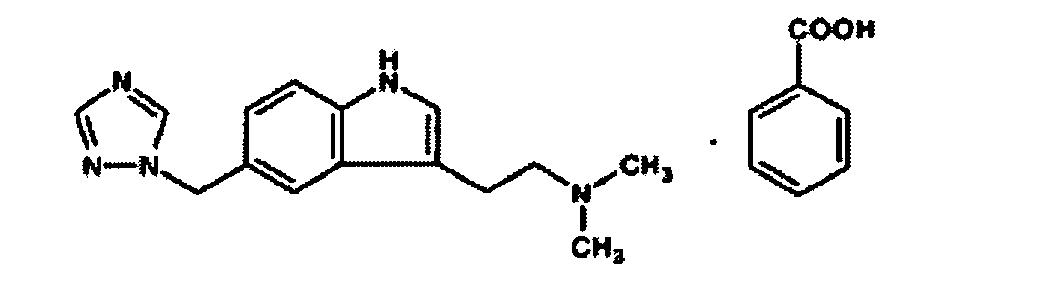
- For purposes of this invention, rizatriptan can be administered as the base or as any pharmaceutically acceptable salt that demonstrates adequate stability upon storage and bioavailability upon administration, but a preferred form of rizatriptan for purposes of this invention is rizatriptan benzoate.
- The dosage form preferably comprises from about 2.5 mg to about 15 mg of rizatriptan (based on the weight of the base, in whatever form the rizatriptan is present), and more preferably comprises from about 5 mg to about 10 mg of rizatriptan, or about 5 mg or about 10 mg specifically, of rizatriptan (corresponding to 7.265 or 14.53 mg of rizatriptan benzoate). In addition, the dosage form preferably yields a tmax for the rizatriptan of from about 0.5 to about 3.0 hours, preferably from about 1.0 to about 2.5 hours, whether determined during a migraine-free period or during an attack.
- Other 5-HT1B/1D receptor agonists with which the invention could be practiced include Zolmitriptan (Zomig®), Naratriptan (Amerge®), Almotriptan (Axert®), and Frovatriptan (Frova®). Other migraine products that could be combined with the diclofenac potassium in the dosage forms of the present invention include dihydroergotamine and metoclopramide.
- Zolmitriptan is chemically designated as (S)-(4)-[[3-[2-(dimethylamino)ethyl]-1H-indol-5yl]methyl]-2-oxazolidinone, and has the following chemical structure:

- The dosage form preferably comprises from about 1.5 mg to about 7.5 mg of zolmitriptan, and more preferably comprises from about 2.5 mg to about 5.0 mg of zolmitriptan, or about 2.5 mg or about 5.0 mg specifically, of zolmitriptan. In addition, the dosage form preferably yields a Tmax for the zolmitriptan of from about 1.0 to about 4.0 hours, preferably from about 1.0 to about 2.0 hours, or from about 2.5 to about 3.5 hours, whether determined during a migraine-free period or during an attack.
- Naratriptan is chemically designated as N-methyl-3-(1-methyl-4-piperidinyl)-1H-indole-5-ethanesulfonamide, and has the following chemical structure when present as the hydrochloride:

- For purposes of this invention, naratriptan can be administered as the base or as any pharmaceutically acceptable salt that demonstrates adequate stability upon storage and bioavailability upon administration, but a preferred form of naratriptan for purposes of this invention is naratriptan hydrochloride.
- The dosage form preferably comprises from about 0.5 mg to about 5.0 mg of naratriptan (based on the weight of the base, in whatever form the naratriptan is present), and more preferably comprises from about 1.0 mg to about 2.5 mg of naratriptan, or about 1.0 mg or about 2.5 mg specifically, of naratriptan (corresponding to 1.11 or 2.78 mg of naratriptan hydrochloride). In addition, the dosage form preferably yields a tmax for the naratriptan of from about 1.5 to about 4.5 hours, preferably from about 2.0 to about 4.0 hours, whether determined during a migraine-free period or during an attack.
- Almotriptan malate is chemically designated as 1-[[[3-[2-(dimethylamino)ethyl]-1H-indol-5-yl]methyl]sulfonyl]pyrrolidine (±) - hydroxybutanedioate (1:1), and has the following chemical structure when present as the malate:

- For purposes of this invention, almotriptan can be administered as the base or as any pharmaceutically acceptable salt that demonstrates adequate stability upon storage and bioavailability upon administration, but a preferred form of almotriptan for purposes of this invention is almotriptan malate.
- The dosage form preferably comprises from about 2.5 mg to about 15.0 mg of almotriptan (based on the weight of the base, in whatever form the almotriptan is present), and more preferably comprises from about 6.25 mg to about 12.5 mg of almotriptan, or about 6.25 mg or about 12.5 mg specifically, of almotriptan. In addition, the dosage form preferably yields a Tmax for the almotriptan of from about 0.5 to about 4.0 hours, preferably from about 1.0 to about 3.0 hours, whether determined during a migraine-free period or during an attack.
- Frovatriptan is preferably administered as the succinic acid salt, in an amount of from about 1.0 to about 5.0 mg, preferably about 2.5 mg (based on the weight of frovatriptan). In addition, the dosage form preferably yields a Tmax for the frovatriptan of from about 0.5 to about 4.0 hours, whether determined during a migraine-free period or during an attack. Other Pharmaceutically Active Agents
- The expression "pharmaceutically active agents" as used herein is intended to encompass agents other than foods, which promote a structural and/or functional change in and/or on bodies to which they have been administered. These agents are not particularly limited; however, they should be physiologically acceptable and compatible with the film.
- Suitable pharmaceutically active agents include, but are not limited to:
- ■ antimicrobial agents, such as triclosan, cetyl pyridium chloride, domiphen bromide, quaternary ammonium salts, zinc compounds, sanguinarine, fluorides, alexidine, octonidine, EDTA, and the like;
- ■ non-steroidal anti-inflammatory drugs, such as aspirin, acetaminophen, ibuprofen, ketoprofen, diclofenac, diflunisal, fenoprofen calcium, naproxen, tolmetin sodium, indomethacin, and the like;
- ■ anti-tussives, such as benzonatate, caramiphen edisylate, menthol, dextromethorphan hydrobromide, chlophedianol hydrochloride, and the like;
- ■ decongestants, such as pseudoephedrine hydrochloride, phenylepherine, phenylpropanolamine, pseudoephedrine sulfate, and the like;
- ■ anti-histamines, such as brompheniramine maleate, chlorpheniramine maleate, carbinoxamine maleate, clemastine fumarate, dexchlorpheniramine maleate, diphenhydramine hydrochloride, diphenylpyraline hydrochloride, azatadine meleate, diphenhydramine citrate, doxylamine succinate, promethazine hydrochloride, pyrilamine maleate, tripelennamine citrate, triprolidine hydrochloride, acrivastine, loratadine, brompheniramine, dexbrompheniramine, and the like;
- ■ expectorants, such as guaifenesin, ipecac, potassium iodide, terpin hydrate, and the like;
- ■ anti-diarrheals, such as loperamide, and the like;
- ■ H2-antagonists, such as famotidine, ranitidine, and the like;
- ■ proton pump inhibitors, such as omeprazole, lansoprazole, and the like;
- ■ general nonselective CNS depressants, such as aliphatic alcohols, barbiturates and the like;
- ■ general nonselective CNS stimulants such as caffeine, nicotine, strychnine, picrotoxin, pentylenetetrazol and the like;
- ■ drugs that selectively modify CNS function, such as phenyhydantoin, phenobarbital, primidone, carbamazepine, ethosuximide, methsuximide, phensuximide, trimethadione, diazepam, benzodiazepines, phenacemide, pheneturide, acetazolamide, sulthiame, bromide, and the like;
- ■ antiparkinsonism drugs such as levodopa, amantadine and the like;
- ■ narcotic-analgesics such as morphine, heroin, hydromorphone, metopon, oxymorphone, levorphanol, codeine, hydrocodone, xycodone, nalorphine, naloxone, naltrexone and the like;
- ■ analgesic-antipyretics such as salycilates, phenylbutazone, indomethacin, phenacetin and the like; and
- ■ psychopharmacological drugs such as chlorpromazine, methotrimeprazine, haloperidol, clozapine, reserpine, imipramine, tranylcypromine, phenelzine, lithium and the like.
- Other suitable drugs include ambroxol hydrochloride, apomorphine, ascorbic acid, betamethasone, caffeine, dextromethorphan, glimepiride, hydrocortisone, ketotifen, loperamide, meclozine, melatonin, neramexane, piroxicam, sodium picosulfate, and zinc histidine, and pharmaceutically acceptable salts thereof.
- The most preferable drugs are those in which a unitary dosage form comprises no more than about 50 mg, 25 mg, 15 mg or 10 mg of the active ingredient per unit.
- The films of the present invention can be provided in various dispensing and/or packaging configurations. For example, in one embodiment, the films would be packaged in a dose card that contains a plurality of individually wrapped films protected by moisture impermeable removable laminar covers. Examples of suitable dose cards are reported, for example, in
U.S. Patent No. 6,520,329 ,WO 2006/056161 ,WO 02/059012 EP 1 353 857WO 01/62621 - In another embodiment, the films would be packaged in a hermetically sealed, moisture impermeable flat pouch comprising two walls adhered around the edges. In a preferred embodiment, the packaging prevents the dosage form from absorbing more than 4.0, 3.0, 2.0 or even 1.0 wt.% moisture in three months when stored at 40 °C and 75% relative humidity.
- In one embodiment the invention relates to a non-mucoadhesive orally disintegrating film, able to disintegrate upon contact with saliva in the buccal cavity within about sixty seconds, comprising donepezil or a pharmaceutically acceptable salt thereof in combination with a hydrophilic binder and a water-soluble diluent, wherein:
- a) said film is characterized predominantly by gastrointestinal absorption when placed on the tongue, allowed to disintegrate, and subsequently swallowed;
- b) said film comprises from about 2.5 to about 20 mg of donepezil or a pharmaceutically acceptable salt thereof;
- c) said donepezil hydrochloride is present in an amount of from about 0.05% to about 50% (w/w), based on the total weight of the film,
- d) said film has a Tmax of from about 3 to about 4 hours, and
- e) said donepezil or pharmaceutically acceptable salt thereof has an absolute bioavailability in said film of about 100%.
- In a further embodiment said donepezil is present as amorphous donepezil hydrochloride.
- In another embodiment said film is characterized by greater than 95% gastrointestinal absorption.
- In a further embodiment of the invention said film comprises from about 40% to about 80% (w/w) of one or more ingredients that constitute a hydrophilic binder and a water soluble diluent.
- In yet a further embodiment of the invention said film comprises further from about 5 to about 25 wt.% of an aminoalkyl methacrylate copolymer, having a molecular weight of from about 120,000 to about 180,000.
- In a further embodiment of the invention said film comprises further from about 10 to about 40 wt.% of a cyclodestrin or derivative thereof.
- In yet a further embodiment of the invention said film comprises from about 0.5 to about 2.0 wt.% citric acid.
- In another embodiment of the invention said film comprises amorphous donepezil hydrochloride, made by a process comprising:
- a) dissolving donepezil hydrochloride in a hydrophilic binder, water soluble diluent and liquid solvent to form a liquid intermediate;
- b) spreading said liquid intermediate on a flat surface; and
- c) evaporating said liquid solvent from said liquid intermediate to form said final film product.
- In another embodiment said donepezil hydrochloride dissolved in step (a) as described above is Form I donepezil hydrochloride.
- The invention relates further to the use of said non-mucoadhesive orally disintegrating film in the manufacture of a medicament for the treatment of mild to moderate dementia in a human patient, for the administration of said film to the tongue of said patient, for swallowing said film within about sixty seconds of administration, and predominantly for the gastrointestinal absorption of said donepezil or pharmaceutically acceptable salt thereof.
- In one embodiment said use is characterized in that greater than 95 wt.% of said donepezil or pharmaceutically acceptable salt thereof is absorbed gastrointestinally.
- In a further embodiment the invention relates to the above described use wherein said donepezil consists essentially of amorphous donepezil hydrochloride.
- The invention relates further to a non-mucoadhesive orally disintegrating film, able to disintegrate upon contact with saliva in the buccal cavity within about sixty seconds, comprising amorphous donepezil hydrochloride in combination with a hydrophilic binder and a water-soluble diluent, wherein:
- a) said film comprises from about 2.5 to about 20 mg of amorphous donepezil hydrochloride;
- b) said donepezil is present in an amount from about 0.05% to about 50% (w/w), based on the total weight of the formulation,
- c) said film has a Tmax of from about 3 to about 4 hours, and
- d) said donepezil has an absolute bioavailability in said dosage form of about 100%.
- The invention relates further to a non-mucoadhesive orally disintegrating film, able to disintegrate upon contact with saliva in the buccal cavity within about sixty seconds, comprising ondansetron or a pharmaceutically acceptable salt thereof, in combination with a hydrophilic binder and a water-soluble diluent, wherein:
- a) said film is characterized predominantly by gastrointestinal absorption when placed on the tongue, allowed to disintegrate, and subsequently swallowed;
- b) said film comprises from about 4 to about 24 mg of ondansetron or pharmaceutically acceptable salt thereof;
- c) said ondansetron or pharmaceutically acceptable salt thereof is present in an amount from about 0.05% to about 50% (w/w), based on the total weight of the formulation,
- d) said film has a Tmax of from about 1.5 to about 2.5 hours, and
- e) said ondansetron or pharmaceutically acceptable salt thereof has an absolute bioavailability in said dosage form of from about 45% to about 75%.
- In one embodiment said ondansetron containing film comprises Form B ondansetron base. In a further embodiment said ondansetron containing film, further comprising from about 5 to about 25 wt.% of an aminoalkyl methacrylate copolymer, having a molecular weight of from about 120,000 to about 180,000.
- In a further embodiment said ondansetron containing film further comprises from about 10 to about 40 wt.% of a cyclodextrin of derivative thereof.
- In a further embodiment said ondansetron containing film comprises from about 40% to about 80% (w/w) of one or more ingredients that constitute a hydrophilic binder and a water soluble diluent.
- The invention relates further to the use of said non-mucoadhesive orally disintegrating film containing odansetron in the manufacture of a medicament for the treatment or prevention of emesis in a human patient, for the administration of said film to the tongue of said patient, for swallowing said film within about sixty seconds of administration, and predominantly for the gastrointestinal absorption of said ondansetron or pharmaceutically acceptable salt thereof.
- The invention relates further to the use of said non-mucoadhesive orally disintegrating film containing ondansetron in the manufacture of a medicament for the treatment or prevention of emesis in a human patient, wherein said emesis is from postoperative nausea and vomiting, chemotherapy induced nausea and vomiting, or radiation induced nausea and vomiting.
- The invention relates further to the use of said non-mucoadhesive orally disintegrating film containing ondansetron in the manufacture of a medicament for the treatment or prevention of emesis in a human patient wherein said film comprises Form B ondansetron base.
- The invention relates further to the use of said non-mucoadhesive orally disintegrating film containing ondansetron in the manufacture of a medicament for the treatment or prevention of emesis in a human patient wherein greater than 95 wt.% of said ondansetron or pharmaceutically acceptable salt thereof is absorbed gastrointestinally.
- The invention further relates to a non-mucoadhesive orally disintegrating film, able to disintegrate upon contact with saliva in the buccal cavity within about sixty seconds, comprising a defined amount of an active pharmaceutical agent, or a pharmaceutically acceptable salt thereof, a hydrophilic binder and a water-soluble diluent, wherein:
- a) said film is characterized predominantly by gastrointestinal absorption when placed on the tongue, allowed to disintegrate, and subsequently swallowed;
- b) said film is bioequivalent to an immediate release tablet or capsule or orally dissolving/dispersing tablet (ODT) that comprises said active pharmaceutical agent or a pharmaceutically acceptable salt thereof in said defined amount; and
- c) said film comprises from about 0.05% to about 50% (w/w) of said active pharmaceutical agent, based on the total weight of the formulation.
- In a further embodiment said film is characterized by greater than 95% gastrointestinal absorption.
- In another embodiment said film comprises from about 40% to about 80% (w/w) of one or more ingredients that constitute said hydrophilic binder and water soluble diluent.
- In still another embodiment the active pharmaceutical agent of said film is selected from: donepezil hydrochloride; ondansetron base; desloratadine; olanzapine; risperidone; rivastigmine tartrate; sildenafil; vardenafil; galantamine; diclofenac potassium; buprenorphine HCl; naloxone HCl dehydrate; alprazolam; clonazepam; diazepam; lorazepam; sumatriptan; eletriptan; rizatriptan; zolmitriptan; naratriptan; almotriptan; frovatriptan; cetirizine hydrochloride; loratadine; ambroxol hydrochloride; apomorphine; ascorbic acid; betamethasone; caffeine; dextromethorphan; glimepiride; hydrocortisone; ketotifen; loperamide; meclozine; melatonin; neramexane; piroxicam; sodium picosulfate; and zinc histidine; or a pharmaceutically acceptable salt thereof; or a combination thereof.
- In a further embodiment the immediate release tablet or capsule or orally dissolving/dispersing tablet (ODT) of said film is characterized by a time to dissolution for 75% of the active pharmaceutical agent of greater than about twenty minutes, and less than about ninety minutes, when tested in a type II dissolution apparatus at pH 2.0 and 37 °C at a paddle speed of 50 rpm.
- In another embodiment the active pharmaceutical agent of said film is subject to first pass metabolism.
- In one embodiment said film further comprises means for promoting gastrointestinal absorption of said active pharmaceutical agent.
- In a further embodiment the immediate release tablet or capsule or orally dissolving/dispersing tablet (ODT) of said film is characterized by (i) predominant gastrointestinal absorption when administered orally, (ii) a first pharmacokinetic profile, and (iii) the presence of said active agent in said defined amount; made by a process comprising:
- a) formulating said film to comprise said active agent in said defined amount and to be characterized by a second pharmacokinetic profile that is bioequivalent to said first pharmacokinetic profile when disintegrated orally and absorbed in the gastrointestinal tract; and
- b) clinically testing said orally administered dosage form and said orally disintegrating film for bioequivalence.
- In one embodiment said film is in the form of a single layer.
- In a further embodiment said film does not contain a surfactant.
- The invention relates further to a non-mucoadhesive orally disintegrating film, able to disintegrate upon contact with saliva in the buccal cavity within about sixty seconds, comprising a defined amount of an active pharmaceutical agent, or a pharmaceutically acceptable salt thereof, a hydrophilic binder and a water-soluble diluent, wherein:
- a) said film is characterized predominantly by gastrointestinal absorption when placed on the tongue, allowed to disintegrate, and subsequently swallowed;
- b) said film comprises from about 0.05% to about 50% (w/w) of said active pharmaceutical agent, based on the total weight of the formulation; and
- c) said film has:
- i) a Tmax greater than about 4.5 hours;
- ii) an absolute bioavailability of greater than about 65%, optionally with a Tmax greater than about 1.5 hours;
- iii) an absolute bioavailability of from about 45% to about 65%, and a Tmax of less than 3.0 hours;
- iv) a Tmax of from 3.0 to 4.5 hours; or
- v) a Tmax of less than 1.0 hours.
- In one embodiment the active agent of said film has a Tmax greater than about 4.5 hours.
- In a further embodiment the active agent of said film has an absolute bioavailability of greater than about 65%, optionally with a Tmax greater than about 1.5 hours.
- In a preferred embodiment the active agent of said film has an absolute bioavailability of from about 45% to about 65%, and a Tmax of less than 3.0 hours.
- In another embodiment the active agent of said film has a Tmax of from 3.0 to 4.5 hours.
- In still another embodiment the active agent of said film has a Tmax of less than 1.0 hours.
- In a further embodiment the active pharmaceutical agent of said film is selected from: donepezil hydrochloride; ondansetron base; desloratadine; olanzapine; risperidone; rivastigmine tartrate; sildenafil; vardenafil; galantamine; diclofenac potassium; buprenorphine HCl; naloxone HCl dehydrate; alprazolam; clonazepam; diazepam; lorazepam; sumatriptan; eletriptan; rizatriptan; zolmitriptan; naratriptan; almotriptan; frovatriptan; cetirizine hydrochloride; loratadine; ambroxol hydrochloride; apomorphine; ascorbic acid; betamethasone; caffeine; dextromethorphan; glimepiride; hydrocortisone; ketotifen; loperamide; meclozine; melatonin; neramexane; piroxicam; sodium picosulfate; and zinc histidine; or a pharmaceutically acceptable salt thereof; or a combination thereof.
- The invention relates further to a non-mucoadhesive orally disintegrating film, able to disintegrate upon contact with saliva in the buccal cavity within about sixty seconds, comprising a defined amount of an active pharmaceutical agent, or a pharmaceutically acceptable salt thereof, a hydrophilic binder, a water-soluble diluent, wherein said film is characterized predominantly by gastrointestinal absorption when placed on the tongue, allowed to disintegrate, and subsequently swallowed; and said active pharmaceutical agent is selected from: donepezil hydrochloride; ondansetron base; desloratadine; olanzapine; risperidone; rivastigmine tartrate; sildenafil; vardenafil; galantamine; diclofenac potassium; buprenorphine HCl; naloxone HCl dehydrate; alprazolam; clonazepam; diazepam; lorazepam; sumatriptan; eletriptan; rizatriptan; zolmitriptan; naratriptan; almotriptan; frovatriptan; cetirizine hydrochloride; loratadine; ambroxol hydrochloride; apomorphine; ascorbic acid; betamethasone; caffeine; dextromethorphan; glimepiride; hydrocortisone; ketotifen; loperamide; meclozine; melatonin; neramexane; piroxicam; sodium picosulfate; and zinc histidine; or a pharmaceutically acceptable salt thereof; or a combination thereof.
- In one embodiment said film comprises means for promoting gastrointestinal absorption, wherein said means comprises:
- a) an ingredient that retards said active pharmaceutical ingredient from dissolving in the buccal cavity;
- b) an ion exchange resin;
- c) a pH adjusting agent that adjusts the ionization of the active pharmaceutical ingredient to a less mucosally absorbable state; or
- d) said active pharmaceutical ingredient in base form.
- The invention relates further to the use of one of the above described non-mucoadhesive orally disintegrating films in the manufacture of a medicament for the administration of said film to the tongue of said patient, for swallowing said film within about sixty seconds of administration, and predominantly for the gastrointestinal absorption of said active agent or pharmaceutically acceptable salt thereof.
- In one embodiment said use is characterized in that greater than 95 wt.% of said ondansetron or pharmaceutically acceptable salt thereof is absorbed gastrointestinally.
- In a further embodiment said use is characterized in that said active pharmaceutical agent is selected from: donepezil hydrochloride; ondansetron base; desloratadine; olanzapine; risperidone; rivastigmine tartrate; sildenafil; vardenafil; galantamine; diclofenac potassium; buprenorphine HCl; naloxone HCl dehydrate; alprazolam; clonazepam; diazepam; lorazepam; sumatriptan; eletriptan; rizatriptan; zolmitriptan; naratriptan; almotriptan; frovatriptan; cetirizine hydrochloride; loratadine; ambroxol hydrochloride; apomorphine; ascorbic acid; betamethasone; caffeine; dextromethorphan; glimepiride; hydrocortisone; ketotifen; loperamide; meclozine; melatonin; neramexane; piroxicam; sodium picosulfate; and zinc histidine; or a pharmaceutically acceptable salt thereof; or a combination thereof.
- In a further embodiment said film used in the manufacture of a medicament is provided on a dose card that contains a plurality of individually wrapped films protected by moisture impermeable removable laminar covers.
- In one embodiment of the invention said film used in the manufacture of a medicament is wrapped individually in a moisture impermeable flat pouch comprising two walls adhered around the edges.
- The invention related further to a method of making a bioequivalent non-mucoadhesive orally disintegrating film, comprising:
- a) providing an orally administered dosage form that comprises an active pharmaceutical agent in a defined amount, and that is characterized by (i) predominant gastrointestinal absorption when administered orally, and (ii) a first pharmacokinetic profile;
- b) formulating a first batch of non-mucoadhesive orally disintegrating film, able to disintegrate upon contact with saliva in the buccal cavity within about sixty seconds, that comprises said active agent in said defined amount, and that is characterized by (i) a defined formulation, (ii) predominant gastrointestinal absorption when dissolved orally, and (iii) a second pharmacokinetic profile that is bioequivalent to said first pharmacokinetic profile; and
- c) clinically testing said orally administered dosage form and said orally disintegrating film for bioequivalence.
- In one embodiment the active pharmaceutical agent to be used in that method is selected from: donepezil hydrochloride; ondansetron base; desloratadine; olanzapine; risperidone; rivastigmine tartrate; sildenafil; vardenafil; galantamine; diclofenac potassium; buprenorphine HCl; naloxone HCl dehydrate; alprazolam; clonazepam; diazepam; lorazepam; sumatriptan; eletriptan; rizatriptan; zolmitriptan; naratriptan; almotriptan; frovatriptan; cetirizine hydrochloride; loratadine; ambroxol hydrochloride; apomorphine; ascorbic acid; betamethasone; caffeine; dextromethorphan; glimepiride; hydrocortisone; ketotifen; loperamide; meclozine; melatonin; neramexane; piroxicam; sodium picosulfate; and zinc histidine; or a pharmaceutically acceptable salt thereof; or a combination thereof.
- In another embodiment said method further comprises:
- a) measuring a first dissolution or disintegration profile for said orally disintegrating film from said first batch;
- b) preparing a second batch of non-mucoadhesive orally disintegrating film that is characterized by said defined formulation;
- c) measuring a second dissolution or disintegration profile for said orally disintegrating film from said second batch; and
- d) comparing said first and second dissolution or disintegration profiles for equivalence.
- In a preferred embodiment said method further comprises packaging said film from said second batch in a dose card that contains a plurality of individually wrapped films protected by moisture impermeable removable laminar covers.
- In one embodiment said method further comprises packaging said film from said second batch in a moisture impermeable flat pouch comprising two walls adhered around the edges.
- The following examples are put forth so as to provide those of ordinary skill in the art with a complete disclosure and description of how the compounds claimed herein are made and evaluated, and are intended to be purely exemplary of the invention and are not intended to limit the scope of what the inventors regard as their invention. Efforts have been made to ensure accuracy with respect to numbers (e.g., amounts, temperature, etc.) but some errors and deviations should be accounted for. Unless indicated otherwise, parts are parts by weight, temperature is in °C or is at room temperature, and pressure is at or near atmospheric.
- Table 1 depicts a representative film formulation that contains 8.0 mg of ondansetron as its base, in order to promote gastrointestinal absorption.
Table 1: Representative Formulation of Ondansetron Base Film Dosage Form Pos. Ingredient Amount
per Film
[mg]Amount per
Film [%]1 Ondansetron (as base) 8.0 15.84 2 Mowiol (Polyvinylalcohol) 22.0 43.56 3 PEG (polyethylene glycol) 6.0 11.88 4 Glycerol anhydrous 2.0 3.96 5 Rice Starch 10.0 19.80 6 Acesulfam K 0.2 0.40 7 Titanium dioxide 0.3 0.59 8 Menthol 1.0 1.98 9 Polysorbate 1.0 1.98 TOTAL 50.5 100.0 - Tables 2 and 3 present clinical pharmacokinetic data for Zofran® brand
immediate release 8 mg and 24 mg tablets, as reported in the Food and Drug Administration (FDA) approved prescribing information for this product:Table 2: Pharmacokinetics in Normal Volunteers Single 8 mg Zofran® Tablet DoseAge-group
(years)Mean
Weight
(kg)n Peak Plasma
Concentration
(ng/mL)Time of
Peak Plasma
Concentration
(h)Mean
Elimination
Half-life
(h)Systemic
Plasma
Clearance
L/h/kgAbsolute
Bioavailability18-40 M 69.0 6 26.2 2.0 3.1 0.403 0.483 F 62.7 5 42.7 1.7 3.5 0.354 0.663 61-74 M 77.5 6 24.1 2.1 4.1 0.384 0.585 F 60.2 6 52.4 1.9 4.9 0.255 0.643 ≥75 M 78.0 5 37.0 2.2 4.5 0.277 0.619 F 67.6 6 46.1 2.1 6.2 0.249 0.747 Table 3: Pharmacokinetics in Normal Volunteers Single 24 mg Zofran® Tablet Dose Age-group
(years)Mean
Weight
(kg)n Peak Plasma
Concentration
(ng/mL)Time of
Peak Plasma
Concentration
(h)Mean
Elimination
Half-life
(h)18-43 M 84.1 8 125.8 1.9 4.7 F 71.8 8 194.4 1.6 5.8 - Dissolution studies were conducted on five different orally administered ondansetron products: Zofran®4 mg Zydis® Lingual;
Zofran® 8 mg Zydis® Lingual; ondansetron 4 mg RapidFilm having the formulation of Table 4;ondansetron 8 mg RapidFilm having the formulation of Table 4 (punched in 6 cm2 rectangles); andZofran® 8 mg Filmtablet.Table 4: Ondansetron RapidFilm Formulation Ingredients Master Batch
Formula [g/100g]Formula dosage
form
[mg/unit]
[3.00 cm3 final film]Ondansetron Base 6,8116 4,000 Polyvinylalcohol 4-88 18,7321 11,000 PEG 10005,1088 3,000 Glycerol anhydr. 1,7032 1,000 Rice starch 8,5149 5,000 Acesulfam K 0,1707 0,100 Titanium dioxide 0,2559 0,150 Levomenthol 0,8514 0,500 Polysorbate 800,8514 0,500 Ethanol 96% 23,7519 Removed Purified Water 33,2481 Removed - Dissolution studies were performed according to Ph. Eur. 2.9.4, paddle, sinker, 900 ml, using 0.1N HCl buffered water at pH 1.0. Stirring occurred at 100 rpm and 37 °C. Relative pharmacokinetics are reported in Table 5 below and
Figure 1 .Table 5: Lot. 5G033 R208046 OND008OD_8mg 5H010 OND008OD_4mg Time Zofran 8mg
Film tablet Zofran 8 mg
Zydis LingualOndanaetron
8 mg Rapid FilmZofran 4 mg
Zydia LingualOndanaetron 4
mg
Rapid Film[min] [%] [%] [%] [%] [%] 0 0 0 0 0 0 1 0.8 100.3 97.1 102.3 71.8 3 9 104.6 102 101.7 98.4 5 22.7 103.4 102.4 101.4 103.3 7 63.4 102.1 101.7 101.3 105 10 103.3 100.8 100.8 101.8 105.2 - A clinical study was conducted to compare the bioavailability profile and the pharmacokinetic parameters of two medicinal products containing 8 mg ondansetron: (1) ondansetron RapidFilm formulated having the formulation reported in Table 4, and (2)
Zofran® 8 mg. Zydis Lingual-Orally Disintegrating Tablets. - The study was a randomized, single dose, two way, two sequence crossover, open label with seven days washout period study under fasting conditions. Orally disintegrating tablet and RapidFilm was allowed to dissolve in the subject's mouth for about 10 seconds before the patient was asked to swallow. The study included 7 healthy adult Caucasian males.
- Table 6 reports pharmacokinetic and bioequivalence parameters observed during the study.
Figure 1 is a comparison of dissolution profiles over time comparing three commercially available formulations of ondansetron with two ondansetron RapidFilm formulations, as described in Table 4.Figure 2 depicts mean (FIG 2A ) and log mean (FIG 2B ) drug plasma concentration profiles versus time for 8 mg ondansetron RapidFilm investigational product (Table 4) versusZofran® 8 mg. Lingual orally disintegrating tablets.Table 6: Pharmacokinetic Parameter Investigational Product
(Algebraic Mean ± SD)Reference Product
(Algebraic Mean ± SD)Cmax (ng/ml) 18.75 ± 6.262 20.37 ± 6.470 AUC 0-t (ng*hr/ml) 94.11 ± 38.078 100.05 ± 48.826 AUC 0-∞ (ng*hr/ml) 98.18 ± 39.345 103.66 ± 49.691 Tmax (hr) 1.58 ± 0.408 1.71 ± 0.749 Tlag (hr) 0.08 ± 0.204 0.08 ± 0.204 T1/2(hr) 3.45 ± 0.817 3.62 ± 0.624 Kelimination (hr1) 0.2111 ± 0.05284 0.1965 ± 0.03480 (AUC 0-t/ AUC 0-∞) % 95.67 ± 1.467 96.14 ± 1.362 BE Assessment Parameter Cmax
(80.00 - 125.00)AUC0-t
(80.00 - 125.00)AUC0-∞
(80.00 - 125.00)Point Estimate (%) 91.84 96.32 96.79 Lower Limit (%) 72.64 82.87 83.81 Upper Limit (%) 116.13 111.96 111.78 Prob<80.00 0.1389 0.0291 0.0239 Prob>125.00 0.0244 0.0105 0.0096 - Table 7 recites the ingredients of a film formulation that contains 10.0 mg of donepezil hydrochloride. The formulation lacks any special ingredients for promoting GI absorption, other than the formulation's affinity for water, and its rapid disintegration in saliva. Table 5 describes an alternative formulation of 10.0 mg donepezil hydrochloride that contains cyclodextrin to retard the absorption of active ingredient through the oral mucosa, and thereby promote GI absorption.
Table 7: Representative Formulation of Donepezil HCl Orally Disintegrating Film Pos. Ingredient Amount
per Film
[mg]Amount per
Film [%]1 Donepezil HCl 10.00 12.27 2 Polyethylenoxide 50.00 61.36 3 Polysorbate 80 (Tween 80) 1.00 1.23 4 Glycerol anhydrous 12.00 14.73 5 Citric acid anhydrous 1.00 1.23 6 Titanium dioxide 0.50 0.61 7 Acesulfam K 1.50 1.84 8 Anis flavor 1.65 2.02 9 Peppermint flavour 3.84 4.71 TOTAL 81.49 100.0 Table 8: Alternative Representative Formulation of Donepezil HCl Orally Disintegrating Film Pos. Ingredient Amount per Film
[mg]Amount per
Film [%]1 Donepezil HCl 10.0 9.48 2 β-Cyclodextrin (Cavamax W7) 44.5 42.18 3 Polyvinylalkohol (Mowiol 4-88) 30.0 28.44 4 Polyethylenglycol (PEG 1000) 8.0 7.58 5 Propylenglycol 5.0 4.74 6 Citric acid anhydrous 1.0 0.95 7 Acesulfam K 1.5 1.42 8 Anis flavor 1.65 1.56 9 Peppermint flavour 3.84 3.64 TOTAL 105.49 100.0 - A comparative dissolution study was undertaken to compare the dissolution profile of various RapidFilm products and formulations with commercially available donepezil products. The formulations for the donepezil film products are reported in Tables 9-14.
Table 9: Donepezil RapidFilm; Prototype A Ingredients Master Batch
Formula [g/100g]Formula dosage
form
[mg/unit]
[3.00 cm3final film]Donepezil HCl (Form I) 4,2470 5,000 Polyvinylalcohol 4-88 12,7410 15,000 PEG 10003,3970 4,000 Acesulfam K 0,6370 0,750 β- Cyclodextrine 18,8980 22,250 Citric Acid anhyd. 0,4250 0,500 Propylenglycol 2,1230 2,500 Anis 0,7010 0,825 Peppermint 1,6310 1,920 Purified Water 39,9000 Removed Ethanol abs. 15,3000 Removed Table 10: Donepezil RapidFilm; Prototype B Ingredients Master Batch
Formula [g/100g]Formula dosage form
[mg/unit]
[3.00 cm3final film]Donepezil HCl (Form I) 3,0540 5,000 Polyethylenoxide 15,2680 25,000 Acesulfam K 0,4580 0,750 Polysorbat 800,3050 0,500 Glycerol anhydr. 3,6640 6,000 Titanium dioxide 0,1530 0,250 Citric acide
monohydrate 0,3050 0,500 Anis 0,5040 0,825 Peppermint 1,1730 1,920 Purified Water 15,3000 Removed Ethanol abs. 59,8200 Removed Table 11: Donepezil RapidFilm; Prototype C Ingredients Master Batch
Formula
[g/100g]Formula dosage form
[mg/unit]
[3.00 cm3final film]Donepezil HCl (amorphous) 13,7230 5,000 Lactose 10,2920 15,000 Polyvinylalcohol 4-88 10,2920 15,000 PEG 10002,7450 4,000 Acesulfam K 0,5150 0,750 β- Cyclodextrine 15,2660 22,250 Citric Acid anhyd. 0,3430 0,500 Propylenglycol 1,7150 2,500 Anis 0,5660 0,825 Peppermint 1,3170 1,920 Purified Water 41,2000 Removed Ethanol abs. 12,4000 Removed Table 12: Donepezil RapidFilm; Prototype E Ingredients Master Batch Formula
[g/100g]Formula dosage form
[mg/unit] film]
[3,00 cm3final film]Donepezil HCl (Form I) 4,8799 5,000 Polyvinylalcohol 4-88 13,8054 15,000 PEG 10003,6813 4,000 Acesulfam K 0,6903 0,750 β- Cyclodextrine 11,7691 11,125 Citric Acid anhyd. 0,4603 0,500 Propylenglycol 2,3008 2,500 Anis 0,7783 0,825 Peppermint 1,8022 1,920 Purified Water 43,2660 Removed Ethanol 96% 16,5664 Removed Table 13: Donepezil/Eudragit Pre-Mix for Prototype F Ingredients Master Batch Formula
[g/100g]Donepezil HCl (Form I) 12,5000 Eudragit E PO 12,5000 Ethanol albs. *) 75,0000 *not part of the finished product Table 14: Donepezil/Eudragit RapidFilm; Prototype F Ingredients Master Batch Formula
[g/100g]Formula dosage form
[mg/unit]
[3.00 cm3final film]Donepezil HCl /Eudragit
combination)10,0000 10,000 Polyvinylalcohol 4-88 15,0000 15,000 PEG 10004,0000 4,000 Acesulfam K 0,7500 0,750 Propylenglycol 2,5000 2,500 Anis 0,8250 0,825 Peppermint 1,9200 1,920 Aqua purificata* 65,0000 Removed *not part of the finished product - Dissolution studies were performed according to Ph. Eur. 2.9.4, paddle, sinker, 900 ml, using 0.1N HCl buffered water at pH 1.0. Stirring occurred at 50 rpm and 37 °C. Relative pharmacokinetics are reported in Table 15 below and
Figure 3 .Table 15: Time Rapid film, Prototype A Rapid film, Prototype C Rapid film, Prototype E Rapid film, Prototype F Aricept film Tablets Aricept ODT [min] [%] [%] [%] [%] [%] [%] 0 0 0 0 0 0 0 3 58.8 86.5 66.8 103.3 14.5 47.9 5 78.7 101.0 78.3 106.7 40.3 78.9 7 90.0 102.4 86.5 111.3 57.4 89.0 10 93.7 105.0 94.7 111.0 70.5 93.5 15 94.0 103.1 102.4 111.0 82.1 97.1 30 93.9 102.9 106.8 111.5 92.9 98.1 - Table 16 recites the ingredients of a 6 cm2 film formulation that contains 12.5 mg of diclofenac potassium (matrix weight = 120.7 g/m2). The film contains an ion exchange resin to retard the absorption of active ingredient through the oral mucosa, and thereby promote GI absorption.
Table 16: Representative Formulation of Diclofenac K Orally Disintegrating Film Pos. Ingredient Amount
per Film
[mg]Amount per
Film [%]1 Mowiol 4-88 22.00 30.4 2 PEG 10006.00 8.3 3 Neohesperidin DC 0.60 0.8 4 Duolite AP 143/1093 18.75 25.9 5 Menthol 1.00 1.4 6 Polysorbate 801.50 2.1 7 Ferrum Oxide (No. 3) 0.05 0.1 8 Rice Starch 10.0 13.8 9 Diclofenac Potassium 12.5 17.3 TOTAL 72.40 100.0 10 Ethanol 96% (v/v)* 50.0 11 Purified Water* 70.0 *Removed by evaporation. - Tables 17 - 37 below present representative formulations of alternative drugs manufactured according to the present invention.
- Using the following components a laminate with a nominal size of 1 000.0 cm2 should be obtained. From the dried laminate films with a size of 6.0 cm2 were punched.
Table 17: ACTIVE INGREDIENT POLYMERS OTHER COMPONENTS SOLVENTS 3.333 g
Ambroxol hydrochloride3.667 g
Poly(vinyl alcohol) 4-880.033 g
Saccharin sodium8.3 g
Ethanol 96 % (V/V)1.000 g
PEG 10000.100 g
Polysorbate 8011.7 g
Purified water0.250 g
Peppermint oil0.100 g
Eucalyptus oil1.667 g
Rice starch - Using the following components a laminate with a nominal size of 400.0 cm2 should be obtained. From the dried laminate films with a size of 6.0 cm2 were punched.
Table 18: ACTIVE INGREDIENT POLYMERS OTHER COMPONENTS SOLVENTS 0.228 g 2.000 g 0.003 g 3.3 g Apomorphine hydrochloride Poly(vinyl alcohol) 4-88 Neohesperidin dihydrochalcone Ethanol 96 % (V/V) 0.533 g
PEG 10000.003 g
Saccharin sodium4.7 g
Purified water0.033 g
Peppermint oil0.001 g
Patent blue V0.009 g
Titanium dioxide - Using the following components a laminate with a nominal size of 6 000.0 cm2 should be obtained. From the dried laminate films with a size of 5.0 cm2 were punched.
Table 19: ACTIVE INGREDIENT POLYMERS OTHER COMPONENTS SOLVENTS 24.000 g Ascorbic acid 24.000 g
Poly(vinyl alcohol) IF 14 0000.120 g
Saccharin sodium42.0 g
Ethanol 96 % (VN)6.000 g
PEG 10008.400 g
Rice starch60.0 g
Purified water0.720 g
Black currant flavor2.400 g
Azorubin (Stock solution 1 %)0.420 g
Titanium dioxide - Using the following components a laminate with a nominal size of 1 000.0 cm2 should be obtained. From the dried laminate films with a size of 6.0 cm2 were punched.
Table 20: ACTIVE INGREDIENT POLYMERS OTHER COMPONENTS SOLVENTS 0.667 g
Betamethasone3.667 g
Poly(vinyl alcohol)
4-880.050 g
Titanium dioxide8.3 g
Ethanol 96 % (V/V)1.000 g
PEG 10001.667 g
Rice starch11.7 g
Purified water - Using the following components a laminate with a nominal size of 1 000.0 cm2 should be obtained. From the dried laminate films with a size of 6.0 cm2 were punched.
Table 21: ACTIVE INGREDIENT POLYMERS OTHER COMPONENTS SOLVENTS 6.667 g
Caffeine2.833 g
Hydroxypropylcellulo se0.600 g
Glycerol, anhydrous20.0 g
Ethanol, anhydrous0.950 g
PEG 10000.1.250 g
Citric acid, anhydrous0.717 g
Povidone0.250 g
Neohesperidin dihydrochalcone - Using the following components a laminate with a nominal size of 4 000.0 cm2 should be obtained. From the dried laminate films with a size of 6.0 cm2 were punched.
Table 22: ACTIVE INGREDIENT POLYMERS OTHER COMPONENTS SOLVENTS 33.333 g
Caffeine20.000 g
Poly(vinyl alcohol) 4-880.333 g
Neohesperidin dihydrochalcone33.3 g
Ethanol 96 % (V/V)5.333 g
PEG 10000.333 g
Saccharin sodium46.7 g
Purified water3.333 g
Glycerol 85 % - Using the following components a laminate with a nominal size of 2 000.0 cm2 should be obtained. From the dried laminate films with a size of 6.0 cm2 were punched.
Table 23: ACTIVE INGREDIENT POLYMERS OTHER COMPONENTS SOLVENTS 3.333 g
Dextromethorphan10.000 g
Poly(vinyl alcohol) 4-880.167 g
Neohesperidin dihydrochalcone16.7 g
Ethanol 96 % (V/V)2.667 g
PEG 100022.0 g
Purified water - Using the following components a laminate with a nominal size of 2 000.0 cm2 should be obtained. From the dried laminate films with a size of 6.0 cm2 were punched.
Table 24: ACTIVE INGREDIENT POLYMERS OTHER COMPONENTS SOLVENTS 4.167 g
Diclofenac potassium7.333 g
Poly(vinyl alcohol) 4-880.200 g
Neohesperidin16.7 g
Ethanol 96 % (V/V)2.000 g
PEG 10000.500 g
Peppermint oil23.3 g
Purified water0.367 g
Sicovit (Stock solution 1 %)0.333 g
Polysorbate 803.333 g
Rice starch - Using the following components a laminate with a nominal size of 1 000.0 cm2 should be obtained. From the dried laminate films with a size of 6.0 cm2 were punched.
Table 25: ACTIVE INGREDIENT POLYMERS OTHER COMPONENTS SOLVENTS 0.500 g
Glimepiride5.000 g
Poly(vinyl alcohol) 4-880.083 g
Neohesperidin dihydrochalcone8.300 g
Ethanol 96 % (V/V)1.333 g
PEG 10000.033 g
Menthyl pyrrolidone carboxylate11.700 g
Purified water0.833 g
Glycerol 85 % - Using the following components a laminate with a nominal size of 1 000.0 cm2 should be obtained. From the dried laminate films with a size of 6.0 cm2 were punched.
Table 26: ACTIVE INGREDIENT POLYMERS OTHER COMPONENTS SOLVENTS 1.867 g
Hydrocortisone acetate3.667 g
Poly(vinyl alcohol) 4-880.050 g
Titanium dioxide8.3 g
Ethanol 96 % (V/V)1.000 g
PEG 10001.667 g
Rice starch11.7 g
Purified water - Using the following components a laminate with a nominal size of 1 500.0 cm2 should be obtained. From the dried laminate films with a size of 6.7 cm2 were punched.
Table 27: ACTIVE INGREDIENT POLYMERS OTHER COMPONENTS SOLVENTS 0.307 g Ketotifen fumarate 2.226 g
Poly(vinyl alcohol) 8-880.111 g
Polysorbate 2011.128 g
Ethanol 96 % (V/V)4.451 g
Poly(vinyl alcohol) 3-834.451 g
Rice starch15.579 g
Purified water0.668 g
PEG 1000 - Using the following components a laminate with a nominal size of 1 500.0 cm2 should be obtained. From the dried laminate films with a size of 6.7 cm2 were punched.
Table 28: ACTIVE INGREDIENT POLYMERS OTHER COMPONENTS SOLVENTS 0.445 g
Loperamide hydrochloride2.226 g
Poly(vinyl alcohol) 8-880.111 g
Polysorbate 2011.128 g
Ethanol 96 % (V/V)4.451 g
Poly(vinyl alcohol) 3-834.451 g
Rice starch15.579 g
Purified water0.334 g
PEG 1000 - Using the following components a laminate with a nominal size of 2 000.0 cm2 should be obtained. From the dried laminate films with a size of 6.0 cm2 were punched.
Table 29: ACTIVE INGREDIENT POLYMERS OTHER COMPONENTS SOLVENTS 9.888 g
Meclozine hydrochloride5.667 g
Poly(vinyl alcohol) 4-880.133 g
Menthol9.7 g
Ethanol 96 % (V/V)1.500 g
PEG 10000.133 g
Licorize flavor13.3 g
Purified water1.000 g
Glycerol2.500 g
Rice Starch - Using the following components a laminate with a nominal size of 500.0 cm2 should be obtained. From the dried laminate films with a size of 6.0 cm2 were punched.
Table 30: ACTIVE INGREDIENT POLYMERS OTHER COMPONENTS SOLVENTS 0.417 g
Melatonin2.500 g
Poly(vinyl alcohol) 4-880.008 g
Neohesperidin dihydrochalcone2.1 g
Ethanol 96 % (V/V)0.0667 g
PEG 10000.008 g
Saccharin sodium4.2 g
Purified water0.042 g
Peppermint flavor0.417 g
Glycerol 85 %2.083 g
Rice starch0.058 g
Titanium dioxide0.006 g
Patent blue V
(Stock solution: 3.1 mg/ml) - Using the following components a laminate with a nominal size of 1 000.0 cm2 should be obtained. From the dried laminate films with a size of 6.7 cm2 were punched.
Table 31: ACTIVE INGREDIENT POLYMERS OTHER COMPONENTS SOLVENTS 1.562 g
Metoclopramide hydrochloride2.226 g
Hydroypropylcellulose0.03 g
Neohesperidin20.772 g
Ethanol 99 % (V/V)3.709 g
Copolyvidone0.059 g
Menthol5.935 g
Corn starch - Using the following components a laminate with a nominal size of 500.0 cm2 should be obtained. From the dried laminate films with a size of 6.0 cm2 were punched.
Table 32: ACTIVE INGREDIENT POLYMERS OTHER COMPONENTS SOLVENTS 2.143 g
Neramexane mesylat1.833 g
Poly(vinyl alcohol) 4-880.017 g
Acesulfame Potassium4.2 g
Ethanol 96 % (V/V)0.500 g
PEG 10000.167 g
Glycerol, anhydrous5.8 g
Purified water0.025 g
Titanium dioxide0.833 g
Rice starch0.012 g
Masking flavor0.045 g
Orange flavor0.083 g
Polysorbate 80 - Using the following components a laminate with a nominal size of 628.0 cm2 should be obtained. From the dried laminate films with a size of 6.0 cm2 were punched.
Table 33: ACTIVE INGREDIENT POLYMERS OTHER COMPONENTS SOLVENTS 1.047 g
Olanzapine2.304 g
Poly(vinyl alcohol) 4-880.021 g
Acesulfame Potassium1.5 g
Ethanol 96 % (V/V)0.628 g
PEG 10004.5 g
Purified water - Using the following components a laminate with a nominal size of 2 000.0 cm2 should be obtained. From the dried laminate films with a size of 5.0 cm2 were punched.
Table 34: ACTIVE INGREDIENT POLYMERS OTHER COMPONENTS SOLVENTS 8.000 g
Piroxicam11.200 g
Poly(vinyl alcohol)
IF 14 00016.0 g
Ethanol 96 % (VN)2.800 g
PEG 100022.4 g
Purified water - Using the following components a laminate with a nominal size of 1 800.0 cm2 should be obtained. From the dried laminate films with a size of 6.0 cm2 were punched.
Table 35: ACTIVE INGREDIENT POLYMERS OTHER COMPONENTS SOLVENTS 10.534 g
Sildenafile citrate8.400 g
Poly(vinyl alcohol) 4-880.060 g
Neohesperidin12.0 g
Ethanol 96 % (V/V)1.950 g
PEG 10000.030 g
Saccharin sodium16.8 g
Purified water0.120 g
Peppermint oil0.045 g
Polysorbate 80 - Using the following components a laminate with a nominal size of 1 350.0 cm2 should be obtained. From the dried laminate films with a size of 6.0 cm2 were punched.
Table 36: ACTIVE INGREDIENT POLYMERS OTHER COMPONENTS SOLVENTS 1.125 g
Sodium picosulfate4.950 g
Poly(vinyl alcohol) 4-880.068 g
Neohesperidin dihydrochalcone11.3 g
Ethanol 96 % (V/V)1.350 g
PEG 10000.068 g
Titanium dioxide15.8 g
Purified water2.250 g
Rice starch - Using the following components a laminate with a nominal size of 2 000.0 cm2 should be obtained. From the dried laminate films with a size of 6.0 cm2 were punched.
Table 37: ACTIVE INGREDIENT POLYMERS OTHER COMPONENTS SOLVENTS 10.443 g
Zinc histidine dihydrate7.333 g
Poly(vinyl alcohol) 4-880.040 g
Acesulfame potassium30.0 g
Purified water1.000 g
PEG 10004.333 g
Sodium alginate - Instrumentation - X-ray diffraction patterns can be obtained on a Miniflex X-ray diffractometer (Rigayu), by laying the sample on a static sample holder. The goniometer radius is 150 mm.
- The X-ray tube has a copper target, with a current intensity of 15 mA and a voltage of 30 kV: the radiation generated by the Cockcroft-Walton method, is constituted by Kα1(1.540562 A) and Kα2(1.544398 A); nickel filter is used for the suppression of Kβ radiation (1.392218 A).
- The detector is a Nal scintillator with a beryllium window. Continuous scanning occurred using a sampling width of 0.01 deg and a scanning rate of 2 deg/minute; 2 θ range of 2 ÷ 50 deg. The sample holder was amorphous glass , and the sample was pressed with a glass plate.
- Differential Scanning Calorimetry (DSC) thermograms is carried out with a DSC 821e instrument (Mettler Toledo). Temperature is set at 10 °C/minute, and the nitrogen flow at 30 ml/min.
- A DSC heating curve for Donepezil HCl Form I is presented in
Figure 5 ; an X-ray diffraction pattern is presented inFigure 6 . X-ray diffraction peaks are given in Table 38.Table 38: Peak no. 2theta Flex Width d-value Intensity I/ Io 1 5.220 0.188 16.9153 1890 80 2 10.140 ····· 8.7163 391 17 3 10.820 ····· 8.1700 445 19 4 12.900 0.235 6.8569 1548 66 5 13.340 0.188 6.6317 1203 51 6 13.840 0.165 6.3932 777 33 7 14.120 0.141 6.2671 814 35 8 15.060 0.212 5.8780 1039 44 9 16.360 0.188 5.4137 782 34 10 17.140 0.282 5.1691 756 32 11 17.760 0.165 4.9900 891 38 12 19.600 0.141 4.5255 657 28 13 20.060 0.141 4.4227 993 42 14 21.440 0.282 4.1411 2366 100 15 22.160 0.259 4.0081 872 37 16 22.600 0.141 3.9311 830 36 17 23.220 0.212 3.8275 1095 47 18 24.180 0.188 3.6777 1822 78 19 26.660 0.188 3.3409 966 41 20 27.420 0.094 3.2500 841 36 21 28.320 0.235 3.1487 786 34 22 29.680 0.094 3.0075 1047 45 23 31.440 0.141 2.8430 922 39 24 32.040 0.071 2.7911 752 32 25 35.320 0.353 2.5391 1305 56 - An X-ray diffraction pattern for ondansetron base Form B is depicted in
Figure 7 ; X-ray diffraction peaks are reported in Table 39.Table 39: Peak no. 2theta Flex Width d-value Intensity I/ Io 1 5.560 .. . .. 15.8817 477 8 2 7.160 0.188 12.3359 6800 100 3 10.860 0.212 8.1400 5031 74 4 11.120 0.235 7.9502 3949 59 5 13.140 0.259 6.7322 1855 28 6 14.640 0.188 6.0456 2315 35 7 16.320 0.306 5.4269 2690 40 8 17.180 0.212 5.1571 968 15 9 20.600 0.188 4.3080 2995 45 10 21.220 0.212 4.1835 2.184 33 11 22.020 0.141 4.0333 1150 17 12 23.980 0.235 3.7079 3420 51 13 24.660 0.259 3.6072 3563 53 14 25.260 0.306 3.5228 5176 77 15 26.500 0.282 3.3607 2324 35 16 27.700 0.165 3.2178 1443 22 - Throughout this application, various publications are referenced. The disclosures of these publications in their entireties are hereby incorporated by reference into this application in order to more fully describe the state of the art to which this invention pertains. It will be apparent to those skilled in the art that various modifications and variations can be made in the present invention without departing from the scope or spirit of the invention. Other embodiments of the invention will be apparent to those skilled in the art from consideration of the specification and practice of the invention disclosed herein. It is intended that the specification and examples be considered as exemplary only, with a true scope and spirit of the invention being indicated by the following claims.
Claims (14)
- A non-mucoadhesive orally disintegrating film, able to disintegrate upon contact with saliva in the buccal cavity within about sixty seconds, comprising an active pharmaceutical agent, namely ondansetron or a pharmaceutically acceptable salt thereof, a hydrophilic binder and a water-soluble diluent, wherein:a) said film is characterized predominantly by gastrointestinal absorption when placed on the tongue, allowed to disintegrate, and subsequently swallowed;b) said film is bioequivalent to an immediate release tablet or capsule or orally dissolving/dispersing tablet (ODT) that comprises said active pharmaceutical agent or a pharmaceutically acceptable salt thereof in said defined amount; andc) said film comprises from about 0.05% to about 50% (w/w) of said active pharmaceutical agent, based on the total weight of the formulation.
- The film of claim 1 characterized by greater than 95% gastrointestinal absorption.
- The film of claim 1 or 2 comprising from about 40% to about 80% (w/w) of one or more ingredients that constitute said hydrophilic binder and water soluble diluent.
- The film of any of the above claims wherein said film comprises ondansetron base.
- The film of any of the above claims wherein the film comprises form B ondansetron base.
- The film of claim 5, wherein the form B polymorph is essentially free of other polymorphic forms, i.e is greater than 70, 80, 90, 95, 98 or 99% pure.
- A film of claim 1 wherein:a) said film comprises from about 4 to about 24 mg of ondansetron or pharmaceutically acceptable salt thereof;b) said film has a Tmaxof from about 1.5 to about 2.5 hours, andc) said ondansetron or pharmaceutically acceptable salt thereof has an absolute bioavailability in said dosage form of from about 45% to about 75%.
- The film of claim 7, further comprising from about 5 to about 25 wt.% of an aminoalkyl methacrylate copolymer, having a molecular weight of from about 120,000 to about 180,000.
- The film of claim 7 further comprising from about 10 to about 40 wt.% of a cyclodextrin of derivative thereof.
- The film of claim 7 wherein said film comprises from about 40% to about 80% (w/w) of one or more ingredients that constitute a hydrophilic binder and a water soluble diluent.
- Use of the non-mucoadhesive orally disintegrating film of claim 7 in the manufacture of a medicament for the treatment or prevention of emesis in a human patient, for the administration of said film to the tongue of said patient, for swallowing said film within about sixty seconds of administration, and predominantly for the gastrointestinal absorption of said ondansetron or pharmaceutically acceptable salt thereof.
- The use of claim 7, wherein said emesis is from postoperative nausea and vomiting, chemotherapy induced nausea and vomiting, or radiation induced nausea and vomiting.
- The use of claim 7 wherein said film comprises form B ondansetron base.
- The use of claim 7 wherein greater than 95 wt.% of said ondansetron or pharmaceutically acceptable salt thereof is absorbed gastrointestinally.
Priority Applications (1)
| Application Number | Priority Date | Filing Date | Title |
|---|---|---|---|
| PL10007501T PL2248519T3 (en) | 2006-10-02 | 2007-10-02 | Non-mucoadhesive film dosage forms |
Applications Claiming Priority (2)
| Application Number | Priority Date | Filing Date | Title |
|---|---|---|---|
| US84896506P | 2006-10-02 | 2006-10-02 | |
| EP07818659A EP2076251A2 (en) | 2006-10-02 | 2007-10-02 | Non-mucoadhesive film dosage forms |
Related Parent Applications (2)
| Application Number | Title | Priority Date | Filing Date |
|---|---|---|---|
| EP07818659.0 Division | 2007-10-02 | ||
| EP07818659A Division EP2076251A2 (en) | 2006-10-02 | 2007-10-02 | Non-mucoadhesive film dosage forms |
Publications (3)
| Publication Number | Publication Date |
|---|---|
| EP2248519A2 true EP2248519A2 (en) | 2010-11-10 |
| EP2248519A3 EP2248519A3 (en) | 2011-12-14 |
| EP2248519B1 EP2248519B1 (en) | 2017-12-06 |
Family
ID=38882216
Family Applications (3)
| Application Number | Title | Priority Date | Filing Date |
|---|---|---|---|
| EP10007501.9A Active EP2248519B1 (en) | 2006-10-02 | 2007-10-02 | Non-mucoadhesive film dosage forms |
| EP07818659A Withdrawn EP2076251A2 (en) | 2006-10-02 | 2007-10-02 | Non-mucoadhesive film dosage forms |
| EP11178296.7A Withdrawn EP2444072A3 (en) | 2006-10-02 | 2007-10-02 | Non-mucoadhesive film dosage forms |
Family Applications After (2)
| Application Number | Title | Priority Date | Filing Date |
|---|---|---|---|
| EP07818659A Withdrawn EP2076251A2 (en) | 2006-10-02 | 2007-10-02 | Non-mucoadhesive film dosage forms |
| EP11178296.7A Withdrawn EP2444072A3 (en) | 2006-10-02 | 2007-10-02 | Non-mucoadhesive film dosage forms |
Country Status (15)
| Country | Link |
|---|---|
| US (3) | US8580830B2 (en) |
| EP (3) | EP2248519B1 (en) |
| KR (1) | KR101448050B1 (en) |
| CN (2) | CN105168186A (en) |
| AU (1) | AU2007304425B2 (en) |
| BR (1) | BRPI0719840A2 (en) |
| CA (1) | CA2664986C (en) |
| DE (1) | DE202007019476U1 (en) |
| DK (1) | DK2248519T3 (en) |
| ES (1) | ES2652592T3 (en) |
| HU (1) | HUE038022T4 (en) |
| MX (1) | MX2009003372A (en) |
| NZ (1) | NZ575900A (en) |
| PL (1) | PL2248519T3 (en) |
| WO (1) | WO2008040534A2 (en) |
Families Citing this family (71)
| Publication number | Priority date | Publication date | Assignee | Title |
|---|---|---|---|---|
| US5968547A (en) | 1997-02-24 | 1999-10-19 | Euro-Celtique, S.A. | Method of providing sustained analgesia with buprenorphine |
| US20070281003A1 (en) | 2001-10-12 | 2007-12-06 | Fuisz Richard C | Polymer-Based Films and Drug Delivery Systems Made Therefrom |
| US8900497B2 (en) | 2001-10-12 | 2014-12-02 | Monosol Rx, Llc | Process for making a film having a substantially uniform distribution of components |
| US10285910B2 (en) | 2001-10-12 | 2019-05-14 | Aquestive Therapeutics, Inc. | Sublingual and buccal film compositions |
| US20190328679A1 (en) | 2001-10-12 | 2019-10-31 | Aquestive Therapeutics, Inc. | Uniform films for rapid-dissolve dosage form incorporating anti-tacking compositions |
| US8900498B2 (en) | 2001-10-12 | 2014-12-02 | Monosol Rx, Llc | Process for manufacturing a resulting multi-layer pharmaceutical film |
| US8765167B2 (en) | 2001-10-12 | 2014-07-01 | Monosol Rx, Llc | Uniform films for rapid-dissolve dosage form incorporating anti-tacking compositions |
| US8603514B2 (en) | 2002-04-11 | 2013-12-10 | Monosol Rx, Llc | Uniform films for rapid dissolve dosage form incorporating taste-masking compositions |
| US7357891B2 (en) | 2001-10-12 | 2008-04-15 | Monosol Rx, Llc | Process for making an ingestible film |
| US11207805B2 (en) | 2001-10-12 | 2021-12-28 | Aquestive Therapeutics, Inc. | Process for manufacturing a resulting pharmaceutical film |
| US20110033542A1 (en) | 2009-08-07 | 2011-02-10 | Monosol Rx, Llc | Sublingual and buccal film compositions |
| US8852638B2 (en) | 2005-09-30 | 2014-10-07 | Durect Corporation | Sustained release small molecule drug formulation |
| US8497258B2 (en) | 2005-11-12 | 2013-07-30 | The Regents Of The University Of California | Viscous budesonide for the treatment of inflammatory diseases of the gastrointestinal tract |
| MX2008012495A (en) | 2006-03-28 | 2009-01-07 | Javelin Pharmaceuticals Inc | Formulations of low dose diclofenac and beta-cyclodextrin. |
| SI2054031T1 (en) | 2006-07-21 | 2016-09-30 | Biodelivery Sciences International, Inc. | Transmucosal delivery devices with enhanced uptake |
| EP1897543A1 (en) | 2006-08-30 | 2008-03-12 | Euro-Celtique S.A. | Buprenorphine- wafer for drug substitution therapy |
| CN105168186A (en) * | 2006-10-02 | 2015-12-23 | Apr应用制药研究股份公司 | Non-mucoadhesive film dosage forms |
| JP2010531807A (en) | 2007-05-25 | 2010-09-30 | トルマー セラピューティクス, インコーポレイテッド | Slow-broadcast formulation of risperidone compound |
| GR20070100405A (en) * | 2007-06-26 | 2009-01-20 | Genepharm �.�. | Improved pharmaceutical composition containing acetylcholine esterace inhibitor and method for the preparation thereof |
| EP2674150A1 (en) * | 2009-01-28 | 2013-12-18 | Labtec GmbH | Pharmaceutical preparation with improved agent stability |
| US20100297232A1 (en) * | 2009-05-19 | 2010-11-25 | Monosol Rx, Llc | Ondansetron film compositions |
| CA2765033C (en) | 2009-06-12 | 2020-07-14 | Meritage Pharma, Inc. | Methods for treating gastrointestinal disorders |
| PL2952191T3 (en) | 2009-06-12 | 2019-02-28 | Sunovion Pharmaceuticals Inc. | Sublingual apomorphine |
| KR101074271B1 (en) | 2009-06-25 | 2011-10-17 | (주)차바이오앤디오스텍 | Fast dissolving oral dosage form containing steviosides as a taste masking agent |
| US8475832B2 (en) | 2009-08-07 | 2013-07-02 | Rb Pharmaceuticals Limited | Sublingual and buccal film compositions |
| UY32836A (en) | 2009-08-12 | 2011-03-31 | Bayer Schering Pharma Ag | STABILIZED PARTICLES THAT INCLUDE 5-METHYL- (6S) -TETRAHYDROPHOLATE |
| WO2011020610A1 (en) | 2009-08-19 | 2011-02-24 | Bayer Schering Pharma Aktiengesellschaft | Drug delivery systems (wafer) for pediatric use |
| JP2013515782A (en) * | 2009-12-28 | 2013-05-09 | モノソル アールエックス リミテッド ライアビリティ カンパニー | Orally administrable film formulation containing ondansetron |
| WO2011117313A1 (en) | 2010-03-23 | 2011-09-29 | Bioalliance Pharma | Fast dissolving drug delivery systems |
| EP2377526A1 (en) | 2010-03-23 | 2011-10-19 | BioAlliance Pharma | Fast dissolving drug delivery systems |
| EP2374448A1 (en) | 2010-04-06 | 2011-10-12 | Labtec GmbH | Oral film formulation |
| US9272044B2 (en) | 2010-06-08 | 2016-03-01 | Indivior Uk Limited | Injectable flowable composition buprenorphine |
| GB2513060B (en) | 2010-06-08 | 2015-01-07 | Rb Pharmaceuticals Ltd | Microparticle buprenorphine suspension |
| SI2600851T1 (en) | 2010-08-04 | 2018-07-31 | Gruenenthal Gmbh | Pharmaceutical dosage form comprising 6'-fluoro-(n-methyl- or n,n-dimethyl-)-4-phenyl-4',9'-dihydro-3'h-spiro(cyclohexane-1,1'-pyrano(3,4,b)indol)-4-amine for the treatment of neuropathic pain |
| US9149959B2 (en) | 2010-10-22 | 2015-10-06 | Monosol Rx, Llc | Manufacturing of small film strips |
| DE102010049708A1 (en) | 2010-10-28 | 2012-05-03 | Hexal Ag | Oral pharmaceutical film formulation for bitter-tasting drugs |
| EA031156B1 (en) | 2010-12-16 | 2018-11-30 | Суновион Фармасьютикалз Инк. | Sublingual films |
| CA2827069C (en) | 2011-02-11 | 2021-02-16 | Ctc Bio, Inc. | Sildenafil-free base-containing film preparation and method for producing same |
| EP2486913A1 (en) * | 2011-02-14 | 2012-08-15 | Labtec GmbH | Rapidly disintegrating oral film formulation for Olanzapin |
| KR101318059B1 (en) * | 2011-07-01 | 2013-10-15 | 광동제약 주식회사 | Edible film of inclusion composition with Loperamide and beta-Cyclodextrin |
| KR101971620B1 (en) | 2011-10-31 | 2019-04-24 | 삼성전자주식회사 | Method for sampling, apparatus, probe, beamforming apparatus for receiving, and medical imaging system performing the same |
| WO2013085276A1 (en) * | 2011-12-08 | 2013-06-13 | 에스케이케미칼 주식회사 | Film for oral administration containing mirodenafil or pharmaceutically acceptable salt thereof |
| US9901539B2 (en) | 2011-12-21 | 2018-02-27 | Biodelivery Sciences International, Inc. | Transmucosal drug delivery devices for use in chronic pain relief |
| KR101440808B1 (en) * | 2012-10-22 | 2014-11-04 | 주식회사 서울제약 | Fast dissolving film comprising high dose of sildenafil or pharmaceutically acceptable salts thereof |
| CN104168895B (en) * | 2012-02-28 | 2020-02-21 | 首尔制药株式会社 | High content fast dissolving film containing sildenafil as active ingredient masking bitter taste |
| CN102920683B (en) * | 2012-06-11 | 2013-08-14 | 江苏豪森药业股份有限公司 | Olanzapine oral instant membrane |
| US20140073678A1 (en) * | 2012-09-12 | 2014-03-13 | Monosol Rx, Llc | Anti-pain and anti-nausea and/or vomiting combinatorial compositions |
| CN102824333B (en) * | 2012-09-26 | 2014-05-14 | 苏州大学 | Oral quick-dissolving film preparation and preparation method thereof |
| CN102846581A (en) * | 2012-09-28 | 2013-01-02 | 天津市聚星康华医药科技有限公司 | Ambroxol hydrochloride oral fast-dissolving film and preparation method thereof |
| US20140275194A1 (en) * | 2013-03-15 | 2014-09-18 | Monosol Rx, Llc | Films and drug delivery systems for rizatriptan |
| RU2671487C2 (en) * | 2013-05-10 | 2018-11-01 | СиТиСи БАЙО, ИНК. | Preparation in form of film containing free donepezilum base and method for its manufacture |
| KR101553207B1 (en) * | 2013-08-02 | 2015-09-17 | 주식회사 서울제약 | Oral dissolving film formulation containing donepezil or pharmaceutically acceptable salts thereof as an active ingredient and the preparation method for the same |
| GB201404139D0 (en) | 2014-03-10 | 2014-04-23 | Rb Pharmaceuticals Ltd | Sustained release buprenorphine solution formulations |
| EP3160589B1 (en) * | 2014-06-24 | 2023-10-25 | TAHO Pharmaceuticals Ltd. | Fast acting orally disintegrating film |
| US10226450B2 (en) | 2014-09-25 | 2019-03-12 | Shilpa Medicare Limited | Pharmaceutical film composition |
| EP3285771B1 (en) | 2015-04-21 | 2025-02-12 | Sunovion Pharmaceuticals Inc. | Methods of treating parkinson's disease by administration of apomorphine to an oral mucosa |
| CN105055378B (en) * | 2015-08-19 | 2017-09-12 | 山东省药学科学院 | A kind of oral cavity rapid release film of meclozine hydrochloride and preparation method thereof |
| US12427121B2 (en) | 2016-05-05 | 2025-09-30 | Aquestive Therapeutics, Inc. | Enhanced delivery epinephrine compositions |
| US11273131B2 (en) | 2016-05-05 | 2022-03-15 | Aquestive Therapeutics, Inc. | Pharmaceutical compositions with enhanced permeation |
| JP7653218B2 (en) | 2016-05-05 | 2025-03-28 | アクエスティブ セラピューティクス インコーポレイテッド | Enhanced Delivery Epinephrine Compositions |
| US12433850B2 (en) | 2016-05-05 | 2025-10-07 | Aquestive Therapeutics, Inc. | Enhanced delivery epinephrine and prodrug compositions |
| EP3299010B1 (en) | 2016-09-21 | 2022-11-09 | LTS Lohmann Therapie-Systeme AG | Oral dosage form |
| JP7182639B2 (en) | 2018-03-01 | 2022-12-02 | エルテーエス ローマン テラピー-ジステーメ アーゲー | Oral dosage form containing theobromine-free cocoa |
| CN108743567A (en) * | 2018-08-24 | 2018-11-06 | 北京太阳升高科医药研究股份有限公司 | Molten film of galanthamine hydrobromide mouth and preparation method thereof |
| CN108785289A (en) * | 2018-09-06 | 2018-11-13 | 北京太阳升高科医药研究股份有限公司 | Molten film of naratriptan hydrochloride mouth and preparation method thereof |
| GB201819978D0 (en) | 2018-12-07 | 2019-01-23 | Univ Strathclyde | Oral thin films |
| US11179331B1 (en) | 2020-04-21 | 2021-11-23 | Cure Pharmaceutcai Holding Corp | Oral soluble film containing sildenafil citrate |
| KR102413426B1 (en) * | 2020-12-21 | 2022-06-29 | 주식회사 씨엠지제약 | Orally disintegrating film comprising naratriptan |
| US12465564B2 (en) | 2021-10-25 | 2025-11-11 | Aquestive Therapeutics, Inc. | Oral and nasal compositions and methods of treatment |
| EP4603084A4 (en) * | 2022-11-14 | 2026-01-21 | Shanghai Aurora Biotechnology Co Ltd | ORALLY SOLUBLE AMBROXOL FILM COMPOSITION, MANUFACTURING METHOD THEREOF AND USES THEREOF |
| GB2629820A (en) * | 2023-05-11 | 2024-11-13 | Fitabeo Therapeutics Ltd | Oral thin film formulations |
Citations (16)
| Publication number | Priority date | Publication date | Assignee | Title |
|---|---|---|---|---|
| US5700478A (en) | 1993-08-19 | 1997-12-23 | Cygnus, Inc. | Water-soluble pressure-sensitive mucoadhesive and devices provided therewith for emplacement in a mucosa-lined body cavity |
| US5800832A (en) | 1996-10-18 | 1998-09-01 | Virotex Corporation | Bioerodable film for delivery of pharmaceutical compounds to mucosal surfaces |
| US5985684A (en) | 1996-04-30 | 1999-11-16 | Cutting Edge Optronics, Inc. | Process for manufacturing a laser diode having a heat sink |
| WO2001062621A1 (en) | 2000-02-23 | 2001-08-30 | Lts Lohmann Therapie-Systeme Ag | Packaging for laminar objects with improved opening properties |
| WO2002059012A1 (en) | 2001-01-23 | 2002-08-01 | Lts Lohmann Therapie-Systeme Ag | Primary packaging unit for a plurality of individual film tablets as pharmaceutical forms |
| US6520329B1 (en) | 1998-12-09 | 2003-02-18 | Lts Lohmann Thapie-Systeme Ag | Packaging for planiform objects/products |
| WO2003093260A1 (en) | 2002-04-30 | 2003-11-13 | Biogal Gyogyszergyar Rt. | Novel crystal forms of ondansetron, processes for their preparation, pharmaceutical compositions containing the novel forms and methods for treating nausea using them |
| WO2004012720A1 (en) | 2002-07-26 | 2004-02-12 | Pfizer Limited | Process for making orally consumable dosage forms |
| US6750921B1 (en) | 1999-06-30 | 2004-06-15 | Thomson Licensing S.A. | Projection video display with photo transistor sensors |
| WO2005039543A1 (en) | 2003-10-27 | 2005-05-06 | Pharmafilm S.R.L. | Self-supporting films for pharmaceutical and food use |
| US20050147653A1 (en) | 2002-05-16 | 2005-07-07 | Kayo Yasuda | Quickly soluble film preparations |
| WO2005080381A1 (en) | 2004-01-21 | 2005-09-01 | Inke, S.A. | New polymorphic forms of ondansetron, processes for preparing them, pharmaceutical compositions containing them and their use as antiemetics |
| WO2006031209A1 (en) | 2003-05-28 | 2006-03-23 | Monosolrx Llc | Polyethylene oxide-based films and drug delivery systems made therefrom |
| WO2006056161A1 (en) | 2004-11-23 | 2006-06-01 | LABTEC Gesellschaft für technologische Forschung und Entwicklung mbH | Primary packaging unit for flat administration forms |
| US7067116B1 (en) | 2000-03-23 | 2006-06-27 | Warner-Lambert Company Llc | Fast dissolving orally consumable solid film containing a taste masking agent and pharmaceutically active agent at weight ratio of 1:3 to 3:1 |
| WO2007009800A2 (en) | 2005-07-20 | 2007-01-25 | Hexal Ag | Oral, quickly disintegrating film, which cannot be spit out, for an antiemetic or antimigraine agent |
Family Cites Families (14)
| Publication number | Priority date | Publication date | Assignee | Title |
|---|---|---|---|---|
| US4136162A (en) * | 1974-07-05 | 1979-01-23 | Schering Aktiengesellschaft | Medicament carriers in the form of film having active substance incorporated therein |
| DE4018247A1 (en) | 1990-06-07 | 1991-12-12 | Lohmann Therapie Syst Lts | MANUFACTURING METHOD FOR QUICK-DISINFITTING FILM-SHAPED PHARMACEUTICAL FORMS |
| US6596298B2 (en) * | 1998-09-25 | 2003-07-22 | Warner-Lambert Company | Fast dissolving orally comsumable films |
| US20050118637A9 (en) * | 2000-01-07 | 2005-06-02 | Levinson Douglas A. | Method and system for planning, performing, and assessing high-throughput screening of multicomponent chemical compositions and solid forms of compounds |
| US7666337B2 (en) * | 2002-04-11 | 2010-02-23 | Monosol Rx, Llc | Polyethylene oxide-based films and drug delivery systems made therefrom |
| DE10159746B4 (en) * | 2001-12-05 | 2006-05-18 | Lts Lohmann Therapie-Systeme Ag | Dispensing device for sheet-like dosage forms |
| DE10256775A1 (en) * | 2002-12-05 | 2004-06-24 | Lts Lohmann Therapie-Systeme Ag | Preparation of film forming composition for transmucosal delivery of nicotine used for treating tobacco addiction, includes converting nicotine free base to its salt with acid and/or incorporation of nicotine as salt |
| CN1565429A (en) | 2003-07-09 | 2005-01-19 | 吴缨 | Instant oral film preparation and its preparation method |
| US20050175689A1 (en) * | 2003-10-27 | 2005-08-11 | Yamanouchi Pharmaceutical Co., Ltd. | Coated fine particles containing drug for intrabuccally fast disintegrating tablet |
| US20050232990A1 (en) * | 2003-12-31 | 2005-10-20 | Garth Boehm | Donepezil formulations |
| PE20060935A1 (en) * | 2004-10-21 | 2006-10-26 | Novartis Ag | PHARMACEUTICAL COMPOSITION INCLUDING DICLOFENACO |
| EP1681048A1 (en) | 2005-01-14 | 2006-07-19 | Krka Tovarna Zdravil, D.D., Novo Mesto | Orally disintegrating composition of olanzapine or donepezil |
| IL175338A0 (en) * | 2006-05-01 | 2006-09-05 | Biota Ltd | Orally administrable films and preparation thereof |
| CN105168186A (en) * | 2006-10-02 | 2015-12-23 | Apr应用制药研究股份公司 | Non-mucoadhesive film dosage forms |
-
2007
- 2007-10-02 CN CN201510501616.1A patent/CN105168186A/en active Pending
- 2007-10-02 NZ NZ575900A patent/NZ575900A/en unknown
- 2007-10-02 ES ES10007501.9T patent/ES2652592T3/en active Active
- 2007-10-02 AU AU2007304425A patent/AU2007304425B2/en active Active
- 2007-10-02 CN CN200780044412A patent/CN101626756A/en active Pending
- 2007-10-02 HU HUE10007501A patent/HUE038022T4/en unknown
- 2007-10-02 MX MX2009003372A patent/MX2009003372A/en not_active Application Discontinuation
- 2007-10-02 US US12/443,414 patent/US8580830B2/en not_active Expired - Fee Related
- 2007-10-02 EP EP10007501.9A patent/EP2248519B1/en active Active
- 2007-10-02 KR KR1020097007210A patent/KR101448050B1/en not_active Expired - Fee Related
- 2007-10-02 EP EP07818659A patent/EP2076251A2/en not_active Withdrawn
- 2007-10-02 BR BRPI0719840-0A2A patent/BRPI0719840A2/en not_active IP Right Cessation
- 2007-10-02 DE DE202007019476U patent/DE202007019476U1/en not_active Expired - Lifetime
- 2007-10-02 WO PCT/EP2007/008579 patent/WO2008040534A2/en not_active Ceased
- 2007-10-02 EP EP11178296.7A patent/EP2444072A3/en not_active Withdrawn
- 2007-10-02 CA CA2664986A patent/CA2664986C/en active Active
- 2007-10-02 DK DK10007501.9T patent/DK2248519T3/en active
- 2007-10-02 PL PL10007501T patent/PL2248519T3/en unknown
-
2013
- 2013-10-11 US US14/052,034 patent/US9682037B2/en not_active Expired - Fee Related
-
2015
- 2015-03-16 US US14/658,907 patent/US20160022574A1/en not_active Abandoned
Patent Citations (17)
| Publication number | Priority date | Publication date | Assignee | Title |
|---|---|---|---|---|
| US5700478A (en) | 1993-08-19 | 1997-12-23 | Cygnus, Inc. | Water-soluble pressure-sensitive mucoadhesive and devices provided therewith for emplacement in a mucosa-lined body cavity |
| US5985684A (en) | 1996-04-30 | 1999-11-16 | Cutting Edge Optronics, Inc. | Process for manufacturing a laser diode having a heat sink |
| US5800832A (en) | 1996-10-18 | 1998-09-01 | Virotex Corporation | Bioerodable film for delivery of pharmaceutical compounds to mucosal surfaces |
| US6520329B1 (en) | 1998-12-09 | 2003-02-18 | Lts Lohmann Thapie-Systeme Ag | Packaging for planiform objects/products |
| US6750921B1 (en) | 1999-06-30 | 2004-06-15 | Thomson Licensing S.A. | Projection video display with photo transistor sensors |
| WO2001062621A1 (en) | 2000-02-23 | 2001-08-30 | Lts Lohmann Therapie-Systeme Ag | Packaging for laminar objects with improved opening properties |
| US7067116B1 (en) | 2000-03-23 | 2006-06-27 | Warner-Lambert Company Llc | Fast dissolving orally consumable solid film containing a taste masking agent and pharmaceutically active agent at weight ratio of 1:3 to 3:1 |
| WO2002059012A1 (en) | 2001-01-23 | 2002-08-01 | Lts Lohmann Therapie-Systeme Ag | Primary packaging unit for a plurality of individual film tablets as pharmaceutical forms |
| EP1353857A1 (en) | 2001-01-23 | 2003-10-22 | LTS LOHMANN THERAPIE-SYSTEME GmbH & CO.KG | Primary packaging unit for a plurality of individual film tablets as pharmaceutical forms |
| WO2003093260A1 (en) | 2002-04-30 | 2003-11-13 | Biogal Gyogyszergyar Rt. | Novel crystal forms of ondansetron, processes for their preparation, pharmaceutical compositions containing the novel forms and methods for treating nausea using them |
| US20050147653A1 (en) | 2002-05-16 | 2005-07-07 | Kayo Yasuda | Quickly soluble film preparations |
| WO2004012720A1 (en) | 2002-07-26 | 2004-02-12 | Pfizer Limited | Process for making orally consumable dosage forms |
| WO2006031209A1 (en) | 2003-05-28 | 2006-03-23 | Monosolrx Llc | Polyethylene oxide-based films and drug delivery systems made therefrom |
| WO2005039543A1 (en) | 2003-10-27 | 2005-05-06 | Pharmafilm S.R.L. | Self-supporting films for pharmaceutical and food use |
| WO2005080381A1 (en) | 2004-01-21 | 2005-09-01 | Inke, S.A. | New polymorphic forms of ondansetron, processes for preparing them, pharmaceutical compositions containing them and their use as antiemetics |
| WO2006056161A1 (en) | 2004-11-23 | 2006-06-01 | LABTEC Gesellschaft für technologische Forschung und Entwicklung mbH | Primary packaging unit for flat administration forms |
| WO2007009800A2 (en) | 2005-07-20 | 2007-01-25 | Hexal Ag | Oral, quickly disintegrating film, which cannot be spit out, for an antiemetic or antimigraine agent |
Non-Patent Citations (1)
| Title |
|---|
| GLAXO SMITH KLINE: "ZOFRAN. PRESCRIBING INFORMATION", GSK, 1 July 1998 (1998-07-01), pages 1 - 17, XP003035471 |
Also Published As
| Publication number | Publication date |
|---|---|
| NZ575900A (en) | 2012-04-27 |
| KR20090080037A (en) | 2009-07-23 |
| US8580830B2 (en) | 2013-11-12 |
| ES2652592T3 (en) | 2018-02-05 |
| CA2664986C (en) | 2015-09-22 |
| AU2007304425B2 (en) | 2013-12-05 |
| PL2248519T3 (en) | 2018-04-30 |
| HUE038022T2 (en) | 2018-10-29 |
| EP2444072A3 (en) | 2014-05-07 |
| US20100173940A1 (en) | 2010-07-08 |
| CA2664986A1 (en) | 2008-04-10 |
| US20160022574A1 (en) | 2016-01-28 |
| CN101626756A (en) | 2010-01-13 |
| US20140179653A1 (en) | 2014-06-26 |
| MX2009003372A (en) | 2009-09-24 |
| US9682037B2 (en) | 2017-06-20 |
| KR101448050B1 (en) | 2014-10-14 |
| EP2076251A2 (en) | 2009-07-08 |
| DK2248519T3 (en) | 2018-01-02 |
| AU2007304425A1 (en) | 2008-04-10 |
| DE202007019476U1 (en) | 2013-01-25 |
| WO2008040534A2 (en) | 2008-04-10 |
| WO2008040534A3 (en) | 2009-01-22 |
| HUE038022T4 (en) | 2023-02-28 |
| EP2248519A3 (en) | 2011-12-14 |
| EP2248519B1 (en) | 2017-12-06 |
| CN105168186A (en) | 2015-12-23 |
| EP2444072A2 (en) | 2012-04-25 |
| BRPI0719840A2 (en) | 2014-11-25 |
Similar Documents
| Publication | Publication Date | Title |
|---|---|---|
| US9682037B2 (en) | Non-mucoadhesive film dosage forms | |
| JP5941558B2 (en) | High content fast dissolving film containing sildenafil as an active ingredient and concealing bitterness | |
| RU2560693C2 (en) | Rapidly dissolving medication-releasing systems | |
| US20060127473A1 (en) | Compositions and methods for stabilizing active pharmaceutical ingredients | |
| JP6049624B2 (en) | Oral pharmaceutical film formulation for bitter drugs | |
| CN101820862A (en) | Method for stabilizing phenylephrine | |
| US20080213343A1 (en) | Oral, Quickly Disintegrating Film, which Cannot be Spit Out, for an Antiemetic or Antimigraine Agent | |
| WO2012110222A1 (en) | Rapidly disintegrating oral film formulation for olanzapin | |
| US20250009729A1 (en) | Donepezil oral films | |
| EP4135655A1 (en) | Oral thin film with smooth fused film | |
| HK1150544A (en) | Non-mucoadhesive film dosage forms | |
| KR101440808B1 (en) | Fast dissolving film comprising high dose of sildenafil or pharmaceutically acceptable salts thereof | |
| Nagpal et al. | Patent innovations in fast dissolving/disintegrating dosage forms | |
| CA3254891A1 (en) | Oral thin film | |
| HK1123228A (en) | Oral, quickly disintegrating film, which cannot be spit out, for a neuroleptic drug |
Legal Events
| Date | Code | Title | Description |
|---|---|---|---|
| PUAI | Public reference made under article 153(3) epc to a published international application that has entered the european phase |
Free format text: ORIGINAL CODE: 0009012 |
|
| AC | Divisional application: reference to earlier application |
Ref document number: 2076251 Country of ref document: EP Kind code of ref document: P |
|
| AK | Designated contracting states |
Kind code of ref document: A2 Designated state(s): AT BE BG CH CY CZ DE DK EE ES FI FR GB GR HU IE IS IT LI LT LU LV MC MT NL PL PT RO SE SI SK TR |
|
| AX | Request for extension of the european patent |
Extension state: AL BA HR MK RS |
|
| RIN1 | Information on inventor provided before grant (corrected) |
Inventor name: GALFETTI, PAOLO Inventor name: BREITENBACH, ARMIN Inventor name: LEHRKE, INGO Inventor name: LEICHS, CHRISTIAN |
|
| RIN1 | Information on inventor provided before grant (corrected) |
Inventor name: LEHRKE, INGO Inventor name: BREITENBACH, ARMIN Inventor name: LEICHS, CHRISTIAN Inventor name: GALFETTI, PAOLO |
|
| PUAL | Search report despatched |
Free format text: ORIGINAL CODE: 0009013 |
|
| AK | Designated contracting states |
Kind code of ref document: A3 Designated state(s): AT BE BG CH CY CZ DE DK EE ES FI FR GB GR HU IE IS IT LI LT LU LV MC MT NL PL PT RO SE SI SK TR |
|
| AX | Request for extension of the european patent |
Extension state: AL BA HR MK RS |
|
| RIC1 | Information provided on ipc code assigned before grant |
Ipc: A61K 9/70 20060101AFI20111104BHEP Ipc: A61K 31/4178 20060101ALI20111104BHEP |
|
| REG | Reference to a national code |
Ref country code: HK Ref legal event code: DE Ref document number: 1150544 Country of ref document: HK |
|
| 17P | Request for examination filed |
Effective date: 20120613 |
|
| RAP1 | Party data changed (applicant data changed or rights of an application transferred) |
Owner name: LABTEC GMBH |
|
| 17Q | First examination report despatched |
Effective date: 20131003 |
|
| 111L | Licence recorded |
Designated state(s): AT BE BG CH CY CZ DE DK EE ES FI FR GB GR HU IE IS IT LT LU LV MC MT NL PL PT RO SE SI SK TR Free format text: EXCLUSIVE LICENSE Name of requester: APR APPLIED PHARMA RESEARCH S.A., CH Effective date: 20120920 |
|
| RAP1 | Party data changed (applicant data changed or rights of an application transferred) |
Owner name: TESA LABTEC GMBH |
|
| TPAC | Observations filed by third parties |
Free format text: ORIGINAL CODE: EPIDOSNTIPA |
|
| RAP1 | Party data changed (applicant data changed or rights of an application transferred) |
Owner name: APR APPLIED PHARMA RESEARCH S.A. |
|
| GRAP | Despatch of communication of intention to grant a patent |
Free format text: ORIGINAL CODE: EPIDOSNIGR1 |
|
| INTG | Intention to grant announced |
Effective date: 20170523 |
|
| RIN1 | Information on inventor provided before grant (corrected) |
Inventor name: LEICHS, CHRISTIAN Inventor name: LEHRKE, INGO Inventor name: GALFETTI, PAOLO Inventor name: BREITENBACH, ARMIN |
|
| GRAS | Grant fee paid |
Free format text: ORIGINAL CODE: EPIDOSNIGR3 |
|
| GRAA | (expected) grant |
Free format text: ORIGINAL CODE: 0009210 |
|
| 111L | Licence recorded |
Designated state(s): AT BE BG CH CY CZ DE DK EE ES FI FR GB GR HU IE IS IT LT LU LV MC MT NL PL PT RO SE SI SK TR Free format text: EXCLUSIVE LICENSE Name of requester: APR APPLIED PHARMA RESEARCH S.A., CH Effective date: 20120920 |
|
| AC | Divisional application: reference to earlier application |
Ref document number: 2076251 Country of ref document: EP Kind code of ref document: P |
|
| AK | Designated contracting states |
Kind code of ref document: B1 Designated state(s): AT BE BG CH CY CZ DE DK EE ES FI FR GB GR HU IE IS IT LI LT LU LV MC MT NL PL PT RO SE SI SK TR |
|
| REG | Reference to a national code |
Ref country code: GB Ref legal event code: FG4D |
|
| REG | Reference to a national code |
Ref country code: AT Ref legal event code: REF Ref document number: 951741 Country of ref document: AT Kind code of ref document: T Effective date: 20171215 Ref country code: CH Ref legal event code: EP |
|
| REG | Reference to a national code |
Ref country code: RO Ref legal event code: EPE |
|
| REG | Reference to a national code |
Ref country code: IE Ref legal event code: FG4D |
|
| REG | Reference to a national code |
Ref country code: DK Ref legal event code: T3 Effective date: 20171221 |
|
| REG | Reference to a national code |
Ref country code: SE Ref legal event code: TRGR |
|
| REG | Reference to a national code |
Ref country code: NL Ref legal event code: FP |
|
| REG | Reference to a national code |
Ref country code: DE Ref legal event code: R096 Ref document number: 602007053326 Country of ref document: DE |
|
| REG | Reference to a national code |
Ref country code: ES Ref legal event code: FG2A Ref document number: 2652592 Country of ref document: ES Kind code of ref document: T3 Effective date: 20180205 |
|
| REG | Reference to a national code |
Ref country code: SK Ref legal event code: T3 Ref document number: E 26096 Country of ref document: SK |
|
| REG | Reference to a national code |
Ref country code: LT Ref legal event code: MG4D |
|
| REG | Reference to a national code |
Ref country code: HK Ref legal event code: WD Ref document number: 1150544 Country of ref document: HK |
|
| PG25 | Lapsed in a contracting state [announced via postgrant information from national office to epo] |
Ref country code: LT Free format text: LAPSE BECAUSE OF FAILURE TO SUBMIT A TRANSLATION OF THE DESCRIPTION OR TO PAY THE FEE WITHIN THE PRESCRIBED TIME-LIMIT Effective date: 20171206 |
|
| REG | Reference to a national code |
Ref country code: AT Ref legal event code: MK05 Ref document number: 951741 Country of ref document: AT Kind code of ref document: T Effective date: 20171206 |
|
| PG25 | Lapsed in a contracting state [announced via postgrant information from national office to epo] |
Ref country code: LV Free format text: LAPSE BECAUSE OF FAILURE TO SUBMIT A TRANSLATION OF THE DESCRIPTION OR TO PAY THE FEE WITHIN THE PRESCRIBED TIME-LIMIT Effective date: 20171206 Ref country code: BG Free format text: LAPSE BECAUSE OF FAILURE TO SUBMIT A TRANSLATION OF THE DESCRIPTION OR TO PAY THE FEE WITHIN THE PRESCRIBED TIME-LIMIT Effective date: 20180306 Ref country code: GR Free format text: LAPSE BECAUSE OF FAILURE TO SUBMIT A TRANSLATION OF THE DESCRIPTION OR TO PAY THE FEE WITHIN THE PRESCRIBED TIME-LIMIT Effective date: 20180307 |
|
| PG25 | Lapsed in a contracting state [announced via postgrant information from national office to epo] |
Ref country code: EE Free format text: LAPSE BECAUSE OF FAILURE TO SUBMIT A TRANSLATION OF THE DESCRIPTION OR TO PAY THE FEE WITHIN THE PRESCRIBED TIME-LIMIT Effective date: 20171206 |
|
| PG25 | Lapsed in a contracting state [announced via postgrant information from national office to epo] |
Ref country code: AT Free format text: LAPSE BECAUSE OF FAILURE TO SUBMIT A TRANSLATION OF THE DESCRIPTION OR TO PAY THE FEE WITHIN THE PRESCRIBED TIME-LIMIT Effective date: 20171206 |
|
| REG | Reference to a national code |
Ref country code: DE Ref legal event code: R097 Ref document number: 602007053326 Country of ref document: DE |
|
| PLBE | No opposition filed within time limit |
Free format text: ORIGINAL CODE: 0009261 |
|
| STAA | Information on the status of an ep patent application or granted ep patent |
Free format text: STATUS: NO OPPOSITION FILED WITHIN TIME LIMIT |
|
| REG | Reference to a national code |
Ref country code: FR Ref legal event code: PLFP Year of fee payment: 12 |
|
| REG | Reference to a national code |
Ref country code: HU Ref legal event code: AG4A Ref document number: E038022 Country of ref document: HU |
|
| 26N | No opposition filed |
Effective date: 20180907 |
|
| PG25 | Lapsed in a contracting state [announced via postgrant information from national office to epo] |
Ref country code: SI Free format text: LAPSE BECAUSE OF FAILURE TO SUBMIT A TRANSLATION OF THE DESCRIPTION OR TO PAY THE FEE WITHIN THE PRESCRIBED TIME-LIMIT Effective date: 20171206 |
|
| REG | Reference to a national code |
Ref country code: CH Ref legal event code: PL |
|
| PG25 | Lapsed in a contracting state [announced via postgrant information from national office to epo] |
Ref country code: MC Free format text: LAPSE BECAUSE OF FAILURE TO SUBMIT A TRANSLATION OF THE DESCRIPTION OR TO PAY THE FEE WITHIN THE PRESCRIBED TIME-LIMIT Effective date: 20171206 Ref country code: LU Free format text: LAPSE BECAUSE OF NON-PAYMENT OF DUE FEES Effective date: 20181002 |
|
| PG25 | Lapsed in a contracting state [announced via postgrant information from national office to epo] |
Ref country code: LI Free format text: LAPSE BECAUSE OF NON-PAYMENT OF DUE FEES Effective date: 20181031 Ref country code: CH Free format text: LAPSE BECAUSE OF NON-PAYMENT OF DUE FEES Effective date: 20181031 |
|
| PG25 | Lapsed in a contracting state [announced via postgrant information from national office to epo] |
Ref country code: MT Free format text: LAPSE BECAUSE OF NON-PAYMENT OF DUE FEES Effective date: 20181002 |
|
| PG25 | Lapsed in a contracting state [announced via postgrant information from national office to epo] |
Ref country code: TR Free format text: LAPSE BECAUSE OF FAILURE TO SUBMIT A TRANSLATION OF THE DESCRIPTION OR TO PAY THE FEE WITHIN THE PRESCRIBED TIME-LIMIT Effective date: 20171206 |
|
| PG25 | Lapsed in a contracting state [announced via postgrant information from national office to epo] |
Ref country code: PT Free format text: LAPSE BECAUSE OF FAILURE TO SUBMIT A TRANSLATION OF THE DESCRIPTION OR TO PAY THE FEE WITHIN THE PRESCRIBED TIME-LIMIT Effective date: 20171206 |
|
| PG25 | Lapsed in a contracting state [announced via postgrant information from national office to epo] |
Ref country code: CY Free format text: LAPSE BECAUSE OF FAILURE TO SUBMIT A TRANSLATION OF THE DESCRIPTION OR TO PAY THE FEE WITHIN THE PRESCRIBED TIME-LIMIT Effective date: 20171206 |
|
| PG25 | Lapsed in a contracting state [announced via postgrant information from national office to epo] |
Ref country code: IS Free format text: LAPSE BECAUSE OF FAILURE TO SUBMIT A TRANSLATION OF THE DESCRIPTION OR TO PAY THE FEE WITHIN THE PRESCRIBED TIME-LIMIT Effective date: 20180406 |
|
| REG | Reference to a national code |
Ref country code: FI Ref legal event code: PCE Owner name: SPEPHARM AG |
|
| REG | Reference to a national code |
Ref country code: GB Ref legal event code: 732E Free format text: REGISTERED BETWEEN 20201224 AND 20201230 |
|
| REG | Reference to a national code |
Ref country code: NL Ref legal event code: PD Owner name: SPEPHARM AG; CH Free format text: DETAILS ASSIGNMENT: CHANGE OF OWNER(S), ASSIGNMENT; FORMER OWNER NAME: APR APPLIED PHARMA RESEARCH S.A. Effective date: 20210118 |
|
| REG | Reference to a national code |
Ref country code: BE Ref legal event code: PD Owner name: SPEPHARM AG; CH Free format text: DETAILS ASSIGNMENT: CHANGE OF OWNER(S), CESSION; FORMER OWNER NAME: APR APPLIED PHARMA RESEARCH S.A. Effective date: 20201216 |
|
| REG | Reference to a national code |
Ref country code: DE Ref legal event code: R082 Ref document number: 602007053326 Country of ref document: DE Representative=s name: KOENIG SZYNKA TILMANN VON RENESSE PATENTANWAEL, DE Ref country code: DE Ref legal event code: R081 Ref document number: 602007053326 Country of ref document: DE Owner name: SPEPHARM AG, CH Free format text: FORMER OWNER: APR APPLIED PHARMA RESEARCH S.A., BALERNA, CH |
|
| REG | Reference to a national code |
Ref country code: ES Ref legal event code: PC2A Owner name: SPEPHARM AG Effective date: 20210216 |
|
| REG | Reference to a national code |
Ref country code: SK Ref legal event code: PC4A Ref document number: E 26096 Country of ref document: SK Owner name: SPEPHARM AG, LUZERN, CH Free format text: FORMER OWNER: APR APPLIED PHARMA RESEARCH S.A., BALERNA, CH Effective date: 20210211 |
|
| REG | Reference to a national code |
Ref country code: HU Ref legal event code: GB9C Owner name: SPEPHARM AG, CH Free format text: FORMER OWNER(S): APR APPLIED PHARMA RESEARCH S.A., CH Ref country code: HU Ref legal event code: FH1C Free format text: FORMER REPRESENTATIVE(S): ARINOVA SZABADALMI ES VEDJEGY IRODA, HU Representative=s name: GOEDOELLE, KEKES, MESZAROS & SZABO SZABADALMI ES VEDJEGY IRODA, HU |
|
| REG | Reference to a national code |
Ref country code: HU Ref legal event code: AG4B Ref document number: E038022 Country of ref document: HU |
|
| P01 | Opt-out of the competence of the unified patent court (upc) registered |
Effective date: 20230507 |
|
| PGFP | Annual fee paid to national office [announced via postgrant information from national office to epo] |
Ref country code: PL Payment date: 20250912 Year of fee payment: 19 Ref country code: NL Payment date: 20250912 Year of fee payment: 19 Ref country code: IT Payment date: 20250922 Year of fee payment: 19 |
|
| PGFP | Annual fee paid to national office [announced via postgrant information from national office to epo] |
Ref country code: BE Payment date: 20250917 Year of fee payment: 19 Ref country code: GB Payment date: 20250904 Year of fee payment: 19 |
|
| PGFP | Annual fee paid to national office [announced via postgrant information from national office to epo] |
Ref country code: FR Payment date: 20250922 Year of fee payment: 19 |
|
| PGFP | Annual fee paid to national office [announced via postgrant information from national office to epo] |
Ref country code: SE Payment date: 20250910 Year of fee payment: 19 |
|
| PGFP | Annual fee paid to national office [announced via postgrant information from national office to epo] |
Ref country code: IE Payment date: 20250909 Year of fee payment: 19 Ref country code: CZ Payment date: 20250923 Year of fee payment: 19 |
|
| PGFP | Annual fee paid to national office [announced via postgrant information from national office to epo] |
Ref country code: RO Payment date: 20250922 Year of fee payment: 19 |
|
| PGFP | Annual fee paid to national office [announced via postgrant information from national office to epo] |
Ref country code: SK Payment date: 20250912 Year of fee payment: 19 |
|
| PGFP | Annual fee paid to national office [announced via postgrant information from national office to epo] |
Ref country code: HU Payment date: 20250929 Year of fee payment: 19 |
|
| PGFP | Annual fee paid to national office [announced via postgrant information from national office to epo] |
Ref country code: DE Payment date: 20250902 Year of fee payment: 19 |
|
| PGFP | Annual fee paid to national office [announced via postgrant information from national office to epo] |
Ref country code: FI Payment date: 20251014 Year of fee payment: 19 Ref country code: DK Payment date: 20251014 Year of fee payment: 19 |
|
| PGFP | Annual fee paid to national office [announced via postgrant information from national office to epo] |
Ref country code: ES Payment date: 20251107 Year of fee payment: 19 |