EP2246814A1 - System zur Verwaltung von Konsumgüterbestellungen und zur weitverbreiteten Distribution solcher Güter und Verfahren zur Umsetzung des genannten Systems - Google Patents
System zur Verwaltung von Konsumgüterbestellungen und zur weitverbreiteten Distribution solcher Güter und Verfahren zur Umsetzung des genannten Systems Download PDFInfo
- Publication number
- EP2246814A1 EP2246814A1 EP10160632A EP10160632A EP2246814A1 EP 2246814 A1 EP2246814 A1 EP 2246814A1 EP 10160632 A EP10160632 A EP 10160632A EP 10160632 A EP10160632 A EP 10160632A EP 2246814 A1 EP2246814 A1 EP 2246814A1
- Authority
- EP
- European Patent Office
- Prior art keywords
- consumer
- consumer goods
- goods
- container
- user
- Prior art date
- Legal status (The legal status is an assumption and is not a legal conclusion. Google has not performed a legal analysis and makes no representation as to the accuracy of the status listed.)
- Withdrawn
Links
Images



Classifications
-
- G—PHYSICS
- G06—COMPUTING OR CALCULATING; COUNTING
- G06Q—INFORMATION AND COMMUNICATION TECHNOLOGY [ICT] SPECIALLY ADAPTED FOR ADMINISTRATIVE, COMMERCIAL, FINANCIAL, MANAGERIAL OR SUPERVISORY PURPOSES; SYSTEMS OR METHODS SPECIALLY ADAPTED FOR ADMINISTRATIVE, COMMERCIAL, FINANCIAL, MANAGERIAL OR SUPERVISORY PURPOSES, NOT OTHERWISE PROVIDED FOR
- G06Q30/00—Commerce
- G06Q30/06—Buying, selling or leasing transactions
Definitions
- the present invention relates to an integrated system for managing purchase orders and for the widespread distribution of consumer goods such as for example food products or mass consumer items.
- the invention also relates to a method for implementing the abovementioned system.
- the invention likewise relates to a container for keeping said consumer goods.
- the present invention relates to the field of the widespread distribution of consumer goods, such as for example food products in general and/or mass consumer items, and the following description is given with reference to this field of application with the sole purpose of simplifying disclosure thereof.
- This solution consists of an alternative purchase methodology which exploits the possibility of receiving orders via the Internet, linking up to a website managed by the same large organisation for receiving subsequently the goods purchased via a home delivery service.
- the technical problem at the basis of the present invention is to devise a new system, and a relative method, for the management by distribution organisations of purchase orders for consumer goods and for the distribution to consumer users of said goods in such a way as to overcome the limitations suffered with reference to the solutions currently proposed of the prior art.
- the system and the method of the present invention should have such structural and functional features to allow purchase orders to be made in a particularly simple and economical way and in respect of distribution structures that are also different one from the other. Moreover the system and the method of the present invention should allow the possibility of receiving at home the consumer goods purchased independently of the presence of the consumer user at the place of delivery of the goods ordered.
- the proposed solution at the basis of the present invention is that of providing a network of palmtop computers supplied to users and designed for remote transmission of purchase orders towards a central processing unit which transmits said orders towards relative distribution structures and a plurality of containers of products, with selective access, installed in proximity of the homes of the consumer users to hold and keep the consumer goods purchased until the time of their collection.
- the invention likewise relates to a method for managing purchase orders for consumer goods and for the widespread distribution of said consumer goods, such as for example food products or mass consumer items, wherein said goods are available at one or more distribution structures or retail outlets and are to be distributed to consumer users, characterised in that it comprises the steps of:
- the invention likewise relates to a container for consumer goods of the type comprising a back, a ceiling and side walls and at least one access aperture closed by a door, characterised in that it is supplied electrically and comprises a lock for said door interlocked with means of control of the access assigned to identify a user having rights of access to the container; said means being activatable also by a supplier authorised for the delivery of said consumer goods.
- the container comprises at least one refrigerated compartment accessible internally.
- 1 indicates overall and schematically a system for managing purchase orders for consumer goods and for the widespread distribution of said goods.
- the system 1 comprises a network 2 of palmtop computers 3 supplied to each consumer user interested in making purchases by means of the method of the present invention.
- the computers 3 could be so-called desktops, however the palmtop computer has the advantage that the user can easily carry it around and send orders from a distance even when far from his or her home or in any case from the place of delivery of the consumer goods which he or she has to purchase.
- the palmtop computers 3 can be of the smartphone type, that is to say cell phones with additional applications and functions made possible by an appropriate program residing in the computer or in the so-called SIM incorporated therein.
- Each palmtop computer 3 is identified by means of a user code which allows the identification also of the consumer user supplied with the palmtop. Moreover this identification also entails the relative identification of a place preferred by the user wherein to perform the delivery of the goods which the user has requested, for example his or her home.
- the palmtop computer 3 offers the consumer user the opportunity of freely managing his or her purchase choices, using a simple and effective technology. Moreover shopping can be combined with various other services, both informational and management (in cooperation with the public administration bodies) which add value to the technological tool and allow the objective to be achieved of increasing the loyalty of the person to using the particular tool supplied to him or her by joining the system.
- Each of the palmtop computers 3 is designed to transmit from a distance purchase orders towards a central data processing unit 4 which is structured preferably, but not necessarily, as a web server or as data server.
- This central data processing unit 4 provides for the sequential transmission of the orders received towards a plurality of corresponding local processing units installed at relative distribution structures or retail outlets 5 which are associated one with the other for the purposes of implementation of the method of the present invention.
- the distribution structures 5 can also be of the specialist or single-theme type (for example pharmacies or bakeries) and can also be of the more generalist type and able to offer for sale a vast range of mass consumer items.
- the central processing unit 4 processes the requests received from the users according to a logic defined by a series of parameters.
- the requests are preferably fulfilled according to a FIFO (First In First Out) mode while the logic of purchase and delivery provides for example for preference to be given to the retail outlet radially closest to the geographical position of the consumer user who has made that given order.
- FIFO First In First Out
- an alternative retail outlet 5 is involved, situated in the system 1 at a radial distance immediately successive to that of the retail outlet previously chosen and only for the articles not found in the first retail outlet.
- the system 1 allows the collection of many data of consumer users who (subject to consent) can be managed in such a way as to simplify even further the basic purchases, proportionate to the consumption made in the previous periods, to the tastes and to the needs expressed, even bypassing the phase of ordering.
- the system 1 comprises also a plurality of containers 7 of products, with selective access, installed in proximity of the homes of the consumer users, or in any case in proximity of a place of delivery approved by the user, to hold and keep the consumer goods purchased.
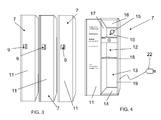
- each container 7 of the system 1 comprises a back wall 14, a ceiling 16 and side walls 17,18 and at least one access aperture 19 closed by a door 11.
- the container 7 is supplied electrically and comprises a lock 9 for the abovementioned door 11 which is interlocked with means of control 8 of access assigned identification of a user having rights of access to the container 7.
- control 8 can however also be activated by a supplier authorised for the delivery of said consumer goods.
- the container 7 comprises a refrigerated compartment 10 accessible internally and closed by a relative door.
- the door for access to the refrigerated compartment 10 can be the same door 11 for access to the container 7 or a specific door for said compartment.
- the container 7 is substantially a cabinet with a refrigerator space and with electronic means of control of access.
- the container 7 can also be placed outside of the home and is capable of maintaining intact the freshness of possible food products even for several hours.
- system 1 of the present invention comprises:
- the central processing unit 4 provides for the identification of the user and for the transmission of one of his or her orders towards relevant distribution structures 5 for the delivery of consumer goods corresponding to the purchase order in a container 7 associated with the identified user.
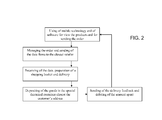
- the invention is based on a particular method which is illustrated broadly in the flow diagram of Figure 2 and comprises essentially the following steps:
- the phase of delivery and of release of the consumer goods provides for a debiting to the consumer user at a charge account held or which can only be operated at one or more of the abovementioned distribution structures or retail outlets 5.
- the charging can be performed at a bank current account held by the user or, more particularly, the consumer user who has joined the system may benefit from opening of credit at the given distribution structure against a bank guarantee.
- the consumer user can simply select the products which he or she needs by scrolling special drop-down menus.
- the simple selection of a given product allows it to be grouped in a list of products to be ordered.
- the user only has to give a definitive confirmation and confirm the place and, preferably, the time of delivery.
- the applications program residing in the palmtop computer is of simple and intuitive use and is provided in versions with facilitated access for persons with lesser mastery of the use of the technologies.
- the technology is also developed in the versions dedicated to persons with limited abilities.
- Processing of the order entails the identifying of the retail outlet 5 that has an arrangement with the system 1 closest to the place indicated by the customer and the transmission of the order.
- Receiving of the order entails the preparation of a sort of "shopping basket" to be placed inside of the refrigerated container 7 of the consumer user who has made the order.
- the transport and the delivery take place according to conventional methods and provide for the placing of the goods ordered in the special container subject to authorised access.
- the order made will then be delivered and deposited inside the container 7 without the need for immediate collection by the consumer user, therefore with the maximum flexibility and economy.
- the system and the method of the present invention also allow a reduction in the computer costs via a greater involvement of the consumer user in the processes of defining the content of the offer, pursuing the objective of creating distribution channels able to meet also individual needs of the users.
- the invention allows the opening-up of new scenarios and opportunities in the relationship between distribution structures and consumer users which allow the definition of times, places and quantities of the supplies, achieving the final objective of increasing the perceived value of the product through the quality of the services related thereto.
- each container 7 appears as a closed cabinet with a substantially parallelepiped shape and with front access via the door 11.
- Several containers 7 can be installed at a place of delivery approved by the user, for example a housing unit or a group of condominium housing units, or again at a public place (gym, recreational club, place of work, town hall, etc.).
- the container 7 is supplied electrically by means of a connection to a 220V electrical network supply source.
- an electrical connection cable is provided with an end plug 22 intended to be connected to an electrical supply socket installed at the home of the consumer user or, in any case, at the place of delivery of the consumer goods.
- TEC thermo electric cooler
- the container 7 is therefore of simplified structure, low cost and low wear, thanks to the absence of the conventional system of compression cycle refrigeration.
- compartment 10 there is the alternative possibility of having different refrigerated compartments and with different and controlled temperatures, as in a normal refrigerator.
- compartment 10 there is even the possibility of varying the capacity of refrigeration in a modular manner thanks to the simplicity of the circuit used, without a variable flow rate valve, with the possibility of handling up to three compartments in an independent manner.
- Figure 3 shows a compartment 12 for medicinal products and a compartment 13 for mass consumer goods which do not require particular climatic conditions for their preservation.
- the casing of the container 7 can be made also in stainless steel for particular uses in aggressive environments.
- the rear part can be in coated aluminium and the thermal insulation is preferably in CFC-free polyurethane.
- the means of control of access 8 comprise an electronic board 20 with microcontroller or microprocessor 30 shown schematically in Figure 5 and which is assigned supervision of the functions of the container 7.
- the board 20 provides an interface 21 for connection via Ethernet line to the Internet network and also a second interface 23 for the remote connection via GSM or GPRS module.
- the lock 9 of the door 11 is electric and is interlocked with the electronic control of the board 20 and of the processor 30.
- the access is managed by means of a reader 25 of electronic cards 24 or chip cards.
- any electronic selective access device can be used such as for example: an electronic key, a magnetic badge or other devices similar to those supplied for systems of alarm and control of access.
- this reader is in two-way connection with the microprocessor 30 which pilots the snap opening of the lock 9 on recognition of a card of the owner user or authorised to access that container 7, or in any case an operator of the system 1 in possession of an access card of the master type.
- the electronic control and management board 20 uses a new generation microcontroller 30, at least 32 bits.
- This microcontroller enables availability of the necessary power of processing for managing all the main peripherals of the board by means of a single integrated circuit and simplifying therefore the circuit and reducing the necessary components.
- This microcontroller 30 integrates and has available a large amount of volatile and non-volatile memory and therefore allows advanced functions to be implemented.
- microcontroller control board In brief, the peculiar features of the microcontroller control board are the following:
- this plastic card 24 is illustrated schematically in Figure 6 ; it incorporates sophisticated security systems and, in addition to allowing univocal recognition of the user to whom the board is matched, it also enables controls on the frequency of access.
- the card comprises an integrated circuit 29 and an interface logic 31 with a non-volatile memory portion 32 containing applications programs and data.
- circuit portions and logics 33, 34 for access control are provided.
- the features of the card 24 are the following:
- the integrated microcontroller 30 also allows the connection of the electronic control board 20 with a possible external computer via a USB port.
- the container 7 has as salient feature the absence of the conventional refrigeration circuit.
- the TEC (thermo electric cooler) cells technology allows the construction in a simplified manner of a cabinet with autonomous refrigeration. More particularly, in the case of management of multiple compartments at different temperatures, the management and manufacture of the device is enormously simplified. In fact the lack of compressor, pipes and condenser in favour of a simple external heat exchanger in aluminium, on the hot side of the TEC cell, is all that is necessary for obtaining the result required. Moreover the cost of a Peltier cell is decidedly lower compared to a complete conventional refrigeration system and would even allow battery power supply, albeit for short periods.
- the fridge cabinet container 7 only has to maintain, for a length of time reduced to a few hours, the temperature of the foods conserved therein.
- the rated power of the TEC cells connected in a string of four is of only 400W, of which only 300W will be used to power this small array in order to optimise the quantity of surface of exchange of the heat between the cells and the compartment, requiring therefore a relatively low refrigeration power.
- a power supply section 28 which deals with converting the network voltage of 220V AC into a voltage of 12V DC. This voltage is to supply both the TEC cells, via the PWM control sections 26 and the microcontroller control board 20.
- the power supply unit uses a switching technology, with low weight and small size, and is also low in cost.
- the module 26 associated with the microprocessor 30 allows a further optimisation of consumption. In fact it is possible, by integrating the available information of the control board 20, to set also the temperature T1, T2 or T3 at which the newly deposited goods have to be maintained.
- the refrigerator cabinet container 7 is able to adapt both to the particular goods present therein and to the particular external weather conditions. Adaptation to the external weather conditions takes place via a temperature sensor 27 provided in each compartment 10, 12 or 13. Adaptation to the particular goods takes place via network (communicating the type of goods deposited) or via operator at the time of the delivery.
- the container 7 can be considered a smart and advanced device, from various viewpoints, and cannot be equated with a common refrigerator.
- the particular technique adopted allows several compartments with different temperatures to be created in a modular and simple manner. According to the needs of the users it will be possible to add a simple Peltier cell, with relative heat sink in aluminium, to a new compartment.
- the temperature control will be assigned to a microcontroller circuit 30, with dedicated PWM power section 26 for each cell, which in addition to managing access via the reader 25 and the possible communication with the central unit 4, also allows optimisation of the dissipation of electrical power for the cooling of the refrigerated compartment.
- the reader 25 of cards 24 allows the opening only to the consumer user, owner of that given container.
- Each card is nominal and personal and allows the user to access the interior of the container to take the foods and the consumer goods purchased on the basis of the rights and privileges which were conferred thereto by signing an agreement with the managing body of the system 1.
- Through the centralised management it is possible to update in real time the information and the rights of access of each user of the system 1.
- the user information is kept in a control centre and, where necessary, transferred in part into the electronic control of the thermal container 7. In this way it will be possible not only to supply the main service but also to update data and information intended for users directly by inserting the card 24 or chip card.
- the orders are managed by the central unit 4 and by the local processing units of the retail outlets logistically closest to the address for the despatch. Once the shopping basket has been prepared, it will be delivered and deposited inside the refrigerated container 7 set up near the building of the user or around the entrance.
- the players involved in the distribution process will be both large organised distribution centres and local commercial businesses who will have, in this new system, a role of fundamental importance, given their vicinity to the places of consumption and of use of the products.
- the deliveries may be made in very short periods of time and without further increases in costs.
- the invention undeniably represents a consistent innovation in the management of distribution of food and/ or of mass consumer products.
- the system previously described allows a "distribution districts" organisation which enables relationships to be established between the various channels of the chain of the entire distribution process.
- the system and the method of the present invention allow the computer costs to be reduced through a greater involvement of the consumer in the processes of definition of the content of the offer, thus creating distribution channels able to relate with the individual needs of the customer in order to define times, places and quantities of the supplies. In this way scenarios and opportunities are opened up which allow the final objective to be achieved of increasing the perceived value of the product through the quality of the services related thereto.
- the system and the method of the present invention allow also a sort of "last minute market" to be encouraged, which enables a real revolution in the processes of purchasing by end consumer users to be achieved.
- the system of the present invention allows effective and efficient management of tangible and intangible resources and achieves advantages in terms of reduction in the times of purchasing by the consumer user.
- the analysis and processing of statistical data collected by the system with special reference to the behaviour of the consumer users in the definition of their choices of when and how to purchase, represents a further strong point in that it even allows agreements to be made with the users for programmed and deadlined purchases of goods with periodical consumption.
- the starting point of the new distribution concept is represented by the need to obtain savings in terms of transaction costs. This is obtained through the creation of distribution districts, wherein the small local shops take on a predominant role. The latter, situated in logistically dominant positions in relation to the large structure of organised distribution, can handle the deliveries of the orders in a streamlined and fast manner and above all without increases in logistic costs.
- the small shopkeeper/distributor who is to be affiliated with the system 1 will have the opportunity of purchasing the products using the same channels used by mass distribution applying retail prices in line with the large commercial centres, in this way obtaining the dual advantage, for mass distribution, of promoting above measure its brand, being present also in the compartment of the sector which defines the so-called small (or last minute) purchases, and the opportunity for the local distributor of offering innovative services and competitive prices.
- the innovation consists therefore in creating an integrated system among the various players involved who, by means of the use of fixed and mobile technologies, obtain the cyclical result of the creation of added value in the various directions of the single value chain.
- the consumer user will have the possibility of purchasing that which he or she effectively needs, in the place and in the moment wherein the need arises. Moreover he or she may have availability of a series of additional services, supplied through the use of mobile technology, which will bring value to the entire system, seen as a joining link of different markets brought together one with the other by the need to relate to the end consumer.
- each tradesperson that has an arrangement will be assigned a specific zone, characterised by the true simplicity of logistic management, due to the proximity between the retail outlet and the place chosen by the end consumer for the delivery.
- Assigning of the zones contributes to a substantial lowering of costs in that, since the areas served are not large in size, the same organisation of the tradesperson can be made available to the District, without increasing ordinary running costs.
- the affiliated tradesperson may benefit from the economies of scale due to a better selection of the purchases and to a considerable reduction in unsold stock and the locking-up of capital.
- the opportunity is provided of obtaining further reductions of the costs of purchase of the goods and of the products, due to the affiliation to the system and through this to a large group of organised distribution.
- the opportunity will therefore be given, also to the small tradesperson, of being part of a complex system, which will enable him or her to use the computer platforms of mass distribution for the management of the warehouse and of the orders, with absolutely low costs, integrating his or her own activity with that upstream relating to the distributor.
- the same stock can be managed in a more streamlined manner, both upstream and downstream.
- the centralised management of the orders guarantees a considerable saving in terms of transaction times linked to the dealings with sales reps, small distributors, etc., in addition to creating for the retail outlet itself a purchaser profile capable of better regimenting the purchase choices.
- this phase is managed virtually by the consumer on the cell phone, a further saving in time and resources will be obtained.
- Mobile e-commerce is the new model which, as widely and authoritatively maintained, will shift the concept of electronic commerce from the PC-landline telephony link, making available e-business services through the use of the cell phone.
- the "mobile partner” who, by means of the concession of a terminal and preparing special tariff plans by subscription, can obtain innumerable advantages, as listed herein below:
Landscapes
- Business, Economics & Management (AREA)
- Accounting & Taxation (AREA)
- Finance (AREA)
- Development Economics (AREA)
- Economics (AREA)
- Marketing (AREA)
- Strategic Management (AREA)
- Physics & Mathematics (AREA)
- General Business, Economics & Management (AREA)
- General Physics & Mathematics (AREA)
- Engineering & Computer Science (AREA)
- Theoretical Computer Science (AREA)
- Management, Administration, Business Operations System, And Electronic Commerce (AREA)
- Cash Registers Or Receiving Machines (AREA)
Applications Claiming Priority (1)
| Application Number | Priority Date | Filing Date | Title |
|---|---|---|---|
| ITMI2009A000668A IT1394050B1 (it) | 2009-04-21 | 2009-04-21 | Sistema per la gestione di ordini d'acquisto di beni di consumo e per la distribuzione capillare di detti beni, nonché metodo per l'attuazione di detto sistema. |
Publications (1)
| Publication Number | Publication Date |
|---|---|
| EP2246814A1 true EP2246814A1 (de) | 2010-11-03 |
Family
ID=41590439
Family Applications (1)
| Application Number | Title | Priority Date | Filing Date |
|---|---|---|---|
| EP10160632A Withdrawn EP2246814A1 (de) | 2009-04-21 | 2010-04-21 | System zur Verwaltung von Konsumgüterbestellungen und zur weitverbreiteten Distribution solcher Güter und Verfahren zur Umsetzung des genannten Systems |
Country Status (2)
| Country | Link |
|---|---|
| EP (1) | EP2246814A1 (de) |
| IT (1) | IT1394050B1 (de) |
Cited By (4)
| Publication number | Priority date | Publication date | Assignee | Title |
|---|---|---|---|---|
| EP2525309A1 (de) * | 2011-05-16 | 2012-11-21 | motiondrive AG | Stationäre oder mobile Station zur Bereitstellung von Konsumgütern, insbesondere von frischen und gefrorenen Lebensmitteln |
| EP2525308A1 (de) * | 2011-05-16 | 2012-11-21 | motiondrive AG | System und Verfahren zur Bereitstellung von Konsumgütern, insbesondere von frischen und gefrorenen Lebensmitteln |
| WO2017156217A1 (en) * | 2016-03-10 | 2017-09-14 | Wal-Mart Stores, Inc. | Apparatuses and methods for providing temperature controlled portable container |
| US11128709B2 (en) | 2015-12-15 | 2021-09-21 | At&T Intellectual Property I, L.P. | Method and apparatus for receiving nutritional information via a network |
Citations (6)
| Publication number | Priority date | Publication date | Assignee | Title |
|---|---|---|---|---|
| DE29613393U1 (de) * | 1996-08-02 | 1997-12-04 | Leiseder, Ulrich, Dipl.-Phys., 21465 Reinbek | Vorrichtung zur Fernauswahl von Objekten |
| DE20006966U1 (de) * | 2000-04-14 | 2000-07-06 | Gatter, Heinz, Wien | Datenübertragungsvorrichtung |
| WO2002007119A1 (en) * | 2000-07-14 | 2002-01-24 | Eli Moreno | System and method for remotely coordinating the secure delivery of goods |
| US20030061113A1 (en) * | 1998-05-29 | 2003-03-27 | Adam Petrovich | Portable electronic terminal and data processing system |
| US6967575B1 (en) * | 2000-04-28 | 2005-11-22 | Intel Corporation | Methods and apparatus for unattended pickups and deliveries |
| US20070210155A1 (en) * | 1996-09-05 | 2007-09-13 | Symbol Technologies, Inc. | Consumer interactive shopping system |
-
2009
- 2009-04-21 IT ITMI2009A000668A patent/IT1394050B1/it active
-
2010
- 2010-04-21 EP EP10160632A patent/EP2246814A1/de not_active Withdrawn
Patent Citations (6)
| Publication number | Priority date | Publication date | Assignee | Title |
|---|---|---|---|---|
| DE29613393U1 (de) * | 1996-08-02 | 1997-12-04 | Leiseder, Ulrich, Dipl.-Phys., 21465 Reinbek | Vorrichtung zur Fernauswahl von Objekten |
| US20070210155A1 (en) * | 1996-09-05 | 2007-09-13 | Symbol Technologies, Inc. | Consumer interactive shopping system |
| US20030061113A1 (en) * | 1998-05-29 | 2003-03-27 | Adam Petrovich | Portable electronic terminal and data processing system |
| DE20006966U1 (de) * | 2000-04-14 | 2000-07-06 | Gatter, Heinz, Wien | Datenübertragungsvorrichtung |
| US6967575B1 (en) * | 2000-04-28 | 2005-11-22 | Intel Corporation | Methods and apparatus for unattended pickups and deliveries |
| WO2002007119A1 (en) * | 2000-07-14 | 2002-01-24 | Eli Moreno | System and method for remotely coordinating the secure delivery of goods |
Cited By (7)
| Publication number | Priority date | Publication date | Assignee | Title |
|---|---|---|---|---|
| EP2525309A1 (de) * | 2011-05-16 | 2012-11-21 | motiondrive AG | Stationäre oder mobile Station zur Bereitstellung von Konsumgütern, insbesondere von frischen und gefrorenen Lebensmitteln |
| EP2525308A1 (de) * | 2011-05-16 | 2012-11-21 | motiondrive AG | System und Verfahren zur Bereitstellung von Konsumgütern, insbesondere von frischen und gefrorenen Lebensmitteln |
| US11128709B2 (en) | 2015-12-15 | 2021-09-21 | At&T Intellectual Property I, L.P. | Method and apparatus for receiving nutritional information via a network |
| WO2017156217A1 (en) * | 2016-03-10 | 2017-09-14 | Wal-Mart Stores, Inc. | Apparatuses and methods for providing temperature controlled portable container |
| GB2563778A (en) * | 2016-03-10 | 2018-12-26 | Walmart Apollo Llc | Apparatuses and methods for providing temperature controlled portable container |
| US10488081B2 (en) | 2016-03-10 | 2019-11-26 | Walmart Apollo, Llc | Apparatuses and methods for providing temperature controlled portable container |
| GB2563778B (en) * | 2016-03-10 | 2021-02-10 | Walmart Apollo Llc | Apparatuses and methods for providing temperature controlled portable container |
Also Published As
| Publication number | Publication date |
|---|---|
| IT1394050B1 (it) | 2012-05-25 |
| ITMI20090668A1 (it) | 2010-10-22 |
Similar Documents
| Publication | Publication Date | Title |
|---|---|---|
| US20060149640A1 (en) | Integrating electronic and traditional retail | |
| CN106447411A (zh) | 撮合平台和系统 | |
| US20160247219A1 (en) | Interactive transaction system for physical merchant stores | |
| US20170024691A1 (en) | System and method for efficient home delivery of perishables | |
| Quelch et al. | All business is local: Why place matters more than ever in a global, virtual world | |
| CN110503521A (zh) | 智能销售终端的租赁信息处理方法、装置、服务器及其系统 | |
| CN108682090A (zh) | 一种社区智能零售系统 | |
| US8600832B2 (en) | Considering selling exemplar-based goods, items, or services | |
| US20070208631A1 (en) | Considering selling exemplar-based goods, items, or services | |
| ITMI20090668A1 (it) | Sistema per la gestione di ordini d'acquisto di beni di consumo e per la distribuzione capillare di detti beni, nonché metodo per l'attuazione di detto sistema. | |
| KR101676745B1 (ko) | 로컬상점 활성화를 위한 온-오프라인을 통한 위치기반 전자상거래 정보 제공방법 | |
| JP2025078706A (ja) | 保冷材提供システム | |
| CN106651456A (zh) | 一种网络购物中推荐商品的方法 | |
| Kumar et al. | E-commerce marketing strategies in the grocery sector: An introduction | |
| US8708193B1 (en) | Vending machine | |
| US20190378154A1 (en) | System And Method For Real-Time Demand Stimulation | |
| KR101779757B1 (ko) | 객체의 정보 제공 방법 및 장치 | |
| KR20150095983A (ko) | 할인점 온-오프라인 쇼핑관리 서비스 시스템 및 그 방법 | |
| KR100702568B1 (ko) | 온라인 구매 물품의 배송 시스템 및 그 운영 방법 | |
| US8200535B1 (en) | Methods and systems for occasion-based lifestyle marketing | |
| WO2024023952A1 (ja) | 保冷材提供システム | |
| KR102489028B1 (ko) | 유통기한 알림 및 추적 기능을 갖는 제품 관리 시스템 | |
| KR102653234B1 (ko) | 글로벌 온라인 쇼핑몰 운영 시스템 | |
| Huong et al. | Creating competitive advantage through branding: The challenges of mom-pop store in Viet Nam: The challenges of mom-pop store in Viet Nam | |
| JP2004259099A (ja) | 小ロットブランド酒類の受発注システム |
Legal Events
| Date | Code | Title | Description |
|---|---|---|---|
| PUAI | Public reference made under article 153(3) epc to a published international application that has entered the european phase |
Free format text: ORIGINAL CODE: 0009012 |
|
| AK | Designated contracting states |
Kind code of ref document: A1 Designated state(s): AT BE BG CH CY CZ DE DK EE ES FI FR GB GR HR HU IE IS IT LI LT LU LV MC MK MT NL NO PL PT RO SE SI SK SM TR |
|
| AX | Request for extension of the european patent |
Extension state: AL BA ME RS |
|
| STAA | Information on the status of an ep patent application or granted ep patent |
Free format text: STATUS: THE APPLICATION IS DEEMED TO BE WITHDRAWN |
|
| 18D | Application deemed to be withdrawn |
Effective date: 20110504 |