EP2246436A1 - Semikontinuierliches Verfahren zur Herstellung von Wasserstoff aus organischen Abfallstoffen - Google Patents
Semikontinuierliches Verfahren zur Herstellung von Wasserstoff aus organischen Abfallstoffen Download PDFInfo
- Publication number
- EP2246436A1 EP2246436A1 EP09425167A EP09425167A EP2246436A1 EP 2246436 A1 EP2246436 A1 EP 2246436A1 EP 09425167 A EP09425167 A EP 09425167A EP 09425167 A EP09425167 A EP 09425167A EP 2246436 A1 EP2246436 A1 EP 2246436A1
- Authority
- EP
- European Patent Office
- Prior art keywords
- reactor
- mixture
- production
- waste
- weight
- Prior art date
- Legal status (The legal status is an assumption and is not a legal conclusion. Google has not performed a legal analysis and makes no representation as to the accuracy of the status listed.)
- Withdrawn
Links
- 238000004519 manufacturing process Methods 0.000 title claims abstract description 95
- 239000001257 hydrogen Substances 0.000 title claims abstract description 73
- 229910052739 hydrogen Inorganic materials 0.000 title claims abstract description 73
- UFHFLCQGNIYNRP-UHFFFAOYSA-N Hydrogen Chemical compound [H][H] UFHFLCQGNIYNRP-UHFFFAOYSA-N 0.000 title claims abstract description 69
- 239000010815 organic waste Substances 0.000 title abstract description 10
- 238000010924 continuous production Methods 0.000 title 1
- VNWKTOKETHGBQD-UHFFFAOYSA-N methane Chemical compound C VNWKTOKETHGBQD-UHFFFAOYSA-N 0.000 claims abstract description 78
- 238000000034 method Methods 0.000 claims abstract description 57
- 230000008569 process Effects 0.000 claims abstract description 54
- 239000000203 mixture Substances 0.000 claims abstract description 52
- 239000007787 solid Substances 0.000 claims description 34
- 239000002699 waste material Substances 0.000 claims description 33
- 239000007789 gas Substances 0.000 claims description 19
- 239000000463 material Substances 0.000 claims description 16
- 239000011541 reaction mixture Substances 0.000 claims description 15
- 239000010802 sludge Substances 0.000 claims description 10
- 239000010865 sewage Substances 0.000 claims description 9
- 241000196324 Embryophyta Species 0.000 claims description 8
- 238000000746 purification Methods 0.000 claims description 8
- 239000003643 water by type Substances 0.000 claims description 8
- 230000029087 digestion Effects 0.000 claims description 7
- 239000004006 olive oil Substances 0.000 claims description 7
- 235000008390 olive oil Nutrition 0.000 claims description 7
- 238000009264 composting Methods 0.000 claims description 6
- 238000002156 mixing Methods 0.000 claims description 5
- 239000002361 compost Substances 0.000 abstract description 9
- 150000002431 hydrogen Chemical class 0.000 abstract description 6
- 230000000696 methanogenic effect Effects 0.000 description 15
- CURLTUGMZLYLDI-UHFFFAOYSA-N Carbon dioxide Chemical compound O=C=O CURLTUGMZLYLDI-UHFFFAOYSA-N 0.000 description 14
- 239000012071 phase Substances 0.000 description 14
- 230000014759 maintenance of location Effects 0.000 description 11
- QTBSBXVTEAMEQO-UHFFFAOYSA-N Acetic acid Chemical compound CC(O)=O QTBSBXVTEAMEQO-UHFFFAOYSA-N 0.000 description 9
- 229910002092 carbon dioxide Inorganic materials 0.000 description 8
- 238000006243 chemical reaction Methods 0.000 description 8
- 241000894006 Bacteria Species 0.000 description 7
- 244000005700 microbiome Species 0.000 description 7
- 239000000047 product Substances 0.000 description 7
- 239000001569 carbon dioxide Substances 0.000 description 6
- 239000000126 substance Substances 0.000 description 6
- 239000000758 substrate Substances 0.000 description 6
- XLYOFNOQVPJJNP-UHFFFAOYSA-N water Substances O XLYOFNOQVPJJNP-UHFFFAOYSA-N 0.000 description 6
- 230000031018 biological processes and functions Effects 0.000 description 4
- 230000007613 environmental effect Effects 0.000 description 4
- 230000006641 stabilisation Effects 0.000 description 4
- 238000011282 treatment Methods 0.000 description 4
- 239000002028 Biomass Substances 0.000 description 3
- 239000002253 acid Substances 0.000 description 3
- 230000009471 action Effects 0.000 description 3
- QVGXLLKOCUKJST-UHFFFAOYSA-N atomic oxygen Chemical compound [O] QVGXLLKOCUKJST-UHFFFAOYSA-N 0.000 description 3
- 230000018044 dehydration Effects 0.000 description 3
- 238000006297 dehydration reaction Methods 0.000 description 3
- 230000002401 inhibitory effect Effects 0.000 description 3
- 239000007788 liquid Substances 0.000 description 3
- 230000004060 metabolic process Effects 0.000 description 3
- 239000001301 oxygen Substances 0.000 description 3
- 229910052760 oxygen Inorganic materials 0.000 description 3
- 230000009467 reduction Effects 0.000 description 3
- 238000005070 sampling Methods 0.000 description 3
- 238000012360 testing method Methods 0.000 description 3
- MYMOFIZGZYHOMD-UHFFFAOYSA-N Dioxygen Chemical compound O=O MYMOFIZGZYHOMD-UHFFFAOYSA-N 0.000 description 2
- 150000007513 acids Chemical class 0.000 description 2
- 230000008901 benefit Effects 0.000 description 2
- 230000015556 catabolic process Effects 0.000 description 2
- 238000002485 combustion reaction Methods 0.000 description 2
- 238000006731 degradation reaction Methods 0.000 description 2
- 238000011161 development Methods 0.000 description 2
- 229910001882 dioxygen Inorganic materials 0.000 description 2
- 238000000855 fermentation Methods 0.000 description 2
- 238000004817 gas chromatography Methods 0.000 description 2
- 239000005431 greenhouse gas Substances 0.000 description 2
- 230000007062 hydrolysis Effects 0.000 description 2
- 238000006460 hydrolysis reaction Methods 0.000 description 2
- 230000003301 hydrolyzing effect Effects 0.000 description 2
- 239000010808 liquid waste Substances 0.000 description 2
- 244000144972 livestock Species 0.000 description 2
- 239000002689 soil Substances 0.000 description 2
- 239000002910 solid waste Substances 0.000 description 2
- 238000011144 upstream manufacturing Methods 0.000 description 2
- 241000192700 Cyanobacteria Species 0.000 description 1
- 240000002129 Malva sylvestris Species 0.000 description 1
- 235000006770 Malva sylvestris Nutrition 0.000 description 1
- 241000282887 Suidae Species 0.000 description 1
- 229920002522 Wood fibre Polymers 0.000 description 1
- 238000009825 accumulation Methods 0.000 description 1
- 230000000789 acetogenic effect Effects 0.000 description 1
- 239000000654 additive Substances 0.000 description 1
- 238000004458 analytical method Methods 0.000 description 1
- 238000010420 art technique Methods 0.000 description 1
- 230000001580 bacterial effect Effects 0.000 description 1
- 238000005842 biochemical reaction Methods 0.000 description 1
- 230000033228 biological regulation Effects 0.000 description 1
- 238000009395 breeding Methods 0.000 description 1
- 230000001488 breeding effect Effects 0.000 description 1
- 235000013351 cheese Nutrition 0.000 description 1
- 239000007795 chemical reaction product Substances 0.000 description 1
- 239000003245 coal Substances 0.000 description 1
- 238000005520 cutting process Methods 0.000 description 1
- 230000007423 decrease Effects 0.000 description 1
- 230000000694 effects Effects 0.000 description 1
- 238000005868 electrolysis reaction Methods 0.000 description 1
- 238000000605 extraction Methods 0.000 description 1
- 230000004151 fermentation Effects 0.000 description 1
- 239000012530 fluid Substances 0.000 description 1
- 238000000227 grinding Methods 0.000 description 1
- 229910001385 heavy metal Inorganic materials 0.000 description 1
- 229930195733 hydrocarbon Natural products 0.000 description 1
- 150000002430 hydrocarbons Chemical class 0.000 description 1
- 239000002054 inoculum Substances 0.000 description 1
- 239000012978 lignocellulosic material Substances 0.000 description 1
- 238000005259 measurement Methods 0.000 description 1
- 239000003345 natural gas Substances 0.000 description 1
- 150000002823 nitrates Chemical class 0.000 description 1
- 239000003921 oil Substances 0.000 description 1
- 235000019198 oils Nutrition 0.000 description 1
- 238000011017 operating method Methods 0.000 description 1
- 150000007524 organic acids Chemical class 0.000 description 1
- 235000005985 organic acids Nutrition 0.000 description 1
- 230000000243 photosynthetic effect Effects 0.000 description 1
- 231100000614 poison Toxicity 0.000 description 1
- 238000002360 preparation method Methods 0.000 description 1
- 238000011165 process development Methods 0.000 description 1
- 238000005086 pumping Methods 0.000 description 1
- 238000004064 recycling Methods 0.000 description 1
- 238000011160 research Methods 0.000 description 1
- 230000035945 sensitivity Effects 0.000 description 1
- 238000005549 size reduction Methods 0.000 description 1
- 238000003307 slaughter Methods 0.000 description 1
- 239000007790 solid phase Substances 0.000 description 1
- 241000894007 species Species 0.000 description 1
- 230000003019 stabilising effect Effects 0.000 description 1
- 239000010902 straw Substances 0.000 description 1
- 150000003467 sulfuric acid derivatives Chemical class 0.000 description 1
- 230000002459 sustained effect Effects 0.000 description 1
- 239000003440 toxic substance Substances 0.000 description 1
- 230000009466 transformation Effects 0.000 description 1
- 235000013311 vegetables Nutrition 0.000 description 1
Images

Classifications
-
- C—CHEMISTRY; METALLURGY
- C12—BIOCHEMISTRY; BEER; SPIRITS; WINE; VINEGAR; MICROBIOLOGY; ENZYMOLOGY; MUTATION OR GENETIC ENGINEERING
- C12P—FERMENTATION OR ENZYME-USING PROCESSES TO SYNTHESISE A DESIRED CHEMICAL COMPOUND OR COMPOSITION OR TO SEPARATE OPTICAL ISOMERS FROM A RACEMIC MIXTURE
- C12P3/00—Preparation of elements or inorganic compounds except carbon dioxide
-
- C—CHEMISTRY; METALLURGY
- C12—BIOCHEMISTRY; BEER; SPIRITS; WINE; VINEGAR; MICROBIOLOGY; ENZYMOLOGY; MUTATION OR GENETIC ENGINEERING
- C12M—APPARATUS FOR ENZYMOLOGY OR MICROBIOLOGY; APPARATUS FOR CULTURING MICROORGANISMS FOR PRODUCING BIOMASS, FOR GROWING CELLS OR FOR OBTAINING FERMENTATION OR METABOLIC PRODUCTS, i.e. BIOREACTORS OR FERMENTERS
- C12M21/00—Bioreactors or fermenters specially adapted for specific uses
- C12M21/04—Bioreactors or fermenters specially adapted for specific uses for producing gas, e.g. biogas
-
- C—CHEMISTRY; METALLURGY
- C12—BIOCHEMISTRY; BEER; SPIRITS; WINE; VINEGAR; MICROBIOLOGY; ENZYMOLOGY; MUTATION OR GENETIC ENGINEERING
- C12M—APPARATUS FOR ENZYMOLOGY OR MICROBIOLOGY; APPARATUS FOR CULTURING MICROORGANISMS FOR PRODUCING BIOMASS, FOR GROWING CELLS OR FOR OBTAINING FERMENTATION OR METABOLIC PRODUCTS, i.e. BIOREACTORS OR FERMENTERS
- C12M23/00—Constructional details, e.g. recesses, hinges
- C12M23/58—Reaction vessels connected in series or in parallel
-
- C—CHEMISTRY; METALLURGY
- C12—BIOCHEMISTRY; BEER; SPIRITS; WINE; VINEGAR; MICROBIOLOGY; ENZYMOLOGY; MUTATION OR GENETIC ENGINEERING
- C12M—APPARATUS FOR ENZYMOLOGY OR MICROBIOLOGY; APPARATUS FOR CULTURING MICROORGANISMS FOR PRODUCING BIOMASS, FOR GROWING CELLS OR FOR OBTAINING FERMENTATION OR METABOLIC PRODUCTS, i.e. BIOREACTORS OR FERMENTERS
- C12M41/00—Means for regulation, monitoring, measurement or control, e.g. flow regulation
- C12M41/12—Means for regulation, monitoring, measurement or control, e.g. flow regulation of temperature
-
- C—CHEMISTRY; METALLURGY
- C12—BIOCHEMISTRY; BEER; SPIRITS; WINE; VINEGAR; MICROBIOLOGY; ENZYMOLOGY; MUTATION OR GENETIC ENGINEERING
- C12M—APPARATUS FOR ENZYMOLOGY OR MICROBIOLOGY; APPARATUS FOR CULTURING MICROORGANISMS FOR PRODUCING BIOMASS, FOR GROWING CELLS OR FOR OBTAINING FERMENTATION OR METABOLIC PRODUCTS, i.e. BIOREACTORS OR FERMENTERS
- C12M41/00—Means for regulation, monitoring, measurement or control, e.g. flow regulation
- C12M41/26—Means for regulation, monitoring, measurement or control, e.g. flow regulation of pH
-
- C—CHEMISTRY; METALLURGY
- C12—BIOCHEMISTRY; BEER; SPIRITS; WINE; VINEGAR; MICROBIOLOGY; ENZYMOLOGY; MUTATION OR GENETIC ENGINEERING
- C12P—FERMENTATION OR ENZYME-USING PROCESSES TO SYNTHESISE A DESIRED CHEMICAL COMPOUND OR COMPOSITION OR TO SEPARATE OPTICAL ISOMERS FROM A RACEMIC MIXTURE
- C12P5/00—Preparation of hydrocarbons or halogenated hydrocarbons
- C12P5/02—Preparation of hydrocarbons or halogenated hydrocarbons acyclic
- C12P5/023—Methane
-
- Y—GENERAL TAGGING OF NEW TECHNOLOGICAL DEVELOPMENTS; GENERAL TAGGING OF CROSS-SECTIONAL TECHNOLOGIES SPANNING OVER SEVERAL SECTIONS OF THE IPC; TECHNICAL SUBJECTS COVERED BY FORMER USPC CROSS-REFERENCE ART COLLECTIONS [XRACs] AND DIGESTS
- Y02—TECHNOLOGIES OR APPLICATIONS FOR MITIGATION OR ADAPTATION AGAINST CLIMATE CHANGE
- Y02E—REDUCTION OF GREENHOUSE GAS [GHG] EMISSIONS, RELATED TO ENERGY GENERATION, TRANSMISSION OR DISTRIBUTION
- Y02E50/00—Technologies for the production of fuel of non-fossil origin
- Y02E50/30—Fuel from waste, e.g. synthetic alcohol or diesel
Definitions
- the present invention relates to a process for semi-continuous hydrogen production from mixtures of organic waste, which can advantageously be integrated in a single process for the production of hydrogen, methane and compost, of which it constitutes the first biological phase; the invention also relates to a plant for implementation of the process.
- Organic wastes that can be treated with these processes comprise, among others, putrescible fractions of urban waste from separate waste collection or from mechanical sorting, solid or liquid waste from livestock processes (breeding and slaughter of pigs, production of cheeses, etc.) or agro-industrial processes (production of oil, wine, sugar, etc.), waste from urban sewage treatment.
- the aerobic metabolism is typical of microorganisms that require molecular oxygen
- the anoxic metabolism requires oxygen in bound form (e.g. nitrates or sulphates)
- the anaerobic metabolism requires the total absence of oxygen.
- Anaerobic processes although characterised by slower degradation of the organic substrate with respect to aerobic processes, allow the production of gases with high energy content (methane, hydrogen) to be coupled with degradation/stabilisation of the substrate.
- biological production appears interesting, above all in view of desirable delocalisation of part of the energy production to a network of micro-production centres spread over the territory.
- Different types of bacteria including anaerobic, aerobic, photosynthetic and cyanobacteria, are capable of producing hydrogen from degradable biomasses.
- the interesting prospects offered by biological hydrogen production have given rise, among other things, to the hypothesis of growing vegetable species specifically to be used as substrate. Nonetheless, the need to grow biomass for this purpose appears debatable in the light of the fact that noteworthy quantities of biodegradable organic substance are already present in waste of various types and, moreover, these represent an environmental problem that requires to be managed appropriately. Therefore, it is believed that the hydrogen production from waste streams represents one of the most promising options.
- anaerobic fermentation has numerous advantages.
- the bacterial populations involved are "flexible" in terms of type of degradable substrate and, moreover, the process does not require the presence of light, and can therefore be conducted in relatively small reactors and during the day or at night without distinction.
- anaerobic digestion appears an extremely interesting option for biological hydrogen production.
- the pH value of the system and the retention time are among the elements that seem to play a key role; in particular, the retention time must be such as to limit the development of methanogenic bacteria and encourage rapid removal of any that do manage to develop, while also ensuring adequate time for the action of the hydrolytic and fermentative bacteria that produce gaseous hydrogen.
- the retention time must be such as to limit the development of methanogenic bacteria and encourage rapid removal of any that do manage to develop, while also ensuring adequate time for the action of the hydrolytic and fermentative bacteria that produce gaseous hydrogen.
- the present invention in a first aspect relates to a process for biological production of hydrogen through semi-continuous anaerobic digestion at a temperature between 30 and 40 °C of a mixture of waste having a total solids content not exceeding 10% in weight;
- the mixture is constituted by biodegradable organic fractions of urban waste, both from separate refuse collection and from mechanical sorting, from vegetation waters deriving from olive oil production and from active sludge from urban sewage purification;
- the process is characterised by being run with an average residence time of the mixture in the hydrogen production reactor between two to four days, obtained through daily removal of a portion corresponding to approximately 1/n of the volume of mixture in the reactor, where n indicates the number of days of desired average residence time, and feeding an equivalent volume of fresh analogous mixture into the reactor.
- the inventors have found in general that by operating on mixtures of the aforesaid components appreciable quantities of hydrogen are produced and that by appropriately selecting the weight ratios between components and, above all, optimising the retention time value, the system remains in biochemical equilibrium, i.e. without giving rise to reaction trends, for an indefinite time, during which hydrogen is produced in large and essentially constant quantities.
- the optimal time was found to be between two and four days, and preferably two days.
- the supply of active sludge from urban sewage purification to the reaction mixture makes it possible to avoid recirculation of process water in the system, normally adopted in known anaerobic digestion systems, which in time causes accumulation in the reactor of toxic substances that inhibit the action of microorganisms.
- the use of active sludge makes it possible to achieve the water content required for a wet process while simultaneously supplying the system with microorganisms particularly active in hydrolysis of the substrate and, being facultative, with low sensitivity to any modest accidental oxygen intrusion.
- the process of the invention it is not necessary to perform a thermal or chemical pretreatment of the biomass targeted at inhibiting methanogenic microorganisms and selecting hydrogen producing microorganisms, a practice used in some prior art systems.
- the mixture of biodegradable organic waste usable to produce hydrogen according to the invention is composed, as stated previously, by putrescible organic fractions of urban waste, both from separate waste collection and from mechanical sorting, vegetation waters from olive oil production and active sludge from urban sewage purification; this waste will be referred to hereafter with the following abbreviations:
- the various components can be present in the mixture in the following percentages in weight:
- the mixture composed of 20% OMW + 55% AS + 25% MSWOF is particularly preferred: in fact, the inventors have observed that this particular mixture allows the reaction to be sustained without requiring to add specific additives, at the beginning of or during the process, to regulate the pH of the reaction mixture to optimal values between approximately 5 and 5.5, a practice which is instead essential with prior art techniques. Moreover, if the optimal retention time of two days is adopted, this mixture is the one which achieves maximum hydrogen production values per unit of mass of volatile solids fed and removed during the process.
- the biodegradable fractions of urban waste are subjected to an operation of size reduction (in a suitable station equipped with cutting tools), in which the solid components are reduced to dimensions of less than 50 mm, to favour homogeneity of the reaction system and subsequent pumping of the mixture, as well as to speed up reactions.
- the MSWOF fraction thus pretreated is fed to a heated mixer together with the liquid or fluid fractions of the mixture.
- Fig. 1 schematically shows a possible plant, 10, for waste treatment according to the invention, suitable to operate according to this operating method; in the figure, the products extracted from the various reactors or elements of the plant are indicated in the dashed ovals.
- Element 11 represents the size reducing station and element 12 represents the mixing station.
- the mixture thus prepared is then pumped to a reactor, element 13 in Fig. 1 , of the continuous stirred-tank chemical or bio-chemical reactor type (known in the sector as CSTR), equipped with instruments to control the main operating parameters (pH, temperature) and with a thermostatic system to maintain the temperature of the mass at values between about 30 and 40 °C; in fact, the inventors have observed that the hydrogen producing reaction proceeds with high yields already when the reaction mixture temperature is maintained in this interval, preferably between 35 and 40 °C, and even more preferably at a temperature of about 39 °C, without the need to adopt thermophilic conditions (of about 55 °C, adopted in other analogous known processes).
- a reactor element 13 in Fig. 1
- CSTR continuous stirred-tank chemical or bio-chemical reactor type
- Both the feed system and the reactor are gas tight, to allow anaerobic conditions to be established in the latter (preventing air from entering from the outside); the reactor is also provided with gas-tight ports to take samples of the reaction mixture for checking the reaction trend with time.
- the gas produced is conveyed to a gasometer; ports are positioned upstream of the gasometer, along the gas conveying duct, and downstream thereof, for sampling and analysing the gas.
- This type of reactor is known in the sector of biochemical plants and requires no further description herein.
- the mixture is undergoes hydrolysis and acid fermentation during which it is transformed essentially into volatile acids, hydrogen and carbon dioxide by hydrolysing and fermenting bacteria.
- the reaction mixture is fed to the reactor according to a time schedule such that each day a volume of approximately half the volume of reaction mixture present in the reactor is discharged and an equivalent volume of fresh mixture is fed.
- a time schedule such that each day a volume of approximately half the volume of reaction mixture present in the reactor is discharged and an equivalent volume of fresh mixture is fed.
- the reduction of volatile solids achievable, an indicator of waste stabilisation, is stably above 30% in weight, on average approximately 32%.
- the gas produced stably contains 35-45% in volume of hydrogen, the rest of the gas being constituted essentially of carbon dioxide.
- the process and the reactor for hydrogen production are preferably combined with further biological process phases and reactors or equipment for methane and compost production, to provide an integrated process and an integrated plant for producing the three products.
- these two further biological stages follow that of hydrogen production, to provide an integrated process and a plant in which the first two anaerobic biological stages (hydrogen and methane production) are destined for the production of renewable energy, and the third aerobic stage for the production of a material to be reused in agriculture if the putrescible fractions of urban waste come from separate refuse collection, or for environmental restoration if the putrescible fractions of urban waste come from mechanical sorting.
- the inventors have found that the product extracted from the hydrogen production bioreactor has optimal characteristics to be fed to a bioreactor, still anaerobic, for methane production; in fact, it contains both acetic acid, the main substrate for methane production, and other volatile organic acids easily convertible, again in the second biological stage, into acetic acid and therefore ultimately into methane.
- the inventors were able to verify that the methanogenic phase applied to the product extracted from the hydrogen production bioreactor leads to an average methane production of approximately 700 NI/kg SV (volatile solids fed to the methanogenic reactor).
- Fig. 1 schematically shows this configuration, in which the bioreactor for methane production, 14, is immediately downstream of the bioreactor 13 for hydrogen production.
- the volume of reaction mixture extracted daily from the hydrogen production bioreactor 13 is fed directly to the bioreactor 14 containing acetophilic methanogenic bacteria that directly produce methane and carbon dioxide and acetogenic bacteria that convert the other volatile acids into acetic acid, which in turn is converted by the former into methane and carbon dioxide.
- the methane production stage requires an inoculum of methanogenic biomass in the initial phase; during normal operation a temperature between 35 and 40 °C is adopted, i.e. the same as the hydrogen production phase, but unlike the latter methane production requires residence times in the reactor in the order of 10-15 days. Given the difference between the hydraulic retention times adopted in the two phases, it is necessary for the methane production reactor to have larger dimensions than the one for hydrogen production.
- the methane production reactor, 14, is also preferably of the CSTR type, is gas tight to allow anaerobic reaction conditions, and is equipped with measurement sensors and sampling ports analogous to those present in the hydrogen production reactor 13.
- Passages between the reactors 13 and 14 and discharge of the latter also take place through gas-tight ducts and pumps, to prevent air from entering the reactor.
- the reactor 14 is dosed volumetrically, through appropriate regulation of the pumps between the two reactors.
- the gas produced is conveyed to a gasometer; ports are positioned upstream of the gasometer, along the gas conveying duct, and downstream thereof, for sampling and analysing the gas.
- the methanogenic phase is implemented with equipment and methods well-known in the sector and does not require further detailed description herein.
- the material discharged from the methane production reactor is dehydrated to a water content of 70-80% and subsequently mixed with bulking material, generally lignocellulosic material (i.e. wood fibres previously reduced in size), in proportion in weight of 60-70% dehydrated digested + 40-30% bulking material, and, finally, aerobically composted for 70-90 days until producing the compost destined for use as soil ameliorant.
- bulking material generally lignocellulosic material (i.e. wood fibres previously reduced in size)
- lignocellulosic material i.e. wood fibres previously reduced in size
- aerobically composted for 70-90 days until producing the compost destined for use as soil ameliorant.
- the station for dehydration of the material is represented by the element 15, the station for mixing with the bulking materials by the element 16, and the composting station by the element 17.
- Preparation of said mixture takes place by first subjecting the MSWOF fraction (coming from separate waste collection or mechanical sorting) to a grinding process with blade grinder which reduces the size to around 5 cm.
- the MSWOF fraction, thus treated, is then sent to a heated mixer to which the OMW fraction and the AS fraction are also fed.
- the mixture thus obtained has a total solids content (ST) of approximately 6% and a volatile solids content of 91% of the total solids present; consequently 1 kg of mixture contains approximately 60 g of total solids and approximately 58 g of volatile solids.
- the mixture is homogenised and transferred through a pump to a continuous stirred-tank reactor (CSTR) with a useful volume of 1 litre.
- CSTR continuous stirred-tank reactor
- the reactor equipped with sensors to detect pH and temperature, as well as ports to take liquid and gaseous samples to check the trend of the biological process, is heated to 39 °C.
- a volume of half the reactor volume (approximately 0.5 I) is extracted, so as to set an average hydraulic retention time of the mixture in the reactor of 2 days; the volume of mixture extracted is replaced by the same volume of fresh mixture.
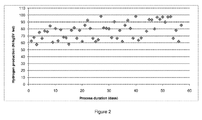
- the quantity of gas produced each day is measured volumetrically and its composition is analysed using gas chromatography, in order to determine the hydrogen content. Hydrogen production, monitored for almost 60 days, is shown in the graph of Fig.
- the average hydrogen production in these experimental conditions is equal to about 70 NI of hydrogen per kg of volatile solids fed, i.e. approximately 4 NI H 2 per kg of mixture fed.
- the average percentage of hydrogen in the gas produced is, in these operating conditions, 36% v/v, the rest being essentially CO 2 .
- the average removal of the volatile solids content fed is approximately 30%.
- the following example relates to methane production at laboratory scale starting from the mixture extracted from the hydrogen production reactor of Example 1.
- the mixture extracted from the reactor for the production of hydrogen is characterised by a total solids content of approximately 5.5%, and a volatile solids content of approximately 74% of the total solids present. Consequently, 1 kg of extracted mixture will contain approximately 55 g of total solids and approximately 41 g of volatile solids.
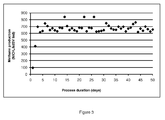
- the retention time adopted for the hydrogen production reactor is 2 days, and the volume of mixture extracted each day is 0.5 I. This volume is sent directly to a second continuous stirred-tank reactor destined for methane production, maintained constantly at a temperature of 39 °C.
- the useful volume of the second reactor is 5 times the volume of the first reactor, i.e. 5 litres of useful volume.
- the second reactor too is equipped with ports for taking liquid and gas samples.
- the quantity of gas produced each day is measured volumetrically and its composition is analysed by gas chromatography, to determine the methane and carbon dioxide content.
- the average percentage of methane in the gas produced is approximately 70% in volume, the rest being essentially CO 2 .
- each day a volume of mixture of 0.5 I is extracted, characterised by a total solids content of approximately 3% and volatile solids content of approximately 59% of the total solids, i.e. 1 kg of mixture extracted from the methanogenic reactor has approximately 28 g of total solids and approximately 16 g of volatile solids.
- This example relates to compost production at laboratory scale using the mixture extracted from the reactor of Example 2.
- the mixture extracted from the methanogenic reactor of Example 2 is sent to a mechanical dehydration station with the purpose of achieving a total solids content of at least 30% in weight.
- the dehydrated material is then sent to a mixing station. In this station the dehydrated material is mixed with bulking material (wooden chips and straw) in proportions, in weight, of 60-70% of dehydrated material + 40-30% of bulking material.
- This material is sent to an aerobic composting system where it is kept for approximately 70-90 days.
- the dehydrated material + bulking material mixture sustains a loss in mass of approximately 30% of the wet mass, which takes account of the reduction both of the water content and of the volatile solids content.
- Table 1 Parameter Measure units Value Humidity % 65.0 Volatile solids % ST 68.8 pH - 8.5 Organic C % ST 33.8 Humic and fulvic C % ST 2.6 Heavy metal content As mg/kg 0.3 Cr mg/kg 2.8 Cd mg/kg 0.02 Cu mg/kg 16.5 Ni mg/kg 5.0 Pb mg/kg 10.5 Zn mg/kg 77.5
- the process of the invention is capable of stably providing high average daily quantities of hydrogen; moreover, the product of the anaerobic hydrogen production station is particularly suitable as input reaction material to feed a methanogenic anaerobic reactor, the solid phase of the product thereof can in turn be used as input component for an aerobic stage of compost production.
Landscapes
- Chemical & Material Sciences (AREA)
- Life Sciences & Earth Sciences (AREA)
- Organic Chemistry (AREA)
- Engineering & Computer Science (AREA)
- Health & Medical Sciences (AREA)
- Zoology (AREA)
- Wood Science & Technology (AREA)
- Bioinformatics & Cheminformatics (AREA)
- Genetics & Genomics (AREA)
- Microbiology (AREA)
- Biochemistry (AREA)
- General Engineering & Computer Science (AREA)
- General Health & Medical Sciences (AREA)
- Biotechnology (AREA)
- Biomedical Technology (AREA)
- Sustainable Development (AREA)
- General Chemical & Material Sciences (AREA)
- Analytical Chemistry (AREA)
- Chemical Kinetics & Catalysis (AREA)
- Molecular Biology (AREA)
- Clinical Laboratory Science (AREA)
- Oil, Petroleum & Natural Gas (AREA)
- Physics & Mathematics (AREA)
- Thermal Sciences (AREA)
- Processing Of Solid Wastes (AREA)
Priority Applications (1)
| Application Number | Priority Date | Filing Date | Title |
|---|---|---|---|
| EP09425167A EP2246436A1 (de) | 2009-04-30 | 2009-04-30 | Semikontinuierliches Verfahren zur Herstellung von Wasserstoff aus organischen Abfallstoffen |
Applications Claiming Priority (1)
| Application Number | Priority Date | Filing Date | Title |
|---|---|---|---|
| EP09425167A EP2246436A1 (de) | 2009-04-30 | 2009-04-30 | Semikontinuierliches Verfahren zur Herstellung von Wasserstoff aus organischen Abfallstoffen |
Publications (1)
| Publication Number | Publication Date |
|---|---|
| EP2246436A1 true EP2246436A1 (de) | 2010-11-03 |
Family
ID=41058573
Family Applications (1)
| Application Number | Title | Priority Date | Filing Date |
|---|---|---|---|
| EP09425167A Withdrawn EP2246436A1 (de) | 2009-04-30 | 2009-04-30 | Semikontinuierliches Verfahren zur Herstellung von Wasserstoff aus organischen Abfallstoffen |
Country Status (1)
| Country | Link |
|---|---|
| EP (1) | EP2246436A1 (de) |
Cited By (1)
| Publication number | Priority date | Publication date | Assignee | Title |
|---|---|---|---|---|
| ITTO20130227A1 (it) * | 2013-03-21 | 2014-09-22 | Consiglio Per La Ricerca E La Speri Mentazione In | Procedimento ed impianto per la produzione di idrogeno (h2) e metano (ch4) da effluenti zootecnici. |
-
2009
- 2009-04-30 EP EP09425167A patent/EP2246436A1/de not_active Withdrawn
Non-Patent Citations (7)
| Title |
|---|
| DAVILA-VAZQUEZ ET AL: "Fermentative biohydrogen production: trends and perspectives", REVIEWS IN ENVIRONMENTAL SCIENCE AND BIOTECHNOLOGY, vol. 7, 2008, pages 27 - 45, XP019580376 * |
| DE GIOANNIS ET AL: "Hydrogen production from municipal and agricultural wastes - Biomass and waste to energy symposium, Venezia", RELAZIONI DEGLI ISTITUTI RI 2006 TERRA E AMBIENTE / CONSIGLIO NAZIONALE DELLE RICERCHE, 2006, pages 1 - 2, XP002546131, Retrieved from the Internet <URL:http://www.cnr.it/documenti/DocumentiProgrammatici/ISTITUTI/RI2006_01_A.pdf> [retrieved on 20090916] * |
| N.N.: "Produzione di idrogeno da residui biodegradabili", RINNOVA COMMUNITY, 2008, pages 1 - 2, XP002546130, Retrieved from the Internet <URL:http://rinnovacommunity.altervista.org/forums/viewtopic.php?f=10&t=5&start=0&st=0&sk=t&sd=a&sid=6ede4ba0bc99ffcc8c692ab0bda4255e&view=print> [retrieved on 20090916] * |
| N.N.: "Wasserstoffgewinnung aus Biomasse", NACHRICHTEN.CH, St.Gallen, pages 1 - 2, XP002546134, Retrieved from the Internet <URL:http://www.nachrichten.ch/detail/303670.htm> [retrieved on 20090916] * |
| NTAIKOU ET AL: "Exploitation of olive oil mill wastewater for combined biohydrogen and biopolymers production", BIORESOURCE TECHNOLOGY, vol. 100, 12 January 2009 (2009-01-12), pages 3724 - 3730, XP026091576 * |
| RECHTENBACH ET AL: "(Dis-)continuous production of biohydrogen and biomethane from organic raw and waste materials by fermentation", VENICE 2008, SECOND INTERNATIONAL SYMPOSIUM ON ENERGY FROM BIOMASS AND WASTE, 2008, pages 1,20, XP002546132, Retrieved from the Internet <URL:www.certh.gr/dat/158C116E/file.pdf?633863607858846250> [retrieved on 20090916] * |
| RECHTENBACH: "Fermentative Erzeugung von Biowasserstoff aus biogenen Roh- und Reststoffen", HAMBURGER BERICHTE 34, ABFALLWIRTSCHAFT, TECHNISCHE UNIVERSITÄT HAMBURG-HARBURG, 2009, pages 6,7,8,9,10,11,12,13,14,195,196,197, XP002546133, Retrieved from the Internet <URL:http://doku.b.tu-harburg.de/volltexte/2009/573/pdf/Dissertation_Rechtenbach_e_diss.pdf> [retrieved on 20090916] * |
Cited By (2)
| Publication number | Priority date | Publication date | Assignee | Title |
|---|---|---|---|---|
| ITTO20130227A1 (it) * | 2013-03-21 | 2014-09-22 | Consiglio Per La Ricerca E La Speri Mentazione In | Procedimento ed impianto per la produzione di idrogeno (h2) e metano (ch4) da effluenti zootecnici. |
| WO2014147558A1 (en) | 2013-03-21 | 2014-09-25 | Consiglio Per La Ricerca E La Sperimentazione In Agricoltura - Cra | Method and plant for continuously producing hydrogen (h2) and methane (ch4) from zootechnical effluents |
Similar Documents
| Publication | Publication Date | Title |
|---|---|---|
| Kayhanian | Ammonia inhibition in high-solids biogasification: an overview and practical solutions | |
| Varol et al. | Comparative evaluation of biogas production from dairy manure and co‐digestion with maize silage by CSTR and new anaerobic hybrid reactor | |
| CN102286541A (zh) | 一种餐厨垃圾、城市污泥和城市粪便制备沼气的方法 | |
| EP3382030B1 (de) | Verfahren und anlage zur hestellung von biogas und wasserstoff, und düngemittel, welche die mit diesem verfahren erhaltenen chelate enthalten. | |
| UA129079C2 (uk) | Спосіб та пристрій для виробництва біогазу | |
| Samadi et al. | Anaerobic co-digestion using poultry slaughterhouse and vegetable wastes to enhance biogas yield: effect of different C/N ratios | |
| Park et al. | Increased biogas production in a wastewater treatment plant by anaerobic co-digestion of fruit and vegetable waste and sewer sludge–a full scale study | |
| Unpaprom et al. | Evaluation of mango, longan and lychee trees pruning leaves for the production of biogas via anaerobic fermentation | |
| Francavilla et al. | Waste cleaning waste: Ammonia abatement in bio-waste anaerobic digestion by soluble substances isolated from bio-waste compost | |
| Dyan et al. | The effect of pH and operation mode for COD removal of slaughterhouse wastewater with Anaerobic Batch Reactor (ABR) | |
| Chulalaksananukul et al. | Bioconversion of pineapple solid waste under anaerobic condition through biogas production | |
| Marques et al. | Co-digestion of Rhodosporidium toruloides biorefinery wastes for biogas production | |
| EP2246436A1 (de) | Semikontinuierliches Verfahren zur Herstellung von Wasserstoff aus organischen Abfallstoffen | |
| Saleh et al. | The potential of sustainable biogas production from animal waste | |
| US9242881B2 (en) | Secondary solid-phase anaerobic digestion producing more biogas | |
| Babaee et al. | Anaerobic digestion of vegetable waste | |
| Liaquat et al. | Nanomaterial-assisted anaerobic digestion of biomass for bioenergy and biofuel production | |
| Malakahmad et al. | Production of renewable energy by transformation of kitchen waste to biogas, case study of Malaysia | |
| Thuan et al. | Semi-continuous anaerobic digestion of water hyacinth with different volatile solid levels for biogas production–A mesocosm experiment | |
| Sinbuathong et al. | Biogas production in semi-continuous-flow reactors using fresh water hyacinth from the Chao Phraya River | |
| Abu-Dahrieh et al. | The potential for biogas production from grass | |
| Ezekoye et al. | Comparative study of calorific values and proximate analysis of biogas from different feedstocks | |
| CN102296091B (zh) | 植物秸秆和制革污泥混合干式厌氧发酵制备生物气的方法 | |
| CN106967588A (zh) | 生物质材料生成沼气装置及生成方法 | |
| Sinbuathong et al. | Sedge for biogas production and improving the process by pretreating sedge prior to co-digestion |
Legal Events
| Date | Code | Title | Description |
|---|---|---|---|
| PUAI | Public reference made under article 153(3) epc to a published international application that has entered the european phase |
Free format text: ORIGINAL CODE: 0009012 |
|
| AK | Designated contracting states |
Kind code of ref document: A1 Designated state(s): AT BE BG CH CY CZ DE DK EE ES FI FR GB GR HR HU IE IS IT LI LT LU LV MC MK MT NL NO PL PT RO SE SI SK TR |
|
| AX | Request for extension of the european patent |
Extension state: AL BA RS |
|
| STAA | Information on the status of an ep patent application or granted ep patent |
Free format text: STATUS: THE APPLICATION IS DEEMED TO BE WITHDRAWN |
|
| 18D | Application deemed to be withdrawn |
Effective date: 20110504 |