EP2246353A1 - Method for producing adenine compound - Google Patents
Method for producing adenine compound Download PDFInfo
- Publication number
- EP2246353A1 EP2246353A1 EP09703040A EP09703040A EP2246353A1 EP 2246353 A1 EP2246353 A1 EP 2246353A1 EP 09703040 A EP09703040 A EP 09703040A EP 09703040 A EP09703040 A EP 09703040A EP 2246353 A1 EP2246353 A1 EP 2246353A1
- Authority
- EP
- European Patent Office
- Prior art keywords
- compound
- same
- formula
- acid
- salt
- Prior art date
- Legal status (The legal status is an assumption and is not a legal conclusion. Google has not performed a legal analysis and makes no representation as to the accuracy of the status listed.)
- Withdrawn
Links
- 0 CC(CN(c1nc(O)nc(N)c1N1)C1=O)N(C**)Cc1cccc(C*)c1 Chemical compound CC(CN(c1nc(O)nc(N)c1N1)C1=O)N(C**)Cc1cccc(C*)c1 0.000 description 5
Images

Classifications
-
- C—CHEMISTRY; METALLURGY
- C07—ORGANIC CHEMISTRY
- C07D—HETEROCYCLIC COMPOUNDS
- C07D473/00—Heterocyclic compounds containing purine ring systems
- C07D473/02—Heterocyclic compounds containing purine ring systems with oxygen, sulphur, or nitrogen atoms directly attached in positions 2 and 6
- C07D473/18—Heterocyclic compounds containing purine ring systems with oxygen, sulphur, or nitrogen atoms directly attached in positions 2 and 6 one oxygen and one nitrogen atom, e.g. guanine
-
- A—HUMAN NECESSITIES
- A61—MEDICAL OR VETERINARY SCIENCE; HYGIENE
- A61P—SPECIFIC THERAPEUTIC ACTIVITY OF CHEMICAL COMPOUNDS OR MEDICINAL PREPARATIONS
- A61P31/00—Antiinfectives, i.e. antibiotics, antiseptics, chemotherapeutics
- A61P31/12—Antivirals
-
- A—HUMAN NECESSITIES
- A61—MEDICAL OR VETERINARY SCIENCE; HYGIENE
- A61P—SPECIFIC THERAPEUTIC ACTIVITY OF CHEMICAL COMPOUNDS OR MEDICINAL PREPARATIONS
- A61P37/00—Drugs for immunological or allergic disorders
- A61P37/02—Immunomodulators
-
- A—HUMAN NECESSITIES
- A61—MEDICAL OR VETERINARY SCIENCE; HYGIENE
- A61P—SPECIFIC THERAPEUTIC ACTIVITY OF CHEMICAL COMPOUNDS OR MEDICINAL PREPARATIONS
- A61P37/00—Drugs for immunological or allergic disorders
- A61P37/08—Antiallergic agents
Definitions
- the present invention relates to a method for preparing an adenine compound useful as a medicament, and to an intermediate for preparing it.
- methyl (3- ⁇ [[3-(6-amino-2-butoxy-8-oxo-7,8-dihydro-9H-purine-9-yl)propyl](3-dimethyaminopropyl)amino]methyl ⁇ phenyl)acetate is prepared by treating 9-(3-bromopropyl)-2-butoxy-8-methoxy-9H-purine-6-amine with an acid, and then reacting it with 3-hydroxypropylamine, methyl 3-bromomethylphenylacetate, mesyl chloride and dimethylamine, sucessively, and so on.
- Problem to be solved by the invention is to provide a novel method for preparing an adenine compound represented by the formula (1) and a pharmaceutically acceptable salt thereof which is useful for a medicament, and an intermediate for preparing it.
- the present inventors have been extensively studied for establishment for a novel method for preparing an adenine compound represented by the formula (1) or a pharmaceutically acceptable salt thereof and as a result the present invention has been completed.
- the present invention relates to
- the present invention it has become possible to provide a novel method for preparing an adenine compound represented by the formula (1) or a pharmaceutically acceptable salt thereof which is useful as a medicament. According to the present invention, the production of a by-product is smaller and the objective compound is prepared in a higher yield comparing with known methods.
- C 1-6 alkyl group includes C 1-6 straight or branched alkyl group, such as methyl group, ethyl group, propyl group, isopropyl group, butyl group, pentyl group, hexyl group, etc.
- C 1-3 alkyl group includes methyl group, ethyl group, propyl group and isopropyl group.
- n and n are independently preferably an integer of 2 to 4, more preferably 3.
- R 1 is preferably C 3-5 straight alkyl group, more preferably butyl group.
- R 2 and R 3 are preferably the same or different, and C 1-4 alkyl group, or R 2 and R 3 are preferably combined with an adjacent nitrogen atom to form pyrrolidine, morpholine, thiomorpholine, piperidine, homopiperidine, piperazine or homopiperazine. Nitrogen atom of position 4 of said piperazine or homopiperazine may be substituted by C 1-4 alkyl group. More preferably R 2 and R 3 are combined with an adjacent nitrogen atom to form a morpholine.
- R 4 is preferably methyl group.
- a compound represented by the formula (1) or its pharmaceutically acceptable salt, and its intermediate or a salt thereof include hydrate and/or solvate thereof.
- a compound represented by the formula (1) or its pharmaceutically acceptable salt, and its intermediate or a salt thereof may form a tautomer, if any and a tautomer thereof is included in the present invention.
- the salt of the compound represented by the formula (2): is not specifically limited, but includes a salt which is commonly used in the art, such as hydrochloride, hydrobromide, maleate, fumarate, malonate, oxalate, trifluoroacetate, etc., preferably hydrochloride, maleate, fumarate, or malonate.
- the above reaction can be conducted in the presence or absence of a base.
- a base may be added 0 to 4, preferably 2 to 3 mole equivalents to compound (2).
- the base includes for example, a tertiary amine such as triethylamine, diisopropylethylamine, N-methymorpholine, 4-(N,N-dimethyamino)pyridine, etc., preferably triethyamine.
- the reaction temperature is not specifically limited, but is usually 15 to 40°C, preferably 20 to 30°C.
- the reaction solvent is not specifically limited, but is N-methylpyrrolidone (NMP), dimethy sulfoxide (DMSO), N,N-dimethyformamide (DMF), dichloromethane, tetrahydrofuran (THF), etc., preferably N-methylpyrrolidone (NMP).
- NMP N-methylpyrrolidone
- DMSO dimethy sulfoxide
- DMF N,N-dimethyformamide
- dichloromethane tetrahydrofuran
- THF tetrahydrofuran
- NMP N-methylpyrrolidone
- the reaction time is usually 3 to 24 hours.
- the order that starting materials and agents are added in the above reaction is not specifically limited, but it is preferable that the substances are added in the order that (i) an amine compound (2), (ii) a base such as triethylamine, etc., (iii) a boron-containing reducing agent, and then (iv) an aldehyde compound (3) for controlling the production of a by-product represented by the following formula (12): , wherein m, n, R 1 , R 2 and R 3 are the same as defined in above formula (1).
- Compound (1) can be isolated in a free form or as a salt with an appropriate acid.
- the salt is not specifically limited as long as it is a pharmaceutically acceptable salt, but includes hydrochloride, sulfate, maleate, fumarate, hydrobromic acid salt, nitrate, orthophosphate, acetate, benzoate, methansulfonate, ethanesulfonate, L-lactate, aspartate, 2-naphthalenesulfonate, citrate, 1,5-naphthalenedisulfonate, succinate, etc.
- the compound (methyl (3- ⁇ [[3-(6-amino-2-butoxy-8-oxo-7,8-dihydro-9H-purine-9-yl)propyl](3 -morpholin-4-ylpropyl)amino]methyl ⁇ phenyl)acetate) prepared by Example 5 or 8 is illustrated.
- Said compound has a unitary crystal in purity of 80%, preferably 90%, more preferably 95% or more.
- the crystal shows characteristic values described in Table 1 ⁇ 0.2 as diffraction peaks at angle of diffraction 2 ⁇ (°)(measured by powder X-ray diffraction) and if a crystal is consistent with 5 or more, preferably 10 or more peaks among peaks shown in Table 1, the crystal can be identified to be the same.
- the present invention relates to
- step (a) compound (4) is usually methanesulfonylated with methanesulfonyl chloride to prepare compound (5).
- Methanesulfonylation is usually in the presence of a base, such as a tertiary amine like triethylamine, diisopropylethylamine, N-methymorpholine etc., preferably triethylamine or diisopropylethylamine.
- a base such as a tertiary amine like triethylamine, diisopropylethylamine, N-methymorpholine etc., preferably triethylamine or diisopropylethylamine.
- Amount of methanesulfonyl chloride used in this reaction is 1 to 2 mole equivalents, preferably 1 to 1.3 mole equivalents to compound (4).
- trimethylamine hydrochloride can be used as an agent for preventing a by-product
- dimethyaminopyridine can be used as a reaction promoting agent
- the reaction temperature is around 0°C to 40°C, preferably around 0°C to 15°C.
- the reaction solvent is not specifically limited, but includes N-methypyrrolidone, dimethyl sulfoxide, dimethylformamide, tetrahydrofuran, etc.
- the reaction time is usually 10 to 60 minutes.
- compound (5) is subjected to next reaction step.
- This reaction can be carried out in the presence of a reaction auxiliary or assistant such as sodium bromide, potassium bromide, sodium iodide, etc.
- a reaction auxiliary or assistant such as sodium bromide, potassium bromide, sodium iodide, etc.
- N-Methylpyrrolidone or dimethy sulfoxide may be used as a reaction solvent, if necessary, but compound (6) is usually used in excess and served as a solvent. Namely compound (6) is usually used in excess to compound (5), for example, about 2 to 30, preferably 15 mole equivalents to compound (5) to be able to control the production of a by-product.
- the reaction temperature is preferably about 20 to 35°C.
- the reaction time is usually 6 to 24 hours.
- compound (6) can be removed by extraction.
- the desired compound can be extracted with a mixture of toluene and THF, or with chloroform.
- the extract can be subjected to the next reaction without condensation, but the desired compound can be isolated in a form of its salt with other acid by a conventional method.
- the acid is preferably trifluoroacetic acid, maleic acid, or malonic acid.
- a strong acid such as hydrochloric acid, hydrobromic acid, sulfuric acid, methanesulfonic acid, toluenesulfonic acid, preferably hydrochloric acid, hydrobromic acid, more preferably 12 to 40% hydrochloric acid.
- the reaction temperature is preferably about 0 to 40°C.
- reaction in this step can be carried out without solvent, but usually after dissolving compound (7) in a suitable organic solvent, to the solution is added the acid.
- the organic solvent is not specifically limited as long as compound (7) is dissolved therein, but is preferably toluene, tetrahydrofuran or a mixture thereof, such as a mixture of toluene and tetrahydrofuran.
- the acid can be used, if necessary after dissolving it in water or an organic solvent.
- the acid may be further diluted with water or may be dissolved in an organic solvent such as ethanol or dioxane.
- the reaction temperature is usually 0°C to 40°C, preferably about 25°C.
- the reaction time is usually 1 to 5 hours.
- Compound (2) is obtained as a salt with an acid used in step (c), but the salt may be exchanged into a salt with another acid if necessary in accordance with a known method.
- a salt of compound (2) obtained in step (c) is added a base such as sodium carbonate, etc., to produce a free form, and then, an acid is added to the free form, or by a method that to the reaction mixture of step (c) is added another acid to isolate as a salt with another acid.
- salt of compound (2) is highly hygroscopic or said acid forms a hardly voluble salt with a base which is used in the next step
- the salt of compound (2) is preferably changed into a salt with another acid.
- Preferable salts of compound (2) are maleate, fumarate and malonate.
- the present invention relates to
- step (d) condensation reaction of compound (8) and compound (9) is usually carried out in the presence of a base, such as an inorganic base like potassium carbonate, or sodium carbonate.
- a base such as an inorganic base like potassium carbonate, or sodium carbonate.
- the compound (9) is used 1 to 2, preferably 1 to 1.3 mole equivalents to compound (8).
- the reaction temperature is about 20 to 40°C.
- a reaction solvent is not specifically limited, but is N-methylpyrrolidone, dimethyl sulfoxide, or dimethylformamide.
- the reaction time is usually 2 to 8 hours.
- Compound (10) produced in this reaction can be isolated or can be subjected to next reaction step without isolation.
- compound (8) and compound (9) which are used as a starting material are known and can be commercially available or prepared in accordance with a method known by a skilled person in the art.
- hydrolysis can be carried out in accordance with hydrolysis of ester known by a skilled person in the art.
- the hydrolysis is carried out by using alkali metal hydroxide such as sodium hydroxide, or potassium hydroxides.
- the reaction temperature is about 20 to 70°C.
- the reaction solvent is not specifically limited, but a conventional organic solvent in the art used in ester hydrolysis can be used.
- the hydrolysis can be also carried in an aqueous solution of alkali metal hydroxide without using an organic solvent.
- An example of the solvent is water-alcohol, preferably methanol-water.
- the reaction time is usually 1 to 5 hours.
- Compound (2) or (7) can form its salt, and its salt is not specifically limited, but includes a conventional salt such as hydrochloride, hydrobromide, maleate, fumarate, oxalate, malonate, trifluoroacetate, etc.
- 3-Bromomethylphenylacetic acid is prepared by brominating methyl group of 3-methyphenylactetic acid with NBS (N-bromosuccinimide).
- AIBN ⁇ , ⁇ '-azobisisobutyronitrile
- the reaction solvent is not limited, but includes a halogenated compound such as carbon tetrachloride, ethylacetate or acetonitrile, preferably acetonitrile.
- Step (g) a by-product can be removed by crystallization and for example, anhydrous butyl acetate is used as the solvent for crystallization.
- 3-Bromomethyphenylacetic acid obtained in step (f) is converted into methyl ester in accordance with a method described in examples or a method known by a skilled person in the art.
- Methyl 3-bromomethyphenylacetate is oxidized with NMO (4-methymorpholine-N-oxide) to prepare an aldehyde compound.
- the amount of NMO is usually 1 to 10, preferably 2 to 3 mole equivalents to methyl 3-bromomethyphenylacetate.
- the solvent is not specifically limited, but includes a polar solvent such as acetonitrile, DMSO and a mixture of a polar solvent and a non-polar solvent, preferably a mixture of acetonitrile and toluene.
- Me means methyl group
- TFA means trifluoroacetic acid
- Ms means methanesulfonyl group in following formulas.
- XRPD Power X-ray diffraction
- N-(3-Aminopropyl)morpholine (102.54g, 710.98mmol) was cooled to 3°C and thereto was added in a fraction a wetted crystal of 3-(6-amino-2-butoxy-8-methoxy-9H-purine-9-yl)propyl) methanesulfonate (corresponding to dried weight 17.70g, 47.40 mmol) not to exceed 20°C.
- 15% brine 189g
- the mixture was extracted with a mixture of toluene (230g) and THF (234 g). After removal of the organic solvent, thereto was added concentrated hydrochloric acid (48g) and the mixture was stirred at 25°C.
- the present invention relates to a method for preparing an adenine compound useful as a medicament and an intermediate for preparing it.
Landscapes
- Health & Medical Sciences (AREA)
- Organic Chemistry (AREA)
- Chemical & Material Sciences (AREA)
- Life Sciences & Earth Sciences (AREA)
- Public Health (AREA)
- Nuclear Medicine, Radiotherapy & Molecular Imaging (AREA)
- Chemical Kinetics & Catalysis (AREA)
- General Chemical & Material Sciences (AREA)
- Medicinal Chemistry (AREA)
- Immunology (AREA)
- Veterinary Medicine (AREA)
- General Health & Medical Sciences (AREA)
- Animal Behavior & Ethology (AREA)
- Pharmacology & Pharmacy (AREA)
- Engineering & Computer Science (AREA)
- Bioinformatics & Cheminformatics (AREA)
- Virology (AREA)
- Communicable Diseases (AREA)
- Oncology (AREA)
- Pulmonology (AREA)
- Pharmaceuticals Containing Other Organic And Inorganic Compounds (AREA)
Abstract

which comprises a step of reacting compound (2):

Description
- The present invention relates to a method for preparing an adenine compound useful as a medicament, and to an intermediate for preparing it.
- An adenine compound represented by the following formula (1):

or a pharmaceutically acceptable salt thereof is known to be useful as a medicament (See patent documents 1 and 2.). - It is described in patent document 1 that methyl (3-{[[3-(6-amino-2-butoxy-8-oxo-7,8-dihydro-9H-purine-9-yl)propyl](2-morpholin-4-ylethyl)amino]methyl}phenyl)acetate is prepared by reacting 9-(3-aminopropyl)-2-butoxy-8-methoxy-9H-purine-6-amine with methyl 3-formylphenyl acetate, and then alkylating the reacted compound with 2-morpholinoethyl chloride, followed by treating with an acid, and so on.
- Furthermore, it is described in patent document 1 that methyl (3-{[[4-(6-amino-2-butoxy-8-oxo-7,8-dihydro-9H-purine-9-yl)butyl](3-morpholin-4-ylpropyl)amino]methyl}phenyl)acetate is prepared by reacting 9-(4-bromobutyl)-2-butoxy-8-methoxy-9H-purine-6-amine with N-(3-aminopropyl)morpholine, and treating the reacted product with an acid, followed by alkylation with methyl 3-bromomethylphenylacetate, and so on.
- Furthermore, it is described in patent document 2 that methyl (3-{[[3-(6-amino-2-butoxy-8-oxo-7,8-dihydro-9H-purine-9-yl)propyl](3-dimethyaminopropyl)amino]methyl}phenyl)acetate is prepared by treating 9-(3-bromopropyl)-2-butoxy-8-methoxy-9H-purine-6-amine with an acid, and then reacting it with 3-hydroxypropylamine, methyl 3-bromomethylphenylacetate, mesyl chloride and dimethylamine, sucessively, and so on.
- However, according to these methods, in case of an alkylation step by substitution reaction with a primary amine and an alkyl halide, or by reductive amination of an aldehyde, there is a problem that not only an objective monoalkylated compound but also dilalkylated compound, a by-product is produced. Furthermore, in case of the above formula (1) wherein m is 3 or 4, there is a possibility to produce a tricyclic compound bridged between positions 9 and 8 of the purine nucleus, or between positions 9 and 3 of the purine nucleus or a by-product derived from β-elimination.
- Furthermore, in case of a compound having an leaving group such as 9-(3-bromopropyl)-2-butoxy-8-methoxy-9H-purine-6-amine, etc., there is a problem (possibility) to produce a by-product represented by the following formula (11) which are formed by condensation of two molecules.

- As mentioned above, a method for preparing a compound represented by the formula (1) which is produced in a high yield with controlling a production of by-products has been desired.
- Patent document 1:
WO 2005/092893 gazette - Patent document 2:
WO 2007/031726 gazette - Problem to be solved by the invention is to provide a novel method for preparing an adenine compound represented by the formula (1) and a pharmaceutically acceptable salt thereof which is useful for a medicament, and an intermediate for preparing it.
- The present inventors have been extensively studied for establishment for a novel method for preparing an adenine compound represented by the formula (1) or a pharmaceutically acceptable salt thereof and as a result the present invention has been completed.
- Namely the present invention relates to
- [1] a method for preparing a compound represented by the following formula (1):

or its pharmaceutically acceptable salt, which is characterized by reacting a compound represented by the following formula (2):

in the presence of a boron-containing reducing agent. - According to the present invention, it has become possible to provide a novel method for preparing an adenine compound represented by the formula (1) or a pharmaceutically acceptable salt thereof which is useful as a medicament. According to the present invention, the production of a by-product is smaller and the objective compound is prepared in a higher yield comparing with known methods.
-
-
Figure 1 shows XRPD data on compound of Example 5. - The present invention is explained more in detail below.
- In the present specification, "C1-6 alkyl group" includes C1-6 straight or branched alkyl group, such as methyl group, ethyl group, propyl group, isopropyl group, butyl group, pentyl group, hexyl group, etc.
- In the present specification, "C1-3 alkyl group" includes methyl group, ethyl group, propyl group and isopropyl group.
- In the present specification, m and n are independently preferably an integer of 2 to 4, more preferably 3.
- In the present specification, R1 is preferably C3-5 straight alkyl group, more preferably butyl group.
- In the present specification, R2 and R3 are preferably the same or different, and C1-4 alkyl group, or R2 and R3 are preferably combined with an adjacent nitrogen atom to form pyrrolidine, morpholine, thiomorpholine, piperidine, homopiperidine, piperazine or homopiperazine. Nitrogen atom of position 4 of said piperazine or homopiperazine may be substituted by C1-4 alkyl group. More preferably R2 and R3 are combined with an adjacent nitrogen atom to form a morpholine.
- In the present specification, R4 is preferably methyl group.
- In the present specification, a compound represented by the formula (1) or its pharmaceutically acceptable salt, and its intermediate or a salt thereof include hydrate and/or solvate thereof.
- Furthermore, a compound represented by the formula (1) or its pharmaceutically acceptable salt, and its intermediate or a salt thereof may form a tautomer, if any and a tautomer thereof is included in the present invention.
- In the present invention, the salt of the compound represented by the formula (2):

is not specifically limited, but includes a salt which is commonly used in the art, such as hydrochloride, hydrobromide, maleate, fumarate, malonate, oxalate, trifluoroacetate, etc., preferably hydrochloride, maleate, fumarate, or malonate. - A boron-containing reducing agent used in the condensation reaction of a compound represented by the formula (2) with a compound represented by the formula (3):

includes sodium triacetoxyborohydride, sodium cyanoborohydride, dimethylsulfideboron complex, 2-pycolin-boron complex, etc., preferably sodium triacetoxyborohydride, sodium cyanoborohydride, more preferably sodium triacetoxyborohydride. - The above reaction can be conducted in the presence or absence of a base. In case of a salt of compound (2), an appropriate amount of a base may be used in order to produce a free amino group. For example, a base may be added 0 to 4, preferably 2 to 3 mole equivalents to compound (2). The base includes for example, a tertiary amine such as triethylamine, diisopropylethylamine, N-methymorpholine, 4-(N,N-dimethyamino)pyridine, etc., preferably triethyamine.
- The reaction temperature is not specifically limited, but is usually 15 to 40°C, preferably 20 to 30°C.
- The reaction solvent is not specifically limited, but is N-methylpyrrolidone (NMP), dimethy sulfoxide (DMSO), N,N-dimethyformamide (DMF), dichloromethane, tetrahydrofuran (THF), etc., preferably N-methylpyrrolidone (NMP). Especially in case of using triethylamine as a base, NMP as a solvent is preferably used.
- The reaction time is usually 3 to 24 hours.
- The order that starting materials and agents are added in the above reaction is not specifically limited, but it is preferable that the substances are added in the order that (i) an amine compound (2), (ii) a base such as triethylamine, etc., (iii) a boron-containing reducing agent, and then (iv) an aldehyde compound (3) for controlling the production of a by-product represented by the following formula (12):

- Compound (1) can be isolated in a free form or as a salt with an appropriate acid. The salt is not specifically limited as long as it is a pharmaceutically acceptable salt, but includes hydrochloride, sulfate, maleate, fumarate, hydrobromic acid salt, nitrate, orthophosphate, acetate, benzoate, methansulfonate, ethanesulfonate, L-lactate, aspartate, 2-naphthalenesulfonate, citrate, 1,5-naphthalenedisulfonate, succinate, etc.
- As a preferable embodiment of compound (1), the compound (methyl (3-{[[3-(6-amino-2-butoxy-8-oxo-7,8-dihydro-9H-purine-9-yl)propyl](3 -morpholin-4-ylpropyl)amino]methyl}phenyl)acetate) prepared by Example 5 or 8 is illustrated. Said compound has a unitary crystal in purity of 80%, preferably 90%, more preferably 95% or more. The crystal shows characteristic values described in Table 1 ±0.2 as diffraction peaks at angle of diffraction 2θ (°)(measured by powder X-ray diffraction) and if a crystal is consistent with 5 or more, preferably 10 or more peaks among peaks shown in Table 1, the crystal can be identified to be the same.
- Furthermore, the present invention relates to
- [2] a method for preparing compound (1) set forth in above [1], wherein the method contains a further process for preparing compound (2) or its salt consisting of following steps (a) to (c):
- Step (a) for preparing a compound represented by formula (5):

which comprises reacting a compound represented by formula (4):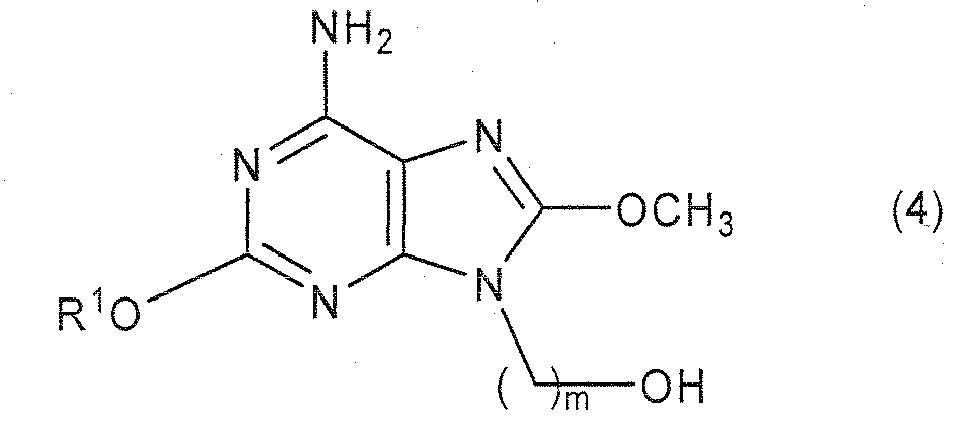
and methanesulfonyl chloride in the presence of a base; - Step (b) for preparing a compound represented by formula (7):

or its salt which comprises reacting a compound (5) prepared by step (a) with a compound represented by formula (6):
or its salt; and then, - Step (c) for preparing compound (2) or its salt which is prepared by treating the compound prepared by step (b) with an acid.
- Step (a) for preparing a compound represented by formula (5):
- Each step is explained in detail below.
- In step (a), compound (4) is usually methanesulfonylated with methanesulfonyl chloride to prepare compound (5).
- Methanesulfonylation is usually in the presence of a base, such as a tertiary amine like triethylamine, diisopropylethylamine, N-methymorpholine etc., preferably triethylamine or diisopropylethylamine.
- Amount of methanesulfonyl chloride used in this reaction is 1 to 2 mole equivalents, preferably 1 to 1.3 mole equivalents to compound (4).
- Furthermore, trimethylamine hydrochloride can be used as an agent for preventing a by-product, and dimethyaminopyridine can be used as a reaction promoting agent.
- The reaction temperature is around 0°C to 40°C, preferably around 0°C to 15°C.
- The reaction solvent is not specifically limited, but includes N-methypyrrolidone, dimethyl sulfoxide, dimethylformamide, tetrahydrofuran, etc.
- The reaction time is usually 10 to 60 minutes.
- After completion of the reaction, to the reaction mixture is added water in order to crystallize the objective compound to give compound (5). Furthermore, when compound (5) is heated, it produces following compounds (13) and (14):

- Therefore, after compound (5) is dried at 0°C to 40°C, preferably 0°C to 20°C, more preferably is not dried, compound (5) is subjected to next reaction step.
- As explained above, in a known method for preparing compound (7) by reacting primary amine (6) and an alkyl halide, etc., there is a problem (possibility) that a dialkylated compound or a tricyclic compound is produced as a by-product. For example, when the alkyl halide carrying such a leaving group as chlorine atom which is less reactive is used, heating (about 60°C) is required. Therefore, there is a possibility to produce a by-product under such a condition. For example, in case of compound (7) wherein m is 2 or 3, there is a possibility to produce as a by-product, a cyclized compound represented by the following formula (15)

- Furthermore, when the alkyl halide carrying such a leaving group as bromine atom which is highly reactive is used, there is a possibility to produce as a by-product, a bis-adenine compound represented by the following formula (16):

- However, in case of a methanesulfonyloxy group (mesyl group) as a leaving group, the mesyl group on compound (5) shows highly reactivity, and in spite of the fact that the reaction is carried out at room temperature (about 5°C to 35°C), the production of a by-product is controlled to give compound (7) in a good yield.
- Furthermore, when compound (6) is used 2 to 30, preferably 10 to 15 mole equivalents to compound (5), a starting material, the production of bis-adenine compound (16) mentioned above can be controlled.
- This reaction can be carried out in the presence of a reaction auxiliary or assistant such as sodium bromide, potassium bromide, sodium iodide, etc.
- N-Methylpyrrolidone or dimethy sulfoxide may be used as a reaction solvent, if necessary, but compound (6) is usually used in excess and served as a solvent. Namely compound (6) is usually used in excess to compound (5), for example, about 2 to 30, preferably 15 mole equivalents to compound (5) to be able to control the production of a by-product.
- The reaction temperature is preferably about 20 to 35°C.
- The reaction time is usually 6 to 24 hours.
- Compound (6) used as a starting material is known and the commercially available product or the product which is prepared in accordance with the similar manners as known by a skilled person in the art can be used.
- After the reaction, compound (6) can be removed by extraction. For example, the desired compound can be extracted with a mixture of toluene and THF, or with chloroform.
- The extract can be subjected to the next reaction without condensation, but the desired compound can be isolated in a form of its salt with other acid by a conventional method. The acid is preferably trifluoroacetic acid, maleic acid, or malonic acid.
- As an acid used in a process for converting compound (7) into compound (2), is illustrated a strong acid such as hydrochloric acid, hydrobromic acid, sulfuric acid, methanesulfonic acid, toluenesulfonic acid, preferably hydrochloric acid, hydrobromic acid, more preferably 12 to 40% hydrochloric acid.
- The reaction temperature is preferably about 0 to 40°C.
- The reaction in this step can be carried out without solvent, but usually after dissolving compound (7) in a suitable organic solvent, to the solution is added the acid.
- The organic solvent is not specifically limited as long as compound (7) is dissolved therein, but is preferably toluene, tetrahydrofuran or a mixture thereof, such as a mixture of toluene and tetrahydrofuran.
- The acid can be used, if necessary after dissolving it in water or an organic solvent. For example, in case of hydrochloric acid or hydrobromic acid, the acid may be further diluted with water or may be dissolved in an organic solvent such as ethanol or dioxane.
- The reaction temperature is usually 0°C to 40°C, preferably about 25°C.
- The reaction time is usually 1 to 5 hours.
- Without concentrating the reaction mixture obtained in the above step (b) thereto is usually added the acid, or to a solution containing compound (7) extracted from the reaction mixture is added the acid to prepare compound (2).
- As compound (2) is superior in thermal stability, after the reaction solvent is removed in vacuo under heating after the reaction, the residue is recrystallized from a mixture of isopropyl alcohol and methanol and filtrated to prepare compound (2) in high purity.
- Compound (2) is obtained as a salt with an acid used in step (c), but the salt may be exchanged into a salt with another acid if necessary in accordance with a known method. For example, to a salt of compound (2) obtained in step (c) is added a base such as sodium carbonate, etc., to produce a free form, and then, an acid is added to the free form, or by a method that to the reaction mixture of step (c) is added another acid to isolate as a salt with another acid.
- When a salt of compound (2) is highly hygroscopic or said acid forms a hardly voluble salt with a base which is used in the next step, the salt of compound (2) is preferably changed into a salt with another acid. Preferable salts of compound (2) are maleate, fumarate and malonate.
- Furthermore, the present invention relates to
- [3] a method for preparing compound (1) or its pharmaceutically acceptable salt set forth in above [2] wherein the method contains the further process for preparing compound (4) or its salt consisting of the following steps (d) to (e):
- Step (d) for preparing a compound represented by formula (10):

which comprises reacting a compound represented by formula (8):
and a compound represented by formula (9):
in the presence of a base,
and then - Step (e) for preparing a compound represented by formula (4):

which comprises hydrolyzing a compound prepared in step (d). - Steps (d) and (e) are explained in detail below.
- Step (d) for preparing a compound represented by formula (10):
- In step (d) condensation reaction of compound (8) and compound (9) is usually carried out in the presence of a base, such as an inorganic base like potassium carbonate, or sodium carbonate.
- The compound (9) is used 1 to 2, preferably 1 to 1.3 mole equivalents to compound (8).
- The reaction temperature is about 20 to 40°C.
- A reaction solvent is not specifically limited, but is N-methylpyrrolidone, dimethyl sulfoxide, or dimethylformamide.
- The reaction time is usually 2 to 8 hours.
- Compound (10) produced in this reaction can be isolated or can be subjected to next reaction step without isolation.
- Furthermore, compound (8) and compound (9) which are used as a starting material are known and can be commercially available or prepared in accordance with a method known by a skilled person in the art.
- In step (e), hydrolysis can be carried out in accordance with hydrolysis of ester known by a skilled person in the art. For example, the hydrolysis is carried out by using alkali metal hydroxide such as sodium hydroxide, or potassium hydroxides.
- The reaction temperature is about 20 to 70°C.
- The reaction solvent is not specifically limited, but a conventional organic solvent in the art used in ester hydrolysis can be used. The hydrolysis can be also carried in an aqueous solution of alkali metal hydroxide without using an organic solvent. An example of the solvent is water-alcohol, preferably methanol-water.
- The reaction time is usually 1 to 5 hours.
- [4] Compounds represented by following formula (2), (4), (5), (7) or (10) which are used as an intermediate in the above reactions:


are novel, and the present invention includes these compounds, a salt, a hydrate, and a solvate thereof. - Furthermore, a tautomer of compound (2) is included in the present invention.
- Compound (2) or (7) can form its salt, and its salt is not specifically limited, but includes a conventional salt such as hydrochloride, hydrobromide, maleate, fumarate, oxalate, malonate, trifluoroacetate, etc.
- Furthermore, compound (3) which is used as a starting material in the present invention, is prepared according to the following reaction scheme:
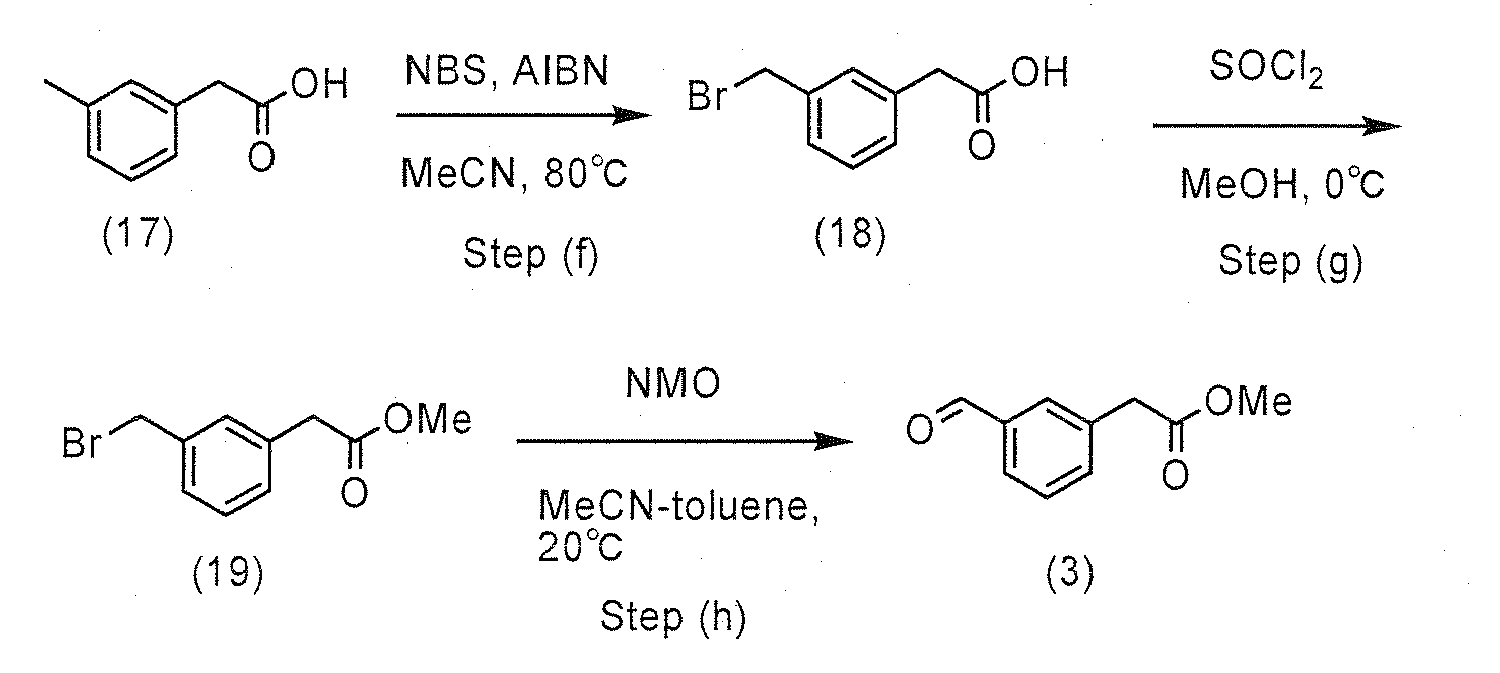
- Each step is explained in detail below.
- 3-Bromomethylphenylacetic acid is prepared by brominating methyl group of 3-methyphenylactetic acid with NBS (N-bromosuccinimide). AIBN (α,α'-azobisisobutyronitrile) is used as a free-radical initiator.
- The reaction solvent is not limited, but includes a halogenated compound such as carbon tetrachloride, ethylacetate or acetonitrile, preferably acetonitrile.
- In this step, a by-product can be removed by crystallization and for example, anhydrous butyl acetate is used as the solvent for crystallization. Step (g)
- 3-Bromomethyphenylacetic acid obtained in step (f) is converted into methyl ester in accordance with a method described in examples or a method known by a skilled person in the art.
- Methyl 3-bromomethyphenylacetate is oxidized with NMO (4-methymorpholine-N-oxide) to prepare an aldehyde compound. The amount of NMO is usually 1 to 10, preferably 2 to 3 mole equivalents to methyl 3-bromomethyphenylacetate. The solvent is not specifically limited, but includes a polar solvent such as acetonitrile, DMSO and a mixture of a polar solvent and a non-polar solvent, preferably a mixture of acetonitrile and toluene.
- Compound (3) is prepared as mentioned above.
- The present invention is explained by the following examples, but the invention is not limited by them.
- In the following examples, the commercially available reaction agents and solvents were used. Organic solutions were dried over anhydrous sodium sulfate unless there is a specific definition.
- Chemical shift of 1H NMR was reported on the basis of inner standard tetramethysilan.
- "Me" means methyl group, "TFA" means trifluoroacetic acid, and "Ms" means methanesulfonyl group in following formulas.
- Conditions of HPLC on analysis for purity are as follows:
- Reverse HPLC column: Mightysil RP-18 GP (5µm, 4.6mm ϕ x 150mm),
- Column temperature: 40°C,
- Flow rate: 1.0ml/min,
- UV wavelengths: 254nm,
- Mobile phase: A solution aqueous 0.1%TFA-water, B solution acetonitrile
- (10%∼100%/21min gradient concentration)
- Melting point was measured by SC/DSC: Sealed Cell/Differential Scanning Calorimetry, namely DSC6200R (by Seiko-Instrument) sample holder: SUS sealed Cell, under following conditions:
- Heat-up rate: 10°C/min., Nitrogen gas circumstance (flow rate 60mL/ml),
- Measuring range; -20°C∼560°C,
- Sample; 2.01mg, aluminum oxide: 2.31mg as a referential compound
- Power X-ray diffraction (XRPD) was measure with RINT2500V (Riken) under following conditions: diffraction angle 2θ; 4° to 40° CuKα radiation (focusing optics), X-ray: 50kV-300mA, Scanning θ-2θ, Scanning speed θ = 4.0/min., Scanning interval: 2θ = 0.02°, measuring angle range 2θ = 2∼40°, Dispersion slit:-1/2°, Emission slit: -0.15mm, Scattering slit:-1/2°.
-

- To a suspension of 2-butoxy-8-methoxy-9H-purine-6-amine trifluoroacetate (20.00g, 56.93mmol) in NMP (111.24g), were added water (1.65g) and potassium carbonate (23.61g, 170.80mmol). Further 3-acetoxypropyl bromide (12.37g, 68.32mmol) was added thereto, followed by stirring for 3 hours at 30°C. To the reaction mixture were added methanol (79.10g) and 2% aqueous sodium hydroxide solution (100g), and the mixture was stirred for 3 hours at 70°C. After adding water (200g), the mixture was cooled to 7°C and the resulting crystal was filtered and dried to give the subject compound (13.03g, 77.5%). Purity: 99.46% (HPLC)
1H NMR (DMSO-d6) δ 6.77 (2H, bs), 4.57 (1H, t, J = 5.2 Hz), 4.16 (2H, t, J = 6.6 Hz), 4.04 (3H, s), 3.89 (2H, t, J = 7.4 Hz), 3.42-3.38 (2H, m), 1.85-1.78 (2H, m), 168-1.61 (2H, m), 1.44-1.35 (2H, m), 0.92 (3H, t, J = 7.3 Hz). -

- To a solution of 3-(6-amino-2-butoxy-8-methoxy-9H-purin-9-yl)propan-1-ol)(12.00g, 40.63mmol) in NMP (97.45g) was added triethyamine (6.17g, 90.65mmol) and the mixture was cooled to 5°C. Thereto was dropped methane sulfonyl chloride (6.05g, 52.82mmol) and the mixture was stirred at 5°C for 30 minutes, followed by adding a water (244.00g). After stirring for 1 hour, the resulting crystal was filtered to give the subject compound (30.34 as a crude product). Purity: 98.39% (HPLC)
-

- To N-(3-aminopropyl)morpholine (86.90g, 602.52mmol) which was cooled to 3°C was in several times added 3-(6-amino-2-butoxy-8-methoxy-9H-purin-9-yl)propyl methanesulfonate (amount corresponding to dried weight 15.00g(40.17mmol)) not to exceed to 20°C. After stirring at 28°C for 10 hours, thereto was added 15% brine (160.00g), and the mixture was extracted with a mixture of toluene (194.08g) and THF (199.8g). After removal of the organic solvent, concentrated hydrochloric acid (41.84g) was added thereto, and the mixture was stirred at 25°C for 3 hours. After removal by distillation of the solvent, to the residue was added methanol (118.65g), followed by raising to 55°C. Isopropanol (353.25g) was dropped thereto and the mixture was crystallized and further raised to 70°C. After one hour, the mixture was cooled to 20°C. The resulting crystal was filtered, washed and dried to give the subject compound (16.80g, 77.5 % by 2 steps). Purity: 99.70% (HPLC)
1H NMR (DMSO-d6) δ 11.12 (1H, bs), 10.58 (1H, bs), 8.93 (2H, bs), 4.20 (2H, t, J = 6.6 Hz), 3.97-3.94 (2H, m), 3.84-3.74 (4H, m), 3.40 (1H, bs), 3.38 (1H, bs), 3.19-3.14 (2H, m), 3.07-2.92 (6H, m), 2.10-1.91 (4H, m), 1.69-1.62 (2H, m), 1.45-1.35 (2H, m), 0.92 (3H, t, J = 7.4 Hz). -

- To a solution of 6-amino-2-butoxy-9-{3-[(3-morpholin-4-ylpropyl)amino]propyl}-7,9-dihydro-8H-purine-8-one trihydrochloride (15.00g, 29.02mmol) in 10% brine (105.00g) was added an aqueous 10% sodium carbonate to be neutralized. After adding chloroform (335.7g), the mixture was heated to 53°C, and the aqueous layer was separated and removed. After an organic layer was concentrated, to the residue was added methanol (296.63g) and the mixture was raised to 50°C. After methanol (59.33g) containing maleic acid (6.74g, 58.04mmol) was dropped, a white crystal was confirmed. After stirring at 70°C for 1 hour, the mixture was cooled to 5°C, a crystal was filtered, washed and dried to give the subject compound (17.60g, 94.8%). Purity: 99.62% (HPLC)
1H NMR (DMSO-d6) δ 9.95 (1H, bs), 8.36 (1.7H, bs), 6.48 (2H, bs), 6.08 (4H, s), 4.15 (2H, t, J = 6.6 Hz), 3.77 (2H, t, J = 6.5 Hz), 3.70 (4H, bs), 2.95 (4H, bt, J = 7.2 Hz), 2.77 (6H, bs), 2.01-1.94 (2H, m), 1.86-1.80 (2H, m), 1.68-1.60 (2H, m), 1.44-1.35 (2H, m), 0.92 (3H, t, J = 7.4 Hz). -

- To a suspension of 6-amino-2-butoxy-9-{3-[(3-morpholin-4-ylpropyl)amino]propyl}-8-oxo-7,9-dihydro-8H-purine dimaleate (15.00g, 23.45mmol) in NMP (54.08g) was added triethyamine (7.12g, 70.35mmol) at 25°C. Then sodium acetoxyborohydride (8.45g, 39.87mmol) was added thereto, followed by stirring at 25°C for 15 minutes. After adding methyl (3-formylphenyl)acetate (6.27g, 35.18mol) and stirring at 25°C for 8 hours, the mixture was cooled to 5°C and then diluted with cold water (240.00). After adjusting pH to 7 with 10% sodium carbonate solution, a seed crystal was added thereto. After stirring for additional 15 minutes, the mixture was adjusted to pH 8 with 10% sodium carbonate solution and thereto was added water (15g). After keeping at 5°C for 1 hour, the resulting white solid was filtered, washed and dried to give the subject compound (12.10g, 90.6%). The seed crystal used in the above was obtained by the method of the above example 5 without adding a seed crystal as the method of the above Example 5. Purity: 94.81% (HPLC)
1H NMR (DMSO-d6) δ 9.82 (1H, bs), 7.24-7.15 (3H, m), 7.10 (1H, d, J = 7.3 Hz), 6.39 (2H, bs), 4.11 (2H, t, J = 6.6 Hz), 3.67 (2H, t, J = 7.2 Hz), 3.64 (2H, s), 3.59 (3H, s), 3.46-3.49 (6H, m), 2.41-2.34 (4H, m), 2.22-2.16 (6H, m), 1.85-1.80 (2H, m), 1.65-1.57 (2H, m), 1.52-1.45 (2H, m), 1.40-1.31 (2H, m), 0.89 (3H, t, J = 7.4 Hz). m.p.: 152.7°C - XRPD data on the subject compound is shown below.
Table 1 2θ (°) d space (Å) Rel Int (%) 4.8 18.5 100 9.5 9.3 49 11.6 7.6 2 11.9 7.4 2 12.1 7.3 2 13.9 6.3 3 14.3 6.2 15 15.2 5.8 2 16.1 5.5 7 17.1 5.2 19 17.8 5.0 11 18.2 4.9 9 19.0 4.7 21 19.7 4.5 16 21.0 4.2 6 22.0 4.0 4 22.6 3.9 31 23.4 3.8 6 23.8 3.7 37 24.3 3.7 27 25.7 3.5 2 26.6 3.4 7 27.1 3.3 4 28.2 3.2 8 28.9 3.1 6 30.8 2.9 4 32.8 2.7 7 33.6 2.7 5 33.9 2.6 4 34.2 2.6 2 - In above table, (2θ (°): Diffraction angle, d space (Å): Space distance of crystal face,
- Rel Int (%): Relative intensity, Accuracy - +/- 0.1° 2θ: Deviation +/- 0.1° 2θ)
-

-

- m-Tolylacetic acid (4.0g, 26.64mmol) and AIBN (α, α'-azobisisobutyronitrile) (0.044g, 0.266mmol) were dissolved in acetonitrile (11.9g) and the solution was raised to 80°C. To this solution was dropped a solution of N-bromosuccinimide (4.98g, 27.97mmol) and AIBN (α, α'-azobisisobutyronitrile) (0.044g, 0.266mmol) in acetonitrile (32g) for 1.5 hours. After stirring for 30 minutes the mixture was cooled to 50°C and thereto was added butyl acetate (38.7g). The mixture was concentrated to remove only acetonitrile. The resulting succinimide (crystal) was removed and the residue was washed three times with water. After concentrating to a desired concentration, thereto was added at 45°C n-heptane (45.6g) to produce a crystal. After cooling to 5°C, the crystal was filtered to give the sub-subject compound (3.76g) as a white crystal. Yield: 62%
1H NMR (CDCl3) δ 7.34-7.33 (3H, m), δ 7.25-7.23 (1H, m), 4.49 (2H, s), 3.67 (2H, s). -

- To a solution of compound (2.8g, 12.22mmol) obtained in step (i) in methanol (7g) was added toluene (14g) and the solution was cooled to 0°C. Thereto was dropped thionyl chloride (0.87g, 7.33mmol) and the mature was stirred for 3 hours at 0°C. To a solution of sodium hydrogencarbonate (1.85g, 12.22mmol) in water (30.24g) was added toluene (14g). After cooled to 0°C, thereto was dropped the above reaction solution. The oil layer was washed with water (14g), and the solvent was removed so as concentration of the solution becomes 25%. This solution was subjected to next step without purification.
1H NMR (CDCl3) δ 7.31-7.19 (4H, m), 4.48 (2H, s), 3.70 (3H, s), 3.64 (2H, s). -

- To a solution of 4-methylmorpholine N-oxide (3.58g, 30.54mmol) in acetonitrile (22.3g) was added toluene (19.3g). Thereto was dropped all of the solution obtained in above Step (ii) at room temperature and the mixture was stirred for 3 hours. After washing with water, the solvent was removed to give the subject compound (1.7g). Yield: 78 %
1H NMR (CDCl3) δ 10.03 (1H, s), 7.83-7.80 (2H, m), 7.59-7.57 (1H, m), 7.54-7.50 (1H, m), 3.73 (2H, s), 3.73 (3H, s). -
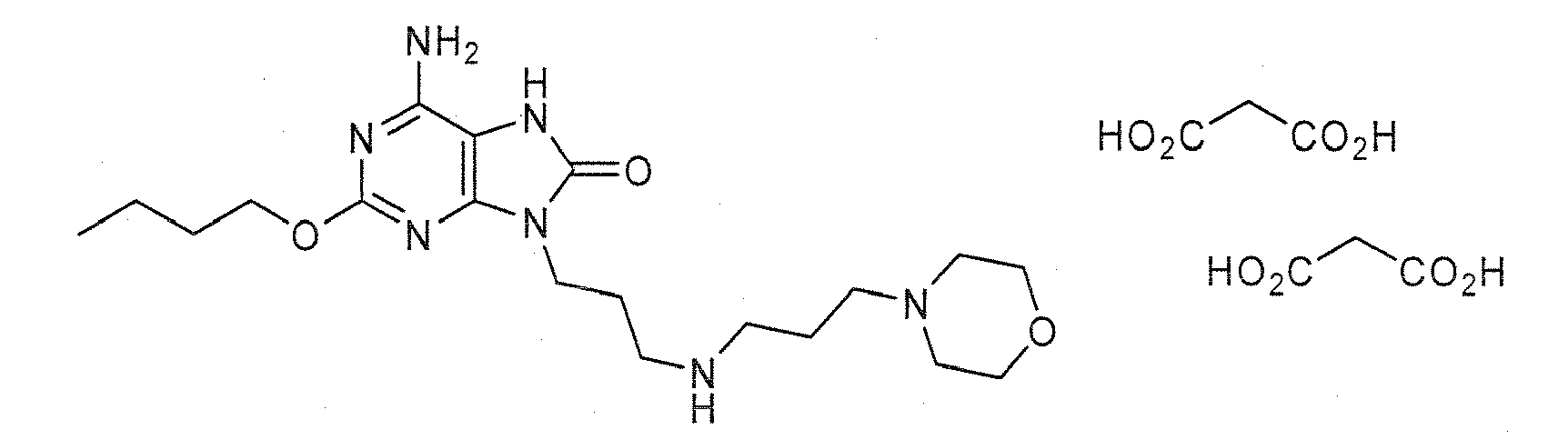
- N-(3-Aminopropyl)morpholine (102.54g, 710.98mmol) was cooled to 3°C and thereto was added in a fraction a wetted crystal of 3-(6-amino-2-butoxy-8-methoxy-9H-purine-9-yl)propyl) methanesulfonate (corresponding to dried weight 17.70g, 47.40 mmol) not to exceed 20°C. After stirring at 28°C for 10 hours, thereto was added 15% brine (189g), and the mixture was extracted with a mixture of toluene (230g) and THF (234 g). After removal of the organic solvent, thereto was added concentrated hydrochloric acid (48g) and the mixture was stirred at 25°C. Three hours later, the water layer was removed and the organic layer was twice extracted with 10% brine (106g) and by combining two water layers was obtained an acidic solution. The solution was neutralized with an aqueous 12% sodium hydroxide solution (142g) and then was made alkaline with 10% sodium carbonate solution (69g). The solution was extracted with chloroform (528g) at 50°C. By adding methanol solution (140g) containing malonic acid (9.87g, 94.80mmol) at 50°C to the separated organic layer there was confirmed a crystal. The solution was cooled to 5°C and the resulting crystal was collected, washed and dried to give the subject compound as a white crystal (21.34g, 73.1%).
1H NMR (DMSO-d6) δ 9.99 (1H, bs), 8.32 (2H, bs), 6.49 (2H, bs), 4.15 (2H, t, J = 8 Hz), 3.76 (2H, t, J = 8 Hz), 3.57 (4H, bt, J = 5 Hz), 2.94 (8H, s+bt, J = 8 Hz), 2.36 (6H, m), 2.00-1.93 (2H, m), 1.75-1.67 (2H, m), 1.67-1.60 (2H, m), 1.43-1.34 (2H, m), 0.92 (3H, t, J = 8 Hz). -

- To a suspension of 6-amino-2-butoxy-9-{3-(3-morpholin-4-ylpropyl)amino)]propyl}-7,9-dihidro-8H-purine-8-one dimalonate (2.80g, 4.55mmol) in NMP (11.5g) was added at 25°C triethyamine (1.38g, 13.64mmol). After stirring for 10 minutes, thereto was added sodium triacetoxyborohydride (1.64g, 7.73mmol), and the mixture was stirred at 25°C for 10 minutes. After adding methyl (3-formylphenyl)acetate (1.42g, 7.96mmol) and stirring at 25°C for 8 hours, thereto was added NMP (11.5g) and the mixture was cooled to 5°C, followed by being quenched with cold water 45 g. The solution was adjusted to pH7 with 10% sodium carbonate solution, and thereto was added a seed crystal (10mg, 0.017mmol). After stirring for 15 minutes, the solution was adjusted to pH 8 with 10% sodium carbonate solution and thereto was added water. After keeping at 5°C for 1 hour, the resulting crystal was filtered, washed and dried to give the subject compound (2.48 g, 95.7%).
1H NMR (DMSO-d6) δ 9.82 (1H, bs), 7.24-7.15 (3H, m), 7.10 (1H, d, J = 7.3 Hz), 6.39 (2H, bs), 4.11 (2H, t, J = 6.6 Hz), 3.67 (2H, t, J = 7.2 Hz), 3.64 (2H, s), 3.59 (3H, s), 3.46-3.49 (6H, m), 2.41-2.34 (4H, m), 2.22-2.16 (6H, m), 1.85-1.80 (2H, m), 1.65-1.57 (2H, m), 1.52-1.45 (2H, m), 1.40-1.31 (2H, m), 0.89 (3H, t, J = 7.4 Hz). - The present invention relates to a method for preparing an adenine compound useful as a medicament and an intermediate for preparing it.
Claims (7)
- A method for preparing a compound represented by the following formula (1):

or its pharmaceutically acceptable salt which is characterized by reacting a compound represented by the following formula (2):
or its salt and a compound represented by the following formula (3):
in the presence of a boron-containing reducing agent. - The method according to claim 1 wherein the boron-containing reducing agent is sodium triacetoxyborohydride.
- The method according to claim 1 or 2 wherein the method contains the further process for preparing compound (2) or its salt consisting of the following steps (a) to (c):Step (a) for preparing a compound represented by formula (5):

which comprises reacting a compound represented by formula (4):
and methanesulfonyl chloride in the presence of a base;Step (b) for preparing a compound represented by formula (7):
or its salt which comprises reacting compound (5) prepared by step (a) with a compound represented by formula (6):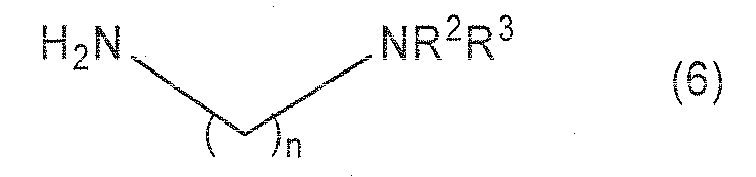
or its salt; and then,Step (c) for preparing compound (2) or its salt which comprises treating compound (7) prepared by step (b) with an acid. - The method according to claim 3 wherein the acid used in step(c) is one or plural acids selected from hydrochloric acid, hydrobromic acid, sulfuric acid, methansulfonic acid and toluenesulfonic acid.
- The method according to claim 4 wherein the acid is 12 to 40% hydrochloric acid.
- The method according to any one of claims 3 to 5 wherein the method contains the further process for preparing compound (4) or its salt consisting of following steps (d) to (e):Step (d) for preparing compound of formula (10):


in the presence of a base,
and then,Step (e) for preparing a compound represented by formula (4):
which comprises by hydrolyzing compound (10) prepared in step (d). - A compound selected from compounds represented by following formulas (2), (4), (5), (7) and (10):

Applications Claiming Priority (2)
| Application Number | Priority Date | Filing Date | Title |
|---|---|---|---|
| JP2008007974 | 2008-01-17 | ||
| PCT/JP2009/050550 WO2009091032A1 (en) | 2008-01-17 | 2009-01-16 | Method for producing adenine compound |
Publications (2)
| Publication Number | Publication Date |
|---|---|
| EP2246353A1 true EP2246353A1 (en) | 2010-11-03 |
| EP2246353A4 EP2246353A4 (en) | 2011-04-20 |
Family
ID=40885414
Family Applications (1)
| Application Number | Title | Priority Date | Filing Date |
|---|---|---|---|
| EP09703040A Withdrawn EP2246353A4 (en) | 2008-01-17 | 2009-01-16 | PROCESS FOR PRODUCING ADENINE COMPOUND |
Country Status (8)
| Country | Link |
|---|---|
| US (1) | US8865896B2 (en) |
| EP (1) | EP2246353A4 (en) |
| JP (1) | JP5577099B2 (en) |
| KR (1) | KR20100125245A (en) |
| CN (1) | CN102143964A (en) |
| CA (1) | CA2711769A1 (en) |
| IL (1) | IL206933A0 (en) |
| WO (1) | WO2009091032A1 (en) |
Cited By (5)
| Publication number | Priority date | Publication date | Assignee | Title |
|---|---|---|---|---|
| US8138172B2 (en) | 2006-07-05 | 2012-03-20 | Astrazeneca Ab | 8-oxoadenine derivatives acting as modulators of TLR7 |
| WO2012080730A1 (en) | 2010-12-17 | 2012-06-21 | Astrazeneca Ab | Purine derivatives |
| US8268990B2 (en) | 2007-11-22 | 2012-09-18 | Astrazeneca Ab | Compounds |
| US8476288B2 (en) | 2009-05-21 | 2013-07-02 | Astrazeneca Ab | Salts 756 |
| US8673907B2 (en) | 2007-12-17 | 2014-03-18 | Astrazeneca Ab | Pharmaceutically acceptable salts of methyl (3-{ [[3-(6-amino- 2-butoxy-8-oxo-7,8-dihydro-9H-purin-9-yl) propyl] (3-morpholin-4-ylpropyl) amino] methyl }phenyl) acetate and their use in therapy |
Families Citing this family (17)
| Publication number | Priority date | Publication date | Assignee | Title |
|---|---|---|---|---|
| KR101111085B1 (en) * | 2002-09-27 | 2012-04-12 | 다이닛본 스미토모 세이야꾸 가부시끼가이샤 | New Adenine Compounds and Their Uses |
| US8012964B2 (en) * | 2004-03-26 | 2011-09-06 | Dainippon Sumitomo Pharma Co., Ltd. | 9-substituted 8-oxoadenine compound |
| TW200831105A (en) | 2006-12-14 | 2008-08-01 | Astrazeneca Ab | Novel compounds |
| SI2132209T1 (en) | 2007-03-19 | 2014-05-30 | Astrazeneca Ab | 9-substituted-8-oxo-adenine compounds as toll-like receptor (tlr7 ) modulators |
| JP5329444B2 (en) | 2007-03-19 | 2013-10-30 | アストラゼネカ・アクチエボラーグ | 9-Substituted-8-oxo-adenine compounds as TOLL-like receptor (TLR7) modulators |
| EP2138497A4 (en) * | 2007-03-20 | 2012-01-04 | Dainippon Sumitomo Pharma Co | NEW ADENINE COMPOUND |
| AR065784A1 (en) * | 2007-03-20 | 2009-07-01 | Dainippon Sumitomo Pharma Co | DERIVATIVES OF 8-OXO ADENINE, DRUGS THAT CONTAIN THEM AND USES AS THERAPEUTIC AGENTS FOR ALLERGIC, ANTIVIRAL OR ANTIBACTERIAL DISEASES. |
| EP2155743B1 (en) * | 2007-05-08 | 2012-08-29 | AstraZeneca AB | Imidazoquinolines with immuno-modulating properties |
| JPWO2009091031A1 (en) * | 2008-01-17 | 2011-05-26 | 大日本住友製薬株式会社 | Method for producing adenine compound |
| EP2507237A1 (en) * | 2009-12-03 | 2012-10-10 | Dainippon Sumitomo Pharma Co., Ltd. | Imidazoquinolines which act via toll - like receptors (tlr) |
| WO2012080728A1 (en) | 2010-12-16 | 2012-06-21 | Astrazeneca Ab | Imidazo [4, 5 -c] quinolin- 1 -yl derivative useful in therapy |
| EP2850067B1 (en) | 2012-05-18 | 2017-08-16 | Sumitomo Dainippon Pharma Co., Ltd. | Carboxylic acid compounds |
| WO2017222946A1 (en) * | 2016-06-20 | 2017-12-28 | Vasade Biosciences | Adenylyl cyclase inhibitors, pharmaceutical compositions and methods of use thereof |
| KR20190084991A (en) | 2016-11-28 | 2019-07-17 | 지앙수 헨그루이 메디슨 컴퍼니 리미티드 | Pyrazole-heteroaryl derivatives, their preparation methods and their medical uses |
| EP3636646A4 (en) | 2017-05-18 | 2020-12-09 | Jiangsu Hengrui Medicine Co., Ltd. | Heteroaryl-pyrazole derivative, and preparation method therefor and medical application thereof |
| CN108948016B (en) * | 2017-05-19 | 2021-02-26 | 江苏恒瑞医药股份有限公司 | Purine ketone derivative, preparation method and medical application thereof |
| JP2021526520A (en) | 2018-05-25 | 2021-10-07 | 江▲蘇▼恒瑞医▲薬▼股▲フン▼有限公司Jiangsu Hengrui Medicine Co., Ltd. | Crystal form and preparation method of hydrochloride of pyrazolo heteroaryl derivative |
Family Cites Families (52)
| Publication number | Priority date | Publication date | Assignee | Title |
|---|---|---|---|---|
| SE8404768L (en) | 1983-09-27 | 1985-03-28 | Ceskoslovenska Akademie Ved | 9- (AMINOALKYL) -8-HYDROXIADENINES AND SETS FOR THEIR PREPARATION |
| US5994361A (en) | 1994-06-22 | 1999-11-30 | Biochem Pharma | Substituted purinyl derivatives with immunomodulating activity |
| JPH10507171A (en) * | 1994-10-05 | 1998-07-14 | カイロサイエンス・リミテッド | Purine and guanine compounds as PNP inhibitors |
| TW552261B (en) * | 1996-07-03 | 2003-09-11 | Japan Energy Corp | Novel purine derivative |
| CA2311742C (en) | 1997-11-28 | 2009-06-16 | Sumitomo Pharmaceuticals Co., Ltd. | 6-amino-9-benzyl-8-hydroxypurine derivatives |
| JPH11180981A (en) | 1997-12-19 | 1999-07-06 | Sumitomo Pharmaceut Co Ltd | Heterocyclic derivatives |
| TW572758B (en) | 1997-12-22 | 2004-01-21 | Sumitomo Pharma | Type 2 helper T cell-selective immune response inhibitors comprising purine derivatives |
| JP4160645B2 (en) | 1997-12-24 | 2008-10-01 | 大日本住友製薬株式会社 | Novel adenine derivatives and their pharmaceutical use |
| JP4189048B2 (en) | 1997-12-26 | 2008-12-03 | 大日本住友製薬株式会社 | Heterocyclic compounds |
| JP2000159767A (en) | 1998-11-26 | 2000-06-13 | Sumitomo Pharmaceut Co Ltd | New method for producing 8-hydroxyadenine derivatives |
| CZ27399A3 (en) | 1999-01-26 | 2000-08-16 | Ústav Experimentální Botaniky Av Čr | Substituted nitrogen heterocyclic derivatives process of their preparation, the derivatives employed as medicaments, pharmaceutical composition and a compound pharmaceutical preparation in which these derivatives are comprised as well as use of these derivatives for preparing medicaments |
| GB9924361D0 (en) * | 1999-10-14 | 1999-12-15 | Pfizer Ltd | Purine derivatives |
| DE60118521T2 (en) * | 2000-01-07 | 2006-10-12 | Universitaire Instelling Antwerpen | Purine derivatives, their preparation and their use |
| US20020040032A1 (en) | 2000-07-07 | 2002-04-04 | Glasky Michelle S. | Methods for stimulation of synthesis of synaptophysin in the central nervous system |
| WO2002004448A2 (en) | 2000-07-07 | 2002-01-17 | Neotherapeutics, Inc. | Methods for treatment of drug-induced peripheral neuropathy and related conditions |
| WO2002004449A2 (en) | 2000-07-07 | 2002-01-17 | Neotherapeutics, Inc. | Methods for treatment of conditions affected by activity of multidrug transporters |
| AU2002239277A1 (en) * | 2000-11-20 | 2002-05-27 | Cor Therapeutics, Inc. | Adenine based inhibitors of adenylyl cyclase, pharmaceutical compositions and method of use thereof |
| JP4331944B2 (en) | 2001-04-17 | 2009-09-16 | 大日本住友製薬株式会社 | New adenine derivatives |
| ITRM20010465A1 (en) | 2001-07-31 | 2003-01-31 | Sigma Tau Ind Farmaceuti | DERIVATIVES OF TRIAZOLYL-IMIDAZOPYRIDINE AND OF TRIAZOLYLPURINES USEFUL AS LIGANDS OF THE ADENOSINE A2A RECEPTOR AND THEIR USE AS MEDICAM |
| US20060252774A1 (en) * | 2002-05-02 | 2006-11-09 | Vatner Stephen F | Regulation of type 5 adenylyl cyclase for treatment of neurodegenerative and cardiac diseases |
| KR101111085B1 (en) | 2002-09-27 | 2012-04-12 | 다이닛본 스미토모 세이야꾸 가부시끼가이샤 | New Adenine Compounds and Their Uses |
| JP2005089334A (en) | 2003-09-12 | 2005-04-07 | Sumitomo Pharmaceut Co Ltd | 8-hydroxyadenine compound |
| US8012964B2 (en) | 2004-03-26 | 2011-09-06 | Dainippon Sumitomo Pharma Co., Ltd. | 9-substituted 8-oxoadenine compound |
| EP1728792A4 (en) | 2004-03-26 | 2010-12-15 | Dainippon Sumitomo Pharma Co | 8-OXOADENINE COMPOUND |
| MX2007013780A (en) * | 2005-05-04 | 2008-02-05 | Pfizer Ltd | 2-amido-6-amino-8-oxopurine derivatives as toll-like receptor modulators for the treatment of cancer and viral infections, such as hepatitis c. |
| JP2009504803A (en) * | 2005-08-22 | 2009-02-05 | ザ リージェンツ オブ ザ ユニバーシティ オブ カリフォルニア | TLR agonist |
| TW200801003A (en) | 2005-09-16 | 2008-01-01 | Astrazeneca Ab | Novel compounds |
| EP1939198A4 (en) | 2005-09-22 | 2012-02-15 | Dainippon Sumitomo Pharma Co | Novel adenine compound |
| US20090105212A1 (en) | 2005-09-22 | 2009-04-23 | Dainippon Sumitomo Pharma Co., Ltd. a corporation of Japan | Novel adenine compound |
| US20090118263A1 (en) | 2005-09-22 | 2009-05-07 | Dainippon Sumitomo Pharma Co., Ltd. | Novel Adenine Compound |
| TW200745114A (en) | 2005-09-22 | 2007-12-16 | Astrazeneca Ab | Novel compounds |
| US20080269240A1 (en) | 2005-09-22 | 2008-10-30 | Dainippon Sumitomo Pharma Co., Ltd. a corporation of Japan | Novel Adenine Compound |
| WO2007034916A1 (en) | 2005-09-22 | 2007-03-29 | Dainippon Sumitomo Pharma Co., Ltd. | Novel adenine compound |
| JP2009528989A (en) * | 2006-02-17 | 2009-08-13 | ファイザー・リミテッド | 3-Deazapurine derivatives as TLR7 modulators |
| US20090281075A1 (en) | 2006-02-17 | 2009-11-12 | Pharmacopeia, Inc. | Isomeric purinones and 1h-imidazopyridinones as pkc-theta inhibitors |
| WO2008004948A1 (en) | 2006-07-05 | 2008-01-10 | Astrazeneca Ab | 8-oxoadenine derivatives acting as modulators of tlr7 |
| PT2038290E (en) | 2006-07-07 | 2013-12-10 | Gilead Sciences Inc | Modulators of toll-like receptor 7 |
| TW200831105A (en) | 2006-12-14 | 2008-08-01 | Astrazeneca Ab | Novel compounds |
| EP2125792B1 (en) * | 2007-02-19 | 2010-12-01 | GlaxoSmithKline LLC | Purine derivatives as immunomodulators |
| JP5329444B2 (en) | 2007-03-19 | 2013-10-30 | アストラゼネカ・アクチエボラーグ | 9-Substituted-8-oxo-adenine compounds as TOLL-like receptor (TLR7) modulators |
| SI2132209T1 (en) | 2007-03-19 | 2014-05-30 | Astrazeneca Ab | 9-substituted-8-oxo-adenine compounds as toll-like receptor (tlr7 ) modulators |
| AR065784A1 (en) | 2007-03-20 | 2009-07-01 | Dainippon Sumitomo Pharma Co | DERIVATIVES OF 8-OXO ADENINE, DRUGS THAT CONTAIN THEM AND USES AS THERAPEUTIC AGENTS FOR ALLERGIC, ANTIVIRAL OR ANTIBACTERIAL DISEASES. |
| EP2138497A4 (en) | 2007-03-20 | 2012-01-04 | Dainippon Sumitomo Pharma Co | NEW ADENINE COMPOUND |
| EP2155743B1 (en) | 2007-05-08 | 2012-08-29 | AstraZeneca AB | Imidazoquinolines with immuno-modulating properties |
| SI2170888T1 (en) * | 2007-06-29 | 2015-10-30 | Gilead Sciences, Inc. | Purine derivatives and their use as modulators of toll-like receptor 7 |
| WO2009034386A1 (en) * | 2007-09-13 | 2009-03-19 | Astrazeneca Ab | Derivatives of adenine and 8-aza-adenine and uses thereof-796 |
| WO2009062059A2 (en) | 2007-11-08 | 2009-05-14 | Pharmacopeia, Inc. | Isomeric purinones and 1h-imidazopyridinones as pkc-theta inhibitors |
| PE20091156A1 (en) * | 2007-12-17 | 2009-09-03 | Astrazeneca Ab | SALTS OF (3 - {[[3- (6-AMINO-2-BUTOXY-8-OXO-7,8-DIHIDRO-9H-PURIN-9-IL) PROPYL] (3-MORFOLIN-4-ILPROPIL) AMINO] METHYL} PHENYL) METHYL ACETATE |
| JPWO2009091031A1 (en) | 2008-01-17 | 2011-05-26 | 大日本住友製薬株式会社 | Method for producing adenine compound |
| WO2009151910A2 (en) | 2008-05-25 | 2009-12-17 | Wyeth | Combination product of receptor tyrosine kinase inhibitor and fatty acid synthase inhibitor for treating cancer |
| UA103195C2 (en) | 2008-08-11 | 2013-09-25 | Глаксосмитклайн Ллк | PURCHASE DERIVATIVES FOR THE APPLICATION IN THE TREATMENT OF ALLERGIES, INFLAMMATORY AND INFECTIOUS DISEASES |
| WO2010033074A1 (en) | 2008-09-18 | 2010-03-25 | Astrazeneca Ab | Use of a tlr7 agonist for the treatment of cancer |
-
2009
- 2009-01-16 WO PCT/JP2009/050550 patent/WO2009091032A1/en not_active Ceased
- 2009-01-16 KR KR1020107017917A patent/KR20100125245A/en not_active Withdrawn
- 2009-01-16 CA CA2711769A patent/CA2711769A1/en not_active Abandoned
- 2009-01-16 EP EP09703040A patent/EP2246353A4/en not_active Withdrawn
- 2009-01-16 CN CN2009801094662A patent/CN102143964A/en active Pending
- 2009-01-16 JP JP2009550058A patent/JP5577099B2/en not_active Expired - Fee Related
- 2009-01-16 US US12/863,291 patent/US8865896B2/en not_active Expired - Fee Related
-
2010
- 2010-07-11 IL IL206933A patent/IL206933A0/en unknown
Cited By (7)
| Publication number | Priority date | Publication date | Assignee | Title |
|---|---|---|---|---|
| US8138172B2 (en) | 2006-07-05 | 2012-03-20 | Astrazeneca Ab | 8-oxoadenine derivatives acting as modulators of TLR7 |
| US8268990B2 (en) | 2007-11-22 | 2012-09-18 | Astrazeneca Ab | Compounds |
| US8765939B2 (en) | 2007-11-22 | 2014-07-01 | Astrazeneca Ab | Pyrimidline derivatives having immune modulating properties that act via TLR7 for the treatment of viral or allergic diseases and cancers |
| US8673907B2 (en) | 2007-12-17 | 2014-03-18 | Astrazeneca Ab | Pharmaceutically acceptable salts of methyl (3-{ [[3-(6-amino- 2-butoxy-8-oxo-7,8-dihydro-9H-purin-9-yl) propyl] (3-morpholin-4-ylpropyl) amino] methyl }phenyl) acetate and their use in therapy |
| US8476288B2 (en) | 2009-05-21 | 2013-07-02 | Astrazeneca Ab | Salts 756 |
| WO2012080730A1 (en) | 2010-12-17 | 2012-06-21 | Astrazeneca Ab | Purine derivatives |
| US8895570B2 (en) | 2010-12-17 | 2014-11-25 | Astrazeneca Ab | Purine derivatives |
Also Published As
| Publication number | Publication date |
|---|---|
| IL206933A0 (en) | 2010-12-30 |
| KR20100125245A (en) | 2010-11-30 |
| JPWO2009091032A1 (en) | 2011-05-26 |
| WO2009091032A1 (en) | 2009-07-23 |
| JP5577099B2 (en) | 2014-08-20 |
| CN102143964A (en) | 2011-08-03 |
| CA2711769A1 (en) | 2009-07-23 |
| US20110046369A1 (en) | 2011-02-24 |
| US8865896B2 (en) | 2014-10-21 |
| EP2246353A4 (en) | 2011-04-20 |
Similar Documents
| Publication | Publication Date | Title |
|---|---|---|
| JP5577099B2 (en) | Method for producing adenine compound | |
| JP6523566B2 (en) | Crystal form of dihydropyrido ring compound, production method and intermediate | |
| CA2871589C (en) | Pyrimidine carboxylic acid derivatives and their use as tlr7 agonists | |
| US8884016B2 (en) | Apixaban preparation process | |
| WO2009091031A1 (en) | Method for producing adenine compound | |
| US11939322B2 (en) | Method for producing tetracyclic compound | |
| CN118317946A (en) | Methods and intermediates for preparing baricitinib | |
| ES2635037T3 (en) | Process for the preparation and purification of apixaban | |
| US12319677B2 (en) | Process for the production of 5-(4-((2S,5S)-5-(4-chlorobenzyl)-2-methyl-morpholino)piperidin-1-yl)-1H-1,2,4-triazol-3-amine | |
| HK1149758A (en) | Method for producing adenine compound | |
| US20100267954A1 (en) | Process for the purification of paliperidone | |
| US20120041211A1 (en) | Novel process for preparing carboxy-containing pyrazoleamido compounds 597 | |
| EP2729463B1 (en) | Substituted phenyl compounds | |
| JP2014530248A (en) | Bosentan acid addition salt | |
| US20080319194A1 (en) | Process for Preparing Quinazolinone Derivatives | |
| US20100137602A1 (en) | Process and intermediates for preparing arzoxifene | |
| WO2026078574A1 (en) | A crystalline ethanolate of an allosteric egfr inhibitor and an enantioselective synthesis thereof | |
| HK1251555B (en) | Crystal form, preparation method and intermediate of dihydropyrido ring compound | |
| HK1207365B (en) | Carboxylic acid compounds | |
| HK1192246B (en) | Substituted phenyl compounds |
Legal Events
| Date | Code | Title | Description |
|---|---|---|---|
| PUAI | Public reference made under article 153(3) epc to a published international application that has entered the european phase |
Free format text: ORIGINAL CODE: 0009012 |
|
| 17P | Request for examination filed |
Effective date: 20100817 |
|
| AK | Designated contracting states |
Kind code of ref document: A1 Designated state(s): AT BE BG CH CY CZ DE DK EE ES FI FR GB GR HR HU IE IS IT LI LT LU LV MC MK MT NL NO PL PT RO SE SI SK TR |
|
| AX | Request for extension of the european patent |
Extension state: AL BA RS |
|
| A4 | Supplementary search report drawn up and despatched |
Effective date: 20110321 |
|
| DAX | Request for extension of the european patent (deleted) | ||
| REG | Reference to a national code |
Ref country code: HK Ref legal event code: DE Ref document number: 1149758 Country of ref document: HK |
|
| 17Q | First examination report despatched |
Effective date: 20120113 |
|
| STAA | Information on the status of an ep patent application or granted ep patent |
Free format text: STATUS: THE APPLICATION IS DEEMED TO BE WITHDRAWN |
|
| 18D | Application deemed to be withdrawn |
Effective date: 20140315 |
|
| REG | Reference to a national code |
Ref country code: HK Ref legal event code: WD Ref document number: 1149758 Country of ref document: HK |