EP2245501B1 - Torische kontaktlinse mit räumlich unterschiedlichem astigmatismus - Google Patents
Torische kontaktlinse mit räumlich unterschiedlichem astigmatismus Download PDFInfo
- Publication number
- EP2245501B1 EP2245501B1 EP09713653.5A EP09713653A EP2245501B1 EP 2245501 B1 EP2245501 B1 EP 2245501B1 EP 09713653 A EP09713653 A EP 09713653A EP 2245501 B1 EP2245501 B1 EP 2245501B1
- Authority
- EP
- European Patent Office
- Prior art keywords
- astigmatism
- zone
- zones
- pupil
- lens
- Prior art date
- Legal status (The legal status is an assumption and is not a legal conclusion. Google has not performed a legal analysis and makes no representation as to the accuracy of the status listed.)
- Active
Links
- 201000009310 astigmatism Diseases 0.000 title claims description 165
- 210000001747 pupil Anatomy 0.000 claims description 73
- 210000004087 cornea Anatomy 0.000 description 26
- 230000004438 eyesight Effects 0.000 description 13
- 238000012937 correction Methods 0.000 description 12
- 230000003287 optical effect Effects 0.000 description 9
- 238000002513 implantation Methods 0.000 description 8
- 238000000926 separation method Methods 0.000 description 6
- 230000007423 decrease Effects 0.000 description 3
- 210000001525 retina Anatomy 0.000 description 3
- 238000001356 surgical procedure Methods 0.000 description 3
- 101150064138 MAP1 gene Proteins 0.000 description 2
- 230000003466 anti-cipated effect Effects 0.000 description 2
- 230000008901 benefit Effects 0.000 description 2
- 230000000694 effects Effects 0.000 description 2
- 238000005259 measurement Methods 0.000 description 2
- 238000012986 modification Methods 0.000 description 2
- 230000004048 modification Effects 0.000 description 2
- 208000002177 Cataract Diseases 0.000 description 1
- 230000004075 alteration Effects 0.000 description 1
- 210000002159 anterior chamber Anatomy 0.000 description 1
- 210000004556 brain Anatomy 0.000 description 1
- 230000008859 change Effects 0.000 description 1
- 230000003247 decreasing effect Effects 0.000 description 1
- 210000000887 face Anatomy 0.000 description 1
- 239000000835 fiber Substances 0.000 description 1
- 239000012530 fluid Substances 0.000 description 1
- 230000004313 glare Effects 0.000 description 1
- 239000007943 implant Substances 0.000 description 1
- 230000006872 improvement Effects 0.000 description 1
- 238000000034 method Methods 0.000 description 1
- 210000001328 optic nerve Anatomy 0.000 description 1
- 230000002093 peripheral effect Effects 0.000 description 1
- 238000001314 profilometry Methods 0.000 description 1
- 230000011218 segmentation Effects 0.000 description 1
- 230000035945 sensitivity Effects 0.000 description 1
- 238000012546 transfer Methods 0.000 description 1
Images
Classifications
-
- G—PHYSICS
- G02—OPTICS
- G02C—SPECTACLES; SUNGLASSES OR GOGGLES INSOFAR AS THEY HAVE THE SAME FEATURES AS SPECTACLES; CONTACT LENSES
- G02C7/00—Optical parts
- G02C7/02—Lenses; Lens systems ; Methods of designing lenses
- G02C7/04—Contact lenses for the eyes
-
- A—HUMAN NECESSITIES
- A61—MEDICAL OR VETERINARY SCIENCE; HYGIENE
- A61F—FILTERS IMPLANTABLE INTO BLOOD VESSELS; PROSTHESES; DEVICES PROVIDING PATENCY TO, OR PREVENTING COLLAPSING OF, TUBULAR STRUCTURES OF THE BODY, e.g. STENTS; ORTHOPAEDIC, NURSING OR CONTRACEPTIVE DEVICES; FOMENTATION; TREATMENT OR PROTECTION OF EYES OR EARS; BANDAGES, DRESSINGS OR ABSORBENT PADS; FIRST-AID KITS
- A61F2/00—Filters implantable into blood vessels; Prostheses, i.e. artificial substitutes or replacements for parts of the body; Appliances for connecting them with the body; Devices providing patency to, or preventing collapsing of, tubular structures of the body, e.g. stents
- A61F2/02—Prostheses implantable into the body
- A61F2/14—Eye parts, e.g. lenses or corneal implants; Artificial eyes
- A61F2/16—Intraocular lenses
- A61F2/1613—Intraocular lenses having special lens configurations, e.g. multipart lenses; having particular optical properties, e.g. pseudo-accommodative lenses, lenses having aberration corrections, diffractive lenses, lenses for variably absorbing electromagnetic radiation, lenses having variable focus
-
- A—HUMAN NECESSITIES
- A61—MEDICAL OR VETERINARY SCIENCE; HYGIENE
- A61F—FILTERS IMPLANTABLE INTO BLOOD VESSELS; PROSTHESES; DEVICES PROVIDING PATENCY TO, OR PREVENTING COLLAPSING OF, TUBULAR STRUCTURES OF THE BODY, e.g. STENTS; ORTHOPAEDIC, NURSING OR CONTRACEPTIVE DEVICES; FOMENTATION; TREATMENT OR PROTECTION OF EYES OR EARS; BANDAGES, DRESSINGS OR ABSORBENT PADS; FIRST-AID KITS
- A61F2/00—Filters implantable into blood vessels; Prostheses, i.e. artificial substitutes or replacements for parts of the body; Appliances for connecting them with the body; Devices providing patency to, or preventing collapsing of, tubular structures of the body, e.g. stents
- A61F2/02—Prostheses implantable into the body
- A61F2/14—Eye parts, e.g. lenses or corneal implants; Artificial eyes
- A61F2/16—Intraocular lenses
- A61F2/1613—Intraocular lenses having special lens configurations, e.g. multipart lenses; having particular optical properties, e.g. pseudo-accommodative lenses, lenses having aberration corrections, diffractive lenses, lenses for variably absorbing electromagnetic radiation, lenses having variable focus
- A61F2/1637—Correcting aberrations caused by inhomogeneities; correcting intrinsic aberrations, e.g. of the cornea, of the surface of the natural lens, aspheric, cylindrical, toric lenses
-
- G—PHYSICS
- G02—OPTICS
- G02C—SPECTACLES; SUNGLASSES OR GOGGLES INSOFAR AS THEY HAVE THE SAME FEATURES AS SPECTACLES; CONTACT LENSES
- G02C7/00—Optical parts
- G02C7/02—Lenses; Lens systems ; Methods of designing lenses
- G02C7/024—Methods of designing ophthalmic lenses
- G02C7/028—Special mathematical design techniques
-
- A—HUMAN NECESSITIES
- A61—MEDICAL OR VETERINARY SCIENCE; HYGIENE
- A61F—FILTERS IMPLANTABLE INTO BLOOD VESSELS; PROSTHESES; DEVICES PROVIDING PATENCY TO, OR PREVENTING COLLAPSING OF, TUBULAR STRUCTURES OF THE BODY, e.g. STENTS; ORTHOPAEDIC, NURSING OR CONTRACEPTIVE DEVICES; FOMENTATION; TREATMENT OR PROTECTION OF EYES OR EARS; BANDAGES, DRESSINGS OR ABSORBENT PADS; FIRST-AID KITS
- A61F2250/00—Special features of prostheses classified in groups A61F2/00 - A61F2/26 or A61F2/82 or A61F9/00 or A61F11/00 or subgroups thereof
- A61F2250/0014—Special features of prostheses classified in groups A61F2/00 - A61F2/26 or A61F2/82 or A61F9/00 or A61F11/00 or subgroups thereof having different values of a given property or geometrical feature, e.g. mechanical property or material property, at different locations within the same prosthesis
- A61F2250/0053—Special features of prostheses classified in groups A61F2/00 - A61F2/26 or A61F2/82 or A61F9/00 or A61F11/00 or subgroups thereof having different values of a given property or geometrical feature, e.g. mechanical property or material property, at different locations within the same prosthesis differing in optical properties
-
- G—PHYSICS
- G02—OPTICS
- G02C—SPECTACLES; SUNGLASSES OR GOGGLES INSOFAR AS THEY HAVE THE SAME FEATURES AS SPECTACLES; CONTACT LENSES
- G02C2202/00—Generic optical aspects applicable to one or more of the subgroups of G02C7/00
- G02C2202/02—Mislocation tolerant lenses or lens systems
-
- G—PHYSICS
- G02—OPTICS
- G02C—SPECTACLES; SUNGLASSES OR GOGGLES INSOFAR AS THEY HAVE THE SAME FEATURES AS SPECTACLES; CONTACT LENSES
- G02C7/00—Optical parts
- G02C7/02—Lenses; Lens systems ; Methods of designing lenses
- G02C7/04—Contact lenses for the eyes
- G02C7/041—Contact lenses for the eyes bifocal; multifocal
-
- G—PHYSICS
- G02—OPTICS
- G02C—SPECTACLES; SUNGLASSES OR GOGGLES INSOFAR AS THEY HAVE THE SAME FEATURES AS SPECTACLES; CONTACT LENSES
- G02C7/00—Optical parts
- G02C7/02—Lenses; Lens systems ; Methods of designing lenses
- G02C7/04—Contact lenses for the eyes
- G02C7/041—Contact lenses for the eyes bifocal; multifocal
- G02C7/045—Sectorial configuration
Definitions
- This invention relates generally to an intraocular lens, and more specifically to an intraocular lens having at least two zones in which the astigmatism amount and/or orientation varies from zone-to-zone.
- cataracts can cause the natural lens of an eye to become opaque. Fortunately, in many of these cases, the natural lens of the eye may be removed surgically and replaced with an intraocular lens, thereby restoring the vision of the eye.
- the power required of the intraocular lens is determined by the properties of the patient's eye, which can include one or more refractive indices, curvatures, and/or distances. Any or all of these properties may be measured for a particular patient, so that a selected power for the intraocular lens matches the power required for a particular eye to within a particular tolerance, such as 0.25 diopters or 0.5 diopters.
- a particular cornea may have a rotational asymmetry that imparts astigmatism onto light that is transmitted through it.
- the astigmatism degrades the vision of the eye, and cannot be corrected by adjusting the power of the lens.
- the intraocular lens may provide additional correction if it has a similar but opposite amount of astigmatism. Then, the astigmatism of the lens may cancel or reduce the astigmatism of the cornea, and the light reaching the retina of the eye may have reduced astigmatism and, therefore, may have improved vision.
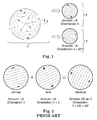
- FIG. 1 is a schematic drawing of a lens pupil in the presence of astigmatism. (Strictly speaking, this is astigmatism balanced by defocus so that RMS wavefront error is minimized.
- FIG. 1 has a given amount of astigmatism corresponding to the fifth and/or sixth Zernike polynomial terms, depending on the orientation of the astigmatism; in FIG. 1 the fourth Zernike term, corresponding to defocus, is zero.
- the wavefront contour map 1 (labeled as "1") shows contours of equal phase in the pupil. In one direction, in this case the direction denoted by angle ⁇ , the wavefront shows a negative curvature. In a direction perpendicular to that denoted by ⁇ , the wavefront shows a positive curvature. At +/- 45° degrees to ⁇ , the wavefront is essentially flat.
- the wavefront contour map 1 may be represented more simply by two equivalent schematic representations 2 and 3 (labeled as "2" and "3", respectively).
- Element 2 shows the pupil having a particular amount of astigmatism, denoted by +A, with an orientation denoted by ⁇ .
- the parallel lines in element 2 act as a guide for the viewer that show the orientation angle of the astigmatism, are not contours of equal phase.
- the "+” signs show regions of increasing phase in the pupil.
- FIG. 2 shows the effects of a rotational misalignment of a known lens that corrects for the astigmatism of a particular cornea.
- the circles in FIG. 2 represent the pupil area of the eye.
- the pupils are shown for simplicity as being circular, but they may include elongations or deformations.
- the pupil areas correspond to physical locations on the anterior and/or posterior surfaces of the intraocular lens, so that the center of the pupil corresponds to the center of the lens surfaces, the edge of the pupil corresponds to the edge of the lens surfaces, and so forth.
- the leftmost circle represents the astigmatism of the cornea of a particular patient's eye.
- the cornea astigmatism may have any particular orientation in the eye, and may deviate significantly from horizontal or vertical.
- the orientation of the cornea astigmatism is represented by an angle ⁇ .
- the magnitude of astigmatism is typically reported in power, usually in diopters.
- astigmatism may be reported as an axial separation between two foci, although this is seldom done for the optics of the eye.
- astigmatism may be reported in terms of wavefront error.
- the power error, the axial separation and the wavefront error may all be related simply to each other, and all are substantially equivalent for the purposes of this discussion.
- the magnitude of the cornea astigmatism is denoted by an amount -A.
- the cornea therefore, has an astigmatism that can be represented by its magnitude ("-A") and its orientation (" ⁇ ").
- a know intraocular lens is shown schematically in the middle circle of FIG. 2 .
- the lens itself has an equal and opposite amount of astigmatism as the cornea, which is denoted by the value +A. If this lens were to be implanted in the eye with its astigmatism precisely oriented to that of the cornea, then the corneal astigmatism would be completely or nearly completely cancelled.
- ⁇ there is usually a small angular error in the orientation that arises during the implantation surgery, which is denoted in FIG. 2 as ⁇ , so that the astigmatism of the lens is oriented at angle ⁇ + ⁇ after implantation.
- This angular error may be kept as small as possible, but may be limited in practice by the skill of the surgeon. While more skilled surgeons may be able to achieve a ⁇ of about 5 degrees, less skilled surgeons may have difficulty meeting this value and may implant lenses with larger angular errors than 5 degrees.
- a typical threshold for astigmatism is 0.25 diopters, so that if the light reaching the retina has less than 0.25 diopters of astigmatism, then the astigmatism does not significantly degrade the vision of the eye.
- the residual astigmatism in the eye may impose a prohibitively tight tolerance on the angular orientation of the lens during implantation, resulting in a tedious and expensive implantation procedure.
- EP 0 949 529 A2 discloses A toric multifocal lens including a plurality of vision correction regions having centers on a common optical center axis, the plurality of vision correction regions providing respective different values of a spherical optical power, each of the plurality of vision correction regions having an optical power for correction of astigmatism, wherein the improvement comprises: at least one of a cylindrical optical power and a cylindrical axis orientation which determine the optical power for correction of astigmatism being different in at least two different vision correction regions of the plurality of vision correction regions, so that the at least two different vision correction regions have respective different values of the optical power for correction of astigmatism.
- WO 03/009053 A1 discloses a contact or intraocular lens comprising a portion for correcting the vision of an astigmatic eye, the lens defining an optical axis and a reference meridian line perpendicular thereto, the lens further having a generally convex anterior face and a generally concave posterior face, wherein one of the anterior or posterior faces is shaped so as to correct for astigmatism in that an optical path through the correcting portion of the lens varies as a function of the angular separation from the reference meridian line, and wherein the correcting portion is divided into at least two sectors having different astigmatism correction axes, the lens further having an angular misalignment tolerance that is increased by at least about 30% over a standard toric lens of the same class.
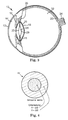
- FIG. 3 is a schematic drawing of a human eye 10, in which the natural lens of the eye has been removed and replaced with an intraocular lens.
- Light enters from the left of FIG. 1 , and passes through the cornea 12, the anterior chamber 14, the iris 16, and enters the capsular bag 18.
- the natural lens occupies essentially the entire interior of the capsular bag 18.
- the capsular bag 18 houses the intraocular lens, in addition to a fluid that occupies the remaining volume and equalizes the pressure in the eye.
- the intraocular lens is described in more detail below.
- the intraocular lens comprises an optic 28 and may include one or more haptics 15 that are attached to the optic 28 and may serve to center the optic 28 in the eye and/or couple the optic 28 to the capsular bag 18 and/or zonular fibers 26 of the eye.
- the optic 28 has an anterior surface 27 and a posterior surface 29, each having a particular shape that contributes to the refractive properties of the lens. Either or both of these lens surfaces may optionally have a diffractive element made integral with or attached to the surfaces.
- the refractive and/or diffractive elements on the anterior and/or posterior surfaces may have anamorphic or toric features that can generate astigmatism. Typically, this astigmatism may be used to offset the astigmatism from a particular cornea in an eye.
- the cornea astigmatism magnitude and orientation may be measured by surface profilometry or by reflected or transmitted wavefront measurements (e.g., using a Hartmann-Shack wavefront sensor, or the like).
- a lens may be selected or fabricated to reduce or at least partially cancel the corneal astigmatism.
- a practitioner may select an intraocular lens from a kit of lenses, with each lens in the kit having a discrete value of astigmatism.
- the astigmatism values in the kit may be in increments of 0.25 diopters, 0.125 diopters, or any suitable value.
- the intraocular lens may be custom-designed and fabricated to offset the cornea astigmatism of a particular patient.
- the intraocular lens has a pupil.
- the pupil of an intraocular lens means the opening of a lens or optic that restricts the extent of a bundle of light rays from a distant source that can imaged or focused by the lens or optic.
- the lens pupil is usually circular and is specified by its diameter.
- the lens pupil represents the full extent of the lens or optic usable for forming the conjugate image of an object or for focusing light from a distant point source to a single focus or to a plurality of predetermined foci, in the case of a multifocal optic or lens.
- the lens pupil has the same or substantially the same diameter as the optic.
- the diameter of the lens pupil may be smaller than the diameter of the optic, for example, due to the presence of a glare or PCO reducing structure disposed about a peripheral region of the optic.
- Many of the figures in this document show an exemplary pupil, when viewed from a position along the optical axis of the lens.
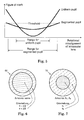
- FIG. 4 is a schematic drawing of the pupil 40 of an embodiment of an intraocular lens.
- the pupil 40 is segmented into two concentric, radial zones.
- Each zone includes the same amount of astigmatism (denoted as amount "A") but with orientations that differ by an angle ⁇ .
- A astigmatism
- ⁇ orientations that differ by an angle ⁇ .
- the orientations of the astigmatisms of the zones may be at " ⁇ - ⁇ /2" and " ⁇ + ⁇ /2".
- the amounts of astigmatism in each zone may be matched to the astigmatism of the cornea of the eye in which the lens is to be implanted. For instance, if the cornea has -2 diopters of astigmatism, then lens 30 may have +2 diopters of astigmatism in each zone. Alternatively, the zones may have powers that differ from that of the cornea and/or that differ from one another. In some embodiments, the lens 30 is part of a catalog or kit that includes lenses having discrete values of astigmatism, where a surgeon or practitioner chooses the amount of lens astigmatism that is closest to the equal and opposite value of the cornea astigmatism.
- the astigmatisms in the two zones have orientations that differ by angle ⁇ .
- the two zones have astigmatism orientations of ⁇ - ⁇ /2 and ⁇ + ⁇ /2.
- the angular separation of the orientations ⁇ may be related to the implantation angular tolerance ⁇ , and may take on values of ⁇ /4, ⁇ /3, ⁇ /2, ⁇ , 2 ⁇ , 3 ⁇ , 4 ⁇ , and so forth. For instance, if the lens is specified to be implanted to within +/- 5°, then the angular separation of the astigmatism orientations ⁇ may be 2.5°, 5° or 10°.
- FIG. 5 is a plot of performance versus rotational misalignment, for lenses having uniform pupils, such as the known lens of FIG. 2 , and having segmented pupils, such as the lens of FIG. 4 .
- the horizontal axis is rotational misalignment, with minima for both curves occurring where the astigmatism of the intraocular lens is rotationally matched to the astigmatism of the cornea.
- the uniform pupil may have a better "optimal" value than the segmented pupil, but the slope away from this "optimal" value is generally larger for the uniform pupil.
- the figure of merit value may increase more slowly for the segmented pupil than for the uniform pupil, and may cross a particular threshold value at a larger rotational misalignment value than the uniform pupil.
- the segmented pupil may have a larger (or more loose) tolerance on rotational misalignment, which can ease the cost and/or difficulty of implantation.
- the vertical axis is figure of merit, which may be any suitable figure of merit used in vision or optics measurements.
- figures of merit that increase away from an optimal (minimum) value include RMS spot size, RMS wavefront error, Zernike polynomial values, wavefront error terms, point spread function dimension(s), or any other suitable figure of merit.
- Other figures of merit may decrease away from an optimal (maximum) value, which is the opposite of the exemplary plot of FIG. 5 .
- One such figure of merit is linear Modulation Transfer Function (MTF) along a particular direction, at a particular spatial frequency, such as 25, 50, or 100 lines pairs per mm.
- MTF Modulation Transfer Function
- Another figure of merit is rotational MTF at a particular rotational frequency, such as 30 circles per degree.
- Another figure of merit that decreases from an optimal maximum value may include Strehl Ratio.
- the overall shape of the lens pupil in FIG. 4 is rotationally symmetric, it is possible to calculate analytically an RMS wavefront error that arises from rotational misalignment of an intraocular lens having such a pupil.
- the following paragraphs provide a non-limiting example of such a calculation.
- the RMS wavefront error is the square root of the wavefront variance, given above.
- each zone has astigmatism oriented at ⁇ i and is bounded by outer radius ⁇ i and inner radius ⁇ i-1 , and ⁇ is the rotational misalignment of the intraocular lens.
- ⁇ W 2 A 2 24 2 ⁇ 2 cos 2 ⁇ ⁇ ⁇ 1 ⁇ 1 6 ⁇ 0 6 + 2 ⁇ 2 cos 2 ⁇ ⁇ ⁇ 2 ⁇ 2 6 ⁇ ⁇ 1 6 + ... + 2 ⁇ 2 cos 2 ⁇ ⁇ ⁇ i ⁇ i 6 ⁇ ⁇ i ⁇ 1 6 + ... + 2 ⁇ 2 cos 2 ⁇ ⁇ ⁇ n 1 6 ⁇ ⁇ n ⁇ 1 6
- An advantage of the segmentation scheme of FIG. 4 in which the lens pupil is segmented into concentric portions, with each portion having the same amount of astigmatism but different orientations for each astigmatism axis, is that the resulting lens becomes less sensitive to rotational misalignment, during and/or after implantation.
- the peak performance of the segmented lens may be less than that of the uniform lens when each lens is optimally aligned; however, the performance of the segmented lens, as a function of rotational misalignment, may deteriorate more slowly than for the uniform lens. For example, as the performance of one segment decreases with rotational misalignment, the performance of the other may increase, wherein the performance of one segment partially offsets the other, thus decreasing sensitivity to rotational misalignment.
- the pupil 40 is divided so that the central zone has a radius equal to roughly half the pupil radius, and an angular separation between astigmatism axes of ⁇ .
- the two zones When optimally aligned to a cornea with astigmatism ⁇ , the two zones have astigmatism orientations of ⁇ +/- ⁇ /2.
- the alignment tolerance ⁇ on the lens may be on the order of ⁇ , with ⁇ being equal to ⁇ or being equal to ⁇ /4, ⁇ /3, ⁇ /2, 2 ⁇ , 3 ⁇ , 4 ⁇ , or any suitable multiplicative factor times ⁇ .
- the pupil 40 is divided so that the central zone has an area that is equal to roughly half the pupil area. Other radius or area ratios between the zones are anticipated in accordance with the particular requirements of a situation or deisign.
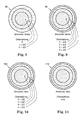
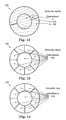
- FIG. 4 In addition to the geometry of FIG. 4 , there are other possible geometries, shown in FIGs. 6-14 , and described in a non-limiting way in the text that follows.
- the central zone may have a radius greater than half the radius of the full pupil.
- the astigmatism amounts are the same in each zone, and the astigmatism orientations are angularly separated by ⁇ .
- the central zone may also have a radius less than half the radius of the full pupil.
- the astigmatism amounts may be different in the central and outer zones.
- the astigmatism amounts may be the same in all three zones.
- the astigmatism amounts may be the different in one or more zones, or different in all the zones.
- the astigmatism orientations may be different in all three zones, for example, with the orientation in one zone falling halfway between the orientations in the remaining two zones. In some embodiments, the orientation of the zones may be selected depending on the amount of astigmatism in each zone.
- the pupil 90 of FIG. 9 there are four concentric zones.
- the astigmatism amounts are the same in all four zones.
- the astigmatism orientations alternate between ⁇ + ⁇ /2 and ⁇ - ⁇ /2, when aligned to a cornea having an astigmatism orientation of ⁇ .
- the astigmatism amounts vary from zone-to-zone.
- the four zones may all have different astigmatism amounts, or at least one zone may have the same astigmatism amount as another zone.
- both the astigmatism amounts and the astigmatism orientations may vary from zone-to-zone.
- the four zones may all have different astigmatism orientations, or at least one zone may have the same astigmatism orientation as another zone.
- the astigmatism amounts and/or orientations may be the same in all the zones, may be different in at least two zones, or may be different in all the zones.
- the lens pupil may optionally have one or more of the concentric zones further divided into one or more azimuthal zones.
- the pupil 120 in FIG. 12 has a central zone, surrounded on one side by one azimuthal zone and on the opposite side by a second azimuthal zone.
- the zones may all have the same astigmatism amounts.
- the two azimuthal zones in pupil 120 have astigmatism orientations that differ from each other by angle ⁇ and differ from the central zone by ⁇ /2.
- the astigmatism orientations of the azimuthal zones may have any particular orientation with respect to the central zone and to each other. Note that in FIG. 12 the boundary between the azimuthal zones is aligned with the astigmatism orientation in the central zone. Alternatively, this boundary may be at an angle to the astigmatism orientation in the central zone.
- the astigmatism amounts are the same in all the zones, and the astigmatism orientations may be different in one or more zones.
- the azimuthal zones of pupil 130 all subtend the same azimuthal angle.
- one or more azimuthal zones may subtend a different azimuthal angle from any another azimuthal zone.
- both the astigmatism amounts and the astigmatism orientations may differ from zone-to-zone.
- a particular zone may be elliptical, or elongated in a particular dimension.
- a particular zone may be spiral-shaped, have a straight or curved edge, have one or more corners, or may be any other suitable shape.
- the lens pupils shown schematically herein show only the spatial locations (x, y) of lens astigmatism amounts and orientations.
- the source of this lens astigmatism may be any combination of a toric or anamorphic anterior refractive surface, a toric or anamorphic posterior refractive surface, and a diffractive element made integral with or attached to the anterior surface and/or the posterior surface.
- the toric or anamorphic surfaces may have a cross-section that may be spherical in shape, or may optionally have aspheric terms and/or a non-zero conic constant.
- a lens comprises more zones than those illustrated in FIGS. 4-14 .
- portions of the lens or the entire lens may be configured so that the orientation of an astigmatism varies continuously between adjacent zone.
- embodiments of the present invention have been directed to intraocular lenses; however, other types of lenses and ophthalmic lenses are anticipated.
- embodiments of the present invention may be incorporated into contact lenses, corneal inlays, spectacles, or any suitable ophthalmic lens.
- embodiments of the present invention may be incorporated various types of ophthalmic lenses, for example, single-focus (monofocal) lenses, refractive lenses, diffractive lenses, dual-focus or bifocal lenses (refractive and/or diffractive), multifocal lenses (refractive and/or diffractive), or accommodating lenses move or change shape in order to provide varying amounts of diopter power.
Landscapes
- Health & Medical Sciences (AREA)
- Ophthalmology & Optometry (AREA)
- Physics & Mathematics (AREA)
- General Health & Medical Sciences (AREA)
- Optics & Photonics (AREA)
- General Physics & Mathematics (AREA)
- Engineering & Computer Science (AREA)
- Veterinary Medicine (AREA)
- Vascular Medicine (AREA)
- Life Sciences & Earth Sciences (AREA)
- Animal Behavior & Ethology (AREA)
- Biomedical Technology (AREA)
- Public Health (AREA)
- Heart & Thoracic Surgery (AREA)
- Transplantation (AREA)
- Oral & Maxillofacial Surgery (AREA)
- Cardiology (AREA)
- Mathematical Physics (AREA)
- Prostheses (AREA)
- Eyeglasses (AREA)
Claims (10)
- Mehrzonale optische Linse mit einer Pupille, die Pupille aufweisend:eine erste Zone mit einem ersten Astigmatismus, wobei der erste Astigmatismus eine erste Größe von Astigmatismus und eine erste Ausrichtung von Astigmatismus hat; undeine zweite Zone, welche die erste Zone umgibt und einen zweiten Astigmatismus hat, wobei der zweite Astigmatismus eine zweite Ausrichtung von Astigmatismus hat, die sich von der ersten Ausrichtung von Astigmatismus unterscheidet;eine durchschnittliche Ausrichtungsachse von Astigmatismus aller Zonen der optischen Linse, wobei die durchschnittliche Achse gestaltet ist, mit einer Achse von Astigmatismus eines Auges ausgerichtet zu sein, wobei die Achse von Astigmatismus des Auges eine konstante Größe und Ausrichtung hat;dadurch gekennzeichnet, dassder zweite Astigmatismus eine zweite Größe von Astigmatismus, gleich der ersten Größe von Astigmatismus, hat,wobei, wenn die optische Linse im Auge angeordnet ist, die optische Linse weniger empfindlich für eine Rotationsfehlausrichtung zwischen der durchschnittlichen Achse und der Achse von Astigmatismus des Auges ist als eine Referenzoptik mit einer ersten und zweiten Zone, welche gleich der ersten und zweiten Zone der optischen Linse sind, außer dass die erste und zweite Zone der Referenzoptik eine gleiche Ausrichtung von Astigmatismus haben.
- Multizonale optische Linse nach Anspruch 1, wobei die erste und zweite Zone kreisförmig und konzentrisch sind.
- Multizonale optische Linse nach Anspruch 1, wobei die erste Zone die Mitte der Pupille enthält und die zweite Zone sich von der ersten Zone zu den Kanten der Pupille erstreckt.
- Multizonale optische Linse nach Anspruch 1, die Pupille des Weiteren aufweisend eine dritte Zone, welche die zweite Zone umgibt und einen dritten Astigmatismus hat, wobei der dritte Astigmatismus eine dritte Größe von Astigmatismus und eine dritte Ausrichtung von Astigmatismus hat, wobei, wenn die optische Linse im Auge angeordnet ist, die optische Linse weniger empfindlich für eine Rotationsfehlausrichtung zwischen der durchschnittlichen Achse und der Achse von Astigmatismus des Auges ist als die Referenzoptik, wobei die Referenzoptik eine dritte Zone gleich der dritten Zone der optischen Linse aufweist, außer, dass die dritte Zone der Referenzoptik eine selbe Ausrichtung von Astigmatismus hat wie die erste und zweite Zone der Referenzoptik.
- Multizonale optische Linse nach Anspruch 4,
wobei die erste, zweite und dritte Größe von Astigmatismus alle gleich sind; und
wobei die erste und dritte Ausrichtung von Astigmatismus gleich und verschieden von der zweiten Ausrichtung von Astigmatismus sind. - Multizonale optische Linse nach Anspruch 4,
wobei die erste, zweite und dritte Größe von Astigmatismus gleich sind; und
wobei die erste, zweite und dritte Ausrichtung von Astigmatismus alle verschieden sind. - Multizonale optische Linse nach Anspruch 4, die Pupille des Weiteren aufweisend eine vierte Zone, welche die dritte Zone umgibt und einen vierten Astigmatismus hat, wobei der Astigmatismus eine vierte Größe von Astigmatismus und eine vierte Ausrichtung von Astigmatismus hat, wobei, wenn die optische Linse im Auge angeordnet ist, die optische Linse weniger empfindlich für eine Rotationsfehlausrichtung zwischen der durchschnittlichen Achse und der Achse von Astigmatismus des Auges ist als die Referenzoptik, wobei die Referenzoptik eine dritte und vierte Zone gleich der dritten und vierten Zonen der optischen Linse aufweist, außer dass die dritte und vierte Zone der Referenzoptik eine selbe Ausrichtung von Astigmatismus haben wie die erste und zweite Zone der Referenzoptik.
- Multizonale optische Linse nach Anspruch 7,
wobei die erste, zweite, dritte und vierte Größe von Astigmatismus alle gleich sind; und
wobei die erste und dritte Ausrichtung von Astigmatismus gleich sind; und
wobei die zweite und vierte Ausrichtung von Astigmatismus gleich und verschieden von der ersten und dritten Ausrichtung von Astigmatismus sind. - Multizonale optische Linse nach Anspruch 7,
wobei die erste, zweite, dritte und vierte Größe von Astigmatismus alle gleich sind; und
wobei die erste, zweite, dritte und vierte Ausrichtung von Astigmatismus alle verschieden sind. - Multizonale optische Linse nach Anspruch 1, wobei die zweite Zone eine erste azimutale Zone und eine zweite azimutale Zone aufweist, wobei die erste und zweite azimutale Zone Astigmatismen von untereinander gleichen Größen und gleich der ersten Größe von Astigmatismus und untereinander unterschiedliche Ausrichtungen und verschieden von der ersten Ausrichtung von Astigmatismus haben.
Applications Claiming Priority (2)
| Application Number | Priority Date | Filing Date | Title |
|---|---|---|---|
| US12/035,370 US7780290B2 (en) | 2008-02-21 | 2008-02-21 | Toric intraocular lens with spatially-variant astigmatism |
| PCT/US2009/034555 WO2009105567A1 (en) | 2008-02-21 | 2009-02-19 | Toric intraocular lens with spatially-variant astigmatism |
Publications (2)
| Publication Number | Publication Date |
|---|---|
| EP2245501A1 EP2245501A1 (de) | 2010-11-03 |
| EP2245501B1 true EP2245501B1 (de) | 2016-09-07 |
Family
ID=40513720
Family Applications (1)
| Application Number | Title | Priority Date | Filing Date |
|---|---|---|---|
| EP09713653.5A Active EP2245501B1 (de) | 2008-02-21 | 2009-02-19 | Torische kontaktlinse mit räumlich unterschiedlichem astigmatismus |
Country Status (5)
| Country | Link |
|---|---|
| US (3) | US7780290B2 (de) |
| EP (1) | EP2245501B1 (de) |
| AU (1) | AU2009215513B2 (de) |
| CA (1) | CA2716243C (de) |
| WO (1) | WO2009105567A1 (de) |
Families Citing this family (21)
| Publication number | Priority date | Publication date | Assignee | Title |
|---|---|---|---|---|
| US7628810B2 (en) | 2003-05-28 | 2009-12-08 | Acufocus, Inc. | Mask configured to maintain nutrient transport without producing visible diffraction patterns |
| US10004593B2 (en) | 2009-08-13 | 2018-06-26 | Acufocus, Inc. | Intraocular lens with elastic mask |
| ES2970433T3 (es) | 2009-08-13 | 2024-05-28 | Acufocus Inc | Método de fabricación de implantes intraoculares con máscara y lentes |
| US9638836B1 (en) | 2011-08-17 | 2017-05-02 | Lockheed Martin Corporation | Lenses having astigmatism correcting inside reflective surface |
| US9545303B2 (en) | 2011-12-02 | 2017-01-17 | Acufocus, Inc. | Ocular mask having selective spectral transmission |
| AU2015268675B2 (en) * | 2012-02-28 | 2016-09-29 | Johnson & Johnson Vision Care, Inc. | Multi-axis lens design for astigmatism |
| AU2016225918B2 (en) * | 2012-02-28 | 2018-01-04 | Johnson & Johnson Vision Care, Inc. | Multi-axis lens design for astigmatism |
| US9046698B2 (en) * | 2012-02-28 | 2015-06-02 | Johnson & Johnson Vision Care, Inc. | Multi-axis lens design for astigmatism |
| US20140121767A1 (en) * | 2012-10-31 | 2014-05-01 | Novartis Ag | Method and system for providing a toric intraocular lens |
| US8974055B2 (en) | 2013-03-15 | 2015-03-10 | Johnson & Johnson Vision Care, Inc. | Method and apparatus for encapsulating a rigid insert in a contact lens for correcting vision in astigmatic patients |
| EP3118671B1 (de) * | 2014-03-11 | 2022-03-23 | Kowa Company Ltd. | Ophthalmische linsen und verfahren zum entwurf ophthalmischer linsen |
| WO2017062316A1 (en) | 2015-10-05 | 2017-04-13 | Acufocus, Inc. | Methods of molding intraocular lenses |
| KR102407311B1 (ko) | 2015-11-24 | 2022-06-10 | 아큐포커스, 인크. | 연장된 초점 깊이를 가진 원환형 작은 구멍의 안내 렌즈 |
| WO2017165679A1 (en) | 2016-03-23 | 2017-09-28 | Abbott Medical Optics Inc. | Ophthalmic apparatus with corrective meridians having extended tolerance band with freeform refractive surfaces |
| EP3932368B1 (de) | 2016-03-23 | 2025-02-26 | Johnson & Johnson Surgical Vision, Inc. | Ophthalmische vorrichtung mit korrekturmeridianen mit erweitertem toleranzband |
| AU2017352030B2 (en) | 2016-10-25 | 2023-03-23 | Amo Groningen B.V. | Realistic eye models to design and evaluate intraocular lenses for a large field of view |
| US10739227B2 (en) | 2017-03-23 | 2020-08-11 | Johnson & Johnson Surgical Vision, Inc. | Methods and systems for measuring image quality |
| CA3082053A1 (en) | 2017-11-30 | 2019-06-06 | Amo Groningen B.V. | Intraocular lenses that improve post-surgical spectacle independent and methods of manufacturing thereof |
| EP3790508A4 (de) | 2018-05-09 | 2022-02-09 | AcuFocus, Inc. | Intraokulares implantat mit entfernbarer optik |
| EP4333685B1 (de) | 2021-05-05 | 2026-01-14 | AMO Groningen B.V. | Ringhalometersystem und verfahren zur quantifizierung von dysphotopsien |
| US20230404742A1 (en) * | 2022-05-25 | 2023-12-21 | Biotech Vision Care Pvt. Ltd. | Novel refractive edof intraocular lens for continuous vision |
Family Cites Families (18)
| Publication number | Priority date | Publication date | Assignee | Title |
|---|---|---|---|---|
| US4778462A (en) * | 1987-08-24 | 1988-10-18 | Grendahl Dennis T | Multiple element zone of focus artificial lens |
| US4798609A (en) * | 1987-08-24 | 1989-01-17 | Grendahl Dennis T | Radially segmented zone of focus artificial lens |
| US4795462A (en) * | 1987-08-24 | 1989-01-03 | Grendahl Dennis T | Cylindrically segmented zone of focus artificial lens |
| US4798608A (en) * | 1987-08-24 | 1989-01-17 | Grendahl Dennis T | Laminated zone of focus artificial lens |
| US4932970A (en) * | 1988-05-17 | 1990-06-12 | Allergan, Inc. | Ophthalmic lens |
| US5066301A (en) * | 1990-10-09 | 1991-11-19 | Wiley Robert G | Variable focus lens |
| US5570143A (en) | 1991-08-09 | 1996-10-29 | Capricornia Contact Lens Pty. Ltd. | Toric lens with axis mislocation latitude |
| US5652638A (en) * | 1995-05-04 | 1997-07-29 | Johnson & Johnson Vision Products, Inc. | Concentric annular ring lens designs for astigmatism |
| IL118065A0 (en) * | 1995-05-04 | 1996-08-04 | Johnson & Johnson Vision Prod | Aspheric toric lens designs |
| PT900403E (pt) | 1996-03-21 | 2003-10-31 | Sola Int Holdings | Lentes monovisao aperfeicoadas |
| JP4023902B2 (ja) * | 1998-04-10 | 2007-12-19 | 株式会社メニコン | トーリック・マルチフォーカルレンズ |
| US6491721B2 (en) | 1998-04-15 | 2002-12-10 | Alcon Manufacturing, Ltd. | Toric intraocular lens material |
| AU5545699A (en) | 1998-08-06 | 2000-02-28 | John B. W. Lett | Multifocal aspheric lens |
| EP1147448A4 (de) | 1998-12-16 | 2008-12-10 | Novartis Ag | Multifokale kontaktlinsen mit aspherischer oberfläche |
| US6533416B1 (en) | 2001-07-20 | 2003-03-18 | Ocular Sciences, Inc. | Contact or intraocular lens and method for its preparation |
| US6923540B2 (en) | 2002-07-31 | 2005-08-02 | Novartis Ag | Toric multifocal contact lenses |
| US6986578B2 (en) | 2003-01-30 | 2006-01-17 | Johnson & Johnson Vision Care, Inc. | Multifocal ophthalmic lenses |
| US6923539B2 (en) | 2003-05-12 | 2005-08-02 | Alcon, Inc. | Aspheric lenses |
-
2008
- 2008-02-21 US US12/035,370 patent/US7780290B2/en active Active
-
2009
- 2009-02-19 CA CA2716243A patent/CA2716243C/en active Active
- 2009-02-19 AU AU2009215513A patent/AU2009215513B2/en active Active
- 2009-02-19 WO PCT/US2009/034555 patent/WO2009105567A1/en not_active Ceased
- 2009-02-19 EP EP09713653.5A patent/EP2245501B1/de active Active
-
2010
- 2010-07-19 US US12/839,241 patent/US8215771B2/en not_active Expired - Fee Related
-
2012
- 2012-07-09 US US13/544,593 patent/US8562131B2/en active Active
Also Published As
| Publication number | Publication date |
|---|---|
| WO2009105567A1 (en) | 2009-08-27 |
| AU2009215513A1 (en) | 2009-08-27 |
| US7780290B2 (en) | 2010-08-24 |
| CA2716243C (en) | 2016-08-09 |
| AU2009215513B2 (en) | 2014-06-26 |
| US20120281182A1 (en) | 2012-11-08 |
| EP2245501A1 (de) | 2010-11-03 |
| US20110170057A1 (en) | 2011-07-14 |
| US20090213326A1 (en) | 2009-08-27 |
| US8562131B2 (en) | 2013-10-22 |
| CA2716243A1 (en) | 2009-08-27 |
| US8215771B2 (en) | 2012-07-10 |
Similar Documents
| Publication | Publication Date | Title |
|---|---|---|
| EP2245501B1 (de) | Torische kontaktlinse mit räumlich unterschiedlichem astigmatismus | |
| US9456894B2 (en) | Toric intraocular lens with modified power characteristics | |
| US11633274B2 (en) | Intraocular lens system | |
| US9216080B2 (en) | Toric lens with decreased sensitivity to cylinder power and rotation and method of using the same | |
| AU2011343581B2 (en) | Ophthalmic lens, systems and methods having at least one rotationally asymmetric diffractive structure | |
| US8894204B2 (en) | Ophthalmic lens, systems and methods having at least one rotationally asymmetric diffractive structure | |
| CN105659152B (zh) | 用于矫正散光的眼镜镜片 |
Legal Events
| Date | Code | Title | Description |
|---|---|---|---|
| PUAI | Public reference made under article 153(3) epc to a published international application that has entered the european phase |
Free format text: ORIGINAL CODE: 0009012 |
|
| 17P | Request for examination filed |
Effective date: 20100818 |
|
| AK | Designated contracting states |
Kind code of ref document: A1 Designated state(s): AT BE BG CH CY CZ DE DK EE ES FI FR GB GR HR HU IE IS IT LI LT LU LV MC MK MT NL NO PL PT RO SE SI SK TR |
|
| AX | Request for extension of the european patent |
Extension state: AL BA RS |
|
| DAX | Request for extension of the european patent (deleted) | ||
| RAP1 | Party data changed (applicant data changed or rights of an application transferred) |
Owner name: ABBOTT MEDICAL OPTICS INC. |
|
| 17Q | First examination report despatched |
Effective date: 20150225 |
|
| GRAP | Despatch of communication of intention to grant a patent |
Free format text: ORIGINAL CODE: EPIDOSNIGR1 |
|
| INTG | Intention to grant announced |
Effective date: 20160331 |
|
| GRAS | Grant fee paid |
Free format text: ORIGINAL CODE: EPIDOSNIGR3 |
|
| GRAA | (expected) grant |
Free format text: ORIGINAL CODE: 0009210 |
|
| AK | Designated contracting states |
Kind code of ref document: B1 Designated state(s): AT BE BG CH CY CZ DE DK EE ES FI FR GB GR HR HU IE IS IT LI LT LU LV MC MK MT NL NO PL PT RO SE SI SK TR |
|
| REG | Reference to a national code |
Ref country code: GB Ref legal event code: FG4D |
|
| RIN1 | Information on inventor provided before grant (corrected) |
Inventor name: ZHAO, HUAWEI |
|
| REG | Reference to a national code |
Ref country code: CH Ref legal event code: EP |
|
| REG | Reference to a national code |
Ref country code: IE Ref legal event code: FG4D |
|
| REG | Reference to a national code |
Ref country code: DE Ref legal event code: R096 Ref document number: 602009040932 Country of ref document: DE |
|
| REG | Reference to a national code |
Ref country code: AT Ref legal event code: REF Ref document number: 827360 Country of ref document: AT Kind code of ref document: T Effective date: 20161015 |
|
| REG | Reference to a national code |
Ref country code: NL Ref legal event code: FP |
|
| REG | Reference to a national code |
Ref country code: LT Ref legal event code: MG4D |
|
| REG | Reference to a national code |
Ref country code: FR Ref legal event code: PLFP Year of fee payment: 9 |
|
| PG25 | Lapsed in a contracting state [announced via postgrant information from national office to epo] |
Ref country code: HR Free format text: LAPSE BECAUSE OF FAILURE TO SUBMIT A TRANSLATION OF THE DESCRIPTION OR TO PAY THE FEE WITHIN THE PRESCRIBED TIME-LIMIT Effective date: 20160907 Ref country code: FI Free format text: LAPSE BECAUSE OF FAILURE TO SUBMIT A TRANSLATION OF THE DESCRIPTION OR TO PAY THE FEE WITHIN THE PRESCRIBED TIME-LIMIT Effective date: 20160907 Ref country code: NO Free format text: LAPSE BECAUSE OF FAILURE TO SUBMIT A TRANSLATION OF THE DESCRIPTION OR TO PAY THE FEE WITHIN THE PRESCRIBED TIME-LIMIT Effective date: 20161207 Ref country code: LT Free format text: LAPSE BECAUSE OF FAILURE TO SUBMIT A TRANSLATION OF THE DESCRIPTION OR TO PAY THE FEE WITHIN THE PRESCRIBED TIME-LIMIT Effective date: 20160907 |
|
| REG | Reference to a national code |
Ref country code: AT Ref legal event code: MK05 Ref document number: 827360 Country of ref document: AT Kind code of ref document: T Effective date: 20160907 |
|
| PG25 | Lapsed in a contracting state [announced via postgrant information from national office to epo] |
Ref country code: SE Free format text: LAPSE BECAUSE OF FAILURE TO SUBMIT A TRANSLATION OF THE DESCRIPTION OR TO PAY THE FEE WITHIN THE PRESCRIBED TIME-LIMIT Effective date: 20160907 Ref country code: LV Free format text: LAPSE BECAUSE OF FAILURE TO SUBMIT A TRANSLATION OF THE DESCRIPTION OR TO PAY THE FEE WITHIN THE PRESCRIBED TIME-LIMIT Effective date: 20160907 Ref country code: GR Free format text: LAPSE BECAUSE OF FAILURE TO SUBMIT A TRANSLATION OF THE DESCRIPTION OR TO PAY THE FEE WITHIN THE PRESCRIBED TIME-LIMIT Effective date: 20161208 Ref country code: ES Free format text: LAPSE BECAUSE OF FAILURE TO SUBMIT A TRANSLATION OF THE DESCRIPTION OR TO PAY THE FEE WITHIN THE PRESCRIBED TIME-LIMIT Effective date: 20160907 |
|
| PG25 | Lapsed in a contracting state [announced via postgrant information from national office to epo] |
Ref country code: EE Free format text: LAPSE BECAUSE OF FAILURE TO SUBMIT A TRANSLATION OF THE DESCRIPTION OR TO PAY THE FEE WITHIN THE PRESCRIBED TIME-LIMIT Effective date: 20160907 Ref country code: RO Free format text: LAPSE BECAUSE OF FAILURE TO SUBMIT A TRANSLATION OF THE DESCRIPTION OR TO PAY THE FEE WITHIN THE PRESCRIBED TIME-LIMIT Effective date: 20160907 |
|
| PG25 | Lapsed in a contracting state [announced via postgrant information from national office to epo] |
Ref country code: AT Free format text: LAPSE BECAUSE OF FAILURE TO SUBMIT A TRANSLATION OF THE DESCRIPTION OR TO PAY THE FEE WITHIN THE PRESCRIBED TIME-LIMIT Effective date: 20160907 Ref country code: IS Free format text: LAPSE BECAUSE OF FAILURE TO SUBMIT A TRANSLATION OF THE DESCRIPTION OR TO PAY THE FEE WITHIN THE PRESCRIBED TIME-LIMIT Effective date: 20170107 Ref country code: PL Free format text: LAPSE BECAUSE OF FAILURE TO SUBMIT A TRANSLATION OF THE DESCRIPTION OR TO PAY THE FEE WITHIN THE PRESCRIBED TIME-LIMIT Effective date: 20160907 Ref country code: BE Free format text: LAPSE BECAUSE OF FAILURE TO SUBMIT A TRANSLATION OF THE DESCRIPTION OR TO PAY THE FEE WITHIN THE PRESCRIBED TIME-LIMIT Effective date: 20160907 Ref country code: SK Free format text: LAPSE BECAUSE OF FAILURE TO SUBMIT A TRANSLATION OF THE DESCRIPTION OR TO PAY THE FEE WITHIN THE PRESCRIBED TIME-LIMIT Effective date: 20160907 Ref country code: CZ Free format text: LAPSE BECAUSE OF FAILURE TO SUBMIT A TRANSLATION OF THE DESCRIPTION OR TO PAY THE FEE WITHIN THE PRESCRIBED TIME-LIMIT Effective date: 20160907 Ref country code: PT Free format text: LAPSE BECAUSE OF FAILURE TO SUBMIT A TRANSLATION OF THE DESCRIPTION OR TO PAY THE FEE WITHIN THE PRESCRIBED TIME-LIMIT Effective date: 20170109 Ref country code: BG Free format text: LAPSE BECAUSE OF FAILURE TO SUBMIT A TRANSLATION OF THE DESCRIPTION OR TO PAY THE FEE WITHIN THE PRESCRIBED TIME-LIMIT Effective date: 20161207 |
|
| REG | Reference to a national code |
Ref country code: DE Ref legal event code: R097 Ref document number: 602009040932 Country of ref document: DE |
|
| PG25 | Lapsed in a contracting state [announced via postgrant information from national office to epo] |
Ref country code: IT Free format text: LAPSE BECAUSE OF FAILURE TO SUBMIT A TRANSLATION OF THE DESCRIPTION OR TO PAY THE FEE WITHIN THE PRESCRIBED TIME-LIMIT Effective date: 20160907 |
|
| PLBE | No opposition filed within time limit |
Free format text: ORIGINAL CODE: 0009261 |
|
| STAA | Information on the status of an ep patent application or granted ep patent |
Free format text: STATUS: NO OPPOSITION FILED WITHIN TIME LIMIT |
|
| PG25 | Lapsed in a contracting state [announced via postgrant information from national office to epo] |
Ref country code: DK Free format text: LAPSE BECAUSE OF FAILURE TO SUBMIT A TRANSLATION OF THE DESCRIPTION OR TO PAY THE FEE WITHIN THE PRESCRIBED TIME-LIMIT Effective date: 20160907 |
|
| 26N | No opposition filed |
Effective date: 20170608 |
|
| PG25 | Lapsed in a contracting state [announced via postgrant information from national office to epo] |
Ref country code: SI Free format text: LAPSE BECAUSE OF FAILURE TO SUBMIT A TRANSLATION OF THE DESCRIPTION OR TO PAY THE FEE WITHIN THE PRESCRIBED TIME-LIMIT Effective date: 20160907 |
|
| PG25 | Lapsed in a contracting state [announced via postgrant information from national office to epo] |
Ref country code: MC Free format text: LAPSE BECAUSE OF FAILURE TO SUBMIT A TRANSLATION OF THE DESCRIPTION OR TO PAY THE FEE WITHIN THE PRESCRIBED TIME-LIMIT Effective date: 20160907 |
|
| REG | Reference to a national code |
Ref country code: IE Ref legal event code: MM4A |
|
| PG25 | Lapsed in a contracting state [announced via postgrant information from national office to epo] |
Ref country code: LU Free format text: LAPSE BECAUSE OF NON-PAYMENT OF DUE FEES Effective date: 20170219 |
|
| REG | Reference to a national code |
Ref country code: FR Ref legal event code: PLFP Year of fee payment: 10 |
|
| REG | Reference to a national code |
Ref country code: CH Ref legal event code: NV Representative=s name: E. BLUM AND CO. AG PATENT- UND MARKENANWAELTE , CH |
|
| PG25 | Lapsed in a contracting state [announced via postgrant information from national office to epo] |
Ref country code: IE Free format text: LAPSE BECAUSE OF NON-PAYMENT OF DUE FEES Effective date: 20170219 |
|
| PG25 | Lapsed in a contracting state [announced via postgrant information from national office to epo] |
Ref country code: MT Free format text: LAPSE BECAUSE OF NON-PAYMENT OF DUE FEES Effective date: 20170219 |
|
| REG | Reference to a national code |
Ref country code: CH Ref legal event code: PFA Owner name: JOHNSON AND JOHNSON SURGICAL VISION, INC., US Free format text: FORMER OWNER: ABBOTT MEDICAL OPTICS INC., US |
|
| REG | Reference to a national code |
Ref country code: DE Ref legal event code: R081 Ref document number: 602009040932 Country of ref document: DE Owner name: JOHNSON & JOHNSON SURGICAL VISION, INC., IRVIN, US Free format text: FORMER OWNER: ABBOTT MEDICAL OPTICS INC., SANTA ANA, CALIF., US Ref country code: DE Ref legal event code: R081 Ref document number: 602009040932 Country of ref document: DE Owner name: JOHNSON & JOHNSON SURGICAL VISION, INC. (N. D., US Free format text: FORMER OWNER: ABBOTT MEDICAL OPTICS INC., SANTA ANA, CALIF., US |
|
| REG | Reference to a national code |
Ref country code: NL Ref legal event code: HC Owner name: JOHNSON & JOHNSON SURGICAL VISION, INC.; US Free format text: DETAILS ASSIGNMENT: CHANGE OF OWNER(S), CHANGE OF OWNER(S) NAME; FORMER OWNER NAME: ABBOTT MEDICAL OPTICS INC. Effective date: 20181204 |
|
| PG25 | Lapsed in a contracting state [announced via postgrant information from national office to epo] |
Ref country code: HU Free format text: LAPSE BECAUSE OF FAILURE TO SUBMIT A TRANSLATION OF THE DESCRIPTION OR TO PAY THE FEE WITHIN THE PRESCRIBED TIME-LIMIT; INVALID AB INITIO Effective date: 20090219 |
|
| PG25 | Lapsed in a contracting state [announced via postgrant information from national office to epo] |
Ref country code: CY Free format text: LAPSE BECAUSE OF NON-PAYMENT OF DUE FEES Effective date: 20160907 |
|
| PG25 | Lapsed in a contracting state [announced via postgrant information from national office to epo] |
Ref country code: MK Free format text: LAPSE BECAUSE OF FAILURE TO SUBMIT A TRANSLATION OF THE DESCRIPTION OR TO PAY THE FEE WITHIN THE PRESCRIBED TIME-LIMIT Effective date: 20160907 |
|
| PG25 | Lapsed in a contracting state [announced via postgrant information from national office to epo] |
Ref country code: TR Free format text: LAPSE BECAUSE OF FAILURE TO SUBMIT A TRANSLATION OF THE DESCRIPTION OR TO PAY THE FEE WITHIN THE PRESCRIBED TIME-LIMIT Effective date: 20160907 |
|
| PGFP | Annual fee paid to national office [announced via postgrant information from national office to epo] |
Ref country code: CH Payment date: 20220114 Year of fee payment: 14 |
|
| PGFP | Annual fee paid to national office [announced via postgrant information from national office to epo] |
Ref country code: FR Payment date: 20220118 Year of fee payment: 14 |
|
| REG | Reference to a national code |
Ref country code: DE Ref legal event code: R081 Ref document number: 602009040932 Country of ref document: DE Owner name: JOHNSON & JOHNSON SURGICAL VISION, INC., IRVIN, US Free format text: FORMER OWNER: JOHNSON & JOHNSON SURGICAL VISION, INC. (N. D. GES. D. STAATES DELAWARE), SANTA ANA, CA, US |
|
| PGFP | Annual fee paid to national office [announced via postgrant information from national office to epo] |
Ref country code: GB Payment date: 20221230 Year of fee payment: 15 |
|
| PGFP | Annual fee paid to national office [announced via postgrant information from national office to epo] |
Ref country code: NL Payment date: 20230113 Year of fee payment: 15 |
|
| REG | Reference to a national code |
Ref country code: CH Ref legal event code: PL |
|
| PG25 | Lapsed in a contracting state [announced via postgrant information from national office to epo] |
Ref country code: LI Free format text: LAPSE BECAUSE OF NON-PAYMENT OF DUE FEES Effective date: 20230228 Ref country code: CH Free format text: LAPSE BECAUSE OF NON-PAYMENT OF DUE FEES Effective date: 20230228 |
|
| PG25 | Lapsed in a contracting state [announced via postgrant information from national office to epo] |
Ref country code: FR Free format text: LAPSE BECAUSE OF NON-PAYMENT OF DUE FEES Effective date: 20230228 |
|
| REG | Reference to a national code |
Ref country code: NL Ref legal event code: MM Effective date: 20240301 |
|
| GBPC | Gb: european patent ceased through non-payment of renewal fee |
Effective date: 20240219 |
|
| PG25 | Lapsed in a contracting state [announced via postgrant information from national office to epo] |
Ref country code: NL Free format text: LAPSE BECAUSE OF NON-PAYMENT OF DUE FEES Effective date: 20240301 |
|
| PG25 | Lapsed in a contracting state [announced via postgrant information from national office to epo] |
Ref country code: NL Free format text: LAPSE BECAUSE OF NON-PAYMENT OF DUE FEES Effective date: 20240301 |
|
| PG25 | Lapsed in a contracting state [announced via postgrant information from national office to epo] |
Ref country code: GB Free format text: LAPSE BECAUSE OF NON-PAYMENT OF DUE FEES Effective date: 20240219 |
|
| PG25 | Lapsed in a contracting state [announced via postgrant information from national office to epo] |
Ref country code: GB Free format text: LAPSE BECAUSE OF NON-PAYMENT OF DUE FEES Effective date: 20240219 |
|
| PGFP | Annual fee paid to national office [announced via postgrant information from national office to epo] |
Ref country code: DE Payment date: 20241231 Year of fee payment: 17 |